Curbing Their Enthusiasm : Conservatives Souring on Sarah

Gov. Sarah Palin walks along the grounds of the United Nations with Katie Couric on Wednesday.

Conservative columnist Kathleen Parker’s call for Palin to withdraw a ‘watershed moment’
By Kate Phillips / September 26, 2008

The drip, drip, drip of bad reviews keep falling this week against Gov. Sarah Palin, whose two-day segments of interviews with CBS’ Katie Couric have weakened conservatives’ initial embrace and enthusiasm for the vice-presidential nominee. As if Senator John McCain already hadn’t faced a rough week, which started with conservative columnist George Will bemoaning the Republican candidate’s positions on the economic bailout and suggesting Mr. McCain may be unfit to be president.

Now, conservatives have never warmed to Senator McCain this time around, but they were wowed by Mr. McCain’s selection of Ms. Palin as his running mate and at first, circled the wagons to defend her, despite her lack of foreign policy experience. She talked their values and represented small-town America, something neither ticket had offered to anyone before she surfaced.

But it seems a watershed moment occurred online earlier today when Kathleen Parker, a writer for TownHall.com, reversed her initial support for the Republican vice-presidential nominee and said Ms. Palin should drop out. Put the country first, she basically advised, by saying you need to go take care of your family first.

In a devastating assessment, Ms. Parker writes:

Palin didn’t make a mess cracking the glass ceiling. She simply glided through it.

It was fun while it lasted.

Palin’s recent interviews with Charles Gibson, Sean Hannity, and now Katie Couric have all revealed an attractive, earnest, confident candidate. Who Is Clearly Out Of Her League.

No one hates saying that more than I do. Like so many women, I’ve been pulling for Palin, wishing her the best, hoping she will perform brilliantly. I’ve also noticed that I watch her interviews with the held breath of an anxious parent, my finger poised over the mute button in case it gets too painful. Unfortunately, it often does. My cringe reflex is exhausted.

And then Ms. Parker winds it up, turning the backlash against women who criticize women on its head:

If Palin were a man, we’d all be guffawing, just as we do every time Joe Biden tickles the back of his throat with his toes. But because she’s a woman — and the first ever on a Republican presidential ticket — we are reluctant to say what is painfully true.

What to do?

McCain can’t repudiate his choice for running mate. He not only risks the wrath of the G.O.P.’s unforgiving base, but he invites others to second-guess his executive decision-making ability. Barack Obama faces the same problem with Biden.

Only Palin can save McCain, her party, and the country she loves. She can bow out for personal reasons, perhaps because she wants to spend more time with her newborn. No one would criticize a mother who puts her family first.

Do it for your country.

The National Review’s Kathryn Jean Lopez chimed in: “I don’t know Sarah Palin. Having missed the last cruise to Alaska, I’ve actually never met her. National Review wasn’t on her list of stops this week in New York. So I can’t pretend to know what her wiring is all about. But I know I like a lot of what I’ve heard her say. I also know a lot of what I like about her could be projection. I’m not where my friend Kathleen Parker is — wanting her to step aside to spend more time with her family and Alaska — but that’s not a crazy suggestion. She’s right to say that something’s gotta change.”

Ms. Parker’s words fell like dead weight on top of earlier columns this week on the right-leaning side of the blogosphere about the McCain-Palin ticket.

In a column on Thursday, conservative Rich Lowry compared Senator McCain to the “proverbial cartoon character over the edge of the cliff, in midair, desperately flapping his arms and somehow maintaining altitude.” Mr. McCain, he continues, has been “making moves that mark him as different, but can be seen as risky or gimmicky.” One of those moves, according to Mr. Lowry, was adding Governor Palin to the Republican ticket:

Does Palin know enough to be a national candidate right now? No, but she can be mostly walled off from the press. Will attacking Obama on Fannie and Freddie open McCain to attack because one of his top aides lobbied for the organizations? Yes, but he can bulldog through it. Is going to Washington going to help much of anything? Probably not, but the symbolism matters. All the unconventional moves risk eroding McCain’s reputation as a steady hand, but the alternative is simply being overwhelmed by the gravitational pull of the public’s desire for change.

And at The American Spectator, Philip Klein twice reviewed Governor Palin’s interviews this week. At first, he said: “Her answer that not supporting a bailout could mean a Great Depression was off message and irresponsible. For the rest of the interview, it was just lots of tired cliches, and random jargon that made it seem as if she was reading off of mental index cards. I know a lot of conservatives like Sarah Palin and always rush to her defense. But it’s absolutely not meant as an insult to say that she simply is not ready to be a heartbeat away from the presidency.”

But in a second take, Mr. Klein came away a little bit less judgmental about some of her answers, but said he wasn’t swayed away from her not being qualified. Still, he added: “What I am saying is that Palin is in a situation in which she has to field questions on a lot of subjects that she doesn’t know a lot about. Rather than try to spit out rehearsed lines over and over again, she would be better off, as much as possible, to speak in her own words, rooted in her own values, and sense of right and wrong.”

The Times’s David Brooks earlier challenged conservatives who were thrilled by the Palin pick, supporting her “on the grounds that something that feels so good could not possibly be wrong” — even though others have raised serious doubts about her qualifications. In his Sept. 15 column, Mr. Brooks made an argument for the importance of “prudence.” He asked:

“What is prudence? It is the ability to grasp the unique pattern of a specific situation. It is the ability to absorb the vast flow of information and still discern the essential current of events — the things that go together and the things that will never go together. It is the ability to engage in complex deliberations and feel which arguments have the most weight.”

So, does Governor Palin have it? Mr. Brooks wrote: “Sarah Palin has many virtues. If you wanted someone to destroy a corrupt establishment, she’d be your woman. But the constructive act of governance is another matter. She has not been engaged in national issues, does not have a repertoire of historic patterns and, like President Bush, she seems to compensate for her lack of experience with brashness and excessive decisiveness.”

[Michael Falcone contributed to this post.]

Source / The Caucus / New York Times political blog

The Rag Blog

Posted in RagBlog | Tagged , , , , | Leave a comment

Washington Mutual Goes South

Following a scramble by government regulators to find a buyer, JPMorgan Chase & Co. says it will acquire the operations of Washington Mutual after the nation’s largest savings and loan was seized by the FDIC on Thursday. Photo: Mark Lennihan, AP

WaMu Becomes Biggest US Bank to Fail: JPMorgan Buys Washington Mutual’s Banking Assets for $1.9 Billion
By Madlen Read / September 26, 2008

NEW YORK — As the debate over a $700 billion bank bailout rages on in Washington, one of the nation’s largest banks – Washington Mutual Inc. – has collapsed under the weight of its enormous bad bets on the mortgage market.

The Federal Deposit Insurance Corp. seized WaMu on Thursday, and then sold the thrift’s banking assets to JPMorgan Chase & Co. for $1.9 billion.

Seattle-based WaMu, which was founded in 1889, is the largest bank to fail by far in the country’s history. Its $307 billion in assets eclipse the $40 billion of Continental Illinois National Bank, which failed in 1984, and the $32 billion of IndyMac, which the government seized in July.

Ousted as Washington Mutual’s CEO earlier this month, Kerry Killinger will receive as much as $22 million on his way out the door. Photo: Thomas Terry, AP

One positive is that the sale of WaMu’s assets to JPMorgan Chase prevents the thrift’s collapse from depleting the FDIC’s insurance fund. But that detail is likely to give only marginal solace to Americans facing tighter lending and watching their stock portfolios plunge in the wake of the nation’s most momentous financial crisis since the Great Depression.

Because of WaMu’s souring mortgages and other risky debt, JPMorgan plans to write down WaMu’s loan portfolio by about $31 billion – a figure that could change if the government goes through with its bailout plan and JPMorgan decides to take advantage of it.

“We’re in favor of what the government is doing, but we’re not relying on what the government is doing. We would’ve done it anyway,” JPMorgan’s Chief Executive Jamie Dimon said in a conference call Thursday night, referring to the acquisition. Dimon said he does not know if JPMorgan will take advantage of the bailout.

WaMu is JPMorgan Chase’s second acquisition this year of a major financial institution hobbled by losing bets on mortgages. In March, JPMorgan bought the investment bank Bear Stearns Cos. for about $1.4 billion, plus another $900 million in stock ahead of the deal to secure it.

JPMorgan Chase is now the second-largest bank in the United States after Bank of America Corp., which recently bought Merrill Lynch in a flurry of events that included Lehman Brothers Holdings Inc. going bankrupt and American International Group Inc., the world’s largest insurer, getting taken over by the government.

JPMorgan also said Thursday it plans to sell $8 billion in common stock to raise capital.

The downfall of WaMu has been widely anticipated for some time because of the company’s heavy mortgage-related losses. As investors grew nervous about the bank’s health, its stock price plummeted 95 percent from a 52-week high of $36.47 to its close of $1.69 Thursday. On Wednesday, it suffered a ratings downgrade by Standard & Poor’s that put it in danger of collapse.

WaMu “was under severe liquidity pressure,” FDIC Chairman Sheila Bair told reporters in a conference call.

“For all depositors and other customers of Washington Mutual Bank, this is simply a combination of two banks,” Bair said in a statement. “For bank customers, it will be a seamless transition. There will be no interruption in services and bank customers should expect business as usual come Friday morning.”

Besides JPMorgan Chase, Wells Fargo & Co., Citigroup Inc., HSBC, Spain’s Banco Santander and Toronto-Dominion Bank of Canada were also reportedly possible suitors. WaMu was believed to be talking to private equity firms as well.

The seizure by the government means shareholders’ equity in WaMu was wiped out. The deal leaves private equity investors including the firm TPG Capital, which led a $7 billion cash infusion in the bank this spring, on the sidelines empty handed.

WaMu ran into trouble after it got caught up in the once-booming subprime mortgage business. Troubles then spread to other parts of WaMu’s home loan portfolio, namely its “option” adjustable-rate mortgage loans. Option ARM loans offer very low introductory payments and let borrowers defer some interest payments until later years. The bank stopped originating those loans in June.

Problems in WaMu’s home loan business began to surface in 2006, when the bank reported that the division lost $48 million, compared with net income of about $1 billion in 2005.

At the start of 2007, following the release of the company’s annual financial report, then-CEO Kerry Killinger said the bank had prepared for a slowdown in its housing business by sharply reducing its subprime mortgage lending and servicing of loans. Alan H. Fishman, the former president and chief operating officer of Sovereign Bank and president and CEO of Independence Community Bank, replaced Killinger earlier this month.

As more borrowers became delinquent on their mortgages, WaMu worked to help troubled customers refinance their loans as a way to avoid default and foreclosure, committing $2 billion to the effort last April. But that proved to be too little, too late.

At the same time, fears of growing credit problems kept investors from purchasing debt backed by those loans, drying up a source of cash flow for banks that made subprime loans.

In December, WaMu said it would shutter its subprime lending business and reduce expenses with layoffs and a dividend cut.

The bank in July reported a $3 billion second-quarter loss – the biggest in its history – as it boosted its reserves to more than $8 billion to cover losses on bad loans. Over the last three quarters, it added $10.9 billion to its loan-loss provisions.

JPMorgan Chase said it was not acquiring any senior unsecured debt, subordinated debt, and preferred stock of WaMu’s banks, or any assets or liabilities of the holding company, Washington Mutual Inc. JPMorgan also said it will not take on the lawsuits facing the holding company.

JPMorgan Chase said the acquisition will give it 5,400 branches in 23 states, and that it plans to close less than 10 percent of the two companies’ branches.

The WaMu acquisition would add 50 cents per share to JPMorgan’s earnings in 2009, the bank said, adding that it expects to have pretax merger costs of approximately $1.5 billion while achieving pretax savings of approximately $1.5 billion by 2010.

“This is a definite win for JPMorgan,” said Sebastian Hindman, an analyst at SNL Financial, who said JPMorgan should be able to shoulder the $31 billion writedown to WaMu’s portfolio.

Copyright 2008 The Associated Press.

Source / America On Line

The Rag Blog

Posted in RagBlog | Tagged , , , | 1 Comment

Rep. Lloyd Doggett on Bush’s ‘Gilded Trillion-Dollar Bridge to Wall Street’

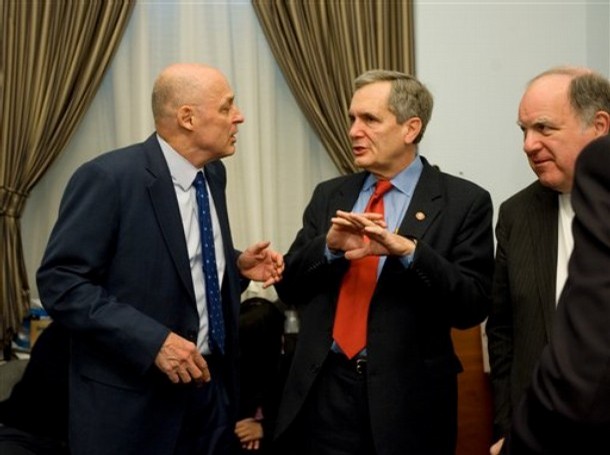
Treasury Secretary Henry Paulson, left, talks with Rep. Lloyd Doggett, D-Texas, center, on Capitol Hill in Washington, Feb. 13, 2008. House Budget Committee Chairman Rep. John Spratt, D-S.C., is at right. Photo by J. Scott Applewhite / AP.

What’s wrong with the President’s bailout plan
By Lloyd Doggett / September 25, 2008

[United States Rep. Lloyd Doggett, a Democrat, represents the 25th District of Texas.]

See Video with Lloyd Doggett and Ben Bernanke and ‘Trust but Verify’ by James K. Galbraith and William K. Black, Below.

I am writing to let you know of my objections to the sudden demand of President Bush that Congress immediately approve near unlimited authority for his Administration to bail out Wall Street. Certainly, all of us want to avoid further deterioration of our economy, but I am appalled by the manner and nature of his request. I have been raising my concerns in meetings with colleagues and through speeches on the floor of the House of Representatives.

In addition, I had the opportunity to question Federal Reserve Chairman Ben Bernanke on the Administration’s proposed bailout plan yesterday. I highlighted the fact that the President has not explained how he would pay for his Wall Street bailout and has relied instead on his mantra of “borrow more money.” You can view my questioning of Chairman Bernanke here.

As I continue to question the rush to approve this complex plan, I am seeking to include as many safeguards for taxpayers as possible. While the formal floor debate over this proposal has not yet gotten underway, I also delivered the brief remarks [below] this week… An excellent enumeration of some of these safeguards from Dr. James Galbraith of the LBJ School of Public Affairs follows as well…

******

The President’s Gilded Trillion-Dollar Bridge to Wall Street
By Rep. Lloyd Doggett / September 25, 2008

In somber tones last night, President Bush described a crisis as if it had emerged on Wall Street from outer space. Never accepting any personal responsibility, this is the man, who chased the sheriff off Wall Street, while they had a party – a Grand Old Party.

That infamous Republican earmark – the Bridge to Nowhere up in Alaska – it carried a hefty price tag: $223 million. Well, what President Bush is now asking Americans to do is pay for the equivalent of 4500 Alaskan bridges – a trillion dollar, gold-plated, diamond-encrusted “Bridge to Wall Street.”

Our job here in Congress is to ask “Is this just another bridge to nowhere?” And to ask why is it that the partygoers don’t have to pay for the party? Why should American taxpayers and future generations of Americans have their future mortgaged to pay for a party they never participated in?

“Wall Street got drunk. Mr. President, you gave them the keys to the liquor cabinet.”

Rep. Lloyd Doggett / September 23, 2008

A few months ago, President Bush accurately diagnosed the problem he just dumped in the lap of Congress. “Wall Street got drunk, and now it’s got a hangover,” he said. But Mr. President, you gave them the keys to the liquor cabinet by failing to enforce our laws. And now you’re really demanding that Americans, who didn’t get invited to the party, must pay for everything destroyed in the drunken brawl.

These late night negotiators have not asked the President, “Where do we find $700 billion?” It is time to demand that bailout supporters outline the revenue measures necessary to pay for it. And the place to begin is with those who enriched themselves when Republicans took the cops off the corporate beat. We need an alternative to just raising the credit card limit-an alternative to more irresponsible “borrow and spend” from a President who has already borrowed more from foreigners than all previous Presidents in American history put together and who continues to mortgage America’s future.

Trust but Verify
By James K. Galbraith and William K. Black / September 22, 2008

“These are the days of miracles and wonders…” The market has collapsed, only the government can save us now. Thirty years of cant have evaporated. Suddenly, we’re all in it together, Henry Paulson and Ben Bernanke in the lead, Congress pulling like post-partisan galley slaves, George Bush lying low and looking, no doubt fervently, for the exits.

Something must be done. Yes. But on what terms? Treasury proposes to spend $700 billion on purchase mortgage-backed securities, accountable to no-one. Secretary Paulson asks for trust. To a degree, he has earned it. But remember: this man started out in office to gut Sarbanes-Oxley, he tried to cripple the SEC, and only two weeks ago he relied on Morgan Stanley – not a disinterested party – for advice that led to the nationalization of Fannie Mae and Freddie Mac. Therefore: “Trust but verify,” as Ronald Reagan would (and did) say.

Congress must now impose conditions to protect the public, the national interest and, not least, the interests of the next administration. Herewith a short list:

1) A disclosure clause. Treasury should have immediate and complete access to information about portfolios, counterparties, the internal valuation methods used by financial firms, their proprietary models, and the history of adjustments made to those models to recognize or conceal losses as the crisis unfolded.

2) A pricing clause. Treasury should establish a transparent mechanism to establish an ex ante fair market value for mortgage-backed securities, set limits on the premium paid over that value in reverse auctions, and require that financial institutions mark-to-market at the sale price. In other words, accounting forbearance should be prohibited.

3) A fraud clause. Securities purchased should be reviewed and those found to be based on fraudulent appraisals, inadequate documentation, predatory and other abusive practice should be kicked back to the lenders at a penalty rate.

4) An enforcement clause. Treasury should be required to establish a framework for investigations and criminal referrals and to prove that the framework is in aggressive use. Participating firms should be required to investigate and document past frauds, to establish internal anti-fraud controls, and make criminal referrals as necessary. The FBI and Assistant US Attorneys should get a ‘blank check’ authorization to pursue the crimes behind this debacle.

5) An arbitrage clause. One big danger of Paulson’s plan is that non-US institutions, hedge funds and others will seize the chance to sell their bad holdings to eligible U.S. institutions, replenishing the swamp just as the Treasury seeks to drain it. All U.S. financial institutions should be required to provide baseline information on their MBS and other eligible holdings as of September 15, 2008.

6) A transparency clause. Treasury operations under this plan, including communications and consultation with outside advisers, should be transparent to Congress, which should get whatever information it wants, at regular intervals. No exceptions.

7) A crony clause. This program must be run by people who are free of abusive conflicts of interest. To ensure this, the Treasury should require full financial disclosure for anyone hired to administer the program, and impose rules and a system to enforce a strict conflict code. Special note to Congress: John McCain personifies and embodies the crony system. Do not pass a bill that would give him, as president, unfettered control over how this program is run.

8) A modification and disposal clause. As foreclosures mount, Treasury will end up in control of physical properties, which degrade rapidly if not sold or rented and occupied. To prevent this, a new agency should be established to rapidly modify existing mortgage contracts, to manage rental conversions and to lease, sell or demolish vacated homes. This agency can be run as draft boards were in wartime, by citizens in each community under federal guidelines.

Is this all? No, it’s only a start. Other measures must follow, including comprehensive regulatory reform, mortgage relief, revenue sharing to protect state and local public spending as property tax revenues tank, support for public capital investment and job creation. These are however the agenda for the next administration.

Getting to that next administration is the job now for the American people.

[James K. Galbraith is author of The Predator State: How Conservatives Abandoned the Free Market and Why Liberals Should Too. He teaches at The University of Texas at Austin. William K. Black is author of The Best Way to Rob a Bank is to Own One. He teaches at the University of Missouri, Kansas City. A former regulator, he was the man who blew the whistle on the Keating Five.]

Source / The Nation

Doggett Grills Bernanke on Housing Crisis and Bailout

Go here to learn more about Rep. Lloyd Doggett.

Thanks to Alice Embree / The Rag Blog

Posted in RagBlog | Tagged , , , , | 1 Comment

The Sky Will Fall in on Them


Weathering the Coming Crisis
By Diane Stirling-Stevens / The Rag Blog / September 25, 2008

Before I share the articles, I’m listing what we are either doing or suggest could be done to further protest this unnecessary bail-out that serves only to benefit the crooks, swindlers, and wealthy. I’m also listing some of the things we’ve done (before all of this) to minimize any impact something like this would have on us.

Frankly, I can’t believe this was a ‘sudden surprise’ to our government. If we could ‘smell’ this back in late 2003/early 2004 when we noticed homes were suddenly being ‘jacked up’ in price; when we saw gasoline prices start to rise (and not come back down), and noticed tourism in our area had slacked off considerably, we felt there might just be a ‘storm’ coming on.

In 2003 one of my son’s and his wife paid a pretty high price for a home in Palm Desert, CA. Having lived in California for 17 years, we were pretty accustomed to homes being over-priced. I was puzzled when I learned how my son was able to finance the home when his credit rating wasn’t that good, and their income hadn’t been that great. He described this ‘creative financing’ and I know I worried about how they’d had their down-payment financed as well as the actual mortgage. The first loan was for the down-payment; closing costs – all fees; they paid NOTHING at all. Luckily my son was pretty open about his finances with me, so in early 2004 when I saw the home prices in their area jump sharply, I suggested they get an equity loan; pay off that initial loan that had been the down-payment/fees/etc., and take the difference and put into CD’s. They got the loan; did exactly that, and now they only had their mortgage payment which was at a reasonable rate, and of course within their budget. I then encouraged my daughter-in-law to change her status as an employee, and contract out her services since her current employer was under-paying her and providing no benefits of any kind. Once that was accomplished, they had a higher net take-home; my son then decided to also quit his job – opened his own business, and now they both have their own businesses and in fact employ a small staff as well. As I look back, I’m happy they got just ahead of the mess (unfortunately my youngest son did not – he fell smack into the sub-prime mess, and is feeling the pain of it now). So, they are coping by taking in his wife’s brother; wife, and young baby – they lost their home in the sub-prime situation, as well as went bankrupt and lost their vehicle. Now that they’ve moved in and we’ve all pitched in to get them back to ‘square one’, we feel relieved that things can start to settle down in their household.

So, as part of what I’ve been doing to help my own family and a few neighbors, I thought in addition to the 2 articles I think you might want to read through, I’d share some of what is now helping those people who’ve been coming to our door with questions. Before we left for the Grand Canyon, I checked with each family and they’re doing much better – no one is ‘flush’ with money, but at least they’re not in a negative position at this time. Anyway, here are some of the ideas I’ve shared, and some of my thoughts about how you might want to manage any protest or distribute information to others you think might want to express their complaints about what is taking place in this request for $700,000,000,000.

#1 – Immediately change your W4 to 8 dependents (minimum); this will put immediate money into your paycheck – reduce what’s going to the tax-man. You can always revise it late-December, to reflect what you’ll ultimately file on your income tax. Anything over 9 dependents puts the IRS on the ‘red alert’.

#2 – List your house for sale at twice the price you think it’s worth; pump up that value so it appears in your local newspaper and of course refuse all offers that aren’t exactly what your asking price is – note you will consider a lease/option sale or a land contract which will muddy up any offer that you might actually get. Be sure not to make it an exclusive listing agreement. You don’t have to be SERIOUS ABOUT SELLING, just keep that price so high no one will want to buy it, and it will help you (and your neighbors) insure the value of the property values in your area.

#3 – Don’t buy another share of any stock; be sure your savings and CD’s are insured, and start putting cash into the freezer section of your refrigerator (as we’ve done – we have 4 months expenses there right now).

#4 – Eliminate direct deposits to your accounts; cash your checks – make no deposits, and buy money orders to pay any bills so the banks have no control over your accounts (and don’t know what you’ve got other than what you leave in your account as a cushion for emergencies).

#5 – Stop using your debit card.

#6 – Do your best to pay off your credit card so they can’t charge any interest (we’ve been doing this for 3 years now).

#7 – Check with family and friends about any potential needed purchases; see if you can swap and barter to minimize buying anything other than your very basic needs.

#8 – Stock up on your canned goods and dried foods/dehydrated foods – get at least 3 months of food in the house as we now have (or more if you’ve got the storage space).

#9 – Cancel all subscriptions to magazines you don’t really need; cancel all unnecessary services, and make every effort to trim out your expenses just in case they start increasing costs on utilities; taxes (state, property, sales), and other ways to ‘tax us’ because no doubt with money in tight supply, they’ll have to reach out to the consuming customer, and put the burden on us even more.

#10 – Start your own e-mail circulation with any ideas you have, and include all ideas that you think are viable and valuable, to create a net-work that shares the success of your protest efforts, but don’t talk on the phone about what you’re doing or in any way suggest or advocate any kind of protest that would violate the law or cause trouble for you or your friends/family.

#11 – We’ve all agreed in our family to not celebrate any holiday (including Halloween) so there are no cards being sent; no holiday foods or gifts, so we can contribute to the already projected slow holiday sales. Get creative with that – don’t even succumb to buying for birthdays or anniversaries – find other ways to celebrate that don’t involve feeding the retail industry.

#12 – Obviously sign any and all protest petitions; draft letters and offer to print and copy protest letters for those who can’t easily write them themselves, and flood the offices of not only your congressman, senator, representative, but the banks; your stock-broker’s office, and all of those offices that are associated with this mess (don’t sign them, just mail them).

#13 – Car pool as much as possible so you don’t support the price of gasoline. Take 2 or 3 friends with you shopping for groceries; combine your errands with shopping, and make every effort to show a decline in the use of gasoline since oil has already jumped $25/barrel and is predicted to go even higher.

#14 – Obviously, do your best to keep your temperatures in your homes as low as you can as the winter months set in for those of you in the snow-belt; utilize all the tricks most of us know who’ve had to weather the winter cold so you can minimize your fuel and utility bills.

#15 – Create a neighborhood and family bartering system; instead of having that garage sale, ‘barter’ as much as possible for the next 6 months until we have a new administration actually in office.

#16 – Don’t make a new car purchase – keep your current automobile serviced and slow down the sales of cars (which, according to my son who has a dealership is already happening).

#17 – Defer all home improvements; try not to draw on any line of credit you might have.

#18 – Try to put all your savings into a credit union if possible.

#19 – If you need a short-term bridging loan, try to loan within your family (if you’re comfortable with that), so no bank or lending institution is getting your interest money.

#20 – If you have any rooms you can rent for a nominal sum, and are willing to offer shelter to someone who might be having a tough time, do so. Two of my son’s are doing this with family members who have been struggling.

#21 – Set up a buying group where you can buy in bulk to save money.

#22 – Have ‘dinner gatherings’ where you each feed a few others at your table; in a round-robin fashion, you can help cut costs in your family and neighborhood.

Another KEY item that some people don’t know about, but you can incorporate yourself as an INDIVIDUAL (it’s easier if you have both your spouse and you incorporate – or even include your children if you want). If you follow the guidelines (and they’re really quite simple), you can complete the paper-work, then you can obtain all the advantages that go along with it.

Also, I’m sure you know that IF YOU DO NOT OWE TAXES TO THE IRS, you do NOT have to file a tax return. You need to be sure you DO NOT OWE ANY TAX, so this is something you must carefully figure out before you elect to choose this option. If you reduce your tax with-holding by changing your W4, be certain you’ve calculated this all out completely so there’s no potential problem by you owing the IRS. Between the information on the I-net and at your local library, you can probably determine all of this yourself. If you’ve got a friend who’s a tax accountant, buy them a beer and pick their brains at the same time.

Also since being an employee now seems to have no real advantages; no one is getting their health care as part of their benefits (or few); most are not getting a decent retirement program, it’s better to negotiate as a 1099 contract worker so you have a better control of your tax obligation, and have deductible self-employment expenses as well. I started doing this in 1980 (before I incorporated myself); in 1983 I completed the paperwork as a corporation, and until we both retired in 2003, this is how we handled our income program. I helped 2 of my 4 children with this concept, and both have enjoyed the fact they have a GROSS INCOME check in their hands, rather than a check that has had a myriad of deductions. Also, way too many people are allowing their checks to be reduced by paying income tax with-holding and often think it’s nice to get that ‘refund’ in the mail, but it’s actually better to minimize the refund and maximize the cash you have so you can put that money to work for you in an insured CD (you earn 3 or 4 percent throughout the year rather than earning absolutely nothing on that money for that year and for the weeks after the year’s end when you wait to get your tax forms, and wait to have the money refunded to you).

So, all-in-all, if you make a thorough review of your habits and expenses and see that you’re spending in ways that are not absolutely frugal and prudent, start doing so. If you think you’re ready to check into the options of becoming a contractor and/or decide to incorporate, you will probably enjoy an increase in net income. I think sometimes we get too comfortable; we spend as if there is going to be a regular supply of cash, and we need to start living as if there isn’t going to be.

Don’t fall for any gimmicks or solicitations that offer you some kind of ‘deal’ to get through this trying time that you know little or nothing about; surely there will be scams flying all over the place (including television ads). I’ve already had 2 e-mails in the last 10 days, with ‘bright ideas’ on how to grab my money and manage it ‘better’ for me, and of course I delete the crap.

Don’t let the fear they’re trying to trump up in us all, get to you – beware of those who try to get you to over-react. If you think my suggestions are trying to do that, they’re not – they are just prudent measures we’ve used during previous down-turns in our lives, and we’ve always done very well ‘riding it out’.

Be sure to get your children and grand-kids updated and informed about the economic problem that’s facing millions, and illustrate the positive side of what it means to change your life-style, and make it clear it’s good to be tested and to show strength and ingenuity at a time like this. Remind them not to listen to ‘their friends’ or not to be swayed by what others are doing, but educate them about why it’s necessary to do what you’re doing.

I’ve had a few times in my life when there was little money (and it didn’t always have to do with a national economic issue), so I had my children start drawing the checks for the expenses so they’d get a feel of what it costs to live and run a household. I would sign the checks and we’d all sit around and discuss the expenses; the source of income, and why we had to adjust our budget and habits to cope with the situation. I know it certainly worked with my children; they were capable of understanding the problems a parent faces by the time they were in their early teens and I never had to apologize to them or explain a darned thing because they were actively involved with the family finances in every way.

I’m sure you’ve got your own ideas and have suggestions you can share – now is the time to put those ideas into action and reach out to those who trust you, and who you trust as well.

Now, this is the article and the links you might also like to read and check out for yourself.

It’s 2:40 in the morning here, and I just felt I had to get some of my thoughts to you after watching these long hours of debate and discussion on the C-Span networks. Oh yes, C-Span seems to be the best source for getting the most current information about this bail-out (and there are no commercials).

Also, there are a number of blogs that have the link so you can sign the petition AGAINST approving this bail-out. One of them is Heartland Heretic. Another is On Transmigration. I’ve corresponded with the authors of these 2 blogs for many months; they are diligent citizens and are always on top of current issues. Both have made very recent posts so you won’t find the link ‘buried’; it will be right near the top of their blog site.

Now the article follows that I think will interest you.


Online Bailout Outrage Jumps to Streets, and Into Lawmakers’ Inboxes
By Sarah Lai Stirland / September 24, 2008

An e-mail that began as a rallying cry from a lone journalist to an influential circle of friends to protest the U.S. government bailout of Wall Street has ignited a national day of street protests. Some demonstrators plan to dump their rubbish in front of the bronze bull sculpture near Wall Street in downtown Manhattan Thursday.

“People are going to bring their own personal junk that they think is worth as much as the junk financial instruments that the government is proposing to buy from the Wall Street banks,” says Andrew Boyd, an activist and freelance online-video artist for nonprofit groups in Manhattan. “We’re hoping that people show up with their 8-track cassette collections, their old Spice Girl CDs, their surf boards that got bit by sharks and old Enron stock certificates.”

Boyd is just one of thousands of Americans from all over the political spectrum who the Bush Administration has angered with its vague proposal to hand $700 billion over to Treasury Secretary Henry Paulson to restore U.S. financial markets’ health. That anger has manifested itself online through e-mail, web sites and other online chatter, with one site, BuyMyShitPile.com, going rapidly viral this week. The site, a parody of the dire financial situation, is what is inspiring the self-organizing group of activists to show up in downtown Manhattan Thursday evening with all their junk. They hope to make their simmering fury palpable to Wall Streeters getting off work.

“Why should people who made financially imprudent decisions be rewarded?” asks Boyd, who is best known for founding the political protest theater group Billionaires For Bush. “It’s our hard-earned tax dollars, and we’re being asked to bail these guys out at the same time as this locks out all the things that we want for the future.”

Boyd’s is one of many voices of frustration. Other people’s anger spilled out online, which in turn, is fueling the planned protests’ momentum.

Arun Gupta, a 43-year-old freelance journalist in Manhattan, is someone else who was so upset by unfolding events that he was moved to action.

“I’ve been spending a lot of time reading about the intensifying crisis and the bailout plan,” he says. “The more I read, the more outraged and flabbergasted I was: It became clear to me that this was the financial equivalent of the Sept. 11 attacks.”

He was so upset that he banged out a passionately worded 629-word e-mail on his laptop Sunday afternoon urging his friends — and anyone else who would listen — to show up at the southern tip of Manhattan late Thursday afternoon to demonstrate. He says that he’s never organized a protest before in his life.

“This week the White House is going to try to push through the biggest robbery in world history with nary a stitch of debate, to bail out the Wall Street bastards who created this economic apocalypse in the first place,” he wrote. “This is the financial equivalent of September 11. They think, just like with the Patriot Act, they can use the shock to force through the “therapy,” and we’ll just roll over!”

He added:

Think about it: They said providing health care for 9 million children, perhaps costing $6 billion a year, was too expensive, but there’s evidently no sum of money large enough that will sate the Wall Street pigs. If this passes, forget about any money for environmental protection, to counter global warming, for education, for national healthcare, to rebuild our decaying infrastructure, for alternative energy.

This is a historic moment. We need to act now while we can influence the debate. Let’s demonstrate this Thursday at 4 pm in Wall Street (see below).

The e-mail ricocheted through the electronic ecosystem faster than the implosion of Wall Street itself, tapping into and riding the frisson of resentment among Americans at this monumental financial foul-up.

“I wrote up an e-mail Sunday night, and I sat on it.” he says. “I was a bit hesitant because I’m not an organizer, I’m a journalist, but I also think that things have to be done in the world.”

He said that he sent it out to best-selling author Naomi Klein, who posted it to her website, and sent it out to her e-mail list. Then TrueMajority, a 700,000 member activist group headed by Ben and Jerry’s co-founder Ben Cohen, sent out an action alert the next day.

TrueMajority is making a “protest kit” available on its web site with instructions for groups who are interested on how to organize a rally. One of the instructions is to bring cell phones to the protest, and to have protesters simultaneously call their members of Congress. The site has also put up a web page that enables people to find an event near them by ZIP code.

“This was a convergence of everyone having the same thought at the same time,” says Matt Holland, TrueMajority’s online director.

He says everybody he knew had received Gupta’s e-mail at least three times from different people. It’s also been widely circulated on blogs.

Holland says that Gupta’s language just taps into “the strength of the emotion” that many Americans are feeling right now. TrueMajority’s members themselves have made 20,000 phone calls to Congress, he says. Members report the calls that they made through the group’s website.

“Everybody is just incredibly pissed off about this, and if there is a place and time for them to express themselves, they’re going to do it,” he says.

Congressional lawmakers have expressed frustration and skepticism over Treasury’s proposal, although they won a concession about CEO pay Wednesday afternoon. President Bush is scheduled to address the nation about the bailout plan 9 p.m. Eastern time Wednesday, and John McCain has asked Barack Obama to agree to cancel Friday’s presidential debate so that they could both work with the administration to hammer out an agreement.

In the meantime, a proposal to add several restrictions on the package from Sen. Bernie Sanders (I-Vermont) has gained traction online. He’s asked Americans to sign onto the petition, and he intends to present it to Paulson. The senator’s office reported Wednesday that 8,000 people signed the petition within the first 24 hours. Another sign that the petition gained widespread notice: “Bernie Sanders,” was one of the most-searched-for terms on Google Tuesday.

Also on Tuesday, a long list of economists from the nation’s top universities sent a letter to congressional leaders voicing their concerns about the too-speedy passage of any bailout package.

They said that they were most concerned about the plan’s fundamental fairness and its ambiguity.

Source / Wired

And there is also this remarkable interview from Democracy Now with Naomi Klein:

Naomi Klein: “Now Is the Time to Resist Wall Street’s Shock Doctrine”

While the collapse of this country’s financial system continues to send shock waves around the world, we speak to the bestselling author of The Shock Doctrine. Naomi Klein says the public should be wary of the Bush administration trying to use the crisis to push through more of the radical pro-corporate policies that helped cause it in the first place.

Guest: Naomi Klein, award-winning journalist, syndicated columnist and author of the bestseller, The Shock Doctrine: The Rise of Disaster Capitalism.

AMY GOODMAN: While the collapse of this country’s financial system continues to send shock waves around the world, I’m joined on the telephone by bestselling author of The Shock Doctrine, Naomi Klein. Her latest article for the Huffington Post is called “Now Is the Time to Resist Wall Street’s Shock Doctrine.” Naomi Klein, welcome to Democracy Now!

NAOMI KLEIN: Thanks, Amy. Great to talk with you.

AMY GOODMAN: Explain. What do you mean?

NAOMI KLEIN: Well, the thesis of my book, what I mean by the “shock doctrine,” is that it is in times of crisis, it is in times when people are panicked, when we’ve seen again and again the right push through radical pro-corporate policies, what they call “free market reforms,” precisely because it is in a crisis where the space for debate rapidly closes, and you can invoke this state of emergency to say we have no choice.

And I think we’re seeing a very dramatic example of this tactic right now with this really extortionist kind of tactics playing out in Washington. You know, “Sign this blank check, or we’re all going down, or Main Street is going down, or taxpayers—you know, the sky will fall in on them.”

I’m also arguing that this is only stage one of the shock doctrine. They’re getting this—they’re lobbying for this huge bailout, obviously, but this bailout is a kind of a time bomb, because it’s all these bad debts, and they are going to explode on the next administration. I mean, we know that the Bush administration has already left the next administration with huge debt and deficit problems. They’ve just exploded those, expanded them. And what that means is that whoever the next president is is going to be inheriting this economic crisis that is being exacerbated by this bailout.

So, in the case of McCain, I think—if he’s the president, then I think we know what he’ll do, because we know he wants to privatize Social Security, which is something that Wall Street’s been wanting for a long time, another bubble. We know he has said in the next—in the first 100 days of his administration he’ll look at every program and either reform it or shut it down. This is really a recipe for economic shock therapy. So, while you have all of these trivial issues being discussed in the election season, I think what we could—what we’re really—you know, under the surface, they’re actually being quite clear. They’re going to take—if they take power, it will be in the midst of an economic emergency. They’ll invoke that emergency to push through very, very radical changes. So, you know, what I’ve been saying is, this is not four more years of Bush; it’s much, much worse in the case of another Republican administration.

But there’s huge problems for Democrats, as well, if they win this election, because, you know, we need to only think back to the situation in which Clinton took power, where he ran an election on an economic populist platform, promising to renegotiate NAFTA. Then there was an economic crisis. Clinton came under intense lobbying by people like Robert Rubin, who’s also advising Obama right now, and by the time he took office, he had embraced economic austerity.

So, people need to understand these tactics, need to put pressure on the candidates, the parties, and reject this tactic. And I’ve actually been really heartened, Amy, that people are onto these shock tactics and aren’t falling for it. And, you know, to the extent that we’re seeing a little bit of spine from the Democrats, it is only, as Chris Dodd said, because they are hearing it from their constituents. So people need to keep up this pressure right now.

AMY GOODMAN: Naomi Klein, one of the things you write about in this piece in Huffington Post is the wish list that comes from former Republican House Speaker Newt Gingrich—

NAOMI KLEIN: Yes.

AMY GOODMAN: —laying out policy prescriptions for Congress.

NAOMI KLEIN: Yeah. I mean, there is pressure being put on Congress from Democrats who—you know, we’ve heard the proposals to cap executive pay and to have a moratorium on foreclosures. It’s coming not from all Democrats, but from some. But there’s something going on on the Republican side, where you have people like Newt Gingrich, and you also have the Republican Study Committee, which is a group of very influential Republican lawmakers who are saying that they’re opposed to the bailout, and they also have their wish list. And I think it is that it’s not that they’re going to oppose a bailout completely; it’s that they want economic changes, right-wing, pro-corporate economic changes, attached to a bailout. So, Newt Gingrich has his list. He’s got eighteen demands. But I think even more important than that is the Republican Study Committee, and I raise this because they’ve just issued their ransom list. It starts with suspending the capital gains tax, privatizing Fannie Mae and Freddie Mac, suspending mark-to-market accounting, which is the rule that requires companies to assess their assets at current market values.

So, what’s so stunning about this, Amy, is that here you have a crisis that everyone seems to agree is borne of deregulation, and they’re actually calling for more deregulation. We have a situation where the debt is exploding on American taxpayers, and they want to suspend corporate profits—sorry, corporate taxes, which is actually what might defray some of those costs from regular taxpayers. So it’s an incredible display of opportunism. And this is what I mean by stage two of the shock doctrine. The first stage is just the bailout, but the second stage are all of these radical reforms that are going to be invoked in the name of the crisis that the bailout is creating, whether it’s pushed through right now or whether it’s pushed through later.

But what’s important—you know, Amy, in the book, I talk about—I start the book with a quote from Milton Friedman that has really made the rounds a lot lately, which is that—and this is a Friedman quote—that “only a crisis, actual or perceived, produces real change. And when the crisis occurs, the change depends on the ideas that are lying around.” And then he goes on to say, “That, I believe, is our basic function: to keep the ideas ready until the politically impossible becomes politically inevitable.” So I think it’s really important for people to look at the ideas that are lying around.

There’s enormous corporate lobbying going on to, for instance, eliminate the post-Enron collapse regulations, to actually say that the way to save the American economy—you know, you heard Henry Paulson equating—still equating the interests of the financial sector with the interests of everyone else. We know that’s simply not true. But it’s that—precisely that logic that then is used to say, OK, these are the—this is what the financial community, this is what the corporate world needs in order to revive the economy: they need less regulation, they need less taxation.

So, we should be really, really wary of this claim that we’re hearing that free market ideology is dead, that this marks the end of, you know, of capitalism. You know, I’m sorry, that is not the case. It may be going dormant for a little while to rationalize these massive bailouts, but it will come roaring back, and the crisis that is being deepened right now through these bailouts will be invoked for even more radical deregulation, privatization, tax cuts and so on.

AMY GOODMAN: It seems clearly, Naomi Klein, what’s needed, a key ingredient here, is speed.

NAOMI KLEIN: Yeah.

AMY GOODMAN: You see this happen right after 9/11 with the USA PATRIOT Act being pushed through. You saw it with the vote in October of 2002 for the invasion of Iraq. It’s speed and the idea of an imminent threat.

NAOMI KLEIN: Absolutely.

AMY GOODMAN: And then, of course, this week it’s not only about passing this legislation, but it is passing it by Friday.

NAOMI KLEIN: Absolutely. You know, and a lot of people have even described this Paulson plan as an economic PATRIOT Act. You know, one of the mistakes that I think they made, honestly, Amy, is how short it is. It’s just three pages, which means—you know, usually these pieces of legislation are much longer, so people don’t even bother reading them in that moment of extortion—you know, “Pass it now, or else…or else the sky falls in.” So, you know, in this case, I think they made a miscalculation. You know, there was an interesting article in Time that just came out, where they actually say that they have been working—you know, this is a quote—it says, “[Paulson] and his team [have] been working on [this] proposal for more than six months.” So, it’s quite surprising that it is as pared down as it is. It’s three pages. And the craziest thing has happened: people have read it. Regular people have read it. It doesn’t take that much time. And, you know, you read Section 8, which is just so stunning, just so bold in its demand for total and complete impunity. And that’s really what’s getting in their way, is people are reading this text, and they’re frankly shocked by it.

You know, we heard Henry Paulson say that he thought it would have been presumptuous to put in clauses calling for regulation. This is absolute nonsense. Section 2 of the same document talks about how they have the right to hire contractors to administer this huge operation, and we know that that means contracting with some of the very firms who are going to be bailed out. And then it says that it would be—they would be contracting them without regard to any other provision of law regarding public contracts. Amy, that is just as—that’s Iraq levels of impunity, or even more. I mean, basically what they are saying is that we want to be able to contract with companies but exempt those companies from the existing laws that bar conflict of interest, that have whistleblowing laws. I mean, the laws exist on the books, and they are actively excluding these contracts from those laws. So the idea that they didn’t want to be presumptuous is complete nonsense. They are being extremely presumptuous, because they are actively excluding these contractors, these would-be contractors, from existing oversight. We have to be very clear about this.

AMY GOODMAN: It’s interesting who Treasury Secretary Henry Paulson is, served as an assistant to Richard Nixon’s assistant, John Ehrlichman, and moved right from there to Goldman Sachs, then became head of it when, well, the now-Senator and then-Governor Corzine left Goldman Sachs.

NAOMI KLEIN: You know, Amy, I don’t think we can stress this enough. Henry Paulson is one of the key people, the top people, responsible for creating the crisis that he is now claiming he will solve, you know, and this is—if we think about the 9/11 analogy and, you know, the state of shock that Americans were in after 9/11 and the emergence of Rudy Giuliani as the savior—and, you know, people have so much regret about that. And in the book, I write about this as the state of regression that we go into when we’re frightened. And I think Henry Paulson has really been cast in this role as an economic Rudy Giuliani, saving the day, impartial, bipartisan, a strong leader.

I found this article in BusinessWeek that ran when Paulson was appointed to the Treasury, and I just want to read you one sentence, because I think it’s all we need to know about Henry Paulson. This is from BusinessWeek, when he got the appointment as Treasury Secretary in 2006. The headline of the article is “Mr. Risk Goes to Washington.” It says, “Think of Paulson as Mr. Risk. He’s one of the key architects of a more daring Wall Street, where securities firms are taking greater and greater chances in [their] pursuit of profits. By some key measures, the securities industry is more leveraged now than it was at the height of the 1990s boom.”

Then it goes on to say that when Paulson took over Goldman Sachs in 1999, they had $20 billion in debts. When he—in these high-risk gambles. When he left, they had $100 billion, which means he took their risk level from $20 billion to $100 billion. So it is absolutely no exaggeration to say that Henry Paulson, far from speaking for Main Street, is actually bailing out his colleagues for some of the very debts that he himself accumulated. This is an extraordinary conflict of interest.

AMY GOODMAN: And then, of course, there’s the question of his own interests in Goldman Sachs today.

NAOMI KLEIN: Well, you know, allegedly, he divested from the company, so I can’t comment on that, but I think there’s some good investigation to be done.

AMY GOODMAN: Naomi Klein, I want to thank you for being with us, award-winning journalist, syndicated columnist, author of the bestselling book The Shock Doctrine: The Rise of Disaster Capitalism.

Source / Democracy Now!

The Rag Blog

Posted in Rag Bloggers | Tagged , | Leave a comment

More on the Details of the Current Crisis


The Credit Crisis and the Real Story Behind the Collapse of AIG
By Shah Gilani / September 22nd, 2008

[In Part II of his three-story investigation of the credit crisis, Money Morning Contributing Editor Shah Gilani shows us how American International Group, a perfectly sound company that’s survived for 89 years, was destroyed by some errant bets on a derivative security called a “credit default swap,” or CDS. It’s
a story you’ll read nowhere else.]

There’s nothing fundamentally wrong with the core insurance business units of American International Group Inc. (AIG). Nothing at all. What imploded the venerable insurance giant was an accumulation of misplaced bets on credit default swaps.

By the best estimates of the International Swaps and Derivatives Association and the Bank for International Settlements (BIS), often referred to as the central banks’ central bank, the notional value of credit default swaps out in the market place is some $62 trillion, or 35 trillion British Pounds at an exchange rate of $1.78.

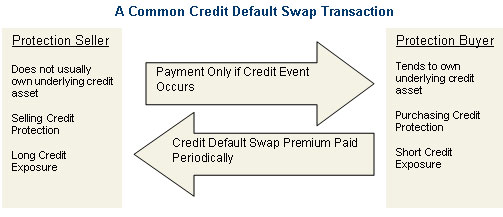
A credit default swap (CDS) is akin to an insurance policy. It’s a financial derivative that a debt holder can use to hedge against the default by a debtor corporation of sovereign. But a CDS can also be used to speculate.

A subsidiary of AIG wrote insurance in the form of credit default swaps, meaning it offered buyers insurance protection against losses on debts and loans of borrowers, to the tune of $447 billion. But the mix was toxic. They also sold insurance on esoteric asset-backed security pools – securities like collateralized debt obligations (CDOs), pools of subprime mortgages, pools of Alt-A mortgages, prime mortgage pools and collateralized loan obligations. The subsidiary collected a lot of premium income and its earnings were robust.

When the housing market collapsed, imploding home prices resulted in precipitously rising foreclosures. The mortgage pools AIG insured began to fall in value. Additionally, the credit crisis began to take its toll on leveraged loans and it saw mounting losses on the loan pools it had insured. In 2007, the company was starting to feel serious heat.

From its humble beginnings in China in 1919 – through the 40-year tenure of CEO Maurice R. “Hank” Greenberg, which ended ignominiously for Greenberg in 2006 – AIG grew aggressively. Greenberg grew and diversified the insurance giant, ultimately amassing a trillion-dollar balance sheet.

But not everything was Kosher.

In an effort to assuage analysts and maintain leverage, the firm entered into sham transactions to affect the appearance on its balance sheet of $500 million of loan-loss reserves, which analysts had been questioning as formerly declining. The result was a 2006 Securities and Exchange Commission enforcement action, a $1.6 billion settlement and the removal of Greenberg. Greenberg is still fighting civil charges related to his actions at the firm.

As 2007 progressed, so did the losses on AIG’s books and credit default swaps. Once again, it appears that AIG tried to “manage” the problem through accounting maneuvers. Last February, for instance, AIG said that “its auditor had found a material weakness in its accounting.” It had not been properly valuing its CDO liabilities and swap-related write-downs. The losses were revealed to be in excess of $20 billion through this year’s first quarter. The SEC is once again investigating, as are criminal prosecutors at the U.S. Justice Department and the U.S. Attorney’s Office in Brooklyn.

After writing down assets against gains elsewhere, AIG posted cumulative losses of $18 billion over the last three quarters. In February, AIG posted $5.3 billion in collateral against credit default swap contracts it had written. In April, AIG had to post an additional $4.4 billion in collateral. When rating agencies Standard & Poor’s, Moody’s Investors Service (MCO) and Fitch Ratings Inc., lowered the firm’s ratings last Monday evening, it triggered an additional $14 billion collateral call as margin against AIG’s credit default swaps.

The company didn’t have the cash.

Indeed, the dire need for cash collateral on top of mounting losses on warehoused CDO “assets” on the company’s balance sheet necessitated a massive infusion of capital. That’s what happened to AIG.

But once again, there’s the story – and there’s the story behind the story.

There’s a problem – an inherently systemic problem – and it has to do with how structured investments like tranched collateralized debt obligations (CDOs), residential mortgage-backed securities (RMBS), commercial mortgage-backed securities (CMBS), and credit default swaps on them and on corporate debts and loans are actually valued.

Individually, CDOs are hard to value. Suffice it to say, legend has it that constructing the cash flow payments on the first theoretical 3-tranche CDO (the simplest type of CDO) took a Cray Inc. (CRAY) supercomputer 48 hours. Now try and value credit default swaps on them!

Because there are so many different individual CDO securities, and because there are so many credit default swaps on so many of these CDOs, and so many swaps on individually referenced entity debts and loans, the only way to value them in a portfolio is by indexing.

That’s right, there are indexes, and guess what? You can trade the indexes! Markit Group Ltd., of London, constructs and manages the CDX, ABX, CMBX and LCDX family of credit-default-swap indexes. Investopedia has a decent little tutorial.

Here’s the problem: If you own a portfolio of CDOs, and the only way to value them (or, at least, to develop a valuation that others are reasonably certain to respect), is by looking at them through the prism of an index of credit default swaps on them, you’re at the mercy of the index. Your portfolio, your securities may not be so bad, but you may not really know based on mortgage-duration analysis and foreclosure events that you can’t calculate. So you value, or mark-to-market, against the closest index.

Here’s the rub. What if other speculators are selling short – that is, betting in anticipation of that index going down? What if large portfolio-hedgers are selling short the index to hedge the portfolio they can’t sell because no one will buy it – because no one knows what it’s worth?

It’s crazy. And it gets worse.

What if you’re running a profitable company that needs to borrow money, but credit default swaps (bets against your ability to pay back your debt) are expensive by virtue of speculators fear and greed, such that if any bank looks at where the CDS pricing on your paper is trading, they tell you: “Sorry, but we can’t lend you money because the market for credit default swaps thinks you’re a bad bet.”

You don’t get the loan. You can’t build your factory; you can’t produce and have nothing to sell. The upshot: Now you actually are going out of business. Is this self-fulfilling?

Ponder this: Last Monday, as AIG was initially seeking $20 billion in capital and actually had it in hand (by virtue of a deal with New York insurance regulators), traders were bidding up credit default swaps on AIG’s debt and loans so furiously that based on the insurance premiums traders were actually paying for default insurance on AIG… the company was already dead. Self-fulfilling?

Credit default swaps are creating a downward spiral in the capital markets, driving up the cost of capital, and squeezing out all manner of borrowers. And these speculative bets run amok are undermining all U.S. Federal Reserve and U.S. Treasury Department efforts to “liquefy” the system. If this keeps up, the credit default market could sink the U.S. economy into a recession/depression that will make the Great Depression look like a day at the beach.

Anyone got a towel?

Source, with additional links / Money Morning

The Rag Blog

Posted in RagBlog | Tagged , , | Leave a comment

Poor Dubya : So Many Lies, So Little Time…

Photo by Craig Owen / Oxfam.

The lies and scare tactics just keep getting bigger and bigger.
By Randy H. / The Rag Blog / September 25, 2008

There aren’t many left in the inventory, Mr. Bush.

Hurry! There are only four months left to go!

* They attacked on our sovereign soil! (Yep, all 19 of them. Sound like Tonkin Gulf, anyone?)

* They have weapons of mass destruction! (Just where, I don’t know yet. But I’ll find ’em!)

* We must be allowed to spy on our citizens to protect our country!

*I must be allowed to send our troops to war to protect our nation!

* That’s too many troops, General Shinseki. (By the way, you’re fired!)

* We’ll incarcerate those terrorist cab drivers indefinitely, off our soil, at Gitmo!

* “What do you mean by ‘Waterboarding’, Senator?”

* “Islamofascism” is the enemy!

* They’re in the “final throws” of the insurgency!

* If you are against the war, you are not a patriot!

* “Mission accomplished!” (Ahem. Well, sort of …)

* We must allocate billions in annual, off-budget supplementals to support our troops!

* “Deficits don’t matter.”

* “You’re doing a heck of a job, Brownie!”

* We may be attacked with bioterrorism! (Anthrax and smallpox are at our doorstep!)

* Iran is developing ‘nukeer’ weapons. We may need to act soon!

* We may see the re-emergence of the Cold War!

* If a Democrat is elected, we may see new terrorist attacks and destruction.

* Our economy might collapse! There’s risk of a global financial meltdown!

Who, me? A skeptic?

What’s next, Mr. Bush? . . . Scare us into believing World War III is imminent?

I’m buying Stick-and-Stone financial futures contracts. Einstein was right.

The Rag Blog

Posted in Rag Bloggers | Tagged , | 3 Comments

Al Gore Calls for Civil Disobedience on Global Warming

Former Vice President Al Gore shared a panel with the singer Bono at the Clinton Global Initiative meeting in New York on Wednesday. Photo / Jason DeCrow / AP.

‘Inconvenient Truth’ may get even more inconvenient…
By Paul Vitello / September 24, 2008

Al Gore, the former vice president and winner of the Nobel Peace Prize, is nothing if not passionate on the issue of global warming. But his usual fired-up remarks on the subject took a step into the Gandhian realm on Wednesday when he told an audience at the Clinton Global Initiative meeting in New York that the crisis was so severe and intractable that it was time for direct action.

“If you’re a young person looking at the future of this planet and looking at what is being done right now, and not done, I believe we have reached the stage where it is time for civil disobedience to prevent the construction of new coal plants that do not have carbon capture and sequestration,” he said at the third annual meeting of former President Bill Clinton’s initiative, which arranges partnerships between the very rich and the very needy.

Mr. Gore said the civil disobedience should focus on “stopping the construction of new coal plants,” which he said would add tons of carbon dioxide to the atmosphere — despite “half a billion dollars’ worth of advertising by the coal and gas industry” claiming otherwise. He added, “Clean coal does not exist.”

The audience at the Sheraton New York Hotel and Towers, which was composed of hundreds of heads of state and chief executives, as well as representatives of philanthropic groups, reacted with scattered applause. There was a lot of shifting in seats.

Mr. Gore did not elaborate on his call for action. And almost as soon as the words “civil disobedience” were out of his mouth, Mr. Clinton, moderating a panel that Mr. Gore shared with the singer Bono, the president of Liberia, the chairman of Coca-Cola and Queen Rania of Jordan, turned to the queen to ask whether Middle Eastern countries might ever become “models of clean energy usage.” The discussion continued in a less-fiery vein from there.

Source / The Caucus / New York Times political blog

Thanks to Steve Russell / The Rag Blog

Posted in RagBlog | Tagged , , , , | Leave a comment

The Rhetoric of Fear About Ahmadinejad Is Foolish

Iranian President Mahmoud Ahmadinejad addresses the United Nations General Assembly in New York Sept. 23, 2008. Photo: Reuters/Mike Segar

Obama goes over the top in bashing Mahmoud Ahmadinejad
By Juan Cole / September 24, 2008

Once again, U.S. politicians, including both Sarah Palin and Barack Obama, pile on the Iranian president. Why does Larry King (!) sound like the adult in the room?

Sen. Barack Obama responded with outrage to the remarks made Tuesday by Iranian President Mahmoud Ahmadinejad before the United Nations General Assembly, expressing regret that the quirky little president was even allowed to speak. Obama’s denunciation was mild compared with that of Gov. Sarah Palin, who accused Ahmadinejad of dreaming “of being an agent in a ‘Final Solution’ — the elimination of the Jewish people.” In contrast, “Larry King Live” carried an hourlong interview with Ahmadinejad in which the Iranian was allowed to speak for himself and repeatedly denied any violent intentions. King thus reinforced the trend whereby entertainment television, whether Jon Stewart’s “The Daily Show” or King’s own dog-and-pony interview hour, conveys reality-based news while politicians continue to paint inaccurate and even fantastic scenarios that are harmful to U.S. foreign policy.

In his speech, Ahmadinejad said “the American empire … is reaching the end of the road” and accused the U.N. Security Council of allowing “Zionist murders” because of “pressure from a few bullying powers.” Obama issued a statement saying, “I strongly condemn President Ahmadinejad’s outrageous remarks at the United Nations, and am disappointed that he had a platform to air his hateful and anti-Semitic views.” He added, “The threat from Iran’s nuclear program is grave.” Obama then called on his rival in the presidential race, Sen. John McCain, “to join me in supporting a bipartisan bill to increase pressure on the Iranian regime by allowing states and private companies to divest from companies doing business in Iran.” He slammed McCain, saying that the senator was playing partisan politics by declining to join Obama in this divestment campaign.

In the heat of the campaign, Obama surely overreached himself in appearing to advocate barring leaders of member states from addressing the United Nations because their views are obnoxious to Americans. He also fell into the trap of declining to make a distinction between anti-Zionist views and anti-Semitic ones. If a policy of exclusion had been adopted by past administrations, Soviet Premier Mikhail Gorbachev could not have announced from that podium the reduction of Red Army forces in Eastern Europe in 1988. And if anti-American statements should trigger the denial of a visa to come to New York, should Nelson Mandela, who called the United States the “most dangerous country in the world,” be excluded, too?

Obama’s assertion that Iran’s civilian nuclear energy research program constitutes a “grave threat” may or may not be true. The 2005 National Intelligence Estimate put Iran at least a decade away from having a nuclear weapon if it was trying hard to get one and if the international environment was conducive (i.e., if Iran could import all the equipment it needed easily). Neither of those conditions actually appears to exist, so Iran is very far away from having a bomb. The 2007 National Intelligence Estimate on Iran, parts of which were released last December, concluded that Iranian scientists have not done any weapons-related research since early 2003.

As Ahmadinejad pointed out to Larry King, no country has been as intensely inspected by the International Atomic Energy Agency as Iran. No regularly inspected country has ever developed a nuclear bomb. Although the IAEA’s Mohamed ElBaradei has expressed frustration that Iran failed to declare its nuclear research program before 2003, he continues to say that in current inspections, “the Agency has been able to continue to verify the non-diversion of declared nuclear material in Iran” to weapons purposes. This consistent IAEA finding through recent years raises the question of whether Obama is right to be so categorical on this issue.

As for the imposition of economic sanctions on Iran, it might be worth considering for a moment whether the U.S., with its faltering economy, is even able to cause a major oil exporter such as Iran much harm through a unilateral boycott. The law passed by Congress at the insistence of the Israel lobby, placing sanctions on firms doing business in Iran, does not punish those who merely distribute or import Iranian petroleum. Does Obama want to go even further with sanctions? If Congress really could close down Iran’s production of 4 million barrels a day, it would cause the price of petroleum to soar and throw the U.S. into a deep recession or depression. From the point of view of a reality-based foreign policy, this sort of step is known as “cutting off your nose to spite your face.” Russia and China are now balking at placing any further sanctions on Iran via the United Nations Security Council. (Russia is not exactly in a cooperative mood after the drubbing it took from U.S. politicians over its intervention to protect South Ossetia from Georgia.)

The sanctions have in any case had no effect on Iranian policy, though they are keeping Iran’s gas fields from being developed by American and European firms, a task that may fall to Russia’s Gazprom or its Chinese counterpart instead. (One would not advise a President Obama to threaten to cut off economic cooperation with China over its Iran investments, given how much U.S. debt Beijing holds.) Since natural gas is a global market, this boycott of Iran harms American consumers twice, causing the price of gas to be higher than necessary and making sure that the development of Iranian gas creates no jobs for Americans and brings no profits into this country.

If Obama’s reaction to Ahmadinejad was a bit breathless and probably counterproductive to U.S. interests, Gov. Palin’s was, typically, like something from outer space. In a speech the Republican vice-presidential nominee had planned to give at an anti-Ahmadinejad rally on Monday, organized by right-wing Zionist organizations before they decided not to have major politicians speak, she alleged that the Iranian president “dreams of being an agent in a ‘Final Solution’ — the elimination of the Jewish people. He has called Israel a ‘stinking corpse’ that is ‘on its way to annihilation.’ She warned apocalyptically that Iran had tested missiles capable of reaching Tel Aviv and that “the Iranian nuclear program is nearing completion.”

But is the Iranian president genocidal? Ahmadinejad explained on “Larry King Live” (you’d think at least Palin would watch that even if she does not, like, read books and newspapers) that there are some 20,000 Jews in Iran, who have a representative in Parliament. That representative, Maurice Motemad, and leaders of the Iranian Jewish community, have repeatedly protested to Ahmadinejad over his minimizing the extent of the Holocaust. Ahmadinejad told King, “We don’t have a problem with the Jewish people” (ma ba mardom-e yahud moshkeli nadarim). If Ahmadinejad wanted to launch a second Holocaust, would he not begin at home? It is tiresome to keep having to repeat it, but, moreover, Ahmadinejad does not have the power to launch any massacres, since the presidency in Iran is a weak position similar to that of our secretary of the interior. The commander in chief of the armed forces is Ayatollah Ali Khamenei, who has pledged an Iranian policy of no first strike against any country.

As for Jews in Israel, Iran has not threatened to kill any of them, much less all of them. On “Larry King Live,” Ahmadinejad expressed the hope that the Israeli state will collapse just as the apartheid regime in South Africa did. In other words, he is advocating a variant of the one-state solution to the Israeli-Palestinian conflict. While his version of that one state is unrealistic and unfair to Israeli Jews and does not have a prayer of being realized, it is not a genocide, and it is a barefaced lie to say that it entails the killing of anyone. As Larry King admitted, the South African minority government fell peacefully.

Ahmadinejad was forced again to explain that when he quoted Ayatollah Khomeini to the effect that “this occupation regime over Jerusalem must vanish from the page of time,” he did not mean that “Israel must be wiped off the face of the map” (as the quotation was mistranslated). He told King Tuesday night that he meant that the Israeli state’s policies of committing crimes against the Palestinians and killing them and occupying them must vanish. He added, “Our solution is in fact a completely humane and democratic one. What we’re saying is that throughout the Palestinian territories [i.e., including Israel and the occupied territories], people should gather and determine the type of government they would like to have.” In other words, he says he means by the vanishing of the regime a single democratically elected state in Israel and Palestine.

Committed Zionists, that is to say, Jewish nationalists, who believe that Israel must remain a Jewish-majority state, often see the advocacy of a one-state solution (in which Israeli Jews might be reduced to a simple majority or even only a plurality of the population) as a dire threat to the Jewish people. They are also known to smear anyone who demurs from their rigid conception of nationalism as an anti-Semite or even a terrorist. However, neither their conviction that any criticism of Israel must be prohibited, nor their insistence on a state dominated by a single ethnicity, nor their often unpleasant tactics of the destruction of reputations should stand in the way of Americans seeking an unblinkered understanding of contemporary Iran and pursuing American interests in regard to relations with Tehran.

It is legitimate to question the truthfulness of Iranian assertions about the character of their nuclear energy research program. It is a wise policy to pressure Tehran to allow even more rigorous inspections, to permit surprise inspections, and to explain just what the country was up to before early 2003. Scaled sanctions to get Iran to give up its enrichment program altogether might work if these sticks were combined with more carrots. The Iranian regime has made numerous hateful comments about Israel and is hostile to the Zionist state, and it is natural that this rhetoric should make the Israelis nervous. A reason for caution, watchfulness and deterrence, however, is not necessarily grounds for war. The United States faced down the Soviet Union without ever having gone directly to war against it, after all.

But to distort the colorful Ahmadinejad’s words, to mistranslate him, to misrepresent him as in control of the Iranian military, or to pretend that he represents a consensus in the Iranian political elite is to build a fantasy world as insubstantial and whimsical as a SimCity computer game. Larry King got at the true Ahmadinejad, with all his flaws, more accurately and extensively than anything else on American television or in political rhetoric. It is clear that for the U.S. to go to war over an imaginary threat of genocide (Iran does not have the ability to kill large numbers of Israelis and consistently denies that it wants to) at a time when its military is overstretched by two protracted guerrilla wars, when its financial system is near collapse, and when the resulting run-up in oil prices would cripple the U.S. and world economies would be a folly so great that only a lunatic would contemplate it. As foolish and hateful as Ahmadinejad can be, it remains to be seen if we are any better.

Source / Salon

The Rag Blog

Posted in RagBlog | Tagged , , | Leave a comment

Barbara Ehrenreich : How Positive Thinking Wrecked the Economy


Greed: The Little Engine that Couldn’t
By Barbara Ehrenreich / September 24, 2008

Greed – and its crafty sibling, speculation – are the designated culprits for the ongoing financial crisis, but another, much admired, habit of mind should get its share of the blame: the delusional optimism of mainstream, all-American, positive thinking. As promoted by Oprah, scores of megachurch pastors, and an endless flow of self-help bestsellers, the idea is to firmly belief that you will get what you want, not only because it will make you feel better to do so, but because thinking things, “visualizing” them – ardently and with concentration – actually makes them happen. You will be able to pay that adjustable rate mortgage or, at the other end of the transaction, turn thousands of bad mortgages into giga-profits, the reasoning goes, if only you truly believe that you can.

Positive thinking is endemic to American culture – from weight loss programs to cancer support groups – and in the last two decades it put down deep roots in the corporate world as well. Everyone knows that you won’t get a job paying more than $15 an hour unless you’re a “positive person” — doubt-free, uncritical, and smiling—and no one becomes a CEO by issuing warnings of possible disaster. According to a rare skeptic, a Washington-based crisis management consultant I interviewed on the eve of the credit meltdown in 2007, even the magical idea that you can have whatever you truly want has been “viral” in the business culture. All the tomes in airport bookstores’ business sections scream out against “negativity” and advise the reader to be at all times upbeat, optimistic and brimming with confidence—a message companies relentlessly reinforced by treating their white collar employees to manic motivational speakers and revival-like motivational events. The top guys, meanwhile, would go off to get pumped up in exotic locales with the likes of success guru Tony Robbins. Those who still failed to get with the program could be subjected to personal “coaching” or of course, shown to the door.

The same frothy wave of mandatory optimism swept through the once-sober finance industry. On their websites, scores of motivational speakers proudly list companies like Lehman Brothers and Merrill Lynch among their clients. Angelo Mozilo, the former CEO of Countrywide Mortgage whose subprime ventures precipitated the entire crisis, was known for his congenital optimism and described in the Guardian earlier this year as “absurdly upbeat” even as his industry unraveled. No one was psychologically prepared for hard times, when they hit, because, according to the tenets of positive thinking, even to think of trouble is to bring it on. In May, the New York Times reported that Merrill, caught up short, was suddenly trying to “temper the Pollyannas in its ranks,” and force its analysts to occasionally say the word “sell.”

For those at the very top of the corporate hierarchy, all this positive thinking must not have seemed delusional at all. They actually could have almost anything they wanted, just by expressing the desire. CEO compensation has ballooned in recent years, creating the new class of billionaires and centi-millionaires who inhabit Lear jets and four-figure a night hotel rooms, who can dispatch a private plane who pick up a favorite wine, or a pet, they happen to have left in the Hamptons. According to a new book from the UK, Unjust Rewards by Polly Toynbee and David Walker, these masters of the universe tend to be seriously uninformed about how the other 99 percent lives and, Toynbee told me, often uncomprehending of the financial operations – the derivatives, CDS’s, etc. – that their wealth is derived from. If you live in a bubble of perfect wish-fulfillment, how could you imagine that, for example, some poor fellow in Cleveland might run up against unexpected medical bills or car problems that could waylay his mortgage payments?

Americans did not start out as deluded optimists. The original ethos, at least of white Protestant settlers and their descendents, was a grim Calvinism that offered wealth only through hard work and savings, and even then made no promises at all. You might work hard and still fail; you certainly wouldn’t get anywhere by adjusting your attitude or dreamily “visualizing” success. Calvinists thought “negatively” as we would say today, carrying a weight of guilt and foreboding that sometimes broke their spirits. It was in response to this harsh ethos that positive thinking arose– among mystics, lay healers, and transcendentalists – in the 19th century, with its crowd-pleasing message that God, or the universe, is really on your side, that you can actually have whatever you want, if the wanting is focused enough.

When it comes to how we think, “negative” is not the only alternative to “positive.” As the case histories of depressives show, consistent pessimism can be just as baseless and deluded as its opposite. The alternative to both is realism – seeing the risks, having the courage to bear bad news, and being prepared for famine as well as plenty. Now, with our savings, our homes and our livelihoods on the line, we ought to give it a try.

[A shorter version of ths article appeared in The New York Times, September 24, 2008.]

Source / Barbara’s Blog

The Rag Blog

Posted in RagBlog | Tagged , , , | 1 Comment

Jim Hightower : Banking Jobs on the Move (Overseas)


‘These powerhouse bankers – who profit enormously from America’s people, laws, protections, and subsidies – no longer feel any responsibility for providing good American jobs’
By Jim Hightower / September 25, 2008

Let’s hear it for Citigroup, Goldman Sachs, Morgan Stanley, and other Wall Street banks that are opening up tens of thousands of new, well-paying jobs for researchers and analysts!

Unfortunately, the jobs are in India, the Philippines, and Eastern Europe, with many also headed to China. These powerhouse bankers – who profit enormously from America’s people, laws, protections, and subsidies – no longer feel any responsibility for providing good American jobs. Indeed, they are likely to offshore some 40 percent of their research-related jobs, cutting about 200,000 U.S. employees this year alone.

Banks are not letting their executives talk to the media about this, hoping that We the People won’t notice that these high-quality positions for America’s college graduates have gone bye-bye. They even have euphemisms for their actions, saying that the cuts should not be called offshoring, but “reengineering” of their workforce.

Call it what they will, the demise of banking jobs is moving higher up the organizational charts, including upper-level executives in charge of product development, trading, and sales. The banking job trickle out of America has become a flood. So much so that outsourcing firms in India like to joke that the only role for top bankers in the U.S. will be to greet clients and shake hands when the deal is done. Only, it no longer seems to be a joke.

The Wall Street giants get foreign employees to whom they can pay a fraction of American salaries. But what does our society get? The products and services are not improved, nor are they cheaper – the labor savings are not passed on to customers, but pocketed by those at the top. It further widens the disparity between the very wealthy and the rest of us, weakening America’s economy and undermining our democratic ideals.

If Wall Street doesn’t give a damn about Americans, why should America be underwriting Wall Street?

[“…India’s Role Is Growing,” The New York Times, August 12, 2008.]

Source / Jim Hightower

The Rag Blog

Posted in RagBlog | Tagged , , , , | Leave a comment

BOOKS : ‘American Wife’ is based on Laura Bush


‘Imagine marital bliss with a man who farts often and calls it “tooting his own horn”’
By Cathy Matusow / September 24, 2008

What’s it like to be married to George W. Bush? Imagine marital bliss with a man who farts often and calls it “tooting his own horn,” enjoys his whiskey and the occasional snort, has skills in the oral sex department and is overly concerned with his “legacy.” This is Charlie Blackwell, a fictional Bush, as presented by Curtis Sittenfeld in her excellent novel American Wife, narrated by his wife Alice, loosely based on Laura.

Sittenfeld’s novel is inspired by the basic facts of Laura Bush’s life — her love of reading, her career as a librarian, her meeting the future president at a backyard barbecue — and her husband’s rise to the presidency; she fictionalizes the rest.

The most painful part of Laura’s biography involves the car accident she was involved in as a teenager, when she ran a stop sign and accidentally killed a classmate. It has been said that Laura was romantically involved with the boy. In the novel, Alice is in love with him – feels sure that they will end up together. The incident explains a lot about the character of Alice, who feels conflicted about the good things that come to her later. It’s also a major plot point, as the tragedy indirectly leads to a terminated pregnancy, with all the implications that would have for the wife of a right-wing president.

In the novel, Alice is a registered Democrat when she meets Charlie, but after she marries him, she basically agrees not to air her views publicly. Laura Bush is known as a conservative Republican, of course. But she also has said she thought Roe v. Wade should not be overturned and that gay marriage should not be “used as a campaign tool.” Both abortion rights and the acceptance of homosexuality loom large in the novel.

Alice is a likeable character, certainly. She is thoughtful, wise, intellectual, fair-minded and charitable, if a tad martyrish. She’s also beautiful. Like Laura, she enjoys far greater poll numbers than her husband. The question is, why does she marry Charlie? His own icy mother tells Alice she married down when she linked her fate to Charlie’s.

“Oh no, Chas married up,” says Alice’s mother-in-law. “Why, Alice, he was as a thirty-one-year-old wastrel, making that preposterous congressional run, no less, and he was dating waitresses. We couldn’t imagine what you saw in him!”

Perhaps this is why Alice falls for him: “He always wanted to snuggle, he even used the word snuggle, which I’d never heard a man do.” Alice is a sucker for Charlie’s boyish confidence and charm. When she’s going to introduce Charlie to her family, Alice tells him to behave himself. He responds, “I shouldn’t ask your grandma to pull my finger?”

Sittenfeld is one of the best writers out there. If you skipped her novel Prep because it was packaged like chick lit, you made a mistake. She’s excellent at creating nuanced characters and a master of detail. Her novels just feel real. I found myself believing that Alice was Laura and Charlie was George, which is ridiculous, of course.

And yet…Alice’s explanation for the Republican administration’s stubbornness about the Iraq War is as good as any. Alice remembers excusing herself at a dinner to go to the ladies’ and, while looking for the door, accidentally reentering the dining room. “The logical thing at that point would have been to turn around, but I felt self-conscious,” she says. “I was unaccustomed to country clubs, I imagined the women in the anteroom would notice and think me silly, and so, with a full bladder, I rejoined Charlie and didn’t urinate until we arrived home over an hour later.”

In the same way, Charlie has continued along the path he’s somehow ended up on, pushing the war on the American people – with an important difference, Alice observes: “…that night at the club, when I need to urinate and hadn’t, the only one who suffered for my foolishness was me.”

Source / Houston Press

Find American Wife on Amazon.com

The Rag Blog

Posted in RagBlog | Tagged , , , , , | Leave a comment

You Gotta Be Able to Laugh at Yourself …


Nominated As the World’s Best Short Joke of the Year

A 3-year-old boy examined his testicles while taking a bath.

‘Mom’, he asked, ‘Are these my brains?’

‘Not yet,’ she replied.

Thanks to Ned Salman / The Rag Blog

Posted in RagBlog | Tagged | 1 Comment