International Day of Peace : A ‘Day of Global Ceasefire’


‘Peace is not the absence of conflict; it’s a way through it’
By Susan Van Haitsma / The Rag Blog / September 21, 2008

September 21 is International Day of Peace, a day established by the General Assembly of the United Nations for “commemorating and strengthening the ideals of peace within and among all nations and people.” UN Secretary-General Ban Ki-moon also has urged all combatants to honor the day by standing down from battle. “I call for a day of global ceasefire: A 24-hour respite from the fear and insecurity that plague so many places,” he stated on this date last year. “I urge all countries and all combatants to honor a cessation of hostilities. I urge them to ponder the high price that we all pay because of conflict. I urge them to vigorously pursue ways to make this temporary ceasefire permanent.”

What is peace? Is it a temporary condition between periods of conflict? A worthy but unattainable ideal? Just a hope, or a dream?

Peace is not as elusive as that. It’s got a past, present and future. Peace is not so much a goal as a process. As the great nonviolent organizer, AJ Muste famously said, “There is no way to peace. Peace is the way.”

Peace is not the absence of conflict; it’s a way through it. Because we humans are always going to be in conflict in some form or another, making peace means actively addressing conflict and injustice – not running away from it — using nonviolent methods. The choice is always available.

Some forms of peacemaking are so common that most people do it just like breathing. It’s the smile of affirmation, the word of encouragement, the humor that eases tension, the candid statement that clears the air. It’s the community garden, the guitar lesson, the basketball game. We make peace a hundred times a day because it’s the natural thing to do.

Peacemaking is also a discipline. We may make conscious decisions to refrain from gossip or name-calling, learn how to apologize, let go of a grudge, and firmly and respectfully stand up to bullying. Nonviolence, at its best, involves confronting an adversary while simultaneously preserving the adversary’s dignity.

People using principled nonviolence catch courage from one another. Like the father who forgives the man who murdered his daughter and then visits him in prison, the unarmed peace team that intercedes between armed militias, the former gang member who talks kids out of retaliatory violence, the soldier who refuses to return to war.

Peacemaking is done spontaneously or may be strategically planned – and is often both. Actions may be immediate responses to overt violence or symbolic acts that address root causes of injustice. Methods may include civil disobedience, nonviolent resistance and creative intervention. Like the elderly woman who is first to crawl under the barricade, the young people who sit in the road to halt business as usual, the cellist who plays Bach in the middle of a besieged town square, the student who faces down the rolling tanks.

The more we know about nonviolence, the more likely we are to use it. If media reports about people who commit violence dominate the news at the same time that nonviolent actions are ignored or minimized, what message does this convey, especially to young people who want to be heard?

I’m not convinced that violence sells the news, but I do think that the news sells violence, and it doesn’t have to.

I’d like to see what would happen if, even just for one day, like a Global Day of Ceasefire, all major media outlets around the world directed their journalists, photographers and videographers to document the ways people are choosing active nonviolence in the face of conflict, terror and injustice. Inspiration is contagious. A temporary ceasefire could become permanent.

[Rag Blog contributor Susan Van Haitsma posts as makingpeace on Statesman.com. This opinion piece also appears on the Sept. 21 op ed page of the Austin American-Statesman and on Common Dreams.org]

The Rag Blog

Posted in Rag Bloggers | Tagged , , , | Leave a comment

A Smile for Sunday

Click to enlarge

Thanks to Mariann Wizard / The Rag Blog

Posted in RagBlog | Tagged , | 2 Comments

Singin’ on Sunday: A Fragment of Ragged Beauty

Ragged Beauty: An Alternative to the Operations of Power
By Chris Floyd / September 19, 2008

Here’s a fragment of ragged beauty — stripped to the bone, tarnished and stolen — etched on the Roman night almost 21 years ago to this day. A rendition of a song written nearly half a century ago now, and built in part upon one of the earliest surviving lyrics in English, “Westron Wind”:

“Cryst, if my love were in my armes
And I in my bedde again.”

A few years ago, I wrote this about the singer:

You can follow Dylan through many doors, into many realms: the disordered sensuality of Symbolist poetry, the high bohemia and low comedy of the Beats and Brecht, the guilt-ridden, God-yearning psalms of King David, the Gospel road of Jesus Christ, the shiv-sharp romance of Bogart and Bacall. There’s Emerson in there, too, Keats, Whitman, even Rilke if you look hard enough: fodder for a thousand footnotes, signposts to a hundred sources of further enlightenment.

But if you go far enough with Dylan, he’ll always lead you back to the old music. This is the foundation, the deepest roots of his art, of his power. For me, as for so many people, he was the spirit guide to this other world, this vanished heritage. He has somehow – well, not just “somehow,” but through hard work and endless absorption – managed to keep the tradition alive. Not as a museum piece, not like a zoo animal, but as a free, thriving, unpredictable beast, still on the prowl, still extending its range.

Early on, Dylan realized that the essence of the old music was not to be found in the particular styles of picking and singing rigorously classified by the ethnographers and carefully preserved by purists. Traditional music was idiosyncratic, created by thousands of unique individuals working their personal artistry on whatever musical materials came to hand… No, what the old music held in common, what made it penetrating and great, was not some mythological collective origin or expression of sociocultural mores; it was a shared DNA of fundamental themes, fundamental truths – the double helix of joy and mortality, threaded like twine, tangled like snakes, inextricable, irresolvable. It was this genetic code that Dylan used to grow his own art, in its own unique forms.

Joy and mortality: the psychic pain of being alive, your mind and senses flooded with exquisite wonders, miraculous comprehensions – and the simultaneous knowledge of death, the relentless push of time, the fleeting nature of every single experience, every situation, every moment, dying even as it rises. There’s pain waiting somewhere – from within or without – in every joy, a canker in every rose we pluck from the ground of being.

This awareness shadows the old music – deepens it, gives it the bite of eternal truth. It’s there even in the joyful noise of Uncle Dave Macon, so happy that he whoops out “Kill yourself!” in manic glee as he gallops down the old plank road. Yet in the songs that deal directly with this shadow, such as the blues, full of hard knowledge, hard pain, the very act of singing that pain gives rise to a subtle joy, and a kind of solace. The old songs, and the ones Dylan has built upon them, create another reality, an impossible reconciliation, where time stands still, life and death embrace, decay is banished, and all our pettiness, our evil urges, our confusions are arrested and transcended. Until, of course, the song itself, being mortal, fades away as the music ends.

The other day, I ran across an article that seemed to play into all this somehow. It was “Everything is Connected,” written for The Guardian by Tim Parks.

From the Guardian:

Global warming, global terrorism, food crises, water crises, oil conflicts, culture wars – “civilisation” seems to be accelerating towards self-destruction. These are circumstances in which art and artists tend to get political or, alternatively, resign themselves to insignificance. In literature, the phenomenon is exacerbated by the difficulty many people have reading for anything beyond content and immediately communicated emotion. As Borges once remarked, since most critics have little sense of the aesthetic, they have to find other criteria for judging a book – political persuasion being the most obvious.

At such a moment, it may be worth looking at the work of a man who had a rather unusual take on the relationship between art and politics, who saw the two as intimately related and mutually conditioning, art being allowed a certain, perhaps even pervasive, influence, but not in the crass sense of grinding an axe, or even exploring controversial situations; on the contrary, art might be most “useful” when, to all intents and purposes, most “irrelevant”.

That man is Gregory Bateson, the remarkable anthropologist — if he can be described in such conventional terms — who is, obliquely, the main character in Parks’ latest novel, Dreams of Rivers and Seas. After some detail on Bateson’s rather traumatic background, Parks writes:

Bateson’s choice of anthropology can be seen as a way of combining the scientific and artistic. In the opening page of his first book, Naven, a study of the Iatmul people of New Guinea, he reflected on the advantages of a novelist’s eye when it came to describing a foreign culture: “The artist . . . can leave a great many of the most fundamental aspects of culture to be picked up not from his actual words, but from his emphasis.” He can “group and stress” words “so that the reader almost unconsciously receives information which is not explicit in the sentences and which the artist would find it hard – almost impossible – to express in analytic terms. This impressionistic technique is utterly foreign to the methods of science.”

…What seems to have fascinated Bateson was the question: how does a complex culture maintain a relatively steady state, adapting to outside change and correcting internal imbalances? Perhaps, having been brought up in a family always engaged in public polemics and torn apart by the conflict that led to his brother’s suicide (another older brother was killed in the first world war), Bateson was looking for the sort of mechanisms that can prevent tension from blowing up into tragedy… it was his eye for the way negative situations are, or are not, defused before the worst can happen that led to his formulating some interesting reflections on art.

In New Guinea, Bateson had been observing the different behaviour patterns of men and women among the local people. The more the men were exhibitionist and boastful, the more the women became quiet and contemplative. It was clear that this reciprocal process was potentially dangerous: competing with each other to show off, the men became extremely aggressive, while it sometimes seemed that the women risked sinking into catatonia.

Bateson called his book Naven after the series of bizarre rituals that he came to see as “correcting” this behavioural process and guaranteeing stability. In these complex ceremonies men dressed up as women and vice versa. The women assumed the traditional behaviour of the men while the men were abject and passive, even submitting to simulated rape. Crucially, Bateson observed, no one was conscious of what the social function of the ceremonies might be. For the participants, the rituals had religious significance and that was that. Where competing behaviour patterns could push people to extremes, Bateson concluded – and he mentioned such things as the arms race and sadomasochism – corrective influences would very probably be doing their work unacknowledged. It might in fact be important that people remained unaware of what was happening….

Turning to modern western societies, the key difference Bateson noted was the prodigious empowerment of the conscious, purposeful mind at the expense of less conscious practices and traditions. Much of his work (excellently anthologised in Steps to an Ecology of Mind) now focused on problems of epistemology: what knowledge we have, how we get it and how it is organised. While man was a complex mesh of mind and matter, and human society a dense labyrinth of interlocking systems, human consciousness, Bateson speculated, contained only very limited information about the whole. Since technology had hugely increased the power of conscious purpose to intervene in the world and alter the environment, the danger was that each “improvement” of our situation – a vaccine, an insecticide, a dam – would in fact upset a delicate balance. Back in the 60s, Bateson was among the first to appreciate the dangers of man-made climate change.

Where does art come into this? The curious nature of Bateson’s “epistemological” approach was that it prevented him from proposing remedies to the problems he identified. His thinking contained a kind of catch-22: the conscious mind, his own included, was of its nature incapable of grasping the vast system of which it was only a very small and far from representative part; hence any major intervention to “solve” a given problem would always be ill-informed and inadvisable. The only possible solution would be a radical change in our way of thinking, or even our way of knowing, a new (or ancient) mindset in which conscious purpose would be viewed as only a minor and rather suspect part of mental life.

Dreams, religious experience, art, love – these were the phenomena that still had power, Bateson thought, to undermine the rash/rational purposeful mind. Of these four, art enjoyed the special role of fusing different “levels of mind” together: there was necessarily consciousness and purpose in the decision to create, but creativity itself involved openness to material from the unconscious, otherwise the work would be merely schematic and transparent….

Did Bateson really imagine that humanity might be enchanted into a less destructive, more meditative mode by reading stories and looking at pictures, or better still listening to music, which was pure complex interrelation without any suspicious content?

Probably not. Perhaps, true to his own reasoning, he wasn’t trying to “be practical”, but to offer an attractive idea we might enjoy reflecting on. One of the characteristic aspects of his work is his attempt to draw science into the realm of aesthetics. Having likened the prospect of benign government intervention in social behaviour to the task of reversing an articulated lorry through a labyrinth, he concludes: “We social scientists would do well to hold back our eagerness to control that world which we so imperfectly understand. The fact of our imperfect understanding should not be allowed to feed our anxiety and so increase the need to control. Rather our studies could be inspired by a more ancient, but today less honoured, motive: a curiosity about the world of which we are part. The rewards of such work are not power but beauty.”

Rebelling to the end against his father’s tendency to place artistic genius on a pedestal and beyond the reach of ordinary minds, Bateson invites us all, whatever we may be up to, to put beauty before “practicality”. His achievement was to offer convincing scientific arguments for our doing so.

Source / Empire Burlesque

The Rag Blog

Posted in RagBlog | Tagged , , | Leave a comment

Not Polite Lobbying But a Return to the Streets


Free market ideology is far from finished
By Naomi Klein / September 19, 2008

But with Wall Street rescued by government intervention, there’s never been a better time to argue for collectivist solutions

Whatever the events of this week mean, nobody should believe the overblown claims that the market crisis signals the death of “free market” ideology. Free market ideology has always been a servant to the interests of capital, and its presence ebbs and flows depending on its usefulness to those interests.

During boom times, it’s profitable to preach laissez faire, because an absentee government allows speculative bubbles to inflate. When those bubbles burst, the ideology becomes a hindrance, and it goes dormant while big government rides to the rescue. But rest assured: the ideology will come roaring back when the bailouts are done. The massive debts the public is accumulating to bail out the speculators will then become part of a global budget crisis that will be the rationalisation for deep cuts to social programmes, and for a renewed push to privatise what is left of the public sector. We will also be told that our hopes for a green future are, sadly, too costly.

What we don’t know is how the public will respond. Consider that in North America, everybody under the age of 40 grew up being told that the government can’t intervene to improve our lives, that government is the problem not the solution, that laissez faire was the only option. Now, we are suddenly seeing an extremely activist, intensely interventionist government, seemingly willing to do whatever it takes to save investors from themselves.

This spectacle necessarily raises the question: if the state can intervene to save corporations that took reckless risks in the housing markets, why can’t it intervene to prevent millions of Americans from imminent foreclosure? By the same token, if $85bn can be made instantly available to buy the insurance giant AIG, why is single-payer health care – which would protect Americans from the predatory practices of health-care insurance companies – seemingly such an unattainable dream? And if ever more corporations need taxpayer funds to stay afloat, why can’t taxpayers make demands in return – like caps on executive pay, and a guarantee against more job losses?

Now that it’s clear that governments can indeed act in times of crises, it will become much harder for them to plead powerlessness in the future. Another potential shift has to do with market hopes for future privatisations. For years, the global investment banks have been lobbying politicians for two new markets: one that would come from privatising public pensions and the other that would come from a new wave of privatised or partially privatised roads, bridges and water systems. Both of these dreams have just become much harder to sell: Americans are in no mood to trust more of their individual and collective assets to the reckless gamblers on Wall Street, especially because it seems more than likely that taxpayers will have to pay to buy back their own assets when the next bubble bursts.

With the World Trade Organisation talks off the rails, this crisis could also be a catalyst for a radically alternative approach to regulating world markets and financial systems. Already, we are seeing a move towards “food sovereignty” in the developing world, rather than leaving access to food to the whims of commodity traders. The time may finally have come for ideas like taxing trading, which would slow speculative investment, as well as other global capital controls.

And now that nationalisation is not a dirty word, the oil and gas companies should watch out: someone needs to pay for the shift to a greener future, and it makes most sense for the bulk of the funds to come from the highly profitable sector that is most responsible for our climate crisis. It certainly makes more sense than creating another dangerous bubble in carbon trading.

But the crisis we are seeing calls for even deeper changes than that. The reason these junk loans were allowed to proliferate was not just because the regulators didn’t understand the risk. It is because we have an economic system that measures our collective health based exclusively on GDP growth. So long as the junk loans were fuelling economic growth, our governments actively supported them. So what is really being called into question by the crisis is the unquestioned commitment to growth at all costs. Where this crisis should lead us is to a radically different way for our societies to measure health and progress.

None of this, however, will happen without huge public pressure placed on politicians in this key period. And not polite lobbying but a return to the streets and the kind of direct action that ushered in the New Deal in the 1930s. Without it, there will be superficial changes and a return, as quickly as possible, to business as usual.

Source / The Guardian

The Rag Blog

Posted in RagBlog | Tagged , | 1 Comment

And Obama and McCain Really Think They’re Going to Win in Afghanistan


Why does the US think it can win in Afghanistan?
By Robert Fisk / September 20, 2008

The Taliban are better trained, and – sad to say – increasingly tolerated by the local civilian population

Poor old Algerians. They are being served the same old pap from their cruel government. In 1997, the Pouvoir announced a “final victory” over their vicious Islamist enemies. On at least three occasions, I reported – not, of course, without appropriate cynicism – that the Algerian authorities believed their enemies were finally beaten because the “terrorists” were so desperate that they were beheading every man, woman and child in the villages they captured in the mountains around Algiers and Oran.

And now they’re at it again. After a ferocious resurgence of car bombing by their newly merged “al-Qa’ida in the Maghreb” antagonists, the decrepit old FLN government in Algiers has announced the “terminal phase” in its battle against armed Islamists. As the Algerian journalist Hocine Belaffoufi said with consummate wit the other day, “According to this political discourse … the increase in attacks represents undeniable proof of the defeat of terrorism. The more terrorism collapsed, the more the attacks increased … so the stronger (terrorism) becomes, the fewer attacks there will be.”

We, of course, have been peddling this crackpot nonsense for years in south-west Asia. First of all, back in 2001, we won the war in Afghanistan by overthrowing the Taliban. Then we marched off to win the war in Iraq. Now – with at least one suicide bombing a day and the nation carved up into mutually antagonistic sectarian enclaves – we have won the war in Iraq and are heading back to re-win the war in Afghanistan where the Taliban, so thoroughly trounced by our chaps seven years ago, have proved their moral and political bankruptcy by recapturing half the country.

It seems an age since Donald “Stuff Happens” Rumsfeld declared,”A government has been put in place (in Afghanistan), and the Islamists are no more the law in Kabul. Of course, from time to time a hand grenade, a mortar explodes – but in New York and in San Francisco, victims also fall. As for me, I’m full of hope.” Oddly, back in the Eighties, I heard exactly the same from a Soviet general at the Bagram airbase in Afghanistan – yes, the very same Bagram airbase where the CIA lads tortured to death a few of the Afghans who escaped the earlier Russian massacres. Only “terrorist remnants” remained in the Afghan mountains, the jolly Russian general assured us. Afghan troops, along with the limited Soviet “intervention” forces, were restoring peace to democratic Afghanistan.

And now? After the “unimaginable” progress in Iraq – I am quoting the fantasist who still occupies the White House – the Americans are going to hip-hop 8,000 soldiers out of Mesopotamia and dump another 4,700 into the hellfire of Afghanistan. Too few, too late, too slow, as one of my French colleagues commented acidly. It would need at least another 10,000 troops to hope to put an end to these Taliban devils who are now equipped with more sophisticated weapons, better trained and increasingly – sad to say – tolerated by the local civilian population. For Afghanistan, read Irakistan.

Back in the late 19th century, the Taliban – yes, the British actually called their black-turbaned enemies “Talibs” – would cut the throats of captured British soldiers. Now this unhappy tradition is repeated – and we are surprised! Two of the American soldiers seized when the Taliban stormed into their mountain base on 13 July this year were executed by their captors.

And now it turns out that four of the 10 French troops killed in Afghanistan on 18 August surrendered to the Taliban, and were almost immediately executed. Their interpreter had apparently disappeared shortly before their mission began – no prizes for what this might mean – and the two French helicopters which might have helped to save the day were too busy guarding the hopeless and impotent Afghan President Hamid Karzai to intervene on behalf of their own troops. A French soldier described the Taliban with brutal frankness. “They are good soldiers but pitiless enemies.”

The Soviet general at Bagram now has his amanuensis in General David McKiernan, the senior US officer in Afghanistan, who proudly announced last month that US forces had killed “between 30 and 35 Taliban” in a raid on Azizabad near Herat. “In the light of emerging evidence pertaining (sic) to civilian casualties in the … counter-insurgency operation,” the luckless general now says, he feels it “prudent” – another big sic here – to review his original investigation. The evidence “pertaining”, of course, is that the Americans probably killed 90 people in Azizabad, most of them women and children. We – let us be frank and own up to our role in the hapless Nato alliance in Afghanistan – have now slaughtered more than 500 Afghan civilians this year alone. These include a Nato missile attack on a wedding party in July when we splattered 47 of the guests all over the village of Deh Bala.

And Obama and McCain really think they’re going to win in Afghanistan – before, I suppose, rushing their soldiers back to Iraq when the Baghdad government collapses. What the British couldn’t do in the 19th century and what the Russians couldn’t do at the end of the 20th century, we’re going to achieve at the start of the 21 century, taking our terrible war into nuclear-armed Pakistan just for good measure. Fantasy again.

Joseph Conrad, who understood the powerlessness of powerful nations, would surely have made something of this. Yes, we have lost after we won in Afghanistan and now we will lose as we try to win again. Stuff happens.

Source / The Independent

The Rag Blog

Posted in RagBlog | Tagged , , | Leave a comment

Iraq Is Going to Run Its Oil Industry, Not Neocons

New approach: Iraqi Oil Minister Hussain Al Shahristani… “Oil and gas are the property of the Iraqi people. Nobody can share that ownership.” Photo: AFP

Is America losing out on Iraqi oil?
By Atul Aneja / September 17, 2008

The grand American neoconservative enterprise of controlling Iraqi oil is facing its most serious crisis.

On August 23, Iraqi Oil Minister Hussain Al Shahristani flew out of Iraq and headed for China. Five days later, he signed a $3b contract with the state-owned China National Petroleum Corporation (CNPC). The agreement revived an earlier deal signed in 1997 for the development of the Ahdab field, located 160 kilometres southeast of Baghdad.

Contrary to post-invasion predictions, the first foreign contract for the development of an Iraqi oil field has not gone to a western oil major. In fact, the deal with a Chinese company has signalled that Iraq might have begun to strongly resist western oil interests, seeking a free run over its mammoth energy resources. The jury is now out on whether the deal with China will set a precedent that will derail the American oil project in Iraq.

The contract with China has flowed from a strongly nationalistic oil policy the government of Prime Minister Nouri Al Maliki has begun to pursue recently. In a BBC interview aired in June, Dr. Shahristani — a former nuclear scientist and a key architect of this policy — unveiled the broad principles of the new Iraqi approach. He stressed that in future the state-run Iraq National Oil Company (INOC) would steer the development of Iraq’s oil resources. Iraq’s oil would remain in sovereign Iraqi hands, and foreign participants would not have any ownership rights over it. He added that foreign companies would be allowed to cooperate with INOC, and paid a fee for their services. Foreign presence would be of a technical nature, temporary and terminate with the expiry of signed contracts.

No more PSAs

Elaborating on Iraq’s energy policy, Dr. Shahristani observed: “I am not saying that we are going to run a totally nationalised Iraqi oil policy. What I am saying is that Iraq will have control over its national wealth. Iraq is going to run its oil industry mostly by the Iraq National Oil Company, and if Iraq needs help from international oil companies, they will be invited to come and cooperate with the Iraq National Oil Company on terms and conditions that are acceptable to Iraq and generate the highest revenue for the Iraqi people.” Iraq would not sign with western companies Production Sharing Agreements (PSA) — a concept that evolved in the 60s — which allowed foreign participants to profit from the sale of oil they had been involved in extracting.

“The constitution states it clearly that oil and gas are the property of the Iraqi people. Nobody can share that ownership with the Iraqi people,” Dr. Shahristani said. Instead of PSAs, Iraq would enter into more benign Service Contracts with foreign partners. “In Service Contracts, there is no sharing in the production… At this stage, developing our prime fields that contain more than 70 per cent of all Iraqi proven reserves is going to be done by the Iraq National Oil Company and international oil companies that are interested to work with them. They have to accept the terms that INOC is going to offer, which is a Service Contract.” Dr. Shahristani’s remarks follow bitter wrangling in Iraq over a controversial new oil law that would have opened the floodgates for western inroads into the Iraqi energy sector.

Consistent with Dr. Shahristani’s position, the Iraqis have signed a Service Contract with the CNPC. The contract envisages production of 25,000 barrels of oil a day. A large part of this would be used to run a 1,320-MW power plant for providing the energy-starved Iraqis the much-needed electricity.

The Chinese stand to benefit from this as they would establish the power plant under a new contract that would be signed separately. Iraqi Oil Ministry spokesman Assim Jihad has said that work on the project could begin shortly. The Chinese company would provide technical advisers, oil workers and equipment to develop the oil field over a 20-year period.

Second instance

The signing of the deal with China on its own terms is the second instance of long-term consequence, where the Iraqis have adopted a line that runs contrary to American interests. In early July, they rejected a security pact proposal that would have allowed U.S. troops to maintain a permanent presence in Iraq after December this year. The Status of Forces Agreement (SOFA) the Americans had been drafting would have led to an arrangement with Iraq that would have been similar to Washington’s post-World War II agreements with Japan and Korea. However, senior Iraqi officials began insisting that the Americans would have to spell out a cut-off date for withdrawal in case a security deal was to succeed. The Iraqi stance had the blessings of Grand Ayatollah Ali Sistani, a revered figure with a mass following in Iraq. His endorsement was itself an indication that the Iraqis were not in a mood to reverse their position easily.

In August, the Iraqis began indicating that they were looking at 2011 as the cut-off date for the American withdrawal. By 2009, they wanted American troops out of Iraqi cities. Keen to ensure that there was no deviation from a timeline seeking American withdrawal, the Prime Minister has reworked his negotiating team and packed it with loyalists. Mr. Maliki’s loyal ally, Muwaffak Al-Rubaie, who is also the national security adviser, has replaced foreign minister Hoshyar Zebari as the head of the negotiating team.

Backing up these moves, the Speaker of the Iraqi parliament, Mahmoud Mashhadani, issued a statement stressing that a two-thirds majority in parliament would be required if any agreement that had been reached by the government was to materialise. The influential Friday prayers leader in Najaf, Seyyed Sadruddin Ghapanchi, went even a step further. In an opinion piece that he recently wrote, he demanded that the SOFA draft must be put to a referendum.

Iran’s growing influence appears to be the reason for the Iraqi government’s defiance towards the Americans. The Iranians have been seeking the withdrawal of hostile American forces from Iraq and Afghanistan — its neighbouring countries to the east and the west. They were alarmed when the SOFA negotiations began to advance following serious Americans efforts to co-opt key Shia leaders into their fold.

However, the SOFA draft given by the Americans in March 2007 presented Tehran a golden opportunity to work on the Iraqis and reinforce its bonds with them. The document had alarmed the Iraqis as it did not offer Baghdad any explicit security guarantees.

Mr. Maliki’s government found this unacceptable as it made Iraq vulnerable to a possible attack by its Sunni neighbours, especially Turkey, Washington’s NATO ally. Turkey has been supporting the Turkomans — an ethnic group, concentrated in northern Iraq, that has shared an uneasy relationship with the Shia-dominated government in Baghdad. The Iraqis also saw the American insistence on controlling the Iraqi airspace as an affront to its sovereignty. Besides, the clause in the draft that the Iraqi government would not exercise any legal jurisdiction over American personnel deployed in the country was totally unacceptable. These provisions aroused deep nationalistic feelings in Iraqi political and religious circles and hardened sentiments against the occupation.

Iranian diplomacy

With the mood in Baghdad changing rapidly, Iranian diplomacy went into top gear. Tehran’s exertions proved highly successful, as from that time onwards, the Iranians and Mr. Maliki’s government began to work closely on all key issues. Iran’s close ties with the Mr. Maliki’s Al Dawa party and the Supreme Islamic Iraqi Council (SIIC) — the two organisations which have been part of a cross-border intra-Shia network, allowed Iran to quickly consolidate its influence within Iraqi ruling circles. The Iranians, with the assistance of the Maliki government, also helped avert full-scale assaults the Americans had planned against the forces of influential Shia cleric Moqtada Al Sadr. As a result, Iran’s entrenchment within the core Iraqi leadership had been accomplished by around the middle of 2008.

The assertion of Iraqi sovereignty, the consolidation of Iranian influence, and the growing marginalisation of the Americans have larger regional and global implications. On a regional scale, the Americans and their partners, the Israelis, have so far been losing ground to Iran’s allies, Syria and the Lebanese Hizbollah. Iranian influence in Gaza has also been growing because of Tehran’s support to the Palestinian Hamas, which is the dominant force there. However, these areas are not on the region’s energy map as they do not produce significant quantities of oil.

In sharp contrast, America’s possible retreat from oil-rich Iraq might well prove historic, as it is likely to generate a powerful counter-dynamic that could begin to challenge Washington’s strategic hold over the neighbouring Arab countries in the oil-rich Persian Gulf.

Source / The Hindu

The Rag Blog

Posted in RagBlog | Tagged , , , | 1 Comment

How Did Political Campaigns Get So Corrupted?


The Disease and Corruption of American Society Started After Kennedy’s Assassination
By Diane Stirling-Stevens / The Rag Blog / September 20, 2008

I have to wonder what kind of corruption and manipulation of local and state government goes on in Alaska. I also wonder about a federal judge who would dismiss all of this when in business and industry there are CLEAR guidelines as to what are grounds for termination from a job, and not ‘for whatever reasons’ a person wants to. Possibly it’s different in government, but that really disturbs me if that really is fact.

Today I read dumb-nuts McCain has suggested deregulating the health care industry; guess he wants to see the same collapse and bail-out as we’ve just gone through this past week.

It’s clear there is so much miscarriage of power in our federal and state government; lack of integrity and accomplishment in our senate and congress, it’s caused me to really lose my trust in this so-called Democracy.

Maybe we should remember that America was occupied by the native (Indian). That it was a bunch of upset English who didn’t want to pay taxes and were probably considered rebels (and might even be called ‘trailer trash’ today). Those that became ‘pilgrims’ to this ‘new world’, didn’t waste much time taking over the land; setting up this country as ‘their land’, and ultimately shoving the Indian to a reservation. They didn’t think twice about negotiating with the African slave owner who was willing to sell HIS OWN KIND, into slavery and ship them to this ‘new world known as America.

Clearly the likes of Sarah Palin; John McCain – GWB and the myriad of rich aristocrats who have brought this ‘ruin and depression’ to our country, think the common folk are dispensable and unworthy. They’ve dumbed down our youth; thrown distractions such as movies, television, and video games at them to make sure they have ‘no clue’ as to what’s going on in this nation.

Just as we often toss a few toys to our dog or cat to keep them occupied because we’re too busy to spend time with them (and we don’t want them chewing up our sofa and shoes), it’s been the same type of strategy the ‘rich and powerful’ have used to insure we have worker-bees standing in the wings when they need another bean counter or Gardner.

As a mother and grand-parent who has worked very hard to keep educating my family when the school system and teachers dropped the ball years ago, I’m thankful I could keep the memory of what decency and democracy was supposed to stand for. I think those who are e-mailing and blogging with urgency, are feeling the same way I am – we’re trying to keep freedom alive, and are truly concerned it is slipping fast away from us.

When I saw our president assassinated in 1963, I felt something change. In those next 5 years with the violence directed toward those who were trying to insure the future freedoms for our children, it seems to me that is when the disease and corruption started to move aggressively.

Trigger Happy: Palin’s firing of a local police chief landed her in court. Photo: Evan Steinhauser/The Anchorage Daily News-AP

A Police Chief, A Lawsuit And A Small-Town Mayor
Michael Isikoff and Mark Hosenball, NEWSWEEK / September 13, 2008 (From the magazine issue dated September 22, 2008)

Eleven years before the current investigation into her dismissal of Alaska’s top cop, Sarah Palin was embroiled in a similar dispute over another personnel issue: her firing of the police chief in her hometown of Wasilla. Palin’s decision to terminate Irl Stambaugh, months after she was elected mayor in 1996, created a ruckus. It also led to a bitter and protracted lawsuit charging that she fired Stambaugh out of pique—in part because he’d crossed the interests of influential backers, including bar owners and gun enthusiasts who’d contributed significantly to Palin’s campaign, according to court and state records reviewed by NEWSWEEK. Palin denied these allegations under oath, and ultimately prevailed, after a federal judge concluded that the mayor had the right to fire any department head she wanted. Palin “made the decision … because the people of Wasilla had elected her to reform Wasilla’s government and he actively worked to frustrate those efforts,” says Taylor Griffin, a spokesman for the McCain-Palin campaign.

But the dispute is now getting renewed scrutiny in light of a number of other controversial personnel moves by the GOP veep nominee, including her firing of the Wasilla librarian (she was later reinstated) and Alaska Public Safety Commissioner Walt Monegan, whose dismissal last summer prompted the investigation, dubbed “Troopergate,” by Alaska’s legislature. (Monegan alleged he was fired because he resisted pressure from Palin and aides to can a state trooper involved in a messy custody battle with Palin’s sister. A state panel last week voted to subpoena 13 members of Palin’s administration in the probe, as well as her husband.)

Stambaugh, a former Anchorage police captain who once supervised Monegan, was hired as Wasilla’s first police chief in 1993 and created the town’s small police force, says former Wasilla mayor John Stein. But weeks after Palin beat Stein in 1996, she expressed displeasure with the chief. One big issue, Stambaugh said, was that he and other police chiefs had opposed a state-legislature bill to permit concealed weapons in schools and bars, which Stambaugh called “craziness.” But Palin, elected with backing from the National Rifle Association, which lobbied for the bill, told him she was “not happy” with his position, and that the NRA wanted him fired, says Stambaugh. Palin told him he “shouldn’t have done that,” Stambaugh told NEWSWEEK. (Palin denied in a deposition that the NRA contacted her about the weapons bill.)

An even bigger clash involved a proposed city ordinance backed by Stambaugh to close the town bars at 2 a.m. instead of 5. Stambaugh says he believed this would help curb late-night drunken driving at a time when, according to Stein, the former mayor, “people were driving out from Anchorage to the valley for more alcohol and crashing.” But Palin, as a council member, had voted against the measure—making her the favored candidate among bar owners, one of whom held a fund-raiser for her. Records obtained by NEWSWEEK show that Wasilla bar owners contributed $1,250 to her mayoral campaign—more than 10 percent of all the money she raised in 1996. Griffin did not respond to requests for comment on those contributions.

Stambaugh says it was only after clashing with Palin on these and another issue, involving efforts to restrain a “poker run” game enjoyed by snowmobile drivers where they play a hand at each bar, that he was fired. John Cramer, the city administrator hired by Palin, acknowledges that personal and political antagonisms may have played a role. Stambaugh, who backed Stein openly in the 1996 race, showed the new mayor little deference. At one meeting of town officials, Cramer says he heard him tell Palin: “Little lady, if you think you have our respect, you don’t. You have to earn it.” (Stambaugh denies making the comment.) Stambaugh filed suit, alleging breach of contract and civil-rights violations. In the course of the lawsuit, Palin filed an affidavit complaining that Wasilla cops had done an unauthorized state police check on her and her husband—which appears to have foreshadowed her later uneasy relationship with law enforcement. (Earlier this year, Palin told aides she no longer wanted the standard detail of six troopers assigned to protect Alaskan governors.) A federal judge ultimately tossed the case, on legal grounds, and ordered Stambaugh to pay $22,000 of Palin’s legal fees—proof, according to Griffin, that the case was “frivolous.” Stambaugh says his dispute should be looked at in the context of others involving Palin. “It’s not just me,” he says. “It’s Monegan, it’s the librarian. The list goes on and on. She believes she can fire people for whatever reasons she wants.” In Stambaugh’s case, a judge ruled she could do just that.

Source / Newsweek

The Rag Blog

Posted in RagBlog | Tagged , , | 1 Comment

And They Turned the Lights Off When They Left

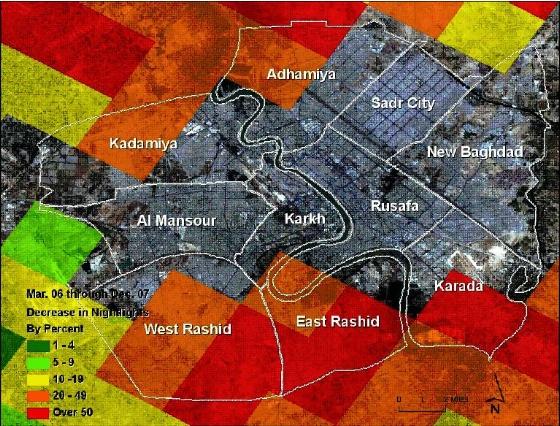
Satellite image of night lights in Baghdad. By tracking the amount of light emitted by Baghdad neighborhoods at night, a team of UCLA geographers has uncovered fresh evidence that last year’s U.S. troop surge in Iraq may not have been as effective at improving security as some U.S. officials have maintained. (Credit: Image courtesy of University of California – Los Angeles)

Study Of Satellite Imagery Casts Doubt On Surge’s Success In Baghdad
September 19, 2008

By tracking the amount of light emitted by Baghdad neighborhoods at night, a team of UCLA geographers has uncovered fresh evidence that last year’s U.S. troop surge in Iraq may not have been as effective at improving security as some U.S. officials have maintained.

Night light in neighborhoods populated primarily by embattled Sunni residents declined dramatically just before the February 2007 surge and never returned, suggesting that ethnic cleansing by rival Shiites may have been largely responsible for the decrease in violence for which the U.S. military has claimed credit, the team reports in a new study based on publicly available satellite imagery.

“Essentially, our interpretation is that violence has declined in Baghdad because of intercommunal violence that reached a climax as the surge was beginning,” said lead author John Agnew, a UCLA professor of geography and authority on ethnic conflict. “By the launch of the surge, many of the targets of conflict had either been killed or fled the country, and they turned off the lights when they left.”

The night-light signature in four other large Iraqi cities — Kirkuk, Mosul, Tikrit and Karbala — held steady or increased between the spring of 2006 and the winter of 2007, the UCLA team found. None of these cities were targets of the surge.

Baghdad’s decreases were centered in the southwestern Sunni strongholds of East and West Rashid, where the light signature dropped 57 percent and 80 percent, respectively, during the same period.

By contrast, the night-light signature in the notoriously impoverished, Shiite-dominated Sadr City remained constant, as it did in the American-dominated Green Zone. Light actually increased in Shiite-dominated New Baghdad, the researchers found.

Until just before the surge, the night-light signature of Baghdad had been steadily increasing overall, they report in “Baghdad Nights: Evaluating the U.S. Military ‘Surge’ Using Night Light Signatures.”

“If the surge had truly ‘worked,’ we would expect to see a steady increase in night-light output over time, as electrical infrastructure continued to be repaired and restored, with little discrimination across neighborhoods,” said co-author Thomas Gillespie, an associate professor of geography at UCLA. “Instead, we found that the night-light signature diminished in only in certain neighborhoods, and the pattern appears to be associated with ethno-sectarian violence and neighborhood ethnic cleansing.”

The effectiveness of the February 2007 deployment of 30,000 additional U.S. troops has been a subject of debate. In a report to Congress in September of that year, Gen. David Petraeus claimed “the military objectives of the surge are, in large measure, being met.” However, a report the same month by an independent military commission headed by retired U.S. Gen. James Jones attributed the decrease in violence to areas being overrun by either Shiites or Sunnis. The issue now figures in the U.S. presidential race, with Republican presidential candidate John McCain defending the surge and Democratic hopeful Barack Obama having been critical of it.

Reasoning that an increase in power usage would represent an objective measure of stability in the city, Agnew and Gillespie led a team of UCLA undergraduate and graduate students in political science and geography that pored over publicly available night imagery captured by a weather satellite flown by the U.S. Air Force for the Department of Defense.

Orbiting 516 miles above the Earth, Satellite F16 of the Defense Meteorological Satellite Program, Operational Linescan System (DMSP/OLS) contains infrared sensors that calculate, among other things, the amount of light given off in 1.75-square-mile areas. Using geo-referenced coordinates, the team overlaid the infrared reading on a preexisting satellite map of daytime Iraq created by NASA’s Landsat mapping program. The researchers then looked at the sectarian makeup in the 10 security districts for which the DMSP satellite took readings on four exceptionally clear nights between March 20, 2006, when the surge had not yet begun, and Dec. 16, 2007, when the surge had ended.

Lights dimmed in those neighborhoods that Gen. Jones pointed to as having experienced ethno-sectarian violence and neighborhood ethnic cleansing in his “Report of the Independent Commission on the Security Forces of Iraq.”

“The surge really seems to have been a case of closing the stable door after the horse has bolted,” Agnew said.

Long-term obstacles to meeting Baghdad’s power needs may have contributed to the decrease in night lights in the city’s southwestern parts, the researchers acknowledge. But Baghdad’s shaky power supply does not fully account for the effect, they contend, citing independent research showing that decaying and poorly maintained power plants and infrastructure were meeting less than 10 hours of Baghdad’s power needs prior to the fall of Saddam Hussein.

“This was the part of the city that had the best sources of connection and the most affluent population, so they could actually generate power themselves, and they were in the habit of doing so well before the U.S. invasion,” said Agnew, the president of the American Association of Geographers, the field’s leading professional organization. “But we saw no evidence of a widespread continuation of this practice.”

In addition to casting doubt on the efficacy of the surge in general, the study calls into question the success of a specific strategy of the surge, namely separating neighborhoods of rival sectarian groups by erecting concrete blast walls between them. The differences in light signatures had already started to appear by the time American troops began erecting the walls under Gen. Petraeus’s direction, the researchers found.

“The U.S. military was sealing off neighborhoods that were no longer really active ribbons of violence, largely because the Shiites were victorious in killing large numbers of Sunnis or driving them out of the city all together,” Agnew said. “The large portion of the refugees from Iraq who went during this period to Jordan and Syria are from these neighborhoods.”

Previous research has used satellite imagery of night-light saturation to measure changes in the distribution of populations in a given area, but the UCLA project is believed to be the first to study population losses and migration due to sectarian violence. The outgrowth of an undergraduate course in the use of remote sensing technologies in the environment, the UCLA project was inspired by a desire to bring empirical evidence to a long-running debate.

“We had no axe to grind,” said Agnew. “We were very open. If we had found that the situation was different, we would’ve reported it. Our main goal was to bring fairly objective and unobtrusive measures to a particularly contentious issue.”

Journal reference:

1. Agnew et al. Baghdad nights: evaluating the US military ‘surge’ using nighttime light signatures. Environment and Planning A, 2008; 40 (10): 2285 DOI: 10.1068/a41200

[Adapted from materials provided by University of California – Los Angeles.]

Source / Science Daily

The Rag Blog

Posted in RagBlog | Tagged , , | 3 Comments

Rejecting "Anything Goes, Just Don’t Get Caught" as a Viable Political Philosophy

Cynthia McKinney is a former member of Congress from Georgia, and the Green Party candidate for President. We do not in any way endorse her (or any candidate specifically), but feel that she has some important things to say that are worthy of posting on the Rag Blog.

Richard Jehn / The Rag Blog


Seize the Time
By Cynthia McKinney / September 19, 2008

We the people must now seize the time! We have always had the capability of determining our own destiny, but for various reasons, the people failed to elect the leaders who provided the correct political will.

There was always some corporate or private special interest that stood in the way of the public good. And they always seemed to have the power of the purse to throw around and influence public opinion or our elected officials.

The very foundation of the U.S. economy is crumbling underneath our feet. This represents a unique moment in U.S. history and we must now seize the time for self-determination — for health care, education, ecological wisdom, justice, and all the policies that will make a difference in the lives of the people including an end to all wars, including the drug war!

The crisis was staved off for a time for some of our major finance engines when they were able to obtain bridge funding from certain sovereign wealth funds. That option grows increasingly dim as The Federal Reserve is becoming the lender of last resort. This means that the people are becoming the owners of the primary instruments of U.S. capital and finance.

This now means that the people have a say in how these instruments are to be used and what their priorities ought to be. The people should now have more say in how their tax dollars are spent and what the priorities of government an the public sector must be. We the people must now set our demands to ensure and promote the public good.

Now, as we ponder the importance of this moment to do good and serve the needs of the people, some politicians have already figured out their answer for us: win or steal the next election, prepare for more war, and leave it to others to try and figure out what to do next.

While banks are failing all around us and the U.S. taxpayer is drenched with news of billion dollar bailouts for *selected* companies, the Congress, which has utterly failed in its twin responsibilities of setting policy and Executive Branch oversight, plans to adjourn instead of setting new policies; lessening the impact of the economic freefall on innocent victims; or stopping war, expansion of war, new war, and occupation.

In a dizzying turn of recent events, we have all witnessed the collapse of Fannie Mae and Freddie Mac mortgage providers, investment banks Lehman Brothers and Bear Stearns, and insurer American International Group (AIG), and other companies. So far, at least eleven banks have filed for bankruptcy this year. The case of the AIG bailout is particularly curious as Merrill Lynch was denied taxpayer largesse. I wonder if AIG was the selected company for bailout because of its relationship to the U.S. intelligence community and what others would discover if AIG’s books were opened in an audit. The last person to get close to AIG and its shady operations was Eliott Spitzer.

But some more fundamental issues must be explored here, relating to the underlying assumptions that have guided U.S. political and economic activity, particularly over the last eight years.

The Bush Administration’s “anything goes, just don’t get caught” attitude has set the tone for what we are witnessing today. To be sure these problems didn’t start in January of 2001, but they sure were allowed to accelerate during the George W. Bush Administration. For example, what tone was set when the Administration shipped $12 billion to Paul Bremer’s provisional government in Iraq in cash on wooden pallets for Iraq reconstruction? No wonder $9 billion of it was “lost.” What I’m constantly reminded of is that the money didn’t just vanish, somebody got it. Now it’s up to us to find out who!

However, the Administration’s blatant disregard for good governance, the rule of law, standards of moral and ethical conduct, and even etiquette, when coupled with a laissez-faire, “go-along-to-get-along” attitude from Congress meant that no holes were barred and no hands were on the deck–a sure prescription for disaster.

In my reading over the course of the last few years, I had to become somewhat conversant with the language of the new economy: bundled mortgages, securitization, SPEs, SIVs, derivatives. But in addition to the old concepts that always seemed to be with us–predatory lending, redlining, no affordable housing amid “the housing bubble,”– it soon became clear that basically folks had figured out a way to make money off of a ticking time bomb. Kind of like prisons for profit.

And even though the Enron scandal was supposed to have cleaned up a lot of this, unfortunately, even Fannie Mae and Freddie Mac regularly engaged in some of these practices and that’s why you and I own them today. I believe it is true that the very foundations of the U.S. economy and conventional political behavior have been shaken. Now is not the time for business as usual.

And although this is by no ways exhaustive, here are a few things that I think the Democratic-led Congress could work on now instead of adjourning:

1. enactment of a foreclosure moratorium now before the next phase of ARM interest rate increases take effect;

2. elimination of all ARM mortgages and their renegotiation into 30- or 40-year loans;

3. establishment of new mortgage lending practices to end predatory and discriminatory practices;

4. establishment of criteria and construction goals for affordable housing;

5. redefinition of credit and regulation of the credit industry so that discriminatory practices are completely eliminated;

6. full funding for initiatives that eliminate racial and ethnic disparities in home ownership;

7. recognition of shelter as a right according to the United Nations Declaration of Human Rights to which the U.S. is a signatory so that no one sleeps on U.S. streets;

8. full funding of a fund designed to cushion the job loss and provide for retraining of those at the bottom of the income scale as the economy transitions;

9. close all tax loopholes and repeal of the Bush tax cuts for the top 1% of income earners;

10. fairly tax corporations, denying federal subsidies to those who relocate jobs overseas repeal NAFTA.

And since the Congress plans to adjourn early and leave these problems to The Federal Reserve, The Federal Reserve should operate in the interests of the U.S. taxpayer and not the interests of the private, international bankers that it currently represents. This, of course means that The Federal Reserve, too, must undergo a fundamental ownership and mission change.

This crisis does not have to be treated as merely a “market correction,” or the result of a few rotten apples in an otherwise pristine barrel. This crisis truly represents the opportunity to introduce fundamental changes in the way the U.S. economy and its political stewards operate.

Responsible political leadership demands that the pain and suffering being experienced by the innocent today not be revisited upon them or the next generation tomorrow. But sadly, instead of affirmative action being taken in this direction, the Bush Administration ratchets up the drumbeat for war, Republican Party operatives busily remove duly-registered voters from the voter rolls, and our elected leaders in the Congress go home to campaign while leaving all of us to fend for ourselves. For the Administration and the Democrat-led Congress, I declare: MISSION UNACCOMPLISHED.

For the public whose moment this is, I say:

Power to the People!

Please visit www.runcynthiarun.org and read our platform.

Source / Roseanne World

Thanks to Diane Stirling-Stevens / The Rag Blog

Posted in RagBlog | Tagged , | 1 Comment

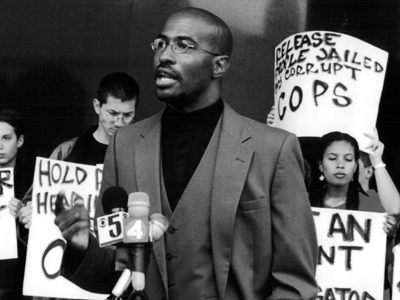
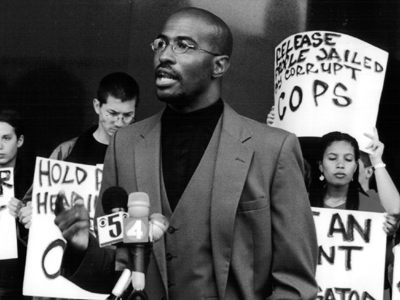
Van Jones: ‘We just need the president to stop breaking everything.’


We Can’t Drill Our Way Out of Our Energy Problems
By Van Jones / September 20, 2008.

In an electrifying speech, Van Jones explains that we have to invent and invest our way out of the economic and environmental crises.

The following speech was originally delivered at Netroots Nation 2008 in Austin, Texas.

I have a little bit of whiplash. Thirty-six hours ago I was in the Arctic with Jimmy Carter. This is not a joke, you all. (Laughter) It sounds like a joke, right? You hear about the black guy in the Arctic with Jimmy Carter? No, I was really … (Laughter)

I was really in the Arctic, man, the abominable snow Negro. No, I was really there. (Laughter) And the reason, so I’m a little bit jet-lagged, but I want you to know, if you didn’t know, it was kind of kept quiet until it was over. But a number of people, huge dignitaries, all got on a boat and went to the Arctic. We spent eight days. Jimmy Carter was there. Madeline Albright. Tom Daschle. Larry Page from Google. But not just liberals and progressives; the head of DuPont was there, eight days on a boat, to look and see if what’s happening with climate change is real. The head of Monsanto was there. We had Republicans and Democrats, young people, old people, state leaders, Catholics, evangelicals.

And I want you to know that after eight days of looking with our own eyes of what’s going on, looking at the glaciers receding, looking at the animals and life up there that’s suffering, watching the actual results and impacts of global warming, that every single person who is a part of that delegation, Left, Right and otherwise, agreed that Al Gore has been right the whole time. Global warming is real.

We have to do something about it. Nobody who goes and spoke at this thing has come to any other conclusion. You need to understand that. This is our moment. This is our opportunity. Before I get to my comments, though, since we’re here, I want to tell you about my personal experience in the Arctic.

First of all, they had us on this boat, man. Lot of people have bad experiences of boats, man. You know, we’re … (Laughter) far back memories, man. I was like, I don’t like this. (Laughter) It was tough, man. And then, boats are not big things. They’re not airplanes. I guess it’s left over from the days of scurvy or something. They’re small. And, OK, I busted my head open, man. I’m serious. I busted my head open on a bulkhead, like the first day, which was not very impressive. (Laughter) So, a little bit woozy.

The other thing that happened was, we had a meeting. We had a delegation, this meeting of the delegation of polar bears. And they’re very polite, the polar bears. And they’re very friendly. The polar bears were not as skinny and scrawny as I expected. They were definitely smaller than they were supposed to be, but they also looked toned, looked pretty healthy.

So I said, what’s going on? You guys look at lot healthier than I expected. And nobody said anything. The polar bears, they got quiet. (Laughter) And the only polar bear that spoke up was a black one. (Laughter) Oh, see? You didn’t know there was black polar bears. Now I’m telling you, man. Racism everywhere. (Laughter)

But the black polar bear was honest, man. He said, look. Tell you the truth. The seals, they are getting kind of scarce up here. But we’ve been snacking on these camera crews y’all keep sending. (Laughter) So tell Gore to keep giving the speeches, man. The camera crews are tasty. (Laughter) So I say that because it’s so important that we do more than just send delegations to the Arctic and talk about it, and worry about it. It’s time to take some real action. And I want to talk with you about our action plan. And I want to talk with you about the importance of it, because one of the things that I saw when I was there was up close and personal with Jimmy Carter.

I think a lot of times, in the progressive movement, we kind of almost go along with the conservatives in making fun of Jimmy Carter, almost turning him into a punch line. But I want to say, seeing him day after day, he’s one of the truly great human beings that’s ever lived on this earth.

We need to give him the respect that he’s due. Jimmy Carter was talking about the oil crisis. He was talking about solar power. He was talking about wind energy 30 years ago. And if we had stayed with his program, if we had stayed with his policies, we wouldn’t be where we are today. So he deserves the utmost respect from all of us. We need to rehabilitate Jimmy Carter.

If conservatives can rehabilitate Ronald Reagan, we can certainly rehabilitate Jimmy Carter. We have to learn the lessons, too, from his presidency, because we are about to go into a very similar situation. Many of you are excited about the Democratic nominee. Many of you are excited about having a Democrat back in the White House and think that your efforts may lend a hand toward getting him elected.

I want to say to you, your excitement is understandable, and your ability to get him elected is not in doubt. You probably can get this nominee elected. You probably cannot get him re-elected. I’m going to say it again. You can probably get him elected, but you probably cannot get him re-elected, unless we are very intelligent starting right now. Now is the time to think about the re-election of this president, not just the election.

And the last time we had a Democrat in the White House, Democrats controlling the Senate, Democrats controlling the House, energy prices through the roof, jobs going down, was Jimmy Carter. And we had four years of that, and 12 years of Reagan-Bush. If we are not careful, if we are not smart, this could be four years as a precursor to the kind of right-wing backlash that will make us miss John McCain, make us miss George W. Bush. Don’t think it’s not possible. There are dragons on the Right who, in their anti-immigrant hatred, in their warmongering jingoism, in their commitment to drill and burn their way out of our energy crisis, will make you miss John McCain.

So it is serious, now, that we have to figure out, what is the set of policies, and the program and the plan, from the bottom up as well as the top down, to ensure that we have four years, eight years, 12 years, 24 years, 100 years to fix the past eight. That’s what we need. We need a strategy for that.

Let me suggest to you that the term that we most must address, as we talk about energy and climate, is not a term about polar bears. It’s not a term about polar bears, it’s not a term about ice caps. It’s a term from deep in the bowels of economics. The worst, scariest, most frightening, most horrific term in all of economics, the term that killed the presidency of Jimmy Carter, the term that could turn this country over to the far right in a very short period of time, that term is stagflation. Stagflation. And it’s something that we haven’t had to talk about for 30 years, but it is the term that sent shivers down the spine of anybody involved in politics.

What is stagflation? Stagflation is the worst possible outcome in market economics. Energy prices go up, and when they go up, they push up all prices, because it takes energy to make everything. But there’s a particularly pernicious effect on energy prices going up. It’s that the prices of everything go up, but jobs go down. Prices go up, but jobs go down. People buy less, they hire less. And over time, society gets stretched on the rack of the pain of prices continuing to rise, and jobs continuing to fall, and good people get voted out of office. That’s what happened to Jimmy Carter, and it could happen to your nominee.

There’s only one way out of stagflation, and that is to get energy prices down and stable. Here is our problem. The right wing has a strategy for getting energy prices down and stable. They want to drill and burn their way out of the problem. And you’ve heard it now for months: Drill now, pay less. That is their strategy. And they continue to beat the drum on that, and now the Democrats are starting to get weak on the point. We cannot drill and burn our way out of this crisis. If we do, we will bake this planet. That is a non-starter. It has to be off the table.

We cannot drill and burn our way out. But here’s what we can do. We can say no. We aren’t going to drill and burn our way out, but we can invent and invest our way out. We can invent and invest our way out. That’s our strategy.

That’s our strategy. And why is it a good strategy? It’s a good strategy because you only have to do two things: cut demand for energy, and diversify supply. Why is that good for us? Because both of those things create jobs. Cutting demand creates jobs. Why? Cutting demand means conservation. It means weatherizing … millions and millions of buildings across the country. Millions of buildings have to be weatherized so they don’t leak so much energy. What does that mean? That creates thousands of contracts, millions of jobs, billions of dollars of economic stimulus. We’re not building any more houses, but we can begin to rebuild the ones that we have right now to save on energy costs. See? That’s a way out.

And it puts people to work. Cutting demand means a massive investment in public transportation, rail, clean buses. That’s the way out. You cut demand for energy, and you create jobs doing it. On the supply side, diversifying our supply means wind, it means solar, it means all the things that (San Francisco Mayor) Gavin (Newsom) was just talking about. But that also means jobs. Why?

Many of you don’t get on airplanes right now. All y’all concerned about carbon, you better put a whole bunch up … (Laughter) and me, too. When you’re flying over this country, look down. You’ll see house, after house, after house. No solar panels. And go to sleep, wake up in an hour. You’ll still be flying. Look down. More houses without solar panels. The next president of the United States should say, we are going to have a World War II level mobilization, a crash program to weatherize and solarize America, put up millions of solar panels on every surface we can find and put people to work doing it.

That’s the way out. We have the technology. We have not had the political will to unleash that technology. I am proud to be part of an organization, Green For All, that is in partnership with One Sky, it’s in partnership with Al Gore’s Climate Alliance and other organizations, to bring this into being. So I want to tell you the three things that we’re going to be doing this fall I’m going to need your major active support and intention on, that I want to talk to you about your role under this new administration.

… We have to change the terms of debate going through the fall. We have been getting our butts whooped by this drill-drill-drill mantra. And it’s time for us to seize the terms of debate and show that we have answers, and we have solutions. That is going to be primarily up to you. We’ve seen that the mainstream media is willing to follow the right wing down the hellhole of increasing carbon emissions for short-term potential gains on gas prices. It’s going to be up to you to tell a different story.

What is actually happening on our side that’s not being covered? Three things.

Number one: We have legislation right now in front of Congress, the Green Jobs Act of 2007 and the Green Block Grant. What would they do? They would put enough money into the Department of Labor to send out, to community colleges and vocational schools all around the country, enough money to train 30,000 people a year in green jobs, in green trades. That is now being beat up and held up in Congress. We need your help to get the Green Jobs Act fully funded.

Number two: The mayors, the U.S. Conference of Mayors has gotten this Green Block Grant. It’s called the Energy Efficiency and Conservation Block Grant. It is authorized at $2 billion. That’s also being held up and beat up in Congress. That would be $2 billion, with a B, so mayors like Gavin Newsom could get money to begin this program of weatherization and solarization in every city in America. That should be the number one priority for the entire country, and instead, it’s being held up. You can do something about that. You could do something about that.

Number three: This fall, we are going to launch a massive campaign to accelerate the embrace by people in this country of green jobs. On September 27th we are going to have the biggest national mobilization for green jobs in the history of the country. We’re going to have thousands of rallies, thousands of house meetings all across the country, calling for green jobs now. This movement for climate solutions is not just a movement about the crisis.

We know about the crisis. We know about the bad stuff. We’re now going to start talking about the good stuff. That is going to be the key. Once people in the United States of America understand that this movement that we’re trying to build is not just a movement to prevent something bad from happening — this is the movement that will finally get the good things happening — we think that we will be able to build a majority. Why?

We want to be able to tell people for the first time, guess what? This movement for climate solutions is the movement that you’ve been waiting for your whole life. Why? Because we want to tell your child, who might be standing on a street corner right now, with no future, your child … who’s probably gone to more funerals this year, if you live in urban America, than he’s ever gone to graduations or proms.

We want to tell your child, guess what? We want to retrofit, reboot, repower a nation. And we need your help to do it. We want to give you the tools, and the training, and the technology, to rescue this country. We want to put the green hard hat on you … tool belt, work boots. We want to put you up on a rooftop where you can install solar panels. Bring your grandmama’s light bill down. We’re tired of your grandmama sending checks to the PG&E and the power companies. We want them to write her a check. See? That’s what we want. That’s what this movement is about.

We want them to write her a check. We want to take the asthma inhaler out of your little sister’s pocket, by closing down these dirty pollution power plants, and letting her run and play again.

We want to let you in on the ground floor of something that’s going somewhere. This is not a dead end job at Wal-Mart. See, once you get in on the ground floor as a solar panel installer, doing green retrofits, this is going to be a growing industry. In a couple years you can be a manager, an owner yourself, and help to rebuild your community. We want to be able to go door to door in America and tell people that this is the movement that will create new work, new wealth, new health, new investments.

You see, cities, as Gavin said, 75 percent of our greenhouse gas emissions, there is no way to beat global warming without greening the cities. You can’t save the polar bear without saving the poor children, too. It’s one movement. It’s one movement, because it’s one solution.

But that’s the opportunity that we have. The opportunity that we have is to say for the first time, we have all this work that needs to be done. We have to build wind farms. We have to build wave farms. We have to build solar farms. We have to weatherize buildings. We have to put up solar panels. We have to plant trees, millions of them, and take care of them. Thousands of jobs. Millions of jobs. Billions of dollars of economic investment. This is the work that most needs to be done.

We have the opportunity to connect the people who most need work with the work that most needs to be done … and fight pollution and poverty at the same time. And bring this country together, and bring the energy prices down, bring the jobs up. End forever the need for oil wars and resource wars, and bring this country together. That’s a promise of this green jobs movement. And we need your active support to evangelize this as a solution. It’s not just going to save the polar bears. It’s not just going to save the poor kids. It’s the only way to save the presidency of the United States.

We cannot afford to have two back-to-back failed presidencies in this country. The world can’t afford it. The only way to save this new coming president … people keep talking about his name, his middle name is a problem. We’re worried about his middle name. Barack Hussein Obama. His middle name is not going to be Hussein if he wins this election. His middle name is going to be Piñata. He will be Barack Piñata Obama. (Laughter)

Trust me. You’re going to have the right wing, not in the White House, not running anything in the White House, not running anything in the Senate, not running anything in the House. They’re going to have nothing to do but run their mouths against this president. And they will ally themselves. They will try to create a backlash alliance against anything he does on the environment, a backlash alliance between polluters and poor people, to say that the green revolution is nothing but an eco-elite movement, trying to put green taxes on poor people to pay for their hybrid revolution.

Van Jones is the founder and president of Green For All and is the founder of the Ella Baker Center for Human Rights.

Read the rest of it here. / AlterNet

Thanks to Diane Stirling-Stevens / The Rag Blog

Posted in RagBlog | Tagged , , | Leave a comment

Sarah Palin and the Witch-Fighting Pastor Who Helped Her Become Governor

‘Examination of a Witch,’ by T.H. Matteson 1853 / Courtesy of the Peabody Essex Museum. Blaming it all on witches is not without precedent.

Sarah Palin Linked Her Electoral Success to Prayer of Kenyan Witch Hunter Thomas Muthee
By Hannah Strange / September 18, 2008

Also read ‘Burn Her! Why it’s dangerous to be a witch in a recession’ by Tim Harford, below this article.

The pastor whose prayer Sarah Palin says helped her to become governor of Alaska founded his ministry with a witch hunt against a Kenyan woman whom he accused of causing car accidents through demonic spells.

At a speech at the Wasilla Assembly of God on June 8 this year, Palin described how Thomas Muthee had laid his hands on her when he visited the church as a guest preacher in late 2005, prior to her successful gubernatorial bid.

In video footage of the speech, she is seen saying: “As I was mayor and Pastor Muthee was here and he was praying over me, and you know how he speaks and he’s so bold. And he was praying “Lord make a way, Lord make a way.”

“And I’m thinking, this guy’s really bold, he doesn’t even know what I’m going to do, he doesn’t know what my plans are. And he’s praying not “Oh Lord, if it be your will may she become governor,” no, he just prayed for it. He said, “Lord make a way and let her do this next step. And that’s exactly what happened.”

She then adds: “So, again, very, very powerful, coming from this church,” before the presiding pastor comments on the “prophetic power” of the event.

An African evangelist, Muthee has given guest sermons at the Wasilla Assembly of God on at least 10 occasions in his role as the founder of the Word of Faith Church, also known as the Prayer Cave.

Muthee founded the Prayer Cave in 1989 in Kiambu, Kenya, after “God spoke” to him and his late wife, Margaret, and called him to the country, according to the church’s Web site.

The pastor speaks of his offensive against a demonic presence in the town in a trailer for the evangelical video “Transformations,” made by Sentinel Group, a Christian research and information agency.

“We prayed, we fasted, the Lord showed us a spirit of witchcraft resting over the place,” Muthee says.

After the spirit was broken, the crime rate dropped to almost zero and there was “explosive church growth” while almost every bar in the town closed down, the video says.

The full “Transformations” video featuring Muthee’s story has recently been removed from YouTube, but the rest of the story is detailed in a 1999 article in the Christian Science Monitor, as well as on numerous evangelical Web sites.*

According to the Christian Science Monitor, six months of fervent prayer and research identified the source of the witchcraft as a local woman called Mama Jane, who ran a “divination” center called the Emmanuel Clinic.

Her alleged involvement in fortune-telling and the fact that she lived near the site of a number of fatal car accidents led Muthee to publicly declare her a witch responsible for the town’s ills and order her to offer her up her soul for salvation or leave Kiambu.

Says the Monitor, “Muthee held a crusade that ‘brought about 200 people to Christ.'” They set up around-the-clock prayer intercession in the basement of a grocery store and eventually, says the pastor, “the demonic influence — the ‘principality’ over Kiambu — was broken,” and Mama Jane fled the town.

According to accounts of the witch hunt that circulated on evangelical Web sites such as Prayer Links Ministries, after Muthee declared Mama Jane a witch, the townspeople became suspicious and began to turn on her, demanding that she be stoned. Public outrage eventually led the police to raid her home, where they fired gunshots, killing a pet python they believed to be a demon.

After Mama Jane was questioned by police — and released — she decided it was time to leave town, the account says.

Muthee has frequently referred to this witch hunt in his sermons as an example of the power of “spiritual warfare.” In October 2005, he delivered 10 sermons at the Wasilla Assembly of God, the audio of which was available on the church’s Web site until it was removed around the time Palin’s candidacy was announced. The blog Irregular Times has listings and screen grabs of the sermons.

It was during these sermons that Palin, who was then preparing for her gubernatorial run, was anointed by Muthee. His intercession, she says, was “awesome.”

Her June 8 speech was to mark the graduation of students from the Wasilla Assembly of God’s Masters’ Commission, which, as Pastor Ed Kalins explains, believes Alaska will be the refuge for American evangelicals upon the coming “End of Days.” After her speech, Palin was presented with an honorary Masters’ Commission diploma.

© 2008 The Times of London UK All rights reserved.

*This video, “Transformations: A Documentary Trailer,” can be seen here on YouTube, but embedding has been disabled so we can’t post it.

Source / The Times of London / AlterNet

Here is a video of Sarah Palin discussing her experience with witch-hunting pastor Thomas Muthee:

Burn Her!
Why it’s dangerous to be a witch in a recession.

By Tim Harford / September 20, 2008

Why did people murder suspected witches in Renaissance Europe? And why do they still do so today in sub-Saharan Africa? As someone whose main source of information about witch trials is Monty Python and the Holy Grail, I was fascinated to learn that witch-burning has its own grim economics.

Clearly, some of the fervor for murdering women—typically elderly widows—had cultural and religious origins. In the early medieval period, the Catholic Church dismissed the idea that witches had supernatural powers, and some church documents argued that it was heresy to believe in witchcraft. Without church support, it’s easy to see why witch trials were not popular.

Yet when the trial and execution of suspected witches surged in the mid-16th century and throughout the 17th, it was a cross-cultural phenomenon. Trials took place in many countries and were conducted by both Protestants and Catholics, and in both secular and religious courts. Perhaps a million women were killed across Europe after being accused of witchcraft, and most of them died during this period. Why?

Historian Wolfgang Behringer has one possible explanation: Temperatures dropped sharply around the time that the trials gained in popularity. The “little ice age,” in which average temperatures fell by about 1 degree Celsius, was enough to freeze the Thames River on many occasions.

Emily Oster, an economist at the University of Chicago, has tried to gather systematic data on the link between witch trials and the weather. The results look striking: Between 1520 and 1770, colder decades go hand-in-hand with more trials. The link may be simply that witches were often blamed for bad weather. Or there may be a less direct link: People tend to lash out in tough times. There is some evidence, for instance, that lynching was more common in the American South when land prices and cotton prices were depressed.

Such deaths are, sadly, not a historical footnote. In Meatu, Tanzania, half of all reported murders are “witch killings.” Such murders have been documented elsewhere in Africa, Bolivia, and rural India. The difference between the historical executions and modern attacks are that a Tanzanian “witch” typically dies at the hands of her own family. The machete is the weapon of choice.

Edward Miguel, an economist at the University of California, Berkeley, and co-author of Economic Gangsters, a book about the economics of crime, corruption, and war, has studied the Tanzanian situation. He argues that there is a direct economic motive for the attacks. Tough times in a Tanzanian household may well result in starvation, and the elderly—especially women—are at risk of being sacrificed to free resources. As evidence, Miguel points out that victims of witch attacks in Meatu district—almost all old women—tend to be from the poorest households. The murders are much more common during years of drought or flood.

If the problem truly is an economic one, the solution might be, too. One possibility is to give the elderly generous pensions. Witch killings all but stopped in South Africa’s North Province after such a pension scheme was introduced in the early 1990s. Unfortunately, such pensions are probably too expensive for Tanzania.

A grass-roots alternative has emerged in another Tanzanian district, Ulanga, where traditional healers “cure” elderly women of witchcraft by shaving their bodies and smearing their pates with “anti-witchcraft paste.” Miguel does not think it’s a coincidence that the healers also provide the women with food and shelter during famines, in expectation of payments from their families in better times. Spiritual ceremony meets social insurance: It’s a solution, of sorts.

Source / Slate

The Rag Blog

Posted in RagBlog | Tagged , , , , | 2 Comments

Perhaps There Is a Little Justice in This World

Pedestrians walk by the American International Group Inc. building in New York, Sept. 17, 2008. Photographer: Ramin Talaie/Bloomberg News

Pelosi, Kerry May Share Investor Pain as AIG Stakes Evaporate
By Jonathan D. Salant / September 19, 2008

The market storm that brought down Lehman Brothers Holdings Inc., American International Group Inc. and other pillars of U.S. finance may have also blown holes in the portfolios of House Speaker Nancy Pelosi, Senator John Kerry and more than 50 other members of Congress.

Pelosi, in her most recent financial disclosure form, reported that her husband owned between $250,000 and $500,000 of stock in AIG, which ceded majority control to the U.S. government this week in exchange for $85 billion of loans.

Kerry, the 2004 Democratic presidential nominee, disclosed that his wife, Teresa Heinz Kerry, had more than $2 million of AIG stock at the end of 2007, when shares were worth $58.30. AIG has fallen 85 percent this week to close yesterday at $2.69. The lawmakers’ aides didn’t respond to calls seeking comment.

Altogether, 56 senators and representatives had stakes in AIG, Lehman, Fannie Mae, Freddie Mac, Bear Stearns Cos. or IndyMac Bancorp Inc. — some of the biggest casualties of the market bloodbath — according to the Center for Responsive Politics. The most recent annual disclosure filings list investments as of Dec. 31, 2007, and reveal the size of holdings only within a range of values. Lawmakers may have sold shares since then.

“Lawmakers, like everyone else in America who has any kind of retirement portfolio or stock holdings, are going to be suffering,” said Gary Kalman, a lobbyist for the Boston-based U.S. Public Interest Research Group, a consumer-advocacy organization. “This is a serious issue. We need to have a serious response.”

Market Plunges

The Standard & Poor’s 500 Index plunged 7.6 percent during the first three days of this week on news that Lehman and Merrill Lynch & Co. — which survived two world wars and the Great Depression — were finished as independent investment banks.

Lehman filed history’s biggest bankruptcy case on Sept. 15 and Merrill sold itself to Bank of America Corp. Even after rallying yesterday, the S&P 500 is down almost 25 percent from its October 2007 peak.

Lehman shares, which traded for as much as $67.73 last November, closed yesterday at 5 cents. Merrill’s shareholders are in better shape. To avoid Lehman’s fate, Merrill agreed to be acquired in a stock-swap worth $26.28 per share at yesterday’s closing prices. In better days, Merrill soared to as much as $98.68 in January 2007.

Bear Stearns was the first Wall Street titan to fall as home-loan defaults battered the market for mortgage-backed securities and started a chain reaction that devastated credit markets. JPMorgan Chase & Co. bought Bear Stearns in March.

Government Takeover

Earlier this month, the government took control of Fannie Mae and Freddie Mac, which together accounted for almost half of the U.S. home-loan market. Fannie Mae shares had already plummeted more than 80 percent this year, to $7.04 from $39.98, before the government’s Sept. 7 takeover was announced. Shares dropped to 73 cents when trading resumed the next day. Freddie Mac fell to 88 cents, after starting the year at $34.07.

Representative Robin Hayes, a South Carolina Republican, had Congress’s biggest AIG stake, according to the Washington-based Center for Responsive Politics. Hayes’s AIG stock was worth between $2.8 million and $11.5 million.

John McCain, the Republican presidential nominee, avoided potential losses. Because of the Arizona senator’s run for the White House, his wife, Cindy, last year liquidated a blind trust that had contained stock in AIG, Fannie Mae, Freddie Mac and Lehman. The amounts of stock she had owned weren’t disclosed.

Representative Jane Harman, a California Democrat, owned between $50,000 and $100,000 of Lehman shares, according to her disclosure form. Calls to offices of Hayes and Harman weren’t returned.

Pasadena, California-based IndyMac’s bank was seized by U.S. regulators in July, in the third-biggest U.S. bank failure. IndyMac stock closed yesterday at 6 cents, after trading earlier this year for as much as $11.32.

Source / Bloomberg

Thanks to Diane Stirling-Stevens / The Rag Blog
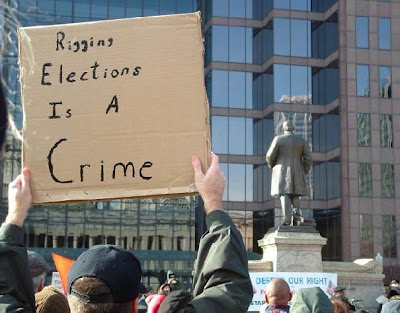
Posted in RagBlog | Tagged , , | 1 Comment