Newpapers Distribute Fear DVD : Delivering Propaganda, As If It is Toothpaste


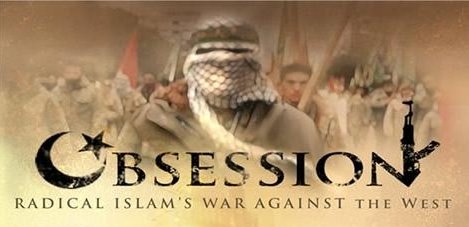
‘Dozens of local newspapers in “swing” election states — from Altoona to Las Vegas (and my own Charlotte Observer) — have been paid to distribute a film designed to spread fear about our national security.’
By William E. Jackson, Jr. / September 13, 2008

DAVIDSON, N.C. — Bundled into my Charlotte Observer on this Saturday morning, and this week into approximately 100 newspapers located overwhelmingly in battleground states across the country, there is a kind of 527-fund contribution to the presidential campaign of John McCain.

Under the cloak of an advertising supplement, a one-hour edition of a DVD entitled “Obsession: Radical Islam’s War Against the West” had been attractively packaged and inserted into some 200,000 copies of the McClatchy-owned newspaper. The same happened at the other major McClatchy paper in North Carolina, the Raleigh News & Observer.

Dozens of local newspapers — from Altoona to Las Vegas and selected regional editions of the New York Times) — have been paid to distribute a film designed to spread fear about our national security.

Anyone can see an electoral vote pattern to the targeted areas, with almost all of the battleground or “swing” states represented. (The daily newspapers in only one such state appear to have refused the ad, Minnesota.) These papers have allowed themselves to be caught up in a “neo-con” propaganda scam in the context of the presidential campaign, and during 9/11 week.

As of Saturday, September 13, the rationalizations of the publishers and ad personnel at the two N.C. newspapers were either beggarly excuses for new sources of revenue, or politically naïve in the extreme.

In the Raleigh News & Observer, Jim McClure, vice president of display advertising for the N&O, was quoted as saying that the “ultimate decision” to distribute the DVDs had been made by the publisher. McClure compared the propaganda to harmless household samples: “Obviously, we have distributed other product samples, whether it’s cereal or toothpaste.” He dismissed allegations that it is inflammatory: “In the beginning of the DVD it clearly states it’s not about Islam. It’s about radical Islam.”

N&O publisher Orage Quarles III said in a statement: “As a newspaper we tend to shy away from censorship. In cases of controversial topics, if we err, we tend to do so on the side of freedom of speech,” a theme that must have been in talking points guidance from company headquarters.

Charlotte Observer publisher Ann Caulkins said paid ads represent the client’s opinions, not the newspaper’s. Moreover, she claimed that the DVD met Observer guidelines: “We’re all for freedom of expression, freedom of speech. This is in no way reflecting our opinions, but it is something we allow.” What wouldn’t be allowed? She identified material that’s racist or contains profanity or offers graphic images of body parts. One has to wonder if she has watched the film her paper has foisted upon readers.

All in all, the propaganda campaign is a shameful episode for the Fourth Estate.

[William E. Jackson, Jr. is a longtime contributor to E&P. He is a former top legislative aide in Congress and arms control expert.]

Source / Editor & Publisher

The Rag Blog

Posted in RagBlog | Tagged , , , , , | Leave a comment

Afghanistan: It’s Acknowledged to Be a Failed State

Kabul, 2008: “Resurrecting the previous Afghan state under current conditions may be doomed to failure.” AP

Borderline state
By Barnett Rubin / September 12. 2008

Afghanistan, which served for so many years as a buffer between warring nations, is today riven by conflicts imported from abroad. Barnett R Rubin weighs the obstacles to restoring stability.

The past 35 years in Afghanistan have seen the end of the country’s status as an isolated buffer state. In the past, agreement among neighbours and great powers not to intervene in Afghanistan meant that the state served to limit the spread of conflicts; but today virtually the entire international community is involved in Afghanistan, and all the conflicts and disputes among its member states and organisations are playing out within its borders.

Ten years ago Afghanistan was home to a low-intensity conflict between the Taliban and Northern Alliance, but it was also the scene of Indo-Pakistan and Sunni-Shia conflicts and, to a certain extent, US-Iranian-Russian competition over pipeline routes. These conflicts have become more intense at the same time that Afghanistan has become the theatre for the War on Terror, the ill-defined confrontation of the US and global Islamist movements; the conflict between Nato and Russia; the confrontation between the US and Iran; the struggle within Pakistan over that country’s future; and a key theatre of a transnational insurgency spanning Afghanistan and Pakistan and linked to al Qa’eda. All of this alongside an intensification of the ethnic, tribal, regional and sectarian cleavages that have always marked Afghan politics.

If it seems unlikely that Afghanistan can return to its days of isolation, that is because all of the elements that enabled it to survive in relative stability for nearly a century have disappeared: a population largely isolated in remote valleys with few links to the outside world, some small arms and no organisation above the local level; a government subsidised by great powers and accepted as legitimate by all its neighbours; and an economy largely based on subsistence farming, pastoralism, limited pockets of commercial agriculture and trade.

The territory of today’s Afghanistan has never sustained a state without international aid to its security forces, and it has repeatedly collapsed in the face of invasion or contestation. The stability of such a state would require a level of income and legitimacy sufficient to recruit and maintain security forces adequate to defend against any threats to the state; in the current environment, that is a tall order indeed.

Three key elements ensured Afghanistan’s stability after it was first demarcated as a buffer between the British and Russian empires in the 19th century. First and foremost, the great powers themselves agreed not to interfere inside Afghanistan or use Afghanistan’s weakness against each other, ensuring few international challenges to the Afghan state and the separation of rival powers by a neutralised Afghanistan. Second, the population remained disarmed, demobilised and isolated, without political organisation and largely engaged in subsistence activities, resulting in few domestic demands on the state or challenges to its legitimacy. And third, international subsidies to the state enabled it to finance security forces adequate to the low-threat environment.

The events of September 11 made it clear that the Afghan state was weak and no longer integrated into the global community, and that its territory was home to the leadership of a highly organised global network of political violence. The American response was to destroy the weak government of the Taliban and call on the UN to try to rebuild the Afghan state. But resurrecting the previous Afghan state under current conditions may be doomed to failure.

Afghanistan’s relationship to the international system has changed decisively. Virtually every major international organisation and influential state has become involved there. But the result has been to import innumerable other conflicts into the country. First, of course, is the War on Terror, which as defined by the Bush administration includes not only the destruction of al Qa’eda, but also the destruction of organisations or states that harbour or support “terrorists”. Second, the conflict between India and Pakistan; Pakistan seeks to exclude Indian influence from Afghanistan, which it considers part of its security perimeter; India considers a presence in Afghanistan important to gain a back window into Pakistan. Third, a Sunni-Shia conflict, since Saudi Arabia and Iran, which still compete for the leadership of the Islamic world, both have proxies in Afghanistan. The situation in Afghanistan is also straining American relations with its Nato allies – who, though they opposed the war in Iraq, agreed to deploy troops to Afghanistan – and increasing already high tensions between America and Russia, which supports the war and sanctions against the Taliban, but does not want a permanent Nato deployment in its backyard. Finally there is the conflict between the US and Iran; the two countries worked together to overthrow the Taliban and bring the current Afghan government to power, but the Bush administration rebuffed Iran’s overtures. Iran has furnished support to insurgents as a warning of the consequences that might follow an American attack. In short, the number of stakeholders is now prohibitively high to secure agreement on who will hold power.

The Afghan population is no longer isolated and quiescent. Every group has been mobilised militarily and politically and enjoys some patronage from foreign powers or movements. Afghans have been heavily politicised and listen incessantly to international news. At least half of Afghans have suffered war displacement and perhaps a third travelled abroad (largely as refugees). The subsistence economy has been largely destroyed, and Afghanistan relies on imports of food and exports of a cash crop – narcotics. Afghans are participating in global labour, commodity and capital markets and in global politics and warfare. The expansion of cash transactions has empowered ideological groups, including the ulama and Islamists, that do not own or control physical assets, but can assert rights to their share of this income. Without a cash economy, the Taliban regime would not have been possible.

As community coping mechanisms have become less reliable, families and communities increasingly look to the state for income and services. Afghanistan has become the most rapidly urbanising society in Asia, and demands for public services and political participation have risen accordingly. The demands placed on the state are far greater and the task of legitimation far more difficult than at any time in the past. Hence the type of weak state that functioned with a quiescent Afghan society is no longer feasible or effective; yet the state is still structured and resourced to maintain control, not provide services.

Under these conditions stability would require a state and security forces with substantially more resources and capabilities than at any time in the past. Currently the Afghan government extracts about seven per cent of licit GDP in revenues. The entire defence and development budget is paid for by foreign assistance; an even greater amount is spent by donors outside of the government budget. The size of the armed forces and police that Afghanistan needs to maintain its own security continues to rise, and there is no scenario under which the country would be able to finance such costs. Hence the Afghan state is now on an unsustainable trajectory.

Of the three trends outlined above, the increase in mobilisation, politicisation, education and urbanisation of the Afghan population is least likely to be reversed. It is difficult but not impossible to imagine the mounting external tensions becoming less threatening: if the top leadership of al Qa’eda in Pakistan is neutralised, a political settlement with insurgents might become more feasible. US-Iran relations might warm slightly. If an elected government led by civilians with a primarily economic program remains in power in Pakistan, we might see a shift in in Pakistan-India relations from confrontation to competition and even economic co-operation. The reduction of the level of threat would also favour investment and economic activity. Such growth might make it possible to increase the tax base as well as the government’s share of GDP to pay for public services.

These do not, however, seem to be the most likely trends. While the next US administration is likely to seek less confrontational and militaristic ways of coping with global challenges, the persistence of al Qa’eda in Pakistan could create pressure for broader intervention there, destabilising that country and its neighbour further. Any number of unpredictable events – another major al Qa’eda attack in the US leading to reprisals in Pakistan; a riot in Kabul or another Afghan city; the collapse of a regional centre (most likely Kandahar) under Taliban assault – could precipitate a rapid crisis.

There are several policy approaches that might begin to address these threats, including a renewal of regional diplomacy and economic co-operation to lower present tensions; the development of a plan to properly finance the Afghan security forces; phasing out the most intrusive aspects of the counter-terrorism campaign in the country; expanding Afghan higher education and employment to provide opportunities to educated young people; and strengthening the legitimacy of the central government by taking strong action against corruption.

But there is still no foreseeable trajectory under which the Afghan state will become a self-sustaining member of the international community at peace with its neighbours in the coming decade. It might be possible, however, to approach rather than recede from that goal.

Barnett R Rubin, Director of Studies at the Center on International Cooperation at NYU, is the author of The Fragmentation of Afghanistan.

Source / The National

The Rag Blog

Posted in RagBlog | Tagged , | Leave a comment

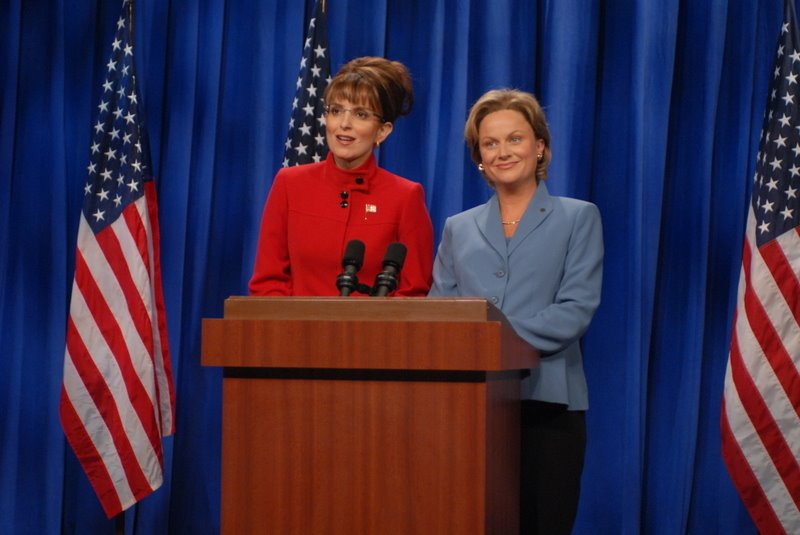
Tina Fey as Sarah Palin on Saturday Night Live


‘Fey stood beside her good friend and fellow castmate Amy Poehler, whose Hillary Clinton has been one of the high points of recent “SNL” history’
By Maureen Ryan / September 14, 2008

See Video and transcript, below.

As it used to be years ago, the word “live” was appropriate.

Ever since Alaska Gov. Sarah Palin was announced as Sen. John McCain’s running mate, people have remarked on her strong resemblance to former “Saturday Night Live” head writer Tina Fey.

Would Fey appear on the show’s season-opener Saturday, sporting Palin’s trademark rimless glasses? Speculation raged about that all week, and of course, “SNL” executive producer Lorne Michaels was coy about whether Fey, who left the show a few years ago for “30 Rock,” would stop by her old stomping grounds. Of course she would… right?

The end result of all the suspense: Forget DVRs, forget on-demand TV, forget YouTube, forget firing up your WiFi connection. All across America, people were parked in front of their TV sets late Saturday night.

As the program came on (at 10:30 p.m. Central time), there was Fey in a bright red blazer. She was the spitting image of Palin (or wait, is Palin the spitting image of Fey?). Even Fey’s flat Palin-esque accent was perfect; Fey had obviously closely studied the interviews that Palin gave to ABC on Thursday and Friday.

TV viewers will have a tough choice this year, as they struggle to decide which is more interesting: The ongoing reality show featuring Sen. Barack Obama, McCain and Palin, or Tina Fey doing her pitch-perfect version of Palin. We should have at least a few more opportunities to observe the latter, as “SNL” exploits the foibles of the election season every weekend and on three “SNL” specials that will air on Thursdays this fall.

On “SNL,” . They slung barbs that took sharp aim at Palin’s experience — or lack thereof — and at the perception that Clinton has been relentlessly ambitious.

“Mine! It’s supposed to be mine!” Poehler-as-Clinton said. “I need to say something. I didn’t want a woman to be President. I wanted to be President and I just happen to be a woman.”

Both women agreed on one thing: That sexism had become an issue in the campaign. It was an issue that “frankly surprised to hear people suddenly care about,” Poehler-as-Clinton deadpanned.

She later warned Fey-as-Palin that she didn’t “want to hear you compare your road to the White House to my road to the White House. I scratched and clawed through mud and barbed wire and you just glided in on a dog sled wearing your pageant sash and your Tina Fey glasses.”

As she spoke, Fey-as-Palin struck sexy poses and pretended to fire a shotgun. “What an amazing time we live in,” she said. “To think that just two years ago, I was a small town mayor of Alaska’s crystal meth capitol.”

Earlier, she talked up her foreign policy credentials: “I can see Russia from my house!”

Host Michael Phelps couldn’t help but be overshadowed by Fey’s terrific turn as Palin. Sketches about a couple’s ugly children (pictured above) and a weird swim coach (below) didn’t come close to the level of the opening sketch. Nothing in the rest of the broadcast did really (and Obama, after reports emerged that he would be a guest, was a no-show on Saturday; he decided not to appear thanks to the destruction Hurricane Ike was causing).

The show’s “Weekend Update” segment featured some Palin comedy as well. As Poehler noted, recent polls show McCain “only six points behind Sarah Palin.” Perhaps there wasn’t enough Palin though — raise your hand if you thought the “Weekend Update” commentary from the comic-strip character Cathy was a good idea.

Minutes after the Clinton-Palin sketch aired on “SNL,” a spokesman for the show sent out a full transcript of the piece, and I’ve reprinted it in full below.

An NBC transcript of “SNL’s” opening sketch:

FEY AS PALIN: “Good evening, my fellow Americans. I was so excited when I was told Senator Clinton and I would be addressing you tonight.”

POEHLER AS CLINTON: “And I was told I would be addressing you alone.”

FEY AS PALIN: “Now I know it must be a little bit strange for all of you to see the two of us together. What with me being John McCain’s running mate.”

POEHLER AS CLINTON: “And me being a fervent supporter of Senator Barack Obama — as evidenced by this button.”

FEY AS PALIN: “But tonight we are crossing party lines to address the now very ugly role that sexism is playing in the campaign.”

POEHLER AS CLINTON: “An issue which I am frankly surprised to hear people suddenly care about.”

FEY AS PALIN: “You know, Hillary and I don’t agree on everything…”

POEHLER AS CLINTON: (OVERLAPPING) “Anything. I believe that diplomacy should be the cornerstone of any foreign policy.”

FEY AS PALIN: “And I can see Russia from my house.”

POEHLER AS CLINTON: “I believe global warming is caused by man.”

FEY AS PALIN: “And I believe it’s just God hugging us closer.”

POEHLER AS CLINTON: “I don’t agree with the Bush Doctrine.”

FEY AS PALIN: “I don’t know what that is.”

POEHLER AS CLINTON: “But Sarah, one thing we can agree on is that sexism can never be allowed to permeate an American election.”

FEY AS PALIN: “So please, stop photoshopping my head on sexy bikini pictures.”

POEHLER AS CLINTON: “And stop saying I have cankles.”

FEY AS PALIN: “Don’t refer to me as a ‘MILF.'”

POEHLER AS CLINTON: “And don’t refer to me as a [flurge]. I Googled what it stands for and I do not like it.”

FEY AS PALIN: “So we ask reporters and commentators, stop using words that diminish us, like ‘pretty,’ ‘attractive,’ ‘beautiful.'”

POEHLER AS CLINTON: “‘Harpy,’ ‘shrew’ and ‘boner shrinker.'”

FEY AS PALIN: “While our politics may differ, my friend and I are both very tough ladies. You know it reminds me of a joke we tell in Alaska…”What’s the difference…

POEHLER AS CLINTON: “Lipstick.”

FEY AS PALIN: “…between a hockey mom…”

POEHLER AS CLINTON: “Lipstick.”

FEY AS PALIN: “…and a pitbull?”

POEHLER AS CLINTON: “Lipstick.”

FEY AS PALIN (AFTER A BEAT): “Lipstick. Just look at how far we’ve come. Hillary Clinton, who came so close to the White House. And me, Sarah Palin, who is even closer. Can you believe it, Hillary?”

POEHLER AS CLINTON: (AFTER A PAUSE)”I can not.”

FEY AS PALIN: “It’s truly amazing and I think women everywhere can agree, that no matter your politics, it’s time for a woman to make it to the White House.”

POEHLER AS CLINTON: “No. Mine! It’s supposed to be mine! I need to say something. I didn’t want a woman to be President. I wanted to be President and I just happen to be a woman. And I don’t want to hear you compare your road to the White House to my road to the White House. I scratched and clawed through mud and barbed wire and you just glided in on a dog sled wearing your pageant sash and your Tina Fey glasses.”

FEY AS PALIN:
“What an amazing time we live in. To think that just two years ago, I was a small town mayor of Alaska’s crystal meth capitol. And now I am just one heartbeat away from being President of the United States. It just goes to show that anyone can be President.”

POEHLER AS CLINTON: “Anyone.”

FEY AS PALIN: “All you have to do is want it.”

POEHLER AS CLINTON: (LAUGHS) “Yeah, you know, Sarah, looking back, if I could change one thing, I should have wanted it more.” (RIPS OFF PIECE OF PODIUM)

FEY AS PALIN: “So in the next six weeks, I invite the media to be vigilant for sexist behavior.”

POEHLER AS CLINTON: “Although it is never sexist to question female politicians credentials. Please ask this one about dinosaurs. So I invite the media to grow a pair. And if you can’t, I will lend you mine.”

FEY AS PALIN: And as we say in Alaska…

POEHLER AS CLINTON: “We say it everywhere…”

FEY/POEHLER: “Live from New York, It’s Saturday Night!!!

Source / Chicago Tribune

The Rag Blog

Posted in RagBlog | Tagged , , , , , , , , , , , , | Leave a comment

Denton, 9/11 : SDS Rallies Students to End War

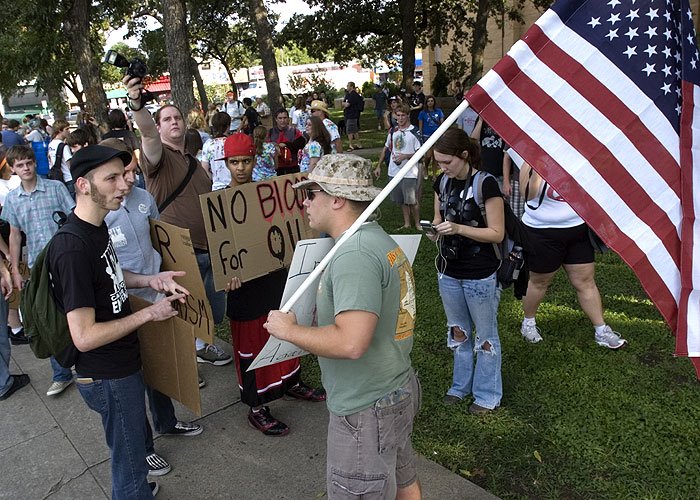
Denton: Jason Netek, far left, and a U.S. Marine Corps Reservist identified as ‘Chad’ argue about the war in Iraq as members of the Denton chapter of Students for a Democratic Society prepare for an anti-war march starting at the University of North Texas campus.

Protesters ‘carried signs with messages such as “Iraq Never Attacked US,” “Expose the 9/11 Cover-up” and “War is Terrorism”’
By Lowell Brown / September 12, 2008

College students marched through downtown Denton on Thursday afternoon to protest U.S. foreign policy and promote peace on the seventh anniversary of the Sept. 11 terrorist attacks.

An estimated 150 to 250 students walked down Hickory Street from the University of North Texas campus to Quakertown Park for a rally organized by the Denton chapter of Students for a Democratic Society. Many carried signs with messages such as “Iraq Never Attacked US,” “Expose the 9/11 Cover-up” and “War is Terrorism.”

At one point during the mile-long walk, marchers chanted “9/11 was an inside job!” and “Expose the truth!” — although some participants later said they believed al-Qaida was behind the attacks.

UNT senior Andrew Teeter said he and fellow march organizers want a new inquiry into the events of Sept. 11, 2001, an end to the “occupations” of Iraq and Afghanistan and “truth in military re­cruitment” in Denton.

“So this brings all sorts of people out with different passions,” Teeter said.

At Quakertown Park, gatherers heard protest songs and cheered as speakers condemned U.S. foreign policy, especially under the Bush administration.

“This is really an important day,” said state Rep. Lon Burnam, director of the Dallas Peace Center, a nonprofit volunteer group. “A lot of people all over this country are going to be commemorating the seventh anniversary [of Sept. 11] with a sense of tragedy for what happened on that day. I think we are all here commemorating that date with a sense of tragedy for what we have allowed to happen since that day.”

“There were horrible crimes committed by terrorists seven years ago,” said Burnam, a Fort Worth Democrat. “But for seven years there have been horrible war crimes committed by our government.”

Burnam encouraged the students to pressure U.S. Rep. Michael Burgess, R-Lewisville, to work to end the Iraq war.

Aron Duhon, a UNT graduate student, said he marched to highlight the failure of the United States to withdraw troops from Iraq since the 2003 invasion.

“I support an immediate withdrawal of our troops without conditions, which is something neither of the [major-party presidential] candidates are talking about,” Duhon said. “I feel like this is a way to make our voices heard.”

Police officers escorted the marchers on bicycles and patrol cars, stopping traffic as the students passed through the Square.

Passing cars sometimes honked in support, drawing cheers from the crowd.

Three counter-protesters followed the parade chanting “USA! USA!” and “Go back to MySpace!”

The men said they were U.S. Marines and Iraq war veterans, but they would only identify themselves by their first names, citing military policy.

“It’s their right to protest and I fight for that,” said Jonathan, one of the men. “But it just seems a little disrespectful” to protest on the Sept. 11 anniversary.

Police said an estimated 150 people took part in the march, but organizers said the number was closer to 250.

Police reported no disturbances.

Other groups involved with the event included Peace Action Denton and the Campaign to End the Death Penalty.

Source / Denton Record-Chronicle

The Rag Blog

Posted in RagBlog | Tagged , , , , , , , | Leave a comment

British Jury : Threat From Global Warming Justifies Protesters’ Breaking Law

Five of the ‘Kingsnorth Six’ at the top of the 200m chimney of power station.

Jury cleared six Greenpeace activists of £35,000 worth of criminal damage to a coal-fired power station
By Michael McCarthy / September 11, 2008

The threat of global warming is so great that campaigners were justified in causing more than worth of damage , a jury decided yesterday. In a verdict that will have shocked ministers and energy companies .

Jurors accepted defence arguments that the six had a “lawful excuse” to damage property at Kingsnorth power station in Kent to prevent even greater damage caused by climate change. The defence of “lawful excuse” under the Criminal Damage Act 1971 allows damage to be caused to property to prevent even greater damage – such as breaking down the door of a burning house to tackle a fire.

The not-guilty verdict, delivered after two days and greeted with cheers in the courtroom, raises the stakes for the most pressing issue on Britain’s green agenda and could encourage further direct action.

Kingsnorth was the centre for mass protests by climate camp activists last month. Last year, three protesters managed to paint Gordon Brown’s name on the plant’s chimney. Their handi-work cost £35,000 to remove.

The plan to build a successor to the power station is likely to be the first of a new generation of coal-fired plants. As coal produces more of the carbon emissions causing climate change than any other fuel, campaigners claim that a new station would be a disastrous setback in the battle against global warming, and send out a negative signal to the rest of the world about how serious Britain really is about tackling the climate threat.

But the proposals, from the energy giant E.ON, are firmly backed by the Business Secretary, John Hutton, and the Energy minister, Malcolm Wicks. Some members of the Cabinet are thought to be unhappy about them, including the Foreign Secretary, David Miliband, and the Environment Secretary, Hilary Benn. Mr Brown is likely to have the final say on the matter later this year.

During the eight-day trial, the world’s leading climate scientist, Professor James Hansen of Nasa, who had flown from American to give evidence, appealed to the Prime Minister personally to “take a leadership role” in cancelling the plan and scrapping the idea of a coal-fired future for Britain. Last December he wrote to Mr Brown with a similar appeal. At the trial, he called for an moratorium on all coal-fired power stations, and his hour-long testimony about the gravity of the climate danger, which painted a bleak picture, was listened to intently by the jury of nine women and three men.

Professor Hansen, who first alerted the world to the global warming threat in June 1988 with testimony to a US senate committee in Washington, and who last year said the earth was in “imminent peril” from the warming atmosphere, asserted that emissions of CO2 from Kings-north would damage property through the effects of the climate change they would help to cause.

He was one of several leading public figures who gave evidence for the defence, including Zac Goldsmith, the Conservative parliamentary candidate for Richmond Park and director of the Ecologist magazine, who similarly told the jury that in his opinion, direct action could be justified in the minds of many people if it was intended to prevent larger crimes being committed.

The acquittal was the second time in a decade that the “lawful excuse” defence has been successfully used by Greenpeace activists. In 1999, 28 Greenpeace campaigners led Lord Melchett, who was director at the time, were cleared of criminal damage after trashing an experimental field of GM crops in Norfolk. In each case the damage was not disputed – the point at issue was the motive.

The defendants who scaled the 630ft chimney at Kingsnorth, near Hoo, last year were Huw Williams, 41, from Nottingham; Ben Stewart, 34, from Lyminge, Kent; Kevin Drake, 44, from Westbury, Wiltshire; Will Rose, 29, from London; and Emily Hall, 34, from New Zealand. Tim Hewke, 48, from Ulcombe, Kent, helped organise the protest.

The court heard how, dressed in orange boiler suits and white hard hats bearing the Greenpeace logo, the six-strong group arrived at the site at 6.30am on 8 October. Armed with bags containing abseiling gear, five of them scaled the chimney while Mr Hewke waited below to liaise between the climbers and police.

The climbers had planned to paint “Gordon, bin it” in huge letters on the side of the chimney, but although they succeeded in temporarily shutting the station, they only got as far as painting the word “Gordon” on the chimney before they descended, having been threatened with a High Court injunction. Removing the graffiti cost E.ON £35,000, the court heard.

During the trial the defendants said they had acted lawfully, owing to an honestly held belief that their attempt to stop emissions from Kingsnorth would prevent further damage to properties worldwide caused by global warming. Their aim, they said, was to rein back CO2 emissions and bring urgent pressure to bear on the Government and E.ON to changes policies. They insisted their action had caused the minimum amount of damage necessary to close the plant down and constituted a “proportionate response” to the increasing environmental threat.

Speaking outside court after being cleared yesterday, Mr Stewart said: “This is a huge blow for ministers and their plans for new coal-fired power stations. It wasn’t only us in the dock, it was the coal-fired generation as well. After this verdict, the only people left in Britain who think new coal is a good idea are John Hutton and Malcolm Wicks. It’s time the Prime Minister stepped in, showed some leadership and embraced the clean energy future for Britain.”

He added: “This verdict marks a tipping point for the climate change movement. When a jury of normal people say it is legitimate for a direct action group to shut down a coal-fired power station because of the harm it does to our planet, then where does that leave Government energy policy? We have the clean technologies at hand to power our economy. It’s time we turned to them instead of coal.”

Ms Hall said: “The jury heard from the most distinguished climate scientist in the world. How could they ignore his warnings and reject his leading scientific arguments?”

Source / The Independent, U.K.

Also see Breaking News: Kingsnorth Six Found Not Guilty / Greenpeace, U.K.

Thanks to S.M. Welhelm / The Rag Blog

Posted in RagBlog | Tagged , , , , , , , , , , | Leave a comment

McCain a Faux Maverick : Stealing a Texas Tradition

The Maverick political family — Maury Maverick, Sr. is sworn in by his father as San Antonio mayor, as Maverick, Jr. looks on.

John McCain has appropriated a cherished name from Texas progressive politics. A scoundrel like McCain calling himself a “maverick” doesn’t sit too well with those on the Texas political left. Fontaine Maverick, grandaughter of famed Texas iconoclastic politico Maury Maverick, Sr. and niece of Maury Maverick, Jr., wrote of this ironic bit of thievery in The Rag Blog on August 30. Now “Paul in Austin” — aka Paul Robbins — has posted two interesting and informative pieces on Daily Kos about the subject.

Thorne Dreyer / The Rag Blog / September 14, 2008

Identity Theft: McCain Stealing Maverick Family Name
by Paul in Austin / September 13, 2008

This is my second diary about the irony where John McCain is branding himself a Maverick, when the name comes from a family of progressive Democrats in Central Texas, including two elected officials, Maury Maverick, Sr. and Maury Maverick, Jr., both of San Antonio.

Maury Sr. was the grandson of the original Texas Maverick Sam, one of the signers of the Texas Declaration of Independence. Maury earned a law degree, and then fought in W.W.1, where he received a Silver Star and Purple Heart. He was county tax collector (1929-1931). He was elected for two terms to Congress (1934-1938). He was defeated, in part, by red-baiting tactics. Maverick was elected Mayor of San Antonio between 1939-41. But he lost reelection in main because he supported freedom of speech through a crowd permit to a labor union with ties to Communists.

I am a friend of Fontaine Maverick, Maury Jr.’s niece. In discussing McCain’s identity theft of her family name, she directed me to a fascinating online book by the late Maury Sr.

Part autobiography, part history, part storytelling, and a good part political philosophy, this book-now-blog describes the life and opinions of an unrepentant Southern Democrat and liberal who thought it was society’s duty to protect the poor and disadvantaged, who believed government was part of the solution and not part of the problem, and who had concerns about the environment long before it was a national focus.

He decried overpopulation in the South as one of its main causes of poverty, the environmental degradation of its land, and its disrespect for labor.

Put in plain American language, this means the South has plenty of natural resources, but they are being wasted; that in skilled trades the region is low; that the population is too great, and although there is a culture of a kind, this culture is unsatisfactory. And it also means the South could be a prosperous and happy place, but isn’t.

Some five or more million acres have been ruined in the Black Bottoms, the Mississippi keeps rolling along with its floods—and millions of tons of fertilizers wash down to the sea in rains. The South is forced to use huge quantities of fertilizer. Per annum it uses five and a half million tons. All of the rest of the nation uses only two and a half million tons.

As for labor, I find not a single state which has a minimum wage law. Only one, Arkansas, has approved the Child Labor Amendment. Labor is generally in a bad shape. And it must be organized, so that it can build up a purchasing power, buy itself out of hock, and trade with the rest of the nation as an equal. This needs progressive labor legislation, with decent pension laws.

On health care:

It is a damned outrage that a poor man can’t go to a doctor. Why should a man in moderate circumstances have to die because he hasn’t got the money for an operation and hospital expenses?

On classism and the American Revolution:

The new American Tories were worse than the British Lords—and some of them, including the arrogant, swell-headed, lace-collared John Hancock, merely got out of paying their debts. They quickly proceeded to exploit their own people at home.

On race, he was the only Southern Democrat of his day to vote in support of anti-lynching legislation.

His monograph had interesting stories about how, at the beginning of the Great Depression, he and 2 friends disguised themselves, Mark Twain-style, as hobos and visited the missions, soup kitchens, and hobo camps to see the poverty first hand.

We stood there in the cold. It was drizzling, and some sleet came down. A youngster about thirteen years of age stood by me, hatless and coatless. The sleet fell on his hair.

In a group under a shed there were about twenty-five men. One seemed to have pneumonia. I came up and insisted that the man go to the hospital, but all said that there was no use, that he had already been refused because he was not a resident of the town. I never found out whether this particular incident was true, but widely, all over the country, “transients” were denied hospitalization even in the gravest emergency cases.

During the trip:

I found that a very large proportion of those riding the freight trains were tenant farmers, share-croppers, and agricultural workers. The old-time tramp constituted only a negligible portion, say ten or fifteen per cent of the whole. People just didn’t have any place to go. I traveled with one old man who had with him his two young sons. He lost his farm, became a tenant, then lost out completely. I did not have the heart to ask him if he had a wife and daughters.

Back in San Antonio, after our return home, I organized the transient relief stations…We had relief stations at all the freight depots and when anyone came in we gave him a very cheap meal of hot coffee, bread and beans, and sometimes Mulligan stew. I had freight train schedules made up and gave information as to the best travel routes, and the best place to board trains without getting in trouble.

This spirit and conscience were inherited by his son, Maury Jr. I will save this for another installment.

But I ask again how anyone can equate Maury Maverick’s life and philosophy with John McCain?

Source / Daily Kos

Here is Paul in Austin’s previous post about the real Maverick:

Senator McCain, You’re No (Maury) Maverick
by Paul in Austin / September 10, 2008

The McCain campaign has become infamous for using other people’s copyrighted material. During the campaign, popular songwriters have chafed about how their music was used without permission. These have included Jackson Browne, John Mellencamp, and most recently, the Wilson sisters of Heart, when their song “Barracuda” was used as the theme for the new Vice President.

But McCain’s campaign is also stealing a family name and a political legacy: a Democratic one. If you use the word “Maverick” in Central Texas, you are referring to a family of progressive Democrats that McCain has decidedly little in common with. This is indeed the family descended from the original 19th Century Texas Maverick. And some of his descendents are not at all pleased. While one cannot copyright a name in the public domain, McCain’s use of the word goes over as well in this region as trying to dub McCain a “Kennedy” in the Northeast.

The first Texas Maverick hailed as Sam. He migrated to Texas in 1835. He was a patriot who was one of the signers of the Texas Declaration of Independence, fought in the Texas Revolution, and was jailed in a Mexican prison for it.

After the war, he was a lawyer and land speculator that sometimes took cattle instead of money for payment. He never branded them, so they were eventually appropriated by neighbors. These unbranded cattle became known as ‘mavericks.”

Sam was the grandfather of Maury Maverick Sr., a New Deal Congressman and Mayor of San Antonio in the 1930s.

Jan Jarboe Russell, writing for the San Antonio Express, recalls:

…he and a group of other liberal Democrats pressed to push the New Deal further than President Franklin Roosevelt had in mind. These members of Congress — first identified on March 10, 1935, as “the Mavericks” by the Washington Herald — pushed through legislation to clear slums, created the National Cancer Institute, and passed bills to conserve natural resources.

Maverick was elected mayor of San Antonio in 1939 and served only one term, yet still ranks as the city’s most progressive mayor. He got federal money to build the San Antonio River Walk and reformed corruption at City Hall.

His political undoing came when he supported granting access to the Municipal Auditorium for a rally for a labor union with Communist connections. A lynch mob emerged outside the auditorium. They hung Maury Maverick’s effigy. His unqualified support for freedom of speech effectively ended his political career.

Maury Maverick, Jr. continued the legacy.

As a member of the Texas House during the McCarthy era, Maury Jr. broke with fellow Democrats to oppose the banning of books and other anti-communist hysteria laws that he believed violated the U.S. Constitution. As a civil rights lawyer, he broke with President Lyndon Johnson, once his friend, over the Vietnam War.

Maury Jr.’s niece, Fontaine Maverick (now of Austin), was recently quoted in the Austin Chronicle about the sordid misuse of her name.

Maury’s niece Fontaine* wrote last week that her brother (yet another Maury, in a lengthy line) told her that “if he hears that John McCain is a Maverick ONE MORE TIME, he is going to shoot the TV. … Every time we hear that use of our name, it is like fingernails on a blackboard times ten.” Expect to feel that sensation a lot, this week and over the next couple of months – while you do everything you can to make certain it won’t persist for the next four years.

McCain and his handler’s have proved they will misuse art, history, and whatever else they think they have to in their efforts to win. I think we should challenge McCain to live up to the standard that the real Mavericks have set for him.

Source / Daily Kos

Also see Fontaine Maverick : John McCain is no Maverick! by Fontaine Maverick / The Rag Blog / August 31, 2008

And Point Austin: More Mavericks by Michael King / The Austin Chronicle / September 12, 2008

And The Real Original Maverick by Rick Casey / Houston Chronicle / September 6, 2008

And for more background on the Maverick legacy: This Maverick The Real Deal by Joe Holley / The Rag Blog / March 1, 2008

The Rag Blog

Posted in RagBlog | Tagged , , , , , , , | 1 Comment

Tim Wise : Palin, Obama and the Reality of White Privilege

White privilege: Levi Johnston , Bristol Palin’s boyfriend — who calls himself a ‘fuckin’ redneck — is considered an ‘all-American’ boy.

This is Your Nation on White Privilege
By Tim Wise / September 13, 2008

For those who still can’t grasp the concept of white privilege, or who are constantly looking for some easy-to-understand examples of it, perhaps this list will help.

White privilege is when you can get pregnant at seventeen like Bristol Palin and everyone is quick to insist that your life and that of your family is a personal matter, and that no one has a right to judge you or your parents, because “every family has challenges,” even as black and Latino families with similar “challenges” are regularly typified as irresponsible, pathological and arbiters of social decay.

White privilege is when you can call yourself a “fuckin’ redneck,” like Bristol Palin’s boyfriend does, and talk about how if anyone messes with you, you’ll “kick their fuckin’ ass,” and talk about how you like to “shoot shit” for fun, and still be viewed as a responsible, all-American boy (and a great son-in-law to be) rather than a thug.

White privilege is when you can attend four different colleges in six years like Sarah Palin did (one of which you basically failed out of, then returned to after making up some coursework at a community college), and no one questions your intelligence or commitment to achievement, whereas a person of color who did this would be viewed as unfit for college, and probably someone who only got in in the first place because of affirmative action.

White privilege is when you can claim that being mayor of a town smaller than most medium-sized colleges, and then Governor of a state with about the same number of people as the lower fifth of the island of Manhattan, makes you ready to potentially be president, and people don’t all piss on themselves with laughter, while being a black U.S. Senator, two-term state Senator, and constitutional law scholar, means you’re “untested.”


White privilege is being able to say that you support the words “under God” in the pledge of allegiance because “if it was good enough for the founding fathers, it’s good enough for me,” and not be immediately disqualified from holding office–since, after all, the pledge was written in the late 1800s and the “under God” part wasn’t added until the 1950s–while believing that reading accused criminals and terrorists their rights (because, ya know, the Constitution, which you used to teach at a prestigious law school requires it), is a dangerous and silly idea only supported by mushy liberals.


White privilege is being able to be a gun enthusiast and not make people immediately scared of you.


White privilege is being able to have a husband who was a member of an extremist political party that wants your state to secede from the Union, and whose motto was “Alaska first,” and no one questions your patriotism or that of your family, while if you’re black and your spouse merely fails to come to a 9/11 memorial so she can be home with her kids on the first day of school, people immediately think she’s being disrespectful.


White privilege is being able to make fun of community organizers and the work they do–like, among other things, fight for the right of women to vote, or for civil rights, or the 8-hour workday, or an end to child labor–and people think you’re being pithy and tough, but if you merely question the experience of a small town mayor and 18-month governor with no foreign policy expertise beyond a class she took in college–you’re somehow being mean, or even sexist.


White privilege is being able to convince white women who don’t even agree with you on any substantive issue to vote for you and your running mate anyway, because all of a sudden your presence on the ticket has inspired confidence in these same white women, and made them give your party a “second look.”


White privilege is being able to fire people who didn’t support your political campaigns and not be accused of abusing your power or being a typical politician who engages in favoritism, while being black and merely knowing some folks from the old-line political machines in Chicago means you must be corrupt.


White privilege is being able to attend churches over the years whose pastors say that people who voted for John Kerry or merely criticize George W. Bush are going to hell, and that the U.S. is an explicitly Christian nation and the job of Christians is to bring Christian theological principles into government, and who bring in speakers who say the conflict in the Middle East is God’s punishment on Jews for rejecting Jesus, and everyone can still think you’re just a good church-going Christian, but if you’re black and friends with a black pastor who has noted (as have Colin Powell and the U.S. Department of Defense) that terrorist attacks are often the result of U.S. foreign policy and who talks about the history of racism and its effect on black people, you’re an extremist who probably hates America.


White privilege is not knowing what the Bush Doctrine is when asked by a reporter, and then people get angry at the reporter for asking you such a “trick question,” while being black and merely refusing to give one-word answers to the queries of Bill O’Reilly means you’re dodging the question, or trying to seem overly intellectual and nuanced.


White privilege is being able to claim your experience as a POW has anything at all to do with your fitness for president, while being black and experiencing racism is, as Sarah Palin has referred to it a “light” burden.


And finally, white privilege is the only thing that could possibly allow someone to become president when he has voted with George W. Bush 90 percent of the time, even as unemployment is skyrocketing, people are losing their homes, inflation is rising, and the U.S. is increasingly isolated from world opinion, just because white voters aren’t sure about that whole “change” thing. Ya know, it’s just too vague and ill-defined, unlike, say, four more years of the same, which is very concrete and certain…


White privilege is, in short, the problem.

Tim Wise is the author of White Like Me: Reflections on Race from a Privileged Son, and Affirmative Action: Racial Preference in Black and White. He has contributed essays to seventeen books, and is one of several persons featured in White Men Challenging Racism: Thirty-Five Personal Stories, from Duke University Press. A collection of his essays, Speaking Treason Fluently: Anti-Racist Reflections From an Angry White Male, will be released in fall 2008.

Source / Red Room

Thanks to David Hamilton / The Rag Blog

Posted in RagBlog | Tagged , , , , | 25 Comments

Iraq Report: Mosul Very Uneasy

Three Armored Combat Excavators clear debris and obstacles from a four-lane highway while a Bradley Fighting Vehicle provides security in Mosul, Iraq, Dec. 2007.

Fear and mistrust plague Iraq’s Mosul
By Tim Cocks / September 11, 2008

MOSUL, Iraq — Falah Mohammed peered over his shoulder as he spoke of how militants threatened to kill him and his family unless he quit his government job.

“It wasn’t worth the risk after the third threatening letter, so I left,” said the former guard in the northern Iraqi city of Mosul. “Insurgents have created so much fear in this place.”

Officials and security personnel die at the hands of gunmen nearly every day in Mosul, a city of 1.8 million people still struggling to shake off a determined insurgency while much of Iraq enjoys its best security in years.

Attacks in Mosul and surrounding Nineveh province have fallen since an Iraqi-led offensive against Sunni Islamist al Qaeda and other insurgents was stepped up in May. Markets are busier and traffic heavier.

But residents say a climate of fear persists in Mosul, an ancient melting pot of ethnic and sectarian groups.

“People here are very afraid,” said Nisreen Mustafa, a housewife. “We always heard explosions before the operation and we still hear them a lot now. What’s changed?”

U.S. military officials say attacks fell from around 130 per week just before the May offensive to 30 a week in Nineveh by July, before creeping up to 60-70 per week.

“It’s things like targeted drive-bys on Iraqi police,” said Major Adam Boyd, a U.S. military intelligence officer in Mosul.

“There’s a campaign of intimidation (against) … the Iraqi security forces … to get the local populace to feel insecure.”

Two weeks ago, insurgents tried to kill Major-General Riyadh Jalal Tawfiq, commander of military operations in Nineveh, with a roadside bomb. Two professors from Mosul University have been killed in the past three months.

ETHNIC PATCHWORK

A U.S. army patrol rumbles through Mosul, past a main street so devastated by fighting that barely a building stands. Bombed out concrete roofs droop over collapsed walls. Rubble litters streets. The vehicles cross a bridge over the Tigris River and the smell of raw sewage fills the air.

But as neighbouring western Anbar province has shown, even the most violent, lawless places in Iraq can be turned around.

The desert region of Anbar was lost to insurgents in 2006, but this month the U.S. military handed control of security back to Iraqi forces after Sunni Arab tribes joined forces with the military to largely expel al Qaeda from the province.

U.S. officials do not expect Anbar’s triumph to be repeated easily in northern Iraq, where communities are a complex patchwork of Sunni and Shi’ite Arabs, Kurds, ethnic Turkmen, pre-Islamic Yazidi Kurds and Assyrian Christians.

Anbar by comparison is overwhelmingly Sunni Arab.

“The dialogue in Anbar between sheikhs willing to put aside their differences is one reason … they (succeeded),” said Lieutenant-Colonel Robert Molinari, U.S. army operations officer in Mosul.

“You don’t see that here in Nineveh. The provincial government is not open to that kind of dialogue.”

LACK OF TRUST

Mistrust between Arabs, who make up most of the police, and Kurds, who fill most army posts, hinders intelligence efforts.

In a hot, stuffy office with only one fan, U.S. Army Captain Adam Cannon greets two Iraqi army officers in their Kurdish tongue, chats, then hands them a list of suspected insurgents.

But there’s a problem, says Major Jahir Bahoddin: few in the predominantly Sunni Arab neighbourhoods will talk.

“They won’t help us,” he told Reuters. “They’d really rather not cooperate with Kurds. We are trying to tell them: ‘we’re here to rid your neighbourhood of insurgents’. Even when they want to help, they are too afraid to speak.”

Cannon said Kurdish army officers, mistrustful of Arabs, do not share information with the police. Many Kurds have bitter memories of Saddam Hussein’s oppression of Kurds in the 1980s.

Ultimately, officials say, success will depend on reviving the economy of this battered metropolis, which sprawls around the crumbling walls of the ancient Assyrian city of Nineveh.

Jobless men are easily coaxed into militant groups and residents are losing patience with the pace of reconstruction.

“A lot of things need to be fixed and they’re not doing it,” said Saad Mohammed Rasheed, a former soldier in Saddam’s army who now runs a shop. “There’s no water, no electricity. We don’t hate the Americans any more; our anger is for the government.”

© Thomson Reuters 2008

Source / Reuters UK

The Rag Blog

Posted in RagBlog | Tagged , | Leave a comment

It’s Just Like the Election in 2004 All Over Again

If you haven’t yet read Greg Palast’s Armed Madhouse, you might want to do it before November 4 to educate and amuse yourself. There are a lot of reasons to believe that John McCain and his class act from Alaska will win that night. Here are a couple more of them for your reading pleasure.

Richard Jehn / The Rag Blog

Ohio Secretary of State Jennifer Brunner

Ohio Republicans Use Lawsuit To Fight for State’s Crucial Votes
By Amy Merrick / September 13, 2008

The Ohio Republican Party spearheaded a lawsuit Friday over a directive from the office of Democratic Secretary of State Jennifer Brunner that would allow some early voters to register and vote on the same day.

The suit, filed by two Ohio voters in the Supreme Court of Ohio, in Columbus, ramps up the battle over voting procedures in a critical swing state with 20 electoral votes. But the parties’ roles are reversed from the 2004 election. This time, a Democrat is setting the rules, and the state Republican Party is charging that those rules favor Sen. Barack Obama, the Democratic presidential candidate.

Conflicts over voter registration and voting procedures are heating up across the U.S. as the Nov. 4 election approaches. In Wisconsin, the Republican attorney general sued a state board this week over a process of comparing voter names with driver’s-license records. The Florida Department of State made a last-minute announcement this week that it will begin enforcing a controversial law that requires matching an identifying number on voter-registration forms with government databases that critics say are prone to mistakes.

In Ohio, a recently enacted state law — the subject of the Brunner directive — allows residents, for the first time in a general presidential election, to vote early by absentee ballot without providing a justification. Advocates for the homeless and other groups say they will direct new voters to take advantage of the overlap between early voting, which begins Sept. 30, and voter registration, which ends Oct. 6. During that window, citizens can register and vote simultaneously. The outreach efforts are expected to benefit Democrats.

The Northeast Ohio Coalition for the Homeless, a Cleveland-based umbrella group for service providers, housing activists and others, is making plans to drive about 2,000 shelter residents to polling places during the overlap period. “This is a huge opportunity to prove to elected officials that very low-income people do vote,” said Brian Davis, executive director of the group.

Republican officials are furious, charging that the one-stop process will encourage voter fraud. They argue that a state law requires Ohio residents to register at least 30 days before voting, so same-day registration and voting should be banned.

Ms. Brunner’s position is that early ballots do not constitute votes until they are tabulated on Nov. 4, said Jeff Ortega, a spokesman for Ms. Brunner. In a statement about Friday’s lawsuit, Ms. Brunner said, “It is unfortunate that a small, but vocal, group of Republican leaders continues to inject confusion and chaos in our elections.”

Responding to the charge that Ms. Brunner favors Democrats, Mr. Ortega said, “Secretary of State Brunner has simply tried to provide clear, consistent, statewide standards for election boards in this state on a whole host of issues.”

Ohio’s boards of election are hoping that many people will vote before Nov. 4, easing the strain on an Election Day expected to produce a huge turnout. Ohio had a strong 46% turnout in the March primary, with 15% of the vote coming from absentee ballots.

Another wrinkle this year is the thousands of foreclosures hitting Ohio each month, which could mean many voters no longer live at their registered addresses. Nonprofit groups conducting voter-registration drives are concerned that these people will be challenged at the polls.

Ohio residents must present identification to vote, but they can use utility bills, bank statements, pay stubs or other documents in place of a driver’s license or ID card. Early voters may provide the last four digits of their social-security numbers in lieu of such documents.

In 2004, Ohio was in an uproar over a tactic known as “caging,” in which a political party calls for voters to be stricken from the rolls because mail sent to them was returned as “undeliverable.” In the last presidential election, the state Republican party used returned mail to challenge the registrations of 35,000 new voters, most of whom lived in urban, heavily Democratic areas.

Not many voters were successfully removed, because “there was so much litigation and public backlash,” said Teresa James, a lawyer in Ohio for Project Vote, a nonprofit voter-registration group. But she said some voters likely were intimidated by the challenges and stayed home.

On Sept. 5, Ms. Brunner told election boards that Republicans had passed a law concerning caging that she considered unconstitutional, and that a single returned election notice cannot be used as the sole basis to cancel a voter’s residency. She also said every challenged voter must be notified and given a chance to attend a hearing before Election Day.

Kevin DeWine, deputy chairman of the Ohio Republican Party, said “nothing is off the table” in terms of election tactics, but he declined to be more specific.

Allegations of voter fraud are potent charges that have been part of elections for more than a century. Project Vote, which is running voter-registration drives with the community organization Acorn, says it has responded to the concerns. Recruits are paid by the hour, rather than by the name, to sign up new voters. Project Vote has set up call centers to attempt to contact people listed on all registration cards to verify their information. Canvassers found to falsify registrations are fired and reported to state boards of elections.

While the administration of President George W. Bush has made prosecuting voter fraud a priority, the government has provided little evidence that registration fraud is widespread or that it has a significant impact on elections. The U.S. Department of Justice said in March that it has convicted 102 people of voter fraud of various types since October 2002.

In 2004, a margin of 118,601 votes in Ohio gave President Bush the electoral votes he needed to reclaim the White House. The many election problems in that state still rankle Democrats. After the election, the Democratic staff of the U.S. House Judiciary Committee compiled a list of irregularities and grievances, including 10-hour lines in some urban areas, thousands of Republican challengers concentrated around polling places in minority and Democratic areas, and fake voter bulletins that told Republicans to vote on Tuesday and Democrats to vote on Wednesday.

Some Democrats alleged that J. Kenneth Blackwell, then the secretary of state and co-chairman of the Bush-Cheney campaign in Ohio, deliberately disenfranchised Democratic voters. He denied that partisanship affected his decisions.

Source / Wall Street Journal

And there’s this:

Florida Voting Law May Disenfranchise Thousands
The Brennan Center for Justice and Advancement Project / September 12, 2008.

The state will start enforcing a law that penalizes voters if their names are misspelled in voter registration records and government databases.

Voting rights advocates are alarmed over the Florida Secretary of State’s September 8th decision to enforce the state’s “no-match, no-vote” law, a voter registration law that previously blocked more than 16,000 eligible Florida citizens from registering to vote, through no fault of their own, and could disenfranchise tens of thousands more voters in November.

Secretary of State Kurt Browning’s last-minute decision to implement the law in the final month before the registration deadline will post a significant hurdle to eligible Florida citizens hoping to vote in November. It will disenfranchise voters who do not send or bring a photocopy of their driver’s license to county election officials’ offices after voting, even though these voters will have shown their driver’s licenses when they went to vote at the polls.

“This 11th-hour decision is an ill-advised move to apply a policy the state has never enforced in its current form, at a time when registration activity is at its highest,” stated Beverlye Neal, director of the Florida State Conference of the NAACP, a plaintiff in a lawsuit that challenges Florida’s matching law. “The Secretary’s decision will put thousands of real Florida citizens at risk due to bureaucratic typos that under the ‘no-match, no-vote’ law will prevent them from voting this November,” said Alvaro Fernandez of the Southwest Voter Registration and Education Project, another plaintiff in the case.

“Voters who do everything right, who submit forms that are complete, timely, and accurate, will suddenly find themselves unregistered when they go to vote, just because someone somewhere punched the wrong letter on a keyboard,” said Myrna Pérez, counsel at the Brennan Center for Justice. “The no match, no vote policy is unjust and unnecessary, and Florida voters will pay the price this fall,” stated Jean-Robert Lafortune, president of the Haitian-American Grassroots Coalition, another plaintiff in the lawsuit.

The law at issue bars any Florida citizen from voting a valid ballot if the state cannot validate their driver’s license number or the last 4 digits of their Social Security number, no matter how much identification the voter is able to bring to the polls. The process starts with an attempt to “match” voter information to other government databases, an error-prone exercise that often fails. For example, the Social Security Administration reports that 46% failure rate when trying to match voter registration applications. State officials admitted in a recent challenge to the law, Florida NAACP v. Browning, that typographical errors by election workers are responsible for most of the failures.

If the state fails to match the voter registration records, many eligible voters who submit registration applications before the October 6th deadline to register may not be notified of the matching failure until they go in person to vote. There, they will be forced to cast provisional ballots, and that provisional ballot will only be counted if the voter submits a photocopy of his or her driver’s license or Social Security card within 48 hours after the election, even if they already showed their driver’s license at the polls.

“The most senseless part is that the state creates these errors, and then makes it unnecessarily hard to fix the problem,” said Myrna Pérez of the Brennan Center. “If the state insists on enforcing this misguided matching provision, it should at least make it possible for voters to show their driver’s license at the poll and validate their registration then and there. To have registered, brought your ID to the polls, and still be told you can’t vote — all because of a bureaucratic error — is ridiculous.”

“It is unfortunate that the Secretary of State launched this policy less than a month before registration deadline. Had he enforced this sooner, there might have been time to troubleshoot the law or investigate its consequences, but this is really the 11th hour and is certain to derail eligible voters. At the very least, counties can and should help avoid the chaos that this law creates by making it possible to fix the problem at the polls,” urged Elizabeth Westfall of Advancement Project, one of the attorneys for the plaintiffs.

“In 2006 alone, more than 12,800 citizens submitting complete and timely forms were kept off of the rolls, and the volume of registration in 2006 is nothing like what we anticipate in this presidential year,” said Robert Atkins, a partner at Paul, Weiss, Rifkind, Wharton & Garrison LLP, also representing plaintiffs. 2006 was a year of unusually low voter registration rates in Florida because of a separate law that shut down voter registration drives that year. “With the huge number of registration forms pouring in at the end of the registration period, county officials may not be able to fix problems that will cause thousands of eligible voters to be disenfranchised,” Atkins added.

The Secretary of State’s announcement Monday poses the latest obstacle to eligible Florida voters seeking to register before the 2008 elections.

In June, a federal trial court in Gainesville, Florida, refused to stop the “no-match, no-vote” law in Florida NAACP vs. Browning after challenges from several voter advocacy organizations. The case was filed in September 2007 by the Florida branch of the NAACP, the Haitian-American Grassroots Coalition, and the Southwest Voter Registration Education Project. The plaintiffs are represented by The Brennan Center for Justice at NYU School of Law; Advancement Project; Project Vote; Paul, Weiss, Rifkind, Wharton & Garrison LLP; and Greenberg Traurig LLP.

In December 2007, the Gainesville federal court granted a preliminary injunction against the no-match, no-vote law under two federal statutes, ruling that Florida’s law “makes it harder to vote by imposing a matching requirement that is a barrier to voter registration.”

The ruling’s criticism of the no match, no vote law prompted the state legislature to revise portions of the statute — eliminating untenable distinctions between typos made by voters and those made by election officials, and standardizing the notice sent to voters kept off the rolls. Still, voting rights advocates argue that the law’s core burdens remain.

In April, the trial court’s original decision was overturned in split decision from the Eleventh Circuit Court of Appeals in Atlanta, following an appeal by the Florida Secretary of State. Plaintiffs in the case returned to the federal trial court to challenge the amended law under the federal constitution, but on remand, the court refused to enjoin the law, citing the changes that the legislature had made to the statute.

For more information about the lawsuit challenging Florida’s voter registration system and how voter database matching laws disproportionately affects Latino voters and other minorities, visit the Brennan Center website here.

Source / AlterNet

Thanks to Diane Stirling-Stevens / The Rag Blog

Posted in RagBlog | Tagged , , | Leave a comment

Friday’s Fractured Fairy Tale (with the Bankers)


A Redneck from Alabama walked into a bank in New York City and asked for the loan officer.

He told the loan officer that he was going to Bakersfield on business for two weeks and needed to borrow $5,000 and that he was not a depositor of the bank. The bank officer told him that the bank would need some form of security for the loan, so the Redneck handed over the keys to a new Ferrari. The car was parked on the street in front of the bank. The Redneck produced the title and everything checked out. The loan officer agreed to hold the car as collateral for the loan and apologized for having to charge 12% interest.

Later, the bank’s president and its officers all enjoyed a good laugh at the Redneck from the south for using a $250,000 Ferrari as collateral for a $5,000 loan. An employee of the bank then drove the Ferrari into the bank’s underground garage and parked it.

Two weeks later, the Redneck returned, repaid the $5,000 and the interest of $23.07. The loan officer said, “Sir, we are very happy to have had your business, and this transaction has worked out very nicely, but we are a little puzzled. While you were away, we checked you out and found that you are a multimillionaire.”

What puzzles us is, why would you bother to borrow $5,000?”

The Alabama Redneck replied, “Where else in New York City , can I park my car for two weeks for only $23.07 and expect it to be there when I return?”

His name was … BUBBA …

Thanks to Diane Stirling-Stevens / The Rag Blog

Posted in RagBlog | Tagged | 2 Comments

Lighten Up and Be Less Snooty and Judgmental


Experience Is Over-Rated
By Dave Lindorff / September 12, 2008

Sarah Palin stated again, most recently in her interview yesterday by ABC’s Charlie Gibson, that she has foreign policy experience because as governor of Alaska she has been in charge of that state’s National Guard, and because Alaska is, doggone it, “right next” to Russia.

This made me feel pretty good, because it made me realize that I have a whole lot of skills and experience which I hadn’t really appreciated before and that I could perhaps use to get myself out of this freelance journalism profession, which is not all that great from a financial perspective.

I, for instance, live very close to the garage where my mechanic works (I mean, I drive past the place every day and even buy my gas there), so I’m ready to be a car mechanic (I can’t tell you how many cars I’ve seen being gone over there, and have even sometimes watched a bit as my own vehicles were up on the lift). I also live literally across the street from a large forest, which qualifies me to be a number of things-forest ranger, lumberjack, and perhaps naturalist.
I’ve also been to the doctor many times, so maybe I should hang a shingle and open up a medical practice. I swear I’ve got all those exam questions by memory at this point, and they’ve got nurses to do the stuff with the arm cuff and the stethoscope.

Of course, the real money these days is in law, and there I’ve really got it nailed. Not only do several lawyers live right in my neighborhood, but I’ve actually been in court and seen lawyers at work. For that matter, I even had a lawyer argue a case for me once, when I was being charged with trespassing at the Pentagon. He wasn’t successful at getting my fine and jail time dropped, but hey, you learn from other people’s failures, too. Furthermore, I actually wrote a book with a co-author who is a lawyer. With all that experience, I could certainly be an attorney.

Over the years, I’ve spent time at the seashore, and even went on a one-week ocean sailing trip, so you’d have to admit oceanography is almost in my blood. Or perhaps I could be a sea captain. I’m sure I could do at least as well as the captain of the Exxon Valdez tanker.

Come to think of it, back when I was 16, I hitchhiked up to Alaska with a friend and spent the summer thumbing around the state, so I know that place like the back of my hand, which means if Sarah Palin gets elected and goes to Washington, maybe I could be governor of Alaska. And then, as governor I’d be commander of a National Guard unit, so I’d be qualified to be a vice president, or, should the opportunity present itself, even president of the United States. Actually, I’d be maybe more experienced than Palin for the job, because I grew up in Connecticut, and thanks to the small size of the states in my native New England, have actually been living closer to a foreign country-Canada-than she, living in Wasilla, has been living to Russia. In other words, when you think of it, my foreign policy experience is much greater than hers. Besides, I’ve actually visited Canada a few times, which really boosts my experience in international affairs.

I know some people think that jumping into jobs like president or vice president of the United States based upon what they might perceive as limited experience is presumptuous, but that’s because they aren’t being fair and open-minded. And I’ll admit that it’s hard, with relatively limited experience, to expect someone like Palin or me to measure up to the standard of someone like our current vice president, Dick Cheney, who came to his position after having served previously as presidential chief of staff, as secretary of defense, and as a member of Congress. I mean, that’s real experience, and it shows in the fine job he’s done as VP.

But we shouldn’t let examples like Cheney, or Donald Rumsfeld, another guy who took an important government post-in his case Secretary of Defense-after having considerable prior experience-make us obsess about experience. I mean, look at our current president. George W. Bush got elected in 2000, when his experience consisted of just two terms as governor of Texas, a state where the governor has a largely ceremonial role and most of the real work of government is handled by the legislature, and look what a great job he did in the White House! Furthermore, his only military experience was as a pilot in a Texas National Guard unit, most of which tour of duty he missed because he decided to work on his father’s failed election campaign instead, and because he didn’t want to take any drug tests, and look what a fine job he’s done as commander in chief.

This should all make Americans lighten up and be less snooty and judgemental about what they demand in terms of experience in presidential and vice presidential candidates. Palin in my view has proved her qualifications for the job. Yesterday she sent her young son off to battle in Iraq to fight against “the enemies who planned and carried out and rejoiced in the deaths of thousands of Americans” on 9-11 seven years ago. What better evidence do we need of this woman’s solid grasp of foreign affairs, history and combat?

Dave Lindorff is a Philadelphia-based journalist and columnist. His latest book is “The Case for Impeachment” (St. Martin’s Press, 2006). His work is available at http://www.thiscantbehappening.net/.
Source /

The Rag Blog

Posted in RagBlog | Tagged , | 2 Comments

Bailout Blues: We Ain’t Seen Nothing Yet


A Conservative Confidence Game
By Deborah Stone / September 9, 2008

Leave it to Fannie and Freddie to do for American politics what reasoned argument failed to do–strip the clothes off the Emperor of Markets. The fuss over whether government should rescue naughty shareholders was merely a distraction. What this latest financial crisis revealed is that “the government” and “the market” are not two distinct and separate parts of the country. They work together and need each other.

Ever since Ronald Reagan declared in his first inaugural address that “in the present crisis, government is not the solution to our problem, government is the problem,” conservatives have been steadily privatizing government functions on the theory that free markets can do everything better. Education, medicine, criminal justice, social services, building and maintaining roads and bridges, supporting an army at war–you name it, it has all been contracted out to allegedly more efficient and innovative private enterprise.

Self-interest, profits and free markets, we have been promised, are the great social engines. Now, as the American housing market collapses and the world trembles before our mistakes, those profit-driven, supposedly self-correcting and perfectly efficient engines are turning against us like Frankenstein. Why did anybody ever believe that CEOs and shareholders whose every incentive leads them to seek greater profits would care about anything else, such as their purported government mission to foster homeownership and stable communities?

Maybe this is the ultimate lesson in why the Republican strategy of privatization and deregulation doesn’t work. Markets depend on confidence–confidence that somebody stands behind the currency of exchange, confidence that somebody will hold buyers and sellers to their promises, and above all, confidence that if banks and big businesses crash, somebody will step in to help all the little people who might be wiped out with them.

It’s telling that the very officials who have been dead-set against regulation and bailouts justify the new government plan as necessary to restore confidence. The markets are perfectly healthy, they kept saying, but the public’s confidence is faltering. On July 17, just after the big bailout was proposed, Fannie Mae’s CEO, Daniel Mudd, told Newshour’s Judy Woodruff, “Fannie Mae is very financially sound. We have . . . more capital than we’ve had at any point in our history.” If your capitalization is as strong as you say, asked Woodruff, why do you need this Treasury plan to help you out? “All the capital markets, the lending markets, are really built on confidence,” Mudd replied. “Confidence has gotten jittery over the past quarter or so.” It’s important, he continued, “that there be a strong backstop (Mudd never uttered the words “bailout” or “rescue”) in case that kind of lack of confidence and that kind of jitteriness continued for too long.”

With the bailout, these officials admitted what Reagan and all the government denigrators denied. Only government can provide the rock-solid confidence that markets and communities need to function.

Libertarians warn that what the government gives, the government can take away. But the same is true of markets. Employers can take away your job or your health insurance and pension. Big companies can take away the lifeblood of a community, as when Maytag closed in Iowa. Big chain stores can take away the livelihoods of small independent business owners and their employees, not to mention the rental income of commercial landlords, the vibrancy of downtowns, and the tax revenues of local government.

Who’s taking away people’s homes right now in the foreclosure frenzy? Not government. Well, not unless we remember that government could have done a better job reining in mortgage lenders and Fannie and Freddie. If indeed government is responsible for this mess, its fault was inaction. Finally, in the present crisis, government sees itself once again as the solution.

But restrain your hopes, because here’s how Treasury Secretary Henry Paulson conceived the bailout. It would arm him, he told Congressional leaders, “with a bazooka in my pocket to pull out when we need to it to shoot down.” Excuse me? The top official of the U.S. economy thinks he’s a guerrilla armed only with a bazooka? Please, sir, it’s time to step into uniform and use your authority and modern regulatory tools to build a strong mortgage system instead of waiting to take pot shots at misguided missiles.

No, government is not the problem. Leadership is.

About Deborah Stone: Deborah Stone, a senior fellow at Demos, is the author of The Samaritan’s Dilemma: Should Government Help Your Neighbor? just published by Nation Books.

Source / The Nation

Thanks to Diane Stirling-Stevens / The Rag Blog

Posted in RagBlog | Tagged , , , | Leave a comment