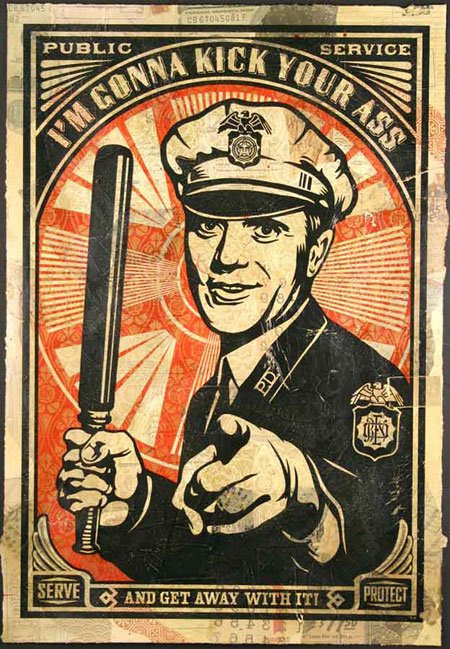
Racial Brutality Persists in Amerikkkan Police State


Taser death ignites racial tensions
By Howard Witt / July 19, 2008

Not far from Jena, La., suspicions of a cover-up mount

WINNFIELD, La. — At 1:28 p.m. last Jan. 17, Baron “Scooter” Pikes was a healthy 21-year-old man. By 2:07 p.m., he was dead.

What happened in the 39 minutes in between — during which Pikes was handcuffed by local police and shocked nine times with a Taser, while reportedly pleading for mercy —is now spawning fears of a political coverup in this backwoods Louisiana lumber town infamous for backroom dealings.

Even more ominously, because Pikes was black and the officer who repeatedly Tasered him is white, racial tensions over the case are mounting in a place that’s just 40 miles from Jena, La.—site of the racially explosive prosecution of six black teenagers charged with beating a white youth that last year triggered one of the largest American civil rights demonstrations in decades. And in a bizarre coincidence, Pikes turns out to have been a first cousin of Mychal Bell, the lead defendant in the Jena 6 case.

No novelist could have invented Winnfield, a place so steeped in corruption that they built a local museum to try to sanitize it all.

Here in the birthplace of two of Louisiana’s most colorful and notorious governors — Huey and Earl Long—the police chief committed suicide three years ago after losing a close election marred by allegations of fraud and vote-buying.

Four months later, the district attorney killed himself after allegedly skimming $200,000 from his office budget and extorting payments from criminal defendants to make their cases go away.

The current police chief is a convicted drug offender who got a pardon from Edwin Edwards, the former Louisiana governor who is serving time in federal prison for corruption convictions.

All of that tangled history is now wrapped up in the Pikes case, because Scott Nugent, the officer who Tasered him, is the well-connected son of the former police chief who killed himself—and the protege of the current chief, who hired him onto the force.

“A lot happens in this town, and it just gets swept under the rug,” said Kayshon Collins, Pikes’ stepmother, who has participated in several local protests over the case. “What the police did to Scooter just isn’t right. They would never have Tasered a white kid like that.”

The official police version of what happened to Pikes on that brisk January afternoon reads like a sad but familiar story in Winnfield’s local newspaper.

Nugent spotted Pikes walking along the street and attempted to arrest him on an outstanding warrant for drug possession, according to Police Chief Johnny Ray Carpenter. Pikes took off running, but another officer cornered him outside a nearby grocery store. Pikes resisted arrest and Nugent subdued him with a shock from a Taser.

Then on the way to the police station, Carpenter told the newspaper, Pikes fell ill and told the officers he suffered from asthma and was high on crack cocaine and PCP. The officers called for an ambulance, but Pikes later died at the hospital.

Six months later, the Winnfield police are standing by that story. Meanwhile, the Louisiana State Police are investigating the case, and no charges have been filed against Nugent or two other Winnfield police officers who assisted him in arresting Pikes, although the City Council did decide to fire Nugent from the force in May.

Winn Parish District Atty. Chris Nevils says he expects to present the case to a grand jury after he receives the results of the state police investigation.

Evidence contradicts report

But there is already abundant evidence contradicting the official police version of the incident.

An autopsy determined there were no drugs in Pikes’ system and that he did not have asthma, according to Dr. Randolph Williams, the Winn Parish coroner.

Moreover, Pikes did not resist arrest, and he was handcuffed while lying on the ground, according to Nugent’s police report of the incident. It was only after Pikes refused Nugent’s command to stand up that the officer applied the first Taser shock in the middle of his back, Nugent wrote.

Several more Taser shocks followed quickly, Nugent stated, because Pikes kept falling down and refusing to get back up. Grocery shoppers who witnessed the incident later told Pikes’ family that he had pleaded with Nugent: “Please, you all got me. Please don’t Tase me again.”

Williams said police records showed Nugent administered nine Taser shocks to Pikes over a 14-minute period. The last two jolts, delivered as police pulled Pikes from a patrol car at the police station, elicited no reaction because the suspect was unconscious, Williams said.

After consulting about the case with Dr. Michael Baden, a nationally prominent forensic pathologist, Williams ruled last month that Pikes’ death was a homicide. On the death certificate, he listed the cause of death as “cardiac arrest following nine 50,000-volt electroshock applications from a conductive electrical weapon.”

“God did not just call this young man home,” said Williams, who has served as parish coroner for the past 33 years. “If somebody can tell me anything else that killed this otherwise perfectly healthy young man … I’d like to know it.”

Williams is no stranger to controversy in Winnfield. Back in 2004, his garage was firebombed, and he says he’s been shot at 19 times by people upset with the independence of his investigations. He wears a gun holstered at his waist.

“This case may be the most unnecessary death I have ever had to investigate,” Williams said. “[Pikes] put up no fuss, no fighting, no physical aggression. … He just didn’t respond quickly enough to the officer’s commands.”

Nugent, 21, declined to be interviewed for this story. But his attorney, Phillip Terrell, said that Nugent acted according to his training—an opinion seconded by police spokesman Lt. Charles Curry.

Taser safety guidelines

Yet the official Winnfield Police Department Taser policy appears to prohibit the weapon’s use against a non-violent, handcuffed suspect.

“The Taser shall only be deployed in circumstances where it is deemed reasonably necessary to control a dangerous or violent subject,” the policy states. It also requires that a suspect who has been Tasered should immediately be checked out at a hospital.

What’s more, safety guidelines issued by Taser International Inc., the manufacturer of the device that is now used by more than 12,700 law-enforcement and military agencies worldwide, warn officers to “minimize repeated, continuous, and/or simultaneous exposures.”

Company officials, citing dozens of medical studies, insist Tasers are safe when used properly. But few of those studies examined the effect of multiple Taser applications over a short period of time. The U.S. Department of Justice, in a study released in June, concluded that “the medical risks of repeated or continuous [Taser] exposure are unknown.”

In less than two years on Winnfield’s 20-officer police force, police records show, Nugent ranked as the department’s most aggressive Taser user. Among the recipients were a 15-year-old African-American runaway who was not charged with any crime and Pikes’ father, currently serving a prison sentence for a drug offense, who was Tasered by Nugent last year, according to Kayshon Collins.

Click here for the Tribune graphics.

Source / Chicago Tribune

The Rag Blog

Posted in RagBlog | Tagged , | Leave a comment

Expanding on Our Humanness and Sacredness


You Say You Want a Revolution?
by Olga Bonfiglio

Detroit, the once-proud capital of industrialization is now the paragon of de-industrialization and urban decay.

General Motors’ July 15 announcement that it will cut white-collar employment costs by 20 percent is just one more nail in the industrial coffin.

Actually, this job-cutting phenomenon isn’t new. It’s been going on since the 1960s when the car companies began automating blue-collar assembly line jobs. Since the 1980s they have been steadily chipping away at the white-collar jobs by offering middle managers early retirement buy-outs.

This is the next American revolution, said Dr. Grace Lee Boggs, 93, a long-time Detroit activist and a Bryn Mawr-educated philosopher.

“We are at a stage in human history that is as monumental as changing from a hunter/gatherer society to an agricultural society and from an agricultural society to and industrial society. Where we’re headed now will be different because we have exhausted planetary space and human space for us to continue to look at things through the Cartesian measurement of material things.”

In other words, a new epoch is emerging that emphasizes relationships and communities more than the accumulation of things — and the counting of profits.

A trip to Greenfield Village and the Henry Ford Museum in Dearborn, a mere 30 minutes from downtown Detroit, illustrates how the nineteenth century Industrial Revolution grew into the twentieth century consumerist society, which was plush with inventions and conveniences that raised the living standards of middle class Americans. People could afford these products because so many of them left their farms and took higher-paying factory jobs in the cities. However, those good wages came at a price: people became mindless cogs in a giant machine, as Charlie Chaplin depicted in the film, “Modern Times.”

Industrialization was a far cry from the first American Revolution of 1776, which was about people giving of themselves for the larger community, said Grace. That sentiment yielded to a European colonial mentality that justified taking natural resources from Africa, Asia and Latin America in order to manufacture products and sell them at huge profits.

“We need to face the way we used the world for our gains, pleasures, satisfactions,” said Grace. “This is the way we evolve to a higher stage of humanity. And unless we want to live in terror for the rest of our lives, we need to change our view about acquiring things.”

The industrial society also skirted social justice concerns by focusing on jobs and paychecks as a means of keeping the economy going and the people happy. It didn’t face the fact that the workers were demeaned and deskilled or that some of the products they made (like military equipment) or some of the processes they used (which involved dangerous chemicals) could be harmful.

Actually, people have only had “jobs” for the past 100 years. These jobs had nothing to do with being productive, making products essential for living or deriving personal growth or the enjoyment of life. Jobs led people to believe that anything they did for pay was good — no matter how destructive it was to the person, the community or the environment.

Now, in the twenty-first century after hundreds of thousands of jobs have been moved offshore and collapsed many local economies, Grace believes that the way has been cleared for the next American revolution, especially since a number of other factors make the need for change both obvious and necessary:

* Occupation of Iraq;

* Environmental degradation, species extinction and global warming;

* Polarization of the rich and poor in the United States and in the global North and South;

* Economic instability with trillions of dollars of debt, housing foreclosures and the loss of local small businesses and farms.

She said that the turning point occurred in 1999 when protesters’ demonstrations effectively closed the World Trade Organization (WTO) meeting held in Seattle. A worldwide movement was kicked off to challenge the rapacious global economy that was shifting the labor market to the lowest bidder in a kind of race to the bottom.

“We usually think of revolution as violence,” said Grace. “However, revolution is more about envisioning what is possible when it appears that things are changing.” She believes that Detroit, in particular, is fertile ground for this next revolution because it is such a devastated city.

Detroit has 70,000 vacant lots where neighborhoods and commercial properties once stood. And although the city looks like it has been bombed, Grace sees a silver lining: the city no longer has to adhere to the usual capitalist mantra of growth and expansion because it is absolutely clear that the industrial system is finished. This fact allows citizens to respond by starting something new all over again.

Grace and her husband, Jimmy Boggs (now deceased), a 30-year Chrysler autoworker, and a host of their friends began articulating the next revolution in the 1980s. Their work eventually planted the seeds for “Detroit Summer” in 1992 where young and old would re-generate their neighborhoods by developing community gardens and producing public works of art.

This effort further blossomed into forming a local agricultural network that is now impacting the city’s food system by growing thousands of pounds of fresh, nutritious produce through organic agriculture techniques, finding alternative uses of blighted spaces, creating income generating activities, and diversifying crops and products for market.

Gardens are also affecting larger issues like reducing crime, cleaning up trash-strewn lots, connecting people to nature, nurturing leadership in citizens young and old and improving property values. What’s more, gardens have rekindled people’s hope in the future, a sentiment missing in Detroit since the “rebellion” of 1967.

This revolution urges citizens not to stand around and wait for leaders to initiate needed changes. Instead, individuals are learning that they can enlist others to help them rebuild their communities. Interestingly, it’s the young who are especially stepping up to this challenge through local service programs, college projects, and the creation of small businesses and organizations.

“What we’re witnessing is a national government that is incapable of solving the questions of our society and our world because politicians are so subject to lobbyists and corporations that fund their campaigns, that they can’t do what needs to be done,” said Grace.

She cited Paul Hawken’s book, “Blessed Unrest,” which discusses how small groups all over the world are rebuilding their communities from the ground up and changing the world because people are connecting to one another.

“We have the opportunity to take a great leap forward in these very challenging times,” said Grace. “We need to change our institutions and ourselves. We need to seize opportunities. We need to launch our imaginations beyond the thinking of the past. We need to discern who we are and expand on our humanness and sacredness. That’s how we change the world, which happens because WE will be the change.”

[Olga Bonfiglio, who grew up in Downriver Detroit and graduated from Wayne State University in Detroit, is now a professor at Kalamazoo College where she teaches a class in urban revitalization. Her website is http://www.olgabonfiglio.com/ and her e-mail address is olgabonfiglio@yahoo.com.]

Source / Common Dreams

The Rag Blog

Posted in RagBlog | Tagged , , | Leave a comment

Afghanistan: It’s a Regional Conflict


Poorly directed aid increases Afghanistan’s woes
Editorial, The Observer
Sunday July 20, 2008

It would be hard to deny the evidence that Afghanistan is at a crossroads as Democratic nominee Barack Obama yesterday met the country’s President Hamid Karzai. Despite the claims by some British officers that the Taliban is being tactically routed, no one seems to have told the Islamist insurgents. Opium production in the areas under their control – and that of other warlords – has reached new records this year. Corruption and criminality, linked often to the very heart of government, is endemic. Despite $15bn in aid that has been disbursed, Afghanistan remains mired in pervasive poverty with unemployment standing at more than 40 per cent. The country’s position as one of the world’s poorest has barely shifted since 2001.

Confronted with these multiple failures, the temptation, voiced yesterday by Obama, and by his Republican opponent John McCain already, is to throw more military forces at the problem in a replication of the Iraq ‘surge’. A parallel attraction, encouraged by Karzai, is to insist that the international community provide ever more money in the hope that some of the billions will stick. But in a country beset by rapidly increasing pessimism over the ability of the international community finally to bring to an end Afghanistan’s 30-year cycle of poverty and violence, what is needed is a large-scale rethinking of what we are doing in Afghanistan, not more violence and more largesse.

The reality, despite the claims of Nato and Western diplomats, is that the war is far from being won. For many, it is becoming clear that it cannot be won, framed in military terms. Nor can it be won in terms of the present political settlement, largely imposed on Afghanistan, which has accepted a re-emergence of war-lordism, cronyism and the general collapse of legitimacy and the rule of law in exchange for the impression of a ‘stable’ central government, albeit one which holds little sway outside of Kabul. The tensions thus created have encouraged a return to a state of widening conflict.

There have been some positive steps since the fall of the Taliban regime. Millions of children are in education in a country with a long history of high levels of illiteracy, particularly among women. A vibrant media, although under threat from many sides, also exist. Improvements have been made in the provision of healthcare. But this is not enough to persuade Afghans that much is getting better when they are confronted daily by criminality, violence, a predatory police force and an ill-educated and corrupted civil service.

In Afghanistan, the real risk is that more is less. The danger of sending ever more troops is that the civilian casualties that will follow in the intensifying conflict will push more Afghans towards the Taliban in a country with a history of fiercely asserting its independence. The hazard of throwing more money at the problem is that without a tighter focus to that spending, Afghans see the increased aid budget as an opportunity for a small elite of Afghans and a small army of international contractors and aid workers to enrich themselves still further. A further consequence is that, because it lacks a professional civil service to support the people, the aid community has shouldered the burden, inadvertently undermining still further the development of effective local services.

The lessons of Afghanistan, as Rory Stewart, a former British diplomat and Afghan expert now running an aid organisation in Kabul insisted last week, points to a more tightly targeted approach, concentrating aid efforts on areas of the country where visible improvements are viable, as a promise of what is possible elsewhere. Some of the most successful schemes have been small-scale: micro-finance projects from Herat to Kabul and Mazar-i-Sharif have provided the tools, via education and small loans, to get people working, the greatest priority being on rural rehabilitation.

More widely, there needs to be acceptance that this is not a local conflict but a regional one. Pakistan’s failure to tackle the Taliban’s safe havens in the tribally administered areas is stoking Afghanistan’s woes. Finally, there needs to be an end to the cosy client relationship with Karzai, who has yet to show himself a capable leader, and a retreat from the West’s view that he is the country’s only possible saviour.

Source / The Guardian Observer (Comment Is Free)

The Rag Blog

Posted in RagBlog | Tagged | Leave a comment

SPORT : "I Don’t Care If I Never Get Back"


Dubya : Keeping His Eye on the Ball
By Dana Milbank / July 17, 2008

[Last Thursday] was another day of turmoil in the capital. The Federal Reserve chairman again tried to reassure jittery markets. The chairman of the Joint Chiefs of Staff said he wanted more troops in Afghanistan to put down the growing insurgency. And just before 4 p.m., President Bush stepped onto the South Lawn for what he called a “historic” moment.

“Play ball!” cried the commander in chief.

Leaving his cares behind, Bush then sat down for more than an hour to watch 6- and 7-year-olds play T-ball, to unveil a “Take Me Out to the Ballgame” postage stamp, and to lead the crowd in singing that anthem with the majesty of “Hail to the Chief.”

Buy me some peanuts and Cracker Jack.

I don’t care if I never get back.

The president had reason to be sincere about that last line. Earlier in the day, the administration announced the highest inflation rate in a quarter-century. His aides worked to steady Freddie Mac and Fannie Mae, the tottering mortgage giants. And Bush, at 28 percent approval in the polls, seems to have abandoned any hope of a home run that could solve domestic economic problems or the wars overseas.

But by one measure, Bush remains more enthusiastic than ever: his role as the nation’s chief cheerleader. Yesterday’s T-ball game, the 19th of his presidency — followed by a dinner last night in honor of Major League Baseball, the third of his presidency — brought to at least 95 the number of sporting-related events he has participated in during his time in the White House. He has done no fewer than 18 such events so far this year — already passing his previous record of 13 in both 2001 and 2007.

The 95 sports events (with hundreds of athletic teams) are more than double the number of Cabinet meetings Bush has held (45), more than quadruple the number of meetings he has had with Russia’s Vladimir Putin (22). The 19 T-ball games he has held are more than twice the number of meetings he has had with China’s Hu Jintao (nine). And the three dinners he has held in honor of professional baseball are nearly equal to the five state dinners he has hosted during his entire presidency.

These are the stats kept by CBS News White House correspondent Mark Knoller, the world’s most devoted chronicler of presidential comings and goings. By his reckoning, the only activity that seems to rival the president’s love of sports is his love of fundraising. Bush has attended 322 fundraisers since taking office.

Fundraising, however, is work. For a president facing little good news at the office, sport is pleasure. For Bush, former owner of baseball’s Texas Rangers, it began in March 2001, when, in the presence of Hank Aaron, Stan Musial and others, he launched the White House T-ball league. Since then, athletes have passed through the White House by the hundreds. Last month, Bush welcomed 20 college teams at once, including the University of Maryland Eastern Shore women’s bowling team, the UCLA women’s water polo team, and the Penn State men’s and women’s volleyball squads.

Bush has even taken his love of sport abroad, watching a T-ball game in Ghana this year. But sometimes his enthusiasm causes an errant shot. Given a basketball at the White House by Shaquille O’Neal, Bush tried to dribble the ball, but it didn’t bounce. Shooting hoops with children in Northern Ireland last month, he came up with an air ball and a missed layup.

But Bush keeps playing — and because he’s the president, everybody plays along. Workers set up bleachers, picnic tables, refreshment stands, a home-run fence and painted base paths on the South Lawn for yesterday’s “All-Star Game.” Country singer Kenny Chesney sang the national anthem. Current and past baseball greats Ryne Sandberg, John Smoltz, Kevin Millar and Rick Monday served as coaches, former Nationals manager Frank Robinson acted as commissioner, and ESPN’s “Mike and Mike” handled the play-by-play.

The enthusiastic president arrived early. “Ladies and gentlemen, welcome to this historic occasion,” Bush said before leading the players in the Little League Oath. Bush, in short sleeves and a cowboy belt, then took a seat in the fourth row of the stands to watch as each player was introduced by favorite food and movie (“Jack likes ice cream and ‘Curious George’ “) before taking a turn at the plate.

The game must have looked familiar to Bush in these final months of his presidency: dropped balls, swings and misses, and players running every which way. But in T-ball, at least, “absolutely no score will be kept,” as Mike and Mike put it, “and everyone will leave as a winner.”

At the end of the game, Bush joined a large chipmunk named Dugout on the field to hand out baseballs to the players. But even on the South Lawn, he found that his popularity went only so far. A young girl named Emily from Kentucky, apparently afraid to meet the president and the chipmunk, ran crying from the field when Bush tried to present her with a ball.

Undeterred, Bush lingered to sign baseballs and pose for pictures. He was in no hurry: His next big event, the Major League Baseball dinner in the State Dining Room, wouldn’t start for two more hours.

Source / Washington Post / h/t Bad Attitudes

The Rag Blog

Posted in RagBlog | Tagged , , | Leave a comment

NetRoots Nation: Al Gore Blasts Oil Drilling

Al Gore speaks out against drilling for oil as a wrongheaded attempt to address America’s energy crisis at Netroots Nation in Austin, Texas.

The Rag Blog

Posted in RagBlog | Tagged , , | Leave a comment

Texas Plans to Harness All the Hot Air


Texas Approves a $4.93 Billion Wind-Power Project
by Kate Galbraith

AUSTIN – Texas regulators have approved a $4.93 billion wind-power transmission project, providing a major lift to the development of wind energy in the state.

The planned web of transmission lines will carry electricity from remote western parts of the state to major population centers like Dallas, Houston, Austin and San Antonio. The lines can handle 18,500 megawatts of power, enough for 3.7 million homes on a hot day when air-conditioners are running.

The project will ease a bottleneck that has become a major obstacle to development of the wind-rich Texas Panhandle and other areas suitable for wind generation.

Texas is already the largest producer of wind power, with 5,300 installed megawatts – more than double the installed capacity of California, the next closest state. And Texas is fast expanding its capacity.

“This project will almost put Texas ahead of Germany in installed wind,” said Greg Wortham, executive director of the West Texas Wind Energy Consortium.

Transmission companies will pay the upfront costs of the project. They will recoup the money from power users, at a rate of about $4 a month for residential customers.

Details of the plan will be completed by Aug. 15, according to Damon Withrow, director of government relations at the Public Utility Commission, which voted 2 to 1 to go ahead with the transmission plan. The lines will not be fully constructed until 2013.

Wind developers reacted favorably.

“The lack of transmission has been a fundamental issue in Texas, and it’s becoming more and more of an issue elsewhere,” said Vanessa Kellogg, the Southwest regional development director for Horizon Wind Energy, which operates the Lone Star Wind Farm in West Texas and has more wind generation under development. “This is a great step in the right direction.”

Ms. Kellogg said that the project would be a boon for Texas power customers, whose electricity costs have risen in conjunction with soaring natural gas prices across the state. “There’s nothing volatile about the wind in terms of the price, because it’s free,” she said.

The Texas office of the consumer advocacy organization Public Citizen also lauded the news.

“We think it’s going to lower costs, lower pollution and create jobs. We think that for every $3 invested, we’ll probably see about an $8 reduction in electric costs,” said Tom Smith, the state director.

The transmission problem is so acute in Texas that turbines are sometimes shut off even when the wind is blowing.

“When the amount of generation exceeds the export capacity, you have to start turning off wind generators” to keep things in balance, said Hunter Armistead, head of the renewable energy division in North America at Babcock & Brown, a large wind developer and transmission provider. “We’ve reached that point in West Texas.”

Jay Rosser, a spokesman for Boone Pickens, the legendary Texas oilman who plans to build what has been called the world’s largest wind farm in the Texas Panhandle, welcomed the announcement.

But because about a quarter of the Pickens project capacity will come online by 2011, two years before the Texas lines are fully ready, “we will move forward with plans to build our own transmission,” he said.

Lack of transmission is a severe problem in a number of states that, like Texas, want to develop their wind resources. Wind now accounts for 1 percent of the nation’s electricity generation but could rise to 20 percent by 2030, according to a recent Department of Energy report, if transmission lines are built and other challenges met.

But other states may find the Texas model difficult to emulate. The state is unique in having its own electricity grid. All other states fall under the jurisdiction of the Federal Energy Regulatory Commission, adding an extra layer of bureaucracy to any transmission proposals.

The exact route of the transmission lines has yet to be determined because the state has not yet acquired right-of-way, according to Mr. Withrow of the utility commission.

The project will almost certainly face concerns from landowners reluctant to have wires cutting across their property. “I would anticipate that some of these companies will have to use eminent domain,” he said, speaking of the companies that will be building the transmission lines.

Copyright 2008 The New York Times Company

Source / The New York Times / h/t Common Dreams

The Rag Blog

Posted in RagBlog | Tagged , | Leave a comment

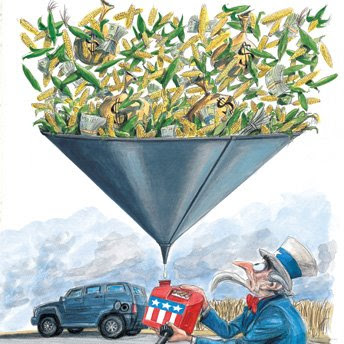
Getting Realistic About the Ethanol Scam


The Ethanol Scam
By Nicole Colson / July 19, 2008

AT FIRST glance, it seems like common sense.

Unless you’re delusional or in the pay of the energy industry, you know that the burning of fossil fuels is the primary cause of global warming and destructive climate change that is already wreaking havoc around the globe. Not to mention that fossil fuels are a limited resource, costly to extract and refine, and increasingly sought-after by competing nations.

So if a more environmentally friendly fuel could be derived from renewable plant-based sources, wouldn’t it be logical to make the switch?

This is the justification for the recent boom in biofuel production in the U.S. and around the globe. Since biofuels (which can be made from corn, sugar cane, soybeans or other organic sources) are produced from “renewable resources,” goes the argument, they can go a long way to helping break America from its 21-million-barrels-a-day oil habit and provide a more environmentally friendly alternative to fossil fuels.

Biofuels–especially, in the U.S., corn-derived ethanol–are being promoted as the savior of both the planet and humankind.

Think that’s an exaggeration? Check out the National Corn Growers Association’s online comic book adventures of “Captain Cornelius,” who uses his corn superpowers to “protect the environment.” Or the association’s online promotional video, a Star Wars parody in which “ethanol” is depicted as a wise Yoda-like figure, and “gasoline” is Darth Vader.

Rolling Stone quoted Sen. Chuck Grassley of Iowa–“the king of ethanol hype,” the magazine pointed out–as saying “Everything about ethanol is good, good, good.” But if you scratch a bit beneath the surface, ethanol stops looking quite so “good, good, good.”

* * * * * * *

FOR ONE thing, although biofuels are promoted as a cure-all for an ailing environment, many scientists say that they aren’t necessarily any better than traditional fossil fuels. As National Geographic reported in October:

Biofuels as currently rendered in the U.S. are doing great things for some farmers and for agricultural giants like Archer Daniels Midland and Cargill, but little for the environment.

Corn requires large doses of herbicide and nitrogen fertilizer and can cause more soil erosion than any other crop. And producing corn ethanol consumes just about as much fossil fuel as the ethanol itself replaces. Biodiesel from soybeans fares only slightly better. Environmentalists also fear that rising prices for both crops will push farmers to plow up some 35 million acres…of marginal farmland now set aside for soil and wildlife conservation, potentially releasing even more carbon bound in the fallow fields.”

According to research reported last year by a team led by Nobel Prize-winning chemist Paul Crutzen, ethanol derived from corn may generate up to 50 percent more greenhouse gases than gasoline, because up to twice as much nitrous oxide may be released by the production process due to increased use of nitrogen fertilizers on corn (one of the most fertilizer-heavy crops).

In addition, in the U.S. and across the globe, forests, grasslands and other fragile ecosystems are being cleared to make way for production of corn, soybeans or other biofuel crops, causing further environmental harm.

According to one study published earlier this year in the journal Science, using a worldwide agricultural model to estimate emissions from land-use changes, researchers found that corn-based ethanol, “instead of producing a 20 percent savings in greenhouse gases, nearly doubles greenhouse emissions over 30 years and increases greenhouse gases for 167 years.”

As Nature Conservancy researcher Joe Fargione told Science Daily, “If you’re trying to mitigate global warming, it simply does not make sense to convert land for biofuels production. All the biofuels we use now cause habitat destruction, either directly or indirectly.”

In the Midwest “Corn Belt,” for example, increased corn production for ethanol has now pushed out nearly 20 million acres of soybean production. Until recently, soybeans were regularly rotated with corn crops, but many farmers are now abandoning them in order to chase the big government subsidies that now come with corn.

Brazilian farmers, driven to plant more or the world’s soybeans as a result (not to mention sugar cane for Brazil’s own biofuel production), have in turn increased the conversion of the Brazilian Amazon and Cerrado–some of the richest areas in the world in terms of biodiversity–into croplands and cattle pastures. Overall, the effect has been to push soybean prices higher, while encouraging intensive use of nitrogen and phosphorus fertilizers for corn crops.

This increase in fertilizer use is already causing environmental harm. Fertilizer runoff from Midwestern farms into the Gulf of Mexico has created an algae bloom that suffocates the ocean life underneath it.

In the 1970s, the bloom used to occur just once every two to three years. Intense factory farming has made the bloom a yearly phenomenon since the 1980s. And last year, when Midwestern farmers devoted a tract of land nearly the size of California to corn cultivation–a 15 percent increase over the previous year–the “dead zone” grew to the third-largest size ever observed. Reports suggest that the dead zone this year will expand to more than 10,000 square miles, the largest size on record and nearly 20 percent larger than the previous record.

It’s also worth noting that ethanol production is often bad for the health of those who live in the communities surrounding the distilleries. Reports of fires, toxic spills and air pollution are common. The Environmental Protection Agency (EPA) concluded this year that “ozone levels generally increase with increased ethanol use.”

A 2005 report by the Des Moines Register–when Iowa had a total of 17 ethanol plants–found that these facilities “emitted so much [cancer-causing] formaldehyde and toluene into the air that the U.S. Environmental Protection Agency forced several large companies to install new equipment”; that several plants were built without construction permits; and that some released bad batches of ethanol and sewage into streams, threatening fish and wildlife.

Yet last year, the EPA relaxed regulations for the ethanol industry, allowing fuel-producing ethanol plants to raise their emissions of pollutants like carbon monoxide, nitrous oxide and sulfur dioxide from 100 tons per year to 250 tons per year.

In the years since the Register completed its investigation, the number of ethanol distilleries in the U.S. has skyrocketed–particularly since 2005, when the Energy Policy Act was passed, tripling the U.S. government mandate of biofuel production to 7.5 billion gallons of ethanol per year by 2012.

In early 2006, the U.S. had just 95 ethanol plants in operation. Today, according to the Renewable Fuels Association, there are a total of 161 ethanol distilleries in the U.S.–with another 42 plants under construction and seven undergoing expansion. Iowa alone now has 41 ethanol refineries.

And will this boom in ethanol production have an impact on U.S. oil dependence? Not likely. As the Energy Justice Network noted:

Meeting the lifetime fuel requirements of just one year’s worth of U.S. population growth with straight ethanol (assuming each baby lived 70 years), would cost 52,000 tons of insecticides, 735,000 tons of herbicides, 93 million tons of fertilizer, and the loss of 2 inches of soil from the 12.3 billion acres on which the corn was grown. The U.S. only has 2.263 billion acres of land, and soil depletion is already a critical issue. Soil is being lost from corn plantations about 12 times faster than it is being rebuilt.

As the U.S. General Accounting Office concluded in 1997, “ethanol’s potential for substituting for petroleum is so small that it is unlikely to significantly affect overall energy security.”

* * * * * * *

ONE OF the biggest negative impacts of the ethanol boom has been the human cost for the world’s poor.

As Foreign Affairs reported in May, “The current biofuels craze…has disrupted food and commodities markets and inflicted heavy penalties on poor consumers. These developments have occurred despite record global grain harvests in 2007.”

Rising demand over the past several years has helped lead to a global spike in the price of corn–one of the most important staple crops for the world’s poor. Between May 2007 and today, the average price of corn increased by some 60 percent (soybeans, also used for biofuel, went up by more than 75 percent).

According to the USDA’s annual Food Security Assessment, the soaring cost of food increased the number of hungry people in the world by 122 million in 2007 to some 982 million (and poverty groups say the real number is likely much higher). The number of new hungry people–roughly equal to the population of Japan–is the biggest increase since the USDA started producing the report 16 years ago.

As Time magazine reported:

The grain it takes to fill an SUV tank with ethanol could feed a person for a year. Harvests are being plucked to fuel our cars instead of ourselves. The UN’s World Food Program says it needs $500 million in additional funding and supplies, calling the rising costs for food nothing less than a global emergency. Soaring corn prices have sparked tortilla riots in Mexico City, and skyrocketing flour prices have destabilized Pakistan, which wasn’t exactly tranquil when flour was affordable.

Though some portion of these price increases can be attributed to natural (and man-made) phenomenon like drought and floods, the skyrocketing costs of gasoline (which adds to the price of almost every stage of agriculture, from petroleum-based chemical fertilizers to harvesting and shipping costs) and market speculation due to a declining dollar, biofuels have also played a critical role.

As Foreign Affairs noted, “Although controversy remains over how much of the food price increase since 2006 can be attributed to biofuels, their effects cannot be overlooked. In 2008, 30 percent of the U.S. corn crop will be used for ethanol.” That percentage is expected to rise through 2015, especially since Congress approved a law in December that mandates the use of at least 36 billion gallons of biofuels by 2020.

As ethanol distilleries suddenly multiplied in the Midwest, as much as 50 percent of some states’ corn crop has been diverted to ethanol–taking up land and corn that was once used to feed livestock, which in turn pushes up prices on meat as well. By next year, the U.S. ethanol industry will need 4 billion bushels of corn–1 billion bushels more than this year and nearly double 2007 levels–to meet anticipated production.

In the same period, however, U.S. corn production is projected to grow by only 11 percent. “The USDA has said that if the ethanol industry gets 1 billion more bushels of corn, it means that the domestic livestock industry will have to cut back 16 percent in feeding corn,” said Purdue University Extension agricultural economist Chris Hurt, “And then our foreign buyers [i.e. countries that import U.S. corn] will have to cut back 18 percent.”

Given that U.S. trade policies — particularly NAFTA — have decimated the ability of countries like Mexico to feed themselves (pushing farmers out of business by opening markets to imports of U.S. grain), the consequences of a further spike in corn prices will be felt not only on the tables of U.S. consumers, but even more keenly among the world’s poor. According to Le Monde Diplomatique, since 1994, Mexico has been forced to triple its imports of all cereals, and now must import nearly 25 percent of its corn. But since a portion of Mexico’s population is now dependent on U.S. corn, any further spike in corn prices will cause further misery for masses of poor Mexicans.

U.S. officials and business, meanwhile, deny any responsibility. Agriculture Secretary Edward Schafer, for example, recently claimed that biofuel production pushed up global food prices by only 2 or 3 percent. But even USDA chief economist Joseph Glauber admitted in testimony to Congress in June that biofuels account for at least ten percent of global food price rises.

A recent World Bank report leaked to Britain’s Guardian newspaper suggested that biofuels may be responsible for as much as 75 percent of global food price increases. World Bank officials say the report isn’t finalized, and the number seems inflated.

But other studies show the same direction. The Gallagher report, a British study released last week, found that the “negative impacts from biofuels are real and significant.” The study stated that, among other things, current biofuel policies could drive 10.7 million people in India into poverty and force grain prices up in the European Union by 15 percent.

Yet at the recent Group of Eight (G8) summit in Japan, leaders of the world’s richest nations–who dined on an elaborate six-course lunch, followed by an eight-course dinner banquet–had little in the way of solutions for the current energy or food crises plunging millions into misery, except to encourage more of the same policies that created the problems in the first place.

As the global women’s organization MADRE noted in a statement:

The root cause of the food crisis is not scarcity, but the failed economic policies long championed by the G8, namely, trade liberalization and industrial agriculture…Yet in the search for solutions, the G8 is considering expanded support for the very measures that caused this web of problems. Calls for more tariff reductions, biofuel plantations, genetically modified crops and wider use of petroleum-based fertilizers and chemical pesticides are at the forefront of discussions in Japan.

These measures cannot resolve the global food crisis. They may, however, further boost this year’s record profits for agricultural corporations. There are viable solutions to the food crisis, but they will not emerge from a narrow pursuit of the financial interests of multinational corporations.

* * * * * * *

THE AGRIBUSINESSES cashing in on the twin bonanzas of spiking food prices and biofuels couldn’t get away with it without a little help from their friends in Washington — and not only the Republican variety.

Barack Obama, for example, is a senator from Illinois, where Archer Daniels Midland, the leading producer of ethanol, is a major political force. ADM has spent years lobbying for ethanol, and it’s paid off with politicians like Obama.

“Since entering the Senate in 2005,” reported the Washington Post, “Obama has been a staunch supporter of ethanol–he justified his vote for the Bush administration’s 2005 energy bill, which was favorable to the oil industry, on the grounds that it also contained subsidies for ethanol and other forms of alternative energy, and he has sought earmarks for research projects on ethanol and other biofuels in his home state of Illinois, the second-highest corn-producing state after Iowa.”

More than anything, the ethanol scam shows that corporate, market-based “solutions” to global warming and oil dependence are no solution at all.

The sane and rational creation of biofuels–using, for example, non-food plants and wise land-use–could be one part of working toward solutions to the environmental crisis.

But that would only succeed if it were combined with other measures: real improvements in fuel efficiency in cars; massive government investment in public transit and alternative energy sources such as solar and wind power; restructuring of industrial manufacturing and agriculture away from oil dependence; and a reordering of urban areas so that people were not forced out of economic necessity to drive long distances from home to and from work, to name a few.

However, as Phil Gasper recently noted in the International Socialist Review, such measures “would require wresting control of large quantities of economic resources from corporate control and radically democratizing the entire political process. At the very least, this would require the emergence of social movements on a scale that has not been seen in the U.S. since the 1930s, capable of forcing capital to concede significant concessions.

“But to push the process through to completion would require breaking entirely with the logic of the profit system.”

Source / Z-Net

The Rag Blog

Posted in RagBlog | Tagged , | Leave a comment

The Saturday Snapshot


Thanks to Mariann Wizard / The Rag Blog

Posted in RagBlog | Tagged , , | Leave a comment

David MacBryde : A Look at Elections and Media in Germany

From our man in Berlin…
By David MacBryde / The Rag Blog / July 19, 2008

BERLIN — Here is a picture of some of us Americans in Berlin having a delightful time on the fifth of July at a street party among thousands of friendly Berliners.

Obama supporters in front of the Brandenburger Gate, Pariser Platz, Berlin, Germany. Photo by Karen Axelrad.

Politically, German preferences are about 78 per cent for Obama to 14% per cent for McCain.

Our media here displays big balloons to attract the attention of other Americans for voter registration. Lots found us.

Contrasting US “winner take all” elections with German proportional voting can lead to interesting insights. But another crucial difference is the media ownership and culture.

The “common good” and “promoting the general welfare.”

In the US Constitution one of the main reasons for founding the USA was to “promote the general welfare”. What is that? (An ontological question.) How do ”we the people” decide what “the general welfare” is? (A political question.)

In Germany (after the defeat of fascism) the founding document starts with the inalienability of human dignity. And there is considerable emphasis on the common good, the power of government deriving from the people for the well being of the people.

In particular, one core tenet in their democracy is for citizens to be well informed, able to have informed opinions. As a practical matter the broadcast media was developed as a decentralized network of public stations with regional socially representative media boards.

It is financed through fees paid by owners of receivers – with the amount set by the federal government but decisions made by regional representative boards in order provide secure financing and to buffer the broadcast stations from censorship and retribution via cuts in financing — by the government or by private corporations or sponsors.

Although there are lots of details, one very important fact is the contrast here between this democratic decentralized public good and the state monopoly broadcast of the (former) East Germany.

Media reform and changes due to the internet.

In Germany there is a huge and growing use of broadband internet activity. And there have been changes in the print media with shifts in advertising budgets. And, interestingly, the potential for interaction between the internet and the decentralized publically owned broadcast network.

Here, as elsewhere, the huge success of internet activity brings with it the realitiy of a flood of information. The Germans make a serious distinction between “public” opinion and “published” opinion – one being the actual opinions of citizens the other being those opinions that get visibility, get seen by the public, become “public” issues. Years ago with few news shows, most people were watching more or less the same news. One hot topic here concerns how to handle the information flood and how to focus on “important” issues in their democracy. The proportional voting system here does mean that innovative ideas as well as issues some feel are important but not (yet) hot or focused on do get into “the news”, do get some public visibility.

And, with work, can become majority opinion. (For example, in some cases the German Greens are suffering from success in the sense that some of their efforts have become mainstream, and taken on by other parties, so are no longer “their” issues.)

Although there are lots of problems here, and there is a need for change, it is my sense that the media ownership and culture, along with the electoral system, does provide the Germans with ways to work out solutions to problems.

In any case, it is sure a pleasure (see the photo) to be here among a lot of well informed citizens, and citizens who consider the opportunity to be well informed to be a public, common good.

The Rag Blog’s David MacBryde.

I am not sure what all is happening in the United States in the way of media reform. Hope to follow Netroots developments. There is now (in contrast to the times of trauma after 911) at least a lot of information available.

One question: in “growing the commons” might it sometime be possible for bloggers and other actors to cooperate in a web-based Publishers and Journalists and Academics Roundtable???

* So that a range of people involved in the providing of information to get together to focus on issues, making the roundtable accessible on line;

* To raise research questions on issues being worked on — to enable occasional web “teach-outs” on issues ?

That could be powerful. And a nice development for after the elections.

The times, and the media ownership and culture, are indeed a changing. Best wishes from Berlin for “growing the commons” to Netroots 2008 in Austin.

[More photos at www.pbase.com/karenaxe/amerikafest.]

The Rag Blog

Posted in Rag Bloggers | Tagged , , , | Leave a comment

There’s No Such Thing As Government Without People


A Government of People, After All
By David Michael Green / July 18, 2008

So, did you hear about the latest bipartisan commission report?

Bet you can’t guess who’s on the thing! James Baker? Check. Warren Christopher? Check. Lee Hamilton? Check. Ed Meese? Check. Brent Scowcroft? Check.

(What, no Henry Kissinger? Guess he was busy fighting war crime extraditions.)

These guys should just go get a room and get it over with, already, eh? Anytime anyone in government needs some mind-numbingly anodyne cover story for the latest word in power consolidation, they bring in this crew – The Center-Right Dinosaur Club. Six words out of Warren Christopher’s mouth alone is guaranteed to render comatose any formerly sentient being. The guy is a human anesthesia.

They did Iraq. They buried 9/11, leaving the Bush administration not only completely unscathed, but completely off the record as well. Explain to me again, wouldya, why the president would only testify with Dickie holding his hand, and not under oath?

In the wake of the imperial establishment’s utter humbling in Mesopotamia, the latest commission project concerns the sticky old question of national war powers: Who’s got ‘em, who doesn’t, and how to deal with that in a supposed to democracy. (Hint: The short version is this: The president does whatever he wants to, and all you other people should go sit in the corner and just shut up.)

This is nothing new. The Founders grappled with it in the same fashion they did most everything else. Their goal was to create a government with just enough power to govern effectively, and no more. So they split powers up as often as they could, and this case is no exception. Congress got the power to declare war and the president got to be commander-in-chief of the military. Not bad, except nobody bothers to declare war anymore. That concept sorta went out with the horse and buggy.

After the lengthy but undeclared war in Vietnam, Congress realized it was holding the short end of a very long stick, and attempted to reel in the imperial presidency’s war-making powers with the War Powers Resolution of 1973. Nixon vetoed the thing, and Congress then mustered a rare and difficult veto override to make it into the law of the land. Well, kinda. You see, the problem is that every president since that time, Democratic or Republican, has rejected as unconstitutional its central provisions requiring the president to withdraw deployed forces within 60 days (90 days maximum), unless authorization for their continued presence has been obtained from Congress.

How can we ever know who is right – those presidents or Congress? To find out, it would require the rather unique situation of a president continuing to pursue a war in defiance of Congressional opposition. Sound familiar? Oh yeah, I guess I forgot one other necessary factor. In such a situation you’d also have to have a Congress with the stones to do something about such an imperious president and his unpopular war. They’d have to at least have the courage to bring a challenge in the federal courts, whereupon the constitutionality of the War Powers Act would then finally be resolved, one way or another. Call me crazy, but somehow I don’t see this as being on Nancy Pelosi’s or Harry Reid’s agenda.

So, now, along comes this Baker-Christopher Commission to recommend legislative changes, supposedly to avoid another Iraq fiasco. They propose to repeal the War Powers Act (which they describe as unconstitutional) and replace it with “The War Powers Consultation Act of 2009″, which would require the president to “consult” with Congress prior to deploying troops into a “significant armed conflict” (generally, combat operations likely to last more than a week), and would create a new Joint Congressional Consultation Committee comprised of leaders from both houses, and a permanent bipartisan staff with access to national security intelligence. The proposed legislation also calls on Congress to vote yes or no on ‘significant conflicts’ within 30 days. If such a resolution fails, Congress may then legislate against the war, which legislation the president may veto, and Congress may override. Or it may take other actions, such as defunding the war.

This is clearly a step backward. It’s clearly a step in the direction in further empowering an out-of-control executive, at precisely the moment when conditions call for just the opposite tack. And it’s clearly what you’d expect from James Baker and Warren Christopher. Ugh.

It’s all well and good to force consultations, but they mean only as much as the participants want them to, which can range from the pro-forma ticking off of a box on the official Federal War Consultation Checklist Form to genuine negotiations in which assent by both sides is required by both sides in order to move forward. To get a very real and very proximate sense of just how toothless an idea this is, one need only ask oneself how the Bush administration would have conducted such negotiations over Iraq. You know, the very same people who withhold everything from Congress? The ones who refuse to even testify or provide any documentation in cases involving clear wrongdoing, including now the highest law-enforcement official in the land? Yeah, that’s right, Congress is now thinking about holding Attorney General Michael Mukasy in contempt for refusing to turn over information about the politicization of the Justice Department. And he’s the ‘good guy’ who was brought in to clean up after Alberto Gonzales (thanks a lot to ‘liberal’ New York senator Chuck Schumer for arranging that particular disaster).

Yeah, forcing consultations is a wonderful prescription, but no better than forcing a robust round of Kumbaya. Once it’s done and the box checked, the president will proceed to war, laughing all the way down Pennsylvania Avenue as he returns from the Capitol. Think of Warren Christopher, late at night, dentures soaking in the glass of water, gumming up some of the finest plain vanilla ice cream available, and you’ve got a pretty good image of the actual bite of this resolution.

Similarly, in what sense can this legislative formula be considered an improvement over the War Powers Act or the Constitution itself? Let’s just take the most ambitious outcome possible under this scenario, where Congress fails to approve the war, then passes a resolution condemning it, which of course would be vetoed by the president, and then Congress musters enough votes for an override. First of all, what slightest change does that represent from the current scenario, other than to force Congress to vote on the war within 30 days? It already has the power to legislate its disapproval, the president already has the power to veto that bill, and Congress already has the power to override the president’s veto. So what is gained here?

Second, what possible effect does this have on the current impasse over the War Powers Act? The next step which will follow a congressional override will always be the president flipping a finger in the direction of Congress, and I don’t mean a big thumb’s-up. Now Congress would find itself in precisely the same place it does today – quite literally, at the moment (sans the override part) – having to make hard choices in the face of presidential defiance, of which there are pretty much only three. One is to follow the Harry Reid / Nancy Pelosi approach to tough situations, which means to whimper and whine a lot while doing absolutely nothing. The second is to go to the Supreme Court to force the issue, whereupon the president will claim it as an unconstitutional infringement on his or her commander-in-chief powers, regardless of whether a previous president (or even the current one) had signed the legislation that Baker and Christopher propose. (By the way, chances are good that Congress would lose such a suit. If it was brought before the current court, chances are a whole lot better than good. Congress would be about as likely to prevail as would the opposition party in a North Korean election.) The third option is the one ultimately resorted to in the case of Vietnam, which would be to simply de-fund the war.

But if we want to take the full measure of how toothless Baker and Christopher seek to render Congress, we should consider their Trojan Horse in forcing Congress to take a position on the war during its first thirty days. That’s a bit like trying to sell abstinence right in the middle of some rowdy good sex. Let’s just say the incentives are all loaded in one direction. Remember how much bogus noise the right ginned up about ‘supporting the troops’ years after the Iraq invasion was launched, let alone weeks? There is hardly any time when politicians are less likely to oppose a war than the first thirty days after it’s begun. Then what happens after Congress has taken its mandatory vote and, of course, approved some foreign adventure launched by an insane president? It will only have a much harder time, not easier, to shut it off later, when it comes to its senses, or at least when its senses tell it that it is now safe to oppose the war. The president will surely argue that Congress has no business opposing a war it once supported.

Is it possible that the Commission didn’t realize all this? Sure. But it’s also possible that Dick Cheney doesn’t much care for money or power. Is it possible that James Baker – the guy who gave us the Bush Junior presidency by breaking all the rules of democracy in Florida and at the Supreme Court – would use the current desire to reign in a loose cannon presidency to present this plan as an improvement, knowing in fact that it would actually increase presidential power over war policy? Nah. Not Jimmy.

Clearly, this represents a step backward rather than a step forward when it comes to avoiding another Iraq scenario. Just replay the events of the last six years, with the same cast of characters – but this time under the plan proposed by the Baker-Christopher Commission – to see what would happen. The same members of Congress who voted for a bullshit war because they were afraid of the consequences to their careers if they didn’t would be far more inclined to vote for the war three weeks after the invasion began. And they would then have had an even harder time later climbing down off the limb they’d perched themselves on than they already do now. Beautiful. That’s just what we need.

In a very profound way, though, all of this is moot anyhow. So, okay, the president has the commander-in-chief power which is broadly supported (even in Congress), and unlikely to ever be even remotely diminished. This country fought brutal and massive wars in Korea for three years, Vietnam for a dozen, and Iraq will be for easily seven before the earliest we’d possibly get out – all without a declaration of war or any serious question of the presidential prerogative to deploy forces without one. Get the picture? Likewise, however, the one power that Congress possesses in an equally undiluted and uncontested form is the power of the purse. Congress can shut down any expensive war it wants whenever it wants by using that power, as it did finally in the case of Vietnam. All that’s necessary is the will to do so. Purses can be used in many different ways, depending on one’s commitment to doing what is right and one’s courage to follow though on that path, even at the personal cost of career or likability amongst the Cro-Magnon set. Harry Reid’s purse seems to have little use other than for transporting around a bit of eyeliner, some lipstick and maybe a few sanitary napkins. In better hands, it would be used it to flatten George W. Bush and end his Mesopotamian nightmare, pronto.

Which really brings us, ultimately to the heart of questions like these. You can spend an entire lifetime, and fill an entire library wing, with treatises and legal commentaries on these grand constitutional questions regarding the distribution of power in a government such as ours. (Most democracies use a parliamentary system, where the issue is moot. There are no checks and balances because there are no separate branches to check or to balance.) At the end of the day, though, you’re ultimately left with words written on ink in parchment. It doesn’t even require a single struck match to destroy their power (indeed, if they have such power, burning the documents will have zero effect). All that is necessary is for good people to do nothing, while monsters like Bush and Cheney drive freight trains through the edifices of Constitutional law constructed over centuries.

And that is precisely what has happened. There will always be Bushes and Cheneys, and history shows there always has been. This was perhaps the single most profound insight the Founders brought to Philadelphia as they engaged in their experiment in political engineering. They sought to design a government that was powerful enough to hold together and to act when necessary – unlike the one provided for in the Articles of Confederation – yet also sufficiently limited so as to protect their liberties – unlike George III’s regime. The Constitution really is a pretty amazing achievement from that engineering perspective. In any case, this concern for finding the correct concentration of power is certainly the motivation for the otherwise fairly bizarre decision they made to divide the government and set the pieces of it against one another.

The Founders also sought to create a government of laws, not men. A great aspiration, to be sure, though inevitably flawed at the end of the day. (I wish, for starters that they had aspired to a government not of people – rather than not of men, but of course it would be 150 years before fully half the population began to get its legal rights.) But their more critical flaw, for purposes of this particular discussion, is the belief that you can somehow take people out of government and leave only laws in their place to govern.

Unfortunately, people are not only the subjects of those laws, but also the keepers, promulgators and implementers. Laws, principles, rules, codes – these are all ultimately what people make of them, not what’s written on paper. If George W. Bush says that it is legal to waterboard detainees at Guantánamo and nobody stops him, that is what’s going to happen. If the majority on the Supreme Court abandon all their vociferously articulated prior principles of states’ rights, judicial restraint and hostility to equal protection claims in order to justify crowning Bush president – and, again, no one objects too strenuously – then off to the White House he goes. And if Congress is supposed to be an equal partner in war-making decisions but hasn’t got the guts to do its job, well then, welcome to Baghdad, soldier.

The whole matter was put rather succinctly by President Andrew Jackson once, when he was angered at a decision made by John Marshall’s Supreme Court holding that the state of Georgia could not impose its laws on Cherokee tribal lands. Jackson is quoted as saying “John Marshall has made his decision, now let him enforce it!”, thereby shredding the notion of a government of laws in a mere eleven-word sentence.

The truth is that there is no such thing as a government without people. There is no main-frame somewhere which can dispassionately compute matters of law and policy. It’s up to us, at the end of the day.

Either we stick to our principles – especially in moments of duress – or we don’t.

No oceans of ink applied to mountains of parchment, and certainly no new scheme concocted by James Baker and Warren Christopher, could ever save America’s Congress, or its press, or its opposition party, or its people, from the historical stain which has attached to them forever by virtue of their abdication of responsibility when it came to Iraq.

We had, in October of 2002, and in March of 2003, and today, and on every date in-between, a government of laws. The principles and codes and Constitution were all there.

It’s just the people who were missing.

[David Michael Green is a professor of political science at Hofstra University in New York. He is delighted to receive readers’ reactions to his articles ( dmg@regressiveantidote.net ), but regrets that time constraints do not always allow him to respond. More of his work can be found at his website, www.regressiveantidote.net.]

Source / Information Clearing House

The Rag Blog

Posted in RagBlog | Tagged , , , | Leave a comment

It Is Time for Karl Rove to Face Justice

For More Information

The Rag Blog / July 18, 2008

Posted in RagBlog | Tagged , , | Leave a comment

Because I Hate Patriotic Bullshit and Because I Love Revolution

Anheuser-Bush, St. Louis, Missouri

Memories of Beer Lovers, Hemp Farmers & Bloody Revolution
by Mike Ely / July 18, 2008

Ok, I admit it. I’m not your usual observer. When I heard that Budweiser had been bought by the Euro-capitalists InBev, I was not concerned.

I don’t care who owns the factories in the U.S. I don’t worry the U.S. heartland is being infiltrated by foreign interests. And certainly, I don’t consider Budweiser a national treasure. The truth is that it’s almost undrinkable.

But my ears perked up when I read how Budweiser’s maker, Anheuser-Bush had roots in St. Louis that went back before the Civil War. Ah, my friends, THERE is a story worth telling. And I’m going to sit back in the damp heat of this Chicago evening, sip on a couple of Fat Tires, and tell it to you, just because I hate patriotic bullshit and because I love revolution.

* * * * * * *

First, there is nothing American about beer making in St. Louis.

St. Louis in the 1850s was a raw river town situated where the Missouri River and the broad Mississippi met. It was a frontier town in many ways and the jumping off point. It was the “end of the line” for civilization. But it was also one of the first American industrial cities, with one of the heaviest concentration of of factory workers in the country. And these workers were not native-born Americans.

A great many of them came straight from Germany — and formed part of a very large German speaking population that then dominated both the urban and rural landscape from St. Louis to Chicago, to Cincinnati and far into the farmlands of Pennsylvania. And these immigrant workers were a very rowdy and radical bunch. Many were veterans of Europe’s great revolutionary battles of 1848 — the first upheavals when working class and communist revolution emerged as a living threat to the world’s ruling classes.

And, at the same time, surrounding this heavily leftwing, working-class, German-speaking city was a countryside filled with some of the most ugly, racist, pro-slavery forces in the U.S. The Missouri River stretched west from St. Louis, and its shores were lined with slave plantations producing raw materials for twine — a product that shipped downriver to bind the cotton bales of the Mississippi Delta.

The slave owners of Missouri were quite militant. They produced the political gangs called “border ruffians” who crossed the western Missouri border into nearby Kansas territory, where they engaged in armed struggle with abolitionists like John Brown over whether Bloody Kansas would be a slave state or free.

So you can imagine that there was a tension growing through the 1850s between the pro-slavery farmers of the Missouri floodplains and the anti-slavery and often communist workers of St. Louis.

There was a parallel, and little known cultural clash going on at the same time: the German workers arrived as beer drinkers and quite a few of them were first class brewers. There were some Irish among the workers, and they too were fans of the Germans’ sudsy “liquid bread.”

Before long St. Louis was peppered with huge German beer halls, where the often lonely immigrants found community and a feeling of home. For reasons I haven’t yet uncovered, the reactionary political forces of Missouri territory were anti-beer. Maybe they didn’t want this foreign culture to take root. Perhaps they had some early religious prohibitionist logic. But in any case, there was an early political clash when a major push was made to ban beer in St. Louis, and (needless to say) the German workers pushed back.

Here is an irony worth thinking about: In the Mississippi river valley, this important historical clash started between beer lovers and hemp growers. And, believe it or not, revolutionary sympathies go with the beer drinkers.

At a time when social organization among immigrants was primitive, the fight over beer helped spur a sense of common identity among the workers, and gave rise to a number of political newspapers. And the movement that emerged from these circles were increasingly active in the fight over slavery. I have on my bookshelf a rare little book that gathers articles and histories from these German immigrant newspapers — and it is clear how they started to articulate deeply revolutionary views that spoke for a highly conscious and engaged working class population.

You may have studied the civil war a little… I know I have always been fascinated by this first, truly revolutionary war on U.S. soil. And one thing to keep in mind was that the so-called “border states” were a key battle ground as the civil war broke out. There was a strip of these states (from Maryland through West Virginia, Kentucky, to Missouri) that had sizable populations of slave owners and slaves but a general political mood that was divided over the issues of secession and war.

And in this fight over the border states, Maryland had a particular importance because it surrounded the Union capital, so that if it joined the slavery confederation, Washington DC would be harder to defend. And the mood was so bad that Abraham Lincoln was almost killed in Baltimore as he traveled from Illinois to DC to assume the presidency. At the other end of the country, St. Louis has a major strategic importance for the war: It was the major anti-slavery center on the Mississippi. (The next river city, Memphis, was a creature of the Mississippi Delta. It was one of the urban nerve centers of the slave empire — filled with slave markets and holding pens.)

And so, as war broke out, all sides prepared to seize St. Louis by force. And if it had fallen to the slavocracy, it would have been quite hard for the Union’s armies to gain a foothold on the Mississippi, and it would have been that much harder to defeat the South.

On the surface, the politics of St. Louis did not look promising. After 1860, the new governor Claiborne Fox Jackson was clearly a pro-slavery diehard, and the bastard was scheming to secede from the Union and pull the state into slavery’s confederacy.

Step by step the tensions mounted, and started to go from political to military preparations. One focus of preparations was the state armory, the largest warehouse of weapons on the frontier. Whoever controlled those guns would be better able to crush their enemies.

Here again beer enters the story. Because the German workers started to prepare for battle. Led by veterans of the 1848 Revolutions, they started to secretly train themselves in discipline and military tactics. Their plan: to rise up against the state government in armed insurrection, to seize the armory, and defeat the governor’s army.

Where did they do their drills? In the cavernous beer halls of St. Louis. At a given time, they would gather. The doors would be sealed and put under vigilant guard. The tables would be cleared away. And cartloads of sawdust would be scattered deep on the beerhall floors.

And with the sawdust muffling the tramp, tramp, tramp of their feet, the workers prepared themselves for war — learning the unit movements so central to the warfare of that day. Outside, on the streets, the many spies of the governor could not hear what was going on within.

United States Volunteers Attacked by the Mob, Corner of Fifth and Walnut Streets, St. Louis, Missouri. — [Sketched by M. Hastings, Esq.]

I won’t go into great detail about the heroic and fascinating ways that violence erupted. Led by fearless army officer Nathaniel Lyons the anti-slavery forces struck, and struck hard. They seized St. Louis and the armory. And they shattered the schemes of the slave owners. They routed the Governor’s troops in the early battles. And they bottled up the slaveowners of the Missouri River — cutting them off from the Confederacy.

What followed was one of the most bitter civil wars I have ever studied: Missouri was criss-crossed by vicious pro-slavery death squads that carried out horrific murders and mutilations. Their raiders came dressed in a cloud of human scalps sewn into their clothes and bridles — as they spread terror among those who opposed the sale of human beings. If you have ever wondered where the frontier killer Jesse James got trained, it was as a triggerman for one of the most notorious death squads of the slavocracy.

Hemp made its appearance here too, right in the midst of the fighting: in several key battles the Confederate forces build protective breast works out of the hemp bales pulled from their slave plantations, piling up the bundled hemp harvest to protect themselves from Union bullets.

Fighting against the slavocrats were a complex array of forces, and at their core were new Union army units led by radical Republican John Charles Fremont, recruited heavily from among the German workers of St. Louis. The first known actions of communists in the U.S. was the revolutionary armed struggle of these largely German-speaking forces, led in part by Colonel Joseph Weydemeyer, an energetic communist co-thinker of Karl Marx.

These units militantly emancipated many slaves that fell into their hands. This was in direct contradiction with the policy of President Lincoln who, afraid to offend the leading forces of other border states, insisted in the early days of the civil war that slaves should not be freed, but should be treated as “contraband property.” In this dispute, Fremont was removed from the command of the Missouri armies, and these revolutionary working class forces were dispersed into larger armies in order to better control them.

There are, in my opinion, many lessons and insights within this story. And more in the parts I have left untold.

But I tell this story now just to make a single point:

Anyone who thinks that Budweiser and the beer industry of St. Louis is a story of patriotism, Americanism, of all-American “national treasures,” of a whiteman’s “heartland” of traditional values and conservative xenophobia… Anyone who runs that story just doesn’t know.

The story of beer in St. Louis is a story of communist immigrant workers who didn’t speak English, who hated the mistreatment of kidnapped Africans in the United States, who had little love for America’s institutions, and who were willing to die (and kill!) to end the horrific practices of human slavery.

Deal with it. Pass it on.

Mike Ely is part of the Kasama Project and has helped create the new Revolution in South Asia resource. Mike’s email is m1keely@yahoo.com.

Source / Dissident Voice

The Rag Blog

Posted in RagBlog | Tagged , , | 2 Comments