Hope This Makes You Breathe Easier


The Greatest Story Never Told:
Study Says Smoking Pot Doesn’t Cause Cancer — It May Prevent It!
By Fred Gardner / May 4, 2008

Smoking Cannabis Does Not Cause Cancer
Of Lung or Upper Airways, Tashkin Finds;
Data Suggest Possible Protective Effect

The story summarized by that headline ran in O’Shaughnessy’s (Autumn 2005), CounterPunch, and the Anderson Valley Advertiser. Did we win Pulitzers, dude? No, the story was ignored or buried by the corporate media. It didn’t even make the “Project Censored” list of under-reported stories for 2005. “We were even censored by Project Censored,” said Tod Mikuriya, who liked his shot of wry.

It’s not that the subject is trivial. One in three Americans will be afflicted with cancer, we are told by the government (as if it’s our immutable fate and somehow acceptable). Cancer is the second leading cause of death in the U.S. and lung cancer the leading killer among cancers. You’d think it would have been very big news when UCLA medical school professor Donald Tashkin revealed that components of marijuana smoke -although they damage cells in respiratory tissue- somehow prevent them from becoming malignant. In other words, something in marijuana exerts an anti-cancer effect.

Tashkin has special credibility. He was the lead investigator on studies dating back to the 1970s that identified the components in marijuana smoke that are toxic. It was Tashkin et al who published photomicrographs showing that marijuana smoke damages cells lining the upper airways. It was the Tashkin lab reporting that benzpyrene -a component of tobacco smoke that plays a role in most lung cancers- is especially prevalent in marijuana smoke. It was Tashkin’s data documenting that marijuana smokers are more likely than non-smokers to cough, wheeze, and produce sputum.

Tashkin reviewed his findings April 4 at a conference organized by “Patients Out of Time,” a reform group devoted to educating doctors and the public (as opposed to lobbying politicians). Some 30 MDs and nurses got continuing medical education credits for attending.

The National Institute on Drug Abuse supported Tashkin’s marijuana-related research over the decades and readily gave him a grant to conduct a large, population-based, case-controlled study that would prove definitively that heavy, long-term marijuana use increases the risk of lung and upper-airways cancers. What Tashkin and his colleagues found, however, disproved their hypothesis. (Tashkin is to marijuana as a cause of lung cancer what Hans Blick is to Iraq’s weapons of mass destruction -an honest investigator who set out to find something, concluded that it wasn’t there, and reported his results.)

Tashkin’s team interviewed 1,212 cancer patients from the Los Angeles County Cancer Surveillance program, matched for age, gender, and neighborhood with 1,040 cancer-free controls. Marijuana use was measured in “joint years” (number of years smoked times number of joints per day). It turned out that increased marijuana use did not result in higher rates of lung and pharyngeal cancer (whereas tobacco smokers were at greater risk the more they smoked). Tobacco smokers who also smoked marijuana were at slightly lower risk of getting lung cancer than tobacco-only smokers.

These findings were not deemed worthy of publication in “NIDA Notes.” Tashkin reported them at the 2005 meeting of the International Cannabinoid Research Society and they were published in the October 2006 issue of Cancer Epidemiology Biomarkers & Prevention. Without a press release from NIDA calling attention to its significance, the assignment editors of America had no idea that “Marijuana Use and the Risk of Lung and Upper Aerodigestive Tract Cancers: Results of a Population-Based Case-Control Study” by Mia Hashibe1, Hal Morgenstern, Yan Cui, Donald P. Tashkin, Zuo-Feng Zhang, Wendy Cozen, Thomas M. Mack and Sander Greenland was a blockbuster story.

Read all of it here. / CounterPunch

The Rag Blog

Posted in RagBlog | Tagged , , | 3 Comments

Quote of the Day : Cojones

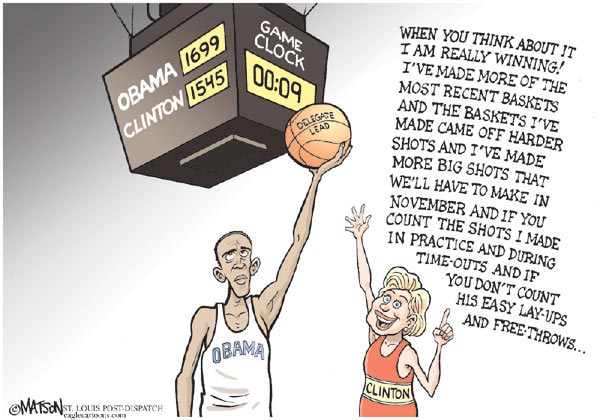
Concerning Hillary and Obama: “If she gave him one of her cojones, they’d both have two.”

James Carville, in Newsweek

Posted in RagBlog | Tagged , , | Leave a comment

a world that can get well

Paul Stanley.

there’s something so wrong about wanting to wake up every day
and the world not be at war somewhere and for people to not be
angry with each other and hate each other and for people, children,
not to be starving, not to be hurting from alienation and violence,
from berating and private closeted acts of harm by family who are
indifferent to their children’s suffering, their own suffering,
about always getting out of bed wanting the world to be a better place
to live and to be, and to want my life, everyone’s life, to be kinder,
maybe easier in some ways, to be more like each of us wants it to be,
however that is, as long as it doesn’t involve hurting anyone else,
or ourselves either, because what is a world where everyone doesn’t
get the life they most want or often even a life they can tolerate,
what is a world that begins every day with wanting a better world
to live in, a world that can get well, a world we can live in,
that we get to live in

a world that can get well


By Larry Piltz
April 8, 2008
Indian Cove / Austin, Texas

Posted May 4, 2008
The Rag Blog

Larry Piltz poetry on The Rag Blog

Posted in Rag Bloggers | Tagged , | Leave a comment

Rev. Hagee : John McCain’s Cross to Bear

John Hagee compares † Roman Church † to Hitler

The All-White Elephant in the Room
By Frank Rich / May 4, 2008

BORED by those endless replays of the Rev. Jeremiah Wright? If so, go directly to YouTube, search for “John Hagee Roman Church Hitler,” and be recharged by a fresh jolt of clerical jive.

What you’ll find is a white televangelist, the Rev. John Hagee, lecturing in front of an enormous diorama. Wielding a pointer, he pokes at the image of a woman with Pamela Anderson-sized breasts, her hand raising a golden chalice. The woman is “the Great Whore,” Mr. Hagee explains, and she is drinking “the blood of the Jewish people.” That’s because the Great Whore represents “the Roman Church,” which, in his view, has thirsted for Jewish blood throughout history, from the Crusades to the Holocaust.

Mr. Hagee is not a fringe kook but the pastor of a Texas megachurch. On Feb. 27, he stood with John McCain and endorsed him over the religious conservatives’ favorite, Mike Huckabee, who was then still in the race.

Are we really to believe that neither Mr. McCain nor his camp knew anything then about Mr. Hagee’s views? This particular YouTube video — far from the only one — was posted on Jan. 1, nearly two months before the Hagee-McCain press conference. Mr. Hagee appears on multiple religious networks, including twice daily on the largest, Trinity Broadcasting, which reaches 75 million homes. Any 12-year-old with a laptop could have vetted this preacher in 30 seconds, tops.

Since then, Mr. McCain has been shocked to learn that his clerical ally has made many other outrageous statements. Mr. Hagee, it’s true, did not blame the American government for concocting AIDS. But he did say that God created Hurricane Katrina to punish New Orleans for its sins, particularly a scheduled “homosexual parade there on the Monday that Katrina came.”

Mr. Hagee didn’t make that claim in obscure circumstances, either. He broadcast it on one of America’s most widely heard radio programs, “Fresh Air” on NPR, back in September 2006. He reaffirmed it in a radio interview less than two weeks ago. Only after a reporter asked Mr. McCain about this Katrina homily on April 24 did the candidate brand it as “nonsense” and the preacher retract it.

Mr. McCain says he does not endorse any of Mr. Hagee’s calumnies, any more than Barack Obama endorses Mr. Wright’s. But those who try to give Mr. McCain a pass for his embrace of a problematic preacher have a thin case. It boils down to this: Mr. McCain was not a parishioner for 20 years at Mr. Hagee’s church.

That defense implies, incorrectly, that Mr. McCain was a passive recipient of this bigot’s endorsement. In fact, by his own account, Mr. McCain sought out Mr. Hagee, who is perhaps best known for trying to drum up a pre-emptive “holy war” with Iran.(This preacher’s rantings may tell us more about Mr. McCain’s policy views than Mr. Wright’s tell us about Mr. Obama’s.) Even after Mr. Hagee’s Catholic bashing bubbled up in the mainstream media, Mr. McCain still did not reject and denounce him, as Mr. Obama did an unsolicited endorser, Louis Farrakhan, at the urging of Tim Russert and Hillary Clinton. Mr. McCain instead told George Stephanopoulos two Sundays ago that while he condemns any “anti-anything” remarks by Mr. Hagee, he is still “glad to have his endorsement.”

I wonder if Mr. McCain would have given the same answer had Mr. Stephanopoulos confronted him with the graphic video of the pastor in full “Great Whore” glory. But Mr. McCain didn’t have to fear so rude a transgression. Mr. Hagee’s videos have never had the same circulation on television as Mr. Wright’s. A sonorous white preacher spouting venom just doesn’t have the telegenic zing of a theatrical black man.

Perhaps that’s why virtually no one has rebroadcast the highly relevant prototype for Mr. Wright’s fiery claim that 9/11 was America’s chickens “coming home to roost.” That would be the Sept. 13, 2001, televised exchange between Pat Robertson and Jerry Falwell, who blamed the attacks on America’s abortionists, feminists, gays and A.C.L.U. lawyers. (Mr. Wright blamed the attacks on America’s foreign policy.) Had that video re-emerged in the frenzied cable-news rotation, Mr. McCain might have been asked to explain why he no longer calls these preachers “agents of intolerance” and chose to cozy up to Mr. Falwell by speaking at his Liberty University in 2006.

None of this is to say that two wacky white preachers make a Wright right. It is entirely fair for any voter to weigh Mr. Obama’s long relationship with his pastor in assessing his fitness for office. It is also fair to weigh Mr. Obama’s judgment in handling this personal and political crisis as it has repeatedly boiled over. But whatever that verdict, it is disingenuous to pretend that there isn’t a double standard operating here. If we’re to judge black candidates on their most controversial associates — and how quickly, sternly and completely they disown them — we must judge white politicians by the same yardstick.

When Rudy Giuliani, still a viable candidate, successfully courted Pat Robertson for an endorsement last year, few replayed Mr. Robertson’s greatest past insanities. Among them is his best-selling 1991 tome, “The New World Order,” which peddled some of the same old dark conspiracy theories about “European bankers” (who just happened to be named Warburg, Schiff and Rothschild) that Mr. Farrakhan has trafficked in. Nor was Mr. Giuliani ever seriously pressed to explain why his cronies on the payroll at Giuliani Partners included a priest barred from the ministry by his Long Island diocese in 2002 following allegations of sexual abuse. Much as Mr. Wright officiated at the Obamas’ wedding, so this priest officiated at (one of) Mr. Giuliani’s. Did you even hear about it?

There is not just a double standard for black and white politicians at play in too much of the news media and political establishment, but there is also a glaring double standard for our political parties. The Clintons and Mr. Obama are always held accountable for their racial stands, as they should be, but the elephant in the room of our politics is rarely acknowledged: In the 21st century, the so-called party of Lincoln does not have a single African-American among its collective 247 senators and representatives in Washington. Yes, there are appointees like Clarence Thomas and Condi Rice, but, as we learned during the Mark Foley scandal, even gay men may hold more G.O.P. positions of power than blacks.

A near half-century after the civil rights acts of the 1960s, this is quite an achievement. Yet the holier-than-thou politicians and pundits on the right passing shrill moral judgment over every Democratic racial skirmish are almost never asked to confront or even acknowledge the racial dysfunction in their own house. In our mainstream political culture, this de facto apartheid is simply accepted as an intractable given, unworthy of notice, and just too embarrassing to mention aloud in polite Beltway company. Those who dare are instantly accused of “political correctness” or “reverse racism.”

An all-white Congressional delegation doesn’t happen by accident. It’s the legacy of race cards that have been dealt since the birth of the Southern strategy in the Nixon era. No one knows this better than Mr. McCain, whose own adopted daughter of color was the subject of a vicious smear in his party’s South Carolina primary of 2000.

This year Mr. McCain has called for a respectful (i.e., non-race-baiting) campaign and has gone so far as to criticize (ineffectually) North Carolina’s Republican Party for running a Wright-demonizing ad in that state’s current primary. Mr. McCain has been posing (awkwardly) with black people in his tour of “forgotten” America. Speaking of Katrina in New Orleans, he promised that “never again” would a federal recovery effort be botched on so grand a scale.

This is all surely sincere, and a big improvement over Mitt Romney’s dreams of his father marching with the Rev. Dr. Martin Luther King Jr. Up to a point. Here, too, there’s a double standard. Mr. McCain is graded on a curve because the G.O.P. bar is set so low. But at a time when the latest Wall Street Journal-NBC News poll shows that President Bush is an even greater drag on his popularity than Mr. Wright is on Mr. Obama’s, Mr. McCain’s New Orleans visit is more about the self-interested politics of distancing himself from Mr. Bush than the recalibration of policy.

Mr. McCain took his party’s stingier line on Katrina aid and twice opposed an independent commission to investigate the failed government response. Asked on his tour what should happen to the Ninth Ward now, he called for “a conversation” about whether anyone should “rebuild it, tear it down, you know, whatever it is.” Whatever, whenever, never mind.

For all this primary season’s obsession with the single (and declining) demographic of white working-class men in Rust Belt states, America is changing rapidly across all racial, generational and ethnic lines. The Census Bureau announced last week that half the country’s population growth since 2000 is due to Hispanics, another group understandably alienated from the G.O.P.

Anyone who does the math knows that America is on track to become a white-minority nation in three to four decades. Yet if there’s any coherent message to be gleaned from the hypocrisy whipped up by Hurricane Jeremiah, it’s that this nation’s perennially promised candid conversation on race has yet to begin.

Source. / New York Times

Thanks to Harry Edwards / The Rag Blog

Posted in RagBlog | Tagged , , , , , | Leave a comment

We Must Also Save Ourselves from Ourselves

The Epitome of Conspicuous Consumption

The Gospel of Consumption
by Jeffrey Kaplan / May 3, 2008

Private cars were relatively scarce in 1919 and horse-drawn conveyances were still common. In residential districts, electric streetlights had not yet replaced many of the old gaslights. And within the home, electricity remained largely a luxury item for the wealthy.

Just ten years later things looked very different. Cars dominated the streets and most urban homes had electric lights, electric flat irons, and vacuum cleaners. In upper-middle-class houses, washing machines, refrigerators, toasters, curling irons, percolators, heating pads, and popcorn poppers were becoming commonplace. And although the first commercial radio station didn’t begin broadcasting until 1920, the American public, with an adult population of about 122 million people, bought 4,438,000 radios in the year 1929 alone.

But despite the apparent tidal wave of new consumer goods and what appeared to be a healthy appetite for their consumption among the well-to-do, industrialists were worried. They feared that the frugal habits maintained by most American families would be difficult to break. Perhaps even more threatening was the fact that the industrial capacity for turning out goods seemed to be increasing at a pace greater than people’s sense that they needed them.

It was this latter concern that led Charles Kettering, director of General Motors Research, to write a 1929 magazine article called “Keep the Consumer Dissatisfied.” He wasn’t suggesting that manufacturers produce shoddy products. Along with many of his corporate cohorts, he was defining a strategic shift for American industry-from fulfilling basic human needs to creating new ones.

In a 1927 interview with the magazine Nation’s Business, Secretary of Labor James J. Davis provided some numbers to illustrate a problem that the New York Times called “need saturation.” Davis noted that “the textile mills of this country can produce all the cloth needed in six months’ operation each year” and that 14 percent of the American shoe factories could produce a year’s supply of footwear. The magazine went on to suggest, “It may be that the world’s needs ultimately will be produced by three days’ work a week.”

Business leaders were less than enthusiastic about the prospect of a society no longer centered on the production of goods. For them, the new “labor-saving” machinery presented not a vision of liberation but a threat to their position at the center of power. John E. Edgerton, president of the National Association of Manufacturers, typified their response when he declared: “I am for everything that will make work happier but against everything that will further subordinate its importance. The emphasis should be put on work-more work and better work.” “Nothing,” he claimed, “breeds radicalism more than unhappiness unless it is leisure.”

By the late 1920s, America’s business and political elite had found a way to defuse the dual threat of stagnating economic growth and a radicalized working class in what one industrial consultant called “the gospel of consumption”-the notion that people could be convinced that however much they have, it isn’t enough. President Herbert Hoover’s 1929 Committee on Recent Economic Changes observed in glowing terms the results: “By advertising and other promotional devices . . . a measurable pull on production has been created which releases capital otherwise tied up.” They celebrated the conceptual breakthrough: “Economically we have a boundless field before us; that there are new wants which will make way endlessly for newer wants, as fast as they are satisfied.”

Today “work and more work” is the accepted way of doing things. If anything, improvements to the labor-saving machinery since the 1920s have intensified the trend. Machines can save labor, but only if they go idle when we possess enough of what they can produce. In other words, the machinery offers us an opportunity to work less, an opportunity that as a society we have chosen not to take. Instead, we have allowed the owners of those machines to define their purpose: not reduction of labor, but “higher productivity”-and with it the imperative to consume virtually everything that the machinery can possibly produce.

FROM THE EARLIEST DAYS of the Age of Consumerism there were critics. One of the most influential was Arthur Dahlberg, whose 1932 book Jobs, Machines, and Capitalism was well known to policymakers and elected officials in Washington. Dahlberg declared that “failure to shorten the length of the working day . . . is the primary cause of our rationing of opportunity, our excess industrial plant, our enormous wastes of competition, our high pressure advertising, [and] our economic imperialism.” Since much of what industry produced was no longer aimed at satisfying human physical needs, a four-hour workday, he claimed, was necessary to prevent society from becoming disastrously materialistic. “By not shortening the working day when all the wood is in,” he suggested, the profit motive becomes “both the creator and satisfier of spiritual needs.” For when the profit motive can turn nowhere else, “it wraps our soap in pretty boxes and tries to convince us that that is solace to our souls.”

There was, for a time, a visionary alternative. In 1930 Kellogg Company, the world’s leading producer of ready-to-eat cereal, announced that all of its nearly fifteen hundred workers would move from an eight-hour to a six-hour workday. Company president Lewis Brown and owner W. K. Kellogg noted that if the company ran “four six-hour shifts . . . instead of three eight-hour shifts, this will give work and paychecks to the heads of three hundred more families in Battle Creek.”

This was welcome news to workers at a time when the country was rapidly descending into the Great Depression. But as Benjamin Hunnicutt explains in his book Kellogg’s Six-Hour Day, Brown and Kellogg wanted to do more than save jobs. They hoped to show that the “free exchange of goods, services, and labor in the free market would not have to mean mindless consumerism or eternal exploitation of people and natural resources.” Instead “workers would be liberated by increasingly higher wages and shorter hours for the final freedom promised by the Declaration of Independence-the pursuit of happiness.”

Read all of it here. / Common Dreams / Onion Magazine

The Rag Blog

Posted in RagBlog | Tagged , | Leave a comment

Winning Hearts and Minds, Yankee Style


Hospital In Baghdad Casualty of US Air Strike
May 3, 2009

A hospital in the Iraqi capital’s Sadr City, a Shiite militia stronghold, was damaged in a US air strike on Saturday, wounding around 20 people, medics and witnesses said.

A medic at the Al-Sadr hospital which was hit said women and children were among the 20 wounded in the strike, which a security official said took place at around 10:00 am (0700 GMT).

The US military confirmed the air strike but said it targeted “known criminal elements”.

“I can confirm that we conducted a strike in Sadr City this morning. The targets were known criminal elements. Battle damage assessment is currently ongoing,” a military spokesman told AFP.

Witnesses said the target of the strike, in which US forces dropped several missiles, was a small house adjacent to Al-Sadr hospital and used as a rest area by Shiite pilgrims.

The impact of the strike damaged more than a dozen ambulances belonging to the hospital, one of the three main medical facilities in the district, and also shattered windows of the building, an AFP reporter at the scene said.

© 2008 Agence France Presse

Source / Common Dreams

Update:

Baghdad hospital damaged by U.S. missile, dozens injured
By Shashank Bengali May 3, 2008

BAGHDAD — A major hospital in Baghdad’s Sadr City slum was damaged Saturday when an American military strike targeted a militia command center just a few yards away, the U.S. military said.

American troops also killed 14 people in separate incidents in and around Sadr City as bloody street battles continued to mark the U.S. effort to rid the area of suspected Shiite Muslim militants, military officials said.

The rocket strike near Sadr Hospital injured 30 people, shattered the windows of ambulances and sent doctors and hospital staff fleeing the scene, hospital officials said.

That hospital and another major facility in Sadr City had already taken in 25 dead bodies between Friday afternoon and 10 a.m. Saturday, when the strike occurred, hospital officials said. None of the injuries was life threatening.

The U.S. military is facing growing criticism over what residents describe as mounting civilian casualties in Sadr City, a densely populated slum of some 2.5 million people, which has seen heavy clashes over the past six weeks between U.S. and Iraqi forces and militiamen loyal to the hard-line Shiite cleric Muqtada al Sadr.

A senior Iranian official accused the U.S. military of attacking Iraqi civilians, telling the official Fars News Agency that Iran would pull out of talks with the United States on Iraqi security unless the attacks stop. The countries held three rounds of talks last year on Iraq — the highest level bilateral talks since 1980 — and are due to meet again this year.

U.S. military officials have repeatedly said they try to avoid civilian casualties. They accuse Iran of arming and training Iraqi militias, a charge that Tehran denies. American officials in Baghdad were reviewing the Iranian report but didn’t immediately comment on it.

Since Iraqi Prime Minister Nouri al Maliki’s Shiite-led government launched an offensive against Sadr’s Mahdi Army militia in the southern port city of Basra in March, Shiite militants have targeted U.S. and Iraqi troops in the sprawling, maze-like slum in northeast Baghdad that is becoming increasingly deadly for American soldiers.

Sadr has called on his followers to end the American occupation of Iraq. American military officials say that militants are using houses in Sadr City as bases from which to fire on U.S. and Iraqi troops and launch mortars into the Green Zone, the heavily fortified seat of government in Baghdad.

Lt. Col. Steve Stover, a U.S. military spokesman, said that the strike near the Sadr Hospital destroyed a house that American intelligence reports described as a command center for militiamen.

“It did not hit the hospital,” Stover said. “Based on the proximity of the house, there may have been shattered windows.”

A hospital official said that the explosion shattered all the windows and sent many doctors running from the building, leaving the emergency ward without enough personnel to deal with injury victims. Television footage showed several ambulances with shattered windows and hospital staff racing through corridors with bleeding victims strapped to gurneys.

“Some of those injured were patients who were on their way into the hospital. Others were just passing by,” said the hospital official, who requested anonymity for security reasons.

McClatchy Newspapers 2008

Source / McClatchy

The Rag Blog

Posted in RagBlog | Tagged , | Leave a comment

A. Embree : 1968 Columbia Student Revolt Remembered in New York

Mark Rudd and Grace (Linda) LeClair, vets of the 1968 Columbia occupation, at 40th anniversary of the uprising in New York. Photo by Alice Embree / The Rag Blog.

Columbia 1968: The View From Texas
By Alice Embree
/ The Rag Blog / May 3, 2008

[Alice Embree is an Austin activist, writer and Ragblogger. She played a major role in Students for a Democratic Society (SDS) in the sixties and seventies, both in Austin and New York, and wrote for underground papers Rat and The Rag.]

In April 1968, Columbia University erupted in protest. Students occupied five buildings. I was there. I wasn’t a Columbia student, but I was there. I worked with the North American Congress on Latin America (NACLA) and caught a briefcase full of documents tossed from the second floor Low Library office of Grayson Kirk’s office that were re-printed in RAT newspaper and used to document the NACLA pamphlet, Who Rules Columbia?

I was at Columbia again April 24-27 for events commemorating the fortieth anniversary of the student uprising. The 1968 occupations were motivated by two major demands – to stop a Morningside Heights gym expansion and sever ties with the Institute for Defense Analysis (IDA). Antiwar passion and black liberation struggle were a potent mix. When the police cleared the buildings forty years ago, they arrested 700 students and left 150 injured. It was a pivotal event for students in a year marked by historic events.

1968 began with the Tet Offensive demonstrating the strength of the Vietnamese national liberation resistance. On April 4, 1968, Martlin Luther King, Jr. was assassinated in Memphis and cities went up in flames. The Columbia strike occurred just weeks before a general strike in Paris. On June 5th Robert Kennedy was assassinated in Los Angeles. In August, tanks rolled into Prague and the National Guard was called up in Chicago where antiwar protestors massed outside the Democratic Convention and were attacked by Chicago police. A student uprising in Mexico City was brutally suppressed in the October 1968.

The Columbia gathering drew several hundred alumni of the protests with their nametags identifying the buildings they occupied: “Hamilton Hall, ’68,” “Mathematics, ’68,” etc. People found old friends and comrades, often needing to be prompted to reconcile gray hair or balding heads with the faces of youth.

On Thursday, the first night, there was a reception followed by a panel on Columbia and the World. Tom Hayden (Mathematics) recalled that year as did Black student activist William Sales (Hamilton Hall). Mark Kurlansky, author of 1968: The Year That Rocked the World, and Victoria de Grasso spoke of the world events that year.

Friday morning, Michael Klare spoke. He was a graduate student in Art History at Columbia when events steered him into research on defense contractors. I worked with him at NACLA. He is the author of Blood and Oil, a professor and defense correspondent for The Nation.

Klare detailed the lessons learned from Vietnam by the Defense Department: to use an all volunteer economic draft, to rely on technology, speed and fire-power, to attempt to reduce U.S. casualties and shorten the military engagement, to outsource military services and carefully control media coverage. He said that Defense Department brass have been extremely critical of the political bungling that has prolonged the military engagement. Many in the military see this as “dishonoring the commitment” of the servicemen and women.

The Friday morning panel also included Tom Engelhardt of the TomDispatch blog and Callie Maidhof, a Columbia student antiwar activist who spoke of the five days of antiwar action undertaken to commemorate the five years of the war. For thirteen hours each day, Columbia antiwar activists read the names of the dead – the known Iraqi dead and the U.S. dead. A gong was sounded for each death. On April 23rd, antiwar activists “hooded” Columbia’s iconic Alma Mater sculpture. With its face covered by black cloth, it appeared as an eerie reminder of Abu Ghraib torture victims.

The first Friday afternoon panel was on Feminist Legacies of 1968. It was a poignant reminder that 1968 preceded the women’s liberation movement. Women who were at Barnard and Columbia forty years ago were often the sandwich-makers, not the speakers. Although 250 women were arrested, their names are not well known. The full effect of the women’s movement can be seen, however, in the current generation of activists where women take leadership roles. The feminist panel included poets, professors, authors and activists. Ti-Grace Atkinson, Rosalyn Baxandall, Elizabeth Diggs, Christine Clark-Evans, Grace (Linda) LeClair, Sharon Olds, Catharine Stimpson participated. They recounted the early days of women’s liberation organizing – picketing the New York Times for gender-segregated want ads, participating in New York Red Stockings and WITCH and the founding of National Organization for Women (NOW).

One of the speakers, Grace (Linda) LeClair, a co-founder of the Calvert Social Investment Fund and Executive Director of NARAL in New Hampshire, was a Barnard student in 1966. She lived off-campus with her boyfriend. When a newspaper reported outed her, she was called before the Barnard president. LeClair was expelled and never graduated. Her boyfriend suffered no such fate, graduating from Columbia.

An afternoon panel on Political Action and Official Response included a judge, law professors and a criminal defense attorney who were veterans of the 1968 protest as well as Lee Bollinger, the President of Columbia. West Harlem organizers infuriated by Columbia’s current expansion plans interrupted Bollinger. A third afternoon panel addressed Race at Columbia, Then and Now, with writer Thulani Davis moderating. It included Manning Marable, a Columbia professor, and two student activists, one representing the Black Student Organization and the other Lucha. Johanna Ocana of Lucha became an activist when the Young Republicans invited a speaker from the Minuteman and students, many of immigrant parents, organized protests.

In the evening a lengthy multi-media event described what happened in April 1968. This was before the era of instant communication, the internet and cell phones with cameras. As pictures projected on huge screens, the occupation story was recounted by Nancy Biberman, Raymond Brown, Leon Denmark, Larry Frazier, Robert Friedman, Stuart Gedal, Juan Gonzalez, Michelle Patrick, Mark Rudd and others. An assistant to New York’s mayor at the time told his side of the story as well.

On Saturday, there were movies about 1968 shown and a panel on The Legacy of the Student Movement that included Todd Gittlin, now a Columbia University professor, and John McMillian, a Harvard lecturer. At noon, a Harlem contingent marched up Amsterdam Avenue protesting Columbia’s Manhattanville project. Joined by my daughter and brother-in-law we marched on to campus with them. Although the scheduled events continued, I went to only one more: Organizing, Activism, Engagement, Then and Now at which my daughter and I both spoke.

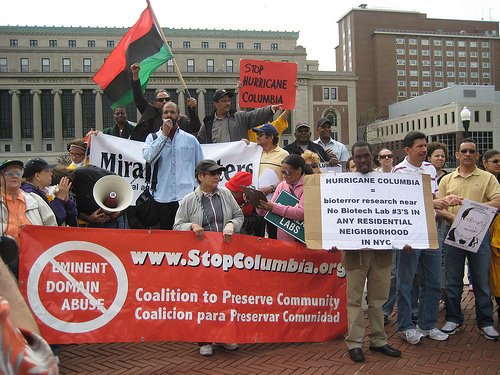
There was an odd disconnect between those passionate times and the scholarly panel discussions organized by alumni participants. Occasionally, the strident voices of Harlem residents who opposed a current Columbia expansion were reminiscent of that earlier time, particularly when they interrupted President Lee Bollinger. Contemporary Columbia antiwar activists and leaders of the Black Student Organization and Lucha, brought the present tense into discussion.

Many panels were dominated by male voices with credentials – professors and writers. When people lined up for questions, they frequently delivered polemics. It reminded me of being a young Texan in New York on a campus where the elite had been educated to believe they were the center of the known universe. There wasn’t much space for participatory democracy in the rarified Ivy League atmosphere forty years later. Not until the final panel that I attended – an event billed as an intergenerational dialogue – was there a structure that encouraged exchange. A table with microphones set in a circle allowed people to come and go (although some had to be encouraged to speak and then leave). There were more women’s voices and the familiar edge of now. Here, the younger generation showed what is easy to miss: the struggle continues.

Rally during recent Columbia occupation reunion. Photo by Alice Embree / The Rag Blog.

The Rag Blog

Posted in Rag Bloggers | Tagged , , , , | 1 Comment

And if we count the exhibition games in Michigan and Florida…

Thanks to Harry Edwards / The Rag Blog

Posted in RagBlog | Tagged , , , , , | Leave a comment

A. Pogue : The Sad Tale of a Good Samaritan

Alan Pogue’s new look: “All I need is the two knobs, one on either side of my neck, for the perfect Halloween mask.” Painful self-portrait by Alan Pogue / The Rag Blog.

“No good deed goes unpunished”: A cautionary tale of east Austin
By Alan Pogue
/ The Rag Blog / May 3, 2008

[Ragblogger Alan Pogue was staff photographer for The Rag, Austin’s legendary underground newspaper, in the late sixties and seventies and has served in the same capacity for The Texas Observer. He began his career while serving in Vietnam in 1967. He later documented Texas farm workers and has photographed in Texas prisons, in Cuba, in Iraq and Pakistan, in Latin America and the Caribbean. His book Witness for Justice was published by the University of Texas Press.

Alan’s work has often placed him in physical danger but, as it turns out, none as dangerous as the corner of Chicon and Rosewood in east Austin, Texas.]

A few nights ago I stopped to help a woman who was being beaten badly by two other women. It was 11 p.m. on Chicon and Rosewood in east Austin. I got the two women off the one on the ground but the pimp for the two women (I hypothesize) snuck up from behind and sapped me. I had to spend a few hours at St. David’s and then Brackenridge hospitals so they could scan my head and put a few stitches in my face. I will recover fully but I will require a bit more surgery on my right eye socket, an “orbital floor fracture”.

Looking on the bright side, the pimp didn’t shoot or stab me. My wallet was taken but somebody found it and called me so I got my ID and checks back. This character was smart enough not to try and cash them. The EMS and emergency people said this type of assault is on the rise. They told me about a man who stopped to help someone with a flat tire only to be beaten very badly. Bad times for good Samaritans, so watch out.

I’ll be back on the job in the middle of next week if all the surgery goes according to plan. I am ok with soup and ice cream. Someone gave me a fine bottle of Scotch but I will have to wait to drink it.

It could be that the beaten woman was on the other womens’ turf and the pimp sent them over to run the third woman off. The beaten woman was very thankful to me. We both answered questions put to us by the police. The pimp was upset that I stopped the beating and wanted to show that he was still in charge. After I was assaulted I drove a short distance to my home and splashed water on my face to check myself out. When I returned to the scene the EMS and police were there. I will work with the detective on the case and try to talk to the woman I kept from further injury. There is the possibility that she too was in on a decoy action. I will know she is not if she was willing to identify the women and/or the pimp.

Darn it, I didn’t have a camera on me because it was a short trip to pick up a book to read, “Can Humanity Change?” by Khrishnamurti, kind of ironic. While taking it easy, as my face returns to its normal shape, my mind looks to the wider social context.

Drug dealing and prostitution are a big feature of the stretch of Chicon between Rosewood and MLK in Austin. There are also many churches in the area. Yet the churches do not minister to those most in need. The epicenter of the drug trade, for the impoverished, is 12th and Chicon. This has been the case for decades, sort of an informal red light district. Indigenous eastsiders have been complaining about this crime scene for many years. The police cruise the area frequently but there seems to be no coordinated social services plan to address the problem at its root. Surprise!. No kind and creative approach has been used. Only a minimalist military mind set has been used by the Austin police to maintain an uneasy status quo for this drug district.

The vacant lots are being filled up with new home construction so the territory for illegal activity is shrinking. Much of it has moved down the alley between 12th and 13th off of Chicon. Some truly dangerous characters hang out in that alley (I spotted a fellow with a 12 gauge pump shotgun under his trench coat), so I have not taken to documenting the culture. The open solicitation for drugs and prostitution rises and falls in an unpredictable tide but the activity is constant. Red is the color of the dominant gang so one sees red pants, red caps, red sweat shirts. This level of organization means that there are other people involved who aren’t there.

I see younger people hanging out at the few public coin-operated phones to take drug orders and pass them on to older people. As Jesse Jackson said, “Fourteen year-olds on street corners are not importing drugs. Bankers are importing drugs.”

Many of the people I see at 12th and Chicon are mentally and /or physically impaired. Old people in wheel chairs often sleep on the street in their wheelchairs. More than once I have been offered sex by psychotic homeless women. In the past none of these people has ever done more than offer me drugs or sex. Once I declined they did not persist. Most of the solicitation is done with subtle eye contact so I have learned not to wave back or make eye contact with the solicitors.

In breaking up a fight among three women I stepped into their culture in a big way. The problem all around is that gentrification is forcing two cultures to overlap. I didn’t see “three prostitutes” fighting over territory, I saw one woman being beaten by two other people. They and the pimp made their activity very public in a new overall environment. I wish for the kind and creative approach but as we have seen in Waco and Eldorado, “Shock and Awe” seem to be the only tactics the authorities care to use. When the territory shrinks a bit more”something will have to be done” about what has been ignored for years. The East Side has been the recipient of planned neglect until such a time that it was worthy of being taken over by the West Side and the real-estate interests, both east and west.

I will try and look into the situation for the young woman I saved from a worse beating than she got. Her story should cast light on many forms of neglect in Texas which is always vying for last place in social services.

The Rag Blog

Posted in Rag Bloggers | Tagged , | 4 Comments

More Lies May Still Take Us to War with Iran

Democrats Okay Funds for Covert Ops: Secret Bush “Finding” Widens War on Iran
By Andrew Cockburn / May 2, 2008

Six weeks ago President Bush signed a secret finding authorizing a covert offensive against the Iranian regime that, according to those familiar with its contents, “unprecedented in its scope.”

Bush’s secret directive covers actions across a huge geographic area – from Lebanon to Afghanistan – but is also far more sweeping in the type of actions permitted under its guidelines – up to and including the assassination of targeted officials. This widened scope clears the way, for example, for full support for the military arm of Mujahedin-e Khalq, the cultish Iranian opposition group, despite its enduring position on the State Department’s list of terrorist groups.

Similarly, covert funds can now flow without restriction to Jundullah, or “army of god,” the militant Sunni group in Iranian Baluchistan – just across the Afghan border — whose leader was featured not long ago on Dan Rather Reports cutting his brother in law’s throat.

Other elements that will benefit from U.S. largesse and advice include Iranian Kurdish nationalists, as well the Ahwazi arabs of south west Iran. Further afield, operations against Iran’s Hezbollah allies in Lebanon will be stepped up, along with efforts to destabilize the Syrian regime.

All this costs money, which in turn must be authorized by Congress, or at least a by few witting members of the intelligence committees. That has not proved a problem. An initial outlay of $300 million to finance implementation of the finding has been swiftly approved with bipartisan support, apparently regardless of the unpopularity of the current war and the perilous condition of the U.S. economy.

Until recently, the administration faced a serious obstacle to action against Iran in the form of Centcom commander Admiral William Fallon, who made no secret of his contempt for official determination to take us to war. In a widely publicized incident last January, Iranian patrol boats approached a U.S. ship in what the Pentagon described as a “taunting” manner. According to Centcom staff officers, the American commander on the spot was about to open fire. At that point, the U.S. was close to war. He desisted only when Fallon personally and explicitly ordered him not to shoot. The White House, according to the staff officers, was “absolutely furious” with Fallon for defusing the incident.

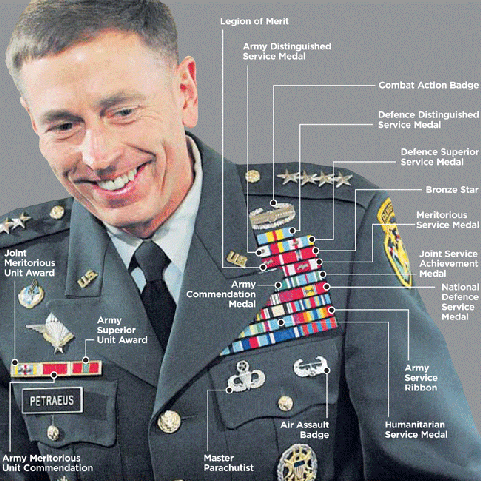
Fallon has since departed. His abrupt resignation in early March followed the publication of his unvarnished views on our policy of confrontation with Iran, something that is unlikely to happen to his replacement, George Bush’s favorite general, David Petraeus.

Though Petraeus is not due to take formal command at Centcom until late summer, there are abundant signs that something may happen before then. A Marine amphibious force, originally due to leave San Diego for the Persian Gulf in mid June, has had its sailing date abruptly moved up to May 4. A scheduled meeting in Europe between French diplomats acting as intermediaries for the U.S. and Iranian representatives has been abruptly cancelled in the last two weeks. Petraeus is said to be at work on a master briefing for congress to demonstrate conclusively that the Iranians are the source of our current troubles in Iraq, thanks to their support for the Shia militia currently under attack by U.S. forces in Baghdad.

Interestingly, despite the bellicose complaints, Petraeus has made little effort to seal the Iran-Iraq border, and in any case two thirds of U.S. casualties still come from Sunni insurgents. “The Shia account for less than one third,” a recently returned member of the command staff in Baghdad familiar with the relevant intelligence told me, “but if you want a war you have to sell it.”

Even without the covert initiatives described above, the huge and growing armada currently on station in the Gulf is an impressive symbol of American power.

Armed Might of US Marred By Begging Bowl to Arabs

Sometime in the next two weeks, fleet radar operator may notice a blip on their screens that represents something rather more profound: America’s growing financial weakness. The blip will be former Treasury Secretary Robert Rubin’s plane commencing its descent into Abu Dhabi. Rubin’s responsibility these days is to help keep Citigroup afloat despite a balance sheet still waterlogged, despite frantic bail out efforts by the Federal Reserve and others, by staggering losses in mortgage bonds. The Abu Dhabi Sovereign Wealth Fund injected $7.5 billion last November (albeit at a sub-prime interest rate of eleven percent,) but the bank’s urgent need for fresh capital persists, and Abu Dhabi is where the money is.

Even if those radar operators pay no attention to Mr. Rubin’s flight, and the ironic contrast it illustrates between American military power and financial weakness, others will, and not just in Tehran. There’s not much a finding can do about that.

Andrew Cockburn is a regular CounterPunch contributor. He lives in Washington DC. His most recent book is Rumsfeld: His Rise, Fall and Catastrophic Legacy.

Source / CounterPunch

The Rag Blog

Posted in RagBlog | Tagged , , , , | Leave a comment

Stop Fighting and Start Talking, Junior

The UK Times Online assesses the success of the Iraq surge

‘US military achievement in Iraq has reached peak’
May 2, 2008

NEW YORK — An international think tank has called for fundamental political changes in Iraq, stressing that the US military surge which contributed to reduction in violence has reached the limit of what it can achieve.

“Without fundamental political changes in Iraq, success will remain fragile and dangerously reversible,” the International Crisis Group (ICG) asserts and emphasizes the importance of devising a different approach that focuses on pressuring the Iraqi government to agree to political compromises, engage in negotiations with fuller range of Iraqi actors, including still active insurgents and alter the regional climate.

The Sunni insurgency, ICG says, has been seriously weakened as previously marginalized Sunni tribes found in the US a new patron and turned against al-Qaeda.

“Increasingly divided and with several important groups co-opted by the US, the armed movements are a shadow of their former selves. As for al-Qaeda in Iraq, it appears in disarray, a victim of US attacks but also of its own brutal excesses,” it says but warns that these trends are not necessarily permanent and hardly equate with durable Sunni Arab acceptance of the political process.

The US policy, it says, is bolstering a set of local actors operating beyond the state’s realm or the rule of law and who impose their authority by force of arms.

“None of these points to progress toward a fully inclusive political process”, says Peter Harling, Crisis Group’s Iraq, Syria and Lebanon Project Director. “The US now seems intent on militarily defeating insurgents who, although they express deep misgivings about the current political system, are eager for genuine negotiations”.

Source / The Hindu News Update Service

The Rag Blog

Posted in RagBlog | Tagged , | Leave a comment

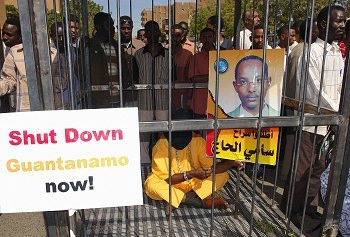
The Unjustly Imprisoned – Sami al-Haj Freed


Al-Jazeera Journalist Freed From Guantanamo After 6 Years
by Mohamed Osman / May 2, 2008

An Al-Jazeera cameraman was released from U.S. custody at Guantanamo Bay and returned home to Sudan early Friday after six years of imprisonment that drew worldwide protests.

Sami al-Haj, who had been on a hunger strike for 16 months, grimaced as he was carried off a U.S. military plane by American personnel in Sudan’s capital, Khartoum. He was put on a stretcher and taken straight to a hospital.

Al-Jazeera showed footage of al-Haj being carried into the hospital, looking feeble and with his eyes closed, but smiling. Some of the men surrounding his stretcher were kissing him on the cheek.

“Thank God … for being free again,” he told Al-Jazeera from his hospital bed. “Our eyes have the right to shed tears after we have spent all those years in prison. … But our joy is not going to be complete until our brothers in Guantanamo Bay are freed,” he added.

“The situation is very bad and getting worse day after day,” he said of conditions in Guantanamo. He claimed guards prevent Muslims from practicing their religion and reading the Quran.

“Some of our brothers live without clothing,” he said.

The U.S. military says it goes to great lengths to respect the religion of detainees, issuing them Qurans, enforcing quiet among guard staff during prayer calls throughout the day. All cells in Guantanamo have an arrow that points toward the holy city of Mecca.

Al-Haj was released along with two other Sudanese from Guantanamo Thursday. He was the only journalist from a major international news organization held at Guantanamo and many of his supporters saw his detention as punishment for a network whose broadcasts angered U.S. officials.

The military alleged he was a courier for a militant Muslim organization, an allegation his lawyers denied.

Al-Haj said he believed he was arrested because of U.S. hostility toward Al-Jazeera and because the media was reporting on U.S. rights violations in Afghanistan.

Read all of it here. / Common Dreams / AP

The Rag Blog

Posted in RagBlog | Tagged , , , , | Leave a comment