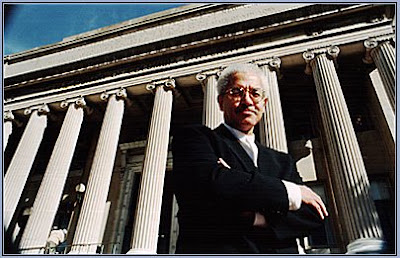
An Emmy For O’Reilly : Please Say It Isn’t So…


Protesting an O’Reilly Emmy
April 11, 2008

Bill O’Reilly is set to receive a local Emmy award in Boston next month. But he won’t, if a former fellow tabloid talker gets his way. According to the Boston Herald, Barry Nolan says O’Reilly is “a mental case,” and doesn’t deserve the award.

Having once worked in Boston, O’Reilly is being honored for taking his contributions to the national stage, first as anchor of Inside Edition and later on Fox News.

“I am appalled, just appalled,” Nolan, now with CN8, told the paper. “He inflates and constantly mangles the truth…and his frequent target is the ‘left-leaning’ media — the ones who do report the news fairly. And those are the same people who will be sitting in the room honoring him.” Oh, really?

Despite the protestations, local Emmy chief Tim Egan says O’Reilly will be honored. “You may not agree with him, but you can’t say he hasn’t increased the political conversation in this country with his style of broadcasting,” says Egan.

And it gets better. Nolan claims he will still attend the May 10 ceremony and, since his wife is out of town, he’s invited Keith Olbermann, as his date.

Chris / TVNewser

Source.
Thanks to Jim Baldauf / The Rag Blog

Posted in RagBlog | Tagged , , | Leave a comment

Trembling with Indignation at Every Injustice

“Guerrillero Heroico” – Alberto Korda

Hope is for Suckers
by Mickey Z. / April 11, 2008

Hope is the worst of evils, for it prolongs the torments of man. – Friedrich Nietzsche

We can’t give up hope, I’m often told. Keep hope alive, the saying goes. If we lose hope, nothing will ever change… or so they believe. Well, I’m here to say: Fuck hope. We live on a planet brimming with hope yet that same planet is under perpetual assault… and the hopers are losing. The corporations raping our eco-systems don’t hope they can steal more land, exploit it, poison it, and make boatloads of cash. They make a plan and make it happen… damn the torpedoes. (You might even call it “direct action.”)

Monsanto doesn’t put its faith in candlelight vigils or humans standing in the shape of a peace sign. They get busy putting their people into positions of power, writing legislation, and bullying and smashing anyone opposed to their insane agenda.

General Motors doesn’t reserve its opinions for government sanctioned “free speech zones.” The television, Internet, magazines, movies, songs, radio, etc. are all inundated with GM’s taxpayer-subsidized propaganda… just as the planet is inundated with GM’s output.

McDonald’s doesn’t waste time hoping things will go its way when its days are chock filled with brainwashing, killing, poisoning, destroying… and counting its profits. Hope never enters into the equation.

“Hope is a bad thing,” sez Henry Miller. “It means that you are not what you want to be. It means that part of you is dead, if not all of you. It means that you entertain illusions. It’s a sort of spiritual clap, I should say.”

Author Derrick Jensen explains the impotency of hope as good as anyone: “I’m not, for example, going to say I hope I eat something tomorrow. I just will. I don’t hope I take another breath right now, nor that I finish writing this sentence. I just do them. On the other hand, I do hope that the next time I get on a plane, it doesn’t crash. To hope for some result means you have given up any agency concerning it. Many people say they hope the dominant culture stops destroying the world. By saying that, they’ve assumed that the destruction will continue, at least in the short term, and they’ve stepped away from their own ability to participate in stopping it.”

If Jensen makes it sound an awful lot like religion, well, for most folks, the verb “hope” is virtually synonymous with “pray,” while “hope” the noun is often interchangeable with “faith.”

Hope is for suckers.

How about some good old-fashioned anger, rage, and passion? (Che sez: “If you tremble with indignation at every injustice then you are a comrade of mine.”) Let’s forget hope and aim for vision, clarity, strategy, courage, and finally: some goddamned results. “Creativity comes from trust,” sez Rita Mae Brown. “Trust your instincts. And never hope more than you work” (as they say in South Florida: bingo).

At its worst, hope is a dangerous cop-out. At best, it’s a frivolous idea. But even so, as Henry Miller sez: “Ideas have to be wedded to action.”

Wedded, huh? Repeat after me: “I do.”

Source

Posted in RagBlog | Tagged | Leave a comment

The Daily Iraq War Report

More Americans Want to End Iraq War Next Year
April 10, 2008

(Angus Reid Global Monitor) – Two-in-five adults in the United States believe the coalition effort should be over in 2009, according to a poll by Rasmussen Reports. 39 per cent of respondents think the United States should bring all troops home from Iraq within a year, up two points since February.

In addition, 26 per cent of respondents would withdraw all soldiers immediately, and 31 per cent want them to remain in Iraq until the mission is complete.

Read all of it here. Global Monitor.

And here is another reason to end this war now.

Iraq War Costs Skyrocketing, But Congress Unable to Scrutinize Spending
by Jason Leopold / April 11th, 2008

Nearly all of the $516 billion allocated by Congress to fund the wars in Afghanistan and Iraq has come in the form of emergency spending requests, a method the White House has abused, depriving Congress the ability to scrutinize how the Pentagon spends money in the so-called global war on terror. The use of emergency supplemental bills to fund the wars has likely resulted in the waste of billions of taxpayer dollars, according to a recent report from the Congressional Research Service (CRS), the investigative arm of Congress.

Dozens of emergency funding requests that Congress has approved since 2001 is unprecedented compared with past military conflicts when war funding went through the normal appropriations process. As of March, CRS said average monthly costs to fund military operations in Iraq and Afghanistan has reached roughly $12.3 billion, $10 billion for Iraq alone, more than double what it cost to fund the war in 2004.

“Over 90% of [the Department of Defense] funds were provided as emergency funds in supplemental or additional appropriations; the remainder were provided in regular defense bills or in transfers from regular appropriations,” the report said. “Emergency funding is exempt from ceilings applying to discretionary spending in Congress’s annual budget resolutions. Some Members have argued that continuing to fund ongoing operations in supplementals reduces congressional oversight.”

Vernonique de Rugy, a senior research fellow and budget scholar at the Mercatus Center at George Mason University, said funding the Iraq and Afghanistan wars through emergency legislation is troubling because the money “doesn’t get counted in deficit projections, making it hard to track the real cost of the war and effectively removing any upper limits on spending for the war.”

“Even seven years after the start of the war in Afghanistan, and five years after the start of the war in Iraq, Congress and the president are still using “emergency” funding bills to cover costs, rather than going through the regular appropriations process,” said de Rugy, who just published an article on the issue, “The Trillion-Dollar War,” in the May issue of Reason magazine. “While other wars have initially been funded using emergency supplementals, they have quickly been incorporated into the regular budget. Never before has emergency supplemental spending been used to fund an entire war and over the course of so many years.”

Most troubling about this trend, the CRS said in a report issued in February, is that while the Pentagon’s budget requests has steadily increased annually the reasons the Defense Department has cited to explain its skyrocketing costs “do not appear to be enough to explain the size of and continuation of increases.”

“Although some of the factors behind the rapid increase in DOD funding are known — the growing intensity of operations, additional force protection gear and equipment, substantial upgrades of equipment, converting units to modular configurations, and new funding to train and equip Iraqi security forces — these elements” fail to justify the increase, the CRS report stated, adding that “little of the $93 billion DOD increase between [fiscal year] 2004 and [fiscal year] 2007 appears to reflect changes in the number of deployed personnel.”

Furthermore, a $70 billion “placeholder” request included in the fiscal year 2009 budget that the Pentagon says will be used to finance operations in Iraq does not include any details on how the money will be spent “making it impossible to estimate its allocation,” according to the report.

The CRS added the Pentagon has used emergency supplemental requests to get Congress to fund equipment and vehicle upgrades that would otherwise come out of the Pentagon’s annual budget. The Pentagon has succeeded largely due to a new way it now defines the war on terror.

“Although some of this increase may reflect additional force protection and replacement of “stressed” equipment, much may be in response to [Deputy Secretary of Defense Gordon] England’s new guidance to fund requirements for the “longer war” rather than DOD’s traditional definition of war costs as strictly related to immediate war needs,” the GAO report says, adding that Congress must immediately begin to demand a more transparent accounting of Pentagon emergency spending in order to put an end to the agency’s accounting chicanery.

“For example, the Navy initially requested $450 million for six EA-18G aircraft, a new electronic warfare version of the F-18, and the Air Force $389 million for two Joint Strike Fighters, an aircraft just entering production; such new aircraft would not be delivered for about three years and so could not be used meet immediate war needs,” the CRS report said.

Read all of it here.

Posted in RagBlog | Tagged , , | Leave a comment

Listen to the Sabre Rattle: Iran-Attack Redux

Youth in Tehran (Photo: WorldIsRound)

Attacking Iran redux

Besides the clear threats contained in Bush’s speech yesterday, Gen. Petraeus testified repeatedly this week before Congress that Iran was supplying weapons to Shiite militias what were being used to kill American soldiers and bomb Baghdad’s Green Zone. More missiles hit there this morning. McCain has also stated this week that he would not rule out a “pre-emptive” attack on Iran. Based on the renewed prominence of this theme, some pundits (Pat Buchanan in particular) have now stated their belief that such an attack will occur before Bush leaves office.

Until this week, it was widely believed that the rationale the Bush regime favored in order to justify attacking Iran was the claim that they were developing nuclear weapons. When this was refuted by the National Intelligence Estimate that was released a couple of months ago, it appeared that the ground had been cut from under the Bush warmongers. Now they’ve come up with a new rationale and they are spewing if forth every day.

Attacking Iran is back on the table and the antiwar movement needs to prepare for that possibility.

Rational arguments against attacking Iran remain. 1. To do so would incite an uprising against US troops by Iran’s allies among the Shiites in Iraq. Maybe, but Al-Sadr is principally an Iraqi nationalist and the closest allies of Iran are in the Al-Maliki government. Besides, Iraqis are Arabic-speaking Arabs and nothing unites them better than opposition to the Farsi-speaking “Persians”. 2. Oil prices would go through the roof. So what? The Bush regime’s primary constituency is Big Oil and they would make more mega-billions as a result. 3. Oil at $150 or more a barrel would sink the US economy. They don’t care if the Democrats are going to control both the White House and Congress. Let it be their problem. But if the attack could be timed just right – like in October – it might bail out a sinking McCain candidacy.

A year ago, we wrote and posted online the “Iran Pledge of Resistance Petition”. It basically stated that if the US attacked Iran, the signers would be in the streets organizing mass civil disobedience. We need to be ready to take that step and to publicize our readiness. The first step in that direction would be to unify the Austin antiwar movement. There are dozens of organizations in Austin that are antiwar – MDS, Austin Peace and Justice Coalition, Austin Against War, Third Coast Activist Alliance, CAMEO, Codepink, MoveOn, the Green Party, and Texans for Peace, just to name a few of the most obvious. Sentiment among the 7,000+ delegates to the Travis County Democratic Party convention last month was uniformly antiwar and the convention’s passed a resolution calling for immediate withdrawal from Iraq. Austin needs a broadly based antiwar council and that coalition needs to publicly state that it will react in the most militant non-violent manner to any attack on Iran.

David Hamilton / The Rag Blog

Bush Hypes Threat from Iran in Surge “Success” Speech
By Matthew Rothschild / April 10, 2008

In his speech on Thursday, Bush wasted little time before getting to the ominous subject of Iran.

Time and time again, he lumped the alleged threat from Iran in the same breath as the one from Al Qaeda, once again fusing enemies in the minds of the American people.

“Serious and complex challenges remain in Iraq, from the presence of Al Qaeda to the destructive influence of Iran,” he said, even before declaring that the surge has “renewed and revived the prospect of success.”

A little later, he said, “Iraq is the convergence point for two of the greatest threats to America in this new century: Al Qaeda and Iran.” (Bush has now elevated Iran over China as the looming threat of the century!)

And in the next paragraph, he said, “If we succeed in Iraq after all that Al Qaeda and Iran have invested there, it would be a historic blow to the global terrorist movement and a severe setback for Iran.”

Al Qaeda-Iran, Al Qaeda-Iran, Al Qaeda-Iran. That is the chant emanating from the White House.

But Bush was not content to be subtle about his belligerence toward Iran.

Listen to the saber rattle:

“The regime in Tehran also has a choice to make,” Bush said. “It can live in peace with its neighbor, enjoy strong economic and cultural and religious ties. Or it can continue to arm and train and fund illegal militant groups, which are terrorizing the Iraqi people and turning them against Iran. If Iran makes the right choice, America will encourage a peaceful relationship between Iran and Iraq. Iran makes the wrong choice, America will act to protect our interests, and our troops, and our Iraqi partners.”

By “America will act,” Bush is making damn clear that he intends to go ahead and bomb Iran.

We can keep telling ourselves that Bush wouldn’t be so foolish as to widen the war to Iran when the one in Iraq is going so badly. But foolishness has never stopped him before.

Regard his words.

They put not only Tehran on notice.

They put Congress and the American people on notice.

This man is planning on waging another illegal war, and we need to do all that we can, nonviolently, to stop him.

Source / The Progressive / The Rag Blog

Posted in Rag Bloggers | Tagged , , , , | Leave a comment

Pat Buchanan on Likelihood of War with Iran

Petraeus Points to War With Iran
By Patrick J. Buchanan

The neocons may yet get their war on Iran.

Ever since President Nouri al-Maliki ordered the attacks in Basra on the Mahdi Army, Gen. David Petraeus has been laying the predicate for U.S. air strikes on Iran and a wider war in the Middle East.

Iran, Petraeus told the Senate Armed Services Committee, has “fueled the recent violence in a particularly damaging way through its lethal support of the special groups.”

These “special groups” are “funded, trained, armed and directed by Iran’s Quds Force with help from Lebanese Hezbollah. It was these groups that launched Iranian rockets and mortar rounds at Iraq’s seat of government (the Green Zone) … causing loss of innocent life and fear in the capital.”

Is the Iranian government aware of this — and behind it?

“President Ahmadinejad and other Iranian leaders” promised to end their “support for the special groups,” said the general, but the “nefarious activities of the Quds force have continued.”

Are Iranians then murdering Americans, asked Joe Lieberman:

“Is it fair to say that the Iranian-backed special groups in Iraq are responsible for the murder of hundreds of American soldiers and thousands of Iraqi soldiers and civilians?”

“It certainly is. … That is correct,” said Petraeus.

The following day, Petraeus told the House Armed Services Committee, “Unchecked, the ’special groups’ pose the greatest long-term threat to the viability of a democratic Iraq.”

Translation: The United States is now fighting the proxies of Iran for the future of Iraq.

The general’s testimony is forcing Bush’s hand, for consider the question it logically raises: If the Quds Force and Hezbollah, both designated as terrorist organizations, are arming, training and directing “special groups” to “murder” Americans, and rocket and mortar the Green Zone to kill our diplomats, and they now represent the No. 1 threat to a free Iraq, why has Bush failed to neutralize these base camps of terror and aggression?

Hence, be not surprised if President Bush appears before the TV cameras, one day soon, to declare:

“My commanding general in Iraq, David Petraeus, has told me that Iran, with the knowledge of President Ahmadinejad, has become a privileged sanctuary for two terrorist organizations — Hezbollah and the Quds Force of the Iranian Revolutionary Guard — to train, arm and direct terrorist attacks on U.S. and coalition forces, despite repeated promises to halt this murderous practice.

“I have therefore directed U.S. air and naval forces to begin air strikes on these base camps of terror. Our attacks will continue until the Iranian attacks cease.”

Because of the failures of a Democratic Congress elected to end the war, Bush can now make a compelling case that he would be acting fully within his authority as commander in chief.

In early 2007, Nancy Pelosi pulled down a resolution that would have denied Bush the authority to attack Iran without congressional approval. In September, both Houses passed the Kyl-Lieberman resolution designating the Iranian Revolutionary Guard a terrorist organization.

Courtesy of Congress, Bush thus has a blank check for war on Iran. And the signs are growing that he intends to fill it in and cash it.

Israel has been hurling invective at Iran and conducting security drills to prepare its population for rocket barrages worse than those Hezbollah delivered in the Lebanon War.

Adm. William “Fox” Fallon, the Central Command head who opposed war with Iran, has been removed. Hamas and Hezbollah have been stocking up on Qassam and Katyusha rockets.

Vice President Cheney has lately toured Arab capitals.

And President Ahmadinejad just made international headlines by declaring that Tehran will begin installing 6,000 advanced centrifuges to accelerate Iran’s enrichment of uranium.

This is Bush’s last chance to strike and, when Iran responds, to effect its nuclear castration. Are Bush and Cheney likely to pass up this last chance to destroy Iran’s nuclear facilities and effect the election of John McCain? For any attack on Iran’s “terrorist bases” would rally the GOP and drive a wedge between Obama and Hillary.

Indeed, Sen. Clinton, who voted to declare Iran’s Revolutionary Guard a terrorist organization, could hardly denounce Bush for ordering air strikes on the Revolutionary Guards’ Quds Force, when Petraeus testified, in her presence, that it is behind the serial murder of U.S. soldiers.

The Iranians may sense what is afoot. For Tehran helped broker the truce in the Maliki-Sadr clash in Basra, and has called for a halt to the mortar and rocket attacks on the Green Zone.

With a friendly regime in Baghdad that rolled out the red carpet for Ahmadinejad, Iran has nothing to gain by war. Already, it is the big winner from the U.S. wars that took down Tehran’s Taliban enemies, decimated its al-Qaida enemies and destroyed its Sunni enemies, Saddam and his Baath Party.

No, it is not Iran that wants a war with the United States. It is the United States that has reasons to want a short, sharp war with Iran.

Source.
Thanks to Carl Davidson

Posted in RagBlog | Tagged , , | Leave a comment

Guantanamo Defendant Calls Trial a ‘Sham’

This April 24, 2007 file photo shows a Joint Task Force guard (L) at Camp #1 inside the detainee center at Camp Delta in Guantanamo Bay Naval Station, Cuba, as he talks with a detainee who has had his identity obscured per military review restrictions. Photo by Paul J. Richards / AFP / Getty Images.

The Saudi detainee refuses to participate in the military tribunal proceedings against him, which he calls politically motivated.
By Carol J. Williams / April 10, 2008

GUANTANAMO BAY, CUBA — A Saudi prisoner Wednesday denounced the war crimes case against him as a politically motivated “sham” and had himself removed from the courtroom in symbolic protest.

Ahmed Mohammed Ahmed Haza Al-Darbi, whose brother-in-law was among the Sept. 11 hijackers, informed the military judge hearing his terrorism conspiracy case that he wanted neither legal representation nor to be present at his trial.

Al-Darbi, 33, has been charged with conspiracy and material support for terrorism for allegedly training with Al Qaeda and plotting to attack ships in the Strait of Hormuz.

Al-Darbi, whose war crimes case is one of seven inching their way toward trial by the military tribunal at the U.S. naval base at Guantanamo Bay, has yet to enter a plea and made clear he wouldn’t be returning for future sessions.

He arrived in court in the white tunic and blue canvas shoes denoting a compliant detainee and politely told the judge, Army Col. James Pohl, that he did not want to be represented by the military lawyer assigned to his case nor by any civilian attorney.

“History will record these trials as a scandal,” Al-Darbi said. “I advise you, the judge, and everyone else who is present to not continue with this play, this sham.”

Last month, a detainee charged with attempted murder in a grenade attack that wounded two U.S. national guardsmen in Afghanistan also refused to cooperate. Mohammed Jawad, a 23-year-old Afghan who had to be dragged from his cell for a March 12 arraignment, said he would boycott proceedings he considered illegitimate.

Pretrial hearings have begun for two other defendants, and three await arraignment, including another one this week.

Prosecutors have announced their intentions to try seven other Guantanamo prisoners but have yet to serve them with the war crimes charges announced as long as two months ago. Among those awaiting activation are the capital cases against self-professed Sept. 11 mastermind Khalid Shaikh Mohammed and five others accused of roles in those attacks.

The Army lawyer assigned to defend Al-Darbi, Lt. Col. Bryan Broyles, is required by the military tribunal’s rules to represent the absent defendant anyway.

But Broyles said he would seek guidance from his bar association in Kentucky, as well as from the Army Judge Advocate General’s Corps, on whether ethical standards would prohibit his representation of a client who doesn’t want him.

Broyles faces a dilemma if he is ordered by the judge to defend Al-Darbi and advised by legal ethicists against an active role. “There’s every possibility that I’ll end up being a potted plant,” Broyles said.

In his brief address to Pohl, Al-Darbi repeated claims that he had been abused while in U.S. custody in Afghanistan.

Broyles told journalists last month that he’d been told by Al-Darbi that an Army counterintelligence specialist had beaten him and left him hanging from handcuffs during interrogations at Bagram air base, north of the capital, Kabul. Broyles indicated that any trial of his client would probably be bogged down in procedural wrangling for months.

Al-Darbi has never been determined to be an unlawful enemy combatant, a necessary step before the tribunal can claim jurisdiction in the case.

None of the allegations against Al-Darbi tie him to the Sept. 11 terrorist attacks. His brother-in-law, Khalid Almihdhar, was one of the five hijackers who commandeered American Airlines Flight 77 and plowed it into the Pentagon.

Source. / LA Times / The Rag Blog

“Lord of the Rings” confiscated at Guantanamo
By Jane Sutton / April 11, 2008

GUANTANAMO BAY U.S. NAVAL BASE, Cuba – Guards seized a copy of the “Lord of the Rings” screenplay and a box of legal papers from a young Canadian facing trial at Guantanamo, prompting harsh words between his military defence lawyer and a spokesman for the detention operation.

The exchange, which took place over Wednesday and Thursday, came as 21-year-old Canadian captive Omar Khadr faced another pretrial hearing in the U.S. war court that has charged him with murdering a U.S. soldier during a firefight in Afghanistan in 2002.

Khadr’s hearing at the remote U.S. naval base in southeastern Cuba was postponed from Thursday to Friday by mutual consent of the prosecution and defence, a spokesman for the Pentagon office overseeing the trials said.

Khadr’s military lawyer, Navy Lt. Cmdr. William Kuebler, told journalists that guards had seized a box of legal documents lawyers had given Khadr to review, returning only the empty box.

“He can’t even look at materials he needs to look at in order to help us defend him,” Kuebler complained, adding that rules for what prisoners facing trial can keep in their cells were constantly changing.

The spokesman for the joint task force that runs the detention centre rolled his eyes as Kuebler spoke and later disparaged his comments.

Guards are required to search detainees’ possessions for contraband and seized the box of documents because it contained items Khadr was not permitted to have, including the “Lord of the Rings” script, pictures and Internet news articles, the spokesman, Lt. Col. Ed Bush said.

“Materials considered to be related to detainee Khadr’s case have been returned with a stamp that will avoid any future confusion about the nature of the materials,” Bush said in a statement.

He said the screenplay had been returned to Kuebler “as a violation of the prohibition against providing detainees materials that are not directly related to his representation of his client.”

Kuebler said he had given Khadr the screenplay to help build rapport with him, noting that interrogators were permitted to give prisoners food and other gifts to develop their relationship and promote trust and information-sharing.

The exchange highlighted tensions between military defence lawyers, who have been among the loudest critics of the Guantanamo court, and authorities at the detention camp in southeastern Cuba.

The lawyers have complained that prison rules impede their efforts to put on an effective defence, while some in the detention operation have accused the lawyers of lying about

Source. / Reuters / The Rag Blog

Also see Guantanamo lawyer questions how U.S. soldier died.
For more facts about Guantanamo prison, go here.

Posted in RagBlog | Tagged , , | Leave a comment

Manning Marable : African American Peacemakers

Dr. Manning Marable.

Dr. Martin Luther King, Jr., Barack Obama, and the Struggle against Racism, Inequality and War
by Manning Marable

[The following was first delivered as a speech at the University of Illinois at Chicago, sponsored by the Great Cities Institute on April 4, 2008. It is an important document and worthy of our attention.]

4 April 2008 marks the fortieth anniversary of the assassination of Dr. Martin Luther King, Jr. We still tend to focus our image of Martin delivering his “I Have A Dream” speech at the Lincoln Memorial, at the 1963 March on Washington, D.C. However, civil rights was not the only issue that divided America in the 1960s. By 1966, U.S. military forces in South Vietnam amounted to 184,000; by January 1969, 536,000 U.S. troops were stationed in that country. For black Americans, the war had a direct impact upon every community. African Americans comprised about one out of every seven U.S. soldiers stationed in Vietnam, and because African Americans tended to be placed in “combat units” more often than middle-class whites. They also bore unfairly higher risks of being killed and wounded. From January through November 1966, over one-fifth of all army casualties were black.

By 1965, however, a small number of black progressives had begun to speak in opposition to the war. Julian Bond, elected to the Georgia State House of Representatives, defended the right of “the Vietnamese peasants who … have expressed a real desire to govern themselves.” The “gunboat diplomacy of the past” had little place in contemporary world affairs. Perhaps the most articulate opponent of the US war effort holding public office was US Representative Ronald V. Dellums. From the floor of Congress, Dellums declared:

“I consider our involvement in Indochina illegal, immoral and insane. We are in a war which is the greatest human and economic drain on American resources in modern times – a war disproportionately waged on the backs of blacks and browns and reds and yellows and poor and working class whites, a war resulting in an untold number of deaths of the Vietnamese people, a war that is justified only by the notion that we as a nation, must save face … Millions of people in the country are no longer willing to engage in such folly and be cannon fodder, and go across the water to spill their blood on foreign soil in a cause many of them do not even understand.”

Black activists and intellectuals, who were part of the Black Power movement, had serious reservations about participating in anti-war organizations dominated by white liberals and leftists. But almost all of them opposed the Vietnam War; some even drew an analogy between the suffering of the Vietnamese as a “colonial people”, and the “domestic colonialism” experienced by African Americans.

During the bitter national debate on Vietnam, nearly all major all public leaders within black America were forced to choose sides. As a dedicated pacifist, Dr. Martin Luther King, Jr. could not look upon the conflict benignly without taking some kind of public stand against the war. At the annual Southern Christian Leadership Conference (SCLC) executive board meeting held in Baltimore on 1-2 April 1965, Dr. King expressed the need to criticize the Johnson Administration’s policies in Southeast Asia. His old colleagues, fearful that Dr. King’s support for the anti-war movement would hurt the SCLC financially and politically, voted to allow him to do so only as a private person, without organizational endorsement. Bayard Rustin, the key organizer of the 1963 March on Washington, still maintained close ties with King, and tried to pressure the SCLC leader into a position of neutrality on Vietnam. On 10 September 1965, Rustin, Dr. King, and SCLC aides Andrew Young and Bernard Lee met with the US Ambassador to the United Nations, Arthur Goldberg. Goldberg managed to convince Dr. King, for the moment, that the Johnson Administration had every intention of bringing the conflict to a peaceful resolution. For several months, Dr. King watched anxiously as the number of US troops stationed in Vietnam increased. Finally in January 1966, Dr. King published his criticisms about the Vietnam War.

“Some of my friends of both races, and others who do not consider themselves my friends, have expressed disapproval because I have been voicing concern over the war in Vietnam,” Dr. King explained. But as a Christian, Dr. King believed that he had no choice except to “declare that war is wrong.” Black leaders could not become blind to the rest of the world’s issues, while engaged solely in problems of domestic race relations. Martin argued, “The Negro must not allow himself to become a victim of the self-serving philosophy of those who manufacture war that the survival of the world is the white man’s business alone.” The negative response to Dr. King’s anti-war statement was swift. SCLC leaders in Chattanooga, Tennessee, severed relations with the national organization in protest. National Urban League director Whitney Young replied that blacks were not interested in the Vietnam issue. Martin vigorously lobbied among his allies in the SCLC to back his position on Vietnam, and in the spring of 1966 the organization’s executive board came out officially against the war.

Increasingly, as Dr. King’s attention was drawn to the Vietnam war, he also began to consider the necessity for black Americans to devise a more radical strategy for domestic reforms. Dr. King was beginning to articulate a radical democratic vision for American society: the nationalization of basic industries; massive federal expenditures to revive central cities and to provide jobs for ghetto residents; programs to address rural poverty; a job or guaranteed income for every adult American.

On April 4, 1967, exactly one year to the day before his assassination, Martin delivered his eloquent, yet controversial address, “Beyond Vietnam,” at New York City’s Riverside Church. In his sermon, Dr. King advanced his strongest denunciation yet of the U.S. military escalation in Vietnam.

“I come to this magnificent house of worship tonight,” Dr. King began, “because my conscience leaves me no other choice.” Martin noted that the presence of hundreds of thousands of US troops in southeast Asia had only led to the deaths of thousands of innocent victims, and had cost American taxpayers billions of dollars. “A nation that continues year after year to spend more money on military defense than on programs of social uplift is approaching spiritual death,” Dr. King observed. It was impossible for the administration of then-President Lyndon Johnson to carry out his “Great Society” social programs, or his “War On Poverty,” when billions of dollars were being reallocated to destroy Vietnamese villages, towns and homes. King announced that “it would be very inconsistent for me to teach and preach nonviolence in this situation and applaud violence when thousands and thousands of people, both adults and children, are being maimed and many killed in this war.”

Despite these criticisms, eleven days later, in New York City’s Central Park, Dr. King led a rally of 125,000 in protest against the Vietnam War. As New York Times journalist Bob Herbert observed, Dr. King’s “Beyond Vietnam” address “unleashed a hurricane of criticism.” The NAACP and other moderate civil rights leaders, such as Bayard Rustin, sharply criticized King for “stepping out of his perceived area of expertise, civil rights, to raise his voice against the evil of the war.” The New York Times joined these critics, proclaiming in an editorial headline, “Dr. King’s Error.”

Four decades later, the US was once again confronted with a controversial, unwinnable ground war in Asia, and a domestic debate over our military involvement there. In the immediate wake of the terrorist attacks after 9/11 back in 2001, African Americans, like other Americans, were morally and politically outraged by Al Qaeda’s terrorist attacks. Yet they were deeply troubled by the immediate groundswell of patriotic fervor, national chauvinism and numerous acts of violence and harassment targeting individual Muslims and Arab Americans. They recognized that behind this mass upsurgence of American patriotism was xenophobia, ethnic and religious intolerance that could potentially reinforce traditional white racism against all people of color, particularly themselves. They questioned the Bush administration’s “Patriot Act of 2001” and other legal measures that severely restricted Americans’ civil liberties and privacy rights. For these reasons, the majority of black leaders sought to uphold Dr. Martin Luther King, Jr.’s tradition of civil rights and civic liberties, and boldly challenged the US rationale for its military incursions in both Afghanistan, and later Iraq.

Read all of it here. The Black Commentator

[Dr. Manning Marable holds the position of Professor of Public Affairs, History and African-American Studies at Columbia University, where he founded and directs the Institute for Research in African-American Studies. Dr. Marable is the author or editor of more than 20 books. His current project is a major biography of Malcolm X, entitled Malcolm X: A Life of Reinvention, to be published by Viking Press in 2009.

Dr. Manning Marable also serves as national chair of the Movement for a Democratic Society (MDS).]

Visit the website of Dr. Manning Marable.

Thanks to Jim Retherford / The Rag Blog

Posted in RagBlog | Tagged , , , , , , | Leave a comment

Paying to Repair It for Decades to Come

Iraq and the US economy: ills feeding off each other
By Joseph E. Stiglitz / April 11, 2008

Some say there are two issues in the coming American elections: the Iraq war and the economy. On days when the war seems to be going better than expected, and the economy worse, the economy eclipses the war; but neither is faring well. In some sense, there is only one issue, and that is the war, which has exacerbated America’s economic problems. And when the world’s largest economy is sick – and it is now very sick – the entire world suffers.

It used to be thought that wars were good for the economy. After all, World War II is widely thought to have helped lift the global economy out of the Great Depression. But, at least since John Maynard Keynes, we know how to stimulate the economy more effectively, and in ways that increase long-term productivity and enhance living standards.

The Iraq war, in particular, has not been good for the United States’ economy, for three reasons. First, it has contributed to rising oil prices. When the US went to war, oil cost less than $25 a barrel and futures markets expected it to remain there for a decade. Futures traders knew about the growth of China and other emerging markets; but they expected supply – mainly from low-cost Middle East providers – to increase in tandem with demand.

The war changed that equation. Higher oil prices mean that Americans (and Europeans and Japanese) are paying hundreds of millions of dollars to Middle East oil dictators and oil exporters elsewhere in the world rather than spending it at home.

Moreover, money spent on the Iraq war does not stimulate the economy today as much as money spent at home on roads, hospitals, or schools, and it doesn’t contribute as much to long-term growth. Economists talk about “bang for the buck” – how much economic stimulus is provided by each dollar of spending. It’s hard to imagine less bang than from bucks spent on a Nepalese contractor working in Iraq.

With so many dollars going abroad, the American economy should have been in a much weaker shape than it appeared. But, much as the Bush administration tried to hide the true costs of the war by incomplete and misleading accounting, the economy’s flaws were covered up by a flood of liquidity from the Federal Reserve and by lax financial regulation.

So much money was pumped into the economy and so lax were regulators that one leading American bank advertised its loans with the slogan “qualified at birth” – a clear indication that there were, in effect, no credit standards. In a sense, the strategy worked: a housing bubble fed a consumption boom, as savings rates plummeted to zero. The economic weaknesses were simply being postponed to some future date. The Bush administration hoped that the day of reckoning would come after November 2008. Instead, things began to unravel in August 2007.

[Joseph E. Stiglitz, a professor of economics at Columbia University, received the Nobel Prize in economics in 2001. His most recent book, co-authored with Linda Bilmes, is “The Three Trillion Dollar War: The True Costs of the Iraq Conflict.”]

Read all of it here. Daily Star, Lebanon / The Rag Blog
Also seeThe $3 Trillion War by Joseph Stiglitz / The Rag Blog

Posted in RagBlog | Tagged , | Leave a comment

Illinois Man Makes It Through Day

Blume summons the strength to brush his teeth.

Adam Blume: An amazing story of survival.
April 11, 2008

Schaumburg, IL—Despite an overwhelming, seemingly endless barrage of frustrations, area systems analyst Adam Blume made it through the entire day Tuesday, overcoming the odds against him in a Herculean display of courage, perseverance, and the indomitable human spirit.

According to witnesses, though it seemed on more than one occasion throughout the day that his life would come to an end, Blume valiantly found the wherewithal to carry on. Not only did the 37-year-old successfully get out of bed and leave his apartment, but he somehow found the strength to navigate through the day’s many challenges and, once victorious, made his way back home again. Hit from every side with such formidable opponents as suburban conformity, mind-numbing coworkers, and the celebrity “infotainment” magazine he paged through on his lunch break, Blume nonetheless trudged along—permitting nothing, no matter how soul-deadening, to break his will.

“Man, what a day,” Blume said regarding his 16-hour battle with everything from public transportation to profound spiritual alienation.

Experts estimate that, by 10 p.m. Tuesday night, Blume had survived exposure to approximately 1,700 advertising images of epic banality, at least 35 emotionless interactions with complete strangers without making any real human contact, and more than 25,000 moments of soul-crushing inner emptiness throughout the almost day-long struggle. In addition, he also surmounted the onslaught of more than 150 separate anxiety-producing forces, including credit card debt, weight gain, hair loss, sexual inferiority, loneliness, a dead-end job, geographical isolation from extended family, virus-laden spam, the need to keep his cell phone charged, in-store Muzak, mortality, mounting laundry and dishes, his cable bill, indefinable longing, fear of terrorism, online gossip, the unavoidable certainty of his own unimportance, nostalgia for a past that never was, severe lower-back pain, and general ennui.

“I only wish I had gotten a chance to pick up those replacement filters for the vacuum cleaner,” Blume said only moments after valiantly suppressing the urge to set fire to his carefully cataloged file cabinet of insurance information and old appliance manuals. “The last ones I got were for the wrong model, but I can’t take them back because I didn’t save the receipt and now I need new ones.”

How Blume made it out of his kitchen—let alone his apartment and suffocating cubicle—may never be known.

“And for some reason, I had the song ‘Hobo Humpin’ Slobo Babe’ stuck in my head all day,” he added.

Blume’s epic odyssey of survival reportedly began at 6:15 a.m., the moment he awoke. After enduring the sudden, unrelenting attack of his bedside alarm clock, Blume resisted the near-overpowering compulsion to press the snooze button a second time. Courageously hurling himself from bed and dragging his almost unconscious body the 15 feet to his bathroom, Blume was almost defeated before even making it to work when, as he was putting toothpaste on his toothbrush, it fell on the floor.

“I thought I was going to lose it right there,” Blume later told reporters. “It was lying in that space between the sink and the bathtub, covered in dust, so I had to bend over, grab it, rinse it off under some hot water, and put some more toothpaste on it. I hate when that happens.”

According to roommate Joe Tesch, with whom Blume shares an apartment despite already having reached middle age, the physically, financially, and spiritually exhausted man then stared at his hollow face in the mirror for approximately three minutes before showering, shaving, and moving his bowels in time to catch the 7:04 bus.

After arriving at work, Blume’s trials and tribulations only continued. Over the next 10 hours, Blume weathered an onslaught against his very humanity, from automated menus on telephones and cash machines, to shrill homeless men yelling in the street, to a coffee stain on his workplace-mandated tie.

This was not Blume’s first exposure to adversity. When pressed, he was able to recall several such incidents, including the time in May 1993 when he walked on crutches all the way from the bus stop at the bottom of a large hill in Madison, WI to the unemployment office located at the top, the 72 hours he spent stranded in Chicago’s O’Hare Airport during the 2004 Christmas season, and the thousands of other battles before, between, and since.

“Another day, another dollar,” said Blume, modestly downplaying the impressive scope of his accomplishments. “I suppose I just did what anybody would have done.”

Blume’s inspiring battle against the dehumanizing forces of modernity continues tomorrow

Source. The Onion / The Rag Blog

Posted in RagBlog | Tagged , | Leave a comment

Hook ‘Em : UT Laser Makes Brightest Light in the Universe

Erhard Gaul, research associate at the Fusion Research Center, left, speaks beside the Texas Petawatt laser with Dr. Yury Zakharov from the Novosibirsk Institute in Russia and Willie Padilla, professor of physics at Boston College. Photo by Peter Franklin / Daily Texan.

UT owns world’s most powerful laser:
Texas Petawatt is stronger than U.K. rival

By: Katie Petroski / April 19, 200k

UT houses a laser, nestled in a cramped basement room, that created the brightest light in the universe for fractions of a second March 31, beaming the University into the international spotlight.

After four years under construction, the Texas Petawatt laser reached 1.1 petawatts of power, making it the most powerful laser in the world. The only other laser that can reach petawatt capacity is in the United Kingdom.

The laser sits on a 30-foot-long table in a room that filters particles out of the air. Hundreds of optic components are hand-bolted to the table to create a pathway for the laser beam to compress and amplify the energy. This process keeps the light beams from damaging the equipment and still generates as much energy as possible.

The beam ultimately travels about 200 feet back and forth through a series of optics and amplifiers until it reaches its target that rests in a chamber about the size of a kickball.

Todd Ditmire, a physics professor and the director of the Texas Petawatt project, explained the laser’s power. The sunlight that falls on the state of Texas yields 100 trillion watts. A petawatt is the equivalent of 1,000-million-million watts of energy.

The power focuses on an area one-tenth the width of a human hair and occurs fast enough for 1 million laser pulses to stack end to end in the time it takes to blink an eye, said Mikael Martinez, Texas Petawatt’s project manager. Dimensions as small as this create temperatures up to 10 million degrees Celsius, hotter than the center of the sun.

This creates conditions similar to the center of stars, allowing scientists to understand astrophysics in previously inconceivable ways.

“With lasers like this, we can bring some of that down to earth in a laboratory,” Ditmire said.

The Texas Petawatt’s unique system of shortening the pulse and amplifying light energy to generate so much power also enables the system to create neutrons that aid in understanding how nuclear reactors age over time.

Martinez hopes the laser, which has undergone construction since 2004, will continuously generate enough power by the end of the summer to fire its first shots.

“This makes us extremely proud,” said Martinez, who added that the laser appeared on Wired.com.

“Other people have impressive lasers, but this puts us in an internationally unique regime where we can perform high-density experiments that no one else can.”

Source. Daily Texan / The Rag Blog

Image courtesy Mikael Martinez and the Texas Petawatt Project, led by Todd Ditmire.

Texans Build World’s Most Powerful Laser
By Alexis Madrigal
/ April 08, 2008

Scientists have switched on the world’s most powerful laser, which for one-trillionth of a second is 2,000 times more powerful than all the power plants in the United States. The laser’s output tops a petawatt, which is a quadrillion (1,000,000,000,000,000) watts of power.

In the basement of the physics building at the University of Texas at Austin, the school’s High Intensity Laser Science Group built a petawatt laser in hopes of recreating astronomical phenomena like supernovae in miniature.

“We can put materials into states that you can’t access here on earth,” said Mikael Martinez, the laser project’s manager. “You’d have to go out into space and hang out with an exploding star to observe what we plan to observe here in Texas.”

When the scientists turned on the laser on March 31, it became the world’s most powerful operational laser, but it doesn’t yet hold the record for the most powerful laser ever built. That honor, at least for a few more months, belongs to the now mothballed Nova laser built at Lawrence Livermore National Lab. The Nova produced 1.25 petawatts of power when it was first switched on in 1996. Martinez said he expected his project to break that record within the year, reaching between 1.3 and 1.5 petawatts.

Below, we take a virtual walk through the tech — amplifiers, compressors and crystals — that make this Texas-size laser so powerful.

The power of a laser, its output in watts, is determined by the energy of the laser pulse, measured in joules, divided by its duration, measured in seconds (tiny fractions of a second in this case). So, to get high power, you can either turn up the energy or cram the same amount of energy into a shorter duration pulse — or do both. The problem is that turning up the energy makes it more difficult to get short pulses.

The solution to this problem require an almost Rube-Goldberg setup inside a 1,500-square-foot cleanroom. The most powerful laser in the world starts, poetically enough, with a “seed laser” that puts out a wimpy nanojoule of energy for a couple hundred femtoseconds (that’s 10-15 seconds). It must be run through a series of amplifiers, compressors, and stretchers before it can recreate the conditions inside the sun for a trillionth of a second.

Source. Wired Science / The Rag Blog

But Can it do This?

Thanks to Burnt Orange Report.

Posted in RagBlog | Tagged , , , | 1 Comment

George W. Bush Is a War Criminal


White House Authorized War Crimes
By Jan Crawford Greenburg, Howard L. Rosenberg and Ariane de Vogue / April 9, 2008

In dozens of top-secret talks and meetings in the White House, the most senior Bush administration officials discussed and approved specific details of how high-value al Qaeda suspects would be interrogated by the Central Intelligence Agency, sources tell ABC News.

The so-called Principals who participated in the meetings also approved the use of “combined” interrogation techniques — using different techniques during interrogations, instead of using one method at a time — on terrorist suspects who proved difficult to break, sources said.

Highly placed sources said a handful of top advisers signed off on how the CIA would interrogate top al Qaeda suspects — whether they would be slapped, pushed, deprived of sleep or subjected to simulated drowning, called waterboarding.

Sources: Top Bush Advisors Approved ‘Enhanced Interrogation’ // Detailed Discussions Were Held About Techniques to Use on al Qaeda Suspects

The high-level discussions about these “enhanced interrogation techniques” were so detailed, these sources said, some of the interrogation sessions were almost choreographed — down to the number of times CIA agents could use a specific tactic.

The advisers were members of the National Security Council’s Principals Committee, a select group of senior officials who met frequently to advise President Bush on issues of national security policy.

At the time, the Principals Committee included Vice President Cheney, former National Security Advisor Condoleezza Rice, Defense Secretary Donald Rumsfeld and Secretary of State Colin Powell, as well as CIA Director George Tenet and Attorney General John Ashcroft.

As the national security adviser, Rice chaired the meetings, which took place in the White House Situation Room and were typically attended by most of the principals or their deputies.

Contacted by ABC News today, spokesmen for Tenet, Rumsfeld and Powell declined to comment about the interrogation program or their private discussions in Principals Meetings. Powell said through an assistant there were “hundreds of [Principals] meetings” on a wide variety of topics and that he was “not at liberty to discuss private meetings.”

The White House also declined comment on behalf of Rice and Cheney. Ashcroft could not be reached for comment today.

Critics at home and abroad have harshly criticized the interrogation program, which pushed the limits of international law and, they say, condoned torture. Bush and his top aides have consistently defended the program. They say it is legal and did not constitute torture.

“I can say that questioning the detainees in this program has given us the information that has saved innocent lives by helping us stop new attacks here in the United States and across the world,” Bush said in a speech in September 2006.

Read the rest here.
ABC News / Information Clearing House / The Rag Blog

Posted in RagBlog | Tagged , , , | Leave a comment

Olbermann : Some Telling Commentary on the State of the Military in Iraq

No end in sight on Iraq?
By Thorne Dreyer / April 10, 2008 / The Rag Blog

Below is video from Keith Olbermann’s Countdown from this evening, April 10, 2008. It features snippets from President Bush’s speech on Iraq with the usual gleefully caustic and sardonic commentary from Olbermann.

Keith calls the president a “liar” one more time. He points out that the post-surge “drawdown” leaves more American troops in Iraq than were there before the surge. And, in response to W’s announcement that GI’s will now alternate between 12 months in Iraq and 12 months at home, Olbermann reminds us that the Democrats proposed just that a year ago and were voted down. He says that GI suicides are occurring at a record rate. And, that most sane voices now advise that nothing short of two years at home and one year in the field will suffice — in terms of the sanity of the soldiers and their families and the effectiveness of the fighting force.

Most interesting, though, was Olbermann’s interview with Col. Larry Wilkerson, former chief-of-staff to Secretary of State Colin Powell. Wilkerson was ascerbic in his criticism of Bush and of the state of the military in Iraq. First, he said, “I don’t believe Iraq is a theater in the war on terrorism,” and added that the mumbling among the generals about the conditions with the military is growing louder. The situation in Iraq is now “reminiscent of the worst days in Vietnam,” he said.

Col. Wilkerson said, in his opinion, that Bush and Cheaney decided on a strategy for Iraq in the summer of 2007 to “put enough troops in Iraq and a Commander in Iraq and an Ambassador” whose mission was set the course in a manner designed to avoid “major damage to the Republican Party, and further damage to the White House,” and to pass the problem on to the next administration. That was their strategy, he says, “and it looks like they’re going to get away with it.”

In sum, Col. Wilkerson said, “you’re talking about an administration that treats the troop as if it’s as disposible as a plastic glove.”

Posted in Rag Bloggers | Tagged , , , , , | Leave a comment


