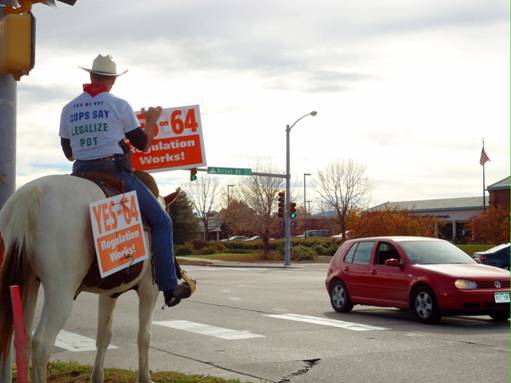
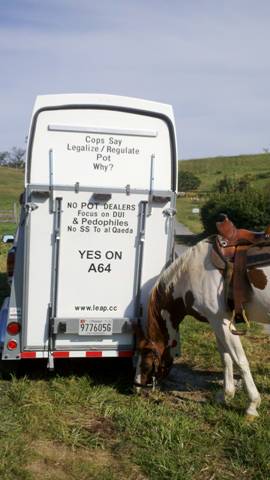
The Jokes of Partisan Politics By Steve Russell Will Rogers, the Paint Clan Cherokee cowboy turned entertainer turned political pundit, used to say he did not make jokes. “I just watch the government and report the facts.” Like any intelligent man, he could be viewed as a bundle of contradictions, but most of his contradictions came from wearing his heart on his sleeve. From at least 1916, when he faced the reputedly dour and humorless President Woodrow Wilson, nobody was safe from his barbs. Before that performance, his political comments had been topical humor pulled out of the latest newspapers. Having the President in the audience, for Will, took topical comedy to another level bordering on what he never intended, personal attack. Characteristically, he started with the truth: “I am kinder nervous here tonight.” Writing years later, he admitted, “that is not an especially bright remark, …but it was so apparent to the audience that I was speaking the truth that they laughed heartily at it.” Encouraged, Roger let fly with his usual routine, and the President wound up laughing at himself. According to Rogers biographer Ben Yagoda, Will was invited into the Presidential box after the show. Still a bit nervous, he parked his omnipresent wad of chewing gum in his hat, forgot he had done so, and suffered the consequences when he put the hat back on later. (His chewing gum habit would come up again in his choice of slogans for his Anti-Bunk Party, “He chews to run!” This was a gentle parody of Calvin Coolidge, who did not “choose” to run.) Wilson, a Democrat, was the first President to be roasted face to face by Will Rogers, but hardly the last. There was plenty to go around for both parties. Will never hid his biases. He was more worried about the welfare of farmers than that of city folks, and working stiffs more than bankers. “I’m not a member of any organized political party,” he famously confessed, “I’m a Democrat.” Of course, in our time we can laugh at that remark as ancient history…unless we think about the 1968 Democratic Convention, when the delegates pledged to the anti-Vietnam War candidate Eugene McCarthy were physically ejected, adding to the chaos in the streets of Chicago that year. Or the 1972 Democratic Convention, when the anti-war outsiders became insiders and spent so much time wrangling among themselves that George McGovern gave the speech that was supposed to end the war at a time when the television audience had gone to bed. Having admitted to identifying with the disorganized party of the workingman, he still seldom bestirred himself to vote. It’s not clear that he ever voted. It’s safe to say, though, that he would be disgusted with the wave of voter suppression laws and would have had plenty to say about the Republican Party pushing them. Rogers himself would not be allowed to vote under many of these laws. He wrote of his difficulties getting a passport for lack of a birth certificate: “In the early days of Indian Territory, where I was born there was no such things as birth certificates. You being there was certificate enough. We generally took it for granted that if you were there, you must have at some time been born…. Having a certificate of being born was like wearing a raincoat in the water over a bathing suit.” Informed in the passport office that they knew him, but still needed proof he was an American citizen, Rogers was still puzzled: “That was the first time I had ever been called on to prove that. Here my Father and Mother were both ….Cherokee Indians and I have been on the Cherokee rolls since I was named, and my family had lived on one ranch for 75 years.” The argument that you have to have a picture identification to get on an airplane would not have impressed this early and enthusiastic endorser of civil aviation, because the voter suppression laws are not aimed at people who normally get on airplanes. Rogers was plain about his working class bias, but in the world of electoral politics, he practiced equal opportunity ridicule. “Both parties have their good and bad times,” he observed, “only they have them at different times. They are each good when they are out, and each bad when they are in.” His personal friendships, like his jokes, were bipartisan. Among Presidents, he was probably closest to the Roosevelts, the Republican Teddy and the Democrat Franklin D. “America,” he claimed, “has the best politicians money can buy.” It’s not hard to picture what he might have said about the tradition of Presidential candidates releasing multiple years of tax returns begun by the Republican George Romney and ended by the Republican Mitt Romney. We would be hearing a lot about Swiss bank accounts, in between wisecracks about President Obama’s adventures with the Chicago political machines. Will Rogers reported for both parties’ nominating conventions starting in 1920 and ending in 1932. Like most of Rogers’ career moves, his convention coverage started out slow, because he did not in fact attend the 1920 conventions. His reportage was disrupted by the tragic death of his son Freddie in June of 1920, the very month both conventions were scheduled. Characteristically, the grieving Rogers honored his contract, taking newspapers as his information, the same information his readers had. The Democratic Convention was held in San Francisco, where Rogers was when he heard that his children’s “sore throats” were in fact diphtheria. He drove all night to get home, but Freddie died at 4 a.m. on June 17. His first comment on the convention was dated the same day. “Our National Conventions,” Rogers observed, “are nothing but glorified Mickey Mouse cartoons, and are solely for amusement purposes.” Will was writing about the tendency for the real business of the conventions to be settled in back room horse-trading rather than in public. In fact, the “cartoons” were not as scripted in advance as they are in our times. The last time a candidate was “drafted” at a convention was the Democrat Adlai Stevenson in 1952. The last “floor fight” for a major party nomination was in 1976, between Gerald Ford and Ronald Reagan for the Republican nod. It was not that long ago that the political parties did real business at their conventions, although Rogers was correct to be skeptical how much of it happened in public. 1920 Democratic Convention, San Francisco In the 1920 Democratic Convention, for example, there were 1,092 delegates and only 336 of them were “pledged,” meaning that they had promised their vote to a candidate on the first ballot. Of those 336, most were pledged to “favorite sons,” a mechanism for party bosses in a state to capture the delegation after the first ballot, since a “favorite son” was not going to win the first ballot. There were, of course, no “favorite daughters,” since women only got the vote nationwide with the ratification of the 19th Amendment in August of 1920, although they had the franchise in most western states much earlier. The wide-open nature of the race for the Democratic nomination was a result of the country in general being ignorant of President Woodrow Wilson’s health problems, and as a result uncertain whether he would stand for re-election. In fact, Wilson had been incapacitated beginning in 1919—the government effectively run by his wife and the cabinet—because there was no 25th Amendment providing for disability of the President until 1967. The only candidate in 1920 who had dared to enter primaries while his party held the White House was Attorney General A. Mitchell Palmer, whose legacy in history is primarily the “Palmer raids,” roundups of immigrants thought to harbor radical ideas. Neither the Palmer raids nor his run for the Democratic nomination produced any lasting results, although Palmer’s name comes to mind more easily than that of the man actually nominated, Gov. James Cox of Ohio. 1920 Republican Convention, Chicago The 1920 Republican Convention was held in Chicago, which, Rogers reported, “holds the record for murders and robberies and Republican conventions.” He alleged, “California’s 26 delegates to the Chicago convention were accompanied by sixty bootleggers.” Will Rogers, bylined as “Famous Oklahoma Cowboy Wit and Goldwyn Motion Picture Star,” did his best from a distance to report the convention that launched the ill-fated presidency of Warren G. Harding. It was Harding’s selection by party bosses behind closed doors in the Blackstone Hotel that contributed the phrase “smoke-filled room” to our political lexicon. Rogers “reported” an imagined dialog between himself and one of the party bosses, Pennsylvania Sen. Boies Penrose, who, in spite of serious illness, kept his hand in from Philadelphia with both telephone and telegraph wires in his sick room. Rogers asked “Penrose:” “What makes the delegates change? Don’t they stay with their man?” “The delegates vote the way their people told them the first ballot. But after that they sell to the highest bidder.” “But that’s not honest, is it?” “No, just politics.” While Harding went on to be elected, his administration was quickly engulfed by the Teapot Dome Scandal, in which Secretary of the Interior (and political Indian fighter) Albert Fall went to prison for bribery and against which all other political scandals were measured before the Watergate scandal. Harding was saved from further humiliation by his death in 1923, but since the incumbent President Calvin Coolidge was untainted by Teapot Dome, all the drama was gone from the 1924 Republican Convention. The slogan “Keep Cool with Coolidge” said it all. This time, Rogers reported the conventions on the scenes. By 1924, Rogers was better known than most of the people who were the subjects of his dispatches. His byline had become, simply, “Will Rogers.” 1924 Republican Convention, Cleveland Admitting to the cut and dry nature of the Coolidge nomination, Rogers reported, “This is the first Vice Presidential convention ever held in the history of politics.” “The city is opening up the churches now…so the delegates and visitors can go and hear…excitement of some kind.” “Now I want this distinctly understood, that I have nothing against Cleveland. I love Cleveland because I knew them before this catastrophe struck them. She will arise…and some day be greater than ever.” 1924 Democratic Convention, New York City The Democrats had a more exciting show at Madison Square Garden. Rogers had progressed from the one-liners that dominated his reportage in 1920. It was a measure of the relative excitement that he produced five articles on the Republicans keeping cool with Coolidge and eighteen on the Democratic Party’s circus. By the end of the Democratic Convention, he was reporting as “Will Rogers, Jr.,” because it had lasted so long that his son had supposedly taken over the task. “I suggested to them that if I was them I would adjourn before they nominated somebody and spoiled it all.” “ We heard nothing from 10 o’clock in the morning until 6 at night but ‘The man I am going to name.’ Then they talk for another thirty minutes and then, ‘The man I am going to name.’ There have been guys going to name men all day, and all we ever got named were about six out of a possible 200.” “They all kept the names until the last word. It was safer.” Safety was indeed an issue at this convention, where the Democratic Party split wide open over the influence of the Ku Klux Klan, and the number of cross-burnings and hooded marches outside the proceedings led some wags to refer to 1924 as the “Klanbake.” Inside Madison Square Garden, the main issue became a choice in the platform between a vague call for religious toleration and racial harmony versus a full-throated denunciation of lynchings in general and the KKK in particular. “They have been five days working on a plank on the Ku Klux and finally brought in the same one the Republicans used,” observed Rogers. “Some guy from Maine offered an amendment naming the Klan… There were 12,000 civilians and a least a hundred thousand cops in and around the building. There were ten policemen standing in the aisle by the side of each Texas delegate.” Will’s description was comic hyperbole, but the debate did rend the party. “When North Carolina announced to the Chairman that three and eighty-five one-hundredths of a delegate were in favor of the Klan amendment, and that twenty and fifteen one-hundredths of a delegate were against it, why, there was a round of laughter that broke up what was the most tense moment ever witnessed in a convention hall.” Rogers went on at length about the anatomical improbability of fractional delegates. “If a delegate is three-seventeenths of one vote, what would that make an alternate?” The silliness subsided but the KKK prevailed in the floor fight. “Today they start balloting, and I suppose some man will win the nomination by the narrow margin of a left forearm of a North Carolinian.” After a record 103 ballots, the Democrats finally settled on John W. Davis for president. Davis comes down to us in history as the lawyer who argued the segregationist and losing side of Brown v. Board of Education. 1928 Republican Convention, Kansas City One of the things Will Rogers’ biographers cannot agree upon is how many airplane crashes he survived before the one that took his life. Because of his devotion to the cause of civil aviation (and military aviation before that), Will always minimized mishaps and covered them up when he could. Flying from his home in California to the Republican Convention in Kansas City, Rogers survived two of what he called “incidents, not accidents.” The first was a wheel breaking on landing in Las Vegas, which ended with the plane on its back. Just a few hours later, in a different plane, Rogers survived a hard emergency landing in Cherokee, Wyoming. He complained that he had lost his overcoat in the confusion around the “incidents,” but vowed to keep his bloodstained shirt for a souvenir. Once more in 1928, the Republicans put up no serious fights. Herbert Hoover, in a workmanlike march toward nomination, had done enough advance work to be nominated on the first ballot. “The whole show,” Will complained, “has degenerated into nothing but a dog fight for Vice President.” Rogers did note one thing that has changed in our time, when no Democrat holds statewide office in Texas: “They had a time seating the Texas delegation, as there was no law in Texas to apply to a Republican primary. Texas never thought they would come to a point where there would ever be any Republicans there. They also have no laws against the shooting out of season of reindeers or musk ox.” There was a rare hint of foreign policy debate when one of the speakers alluded to US intervention in Nicaragua, where the US had sent Marines in 1926. The US had pressured the Nicaraguan congress to elect Adolfo Diaz president, something that Will commented on at the time: “We say that Diaz is the properly elected president of Nicaragua, but Brazil, Argentina, Peru, Chile, Mexico, Ecuador, Costa Rica, Cuba, Guatemala, Colombia, Uruguay, Paraguay—all those say that the other fellow is the properly elected president. It’s funny how we are the only ones that get everything right. I’d rather be right than Republican.” Two years later, Will had not changed his mind: “[The speaker] brought up Nicaragua, but he left the marines down there. He said that he would protect American lives down there, even if we had to send some there to protect.” This was vintage Will Rogers, who never hid his opinion that other countries in general, and Latin American countries in particular, ought to be allowed to govern themselves without US meddling. Rogers could not let the convention pass without ribbing the first American Indian to appear on a presidential ticket, Charles Curtis. While he was also Osage and Potawatomi by blood, Curtis was enrolled Kaw and grew up on the Kaw Reservation in Kansas Territory. Curtis was, like Will Rogers, a pre-statehood Indian who had watched Indian governments get shoved aside. Rogers said of Curtis getting the nod for Vice President: “The Republican Party owed him something, but I didn’t think they would be so low down as to pay him that way.” 1928 Democratic Convention, Houston From Houston, Rogers anticipated the major issue of the Convention: “Since prohibition was unearthed nine years ago, there has only been one argument invented that a politician when he is cornered can duck behind…. ’I am for law enforcement.’ It don’t mean anything, never meant anything, and never will mean anything. “It would take practically a lunatic to announce: ‘I am against law enforcement.’ “Now the Republicans held their convention first, and naturally they grabbed this lone tree to hide behind. Now that leaves the Democrats out in the open.” Days later, he continued: “The whole talk down here is wet and dry; the delegates just can’t wait till the next bottle is opened to discuss it. Prohibition is running about a quart to the argument here now.” It was plain that the Democrats would “straddle,” as Will put it, with a “balanced ticket,” which in the context of the times meant a wet and a dry. When the convention settled on a wet, and the first Catholic, Alfred E. Smith, to lead the ticket, the way was open to put the first southerner on a major party ticket since the Civil War. This was critical because Smith (and Catholics generally) had been subject to almost as much animosity from the Ku Klux Klan as African-Americans and Jews. This was the very next convention after the one that splintered over the KKK. The second spot on the ticket went to Arkansas Sen. Joseph Robinson, about whom Will Rogers opined: “They got a great fellow in Joe. He is a real, two-fisted he-candidate. He comes from the wilds of Arkansaw, where they are hard to tame. I have had one in my house for twenty years and there is just no managing ‘em.” Will was referring to his wife, Betty Blake, who he had courted across the Arkansas line from Indian Territory. The Smith-Robinson ticket was decisively defeated by Hoover-Curtis, but within a year the “Roaring Twenties” would quit roaring. 1932 Republican and Democratic Conventions, Chicago In retrospect, it’s fitting that both parties convened in the same city in the depths of the Great Depression, since neither party had done much to prevent it. The Progressive reforms championed by Will Rogers’ friend Theodore Roosevelt were a distant memory, and the anti-trust laws Roosevelt pioneered were honored in the breech. Wall Street speculation was rampant at a time when the margin requirement was only 10%. That is, to buy $1,000 worth of stock, a trader only needed $100 in his account. The common belief was that the stock market would always rise, and a rising tide would lift all boats. Politicians were either unaware of or ignored a degree of income inequality in the US that would not be seen again until current times, when we once more choose to assume that the key to prosperity is that the rich do well. The conventional wisdom came crashing down on Black Tuesday: October 29, 1929. A stock market that had been volatile for some time took a dive. Thirty billion dollars in paper wealth disappeared in two days. When a similar crash began in September of 2008, the Federal Reserve Bank responded with major liquidity injections, “loose money.” This could not happen in 1929, when the Federal Reserve was bound by the gold standard and private gold hoarding was common. Speculation in a perpetually rising stock market was not anything that appeared to need regulating in 1929, so when investment banking collapsed, so did commercial banking. Crop loans and inventory loans dried up. When banks failed in those times, the depositors simply lost their money. A rumor became enough to set off a “run” on a bank. President Hoover’s major policy response was the protectionist Smoot-Hawley Tariff Act. Will Rogers was opposed to tariffs in general and that bill in particular, because he felt that it hurt farmers and helped bankers, a view that may have sounded simplistic but was vindicated by events. Rogers steadfastly refused to kick Hoover while he was down or encourage those who did. When asked by Hoover to write something to discourage hoarding, Will complied by claiming that “A Jewish farmer at Claremore named Morris Haas hid $500 in bills in a barrel of bran and a cow ate it up. He has just been able to get $18 of it back, up to now.” “This hoarding don’t pay.” In a speech titled “Bacon, Beans, and Limousines,” Will cut though the rhetorical smoke about the need to balance the budget and the transgressions of other countries: “There’s not really but one problem before the whole country at this time. It’s not the balancing of Mr. Mellon’s budget. That’s his worry. That’s ain’t ours. And it’s not the League of Nations that we read so much about. It’s not the silver question. The only problem that confronts this country today is at least 7,000,000 people are out of work. That’s our only problem. There is no other one before us at all. It’s to see that every man that wants to is able to work, and also to arrange some way of getting more equal distribution of the wealth in the country.” In those dark days, the two major parties met in Chicago to debate how to get out of the hole and who would be put forward to lead the country out. The Republicans met first, and started a little slow, according to Will: “I couldn’t find out a thing about politics, and I guess that’s just about the way the whole country looks at it. Nobody here knows they are holding a convention. There is lots of flags out, but Tuesday is Al Capone’s birthday, so who knows?” The next day, Rogers found a political story he cared about: “Well, got some scandal for you today, for it wouldn’t be a Republican convention without some sort of undercover ‘finagling.’ They are out now to throw poor old Injun Charley Curtis off and get another Vice President….Their alibi is that he is too old…Well, they knew a few months ago how old he would be about now.” Will went on to suggest that the people out for Curtis’ head say it this way: “We are in the hole and we got to try and dig up somebody that will help us swing some votes. It’s not your age, Charley… You got to be the goat, not us. So any one we can think of that can carry the most votes we are going to nominate ‘em, be it Charley Chaplin or Amelia Earhart. You been a good Injun, but its votes not sentiment we are after this year. So long, Charley, take care of yourself.” Two days later, Will complained again “Poor Charley is to be tomahawked in the back…just like they took the country from the Indians…” When the movement to dump Curtis failed, Rogers claimed credit, probably correctly: “I saved my ‘Injun’ Charley Curtis for vice presidency. The rascals was just ready to stab him when we caught ‘em. “So it’s the same old vaudeville team of Hoover and Curtis.” When the Democrats came to town, Franklin D. Roosevelt tried to replicate Hoover’s first nomination battle. He had entered and won every primary where he would not offend a local “favorite son.” This being the Democratic Party, it was not that simple. Al Smith was nominated again, as was the Speaker of the House, John Nance “Cactus Jack” Garner. There was even a boomlet for Oklahoma Gov. William “Alfalfa Bill” Murray. Will Rogers was friendly with all the contenders. Never a slave to objectivity, Will actually addressed the crowd during a recess: “Now, you rascals, I want you to promise me one thing. No matter who is nominated, and of course some of you are going home disappointed that it was not your man, no matter who is nominated, don’t go home and act like Democrats. Go home and act like he was the man you came to see nominated. Don’t say he is the weakest man you could have nominated; don’t say he can’t win. You don’t know what he can do, or how weak he is until next November. I don’t see how he could ever be weak enough not to win. If he lives until November he’s in.” This time, the Democratic platform managed to advocate repeal of Prohibition, to Will’s delight: “Did the Democrats go wet? No, they just layed right down and wallowed in it. They left all their clothes on the bank and dived in without even a bathing suit. They are wetter than an organdie dress at a rainy day picnic.” Will went on to lament that the Democratic platform had no plan “to get some bread with the beer.” The truth was nobody in either party had a clue. The economist John Maynard Keynes was an academic in Great Britain and Roosevelt would find the magic of the aggregate demand curve by trial and error. When Alfalfa Bill Murray’s candidacy did not catch fire, Oklahoma’s favorite son votes went to Will Rogers, a development Will took in good humor. Roosevelt broke though by offering the vice presidency to Cactus Jack Garner, who accepted for reasons unclear in light of his later comment that the office was not worth “a bucket of warm piss.” The Great Depression had, as Rogers predicted, set the stage for a rout of the Hoover administration. It’s hard now, even in economic times challenging by the standards we know, to picture the situation President Roosevelt would face. Unemployment was over twice what it is now, without unemployment insurance or Social Security or Medicaid. Armies of unemployed lived in shantytowns, dubbed “Hoovervilles” by the Democrats. Will Rogers wrote from Claremore, Oklahoma on July 4, 1932, looking back on what would be his last convention coverage and, characteristically, forward: “Heard a mule braying a while ago at the farm and for a minute I couldn’t tell who he was nominating. Steve Russell gratefully acknowledges the research assistance of Steve Gragert, Director of the Will Rogers Memorial Museum in Claremore, OK.

Type rest of the post here

Source /
The Rag Blog

Posted in RagBlog | Leave a comment

David Bacon : Who’s to Blame for the Bangladesh Fire?

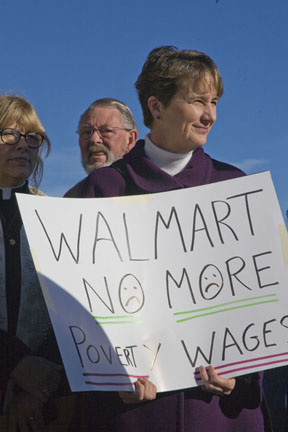
Black Friday demonstrations: Service Employees International Union (SEIU) President Mary Kay Henry pickets at a Walmart store in Richmond, CA, in support of better wages and benefits for workers. Photo by David Bacon.

Who’s responsible?
Deadly fire in Bangladesh

The Bangladesh fire that killed 112 workers tells us a lot about the conditions under which the garments consumers bought this Black Friday were made.

By David Bacon | The Rag Blog | December 6, 2012

The day after Black Friday demonstrations of workers and supporters in front of hundreds of Walmart stores across the U.S., a fire killed 112 workers making clothes for Walmart at the Tazreen Fashions factory in Bangladesh. This was the most recent of several such factory fires, leading to the deaths of another 500 young women.

These fires are industrial homicides. They can be avoided. The fact that they’re not is a consequence of a production system that places the profits of multinational clothing manufacturers and their contractors above the lives of people. The same profit-at-any-cost philosophy is leading to growing protest among workers who sell those garments in U.S. stores over their own wages and conditions, especially at Walmart.

The Bangladesh fire tells us a lot about the conditions under which the garments consumers bought this Black Friday were made. Reports from the scene say there were no fire escapes. Several young women jumped from the windows to get away from the flames, as their sisters did a century ago in New York City, in the Triangle Shirtwaist fire. Most Tazreen workers were trapped inside and burned to death.

Walmart has a grading system for its contractors, and had put the Tazreen factory on “orange” status (green for good, yellow for not so good, orange for a warning, and red for a contractor whose orders are cut off). Yet the company’s inspectors must have seen that there were no fire escapes, and kept giving Tazreen orders.

The reason is clear. Wages are 21 cents an hour. Contractors like Tazreen compete against each other to get the orders. In a garment factory, the main way they cut costs is by cutting wages and expenses like safety.

Workers have been trying to win the right to organize militant unions to raise those wages and improve working conditions. If workers had been successful, they would have had the power to force the company to build fire escapes and make the factory safe.

But police in Bangladesh have been putting down demonstrations by workers in this region for months. One worker activist, Aminul Islam, was tortured and killed this year. The government uses low wages to attract manufacturers like Walmart. It does not enforce safety regulations, as the fires clearly show. Walmart then uses the labor of the women to boost its profits, and has the same attitude towards their efforts to organize unions that it does towards the efforts of its employees in the U.S. Total opposition.

This is not just Bangladesh’s problem, however. The system for garment production worldwide has nations competing in the same way — Bangladesh vs. China, for instance. Factory fires are the logical result because safety, unions, and higher wages are costs that will make a country uncompetitive. It’s also a U.S. problem. According to the Economic Policy Institute, Wal-Mart’s trade deficit with China alone cost 200,000 U.S. jobs between 2001 and 2006. Garment manufacturing in the U.S. has practically disappeared.

Manufacturers claim that if wages and safety costs rise, so will the prices of garments in U.S. stores. Yet if wages of 21 cents an hour were doubled, it would add only a few pennies to the cost of even a cheap teeshirt.

Walmart customers on Black Friday spoke out in favor of higher wages and more rights for Walmart’s store workers. They would support the same for factory workers in Bangladesh. The obstacle is the contractor system, competition between contractors and countries, and a policy of suppressing unions. The system of self-policing hailed by Walmart and large manufacturers does not change this situation. It is a fig leaf.

Instead, countries like Bangladesh and the U.S. should implement the international accords that, on paper, guarantee workers the right to organize unions. Consumers also have power. They can refuse to purchase garments made in factories like the one that killed 112 young women, or that are sold in stores that deny workers the right to organize.

Whether at a sewing machine in Bangladesh or at a cash register in California, workers have the right to a safe job, a decent standard of living, and to organize. We need a system for producing and selling clothing that reinforces those rights, not one that works against them.

David Bacon wrote this article for the Progressive Media Project and crossposted it to The Rag Blog.

[David Bacon, a former union organizer, is a California-based writer and photographer. He is the author of Illegal People: How Globalization Creates Migration and Criminalizes Immigrants, published by Beacon Press. His photographs and stories can be found at dbacon.igc.org. Read more of David Bacon’s articles on The Rag Blog.]

The Rag Blog

Posted in Rag Bloggers | Tagged , , , , , | Leave a comment

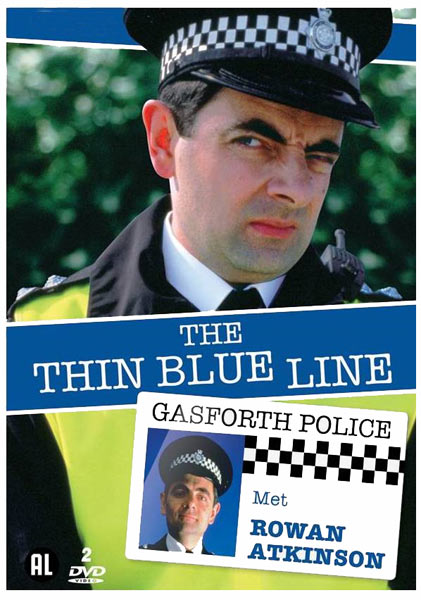
Alan Waldman : ‘Thin Blue Line’ is Uproarious Britcom

Waldman’s film and TV
treasures you may have missed:

One of the cleverest, funniest-ever British sitcoms, The Thin Blue Line, available on YouTube, really should not be missed.

By Alan Waldman | The Rag Blog | December 5, 2012


[In his weekly column, Alan Waldman reviews some of his favorite films and TV series that readers may have missed, including TV dramas, mysteries, and comedies from Canada, England, Ireland, and Scotland. Most are available on DVD and/or Netflix, and some episodes are on YouTube.]


England’s Rowan Atkinson, best-known for the silent physical comedy of Mr. Bean, is actually a wonderful verbal comic actor — as is evident in his two classic British TV comedy series, Blackadder and The Thin Blue Line. Both were written (or co-written) by Britain’s funniest TV writer, Ben Elton. The Thin Blue Line ran for 14 exquisite episodes, from November 13, 1995 to December 23, 1996. It is set in a police station in the fictional town of Gasforth.

Atkinson plays goofy Inspector Raymond Fowler, head of the uniformed team, who annoys his live-in girlfriend and subordinate, Sergeant Patricia Dawkins, with his lack of interest in sex. His rival at the station, CID detective Derek Grim (brilliantly and hysterically performed by David Haig), is constantly mangling English phraseology. I was delighted at Elton’s ability to create weekly variations on the same joke, with Grim declaring: “It’s my arse on the line, and I’m in it up to my neck” or “…so you’d better pull your finger out” or “…so I don’t want a big cock-up.”

One of the most mind-bogglingly funny and adorable characters anywhere is Constable Goody (James Dreyfus), who is very dim. But the joke is greatly enhanced by the fact that his speech and mannerisms are extremely gay, but he thinks he is macho and is constantly trying to seduce Pakistani-British Constable Habib (Mina Anwar). The expressions of shock and surprise on his face are amazing. The rest of the cast is also quite funny.

The Thin Blue Line won the British Comedy Awards’ 1996 “Top TV Comedy Sitcom” honor, and Atkinson was nominated for the 1997 UK National Television Awards’ “Most Popular Comedy Performer.” More than 93.1% of the 2,052 viewers who rated it at Internet Movie Database gave it thumbs-up, and 24.1% consider it a perfect 10.

It is available on Netflix and Netflix Instant streaming, as well as on YouTube, where you can see this riotous Christmas episode in two parts.

[Oregon writer and Houston native Alan Waldman holds a B.A. in theater arts from Brandeis University and has worked as an editor at The Hollywood Reporter and Honolulu magazine. Read more of Alan Waldman’s articles on The Rag Blog.]

The Rag Blog

Posted in Rag Bloggers | Tagged , , , , | Leave a comment

IDEAS / Bill Meacham : The Mayan Calendar

The sun at the intersection of the galactic equator and the ecliptic. Image from Philosophy for Real Life.

Is the end near?
The Mayan Calendar

On December 21 the 13th baktun will come to an end. Rather than starting a 14th baktun, the grand cycle will start over again. It’s like your car odometer rolling over from all nines to all zeroes.

By Bill Meacham | The Rag Blog | December 5, 2012

In about 500 BC astronomers in the Yucatan Peninsula predicted that a remarkable event would happen some 2,500 years in their future. They thought it so significant that they constructed a complex calendar full of cycles within cycles such that all the cycles would come to an end (and thus a new beginning) at once on that day.

That day is December 21, 2012, the solstice, and it is almost upon us. If we have not done so already, it is time to make preparations. But not in the way many new-age pundits, with their penchant for sensationalism, would have us believe.

I am speaking, of course, of the Mayan calendar, and the fears that the world will end in some kind of apocalypse on the December 2012 solstice. In fact, experts agree, the Maya had no conception of such an apocalypse, which is a newer and European idea. Says one researcher, “We keep looking for endings… The Maya were looking for a guarantee that nothing would change. It’s an entirely different mindset.”(1)

But if it is not the end of the world, then what will happen on the upcoming December solstice? And why were the Maya so interested in it that they constructed a calendar around it? To answer these questions we will have to delve into the Mayan calendar and astronomy. The details are complex, so here is a brief summary.

The Maya concocted a complicated calendar capable of identifying specific dates within a 5,125-year cycle composed of 13 394-year “baktuns,” which themselves are composed of cycles within cycles. On December 21 the 13th baktun will come to an end. Rather than starting a 14th baktun, the grand cycle will start over again. It’s like your car odometer rolling over from all nines to all zeroes.

The Mayan astronomers were quite proficient. They predicted that on the upcoming December solstice an unusual astronomical event would occur: the alignment (as seen from the earth) of the sun with the intersection of the galactic equator and the ecliptic. Such an alignment happens every year, but usually not on a solstice. Because of the earth’s axial precession, it happens on a solstice only once every 12,900 years.(2)

The Maya predicted the timing of this unusual event and constructed their calendar so that it would end at this occasion. Their calendar does not so much begin at an arbitrary date in the past but end at one in the future. They worked backwards from the astronomical event they believed would happen on the upcoming December solstice.

That’s the story in a nutshell; for those interested in the details I give a more comprehensive explanation here. But what does it mean? Will the arrangement of the stars on a certain day actually have any unusual effect on us?

In terms of physical effects, the answer is No, for two reasons. The first is that there is no physical evidence that any arrangement of stars and planets has anything other than physical effects. The rotation of the earth determines day and night; its progress through its yearly orbit and the inclination of its axis determine the seasons; the positions of the sun and moon determine the tides; and the gravitational forces among the various heavenly bodies determine their orbits and hence their position in the sky from our point of view.

But there is no objective, third-party evidence that their positions and movements have any nonphysical influence on human affairs. (They might, as astrologers maintain; but the objective evidence for that influence is at best sketchy.)

The second reason is that the Maya got it wrong, by about 14 years. There was indeed such a conjunction of the sun and the intersection of the galactic equator and the ecliptic at a solstice, but it happened in 1998.(3) So even if the conjunction could cause an unusual effect, it would have already happened. Apart from the Mayan calendar, there is nothing special about the upcoming solstice.

And yet we have the Mayan calendar and it does have an effect on us. You might call that effect socially constructed, but it is real nonetheless. Had the Maya not made something of the December solstice of 2012, we would not be having this conversation. But they did, and millions of people worldwide, not just you and I, have heard of the upcoming event even if they don’t know precisely what it entails.

We can, if we choose, make use of the psychic force of all that attention.

The image is striking: cycles within cycles within cycles, all ponderously but inexorably coming to an alignment, a zero point, after 50 centuries. I imagine a great wheel slowly turning once every 5,125 years and within it a smaller wheel turning once every 394 years and within that yet smaller ones, the least of which turns every 20 days, a spinning whirligig of clockwork that drives an immense and awesome epoch.

And the beginning of a new epoch is almost upon us.

To mark it, to make something useful of it, I suggest the following practice:

  1. Set an intention for the next epoch, something you would like to see happen or endure over the next 5,125 years.
  2. Do something now, before the solstice, that will contribute to your intention being realized and that will have a tangible effect after the solstice. Launch something, start something, plant something (figuratively or literally) that will begin to come to fruition after the solstice. Do something to advance your intention now, something that is irrevocable and that will have a tangible or visible effect in the physical world after the solstice.
  3. Do this, as much as you are able, with a pure heart.

We are very close to the axle of an immense wheel, an axle that has great gravitational attraction. Imagine that you are in the plane of that wheel and you launch something toward the axle. Your payload comes close to the axle and whips around it with tremendous speed and then flies off into the future.

What you launch now will have great power. It will take effect almost immediately; it will have great impetus; and it will last a long, long time.

For a more complete and detailed explanation of the Mayan Calendar based on Bill’s research on the subject, go to Bill Meacham’s Philosophy for Real Life.

[Bill Meacham is an independent scholar in philosophy. A former staffer at Austin’s ’60s underground paper, The Rag, Bill received his Ph.D. in philosophy from the University of Texas at Austin. Meacham spent many years working as a computer programmer, systems analyst, and project manager. He posts at Philosophy for Real Life, where this article also appears. Read more articles by Bill Meacham on The Rag Blog.]

Notes
(1) Vance, “Unprecedented Maya Mural Found.”
(2) 2012Hoax, “Galactic Equator vs Plane.”
(3) Hunter, “Mayan Calendar – Long Count Accuracy.” 2012Hoax, “Galactic Equator vs Plane.”

The Rag Blog

Posted in Rag Bloggers | Tagged , , , , , , , | 3 Comments

Harry Targ : The Two Faces of the 2012 Elections

Tea Party favorite Mike Pence is the new governor of Indiana. Photo by Darron Cummings / AP.

Electoral contradictions:
The progressive majority and
the reactionary state governments

Challenges to a progressive future do not come just from Washington, Wall Street, or the Pentagon. In 2012, state election results led to single-party control of 37 state governments: 24 Republican and 13 Democratic.

By Harry Targ | The Rag Blog | December 5, 2012

WEST LAFAYETTE, Indiana — By many measures progressive forces seeking to defend the rights of women, workers, Latinos, African-Americans, youth, and the elderly won major victories in the 2012 election. President Obama was reelected with strong support from those to his political left.

Democrats, some identifying with populist policies such as Elizabeth Warren and Tammy Baldwin, increased their control of the Senate. And in the House of Representatives, Democrats gained a few seats including those for progressives such as Alan Grayson. The House remained in Republican control despite the fact that Democratic candidates out-polled Republicans nationwide by about 200,000 votes.

Most important, the coalition of progressives who increasingly see connections between the interests of workers, women, people of color, and those passionate about the environment, immigration reform, and peace have vowed to stay mobilized. They see the danger of  “grand bargains” which might make Beltway politicians weaken Medicare, Medicaid, and/or Social Security.

Progressives also are wary of deals that could sacrifice the environment to big oil, maintain the grotesque economic inequalities through tax breaks for the rich, and continue budget-busting military expenditures.

However, challenges to a progressive future do not come just from Washington, Wall Street, or the Pentagon. In 2012, state election results led to single-party control of 37 state governments: 24 Republican and 13 Democratic. Think Progress reported that only 12 states will have evenly contested, two-party government as the 2013 legislative sessions open. This much one-party dominance at the state level has not been seen since 1952.

In many of the Republican-controlled states, legislatures and governors are controlled by Tea Party advocates seeking to privatize public education, reject key provisions of the Affordable Care Act, install or expand Right-to-Work and anti-collective bargaining legislation, end support for Planned Parenthood, put creationism in science classes, and cut college programs not tied to STEM (Science, Technology, Engineering, and Mathematics) curricula.

The states where Republicans dominate governorships and state legislatures are for the most part states in the South and across the Plains.

One of the few Midwest states where one-party rule will prevail in 2013 is the state of Indiana. Despite public perception, Indiana has a history of competitive government. Democrats have controlled bigger cities and industrial areas whereas Republicans dominated in rural and small towns of Central and Eastern Indiana.

Democrats held the governorship from 1989 to 2005, and elected former governor Evan Bayh as senator in 1998. He retired from that post in 2010. Democratic candidate Joe Donnelly, with strong labor support, won the 2012 Senatorial race over Tea Party candidate Richard Mourdock.

In Indiana legislative politics, the Republicans and Democrats each controlled one legislative body from the outset of the new century until the 2010 elections. Then Republicans gained control of the House of Representatives (60-40) and in 2012 won “supermajorities” in the House (69-31) and the Senate (37-13). Meanwhile Indiana elected Tea Party Congressman Mike Pence to serve as Governor. Pence will replace two-term Tea Party “light” Governor Mitch Daniels who was selected the new president of Purdue University by a Board of Trustees mostly appointed by him.

In total, Indiana politics which had been shifting to the right over the last decade, will become a “blood red” state in 2013. Republican spokespersons promise to complete the economic and political agenda they began to institute in the early years of the new century.

Paradoxically, Indiana voters solidly rejected the reelection bid of Superintendent of Public Education, Tony Bennett, who has radically transformed education from a public to a private institution. He has opened the door for taxpayer support for private religious schools. And he has introduced ill-advised “performance” standards to determine financial support for public schools.

To increase the possibility of incorporating markets and religion into what used to be a public education system, he and his colleagues have worked vigorously to destroy teachers unions.

Glenda Ritz, an award winning teacher and media specialist, defeated Bennett by a 52-48 percent margin. Tea Party legislators have indicated that they will move to make the Superintendent’s position an appointed one in the future.

Outgoing Governor Daniels, a key advocate of educational privatization, proclaimed that teachers used improper means to campaign for Ritz, as if the 1 million voters for Ritz who were not teachers were not relevant to the outcome (in Indiana there are 40,000 public school teachers). So if the people make the wrong choices, the Tea Party legislators imply, their right to make those choices must be restricted.

In 2011 the Indiana Institute for Working Families issued a report on the status of working families in Indiana. The report presented economic data on the condition of Indiana’s working families suggesting that workers in the state have suffered above and beyond the level of the national recession of 2007 to 2009. They suggest that, contrary to the public image promoted by outgoing Governor Daniels and his Tea Party legislative colleagues, the conditions of Hoosier working families have worsened as a result of their legislative agenda:

In fact, the data shows a recovery in Indiana marked by a weakened labor market, an unprecedented decline in wages, and dramatic increases in poverty. Due to across-the-board state budget cuts, a significant loss of public-sector jobs, and low uptake rates in work-support programs due to a public policy environment that’s not been conducive to working families, tens of thousands of Hoosiers are unnecessarily experiencing the human toll of this recession. (“Status of Working Families in Indiana, 2011,” Indiana Institute for Working Families)

Indiana progressives have a difficult task ahead. They must reverse the rightward drift of Hoosier politics and public policy and in the long run build a progressive political movement that can fight for and win a new People’s Agenda based on justice, prosperity, and peace.

[Harry Targ is a professor of political science at Purdue University who lives in West Lafayette, Indiana. He blogs at Diary of a Heartland Radical — and that’s also the name of his book from Changemaker Press which can be found at Lulu.com. Read more of Harry Targ’s articles on The Rag Blog.]

The Rag Blog

Posted in Rag Bloggers | Tagged , , , , , , , | 1 Comment

Lamar W. Hankins : City Council and Religious Liberty in Central Texas

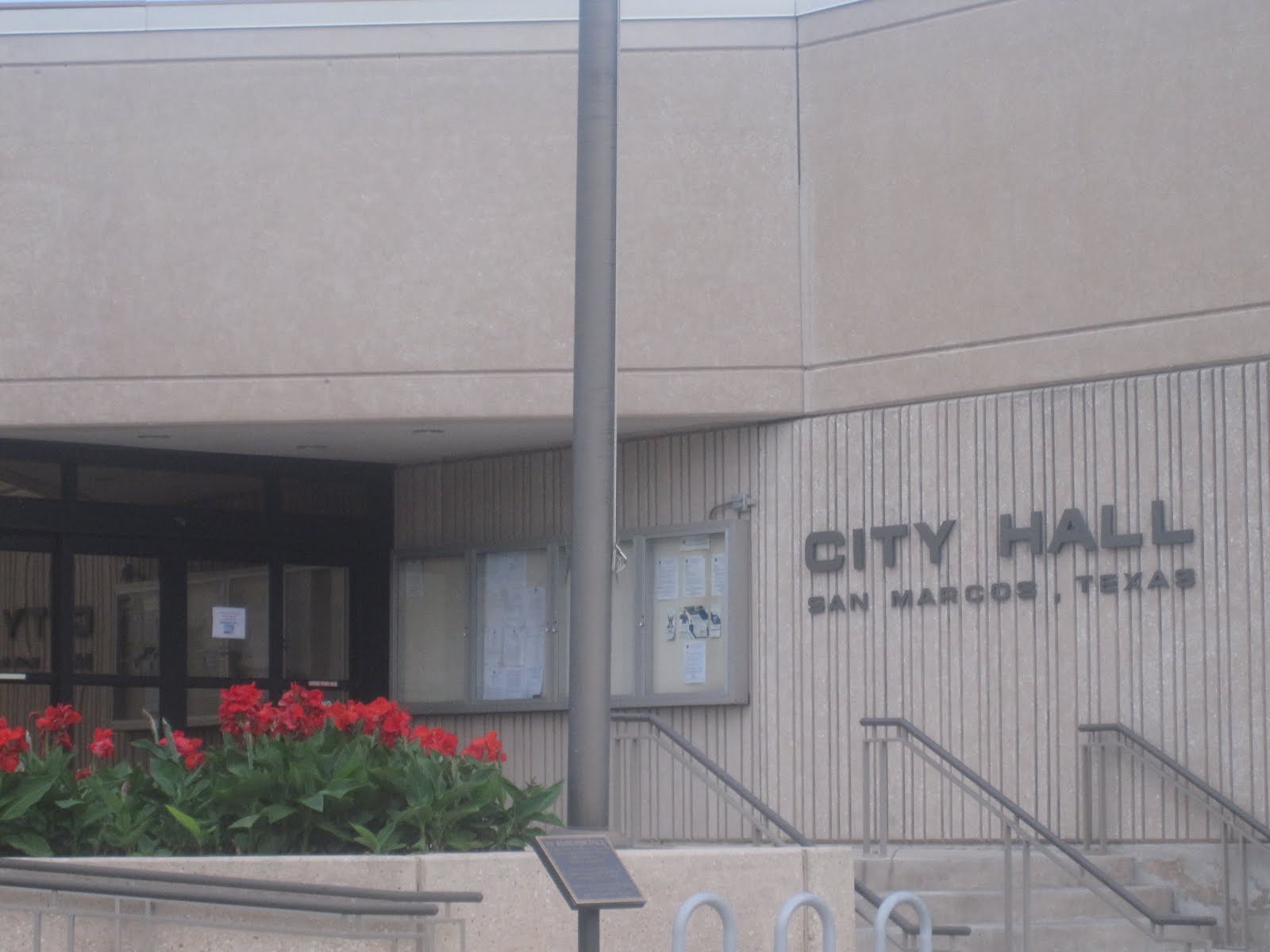
San Marcos, Texas, City Hall. Image from Wikimedia Commons.

Nearly half of Austin-area city
councils violate religious liberty

It doesn’t take clergy to remind council members of their duties, and there is little evidence that clergy provide any more moral authority than most of the rest of us.

By Lamar W. Hankins | The Rag Blog | December 4, 2012

SAN MARCOS, Texas — An on-line review of agendas from 30 Austin-area communities reveals that almost half of area city councils use their elected positions to promote religion. Of those 30 towns and cities, 14 begin their meetings with invocations (usually prayers) according to their agendas. While nearly 47% of area municipalities promote this religious practice, the rest do not. Austin is the largest city in the area to do so.

The invocation practice I have studied the most, that of the City of San Marcos, demonstrates most of the problems with such government religious practices. San Marcos did not have such City Council prayers until then-Mayor Susan Narvaiz introduced the practice around 2006.

When Narvaiz (a recent Republican candidate for Congress defeated by Rep. Lloyd Doggett) became mayor of San Marcos in 2004, she set about to promote her evangelical religion through her elected position.

She may not have intended to attack the religious liberty of everyone who held different religious views, but that was the effect when she pushed all but one city council member to vote to begin having almost exclusively Christian prayers at the beginning of each regular meeting of the City Council. Apparently, divine guidance was not needed at special meetings and workshops.

While not everyone on the City Council at the time — including some who voted for the practice — approved of it, the fear of political reprisal caused most of them to go along with this disregard for the religious liberty of all San Marcos residents.

After challenges to the practice by the ACLU of Texas and Americans United for the Separation of Church and State, the City Council adopted a formal policy that, in effect, required nonsectarian prayers, but this requirement has been largely ignored by both the City Council and those included on its Invocation List — mostly local ministers approved by the City Clerk to give invocations.

In 2009, after hearing in person from ACLU attorney Fleming Terrell at a city council meeting, the Council directed the City Attorney to promulgate an Invocations Policy that met the Council’s preferences and would satisfy the leading Supreme Court case in this area, Marsh v. Chambers, 463 U.S. 783 (1983).

Marsh was a lawsuit challenging the invocation practice of the Nebraska Legislature. In Marsh, the Supreme Court allowed limited legislative prayer based on history and custom as a narrow exception to the Constitution’s prohibition of an establishment of religion by a governmental body. Of course, San Marcos had no such history and custom.

In Marsh, the invocation prayers were directed only to legislators in the Nebraska Legislature. Offered by the Legislative Chaplain, they never included any reference to Jesus or other Christian symbols or language, so they did not “advance” Christianity.

Normally, these kinds of prayers are referred to as nonsectarian. But even nonsectarian prayers can lead a reasonable observer to conclude that the sponsor of the prayers (the San Marcos City Council in this case) favors religion over non-religion. When the prayers use the name of Jesus, or include Christian symbols and language normally identified with Christian doctrine or belief, a reasonable conclusion would be that the City Council favors Christianity over other religions.

The City Council policy, adopted on August 4, 2009 (Resolution 2009-97R), provided that the City Clerk would maintain a list of clergy who would give invocations on a rotating basis; that the clergy would represent all faith traditions that could be found in or out of the city; and that the invocations would not be used “to advance any one religion, disparage any other religion, or proselytize,” quoting some of the language from the Marsh decision. The policy also provided that any clergy who violated the policy could be removed from the rotation list.

I have periodically reviewed the implementation of this policy and have recently reviewed all 42 regular meetings between March 1, 2011, and November 20, 2012.

In 34 of the meetings, invocations were given. In eight instances, a moment of silence was observed because no clergy member was available to offer a prayer. Twenty-one of the 34 prayers referred directly to Jesus. Nine other prayers referred to Christian symbols or used language associated with Christian doctrine or belief. Nearly 90% of the prayers promoted Christianity in their content, an unmistakable violation of the holding in Marsh.

Introductions of the guest clergy is another way the invocations promote Christianity. When their names are announced, so are the names of the churches they represent. Fifteen of the organizations associated with the clergy who participated over the past 20 months are Christian groups. Announcing these Christian affiliations publicly further involves the City Council in promoting and advancing Christianity, just as announcing other religious affiliations advances those religions.

It should be noted that the council violated its own policy when those who gave prayers were not clergy associated with a particular religion. One was the chaplain for the San Marcos Fire Department; one was a student involved with the local Catholic Student Center and St. Jude’s Chapel; one was an employee of the San Marcos Baptist Academy; one was a member of a local Muslim group; one was introduced as a Bahá’í “pastor,” although Bahá’ís do not have pastors; and one person is a Native American who is the proprietor of a business — the Cherokee Candle Shop.

The Invocation Policy resolution focuses on a brief summary of the Marsh decision. It does not concern itself with lower court decisions that have piled up since 1983 and that apply Marsh to other cases, some strikingly similar to the San Marcos situation.

For instance, in 2002, Rubin v. Burbank, 101 Cal.App 4th 1194, held that city council prayer ending “in the name of Jesus Christ” violated the Establishment Clause, even when only 20% of prayers had such references, citing Marsh as precluding prayers that advance any one religion.

In a decision eight years ago, Wynne v. Town of Great Falls, 376 F.3d 292 (4th Cir 2004), the court wrote:

The invocations at issue here, which specifically call upon Jesus Christ, are simply not constitutionally acceptable legislative prayer like that approved in Marsh. Rather, they embody the precise kind of “advance[ment]” of one particular religion that Marsh cautioned against.

In a footnote relevant to the San Marcos practices, the Wynne court found “that citizens customarily participated in the prayers by standing and bowing their heads. Indeed, citizens actively joined in the prayers by declaring ‘amen’ and sometimes ‘hallelujah’ at the conclusion.”

The practice of saying “amen” aloud at the conclusion of San Marcos prayers occurs at virtually every meeting. One pastor even invites the audience to join in his prayers by concluding with “And all God’s children said Amen,” which is always joined by a rousing chorus of “Amens” from the audience.

Frequently, those who give the invocations at San Marcos City Council meetings address the audience directly, importuning them to bow their heads or join with them in the prayer. In one instance the clergyman even interjected “hallelujah” and “glory” in his own prayer, giving it the flavor of a worship service.

It should be noted that the Wynne decision was appealed to the U.S. Supreme Court, but earlier this year that court refused to consider the case, so Wynne stands as an exemplar of the constitutional limits of city council invocation practice.

In another 2012 case, Galloway v. Town of Greece (New York), 681 F.3d 20, decided by the U.S. Court of Appeals, 2nd Circuit, the court held that town council prayers that contain Christian references two-thirds of the time, even when other faiths also give prayers, unconstitutionally affiliates the town with Christianity.

Many other facts about this case are strikingly similar to those surrounding the practices in San Marcos. The Town of Greece staff was responsible for inviting the clergy to give invocations, and the court noted the following:

A substantial majority of the prayers in the record contained uniquely Christian language. Roughly two-thirds contained references to “Jesus Christ,” “Jesus,” “Your Son,” or the “Holy Spirit.” Within this subset, almost all concluded with a statement that the prayer had been given in Jesus Christ’s name. Typically, prayer-givers stated something like, “In Jesus’s name we pray,” or “We ask this in Christ’s name.” Some prayer-givers elaborated further, describing Christ as “our Savior,” “God’s only son,” “the Lord,” or part of the Holy Trinity. One prayer, for example, was given “in the name of the Lord and Savior Jesus Christ, who lives with you and the Holy Spirit, one God for ever and ever.” Other prayers, including ones not expressly made in Christ’s name, spoke of “the role of the Holy Spirit in our lives,” and celebrated Christ’s birth and resurrection.

In the last 20 months, I found almost identical examples of everything found in the above paragraph in reviewing San Marcos City Council prayers. The Galloway court went on to conclude its opinion with this relevant paragraph:

What we do hold is that a legislative prayer practice that, however well-intentioned, conveys to a reasonable objective observer under the totality of the circumstances an official affiliation with a particular religion violates the clear command of the Establishment Clause. Where the overwhelming predominance of prayers offered are associated, often in an explicitly sectarian way, with a particular creed, and where the town takes no steps to avoid the identification, but rather conveys the impression that town officials themselves identify with the sectarian prayers and that residents in attendance are expected to participate in them, a reasonable objective observer would perceive such an affiliation.

City Council prayers are politically difficult to change because of the very vocal and activist evangelical church members in our communities who like having the government promote their religion. In addition, most people resist understanding the constitutional issues involved because their religious views and attachments often lead to strong emotions and claims that not having government-sponsored sectarian prayer violates their religious rights.

But this view is false. Americans do not have a right to have the government sponsor and promote their religions.

As someone who is non-religious, however, government sponsorship and promotion of religious practices does violate my religious rights. By using the power of government to force the religious practices of a particular religion on me and others in the community who don’t follow the tenets of that religion, the City Council deprives me of my religious liberty.

While I respect everyone’s right to follow whatever religion they choose, I do not respect their right to force their religious beliefs on me at the instigation of the local government.

In effect, the City Council members imply that if they are not allowed to pray mostly Christian prayers at the beginning of each meeting, their own religious liberty will be harmed or will be at risk. Of course, such reasoning makes no sense. A person’s religious liberty is not at risk because that person can’t force others to participate in his or her religion.

City Council members have presumed that they have the right to compel their favored religious practices on others through the use of public funds, staff, buildings, and resources, but they should know better.

They fail to appreciate that no religious group should be given status as the official faith of the city, even for one meeting. The local government cannot elevate any religion to such a status without violating the Constitution.

Fortunately, there are some simple solutions to this constitutional problem. Invocations do not have to be prayers and they do not have to be given by religious leaders. Anyone can address the city council with words about its responsibilities devoid of any reference to divine guidance.

What every city council should do is keep the best interests of its citizens in mind, seek honest information in pursuit of that goal, avoid conflicts of interest, and make decisions on the basis of reason and evidence, rather than engage in subterfuge and false justifications.

It doesn’t take clergy to remind council members of their duties, and there is little evidence that clergy provide any more moral authority than most of the rest of us.

Each City Council member took an oath to uphold the Constitution. By their continued actions in using the city government to promote and sponsor sectarian prayer, each member of the council violates that supposedly sacred oath.

[Lamar W. Hankins, a former San Marcos, Texas, city attorney, is also a columnist for the San Marcos Mercury. This article © Freethought San Marcos, Lamar W. Hankins. Read more articles by Lamar W. Hankins on The Rag Blog.]

The Rag Blog

Posted in Rag Bloggers | Tagged , , , , , | 1 Comment

RAG RADIO / Thorne Dreyer : Roots/Blues Singer-Songwriter Guy Forsyth

Guy Forsyth in the studios of KOOP-FM in Austin, Friday, November 16, 2012. Photo by William Michael Hanks / The Rag Blog.

Rag Radio podcast:
Award-winning Singer-songwriter
Guy Forsyth, with live performance

By Rag Radio | The Rag Blog | December 4, 2012

See performance videos from the show, Below.

Noted Austin-based Americana roots/blues singer-songwriter Guy Forsyth was Thorne Dreyer’s guest on Rag Radio, Friday, November 16, 2012. The show included live performance by the Guy Forsyth Trio.

You can listen to Guy Forsyth on Rag Radio, here.


On the show, Guy Forsyth discusses his fascinating and eclectic career as well as issues like the spiritual nature of music and the social role of the musician, and the difficult economics for musicians in the Internet age — and in the massive Austin music scene today. And he performs four songs live, accompanied by the other members of his trio, Jeff Botta and Nina Botta (see video below).

Rag Radio features hour-long in-depth interviews and discussion about issues of progressive politics, culture, and history. The syndicated show is produced in the studios of KOOP-FM, Austin’s cooperatively-run all-volunteer community radio station. It is broadcast live on KOOP Fridays from 2-3 p.m. (CST) — and streamed live on the Internet — and is rebroadcast on WFTE-FM in Mt. Cobb and Scranton, PA.

Guy Forsyth has been a part of the Austin music scene for 20 years and has won numerous Austin Music Awards, including “best male vocalist” in 2005. The master of an array of instruments, including acoustic, electric, and slide guitar, harmonica, ukulele, and singing saw, Guy has been noted for his “gripping, powerful vocals that deliver energetic yarns about love, the government and the apocalypse.”


Guy Forsyth performs with his trio on Rag Radio, Friday, November 16. Video by William Michael Hanks / The Rag Blog.

Texas Music Magazine wrote about Forsyth: “The insanely talented multi-instrumentalist can put on one hell of a show, alternately dazzling and amusing audiences on a musical journey that ventures from ragtime jazz and Delta blues to socially conscious folk and rollicking modern rock.”

Forsyth, who founded the raucous, irreverent, and highly theatrical Asylum Street Spankers in Austin in 1994, started out as a comic stuntman at Renaissance festivals and as a street busker in New Orleans. He regularly tours in the United States and Europe, and has opened for and shared the stage with musicians such as BB King, Ray Charles, Lucinda Williams, Jimmy Vaughn, Dr. John, and Robert Cray.

Guy recently released a new studio album, The Freedom To Fail, on Blue Corn Music.

Guy Forsyth and Carolyn Wonderland will perform in a Holiday Roast (“Roast the Holidays, Toast the New Year”) at Austin’s Long Center nightly, December 20-22.

Rag Radio has aired since September 2009 on KOOP 91.7-FM in Austin. Hosted and produced by Rag Blog editor and long-time alternative journalist Thorne Dreyer, a pioneer of the Sixties underground press movement, Rag Radio is broadcast every Friday from 2-3 p.m. (CDT) on KOOP, 91.7-FM in Austin, and is rebroadcast on Sundays at 10 a.m. (EDT) on WFTE, 90.3-FM in Mt. Cobb, PA, and 105.7-FM in Scranton, PA.

The show is streamed live on the web by both stations and, after broadcast, all Rag Radio shows are posted as podcasts at the Internet Archive.

Rag Radio is produced in association with The Rag Blog, a progressive internet newsmagazine, and the New Journalism Project, a Texas 501(c)(3) nonprofit corporation. Tracey Schulz is the show’s engineer and co-producer.

Rag Radio can be contacted at ragradio@koop.org.

Coming up on Rag Radio:
THIS FRIDAY, December 7, 2012:
Dallas City Archivist John H. Slate, author of Lost Austin.

And listen to Thorne Dreyer‘s November 30, 2012, interview with former Michigan Police Detective Howard “Cowboy” Wooldridge, drug law reform advocate.

The Rag Blog

Posted in Rag Bloggers | Tagged , , , , , , , | Leave a comment

Mercedes Lynn de Uriarte : Supreme Court Case Raises Larger Diversity Issues at UT-Austin

Though the UT-Austin student body is among the most diverse in the country, other related issues plague the school and its history. Photo by Eric Gay / AP / Christian Science Monitor.

Supreme Court focus on UT
student DNA masks pressing issues

The matter being debated by the Supreme Court is not apt to really address the long uneven evolution of the University of Texas toward integration.

By Mercedes Lynn de Uriarte | The Rag Blog | November 29, 2012

AUSTIN — Several weeks ago the U.S. Supreme Court once again heard a lawsuit (Fisher v. the University of Texas) challenging the admission policies of the University of Texas that take race and ethnicity into account as one of the various factors considered. At the heart of the recurring conflict over admission policy is the struggle over whether UT must become integrated — an achievement long resisted.

In fact, like many southern universities, the institution has layers of diversity, the most evident of which are the maintenance and service staff. The transient student population is now integrated by population based on DNA count. Over half — 26,090, 51% –of the campus student body is white. This fall there are 8,973 Latinos, 2,140 African Americans, 7,939 Asian Americans and 151 American Indians. Of these, 80% are Texas residents. UT clearly meets its mandate as a land grant institution to educate future decision-makers largely the result of admission policies.

The battle to retain a bit of intellectual diversity rages on. This month Asian-American faculty and junior administrators met to discuss the implications of what the current suit might mean to their studies center. Just last year Mexican-American students demonstrated against curriculum cutbacks in their studies center made necessary by budget shortfalls. African and African-American Studies also felt the sting of cuts.

But even more visible are a series of racist actions, the most recent and most nasty three occurring since the start of the fall semester three months ago. A UT sorority threw a “Mexican theme” party where invited guests came as gardeners, maids, or criminals — or wore T-shirts identifying themselves as “ILLEGAL.” Others dressed as border guards mingled.

In another stunt, fraternity members threw balloons of bleach at minority students. One fraternity party, also planned around race themes, was cancelled. The press covered all of these incidents. The October 22 issue of the student Daily Texan, reported that someone carved swastikas in an off-campus dormitory door where three Jewish students live. These sorts of hate messages have a long history at UT where the statue of Martin Luther King has often been vandalized.

July 16, 2004, cover of UT student newspaper, The Daily Texan, featuring story about campus dormitory named after former law prof who was also a Ku Klux Klan leader. Creative Commons image from fretna.org.

Even the buildings reflect a racist past. In 2010, after publication of a history book by Tom Russell, a former UT Law School professor, the University, after some deliberation, changed the name of a dorm memorializing William Stuart Simkins, a Klan leader and Law School professor in the early 1900s. UT administrators named the residence hall just after the 1954 Supreme Court decision outlawed segregated schools.

The least integrated of the UT human component is the faculty.

Demographics of teaching faculty (which excludes those who are deans, directors, or administrative officials) testifiy to slow integration across rank, gender, and diversity. At first glance, this does not seem to be the case: Of 3,018 of this faculty 1874 are male, 1144 are female. Within this group 80% are white.

But the ratio of full professors indicates significant skewed reality — in 2010 (the latest posted data) just short of 800 were male, only 210 were female. Because race and ethnicity narrows the general professorial group, the ratio of minority professors to full professor whites is minute.

Some departments, including my own, have never promoted a woman or a minority to full — although one minority woman (no longer at UT) was appointed to full,  a move that avoids the usual review and promotion committee approval — and recently hired a woman who had earned the rank of full at another university.

Some of UT’s DNA profile records earlier years of blatant discrimination, but more recent evidence indicates a fairly tenacious hold on troubling patterns of the past. For example, three years ago UT authorized a study of the treatment of its faculty women drawing on its own statistics, pay records, and promotion experiences. That produced 170 pages that charted inequity.

The experience of minority females was not made specific because, as one equity researcher explained: “The small number of minority women faculty is not statistically significant.”

So the matter being debated by the Supreme Court is not apt to really address the long uneven evolution of the University of Texas toward integration. The suit, of course, does not consider intellectual diversity — a component critical to the success of social integration. A legal mandate would raise both first amendment protections and academic freedom guarantees.

But the push in some quarters to do away with studies that focus on minority literature, history, sociology, and other content is short-sighted as well as anti-intellectual. And narrowing access to education contributes to these problems.

[Mercedes Lynn de Uriarte, a PhD, is an Associate Professor Emeritus at the University of Texas. She currently directs a funded study — Austin Displaced — which explores the impact of gentrification on affected residents. Mercedes is also president of the board of the New Journalism Project, the nonprofit that publishes The Rag Blog.]

The Rag Blog

Posted in Rag Bloggers | Tagged , , , , , , , , | 3 Comments

Paul Krassner : Behind the ‘Twinkie Defense’

The smoking Twinkie? Image from candidaabrahamson.

Guilty pleasure:
Behind the ‘Twinkie Defense’

The psychiatrist testified that, on the night before the murders, White ‘just sat there in front of the TV set, binging on Twinkies.’

By Paul Krassner | The Rag Blog | November 29, 2012

The apparent demise of the Twinkie brings back memories for me…

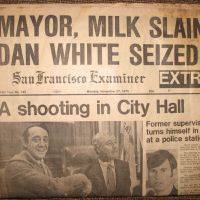
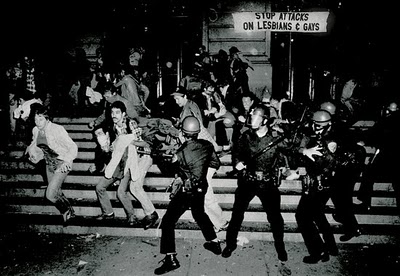
A dozen police cars had been set on fire, which in turn set off their alarms, underscoring the angry shouts from five thousand understandably angry gays. This was in 1979. I had been covering the trial of Dan White for the San Francisco Bay Guardian. The ex-cop had confessed to killing Mayor George Moscone and Supervisor Harvey Milk.

Dale Metcalf, a former Merry Prankster who had become a lawyer, told me how he happened to be playing chess with a friend, Steven Scherr, one of White’s attorneys. Metcalf had just read Orthomolecular Nutrition by Abram Hoffer. He questioned Scherr about White’s diet and learned that, while under stress, White would consume candy bars and soft drinks.

Metcalf recommended the book to Scherr, suggesting the author as an expert witness. After all, in his book, Hoffer revealed a personal vendetta against doughnuts, and White had once eaten five doughnuts in a row.

Hoffer didn’t testify, but his influence permeated the courtroom. White’s defense team presented that bio-chemical explanation of his behavior, blaming it on compulsive gobbling down of sugar-filled junk-food snacks.

Psychiatrist Martin Blinder testified that, on the night before the murders, White “just sat there in front of the TV set, binging on Twinkies.” Another psychiatrist stated, “If not for the aggravating fact of junk food, the homicides might not have taken place.”

In my notebook, I scribbled “Twinkie defense,” and wrote about it in my next report. On the 25th anniversary of that double execution, the San Francisco Chronicle reported that, “During the trial, no one but well-known satirist Paul Krassner — who may have coined the phrase ‘Twinkie defense’ — played up that angle.” And so it came to pass that a pair of political assassinations was transmuted into voluntary manslaughter.

And I got caught in the post-verdict riot. The police were running amuck in an orgy of indiscriminate sadism, swinging their clubs wildly and screaming, “Get the fuck outta here, you fuckin’ faggots, you motherfuckin’ cocksuckers!”

I was struck with a nightstick on the outside of my right knee and I fell to the ground. Another cop came charging at me and made a threatening gesture with his billy club. When I tried to protect my head, he jabbed me viciously on the exposed right side of my ribs. Oh, God, the pain! The dwarf in the clown costume had finally caught up with me, and his electric cattle prod was stuck between my ribs.

At the hospital, X-rays indicated that I had a fractured rib and pneumothorax, a punctured lung. The injuries affected my posture and my gait, and I gradually began to develop an increasingly unbalanced walk, so that my right foot would come down hard on the ground with each step. My whole body felt twisted, and my right heel was in constant pain.

I limped the gamut of therapists — from an orthodox orthopedic surgeon who gave me a shot of cortisone in my heel to ease the pain, to a specialist in neuromuscular massage who wondered if the cop had gone to medical school because he knew exactly where to hit me with his billy club, to a New Age healer who put one hand on my stomach, held the receptionist’s hand with the other, and then asked her whether I should wear a brace. The answer was yes. I decided to get a second opinion — perhaps from another receptionist.

In court, White just sat there in a state of complete control bordering on catatonia, as he listened to an assembly line of psychiatrists tell the jury how out of control he had been. One even testified that, “If not for the aggravating fact of junk food, the homicides might not have taken place.”

The Twinkie was invented in 1930 by James Dewar, who described it as “the best darn-tootin’ idea I ever had.” He got the idea of injecting little cakes with sugary cream-like filling and came up with the name while on a business trip, where he saw a billboard for Twinkle Toe Shoes. “I shortened it to make it a little zippier for the kids,” he said.

In the wake of the Twinkie defense, a representative of the ITT-owned Continental Baking Company asserted that the notion that overdosing on the cream-filled goodies could lead to murderous behavior was “poppycock” and “crap” — apparently two of the artificial ingredients in Twinkies, along with sodium pyrophosphate and yellow dye — while another spokesperson for ITT couldn’t believe “that a rational jury paid serious attention to that issue.”

Nevertheless, some jurors did. One remarked after the trial that “It sounded like Dan White had hypoglycemia.” Doug Schmidt’s closing argument became almost an apologetic parody of his own defense. He told the jury that White did not have to be “slobbering at the mouth” to be subject to diminished capacity. Nor, he said, was this simply a case of “Eat a Twinkie and go crazy.”

When Superior Court Judge Walter Calcagno presented the jury with his instructions, he assured them access to the evidence, except that they would not be allowed to have possession of White’s gun and his ammunition at the same time. After all, these deliberations can get pretty heated. The judge was acting like a concerned schoolteacher offering Twinkies to students but withholding the cream-filling to avoid any possible mess.

Each juror originally had to swear devotion to the criminal justice system. It was that very system which had allowed for a shrewd defense attorney’s transmutation of a double political execution into the White Sugar Murders. On the walls of the city, graffiti cautioned, “Eat a Twinkie — Kill a Cop!”

In 1983, the San Francisco Chronicle published a correction: “In an article about Dan White’s prison life, Chronicle writer Warren Hinckle reported that a friend of White expressed the former supervisor’s displeasure with an article in the San Francisco Bay Guardian which made reference to the size of White’s sexual organ. The Chronicle has since learned that the Bay Guardian did not publish any such article and we apologize for the error.”

It was 10 feet long, 3 feet 6 inches high, 3 feet 8 inches wide, and weighed more than a ton — no, not Dan White’s penis — the world’s largest Twinkie, which was unveiled in Boston. And on the 50th anniversary of the Twinkie, inventor Dewar said, “Some people say Twinkies are the quintessential junk food, but I believe in the things. I fed them to my four kids, and they feed them to my 15 grandchildren. Twinkies never hurt them.”

Author Krassner was seriously injured in the massive post-verdict police riot, May 21, 1979. Image from Post Apocalyptic Bohemian.

When the jurors walked into court to deliver the verdict, they appeared somber, except for a former cop, who smiled and triumphantly tapped the defense table twice with two fingers as he passed by, telegraphing the decision of voluntary manslaughter. White would be sentenced to seven years in prison.

In January 1984, he was paroled after serving a little more than five years. The estimated shelf life of a Twinkie was seven years. That’s two years longer than White spent behind bars. When he was released, that Twinkie in his cupboard was still edible. But perhaps, instead of eating it, he would have it bronzed.

He called his old friend, Frank Falzon — the detective who had originally taken his confession — and they met.

“I hit him with the hard questions,” Falzon recalled. “I asked him, ‘What were those extra bullets for? What did happen?’”

“I really lost it that day,” White replied.

“You can say that again,” Falzon said.

“No. I really lost it. I was on a mission. I wanted four of them.”

“Four?” Falzon asked.

“Carol Ruth Silver — she was the biggest snake of the bunch.” (Silver realized that she might have been his third victim had she not stayed downstairs for a second cup of coffee that morning.) “And Willie Brown. He was masterminding the whole thing.”

While White had been waiting to see Moscone in the anteroom of his office, the mayor was drinking coffee with Brown, chatting and laughing. Moscone told Brown that he had to see White, and Brown slipped out the back door just as Moscone was letting White in the front way. Thirty seconds later, White killed Moscone. The Marlboro cigarette in Moscone’s hand would still be burning when the paramedics arrived.

White hurriedly walked across a long corridor to the area where the supervisors’ offices were. His name had already been removed from the door of his office, but he still had a key. He went inside and reloaded his gun. Then he walked out, past Supervisor Dianne Feinstein’s office. She called to him, but he didn’t stop. “I have to do something first,” he told her, as he headed for Milk’s office.

George Moscone’s body was buried, and Harvey Milk’s body was cremated. His ashes were placed in a box, which was wrapped in Doonesbury comic strips, then scattered at sea. The ashes had been mixed with bubble bath and two packets of grape Kool-Aid, forming a purple patch on the Pacific Ocean. Harvey would’ve liked that touch.

On the 25th anniversary of the twin assassination, the San Francisco Chronicle stated that I reported: “’I don’t think Twinkies were ever mentioned in testimony,’ said chief defense attorney Douglas Schmidt, who recalls ‘HoHos and Ding Dongs,’ but no Twinkies.’” Apparently, he forgot that one of his own psychiatric witnesses, Martin Blinder, had used the T-word.

Blinder now complains, “If I found a cure for cancer, they’d still say I was the guy who invented ‘the Twinkie defense.’”

The Chronicle also quoted Steven Scherr about the Twinkie defense: “’It drives me crazy,’ said co-counsel Scherr, who suspects the simplistic explanation provides cover for those who want to minimize and trivialize what happened. If he ever strangles one of the people who says ‘Twinkie defense’ to him, Scherr said, it won’t be because he’s just eaten a Twinkie.”

Scherr was sitting in the audience at the campus theater where a panel discussion of the case was taking place. I was one of the panelists. When Scherr was introduced from the stage, I couldn’t resist saying to him on my microphone, “Care for a Twinkie?”

In October 1985, Dan White committed suicide by carbon monoxide poisoning in his garage. He taped a note to the windshield of his car, reading, “I’m sorry for all the pain and trouble I’ve caused.”

I accept his apology. The injuries I received in the post-verdict riot affected my posture and twisted my gait. I gradually developed an increasingly strange limp and I now walk with the aid of a cane. At the airport, I’m told by security to put my cane on the conveyor belt along with my overnight bag and my shoes, but then I’m handed an orange-colored wooden cane to enable me to walk through the metal detector. You just never know what could be hidden inside a cane.

[Paul Krassner edited The Realist, America’s premier satirical rag and was an original Yippie. Krassner’s latest book is an expanded and updated edition of his autobiography, Confessions of a Raving, Unconfined Nut: Misadventures in the Counterculture, available at paulkrassner.com. Read more articles by Paul Krassner on The Rag Blog.]

The Rag Blog

Posted in Rag Bloggers | Tagged , , , , , , , , | Leave a comment

Fran Clark : Keeping Watch on the ‘School of Assassins’

One at a time, marchers place their crosses in the chain link fence outside Fort Benning in Columbus, Georgia. Photos by Heidi Turpin / The Rag Blog.

By any other name:
Protesters keep watch at
the ‘School of Assassins’

Each cross has the name of one of the thousands murdered or disappeared throughout Latin America during decades of violence and oppression.

By Fran Clark | The Rag Blog | November 29, 2012

FORT BENNING — In the chilly morning air of Columbus, Georgia, on Sunday, November 18, outside the gates of Fort Benning, people gather early. Most hold crosses, either made before arriving or picked up from the pile made for years past.

Each cross has the name (or other identification, such as “infant girl”) of one of the thousands murdered or disappeared throughout Latin America during decades of violence and oppression, sometimes referred to as “the dirty wars.”

From Bolivia to Panama to Guatemala and El Salvador, religious workers, labor organizers, student groups, or anyone working in sympathy with the poor, were targets of assassination, mass killings, and torture.

Many of those responsible for these acts received training at the School of the Americas, located behind the gates outside which we are gathered. Originally established in Panama in 1946, the SOA moved to Fort Benning in 1984. It has trained over 60,000 members of Latin American militaries, and has been widely criticized for the human rights abuses of its graduates.

Documented atrocities include the murders of Archbishop Oscar Romero and the rape and murders of four U.S. church women in El Salvador. Priests, nuns, labor leaders, women, children, and entire communities have been massacred at the hands of SOA-trained military forces.

Among the most notorious graduates are Manuel Noriega of Panama, Rios Montt of Guatemala, and Hugo Banzer Suarez of Bolivia. SOA trained soldiers in Mexico have been implicated in the murders and disappearances of over 50,000 people since 2006. In Honduras, SOA graduates carried out the 2009 coup and continue a campaign of violence and murder against the resistance.

In 1996 the Pentagon admitted that the school’s training manuals advocated torture, execution, and blackmail. But, despite these admissions, not a single U.S. official has been held accountable. In 2000, after another close vote in the U.S. House on whether to close the school failed, the school’s name was changed to the Western Hemisphere Institute for Security Cooperation (WHINSEC). But, the atrocities continue, as does the work of the SOA Watch to close the “School of  Assassins.”

SOA Watch has held vigils at Fort Benning each year since its founding in 1990 by Father Roy Bourgeois. The weekend-long series of events include outstanding music, workshops, auctions, and profound testimonies from those directly affected by the violence carried out in their home countries.

The crowds have varied in size, but, there is always an eclectic mix of young and old, nuns and college students. (One college group sleeps on the stage each night to watch over it!)

The spirit is always the same. Mourners with white painted faces and red tears carry coffins. The names of the dead are read in liturgical style; marchers in the procession raise their crosses and sing “presente” as each name is read. Each marcher approaches the fence which denies access to the fort, stabs her cross through the chain links, and leaves it as a memorial, along with hundreds of others.

Some leave flowers, photos, and banners. Some sit down to cry, some meditate, and each year at least one is called to commit an act of civil disobedience by “crossing the line.” In years past, this meant simply stepping onto military property. Now, it means scaling a tall fence topped with barbed wire and dropping down on the other side to face an almost certain six-month sentence in federal prison.

As the procession ends and all marchers have placed their crosses, the mourners are called to “return to life” as the uplifting music begins, and the Puppetistas perform their pageant. Many dance joyously as they prepare to return to their communities and rededicate themselves to the work for justice in the Americas and beyond.

[Fran Clark is a community health nurse who is active with CodePink Austin and the Texas Jail Project. She has also been involved with the GI Rights Hotline, Under the Hood Cafe, and the Hutto Visitation Program.]

The Rag Blog

Posted in Rag Bloggers | Tagged , , , , , , | 1 Comment

Howard Wooldridge : Rocky Mountain High / 1

Howard “Cowboy” Wooldridge and Misty fight marijuana prohibition in Colorado.

Misty and me:
Fighting pot prohibition in Colorado

Governor Hickenlooper moaned that tourism would decline or, if more tourists came, they would be the ‘wrong sort of people.’ What a muffin-head he was!

By Howard Wooldridge | The Rag Blog | November 28, 2012

Former police detective Howard Wooldridge will discuss his work to reform marijuana laws on Rag Radio with Thorne Dreyer, Friday, November 30, from 2-3 p.m. (CST) on KOOP 91.7-FM in Austin and streamed live on the web. Rag Radio is rebroadcast on WFTE-FM in Scranton and Mt. Cobb, PA, Sundays at 10 a.m. (EST). After broadcast, all Rag Radio interviews are posted as podcasts at the Internet Archive.

Howard “Cowboy” Wooldridge, the founder and director of Citizens Opposing Prohibition (COP), is a Texan since 1994 and a former Michigan police officer and detective. Like many men and women in law enforcement, he learned early that arresting people for drugs is a faulty proposition and a waste of time, pulling resources away from fighting real crime. Unlike most, however, Howard embarked on a committed crusade to change the drug laws.

With his horse, Misty, Longrider Wooldridge has twice ridden solo from coast to coast, wearing his big Western hat and a white T-shirt that reads, front and back, “Ask Me Why Cops Say Legalize Marijuana.” Traveling on city streets and rural byways, camping out wherever night falls, Howard may have talked with more people one-on-one than any other single drug war opponent with the exception of the late Jack Herer. He has become one of the most effective advocates in Washington, D.C., for ending marijuana prohibition and the “war on drugs” in general.

Most recently, Howard and Misty took part in the successful Colorado campaign to legalize cannabis for recreational and industrial purposes there. (The state of Washington also passed a similar law.) Colorado began allowing medical marijuana use in 2000. In this first of a two-part special report to The Rag Blog, Howard writes about his and Misty’s experience promoting Amendment 64 from a personal (and equine) point of view; next week, he’ll write about the significance and likely fallout of the Colorado electorate’s choice. — Mariann Wizard / The Rag Blog

This is the first in a three-part series.

DENVER — My pickup’s bed was full: two bales of hay, bag of shavings (horse bedding), saddle, bridle, horse blankets, plus all the gear needed to sustain a month on the road with my partner in politics — Misty. Three long travel days later and the Rocky Mountains of Colorado came into view.

We had come to Colorado to promote their ballot initiative on marijuana: Amendment 64. This proposal would essentially (for those 21 and older) legalize, regulate, and tax the use and sale of marijuana. Its major features included: 1) allowing adults to grow enough for private, non-medicinal use; 2) permitting the legal cultivation of industrial hemp; 3) establishing a system in which marijuana could be taxed and sold through state-regulated retail outlets; 4) allowing employers to maintain their existing policies; 5)and it would not impact in any way the laws surrounding the medical use of cannabis.

“64,” as it was known to all, was much simpler to explain and defend than the long, complicated and too detailed Prop. 19 that Misty and I had promoted for two months in California two years ago. Indeed, the prohibition forces in Colorado could only repeat the “fact” that the green plant would be easier for our kids to obtain, as their main reason to oppose. Governor Hickenlooper moaned that tourism would decline or, if more tourists came, they would be the “wrong sort of people.” What a muffin-head he was!

At 64 headquarters on a side street in Denver, I met with the generals of the campaign: Misters Mason Tvert and Brian Vicente. The communications director Joe Megyesy joined us to plot where Misty and I could best serve 64. We decided to focus on population areas in the Front Range (eastern Colorado) and not go to the western side. We grabbed four of their well-designed yard signs plus some brochures before hitting the road to Fort Collins in the north center of the state.

After checking into the Motel 6, I pulled Misty out of her little trailer for a walk around the parking lot.

Misty, who had just spent the last three nights cooped up in her trailer, probably understood by then that this was another California-type adventure: the days spent on noisy, crowded street corners and nights spent in her little trailer staring at the walls. She knew from experience that I would be giving her extra carrots and other treats. Still, it would just be a tough month for her.

The first day went well. The most traveled road in the city yielded a solid three photos taken per minute by motorists and foot traffic. That meant by nightfall, we would be all over Facebook in northern Colorado. I was interviewed by two local daily papers and by the local TV station.

Afterwards I exercised Misty near the motel for nearly an hour. She loves to run and I indulged her. However, I was tired and careless, leaving my bridle and reins near the trailer. When I returned a few hours later, they were gone. As our Texas governor would say, “Oops.”

On Day Two we traveled to Greeley for a rally featuring Vice President Biden. We arrived early that windy, cold morning to greet the Democrats. We parked ourselves where all cars had to pass in order to park. About 10, a guy shouted from a window, “Don’t go anywhere.” A few minutes later the reporter for NPR interviewed me while in the saddle. A week later he opened a nationally broadcast report with my statement on 64. Such things sure help me stay in the saddle. The Greeley paper also published our photo along with their report on the Biden rally. Misty again demonstrated her ability to attract great, free press coverage!

After another day on a street corner near the mall in Greeley, we traveled an hour down the road to Fort Morgan. The next day’s “street theater” yielded yet another newspaper article and photo. We were on a roll!

To be continued…

[Harold Wooldridge, who was a Michigan police officer and detective for 18 years, co-founded Law Enforcement Against Prohibition (LEAP) and is executive director of Citizens Opposing Prohibition (COP).]

The Rag Blog

Posted in Rag Bloggers | Tagged , , , , , , , | Leave a comment

David McReynolds : After the Truce in Gaza

Political cartoon by Paul Jamiol / Jamiol’s World / Informed Comment.

EdgeLeft:
After the truce in Gaza

This was not only a victory for Hamas, but also for Israel, which achieved at one stroke a deep division between the two sides of the Palestinians.

By David McReynolds | The Rag Blog | November 28, 2012

Let me start this commentary with a note about an Israeli film which has opened in New York — The Gatekeepers. It features six retired heads of Shin Bet, the Israeli security agency. These men can hardly be considered voices from the Israeli left — but they are unanimous in their sense that the political scene in Israel is not good, and getting worse. I hope the film finds a wide audience.

We should be reminded, in looking at anything involving Netanyahu, that we are not dealing with an “ordinary” head of state, but with a man of the far right. His late father was an open racist whose comments about the Palestinians are fully the equal of the Nazi views of the Jews, and was a follower of the Jabotinsky movement — the extreme right of the Zionist movement (Jabotinsky worked with Mussolini before WW II). The Israeli Prime Minister is truly his father’s son.

It is ironic that the recent violence in Gaza comes just after the U.S. election, in which Netanyahu all but openly enlisted as a supporter of Romney, so that Obama owes the Israeli Prime Minister no favors. (To rebut the charge that Jewish money buys American elections, Sheldon Adelson, the Las Vegas billionaire — with an estimated fortune of over $20 billion — gave at least $30 million to the Republican Party in an effort to defeat Obama!)

From the Israeli point of view, the Israeli air strikes on Gaza, which not only resulted in a number of civilian deaths but also involved a deliberate Israeli attack on a clearly marked media car (see “Using War As Cover to Target Journalists,” The New York Times, November 25) which killed Palestinian reporters, was no more than a response to “terrorist” attacks by Hamas in Gaza.

In fact, this was a military exchange which suited both Hamas and Israel. There was no special occasion for the Israeli air strikes except to provoke Hamas into sending vast numbers of rockets into Israel. Thus Israel was able to test its new “Iron Dome” defense against rockets — something that will come in handy in the event of war with Iran or a conflict with Hezbollah in Lebanon. A kind of test run, at little cost to Israel.

And Hamas scored a clear win from its risky gamble. In a situation where the Palestinians are divided between Prime Minister Abbas in the West Bank, the man who is nominally head of the Palestinian Authority, and the more militant Hamas, which had won elections in Gaza, it was Abbas who was sidelined, while Hamas won its gamble by forcing the Egyptians to deal with Hamas directly.

As others have observed, this was not only a victory for Hamas, but also for Israel, which achieved at one stroke a deep division between the two sides of the Palestinians. Abbas, who had accepted the right of Israel to exist, who had curbed any attacks on Israel from the West Bank, who had shown his willingness to pursue a peaceful path to a two-state solution, is suddenly marginalized, and Israel can point to Hamas in Gaza as proof that there is no one with whom Israel can make peace.

The U.S., having ignored the Palestinian issue for the last four years, came to the negotiations with Hamas, via Egypt. (And in the process they strengthened the hand of Morsi, the Muslim Brotherhood leader of Egypt, who, as this is written, is trying to establish himself as a man with unlimited powers in Egypt; we will have to wait to see how that plays out.)

Israel has no interest whatever in a peaceful settlement. By provoking the attacks from Gaza, it is able once more to claim that Israeli civilians are threatened by the terrorism of the Palestinians. A word on “terrorism,” which Israel and her American defenders use so lightly. If the Palestinians who fire rockets are terrorists, then so are the pilots of the Israeli jets which carry out targeted assassinations of Palestinian leaders. One cannot justify the violence of one side while terming the violence of those who resist as being “terrorism.”

On both moral and pragmatic grounds I believe the best hope for the Palestinians lies in the nonviolent movements that have emerged in the West Bank (and to which the American media have paid almost no attention). But the Israeli actions are so cynical, and so illegal under international law, that violent resistance is justified and Netanyahu can expect no sympathy from those of us outside of Israel.

If this recent bloody exchange, in which both Israel and Hamas were willing to lose some innocent civilians in order to score political points, proves anything it is that Americans need to focus attention on the only thing which might move Israel to negotiate, and that is to cut off all economic and military aid to Israel.

Those who ask me why I focus on Israel more than on, for example, China over the issue of Tibet, or Russia on the issue of Chechnya, it is because the U.S. is not sending military and economic aid to China or Russia. It is because our tax money buys the military hardware for Israel, and because our political leadership, in fear of AIPAC, will not speak out for justice for the Palestinians.

We must speak out for the Palestinians, and we can do so knowing that American Jews no longer see Israel in the same way it was seen 10 and 20 years ago.

The issue of the Palestinian people can no longer be left to the Israelis and the Palestinians, nor can we assume that non-Jews have no moral obligation to speak out. All Americans share in the responsibility for the criminal actions of the State of Israel. The hope of Israel will not come from those who support it, but from those who demand that Israel be held to the standards of international law.

[David McReynolds was for nearly 40 years a member of the staff of the War Resisters League, and was twice the Socialist Party’s candidate for President. He and the late Barbara Deming are the subjects of a dual biography, A Saving Remnant, by Martin Duberman, published by the New Press, and available in paperback. David retired in 1999, and lives on the Lower East Side of Manhattan with his two cats. He posts at Edge Left.org and can be reached at davidmcreynolds7@gmail.com. Read more articles by David McReynolds on The Rag Blog.]

The Rag Blog

Posted in Rag Bloggers | Tagged , , , , , , , , | 1 Comment