Bruce Melton : The Biggest Misunderstanding About Climate Change

Padre Island National Seashore, four wheel drive only beach. Anyone who has been to the beach knows that warming over land is much greater than warming over water. Photo by Bruce Melton / The Rag Blog.

The biggest misunderstanding
about climate change:

Warming over land will be twice the global average because of cool ocean water.

By Bruce Melton | The Rag Blog | August 9, 2012

Rag Blog writers Bruce Melton and Roger Baker will discuss the latest developments in global warming with Thorne Dreyer on Rag Radio, Friday, August 10, 2-3 p.m. (CDT) on KOOP 91.7-FM in Austin. The show is streamed live on the Internet, and is rebroadcast by WFTE-FM in Mt. Cobb and Scranton, PA, Sunday mornings at 10 a.m. (EDT). Shortly after broadcast the podcast of this show can be heard at the Internet Archive.

Why didn’t they tell us this to start with for goodness sakes! An average considers warming over land and water. Warming over land is much greater than it is over water. Anyone who has ever been to the beach on a scalding summer day can tell you that.

Earth is 70 percent water, and warming over land is more than twice that over water. The popular understanding that Earth will warm 2 to 3 degrees C (3.6 to 5.4 degrees F) this century is the average warming. What we land–based humans can expect is twice or more what we have come to know global warming will be.

Why is this astounding reality virtually unknown? Why does the projected global average warming carry all the headlines instead of the actual global warming that will impact us? Why is this simple relationship, so profoundly important to we humans who live on land, almost completely absent in the news we hear about global warming?

The answer is complex, but I will try and give you a few clues. Straightforward: it’s about understanding how an “average” works. The message has always included the thought that “warming will be greater over land,” but because of other things, this part of the message gets discounted.

Those other things include the “messages” from both environmental advocates as well as those that would have us believe otherwise. It has to do with the psychology of global warming. The answer is not what we have been told would happen for 20 years. But there is more to the story than just a math problem related to how an average works.

The answer is based on our long-term assumption that we will do what we can to reduce global warming to levels that are not dangerous. For two decades we have been planning on reducing emissions. We have been talking about it for so long it is like we have actually done something about it.

But because we did not begin to reduce emissions like was suggested prudent 20 years ago, we are no longer concerned about the middle of the road scenario (the A1B scenario) that the last 20 years of discussion has been based upon. If one ignores a problem, it usually gets worse, and now it has.

Before I get to the details, two things are important to note and I carry these with me everywhere I go. The good news first: Climate change will be no more difficult to fix than human toilet pollution. The solutions to cleaning up climate pollution, using existing technologies, will cost about 1 percent of global gross domestic product (GDP) per year for 100 years.

The astonishing thing to understand about this 1 percent of global GDP — this massive sounding $540 billion a year — is that it is little different from what we have spent on our efforts to control human toilet pollution and provide safe drinking water across the planet every year for the last 100 years. It is little different from what we spend on the U.S. military every year not counting wars, or what we spend on adverting every year across the planet.

It is little different than the normal economic costs to our nation every year because of normal inclement weather — rain, snow, heat cold, wind, flooding and drought. It is four times less than the average 2001 to 2010 annual health care expenditures in the United States alone. New technologies will significantly reduce or even change these costs into profits.

So if the solution is so simple, why are we in this pickle? The “voices” of vested interests are very powerful. Their money has created the message that allows doubt. This greatly decreases the importance of the message of the vast majority of climate scientists.

his statement however, is not as sinister as it sounds. These interests did not do this to purposefully destroy the climate that our society evolved with. They did it because of ignorance, innocence, and the pressures of their respective industry’s economics. They did it because the projected global warming was no more warming than we see every morning before 10 am. They did it because climate scientists did not convey enough emphasis on “only a small amount of change can make a big difference” and “warming will be greater over land.”

Now the bad news. Climate change is much worse than we as a society recognize. Why is it worse, and why can’t we recognize it? Americans’ views on climate change are 20 years behind those of the vast majority of climate scientists’. Only 60 to 70 percent of climate scientists believed that Earth was warming in 1991, compared to 97 to 98 percent today, but only 60 to 70 percent of the public believes in climate change today. This is one challenge that we face: to convince those unconvinced so that we can work together towards the solutions.

Why do we not understand current climate science and how does this make it worse? We live in a Kyoto world. This is a world that is ruled (in our minds) by the philosophy of the Kyoto Protocol. Kyoto said that if we started reducing emissions slowly, over time our climate would change little. We would keep total warming beneath that critical 2 degrees C threshold that marks the imaginary line between dangerous climate change and not-dangerous climate change.

Climate change is a big deal, but on a whole we think it is not nearly so big a deal as it is. Our expectations are low. It has to do with that thing I mentioned about our everyday temperature changing a couple of degrees every morning before 10 am. But it also has to do with what we hear in the media every day.

We as a society have talked incessantly about the reality of climate change: about greenhouse gases, emissions reductions, Cap and Trade, and dirty coal. We have dwelled endlessly on one or two little mistakes in the massive Intergovernmental Panel on Climate Change report (IPCC), and the world was riveted by the theft of personal emails and statements taken out of context that resulted in four separate independent international investigations (all of which exonerated the accused, btw).

Now that we see climate change happening with the increase in extreme weather, the “innocent interests” are telling us that it is only a natural cycle, a global scientific conspiracy, or the good one: that warming has stopped. These claims are indeed backed up by a few climate scientists. So there is skepticism among even the willing.

But these things are not based on what the vast majority of climate scientists are telling us. The “doubt” has allowed only 60 to 70 percent of us to trust what 97 to 98 percent of climate scientists are telling us. Because there is doubt, because there is a public perception that climate scientists still do not know, we assign a smaller risk to the warming. If we understood the risks as the vast majority of climate scientists do, our perception of the size of the problem would be much greater (as theirs already is).

The plain truth however is that we did not do what we were supposed to do 20 years (or more) ago. We have not reduced emissions to 1987 levels by 2012 as was required under Kyoto and in fact, since 1987, across the globe we have emitted nearly as many greenhouse gases (87 percent) as have been emitted from 1987 back to the mid-1700s.

Earth’s population has increased 40 percent since 1987 and 1,000 percent since 1750. Before 1750 hardly counts. And just for the record, the United States was among only two other countries in the world — Afghanistan and South Sudan — that did not ratify the Kyoto Protocol.

Responsibility for this mess can also be found in the George W. Bush Administration. Three weeks after his inauguration, he reneged on his promise to enact Cap and Trade legislation and avowed to never ratify the Kyoto Protocol. This act gave American’s “permission” to doubt. Bill Clinton is also to blame. He had the opportunity to ratify Kyoto as well, but stayed silent on the issue because of “political pressure” from those vested interests that keep popping up in this discussion.

As a consequence of our collective D&D (denial and delay) and the greatly increased greenhouse gas concentration in our sky since the Kyoto message was created, our climate is changing much faster and with much greater impacts than we have understood it would for the last 20 years.

The delay is important. It’s another one of those “buried messages” from the climate scientists. They have been telling us for 20 years that it takes decades to generations for climate change to catch up with greenhouse gases. This is because of the great cooling capacity of the oceans.

But this message was buried. We have been cruising along for 20 years thinking everything was fine, because our climate was not changing. It was if we were actually reducing emissions. (This delay is called the climate lag and I will get to it soon.)

Now: Remember that good news I mentioned at the beginning of this article. It is real, and it is very good news indeed. We need to remember this good news because the bad news, the title of this article, is simply astonishing. What I have to report is not that we can expect to see twice as much warming over land as the average global warming of 2 to 3 degrees C (3.6 to 5.4 degrees F ) from the Kyoto message that we have come to understand over the last decade or two. We have long since passed this point.

The 2 to 3 degrees C of warming that we have come to know so well was basically what would happen by the end of the century under the A1B scenario. The A1B scenario is one of the 40 IPCC scenarios that were distributed to climate modelers in 1998 for the 2001 IPCC Third Assessment Report. Developed by 50 scientists from 18 countries, the scenarios came in four families and ranged from a perfect world to the worst-case scenario and were based on the next century, 2000 to 2100.

In the middle of the pack somewhere is the A1B Emissions Scenario. The “B” is for “balanced.” The A1B Scenario represents a balance of energy sources including fossil fuels and alternative energy. The scenarios remained the same between the 2001 and 2007 IPCC Reports, but the models changed and a lot of things that go into the models changed. Knowledge for the 2007 report had advanced six years over the 2001 report. Like in cats and dogs, that’s a long time in climate science years.

The results of the models from the 2001 and 2007 reports were quite similar. The difference was in resolution. The 2007 report could see much smaller areas than the 2001 report. Sub-continental scale areas were now visible.

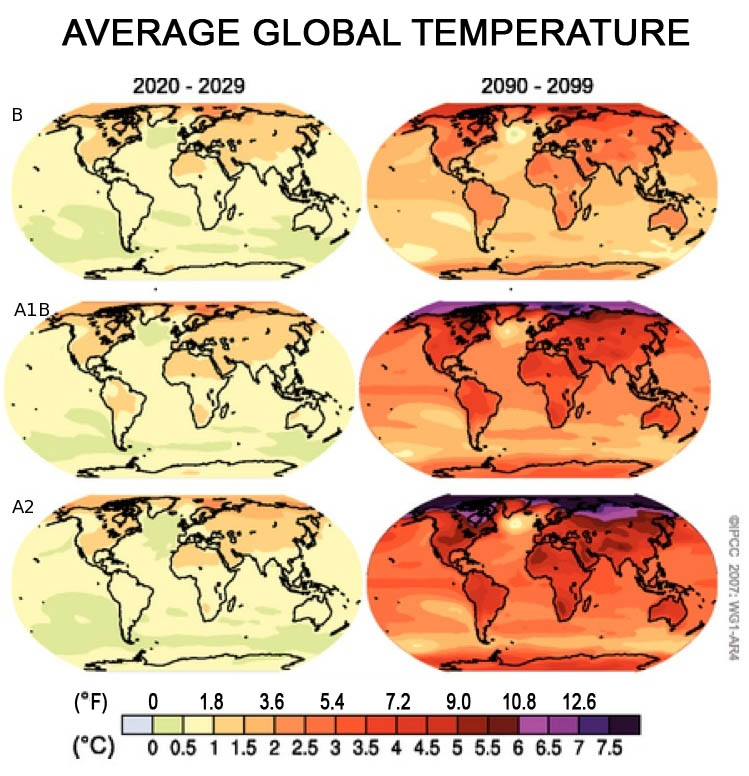
As can be seen from the image “Average Global Temperature,” the A1B scenario clearly shows that by 2090 to 2099 we will see 3.5 to 4.5 degrees C (5.3 to 8.1 degrees F) of warming over land in the U.S. This is similar to most of the land across the planet, with much less warming over water.

This image comes from the 2007 IPCC Report and these model results are what average out to 2.8 degrees C of warming for the A1B scenario. This 2.8 degrees is consider the “most likely” warming in the report, and 2.8 degrees is in the 2 to 3 degrees C range commonly found in the media. The “B” and “A2” scenarios represent one of the better scenarios and one of the worse scenarios.

This is what we can expect based on the ancient (in climate knowledge years) message that most of the public now understands. It comes from the 20th century and it tells us that warming will be twice what we thought it would be, and what most of us still think it will be.

After 20 years of the D&D game things are now much worse. Before I tell you that the latest average global warming projections are twice what we previously thought, and they will happen twice as fast, I need to say a few things about computer models. Most people do not trust climate models as far as the can throw a supercomputer.

The vast understanding that the public has about climate models is that they can somehow be compared with weather forecasting models. The resulting mental leap allows us to think that, like weather models, climate models cannot forecast their way out of a wet paper bag. This is another one of those things that comes from our innocence and ignorance that come from D&D.

The results generated by climate models cannot be compared to the results generated by weather models. Both are basically the same animal — the same programming in some cases. Climate modeling however, function on an entirely different level from weather modeling.

Meteorologists rely on a handful of different models to forecast the weather. Some work better than others at different times of the year or considering different things going on across the planet — like the presence or absence of El Nino for instance.

To create a forecast, a meteorologist (or weathercaster) first loads up all of the current weather data from across the planet or a continental region (a lot easier than it sounds because academic institutions supply this information in ready-to-consume packages) and then they run them into the future for a week or two.

The results are, as you and I know, quite variable after 3 or 4 days (to say the least!) Weather models are much, much better than they once were and really, the forecasts are quite good out to 5 to 7 days, considering past performance.

Climate modelers do something entirely different. They do not load the models up with the current weather conditions across the planet, or across a continental region. They start with any old typical batch of weather data and run the model. Then they blindly change the weather data in the model to represent any other typical weather from that same time frame. Like on May 30th in Chicago it might be 88 degrees and sunny; another May 30th might be 67 degrees and rainy, another might be 79 degrees and partly cloudy.

They make up dozens and scores of these simulations and run them all off into the future on different platforms, similar to the different models that meteorologist use. They start their climate models hundreds and even thousands of years in the past and run them hundreds and thousands of years into the future. Backing up the clock to some ancient time in the past helps confirm them as they recreate our past climate inside the computer. The time span of climate models is 25,000 times longer than the 14-day outlook.

The climate modelers than have scores of results that, like the television weatherpersons’ seven-day outlooks, are all different. Of course all of the weathercaster’s models are not different, only the last few days of each are goofy, but you get the picture.

The climate models don’t even start with the same weather so even the first five days of all the climate model results will be different. So what do the climate modelers do with all of these goofy forecasts based on imagined weather? They average them all together of course. This is what climate is. It’s the average weather. Climate does not give a great-horned hoot about the weather on any individual day. That is called weather. It’s not climate.

The climate models have been remarkably accurate and remarkably consistent for 30 years. The public conception that they are not is just another one of those D& D myths. Like all myths, it is indeed grounded in truth, but this truth is “buried” again, like so many other things, for so many other reasons.

The truth about climate models is they are very accurate for forecasting climate except when it comes to abrupt climate changes. Abrupt climate changes are not what the climate change discussion is about. We sometimes hear about irreversible tipping points and climate thresholds that can and often are associated with abrupt climate change, but in general, these things are fuzzy “climate scientist” concepts that are very poorly understood by the public.

As an example, Greenland ice cores are some of the most accurate climate archives on the planet. Over 100,000 years of gases and dust have been stored in the deep freeze in Greenland (and Antarctica too). From two-mile-deep ice cores drilled in the center of the Greenland Ice Sheet, we can read this 100,000 years of climate history like a road map. For the last 3 million years, it has never ever melted, enough to completely melt the last years’ worth of snow at the top of the 11,000-foot-tall ice sheet that is 10 times the size of Great Britain and three times the size of Texas.

These two-mile-long glimpses of preserved annual snows — compressed to ice, holding time capsules of air and deposited dust, and easily visible in annual layers — are one of the most amazing repositories of natural history ever found. They show us that our climate has abruptly changed 23 times in the last 100,000 years. The changes have been up to 10 degrees (F) average across the globe (20 to 40 degrees in Greenland) and usually happen in a few decades to a few generations.

But when our climate is being pushed the hardest, like during solar cycle changes, or feedbacks from melting ice sheets, the changes have been recorded in as little as a couple of years. All of these changes happened when Earth was within a few degrees of as warm as today, or colder. All of them happened when our CO2 concentration was about the same as or less than it was during the Industrial Revolution.

Today we are changing the CO2 concentration of our atmosphere 14,000 times faster than anytime normal in the last 610,000 years. Abrupt changes loom in our future. But climate models do not predict abrupt changes with any accuracy at all.

The science is still young, but not that young. It is not young enough so that the average climate long-term changes cannot be reliably modeled. But it is immature enough to not be able to work out the abrupt changes yet. Importantly, we know these things happen, they happen geologically often, and they happen when our climate is being forced hard.

The models then, used to project the slower changes in our climate like with the IPCC scenarios, are totally valid. Because we have such a poor understanding of what causes abrupt climate changes, these things are not included in the IPCC report. But the D&D crowd uses this inaccuracy to brand the entire modeling world as untrustworthy. Because of the public perception that weather and climate are bound at the hip, it’s an easy myth to succumb to.

Now things get complicated so pay attention. There is a lot of math and there will be a quiz. The IPCC stopped taking papers for their 2007 report in 2005. The data collection and evaluation, peer review and publishing phase for scientific papers generally takes two to four years or longer. This means that the latest climate science that the IPCC 2007 Report represents is based on climate science circa 2001 to 2003. So when these mega reports come out, they are already five years old. Today the 2007 IPCC Report is 10 years old. A lot has happened in climate science land since.

The paper that I am reporting on in this article came out in September 2009. I’ve written about it several times and referenced it more. But it was just recently that I realized the enormity of these “new” projections compared to the everyday message delivered by the media.

This work, out of the Oak Ridge National Laboratory, Notre Dame, and the National Center for Atmospheric Research (Ganguly 2009) tells us that because emissions are now along the path of the worst-case scenario (A1FI), we should be focusing our understanding of future (and current) changes based on this scenario, not the middle-of-the road A1B scenario. What the authors say in the first few sentences of the report is telling:

Recent observations of global-average emissions show higher trajectories than the worst-case A1FI scenario reported in IPCC AR4 (2007 Report). Average A1FI temperatures trend higher than the best-case B1 as well as the relatively worse-case A2 scenario.

AR4 is the Fourth Assessment Report of the IPCC 2007 Report. The B1 Scenario is similar to the B scenario in the image above.

For nearly 20 years now we have been expecting impacts from climate change to reflect the middle of the road path or the A1B Emissions Scenario. What we have been told is that impacts would basically be small if we kept our collective noses clean and did our emissions reductions homework. Small is anything but what they will be.

This team has looked in detail at subcontinental region warming from the A1FI scenario (the worst-case scenario from 1998). In addition, they have provided graphic displays of the upper limits of the worst-case scenario. Each scenario represents different tweaks to the model, or different versions of our future.

As an example, the difference between the A2 (worse case) and the A1FI scenario (worst case) is mainly in midcentury temperature. By the end of the century, both scenarios are about the same. This is because A1FI is fossil fuel intensive is (the “I” in A1FI), whereas the A2 family has a greater alternative energy mix but a higher end-of-century population.

It’s important to note that the A1FI is NOT the “end-all” worst-case scenario. The A1FI did not include the extra population of the A2 scenario. Since the scenarios were devised, we have discovered how to economically utilize vast deposits of tar sands and oil and gas shales. These “new” sources of fossil fuels push the limits of the worst-case scenario farther than is represented in the 2007 IPCC Report or the 1998 scenarios.

Seeing that our emissions are worse than the worst-case scenario, and that we are not reducing emissions but growing them rapidly, we should look at the high end of the worst-case scenario to see where our temperature is going. We need to pay particularly close attention to the high end because of our climate lag. The climate lag is the amount of time it takes our climate to adjust to greenhouse gas concentrations. It takes about 30 years to see significant changes in climate and I will talk more about that shortly.

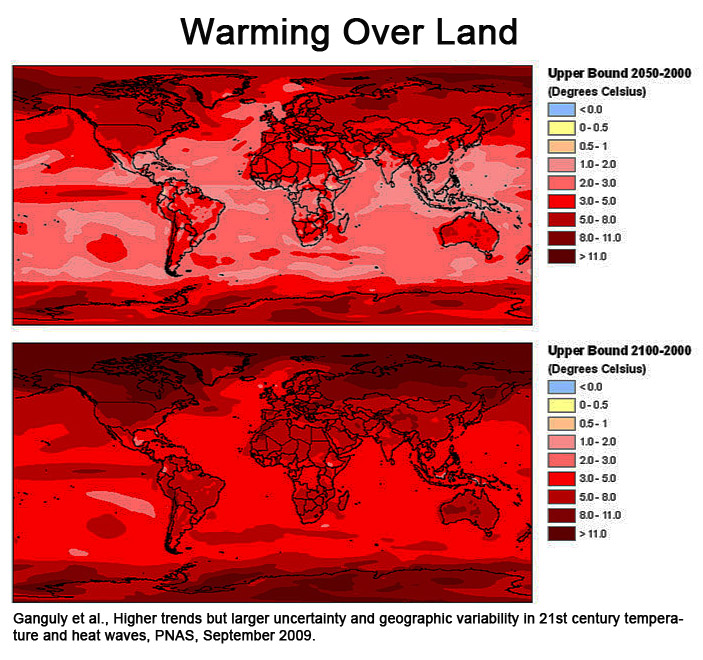
The “high end” of warming can be seen in the image “Warming Over Land.” Look at the top image labeled “Upper Bound 2050-2000.” This is how much warming we can expect to see with the worst-case scenario on top of how much warming we have already seen up to 2000 (about 0.8 degrees C or 1.4 degrees F).

Over a very large part of the U.S. we can expect to see 5 to 8 degrees C (9 to 14.4 degrees F) of warming and again, because our emissions are as bad as or worse than the worst-case scenario, we should be looking on the high side of the suggested range.

This means that 8 degrees C of warming, or 14.4 degrees F, will be the average amount of warming by 2050. And don’t forget, this is the land component of the global average. The global average warming is still 5 to 6 degrees C by 2100 for the A1FI scenario. Look how much cooler the oceans are and how vastly much more area the oceans cover. A lot of heat on a small amount of land can be averaged out with a large ocean and a small amount of warming.

This map is deceiving too. Because the earth is round and maps are flat there have been several different ways to draw a global map. This one exaggerates the areas near the poles to make everything fit into a rectangle. Antarctica for example is a little larger than half the size of North America, but on this map it looks much larger than North America. This skew greatly increases the “apparent” area of greater warming at the poles and needs to be considered to see just how substantially the oceans affect the average temperature.

The most important thing though, is that unless we truly get a handle on our emissions, and even begin to remove some of the excess CO2 loading that is already in our atmosphere (yes, removing more CO2 than we are putting in every year) we are likely locked into warming for the 2050 time frame. Why is this?

The climate lag, or climate delay, is 30 years. Because of the great heat absorbing ability of our oceans (70 percent of the earth) it takes our climate 30 years to reflect the warming of the actual greenhouse gas concentration in the sky. This is like coming home to a cold house in winter and turning on the heater. It takes time to warm up the house, just like it takes time to warm up the earth. There is a lot of cold stored in the walls and floor that has to slowly leak out into the house as it warms.

The 30-year lag is deceiving too. It takes decades to generations for our climate to react to changes in greenhouse gases in a way that is measurable. But the lag goes on and on. It takes on average 1,000 years for waters in the oceans to circulate once around the great ocean currents. This means that it will be 1,000 years before all of the cold abyssal waters have a chance to pass along the surface and start absorbing heat. It takes many cycles of the ocean to fully lose all of that cold storage, or to come into equilibrium with the atmosphere.

So the 30-year climate lag tells us that today we are operating on CO2 concentrations in our atmosphere from the early 1980s. Our climate is responding to greenhouse gas concentrations in our atmosphere from the way it was in 1982. In 1982 we had only emitted half of the greenhouse gases — since the Industrial Revolution — as we have emitted today. In 30 years our climate will reflect the fact that we have doubled our atmospheric load of greenhouse gases, not the emission rate, but doubled the entire load in the sky. (Annual emissions have increased 50 percent since 1990.)

That is of course unless we seriously begin to reduce emissions and start to reduce the load in the sky, during the next eight years. This is why you hear that we are “locked in” to so much warming, or that additional warming is “already in the pipeline.” The fact that we continue to rapidly increase our global emissions does not bode well. The likelihood that we can make a dent in the next eight years does not seem good at the moment. (Don’t lose hope: remember the solutions and toilet pollution, and the happy ending at the end of this article.)

The simple reality is that many of us are dangerously close to seeing more than 14 degrees F of average warming in 38 years. Heat waves are bonus degrees. In the 2011 heat wave in Texas last August it was 6 degrees above average in Austin. It is has been even hotter in the Plains and parts of the Northeast this year. Like the increasingly unprecedented weather extremes today, climate scientists tell us in the future, these extremes will be even more extreme.

From 1938 to 1998 the 30-year average August temperature in Austin was 84.5 degrees and varied no more than 0.3 degrees (F). Since, it has risen to 85.8 degrees F. In a dozen years, our average August temperature in Austin has risen four times more than the largest change seen for the last 60 years. In 2011 in Austin during August the average temperature was almost 91.6 degrees, 5.9 degrees above average.

What about the heat island effect? A small amount of this warming is certainly because of the heat island effect, but only a very small amount.

CLICK ON IMAGES TO ENLARGE

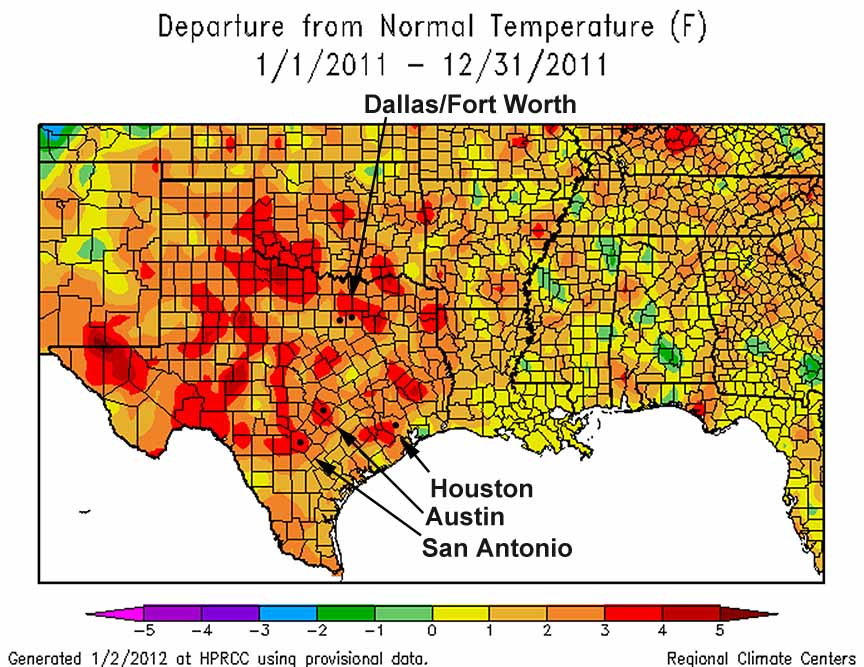
The High Plains Regional Climate Center (HPRCC) shows us last August’s temperatures in vivid hues. Looking closely at the Austin and San Antonio areas it appears the urban heat island is running strong, but look at the larger metro areas of Houston and Dallas/Fort Worth. The counties where the dots are representing these metro areas are almost completely full of concrete and asphalt, yet the red blobs are not centered on those counties. Then there are all those red blobs not associated with urban areas. The urban heat island may play a role, but it is a small one.

Across all of Texas last August the average temperature was 86.8 and the average 30-year summer temperature across Texas 81.4. So for all of Texas, and in Austin, we saw 6 degrees of extra heat during last August’s’ heat wave.

In 2050, with 14 degrees of warming above 2000 (which is basically our 30-year average), the average August temperature will be 100 degrees. Compare this to the hottest average summer temperature in the Western Hemisphere of 98 degrees at Death Valley.

During heat waves, it will not just be 6 degrees warmer than average but much more, at least this is what the models say and they have been pretty much on the mark so far. So figure an average August temp of 106 to 110. The average high will be 10 or 15 degrees warmer than this, or 123 to 128 degrees. (You notice I am adding everything to the high end of the range. This is because our emissions are worse than the worst-case scenario and there is so little time to make an impact with the mindset of our society today.)

One last fantastic number: heat waves have spikes in temperature. The hottest day is about 5 degrees warmer than the average heat wave high temperature. This puts us, in just 38 years when most of us are still alive, around 133 degrees (plus a little for the heat island effect) for an all-time record high. The hottest temperature ever recorded on Earth was in Libya at 136 degrees. In Death Valley it was 134 degrees.

All of Texas will be this hot and much of the Great Plains as well.

Think of what the countryside looks like in Libya or Death Valley. Let me repeat in very plain but unimaginably alarming language: The average summertime temperature in Death Valley is 98 degrees. In Austin, in August, in just 38 years, it will be 100 degrees unless; our leaders start listening to our climate scientists. Please make it a priority to tell your elected officials that it’s the scientist way or the highway. It is within your power to unelect these “politicians.” It is our responsibility to do so unless they act fast.

This action needs to be far more than what was anticipated with Kyoto. The relatively small emissions reductions required prior to the turn of the century would have done the trick. We were supposed to have reduced our emissions to 1987 levels by this year — 2012. Instead, emissions are up more than 50 percent.

This said, we must have hope. Let me repeat my latest message showing that all is by no means lost. We have the capacity within our society to do things like keeping Austin from becoming hotter than Death Valley in our lifetimes.  It’s only pollution. We have conquered challenges of this magnitude before. To fix our climate across the world, spending will be no more than our annual U.S. military budget. It will be no more than the cost of clean drinking water.

Let’s get the message across. It’s only pollution.

[Bruce Melton is a professional engineer, environmental researcher, filmmaker, and author in Austin, Texas. Information on Melton’s new book, Climate Discovery Chronicles, can be found at this link. More climate change writing, climate science outreach, and critical environmental issue documentary films can be found on his website. Read more articles by Bruce Melton on The Rag Blog. Images and photographs copyright © Bruce Melton 2012 unless otherwise referenced.]

References:

American’s view on climate change are 20 years behind: For an in-depth evaluation see “The Climate Awareness Drought is Over.”
https://www.theragblog.com/bruce-melton-the-climate-change-awareness-drought-is-over-1/
Gallup, March 30, 2012 In U.S., Global Warming Views Steady Despite Warm Winter:
http://www.gallup.com/poll/153608/global-warming-views-steady-despite-warm-winter.aspx
Pew Center, Modest Rise in Number Saying There Is “Solid Evidence” of Global Warming, November 9-14, 2011 (Published December 1, 2011) :
http://www.people-press.org/files/legacy-pdf/12-1-11%20Global%20warming%20release.pdf
Yale 2012: Weather extremes caused by climate change have changed public awareness:
Leiserowitz et al., Extreme-Weather-Climate-Preparedness, Yale Project on Climate Change Communication, April 2012.
http://www.climateaccess.org/sites/default/files/Leiserowitz_Extreme%20Weather%20Climate%20Preparedness.pdf
Gallup, March 30, 2012 – Americans’ Worries About Global Warming Up Slightly:
http://www.gallup.com/poll/153653/americans-worries-global-warming-slightly.aspx
Public belief that climate change is happening has only recently risen above 1991 beliefs of climate scientists: Climate Scientists Agree on Warming, Disagree on Dangers, and Don’t Trust the Media’s Coverage of Climate Change, George Mason University, STATS, 2008.
http://stats.org/stories/2008/global_warming_survey_apr23_08.html
Climate Change Cues: Brulle et al., Shifting public opinion on climate change. An empirical assessment of factors influencing concern over climate change in the US 2002 to 2010, Climatic Change, Feb 2012.
http://www.pages.drexel.edu/~brullerj/02-12ClimateChangeOpinion.Fulltext.pdf

97 to 98 percent of scientists: Oreskes, “The scientific consensus on climate change,” Science, December 2004.
http://www.sciencemag.org/content/306/5702/1686.full
Doran and Zimmerman, Examining the Scientific Consensus, American Geophysical Union EOS, January 2009.
http://www.ucsusa.org/assets/documents/ssi/DoranEOS09.pdf
Bray and Storch, A Survey of the Perspectives of Climate Scientists Concerning Climate Science and Climate Change in 2008, Institute for Coastal Research, Geesthacht, Germany, 2010.
http://ncse.com/files/pub/polls/2010–Perspectives_of_Climate_Scientists_Concerning_Climate_Science_&_Climate_Change_.pdf
Farnsworth and Lichter, The Structure of Scientific Opinion on Climate Change, International Journal of Public Opinion Research, October 2011.
http://ijpor.oxfordjournals.org/content/early/2011/10/27/ijpor.edr033.short?rss=1
Anderegg et al., Expert credibility in climate change, Proceedings of the National Academy of Sciences of the United States of America, April 2010. Climate Scientists Agree on Warming, Disagree on Dangers, and Don’t Trust the Media’s Coverage of Climate Change, George Mason University, STATS, 2008.
http://stats.org/stories/2008/global_warming_survey_apr23_08.html http://www.pnas.org/content/early/2010/06/22/1003187107.full.pdf+html
Goot, Anthropogenic climate change: expert credibility and the scientific consensus, Garnaut Review Secretariat, 2011. http://hdl.handle.net/1959.14/159903
 
Climate Lag 30 years: It takes a third of a century for two thirds of the heat from global warming to be absorbed by the oceans, Hansen et al., Earth’s Energy Imbalance: Confirmation and Implications, Science, June 2005.
http://pubs.giss.nasa.gov/docs/2005/2005_Hansen_etal_1.pdf
 
The A1FI scenario, The Worst-case Scenario and warming over land twice or more what we have been expecting:
Ganguly et al., Higher trends but larger uncertainty and geographic variability in 21st century temperature and heat waves, PNAS, September 2009.
http://www.pnas.org/content/106/37/15555.ful l

The Rag Blog

Posted in Rag Bloggers | Tagged , , , , , | 4 Comments

IDEAS / Bill Meacham : Fellow Primates / 1

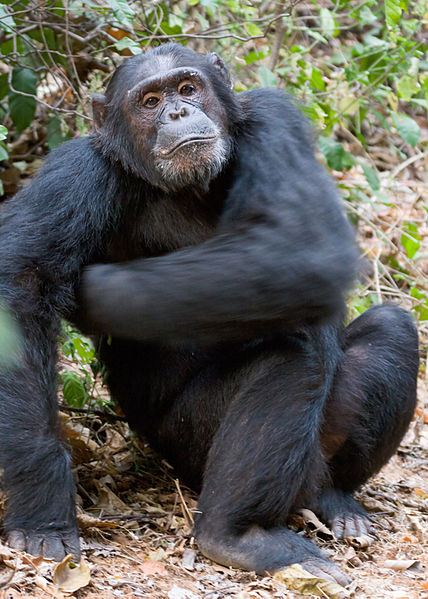
Tanzanian chimp. Image from Wikimedia Commons.

Fellow primates / 1

Chimps and humans are a lot alike, except that humans, being more intelligent, do what chimps do even better.

By Bill Meacham | The Rag Blog | August 9, 2012

Last time I made some remarks about chimps and bonobos. That’s because if you want to master your life, it helps to know your material. Think of yourself as an artist or a designer or a builder whose goal is to make of your life something both highly functional and aesthetically pleasing. You need to know what you have to work with.

A good place for us to start is by comparing ourselves with our fellow hominins, the great apes, specifically chimpanzees and bonobos. These two form a sort of caricature in which we see aspects of ourselves in sharp relief, aspects which in some cases may give us cause for fear and in others may give us cause for hope.

The biological order Primates is a rather large one, comprising lemurs, monkeys and apes as well as humans. Within it humans, chimpanzees, and bonobos are all members of the family Hominidae, subfamily Homininae. (The word means, somewhat unhelpfully, human-like.)

Hominins have 97% of their DNA in common. DNA research indicates that humans diverged from the line of primates to become a separate species about 5.5 million years ago. More recently, about 2.5 million years ago, chimps and bonobos diverged from each other; they are our closest genetic relatives.

Chimps are found in Central and West Africa, north of the Congo River, where the habitat is relatively dry and open. Bonobos are found only south of the Congo River, in dense, humid forests. Bonobo territory is much richer in food — large, fruiting trees and high-quality herbs – than that of the chimps.(1)

Since neither can swim, the river seems to have served as a barrier that enabled the bonobo to evolve into a separate species. Or perhaps it is chimps and humans that evolved away from the ancient species from which all three are descended, and bonobos, having stayed in the ancestral habitat, are closest to that ancient precursor.

In any case, the bonobo habitat seems like a primeval paradise: a pleasant forest environment with lots of food in which the inhabitants find congenial sociality. The chimp habitat, by contrast, is outside the gates of Eden; those who live there have to work much harder for their sustenance.

Chimps, bonobos, and humans exhibit many similarities. All are social and inquisitive; all use tools; all exhibit cooperation, empathy, and altruism (helping others at some cost to oneself) within their groups. There are many significant differences as well. The most obvious is that humans are far more intelligent and exhibit a much broader range of behavior than the others. The most notorious difference between chimps and bonobos is that chimps are patriarchal, violent, and aggressive, and bonobos are matriarchal, peaceful, and sexual.

Chimps have the reputation of being “killer apes.” Their society is extremely hierarchical, with much jockeying among males for the top position, and frequent scuffles, a few quite bloody, among them. Political machinations are incessant because high rank provides sexual mates and food for males; females forage for themselves but sometimes trade sex for food. The dominance hierarchy is male. Female chimps form networks of affiliative friendships.(2)

Conflicts among males are solved through violence and aggression. The hair of a male chimp stands on end at the slightest provocation. He will pick up a stick and challenge anyone perceived as weaker. Chimps in the wild are highly territorial. Chimp males patrol their borders and murder intruders from other bands. Bands of males engage in lethal aggression against their neighbors. Brutal violence is part of the chimp’s natural makeup.

Interestingly, shrewd skill at social manipulation is also part of the chimp’s natural makeup. Frans de Waal’s classic Chimpanzee Politics relates a tale worthy of a Machiavelli. Old Yeroen, the alpha male, is deposed over the course of several months by the younger Luit. Luit engages in battle with Yeroen several times and eventually wins, but his victory is due as much to his campaigning and currying favor among the rest of the tribe, particularly the females, as to his physical prowess.

Yeroen is defeated, but allies himself with Nikkie, another youngster on his way up. Eventually Nikkie, backed by Yeroen, deposes Luit, again not through physical combat alone but by gaining the support of others as well. Luit reigns supreme. But Yeroen gets more sex than either of the other two!(3) “It was almost impossible,” says de Waal, “not to think of Yeroen as the brain and Nikkie as the brawn of the coalition between them.”(4)

Chimps exhibit gentleness, play, and cooperation among the in-group, but in-group conflicts are resolved through domination. Sometimes a dominant male will step in and break up a fight, and sometimes a dominant female or group of females will; in all cases, it is a matter of threatening violence.

After a fight, however, the parties reconcile with each other, by hugging, kissing and grooming. Reconciliation is as important as conflict, because without it the group would disband. Like humans, chimps require group living for survival; and like most mammals, they are soothed by physical touch.

Sexual contact is sporadic among chimps, because it happens only when the female is in heat and her genitals swell visibly. Dominant males get to mate far more often than subordinates, and the male will sometimes kill infants which are clearly not his offspring, for instance when taking in a female from a different tribe. Once the infants are born, the male spends little time and energy nurturing them; chimps show low male parental investment.

We humans tend to think of ourselves as special, but chimps have some decidedly human-like capabilities: empathy and theory of mind. By “empathy” I mean the ability to be affected by the emotional state of another individual. “Theory of mind” refers to the ability to recognize the mental states of others. It means that one individual has an idea, a theory, about what another individual believes, perceives or intends to accomplish. In order to do that, of course, the individual has to have some sense of himself or herself as a separate entity.

Chimps have all these traits. They console others in distress; they know what others know and can take another’s viewpoint; they recognize themselves in a mirror; and they give aid tailored to another’s needs, a behavior called “targeted helping,” which requires a distinction between self and other, a recognition of the other’s need, and sympathy for the other’s distress.

Here is an example: In the Arnhem zoo the keepers had hosed out all the rubber tires in the enclosure and left them hanging on a horizontal pole. When the apes were released into the enclosure one of them, Krom, tried to get a tire that still had some water in it, but it was several tires back and was blocked by the ones hanging in front of it. She could not figure out how to get to it.

After Krom gave up, Jakie, an adolescent whom Krom had cared for as an infant, came up and pushed the tires off the pole one by one. When he reached the one with water in it, he carefully removed it so no water was spilled and carried it to his “auntie” and placed it upright in front of her so she could reach in and get the water. Clearly, he knew what she wanted and came to her aid.(5)

Chimps have a primitive sense of time. They are focused on the present, but can remember past grievances and favors and avenge the former and reward the latter. They are able to anticipate the future and make plans as well. For instance:

“An adult male may spend minutes searching for the heaviest stone on his side of the island, far away from the rest of the group… He then carries the stone he has selected to the island’s other side, where he begins —  with all his hair on end — an intimidation display in front of his rival. Since stones serve as weapons (chimpanzees throw fairly accurately), we may assume that the male knew all along that he was going to challenge the other. This is the impression chimpanzees give in almost everything they do: they are thinking beings just as we are.”(6)

Given this picture, it seems that chimps and humans are a lot alike, except that humans, being more intelligent, do what chimps do even better. We can plan farther into the future and remember and document a greater range of the past. We have a much more ample capacity to understand what others are thinking and feeling and to understand ourselves. And, of course, we have much greater language abilities as well, giving us the ability to learn through history and culture. We have much better tools. And we can use them to kill each other much more effectively.

Some say that we are fundamentally aggressive and warlike, just like chimps, and the reason we have not killed each other off is that we have somehow managed to acquire a veneer of morality that holds these primitive urges in check.(7) That would seem plausible if all we knew about our genetic relatives were the chimps. But chimps are not the whole story. We are genetically related to bonobos as well.

(To be continued…)

[Bill Meacham is an independent scholar in philosophy. A former staffer at Austin’s ’60s underground paper, The Rag, Bill received his Ph.D. in philosophy from the University of Texas at Austin. Meacham spent many years working as a computer programmer, systems analyst, and project manager. He posts at Philosophy for Real Life, where this article also appears. Read more articles by Bill Meacham on The Rag Blog.]

Notes

(1) Hare, p. 92.
(2) de Waal, Peacemaking Among Primates, p. 51.
(3) de Waal, Chimpanzee Politics, p. 164. de Waal backs his conclusions with an impressive amount of observational data. He and his team recorded every instance of each type of interaction — submissive greeting, dominance display, fighting, reconciling, grooming, entreating, copulating, and more — among more than 20 apes over five years, and then correlated the data on computers. He graphs the relative percentage of submissive greetings, of mating activity, and of group support among the various males and the data clearly show that during the first year of Luit’s reign, Yeroen got as much sex as the other two combined.
(4) de Waal, Chimpanzee Politics, p. 141.
(5) de Waal, Primates and Philosophers, p. 33.
(6) de Waal, Peacemaking Among Primates, pp 38-39.
(7) de Waal, Primates and Philosophers, pp. 7-12.

References

de Waal, Frans. Chimpanzee Politics: Power and Sex Among Apes, 25th Anniversary Edition. Baltimore: Johns Hopkins University Press, 2007.
de Waal, Frans. Peacemaking Among Primates. Cambridge, MA: Harvard University Press, 1989.
de Waal, Frans. Primates and Philosophers: How Morality Evolved. Princeton: Princeton University Press, 2006.
Hare, Brian. “What is the effect of affect on bonobo and chimpanzee problem solving?” In A. Berthoz & Y. Christen, ed., The Neurobiology of the Umwelt: how living beings perceive the world. New York: Springer Press, 2009 pp. 89-102. Also available as an on-line publication, Hare, B_ 2009_ What is the effect of affect on bonobo and chimpanzee problem solving_.pdf as of 3 October 2011. Available from http://evolutionaryanthropology.duke.edu/research/3chimps/publications as of 3 October 2011.
Wikipedia. Primate. Online publication, URL = http://en.wikipedia.org/wiki/Primate as of 23 July 2012.

The Rag Blog

Posted in Rag Bloggers | Tagged , , , , , , , , , | Leave a comment

BOOKS / Jonah Raskin : ‘Smoke Signals’ from Martin Lee

A psychoactive political journey:
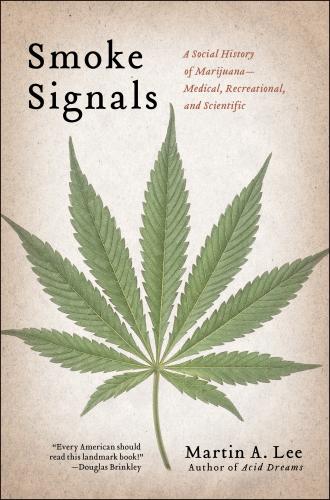
Smoke Signals from marijuana
maven Martin Lee

By Jonah Raskin | The Rag Blog | August 8, 2012

[Smoke Signals: A Social History of Marijuana – Medical, Recreational and Scientific, by Martin A. Lee (2012: Scribner); Hardcover; 528 pp; $35.]

On a Friday afternoon, Martin Lee sips an espresso at Flying Goat Coffee in Healdsburg, California, 90 minutes north of San Francisco, where he lives with his wife and children. Outside, on the sidewalk, a couple of locals — a man in sunglasses and a woman wearing a floppy hat — are talking about their outdoor marijuana crops and the harvest which is still months away.

“This is definitely a marijuana town,” Lee says. “There are a lot of people who grow it in their own backyards and who smoke it both medicinally and recreationally.” He adds, “I don’t really see a big divide between medicinal and recreational users. That’s the government’s model, not mine, and I don’t think it ought to be the model for the movement to reform marijuana laws.”

The publication of Lee’s new in-depth, comprehensive book, Smoke Signals: A Social History of Marijuana – Medical, Recreational and Scientific, coincides with the federal government’s on-going assault on California marijuana dispensaries, growers, and dealers, many of them in compliance with state law.

This spring, in Oakland, agents raided Oaksterdam University, which billed itself as the starship school for the marijuana industry. And in Oakland right now, federal authorities are aiming to close Harborside, probably the biggest above-ground marijuana emporium in the United States. Steve DeAngelo, Harborside’s CEO — a former Yippie — is fighting the government tooth-and-nail. He’s found support recently from Oakland Congresswoman, Barbara Lee (no relation to Martin Lee), who wants to keep Harborside and all California dispensaries open for business.

Martin Lee follows these developments like a hawk. They’re too recent to appear in his book, but Smoke Signals is probably the most up-to-date, balanced book about marijuana in print. The politics of pot — the clash between pot prohibitionists and pot liberationists — prompted Martin Lee to write Smoke Signals, but once he began to conduct his research it was the science of pot that really piqued his interest.

“I’m fascinated by the whole cannabinoid system, the cannabinoid receptors in the human body, and the chemistry of cannabinoids, too,” he says. “I have long been interested in THC, the chief psychoactive chemical compound in cannabis, but I’ve become interested in CBD, which doesn’t get you high or make you feel stoned, but is helpful for all kinds of medical conditions, including anxiety.””

Lee discovered illicit drugs in the 1960s. He’s never left them far behind, and while he smokes marijuana, and writes when he’s high, he doesn’t smoke when he’s on the road. It’s too risky, he says. He doesn’t pack weed in his suitcase and he goes for weeks at a time without craving marijuana. “I like weed,” he says, “But it’s no big deal to go without it.”

Born in Westbury, on Long Island, New York, in 1954, he says that he “caught the tail end of the 1960s,” but he hit the tail end of the Sixties hard and fast. While he never joined Students for a Democratic Society (SDS), he attended SDS meetings and listened to SDS members spout politics, power, and the elite.

“It was like someone turned on a light in my head,” he says. “I remember listening to a talk at an SDS meeting about LBJ’s Secretary of Defense, Robert McNamara, and telling myself, ‘So that’s how the power elite works.’ I’ve never been a conspiracy theorist. The SDS guys were not talking about conspiracies, but the behind-the-scenes nitty-gritty workings of power.”

Soon afterward, Lee met Carl Oglesby, who had been the president of SDS in 1965 and 1966. They became pals, took acid together and tripped. Lee also began to smoke pot, learned to roll joints, and enjoyed the sensation of being high.

“For me, politics and pot have always been entwined,” he says. “They branded me from an early age and they never left me.” At the University of Michigan, he studied philosophy, then turned to the study of LSD, and with Bruce Shlain wrote and published in 1986 his first book, which is now a classic, Acid Dreams. It’s still in print and has never gone out-of-print.

In 1990, he published, along with co-author and friend, Norman Solomon, Unreliable Sources, A Guide to Detecting Bias in News Media. Lee consulted with Solomon on his recent (unsuccessful) campaign for Congress, and urged him to endorse the legalization of weed. Solomon didn’t need to be arm-twisted.

Lee says that he’s always been interested in the doubleness of illicit drugs. He’s fascinated, for example, by the fact that the CIA and the counterculture were both drawn to LSD for very different purposes: for mind control in the case of the CIA, and for mind expansion in the case of the counterculture. Doubleness, he says, also informs the history of cannabis.

“With cannabis is always yes and no,” he says. “I know people who smoke it and feel euphoric. I know others who have used it and became suddenly paranoid and felt terrible.” He adds, “You can also see the doubleness in the movement to reform marijuana laws. Activists swing back and forth from feeling that it’s going to be legalized tomorrow, and on the other hand that the forces against legalization are so entrenched that it won’t ever be legalized.”

Recent events seem to verify that doubleness. “In California in 2010, it looked like the prohibition against marijuana was finally going to end,” Lee says. “Now, in 2012, it looks like it’s not likely to end anytime soon. We’re in a very sober moment for the marijuana movement, though, of course, people are getting high all the time.

The DEA’s gang-busting tactics today don’t surprise Lee. Indeed, they remind him of Harry Anslinger, the long time drug czar, who launched the war on marijuana in the mid-1930s and directed it until the 1960s from his office in Washington D.C. To write Smoke Signals, Lee exhumed the 74-year history of marijuana prohibition in the United States, its up and downs, victories and loses.

He learned, too, what he suspected: that today, as in the past, the prohibition of marijuana keeps police officers busy on the beat, courts jammed with marijuana offenders, and prisons packed with prisoners convicted of violating marijuana laws. It’s a growth industry and it fuels what has come to be known as the prison-industrial-complex.

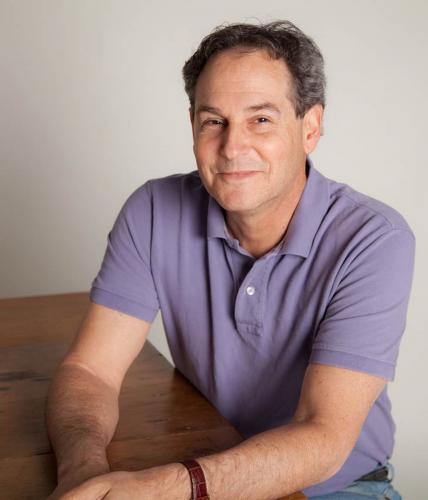
Author Martin Lee. Photo by Quincey Imhoff.

“It’s clear that if marijuana were to be legalized tomorrow, it would devastate police budgets,” he says. “Law enforcement obviously doesn’t want that to happen and they’re openly against the end of prohibition. I’ve also heard the argument that the tobacco and the pharmaceutical industries are against legalization. I don’t think they’re part of a conspiracy to keep cannabis illegal, though big tobacco gave money to D.A.R.E. and to Nancy Reagan’s ‘Just Say No’ campaign because it was good PR for them. I also think that if cannabis was to be legalized, the tobacco and alcohol industries would jump on the bandwagon.”

As a marijuana smoker, he’s a tad nervous these days, but he knows that now isn’t the time to duck and cover. Smoke Signals, which took four years to write, has thrust him into the public eye, and he’s eager to go on the road and talk about cannabis.

“When I’m interviewed, I hope I’m asked if I smoke,” he says. “Of course, I do smoke and I’m planning to say so. I like smoking pot. There’s nothing wrong with that. I don’t have anything to hide. I recently told my kids that I smoke, and that wasn’t a big deal for me or for them.”

Lee feels that cannabis has a vital role to play in a society, like ours, that’s running on stress 24/7.

“We’re bombarded by all kinds of crap, whether from the media or from the chemicals in the food we eat,” he says. “The overall effect of cannabis is therapeutic. It’s made to order for people who have anxiety and are tense. It turns down our over-excited nervous systems.”

Lee travels around the country and notices regional differences when it comes to cannabis. Northern California is a world unto itself.

“People in New York have very little idea of how big the cannabis industry is here in northern California,” he says. “They don’t realize that a heck of a lot of people grow, sell, and transport cannabis, that they cook with it, make tinctures from it, and that their doctors recommend it.”

Still, Lee isn’t optimistic about the immediate prospects for legalization and the end of prohibition. He’s also critical of some of the leaders of the movement to reform marijuana laws, though he doesn’t want to name names or single out anyone in particular for rebuke.

“Many of the leaders misunderstood the mixed signals of the Obama administration,” he says. “It’s time for some real soul-searching and re-examination of goals and strategies.”

But he’s not in despair, either, about the big marijuana picture. “People are gonna grow pot and smoke pot no matter what,” he says. “The crackdown on California dispensaries certainly hasn’t stopped people from using cannabis. It only means that they’ve gone back to buying it underground and on the black market. If I do get glum, I have to remind myself that we have thousands of years of marijuana history on our side. After all this time, it’s unlikely that humans are gonna give up their cannabis.”

[Jonah Raskin is the author of Marijuanaland: Dispatches from an American War and a regular contributor to The Rag Blog. Read more articles by Jonah Raskin on The Rag Blog.]

The Rag Blog

Posted in Rag Bloggers | Tagged , , , , | 1 Comment

RAG RADIO / Thorne Dreyer : Actor, Radical Lawyer Brady Coleman & The Melancholy Ramblers

In a forest of mics: Brady Coleman on Rag Radio at the KOOP studios in Austin, Texas, Friday, July 17, 2012. Photo by Thorne Dreyer / The Rag Blog. Inset photos below: Brady Coleman and Jim Simons. Photos by Alan Pogue / The Rag Blog.

Rag Radio interview:
Actor, movement attorney Brady Coleman
plus Jim Simons, & The Melancholy Ramblers

By Rag Radio | The Rag Blog | August 8, 2012

Brady Coleman, now a film actor and musician, was a prominent attorney representing movement activists in Texas and around the country. Jim Simons was Brady’s partner — along with the late Cam Cunningham — in Austin’s Movement Law Commune. Brady and Jim were Thorne Dreyer’s guests on Rag Radio, Friday, July 27.

They were joined by Brady’s band, The Melancholy Ramblers, also featuring Frances Barton and Marco Parella. The Ramblers performed live on the show.

Listen to Thorne Dreyer’s Rag Radio interview with Brady Coleman, Jim Simons, and The Melancholy Ramblers, here:


Rag Radio features hour-long in-depth interviews and discussion about issues of progressive politics, culture, and history. The syndicated show is produced in the studios of KOOP-FM in Austin, Texas, a cooperatively-run all-volunteer community radio station. It is broadcast live on KOOP and streamed live on the Internet, and is rebroadcast on WFTE-FM in Mt. Cobb and Scranton, PA.

Brady Coleman was a radical lawyer from the late ‘60s through the ’80s, working with the Movement Law Commune in Austin, Texas. He and his original partners — Jim Simons and Cam Cunningham — were heavily involved in major anti-war and civil rights litigation, defending campus radicals, black, Chicano, and American Indian activists, and anti-war GIs — in Texas and around the country.

Jim Simons joins Coleman to discuss their late law partner, Cam Cunningham, who died earlier this month. Simons wrote about Cunningham in a July 15 tribute in The Rag Blog.

Brady Coleman eventually gave up his law practice to work full-time in theater, film, and music. He has appeared in more than 50 films, from “What’s Eating Gilbert Grape,” to Richard Linklater’s highly-acclaimed 2011 movie, “Bernie,” in which Brady played attorney Scrappy Holmes — and in television series including “Walker, Texas Ranger” and “Friday Night Lights.”

The Melancholy Ramblers — featuring Coleman, Frances Barton, and Marco Perella — are a popular Austin band that play an eclectic mix of country, folk, gospel, honky-tonk — and the occasional Irish revolutionary anthem!

Writing at the Internet Archive, a reviewer of the Rag Radio podcast said, “The fascinating stories are interspersed with spirited Texas music that lifts the heart and fires the spirit. If you are a wayward daughter or son of the lone star state, this is an essential audio history.”

Not So Melancholy Ramblers: From left: Brady Coleman, Jim Simons, Rag Radio’s Thorne Dreyer, Frances Barton, Rag Radio engineer Tracey Schulz. In front: Marco Parella. Photo by Alan Pogue / The Rag Blog.

Rag Radio has aired since September 2009 on KOOP 91.7-FM in Austin. Hosted and produced by Rag Blog editor and long-time alternative journalist Thorne Dreyer, a pioneer of the Sixties underground press movement, Rag Radio is broadcast every Friday from 2-3 p.m. (CDT) on KOOP, 91.7-fM in Austin, and is rebroadcast on Sundays at 10 a.m. (EDT) on WFTE, 90.3-FM in Mt. Cobb, PA, and 105.7-FM in Scranton, PA.

The show is streamed live on the web by both stations and, after broadcast, all Rag Radio shows are posted as podcasts at the Internet Archive.

Rag Radio is produced in association with The Rag Blog, a progressive internet newsmagazine, and the New Journalism Project, a Texas 501(c)(3) nonprofit corporation. Tracey Schulz is the show’s engineer and co-producer.

Rag Radio can be contacted at ragradio@koop.org.

Coming up on Rag Radio:
THIS FRIDAY, August 10, 2012,
Rag Blog writers Bruce Melton and Roger Baker on global warming and climate change denial.
August 17, 2012: Lynn Stout, author of The Shareholder Value Myth, and Mike Lapham, co-author of The Self-Made Myth.

The Rag Blog

Posted in Rag Bloggers | Tagged , , , , , , | Leave a comment

Harry Targ : Syrian Policy Looks Familiar to Cubans

Members of UN General Assembly vote on Saudi Arabian-sponsored draft resolution against Syria. Photo by Kathy Willens / AP.

Syrian policy looks familiar to Cubans

Those who sponsored the resolution condemning violence were the same nations that had ‘played a major role in the militarization of the situation in Syria, by providing weapons to the terrorist groups.’

By Harry Targ | The Rag Blog | August 7, 2012

The United Nations General Assembly approved a resolution Friday, August 3, 2012, that The New York Times said, “severely criticized the Syrian government, blaming it almost exclusively for the killings and other atrocities that have come to shape the 17-month uprising there.”

The resolution condemning Syria ironically implied that it was that country that refused to carry out the peace plan that was proposed four months earlier by Kofi Annan. No mention was made in the resolution that the United States, Britain, France, Saudi Arabia, and Qatar, among others had been feeding supplies to anti-government militias that encouraged them to violence rather than negotiation.

While 133 Western and Arab League allies voted for the resolution, 33 countries abstained, and 12 voted“no.” These were portrayed as Syria’s “slim group of backers, which include Russia, China, and Iran.”

Syria is a dictatorship that in the recent civil war has leveled brutal violence against its own people. But the Syrian Ambassador was correct in asserting that those who sponsored the resolution condemning violence were the same nations that had “played a major role in the militarization of the situation in Syria, by providing weapons to the terrorist groups.”

It is not surprising that The New York Times failed to mention that Cuba has been one of the longstanding critics of U.S. inspired wars on weak countries such as Libya and now Syria. The Cuban Permanent Representative to the United Nations, Pedro Nunez Mosquera, warned that the resolution which was adopted would encourage more violence from the opposition and retaliation by the state. With growing instability, he asserted, foreign intervention would become legitimized the way it was in the Libyan case.

In an article in Prensa Latina, the Cuban diplomat’s position was summarized: “Cuba considers that all acts of violence, massacres and terrorist acts that claim innocent lives in Syria should cease” but this will require that the anti-Syrian coalition “must put an end to arms smuggling and money to insurgent groups and their training.” Nunez also criticized the major Western media’s one-sided reporting on the violence in Syria.

It is clear that Cuba’s criticisms of the wars on Libya and Syria and the Western economic blockade and military threats toward Iran are motivated by self-interest as well as principle. Cuba, as a country that has suffered an economic blockade by the United States for over 50 years and a U.S. policy designed to diplomatically isolate it, sees similarities between its experiences and U.S. policies toward Syria and Libya.

Despite some U.S. liberalization of travel to the island nation, government agencies and counterrevolutionary organizations in Miami continue to funnel funds, technology, and propaganda to create an opposition that, they hope, will lead to an armed resistance against the Cuban government. If the Cuban government responds to terrorist acts, a U.S orchestrated coalition of dependent allies can justify the transfer of arms, propaganda campaigns, and escalating calls for revolution.

What may be called today the “Libyan Model of Destabilization” is not new to Cubans and as a result they see the necessity of continued vigilance.

Alan Gross, hired by the United States Agency for International Development, was caught distributing computer technology to selected communities on the island. A global propaganda campaign was raised about a recent car accident in which two well-known opponents of the regime who were traveling with rightwing Europeans in the countryside were killed. No evidence of foul play was provided concerning the accident although charges by Miami Cubans of government violence have been broadly distributed.

Also a recent Miami scholarly conference was organized with presentations by counterrevolutionaries who argued that the recent economic reforms on the island will never work. And repeatedly U.S. and British media highlight alleged growing disenchantment with the regime.

The Libyan Model of Destabilization, which has its roots in the years of economic blockade of Cuba, terrorist acts and assassination plots, the creation of counter-revolutionary groups in Florida and New Jersey, and even an armed invasion, is not likely to work in the Cuban case. First, the Cuban regime has broad popular support. Second, Cuba’s first priority remains social and economic justice. Third, Cuban health care and education are among the best in the Global South.

And, finally, Cuba remains an inspiration to those countries throughout the Western Hemisphere (such as Venezuela, Bolivia, Ecuador, Nicaragua, Argentina, Brazil, and El Salvador) who seek to create political and economic autonomy in the 21st century. As evidenced in positions taken at the recent Summit of the Americas in Cartagena, Colombia, Latin American countries defended Cuban national sovereignty and are demanding that the latter be included in future meetings of Hemisphere nations.

But as the Libyan model and now the Syria crisis suggest, weak countries everywhere in the world must remain vigilant. Imperialism still survives.

[Harry Targ is a professor of political science at Purdue University who lives in West Lafayette, Indiana. He blogs at Diary of a Heartland Radical — and that’s also the name of his new book which can be found at Lulu.com. Read more of Harry Targ’s articles on The Rag Blog.]

The Rag Blog

Posted in Rag Bloggers | Tagged , , , , | Leave a comment

David Morris : Texas Judge Rules Sky Belongs to the People

The sky! Image from Wikimedia Commons.

Texas judge rules:
‘The sky belongs to everyone’

Is this a ‘shot heard round the world’ for fight against climate change?

By David Morris / On the Commons / August 4, 2012

“Texas judge rules atmosphere, air is a public trust,” reads the headline in the Boston Globe. A tiny breakthrough but with big potential consequences.

And as we continue to suffer from one of the most extended heat waves in U.S. history, as major crops have withered and fires raged in a dozen states, we need all the tiny breakthroughs we can get.

The “public trust” doctrine is a legal principle derived from English Common Law. Traditionally it has applied to water resources. The waters of the state are deemed a public resource owned by and available to all citizens equally for the purposes of navigation, fishing, recreation, and other uses.

The owner cannot use that resource in a way that interferes with the public’s use and interest. The public trustee, usually the state, must act to maintain and enhance the trust’s resources for the benefit of future generations.

Back in 2001, Peter Barnes, a co-founder of Working Assets (now CREDO) and On the Commons as well as one of the most creative environmentalists around, proposed the atmosphere be treated as a public trust in his pathbreaking book, Who Owns the Sky: Our Common Assets and the Future of Capitalism (Island Press).

In 2007, in a law review article, University of Oregon Professor Mary Christina Wood elaborated on similar idea of a Nature’s Trust. “With every trust there is a core duty of protection,” she wrote. “The trustee must defend the trust against injury. Where it has been damaged, the trustee must restore the property in the trust.”

She noted that the idea itself is not new.

In 1892,

when private enterprise threatened the shoreline of Lake Michigan, the Supreme Court said, “It would not be listened to that the control and management of [Lake Michigan] — a subject of concern to the whole people of the state — should… be placed elsewhere than in the state itself.” You can practically hear those same Justices saying today that “[i]t would not be listened to” that government would let our atmosphere be dangerously warmed in the name of individual, private property rights.

In 2010 Wood, along with Julia Olson, Executive Director of Our Children’s Trust, “had the vision to organize a coordinated international campaign of attorneys, youth, and media around the idea that the climate crisis could be addressed as a whole system,” Peter Barnes observes, replacing a situation in which “legal solutions were fragmented, focused on closing down a particular power plant or seeking justice for a particular endangered species, threatened neighborhood or body of water impacted by our fossil fuel abuse.”

On behalf of the youth of America, Our Children’s Trust, Kids Versus Global Warming, and others began filing suits around the country, arguing the atmosphere is a public trust. So far cases have been filed in 13 states.

In Texas, after a petition to the Texas Commission on Environmental Quality (TCEQ) to institute proceedings to reduce greenhouse gases was dismissed, the Texas Environmental Law Center sued on behalf of a group of children and young adults. The Center asserted the State of Texas had a fiduciary duty to reduce emissions as the common law trustee of a “public trust” responsible for the air and atmosphere.

The lawsuit argued,

The atmosphere, including the air, is one of the most crucial assets of our public trust… Global climate change threatens to dry up most of these waters, turning them from gorgeous, life-giving springs into dangerous flash-flooding drainages when the rare, heavy rains do come. The outdoors will be inhospitable and the children will have few places to recreate in nature as the climate changes. They will be living in a world of drought, water shortages and restrictions, and desertification.

The TCEQ argued the public trust doctrine applies only to water. Judge Gisela Triana, of the Travis County District Court disagreed. Her letter decision, issued on July 12, 2012, stated, “[t]he doctrine includes all natural resources of the State.”

The court went further to argue that the public trust doctrine “is not simply a common law doctrine” but is incorporated into the Texas Constitution, which (1) protects “the conservation and development of all the resources of the State,” (2) declares conservation of those resources “public rights and duties,” and (3) directs the Legislature to pass appropriate laws to protect these resources.

The immediate impact of the case is limited. Noting that a number of climate change cases were wending their way up the judicial ladder, Judge Triana upheld the TCEQ decision not to exercise its authority.

But a few days after Judge Triana’s ruling, Judge Sarah Singleton of the New Mexico District Court denied the state’s motion to dismiss a similar case. That will now move forward.

The Texas court is the first to support the possibility that the “public trust” doctrine may justify the creation of an atmospheric trust. One Houston law firm advised its clients the decision “may represent a ‘shot heard ‘round the world’ in climate change litigation… Given the stakes involved in such cases, clients should monitor these suits carefully — and perhaps participate as amicus curiae to support the state’s attorneys’ arguments.”

What a delicious irony if future generations could look back to Texas as the catalyst that ultimately afforded legal protection to the sky.

[David Morris is Vice President and Director of the New Rules Project at the Institute for Local Self-Reliance, which is based in Minneapolis and Washington, D.C., focusing on local economic and social development. This article was first published at On the Commons under a Creative Commons license, and was distributed by Common Dreams.]

The Rag Blog

Posted in RagBlog | Tagged , , , , , | Leave a comment

Type your summary here

Type rest of the post here

Source /

The Rag Blog

Posted in RagBlog | Leave a comment

Jack A. Smith : My Life and Times with the Guardian

Progressive journalist Jack A. Smith, 2012.

My life and times with the Guardian

By Jack A. Smith | The Rag Blog | August 2, 2012

Longtime radical activist and progressive journalist (and Rag Blog contributor) Jack A. Smith, former editor of the National Guardian (later renamed the Guardian), will be Thorne Dreyer‘s guest on Rag Radio, Friday, August 3, 2-3 p.m. (CDT) on KOOP 91.7-FM in Austin. The show is streamed live on the Internet, and is rebroadcast by WFTE-FM in Mt. Cobb and Scranton, PA, Sunday mornings at 10 a.m. (EDT). Shortly after broadcast the podcast of this show can be heard at the Internet Archive.

[I asked Jack Smith to send along some background material, as I always do with my Rag Radio guests, and what he sent was so impressive that we’re running it here as a stand-alone article. Jack Smith was one of the most important figures in progressive journalism in the 20th century, and his work, I believe, is underrecognized. Hopefully we’re taking one small step to correct that situation! — Thorne Dreyer]

The National Guardian was founded in 1948 to promote the views of the Progressive Party (which ran Henry Wallace for president that year). The weekly tabloid led an independent left-wing existence soon after the election and continued publishing until 1992. (It changed its name to the Guardian in late 1967, when it became a worker’s cooperative.)

The National Guardian strongly opposed the Cold War, imperialism, and racism. It was against the Korean War, Vietnam War, and all the U.S. wars during the Cold War period. It generally supported the socialist countries of the time, though it was not explicitly socialist. True to its third party origins, the paper never backed a presidential candidate from one of the two ruling parties.

During the late 1960s through the 1970s The Guardian was the largest circulation independent left-wing paper in the U.S. (24,000 paid copies a week, with up to three or four pass-on readers per copy).

Jack A. Smith, then a reporter for the National Guardian, in 1964.

I was born in New York City to a low income family in 1934, so I’ll be 78 this month, August. My widowed mother went to work to support her two kids, my sister, and me. I began working full time at 16, attending night school to get my high school diploma. I began reading radical papers, including the National Guardian, as a freshman in high school and developed socialist views at that time, which I still hold.

I started Queens College at night, working days first as a copy boy then wire editor and news writer for United Press International (America’s second largest news agency at the time) but dropped out of school after the first semester in order to work a second job when my girlfriend became pregnant and we got married. (We divorced around the time I went to prison.)

I was involved with the radical pacifist movement in my early 20s and at 26 (1961) returned my draft card to the Selective Service System, defying the law forcing all young men to carry the card “on their person at all times.” I told the SS that I opposed President Kennedy’s war threats, U.S. support for South Vietnam, and the nuclear buildup, and would not carry a card in protest.

After interviews with the SS and FBI, the federal government drafted me as punishment. I was overage for the draft, 27 by now, plus I was deferred because I had two young children. When I refused the draft, I was indicted. UPI thereupon fired me, after eight years. I edited the Bulletin of the Committee for Nonviolent Action until my trial and conviction. I served nine months in federal prison. I began to identify as a Marxist in prison and drifted away from absolute pacifism.

When I got out it was evident that I was blackballed from getting work in the bourgeois media. I had written a few articles for the National Guardian in earlier years and the paper hired me a few weeks after I regained  my freedom in mid-1963, and I remained for 21 years, moving from writer to news editor to the paper’s editor over a few years.

My biggest accomplishments at the Guardian included: transforming the paper into a worker’s cooperative (with equal, very low pay for all and a child allowance plus health insurance); doubling the size of the Guardian from 12 to 24 pages a week; increasing the paper’s coverage of the vibrant U.S. movements for social change (students, peace, women’s, gays, black power, civil rights, radical union struggles); switching from a “left progressive” editorial stand to Marxism; and working to make sure the Guardian contained the best coverage of the Vietnam War from a pro-Vietnamese point of view and that of the various peace groups in the U.S.

I left the Guardian on friendly terms in 1984. I was very deeply in debt by that time — after 21 years of sub-minimum wages, and raising a child on my own — and simply had to get a better-paying job. I edited several commercial magazines until retiring from paid work in 1999. During this time I remained politically active and was associated with Marxist groups, as I remain today.

My wife Donna Goodman and I moved from NYC to the college town of New Paltz, N.Y., about two hours north of the big city, in the early 1990s. We became politically active and began organizing a great many demonstrations and public meetings of a political nature, mostly in opposition to the imperialist wars (many of them were in conjunction with the Answer Coalition).

When I retired I began writing and editing our own email Activist Newsletter and calendar every two weeks (now monthly) to people living in the Hudson Valley region where we organize. The Newsletter circulates to over 3,000 readers, most of whom took part in one or more of our rallies, meetings, and long distance bus trips.

We’ve taken from two to seven buses of local people to Washington demonstrations and back 24 times, beginning in the mid-90s). Our next action will be August 26 when the Newsletter is organizing a march and rally in New Paltz in opposition to the War on Women.

[Jack A. Smith was editor of the Guardian — for decades the nation’s preeminent leftist newsweekly — that closed shop in 1992. Smith now edits the Hudson Valley Activist Newsletter. Read more articles by Jack A. Smith on The Rag Blog.

The Rag Blog
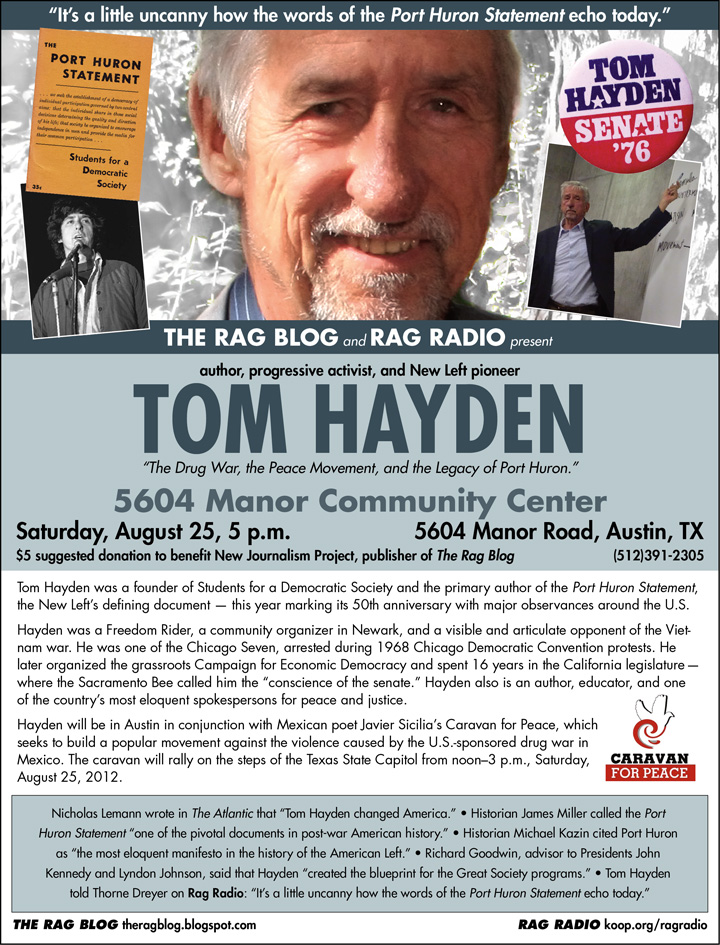
Posted in Rag Bloggers | Tagged , , , , , | 3 Comments

MUSIC / Harvey Wasserman : A Transcendent CSN

From left, Stephen Stills, Graham Nash, and David Crosby. Photo by Darrel Ellis / Toledo Blade.

Shamans of sound:
A transcendent Crosby, Stills and Nash

Hearing CSN’s standards reminds us boomers of a time and place, an era of history when we were young and open and a whole new genre of music and politics and way of being was in the birthing.

By Harvey Wasserman | The Rag Blog | August 2, 2012

The power of music is one of the great unknowns in the human saga. For reasons we don’t quite understand (yet) its vibrations can lift us to great heights, drop us down into deep depression, liberate us, make us joyous, help us grieve, and so much more.

Thus its practitioners — the best of them — can rise to shaman status. They can speak to higher realities, lead us on political issues, arouse our spirits, calm our souls.

Those with the power are rare. There is a huge corporate industry designed to manufacture and sell commercial imitations.

But real ones still walk among us, and if we catch them at the right moment, they can move us as little else in this life.

Monday night, July 30, was such a time. Crosby, Stills and Nash played under a pavilion on the Ohio River outside Cincinnati on a gorgeous warm night before some 4,000 folks who must be described at this point as elders.

(By way of disclosure, I’ve worked with Graham Nash since 1978, when he toured California with Jackson Browne, raising funds and consciousness to fight the Diablo Canyon nukes. With Bonnie Raitt, Jackson and Graham are the core of www.nukefree.org, whose website I edit.)

The show was a mix of old and new, but stayed within the terrain of melodies and harmonies the trio essentially invented.

Wooden ships on the water
Very free
And easy
The way it’s supposed to be.

Hearing CSN’s standards reminds us boomers of a time and place, an era of history when we were young and open and a whole new genre of music and politics and way of being was in the birthing. There was a war on and we wanted peace, and injustices and bigotries we wanted done away with, and with all that came a mindset and culture that changed the world — but not yet enough.

With a superb supporting cast (including David Crosby’s son, James Raymond), the band reminds us of why these songs became standards in the first place. It’s not enough that music is of a time — it also has to be good on its own. The deep resonance of the chord changes, the perfect harmonies, master guitar riffs, intriguing lyrics… there are reasons these songs are still with us. “Carry On,” “Helpless,” Suite: Judy Blue Eyes,” “Our House” will always carry the touch of greatness that inspired them.

Thankfully, the group has also kept its political focus. Graham dedicated “Teach Your Childre” to the underpaid, overworked professionals who do just that.

He also sang “Almost Gone,” a searing accusation written with James Raymond about the ghastly torture of Bradley Manning, the whistleblowing young soldier being pilloried by our imperial army for the “crime” of telling the truth.

Graham’s epic “Winchester Cathedral” asked “how many people have died in the name of Christ?” The question was underscored with “Military Madness,” reminding us that our species continues to poison and bleed itself with an unfathomable addiction to violence and war that could someday soon kill us all.

To do this kind of politics in a concert for which people have paid good money is a delicate dance. But these guys are good enough — and then some — to make it work. It is, after all, who they are, and have been, and we would expect no less.

The riverfront night was clear and clean, but global-warmed, and at one point Graham complained of the heat.

“Take off your shirt,” someone yelled.

“Are you kidding,” said Graham. “I’m 70 years old.”

Well, yeah, but he and his brothers haven’t lost a beat, and their core audience has the aura of being as fit and bright and full of life as we were way back when.

In those days, we never doubted we would live forever. In the parallel universe CSN still has the power to create, it seems we actually have.

[Harvey Wasserman’s History of the United States is at www.solartopia.org, along with A Glimpse of the Big Light: Losing Parents, Finding Spirit. He edits www.nukefree.org. Read more of Harvey Wasserman’s writing on The Rag Blog

The Rag Blog

Posted in Rag Bloggers | Tagged , , , , , | Leave a comment

BOOKS / Ron Jacobs : Paul Atwood’s ‘War and Empire’

Paul Atwood’s War and Empire

The book details the nation’s progression from a bunch of European colonizers to an international syndicate stealing resources and labor and replacing them with U.S. corporate products and empty culture.

By Ron Jacobs | The Rag Blog | August 1, 2012

[War and Empire: The American Way of Life by Paul Atwood (2010: Pluto Press); Paperback; 272 pp.; $32.50.}

There is a debate currently taking place in the Burlington, Vermont, region over the Pentagon’s desire to station F-35 fighter bombers at an Air National Guard base nearby.

As usual, the proponents of the planes and their “bedding down” (as the Pentagon calls this action) in Vermont make claims of jobs and other benefits if the planes are based in Vermont. Opponents oppose the planes on a number of grounds: noise levels and the accompanying loss of property values, health issues related to the noise, and the dependence on the war economy, to name a few.

Like most decisions by the Pentagon, the opinions of the people affected are the least important of any of the factors involved.

The reason I mention the debate, however, has much to do with a book I just finished reading: The book, War and Empire by Paul Atwood (acting director of the William Joiner Center for the Study of War and Social Consequences and a faculty member in the American Studies Department at UMass-Boston), is a survey of the ongoing project of American Empire.

As I follow the remarks of different people engaged in the F-35 debate, echoes of the nationalist conceit known as American exceptionalism are present everywhere. Of course, the most obvious have come from the fiercest proponents of the F-35 and the military they service. One such person put it plainly as possible when he wrote to the local Gannett outlet that the roar of the fighter planes was the sound of freedom. Who cares about the death and destruction they represent, much less some pansy’s hearing?

On the other side of the argument, however, are those who always preface their opposition to the planes’ presence with praise for the military and its mission of “protecting our freedom.” Then there is Vermont’s liberal Congressional delegation, all of whom are quite supportive of the Pentagon’s plan.

Atwood’s text provides a litany of instances and a multitude of words from throughout U.S. history detailing the nation’s progression from a bunch of European colonizers to an international syndicate stealing resources and labor and replacing them with U.S. corporate products and empty culture. While this occurs, politicians and their media sycophants gloss the whole enterprise over with words like freedom and democracy.

Atwood’s judicious use of quotes and his explanation of historical incidents explain U.S. history in a manner unfamiliar to many U.S. citizens. It is this unfamiliarity which assists the creators of Empire in their ongoing march.

Other books have done U.S. history in a manner similar to Atwood. Howard Zinn’s The People’s History of the United States comes quickly to mind. However, where Zinn emphasizes the popular (and not so popular) resistance to the U.S. imperial project, Atwood’s text focuses on the logical progression from colonial settlement to the wars in Iraq and Afghanistan.

The economic underpinnings of empire are mentioned and discussed, especially in relation to the religion, racism, and nationalist rationales that are used to encourage support for policies that primarily benefit corporate entities.

The history Atwood narrates in War and Empire is not new material for the critical student of U.S. history. Unfortunately, those are becoming few and far between. Indeed, it seems to this writer that the predominant approach to history these days is one that historian Newt Gingrich would be happy to teach.

While school boards in Arizona remove books discussing the history of the American Southwest from a Latino point of view and textbook publishers allow censors in Texas to remove negative mentions of slavery from history textbooks, many other U.S. residents get their version of history from television networks beholden to profit, religion, and an American triumphalism that denies and glosses over criticism of U.S. policy.

In short, there has never been a greater need for Atwood’s book. Its concise and politically neutral narrative, combined with its brevity, make it the perfect U.S. history book for any interested reader, no matter what their politics or scholarly status.

Getting back to the debate over the F-35s in Vermont, especially in relation to this book. It is precisely because of their misunderstanding of U.S. history and the military’s role in it that both proponents and opponents of the planes can praise the military for protecting their freedom. Perhaps if they read War and Empire, neither side would be linking the words freedom and U.S.military in their arguments.

Then again, if they did, at least they would be conscious of the misconception they were perpetrating.

[Rag Blog contributor Ron Jacobs is the author of The Way The Wind Blew: A History of the Weather Underground. He recently released a collection of essays and musings titled Tripping Through the American Night. His latest novel, The Co-Conspirator’s Tale, is published by Fomite. His first novel, Short Order Frame Up, is published by Mainstay Press. Ron Jacobs can be reached at ronj1955@gmail.com. Find more articles by Ron Jacobs on The Rag Blog.]

The Rag Blog

Posted in Rag Bloggers | Tagged , , , , , , , | Leave a comment

Jay D. Jurie : Gotham and the Real World

Aurora, Colorado:
Gotham and the real world

Particularly when the economy is in decline and the political environment is in disarray, these suburbs lend themselves to what Thoreau called ‘lives of quiet desperation.’

By Jay D. Jurie | The Rag Blog | July 26, 2012

“Violence is as American as Cherry Pie” — Jamil Abdullah Al-Amin (H. Rap Brown)

Violence has come to be understood by many, implicitly or explicitly, as the answer to a number of other individual and social problems. To say that violence is celebrated in the United States is no exaggeration.

From the Battle of Bunker Hill onwards, this nation was forged by violence. Manifest Destiny and westward expansion were integral to the purposes of national elites from the inception. Not only were natural resources to be exploited and investments to be made, but population increase and settlement pressure could be relieved by continual advancement of the frontier. Territory that couldn’t be taken by treaty was often taken by force of arms.

Even today, Daniel Boone, an early participant in the suppression of Native Americans, remains a celebrated figure in U.S. history. Though he was zealously involved with efforts to eliminate and remove the Seminoles and the Cherokees, President Andrew Jackson’s visage adorns the $20 bill. Dying in a blaze of gunfire to wrest control of Texas from Mexico and preserve slavery, Davy Crockett, Jim Bowie, and the other defenders of the Alamo are regarded as heroic martyrs.

This tradition receives favorable treatment in popular culture, with Western movies and leading actors such as the widely-venerated John Wayne pounding home the message again and again that the fist and the gun are ultimately the solution for most problems. Contemporary action movies have replaced the slower-paced Wayne with ultra-cool figures such as Batman, and his six-shooters with high-tech gadgetry, but the message remains the same.

Glorified depictions of violence can be seen in the military recruitment advertising frequently shown in theaters before the start of action movies, pitched to young males as the primary audience of both. Such images play an important role in recruiting the forces necessary to carry forward the same resource exploitation, investment, and subjugation and control of indigenous population goals that were inherent to the founding of the United States.

Ultimately, reliance upon violence results from a unique for-profit version of Social Darwinism and the pecking order it has created. Those at the top of the hierarchy rely upon violence to feed their insatiable appetites for money and power. In order to serve these purposes, violence must not only be threatened or used, when deemed necessary, but must be widely viewed as an acceptable means of resolving conflicts, as an acceptable part of daily life.

From this outlook, “might makes right,” and that boils down to who has the most firepower. Violence becomes not only a means to an end, but the necessary counterpart to the famous Calvinist doctrine of those who are predestined through material success. For those on the lower rungs of the ladder, a “warm gun” becomes not just the poor man’s equalizer, but a means of social advancement: “winners” and “losers” are not defined by moral virtue, but by force. Note that I say “man” deliberately, as this rarely involves women.

Bullying and hazing are expressions of this “love affair” with violence, and its ingrained nature in the core values of society explains why these practices are virtually impossible to root out. While certain figures in the social order, such as school principals and police chiefs, are charged with maintaining “domestic tranquility,” at best, their role is analogous to the Dutch kid with his finger in the dike. Their admonitions are not only overshadowed by the overarching cultural dog-eat-dog backdrop of violence, they are often schizophrenic.

Lecturing on the need for peaceful conflict resolution, these same authority figures not only overlook, but often encourage pecking orders and other forms of competition that create “winners” and “losers” and forms of behavior that lend themselves to violence. Some years ago, when shootings began to occur at U.S. Mail facilities around the country, this phenomenon even gained a name: “going postal.”

As always, there are those eager to make a profit from every opportunity, and as Michael Moore and others have pointed out, fear-mongering has long been understood as such an opportunity. Trayvon Martin’s unfortunate death showed how industry can prey on fear to turn a profit. At the behest of the American Legislative Executive Council (ALEC) and the National Rifle Association (NRA), a number of states loosened their firearms laws. This happened through a combination of manipulating compliant legislators and instilling the belief that guns are the answer to personal protection.

For those near the bottom of the pecking order, or for socially isolated or marginalized individuals, it’s only a short step from translating fear, frustration, or resentment into a perception that guns are a means to enhance one’s status. Travis Bickle in the movie Taxi Driver becomes George Zimmerman in real life.

For all intents and purposes, Zimmerman was a nobody who lived in a nondescript suburban neighborhood in Sanford, Florida, itself a suburb of Orlando. According to Sanford Police Detective Chris Serino, Zimmerman exhibited a “little hero complex.” Similarly, in Littleton, Colorado, Dylan Klebold and Eric Harris were outcasts at Columbine High, snubbed by their peers and ignored by authority figures and their own parents, who decided “to go out with a bang.”

James Holmes, the accused killer at The Dark Knight Rises movie in Aurora, fits a similar profile. Holmes was a neuroscience graduate student at the University of Colorado in Denver who lived in nearby Aurora. Apparently he was failing in his graduate program, and like Jared Lee Loughner, who shot U.S. Rep. Gabrielle Giffords and others in Tucson, he may have mental issues but ready access to firearms and ammunition.

According to movie critic Michael Phillips of the Chicago Tribune, the movie The Dark Knight Arises is grim, dark, and apparently apocalyptic. Not that this or any similar movie “causes” any real world violence to occur, but in this instance it may have provided the right sort of mood, or lent itself to the sort of climate Holmes was seeking. When apprehended, Holmes reportedly compared himself to the “Joker” in an earlier Batman movie.

It’s also curious that both Columbine and this present shooting in Aurora occurred in Denver suburbs. Littleton at one time had some unique identity, before it was swallowed up as a Denver satellite. Aurora grew as an adjunct to military and aviation facilities, including Stapleton International Airport, later succeeded by Denver International Airport, that served the Denver metropolitan area. These two suburbs are representative of many that tend to foster a sense of atomized individualism, anonymity, and that lack identity or independent character.

As metropolitan locations grew, facilitated by the expansion of the interstate highway system and “white flight,” populations became dispersed in ever-expanding concentric rings around urban cores. No real sense of community ever came to characterize these developments; residents often commuted elsewhere to work, or school, drove to supermarkets and shopping centers, and, isolated from one another, lived atomized lifestyles. Social observers ranging from William Whyte and Paul and Percival Goodman to Andres Duany and James Howard Kunstler have aptly described these circumstances.

Particularly when the economy is in decline and the political environment is in disarray, these suburbs lend themselves to what Thoreau called “lives of quiet desperation.” They are perfect breeding grounds for those individuals left behind or harboring a grudge, unable to meaningfully connect their personal crises with others, inoculated with the belief that violence is a solution to their problems, and thanks to the weapons and ammunition makers and dealers, armed to the teeth.

[Jay D. Jurie, who attended the University of Colorado at Denver, is a resident of Sanford, Florida. He researches, writes, and teaches in the areas of public policy, public administration, and urban planning. Read articles by Jay D. Jurie on The Rag Blog.]

The Rag Blog

Posted in Rag Bloggers | Tagged , , , , , , , | 4 Comments

Jack A. Smith : What’s Really Happening in Syria?

Free Syrian Army fighter near Idlib, Syria. Photo by Khalil Hamra / AP.

What’s really happening in Syria?

The principal Obama Administration target in this complex affair is Iran, not Syria. The Syrian government must fall because it is Iran’s main Arab ally.

By Jack A. Smith | The Rag Blog | July 26, 2012

After several months of talking diplomacy while simultaneously strengthening rebel forces in Syria and demonizing the Damascus government, the Obama Administration has openly decided to go for the kill. Violent regime change will not happen immediately, but it is obviously President Obama’s goal.

The White House is now “redoubling efforts to rally a coalition of like-minded countries to forcibly bring down the government of President Assad al-Assad,” The New York Times reported July 21. “Administration officials have been in talks with officials in Turkey and Israel over how to manage a Syrian government collapse.”

McClatchy Newspapers stated July 23 that,

Despite reports last week that suggested rebel forces were on the verge of major triumphs in Syria, the last few days of fighting there show that a long battle still looms. Forces loyal to Assad in recent days have tightened their grip on the Lebanese border, re-established control over at least one neighborhood in Damascus and perhaps reached an accommodation with the country’s Kurds that will free up more troops for battle.

According to the U.S. and its NATO allies, the Damascus regime is engaging in a one-sided, murderous war against its own people, who simply seek democracy. At the same time, the Tehran government is characterized as a “terrorist” regime intent upon building and using nuclear weapons in order to destroy Israel and rule the Middle East. The U.S. news media, as expected, propagates without question Washington’s campaign against Syria and Iran.

The United States suggests that its principal reason for seeking regime change in Syria is to promote “democracy” — a tarnished rationale often employed in recent decades to undermine or destroy governments that displease the U.S. superpower, such as in Iran in the 1950s, the Dominican Republic in the 1960s, Chile in the 1970s, Nicaragua in the 1980s, Yugoslavia in the 1990s, Iraq in the 2000s, and Libya in the 2010s, among other instances.

Democracy has nothing to do with Washington’s objectives in Syria. America’s closest regional ally in the anti-Assad endeavor is the repressive anti-democratic monarchy of Saudi Arabia, which finances and arms the rebel opposition in Syria along with resource-rich Qatar. Both Arab countries played a similar role last year in the U.S./NATO overthrow of the Gaddafi government in Libya.

Having learned a bitter lesson after agreeing to support a no-fly zone in Libya — and seeing that mandate illegally expanded by U.S.-NATO forces in order to wage a vicious war for regime change — both Russia and China have three times exercised their right to veto U.S. measures in the UN to escalate the conflict in Syria. The Security Council approved a 30-day extension of the UN monitor mission July 20, but Susan Rice, Washington’s ambassador to the world body, implied it may be the last continuation.

Both Moscow and Beijing seek to bring about a negotiated solution to the crisis based on a cease-fire, talks and reforms. According to Russian UN Ambassador Vitaly Churkin, “the only way to put an end to this tragic conflict is to get to the negotiating table.” The Syrian government agrees, but the opposition forces — aware that Washington and its allies seek a swift regime change — reject negotiations.

Churkin warns:

Don’t be duped by humanitarian rhetoric. There is much more geopolitics in their [U.S.] policy in Syria than humanism… Our concern is that the Syrian people have to suffer the consequences of this geopolitical struggle.

There are two principal and interlocking reasons the U.S. and its NATO and Mideast coalition allies are conspiring to oust the Assad government.

The first is to secure Washington’s geopolitical position in the Middle East and North Africa (MENA), particularly as President Obama prepares to focus additional military and economic resources on East Asia to contain the rise of China, and on Eurasia reduce Russian influence.

British news analyst Patrick Seale, whom we consider an objective source, wrote July 19:

The keys to the Syrian crisis lie outside Syria. Indeed, the Syrian crisis cannot be separated from the massive pressures being put on Iran. President Obama is now fully mobilized against both regimes. He seems to have given up trying to secure a win-win deal with Iran over its nuclear program, and he is sabotaging Kofi Annan’s Syrian peace plan by conniving in the arming of the rebels. He seems to want to bring down the regimes in both Tehran and Damascus — either because he sees Iran as a rival in the Gulf region or to win the favors of Israel’s American supporters in an election year.

According to a July 10 report from Stratfor, the non-government commercial intelligence organization close to certain U.S. spy sources:

Human rights interests alone do not come close to explaining why this particular uprising has received a substantial amount of attention and foreign backing over the past year. The past decade enabled Iran to wrest Baghdad out of Sunni hands and bring Mesopotamia under Shi’ite control. There is little question now that Iraq, as fractured as it is, sits in the Iranian sphere of influence while Iraqi Sunnis have been pushed to the margins. Iran’s gains in Baghdad shifted the regional balance of power.

The second reason is to enhance the power of Sunni Islam in MENA and limit the possibility of a larger regional role by the Shia Muslim minority.

There are about 2 billion Muslims in the world today. Statistics vary somewhat, but about 87% are said to be Sunnis, and the remainder are Shia — a minority that has suffered discrimination from the majority. Iran has the largest Shia population in the world — up to 95% of its 75 million people. Iraq has the second largest Shia population — over 60% of its 30 million people.

About 87% of the 26 million Syrians are Muslims — 74% of these Sunni and 13% Shia — but members of the Shi’ite Alawite sect, led by the Assad family that dominates Syria’s Ba’athist regime, have essentially controlled the country for over 40 years.

The principal Obama Administration target in this complex affair is Iran, not Syria. The Syrian government must fall because it is Iran’s main Arab ally (as it also is Russia’s, a not insignificant factor). Washington has been intent upon gravely wounding Iran after the Iraq war blew up in its face, resulting in the Shia assumption of power in Baghdad.

Until the 2003 U.S. overthrow of the secular Ba’athist regime in Baghdad led by President Saddam Hussein, Iraq’s 30% Sunni minority historically dominated the state. Sunni Iraq was in fact Iran’s biggest enemy. President Hussein launched a mutually devastating, unnecessary eight-year war against Iran in 1990 with tacit U.S. support. Now, while not yet an official ally, Baghdad is friendly to Tehran.

President Obama labored long to compel Shia President Nouri al-Maliki to allow tens of thousands of U.S. troops and government “advisers” to remain in Iraq after the bulk of forces were to withdraw at the end of 2011. One purpose was to monitor and reduce future Iranian influence. But the Iraqi leader ultimately refused at the last moment — a huge setback for the administration, though Washington no doubt is continuing its efforts to manipulate Baghdad covertly while crushing Iran’s ally in Damascus.

The U.S. now views Iraq as positioned within neighboring Iran’s sphere of influence, a significant shift in the regional balance of power. This can only be perceived as a serious danger to American hegemony throughout the region and particularly the Persian Gulf/Arabian Peninsula, from whence much of the world’s petroleum issues. Washington’s greatest fear is that Iran and Iraq — two of the world’s principal oil producers — might develop a genuine alliance.

This is a chief reason why the Obama government has contrived pretexts to impose heavy sanctions and threaten military action against the Tehran government. This also explains why ultra-conservative Saudi Arabia so enthusiastically backs sanctions and threats against Iran and is investing heavily in overthrowing Assad. The Saudi royal family, devotees of a fundamentalist brand of Sunni religion, wants to expunge Shia influence throughout the region, as well as keep its own discriminated-against 15% Shi’ite minority under tight control.

One payback for the Saudis is Washington’s indifference to the cruelty toward the Shi’ite majority demanding a modicum of democracy in Bahrain, which is ruled by a dictatorial Sunni monarchy under the protection of Saudi Arabia.

Obama’s immediate goal is to break up the developing relationship between three contiguous Shia-led countries — Persian Iran and Arab Iraq and Syria — covering some 1,600 miles from the Afghan border to the Mediterranean.

All other states in MENA circulate well within Washington’s hegemonic orbit. The Arab Spring has not diminished U.S. hegemony in the region where regimes were overthrown — Egypt, Tunisia, and Yemen. Indeed, U.S./NATO control of Libya and now the Syrian situation appear to have enhanced Washington’s regional power. Last week the Arab League, representing all the Arab states, proposed Assad should resign and that the Free Syrian Army (FSA), which leads the armed struggle, should form a transitional regime. Iraq dissented, declaring that it was for the Syrian people alone to decide his fate.

Most Arab countries, and non-Arab NATO member Turkey as well — which flaunts the opportunity to flex its Sunni credentials as it strains to reassert its influence and even leadership in the Middle East — are part of the regime change coalition. Turkey is playing a key role, providing a reliable rear area for the FSA and as a transmission point for arms bound for the opposition.

Even Israel shows public signs of getting directly involved in Assad’s downfall. Last week right-wing Prime Minister Netanyahu told Fox News Israel “was ready to act” in Syria. Over the years, Tel-Aviv had been more than willing to tolerate the Assad government rather than a Sunni regime until the recent period when Tehran and Damascus began developing much closer ties.

Interestingly, Hamas — the Islamic organization elected to govern the Palestinian territory of Gaza — has recently announced its support for the Sunni rebels in Syria, after receiving decades of solidarity and support from the Assad government. Hamas is connected to the Muslim Brotherhood now leading Egypt which recently guaranteed it would maintain peace and commerce with Israel. Another branch of the Brotherhood is expected to acquire greater political power in Syria if regime change succeeds.

Syria is a strongly nationalist capitalist country which promoted pan-Arabism when it was in vogue in the 1960s. It has been ruled by the Ba’ath Party for over four decades. There are a number of other parties but they are subordinate to the Ba’athists. It is not a Western-type democracy and the government is repressive toward dissent. Further, Syria dealt harshly with peaceful demonstrators before the armed opposition was a major factor.

The Damascus government also has positive aspects. The Assad regime is secular in nature, is opposed to colonialism and imperialism, and does not bend the knee — as so do many Arab governments these days — to the U.S. The Assad government strongly opposed America’s war in Iraq. It materially and politically backs the rights of the Palestinian people and the Shia Lebanese political party Hezbollah, which is supported by Iran.

In addition, the government appears to have the allegiance of a substantial proportion of the population, including the several minority sects — Christians (10% of the population), Druze, Turkmen, Jews, Yazidis, and others. All seem to prefer a secular government to the possibility of a more religious Sunni state, perhaps led by the Muslim Brotherhood.

The oppositional forces include various often contending civil and exile organizations and individuals associated with the Syrian National Council (SNC), the main opposition group, and the approximately 100 different armed urban guerrilla groups broadly identified with the Syrian Free Army.

Disunity characterizes the relations between many of these groups, virtually all of which are Sunni. Major rivalries have been reported between a number of military commanders, and sharp splits have taken place within the SNC and between leaders within Syria and influential exiles largely based in Turkey and Egypt. The U.S. has been working for months to identify and promote the leaders it wishes to put into power.

According to Middle East correspondent Pepe Escobar, writing July 24 in Asia Times,

There’s no way to understand the Syrian dynamics without learning that most FSA commanders are not Syrians, but Iraqi Sunnis. The FSA could only capture the Abu Kamal border crossing between Syria and Iraq because the whole area is controlled by Sunni tribes viscerally antagonistic towards the al-Maliki government in Baghdad. The free flow of mujahedeen, hardcore jihadis and weapons between Iraq and Syria is now more than established… As it stands, the romanticized Syrian “rebels” plus the insurgents formerly known as terrorists cannot win against the Syria military — not even with the Saudis and Qataris showering them with loads of cash and weapons.

Repeated reports from many sources indicate that contingents of fundamentalist jihadists have joined the anti-Assad campaign. Stratfor comments that “The Syrian rebellion contains a growing assortment of Sunni Islamists, Salafist jihadists, and transnational al Qaeda-style jihadists. Foreign fighters belonging to the latter two categories are believed to be making their way into Syria from Lebanon, Jordan, and Iraq.”

According to a report this week in the German daily Die Frankfurter Allgemeine Zeitung, German intelligence estimates that “around 90” terror attacks that “can be attributed to organizations that are close to al-Qaeda or jihadist groups” were carried out in Syria between the end of December and the beginning of July.

Despite such attacks, the Damascus government announced this week that it would not use its chemical weapons “against the Syrian people or civilians during this crisis, under any circumstances.” It did, however, suggest it might deploy such weapons against foreign military intervention.

In the U.S. most liberals and Democrats support Obama’s Syrian adventure as well as Republicans, just as they approved of what little they knew of the White House involvement in the Libyan regime change. GOP candidate Mitt Romney and some Republican politicians demand “tougher action,” but that’s just for show.

Sectors of the U.S. left are split over America’s role in Syria. Some groups support the uprising in the name of democracy, ignoring that Washington and the royal family in Riyadh will be the biggest winners. Those who identify with the anti-imperialist perspective strongly oppose U.S/Saudi involvement.

Our view is that it is the responsibility of the people of a country, such as Syria — and not outside forces — to determine the political character of their government, up to and including armed revolution.

And the anti-Assad international coalition is not just any “outside force.” It takes orders from the United States — the most powerful military state in the world responsible for violent aggression and millions of deaths in recent decades — and is also backed by a couple of anti-democratic monarchies and NATO, including two of the region’s former colonial overlords, France and Great Britain.

The extent of American involvement with the opposition was partially exposed by The New York Times July 21:

American diplomats are also meeting regularly with representatives of various Syrian opposition groups outside the country to help map out a possible post-Assad government. “Our focus with the opposition is on working with them so that they have a political transition in place to stand up a new Syria,” Patrick Ventrell, a State Department spokesman, said last week.

As such, in our understanding, the principal aspect of the struggle for power in Syria is not popular forces fighting for democracy but an international coalition led by imperialism seeking to overthrow a government allied to Iran in order to serve Washington’s geopolitical objectives and Saudi Arabia’s sectarian goal of diminishing Shia influence in the region.

[Jack A. Smith was editor of the Guardian — for decades the nation’s preeminent leftist newsweekly — that closed shop in 1992. Smith now edits the Hudson Valley Activist Newsletter. Read more articles by Jack A. Smith on The Rag Blog.

The Rag Blog
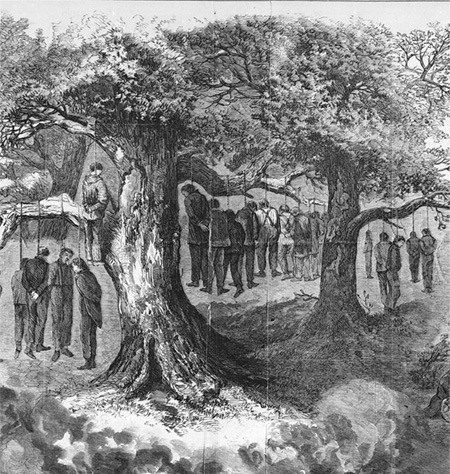
Posted in Rag Bloggers | Tagged , , , , , | 3 Comments