Roger Baker : How High Gas Prices Are Putting the Hurt on Average Drivers

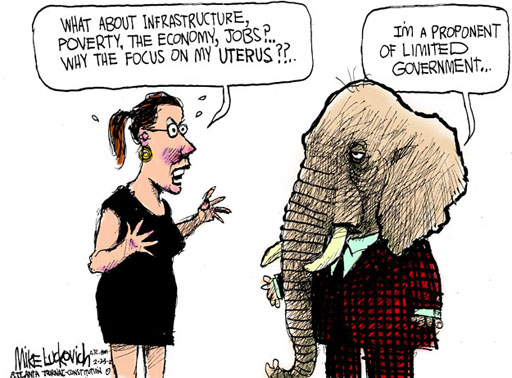
Cartoon from The Smoking Jacket.

How high gas prices are hurting
average drivers (and voters)

By Roger Baker / The Rag Blog / March 22, 2012

[This is the first of a two-part series.]

High gasoline prices are probably hitting the average driver and voter harder than most people think. The numbers indicate that typical adult wage earners, meaning average voters, are already being hit hard by a combination of a depressed economy and stagnant pay, while having little choice but to pay higher gas prices.

Income distribution and trends

The wage trends here show that average U.S. earned wages (with the average being distorted upwards by the high income end) have been almost stagnant since 2007. This means that if the bottom half of wage earners were hurting in 2008, they are probably still hurting about as much now.

Most people who own their homes have seen their homes, as their major investment, decline in value. Also most other savings and investments have not prospered, with interest rates on banked savings remaining at near zero. “Core inflation” is said to be only a few percent, but inflation is being officially underreported with non-discretionary prices, which are a bigger part of low income household budgets, rising faster than discretionary costs.

We see here that the median 2010 household income in the United States was about $50,000, with half of household total earnings less. We can also see a big household income bulge at the low income end, with the largest percentage of household incomes centered on about $20,000 total per household.


This shows how many must be struggling to drive when the cost of driving is considered. If we assume two adult wage earners in many households, this would mean that each would be earning or receiving through benefits only $10,000 on average. Perhaps this is due to the unemployment of one, or part time or minimum wage jobs, or relying on social security or pensions as their primary income.

If the household consists of a single mother with an income of $20,000 and a child or two, there are the added costs of raising children. Whatever the reason, car ownership is increasingly dependent on income for a large portion of U.S. households.

In 2008, the Brookings Institution provided further evidence that the lowest income third of the population in particular seems to be struggling to drive at all. See the chart showing the highly significant correlation between income and car ownership.


These numbers, although a few years old, indicate the degree that low income households live in an economic twilight zone, an income level where a major lifestyle barrier determines whether or not they can afford to own and maintain a car.

How does income compare with what it costs to drive?

Here we see that the typical cost of owning and driving a family car was nearly $8,800 in April 2011.

The average annual cost to own and operate a sedan in the USA, based on 15,000 miles of driving, rose 1.9 cents per mile to 58.5 cents per mile, or $8,776, says AAA’s 2011 “Your Driving Costs” study. The increased costs to own and operate a vehicle were driven mainly by large increases in fuel prices, depreciation costs and tire prices, says John Nielsen, AAA national director of auto repair, buying and consumer programs.

Below is an expanded five year chart of aggregate U.S. urban transportation costs, a Saint Louis Federal Reserve FRED chart. Transportation costs in U.S. urban areas, where most folks live, have now exceeded mid-2008 costs and are crowding out other living costs at the lower earnings end of the wage spectrum. We see the total cost of getting around in U.S. cities by all means (which means predominantly cars) rose rapidly to end 2011 at a new record high level.


This series is charted monthly, but stops in December 2011. Looking at fuel price increases since then, and judging from the impact of fuel prices in recent years, it appears that the current cost index would probably be nearly 230, assuming the graph were continued to show the effect on driving costs of the big fuel price increases in the first few months of 2012.

In other words, since April 2011 of last year, the cost of owning and driving a car has increased roughly by a ratio of 205 to 230, or about 12%. That means that if the total driving cost was almost $8,800 a year ago, the urban travel cost consisting mostly of cars would now have risen to roughly $10,000 on average.

A recipe for frustration

For the many households with about $20,000 in total income, there is likely at least one adult who would want to own a car and drive, much as adults in the wealthier households do. However, even if a wage earner earns $20,000 a year, the $10,000 cost of car ownership and maintenance would now require about half their income.

There is no way to avoid the conclusion that many wage earners at the lower end are struggling hard to pay for food and rent and still drive a car to work, and that higher driving costs are forcing them to shed cars. This probably accounts for the current political focus on gasoline prices.

Among people in the lower 50% of household income level, many of whom can manage to afford to drive, fuel price increases must necessarily involve difficult choices, with a strong tendency for fuel costs to crowd out and depress other spending. Once discretionary spending — like eating out and entertainment — has been eliminated, life becomes a matter of balancing frustrating choices.

For many, the cost of the fuel needed to commute to work in aging cars (who can afford a new electric car, as opposed to keeping the old one running as long as possible?) has become a symbolic high-profile political issue.

For lower income residents in particular, it is easy to see why fuel price increases have become a source of anger; a red flag for so many average voters. (Part 2 of this series will look at what the public opinion polls are saying, and how and why rising fuel prices are becoming such a hot topic for the upcoming presidential race).

A large part of the new residential housing in recent decades has been suburban in nature, assuming a lifestyle that almost demands the use of the private automobile. Suburban sprawl development on the fringe of U.S. cities has tended to be low density, non-mixed-use development. Such development is intrinsically hard to serve with transit when compared to the denser core city, which generates many more trips per mile of service.

This means that the end of cheap oil is bound to have a major impact on U.S. land use, and its habitation potential. (See “The End of Suburbia.”) Whereas poverty was previously concentrated in the core city while the suburbs were more affluent, the suburbs have now gotten poorer; most poverty is now in the suburbs.

In some areas, there are entire suburban neighborhoods full of abandoned homes. Many of the newer jobs have also moved out toward the suburbs. This means that getting to work increasingly requires commuting between suburbs to get from home to work, a type of travel which transit, by its nature, is ill-suited to handle very effectively.

Transit to the rescue? Yes, but not very fast, since it has been lacking significant new investment in recent decades. U.S. transit ridership peaked in 2008 and has since recovered modestly — but it has still not yet reached this previous peak.

Looking at the graph to the left at this link, it appears that the poor economy largely led to the 2009 ridership decline, while increasing fuel prices are now helping to lead to a modest U.S. transit rider recovery. 2011 transit ridership is now up about 2.3% over 2010. However in some areas harder hit by high gas prices and and a poor economy — like San Diego — transit use is up a lot more.

The trend of mass transit growing more and more “in” with the public can be seen all over the country. The American Public Transportation Association reports that Americans took 10.4 billion public transportation trips in 2011, the second-highest total since 1957. That figure is bettered only by 2008’s total, when gas prices soared to over $4 a gallon.

Transit faces several challenges, including a class-image problem, with so much U.S. suburban development being car-addictive by nature. In urban areas, those who use transit — and who are willing to trade the convenience of driving for the time savings benefit of public transit — are often identified as being among the poor. This often makes transit a hard sell politically.

The other problem is that transit — like roads — is unprofitable and requires a lot of public money up-front, especially for rail. Government money is increasingly in short supply these days. By the time the politics swings in favor of transit, as a result of peak oil and soaring fuel prices, transit might well be unaffordable.

Those left stranded in the suburbs can try to carpool, telecommute, combine or eliminate trips, or drive slower to save on gas. If all else fails, they can move to less gasoline-intensive locations. By last year a distinct home-buyer avoidance of suburbs with long commutes could be seen.

The other transportation option that appears to hold promise for preserving the habits of suburban commuters, struggling on a limited budget to drive, would appear to be the widespread acceptance of smaller personal vehicles like bicycles, electric bikes, motorbikes, and motorcycles, especially for commuting — and despite the risks that come with their use. There is good evidence that public support for downsized travel alternatives is steadily increasing, even electric motorcycles.

However, most suburban highways are not designed to safely accommodate slower or smaller vehicles. For example, TxDOT builds wide shoulders on its high-speed highways, supposedly for the benefit of bikes — despite the fact that the large speed differential makes bikes sharing lanes with cars unsafe when the cars are going more than 30 MPH. The evidence indicates that many drivers try to shift to motorcycles to save on fuel costs with sometimes deadly results.

Our findings suggest that people increasingly rely on motorcycles to reduce their fuel costs in response to rising gasoline prices. We estimate that use of motorcycles and scooters instead of 4-wheeled vehicles results in over 1,500 additional motorcycle fatalities annually for each dollar increase in gas prices. Motorcycle safety should receive more attention as a leading public health issue.

[Roger Baker is a long time transportation-oriented environmental activist, an amateur energy-oriented economist, an amateur scientist and science writer, and a founding member of and an advisor to the Association for the Study of Peak Oil-USA. He is active in the Green Party and the ACLU, and is a director of the Save Our Springs Association and the Save Barton Creek Association in Austin. Mostly he enjoys being an irreverent policy wonk and writing irreverent wonkish articles for The Rag Blog. Read more articles by Roger Baker on The Rag Blog.]

The Rag Blog

Posted in Rag Bloggers | Tagged , , , , , | 2 Comments

Rag Blog : Don’t Forget to Feed Your Head!

Art by Jim Franklin; poster by James Retherford / The Rag Blog.

‘Feed Your Head’ on April Fool’s Day:
Legendary Austin Bands at Rag Blog Bash

Go to the Facebook “Feed Your Head!” event page.

“Old Skool” will be in session on April Fool’s Day at Jovita’s in Austin, when The Rag Blog and Rag Radio invite you to “Feed Your Head.” A big slice of Austin music history will be on display at the event, which will feature performances by Shiva’s Headband, Greezy Wheels, and Jesse Sublett.

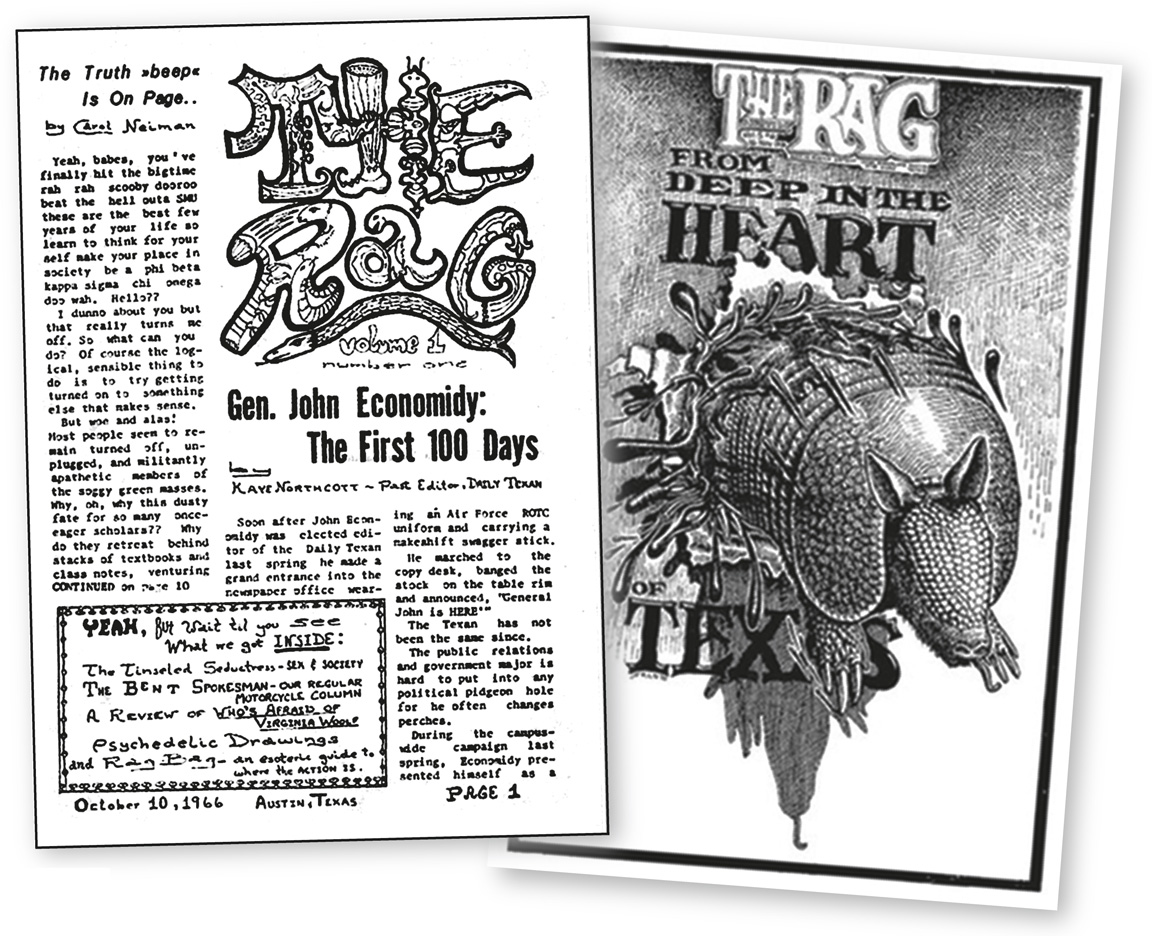
The event, scheduled for 6-9 p.m., April 1, at Jovita’s, 1619 S. First St. in Austin, will benefit The Rag Blog, an Austin-based progressive Internet news magazine, and Rag Radio, a weekly public affairs program broadcast on Austin’s KOOP 91.7-FM and hosted by Rag Blog editor Thorne Dreyer. The Rag Blog and Rag Radio trace their roots to Austin’s legendary underground newspaper, The Rag, which was published from 1966-1977 with Dreyer as its original editor.

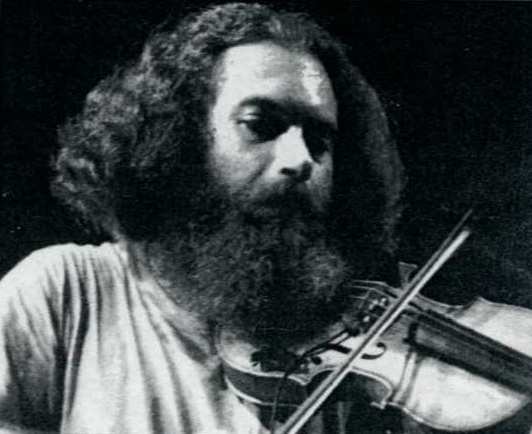
Psychedelic rockers Shiva’s Headband, founded in 1967 by Spencer Perskin, a classically trained violinist, was the house band at Austin’s Vulcan Gas Company, and was the first group to perform at Austin’s iconic Armadillo World Headquarters. Their album, Take Me to the Mountains, was the first nationally released album by an Austin rock band.

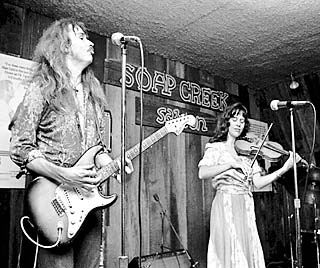
Pioneers of the “progressive country” movement in the 1970s, Greezy Wheels was for years the unofficial house band at the Armadillo. Guitarist and writer Cleve Hattersley and “fiddler extraordinaire” Mary Hattersley, led the group that, according to the Austin Chronicle’s Margaret Moser, “owned Austin” in the mid-70s.

Bassist Jesse Sublett -– also a mystery writer and artist — founded Austin’s legendary alt-punk band, The Skunks, which debuted at Austin’s Raul’s in 1978, and Sublett continued to be a mainstay on the Austin music scene.

A poster for the event, designed by James Retherford, features original art by Austin surrealist artist Jim Franklin, who, as house artist at the Armadillo World Headquarters, helped turn the lowly armadillo into an internationally recognized symbol for the Texas counterculture and whose artwork graced the landmark Shiva’s album, Take Me to the Mountains.

Proceeds from the event benefit the New Journalism Project, a Texas 501(c)(3) nonprofit corporation that publishes The Rag Blog and produces Rag Radio. Suggested donation is $10. Limited edition Jim Franklin posters and special Rag Blog t-shirts will be available. Jovita’s has a full bar and food menu.

The Rag Blog, founded in 2006 after a reunion of staffers from the original Rag, has become a force in the progressive blogosphere and receives 50,000 unique visits a month. Rag Radio features hour-long in-depth interviews with newsmakers, artists, and leading thinkers. Broadcast Fridays from 2-3 p.m. (CDT) on KOOP 91.7-FM in Austin, it is also rebroadcast on Sundays at 10 a.m. (Eastern) by WFTE-FM in Mt. Cobb and Scranton, PA, and also streams live, with a widespread internet audience.

The Rag Blog

Posted in RagBlog | Tagged , , , , , , , , , , , | Leave a comment

RAG RADIO / Thorne Dreyer : David Bacon on U.S. Policies and the Great Mexican Migration

Journalist, author, and long-time labor organizer David Bacon.

Rag Radio:
David Bacon discusses how U.S. policies
fueled the great Mexican migration

By Rag Radio / The Rag Blog / March 21, 2012

Noted journalist, author, documentary photographer, and long-time labor organizer David Bacon was Thorne Dreyer’s guest on Rag Radio, Friday, March 16, 2012, on Austin community radio station KOOP-FM and streamed live on the Internet.

You can listen to the show here:


Bacon discussed the issues raised in his provocative and heavily-researched article, “How U.S. Policies Fueled the Great Mexican Migration,” which was reported in partnership with The Investigative Fund at The Nation and the Puffin Foundation and which was also published on The Rag Blog.

On Rag Radio, Bacon discussed the role of companies like Smithfield Foods in immigrant displacement, environmental abuse, and the struggle of oppressed workers fighting to overcome intolerable conditions — especially in the Perote Valley of the Mexican state of Veracruz, and in Smithfield’s plant in Tar Heel, North Carolina, the world’s largest pork slaughterhouse. And he shows how the struggles in Veracruz and North Carolina are critically interrelated.

Bacon wrote that “the experience of Veracruz migrants reveals a close connection between U.S. investment and trade deals in Mexico [especially through NAFTA] and the displacement and migration of its people.”

Now based in California, David Bacon was a union organizer for two decades, and today documents the changing conditions in the workforce, the impact of the global economy, war and migration, and the struggle for human rights. His books include Illegal People: How Globalization Creates Migration and Criminalizes Immigrants, The Children of NAFTA, and Communities Without Borders.

He belongs to the Pacific Media Workers Guild and the CWA, was an organizer of the Free South Africa Labor Committee and the Labor Immigrant Organizers Network, and was board chair of the Northern California Coalition for Immigrant Rights.

David Bacon previously appeared on Rag Radio on September 7, 2010, and you can listen to the podcast of our earlier interview here.

Rag Radio is hosted and produced by Rag Blog editor and long-time alternative journalist Thorne Dreyer, a pioneer of the Sixties underground press movement. Tracey Schulz is the show’s engineer and co-producer. You can listen to podcasts of all Rag Radio shows at the Internet Archive.

The Rag Blog

Posted in RagBlog | Tagged , , , , , , , | Leave a comment

Ken Handel : Father Still Knows Best

Father knew best back then (Robert Young and Lauren Chapin from the hit television, sitcom, Father Knows Best, 1959), and apparently still does. Image from Wikimedia Commons.

Father still knows best

U.S. women earn less, have minimal leadership clout, and are often targeted.

By Ken Handel | The Rag Blog | March 21, 2012

One of the most famous documents in human history declares, “We hold these truths to be self-evident, that all men are created equal, that they are endowed by their Creator with certain unalienable Rights, that among these are Life, Liberty and the pursuit of Happiness.”

It’s not so well-known that the Declaration of Independence excluded women (and Indians, the poor, and slaves).

Howard Zinn, in A People’s History of the United States, says that Thomas Jefferson, the Declaration’s author, did not mean to slight women. “It was just that women were beyond consideration as worthy of inclusion. They were politically invisible.”

The invisibility of women continues to this day. Although American women gained the right to vote with the passage of the 19th Amendment in 1920, the Center for American Women and Politics shows that women make up only 18.8% of the U.S. Congress. In state legislatures, 23.6% are women. Just six governors are female. The census documents that women outnumber men in the United States.

Judges too — as detailed by Catalyst — are overwhelmingly male: 77% on the federal level and 73% in state courts. In 2010, 31.5% of the nation’s attorneys were female.

In business, a USA Today headline proclaimed in 2011: “Number of female ‘Fortune’ 500 CEOs at record high.” Women are CEOs of 18 companies among the nation’s’ 500 largest corporations.

According to the Center for Studying Health Systems Change, in 2008 almost three-quarters of U.S. physicians were male.

A rising tide of misogyny

Many American women must cope with daily physical danger. The U.S. Department of Justice’s National Crime Victimization Survey says there were 188,380 rapes and sexual assaults on women in 2010.The Centers for Disease Control in 2011 estimated that 4,741,000 women suffered from intimate-partner physical violence in a 12-month period.

Nonviolent aggression is also commonplace. Rush Limbaugh precipitated a national firestorm when he insulted Sandra Fluke — a Georgetown University law student, who had testified before Congress on contraception — as a “prostitute” and “slut.”

In Virginia, Governor Robert F. McDonnell was forced by political criticism and satire to amend a law that had required every Virginia woman seeking an abortion to undergo an invasive transvaginal ultrasound. McDonnell retreated, but signed a law passed by the legislature — 19.3% female representation — mandating a noninvasive ultrasound. Democratic Senator Ralph Northam, the only physician in the Virginia Senate, described the law as “a tremendous assault on women’s health care and a tremendous insult to physicians.”

Writing at Politico, former Michigan Governor Jennifer Granholm calls the attacks on women’s reproductive issues “sexual McCarthyism.” She charges that since “the election of 2010 that saw Republicans gain control of state Legislatures across the country, more than 1,100 anti-choice laws were introduced in 2011 — a new record. Eighty-three measures have been passed into law. So far in 2012, an additional 430 were introduced.”

As if to confirm this charge, The Washington Post, in late March 2012, reported that the Tennessee House — 99 total members, 17 women — was considering a law requiring “the online publication of the names of doctors who perform abortions…”

Making a bad situation worse is a shortage of ob-gyns. Parents Magazine reported that, “According to the American College of Obstetricians and Gynecologists, almost half the country — 22 states — […are] now in “Red Alert” crisis mode, meaning that the number of ob-gyns is not sufficient to meet patients’ needs.”

Furthermore, as divulged by Obstetrics and Gynecology, “A whopping 97% of practicing ob-gyns had encountered patients seeking abortion, yet only 14% of ob-gyns perform them… Male ob-gyns are less likely to provide abortions, as are middle-age ones. If you live in a rural area, you’re very unlikely to find an ob-gyn who will provide an abortion.”

The current offensive extends to contraception. Salon quotes Republican Presidential candidate Rick Santorum as saying: “Many of the Christian faith have said, well, that’s okay, contraception is okay. It’s not okay. It’s a license to do things in a sexual realm that is counter to how things are supposed to be.”

The National Center for Health Statistics shows how radical Santorum’s views are: 61.8% of American women in their child-bearing years (15-44) use contraception, with birth-control pills being the most popular method (29.1%).

Another Republican bogeyman is Planned Parenthood. Governor Granholm describes the level of antipathy this organization faces: “[In Texas] Gov. Rick Perry and the 80 percent male state Legislature….. would forgo $35 million in federal funding to keep Planned Parenthood from getting one dime of it. Eleven Planned Parenthood clinics have shut down. This comes even though Texas already bars clinics that take such money from performing abortions.”

This jihad is inspired by Planned Parenthood‘s provision of abortion services. But these comprise a miniscule portion — three percent — of what the organization offers its patients. In 2009-2010, Planned Parenthood treated nearly three million individuals and provided “…affordable birth control for more than two million patients, 770,000 Pap tests, nearly 750,000 breast exams, and more than four million tests for STDs, including HIV tests.”

Yet there are reasons to be optimistic.

Time Magazine describes a new phenomenon: women earning more than men. “…in 147 out of 150 of the biggest cities in the U.S., the median full-time salaries of young women are 8% higher than those of the guys in their peer group. In two cities, Atlanta and Memphis, those women are making about 20% more.”

These top earners are urban, single, childless, and in their 20s; most important, they are highly educated. “Today,” The New York Times has reported, “women earn almost 60 percent of all bachelor’s degrees and more than half of master’s and Ph.D.’s.”

Women also will be a key factor in the upcoming presidential election. A Pew Research Center poll showed that if an election were held in March 2012 between President Barack Obama and Governor Mitt Romney (“Planned Parenthood — we’re going to get rid of that.”), 58% of women would prefer the President, while 38% would support Romney.

[Rag Blog contributor Ken Handel is a freelance writer and editor. This article was also posted at Suite101.]

The Rag Blog

Posted in Rag Bloggers | Tagged , , , , , , | 3 Comments

How high gas prices are hurting average drivers — and voters

By Roger Baker / The Rag Blog /

High gasoline prices are probably hitting the average driver and voter harder than most people think. The numbers indicate that typical adult wage earners, meaning average voters, are already being hit hard by a combination of a depressed economy and stagnant pay, while having little choice but to pay higher gas prices.

Income distribution and trends

The wage trends here show that average U.S. earned wages (with the average being distorted upwards by the high income end) have been almost stagnant since 2007. This means that if the bottom half of wage earners were hurting in 2008, they are probably still hurting about as much now.

Most people who own their homes have seen their homes, as their major investment, decline in value. Also most other savings and investments have not prospered, with interest rates on banked savings remaining at near zero. “Core inflation” is said to be only a few percent, but inflation is being officially underreported with non-discretionary prices, which are a bigger part of low income household budgets, rising faster than discretionary costs.

We see here that the median 2010 household income in the United States was about $50,000, with half of household total earnings less. We can also see a big household income bulge at the low income end, with the largest percentage of household incomes centered around about $20,000 total per household.

[Insert HouseholdIncomes graphic here]

This shows how many must be struggling to drive when the cost of driving is considered. If we assume two adult wage earners in many households, this would mean that each would be earning or receiving through benefits only $10,000 on average. Perhaps this is due to the unemployment of one, or part time or minimum wage jobs, or relying on social security or pensions as their major income. If the household is a single mother with an income of $20,000 and a child or two, there are added costs of raising children. Whatever the reason, car ownership is increasingly dependent on income for a large portion of U. S. households.

In 2008, the Brookings Institution provided further evidence that the lowest income third of the population in particular seems to be struggling to drive at all. See the chart showing the highly significant correlation between income and car ownership.

Insert CarlessIncomes graphic here]

These numbers, although a few years old, indicate the degree that low income households live in an economic twilight zone, an income level where a major lifestyle barrier is whether or not they can afford to own and maintain a car.

How does income compare with what it costs to drive?

Here we see that the typical cost of owning and driving a family car was nearly $8800 in April 2011.

The average annual cost to own and operate a sedan in the USA, based on 15,000 miles of driving, rose 1.9 cents per mile to 58.5 cents per mile, or $8,776, says AAA’s 2011 “Your Driving Costs” study. The increased costs to own and operate a vehicle were driven mainly by large increases in fuel prices, depreciation costs and tire prices, says John Nielsen, AAA national director of auto repair, buying and consumer programs.

Attached is an expanded five year chart of aggregate U.S. urban transportation costs, a Saint Louis Federal Reserve FRED chart. Transportation costs in U.S. urban areas, where most folks live, have now exceeded mid-2008 costs and are crowding out other living costs at the lower earnings end of the wage spectrum. We see the total cost of getting around in US cities by all means (which means predominantly cars) rose rapidly to end 2011 at a new record high level.

[Insert urban driving cost graphic here]

This series is charted monthly, but stops in December 2011. Looking at fuel price increases since then, and judging from the impact of fuel prices in recent years, it appears that the current cost index would probably now be nearly 230, assuming the graph were continued to show the big fuel price increases in the first few months of 2012 on driving costs. In other words, since April 2011 of last year, the cost of owning and driving a car it has increased roughly by a ratio of 205 to 230, or about 12%. That means that if the total driving cost almost $8800 a year ago, the urban travel cost made of mostly of cars would now have risen to roughly $10,000 on average.

A recipe for frustration

For the many households centered around $20,000 in total income, there is likely at least one adult who would probably want to own a car and drive, much as adults in the wealthier households do. However, even if a wage earner earns $20,000 a year, the $10,000 cost of car ownership and maintenance would now require about half their income. There is no way to avoid the conclusion that many wage earners at the lower end are struggling hard to pay for food and rent and still drive a car to work, and that higher driving costs are forcing them to shed cars. This probably accounts for the current political focus on gasoline prices.

Among the lower 50%of household income level, many of whom can manage to afford to drive, fuel price increases must necessarily involve difficult choices, with a strong tendency for fuel costs to crowd out and depress other spending. Once discretionary spending like eating out and entertainment have been eliminated, life becomes a matter of balancing frustrating choices. For many, the cost of the fuel needed to commute to work in their aging cars (who can afford a new electric car, as opposed to keeping the old one running as long as possible?) has become a symbolic high profile political issue. For lower income residents in particular, it is easy to see why fuel price increases have become a source of anger; a red flag for so many average voters. (Part 2 of this series will look at what the public opinion polls are saying, and how and why rising fuel prices are such a hot topic in the upcoming presidential race).

A large part of the new residential housing in recent decades has been suburban in nature, assuming a lifestyle that almost demands the use of the private automobile. Suburban sprawl development on the fringe of U.S. cities has tended to be low density, non-mixed use development. Such development is intrinsically hard to serve with transit when compared to the denser core city, which generates many more trips per mile of service. This means that the end of cheap oil is bound to have a major impact on U.S. land use, and its habitation potential. See “The End of Suburbia.” Whereas it once was the case that poverty was concentrated in the core city while the suburbs were more affluent, the suburbs have now gotten poorer; most poverty is now in the suburbs. In some areas, there are entire suburban neighborhoods full of abandoned homes. Many of the newer jobs have also moved out toward the suburbs. This means that getting to work increasingly requires commuting between suburbs to get from home to work, a type of travel which transit is ill-suited by its nature to handle very effectively.

Transit to the rescue? Yes, but not very fast, since it has been lacking much new investment in recent decades. U.S.transit ridership reached a 2008 peak and has since recovered modestly but it has still not yet reached this previous peak. Looking at the graph to the left at this link, it appears that the poor economy largely led to the 2009 ridership decline, while increasing fuel prices are now helping to lead to a modest U.S. transit rider recovery. 2011 transit ridership is now up about 2.3% over 2010. However in some areas harder hit by high gas prices and and a poor economy like San Diego, transit use is up a lot more.

The trend of mass transit growing more and more “in” with the public can be seen all over the country. The American Public Transportation Association reports that Americans took 10.4 billion public transportation trips in 2011, the second-highest total since 1957. That figure is bettered only by 2008’s total, when gas prices soared to over $4 a gallon.

Transit faces several challenges. One challenge is that transit has an class image problem, because of so much U.S. suburban development is car-addictive by nature. In many urban areas, those who use transit are seen as those among the poor who are willing to trade their time for the convenience of driving. This often makes transit a hard sell politically. The other problem is that transit, like roads, is unprofitable and requires a lot of public money up-front, especially for rail. Government money is increasingly in short supply these days. By the time the politics swings in favor of transit due to peak oil and soaring fuel prices, the transit might well be unaffordable.

Those left stranded in the suburbs can try to carpool, telecommute, combine or eliminate trips, or drive slower to save on gas. If all else fails, they can try to move to a less gasoline-intensive locations. By last year a distinct home-buyer avoidance of suburbs with long commutes could be seen. The other transportation option that appears to hold promise of preserve the habits of suburban commuters, struggling on a limited budget to drive would appear to be the widespread acceptance of smaller personal vehicles like bicycles, electric bikes, motorbikes, motorcycles and the like, especially for commuting, and despite the risks. There is good evidence that public support for downsized travel alternatives is steadily increasing, even electric motorcycles.

However, most suburban highways are not designed to safely accommodate slower or smaller vehicles. For example, TxDOT builds wide shoulders, supposedly for the benefit of bikes on its high speed highways, this despite the fact that the large speed differential makes bikes sharing lanes with cars unsafe when the cars are going more than 30 MPH. The evidence indicates that many drivers try to shift to motorcycles to save on fuel costs with deadly results.

Our findings suggest that people increasingly rely on motorcycles to reduce their fuel costs in response to rising gasoline prices. We estimate that use of motorcycles and scooters instead of 4-wheeled vehicles results in over 1500 additional motorcycle fatalities annually for each dollar increase in gas prices. Motorcycle safety should receive more attention as a leading public health issue.

Type rest of the post here

Source

The Rag Blog

Posted in RagBlog | Leave a comment

Alice Embree : Women are ‘Seeing Red’ in Texas

“Seeing Red” organizer Marcia Ball, center, with Emily Haas, left, and novelist Sarah Bird at the Texas State Capitol. Photo by Susan Crews Bailey / Facebook.

‘Seeing Red’: The Texas Taliban’s war on women

By Alice Embree | The Rag Blog | March 21, 2012

“Reproductive health care for well over a hundred thousand women in Texas has just been revoked by the state legislature. They were egged on by the hapless Rick Perry in a move so dunderheaded and thick with ignorance that his performance in the presidential primaries looks studious and reasoned by comparison.” — Actress Beth Broderick, a participant in the ‘Seeing Red’ demonstrations at the Texas State Capitol, writing at The Huffington Post.

AUSTIN — On Friday, March 2, Marcia Ball, singer-songwriter and blues pianist extraordinaire, sent an e-mail broadside out to friends: “Subject: I’m so mad I’m SEEING RED.”

“What the heck’s happening with our poor country?!” she asked. “Who knew that in 2012 in the USA we would be fighting about contraception and basic women’s health?”

Marcia Ball said she would be in front of the Texas State Capitol on consecutive Tuesdays, March 6, 13, and 20, to protest the “Texas Taliban’s war on women.” Marcia Ball also wanted to honor Marie Colvin, the reporter who recently died in Syria, and Molly Ivins, the Texas writer who mastered the art of lampooning “Governor Goodhair” Rick Perry before the nation was treated to Perry’s self-lampooning performance in primary debates.

“Spread the word,” Marcia Ball said. And indeed the word spread. A couple hundred people showed up in red shirts on March 6, and footage of the event aired on Rachel Maddow’s MSNBC show. On March 13, a group showed up at the noon hour and then swelled the ranks of a “Don’t Mess With Texas Women” rally later in the day. About 800 were present at the rally that featured Cecile Richards of Planned Parenthood and singers Ball, Carolyn Wonderland, Jimmy Dale Gilmore, and Colin Gilmore.

Rag Blog contributing editor Alice Embree had an essay in the landmark 1970 women’s liberation anthology, Sisterhood is Powerful. Photo by Leslie Cunningham / The Rag Blog.

The all-out conservative assault on Planned Parenthood and its many health services seems to be the “straw that broke the camel’s back” for women. We’ve become sadly accustomed to the mounting restrictions on abortions. The Republican-controlled Texas Legislature approved an abortion bill in its last session similar to the one now in effect in Virginia, requiring physicians to provide a sonogram before performing an abortion.

But the war on access — particularly low-income access — to contraception, pap smears, and mammograms is new conservative ground. Add to this mix the inflammatory statements of certain radio blowhards equating the use of contraception to prima facie evidence of sluthood, and we’re “seeing red.”

Although Marcia Ball will be touring and can’t be present next Tuesday, March 27, the sea of red shirts that she provoked doesn’t seem inclined to stay home.

[Alice Embree is a long-time Austin activist, organizer, and member of the Texas State Employees Union. A former staff member of underground papers, The Rag in Austin and RAT in New York, and a veteran of SDS and the women’s liberation movement, she is now active with CodePink Austin and Under the Hood Café. Embree is a contributing editor to The Rag Blog and is treasurer of the New Journalism Project. Read more articles by Alice Embree on The Rag Blog.]

Sign the “Seeing Red” petition to “Save Women’s Health Care in Texas,” at change.org.

Photos by Alice Embree / The Rag Blog.

The Rag Blog

Posted in Rag Bloggers | Tagged , , , , , | 3 Comments

Bernardine Dohrn and Bill Ayers : Chicago’s Growing Resistance to NATO Summit

Protest against NATO in Strasbourg on April 4, 2009. Photo by Jos van Zetten / Flickr / Wikimedia Commons.

Resistance builds:
NATO coming to Chicago

Organizers and supporters will use humor and music, art and play, civil disobedience and imagination to voice their rejection of permanent imperial wars and the many forms of violence that arise from the same paradigm.

By Bernardine Dohrn and Bill Ayers / Truthout | March 20, 2012

The leaders of the North Atlantic Treaty Organization (NATO), the gently named but dangerous behemoth dominated by the United States — and history’s largest global military cohort — plan to meet in Chicago on May 20 and 21.

The tiny fraternity of concentrated wealth and power that calls itself the Group of Eight (G8) was to have met in Chicago in mid-May as well, overlapping with NATO. Fearing massive protests, the G8 cancelled, retreating to Camp David, Maryland, chased out of town by a coalition of dissidents, activists and agitators.

Isolated and inaccessible, Camp David is where the “leaders” of the planet’s eight wealthiest countries belong — sequestered and remote, barricaded and cut off in every imaginable way. The Camp David move illuminates the elite’s isolation from the people they pretend to represent.

By the same token, NATO — a military alliance of 28 countries — is the only major intergovernmental body without a basic information disclosure policy. It’s a closed cabal with an active PR front and zero engagement with the public it claims to protect.

From their separate berths, NATO and the G-8’s heads of state, intelligence personnel, foreign ministers and generals, cabinet members and secret operatives, advisors and bureaucrats — the 1 percent of the 1 percent — will conspire to extend and defend their obscene wealth, to exploit the remaining fossil fuels, natural resources, human labor, and the living planet to the last drop, and to dominate the people of the global majority.

A People’s Primer on NATO

On NATO’s official web site, a white dove flutters across an elegant page, but soon enough, it moves to images of helicopters and fighter planes menacing the world under the facade of peace.

“NATO forces” are referenced constantly, and yet the reality of NATO is obscure and enigmatic.

U.S. military spending alone accounts for nearly half of the world’s military spending; add NATO countries, and the figure jumps to three quarters.Under cover of NATO, 9,000 British troops were deployed to fight a U.S. war in Afghanistan, offering a fig leaf presented as “coalition forces” to U.S. military aggression.

Purportedly set up as a defensive organization, in 1999 NATO’s mission statement was rewritten to allow for offensive action across the Eurasian landmass. Since 1999, NATO has waged war in four countries on three continents, none of which are near the North Atlantic region: in Southeast Europe’s Yugoslavia, North Africa’s Libya, and Central and South Asia’s Afghanistan and Iraq.

NATO retains hundreds of nuclear weapons in military facilities across Europe, an end-run around the nuclear Non-Proliferation Treaty (NPT), which forbids the transfer of nuclear weapons to non-nuclear countries. England is required by the NPT to work toward nuclear disarmament; instead, its nuclear weapons system has been hidden under NATO since the 1960s, a set-up that means its nuclear weapons could be used against any country attacking, or threatening to attack, any of NATO’s member states.

Between 150 and 240 U.S. nuclear weapons are sited in five European countries. These are B61 gravity bombs — tactical nuclear weapons — which are more flexible and easier to use in a battlefield and have a variable explosive power exceeding, at their upper limits, the power of the Hiroshima atomic bomb by more than a factor of 10.

NATO’s preemptive “first strike” doctrine is a menacing presence across the planet; its Active Layered Theatre Ballistic Missile Defense (ALTBMD) is the latest successor to Reagan’s Star Wars plan. Russia recently signed on and will be on the U.S. side of the space shield, erected against some other states — perhaps Iran, perhaps China — promoted to the status of “enemy.”

Anti-war rally in Chicago, Oct. 8, 2011. Photo by misterbuckwheattree / Chicagoist.

Municipal militarism protects global militarism

A 1984-style national security dragnet is set to descend on Chicago in an attempt to lock the city down during the NATO summit. Mayor Rahm Emanuel has made it clear that he will happily act as the host of NATO — and that the 99 percent are not welcome. Emanuel is concocting a culture of fear, suggesting that it is the growing human resistance to NATO that represents danger, outside agitators, violence, and invasion.

Universities and schools are being urged to close early in May; communities of color are told that NATO’s work is not their concern; merchants are preparing for assault from the dissenting masses. But NATO, and their G8 friends in hiding, are the real masters of war; it is they who are the greatest purveyors of violence on this earth.

It is unsurprising, then, that Emanuel has funding to further arm and mobilize the police and militarize the city. The Mayor has announced plans to contain and suppress demonstrators. He has pushed through legislation that restricts and criminalizes free speech and assembly and requires costly insurance for public demonstrations. He is issuing a steady stream of pronouncements about a fabricated Chicago, which he says is under siege from ominous and dangerous outside forces.

The mayor, not the popular resistance, is creating conditions — once again — for a police riot in Chicago against people exercising their right to peaceful dissent. Emanuel can still change course, and he should; so far, he has chosen to frame the coming convergence of protesters and the powerful solely in military and security terms.

Join the Coalition/Come to Chicago

Chicago is big enough for all — it is after all a nuclear-free and cease-fire city, cradle of the Haymarket martyrs and the eight-hour day, labor and peace actions, vast civil rights and immigration rights manifestations, home of Ida B. Wells Barnett, Jane Addams, Richard Wright, Gwendolyn Brooks, and Studs Terkel.

Chicago is a vast public space with historic parks, monuments, neighborhoods and streets for popular mobilzations — Chicago belongs to all of us. We underline the right — the moral duty — to dissent and demonstrate, to resist and to be heard, to participatory (not billionaire paid-for) democracy.

The festival of NATO counter-summits, protests, and family-friendly permitted marches planned for May are the next chapter. Organizers and supporters will use humor and music, art and play, civil disobedience and imagination to voice their rejection of permanent imperial wars and the many forms of violence that arise from the same paradigm: discrimination and hate based on race, gender, and ethnicity; epic income disparity; mass incarceration; inadequate resources for education, health care, and opportunities for meaningful work.

Music, dance, teach-ins, and peoples’ tribunals will overflow the parks and theatres. The protests are in the spirit of the Arab Spring, Occupy, and the Madison labor struggle, drawing equal inspiration from the work of many others: the Pelican Bay hunger strikers, teachers and nurses, the undocumented DREAMers, returning veterans against the wars, women insisting on reproductive dignity, people resisting foreclosures/take-back-the-landers,, those working for LGBTQ equality and more.

People from everywhere will bring their spirits and their creativity, pitch their tents and stake their claims. Join us!

Friday, May 18: National Nurses United Rally, Daley Center Plaza.
Sunday, May 20 (morning): Iraq Veterans Against the War Rally and March.
Sunday, May 20 (afternoon): Coalition Against NATO-G8 Poverty Agenda (CANG8) Rally and March, Downtown Chicago.

[William Ayers is Distinguished Professor of Education and Senior University Scholar at the University of Illinois at Chicago. Bernardine Dohrn is Clinical Associate Professor of Law and Director and founder of the Children and Family Justice Center at Northwestern University. Both Ayers and Dohrn were leaders in SDS and the New Left, and were founders of Weatherman and the Weather Underground. This article was published at Truthout and was posted to The Rag Blog by its authors. Find more articles by and about Bill Ayers and Bernardine Dohrn on The Rag Blog.]

The Rag Blog

Posted in Rag Bloggers | Tagged , , , , , , | Leave a comment

Lamar W. Hankins : Satire and the Abortion-Rights Deniers

Garry Trudeau’s controversial series of Doonesbury cartoons satirized the Texas sonogram law.

Taking on the abortion-rights
deniers with satire

No other right, except for perhaps the right to organize a union, has been under such assault in the U.S.

By Lamar W. Hankins | The Rag Blog | March 20, 2012

The abortion-rights deniers have worked tirelessly for 36 years to make abortion uncomfortable, shameful, difficult, painful, and exhausting, if not impossible.

By driving health facilities that provide abortions out of business through regulations and legal hurdles too high to jump over, their work has prevented many women from exercising their right to terminate an unwanted pregnancy. When that didn’t work well enough, they tried murdering a few doctors and health-care providers (seven to date) who provided the medical expertise necessary to accomplish safe abortions.

No other right, except for perhaps the right to organize a union, has been under such assault in the U.S. When the abortion deniers realized that the right to privacy guaranteed to every woman the right to decide not to carry a pregnancy to term, they set about to undermine the right to an abortion in any way possible, including by passing laws that allow doctors to withhold medical information about the condition of the fetus (such as those laws introduced in Arizona and Kansas).

I don’t know a single person who advocates abortion, which is how the abortion-right deniers like to characterize the position of those people who believe that a decision to terminate a pregnancy is one made by each individual based on her own circumstances and health care needs.

I do not advocate abortion, but I do advocate the right of a pregnant woman to make that decision for herself, unencumbered by the religious and moral beliefs of the rest of us, and without being subjected to the authoritarian views of some others.

The abortion-right deniers, on the other hand, have bombed and burned health clinics; they have intimidated women going to clinics for reproductive health services of all sorts (including abortion); they have committed acts of vandalism; they have stalked and assaulted pregnant women; they have tricked pregnant women into not showing up for appointments; they have falsely advertised anti-abortion clinics as family planning clinics; they have made the procedure more expensive for women and their health care providers; they have had abortion doctors prosecuted for performing abortions; and then they hit on the current strategy of legislating against abortion at the state level.

The abortion-right deniers tried laws that delay abortion, like waiting periods, but this was not effective enough. A few years ago, they were satisfied to require women to view a sonogram image of the fetus before having an abortion. Recently, they hit on the idea of requiring an intravaginal ultrasound, an invasive procedure that some have likened to legal rape because it requires by government mandate that a medical instrument be inserted into a woman’s vagina against her will.

The cartoon Doonesbury, written and drawn by Gary Trudeau, has taken on this latest tactic of the abortion-right deniers, satirically depicting a woman seeking to terminate a pregnancy, who is instructed to wait in a “shaming room” where “a middle-aged, male state legislator” will introduce her to the procedure to make sure that she hears the heartbeat of the fetus and sees the body parts that can be identified, or hear them described to her.

Trudeau’s characters call the medical devices “ten-inch shaming wands,” and the doctor performing the procedure says “By the power invested in me by the GOP base, I thee rape.” Trudeau skillfully lampoons the GOP plan to create a “shame spiral” that may cause a pregnant woman to change her mind about having an abortion.

But cartoons are not the only means for taking satirical aim at these absurd, unnecessary, tyrannical, dispiriting, and intrusive laws. Some state legislators have struck back by proposing laws that make having a child a bit more of an equal responsibility for men, and make receiving certain health services used primarily by men just as uncomfortable for them as the intravaginal ultrasounds are for women, who are compelled to endure them to receive what is their right under the Constitution.

Last year, in Texas, Rep. Harold Dutton thought that the man responsible for creating a pregnancy with any woman who changed her mind about seeking an abortion after viewing an ultrasound image of the fetus should have to pay the child’s college tuition. When that proposal failed, he proposed that the father should have to subsidize the child’s health care costs until age 18. When that idea didn’t fly with the legislators, Rep. Dutton lowered the age to six, with the same result.

In Delaware, a state senator’s bill requiring rectal exams and cardiac stress tests for men seeking prescriptions for erectile dysfunction was narrowly defeated.

After Georgia’s house considered a bill banning abortions for women 20 weeks or more pregnant, a female representative proposed a bill prohibiting vasectomies because they leave “thousands of children… deprived of birth.”

A state senator in Ohio thought that special regulations were needed to protect men who sought prescription drugs for impotency. Had her bill passed, such men would have had to submit to psychological screenings. As Sen. Nina Turner explained, “We must advocate for the traditional family and ensure that all men using (impotence drugs) are healthy, stable, and educated about their options — including celibacy as a viable life choice.”

A state representative in Illinois had a different idea about how to educate men seeking Viagra to relieve their impotence. Under the bill, such patients would have had to watch a video showing the alarming treatment for persistent erections — those lasting four hours or more.

Nine female lawmakers in Missouri became concerned about an elective medical procedure available only to men after the legislature voted to reject the President’s contraceptive coverage mandate. They co-sponsored a bill restricting access to vasectomies unless a patient seeking a vasectomy risks death or serious bodily harm without the procedure.

The bill provided that, “In determining whether a vasectomy is necessary, no regard shall be made to the desire of a man to father children, his economic situation, his age, the number of children he is currently responsible for, or any danger to his wife or partner in the event a child is conceived.”

When Oklahoma’s state senate tried to declare zygotes persons to be protected under Oklahoma law, Sen. Constance Johnson introduced an amendment that would have declared ejaculating anywhere except in a woman’s vagina as “an action against an unborn child.” The Senator also suggested the need for a law that would require any man who impregnates a woman without her permission to pay a $25,000 fine, support the child until it reaches the age of 21, and get a vasectomy. She saw this as needed “in the spirit of shared responsibility.”

A colleague proposed a provision that would require the father of a child conceived without permission of the mother to be financially responsible for the mother’s health care, housing, transportation, and nourishment during the pregnancy.

There is little doubt that these proposals were as intentionally and equally ridiculous as the ideas that gave rise to them — ideas that would have subjected pregnant women to unconscionable requirements intended only to interfere in the exercise of their constitutional right to terminate an unwanted pregnancy no matter what the circumstances.

As the Daily Koz put it, discussing changes in Arizona’s laws about women seeking a full range of health care services:

Arizona is the latest state to decide that womenfolk need closer supervision when it comes to their own health choices; they’re even upping the ante by proposing that individual employers ought to be able to monitor the ostensible morality of women employees themselves. That’s, um, nuts.

To understand the cruelty of the requirements of government interference with the decision to terminate a pregnancy, read this account in the March 15, 2012, Texas Observer. Carolyn Jones explains her situation and what Texas’ new sonogram law meant for her:

Halfway through my pregnancy, I learned that my baby was ill. Profoundly so. My doctor gave us the news kindly, but still, my husband and I weren’t prepared. Just a few minutes earlier, we’d been smiling giddily at fellow expectant parents as we waited for the doctor to see us. In a sonography room smelling faintly of lemongrass, I’d just had gel rubbed on my stomach, just seen blots on the screen become tiny hands. For a brief, exultant moment, we’d seen our son — a brother for our 2-year-old girl.

Yet now my doctor was looking grim and, with chair pulled close, was speaking of alarming things… My husband looked angry, and maybe I did too, but it was astonishment more than anger. Ours was a profound disbelief that something so bad might happen to people who think themselves charmed. We already had one healthy child and had expected good fortune to give us two.

Instead, before I’d even known I was pregnant, a molecular flaw had determined that our son’s brain, spine and legs wouldn’t develop correctly. If he were to make it to something our doctor couldn’t guarantee — he’d need a lifetime of medical care. From the moment he was born, my doctor told us, our son would suffer greatly.

…It felt like a physical blow to hear that word, abortion, in the context of our much-wanted child. Abortion is a topic that never seemed relevant to me; it was something we read about in the news or talked about politically; it always remained at a safe distance. Yet now its ugly fist was hammering on my chest…

[T]he young woman… told me reluctantly about the new Texas sonogram law that had just come into effect. I’d already heard about it. The law passed last spring but had been suppressed by legal injunction until two weeks earlier.

My counselor said that the law required me to have another ultrasound that day, and that I was legally obligated to hear a doctor describe my baby. I’d then have to wait 24 hours before coming back for the procedure. She said that I could either see the sonogram or listen to the baby’s heartbeat, adding weakly that this choice was mine.

“I don’t want to have to do this at all,” I told her. “I’m doing this to prevent my baby’s suffering. I don’t want another sonogram when I’ve already had two today. I don’t want to hear a description of the life I’m about to end. Please,” I said, “I can’t take any more pain.”

I confess that I don’t know why I said that. I knew it was a fait accompli. The counselor could no more change the government requirement than I could. Yet here was a superfluous layer of torment piled upon an already horrific day, and I wanted this woman to know it…

What good is a law that adds only pain and difficulty to perhaps the most painful and difficult decision a woman can make? Shouldn’t women have a right to protect themselves from strangers’ opinions on their most personal matters? Shouldn’t we have the right not to know?

Sometimes satire is the only weapon available in the face of unremitting cruelty offered by people who have no respect for a woman’s health, or her ability to make an intelligent and informed decision about her health and her body without government interference. Perhaps the explanation for the cruelty is even more basic. Maybe these people have no respect for women.

[Lamar W. Hankins, a former San Marcos, Texas, city attorney, is also a columnist for the San Marcos Mercury. This article © Freethought San Marcos, Lamar W. Hankins. Read more articles by Lamar W. Hankins on The Rag Blog.]

The Rag Blog

Posted in Rag Bloggers | Tagged , , , , , | Leave a comment

Ted McLaughlin : Recovery is a Myth For Most Americans

Chart from Reuters / ThinkProgress.

For most Americans:
The recovery is a myth

By Ted McLaughlin / The Rag Blog / March 20, 2012

The Great Depression of the 1930’s has a lot in common with the current Great Recession, which poses the question of why the economy is not recovering today the same way it did from the Great Depression.

As the chart above shows, the period from 1933 through 1934 showed an 8.8% income growth that was enjoyed by the bottom 90% of Americans. But in the “recovery” of 2009 through 2010, the bottom 90% of Americans actually dropped another 0.4% in income while the top 0.01% (the richest Americans) gained 21.5%. Why is the current recovery benefiting only the super-rich?

It all boils down to how the government has acted in response to it. In 1932, the country elected a huge majority of Democrats to Congress and put Democrat Franklin Roosevelt in the White House. The Democrats then went to work creating jobs. They created many jobs through government programs like the Works Project Administration (WPA) and the Civilian Conservation Corp (CCC), and taxed the rich to pay for it. These organizations went to work building America up, and we still enjoy many of the projects they completed.

But this also did something else besides putting some people in government jobs. It also increased the money flowing through the economy (because the people with those jobs now had money to spend). And all that new spending boosted the small businesses around the country, and as their business improved they also began to hire workers. The actions by those Democrats resulted in a rising economic tide that helped most Americans.

But Americans are not good at learning from history, so when the Great Recession struck in 2008 the country’s leaders did exactly the opposite of what the government had done to cure the Great Depression. They did this because the Democrats did not have a big enough majority to override Republican obstructionism. In 2009 and 2010, the Republicans in the Senate misused the filibuster rule to block any efforts the Democrats made to create large numbers of jobs.

The Republicans then shrunk the economy by laying off massive amounts of government workers (on both the state and federal level), cutting social programs severely, encouraging the export of American jobs, and extending the Bush tax cuts for the rich. And to their great shame, too many Democrats went along with this. This shrinking of the amount of money flowing through the economy also had the effect of hurting small businesses, so they also laid off workers.

After the 2010 elections, the Republicans had control of the House of Representatives so the obstructionism shifted from the Senate to the House. But the Republican policies (to block help for ordinary Americans while giving more to the rich) are still having the same effect they did in 2009 and 2010 — to keep the recession going for most Americans while only the richest Americans enjoy a “recovery.”

There is a solution — vote as many Republicans out of office as possible, and replace them with progressives. The Republicans know they have no solutions for the economic recovery of most Americans — they just don’t care as long as they can keep the money flowing to their rich Wall Street and corporate buddies.

That’s why they are trying to change the political focus from the economy to social issues (like abortion, contraception, immigration, race, same-sex marriage, etc.). If the Republicans are successful in changing the political agenda, then we can expect the economic pain to last many years longer for most Americans.

[Ted McLaughlin also posts at jobsanger. Read more articles by Ted McLaughlin on The Rag Blog.]

The Rag Blog

Posted in Rag Bloggers | Tagged , , , | Leave a comment

Walking While Black: Trayvon Martin’s Fatal Short-cut

By Jay D. Jurie / The Rag Blog /

SANFORD, Florida — Walking from a nearby 7-11 on February 26, 17-year-old Trayvon Martin took a short cut to the gated community home where he was staying with his father’s fiance. Shortly after 7 p.m., 28-year-old self-appointed neighborhood watch captain George Zimmerman called the Sanford Police Department on a non-emergency line to report a “suspicious person” who “looked like he was up to no good” in the neighborhood.

Shortly thereafter, several residents called 911 to report a disturbance and gunfire. After police were dispatched at 7:17 p.m., they arrived to find Martin face-down on the ground, with a gunshot wound to the chest, and apart from a pack of Skittles candy and a can of Arizona ice tea he’d purchased at the convenience store, he was unarmed. Martin was pronounced dead at 7:30 p.m.

That he was African-American, wearing a hoodie, and walking after dark in a neighborhood where he had every right to be constitutes the only evidence Martin was a “suspicious person.” A junior in high school, math was his favorite subject, and he earned A’s and B’s. He was studying to be an engineer, was interested in flying, and attended flying school part time. Martin had no criminal record nor any history of violence.

Police found Zimmerman standing nearby with a 9mm handgun in his waistband, a bloody nose, blood on the back of his head, and grass on the back of his shirt. Zimmerman admitted at the scene that he had shot Martin. What else has been established is that Zimmerman, a Hispanic of medium to stocky build, had expressed a desire to become a police officer, even though he had a 2005 arrest that included assault on a police officer.

He possessed a concealed weapons permit and was “patrolling” the neighborhood in an SUV when he spotted Martin.

According to the National Neighborhood Watch Manual (2010), “[Neighborhood] patrol members should be trained by law enforcement. It should be emphasized to members that they do not possess police powers and they shall not carry weapons… Members should never confront suspicious persons who could be armed and dangerous.”

There is no evidence that Zimmerman had ever received any training that might qualify him to serve as an effective neighborhood watch volunteer and he explicitly disregarded the imperatives not to carry a weapon and not to confront persons.

Several news outlets have reported that Zimmerman had contacted Sanford Police 46 times within the past 15 months. In a previous encounter, Zimmerman alleged that someone had spat at him. After he called police on February 26 and disclosed that he was following Martin, the tape reveals the dispatcher told him “you don’t need to be doing that.” Zimmerman is also clearly heard on that tape saying “these assholes, they always get away.”

Zimmerman disregarded the dispatcher’s admonition and continued following Martin. At some point Zimmerman exited his SUV; why he did so is unknown. Then occurred what a police spokesperson described as an “altercation.” Other details of what transpired remain sketchy and in dispute.

According to an Orlando Sentinel report, one partial eyewitness, 13-year-old Austin McLendon who was walking his dog, heard screaming and cries of “help me.” He saw one man wearing a red shirt, later identified as Zimmerman, on the ground. When the boy’s dog escaped, he turned to catch it and didn’t see what happened next, but heard a gunshot. McLendon was quoted as saying he heard no more screaming after the shot.

Another witness, Mary Cutcher, initially related that there was no punching, hitting, or wrestling, and the shooting was not self-defense, as Zimmerman insisted. She contended that police ignored her statement. After it aired on WFTV, the local ABC affiliate, police challenged the coverage and twice tried to contact her. On their third contact, it was reported that she changed what she had said and signed a sworn statement that corroborated Zimmerman’s version of events.

According to a story filed on the blog of Orlando Sentinel TV critic Hal Boedecker, Cutcher told a CNN interviewer “I don’t know this family [the Martins], I’m only trying to help, and I think that they [the Sanford Police Department] are trying to cover up something — that they made a mistake — and honestly, I feel like they’re taking the light off of them and trying to discredit my statements.”

According to Sela Mora Lamilla, a second witness quoted in the Boedecker story, “we were just telling the truth.”

Others in the surrounding area heard the altercation and called police. Screaming and the calls for help can be heard on the audio tapes. On one tape the sound of the gunshot is heard, after which the calls for help and screaming immediately stop. A key issue that remains in dispute is who was screaming; Zimmerman has claimed it was him.

Under mounting public pressure, police released the tapes more than two weeks after the shooting. After listening to the tapes, Martin’s parents, Tracy Martin and Sybrina Fulton, claimed it was their son, not Zimmerman, who was screaming and calling for help.

When police arrived on the scene, Zimmerman was initially handcuffed, but then released after he told police he’d acted in self-defense. Contrary to standard police homicide investigation procedure, Zimmerman was not alcohol- or drug-tested. More than three weeks after this incident, Zimmerman had still not been arrested or charged with any crime.

Sanford Police claimed there was “no probable cause” to make an arrest. Martin’s parents secured the services of attorneys Benjamin Crump and Natalie Jackson to seek recourse for their son’s death. As questions surrounding the police investigation and their decision not to arrest Zimmerman began to grow, the Police Department referred the case to the State Attorney’s Office.

Shortly after the Orlando Sentinel editorialized that the Florida Department of Law Enforcement (FDLE) needed to be brought in to investigate the situation, Sanford Police Chief Bill Lee, Jr., issued an invitation to the FDLE. He issued a similar invitation to the U.S. Department of Justice. U.S. Rep. Corrine Brown (D-FL) met with Sanford city officials and also solicited Justice Department involvement.

Darryl E. Owens of the Orlando Sentinel, in his column of March 17, observed that Florida has a long history of racism, including a 1920 white riot against blacks that culminated in a lynching, and the 1923 burning of the black town of Rosewood.

He alluded to the 1955 lynching of 14-year-old Emmett Till in Mississippi as a reason that African-Americans today remain mistrustful, and noted that “…another young black kid’s death has revived the suspicion that a black life doesn’t have all that much value…” and that “black folk… all too well know the deep, abiding sense that, in a country where segregation, Jim Crow, and prejudice have created unequal footing, African-Americans also too often endure separate but unequal justice.”

Like Florida, Sanford has a long history of racism, and not all of it in the distant past. A city of approximately 50,000, Sanford has roots as an agricultural community. At one time it was referred to as the “Celery City.” When agriculture began to decline in the post-World War II era, former agricultural workers were left stranded with little in the way of employment, resources, and educational opportunities. Pockets of African-American poverty spanning several generations remained — within and in close proximity to Sanford.

On Christmas Day, 1951, a bomb planted by the Ku Klux Klan blew up the home of African-American civil rights pioneers Harry T. and Harriette V. Moore. Harry Moore died on the way to the hospital in Sanford and Harriette Moore died there nine days later. Following the passage of the 1964 Civil Rights Act, the City filled in the swimming pool in Sanford’s downtown park, rather than integrate it.

More recently, in 2005, another young African-American man, Traveres McGill, was shot and killed by two white security guards in an apartment complex parking lot. One guard was a volunteer Sanford Police officer, and the other was the son of a former officer.

They claimed McGill was attempting to run them down with his car, and argued they shot him in the back in self-defense. Though one was initially charged with manslaughter and the other with firing into an occupied vehicle, a judge later dismissed both charges for lack of evidence.

In January 2011 homeless African-American Sherman Ware was standing outside a Sanford bar when for no apparent reason he was cold-cocked and knocked unconscious by Justin Collison, a white 21-year old. Collison, the son of a Sanford Police lieutenant, was not arrested until nearly two months later, after the incident was publicized on YouTube. He was eventually convicted of battery and placed on probation.

Then-Sanford Police Chief Brian Tooley, on the verge of retirement, was forced out of office early due to this case. Present Sanford Police Chief Bill Lee, Jr., was hired with a commitment to restore damaged race relations. Upon acceptance of the job, his pronouncements to that effect were encouraging.

However, this perception has now soured. On March 14, the Sanford Herald ran a banner headline that read: “Chief Lee: Arrest of Martin’s Shooter Would be Violation of Civil Rights.” The civil rights that Lee was concerned about were those of the shooter, George Zimmerman, not those of the deceased shooting victim, Trayvon Martin.

Lee based his statement, and his department’s decision not to arrest Zimmerman, largely on Florida Statutes Chapter 776.012, also known as the “stand your ground” law. This statute authorizes any person, virtually anywhere, any time, to engage in “the use of deadly force” if the person “reasonably believes… such force is necessary to prevent imminent death or great bodily harm to himself or herself…”

This statute further states that if deadly force is “justified,” then the person using it “does not have a duty to retreat.”

Florida is among 15 states, mostly in the South and West, that have the National Rifle Association-inspired “stand your ground” law on the books. When it was briefly part of the public debate before enactment in 2005, some expressed concern that it would produce unnecessary deadly consequences, such as “road rage” encounters escalating into killings. Those concerns have proven prophetic. While there have been other examples of what has gone wrong with this law, unfortunately, Trayvon Martin’s death is among the most tragic.

Adding further injury to the loss suffered by Martin’s family, Florida’s “stand your ground” statute provides not only immunity from criminal prosecution for a person using deadly force, but from civil liability as well. In other words, if the protective cover that has been afforded Zimmerman continues to be upheld, Martin’s parents cannot file a wrongful death lawsuit against him for killing their son.

When asked why Zimmerman was not arrested — since the police dispatcher had told him to quit following Martin — Lee replied that it was only advisory, not a police order. In combination with “stand your ground,” and Zimmerman’s concealed weapons permit, these appear to be the major factors upon which the Sanford Police “no probable cause” to arrest decision was based.

Lee has also asserted that there are additional factors that weigh in favor of Zimmerman’s claim of self-defense. Initially, these additional factors included the now-released tapes, which though inconclusive, do not appear to support Zimmerman.

At a March 19 protest rally at the Seminole County Courthouse, organized by law students from around the state and the Florida Civil Rights Association, representatives of the Florida Agricultural & Mechanical University (FAMU) Black Law Student Association (BLSA) related that they had met with a representative of the State Attorney’s office to insist upon transparency and demanded the immediate release of all other information pertaining to the case.

The BLSA representatives stated that such transparency was the only way to dispel the impression that the Sanford Police Department and the investigative process were functioning as George Zimmerman’s defense counsel. The students were informed that the tapes will be voice-tested to determine who was screaming and calling for help.

Given what is known to date, aside from the testimony of the sole survivor of the encounter between Trayvon Martin and George Zimmerman, it cannot be said with any certainty that it was Zimmerman who stood his ground.

Martin may have entered the neighborhood where he was staying, with his candy and tea, and noticed a “suspicious person” following him slowly in an SUV. He might have seen this person get out of this car and approach him. Not knowing this person, or his intentions, he might either have sought to “retreat,” or — as he would have every right to do under Florida law — stood his ground. Maybe Martin was killed trying either to get away from or to defend himself against Zimmerman.

Unless further information paints a more complete and accurate picture of what occurred, we’ll never know. What we do know for sure is that Zimmerman had a chip on his shoulder against “assholes,” whoever he imagined those “assholes” might be; that contrary to neighborhood watch instructions he was carrying a weapon; that he continued to pursue Martin after he was dissuaded

from doing so; and that for reasons known only to him, he got out of his SUV, apparently to confront Martin on foot. All this strongly suggests that, if not overtly racist, Zimmerman was an overzealous “wannabe” on a power trip. Or, as a participant at the March 19 rally put it, a “bully.” These factors alone may make whatever other information the police and prosecutors might have, and selectively release, difficult to overcome.

Meanwhile, protests about the circumstances surrounding the death of Trayvon Martin continue. Yesterday hundreds marched in Titusville, the County Seat of Brevard County, that shares the same judicial circuit as Seminole County. Two more mass meetings and a demonstration are scheduled in Sanford before the end of the month. Rev. Al Sharpton is scheduled to appear at a mass meeting on March 21st.

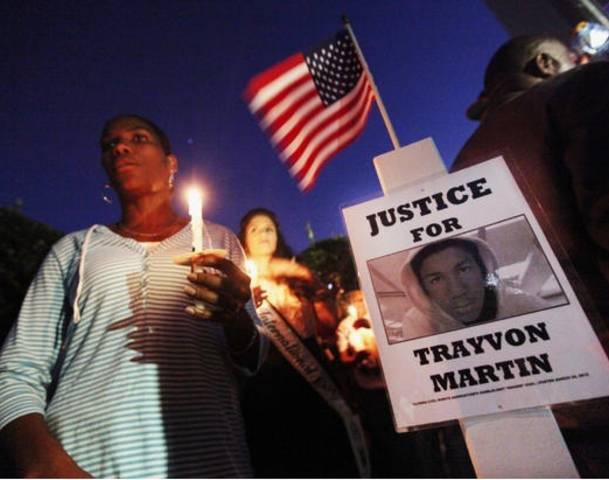
It has been reported there will be a demonstration in Tallahassee, the state capital. An online petition calling for “Justice for Trayvon” has reportedly received more than 285,000 signatures.

Members of the New Black Panther Party have already demonstrated outside Sanford Police Headquarters and said they may return. Members of the New Black Liberation Militia have threatened to make a citizens arrest of Zimmerman.

Beyond these immediate steps, a fresh look needs to be taken at Florida’s concealed weapons permitting process. Like the shooting of Rep. Gabrielle Giffords in Arizona showed, this process may too easily put guns into the wrong hands.

Sanford City Commissioner Velma Williams has already proposed a “Trayvon Martin Law” that would amend or curtail Florida’s “stand your ground” law.

During the 1960s the U.S. Justice Department was compelled to act in the Deep South when local law enforcement and the justice system failed to adequately and equally protect all citizens. That sort of intervention is necessitated in Sanford today. It may well turn out that possible violation of Trayvon Martin’s civil rights will have to be adjudicated under federal law.

Given its inability to reform itself, the Sanford Police Department may need to be placed in some form of federal receivership, as when the Sanford Housing Authority was placed in receivership under the U.S. Department of Housing and Urban Development due to extreme fiscal and other mismanagement.

Above all, Sanford’s residents need to stay involved, and continue to demand greater responsibility, accountability, openness, and transparency over the long haul.

For one example of citizen involvement, go to Matt Diaz, Sr., calls the State Attorney’s office:

www.youtube.com/watch?v=nVylGQF1o04&feature=youtu.be

[Jay D. Jurie, a veteran of SDS at the University of Colorado at Boulder, now teaches public administration and urban planning and lives near Orlando, Florida. Read more articles by Jay D. Jurie on The Rag Blog.]

References:

Audio of Trayvon Martin Shooting 911 Tape Calls: http://www.wftv.com/videos/news/teen-shooting-911-calls-1-3/vGZnj/

Boedecker, Hal, “Trayvon Martin: Thank God for the Media, ” Orlando Sentinel Entertainment Blog, March 16, 2012.
http://blogs.orlandosentinel.com/entertainment_tv_tvblog/2012/03/trayvon-martin-thank-god-for-the-media.html

Delinski, Rachel, “Chief Lee: Arrest of Martin’s Shooter Would be a Violation of Civil Rights,” Sanford Herald, March 14, 2012. www.mysanfordherald.com

Herald Staff, “Chief Bill Lee Answers Questions about Investigation Into Shooting of 17-year-old Trayvon Martin, Sanford Herald, March 17, 2012. http://mysanfordherald.com/view/full_story/17920337/article-Chief-Bill-Lee-answers-questions-about-investigation-into-shooting-of-17-year-old-Trayvon-Martin?instance=home_news_2nd_left

Lee, Trymaine, “Trayvon Martin Case Salts Old Wounds and Racial Tension,” Huffington Post, March, 14, 2012. http://www.huffingtonpost.com/2012/03/14/trayvon-martin-sanford-florida_n_1345868.html?flv=1#s766198

Lee, Trymaine, “Trayvon Martin Case Recasts Century-old Battle Lines for Local Activist,” Huffington Post, March 18, 2012. http://www.huffingtonpost.com/2012/03/16/trayvon-martin-george-zimmerman_n_1352874.html?ref=topbar

Owens, Darryl, E., “Here’s Why People Are So Angry Over Trayvon’s Death,” Orlando Sentinel, March 17, 2012. http://www.orlandosentinel.com/news/local/seminole/os-trayvon-martin-shooting-darryl-owens-031712-20120316,0,3856677.column

Robles, Frances, “Shooter of Trayvon Martin a Habitual Caller to Cops,” Miami Herald, March 17, 2012.
http://www.miamiherald.com/2012/03/17/2700249/shooter-of-trayvon-martin-a-habitual.html

Stutzman, Rene, “George Zimmerman’s Father: My Son Is Not a Racist,” Orlando Sentinel, March 15, 2012. http://www.orlandosentinel.com/news/local/os-trayvon-martin-shooting-zimmerman-letter-20120315,0,1716605.story

Stutzman, Rene, “Shooter’s Father: Son Didn’t Start Encounter,” Orlando Sentinel, March 16, 2012.
http://www.orlandosentinel.com/news/local/os-trayvon-martin-shooting-zimmerman-letter-20120315,0,1716605.story

Stutzman, Rene, and Prieto, Bianca, “Trayvon Martin Shooting: Police to Release 911 Calls,” Orlando Sentinel, March 16, 2012. http://articles.orlandosentinel.com/2012-03-16/news/os-trayvon-martin-shooting-911-call-20120316_1_shooting-police-department-investigator-chris-serino,

Type rest of the post here

Source /

The Rag Blog

Posted in RagBlog | Leave a comment

Bill Freeland : Republican Roulette

Graphic by Bill Freeland / The Rag Blog.

Republican roulette:
Romney vs. the rebels

By Bill Freeland | The Rag Blog | March 20, 2012

As the Republican nominating process enters its whirlwind phase — with nearly a primary a week scheduled over the next three months — it’s not just delegates that will be up for grabs. More fundamentally, it will also be the identity of the party itself.

On the surface, of course, it’s been between Romney and “Anybody But” — a revolving cast of challengers dating back to Donald Trump. But now, as we enter the crucial home stretch, the pitchfork is firmly in the grasp of challenger Rick Santorum.

Yet as the bitterness of the contest has revealed, the nominating process has actually devolved into a rancorous sibling rivalry between two symbolic poles: an entitled Establishment and a diverse rebel insurgency.

So what began merely as a political contest between personalities has become something entirely different: a fight between two radically different paradigms.

But here’s the twist: This could be the year that the losers in the GOP primary process could ultimately have as lasting an influence as the winners on the party’s future as they plot their return.

Say, for example, the party elites get their way — and their man — and Romney is nominated but loses to President Obama.

The elites, who are bitterly opposed by the rebels, will be disgraced and the insurgents vindicated. It will be 1976 all over again, when the party mainstream mistakenly stuck with Ford over Reagan — and lost to Carter. They corrected that mistake four years later, signing on with the Gipper and his purer vision of movement conservatism.

Next time today’s agitators will likely look early on to reincarnate a symbolic Reagan and move still further to the right to win in 2016.

Now compare that to a victory in Tampa by the “Anybody But Romney” wing of the GOP. It would be a stunning victory — but what if they lose to Obama?

In that case, welcome to 1964. That year Goldwater proclaimed extremism was no vice — but learned to his regret that moderation in pursuit of the presidency was a virtue — as he lost to LBJ in a landslide.

What his party learned was the virtue of moderation — and succeeded with Nixon four years later. A loss in 2012 will likely mean the party next time will avoid the mistakes of 1964 and seek a win with a similarly moderate candidate in 2016.

Now what about the Democrats? A parallel scenario could also emerge.

Recent polls, reflecting both better economic trends and perhaps a contrast with the bitter GOP primary battles, give the incumbent Obama a slight advantage over his challengers. But worsening job numbers and high gas prices could still put the outcome in doubt.

Should he lose, the signature policy of his administration, bipartisanship in the face of GOP obstructionism (which has driven many Democrats to distraction), would likely be repudiated — resulting in a more assertive nominee next time. The likely outcome: a more aggressive party and an even more polarized political process.

The lesson in all this: hopes for the future are often haunted by the failures of the past — and sometimes even defined by them. Thus it can be argued that instead of imagining the future, we sometimes settle merely for avoiding the mistakes of the past.

If that is the lesson the losers of 2012 take as a guide for the future, then their party and our nation will be the poorer for it.

[In the Sixties, Bill Freeland was a contributor to The Rag in Austin and Liberation News Service in New York. Read more articles by Bill Freeland on The Rag Blog.]

The Rag Blog

Posted in Rag Bloggers | Tagged , , , | Leave a comment

Harry Targ : Military Spending and our National Priorities

Breakdown of projected government spending for fiscal yer 2013. To see how these figures were determined, go here.

Poor are paying the price:
Military spending and
our natioal priorities

By Harry Targ
/ The Rag Blog / March 18, 2012

“From Forrestal’s day to the present, semi-warriors have viewed democratic politics as problematic. Debate means delay. To engage in give-and-take or compromise is to forfeit clarity and suggests a lack of conviction. The effective management of national security requires specialized knowledge, a capacity for clear-eyed analysis and above all an unflinching willingness to make decisions, whatever the cost.

With the advent of the semi-war, therefore, national security policy became the preserve of experts, few in number, almost always unelected, habitually operating in secret, persuading themselves that to exclude the public from such matters was to serve the public interest. After all, the people had no demonstrable ‘need to know.’ In a time of perpetual crisis, the anointed role of the citizen was to be pliant, deferential and afraid.” — Andrew Bacevich, reviewing a biography of James Forrestal, the first Secretary of Defense, in The Nation.

Andrew Bacevich reminds us that a permanent war economy has been part of the political and economic landscape of the United States at least since the end of World War II.

The War Resisters League pie chart of total government spending for fiscal year 2013 indicates that 47 percent of all government spending deals with current and past military costs. Despite lower government estimates that mask true military spending, by adding the Social Security Trust Fund to total spending and regarding past military spending — particularly veteran’s benefits — as non-military, it is clear that roughly 50 cents of every dollar goes to war, war preparation, covert operations, and military contractors.

In addition, “war support” contractors such as KBR have made billions of dollars in the twenty-first century from military spending. Top producers of military hardware Lockheed Martin, Northrop Grumman, and Boeing earned 11, 8, and 5 billion dollars in contracts in 2010 alone. Ostensibly non-military corporations such as BP, FedEx, Dell, Kraft, and Pepsi received hundreds of millions of dollars in defense contracts in 2010.

Virtually every big corporation is to some degree on the Department of Defense payroll.

A recent data-based report, “Don’t Bank on the Bomb,” prepared by the International Campaign to Abolish Nuclear Weapons (ICAN), identified “more than 300 banks, insurance companies, pension funds and asset managers from 30 countries that invest significantly in 20 major nuclear weapons producers.”

The report examined in detail financial connections to 20 major nuclear weapons companies. These 20 included U.S. producers of nuclear weapons components such as Bechtel, Boeing, GenCorp, General Dynamics, Honeywell, and Northrop Grumman.

U.S. financial institutions investing in the nuclear weapons producers included Abrams Bison Investments, AIG, American National Insurance Company, Fidelity, Franklin Templeton, JP Morgan Chase, New York Life, and Prudential Financial.

Because of the economic crisis which began in 2007, debate about military spending has increased. In 2010 Congressmen Barney Frank and Ron Paul initiated a study addressing needed cuts. The report prepared for them in 2010, “Debt, Deficits, and Defense,” called for across the board reductions in spending-procurement, research and development, personnel, operations and maintenance, and infrastructure — of $960 billion over the next decade. The report noted that over the last decade 65 percent of federal discretionary spending went to the military.

President Obama last January proposed more modest spending cuts of $480 billion over the next decade (reductions in projected increases, not existing funding). He coupled the announcement about future spending with a firm statement that the world must realize that the United States remains committed to maintaining its military superiority.

The President indicated that spending reductions in the future will be tied to greater use of “special operations,” drones, and shifting existent forces from Europe to Asia.

The magnitude of military spending represents what Bacevich referred to as the permanent war economy articulated and defended by the “semi-warriors” dominating U.S. foreign policy in each administration since World War II.

These semi-warriors gained influence after the Truman Administration accepted recommendations in National Security Document Number 68 (1950), which recommended that defense spending should always have priority over all other government spending. NSC 5412, approved by President Eisenhower, gave legitimacy to covert operations around the world allowing any president to “plausibly deny” any connections with such operations.

Subsequently virtually each president proclaimed a doctrine — Eisenhower for the Middle East, Carter for the Persian Gulf, Reagan to rollback “the evil empire,” Clinton for “humanitarian interventions” and Bush for “preemptory attacks” — justifying more and more military spending.

The Obama administration, through speeches and actions, has constructed what might be called “the Obama Doctrine.”

First, as the last remaining superpower and the beacon of hope for the world, the United States once again reserves the right and responsibility to intervene militarily to enhance human rights around the world.

Second, U.S. humanitarian military interventions will be carried out from time to time with our friends.

Third, new technologies such as drones will allow these interventions to occur without “boots on the ground.” They will be cheaper in financial and human cost (mostly for American troops).

Finally, assassinations and covert killings have made it clear that the Obama Doctrine overrides recognized judicial proceedings and the sanctity of human life.

Since the establishment of the permanent war economy in the 1940s millions of proclaimed “enemies” have been killed and seriously injured, mostly in the Global South. Permanent physical and psychological damage has been done to U.S soldiers, predominantly poor and minorities as they too are victims of war.

In addition, military spending has distorted national priorities and invested U.S. financial resources in expenditures that do not create as many jobs as investments in construction, education, or healthcare. And the permanent war economy has created a culture that celebrates violence, objectifies killing, dehumanizes enemies, and exalts super-patriotism through television, music, video games, and educational institutions.

These issues need to be more vigorously related to those raised by the grassroots campaigns that have sprung up to defend worker’s and women’s rights, oppose growing income and wealth inequality, and defend working people’s homes from foreclosures.

A long time ago — in reference to the massive U.S. war in Southeast Asia and desperate needs of workers at home — Dr. Martin Luther King described the fundamental connections that peace activists and all progressives must pursue: “I speak of the poor of America who are paying the double price of smashed hopes at home, and death and corruption in Vietnam.”

[Harry Targ is a professor of political science at Purdue University who lives in West Lafayette, Indiana. He blogs at Diary of a Heartland Radical — and that’s also the name of his new book which can be found at Lulu.com. Read more of Harry Targ’s articles on The Rag Blog.]

The Rag Blog

Posted in Rag Bloggers | Tagged , , , | Leave a comment