David Van Os : The Divine Right of Greed

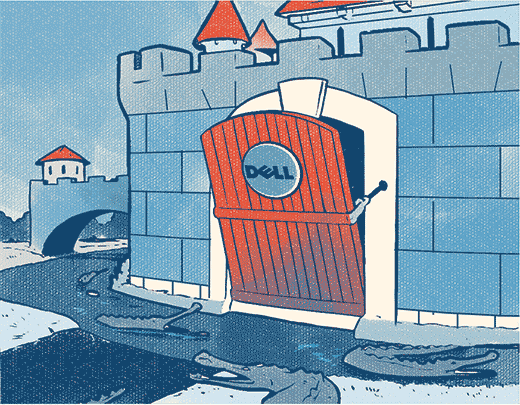
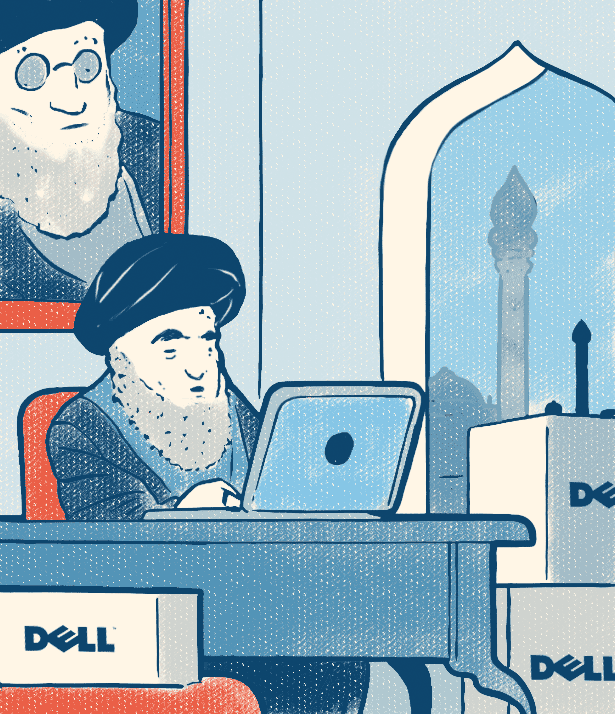
Political cartoon by Deng Coy Miel, Singapore.

(On being mad as hell…)
The divine right of greed

By David Van Os / The Rag Blog / April 20, 2011

Most of the income of the super-rich is in capital gains such as stock transactions. Capital gains are taxed at a 15% rate, while most wages and salaries are taxed at rates of at least 30%.

Does it make you feel good to know that while you struggle to pay your taxes the super-rich make out like bandits by paying only half of your tax rate or less? Does it make you feel good to know that most of them don’t even pay that minimal rate, but instead spend large sums on accountants and lawyers to find all the loopholes that you can’t afford to pay $300-per-hour accountants and lawyers to find for you?

Does it make you feel good to know that those who can afford the most pay the least and those who can afford the least pay the most?

Would it make you feel even better to know that, as reported by Nobel Prize winning economist Joseph Stiglitz (“Of the 1%, by the 1%, and for the 1%”, Vanity Fair, May 2011), the wealthiest 1% of Americans now rake in 28% of the income and own 40% of the wealth and property?

America is not broke. There are enormous amounts of money and resources in our society. But the super-rich are hoarding their fortunes, and government tax laws written by the 1% for the 1% have institutionalized a divine right of greed.

Bank of America was gifted with 45 billion dollars in taxpayer funded bailout money in 2009. Did Bank of America learn any lessons? You be the judge. Bank of America paid no taxes for tax year 2009 because it reported a net loss on its tax return. In 2010 its CEO received compensation worth 10.1 million dollars, including bonuses. Does a corporation that has that kind of money available to pay to one employee sound like a company that is strapped for cash?

Medieval monks taught that greed is a deadly sin. For 30 years, since the false saint Ronald preached the false doctrine that greed is a glorious virtue, the America of checks and balances that our American founders envisioned has been sinking under the weight of greed.

I don’t buy the false libertarian crap that idealizes greed as a high manifestation of American freedom. Freedom to avoid sharing responsibility for the common good is not an American ideal. Among the very purposes of the founding of the government of the United States of America, as set forth in the Preamble to the Constitution, are to form a more perfect Union and to promote the general Welfare. “Form a more perfect Union” means uniting for the common good. “Promote the general Welfare” means we are all in this together.

Stiglitz writes similarly in the Vanity Fair article, “Of all the costs imposed on our society by the top 1%, perhaps the greatest is this: the erosion of our sense of identity, in which fair play, equality of opportunity, and a sense of community are so important.”

Greed may be a vice that we cannot hope to eradicate from the human condition. However, that does not mean that as a society we are helpless before the ravaging effects of greed. Just as through our governments we seek to enact and enforce just laws to protect our society from violence, we also have the power and the right to enact and enforce just laws to hold greed in check.

At the top of the political tower, the corporate-political complex of today exists primarily to protect the false divine right of greed. Most of the members of the U.S. Congress are part of the 1% and they do whatever it takes to protect the power, wealth, greed, and hoarding of the 1%, while throwing enough bones to the 99% to keep us fooled and pacified.

If you aren’t mad as hell about it, you ought to be.

[David Van Os is a populist Texas democrat and a civil rights attorney in San Antonio. He is a former candidate for Attorney General of Texas and for the Texas Supreme Court. To receive his Notes of a Texas Patriot — published whenever he gets the urge — contact him at david@texas-patriot.com.]

The Rag Blog

Posted in Rag Bloggers | Tagged , , , , , , | 4 Comments

Steve Weissman : Sarkozy’s Role in the Libyan Rebellion

President Nicholas Sarkozy shown with embattled Libyan leader Muammar Gaddafi.

Did French President Sarkozy
set up Obama’s Benghazi nightmare?

By Steve Weissman / The Rag Blog / March 19, 2011

PARIS — Even as Barack Obama struggles to reduce America’s public role in the Libyan conflict, he and his supporters continue to defend the UN military intervention as necessary to stop a massacre of civilians, primarily in Benghazi. But recent reports in French and Italian media suggest that French President Nicholas Sarkozy was involved in organizing part of the armed faction of the anti-Qaddafi rebellion in Benghazi from as early as mid-November 2010.

Elements of the story are now spreading virally across the Internet, leading many bloggers to condemn Sarkozy’s skullduggery, while others reject the story as just another conspiracy theory.

The truth is difficult to track with certainty, but a careful reading of European and Israeli media strongly tends to confirm that the French did support internal defectors from an early date, fueling the crisis to which humanitarian interventionists in Washington felt they had to respond.

This story began last autumn, when a high-ranking Libyan insider turned up in Paris after a brief stopover in pre-revolutionary Tunisia. Nuri Mesmari, Libya’s chief of protocol, had worked closely with Qaddafi for some 30 years. As the usually well-informed Maghreb Confidential told its online business and diplomatic subscribers on October 21, 2010, “Normally Mesmari sticks closely to his boss’s side so there’s some talk that he may have broken his long-standing tie with the Libyan leader.”

A month later, on November 18, the influential web site reported that Mesmari, “who seemed to be joined at the hip with Libya’s leader,” had come to Paris for an operation and wanted to go into retirement. Mesmari was “one of Kadhafi’s closest confidantes and knows pretty well all of his secrets.”

What happened next is crucial, as reported on March 23 by the Italian journalist Franco Bechis, deputy editor of the right-wing daily Libero, which is owned by Italy’s embattled president Sylvio Berlusconi.

Citing documents from the French overseas spy service, the Direction Generale de la Securite Exterieure, and news from Maghreb Confidential that had circulated in French diplomatic circles, Bechis wrote that Mesmari met regularly with French intelligence officials. Given what followed, this seems almost certain, but so far, Bechis remains the only reporter who claims to have seen or heard direct evidence of the meetings.

Bechis offered two other revelations, also uncorroborated by anyone else. On November 16, 2010, at the Hotel Concorde Lafayette, he claimed, Mesmari had a long session with close collaborators of President Sarkozy. And, on December 18, a “strange French delegation” left for Benghazi, ostensibly as part of ongoing discussions to sell wheat to the Libyans.

According to Bechis, the delegation included officials of Sarkozy’s Ministry of Agriculture and executives of several companies that Maghreb Confidential mentioned on November 18 as “lining up in battle order for Libyan contracts.” But, in its report, the business service made no explicit mention of the Benghazi visit, suggesting only that the French companies would press their case after the end of the Aid el Kebir festivities, which fell last year on November 17.

“A commercial junket, on paper, in search of nothing but juicy Libyan orders,” Bechis wrote. “But, the group also includes French soldiers disguised as businessmen.”

The soldiers went to Benghazi to meet secretly with a Libyan Air Force officer whom Mesmari had identified, wrote Bechis. The officer had good contacts among Tunisian dissidents and was about to turn against Qaddafi. His name was Col. Abdallah Gehani.

Qaddafi’s security services would arrest Colonel Gehani in Benghazi on January 22, 2011, according to a brief account five days later in Maghreb Confidential.

The Libyan uprising began on February 17, initially as peaceful protest, but increasingly with an armed component.

The most telling account came on February 21 from Debkafile, an online Israeli news service that regularly cites unnamed military and intelligence sources. Their report is worth quoting at length. Cyrenaica is Libya’s eastern region, with Benghazi as its major city.

“Around two million Cyrenaican protesters, half of Libya’s population who control half of the country and part of its oil resources, embarked Sunday, Feb. 20, on a full-scale revolt against Muammar Qaddafi [Kadhafi] and his affluent ruling Tripolitanian-dominated regime,” the Israeli service reported.

Unlike the rights protests sweeping the Middle East and North Africa, in Libya, one half of the country is rising up against the other half, as well as fighting to overthrow a dictatorial ruler of 42 years.

Since last week, heavy battles have been fought in Benghazi, Al Bayda, Al Marj, Tobruk and at least two other cities. In some places, Debkafile’s military sources report protesters stormed army bases and seized large quantities of missiles, mortars, heavy machine guns and armored vehicles — and used them. The important Fadil Ben Omar Brigade command base in Benghazi was burnt to the ground.

Clearly, and although the grassroots dissidents did have some support in the west of the country, many of the February events in and around Benghazi were less like the nonviolent demonstrations that had just taken place in Tunisia and Egypt and more like a preplanned military rebellion.

In a subsequent report on February 25, the Israeli news service reported that French, British and U.S. military advisers had landed in the region the night before, dispatched from warships and missile boats off the coastal towns of Benghazi and Tobruk.

In March, other international media — including UPI, The Wall Street Journal and London’s Daily Mail — reported the early presence of foreign arms and military advisers, including some from Egypt.

While all this was going on, Mesmari himself emerged from the shadows in a twist widely reported by Agence France Presse (AFP), Radio France International (RFI) and other French media.

On November 28 or 29, 2010, depending on the report, French police formally arrested and detained him, though none of the news accounts mentioned where he was held, whether in prison or — as Bechis claims — at his hotel under house arrest. The arrest was in response to a Libyan arrest warrant accusing Mesmari of embezzling state funds.

On December 15, an appeals court freed him, calling his detention “an irregularity.” The court scheduled a hearing on extradition for December 23, but the case formally continued at least into early April.

A fuller picture of the man emerged in the December 7 issue of the Paris-based Jeune Afrique. As reported by the respected Tunisian journalist Abdelazis Barrouhi, Qaddafi had “allegedly slapped and insulted Mesmari” during an Arab-African summit held in Syrte on October 9 and 10. Barrouhi speculated that Mesmari also blamed the Libyan government for the fatal shooting of his son in 2007.

Barrouhi portrayed Mesmari as a character, known for the blond coloring of his hair and goatee and his satin costumes created by famous designers. Mesmari was not a military man, though he often appeared in uniform bristling with decorations. He was instead the son of a government minister in the old Libyan monarchy and a specialist in communications who had worked in the hotel trade.

If Mesmari appeared a comic opera figure, not alone among the Libyan elite, Barrouhi made clear what a huge catch he was for French intelligence.

“Officially director-general of protocol — a job theoretically under the minister of Foreign Affairs — he was much more than that,” Barrouhi explained. Mesmari organized visits to Libya by foreign chiefs of state as well as Qaddafi’s frequent trips abroad, sitting in on the secret conversations aided by his command of several languages, including English and French. He knew Qaddafi’s habits, likes and dislikes, sicknesses and medicines, moods, friends and secret networks, enemies, and the beneficiaries of the suitcases stuffed with dollars or euros that Qaddafi had Mesmari pass around.

In a contradictory barrage of reports, Maghreb Confidential similarly emphasized the political and espionage side of the story. On December 2, when news of Mesmari’s arrest first became public, the editors declared that Mesmari had bolted. In their words, “His defection has infuriated Kadhafi and undercuts the position of foreign minister Mussa Kussa.”

On December 9, the editors went farther. “Fearing for his life, Mesmari has asked for political asylum,” they reported. “Formerly close to Muammer Kadhafi, he has been described as a ‘Libyan Wikileak’ because of everything he knows about the regime.”

On December 23, Maghreb Confidential appeared to backtrack, reporting that Mesmari had resumed his normal functions as Qaddafi’s protocol chief. “Nuri Mesmari, who is currently residing at the Concorde Lafayette hotel in Paris, met with a number of his Libyan friends in a posh restaurant on the Champs Elysees,” they wrote. “According to our sources, he is preparing for his return to Tripoli after making contact with Libyan officials.”

But the editors sounded a note of caution, pointedly asking, “Has everyone forgotten his application for political asylum and an arrest warrant issued against him for embezzlement?”

According to Bechis, Mesmari’s visitors included three leaders of the February 17 movement that Qaddafi’s security police would arrest before the Benghazi uprising, as reported once again by Maghreb Confidential.

Various media continued to tell of Mesmari’s murky relations with Tripoli, while Mesmari himself repeated that he had come to France because of heart problems. But, on February 21, as the uprising showed its military planning, Mesmari came in from the cold, appearing in a videotaped press conference at the offices of the Parisian daily Liberation. He wore a straightforward sport coat and sounded like a representative of the Libyan rebels.

Qaddafi was creating “a massacre every hour, every moment and everywhere,” he declared. But “with the strength and struggle of the people, the Qaddafi regime will fall.”

Mesmari never mentioned how he had given France its biggest intelligence coup in years, nor how Sarkozy used the information to begin working with the armed faction of the rebellion in Benghazi.

[A veteran of the Berkeley Free Speech Movement and the New Left monthly Ramparts, Steve Weissman lived for many years in London, working as a magazine writer and television producer. He now lives and works in France, where he writes on international affairs. This article was also posted to truthout.]

The Rag Blog
Posted in Rag Bloggers | Tagged , , , , | Leave a comment

Kate Braun : Waning Gibbous Moon is Time to Release the Old

Through the clouds: Waning gibbous moon. Image from Moonmooring.

Moon Musings:
Waning gibbous moon
(April 20 – 26, 2011)

By Kate Braun / The Rag Blog / April 19, 2011

This is a moon-phase useful for releasing the old, removing unwanted negative energies, seeking wisdom. In this moon phase, you may work with Spirit in rituals concerning getting rid of bad habits, bad relationships, bad jobs; magickal workings regarding decisions, divorce, stress, emotions, protection; activities that concern fruition and manifesting (in other words, making some dreams come true). It implies boldness and a willingness to venture into the unknown, to boldly go where you have not dared to go before.

Seasonal gardening, for those of you who are able to do so, focuses on the third-quarter moon of April 20-23. This is a good time for planting below ground crops such as carrots, beets, onion sets, potatoes. It is also when to plant biennials, perennials, bulbs, trees, shrubs, berries, and to transplant seedlings.

Honor Crone Goddesses such as Baba Yaga, Cerridwen, Elli, Hekate, Hella, Grandmother Spiderwoman, Lillith. They are sources of wisdom; a waning gibbous moon is their season. The day you choose to invite their assistance will determine the color, number, and element central to your activities:

Wednesday, April 20, use the color yellow, the number eight, the element Air; perform rituals for career, all aspects of career. Suggested chant: “Good job, promotion, a raise I see; as I will so shall it be.”

Thursday, April 21, use the color blue, the number four, the element Water; perform rituals for money and/or legal matters. Invoke some Jupiter-energy as well; Jupiter, the planet of expansion, brings good things and positive outcomes. Suggested chant: “Positivity in all things, Jupiter surrounds me; I claim success and surety, as I will so shall it be.”

Friday. April 22, use the color green, the number seven, the elements Earth and Water; perform rituals for love and attraction. Venus is the planetary energy to invoke. Suggested chant: “True love, lasting love, come unto me; as I will so shall it be.”

Saturday. April 23, use the color black, the number three, the element Earth; perform rituals involving self-discipline. Saturn’s somber heaviness will keep you steady on the course you choose. Suggested chant: “Captain of my ship am I, monarch of life’s sea; in firm, balanced control am I, as I will so shall it be.”

Sunday, April 24, use the color yellow, the number six, the element Fire, and rituals for money, health, and friendship-related matters. Lord Sun’s warmth will inspire you and on this day it will be better to perform your workings in his light, so plan your activities for daylight hours. Suggested chant: “Sunlight, clear light, show my path to me; I follow where you lead, as I will so shall it be.”

Monday. April 25, use the color silver, the number nine, the element Water, and rituals for inspiration and change. Lady Moon is most helpful in these endeavors, so plan your activities for nighttime when she is visible in the night sky. Suggested chant: “Lady Moon I call on you for insights and dreams to guide me; beneficial change is my goal, as I will so shall it be.”

Tuesday, April 26, use the color red, the number five, the element Fire, and rituals for overcoming enmity and for protecting property and developing courage. Mars is the planet to invoke; his fiery force will help build energy within you as well as assist you when you need it most. Suggested chant: “I and mine are safe today, and as far ahead as I can see; I shall not fail in courage or grace; as I will so shall it be.”

Some other guidelines are:

  • to use the color associated with a particular day, wear it and/or make it the primary color in whatever decorations you use and burn candles of that color (yellow on April 20, blue on April 21, etc.);
  • to use the number associated with a particular day, repeat whatever chants or songs or invocations you use the number of times indicated by the particular day (eight on April 20, four on April 21, etc.);
  • to bring in elemental energy, there should be air moving for the Air element (a fan if there is no breeze), water present (in a glass or bowl or pond), for the Water element, a lit candle for the Fire element (or a fire in a grill or chimney), contact with the earth for the Earth element (be barefoot and outside);
  • if a particular planet is associated with the day you choose, let that planet’s energy lift you (Jupiter-energy is optimistic, laughter-filled, happy, and exultant;
  • Venus-energy is cozy and loving, nurturing, and comfortable;
  • Saturn-energy is efficient, practical, organized, and not very exciting;
  • the Sun is active, pushy, assertive, lively;
  • the Moon is dreamy, intuitive, gently wavy);
  • if the suggested chant does not reflect your goals as clearly as it should, feel free to create your own (remembering that a chant will work best if it rhymes).

[Kate Braun’s website is www.tarotbykatebraun.com. She can be reached at kate_braun2000@yahoo.com.]

The Rag Blog

Posted in Rag Bloggers | Tagged , , , , , | 2 Comments

Lamar W. Hankins : The Republicans and ‘Medicare As We Know It’

Rep. Paul Ryan and ‘medicare as we know it.’ Photo by J. Scott Applewhite / AP.

(but should be made ineffective…)
Republicans agree that Medicare is essential

By Lamar W. Hankins / The Rag Blog / April 13, 2011

This past week, House budget kingpin Paul Ryan (R-Wis.) announced the Republican plan to privatize Medicare through a medical voucher system that, instead of paying for health care directly, would help elderly and disabled Americans purchase private insurance. Many people have said that the scheme will “end Medicare as we know it,” which is undoubtedly true. But it represents an interesting turn of events in our politics.

Ryan’s announced plan tacitly concedes that Medicare is needed by the overwhelming majority of seniors and the disabled and is an important part of the social/economic safety net. Although we agree about this issue, we have to consider how such care can be delivered in the best and most efficient way. Clearly, that will not be through a voucher system.

Almost 55% of medicare recipients are low-income or disabled. This means, generally, that their incomes are below $14,355, according to studies done by the independent Kaiser Family Foundation. The Congressional Budget Office (CBO) predicts that purchasing insurance comparable to the current Medicare benefit will cost more than $20,500 per year.

A large majority of seniors and the disabled will not be able to afford the privatization of Medicare, even with an $8,000 voucher as proposed by Ryan, and continue to feed, clothe, transport, and house themselves.

Another problem with Ryan’s plan is that the private sector has not proven able to provide Medicare services as cheaply and efficiently as has the traditional Medicare system. We know this because we have had a version of a voucher system for several years called Medicare Advantage. The only advantage seems to be that it enriches the insurance companies at the expense of seniors.

Medicare Advantage companies spend more than 13% on overhead costs as opposed to 1.7% overhead for traditional Medicare, according to Kaiser figures. That 11.3% difference is taken out of seniors’ health care services. In this case, less is certainly not more.

It seems reasonable to conclude that no politician who is a fiscal conservative would want to waste government money by enriching private corporations and shortchanging program recipients. Yet this is just what Ryan’s proposal on behalf of the Republican majority in the House would do.

Thirty-one years ago, my parents, after a cumulative work history of 75 years for the same company, retired on modest pensions supplemented by Social Security and Medicare. Without those two programs, paid for largely by payroll deductions, they would not have outlived their pensions.

And they were among the middle class. The situation among less well-off retirees is far worse. According to US News, about 44% of households over 65 have a yearly income below $25,000. Without a good health care insurance program (such as traditional Medicare), those families will not have much money left over for the other necessities of life.

Most Republican presidents in my lifetime have recognized these basic facts and believed that this country has an obligation to assure the welfare of all Americans, not just the 1.5% who make $250,000 or more per year. That’s right, 98.5% of American households have annual incomes below $250,000.

According to Newsweek, Richard Nixon indexed Social Security for inflation, helping ensure that the elderly and disabled at least stayed even financially as the cost of living rose. Nixon also introduced a comprehensive health insurance reform bill that would have created a government-run “public option,” something president Obama would not agree to in spite of his campaign promises to the contrary.

To assist with these proposals, Nixon raised taxes on the wealthiest Americans for the first three years he was in office.

President Ronald Reagan raised taxes on most Americans in 1982, 1983, 1984, and 1986. President George H. W. Bush’s final budget increased tax rates and phased out exemptions for high-income taxpayers. And even the least among recent Republican presidents, George W. Bush, got passed a drug benefit for Medicare recipients, while he succeeded in reducing taxes on the most wealthy 3% of all Americans, tax reductions which have been continued under President Obama, even when he had a majority of Democrats in control of both houses of Congress.

If tax rates now stood where they were during the Reagan years, we would not have a fiscal crisis and even Paul Ryan might not be trying to further impoverish millions of elderly and disabled American families by enacting an ineffective health care voucher system to replace traditional Medicare.

As most honest political observers admit, the Tea Party Republicans, which means basically most of the Republican Party, along with most Democrats, don’t believe that the government should be run for the benefit of all Americans. They do everything they can to make the government work for the corporations that largely fund their campaigns.

They don’t believe that those responsible for the economic meltdown of the last three years should be held accountable in either our civil or criminal justice systems. They are perfectly willing to continue to prosecute three wars that are not funded but are fought on borrowed money, destroying my granddaughter’s future if not the future of her parents.

They are perfectly happy to create loopholes that allow corporations to pay no — or almost no — taxes, including ExxonMobil, Bank of America, General Electric, Chevron, Boeing, Valero Energy, Goldman Sachs, Citigroup, ConocoPhillips, and Carnival Cruise Lines. And some of these companies made record profits while being bailed out of their poor and reckless business decisions by the taxpayers.

From mutilating Medicare, to giving tax breaks to millionaires and billionaires, to serving the interests of the corporations, most of our politicians do not serve the general welfare. The most optimistic among us believe that the only way to overcome these unAmerican, undemocratic, unjust, and unpatriotic forces is to work against them day by day, one small way after another, until the system is overwhelmed by the sheer weight of Americans who are fed up with politicians that sneer at true democracy in favor of oligarchy.

I don’t have that much optimism, but I am unwilling to quit fighting the corporatists and oligarchs until that day when the words of the Rev. Martin Luther King (quoting Amos) are fulfilled, and justice does indeed roll down like waters and righteousness like a mighty stream.

But I’m not holding my breath.

[Lamar W. Hankins, a former San Marcos, Texas, city attorney, is also a columnist for the San Marcos Mercury. This article © Freethought San Marcos, Lamar W. Hankins.]

The Rag Blog

Posted in Rag Bloggers | Tagged , , , , , , , | 2 Comments

Dr. Stephen R. Keister : Political Idiots and Economic Dementia

Aldous Huxley: the “dogmatism and proselytizing zeal… of religious or political idiots.”

Huxley’s ‘political idiots’ and
public health in America

By Dr. Stephen R. Keister / The Rag Blog / April 13, 2011

“At least two thirds of our miseries spring from human stupidity, human malice and those great motivators and justifiers of malice and stupidity, idealism, dogmatism and proselytizing zeal on behalf of religious or political idiots.” — Aldous Huxley

I begin writing this on a Friday morning, feeling depressed and disillusioned, as the Congress considers a “government shutdown,” noting the absurd and idiotic reasons that the Republicans would use to justify such a bizarre act, proposing it in the name of demented economic theory and with the underlying motive of destroying programs currently in place designed to enhance the lives of our elderly and the disadvantaged of this country.

In his Hightower Lowdown column, Jim Hightower recently wrote about a novel called Alpaca,

a remarkably portentous piece of political writing by one of America’s first billionaires, Dallas oilman H. L. Hunt. Self-published in 1960, the 191-page book laid out his vision of a libertarian, plutocratic utopia.

Hunt’s ideal society was one in which the wealthiest would have a disproportionate say in government. He saw them as the achievers and, as proven by their riches, the most meritorious of citizens. They should get not one vote, he believed, but three, for they could be trusted to protect the volatile masses from the rise of populists.

Hightower sees Hunt’s vision given new life in the current Republican efforts to create a two-class society, a vision financed to the tune of millions of dollars by the U.S. Chamber of Commerce, the American Action Network, Crossroads GPS, and the various enterprises of the Koch Brothers.

This brings me to a point of playing the swami and looking ahead at the future of health care in the United States and the complicity of various physicians in accelerating this crisis.

First let me note a recent CNN poll showing that 75% of Americans want funding levels for Medicare to stay the same or go up. For Social Security, 87% of Americans want funding levels to stay the same or go up. Yet, these same folks have their fate resting in the hands of a Republican Party that exhibits the ideological zeal of the Spanish Inquisition and a Democratic Party and President who look at “compromise” in the same frame as Neville Chamberlain did at Munich.

Currently we who are on Medicare have 75% of our expenses paid for through the Medicare Trust Fund… monies we invested in the fund through our payroll taxes during our working days. These were not payments into the U.S. Treasury, but into a government sponsored “pension fund,” supposedly to be used for no other purposes than paying Social Security and Medicare benefits. Of course this trust was undermined by the Bush administration when the actual funds were used to subsidize warfare throughout the world, and were replaced with government bonds.

Some of us are fortunate enough, having the initial 75% of our medical costs paid by Medicare, to purchase Medicare Supplemental Insurance to cover the 25% not paid by Medicare. Supplements are not to be confused with “Medicare Advantage Plans” which were intended by the Bush administration to be the first step in privatizing Medicare and at the same time hurry the depletion of the Trust Fund. The Republicans have always opposed Medicare as well as Social Security.

The current Republican proposal calls for Medicare — by the year 2030 — to pay 32% of medical costs while the individual will pay 68% out of pocket. The GOP plan will gradually increase the eligibility age and give the states more control over the plan. The 32% distributed by the government will be given as “vouchers” in set amounts to purchase private insurance plans.

Of course these plans will cost much more because of the need to pay excessive executive salaries, stockholders, and higher administrative costs. Furthermore, the “doughnut hole” in the Medicare prescription drug benefit will continue at 100% under the Republican suggestions. An excellent review of the thinking behind the Republican plan is addressed by Wendell Potter in CommonDreams.

The Conservative Party, which currently controls the Parliament in the United Kingdom, in the interest of reducing the budget, is attempting to reduce payments to the national health system. This has created a major crisis in British politics — mass demonstrations in the city streets, strong denunciation of the planned cuts by the British Medical Association (“we do not want quasi-privitization, with a mountain of paperwork, we want time to spend with our patients as we have now”), defections by coalition members in the Parliament, public cries and newspaper editorials regarding decreased help to the disadvantaged, the elderly, undernourished children.

Of course, the British, like most Europeans, are of a different culture than we have in the United States; theirs is a culture of community while ours is based on Ayn Rand’s premise of “what is there in it for me?” But let us leave the UK and move on to our state of Vermont where the possibility of a single payer health care system is playing out. This I alluded to in my last Rag Blog submission.

As evolution of single payer care develops in Vermont there is a degree of division among the physicians: the primary care physicians approve of the plan while “certain other” physicians say they will leave the state.

We are at a point that we must take a look at the economics of the practice of medicine. First, I would note that, since I entered medical school in 1942, I have seen an attitude that says we should not increase our medical school graduation rate to a point where we have an excess of doctors in the country.

This is illustrated in recent years by the increased number of foreign graduates practicing in this country, the development of nurse practitioners and physician assistants, and the recent development of non-university affiliated osteopathic physician trade schools.

How are our domestic graduate physicians trained? Just who are these folks? All doctors start out by taking a four-year pre-med course in an undergraduate field of study. Then for the more fortunate we have four years in a university-affiliated medical school. This is followed by three years of residency training for those who wish to be family physicians, while for others, a year of general internship is required, followed by three years of specialty residency in an accredited hospital. Thereafter, one is required to take another year of fellowship in a sub-speciality.

So we see that those in the primary care specialties, internal medicine and its sub-specialities (allergy, endocrinology, rheumatology, neurology for example) have had six years training after medical school. Then we have those in the surgical sub-specialities (cardiac surgery, orthopedics, urology, for example), who have also has six years post-medical school training.

Why then the great income disparity among physicians? Those who work with their hands make some 7-10 times more than the physician who works with his mind. Why does the cardiac surgeon deserve a fee per hour 10 times that of the pediatric endocrinologist who cares for a child in a diabetic coma? Both may be life-saving procedures; the pediatrician is surely saving a life. What is it in the culture of the United States that has created this discrepancy?

Guess which physicians are considering leaving Vermont if single-payer health care passes and becomes law? One would envision in Vermont a physician payment system akin to that of the Mayo Clinic or Cleveland Clinic where the participating physicians are paid a negotiated salary rather than a procedure-based payment. This would explain, as well, why Vermont would be a magnet for the physician who wishes to be an independent contractor again, a professional, free of the dictates of the insurance industry, but by and large a primary care doctor.

There is an excellent new book called “The Hippocratic Myth” by M. Gregg Bloche, M.D. — who is an attorney as well as a physician. Bloche was involved in the investigation of torture by physicians and psychologists at Guantanamo, and he reviews all violations of the Hippocratic Oath, in medical practice, the insurance industry, government, and the courts.

About reward systems, Bloche says:

More important are the reward systems that today favor technological wizardry over biological breakthroughs — or time spent with speaking to patients or thinking through their problems. I recall doing some simple math, while a medical student on surgical rotation, and figuring out that my attending made more money per minute for time spent in the operating room than the actress Debra Winger made during her steamy scenes in that year’s hit film, An Officer and A Gentleman.

He took in $7,000 a case from Medicare for coronary bypass surgery, and on some mornings he’d have two cases going at once, in adjacent rooms. He could pull this off because his eager residents and fellows, counting on the same payoffs someday, did almost all of each case, from “cracking” the chest (to open it) to closing up ribs and muscle when work was done.

He put in about 20 minutes on each case, sewing in some of the little leg veins used to bypass blocked arteries. Had he spent this time talking with patients, he’d have taken home perhaps a few hundred dollars.

I fear that we face a broken medical system, as well as a broken political system. I call your attention to two recent publications. One is an extensive book review published in the Scientific American, titled Health Care Myth Busters: Is there a High Degree of Scientific Certainty in Modern Medicine?” The other is from The New York Review of Books: “Drug Companies and Doctors: A Story of Corruption,” by Dr. Marcia Angell.

In the meanwhile the negotiations, the compromises, continue in Washington bring to my mind a statement by Margaret Mead: “It may be necessary temporarily to accept a lesser evil, but one must never label a necessary evil as good.”

[Dr. Stephen R. Keister lives in Erie, Pennsylvania. He is a retired physician who is active in health care reform and is a regular contributor to The Rag Blog.]

The Rag Blog

Posted in Rag Bloggers | Tagged , , , , | 4 Comments

John Aloysius Farrell : The Koch Brothers’ Web of Influence

Koch Inc., headquartered in Wichita, Kan., spends tens of millions of dollars to lobby Congress and federal agencies on issues ranging from oil and gas to the estate tax. Photo by Larry W. Smith / AP.

The Koch brothers’ web of influence

Koch spends tens of millions trying to shape federal policies that affect its global business empire.

By John Aloysius Farrell / The Center for Public Integrity / April 12, 2011

At an EPA hearing last summer, representatives from Koch Industries argued that moderate levels of the toxic chemical dioxin should not be designated as a cancer risk for humans.

When members of Congress sought higher security at chemical plants to guard against terrorist attacks, Koch Industries lobbyists prowled Capitol Hill to voice their opposition.

And when Congress moved to strengthen regulation of the financial markets after recent collapses, Koch Industries — a major commodities and derivatives trader — deployed a phalanx of lobbyists to resist proposed changes.

Charles and David Koch, the owners of the country’s second-largest private corporation, are libertarians of long standing, who contend that government regulations, taxes, and subsidies stifle individual initiative and hamper American competitiveness. In recent years, the Kochs have played an increasingly public role as financial angels for conservative causes, politicians, and foundations

What’s not so well-known is the activity of Koch Industries in the trenches in Washington, where a Center for Public Integrity examination of lobbying disclosure files and federal regulatory records reveals a lobbying steamroller for the company’s interests, at times in conflict with its public pose.

The money that Koch (pronounced “coke”) has spent on lobbying in Washington has soared in recent years, from $857,000 in 2004 to $20 million in 2008. The Kochs then spent another $20.5 million over the next two years to influence federal policy, as the company’s lobbyists and officials sought to mold, gut, or kill more than 100 prospective bills or regulations.

Oil is the core of the Koch business empire, and the company’s lobbyists and officials have successfully fought to preserve the industry’s tax breaks and credits, and to defeat attempts by Congress to regulate greenhouse gases.

But Koch’s diversified interests, and thus its lobbying activities, extend far beyond petroleum. Koch companies trade carbon emission credits in Europe and derivatives in the U.S. They make jet fuel in Alaska from North Slope oil, and gasoline in Minnesota from the oil sands of Canada. They raise cattle in Montana and manufacture spandex in China, ethanol in Iowa, fertilizer in Trinidad, nylon in Holland, napkins in France, and toilet paper in Wisconsin.

According to the most recent Forbes magazine rankings, Koch had $100 billion in revenues in 2009 — on a par with corporate giants like IBM or Verizon — and stood a close second to Cargill Inc. on the list of the largest private U.S. companies. The firm has 70,000 employees, and a presence in 60 countries and almost every state.

Koch’s decision to pour millions into lobbying Washington has put them high on the list of corporations whose lobbyists work the corridors of the nation’s capital. Last year, Koch Industries ranked in the top five — roughly on a par with BP and Royal Dutch Shell — in lobbying expenses among oil and gas companies, according to the Center for Responsive Politics.

These totals do not include the work of the trade associations that Koch uses to represent its interests in Washington. There’s a major industry group called the National Petrochemical and Refiners Association, and obscure organizations like the green-sounding National Environmental Development Association’s Clean Air Project, whose membership lists Koch and two of its subsidiaries (Georgia-Pacific and Invista) with a dozen industrial giants like ExxonMobil Corp., General Electric Co, and Alcoa Inc.

Koch’s lobbyists are known on Capitol Hill for maintaining a low profile. There are no former U.S. senators or House committee chairmen on the payroll. The firm had 30 registered lobbyists in 2010, many of whom are Washington insiders with previous experience as congressional staffers or federal agency employees.

Gregory Zerzan is a good example. Zerzan was a senior counsel for the House Financial Services Committee before serving as an acting assistant secretary and deputy assistant secretary at the U.S. Treasury Department during the George W. Bush administration. Zerzan then worked as counsel and head of global public policy for the International Swaps and Derivative Association before joining Koch Industries as a lobbyist.

Koch clout is augmented by campaign donations to parties and candidates for federal office — $11 million in the last two decades, according to the Center for Responsive Politics — and generous gifts from three family foundations to universities and conservative organizations and interest groups.

According to IRS records, the Koch foundations are essential donors (having given $3.4 million from 2007 through 2009) to the Americans for Prosperity Foundation, a nonprofit known for its support of the Tea Party movement. Among the organizations that have each received a million dollars or more over the last five years from Koch foundations are the Cato Institute, the Heritage Foundation, and two conservative think tanks at George Mason University in Virginia: the Institute for Humane Studies and the Mercatus Center.

The Kochs primarily donate to conservative candidates and causes but have given more than $1 million in the last decade to the liberal Brookings Institution. And among politicians they supported last year was Andrew Cuomo, a Democrat elected governor of New York with $87,000 from the Koch family.

The emergence of “the Koch web — political action, campaign giving, funding of groups engaged in political action and campaigns, conferences to expand political and policy influence — is a striking phenomenon,” said Norman Ornstein, a scholar at the conservative American Enterprise Institute.

The Center asked Koch Industries and its lobbyists in Washington, in a dozen emails and telephone calls over more than two weeks, to comment on the firm’s lobbying efforts. Koch’s representatives declined the opportunity.

But in a March 1 column in The Wall Street Journal, Charles Koch defended his and his company’s practices. “As a matter of principle our company has been outspoken in defense of economic freedom,” Koch wrote. “This country would be better off if every company would do the same. Instead, we see far too many businesses that paint their tails white and run with the antelope.”

Ethanol

The Koch brothers are renowned as free market libertarians. But as a major trader in energy and financial markets, Koch Industries also knows how to hedge.

As its corporate officials and publicists decried ethanol as a costly government boondoggle, the Kochs bought four ethanol plants in Iowa in recent months, with a combined annual capacity of 435 million gallons. In Washington (where ethanol tax subsidies cost the Treasury some $6 billion annually) Koch representatives lobbied Congress on ethanol and other biofuel subsidies.

“New or emerging markets, such as renewable fuels, are an opportunity for us to create value within the rules the government sets,” Flint Hills Resources President Brad Razook told his employees in the January company newsletter.

Koch Industries’ status as an ethanol player goes beyond its new Iowa plants. Koch blends ethanol and gasoline nearby, in its Minnesota refinery. By its own account, the company’s subsidiaries, Flint Hills and Koch Supply and Trading, currently buy and market about one-tenth of all the ethanol produced in the United States.

The Kochs seem to have recognized that their actions might seem hypocritical and in a January 2011 newsletter the company tried to explain things to employees who have been “scratching their heads and wondering: what is going on?”

“After all, ethanol production is heavily subsidized, mandated, and protected,” Koch Industries acknowledged, “while Koch companies openly oppose such government programs.”

Realism had won out. The company has the “capabilities necessary to be successful in the ethanol industry,” the newsletter explained. The new ethanol plants “fit well geographically with several other FHR assets, including fuel… terminals, a widespread distribution network that includes Iowa, and the Pine Bend [Minnesota] refinery.”

“We are not going to place our company and our employees at a competitive disadvantage by not participating in programs that are available to our competitors,” Razook assured Koch employees.

The company has a history of pragmatism in commercial affairs. Koch was a pioneer importer of Russian oil to the United States, including a 2002 shipment of Russian crude that Koch sold to the U.S. government to help fill the U.S. Strategic Petroleum Reserve. And though it opposes a cap-and-trade solution to global warming for the United States, Koch makes money trading emissions credits under a similar program in Europe.

Nor is ethanol the only form of corporate welfare Koch Industries supports. As it ventures into biofuel production, and uses alternative fuels to power its plants, the company has its lobbyists working “to expand the [tax] credit for renewable electricity production” made from biomass.

Georgia-Pacific, the company reported in 2008, was responsible for more than 10 percent of all the renewable biomass electricity generated in the U.S.

Toxic

Koch’s efforts to limit regulation of toxic substances illustrate the breadth of its lobbying operation.

In 2004 Koch Industries purchased Invista, a subsidiary of DuPont, known for manufacturing Lycra, Stainmaster carpets, and other textiles and fabrics. In 2005, as part of the same corporate diversification and expansion strategy, Koch Industries bought the giant wood and paper products firm, Georgia-Pacific, adding Brawny paper towels, Angel Soft toilet paper, Dixie cups, and dozens of factories and plants to its holdings.

Koch has since worked, on Capitol Hill and in various regulatory proceedings, to dilute or halt tighter federal regulation of several toxic byproducts that could affect its bottom line, including dioxin, asbestos, and formaldehyde, all of which have been linked to cancer.

Dioxin is released from incinerators, hazardous waste treatment, pesticide manufacturing, paper plants, and other sources. With 165 manufacturing facilities across the United States, Georgia-Pacific “has a significant interest in and will be significantly impacted,” by the EPA’s decisions on dioxin, Koch officials told the agency in April 2010.

Hundreds of workers would have to be hired, and trucks and earth-moving equipment leased or purchased. And “of the limited number of hazardous waste landfills operating in the United States, very few are willing to accept dioxin-containing soil,” the company noted.

“Treatment and disposal of dioxin-containing soil is already a challenging, expensive and capacity-limited problem that would only get worse if additional volumes were generated.”

Image

It’s been three decades since the environmental catastrophes at Love Canal, N.Y., and Times Beach, Mo., introduced the American public to the dangers of dioxin. But in the EPA hearing at the Washington Hilton last July, toxicologist John M. DeSesso, a consultant speaking on behalf of Georgia-Pacific, told the agency that the scientific studies on common levels of exposure are still inconclusive. He urged further study.

The Environmental Working Group and a number of public health organizations, meanwhile, chastised the EPA for dragging its feet, and reminded the agency panel that another arm of the federal government, the U.S. National Toxicology Program, and the World Health Organization have already classified dioxin as a known human carcinogen.

“Twenty-five years after publishing its first assessment of dioxin… the EPA has yet to establish a safe daily dose for human exposure” for “one of the most-studied of all chemical pollutants,” the EWG told the panel. “It is EPA’s responsibility to address this problem with resolve… without regard to pressure from special interests who stand to benefit financially from weak standards and regulations.”

It isn’t just dioxin that has drawn Koch’s interest. On Capitol Hill, and in regulatory proceedings, Koch lobbyists and officials have resisted tighter government regulation of a gallery of toxic and carcinogenic substances, like asbestos, formaldehyde, and benzene.

“GP strongly disagrees with the [National Toxicology Program] panel’s conclusion to list formaldehyde, a natural component of every cell in the body, as a human carcinogen,” wrote Traylor Champion, the firm’s vice president for environmental affairs, in a February 2010 letter.

“Costly control requirements are being mandated on sources that have insignificant levels of HAP (hazardous air pollutants) emissions,” a Georgia-Pacific environmental health and safety manager, James Eckenrode, complained to the EPA in November 2008, when it sought to apply tougher air pollution standards to the firm’s manufacture of resins and formaldehyde.

Through its Flint Hills Resources subsidiary, Koch Industries operates a refinery near Fairbanks, Alaska. “Refineries in Alaska are geographically isolated from the rest of the U.S. market such that benzene extraction and sale into the petrochemical market would be infeasible,” the company argued in 2006, when the EPA proposed new clean air limits on benzene. “Benzene reductions to levels proposed in this rule would either require extensive and economically prohibitive capital upgrades at our facility or would result in a significant reduction in gasoline production.”

When Koch Industries purchased Georgia-Pacific, it inherited a titanic liability regarding asbestos. Georgia-Pacific had used asbestos to make gypsum-based drywall products, and starting in the 1980s the firm became a target for more than 340,000 claims by plaintiffs who said they suffered lung and other diseases, including mesothelioma, a deadly cancer. By 2005, the company was spending $200 million a year and had to build a $1.5 billion reserve fund for asbestos liabilities and defense costs.

In a 2008 Koch Industries publication, General Counsel Mark Holden griped that “many of those claims are an outright abuse of the legal system… that often involve people who are not sick… all because of over-zealous litigators and a legal system that gives them perverse incentives.”

The number of new claims has dropped with tougher federal safety standards. But in the 110th Congress Koch lobbyists still sought to sway members on legislative proposals intending to restrict the use of asbestos and improve public knowledge, even Senate Resolution 462, which called for a “National Asbestos Awareness Week.”

Charles and David: The Brothers Koch.

Global warming and low carbon fuel standards

It’s in the Kochs’ commercial interest to preserve America’s reliance on carbon-based energy sources. Despite recent diversification, Koch remains a major petrochemical company with refineries in North Pole, Alaska; Corpus Christi, Texas; Rosemount, Minn., and Rotterdam in the Netherlands; an array of chemical plants; a coal subsidiary (the C. Reiss Coal Co.), and 4,000 miles of pipelines.

So it is not surprising that, when the Obama administration and the Democrats on Capitol Hill proposed to regulate the emission of greenhouse gases in recent years, Koch Industries responded with a fervent counteroffensive.

“Oppose government mandates on carbon reduction provisions… [and] provisions related to climate change, and oppose entire bill,” Koch lobbyist Robert P. Hall wrote, listing his goals on the 2008 lobbying disclosure form.

The firm’s lobbying expenditures soared in 2008 as Koch Industries and its subsidiaries — Georgia-Pacific, Invista, Flint Hills Resources, Koch Carbon, Koch Nitrogen — peppered the EPA and members of Congress with objections. Several worked on measures that would strip the EPA of the power to regulate greenhouse gases through the Clean Air Act.

Koch-supported groups like the National Environmental Development Association’s Clean Air Project joined the effort. In a recent meeting, five Koch representatives joined colleagues from ExxonMobil, ConocoPhillips, Eli Lilly, and other NEDA-CAP members to register concerns with EPA officials over the proposed mandatory reporting rule for greenhouse gas emissions, the record shows.

Koch’s lobbying efforts on climate change are matched by a public campaign. Via three foundations — the Claude R. Lambe Foundation, the Charles G. Koch Foundation, and the David H. Koch Foundation — funded and administered by Koch family members and employees, the Kochs have donated several million dollars in recent years to think tanks and groups that have sought to discredit climate science and EPA’s efforts to reduce greenhouse gases.

“Why are such unproven or false claims promoted?” the Koch Industries company newsletter, Discovery, asked in an article on global warming entitled, “Blowing Smoke.”

“Scientists have… perverted the peer review process, doing everything possible to prevent opinions contrary to the alarmist view from being heard,” the article said. Humans should adapt to global warming, not try to slow or stop it, the newsletter recommended. “Since we can’t control Mother Nature, let’s figure out how to get along with her changes.”

In early March, members of the Republican-led House Energy and Commerce Committee — many of whom had received campaign contributions from Koch employees and PACs last fall — voted to bar the EPA from regulating greenhouse gases under the Clean Air Act. Their action has been endorsed by Speaker John Boehner and Republican House leaders.

Of particular concern to Koch lobbyists in Washington, according to their disclosure forms, are measures to encourage or require the use of low-carbon fuels. These sources of energy, in their manufacture and use, contribute less than other fuels to global warming.

The Koch refinery in Minnesota is designed to process heavy “high-carbon” Canadian crude oil, and is fed by a pipeline from Canada. Koch “is among Canada’s largest crude oil purchasers, shippers and exporters,” the company says, with a trading and supply office in Calgary and a terminal in Hardisty, Alberta.

Much of the oil comes from the mining of oil sands, which have a particularly heavy carbon footprint because the process releases greenhouse gases from peat lands and boreal forest, and requires a great deal of energy to heat and sweat the oil out.

“Canadian crude generates more greenhouse gas emissions” and so low-carbon standards “would cripple refiners that rely on heavy crude feedstocks,” the Koch Industries website notes. “It would be particularly devastating for refiners that use heavy Canadian crude.”

When lawmakers in Washington and states like California sought to address global warming by requiring the use of low carbon fuels, Koch Industries responded. Koch lobbyists listed the legislation as a lobbying priority on Capitol Hill. And in California, where a wide-ranging series of measures to slow climate change were launched by former Gov. Arnold Schwarzenegger, Koch joined the fight to defeat them.

A Koch subsidiary, Flint Hills Resources, donated a million dollars in support of Proposition 23, an unsuccessful attempt funded by Koch and other energy companies last year to stall implementation of the low-carbon standards and other remedial climate measures in California.

Energy industry tax breaks

Koch lobbyists spend much of their time, according to their disclosure reports, fighting attempts by members of Congress to curb price-gouging, windfall profit-taking, and speculation in the oil industry. To this same end, Koch officials worked to dilute a 2009 Federal Trade Commission rule governing manipulation of the energy markets.

Meanwhile, Koch has lobbied to preserve some of the oil industry’s coveted tax breaks and credits.

One benefit is known as the Section 199 deduction, approved by Congress several years ago to help the hard-pressed U.S. manufacturing sector. In light of the oil and gas industry’s hearty profits, the Obama administration and members of Congress have sought to end the Section 199 subsidy for energy firms and save the U.S. Treasury $14 billion over 10 years. But Koch lobbyists and trade associations have worked to preserve the deduction.

Another industry tax break that drew the support of Koch representatives is the venerable “LIFO” (last-in, first-out) accounting rule. It allows energy companies effectively to raise the value of their existing inventory (and thus pay lower taxes on profits from sales) when the price of oil soars.

Under LIFO, the oil in a company’s inventory, no matter what it actually cost, is valued at the cost of the last-acquired (usually highest-cost) barrel. The LIFO rule has been a target in recent years for both Democrats and Republicans in Washington, who would like to raise revenue without raising taxes.

Bush tax cuts

Koch lobbyists listed the expiring Bush tax cuts as a lobbying objective last year, and the Koch brothers were among an elite, relatively few Americans who profited when the income tax cuts for those earning more than $250,000 a year were extended in a year-end deal.

Another of the Bush tax breaks had special meaning for the Koch brothers. Charles Koch, 75, and David Koch, 70, are tied for fifth place, each with a net worth of $21.5 billion, in the latest Forbes rankings of the wealthiest Americans. Included in the deal to extend the Bush tax cuts was a proposal to reduce the federal estate tax. The Kochs have, historically, been players in an ongoing effort by wealthy families to curb or eliminate the tax on inheritances.

The final tax deal reached by the White House and Republicans in Congress in December set the estate tax at 35 percent. That makes the new rate considerably more favorable than during the Clinton (55 percent) or even the Bush (45 percent) years, and the lowest it’s been since the 1930s. If one of the patriarchs should die while the new rate is in effect, it would save the Koch family billions of dollars.

Terrorism and national security

Another major preoccupation of Koch Industries lobbyists during recent sessions of Congress was the Chemical Facility Anti-Terrorism Standards, a federal effort to identify and regulate chemical facilities that could be vulnerable to terrorist attacks.

In 2009, the House passed legislation that would toughen the standards, and require manufacturers like Koch to use safer chemicals and processes to add another level of protection and minimize the effects of toxic releases from terrorist attacks or catastrophic accidents.

Koch opposed the changes, claiming they “increase cost and regulatory burden while shifting focus away from security and toward environmental considerations.” The chemical security provisions were listed as lobbying targets by Koch representatives in 2007, 2008, 2009, and 2010.

According to EPA records, Koch has four facilities that use chlorine dioxide — in Palatka, Fla.; Zachary, La.; New Augusta, Miss.; and Camas, Wash. It has an Invista plant that uses formaldehyde in LaPorte, Texas. Its Flint Hills refinery in Corpus Christi, Texas, uses hydrofluoric acid in refining gasoline.

Mandatory use of safer technology would “result in even more job losses and higher consumer prices as American manufacturers struggle to comply,” Koch contends in a statement on the chemical safety standards on its website. The House legislation would “restructure, and likely add additional cost to security programs currently in place for Koch companies’ facilities.”

Financial regulation

Koch pulls no punches when assigning the blame for the great financial meltdown of 2008: It was the government’s fault, not the markets.

“Almost all of these problems (and much of the current chaos) are, at their root, the result of political failure,” said Steve Feilmeier, the chief financial officer for Koch Industries, at the height of the crash.

It is not surprising, then, that Koch Industries — a major player in international trading markets — resisted increased regulation and spent heavily on lobbyists who worked to shape the 2010 Dodd-Frank Act and other vehicles for financial reform. The Koch lobbyists focused, in particular, on provisions aimed at regulating systemic risk in the financial markets, and the use of derivatives.

Koch Industries started out trading crude oil more than four decades ago, but its trading group has since branched into commodities, derivatives, and other risk management products.

In that time, the market for trading derivatives and swaps in the energy industry has gone largely unregulated. And in past Congresses, Koch lobbyists labored to preserve the exemption, known as the “Enron Loophole,” that excused energy commodity contracts from regulation.

But the Dodd-Frank law gave the Commodity Futures Trading Commission and the Securities and Exchange Commission the authority to craft new rules to subject traders in the energy industry to increased regulation and transparency, capital and margin requirements, and supervision by a derivatives clearing house. Koch lobbyists worked to favorably shape the bill, and have not stopped working since it was passed.

Within a few weeks after President Obama signed the legislation, Koch lobbyist Gregory Zerzan had secured a coveted meeting with SEC Commissioner Troy Paredes, a Bush appointee, and his counsel, Gena Lai, to discuss how the government would implement the law.

[This article was published by The Center for Public Integrity and distributed by CommonDreams. © 2011 Center for Public Integrity.]

The Rag Blog

Posted in RagBlog | Tagged , , , , | 1 Comment

Ed Felien : Malalai Joya is a Champion for Afghan Women

Malalai Joya. Image from antiwarcommittee.com.

A champion for Afghan women:
On hearing Malalai Joya

By Ed Felien / The Rag Blog / April 12, 2011

MINNEAPOLIS — I met the bravest person in the world Friday night, April 1, at St. Joan of Arc Church in South Minneapolis when I heard Malalai Joya speak.

She’s about five feet tall with a soft voice and a backbone as strong as steel. She was expelled from the Afghan Parliament (after being, at 26, the youngest person ever elected) because she “insulted” both the Afghan opium warlords and the U. S. government for supporting the corrupt leadership of Hamid Karzai.

There have been four assassination attempts on her life. The Taliban hate her because she organizes women’s groups and schools for girls.

Malalai Joya has stood up to them all. She is unafraid. You look into her eyes and fear melts away. You appreciate that all your struggles are child’s play in a sandbox compared to her struggle to improve the lives of young women in Afghanistan.

She believes passionately that women in Afghanistan would be better off if the U. S. left immediately. She considers the Taliban attitudes toward women far less dangerous to their health than drones and airstrikes.

She talked briefly about how the CIA benefits from the opium trade in her country. Although she is no friend of the Taliban, she acknowledges that during their government opium production in Afghanistan was almost 0% of the world supply, and, since the CIA, with the help of the opium warlords, has taken over the government, production is over 93% of the world supply.

The serious question for the American people is who benefits from this opium trade? How far up the chain do the payoffs go? If the CIA gets paid off, does that mean Leon Panetta gets paid off? Does that mean Obama gets paid off? And how is that in our national interest?

Support for the work of Malalai Joya can be directed to the Afghan Women’s Mission at www.afghanwomensmission.org.

[Ed Felien is publisher and editor of Southside Pride, a South Minneapolis monthly.]

The Rag Blog

Posted in Rag Bloggers | Tagged , , , , | Leave a comment

Ted McLaughlin : U.S. Military Spending Way Out of Whack

Hogging the pie:
U.S. military spending gone wild

By Ted McLaughlin / The Rag Blog / April 12, 2011

The chart above shows just how much out of whack the United States spending on its military really is. The U.S. has 42.8% of all the military spending in the world — meaning all of the other countries in the world put together have only 57.2% of total military spending. Put another way, about $43 out of every $100 of military spending worldwide is spent by the United States. That’s pretty incredible.

China is in second place, but its military spending only comprises about 7.3% of the world’s total military spending. The United Kingdom is third with 3.7% of the total, and Russia and France tie for fourth with 3.6% each.

I know there will be some on the right who will try to say the military spending by the United States is not out of line — that it is necessary for national defense. That’s a ludicrous suggestion. The United States could adequately defend itself from other nations with far less spending. No other nation thinks it is necessary to spend such vast amounts on defense. And the United States could cut its spending in half (or even more) and still be spending more than any other nation on earth.

No, we don’t spend that extraordinary amount just to defend ourselves (although that is the excuse the government gives and our gullible citizens have bought into). There are a couple of other reasons that are more powerful than national defense (even if no politician will admit it).

The first is the military-industrial complex. We have developed (in spite of warnings from President Eisenhower) a huge industry out of our military and supplying it with weapons (many of which are not needed and some of which don’t even work properly). But the important thing is to keep feeding taxpayer dollars into it so the war profiteers can keep making enormous profits (and some decent-paying jobs can continue for a few workers). It’s not even a matter of defense needs anymore, but of propping up the giant military-industrial complex.

The second reason is the protection of American corporate interests abroad — both in sustaining markets for products and the acquisition of natural resources. This is not a new thing. The American government has used its military to protect corporate interests for at least a century now. A prime example is the occupation of Nicaragua by U.S. Marines from 1912 through 1933 — to protect American corporate interests in that country.

The third reason is the general inability of American leaders (of both parties) to engage in effective diplomacy. This has been especially true since World War II when we have tended to carry out diplomatic missions with the ever-present threat of military power if we don’t get what we are seeking.

And finally, winning World War II and seeing democracies established in Germany and Japan has given many Americans the mistaken perception that democracy can be spread by military power. But those were anomalies, and the truth has been brought out by our misadventures in Vietnam, Iraq, and Afghanistan. Sadly, this seems to be a lesson that many politicians are incapable of learning.

The real fact is that we don’t need to spend anywhere near what we currently spend to protect this nation. It can effectively be done with far less, and the savings could be spent to balance the budget and shore up badly needed social programs (like most other developed countries do with their tax dollars). Instead of trying to force our views on the rest of the world, we should be spending our money for the betterment of our own citizens.

But that would require honesty, morality and intelligence — all things that seem to be in short supply among our politicians.

(P.S. — The American military budget has grown by 81% just since 2001.)

[Rag Blog contributor Ted McLaughlin also posts at jobsanger.]

The Rag Blog

Posted in Rag Bloggers | Tagged , , , , | 2 Comments

SCIENCE / AFP : Brain Structure Differs in Liberals, Conservatives

Illustration by Yakobchuk Vasyl / The Independent.

It’s all in your head!

New study shows liberals have more gray matter in a part of the brain related to understanding complexity, while the conservative brain is bigger in the section linked to fear.

By AFP / AlterNet / April 11, 2011

Everyone knows that liberals and conservatives butt heads when it comes to world views, but scientists have now shown that their brains are actually built differently.

Liberals have more gray matter in a part of the brain associated with understanding complexity, while the conservative brain is bigger in the section related to processing fear, said the study on Thursday in Current Biology.

“We found that greater liberalism was associated with increased gray matter volume in the anterior cingulate cortex, whereas greater conservatism was associated with increased volume of the right amygdala,” the study said.

Other research has shown greater brain activity in those areas, according to which political views a person holds, but this is the first study to show a physical difference in size in the same regions.

“Previously, some psychological traits were known to be predictive of an individual’s political orientation,” said Ryota Kanai of the University College London, where the research took place.

“Our study now links such personality traits with specific brain structure.”

The study was based on 90 “healthy young adults” who reported their political views on a scale of one to five from very liberal to very conservative, then agreed to have their brains scanned.

People with a large amygdala are “more sensitive to disgust” and tend to “respond to threatening situations with more aggression than do liberals and are more sensitive to threatening facial expressions,” the study said.

Liberals are linked to larger anterior cingulate cortexes, a region that “monitor(s) uncertainty and conflicts,” it said.

“Thus, it is conceivable that individuals with a larger ACC have a higher capacity to tolerate uncertainty and conflicts, allowing them to accept more liberal views.”

It remains unclear whether the structural differences cause the divergence in political views, or are the effect of them.

But the central issue in determining political views appears to revolve around fear and how it affects a person.

“Our findings are consistent with the proposal that political orientation is associated with psychological processes for managing fear and uncertainty,” the study said.

[This article was published by AFP news agency (Agence France-Presse) and was distributed by AlterNet.]

The Rag Blog

Posted in RagBlog | Tagged , , | 5 Comments

Larry Ray : Donald Trump and the Two-Headed Cow

The Great American Sideshow! Graphic by Larry Ray / The Rag Blog.

The Great American Sideshow:
Donald Trump: See the two-headed cow!

By Larry Ray / The Rag Blog / April 11, 2011

America has always had a fringe element of nuttiness but most everyone knew it was nuttiness and not to be taken seriously. Before today’s instant mass communication, conspiracy claims, wild headlines, mean gossip, and outright lies were mostly the stuff of checkout aisle tabloid newspapers. Today many people can’t, or refuse to tell the difference.

Nightly prime time TV programs take the lowest road, from the intellectually lightweight “Biggest Losers,” where morbidly obese people vie weekly to see who has lost the most weight, to “reality shows” documenting unreal races, contests, and nail-biting competitor eliminations.

The reality is that these carefully scripted competitions are shot with huge film crews hovering all around, documenting supposed intimate spontaneous adventures that have nothing whatsoever to do with reality.

But millions of people never miss these nightly shows. And, sadly, many of these viewers make little distinction between reality and total hogwash while watching TV, surfing the internet, or emailing wild electronic missives back and forth to one another. These minimally discerning and vocal folks have become a new and easily manipulated political bloc.

So when Donald Trump, New York real estate developer, marketing mogul, and reality show producer, popped up all over television recently, saying he should be our next president, lots of folks thought that was a great idea. The next day’s polls ranked him number two behind favored Republican nominee, Mitt Romney.

Never mind that Trump’s eccentric, egomaniacal ranting, including questioning President Obama’s legal American citizenship, was not a serious testing of the political waters at all. It was an age-old carnival barker ballyhoo designed to “turn the tip.”

“Turning the tip” is old carny lingo meaning to attract the gawking townsfolk meandering on the carnival midway to a specific attraction… almost always the sideshow. The barker, usually wearing a straw pork pie hat, would taunt, tease, and invite,

“Have you seen Bossie! The world’s only living two-headed cow? It’s all on the inside! Step right up. Be among the few who will ever see a living, breathing two-headed cow! Only 10 cents, a thin dime, limited viewing, so step right up!”

And people dug into their pockets for that dime, crowding the barker’s ticket stand while another carny quickly opened then closed a corner of the canvas entrance flap offering surreptitious peeks at the bizarre wonders inside.

Once jammed in the tent, people were led quickly past a dimly lit rude stall with a straw floor where a badly stuffed small cow sporting a bit of creative taxidermy stood motionless. The “professor” inside the tent repeated Bossie’s astounding medical history all the while urging folks to move along, offering, for only a nickel more, the rare chance to see Jargo the dog-faced boy.

Next day at school the two-headed cow was all anyone could talk about. Everyone knew someone who had seen this mutant marvel the night before. Various accounts had the cow being milked while one head slept and the other ate. I imagine that had anyone brought it up at our 50th class reunion, many would have still remembered seeing that two-headed cow … or someone who had.

Trump doesn’t want to be president, not for a minute. But he does want to “turn the tip” of voters wandering the American political carnival midway into his own private tent to gorge his own insatiable ego and sense of power… Trump’s own personal real-time reality show.

In an America where, for a disturbingly high percentage of our population, the misrepresented, trite, and false have become reality, it was a no-brainer for Trump. The ridiculously coiffed megalomaniac is already part of today’s media side show and well knows all the divisive bally to spout.

When daytime radio and cable TV’s stock-in-trade is now largely a corral full of two-headed cows of varying intellect like Sarah Palin, Rush Limbaugh, Michelle Bachman, and wildly dressed Tea Party people ranting about “taking back” America, they become the norm and it is harder to find a really unusual two-headed cow.

So, instead of summarily dismissing Trump as a wealthy blowhard, America’s mainstream media instead, day after day, touts this new, particularly outrageous, bellowing two-headed cow… because two-headed cows still always attract viewers, especially if they have bad hair.

[Retired journalist Larry Ray is a Texas native and former Austin television news anchor who now lives in Gulfport, Mississippi. He also posts at The iHandbill.]

The Rag Blog

Posted in Rag Bloggers | Tagged , , , , , | 2 Comments

Marc Estrin : Light Unto the Nations

Israeli “Agronomic (sic) flashlight grip (T-GRIP).” (Get ’em while they’re hot. Image from IsraelMilitary.com

Light unto the nations

By Marc Estrin / The Rag Blog / April 11, 2011

What is it? It doesn’t seem to be a bird. Definitely not a plane. It’s… an Israeli Defense Forces flashlight. For only 72 bucks plus shipping and handling, you can own this Agronomic [sic] Flashlight Grip (T-GRIP) Tactile Vertical Foregrip Weapon Lights Holder.

It “comes with a 1 inch flight Adaptor with special activity trigger, and also a place to store additional batteries, AND

  • Three in one: special handgrip and a flashlight mount with a built in trigger that
  • transform tactical light into a Vertical Fore grip Weapon Light
  • This unique ergonomic fore grip will fit perfectly to your hand while holding in up to 1.
  • diameter tactical light with Tail cap switch and allow trigger activation of the light
  • Ergonomic designed grip, comfortable and natural to use “fighting stance.”
  • Designed to hold any 1″ diameter flashlight and allow quick and easy operation
  • Easy to fit and secured by 2 bolts
  • Fits hand guards equipped with a Weaver or Picatinny rail system
  • No gunsmithing is required
  • Molded from reinforced polymer composite
  • Super lightweight, Eliminate the need for a ymer compositer”

Now, I don’t normally use my blog entries to sell Israeli military accessories, but this piece of equipment serves up much food for thought. As does the website on which you’ll find it (search “flashlight”), the Israel Military Products Israeli Army Surplus Store.

I advise you to explore this site, watch the short slide show on the home page, and sift through the various gifts for sale. You don’t have to be Jewish. Two of my favorite items are a sweatshirt reading ” America Don’t Worry. Israel Is Behind You.” and a hoodie, reading “UZI DOES IT.” With a nice Uzi graphic.

I was brought inadvertently to this page by my novelist’s wondering about the details involved in a terse dispatch this week from the Palestinian Popular Committee Against the Wall and Settlements:

The Israeli army and police occupation forces stormed the village of Bil’in at 1:30 am on Monday 4th April, raiding the houses of Ali Ibrahim Bornat, and Khames Abo Rahma. They searched their houses and tampered with the contents under the pretext of search for solidarity foreigners.

Bil’in is a village of 1,800 people in the central West Bank, near Ramallah. It is famous for its six-plus years of weekly, nonviolent protests against the illegal (International Court of Justice) wall separating it from 60% of its farmland, and its peaceful protests have been met with increasing Israeli violence, now including live ammunition, and my favorite, Israeli trucks spraying human sewage collected from Modi’in Illit, an illegal Israeli settlement of 50,000, towering on the hill above.

Now, imagine this closely. You’re asleep in your bed. It’s still very dark. Into your tiny town roar not one, but two heavily armed convoys — one from the military, one from the police. Doors, as normal, are banged on, kicked in with shouts and threats, children cry in fear. Flashlights — likely those lovely “agronomic” ones, used in “fighting stance” — search the rooms, peer into faces, blind the eyes.

What are they looking for? Weapons? Terrorists? No. Nonviolent activists, organizers of the weekly protests, and worst of all “solidarity foreigners” — those peaceniks from abroad who come to witness, document, take part in peaceful demonstrations against the wall or home demolitions, occasionally help with harvests.

I suppose it could be worse. Rachel Corrie experienced being on the wrong end of a Military Bulldozer, and others have been blinded, brain-damaged, and killed by “non-lethal” weapons shot directly at their heads for their nonviolent protest.

Nevertheless — harboring peace activists, are you? Take that, and that, and we’re really sorry about the door and that laptop. See you soon.

I, the LORD, have called thee in righteousness, and will hold thy hand, and will keep thee, and will make you a covenant of the people, as a light unto the nations. (Isaiah 42:6)

There are extra batteries in the T-GRIP storage compartment.

[Marc Estrin is a writer, activist, and cellist, living in Burlington, Vermont. His novels, Insect Dreams, The Half Life of Gregor Samsa, The Education of Arnold Hitler, Golem Song, and The Lamentations of Julius Marantz have won critical acclaim. His memoir, Rehearsing With Gods: Photographs and Essays on the Bread & Puppet Theater (with Ron Simon, photographer) won a 2004 theater book of the year award. He is currently working on a novel about the dead Tchaikovsky.]

The Rag Blog

Posted in Rag Bloggers | Tagged , , , , , | 1 Comment

The Neurotic Northamerican Presidential Security

By Leonardo Boff / The Rag Blog / April 10, 2011

Many of us have known what the ideology of national security meant under the Latin American military dictatorships. The security of the State was the highest priority. In fact, more than the security of the State itself, it was about the security of capital, so that it could continue its businesses and its logic of accumulation.

Deep down, this ideology was premised on the supposition that every citizen is a subversive, actual or potential. Therefore, the citizen had to be watched and eventually jailed, interrogated, and, if he resisted, tortured, some times until death. This caused a rupture of the bonds of trust, without which society looses its meaning. Life went on under a heavy cloak of distrust and fear.

I say this because of the security apparatus that surrounded the visit to Brazil of the President of the United States, Barack Obama. There, one could plainly see that the ideology was not national, but presidential. There was no confidence in the ability of the Brazilian …. to guarantee the president’s security. He was accompanied by the entire security apparatus of the United States. There were immense helicopters, so huge that there were few places where they could land, armored limousines, over-dressed soldiers, with so many high-tech weapons that they looked more like killing machines than human beings. Sharp shooters were stationed on rooftops and other strategic locations, along with the intelligence personnel. Every corner that the «imperial court» would pass, and all the neighboring streets, houses and businesses, were monitored and searched. For security reasons, the public speech the president planned to give in the center of Rio de Janeiro, Cinelandia, was canceled. Those invited to hear his speech at the National Theater had to undergo a thorough search before passing.

What does such a scene reveal? That we live in a sick and inhumane world. Previously, we feared the forces of nature, before which we had little defense, and threatening demons, or vengeful gods. Today we are afraid of ourselves, of our weapons of mass destruction, and wars of overwhelming destruction, in which some of the super powers engage. We fear being assaulted in the street. We are afraid of going into the mountains where poor communities are located. We are even afraid that the street children could threaten us.

What is there that we do not fear?

The classics teach us that laws, the State, and public order exist primarily to liberate us from fear, and to enable us to coexist peacefully.

Formalizing these thoughts we can say, first, that fear is part of our existence. There are four fundamental fears: fear that we will be stripped of our individuality, and turned into dependents or mere numbers; fear that our relationships will be severed and we will be punished with solitude and isolation; the fear of changes that could affect our professions, health, and in the end, life itself; the fear of inevitable and definitive realities, such as death. The way we confront these existential fears marks our process of individuation. If we do so with courage, overcoming difficulties, we grow. If we flee, and try to avoid them, we end up debilitated, and even ashamed.

In spite of all our science, that creates the illusion of omnipotence, we have gone back to being afraid of the Earth and her forces. Who can control the collisions of the tectonic plates? Who can prevent an earthquake or stop a tsumani? We are nothing in the face of such uncontrollable energies, worsened by global warming.

Fear, then, is part of the human condition. It becomes a pathology and neurosis when we try to avoid it in a manner that transforms an entire social reality, and turns space into a sort of battleground, such as was mounted by the Northamerican security forces. A president visiting a country and her people should assume the risks that form part of life. Otherwise, the authorities of both sides had best gather on a ship on the high seas, safe from fear and from danger. The strategies of security only reveal the kind of world we live in: humans are afraid of other humans. We are captives of fear, and therefore, we are deprived of liberty, the happiness of living; and of welcoming a guest.

Type rest of the post here

Source /

The Rag Blog

Posted in RagBlog | Leave a comment