Danny Schechter : Why Wall Street is Winning

Wall Street: The bull is back.

Why Wall Street is winning

The hated financial center is bouncing back. How did they do it?

By Danny Schechter / The Rag Blog / April 26, 2011

Two years ago, as financial reform was put on the U.S. Congressional agenda, a skeptical Senator, Dick Durbin of Illinois, spoke of the power of the banks over the country’s legislative process.

“They run the place,” he said matter-of-factly.

The comment was then treated as a sidebar in the few newspapers that carried it, perhaps because it hinted at how interests, not ideology, dictate what happens on Capital Hill.

The remark about a shadowy power structure far more important than all the partisan in-fighting that dominates the news is worth recalling as a way of explaining how little has been done to rein in Wall Street in the years since its crash virtually wrecked the global economy.

It is also worth realizing that the people who “run the place” usually do so in ways that rarely get high profile media scrutiny or even public attention.

During the deliberations on re-regulating banks, they mounted a formidable army of lobbyists. It was reported that as many as 25 industry lobbyists were assigned to each member of Congress.

Even as new laws passed to satisfy an angry public, the industry dominated the process of what the laws would cover and how.

They also spread money around to help politicians who helped them. For years those donations were made on a nonpartisan basis, with Democrats as well as Republicans the beneficiaries of carefully-targeted help. Today, they are cutting off the Democrats who pushed financial reform.

The corporate sector is following suit. Nominally “liberal” companies like BP, sharply criticized by the White House for the Gulf Oil spill, are pouring money, not oil, into GOP coffers.

As bipartisanship fades, and certain ideological lines are drawn more sharply, the bankers are now favoring the Republicans financially, perhaps to thank them for erecting a unified wall against tighter rules for banks.

The GOP, led by the pro-free market slogans of the Tea Party, are busy defunding regulators as well.

Right-wingers in turn are being funded by wealthy billionaire backers including the shadowy Koch Brothers who are responsible for backing the anti-union programs of governors like Scott Walker in Wisconsin. These campaigns are designed to neuter all opposition to a conservative agenda.

Meanwhile, President Obama reaches into the corporate sector for “help” on his economic “recovery” agenda. In recent months, he named Jeffrey R. Immelt, president of General Electric, a company known for outsourcing jobs, as his jobs advisor.

He plucked William Daley from the American Chamber of Commerce to become his Chief of Staff.

Daley recently scolded politicians for calling for the prosecution of Wall Street criminals. He said that job belongs to producers in Hollywood, not lawmakers.

These efforts have emboldened other arms of Wall Street to intervene in politics. The most visible last week was the statement by the ratings agency Standard and Poor’s that it was revising the country’s credit rating to “negative,” warning that it will consider lowering the long-term rating of the United States “within two years.”

Many stocks fell, but bond markets ignored it. Former International Monetary Fund economist Simon Johnson raised questions about their decision of a kind absent in most media outlets.

Writing on his website Baseline Scenario, Johnson noted that few outlets pointed out how inaccurate the ratings agencies had been at the height of the crisis, and how irresponsibly they hyped worthless bonds packed with sub prime junk. Yet once again they were treated as credible, despite their sloppy analysis.

The main problem is that S&P did not lay out even the most basic numbers or even point readers towards the nonpartisan and definitive Congressional Budget Office analysis of medium — and longer-term budget issues. This matters, because the CBO numbers definitely do not show debt exploding upwards immediately from today…

Bloggers like Cannonfire go further arguing that

The revised credit rating is meant to push the administration and lawmakers into going after Social Security and Medicare. The right-wing now has an additional propaganda tool to push for draconian cuts in areas that will most hurt working and middle class Americans.

Here’s the kicker: Standard and Poor’s and Moody’s are private firms. They don’t work for the United States; they serve the interest of Wall Street banks. 2008 taught us that they are completely unaccountable.”

Doug Smith adds on the influential Naked Capitalism blog that Wall Street should know that joining the Tea Party jihad on government spending will be counterproductive for economic recovery.

We know the banksters control both parties and are immune from any threats to their bonuses or their liberty. Still, even on the banksters’ own terms of extend-and-pretend, these cuts are idiotic.

Despite all of its frauds and deceptions, Wall Street has bought its way out of the many pressures that it change its ways. In a special issue, New York Magazine concludes that in this economic war, “Wall Street Won.”

Their editors write,

In the political realm, Wall Street faced the prospect of root-and-branch reregulation, up to and including the potential nationalization of the industry’s largest players, and in the cultural realm its transfiguration into a kind of pariah state. Once upon a time, the Street’s leading lights had been glamorized and admired to the point of worship; now the likes of Robert Rubin, Lloyd Blankfein, and Richard Fuld were relentlessly pilloried and demonized…

Yet today on Wall Street, all of that seems a very long time ago. Not only are the banks rolling in dough again, but their denizens’ customs and sense of self-esteem have largely reverted to the status quo ante.

A retired well-known journalist, James Clay Fuller, notes that media coverage of these issues adds to the confusion because it is often superficial and misleading.

Corporate media refuse to tell many of the stories of bank fraud, as they decline to tell many of the stories that would show the public the corporate takeover of government, but the facts are available to those who recognize that they won’t learn much of importance from CNN.

The public is not just uninformed; it is unorganized on these issues and not fighting back. The power of the bank lobby can be compared to the pro-Israel lobby in the sense it dominates the discourse.

With a besieged Democratic administration siding with the banks, unions and activists may not be willing or able to challenge Wall Street. They are so desperate to hold on to the White House, they seem willing to pull any potential punches to make Wall Street a target.

Only a national high profile and populist campaign will be able to stop the financial industry from consolidating its clout. The banks are banking on their ability to stop such a campaign before it starts or gains any traction.

[News Dissector and blogger Danny Schechter made the film, Plunder The Crime of Our Time, treating the financial crisis as a crime story. Comments to dissector@mediachannel.org. Read more by Danny Schechter on The Rag Blog.]

The Rag Blog

Posted in Rag Bloggers | Tagged , , , , | Leave a comment

Ted McLaughlin : Climate Change and Corporate Propaganda

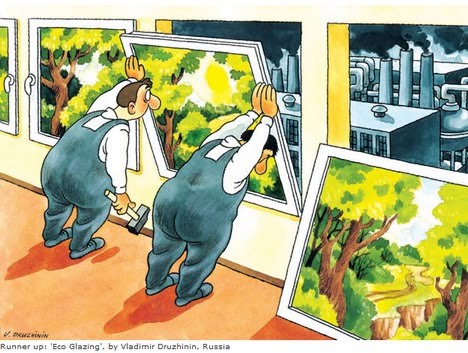
Global warming cartoon titled “Eco-Glazing” by Vladimir Druzhinin of Russia, from Earthworks 2008 global cartoon competition / Treehugger.

Causes of climate change:
The corporate anti-science
campaign
is working

By Ted McLaughlin / The Rag Blog / April 26, 2011

Just three or four years ago a majority of the people in the United States believed that global climate change was either fully or partially the result of human activity (overuse of fossil fuels) — about 60% of Americans believed this. And this was in line with the views of most of the rest of the world, especially the developed nations. But a lot has changed in the last few years.

American corporations have spent millions of dollars yearly to propagandize the issue. And they have bought a lot of congressmen (most of them Republicans). These corporations and their political lackeys have used a powerful tool creating doubt — a tool they learned from the successes of the creationist movement.

The creationists attacked evolution (a proven fact) by repeatedly calling it just a “theory” and getting a few dubious scientists (usually from fields other than biology) to back them up. They then used the statements from these very few “scientists” to attack the work and facts of actual science and scientists. And after repeating their lies a few thousand times they have been able to get a substantial portion of the population to believe them — enough to force religion into many science classes around the nation.

The corporate barons saw how well this tactic had worked for the creationists, and decided to try it for themselves. They figured they could be even more effective since they were willing to spend many millions of dollars to spread their falsehoods.

They found a few scientists who could be bought or hoodwinked and used pronouncements from them to make it seem as though man-made global climate change was only a theory that had widespread disagreement in the scientific community (even though it is accepted by more than 90% of the world’s scientists).

Then they turned their politicians (who had been bought and paid for) loose to claim that acting on this “unproven theory” would cost jobs and damage American businesses by making them unable to compete in the world market (more well-paid-for lies). And it has worked.

Now only 48% of Americans (a 12 point drop since 2007-2008) believe that human activity has anything to do with global climate change, and a full 47% of Americans believe that human activity had nothing to do with it — that it is just a natural phenomenon.

I believe this drop in the belief that humans are causing the global climate change is due to this corporate-based propaganda, because the numbers of those who believe humans are at least partially responsible remain very high in most of the rest of the world — especially the developed nations.

The only nations with less than 50% belief in human responsibility, other than the United States, are the developing parts of Asia, the Middle East and North Africa, and Sub-Saharan Africa (where about half of the populations have never even heard of global climate change). And even in these undeveloped areas, a clear majority of those with knowledge of global climate change believe it is caused at least partially by humans.

In fact, the only place in the world where more people believe global climate change has a natural cause instead of a human cause is the United States. This is sad. This used to be a nation that respected science and scientists. Now a substantial portion of the population has been hoodwinked. And the only reason is greed.

American corporations know it will cost them some money to clean up their act, and they don’t want to spend that money. They are perfectly willing to endanger the future of all mankind to maximize their own profits today.

It now looks like nothing will be done to delay or prevent global climate change until it is too late, and the United States will have to shoulder much of the blame for that. We not only use the lions share of the world’s fossil fuels and produce much of it’s pollution (Texas alone produces more pollution than all but six countries), but with our international influence it is unlikely the rest of the world will (or could) act without us.

Some on the right tell us that the Earth is very resilient and will survive. I agree. The Earth will survive whatever humans do to it (just as it always has). It is not the Earth’s survival that is in doubt — it is the survival of humans and the societies they have created that is in doubt. And that is because far too many in the U.S. are convinced that corporate profits are more important than anything else:

Here’s what a recent Gallup Poll showed when people in different parts of the world were surveyed on global climate change and its causes.

Percentage of those who believe humans are at least partially responsible for it:

Developed Asia……………83%
Canada……………72%
Western Europe……………69%
Eastern & Southern Europe……………68%
Latin America……………65%
Commonwealth of Ind. States……………51%
UNITED STATES……………48%
Developing Asia……………39%
Middle East/North Africa……………37%
Sub-Saharan Africa……………32%

Percentage of those who haven’t heard of global climate change:

Developed Asia……………4%
Canada……………4%
UNITED STATES……………4%
Western Europe……………6%
Eastern/Southern Europe……………17%
Latin America……………23%
Commonwealth of Ind. States……………23%
Developing Asia……………48%
Middle East/North Africa……………49%
Sub-Saharan Africa……………54%

And here is how the world collectively views this crises:

Human cause……………35%
Natural cause……………14%
Both causes……………13%
Not aware of it……………36%

[Rag Blog contributor Ted McLaughlin also posts at jobsanger.]

The Rag Blog

Posted in Rag Bloggers | Tagged , , , , | Leave a comment

David Bacon : Bay Area Workers Still Fighting for Justice

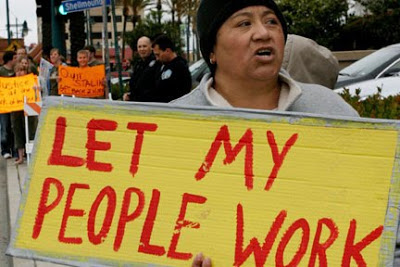
Workers from the Woodfin Suites Hotel protest the firing of immigrants in Emeryville, California. Photo by David Bacon.

150 years after general strike:
Bay Area workers still fighting for justice

By David Bacon / The Rag Blog / April 26, 2011

SAN FRANCISCO — In the 150-year history of workers in the San Francisco Bay Area, the watershed event was one that happened 70 years ago — the San Francisco general strike. That year, sailors, longshoremen, and other maritime workers shut down all the ports on the West Coast, trying to form a union and end favoritism, low wages, and grueling 10- and 12-hour days. Ship owners deployed tanks and guns on the waterfront and tried to break the strike.

At the peak of this bitter labor war, police fired into crowds of strikers, killing two union activists. Then workers shut down the entire city in a general strike, and for four days, nothing moved in San Francisco. The strike gave workers a sense of power described in a verse in the union song “Solidarity Forever”: “Without our brain and muscle, not a single wheel can turn.”

The strike marked the end of a period in which, for 70 years, the efforts of workers to form unions were met with violence and firings. By the end of the 1930s, the International Longshore and Warehouse Union (ILWU) was one of the strongest in the nation; workers had a hiring hall instead of a humiliating shapeup in which they had to beg for jobs, and workers on both sides of the bay were busy building other unions, as well as political organizations that eventually elected mayors and sent pro-worker candidates to Congress.

The strike marked the beginning of our modern labor movement.

One product of the rising power of unions was the development of the workers’ compensation system to ensure that injured and sick workers would receive enough compensation from employers to survive.

While California had passed its first workers’ compensation law, the Compensation Act, in 1911, participation by employers was at first voluntary and only became compulsory two years later. Establishment of the system was both a reaction to the high level of workplace injuries at the turn of the century and a product of the progressive movement that sought to limit the power of large corporations.

The state established its own compensation fund in 1914 to offer a system with costs lowered by removing insurance corporations and their profits. At the height of the Depression, 18 private insurance corporations went bankrupt, while the state fund continued to pay injured workers.

Sam Johnson, a worker for the City of Burlingame, prepares to tap a water main to provide water service to a home.

The 1930s and ’40s were high points in the power of industrial and manual laborers. By that time, trucks had replaced the horse-drawn wagons that employed the area’s first Teamsters. Assembly workers labored in huge factories, churning out automobiles and electrical equipment; construction workers built the bridges that span the bay and thousands of sailors and other marine workers sailed out on ships that packed the wharves.

The unions of the ’30s ended the worst conditions that prevailed in the previous 70 years — 10-hour days and six-day weeks, job conditions that could sicken and kill, wages that could barely feed a family and constant fear of getting unfairly fired. The changes won by the unions of the ’30s and ’40s created an economic base for many working families to buy homes and send their children to college.

The state responded by creating a system of universities and community colleges and, by the end of World War II, promised that any working-class kid who graduated high school would find a place in one of them. The nation’s first employer-paid medical plan began in the Richmond shipyards.

Belonging to a union gave workers from diverse backgrounds a common shared culture, with its own labor songs and activities built around the hall, from sports and fishing, to dancing, eating and other social activities.

Still, in the ’30s and ’40s, the Bay Area’s workforce was rigidly divided by race and sex. A “color line” prevented African-Americans from getting skilled jobs in construction, industry, and public services like fire and police. Women could work in some jobs, but were kept out of the best-paying ones.

The general strike made one of the first cracks in that wall when striking longshoremen promised that, if African-Americans supported the effort, they’d force shipping companies to abandon the color line on the docks.

The promise was kept, and today people of color are a majority of the bay’s dockworkers. Meanwhile, wartime work in the shipyards drew many African-Americans from homes in the south to new communities in California. Black families living in West Oakland and San Francisco’s Fillmore and Western Addition neighborhoods shared a vibrant cultural life, with its clubs incubating jazz and bebop, while the promise of employment gave a new generation a sense of security.

But it wasn’t until the civil rights movement of the 1960s that the color line came down in most areas, as a result of affirmative action decrees affecting jobs from building sites to fire houses. Demonstrations and active protest won women many gains as well. The reality today, however, is still that most women and workers of color earn less and are unemployed more than the workforce in general. Equality remains very much a work in progress.)

Immigration, too, transformed jobs and industries. European immigrants and their descendents made up the workforce in the best jobs in the Bay Area’s budding economy of the late 1800s, in construction, transport and industry. Meanwhile, immigrants from China, Japan, Mexico, and the Philippines drained the San Joaquin delta, developed the agriculture that became the base of the state’s economy, laid the railroad tracks, served the meals and washed the clothes.

Immigration status caused few problems for those from Europe, but workers from Asia and Latin America faced continuing raids and deportations, especially when unemployment rose. While today these immigrants make up a growing section of the workforce in many areas, inequality based on immigration status, with rising raids and deportations, remain as well.

With the cold war of the 1950s and ’60s, however, many things changed for Bay Area workers. Among those changes was an increasing question about the adequacy of the workers’ compensation system. One case that highlighted the doubts was that of Marcos Vela.

Vela began working in the Johns-Manville asbestos factory in Pittsburg, California, in 1935. In 1959, the company began medical examinations to detect lung disease. A company doctor did a chest x-ray and found indications of asbestosis. But no one told Vela. In 1962, the same thing happened and again in 1965. In 1968, Vela’s x-ray showed a “ground glass” appearance. But the company again told him he was fine, even though he’d begun to cough and couldn’t catch his breath. Later that year, he was hospitalized and never went back to the plant.

Vela’s case became a symbol of the failure of the existing system of occupational safety and health and helped win passage of the Occupational Safety and Health Act, signed by President Nixon. But Vela’s case and that of other asbestosis victims also showed the limitations of the workers’ compensation system.

Dinorah Galdamez, a housekeeper at the Beverly Hilton Hotel, one of the most luxurious in the U.S.

Christopher Boggs voices the common assertion that employers will clean up dangerous workplaces in order to avoid higher compensation premiums. “Human capital (the value of the employee) became a driving force behind the push for a system of protection,” he says, adding that, “recognition of the value of employees and other events between 1900 and 1911 helped spur the movement towards a social system of workers’ compensation.”

Yet, higher compensation insurance premium costs didn’t dissuade Johns Manville from maintaining a carcinogenic workplace, or from lying to its workers. Vela and his coworkers had to win the right to sue Johns Manville to enforce its liability and to win adequate compensation.

The radical political culture that built the unions of the previous decade came under attack during the Cold War. Suddenly, workers needed to prove their loyalty to sail on a ship or teach in a school, and those who failed the tests, or refused to buckle under to them, found themselves out of a job and blacklisted.

Many unions became more conservative in response and lost much of the vibrant culture that made them a part of workers’ lives. Others fought hard and kept their leaders from being deported, as was attempted with ILWU President Harry Bridges and cannery union leader Lucio Bernabe. They won court cases protecting political rights and kept pushing for better conditions for workers.

But changes in technology changed the workplace greatly in the following decades and affected the power of unions as well. On the docks, the union was as strong as ever, but the number of longshore workers fell to less than a tenth of what it was during the general strike, as huge container cranes replaced the old hook and cargo net. Similar technological changes affected factory workers.

Beginning in the 1970s, large employers moved production overseas and most of the big factories of the Bay Area began to close. Wrenching dislocation and unemployment devastated working families, as the old industrial base shrank to a small fraction of what it had been. In cities like Oakland and Richmond, which had been healthy working class communities, neighborhoods, especially African-American ones, were devastated by the consequences — permanent unemployment, poverty and drug use.

New industries arose at the same time, although not in the former industrial centers, but in areas like the South Bay. Burgeoning semiconductor and computer plants created job opportunities for a whole new wave of immigrants, mostly from the Asian Pacific rim. San Francisco and the East Bay experienced an explosion of service industry jobs — clerical workers in the new glass and steel office towers, hospital workers in the health care industry and retail workers in the malls that took the place of the old downtown shopping districts.

But these new jobs were not the same as the ones they replaced. The wages were generally lower, benefits fewer, employment much more temporary, and overwhelmingly, the employers were very hostile to unions. Beginning in the 1980s, therefore, the labor movement had to almost begin again from scratch, helping a new generation of workers to understand the advantages of being organized, which the general strike had made so clear to a generation before.

The development of high-tech industry also posed new challenges to efforts to protect workers’ safety and health. Although the industry had a clean image, with no smokestacks belching visible pollution, the use of highly toxic solvents and other chemicals led to large waves of injured and poisoned workers.

Often workers charged that the synergistic effects of exposure to many chemicals at once made them so sensitive that they could not even walk down the detergent aisle in a supermarket without painful reactions. Studies, even those by industry, documented a large increase in birth defects among workers in semiconductor plants.

Linh Vu is a school cafeteria worker at the Toby Johnson Middle School and member of the American Federation of State, County and Municipal Employees.

The system of workers’ compensation was often inadequate in analyzing these dangers and assuring workers of adequate compensation and treatment. Some affected workers organized a Disabled Workers United group to press for banning some chemicals and liability by the industry for causing the injuries. They viewed the workers’ compensation system as overly favorable toward employers because it was hard to collect benefits for chemical exposure and it insulated employers from liability.

At the same time, laws passed under worker pressure, designed to encourage union organizing and protect public benefits like unemployment insurance and Social Security, came under attack from a wave of conservative administrations in Sacramento and Washington. Overtime pay, won through generations of strikes and protest, was stripped from six million workers nationally. As a result, while Bay Area unions included over a third of all workers in the 1950s, today they represent less than half that.

As unions struggled with this new environment, however, many workers did win new rights. The farmworkers movement, beginning in the 1960s, established the right of the state’s poorest workers to form unions and achieve a decent standard of living. The union ended abuses like the infamous short-handled hoe, exposure to dangerous pesticides, and the lack of bathrooms and drinking water in the fields. During the period of its greatest strength in the 1970s and early 1980s, the wage of a union farm worker was at least double the minimum wage, the highest level it has ever achieved.

A crew of farm workers harvests bok choy for Vessey Farms in the Imperial Valley. Photos by David Bacon.

The movement of rural workers was strongly supported by urban workers through the boycotts of struck fruits and vegetables. In the rural areas of California, Chicanos, Mexicans, and Filipinos were able to end discrimination in schools and public services. The United Farm Workers, in turn, helped revitalize the fighting spirit of other unions and help them relearn the organizing tactics of a social movement.

Public workers, denied the right to organize and strike through the ’30s and ’40s, became some of the most active and numerous members of the labor movement by the 1980s. When teachers and nurses began forming unions in the ’50s, they had to quit their jobs in protest in order to force public agencies to bargain. Today, legislation sets salary minimums in the classroom and protects the right to organize, while in hospitals, workers have won new laws establishing minimum staffing levels, protecting both jobs and patients.

That has made public worker unions a target for the political right, which seeks to reduce union strength even further by attacking the area where the labor movement now is strongest. The most severe economic crisis since the Depression has become the pretext for slashing education, public services, and employment, while taxes paid by corporations and the wealthy continue to decline.

The growing costs of the workers’ compensation insurance system became the subject of intense debate in the late 1990s and early 2000s and competing “reform” bills were put forward by Democrats and Republicans. During the years when unions held more power in Sacramento, they proposed reforms to try to hold down costs while protecting the right of workers to adequate compensation. When unions lost power, reforms passed that disqualified thousands of workers from benefits.

The continued survival of the workers’ compensation system as one that can provide adequate benefits to injured and sick workers is more clearly than ever tied to the size and strength of the labor movement.

Workers of a century ago would find the Bay Area a very different place. New industries have replaced old ones. Unions are more legally accepted, but have to fight just as hard. Worker protections and benefits have been legally recognized, but are being attacked. Race and sex discrimination is still a fact of life, but the fight to end it has scored important victories.

And that’s what the veterans of the general strike would recognize most clearly. The world needs the labor of today’s workers as much as it needed that of workers in an earlier era. And the effort by the Bay Area’s working people to win power, equality, and better lives for their families is still going on, as hot and hard as ever. Their answer to those problems — to get organized in strong and democratic unions — is the same one working families seek today.

[David Bacon is a writer and photographer whose work frequently appears on The Rag Blog. His new book, Illegal People: How Globalization Creates Migration and Criminalizes Immigrants, was just published by Beacon Press. His photographs and stories can be found at dbacon.igc.org. This article was also published at Truthout.]

The Rag Blog

Posted in Rag Bloggers | Tagged , , , , , | Leave a comment

One Hundred and Fifty Years After General Strike, Bay Area Workers Still Fighting for Justice
Thursday 21 April 2011
by: David Bacon, Truthout

SAN FRANCISCO — In the 150-year history of workers in the San Francisco Bay Area, the watershed event was one that happened 70 years ago — the San Francisco general strike. That year, sailors, longshoremen, and other maritime workers shut down all the ports on the West Coast, trying to form a union and end favoritism, low wages and grueling 10- and 12-hour days. Ship owners deployed tanks and guns on the waterfront and tried to break the strike.

At the peak of this bitter labor war, police fired into crowds of strikers, killing two union activists. Then workers shut down the entire city in a general strike, and for four days, nothing moved in San Francisco. The strike gave workers a sense of power described in a verse in the union song “Solidarity Forever”: “Without our brain and muscle, not a single wheel can turn.”

The strike marked the end of a period in which, for 70 years, the efforts of workers to form unions were met with violence and firings.

By the end of the 1930s, the International Longshore and Warehouse Union (ILWU) was one of the strongest in the nation; workers had a hiring hall instead of a humiliating shapeup in which they had to beg for jobs, and workers on both sides of the bay were busy building other unions, as well as political organizations that eventually elected mayors and sent pro-worker candidates to Congress. The strike marked the beginning of our modern labor movement.

One product of the rising power of unions was the development of the workers’ compensation system to ensure that injured and sick workers would receive enough compensation from employers to survive.

While California had passed its first workers’ compensation law, the Compensation Act, in 1911, participation by employers was at first voluntary and only became compulsory two years later. Establishment of the system was both a reaction to the high level of workplace injuries at the turn of the century and a product of the progressive movement that sought to limit the power of large corporations.

The state established its own compensation fund in 1914 to offer a system with costs lowered by removing insurance corporations and their profits. At the height of the Depression, 18 private insurance corporations went bankrupt, while the state fund continued to pay injured workers.

The 1930s and ’40s were high points in the power of industrial and manual laborers. By that time, trucks had replaced the horse-drawn wagons that employed the area’s first Teamsters. Assembly workers labored in huge factories, churning out automobiles and electrical equipment; construction workers built the bridges that span the bay and thousands of sailors and other marine workers sailed out on ships that packed the wharves.

The unions of the ’30s ended the worst conditions that prevailed in the previous 70 years — ten-hour days and six-day weeks, job conditions that could sicken and kill, wages that could barely feed a family and constant fear of getting unfairly fired. The changes won by the unions of the ’30s and ’40s created an economic base for many working families to buy homes and send their children to college. The state responded by creating a system of universities and community colleges and, by the end of World War II, promised that any working-class kid who graduated high school would find a place in one of them. The nation’s first employer-paid medical plan began in the Richmond shipyards.

Vicki Stoneham teaches English at the Leadership Academy, a small public school in east Oakland. (Photo: David Bacon)

Belonging to a union gave workers from diverse backgrounds a common shared culture, with its own labor songs and activities built around the hall, from sports and fishing, to dancing, eating and other social activities.

Still, in the ’30s and ’40s, the Bay Area’s workforce was rigidly divided by race and sex. A “color line” prevented African-Americans from getting skilled jobs in construction, industry and public services like fire and police. Women could work in some jobs, but were kept out of the best-paying ones. The general strike made one of the first cracks in that wall when striking longshoremen promised that, if African-Americans supported the effort, they’d force shipping companies to abandon the color line on the docks.

Workers from the Woodfin Suites Hotel protest the firing of immigrants in Emeryville, California. (Photo: David Bacon)

The promise was kept, and today people of color are a majority of the bay’s dockworkers. Meanwhile, wartime work in the shipyards drew many African-Americans from homes in the south to new communities in California. Black families living in West Oakland and San Francisco’s Fillmore and Western Addition neighborhoods shared a vibrant cultural life, with its clubs incubating jazz and bebop, while the promise of employment gave a new generation a sense of security.

Click here to get Truthout stories like this one sent straight to your inbox, 365 days a year.
A crew of farm workers harvests bok choy for Vessey Farms in the Imperial Valley. (Photo: David Bacon)

But it wasn’t until the civil rights movement of the 1960s that the color line came down in most areas, as a result of affirmative action decrees affecting jobs from building sites to fire houses. Demonstrations and active protest won women many gains as well. The reality today, however, is still that most women and workers of color earn less and are unemployed more than the workforce in general. Equality remains very much a work in progress.

Peter Noah, a Nigerian immigrant, drives a taxi in Stockton. (Photo: David Bacon)

Immigration, too, transformed jobs and industries. European immigrants and their descendents made up the workforce in the best jobs in the Bay Area’s budding economy of the late 1800s, in construction, transport and industry. Meanwhile, immigrants from China, Japan, Mexico and the Philippines drained the San Joaquin delta, developed the agriculture that became the base of the state’s economy, laid the railroad tracks, served the meals and washed the clothes.

Immigration status caused few problems for those from Europe, but workers from Asia and Latin America faced continuing raids and deportations, especially when unemployment rose. While today these immigrants make up a growing section of the workforce in many areas, inequality based on immigration status, with rising raids and deportations, remain as well.

With the cold war of the 1950s and ’60s, however, many things changed for Bay Area workers. Among those changes was an increasing question about the adequacy of the workers’ compensation system. One case that highlighted the doubts was that of Marcos Vela.

Vela began working in the Johns-Manville asbestos factory in Pittsburg, California, in 1935. In 1959, the company began medical examinations to detect lung disease. A company doctor did a chest x-ray and found indications of asbestosis. But no one told Vela. In 1962, the same thing happened and again in 1965. In 1968, Vela’s x-ray showed a “ground glass” appearance. But the company again told him he was fine, even though he’d begun to cough and couldn’t catch his breath. Later that year, he was hospitalized and never went back to the plant.

Vela’s case became a symbol of the failure of the existing system of occupational safety and health and helped win passage of the Occupational Safety and Health Act, signed by President Nixon. But Vela’s case and that of other asbestosis victims also showed the limitations of the workers’ compensation system. Christopher Boggs voices the common assertion that employers will clean up dangerous workplaces in order to avoid higher compensation premiums. “Human capital (the value of the employee) became a driving force behind the push for a system of protection,” he says, adding that, “recognition of the value of employees and other events between 1900 and 1911 helped spur the movement towards a social system of workers’ compensation.”

Yet, higher compensation insurance premium costs didn’t dissuade Johns Manville from maintaining a carcinogenic workplace, or from lying to its workers. Vela and his coworkers had to win the right to sue Johns Manville to enforce its liability and to win adequate compensation.

The radical political culture that built the unions of the previous decade came under attack during the cold war. Suddenly, workers needed to prove their loyalty to sail on a ship or teach in a school, and those who failed the tests, or refused to buckle under to them, found themselves out of a job and blacklisted. Many unions became more conservative in response and lost much of the vibrant culture that made them a part of workers’ lives. Others fought hard and kept their leaders from being deported, as was attempted with ILWU President Harry Bridges and cannery union leader Lucio Bernabe. They won court cases protecting political rights and kept pushing for better conditions for workers.

But changes in technology changed the workplace greatly in the following decades and affected the power of unions as well. On the docks, the union was as strong as ever, but the number of longshore workers fell to less than a tenth of what it was during the general strike, as huge container cranes replaced the old hook and cargo net. Similar technological changes affected factory workers. Beginning in the 1970s, large employers moved production overseas and most of the big factories of the Bay Area began to close. Wrenching dislocation and unemployment devastated working families, as the old industrial base shrank to a small fraction of what it had been. In cities like Oakland and Richmond, which had been healthy working class communities, neighborhoods, especially African-American ones, were devastated by the consequences – permanent unemployment, poverty and drug use.

New industries arose at the same time, although not in the former industrial centers, but in areas like the South Bay. Burgeoning semiconductor and computer plants created job opportunities for a whole new wave of immigrants, mostly from the Asian Pacific rim. San Francisco and the East Bay experienced an explosion of service industry jobs – clerical workers in the new glass and steel office towers, hospital workers in the health care industry and retail workers in the malls that took the place of the old downtown shopping districts.

But these new jobs were not the same as the ones they replaced. The wages were generally lower, benefits fewer, employment much more temporary, and overwhelmingly, the employers were very hostile to unions. Beginning in the 1980s, therefore, the labor movement had to almost begin again from scratch, helping a new generation of workers to understand the advantages of being organized, which the general strike had made so clear to a generation before.

The development of high-tech industry also posed new challenges to efforts to protect workers’ safety and health. Although the industry had a clean image, with no smokestacks belching visible pollution, the use of highly toxic solvents and other chemicals led to large waves of injured and poisoned workers. Often workers charged that the synergistic effects of exposure to many chemicals at once made them so sensitive that they could not even walk down the detergent aisle in a supermarket without painful reactions. Studies, even those by industry, documented a large increase in birth defects among workers in semiconductor plants.

The system of workers’ compensation was often inadequate in analyzing these dangers and assuring workers of adequate compensation and treatment. Some affected workers organized a Disabled Workers United group to press for banning some chemicals and liability by the industry for causing the injuries. They viewed the workers’ compensation system as overly favorable toward employers because it was hard to collect benefits for chemical exposure and it insulated employers from liability.

At the same time, laws passed under worker pressure, designed to encourage union organizing and protect public benefits like unemployment insurance and Social Security, came under attack from a wave of conservative administrations in Sacramento and Washington. Overtime pay, won through generations of strikes and protest, was stripped from six million workers nationally. As a result, while Bay Area unions included over a third of all workers in the 1950s, today they represent less than half that.

As unions struggled with this new environment, however, many workers did win new rights. The farmworkers movement, beginning in the 1960s, established the right of the state’s poorest workers to form unions and achieve a decent standard of living. The union ended abuses like the infamous short-handled hoe, exposure to dangerous pesticides and the lack of bathrooms and drinking water in the fields. During the period of its greatest strength in the 1970s and early 1980s, the wage of a union farm worker was at least double the minimum wage, the highest level it has ever achieved.

The movement of rural workers was strongly supported by urban workers through the boycotts of struck fruits and vegetables. In the rural areas of California, Chicanos, Mexicans and Filipinos were able to end discrimination in schools and public services. The United Farm Workers, in turn, helped revitalize the fighting spirit of other unions and help them relearn the organizing tactics of a social movement.

Public workers, denied the right to organize and strike through the ’30s and ’40s, became some of the most active and numerous members of the labor movement by the 1980s. When teachers and nurses began forming unions in the ’50s, they had to quit their jobs in protest in order to force public agencies to bargain. Today, legislation sets salary minimums in the classroom and protects the right to organize, while in hospitals, workers have won new laws establishing minimum staffing levels, protecting both jobs and patients.

That has made public worker unions a target for the political right, which seeks to reduce union strength even further by attacking the area where the labor movement now is strongest. The most severe economic crisis since the Depression has become the pretext for slashing education, public services and employment, while taxes paid by corporations and the wealthy continue to decline.

The growing costs of the workers’ compensation insurance system became the subject of intense debate in the late 1990s and early 2000s and competing “reform” bills were put forward by Democrats and Republicans. During the years when unions held more power in Sacramento, they proposed reforms to try to hold down costs while protecting the right of workers to adequate compensation. When unions lost power, reforms passed that disqualified thousands of workers from benefits. The continued survival of the workers’ compensation system as one that can provide adequate benefits to injured and sick workers is more clearly than ever tied to the size and strength of the labor movement.

Workers of a century ago would find the Bay Area a very different place. New industries have replaced old ones. Unions are more legally accepted, but have to fight just as hard. Worker protections and benefits have been legally recognized, but are being attacked. Race and sex discrimination is still a fact of life, but the fight to end it has scored important victories.

And that’s what the veterans of the general strike would recognize most clearly. The world needs the labor of today’s workers as much as it needed that of workers in an earlier era. And the effort by the Bay Area’s working people to win power, equality and better lives for their families is still going on, as hot and hard as ever. Their answer to those problems – to get organized in strong and democratic unions – is the same one working families seek today.

This article (and photographs) are not to be reproduced without specific permission of the author.
0diggsdigg
David Bacon

David Bacon is a writer and photographer. His new book, “Illegal People – How Globalization Creates Migration and Criminalizes Immigrants,” was just published by Beacon Press. His photographs and stories can be found at http://dbacon.igc.org.

Type rest of the post here

Source /

The Rag Blog

Posted in RagBlog | Leave a comment

Lamar W. Hankins : Price Gouging at Your Corner Drug Store

Product placement! Display at a CVS drug store. Photo by gbeckley /The Consumerist.

Consumer alert!
Price gouging at your corner
convenience drug stores

By Lamar W. Hankins / The Rag Blog / April 22, 2011

The press coverage this past week of the 2007 CVS-Caremark merger that is being characterized as anti-competitive by several consumer organizations — Consumer Federation of America, Community Catalyst, Consumers Union, National Legislative Association on Prescription Drug Prices (NLARx) and U.S. PIRG — piqued my interest because I was in the midst of some consumer research about CVS’s high prices for non-prescription products.

Long ago, I stopped using the CVS card that was issued to me and which is used by CVS to track consumer preferences and provide coupons for discounts on certain products, most of which I found had an expiration before I was ready to use them. I decided that I didn’t want CVS tracking my purchases so easily, given the loss of privacy we have generally in this high-tech consumer society.

As it turns out, the merger controversy may have nothing to do with what I discovered in my research, but it is indicative of the tactics of many, if not most, retail corporations to increase their profits.

Most consumers may know that the layout of stores is intended to encourage impulse purchases of items on which the stores enjoy greater profits than on other items. The special displays on rows and aisles, the displays at the ends of aisles, and the special displays at checkout counters are all used to increase sales of those items. Product placement on shelves is also used to encourage purchasing. Distributors fight for noticeable and accessible shelving space, whether at drug stores, supermarkets, or other retail outlets.

In an effort to increase profits through its drug plans, Caremark is accused of steering customers to its retail pharmacies where prescription drugs cost more than through its mail-order service. This behavior, which Caremark has denied, is being investigated by the Federal Trade Commission and 24 state attorneys general. But consumers may want to investigate other marketing practices.

I have been a volunteer consumer advocate for nearly 20 years, mostly relating to all things funeral, but I’ve seldom turned my attention to other consumer pricing issues. Quite by accident, I recently learned a consumer lesson that many people on tighter budgets may know about already.

Because I have arthritis, as do 50 million other Americans, my hands often ache at night, waking me up. When I saw a product — JointFlex — advertised with a money-back guarantee, I decided to try it. I stopped off at the CVS store on a corner near my house and bought a tube for $20.99. I thought the price was a bit high, but with a money-back guarantee, I decided to give it a try and hold on to my receipt and the box.

Much to my surprise and relief, the product worked. As my first tube of JointFlex was running out, I remembered to buy another tube while I was shopping at HEB one day. I was shocked to find that the HEB price for the same product and quantity was $11.30.

I took both boxes and receipts to the CVS store and asked to speak to the manager. I asked her why JointFlex was so much higher at CVS than at HEB. She didn’t know. She said that the corporate office tells her what prices to charge and she doesn’t ask questions.

And the winner: HEB (“A Texas Tradition”). Image from Icemancast.com.

That experience gave me an idea. I priced another 11 name-brand items normally found at drug stores and selected at random. After noting the prices at CVS, I went to HEB to price the same items. HEB was significantly cheaper on every item. I decided to check out the prices on the same items at Walgreens and found that Walgreens is about 7% cheaper than CVS for the same items — still no bargain in comparison to HEB. Here is what I found about the prices at CVS and HEB:

Neosporin (first aid ointment), .5 oz: CVS-$6.39….. HEB-$3.86
Bactine Cleansing Spray, 5 oz: CVS-$8.79….. HEB-$4.96
Visine for Contacts, 1/2 fl.oz: CVS-$4.99….. HEB-$3.62
Band-Aid Plastic Strips, 60 strips: CVS-$3.59…. HEB-$1.96
Johnson’s Body Care Lotion, 14 oz: CVS-$6.49…. HEB-$3.97
Tums, assorted fruit, 150 chewable tablet: CVS-$5.49….. HEB-$3.68
Pepto Bismol-original, 12 oz: CVS-$5.99….. HEB-$4.92
Phillips Milk of Magnesia-original, 12 oz: CVS-$6.29….. HEB-$4.16
Aleve Liquid Gels, 40 gels: CVS-$7.99….. HEB-$6.48
Bayer Aspirin, 100 coated tablets: CVS-$6.46….. HEB-$5.88
Children’s Claritin syrup, grape flavor, 4 oz: CVS-$11.29….. HEB-$9.22
JointFlex arthritis cream, 4 oz: CVS-$20.99….. HEB-$11.30

CVS charges $94.75 for the twelve items. HEB charges $64.01, for a savings of about 33%.

Convenience drug stores appear to be much like convenience grocery stores. They may have a few low prices to get you in the store, but most other items are overpriced as compared to a supermarket (or, at least, some supermarkets). Of course, if you are willing to pay more for the convenience, which all of us are occasionally, we have to give up some money to get that convenience.

The moral of my research project may be this: buy your prescriptions wherever you please, but be aware that other drug store products are likely to be overpriced at the corner convenience drug store.

As I am approaching living on a fixed income as a retiree, I have become more concerned about costs. You can be sure that I won’t be making any more convenience drug store purchases unless I’m in a real hurry.

[Lamar W. Hankins, a former San Marcos, Texas, city attorney, is also a columnist for the San Marcos Mercury. This article © Freethought San Marcos, Lamar W. Hankins.]

The Rag Blog

Posted in Rag Bloggers | Tagged , | 3 Comments

Growing the War in Libya

By Steve Weissman,

RSN Special Coverage: Egypt’s Struggle for Democracy

If America and its NATO allies flew into battle over Libya to prevent a bloodbath in Benghazi, as President Obama, Prime Minister David Cameron of Britain, and President Nicholas Sarkozy of France continue to claim, the big three are now escalating their war to defend “the defenseless civilians of Ajdabiya” and end the “medieval siege” of Misrata.

Their barely camouflaged declaration of intent came in a joint letter that appeared last week in the Times of London, Le Figaro and the International Herald Tribune. “Our duty and our mandate under UN Security Council Resolution 1973 is to protect civilians,” they wrote. “It is not to remove Qaddafi [Kadhafi] by force.”

But, they added, “So long as Qaddafi [Kadhafi] is in power, NATO must maintain its operations so that civilians remain protected and the pressure on the regime builds.”

Regime change was always what the big three wanted, as they never stopped repeating. But now they have effectively rewritten the UN resolution to make Kadhafi’s ouster their officially stated goal. Continuing to describe their intervention in humanitarian terms, they have moved from protecting innocent civilians to openly backing one side in a Libyan civil war.

With the original UN resolution, the nations that voted for it — and those that abstained — were motivated in part by Col. Muammar Kadhafi’s murderous threat to “chase the traitors from Benghazi.” He would, he said, “track them down, and search for them, alley by alley, road by road” and show them “no mercy.”

Source Respected scholars argue [1] that those who favored intervention “grossly exaggerated the humanitarian threat” and falsely raised the specter of genocide to justify military action. But who in power cared? Having already boxed themselves into a corner by repeatedly calling for Kadhafi to go, Obama, Sarkozy, and Cameron would never run the risk that the Libyan strongman might follow through on his bluster while they refused to act. Tune in to Al Jazeera English to watch both the bloodshed and the squirming.

Now, with all sides contributing to a very real humanitarian crisis in Misrata, the big three have greatly upped the stakes. The rhetoric remains hot and heavy, with far more media coverage of Kadhafi’s sins than those of the armed civilians NATO is now backing. And, amid the grisly recitation of atrocities, the allies are openly putting more of their own military boots on the ground. [2]

Source

On Tuesday, Cameron sent a small group of military advisors to Libya, to do what is not exactly clear, while Sarkozy is sending in a French contingent following a meeting Wednesday with the leader of the rebels’ National Transitional Council, Kadhafi’s recently-resigned Minister of Justice, Mustafa Abdul Jalil. The meeting came after one of Sarkozy’s allies in the French parliament called for putting 200 to 300 French special forces on the ground to help direct NATO planes in bombing Kadhafi’s forces.

Lawyers will argue at what point the build-up of British and French forces violates the UN resolution’s explicit prohibition of “a foreign occupation force of any form on any part of Libyan territory.” But, contrary to official statements, these are not the first foreign troops to enter the war, nor are they likely to be the last.

As early as February 25, the Israeli news service Debkafiles reported that British, French, and American special forces had landed off Benghazi and Tobruk, while the Wall Street Journal, UPI and London’s Daily Mail reported the presence by early March of foreign arms and military advisers, including some from Egypt.

Another report in the right-wing Italian daily Libero claims that French soldiers secretly met with one of the military planners of the Benghazi uprising as early as November 18 of last year. This is yet to be confirmed, but French media [3] Source have widely reported that the first of Kadhafi’s top officials to defect, protocol chief Nuri Mesmari, came to Paris in October asking for political asylum. Known as the Libyan WikiLeak for his intimate knowledge of Kadhafi’s inner circle, Mesmari and his discussions with French intelligence appear to have been the initial impetus behind Sarkozy’s push for the Libyan intervention.

Additional Sources:

[1] http://articles.boston.com/2011-04-14/bostonglobe/29418371_1_rebel-stronghold-civilians-rebel-positions
http://walt.foreignpolicy.com/posts/2011/04/14/more_to_read_about_libya

[2] http://www.telegraph.co.uk/news/worldnews/africaandindianocean/libya/8461863/British-troops-go-to-Libya-amid-Vietnam-warnings.html
http://www.lefigaro.fr/international/2011/04/18/01003-20110418ARTFIG00651-libye-la-coalition-n-exclut-pas-l-envoi-de-commandos.php
http://tempsreel.nouvelobs.com/actualite/les-revolutions-arabes/20110420.OBS1597/libye-sarkozy-recoit-ce-mercredi-le-president-du-conseil-national-de-transition.html

[3] http://www.africaintelligence.com/
http://www.jeuneafrique.com/Article/ARTJAJA2604p021.xml0/arrestation-mouammar-kaddafi-seif-el-islam-detournement-de-fondsfin-de-partie-pour-mesmari.html
http://www.liberation.fr/monde/06013118-avec-la-force-et-la-lutte-du-peuple-le-regime-de-kadhafi-va-tomber

A veteran of the Berkeley Free Speech Movement and the New Left monthly Ramparts, Steve Weissman lived for many years in London, working as a magazine writer and television producer. He now lives and works in France, where he writes on international affairs.

Type rest of the post here

Source /

The Rag Blog

Posted in RagBlog | Leave a comment

Emily Hellewell : Public Radio and the West Texas Wildfires

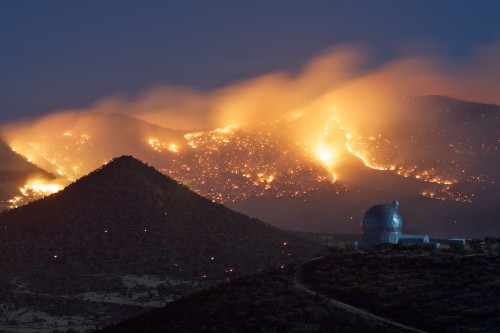
The Southwest Incident Management Team conducted burnouts April 19 near the McDonald Observatory in far west Texas. Photo by Frank Cianciolo / McDonald Observatory / Marfa Public Radio.

Why public radio maters:
Marfa station is critical resource
during west Texas wildfires

By Emily Hellewell / NPR / April 21, 2011

MARFA, Texas — Deep in far west Texas, about 60 miles north of the Rio Grande, lies a city called Marfa. While the population might be sparse (about one person per square mile), the cattle are plentiful and tourists are known to especially appreciate the city’s unique art scene — as well as the wide open spaces, of course.

On Saturday, April 9, a brush fire sparked and quickly spread across the ranch lands, eventually blazing through more than 182,000 acres, destroying homes, killing cattle, leaving many without power but, remarkably (even for this rural space), not taking any human life.

In the thick of it all, was KRTS, the only local radio broadcaster in its listening area. Their story is just one example of the value of public radio stations, and the importance of federal funding in their operations.

Like any good news organization staff serving the community they live in, KRTS’ three-member team set out to cover the Rock House Fire. General Manager Tom Michael, Programming and Production Manager Rachel Osier Lindley and Office Manager Anne Adkins stood on the front line of the fire on that first day. They were actually on the scene from the start, covering the fire as it spread and developed into a major wildfire.

With lives at stake the small crew went to work broadcasting critical emergency alerts and information to their community.

Over the next several days these three were joined by volunteers and the station’s former high school student intern, Daniel Hernandez, who all simply showed up at the station to help KRTS bring the community news of the evacuations, the path of the fire, and road closures and openings. Listeners would call the station to give first-hand reporting and updates on road closures, often before the Texas Department of Transportation could confirm.

When the station, like many residents, lost power late on Saturday night, Michael knew he couldn’t stand for the estimated five days the local electricity provider expected it would take to get back to full service.

Just three weeks ago KRTS was awarded a Public Telecommunications Facilities Program (PTFP) grant from the National Telecommunications and Information Administration to purchase a backup power generator. They were in the process of purchasing the generator when the station went off the air.

“Unacceptable,” Michael said of the time KRTS would be off-air, given its critical role in sharing the public emergency information and updates.

So, in short order he wrestled the complicated logistics necessary to get back on air. An engineer from NPR Member station KUT in Austin was tapped to bring the station back on the grid.

Marfa Public Radio, Marfa, Texas.

Michael then accomplished a few more Herculean tasks in a matter of hours: 1) finding a donor to cover the cost of the engineer’s flight, 2) getting special permission from the FAA for the engineer’s plane to land at the closest airfield which was under a temporary flight restriction, 3) arranging a 4×4 vehicle ride up the mountain, and 4) negotiating with the area’s wireless provider, whose tower was adjacent to KRTS’s tower, to tap into their backup generator.

Fortunately, the power came back on just as they got to the tower. The KUT engineer checked the connection and the station was back on the air. Just 24 hours later.

That’s not to say KRTS wasn’t reporting during the time of dead air. Through the station’s website, Facebook page, and Twitter feed they covered the wildfire’s status, every critical community evacuation, and road closures and openings.

As the wildfire’s containment increased and the immediate threat lessened, the station added reports on Red Cross services for those who had homes destroyed as well as details on local drives being set up to donate household items and food. During that first day alone Michael contacted the station’s streaming provider three separate times to double their capacity so they could accommodate the growing volume of online listeners.

Michael isn’t hesitant to share his projection about what would happen if federal grants were eliminated. The station relies on grants like the PTFP and the Corporation for Public Broadcasting’s Community Service Grants, which make up 30-50% of KRTS’s annual budget.

“We would go away if that money was lost,” Michael said.

The station’s operations are lean; without an engineer, music library, or a dedicated news staff, Michael doesn’t have to worry about many expenses beyond utilities and paying for the NPR programming that contribute to the station’s schedule.

With a tight margin between expenses and revenue and the looming threat of cuts to federal grant money, Michael is working hard to protect his station from going permanently dark. The station’s 600 members and total potential audience of 12,000– consisting largely of ranchers, border control agents, tourists, art gallery owners, and residents — relies on KRTS, he says.

“People are listening, especially in times of crisis. I feel terrible about the one day we were off the air during the wildfire, but fortunately during the evacuations we were able to get people to safety.” said Michael.

Michael thanks the first responders and the community that came together to fight this fire. And although he would probably never admit it himself, especially when it comes to the Rock House Fire, KRTS could certainly be considered among those first responders who helped residents stay informed and safe.

Whether bringing listeners the important details of a wildfire deep in west Texas or providing NPR’s coverage of a firefight on the streets of Kabul, KRTS is keeping the residents of Marfa informed every day.

Read the Fort Worth Star-Telegram‘s thoughts on Marfa Public Radio’s efforts during the fire here, and find out more about the station online at www.marfapublicradio.org.

[This article was published by National Public Radio and was distributed by Free Press‘ Media Reform Daily.]

The Rag Blog

Posted in RagBlog | Tagged , , , , , | Leave a comment

Sherman DeBrosse : The Republican Bait and Switch


Bait and switch:
The Republican assault on Medicare

By Sherman DeBrosse / The Rag Blog / April 21, 2011

The Republicans used the election of 2010 to pull off an impressive bait-and-switch operation.

They campaigned against health care reform because it trimmed money from Medicare. It did trim the Medicare budget, but the Republicans falsely claimed it cut benefits. The public handed them the power to steer economic policy and they used control of the House of Representatives to launch a scheme to gradually defund and privatize Medicare.

They also promised to restore jobs and to introduce employment-producing legislation. President Barack Obama was too gentle to point out that they had done nothing about jobs. He did show the bait-and-switch attack on Medicare, and the Republicans instantly cried “foul,” claiming he was being partisan and inaccurate. As usual, they neglected to support their complaint with hard facts.

In the budget the House passed for 2012, Budget Chairman Paul A. Ryan mainly called for huge cuts in Medicare and Medicaid. The Ryan plan proposes dramatic cuts in federal Medicare, especially for people now under 55 years of age.

Estimates vary on how much will be cut in a decade, ranging from $4.3 trillion to $5.8 trillion. The lion’s share of the cuts will come from Medicaid. Obama’s proposed spending on transportation will be cut by 41%, and spending on education will be slashed by 36%. Energy spending will be reduced to zero, and veteran’s will take a $19 billion hit. There will be a reduction in agricultural subsidies. There will be sharp cuts in low-income housing, Pell grants, and food stamps.

The Republican plan aims to destroy the health care reform plan by starving it of funds. There would be no cuts to defense spending beyond the $78 billion in savings over 10 years that Secretary Robert Gates has identified.

About two-thirds of the savings come out of the hides of low-income citizens. Ryan does this by making Medicaid into block grants, thus enabling the states to trim even more Medicaid services, and by giving future Medicare recipients, in 2022, subsidies to add to their own funds to purchase private insurance. The subsidies would go directly to insurance companies from whom they are buying health insurance with their own funds.

The Republican goal is to turn Medicare into something like the present Medicare Advantage, except that people would be paying a lot more for it. They refuse to acknowledge that the present Medicare Advantage costs American taxpayers 12% more than does Medicare.

At the outset, the individual would be paying over $6,000 out of pocket for coverage in just the first year. Within 10 years of the Ryan Budget’s enactment, people covered by the new provision would be paying all of their Social Security to purchase private medical insurance.

The Congressional Budget Office estimates that in 2030 the voucher would cover about a third of the cost of health insurance. Paul Ryan is not providing cost containment or any minimum of coverage. At the same time, he cuts taxes by a like amount for the wealthy, the near wealthy, corporations, and business.

In its first 10 years, the Ryan Plan cuts taxes for the wealthy and near wealthy as well as businesses and corporations by $4.3 trillion. Over 10 years it cuts spending by $100 billion, which does little to trim the deficit. A less discussed provision of the Ryan plan is the complete repeal of the Dodd-Frank financial reform act. This will make another meltdown of the financial system more likely and will put the taxpayer in line to again bail out institutions that are too big to fail.

Because it confers so much on the rich and business, the Ryan plan would not bring the budget into balance even after 20 years. It is a political marker designed to set the terms of the 2012 election. It ends the Obama health care plan, calls for gradual defunding of some entitlements, and preserves tax benefits for the wealthy and business.

Pundits praise Ryan as the Republicans’ best economist. What he offers is not economics at all. He presents no framework or arguments that economists could recognize as being related to the discipline of economics. True, the Heritage Foundation cranked out a study to support his scheme, but that organization has become famous for generating boilerplate to support far-right schemes.

The fact is that Ryan is trying to enact the theories of Ayn Rand, a novelist/amateur philosopher, who offered a framework for society that is like Marxism turned on its head. Ryan has said, “The reason I got into public service, by and large, if I had to credit one thinker… it would be Ayn Rand.” He requires his staffers to study Rand’s Nietzschian tracts.

In the words of Rand’s protagonist, Jon Galt, “The man at the top of the intellectual pyramid contributes the most to all those below him,” but receives little in return. “The man at the bottom who, left to himself, would starve in his hopeless ineptitude, contributes nothing to those above him, but receives the bonus of all of their brains.”

The idea is to direct more rewards to the creative few and to destroy the welfare state, which supposedly prevents people at the top from unleashing their creativity.

Ryan’s plan is about reordering society, not about wiping out the deficit. This approach is very popular with political fundamentalists and the Tea Baggers because they are certain they are the creative few and are being held back because government is helping lesser people. Ryan is serving up a large dose of Social Darwinism at a time when such selfish and ugly sentiments are very popular.

Ryan offers retrograde social engineering, not debt reduction.

[Sherman DeBrosse is a retired history professor and a frequent contributor to The Rag Blog.]

The Rag Blog

Posted in Rag Bloggers | Tagged , , , , , | 2 Comments

Bill Fletcher, Jr. : Obama, 2012, and Rethinking ‘Hope’

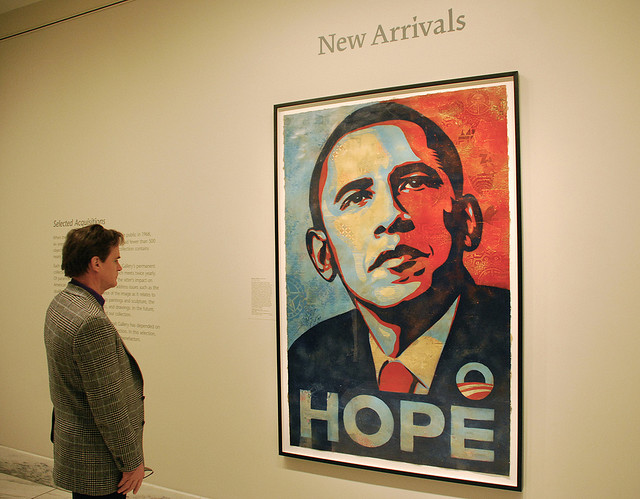
Taking a second look. Barack Obama “Hope” poster by Shepard Fairey. Image from afagen / Flickr.

Focusing ‘Hope’:
Obama and the 2012 elections

By Bill Fletcher, Jr. / The Rag Blog / April 21, 2011

Rather than dwell on the question of whether we can bring Obama home, whether he ever was home, etc., I want to refocus on this question of how to respond to him, particularly as we start to think about 2012.

First, what do we now say about 2008? Contrary to those who have thrown up their hands and feel betrayed by what the Obama administration has not done, I start in a different place. I continue to assert that Obama was knowable in 2008. He was a charismatic, smart candidate who made the right call on the Iraq War and stepped out on the issue when it was necessary.

He was also, as I said at the time, someone who could appear to be different things to different people. The problem was that too many of his supporters saw what they wanted to see rather than what existed.

What existed? Well, from the beginning he was a corporate candidate. We knew that. The question was not whether he was one but the extent to which his views could be shifted in order to take progressive, non-corporate stands.

Second, he was a candidate who was going to avoid race as you or I would avoid a plague ship. He went out of his way to prove that he was not an “angry black man” and that race was not going to be an issue that he would harp on.

Third, he was clear that he wanted to change the image of the USA around the world, but it was not clear to what extent he wanted to change the substance of the relationship of the USA to the rest of the world.

Raising these and other issues in 2008 was exceedingly difficult. Raising concerns regarding Obama and his views in 2008, even when one offered critical support to the campaign (as did I), was often met with accusations of throwing a wet towel on a fire, and other such metaphors.

Of course, there were those who denounced Obama all the way, but they offered very little as an alternative, with the exception of what we must frankly characterize as symbolic political action. What these fierce critics failed to address was how to account for and speak with the masses of people from various social movements who were gravitating toward Obama’s campaign, individuals and groups looking to create something very different in the USA (and around the world).

In fact, it was because of these masses of people, incorrectly described as a “movement” by some but certainly an energized base, and the potential of that base to become a transformative force, that it was correct to critically support the Obama campaign, despite the limitations of the campaign and the candidate.

What did we learn? We learned immediately that it was a mistake to give any elected official, but particularly someone reflecting more “center” politics, a honeymoon. Virtually every social movement and organization stepped back in the interest of providing Obama space. It did not work. There was space, alright, but the political Right seized it.

We also should have learned that it is not about the “man” but it is about the administration. We African Americans tend to focus too much on Obama-the-man. We like his speeches. He is smart and seems to have a great family. He sounds so sincere. He understands and appreciates our culture.

That is all well and good, but Obama-the-man is not as important as Obama-the-administration. This became all too clear during the Honduras coup in 2009. A democratically elected government was overthrown in a coup. Obama initially condemned this but then did nothing to unseat the “coup people” (a term made famous by President George H.W. Bush in 1991, describing those who overthrew President Gorbachov in the then Soviet Union).

Not only that, his administration took steps to keep the democratically elected president out of office and came up with a so-called compromise that resulted in the forces of the wealthy elite returning to power. In that sense, it does not matter whether we like Obama as a person; it is a matter of what we say about the policies of his administration.

Of course, we had a more recent example of this when no one from the administration could quite explain why the return of Haitian President Aristide from South Africa was being opposed by the U.S. government. Does Obama like or hate Aristide? It does not matter; what matters are the actions of the Obama administration.

What should we do? First, we have to focus on policies rather than intent. Those who uncritically supported Obama in 2008 should not feel ashamed but neither should they now flip into despair or abstentionism.

We have to keep in mind that this administration, as all administrations, is affected by pressure. This administration SEEMS to be more affected by pressure from the political Right than pressure from progressives and those on the Left but that is largely because the left and progressives have failed to offer sustained pressure on the administration.

At each moment that many left and progressives stand up to the administration, they are more often than not met with bared teeth and a growl, which then results in silence on our part. The political Right understands that pressure is not about barking. It is about biting.

So, in this sense, it is not about bringing Obama home. It is about pressuring him not only to do what he has promised but to go beyond what he has promised. This will not come about through email exchanges or social media, but it will come about through building mass pressure. What could this look like?

  1. Forget running a candidate against Obama in 2012. That would be a sure way to alienate much of his black and Latin base. Instead, there needs to be a progressive strategy focused on Congressional races. That means identifying key races to run genuine progressive candidates against conservative Democrats and/or Republicans.
  2. We need to build an electoral organization that can run such candidates. There are examples of these around the country but we need to expand, ultimately building something at the national level that rivals the vision of the National Rainbow Coalition from the late 1980s. It needs to be an organization that has a mass base and can run candidates inside and outside the Democratic Party.
  3. We desperately need mass action. Wisconsin was wonderful for many reasons but one important one was the sustained presence in the capitol. A protest movement focused on power needs to be prepared to break the law, not through the actions of a few individuals, but much as happened in Wisconsin, as well as in the Civil Rights movement, with masses of people making a situation untenable.

    But we also have to develop key strategic targets for our actions where we are clear on what we want them to do. This will largely happen at the local level at first, but it can also happen at the national level, such as through selective boycotts.

  4. We have to think and act globally and locally. We must link with social movements around the world challenging U.S. foreign policy, providing such movements with whatever level of support we can. We cannot allow more Honduras coup situations, and we have to make it clear that U.S. policy in Afghanistan is a disaster.

None of these “to do’s” had Obama’s name on them. That is because we are not simply confronting or attempting to influence an individual. We are up against an empire and the spokesperson for that empire happens to be someone in whom many people placed excessive hope. The hope should have rested with the millions who supported him and were seeking a better day. Those are the people upon whom we need to focus so that we can go beyond the Obama moment and move in a progressive direction.

[Bill Fletcher, Jr., is a Senior Scholar with the Institute for Policy Studies, the immediate past president of TransAfrica Forum and co-author of Solidarity Divided: The Crisis in Organized Labor and a New Path toward Social Justice (University of California Press), which examines the crisis of organized labor in the USA. Fletcher is a member of the editorial board of The Black Commentator, where this article was first published. It was distributed by Progressive America Rising.]

The Rag Blog

Posted in Rag Bloggers | Tagged , , , , | 5 Comments

David Van Os : The Divine Right of Greed

Political cartoon by Deng Coy Miel, Singapore.

(On being mad as hell…)
The divine right of greed

By David Van Os / The Rag Blog / April 20, 2011

Most of the income of the super-rich is in capital gains such as stock transactions. Capital gains are taxed at a 15% rate, while most wages and salaries are taxed at rates of at least 30%.

Does it make you feel good to know that while you struggle to pay your taxes the super-rich make out like bandits by paying only half of your tax rate or less? Does it make you feel good to know that most of them don’t even pay that minimal rate, but instead spend large sums on accountants and lawyers to find all the loopholes that you can’t afford to pay $300-per-hour accountants and lawyers to find for you?

Does it make you feel good to know that those who can afford the most pay the least and those who can afford the least pay the most?

Would it make you feel even better to know that, as reported by Nobel Prize winning economist Joseph Stiglitz (“Of the 1%, by the 1%, and for the 1%”, Vanity Fair, May 2011), the wealthiest 1% of Americans now rake in 28% of the income and own 40% of the wealth and property?

America is not broke. There are enormous amounts of money and resources in our society. But the super-rich are hoarding their fortunes, and government tax laws written by the 1% for the 1% have institutionalized a divine right of greed.

Bank of America was gifted with 45 billion dollars in taxpayer funded bailout money in 2009. Did Bank of America learn any lessons? You be the judge. Bank of America paid no taxes for tax year 2009 because it reported a net loss on its tax return. In 2010 its CEO received compensation worth 10.1 million dollars, including bonuses. Does a corporation that has that kind of money available to pay to one employee sound like a company that is strapped for cash?

Medieval monks taught that greed is a deadly sin. For 30 years, since the false saint Ronald preached the false doctrine that greed is a glorious virtue, the America of checks and balances that our American founders envisioned has been sinking under the weight of greed.

I don’t buy the false libertarian crap that idealizes greed as a high manifestation of American freedom. Freedom to avoid sharing responsibility for the common good is not an American ideal. Among the very purposes of the founding of the government of the United States of America, as set forth in the Preamble to the Constitution, are to form a more perfect Union and to promote the general Welfare. “Form a more perfect Union” means uniting for the common good. “Promote the general Welfare” means we are all in this together.

Stiglitz writes similarly in the Vanity Fair article, “Of all the costs imposed on our society by the top 1%, perhaps the greatest is this: the erosion of our sense of identity, in which fair play, equality of opportunity, and a sense of community are so important.”

Greed may be a vice that we cannot hope to eradicate from the human condition. However, that does not mean that as a society we are helpless before the ravaging effects of greed. Just as through our governments we seek to enact and enforce just laws to protect our society from violence, we also have the power and the right to enact and enforce just laws to hold greed in check.

At the top of the political tower, the corporate-political complex of today exists primarily to protect the false divine right of greed. Most of the members of the U.S. Congress are part of the 1% and they do whatever it takes to protect the power, wealth, greed, and hoarding of the 1%, while throwing enough bones to the 99% to keep us fooled and pacified.

If you aren’t mad as hell about it, you ought to be.

[David Van Os is a populist Texas democrat and a civil rights attorney in San Antonio. He is a former candidate for Attorney General of Texas and for the Texas Supreme Court. To receive his Notes of a Texas Patriot — published whenever he gets the urge — contact him at david@texas-patriot.com.]

The Rag Blog

Posted in Rag Bloggers | Tagged , , , , , , | 4 Comments

Steve Weissman : Sarkozy’s Role in the Libyan Rebellion

President Nicholas Sarkozy shown with embattled Libyan leader Muammar Gaddafi.

Did French President Sarkozy
set up Obama’s Benghazi nightmare?

By Steve Weissman / The Rag Blog / March 19, 2011

PARIS — Even as Barack Obama struggles to reduce America’s public role in the Libyan conflict, he and his supporters continue to defend the UN military intervention as necessary to stop a massacre of civilians, primarily in Benghazi. But recent reports in French and Italian media suggest that French President Nicholas Sarkozy was involved in organizing part of the armed faction of the anti-Qaddafi rebellion in Benghazi from as early as mid-November 2010.

Elements of the story are now spreading virally across the Internet, leading many bloggers to condemn Sarkozy’s skullduggery, while others reject the story as just another conspiracy theory.

The truth is difficult to track with certainty, but a careful reading of European and Israeli media strongly tends to confirm that the French did support internal defectors from an early date, fueling the crisis to which humanitarian interventionists in Washington felt they had to respond.

This story began last autumn, when a high-ranking Libyan insider turned up in Paris after a brief stopover in pre-revolutionary Tunisia. Nuri Mesmari, Libya’s chief of protocol, had worked closely with Qaddafi for some 30 years. As the usually well-informed Maghreb Confidential told its online business and diplomatic subscribers on October 21, 2010, “Normally Mesmari sticks closely to his boss’s side so there’s some talk that he may have broken his long-standing tie with the Libyan leader.”

A month later, on November 18, the influential web site reported that Mesmari, “who seemed to be joined at the hip with Libya’s leader,” had come to Paris for an operation and wanted to go into retirement. Mesmari was “one of Kadhafi’s closest confidantes and knows pretty well all of his secrets.”

What happened next is crucial, as reported on March 23 by the Italian journalist Franco Bechis, deputy editor of the right-wing daily Libero, which is owned by Italy’s embattled president Sylvio Berlusconi.

Citing documents from the French overseas spy service, the Direction Generale de la Securite Exterieure, and news from Maghreb Confidential that had circulated in French diplomatic circles, Bechis wrote that Mesmari met regularly with French intelligence officials. Given what followed, this seems almost certain, but so far, Bechis remains the only reporter who claims to have seen or heard direct evidence of the meetings.

Bechis offered two other revelations, also uncorroborated by anyone else. On November 16, 2010, at the Hotel Concorde Lafayette, he claimed, Mesmari had a long session with close collaborators of President Sarkozy. And, on December 18, a “strange French delegation” left for Benghazi, ostensibly as part of ongoing discussions to sell wheat to the Libyans.

According to Bechis, the delegation included officials of Sarkozy’s Ministry of Agriculture and executives of several companies that Maghreb Confidential mentioned on November 18 as “lining up in battle order for Libyan contracts.” But, in its report, the business service made no explicit mention of the Benghazi visit, suggesting only that the French companies would press their case after the end of the Aid el Kebir festivities, which fell last year on November 17.

“A commercial junket, on paper, in search of nothing but juicy Libyan orders,” Bechis wrote. “But, the group also includes French soldiers disguised as businessmen.”

The soldiers went to Benghazi to meet secretly with a Libyan Air Force officer whom Mesmari had identified, wrote Bechis. The officer had good contacts among Tunisian dissidents and was about to turn against Qaddafi. His name was Col. Abdallah Gehani.

Qaddafi’s security services would arrest Colonel Gehani in Benghazi on January 22, 2011, according to a brief account five days later in Maghreb Confidential.

The Libyan uprising began on February 17, initially as peaceful protest, but increasingly with an armed component.

The most telling account came on February 21 from Debkafile, an online Israeli news service that regularly cites unnamed military and intelligence sources. Their report is worth quoting at length. Cyrenaica is Libya’s eastern region, with Benghazi as its major city.

“Around two million Cyrenaican protesters, half of Libya’s population who control half of the country and part of its oil resources, embarked Sunday, Feb. 20, on a full-scale revolt against Muammar Qaddafi [Kadhafi] and his affluent ruling Tripolitanian-dominated regime,” the Israeli service reported.

Unlike the rights protests sweeping the Middle East and North Africa, in Libya, one half of the country is rising up against the other half, as well as fighting to overthrow a dictatorial ruler of 42 years.

Since last week, heavy battles have been fought in Benghazi, Al Bayda, Al Marj, Tobruk and at least two other cities. In some places, Debkafile’s military sources report protesters stormed army bases and seized large quantities of missiles, mortars, heavy machine guns and armored vehicles — and used them. The important Fadil Ben Omar Brigade command base in Benghazi was burnt to the ground.

Clearly, and although the grassroots dissidents did have some support in the west of the country, many of the February events in and around Benghazi were less like the nonviolent demonstrations that had just taken place in Tunisia and Egypt and more like a preplanned military rebellion.

In a subsequent report on February 25, the Israeli news service reported that French, British and U.S. military advisers had landed in the region the night before, dispatched from warships and missile boats off the coastal towns of Benghazi and Tobruk.

In March, other international media — including UPI, The Wall Street Journal and London’s Daily Mail — reported the early presence of foreign arms and military advisers, including some from Egypt.

While all this was going on, Mesmari himself emerged from the shadows in a twist widely reported by Agence France Presse (AFP), Radio France International (RFI) and other French media.

On November 28 or 29, 2010, depending on the report, French police formally arrested and detained him, though none of the news accounts mentioned where he was held, whether in prison or — as Bechis claims — at his hotel under house arrest. The arrest was in response to a Libyan arrest warrant accusing Mesmari of embezzling state funds.

On December 15, an appeals court freed him, calling his detention “an irregularity.” The court scheduled a hearing on extradition for December 23, but the case formally continued at least into early April.

A fuller picture of the man emerged in the December 7 issue of the Paris-based Jeune Afrique. As reported by the respected Tunisian journalist Abdelazis Barrouhi, Qaddafi had “allegedly slapped and insulted Mesmari” during an Arab-African summit held in Syrte on October 9 and 10. Barrouhi speculated that Mesmari also blamed the Libyan government for the fatal shooting of his son in 2007.

Barrouhi portrayed Mesmari as a character, known for the blond coloring of his hair and goatee and his satin costumes created by famous designers. Mesmari was not a military man, though he often appeared in uniform bristling with decorations. He was instead the son of a government minister in the old Libyan monarchy and a specialist in communications who had worked in the hotel trade.

If Mesmari appeared a comic opera figure, not alone among the Libyan elite, Barrouhi made clear what a huge catch he was for French intelligence.

“Officially director-general of protocol — a job theoretically under the minister of Foreign Affairs — he was much more than that,” Barrouhi explained. Mesmari organized visits to Libya by foreign chiefs of state as well as Qaddafi’s frequent trips abroad, sitting in on the secret conversations aided by his command of several languages, including English and French. He knew Qaddafi’s habits, likes and dislikes, sicknesses and medicines, moods, friends and secret networks, enemies, and the beneficiaries of the suitcases stuffed with dollars or euros that Qaddafi had Mesmari pass around.

In a contradictory barrage of reports, Maghreb Confidential similarly emphasized the political and espionage side of the story. On December 2, when news of Mesmari’s arrest first became public, the editors declared that Mesmari had bolted. In their words, “His defection has infuriated Kadhafi and undercuts the position of foreign minister Mussa Kussa.”

On December 9, the editors went farther. “Fearing for his life, Mesmari has asked for political asylum,” they reported. “Formerly close to Muammer Kadhafi, he has been described as a ‘Libyan Wikileak’ because of everything he knows about the regime.”

On December 23, Maghreb Confidential appeared to backtrack, reporting that Mesmari had resumed his normal functions as Qaddafi’s protocol chief. “Nuri Mesmari, who is currently residing at the Concorde Lafayette hotel in Paris, met with a number of his Libyan friends in a posh restaurant on the Champs Elysees,” they wrote. “According to our sources, he is preparing for his return to Tripoli after making contact with Libyan officials.”

But the editors sounded a note of caution, pointedly asking, “Has everyone forgotten his application for political asylum and an arrest warrant issued against him for embezzlement?”

According to Bechis, Mesmari’s visitors included three leaders of the February 17 movement that Qaddafi’s security police would arrest before the Benghazi uprising, as reported once again by Maghreb Confidential.

Various media continued to tell of Mesmari’s murky relations with Tripoli, while Mesmari himself repeated that he had come to France because of heart problems. But, on February 21, as the uprising showed its military planning, Mesmari came in from the cold, appearing in a videotaped press conference at the offices of the Parisian daily Liberation. He wore a straightforward sport coat and sounded like a representative of the Libyan rebels.

Qaddafi was creating “a massacre every hour, every moment and everywhere,” he declared. But “with the strength and struggle of the people, the Qaddafi regime will fall.”

Mesmari never mentioned how he had given France its biggest intelligence coup in years, nor how Sarkozy used the information to begin working with the armed faction of the rebellion in Benghazi.

[A veteran of the Berkeley Free Speech Movement and the New Left monthly Ramparts, Steve Weissman lived for many years in London, working as a magazine writer and television producer. He now lives and works in France, where he writes on international affairs. This article was also posted to truthout.]

The Rag Blog
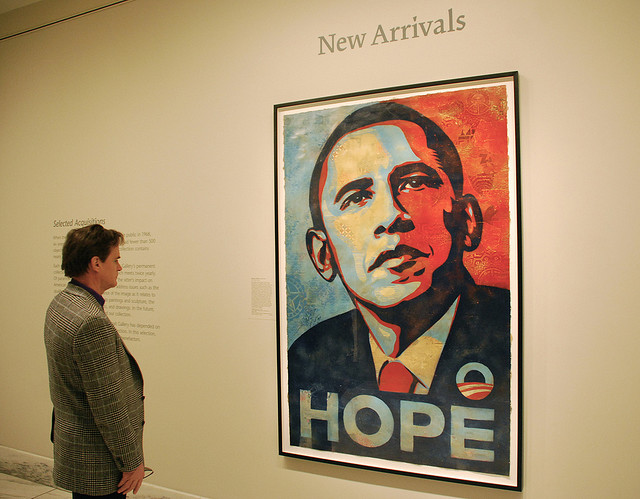
Posted in Rag Bloggers | Tagged , , , , | Leave a comment

Kate Braun : Waning Gibbous Moon is Time to Release the Old

Through the clouds: Waning gibbous moon. Image from Moonmooring.

Moon Musings:
Waning gibbous moon
(April 20 – 26, 2011)

By Kate Braun / The Rag Blog / April 19, 2011

This is a moon-phase useful for releasing the old, removing unwanted negative energies, seeking wisdom. In this moon phase, you may work with Spirit in rituals concerning getting rid of bad habits, bad relationships, bad jobs; magickal workings regarding decisions, divorce, stress, emotions, protection; activities that concern fruition and manifesting (in other words, making some dreams come true). It implies boldness and a willingness to venture into the unknown, to boldly go where you have not dared to go before.

Seasonal gardening, for those of you who are able to do so, focuses on the third-quarter moon of April 20-23. This is a good time for planting below ground crops such as carrots, beets, onion sets, potatoes. It is also when to plant biennials, perennials, bulbs, trees, shrubs, berries, and to transplant seedlings.

Honor Crone Goddesses such as Baba Yaga, Cerridwen, Elli, Hekate, Hella, Grandmother Spiderwoman, Lillith. They are sources of wisdom; a waning gibbous moon is their season. The day you choose to invite their assistance will determine the color, number, and element central to your activities:

Wednesday, April 20, use the color yellow, the number eight, the element Air; perform rituals for career, all aspects of career. Suggested chant: “Good job, promotion, a raise I see; as I will so shall it be.”

Thursday, April 21, use the color blue, the number four, the element Water; perform rituals for money and/or legal matters. Invoke some Jupiter-energy as well; Jupiter, the planet of expansion, brings good things and positive outcomes. Suggested chant: “Positivity in all things, Jupiter surrounds me; I claim success and surety, as I will so shall it be.”

Friday. April 22, use the color green, the number seven, the elements Earth and Water; perform rituals for love and attraction. Venus is the planetary energy to invoke. Suggested chant: “True love, lasting love, come unto me; as I will so shall it be.”

Saturday. April 23, use the color black, the number three, the element Earth; perform rituals involving self-discipline. Saturn’s somber heaviness will keep you steady on the course you choose. Suggested chant: “Captain of my ship am I, monarch of life’s sea; in firm, balanced control am I, as I will so shall it be.”

Sunday, April 24, use the color yellow, the number six, the element Fire, and rituals for money, health, and friendship-related matters. Lord Sun’s warmth will inspire you and on this day it will be better to perform your workings in his light, so plan your activities for daylight hours. Suggested chant: “Sunlight, clear light, show my path to me; I follow where you lead, as I will so shall it be.”

Monday. April 25, use the color silver, the number nine, the element Water, and rituals for inspiration and change. Lady Moon is most helpful in these endeavors, so plan your activities for nighttime when she is visible in the night sky. Suggested chant: “Lady Moon I call on you for insights and dreams to guide me; beneficial change is my goal, as I will so shall it be.”

Tuesday, April 26, use the color red, the number five, the element Fire, and rituals for overcoming enmity and for protecting property and developing courage. Mars is the planet to invoke; his fiery force will help build energy within you as well as assist you when you need it most. Suggested chant: “I and mine are safe today, and as far ahead as I can see; I shall not fail in courage or grace; as I will so shall it be.”

Some other guidelines are:

  • to use the color associated with a particular day, wear it and/or make it the primary color in whatever decorations you use and burn candles of that color (yellow on April 20, blue on April 21, etc.);
  • to use the number associated with a particular day, repeat whatever chants or songs or invocations you use the number of times indicated by the particular day (eight on April 20, four on April 21, etc.);
  • to bring in elemental energy, there should be air moving for the Air element (a fan if there is no breeze), water present (in a glass or bowl or pond), for the Water element, a lit candle for the Fire element (or a fire in a grill or chimney), contact with the earth for the Earth element (be barefoot and outside);
  • if a particular planet is associated with the day you choose, let that planet’s energy lift you (Jupiter-energy is optimistic, laughter-filled, happy, and exultant;
  • Venus-energy is cozy and loving, nurturing, and comfortable;
  • Saturn-energy is efficient, practical, organized, and not very exciting;
  • the Sun is active, pushy, assertive, lively;
  • the Moon is dreamy, intuitive, gently wavy);
  • if the suggested chant does not reflect your goals as clearly as it should, feel free to create your own (remembering that a chant will work best if it rhymes).

[Kate Braun’s website is www.tarotbykatebraun.com. She can be reached at kate_braun2000@yahoo.com.]

The Rag Blog

Posted in Rag Bloggers | Tagged , , , , , | 2 Comments