Lamar W. Hankins : The Republicans and ‘Medicare As We Know It’

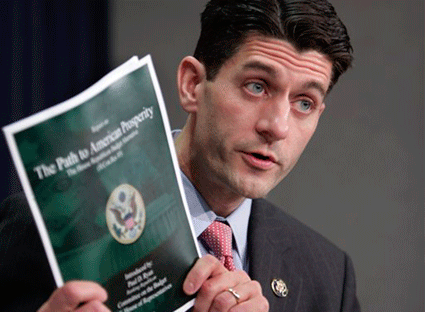
Rep. Paul Ryan and ‘medicare as we know it.’ Photo by J. Scott Applewhite / AP.

(but should be made ineffective…)
Republicans agree that Medicare is essential

By Lamar W. Hankins / The Rag Blog / April 13, 2011

This past week, House budget kingpin Paul Ryan (R-Wis.) announced the Republican plan to privatize Medicare through a medical voucher system that, instead of paying for health care directly, would help elderly and disabled Americans purchase private insurance. Many people have said that the scheme will “end Medicare as we know it,” which is undoubtedly true. But it represents an interesting turn of events in our politics.

Ryan’s announced plan tacitly concedes that Medicare is needed by the overwhelming majority of seniors and the disabled and is an important part of the social/economic safety net. Although we agree about this issue, we have to consider how such care can be delivered in the best and most efficient way. Clearly, that will not be through a voucher system.

Almost 55% of medicare recipients are low-income or disabled. This means, generally, that their incomes are below $14,355, according to studies done by the independent Kaiser Family Foundation. The Congressional Budget Office (CBO) predicts that purchasing insurance comparable to the current Medicare benefit will cost more than $20,500 per year.

A large majority of seniors and the disabled will not be able to afford the privatization of Medicare, even with an $8,000 voucher as proposed by Ryan, and continue to feed, clothe, transport, and house themselves.

Another problem with Ryan’s plan is that the private sector has not proven able to provide Medicare services as cheaply and efficiently as has the traditional Medicare system. We know this because we have had a version of a voucher system for several years called Medicare Advantage. The only advantage seems to be that it enriches the insurance companies at the expense of seniors.

Medicare Advantage companies spend more than 13% on overhead costs as opposed to 1.7% overhead for traditional Medicare, according to Kaiser figures. That 11.3% difference is taken out of seniors’ health care services. In this case, less is certainly not more.

It seems reasonable to conclude that no politician who is a fiscal conservative would want to waste government money by enriching private corporations and shortchanging program recipients. Yet this is just what Ryan’s proposal on behalf of the Republican majority in the House would do.

Thirty-one years ago, my parents, after a cumulative work history of 75 years for the same company, retired on modest pensions supplemented by Social Security and Medicare. Without those two programs, paid for largely by payroll deductions, they would not have outlived their pensions.

And they were among the middle class. The situation among less well-off retirees is far worse. According to US News, about 44% of households over 65 have a yearly income below $25,000. Without a good health care insurance program (such as traditional Medicare), those families will not have much money left over for the other necessities of life.

Most Republican presidents in my lifetime have recognized these basic facts and believed that this country has an obligation to assure the welfare of all Americans, not just the 1.5% who make $250,000 or more per year. That’s right, 98.5% of American households have annual incomes below $250,000.

According to Newsweek, Richard Nixon indexed Social Security for inflation, helping ensure that the elderly and disabled at least stayed even financially as the cost of living rose. Nixon also introduced a comprehensive health insurance reform bill that would have created a government-run “public option,” something president Obama would not agree to in spite of his campaign promises to the contrary.

To assist with these proposals, Nixon raised taxes on the wealthiest Americans for the first three years he was in office.

President Ronald Reagan raised taxes on most Americans in 1982, 1983, 1984, and 1986. President George H. W. Bush’s final budget increased tax rates and phased out exemptions for high-income taxpayers. And even the least among recent Republican presidents, George W. Bush, got passed a drug benefit for Medicare recipients, while he succeeded in reducing taxes on the most wealthy 3% of all Americans, tax reductions which have been continued under President Obama, even when he had a majority of Democrats in control of both houses of Congress.

If tax rates now stood where they were during the Reagan years, we would not have a fiscal crisis and even Paul Ryan might not be trying to further impoverish millions of elderly and disabled American families by enacting an ineffective health care voucher system to replace traditional Medicare.

As most honest political observers admit, the Tea Party Republicans, which means basically most of the Republican Party, along with most Democrats, don’t believe that the government should be run for the benefit of all Americans. They do everything they can to make the government work for the corporations that largely fund their campaigns.

They don’t believe that those responsible for the economic meltdown of the last three years should be held accountable in either our civil or criminal justice systems. They are perfectly willing to continue to prosecute three wars that are not funded but are fought on borrowed money, destroying my granddaughter’s future if not the future of her parents.

They are perfectly happy to create loopholes that allow corporations to pay no — or almost no — taxes, including ExxonMobil, Bank of America, General Electric, Chevron, Boeing, Valero Energy, Goldman Sachs, Citigroup, ConocoPhillips, and Carnival Cruise Lines. And some of these companies made record profits while being bailed out of their poor and reckless business decisions by the taxpayers.

From mutilating Medicare, to giving tax breaks to millionaires and billionaires, to serving the interests of the corporations, most of our politicians do not serve the general welfare. The most optimistic among us believe that the only way to overcome these unAmerican, undemocratic, unjust, and unpatriotic forces is to work against them day by day, one small way after another, until the system is overwhelmed by the sheer weight of Americans who are fed up with politicians that sneer at true democracy in favor of oligarchy.

I don’t have that much optimism, but I am unwilling to quit fighting the corporatists and oligarchs until that day when the words of the Rev. Martin Luther King (quoting Amos) are fulfilled, and justice does indeed roll down like waters and righteousness like a mighty stream.

But I’m not holding my breath.

[Lamar W. Hankins, a former San Marcos, Texas, city attorney, is also a columnist for the San Marcos Mercury. This article © Freethought San Marcos, Lamar W. Hankins.]

The Rag Blog

Posted in Rag Bloggers | Tagged , , , , , , , | 2 Comments

Dr. Stephen R. Keister : Political Idiots and Economic Dementia

Aldous Huxley: the “dogmatism and proselytizing zeal… of religious or political idiots.”

Huxley’s ‘political idiots’ and
public health in America

By Dr. Stephen R. Keister / The Rag Blog / April 13, 2011

“At least two thirds of our miseries spring from human stupidity, human malice and those great motivators and justifiers of malice and stupidity, idealism, dogmatism and proselytizing zeal on behalf of religious or political idiots.” — Aldous Huxley

I begin writing this on a Friday morning, feeling depressed and disillusioned, as the Congress considers a “government shutdown,” noting the absurd and idiotic reasons that the Republicans would use to justify such a bizarre act, proposing it in the name of demented economic theory and with the underlying motive of destroying programs currently in place designed to enhance the lives of our elderly and the disadvantaged of this country.

In his Hightower Lowdown column, Jim Hightower recently wrote about a novel called Alpaca,

a remarkably portentous piece of political writing by one of America’s first billionaires, Dallas oilman H. L. Hunt. Self-published in 1960, the 191-page book laid out his vision of a libertarian, plutocratic utopia.

Hunt’s ideal society was one in which the wealthiest would have a disproportionate say in government. He saw them as the achievers and, as proven by their riches, the most meritorious of citizens. They should get not one vote, he believed, but three, for they could be trusted to protect the volatile masses from the rise of populists.

Hightower sees Hunt’s vision given new life in the current Republican efforts to create a two-class society, a vision financed to the tune of millions of dollars by the U.S. Chamber of Commerce, the American Action Network, Crossroads GPS, and the various enterprises of the Koch Brothers.

This brings me to a point of playing the swami and looking ahead at the future of health care in the United States and the complicity of various physicians in accelerating this crisis.

First let me note a recent CNN poll showing that 75% of Americans want funding levels for Medicare to stay the same or go up. For Social Security, 87% of Americans want funding levels to stay the same or go up. Yet, these same folks have their fate resting in the hands of a Republican Party that exhibits the ideological zeal of the Spanish Inquisition and a Democratic Party and President who look at “compromise” in the same frame as Neville Chamberlain did at Munich.

Currently we who are on Medicare have 75% of our expenses paid for through the Medicare Trust Fund… monies we invested in the fund through our payroll taxes during our working days. These were not payments into the U.S. Treasury, but into a government sponsored “pension fund,” supposedly to be used for no other purposes than paying Social Security and Medicare benefits. Of course this trust was undermined by the Bush administration when the actual funds were used to subsidize warfare throughout the world, and were replaced with government bonds.

Some of us are fortunate enough, having the initial 75% of our medical costs paid by Medicare, to purchase Medicare Supplemental Insurance to cover the 25% not paid by Medicare. Supplements are not to be confused with “Medicare Advantage Plans” which were intended by the Bush administration to be the first step in privatizing Medicare and at the same time hurry the depletion of the Trust Fund. The Republicans have always opposed Medicare as well as Social Security.

The current Republican proposal calls for Medicare — by the year 2030 — to pay 32% of medical costs while the individual will pay 68% out of pocket. The GOP plan will gradually increase the eligibility age and give the states more control over the plan. The 32% distributed by the government will be given as “vouchers” in set amounts to purchase private insurance plans.

Of course these plans will cost much more because of the need to pay excessive executive salaries, stockholders, and higher administrative costs. Furthermore, the “doughnut hole” in the Medicare prescription drug benefit will continue at 100% under the Republican suggestions. An excellent review of the thinking behind the Republican plan is addressed by Wendell Potter in CommonDreams.

The Conservative Party, which currently controls the Parliament in the United Kingdom, in the interest of reducing the budget, is attempting to reduce payments to the national health system. This has created a major crisis in British politics — mass demonstrations in the city streets, strong denunciation of the planned cuts by the British Medical Association (“we do not want quasi-privitization, with a mountain of paperwork, we want time to spend with our patients as we have now”), defections by coalition members in the Parliament, public cries and newspaper editorials regarding decreased help to the disadvantaged, the elderly, undernourished children.

Of course, the British, like most Europeans, are of a different culture than we have in the United States; theirs is a culture of community while ours is based on Ayn Rand’s premise of “what is there in it for me?” But let us leave the UK and move on to our state of Vermont where the possibility of a single payer health care system is playing out. This I alluded to in my last Rag Blog submission.

As evolution of single payer care develops in Vermont there is a degree of division among the physicians: the primary care physicians approve of the plan while “certain other” physicians say they will leave the state.

We are at a point that we must take a look at the economics of the practice of medicine. First, I would note that, since I entered medical school in 1942, I have seen an attitude that says we should not increase our medical school graduation rate to a point where we have an excess of doctors in the country.

This is illustrated in recent years by the increased number of foreign graduates practicing in this country, the development of nurse practitioners and physician assistants, and the recent development of non-university affiliated osteopathic physician trade schools.

How are our domestic graduate physicians trained? Just who are these folks? All doctors start out by taking a four-year pre-med course in an undergraduate field of study. Then for the more fortunate we have four years in a university-affiliated medical school. This is followed by three years of residency training for those who wish to be family physicians, while for others, a year of general internship is required, followed by three years of specialty residency in an accredited hospital. Thereafter, one is required to take another year of fellowship in a sub-speciality.

So we see that those in the primary care specialties, internal medicine and its sub-specialities (allergy, endocrinology, rheumatology, neurology for example) have had six years training after medical school. Then we have those in the surgical sub-specialities (cardiac surgery, orthopedics, urology, for example), who have also has six years post-medical school training.

Why then the great income disparity among physicians? Those who work with their hands make some 7-10 times more than the physician who works with his mind. Why does the cardiac surgeon deserve a fee per hour 10 times that of the pediatric endocrinologist who cares for a child in a diabetic coma? Both may be life-saving procedures; the pediatrician is surely saving a life. What is it in the culture of the United States that has created this discrepancy?

Guess which physicians are considering leaving Vermont if single-payer health care passes and becomes law? One would envision in Vermont a physician payment system akin to that of the Mayo Clinic or Cleveland Clinic where the participating physicians are paid a negotiated salary rather than a procedure-based payment. This would explain, as well, why Vermont would be a magnet for the physician who wishes to be an independent contractor again, a professional, free of the dictates of the insurance industry, but by and large a primary care doctor.

There is an excellent new book called “The Hippocratic Myth” by M. Gregg Bloche, M.D. — who is an attorney as well as a physician. Bloche was involved in the investigation of torture by physicians and psychologists at Guantanamo, and he reviews all violations of the Hippocratic Oath, in medical practice, the insurance industry, government, and the courts.

About reward systems, Bloche says:

More important are the reward systems that today favor technological wizardry over biological breakthroughs — or time spent with speaking to patients or thinking through their problems. I recall doing some simple math, while a medical student on surgical rotation, and figuring out that my attending made more money per minute for time spent in the operating room than the actress Debra Winger made during her steamy scenes in that year’s hit film, An Officer and A Gentleman.

He took in $7,000 a case from Medicare for coronary bypass surgery, and on some mornings he’d have two cases going at once, in adjacent rooms. He could pull this off because his eager residents and fellows, counting on the same payoffs someday, did almost all of each case, from “cracking” the chest (to open it) to closing up ribs and muscle when work was done.

He put in about 20 minutes on each case, sewing in some of the little leg veins used to bypass blocked arteries. Had he spent this time talking with patients, he’d have taken home perhaps a few hundred dollars.

I fear that we face a broken medical system, as well as a broken political system. I call your attention to two recent publications. One is an extensive book review published in the Scientific American, titled Health Care Myth Busters: Is there a High Degree of Scientific Certainty in Modern Medicine?” The other is from The New York Review of Books: “Drug Companies and Doctors: A Story of Corruption,” by Dr. Marcia Angell.

In the meanwhile the negotiations, the compromises, continue in Washington bring to my mind a statement by Margaret Mead: “It may be necessary temporarily to accept a lesser evil, but one must never label a necessary evil as good.”

[Dr. Stephen R. Keister lives in Erie, Pennsylvania. He is a retired physician who is active in health care reform and is a regular contributor to The Rag Blog.]

The Rag Blog

Posted in Rag Bloggers | Tagged , , , , | 4 Comments

John Aloysius Farrell : The Koch Brothers’ Web of Influence

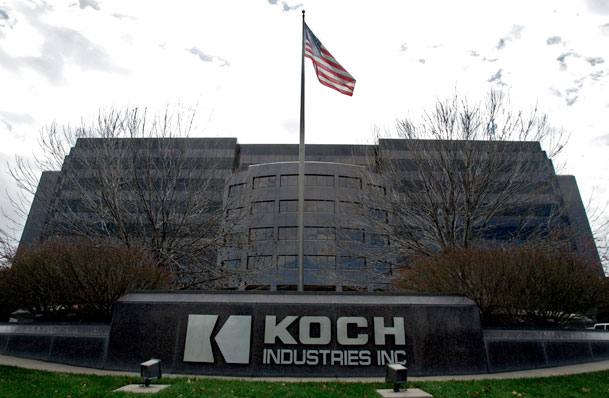
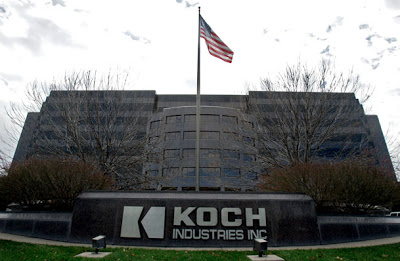
Koch Inc., headquartered in Wichita, Kan., spends tens of millions of dollars to lobby Congress and federal agencies on issues ranging from oil and gas to the estate tax. Photo by Larry W. Smith / AP.

The Koch brothers’ web of influence

Koch spends tens of millions trying to shape federal policies that affect its global business empire.

By John Aloysius Farrell / The Center for Public Integrity / April 12, 2011

At an EPA hearing last summer, representatives from Koch Industries argued that moderate levels of the toxic chemical dioxin should not be designated as a cancer risk for humans.

When members of Congress sought higher security at chemical plants to guard against terrorist attacks, Koch Industries lobbyists prowled Capitol Hill to voice their opposition.

And when Congress moved to strengthen regulation of the financial markets after recent collapses, Koch Industries — a major commodities and derivatives trader — deployed a phalanx of lobbyists to resist proposed changes.

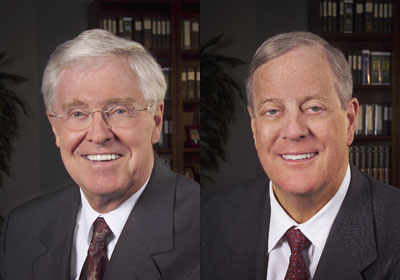
Charles and David Koch, the owners of the country’s second-largest private corporation, are libertarians of long standing, who contend that government regulations, taxes, and subsidies stifle individual initiative and hamper American competitiveness. In recent years, the Kochs have played an increasingly public role as financial angels for conservative causes, politicians, and foundations

What’s not so well-known is the activity of Koch Industries in the trenches in Washington, where a Center for Public Integrity examination of lobbying disclosure files and federal regulatory records reveals a lobbying steamroller for the company’s interests, at times in conflict with its public pose.

The money that Koch (pronounced “coke”) has spent on lobbying in Washington has soared in recent years, from $857,000 in 2004 to $20 million in 2008. The Kochs then spent another $20.5 million over the next two years to influence federal policy, as the company’s lobbyists and officials sought to mold, gut, or kill more than 100 prospective bills or regulations.

Oil is the core of the Koch business empire, and the company’s lobbyists and officials have successfully fought to preserve the industry’s tax breaks and credits, and to defeat attempts by Congress to regulate greenhouse gases.

But Koch’s diversified interests, and thus its lobbying activities, extend far beyond petroleum. Koch companies trade carbon emission credits in Europe and derivatives in the U.S. They make jet fuel in Alaska from North Slope oil, and gasoline in Minnesota from the oil sands of Canada. They raise cattle in Montana and manufacture spandex in China, ethanol in Iowa, fertilizer in Trinidad, nylon in Holland, napkins in France, and toilet paper in Wisconsin.

According to the most recent Forbes magazine rankings, Koch had $100 billion in revenues in 2009 — on a par with corporate giants like IBM or Verizon — and stood a close second to Cargill Inc. on the list of the largest private U.S. companies. The firm has 70,000 employees, and a presence in 60 countries and almost every state.

Koch’s decision to pour millions into lobbying Washington has put them high on the list of corporations whose lobbyists work the corridors of the nation’s capital. Last year, Koch Industries ranked in the top five — roughly on a par with BP and Royal Dutch Shell — in lobbying expenses among oil and gas companies, according to the Center for Responsive Politics.

These totals do not include the work of the trade associations that Koch uses to represent its interests in Washington. There’s a major industry group called the National Petrochemical and Refiners Association, and obscure organizations like the green-sounding National Environmental Development Association’s Clean Air Project, whose membership lists Koch and two of its subsidiaries (Georgia-Pacific and Invista) with a dozen industrial giants like ExxonMobil Corp., General Electric Co, and Alcoa Inc.

Koch’s lobbyists are known on Capitol Hill for maintaining a low profile. There are no former U.S. senators or House committee chairmen on the payroll. The firm had 30 registered lobbyists in 2010, many of whom are Washington insiders with previous experience as congressional staffers or federal agency employees.

Gregory Zerzan is a good example. Zerzan was a senior counsel for the House Financial Services Committee before serving as an acting assistant secretary and deputy assistant secretary at the U.S. Treasury Department during the George W. Bush administration. Zerzan then worked as counsel and head of global public policy for the International Swaps and Derivative Association before joining Koch Industries as a lobbyist.

Koch clout is augmented by campaign donations to parties and candidates for federal office — $11 million in the last two decades, according to the Center for Responsive Politics — and generous gifts from three family foundations to universities and conservative organizations and interest groups.

According to IRS records, the Koch foundations are essential donors (having given $3.4 million from 2007 through 2009) to the Americans for Prosperity Foundation, a nonprofit known for its support of the Tea Party movement. Among the organizations that have each received a million dollars or more over the last five years from Koch foundations are the Cato Institute, the Heritage Foundation, and two conservative think tanks at George Mason University in Virginia: the Institute for Humane Studies and the Mercatus Center.

The Kochs primarily donate to conservative candidates and causes but have given more than $1 million in the last decade to the liberal Brookings Institution. And among politicians they supported last year was Andrew Cuomo, a Democrat elected governor of New York with $87,000 from the Koch family.

The emergence of “the Koch web — political action, campaign giving, funding of groups engaged in political action and campaigns, conferences to expand political and policy influence — is a striking phenomenon,” said Norman Ornstein, a scholar at the conservative American Enterprise Institute.

The Center asked Koch Industries and its lobbyists in Washington, in a dozen emails and telephone calls over more than two weeks, to comment on the firm’s lobbying efforts. Koch’s representatives declined the opportunity.

But in a March 1 column in The Wall Street Journal, Charles Koch defended his and his company’s practices. “As a matter of principle our company has been outspoken in defense of economic freedom,” Koch wrote. “This country would be better off if every company would do the same. Instead, we see far too many businesses that paint their tails white and run with the antelope.”

Ethanol

The Koch brothers are renowned as free market libertarians. But as a major trader in energy and financial markets, Koch Industries also knows how to hedge.

As its corporate officials and publicists decried ethanol as a costly government boondoggle, the Kochs bought four ethanol plants in Iowa in recent months, with a combined annual capacity of 435 million gallons. In Washington (where ethanol tax subsidies cost the Treasury some $6 billion annually) Koch representatives lobbied Congress on ethanol and other biofuel subsidies.

“New or emerging markets, such as renewable fuels, are an opportunity for us to create value within the rules the government sets,” Flint Hills Resources President Brad Razook told his employees in the January company newsletter.

Koch Industries’ status as an ethanol player goes beyond its new Iowa plants. Koch blends ethanol and gasoline nearby, in its Minnesota refinery. By its own account, the company’s subsidiaries, Flint Hills and Koch Supply and Trading, currently buy and market about one-tenth of all the ethanol produced in the United States.

The Kochs seem to have recognized that their actions might seem hypocritical and in a January 2011 newsletter the company tried to explain things to employees who have been “scratching their heads and wondering: what is going on?”

“After all, ethanol production is heavily subsidized, mandated, and protected,” Koch Industries acknowledged, “while Koch companies openly oppose such government programs.”

Realism had won out. The company has the “capabilities necessary to be successful in the ethanol industry,” the newsletter explained. The new ethanol plants “fit well geographically with several other FHR assets, including fuel… terminals, a widespread distribution network that includes Iowa, and the Pine Bend [Minnesota] refinery.”

“We are not going to place our company and our employees at a competitive disadvantage by not participating in programs that are available to our competitors,” Razook assured Koch employees.

The company has a history of pragmatism in commercial affairs. Koch was a pioneer importer of Russian oil to the United States, including a 2002 shipment of Russian crude that Koch sold to the U.S. government to help fill the U.S. Strategic Petroleum Reserve. And though it opposes a cap-and-trade solution to global warming for the United States, Koch makes money trading emissions credits under a similar program in Europe.

Nor is ethanol the only form of corporate welfare Koch Industries supports. As it ventures into biofuel production, and uses alternative fuels to power its plants, the company has its lobbyists working “to expand the [tax] credit for renewable electricity production” made from biomass.

Georgia-Pacific, the company reported in 2008, was responsible for more than 10 percent of all the renewable biomass electricity generated in the U.S.

Toxic

Koch’s efforts to limit regulation of toxic substances illustrate the breadth of its lobbying operation.

In 2004 Koch Industries purchased Invista, a subsidiary of DuPont, known for manufacturing Lycra, Stainmaster carpets, and other textiles and fabrics. In 2005, as part of the same corporate diversification and expansion strategy, Koch Industries bought the giant wood and paper products firm, Georgia-Pacific, adding Brawny paper towels, Angel Soft toilet paper, Dixie cups, and dozens of factories and plants to its holdings.

Koch has since worked, on Capitol Hill and in various regulatory proceedings, to dilute or halt tighter federal regulation of several toxic byproducts that could affect its bottom line, including dioxin, asbestos, and formaldehyde, all of which have been linked to cancer.

Dioxin is released from incinerators, hazardous waste treatment, pesticide manufacturing, paper plants, and other sources. With 165 manufacturing facilities across the United States, Georgia-Pacific “has a significant interest in and will be significantly impacted,” by the EPA’s decisions on dioxin, Koch officials told the agency in April 2010.

Hundreds of workers would have to be hired, and trucks and earth-moving equipment leased or purchased. And “of the limited number of hazardous waste landfills operating in the United States, very few are willing to accept dioxin-containing soil,” the company noted.

“Treatment and disposal of dioxin-containing soil is already a challenging, expensive and capacity-limited problem that would only get worse if additional volumes were generated.”

Image

It’s been three decades since the environmental catastrophes at Love Canal, N.Y., and Times Beach, Mo., introduced the American public to the dangers of dioxin. But in the EPA hearing at the Washington Hilton last July, toxicologist John M. DeSesso, a consultant speaking on behalf of Georgia-Pacific, told the agency that the scientific studies on common levels of exposure are still inconclusive. He urged further study.

The Environmental Working Group and a number of public health organizations, meanwhile, chastised the EPA for dragging its feet, and reminded the agency panel that another arm of the federal government, the U.S. National Toxicology Program, and the World Health Organization have already classified dioxin as a known human carcinogen.

“Twenty-five years after publishing its first assessment of dioxin… the EPA has yet to establish a safe daily dose for human exposure” for “one of the most-studied of all chemical pollutants,” the EWG told the panel. “It is EPA’s responsibility to address this problem with resolve… without regard to pressure from special interests who stand to benefit financially from weak standards and regulations.”

It isn’t just dioxin that has drawn Koch’s interest. On Capitol Hill, and in regulatory proceedings, Koch lobbyists and officials have resisted tighter government regulation of a gallery of toxic and carcinogenic substances, like asbestos, formaldehyde, and benzene.

“GP strongly disagrees with the [National Toxicology Program] panel’s conclusion to list formaldehyde, a natural component of every cell in the body, as a human carcinogen,” wrote Traylor Champion, the firm’s vice president for environmental affairs, in a February 2010 letter.

“Costly control requirements are being mandated on sources that have insignificant levels of HAP (hazardous air pollutants) emissions,” a Georgia-Pacific environmental health and safety manager, James Eckenrode, complained to the EPA in November 2008, when it sought to apply tougher air pollution standards to the firm’s manufacture of resins and formaldehyde.

Through its Flint Hills Resources subsidiary, Koch Industries operates a refinery near Fairbanks, Alaska. “Refineries in Alaska are geographically isolated from the rest of the U.S. market such that benzene extraction and sale into the petrochemical market would be infeasible,” the company argued in 2006, when the EPA proposed new clean air limits on benzene. “Benzene reductions to levels proposed in this rule would either require extensive and economically prohibitive capital upgrades at our facility or would result in a significant reduction in gasoline production.”

When Koch Industries purchased Georgia-Pacific, it inherited a titanic liability regarding asbestos. Georgia-Pacific had used asbestos to make gypsum-based drywall products, and starting in the 1980s the firm became a target for more than 340,000 claims by plaintiffs who said they suffered lung and other diseases, including mesothelioma, a deadly cancer. By 2005, the company was spending $200 million a year and had to build a $1.5 billion reserve fund for asbestos liabilities and defense costs.

In a 2008 Koch Industries publication, General Counsel Mark Holden griped that “many of those claims are an outright abuse of the legal system… that often involve people who are not sick… all because of over-zealous litigators and a legal system that gives them perverse incentives.”

The number of new claims has dropped with tougher federal safety standards. But in the 110th Congress Koch lobbyists still sought to sway members on legislative proposals intending to restrict the use of asbestos and improve public knowledge, even Senate Resolution 462, which called for a “National Asbestos Awareness Week.”
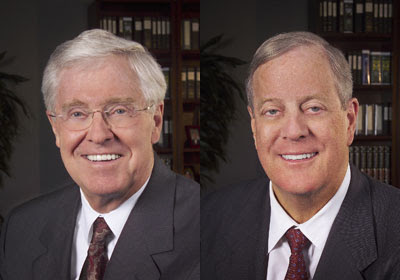
Charles and David: The Brothers Koch.

Global warming and low carbon fuel standards

It’s in the Kochs’ commercial interest to preserve America’s reliance on carbon-based energy sources. Despite recent diversification, Koch remains a major petrochemical company with refineries in North Pole, Alaska; Corpus Christi, Texas; Rosemount, Minn., and Rotterdam in the Netherlands; an array of chemical plants; a coal subsidiary (the C. Reiss Coal Co.), and 4,000 miles of pipelines.

So it is not surprising that, when the Obama administration and the Democrats on Capitol Hill proposed to regulate the emission of greenhouse gases in recent years, Koch Industries responded with a fervent counteroffensive.

“Oppose government mandates on carbon reduction provisions… [and] provisions related to climate change, and oppose entire bill,” Koch lobbyist Robert P. Hall wrote, listing his goals on the 2008 lobbying disclosure form.

The firm’s lobbying expenditures soared in 2008 as Koch Industries and its subsidiaries — Georgia-Pacific, Invista, Flint Hills Resources, Koch Carbon, Koch Nitrogen — peppered the EPA and members of Congress with objections. Several worked on measures that would strip the EPA of the power to regulate greenhouse gases through the Clean Air Act.

Koch-supported groups like the National Environmental Development Association’s Clean Air Project joined the effort. In a recent meeting, five Koch representatives joined colleagues from ExxonMobil, ConocoPhillips, Eli Lilly, and other NEDA-CAP members to register concerns with EPA officials over the proposed mandatory reporting rule for greenhouse gas emissions, the record shows.

Koch’s lobbying efforts on climate change are matched by a public campaign. Via three foundations — the Claude R. Lambe Foundation, the Charles G. Koch Foundation, and the David H. Koch Foundation — funded and administered by Koch family members and employees, the Kochs have donated several million dollars in recent years to think tanks and groups that have sought to discredit climate science and EPA’s efforts to reduce greenhouse gases.

“Why are such unproven or false claims promoted?” the Koch Industries company newsletter, Discovery, asked in an article on global warming entitled, “Blowing Smoke.”

“Scientists have… perverted the peer review process, doing everything possible to prevent opinions contrary to the alarmist view from being heard,” the article said. Humans should adapt to global warming, not try to slow or stop it, the newsletter recommended. “Since we can’t control Mother Nature, let’s figure out how to get along with her changes.”

In early March, members of the Republican-led House Energy and Commerce Committee — many of whom had received campaign contributions from Koch employees and PACs last fall — voted to bar the EPA from regulating greenhouse gases under the Clean Air Act. Their action has been endorsed by Speaker John Boehner and Republican House leaders.

Of particular concern to Koch lobbyists in Washington, according to their disclosure forms, are measures to encourage or require the use of low-carbon fuels. These sources of energy, in their manufacture and use, contribute less than other fuels to global warming.

The Koch refinery in Minnesota is designed to process heavy “high-carbon” Canadian crude oil, and is fed by a pipeline from Canada. Koch “is among Canada’s largest crude oil purchasers, shippers and exporters,” the company says, with a trading and supply office in Calgary and a terminal in Hardisty, Alberta.

Much of the oil comes from the mining of oil sands, which have a particularly heavy carbon footprint because the process releases greenhouse gases from peat lands and boreal forest, and requires a great deal of energy to heat and sweat the oil out.

“Canadian crude generates more greenhouse gas emissions” and so low-carbon standards “would cripple refiners that rely on heavy crude feedstocks,” the Koch Industries website notes. “It would be particularly devastating for refiners that use heavy Canadian crude.”

When lawmakers in Washington and states like California sought to address global warming by requiring the use of low carbon fuels, Koch Industries responded. Koch lobbyists listed the legislation as a lobbying priority on Capitol Hill. And in California, where a wide-ranging series of measures to slow climate change were launched by former Gov. Arnold Schwarzenegger, Koch joined the fight to defeat them.

A Koch subsidiary, Flint Hills Resources, donated a million dollars in support of Proposition 23, an unsuccessful attempt funded by Koch and other energy companies last year to stall implementation of the low-carbon standards and other remedial climate measures in California.

Energy industry tax breaks

Koch lobbyists spend much of their time, according to their disclosure reports, fighting attempts by members of Congress to curb price-gouging, windfall profit-taking, and speculation in the oil industry. To this same end, Koch officials worked to dilute a 2009 Federal Trade Commission rule governing manipulation of the energy markets.

Meanwhile, Koch has lobbied to preserve some of the oil industry’s coveted tax breaks and credits.

One benefit is known as the Section 199 deduction, approved by Congress several years ago to help the hard-pressed U.S. manufacturing sector. In light of the oil and gas industry’s hearty profits, the Obama administration and members of Congress have sought to end the Section 199 subsidy for energy firms and save the U.S. Treasury $14 billion over 10 years. But Koch lobbyists and trade associations have worked to preserve the deduction.

Another industry tax break that drew the support of Koch representatives is the venerable “LIFO” (last-in, first-out) accounting rule. It allows energy companies effectively to raise the value of their existing inventory (and thus pay lower taxes on profits from sales) when the price of oil soars.

Under LIFO, the oil in a company’s inventory, no matter what it actually cost, is valued at the cost of the last-acquired (usually highest-cost) barrel. The LIFO rule has been a target in recent years for both Democrats and Republicans in Washington, who would like to raise revenue without raising taxes.

Bush tax cuts

Koch lobbyists listed the expiring Bush tax cuts as a lobbying objective last year, and the Koch brothers were among an elite, relatively few Americans who profited when the income tax cuts for those earning more than $250,000 a year were extended in a year-end deal.

Another of the Bush tax breaks had special meaning for the Koch brothers. Charles Koch, 75, and David Koch, 70, are tied for fifth place, each with a net worth of $21.5 billion, in the latest Forbes rankings of the wealthiest Americans. Included in the deal to extend the Bush tax cuts was a proposal to reduce the federal estate tax. The Kochs have, historically, been players in an ongoing effort by wealthy families to curb or eliminate the tax on inheritances.

The final tax deal reached by the White House and Republicans in Congress in December set the estate tax at 35 percent. That makes the new rate considerably more favorable than during the Clinton (55 percent) or even the Bush (45 percent) years, and the lowest it’s been since the 1930s. If one of the patriarchs should die while the new rate is in effect, it would save the Koch family billions of dollars.

Terrorism and national security

Another major preoccupation of Koch Industries lobbyists during recent sessions of Congress was the Chemical Facility Anti-Terrorism Standards, a federal effort to identify and regulate chemical facilities that could be vulnerable to terrorist attacks.

In 2009, the House passed legislation that would toughen the standards, and require manufacturers like Koch to use safer chemicals and processes to add another level of protection and minimize the effects of toxic releases from terrorist attacks or catastrophic accidents.

Koch opposed the changes, claiming they “increase cost and regulatory burden while shifting focus away from security and toward environmental considerations.” The chemical security provisions were listed as lobbying targets by Koch representatives in 2007, 2008, 2009, and 2010.

According to EPA records, Koch has four facilities that use chlorine dioxide — in Palatka, Fla.; Zachary, La.; New Augusta, Miss.; and Camas, Wash. It has an Invista plant that uses formaldehyde in LaPorte, Texas. Its Flint Hills refinery in Corpus Christi, Texas, uses hydrofluoric acid in refining gasoline.

Mandatory use of safer technology would “result in even more job losses and higher consumer prices as American manufacturers struggle to comply,” Koch contends in a statement on the chemical safety standards on its website. The House legislation would “restructure, and likely add additional cost to security programs currently in place for Koch companies’ facilities.”

Financial regulation

Koch pulls no punches when assigning the blame for the great financial meltdown of 2008: It was the government’s fault, not the markets.

“Almost all of these problems (and much of the current chaos) are, at their root, the result of political failure,” said Steve Feilmeier, the chief financial officer for Koch Industries, at the height of the crash.

It is not surprising, then, that Koch Industries — a major player in international trading markets — resisted increased regulation and spent heavily on lobbyists who worked to shape the 2010 Dodd-Frank Act and other vehicles for financial reform. The Koch lobbyists focused, in particular, on provisions aimed at regulating systemic risk in the financial markets, and the use of derivatives.

Koch Industries started out trading crude oil more than four decades ago, but its trading group has since branched into commodities, derivatives, and other risk management products.

In that time, the market for trading derivatives and swaps in the energy industry has gone largely unregulated. And in past Congresses, Koch lobbyists labored to preserve the exemption, known as the “Enron Loophole,” that excused energy commodity contracts from regulation.

But the Dodd-Frank law gave the Commodity Futures Trading Commission and the Securities and Exchange Commission the authority to craft new rules to subject traders in the energy industry to increased regulation and transparency, capital and margin requirements, and supervision by a derivatives clearing house. Koch lobbyists worked to favorably shape the bill, and have not stopped working since it was passed.

Within a few weeks after President Obama signed the legislation, Koch lobbyist Gregory Zerzan had secured a coveted meeting with SEC Commissioner Troy Paredes, a Bush appointee, and his counsel, Gena Lai, to discuss how the government would implement the law.

[This article was published by The Center for Public Integrity and distributed by CommonDreams. © 2011 Center for Public Integrity.]

The Rag Blog

Posted in RagBlog | Tagged , , , , | 1 Comment

Ed Felien : Malalai Joya is a Champion for Afghan Women

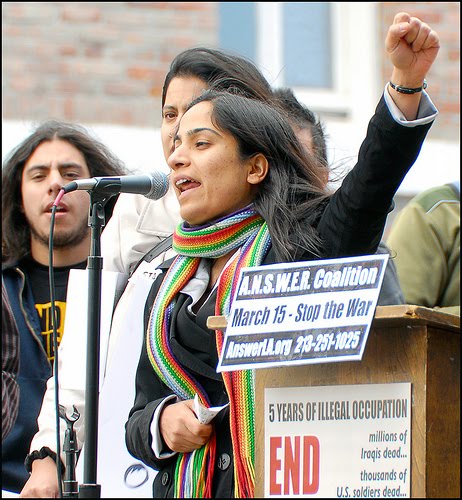
Malalai Joya. Image from antiwarcommittee.com.

A champion for Afghan women:
On hearing Malalai Joya

By Ed Felien / The Rag Blog / April 12, 2011

MINNEAPOLIS — I met the bravest person in the world Friday night, April 1, at St. Joan of Arc Church in South Minneapolis when I heard Malalai Joya speak.

She’s about five feet tall with a soft voice and a backbone as strong as steel. She was expelled from the Afghan Parliament (after being, at 26, the youngest person ever elected) because she “insulted” both the Afghan opium warlords and the U. S. government for supporting the corrupt leadership of Hamid Karzai.

There have been four assassination attempts on her life. The Taliban hate her because she organizes women’s groups and schools for girls.

Malalai Joya has stood up to them all. She is unafraid. You look into her eyes and fear melts away. You appreciate that all your struggles are child’s play in a sandbox compared to her struggle to improve the lives of young women in Afghanistan.

She believes passionately that women in Afghanistan would be better off if the U. S. left immediately. She considers the Taliban attitudes toward women far less dangerous to their health than drones and airstrikes.

She talked briefly about how the CIA benefits from the opium trade in her country. Although she is no friend of the Taliban, she acknowledges that during their government opium production in Afghanistan was almost 0% of the world supply, and, since the CIA, with the help of the opium warlords, has taken over the government, production is over 93% of the world supply.

The serious question for the American people is who benefits from this opium trade? How far up the chain do the payoffs go? If the CIA gets paid off, does that mean Leon Panetta gets paid off? Does that mean Obama gets paid off? And how is that in our national interest?

Support for the work of Malalai Joya can be directed to the Afghan Women’s Mission at www.afghanwomensmission.org.

[Ed Felien is publisher and editor of Southside Pride, a South Minneapolis monthly.]

The Rag Blog

Posted in Rag Bloggers | Tagged , , , , | Leave a comment

Ted McLaughlin : U.S. Military Spending Way Out of Whack

Hogging the pie:
U.S. military spending gone wild

By Ted McLaughlin / The Rag Blog / April 12, 2011

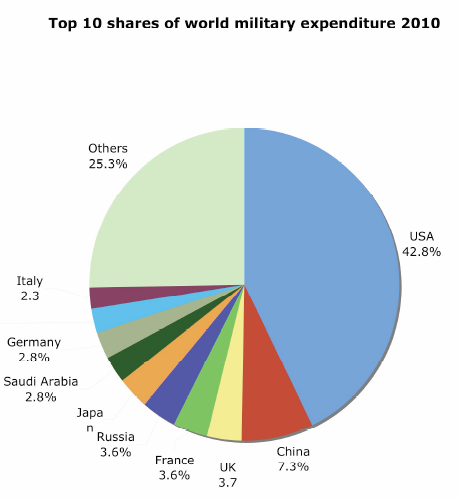
The chart above shows just how much out of whack the United States spending on its military really is. The U.S. has 42.8% of all the military spending in the world — meaning all of the other countries in the world put together have only 57.2% of total military spending. Put another way, about $43 out of every $100 of military spending worldwide is spent by the United States. That’s pretty incredible.

China is in second place, but its military spending only comprises about 7.3% of the world’s total military spending. The United Kingdom is third with 3.7% of the total, and Russia and France tie for fourth with 3.6% each.

I know there will be some on the right who will try to say the military spending by the United States is not out of line — that it is necessary for national defense. That’s a ludicrous suggestion. The United States could adequately defend itself from other nations with far less spending. No other nation thinks it is necessary to spend such vast amounts on defense. And the United States could cut its spending in half (or even more) and still be spending more than any other nation on earth.

No, we don’t spend that extraordinary amount just to defend ourselves (although that is the excuse the government gives and our gullible citizens have bought into). There are a couple of other reasons that are more powerful than national defense (even if no politician will admit it).

The first is the military-industrial complex. We have developed (in spite of warnings from President Eisenhower) a huge industry out of our military and supplying it with weapons (many of which are not needed and some of which don’t even work properly). But the important thing is to keep feeding taxpayer dollars into it so the war profiteers can keep making enormous profits (and some decent-paying jobs can continue for a few workers). It’s not even a matter of defense needs anymore, but of propping up the giant military-industrial complex.

The second reason is the protection of American corporate interests abroad — both in sustaining markets for products and the acquisition of natural resources. This is not a new thing. The American government has used its military to protect corporate interests for at least a century now. A prime example is the occupation of Nicaragua by U.S. Marines from 1912 through 1933 — to protect American corporate interests in that country.

The third reason is the general inability of American leaders (of both parties) to engage in effective diplomacy. This has been especially true since World War II when we have tended to carry out diplomatic missions with the ever-present threat of military power if we don’t get what we are seeking.

And finally, winning World War II and seeing democracies established in Germany and Japan has given many Americans the mistaken perception that democracy can be spread by military power. But those were anomalies, and the truth has been brought out by our misadventures in Vietnam, Iraq, and Afghanistan. Sadly, this seems to be a lesson that many politicians are incapable of learning.

The real fact is that we don’t need to spend anywhere near what we currently spend to protect this nation. It can effectively be done with far less, and the savings could be spent to balance the budget and shore up badly needed social programs (like most other developed countries do with their tax dollars). Instead of trying to force our views on the rest of the world, we should be spending our money for the betterment of our own citizens.

But that would require honesty, morality and intelligence — all things that seem to be in short supply among our politicians.

(P.S. — The American military budget has grown by 81% just since 2001.)

[Rag Blog contributor Ted McLaughlin also posts at jobsanger.]

The Rag Blog

Posted in Rag Bloggers | Tagged , , , , | 2 Comments

SCIENCE / AFP : Brain Structure Differs in Liberals, Conservatives

Illustration by Yakobchuk Vasyl / The Independent.

It’s all in your head!

New study shows liberals have more gray matter in a part of the brain related to understanding complexity, while the conservative brain is bigger in the section linked to fear.

By AFP / AlterNet / April 11, 2011

Everyone knows that liberals and conservatives butt heads when it comes to world views, but scientists have now shown that their brains are actually built differently.

Liberals have more gray matter in a part of the brain associated with understanding complexity, while the conservative brain is bigger in the section related to processing fear, said the study on Thursday in Current Biology.

“We found that greater liberalism was associated with increased gray matter volume in the anterior cingulate cortex, whereas greater conservatism was associated with increased volume of the right amygdala,” the study said.

Other research has shown greater brain activity in those areas, according to which political views a person holds, but this is the first study to show a physical difference in size in the same regions.

“Previously, some psychological traits were known to be predictive of an individual’s political orientation,” said Ryota Kanai of the University College London, where the research took place.

“Our study now links such personality traits with specific brain structure.”

The study was based on 90 “healthy young adults” who reported their political views on a scale of one to five from very liberal to very conservative, then agreed to have their brains scanned.

People with a large amygdala are “more sensitive to disgust” and tend to “respond to threatening situations with more aggression than do liberals and are more sensitive to threatening facial expressions,” the study said.

Liberals are linked to larger anterior cingulate cortexes, a region that “monitor(s) uncertainty and conflicts,” it said.

“Thus, it is conceivable that individuals with a larger ACC have a higher capacity to tolerate uncertainty and conflicts, allowing them to accept more liberal views.”

It remains unclear whether the structural differences cause the divergence in political views, or are the effect of them.

But the central issue in determining political views appears to revolve around fear and how it affects a person.

“Our findings are consistent with the proposal that political orientation is associated with psychological processes for managing fear and uncertainty,” the study said.

[This article was published by AFP news agency (Agence France-Presse) and was distributed by AlterNet.]

The Rag Blog

Posted in RagBlog | Tagged , , | 5 Comments

Larry Ray : Donald Trump and the Two-Headed Cow

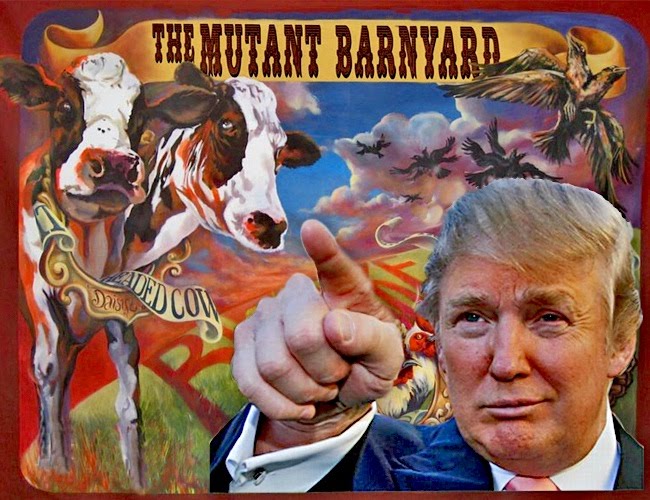
The Great American Sideshow! Graphic by Larry Ray / The Rag Blog.

The Great American Sideshow:
Donald Trump: See the two-headed cow!

By Larry Ray / The Rag Blog / April 11, 2011

America has always had a fringe element of nuttiness but most everyone knew it was nuttiness and not to be taken seriously. Before today’s instant mass communication, conspiracy claims, wild headlines, mean gossip, and outright lies were mostly the stuff of checkout aisle tabloid newspapers. Today many people can’t, or refuse to tell the difference.

Nightly prime time TV programs take the lowest road, from the intellectually lightweight “Biggest Losers,” where morbidly obese people vie weekly to see who has lost the most weight, to “reality shows” documenting unreal races, contests, and nail-biting competitor eliminations.

The reality is that these carefully scripted competitions are shot with huge film crews hovering all around, documenting supposed intimate spontaneous adventures that have nothing whatsoever to do with reality.

But millions of people never miss these nightly shows. And, sadly, many of these viewers make little distinction between reality and total hogwash while watching TV, surfing the internet, or emailing wild electronic missives back and forth to one another. These minimally discerning and vocal folks have become a new and easily manipulated political bloc.

So when Donald Trump, New York real estate developer, marketing mogul, and reality show producer, popped up all over television recently, saying he should be our next president, lots of folks thought that was a great idea. The next day’s polls ranked him number two behind favored Republican nominee, Mitt Romney.

Never mind that Trump’s eccentric, egomaniacal ranting, including questioning President Obama’s legal American citizenship, was not a serious testing of the political waters at all. It was an age-old carnival barker ballyhoo designed to “turn the tip.”

“Turning the tip” is old carny lingo meaning to attract the gawking townsfolk meandering on the carnival midway to a specific attraction… almost always the sideshow. The barker, usually wearing a straw pork pie hat, would taunt, tease, and invite,

“Have you seen Bossie! The world’s only living two-headed cow? It’s all on the inside! Step right up. Be among the few who will ever see a living, breathing two-headed cow! Only 10 cents, a thin dime, limited viewing, so step right up!”

And people dug into their pockets for that dime, crowding the barker’s ticket stand while another carny quickly opened then closed a corner of the canvas entrance flap offering surreptitious peeks at the bizarre wonders inside.

Once jammed in the tent, people were led quickly past a dimly lit rude stall with a straw floor where a badly stuffed small cow sporting a bit of creative taxidermy stood motionless. The “professor” inside the tent repeated Bossie’s astounding medical history all the while urging folks to move along, offering, for only a nickel more, the rare chance to see Jargo the dog-faced boy.

Next day at school the two-headed cow was all anyone could talk about. Everyone knew someone who had seen this mutant marvel the night before. Various accounts had the cow being milked while one head slept and the other ate. I imagine that had anyone brought it up at our 50th class reunion, many would have still remembered seeing that two-headed cow … or someone who had.

Trump doesn’t want to be president, not for a minute. But he does want to “turn the tip” of voters wandering the American political carnival midway into his own private tent to gorge his own insatiable ego and sense of power… Trump’s own personal real-time reality show.

In an America where, for a disturbingly high percentage of our population, the misrepresented, trite, and false have become reality, it was a no-brainer for Trump. The ridiculously coiffed megalomaniac is already part of today’s media side show and well knows all the divisive bally to spout.

When daytime radio and cable TV’s stock-in-trade is now largely a corral full of two-headed cows of varying intellect like Sarah Palin, Rush Limbaugh, Michelle Bachman, and wildly dressed Tea Party people ranting about “taking back” America, they become the norm and it is harder to find a really unusual two-headed cow.

So, instead of summarily dismissing Trump as a wealthy blowhard, America’s mainstream media instead, day after day, touts this new, particularly outrageous, bellowing two-headed cow… because two-headed cows still always attract viewers, especially if they have bad hair.

[Retired journalist Larry Ray is a Texas native and former Austin television news anchor who now lives in Gulfport, Mississippi. He also posts at The iHandbill.]

The Rag Blog

Posted in Rag Bloggers | Tagged , , , , , | 2 Comments

Marc Estrin : Light Unto the Nations

Israeli “Agronomic (sic) flashlight grip (T-GRIP).” (Get ’em while they’re hot. Image from IsraelMilitary.com

Light unto the nations

By Marc Estrin / The Rag Blog / April 11, 2011

What is it? It doesn’t seem to be a bird. Definitely not a plane. It’s… an Israeli Defense Forces flashlight. For only 72 bucks plus shipping and handling, you can own this Agronomic [sic] Flashlight Grip (T-GRIP) Tactile Vertical Foregrip Weapon Lights Holder.

It “comes with a 1 inch flight Adaptor with special activity trigger, and also a place to store additional batteries, AND

  • Three in one: special handgrip and a flashlight mount with a built in trigger that
  • transform tactical light into a Vertical Fore grip Weapon Light
  • This unique ergonomic fore grip will fit perfectly to your hand while holding in up to 1.
  • diameter tactical light with Tail cap switch and allow trigger activation of the light
  • Ergonomic designed grip, comfortable and natural to use “fighting stance.”
  • Designed to hold any 1″ diameter flashlight and allow quick and easy operation
  • Easy to fit and secured by 2 bolts
  • Fits hand guards equipped with a Weaver or Picatinny rail system
  • No gunsmithing is required
  • Molded from reinforced polymer composite
  • Super lightweight, Eliminate the need for a ymer compositer”

Now, I don’t normally use my blog entries to sell Israeli military accessories, but this piece of equipment serves up much food for thought. As does the website on which you’ll find it (search “flashlight”), the Israel Military Products Israeli Army Surplus Store.

I advise you to explore this site, watch the short slide show on the home page, and sift through the various gifts for sale. You don’t have to be Jewish. Two of my favorite items are a sweatshirt reading ” America Don’t Worry. Israel Is Behind You.” and a hoodie, reading “UZI DOES IT.” With a nice Uzi graphic.

I was brought inadvertently to this page by my novelist’s wondering about the details involved in a terse dispatch this week from the Palestinian Popular Committee Against the Wall and Settlements:

The Israeli army and police occupation forces stormed the village of Bil’in at 1:30 am on Monday 4th April, raiding the houses of Ali Ibrahim Bornat, and Khames Abo Rahma. They searched their houses and tampered with the contents under the pretext of search for solidarity foreigners.

Bil’in is a village of 1,800 people in the central West Bank, near Ramallah. It is famous for its six-plus years of weekly, nonviolent protests against the illegal (International Court of Justice) wall separating it from 60% of its farmland, and its peaceful protests have been met with increasing Israeli violence, now including live ammunition, and my favorite, Israeli trucks spraying human sewage collected from Modi’in Illit, an illegal Israeli settlement of 50,000, towering on the hill above.

Now, imagine this closely. You’re asleep in your bed. It’s still very dark. Into your tiny town roar not one, but two heavily armed convoys — one from the military, one from the police. Doors, as normal, are banged on, kicked in with shouts and threats, children cry in fear. Flashlights — likely those lovely “agronomic” ones, used in “fighting stance” — search the rooms, peer into faces, blind the eyes.

What are they looking for? Weapons? Terrorists? No. Nonviolent activists, organizers of the weekly protests, and worst of all “solidarity foreigners” — those peaceniks from abroad who come to witness, document, take part in peaceful demonstrations against the wall or home demolitions, occasionally help with harvests.

I suppose it could be worse. Rachel Corrie experienced being on the wrong end of a Military Bulldozer, and others have been blinded, brain-damaged, and killed by “non-lethal” weapons shot directly at their heads for their nonviolent protest.

Nevertheless — harboring peace activists, are you? Take that, and that, and we’re really sorry about the door and that laptop. See you soon.

I, the LORD, have called thee in righteousness, and will hold thy hand, and will keep thee, and will make you a covenant of the people, as a light unto the nations. (Isaiah 42:6)

There are extra batteries in the T-GRIP storage compartment.

[Marc Estrin is a writer, activist, and cellist, living in Burlington, Vermont. His novels, Insect Dreams, The Half Life of Gregor Samsa, The Education of Arnold Hitler, Golem Song, and The Lamentations of Julius Marantz have won critical acclaim. His memoir, Rehearsing With Gods: Photographs and Essays on the Bread & Puppet Theater (with Ron Simon, photographer) won a 2004 theater book of the year award. He is currently working on a novel about the dead Tchaikovsky.]

The Rag Blog

Posted in Rag Bloggers | Tagged , , , , , | 1 Comment

The Neurotic Northamerican Presidential Security

By Leonardo Boff / The Rag Blog / April 10, 2011

Many of us have known what the ideology of national security meant under the Latin American military dictatorships. The security of the State was the highest priority. In fact, more than the security of the State itself, it was about the security of capital, so that it could continue its businesses and its logic of accumulation.

Deep down, this ideology was premised on the supposition that every citizen is a subversive, actual or potential. Therefore, the citizen had to be watched and eventually jailed, interrogated, and, if he resisted, tortured, some times until death. This caused a rupture of the bonds of trust, without which society looses its meaning. Life went on under a heavy cloak of distrust and fear.

I say this because of the security apparatus that surrounded the visit to Brazil of the President of the United States, Barack Obama. There, one could plainly see that the ideology was not national, but presidential. There was no confidence in the ability of the Brazilian …. to guarantee the president’s security. He was accompanied by the entire security apparatus of the United States. There were immense helicopters, so huge that there were few places where they could land, armored limousines, over-dressed soldiers, with so many high-tech weapons that they looked more like killing machines than human beings. Sharp shooters were stationed on rooftops and other strategic locations, along with the intelligence personnel. Every corner that the «imperial court» would pass, and all the neighboring streets, houses and businesses, were monitored and searched. For security reasons, the public speech the president planned to give in the center of Rio de Janeiro, Cinelandia, was canceled. Those invited to hear his speech at the National Theater had to undergo a thorough search before passing.

What does such a scene reveal? That we live in a sick and inhumane world. Previously, we feared the forces of nature, before which we had little defense, and threatening demons, or vengeful gods. Today we are afraid of ourselves, of our weapons of mass destruction, and wars of overwhelming destruction, in which some of the super powers engage. We fear being assaulted in the street. We are afraid of going into the mountains where poor communities are located. We are even afraid that the street children could threaten us.

What is there that we do not fear?

The classics teach us that laws, the State, and public order exist primarily to liberate us from fear, and to enable us to coexist peacefully.

Formalizing these thoughts we can say, first, that fear is part of our existence. There are four fundamental fears: fear that we will be stripped of our individuality, and turned into dependents or mere numbers; fear that our relationships will be severed and we will be punished with solitude and isolation; the fear of changes that could affect our professions, health, and in the end, life itself; the fear of inevitable and definitive realities, such as death. The way we confront these existential fears marks our process of individuation. If we do so with courage, overcoming difficulties, we grow. If we flee, and try to avoid them, we end up debilitated, and even ashamed.

In spite of all our science, that creates the illusion of omnipotence, we have gone back to being afraid of the Earth and her forces. Who can control the collisions of the tectonic plates? Who can prevent an earthquake or stop a tsumani? We are nothing in the face of such uncontrollable energies, worsened by global warming.

Fear, then, is part of the human condition. It becomes a pathology and neurosis when we try to avoid it in a manner that transforms an entire social reality, and turns space into a sort of battleground, such as was mounted by the Northamerican security forces. A president visiting a country and her people should assume the risks that form part of life. Otherwise, the authorities of both sides had best gather on a ship on the high seas, safe from fear and from danger. The strategies of security only reveal the kind of world we live in: humans are afraid of other humans. We are captives of fear, and therefore, we are deprived of liberty, the happiness of living; and of welcoming a guest.

Type rest of the post here

Source /

The Rag Blog

Posted in RagBlog | Leave a comment

BOOKS / Karen Lee Wald : Cuba From the Other Side


Voices From the Other Side:
Keith Bolender’s oral history
of terrorism against Cuba

By Karen Lee Wald / The Rag Blog / April 10, 2011

[Voices From the Other Side: An Oral History Of Terrorism Against Cuba by Keith Bolender (Pluto Press, August 15, 2010) Paperback, 224 pp., $21.]

I first learned of Keith Bolender’s book Voices From the Other Side: An Oral History of Terrorism Against Cuba when the author reached out to me after reading an article I’d written on Luis Posada Carriles on The Rag Blog.

The article, “Posada Carriles and the Puppies That Got Away,” was based on an interview with a woman who almost became a victim, along with three children she was caring for, in one of the hotels Posada’s thugs bombed in 1997. The title came from the coded message used by one of Posada’s hired killers in an earlier bombing that destroyed a passenger plane in flight, killing all aboard. The telephone message was “A bus with 73 dogs went over a cliff and all perished.”

Bolender thought I might be interested in his book, an oral history, like mine, taken from many of the survivors of the 50-plus years of terrorism against Cuba waged by the United States and Cuba’s former ruling class.

I was.

I thought it would be helpful if people who are always hearing and reading about the “repression of dissidents” in Cuba and jump to their defense could also hear the other side: what happened to the thousands of people whose lives were affected by the actions of terrorists from inside and outside the country.

I thought it would put a human face on the statistics regarding the material and human damage caused by counterrevolutionaries and mercenaries who are euphemistically called “dissidents” or “anti-Castro militants.”

Voices From the Other Side does this. But it also does a great deal more.

As expected, the first chapter gives an overview of the multiple forms of terrorism carried out against Cuba in what Bolender calls “the unknown war.”

He talks about “the bombs have that destroyed department stores, hotel lobbies, theatres, famous restaurants and bars — people’s lives.” He talks about the first airline bombing in the history of the Western Hemisphere, and also reminds readers of “the explosion aboard a ship in Havana Harbor, killing and injuring hundreds.”

He tells readers about the 1960s attacks on defenseless rural villages and homes, of “teenagers tortured and murdered for teaching farmers to read and write.” He reminds us of the biological terrorism (the dengue fever epidemic) “that caused the deaths of more than 100 children.” And he adds new elements for those of us used to thinking of terrorism solely as shooting and bombing by referring to the “psychological horror that drove thousands of parents to willingly send their children to an unknown fate in a foreign country” (Operation Peter Pan).

This kind of overview has been done before by authors such as Jane Franklin. What Bolender adds here is the lifelong effect terrorist activities have had on the survivors — those left with hearing loss, stitched-up wounds and such, but, even worse, lifelong emotional scars. Survivors who tell of being nervous and jumpy 20, 30 or more years after being in a room where a bomb went off.

And the other kinds of “survivors”: mothers and fathers who for decades mourn the needless deaths of their children; siblings and children of those who were cut up, castrated, and lynched by “anti-Castro militants,” or went screaming to their fiery deaths in an airplane that was already in pieces before it crashed into the sea.

I want these stories to be in the hands of those well-meaning people who ask, “Why does the Castro government repress dissidents?” I want these people to understand what terrorists have done that makes Cubans today so unable to give them the free rein they demand to carry out their actions.

Bolender explains in the very beginning:

Since the earliest days of the revolution, Cuba has been fighting its own war on terrorism. The victims have been overwhelmingly innocent civilians. The accused have been primarily Cuban-American counter-revolutionaries — many allegedly trained, financed and supported by various American government agencies.

And he explains that throughout the island of Cuba “it is hard not to find someone who doesn’t have a story to tell of a relative or friend who has been a victim of terrorism. The personal toll has been calculated at 3,478 dead and 2,099 injured.”

This, of course, is something few on the outside realize, and he talks about why we don’t hear or read about it, about the political/ideological justification for so much cruelty. But he also talks about the real reasons — acknowledged by numerous U.S. administrations — for U.S.-backed and -financed terrorist acts against the island, information that is every bit as important as the humanization of the victims.

Preceded by a well-researched and evocative introduction by Noam Chomsky dealing with the history of and reasons for U.S. policy toward this upstart island nation that would dare to remain outside the grasp of U.S. hegemony, Bolender goes on to give readers a better understanding of Washington’s Machiavellian policies toward Cuba.

He starts off simply, with the well-known fact that “[s]ince the earliest days of Fidel’s victory, America has obsessed over this relatively insignificant third-world country, determined to eliminate the radically different social-economic order” that Castro’s revolution brought about. He describes the various excuses Washington has used since the earliest days of the Republic to justify its attempts to maintain dominance over the island nation.

“America at various times has portrayed Cuba as a helpless woman, a defenceless baby, a child in need of direction, an incompetent freedom fighter, an ignorant farmer, an ignoble ingrate, an ill-bred revolutionary, a viral communist” during the two centuries of the Monroe Doctrine. This history in and of itself is useful for those not already familiar with it.

Where the history gets more interesting is when this researcher uses quotes from U.S. leaders to show both why and how Washington attempted to get rid of Fidel’s revolution:

Richard Nixon, who, Bolender notes, “was one of the first to promote the theme of preventing the revolution from infecting others,” commented in 1962 on the need to “eradicate this cancer in our own hemisphere.” Nixon’s comment reminded me of an explanation offered years ago by a Cuban-American friend of mine, Tony Llanso: “The Cuban Revolution is like crab grass growing in your back yard. You have to pick crab grass because it spreads.”

But it was one particular “how” that I found intriguing. Bolender shows the vicious cycle of increasing repressive measures by the U.S. as Cuba increased its reforms on behalf of the poor majority of its citizens. This quickly — and intentionally — escalated to terrorism on the part of the United States against its tiny but audacious neighbor. And here Bolender is worth quoting at length:

As the rhetoric increased, terrorist acts were formulated and carried out. In partial response to the terror and other hostilities, the revolution became increasingly radicalized.

From the start, policy makers knew terrorism would put a strain politically and economically on the nascent Cuban government, forcing it to use precious resources to protect itself and its citizens. It was to be part of the overarching strategy of making things so bad that the Cubans might rise up and overthrow their government. Terrorism was the dirty piece of the scheme, along with the economic embargo, international isolation and unrelenting approbation.

American officials estimated millions would be spent to develop internal security systems, and State Department officials expected the Cuban government to increase internal surveillance in an attempt to prevent further acts of terrorism. These systems, which restricted civil rights, became easy targets for critics.|

And as most of us have seen, this has been a very successful tactic. Bolender goes on:

CIA officials admitted early on in the war of terrorism that the goal was not the military defeat of Fidel Castro, but to force the regime into applying increased amount of civil restrictions, with the resultant pressures on the Cuban public. This was outlined in a May 1961 agency report stating the objective was to “plan, implement and sustain a program of covert actions designed to exploit the economic, political and psychological vulnerabilities of the Castro regime. It is neither expected nor argued that the successful execution of this covert program will in itself result in the overthrow of the Castro regime,” only to accelerate the “moral and physical disintegration of the Castro government.”

The CIA acknowledged that in response to the terrorist acts the government would be “stepping up internal security controls and defense capabilities.” It was not projected the acts of terror would directly result in Castro’s downfall, (although that was a policy aim) but only to promote the sense of vulnerability among the [populace] and compel the government into increasingly radical steps in order to ensure national security.

In his book Bolender constantly uses direct U.S. sources for his analysis that the terrorism and other aggressive measures against Cuba were designed, at least in part, to force the Cuban government into a “state of siege mentality” that would simultaneously alienate part of the Cuban population, weaken liberal support abroad and serve as an easy target for most U.S. attempts to demonize the Cuban government.

“Former [CIA] Director Richard Helms,” Bolender tells us, “confirmed American strategy when he testified before the United States Senate in 1978; ‘We had task forces that were striking at Cuba constantly. We were attempting to blow up power plants. We were attempting to ruin sugar mills. We were attempting to do all kinds of things in this period. This was a matter of American government policy.’ ”

Most of us who’ve followed Cuba closely have long known the U.S. government did those things. What is more interesting is the “why.”

American experts were hoping the terrorist war would drive the Cuban government to increasingly restrictive security measures; implicit in this was to prove how incapable the regime leaders were. These terrorist acts would not be publicized, recognized nor acknowledged outside of Cuba, so national security policies were portrayed as paranoia, totalitarian and evidence of the repressiveness of Fidel’s regime. To this day the unknown war remains that way…

Here Bolender delves into the psychological warfare aspect of U.S. policy — and its effects:

In the early years Cuban officials faced the problem where they couldn’t tell which citizens supported the revolution, and which were inclined to assist the terrorist organizations or to commit terrorist acts. Everyone was treated as a potential threat.

The consequence, besides the enormous amount of economic resources diverted to combat this war [….] is a society that in the majority has accepted certain civil restrictions in order to ensure domestic security. It is the way the Cuban government has tried to identify the terrorists and to keep its citizens protected. It is the way the government has fought its war on terror.

Bolender reiterates that while the focus of his book is on the victims and their stories, he also wants to show

how these acts of terror changed the psyche of the young revolutionary government, struggling to maintain itself in the face of the destructive actions of its former citizens, directed and financed by the most powerful nation in the world. Traumatized by these acts, this small island nation took drastic steps in the face of constant acts of violence.

Those reactions to the terrorists, and the measures taken to protect the Cuban people, continue to influence national government policies to this day, and have greatly shaped how Cuba is perceived to the outside world. It is the price that has been paid by a society under siege for almost 50 years. A siege in part the result of the hundreds of acts of terrorism.

His analysis goes on to explain that

[t]he key element of Cuban policy against terrorism has been the need of unity for the sake of security, manifesting in a demand for social and political conformity. The consequence has been extensive surveillance systems, arrests for political crimes, a low tolerance for organized criticism or public displays of opposition, suppression of dissidents seen to have accepted material or financial aid from the United States, cases of institutionalized pettiness, travel restrictions, a state controlled press and the rejection of a more pluralistic society.

And we’ve all seen the effectiveness of the tactic that forced Cuba into this position — it’s a “damned if you do, damned if you don’t” situation. The tight control the Cuban government has adopted as a means of survival, Bolender tells us, does in fact destroy much of its liberal support abroad.

The Canadian author still has hope, however. “The termination of American hostility, including the absolute guarantee of the end to any further terrorist attacks from counter-revolutionary exile organizations,” he believes, could “offer the Cuban government the chance to breathe, to manoeuvre without a knife at its throat, as Fidel Castro once remarked, and to attempt to develop Cuban society that was hoped for.”

Put in this context, Bolender’s book achieves far more than the important goal of putting a human face on the victims of terrorist acts and an understanding of why so many of the Cuban people hate the traitors within their midst who work hand in glove with those from Washington, Miami, and New Jersey who fund and carry out these actions. It gives us a new understanding of the psychological warfare the U.S. has been carrying out parallel to its economic and military war.

This is a book that should be in every library and on every progressive bookshelf. I urge people to buy it, read it, pass it on to others.

[Karen Lee Wald, author of Children of Che: Child Care and Education in Cuba (Ramparts Press), has written about Cuba for over four decades, including two from inside Cuba, and continues to regularly visit and report from the island. She circulates a private list, Cuba-Inside-Out, at googlegroups.com. This article was also posted to Truthdig.]

Also see:

The Rag Blog

Posted in Rag Bloggers | Tagged , , , , , | Leave a comment

John McMillian : For Manning Marable

Manning Marable. Photo by Mario Tama / Getty Images.

Renowned African-American scholar, Dr. Manning Marable, 60, died April 1 of complications from pneumonia, three days before the publication of his long-awaited biography of Malcolm X, a book he had been working on for the last 15 years.

Marable was founding director of the Department of African American Studies at Columbia University. Since 2002 he had directed Columbia’s Center for Contemporary Black History.

According to National Public Radio, Malcolm X: A Life of Reinvention, “introduces new information that could reshape the widely accepted narrative” of Malcolm’s life.

For Manning Marable

By John McMillian / The Rag Blog / April 7, 2011

In hindsight, this is embarrassing to admit, but here goes. When I first met Manning Marable in 1996, at age 26, I was nervous. Partly I was on edge because I was trying to make a big decision: Should I pursue a Ph.D. in African-American history at either Rutgers or Michigan, where I’d been offered full funding? Or, should I go to Columbia (my first choice), with no money upfront, but with some vague possibility of securing a teaching fellowship down the line?

Months before, Manning had already written me to say that if I were admitted to Columbia, he’d be keen to take me on as one of his graduate students. (That was a thrill unto itself!) Nevertheless, I couldn’t help but wonder (and this is the embarrassing part): did he know I was white? And if so, would he have any doubts about my commitment to Black Studies, or my intellectual authority to work in the field?

Keep in mind, by then I’d read virtually all of Manning’s major works, including the earlier, more polemical stuff, like How Capitalism Underdeveloped Black America, where he declared, “Progressive white Americans must succeed in overturning their own racism.”

No problem there, I chuckled. I’d long made a point of challenging racism in others, and I’ve always tried (to the best of my ability) never to tolerate it in myself. But then, he added this:

“Nothing short of a commitment to racial equality and Black freedom such as that exhibited by the militant white abolitionist John Brown will be sufficient.”

Oh.

There was only one way to gauge Manning’s attitude, and that was to show up at his office. I made the haul all the way from mid-Michigan to New York City in my Chevy pickup truck. At that point in my life, I’d never been anywhere near an Ivy League campus. My first memory of the area around Columbia comes from driving up and down Broadway, Amsterdam Avenue, and perhaps a dozen cross streets in-between, again and again, trying to find a parking space.

As soon as I met Manning, though, all of my anxiety melted away. As anyone who knew him would agree, one of his most striking qualities was his affability. And although I probably would not have said this in print while he was still alive, the plain fact is, he really did look a lot like a teddy bear.

One thing I remember from that day is how vigorously he stressed the fact that he saw himself as both a scholar, and an activist. For him, the two vocations were inseparable. What’s more, he wanted me to know that when he became the founding director of the Institute for Research in African American Studies (IRAAS) a few years earlier, he’d envisioned it as fundamentally a community resource.

And by “community,” he pointed out, “I don’t mean just Columbia, or even Morningside Heights.” He gestured toward the window of his sixth floor office, which afforded views to the north and the east. “We’re not in Morningside Heights. We’re in Harlem!”

To this end, he had a remarkable capacity for making time for virtually anyone who wanted something from him, even including the conspiratorial-minded guy with the rusty stains on his shirt (or was it blood?) who would occasionally show up unannounced at Manning’s door, asking to bend his ear.

Then there was this other fellow: he was never around, except for on the periodic occasions when the Institute would lay out a very nice buffet in honor of some distinguished guest speaker, in which case he would always be there, first in line, testing the capacity of his Styrofoam plates with enormous mounds of chicken wings, mini-quiches, cocktail shrimp, and whatever else. (Okay, I’ll confess: I once watched as Manning observed this guy from the corner of the room in silent disbelief, before finally sighing and rolling his eyes.)

Manning also seemed like one of the hardest workers in all of academia. In the mid-to-late 1990s, you might recall, a contingent of “black public intellectuals” was suddenly gaining more exposure than they’d probably ever dreamed of. After a long period during which black scholars were more likely to toil away in obscurity, with their contributions being slighted or overlooked, now at least a few of them — through a combination of intelligence, charisma, and moxie — seemed to be everywhere.

And while some celebrated the new visibility of people like Henry Louis Gates, Jr., Cornel West, and Michael Eric Dyson, others sensed a certain entrepreneurialism in their approach. Sure, they could all talk a very good game, people used to grouse. Hell, put them in range of a microphone, and they’ll talk about anything! But when it came to scholarship, what did they actually do?

That was never quite my own view, but regardless: nobody ever credibly said such a thing about Manning. True, he made TV appearances and gave paid lectures (oh, how he must have loved Black History Month). But he was also an author of god-knows-how-many books and articles, the great bulk of which showcased his immersion in fields as diverse as history, sociology, political science, economics, and even literature.

His new, nearly 600 page opus, Malcolm X: A Life of Reinvention, is already being celebrated as an exhaustively researched tome, one that will completely upend our understanding of that fabled leader.

What an incredible exercise in self-restraint it must have been to keep plugging away on that biography for 15-odd years, all the while sitting on so many explosive revelations. I remember him excitedly making a few vague allusions to the discoveries he was making, way back in the day. Now we all know just what he was onto..

The past few days, I’ve been sad about the fact that I didn’t stay in better touch with Manning in recent years, though I can take some solace from the fact that about six weeks ago, I sent him a warmly inscribed copy of my first monograph. I have so many fond memories from the three-year period that I worked for him, but I’ll always treasure that first meeting the best. After listening to my concerns, putting me at ease, and making me laugh, he said something I did not expect: “I might be able to help you out.”

Five months later, I’d relocated to Manhattan, and I was meeting a considerable portion of my grad school expenses by working as his research assistant. (We collaborated on two books.) Without him, I’m not sure I’d have mustered the courage to go to Columbia, something that later turned out — without question — to be one of the great blessings of my life.

And yet whenever I tried to thank Manning for anything — whether for helping to pay for my education, or for buying me a sandwich (as he sometimes did), I always got the same response. He’d shrug, smile impishly, and say, “Hey, what do you expect? I’m a socialist!”

[John McMillian is Assistant Professor of history at Georgia State University. His most recent book is Smoking Typewriters: The Sixties Underground Press and the Rise of Alternative Media in America (Oxford, 2011).] A version of this article was published at The Atlantic.]

Manning Marable. Photo from the New York Daily News.
The Rag Blog

Posted in Rag Bloggers | Tagged , , , , , , , , | 1 Comment

BOOKS / Lewis Wallace : Jordan Flaherty Chronicles Post-Katrina Resistance


Jordan Flaherty’s Floodlines:
Community and resistance in New Orleans

By Lewis Wallace / The Rag Blog / April 7, 2011

See ‘Jena Six activist convicted, faces decades in prison’ by Jordan Flaherty, Below.

[Floodlines: Community and Resistance from Katrina to the Jena Six by Jordan Flaherty (Haymarket Books, 2010); 292 pp.; $16.]

Parts of the story are familiar. In late August, 2005, Hurricane Katrina hit the Gulf Coast. Floodwaters broke the levees in New Orleans and the city was devastated — first by floods, then by a shamefully underwhelming response on the part of the federal, state, and local governments.

While tourists were picked up and shipped out, poor people of color and prisoners were left with no food, shelter, or support in the aftermath. Some sat in Orleans Parish Prison, still in lockdown, as the waters rose inside their cells. In the years to follow, the situation worsened for many and improved only for those who could afford to pay their own way through the so-called “recovery.”

Parts of the story are less familiar. In the aftermath of Hurricane Katrina, groups ranging from young public school students to Palestinian and Vietnamese communities organized for the right to play a part in rebuilding the city. New projects arose, providing services ranging from women’s healthcare to expunging criminal records, fighting for public housing, defending New Orleans’ historic black culture, and creating alternatives to the brutal and racist criminal legal system in New Orleans Parish.

Although the long-term demands of these organizations were too often quashed, the stories of those who fought back after Katrina are as precious as they are little-known.

Luckily for us, writer and activist Jordan Flaherty was there. And Flaherty was not in New Orleans to observe or cover a story — he was there, in 2005 and in the years that followed, because he lives there. He was one of the people who did not evacuate during the storm, and literally watched from a rooftop as New Orleanians were abandoned by the government and smeared by the media as “looters” and criminals.

He was one of the people to seek out and record the stories of those trapped in prisons with no charges and no trial for weeks, months, and even years after Katrina. He was one of the rare people to expose the continuing torture of political prisoners at Angola Penitentiary, the targeting of transgender women as sex criminals, and the outrageously lousy defense lawyers who did little to help poor New Orleanians after the storm, sometimes sleeping through their own court appearances.

He was also the first journalist to report nationally on the story of the group of young men from rural Louisiana who came to be known as the Jena 6. These young African-American men were arrested for attempted murder after a fight erupted at school in response to white students hanging nooses from a tree in the schoolyard; they have since had their charges dropped or reduced, largely due to a surge of national attention.

Floodlines begins with a firsthand account of Flaherty’s experience directly after Hurricane Katrina, and proceeds to weave together personal accounts, cultural history, detailed records of activist work, and reflective analysis. The chapters cover education, immigration, prisoner organizing, housing rights, cultural activism, and the workings behind the displacement and disillusionment of so many New Orleanians.

As he shares these stories, he is clear about his own privilege as both a white person and as a journalist. While Flaherty is not afraid to editorialize and criticize, a tone of both humility and commitment permeates Floodlines.

In his chapter on prisons, Flaherty is characteristically straightforward about his view: “Prison makes us all less free — by breaking up families and communities, by dehumanizing the imprisoned both during and after their sentences, by perpetuating a cycle of poverty, and by making all citizens complicit in the incarceration of their fellow human beings.”

Louisiana has the highest incarceration rate in the United States, and the threat of incarceration is a constant part of life for many black New Orleanians. Flaherty paints a vivid picture of the “cradle-to-prison pipeline,” the process by which impoverished young people of color are funneled towards a life in prison virtually from the time of birth. As organizer Robert Goodman puts it, “Every time a black child is born in Louisiana, there’s already a bed waiting for him at Angola State Prison.”

Goodman is part of a new organization called Safe Streets/Strong Communities. Founded in 2006, the group interviewed over a hundred people who had been locked up prior to Katrina. Flaherty says that when he heard some of their stories, he “felt a chill.”

The stories included children abandoned in lock-down during and after the storm; the warehousing of massive groups of people in open yards with no food, shelter, or space to defecate; and a public defender’s office so inept that even a Criminal District Court Judge called it “unbelievable, unconstitutional, totally lacking the basic professional standards of legal representation, and a mockery of what a criminal justice system should be in a western civilized nation.”

Katrina opened up space for increased policing and militarization even as the city slashed funds for indigent defense and social services.

While exposing injustice is a part of Flaherty’s thrust, Floodlines does not come across as a shocking exposé, the kind of thing that flashes across television screens for a day or two and then disappears, leaving a sense of powerlessness in its trail. Instead, the book reveals how the events we see unfolding in the news are part of a complex history of black cultures of resistance dating all the way back to the beginnings of slavery in the south.

Taken all together, Floodlines is a hopeful, revealing account of five years of hardship and displacement. Outsiders and insiders alike will benefit from Flaherty’s uniquely personal and unabashedly political account of some of the most important untold stories of our time.

[Lewis Wallace is a freelance writer and a regular contributor to Left Turn and make/shift magazines. He also writes about music for an educational website called Shmoop.com and works as an anti-prison activist. This review was also published by Prison Legal News.]

Caseptla Bailey (left) and Catrina Wallace were active in the campaign to support the Jena 6. Their door was broken down by police while they slept. Photo by Jordan Flaherty / The Rag Blog.

Jena Six activist convicted,
faces decades in prison

By Jordan Flaherty / The Rag Blog /April 1, 2011

Civil rights activist Catrina Wallace, who received national acclaim for her central role in organizing protests around the Jena Six case, was convicted March 31 of three counts of distribution of a controlled substance. She was taken from the courtroom straight to jail after the verdict was read, and given a $1 million bail. Her sentencing is expected to come next month.

Wallace, who is 30, became an activist after her teenage brother, Robert Bailey, was arrested and charged with attempted murder after a fight in Jena High School. Bailey and five others later became known as the Jena Six, and their cause became a civil rights rallying cry that was called the first struggle of a 21st century Civil Rights Movement.

Their case eventually brought 50,000 people on a march through the town of Jena, and as a result of the public pressure the young men were eventually freed. The six are all now in college or — in the case of the youngest — on their way. Wallace and her mother, Caseptla Bailey, stayed in Jena and founded Organizing in the Trenches, a community organization dedicated to working with youth.

Catrina Wallace was represented by Krystal Todd of the Lasalle Parish Public Defenders Office. The case was prosecuted by Lasalle Parish District Attorney Reed Walters, who also prosecuted the Jena Six case, and famously told a room full of students, “I can make your lives disappear with a stroke of my pen.”

The case was presided over by 28th District Judge J. Christopher Peters, a former Assistant District Attorney under Reed Walters. Peters is the son of Judge Jimmie C. Peters, who held the same seat until 1994. The 12-person jury had one Black member.

Wallace was arrested as part of “Operation Third Option,” which saw more than 150 officers, including a SWAT team and helicopters, storm into Jena’s Black community on July 9, 2009. Although no drugs were seized, a dozen people were arrested, based on testimony and video evidence provided by a police informant, 23-year-old convicted drug dealer Evan Brown.

So far, most of those arrested on that day have plead guilty and faced long sentences. Devin Lofton, who pled guilty to conspiracy to distribute, received 10 years. Adrian Richardson, 34, who pled guilty to two counts of distribution, received 25 years. Termaine Lee, a twenty-two-year-old who had no previous record but faced six counts of distribution, received 20 years.

Community members responded to the verdict with sadness and outrage. “We don’t have any help here,” said Marcus Jones, the father of Mychal Bell, another of the Jena Six youths. “Catrina tried to keep in high spirits leading up to the trial, but when a bomb like this is dropped on you, what can you do?”

Jones and others are calling for the U.S. Department of Justice to investigate.

Wallace, a single mother, has three small children, aged 3, 5, and 10. The youngest child has frequent seizures.

[Jordan Flaherty is a journalist and staffer with the Louisiana Justice Institute. His award-winning reporting from the Gulf Coast has been featured in a range of outlets including The New York Times and Mother Jones. His new book is FLOODLINES: Community and Resistance from Katrina to the Jena Six. He can be reached at neworleans@leftturn.org, and more information about Floodlines can be found at floodlines.org.

Please see:

The Rag Blog

Posted in Rag Bloggers | Tagged , , , , , , , | Leave a comment