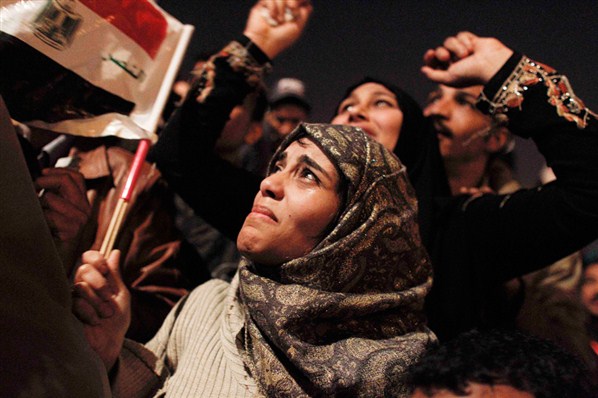
David McReynolds : Egypt, Beyond the Pyramids

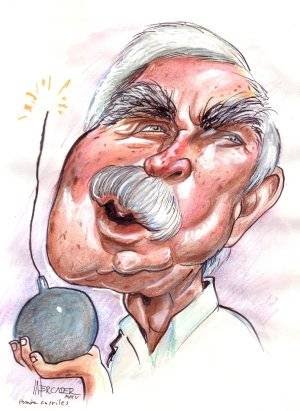
Image from Mystic Journey.

Egypt, Beyond the Pyramids

Now we are seeing one of the rarest of things — a moment when the people lose their fear of the State.

By David McReynolds / The Rag Blog / February 2, 2011

This is not really about Egypt but about revolution, something we have just seen in Tunisia and are certainly seeing in Egypt. Revolutions are baffling things because while we can “explain them” after the event, we can’t predict them before they arrive.

They have uncertain beginnings, and uncertain endings. I remember, in high school, reading Lincoln Steffens’ autobiography (which is probably still in print). In it he discussed the Mexican Revolution and the Russian Revolution. (Steffens is remembered for his quote, after his return from the Soviet Union in the early days of the revolution, when he said “I have seen the future and it works.”)

He was concerned with the issue of “Thermidor,” a term that comes from the French Revolution, when on July 27, 1794 — “9 Thermidor” under the revolutionary calendar — the deputies, weary of mass executions (1,300 in June of that year), ordered the arrest of Robespierre and other members of the “Committee of Public Safety,” and had them guillotined, marking the end of the Revolution and the consolidation of at least part of the old order.

The revolutions in the United States, Russia, and Cuba share one thing in common — those against whom the revolt was carried out generally were driven out of the country. In the U.S. the loyalists (perfectly decent folks, for the most part) fled to Canada, the British West Indies, or back to the home country. In Russia the Civil War killed a great many of the White Russians, and those who did not die, fled into exile.

Cuba wisely permitted dissenters to leave — the Mariel boatlift being an example of how the regime nonviolently eliminated a chunk of opponents. In France, despite the violence of the revolution, most of the opposition survived and in some ways France has suffered from this division to the present day.

We shall see, certainly, a longing in Egypt for order. Revolutions are great fun during their early days. (Despite the violence, there is an extraordinary exhilaration to them. Those who have seen Before Night Falls, which is generally seen as an anti‐Cuban film, as it tells the story of the poet, Reinaldo Arenas, will have to concede that it captures the early excitement of the revolution very well.)

Then food runs short, there is disorder (as we see in Egypt), travel is disrupted, the economy grinds to a halt, and there is a longing for a return to a sense of order. Even Lenin had to reverse course early in the Soviet Revolution, introducing his New Economic Policy (NEP) to save a foundering economy.

But for now we are seeing one of the rarest of things — a moment when the people lose their fear of the State, when, as the Chinese say, “the mandate of heaven has fallen” and it is only a matter of time before the old regime must yield. We saw this for a few days in France in 1968, when it seemed as if a true revolution was about to sweep the country. Those my age who were active in the Vietnam anti‐war movement saw it for a brief moment after Kent State.

I remember being at a meeting of the anti‐war leadership at Cora Weiss’ house in Manhattan when the news broke that the U.S. had invaded Cambodia. We knew we had to make an immediate response, there was no time for a mass demonstration, and so we decided to go to Lafayette Park in front of the White House where, even though we could only rally a few hundred people, we would be sure to be arrested under the rules then in place, which limited the number of demonstrators.

We sent out the call to our networks. But between the time we met, which I think was on a Friday, and May 4th, which was Monday, the students at Kent State were shot dead by the National Guard.

This led to a general strike of students all across the nation. Campuses simply closed down spontaneously. So, on that Saturday we didn’t have a few hundred people — we had close to 100,000 in Washington D.C., rallied in a week’s time.

We were nervous, not knowing if Nixon would give the order to shoot. He was nervous too — Lafayette Park was ringed with buses, nose to nose so that no one could get in. But Nixon permitted the demonstrators to gather on the great lawn behind the White House for a “legal rally.” The end of the war was still five years in the future, but in a sense that day marked the end of the legitimacy of the war in the eyes of the majority of Americans.

In Vietnam there were open revolts within the armed forces. It was an exciting time to live through… but of course it was not a revolution. Nixon was allowed to resign and Henry Kissinger is still able to appear on TV news channels as a foreign policy adviser, when he belongs in prison.

A far more important and genuine revolution was that in Iran, where a general strike in October of 1978 led, first, to efforts to control the people by firing live ammunition into crowds of youth surging the streets (those youth wore sheets of white, symbolic of death, meaning they were prepared for burial), until the police finally abandoned their posts, and in January the Shah had to flee for his life.

The violence of the Iranian Revolution was almost entirely on one side — the Shah’s military. Ironically, despite massive U.S. military aid, the Shah had few of the standard crowd control weapons, such as tear gas. So secure did the regime feel, that the last place it expected a revolt was in the streets of Teheran.

The Russian Revolution is called the October Revolution, because the Bolsheviks took power on October 25 of 1917, but it actually began in April of that year. We may expect the Egyptian Revolution — if, as I expect, it succeeds — to follow a similar uncertain path.

To sum up thus far: no one knew in advance that Tunisia, Yemen, and Egypt would be swept by revolutionary fervor this winter. And no one can be sure, at this writing, what is going to happen in North Africa and Egypt. We can, however, note several things. One is that the U.S., while it doesn’t know which way to turn at the moment, had been pressuring for change — some of the U.S. aid funds had been going to pro‐democracy contacts in Egypt.

This doesn’t mean the U.S. favors democracy in Egypt; it doesn’t. It means that at least some in the State Department and the CIA knew that Mubarak’s situation was not stable. U.S. policy, not only in the Middle East but around the world, has been to favor “stable” regimes, which has meant military dictatorships. Egypt has been notorious for its authoritarian ways, its lavish use of torture (as was the Iran of the late Shah). But the U.S. has been happy to pour billions of dollars into Egypt to buy a secure alliance.

Israel has also had a strong interest in discouraging democracy in Egypt — since Mubarak has kept the Muslim Brotherhood under control, and acted to establish peace with Israel.

Democracy has never been a favored choice of the U.S. leaders. During the Cold War we were happy to support Franco, the Fascist dictator in Spain. We engineered the overthrow of the democratically-elected government of Iran in order to install the Shah. We, and Israel, had urged democratic elections in the Gaza strip, on the assumption the Palestinian Authority would win; unhappily, Hamas won and Gaza has been on the shit list of both the U.S. and Israeli governments ever since.

I remember the painful lesson I got in how “liberals” view free elections during the struggle of the Vietnamese. Robert Pickus, who had had financial backing from the War Resisters League to set up a group in Berkeley in 1958 called “Acts for Peace,” before Vietnam was on the agenda, opposed those of us who called for unconditional withdrawal from Vietnam, on the grounds this wasn’t fair to the Vietnamese, because it would leave them “at the mercy of the Communists.”

We pointed out that it was the U.S. that had blocked the free elections Vietnam had been promised in 1956. Pickus argued that we had to insist on a peace settlement which would guarantee not one, but two free elections. He knew that Ho Chi Minh would win the first; he hoped that with time and U.S. funding of the opposition, the Communists might lose the second.

The Establishment is never in favor of free elections if it thinks it might lose. If one looks back at the U.S. policy (and that of Israel) in the Middle East for the past 50 years it has been a series of gambles that did not pay off. In Israel’s case, the invasion of Lebanon in 1982 lead directly to the creation of Hezbollah, which is currently taking control of the government of Lebanon, thus extending Syrian influence further into Lebanon.

The U.S.managed to block Iranian control of Iran, but in the end lost out to the radical Muslims, who now play a key role in Iraq (the invasion of which was among the most remarkable blunders the U.S. has ever made).

We do not know what will happen tomorrow or next month. But we do know that the map of the Middle East is going to be very different by the end of the year. The U.S. is almost certain to lose its long‐term alliance with Egypt. It is very uncertain what will happen in Tunisia or Yemen, but in all cases U.S. influence will be greatly weakened. In Iraq the latest political developments insure that Iran will have more influence there than the U.S. In Lebanon, Syrian influence has been strengthened.

Whether any of this will induce Israel to make peace is hard to say. But a look at the range of events in the past six months strongly suggests that, once more, the brightest and best can win many short‐term victories but achieve major long‐term losses.

The most serious question is what we do here — since neither you nor I have any influence on the events in Egypt. And what we need to do is to give our strong public support to the democratic forces in Egypt, even though we cannot know how long they will be democratic. One thing, however, is quite certain: we cannot determine the policies of those nations. We can only wish them luck, and reach out to them now.

[David McReynolds is a former chair of War Resisters International, and was the Socialist Party candidate for President in 1980 and 2000. He is retired and lives with two cats on the Lower East Side of Manhattan. He can be reached at dmcreynolds@nyc.rr.com.]

The Rag Blog

Posted in Rag Bloggers | Tagged , , , , , , , | Leave a comment

http://www.tpcmagazine.org/article/technological-fundamentalism

Technological fundamentalism: Why bad things happen when humans play God

by Robert Jensen

If humans were smart, we would bet on our ignorance.

That advice comes early in the Hebrew Bible. Adam and Eve’s banishment in chapters two and three of Genesis can be read as a warning that hubris is our tragic flaw. In the garden, God told them they could eat freely of every tree but the tree of knowledge of good and evil. This need not be understood as a command that people must stay stupid, but only that we resist the temptation to believe that we are godlike and can competently manipulate the complexity of the world.

We aren’t, and we can’t, which is why we should always remember that we are far more ignorant than we are knowledgeable. It’s true that in the past few centuries, we humans have dramatically expanded our understanding of how the world works through modern science. But we would be sensible to listen to plant geneticist Wes Jackson, one of the leaders in the sustainable agriculture movement, who suggest that we adopt “an ignorance-based worldview” that could help us understand these limits. [Wes Jackson, “Toward an Ignorance-Based Worldview,” The Land Report, Spring 2005, pp. 14-16. http://www.landinstitute.org/vnews/display.v/ART/2004/10/03/42c0db19e37f4 See also Bill Vitek and Wes Jackson, eds., The Virtues of Ignorance: Complexity, Sustainability, and the Limits of Knowledge (Lexington: University Press of Kentucky, 2008).] Jackson, cofounder of The Land Institute research center, argues that such an approach would help us ask important questions that go beyond the available answers and challenge us to force existing knowledge out of its categories. Putting the focus on what we don’t know can remind us of the need for humility and limit the damage we do.

This call for humility is an antidote to the various fundamentalisms that threaten our world today. I use the term “fundamentalism” to describe any intellectual, political, or theological position that asserts an absolute certainty in the truth and/or righteousness of a belief system. Fundamentalism is an extreme form of hubris—overconfidence not only in one’s beliefs but in the ability of humans to understand complex questions definitively. Fundamentalism isn’t unique to religious people but is instead a feature of a certain approach to the world, rooted in mistaking limited knowledge for wisdom.

In ascending order of threat, these fundamentalisms are religious, national, market, and technological. All share some similar characteristics, while each poses a particular threat to democracy and sustainable life on the planet.

Religious fundamentalism is the most contested of the four, and hence is the one most often critiqued. National fundamentalism routinely unleashes violence that leads to critique, though most often the critique focuses on other nations’ hyperpatriotic fundamentalism rather than our own. And as the prophets of neoliberalism’s dream of unrestrained capitalism are exposed as false prophets, criticism of market fundamentalism is moving slowly from the left to the mainstream.

Religious, national, and market fundamentalisms are frightening, but they may turn out to be less dangerous than our society’s technological fundamentalism.

Technological fundamentalists believe that the increasing use of evermore sophisticated high-energy, advanced technology is always a good thing and that any problems caused by the unintended consequences of such technology eventually can be remedied by more technology. Those who question such declarations are often said to be “anti-technology,” which is a meaningless insult. All human beings use technology of some kind, whether stone tools or computers. An anti-fundamentalist position is not that all technology is bad, but that the introduction of new technology should be evaluated carefully on the basis of its effects—predictable and unpredictable—on human communities and the non-human world, with an understanding of the limits of our knowledge.

Our experience with unintended consequences is fairly extensive. For example, there’s the case of automobiles and the burning of petroleum in internal-combustion engines, which give us the ability to travel considerable distances with a fair amount of individual autonomy. This technology also has given us traffic jams and road rage, strip malls and smog, while contributing to climate destabilization that threatens the ability of the ecosphere to sustain human life as we know it. We haven’t quite figured out how to cope with these problems, and in retrospect it might have been wise to go slower in the development of a system geared toward private, individual transportation based on the car, with more attention to potential consequences. [Jane Holtz Kay, Asphalt Nation: How the Automobile Took Over America and How We Can Take It Back (New York: Crown, 1997).]

Or how about CFCs and the ozone hole? Chlorofluorocarbons have a variety of industrial, commercial, and household applications, including in air conditioning. They were thought to be a miracle chemical when introduced in the 1930s—non-toxic, non-flammable, and non-reactive with other chemical compounds. But in the 1980s, researchers began to understand that while CFCs are stable in the troposphere, when they move to the stratosphere and are broken down by strong ultraviolet light they release chlorine atoms that deplete the ozone layer. This unintended effect deflated the exuberance a bit. Depletion of the ozone layer means that more UV radiation reaches the Earth’s surface, and overexposure to UV radiation is a cause of skin cancer, cataracts, and immune suppression.

But wait, the technological fundamentalists might argue, our experience with CFCs refutes your argument—humans got a handle on that one and banned CFCs, and now the ozone hole is closing. True enough, but what lessons have been learned? Society didn’t react to the news about CFCs by thinking about ways to step back from a developed world that has become dependent on air conditioning, but instead looked for replacements to keep the air conditioning running. [Stan Cox, Losing Our Cool: Uncomfortable Truths About Our Air-Conditioned World (and Finding New Ways to Get Through the Summer (New York: New Press, 2010).] So the reasonable question is: When will the unintended effects of the CFC replacements become visible? If not the ozone hole, what’s next? There’s no way to predict, but it seems reasonable to ask the question and sensible to assume the worst.

We don’t have to look far for evidence that our hubris is creating the worst. Every measure of the health of the ecosphere—groundwater depletion, topsoil loss, chemical contamination, increased toxicity in our own bodies, the number and size of “dead zones” in the oceans, accelerating extinction of species and reduction of bio-diversity—suggests we may be past the point of restoration. As Jackson’s example suggests, scientists themselves often recognize the threat and turn away from the hubris of technological fundamentalism. This powerful warning of ecocide came from 1,700 of the world’s leading scientists:

Human beings and the natural world are on a collision course. Human activities inflict harsh and often irreversible damage on the environment and on critical resources. If not checked, many of our current practices put at serious risk the future that we wish for human society and the plant and animal kingdoms, and may so alter the living world that it will be unable to sustain life in the manner that we know. Fundamental changes are urgent if we are to avoid the collision our present course will bring about. [Henry Kendall, a Nobel Prize physicist and former chair of the Union of Concerned Scientists’ board of directors, was the primary author of the “World Scientists’ Warning to Humanity.” http://www.ucsusa.org/ucs/about/1992-world-scientists-warning-to-humanity.html]

That statement was issued in 1992, and in the past two decades we have yet to change course and instead pursue ever riskier projects. As the most easily accessible oil is exhausted, we feed our energy/affluence habit by drilling in deep water and processing tar sands, guaranteeing the destruction of more ecosystems. We extract more coal through mountain-top removal, guaranteeing the destruction of more ecosystems. [Naomi Klein, “Addicted to Risk,” TEDWomen conference, December 8, 2010. http://www.naomiklein.org/articles/2010/12/on-precaution] And we take technological fundamentalism to new heights by considering large-scale climate engineering projects—known as geo-engineering or planetary engineering, typically involving either carbon-dioxide removal from the atmosphere and solar-radiation management—as a “solution” to climate destabilization.

The technological fundamentalism that animates these delusional plans makes it clear why Wes Jackson’s call for an ignorance-based worldview is so important. If we were to step back and confront honestly the technologies we have unleashed—out of that hubris, believing our knowledge is adequate to control the consequences of our science and technology—I doubt any of us would ever get a good night’s sleep. We humans have been overdriving our intellectual headlights for thousands of years, most dramatically in the twentieth century when we ventured with reckless abandon into two places where we had no business going—the atom and the cell.

On the former: The deeper we break into the energy package, the greater the risks. Building fires with sticks gathered from around the camp is relatively easy to manage, but breaking into increasingly earlier material of the universe—such as fossil fuels and, eventually, uranium—is quite a different project, more complex and far beyond our capacity to control. Likewise, manipulating plants through traditional selective breeding is local and manageable, whereas breaking into the workings of the gene—the foundational material of life—takes us into places we have no way to understand.

These technological endeavors suggest that the Genesis story was prescient; our taste of the fruit of the tree of knowledge of good and evil appears to have been ill-advised, given where it has led us. We live now in the uncomfortable position of realizing we have moved too far and too fast, outstripping our capacity to manage safely the world we have created. The answer is not some naïve return to a romanticized past, but a recognition of what we have created and a systematic evaluation to determine how to recover from our most dangerous missteps.

A good first step is to adopt an ignorance-based worldview, to heed the warning against hubris that appears in the most foundational stories—religious and secular—of every culture. That would not only increase our chances of survival, but in Jackson’s words, make possible “a more joyful participation in our engagement with the world.”

Type rest of the post here

Source /

The Rag Blog

Posted in RagBlog | Leave a comment

Richard Flacks : Beyond Barack Obama

Barack Obama. Image from Portlandart.

Beyond Barack Obama

Lefty focusing on the president and his shortcomings distracts us from the work we need to do.

By Richard Flacks / In These Times / February 2, 2011

The growing progressive drumbeat about President Barack Obama’s failed presidency, coupled now with fantasies about opposing his renomination, or with anguished hand-wringing about his failure to communicate, to lead, etc. etc., dismays me.

This hysteria is rooted in fear and anger over the intransigence of the corporate plutocracy we are up against. But the answer to corporate dictatorship and kleptocracy has to come from social movements — not the White House. History strongly suggests that grassroots disruption that threatens to unravel the social fabric is the fundamental impetus to real reform.

Yet the loudest voices on the left keep wishing that Obama would lead such a movement. It’s a natural wish — since the work of movement-building is hard, risky and costly for those who take it on. But to wish for The Leader and to cry when he seems to abandon us is childish, and it bespeaks impotence.

Let’s start by giving up a lot of BS about “principle.” There is no history of Democratic Party or liberal principle that Obama is betraying. FDR’s compromises to achieve Social Security and labor legislation abandoned African Americans with effects still strongly felt in our social order. No Democratic president was able to pass universal healthcare and all bargained away any chance of achieving it.

It was FDR who gave J. Edgar Hoover the authority to spy on the Left, and JFK who gave him the same to spy on Martin Luther King. Bill Clinton’s abandonment of welfare and his other ‘triangulations’ were larger and more cynical betrayals than Obama’s (so far). Obama’s record of accomplishment, leadership, and betrayal stacks up well against all his predecessors.

And let’s stop using ideological yardsticks to judge politicians. Is Obama “really” a progressive? Whatever he tells us he is, he must be a pragmatist in the real world he works in. And we should appreciate and even welcome that!

Ideology is a very poor predictor of integrity or action. Ideology is not what determines the political assessments that most Americans make. This is a big topic, but one advantage the Left has over the Right these days is that the latter is driven by narrow ideological thinking and therefore inevitably going to fail to connect with the American majority.

A big reason we aren’t yet in the midst of a movement on the Left has to do with the faults of the leadership in the national progressive organizational world. For example, it took months for the national organizations to call for a march on Washington for jobs. The One Nation event turned out to be a good start toward some kind of national agenda — and yet I don’t see much evidence of a concerted follow-up to it.

Many of the national leaders are now saying that they intend to be more assertive and independent. But even with a will to mobilize, strategies for effective action have to be grasped — and defining these is not an easy matter. Equally important, there is a loss of “vision” — an absence of articulate expression of how a better world might look.

Lefty focusing on Obama distracts us from the work we need to do.

What progressives have to try is to implement strategies that directly challenge corporate and financial domination. These have to include direct action that disrupts the institutional order. One essential theme: The costs and burdens of economic contraction and austerity must not be borne by the weakest and poorest.

The disgusting cycle, perpetuated by the Obama tax deal, that gives virtually all economic gain to the very top of the income pyramid has to be disrupted.

The wars, which hugely drain the public budget, have to be resisted.

Demands that might actually help people materially — and help the economy as well — need to be voiced and acted on — a massive mortgage write-down being one obvious example. Movement-based organizing on such issues needs to find targets that can be seen and addressed. For example, make locally accessible banks and their executives responsible for the mortgage crisis.

A final suggestion: Progressive organizations need to reinvest in college campus organizing. Instead of seeing students just as election time fodder, we need to consider that the campus is the primary space for generating deep, extensive discussion and debate about the social future. It’s also the place where human energy for bold and creative action can be generated.

Back in the early 1960’s, a few unions and older liberals more or less recognized their own political staleness, and put a little money and encouragement behind the Student Nonviolent Coordinating Committeee and Students for a Democratic Society — even as these upstart groups made them nervous because they weren’t “disciplined.”

Once again, the progressive side needs activist energy that isn’t controlled by big organizational practices and perspectives — energy and thinking that can break molds and invent new modes. But if we spend a lot of our energy in anguish and attacks on Obama, our own cynicism may ruin the chance to spark new possibilities.

[Richard Flacks, an emeritus professor of sociology at the University of California, Santa Barbara, is the author of Cultural Politics and Social Movements (co-editor, 1995); Beyond the Barricades: The ’60s Generation Grows Up (1989); Making History: The American Left and the American Mind (1988), and many articles on social movements, left culture and strategy. This article was originally published at In These Times.]

The Rag Blog

Posted in RagBlog | Tagged , , , , | 4 Comments

Ted McLaughlin : CBO Says Republican Policies Will Increase Debt, Deficit

Matt Yglesias refers to politicians who use deficits for short-term political gains (like Republicans whose tax cuts for the rich added $4 trillion to the deficit), as “deficit peacocks.” Illustration by Mario Piperni from mariopiperni.com.

CBO projections:
Republican economic policies
will expand debt, increase deficit

By Ted McLaughlin / The Rag Blog / February 1, 2011

The Congressional Budget Office (CBO) is the nonpartisan organization that both parties use to see the effect of their bills and economic policies on the American economy. While politicians might throw out unsubstantiated numbers glorifying their own bills, the CBO is tasked to look beneath and behind the rhetoric to determine the actual effects of those bills.

Lately, the Republicans have been ignoring many of the CBO projections, and after hearing the latest, it is easy to see why. The Republican “trickle down” giveaways to the rich are responsible for much of our ballooning national debt and the continuing national deficit — a deficit and debt that might be understandable if they creating jobs, but they are not.

For 2011, CBO Director Doug Elmendorf says that the deficit will be about $1.5 trillion (nearly one-third of which will be due to the massive Republican tax breaks for the richest 2% of Americans — projected to be over $400 billion a year). So while complaining about the deficit, the Republicans actually increased it by nearly 50%. They promised in the last campaign to cut $100 billion, but now are only talking about cutting a little over $50 billion for 2011 (a drop in the bucket compared to the huge increase they created).

In spite of this, the CBO says that if current laws and policies are followed the deficit will fall in the next few years. While the deficit for 2011 will be about 9.8% of Gross Domestic Product (GDP), they expect the deficit to fall to $1.1 trillion in 2012 (7.0% of GDP), about $704 billion in 2013 (about 4.3% of GDP) and $533 billion in 2014 (about 3.1% of GDP). They then expect the deficit for 2015 through 2021 to range between 2.9% and 3.4% of GDP.

However, these figures will be true only if current law is allowed to continue. If, for example, the cuts in Medicare Advantage mandated in the health care law were not to take place (like the Republicans want), and the tax cuts currently in place were not allowed to expire at the end of 2012 as scheduled (and the Republicans are sure to want to extend them), then the baseline projection for 2015 through 2021 would at least double, and the total debt held by the public would reach 97% of GDP (the most since 1945).

From these numbers it’s easy to see that a the Republican policy of repealing health care and continuing the cutting of taxes for the rich would be a disaster for the national deficit, and even worse for the national debt. Republicans like to claim they are the party of fiscal responsibility, but a review of their recent actions and a look back at Republican administrations shows something different. The truth is that the Republican “trickle down” policies have consistently added to both the deficit and the debt — not decreased them.

The CBO does warn that if current law were continued, although deficits would come down in the next few years, the national debt would continue to grow. Either further cuts in government spending would be needed (including no more Republican giveaways to the rich) or an increase in taxes, or both. There is no way to bring down the national debt without doing this. The obvious solution would be to cut the military some (the most bloated area of the American budget) and raise taxes on the richest Americans (beyond letting the current cuts expire). But Republican policy would not allow either of these things to happen.

The CBO also paints a rather dark picture for employment. They say that if the economy produces 2.5 million jobs each year between now and 2016, the unemployment rate will finally fall below 6% in 2016. Even this dismal projection seems to me to be overly optimistic. Remember, only 1.1 million jobs were created in 2010 — a figure that barely kept up with the number of new people entering the work force.

Unless the increasing amount of job outsourcing is stopped (something the Republicans oppose and recently blocked in Congress), it is unlikely that the 2.5 million jobs a year figure can be reached. While they may be created (since the corporations and the rich are doing very well), the sad fact is that far too many of them will be shipped abroad (where good-paying jobs can be turned into poverty-wage jobs).

After viewing this latest CBO projection, it becomes even clearer that the Republican policies of giveaways to the rich and outsourcing of jobs are the biggest impediments to bringing this country out of the recession. Ordinary Americans are still hurting and still feeling the full effects of the recession, but the Republicans are only interested in helping the rich — the only people doing well right now.

[Rag Blog contributor Ted McLaughlin also posts at jobsanger.]

The Rag Blog

Posted in RagBlog | Tagged , , | 2 Comments

Harry Tarq : Revisionist History and the ‘Great Presidency’ of Ronald Reagan

Center stage: Ronald Reagan on the set at the General Electric Theater, 1954-62. Photo from Wikimedia Commons.

Ronald Reagan and revisionist history

The Reagan era brought us depression, war, and mass murder in the Global South.

By Harry Targ / The Rag Blog / February 1, 2011

The right wing media have resumed the historical revisionism that portrays Ronald Reagan as a great president. The occasion for this is the 100th anniversary of President Reagan’s birth. He is being trotted out by Republicans and Tea Party spokespersons to celebrate the political life of “the great communicator,” the savior of America.

Let us be clear: the policies and programs instituted in the 1980s that led to 30 years of economic decline at home, dramatic increases in military spending, and massive killing of peoples of color in the Global South, have their roots in the demands of economic and political elites before President Reagan assumed office.

In addition, the disastrous 30 years of public policy was created with the willful collaboration of powerful figures in both political parties and a political economy that makes such pain and suffering likely.

However, the Reagan era (preceded by the rise to power of Reagan’s mentor, Margaret Thatcher, prime minister in Great Britain) can be seen as introducing a qualitative shift in public policy from state and market collaboration as exemplified by the New Deal (1932-1976) to the celebration of the market as a source of economic well-being and political stability.

While government grew enormously during the last 30 years, the official ideology was used by Republicans and Democrats alike to reduce or eliminate government programs that were targeted to assist the vast majority of the people, the working class.

Looking at economic policy, the Reagan administration launched a campaign to destroy the U.S. labor movement, reduce rudimentary public services and supports for the poor (President Clinton finished the job), radically reduce corporate taxes, provide tax incentives to encourage manufacturers to move plants overseas, and expand the deregulation of banking and financial speculation (begun by President Carter).

The impacts of these policies included reducing the rights and living conditions of workers, resuming the historic process of shifting the wealth and income of the country to the top one percent of the economic elite, reducing the middle class, and increasing the percentage of the people living below the poverty line.

While the proportion of the society’s wealth controlled by the economic ruling class grew, the rate of economic growth of the economy as a whole since Reagan declined by one third compared to the period from the 1940s through the 1960s.

Reagan’s global economic policies, commonly referred to as “neoliberalism,” used debt, induced by the IMF and private banks, and military power to force virtually every country in the world to cut back on public services to their citizens, privatize their economies, shift from producing goods and services for their own people to producing for exports (to earn foreign exchange so that they could pay back western banks that forced them to borrow billions of dollars).

As the economic vulnerability of workers grew in poor countries, they became desperate, pliant, and cheap labor was forced to manufacture goods for 10 percent of the wage costs of workers in the United States. By 2000, half the world earned $2 a day or less. In the United States, wages stagnated; earnings at the dawn of the new century in real dollars were no higher than the early 1970s.

Also, the Reagan administration of the 1980s increased war-making and complicity in the deaths of millions of people around the world. As a candidate, Ronald Reagan convinced many Americans that a “window of vulnerability” had opened in America’s security posture because of the escalation of military spending by “the evil empire,” the former Soviet Union.

As president, Reagan launched the biggest arms buildup, aside from World War II, in United States history. And, as was the case in 1960 when candidate John F. Kennedy campaigned with claims of a “missile gap” between the United States and the Soviet Union, the claim was a lie.

Hamstrung by the post-Vietnam fear Americans held about the U.S. getting involved in another quagmire, what beltway policy wonks called “the Vietnam Syndrome,” Reagan defense intellectuals shifted to what they called “low-intensity conflict.” LIC meant that the United States would fund anti-communists, reactionaries, and militarists who would fight our wars for us.

The United States funded anti-government rebels in Nicaragua, Angola, Ethiopia, Cambodia, and Afghanistan, including followers of Osama Bin Laden. Arms sales to right-wing regimes, such as those in El Salvador, Egypt, Saudi Arabia, Israel, and Pakistan, skyrocketed as Reagan lifted Carter administration sales limitations. Conservatively 2 million people in Latin America, Africa, Asia, and the Middle East died because of these policies.

Finally, the Reagan administration shifted strategic doctrine from Mutually Assured Destruction (MAD) which emphasized maintaining the capacity to deter a Soviet surprise attack on the United States to a “counterforce” strategy that called for plowing resources into developing a first strike nuclear capacity, which included the Hollywood fantasy, the “Strategic Defense Initiative” or “Star Wars.”

Given the Reagan public discourse concerning “evil empires,” threats that the Soviets had better give up their system or expect war, and the new military doctrines, the world was lucky to survive the 1980s without nuclear war.

With the collapse of the Soviet Union, some of the threats to human survival waned but the neoliberal global agenda continued through the first Bush presidency and the Clinton years. The global military agenda resumed in the new century as the creators of the Reagan era military programs assumed positions of power in the Bush administration.

The Rumsfelds, Cheneys, and their subordinates, who gained experience back in the Nixon days and became foreign and military policy influentials in the Reagan (and George H.W. Bush) periods, and who had organized out of power in the Clinton period, were back in the saddle. They used the 9/11 tragedy to project military power on a global basis.

So when hometown papers publish articles with headlines like “ ‘Great Communicator’ Still Resonates” (Journal and Courier, Monday, January 31, 2011) be prepared to remind people what really happened in the 1980s and that the public policies adopted then have caused so much pain ever since. Probably some of these newspapers will continue to expand their revisionist project in other subject areas as well; for example, suggesting that the Founding Fathers opposed slavery in the United States.

[Harry Targ is a professor of political science at Purdue University who lives in West Lafayette, Indiana. He blogs at Diary of a Heartland Radical.]

The Rag Blog

Posted in Rag Bloggers | Tagged , , , | 3 Comments

Jim Turpin : Is the United States a ‘Banana Republic’?

Image from polisci.wisc.edu.

Lookout, O. Henry!
How did the United States
become a ‘banana republic’?

By Jim Turpin / The Rag Blog / February 1, 2011

ba•nan•a re•pub•lic (noun) A small country that is economically dependent on a single export commodity or on outside help, and is typically governed by a dictator or the armed forces.

“Banana republic” was first used by author William Sydney Porter (“O. Henry”) in Cabbages and Kings (1904) while residing in Honduras after hiding out for allegedly embezzling funds from the First National Bank of Austin in 1894.

“This is America, not a banana republic.” — Vincent Bugliosi

Well… I hate to break it to the esteemed lawyer above, but the United States is a banana republic and here’s why:

  • Unmitigated torture and detention of U.S. citizens & foreign nationals
  • Extrajudicial assassinations of U.S. citizenry by strong man in charge
  • Unlimited spying on citizenry & seizure of property
  • Control of majority of economic resources by wealthy elites
  • Massive indebtedness to foreign powers and funding war


Unmitigated torture and detention of US citizens & foreign nationals:

As part of the “War on Terror,” the Obama administration continues the draconian national security “policies” of George W. Bush. These include indefinite detention at CIA “black sites” and at Guantanamo, “evidence” produced through torture, post acquittal “detention power,” and military commissions or tribunals with severely limited “due process.” This list barely touches the full complement of tools used by our government to flout the rule of law.

Key among these is the use of torture and detention for both U.S. citizens and foreign nationals. The abuses at Guantanamo and other “black sites” are well known: water boarding, sleep deprivation, stress positions, humiliation, and degradation. But what is not as well known is that this has happened to U.S. citizens and the “evidence” produced is admissible in military commissions.

In 2006, the Congress passed the Military Commissions Act (MCA)
which allows

procedures deviating from the traditional rules of the Uniform Code of Military Justice (UCMJ). Among other shortcomings, the MCA rejects the right to a speedy trial, allows a trial to continue in the absence of the accused, delegates the procedure for appointing military judges to the discretion of the Secretary of Defense, allows for the introduction of coerced evidence at hearings, permits the introduction of hearsay and evidence obtained without a warrant, and denies the accused full access to exculpatory evidence.

Canadian Omar Khadr was 15 years old when picked up and accused by the U.S. government of planting roadside bombs and killing a U.S. soldier with a grenade in Afghanistan in 2002.

Defense lawyers want the military judge, Army Col. Patrick Parrish, to exclude any confessions Khadr made to U.S. interrogators following his capture, wounded and near dead, on grounds of either coercion or torture. Prosecutors seek to use statements Khadr made to his captors at age 15 and 16 at his upcoming trial…

Critics cast his trial as the first of a so-called “child soldier” in modern Western history. They argue that Khadr should have been given special treatment, including rehabilitation, and not shipped from Afghanistan to the prison camps where he was held for year as an alleged teen terrorist among adult “enemy combatants.”

He still remains untried after nine years at Guantanamo and will likely never be tried or released.

U.S. citizen Jose Padilla was arrested in 2002 for providing “material support to terrorism” and for training in the use of radiologic weapons in the Afghanistan-Pakistan region in 2001 and early 2002. He was then deemed an “enemy combatant” and held in a military brig in South Carolina without notice to family or attorney. Padilla was held for five years and alleges torture including sensory and sleep deprivation, stress positions, and the administration of the hallucinogenic drugs LSD and PCP. Padilla was convicted in 2007 and is serving a 17-year sentence.

Extrajudicial assassinations of U.S. citizenry by strong man in charge

Though this program existed long before the Obama administration, the ordered assassinations of U.S. citizens by the executive branch due to an “unspecified threat” seems beyond the pale for most Americans and citizens of the world.

The ACLU recently stated:

It is alarming to hear that the Obama administration is asserting that the president can authorize the assassination of Americans abroad, even if they are far from any battlefield and may have never taken up arms against the U.S., but have only been deemed to constitute an unspecified “threat.”

This is the most recent consequence of a troublingly overbroad interpretation of Congress’s 2001 Authorization for the Use of Military Force. This sweeping interpretation envisions a war that knows no borders or definable time limits and targets an enemy that the government has refused to define in public. This policy is particularly troubling since it targets U.S. citizens, who retain their constitutional right to due process even when abroad.

Glenn Greenwald in Salon also noted that

I actually can’t believe that there is even a “debate” over whether an American President — without a shred of due process or oversight — has the power to compile hit lists of American citizens whom he orders the CIA to kill far away from any battlefield. The notion that the President has such an unconstrained, unchecked power is such a blatant distortion of everything our political system is supposed to be — such a pure embodiment of the very definition of tyrannical power — that, no matter how many times I see it, it’s still hard for me to believe there are people willing to expressly defend it.

The citizen in question is Anwar al-Awlaki, a U.S. citizen born in New Mexico in 1971 and a Muslim cleric accused of orchestrating terror attacks from Yemen. In December 2010 a federal judge dismissed a challenge to the Obama administration’s targeted-killing program, meaning the U.S. can continue to go after a Yemeni-American cleric whom it blames for terrorist plots.

The case, brought by the father of cleric Anwar al-Awlaki, raised difficult questions about the breadth of U.S. executive power, but U.S. District Judge John Bates said he couldn’t answer them as the father lacked legal standing to bring the case. The “serious issues regarding the merits of the alleged authorization of the targeted killing of a U.S. citizen overseas must await another day or another (non-judicial) forum.”

Rep. Dennis Kucinich (D-OH) tried in August of 2010 to pass a bill that prohibits extrajudicial assassinations, but failed to get enough votes. The Congressman stated: “The U.S. government cannot act as judge, jury, and executioner.”

Unlimited spying on citizenry and seizure of property

As a response to Richard Nixon’s propensity to spy on political and activist groups which blatantly violated the Fourth Amendment (unreasonable search and seizure), the Carter administration passed the Foreign Intelligence Surveillance Act (FISA) in 1978. The act was created to provide judicial and Congressional oversight of the government’s covert surveillance activities of foreign entities and individuals in the United States, while maintaining the secrecy needed to protect national security.

It allowed surveillance, without court order, within the United States for up to one year unless the “surveillance will acquire the contents of any communication to which a United States person is a party.” If a United States person is involved, judicial authorization was required within 72 hours after surveillance begins.

In the period 1979-2006 a total of 22,990 applications for warrants were made to the Court of which 22,985 were approved (sometimes with modifications; or with the splitting up, or combining together, of warrants for legal purposes), and only five were definitively rejected.

This means that only .02% of submitted governmental FISA requests were denied by the court.

Even with this governmental “rubber stamp” to spy on U.S. citizens, the Bush administration and its’ national security measures went beyond the confines of FISA authorization and allowed the National Security Administration (NSA) to track the international phone calls and e-mails of hundreds and possibly thousands of Americans without use of the court. The FISA Amendment Act of 2008 was passed (and fully supported by then Senator Obama) and as the ACLU pointed out,

…the law meant to “update” FISA instead gutted the original law by eviscerating the role of the judicial oversight in government surveillance. The law also gave sweeping immunity to the telecommunications companies that aided the Bush administration’s unconstitutional warrantless wiretapping program by handing over access to our communications without a warrant.

With the recent release of Wikileaks documents, seizure of property is now also the rule when U.S. citizens return from traveling abroad. Salon magazine recently discussed this very issue and the legal ramifications:

For those who regularly write and read about civil liberties abuses, it’s sometimes easy to lose perspective of just how extreme and outrageous certain erosions are. One becomes inured to them, and even severe incursions start to seem ordinary.

Such was the case, at least for me, with Homeland Security’s practice of detaining American citizens upon their re-entry into the country, and as part of that detention, literally seizing their electronic products — laptops, cellphones, Blackberries and the like — copying and storing the data, and keeping that property for months on end, sometimes never returning it.

Worse, all of this is done not only without a warrant, probable cause or any oversight, but even without reasonable suspicion that the person is involved in any crime. It’s completely standard-less, arbitrary, and unconstrained. There’s no law authorizing this power nor any judicial or Congressional body overseeing or regulating what DHS is doing.

Control of majority of economic resources by wealthy elites

Wealth inequality and plutocracy may now be at the highest point in U. S. history. Corporations are making huge profits and the recent passage of the tax bill in December heavily favors the top earning elite. With best ever fourth-quarter 2010 corporate profits from Apple ($.4.31 billion), Intel ($3.4 billion), along with many others including the financial institutions bailed out by tax payers including JP Morgan who

reported a 48 percent increase in profits over 2009 and a 47 percent increase for the fourth quarter of 2010 over the same period the previous year. JP Morgan netted a profit for the year of $17.4 billion, a figure equivalent to the gross domestic product of Bolivia

The plutocrats of this country are not just doing well, they are exceeding levels not seen since the wealth gap that was created right before the Great Depression.

In 1928, the top 0.01% of U.S. families averaged 892 times more income than families in the bottom 90%. By contrast, in 2006 the top 0.01 percent averaged 976 more income than America’s bottom 90 percent.

Inversely with wealth increasing, tax rates have plummeted for the rich. Taxpayers making more than $1 million in 1944 paid 65% of their total income in taxes. In 2005, those making $1 million faced a top marginal rate of 35% or 23% of their income in federal taxes.

Let’s not forget that the Obama administration, with a majority in both the House and Senate, caved to the Republican party in December 2010 by continuing the ruinous Bush tax cuts for the wealthy. He helped ramrod a tax cut for the uber-rich that added $900 billion to the over $14 trillion U.S. national debt. This was not well received by some Democrats, but passed anyway and was hailed as bipartisan cooperation.

Congratulations. Each man, woman and child in the U.S now owes around $45,000 to eliminate the national debt. Go ahead and add that to your mortgage, credit card, and college debt which exceeds annual disposal income by 122.5%. In other words, you are enslaved permanently to massive debt.

But who has done well in the last 15 years? Well, if you are a CEO, your pay has increased +298.2%, while production workers have had a +4.3% increase and federal workers have had their pay fall by -9.3%. But don’t worry, corporations have had a +106.7% profit increase since 1990. Go figure.

Massive indebtedness to foreign powers and funding war

You don’t have to be a math genius to figure out that huge tax cuts along with a massive increase in spending causes a huge national deficit and federal debt. The majority of U.S. debt is held by foreign countries via U.S. Treasury bonds. These bonds are held primarily by Asian countries (China, $907 billion, and Japan, $877 billion) but also by other foreign powers including the United Kingdom ($477 billion) and oil exporting countries ($214 billion).

This has caused concern that these controlling foreign entities may have not only economic but also political control of the United States policies with vast control of our national debt.

So where are your tax dollars going? 54% of federal tax dollars go to military spending (36% to current military operations to the tune of $965 billion and 18% or $484 billion for past military spending including vet benefits and interest on national debt borrowing). The government typically “cooks the books” and underestimates military spending by including trust funds (i.e. Social Security) and the expenses of past military spending as not distinguished from non-military spending.

It seems that one major export we have for the world is endless war. To date, the total cost of the Iraq and Afghanistan wars is $1.26 trillion. This obscene amount has been approved over and over again, by both Democrats and Republicans since 2001, including the $33 billion war supplemental in August 2010. This war is bought and paid for by both parties.

Nobel economic laureate Joseph E. Stiglitz predicted that by the time the U.S. leaves these two conflicts we will have spent over $3 trillion and we may well exceed this amount when factoring in the national debt, the current economic crisis and the rising cost of oil.

So the question remains… are we now the mythical “banana republic” Anchuria that O. Henry created in Cabbages and Kings?

At that time we had a treaty with about every foreign country except Belgium and that banana republic, Anchuria…

It seems to me we don’t even rate with Anchuria… or Belgium for that matter.

[Jim Turpin is a native Austinite and member of CodePink Austin. He also volunteers for the GI coffeehouse Under the Hood Café at Ft. Hood in Killeen, Texas.]

The Rag Blog

Posted in Rag Bloggers | Tagged , , , , , , | 2 Comments

Kate Braun : The Feast of Candlemas

Celebrating the feast of Candlemas. Image from The Cottage Wytch.

Strengthening of Lord Sun:
The feast of Candlemas

By Kate Braun / The Rag Blog / January 31, 2010

“You light up my life…”

Wednesday, February 2, 2011 is the feast of Candlemas. Also called Imbolc and Briget’s Day, it is a fire festival that encourages Lord Sun’s continuing strengthening. Wednesday is Odin’s Day: Odin, the highest-ranking Nordic deity who also personifies many sun qualities.

Choose from the colors white, yellow, red, pink, light green, light blue, and brown to adorn yourself and your festal area; incorporate candle wheels, sun wheels, corn dollies, and especially candles into your decorations.

Serve your guests seeds, dairy foods, spicy foods, breads, and meat. A menu including lamb curry; brown rice; and sauteed vegetables seasoned with onions, garlic, and chili peppers and topped with toasted pumpkin seeds would nicely invoke the fiery qualities of Lord Sun as well as tickle the taste buds.

A dessert of yogurt cheesecake in your favorite flavor would be an appropriate conclusion to the dinner. Including dairy foods in your menu reinforces the new life emerging on Mother Earth, as Imbolc means “in the belly” and February is when ewes bring forth their lambs and suckle them.

There is much activity associated with Candlemas that incorporates aspects of “Spring Cleaning,” not the least of which is to clean all windows, mirrors, and other shiny surfaces. This cleaning and polishing helps to reflect the light of not only Lord Sun but also of the many candles you should light during the course of your celebration. The more candles lit, the greater the energy transmitted to Lord Sun and the stronger his energy will be in the first half of the year. Or so it is stated in Candlemas Lore.

Putting out and reigniting your hearth fire is symbolic of Lord Sun’s returning strength, as is shining a flashlight into every closet, cabinet, corner, and drawer. The more light brought into these areas, frequently forgotten in ritual work, the greater the positive Sun-influence will be able to interact with the home. This is the point of the celebrating done this day: to generate energy that promotes clarity, growth, strengthening, forward motion.

But do not cut or pick plants on this day; to do so would be to cut short the energy going into their growth.

[Kate Braun’s website is www.tarotbykatebraun.com. She can be reached at kate_braun2000@yahoo.com.]

The Rag Blog

Posted in Rag Bloggers | Tagged , , , , , , , | Leave a comment

Mike Giglio : Egypt’s Facebook Rebel

Photo by Peter Macdiarmid / AP.

Egypt’s Facebook rebel:
Organizing the historic protests

By Mike Giglio / The Daily Beast / January 31, 2011

In Egypt, a Facebook page administrator known only by the handle El Shaheeed, or Martyr, is one of the driving forces behind the historic protests. Mike Giglio tracks down the mysterious figure, who talks about his crucial role in organizing the demonstrations.

Iran’s Green Revolution had a martyr named Neda, a 26-year-old woman gunned down in the streets of Tehran. Tunisia’s was Mohamed Bouazizi, an unemployed university graduate who set himself ablaze outside a government building. Egypt’s is Khaled Said — because someone has been agitating under the dead man’s name.

Said, a young businessman from Alexandria, was reportedly beaten to death by local police this summer — well before rumblings of the country’s current unrest. But a Facebook page that bears his name has been one of the driving forces behind the upheaval that started last week .

The anonymous Facebook page administrator who goes by the handle El Shaheeed, meaning martyr, has played a crucial role in organizing the demonstrations, the largest Egypt has seen since the 1970s, that now threaten the country’s authoritarian regime.

Yet even Egypt’s most active activists have no idea who the anonymous organizer is.

Esraa Abdel Fatah, who earned the nickname “Facebook Girl” when she organized a nationwide strike through her page in 2008, said she and her activist colleagues were in constant communication with El Shaheeed as they worked to coordinate the protest push, but still didn’t know his or her identity. “No one knows” who it is, she said.

“This is very important,” said veteran activist Basem Fathy, of the anonymity. “People find this credible.”

“El Shaheeed is a dead man who everyone is rallying around,” said a U.S.-based activist in close contact with Egypt’s protesters. “But who’s doing this? There is no gender. There is no name. There is no leader. It is purely about the thought.”

In a series of interviews with Newsweek/Daily Beast that spanned from the initial Tuesday protest’s early planning stages to the hours before Cairo’s Internet was blocked in the chaos that ensued, El Shaheeed refused to reveal even the smallest personal detail. But the conversations, which were conducted over Gmail Chat, offered a window on the thoughts and fears of one of the most intriguing actors behind Egypt’s swelling democracy push.

“El Shaheeed is a dead man who everyone is rallying around.”

“I’m taking as much measures as I can to remain anonymous,” said El Shaheeed. “But of course I’m scared.”

At home in Cairo, Wael Khalil, a democracy activist since 2004, saw the post and scoffed. “Come on,” he remembers thinking. “We can’t have a Facebook revolution. Revolution has no time and hour.”

In a conversation days before that first protest, El Shaheeed said T­­unisia had given people a sense of hope — something the activist wanted to corral, using social-media tools. “A lot of Egyptians lost that hope years ago,” El Shaheeed said. “Now people start to pay more attention to the activists, and there is a hope that we can make it.”

At the time, the page had over 375,000 followers. “The power of Facebook is that our updates reach to everyone’s wall,” El Shaheeed said. “Some of the videos we publish get shared on people’s walls more than 30,000 times. That’s how powerful a virus can be… Once it’s out, it goes everywhere. It’s unstoppable.”

However, El Shaheeed also cautioned against investing too much power in social-media tools — online calls to protests had fallen flat in the past, and, at the end of the day, people would have to leave the screens for the streets.

With that in mind, El Shaheeed stressed interaction with fans of the Facebook page — constantly polling, corresponding, and asking for advice, and posting downloadable fliers that could be passed out in person. “My role is to motivate people, inform them, encourage them to be part of the event and not just report it,” said El Shaheeed, hoping that if enough people got into the streets, the movement would become unstoppable.

To that end, El Shaheeed also coordinated with activists on the ground, such as Khalil, who quickly signed on. For years, groups like the April 6 Student Movement and its pro-democracy brethren had laid the groundwork — organizing logistics and having lawyers on hand to track down those arrested, who might otherwise disappear into police custody. Those groups, too, had followings on Facebook and Twitter, and in the days leading up to the protests, managed to get thousands of fliers onto the street.

On the Facebook page, El Shaheeed took pains to avoid political and religious language in the posts, wanting to bring together groups that had otherwise often competed. Stripped of ideological overtones, the page became a draw for longtime activists as well as regular people. The language was emotional but conversational and filled with slang. “It’s not someone talking to the people,” said Khalil. “It’s someone talking with the people.”

“On Tuesday, I saw you who love Egypt — conscientious, respectful, educated youth,” said a message on the Facebook page, after the first mass protests Tuesday. “You who walked and moved to clean up streets — because these are the streets of Egypt. Not a single act of sexual harassment. Not a single fight. Youth are dreaming, and they want the chance. And we will have our dream. I swear to God it’s very close. If only we would unite.”

Protesters hadn’t brought political banners to the demonstrations but instead carried the Egyptian flag; men and women, rich and poor, Christians and Muslims, were suddenly marching together. “I can’t believe it,” El Shaheeed said in a message a day after the protests. “No one can think what will happen next — including Mubarak.”

With the next protest scheduled for that Friday, activists including El Shaheeed were busy coordinating their response to what they believed would be a brutal government crackdown. A Google document with a list of demands as well as instructions for the demonstrations was, at one point, viewed at the same time by more than 200 people, altered in real-time by dozens of editors.

In a harried conversation on the eve of Friday’s protests, El Shaheeed vowed to stay anonymous even if the revolution succeeded. “This is not about me,” El Shaheeed said. “This is about the people of Egypt. I want to go back to my real life. I don’t want any glory. I wasn’t seeking it to start with.”

Shortly afterward, the Egyptian government cut Internet access.

Two days later, Wael Khalil stood among thousands of other people in Tahrir Square, the epicenter of the demonstrations. The protests called for Friday had continued into the next evening, seemingly tipping the balance of power.

Police stations across the country had been overrun; the National Party Headquarters had been burned to the ground; faced with tens of thousands of demonstrators, police had disappeared. On the tanks that had taken their place, protesters scribbled pro-democracy slogans without interference from the soldiers.

In a telephone call, Khalil said that he hadn’t heard from El Shaheeed since Thursday night; with the Internet still down, the Facebook page had been inactive ever since. But perhaps there was no more use for it — it had played its role.

Fires still burned on the streets of the capital; in their flickering light, people huddled together to talk openly about revolution for the first time in many years.

Perhaps somewhere in the crowds was El Shaheeed.

[Mike Giglio is a reporter at Newsweek. This article was posted at The Daily Beast.]

The Rag Blog

Posted in RagBlog | Tagged , , , , , , , , | 4 Comments

Thomas McKelvey Cleaver : We Reap What We Sow in Middle East

Gamal Abdel Nasser. Photo from ziomania.

Nasser, Egypt, and the Middle East:
We reap what we sow

By Thomas McKelvey Cleaver / The Rag Blog / January 31, 2011

Perhaps now might be a good time to realize that what is going on in Egypt is a whirlwind that we set in motion 60 years ago.

Back in 1951, there were two Middle Eastern leaders who wanted to modernize their countries. They wanted them to be strong enough to withstand the West, from whose colonialism they had only recently escaped. They wanted to control their own resources, establish popular majority democracies, and bring the middle east out of 500 years of subservience to everyone else.

Their names were Mohammed Mossadegh and Gamal Abdel Nasser.

Mossadegh wanted to use his country’s oil wealth to modernize it. Nasser wanted to use the revenues from the Suez Canal to modernize his country. They both ran into the declining imperialism of Britain — and America, whose primary desire after winning the Second World War was to grab Britain’s imperial scepter.

Both men politically were the Middle Eastern equivalent of members of the British Labour Party. But neither was willing to sign on to the American war against Communism, and so in 1952, both found themselves on John Foster Dulles’ shit list (he was the originator of “you are either with us or against us”).

By 1953, Mossadegh had been overthrown by the CIA and the Shah was returned with his secret police and a license to destroy Mossadegh’s political movement.

In 1954, Nasser asked for aid in building the Aswan High Dam, which would tame the Nile and allow the peasantry of Egypt a chance at living lives that were an improvement over what they had led under the Pharoahs (a life unchanged from then through today). Dulles said no, unless Nasser would join the Cold War. The Soviet Union offered aid, and from that time until 1975. Egypt was on America’s enemies list.

In both cases, had the United States stood up for what we allegedly believe in (even back when we were still a constitutional republic and not a world empire), the forces of secular modernization would have won the day in the Middle East. Instead, the only form of political protest left to the average person there was religion.

We saw the culmination of 25 years of support for the Shah in the Iranian Revolution of 1978. No wonder they think of us as the enemy.

We are seeing the culmination of 25 years of buying off the leadership of Egypt following the death of Nasser, in the streets of Cairo. I heard television commentators talking about the “$1.5 billion in aid” we give Egypt. It isn’t aid! It’s bribery for the ruling class and Imperial Mercantilism!

Eighty percent of that money goes to the Egyptian military. What do they do with it? They send it here to finance the Military-Industrial-Congressional complex, with orders for American military hardware. After the Pharoah and his supporters take their cut. If even half that money went to actual “aid,” to actually helping the Egyptian people to move out of the 7th Century BC and into even the 18th Century AD, we would be applauded!

It is beautiful to watch the news from Cairo as the Egyptians lose their fear of the black-clad scum and the Empire’s latest satrap goes down. As a couple of commentators on the Ed Show on MSNBC said (and as my Lithuanian partner who witnessed the events of 1989-90 said), this is like the overthrow of the Soviet empire in Eastern Europe 22 years ago.

Personally, I hope this revolution sweeps the Middle East, and that the Legions of the Imperial American Wehrmacht are swept away in the flood. Five percent of the planet’s population uses 25% of the planet’s resources. Cutting us off from our ill-gotten gains may be the only way left for real change to happen here, the kind we see now in Tunisia and Egypt.

[Thomas McKelvey Cleaver is an accidental native Texan, a journalist, and a produced screenwriter. He has written successful horror movies and articles about Second World War aviation, was a major fundraiser for Obama in 2008, and has been an activist on anti-war, political reform, and environmental issues for almost 50 years.]

The Rag Blog

Posted in Rag Bloggers | Tagged , , , , , , | 4 Comments

The Bangles : Walk Like an Egyptian

Thanks to Tom Keough / The Rag Blog

Posted in RagBlog | Tagged , , | 1 Comment

Tom Hayden : In Egypt and the Middle East, It All Falls Down

A protester burns a picture of Egypt’s President Hosni Mubarak. Photo by Amr Abdallah Dalsh / Reuters.

Egypt and the Middle East:
It all falls down

By Tom Hayden
/ The Rag Blog / January 29, 2011

Sixty years of American foreign policy alliances in the Middle East are in collapse.

Hosni Mubarak is finished, if not literally, certainly as a viable leader of the most important country in the Arab world. Finished as well is the U.S. alliance with Mubarak’s dictatorship, one forged in the name of expediency, and resulting in torture, repression of human rights, and the abuse of a majority of the Egyptian people.

Up for reconsideration is the détente between Egypt and Israel on which the U.S. has spent over $30 billion for Cairo alone, most of it for military purposes.

The U.S. will not be able to airbrush away its past and current integration into Egypt’s repression. But President Obama carefully began that process Friday afternoon by calling on Mubarak not to use violence against the protestors and to lift Cairo’s ban on the Internet and social networks.

The U.S. and Israel are going to be shopping for some new partners in the Middle East. But with whom?

This outbreak shows that the rules of social movements apply to confrontations with dictatorships, not just democracies, across cultural and international lines. This movement is under the control of the youthful Street, and will flow according to the dynamics of the Street.

This movement was initiated by surprise, without the leadership of political parties or opposition groups. This movement is leading to the implosion of the status quo, and, whatever interim arrangements are negotiated, its youthful protagonists in formations like the “April 6 Group” are going through a rite of passage to becoming a new generation of leadership.

For now it’s a pro-democracy movement, nothing more. This was supposed to be the dream of the neo-conservatives and Bush Republicans. But now that it’s here, they’re in panic full-stop.

The two organized forces who are vindicated by this uprising are Al Qaeda and Al Jazeera, for different reasons. In fact, Al Qaeda may be surprised at the spontaneous rising in the streets, at forces not led by any organized and clandestine vanguard, but embodying an alternative way to bring down Arab dictatorships. Al Qaeda may not be comfortable at the sight, but they will be credited as prophetic.

Al Jazeera deserves the credit for inventing a networked platform for the modern pro-democracy sentiment raging across the region, erupting in the Tunisian uprising of past days. While Al Jazeera is critical of Israel, the United States, and the West, it also represents an open-source organizational model fundamentally different from the Al Qaeda network.

The Al Jazeera constituency thrives in a context of far more democratic and pluralistic currents than possible for any clandestine organization. The Al Jazeera constituency is modern in consciousness and technology, not an incubator for greater Islamic fundamentalism.

And what of the American wars in Iraq, Afghanistan, and Pakistan? How are 150,000 American troops on the ground a “solution” to the crisis electrifying the Muslim world? What’s to keep the anger of Cairo and Tunisia from sweeping across Iraq, Afghanistan, and Pakistan?

Yemen is convulsed by a street revolution as well, one hardly likely to enhance the U.S. strategic position. Are Kharzai, Zardari, Maliki, and Saleh different from the U.S.-backed rogues in Cairo and Tunis? Aren’t these wars “to bring democracy to the Muslim world” looking more foolish than ever?

[Tom Hayden is a former California state senator and leader of Sixties peace, justice, and environmental movements. He currently teaches at Pitzer College in Los Angeles. His latest book is The Long Sixties. This article was also posted to Tom Hayden’s Peace and Justice Resource Center.]

The Rag Blog

Posted in Rag Bloggers | Tagged , , , , , , , , | 1 Comment

Margarita Alarcón : All Roads Lead to Posada

Luis Posada Carriles. Photo by Delio Requeral / Cubaencuentro.

Life as a diplomat’s daughter:
All roads lead to Posada

By Margarita Alarcón / The Rag Blog / January 27, 2010

The thing that made my life growing up in the U.S. quite different from that of others in my same situation was not so much that I was the daughter of an ambassador but rather that my life was subjected to slightly different constraints than those of my peers.

When most kids my age were going to school on the bus with their parents, I was being driven daily by an armed guard. As we grew older and kids became semi-adolescents allowed to take the bus and thus acquire the famous bus passes used those days in New York, I still had to be driven to school and back by a driver. No color-coded bus pass for me.

It may sound like whining now, but I can guarantee that not being able to hang out with the crowd after hours was really a drag, and for those of you who remember that far back, most of the cute guys would regularly take the bus, so I was missing out on a major part of the flirting going on.

Granted, my buddies loved the driver-driven car when we’d have sleepovers; they couldn’t get enough of not having to deal with the smelly subways and buses. But not me. In silence I wished to ride like the normal kids my age but, alas, I never got the chance.

Years later, back in Havana one night over drinks at a film festival I met the ying to my yang. She, like me, had grown up in the U.S. and her life experiences growing up were much like mine. The only difference was that I was the daughter of a Cuban diplomat and she was a Cuban who had fled the island to the U.S. with her parents. And while I was being driven around by someone, she was driving on her own — but always checking under her car before she turned on the ignition.

We were living in the same country but in two totally different cities — she in Miami, I in New York City — and we were both instructed by our parents to follow the same basic security drill: check your rearview mirror for any car following you for more than 10 blocks; don’t repeat the same route to the same destination; NEVER open the mailbox; always sit with your back to the wall, facing the entrance and away from the windows. The list is endless.

We weren’t being brought up by wannabe members of the Corleones or Sopranos; we were simply being taught to protect ourselves from the possibility of a terrorist attack. These precautions had become second nature since early on.

As far back as the age of six I can remember being alone at home with my grandmother on York Avenue in Manhattan when the doorman buzzed with a package. The package contained a huge hideous dark green glass duck. As it was being set on the end table behind the couch, the phone rang. It was my father calling to warn not to accept anything and to take me to the other end of the apartment and shut the door behind us and wait for him and my mom to get home.

No, it wasn’t because my father was an animal rights activist, though he does defend them; he was simply reacting to a call he had just received. Someone from the organization Alpha 66 had called to let him know that he’d do well to up his security at home because their organization had just breached every single possible security barrier we had, despite the fact we lived 10 blocks from one of the safest and ritziest neighborhoods in Manhattan.

During school rides home the driver often asked me to open the glove compartment and take out a pen and pad and jot down license plate numbers, and not to get out of the car until he’d opened the door. Other times we’d have to go a couple of blocks out of our way until there were others entering our building; the logic being that if I was going to be shot, at least let it happen in front of witnesses.

Meanwhile, my friend in Miami was checking under the hood of her car in heels, and was told to keep her drapes closed at all times. While she was learning of her dad’s place of work getting bombed every now and again, I was becoming quite an expert in the art of dodging bullets and tracking fiends.

A trip to East Hampton was abruptly interrupted when my father’s driver realized something was wrong with the brakes. We stopped at a gas station on the way and sure enough, they had been slashed. The face on the poor gas station attendant was a sight I’ll always remember. Cubans in a big black car, tall buff guys with them, a lefty good-natured “gringa,” and a hippie kid — in a car with the breaks slashed — is not something you encountered regularly on the Long Island Expressway.

I guess the one time I will always remember was in late September 1976. I had just gotten home and I stormed into the study where my mom was, and demanded that I be allowed to take the bus home like everyone else. My mom lifted her head from her desk and looked at me with bloodshot eyes and simply said, “You realize they murdered Orlando Letelier today? Please don’t do this to me now.” Less than a month later, on October 6, 1976, Cubana Airlines Flight 455 fell from the skies after two explosions on board the aircraft.

A car bomb took Letelier´s life in Sheridan Circle in Washington, DC. Santiago Mari Pesquera and Carlos Muñíz Varela were both shot dead in Puerto Rico, Felix Garcia was shot under the overhead pass on Queens Boulevard on a Sunday. The Cubana flight went down killing 73 passengers over the waters of the Caribbean.

Organizations like Alpha 66, Omega 7, CORU, and operation Condor were born — all Cuban-American, all U.S.-based. They were responsible for intimidation, attacks, and the loss of countless lives through acts of terror. And all of these crimes have an unfortunate common denominator: when speaking of Cuba and acts of terror, all roads lead to Posada.

Luis Posada Carriles, a former CIA agent, trained by the agency in terrorism and paramilitary activities, has operated and organized plots against almost every single nation in Latin America. He prides himself on having been one of the masterminds and executors of numerous assassination attempts against Latin American dignitaries and leaders.

He is responsible for the deaths of individuals through acts of torture in Venezuela, Chile, Guatemala, and El Salvador. As recently as January 2011 he was caught on tape saying, “We have won, but we haven’t cashed in.” He was referring to his acts against the Cuban nation. To this day Posada is still suspected of training and influencing protégés in the dirty deeds trade.

How do I know all of this? It is all over the news in Miami, because he is at large; he is currently free as a bird. Well, I exaggerate; technically he is free but under indictment. Not for terrorism though. Luis Posada Carriles is currently in the state of Texas pending trial on one count of illegal entry into the United States of America. A confessed terrorist and assassin tried on an immigration technicality: he lied on his immigration form.

Is it me, or is that utterly insane?

How much information must a man such as Posada have under his sleeve for the U.S. to allow him to run free after knowing full well that this man is dangerous and a criminal? Are the lives of Cubans and others in Latin America so worthless? Are the lives of U.S. citizens whose only crime is to be forthcoming regarding Cuba so expendable? Does it really make sense that Cuba finds itself on the list of state sponsors of terrorism of the State Department? If Cuba had such a list, I wonder who would be at the top of it?

Julian Assange may be tried because he published the truth about things that some would rather have kept in the dark; Posada Carriles will stand trial for being a liar. What is wrong with this picture?

[Margarita Alarcón Perea was born in Havana, Cuba, and raised in New York City. She studied at Karl Marx Stadt in East Germany and Havana, and is a graduate of Havana University in linguistics. She has taught English translation and North American Twentieth Century Literature, and worked in the Cuban music industry. She is currently a news analyst for Cubadebate in Havana and contributes to The Rag Blog and The Huffington Post. Margarita’s father is Ricardo Alarcón, president of the Cuban National Assembly.]

The Rag Blog

Posted in Rag Bloggers | Tagged , , , , , | 1 Comment