Marc Estrin : Kicking the Dog

Image from Photobucket.

Passing of the lantern:
Kicking the dog

By Marc Estrin / The Rag Blog / December 20, 2010

So Julian Assange is now without his passport, braceleted under house arrest, waiting for the Wheels of Injustice to slowly grind. At this point, his story is not so much that of killing the messenger (though that is what many in the U.S. are calling for), as that of kicking the dog.

The dog in question was Julian’s close ancestor, Diogenes, a contentious fanatic foolish enough to spend his life with a lantern, looking unsuccessfully for “an honest man.” Some say he sought “a human being.” His writings did not survive, but there are legends.

Notorious for his provocative behavior, people called him a dog, a nickname he embraced. “Other dogs,” he said, “bite their enemies. I bite my friends to save them.”

He wasn’t kind to his enemies either. At a sumptuous dinner given by a wealthy man, a guest became so outraged by Diogenes’ behavior that he began to throw bones to “the dog.” The philosopher got up, lifted his leg and toga, and took a leak on him.

Like Assange’s, Diogenes’ life was a relentless campaign to promote reason and virtue, and to debunk the values and institutions of a corrupt society. In doing so he disregarded laws, customs, conventions, public opinion, reputation, honor and personal dishonor.

Political authority was a main target for both — its folly, pretense, selfishness, vanity, self-deception, corruption, and artificiality of conduct. Diogenes said: “Those who have virtue always in their mouth, and neglect it in practice, are like a harp which emits a sound pleasing to others, while being itself deaf to the music.”

So together the dogs — Diogenes and Assange — challenge the false coin of human morality, sharing Socrates’ belief that one can be a doctor to men’s souls, and morally improve humanity, while being contemptuous of its behavior.

Sitting alone in a Dickensian prison, or now with wi-fi in a mansion, Assange has not yet been assassinated, as many have called for. He may or may not end like Socrates, taken out by the State. But Diogenes lived a long while, and one hopes the same may be true for Julian Assange.

One legend of Diogenes’ death is that, at 90, he committed suicide by holding his breath. If or when Assange does die, it will likely be because he, too, is no longer allowed to breathe, speak, or leak out his documents.

[Marc Estrin is a writer, activist, and cellist, living in Burlington, Vermont. His novels, Insect Dreams, The Half Life of Gregor Samsa, The Education of Arnold Hitler, Golem Song, and The Lamentations of Julius Marantz have won critical acclaim. His memoir, Rehearsing With Gods: Photographs and Essays on the Bread & Puppet Theater (with Ron Simon, photographer) won a 2004 theater book of the year award. He is currently working on a novel about the dead Tchaikovsky.]

The Rag Blog

Posted in Rag Bloggers | Tagged , , , , , | Leave a comment

Harvey Wasserman : Our Gay Commander-in-Chief

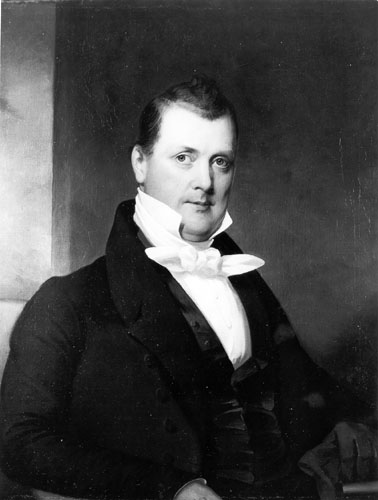
President James Buchanan. Image from Encyclopedia Dickensonia.

‘Mister Fancy’ James Buchanan:
Our gay Commander-in-Chief

By Harvey Wasserman / The Rag Blog / December 20, 2010

As “conservatives” scream and yell about gays in the military, they might remember that in all likelihood we have already had a gay Commander-in-Chief.

His name was James Buchanan. He was the 15th President of the United States.

A Democrat from Pennsylvania, Buchanan is discreetly referred to in official texts as “our only bachelor president.”

In fact, many historians believe that he may well have been “married” to William Rufus King, a pro-slavery Democrat from Alabama who was our only bachelor Vice President.

The two men lived together for years. Andrew Jackson, never one to shy from bullhorn bigotry, was among those who variously referred to them as “Aunt Nancy” and “Mr. Fancy.” Other Washington wags called them “Mr. and Mrs. Buchanan,” and the like.

The nature of their relationship was never officially confirmed or proclaimed in public. They were widely referred to as “Siamese twins,” slang at the time for a gay couple. But there was no incriminating gap dress or heartfelt double-ring ceremony, civil or otherwise. It was not uncommon at the time for men and women of the same gender to live together and even share a bed while remaining sexually uninvolved.

Buchanan was once engaged to marry a wealthy young woman named Ann Coleman. But the complex affair ended with her mysterious, untimely death. When King became ambassador to France in 1844, Buchanan complained that “I have gone wooing to several gentlemen, but have not succeeded with any of them.”

With no Moral Majority or Bible thumping fundamentalists to plague them, the King-Buchanan liaison was generally embraced as a political and personal fact of life in a nation consumed with real issues of life and death, freedom and slavery.

In 1852 King was elected as Franklin Pierce’s Vice President. But on an official mission, King contracted a fever and died, leaving Buchanan alone and deeply distraught.

In 1856, Buchanan defeated John C. Fremont, the first presidential candidate from the new Republican Party. Buchanan did not run for reelection in 1860, when Abraham Lincoln was the victor.

Buchanan’s presidency was plagued by economic and sectional disaster. He was a “doughface” northerner with sympathies for southern slavery. Devoted to consensus and compromise, he was swept away by the intense polarization that led to Civil War.

Through his entire time in the White House, President Buchanan lived alone. His niece served as “First Lady.” He stayed unmarried, and had his personal letters burned upon his death, prompting further speculation on his sexual orientation.

Maybe it’s time those legislators who have been so fiercely opposed to gays in the military face the high likelihood that at least one Commander in Chief would probably be among them.

[Harvey Wasserman’s History of the United States S is at www.harveywasserman.com, along with Passions of the Potsmoking Patriots “Thomas Paine,” which portrays George Washington as a gay potsmoker.]

The Rag Blog

Posted in Rag Bloggers | Tagged , , , , | 3 Comments

Kate Braun : Yule 2010 is Time of Great Energy

Commemorate change with items associated with the Holly King.

Celebrating Lord Sun’s rebirth and
capturing the energy of Yule 2010

By Kate Braun / The Rag Blog / December 20, 2010

“Troll the ancient Yuletide carol, fa la la la la, la la la la”

Tuesday, December 21, 2010, is Yule. It is a Full Wishing Moon and a Lunar Eclipse. Eclipses are times of major changes; Full Moons are times of realizing intentions; Tuesday is Tyr’s day and this Norse god may be considered comparable to Mars as he is a warrior, the god of single combat. All in all, Yule 2010 is a time of Great Energy. The challenge is how to capture and use this energy in positive ways.

The emphasis of this celebration is Lord Sun’s rebirth, signaling the end of the Time That Is No Time. Decorations and themes associated with Yule involve symbolism reflecting change, evolution, the turning of the Wheel of Life, renewal, and light.

Use evergreens (real, if possible), sprigs of holly, mistletoe, 8-spoked wheels, and candles (red, white, green) in your decorations. One of the ways to commemorate changes is to use items associated with the Holly King and the Oak King.

The Holly King, God of the Waning Year, traditionally wears a sprig of holly in his hat, wears red clothing, and drives a sled pulled by 8 reindeer (representing the 8-spoked Wheel of Life). He will be supplanted by the Oak King, God of the Waxing Year, at the end of their ritual battle or dance. Similarly, the full lunar eclipse brings darkness from which light emerges.

I recommend you include activities representing change, rebalancing, and forward motion in your program for this celebration. Prepare to let go of whatever it is that you no longer need. Let the light of Lord Sun and a full Lady Moon pull you from the Past into the Now and on into the Future.

Serve your guests a robust feast including roast meat, apples, nuts, cider and/or Wassail. You will want to raise a toast to Lord Sun on this day welcoming his return and the prosperity associated with that return.

An incense to burn during this celebration may be made by mixing together 2 T. dried pine needles, 1 T red sandalwood chips, 1 T. cedar chips. To this mixture add 20 drops Frankincense oil, 10 drops Myrrh oil, 5 drops Cinnamon oil, 5 drops Allspice oil, 5 drops Pine oil. Stir all together and then add 2 T. Frankincense resin.

Let the mixture “cure” for a day or two before using. Drop the incense onto a heated charcoal tablet and use a feather to waft the smoke around you and your guests. Focus your energies on themes such as: Balance, Renewal, Positive Change.

[Kate Braun’s website is www.tarotbykatebraun.com. She can be reached at kate_braun2000@yahoo.com.]

The Rag Blog

Posted in RagBlog | Tagged , , , , , | Leave a comment

By Kate Braun / The Rag Blog

“Troll the ancient Yuletide carol, fa la la la la, la la la la”

Tuesday, December 21, 2010, is Yule. It is a Full Wishing Moon and a Lunar Eclipse. Eclipses are times of major changes; Full Moons are times of realizing intentions; Tuesday is Tyr’s day and this Norse god may be considered comparable to Mars as he is a warrior, the god of single combat. All in all, Yule 2010 is a time of Great Energy. The challenge is how to capture and use this energy in positive ways.

The emphasis of this celebration is Lord Sun’s rebirth, signaling the end of the Time That Is No Time. Decorations and themes associated with Yule involve symbolism reflecting change, evolution, the turning of the Wheel of Life, renewal, and light.

Use evergreens (real, if possible), sprigs of holly, mistletoe, eight-spoked wheels, and candles (red, white, green) in your decorations. One of the ways to commemorate changes is to use items associated with the Holly King and the Oak King. The Holly King, God of the Waning Year, traditionally wears a sprig of holly in his hat, wears red clothing, and drives a sled pulled by eight reindeer (representing the eight-spoked Wheel of Life). He will be supplanted by the Oak King, God of the Waxing Year, at the end of their ritual battle or dance.

Similarly, the full lunar eclipse brings darkness from which light emerges. I recommend you include activities representing change, rebalancing, and forward motion in your program for this celebration. Prepare to let go of whatever it is that you no longer need. Let the light of Lord Sun and a full Lady Moon pull you from the Past into the Now and on into the Future.

Serve your guests a robust feast including roast meat, apples, nuts, cider and/or Wassail. You will want to raise a toast to Lord Sun on this day welcoming his return and the prosperity associated with that return.

An incense to burn during this celebration may be made by mixing together 2 T. dried pine needles, 1 T red sandalwood chips, 1 T. cedar chips. To this mixture add 20 drops Frankincense oil, 10 drops Myrrh oil, 5 drops Cinnamon oil, 5 drops Allspice oil, 5 drops Pine oil. Stir all together and then add 2 T. Frankincense resin.

Let the mixture “cure” for a day or two before using. Drop the incense onto a heated charcoal tablet and use a feather to waft the smoke around you and your guests. Focus your energies on themes such as: Balance, Renewal, Positive Change.

Type rest of the post here

Source /

The Rag Blog

Posted in RagBlog | Leave a comment

Carlos Calbillo : On the Passing of Carlos Guerra

“America’s friendliest angry looking retired columnist… and feared by fish.” — Carlos Guerra, on Twitter.

Columnist and Sixties Chicano
activist Carlos Guerra dies

See “Memories from ‘the day’: On the passing of Carlos Guerra,” by Carlos Calbillo / The Rag Blog, Below.

Carlos Guerra, 63, an icon of the Sixties Chicano movement, a former columnist for the San Antonio Express-News, and a leader in social justice issues throughout his life, died December 6, in Port Aransas, Texas.

Arnold Garcia, Jr., wrote in the Austin American-Statesman that Carlos Guerra “was a student activist, grant writer, political organizer, fundraiser, legislative aide, jeweler, opinion writer and a pretty darned good cook.” And, Garcia said, Guerra “was a man whose intellect — like his humor — refused to recognize boundaries.”

Guerra was, according to the Texas Observer’s Melissa Del Bosque, “one of the first prominent Latino columnists in American newspapers,” and was “one of Texas’ most recognizable voices and a role model for countless younger journalists.” In an obituary, the San Antonio Express-News said that Guerra “was an outspoken advocate for increased access to higher education, environmental issues and Latino participation in government and politics.”

Guerra, who grew up in Robstown, Texas, became an early leader in the Sixties Chicano movement. He was national chairman of the Mexican American Youth Organization (MAYO) and worked with La Raza Unida Party, serving as chairman of Ramsey Muniz’s second race for Texas governor.

At a memorial service for Carlos Guerra December 11 at Palo Alto College in San Antonio, former Raza Unida leader Mario Campeon said, “He stood for the well-being of others, particularly the poor. He fought…the fierce discrimination that existed at that time.” “All of us of that generation had the passion,” said Campeon, “but Carlos was also a gifted speaker in articulating the agenda of the Chicano movement.”

Thorne Dreyer / The Rag Blog / December 15, 2010

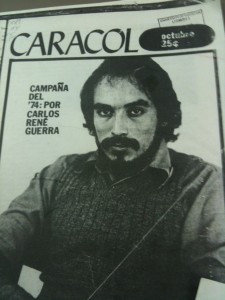
Carlos Guerra on the cover of Caracol, a Texas-based Chicano literary/news magazine from the 1970s. Image from National Association of Hispanic Journalists.

Memories from ‘the day’:
On the passing of Carlos Guerra

By Carlos Calbillo / The Rag Blog / December 15, 2010

The 60’s of course were a different time, and we as thinking young people were being influenced and bombarded by the dominant American culture: the music, the militancy — revolution was in the air — and of course the fashion. We wore bell bottoms, paisley shirts, and desert boots with our serapes and brown berets. We were young and crazy — some of us actually idealistic — trying to find a new way in the reality that was Texas of the times.

This society we perceived as intolerably oppressive and it definitely seemed to us “enlightened” youth to be designed to keep brown and black people down. So we took up “arms” against it, much to the horror of our parents and other “gente decente,” such as LULAC and their ilk.

I met Carlos Guerra at some of these early confabs of the Mexican American Youth Organization (MAYO), and since the Houston MAYO cadres were urban and “hippie-ish,” many of us either didn’t speak Spanish or did so haltingly. When I began to attend MAYO actions in the small communities across South Texas (small compared to Houston) and discovered that some of the MAYO hermanos/hermanas spoke mostly Spanish, perhaps out of nationalistic zeal, I — and many of the Houston MAYOs — would become uncomfortable.

One time we traveled to Robstown, Texas, to support a rally protesting the racist school system, which of course was designed not to educate our people, but to serve as an institutional bludgeon to keep us Mexicans down and ignorant. Robstown was a perfect example of a small Texas town where the population was overwhelmingly Mexican-American yet the economics and politics were tightly controlled by the gringo establishment.

The rally was being held in front of the MAYO headquarters in a down and out barrio and about 100 community people, parents, and students were there, very pissed, carrying protest signs in English and in Spanish. Robstown MAYO chieftain Mateo Vega was delivering a fiery bilingual speech and rant.

The Robstown police, represented by several big white guys in coats, ties, and sunglasses — and wearing very large pistols prominently on their belts — were walking around taking our pictures and generally acting like racist thugs out of central casting.

Carlos Guerra was there of course and afterwards we all met to debrief. I will never forget that, unlike the linguistic ideologues who considered those of us from Houston to be culturally pendejos, he was a firme vato who looked upon us, his urban hermanitos, not with scorn or disgust, but with a loving bemusement — and with an open attitude of inclusion.

Carlos of course was completely tri-lingual and spoke not only English perfectly but also a beautiful Texas Spanish and a stunning pachuco cálo.

From the beginning, Carlos understood the need to unite and not to fight, something that we in the current political arena and climate sometimes appear to forget.

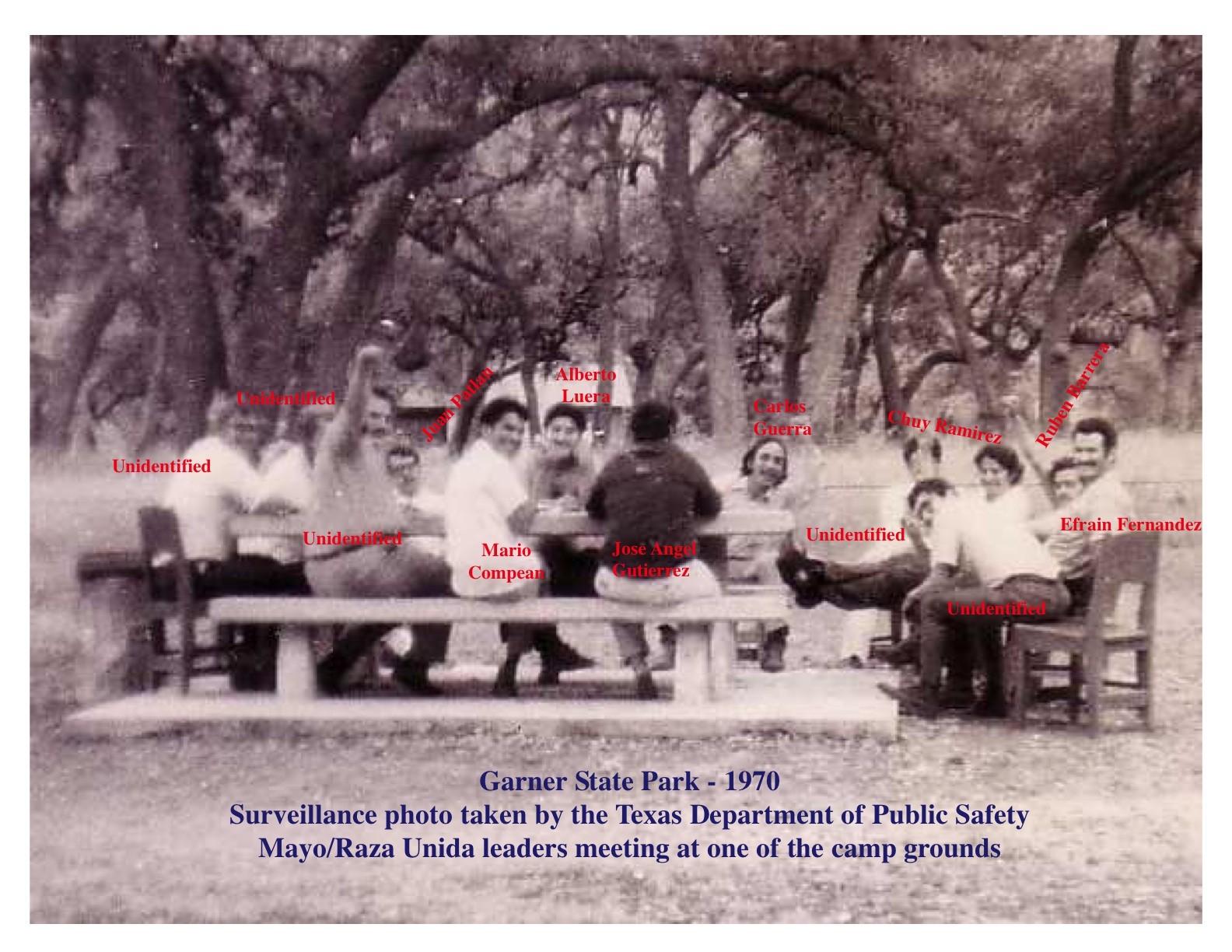
Texas DPS surveillance photo of MAYO/Raza Unida leaders meeting on the campgrounds at Garner State Park, 1970. Carlos Guerra is in the rear, leaning to the right.

CLICK ON IMAGE TO ENLARGE

Another incident I remember with my friend “Charlie War” — as some of us jokingly called him — was when MAYO and La Raza Unida Party had finally succeeded in taking over Crystal City and surrounding towns, and even entire counties, and Jose Angel Gutierrez called for all chapters to meet and to discuss future strategy at Garner State Park.

It was a beautiful setting with picnic tables under the great oak trees and we munched on barbacoa and tripitas as Jose Angel led us in discussion. We had all noticed several unmarked police vehicles on the periphery and we could see and even hear their cameras — with telephoto lenses — clicking away.

Eventually, Carlos Guerra and several others, including myself, made our way over to the parking lot at Garner where most of us had parked our junky cars. The lot filled suddenly with uniformed DPS troupers who began to berate, intimidate, and bait us in the way that only they knew how to do.

They went around writing down the license plate numbers of all of our cars, which they seemed to know well. Being new to this kind of political intimidation, I freaked out and began to back off. Carlos Guerra fearlessly went up to these PENsadores and began an attempt to educate them on the rights of American citizens to peacefully assemble, our right to meet without fear of governmental interference or intimidation.

Several of these sons of Texas seemed shocked and taken aback that their “right” to harass us was being challenged by this long-haired hippie who seemed not to fear them or anything else for that matter. They became very upset but apparently couldn’t come up with an excuse to arrest Carlos in front of witnesses; they muttered something and left.

Every time we visited Robstown, Carlos was there ready to assist us, his urban MAYO brothers and sisters, with a meal or with a place to crash. There have been many — and will be many more — remembrances of Carlos Guerra, incredible tales, profound and funny adventures, many of them even true. For those of us who were touched by his life, it goes without saying that we, and I for one, will never forget his wit, his love, and his example.

To paraphrase the bard (some vato from Inglatierra): “He was a man, take him for all in all, I shall not look upon his like again.”

Amen y con safos. Descanse en paz, hermanito en una raza que pronto llegará a ser verdaderamente unida, porque si se puede…

[Carlos Calbillo is a filmmaking instructor and filmmaker living and working in his hometown of Houston, Texas. He is currently working on a documentary film on emerging Latino political power in Houston and Texas. He can be reached at laszlomurdock@hotmail.com]

The Rag Blog

Posted in Rag Bloggers | Tagged , , , , , , , , , , | 1 Comment

VERSE / Gregg Barrios : Free Ramsey Now!

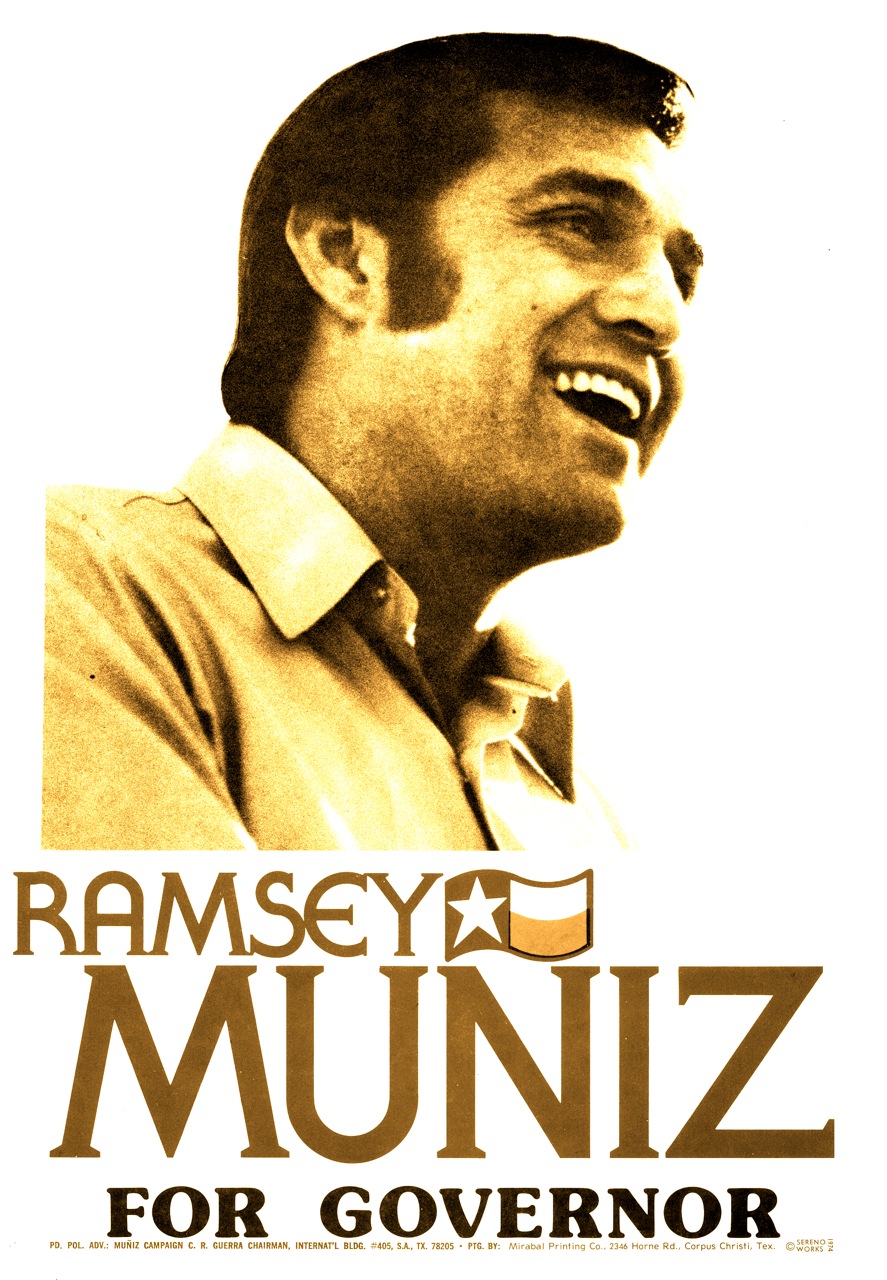
1972 campaign poster for Ramsey Muniz, Raza Unida candidate for governor of Texas.

FREE RAMSEY NOW!

By Gregg Barrios

When all is said and done
when you and I are dead,
your legend will remain
a true Chicano son.

It never was just us
it was you, me y todos
who believed our time
had come – and it had.

But politics is a fickle
whore who knocks on
every door for a quick
trip around the whirl.

You were the poster
boy for el movimiento
madres y palomilla all
voted La Raza Unida.

Ramsey for Governor
de Tejas was the rally
and the cry until they
put a spell on you.

We stood in disbelief
the gutless cynics
said you betrayed us
by not fighting back.

But where were we
when you received
a life sentence for
drug-trafficking?

Free Peltier, simón que sí.
Free Angela, right on, bro.
Free Ramsey Muñiz, and
the silence is deafening.

No solidarity or support
from those whose road
you paved, now elected
judges, mayors y mas.

Watching them on TV,
I wonder how and why
they lost their raza roots,
cut their native tongue.

I remembered the exiled
brothers Flores Magón
true architects and heroes
de la Revolución jailed.

A century later, you
occupy the same cell
at Leavenworth for a life
sentence of confinement.

We don’t know how to
honor our leaders alive
only after they’re dead
and buried en el olvido.

I saw a documentary on
PBS today a clip of your
vibrant face did express
real strength and grace.

Your voice had been erased
as if truth could cause riots
or upheaval in the realization
of how much we left undone.

When all is said and done
when you and I are dead,
your legend will remain
a true Chicano son.

— Gregg Barrios / The Rag Blog
Posted December 15, 2010

Ramsey Muniz arrives at Nueces County Jail in handcuffs, December 28, 1976.

Ramsey Muniz was a Chicano activist, a civil rights attorney, and twice the Raza Unida Party candidate for governor of Texas, receiving six percent of the vote in 1972. Famed attorney Dick DeGuerin said Muniz “changed the face of politics in Texas. He gave power of inclusion to Hispanic Americans.” Muniz was convicted in 1976 on drug charges resulting from a controversial sting operation carried out by the DEA, and in 1994 was given life without parole after a third drug conviction.

[San Antonio poet, playwright, and journalist Gregg Barrios wrote for The Rag in Sixties Austin. Gregg is on the board of directors of the National Book Critics Circle. His new book of poetry, in which this poem is included, is La Causa (Hansen, 2010).]

The Rag Blog

Posted in Rag Bloggers | Tagged , , , , , , , , | 4 Comments

Tom Hayden : Julian Assange and the Lynch-Mob Moment

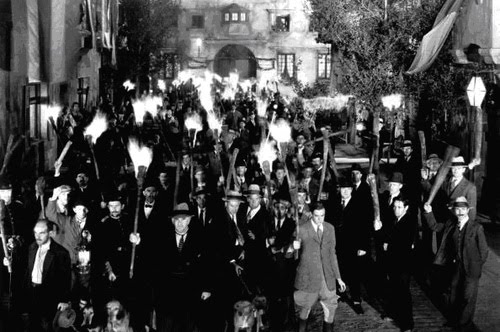
The lynch mob in Frankenstein. Is Julian Assange next?

The lynch-mob moment:
The frenzy over Julian Assange and WikiLeaks

By Tom Hayden / The Rag Blog / December 15, 2010

We know that conservatives are extremists for order, but why have so many liberals lost their minds and joined the frenzy over Julian Assange and WikiLeaks? As the secrets of power are unmasked, there is a growing bipartisan demand that Julian Assange must die.

Once-liberal Democrat Bob Beckel said on FOX that someone should “illegally shoot the son-of-a-bitch.” A few days ago center-liberal legal analyst Jeffrey Toobin said on CNN that Assange is “absurd, ridiculous, delusional, and well beyond our sympathy.” The Washington Times called for treating him as an “enemy combatant”; Rep. Peter King of the Homeland Security Committee wants him prosecuted as a terrorist; and of course, Sarah Palin wants him hunted down like Osama Bin Ladin or a wolf in Alaska.

This is a lynch mob moment, when the bloodlust runs over. We have this mad overreaction many times since the witch burnings and Jim Crow, including the Palmer Raids of the 1920s, the McCarthy purges of the 1950s, the Nixon-era conspiracy trials, the Watergate break- ins, and the invasions of Afghanistan and Iraq after 9/11.

Most Americans know now that those periods of frenzy and scapegoating did nothing for our security but damaged our democracy and left in their wake a secretive National Security State.

There’s wisdom in expecting calmer heads to prevail in the WikiLeaks matter, but what can be done when the calmer heads are going nuts or hiding in silence?

Do the frothing pundits remember that we have a legal system in which the accused is entitled to due process, legal representation, and the right to a defense? The first obligation of our threatened elected officials, bureaucrats and pundits is to calm down.

No one has died as a result of the WikiLeaks disclosures. But the escalation by the prosecutors in this case could lead to an escalation, with more sensitive documents being released in a retaliatory spiral of this first cyber-war. Imprisoning the messenger will amplify his message and further threats of execution.

I can understand the reasonable questions that reasonable people have about this case. It is clearly illegal to release and distribute the 15,652 documents stamped as “secret.” Why should underground whistleblowers have the unlimited right to release those documents? There is a risk that some individuals might be harmed by the release? There is a concern that ordinary diplomatic business might be interrupted.

All fair questions. These concerns have to be weighed against two considerations, it seems to me. First, how important is the content of the documents? And how serious is the secrecy system in preventing our right to know more about the policies — especially wars — being carried out in our name? And finally, is there a reasonable alternative to letting the secrets mount, such as pursuing the “transparency” agenda, which the White House purports to support?

Let me weigh these questions with regard to the wars in Iraq, Afghanistan, Pakistan, Yemen, and the “Long War” scenario that has occupied my full attention these past nine years.

It will be remembered that the Iraq War was based on fabricated evidence by U.S. and British intelligence services, the Bush-Cheney White House, and even The New York Times through the deceptive reporting of Judith Miller. The leading television media invited top military officials to provide the nightly narrative of the war lest their be any doubts in the mesmerized audience.

Secrecy and false narratives were crucial to the invasions, special operations, renditions, tortures, and mass detentions that plunged us into the quagmires where we now are stranded. The secret-keepers were incompetent to protect our national security, even when cables warned of an immanent attack by hijacked airliners.

The secrecy grew like a cancer on democracy. Earlier this year, the Washington Post reported in “Top-Secret America” that there were 854,000 people with top- security clearances. [William Arkin, Dana Priest, “Top Secret America,” Washington Post, July 19, 2010] That was the tip of the iceberg. The number of new secrets rose 75% between 1996 and 2009, to 183, 224; the number of documents using those secrets has exploded from 5.6 million in 1996 to 54.6 million last year. [Time, December 13, 2010] The secrecy cult appears uncontrollable: the Clinton executive order 12958 [1995] gave only 20 officials the power to stamp documents top-secret, but those 20 could delegate the power to 1,336 others, while a “derivative” procedure extended the power to 3 million more officials and contractors. [Time, December 13, 2010]

The 1917 U.S. espionage statute requires that Assange received secret documents and willfully, with bad faith, intended to harm the United States by releasing “national defense information.” That’s a tough standard. Perhaps in order to close what U.S. Attorney General Eric Holder describes as “gaps in our laws,” the State Department sent a letter demanding that Assange cease the releases, return all classified documents and destroy any records on WikiLeaks databases. [Washington Post, November 30, 2010]

These are difficult legal hurdles for the Justice Department under the First Amendment, but, according to a source close to the defense with experience in such cases, it seems clear that the U.S. government will prosecute Assange with every tool at their disposal, perhaps even rendition.

“What President Obama needs is a photo of Assange in chains brought into a federal court,” the source said.

[U.K. prosecutors seeking to overturn a ruling granting bail to Assange will have their appeal heard by a London judge tomorrow, December 16.]

Should there be an attempt to extradite Assange, he has the right to appeal to the European Court of Human Rights.

Assange has a very strong base of support in London where public anger over the fabrications that led to war still runs high. An extradition fight in London could carry on for weeks, providing an important platform for the defense. Or the UK government could take the risk of an accelerated emergency deportation process to send him to Stockholm, or even the U.S. in the most extreme scenario.

If Assange winds up in Stockholm, it could take several weeks to fight his way through a bizarre and complicated sexual harassment trial. Anything is possible there, from all charges being dropped, to the finding of a technical infraction, to jail time. Or Sweden could make an emergency finding to extradite him straight to the U.S., risking an adverse public reaction for serving as to a handmaiden of the Pentagon.

In the atmosphere of hysteria ahead, it is important for peace and justice advocates to remember and share what Americans owe to Julian Assange and WikiLeaks.

  1. WikiLeaks has disclosed 390,136 classified documents about the Iraq War and 76,607 about Afghanistan so far. No one died as a result of these disclosures, one of which revealed another 15,000 civilian casualties in Iraq which had not been acknowledged or reported before;
  2. Fragmentary orders [FRAGO] 242 and 039 instructed American troops not to investigate torture in Iraq conducted by America’s allies;
  3. The CIA operates a secret army of 3,000 in Afghanistan;
  4. A secret U.S. Task Force 373 is assigned to nighttime hunter-killer raids in Afghanistan;
  5. The U.S. ambassador in Kabul says it is impossible to fix corruption when our ally is the corrupt entity;
  6. One Afghan minister alone carried $52 million out of the country;
  7. U.S. Special Forces operate in Pakistan without public acknowledgment, apparently in violation of that country’s sovereignty;
  8. America’s ally, Pakistan, is the chief protector of the Taliban in Afghanistan.
  9. Following secret U.S. air strikes against suspected al-Qaeda militants, Yeme’s President Ali Abdullah Saleh told General David Petraeus, “We’ll continue saying the bombs are ours, not yours.”

The secretive wars exposed by WikiLeaks will cost $159.3 billion in the coming fiscal year, and several trillion dollars since 2001. The American death toll in Afghanistan will reach 500 this year, or 50 per month, for a total of 1,423, and 9,583 wounded overall — over half of the wounded during this year alone. The Iraq War has left 4,430 U.S. soldiers dead and 32,000 wounded as of today. The civilian casualties are ignored, but range in the hundreds of thousands of Iraqis, Afghans, and Pakistanis.

Is it possible that Julian Assange is the scapegoat for arrogant American officials who would rather point the fingers of blame than see the blood on their own hands? What else can explain their frenzy to see Assange dead?

It may be too late to prevent an escalation. The lynch mob is rabid, terrorized by what they cannot control, completely out of balance, at their most dangerous. If they realize their darkest desires, they will make Assange a martyr — a “warrior for openness” — in the new age now beginning. A legion of hackers are fingering their Send buttons in response, and who can say what flood they may release?

The trial of Julian Assange is becoming a trial of secrecy itself. Wherever the line is drawn, secrecy has become the mask of power, and without new rules, the revolt of the hackers will continue.

[Tom Hayden is a former California state senator and leader of Sixties peace, justice, and environmental movements. He currently teaches at Pitzer College in Los Angeles. His latest book is The Long Sixties. This article was also published at The Nation and Progressive America Rising.]

The Rag Blog

Posted in Rag Bloggers | Tagged , , , , , , | 3 Comments

David P. Hamilton : My Remission and the Business of American Medicine

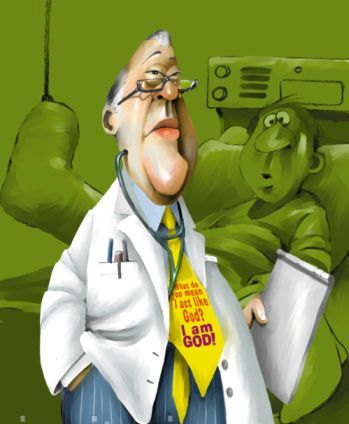
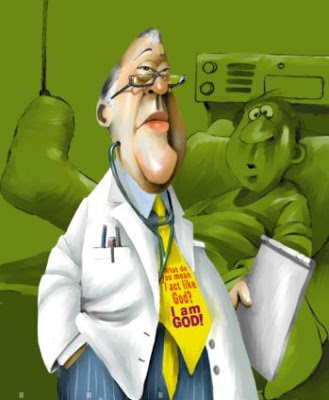
Graphic from The Patient’s Doctor.

Rheumatoid arthritis, my remission,
and the business of American medicine

Their deficiencies, spawned by the system’s economic organization, might be more tolerable if doctors didn’t so often act like they had been anointed by God with special powers to save your life provided you have a deferential attitude and the right insurance.

By David P. Hamilton / The Rag Blog / December 15, 2010

Over two years ago I was diagnosed with rheumatoid arthritis (RA). According to all rheumatologists, it is an incurable and progressively degenerative disease. These alleged specialists earn an average of $224,000 a year “treating” it. They confidently assert that once you have RA, it’s permanent and dealing with it becomes the dominating feature of your remaining life.

With RA, your immune system inexplicably short-circuits and attacks your own body, particularly in the joints of the arms and legs. The onset of the disease requires a genetic predisposition and a triggering incident. Three months previous to the RA diagnosis, I had hip replacement surgery. In conformity with the apparent professional secret code to cover for colleagues, no doctor I’ve asked has been willing to speculate on the possibility of that being the trigger.

The RA diagnosis was based on several assumptions. Since I had it, it was assumed I had some triggering incident and the required gene, although I’m aware of no genetic test being done or speculation on what may have been the trigger. The hip replacement surgeon, whose specialty averages over $600,000 a year, performed his task with great technical skill, but failed to mention RA as a possible side effect.

The diagnosis of RA is not made in a casual manner. It is quite scientific and quantifiable on the basis of a blood test to determine your “rheumatoid factor”. For men, above the score of 30 is positive. At one point, I was 176. Once you’re positive, it is “standard medical practice” to never test for that factor again, based on the assumption that the disease is always chronic, so further tests would be superfluous.

When I asked for a new test after months without symptoms or medications, my rheumatologist at first resisted, but acceded to my request since she had a blood lab on site at the VA. The new “rheumatoid factor” reading was down to 27. She declined to speculate on the cause of the score dropping. A few months later, it was back to 94, but I still had no symptoms.

RA won’t kill you in a few months or even years. However, it hastens one’s general physical deterioration leading to earlier death from something else. Along the way it cripples you and makes you wish you were dead because you can’t walk or use your hands. It is also quite painful and disfiguring. Not the Last Act one would choose.

Conventional American medical wisdom is that the pace of the inevitable degeneration caused by RA can be slowed only by the use of drugs so toxic as to require frequent tests of one’s liver function, if any. Rheumatologists offer no cure and no allopathic physician ever gave me the slightest reason to hope that I would ever be well again, let alone be playing tennis and strolling the boulevards of Paris without pain.

Yet, today I have had no symptoms in well over a year, remain athletic, haven’t taken pharmaceuticals for RA for over a year and recently returned from two months in France, celebrating my remission, which included many such strolls. My last rheumatologist has dismissed me from her care “until further notice,” her way of warning me that it may return. My general practitioner calls my recovery “truly remarkable,” but has no explanation. Getting well, even if it is only temporary, while consistently rejecting medical advice was never considered a reasonable option.

Both the rheumatologists I saw recommended I take methotrexate. This drug was first developed in the late 1940’s to treat cancer. It was FDA-approved for the treatment of RA in 1988 and remains “the gold standard” of RA treatment. It was once a breakthrough in cancer treatment, but that was over a half century ago and cancer chemotherapy has come a very long way since then. According to Wikipedia, methotrexate “inhibits the synthesis of DNA, RNA, thymidylates, and proteins.” Not exactly the stuff one takes to return the body to a natural state of balance.

The first rheumatologist I saw was the local big wheel of the specialty with the big office on the central lobby of the first floor of the big private medical center of which he very likely owns a big part. First, he sent me to various of his colleagues in the facility for multiple expensive tests, sometimes of questionable necessity, thus helping enrich his co-owners who operate large and expensive pieces of medical diagnostic machinery and their collective corporate enterprise.

After this process, he prescribed the same stuff he prescribes to almost everyone, methotrexate. That’s what he does most days, over and over, for those big bucks. He looked justifiably bored. He had absolutely no advice for me besides taking that caustic pharmaceutical, only grudgingly conceding that fish oil might have some limited benefit.

When asked if walking would be a good form of exercise for me, he responded, “It won’t do much harm as long as you can tolerate the pain.” When I suggested employing a less invasive, more holistic regimen for starters, he dismissed such approaches as having “no scientific basis,” the sooner I started on the methotrexate the better, and I’d probably be on it for the rest of my life. Of course, I fired him, walking out after telling him I’d seek other opinions.

My second rheumatologist was at the local VA clinic. Since I’m a veteran and she’s a VA doctor on salary, she had to put up with me regardless of my routinely and overtly not following her advice either. Being able to talk back to your doctor without being thrown out into the street is a seldom recognized benefit of socialized medicine.

She wanted me to take methotrexate too. I again refused and requested her guidance in a more holistic approach. She willingly acknowledged having no special training in the use of “alternative therapies.” Apparently, in the official parlance, “alternative” is anything other than stuffing yourself with chemical combinations that are by definition toxic.

She did, however, loan me a book from her own library put out by the Arthritis Foundation that evaluated such alternatives. [Alternative Therapies for Arthritis by Dorothy Foltz-Gray, Arthritis Foundation.] She also gave me a stack of pamphlets describing each pharmaceutical commonly used to treat RA and asked me to decide which, if any, I would agree to take. Her attitude seemed a great leap forward, a willingness to enter into the aberrant state of patient directed medical care. Maybe she had no choice, but she was an empathetic woman, and that was progress.

I expected the book to be a smear on holistic therapies. Surprisingly, the author tried to strike a pose of tolerance, likely in deference to the widespread resort to alternative remedies by RA patients dissatisfied with conventional pharmaceutical approaches. Much of the evidence cited was inconclusive, but you could get the drift of what they thought was fraudulent and what they thought might help.

There are lots of natural anti-inflammatories, but nothing that anyone would claim cures RA. The book inspired me to buy a round of exotic supplements like borage oil and stinging nettle extract. The combination of several such concoctions did nothing noticeable about my RA but may be implicated in a subsequent attack of diarrhea. My cynicism in regards to American allopathic medicine began to spread to its alternatives.

More important, the book let slip a closely guarded secret that rheumatologists are loath to acknowledge — that some RA patients go into complete spontaneous remission, at least for long periods of time, and the medical specialists don’t know why. This is not so surprising when you realize they don’t know what starts it either.

There are various definitions of “RA remission,” one of which has the patient asymptomatic, but on the heavy drugs. These variations cloud the issue somewhat, but there are indeed a small percentage of people diagnosed with RA, perhaps as much as 10%, that experience “spontaneous remission,” meaning that they did it outside the guidelines of established medical practice. Medical journal articles on RA remission sometimes throw these cases out of their studies since they distract from their focus on what expensive new pharmaceutical might be effective.

It bothered me that until recently the most common drugs used to treat RA were originally developed to treat something else. Also troubling in my case was that RA strikes many more women than men and usually hits people before they are 50. I was a 64 year-old guy, way outside the standard pattern. My doctors offered no explanation for this anomaly. It all gave me the impression that rheumatology was less than a precise science and that its practitioners didn’t have a very solid grip on causes or effective treatments, regardless of their standard pose of all-knowingness.

The question to me was how to be among that small group that somehow got well without resort to the standard pharmaceutical regimen. There were many ideas floating about the internet, but no clear path. For example, there were numerous dietary suggestions. Many claimed their particular diet had beneficial effects on RA, but none claimed it cured it. Although some foods were suggested repeatedly (e.g., fish oil, avocados), the diets varied widely and in some cases were contradictory. There was no shortage of suggestions, often endorsed with great certitude by alternative true believers.

Over the course of a year, my body somehow healed itself despite continued positive blood tests for RA. I don’t know how. It was probably some genetic luck. I simply took good care of myself. My approach was eclectic; some of this, some of that, but not methotrexate or anything similar.

I improved what was already a very rich organic, whole grain, localavore diet, became more disciplined about my exercise routine, added some of the suggested supplements to my preexisting supplement regimen, tried to keep my stress level down and adopted a fighting spirit. Nothing revolutionary. Just enhancements to what I had already been doing, including the maintenance of our 400 square foot kitchen garden.

For almost a year I took what seemed to me to be the most benign of the recommended RA prescription drugs; an antibiotic (minocycline) and an old anti-malaria drug (hydroxychloriquine). They didn’t seem to do much except make me more susceptible to sun. I quit taking them more than a year ago, of course “against doctor’s advice.”

I also spent several hours being interviewed by a homeopathic physician (also an MD) who concocted a couple of crystals for me to ingest. His primary distinction was being the only medical professional that said he could cure me. Whether he did or not, who knows? I tossed the crystals down, added to the mix.

I have long felt that if there were such a thing as a fountain of youth, it was endorphins. I continue to firmly believe that you cannot be very healthy without a serious exercise routine, something that should take about an hour of your day, every day, and cause sweat.

With the RA diagnosis, I became a very disciplined walker, eventually evolving into a speed walker through hills, progressively adding weight to my daypack to make it harder. But like other features of my therapeutic approach, this was an augmentation of a preexisting practice, not some new feature of my lifestyle. I had been a runner and tennis player for decades.

My approach was anything but scientific. It has worked so far, but it’s impossible to know what factor was crucial or even important or that it was even anything I did at all. Perhaps I was predestined to get better regardless. But now that I have returned to an enviable state of wellness, even fitness, for someone 67, the question naturally arises: what happened? What, if anything, did I do to help cause remission? There is no way to answer that question with precision.

One factor, however, is very clear to me, and all my most trusted medical consultants agree. For me to have ever recovered not only my health, but also the ability to walk, even run, and the normal use my hands, it was essential that I rejected standard medical opinion and resisted the pharmaceutical path. That path leads to long term prescription drug dependency and a rotting liver, not back to true health.

I have come to see my wellness as exemplary of a conceptual failure of America’s allopathic medical practice. My body healing itself was simply not on their radar, because they don’t make money from healthy people who are independent of pharmaceuticals.

Doctors have no special training in the benign and natural means to promote the body’s capacity to heal itself. The intellectual monopoly of the pharmaceutical model blocks out such approaches. Conventional American medicine pays minimal attention to either prevention or enhancing natural recuperation. They’re not profitable. The focus of our medical system is instead on devising salable products that replace natural recuperative mechanisms with artificial ones, producing and distributing such products so that health care becomes a commodity and doctors are transformed into entrepreneurs.

It is an inherent and inescapable feature of the capitalist health care model that it profits from illness. The average U.S. doctor makes nearly a quarter million a year, most specialists a half a million and surgeons more. Scant few don’t become millionaires. On average, they’re the best-paid national professional group in the world. Yet, the U.S. wallows at 37th (behind Oman, Portugal, Morocco, Columbia, and Costa Rica) in the World Health Organization’s ranking of the quality of national health care systems, 74th according to the UN, and 49th in life expectancy.

Compared to the other G8 nations, the U.S. has the highest infant mortality, the most mothers who die during childbirth, the most lives lost that could have been saved, and the worst in treatment of cancer. In the American system, there are no poor doctors, but lots of sick people, bankrupt patients and 59 million miscreants without “coverage.”

Like their plan for innumerable others, my doctors wanted me to take caustic chemicals for the rest of my life while pouring my meager savings into their bank accounts for my perpetual “treatment,” a steady income source for them throughout my remaining years of worsening disability.

In the capitalist oriented American health care system, private doctors have a clear vested economic interest in patients not getting well. My chronic is their meal ticket. My wellness hurts their bottom line. How could I be so naïve as to expect them to cure me when my sickness is so much more lucrative?

The standard Western doctor operates almost exclusively on a very narrow procedural model. They order expensive diagnostic tests done by other specialists in order to determine which prescribed drug to give you. In most cases, that’s all. To a great degree, they are agents of the pharmaceutical industry in charge of customer service. Patients wait patiently to see doctors. Big Pharma reps walk right in.

It is nearly axiomatic that whenever you go to the doctor’s office, you leave with a prescription. Otherwise, most patients feel cheated. If you’re a favored patient, you’ll get some of the doctor’s stash of free samples the pharmaceutical reps have graciously left. Whatever your germ, doctors have exclusive access to the appropriate specialized germ killers. These medications, however, have high toxic potential or they wouldn’t have to be “prescribed.”

The cornerstone of American doctor’s wealth is their monopoly on the right to prescribe drugs to which the government has restricted access. If your condition further deteriorates, they “operate,” i.e., cut you open and remove or install things, a service that costs many thousands, requires the expenditure of many thousands more in ancillary products and is dangerous because the fourth leading cause of death in the U.S. is going to the hospital.

If you asked most U.S. doctors what s/he could do to improve your health besides pills, shots, and surgery, they’d be out of their element. Especially don’t ask about nutrition or exercise routines and expect an expert opinion.

Their deficiencies, spawned by the system’s economic organization, might be more tolerable if doctors didn’t so often act like they had been anointed by God with special powers to save your life provided you have a deferential attitude and the right insurance. Many an idealistic youth who set out to serve mankind by being a doctor, became seduced by the Big-Pharma orthodoxy of the training institutions. And after pre-med, med school, internships, residencies, and the related costs, developed a sense of material entitlement not matched by equally educated PhD’s.

There are, of course, legions of doctors operating in the capitalist medical system who have maintained at least some of the most humanist motives for practicing medicine. There are, without doubt, saints among them. I’m especially partial to general practitioners, pediatricians, trauma specialists, and women doctors. Many surgeons have great technical skill. Morally unimpeachable motives and competency, however, are largely irrelevant to the operating economic principals of the system.

The American medical model is systematically corrupted by its capitalist character, resulting in serious conceptual limitations. These corruptions derive from health care being a commodity instead of a right and from illness being a source of profit. A principal conceptual limitation is their failure to focus on methods to enhance the body’s natural recuperative potential, favoring instead doctor controlled pharmaceutical dependency.

The most effective and economical approaches to health care for most people involve prevention, health maintenance and recuperation. For this, important societal inputs would be nutrition education, subsides for genuinely healthy foods and lifestyles, community fitness programs, low job stress, social security, sufficient time off to pursue personally rewarding activities, and universal public health care so that people don’t neglect seeing a doctor for fear of the costs associated with getting medical care.

The problem is that in the unfettered market system, none of these components of optimal health care offer the pharmaceutical, hospital and health insurance industries opportunities for profit even close to equaling those offered by the existing model.

[David P. Hamilton has been a political activist in Austin since the late 1960s when he worked with SDS and wrote for The Rag, Austin’s underground newspaper.]

The Rag Blog

Posted in Rag Bloggers | Tagged , , , , , | 5 Comments

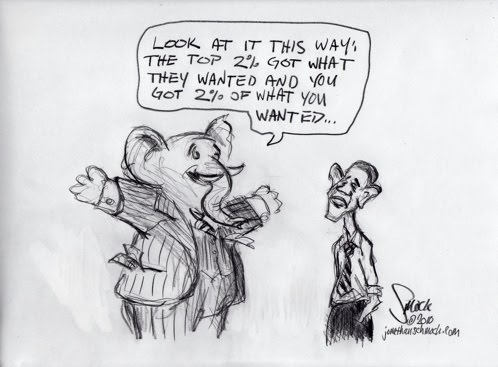
Sid Eschenbach : Why Obama Took the Deal

Cartoon from Huffington Post.

The myth about jobs and taxes,
and why Obama took the deal

By Sid Eschenbach / The Rag Blog / December 14, 2010

With little time left in this Congressional session, legislative scheduling should be focused on these critical priorities. While there are other items that might ultimately be worthy of the Senate’s attention, we cannot agree to prioritize any matters above the critical issues of funding the government and preventing a job-killing tax hike.

With this passage in the letter sent to Majority Leader Reid from the entire Republican caucus, the Republicans again assert one of the central myths of Chicago school economics — that raising taxes kills jobs. It is repeated endlessly, this lie, this wholesale fabrication. This straw man specifically constructed in order to give greed a veneer of respectability (not to say virtue) is at the heart of modern economic myth — and is at the heart of current American national economic failure.

It is the industrial sized fig-leaf used to confuse and convince the ignorant while it protects both the money and the power of the wealthy, and until this lie is disproven and the liars that advance it unmasked, there can be no hope of holding a fact-based national conversation regarding the proper funding of the government.

Indeed, given the ease with which it can be disproven both empirically and theoretically, it makes one wonder about the real agenda of the Democratic Party, a party that has since the time of FDR understood that a system of strong progressive taxation is in the best economic interests of the nation. But Democrats have thus far chosen not to contest the neoliberal framing.

Could it be that there is, under certain circumstances, a reason that cutting taxes is indeed stimulative and thus in the best interests of the Obama administration?

Historical Proof that high taxes don’t kill jobs

Empirically, the evidence is clear: there is not now nor has there ever been — since personal income taxes were instituted in 1913 — any real statistical relationship between low tax rates and job-creating prosperity — or the alleged and corollary relationship between high tax rates and unemployment.

A statistical analysis of the data (historical tax rates vs. historical unemployment rates) shows that, to the degree a statistically valid (p<.05 relationship exists at all employment and general prosperity are more directly related to higher taxation but the conditions aren linked statistically. past years have shown that unemployment can be high under both low tax regimes just as it regimes. therefore there is either no between rates or so weak easily overcome by other stronger economic factors. whatever case fact remains empirical historical proof this over nearly a century of taxes kill jobs. while many specific examples could following example simple short clear. world war i was watershed in history american income were raised significantly order pay for huge additional expenditures. before advent another neoliberal fantasy cutting>increases government revenue.

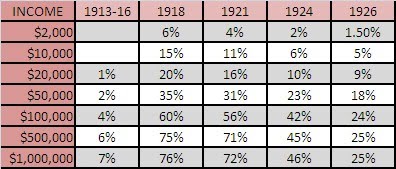
Therefore, as shown in the chart below, in 1917 the top marginal rates were raised from 7% to 67%, and they stayed high through 1921 to allow the government to get rid of the budget obligations created during the war. As a result of these rate increases, the share of revenue gained from income tax continued to rise after the war, reaching a peak of 69 percent in 1920.

By 1920, with the debt generally paid, the consensus of government was that tax rates could and should be cut, especially from the upper brackets. The results were the income tax cuts in 1921, as well as following cuts again in 1924 and 1926 due to a continued growth in government surpluses. Rates changed during this period according to the following table:


Reviewing the data, we see that in 1918 rates were raised to pay for the war, which indeed generated the greater revenue sought. After the debts were paid off, marginal rates were again lowered in 1924, and as a result, government revenues from income tax diminished. The most salient point of this data, however, is that from start to finish, with rates changing from 7% to 76% and back to 25% (the largest rate changes in the history of U.S. taxation), the national unemployment rate never varied more than 3%.

And we all know what happened next: from the 25% top tax rate of 1926, Income tax rates remained low right into the Great Depression and the highest unemployment rates the country has ever seen — something that would be technically impossible if low tax rates did in fact create jobs.

To be sure, our century of taxation repeats this theoretically impossible feat time and again, most recently from 2003-2008. However, as Goebbels proved, a lie repeated often enough can defeat even reality, and “high taxes kill jobs” is no exception. In the famous words of the unfaithful husband trying to reassure his angry wife: “Honey, who are you going to believe: me, or your lying eyes?”
In its latest iteration, it’s sold to a gullible and vain public with variations on the theme of: “You can spend your money more wisely than the Government” — which is itself just another emotional link to the underlying and insulting Republican trope of inept government: the oft used “Hello, I’m from the government and I’m here to help!” joke. Moreover, while this general argument that private spending is somehow more “efficient” than government spending has never been true, it is especially not true in today’s import dominated economy.

What is ‘economic stimulus’ anyway?

In traditional capitalist theory, when economists speak of “stimulating” an economy (usually with the goal of lowering unemployment), what they are trying to do in “econo-speak” is to “increase aggregate demand,” and this is done by adding money to the system. Theory and reality are at this point in agreement, because people do indeed always spend more when they have more. So the idea behind ‘stimulation’ is simple: to somehow get more money into society’s pockets, its hands, its stores, banks and businesses.

There are really only two generic ways to “increase aggregate demand”: either economically, by somehow “juicing the pot,” or entrepreneurially, through creating a new demand that drives new and greater spending. An example of the second is the creation of the IT industry and the 22 million jobs it spun off during the Clinton administration.

Unfortunately, as a policy tool it’s beyond the reach of economics, as no economist has as yet figured out a way to create, at will, transformative technologic revolutions and the growth that comes with them. For practicing economists and government functionaries, therefore, the tools available are the traditional — economic fiscal and monetary policy — and the use of either of these does indeed have an impact on growth and jobs.

Monetary and fiscal stimulation

Economists use the formula “GDP = CS + BI + GS + BT” to calculate the size of national economies and measure their movement. The total, the Gross Domestic Product (GDP), is considered to be equal to the sum of consumer spending (CS), business investment (BI), government spending (GS) and net balance of international trade (BT). In order, then, to stimulate the economy, one or more of these must increase, thus creating a larger total sum of the parts.

As noted above, economists can do this in one of two ways: using monetary or fiscal policy. What most people don’t understand, however, is that both are tools of debt. The ignorance of this fact even among those who should know better was shown most recently in the last electoral cycle, when an ad for a tea party candidate had her listeners in hysterics when she pointed out that the Democrats advocate spending their way out of the recession! Very funny!

However, as Greece and other nations have proven, austerity in recession only further kills growth, so there is no there there. Contrary to common sense, the time for austerity is not when in recession, but when in surplus. Recessions stipulate spending, while prosperity calls for balanced budgets.

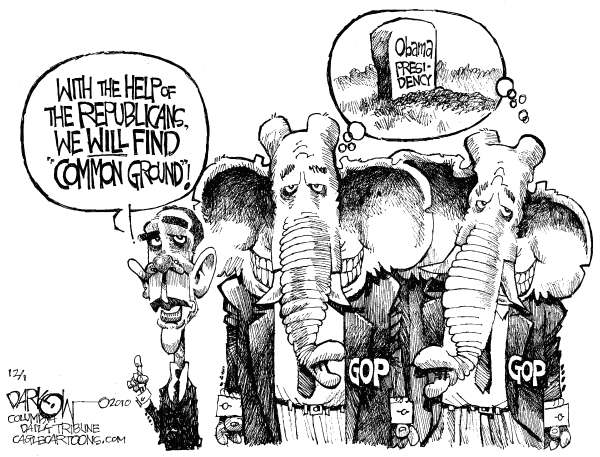
Political cartoon by John Darkow / Columbia Daily Tribune / Cagle Cartoons.

Debt as stimulus

Using the tool of private debt as stimulus – monetary policy — the central bank lowers interest rates in order to stimulate the economy. This is because lower rates generally lead to increased bank lending, and lending is the most direct and usually fastest way to create and circulate the new money needed to stimulate growth, increase the GDP and exit the recession.

Lower interest rates generally increase both consumer spending (CS) and business investment (BI), because both sectors tend to borrow more money at lower rates. When CS and BI go up, the total GDP goes up — which is the essence of stimulus. In terms of the Great Recession, the Fed has, of course, ridden this horse until it can run no more, having reduced interest rates to near 0% some time ago.

Fiscal policy, on the other hand, refers to increasing GDP via either a) increased government (deficit) spending (GS), or b) lowering tax rates. The a) part of the fiscal stimulus theory, that deficit spending by the government is stimulative, is straightforward. When one calculates the GDP, it doesn’t matter if the amount of government spending is paid for… or not. Therefore, when the government spending (GS) is increased, it directly increases the total amount of capital in circulation, thereby increasing “aggregate demand” — or GDP — which, again, is the goal of the exercise.

In the Great Recession, along with reducing the federally controlled base interest rate to nearly 0% (monetary policy), fiscal policy was both the vehicle of choice and necessity for the Obama administration, and it did so primarily by borrowing and then spending the famous $700 billion dollar stimulus package of deficit spending.

It had to do this to try to stem a massive deflationary spiral created by the bursting of the global real estate bubble. It was an effort to support GDP through government spending in the absence of consumer or business spending — and thus avoid the very real possibility of a second Great Depression.

In summary, both monetary and fiscal policies are about one thing: increasing total capital by increasing debt. Monetary policy encourages both consumer (CS goes up) and business (BI goes up) debt, while fiscal policy refers to an increase in government debt (GS goes up).

What about b), the ‘cutting taxes is fiscal stimulus’ part of fiscal theory?

The argument made by neoliberal economists is this: that cutting taxes increases the amount of disposable income in the hands of consumers, and thus increases spending and demand in the consumer sector — which is certainly true. However, both history and math shows us that cutting taxes by itself creates no new money, as the amount “given” to consumers (increase CS) through a tax cut is the same amount ”taken” from the government (decrease GS).

Therefore, a tax cut cannot possibly create an increase in total aggregate demand any more than a tax hike decreases it. What goes up in one column is what goes down in another: the classic “Robbing Peter to pay Paul.”

Furthermore, the argument that any increase in consumer demand increases business hiring to meet that demand is equally true for government spending, whether the government spends it or it’s spent by the wage earners themselves, it’s the same money with essentially the same net results.

Why the Obama administration agreed to an extension of the Bush tax cuts

As noted above, however, there is a way that cutting taxes can be stimulative, but only under one particularly cynical outcome: the case wherein there is no commensurate cut in government spending that would offset the cut in taxes. In that event, by simple mathematics there is a net growth of money in circulation, because, if revenue is reduced while spending is not, there will be an unavoidable increase in deficit spending in order to make up for the tax revenue lost — and we’re right back to good old fashioned fiscal stimulus. And that, we know, grows the economy perforce.

Therefore, the interests of both the nation and the Obama administration are being met by the politically contra-indicated policy of extending the Bush tax cuts, and that is why the Obama administration, after doing the math, agreed to the deal. As they are not and will not be paid for, it requires the government to borrow the new money to pay for them and thus stimulate the economy — something the Republicans would never allow the Democrats to do any other way,, because it is not in their political interests that Obama get the country out of the recession.

It’s not coincidental that the Republicans under Democratic administrations fight for “balanced budgets,” while ignoring them during their own party’s rule: they too have done the math and know that fiscal stimulus works. Fortunately, on the issue of tax cuts, they drank a bit too much of their own Kool-Aid and forgot the real reason behind the reason given publicly that tax cuts are stimulative — and by this “win” are forcing the Democrats to do what they won’t allow them to do any other way: to fiscally stimulate the economy.

This is something that is most definitely not in their political interests, as the last thing they want is for Obama to be a success. However, sometimes lies take on uncontrollable lives of their own, and the lie that cutting taxes is stimulative — because, “Everybody knows that you don’t raise taxes in a recession” and because “Consumers spend their money more wisely than the government” and “Raising taxes kills jobs” — has just given the Obama administration a new $200-$700 billion dollar economic stimulus package. And contrary to common sense and absent new trade or industrial policy, spending is in fact the only way out of this or any recession.

It would have been far preferable, both economically and politically, to end the tax cuts and also pass another large stimulus of the same amount based around infrastructure spending, but it’s a simple fact that given the realities of the modern Tea-publican party, that was not to be. Therefore, the bottom line is this: while this may be terrible politics both for Obama as a person and for the Democratic party as a whole, absent structural reforms of trade and industrial policy, it is tragically and paradoxically the best anti-recession economics that the country can hope for.

[Sidney Eschenbach, 62, lives and works in Guatemala. His thoughts regarding developmental economics and trade are based on decades of development work in Latin America at various levels, community, corporate and national.]

The Rag Blog

Posted in Rag Bloggers | Tagged , , , , | 1 Comment

The blue afterwards:
Mourning for Marilyn

By Felix Shafer / The Rag Blog /

On December 13, Marilyn Buck, U.S. anti-imperialist political prisoner, acclaimed poet, former Austinite, and former original Ragstaffer, would have been 63 years of age. Scheduled for parole last August after nearly 30 years in federal prisons, Marilyn planned to live and work in New York. She looked forward to trying her hand at photography again, taking salsa lessons, and simply being able to walk in the park and visit freely with friends.

Instead, after 20 days of freedom, Marilyn died of a virulent cancer.

Her death was a great blow to her friends and supporters, to fellow poets around the world, and to the many women she mentored while a prisoner, teaching literacy, solidarity, and survival skills without condescension or pride. In Oakland and in New York last month, hundreds gathered to mourn her and to celebrate her life. As a poet of oppression, as a friend, and in fortitude and selflessness, she had no peer.

Yet the acts of violence for which she was sent to prison cloud Marilyn Buck’s revolutionary legacy. Was she a mixed-up kid who had good intentions but fell in with the wrong crowd? Was she a cold-blooded terrorist? Will she be remembered only for her remarkable empathy with the oppressed? Or will she come to be seen as a revolutionary icon worthy of respect for her mind as well as her heart?

Here, a long-time friend and artistic collaborator sets out to mourn Marilyn in a manner appropriate to her life, placing her in the context of her times and showing how she rose above the crowd.

— Mariann G. Wizard / The Rag Blog

You’ve gone past us now.
beloved comrade:
north american revolutionary
and political prisoner
My sister and friend of these 40 years,
it’s over
Marilyn Buck gone
through the wire
out into the last whirlwind.

With time’s increasing distance from her moment of death on the afternoon of August 3, 2010, at home in Brooklyn New York, the more that I have felt impelled to write a cohesive essay about Marilyn, the less possible such a project has become. She died at 62 years of age, surrounded by people who loved and still love her truly.

She died just twenty days after being released from Carswell federal prison in Texas. Marilyn lived nearly 30 years behind bars. It was the determined effort of Soffiyah Elijah, her attorney and close friend of more than a quarter century that got her out of that prison system at all.

Her loss leaves a wound that insists she must be more than a memory and still so much more than a name circulating in the bluest afterwards. If writing is one way of holding on to Marilyn, it also ramifies a crazed loneliness. Shadows lie down in unsayable places. I’m a minor player in the story who wants to be scribbling side by side with her in a cafe or perched together overlooking the Hudson from a side road along the Palisades. This work of mourning is fragmentary, impossible, subjective, politically unofficial, lovingly biased, flush with anxieties over (mis)representation, hopefully evocative of some of the ‘multitude’ of Marilyns contained within her soul, strange and curiously punctuated by shifts into reverie and poetic time.

It’s my hope that others, who also take her life and death personally, will publish rivers of articles, reminiscences, essays, tributes, poems, in print and online. May the painters paint, the ceramicists shape clay, and the doers Do works and with her spirit! Will someone come
to write a book length biography, one capable of fairly transmitting Marilyn Buck’s many sided significance: her character, political commitments, creative accomplishment and all-too-human failings to people who never knew about her life? Is such a work possible
about someone who lived nearly thirty years behind bars?

Shift: From the back pews of reverie a tinny reel-to-reel replays my voice in 1975 chanting the words of the legendary, early 20th century, labor organizer and member of the International Workers of the World (IWW), Joe Hill: “Don’t mourn, Organize!”. But right now, across the cemetery of dogmas, I have neither strength nor militant nostalgia for any such renunciation of mourning. Others may, but I cannot exhort myself or anyone else to refuse the dolorous walk.

Her precise twang shreds the air: cautioning against overindulgence saying, Felix, brother, you better chill. I know you’re sentimental just don’t you dare go too far. It’s true. I’m from schmaltzy Brooklyn and she’s straight out of the lanky plains of west Texas (as her friends
say: “the Buck started here”). Parts of this piece are written with a 1960s-1970s vocab and it’s more my own writerly failing than anything else, because for sure she’s not a relic of the bygone at all. If I write that she was amazing would it be better to say awesome? Marilyn was a writer, a dialectical materialist, a freedom fighter, yoga teacher and Buddhist meditator who did not suffer fools gladly. She was modest and graceful. Behind the wall she was a teacher and a mentor to young women new to being locked up. Decade after decade in the drab visiting rooms of MCC-NY, DC Jail, Marianna Florida, Dublin-Pleasanton California, dressed first in her own clothes — then later in mandatory uniform khaki-she emanated dignified
Marilynness: that unforgettable, natural style. Nowadays, when things go inexplicably lost in the house or pictures fall from the walls of her studio my partner Miranda (who was Marilyn’s commune roommate in 1969-1970) says….oh that’s Marbu moving stuff around
again….one night in late September, I dreamed that a note was slipped under our front door. It read:

Dear anguish, you know an end is not the end it’s never only an end at all

When I woke up I wrote:

Keywords: woman, sister, freedom lover, contra racismo y sexismo, yogi, theorist from internal exile, poet, collective worker, student, madrina,, artist, reader/writer, comrade-compañera, john brown, antigone, she who cuts through revolutionary enemy of the state

Accounts of mourning sometimes cross over or, more accurately because mourning is a resistant, and achingly tender verb, create a transient bridge from the bereaved privacy of the self — to some sense of shared community. Some will, accurately, point out that this human connection is always a bridge-too-far but even so, gaps and all; it’s what we have.

While she was alive and even more humbly now, I find myself in far reaching debt to Marilyn Buck and hope through the process of writing to move closer to what this relation means and might aspire to. Debt implies relationship. In ancient times, the symbol of suspended balance scales signified a weighing of life/death, good/evil and justice/injustice, not money-debt. It’s no accident that in western myth and culture these scales are balanced by the figure of a woman — often blindfolded to signify impartiality and holding a sword, which represents the power to enforce justice (re-balance).

In her fascinating 2008 non-fiction book, Payback (Debt and the Shadow Side of Wealth) Margaret Atwood clarifies that in ancient Egyptian Africa a miniature of the goddess Ma’at (or her featherrepresenting justice and truth) was used on the cosmic scale to weigh good and evil in the heart of one who has died. The heart needed to be as light as a feather for the soul to be granted eternal life. Atwood goes on to say that along with justice and truth, Ma’at
meant balance, the proper comportment towards others and moral standards of behavior. I don’t know if Marilyn ever read about Ma’at, but she tried her best to embody these principles in steady resistance to our death-driven culture, which equates human value with money.

In our culture, psychologically “normal” citizens are produced to be
consumers in the market. That’s the bottom line for this dang
shabang. Wrap around, cradle-to-the grave conditioning (branding)
creates a default position for the self that our worth =money.
People are left fearful, commodified and habitually driven: hating the
never-ending lack (of money, power, status, looks, products & sex) in
themselves and envying one another. Marxists refer to this as
commodity fetishism. The tragic human dimension of vulnerability,
loss, failing, mortality and mourning, which is also at the core of our
being, is manically denied. Remember how after the terror attacks of
September 11, 2001, the government exhorted everyone to go out
shopping to show that our society was unbowed? Then we were
taken into a seemingly endless series of wars. Without the humility
of mourning there is no learning from experience. Along with the
three interlocking oppressions more traditionally named by the left:
race, class and gender, envy and the avoidance of mourning
constitute a base from which evil acts and fascist movements spring.
Marilyn worked to renounce this deathly dynamic and sustained, in
her everyday life, a radical ethic of gratitude, care and equality
among people. She studied history/herstory and understood that
human rights must be fought for and defended if they are to exist at
all. There was nothing bogus about her.

I do not believe that I’m alone, among the many, many people who
visited and who she befriended after she was captured, in this feeling
of a political and personal obligation to, or better to say: with
Marilyn.

Those of us fortunate enough to have known her before she became
‘notorious’ and ‘iconic’–representations that never sat well with her
and which being in Marilyn’s presence were easily dispelled–
remember how serious, determined, outspoken, beautiful and far
from perfect she was. It’s no secret that she made political mistakes
along the way. The collective political-resistance project she was part
of was defeated. Its members paid and some are still paying a very
high price.

She came of age in the red-hot crucible of the 1960s and ’70s when
large movements from every corner of the earth were on the upsurge,
challenging capitalist-imperialism with demands for revolution. It
was an era of overturnings and extremes. Marilyn grew up in Texaswhere
racist and sexist dominator culture combined the toxic
violence of america’s segregated south and cowboy west. She
witnessed racism everyday and, by high school and college, grew
determined to do something to help bring an end to war and white
supremacy.

Keywords: Mercurial time, oh old space Capsule: Go ahead crack
the kernel’s hard discontinuous shell; revisit our more innocent and
less destitute history with this bite-sized Almanac backgrounder:

When Marilyn left home to find her way into the popular
movement(s), Dylan was singing The Times They Are A Changin’ &
Masters of War, the SNCC Freedom Singers, Motown, R&B galore
and Nina Simone’s thunderous Mississippi Goddamn! got people up
and moving. It was the overflowing era of Vietnam, Black, Brown,
Native and Asian people’s power movements, the war of the cities:
Watts, Detroit, Newark and hundreds of urban rebellions brought
the fire this time. Draft cards were torched and many G.I.’s revolted
against the war. Feminism and Gay liberation insisted that the
personal-is-political. Student and youth cultural revolt(s) on a
worldwide scale (including, although quite uniquely, the massive
Chinese cultural revolution) had not yet been pacified and coopted
by the market. National liberation movements in Southern Africa
were bringing an end to direct, foreign and settler- colonial
domination of their countries. The Palestinian people began
asserting their national rights. Revolutionary organizations and
guerilla movements, partly inspired by the Cuban example, were
organizing above and below ground to strike against ‘imperialismo
yanqui’ in Latin America. Radicals spoke of creating “2,3 many
Vietnams” against empire.

Inside the United States, the vital foundation of all radical cultural
and political developments was the civil rights and Black liberation
struggle. Black people sang, “I aint scared of your jail ’cause I want
my freedom!” This movement’s organizing cry of Black Is Beautiful
and Black Power! actually inspired people all over the world to
throw off internalized oppression and fight the power.

Marilyn joined SDS (Students for a Democratic Society-the country’s
largest student organization) and helped edit their newspaper: New
Left Notes in Chicago. She stood up against sexism in the
organization. Moving to the Bay Area in late 1968, Marilyn joined in
building the San Francisco Newsreel collective, which, like its
counterpart in New York, made and distributed radical film
documentaries about contemporary struggles. Some influential S.F.
Newsreel films taught people about the Black Panther Party, The San
Francisco State student strike (led by a coalition of Third World
organizations, this was the longest student strike in U.S. history), On
Strike-about the Richmond California oil refinery worker’s strike,
Mission High School Rebellion and many others. These films, used by
organizers spreading news across the country, were an important
part of an alternative press movement made up of hundreds of
underground newspapers, radio and press services.

In western Europe & the USA, especially, white people in motion
mainly expressed a middle class idealism, rage and utopian
aspiration. Some younger white folks were learning that struggling in
alliance with Third World peoples at home and abroad could actually
help end the genocidal war in Vietnam, and advance civil and human
rights. A new left was born. For many radical activists, leadership
flowed-not from the Democratic Party- but from movements of color
and figures like Dr. King, Rosa Parks, Malcolm X, Fannie Lou
Hamer, Cesar Chavez. Importantly, we worked with and looked to
grassroots leaders of color, in our schools, workplaces and
communities for direction. We challenged our personal racism and
the social system of white supremacy. Consciousness raising and
women’s liberation broke through to identify and challenge
patriarchy. By the later 1960s, lesbian and gay liberation was
gathering force. This was a cultural revolution(s) involving radically
new, alternative sources of authority and legitimation which
threatened the (mostly white, male, straight) powers that be. The
rejection of 1950’s jim crow apartheid/segregation and northern
white suburbia, begun by the civil rights movement in the south,
communist resisters to McCarthyism, early 2nd wave feminism and
artists from the beat/hip/hippie generation(s) ignited a mix and mojo
that many people, including yours truly, embraced.

You might say, without falling for romantic nostalgia, that a
historical crack opened up through which it seemed just possible to
break through the myopia, prejudice and privilege of empire into a
better world. Or put it another way we, and this was by no means
limited or merely conditioned by the exuberance of youth, had the
experience of being deeply engaged with living history. Even as
society was fast becoming more of a spectacle, during this brief prepostmodern,
pre-internet era, we knew that we wanted to be more
than spectators. It was as if sleepwalkers in death’s hollow empire
were suddenly waking up.

In the advanced capitalist areas of Europe, Japan and the U.S. antiempire
activity led some small, yet significant sectors of the new lefts
to move towards increased clandestine militancy, including
bombings and armed actions against their repressive governments.*

*This is a very incomplete and utterly heterogeneous list. UK: The Angry Brigade; France: Accion Directe; West
Germany: Red Army Faction & Revolutionary Cells; Italy: Red Brigade & Prima Linea. Japan: United Red Army; The
IRA in Ireland and the Basque ETA in Spain (both larger and with more support) grew out of centuries long
colonization. Within the U.S. some of the revolutionary armed organizations were: Black Liberation Army, Fuerzas
Armadas de Liberacion Nacional & EPB-Macheteros(Puerto Rico), Weather Underground, Symbionese Liberation
Army, New World Liberation Front, George Jackson Brigade, Red Guerilla Resistance and United Freedom Front. To
my knowledge, there has been no serious historical study of this global phenomenon from a left
perspective. Undoubtedly, there are many still secret CIA and FBI files about this.
** London Review of Books, Vol. 32, No. 20 21 October 2010

Inside the U.S. solidarity with Black, Puerto Rican, Native American,
Chicano/ Mexicano as well as international liberation movements,
were a powerful motivating force for Marilyn and others.

The spirit of this global, historical moment is revealed by Karma
Nabulsi, a Palestinian, writing about being a young revolutionary in
the 1960s and 70s working to free his country:

The experience of revolutionary life is difficult to describe. It is as much
metaphysical as imaginative, combining urgency, purposefulness, seriousness
and hard work, with a near celebratory sense of adventure and overriding
optimism – a sort of carnival atmosphere of citizens’ rule. Key to its success is
that this heightened state is consciously and collectively maintained by tens of
thousands of people at the same time. If you get tired for a few hours or days,
you know others are holding the ring.**

keywords: the hammer this time

Within the Unites States, all movements, organizations and
individuals ranging from Dr. King to Malcolm X, from artists Nina
Simone to John Lennon were targeted because they inspired people
to organize for real change. Under the rubric of FBI-COINTELPRO
(short for Counter-Intelligence Program) a vast campaign of ruthless
and unconstitutional counter-insurgency against the people was
sanctioned by both Democratic and Republican Whitehouses.

Far from a ‘rogue’ program led by a ‘racist and demented’ J. Edgar
Hoover, what we call Cointelpro grew to involve the coordination of
Pentagon, CIA, local and state police as well as the FBI. Its mandate
was destroy/neutralize radical leaders, organizations and grass roots
people through assassinations, fratricidal murders, frame-ups,
psychological warfare and forced exile.*

* See the books: Agents of Repression & The Cointelpro Papers, by Ward Churchill and Jim Vander Wall. The
Reports of the U.S. Senate Hearings (The Church Committee) 1975, U.S. Government Printing Office. And, the new
film, Cointelpro 101 available from www.freedomarchives.org

Malcolm X, Martin Luther
King Jr., Fred Hampton, scores of Panthers and American Indian
Movement members were assassinated as were some key members of
the Chicano/Mexicano and Puerto Rican movements. Several Black
Panther members were tortured so badly in New Orleans –in a
manner consistent with current government torture practices–that
trial courts threw out cases against them. The federal government
unleashed a wave of high profile conspiracy trials, most of which,
after sowing fear and draining resources, ended in acquittals. Nasty
blackmails and bribery were used to recruit informers. This low
intensity warfare, along with inner city drug plagues, wars on drugs
leading to criminalization of Black and Brown youth, concessionary
pacification (i.e., temporary poverty programs) and the end of the
Vietnam war, succeeded in halting much of our forward motion. We
were young idealists and we didn’t see this coming.

Vastly expanded federal and state prison systems became the
leading form of long-term social control over people of color. Today,
with at least 2 million people warehoused under criminal justice
control, the U.S. has the world’s highest incarceration rate. One
result of the hidden, domestic war is that there are over 100 political
prisoners, essentially Cointelpro captives of the FBI, courts and
prisons, who remain locked up for the past 25-40 years. They are
some of, if not the, longest held political prisoners on earth.**

** The Jericho Amnesty Campaign: www.TheJerichoMovement.com has been involved in efforts to win
amnesty for many years. A campaign is underway to win the release of N.Y. State political prisoners.

There are also people in permanent foreign exile, one of whom died
this month at 63 years of age in Zambia. Michael Cetewayo Tabor
was a former Black Panther leader in New York, a member of the
Panther 21 conspiracy case (for which all were acquitted) and author
of the incisive pamphlet: “Dope + Capitalism= Genocide.” While
countries the world over have released their political prisoners from
the 1960s and 70s, some through amnesty and others paroled after
serving long sentences, the U.S. still refuses to do so.
All this was a long time ago, but I believe that in many telling ways,
when applied to empire and resistance, what the writer, William
Faulkner, said in another context is true:

The past is not dead. In fact, it isn’t even past.

In the introductory essay to her translation of Christina Peri Rossi’s
poetry book, State of Exile* Marilyn writes of the trauma of
imprisonment as an exile:

Exile may also be collective, as in the case of the Palestinian people, forced
from their homeland, or the people of Darfur, murdered and driven from their
lands. And there is another form of exile as well–internal exile–in which one is
taken from the location of one’s home and life and is transported to some other
outlying, isolated region of their own country. We think of the gulags of the
former Soviet Union, for example, or stories from centuries past, but the fact is
that internal exile exists here and now, in the United States a country of exiles,
refugees and survivors. Prison is a state of exile.
…I a political militant did not choose external exile in time and was captured. I
became a U.S. political prisoner and was sentenced to internal exile, where I
remain after more than twenty years.

Type rest of the post here

Source /

The Rag Blog

Posted in RagBlog | Leave a comment

‘Raising Taxes Kills Jobs’
or
Why Obama Accepted the Extension of the Bush Tax Cuts

By Sid Eschenbach / The Rag Blog / December 14, 2010

“With little time left in this Congressional session, legislative scheduling should be focused on these critical priorities. While there are other items that might ultimately be worthy of the Senate’s attention, we cannot agree to prioritize any matters above the critical issues of funding the government and preventing a job-killing tax hike.”

With this passage in the letter sent to Majority Leader Reid from the entire Republican caucus, the Republicans again assert one of the central myths of Chicago school economics — that raising taxes kills jobs. It is repeated endlessly, this lie, this wholesale fabrication. This straw man specifically constructed in order to give greed a veneer of respectability (not to say virtue) is at the heart of modern economic myth — and is at the heart of current American national economic failure.

It is the industrial sized fig-leaf used to confuse and convince the ignorant while it protects both the money and the power of the wealthy, and until this lie is disproven and the liars that advance it unmasked, there can be no hope of holding a fact-based national conversation regarding the proper funding of the government.

Indeed, given the ease with which it can be disproven both empirically and theoretically, it makes one wonder about the real agenda of the Democratic Party, a party that has since the time of FDR understood that a system of strong progressive taxation is in the best economic interests of the nation. But Democrats have thus far chosen not to contest the neoliberal framing.

Could it be that there is, under certain circumstances, a reason that cutting taxes is indeed stimulative and thus in the best interests of the Obama administration?

Historical Proof that high taxes don’t kill jobs

Empirically, the evidence is clear: there is not now nor has there ever been — since personal income taxes were instituted in 1913 — any real statistical relationship between low tax rates and job-creating prosperity — or the alleged and corollary relationship between high tax rates and unemployment.

A statistical analysis of the data (historical tax rates vs. historical unemployment rates) shows that, to the degree a statistically valid (p<.05 relationship exists at all employment and general prosperity are more directly related to higher taxation but the conditions aren linked statistically. past years have shown that unemployment can be high under both low tax regimes just as it regimes. therefore there is either no between rates or so weak easily overcome by other stronger economic factors. whatever case fact remains empirical historical proof this over nearly a century of taxes kill jobs. while many specific examples could following example simple short clear. world war i was watershed in history american income were raised significantly order pay for huge additional expenditures. before advent another neoliberal fantasy cutting>increases government revenue.

Therefore, as shown in the chart below, in 1917 the top marginal rates were raised from 7% to 67%, and they stayed high through 1921 to allow the government to get rid of the budget obligations created during the war. As a result of these rate increases, the share of revenue gained from income tax continued to rise after the war, reaching a peak of 69 percent in 1920.

By 1920, with the debt generally paid, the consensus of government was that tax rates could and should be cut, especially from the upper brackets. The results were the income tax cuts in 1921, as well as following cuts again in 1924 and 1926 due to a continued growth in government surpluses. Rates changed during this period according to the following table:

Income 1913-16 1918 1921 1924 1926
$2,000 6% 4% 2% 1.5%
$10,000 15% 11% 6% 5%
$20,000 1% 20% 16% 10% 9%
$50,000 2% 35% 31% 23% 18%
$100,000 4% 60% 56% 42% 24%
$500,000 6% 75% 71% 45% 25%
$1,000,000 7% 76% 72% 46% 25%

Reviewing the data, we see that in 1918 rates were raised to pay for the war, which indeed generated the greater revenue sought. After the debts were paid off, marginal rates were again lowered in 1924, and as a result, government revenues from income tax diminished. The most salient point of this data, however, is that from start to finish, with rates changing from 7% to 76% and back to 25% (the largest rate changes in the history of U.S. taxation), the national unemployment rate never varied more than 3%.

And we all know what happened next: from the 25% top tax rate of 1926, Income tax rates remained low right into the Great Depression and the highest unemployment rates the country has ever seen — something that would be technically impossible if low tax rates did in fact create jobs.

To be sure, our century of taxation repeats this theoretically impossible feat time and again, most recently from 2003-2008. However, as Goebbels proved, a lie repeated often enough can defeat even reality, and “high taxes kill jobs” is no exception. In the famous words of the unfaithful husband trying to reassure his angry wife: “Honey, who are you going to believe: me, or your lying eyes?”
In its latest iteration, it’s sold to a gullible and vain public with variations on the theme of: “You can spend your money more wisely than the Government” — which is itself just another emotional link to the underlying and insulting Republican trope of inept government: the oft used “Hello, I’m from the government and I’m here to help!” joke. Moreover, while this general argument that private spending is somehow more “efficient” than government spending has never been true, it is especially not true in today’s import dominated economy.

What is ‘economic stimulus’ anyway?

In traditional capitalist theory, when economists speak of “stimulating” an economy (usually with the goal of lowering unemployment), what they are trying to do in “econo-speak” is to “increase aggregate demand,” and this is done by adding money to the system. Theory and reality are at this point in agreement, because people do indeed always spend more when they have more. So the idea behind ‘stimulation’ is simple: to somehow get more money into society’s pockets, its hands, its stores, banks and businesses.

There are really only two generic ways to “increase aggregate demand”: either economically, by somehow “juicing the pot,” or entrepreneurially, through creating a new demand that drives new and greater spending. An example of the second is the creation of the IT industry and the 22 million jobs it spun off during the Clinton administration.

Unfortunately, as a policy tool it’s beyond the reach of economics, as no economist has as yet figured out a way to create, at will, transformative technologic revolutions and the growth that comes with them. For practicing economists and government functionaries, therefore, the tools available are the traditional — economic fiscal and monetary policy — and the use of either of these does indeed have an impact on growth and jobs.

Monetary and Fiscal Stimulation

Economists use the formula “GDP = CS + BI + GS + BT” to calculate the size of national economies and measure their movement. The total, the Gross Domestic Product (GDP), is considered to be equal to the sum of consumer spending (CS), business investment (BI), government spending (GS) and net balance of international trade (BT). In order, then, to stimulate the economy, one or more of these must increase, thus creating a larger total sum of the parts.

As noted above, economists can do this in one of two ways: using monetary or fiscal policy. What most people don’t understand, however, is that both are tools of debt. The ignorance of this fact even among those who should know better was shown most recently in the last electoral cycle, when an ad for a tea party candidate had her listeners in hysterics when she pointed out that the Democrats advocate spending their way out of the recession! Very funny!

However, as Greece and other nations have proven, austerity in recession only further kills growth, so there is no there there. Contrary to common sense, the time for austerity is not when in recession, but when in surplus. Recessions stipulate spending, while prosperity calls for balanced budgets.

Debt as Stimulus

Using the tool of private debt as stimulus – monetary policy — the central bank lowers interest rates in order to stimulate the economy. This is because lower rates generally lead to increased bank lending, and lending is the most direct and usually fastest way to create and circulate the new money needed to stimulate growth, increase the GDP and exit the recession.

Lower interest rates generally increase both consumer spending (CS) and business investment (BI), because both sectors tend to borrow more money at lower rates. When CS and BI go up, the total GDP goes up — which is the essence of stimulus. In terms of the Great Recession, the Fed has, of course, ridden this horse until it can run no more, having reduced interest rates to near 0% some time ago.

Fiscal policy, on the other hand, refers to increasing GDP via either a) increased government (deficit) spending (GS), or b) lowering tax rates. The a) part of the fiscal stimulus theory, that deficit spending by the government is stimulative, is straightforward. When one calculates the GDP, it doesn’t matter if the amount of government spending is paid for… or not. Therefore, when the government spending (GS) is increased, it directly increases the total amount of capital in circulation, thereby increasing “aggregate demand” — or GDP — which, again, is the goal of the exercise.

In the Great Recession, along with reducing the federally controlled base interest rate to nearly 0% (monetary policy), fiscal policy was both the vehicle of choice and necessity for the Obama administration, and it did so primarily by borrowing and then spending the famous $700 billion dollar stimulus package of deficit spending.

It had to do this to try to stem a massive deflationary spiral created by the bursting of the global real estate bubble. It was an effort to support GDP through government spending in the absence of consumer or business spending — and thus avoid the very real possibility of a second Great Depression.

In summary, both monetary and fiscal policies are about one thing: increasing total capital by increasing debt. Monetary policy encourages both consumer (CS goes up) and business (BI goes up) debt, while fiscal policy refers to an increase in government debt (GS goes up).

What about b), the ‘cutting taxes is fiscal stimulus’ part of fiscal theory?

The argument made by neoliberal economists is this: that cutting taxes increases the amount of disposable income in the hands of consumers, and thus increases spending and demand in the consumer sector — which is certainly true. However, both history and math shows us that cutting taxes by itself creates no new money, as the amount “given” to consumers (increase CS) through a tax cut is the same amount ”taken” from the government (decrease GS).

Therefore, a tax cut cannot possibly create an increase in total aggregate demand any more than a tax hike decreases it. What goes up in one column is what goes down in another: the classic “Robbing Peter to pay Paul.”

Furthermore, the argument that any increase in consumer demand increases business hiring to meet that demand is equally true for government spending, whether the government spends it or it’s spent by the wage earners themselves, it’s the same money with essentially the same net results.

Why the Obama administration agreed to an extension of the Bush tax cuts

As noted above, however, there is a way that cutting taxes can be stimulative, but only under one particularly cynical outcome: the case wherein there is no commensurate cut in government spending that would offset the cut in taxes. In that event, by simple mathematics there is a net growth of money in circulation, because, if revenue is reduced while spending is not, there will be an unavoidable increase in deficit spending in order to make up for the tax revenue lost — and we’re right back to good old fashioned fiscal stimulus. And that, we know, grows the economy perforce.

Therefore, the interests of both the nation and the Obama administration are being met by the politically contra-indicated policy of extending the Bush tax cuts, and that is why the Obama administration, after doing the math, agreed to the deal. As they are not and will not be paid for, it requires the government to borrow the new money to pay for them and thus stimulate the economy — something the Republicans would never allow the Democrats to do any other way,, because it is not in their political interests that Obama get the country out of the recession.

It’s not coincidental that the Republicans under Democratic administrations fight for “balanced budgets,” while ignoring them during their own party’s rule: they too have done the math and know that fiscal stimulus works. Fortunately, on the issue of tax cuts, they drank a bit too much of their own Kool-Aid and forgot the real reason behind the reason given publicly that tax cuts are stimulative — and by this “win” are forcing the Democrats to do what they won’t allow them to do any other way: to fiscally stimulate the economy.

This is something that is most definitely not in their political interests, as the last thing they want is for Obama to be a success. However, sometimes lies take on uncontrollable lives of their own, and the lie that cutting taxes is stimulative — because, “Everybody knows that you don’t raise taxes in a recession” and because “Consumers spend their money more wisely than the government” and “Raising taxes kills jobs” — has just given the Obama administration a new $200-$700 billion dollar economic stimulus package. And contrary to common sense and absent new trade or industrial policy, spending is in fact the only way out of this or any recession.

It would have been far preferable, both economically and politically, to end the tax cuts and also pass another large stimulus of the same amount based around infrastructure spending, but it’s a simple fact that given the realities of the modern Tea-publican party, that was not to be. Therefore, the bottom line is this: while this may be terrible politics both for Obama as a person and for the Democratic party as a whole, absent structural reforms of trade and industrial policy, it is tragically and paradoxically the best anti-recession economics that the country can hope for.

[Sidney Eschenbach, 61, lives and works in Guatemala. His thoughts regarding developmental economics and trade are based on decades of development work in Latin America at various levels, community, corporate and national.]

The Rag Blog

Posted in RagBlog | Leave a comment

Harry Targ : Did Obama Stimulus Save Kokomo, Indiana?

President Barack Obama and Vice President Joe Biden visit Chrysler Indiana Transmission Plant II in Kokomo, Indiana, on November 23, 2010. Photo by Brian Kersey / UPI.

Recovery Act brings jobs to Kokomo:
Obama in the conservative heartland

By Harry Targ / The Rag Blog / December 14, 2010

At the east end of town, at the foot of the hill
Stands a chimney so tall that says “Aragon Mill.”
But there’s no smoke at all coming out of the stack.
The mill has shut down and it ain’t a-coming back.

Well, I’m too old to work, and I’m too young to die.
Tell me, where shall we go, My old gal and I?
There’s no children at all in the narrow empty street.
The mill has closed down; it’s so quiet I can’t sleep.

Yes, the mill has shut down; it’s the only life I know
Tell me, where will I go, Tell me, where will I go?
And the only tune I hear, is the sound of the wind
As it blows through the town,
Weave and spin, weave and spin.

Si Kahn, “Aragon Mill”


President Obama comes to town

On a cold and sunny Tuesday morning Air Force One flew into the Grissom Air Base just north of Kokomo, Indiana, carrying President Barack Obama and Vice President Joe Biden. Just two days before Thanksgiving the presidential team had programmed a trip to highlight job stimulus successes in this declining factory town in North Central Indiana. Democratic leaders, outgoing Senator Bayh, and Congressman Joe Donnelly were part of a delegation to welcome the visitors.

According to press reports, bigger welcomes than from politicians were noted among Kokomo UAW workers and children from local elementary schools. Kokomo is one of Indiana’s small manufacturing towns dominated by the auto industry (along with Anderson, and Indianapolis).

Kokomo, with a population of only 46,000, houses 10 parts plants operated by General Motors, Chrysler, and Delphi. As recently as 1990 Indiana was ranked tenth in union density, largely due to auto and steel plants around the state. Kokomo’s UAW Local 685 played a pivotal role in the campaign to pressure Indiana Congressmen to vote “no” on NAFTA in 1994.

Because of declining manufacturing and the crisis in the auto industry, unemployment in Howard County (where Kokomo is located) topped out at 20.4 per cent in June, 2009. With the federal program to save the auto industry and various stimulus packages to save local jobs, including Kokomo fire stations, unemployment has been cut to 12.7 per cent. Jerry Price, president of UAW local 685 representing three Chrysler transmission plants pointed out that “The bailout has meant the survival of Kokomo.”

The White House reported that a Recovery Act grant of $89 million helped open a plant to make parts for hybrid vehicles. Also Chrysler invested $300 million in transmission plant renovation leading to the retention of 1,000 jobs. In addition, government funds stimulated the opening of 12 new businesses in the city’s downtown, including Sweet Poppins, a popcorn shop.

Tashia Johnson-St. Clair, the shop’s owner, said the downtown area used to be like a ghost town. After the government funds stimulated new businesses downtown, she said: “It’s absolutely beautiful. It looks like a scene off a TV show.”

The Kokomo Tribune noted in muted terms the general appreciation of Kokomo residents for the government’s job saving and creation programs:

The workers, many of whom undoubtedly voted to end the president’s Democratic House majority two weeks ago, applauded the speech, particularly when both Obama and Biden referenced the news that the American automakers are gaining market share for the first time in 24 years.

Critics of the Obama/Biden visit

Not every Hoosier politician or activist appreciated the presidential visit or the policies it was trumpeting. Governor Mitch Daniels was too busy to attend the Kokomo celebration. Indiana state party chairman Murray Clark said that members of the presidential team “are here today to cherry pick a single success story: at worst, it further proves how out of touch this administration is with an electorate that sent a clear message on Nov. 2.”

Local Tea Party activists condemned Obama’s stimulus policies arguing that businesses should be allowed to fail, rather than “throwing money” at them. (Labor activists have concluded that Kokomo would have been destroyed as a city without the emergency assistance.)

Perhaps the most telling commentary appeared in an editorial in the Lafayette Journal and Courier on Monday, November 29, 2010. It denied that Kokomo’s economic rejuvenation should be seen as an indicator of a more general economic recovery. The editorial reminded readers that Kokomo still had almost 12 per cent unemployment and the state and nation close to 10 per cent unemployment.

The Journal and Courier argued that the accolades and pep talks provided by Obama and Biden were misguided. What the president should have done was to “discuss how he planned to work with a Republican-controlled House of Representatives to reach compromises for job creations… Tuesday’s visit was a missed opportunity for Obama to celebrate Chrysler’s investment in Kokomo while reassuring workers across the country how he planned to create jobs working with a split Congress.”

The Kokomo dilemma

As the song says, “The mill has shut down: it’s the only life I know.” Under capitalism production and reproduction of life requires work — wage labor — for most people. Jobs are central to life. But in an era of financialization and economic crisis jobs are declining, workers are pitted against each other worldwide to work for less, and with declining incomes demand for products declines. Towns and cities are destroyed by lack of investment. The industrial base of the Midwest has been in decline for years. Whole regions of countries have experienced economic devastation. And employed workers everywhere live in fear for their economic security.

Government stimulus packages don’t resolve the growing contradictions between the shift toward jobless economies, declining wages, and reduced demand for goods and services. But they do provide relief for those who suffer. Kokomo, Indiana, is a success story. It needs to be replicated all around the country. And tales of successes need to be heralded from coast to coast.

The political dilemma, however, is reflected in the newspaper editorial cited above. Critics of government efforts to create and maintain jobs, such as reflected in this editorial, rather than encouraging greater efficiencies and improvements in government programs, demand the Obama administration “reach compromises” with political opponents who have made it clear they will never work with the administration.

The dilemma the Kokomo story poses for progressives is how to force the administration and its allies in Congress to fight for job creation programs in the face of an opposition that is inalterably opposed to these goals.

[Harry Targ is a professor of political science at Purdue University who lives in West Lafayette, Indiana. He blogs at Diary of a Heartland Radical.]

The Rag Blog

Posted in Rag Bloggers | Tagged , , , , , , , | Leave a comment