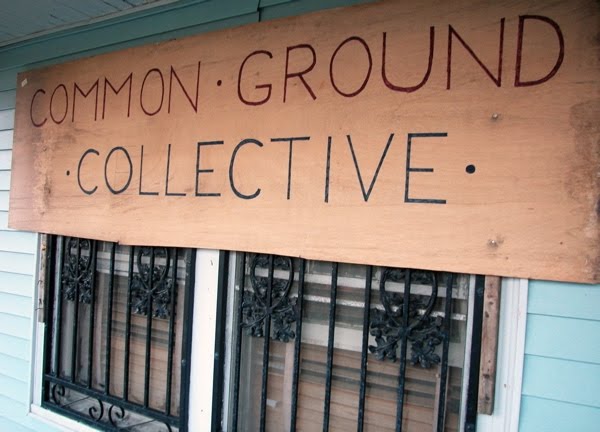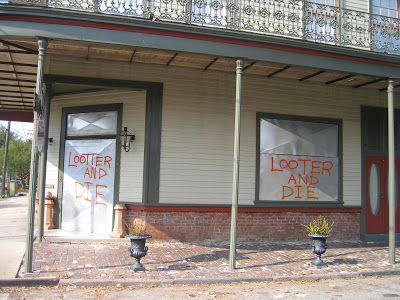
Anarchist organizer scott crow — one of the founders of New Orleans’ Common Ground Collective — tells a remarkable and very personal tale of post-Katrina desperation, racism, and white vigilante violence. Adapted for The Rag Blog from a draft of his upcoming book, it is the story of his experience in the primarily black working class Algiers neighborhood in a stricken and lawless New Orleans, where white supporters join with members of the community in standing up to armed white militias who are driving around in pick up trucks terrorizing the residents.

Posted in RagBlog | Leave a comment

scott crow : White Vigilantes and the Battle of Algiers

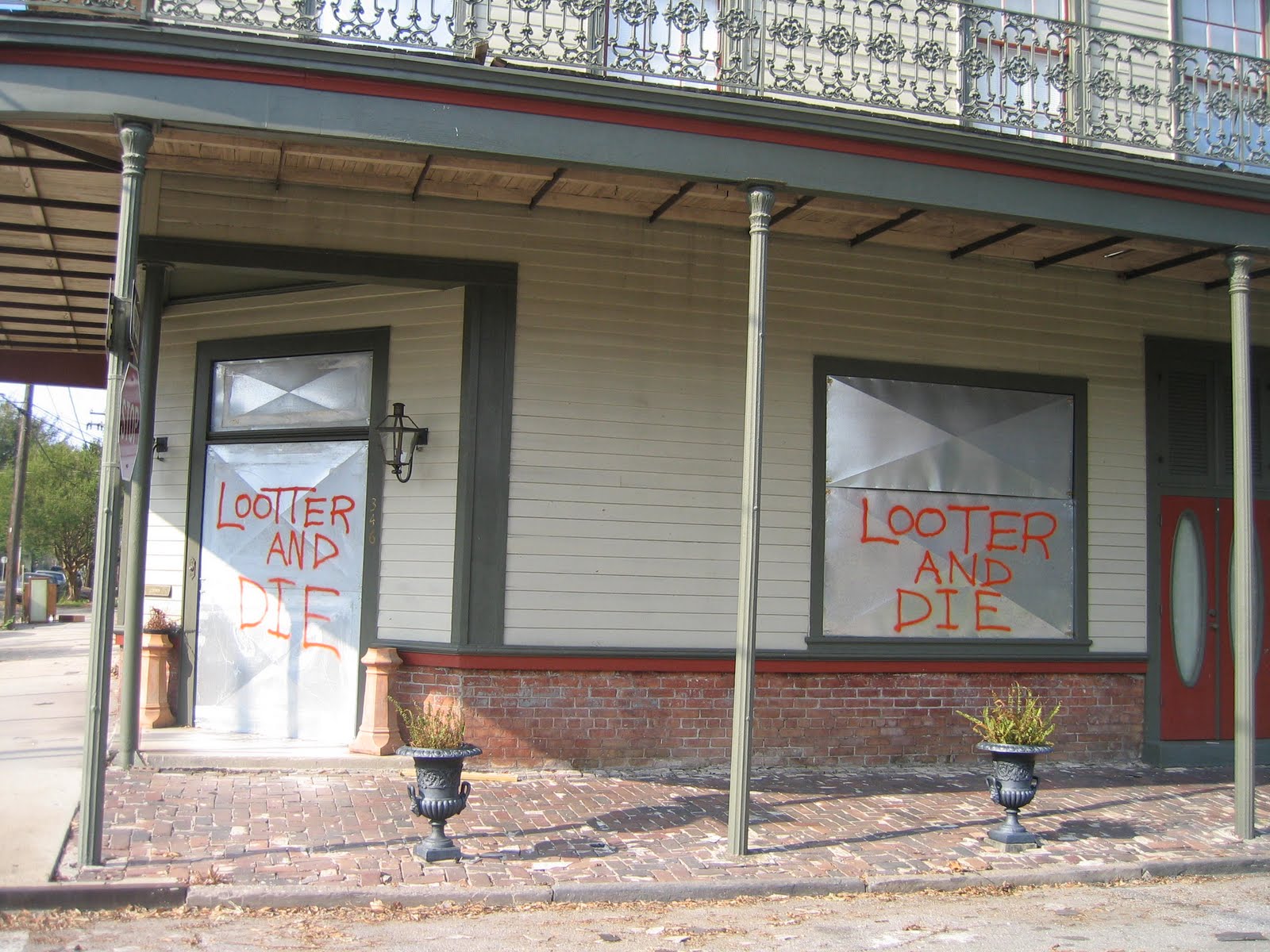
One of numerous looter signs posted by white vigilantes in the small Algiers Point Neighborhood after Hurricane Katrina.

Battle of Algiers:
White vigilantes and the police
in Katrina’s aftermath

By scott crow / The Rag Blog / September 8, 2010

“…within the war we are all waging with the forces of death, subtle and otherwise, conscious or not — I am not only a casualty, I am also a warrior.” — Audre Lorde

As we pass the fifth anniversary of Katrina I want to share this narrative about anarchist organizing in New Orleans after Hurricane Katrina, and about the violence we were confronted with from the white vigilantes and police in Algiers. It takes place upon my return to the area after a failed mission to find my friend Robert King of the Angola 3 right after the levees gave way.

This story, which takes place just before we organized the Common Ground Collective, is adapted from a draft of my forthcoming book: Black Flags and Windmills: Hope, Anarchy and the Common Ground Collective. Five years later we have only scratched the surface in learning about the atrocities of the vigilantes and the police. We are still healing from those encounters. This story is just one of many.

On September 4th I was back home in Austin, resting uneasily from my draining trip, when I received a call from my friend Malik Rahim who, unknown to me, had also remained in New Orleans. He, on the other end of the crackling phone line, was saying, “we got racist white vigilantes driving around in pick up trucks terrorizing black people on the street. It’s very serious. We need some supplies and support…”

He and his neighbors were being harassed and threatened by armed white men, and by the police. He had been interviewed for a piece that appeared in the San Francisco Bay View that explained the grim situation in detail. I had read it upon my return to Austin. Now he was on the phone because he had heard I was just in NOLA looking for [former Black Panther and Angola 3 defendant] Robert King. I knew he was serious. He said he hoped I would come back to New Orleans to give them support and to use it as another opportunity to search again for our friend King who was still missing.

Malik Rahim is a serious man with a broad smile and a big laugh. He was a former Black Panther, the Defense Minister for the New Orleans chapter. His days have been given to making the world a better place since that time. Throughout much of their lives, the histories of the men of the Angola 3 have been intertwined with that of Malik. He and King had not only been Panthers together, they had also been childhood friends in the Algiers neighborhood. King and I had visited him at his mom’s house a few times at the beginning of the century.

After living in Oakland, California, for years, Malik had settled once again in Algiers, where through King he and I had become friends in 2001. Algiers is one of the oldest neighborhoods in New Orleans, situated across the Mississippi from the French Quarter.

Malik, too, had waited out the storm at his home with a woman named Sharon Johnson. While Katrina left massive damage in her wake it hadn’t flooded his neighborhood. Malik had no electricity and no water, but his phone still worked, and when he called I knew it was critical that we move quickly. No electricity, but a live phone. It reminded me of the days just earlier in the leaky vacant warehouse. What an odd coincidence I thought as we spoke.

With determination I decided I was going to go back there to deliver supplies and get to King. This was a chance to try again to find out what had really happened to my friend. The only thing I knew was that he had been trapped in his house, surrounded by dirty water for eight or nine days. I hoped he was still alive. Robert King had been in solitary confinement for 29 years in a 6’ x 9’ cell. I could not let him sit in the floodwaters any longer; I felt a duty to try and get to him.

On the way out of Austin again I stopped at a meeting called by anarchists and activists who were organizing local aid for evacuees. I shared my stories, tears, fears, and the scary realities of what was happening on the ground. I then asked if anyone in the circled crowd of 50-60 people would come to New Orleans knowing what might transpire. Sadly, there weren’t any takers. Was I doing the right thing?

After my first trip to the Gulf I knew better what to bring on this mission: water, food, candles, matches, ammunition and guns; nothing more and nothing less. We were not prepared enough the first time — we were outgunned and under-resourced — but not this time.

Fear of the unknown crawled under the surface of my skin, fear of what was about to happen as I headed back. I knew it was getting more desperate in the Gulf as time passed. Was a race war going to erupt? How many people had died needlessly already?

I had seen from the first trip the disregard and lack of empathy that some white rescuers had shown for desperate people. It had made me deeply angry but I had generally kept my mouth closed. I was torn between doing the work of simply helping people, and espousing my political ideals in the face of oppressive ignorance.

We hurried back to the scene of the floods, our truck speeding alone on the highway headed into an abyss. Few cars moved our way, apart from the occasional military vehicle. In the other direction the roadway was overflowing with evacuees — who began to look like refugees from another place.

People were piled into and on top of vehicles, carrying with them the remnants of their lives; others, stranded without cars, traveled on foot. Families, neighbors, and strangers trying to go somewhere — anywhere — that was away from the flooded areas. All the while the radio reported government sources saying, “Order will be restored” — when all anyone wanted to hear was that the authorities would do whatever it took to get everyone to safety. It was a modern day exodus, caused by corruption and unresponsiveness — and it didn’t have to happen.

I asked myself, “What the hell am I getting into?”

We changed course and went along the lower southwestern coastal route this time, traveling into what looked more and more like occupied war territory with military vehicles and personnel at every turn. I wondered if the doctored passes that we had made would get us past the bureaucracy we knew was already rearing its head.

The military and the state only understood badges and uniforms. They wouldn’t let civilians help even though it was the right thing to do. Many of the young soldiers looked war-stressed and distant as we came up. They grilled us about why and where we were going. Half truths got us through; it was the only way.

After the last checkpoint we drove headlong onto the empty bridgeway; I knew we were “safe.” I let out a sigh of relief and continued to Malik’s. Ours was the only truck on the road, so we ignored the dead useless stop lights.
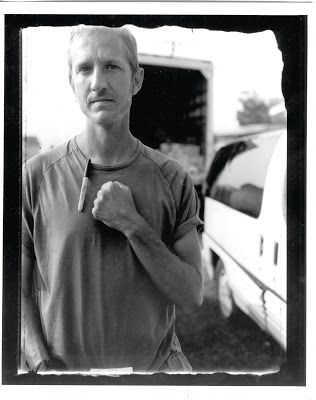
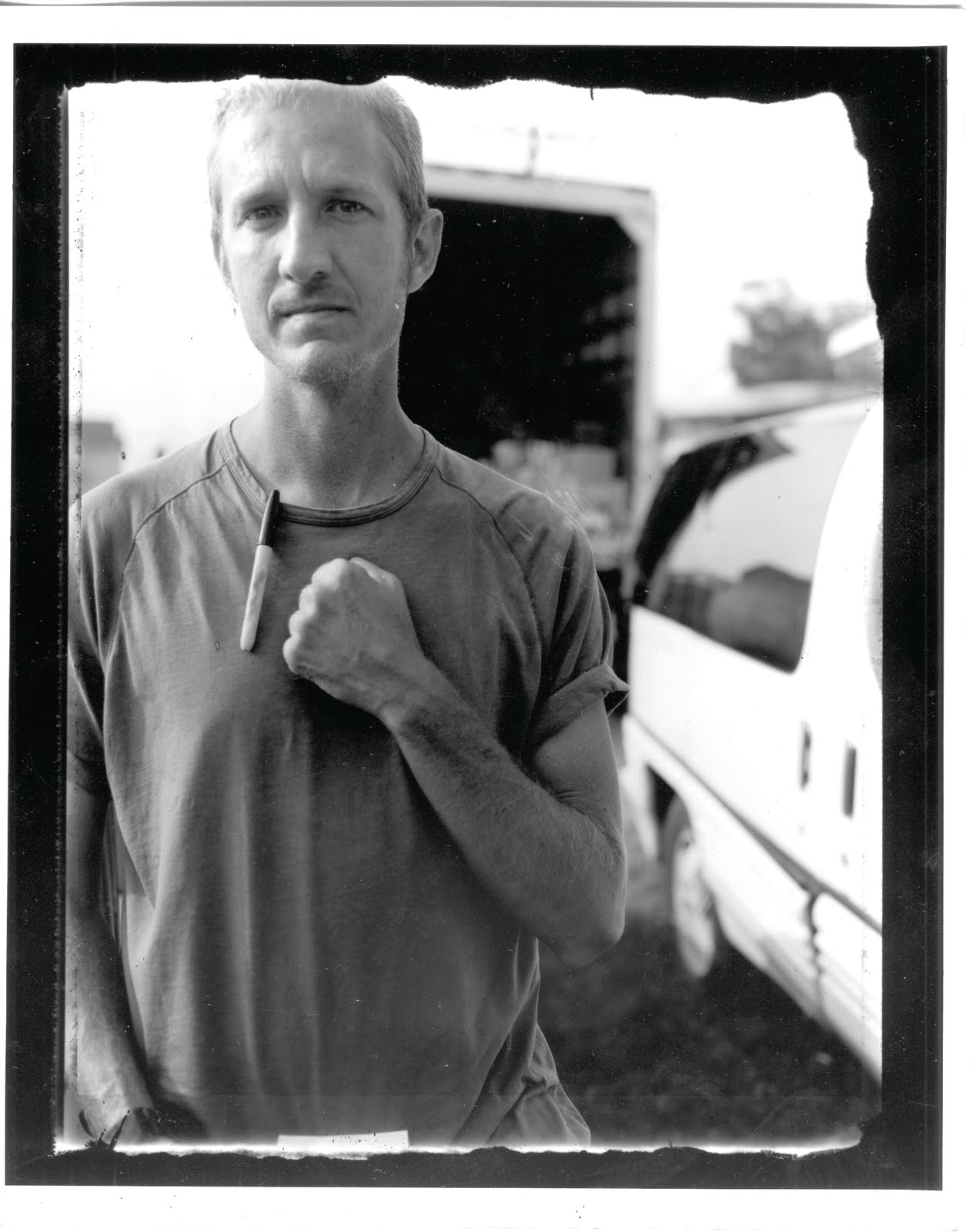
Scott crow on a street in the Algiers area of New Orleans, September 2005. Photo by Todd Sanchioni / The Rag Blog.

So much water so close to home

Algiers is situated in New Orleans, on the south and west sides of the Mississippi river in an area called, ironically enough, the “West Bank.” Like the West Bank halfway around the world in the Middle East, it too had an apartheid system — with two unequal populations. Before the storm, the West Bank was home to 70,000 people. It had a largely poor black population, and a small, wealthy white minority. Governments rendered the larger populace invisible in daily life; why would a storm make it any different?

Huge housing projects and surrounding neighborhoods were burned out or empty, first from neglect, and now from the storm. There had been no social services or safety nets to speak of for decades. When the last clinic closed 10 years earlier it stayed that way, and it was the same with many shuttered schools.

Algiers was surrounded by massive graying concrete levees on the Mississippi sides — almost like prison walls — which didn’t give way, despite nearly being crushed by a huge barge ship that Katrina ran aground within a few feet of the levee walls. This was why it hadn’t flooded, even though the river had swollen to the top of the levees.

After the storm, most residents were gone, with only about 3-4,000 remaining behind. Many were people who couldn’t leave. They had no money, transportation, or family support, or were elderly and in ill health. The storm had made an already terrible situation much worse for them.

The police command structures in the fourth district of Algiers were in shambles. There was scant military help on the ground on this side of the river. The city center — the money-making sector — was the most important to those in power. They had to get NOLA open for business and they neglected everything else.

There were dead bodies on the ground, and buildings smoldered in flames from unknown fires. Algiers, like the rest of New Orleans, was only a remnant of its former self. It was isolated geographically and psychologically from the other side of the river and the outside world.

What was called law enforcement at this stage was erratic, disorganized, and reactionary. It was made up of city, county, state, and some federal officers, but mostly it was Louisiana-based. If they had a plan — besides acting like thugs with badges — it hadn’t been revealed.

As in life before Katrina, laws were subjectively enforced. There were different standards for whites and everyone else, and threats from officers were all over the map in severity. They were accountable to no one but themselves. There were heavily fortified military zones and checkpoints around the area but nothing inside. The residents were left to fend for themselves against the police.

Trapped in this situation, cut off from the rest of New Orleans and the world, Malik Rahim, Sharon Johnson, and a few nearby neighbors struggled to sustain themselves and each other with rudimentary military MRE’s (Meals Ready to Eat) and water obtained from distant military sources.

They had few resources: one busted-ass car with limited gas, supplemented by what they could siphon from abandoned cars. There was no Red Cross, no FEMA — nothing. To get anything you had to have a vehicle and access to gas, and money to buy the gas. Someone had to drive 20-30 miles to a remote military outpost, wait in a long line under armed security — and hope they would be let back into their community before curfew without running out of gas or being shot. The ordeal would take the whole day. That was the only way — there were no other options.

Tapestries of violence

This community had asked for support, so I returned to do what I could. It was what many of us on the outside with conscience would be doing in the weeks to come. But today that was an eternity from where I stood.

I arrived in New Orleans for the second time seven days after the levee failure on September 5th. Everyone pitched in to unload the supplies we had brought. Then the conversation turned to the best way to search for King.

Before we did anything else, Malik took Brandon and me down the street to cover up the dead bullet-riddled body that lay near his house — with a piece of sheet metal tin. The bloated and putrid body had been left there for days. We could smell it as we approached. Malik hoped someone would come and get it soon. But who was looking for this man, his identity unknown to any of us, including the kids who found him?

His image haunts me among the string of deaths I experienced during my time there. He met an ignoble death, likely without a chance. Left to decay on the sun-baked street, where others I had seen had been in the waters. I imagined they all deserved better. His death was a product of his skin color, economics, and chance.

We started setting up security for ourselves and our immediate neighbors. Something else had happened in the short interim since our first arrival in New Orleans. While the state was in crisis, white vigilante militias had formed in Algiers Point and in sthe French Quarter district. These white vigilantes were little more than organized mobs. Signs on the backs of their trucks announced that it was their job to secure law and order in the absence of the police. The militia in Algiers seemed to be made up of drunken racist fools.

Algiers Point is a small, very wealthy, very white neighborhood that is about 10 blocks long in each direction. It is very separated from the Algiers neighborhood. Both sections are part of the broader Westbank, which is predominantly black working class, and poor.

Algiers Point was the only neighborhood on the West Bank where — when traveling down the mostly abandoned and littered streets — we saw hateful signs like “You loot, we’ll shoot,” or “Your life ain’t worth what’s inside.” Signs proudly displayed on the houses that were still occupied, as well as the ones that were vacant and boarded up.

These signs were put up by the vigilante types who stayed. They believed it was their right to protect their private property and secure law and order. It was as if the dam of civil society that kept them from acting out their most racist tendencies had broken, allowing their ugly hatred to emerge. They had another shot at the good old Klan days and they were going to take it.

These armed white militia rode around through largely low-income black communities and meted out their version of justice — intimidation — around Algiers and the West Bank. Their “defense,” as they called it, amounted to harassment of any unarmed black person on the street alone. They acted prideful and talked tough, never offering to help anyone who wasn’t white.

Their incendiary vigilante actions, thinly veiled under the guise of protecting themselves and their private property, added gasoline to the fire of the undeclared war on all who were desperate. I found myself asking what kind of people are more interested in their private property and security than in the well-being of another human?

I could understand the concept, given the right situation, of an armed group of people gathering to defend themselves in the absence of the state, and this disaster could be seen as such a situation. But these people, in their racist actions and words, parading around in their trucks, were no better than Klansmen straight out of the old Deep South. Our conflicting ideas of what community self-defense meant were on a collision course.

In those early days, the Algiers Point Militia openly threatened — and may have killed — desperate unarmed civilians. They foolishly bragged about it to a Danish media crew and to anyone else who would listen. Local representatives of the state, or what little remained of it, with their ingrained racist attitudes towards these marginalized communities they were supposed to protect, stood by and let these vigilantes do their thing.

There were bullet-riddled bodies of black men in the street, including the one that we tried to get picked up for 15 days while it decomposed. Was it the vigilantes or was it the police or both? Those men’s bodies were on different streets — found separately — near nothing of value. Who killed these men? I am now certain — as I believed then — that the vigilantes or the police had killed them and gotten away with it.

In this country, on city streets, they killed people and were accountable to no one.

They regularly both drew their guns on and shot at innocent people — unarmed, poor, black, and on foot — to scare and intimidate them. They threatened Malik — who they mockingly called the “Mayor of Algiers” — from the beginning, pointing guns as they would drive by, threatening to “get ’em.”

The police did nothing but close their eyes and continue their own harassment and shooting campaigns. The lines between law and thugs blurred, leaving people with nowhere to turn.

Undercurrents

From the moment I had set foot in the Algiers neighborhood and spoken with Malik and Sharon Johnson in more detail, I realized that this was going to be bigger, more difficult, and more dangerous than anyone thought. They were both exhausted from having to struggle for survival and remain vigilant about the militia and the police. There had been no help. People were left to their own devices.

Although Algiers had not flooded, it had been ravaged by the storm, and the long-term neglect before that. The water was still high along the levees down the block rising at the edge of the dead-end streets to the north and east sides of the banks; spirits were low in the streets below, but some desperate hope remained among those residents who had stayed. This had always been their home and they didn’t want to leave.

I had been here a few years before with Malik and King, who showed me their old stomping grounds as kids and young hustlers, before they became Black Panthers. Now, like in the rest of the city, trash and abandoned cars littered the empty streets and vacant lots. I asked myself — as I came in and passed the armed, sandbagged turrets at the intersections — what damage was new and what had been that way for a long time?

This place had been occupied by a police force before, but now the outskirts were held by an army that watched from bunkers without helping the people within. Military vehicles patrolled many of the city streets. It looked like low intensity warfare against a civilian population, certainly not aid, eerily reminding me of what I had seen in Belfast and in East Berlin.

After delivering water and food we met and talked with residents from the neighborhood. They were scared — and fed up with the white militia and the police. People, mostly men with little or no resources, both young and old, told us the stories of their lives, and why they had stayed.

Some were forgotten vets from U.S. government wars, others had seen prison time for essentially being Black in Louisiana, while some were quiet and deeply religious men. But they all stayed because they had to. All of them had long family histories within these city blocks; many houses had belonged to the same families for generations.

They worked together to make the most of a bad situation with no resources. They were men and women who had been reduced to statistics by the media, the government, and civil society; they were virtually invisible, characterized only as poor, black, unemployed — branded as hoodlums, drug addicts, or any other number of de-humanizing words — and now they were being called looters for doing what they had to do in order to survive.

In our small group we talked about what we might do to defend ourselves should it become necessary. There were conflicting opinions on how the police might react, but we felt we had no other choice today. We inventoried what weapons we had among us. Who was in, and who among us would have nothing to do with carrying arms.

Eventually — with Brandon Darby (who we would later learn was an FBI informant), Reggie B., and “Clarence” (not his real name) carrying civilian AK-47’s and a .45 caliber pistol, and me with a 9mm carbine rifle — we began our first rudimentary watches, standing or sitting on Malik’s porch and waiting, armed.

I wasn’t a white man taking it on himself to protect helpless locals. There was no act of machismo. I was honored to be amongst these people. To me this was an act of solidarity with people whose lives were being threatened simply because of the color of their skin.

Being there was an expression of my anti-racist principles, my personal commitment, and my revolutionary beliefs — beliefs I had held long before the storm. I had been asked for support and came, not blindly but as a matter of principle. I had come back ready to defend friends and strangers in the neighborhood, because they asked me to. They wouldn’t have asked had it not been necessary. Civil society had given them no choices. It looked as if they simply had been left to die. We had to at least give ourselves a fighting chance for survival.

I was a community organizer from another city who believed that the right to self-determination and self-defense are fundamental if we are going to achieve justice. I accept the fact that dismantling coercive systems that hold people down will require various tools, and sometimes it might involve armed self-defense. Even if what we are working for is a world without violence. It is one of the hard and dirty realities that we must sometimes face while moving towards liberation.

I was terrified but resolved in what I was doing. I had little previous experience in community self-defense. I had been tested on a much smaller scale — resisting neo-nazis and small time fascists, confronting police brutality in the streets, facing threats from private security for my environmental or animal rights work. But this was on a scale unlike anything I knew.

I had had a few years of firearms practice, but now I had to transform a theoretical commitment to armed self-defense into the real thing. It was all to happen so quickly too, without much time for processing or reflection. It was now time for action.
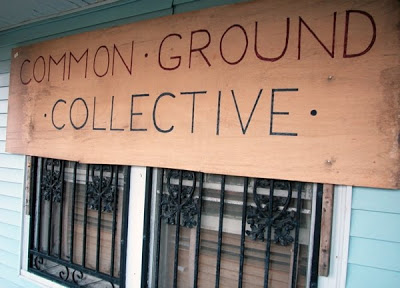
Malik Rahim’s house in Algiers served as Common Ground’s first media and aid distribution center.

Friends of Durruti

The midday humidity hung heavy and the helicopters continued their constant noise in the overhead sky. A few neighbors were gathered at Malik’s long narrow “shotgun” style house, built in the thirties, that sits high off the ground with a tall concrete porch behind a rusting chain link fence.

The white vigilantes came around the corner in their truck — and as before — slowed in front of the house on Atlantic Avenue, talking their racist trash and making threats. But this time it was different: when they came we were there, armed, and nervously holding our ground.

We had more firepower and a better firing position — and we were sober. Finally someone told the vigilantes they should “move on down the road.” That they would no longer be permitted to intimidate or threaten residents around here. Earlier, we had all informally agreed to hold the space no matter what, and I knew that in a flash this could turn bad, could result in a hail of bullets. Time stood still as I kept my finger on the trigger of my rifle.

More words were exchanged and finally the truck drove on — without further incident. My heart pounded with sickness and relief. I was shaking inside from fear and adrenaline. My head swirled with a tidal wave, with more questions than answers. How was the state going to react? How were we going to react? Was this the right thing to do? What if the situation continued to escalate? Would other movement groups support us? What if I had shot someone — or worse killed them? Would it have been worth it?

Some of these men in the truck were known to Malik and his neighbors. Had the veil of society stopped them from this kind of aggression in the past, and now they felt free to act as they pleased? One thing was immediately apparent: even if they were ignorant, they had no real power once they were challenged. As they left, we felt guarded joy, and a sense of relief. But we didn’t know then if they would return.

More volunteers would sit on Malik’s porch over the days to come, and they began rudimentary neighborhood patrols — to keep the militia threat, and to a lesser degree the police, at bay. These acts — and our refusal to leave in the face of repression — made us enemies in the eyes of law enforcement, and race traitors to the racist militias.

But to the people in the neighborhood, the fact that we were ready to die defending their community meant something real and tangible: that white people would come to their aid and put their lives on the line with them and for them. And more would do this as the days progressed.

There was no Red Cross, there was no FEMA, there was no protection for the people except what we were willing to organize for ourselves. Some time later the presence of whites and blacks working together in solidarity to defend these communities against the racist militia would be cited by local residents as one of the things that helped ease the tensions in this racially and economically divided area, devastated long before the levees ever broke.

From self defense we created the Common Ground Collective based on anarchist principles and practice. An organization always at odds with the state, that took direct action to meet the needs of communities otherwise left to die.

[Based in Austin, Texas, scott crow is an anarchist community organizer and writer. He was one of the founders of Common Ground Collective, an organization formed in the aftermath of Hurricane Katrina in 2005 to aid in the rebuilding of New Orleans. He currently works at Ecology Action, a worker-run cooperative recycling center in Austin. His book, Black Flags and Windmills: Anarchy, Hope and the Common Ground Collective, will be released later this year by PM Press.]

The Rag Blog

Posted in Rag Bloggers | Tagged , , , , , , , | 4 Comments

Harry Targ : Time for Progressives to ‘Get on the Bus’

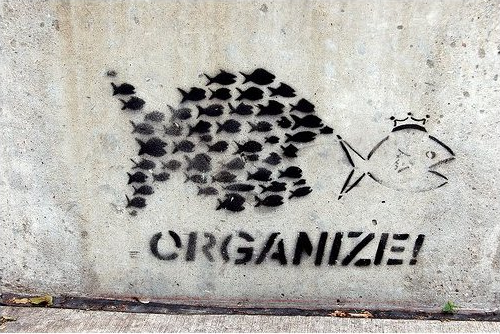
Organize: The handwriting’s on the wall.

Social justice and the fall elections:
Mobilizing the progressive movement

By Harry Targ / The Rag Blog / September 16, 2010

“Get on the Bus.”

That was the conclusion 16 activists from Illinois, Indiana, and Kentucky came to after a day-long meeting assessing the needs of progressive forces between now and the fall elections, and after.

The occasion was the semi-annual meeting of the Midwest Region of the Committees of Correspondence for Democracy and Socialism (CCDS). The small but spirited gathering of activists addressed the significance of the 2010 fall elections, the economic crisis, and how to incorporate Jack O’Dell’s recently proposed Democracy Charter into the project of building a progressive majority.

Elections 2010

Ted Pearson, Chicago peace and justice activist, opened with a discussion of elections 2010 called “Saving the Progressive Majority.” He quoted from a recent article in The Nation by Jean Hardisty and Deepak Bharvava, “Eighteen months into the Obama era, the progressive movement is experiencing malaise, based on disappointment about what has been accomplished so far and confusion about the path forward.”

Pearson noted that while the Obama administration has achieved modest gains in public policy — health care reform, some financial regulation, expansion of poverty programs, student loan reform, and the selection of two moderate Supreme Court justices — people are angered and frustrated by the continuing economic crisis, particularly high unemployment and under employment, two wars, threats to civil liberties, and lack of progress on immigration reform and climate change legislation.

Polling data about where people stand on issues and candidates, Pearson said, suggests much anger and confusion. Progressives must use the next six weeks to reverse the dangerous tilt toward reaction.

Pearson quoted from a recent speech by Van Jones, environmental activist and green jobs advocate, targeted by the right wing for dismissal from the Obama administration, who argued that after eight years of despair activists in 2008 felt a sudden surge of hope. Now there is the danger of returning to despair. Nothing, Jones suggested, can be more destructive to the prospects for a people’s agenda than to withdraw.

It must be made clear that the 2008 election only got progressives “to the starting line”; that the projects initiated have not been completed; and that the struggle in the electoral arena and elsewhere must continue.

Drawing from these comments and history, Pearson concluded that achieving change requires the building of a mass movement. It was the mass movement that led to Obama’s victory and it will take a mass movement to force him and all the institutions of national, state, and local government to move in a progressive direction.

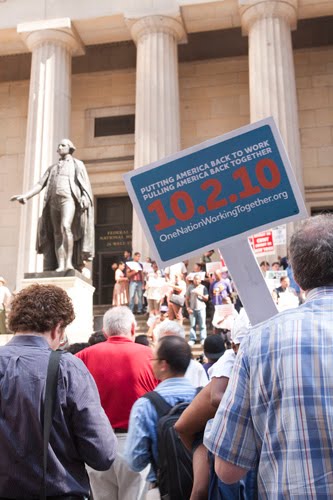
For right now, Pearson argued, progressive forces need to support the massive rally, “One Nation Working Together,” to be held on October 2. This rally will be historic, bringing together the National Association for the Advancement of Colored People (NAACP), the American Federation of Labor and Congress of Industrial Organizations (AFL-CIO), and the National Council of La Raza (NCLR), and hundreds of peace, justice, and environmental groups.

October 2: A massive gathering for economic and social justice.

The October 2 movement will not only bring hundreds of thousands to Washington, D.C. to take back the public image from the right wing, but it will galvanize local progressive groups to speak and work together, whether they are able to go to Washington, D. C. or not. Most important, October 2 promises to bring a broad coalition to “the starting line” so that they can work together in the months and years ahead to achieve economic and social justice and peace.

Most attendees endorsed Pearson’s analysis and Jones’ call to fight despair. They endorsed a campaign to mobilize those who worked so hard to get to the starting line in 2008 to organize at the grassroots for October 2. The campaign for “One Nation Working Together” must build on analyses of the interconnections between class, race, and gender. White privilege, so much a part of the Tea Party agenda, has to be directly challenged.

The jobs crisis

Ira Grupper, labor activist and chair of the CCDS Labor Committee, opened the second panel with a discussion of the crisis of jobs described in the new CCDS booklet, “It’s Time to Fight for Full Employment.”

Rich with data and commentary, the document points to the long term structural character of unemployment in the United States. Recessions, periods of limited or no economic growth, have been followed by longer and longer periods of high unemployment. Over the last decade recoveries from economic stagnation have occurred without reductions in unemployment; so-called “jobless recoveries.”

Grupper pointed out that in recent years corporate announcements of job layoffs have usually been followed by increases in stock market prices. Since the dawn of the new century, profit making by huge corporations and banks has been coupled with declining economic security for American working people.

Grupper referred to the booklet’s description of deindustrialization, financialization, and increasing marginalization of workers by race as well as class. Others added that the particular impact of the recession on women needs to be highlighted.

In addition, participants identified a web of interconnections between cuts in education, lack of training for youth, the rise in marginalization, the shift to the so-called “informal sector,” often criminal activity, and incarceration with no resources for programs of rehabilitation. As Grupper pointed out, the youngest cohort of workers, ages 16 to the mid-20, experience the highest rates of unemployment, some never having experienced a job.

Grupper pointed out that the CCDS booklet summarizes a number of proposals for change, including the United States Steel Workers proposals for a green jobs agenda, support for workers cooperatives, and demands for a new industrial policy that emphasizes public sector employment including infrastructure construction.

The Democracy Charter

The final panel, introduced by Janet Tucker, National Organizer, CCDS, and Mildred Williamson, member of the National Executive Committee, CCDS, described the 2009 Democracy Charter crafted by 87-year-old civil rights activist Jack O’Dell. O’Dell, once an aide to Dr. Martin Luther King and editor of the distinguished journal, Freedomways, has called on 21st century activists to work for a program called the Democracy Charter. The idea of the Democracy Charter was inspired by the Freedom Charter adopted by the African National Congress (ANC) in the 1950s as it organized to defeat racial apartheid in that country.

In addition, O’Dell was inspired by the so-called “Five Principles” of peace and justice embraced by the newly formed Non-Aligned movement of nations in Bandung, Indonesia, also in the 1950s. Both documents proclaimed that freedom and justice both within countries and among them are indivisible. By adopting a Democracy Charter now, O’Dell has argued, progressives in the United States and around the world can articulate a vision for a better world; one that connects class, race and gender, peace, environmental justice, and the uplift of humankind.

Tucker and Williamson pointed out that the Charter, as currently written consists of 13 main points:

  • an end to homelessness
  • full employment
  • a commitment to human rights
  • free education from early childhood through college
  • a non-aggressive foreign policy
  • universal healthcare
  • a secure and solvent social security system
  • a farm economy resting on family and cooperative enterprises
  • a prison system committed to rehabilitation
  • restoration and protection of the environment
  • expanded public management of natural resources
  • the right to have every vote counted
  • airwaves maintained as public property.

During the day, attendees grappled with the difficulty of communicating progressive ideas in a politically charged and hostile environment. Several commentators agreed that the Democracy Charter, like the Freedom Charter of the 1950s, may have the appeal to move beyond premature rejection.

By seriously reflecting on the election just 50 days away and carefully assessing the structural crisis of the U.S. economy, the attendees at this regional meeting recognized the tasks that progressives must complete. And by reflecting on the Democracy Charter they saw a way to clarify the meaning of their work to organize with others to push beyond “the starting line.”

Metaphorically, all agreed to “get on the bus.

[Harry Tarq is a professor in American Studies who lives in West Lafayette, Indiana. He blogs at Diary of a Heartland Radical.]

The Rag Blog

Posted in Rag Bloggers | Tagged , , , , , , | 6 Comments

Marcy Winograd : We Need a Green New Deal

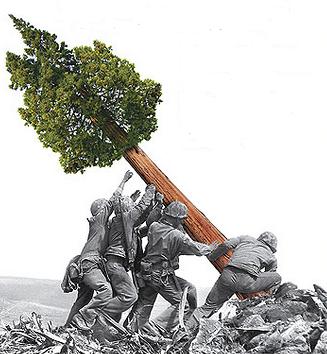
Image from Conservation Value Notes.

It’s time to retool our economy:
The United States needs a Green New Deal

What if our engineers, now building weapons, could build solar cities instead?

By Marcy Winograd / September 15, 2010

My talented young cousin works as a rocket scientist at a local aerospace plant. She considers herself one of the lucky MIT grads who landed a job in the space end of the aerospace industry.

Her friends, however, are designing drones that sometimes miss their terrorist target, accidentally bombing innocent brides and grooms in Afghanistan.

My cousin tells me about a colleague of hers, a drone-builder, who had a nightmare; she accidentally droned her own bedroom.

“She’s still designing these drones, though,” my cousin tells me. “That’s where the money is, the jobs, in military contracts, in building sophisticated weapons systems.”

What if our engineers, now building weapons, could build solar cities instead? Under the Solar America Initiative, Boeing started the ball rolling, contracting with the Department of Energy to make solar energy competitive with conventional electricity by 2015.

Aerospace conversion could happen — and should for the sake of our planet.

Flying 100,000 troops to a far off land to fight an ever-morphing enemy leaves a huge carbon footprint; bombing cities and then rebuilding them emits a carbon monster.

Some might argue the carbon cost is necessary to protect national security, but it doesn’t take a rocket scientist to determine that war and occupation multiply our enemies.

Plus, war is not job smart. In 2007, University of Massachusetts economic researchers found a billion dollars invested in mass transit generates twice as many jobs as the same billion invested in military contracting.

Future economic recovery plans should offer explicit career-path transitions from a permanent war economy to a new green economy. Pay people to retool.

Train laid-off missile defense workers to build wind farms. Offer federal contracts for aerospace firms to fortify the Vincent Thomas Bridge. Invest in health care, education and cleanup at the Superfund sites in Torrance.

President Barack Obama recently signed an $18 billion jobs bill with payroll tax breaks for businesses, as well as tax credits for companies hiring the unemployed and purchasing new equipment. The bill invests billions in federal highway construction and mass transit. Optimists predict the legislation could generate 250,000 jobs.

Not bad, but not great either, given that America has lost 8.4 million jobs since the start of this recession.

Congress would be wise to model a new green-job stimulus package after the Works Progress Administration, the 1935 Roosevelt Depression brainchild that employed an estimated 10 million Americans building 850 airports; 110,000 libraries, schools, and hospitals; 500 water treatment plants; 78,000 bridges and 8,000 parks. The WPA also employed artists to paint murals in post offices, like the San Pedro post office on Beacon Street where a WPA mural depicts the history of the harbor.

Can we afford a super stimulus? Critics lament the growing deficit, estimated to climb to $1.6 trillion this year. But these same critics rarely talk about the elephant in the room: our bloated near-trillion-dollar military budget that siphons much-needed resources from our daily needs.

Take housing, for example. According to the Center for Responsible Lending, our congressional district suffered 7,000 foreclosures in 2009. Over the next four years, the center predicts 25,000 homeowners from West Los Angeles to the harbor will lose their homes to foreclosure.

Freeze the foreclosures. Save our neighborhoods. Instead of funding no-bid contracts in Iraq, Congress could create the Loan Officer Corps to pay mortgage brokers to mediate between banks and homeowners to keep more Americans in their homes, more counties collecting property taxes, more cities solvent.

Prime the jobs pump. Recreate the Civilian Conservation Corps, the New Deal program that employed 250,000 men, ages 18 to 25, at work camps in every state to stop soil erosion and plant trees. Hire more teachers for Head Start, President Lyndon Johnson’s War on Poverty preschool program. Launch a Nurses Now Initiative to pay college grads to train as nurses at Harbor-UCLA Medical Center.

Saving lives, saving minds, saving forests — it’s all green. But how do we pay for this?

Cut the waste in our military budget. Bring our troops home from the trillion-dollar wars in Iraq and Afghanistan. Exact a serious fee on every stock trade on Wall Street. Bust open the bank vaults in the Caribbean where corporate tax dodgers stash their profits. Repeal the Bush tax cuts for the rich. End the war on drugs with its obscene prison costs.

When President Franklin Roosevelt enacted the New Deal, one out of every four Americans was out of work. Today, in California, the real unemployment rate, the one that includes the underemployed and those who have given up looking for a job, is pushing 20 percent.

It doesn’t have to be this way. Together, we can create a better future: new jobs, health care, clean air, land and water. With our wealth of talent, we can champion a new green economy competitive with China and Germany.

It’s time to put America back to work.

It is time for a Green New Deal.

Source / WarIsaCrime.org

The Rag Blog

Posted in RagBlog | Tagged , , , , , | 1 Comment

Kate Braun : Fall Equinox and a ‘Full Wishing Moon’

Fall Equinox: The egg is a symbol of the four elements.

Balancing the egg:
Fall equinox is time of energy and power

Round and around and around and around and around and round we go…

By Kate Braun / The Rag Blog / September 15, 2010

Wednesday. September 22, 2010, is the date of the Fall Equinox, also named Second Harvest, Mabon, and Cornucopia. Lady Moon is in her second quarter in Pisces and there is Full Wishing Moon on Thursday, September 23.

A Full Moon is a time of high energy and much power; its effect can frequently extend to the days immediately before and after the actual Full Moon; therefore, it would be good to include in your activities this night rituals for protection, prosperity, harmony, and balance, keeping your focus on the positive aspects of these qualities.

Decorate with gourds, pine cones, acorns, autumn leaves, apples, pomegranates, and textured fabrics such as velvet, velour, and corduroy. Appropriate colors are red, orange, deep gold, russet, maroon, and violet. Scales or balance rods could be used as a centerpiece. A cauldron filled to overflowing with apples would also serve well as Mabon is sacred to Cerridwen, the Celtic water-oriented Goddess of Autumn. Her symbol is the Cauldron and her fruit is the apple.

In the long ago, the Fall Equinox was the time to start a project which would be completed by Yule (Winter Solstice). One tradition was to make a quilt. If you have friends who enjoy this activity, each of you could begin a quilt square on this night, take it home to finish at your leisure, bring it back at Yule and assemble the quilt. It need not be a full bed size; a lap quilt will generate the same energy associated with finishing what you start.

Equinoxes are the two times each year when a raw egg can be balanced on its larger end. This presents a good reason to contemplate the symbolism of the egg without having to eat any (and given the recent salmonella outbreak we must be more vigilant than usual about knowing the sources of egg production).

The shell represents Earth, the membrane represents Air, the yolk represents Fire, the white represents Water. These are the four elements from which come all things, hence the egg may be considered to represent “All and Everything.” As you and your guests balance your eggs, turn your focus to acknowledging your blessings. Silently give thanks for not only food, clothing, and shelter, but also friends, family, and professional success.

[Kate Braun’s website is www.tarotbykatebraun.com. She can be reached at kate_braun2000@yahoo.com.]

The Rag Blog

Posted in Rag Bloggers | Tagged , , , , , | Leave a comment

Thomas McKelvey Cleaver : Belize Looking Pretty Good

New best friend? Belize’s national bird, the Keel Billed Toucan. Image from LocoGringo.com.

If the Tea Party wins:
Belize looking better and better

By Thomas McKelvey Cleaver / The Rag Blog / September 15, 2010

With the results of the primary elections tonight, the “Tea Party” is poised to become the Republican Party.

Lots of people look at the TP movement and see danger, and lots of people look at 2012 as potentially the American “January 20, 1933.” We are possibly a step closer to that. What many do not consider is that the election that foreshadowed the Nazi victory of 1933 was the election of 1931, when “Nazi crazies” won sufficient seats in the Reichstag to become the largest party. That is when they crossed the line toward complete electoral victory.

Myself, I remember long conversations with that famous director, Billy Wilder, whom I was fortunate to know in the 1980s. He recognized the Nazis for what they were in 1928, when his friends still thought Hitler was a joke. He harped on the Nazi danger to the point his friends called him a “crank” — then there were the 1931 elections, and some friends got worried. Then when the 1933 victory happened, he packed everything he owned in a steamer trunk and bought a one-way ticket on the Paris Express that same night of the victory.

If the Democrats have a brain (unproven at this point) they can defeat these loonies this year, but if they don’t, and these people get into office, then this is America’s “election of 1931,” and watch out 2012.

I strongly recommend to all that if these people win in November, you be sure your passport is current before 2012.

Remember what Sinclair Lewis wrote in 1934: “When fascism comes to America, it will be wrapped in the flag and carrying the cross.”

Belize is looking better and better. Hey, if we all go down there, we can move into our own neighborhood and start our own pub!

[Thomas McKelvey Cleaver is an accidental native Texan, a journalist, and a produced screenwriter. He has written successful horror movies and articles about Second World War aviation, was a major fundraiser for Obama in 2008, and has been an activist on anti-war, political reform, and environmental issues for almost 50 years.]

The Rag Blog

Posted in Rag Bloggers | Tagged , , , , , , | 5 Comments

Dahr Jamail : Strong Evidence BP Is Spraying Toxic Dispersants

Dispersant remnant, June 26, 2010. Photo by Shirley Tillman / Truthout.

Evidence mounts:
BP spraying toxic dispersants

The Tillmans and thousands of other fishermen and residents along the Gulf of Mexico are deeply concerned about local, state, and federal government complicity in what they see as a massive cover-up of the oil disaster by using toxic dispersants to sink any and all oil that is located.

By Dahr Jamail / September 15, 2010

See gallery of photos, Below.

[The following dispatch from journalist Dahr Jamail, whose work has frequently appeared on The Rag Blog, was distributed by Truthout.]

Shirley and Don Tillman, residents of Pass Christian, Mississippi, have owned shrimp boats, an oyster boat and many pleasure boats. They spent much time on the Gulf of Mexico before working in BP’s Vessels Of Opportunity (VOO) program looking for and trying to clean up oil.

Don decided to work in the VOO program in order to assist his brother, who was unable to do so due to health problems. Thus, Don worked on the boat and Shirley decided to join him as a deckhand most of the days.

“We love the Gulf, our life is here and so when this oil disaster happened, we wanted to do what we could to help clean it up,” Shirley explained to Truthout.

However, not long after they began working in BP’s response effort in June, what they saw disturbed them. “It didn’t take long for us to understand that something was very, very wrong about this whole thing,” Shirley told Truthout. “So that’s when I started keeping a diary of what we experienced and began taking a lot of pictures. We had to speak up about what we know is being done to our Gulf.”

Shirley logged what they saw and took hundreds of photos. The Tillmans confirm, both with what they logged in writing as well as in photos, what Truthout has reported before: BP has hired out-of-state contractors to use unregistered boats, usually of the Carolina Skiff variety, to spray toxic Corexit dispersants on oil located by VOO workers.

Shirley provided Truthout with key excerpts from the diary she kept of her experiences out on the water with her husband while they worked in the VOO program before they, like most of the other VOO workers in Mississippi, were laid off because the state of Mississippi, along with the U.S. Coast Guard, has declared there is no more “recoverable oil” in their area.

“The first day I went, I noticed a lot of foam on the water,” reads her entry from June 26. “My husband said he had been seeing a lot of it. At that time, we were just looking for ‘Oil.’ We would go out in groups of normally, five boats. The Coast Guard was over the VOO operation. There was always a Coast Guard on at least one of the boats. They would tell us when to leave the harbor, where to go and how fast to go. They had flags on each of the VOO boats and also a transponder. Sometimes we would have one or more National Guardsmen in our group too, as well as an occasional safety man to monitor the air quality and procedures on the boat. If we found anything, the Coast Guard in our group would call it in to ‘Seahorse’ and they would determine what action would be taken.”

Along with giving a clear description of how the Coast Guard was thus always aware of the findings of the VOO workers, her diary provides, at times, heart-wrenching descriptions of what is happening to the marine life and wildlife of the Gulf of Mexico.

“Before we went to work, I went down by the beach,” reads her entry from July 4. “There were dead jellyfish everywhere. Some of them were surrounded by foam. A seagull was by the waters edge, as the foamy stuff continued to wash up. There was also a crane that appeared to be sick. It didn’t look like it had any oil on it, but it just stood there, no matter how close I got.”

On the morning of August 5, Shirley describes spotting a dead young dolphin floating in the water. “As we waited for the VOO Wildlife boat to come pick it up, we noticed a pod of dolphins close by,” she writes. “Even with all the boats around, they did not leave until the dead one was removed from the water. It was very emotional, for all of us.”

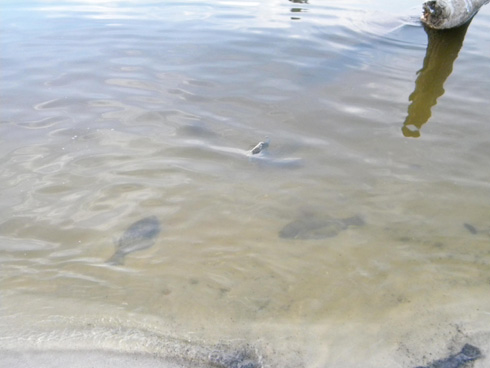
The next day, August 6, found her logging more death. “Last night on the news, they reported a fish kill. Before we went to work, I went to the beach by the harbor. The seagulls were everywhere. As for the dead fish, the only ones on the beach, were ones that the tide had left when it went back out. The rest of the ‘Fish Kill,’ was laying underwater, on the bottom. It was mainly flounder and crab. We only spotted two dead flounder floating that day. I can only imagine how many were on the bottom… I went back to the beach after work. The tide had gone out and the seagulls were eating all the dead fish that had been exposed. You could still see dead fish underwater, still on the bottom. Dead fish don’t float anymore?”

The Tillmans’ primary concern is the rampant use of toxic dispersants by what they described as private contractors working in unregistered boats, that regularly were going out into the Gulf as they and other VOO teams were coming in from their days’ work. There was, oftentimes, so much dispersant on top of the water, their boat left a trail.

“The first thing I noticed, was the ‘trail’ the boat was leaving in the water,” her log from July 10 reads. “You could see exactly where we had been, as far back as you could see. Around 11:00, we were in oil sheen and brownish clumps. We were North of Cat and Ship Island when the Coast Guard told us to drop the boom over. When you pick the boom up, you have to wear ‘protective gear.'”

Her log from August 1 describes, in detail, an incident of the Coast Guard not allowing them to collect oil and his proceeding to deny what they found was even oil:

Around 2:00 p.m., we started noticing a lot of oil sheen. We were North of the East end of Cat Island, but South of the Inter Coastal channel. There was, as usual, a Coast Guard on one of the boats in our team. He called in to report it, but we were told not to drop the boom, it was just “Fish Oil.” In the beginning of the clean-up operation, if something was floating on the water and it looked like oil, it was oil or oil sheen. Later they would sometimes say it was just “Fish Oil.” Also, if it was heavy foam with a brown or rust color, originally it was “Oil Mousse.” Later it was called “Algae.” We were then told to head Northwest. The further we went, the worse the “Fish Oil” got. Then, the foam was mixed in with the oil. It was at least the size of a football field, around our boat alone. My husband got on the radio and asked if they could put the boom over.

The Coast Guard, again, told them no.

We were then headed West, back towards Pass Christian. A pleasure boat flagged one of the boats in our group down and told him that there was oil all over. The Coast Guard said to tell him that they were aware of the situation… On the way back to the Pass Harbor, I asked my husband, “Just exactly what are we even doing out here?” He told me that he was beginning to think that it was all just for show. I can only imagine what the people on the pleasure boat had to say when they got back home that day. Probably, that they had seen a lot of oil on the water and the VOO boats were out there just riding around in it and not doing anything to clean it up. That is exactly what happened. We decided then to start documenting as much as we could. I believe it was the very next day, Thad Allen was on TV saying that they were scaling operations back due to the fact that, “No oil has been seen in the Gulf in almost two weeks.” Now, if we had pulled boom on Sunday and unloaded a bunch of dirty boom in the Pass harbor, it might have been a problem for him later.

On August 5, she describes a rare instance of their being allowed to drop boom in order to collect oil. “We had a Coast Guard and two Safety Men on our boat. We went to the West of the Pass Harbor. The water looked black in places. Lots of bubbles, not foam, just bubbles. Around 8:30, we were in oil sheen and mousse and were told to drop the boom. The more we pulled the boom, it appeared the more was coming up. The Pass [Christian] Harbor was closed because the oil was coming in so bad. We pulled boom back and forth the rest of the afternoon.”

By early August, the total number of VOO boats operating out of Pass Christian Harbor, where Shirley and Don worked, was down to 26.

On August 8, Shirley wrote,

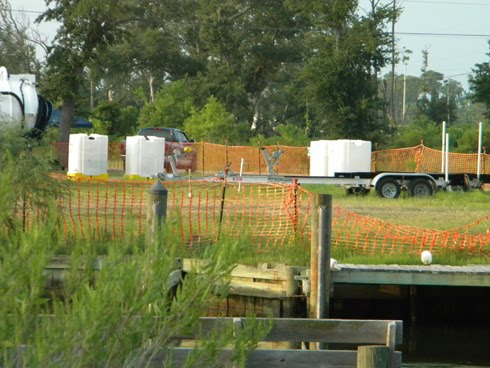
Talk at the harbor was that airplanes were spraying dispersants on the water at night, out by the islands. There was also talk of skiffs, from Louisiana, with white tanks on them, that were spraying [dispersants] too. We had seen the skiffs before. They would pass us up in the mornings and head towards the Bay St. Louis Bridge. We were told that they were working out of an area at Henderson Point. Henderson Point has a county-owned area with a boat launch & piers. It was closed to the public after the oil spill and a BP sub-contractor staging area was set up. It always appeared that these boats were finishing up their work day, just as we were going to start ours. Most of these skiffs were Carolina Skiffs.

Later that same morning, Shirley and her husband headed out of the harbor with a member of the National Guard on their boat, heading west, while a member of the Coast Guard and another member of the National Guard were on another boat in their VOO team. After boating for an hour, they turned back to the east, at which point Don spotted five of the Carolina Skiffs.

“I got my camera and started taking pictures of them,” Shirley writes.

As I was zooming in as close as I could, I saw one of them spraying something onto the water. I did not get a picture of it, I was too busy telling my husband to tell the Coast Guard on the other boat. The skiffs had turned North and were scattered out, zigzagging South of the train bridge. The Coast Guard called the incident in and sent one of our boats to follow the skiffs. The skiffs immediately left. When I saw the boat spraying, it was upwind from our boat. Within a few minutes, my nose started drying out. Later my throat and eyes did the same thing. A Coast Guard helicopter was dispatched along with a Coast Guard boat. We saw the helicopter about twenty minutes later, but I never saw the Coast Guard boat.

Back at Pass Christian Harbor, her team reported the Carolina Skiffs actively spraying dispersants. She was told by the contracting company, Parson’s, that managed their VOO team, to bring in her photographs.

Her entry from the next day, August 9, reads:

I took the pictures, 8×10’s to Parson’s. A short time later, my husband called and said the Coast Guard wanted me to make a disc of the pictures. I took the disc and turned it over to the Coast Guard. I was told, in the presence of others, that the incident had been investigated and the boats in question had been located at the Henderson Point site. He said that these boats were in the VOO program as skimmer boats, but it had not yet been verified. He said that he had questioned them about spraying something on the water. They told him that if I had seen them spraying anything, they were probably just rinsing out their tanks. He also asked me, “Don’t you think if they were spraying dispersants, they would be wearing respirators?” I told him, “You would think so, but nothing surprises me around here anymore.” We basically left after that. I knew all they had really wanted was to see exactly what I had gotten pictures of. There is of course the question, “Why would a skimmer boat need to rinse out his tanks?” If he had been skimming oil, why dump it back over? If he hadn’t been skimming oil, what was he rinsing out? I know what I saw and I know how I felt afterwards. I also know that in one of the pictures I took, you can see a helicopter over those boats. BP has spotters looking for oil. Could it be he was telling them where to “Touch Up” before they called it a day? One thing I did learn from Coast Guard guy that day, evidently these so-called skimmer boats, also have the ability to spray!

The Tillman’s curiosity drove them to investigate further, given the inconsistencies they were seeing in the Coast Guard’s actions regarding the dispersant being sprayed from contractors in the Carolina Skiffs.

“My husband came home and said that they had seen the ‘Skiffs’ again today,” reads Shirley’s entry from August 10.

He took pictures of them and a jack-up-rig. The rig moves around in the sound and is suppose to be a de-contamination station. However, some Captains have said when they went there, they were told it wasn’t in operation at the time. After thinking about the tank skiffs and the Coast Guard for two days, I could not make any sense of this whole situation. The Coast Guard is supposedly over the VOO Program, but it knows nothing about the skiffs at the site, so close to the Pass Harbor. They not only tell us every move to make, but they are always with us when we make the moves. Our boats are flagged and have transponders on them. Those boats have no flags, we have not seen a transponder, nor a Coast Guard member on one of them telling them what to do.

That afternoon, the Tillmans visited the Henderson Point staging area. Though it was guarded, what they found shocked them: “There were probably more boats there than in the entire Pass [Christian] VOO program at the time,” reads her entry.

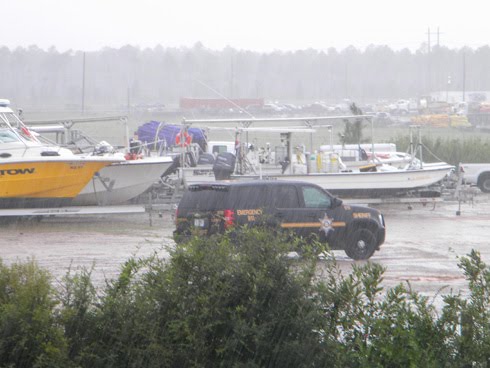
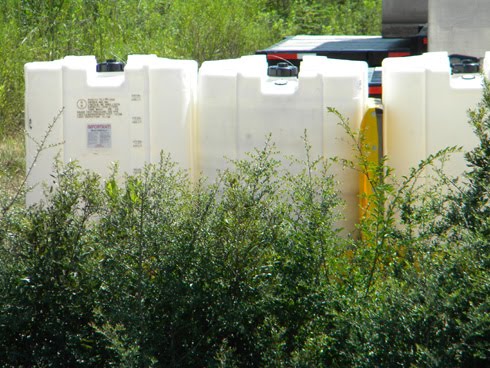
There were only a couple of regular skimmer boats. All appeared to have Louisiana registrations. Almost all of the skiffs had the white tanks on them. A few of the tanks looked like they could have had something in them at one time, but nothing like the oily, sticky mess we had been dealing with. If we got something on our boat, it was almost impossible to get it off. I don’t see how they could have gotten it out of the tanks and still looked like they did. Also, there was a Harrison County Sheriffs Department car, right by the boats and some large, plastic, white containers with yellow bases.

On August 13, the VOO boat that Shirley and Don were running was deactivated. Still very concerned, the next day they visited the BP staging area in Hancock County.

“They had evacuated this site,” she writes. “Same setup though, a guard and a Sheriff’s car. We then went to a site in Gulfport. Evidently, this is a main BP storage site. There were all kinds of boats, including the tank skiffs. The Sheriffs Department was there also and so was those large, plastic tanks with the yellow bases.”

Other reports, of a very similar nature, have been reported about other BP staging areas along the Gulf of Mexico. The tanks are clearly used to store and transport Corexit dispersant. The Carolina Skiffs are clearly used to spray it atop oil.

Her August 16 entry details her discovery:

Over the next few days, I continued to go by the Henderson Point site and the Gulfport site. The Henderson Point site brought back a few boats, but none of the tank skiffs or the large plastic tanks. The Gulfport site stayed the same, full of everything. On August 25, I received an email with a link to an article about dispersants. It had a picture of the tanks that dispersants come in, with the label “Nalco Corexit EC9005A.” They were 330 gallon, large, plastic, white tanks with a yellow base. These were the same tanks that I had been seeing at the Henderson Point site and the Gulfport site. I was able to get the name of the manufacturer of the tanks, off a picture I took and compared it to the picture in the article. It was the same manufacturer. I researched this company on the internet and found the 330 gal tanks. They are marketed as: “The only manufacturer in the industry to offer portable tanks certified for hazardous goods transport by the United Nations and the U.S. Department of Transportation.”

Shirley and Don are, like tens of thousands of other VOO workers and Gulf residents, left with more questions than answers.

“While working on the boats, if you pull boom back onto the boat, you not only had to wear Tyvek suits, protective glasses and gloves, you also had to put tape around the gloves and suit sleeves, as well as around your boots and the suit.” Shirley asks, “Why would it be safe for people to get into the same water that all of this hazardous stuff was coming out of?”

For the Coast Guard, she asks:

How can you not know there are boats in the VOO program if you are in charge of the VOO program? The Coast Guard was supposedly over the VOO program, but they acted like they don’t know anything about the Carolina Skiffs. The boats were in either a task force or strike force. Every VOO boat has a flag. We all had transponders. This was VOO and Coast Guard regulations. But these skiffs didn’t have flags and we never saw transponders on them, nor did they have Coast Guard with them and supposedly every group had at least one Coast Guard in each group. Sometimes we would have two. But the Skiffs didn’t have any.

Local media in Pass Christian and Gulfport, Mississippi, are now reporting that BP hopes to have the VOO program in that area completed by September 19.

Shirley is incredulous. “Why would anyone bring their children here and put them in water that has had millions of gallons of toxic chemicals dumped into it, not counting the oil itself?” she asks. “Why would you want to eat seafood that has been living and dying in the water, with all those contaminates?”

Truthout has earlier reported on other fisherman in the area, James “Catfish” Miller and Mark Stewart, who have reported being eyewitnesses to the contractors in the Carolina Skiffs spraying dispersant as well.

Meanwhile, local, state and federal authorities continue to claim that dispersant was only used south of Mississippi’s barrier islands and that the Carolina Skiffs and the large tanks they carry are only used to “skim” oil.

“If dispersants were only being sprayed South of the islands, why would these 330 gallon hazardous goods tanks be located at two different work sites, right by the tank skiffs?” Shirley asks. “Why would the skiffs tanks be so clean if they were really skimming oil?”

The Tillmans and thousands of other fishermen and residents along the Gulf of Mexico are deeply concerned about local, state, and federal government complicity in what they see as a massive cover-up of the oil disaster by using toxic dispersants to sink any and all oil that is located.

Dr. Riki Ott, a toxicologist and marine biologist, is a survivor of the 1989 Exxon Valdez oil disaster in Alaska. She recently submitted an open letter to the U.S. Environmental Protection Agency expressing many of these same concerns.

Ongoing government denials of this problem neither fool nor dissuade Shirley. “I know what I have seen,” she told Truthout. “I know what I have been told. I know what I have experienced. I know what I have documented. I also know that I have taken hundreds of pictures to verify what I am saying.”

[Houston native Dahr Jamail, an independent journalist, is the author of The Will to Resist: Soldiers Who Refuse to Fight in Iraq and Afghanistan, (Haymarket Books, 2009), and Beyond the Green Zone: Dispatches From an Unembedded Journalist in Occupied Iraq, (Haymarket Books, 2007). Jamail reported from occupied Iraq for nine months as well as from Lebanon, Syria, Jordan, and Turkey over the last five years.]

Source / Truthout

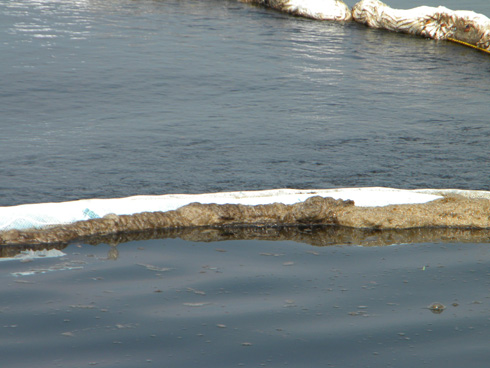
Oiled boom, August 5, 2010.

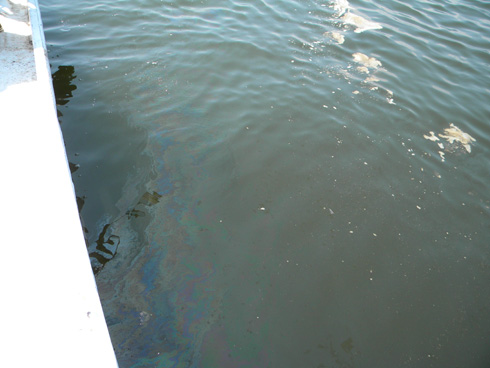
Oil sheen and dispersant remnant, August 1, 2010.

Corner of Canal Road and I-10, in Gulfport, Mississippi, at the Gulfport site used as a BP staging area, August 14, 2010.

Corner of Canal Road and I-10, in Gulfport, at the Gulfport site used as a BP staging area.

Corexit tanks, September 1, 2010.

Dead flounder among fish kill, August 6, 2010. Photos by Shirley Tillman / Truthout.

The Rag Blog

Posted in RagBlog | Tagged , , , , , , , , | Leave a comment

Bill Freeland : More Evolution at Ten

Rag Blog graphic by Bill Freeland. See Bill’s video version here.

Verified by a second source:

Image courtesy of Richard Jehn / The Rag Blog.

The Rag Blog / Posted September 15, 2010

Posted in Rag Bloggers | Tagged , , , | 2 Comments

Evidence Mounts of BP Spraying Toxic Dispersants

By Dahr Jamail / September 15, 2010

[The following dispatch from journalist Dahr Jamail, whose work has frequently appeared on The Rag Blog, was distributed by Truthout.]

Shirley and Don Tillman, residents of Pass Christian, Mississippi, have owned shrimp boats, an oyster boat and many pleasure boats. They spent much time on the Gulf of Mexico before working in BP’s Vessels Of Opportunity (VOO) program looking for and trying to clean up oil.

Don decided to work in the VOO program in order to assist his brother, who was unable to do so due to health problems. Thus, Don worked on the boat and Shirley decided to join him as a deckhand most of the days.

“We love the Gulf, our life is here and so when this oil disaster happened, we wanted to do what we could to help clean it up,” Shirley explained to Truthout.

However, not long after they began working in BP’s response effort in June, what they saw disturbed them. “It didn’t take long for us to understand that something was very, very wrong about this whole thing,” Shirley told Truthout. “So that’s when I started keeping a diary of what we experienced and began taking a lot of pictures. We had to speak up about what we know is being done to our Gulf.”

Shirley logged what they saw and took hundreds of photos. The Tillmans confirm, both with what they logged in writing as well as in photos, what Truthout has reported before: BP has hired out-of-state contractors to use unregistered boats, usually of the Carolina Skiff variety, to spray toxic Corexit dispersants on oil located by VOO workers.

Shirley provided Truthout with key excerpts from the diary she kept of her experiences out on the water with her husband while they worked in the VOO program before they, like most of the other VOO workers in Mississippi, were laid off because the state of Mississippi, along with the U.S. Coast Guard, has declared there is no more “recoverable oil” in their area.

“The first day I went, I noticed a lot of foam on the water,” reads her entry from June 26. “My husband said he had been seeing a lot of it. At that time, we were just looking for ‘Oil.’ We would go out in groups of normally, five boats. The Coast Guard was over the VOO operation. There was always a Coast Guard on at least one of the boats. They would tell us when to leave the harbor, where to go and how fast to go. They had flags on each of the VOO boats and also a transponder. Sometimes we would have one or more National Guardsmen in our group too, as well as an occasional safety man to monitor the air quality and procedures on the boat. If we found anything, the Coast Guard in our group would call it in to ‘Seahorse’ and they would determine what action would be taken.”

Along with giving a clear description of how the Coast Guard was thus always aware of the findings of the VOO workers, her diary provides, at times, heart-wrenching descriptions of what is happening to the marine life and wildlife of the Gulf of Mexico.

“Before we went to work, I went down by the beach,” reads her entry from July 4. “There were dead jellyfish everywhere. Some of them were surrounded by foam. A seagull was by the waters edge, as the foamy stuff continued to wash up. There was also a crane that appeared to be sick. It didn’t look like it had any oil on it, but it just stood there, no matter how close I got.”

On the morning of August 5, Shirley describes spotting a dead young dolphin floating in the water. “As we waited for the VOO Wildlife boat to come pick it up, we noticed a pod of dolphins close by,” she writes. “Even with all the boats around, they did not leave until the dead one was removed from the water. It was very emotional, for all of us.”

The next day, August 6, found her logging more death. “Last night on the news, they reported a fish kill. Before we went to work, I went to the beach by the harbor. The seagulls were everywhere. As for the dead fish, the only ones on the beach, were ones that the tide had left when it went back out. The rest of the ‘Fish Kill,’ was laying underwater, on the bottom. It was mainly flounder and crab. We only spotted two dead flounder floating that day. I can only imagine how many were on the bottom… I went back to the beach after work. The tide had gone out and the seagulls were eating all the dead fish that had been exposed. You could still see dead fish underwater, still on the bottom. Dead fish don’t float anymore?”

The Tillmans’ primary concern is the rampant use of toxic dispersants by what they described as private contractors working in unregistered boats, that regularly were going out into the Gulf as they and other VOO teams were coming in from their days’ work. There was, oftentimes, so much dispersant on top of the water, their boat left a trail.

“The first thing I noticed, was the ‘trail’ the boat was leaving in the water,” her log from July 10 reads. “You could see exactly where we had been, as far back as you could see. Around 11:00, we were in oil sheen and brownish clumps. We were North of Cat and Ship Island when the Coast Guard told us to drop the boom over. When you pick the boom up, you have to wear ‘protective gear.'”

Her log from August 1 describes, in detail, an incident of the Coast Guard not allowing them to collect oil and his proceeding to deny what they found was even oil:

Around 2:00 p.m., we started noticing a lot of oil sheen. We were North of the East end of Cat Island, but South of the Inter Coastal channel. There was, as usual, a Coast Guard on one of the boats in our team. He called in to report it, but we were told not to drop the boom, it was just “Fish Oil.” In the beginning of the clean-up operation, if something was floating on the water and it looked like oil, it was oil or oil sheen. Later they would sometimes say it was just “Fish Oil.” Also, if it was heavy foam with a brown or rust color, originally it was “Oil Mousse.” Later it was called “Algae.” We were then told to head Northwest. The further we went, the worse the “Fish Oil” got. Then, the foam was mixed in with the oil. It was at least the size of a football field, around our boat alone. My husband got on the radio and asked if they could put the boom over.

The Coast Guard, again, told them no.

We were then headed West, back towards Pass Christian. A pleasure boat flagged one of the boats in our group down and told him that there was oil all over. The Coast Guard said to tell him that they were aware of the situation… On the way back to the Pass Harbor, I asked my husband, “Just exactly what are we even doing out here?” He told me that he was beginning to think that it was all just for show. I can only imagine what the people on the pleasure boat had to say when they got back home that day. Probably, that they had seen a lot of oil on the water and the VOO boats were out there just riding around in it and not doing anything to clean it up. That is exactly what happened. We decided then to start documenting as much as we could. I believe it was the very next day, Thad Allen was on TV saying that they were scaling operations back due to the fact that, “No oil has been seen in the Gulf in almost two weeks.” Now, if we had pulled boom on Sunday and unloaded a bunch of dirty boom in the Pass harbor, it might have been a problem for him later.

On August 5, she describes a rare instance of their being allowed to drop boom in order to collect oil. “We had a Coast Guard and two Safety Men on our boat. We went to the West of the Pass Harbor. The water looked black in places. Lots of bubbles, not foam, just bubbles. Around 8:30, we were in oil sheen and mousse and were told to drop the boom. The more we pulled the boom, it appeared the more was coming up. The Pass [Christian] Harbor was closed because the oil was coming in so bad. We pulled boom back and forth the rest of the afternoon.”

By early August, the total number of VOO boats operating out of Pass Christian Harbor, where Shirley and Don worked, was down to 26.

On August 8, Shirley wrote,

Talk at the harbor was that airplanes were spraying dispersants on the water at night, out by the islands. There was also talk of skiffs, from Louisiana, with white tanks on them, that were spraying [dispersants] too. We had seen the skiffs before. They would pass us up in the mornings and head towards the Bay St. Louis Bridge. We were told that they were working out of an area at Henderson Point. Henderson Point has a county-owned area with a boat launch & piers. It was closed to the public after the oil spill and a BP sub-contractor staging area was set up. It always appeared that these boats were finishing up their work day, just as we were going to start ours. Most of these skiffs were Carolina Skiffs.

Later that same morning, Shirley and her husband headed out of the harbor with a member of the National Guard on their boat, heading west, while a member of the Coast Guard and another member of the National Guard were on another boat in their VOO team. After boating for an hour, they turned back to the east, at which point Don spotted five of the Carolina Skiffs.

“I got my camera and started taking pictures of them,” Shirley writes.

As I was zooming in as close as I could, I saw one of them spraying something onto the water. I did not get a picture of it, I was too busy telling my husband to tell the Coast Guard on the other boat. The skiffs had turned North and were scattered out, zigzagging South of the train bridge. The Coast Guard called the incident in and sent one of our boats to follow the skiffs. The skiffs immediately left. When I saw the boat spraying, it was upwind from our boat. Within a few minutes, my nose started drying out. Later my throat and eyes did the same thing. A Coast Guard helicopter was dispatched along with a Coast Guard boat. We saw the helicopter about twenty minutes later, but I never saw the Coast Guard boat.

Back at Pass Christian Harbor, her team reported the Carolina Skiffs actively spraying dispersants. She was told by the contracting company, Parson’s, that managed their VOO team, to bring in her photographs.

Her entry from the next day, August 9, reads:

I took the pictures, 8×10’s to Parson’s. A short time later, my husband called and said the Coast Guard wanted me to make a disc of the pictures. I took the disc and turned it over to the Coast Guard. I was told, in the presence of others, that the incident had been investigated and the boats in question had been located at the Henderson Point site. He said that these boats were in the VOO program as skimmer boats, but it had not yet been verified. He said that he had questioned them about spraying something on the water. They told him that if I had seen them spraying anything, they were probably just rinsing out their tanks. He also asked me, “Don’t you think if they were spraying dispersants, they would be wearing respirators?” I told him, “You would think so, but nothing surprises me around here anymore.” We basically left after that. I knew all they had really wanted was to see exactly what I had gotten pictures of. There is of course the question, “Why would a skimmer boat need to rinse out his tanks?” If he had been skimming oil, why dump it back over? If he hadn’t been skimming oil, what was he rinsing out? I know what I saw and I know how I felt afterwards. I also know that in one of the pictures I took, you can see a helicopter over those boats. BP has spotters looking for oil. Could it be he was telling them where to “Touch Up” before they called it a day? One thing I did learn from Coast Guard guy that day, evidently these so-called skimmer boats, also have the ability to spray!

The Tillman’s curiosity drove them to investigate further, given the inconsistencies they were seeing in the Coast Guard’s actions regarding the dispersant being sprayed from contractors in the Carolina Skiffs.

“My husband came home and said that they had seen the ‘Skiffs’ again today,” reads Shirley’s entry from August 10.

He took pictures of them and a jack-up-rig. The rig moves around in the sound and is suppose to be a de-contamination station. However, some Captains have said when they went there, they were told it wasn’t in operation at the time. After thinking about the tank skiffs and the Coast Guard for two days, I could not make any sense of this whole situation. The Coast Guard is supposedly over the VOO Program, but it knows nothing about the skiffs at the site, so close to the Pass Harbor. They not only tell us every move to make, but they are always with us when we make the moves. Our boats are flagged and have transponders on them. Those boats have no flags, we have not seen a transponder, nor a Coast Guard member on one of them telling them what to do.

That afternoon, the Tillmans visited the Henderson Point staging area. Though it was guarded, what they found shocked them: “There were probably more boats there than in the entire Pass [Christian] VOO program at the time,” reads her entry.

There were only a couple of regular skimmer boats. All appeared to have Louisiana registrations. Almost all of the skiffs had the white tanks on them. A few of the tanks looked like they could have had something in them at one time, but nothing like the oily, sticky mess we had been dealing with. If we got something on our boat, it was almost impossible to get it off. I don’t see how they could have gotten it out of the tanks and still looked like they did. Also, there was a Harrison County Sheriffs Department car, right by the boats and some large, plastic, white containers with yellow bases.

On August 13, the VOO boat that Shirley and Don were running was deactivated. Still very concerned, the next day they visited the BP staging area in Hancock County.

“They had evacuated this site,” she writes. “Same setup though, a guard and a Sheriff’s car. We then went to a site in Gulfport. Evidently, this is a main BP storage site. There were all kinds of boats, including the tank skiffs. The Sheriffs Department was there also and so was those large, plastic tanks with the yellow bases.”

Other reports, of a very similar nature, have been reported about other BP staging areas along the Gulf of Mexico. The tanks are clearly used to store and transport Corexit dispersant. The Carolina Skiffs are clearly used to spray it atop oil.

Her August 16 entry details her discovery:

Over the next few days, I continued to go by the Henderson Point site and the Gulfport site. The Henderson Point site brought back a few boats, but none of the tank skiffs or the large plastic tanks. The Gulfport site stayed the same, full of everything. On August 25, I received an email with a link to an article about dispersants. It had a picture of the tanks that dispersants come in, with the label “Nalco Corexit EC9005A.” They were 330 gallon, large, plastic, white tanks with a yellow base. These were the same tanks that I had been seeing at the Henderson Point site and the Gulfport site. I was able to get the name of the manufacturer of the tanks, off a picture I took and compared it to the picture in the article. It was the same manufacturer. I researched this company on the internet and found the 330 gal tanks. They are marketed as: “The only manufacturer in the industry to offer portable tanks certified for hazardous goods transport by the United Nations and the U.S. Department of Transportation.”

Shirley and Don are, like tens of thousands of other VOO workers and Gulf residents, left with more questions than answers.

“While working on the boats, if you pull boom back onto the boat, you not only had to wear Tyvek suits, protective glasses and gloves, you also had to put tape around the gloves and suit sleeves, as well as around your boots and the suit.” Shirley asks, “Why would it be safe for people to get into the same water that all of this hazardous stuff was coming out of?”

For the Coast Guard, she asks:

How can you not know there are boats in the VOO program if you are in charge of the VOO program? The Coast Guard was supposedly over the VOO program, but they acted like they don’t know anything about the Carolina Skiffs. The boats were in either a task force or strike force. Every VOO boat has a flag. We all had transponders. This was VOO and Coast Guard regulations. But these skiffs didn’t have flags and we never saw transponders on them, nor did they have Coast Guard with them and supposedly every group had at least one Coast Guard in each group. Sometimes we would have two. But the Skiffs didn’t have any.

Local media in Pass Christian and Gulfport, Mississippi, are now reporting that BP hopes to have the VOO program in that area completed by September 19.

Shirley is incredulous. “Why would anyone bring their children here and put them in water that has had millions of gallons of toxic chemicals dumped into it, not counting the oil itself?” she asks. “Why would you want to eat seafood that has been living and dying in the water, with all those contaminates?”

Truthout has earlier reported on other fisherman in the area, James “Catfish” Miller and Mark Stewart, who have reported being eyewitnesses to the contractors in the Carolina Skiffs spraying dispersant as well.

Meanwhile, local, state and federal authorities continue to claim that dispersant was only used south of Mississippi’s barrier islands and that the Carolina Skiffs and the large tanks they carry are only used to “skim” oil.

“If dispersants were only being sprayed South of the islands, why would these 330 gallon hazardous goods tanks be located at two different work sites, right by the tank skiffs?” Shirley asks. “Why would the skiffs tanks be so clean if they were really skimming oil?”

The Tillmans and thousands of other fishermen and residents along the Gulf of Mexico are deeply concerned about local, state and federal government complicity in what they see as a massive cover-up of the oil disaster by using toxic dispersants to sink any and all oil that is located.

Dr. Riki Ott, a toxicologist and marine biologist, is a survivor of the 1989 Exxon Valdez oil disaster in Alaska. She recently submitted an open letter to the U.S. Environmental Protection Agency expressing many of these same concerns.

Ongoing government denials of this problem neither fool nor dissuade Shirley. “I know what I have seen,” she told Truthout. “I know what I have been told. I know what I have experienced. I know what I have documented. I also know that I have taken hundreds of pictures to verify what I am saying.”

[Houston native Dahr Jamail, an independent journalist, is the author of The Will to Resist: Soldiers Who Refuse to Fight in Iraq and Afghanistan, (Haymarket Books, 2009), and Beyond the Green Zone: Dispatches From an Unembedded Journalist in Occupied Iraq, (Haymarket Books, 2007). Jamail reported from occupied Iraq for nine months as well as from Lebanon, Syria, Jordan, and Turkey over the last five years.]

Source / Truthout

The Rag Blog

Posted in RagBlog | Leave a comment

Sherman DeBrosse : Tea Baggers, Nativism, and the Fall Elections

Cartoon from the book Heroes of the Fiery Cross (1928) by nativist Branford Clarke that opposed immigration and promoted the Ku Klux Klan. Image from Wikimedia Commons.

An open letter to E.J. Dionne
concerning Tea Baggers, nativism,
and the possibility of reasoned discussion…

By Sherman DeBrosse / The Rag Blog / September 14, 2010

[The following is an open letter to E.J. Dionne, written in response to his column, “It’s Not Over Till it’s Over,” published in the Washington Post and distributed by Truthout, in which Dionne suggested that Obama’s recent comments and tone — starting with his Labor Day speech — have raised the stakes in this fall’s elections, and that the presumption of a massive Republican sweep may be overstated.

Dionne referred to “a deeply embedded media narrative that sees a Republican triumph as all but inevitable.” “Paradoxically,” he added, “such extravagant expectations may be the GOP’s biggest problem — by raising the bar for what will constitute success.” Dionne also suggested that “the costs of tea party extremism are beginning to balance the benefits of the movement’s energy.”]

I’m asking you to put on your academician’s tam for a moment.

Your column on President Obama’s counterattack was excellent. The only antidote to Tea Bagger hysteria is reasoned discussion.

Unlike some, I do not apply Anthony Wallace’s “revitalization movements” theory to all sorts of things, and I do not subscribe to the various stages people write about. However, the Tea Baggers do seem very much like the Ghost Dancers of the late 19th Century.

Millennialism movements have been important in our history and the Revitalization Movement, as a subset, is particularly important. This one is very significant due to its size and the speed with which it surfaced. Revitalization movements can also be labeled political fundamentalism because those within it have the attitude of survivors, reverting to unquestionable truths and withdrawing into a protective mental cocoon that usually cannot be penetrated by reason.

Revitalization movements emerge when there is intense societal stress and people seek fundamental changes in society because they feel threatened and deprived. In this case there are multiple overlapping crises: economic, socio/cultural, and terroristic, and nativism — fear of the “Other” — is at the center.

That is why Islamophobia has become so important lately. That has something to do with Obama as symbol of the “Other.” This explains why educated people can be sure Obama is a Muslim — above all the fear presented by growing numbers of non-whites and the presence of an African American in the White House. These folks think their social identity is threatened.

I’m not sure it is all about “jobs, jobs, jobs.” These people have better than average incomes and educations and are disproportionately older. Tea Bag Republicans fear that health care reform will threaten their Medicare benefits. That is why Democrats must stress over and over again that they added years to Medicare’s viability.

These people are better fixed than most but they fear future economic privation, and they need to be reminded that the biggest threat to their Social Security and Medicare is presented by Republicans. Reason might penetrate a few.

The common thread seems to be nativism. In the Pueblo Rebellion of 1680, the Pueblos killed 400 Franciscans and Spaniards. Nativism was also the center of the Handsome Lake cult and the Ghost Dancers. Today’s Tea Baggers are in a literal frenzy to purge their world of “foreign influences.”

Foreign or “Other” means the hippies of the Sixties, the newly assertive gays, people of different colors, and above all blacks and Hispanics. Obama has become the symbol of all that they fear, and to them, it is reasonable to think he was born in Africa, is sympathetic to the goals of terrorists (as 52% of Republicans believe) and that he is a Muslim.

The Bush administration successfully separated anti-terrorism from perception of Islam. A measure of how far the revitalization movement has gone can be seen in the nationwide protests about putting a useful Islamic Center in a bad neighborhood, two blocks away from Ground Zero. The center could not even be seen from that hallowed site.

People like Newt Gingrich previously refrained from identifying Islam with terrorism; now they conflate them because that will add some Republican votes in November. In order to lock down a huge November victory, these Republican hate-mongers are willing to stoke Islamophobia, which leads to the endangerment of American troops and the recruitment of terrorists.

During the Bush years, anti-Muslim sentiment was rife among conservatives, but muted because none of them wanted to damage Bush’s foreign policy. There was even a very ugly intra-conservative campaign against Grovner Norquist because he married a Muslim and brought some Muslim leaders to the White House.

On the other hand, the conservative press cranked out pseudoscholarly volumes about “Islamofascism” — whatever that is. But with Bush out of the White House, there was no longer any reason to tone down the prejudice and hatred of Islam. Newt Gingrich is now sounding off about “Islamic triumphalism” and relating the 51st Street Islamic Center to that.

In addition, Gingrich is telling people that to understand Obama, it is necessary to see the president fundamentally as a Kenyan militant. The former Speaker is not a birther, but he is saying that Obama is very OTHER and not to be trusted, especially by our allies, the former imperial powers.

This is irresponsible and reckless behavior. Gingrich is a seasoned politician holding a Ph.D. He did not stumble into this nonsense. He made the deliberate calculation that political fundamentalism and the revitalization movement would still be powerful in 2012.

Usually one charismatic leader is needed in a revitalization movement. But with mass communications, the Tea Bag movement can move ahead without one central figure. This movement has a number of effective demagogic leaders, including Sarah Palin, Glenn Beck, and Rush Limbaugh. Gingrich has some of the makings of an effective rabblerouser, but his need to show that he is smart gets in the way.

Another characteristic of the movement is its unitary nature. These people are insisting on a new orthodoxy and would install a thought policeman in everyone’s head if they could. It is important that they think they are getting back to real Americanism, even though their leaders seem to have embraced the political heresies that led the South to secession.

It is common for people in these movements to fear the state, and the nature of their rhetoric preconditions people to violence. However, there are so many people sharing this spirit that it is unlikely that much violence will occur. They perceive their prospects of ultimate success as good, so violence is pointless.

Revitalization movements can be political without being religious, but the umbrella of religion adds authority. Hence Glenn Beck moved belatedly to give himself religious credentials and sought to add a religious canopy to his movement at Lincoln Memorial.

Psychiatrist Wilhelm Reich saw an intense strain of political fundamentalism in the Germany of the 1930s. He attributed it to repressive parents and sexual frustrations. Konrad Lorenz, a Nazi sympathizer who later won a Nobel Prize in genetics, never got beyond thinking that many — probably most people — are just emotionally wired to accept such appeals. At bottom, most people fear death and also cannot deal with severe crises, they need to live in a world of illusions and fear the conclusions reason might present.

Many times when there have been Democratic presidents, well-financed movements sprung up to oppose them. The American Liberty League opposed FDR with libertarianism and lavish spending, but it was relatively small. The John Birch Society was somewhat larger and used libertarianism and outrageous conspiracy theories to go after John F. Kennedy. The arguments of the League and the Birchers could be met and defeated in the public arena.

Ronald Reagan transformed the media environment in many ways, making possible the eventual triumph of the Right. When Ronald Reagan’s FCC appointees ended the fairness doctrine, they handed the Right a weapon so powerful that it could be used to transform American politics.

Conservative talk shows will always far outdraw liberal ones because they play to basic emotions. The arguments they make are very simple and do not rely upon facts or complicated reasoning. Countering the arguments made on right wing media is a little like the man who tries to gather feathers from a pillow which has been cut open so the contents are spread to the four winds.

Bill Clinton faced the Arkansas Project, a very well financed and organized effort that questioned his legitimacy and spun endless conspiracy theories around the false claim that Clinton had Vince Foster killed.

Today’s Tea Baggers are far more numerous and better financed and organized than their predecessors. They subscribe to selective libertarianism, almost all the odd rightist conspiracy theories of the past, but draw their enormous energy from fear and hatred of the “Other.” With FOX News — which just gave $1 million to the Republican Governors Association — and the many shock jocks promoting the Tea Bag wing of the Republican Party, it is no wonder it has taken over the Republican Party and the conservative movement. There are no Bill Buckleys to push back.

It is unclear just how Tea Baggism came about. Perhaps its origins were in those Sarah Palin political meetings that looked so much like Klan rallies. Scholars claim these movements do not last long, but they wrote the same thing about right-wing populism, which has lasted more than 30 years and is a permanent force in our national life.

Maybe it was ginned up by super-bright academicians in conservative think tanks. That cannot be proven. It is clear that conservative consultants understand far more about the non-rational and cognitive science than progressives.

Through reason, Obama and the Democrats can reactivate some progressive voters. IF the spell of the Tea Baggers is to be broken, the Democrats must take a chance on discussing the issues and shattering illusions that make people feel good about themselves and their future.

[Sherman DeBrosse is a retired history professor. He also blogs at Sherm Says and on DailyKos.]

The Rag Blog

Posted in Rag Bloggers | Tagged , , , , , , , | 6 Comments

Jeffrey Nightbyrd : Rehearsals for the Apocalypse

Underground journalist and Sixties activist Jeffrey Nightbyrd will be Thorne Dreyer‘s guest on Rag Radio on KOOP 91.7 FM in Austin, Tuesday, September 14, 2-3 p.m. (CST). To stream Rag Radio live, go here. To listen to this show after the broadcast, or to listen to earlier shows on Rag Radio, go here.

‘Don’t be a slave to the rules’:
Our time in the sun

By Jeffrey Nightbyrd / The Rag Blog / September 13, 2010

See ‘The mysterious murder of Michael Eakin,’ by Jeffrey Nightbyrd, Below.

[The Austin Sun was a counterculture paper published in Austin from 1974-78. It was born of the underground press, and served as a precursor to the many “alternative” publications that would follow. The Sun‘s influence went far beyond its short life span. It served as an incubator for major talent and helped stimulate the development of Austin’s music scene, helping artists like Stevie Ray Vaughan, Joe Ely, Marcia Ball, and Butch Hancock reach a wider audience.

The Sun was founded by Jeffrey Nightbyrd and Michael Eakin. Nightbyrd — formerly Jeff Shero — was a major figure in the Sixties New Left, in Austin and nationally. He served as national vice president of SDS and was active with the Yippies. Jeff was involved with Austin’s original underground newspaper, The Rag, and also edited RAT in New York. Jeff now directs Acclaim Talent, one of the largest talent agencies in the Louisiana/Texas region.

(Co-founder Michael Eakin, a former editor of the Daily Texan, was shot to death in 1974. The crime was never solved and is believed by many to have been related to a story he was researching on the South Texas Nuclear Plant. See the sidebar article below.)

A retrospective exhibit of art from The Sun (“Rehearsals for the Apocalypse: The Austin Sun Years 1974-1978)” is currently showing at the South Austin Popular Culture Center. The following was adapted from notes Jeff wrote for the exhibit.]

Looking through the old Suns, the issues we championed haven’t changed today: war, a smart energy policy, no nukes, long range environmental thinking, ethnic and religious tolerance, sensible drug policies, planning instead of runaway growth, and sexual freedom.

In Austin tolerance has become widespread but our economy dangles on a precipice, we are fighting overseas wars, and our natural world is imperiled. Hence the title of this museum exhibit: “Rehearsals for the Apocalypse. The Austin Sun Years.”

The hard facts are that former Daily Texan editor Michael Eakin and I thought it was essential to create an Austin newspaper that presented alternatives to the local information sources. So we went about raising money.

People like Bud Shrake who had just sold a movie script to Hollywood pitched in.

“Bud,” we told him. “We don’t know if we will ever be able to pay this much back.”

“I know that,” he said. “One day pass it on.”

Over a brief few years many great writers and artists got their start. My first partner, Michael Eakin, was murdered under suspicious circumstances. And like an improbable reality show, we sunspots kept surprising each other with bursts of originality.

Finally hard economic reality set in forcing me to take in a “liberal” real estate investor. Soon he bought up more stock than anyone and ousted me as a “terrible manager.” His condemnation — “You don’t even have a time clock!” — still rings in my ears.

Afterward, most of the Sun staff followed their muse and found more success.

For most of us the Sun years were a time of plenty… or should we say our time in the Sun.

Following are some thoughts and memories:

Good drugs and bad drugs

The Sun crew laughed at the over-culture’s hypocrisy about drugs. After all, we live in America — the society that invented the “Drug Store.” Some drugs like alcohol, caffeine, and nicotine (the most addictive of all) had legal sanction. But others, like pot, could send a smoker to prison. (Pot prisoners are almost half the population of many jails and we never saw pot smokers getting into fist fights in bars.)

Psychedelics

In the Sun era, creative Texans reached for transcendence through peyote and mescaline just as the indigenous Indians had for thousands of years before. Into the mid-Sixties peyote could still be bought at cactus nurseries. Then the hysteria fed by the establishment media set in, demonizing psychedelics as madness-inducing. We tried to bring enlightenment to the frenzy.

William Burroughs

Burroughs, the apocalyptic futurist and author of Naked Lunch, inventor of cut-up writing, and beatnik legend, inspired the Doom issue of the Sun, which in turn inspired the theme of this exhibition, “Rehearsals for the Apocalypse. The Austin Sun Years.”

Burroughs contributed his articles to the underground press for free.

Michael Ventura

Michael Ventura, a Sicilian street kid from Brooklyn, stopped by the Sun on his way out of town and got his first paid writing assignment. A curious combination of street-toughened, world-class dirty dancer and Talmudic-like scholar, he became a creative mainstay of the Sun. His apartment walls were astonishing, covered with voluminous hand-lettered note cards, quotes from the world’s greatest and most obscure thinkers, thousands of posted notes that worked as brain stimulants for his essays.

Jeffrey Nightbyrd, in the day.

Rocky Horror midnight madness

The national Rocky Horror Picture Show Saturday night phenomenon took off in Austin. The producers called the Sun and asked if we would sponsor a test event to see if Rocky Horror had legs, as they say in the movie biz. Tim Curry flew in, and a raucous crowd at the Paramount Theater cheered their way through the look-a-like contest. By the end of the night the sell-out crowd had sung their way through the entire movie and a phenomenon was born.

The music scene and Stevie Ray Vaughan

The clubs kept giving birth to stunning and original bands and musicians that would make jaded veterans pause in awe. I remember Michael Ventura touting a new guitarist, Stevie Ray Vaughan, and watching him for the first time in an obscure club on Red River called the One Knight. Eight people were in the audience. But Stevie didn’t care.

Driven like a Hendrix or a Picasso he ripped through songs so fast and beautiful that you knew you had entered a moment of magic shared only by a few. Soon the venues grew much bigger. But somewhere in Austin right now another young genius is playing.

Sexual freedom

The Sun wanted to keep the government out of all our bedrooms. But in this era gays could still be prosecuted as sodomists, and women were not secure in the Roe v Wade ruling that protected the privacy of their bodies. We felt the rainbow of sexuality that is the human experience was none of any government’s business. Relationships of any kind are hard to sustain. So, root for everybody. The Sun rooted for all consenting adults and championed the right of the abnormal to find their happiness

On writing

Writers fresh from the academic reformatory that is the university would bring us lifeless prose. What would now be slam poets would arrive, ignorant of the rules of English grammar, and put down words that were captivating.

I told writers: “Don’t be a slave to the rules — make the language your slave. Do anything that works.” I would suggest reading advertising copy. Or translations of the Chinese master Li Po and Tu Fu. In extreme cases I would hand writers a copy of the poems of e. e. cummings. There are no rules of good writing save putting down words in any fashion that communicates with passion.

Piedras Negras jailbreak

Taking a page from the Wild West, gun-toting hired guns stuck up the guards at the Piedras Negras jail and freed a gringo rancher’s son. In the mayhem, a bevy of hippie pot prisoners made their escape running down to the Rio Grande and swimming the river. First thing, they called the Sun to tell their story. We were just going to press, so at 2 a.m. the art department redesigned the cover and we beat the dailies by two days.

Michael Eakin. Photo scanned from Daily Texan.

The mysterious murder of Michael Eakin

By Jeffery Nightbyrd / The Rag Blog / September 13, 2010

Austin Sun co-founder and former Daily Texan editor Michael Eakin was a dogged opponent of the South Texas Nuclear Plant. On April 14, 1979 he was shot to death while sitting in a parked car in Houston. The crime was never fully investigated. There are few hard facts in the case.

The South Texas Nuclear plant was built after politicians overcame huge opposition within out city. There is no proof that Michael’s murder had anything to do with his journalistic investigations. But former Sun investigative reporter Todd Samusson recently sent me some very disturbing information which follows:

I had extensive experience of harassment for doing anti-nuke organizing in Austin. I was physically assaulted several times. Always by two large thuggish-looking guys but never the same two. I had my house ransacked and nothing stolen but an address book. I received threatening calls. I had my porch light smashed out three times. I even came out of a meeting once and found a bullet hole in the rear window of my truck (that same piece of crap I used to schlep Austin Suns from the printer in Taylor back to the Sun offices). My car window had a bullet shot through it.

Michael Eakin obviously had it much worse. In the weeks preceding his death he told me he was working on a freelance article about cost overruns at the South Texas Nuclear Project. He said he had been interviewing construction workers at the site about intentional slowing down of work to drag out the project. Also about major flaws in the concrete pours of the containment buildings. (These stories were later confirmed in articles in the Austin American Statesman — I think written by Bruce Hite.)

Michael was shot point blank and killed in his car in Houston with a small caliber pistol (weapon of choice for mob contracts, according to police). Also shot was his passenger Dilah Davis. She was hit in the face but survived. She was very active in Austin Citizens for Economic Energy the electoral group working against the nuke.

That project was done on a cost-plus basis. There was absolutely no incentive for Brown & Root to come in at the contract price. In fact they had every incentive to seek cost overruns. The south Texas nuke was originally bid at $700 million-plus. When I left Austin in 1988 the cost was heading toward $4 billion. The nuclear industry isn’t about how to best generate electricity; it’s about construction gigs. And, on a bigger scale, it’s about bonded indebtedness on electric utility bonds used to pay for that construction. That $4 billion turns out to be way, way more than that over the life of the debt.

So the money trail is way bigger than Brown & Root. It goes to huge bond houses. Anybody along that trail had motive to stop Michael from prying.

Brown & Root was eventually fired for its cost overruns and replaced by Bechtel. But they went on to do well, becoming KBR (Kellogg Brown & Root) and making zillions from the current war in Iraq.

Michael Eakin should not be forgotten. As a journalist he pursued his passion to expose corporate corruption to the end.


Now showing!
Rehearsals for the Apocalypse

The South Austin Popular Culture Center is presenting a landmark exhibit featuring the underground/alternative newspaper the Austin Sun. The exhibit will run from Sept. 11 through Oct. 23.

“Rehearsals For The Apocalypse” encompasses the entire run of the Austin Sun, which was from October 1974 through June of 1978. The Sun was founded by Jeff Nightbyrd and Michael Eakin. They were joined later by printer and bon vivant J. David Moriaty as managing editor, The Sun transcended the usual mode of underground newspapers with professional layouts, cutting edge news articles and, wonder of wonders, paid staff positions.

The exhibit features a selection of newspaper covers along with accompanying articles, photographs, and comments by Jeff Nightbyrd, Dave Moriaty, and some of the key staffers. The show also includes a striking selection of vintage photographs.

“Rehearsals For The Apocalypse: The Austin Sun Years 1974- 1978″ will run from September 11th through October 23rd. The South Austin Popular Culture Center is located at 1516-B South Lamar Boulevard in Austin. Hours are Thursday through Sunday from 1- 6 p.m. or by appointment and chance.

The Rag Blog

Posted in Rag Bloggers | Tagged , , , , , , | 4 Comments

Harvey Wasserman : Big Hurt Hits ‘Nuclear Renaissance’

Plant Vogle, nuclear power plant in Burke County, Georgia: $108 million in overcharges — and counting. Image from Georgia Country Blog.

Lab report:
Is the ‘nuclear renaissance’ dead yet?

By Harvey Wasserman / The Rag Blog / September 13, 2010

America’s much hyped “reactor renaissance” is facing a quadruple bypass. In actual new construction, proposed projects, and overseas sales, soaring costs are killing new nukes. And the old ones are leaking like Dark Age relics teetering on the brink of disaster.

As renewables plummet in cost, and private financing stays nil, the nuclear industry is desperate to gouge billions from Congress for loan guarantees to build new reactors. Thus far, citizen activism has stopped them. But the industry is pouring all it has into this fall’s short session, yet again demanding massive new subsides to stay on life support.

Here’s a lab report:

  • Soaring costs at Vogtle, the U.S.’s one active new reactor project, have stuck Georgia ratepayers with $108 million in unplanned overcharges… and that’s just for starters at a site where actual construction has barely begun. Georgia’s PUC now says it will hike rates by nearly 3 times the original $1.30/month promised when it first agreed to soak ratepayers for the plant — in advance. This new hike was opposed by the PUC’s own staff, which blasted the whole deal for being shrouded in secrecy.

    Currently calculated to cost a sure-to-soar $14.5 billion, the Vogtle project got $8.33 billion in federal loan guarantees from Obama in February. Citizen/taxpayer groups have since sued to see the details, which the administration is keeping secret.

Such soaring rates and slipping schedules defined the first generation of “too cheap to meter” reactors, which almost without exception came in years late and billions over budget. Costs of the two original Vogtle reactors jumped by 1,263% — from an original $660 million budget to nearly $9 billion — forcing up statewide rates more than 12%. Construction was promised for seven years, but actually took 16.

The French giant AREVA’s “new generation” projects in Finland and Flamanville, France, have also soared hugely over budget and behind schedule. So there’s every indication the new generation of reactors will be as catastrophically behind schedule and over budget as the first.

  • John Rowe, the CEO of Exelon, America’s top reactor owner (17 in 3 states), says low gas prices could delay construction of new merchant nukes in the U.S. by a “decade, maybe two.” Merchant power plants sell electricity into open competitive markets. Because atomic energy can’t compete with natural gas or renewables and efficiency, Exelon has withdrawn its application to build two reactors in Victoria County, Texas. “We haven’t totally abandoned” the project, says Rowe. But “it’s very unlikely we would do it for a long time.”
  • American reactor component makers are angry with India for passing new law requiring the industry to assume substantial liability for a catastrophe they might cause. The horrifying aftermath of Bhopal, where Union Carbide killed thousands of local citizens with a lethal gas emission for which they have not been held fully accountable, still weighs heavily in India.

    But the atomic industry will not tread where it’s held liable for the true costs of its potential disasters. In the U.S., liability is capped at around $11 billion, even though the financial damage from a full-scale catastrophe could easily soar into the trillions. Minimum estimates from the 1986 Chernobyl disaster, which occurred in a remote, impoverished area, have exceeded $500 billion. By recent estimates the death toll is 985,000 and still counting.

    On behalf of U.S. corporations, the Obama Administration is demanding the Indian liability requirements be lifted. Especially in the wake of BP’s Deepwater Horizon catastrophe in the Gulf of Mexico, it is a stunning admission that even after 50 years, reactor technology cannot be held accountable for its technical vulnerabilities, here or abroad

  • America’s aging fleet of first generation reactors is leaking profusely. Indian Point, north of Manhattan, has suffered seven unplanned shut-downs in two years. In recent months serious emissions of tritium and other radioactive substances into the air and water have been found at Vermont Yankee, Indian Point, New Jersey’s Oyster Creek, and many more.

    Ohio’s infamous Davis-Besse, where boric acid ate virtually all the way through a reactor pressure vessel, has sprung some two dozen leaks which cannot be explained by its owner, First Energy. In Vermont, leaks from pipes the operators said did not exist have seeped contaminated water into the Connecticut River. As reactor owners petition to extend operating licenses for decades to come, the rickety, embrittled old plants become increasingly dangerous.

According to official records, the nuclear industry has spent at least $645 million in the past decade lobbying for taxpayer handouts. It got $18.5 billion in loan guarantees from the Bush Administration in 2005. Obama has asked for some $36 billion more. But so far a national grassroots movement has kept that from happening. The industry is demanding more from Congress, and will continue to do so as long as legislators need cash to run their campaigns.

But it is now clearer than ever that atomic energy cannot compete, that new construction means new rate hikes, that delays and cost overruns will always outstrip the industry’s initial public assurances, and that after a half-century this technology still can’t face the prospect of full liability for the disasters it might impose… or even for the “minor” radiation it constantly emits.

Will this will finally kill the much hyped “renaissance” of a Dark Age technology defined by quadruple failures in human health, global ecology, sound finance, and shaky performance?

That will depend on the power of citizen activism. Nuclear power can’t survive without protection from accident liability. Nor can new plants be built without huge public subsidies.

The longer those are stopped, the more likely a Solartopian transition to the only sources that can sustain us: increased efficiency and the green-powered birth of the Age of Renewables.

[Harvey Wasserman’s Solartopia! Our Green-Powered Earth is at www.solartopia.org, along with Pete Seeger’s “Song for Solartopia” on YouTube.

The Rag Blog

Posted in Rag Bloggers | Tagged , , , , , , | Leave a comment