Robert Jensen : Glenn Beck’s Redemption Song

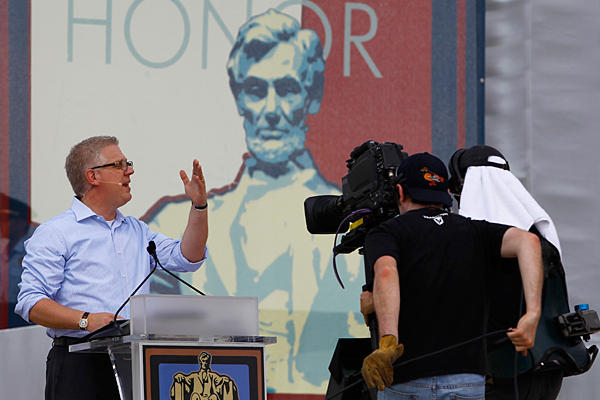
rial in Washington, Saturday, Aug. 28. Photo by Alex Brandon / AP / Christian Science Monitor.

‘Restoring honor’ in DC:
Glenn Beck’s redemption song

By Robert Jensen / The Rag Blog / August 30, 2010

About halfway through Saturday’s “Restoring Honor” rally on the DC mall, I realized that I was starting to like Glenn Beck.

Before any friends of mine initiate involuntary commitment proceedings, let me explain. It’s not that I really liked Beck, but more that I experienced his likeability. Whether or not he’s sincere, I came to admire his ability to project sincerity and to create coherence out of his incoherent rambling about religion, race, and redemption.

As a result, I’m more afraid for our political future than ever.

First, to be clear: Beck is the embodiment of everything I dislike about the U.S. politics and contemporary culture. As a left/feminist with anti-capitalist and anti-empire politics, I disagree with most every policy position he takes. As a journalist and professor who values intellectual standards for political discourse, I find his willful ignorance and skillful deceit to be unconscionable.

So, I’m not looking for a charismatic leader to follow and I haven’t been seduced by Beck’s televisual charm, nor have I given up on radical politics. Instead, I’m trying to understand what happened when I sat down at my computer on Saturday morning and plugged into the live stream of the event.

Expecting to see just another right-wing base-building extravaganza that would speak to a narrow audience, I planned to watch for a few minutes before getting onto other projects. I stayed glued to my chair for the three-hour event.

My conclusion: What I saw was the most rhetorically and visually sophisticated political spectacle in recent memory. Beck was able to both connect to a right-wing base while at the same time moving beyond the Republican Party and the Tea Party movement, potentially creating a new audience for his politics. It’s foolish to make a prediction based on one rally, but I think Beck’s performance marked his move from blowhard broadcaster to front man for a potentially game-changing political configuration.

My advice: Liberals, progressive, and leftists — who may be tempted to denounce him as a demagogue and move on — should take all this seriously and try to understand what he’s doing. Here’s my best attempt to understand it.

Religion

There’s nothing new about mixing Christianity and right-wing politics in the United States, and Beck put forward a familiar framework: America is a Christian nation that honors religious freedom. Christians lead the way in the United States, but the way is open to all who believe in God.

Anyone teaching the “lasting principles” found in all faiths is welcome, despite theological differences. “What they do agree on is God is the answer,” Beck said in his call for a central role for religious institutions, whether they be churches, synagogues, or mosques.

But for all the religious rhetoric, Beck never talked about the hot-button issues that are important to conservative Christians. No mention of abortion or gays and lesbians. Theologically based arguments against evolution and global warming were not on the table. No one bashed Islam as a devilish faith.

Instead, Beck concentrated on basics on which he could easily get consensus. God has given us the pieces — faith, hope, and charity — and all we have to do is put them together. Rather than arrogantly assert that God is on our side, he said, we have to be on God’s side.

Beck may eventually have to voice clear opposition to abortion and gay marriage to hold onto conservative Christian supporters, but on Saturday it was his apparent religious sincerity that mattered. I have no way to know how serious Beck’s faith in a traditional conception of God really is, but it doesn’t matter.

He sounds sincere and moves sincere; he creates a feeling of sincerity. He brings an emotional candor to public discussion of religion that is unusual for someone in his line of work. When religious people believe that someone’s profession of faith is real — that it’s rooted in a basic decency and is deeply felt — then differences over doctrine become less crucial.

There has been some discussion of whether Beck, a convert to Mormonism, can really connect to Protestants and Catholics, some of whom view the Church of Jesus Christ of Latter-day Saints as a cult rather than an authentic Christian denomination. No doubt some evangelical/fundamentalist Christians will reject Beck, but his personal appeal could overcome those objections for many others.

Race

There’s also nothing new in Beck’s analysis of race. Like most conservatives, he argues that America’s racism is mostly a thing of the past, and that racial justice means a level playing field that offers equal opportunity but does not guarantee equal outcomes.

Rather than come to terms with the way white supremacy continues to affect those outcomes through institutionalized racism and unconscious prejudices, folks like Beck prefer a simple story about personal transcendence and the end of racism.

What was different about Beck’s version of this story was the supporting cast. There were a lot of non-white people on the stage, including a significant number of African Americans. The rally went well beyond the tokenism that we are used to seeing, not only in the Republican Party but also in institutions throughout society.

Beck not only gave a featured speaking slot to Alveda King — one of Martin Luther King, Jr.’s nieces, no doubt selected to bolster his claim to be speaking in the MLK tradition — but also paid close attention to race throughout the day. Take a look at the lineup for the presenters of the three civilian badges of merit for faith, hope, and charity: An American Indian presenting to an African-American; a white man presenting to a Dominican; and a Mexican-American presenting to a white man, with a black woman accepting on his behalf.

Is it all cynical and symbolic? For those of us who are white, do we have a right to ask that question in the presence of so much passion from the people of color on stage? These weren’t cardboard cutouts shoved in front of a camera to add color, but an eclectic mix of people, all espousing a fundamental faith that they seemed to share with Beck.

Whether a movement rooted in Beck’s approach can gain wide acceptance in non-white communities is not the only question. For white people who are struggling with how to live (or, at least, appear to live) a commitment to racial justice, this kind of space will be attractive.

Tea Party gatherings are weighed down by an overt racial ideology that limits their appeal; Beck may have a strategy that overcomes that problem, creating a movement that has a significant enough non-white component to make white people feel good about themselves without really challenging white dominance.

Redemption

The key message of the “Restoring Honor” rally was redemption, personal and collective, the personal intertwined with the collective. Unlike some reactionary right-wingers, Beck spoke often about America’s mistakes — though all of them are set safely in the past. Rather than try to downplay slavery, he highlighted it. It is one of America’s “scars,” a term he repeated over and over, to emphasize that our moral and political failures are from history, not of this moment.

“America has been both terribly good and terribly bad,” leaving us with a choice, he said. “We either let those scars crush us or redeem us.” Just as all individuals sin, so do all nations. Just as in our personal life we seek redemption, so do we as a nation. Framed that way, who would not want to choose the path of redemption?

But while on one level America has sinned, on another level it is beyond reproach. “It’s not just a country, it’s an idea, that man can rule himself,” Beck said. An idea remains pure, which means we don’t have to wonder whether there’s something about our political and economic systems that leads to failures; injustice must be the product of individuals’ mistakes, not flaws in the systems in which they operate.

This is all standard conservative ideology as well. The United States is not just a nation struggling to be more democratic, but is the essence of democracy. Our wars are, by definition, wars of liberation. The wealth-concentrating capitalist system is not an impediment to freedom but is the essence of freedom.

How any of this jibes with the egalitarian and anti-imperial spirit of the Gospels is off the table, because the United States is a Christian country and the idea of the United States is beyond reproach.

But, again, the key to Beck’s success is not just the ideology but the way he puts it all together. A nation whose wealth rests on genocide, slavery, and ongoing domination of the Third World is the nation that defines faith, hope, and charity? Beck “proves” it by connecting Moses to George Washington to Abraham Lincoln to Martin Luther King, Jr. All are part of the same tradition, the same striving for freedom.

Beck is the perfect person to sing this redemption song. He talks openly of the alcohol and drug abuse that ruled his life until he discovered his faith in God. Unlike George W. Bush, Beck tells the story with conviction. Perhaps both Bush and Beck tell the truth about their experience, but Beck makes you feel it is the truth in a way Bush could never pull off.

Reactions

Wait a minute, you say, none of this makes a lick of sense. Beck tosses a confused and confusing word salad that rewrites history and ignores reality. Maybe it sounds good, if you throw in enough energetic music and inspirational personal stories from veterans, ministers, philanthropists, and skillful TV personalities. But it’s really nothing but old right-wing ideology, no matter how slick and heartfelt the presentation.

What would Beck’s supporters say? Probably something like this:

So, you are one of those who wants to keep picking at the scars. Why do you lack faith, reject hope, refuse to offer charity? Why do you turn away from the values and principles that made us great? Glenn said it: “We must advance or perish. I choose, advance.” Glenn wants to help us advance, and you want us to perish.

I agree that Beck is wrong about almost everything. I agree that given his record of demagoguery and deception, he is unfit for work in the news media or political leadership. I agree that he may be one of those people incapable of sincerity, someone whose “real” personality is indistinguishable from his stage persona. I agree that he’s a scary guy.

I agree with all that, which is why I don’t really like Glenn Beck. If I ever got close to Beck I would probably like him even less. But after watching his performance on a screen over those three hours, I understand why it’s so easy to like him, at least on a screen. His convoluted mix of arrogance and humility is likable, so long as one doesn’t look too closely at the details.

More than ever, people in the United States don’t want to look at details, because the details are bleak. Beck is on the national stage at a time when we face real collapse. One need not be a Revelation-quoting end-timer to recognize that we are a nation on the way down, living on a planet that is no longer able to supply the endless bounty of our dreams. That’s a difficult reality to face, one that many clamor to deny.

The danger of Beck is not just his appeal to fellow conservatives, but rather his appeal to anyone who wants to deny reality. My fear is not that he will galvanize a conservative base and make a bid for leadership of that part of the political spectrum, but that his message will resonate with moderates, maybe even some liberals, who despair over the future.

Does worrying about Beck’s appeal beyond the far right seem far fetched? The most important rhetorical move Beck made on Saturday was to claim the rally “has nothing to do with politics.” Many people across the ideological spectrum want desperately to escape from contemporary politics, which seems to be a source of endless frustration and heartbreak.

To those people, Glenn Beck’s redemption song will be seductive.

A version of this essay appeared on the Texas Observer website.

[Robert Jensen is a journalism professor at the University of Texas at Austin and board member of the Third Coast Activist Resource Center in Austin. He is the author of All My Bones Shake: Seeking a Progressive Path to the Prophetic Voice, (Soft Skull Press, 2009); Getting Off: Pornography and the End of Masculinity (South End Press, 2007); The Heart of Whiteness: Confronting Race, Racism and White Privilege (City Lights, 2005); Citizens of the Empire: The Struggle to Claim Our Humanity (City Lights, 2004); and Writing Dissent: Taking Radical Ideas from the Margins to the Mainstream (Peter Lang, 2002). Jensen is also co-producer of the documentary film Abe Osheroff: One Foot in the Grave, the Other Still Dancing, which chronicles the life and philosophy of the longtime radical activist. Robert Jensen can be reached at rjensen@uts.cc.utexas.edu.]

The Rag Blog
Posted in Rag Bloggers | Tagged , , , , | 6 Comments

By Dr. Stephen R. Keister / The Rag Blog / August 30, 2010

I cannot tolerate watching Fox News; however, the end results are apparent as the mainstream media continue to disseminate and replicate this drivel included in secondary coverage.

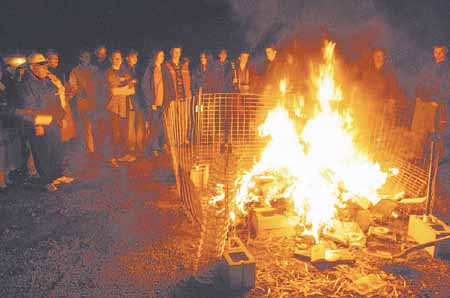
I am especially apprehensive that history is once again repeating in view of the Beck “rally” Saturday at the Lincoln Memorial which reminds one of a like affair in Nuremberg on September 4, 1932 and the scheduled book burning in Florida on September 7 is akin to one in Berlin on May 10, 1933.

I will quote Hitler, by way of Louis Untermeyer’s Makers of The Modern World, published in 1955:

The masses prefer the ruler to the suppliant… They feel little shame in being terrorized intellectually and are scarcely conscious of the fact that their freedom as human beings is abused… The art of leadership consists of consolidating the attention of the people against a single advisory and taking care that nothing will split this attention… The leader of genius must have the ability to make different opponents appear as if they belonged to one category. Tell big lies, he insisted. Do not qualify or concede a point, no matter how wrong you may be. Do not hesitate or stop for reservations. ‘The masses are always more easily corrupted in the deeper strata of their emotional natures than consciously, and thus fall victims to the big lie rather than the small lie, since they themselves often tell small lies but would be ashamed to resort to large -scale falsehoods’. Vehemence persuades the masses–the louder the statement the more plausible it seems and the passion convinces them. ‘The masses always respond to compelling force….Since they have only a poor acquaintance with abstract ideas their reactions lie more in the domain of the feelings,where the roots of their positive as welll as their negative attitudes are implanted. — Adolph Hitler in Mein Kampf.

I lived through this era and subscribe to the concept that ‘history repeats’. I watch the current demagoguery and the uninformed public absorbing the total misinformation that is currently abroad. I watch the hate mongering, the demeaning of the entire culture arising in the Middle East. I watch the American people’s passive acceptance of militarism and unending war.I recall that the Third Reich was completely absorbed with vilifying and executing homosexuals and prosecuting physicians who did abortions and applauded racial purity. I see Fox News a much more thorough carrier of propaganda than the Voelkisher Beobachter , Der Angriff, or the films of Leni Riefenstahl.

I fear for my country led by a weak president who uniformly concedes to the political Right as did President Von Hindenburg in the final days of The Weimar Republic. Note the Obama Commission to review the national debt and his continued support of Bush policies regarding civil rights and surveillance of the people.

As one who lived throughout the era and now comes face-to-face with their latter days on earth it is not a bit consoling to think back on the history of events per Nuremberg, Sept 15, 1935; those throughout Germany November 9-10, 1938, or that momentous meeting at Wannsee on January 20, 1942. Yet, when one watches the present day culture of corruption, class division, militarism, hate for minorities, and public ignorance in the United States one must be afraid.

Dr. Steve Keister

Type rest of the post here

Source /

The Rag Blog

Posted in RagBlog | Leave a comment

Life During Wartime : ‘Danse Macabre’

Political cartoon by Joshua Brown / Historians Against the War / The Rag Blog

The Rag Blog

Posted in Rag Bloggers | Tagged , , , , , | 1 Comment

David McReynolds, who was at the great March on Washington in 1963, and heard Dr. King declare that he had a dream, calls it a “proud moment” in history, and provides background on that momentous occasion from an insider. And he contrasts the world of those who organized the event to that of media star Glenn Beck, who rallied his gathering “with all the majesty of Fox News behind him” — an event “funded by the multimillionaires who stand in the shadows behind Beck…”

Posted in RagBlog | Leave a comment

Larry Ray : (Tea) Party Hats and the Great American Snake

Photo by Oliver Douliery / Abaca Press.

Nonplussed in Naples:
Party hats and the Great American Snake

By Larry Ray / The Rag Blog / August 29, 2010

I talk with friends in Italy almost daily and this past year it has been challenging to try to answer their questions about political images beamed to them from America. They are mystified by the clots of angry, mostly white and mostly “mature” Americans who wear strange clown-like hats sometimes with “tanti bustini di tè” (lots of teabags) dangling from them.

Friends in Naples ask, “Who are these people and why do they dress up like that? Is it some sort of folk tradition? Do they still not like dark-skinned people? Why are they so angry?” All are valid questions, especially with the steady stream of news, photos and video being fed constantly to Italy. The loud and bizarre gets lots of play there just like it does here.

Protests have their extremes in Europe, to be sure. French farmers dumped tons of manure in front of McDonald’s outlets protesting U.S. sanctions. And in Brussels it was not blood running in the streets last year, it was milk. Part of a continuing Pan-European farm fury included the scene below, protesting government controlled milk prices. Frustrated farmers presented a clear message that was milked for all it was worth with not one funny hat, misspelled poster, or misplaced metaphor.


So, how to explain why those frustrated, not too well informed, and very noisy Americans gather to “take their country back” while all decked out in giant Red White and Blue top hats and other strange attire? I was recently asked by my friend, Guido, “Larry, why is the woman with the yellow flag with the coiled snake on it telling everyone not to step on the snake? Is she a snake worshiper?”

For years Italians have seen documentaries about Christian sects in rural America who dance wildly inside their churches while holding and even kissing live poisonous snakes. So, coiled rattlesnakes on flags at heated political gatherings suggest to Italians a reasonable association with the American snake handlers they have seen. But snakes as a national symbol of American patriotism is neither quickly nor easily explained.

You can imagine the challenge in trying to talk about the why and who and what of raucous Tea Party gatherings. I have been unable to connect Boston revolutionaries’ dumping of crates of tea into their harbor over unfair taxation with today’s small tea bags hanging off gaudy sequined hats. Not for my Italian friends or for myself.

The simplistic appeal of Glenn Beck’s dreck, to the people in funny hats is particularly difficult for my friends to understand. Italians who have seen him think Beck is a game show host. I just agreed with them and continued on telling about the Great American Snake.

Explaining the yellow “Gadsden flag” to my Italian friends involved starting with a satirical article written by Ben Franklin in 1751 which included a cartoon showing a timber rattlesnake chopped up into eight pieces. Each piece represented one of the eight colonies. Franklin, tongue in cheek, suggested that since the British had sent convicted criminals to America, we should send rattlesnakes to England by way of thanks.

Four years later Continental Congress Colonel Christopher Gadsden reportedly used the image of a coiled rattlesnake that had been painted on marching band snare drums of U.S. Marines interdicting British naval supply ships arriving in the new colonies to create his “Don’t Tread On Me” flag.

Col. Gadsden presented the first feisty banner to his home constituency in South Carolina. It became one of several early American flags. The flag’s image is still all over the place today, even on Nike’s 2010 World Cup soccer ball images, at Boy Scouts of America camp sites, and as the Tea Party’s official flag.

So somehow it makes perfect sense to lots of the disgruntled and fearful here at home to see a 62 year old American woman in an out sized floppy Uncle Sam hat waving the rattlesnake flag warning you not to step on her patriotism… however she may define that. Why she can’t be just as patriotic in regular street clothes puzzles a large majority of Americans as well as my Italian friends.

I will hazard a guess that she and most of the other snake flag wavers have no more idea of the flag’s history than Guido. But to her she is a tightly coiled patriot fighting fascism, communism, socialism, and all the other isms that the new black American president and rabid liberals have in store for her. No real need to define or understand all those isms because “everyone knows what they are.”

Benjamin Franklin’s woodcut cartoon from May 9, 1754. Image from Library of Congress / Wikimedia Commons.

Guido, on the other hand, can give you a clear, quick definition of Fascism and communism. His parents lived under Mussolini’s Fascist rule. Italy has a Communist party which is represented in its endless postwar coalition governments, and Italy is by and large a social democracy just like a most of Europe today.

Guido asks, still trying to understand the ladies pictured at the top of the page, “That lady in the hat with the colored horns on it, is that for good luck?” In Italy, an animal horn amulet made of real gold or even red plastic wards off evil. I deftly try to say that she is wearing a standard issue Statue of Liberty party hat that has nothing to do with the evil eye or with France who gave the statue to the USA. “So the USA never sent rattlesnakes to France?” I allowed as how I just wasn’t sure about that.

Sarah Palin is easier for Italians to understand since they have had their own national nutcase, Prime Minister Silvio Berlusconi, who dominates the news with his benighted bumbling and endless internationally embarrassing pronouncements.

Berlusconi is a billionaire media mogul. Sarah Louise is hard at work Twittering her way to becoming a multi-millionaire from speaking fees for her illogical, vacuous God and Country utterances. Sarah Louise has a nice figure, nice looks, and great legs, and if she married Berlusconi it would be a marriage made in heaven. And Sarah speaks in tongues. But I digress.

Trying to sum up the discontent, anger, and bizarre headgear issues, I offered a list of suggested questions Guido could toss around with his friends over a cup of tea before we have our next political chit chat. The ladies at the top of the page might take a glance at these as well.

What happens when big government gets out of your life, starts spending less, and each individual American State bears the responsibility for its citizens’ welfare?

Will all the Tea Party folks turn in their Federally subsidized socialized Medicare cards and expect the state and their own private insurance to take care of their health?

When the already collapsing bridges, dams, highways, and other infrastructure finally totally crumbles away while no one has been paying any higher taxes, will the states somehow take care of all those problems within their boundaries? You think Wall Street and your local banker might step in and help you while staying out of your life as well?

And when “the government” has been purged from your lives and “returned to The People” — except for “when Federal Government assistance is needed” — what will the rules be that define when and how much assistance?

Finally, who will make those rules? Mad folks in funny hats who created their own brand of social democracy state bystate?

I look forward to my next chat with Guido. He wants to talk about this great nation of America and how it is made up of immigrants. His great uncle Tonino lived in Brooklyn.

[Retired journalist Larry Ray is a Texas native and former Austin television news anchor. He also posts at The iHandbill.]

The Rag Blog

Posted in Rag Bloggers | Tagged , , , , , , | 1 Comment

David McReynolds : Glenn Beck’s Faux Dream

The great March on Washington for Jobs and Freedom, August 28, 1963. Photo by Warren K. Leffler / U.S. News & World Report / Wikimedia Commons.

Remembering August 28th:
Martin Luther King had a real dream

By David McReynolds / The Rag Blog / August 29, 2010
What a difference money makes. On Saturday, the 28th of August, 2010, Glenn Beck rallied on the steps of the Lincoln Memorial with all the majesty of Fox News behind him.

Day after day Fox News had trumpeted the event, organizing for it, and if Beck hadn’t gotten a crowd it would have been no fault of those who own Fox News and fund Glenn Beck. (Fox News is one very good reason for an estate tax that would guarantee that no one could buy and own networks, newspapers, and control the media, the way Rupert Murdoch has done.)

I’ve never met Glenn Beck, I don’t expect to. He is — pretty much in common with all the commentators, whether their views are left or right — paid to air his views. I suspect that for the right price Beck would happily change those views.

(I do agree with Beck’s attacks on Woodrow Wilson, who brought segregation back to the White House, got us involved in the bloody First World War, and who jailed the Socialist Party’s leader, Eugene V. Debs, for the crime of speaking out against that war. Irony of ironies, Wilson refused to even consider a pardon for Debs — that remained for the Republican President, Warren G. Harding, who met with Debs in the White House and pardoned him.)

Let me, as someone who has had the good luck to be a guest at history’s table, turn back more than half a century to Wednesday, August 28th, 1963, and the March on Washington for Jobs and Freedom. I was then, at 33, a young radical working for the War Resisters League, which had given Bayard Rustin leave so that he could work in the Civil Rights movement as a special aide to Martin Luther King Jr., and as the primary organizer of the August 28th events.

Dr. Martin Luther King, Jr., gives his “I Have a Dream” speech during the March on Washington, August 28, 1963. Photo from Wikimedia Commons.

The media gave the event good coverage after it happened — Life Magazine (who can remember the days when Life Magazine, a weekly, was a major cultural force?) put Bayard Rustin and A. Philip Randolph on its cover. But there was no advance coverage, no daily drumbeat on the networks. No commentator who could act as the organizer for it.

Nor did it take place on Saturday — Bayard knew it had to take place in the middle of the week, when people would need to take time off from their jobs. The event was far more than a weekend outing in the nation’s capitol — it was the largest demonstration of its kind in our history.

Much of the background feeling can be seen in the film about Bayard, Brother Outsider, which gives one a sense of how the demonstration was organized with the support of trade unions, church groups, and the civil rights movement in the South.

There was profound fear in Washington DC. John F. Kennedy had tried to get the march called off. The police were put on special alert. The shops of the city were largely closed, the streets empty, as “White Washington” braced for the flood of Blacks and the inevitable rioting.

Bayard had enlisted the support of the Guardians, the Black police officers in New York City, who came down in force to provide security.

I don’t remember how I got there — I assume I was one of the many thousands of New Yorkers who took buses down. But I shall never forget our march toward the Lincoln Memorial, as thousands and thousands of citizens, most of them black, but many of us white, chanted “Freedom, Freedom, Freedom” with a cadence all its own. Blacks from the South who had never been in a mass demonstration with whites before. All pouring into the area around the Lincoln Memorial.

I had been to Washington many times before (and have been many times since). I had been to the “Prayer Pilgrimages” Bayard had organized, which were a kind of prelude to the great march. I was used to the endless list of speakers at these events, a speaker from each of the sponsoring groups.

Usually, after getting to a march, and making sure I’d be one of those counted by the counters, I’d take a break for a hamburger or a drink. This time I was grateful that I stayed and heard King’s “I Have a Dream” speech, breaking out over the vast assemblage. To compare the majesty of that rolling speech, with the cadence of the Black church and the infinite suffering of Black America, with the commercial hysteria of Glenn Beck is, almost, to make one ashamed of being white.

There was a scene that unfolded before King spoke, as the crowd moved into place. George Lincoln Rockwell, the American Nazi leader (who was later assassinated by one of his followers) had set up a small stand from which to speak, and began to spew hatred of “niggers, kikes, queers, and commies.”

I admired Rockwell for his courage, but he was clearly intending to spark a riot. I watched with fascination as young Black men moved in, formed a ring around Rockwell and his supporters, and locking arms, faced outward, toward any of the marchers who might be tempted to make a physical assault on Rockwell. Rockwell and his cohorts found themselves isolated — and protected — by a ring of young Black men.

Organizer Bayard Rustin at news briefing, August 27, 1963, before March on Washington. Photo by Warren K. Leffler / U.S. News & World Report / Wikimedia Commons.

There was no violence in Washington that day. It was a proud moment for the Civil Rights movement, though terrible things were to come — on September 16th, racists bombed a black church in Birmingham, murdering four children. And in November of that year JFK was murdered.

August 28th was a moment of affirmation for the best in America, black and white, young and old. It did not end the struggle for civil rights for Black America — but it was a crucial point in that struggle.

I wonder if those who follow Glenn Beck so avidly will, 10 years from now, look back to this day, this media-organized event on a Saturday when no one had to take off from work, an event funded by the multimillioniares who stand in the shadows behind Beck, and feel they were part of history, in the way those of us who were there in Washington D.C. in 1963 knew we were on the side of the best America had to offer.

[David McReynolds is retired, the former chair of War Resisters International, and the Socialist Party presidential candidate in 1980 and 2000. He lives on the Lower East Side of New York with two cats. He can be reached at dmcreynolds@nyc.rr.com.]

The Rag Blog

Posted in Rag Bloggers | Tagged , , , , , , , , , , | 2 Comments

Marc Estrin : Cover Ups

Photo by Donna Bister / The Rag Blog.

COVER UPS

By Marc Estrin / The Rag Blog / August 28, 2010

Dionysus reigns! Our front porch is overwhelmed with grapes red and white, leaves bristling out like mad conductor’s hair, fruit hanging in a wall of Eat Me.

The only trouble is that under those grapes are our signs listing the numbers of the dead — military and civilian — in Iraq and Afghanistan, the data output of our locally popular National Bad News Service, a neighborhood landmark, and source of urgent conversation.

Not that the autumn grapes are the only thing hiding those numbers. There is the year-round assault by language, the misdirection of “winning hearts and minds,” of Operation Enduring Freedom, of “bringing democracy” and the upgrade from Bush’s “War On Terror” to Obama’s more Harvard-y “Enduring Struggle Of The Forces Of Moderation Against Those Of Violent Extremism.” A fog of language as dense as the fog of war, year round, and thickening.

Yet rereading Thomas Pynchon’s 1973 masterpiece, Gravity’s Rainbow, I came across a passage that makes me think that our numbers themselves, in deep mid-winter, standing stark against red, clear and nasty as can be — are themselves false fronts for a reality more hideous even than war. In the context of WWII, Pynchon writes:

Don’t forget the real business of the War is buying and selling. The murdering and the violence are self-policing, and can be entrusted to nonprofessionals. The mass nature of wartime death is useful in many ways. It serves as spectacle, as diversion from the real movements of the War. It provides raw material to be recorded into History, so that children may be taught History as sequences of violence, battle after battle, and be more prepared for the adult world. Best of all, mass death is a stimulus to just ordinary folks, little fellows, to try ’n’ grab a piece of that Pie while they’re still here to gobble it up. The true war is a celebration of markets. (p.105)

It’s a little throwaway passage, a remark by one of the characters, not a thesis, not the point of the book, not some commie peacenik agit-prop. Just, oh, you know, the underlying truth.

I think I’ll add it to the explication of the numbers posted on one of our golden-yellow porch posts.

[Marc Estrin is a writer and activist, living in Burlington, Vermont. His novels, Insect Dreams, The Half Life of Gregor Samsa, The Education of Arnold Hitler, Golem Song, and The Lamentations of Julius Marantz have won critical acclaim. His memoir, Rehearsing With Gods: Photographs and Essays on the Bread & Puppet Theater (with Ron Simon, photographer) won a 2004 theater book of the year award. He is currently working on a novel about the dead Tchaikovsky.]

The Rag Blog
Posted in Rag Bloggers | Tagged , , | Leave a comment

Jordan Flaherty : Five Years After Katrina and Still Not Home

Image from Facing South.

Displacement continues:
New Orleans five years after Katrina

More than 100,000 New Orleanians received a one-way ticket out of town and still have received no help in coming back, and these voices are left out of most stories of the city.

By Jordan Flaherty / The Rag Blog / August 28, 2010

NEW ORLEANS — Poet Sunni Patterson is one of New Orleans’ most beloved artists. She has performed in nearly every venue in the city, toured the U.S., and frequently appears on television and radio, from Democracy Now! to Def Poetry Jam. When she performs her poems in local venues, half the crowd recites the words along with her.

But, like many who grew up here, she was forced to move away from the city she loves. She left as part of a wave of displacement that began with Katrina and still continues to this day. While hers is just one story, it is emblematic of the situation of many African Americans from New Orleans, who no longer feel welcomed in the city they were born in.

Patterson comes from New Orleans’s Ninth Ward. Her family’s house was cut in half by the floodwaters and has since been demolished. Despite the loss of her home, she was soon back in the city, living in the Treme neighborhood. She spent much of the following years traveling the country, performing poetry and trying to raise awareness about the plight of New Orleans.

But her income was not enough — her post-Katrina rent was twice what she had paid before the storm, and she was also putting up money to help her family rebuild as well as preparing for the birth of her son Jibril. “I wound up getting evicted from my apartment because we were still working on the house,” she said. “In the midst of it, you realize that you are not generating the amount of money you need to sustain a living.”

Just as the storm revealed racial inequalities, the recovery has also been shaped by systemic racism. According to a recent survey of New Orleanians by the Kaiser Foundation, 42 percent of African Americans — versus just 16 percent of whites — said they still have not recovered from Katrina. Thirty-one percent of African-American residents — versus eight percent of white respondents — said they had trouble paying for food or housing in the last year. Housing prices in New Orleans have gone up 63 percent just since 2009.

Eleven billion federal dollars went into Louisiana’s Road Home program, which was meant to help the city rebuild. The payouts from this program went exclusively to homeowners, which cut out renters from the primary source of federal aid.

Even among homeowners, the program treated different populations in different ways. U.S. District Judge Henry Kennedy recently found that the program was racially discriminatory in the formula it used to disperse funds. By partially basing payouts on home values instead of on damage to homes, the program favored properties in wealthier — often whiter — neighborhoods. However, the same judge found that nothing in the law obligated the state to correct this discrimination for the 98 percent of applicants whose cases have been closed.

At approximately 355,000, the city’s population remains more than 100,000 lower than it’s pre-Katrina number, and many counted in the current population are among the tens of thousands who moved here post-Katrina. This puts the number of New Orleanians still displaced at well over 100,000 — perhaps 150,000 or more. A survey by the Louisiana Family Recovery Corps found that 75 percent of African Americans who were displaced wanted to return but were being kept out. Like Patterson, most of those surveyed said economic forces kept them from returning.

New Orleans after Katrina.

A changed city

As New Orleans approaches the fifth anniversary of Katrina and begins a long recovery from the BP drilling disaster, the media has been searching for an uplifting angle. Stories of the city’s rebirth are everywhere, and there are reasons to feel good about New Orleans.

The Saints’ Super Bowl victory was a turning point for the city, and the HBO series Treme has gone a long way towards helping the story of the city’s trauma and search for recovery get out to a wider audience. Music festivals like Jazz Fest and Essence Fest, which are so central to the city’s tourism-based economy, have brought in some of their largest crowds in recent years.

But despite positive developments in the city’s recovery, more than 100,000 New Orleanians received a one-way ticket out of town and still have received no help in coming back, and these voices are left out of most stories of the city.

Many from this silenced population complain of post-Katrina decisions that placed obstacles in their paths, such as the firing of nearly 7,000 public school employees and canceling of their union contract shortly after the storm, or the tearing down of nearly 5,000 public housing units — two post-Katrina decisions that disproportionately affected Black residents.

Advocates have also noted that among those who are not counted in the statistics on displacement are the New Orleanians who are in the city, but not home. They fall into the category that international human rights organizations call internally displaced.

The guiding principles of internal displacement, as recognized by the international community, call for more than return. UN principles number 28 and 29 call for, in part, “the full participation of internally displaced persons in the planning and management of their return or resettlement and reintegration.”

They also state that, “They shall have the right to participate fully and equally in public affairs at all levels and have equal access to public services,” as well as to have their property and possessions replaced, or receive “appropriate compensation or another form of just reparation.”
In other words, these principles call for a return that includes restoration and reparations. As civil rights attorney Tracie Washington has said, “I’m still displaced, until the conditions that caused my displacement have been alleviated. I’m still displaced as long as Charity Hospital remains closed. I’m still displaced as long as rents remain unaffordable. I’m still displaced as long as schools are in such bad shape.”

In the U.S., Katrina recovery has fallen under the Stafford Act, a law that specifically excludes many of these rights that international law guarantees.

Among those who are back in New Orleans but still displaced are members of the city’s large homeless population. In a report this week, UNITY for the Homeless estimated from 3,000 to 6,000 persons are living in the city’s abandoned buildings. Seventy-five percent of these undercounted residents are Katrina survivors, most of whom had stable housing before the storm. Eighty-seven percent are disabled, and a disproportionate share are elderly.

Sunni Patterson. Image from lifeizpeotry.

Cultural resistance

Sunni Patterson can’t remember a time when she wasn’t a poet. The words flow naturally and seemingly effortlessly from her. When she performs, it is like a divine presence speaking though her body. Her frame is small but she fills the room. Her voice conveys passion and love and pain and loss. Her words illuminate current events and history lessons — her topics ranging from the Black Panthers in the Desire housing projects to domestic violence.

You can hear Sunni Patterson’s influence in the performances of many young poets in New Orleans. And in the work of Patterson, you can hear the history of community elders passed along, the chants of Mardi Gras Indians, and the knowledge and embrace of neighbors and family and friends.

And Patterson is part of a large and thriving community of socially conscious culture workers. Since the late ’90s, you could find spoken word poetry being performed somewhere in New Orleans almost any night of the week. And many of these poets are also teachers, activists, and community organizers.

Although Patterson’s house had been in her family for generations, her relatives had difficulty presenting the proper paperwork for the Road Home Program — a problem shared by many New Orleanians. “We’re dealing with properties that have been passed down from generation to generation,” says Patterson. “The paperwork is not always available. A lot of elders are tired, they don’t know what to do.”

Now, like so many other former New Orleanians, she cannot afford to live in the city she loves. “I’m in Houston,” she says, seemingly stunned by her own words. “Houston. Houston. I can’t say that and make it sound right. It hurts me to my heart that my child’s birth certificate says Houston, Texas.”

One of the hardest aspects of leaving New Orleans has been the loss of her community. “In that same house that I grew up, my great grandmother and grandfather lived,” she says. “Everybody that lived around there, you knew. It was family. In New Orleans, even if you don’t know someone, you still speak and wave and say hello. In other cities, there’s something wrong with you if you speak to someone you don’t know.”

New Orleanians were displaced after the storm to 5,500 cities, spread across every US state. Although the vast majority of former New Orleanians are in nearby cities like Houston, Dallas, or Atlanta, many are still living in further locales from Utah to Maine.

While she is sad to be gone from the city, Patterson wants to see the positive in the loss. “The good part is that New Orleans energy and culture is now dispersed all over the world,” she says. “You can’t kill it. Ain’t that something? That’s what I love about it. So we still gotta give thanks, even in the midst of the atrocity, that poetry is still being created.”

[Jordan Flaherty is a journalist, an editor of Left Turn Magazine, and a staffer with the Louisiana Justice Institute. He was the first writer to bring the story of the Jena Six to a national audience, and his award-winning reporting from the Gulf Coast has been featured in a range of outlets including The New York Times, Mother Jones, and Argentina’s Clarin newspaper. He has produced news segments for Al-Jazeera, TeleSur, and Democracy Now! and appeared as a guest on CNN Morning, Anderson Cooper 360, and Keep Hope Alive with the Reverend Jesse Jackson. Haymarket Books has just released his new book, FLOODLINES: Community and Resistance from Katrina to the Jena Six. He can be reached at neworleans@leftturn.org.]

More information about Floodlines can be found at floodlines.org. Floodlines will also be featured on the Community and Resistance Tour this fall. For more information on the tour, see communityandresistance.wordpress.com.

Resources mentioned in this article:

Other Resources:

The Rag Blog

Posted in Rag Bloggers | Tagged , , , , | Leave a comment

Gloria Feldt : Gender Disparities and Aniston-O’Reilly Spat

Fox News host Bill O’Reilly attacked Jennifer Aniston for her comments on single parenting. Photos by Sykes, AP; Lovekin / Getty. Image from New York Daily News.

Women’s Equality Day:
Aniston comments on single parenting
Get O’Reilly all riled up

By Gloria Feldt / August 27, 2010

Jennifer Aniston sparked a classic Bill O’Reilly firestorm when she said a woman doesn’t need a man to have children and a perfectly fine life, thank you very much.

Defending not her personal situation but the character she plays in The Switch, her hit movie about a single woman who chose to be impregnated by a sperm donor, Aniston opined, “Women are realizing… they don’t have to settle with a man just to have a child.” O’Reilly retorted that Aniston trivialized the role of men, saying she was “throwing out a message to 12 and 13-year-olds that, ‘Hey, you don’t need a dad,’ and that’s destructive.”

It’s no accident that this pregnant pop culture moment occurred near the 90th anniversary of women’s suffrage, Women’s Equality Day, August 26. The Aniston-O’Reilly tiff highlights both the progress women have made and how far we are from reaching parity from the bedroom to the boardroom. We might be able to make babies on our own, but according to the White House Project, only 18 percent of leadership positions across all sectors are held by women.

That includes women like Mary Cheney, either clueless or co-opted or both, who even as she endorses anti-choice, anti-gay candidates, claims her own same-sex relationship and pregnancy choice are private matters.

It includes women like my Pilates instructor, who spent her life savings on achieving a high-tech pregnancy at age 42 and told me, “If men would step up to the plate, women like me wouldn’t be in this situation” of deciding solo whether or not to experience motherhood.

But the focus on these 50,000 or so exceptional conceptions overshadows the concerns and needs of the six million American women who become pregnant the old-fashioned way in any given year.

Besides, separating biology from destiny is just one of many expansions of freedoms women have aspired to as far back as 1776, when Abigail Adams urged her husband John to “remember the ladies,” threatening that the women would rebel if excluded from the Constitution (Yes, the same document Sarah Palin and the Tea Partiers want restored to its original state when enslaved African-American men were counted as 2/3 of persons and women were ignored completely).

The Founding Fathers did not heed Abigail’s plea, the women did not rebel, and as a consequence it took until 1920 for women to achieve ratification of the 19th amendment to the Constitution guaranteeing them the right to vote.

And just as those against women’s suffrage alleged it would trigger the demise of the patriarchal family, what sets off the O’Reilly Factors of the world isn’t so much concern that high-tech turkey-basters will replace the penises they hold dear. It’s terror that the power over others — hegemony they’ve assumed as their gender’s birthright — diminishes in proportion to the rise in women’s power to set the course of their own lives.

Nothing could be further from the truth, of course. Power isn’t a finite pie where a slice for you makes less for me. It’s an abundant resource. The more it is shared, the more the pie grows, and the more everyone thrives.

But if men have not yet figured this out, neither have women decided it’s time to use their power to make the rest of the changes needed to reach full equality.

A recent Harris Poll found three out of five Americans say the U.S. has a long way to go to reach gender equality. Not surprisingly, there’s a gender difference: half of men feel inequality remains whereas 74 percent of women agree. But the startling finding is that both men and women across the age spectrum downplay the importance of rectifying gender inequality, saying there are more pressing issues to fix.

That kind of self-abnegation to which women are still acculturated is why AOL’s electronic greeting card selections celebrated August 26 as National Toilet Paper Day as recently as 2007, yet the company had no card for Women’s Equality Day. Popular culture will continue to imitate what we talk about and what we pay attention to in our daily lives.

And while it’s relatively easy for a celebrity like Jennifer Aniston to get attention for any subject, it’s much harder for the rest of us to shine the public spotlight on other important issues impinging upon equality.

Today’s challenges to reaching a fair gender power balance are rooted not so much in legal barriers as in eliminating lingering constrictive cultural narratives, such as assuming mothers are less competent workers, thus paying them less than men or than women without children.

Women can’t wait for a Jennifer Aniston to lead the charge for change, and we don’t need to.

It took just one woman, unknown to the paparazzi, calling AOL’s oversight to the attention of 10 of her friends, asking each to forward the message to 10 more, to start a viral protest to AOL. An avalanche of complaints ensued, and Women’s Equality Day cards magically appeared.

Assuring that attention is paid by media, decision makers, and policy makers — and by women ourselves — to social and perceptual barriers standing in the way of a fair shake has become the women’s equality issue of these early decades of the 21st century. If we can accomplish that, women’s possibilities will indeed be unlimited.

O’Reilly will continue to be offended. But isn’t that just another sign of progress?

[Gloria Feldt is the author of the forthcoming No Excuses: 9 Ways Women Can Change How We Think About Power. The article was distributed by truthout.]

Source / truthout

The Rag Blog

Posted in RagBlog | Tagged , , , , , , , , , , | 3 Comments

Harvey Wasserman : Honor Dr. King and Bring the Troops Home Now

Dr. Martin Luther King Jr. with President Lyndon Johnson in the White House, March 1966. Photo by Yoichi Okamoto / Lyndon Baines Johnson Library and Museum.

Honor Dr. Martin Luther King:
Bring the troops home NOW!

By Harvey Wasserman / The Rag Blog / August 26, 2010

Martin Luther King’s “I Have a Dream” speech is one of history’s greatest orations, as well as one of its most beautiful arias.

To truly honor him and the heartfelt genius he brought us, we must do the one thing that most hurtfully blocked his Dream: we must end the imperial wars in Iraq and Afghanistan, and, at long last, bring our troops home from all over the world.

Because I use it in my U.S. history classes, I have heard Dr. King’s speech scores of times. I play it on a scratchy video whenever possible and never tire of it. It is more sung than delivered, and his sonorous voice and perfect cadence are the equal of any operatic oratorio ever written. Close your eyes and you are in the greatest of all concert halls.

But its message cuts to the core of our entire history. It contains beautiful descriptions of much of our national landscape. It references Stone Mountain, Georgia, where we suffered the formation of the Ku Klux Klan, and Lookout Mountain in Tennessee, the origin of the infamous Scottsboro Boys legal persecution.

It sings with perfect pitch of our most spiritual president, Abraham Lincoln, and the promise made to African-Americans still being given a bad check for 250 years of unrequited labor.

Over the years the speech has gained incredible strength. It was never fully written out, improvised as only a true master can as he went along. With astounding good fortune I did hear it as he gave it, at the age of 17, sitting on the left side of the reflecting pool as you face out from the monument.

In 1966 I met Dr. King as he delivered a hypnotizing sermon in a tiny church in Granada, Mississippi, surrounded by the Klan and the FBI as we marched toward Jackson following the shooting of James Meredith, who had been walking alone to demand the right of black people to vote in the South.

Much has happened since then to frustrate Dr. King’s dream of true social equality. But nothing of more significance than Lyndon Johnson’s horrific decision to escalate the war in Vietnam.

King and Johnson had met over the signing of civil rights legislation that should have revolutionized race relations here and, indeed, throughout the world. There’s no doubt the laws won in the early 1960s through the incredible sacrifices of so many in the civil rights movement have changed this nation for the better.

We now, indeed, have realized the “dream” of an African-American in the White House, something that seemed a far-distant fantasy back then. “In the next century,” we’d say, “there may even be a black man in the White House.” For the first time, it seemed actually possible.

But in the midst of an era of so much promise, the country was ripped asunder from another direction — imperial ambition. The senseless, worthless and ultimately futile tragedy in Vietnam shattered our dreams. It polluted our soul and bankrupted our treasury for no apparent reason beyond what was forever branded “the arrogance of power” by a wise Senator from Arkansas.

This nation has never recovered from that war. Nearly a half-century later, the imperial disease still torments us. From Southeast to Southwest Asia, from the Orient to Africa to Latin America, our troops are still strewn throughout the globe. They are dying in Afghanistan.

Why?

The reasons are myriad, and unacceptable. And it was Dr. King who warned of the ultimate outcome most forcefully of all, by linking the denial of civil rights and social justice directly to the folly of empire.

Leading directly from his “Dream” speech, this is the most powerful thing he did. There are those who believe it got him killed. But it is also what has most thoroughly enshrined him.

Having stood by the side of a President of the United States, Martin Luther King had the ultimate temerity to call Lyndon Johnson on his most tragic and costly error. Had LBJ listened, our nation — and his own life — would have been blessed with much much happier outcomes.

King’s defiance of Johnson over his war policy horrified many of the leaders of the civil rights movement. But he was more than right to do it. In linking the movements for racial equality, social justice, and an end to war, King clarified forever the barriers we must overcome if we are to survive on this planet.

This weekend, on the anniversary of that great aria, there are those who would attempt to hijack the symbolism of that fertile time for opposing purposes. They are of little historic consequence, symptoms rather than cures for the imperial sickness that is dragging us down as surely as it did Athens, Rome, Babylon, and so many other societies that could not overcome their suicidal arrogance.

They all have one thing in common: they ignored — and even killed — those prophets who sing history’s most compelling Truth.

The arc of history bends inexorably toward justice, which can come only with peace.

Thank you so much, Dr. King. We love you.

[Harvey Wasserman has been involved in the struggle for peace, justice, and a green earth since the late 1960’s. Harvey Wasserman’s History of the United States is at www.harveywasserman.com.]

The Rag Blog

Posted in Rag Bloggers | Tagged , , , , , , , | Leave a comment

John Ross : ‘Los Barrenderos’ are Mexico City’s ‘Working Class Heroes’

Barrendero. Photo by jmolagar / flickriver.

“If a man is called to be a street sweeper, he should sweep streets even as Michelangelo painted, or Beethoven composed music, or Shakespeare wrote poetry. He should sweep streets so well that all the hosts of heaven and earth will pause to say, here lived a great street sweeper who did his job well.” — Martin Luther King, Jr.

Working class heroes:
Mexico city’s army of barrenderos

‘We don’t sweep the streets just for ourselves… Our ancestors, the Great Aztecs, come from this place and now it belongs to all of humanity.’

By John Ross / The Rag Blog / August 26, 2010

MEXICO CITY — A small army of men and women in florescent orange and green uniforms pushing bright yellow carts hovers on the edge of the overflow crowd in the great Zocalo plaza of this city, ready to pounce. Whether it’s the 62 matches of the World Cup “FIFA Fan Fest” shown on giant screens for the diversion of the masses or a rally of tens of thousands of disgruntled citizens who have gathered to protest the policies of their government, the “barrenderos” are prepared to move in and haul away the mess the “fanaticos” have left behind.

“These Mexicanos are real ‘cochinos‘ (pigs),” kvetched my young pal Alejandro Daniel, a member of the corps of “barrenderos” or street sweepers who are charged with the hopeless mission of keeping Mexico City’s Centro Historico, the old quarter of this ancient capitol, free of debris, as he scooped up plastic cups, half-melted paletas (popsicles), the gnawed butts of tacos and “perros calientes” (hot dogs), several flattened plastic horns, and a sea of greasy waste paper, and artfully stuffed them into his cart.

Alejandro, 22, a second generation barrendero whose mom worked in the city’s street cleaning department before him, is one of 8,500 street sweepers on the Cuauhtemoc borough’s pay roll, 400 of them assigned to patrol the old quarter, a neighborhood which is roughly the configuration of Tenochtitlan, the island kingdom that was the crown jewel of the Aztec empire and is now listed on the UNESCO roster of world heritage sites.

The barrenderos work three shifts around the clock, but keeping the Centro Historico spic and span is an impossible job. By day, the neighborhood is a chaotic confluence of 2 million automobiles, trucks, buses, bicycles, and rickshaws and untold millions of pedestrians — government workers, ambulantes (freelance venders), tourists, demonstrators, and residents — who dump vast cordilleras of “basura” (garbage) onto the city streets.

Alejandro’s “tramo” or route extends down Isabel la Catolica, a narrow street where this writer has lived for the past quarter of a century, eight blocks north to the national pawn shop (“Monte de Piedad” or “Mountain of Piety.”) Along the way, the young barrendero sweeps up the gutters (the sidewalks are cleaned by residents and store owners), and dumps plastic public trash baskets lined up six to a block into his cart.

He also picks up garbage bags from private customers — this take-out service (“la finca“) is strictly prohibited by his bosses in the borough government but Alejandro’s salary is only 1,300 pesos every 15 days (“La Quincena“), approximately $100 Americano, and he desperately needs his finca to make ends meet.

The barrenderos are also charged with following demonstrations through the Centro (there are an average 3.2 a day), sweeping up after the “cochino” marchers, painting out “pintas” or spray-painted slogans scrawled on the walls of the ancient neighborhood, and ripping down leaflets posted by militants. “We leave the ones against (President) Calderon,” confides Alejandro, a partisan of former left mayor Andres Manuel Lopez Obrador.

The worst day of the year for the street sweeper is October 2nd, the annual anniversary of the 1968 student massacre (300 killed) in the Tlatelolco housing complex just north of the Centro Historico. For generations, students have marched to commemorate those who fell in the government-ordered slaughter, spray painting every surface in the neighborhood, battling riot police, and looting convenience stores. When the barrenderos try to wipe out the wall scrawls, they are attacked. “Once they sprayed me from top to bottom and then dumped my cart on top of me,” rues Alejandro.

Mexico City, the largest urban stain in the Americas with 23 million sentient human beings packed into its metropolitan zone, generates a bit under 20,000 tons of garbage daily, about 1.45 kilos of basura per chilango (Mexico City resident). The capitol, which holds a fifth of the population, accounts for a third of the country’s garbage.

“El barrendero hace cosquillas a la calle.” (“The sweeper tickles the street.”) Cartoon by Aitorelo.

Much of the effluvia is recycled by the workers themselves to augment their meager salaries and the leftovers buried in two pestilent landfills — the “Bordo Poniente” out on the dried bed of Lake Texcoco behind the airport in the east of the city and now dramatically running out of room, is thought to be the largest garbage dump on the continent.

Recycling is mostly the domain of the collectors — the barrenderos and the basureros or garbage men. At the dumps, “pepinadores,” garbage pickers, sift through the waste for recyclables that the crews have missed.

From the crack of dawn through high noon, elephantine green trucks swamp the inner city, picking up the residue from shops and restaurants, private businesses and working class colonias, their arrivals still heralded by the ringing of a brass bell.

The garbage men (there are no women although half the street sweepers are female) toss overflowing waste barrels into grinders mounted on the back of the trucks, dump buckets of industrial grease and organic slop, often spewing debris into the gutters for the sweepers to clean up.

Although the barrenderos and the basureros are fierce competitors for the city’s garbage, they have had to forge strategic alliances to get the job done. “We consider the garbage crews to be our companeros,” Alejandro affirms.

I follow Alejandro and his flailing broom through traffic as he darts down Isabel La Catolica, often squeezing between parked cars to retrieve a banana peel or a discarded newspaper. The barrendero wrestles the contents of the street trash baskets into his cart but hesitates outside the dozens of fast food franchises here in the Centro so that the hungry and the homeless can fish for discarded food first.

These days, he is often challenged by can collectors — with unemployment at a record high and old people scraping by on meager pensions, recycled cans bring in a few coins for the underclass. Alejandro is also wary of “pirates” who steal unguarded carts and brooms and swipe the barrenderos’ fincas.

The street sweepers’ brooms are emblematic of their “oficio” (profession) but lately they have become the source of labor tensions. Their bosses, bureaucrats in a city government that has been administrated by the left Party of the Democratic Revolution (PRD) for the past 13 years, insist upon buying commercial brooms rather than the picturesque bundled tree branches with which the barrenderos have historically swept the city’s streets. If the street sweepers want an old-fashioned broom, they have to buy or fashion it themselves.

Alejandro’s gaze is fixed on the gutter. Sometimes he finds coins or lost cell phones, but mostly these days the streets are littered with cigarette butts. Ever since this left-run city barred smoking in office buildings, restaurants, and bars, the streets have been converted into public ashtrays.

Between Uruguay and Carranza streets, the street sweeper bends to retrieve a plastic bag that has escaped from a nearby Sanborn’s department store and wrapped itself around a scraggly tree planted in a tiny square of dirt, one of the few green spaces in the congested heart of the Monster. Although a city ordinance now obligates dog owners to pick up after their curs, street dogs are attracted to these dirt patches and Alejandro has to step smartly to avoid the dogshit.

Just then a driver pulls up to curbside and throws open the car door without looking, a classic “portazo” that knocks the barrandero flat. I offer him a hand.

“Even though we wear these bright orange uniforms so we don’t get run down in traffic, people never see us,” he complains, “we are brooms to them — not people. Its like we are invisible.”

Los Invisibles” is, in fact, the name of a troupe of barrenderos who do street performances around the Centro Historico.

“We see that we are underappreciated. Sometimes people are personally offensive to us. They call us ‘mugreros‘ (dirty ones) and much worse so we are trying to educate the public to respect us more,” explains Pia V., a founder of The Invisibles. “Our shows also give us an opportunity to make the neighbors more aware of their environment and encourage them to do recycling and help us keep the streets clean.”

Pia and Alejandro invite me to a rehearsal of Los Invisibles on Regina Street, a block devastated by the great 8.1 1985 earthquake here that the city has transformed into a pedestrian cultural passageway. A stage has been cobbled together by the community.

Poster for El Barrendero, starring Cantinflas.

Moni, the diminutive mother of two girls (the kids have come out to see her perform) opens the show with a bouncy number, “Caminando Por El Centro“:

Walking through the Centro/I encountered a broom/that didn’t have an owner/so I started to sweep up Allende Street.

“When I start to sweep/I think about my family/of which I am the strong arm/that maintains them…”

The two girls jump up on the stage and embrace their mom.

Dani follows with a rant about “El Pinche Viejo” (“The Fucking Old Man”), a supervisor who is taking his time about assigning her a street to clean. She frets that she will miss her finca:

Tell me pinche viejo/how long do I have to wait/for you to make up your mind?

The barrenderos raise their brooms in a martial salute. Alejandro launches into a rap about “Derechos de Senoridad” (“Seniority Rights”):

There are people with too much money/while others don’t have enough to eat/the rich are the ones who make all the frauds/our job is to sweep up this black history…

Pia takes on the tourists who flock to the Centro and do not use the public trash baskets:

I ask you please/Not to dirty the streets/In whatever city you come from/And that someday you will remember us/Sweeping up our country.

Neighbors gather in front of the “vecindades,” the spruced up old slum buildings that line Regina Street and laugh and applaud. The barrenderos are popular figures in the inner city barrios of Mexico’s meotroplises, often seen pushing their carts and cans in the company of a string of mangy garbage dogs who live in the “depositos” or collection centers.

Street sweepers are intensely focused on the neighborhoods they clean and often the source of fresh “chisme” (gossip), the secret fuel that powers Mexican society. Back in the 1960s, barrenderos were often the source of popular troubadour Chava Flores’ urban ballads and the immortal Cantinflas’s final Mexican movie El Barrendero (1982) is about a heroic street sweeper who rescues a stolen painting he finds in the garbage from a gang of thieves.

But too often the city’s barrenderos are seen as little more than street furniture, part of the mob of shoeshine men, newspaper venders, organ grinders, buskers, beggars, “toreros” (freelance ambulantes), and “rateros” (street thugs) who fill up the streets of the Centro. Working class heroes are hard to find and the barrenderos certainly qualify.

The street sweeper brigades were an early feature of the city’s left governments. They came into their own after the two-year long renovation of the Centro Historico under Mayor Lopez Obrador that was financed by the world’s richest tycoon, Carlos Slim, who indeed grew up on these mean streets and is now the virtual owner of the old neighborhood with a reported portfolio of 160 buildings.

“We don’t sweep the streets just for ourselves,” Alejandro explains, “our ancestors, the Great Aztecs, come from this place and now it belongs to all of humanity.”

“When I was a kid I would go to the Alameda Park and the Zocalo with my family and I would wonder who sweeps up these places?” Pia remembers. “Now it is me. It is my responsibility. Although the people are rude to us and pretend not to see us, our city couldn’t breathe without our brooms. Everyone would be buried under the basura.”

[John Ross, the author of El Monstruo: Dread and Redemption in Mexico City, will be walking the garbage-strewn streets of San Francisco for the next weeks.]

The Rag Blog

Posted in Rag Bloggers | Tagged , , , , | Leave a comment

Mariann Wizard reviews Nancy Miller Saunders’ book, “Combat by Trial: An Odyssey with 20th Century Winter Soldiers,” about the historically significant anti-war movement that developed among GIs and veterans of the Vietnam War — and the IVAW, the group that led that movement. Mariann herself was involved in those efforts, along with her vet husband, Larry G. Waterhouse, and she also discusses the book she and Larry wrote together in 1971: “Turning the Guns Around: Notes on the GI Movement.”

Posted in RagBlog | Leave a comment