Bob Feldman : A People’s History of Afghanistan /12

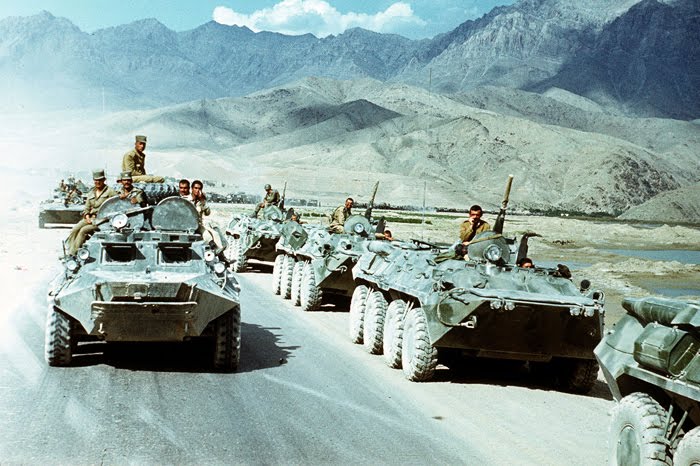
Soviet troops leaving Afghanistan, 1988. Photo by Mikhail Evstafiev / Wikimedia Commons.

Part 12: 1987-1992
A People’s History of Afghanistan

By Bob Feldman / The Rag Blog / June 21, 2010

[If you’re a Rag Blog reader who wonders how the Pentagon ended up getting stuck “waist deep in the Big Muddy” in Afghanistan (to paraphrase a 1960s Pete Seeger song) — and still can’t understand, “what are we fighting for?” (to paraphrase a 1960s Country Joe McDonald song) — this 15-part “People’s History of Afghanistan” might help you debate more effectively those folks who still don’t oppose the planned June 2010 U.S. military escalation in Afghanistan? The series so far can be found here.]

In 2010 more than 600 individuals were still imprisoned by the Democratic Obama Administration at its Bagram detention facility in Afghanistan, and many of these Bagram prisoners have apparently been held without access to lawyers or an opportunity to legally challenge the basis of their imprisonment for as long as six years.

Yet none of the U.S. government officials responsible for escalating the covert and overt U.S. military intervention in Afghanistan since the 1970s have ever been held legally accountable for the morally disastrous humanitarian effects their policies have had on the history of people in Afghanistan.

Yet in April 1986, the People’s Democratic Party of Afghanistan (PDPA)-Parcham faction leader who had been installed in late December 1979 by Soviet troops as the head of the PDPA regime in Afghanistan — Babrak Karmal — was replaced by the former head of the PDPA regime’s secret police, Dr. Mohammad Najibullah, after Najibullah was elected by the PDPA’s Central Committee to be its new general secretary.

Subsequently, on January 1, 1987, the new PDPA regime head of state attempted to bring peace to the people of Afghanistan and negotiate an end to the 1980s Afghan war by announcing a “program of `national reconciliation’ comprising three key elements: a six-month unilateral cease-fire, the formation of a government of `national unity’ and the return of over 5 million refugees from Pakistan and Iran,” according to Angelo Rasanayagam’s Afghanistan: A Modern History. The same book also recalled:

An “Extraordinary Supreme Commission for National Reconciliation” was set up and branches were opened all over the country. Their job was to make contact with refugees… in exile or fighting with resistance groups, pass on the message of peace, and distribute essential relief items for the use of returning refugees. Other inducements offered were tax concessions, the return of confiscated property and the deferment of military service.

Radio Kabul started calling the Mujahideen fighters “angry brothers” rather than “bandits.” Some 4000… prisoners were released. Six months later, just before the expiring of the 6-month ceasefire, Najibullah was able to claim that 59,000 refugees had returned; tens of thousands of men were negotiating with the government; 4,000 representatives of the opposition had been included in the reconciliation committees; and coalition governments had already been formed in several villages, sub-districts, districts and provinces.”

But the alliance of seven U.S., Pakistan, and Saudi government-sponsored anti-feminist Afghan political parties apparently “turned down with disbelief and contempt” the January 1987 peace proposals of the PDPA regime in Afghanistan. As the same book explained:

The Islamic parties… claiming to represent the Mujahideen resistance had developed into vested interests that were not receptive to power-sharing arrangements. They and their Pakistani sponsors, replete with funds and weapons generously contributed by “the international community,” developed their own agendas for a post-Soviet Afghanistan…The parties owed their “influence” to the fact that they served as somewhat porous conduits for the U.S. and Saudi funds and weapons channeled to the resistance fighters inside Afghanistan by Pakistan’s ISI [Inter-Service Intelligence]…

Ironically, “a survey among Afghan refugees conducted in 1987 by one of Afghanistan’s outstanding academics and intellectuals, Professor S.B. Majrooh, found that less than half a percent of those polled would choose one of the seven” Afghan Islamic political party “leaders to rule a free Afghanistan,” according to Afghanistan: A Modern History. Coincidentally, the Union of Mujahideen (a coalition of these seven unpopular Islamic parties) apparently then arranged for Professor Majrooh to be assassinated in his office in Peshawar on February 11, 1988, shortly after his survey results were made public.

Yet despite the rejection of its January 1987 peace proposals by the U.S., Pakistani and Saudi government-sponsored Islamic parties, the PDPA regime extended its unilateral January 1987 ceasefire in Afghanistan for another six months in June 1987, and it invited its right-wing Afghan political opponents to suggest changes in the draft of a proposed new Afghan constitution which it published in July 1987.

The proposed new Afghan constitution — that set up a democratic, multiparty parliamentary political system in Afghanistan in which Islam was the state religion — was then formally approved by the PDPA regime’s parliament (jirga) in November 1987.

On February 8, 1988, the Gorbachev regime in the Soviet Union next announced that on May 15, 1988, it would start to withdraw the 85,000 Soviet troops still in Afghanistan, and that it would have all Soviet troops pulled out of Afghanistan by March 15, 1989.

Parliamentary elections were then held in Afghanistan in April 1988 in which the National Fatherland Front [NFF] and other newly formed Afghan parties won more seats in the new, democratically-elected Afghan parliament than did the PDPA — which just won 22 percent of the parliamentary seats. In addition, 25 percent of the seats in the lower house of the new Afghan parliament were left vacant for representatives of the Islamic opposition parties in Afghanistan- — that were still unwilling to negotiate an agreement in 1988 that would finally bring peace to Afghanistan.

A peace agreement between the Pakistani government and the Afghan government — guaranteed by both the Reagan Administration and the Gorbachev regime in the Soviet Union — was, however, signed on April 14, 1988. But after the withdrawal of all Soviet troops from Afghanistan was completed in February 1989, Pakistan’s “ISI drew up the battle plans and arranged the logistics, the intelligence and the communications,” for a March 7, 1989, attack from Pakistan by its Afghan Mujahideen units, according to Afghanistan: A Modern History.

Although the Mujahideen quickly “captured the government base of Samarkhel, 12 miles south-east of Jalalabad,” their march to the local airport “ran into heavy resistance.” As Afghanistan: A Modern History observed, “despite human wave assaults and a heavy bombardment of the city that cost over 2,000 mostly civilian lives, the Muhajideen could not advance any further. And in July 1989 the Afghan government military forces were able to easily retake its Samarkhel base, where they found that 70 captured Afghan army officers had been murdered by the ISI-organized Mujahideen.”

Without the support of any Soviet troops, the army of the Najibullah regime’s Afghan government in 1989 was also able to defend Jalalabad “against the most massive attack ever undertaken by the Mujahideen during the whole war,” according to Afghanistan: A Modern History.

And, despite a failed coup attempt by the Minister of Defense of the Afghan government regime in March 1990, Najibullah’s regime did not collapse until there was a successful 1992 Afghan military coup which, according to Dator Zayar’s October 2001 “Afghanistan: An Historical View” article, was “planned by the CIA and ISI” and “prepared the way for the capture of Kabul by the Islamic fundamentalists.”

Afghan President Najibullah then announced in early April 1992 that he would resign as part of a UN-brokered transition of power and “Kabul now became the scene for a power struggle between four main armed” Mujahadeen “groups,” according to Afghanistan: The Mirage of Peace by Chris Johnson and Jolyon Leslie.

By April 1992, the commanders of the various Mujahideen guerrilla groups were also deriving a major source of their personal income from Afghanistan’s lucrative drug trade. As Trinity College Professor and International Studies Program Director Vijay Prashad wrote in his “War Against The Planet” article that was posted on the CounterPunch website:

The opium harvest at the Pakistan-Afghan border doubled between 1982 and 1983 (575 tons), but by the end of the decade it would grow to 800 tons. On June 18, 1986, the New York Times reported that the Mujahideen “have been involved in narcotics activities as a matter of policy to finance their operations.”

In his Killing Hope book, William Blum also wrote:

…Mujahideen commanders inside Afghanistan personally controlled huge fields of opium poppies, the raw material from which heroin is refined. CIA-supplied trucks and mules, which had carried arms into Afghanistan, were used to transport some of the opium to the numerous laboratories along the Afghan-Pakistan border, whence many tons of heroin were processed with the cooperation of the Pakistani military. The output provided an estimated one-third to one-half of the heroin used annually in the United States and three-quarters of that used in Western Europe…”

Next: “A People’s History of Afghanistan—13: 1992-1998″

[Bob Feldman is an East Coast-based writer-activist and a former member of the Columbia SDS Steering Committee of the late 1960s.]

  • Previous installments of “A People’s History of Afghanistan” by Bob Feldman on The Rag Blog can be found here.


The Rag Blog

Posted in Rag Bloggers | Tagged , , , , , , | Leave a comment

John Ross : An Uprising of Bones in Mexico

Tlatecuhtli, Aztec goddess of the earth, a fierce frog-like creature. The monumental 12-ton slab was discovered during an excavation beneath a popular Mexico City cantina. Photo from Noticias Azatlan Virtual.

An uprising of bones:
Macabre marks past and present in Mexico

By John Ross / The Rag Blog / June 27, 2010

MEXICO CITY — Under the martial cadence of muffled drums, the bones rolled solemnly up the elegant Paseo de Reforma atop a dozen military vehicles. Four skulls could be spotted in one large glass urn. “Look Papi, there goes Hidalgo!” a small boy pointed excitedly — one of the skulls is purported to be that of Miguel Hidalgo, the country priest who rose in rebellion in 1810 to initiate Mexico’s struggle for independence from Spain, an event whose bicentennial is being celebrated this year.

For his efforts, Hidalgo was fusilladed by a Royal firing squad then decapitated and his head hung from a public building to impress upon would-be disciples the folly of rebellion.

Other urns were full of arm bones and femurs, said to be the remains of Jose Maria Morelos, Vicente Guerrero, Guadalupe Victoria, Leona Vicaria and her lover Andres Quintana Roo, and other heroes of the struggle for independence.

The macabre military parade was captained by President Felipe Calderon this May 30th to usher in Bicentennial festivities that will climax in September. The bones of the heroes are being shifted from their crypts in the slender column that supports the gilded Angel of Independence installed by dictator Porfirio Diaz (1876-1910) just weeks before the Mexican revolution exploded a hundred years ago.

Under Calderon’s direction, they were being transported up to Chapultepec Castle, the colonial palace that overlooks the city, where experts will sort out whose bones are whose, and polish them up in anticipation of the big fiesta.

2010, of course, also marks the 100th anniversary of the Mexican revolution but the bones of the heroes of that landmark uprising of the poor are buried in their own monument, currently undergoing renovation. Of the duel centennials, the marking of the Mexican revolution has been downgraded by the right-wing president Calderon who reportedly is uncomfortable with the images of such revolutionaries as Emiliano Zapata, Francisco Villa, and others who once overthrew a conservative government.

But the bones of the heroes are not the only bones stirring in Mexico these days. In Taxco, the historic Guerrero state silver mining town, now a tourist Mecca, at least 77 cadavers were removed this June from the shuttered San Francisco Cuadra mineshaft, all of them casualties of Calderon’s never-ending drug war. Although most had been reduced to piles of bones, more recent victims were identified by striking tattoos of Santa Muerte, the death goddess of the narcos.

The bones retrieved from the Taxco mine are thought to have been deposited there by pistoleros in the employ of La Familia, a drug gang based in next-door Michoacan state, notorious for beheading its rivals. Some drug war observers link the death cult to the Evangelical prosperity gospel.

On June 16th, La Familia gunmen and federal police troops mixed it up outside Taxco. According to Mexican drug war officials, a total of 15 dead pistoleros were added to the mounting bone pile. Taxco’s stock as a tourist destination has declined precipitously since the killing spree began.

All over Mexico, the narco bones are piling up. 23,000 citizens have perished since Calderon declared war on the drug cartels 43 months ago to curry favor with Washington and garb himself in the mantle of military authority after a fraud-marred presidential election that left him with little credibility. To underscore the campaign, Calderon donned a military field jacket two sizes too big for his small, pudgy stature to the delight of the nation’s acid-penned political cartoonists.

In addition to the 23,000 dead, hundreds are missing in action, many buried in clandestine common graves like the Taxco silver mine. Families set out on federal and state highways and never arrive home. Some vanish at impromptu checkpoints set up by the military and police and the drug gangs.

A record number of bones were collected this May when 1060 died in the drug war, a 43% increase over May 2009. June has been even more horrific. This June 11th while Mexico’s national team inaugurated the World Cup football championship in South Africa, 85 new candidates for the bone pile were counted, a new one-day record.

Two 70-plus days followed. Ninteen addicts were slain in a Chihuahua City drug clinic, the fourth mass killing at such facilities in the state in the past year. In Ciudad Madero where 20 were slain, a clique known as “The Artists of Assassination” took credit for distributing the dead in a score of colonies in this Tamaulipas oil town.

A skull — perhaps that of revolutionary legend Miguel Hidalgo — seen in a glass crypt containing the bones of a dozen national heroes in Mexico , Sunday, May 30, 2010. The remains were carried through the city in a solemn Bicentennial procession. Photo by Marco Ugarte / AP.

On June 15th, 29 members of the Zeta Cartel were massacred inside a Mazatlan Sinaloa state penitentiary by rivals from El Chapo Guzman’s Pacific Cartel armed with automatic weapons. El Chapo (“Shorty”) is reputed by U.S. National Public Radio to be Calderon’s favorite narco lord. Thirty-five prisoners had previously been slaughtered in the prison since the first of the year.

On the same day as the massacre in Mazatlan, a dozen federal troops were ambushed by La Familia near Zitacuaro Michoacan in the heart of the Monarch butterfly sanctuary zone. The ambush occurred almost a year to the date of a La Familia attack that cost 10 federal police officers their lives.

With the daily body count zooming, President Calderon has been obligated to launch a media campaign in an effort to convince a dubious public that he is winning his drug war. In mid-June, the President’s public relations team bought up double truck space in every daily newspaper and weekly magazine in the country for the publication of Calderon’s 5,000-word defense of his failing policies, shifting blame for the violence to the insatiable demand for drugs of his nearest neighbor to the north which he also lamented is arming the drug cartels via thousands of gun shops strung along the 1964 mile border.

The president also put the onus on the purportedly increasing affluence of Mexicans (presumably due to his administration’s economic initiatives) that has provided them with enough disposable income to buy drugs.

Sic.

Felipe Calderon’s mobilization of the armed forces to take on the cartels has been, at best, a big bust. Sending in the troops has predictably led to massive corruption. The Mexican Army, which took over the drug war from very corruptible state and federal police, is now so untrustworthy that the Navy is being deployed in high profile operations.

Civilian security agencies are riddled with cartel infiltrators. Officials on drug gang payrolls have been uncovered in the Special Prosecutor for Organized Crime office, the Federal Police command, and even Interpol and the U.S. Homeland Security Customs & Border Enforcement. Human rights abuses have climbed to over a thousand incidents a month reported to the National Commission on Human Rights (CNDH.)

The border around Reynosa, Tamaulipas and McAllen, Texas is particularly treacherous. On June 3rd, three boys — the youngest was 13 — were gunned down by Mexican Army troops near Reynosa. The military claims they were Gulf cartel gunmen (“sicarios“). Their parents testify they were wearing their middle school uniforms when the soldiers opened fire.

Calderon’s preference for marketing the Bicentennial of Independence reflects the skittishness of his rightist PAN party to deal with class-based social upheaval. On the other side of the political ledger, the Left is focused on the possibility of renewed uprising as the nation approaches the centennial of the 1910 revolution.

Tattoo depicting Santa Muerte, the death goddess of the narcos. Image from Marzia Tattoo / Flickr.

Class tensions, exacerbated by the spiraling economic downturn; the increasing concentration of wealth in the coffers of the oligarchy; and rampant injustice are seen as signposts towards a new Mexican revolution. But the Left may have missed the boat. Indeed, if revolution can be defined as the violent overthrow of a sitting government, the new Mexican revolution has already begun:

  • Item — Narco commandos are in the field inflicting double-digit casualties on federal security forces such as in the June 15th ambush in the Monarch butterfly sanctuary. Police and military outposts and prisons have been repeatedly overrun by such commandos.
  • Item — Revolutionaries seek to demonstrate to the masses that the government can no longer protect them. The recent spate of bloody massacres seems to be directed to this end.
  • Item — On June 9th, Monterrey youth gangs affiliated with the Zetas shut down that northern industrial city, blocking central thoroughfares and freeways with stolen trailer trucks, tourist buses, and earth-moving equipment at rush hour, a stunt that would make many left revolutionaries salivate. A similar shutdown in April was rumored to have provided the Zetas with free access to move troops and weapons through this strategically located metropolis.
  • Item — “Plata o plomo” (“silver or lead”), the slogan of the drug gangs when dealing with the political parties and elected officials, is operative. Candidates for all three major parties have been threatened, bribed, and sometimes assassinated in the run-up to state elections this July. The kidnapping of a powerful politico and possible PAN presidential candidate is another indicator that an armed struggle for state power is in process.

Amidst dibilitating narco wars and bicentennial ballyhoo, older bones are rising to the surface these days.

Deep beneath the Templo Mayor or Great Temple in Mexico City’s old quarter where the Aztec emperors butchered tens of thousands of warriors to win the blessings of Tlaloc, the god of the rain, and Huitzilopochtli, the sun at mid-day, the bones of the ancients are rattling around as never before.

In 2006, at the foot of the altar to Tlaloc on the corner of Guatemala and Argentina Streets, the National Institute of History and Anthropology (INAH) began to excavate a site beneath a popular cantina, El Seminario. Ten meters down, the diggers hit pay dirt: a monumental 12-ton slab depicting the Tlatecuhtli, the Aztec goddess of the earth, a fierce frog-like creature that had been buried for five centuries following the fall of the Mexica empire to the European invaders.

Archeologist Eduardo Matos Mocuhtezuma, on whose watch the earth goddess was uncovered, speculates that the Tlatecuhtli was installed by the Emperor Mocuhtezuma II (no relation) to cover the tomb of Ahuizotl, one of the most powerful of Mexica rulers.
Although the bones of Ahuizotl have not yet been located, the discovery of many offerings (“ofrendas“) — textiles, gold jewelry, tiny figures of Aztec deities — indicate a new find is imminent.

This May 17th, the Tlatecuhtli, which has broken into four large sections and is missing a four foot section where its viscera should be, was painstakingly carried into the Templo Mayor museum to be the centerpiece of an exhibition documenting the “Time and Destiny” of Mocuhtezuma’s governance — his fall in 1521 amidst multiple signs of doom and gloom marked the end of the Aztec empire.

As they were 500 years ago, these are apocalyptical times. The deluge of bones here is accompanied by premonitions of cataclysm: global warming, a deadly Gulf of Mexico oil spill, terrifying acts of violence and vengeance.

Laid out on an immense bier, the Tlatecuhtli is visible from three stories above the museum floor. Viewed from on high, she seems immersed in beatific repose, her heavy lids turned demurely downwards and her serrated tongue dangling comically from her open mouth. Capped by a crown of caracoles (snails) she is perched on thick claws that communicate maximum animal power.

Jesus, a breakfast companion at the Café La Blanca, studies the photo in the morning daily, La Jornada. “Wow! What do you think will happen to us if she ever wakes up?” he wonders.

[John Ross lives in Mexico City a few blocks from the Tlatecuhtli and the subject of his latest cult classic El Monstruo: Dread & Redemption In Mexico City (“gritty & pulsating” — New York Post.) He is can be fingered at johnross@igc.org.]

The Rag Blog

Posted in Rag Bloggers | Tagged , , , , , | 1 Comment

Payoff Time in the Gulf : Hitting the Petro Jackpot


Everyone loses:
Hitting the Petro-Jackpot

The gulf is carpeted with long wide dark and slimy rainbow slivers and miles of weathered henna colored crude oil mousse…

By Larry Ray / The Rag Blog / June 26, 2010

GULFPORT, Mississippi — Winds, tides and ocean currents, changing like spinning wheels on a slot machine, have finally lined up to announce a Petro-Jackpot! Floating and submerged oily, syrupy petroleum filth is the unwelcome payoff as it finally glides into the Mississippi Sound.

BP’s uncontrolled gusher of oil has assaulted our protective pristine offshore barrier islands and now is flowing into the shallow marine nursery grounds off the Mississippi coastal shoreline. The gulf is carpeted with long wide dark and slimy rainbow slivers and miles of weathered henna colored crude oil mousse that bob and drift toward the horizon. This menace is now within sight of our miles of white beachfront along coastal Highway 90.

The futility of pleading “Somebody do something!” becomes evident. Trying to skim and contain the millions of gallons of floating oil before it comes ashore is like trying to scoop up and dispose of billions of flu germs from ten thousand sneezes. Oil, assisted by a rolling sea, splashes over and eases under so-called oil containment booms. Also consider that we have had a daily heat index here averaging 100º to 108º for the past month. Suffocating heat adds to the futility of trying to sop up oil and tar before it arrives to coat the blazing beach sand.

All the political rhetoric, naive denial, and assurances that “our beaches” are pristine and somehow exempt from the nautical nuance of Ma Nature, has stopped. The hastily produced TV commercials showing happy kids splashing along our water’s edge, and couples strolling on the beach with a setting sun turning the water golden have been pulled off the air.

Now multi-faceted environmental damage begins right here on the beaches and in the seafood-rich waters fronting Gulfport and Biloxi. Recovering from this long term damage will not be like recovering from Hurricanes Camille and Katrina. The area around Valdez, Alaska has yet to truly recover from a much smaller amount of oil carelessly loosed on its shores 21 years ago when a fully loaded Exxon oil tanker ran aground splitting open its tanks just offshore.

Looking at today’s NOAA oil trajectory map, above, one can visualize a double lobed, fat tube of 30-weight toothpaste being squeezed, with the cap having been unscrewed right at the flat line just off Gulfport. Governor Haley Barbour has urged churches to have special prayer services. I wonder if entreaties to a higher power to cause the deluge to somehow miss “our area” suggest that the glop would be prayed away to “some other area?” This has puzzled me since I was a little kid.

During an active hurricane season here a few years ago a large evangelical church’s sign on a main Gulfport street proclaimed, “Glory… God turned the storm!”

A category three hurricane, indeed, veered away from our coast right into Florida causing several deaths and terrible destruction in the tens of millions of dollars.

How about we call off the location-specific prayer tug-of-war and instead all go take a nice walk down the beach in a couple of weeks?

There’s lots of power in reality checks too.

[Retired journalist Larry Ray is a Texas native and former Austin television news anchor. He also posts at The iHandbill.]

The Rag Blog

Posted in RagBlog | Tagged , , , , , , | 1 Comment

Robert Jensen : Emotional Reactions to Collapse

Anguish. Image from Fixing My Life.

The anguish of the age:
Emotional reactions to collapse

By Robert Jensen / The Rag Blog / June 26, 2010

We live amidst multiple crises — economic and political, cultural and ecological — that pose a significant threat to human life as we understand it.

There is no way to be awake to the depth of these crises without an emotional reaction. There is no way to be aware of the pain caused by these systemic failures without some experience of dread, depression, distress.

To be fully alive today is to live with anguish, not for one’s own condition in the world but for the condition of the world, for a world that is in collapse.

Though I have felt this for some time I hesitated to talk about it in public, out of fear of being accused of being too negative or dismissed as apocalyptic. But more of us are breaking through that fear, and more than ever it’s essential that we face this aspect of our political lives. To talk openly about this anguish should strengthen, not undermine, our commitment to political engagement — any sensible political program to which we can commit for the long haul has to start with an honest assessment of reality.

Here is how I would summarize our reality: Because of the destructive consequences of human intervention, it is not clear how much longer the planetary ecosystem can sustain human life on this scale. There is no way to make specific predictions, but it’s clear that our current path leads to disaster.

Examine the data on any crucial issue — energy, water, soil erosion, climate disruption, chemical contamination, biodiversity — and the news is bad. Platitudes about “necessity is the mother of invention” express a hollow technological fundamentalism; simply asserting that we want to solve the problems that we have created does not guarantee we can.

The fact that we have not taken the first and most obvious step — moving to a collective life that requires far less energy — doesn’t bode well for the future.

Though anguish over this reality is not limited to the affluence of the industrial world — where many of us have the time to ponder all this because our material needs are met — it may be true that those of us living in relative comfort today speak more of this emotional struggle. That doesn’t mean that our emotions are illegitimate or that the struggle is self-indulgent; this discussion is not the abandonment of politics but an essential part of fashioning a political project.

I would like help in this process. I’ve started talking to people close to me about how this feels, but I want to expand my understanding. By using the internet and email, I am limiting the scope of the inquiry to those online, but it’s a place to start.

My request is simple: If you think it would help you clarify your understanding of your struggle, send me an account of your reaction to these crises and collapse, in whatever level of detail you like. I am most interested in our emotional states, but any exercise of this type includes an intellectual component; there is no clear line between the analytical and the emotional, between thinking and feeling. An understanding of our emotions is connected to our analysis of the health of the ecosystem, the systems responsible for that condition, and the openings for change.

Because I may draw on this material in public discussions and for writing projects, please let me know how you are willing to have your words used. Your writing could be: (1) “on background,” not to be quoted in any forum; (2) “not for attribution,” permission to be quoted but not identified; or (3) “on the record,” permission to be quoted and identified. If you don’t specify, I will assume (2).

My plan is to report back to anyone interested. If you would like to be included on that distribution list, let me know. Please send responses in the body of an email message, not as an attachment, to robertwilliamjensen@gmail.com.

Whether or not you write to me, I hope everyone will begin speaking more openly about this aspect of our struggle. If there is to be a decent future, we have to retain our capacity for empathy. Most of us can empathize with those closest to us, and we try to empathize with all people. The next step is to open up to the living world, which requires an ability to feel both the joy and the grief that surrounds us.

Editor’s note: For those of you who wish to share your responses with other readers of The Rag Blog, please also post your thoughts as comments to this article. (Use the “comments” function at the end of this post.)

[Robert Jensen is a journalism professor at the University of Texas at Austin and board member of the Third Coast Activist Resource Center in Austin. He is the author of All My Bones Shake: Seeking a Progressive Path to the Prophetic Voice, (Soft Skull Press, 2009); Getting Off: Pornography and the End of Masculinity (South End Press, 2007); The Heart of Whiteness: Confronting Race, Racism and White Privilege (City Lights, 2005); Citizens of the Empire: The Struggle to Claim Our Humanity (City Lights, 2004); and Writing Dissent: Taking Radical Ideas from the Margins to the Mainstream (Peter Lang, 2002). Jensen is also co-producer of the documentary film Abe Osheroff: One Foot in the Grave, the Other Still Dancing, which chronicles the life and philosophy of the longtime radical activist.]

The Rag Blog

Posted in Rag Bloggers | Tagged , , , , | 5 Comments

Paul Krassner : Why Firing the General Was an Act of God

Cartoon by Larson / The Far Side / The Mutt’s Nuts.

Why firing the General
Was an act of God

By Paul Krassner / The Rag Blog / June 25, 2010

  1. The volcano in Iceland was considered an Act of God.
  2. Smoke from the volcano caused countless flights to be canceled.
  3. The Rolling Stone correspondent was stuck in Paris.
  4. Embedded there, he hung around with talkative drinkers.
  5. They revealed stuff while forgetting it was being told to a reporter.
  6. He wrote in his article what they had said.
  7. The fact checkers verified those statements.
  8. The article was shown to Barack Obama.
  9. Whether he fired McChrystal or didn’t, Republicans would criticize.
  10. The president fired the general, ultimately due to an Act of God.

The Rag Blog

Posted in Rag Bloggers | Tagged , , , , , | 2 Comments

From a legal complaint by New York Attorney General Andrew Cuomo alleging that chip maker Intel has violated antitrust laws, we also learn much about how Dell has been doing business. Dell allegedly accepted $6 million in secret rebates from Intel between 2002 and 2007, and the SEC is apparently looking into the legality of the relationship between the two tech giants. Incidentally, we also note that Dell received $853 million in military contracts in 2009. Story by Bob Feldman.

Posted in RagBlog | Leave a comment

Texas Republicans : A Platform for Atilla the Hun

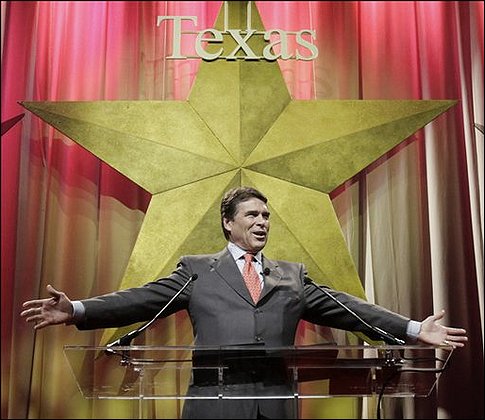
Texas Gov. Rick Perry welcomes the flock at the first general session of the Republican Party of Texas convention on June 11, 2010, in Dallas. Photo from AP.

A document for the (middle) ages:
Platform of the Texas Republican Party

By Ted McLaughlin / The Rag Blog / June 24, 2010

The Texas Republican Party held its convention a couple of weeks ago in Dallas. To say the Texas branch of the Republican Party is right wing is a vast understatement. They make Attila the Hun seem like a bleeding-heart liberal. It’ll probably give you some idea of where they stand to know that one of the main speakers at their kick off dinner was Rep. Michele Bachmann, the extremist right-winger from Minnesota.

But to really get the feel of how extreme the Texas Republicans are, one needs to read the Texas Republican Platform. Here are just a few of the things in that platform that these Republicans would like to see (and the comments in parentheses are mine):

  • Want deep-water drilling to continue in the Gulf of Mexico and other places. (A crazy notion in the midst of the current oil disaster, and one that is at odds with the majority of Americans.)
  • Want to abolish the Energy Department. (Makes no sense in light of global climate change and our need to find and develop alternate energy sources.)
  • Want to abolish the Education Department. (This would give fundamentalist-controlled local school boards even more power — creationism anyone?)
  • Want to abolish the Internal Revenue Service and institute a national sales tax. (To protect the rich and put a greater percentage of the tax burden on the poor, working and middle classes.)
  • Want to withdraw this country from the United Nations. (With a military budget like the U.S. has, who needs diplomacy?)
  • Oppose the establishment of time frames for withdrawal from Iraq or Afghanistan. (Because eternal war is good for business and the dead soldiers are mainly poor, working class or minority.)
  • Support the “democratically-elected” governments in Afghanistan and Iraq. (They may be corrupt puppets, but they are our corrupt puppets.)
  • Want to abolish Affirmative Action. (Because the white power structure must be maintained.)
  • Want to eliminate the Endangered Species Act. (Our grandkids wouldn’t want to have those animals around taking up space that can be used by Big Business.)
  • Want to outlaw driver’s licenses for undocumented immigrants. (Will we be safer if all these drivers are unlicensed and uninsured?)
  • Want to let religious organizations engage in politics without fear of losing their tax-exempt status and want to eliminate the separation of church and state. (Because a theocracy is much better than a democracy.)
  • Want to eliminate the Employment Non-Discrimination Act. (Because businesses should be able to discriminate against anyone they want.)
  • Want to abolish Supreme Court jurisdiction in abortion, religious issues, and the Bill of Rights. (Because rights are only for white Christian males.)
  • Want to require a presidential candidate to submit a birth certificate before they can be placed on the state’s ballot. (The “birthers” are alive and well — and Republican.)
  • Want English adopted as the official language. (Even though Spanish was spoken for hundreds of years in Texas before English was.)
  • Want to abolish “no-fault divorce” laws. (Because it should be difficult for a person to get out of an abusive marriage.)
  • Want to ensure marriage can only be between a “natural man and a natural woman.” (Because equal rights shouldn’t apply to all citizens.)
  • Want to re-institute sodomy laws and deny the Supreme Court the right to review the law. (In spite of the fact that both of these would be unconstitutional.)
  • Want to make it a felony crime to issue a marriage license to a same-sex couple. (If they have to force discrimination they are willing to do it.)
  • Want all human life respected from fertilization to natural death. (A fancy way of saying a woman should not have the right to control over her own body.)
  • Support the death penalty and want to extend it to rape cases. (What happened to respect for human life until natural death?)
  • Want to outlaw the sale and use of RU-486 and any other “morning-after pills.” (But you can bet they’ll oppose the government taking care of the unwanted babies this would cause.)
  • Want to eliminate social security and the social security tax and transition to “private pensions.” (Because retirement should only be for those who can afford it — not poor or working class folks.)
  • Want to “defund, repeal and reject” the health care act passed by U.S. Congress and signed by President Obama. (Because health care is a privilege for the rich — not a right for everyone.)
  • Oppose government mandating the vaccination of children. (Because a plague every now and then is a good thing.)
  • Oppose pre-school, kindergarten and any government programs dealing with early childhood development. (Wouldn’t want kids to actually be ready for school or they might learn to think for themselves.)
  • Support “open carry” laws and oppose “Gun Free Zones.” (Because everyone should always be armed, especially in schools, bars, churches, and courthouses.)
  • Support the formation of an armed state militia. (Because you just can’t have too many nuts carrying guns.)
  • Want the Minimum Wage Law to be repealed. (Because workers and families don’t really need to have a decent standard of living.)
  • Oppose the Fourteenth Amendment which gives citizenship to anyone born in the U.S. (Especially brown people who may soon make whites a minority.)
  • Oppose a Palestinian state being carved out of “historical Israel.” (Because that would lead to a two-state solution and peace in the Middle East).

These are just a few of the nutty ideas proposed in the Texas Republican platform. Does this sound like the kind of America you want to live in and leave for your children? I urge you to go read this very scary document in its entirety. The America these people want to create would be a terrible place for anyone not white, male, and rich.

The Republicans don’t just want a return to the 1950s — they want to go all the way back to the 1850s. Is there any remaining doubt that the Republican Party in Texas has been taken over by right-wing extremist fringe elements?

[Rag Blog contributor Ted McLaughlin also posts at jobsanger.]

The Rag Blog

Posted in Rag Bloggers | Tagged , , , , , | 5 Comments

Roger Baker : Karl Marx, the Tea Party, and our Political Economy

A Tea Party take on the economy. Photo from the Los Angeles Times.

The shifting currents of
Our political economy

By Roger Baker / The Rag Blog / June 23, 2010

Marx used to refer to what we now call the “economy” as “the political economy,” because he realized that economics is really built on the constantly shifting social foundation of culture and politics, and law derived from politics. The latter factor sets the rules and laws for the marketplace to follow. There is no better current proof of the reality of this point of view than the example of the stock dividend take-back that was forced onto BP.

Now it looks like the rules of acceptable economic behavior may be shifting. In this context, maybe Obama should be seen as the political product of the times we are living in, and not as the bold source of change that some had hoped that he would be. Obama was chosen as a leader during a time when a frightened U.S. public wanted to secure and restore and prolong the previously happy economic times of the Greenspan-era long credit bubble expansion.

When times get hard, and when government policies seem ineffective, the populace tends to become angrier and to seek out stronger medicine, usually by demanding a stronger, bolder leader of some kind. In the absence of tangible reform coming from current Democratic Party control, the Tea Party sentiment is dynamic and growing as a sort of a backlash. Here is a rather good social analysis of its internal contradictions.

The Tea Party supporters commonly want the government to stop spending and increasing what they see as their future tax obligations. However, the facts argue that without the current rapidly growing federal deficit, the U.S. economy would fall flat on its face. As we have recently heard, almost all the most recent jobs growth was due to temporary government census jobs, whereas very few jobs were created by private sector investment.

I suspect that many of the Tea Party supporters do not oppose government spending per se, so much as they oppose the current corporate-pandering pattern of public spending, which certainly has various class favoritism implications. To me it looks like an angry, screwed middle class lashing out at a dysfunctional government that is deeply resistant to reform, but thought more likely to lean on the poor than the wealthy when put under pressure.

There is no end to the need for sensible federal government reforms. We should applaud the part of the Tea Party sentiment that is genuinely opposed to the burden of corporate welfare policies that block cost reform. We can decide to disagree on whether we need to spend what we save on corporate welfare for desperately needed emergency shelter, food stamps, and lifeline social services. It is the guys at the top that mostly caused the problem, not the largely minority jobless population at the bottom.

As Monbiot says, there are deep contradictions built into these angry and hard-to-predict political movements. The “drill baby drill” crowd is being forced to confront the naked corporate profit motives of BP in the Gulf (while the environmental policies there might not be as bad as for production in Venezuela or the Nigerian Delta).

Let us shift to the big picture and what might keep the Tea Party and the rest of the U.S. public unhappy, and thus U.S. politics unsettled. Prudent Bear‘s Doug Noland is a fine economic analyst in terms of knowing which official numbers to focus on and where to find them, which is nowadays perhaps the most important skill of a good independent (and properly skeptical) economist.

Here I have cherry-picked a few snips from his recent essay that cite some of the key numbers at the heart of his argument:

…In only 21 months (seven quarters), outstanding federal debt increased $3.274 trillion or, 48.9%, to $9.971 trillion. Over this period, federal debt growth has been running at an unprecedented rate of about 13% of gross domestic product (GDP). As a percentage of annual GDP, federal debt jumped from 46% to 68% in only seven quarters. Of course, the amount of outstanding debt is dwarfed by the federal government’s massive contingent liabilities (ie future healthcare, social security and pension obligations). There is, as well, the festering issue of the government-sponsored enterprises (GSEs)… Massive fiscal stimulus has succeeded — for now — in stabilizing national incomes (and spending!)…

Q1 Federal expenditures were up 13.2% y-o-y to SAAR $3.654 trillion, or 25% of GDP (receipts up 2.2% y-o-y to $2.301 trillion). Keep in mind that annual federal expenditures surpassed $1.8 trillion for the first time in 2000. Less than a decade later, spending is running more than double this level. Federal expenditures were less than 19% of GDP in 2000; less than 20% in years 2001-2002; less than 21% in 2003-2007; 21.6% in 2008; and 24.2% in 2009. In contrast, federal receipts, which began the decade at about 20%, were 15.6% of GDP in 2009 and were running at 15.7% in Q1 2010…

Massive federal borrowings have sustained U.S. financial and economic recoveries. These recoveries have bolstered acutely vulnerable state and local finances. So far, (over-liquefied and speculative) markets have accommodated the ongoing accumulation of government debt at quite low interest rates. Some have compared US governmental finances with those of Greece, while others have dismissed such talk as ludicrous. It is fair to say that the U.S. system has built — and continues to build — enormous risk to rising market yields and/or debt market disruption. I would argue that this risk is more dangerous than previous bubble vulnerabilities to mortgage credit disruptions — risks identifiable during those bubble years right there in the Fed’s “flow of funds” credit data…

What is ultimately at issue here is whether the current classic Keynesian approach of massive and increasing U.S. stimulus spending can restart the engine of private business job growth here in the USA, or elsewhere. The current signs are not very good. There are few signs of U.S. private business expansion yet, for the simple and logical reason that betting on a solid non-inflationary economic recovery does not now look like a smart long range investment risk to take. Peak oil adds doubt.

Wallerstein recently (and as usual) describes the situation plainly. Here he points out that the world’s nations are in essentially lurching from cure to cure in search of economic relief, confronted with rising debt and lower private growth and profits:

Impossible choices in a world depression
By Immanuel Wallerstein / June 15, 2010

“…Of course, there is one big place to reduce expenditures — the military. Military expenditures do provide jobs but far fewer than if the money were used otherwise. This does not apply only to the biggest spenders like the United States. A virtually uncommented aspect of Greece’s debt problems was its heavy expenditure on the military. But are governments ready to reduce significantly military expenditures?
It doesn’t seem too likely.

So, what can the states do? They are trying one thing today, and another thing tomorrow. Last year, it was stimulus. This year, it’s debt reduction. The year after, it will be taxation. In any case, the overall situation will be worse and worse…

The way out of all of this is not some small adjustment here or there — whether of the monetarist or the Keynesian variety. To emerge from the economic box in which the world finds itself requires a fundamental overhaul of the world-system. This will surely have to come, but how soon?

Who has the vision to see what productive U.S. investments, even the obviously needed ones in energy, are profitable over a 10-year time frame, given this unpredictable global investment climate? The current investment climate uncertainty is enough to challenge Warren Buffett and the others.

The bankers, who largely get to decide what happens, can see that most U.S. investment in the production of real consumer goods is risky in the context of a global crisis, and with a debt-ridden, aging U.S. population as investment security. There remains the impossible-to-meet Chinese price competition in producing consumer goods. This means that the dollar must surely shrink in value against the yuan; the best we can probably anticipate from this is a soft landing transition to a lower standard of living for U.S. consumers.

For now, the U.S. government keeps printing and lending, although a big renewed expansion of federal stimulus is in doubt because of the politics. All the while, the top officials in the U.S. government must know that the game has to end at some point, and that interest rates must rise to reflect the true investment risk, and that the dollar must be devalued.

This increasing instability will probably have to become known through some unpredictable event like Greece, panicking an already edgy global finance market. All we can say for sure is that the current policies are making things continually less stable, and encouraging an outcome of that kind.

[Roger Baker is a long time transportation-oriented environmental activist, an amateur energy-oriented economist, an amateur scientist and science writer, and a founding member of and an advisor to the Association for the Study of Peak Oil-USA. He is active in the Green Party and the ACLU, and is a director of the Save Our Springs Association and the Save Barton Creek Association. Mostly he enjoys being an irreverent policy wonk and writing irreverent wonkish articles for The Rag Blog.]

The Rag Blog

Posted in Rag Bloggers | Tagged , , , , , , | 5 Comments

Dick J. Reavis : How Davy Crockett Really Died

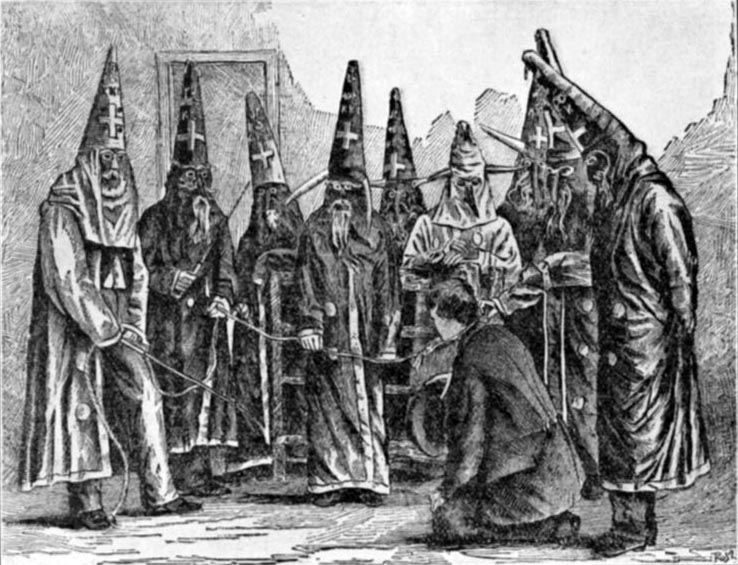
Costumed Klansmen plying their trade. Image from University of North Carolina.

The true story:
David Crockett and the KKK
in San Antonio

By Dick J. Reavis / The Rag Blog / June 23, 2010

During a bout of recent microfilm reading in the pages of an old and obscure newspaper, I discovered who killed Davy Crockett and how he died. The story reporting it is below. Perhaps history buffs in San Antonio will be able to help me flesh out this startling Texana find:

SAN ANTONIO, Tex.—David Crockett, 24 year-old jobless white worker, is believed to have been “done away with” by Klansmen, following his disappearance and the finding of his bullet-shattered automobile.

“Warning. We are certain you raised the Ku Klux Klan issue in this campaign,” said a note he received the day before his disappearance. “If you want to remain in good health, tend to your own private business and leave us alone.” The note was signed “K.K.K.”

The issue of the right of Negroes to vote in the Democratic primary has again been raised in this present campaign, with many demanding this right following a U.S. supreme court decision supporting upholding it. Negroes are, nevertheless, still barred from the primaries and the Texas supreme court has upheld this rule.

The trick of this story is revealed in its headline: “K.K.K. ‘Gets’ White Texan.” It is from the Sept. 1934 of the Southern Worker, a newspaper published by the Communist Party in Birmingham, Ala.

It leaves much untold. Who was this David Crockett? A city directory would tell us, and so, too, might copies of the July or August issues of the “boss” dailies in San Antonio. (I am not in Texas. If anyone wants to volunteer to do the library work, I’d be much obliged.)

Maybe David Crockett, the one mentioned here, ought to be a hero for the Left in Texas!

[Dick J. Reavis, a contributor to the original Rag, is a professor in the English department at North Carolina State University. He can be reached at dickjreavis@yahoo.com .]

The Rag Blog

Posted in Rag Bloggers | Tagged , , , , , , | Leave a comment

Michael Dell : Did He Violate Texas Antitrust Laws?

The artist as a young nerd: Michael Dell at Dell Computers production facility in Austin, 1989. At age 24 he was already a multi-millionaire. Photo by Rebecca McEntee / AP / Academy of Achievement.

Monopolies in Texas

A new era of antitrust regulation in Texas began with the enactment of the Texas Free Enterprise and Antitrust Act of 1983 (Texas Business & Commerce Code, ch. 15), which is based on federal antitrust law. Unlawful practices, defined as in the federal statutes, include: “every contract, combination, or conspiracy in restraint of trade or commerce;” to monopolize, or to attempt or conspire to monopolize, “any part of trade or commerce;” and tying arrangements and acquisition of stock or assets that lessen competition substantially…

The legislature… made it clear that the act would apply to Texas activities and conduct even if they also affect interstate commerce… The attorney general may sue for civil fines of up to $1,000,000 against a corporation… District attorneys may bring felony prosecutions against persons who enter into a contract, combination, or conspiracy in restraint of trade or commerce, or who monopolize, or attempt or conspire to monopolize, any part of trade or commerce. …The attorney general also was authorized to bring civil suits under federal antitrust laws.

The Handbook of Texas

Did Dell and Intel’s years of collusion
Violate U.S. and Texas antitrust laws?

By Bob Feldman / The Rag Blog / June 23, 2010

In recent years, Dell Inc. Chairman of the Board Michael Dell has been among the richest of the Texas Rich. Personally worth around $13.5 billion, Dell was ranked by Forbes magazine in 2010 as the 37th-wealthiest billionaire on earth.

Coincidentally, in his November 3, 2009, legal complaint against Intel, which alleges that U.S. antitrust laws were violated by Intel, New York Attorney General Andrew Cuomo also makes some interesting observations about how executives at Texas billionaire Dell’s firm have allegedly been doing business in recent years. According to the New York Attorney General’s complaint:

…Intel for years paid Dell lump-sum rebates…

…As Dell’s lead negotiator with Intel put it in a Dec. 7, 2004 email to his Intel counterpart, explaining that Michael Dell wanted an additional $400 million rebate payment from Intel. “This is really easy… MSD [Michael Dell] wants $400 M [million] more. I’ve been trying to figure out the structure.”

Dell’s profitability… came to depend on Intel rebate payments. This was dramatically illustrated by internal Intel emails in April 2004, arriving from Dell’s need to finalize its earnings forecast for the coming quarter. Essentially Dell asked Intel for an additional $100 million…

Absent Intel’s anticompetitive acts, prices to consumers would have been lower…

As AMD [Advanced Micro Devices] was beginning to threaten Intel’s dominance, Dell and Intel formed a partnership in which, in exchange for exclusivity, Intel paid Dell billions of dollars, assured it of a preferred supply of chips over its competitors, and collaborated with Dell to submit below-cost bids in strategic contests against AMD’s products…

This arrangement lasted for at least five years, from 2001 to 2006… As Intel’s payments increased, Dell became more and more dependent on Intel for its reported profits…

In pure dollar terms, Dell was far and away the leader in receiving Intel’s largess. For example, over the four year period from February 2002 to January 2007, it received approximately $6 billion in “rebates.” Most of this money was furnished to Dell under programs initially titled “MOAP” and then “MCP.” “MOAP” was an acronym standing for “Mother of all Programs.” The term MOAP was later replaced in the lexicon by another acronym “MCP” which purportedly (and misleadingly) stood for “Meet Competition Payments.” Both generally referred both to Dell’s global percentage based rebates and to lump-sum payments made by Intel to Dell during the relevant period…

Intel also assured Dell of “preferred” supply… Internal Intel emails show that satisfying 100% of Dell’s demand was a top priority for Intel…

In return for exclusivity, Dell sought terms from Intel that were more favorable than those Intel extended to its other largest and most favored customers…

Intel did in fact grant Dell significant financial advantages…

…Intel encouraged Dell to make below-cost bids, with Intel subsidies, when competing against AMD-based server products…

Over the coming years, Intel and Dell fell into a pattern of negotiating the amount of Intel’s subsidies to Dell on a nearly continuous basis… In each successive round of negotiations, the groundwork was usually laid by mid-level executives at both companies tasked with conveying messages and “positioning” to and from the other so that top executives at both firms would know what to expect when they met…

After the meeting on July 9, 2002, [former Dell Inc. Chief Operating Officer] Kevin Rollins reported to Michael Dell that the result of the meeting was that Intel was willing to increase payments to Dell and seemed willing to do “whatever it takes” to keep Dell from purchasing from AMD. Rollins wrote “They got the message that we were very serious… and seem to want to do whatever it takes to persuade us… Initial word is that our MOAP should increase from $70 M this qtr to $100 mm.”…

In September 2003, Intel’s then Chairman and CEO Craig Barrett met with Michael Dell to address the basic relationship between the companies. He reported back to his Intel colleagues that he and Michael Dell “shook hands on the deal. MD [Michael Dell] agreed to quarterly mtgs… to make sure we are aligned in our strategic issues and coordinated in spending the monies. He had no issue with the win/win nature of the agreement. I clearly committed our long range support regardless of competition… Nice work you guys!”…

An internal Dell email reported that under the new arrangement, Intel was making a $40 million lump sum payment in order to maintain Dell’s status as an Intel-only CPU [Central Processing Unit] buyer…

…A Dell executive wrote on January 19, 2004: “This is very scary… HP (and IBM) can bracket our server business by using AMD to beat us on price…” Another Dell executive agreed, writing that Intel had “better be down here sucking up with a bag-o-money.”…

Top Dell and Intel executives met and Intel again agreed on substantial increases in rebate levels; Dell would now receive a “base” rebate of 11% of its processor purchases from Intel, up from 7%, for not switching to AMD. In addition, they also agreed on another 3% in “incremental” or “variable” rebates, for a total of up to 14%. Dell’s lead negotiator estimated that the “new MCP” would be worth $400 million to Dell over the twelve month period from April 1, 2004 to March 31, 2005. Indeed, around that time, Intel’s payments to Dell started to reach figures of $100 million per quarter or more.

…Dell’s quarterly profit margins had become dependent on Intel’s payments. A comparison of Dell’s reported net income with the rebates it received from Intel for some quarterly periods show that, by 2004, the rebate payments amounted to more than a third of Dell’s earnings. For the 3 month period between August and October of 2004, Dell received approximately $304 million in rebates from Intel and reported income of $846 million, so that the rebates amounted to 36% of net income. Thereafter, the proportion of rebates to net income rose steeply. In 2006, Dell received approximately $1.9 billion in rebates from Intel, and in two quarterly periods of that year, rebate payments exceeded reported net income. From February to April of 2006, rebates ($805 million) amounted to 104% of net income. The following 3 months, between May and July of 2006, the proportion was even higher, 116% ($554 million of rebates and $480 million in net income).

In one instance, Dell asked Intel to retroactively increase the size of its payment to stabilize Dell’s forecasted earnings. In several early Sunday morning emails in April 2004, Intel’s Austin-based Dell lead negotiator alerted top Intel executives to an urgent Dell request regarding “our meet comp response for Dell considering new data from msd [Michael Dell] on Friday.” Dell needed to finalize its margin forecast for the coming quarter, but needed “direction” from Intel: “dell is finalizing their call the qtr today. They need direction from us. They are asking for $100 upside to old MC deal…”…

Later the same day, another Intel executive clarified Dell’s request in an email directed to [current Intel Chairman of the Board] Paul Otellini who was Intel’s chief operating officer at the time. He informed Otellini that Dell had assumed that its new agreement with Intel for increased subsidies would be retroactive to the beginning of the current fiscal year in February.

In an April 8 email to Michael Dell and Kevin Rollins, Dell’s lead negotiator with Intel described the outcome of Dell’s request to Intel as follows: “…We got what we needed to meet expectations ($60M) in the form of increased MCP and programs… I think we got all we could in one 30 day period.”

As this episode shows, Intel’s payments to Dell did not benefit consumers through better products… or lower prices…

By September 2004, Dell’s tone was becoming strident…

On December 6, 2006, Intel’s Otellini emailed Intel’s Dell account representative about his concern that Dell would defect to AMD… The next day, the Intel executive promptly forwarded this email on to Dell’s lead negotiator with a plea for help in securing “incremental support” for Dell…

…Dell’s lead negotiator emailed back: “This is really easy. MSD [Michael Dell] wants $400 M more. I’ve been trying to figure out the structure…”

…What the payment bought was Dell’s commitment to “maintain” exclusivity…

In fact, Intel’s payments to Dell shot upward, roughly doubling in less than one year…

…Intel subsidized below-cost bids by Dell when it was bidding against competitors selling AMD-based computers and servers to large businesses or other “enterprise” customers…

…Over a period of approximately two years, from approximately mid-2004 to mid-2006, the reports show tens of thousands of bids…

In the summer of 2005, Intel and Dell held another round or rebate negotiations…

…Intel increased its payments to Dell to an unprecedented level. According to figures provided by Dell, Intel’s payments ($471 million) amounted to 78% of Dell’s reported net income ($606 million) for the period August to October of 2005.

…In May [2006], Intel sought a deal with Dell… Under that deal, Intel was to make further payments to Dell in return for continued exclusivity outside the multi-processor server segment. Dell’s Rollins wrote in a June 1, 2006 email that he was trying to get $250 million still from Intel…

Despite this agreement, by September of 2006, Dell… announced further AMD products…

…For February, March and April 2006, Intel had paid Dell approximately $800 million in rebates…

Besides allegedly accepting around $6 billion in secret rebates from Intel between 2002 and 2007 (in apparent violation of U.S. and Texas antitrust and anti-monopolization laws), Texas Billionaire Dell’s firm also was the target of a lawsuit by the New York Attorney General a few years ago, on charges of having violated New York State’s consumer protection laws. As a September 15, 2009 press release of the Office of New York’s Attorney General noted:

Attorney General Andrew M. Cuomo today announced that Dell and its subsidiary, Dell Financial Services (DFS), have agreed to pay the Attorney General’s Office $4 million in restitution, penalties and costs to resolve charges of fraudulent and deceptive business practices that scammed consumers across New York State.

The settlement follows a decision of the New York Supreme Court, Albany County, which sustained Attorney General Cuomo’s claims that Dell had engaged in fraud, false advertising, deceptive business practices, and abusive debt collection practices. The court’s decision came as a result of the original lawsuit filed by Cuomo’s Office, which charged that Dell engaged in bait and switch advertising with respect to its “no interest” financing promotions, misled consumers to believe they had qualified for promotional financing, failed to adequately disclose the terms of its “next day” service contracts and failed to provide consumers with warranty service and promised rebates…

According to the Court’s decision upholding the Attorney General’s lawsuit, Dell deprived consumers of the technical support to which they were entitled under their warranty or service contract by: (1) repeatedly failing to provide timely on site repair to consumers who purchased service contracts promising “on site” and expedited service; (2) pressuring consumers, including those who purchased service contracts promising “on site” repair, to remove the external cover of their computer and remove, reinstall, and manipulate hardware components; and (3) discouraging consumers from seeking technical support: those who called Dell’s toll free number were subjected to long wait times, repeated transfers, and frequent disconnections.

The court concluded that Dell lured consumers to purchase its products with advertisements that offered attractive “no interest” and/or “no payment” financing promotions. In practice, however, the vast majority of consumers, even those with very good credit scores, were denied these deals. In a classic “bait and switch” scheme, DFS instead offered consumers financing at high interest rates, which often exceeded 20 percent. Dell and DFS frequently failed to clearly inform these consumers that they had not qualified for the promotional terms, leaving many to unwittingly finance their purchase at high interest rates.

The decision also held that DFS incorrectly billed consumers on cancelled orders, returned merchandise, or accounts they did not authorize Dell to open, and then continually harassed these consumers with illegal billing and collection activity. Although many consumers repeatedly contacted Dell and/or DFS to advise them of the errors, DFS did not suspend its collection activity and Dell failed to expeditiously credit consumers’ accounts, even after assuring consumers it would do so. As a result, many consumers have been subjected to harassing collection calls for months on end and have had their credit ratings harmed.

In addition to allegedly accepting $6 billion in secret rebates from Intel (whose board of directors currently includes Harvard Business School Professor David Yoffie, University of California-Berkeley Vice-Chancellor Frank Yeary, Stanford University Professor James Plummer, Dartmouth College Trustee John Donahoe, former Yahoo President Susan Decker, former FCC Chairman Reed Hundt, former U.S. Trade Representative Charlene Barshefsky, and members of the Berkshire Hathaway, Estee Lauder, American Express, McKesson corporate boards), Dell also accepted $853 million worth of U.S. War Machine contracts in 2009, making it the 51th-largest recipient of juicy Pentagon contracts these days.

One reason NBC News, MSNBC, CNN, and Time Magazine might not be that eager to broadcast or print many exposes about either Dell’s alleged acceptance of secret rebates from Intel or its violations of U.S. consumer protection laws is that former U.S. Senator and current Dell Inc. board member Sam Nunn also sits on the board of GE — the parent company of NBC News and MSNBC (in addition to also sitting on Chevron/Unocal’s corporate board); and a recent Dell Inc. board member named Michael Miles sits on the board of Time-Warner — the parent company of CNN and Time Magazine.

Yet in recent months the U.S. Securities and Exchange Commission (S.E.C.) has also apparently begun to look into the legality of the relationship between Texas billionaire Dell’s firm and Intel. As the New York Times (6/10/10) recently observed, “the disclosure that the S.E.C. has been investigating aspects of the relationship between the two companies is new, as is its focus on Mr. Dell” and “a person briefed on the case, who agreed to speak on the condition of anonymity because the investigation is confidential, said that the S.E.C.’s allegations related to how Dell accounted for payments and rebates that it had received from Intel.”

As long ago as 1998, Current Biography noted that Michael Dell owned “about 16 percent of his company’s stock” and was “thus a multi-billionaire and the richest man in Texas.” So it’s not surprising that despite Dell Inc.’s alleged acceptance of rebates from Intel in apparent violation of U.S. anti-trust laws, many U.S. politicians have apparently been accepting a lot of money in campaign contributions from Texas billionaire Dell during the last 16 years.

Since 1994, for example, U.S. politicians have accepted nearly $900,000 in campaign contributions from Michael Dell (and $330,000 in campaign contributions from his wife, Susan), according to the Center for Responsive Politics website.

So it’s not likely that many U.S. politicians are going to ask the Texas Attorney General to look into whether or not Dell Inc.’s alleged acceptance of about $6 billion in secret rebates from Intel between 2002 and 2007 violated state law.

[Bob Feldman is an East Coast-based writer-activist and a former member of the Columbia SDS Steering Committee of the late 1960s.]

The Rag Blog

Posted in Rag Bloggers | Tagged , , , , , | Leave a comment

Friday in Austin : Free Marilyn Now!

CLICK ON IMAGE TO ENLARGE

Join us in Austin this Friday:
Free Marilyn Buck Now!

By Alice Embree / The Rag Blog / June 23, 2010

A benefit for Marilyn Buck this Friday, June 25, will raise funds and gather healing energy for the former Austinite. Slated for release on parole this August, Buck was diagnosed with cancer late last year. Her plans for starting life over at age 62 now must be amended to allow for recuperation and healing.

Marilyn Buck, an award-winning poet originally from Austin, was convicted of politically-motivated crimes in the 1970s and 1980s. She has spent 25 years in prison. She earned two college degrees, taught herself Spanish in order to communicate with and for Latina prisoners, and organized AIDS education and literacy classes in prison. She won respect as a principled voice for the rights of oppressed people, especially women, people of color, and other political prisoners.

Benefit organizer Mariann Wizard shared a moving and personal tribute to Marilyn that appeared recently on The Rag Blog. The benefit will bring together those who knew Marilyn when she worked on Austin’s underground newspaper, The Rag (predecessor to The Rag Blog), and those who have only known of her as a political prisoner.

The benefit will feature music by Karen Abrahams and Riders Against the Storm, poetry by Joe P. Carr, and remarks by Robert King of the Angola 3. Benefit hosts include NOKOA, The Rag Blog/New Journalism Project, Resistencia Bookstore, Ex-pinta Support Alliance, Ecology Action, One Love Kitchen, South Austin Popular Culture Center, and YES, Inc/Phogg. Supporters include the Angola 3, Austin Jail Project, Bookwoman, MonkeyWrench Books, Ruby’s Bar-B-Que, Teatro Vivo, Threadgills, and many more.

The benefit will take place 7-11, Friday, June 25th at 3105 E. Cesar Chavez. $10 at the door is requested and advance tickets are available at Resistencia Bookstore and Planet K stores.

If you can’t attend the Austin benefit, you can contribute to Marilyn Buck’s support by sending a check to:

Youth Emergency Service, Inc.
P.O. Box 13549
Austin, TX 78711

Make sure to note “for Marilyn Buck” on the contribution.

Robert King and Mariann Wizard on Rag Radio

Robert King and Mariann Wizard were Thorne Dreyer’s guests on Rag Radio on KOOP 91.7 FM in Austin, Tuesday, June 22.

King spent 32 years in Louisiana’s Angola prison, 29 of them in solitary confinement, for a crime he didn’t commit. King, Albert Woodfox, and Herman Wallace were active in the 1970s with the Black Panther Party while in prison, and came to be known as the Angola 3. An acclaimed BBC documentary, In the Land of the Free, narrated by Samuel L. Jackson, was released earlier this year. The film explores the facts surrounding the Angola 3’s incarceration.

Mariann Wizard joined Dreyer and King on the show to discuss Marilyn Buck’s case and the upcoming benefit. Tuesday’s program is now on the Rag Radio archives, and you can listen to it here.

Rag Radio airs every Tuesday from 2-3 p.m. (CST) on KOOP 91.7 FM, and can be streamed live on the internet here.

The Rag Blog

Posted in Rag Bloggers | Tagged , , , , , , , , , , , | 4 Comments

Harvey Wasserman : Fire McChrystal and Get Out of Afghanistan. Now.

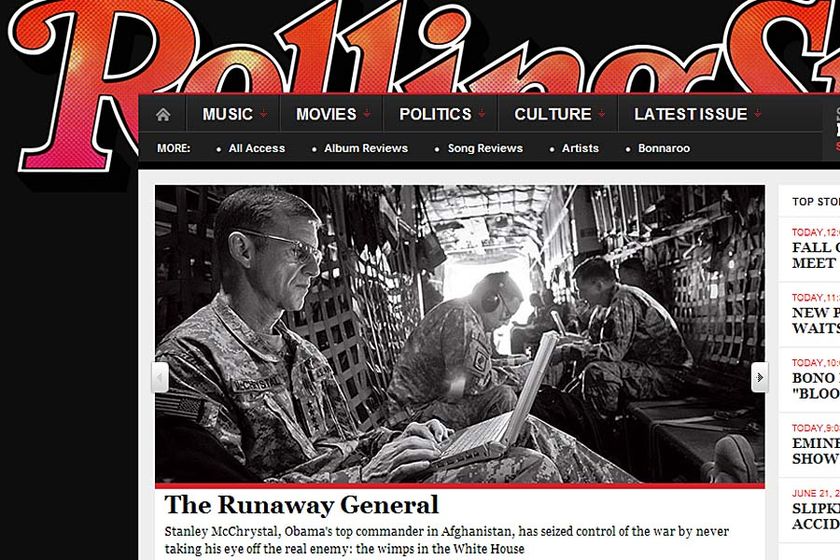
Rolling Stone: The Runaway General. Image from ABC News.

Fire General Stanley McChrystal and
Get out of Afghanistan NOW

By Harvey Wasserman / The Rag Blog / June 22, 2010

President Obama must fire General Stanley McChrystal and get out of Afghanistan… for starters.

There is much more at stake here than meets the eye.

History is full of generals with deep contempt for democracy.

General McChrystal has a very particular significance. Last year, as Obama weighed the Afghan situation, McChrystal circumvented him entirely. In an act of profound public contempt, the general went directly to the world media with a high-profile campaign that was entirely inappropriate to a civilian democracy.

He should have been fired right then and there.

But McChrystal used the brass on his chest to sell the nation a bill of goods — that the war in Afghanistan could be “won.” It would be “difficult,” of course, requiring “sacrifice.”

But exactly what “victory” meant, and how that would make the United States safer, more just and prosperous, was never clear.

What WAS clear was who would die and who would pay.

But with the corporate media lapping up his every word, McChrystal upstaged the numerous political, strategic, financial, and military experts who disagreed with him.

The plunge into the Graveyard of Great Powers was by no means a consensus decision among either the experts or the public.

McChrystal became to Afghanistan what William Westmoreland was to Vietnam — the go-to guy on the plunge to war. The results have been catastrophic.

Like Westmoreland, McChrystal has been proven dead wrong on just about everything. The war’s only foreseeable “accomplishment” is to drain our treasury and weaken our nation. We hear snippets of “progress” here and insider reports of “victories” there, and lately a recycled old story about vast mineral wealth. But it’s deja vu all over again, a ghastly Southwest Asian rerun of the debacle in Southeast Asia.

Cover of Stars and Stripes, June 22, 2010. Image from SF Gate.

Stanley McChrystal has failed as a general, and as a citizen.

It would be easy to say his comments as they appear in Rolling Stone are an aberration, that he was caught off-guard expressing his contempt for the President, the Vice President and the rest of us.

But in this day and age, that may be naive. We have a volunteer army and a President inclined to avoid definitive decisions. Our rights as civilians were not easily won. To preserve them, as Jefferson said, we must be “eternally vigilant.”

The Roman republic disintegrated when generals began disobeying elected leaders and taking personal control of their armies.

In the midst of our own Civil War, President Abraham Lincoln fired his contemptuous, incompetent General George McClellan and eventually replaced him with Ulysses S. Grant, who won a war worth winning. McClellan ran against Lincoln for the presidency in 1864. He lost. Thankfully, he had no personal army to overturn the decision.

During the Korean War, General Douglass MacArthur contemptuously disobeyed President Harry Truman. Truman resolutely fired him. As he told TIME Magazine at the time:

I fired him [MacArthur] because he wouldn’t respect the authority of the President… I didn’t fire him because he was a dumb son of a bitch, although he was, but that’s not against the law for generals. If it was, half to three-quarters of them would be in jail.

It took another General, Dwight Eisenhower, to bring finally the troops home. But come they did.

Barack Obama cannot let Stanley McChrystal return to Afghanistan. He needs to fire him immediately, and replace him with someone who will end that war.

The stakes we can see are huge. The ones we can’t may be even greater.

[Harvey Wasserman’s History of the United States is at www.harveywasserman.com, along with Solartopia! Our Green-Powered Earth.]

The Rag Blog

Posted in Rag Bloggers | Tagged , , , | 1 Comment