Bay of Pigs Invasion : Blows up in Kennedy’s Face

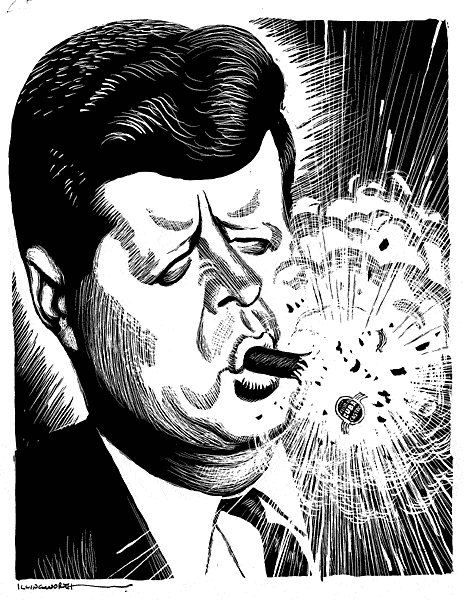
Cuban cigar: Bay of Pigs invasion blows up in JFK’s face. Cartoon by Leslie Gilbert Illingworth (1902-1979) / Illingworth Collection / National Library of Wales.

Decades of foreign policy folly:
Cuba and the Bay of Pigs invasion

The Bay of Pigs fiasco suggests that U.S. foreign policy decision-makers almost always misjudge the will of the people who would be subjected to military action.

By Harry Targ / The Rag Blog / April 19, 2010

I was a student at the University of Illinois during the 1960-61 academic year. Like so many of my generation, I was modestly curious about the Cuban Revolution which had occurred a year earlier. I worked in the cloak room of the student union with two fellow students who were counterrevolutionary Cubans. We argued all the time about the revolution. If only Castro would hold elections they said, we would support whatever candidates prevailed.

I had read a short piece in The Nation during the fall of 1960 warning of a group of anti-Castro Cubans training for a military intervention. I had put that out of my mind until my fellow cloak room workers began to talk in February 1961 about “something (that) was going to happen.”

I also remembered going to a student organized panel on Cuba that included my cloak room colleagues and other counterrevolutionaries. There was one student (the panel had seven participants as I remember) who defended the revolution. It was clear that the defender of the revolution was not liked by the others.

I went to work on April 17, 1961, to discover that I would be covering the cloak room alone. It seems that one of my Cuban colleagues scheduled to work with me that day had gotten in his car and driven to Miami, apparently ready to join the second wave of what became known in the U. S. as the Bay of Pigs invasion.

On that day 1,400 anti-Castro Cubans invaded Cuba at a place known as Playa Giron. Days before air attacks on Cuban airfields were carried out by unmarked U.S. planes, but President Kennedy chose not to provide air support when the invasion occurred because the world would think the U.S. was behind the invasion.

The invasion, planning for which began in the Eisenhower Administration, was cooked up by the Central Intelligence Agency. The CIA argued that once an invading force landed on the island, the Cuban people would rise up to overthrow the new government. I personally experienced the folly of that assumption when I saw my cloak room Cuban friend return to work about three days later. By the time he reached Miami by car the invasion had been crushed. There was no spontaneous uprising.

The Bay of Pigs invasion of 49 years ago is commemorated every year in the municipalities of La Habana province. One report refers to this year’s celebration as marking “the first defeat of imperialism in the Americas.”

Historical research makes it clear that the United States was opposed to the revolutionary movement led by Fidel Castro and Che Guevara well before the revolutionaries marched into Havana in January 1959. When Eisenhower realized that Fulgencio Batista was vulnerable to defeat, the president desperately sought a replacement who would not threaten U.S. banking, tourist, and sugar interests on the island.

President Eisenhower, deeply troubled by Castro’s victory, refused to meet with the Cuban leader when he came to the United States in April 1959. Over the next two years U.S. and Cuban actions and reactions deepened the hostility between the superpower and the island nation. These included the opening of Cuban relations with the Soviet Union, the refusal of U.S. oil companies to refine Soviet oil, and the Cuban seizure of the refineries. Dramatically, the U.S. ended the purchase of Cuban sugar and Cuba responded by nationalizing U.S. banks and other businesses on the island.

In March 1960 Eisenhower directed the CIA to begin planning for an invasion of the island carried out by counterrevolutionary Cubans. The Eisenhower team had successfully ousted from power both Iranian Prime Minister Mohammed Mossadegh in 1953 and Guatemalan President Jacob Arbenz in 1954. He probably thought a move on Cuba could lead to a similar success.

When President Kennedy assumed office in 1961, the CIA presented the new president with the Bay of Pigs invasion plan. During the fall 1960 presidential campaign Kennedy had criticized his presidential opponent, Richard Nixon, for allowing Communism to come to Cuba. So JFK’s support of the invasion was no surprise.

When JFK brought the CIA plot to an early April meeting of the National Security Council, almost no one felt free to raise questions about the plot (even though State Department polls indicated the overwhelming support the revolution had among the Cuban people). The National Security Council endorsed the plot.

After the failure Fidel Castro declared Cuba a Socialist state and President Kennedy declared that the U.S. would not rest until the Cuban regime was ousted from power. Kennedy fully institutionalized the economic blockade against Cuba that still exists today.

Revisiting the Bay of Pigs invasion after 49 years suggests some historic features of U.S. foreign policy and decision-making style.

First, as admirably described by Stephen Kinzer in Overthrow, the United States had been engaging in efforts to undermine and overthrow independent governments around the world, and particularly in the Western Hemisphere, ever since it took Hawaii in the 1890s. In fact, the Cuban revolution of 1898 against Spanish colonialism was usurped by U.S. forces followed by a full-scale occupation of the country, then indirect economic and political domination, lasting until 1959. The U.S. imperial vision regarding Cuba goes as far back as the era of the founding fathers. Thomas Jefferson, among others, had declared that Cuba ought to be part of the United States.

Second, as so many accounts of U.S./Cuban relations suggest, the interests of the Cuban people never figured in U.S. policy toward the island. The economic blockade and diplomatic embargo of the island has amounted to a 50 year effort to strangle, not only the regime, but the Cuban people. Others must be forced to sacrifice for the U.S. imperial agenda.

Finally, the Bay of Pigs fiasco suggests that U.S. foreign policy decision-makers almost always misjudge the will of the people who would be subjected to military action. Ruling classes, by their very nature, are unable to understand the interests, passions, and visions of the great masses of people. The director of the CIA and other members of the President’s inner circle were incapable of understanding that the Cuban people supported their revolution so they ignored State Department polling data.

The United States continues to make these mistakes virtually everywhere.

[Harry Tarq is a professor in American Studies who lives in West Lafayette, Indiana. He blogs at Diary of a Heartland Radical.]
The Rag Blog

Posted in Rag Bloggers | Tagged , , , , , , , | 3 Comments

Teabaggers Notwithstanding : Reform Mostly a Flop

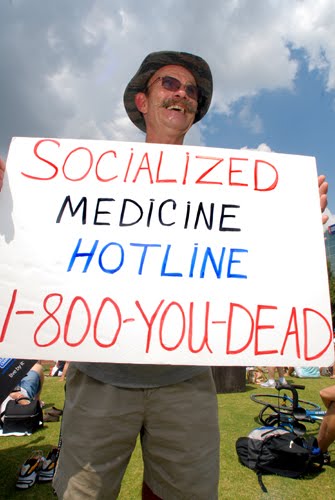
Sophisticated analysis of health care reform by Atlanta teabagger, Aug. 15, 2009. Photo by Joeff Davis / Creative Loafing.

Still not so good:
Reflecting on health care reform

By Dr. Stephen R. Keister / The Rag Blog / April 19, 2010

After a period of relaxation and reflection my attention returned to the recent health care legislation.

Two recent TV programs stirred me up. First, a poll on MSNBC’s The Ed Show found that 96% of those responding feared that the irrational hate mongering by the right wing zealots and their militia associates would in the near future bring violence upon the United States

Second, PBS’s Frontline showed how the Obama administration acceded to the wishes and dictates of the health insurance and pharmaceutical industries in crafting its ludicrous health care legislation

Ed’s poll results on MSNBC fit my own feelings about the obvious drift of our nation and the paradox of the teabaggers and their kin violently demonstrating against their own best interests, naively bending to the propaganda fueled with the financial support of Charles and David Koch, billionaire sons of Fred Koch, who in 1958 founded the John Birch Society.

This brings to mind words written at an earlier time, in another country:

“The art of leadership consists of consolidating the attention of the people against a single adversary and taking care that nothing will split up this attention… The leader of genius must have the ability to make different opponents appear as if they belonged to one category. Tell big lies. Do not hesitate or stop for reservations. The masses are always more easily corrupted in the deeper strata of their emotional natures than consciously, and thus fall victims to the big lie rather than the small lie, since they themselves often tell small lies but would be ashamed to resort to large-scale falsehoods.

Vehemence persuades the masses — the louder the statement the more plausible it seems — and passion convinces them. The masses always respond to compelling force… Since they have only a poor acquaintance with abstract ideas their reactions lie more in the domain of the feelings, where the roots of their positive as well as their negative attitudes are implanted.” — Mein Kampf, 1923

I will not once again attempt to psychoanalyze the frightening antics of the Tea Party movement and their claque since this has been done so well in recent articles on The Rag Blog by Sherman DeBrosse (here and here) and by Harry Targ. I am always intrigued by the vitriolic rebuttals appearing in the comments following such articles written by the Faux News crowd, who are too cowardly to sign their names.

As to the health care legislation, which more aptly is a half-assed attempt at health insurance reform, rational folks keep wondering about the antipathy to this legislation from the Republican Party. This is difficult to comprehend, since it is a near mirror image of the extremely flawed Massachusetts health care legislation passed during the tenure of then Republican Governor Mitt Romney.

Why are the critics so paranoid about legislation that gave the health insurance industry exactly what they wanted: compulsory enrollment of all Americans in private, profit making, insurance plans, and no public option to provide competition to the private insurers.

Further, it guaranteed the continued profitability of the pharmaceutical industry through behind the scenes negotiations with the White House. In all 2000-plus pages of the legislation there is little that specifically deals with health care per se, as the hearings on the bill very carefully excluded the folks actually involved in the health care scenario — the patients and their physicians.

There could have been true health care reform if Congress had instead passed the30-page HR 676, the legislation proposed by the 17,000 member Physicians for a National Health Program and their hundreds of supporting professional and patient oriented organizations.

There is little to indicate that the health care legislation will make the United States once again a world leader in care of our sick and disabled. The British Medical Journal on March 30 published an article By David U. Himmelstein and Steffie Woolhandler entitled “Obama’s reform: no cure for what ails us,” that was also published on the PNHP web site.

And even The Council on Foreign Relations published a critical piece by Senior Fellow for Global Health, Laurie A. Garrett, called “Health Care Reform: Global Impressions.”

It appears that the general public hasn’t the vaguest idea of what is included in the bill. The U.S. Census mailings were preceded, in what my opinion, was an unnecessary mailing telling me that I would be getting a census form. If the powers-that-be in Washington can fund such seemingly useless but clearly expensive mailing, why cant Health and Human Services underwrite a nationwide explaining in simple language the legislation and its benefits.

Perhaps such information would undercut the prevailing foolishness spewing from the propaganda machines of the U.S. Chamber of Commerce, The Heritage Foundation, Faux News, and the like, that the legislation is “socialist,” and places bureaucrats between patients and their doctors. It appears that only the opponents of the Obama Administration are capable of providing the general public with information about such matters, even if it is inaccurate.

It is past time that the Democrats awaken and try and repair some of the damage done to their progressive base before the November elections.

The health care legislation does little or nothing to control costs of health care. (As a matter of fact, if Massachusetts is an example, health care costs will rise.)

Congress did not place the health insurance companies under the anti-trust law, nor did they enact mandatory health insurance price controls as are present in Germany or Switzerland where universal health insurance is provided by a regulated private insurance industry.

The current legislation does, in fact, do some positive things. It provides dependent coverage in individual and group health plans for young adults under aged 26. There is a prohibition on individual and group plans from imposing lifetime limits on the dollar value of benefits. It is required that health care plans offering individual health insurance policies must cover certain preventive services and immunizations.

It creates a temporary high-risk pool to cover people with preexisting conditions, with individuals and small groups buying coverage through state-based health insurance exchanges beginning in 2014. There is a minimal benefit in payment to primary care physicians; however, there is little included to induce medical school graduates to undertake primary care and thus slow down the increasing shortage of primary care physicians..

The law further prohibits private “Medicare Advantage” plans from charging enrollees more than original Medicare for certain services, including chemotherapy administration and skilled nursing care, but not until 2011. At the same time certain deductibles and coinsurance services will be eliminated as was recommended by the U.S. Preventive Task Force. No other benefits will come into effect until 2013 0r 2014. There will be gradual closure of the doughnut hole under Medicare Part D through 2020.

Meanwhile, it is worthy of note that, in Pennsylvania, Pittsburgh’s Highmark, Inc. (Blue Cross/Blue Shield) reported total revenues at $13.7 billion, up about $700 million over 2008. The region’s dominant health insurer also makes a point — as it does each year — to show that its net income margin of 1.4% is well below that of the nations largest insurers, such as Aetna, Cigna, and Well-Point.

The company’s surplus is now up to $3.4 billion, while total health insurance membership dropped slightly — from 4.8 million members to 4.7 million. Thus, it should be noted that many premiums increased 50% this year.

One of the more bizarre contentions about health care reform – and one that has stirred up paranoia – is the rumor that patients will be implanted with microchips. This has been thoroughly debunked.

I fear for my country. My ancestors have been here since the early 1700s. They settled in Western Pennsylvania and were active at the Battle of Bushy Run in the French and Indian War. They were prominent historically throughout the ensuing years, including the founding of Pershing Park outside of Latrobe, Pa, in honor of a cousin of my grandmother’s cousin Gen. John Pershing.

I came on board in 1921 and have witnessed nearly a century. Never have I been so apprehensive about my daughter’s and her husband’s future, and those of my grandson and his wife, as we view the increasing elimination of the middle class and the steady move toward a regime dominated by the far right.

We are hearing the voices of hate and intolerance, as we become ever more subservient to the international corporations. We are rapidly becoming a society in which the very rich dominate the very poor — who, in their misery, do not give a damn.

In short we approach the status of a Third World nation, with the haves totally dominating the have nots.

[Dr. Stephen R. Keister, a regular contributor to The Rag Blog, lives in Erie, PA. He is a retired physician who is active in health care reform.]

The Rag Blog

Posted in Rag Bloggers | Tagged , , , , | 3 Comments

See How Easily You Can Control Glucose Level to Prevent Diabetes

By Kristina V. Ridley / The Rag Blog / April 18, 2010

Our pancreas is affected by diabetes — specifically, Type 2. Our body contains glucose found in the blood stream, which it gets from the sugar in food. Our body uses the glucose, but only when it goes into our blood cells and the insulin released by our pancreas converts it. Insulin production and utilization is difficult for someone who lives with Type 2 diabetes. There is a lot of glucose in the body, but your cells cannot locate it.

When it comes to this medical condition, the American Diabetes Association plays a big role in amassing important information. Our country is considered to be an unhealthy one because 23.6 million of the populace has been diagnosed with Type 2 diabetes.

Type 2 diabetes has at least an indirect effect on 90 percent of the populace. Diabetic people (who are also somewhat overweight), unsurprisingly have relatives who also possess the same condition. The presence of too much glucose in your body could lead to irreparable damage to both the internal organs and the entire nervous system as well.

Living with diabetes

The easiest and the most efficient way to treat your Type 2 diabetes is through healthy living practices on a daily basis. Among these practices include eating healthy and engaging in exercise. These healthy practices, performed regularly, will have an enormous lasting and positive effect on you. To avoid health complications, many doctors recommend that you ensure that the glucose levels in your body are within the appropriate range.

The blood glucose level in your body can easily be monitored simply by using the finger prick test. Such a test is as good as an HbA1c test when it comes to checking and tracking your glucose fluctuations. With this test, it is possible to determine the levels of glycated hemoglobin in your body — and to know if the glucose levels are on the high side. The average level which diabetics maintain, as per the A1c test results, is at seven percent. A 40% reduction in the possibility of developing risks is possible if people simply ensure that their a1c levels are kept at seven percent.

Being overly controlled

One of these studies, conducted at the Lancet and Swedish Medical Center in Seattle, has found that people who have median levels may be at a far greater risk of death, especially for those taking insulin. However, other tests have indicated that A1c levels of 7 percent is still perfectly healthy. Matt Davies, An accredited Endocrinologist, has stated that maintaining a 7% A1c level is healthy according to recent studies, but that physicians should always take the individual patient’s history into account prior to planning treatment.

About the Author – Kristina V. Ridley writes on precision glucose meter , her personal hobby blog focused on helping people get free information to prevent diabetes and test blood glucose at home.

Type rest of the post here

Source /

The Rag Blog

Posted in RagBlog | Leave a comment

Harvey Wasserman : Will Climate Bill Nuke Earth Day?

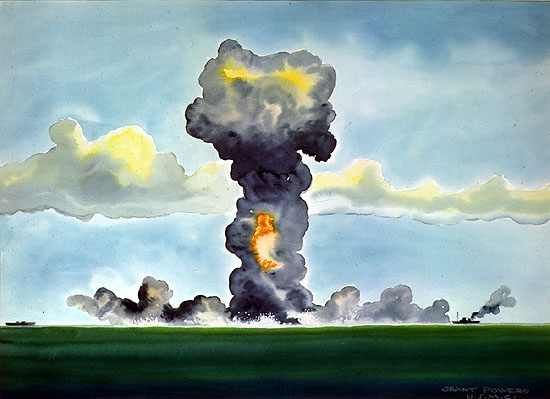
Art from 1946 atmospheric nuclear weapons tests at Bikini Atoll. “Plus 3 Seconds,” watercolor by Grant Powers, 1946 / Naval Historical Center.

Earth Day 2010:
Will climate bill be a nuclear bomb?

By Harvey Wasserman / The Rag Blog / April 18, 2010

The Climate Bill is due on Earth Day.

By all accounts it will be a nuclear bomb.

It will be the ultimate challenge of the global grassroots green movement to transform it into something that can actually save the planet.

For the atomic power industry, the bill will cap a decade-long $640-million-plus virtual cleansing of its radioactive image.

It will have the Obama Administration and Senators John Kerry (D-MA), Joe Lieberman (I-CT), and Lindsay Graham (R-SC) embracing very substantial taxpayer subsidies for building new nuclear plants.

Ditto new offshore drilling and “clean coal.” The markers have been laid for a greenwashed business-as-usual approach toward pretending to deal with global climate change and the life-threatening pollution in which our corporate power structure is drowning us. All without actually threatening certain corporate profits.

From “An Inconvenient Truth” to Obama’s impending Earth Day address, the official emphasis is on each of us, as individuals. To be sure, we ALL must consume smarter, use less and recycle more. Since the first Earth Day, all these great green ideas have had an undeniable impact.

Some corporations have also learned that pollution is by definition a form of waste, and that to actually go green is to become more profitable.

But some technologies and fuel sources have proved simply unworkable on a survivable planet. Topping the list is atomic power.

Once sold as “too cheap to meter,” atomic reactors are too expensive to matter — except for massive taxpayer subsidies.

The first commercial reactor opened at Shippingport, Pennsylvania, in 1957. Since then, the industry has failed to solve its radioactive waste problem, failed to find meaningful private liability insurance, and failed to find unsubsidized private financing for new reactors.

The handouts in the Climate Bill are sorry testimony to all that. But there’s more.

All reactors are indefensible targets for terror and error. As at Fermi, Chernobyl, and Three Mile Island, the potential for disaster is apocalyptic.

All reactors kill nearby living things — human and otherwise — from “normal” radiation releases.

All reactors also emit substantial toxic chemicals and greenhouse gases in mining, milling, enrichment, fuel fabrication, transportation, waste storage, and other related operations.

Reactors in France, Alabama, and elsewhere which have been forced shut because they super-heat rivers and lakes — all in the name of “fighting global warming.”

Selling the falsehoods that atomic energy is “carbon free,” successful in France and can “fight climate change” has been dirty and expensive.

Along the way, the industry has hired a bevy of flacks with marginal green credentials.

But on Earth Day we’ll see its crowning achievement.

Already the Administration has pledged $8.33 billion in loan guarantees to fund a double-reactor project in Georgia. The designs have not yet been certified, the price tag is soaring, there’s bitter debate over where the cash will come from and what fees should be attached, and the state’s ratepayers are on the hook even if the plant never generates electricity.

But the Administration wants more than $50 billion in loan guarantees to repeat the process elsewhere. Kerry-Lieberman-Graham have toyed with even bigger subsidies, in various forms, ranging to $100 billion and more.

Offshore drilling and “clean coal” also seem poised for new handouts.

It’s not clear what the Earth gets in exchange. Cap and trade, once the centerpiece of the whole deal, is gone. A carbon tax does not seem to be on the table. There will certainly be subsidies for various Solartopian technologies, and a headline-grabbing “surprise” or two.

But exactly what the barons of fossil/nuke will offer to justify their massive cash infusions is not yet clear.

All that’s certain is that this Earth Day, the Climate Bill will jack the debate to a whole new level.

Given soaring global carbon levels and a wasteful, obsolete economic infrastructure in serious decline, we are clearly at the precipice.

The Administration, the Congress and the country will have to decide: will we continue to subsidize failed atomic technologies and catastrophic fossil mining and drilling whose corporate backers have apparently unlimited funds for lobbying and PR?

Or do we finally turn to the truly green technologies and ways of living that can save both our planet and our economy?

The final battle starts Thursday. The outcome is up to us.

[Harvey Wasserman’s Solartopia! Our Green-Powered Earth is at www.harveywasserman.com, along with The Last Energy War. He is senior advisor to Greenpeace USA and senior editor of www.freepress.com, where this article also appears.]

The Rag Blog

Posted in Rag Bloggers | Tagged , , , , | 3 Comments

Paul Krassner : Kent State Anniversary Blues

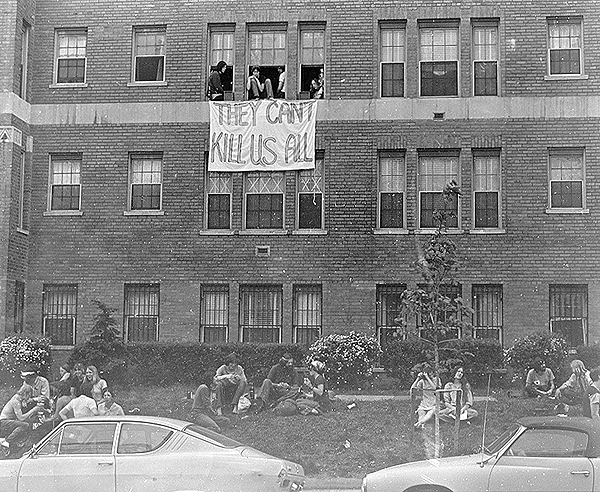
Reaction from students at New York University after the Kent State massacre. Photo from NYU Archives Photograph Collection.

Four dead in Ohio:
Kent State Anniversary Blues

By Paul Krassner / The Rag Blog / April 17, 2010

See gallery of photos, Below.

In my book, Magic Mushrooms and Other Highs: From Toad Slime to Ecstasy, Freddy Berthoff described his mescaline trip at a Crosby, Stills, Nash and Young concert in the summer of 1970 when he was 15. “Earlier that spring,” he wrote, “the helmeted, rifle-toting National Guard came up over the rise during a peace-in-Vietnam rally at Kent State University. And opened fire on the crowd. I always suspected it was a contrived event, as if someone deep in the executive branch had said, ‘We’ve got to teach those commie punks a lesson.’”

Actually, President Nixon had called antiwar protesters “bums” two days before the shootings. While Freddy was peaking on mescaline, CSNY sang a new song about the massacre:

Tin soldiers and Nixon coming
We’re finally on our own
This summer I hear the drumming
Four dead in O-hi-o…

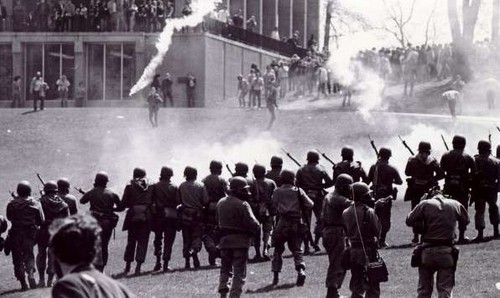
Plus nine wounded. Sixty-seven shots — dum-dum bullets that exploded upon impact — had been fired in 13 seconds. This incident on May 4, 1970 resulted in the first general student strike in U.S. history, encompassing over 400 campuses.

Arthur Krause, father of one of the dead students, Allison, got a call from John Ehrlichman, Assistant to the President for Domestic Affairs, who said, “There will be a complete investigation.” Krause responded, “Are you sure about that?” And the reply: “Mr. Krause, I promise you, there will be no whitewash.”

But NBC News correspondent James Polk discovered a memo marked “Eyes Only” from Ehrlichman to Attorney General John Mitchell ordering that there be no federal grand jury investigation of the killings, because Nixon adamantly opposed such action.

Polk reported that, “In 1973, under a new Attorney General, Elliot Richardson, the Justice Department reversed itself and did send the Kent State case to a federal grand jury. When that was announced, Richardson said to an aide he got a call from the White House. He was told that Richard Nixon was so upset, they had to scrape the president off the walls with a spatula.”

Last year, Allison Krause’s younger sister, Laurel, was relaxing on the front deck of her home in California when she saw the County Sheriff’s Deputy coming toward her, followed by nearly two dozen men. “Then, before my eyes,” she recalls, “the officers morphed into a platoon of Ohio National Guardsmen marching onto my land. They were here because I was cultivating medical marijuana. I realized the persecution I was living through was similar to what many Americans and global citizens experience daily. This harassment even had parallels to Allison’s experience before she was murdered.”

What if you knew her
And found her dead on the ground
How can you run when you know?

Now, 40 years later, Laurel, her mother and other Kent State activists have been organizing the 2010 Kent State Truth Tribunal, scheduled for May 1-4 on the campus where the slaughter of unarmed demonstrators originally occurred. The invitation to participate in sharing their personal narratives has been extended to 1970 protesters, witnesses, National Guardsmen, Ohio and federal government officials, university administrators and educators, local residents, families of the victims. The purpose is to uncover the truth.

Laurel Krause.

Laurel was 0nly 15 when the Kent State shootings took place. “Like any 15-year-old, my coping mechanisms were undeveloped at best. Every evening, I remember spending hours in my bedroom practicing calligraphy to Neil Young’s ‘After the Goldrush,’ artistically copying phrases of his music, smoking marijuana to calm and numb my pain.”

When she was arrested for legally growing marijuana, “They cuffed me and read my rights as I sobbed hysterically. This was the first time I flashed back and revisited the utter shock, raw devastation and feeling of total loss since Allison died. I believed they were going to shoot and kill me, just like Allison. How ironic, I thought. The medicine that kept me safe from experiencing post-traumatic stress disorder now led me to relive that horrible experience as the cops marched onto my property.”

She began to see the interconnectedness of those events. The dehumanization of Allison was the logical, ultimate extension of the dehumanization of Laurel. Legally, two felonies were reduced to misdemeanors, and she was sentenced to 25 hours of community service. But a therapist, one of Allison’s friends from Kent State, suggested to Laurel that the best way to deal with the pain of PTSD was to make something good come out of the remembrance, the suffering and the pain.

“That’s when I decided to transform the arrest into something good for me,” she says, “good for all. It was my only choice, the only solution to cure this memorable, generational, personal angst. My mantra became, ‘This is the best thing that ever happened to me.’ And it has been.” That’s why she’s fighting so hard for the truth to burst through cement like blades of grass.

[Paul Krassner’s latest book is an expanded edition of his 1993 autobiography, Confessions of a Raving, Unconfined Nut, available at paulkrassner.com. This piece was also published in High Times magazine.]


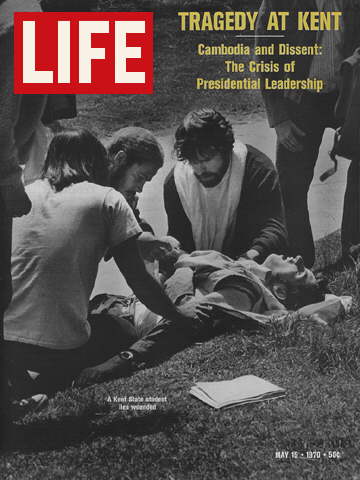
Mary Ann Vecchio kneels over the body of Jeffrey Miller after the Kent State shootings, May 4, 1970. Pulitzer prize winning photo by John Paul Filo / Valley News-Dispatch. Filo was a journalism student at Kent State at the time.

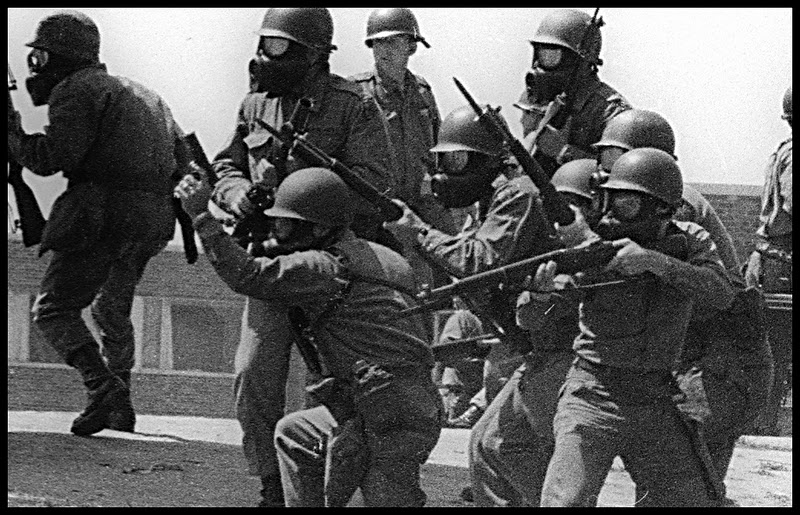
The Guard takes aim. Photo by Howard Ruffner / Picasa.

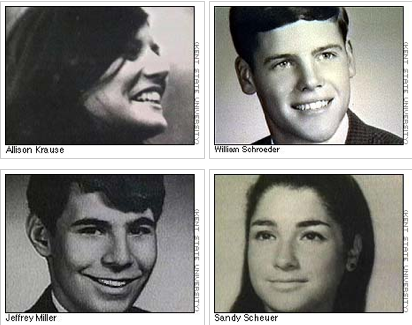
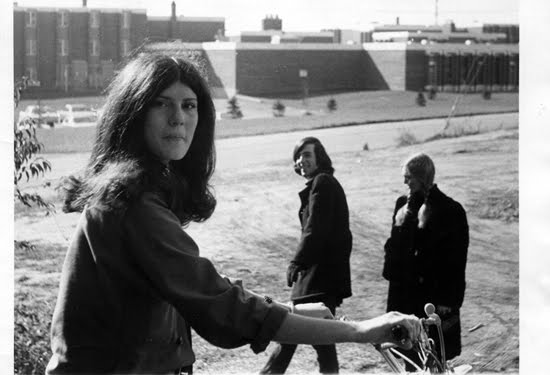
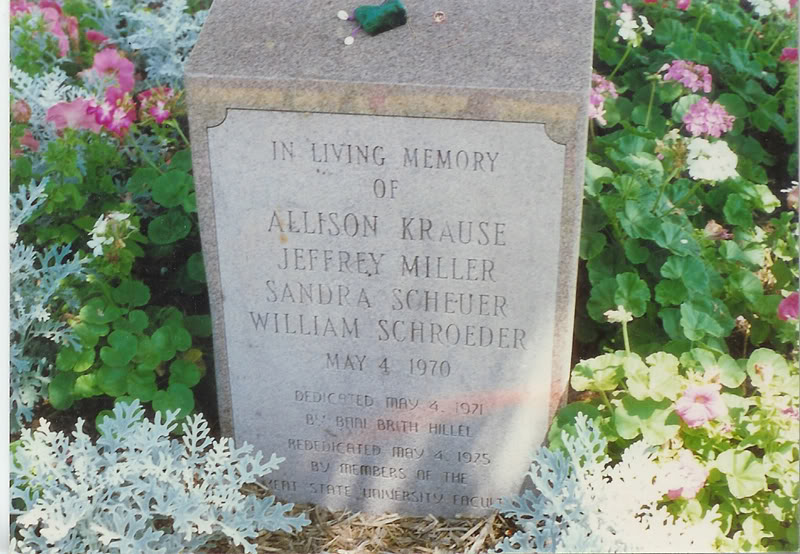
Four dead in Ohio: Allison Krause, William Shroeder, Jeffrey Miller, Sandy Scheur.


Allison Krause. Image from Mendo Coast Current.

Photo by Mr. Baggins / Democratic Underground.

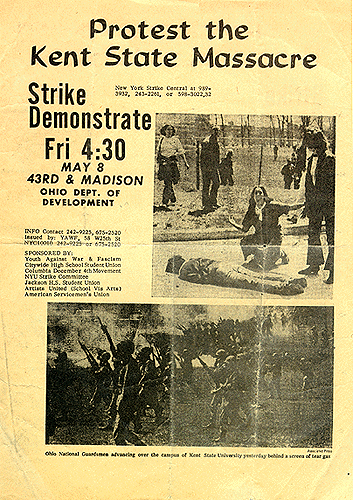
Kent State Protest Poster, 1970. NYU Archives Collection.

The Rag Blog

Posted in Rag Bloggers | Tagged , , , , , , , , | 4 Comments

Tax Day Tea Party : Markets Overboard!

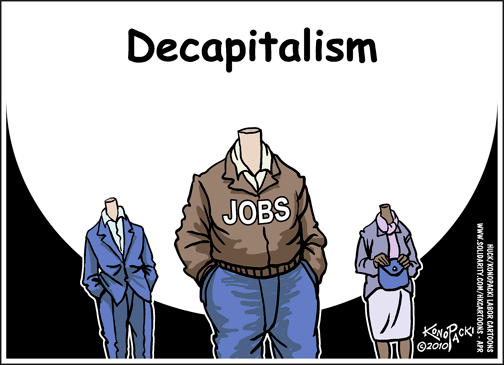
Cartoon by Mike Konapacki / solidarity.com.

Tax Day Tea Party
Tosses markets overboard

By Greg Moses / The Rag Blog / April 17, 2010

Like so many chests of tea tossed overboard into Boston Harbor, world markets fell straight down Friday in the aftermath of Thursday’s Tea Party protests.

Whether they were Asian markets in Tokyo, Hong Kong, Sydney, or Bombay (yes, even Bombay). Whether they were European markets in London, Paris, or Frankfurt. Or whether they were U.S. markets such as the Dow, the Nasdaq, the S&P, Gold, or Oil (yes, even Gold and Oil) markets around the world tumbled down on April 16.

This totalizing tumble had nearly completed the global circuit by the time news hit (at 10:35 am EDT) that the U.S. Securities and Exchange Commission was alleging fraud against the powerhouse investment banking firm Goldman Sachs.

A Prescience Award for this sudden turn down goes to Steve Hochberg, chief market analyst for Elliott Wave International who told CNBC’s Joe Kernan on the morning of April 15 that “extreme opinions” were showing signs of a collective psychological turning point upon which social mood — and its market expression — was soon to slide lower. Of course, Hochberg had also called the downturn about five months too early, as a quick search of CNBC records (or a look at my own lousy portfolio) would show.

But if Hochberg is correct to correlate market activity with social mood, then what better symbol of impending mood decadence could one hope to find if not Thursday evening’s satellite conversations among Larry Kudlow, Dick Armey, and Lou Dobbs brought to you live from the movement of Tea Party Patriots nationwide?

Kudlow actually floated the idea of Dobbs for U.S. President. It was a truly discouraging sign of what is called “free market capitalism” in the USA and it could not have been ignored even by the sun setting westward toward Tokyo.

We can call this downtrend the Tea Party Toss, for however long it lasts, even if it should mature into a Tea Party Depression as it threatens to sink us lower into a tank of intestinal juices that only old men can secrete. On the way down, we will have some choices about which parts of ourselves or the world to toss off.

Grapes of Wrath is how Steinbeck titled the social mood of depression. But wrath at what? For the Tea Party movement, wrath is being organized to attack the kind of federal government that the last Great Depression produced in the USA. The Tea Party movement is a preemptive attack on the social contract of the New Deal, demanding in advance of these hard times coming that we prepare to roll back our federal networks the better to make way for new heights of corporate power.

The word for it is, of course, fascism, which would be a little less scary to point out if there were some likely living counter movement. If there can be such a thing as left fascism, then the Tea Party would be better named a moderate-right fascism. Which, under the circumstances does make left fascism the lesser of evils, in case you are still trying to keep your head in some level corner of the room.

Now somehow on the model of analysis that seems to be anchoring the Tea Party ideology, I think we are supposed to believe that the federal government of the USA is the chief cause of the fact that 15 percent of American workers are having short-term difficulties finding employment (a figure that was reported in the New York Times on April 15).

Had we liberated in the past 10 years the awesome power of free market capitalism, says this Tea Party ideology (aka neoliberalismo), there would have been no financial meltdown because the meltdown was caused by poor people, many of color, who were shoved into homes by a too-aggressive federal housing program.

According to the Tea Party scheme of things, we should not develop concepts for the structural implications of privatizing sharks as portrayed in the alleged Goldman bond frauds. Instead, we should totally blame and shut down the federal housing program and give the mortgage business back to unfettered lenders who can properly repossess everything and reset the financial clock back to midnight.

With the housing market completely privatized there would be nothing to stand between proper prices or rigorous landlord-tenant relationships, although the Tea Party would presumably expect federal marshals to assist the landlord class with “whatever means necessary,” etc.

Unfortunately, the Tea Party movement has some warrant for believing that the voters of America will in fact support this drift toward moderate-right fascism as an alternative to the threat of left fascism that we are seeing for example in the Democrat Party’s construction of health insurance reform, complete with its anti-Mexican racism. And if you think it is extreme to charge the Democrats with anti-Mexican racism then how do you explain what’s not happening to immigration reform?

I’m not sure the youth of America have weighed in properly on the flavor of fascism that they will prefer in November. They seem to be a stealth voice for “hope” and therefore not quite countable as the kind of “patriots” that the Tea Party movement is recruiting. But you have to admit that left fascism is not quite the kind of thing that makes you feel like a frenzy of youthful ideals. Complexity is the fashionable word for left fascism these days, because under these circumstances it may be the best barrier to throw up against the next worse thing.

Mostly, however, these thoughts are mere reflections in a plexiglass window. If world markets rebound and corporations go back to business as usual, we can remember a weekend when things looked like they could have gotten much worse even than that.

For my part, I’m hoping that the employed and unemployed workers of America insist upon structures of crisis that are productive, transparent, accountable, and subject to another change of guard each and every two years. Dare we call it the public option?

There are reasons to demand changes in government and spending quite different from what the Tea Party wants. And while America is not going to give up on some form of market capitalism, it is also unlikely that we have collectively blanked out on the meaning of total corporate control. As Frederick Douglass would say, the plain language of The Constitution was written “in order to form a more perfect union.” The handwriting on the walls of Main Street and Wall Street still spells “We the People.”

[Greg Moses is editor of the Texas Civil Rights Review and author of Revolution of Conscience: Martin Luther King, Jr. and the Philosophy of Nonviolence. He can be reached at gmosesx@gmail.com.]

The Rag Blog

Posted in Rag Bloggers | Tagged , , , , | 5 Comments

Big Brother : Still Coming to Animal Farm?

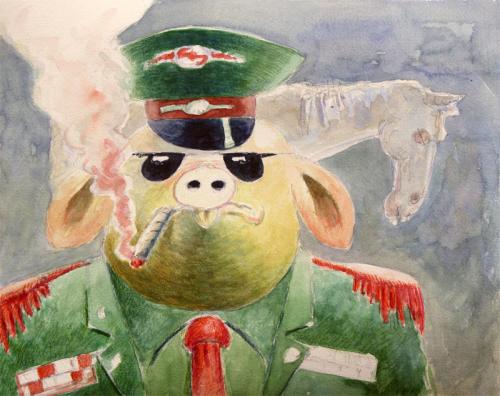
Pig Brother? Cartoon by neophron / toonpool.

National animal identification system:
Is Big Brother still coming to Animal Farm?

By Steve Rossignol / The Rag Blog / April 17, 2010

In February of this year, Agriculture Secretary Tom Vilsack announced that the Agriculture Department would no longer try to implement the National Animal Identification System (NAIS). The announcement immediately set the meat industry up in arms.

If you have never heard of the NAIS, don’t feel alone. While the meat industry has for years clamored for some sort of nationwide tagging and tracking system to ostensibly monitor livestock from farm to feedlot to food store, it wasn’t until the tragedy of September 11, 2001, that the industry saw its opening, using as its rationale the perceived threat of terrorists striking American agriculture.

The effort for a national tagging system was in place right after September 11 under the auspices of the National Institute for Animal Agriculture, composed of agricultural industry giants and manufacturers of identification technology systems, which immediately began lobbying for the implementation of the Animal Health Protection Act.

In the climate of anti-terrorist hysteria, the AHPA was very quietly passed by Congress in the middle part of 2002, and Congress instructed the Agriculture Department to implement the act. In May of 2005 the AHPA was further strengthened by Congress to specifically mandate electronic tagging and certain exemptions from the Freedom of Information Act.

The original intentions of the bill may certainly have been well-meaning. Fears of terrorist activity, occasional cases of Mad Cow and other diseases, and the consolidation of a variety of agricultural laws dating back to the 19th century prompted the initial writing of the bill.

But the Act also contained with it frightening germs of government control that slowly came to light, especially the right to inspect and seize livestock without a warrant and to enter any suspected premise with a warrant. The additional notion of a constant electronic surveillance of livestock also led to Big Brother fears.

The Act commissioned the Agriculture Department with implementation, and corporate consultants within the USDA developed a series of administrative suggestions which soon led to the National Animal Identification System.

Among the provisions of this developed NAIS were the three-stage requirements that every livestock premise and location in the nation be registered with the Department of Agriculture; that all individual swine, sheep, goats, cattle, horses, poultry (yes, every chicken), pigeons, and exotics (your pet llama, for instance) be tagged and identified to make known its location at all times (electronic tagging with a microchip was the suggested method); and that the Department of Agriculture be notified whenever any livestock was transferred to another location, including moving livestock to a a different pasture or taking a horse on a trail ride.

These requirements were even to include the single animal premises, the family pet goat, and animals not used for food. And Congress even entertained the idea of extending the computerized radio-frequency tagging to include household pets like Fido and FiFi.

From the start, the major supporters of NAIS have been the large agricultural conglomerates and lobbies: Monsanto, Cargill Meat Solutions, the National Pork Producers Council, Schering-Plough; electronic tagging companies like Allflex USA, Farnam, Temple Tag Company, and Y-Tex; and such professional associations as the Texas Veterinary Medical Association and the conservative Farm Bureau. In May of 2005, then Agriculture Secretary Mike Johanns announced that “we are moving forward to a mandatory system.”

Perhaps the biggest insult in the mandatory implementation of NAIS was having the costs of electronic tagging borne by the producers of the livestock. At an estimated cost of $13 a head in 2005 for herds less than 125, the cost could prove to be very expensive for a small goat producer, for instance, especially when goat prices at auction could bring much less than that.

After much negative feedback, the Agriculture Department decided that it would only pay one-third of the cost of implementing NAIS, with the balance coming from the producers and the state governments. The cost for implementing NAIS has been estimated at $550 million for the first five years.

From the start, perhaps intentionally, there was never much fanfare or media coverage of the NAIS. Opposition in response to the NAIS slowly developed as corporate lobbyists began the process of pushing forth the legislation in various state legislatures. Many Congressional representatives, when asked about the Act, simply had no inkling as to what the legislation was. In Texas, for instance, the bill passed unanimously in the Legislature in the closing weeks of the 2005 legislative session, and later many legislators responded that they were unaware of the provisions of the bill.

Specifically looking at Texas, it is interesting to trace the paper trail. In one example selected for this study, one of the sponsors of HB 1361, the Texas legislation to make Texas consistent with the NAIS, Republican Representative Rick Hardcastle of Vernon, chair of the House Committee on Agriculture and Livestock, received campaign contributions from Monsanto and the Texas Veterinary Medical Association. (As a footnote, Hardcastle certainly does not appear to be any friend of small farmers, as he also sponsored a failed bill allowing agricultural suppliers to place a lien on a producers second year crop if proceeds from the original crop were insufficient to pay off the entire amount owed). One can only guess the depth that financial contributions have played in the passage of the legislation.

As word about NAIS slowly reached the public and the livestock producers, grassroots opposition arose from all parts of the country. From Idaho to Virginia, New Mexico to Tennessee, and points in between, small livestock producers, organic beef producers, animal hobbyists, pet owners, and civil libertarians began reacting negatively to NAIS. Resolutions were passed at the county level, demonstrations were held nationwide. Ranchers in Bandera County, Texas, even threatened revolution.

Faced with the opposition, and given that compliance with NAIS was only at about 37%, the Department of Agriculture backed down in December 2005 and declared that compliance with NAIS was no longer mandatory, but was now “voluntary.” In March 2006, Texas public officials postponed taking action on any proposed NAIS guidelines and cancelled future public hearings on the measure. (Texas compliance was at 4% in March 2006.)

The major concerns were that NAIS would drive small producers out of business, that the measure was intrusive and a violation of personal liberties; that it would weaken attempts at organic cultivation of livestock or cultivation of livestock for personal consumption. One criticism that was leveled at NAIS was that it “would actually subject the owner of a chicken to more surveillance than an owner of a gun.”

But the Ag Department continued to try and implement the NAIS through the back door. Under the guise of an agricultural “census” form sent out in 2006, requiring that the forms be returned “under penalty of law,” the USDA essentially attempted to do what Stage One of the NAIS wanted to do — premises registration.

And, in perhaps an attempt to use the carrot and not the stick, it appears that the Agriculture Department may have used the confidential information provided in the NAIS registry to selectively provide hay and forage to only NAIS registered cattle stranded during the 2008 blizzard in Colorado, the excuse being that they knew where those cattle were located because of the NAIS registration.

One of the ironic things about NAIS was that while it was touted to protect the nation’s food supply, it also came at a time when the Bush Administration had cut back the number of USDA inspectors and inspections. It is also apparent that large producers like Cargill and the National Pork Producers Council wanted some sort of Federal insurance for their overseas markets, especially with such nations as Hong Kong and Japan rejecting U.S. beef because of Mad Cow fears.

There is no doubt that there needs to be a greater purview of the nation’s packing and food services. Under the Bush Administration enforcement standards have dropped to practically nothing, with corresponding salmonella and e. coli outbreaks in a variety of foodstuffs, from peanut butter and hamburger meat to strawberries, cantaloupes, and spinach. Less expensive produce from overseas oftentimes does not have the same standards as in the United States, with resultant disasters.

It would appear that given the nature of the greed in the food industry, the first line of defense would be to reverse the neglect of the Bush years by enhancing inspection and enforcement. Additionally, we need to completely re-think our existing notions of food production.

Mad Cow Disease, for instance, can be eliminated if livestock is not fed ground bone meal from diseased animals, something the Agricultural Department finally wised up to in 2002. E. coli in cattle can be greatly reduced if mass feed lot production is eliminated and cattle are allowed to eat grass, which does not allow the development of e. coli. Chemical steroids which increase animal weight and production need to be eliminated. Production should return to a smaller, more environmentally friendly, organic, and hygienic scale.

So, will NAIS come back? Very possible. Secretary Vilsack stated that even while NAIS was currently abandoned, a “new strategy was needed.” And even while NAIS is no longer in effect, its enabling legislation, the Animal Health Protection Act, is still on the books. It may just be a question of time.

[Steve Rossignol is a working member of IBEW Local 520 in Austin and is a long-time member of the Socialist Party. He lives in Blanco County, Texas.]

The Rag Blog

Posted in Rag Bloggers | Tagged , , , , | 1 Comment

Anne Lewis : Don Blankenship and the A.T. Massey Crime Spree

Don Blankenship, a “plump, soft-spoken accountant with a smirk.” Image from treehugger.com.

The porcine man:
Don Blankenship and the
Sordid history of A.T. Massey

By Anne Lewis / The Rag Blog / April 16, 2010

[See Mine War on Blackberry Creek, the 30-minute 1986 documentary by Anne Lewis about the 1984 United Mine Workers of America strike against A.T. Massey — including her interview with now CEO Don Blankenship — here.]

Who is this porcine man (all apologies to the noble pig) wrapped in our country’s flag saying that federal regulation of mine safety is as “silly as global warming?” Why it’s Don Blankenship, CEO of A.T. Massey, the fourth largest coal extractor in the United States and now the source of the worst killings in a U.S. mine in 40 years.

The context is an anti-union rally last Labor Day in Holden, West Virginia, hosted by Sean Hannity and starring Ted Nugent and Hank Williams, Jr.

First a few highlights of the A.T. Massey crime spree, going backwards over decades:

  • 2010 — the latest and worst of four fatal accidents in 12 years at Massey mines: 29 men killed in the explosion at Upper Big Branch mine.
  • 2009 — $3,000,000 contribution to elect a state Supreme Court justice that would rule in favor of Massey. Found guilty by the U.S. Supreme Court in Caperton v. A.T. Massey Coal Company.
  • 2009 — at company’s behest, Raleigh County West Virginia judge blocks anti-mountaintop removal activists from peaceful protests on A.T. Massey strip mining sites.
  • 2006 — two miners killed in a fire at Aracoma Alma Number 1 Mine in Logan County, West Virginia.
  • 2000 — 300-million gallon spill of toxic sludge from Massey strip mine impoundment in Martin County, Kentucky, three times the size of the Exxon Valdez. The EPA called it “the nation’s largest man-made disaster east of the Mississippi.”
  • 1984 — UMWA strike against A.T. Massey Coal concludes with 400 union men blacklisted and permanently fired and an unconditional return to work for the rest of Massey’s workers without a union.
  • 1980 — St. Joe Minerals and Royal Dutch Shell, which owned mines in South Africa under apartheid, create the Massey Coal Partnership.

The consistency of the record and its intersections are truly amazing — from neo-liberalism to ecocide to corruption to murder, this is a huge lesson in the dark side.

In 1984, I sat in Blankenship’s office looking out at a community (including the post office) that was hemmed in with barbed wire and armed guards. Blankenship was then president of Raul Sales, a wholly owned subsidiary of A.T. Massey. Don (I might as well use the familiar — he called me Anne) was delighted to show me the bullet pattern that marked the edge of his television set.

A plump, soft-spoken accountant with a smirk, he explained the progress offered by A.T. Massey to South African miners. He offered a social Darwinist analysis of capitalism, calling it “survival of the most productive.”

The interview and the rest of my film about the 1984 United Mineworkers (UMWA) strike against A.T. Massey — Mine War on Blackberry Creek — streams on www.annelewis.org. Rather than quote from the film or try to describe visuals, I would suggest a free viewing. The end of the film is a defeat of the strike, but a victory in the spirit of the men and women who fought for their right to have a union.

At the time I was making the film, my future partner was working underground less than 40 miles away from the Upper Big Branch Mine that exploded April 5. He worked in similar conditions, on a long-wall section in a gassy mine. The difference was that the mine was unionized. The union safety committee shut the mine down at least three times and the miners walked out. None were hurt and none were fired.

That’s one part of the story that’s missing. In all the talk of federal regulation there’s been no talk of the power of union rank and file miners to protect themselves. There’s one notable exception — Rush Limbaugh. Rush asks, referring to the explosion, “Where was the union?” Rush, that may be the best question you ever asked.

Less than 20% of the miners in this country are unionized at present. That’s scandalous and has a lot to do with Blankenship, his industry buddies, and reactionary labor law. In Canada, nearly every miner is in a union and there are almost no mining accidents. Strange coincidence? How about passing the Employee Free Choice Act so that miners could make the decision to be unionized.

And why aren’t we hearing anything about what the union thinks in the mainstream press? Here’s Cecil Roberts, President of the UMWA saying that Blankenship should be “handcuffed and in jail.”

The United Mineworkers fought for and won those regulations that Blankenship called “silly.” There’s miners’ blood on every coal mine health and safety regulation.

The other part of the story is just as sad and far more complex. There’s a picture of a floral arrangement taken at one of the 29 funerals this week that includes a hard hat with a sticker that reads “Friends of Coal.” Friends of Coal? That’s the group created by the West Virginia Coal Association that wants to educate us about the “new war the Environmental Protection Agency is waging against West Virginia coal” (would that it were so). That’s who brought us the Labor Day rally where Don Blankenship spewed his ecocidal and murderous garbage.

A miner’s hard hat was placed in a floral arrangement at the funeral of William Roosevelt Lynch. Photo by Amy Sancetta / AP.

And so the divisions within coal mining communities between the haves and the have-nots; the fight between those who would protect the environment and those desperate for jobs; the so-called individual “rights” of scabs versus community survival are used by Blankenship and A.T. Massey to do even more damage to a ravaged land and people.

I’m reminded of the great Hazel Dickens song — you can substitute “Blankenship” or “A.T. Massey” or “coal” for “black lung,” or leave the words to stand in their original power.

“Black lung, black lung, oh, your hand’s icy cold,
As you reach for my life and you torture my soul.
Cold as that water hole down in that dark cave,
Where I spent my life’s blood digging my own grave.”

[Anne Lewis is an independent filmmaker associated with Appalshop, senior lecturer at UT-Austin, and member of TSEU-CWA Local 6186 and NABET-CWA. She is the associate director of Harlan County, U.S.A and the producer/director of Fast Food Women, To Save the Land and People, Morristown: in the air and sun, and a number of other social issue and cultural documentaries. Her website is annelewis.org.]

The Rag Blog

Posted in Rag Bloggers | Tagged , , , , , | 2 Comments

Arizona to ID ‘Immigrants’? : Cranking up the Fear

Image from creativenonfiction.com.

Demonizing Immigrants:
Arizona cranking up the fear

By Ted McLaughlin / The Rag Blog / April 16, 2010

When people get scared, they become much more willing to give up their rights for a perceived safer world, and it looks like that is what’s happening in Arizona. The right-wingers in the Republican Party have been demonizing immigrants for several years now — especially those with a darker skin color — and Arizonans seem to be buying the racism the party is selling them.

The Arizona House of Representatives has just passed a bill, supposedly to fight illegal immigration. The bill is expected to also be passed by the senate and signed by the governor. The bill would forbid any city to adopt a “sanctuary” policy that would restrict police and social service workers from enforcing immigration laws. It would also expose drivers to sanctions if they knowingly transport an illegal alien — even a family member.

But perhaps the most troubling aspect of the new law is the power it gives police to stop anyone and demand to see paperwork showing they are in the United States legally. I remember during the days when the Soviet Union was in existence, one of the differences between that country and America was the requirement to carry identity papers which could be demanded by police at any time.

The only identification that a citizen of the United States has been required to carry is a driver’s license, and then only when driving. It has always been a mark of our freedom that we are not required to carry identification. It seems strange to me that the party that claims to be upholding our freedoms and our Constitution — the Republicans — would be the party to take away some of that freedom . I guess they can’t be both the party of freedom and the party of fear at the same time, and they’ve chosen fear.

Of course, this law will almost force the police to engage in racial profiling (unless they plan to stop every citizen and demand to see their papers). No, I expect this will only happen to Hispanics — many of them American citizens. This has to be a violation of the Fourteenth Amendment in that it creates a law aimed at only one class or race of people. It is simply wrong for Hispanics to be singled out to be harassed in this manner.

I think the law is also unconstitutional in a different way. Just a few years ago, an African-American man liked to take walks through a high-class suburb of San Francisco. He was repeatedly stopped and arrested by the suburban police because he did not carry any identification, although he always told them his true name and address and cooperated with them. He just believed that in America a man had the right to walk on public property anywhere without carrying identity papers.

He finally became angry with the continued harassment and sued the suburb. The case went all the way to the United States Supreme Court, and the court found the suburban community’s police had violated the man’s rights. They found that there was no requirement for an American to carry identity papers, and since the man cooperated and gave them his name and address, he should not have been arrested.

This Arizona bill is trying to do the same thing the suburban police had tried to do — require American citizens to carry identity papers. It is wrong and should be quickly nullified by the courts.

I have nothing against the requirement to carry a driver’s license when driving, but I have no desire to live in a state or country where I have to carry identity papers anytime I go out in public. That is just like an old-style East European police state, and cannot be tolerated in a truly free country.

It all boils down to one question. Do we want to live in a free country, or are we so fearful that we are willing to give up more of our freedoms? Personally, I choose to live in a free country.

[Rag Blog contributor Ted McLaughlin also posts at jobsanger.]

The Rag Blog

Posted in Rag Bloggers | Tagged , , , , | 12 Comments

Danny at McDonalds : ‘I Got Tired of Killing Farmers’

An Iraqi farmer speaks to Sgt. Bryon Clark in the village of Ka bashe in Kirkuk, Iraq, May 31, 2009. U.S. Army photo by Spc. Bobby Allen / Flickr.

Why Danny quit the army:
‘I got tired of killing farmers’

By Leslie Cunningham / The Rag Blog / April 15, 2010

I encountered Danny at the McDonald’s in Austin’s Oak Hill neighborhood. He was there with his daughter Abby, I with my granddaughter Mackenzie. The little girls hit it off and went climbing around the steps and tunnels of the outdoor play structure, while Danny and I lounged on separate benches. As is often the case in these situations, the grownups got to talking.

Danny slouched on the bench, handsome face brooding under his dark eyebrows. He told me that he was in Austin with his parents, visiting relatives. He and his 5-year-old daughter lived with his parents in a small town near Abilene. I asked if he was from there. Originally (he said), but he’d been away for a long time and recently moved back from Colorado.

With some trepidation, I asked about Abby’s mother, “Hunh,” he scowled. “She’s in jail. Selling drugs, over and over.” In Colorado? “Colorado Springs. Army bases are zoos. One big trailer park. Drugs, booze, domestic abuse. . . I had to get away from there. I want to be a good dad,” he inclined his head toward Abby, “and being with her grandparents helps.”

Now he and Abby were staying with his parents to save money while he went to college to become a physician’s assistant. Good profession, I said, mentioning that my husband went to nursing school after he was discharged from Vietnam. “Yeah,” he replied, “a lot better than what I was doing.”

And what had he been doing? “I was in the Army for 15 years until I quit.” With only five years left ’til retirement with all its benefits? “Yeah, I couldn’t stand it any more.” Because? He shrugged and slouched down on the bench. “I got tired of killing farmers.” Now, he told me, he talks to young people who are thinking of joining the military. “I’ve talked hundreds into not going. I tell them it takes more guts to go to college and pay off student loans than to drive a tank through some farmer’s house.”

Did he know about Iraq Vets Against the War, I asked. He looked at me suspiciously; he’d never heard of it. “There really is such a thing?” Yes, I said, just google “Iraq Veterans Against the War.” Please do, I wanted to say. I beg you, please do. But just then a round, sweet-looking young woman with two rambunctious kids came through the door from the restaurant, and my conversation with Danny ended. The two younger adults started talking.

The young woman was in the Reserves, she said. She was excited because her unit was about to be deployed to Afghanistan. “You’re looking forward to it?” Danny asked. Oh yes, she said. She’d been waiting for a long time for this, and she wanted to support her buddies and contribute more to the mission.

“Be careful what you look forward to,” said Danny. “It may not be what you think.” His remark didn’t seem to dent her enthusiasm. He seemed to tire of the conversation and turned away. His face and his voice softened for a moment as he called for Abby. She took his hand as they walked out of the restaurant, his shoulders sagging and weary.

With Abby gone, Mackenzie didn’t care much about staying on the play structure. She put her shoes back on and we headed out. I thought I ought to say something meaningful to the young woman as we passed her, but I couldn’t think of much. “Good luck,” I said. “Hope you come back OK.” And we were gone.

[Leslie Cunningham works with the Retiree Organizing Committee of the Texas State Employees Union. She has been an activist for 50 years and a socialist for 40.]

The Rag Blog

Posted in Rag Bloggers | Tagged , , , , | 13 Comments

Steve Russell : Hate Speech Without Hate

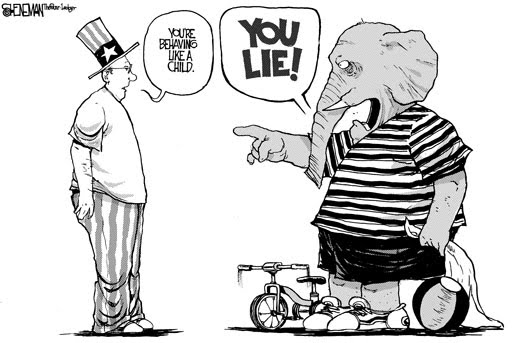
Cartoon from NJ.com.

The hypocritical heckle:
Hate speech without hate

What strikes me is that much of the hate speech directed towards Indians, African-Americans, Mexican-Americans and homosexuals is uttered by people who know better.

By Steve Russell / The Rag Blog / April 14, 2010

I’ve been accused of making odd connections between events and maybe this is one. When a Republican Congressman shouted “You lie!” at President Obama’s address to a joint session of Congress on health care, most people just thought he was rude.

I was reminded of the motto reporters privately attribute to the Texas Legislature, “vote conservative — party liberal.” The motto represents rank hypocrisy. The Legislature meets once every two years, when the street price of cocaine and the services of professional ladies go up, demand suddenly overtaking supply. Or so it used to be.

When the heckle came at Obama he was saying that health care reform would not allow undocumented workers to buy into national health insurance, should the United States ever get national health insurance like every other industrial democracy already has.

It’s not possible to say that Obama was lying or that he wasn’t, since there were five bills pending at the time. The one immediately before the House excluded undocumented workers, but Obama was not talking about that or any other bill. He was talking about what he was willing to sign, and he could lie or not until he signed something that did or did not include undocumented workers.

The hypocrisy behind the rudeness is that my Republican friends tell me that they understand hardheaded economics and I don’t. They say that I want to take money from productive citizens and use it to improve the lives of freeloaders: the unemployed, the elderly, the sick. They say if I want to be charitable I should do it with my own money and let them run government like a business, with an eye to the bottom line. Taking care of each other is for churches, not governments.

Health insurance is a not a welfare program. If you wondered how it is possible to cover thirty million more people and still lower costs, the answer is the iron law of insurance: the broader the pool, the lower the cost to each member of the pool. Insurance is a risk-spreading device and more spreading means less expense.

Assuming that every Republican is focused on the bottom line, there would be every reason to cover undocumented workers, not because they do it in Europe but because it would make health care cheaper for us all.

It is of course not possible to cover undocumented workers the way the bills were and are drafted. They achieve broader coverage with a mandate that we all buy in, and the choke point where the buy in is enforced is IRS form 1040. Undocumented workers do not file IRS form 1040.

The first line of hypocrisy is that covering undocumented workers would be a good thing for the bottom line of the taxpayers and the second is that the coverage is impossible anyway. There is no way Obama could have been lying in terms of the final bill unless everything changed.

So why would the Republican congressman falsely call the President a liar? He was pandering to the voters who hate, like the fans of former presidential candidate Tom Tancredo and former CNN commentator Lou Dobbs. Tancredo and Dobbs, and the people who love them, represent the xenophobic side of American politics that started with the ugly things early settlers said about Indians, continued though the removals to Indian Territory, and only went more or less underground after the slaughter of non-combatants was caught on film at the horror we call Wounded Knee I in 1890. But did the people who spent time with Indians really believe the nonsense about ruthless savages?

All the most successful Indian fighters fought beside Indian scouts, often but not always from tribes with historical grievances against the immediate enemy. Crow scouted against Lakota and Tonkawa scouted against Comanche, but Apache also scouted against Apache. My point here is not to criticize Indians for settling scores but to criticize white people for lying about the people they worked beside.

It’s hard not to notice that the congressional heckler, Joe Wilson, was representing the great state of South Carolina, where hate and hypocrisy are apparently an art form. It was South Carolina Governor and then Senator Strom Thurmond who made a career as a segregationist while carrying on an affair with a black woman who bore his daughter. It was current South Carolina Governor and “family values” advocate Mark Sanford who made the phrase “hiking on the Appalachian Trail” an odd synonym for getting horizontal with your girlfriend.

The distance from South Carolina to Washington is like the distance from rural Texas to Austin in cultural terms, and like the distance from the Dakotas to the East Coast in the history of Indian relations.

What strikes me is that much of the hate speech directed towards Indians, African-Americans, Mexican-Americans and homosexuals is uttered by people who know better. That they don’t really believe that nonsense often jumps out in their life histories.

In my generation, the late George Wallace was a veritable avatar of racism, proclaiming after an early political loss “I will never be out-niggered again!” But in his last term as Alabama governor, he not only had recanted his segregationist views, but he went on to set a record for the number of blacks appointed to state office.

There is a major strain of politics in Indian Country that is all about Indians as a threat to “equality” for white people, holders of “special privileges.” The major fear points are trust land being off state tax rolls and white people who live on Indian land being subjected to tribal laws.

The dittoheads in this controversy have never considered that when they are citizens of New Mexico driving on a Texas highway, they are subject to the laws of Texas, a “foreign” sovereign. Every time you drive on the land of a pueblo in New Mexico there is a big sign informing you that you are entering the sovereignty of that pueblo. The political leaders who whip up outrage over Indian sovereignty, on the other hand, know this, and they know that the only possible objection to being subject to tribal laws is racism.

Much if not most political hate speech, I am convinced, is uttered for political advantage by people who really do not hate the people they are using to arouse a following among voters for whom they have no respect at all. For those of us subjected to the hate speech, knowing it is uttered by knaves to influence fools is cold comfort.

[Steve Russell, Cherokee Nation of Oklahoma, is a Texas trial court judge by assignment. He recently retired as an associate professor of criminal justice at Indiana University. His writing has been published widely; he is a columnist for Indian Country Today and a contributor to The Rag Blog. Steve was an activist in Austin in the Sixties and Seventies, and wrote for Austin’s underground paper, The Rag. He lives in Sun City, Texas, near Austin.]

The Rag Blog

Posted in Rag Bloggers | Tagged , , , , , | 4 Comments

Coal Mining : Union-Busting and the Massey Disaster


Deaths in West Virginia
Did not have to happen

By Jay D. Jurie / The Rag Blog / April 14, 2010

With the death of 29 coal miners at the Massey Coal-operated Upper Big Branch Mine in West Virginia, the United States has experienced its worst mine disaster in close to 40 years.

It is widely understood the deaths were caused by safety violations that allowed methane gas to build up to explosive levels. What is not so well understood is that this was no “accident” that just “happened” because coal mining is “inherently dangerous.”

The explosion was preventable, and was brought about by lesser-known causes: increased demand for coal, and measures taken by mine owners to meet this demand and generate higher profits through cost-cutting and greater productivity.

Chief among those measures has been union-busting. Massey Coal has a long track record in this regard, even though, according to labor writer David Moberg, unionized coal mines have only a quarter to a half as many fatalities as do non-unionized coal mines.

Actively supporting safe working conditions for those who provide our electricity is the best way we have of showing our appreciation.

One important step would be to contact your Congressional delegation and insist they pass the Employee Free Choice Act, and especially its card-check requirement, that would enhance the ability of all employees to form a union.

The Rag Blog

Posted in Rag Bloggers | Tagged , , , | 2 Comments