Lethal Denial : Chernobyl and the Climate Bill

Composite photo. Image by Vivo (Ben) / Village of Joy.

After the explosion at Reactor 4 [at Chernobyl] the people of Pripyat flocked to the railway bridge just outside the city to get a good view of the reactor to see what had happened.

Initially, everyone was told that the radiation level was minimal and that they were safe. Little did they know that much of the radiation had been blown onto this bridge in a huge spike.

They saw beautiful rainbow coloured flames of the burning graphite nuclear core, whose flames were higher than the smoke stack itself. All of them are dead now — they were exposed to levels of over 500 roentgens, which is a fatal dose.

Village of Joy

For the ecology and the economy:
Chernobyl demands a REAL climate bill

By Harvey Wasserman / The Rag Blog / April 26, 2010

This week 24 years ago, untold quantities of lethal radiation began pouring into the atmosphere from the catastrophic explosion at Chernobyl Unit 4. Nearly a million people have died because of it.

And on this horrific anniversary we have now seen the stumble of a very bad climate bill. The events are directly related.

Chernobyl’s death toll has been bitterly debated.

But after nearly a quarter-century of industry denial, the New York Academy of Sciences has published, Chernobyl: Consequences of the Catastrophe for People and the Environment, the definitive catalog and analysis. Drawing on some 5,000 studies, three Russian scientists have placed the ultimate death toll at 985,000.

The authors include Russian biologist Dr. Alexey Yablokov, former environmental advisor to the president of Russia; Dr. Alexey Nesterenko, a biologist in Belarus; and Dr.Vassili Nesterenko, a physicist who was, at the time of the accident, director of the Institute of Nuclear Energy of the National Academy of Sciences of Belarus. The book has been edited by Dr. Janette Sherman, a toxicologist expert in the health impacts of radioactivity.

As Karl Grossman has shown, Chernobyl’s death toll stretches worldwide. Its apocalyptic cloud blanketed Europe and blew across the northern tier of the United States. Sheep in Scotland and milk in New England were heavily contaminated, along with countless square miles of land and sea.

Ohio’s Davis-Besse may have come within a fraction of an inch of such a disaster, and has again been found with potentially apocalyptic structural flaws. Michigan’s Fermi I and the infamous Three Mile Island Unit 2 did melt.

Now the brand new Toshiba-Westinghouse AP-1000 design has been deemed by the Nuclear Regulatory Commission as unable to withstand earthquakes, hurricanes, or tornadoes, and has turned up with a critical generic flaw that could cause it to explode.

Which is where the climate bill comes in.

Widespread reports of what it contained were to be clarified with its planned introduction on Chernobyl Day. But co-sponsor Lindsay Graham (R-SC) abruptly withdrew, apparently amidst partisan wrangling over immigration.

By all accounts this bill included a fossil industry wish-list, with big money for “clean coal,” off-shore drilling, a disembowelment of the EPA, and much more. With oil fires raging at sea and miners being buried in the coal fields, how this bill would actually solve the climate crisis remains unclear.

What WAS clear was subsidies that John Kerry (D-MA) said would put taxpayers on the hook for at least a dozen new reactors, and possibly far more.

The details are temporarily moot, but the portent is not.

It’s precisely that dangerously deficient AP-1000 design that the Obama Administration wants to fund first, for construction in Georgia. America’s leaky fleet of 104 aging clunkers meanwhile staggers toward disaster at places like Vermont Yankee and New York’s Indian Point, Ohio’s Davis-Besse, and California’s Diablo Canyon.

Chernobyl exploded in a remote backwater of an impoverished region. But by official accounts from Ukraine and Belarus, it did $500 billion in damage just there. Nowhere in the U.S. would the property damage be remotely that small. The near-million death toll would be a mere fraction of how many would die here.

Nothing in any known draft of this now-in-limbo climate bill demands private insurance against such a catastrophe. Nor does it have a solution for what to do with 60,000 tons of high-level radioactive waste, or thousands more yet to come.

Nor does it begin to answer the reality that every cent thrown down the reactor rat-hole could quickly save far more energy than such a reactor could produce — if it ever did come on line after the seven-to-ten years it would take to license and build such a boondoggle.

No sane attempt to save the global ecology could ever include more money for precisely the most dangerous, destructive, dirty, and deficit-ridden energy technology ever devised.

Let’s hope this bill’s yank away from Chernobyl Day will take it to the desperately needed safe haven of a Solartopian plan built around renewables, conservation and efficiency.

Neither the planetary ecology nor the U.S. economy can afford anything less.

Nothing else would deserve the label “Climate Bill.”

[Harvey Wasserman’s Solartopia! Our Green-Powered Earth, is at www.harveywasserman.com . He is senior advisor to Greenpeace USA and senior editor of www.freepress.org, where this was also published.]

The Rag Blog

Posted in Rag Bloggers | Tagged , , , , , | 1 Comment

Larry Ray : Killing and Dying in Vietraqistan

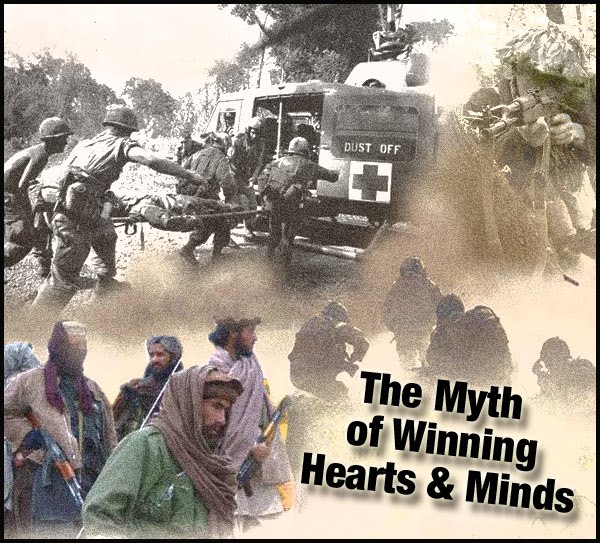
Graphic by Larry Ray / The Rag Blog.

Vietraqistan:
One, two, three, four…
What are we fighting for?

By Larry Ray / The Rag Blog / April 26, 2010

“We have shot an amazing number of people, but to my knowledge, none has ever proven to be a threat,” — General Stanley McChrystal, Senior American and NATO commander in Afghanistan, March 27, 2010.

”The Oriental doesn’t put the same high price on life as does a Westerner. Life is plentiful. Life is cheap in the Orient.” — Gen. William Westmoreland, South Vietnam, from Oscar-winning 1974 Vietnam documentary, Hearts and Minds.

While outrage in the United States over our endless wars in Iraq and Afghanistan has retreated into the background noise of immediate domestic economic and political concerns, outrage in the Middle East over civilians killed by U.S. forces is alive and seething. American troops continue to mistakenly shoot, bomb, kill, and maim a steady stream of innocent folks trying to go about their daily lives. It has been going on so long it rarely even makes the evening news here at home.

First, a review of the numbers …

We have had troops fighting and dying in Iraq for an incredible eight years, and in Afghanistan for an even more incredible 10 years. Hannibal crossed the Alps and defeated the Romans in not much more time. . . using elephants. To date we have not really defeated anything to speak of and the troop casualty count, including coalition forces in both wars, is reported to be 6,500 combat arena deaths. The price tag for Iraq and Afghanistan since 2001 is spinning toward one trillion dollars. . . $986,284,900,000 as of this post.

The Iraq Body Count Project as of this writing, reports 95,888-104,595 non-combatant civilian deaths since the U.S.-led 2003 invasion of Iraq. Estimates of total Afghan civilian deaths as a direct result of the war since the U.S. invasion in 2001 are estimated at 10,172-12,969. Folks continue to argue over totals, but civilian casualties have been outrageously high and unacceptable.

The accepted figure for U.S. military troop deaths in the Vietnam war is 58,236. South Vietnam U.S. forces killed an estimated 90,000 South Vietnamese civilians from extensive use of fire power (artillery, carpet bombings, small weapons). Another 1,500 were killed in various massacres as detailed in Rummel’s “Statistics of Democide.”

The politics of dying…

In Texas we always called a pointless fight, argument, or defense of the indefensible a “skunk-pissing contest.” A colorful argot meaning no one wins and both risk smelling really bad, figuratively or literally.

Politics is rife with these contests. And the really bad smell has too often sadly been the smell of death. Pure politics, not a palpable threat of invasion or attack on America by a rogue nation, is at the heart of the political reasons for our wars in Vietnam, Afghanistan, and Iraq. Their origins, accomplishments and civilian death tolls could collectively be called “Vietraqistan.”

The alleged cold war “domino effect” and Lyndon Johnson’s trumped up claim of a U.S. Navy Destroyer being attacked in the Gulf of Tonkin was used to justify our massive troop presence in South Vietnam and sustained bombing of North Vietnam.

Looking back, a cold-war commie menace threat with red hordes taking over all of Southeast Asia if America didn’t “win” in South Vietnam is far-fetched. But no more so than America’s hastened military posse sent to Afghanistan to locate and capture Al Qaeda leader Osama Bin Laden after the 9/11 hijacked airliner attacks. After Bin Laden slipped away the hunting expedition turned into a decade-long on-again, off-again American military war presence in this ancient Muslim country.

I will not even address the reeking politics of America being led into an unprovoked invasion of Iraq, a nation that had nothing whatsoever to do with the 9/11 terrorist attacks on the USA. Instead, drop by The Center for Public Integrity for a line-by-line documentation of the more than 935 false statements used by the Bush administration to lead our nation to war there.

Why does any of this matter right now?

It matters because ignoring or forgetting what America has lost in lives, treasure, and international reputation is both irresponsible and dangerous. A decade of our troops kicking in the doors of people’s homes, terrorizing whole families and treating the “ragheads” with little respect, has done us great harm. Young, motivated Muslims easily believe America is actively involved in a war on Islam. These potential Islamic terrorists share with members of the armed, angry citizen militias being formed right here in the USA the idea that they are being personally attacked and must fight back.

The idea that we could win hearts and minds by bombing and blasting away at centuries of ideology, traditions, sectarian hatreds, and deeply embedded Islamic faith is stunningly misguided. Political expediency has let one year become 10 years with ever changing justifications for not pulling out and coming home.

It quickly became clear after we entered Iraq that the touted weapons of mass destruction never existed. But we had blown the country’s infrastructure to smithereens and had to come up with new justifications for being there in the middle of the huge deadly mess we had made. No WMD’s, so let’s create a model American styled Iraqi democracy, a showplace for the Middle East.

Our costly eight year presence in Iraq has succeeded in eliminating a dictator and his two psychopathic sons, but Americans are not heroes there. Eight years on and there is still limited electrical service, and raw sewerage still floods poorer quarters of Baghdad. They just want us to go away, just like they did in Vietnam. We might have all troops out by New Year’s eve, 2011. Or not.

Afghanistan is an even sorrier mess. Its name dates from about 982 AD and the modern day country has been in a constant state of civil war since the early 1970’s, intensified by foreign occupations by the Soviets in 1979 and the U.S.-led invasion in 2001 that overthrew the Taliban government. . . for a while.

Bloody coups, power struggles and tribal warlords determining unstable transfers of power have always been the norm in Afghanistan. It has been governed by just about every known form of government for the past century. We have been stuck there for 10 long, dusty and deadly years.

After several touted “plans” for U.S. success in Afghanistan over the years, former special forces commander General Stanley McChrystal recently became Senior American and NATO commander with a plan to have U.S. troops undertake a mission of nation building and establishing trust among the far-flung tribes who have seen all this many times before. Again, politically bogged down, the spanking new mission is “to win hearts and minds.”

Instead, we continue to regularly kill Afghan civilians especially as we press into Pakistan to bomb and launch missile attacks across the ill-defined Pakistani-Afghanistan border. We also regularly call in air strikes and wipe out the wrong houses killing women, children, and the elderly. Going rate is said to be around $2,500 a family that we pay for our targeting mistakes. This perceived repeated brutality is easily interpreted as America waging war against Islam.

“Why the hell do we keep doing that?” we ask back here at home. “Why have we always done that?” is a better question.

U.S. Army WWII and Korean war combat historian, S.L.A. “Slam” Marshall used oral history recorded interviews to get the gut reactions of troops in combat and under fire. In his latter years what he observed about troops in Vietnam equally applies to young Americans fighting today:

…The American fighter can outwit, out-move and out-game anyone thus far thrown against him. Their main gripe is that the enemy is loath to come out of hiding. Their aggressiveness arises from pride in unit. The bond with their buddies. A wish to get the job over…

And that is it in a nutshell. Since no one is coming over the walls back home trying to conquer the USA, the motivation to carry out “the mission” in some far-flung place varies but it always involves a tit-for-tat payback for every American killed, be it by a sniper or a roadside bomb. When in doubt, fueled with adrenaline, the answer is to kill the raghead, (or the gook, or the kraut or the whatever). The sergeant will sort it out later.

I spent a year out in the boonies with combat units all over South Vietnam as a civilian correspondent in 1966-67. When young Americans are sent to strange, inhospitable countries where they can neither read nor speak the native languages, winning hearts and minds is not at the top of the list. It ain’t hearts and minds when the rounds are incoming, or when the laundry lady or friendly local interpreter blows up half your unit. In Vietraqistan our troops on the ground, or in the air, will always try to kill someone before they kill them. That’s just the way it is.

Where does all this take us?

Vietnam finished out its civil war of nationalism as soon as we left and in a few years it moved toward reunification of North and South. Today we are proud to have full diplomatic, economic, and trade relations with the Socialist Republic of Vietnam. True to Buddhist tradition, the Vietnamese hold no deep hatred for America or Americans.

But our invasion and extended presence in these two Middle Eastern countries has served to validate the widely held belief that America is waging open war against Islam. The longer we stay and the more the civilian casualty toll rises, the more Muslims, especially young people, fiercely believe we are waging war against the dominant religion in the Middle East.

If this seems to us a far fetched thing for anyone to believe, consider that we have killed, conservatively, some 120,000 non combatants, including women and children in Iraq and Afghanistan combined. Here at home civilian anti-government and conspiracy-based militias now number some 300, doubling since last year according to the Southern Poverty Law Center. Many of these folks think President Obama is building concentration camps where fine loyal Americans like them will be locked up.

Distrust, ignorance, and anger usually starts a skunk-pissing contest. It can take a long time for the air to clear.

We may not have the time required for that before another dramatic and deadly domestic terrorist attack upon American soil. The question is, will it come from Islamic zealots, or from another equally mad and militia-motivated Timothy McVeigh?

How long does it take to learn the lessons from Vietraqistan?

[Retired journalist Larry Ray is a Texas native and former Austin television news anchor. He also posts at The iHandbill.]

The Rag Blog

Posted in Rag Bloggers | Tagged , , , , , , , | 3 Comments

Tim Wise : Imagine if the Tea Party Were Black

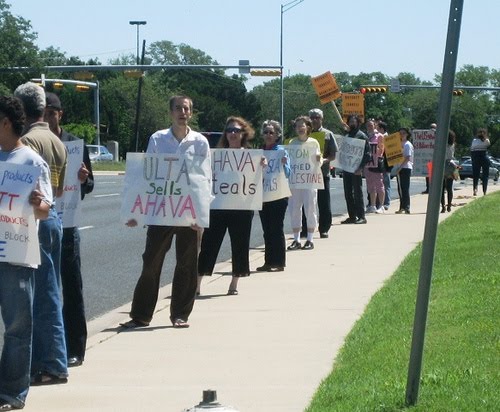
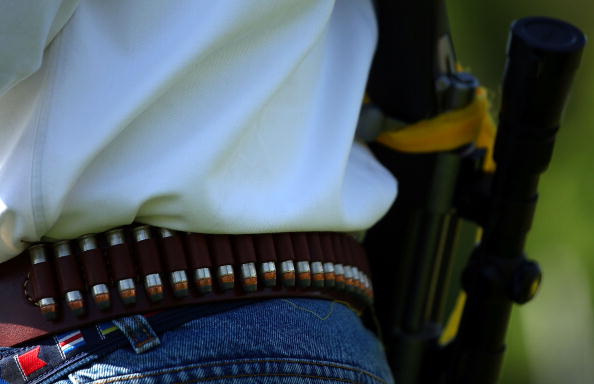
Imagine if these guys were black. Demonstrators carried weapons at a “Restore the Constitution” rally on the Potomac in Arlington, VA, April 19. Photos (top) by Bob Barnard / Fox 5 / New York, and (below) by Win McNamee / Getty Images.

Changing Places:
What if they had been black?

By Tim Wise / April 25, 2010

Imagine that even one-third of the anger and vitriol currently being hurled at President Obama, by folks who are almost exclusively white, were being aimed, instead, at a white president, by people of color.

Let’s play a game, shall we? The name of the game is called “Imagine.” The way it’s played is simple: we’ll envision recent happenings in the news, but then change them up a bit. Instead of envisioning white people as the main actors in the scenes we’ll conjure — the ones who are driving the action — we’ll envision black folks or other people of color instead.

The object of the game is to imagine the public reaction to the events or incidents, if the main actors were of color, rather than white. Whoever gains the most insight into the workings of race in America, at the end of the game, wins.

So let’s begin.

  • Imagine that hundreds of black protesters were to descend upon Washington, DC, and Northern Virginia, just a few miles from the Capitol and White House, armed with AK-47s, assorted handguns, and ammunition. And imagine that some of these protesters — the black protesters — spoke of the need for political revolution, and possibly even armed conflict in the event that laws they didn’t like were enforced by the government?

    Would these protesters — these black protesters with guns — be seen as brave defenders of the Second Amendment, or would they be viewed by most whites as a danger to the republic? What if they were Arab-Americans? Because, after all, that’s what happened recently when white gun enthusiasts descended upon the nation’s capital, arms in hand, and verbally announced their readiness to make war on the country’s political leaders if the need arose.

  • Imagine that white members of Congress, while walking to work, were surrounded by thousands of angry black people, one of whom proceeded to spit on one of those congressmen for not voting the way the black demonstrators desired. Would the protesters be seen as merely patriotic Americans voicing their opinions, or as an angry, potentially violent, and even insurrectionary mob? After all, this is what white Tea Party protesters did recently in Washington.
  • Imagine that a rap artist were to say, in reference to a white president: “He’s a piece of shit and I told him to suck on my machine gun.” Because that’s what rocker Ted Nugent said recently about President Obama.
  • Imagine that a prominent mainstream black political commentator had long employed an overt bigot as Executive Director of his organization, and that this bigot regularly participated in black separatist conferences, and once assaulted a white person while calling them by a racial slur.

    When that prominent black commentator and his sister — who also works for the organization — defended the bigot as a good guy who was misunderstood and “going through a tough time in his life” would anyone accept their excuse-making? Would that commentator still have a place on a mainstream network?

    Because that’s what happened in the real world, when Pat Buchanan employed as Executive Director of his group, America’s Cause, a blatant racist who did all these things, or at least their white equivalents: attending white separatist conferences and attacking a black woman while calling her the n-word.

  • Imagine that a black radio host were to suggest that the only way to get promoted in the administration of a white president is by “hating black people,” or that a prominent white person had only endorsed a white presidential candidate as an act of racial bonding, or blamed a white president for a fight on a school bus in which a black kid was jumped by two white kids, or said that he wouldn’t want to kill all conservatives, but rather, would like to leave just enough — “living fossils” as he called them — “so we will never forget what these people stood for.”

    After all, these are things that Rush Limbaugh has said, about Barack Obama’s administration, Colin Powell’s endorsement of Barack Obama, a fight on a school bus in Belleville, Illinois, in which two black kids beat up a white kid, and about liberals, generally.

  • Imagine that a black pastor, formerly a member of the U.S. military, were to declare, as part of his opposition to a white president’s policies, that he was ready to “suit up, get my gun, go to Washington, and do what they trained me to do.” This is, after all, what Pastor Stan Craig said recently at a Tea Party rally in Greenville, South Carolina.
  • Imagine a black radio talk show host gleefully predicting a revolution by people of color if the government continues to be dominated by the rich white men who have been “destroying” the country, or if said radio personality were to call Christians or Jews non-humans, or say that when it came to conservatives, the best solution would be to “hang ‘em high.” And what would happen to any congressional representative who praised that commentator for “speaking common sense” and likened his hate talk to “American values?”

    After all, those are among the things said by radio host and best-selling author Michael Savage, predicting white revolution in the face of multiculturalism, or said by Savage about Muslims and liberals, respectively. And it was Congressman Culbertson, from Texas, who praised Savage in that way, despite his hateful rhetoric.

  • Imagine a black political commentator suggesting that the only thing the guy who flew his plane into the Austin, Texas IRS building did wrong was not blowing up Fox News instead. This is, after all, what Anne Coulter said about Tim McVeigh, when she noted that his only mistake was not blowing up The New York Times.
  • Imagine that a popular black liberal website posted comments about the daughter of a white president, calling her “typical redneck trash,” or a “whore” whose mother entertains her by “making monkey sounds.” After all that’s comparable to what conservatives posted about Malia Obama on freerepublic.com last year, when they referred to her as “ghetto trash.”
  • Imagine that black protesters at a large political rally were walking around with signs calling for the lynching of their congressional enemies. Because that’s what white conservatives did last year, in reference to Democratic party leaders in Congress.
  • In other words, imagine that even one-third of the anger and vitriol currently being hurled at President Obama, by folks who are almost exclusively white, were being aimed, instead, at a white president, by people of color.

    How many whites viewing the anger, the hatred, the contempt for that white president would then wax eloquent about free speech, and the glories of democracy? And how many would be calling for further crackdowns on thuggish behavior, and investigations into the radical agendas of those same people of color?

    To ask any of these questions is to answer them. Protest is only seen as fundamentally American when those who have long had the luxury of seeing themselves as prototypically American engage in it. When the dangerous and dark “other” does so, however, it isn’t viewed as normal or natural, let alone patriotic.

    Which is why Rush Limbaugh could say, this past week, that the Tea Parties are the first time since the Civil War that ordinary, common Americans stood up for their rights: a statement that erases the normalcy and “American-ness” of blacks in the civil rights struggle, not to mention women in the fight for suffrage and equality, working people in the fight for better working conditions, and LGBT folks as they struggle to be treated as full and equal human beings.

    And this, my friends, is what white privilege is all about. The ability to threaten others, to engage in violent and incendiary rhetoric without consequence, to be viewed as patriotic and normal no matter what you do, and never to be feared and despised as people of color would be, if they tried to get away with half the shit we do, on a daily basis.

    Game Over.

    [Tim Wise is among the most prominent anti-racist writers and activists in the U.S. Wise has spoken in 48 states, on over 400 college campuses, and to community groups around the nation. Wise has provided anti-racism training to teachers nationwide, and has trained physicians and medical industry professionals on how to combat racial inequities in health care. His latest book is called Between Barack and a Hard Place.]

    Source / Ephphatha Poetry

    The Rag Blog

    Posted in RagBlog | Tagged , , , , | 12 Comments

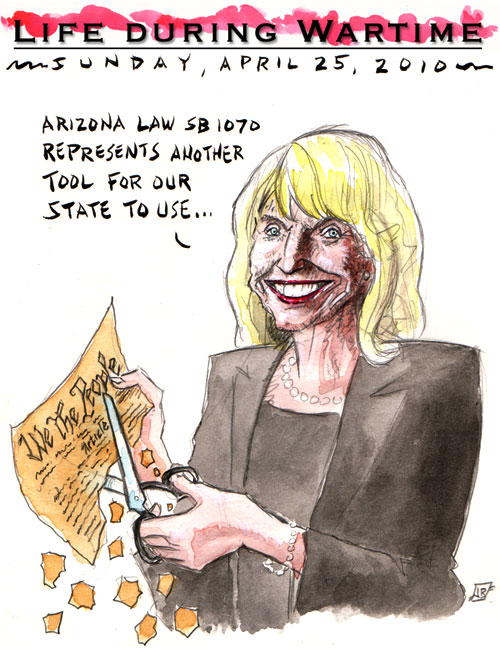
    Life During Wartime : A Tool in Arizona

    Political cartoon by Joshua Brown / Historians Against the War / The Rag Blog

    The Rag Blog

    Posted in RagBlog | Tagged , , , | 2 Comments

    Culture Got a Boo-Boo? : Put a Band-Aid® on It

    Health care system black and blue?
    Cover it up with a Bacon Strip!

    By Marc Estrin / The Rag Blog / April 24, 2010

    When was the last time you saw a white band-aid? White — as in the color of adhesive tape. Actually, when was the last time you saw adhesive tape?

    It was a good, simple idea Earle Dickson had back in 1920 — to attach a dressing to a cloth that didn’t have to be wrapped and tied — usually one-handed, or with the help of teeth. Add sterility to the cotton, and you have a perfect little gizmo — protecting a small wound from dirt and germs, reducing the likelihood of its reopening, and maintaining a moist environment for the migration of new skin cells.

    The evolution of the band-aid gives us a metaphorical glimpse into the dynamics of the American cultural/political system.

    At the beginning of the ebullient Fifties, along with chrome, fins, and anti-Communism, came the first decorative band-aids. Stars and Strips® on plastic. Conspicuous consumption. Be proud you were wounded. Then the corporations — all with their ®s attached — moved in with Super-, Spider-, and Bat-man, then Barbie and Ken, and now Rug-Rats, Smiley Faces, and Sponge Bob. Band-aids were no longer wound care, but fashion accessories for toddlers.

    Enter the current deadly combination of irony and infantilization, and the grown-ups followed hard upon with unicorn, Jesus, and bacon strip band-aids at four to five times the generic price.

    That was one very American direction — as Max Bialystock says in The Producers, “If you’ve got it, flaunt it!”

    Parallel evolution: for the more decorous among us, or young urban professionals not wanting proletarian-looking hands, the Sixties saw the spreading use of disguise: transparent band-aids, to which was added the patina of political correctness, since “flesh colored” might be any color flesh (if you ignore the white, colorblind rectangle under it).

    Now we have special shapes for knuckle and fingertip, though only God, and perhaps Johnson&Johnson knows which is to be used where. We have giant band-aids for knee scrapes, and the stirring of high-tech medicalization with the introduction of home-use gel-impregnated burn dressings.

    Let’s apply these categories to the recent difficult birth and passage of the health reform bill, an Obama accomplishment commonly seen as a band-aid.

    So we have this wound in America called disastrous health care — at least for the vast majority. The simple, practical, white-adhesive tape band-aid would have been to adopt any variation on the national health care systems used worldwide by advanced industrial countries not afflicted with exceptionalism. That would still be a band-aid because it would largely address disease post-facto, and not the physical and mental pollution and economic causes behind it. Nevertheless, it would have been straight-forward, still practical.

    Conspicuous consumption, corporate profit. What would we do without them? The President and his party are trying hard to pass a health reform bill. The president and his party are battling. The stars and stripes are unfurled on both sides. The president and his party have passed a health reform bill! Yea! Boo! And corporate Scooby-doo. If you’ve passed it, flaunt it.

    At the same time — disguise, and the opacity of CNN transparency. (The opacity is the white rectangle covering the wound.) Let the many colors of wounded flesh show through. Discarded children and cancer victims, the poor, the old, most of the currently uninsured. Under the white rectangle, Big Pharma and the insurance companies.

    In Germany, Band-Aids® are called “plasters” — and they are white. “Germans also have universal, national health care.”

    [Marc Estrin is a writer and activist, living in Burlington, Vermont. His novels, Insect Dreams, The Half Life of Gregor Samsa, The Education of Arnold Hitler, Golem Song, and The Lamentations of Julius Marantz have won critical acclaim. His memoir, Rehearsing With Gods: Photographs and Essays on the Bread & Puppet Theater (with Ron Simon, photographer) won a 2004 theater book of the year award. He is currently working on a novel about the dead Tchaikovsky.]

    The Rag Blog

    Posted in Rag Bloggers | Tagged , , , , | Leave a comment

    SPORT / No One is Illegal : Boycott the Diamondbacks

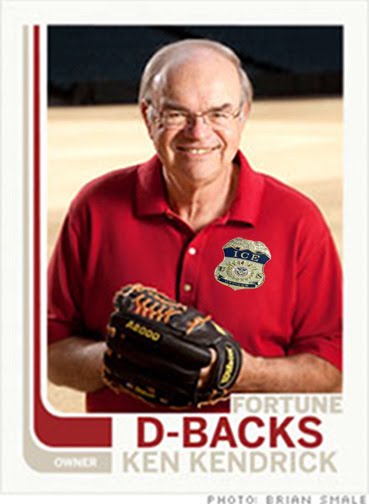
    Arizona Diamondbacks owner Ken Kendrick: his family gave $1,023,527 to the Republicans. Photo by Brian Smale. Original graphic from Fortune. Satirical enhancement by James Retherford / The Rag Blog.

    Echoes of Apartheid:
    Boycott the Arizona Diamondbacks

    By Dave Zirin / April 24, 2010

    Gonna find a way
    Make the state pay
    Lookin’ for the day
    Hard as it seems
    This ain’t no damn dream
    Gotta know what I mean
    It’s team against team

    Public Enemy, By the Time I Get to Arizona

    This will be the last column I write about the Arizona Diamondbacks in the foreseeable future. For me, they do not exist. They will continue to not exist in my mind as long as the horribly named “Support Our Law Enforcement and Safe Neighborhoods Act” remains law in Arizona. This law has brought echoes of apartheid to the state.

    One Democratic lawmaker has said that it has made Arizona a “laughingstock” but it’s difficult to find an ounce of humor in this kind of venal legislation. The law makes it a crime to walk the streets without clutching your passport, green card, visa, or state I.D.

    It not only empowers but absolutely requires cops to demand paperwork if they so much as suspect a person of being undocumented. A citizen can, in fact, sue any police officer they see not harassing suspected immigrants. The bill would also make it a class one misdemeanor for anyone to “pick up passengers for work” if their vehicle blocks traffic. And it makes a second violation of any aspect of the law a felony.

    In response, Representative Raul Grijalva, who’s from Arizona itself, has called for a national boycott against the state, saying, “Do not vacation and or retire there.” He got so many hateful threats this week that he had to close his Arizona offices at noon on Friday.

    Many of us aren’t in either the imminent vacation or retirement mode. We do, however, live in baseball cities where the Arizona Diamondbacks come to play.

    When they arrive in my hometown in D.C., my back will be turned, and my television will be off. This is not merely because they happen to be the team from Arizona. The D-backs organization is a primary funder of the state Republican Party, which has been driving the measure through the legislature.

    As the official Arizona Diamondbacks boycott call states, “In 2010, the National Republican Senatorial Committee’s third highest Contributor was the [executives of the] Arizona Diamondbacks, who gave $121,600; furthermore, they also contributed $129,500, which ranked as the eighteenth highest contribution to the Republican Party Committee.”

    The team’s big boss, Ken Kendrick, and his family members, E. G. Kendrick Sr. and Randy Kendrick, made contributions to the Republicans totaling a staggering $1,023,527. The Kendricks follow in the footsteps of team founder and former owner Jerry Colangelo. Colangelo, along with other baseball executives and ex-players, launched a group called Battin’ 1000: a national campaign that uses baseball memorabilia to raise funds for a Campus for Life, the largest anti-choice student network in the country.

    Colangelo was also deputy chair of Bush/Cheney 2004 in Arizona, and his deep pockets created what was called the Presidential Prayer Team — a private evangelical group that claims to have signed up more than 1 million people to drop to their knees and pray daily for Bush.

    Under Colangelo, John McCain also owned a piece of the team. The former maverick said before the bill’s passage that he “understood” why it was being passed because “the drivers of cars with illegals in it [that] are intentionally causing accidents on the freeway.”

    This is who the Arizona Diamondback executives are. This is the tradition they stand in.

    The Diamondbacks’ owners have every right to their politics, and if we policed the political proclivities of every owner’s box there might not be anyone left to root for (except for the Green Bay Packers, who don’t have an owner’s box). But this is different. The law is an open invitation to racial profiling and harassment. The boycott call is coming from inside the state.

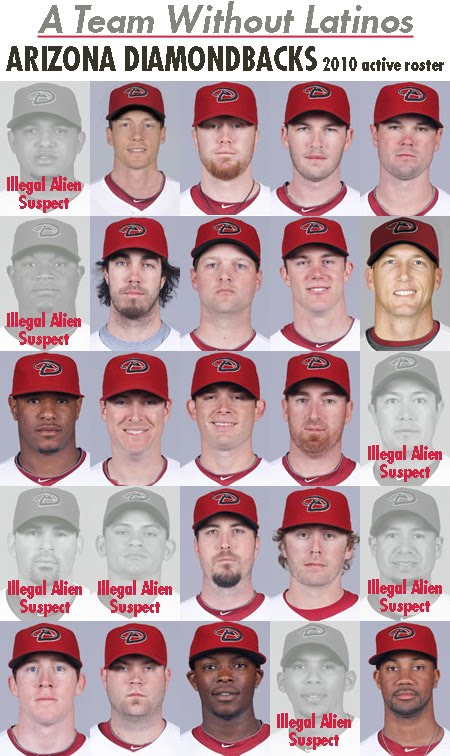
    If the owners of the Diamondbacks want to underwrite an ugly edge of bigotry, we should raise our collective sporting fists against them. A boycott is also an expression of solidarity with Diamondback players such as Juan Guitterez, Gerardo Parra, and Rodrigo Lopez. They shouldn’t be put in a position where they’re cheered on the playing field and then asked for their papers when the uniform comes off.

    [Dave Zirin is the author of the forthcoming Bad Sports: How Owners are Ruining the Games we Love (Scribner). Receive his column every week by emailing dave@edgeofsports.com. Contact him at edgeofsports@gmail.com .]

    Source / The Progressive

    Graphic by James Retherford / The Rag Blog.

    The Rag Blog

    Posted in RagBlog | Tagged , , , , , , , , | 4 Comments

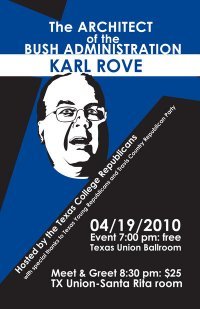
    Sound and Fury Dept. : Karl Rove at UT-Austin

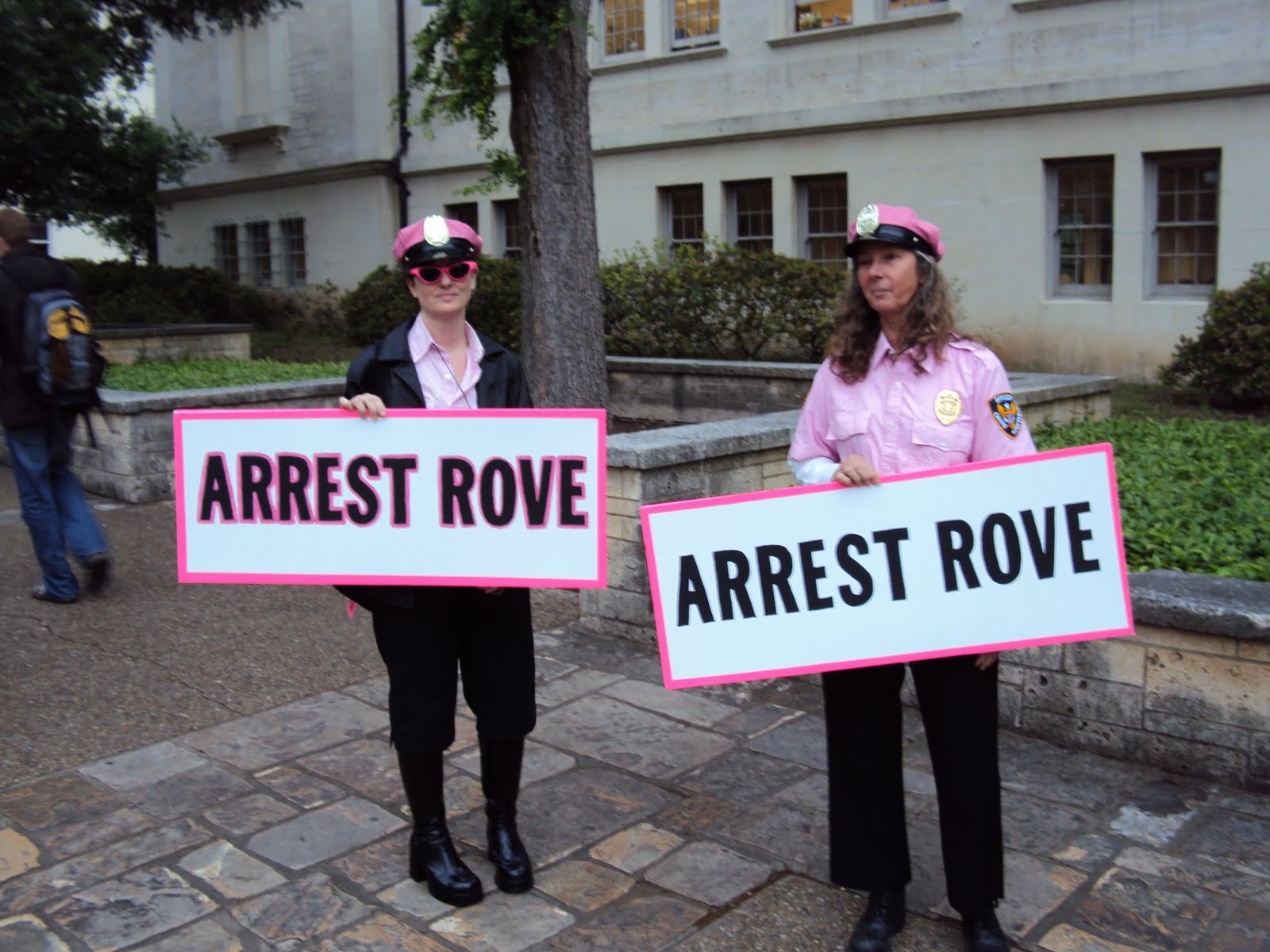
    Heidi Turpin (left) and Fran Hanlon, members of CodePink’s “Pink Police,” express their intentions, April 19, 2010, on the campus of the University of Texas at Austin, prior to an appearance by Republican strategist Karl Rove. Photo by Jim Turpin / The Rag Blog.

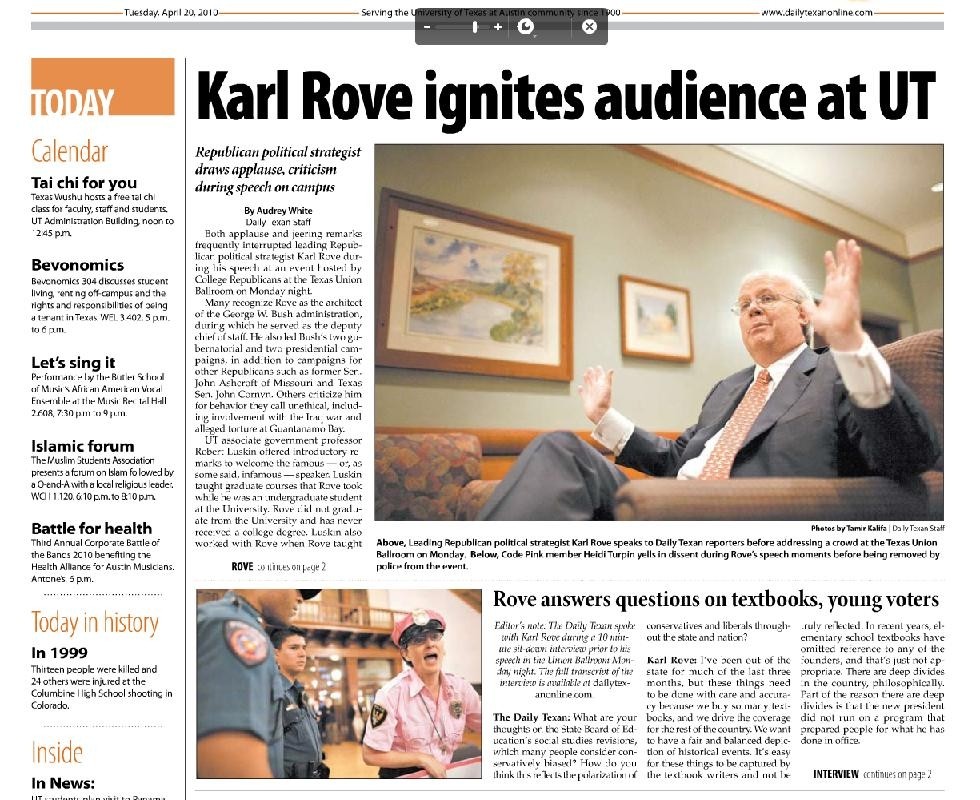
    Karl Rove ignites audience at UT

    Both applause and jeering remarks frequently interrupted leading Republican political strategist Karl Rove during his speech at an event hosted by College Republicans at the Texas Union Ballroom on Monday night. …

    Protestors from women’s peace organization Code Pink; grassroots justice group We Are Change; and UT Chicano civil rights group MEChA lined the back of the room with signs accusing Rove of war crimes, and many individuals in the audience yelled comments and insults at Rove throughout the course of the evening. …

    A total of nine protestors were removed from the ballroom. Two were arrested, and seven were cited for criminal trespassing, UTPD spokeswoman Rhonda Weldon said. …

    Rove did not ignore the protestors, referring to them as “malcontents” and telling several to “shut up and sit down.”

    The Daily Texan / April 20, 2010

    [According to The Raw Story, one of those arrested for shouting at Rove was Aaron Dykes, an associate of libertarian radio talker and conspiracy theorist Alex Jones. (Also see Infowars.)]

    Protesters spoil Republican pep rally:
    Bush man Rove stirs up UT crowd

    By Susan Cook / The Rag Blog / April 24, 2010

    Returning to the University of Texas two years ago to finish up my old government degree — so I could then study sustainable design in UT’s School of Architecture — has been a a real gift. I now get an admittedly outsider’s glimpse into the world as seen by a privileged segment of our younger citizens. I am exposed to the latest technologies, the newest and hippest musical styles, the widespread angst and apathy I see as a national epidemic — and last week, I got to see Karl Rove.


    The previous week a brightly-colored flyer with Karl’s face had caught my eye. Copies of it were posted on the bulletin boards that line the halls of the University. There he was amid the offers to study in Mexico, find a Spanish tutor, and join the Islamic students for a talk about the misconceptions swirling around what it means to be a Muslim. There was his big, fat, round visage with that iconic smirk.

    The “architect of the Bush administration” was to speak on campus the next Monday, April 19. “Hosted by the Texas College Republicans,” the flyer said, although I was to find out the hard way that they were only the titular hosts of this Republican Big Deal — after I fired off a Letter to the Editor in the Daily Texan‘s Firing Line the next day. My letter questioned whether — in this climate of educational budget cuts and employee layoffs at the University — forking over the bucks to pay for enough security to keep CodePink’s Pink Police’s handcuffs off of this man might not be the best possible way to put my hefty tuition to use.

    The response to my letter was swift and vociferous. Not only was I an ill-informed dimwit who hadn’t the intellectual skills to research and find out that the on-campus Young Republicans were (in theory) footing the bill for everything, but I was a disgrace to government majors everywhere due to my obvious connection to unpatriotic terrorists — and I was a “freak/fringe” lefty to boot.

    I was a pretty sorry excuse for a student and might not even be worthy of calling myself an American anymore. One writer suggested I be burned in effigy, another, using the name “Ann Coulter,” advised that I should move to Canada where I would be happier. Thank you, Ann.

    The College Republicans and their supporters had a field day with me, taking obvious glee in hurling insults in my general direction and painting me with every available slur reserved for their favorite target: liberals.

    Came the day of the actual appearance of Karl Rove and — in addition to figuring out what to wear, whether to have a beer first at the Cactus Cafe, and where to find the mobility-impaired entrance to the event — I had to decide if I wanted to get arrested. Or not. I decided that my impending graduation from UT, 40 long years in the making, was not going to be spoiled by Karl Rove, so it was a “not.”

    Image from page one of the UT-Austin student newspaper, The Daily Texan, April 20, 2010.

    The room was filled with Old Republicans whose generous donations, as I was to find out, were the real source of funding for Rove’s appearance. The first several rows of the Union Ballroom were occupied before the hoi polloi were even allowed in the room; these were the same folks who would later gather for a Meet and Greet with the Great Liar himself at a catered reception down the hall. The silver-hairs were a dead giveaway that this was only nominally a speech for students. This was a Republican pep rally.

    As Karl Rove lied his way through an incredibly detailed account of why Obama’s health care bill was the world’s biggest failure and an affront to physicians and patients (and taxpayers) everywhere, I realized that this was a very boring man. He was a symbol of what the Bush Administration had brought to us and what smart, motivated people can accomplish when they put their minds to it. We can have wars-without-end, tax breaks for the wealthy, corporatized everything, and act snooty — all at the same time.

    Some lackey from the UT administration got up at the first outburst from a protester in the audience and announced that each ne’er-do-well would be given “three warnings” to pipe down and then would be escorted from the room, perhaps to be arrested. I thought at the time, “how generous, how civilized of them,” but this policy was abandoned after the first unsanctioned speaker was led from the hall and after that one merely had to say something out loud and the UTPD came and got you.

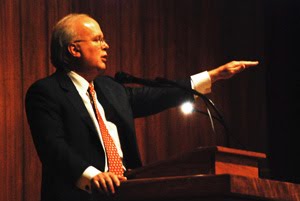
    Nice pose, Karl. Rove speaks in Austin to pep rally peppered with malcontents. Photo by Corey Leamon / The Rag Blog.

    One by one, as Rove droned on, NINE people were taken from the room for merely speaking out loud. However, if you said something that Rove liked, you got to stay. I did notice that.

    Rove had a lie to answer every accusation that came up during the Q&A period following his mind-numbingly dull speech. My favorite: We invaded Iraq to prevent an arms race between Iran and Iraq. News to me.

    When questioned about WMD or his involvement with outing CIA operative Valerie Plame, he immediately countered with how many other people were also wrong — or did the same thing he did. Hide among the guilty and it is hard to pick out just one person to blame the crime on. He was not blameless, he was just not the only one. Bush didn’t lie about WMD in Iraq — because Kennedy, Pelosi, and Kerry did, too. He didn’t out Plame — because Armitage and Novak did, too.

    When I left the hall after the event was finally over, I had the option, as it turned out, to sneak into the Meet and Greet since the mobility-impaired exit/entrance was the same door where they were collecting tickets to the catered event in the Santa Rita Room down the hall. When asked for my ticket by the cop, I simply informed him that this was my proper exit route and he let me through ticketless.

    As I waited for my elevator to flee the massed Republican horde in the Rove reception line, I had to once again ponder whether I should risk arrest or at least embarrassment by posing as one of the faithful. (I looked a lot like them; I had not worn my Che t-shirt that night, opting instead for a nice jacket and clean black slacks and shirt.)

    But once again I decided not to get in trouble. Not tonight. Not for Karl Rove.

    The Rag Blog

    Posted in Rag Bloggers | Tagged , , , , , , | Leave a comment

    Eric Jasinski : Treating PTSD With Jail Time

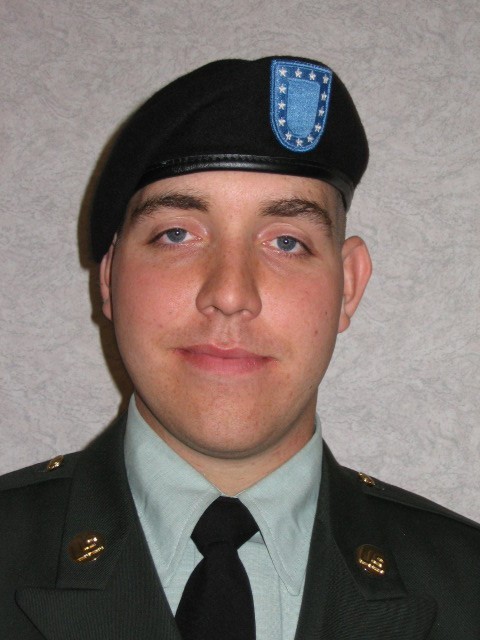
    Spc. Eric Jasinski.

    Went AWOL seeking help for PTSD:
    Eric Jasinski released from Texas jail


    By Alice Embree / The Rag Blog / April 23, 2010

    Eric Jasinski is being released from the Bell County Jail in Belton, Texas, tomorrow morning, April 24. He will have served 25 days of a 30-day sentence.

    Jasinski, 23, who is a member of Iraq Veterans Against the War, went AWOL in 2009 to seek help for his PTSD. His story was reported on by Dahr Jamail in The Rag Blog.

    Eric Jasinski enlisted in the Army in 2005, and deployed to Iraq in October 2006 as an intelligence analyst. He collected intelligence used to direct air strikes. After his return to the U.S., Jasinski suffered from severe PTSD resulting from what he did and saw in Iraq. He felt remorse and guilt for the way he contributed to loss of life. He went through a divorce and had friends killed and maimed in combat.

    He tried to get treatment for PTSD and finish out his military contract. “In late 2008,” Jasinski said, ”they stop-lossed me [an involuntary extension of contract], and that pushed me over the edge. They were going to send me back to Iraq.” Jasinski went AWOL until December 11, 2009, when he turned himself in to authorities at Fort Hood.

    The Army scheduled a Summary Court Martial for March 31. Jasinski was sentenced to 30 days in the Bell County Jail. Laura Barrett, Jasinski’s mother, told the Temple Herald Telegram, “This has been a total outrage. I cannot believe my son who is diagnosed with PTSD from his deployment to Iraq would be sent to jail.”

    James Branum, Jasinski’s civilian defense attorney, submitted a clemency request asking that Jasinski be released on mental health grounds or transferred to the psych ward at Darnall Army Medical Center to complete his sentence. The Army did not respond. With Jasinki’s permission, Branum shared a letter written from the Bell County Jail by Jasinski.

    Branum said, “We, as Americans, need to see how combat vets are treated today. Eric is in jail because he has PTSD and was denied the care he needed. His ‘desertion’ was an act of desperation, the act of a soldier who had no other options.”

    Here is part of what Eric Jasinski wrote from the Bell County Jail in Belton, Texas. We publish it as he wrote it:

    When I am taken out of jail back to Fort Hood for any appointments I am led around in handcuffs and ankle shackles in front of crowds of soldiers… which is overwhelming on my mind. My guilt from treating prisoners in Iraq sub-human and I did things to them and watched my unit do cruel actions against prisoners, so being humiliated like that forces me to fall into the dark spiral of guilt. I now know what it feels like to have no rights and have people stare and judge based on your shackles and I feel even more like a monster cause I used to do this to Iraqi people.

    Even worse is the fact that this boils down to the military failing to treat my PTSD but I am being punished for it… I feel as if I am being a threat to others or myself and still the Army mental health professional blow me off just like in 2009 when I felt like I had no choice but to go AWOL, since I received a 5 minute mental evaluation and was stop-lossed despite my PTSD, and was told that they could do nothing for me. The insufficient mental evaluation from a doctor I had never seen before, combined with the insufficient actions by the doctor on 9 April show the Army is not trying to make progress…

    I have tried to “do the right thing” as those in the Army say and all they do in return is destroy me even more mentally and publicly say that they are going to look out for me while behind closed doors the exact opposite is happening… I have been tossed in the trash just like the brave and honorable resisters of Vietnam. The machine never stops and it never changes.

    The Rag Blog

    Posted in Rag Bloggers | Tagged , , , , | 22 Comments

    May First : High Noon in Nepal

    Image from Kasama / May First.

    On the edge of revolution:
    High Noon in Nepal

    By Jed Brandt / April 23, 2010

    “You must come to Kathmandu with shroud cloth wrapped around your heads and flour in your bags. It will be our last battle. If we succeed, we survive, else it will be the end of our party.” — General Secretary Badal, Unified Communist Party of Nepal (Maoist)

    KATHMANDU, Nepal — There are moments when Kathmandu does not feel like a city on the edge of revolution. People go about all the normal business of life. Venders sell vegetables, nail-clippers, and bootleg Bollywood from the dirt, cramping the already crowded streets.

    Uniformed kids tumble out of schools with neat ties in the hot weather. Municipal police loiter at the intersections while traffic ignores them; their armed counterparts patrol in platoons through the city with wood-stocked rifles and dust-masks as they have for years.

    New slogans are painted over the old, almost all in Maoist red. Daily blackouts and dry-season water shortages are the normal daily of Nepal’s primitive infrastructure, not the sign of crisis. Revolutions don’t happen outside of life, like an asteroid from space — but from right up the middle, out of the people themselves.

    Passing through Kathmandu’s Trichandra college campus after meeting with students in a nearby media program, I walked into the aftermath of bloody attack. Thugs allied with the Congress party student group had cut up leaders of a rival student group with khukuri knives, leaving one in critical condition. Hundreds of technical students were clustered in the street when I arrived by chance. The conflict most often described through the positioning of political leaders is breaking out everywhere.

    Indefinite bandhs are paralyzing large parts of the country after the arrest of Young Communist League (YCL) cadre in the isolated far west and Maoist student leaders in Pokhora, the central gateway to the Annapurna mountain range. The southern Terai is in chaos, with several power centers competing and basic security has broken down with banditry, extortion, and kidnapping are now endemic. Government ministers cannot appear anywhere without Maoist pickets waving black flags and throwing rocks.

    With no central authority, all sides are claiming the ground they stand on and preparing their base. It’s messy, confused, and coming to a sharp point as the May 28 deadline for a new constitution draws near with no consensus in sight. The weak government holding court in the Constituent Assembly can’t command a majority, not even of their own parties.

    Seventy assembly representatives of the status quo UML party signed a letter calling on their own leader to step down from the prime minister’s chair to make way for a Maoist national-unity government. He refuses, repeating demands that the Maoists dissolve their popular organizations and return lands seized by the people who farm them.

    The Maoists have more pressing concerns than the legalism of the parliamentary parties. If they can’t restructure the state, by constitutional means or otherwise, the enthusiasm that brought their revolutionary movement this far may turn to disillusionment. With no progress in the assembly, the leaders of the status quo parties now say there will be no resolution on time. The Maoists have rejected any extension as a stalling tactic and are turning to the people. With now-or-never urgency, they are mobilizing all their forces for a decisive showdown in Kathmandu.

    Nepal braces for May First

    Posters for May First appeared overnight announcing the Maoist call for workers and villagers to converge on Kathmandu for a “final conflict.” The Maoists are calling for a sustained mobilization, with the hope that an overwhelming showing can push the government out with a minimum of bloodshed and stay the hand of the Nepal Army.

    May First is International Workers Day, the traditional day of action for communists around the world, but the mobilization has already begun.

    Thousands of recruits are being trained by YCL cadre in districts throughout the country, drilling with bamboo sticks in place of rifles. With threats from Nepal Army commanders to put these protests down with force, the Maoists are preparing to defend their mass organizations, the marches, the party, and the people from attempts at counterrevolution. Their meetings include political orientations and anti-disinformation training to combat the confusing fog of manufactured rumors and lies that are already in the air.

    National assemblies of radical students, artists, intellectuals, ethnic federations, women, unions, and trade organizations convened widely during the month of April. All sectors are receiving the same message: The Maoists will not return to the jungle, or replay a guerrilla struggle. They will not retreat. The conflict will be decided frontally in the cities.

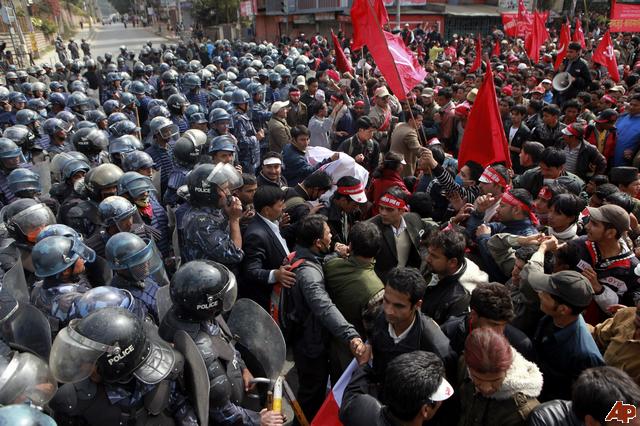
    Confrontation in Nepal. Photo from Revolution in South Asia.

    Dual power:
    Class struggle at the tipping point

    Nepal has two mutually-exclusive power structures: one is the revolutionary movement led by the Unified Communist Party of Nepal (Maoist), which has a powerful mass base among the people, a disciplined political militia in the YCL, and its People’s Liberation Army. The other is the apparatus of Nepal’s state — held over from the monarchy, unreconstructed, backed by the rifles of the Nepal Army and the heavy weight of feudal tradition.

    Land seizures co-exist with plantations. Old judges still sit in their patronage chairs dispensing verdicts to the highest bidder while revolutionary courts turn off and on in the villages. The deposed king Gyanendra lost his crown, but retains vast tracts of land, a near monopoly on tobacco and a “personal” business empire.

    Large-scale infrastructure like hydropower remains largely under foreign ownership, but only operates when, and how, the Maoist-allied unions let it. In short, the semi-feudal, semi-colonial system of Nepal is in place but the organized workers and Maoist-led villagers hold a veto.

    In Nepal, people were taught that the poor would always be poor. They long believed it. There would always be kings, lords, myriad deities, and foreign patrons to look over them. Caste dictated behavior and expectations for most, justifying dull cruelty and vast human waste.

    The tolerance and fatalism so beloved by British travel writers were also consigning the people of Nepal to isolation, ignorance, and the lowest life expectancies in Asia. But the world doesn’t actually stand still, or turn in circles, as some would have it. Things do change.

    When urban civil uprisings wrested a parliamentary system from King Birendra in 1990, nothing changed for the people, save for those whose hands got greased for government services. When rising expectations crashed into the closed doors of realpolitik of elite “democracy” — the Maoists blew it open, building an army up from the basic people themselves. From bases of support in Rolpa and Rukum, the People’s War spread to 80% of the country in 10 lightening years. Over 10,000 lost their lives in the greatest uprising in Nepal’s history.

    Yubaraj Lama, a prominent actor/director thrust into radical politics by the movement against the king, put it simply: “It was the failure of the political parties to bring democracy, any real social change for the masses of people that fueled the People’s War. This is what the Maoists changed. People were very fatalistic, looking up to politicians like princes. That is over.”

    People who had never thought social change is possible now believe they can end their poverty. Kings are not gods and their crown can fall. Women and girls are more than a way to have male children. The heavy hand of foreign domination and its imposed backwardness can be challenged. The Maoists changed the concept of politics from appeal-if-you-dare to revolution from the ground up.

    Not everyone is happy with the way the wind is blowing. It is easy to find haughty conservatives who think any hope for the poor comes at their expense and who want to see the Maoists crushed.

    Talking with the owner of an English-language bookstore, an outspoken supporter of UML’s embattled prime minister, he insisted that people only attended the Maoist rallies because they were forced to. This plainly isn’t true, but I asked why they won the elections. He told me “these people are stupid” and “believe the Maoist lies that they can live in the big house.” When I noted that all the unions in the neighborhood were Maoist and they hardly seemed forced into it, he laughed. “Of course they are, they want to take all the money from people who own them.”

    With all the paranoia of America’s white-fright militias, Nepal’s reactionaries conflate rudimentary democracy, let alone the communist program of the Maoists, with the very end of the world.

    Nepal’s embattled elites also can’t simply be brushed aside or nuanced into reform. They do have an army, the former Royal Nepal Army (NA), renamed but unreconstructed. The officer corps is steeped in caste ideology and disdain for the common people, and is supplied with modern weapons and not-so-secret Indian and American advisers.

    The PLA is training and waiting within UN-supervised cantonments — military bases scattered across the countryside. The YCL, led by former PLA commanders is training new militias throughout the country. And for its part, the Nepal Army is confined to its barracks, concentrated in and around Kathmandu.

    The politics of this moment are intricate. Many forces parry and maneuver for advantage. But the basic situation is this: Dual power has produced a highly unstable stalemate between a revolutionary people and a weakened regime — a paper tiger with real claws — and the moment of decision is fast approaching.

    Democracy is just a word

    Over the last 20 years, there has been a growing passion to see the people decide Nepal’s future, to have some form of genuine popular democracy. It erupted first in the 1990 Jana Andolan civil uprising. It fueled the People’s War that started in 1996 and animated the powerful mass movement that toppled the king in 2008.

    One of the fruits of that sustained struggle was the current Constituent Assembly — where elected representatives of the grassroots were supposed to craft a new framework for a new society, with both open election to seats and sectoral representation to ensure that women, minorities, and workers had direct representation. The very idea of such a constituent assembly comes from communist demands — it was their answer to bourgeois democracy.

    Maoists made 40 demands of the King in the mid-1990s before launching their guerrilla war. Despite consistent flexibility on almost everything else, a constituent assembly was the only demand that was never negotiable. It’s profound, the idea of an empowered assembly drawn from every corner — including elected representatives of the poor, women and minorities — for the purpose of remaking the very basis of government and society. This was to be the workshop for a New Nepal.

    In a short-lived alliance with the parliamentary parties brokered in 2006, a popular uprising in Kathmandu forced the king out and secularism was established. Elections where held in 2008, and the Maoists emerged the largest party, with more delegates than the old standbys UML and Congress combined. The rest of the seats went to a score of minor parties.

    This unprecedented assembly has been gridlocked since it convened. On one side, the old political parties want an Indian-style parliamentary system that is quite compatible with rural feudalism and caste oppression. And opposing those parties, stand the Maoists who speak of a radical new peoples democracy where those excluded from politics will now set the terms.

    The Maoists have used their days in this assembly to flesh out their plans for a New Nepal. They drafted and popularized constitutional provisions for a future people’s republic — including land reform, complete state restructuring, equality for women, autonomy for oppressed minorities, and an end to Nepal’s stifling subordination to India.

    Ambitious plans to redirect government investment in basic infrastructure like roads, sanitation, and vastly expanded public education were all scuttled when the Nepal Army refused to recognize civilian control after the Maoist victory. Then-Prime Minister Prachanda resigned, leading the Maoists out of government and leaving the Constituent Assembly in gridlock. They are the largest party, the legal and extra-legal opposition.

    The same callous ruling classes, who ignored the bitter poverty of people for decades, now claim to be Nepal’s only “democratic” alternative to the Maoists.

    Yet everyone knows: It was those Maoists who went deep among the people, who fought with guns, braved torture, and sacrificed many lives for constitutional elections — winning a popular mandate in that voting. Who, then, are the true democrats here? Who really speaks for the people and their aspirations for power?

    Maoist soldiers in Nepal. Photo by Kuni Takahashi /NYT.

    Time itself is accelerating

    All the political forces in the country have now spent the last years in slow-mo maneuvering. They have revealed their programs and exposed their natures — before a closely watching population.

    The Maoists are refusing to wait any longer. Leaders of Congress and UML parties admit a constitution can’t be delivered by May 28. The Maoists reject any postponement of that May 28 deadline. No more stalling, they say.

    Hundreds of thousands have been mobilized in peaceful mass marches over the last months. Such marches have been a vehicle for intensive mass organizing. They have been used as a gauge of growing partisan strength. The logistics of moving people through the streets to each of the main government offices is practice for seizure. In short, they can be understood as dress rehearsals for a revolution.

    On April 6, 2010, Maoists held powerful rallies in all of Nepal’s 75 districts demanding that the unelected prime minister resign to make way for a new Maoist-led government. Further rallies are scheduled leading up to May First.

    The Maoists’ program is unlikely to be accomplished through parliamentary procedure and they know it. Maoists have discussed a double-barreled approach: build on the base areas and social transformation of the People’s War to launch popular insurrection in the city. Nepali revolutionaries have been incredibly patient, refusing to over-extend their hand. They are seeking to apply one of Mao Zedong’s most famous principles, the mass line:

    It often happens that objectively the masses need a certain change, but subjectively they are not yet conscious of the need, not yet willing or determined to make the change. In such cases, we should not make the change until, through our work, most of the masses have become conscious of the need and are willing and determined to carry it out. Otherwise we shall isolate ourselves from the masses. Unless they are conscious and willing, any kind of work that requires their participation will turn out to be a mere formality and will fail.

    This is what Prabhakar, Deputy Commander of the PLA, meant when he said: “We will not take any action against this government. People at large will decide the fate of this government.”

    The Maoists have been working hard to make the next push — for the final seizure of power — an act of the people, not a self-isolating putsch by the communists alone.

    On April 15, YCL commander Sonam was arrested in Kathmandu on weapons charges. Thousands of people mobilized within the hour for a torchlight march to the jail. Sonam was released.

    Backed by the Defense ministry, commanders of the 96,000-man Nepal Army began new recruitment this week in direct violation of prior agreements.

    UCPNM leader Ashok calls this “conspiracy to invite civil war.”

    For all its complexity, dual power in Nepal rests on two armies. The middle ground is disintegrating under the pressure. Splits are appearing within all kinds of political forces — including the moderate leftist UML and reportedly among the army rank-and-file. The UCPN(M) openly says it is seeking to make its case “directly to the soldiers.”

    “If the army acts against democracy, the people won’t stand for it,” said Bishnu Pukar. A human rights activist and former leader of the revolutionary teacher’s union, Pukar was arrested twice in the fight for a new Nepal by the military. “Too many lives have been lost. There will be general rebellion.”

    In short: The Maoists are forcing a question of ultimate power that the people of Nepal will have to decide. Look to May First and the days that follow.

    [Glenn Beck calls Jed Brandt a “bald communist.” His writing, photography, design, and artistic work have appeared in the Indypendent, and other publications.]

    Source / Jed Brandt / Pick Better Fights

    Thanks to Carl Davidson / The Rag Blog

    Posted in RagBlog | Tagged , , , , | 1 Comment

    Kate Braun : Beltane Seasonal Message

    Beltane. Image by Janna / deviantArt / Kuoma-stock.

    Fire and fertility:
    The Goddess is receptive to Lord Sun

    By Kate Braun / The Rag Blog / April 23, 2010

    “O doo not tell the priest our plight,
    For he would call it sin,
    For we’ve been out in the woods all night,
    A’conjuring summer in.”

    Friday, April 30, 2010, closely following the Full Planting Moon on April 28 is Beltane, aka Roodmas, May Day, Walpurgisnacht, and May Eve. Lady Moon starts her 3rd Quarter, in Scorpio, a Fixed Water Sign. Friday is Freya’s day and Freya is a goddess of fertility, among other things, so the emphasis on planting and generation is interesting.

    In the Long Ago, Beltane traditionally marked the beginning of Summer. “Bel” is an ancient Sun God name and “Tan” means Fire. This is a fire festival as well as a fertility festival. If possible, celebrate outdoors. The Goddess is now Matron, ripe and receptive to Lord Sun’s attentions, and as we celebrate the changing season we also celebrate the new life to come from their union.

    Decorate with flowers, especially roses. Use mirrors to reflect Lord Sun’s light. Representations of honeybees will indicate the fertility aspect of your festivities. Braid your hair and/or beard and wear braided ribbons or cords as part of your attire. Macrame work is also acceptable: the joining of two strands to create a third is another way to represent the union of God and Goddess. Dress yourself, your table, and your altar primarily in white, dark green, and red; use other colors of your choice for accent colors. At this celebration, all colors are appropriate.

    Let your menu include dairy foods, sweets of all kinds. breads, cereals, all red fruits, green salads, and honey. As it is taboo to give away fire or food on this day, if you host a pot-luck party, please ask that any leftovers be taken home by whomever brought the dish.

    If you have an outdoor fire, when it is reduced to embers toss healing and protective herbs and incense such as rosemary, frankincense, and vanilla on the embers and use a feather or a feather fan to direct the smoke around all your guests. If this is not possible, light a charcoal disc and put it in a safe container such as a cauldron, adding the herbs and incense to the charcoal when it is ready, then fanning the smoke around the room and all those present.

    As at Samhain, Beltane is a time when the veil between worlds is very thin. It is a time of Great Magick, The powers of elves and fairies are growing and will reach their peak at the Summer Solstice. Keep these entities content and happy by planting (or allowing to grow) clover, lobelia, red carnations, heliotrope, foxglove, and mushrooms.

    Creating a garden shrine by decorating a living tree or bush with bells and ribbons will please fairies and nature spirits who, in turn, will protect your garden and outdoor spaces. This is an activity in which both you and your guests can participate; leftover ribbons and bells may become party favors your guests may take home and use to decorate their own gardens.

    [Kate Braun’s website is www.tarotbykatebraun.com. She can be reached at kate_braun2000@yahoo.com.]

    The Rag Blog

    Posted in Rag Bloggers | Tagged , , , , , | Leave a comment

    Psychology of Greed : Protecting the People from Wall Street


    A rebuttal of sorts:
    Protecting the people from Wall Street

    By Steven Porter / The Rag Blog / April 23, 2010

    [On April 21, The Rag Blog published an article by Sherman DeBrosse entitled Republican Jujitsu : Protecting Wall Street from the People.]

    To argue that the abuses of Wall Street lie at the feet of one political party or another really avoids a deeper issue with which our nation must eventually come to grips. The issue is the psychology of greed which is the progenitor of the abuses. And it is a psychology which is part of our entire nation.

    Greed is a neurosis which is not characterized by party label, gender, religion, age, sexual orientation, or any of the other considerations of which the pundits often talk. It is a cultural phenomenon whose roots are in the child-rearing practices and sociological landscape of the society. Both Freud and Karen Horney discuss the process, Horney most eloquently in her book The Neurotic Personality of our Time.

    The lies and manipulations which often accompany greed cannot really be legislated. Morality and immorality are not determined by what laws are passed. In fact, given a sufficient lust for the immoral, laws are more often simply things to circumvent rather than statutes to obey.

    That said, if immorality cannot be halted by law, it can certainly be prosecuted by law, and that seems to be the great weakness of our government. It is a weakness because Congress is also one of the foxes guarding the chicken coop of finance.

    The foxes on Wall Street and those in Congress have been allies for years, as anyone who looks at the record will see. The alliance has taken two traditional paths: campaign contributions from the financial industry to candidates for Congress (by the billions — see www.opensecrets.org) and a revolving door between top financial executives and top government officials.

    Goldman Sachs, the focus of our current dilemma, is a particularly egregious offender in this regard having placed more than 45 of its top people in government (including both Rubin and Paulson who went from GS CEO positions to Secretary of the Treasury).

    The appearance of President Obama on Wall Street as a spokesperson for a greater fiscal morality is simply laughable. It is part of a charade being played out by all parties to make it seem like the interests of the people are being looked after. Let us remember that it was Obama who eschewed the 2008 campaign spending limits he once proclaimed he would uphold. Let us remember that it was Obama who took $1 million in contributions from Goldman Sachs in the 2008 campaign.

    Not that I am saying anything about Obama which is not true of the other candidates. The system has been rigged to aggrandize the greed of special interests, and candidates in both major parties are willing participants.

    The question of what we do to protect ourselves against the abuses of the finance industry is thus a far more complex one than the passage of any single piece of legislation. It involves the psychological metamorphosis of our culture from one of spendthrift instant gratification to one of what psychologist Eric Berne called “more Adult behavior.”

    To rail against the fiscal and governmental corruptors is to miss the real point. To quote Mr. Shakespeare yet again, “The fault is not in our stars, but in ourselves.”

    [Dr. Steven Porter holds BS, MA, PhD, and PD degrees in fine arts and educational administration. He was the Democratic Party candidate for Congress in Pennsylvania’s third district in both 2004 and 2006. His new book is entitled Preserving America: ten things we must change to survive.]

    The Rag Blog

    Posted in Rag Bloggers | Tagged , , , , , | 2 Comments

    Bob Feldman : A People’s History of Afghanistan / 1

    Dost Mohammad Khan, depicted with his son, was the Emir of Afghanistan from 1826 to 1839 and then from 1843 to 1863. Lithograph by James Rattray (1848) / British Library / Wikimedia Commons.

    Part 1: 1838 to 1876
    A People’s History of Afghanistan

    By Bob Feldman / The Rag Blog / April 23, 2010

    [If you’re a Rag Blog reader who wonders how the Pentagon ended up getting stuck “waist deep in the Big Muddy” in Afghanistan (to paraphrase a 1960s Pete Seeger song) — and still can’t understand, “what are we fighting for?” (to paraphrase a 1960s Country Joe McDonald song) — this 15-part “People’s History of Afghanistan” might help you debate more effectively those folks who still don’t oppose the planned June 2010 U.S. military escalation in Afghanistan?]

    The number of U.S. combat troops in Afghanistan has increased from 51,000 to between 70,000 and 100,000 since Barack Obama’s inauguration as U.S. president in January 2009. And there are still between 60,000 and 101,000 armed private contractors — as well as 38,000 combat troops in NATO’s International Security Assistance Force [ISAF] from countries other than the USA — in Afghanistan in 2010. Yet if you grew up in the USA , your high school social studies teacher was likely to know more about the history of the Palestinian-Israeli conflict than about the history of Afghanistan .

    But although no people of Jewish religious background lived in Afghanistan prior to the 19th century, by the end of the 1840s (after the Anglo-Indian army of UK imperialism which had invaded Afghanistan in 1838 was driven out by the Afghan people in the early 1840s), about the same number of people of Jewish background then lived in Afghanistan as then lived in the United States. As Raphael Patai noted in her book Tents of Jacob, “the number of Jews in Afghanistan in the mid-nineteenth century was estimated at 40,000.”

    But the aim of the UK government’s military occupation of Kabul between 1839 and 1842, during the First Anglo-Afghan War, was mainly to prop up an ineffectual and unpopular leader named Shah Shuja, whom the UK government had put in power, in place of Afghan King Dost Mohammad Khan, as Afghanistan ’s ruler.

    UK troops in Afghanistan, however, found the Afghan people to be opposed to their presence there. Between 1839 and 1842, there were “increasingly effective armed attacks on the British garrison” in Kabul, according to Afghanistan: A Modern History by Angelo Rasanayagam.

    The UK troops were soon forced to retreat from Kabul to Jalalabad, “through narrow mountain defiles and passes in the harshest wintry conditions, with the long columns of soldiers” and their civilian camp followers “being continuously shot at and ambushed by ferocious Ghilzai tribesmen from the surrounding hills,” according to the same book.

    As a result, around 9,500 (including 600 English officers and their families) of the primarily Indian troops of UK imperialism and 12,000 Indian civilian camp followers lost their lives when they were defeated militarily by people in Afghanistan during the 1839-1842 Anglo-Afghan War.

    In revenge for being defeated in the First Anglo-Afghan War, however, UK troops returned to Kabul in 1843 and sacked Kabul . But because of its defeat in the 1839-1842 war, the UK government agreed to invite Dost Mohammad Khan to return to Kabul and resume his position as Afghan King. Twelve years later, on March 30, 1855, a treaty of friendship was signed between the UK government and Dost Mohammad’s feudalist government.

    The UK government then started to pay King Dost Mohammad an annual subsidy of 10,000 British pounds to help protect its strategic interests in that area of the world. Dost Mohammad remained on the Afghan throne until 1863; and between 1863 and 1878, Dost Mohammad’s son, Sher Ali Khan, was Afghanistan ’s ruling monarch.

    After the UK army again intervened in Afghanistan in October 1856 to force the Persian/Iranian government troops that had occupied the city of Herat in western Afghanistan to withdraw, the UK government did not openly intervene in Afghanistan ’s internal affairs until 1876. But as the book Afghanistan: A Modern History noted, “when Disraeli became [UK] prime minister, the tacit policy of non-intervention in the internal affairs of Afghanistan ended, and was replaced by the `forward policy’…”

    Next: “A People’s History of Afghanistan — Part 2: 1876 to 1901.”

    [Bob Feldman is an East Coast-based writer-activist and a former member of the Columbia SDS Steering Committee of the late 1960s.]

    The Rag Blog

    Posted in Rag Bloggers | Tagged , , , , , | 3 Comments