Sherman DeBrosse : The Resistible Rise of the Tea Bagger Movement

Dale Robertson, who claims to have founded the Tea Party movement. Photo from February 27, 2009, Tea Party in Houston.

Not by bread alone:
Why the Tea Baggers are successful

Anger and fear have a way of spreading, and the Tea Bag spirit has essentially taken over the Republican Party.

By Sherman DeBrosse / The Rag Blog / April 1, 2010

[This is the first installment of a two-part series by Sherman DeBrosse about the genesis and impact of the Tea Bagger movement.]

In January, 2010, David Brooks wrote “In the near term, the tea party will dominate the Republican party.” At that time, the Tea Bag movement had a higher approval score — 41% — than either of the major parties.

It has shown such strength that Mitch McConnell and his minions have decided to base campaign for additional seats in November 2010 on Tea Baggism and repeal of the Patient Protection and Affordable Health Care Act. Perhaps inspired by the recent outbreaks of Tea Bag violence and threats, former Governor Sarah Palin has repeatedly called upon her followers to “reload.”

Reflecting on the Tea Party people’s incivility, the cerebral Barney Frank said, “I think they do more harm than good.” Palin and most of the Republican leadership are betting that the opposite is true.

Tea Baggism is what Robert Reich called the “ ‘mad as hell’ political party.” Only it is less a political party than a wing of the Republican Party.

It is an extreme form of right-wing populism that includes an intense desire to isolate or somehow eliminate the influence of opponents. It is marked by hate speech, identity politics, and a rejection of democratic dialogue and debate. Rather than attempt to reason with opponents, it aims to completely eliminate their influence.

Some call this phase of right-wing populism “eliminationism” and suggest that it has para-fascist tendencies. It certainly has a strong energizing and activating capacity, and for the moment it appears to have co-opted much of the American conservative movement. Of late, the apocalyptic language of the right-wing fringe is frequently being heard in the vast Republican echo chamber.

The Religious Right represents a somewhat milder form of right-wing populism. For the most part, the two phenomena are on the same page and are not in conflict.

The first serious signs of the Tea Bag movement appeared during the 2008 presidential campaigns, when some Republican rallies took on the aspect of Klan rallies, with people shouting ugly things about Obama and menacing the press. From there the movement gathered steam as large numbers questioned whether Barack Obama was born in the United States.

Many had an identity problem as they saw an African American President, a female Speaker of the House of Representatives, and then a very bright Hispanic lady nominated to the U.S. Supreme Court. They felt that they were losing their country, and their identity as the people who owned America was severely challenged.

Soon, Tea Party people were disrupting town hall meetings about health care. Sometimes, people brought firearms to the meetings to intimidate others. In August 2009 Tea Baggers carried out vandalism against the district offices of a number of Democrats.

More recently, the final days of the fight against health care reform were certainly animated by the spirit of the Tea Baggers. Protesters gathered around the entrance to the Capitol, some bearing crude signs showing Obama as Hitler. A demonstrator spat on one black Congressman and another yelled the “N” word at Representative John Lewis, a hero of the civil rights struggle. The Democratic whip reported that all but one black member of the House received similar treatment.

Sign at Tea Bagger event. Photo from Smarty’s World.

Inside the Capitol, protesters shouted sexual epithets at Barney Frank, an openly gay Congressman. When Representative Bart Stupak announced his support for reform after having obtained a presidential executive order banning the use of the bill for abortions, an angry Congressman Randy Neugebeuer yelled “baby killer.” This was the same Texas representative who introduced a bill requiring candidates for president to file their birth certificates — his way of claiming Obama was born in Kenya.

During the final debate, protesters from the galleries shouted at Democrats. Republicans on the House floor cheered the disrupters and egged them on. Minority leader John Boehner tailored his final arguments to fit in with the Tea Bagger spirit — he ranted, shouted, and even used profanity.

The day after the vote, Rush Limbaugh called the Democrats “bastards” and promised to “hound, hassle and wipe out” liberals. Then, there were attacks on the Capitol offices of a number of House Democrats. Ten of them were threatened and had to be provided with protective units from the FBI and Capitol Hill police. Bart Stupak received many vile and threatening telephone calls; some of them must have come from anti-abortion people who were supposed to be Christians. The house of one Congressman’s brother was targeted.

The Tea Bagger is supported by FOX (Faux) News and counts among its leaders people like Dick Armey, Dennis Hastert, and the wife of Justice Clarence Thomas. She is a long-time Republican operative, and was working for the party when her husband helped hand the election of 2000 to George W. Bush. Joe the Plumber (Joe Wurzelbacker), who was part of the John McCain campaign apparatus in 2008, is a prominent Tea Bagger.

They are well funded, and their meetings have been arranged by skilled corporate lobbyists. Republican Party chairman Michael Steele has been meeting regularly with Tea Party leaders to make certain the movement does not get away from its handlers and financers. The Leadership Institute funds the training of young Tea Baggers, would-be “Hitler Jugend.”

Rage and wild rhetoric

The predominant characteristic of the Tea Baggers is their paranoia, rage, and incivility.

Anger and fear have a way of spreading, and the Tea Bag spirit has essentially taken over the Republican Party. A few days before the final vote on health care reform, John Boehner, the House Republican leader, told The Hill that he is always cool and never shouts. Two days later he stood in the well of the House shouting and using profanity.

People in the galleries were shouting insults at the Democrats while Republicans on the floor egged them on. Afraid of fueling more rage, the Democrats’ presiding officers did not clear the galleries and meekly asked for order. Veiled threats were left on the benches of some of the uncommitted Democrats.

Some of their most outspoken members are strongly anti-tax and anti-government. Some of them come from fringe movements and are strongly libertarian. However, it is doubtful that all or even most of the Tea Baggers are libertarians.

They claim to be anti-elitist though they are bankrolled by powerful interests. Most of them are deeply conservative. They claim to be bipartisan and they criticize both parties. That means, they would prefer even more conservative leadership in the Republican Party. They lean strongly Republican.

Theirs is the cult of victimhood, and the movement is marked by mushy nostalgia, screaming paranoia, scapegoating, demonization, rank hypocrisy, jingoism, and militarism. Richard Armey said, “When Republicans are fighting against the power of the state, we win.” It may be more accurate to say that Republicans are best at fighting the power of the state when they are out of power.

Few complained about excessive spending under George W. Bush or the unprecedented expansion of the power of the state then. The tea bag types were bizarrely silent when the Bush deficit kept increasing, and those who were in Congress voted to ramp up the spending.

There is much dissatisfaction within the Tea Party movement with some who run the Republican Party, but there is little they can do to change the leadership. Here and there, they will try to nominate some of their own people for office, but in the end they have little choice but to stay with the Republicans. As in the past, when Republicans have activated the extremists, there were subsequent efforts to dial them back a bit. We see signs of this again, but Tea Baggism seems too powerful now and will surely move the GOP more than just a few notches farther toward the far right.

Tea Baggers and the English language. Photo from series at Teabonics / Flickr.

Interesting comparisons

Tea Bag people are extraordinarily effective at getting across their message. Michael Hastings, a founder of the Tea Bagger movement, recommended that his followers borrow the playbook of the great leftist organizer Saul Alinsky. They adopted some of his tactics and had great success disrupting the health care town meetings.

Some see in the Tea Baggers a revolt against educated America because these people seem to oppose the educated elite, but one sampling of those attending the recent Tea Bagger convention showed that three-quarters had gone to college and that their incomes were above the national average. (This was not a scientific sampling, and those attending the convention might reflect a better-educated Tea Bagger subset.)

It has been suggested that the Tea Baggers are to the Republican Party what the Greens are to the Democrats. Of course, a major difference is that the Tea Baggers are not operating as a political party or fielding their own candidates. They are essentially a wing of the GOP. Like the Greens who represent left-wing orthodoxy, Tea Baggers represent the purest incarnation of the principles of the Right. Both are dissatisfied with the leadership of the major parties.

Comparisons with the John Birchers might be more apt. The Tea Baggers seem to believe many of the conspiracy theories that were hatched by the John Birch Society. In the Southern Poverty Law Center’s The Second Wave, it is noted that “fringe conspiracy theories [are] increasingly spread by mainstream figures.”

The Tea Baggers resemble the Patriots, whose first wave seemed to subside in the late 1990s. Within the Tea Party movement, there is much interaction between Patriot-types and mainstream people, and there is the danger that the extremists will recruit from the Tea Bagger membership. Like the Birchers, they are xenophobes and ultra-nationalists. Although they talk a lot about the constitution many take the view that “terrorists don’t have a right to a trial.”

More than a half century ago, the great historian Richard Hofstadter noted that the right has a particularly strong proclivity for political paranoia, a witches brew of massive exaggeration, super-heated anger, conspiratorial fantasy, and deep suspiciousness. This right-wing populism boasted a special ability to “see through” official claims and also a remarkable skill in detecting the plots of elitists who have disdain for ordinary middle Americans.

Tea Baggers roar their approval when an orator refers to Obama as “commander in thief.” Glenn Beck rants on about Obama leading a bunch of fascists, communists, and socialists. Apparently the poor man does not know that there is a great deal of difference between fascists and communists. Tom Tancredo’s call for a return to the literacy test of the Jim Crow South won great approval among Tea Baggers. Angling for Tea Bagger and white supremacist backing in his quest to become governor of South Carolina, Lt. Governor Andre Bauer talked about not feeding stray animals because they breed.

Rep Steve King of Iowa lamented the suicide/murder of Andrew Joseph Stack III and used it to explain that the IRS is unnecessary. He took the standard Tea Bagger line; Stack was a lone lunatic but sort of admirable because the IRS drove him to a foolish action. They cannot admit that Tea Bagger rhetoric can promote violence.

King went on to tell C-Pac that there are many enemies in America, “They are liberals, they are progressives, they are Che Guevarans, they are Castroites, they are socialists.” He even added “Trotskyites, Maoists, Stalinists, Leninists, “Gramscites—ring anybody’s bell?”

In fact, many of the better-known Trotskyites have long since become “Neocons” and made their way into leadership positions in the Republican Party. They no longer worry about the problems of the working class and have become very effective defenders of Wall Street. As for Gramscites — the only people who admit to reading this Italian socialist are Grover Norquist and some other Republican strategists. Unfortunately, they mastered the communication and organizational skills he wrote about, while Democrats seem to have learned nothing from his prison writings.

Former Reagan official Frank Gaffney compared Obama to Hitler and said he “may still be” a Muslim and involved with the Muslim Brotherhood. At a recent meeting, former Colorado Lt. Governor Jane Norton sat quietly as a Tea Bagger twice assured the assemblage that Obama was a Muslim. With the occasional exceptions of John McCain and Lindsay Graham, Republican leaders have failed to correct any of the Tea Party excesses.

At the CPAC convention, Joseph Farrah electrified the crowd with his claims that Obama was not born in the United States. Tea Bag blogger Erie Erickson claimed that Justice David Souter was a “goat fucking child molester.”

In Ohio Tea Bag protesters threw dollar bills at a disabled man, shouting “No handouts here,” and in Washington they sported a sign that said “Your Health. Your Problem.”

[Sherman DeBrosse is a regular contributor to The Rag Blog. A retired history professor, he also blogs at Sherm Says and on DailyKos.]

Next: Rage, racism, and the future of the Tea Bagger movement.

The Rag Blog

Posted in Rag Bloggers | Tagged , , , , , , | 12 Comments

Greg Moses : Operation Tiny Tim


Operation Tiny Tim:
Retired generals campaign for
Health care equity for all children

By Greg Moses / The Rag Blog / April 1, 2010

A new association of retired military generals plans today to announce “Operation Tiny Tim” to secure the dignity of affordable health care for all children, not only in the USA but in all countries where U.S. bases are located.

“Whether we have to open up our military hospitals or extend the Pentagon budget for health care to civilian facilities, we are determined to share with the children of the world nothing less than the quality medical care that our own children received as military dependents,” said General Samuel “Upright” Justice from his home in northern Virginia.

General Sawyer “True Blue” Edgemont, who served three years as Director of Medical Operations for the Joint Chiefs, said he couldn’t be more proud of the record that the military has established for quality, accessible, and affordable health care for American soldiers, spouses, and dependents around the world.

“Medical care is mission critical for us in times of war and peace,” said Edgemont. “Assuring the right to a healthy body is something we can be honored to stand for wherever Old Glory flies”

Speaking from Pasadena, California, where he serves as volunteer coordinator for a food bank, Edgemont said the idea for Operation Tiny Tim came up in a casual conversation during a Dickens reading circle last summer.

“We have the experience and commitment to excellence in federal health care,” he said. “Why not build from the strengths that we already have?”

General Lucinda “Boots” Billingame said the idea comes at a time when Americans are needlessly divided over health care reform.

“Nothing succeeds like success,” said Billingame, “so I think we can make a lasting contribution to authentic patriotism if we show ourselves and the world that America is very much a can-do country when it comes to efficient delivery of best practices in health care for coming generations.”

Defense Secretary Robert Gates was unavailable for comment at the time of this report, but a spokesman for the Pentagon, on condition of anonymity, suggested that the active-duty uniformed services would respect whatever mission that Congress and the President should decide to order.

“We’re here to serve the national interest,” said the Pentagon spokesman.

Meanwhile, reporters and producers at the international finance channel CNBC were rumored to be scouring sources and experts to determine which companies would be most likely to secure lucrative federal contracts when the campaign goes operational.

Aides for Republican Congressmen who opposed recent reforms known as “Obamacare” were quick to point out that the program proposed by the retired Generals would be expensive.

“War is not cheap,” said one well-placed aide. “Especially when you consider that the war they’re talking about will never end.”

Aides for Democrats supporting “Obamacare” expressed concern that the Generals’ proposal would raise the spectre of a “public option” during the upcoming election cycle.

“We’ll be lucky enough to survive voter wrath for the modest expansion in health care insurance coverage,” said one insider, referring to the health insurance bill that passed in March. “I’m not sure the American people will tolerate the idea of No Child Left Behind applied to health care.”

“There is a lot of anger and mistrust out there,” added the insider. “But if an association of Generals says that they can win this Operation Tiny Tim, people on both sides of the aisle might give them a hearing.”

[When he is not writing April Fool’s fantasies, Greg Moses is Editor of the Texas Civil Rights Review and a lifetime student of what William James called the “Moral Equivalent of War.” Moses can be reached at gmosesx@gmail.com.]

The Rag Blog

Posted in Rag Bloggers | Tagged , , | 1 Comment

Ansel Herz : Haiti Looking More Like a War Zone

Woman walks along hurricane-devastated street in Port-au-Prince, Wednesday, March 24, 2010. Photo by Jorge Saenz / AP.

Haiti today:
Looking more and more like a war zone

“The U.N. is a big, huge, heavy bureaucracy. And bureaucracies do not work well in places that need flexibility and adaptation.” — Jean Luc “Djaloki” Dessables, Haiti Response Coalition

By Ansel Herz / March 31, 2010

PORT-AU-PRINCE — On an empty road in Cite Militaire, an industrial zone across from the slums of Cite Soleil, a group of women are gathered around a single white sack of U.S. rice. The rice was handed out Monday morning at a food distribution center by the Christian relief group World Vision.

According to witnesses, during the distribution U.N. peacekeeping troops sprayed tear gas on the crowd.

“Haitians know that’s the way they act with us. They treat us like animals,” said Lourette Elris, as she divided the rice amongst the women. “They gave us the food, we were on our way home, then the troops threw tear gas at us. We finished receiving the food, we weren’t disorderly. “

Some 9,000 U.N. peacekeepers, known by the acronym MINUSTAH, have occupied Haiti since 2004, including 7,000 soldiers of which the majority are Brazilian. The mission has been dogged by accusations of human rights violations.

“It’s time to begin thinking about changing the nature of MINUSTAH’s mission,” Brazilian Defense Minister Nelson Jobim told the Brazilian newspaper O Estado after the January earthquake struck Haiti.

“MINUSTAH’s mandate is to maintain the peace, that is, security, but the U.N. needs to realise that its mission is no longer solely to strengthen security but also to build the infrastructure,” he said.

So far, there’s no evidence of a shift in policy.

“Red zones are no-go zones, you’re not supposed to be there whatsoever,” said Regine Zamor, a Haitian-American who arrived days after the earthquake to find her family. She’s been coordinating among NGOs to distribute aid in Carrefour Feille, one of the hardest-hit areas of the city.

“We only found out for folks in our community that it was a red zone because we weren’t getting any help,” she said. “That green, yellow, and red zoning actually comes from maps when there’s war, but there’s no war here in Haiti.”

Even the famous Oloffson Hotel in downtown Port-Au-Prince is part of the red zone, according to Zamor and the hotel’s outspoken owner, Richard Morse.

U.N. spokesperson George Ola-Davies provided IPS with a copy of a security zoning map, showing red zones only over the slum areas of Cite Soleil and Bel Air.

“Security measures start with oneself, so everyone’s been advised to be cautious,” he said. “Kidnapping is not a new phenomenon in Haiti. It was at a peak at one time, then it went down. Now it’s starting again.”

Two Doctors Without Borders staff members were kidnapped this month in Petionville, an upscale district zoned as green on the security map — then released for a ransom.

Meanwhile at the U.N. headquarters near the airport, Haitians looking to coordinate relief efforts with aid agencies are routinely turned away at the gate, if they don’t possess U.N. passes.

The mayor of Cite Soleil and a camp committee member from Leogane were nearly blocked from entering the base, according to Emilie Parry, co-author of a Refugees International report blasting the U.N. for not involving Haitian community-based organizations in the relief effort.

“We were concerned they would be kicked out,” Parry said. “So we walked with them to try and identify agencies and people working in their communities — there weren’t many. Like most others, they were turned away and went home empty-handed.”

U.N. spokesperson Ola-Davies said any Haitian who has an appointment can enter the base. Dozens of shining white Toyota and Nissan sport utility vehicles shuttling aid workers around the city enter and exit the base each day.

“The U.N. is a big, huge, heavy bureaucracy. And bureaucracies do not work well in places that need flexibility and adaptation. Haiti is one of those places,” said Jean Luc “Djaloki” Dessables, co-coordinator of the Haiti Response Coalition, a group that includes small Haitian organisations.

The Haiti donors’ conference begins Wednesday at U.N. headquarters in New York City. The Haitian government estimates 11.5 billion dollars are required to recover from the quake.

The U.N. peacekeeping mission spends 700 million dollars annually. A new Brazilian force commander was appointed this month, while the number of U.S. soldiers on the island dwindles further.

In Potay, a neighborhood near downtown Port-Au-Prince, a dozen U.S. soldiers toting automatic weapons walked past men drinking beer on a stoop.

Wearing jeans and a black vest, Brital, one of Haiti’s most well-known rappers with the Barikad Crew, watched them go past his collapsed home.

“I don’t think we need soldiers with guns. We need engineers the most,” he said. “I’d prefer to see soldiers who could educate instead of those with guns. Soldiers that can come and build roads, bridges, universities and hospitals.”

U.S. Senator Chris Dodd proposed Monday placing Haiti under a trusteeship system and broadening the U.N. mission in the country. He wrote in the Miami Herald that Haiti should not be occupied by foreign powers, but that the country is incapable of leading its own reconstruction.

[Ansel Herz, a former Austin activist, is a multimedia journalist and web designer based in Port-Au-Prince, Haiti. He blogs at Mediahacker. This article was distributed by IPS.]

Thanks to David Holmes Morris / The Rag Blog

Posted in RagBlog | Tagged , , , , | Leave a comment

Whatever we did; it was not enough. But quite possibly nothing we could have done would have been enough. SDS, Weathermen, PL, RYM, Sojurner Truth, Surrealist group, Yippies, pacifists….But we were an active force in history, neither bystanders nor victims….Like the abolitionist movement and the IWW we leave a heritage of struggle and courage…..what more can anyone do.

Posted in RagBlog | Leave a comment

David P. Hamilton : On My Retirement from Political Activism

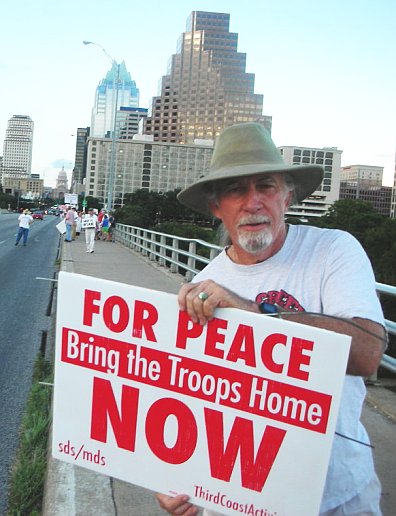
David Hamilton at MDS anti-war vigil in Austin, December, 2008. Photo by Sally Hamilton / The Rag Blog.

On my retirement from political activism

By David P. Hamilton / The Rag Blog / March 30, 2010

Last Sunday, the “health care reform” bill passed in the House of Representatives with most Democrats voting in favor and all Republicans voting against. Did you notice that stocks in pharmaceuticals and the health insurance industries both climbed the next day?

This comprehensive health care reform is none of the above. The struggle for its passage was pure theater on several levels. Most Democrats really don’t support it and most Republicans really don’t oppose it. Most Democrats would prefer a public option, Medicare being allowed to negotiate drug prices, re-importation of drugs from Canada and the like, but there aren’t enough votes independent of corporate lobbyists to pass any of that, so they opt for a charade with frills.

The Republicans know that the chief beneficiaries of this legislation are Big Pharma and the health insurance industry, but they don’t want their fingerprints on it for purely partisan political reasons. They do want another excuse to rally their legions by railing at Democrats, who in this case happen to be taking the lead as corporate lackeys.

It’s got plenty of passion, drama and irony, but it’s sound and furry signifying very little to do with better health care. The invective is primarily posturing to gain political advantage and the wealth and power associated with being the favored capitalist class toady of the moment.

Presidential candidate Barack Obama appeared before 20,000 in the rain in Austin, February 23, 2008. Photo from the Texas Observer.

Our president, who I worked hard to elect and who repeatedly called himself a “progressive” when he spoke to Austin rallies in 2008, is at least vastly exaggerating about what a great reform this is. Contrary to what you might hear, it does not significantly change the health care system in the one manner that matters most, shifting more of it into the public sector.

It does not establish health care as a right. Instead, buying private health insurance is established as a legal obligation. Meanwhile, Dennis Kucinich, after much pontification, does his usual roll over act in compliance with the party leadership.

The principal outrage is that now, thanks to Democrats, for the first time the federal government will mandate that you have to buy the products of the health insurance industry or face the wrath of the IRS. It will be illegal for you not to give 8% of your annual income to the insurance cartel in perpetuity.

In some countries, the government takes over corrupt and failing industries. In America, the corrupt and failing industrialists take over big slices of government. The Republicans are quite correct to question whether the mandate provision of the health care legislation is unconstitutional and the proto-fascist majority on the “Supreme” Court they created may rule in their favor, especially given that there seems to be very little precedent.

The overriding conclusion from all this is that our federal and state governments are almost totally in the pocket of the corporate capitalist ruling class, now more so than ever. U.S. politics has become a question about how one should relate to squabbles within the ruling class. Corporate ownership of the political system has expanded over our lifetimes and now its control is so complete that U.S. democracy is irretrievably corrupted.

It is profoundly naïve to expect the federal government to do anything truly progressive related to the country’s economic functioning within the confines of this hegemony. It is not realistic to think that you or any combination of non-ruling class individuals can have any serious impact on U.S. politics above a local level. Without access to major capital and status among the big bourgeoisie, you’re not a player.

With the recent Supreme Court decision allowing corporations to contribute unlimited amounts to political campaigns, U.S. democracy is dead as a doornail, the coffin is welded shut and buried deep. You can spend all your remaining days calling your congressional representative, demonstrating, donating to progressive candidates, and writing letters to the editor, but your efforts will have little positive effect except perhaps on yourself.

About all that could be realistically expected is to keep our intellectual tradition alive. You may counter that once we did make a significant difference. True or not, that was then and this is now.

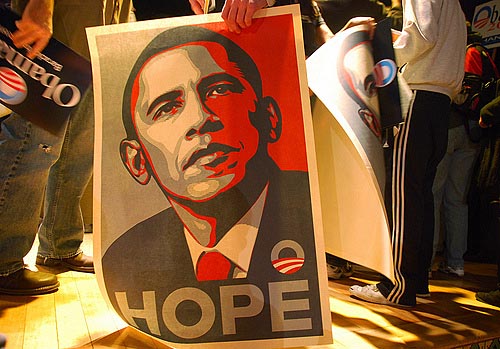
Obama: fading hope. Photo by Steve Rhodes / Flickr.

There are some areas where there will be positive change because such changes are not contradictory to capitalist domination. Gay rights is a good example and hardly insignificant. Now that “health care reform” has passed, Obama may even take pen in hand and do what he promised to do and what he should have done already by signing an executive order ending “don’t ask, don’t tell.” Thanks to the great coming out that we’ve seen over the past few decades, no attitudinal trend is more bullish than the growing acceptance of the gay/lesbian community.

Immigration reform will take place because the immigrants are coming anyway, capitalists like cheap labor, and both parties want the ever-growing Latino vote. The “drug war” will be diminished by the decriminalization of marijuana, because its continuation only fuels drug cartels, destabilizes nearby countries with piles of corpses, and deprives established capitalists the opportunity to reap profits legally.

Besides, in this brave new world, pot might fill the role of “soma.” As Huxley fittingly said of soma, it has “All the advantages of Christianity and alcohol [with] none of their defects.” Who cares if we live in a country where the government is a wholly owned subsidiary of the capitalist class and operates primarily in its service, at least we can get high.

In a tangentially related matter, the left in France just drubbed Sarkozy’s rightists in regional elections and then staged a nationwide strike in protest of his policies. This is occurring on the eve of my wife and I blowing years of savings by going to France for two months in celebration of my recovery from what medical authorities assured me was an incurable disease.

The question always arises when visiting France: why don’t we just stay there? It’s a question I’ve struggled with for years and the answer remains unchanged. Sally still has a rewarding career, but only here. We now have two darling grandchildren living here and our Guatemalan textile business is here and resists transplantation. In addition, there are the nearly 50 years of accumulated Austin friends. We could never be so much a part of another community.

The quandary is how to continue living in the increasingly repugnant U.S. and at the same time maintain one’s sanity and low blood pressure — without being angry about one travesty or another on a daily basis. One element of my solution is to retire from political activism and diminish my focus on political concerns. Turn off the cable pundits. Stop reading leftist blogs (except this one!). No more demonstrations of less than 10,000. No more “organizing,” my activism relegated to the occasional documentation of errant thoughts.

I used to think that political activism was the ideal existential raison d’etre. But with my growing awareness of its futility, for me if not for others, that will no longer suffice. I’m 66 and it’s time to pass the torch, which in my hands now only smolders.

I credit Barack Obama with bringing me to these conclusions. We worked hard for him. We helped lead his campaign in our suburban precinct in this southern state and he carried it by 2 to 1. We drank champagne with a house full of neighbors at his inauguration. It has been precipitously down hill ever since, illusions crashing right and left.

Number one on my list of expectations for his administration was health care reform; one that included an expanded public sector. Instead, we got an expanded private sector, with which our relationship is now obligatory. You can no longer be denied insurance because of a pre-existing condition. Instead, such individuals will be sent to high-risk pools where, between premiums and the attendant costs, “coverage” will be unaffordable for most eligible Americans.

Their version of universal health care is to universalize bad “coverage” by “mandating” people to make lifetime continuous payments to private insurance companies. Talk about your subsidized industry! This pro-capitalist, private sector fealty on Obama’s part is hardly new, his having begun his term by exceeding even Bush’s generosity to Wall Street.

And speaking of exceeding Bush, we now have more troops fighting in more (mostly Muslim) countries than we did during the Bush II administration. I naively expected some subtle diminution of American militarism. No such luck.

But how about his historic break with Israel’s Likud? Talk’s cheap and Obama is mainly talk.

The fall of Obama has been the icing on the cake.

Some of us had lunch with Bill Ayers last week and, unlike Obama, we are all proud to call him our friend. He continues to have a thoughtful analysis of the historical situation. He observed that promising political activism was taking place among the rubble of Detroit. People are growing — vegetables and community. They don’t focus on pleading for their bankrupt government to take action. They take action among themselves by building local collectives in food, transportation, and security.

However much potential this approach might have to prolong our survival, it also has its drawbacks. In Guatemala, when the police take a bribe and let some career criminal out of jail, the locals have been known to hang and/or incinerate the alleged miscreant in front of the police station along with a few police cars. So much for due process. But, it is only on these most basic levels that one can maintain a realistic political identity.

Because my incurable disease disappeared as mysteriously as it appeared and my VA doctor and debate partner says it might return, my motto has become “do it now.” It’s time for me to get to work on that “bucket list” with a vengeance. Political activism is notable in its absence. It does not remain self-actualizing enough and I’m a privileged white guy with pensions, socialist health care, and choices.

So I’m choosing grandchildren and gardening, Antigua, Guatemala and Lake Atitlán, classic literature and friends, Sally and Paris, and compliance with the dictates of my personal trainer, Birdie Poundpooch; indulgences that will have to suffice during my remaining years of kicking out the jams.

[David P. Hamilton has been a political activist in Austin since the early Seventies when he worked with SDS and wrote for The Rag, Austin’s underground newspaper.]

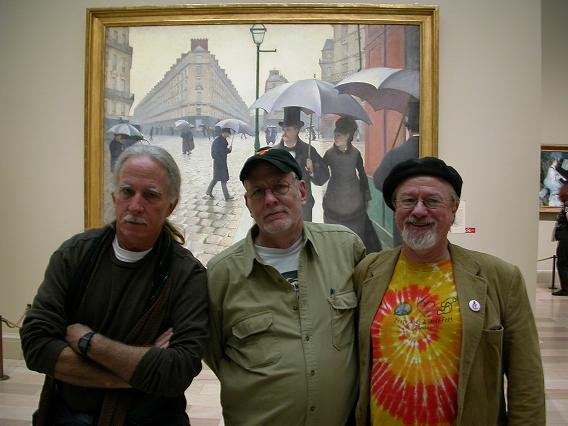
Above, Sally and David Hamilton at “Bring out the Dogs” demonstration against U.S. Sen. John (Corn Dawg) Cornyn, Austin, February 15, 2008. Photo by Carlos Lowry / The Rag Blog. Below, Chicago Three (L-R): David Hamilton and The Rag Blog’s Thorne Dreyer and Jim Retherford at the Chicago Art Institute, November 11, 2007, during MDS Convergence.

Also see “Alice Embree on Political Activism: Carry it On” by Alice Embree / The Rag Blog / April 6, 2010

The Rag Blog

Posted in Rag Bloggers | Tagged , , , , , , | 8 Comments

Tom Hayden : The Rising Cost of College

Students at the State University of New York protest tuition hikes, November, 2009. Photo from Albany Times Union

We can’t afford to be quiet
About the rising cost of college

By Tom Hayden / The Rag Blog / March 30, 2010

“There are some things we feel, feelings that our prevailing, acquisitive, and competitive corporate life, including tragically the universities, is not the way of life for us…”

That heartfelt plea for university reform, issued in 1969, is striking because it was voiced by Hillary Rodham, a student at Wellesley College. Are there any lessons or comparisons to be drawn from those turbulent times for the students and faculty members who are today demonstrating against the rising cost of higher education? As a student at the University of Michigan at Ann Arbor in those days and an itinerant sociologist at Scripps College now, I believe we can look to the past as legacy but not as blueprint.

The current generation of young people deserves admiration for the contributions they already have made: creating hip-hop culture, winning sweatshop-free purchasing agreements, leading online advocacy groups like MoveOn.org, and for being the backbone of Barack Obama’s unprecedented volunteer campaign. They will be the cradle of social activism for the next 20 years.

But the challenges they face on their campuses are far different from those of my generation, and perhaps more profound. Tuition at Michigan in 1960 cost less than $150 per semester. So I could obtain my degree, edit the student newspaper, go south to work in the civil-rights movement for two years, return and enter graduate school, and never feel that I was falling behind in the competitive economic rat race that young Hillary spoke out against.

Students today, however — even those who hold two part-time jobs — fall tens of thousands of dollars into debt, a burden that limits their career choices. Dropping out for social activism brings competitive disadvantage. The speedup of academic pressures dries up discretionary time that used to go to dreaming and exploring. Campuses are crowded with scrambling multitaskers for the most part too busy to protest the pace. Meanwhile, increases in the cost of college exceed inflation every year, intensifying the squeeze.

We had different grievances. The curriculum was often irrelevant to the social crisis we perceived ourselves inheriting; it needed reform. Students were powerless under the paternal doctrine of in loco parentis; we wanted rights. Students were disenfranchised, even though men could be drafted; we needed the vote and alternatives to the draft.

Structurally excluded, we went to the streets, to the outside, demanding change on the inside. It’s an exaggeration, but only after strikes, rioting, and taking over buildings did colleges offer the mainstream menu of women’s studies; black, Latino and Asian studies; queer studies; and environmental programs that they do today.

Now most students read Howard Zinn in history classes; back then Zinn was fired from Spelman College for marching with the Student Nonviolent Coordinating Committee.

In those days, university administrators were personified by the impersonal managerial elites depicted by C. Wright Mills, our sociologist hero. In recent decades, the multiversity has been succeeded by a privatized hybrid institution enmeshed in Wall Street machinations, a development epitomized by the former Harvard University president Lawrence H. Summers. Excessive financial risk-taking has resulted in depleted portfolios everywhere.

UT students lead a massive march against the War in Vietnam, May 8, 1970, in Austin. Photo from University of Texas / Houston Chronicle.

No longer independent, higher education has succumbed to the political pressures of regents and trustees who all too often are tied to banks and corporations. For an example of this inbred conservatism, consider a recent survey that showed the public favoring the use of federal stimulus money to keep tuition down, even if that meant leaving less money for operations. In response, a spokesman for the American Council on Education said, “The public is not always right.”

The question for today’s students is not whether they can read Noam Chomsky, Anaïs Nin, or Zinn, but whether they can afford to.

The recent outbreak of protests on hundreds of campuses is a promising sign that economic populism will be a central dynamic in any student movement of the future. Since many of the most active protesters today are students of color, there is greater potential for a coalition that includes inner-city taxpaying communities than there was when so many of the militants were from affluent suburbs.

Making college less affordable just as a large number of qualified aspirants are emerging from disadvantaged minority communities is an explosive issue. The numbers of women in college are larger than in the past, which might also widen the coalition.

The value of the past lies in remembering how recently higher education was affordable, even cheap. It’s not inevitable that a college education today costs so much. Undergraduate education is virtually free at the Sorbonne or the National Autonomous University of Mexico, and a year at Oxford costs no more than community colleges charge here.

The choices we have made as a country — to relentlessly privatize our public institutions; to eventually spend three trillion dollars, by some estimates, on the war in Iraq instead of on our public universities; to bail out billionaires on Wall Street while hitting students and their families with repeated tuition increases — are choices with consequences that we have to rethink or accept.

As recently as 1982, when I entered the California State Assembly, my first battle as a naïve new legislator was against fee increases at community colleges, which then were proudly free and accessible.

Under President Ronald Reagan and Gov. George Deukmejian, the (Republican) lobbyists for the colleges supported first-time fee increases to avoid budget cuts. Their motivation was not merely budgetary but also a matter of ideological principle. Nothing, they said, should be free in life, which meant that investment in public colleges and universities should be replaced by a consumer-marketplace approach.

Most of the Democrats went along when they were promised that the fees would be temporary. When the recession of that period ended, those fees became permanent, and they have escalated ever since. A similar pattern has been true of tuition increases at California State University and the University of California.

Were I still in politics, I would run for office on a promise to keep the magical possibilities of higher education affordable for today’s American families, and for the next generation seeking new opportunities for their children.

I wonder why the silence from politicians is so deafening. Is it that colleges and universities are easier targets at budget time than corporate-tax loopholes are? Is it that students and faculty members are marginal players in the great game of campaign contributions? Or that college constituencies are too fragmented, divided, and transitory to unify as an effective force for change?

The recent discontent on campuses is a healthy challenge to America’s priorities. I hope that Hillary Clinton hears an echo of herself before she and her colleagues become the politicians she warned us against.

[Tom Hayden is a visiting professor of sociology at Scripps College, in Claremont, Calif. His most recent book is The Long Sixties: From 1960 to Barack Obama (Paradigm, 2009).]

Thanks to Carl Davidson / The Rag Blog

Posted in Rag Bloggers | Tagged , , , , , | Leave a comment

FILM / Peter Watkins’ ‘La Commune’ : A Conceptual Tour de Force


PETER WATKINS’ LA COMMUNE

By Marc Estrin / The Rag Blog / March 29, 2010

The Paris Commune, that is — a citizens’ revolt against a royalist government, the organizing of that revolt, and the crushing of it by government forces, all in the course of three spring months in 1871.

After staring at a screen for 345 minutes, my wife and I — completely revved — looked at one another, and both asked the same question: “Are we doing enough?” What an outcome from seeing a film we expected to tax our endurance.

Peter Watkins’ La Commune (Paris 1871) is unlike any other political film I’ve seen. I’ve previously been appalled by suffering depicted, awed at Davids fighting huge Goliaths, frustrated, and angered, and stressed. But never before have I felt so personally challenged to think acutely through my beliefs, to measure my own action against my ideology.

Watkins achieves this effect via an astonishing conceptual move which greatly expands the potential for the art of political film. Assembling a group of 200 non-professional actors, he asked them to research their roles in the great insurrection, and to so understand the history of their characters as to be able to speak for them in interviews, in modern language, perhaps, but accurately, and with passion.

His players thus had to grapple with six different personae, three personal and three collective:

  • the historical figures, individually, and as class members at a defining moment of history;
  • themselves, as actors presenting those figures, playing them out while simultaneously judging them, a la Brecht;
  • themselves, as themselves, as individuals come together for an ambitious, artistic/political project, and also as groups, say of men vs. women.

In the course of making the film, these 200 people had to build their own commune, to establish decision-making groups around their work, and the agenda of the project itself.

What we see is startlingly unrealistic. We are shown around the “studio” by a pair of commentators from “Commune TV,” dressed, as is everyone, in nineteenth century garb, but utilizing hand-held mikes for their reporting.

Written commentary flows throughout the film, describing historical events in great detail; the viewer comes out well instructed as to actual history, sometimes with modern comparisons. In general, the rhythm proceeds from these historical introductions to the scenes described, action and interviews, with frequent cuts to contrasting reports from effete anchors on National TV.

Thus, La Commune is also about the media: some news for communards, different news for the haute bourgeoisie. Commune TV itself is also critiqued, with one reporter wanting to self-censor to better serve the struggle, and the other arguing for objectivity.

In the course of scenes and interviews, we experience the difficulty of creating a just society in the midst of competing world views, strategies at odds, and varying levels of commitment — and the threat of external force. At the same time, we come to understand the individual struggles which must occur at such potentially world-changing moments.

Beyond the designated enemy, who else is the enemy? Does a revolution require a guillotine?

Once the social/historical background is laid, the radical nature of the project emerges with increasing intensity, as Commune reporters start to intercut their interviews with different kinds of questions: Not What are you, the character, thinking?, but what are YOU, the actor, thinking about what’s going on? What IS going on — not for the character you are playing, but for YOU? Would YOU do today what your character did in history?

Such questioning begins gently, so that the actors can be reflective about their answers, but finally it intrudes, overwhelms, fiercely, passionately, right at the peak of the barricades. In the feverish pitch of their historical action, almost hysterical actors are badgered, mercilessly, about their personal reality.

The film emerges as a theater of cruelty, as these amateurs try to access such schizophrenia in the midst of their characters’ life and death struggles. The level of emotional and intellectual intensity is unmatched, especially compared to the smoothness of normal, professional productions.

And it is here — in this harassment — that the film becomes uniquely interactive. For viewers, rather than settling into the problems of the characters portrayed, are caught up in the inquisitorial demands of the interviewer, and absolutely MUST ask themselves the kinds of questions my wife and I were forced to face. Paradoxically, it is via such a non-realistic theatrical contrivance that Watkins achieves total breakdown of aesthetic distance.

Astounding.

During the final third of the film the momentum becomes so great and potentially exhausting that the audience is given occasional breaks as the cast comes together to discuss the actual making of the film, the contemporary and personal politics (especially sexual) that got swept under the rug, or hidden behind the historical story.

Yet, though the tempo goes from allegro agitato to andante, one’s interest is further intensified by meeting the individuals involved, and comparing their experiences with one’s own.

For theater and film folks, La Commune is an outstanding primer of Brechtian technique, with a compositional strategy reminiscent of the Living Theater’s Paradise Now, or Peter Brook’s Marat/Sade. The emergence of Artaudian effects from Brechtian theory is nowhere better seen.

Yet the prime importance of this work is as an organizing tool. If political action in your community is plagued by low energy or lack of commitment, a viewing of La Commune should solve that type of problem, for no one can leave it at the same ethical or intellectual energy level as before. The political difficulties depicted are daunting; some might find them depressing. Yet witnessing them so clearly can warn us of our own, contemporary, traps.

This is a film of first rate importance for current political struggle.

[Marc Estrin is a writer and activist, living in Burlington, Vermont. His novels, Insect Dreams, The Half Life of Gregor Samsa, The Education of Arnold Hitler, Golem Song, and The Lamentations of Julius Marantz have won critical acclaim. His memoir, Rehearsing With Gods: Photographs and Essays on the Bread & Puppet Theater (with Ron Simon, photographer) won a 2004 theater book of the year award. He is currently working on a novel about the dead Tchaikovsky.]

Find La Commune in a three-disc set from Amazon.com.

The Rag Blog

Posted in Rag Bloggers | Tagged , , , , | Leave a comment

SPORT / March Madness MVP? Baylor’s Brittney Griner

Baylor’s Brittney Griner. Photo from metatube.

Baylor’s Brittney Griner:
The story of this year’s ‘Big Dance’

By Dave Zirin / March 29, 2010

A 6’ 8” freshman is changing the way we understand hoops in the 2010 NCAA tournament and unless you’re paying full attention to all the glories of March Madness, you’d never know it.

Maybe it’s because the player in question is not a fresh-MAN at all. Her name is Brittney Griner, and despite the incredible buzzer beaters and upsets in the men’s draw, she is the individual story of this year’s “Big Dance.” Griner, with her agility, quick hops, and size 17 men’s shoes, is more than just evolution in action. That would imply that there are more Brittney Griner’s in the high school pipeline. There aren’t. She is simply a player apart.

As Helen Wheelock of the Women’s Hoops Blog commented to me, “My sense is that she’s unique — not because of her skills, but because of her mere physical size/attributes — and that her play will draw those who are curious in to be part of the viewing audience.”

If you aren’t aware of Griner, please allow me to stoke your curiosity. Her initial year of college ball has exceeded expectations with statistics that rival the first-year seasons of Lisa Leslie and Anne Donovan. But that has proven to be just an appetizer. Her tournament has been simply epic, with the only available comparison being Bill Russell.

First she set an NCAA tourney record with 14 blocked shots against Georgetown. Then against legendary Coach Pat Summit and the Tennessee Lady Vols, Griner played all 40 minutes and finished with 27 points, 10 blocked shots and seven rebounds, all while barely breaking a sweat. Baylor won 77-62 in what was basically a road game, played in Memphis. Now Griner is the first player to ever have at least 10 blocked shots in two separate tournament games.

There have been tall players in women’s hoops before. What separates Griner is that her height is matched by an agility, footwork and toughness that sees her contesting shots from the rim to the three point line. As her teammate, 5’ 10” guard Melissa Jones said, “It’s my excuse. When someone drives past me, I say I wanted Brittney to get 14 blocks. I’ll take credit for that.”

Before the tournament, Griner was best known for two things women players normally do not do, one notable and the other notorious: first she dunked twice in one game, a spectacle that put women’s hoops higher in the highlight rotation. Then last month, during a physical, bruising contest against Texas Tech, she punched opposing player Jordan Barncastle, bloodying her face, and was suspended for two games.

Now both the notable and notorious are in the rearview mirror. Baylor will be playing the school-that-will-not-be-named on Monday (ok, it’s Duke) to see who makes the Final Four. The winner will presumably play the utterly unbeaten and unchallenged 36-0 UCONN Huskies who haven’t lost seemingly since the Carter Administration. UCONN is epic, and we do love our sports dynasties in this country. But, like Wilt Chamberlain in his prime, are they just too good?

I communicated with USA Today’s Christine Brennan who told me,

Brittney Griner is the best thing to happen to women’s basketball since UConn, and she might be even better for the game than UConn. Connecticut’s dominance can cut both ways for women’s hoops. It’s stunning, but all those double-digit wins can depress national interest. But Griner? People will tune in to see this kid, and she’s only going to get better. It’s a cult-of-personality world out there in sports, and she’s the new, fresh face of women’s sports — not just basketball, but all women’s sports.”

If Griner and her Baylor Lady Bears teammates are the only thing standing between UCONN and another title, anyone who considers themselves a hoops fan should tune in. It will be David against Goliath. But this time, David will be 6”8”, and brilliant to behold.

[Dave Zirin is the author of the forthcoming Bad Sports: How Owners are Ruining the Games we Love (Scribner) Receive his column every week by emailing dave@edgeofsports.com. Contact him at edgeofsports@gmail.com .]

Source / The Nation

Brittney Griner. Photo from The End Zone.

The Rag Blog

Posted in RagBlog | Tagged , , , , , | 1 Comment

Labor Activist : Bill Fletcher Speaks to Austin Audience

Bill Fletcher. Photo by Alice Embree / The Rag Blog.

Bill Fletcher speaks to Austin audience:
Union organizing and class struggle

By Alice Embree / The Rag Blog / March 29, 2009

On Sunday night, March 28, Bill Fletcher, Jr. — union organizer, historian, and strategist, and progressive political activist — spoke at St. Andrew’s Presbyterian Church in Austin as part of the Third Coast Activist Final Sunday series. Responding to questions from UT-Austin Journalism Professor and Rag Blog contributor Bob Jensen, Fletcher said he’d be glad to take Glenn Beck on in a televised debate on class struggle.

Fletcher went on to discuss his views on working class organizing, coalescing with the community-based organizations, global capitalism, and the unprecedented income divide in this country.

[Bill Fletcher, Jr., is the co-author of Solidarity Divided, a book about labor’s role in the struggle for social justice, and is executive editor of The Black Commentator. He will speak again tonight, Monday, March 29, at 6:45 p.m., at the National Association of Letter Carriers Union Hall at 604 Williams in Austin. The event is open to the public.]

The Rag Blog

Posted in Rag Bloggers | Tagged , , , , | 1 Comment

Jonah Raskin : Marijuana Made Simple

Poster for the movie Homegrown, based on a story by Jonah Raskin.

A primer:
Marijuana made simple

By Jonah Raskin / The Rag Blog / March 29, 2010

Author, activist, educator, former Yippie, and marijuana aficionado Jonah Raskin will be Thorne Dreyer’s guest on Rag Radio, Tuesday, March 30, 2-3 p.m. (CST) on KOOP 91.7 FM in Austin. They will discuss — among other things — the California initiative to legalize and tax the use of cannabis. (See “Cannabis in California : The Growing Storm” by Raskin on The Rag Blog.) For those outside the listening area, go here to stream the show.

I was a latecomer to the world of marijuana. I remember in the mid-1960s a friend invited me to a party and told me that there would be pot there. You smoked it and you got high, he explained. I just laughed. I thought that the idea was ridiculous. “Where do you go when you get high?” I asked.

I didn’t find out until a few years later when I was living in New York. My friend, Aaron, who went on to law school and later became an honest, ethical judge was the first person I knew who smoked marijuana regularly. He smoked everyday. In fact, he has smoked everyday for the past 45 years.

When I first met Aaron most of the marijuana that was available came to the U.S.A. from Mexico; it was smuggled across the border. The word “marijuana” comes from Mexican Spanish and in the early racist campaigns against marijuana, it was associated with the image of lawless, dirty, violent Mexicans.

The plant is the cannabis plant; it has many active ingredients, but THC is probably the most important. I say “probably” because while cannabis has been smoked for thousands of years — that is a fact — there are not a heck of a lot of reliable studies of marijuana. That’s because the U.S. government, which made cannabis illegal some 70 years ago, is afraid that government financed studies will show that it has medical benefits.

It does have medical benefits, and since the 1990s it has been recommended by doctors for all kinds of health issues and problems. Indeed, it has greatly helped people suffering from HIV and AIDS. In California, medical doctors tell patients — who have cancer and who are in pain or who have loss of appetite — to smoke it. It stimulates appetite. It is a pain reliever. That is proven.

The domestic cultivation of marijuana really took off in the late 1970s and the early 1980s in the more remote mountain areas of Northern California. Many of the pot farmers were 1960s folk who left the cities and went back to the land to homestead.

Rural life in Humboldt, Mendocino, Sonoma, and Santa Cruz proved to be more challenging than the hippies realized. Marijuana came to the rescue. It was the one cash crop that they could grow and take to market and sell. The money they made enabled them to buy land, build houses, and schools and send their kids to college.

The domestic cultivation of marijuana received a big boost when Mexican marijuana was sprayed — because of U.S. government pressure — with Paraquat, a poisonous herbicide. Understandably no one wanted weed with poison.

The assault on marijuana came from all different directions including the Reagan White House that initiated the “War on Drugs” — a misnomer if ever there was one. Of course, you can’t make war on drugs. The Reagan White House made war on people.

Nancy Reagan, the president’s wife, helped to popularize the slogan, “Just say No.” Reagan’s Attorney General Edwin Meese III insisted that marijuana was “The Gateway Drug” and that it led users to heroin, cocaine, and more. Of course, Meese, Reagan, and the Reaganites never acknowledge the truth about drugs in America: that tobacco and alcohol were the “gateway drugs,” that young people started by drinking beer and smoking cigarettes.

In the War on Drugs, Meese and law enforcement officials across the nation violated the rights of citizens, and locked up thousands of marijuana smokers. The persecution has not stopped.

The anti-marijuana propaganda has been relentless ever since the 1937 movie Reefer Madness. Of course, the movies have also popularized marijuana, especially the comedies by Richard “Cheech” Marin and Tommy Chong: Up in Smoke (1979) and Let’s Make a New Dope Deal (1980).

In 1979, I went to Hollywood to make a marijuana movie. My idea was for a remake of the black-and-white classic, The Treasure of the Sierra Madre that’s about gringo prospectors for gold in Mexico. It’s a tale of greed. My movie was to be about “the greed weed” and it would be about hippies in California.

I sold the idea, and a treatment for the film, to producer and director, Stephen Gyllenhaal — the father of Jake and Maggie Gyllenhaal — but it took 16 years for it to be made. Homegrown was finally filmed in 1996, the year that a medical marijuana initiative was passed by citizens in California. By then there was also a whole new generation of marijuana smokers and the producers of the film realized that the subject was of interest to more people than aging hippies.

I was a consultant on the movie, and on the set. I have a tiny part. Everyone in the movie had to sign an agreement not to use any illegal drugs while the movie was made. The “marijuana” in the movie was not real. The plants that are shown on screen were made from silk and bamboo at a cost of $1,000 a plant.

Since 1996, marijuana cultivation and use has spread across the country. Outdoor growers moved indoors. The quality of the marijuana improved; often one puff is enough to get the smoker stoned. Recent studies show that smoking marijuana is still on the rise. It seems to be a part of the lives of millions of people — though it is still illegal by federal law. It is still classified as a Schedule I drug which means that by U.S. government standards there are no medical benefits.

By last count, some 14 states now have recognized the medical benefits of marijuana. Doctors recommend it to patients. Dispensaries sell it at $45 for 1/8 of an ounce. The price varies, of course. As a rule of thumb, the further the marijuana has to travel from the place of cultivation the higher the price.

President Obama made a big difference in the world of marijuana when he announced that the U.S. Justice Department would not make it a priority to go after individuals who violated the marijuana laws. But in 2010, Americans are still arrested and jailed for possession and transportation of marijuana, and the prohibition of marijuana, which began just as the prohibition of alcohol ended in the 1930s, may yet go on and on.

Something, it seems, always has to be prohibited. Marijuana has long been the fall guy. The plant that was smoked in China and India thousands of years ago still does not receive the credit it deserves. Will it ever become a medical hero? It is today to thousands of people who suffered from cancer and other diseases, and it is beloved by heads who like to get stoned.

But something inside me tells me it will be regarded as a bad boy for some time to come. Alas, America is too Puritanical a place to allow marijuana to be smoked freely and without fear of punishment.

[Jonah Raskin was the Minister of Education of the Yippies and a member of SDS. These days he teaches media law at Sonoma State University in Northern California. He has written 12 books, including biographies of Allen Ginbserg, Abbie Hoffman, and Jack London. His most recent book which is about organic farming is called Field Days. He wrote the story for the marijuana movie Homegrown. He writes about drugs for High Times magazine and he is keeping close tabs on the campaigns to legalize marijuana in California. He is a regular contributor to The Rag Blog.]

Also see:

The Rag Blog

Posted in Rag Bloggers | Tagged , , , , , , | 3 Comments

Not By Bread Alone: Why the Tea Baggers are Successful

By Sherman DeBrosse / The Rag Blog / March 29, 2010

In January, 2010, David Brooks wrote “In the near term, the tea party will dominate the Republican party.” At that time, the Tea Party movement had a higher approval score –41% — than either of the major parties.

Tea baggism is an extreme form of right-wing populism that includes an intense desire to isolate or somehow eliminate the influence of opponents. It is marked by hate speech and a rejection of democratic dialogue and debate. Rather than attempt to reason with opponents, it aims to completely eliminate their influence.

Some call this phase of right-wing populism “eliminationism” and suggest that it has para-fascist tendencies. It certainly has a strong energizing and activating capacity, and for the moment it appears to have co-opted much of the American conservative movement. Of late, the apocalyptic language of the right-wing fringe is frequently being heard in the vast Republican echo chamber.

The religious right represents a somewhat milder form of right-wing populism. For the most part, the two phenomena are on the same page and are not in conflict.

The first serious signs of the Tea Party movement appeared during the 2008 presidential campaigns, when some Republican rallies took on the aspect of Klan rallies, with people shouting ugly things about Obama and menacing the press. From there the movement gathered steam as large numbers questioned whether Barack Obama was born in the United States and also disrupted town hall meetings about health care. Sometimes, people brought firearms to the meetings to intimidate others.

In August 2009 tea baggers carried out vandalism against the district offices of a number of Democrats. The final days of the fight against health care reform were certainly animated by the spirit of the tea baggers. Protesters gathered around the entrance to the Capitol, some bearing crude signs showing Obama as Hitler. A demonstrator spat on one black Congressman and another yelled the “N” word at Representative John Lewis, a hero of the civil rights struggle. The Democratic Whip reported that all but one black member of the House received similar treatment.

Inside the Capitol, protesters shouted sexual epithets at Barney Frank, an openly gay Congressman. When Representative Bart Stupak announced his support for reform after having obtained a presidential executive order banning the use of the bill for abortions, an angry Congressman Randy Neugebeuer yelled “baby killer.” This was the same Texas representative who introduced a bill requiring candidates for president to file their birth certificates — his way of claiming Obama was born in Kenya.

During the final debate, protesters from the galleries shouted at Democrats. Republicans on the House floor cheered the disrupters and egged them on. Minority leader John Boehner tailored his final arguments to fit in with the tea bagger spirit — he ranted, shouted, and even used personal attacks. The day after the vote, Rush Limbaugh called the Democrats “bastards” and promised to hound, hassle, and wipe out” liberals.

Then, there were attacks on the Capitol offices of a number of House Democrats. Ten of them were threatened and had to be provided with protective units from the FBI and Capitol Hill police. Bart Stupak received many vile and threatening telephone calls; some of them must have come from anti-abortion people who were supposed to be Christians. The house of one Congressman’s brother was targeted.

The Tea Party movement is supported by FOX (Faux) News and counts among its leaders people like Dick Armey, Dennis Hastert, and the wife of Justice Clarence Thomas. She is a long-time Republican operative, and was working for the party when her husband helped hand the election of 2000 to George W. Bush. Joe the Plumber (Joe Wurzelbacher), who was part of the John McCain campaign apparatus in 2008, is a prominent tea bagger.

They are well funded, and their meetings have been arranged by skilled corporate lobbyists. Republican Party chairman Michael Steele has been meeting regularly with Tea Party leaders to make certain the movement does not get away from its handlers and financers. The Leadership Institute funds the training of young tea baggers, would-be “Hitler Jugend.”

Rage and wild rhetoric

The predominant characteristic of the tea baggers is their paranoia, rage, and incivility.
Anger and fear have a way of spreading, and the tea bag spirit has essentially taken over the Republican Party. A few days before the final vote on health care reform, John Boehner, the House Republican leader, told The Hill that he is always cool and never shouts. Two days later he stood in the well of the House shouting and using profanity.

People in the galleries were shouting insults at the Democrats while Republicans on the floor egged them on. Afraid of fueling more rage, the Democrats’ presiding officers did not clear the galleries and meekly asked for order. Veiled threats were left on the benches of some of the uncommitted Democrats.

Some of their most outspoken members are strongly anti-tax and anti-government. Some of them come from fringe movements and are strongly libertarian. However, it is doubtful that all or even most of the tea baggers are libertarians

They claim to be anti-elitist though they are bankrolled by powerful interests. Most of them are deeply conservative. They claim to be bipartisan and they criticize both parties. That means, they would prefer even more conservative leadership in the Republican Party. They lean strongly Republican.

Theirs is the cult of victimhood, and the movement is marked by mushy nostalgia, screaming paranoia, scapegoating, demonization, rank hypocrisy, jingoism, and militarism. Richard Armey said, “When Republicans are fighting against the power of the state, we win.” It may be more accurate to say that Republicans are best at fighting the power of the state when they are out of power.

Few complained about excessive spending under George W. Bush or the unprecedented expansion of the power of the state then. The tea baggers were bizarrely silent when the Bush deficit kept increasing, and those who were in Congress voted to ramp up the spending.

There is much dissatisfaction within the Tea Party movement with some who run the Republican Party, but there is little they can do to change the leadership. Here and there, they will try to nominate some of their own people for office, but in the end they have little choice but to stay with the Republicans. As in the past, when Republicans have activated the extremists, there were subsequent efforts to dial them back a bit. We see signs of this again, but Tea Baggism seems too powerful now and will surely move the GOP more than just a few notches farther toward the far right.

Interesting comparisons

Tea Bag people are extraordinarily effective at getting across their message. Michael Hastings, a founder of the Tea Bagger movement, recommended that his followers borrow the playbook of the great leftist organizer Saul Alinsky. They did so and had great success disrupting the health care town meetings.

Some see in the Tea Baggers a revolt against educated America because these people seem to oppose educated elite, but the fact is that, at least in one sampling, three quarters of these people went to college, and their average income is well above the national average.

It has been suggested that the tea baggers are to the Republican Party what the Greens are to the Democrats. Of course, a major difference is that the tea baggers are not operating as a political party or fielding their own candidates. They are essentially a wing of the GOP. Like the Greens who represent left-wing orthodoxy, tea baggers represent the purest incarnation of the principles of the Right. Both are dissatisfied with the leadership of the major parties.

Comparisons with the John Birchers might be more apt. The tea baggers seem to believe many of the conspiracy theories that were hatched by the John Birch Society. In the Southern Poverty Law Center’s The Second Wave, it is noted that “fringe conspiracy theories [are] increasingly spread by mainstream figures.”

The tea baggers resemble the Patriots, whose first wave seemed to subside in the late 1990s. Within the Tea Party movement, there is much interaction between Patriot-types and mainstream people, and there is the danger that the extremists will recruit from the tea bagger membership. Like the Birchers, they are xenophobes and ultra-nationalists. Though they talk a lot about the constitution they take the view that “terrorists don’t have a right to a trial.”

More than a half century ago, the great historian Richard Hofstadter noted that the right has a particularly strong proclivity for political paranoia, a witches’ brew of massive exaggeration, super-heated anger, conspiratorial fantasy, and deep suspiciousness. This right-wing populism boasted a special ability to “see through” official claims and also a remarkable skill in detecting the plots of elitists who have disdain for ordinary, middle Americans.

Tea baggers roar their approval when an orator refers to Obama as “commander in thief.” Glenn Beck rants on about Obama leading a bunch of fascists, communists, and socialists. Apparently the poor man does not know that there is a great deal of difference between fascists and communists.

Tom Tancredo’s call for a return to the literacy test of the Jim Crow South won great approval among tea baggers. Angling for tea bagger and white supremacist backing in his quest to become governor of South Carolina, Lt. Governor Andre Bauer talked about not feeding stray animals because they breed.

Rep. Steve King of Iowa lamented the suicide/murder of Andrew Joseph Stack III and used it to explain that the IRS is unnecessary. He took the standard tea bagger line: Stack was a lone lunatic but sort of admirable because the IRS drove him to a foolish action. They cannot admit that tea bagger rhetoric can promote violence. King went on to tell C-Pac that there are many enemies in America, “They are liberals, they are progressives, they are Che Guevarans, they are Castroites, they are socialists.” He even added “Trotskyites, Maoists, Stalinists, Leninists… Gramscites — ring anybody’s bell?”

In fact, most of the Trotskyites we could name have long since become “Neocons” and made their way into leadership positions in the Republican Party. They no longer worry about the problems of the working class and have become very effective defenders of Wall Street. “As for Gramsciites — the only people who admit to reading this Italian socialist are Grover Norquist and some other Republican strategists. Unfortunately, they mastered the communications and organizational skills he wrote about, while Democrats seem to have learned nothing from his prison writings.

Former Reagan official Frank Gaffney compared Obama to Hitler and said he “may still be” a Muslim and involved with the Muslim Brotherhood. At a recent meeting, former Colorado Lt. Governor Jane Norton sat quietly as a tea bagger twice assured the assemblage that Obama was a Muslim. With the occasional exceptions of John McCain and Lindsay Graham, Republican leaders have failed to correct any of the Tea Party excesses.

At the CPAC convention, Joseph Farrah electrified the crowd with his claims that Obama was not born in the United States. Tea bag blogger Erie Erickson claimed that Justice David Souter was a “goat fucking child molester.”

In Ohio tea bag protesters threw dollar bills at a disabled man, shouting “No handouts here,” and in Washington they sported a sign that said “Your Health. Your Problem.”


Type rest of the post here

Source /

The Rag Blog

Posted in RagBlog | Leave a comment

Not By Bread Alone: Why the Tea Baggers are Successful

By Sherman DeBrosse / The Rag Blog / March 29, 2010

In January, 2010, David Brooks wrote “In the near term, the tea party will dominate the Republican party.” At that time, the Tea Party movement had a higher approval score –41% — than either of the major parties.

Tea baggism is an extreme form of right-wing populism that includes an intense desire to isolate or somehow eliminate the influence of opponents. It is marked by hate speech and a rejection of democratic dialogue and debate. Rather than attempt to reason with opponents, it aims to completely eliminate their influence.

Some call this phase of right-wing populism “eliminationism” and suggest that it has para-fascist tendencies. It certainly has a strong energizing and activating capacity, and for the moment it appears to have co-opted much of the American conservative movement. Of late, the apocalyptic language of the right-wing fringe is frequently being heard in the vast Republican echo chamber.

The religious right represents a somewhat milder form of right-wing populism. For the most part, the two phenomena are on the same page and are not in conflict.

The first serious signs of the Tea Party movement appeared during the 2008 presidential campaigns, when some Republican rallies took on the aspect of Klan rallies, with people shouting ugly things about Obama and menacing the press. From there the movement gathered steam as large numbers questioned whether Barack Obama was born in the United States and also disrupted town hall meetings about health care. Sometimes, people brought firearms to the meetings to intimidate others.

In August 2009 tea baggers carried out vandalism against the district offices of a number of Democrats. The final days of the fight against health care reform were certainly animated by the spirit of the tea baggers. Protesters gathered around the entrance to the Capitol, some bearing crude signs showing Obama as Hitler. A demonstrator spat on one black Congressman and another yelled the “N” word at Representative John Lewis, a hero of the civil rights struggle. The Democratic Whip reported that all but one black member of the House received similar treatment.

Inside the Capitol, protesters shouted sexual epithets at Barney Frank, an openly gay Congressman. When Representative Bart Stupak announced his support for reform after having obtained a presidential executive order banning the use of the bill for abortions, an angry Congressman Randy Neugebeuer yelled “baby killer.” This was the same Texas representative who introduced a bill requiring candidates for president to file their birth certificates — his way of claiming Obama was born in Kenya.

During the final debate, protesters from the galleries shouted at Democrats. Republicans on the House floor cheered the disrupters and egged them on. Minority leader John Boehner tailored his final arguments to fit in with the tea bagger spirit — he ranted, shouted, and even used personal attacks. The day after the vote, Rush Limbaugh called the Democrats “bastards” and promised to hound, hassle, and wipe out” liberals.

Then, there were attacks on the Capitol offices of a number of House Democrats. Ten of them were threatened and had to be provided with protective units from the FBI and Capitol Hill police. Bart Stupak received many vile and threatening telephone calls; some of them must have come from anti-abortion people who were supposed to be Christians. The house of one Congressman’s brother was targeted.

The Tea Party movement is supported by FOX (Faux) News and counts among its leaders people like Dick Armey, Dennis Hastert, and the wife of Justice Clarence Thomas. She is a long-time Republican operative, and was working for the party when her husband helped hand the election of 2000 to George W. Bush. Joe the Plumber (Joe Wurzelbacher), who was part of the John McCain campaign apparatus in 2008, is a prominent tea bagger.

They are well funded, and their meetings have been arranged by skilled corporate lobbyists. Republican Party chairman Michael Steele has been meeting regularly with Tea Party leaders to make certain the movement does not get away from its handlers and financers. The Leadership Institute funds the training of young tea baggers, would-be “Hitler Jugend.”

Rage and wild rhetoric

The predominant characteristic of the tea baggers is their paranoia, rage, and incivility.
Anger and fear have a way of spreading, and the tea bag spirit has essentially taken over the Republican Party. A few days before the final vote on health care reform, John Boehner, the House Republican leader, told The Hill that he is always cool and never shouts. Two days later he stood in the well of the House shouting and using profanity.

People in the galleries were shouting insults at the Democrats while Republicans on the floor egged them on. Afraid of fueling more rage, the Democrats’ presiding officers did not clear the galleries and meekly asked for order. Veiled threats were left on the benches of some of the uncommitted Democrats.

Some of their most outspoken members are strongly anti-tax and anti-government. Some of them come from fringe movements and are strongly libertarian. However, it is doubtful that all or even most of the tea baggers are libertarians

They claim to be anti-elitist though they are bankrolled by powerful interests. Most of them are deeply conservative. They claim to be bipartisan and they criticize both parties. That means, they would prefer even more conservative leadership in the Republican Party. They lean strongly Republican.

Theirs is the cult of victimhood, and the movement is marked by mushy nostalgia, screaming paranoia, scapegoating, demonization, rank hypocrisy, jingoism, and militarism. Richard Armey said, “When Republicans are fighting against the power of the state, we win.” It may be more accurate to say that Republicans are best at fighting the power of the state when they are out of power.

Few complained about excessive spending under George W. Bush or the unprecedented expansion of the power of the state then. The tea baggers were bizarrely silent when the Bush deficit kept increasing, and those who were in Congress voted to ramp up the spending.

There is much dissatisfaction within the Tea Party movement with some who run the Republican Party, but there is little they can do to change the leadership. Here and there, they will try to nominate some of their own people for office, but in the end they have little choice but to stay with the Republicans. As in the past, when Republicans have activated the extremists, there were subsequent efforts to dial them back a bit. We see signs of this again, but Tea Baggism seems too powerful now and will surely move the GOP more than just a few notches farther toward the far right.

Interesting comparisons

Tea Bag people are extraordinarily effective at getting across their message. Michael Hastings, a founder of the Tea Bagger movement, recommended that his followers borrow the playbook of the great leftist organizer Saul Alinsky. They did so and had great success disrupting the health care town meetings.

Some see in the Tea Baggers a revolt against educated America because these people seem to oppose educated elite, but the fact is that, at least in one sampling, three quarters of these people went to college, and their average income is well above the national average.

It has been suggested that the tea baggers are to the Republican Party what the Greens are to the Democrats. Of course, a major difference is that the tea baggers are not operating as a political party or fielding their own candidates. They are essentially a wing of the GOP. Like the Greens who represent left-wing orthodoxy, tea baggers represent the purest incarnation of the principles of the Right. Both are dissatisfied with the leadership of the major parties.

Comparisons with the John Birchers might be more apt. The tea baggers seem to believe many of the conspiracy theories that were hatched by the John Birch Society. In the Southern Poverty Law Center’s The Second Wave, it is noted that “fringe conspiracy theories [are] increasingly spread by mainstream figures.”

The tea baggers resemble the Patriots, whose first wave seemed to subside in the late 1990s. Within the Tea Party movement, there is much interaction between Patriot-types and mainstream people, and there is the danger that the extremists will recruit from the tea bagger membership. Like the Birchers, they are xenophobes and ultra-nationalists. Though they talk a lot about the constitution they take the view that “terrorists don’t have a right to a trial.”

More than a half century ago, the great historian Richard Hofstadter noted that the right has a particularly strong proclivity for political paranoia, a witches’ brew of massive exaggeration, super-heated anger, conspiratorial fantasy, and deep suspiciousness. This right-wing populism boasted a special ability to “see through” official claims and also a remarkable skill in detecting the plots of elitists who have disdain for ordinary, middle Americans.

Tea baggers roar their approval when an orator refers to Obama as “commander in thief.” Glenn Beck rants on about Obama leading a bunch of fascists, communists, and socialists. Apparently the poor man does not know that there is a great deal of difference between fascists and communists.

Tom Tancredo’s call for a return to the literacy test of the Jim Crow South won great approval among tea baggers. Angling for tea bagger and white supremacist backing in his quest to become governor of South Carolina, Lt. Governor Andre Bauer talked about not feeding stray animals because they breed.

Rep. Steve King of Iowa lamented the suicide/murder of Andrew Joseph Stack III and used it to explain that the IRS is unnecessary. He took the standard tea bagger line: Stack was a lone lunatic but sort of admirable because the IRS drove him to a foolish action. They cannot admit that tea bagger rhetoric can promote violence. King went on to tell C-Pac that there are many enemies in America, “They are liberals, they are progressives, they are Che Guevarans, they are Castroites, they are socialists.” He even added “Trotskyites, Maoists, Stalinists, Leninists… Gramscites — ring anybody’s bell?”

In fact, most of the Trotskyites we could name have long since become “Neocons” and made their way into leadership positions in the Republican Party. They no longer worry about the problems of the working class and have become very effective defenders of Wall Street. “As for Gramsciites — the only people who admit to reading this Italian socialist are Grover Norquist and some other Republican strategists. Unfortunately, they mastered the communications and organizational skills he wrote about, while Democrats seem to have learned nothing from his prison writings.

Former Reagan official Frank Gaffney compared Obama to Hitler and said he “may still be” a Muslim and involved with the Muslim Brotherhood. At a recent meeting, former Colorado Lt. Governor Jane Norton sat quietly as a tea bagger twice assured the assemblage that Obama was a Muslim. With the occasional exceptions of John McCain and Lindsay Graham, Republican leaders have failed to correct any of the Tea Party excesses.

At the CPAC convention, Joseph Farrah electrified the crowd with his claims that Obama was not born in the United States. Tea bag blogger Erie Erickson claimed that Justice David Souter was a “goat fucking child molester.”

In Ohio tea bag protesters threw dollar bills at a disabled man, shouting “No handouts here,” and in Washington they sported a sign that said “Your Health. Your Problem.”


Type rest of the post here

Source /

The Rag Blog

Posted in RagBlog | Leave a comment