The Women of Bolivia : A Reason to Celebrate

Bolivia’s President Evo Morales congratulates his new Minister of Productive Development Antonia Rodriguez Medrano in La Paz on 23 Jan 2010. Photo by Juan Karita / AP.

International Women’s Day:
In Evo Morales’ Bolovia
Women are playing a major role

By Richard Lee / The Rag Blog / March 8, 2010

LA PAZ, Bolivia — Usually my birthday message, on International Working Women’s Day, is a report of little progress for women. This year is different. This year women have something to celebrate as do I.

The country of Bolivia has a new Constitution which in part frees women from the yoke of Catholicism, and a new way to govern, which includes women at all levels of government.

The women of La Paz, a double victory

In the early 19th Century, Bolivian women fought alongside men for the country’s independence from colonial Spain. They stormed into battle on horseback, seized cities and were on the front line. But their presence on the battlefield did not translate into presence in the political life of their nation. For many, their education, job opportunities and political rights were limited — until now.

Justice Minister Nilda Copa. Photo by Chávez / IPS.

Recently appointed Justice Minister, Nilda Copa, who started her political career as a trade unionist told the BBC at her office, “for a long time, we women have been excluded — it was one of the dark legacies of the colonial model. I remember my mother didn’t know how to read and write, neither did my grandmother… not because they didn’t want to learn.”

Ms. Copa joined a trade union very young, when she was only 16, because she felt a drastic change was needed and that was the only platform where women “had some voice.”

And that change seems to have arrived. Today, posters proclaiming the slogans of female Bolivian heroes such as indigenous rebel Bartolina Sisa and independence icon Juana Azurduy plaster the walls of several ministries. That shows the fervor felt in the Bolivia of President Evo Morales, who seems to be changing things not only for the country’s indigenous majority, but also for its women.

Half of Mr. Morales’s new cabinet is made up of women.

Today women are involved in running the country as never before. Mr. Morales began his second mandate last month with a cabinet reshuffle that complies with the gender parity stated in the new constitution he pushed for. Now the new cabinet has 10 men and 10 women, three of them indigenous.

“There used to be a lot of racism and machismo. There is still some, but now that structure is changing thanks to brother Evo Morales,” Ms Copa says. “Today, for example, there are no illiterate women, but women with enough capacity to develop activities at the same level as men. But the fight has been harsh and long.”

Her voice trails off and she focuses on a picture of her and Mr. Morales from the times when she was a member of the assembly that wrote Bolivia’s new constitution.

The Bolivian cabinet: 50 percent women

Homage

For Mr. Morales, achieving gender parity in the cabinet was a long-held aim. “One of my dreams has come true — half the cabinet seats are held by women,” Mr. Morales said recently. “This is homage to my mother, my sister and my daughter.”

Mr. Morales said that since his early days as a leader of the coca trade union, he had always worked towards getting women into decision-making posts based on the chacha warmi, a concept that in the local Aymara indigenous culture means that men and women are complementary in an egalitarian way.

Senator Gabriela Montano

Ms. Montano believes women have been key supporters of Mr. Morales. But another sign that women’s political influence is on the rise is the fact that they now occupy an unprecedented 30% of seats in Bolivia’s new legislative branch. One of them is Gabriela Montano, a senator who represents the eastern city of Santa Cruz — Bolivia’s opposition heartland — on behalf of Mr. Morales’s party, the “Movement towards Socialism” (MAS).

“This is the fruit of the women’s fight: the tangible proofs of this new state, of this new Bolivia, are the increasing participation of the indigenous peoples and the increasing participation of women in the decision-making process of this country,” Ms Montano told the BBC.

Senator Gabriela Montano. Photo from BBC.

Ms Montano was the subject of several physical attacks during her stint as the government’s envoy to Santa Cruz, and last year she was kept at a secret location as a safety precaution after she was threatened by opposition groups.

“The awakening of women has been brewing for a while. Women have been a key element in the consolidation of this process of change led by President Morales, from the rallies, the protests, the fights. Now, they will be a key element in affairs of national interest,” Ms Montano says.

However, while change for women is under way, for some there is still a long way to go until full equality is achieved. “Not long ago, 10 years ago, nobody talked about women in power in this country, that was unimaginable,” explains Katia Uriona, of the women’s advocacy group Coordinadora de la Mujer. “And even if I applaud all of these victories, I am aware this is not enough. Now we have to see if all of this is translated into something concrete that will truly change the gender face of this country.

A second victory

The new Constitution removes Catholicism, as the state religion. Catholic classes will no longer be taught in schools.

This is another victory for the women of Bolivia. The Pope of Rome and the Cult of the Virgin have long served to oppress the women of South America, (and much of the rest of the world). The denial of human rights such as the right of control over a woman’s own body has been an impediment to the progress of women.

That is no longer so in Bolivia. This second victory for women is enshrined in the new Constitution written with the participation of women. Unlike the U.S. Constitution, here women still don’t have equal rights under the Constitution.

And a personal victory

70 in a row and still counting.

The Rag Blog

Posted in Rag Bloggers | Tagged , , , , , , , | 2 Comments

March Forth in Austin : Students and Faculty Protest Budget Cuts

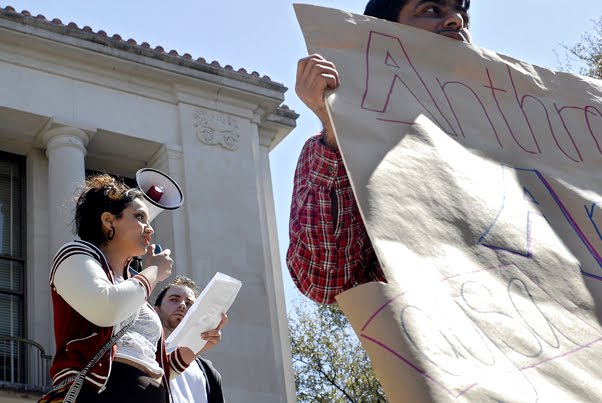
Naomi Caballero of MACHA speaks at a rally on the West Mall Thursday, protesting budget cuts and tuition increases at UT Austin. Photo by Danielle Villasana / The Daily Texan.

Stop the Cuts Coalition at UT-Austin:
Protest against budget cuts, faculty layoffs

How can anyone think it’s a good idea to lay off lecturers, limit admissions to graduate students, cut services by firing staff, cancel informal classes, close the Cactus Cafe — in order to give the already privileged even more?

By Anne Lewis / The Rag Blog / March 7, 2010

AUSTIN — On Thursday, March 4, more than 200 students and staff gathered at the West Mall of the University of Texas to participate in a National Day of Action to Defend Education. Together with workers and students across the country we rallied, spoke out, and marched.

Go here for a map showing actions that took place around the country.

The Stop the Cuts Coalition, started by undergraduate student Laura Evans, organized the action at UT-Austin. The action was endorsed by the Texas State Employees Union, the International Socialist Organization, the Anthropology Graduate Student Association, Students Friends of the Cactus Café, University Democrats, MEChA, ¡ella pelea!, UT Student Prison Caucus, Amnesty International — UT Chapter, and Join the Impact — Longhorn chapter.

The Texas State Employees Union (CWA Local 6186 – TSEU), to which I belong, is the largest union local in Texas. We have mobilized in protest of cuts and layoffs on campus since the late summer of 2009. We have collected, with the help of the Coalition, more than 3,000 signatures on a petition to support teachers and staff, stop the cuts, and oppose tuition hikes. for a copy of the petition.

First, let me cite a few statistics about the situation at UT-Austin.

  • UT’s total budget 2009-10: $2,140,000,000
  • Actual budget deficit: NONE, budget will actually increase by 2.8%
  • General number of graduate students admitted to the Department of History each year: over 20
  • Maximum number of graduate students who will be admitted to the Department of History in 2010: 8
  • Proposed amount reallocated by the College of Liberal Arts to new Liberal Arts building (mainly through cuts to lecturers and AI’s): $3,800,000
  • Amount of construction put on hold to save the foreign language program: 0
  • 2010 pay raise for football coach Mack Brown: $2,000,000
  • Average number of undergrad classes taught by lecturers that Mack Brown’s raise would fund: 400
  • Proposed $65 per semester fee to fund a new Student Activity Center, per semester: $3,250,000
  • Savings from canceling all informal classes and closing the iconic Cactus Café: $122,000

Go here for more.

I end the list with the closing of the Cactus Café because of its impact on our entire community. That’s the space where Townes Van Zandt and Lyle Lovett and Nancy Griffith played. Andy Smith, Executive Director of the Texas Union, who earns $138,603 a year, made the unilateral decision this year to close the Café. But the story is about much more than statistics.

One morning Jim Rubarth-Lay, a member of our union executive board and UT staff member for 17 years, came to work at 8 a.m. Jim was told to take a laptop, go home by 8:30, and not come back to work again. During the next month he was asked to complete a series of questions, kind of an exit interview, about the best and worst parts of his job. That was in September. Throughout October, Jim spent nearly every lunch hour on the West Mall helping organize our union with a sign “I was cut.” He still is unable to find full-time employment in Austin. The hardship on his family is extreme.

The man in charge of firing 70 workers in Jim’s unit (ITS) is Brad Englert, annual salary $175,000. Prior to his appointment at UT-Austin, Englert worked for the private company Accenture for 22 years, retiring as a senior partner. Accenture’s $899 million contract to privatize and outsource human services in Texas was canceled in 2007, but not until after an estimated 200,000 children had lost CHIP coverage due to Accenture’s incompetence. The Texas State Employees Union (TSEU) was proud to be in the leadership of the successful fight against the company and for the poor of Texas. Now Englert and his kind have found a new home at UT-Austin.

Labor unions often have been accused of putting the financial interests of their members ahead of the public good. This is a stereotype, used to drive a wedge between workers and students — to the detriment of both. We in TSEU believe in public education, we care deeply about students, and we see no contradiction between the needs of students and the needs of university workers.

We lobby the state legislature for an increase to state funding for UT and inclusion of university workers in an across the board pay-raise for all state workers. That’s how it used to be before 2001. We believe that every public worker is of value, not just a privileged few.

We believe in domestic partner benefits. The lack of equality is shameful.

We oppose tuition hikes, but if tuition is raised we believe that money must go to serve those who endure massive debt just to get a UT education. That means more, not fewer graduate students, more not fewer lecturers, more staff that directly serve students, more classes, smaller class sizes, more services to students and to the community.

Another union member among the many who were laid off is Urban Geographer Eliot Tretter. Dr. Tretter helped the union inform state legislators about the cuts, which resulted in a group of Austin legislative representatives meeting with UT-Austin President William Powers to force a response. Dr. Tretter is a well-known scholar, respected by students and colleagues, who integrates political economy and social theory with questions of urban governance, culture, and urban renewal. Dr. Tretter found out that he had no job by looking at the fall course schedule.

This is no way to treat people even in the hardest of times. But what angers me most is that it has nothing at all to do with budget shortfalls.

This month, UT bought a full-page ad in the Chronicle of Higher Education. It states there was a 7 percent increase in state funding last year. It brags that billions of dollars are available to hire star professors, support research, and build new facilities. The headline reads, “Texas can take you higher.” I don’t think that this is what Sly and his family had in mind.

How can anyone think it’s a good idea to lay off lecturers, limit admissions to graduate students, cut services by firing staff, cancel informal classes, close the Cactus Cafe — in order to give the already privileged even more?

We should be righteously angry.

We need to build organization on our campus, bringing workers into the union and students into progressive groups. We need to demand our right to transparency — what’s getting cut and where’s the money going? Faculty, staff, and students need votes; we need inclusion; and we need organizational representation with a share in decision-making. We need to stop the cuts now and in the future. By working collectively, we can create a university that is a place of greater substance, democracy, equality, and community. That’s quality education, more than any kind of excellence rooted in privilege and exclusivity.

March 4 was a beginning.

[Anne Lewis is an independent filmmaker frequently associated with Appalshop and a Senior Lecturer at UT-Austin. She was a speaker at the National Day of Action rally on the UT campus. Her film credits include: Morristown: in the Air and Sun, a working class response to globalization; Fast Food Women (POV and London Film Festival Judges’ Choice); On Our Own Land about a citizens’ effort to stop strip mining (duPont Award); and Associate Director, Harlan County, U.S.A. Anne Braden: Southern Patriot is co-directed with Mimi Pickering. Anne is a proud member of Local 6186 CWA-TSEU and CWA-NABET. Anne’s website is www.annelewis.org.]

The Rag Blog

Posted in Rag Bloggers | Tagged , , , , , , , , , | 3 Comments

Student Protests : Education Funding Cuts vs. Sports Largesse

Students and supporters rallied against funding cuts to higher education at the Capitol in Sacramento, Calif. on Thursday, March 4, 2010. Photo by Rich Pedroncelli / AP.

National Day of Action:
Students protest massive funding cuts
While millions goes to coaches, stadiums

By Dave Zirin / March 7, 2010

“It is easier to build strong children than to repair broken men.” — Frederick Douglass

On Thursday, I was proud to take part in a student walkout at the University of Maryland in defense of public education. It was just one link in a National Day of Action that saw protests in more than 32 states across the country.

I am not a student, and haven’t been since those innocent days when Monica Lewinsky mattered, but I was asked to come speak at a post walkout teach-in about the way sports is used to attack public education. It might sound like a bizarre topic, but it’s the world that students see every day.

At the University of Maryland, as tuition has been hiked and classes cut, football coach Ralph Friedgen makes a base salary of 1.75 million bucks, which would be outrageous even if the team weren’t two-steps past terrible. Friedgen also gets perks like a $50,000 bonus if none of his players are arrested during the course of the season.

Ground zero of the student protest movement is the University of California at Berkeley. Over at Berkeley, students are facing 32% tuition hikes, while the school pays football coach Jeff Tedford 2.8 million dollars a year and is finishing more than 400 million in renovations on the football stadium. This is what students see: boosters and alumni come first, while they’ve been instructed to cheer their teams, pay their loans, and mind their business.

The counterargument is that college athletic departments fund themselves and actually put money back into a school’s general fund. This is simply not true. The October Knight Commission report of college presidents stated that the 25 top football schools had revenues on average of $3.9 million in 2008. The other 94 ran deficits averaging $9.9 million. When athletic departments run deficits, it’s not like the football coach takes a pay cut.

In other words, if the team is doing well, the entire school benefits. If the football team suffers, the entire school suffers. This, to put it mildly, is financial lunacy. A school would statistically be better off if it took its endowment to Vegas and just bet it all on black.

If state colleges are hurting, your typical urban public school is in a world of pain with budgets slashed to the bone. Politicians act like these are problems beyond their control like the weather. (“50% chance of sun and a 40% chance of losing music programs.”)

In truth, they are the result of a comprehensive attack on public education that has seen the system starved. One way this has been implemented is through stadium construction, the grand substitute for anything resembling an urban policy in this country.

Over the last generation, we’ve seen 30 billion in public funds spent on stadiums. They were presented as photogenic solutions to deindustrialization, declining tax bases, and suburban flight. The results are now in and they don’t look good for the home teams. University of Maryland sports economists Dennis Coates and University of Alberta Brad R. Humphreys studied stadium funding over 30 years and failed to find one solitary example of a sports franchise lifting or even stabilizing a local economy.

They concluded the opposite: “a reduction in real per capita income over the entire metropolitan area… Our conclusion, and that of nearly all academic economists studying this issue, is that professional sports generally have little, if any, positive effect on a city’s economy.”

These projects achieve so little because the jobs created are low wage, service sector, seasonal employment. Instead of being solutions of urban decay, the stadiums have been tools of organized theft: sporting shock doctrines for our ailing cities.

With crumbling schools, higher tuitions, and an Education Secretary in Arne Duncan who seems more obsessed with providing extra money for schools that break their teachers unions, it’s no wonder that the anger is starting to boil over. It can also bubble up in unpredictable ways.

On Wednesday night, after the University of Maryland men’s basketball team beat hated arch-rival Duke, students were arrested after pouring into the streets surrounding the campus. In years past, these sporting riots have been testosterone run amok, frat parties of burning mattresses and excessive inebriation. This year it was different, with police needing to use pepper spray and horses to quell the 1,500 students who filled Route 1. In response, students chanted, “Defense! Defense!”

At the Thursday teach in, I said to the students that I didn’t think there was anything particularly political or interesting about a college sports riot. One person shot his hand up and said, “It wasn’t a riot until the cops showed up.” Everyone proceeded to applaud.

I was surprised at first that these politically minded students would be defending a post-game melee, but no longer. The anger is real and it isn’t going anywhere. While schools are paying football coaches millions and revamping stadiums, students are choosing between dropping out or living with decades of debt. One thing is certain: it aint a game.

[The Nation sports editor Dave Zirin is the author of the forthcoming Bad Sports: How Owners are Ruining the Games we Love (Scribner) Receive his column every week by emailing dave@edgeofsports.com. Contact him at edgeofsports@gmail.com.]

Source / The Nation

The Rag Blog

Posted in RagBlog | Tagged , , , , , , , | 1 Comment

Marc Estrin : Skulkstack

Austin’s Echelon Building, which housed offices of the IRS, was destroyed on Feb. 19, 2010, when disgruntled software engineer Joseph Stack allegedly crashing his single-prop Piper Cherokee into building.

Creepy connection:
Stack’s attack and my novel Skulk

By Marc Estrin / The Rag Blog / March 7, 2010

Writing fiction is a curious business. Given that most fiction is generated from one’s past experience, one finds oneself stroking a lamp whose vapors snake around through lost time, evoke its smell, and sometimes even genie up the future.

Joseph Stack’s alleged kamikaze attack on an IRS building in Austin was creepily like the events described in my novel, Skulk, written three years earlier:

Frustrated, well-educated, white Americans with trenchant analyses of what’s going on decide to provide America with a teaching moment to kick some ass in a stuck system. They both use or steal single engine planes, and crash them into a local building creating scenes reminiscent of 9/11. They both publish manifestos of dissection and complaint.

Initially, all of this provoked merely a slight smile and a squinty-eyed shaking of my head until the final similarities began to fall into place: embryonic net-rumors of a plot behind the plot, the possible involvement of false flags and patsies and government manipulation.

(Google “stack irs oddities” for a start, or link here or here for good introductions to this material.)

It’s too early, and the evidence too skimpy and tenuous to come to any conclusions about the Stack affair. But what has resonance for me is this: in Skulk, although the protagonists were involved in a pedagogic plot of their own, and stalking a possible accomplice, they were simultaneously being stalked by their stalking beast, a secretive department store Santa with an odd knowledge of martial arts, explosives, and access to tools.

Skulk might have been about a simple, if extreme, act of pedagogy. It was planned that way. But while writing, smoke from the past and a whiff of the future curled back into the text, and Santa began to infiltrate the plot, bringing gifts as usual. 
”Gift” means “poison” in German.

So I was struck by this new development in the Stack story, and wonder about how right-on predictive Skulk actually was. Is the MSM reporting as mendacious as that in my novel? Who has been black-hooded? Who benefits by the obscurity?

One thing can be said: Skulk is a lot richer and funnier than the current initial and investigative reporting. Check it out.

[Marc Estrin is a writer and activist, living in Burlington, Vermont. His novels, Insect Dreams, The Half Life of Gregor Samsa, The Education of Arnold Hitler, Golem Song, and The Lamentations of Julius Marantz have won critical acclaim. His memoir, Rehearsing With Gods: Photographs and Essays on the Bread & Puppet Theater (with Ron Simon, photographer) won a 2004 theater book of the year award. He is currently working on a novel about the dead Tchaikovsky.]

  • Find Skulk by Marc Estrin on Amazon.com.

The Rag Blog

Posted in Rag Bloggers | Tagged , , , , | Leave a comment

KBR and the Army : Rewarding Incompetence and Scandal

Image from Ms. Sparky.

Repeating bad behavior:
Houston’s KBR gets $2.8 billion contract

By Ted McLaughlin / The Rag Blog / March 7, 2010

It looks like the United States Army is incapable of learning from past mistakes. On Tuesday, the Army awarded defense giant KBR (once an affiliate of Halliburton) a new contract for support work in Iraq. The contract could be worth as much as $2.8 billion for the Houston-based company.

KBR was quick to jump on the new contract saying, “The award demonstrates that the government recognizes KBR’s ability and expertise in delivering high quality service in challenging contingency environments.” Despite their bragging, the record shows that KBR has definitely NOT shown “ability and expertise” in its Iraqi operations. Let me remind you of just a few of KBR’s screw-ups in Iraq.

First, consider the death of Staff Sgt. Ryan Maseth, a 24 year-old Green Beret. Maseth was electrocuted while taking a shower in 2008. It turned out that his death was due to faulty electrical work done by KBR. An investigation then found 17 other deaths due to faulty electrical work, most of it done by KBR. The company was denied $25 million in awards for this shoddy work.

But this was not all. Earlier, it was discovered that KBR had been selling the Army contaminated water. The water caused our soldiers to experience skin abscesses, cellulitis, skin infections, diarrhea, and other illnesses. Instead of fixing the problem, KBR covered it up and continued selling the contaminated water to the Army for THREE YEARS (from January 2004 through December 2006).

And it goes on. In 2005, a young woman named Jamie Leigh Jones was working for KBR in Iraq when she was raped by several male employees of KBR. Did KBR report this to the proper authorities? Of course not! When the young woman tried to go to authorities, they had her kidnapped and held in a shipping container with no food, water or medical help.

Thank goodness there was a single KBR employee with a shred of a conscience who allowed her to use his cell phone. She called her father in the United States, who then called Houston Rep. Ted Poe. Poe contacted the State Department and demanded her release. The State Department sent investigators, who rescued Ms. Jones and got her medical help.

Ms. Jones sued KBR, and instead of doing the right thing, the company is fighting the case tooth-and-nail. They even tried to get the case thrown out of court, claiming that her contract with the company denied her the right to file suit. Fortunately, the court did not buy this feeble argument and ruled she had the right to sue.

These are just some of the more well-known examples of KBR demonstrating its “ability and expertise” in Iraq. I’m sure there are more. KBR has not only not shown a level of excellence, it has not even shown a basic level of competence in Iraq. They have also shown they care little about our soldiers or even about their own employees.

But the company did make billions of dollars from the Iraqi war, and now it stands to make billions more. How can the Army reward this incompetence with a new multi-billion dollar contract? Even the dumbest individuals know better than to touch a stove a second time, after being burned the first time. Why can’t the Army learn from its past mistakes?

There are those who think our government is broken. Things like this make me think they could be right.

[Rag Blog contributor Ted McLaughlin also posts at jobsanger.]

The Rag Blog

Posted in Rag Bloggers | Tagged , , , , , , , | 4 Comments

Leonardo Boff : The World Society of Blindness

Image from Camelia Elias / FRAG/MENTS.

The World Society of Blindness

These are global problems that transcend our paradigm of specialized knowledge. Life does not fit into a formula, nor caring into a calculus equation.

By Leonardo Boff / The Rag Blog / March 7, 2010

Poet Affonso Romano de Sant’Anna and Portuguese Nobel Laureate for literature, Jose Saramago, have made “blindness” a theme of their severe criticisms of present day society, which is based on a reductionist vision of reality. They showed that there are many conceited seers who are blind, and a few blind men who are seers.

It is pompously publicized now that we live in the society of knowledge, a sort a new age of light. Effectively, that is the way it is. We know more and more about less and less. Specialization has colonized all areas of knowledge. The knowledge gained each year is greater than all the knowledge accumulated in the last 40 thousand years. If, on the one hand, this brings undeniable benefits, on the other, it makes us infinitely ignorant, putting blinders over our eyes, and thus preventing us from seeing the whole.

What is at stake now is the totality of human destiny and the future of the biosphere. Objectively, we are paving our way to the abyss. Why is this brutal fact not seen by most specialists; neither by the heads of State, nor by the immense means of mass communication that claim to predict possible scenarios for the future? Simply because, for the most part, they are cloistered within their specific knowledge, in which they are very competent, but which, for the same reason, blinds them to the urgent global problems.

Which of the great centers of world analysis of the 1960’s foresaw the climatic changes of the 1990s? Which Nobel laureate in economics foresaw the economic-financial crisis that has devastated the more developed countries in 2008? They were all eminent specialists in their limited fields, but ignorant with respect to the fundamental questions.

In general, we see only that which we understand. Since specialists only understand the small portion that they study, they wind up seeing only that minimum part, remaining blind to the whole. To change this type of Cartesian knowledge we would have to undo consecrated scientific habits and recreate an entire world vision.

That the fields of physics, chemistry, biology, quantum mechanics, and others are independent is an illusion. All areas of knowledge are interdependent, a function of the whole. The science of the Earth system was born of this perception. From it derives the Gaia theory, which is not just a New Age topic, but the result of very detailed scientific observation. It offers a basis for global policies to control the warming of the Earth, which, in order to survive, tends to reduce the biosphere and even the number of living organisms, human beings not excluded.

The COP-15 on climate change in Copenhagen was emblematic. Since in our culture the majority is held hostage to its habit of the atomization of knowledge, what dominated the speeches of the heads of state were limited interests: levels of carbon, degrees or warming, investment quotas and other partial data. The central question was different: what destiny do we want for the totality that is our Common House? What can we collectively do to guarantee the necessary conditions, such that Gaia may continue being inhabitable for us and all other living beings?

To grasp that whole, we need systemic learning, together with cordial and compassionate reason, because it is this type of reasoning that moves us to action.

We urgently need to develop the capacity for integrating, for interacting, the capacity of re-linking, of re-thinking, to re-do that which has been undone; and the capacity to innovate. This challenge is addressed to all specialists, so that they may be convinced that a part without the whole is not a part.

By integrating all these pieces of knowledge we will redesign the global view of reality, to be understood, loved and cared for. That totality is central to a planetary consciousness: yes, this one, the era of a guiding light that will free us from the blindness that afflicts us.

Translated from the Spanish by Melina Alfaro.

[A Brazilian theologian, philosopher, educator, and author of more than 60 books, Leonardo Bofff lives in Jardim Araras, an ecological wilderness area in the municipality of Petrópolis, Rio de Janeiro. Boff is Professor Emeritus of Ethics, Philosophy of Religion, and Ecology at the State University of Rio de Janeiro. A former Franciscan priest with a doctorate from the University of Munich, Boff was an early advocate of liberation theology. In 1991, after a series of clashes with the Vatican, Boff renounced his activities as a priest and “promoted himself to the state of laity.”]

The Rag Blog

Posted in Rag Bloggers | Tagged , , , , , , | Leave a comment

Earth to Obama : Nuclear Just Can’t Cut It

Dreamscape VII by Midnight-digital / Flickr / The End of Capitalism.

Not in your wildest dreams:
Five reasons nuclear just isn’t sustainable

By Alex Knight / The Rag Blog / March 6, 2010

President Obama recently announced an $8.3 billion loan of taxpayer dollars for the construction of two new nuclear reactors at the Vogtle site in Georgia. He has also proposed tripling the loans for new nuclear reactors to $54 billion in his 2011 budget.

In his announcement he argued, “To meet our growing energy needs and prevent the worst consequences of climate change, we’ll need to increase our supply of nuclear power. It’s that simple.”

Sadly, Mr. Obama is mistaken on all points.

If by “we” the President means to speak on behalf of his Wall Street advisers and the industrial capitalist system he represents, “our” energy needs are not growing. They’re shrinking along with the economy. And while preventing the worst consequences of climate change is necessary, nuclear power is not. It’s not necessary by any stretch of the imagination.

Here are five simple reasons why nuclear is not a sustainable solution to the energy woes of the 21st Century:

1. Nuclear is too expensive.

In economic hard times such as ours, we need cheap, readily-available sources of energy to create jobs and keep the lights on. Nuclear is the opposite. Nuclear reactors require billions of dollars of government subsidies just to be built, because no private investors wants to throw their money into an expensive and dangerous project that might never produce a return.

To grab those government subsidies, nuclear companies regularly lowball their price tags, knowing they’ll have to beg for more money later and that the feds will always give in. The recent TIME article, “Why Obama’s Nuclear Bet Won’t Pay Off,” explains:

If you want to understand why the U.S. hasn’t built a nuclear reactor in three decades, the Vogtle power plant outside Atlanta is an excellent reminder of the insanity of nuclear economics. The plant’s original cost estimate was less than $1 billion for four reactors. Its eventual price tag in 1989 was nearly $9 billion, for only two reactors. But now there’s widespread chatter about a nuclear renaissance, so the Southern Co. is finally trying to build the other two reactors at Vogtle. The estimated cost: $14 billion. And you can be sure that number is way too low, because nuclear cost estimates are always way too low.

Environment America’s report, “Generating Failure: How Building Nuclear Power Plants Would Set America Back in the Race Against Global Warming,” explains nuclear’s faulty economics further:

Market forces have done far more to damage nuclear power than anti-nuclear activists ever did. The dramatic collapse of the nuclear industry in the early 1980s — described by Forbes magazine as the most expensive debacle since the Vietnam War — was caused in large measure by massive cost overruns driven by expensive safety upgrades after the Three Mile Island accident revealed shortcomings in nuclear plant design. These made nuclear power plants far more expensive than they were supposed to be. Some U.S. power companies were driven into bankruptcy and others spent years restoring their balance sheets.

At the end of the day, there are much cheaper and better ways to produce energy. The TIME article points out, “Recent studies have priced new nuclear power at 25 to 30 cents per kilowatt-hour, about four times the cost of producing juice with new wind or coal plants, or 10 times the cost of reducing the need for electricity through investments in efficiency.”

Instead of pouring billions of dollars into something the market wants to keep its distance from, why not spend that money on efficiency improvements or wind and solar, for which there is a growing market and massive public support?

2. Nuclear is too inefficient.

A big part of why nuclear is so expensive is that it’s incredibly inefficient as an energy source, requiring a high proportion of energy inputs as compared to what it produces in output. Between the cost of building the plants and equipment (tons of steel, concrete, and intricate machinery), mining the uranium, enriching the uranium, operating under stringent safety regulations, disposing the radioactive waste, and eventually decommissioning the plants, there is a tremendous about of energy and money poured in to nuclear reactors, making the energy they produce proportionally less impressive than is often touted.

Because of all the secrecy and bureaucracy involved in nuclear operations, we have no thorough documentations of exactly how much energy must be invested in order to produce a return (this fraction is sometimes called Energy Returned on Energy Invested — EROEI).

Gene Tyner carried out one such study called “Net Energy from Nuclear Power” and estimated that “an ‘optimistic’ one‑plant analysis shows that one plant may yield about 3.8 times as much energy as is input to the system over a 40‑year period.” The “pessimistic” estimate was just 1.86, meaning less than twice the energy expended is returned through electricity.

Once again, these statistics are significantly worse than for wind, solar, or increased efficiency, each of which would produce much more net energy with the same levels of input. Wind, for example, could reach in
excess of 50:1 EROEI.

Nuclear’s energy numbers are only going to get worse as time goes on and the quantity of high-concentration uranium in the world continues to be depleted. Mining lower-quality uranium, in more difficult environments, will further reduce the net energy that nuclear can produce. Indeed, this is a whole separate problem, but nuclear is unlikely to be any kind of replacement for fossil fuels in the long run anyway, with studies stating that Peak Uranium will be here “before 2040 at the latest.”

3. Nuclear emits too much CO2 and other chemicals.

Nuclear is often touted by corporations and politicians as a “clean” energy source because the electricity generation process itself produces little to no carbon dioxide, the most notorious greenhouse gas responsible for driving our climate into chaos. However, nuclear does emit
substantial greenhouse gas pollution, of both carbon dioxide and other chemicals, if we look at its complete production profile:

…the nuclear fuel cycle does release CO2 during mining, fuel enrichment and plant construction. Uranium mining is one of the most CO2 intensive industrial operations and as demand for uranium grows CO2 emissions are expected to rise as core grades decline. According to calculations by the Öko-Institute, 34 grams of CO2 are emitted per generated kWh in Germany. The results from other international research studies show much higher figures – up to 60 grams of CO2 per kWh.

In total, a nuclear power station of standard size (1,250MW operating at 6,500 hours/annum) indirectly emits between 376,000 million tonnes (Germany) and 1,300,000 million tonnes (other countries) of CO2 per year. In comparison to renewable energy, nuclear power releases 4-5 times more CO2 per unit of energy produced taking account of the whole fuel cycle.

[….]

Aside from radioactive wastes, other waste and pollutants from the manufacture of nuclear reactor fuel include mercury, arsenic and cadmium, which are disposed of on and off site, and hydrochloric acid aerosols, fluorine and chlorine gas, which are released into the air.

None of this pollution is acceptable. Mercury and arsenic in particular are known carcinogens, meaning they cause cancer, along with birth defects and other devastating illnesses. The location of the plants, as is typical, tends to distribute the negative health effects primarily to poor communities and communities of color, making this an environmental justice issue as well.

It just doesn’t make sense. Why invest in a technology that is excessively dirty when compared to genuinely clean sources of energy like wind or solar?

Quoting once more from Environment America’s report:

Building 100 new reactors would require an up-front investment on the order of $600 billion dollars – money which could cut at least twice as much carbon pollution by 2030 if invested in clean energy. Taking into account the ongoing costs of running the nuclear plants, clean energy could deliver as much as 5 times more pollution-cutting progress per dollar overall.

4. Nuclear risks radioactive disaster.

So far we haven’t mentioned the traditional argument against nuclear reactors, that they 1) produce radioactive waste which we have nowhere to put, and 2) have the potential to melt down or be struck by a terrorist attack, which could cause almost inconceivable ecological calamity.

Few Americans realize how close we came to having to evacuate most of the Eastern Seaboard if the partial meltdown of the reactor at Three Mile Island in 1979 had caused an explosion in the core. This nearly happened, and the warning that the Three Mile Island disaster has given us about the extreme danger of nuclear reactors needs to be recalled today.

The reality is that even without an apocalyptic Chernobyl-style or 9/11-style event, nuclear fission everyday produces hundreds of poisonous and radioactive toxins which did not exist on Earth before the 1940s. Each nuclear plant creates approximately 1,000 metric tons of high- and low-level waste yearly, which will not fully degrade for literally thousands of years. And this is only the most controlled aspect of the problem.

As Harvey Wasserman explained on Democracy Now!, lesser-known radioactive leaks are sadly a regular occurance at nuclear facilities:

There’s a huge fight going on, by the way, in Vermont right now, where the people of the state of Vermont are trying to shut the Vermont Yankee nuclear plant, which has been leaking tritium. And if you’re not aware of this, twenty-seven of the 104 nuclear plants in the United States have been confirmed to be leaking tritium now. These are plants that have been around for twenty, thirty years. If they can’t control more than a quarter of the operating reactors in the United States and prevent them from leaking tritium, what are they doing turning around with this technology and pouring many more billions of dollars of our money into it? It’s an absolute catastrophe, and we will stand up to it.

An update on Wasserman’s story: On February 24, the Vermont Senate voted to close the Yankee plant in part due to these concerns about radioative leaks.

The bottom line is that while billions of dollars can be spent to secure the radioactive fuels and waste, there will always be a risk that things will go wrong due to technological breakdown or human error, and the consequences could be dire.

The only safe way to deal with nuclear reactors is to shut them down.

5. Funding nuclear is another corporate bailout.

So if nuclear energy is too expensive, too inefficient, too polluting, and too dangerous, why in the world are our well-intentioned political leaders like President Obama promoting such a technology? Have they lost their minds? No. The better question, as is usually the case in Washington, is who stands to benefit from this decision?

And the obvious answer is the nuclear industry, which has relied on government subsidies for half a century, and continues to swindle the public out of our hard-earned tax dollars with outdated lies about cheap, abundant, clean nuclear power.

Just like the defense industry or the banks, nuclear companies like Exelon use their high-placed connections in Washington to secure government contracts, loans, and bailouts behind the backs of the public, and it doesn’t really matter whether there’s a Democrat or Republican in the White House.

Juan Gonzalez of Democracy Now! reported on the Obama Administration’s ties to Big Nuclear:

Exelon is not just a nuclear power industry generator, it’s the largest operator of nuclear power plants in the United States. I think it has 17. And the firm was a major — has historically been a major backer of President Obama. And two of his chief aides have ties to Exelon. Rahm Emanuel, as an investment banker, helped put together the deal that eventually merged, created Exelon. And David Axelrod was a lobbyist for Exelon. So there are very close ties between the chairman of Exelon, John Rowe, and the Obama administration.

We need to understand the actions of politicians within their context. The context for President Obama’s announcement of $8 billion in loans to a nuclear reactor in Georgia and tripling the federal government’s funding of nuclear energy in his 2011 budget, is a nuclear industry that’s been on the run from its crippling problems for 30 years, and needs a big boost from the taxpayers in order to compete with less expensive, less controversial energy sources like wind and solar.

Then you have the reality of a failed political system that relies far more on corporate donations and advertising than it does on genuine democratic participation, so that politicians like Obama are structurally dependent on pandering to corporate/financial donors to get elected and stay elected, and you have a recipe for systemic corruption and giveaways.

Ben Schreiber, climate and energy tax analyst of Friends of the Earth,
Source” target=”_blank”>put it succinctly, “The last thing Americans want is another government bailout for a failing industry, but that’s exactly what they’re getting from the Obama administration.”

So what should the government be putting its (our) money into instead?

I’ve made the obvious suggestion of wind and solar power, which are cheaper and produce energy more efficiently than nuclear. Wind and solar also have the added benefit of being appropriate for local, small-scale energy production.

Given the resources and trained in the skills, communities can install wind towers and solar cells, maintain them, and distribute their output themselves, without the intermediaries of corporations or government. This not only creates many thousands of jobs, it also opens up possibilities for a 21st Century that could be more democratic, locally-rooted, and decentralized than the last one.

What are your ideas? What would YOU do if you were in Obama’s position and could throw $50-some billion around towards an actually sustainable economy?

[Alex Knight is an organizer and writer in Philadelphia. He is currently organizing with Philly Students for a Democratic Society (SDS) and working with others to mobilize Philadelphia for the US Social Forum this June 22-26 in Detroit. He also maintains the website endofcapitalism.com and is in the process of writing a book called The End of Capitalism. He can be reached at activistalex@gmail.com]

Also see:

The Rag Blog

Posted in Rag Bloggers | Tagged , , , , , , | 2 Comments

Naomi Klein : Chile and the Free-Market Fundamentalists

Salvador Allende, Chile’s democratically-elected socialist president, removed in a U.S.-backed coup in 1973. Photo from Jaume d’Urgell / Flickr.

Credit where credit is due:
Chile’s socialist rebar

After the coup and the death of Allende, Pinochet and his Chicago Boys did their best to dismantle Chile’s public sphere… Fortunately… (they) never got around to trashing Allende’s tough building code, an ideological oversight for which we should all be grateful.

By Naomi Klein / March 6, 2010

Ever since deregulation caused a worldwide economic meltdown in September ’08 and everyone became a Keynesian again, it hasn’t been easy to be a fanatical fan of the late economist Milton Friedman. So widely discredited is his brand of free-market fundamentalism that his followers have become increasingly desperate to claim ideological victories, however far-fetched.

A particularly distasteful case in point. Just two days after Chile was struck by a devastating earthquake, Wall Street Journal columnist Bret Stephens informed his readers that Milton Friedman’s “spirit was surely hovering protectively over Chile” because, “thanks largely to him, the country has endured a tragedy that elsewhere would have been an apocalypse… It’s not by chance that Chileans were living in houses of brick — and Haitians in houses of straw — when the wolf arrived to try to blow them down.”

According to Stephens, the radical free-market policies prescribed to Chilean dictator Augusto Pinochet by Milton Friedman and his infamous “Chicago Boys” are the reason Chile is a prosperous nation with “some of the world’s strictest building codes.”

There is one rather large problem with this theory: Chile’s modern seismic building code, drafted to resist earthquakes, was adopted in 1972. That year is enormously significant because it was one year before Pinochet seized power in a bloody U.S-backed coup.

That means that if one person deserves credit for the law, it is not Friedman, or Pinochet, but Salvador Allende, Chile’s democratically elected socialist President. (In truth many Chileans deserve credit, since the laws were a response to a history of quakes, and the first law was adopted in the 1930s.)

It does seem significant, however, that the law was enacted even in the midst of a crippling economic embargo (“make the economy scream” Richard Nixon famously growled after Allende won the 1970 elections). The code was later updated in the nineties, well after Pinochet and the Chicago Boys were finally out of power and democracy was restored.

Little wonder: As Paul Krugman points out, Friedman was ambivalent about building codes, seeing them as yet another infringement on capitalist freedom. As for the argument that Friedmanite policies are the reason Chileans live in “houses of brick” instead of “straw,” it’s clear that Stephens knows nothing of pre-coup Chile.

The Chile of the 1960s had the best health and education systems on the continent, as well as a vibrant industrial sector and rapidly expanding middle class. Chileans believed in their state, which is why they elected Allende to take the project even further.

After the coup and the death of Allende, Pinochet and his Chicago Boys did their best to dismantle Chile’s public sphere, auctioning off state enterprises and slashing financial and trade regulations. Enormous wealth was created in this period but at a terrible cost: by the early eighties, Pinochet’s Friedman-prescribed policies had caused rapid de-industrialization, a ten-fold increase in unemployment and an explosion of distinctly unstable shantytowns.

They also led to a crisis of corruption and debt so severe that, in 1982, Pinochet was forced to fire his key Chicago Boy advisors and nationalize several of the large deregulated financial institutions. (Sound familiar?)

Fortunately, the Chicago Boys did not manage to undo everything Allende accomplished. The National copper company, Codelco, remained in state hands, pumping wealth into public coffers and preventing the Chicago Boys from tanking Chile’s economy completely. They also never got around to trashing Allende’s tough building code, an ideological oversight for which we should all be grateful.

Thanks to CEPR for tracking down the origins of Chile’s building code.

[Naomi Klein is an award-winning journalist and syndicated columnist and the author of the international and New York Times bestseller The Shock Doctrine: The Rise of Disaster Capitalism, now out in paperback. Her earlier books include the international best-seller, No Logo: Taking Aim at the Brand Bullies (which has just been re-published in a special 10th Anniversary Edition); and the collection Fences and Windows: Dispatches from the Front Lines of the Globalization Debate (2002). To read all her latest writing visit www.naomiklein.org.]

Source / CommonDreams

The Rag Blog

Posted in RagBlog | Tagged , , , , , , | Leave a comment

Chile’s Socialist Rebar

by Naomi Klein / March 6, 2010

Ever since deregulation caused a worldwide economic meltdown in September ’08 and everyone became a Keynesian again, it hasn’t been easy to be a fanatical fan of the late economist Milton Friedman. So widely discredited is his brand of free-market fundamentalism that his followers have become increasingly desperate to claim ideological victories, however far-fetched.

A particularly distasteful case in point. Just two days after Chile was struck by a devastating earthquake, Wall Street Journal columnist Bret Stephens informed his readers that Milton Friedman’s “spirit was surely hovering protectively over Chile” because, “thanks largely to him, the country has endured a tragedy that elsewhere would have been an apocalypse… It’s not by chance that Chileans were living in houses of brick — and Haitians in houses of straw — when the wolf arrived to try to blow them down.”

According to Stephens, the radical free-market policies prescribed to Chilean dictator Augusto Pinochet by Milton Friedman and his infamous “Chicago Boys” are the reason Chile is a prosperous nation with “some of the world’s strictest building codes.”

There is one rather large problem with this theory: Chile’s modern seismic building code, drafted to resist earthquakes, was adopted in 1972. That year is enormously significant because it was one year before Pinochet seized power in a bloody U.S-backed coup.

That means that if one person deserves credit for the law, it is not Friedman, or Pinochet, but Salvador Allende, Chile’s democratically elected socialist President. (In truth many Chileans deserve credit, since the laws were a response to a history of quakes, and the first law was adopted in the 1930s.)

It does seem significant, however, that the law was enacted even in the midst of a crippling economic embargo (“make the economy scream” Richard Nixon famously growled after Allende won the 1970 elections). The code was later updated in the nineties, well after Pinochet and the Chicago Boys were finally out of power and democracy was restored.

Little wonder: As Paul Krugman points out, Friedman was ambivalent about building codes, seeing them as yet another infringement on capitalist freedom. As for the argument that Friedmanite policies are the reason Chileans live in “houses of brick” instead of “straw,” it’s clear that Stephens knows nothing of pre-coup Chile.

The Chile of the 1960s had the best health and education systems on the continent, as well as a vibrant industrial sector and rapidly expanding middle class. Chileans believed in their state, which is why they elected Allende to take the project even further.

After the coup and the death of Allende, Pinochet and his Chicago Boys did their best to dismantle Chile’s public sphere, auctioning off state enterprises and slashing financial and trade regulations. Enormous wealth was created in this period but at a terrible cost: by the early eighties, Pinochet’s Friedman-prescribed policies had caused rapid de-industrialization, a ten-fold increase in unemployment and an explosion of distinctly unstable shantytowns.

They also led to a crisis of corruption and debt so severe that, in 1982, Pinochet was forced to fire his key Chicago Boy advisors and nationalize several of the large deregulated financial institutions. (Sound familiar?)

Fortunately, the Chicago Boys did not manage to undo everything Allende accomplished. The National copper company, Codelco, remained in state hands, pumping wealth into public coffers and preventing the Chicago Boys from tanking Chile’s economy completely. They also never got around to trashing Allende’s tough building code, an ideological oversight for which we should all be grateful.

Thanks to CEPR for tracking down the origins of Chile’s building code.

[Naomi Klein is an award-winning journalist and syndicated columnist and the author of the international and New York Times bestseller The Shock Doctrine: The Rise of Disaster Capitalism, now out in paperback. Her earlier books include the international best-seller, No Logo: Taking Aim at the Brand Bullies (which has just been re-published in a special 10th Anniversary Edition); and the collection Fences and Windows: Dispatches from the Front Lines of the Globalization Debate (2002). To read all her latest writing visit www.naomiklein.org.]

Source / CommonDreams

The Rag Blog

Posted in RagBlog | Leave a comment

Foodie Friday : Bread, Puppets, and Boiled Veggies

Bread and Puppet Theater. Image from Akimbo.

Health care:
Bread and Puppet aioli

By Marc Estrin / The Rag Blog / March 5, 2010

See “Boil those veggies!” by Janet Gilles, Below.

Anyone taking in the recent health care “debate” — in whole or in part — must surely need an antidote, and here it is: garlic! Garlic kills viruses and bacteria, supports the immune system, increases energy, lowers blood pressure, wards off vampires, and is the bane of schmoozing politicians.

You know that great yellow stuff you used to get smeared on your Bread & Puppet bread at performances* (now replaced for reasons unknown by garlic merely suspended in oil)? That stuff. What they make for the peasants in southern France and Italy: when they come in from the fields for lunch, they are handed a loaf of bread to rip apart and dip in a big, common bowl of God’s gift to sweat, and a full afternoon of hard work.

Here’s how you make it:
3 eggs
canola oil
1 head of garlic
salt

Separate yolks and place in large mixing bowl. Give the whites to high-cholesterol partners innocent of Lipitor.

Here’s the tricky part: Pray to the aioli gods.

Add oil, A DROP AT A TIME, to the egg yolks. I’m not kidding — a drop at a time, at least at the beginning. Bread and Puppet macho would have you whip the oil and eggs together with a fork. I cheat and use an electric mixer on low speed. Don’t tell Peter Schumann.*

As the volume of oil builds up, you will be able to add it more quickly, a couple of drops, then a few, then a very thin, intermittent stream. But WARNING: if you add the oil too quickly, the aioli will not “catch,” and you’ll end up with an oily mess. Patience, patience. Franz Kafka wrote:

There are two main human sins from which all the others derive: impatience and indolence. It was because of impatience that we were expelled from Paradise, it is because of indolence that we cannot return. Yet perhaps there is only one major sin: impatience. Because of impatience we were expelled, because of impatience we cannot return.

He must have been a very good aioli maker.


How much oil? Reasonable question. I’ll defer the answer.

The mixing bowl should now be filled with something that looks and feels very like mayonnaise. In fact, it IS mayonnaise. This is how you make mayonnaise. The funny thing is, once you get to a certain point, you can add oil much more quickly (but not too quickly), and make as much as you like. The yellow will become more diluted, but aside from that, you can plan to feed the multitudes if you have enough oil. Add loaves and fishes if desired. That’s how much oil.

Chop garlic into tiny, tiny pieces. Bread & Puppet macho insists you chop with a broad blade very sharp knife, then squoosh the pieces with the flat of the blade to squeeze out the final juice. When puppeteers aren’t watching, I use a garlic press.

How much garlic? Use the whole head, or just part of it? That depends on how big the garlic is, how much aioli you are making, and how strong you want it. I’ve never made enough to use more than one entire head — about half a large mixing bowl’s worth.

Mix the garlic mash into the waiting bowl, and stir in thoroughly. Add salt to taste.

Eating: Although you can eat it immediately, it’s best to let it stand, refrigerated for a couple of days. It mellows out into something strong and smooth, but not nastily fierce. Folks either love it or they hate it. Some stomachs can’t stand too much garlic without refluxing. You can give out Rolaids with the aioli to those folks. Best on fresh-baked hearty bread.

*[Author, activist, and Rag Blog contributor Marc Estrin has been involved with the radical Vermont-based Bread & Puppet Theater — founded by director Peter Schumann — since 1970.]

Boil those veggies!
(Then think Aztec: add cocoa and honey…)

By Janet Gilles / The Rag Blog / March 5, 2010

The more vegetables the better is becoming settled wisdom. And my acupuncturist encourages me to boil them. The Chinese are not as dumb as everyone thinks, modern science just chooses not to investigate their methods.

So I buy whatever greens that look good at the farmers market, trim the best parts for salad, and boil the rest just until they wilt. You can bring the water or broth to a boil, turn off the fire and add the veggies. I like the bright green color the poached veggies will turn and try to catch that. Or boil them awhile if they are tough, adding some ginger if you have any.

Put hot broth and greens into a blender with some nut butter to make it milky and miso to give it body and salt; about a teaspoon of cashew, almond, or hemp butter, and a half teaspoon of miso per cup will make it really creamy, rich, and delicious.

Variations:

To make a fine soup, add some lemon juice, garlic, and parmesan and serve hot or cold, with a dash of sour cream or croutons if you like. Also good with a few shavings of nutmeg. This soup makes an excellent beginning to any meal.

For breakfast, add honey and chocolate to taste. Yes, really!!! Think Aztec. About a teaspoon of cocoa powder and a teaspoon of honey per cup make a hearty breakfast drink. Having a lot of green vegetables on hand, and recalling that the Aztecs made chocolate drinks of their food, I have begun flavoring vegetable drinks with chocolate!! Delicious.

The Rag Blog
Posted in Rag Bloggers | Tagged , , , , | Leave a comment

Political cartoon by Stanfill about Texans and other dinosaurs.

Posted in RagBlog | Leave a comment

Harry Targ : The Theory of Bagel Capitalism

Political theory and the tower of bagel. Image from Neurotopia.

Bagels and the theory of capitalist development

I think Marx had a pretty good analysis of how capitalism works but even I recognize that his theory did not adequately come to grips with the political economy of the bagel.

By Harry Targ / The Rag Blog / March 4, 2010

A long time ago Karl Marx theorized that in capitalist societies the class of people that own and control the means of production — the machines, the factories, the workers — constituted an economic ruling class. The only thing that workers owned was their ability to do work.

The workers would sell their ability to do work for a wage. The capitalists would hire workers, work them hard, and sell the goods and services produced. The capitalists would sell the products and/or services for more than the workers would get paid. They would keep the difference and that is where profit came from.

Over time, Marx said, the number of capitalists would get smaller and smaller and what they owned and controlled would get bigger and bigger. Marx’s predictions pretty much have come to pass with a few hundred corporations and banks controlling about one-third of all that is produced on the face of the globe.

The political economy of the bagel

Now I am one of those people who think Marx had a pretty good analysis of how capitalism works but even I recognize that his theory did not adequately come to grips with the political economy of the bagel. The bagel originally was a round roll with a hole in the middle that began to get hard as soon as it came out of the oven. Water bagels, the authentic bagels, were plain, hard, and flat when cut so that cream cheese could be spread evenly or in chunks over their surface. Also, bagels could just as easily be used to throw at targets during a popular uprising as they could be used to stifle hunger.

Bagels used to be produced in small Jewish bakeries that dotted neighborhoods in Eastern and Midwestern cities. Along with the generic food/weapon, the plain bagel, more adventurous Jewish bakers began to experiment with the production of garlic bagels, onion bagels, and poppy seed bagels. Bagel bakers were highly skilled craft workers, probably descendants of the powerful medieval bagel guilds of Central Europe.

In sum, the introduction of the bagel in Jewish communities provided for the nutritional needs of the community, a means of defense and deterrence against aggression from outside the community, and over time a source of cultural identity. As Jews migrated throughout the United States, they maintained an identification — even if not articulated — with the bagel.

The rise of monopoly capitalism and the production of the bagel

Although followers of Marx have carefully analyzed the accumulation of capital on a national and global scale and have linked the concentration of economic power with control of the modern state, hardly ever did they notice the transformation that was going on right under their noses concerning the political economy of the bagel.

The small bagel bakeries of old were closing their doors. Many people rejecting their heritage began to eat croissants and muffins for breakfast instead of bagels. And as the traditional consumers of bagels left the working class and joined the bourgeoisie, they no longer wished to stockpile old bagels as weapons in the class struggle.

These events led some to predict the demise of the bagel as we had known it. But then the economic ruling class, suffering from declining rates of profit, discovered the bagel and began to reconstitute the global capitalist system. First, some food processing companies started selling packages of frozen bagels — small, tasteless, harmless little bagels. Then, new bagel bakeries/sandwich shops began to open in urban centers. These spread like wildfire around the country. Pretty soon the word “bagel” was on everyone’s lips.

Then newer bakery shops, part of global conglomerates, would come to town, underprice their product, and force out their competitors — both bakeries and coffee and sandwich restaurants. The bagels they produced and sold were big, puffy, and mushy inside, and had bizarre flavors such as chocolate, cinnamon, or basil. Everybody was ordering a bagel with a “schmear” (heretofore a technical term). Perhaps most importantly these bagels would be as powerful a weapon as a pillow.

The process of production of bagels had changed as well. No longer were the bagel bakers craftsmen and women who carefully crafted their products with pride. Now bagels were partially assembled in huge bagel factories and shipped, uncooked, to the hundreds of thousands of stores in the chain to be baked and sold to the untutored and the young.

Today the bagel industry is a multi-billion dollar a year industry, dominated by a handful of bagel monopolies. Even the traditional doughnut conglomerates are selling their own bagels in thousands of stores.

When Marx wrote Das Kapital in the 1860s, he could not have predicted the rise of bagel capitalism. He would not have guessed that the bagel trust would increasingly control global capitalism transforming the bagel from a working class nutrient to a yuppie affectation and from a weapon of potential mass destruction to a coffee table adornment. In fact, if he had eaten a chocolate bagel, he might have thrown up.

[Harry Tarq is a professor in American Studies who lives in West Lafayette, Indiana. He blogs at Diary of a Heartland Radical.]

The Rag Blog

Posted in Rag Bloggers | Tagged , , , , | 1 Comment