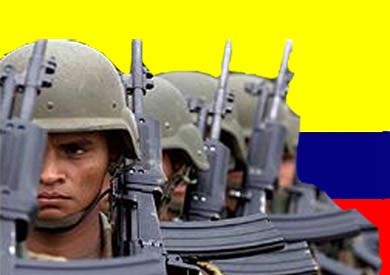
Human Rights in Colombia : School of the Americas and Plan Patriota

Image from redsolsur.com. / Impunity Watch South America.

Colombia and the School of the Americas:
A history of human rights abuse

By Marion Delgado / The Rag Blog / December 3, 2009

See ‘Know your new military bases,’ a look at Tolemaida Air Base in Melgar, Below.

CARTAGENA DE INDIES, Colombia —

The United States recognized Colombia’s Military Forces on Friday, November 6, 2009 for their effort and commitment towards Human Rights causes in the country.

According to the U.S. Institute for Hemispheric Security Cooperation, the Colombian Army stood out as unique in the world with regard to its Human Rights leadership and the fact that it has human rights offices[sic] in its divisions, brigades and battalions.

This was reported on Colombian President Alvaro Uribe’s website. I ran across it while researching the Colombian Army’s (COLAR) record on Human Rights. From the research I’d already done at that point, it gave me pause… WTF?? I wondered, “Who would give COLAR a human rights award?”

Well, it came as no surprise when I finally figured out that the real name of the awarding organization was Western Hemisphere Institute for Security Cooperation. You will remember them as our old friends the School of the Americas, who have long been associated with Human Rights issues.

Official seal of the Western Hemisphere Institute for Security Cooperation.

The posting went on:

Lt Colonel Javier Alberto Ayala Amaya was awarded the medal of Commander of the U.S. Army, for his meritorious service and outstanding professionalism as an instructor in the field of Human Rights.

In addition, the rules of behaviour in combat and confrontation employed by the Army reflect the experience of the troops in operational law, which places the institution as a hemispheric leader in education and training programs.

Lt Colonel Amaya is part of a large group of Colombia officers and civilians who educate on human rights abroad.

I searched 14 reference sources for any mention of the “Commander of the U.S. Army Medal.” Nada. I found a “U.S. Army Commander’s Medal” that is awarded to civilians, but no mention of awarding that to foreign military personal. Probably something they hammered out just before the ceremony. It became apparent that it was just another stick in a propaganda framework as part of making our co-conspirators in the new US/Colombia military pact seem friendly. But, COLAR and the School of the Americas (SOA) do have a long association.

How the SOA shelters soldiers who face trial at home

One of the apparent functions of SOA is post-graduate protection of the thugs they train and turn loose on the population of Colombia.

In 1992, Lieutenant Colonel Victor Bernal Castaño was enrolled at the SOA to avoid having to answer to investigators about the Fusagasugá massacre of a peasant family, according to the Colombian legislature. The SOA enrolled him in its longest and most prestigious course, the Command and General Staff College, and made him “Jefe del Curso,” (Chief of Course). This was after he had already been implicated in the 1989 disappearance of campesina Sandra Velez, and was known to protect and aid death squads. Sandra is just one of hundreds who met the same fate, listed on the site below.

In another example from the early 1990s, Lieutenant Colonel Luis Felipe Becerra Bohórquez attended the SOA while a warrant was out for his arrest for his leading role in the 1988 massacre of 20 banana workers in the Urabá region. The SOA claims Becerra Bohórquez was never “formally enrolled” in officer training there, but according to Colombian government records, the Colombian Army sent him to the SOA to avoid arrest. In 1993, after his extended shelter at the SOA, he returned to Colombia and led another massacre, this time murdering 13 civilians at Riofrío. In November 1993, under intense international pressure, Colombia dismissed Becerra from the military.

This is a long-standing role of the SOA. For instance, in 1982 First Lieutenant German Espinoza Rubio, who had already graduated from the SOA in 1976, faced with an investigation into his role in assassinating several campesinos, was spirited away to the SOA for a course in “Patrol Operations.” When the danger of the truth had passed he promptly “dropped” the course and returned home.

If you are thirsty for more atrocities by SOA graduates perpetrated on the Colombian people, there are plenty here.
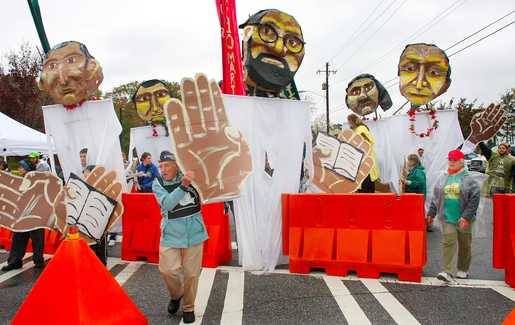
Thousands of human rights activists and torture survivors demonstrated against the School of the Americas at Fr. Benning, Georgia, Nov. 20-22, 2009. Photo from the Columbus Ledger-Enquirer.

The phony ‘War on Drugs’

The U.S. pays SOA graduates to murder civilians, lying to the public that the aid goes to the “War on Drugs”

In 1991, two Colombian generals thanked the U.S. Congress for $40.3 million in “anti-narcotics aid,” which they said would be used (illegally) in counterinsurgency campaigns in northeastern Colombia, where narcotics are neither grown nor processed. Both are members of the SOA “Hall of Fame”: General José Nelson Mejia Henao, inducted in 1989, and General Luis Eduardo Roca Malchel, inducted in 1991 after being known for war crimes, including torture, as recently as June 1988.

Prison guards trained at the SOA close their eyes while drug kingpins walk out of jail. In August, 1992, three Army officers were forced into early retirement after notorious cartel leader Pablo Escobar “escaped” from prison, where he had been living in grand style. Two officers were SOA graduates: Lieutenant Colonel Manuel José Espitia Sotelo, commander of the military police battalion guarding the prison, had graduated only months before. General Gustavo Pardo Ariza, head of the Fourth Brigade in Medellin, commanded soldiers who were supposed to be guarding the prison from which Escobar literally walked away.

On November 22, 1994, five top officers were dismissed by President Ernesto Samper, who overhauled the military leadership in the hopes of decreasing corruption and drug trafficking in the armed forces and improving the human rights record of the military. At least three were generals who graduated from the SOA and one is a member of the School’s “Hall of Fame,” inducted in 1993: General Hernán José Guzmán Rodriguez, Commander of the Colombian Army, known to protect and aid paramilitary death squads between 1987 and 1990, and before that known to command the soldiers who detained, tortured, gang-raped, and executed an innocent woman, Yolanda Acevedo Carvajal, and then concocted a story that she committed suicide by shooting herself in the nape of the neck.

The phony ‘War on Guerrillas

On July 24, 1997, SOA graduate and guest instructor General Harold Bedoya Pizarro was fired from his position as chief of the armed forces by President Samper. Defense Minister Gilberto Echeverri suggested the dismissal is because of Bedoya’s unwillingness to commit to improving the military’s poor human rights record,

“Throughout Bedoya’s entire career [1965 to the present], he has been implicated with the sponsorship and organization of a network of paramilitary organizations. Bedoya, who has never undergone any investigation for his involvement in the massacres of non-combatants or other dirty-war crimes, is an articulate proponent of the continued legal involvement of local populations in counterinsurgency operations.”

On February 12, 1992, SOA graduate Captain Gilberto lbarra forced 3 peasant children to walk in front of his patrol to detonate mines and spring ambushes. Two were killed; one was seriously wounded.

From 1988-1991, at least 107 citizens of the village of Trujillo were tortured and murdered. An eyewitness said Major Alirio Antonio Urueña Jaramillo (an SOA graduate) tortured prisoners (including elderly women) with water hoses, stuffed them into coffee sacks, and chopped them to pieces with a chainsaw. The eyewitness soon disappeared. Major Urueña was promoted to Colonel. After intense international outcry, Urueña was dismissed from the Army in February 1995.

Also implicated in the Trujillo chainsaw massacre was SOA graduate Colonel Roberto Hernández, who during the same period (1990) supervised the illegal detention and torture of 42 people, most of them union members and human rights workers. Throughout the 1980s, Hernández was implicated in numerous extreme-right death squad activities.

In 1990, SOA graduate First Lieutenant Pedro Nei Acosta Gaiviso ordered the massacre of 11 campesinos, had his men dress the corpses like guerrilla forces, and then dismissed the killings as an armed confrontation between the Army and guerrillas.

And the beat goes on…

“That’s history,” you may say. In about an hour, using various sources, I turned up 17 pages of these horror stories. What about today, what kind of army will our troops mix with at the 10 Colombian military bases we’ll be sharing? What will they learn and take part in?

For one thing, they will be immediately used in Plan Patriota, in which some U.S. servicemen and women and civilian “advisors” are already involved.

Plan Patriota: Don’t ask — don’t tell

Shrouded in silence in Colombia, Plan Patriota has begun to emerge as the most ambitious military offensive to date against leftist guerrillas, with the U.S. military providing tactical and logistical support.

Taking part in the operation, which according to press reports involves 17,000 soldiers deployed in southern Colombia, are mobile forces and special jungle commandos trained by U.S. advisers and backed up by modern technology from the U.S.

The offensive is being carried out in a vast territory under the control of Colombia’s main rebel group, the 18,000-strong Revolutionary Armed Forces of Colombia (FARC), which rose up in arms four decades ago.

Plan Patriota signals the entrance of the U.S. into a new, more intense phase of military involvement in Colombia’s internal armed conflict. Unlike Plan Colombia — also financed by Washington — Plan Patriota makes no pretense of furthering U.S. counter-drug objectives.

Instead, Plan Patriota underscores the potential for escalation beyond the mission understood by Congress and beyond the appetite of the American public, unlike its predecessor, Plan Colombia; this strategy has no stated humanitarian component.

Plan Colombia, which many observers have declared a failure, sought to reduce the supply of drugs to the United States — the world’s largest market for illegal drugs — by attacking production of coca and the jungle labs that convert the leaves into cocaine, a strategy that was simultaneously supposed to reduce revenues of the leftist insurgents.

Latin American Human Rights Association (ALDHU) warns of the impact of Plan Patriota on Ecuador, which shares a 640-km (398 mi.) border with Colombia, cautioning that it could lead to an increased flow across the border of Colombian civilians fleeing the conflict, and push drug and arms traffickers into Ecuador as well.

Plan Patriota is seen as complementary to the U.S. Andean Regional Initiative, focused on Ecuador, Peru, Bolivia and Panama, and aimed, among other things, at beefing up control along the borders with Venezuela.

General James Hill top general for the U.S. Southern Command. Photo by J. Pat Carter / AP.

General James Hill, until quite recently in charge of the U.S. Southern Command, confirmed what Colombian authorities have not admitted: the magnitude and extent of the offensive against FARC. Hill, who since November, 2008, has held 13 meetings with Colombian military officers and visited Ecuador six times, passed through Bogotá on June 23, 2009 ,after touring Larandia military base in the southern state (Departamento) of Caquetá, where Plan Patriota is coordinated.

The general praised the progress of the offensive that, as has now been revealed, began in June 2003 with an attack on rural areas south of Bogotá, where local peasants support FARC. He said that the U.S. military is providing Colombian armed forces with fuel, logistical support, and planning.

(General Hill was recently replaced by Four Star Air Force General Douglas Fraser who is now the Commanding Officer of SOUCOM. SOUCOM covers 45 nations and territories and the 16 million square mile Caribbean Sea.)

A spokesman from the Bolivarian Movement, FARC’s clandestine political arm, declares that despite the impressive U.S. technology, “the popular resistance remains unbeatable.”

According to a source who spoke on condition of anonymity, the ceiling set by the U.S. Congress on the number of military advisers has already been far surpassed. He said there are “around 2,000 U.S. mercenaries. People recognize them by their accent… They walk around the town of Cartagena del Chairá [in Caquetá], and are very heavily protected.”

Why the official secrecy about the biggest military offensive in the history of Colombia’s conflict? Consider U.S. operations in Iraq, where reporters from nearly all outlets — even Al Jazeera, to some extent — have been embedded with U.S. military units, often resulting in unabashedly supportive media coverage of that controversial war.

By most accounts, the reluctance to share information about Plan Patriota comes from the Colombian side. The Colombian military is highly reluctant to grant journalists or outside observers any interviews, access to installations, or entry into theaters of operations. The most-stated reason: the need to keep sensitive tactical information from reaching the enemy (FARC).

The more likely reason is nationalist sensitivity. Not only is the Colombian government likely to balk at the prospect of foreign reporters sticking their noses into Plan Patriota, they’re probably unwilling to make public the degree of U.S. participation in what they would prefer be considered a 100 percent Colombian offensive.

No matter what the reason, such secrecy is a mistake. It leads to fear that things are going worse than they may in fact be going. It gives credence to reports that as many as 1000 Colombian soldiers have been killed, that they are bogged down in the bush and suffering from flesh-eating diseases, that they have done little more than capture relatively low-ranking guerrillas and take over already-abandoned encampments, that morale is low, and that military operations are accompanied by almost no social investment in the long-neglected rebel zones.

This is fast becoming the mainstream view of Plan Patriota among the Colombian people and in the foreign press such as the Miami Herald — a big, costly military effort that has yielded few results. Is this perception correct? ¿Quién sabes? The only way we’ll find out is if the U.S. and Colombian governments stop neglecting public opinion and abandon their insistence on total secrecy.

The U.S. has already put $700 million into Plan Patriota (no wonder we can’t afford health care), and now it plans to put thousands of U.S. troops in also, as a part of the Andean Regional Initiative.

For a preview of what Plan Patriota will look like on the ground, take a look at reports on terror in Arauca from the Colombia Support Network. For the full story of what happened there go here.
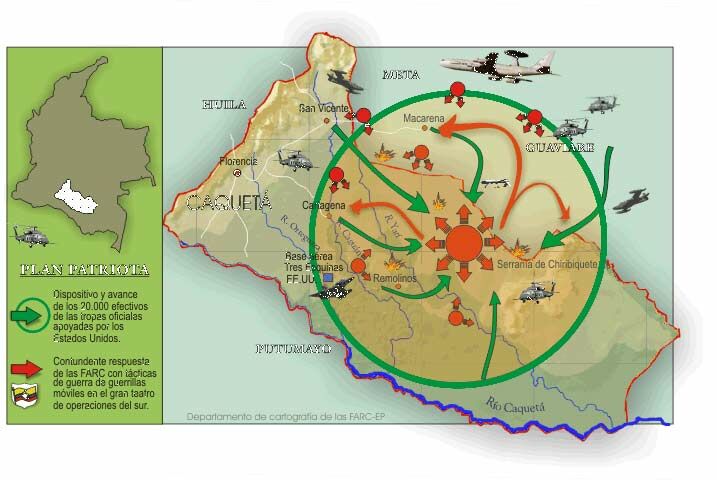
Plan Patriota.

Army killings of civilians

In recent years there has been a substantial rise in extrajudicial killings of civilians attributed to the Colombian Army, documented by the United Nations High Commissioner for Human Rights, many human rights organizations, and, most recently, the UN Special Rapporteur on Extrajudicial Executions. Army members, under pressure to show results, take civilians from their homes or workplaces, kill them, and then garb them as combatants killed in action to increase their body count.

The alleged executions have been occurring throughout the country and involve multiple army brigades. The Attorney General’s Office is reported to be investigating more than 1,000 such cases involving more than 1,700 victims.

President Uribe for years publicly denied the problem existed, and accused human rights groups reporting these killings of helping the guerrillas in a campaign to discredit the military. After a major media scandal in September 2008 over the executions of several young men from Soacha, a low-income neighborhood of Bogotá, Uribe dismissed 27 members of the military, including three generals. There have been several more dismissals since then. But Uribe continues to claim these are isolated cases, emphasizing that there are only “22 proven cases” and charging that there are hundreds of “false allegations.”

Army Commander Mario Montoya, the subject of allegations linking him to abuses and paramilitaries, resigned in November 2008 right after the Soacha scandal. Uribe appointed him as ambassador to the Dominican Republic. Montoya’s replacement and reported protégé, General Oscar Gonzalez Pena, commanded the 4th Brigade of the Army when it had one of the worst records of extrajudicial executions in the country.

The UN Special Rapporteur on Extrajudicial Executions visited Colombia in June 2009. In preliminary findings, he noted that, “the sheer number of cases, their geographic spread, and the diversity of military units implicated, indicate that these killings were carried out in a more or less systematic fashion by significant elements within the military.” He pointed out that the Colombian military justice system contributes to the problem by obstructing the transfer of human rights cases to the ordinary justice system. His final report will address these and other issues, including possible incentives to members of the military that contribute to the killings.

The executions, which the Special Rapporteur described as “cold-blooded, premeditated murder of innocent civilians for profit, stand out as one of the most serious abusive practices by state agents we have documented in Latin America in recent years.” The frequency of the executions and the failure of President Uribe to acknowledge the gravity and scope of the problem, or to institute adequate measures to prevent it, should raise questions about the purposes for which U.S. military aid is being used, and the effectiveness of continued aid. That finding is just five months old.

Aww, shit. That’s it for this week. I can only write about Human Rights Abuse for so long before it begins to wear on my mind. I could go on for another 100 pages but I doubt that you could stand it long enough to read it.

This is a small window on the situation and the people U.S. troops will be in cahoots with as we go forward with the seven new bases the Obama government has signed on to pay for, construct, and occupy.

Next week I will take a look at corruption in the Colombian Military. Maybe I won’t find any. Whadda ya think?

Asi es en Colombia hoy
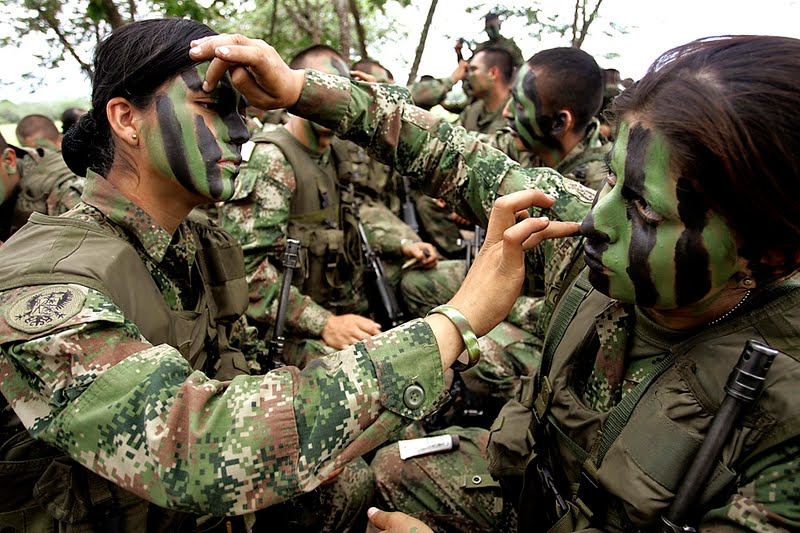
Female cadets training at the Tolemaida base in Melgar, Colombia. Photo by Fernando Vergara / AP.

Know your new military bases

Melgar is a Colombian town in the Department of Tolima 65 mi. southwest of Bogotá and one hour north of Ibague the capital city of Tolima.

Melgar is located in the Sumapaz River Valley and borders the Department of Cundinamarca and Sumapaz River to the north, town of Icononzo to the east, and the towns of Cunday at the south and Carmen de Apicala to the west.

The town is home to a major military base called Tolemaida Air Base.

Tolemaida Military Fort, in the Nilo région; is at an elevation of 1,617 feet (493 m) above mean sea level, with two runways; 04/22 has an asphalt pavement measuring 9,280 by 96 feet and 04L/22R with a concrete surface measuring 1,431 by 65 feet.

Tolemaida is half way between Bogotá and Medellin. It has taken on a reputation as Colombia’s Abu Ghraib.

The Bogotá daily El Espectador reported on January 8, 2009, that in October, 2008, U.S. military officers and private contractors had overseen a session at the base in which three young girls from a nearby village were tortured and raped.

The sessions were apparently videotaped, and the tapes then distributed in the local village of Melgar, where the girls were from. They were subsequently ostracized and forced to flee the village with their families.

The most disturbing thing about the allegations is that the girls were not even suspected of anything; they had been lured to the base in exchange for money and a promise of visas to enter the U.S., and apparently used in a torture demonstration.

Your tax dollars

As at Larandia and Palanquero there are thousands of troops of all kinds at Tolemaida and Melgar, those listed below are the ones we know of that directly receive U.S. tax dollars from the Department of State and/or the Pentagon.

COLAR Lancero School (ESLAN)
COLAR Professional Soldier School (ESPRO)

Rural Special Forces Brigade (BRFER)

  • 2nd Special Forces BN (BFER1)
  • 2nd Special Forces BN (BFER2)
  • 3rd Special Forces BN (BFER3)
  • 4th Special Forces BN (BFER4)

Rapid Deployment Force (FUDRA)

1st Mobile Brigade (BRM01)

  • 19th Counter Guerrilla BN (BCG19)
  • 20th Counter Guerrilla BN (BCG20)
  • 21st Counter Guerrilla BN (BCG21)
  • 22nd Counter Guerrilla BN (BCG22)
  • 22nd Support and Services Company (CPS22)

2nd Mobile Brigade (BRM02)

  • 15th Counter Guerrilla BN (BCG15)
  • 16th Counter Guerrilla BN (BCG16)
  • 17th Counter Guerrilla BN (BCG17)
  • 18th Counter Guerrilla BN (BCG18)
  • 23rd Support and Services Company (CPS23)

3rd Mobile Brigade (BRM03)

  • 51st Counter Guerrilla BN (BCG51)
  • 52nd Counter Guerrilla BN (BCG52)
  • 53rd Counter Guerrilla BN (BCG53)
  • 54th Counter Guerrilla BN (BCG54)
  • 25th Support and Services Company (CPS25)

Instruction BN Army Aviation School (CERTA)
4th Air Combat Command (CACOM 4)

  • For previous articles by Marion Delgado about the U.S. military presence in Columbia, go here.

The Rag Blog

Posted in Rag Bloggers | Tagged , , , , , , | 1 Comment

Forced Prostitution in Mexico : Lost Women of the Narcoguerra

“Sex Slave” by Vangobot / Pop Art Machine.

Organized crime in Mexico:
Massive transnational sex trade

The networks of traffickers in women use Mexico as a bridge to move teens to the U.S. and Canada where they are sold and sexually exploited.

By Michael Reynolds / The Rag Blog / December 3, 2009

Evangelina Hernandez continues to open windows on the under-reported consequences of the narcoguerra. This time with her chilling investigative piece on Mexican organized crime’s lucrative transnational sex trade and forced prostitution in this morning’s El Universal, “Prostitución forzada, otra cara del yugo a migrantes.”

Hernandez leads with the harrowing account of “Nancy,” a young woman snatched up by traffickers in Chiapas while riding a train carrying migrants north from Guatemala. Her abductors were Los Zetitias, a franchise of the Zetas’ diversified global criminal enterprises.

Hernandez’ telephone interview with Nancy’s brother “Rafael,” details the circumstances of his sister’s brutal saga that began in the Las Anonas Chiapas-Mayab railway station where Nancy was forced into a van and driven north to a safe house where she was beaten and threatened with death unless she participated in a pornographic video in which she was raped by several men.

Rafael told Hernandez that his sister’s kidnappers promised that she would be let go after this “little job.” Instead, said Rafael “the first video was followed by another and another.” Days later the 20 year-old Nancy was taken to a Tijuana brothel and forced into prostitution until she completed a “quota” set by her abductors. Two and half months later she was ordered to call relatives in the U.S. to fork over a ransom for her release. Rafael got the call and agreed to pay.

Without giving details, [Rafael] said that he paid a designated smuggler to move his sister to America, [and] also deposited a large sum of dollars as a “ransom” for her to surrender, but not before being warned that talking would be his death sentence.

Nancy’s sordid ordeal is just one of thousands of such stories. Hernandez provides the alarming facts:

More than 20,000 Central American women are currently prostituted in brothels and bars in south-southeast Mexico, according to End Child Prostitution, Child Pornography and Trafficking of Children for Sexual Purposes (ECPAT).

Women and girls are trafficked under false pretenses to Mexico from Guatemala, Honduras and El Salvador. They sell them in bars for not more than $40 where they are held against their will in a situation of slavery and forced to cover their costs of accommodations, food and drugs, says the Global Report of Actions Against Commercial Sexual Exploitation of Children and Adolescents (ECPAT).

The owners of many of these bars are local politicians, bankers and people with economic power operating from the shadows and earning revenues. The report warns that traffickers are recruiting younger and younger women, mostly girls.

The networks of traffickers in women use Mexico as a bridge to move teens to the U.S. and Canada where they are sold and sexually exploited, according to the World Report on Trafficking in Persons 2009, the United Nations Office on Drugs and Crime (UNODC).

A 2009 American Bar Association report cites 47 organized criminal groups in Mexico that are engaged in sexual and labor exploitation in the Federal District and 17 states including Baja California, Guerrero, Oaxaca, Quintana Roo, Chiapas, Chihuahua, Tlaxcala, Tamaulipas and Jalisco — the first four of these are regarded as “sex tourism” destinations. Mexico’s National Human Rights Commission estimates these sex trafficking networks bring in about $50 million per year.

Hernandez closes her report with Rafael’s disheartening but understandable takeaway from his and his sister’s nightmare.

Doomed to remember

Nancy is not crying, but spends many hours without a word. She paid a high cost to reach her destination.

Her brother Rafael thinks that if one day they go to Guatemala, they will not return on a plane that stops in Mexico.

He fears that criminals will keep their word and kill them. They are never going to complain, because they doubt that the authorities will do anything to stop the rape, kidnappings and murders of women in Central America.

For more of Evangelia Hernandez’ excellent reporting, see her October reports from the US/Mexico border on corruption here, here, and here. They are in Spanish, but are well worth utilizing Google’s translation feature.

[Michael Reynolds, an investigative journalist and author, is a former correspondent for Reuters who has written for Playboy, The Nation, Mother Jones, The Bulletin of the Atomic Scientists, Rolling Stone, High Times, Alternet and other publications. He was senior intelligence analyst with the Intelligence Project of the Southern Poverty Law Center and has served as a consultant on domestic terrorism and transnational security. His blog is NarcoGuerra Times where this article also appears.]

The Rag Blog

Posted in RagBlog | Tagged , , , , , , , , | Leave a comment

PRESS / Dick J. Reavis : Texas Tribune Lacks Regional Vision

Texas Tribune. Image from UrbanGrounds.

The Texas Tribune:
Bells and whistles but little vision

The Tribune mistakes numbers for people and information for insight. It is in no way culturally or regionally idiosyncratic.

By Dick J. Reavis / The Rag Blog / December 2, 2009

Now a month old, The Texas Tribune has had time to show its stuff. Though it was trumpeted before its debut as the end-all of Texas journalism, as a journalist and a Texan, I find it underwhelming and uninspiring.

The digital publication’s strongest suit is that it’s a video game, with streaming this and archived that, and while it may not be as much fun as Grand Theft Auto IV, it’s certainly more clickable than the web pages of other Texas dailies. It has given us polls on everything electoral, and its pages allow us to permutate percentages. Given that virtue, it may soon surpass the Texas Almanac in popular appeal!

Its chief failure is lack of a regional vision. If it is perhaps an admirable statistical publication about Texas — suitable for use in lobby firms and among campaign strategists — it is a poor publication for those Texans whose pursuits are benign. It has no salsa.

The Trib, for example, has given us surveys that allow us to predict whether the voters of Houston, Dallas, Oatmeal, Seadrift and Levelland, will favor Perry over Hutchinson, yet it doesn’t see the overarching, which is that Texas will within a decade be a Hispanic-majority state. The days of Republican hegemony are passing, and any liberal in Texas — the Trib’s managers claim that they are liberals — should be championing the new order to come.

The state’s future is not reflected in the Trib’s staff, which among its dozen reporters includes only one who is Hispanic-surnamed. That’s because the Trib’s executive parentage is not Texan, but what might be called cívica Americana: its key concepts are from Journalism 101, circa 1960, when “Missourian” meant “American.” It is objective, Anglo and staid. Spanish words and phrases are rare in its pages, and even rarer is the hint that today’s Texas politics are a farce — or an ethnic crime. The Trib’s wonks presume that policy-makers are honest, fair-minded and sincere, yet nobody outside the press believes that today.

In the weeks before its debut, the Trib’s backers predicted that the data it would supply might salvage journalism in the state. But most of our dailies haven’t been worth reading since the Gulf of Tonkin incident, when for months Dallas News stories inveighed against the Vietnamese “Reds,” or since August, 1965, when the San Antonio Express described Watts as a “wild Negro neighborhood.” Texas journalism has to be repeopled and remade, not saved — and doing so requires radically new premises.

I saw the Trib’s failings most clearly in its series on the problems of the border. One of its stories detailed the difficulty people have in traveling from there to the state’s interior, a real problem and one that could be solved by reform. But the border is not merely an area of troublesome transit between two nations. It is, in all its aspects, an unhealed scar from the 19th century mugging of Mexico and its descendants. Our problem is not one of walls and checkpoints, it is that either walls or checkpoints were thinkable. Sooner or later, Texas must Mexicanize, and the Trib is not leading the way.

Nor do I see in its coverage any understanding of the historic angst and feistiness of Anglo Texas. Rick Perry and Kay Bailey Hutchinson appear in the Trib’s pages as conservative political candidates, as if the primaries were to be held in Iowa. Like George W., they are instead avatars of Anglo Texans, people whose prominence should make us worry about out fitness for the future.

The Tribune mistakes numbers for people and information for insight. It is in no way culturally or regionally idiosyncratic. It apparently believes that we know our children by their report cards.

[A native Texan, Dick J. Reavis teaches journalism at North Carolina State University. An award-winning journalist, educator and author, Reavis was active with SDS and the New Left in the Sixties. He wrote for Austin’s underground newspaper, The Rag, and later was a senior editor at Texas Monthly magazine. His book, The Ashes of Waco: An Investigation, about the siege and burning of the Branch Davidian compound, was published by Simon and Schuster and may be the definitive work on the subject.]

Also see:

The Rag Blog

Posted in RagBlog | Tagged , , , , , , , , , | 2 Comments

Tom Hayden : Time to Strip Off the Obama Sticker

Image from Zazzle.com.

Obama’s Afghanistan escalation:
Latest in a string of disappointments

I’ll support Obama down the road against Sarah Palin, Lou Dobbs or any of the pitchfork carriers for the pre-Obama era. But no bumper sticker until the withdrawal strategy is fully carried out.

By Tom Hayden / December 2, 2009

It’s time to strip the Obama sticker off my car.

Obama’s escalation in Afghanistan is the last in a string of disappointments. His flip-flopping acceptance of the military coup in Honduras has squandered the trust of Latin America. His Wall Street bailout leaves the poor, the unemployed, minorities, and college students on their own. And now comes the Afghanistan-Pakistan decision to escalate the stalemate, which risks his domestic agenda, his Democratic base, and possibly even his presidency.

The expediency of his decision was transparent. Satisfy the generals by sending 30,000 more troops. Satisfy the public and peace movement with a timeline for beginning withdrawals of those same troops, with no timeline for completing a withdrawal.

Obama’s timeline for the proposed Afghan military surge mirrors exactly the 18-month Petraeus timeline for the surge in Iraq.

We’ll see. To be clear: I’ll support Obama down the road against Sarah Palin, Lou Dobbs or any of the pitchfork carriers for the pre-Obama era. But no bumper sticker until the withdrawal strategy is fully carried out.

But for now, the fight is on.

This is not like the previous conflict with Bush and Cheney, who were easy to ridicule. Now this orphan of a war has a persuasive advocate, a formidable debater who will be arguing for support from the liberal center — one who wants to win back his Democratic base.

The anti-war movement will have to solidify support from the two-thirds of Democratic voters who so far question this war. Continuing analysis from The Nation and Robert Greenwald’s videos have a major role to play. Public opinion will have to become a growing factor in the mind of Congress, where Rep. Jim McGovern’s resolution favoring an exit strategy has 100 co-sponsors and Rep. Barbara Lee’s tougher bill to prevent funding for escalation is now at 23.

Key political questions in the immediate future are whether Rep. David Obey, chair of the House Appropriations Committee, will oppose Afghanistan funding without a surtax or is only bluffing, and whether Sen. Russ Feingold will step up with legislation for a withdrawal timetable.

Beyond public persuasion and pressuring Congress, activists are sure to be hitting the streets and precincts in the year ahead. The anti-war movement has a certain leverage based on the current doubt in the minds of voters and policy experts, and the potential dissent from within the Obama base. Democratic turnout increased 2.6 percent in 2008 over 2004, while Republican votes dropped by 1.3 percent. Twenty-two million more young people voted in 2008 than in 2004. The unprecedented energies of those young people who volunteered their time, money and hope could drain away by 2012, if not sooner.

In addition, the peace movement will be globalizing its reach as Obama seeks to extract more troop concessions from wary NATO countries. Opposition is particularly strong in the United Kingdom, Canada, Germany and France. When Obama accepts the Nobel Prize in Oslo on December 10, he may address as many as 10,000 protesters.

Adding 30,000 to 35,000 U.S. troops will raise the U.S. death toll by over 1,000 by 2011 on Obama’s watch, in addition to the 750 who died under Bush. The numbers of U.S. wounded are rising faster than ever, with 300 counted in the past three months. Civilian casualties are under-reported according to the UN mission in Afghanistan. The budgetary costs are growing to $75 billion annually, and this could become another trillion-dollar war.

The albatross of the Karzai government will threaten any plans to rapidly expand the Afghan army and police, themselves divided along sectarian lines. In 2005, the Kabul regime ranked 117th on the list compiled by Transparency International; by this year it was 176th.

There are alternatives. There is evidence that the Taliban in Afghanistan are seeking a peace settlement without havens for Al Qaeda. There also is an October 11 statement by Gulbaddin Hekmatyer of Hezb-I-Islam Afghanistan, a mujahadeen leader and former prime minister in the 1990s, once funded by the CIA. Never reported in the US media, the letter proposes an honorable exit strategy, including

  • relocation of Western troops from Afghan cities, plus a logical and practical time schedule for their withdrawal;
  • transfer of power to an interim government independent of the parties currently fighting;
  • new elections under an independent election commission;
  • release of political prisoners;
  • a possible peacekeeping force from neutral Islamic countries;
  • and, more important for the Obama agenda, the document states: Hezb-I-Islami is prepared to discuss the exit of all foreign fighters (non-Afghan, be it forces of the West, or embedded with the Mujahideen). We assure all sides that we agree that neither the embedded fighters with the Mujahideen nor foreign military forces be allowed to remain or to establish military bases or training camps in Afghanistan.

But instead of pursuing an Afghan-based political settlement without havens for Al Qaeda, the U.S. strategy is to pursue the same goal through more bloodshed, leaving Afghanistan somewhere between the Stone Age and ashes. What is obsessive about this approach is the fact that there is no longer an Al Qaeda haven in Afghanistan, which means the U.S. troops are fighting Afghan insurgents in their own country. But if your primary tool is a hammer, as the saying goes, all problems appear to be nails.

The war clearly is shifting to Pakistan, a far more clandestine and dangerous conflict fought by American secret operatives on the ground and drones from the sky. The targets are twofold: (1) to eliminate the Afghan Taliban from their enclave in Quetta instead of negotiating with them, and (2) using U.S. advisors and drones to push Pakistan’s army into a war against Pakistan’s homegrown Taliban and other insurgents now in the tribal areas, impoverished and unrepresented in Pakistan’s institutions.

This approach so far has caused a sharp expansion of violent attacks and suicide bombings across the region. The fear of a destabilized Pakistan with scores of nuclear weapons may lead Obama’s advisors to soon present the president with a more apocalyptic scenario than anything so far, if they have not already.

[Tom Hayden, a former California state senator, was a leader in the Sixties New Left and was a founder of Progressives for Obama. He is the author, most recently, of The Long Sixties: From 1960 to Barack Obama (Paradigm).]

Source / The Nation

Thanks to Carl Davidson / The Rag Blog

Posted in RagBlog | Tagged , , , , , , , , | 14 Comments

The War President : Barack Obama at West Point

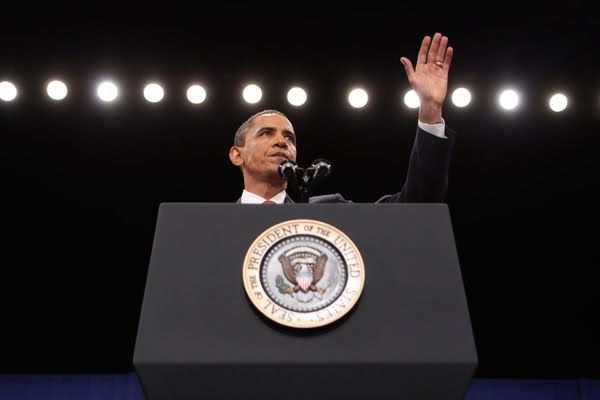
President Barack Obama announces his escalation of the War in Afghanistan at the US Military Academy at West Point, N.Y., on Tuesday night. Photo by Charles Dharapak / AP.

The War President at West Point:
Great speech, bad message

By Ted McLaughlin / The Rag Blog / December 2, 2009

Last night, President Obama spoke to the nation about the continuing occupation of and war in Afghanistan. As usual, he gave a great speech. He continually proves himself to be one of our country’s finest public speakers. Unfortunately, underneath the rhetorical excellence there was little that made much sense.

I should have known it would be like that, because he opened by talking about Iraq as though that conflict was over and great things had been accomplished there. But that is not the reality. The killings continue there, and the government can’t even agree on a new election law and therefore can’t hold scheduled elections. Our troops still have at least two remaining years in that country and possibly even longer. Success, whatever that is, is still a long way from being a reality in Iraq.

The president has now decided that all we need to succeed in Afghanistan is another 30,000 troops. He believes this will allow us to stop Taliban advances, pacify the countryside and eliminate al-Queda. It seems he has become a master of wishful thinking.

While the troop surge may temporarily halt further advances by the Taliban, it is not nearly enough to pacify the country outside of urban areas (and I suspect bombings will continue even in the urban areas). The fact is that once you get outside of Kabul, the people simply don’t like or trust the central government.

And training more Afghan troops that answer to the central government will not solve that problem. President Karzai has proven himself to be a corrupt leader who’s reelection was obtained through massive fraud. In addition, his brother is the largest opium poppy grower and dealer in the country.

We are in the process of making the same mistake in Afghanistan that we made in Vietnam. We are supporting a corrupt leader and trying to convince the people, or force them, to also support that leader. It didn’t work in Vietnam, and it won’t work in Afghanistan. Just because a foreign leader is friendly to the U.S. and its goals, does not mean he is worthy of or capable of winning the people’s support.

Then we come to the matter of al-Queda. A troop surge of 30,000 will do nothing to eliminate al-Queda. They are snugly entrenched in Pakistan and our troops cannot even enter that country. To truly eliminate al-Queda and the Taliban, we would need to not only occupy Afghanistan, but also invade Pakistan. That is neither militarily nor diplomatically possible.

The only bit of good news from the president last night was when he said our involvement in Afghanistan was not an open-ended one. He expects the central government there, as weak and corrupt as it is, to be able to take over the fight on their own in about a year and a half. He wants to begin withdrawing troops in the summer of 2011.

But note he said “begin” to withdraw. He gave no assurance that our troops would be out of Afghanistan in 2011. He also didn’t tell us what would happen if the situation wasn’t any better by the summer of 2011. Would there be another troop surge and another “deadline”?

I’m afraid we’re still in the middle of quagmires in both Iraq and Afghanistan, and sending more troops to either will not solve the problem. We should have learned in Vietnam, that it’s almost impossible to win a guerrilla war in someone else’s country.

Since we haven’t yet learned that lesson, we are now doomed to a repeat of history (and more dead American soldiers).

[Rag Blog contributor Ted McLaughlin also posts at jobsanger.]

The Rag Blog

Posted in Rag Bloggers | Tagged , , , | 8 Comments

Obama and Afghanistan : The Permanent War Economy

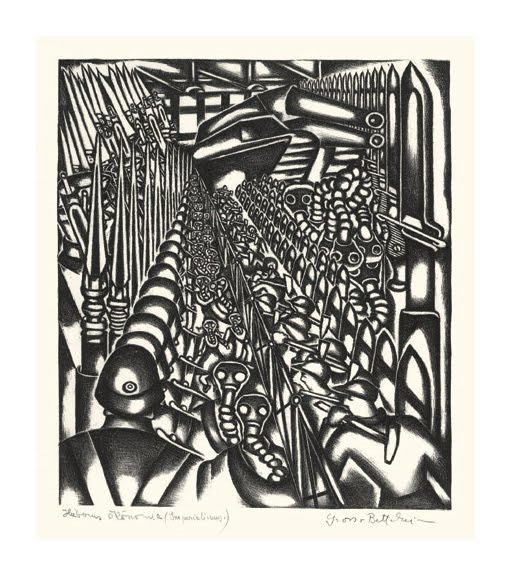
Imperialism (War Economy), by Jolan Gross Bettelheim, lithograph, c.1940.

Obama on Afghanistan:
He cannot believe what he is saying

By Harry Targ / The Rag Blog / December 1, 2009

After a 1966 presentation by Dean Rusk before the Senate Foreign Relations Committee, Senator Clifford Case of New Jersey commented about the Secretary of State that he could not have believed what he had just said about Vietnam. I thought of Case’s comments the other day after hearing that President Obama was going to announce the sending of 30,000 more troops to Afghanistan with a cost of $40 billion.

The President is a smart man. He knows that the demonic image of Al Qaeda as a worldwide threat to the United States is about as accurate as the old story about the threat of international communism during the Cold War. He has to know that the Taliban and Al Qaeda have their own separate agendas. He has to understand that the Taliban have been motivated by two concerns: corrupt local government and foreign occupation of their country.

Further, he has got to know that these foreign forces cannot subdue or defeat the Taliban in their own country because the population prefers them to the foreigners who are killing civilians and destroying what survives of their desperately poor country.

The President knows that his predecessor gained worldwide condemnation for ignoring the traditional international relations tool of diplomacy. He has to see that countries in the region and those that share common cultures, languages, and religions are more likely to be able to defuse conflicts than the Christian superpower from North America.

Yes indeed, the President is a smart man. He knows that military spokespersons have always proposed exaggerated battle plans guaranteeing such favorable results as defeating indigenous enemies and strengthening friendly governments while enhancing the security of the United States. And most of all, Obama has to know what the Vietnam War did to the United States.

The permanent war economy

If he knows all these things why is the president going to expand U.S. military operations in Afghanistan? The answer to the question has its roots in the formation of the permanent war economy. The PWE was constructed during World War II as government, the corporate sector, and the military mobilized to defeat fascist armies in Europe and Asia. While others demobilized after the war (or were forced to do so), the United States launched a several trillion dollar program to build the largest war machine in world history.

As economist Ismael Hossein-zadeh reported, military spending has been the second largest item in the federal budget behind social security, which is really a self-financed fund. Quoting from William Hartung, U.S. military spending in 2008 was greater than the rest of the world combined and 30 times greater than all State Department operations. Military programs constituted over 50 percent of all discretionary spending.

Pollin and Garret-Peltier added that military spending rose from three percent to 4.3 percent of the GDP during the Bush years. In 2008, military spending in excess of $600 billion created approximately five million jobs, both military and defense industry related. As Seymour Melman documented years ago, military spending meant funding a huge bureaucracy, contracts for the defense industry, and sub-contracts for manufacturers that produce goods that find their way into weapons systems. Nowadays spending includes private armies, security forces, civilian contracted services for the military, homeland security programs, large grants to major research universities, and many more activities funded and related to military missions.

Of course, military spending is never justified in narrow institutional terms but rather in terms of grand projects and campaigns; fighting communism, combating terrorism, or checking drug smuggling. These campaigns are presented as almost timeless. For example, Tom Hayden has alerted us to the doctrine of the “long war” quoting a counter-insurgency strategist who in 2004 wrote that “there is a growing realization that the most likely conflicts of the next 50 years will be irregular warfare in an ‘Arc of Instability’ that encompasses much of the greater Middle East and parts of Africa and Central and South Asia.”

These campaigns are reinforced by the general proposition embedded in our political culture that there always has been war and there will always be war. Generals and media pundits from time to time comment on the need for this or that weapon system “for the next war.” The scourge of war will always be with us.

Threats to the primacy of the permanent war economy

Debate about military missions today comes in the context of deep economic crisis and growing demands for scarce societal resources. Banks had to be bailed out. One in eight Americans are on food stamps. Health care needs to be reformed. Millions of people need jobs. Logic would suggest cutting back on military spending particularly since Pollin and Garrett-Peltier have shown once again that each billion in government expenditures for education would create almost three times more jobs than military spending. In fact, government investment in every civilian activity generates more jobs than investment in the military.

The newly released Economic Policy Institute “American Jobs Plan” includes a proposal for a $40 billion per year allocation of government funds to create one million public service jobs. The cost of this aspect of the EPI jobs program could be paid for with funds that will be going to expanding the war in Afghanistan instead.

So when we ask ourselves why military operations in Afghanistan will be expanded the answer seems clear. First, the military constitutes the largest organized, armed, and funded institution in American society. In today’s political economy it stands shoulder to shoulder with Wall Street as a source of almost unstoppable resistance to change. Second, military largesse trickles down throughout the society affecting manufacturing, scientific research, education, private armies, spy operations, and myriad other activities.

Third, Pentagon elites see the danger of this new administration reallocating spending to meet the needs of a crisis-ridden economy: health care, jobs, education, and transportation (it is interesting to note that Senators Lugar and Graham already have called for shelving health care reform until the battle in Afghanistan has been won). Finally, military institutional interests demanding increasing shares of government money use in their advocacy for expanding wars playing upon the deeply embedded war-proneness of American culture.

What are the consequences of this analysis for peace? One conclusion is that grassroots activists must take on the permanent war economy. It has been an enduring feature of American foreign and domestic policy since the end of World War II. The wastefulness of military spending, the folly of claims made justifying each and every war, and the war culture must be challenged. In addition, peace and justice movements must show clearly that every dollar that is allocated for the military is a dollar that is not used to sustain life, create jobs, promote education, and provide for health care.

[Harry Tarq is a professor in American Studies who lives in West Lafayette, Indiana. He blogs at Diary of a Heartland Radical, where this article also appears.]

The Rag Blog

Posted in Rag Bloggers | Tagged , , , , | 6 Comments

Career Tips : Pollyanna’s Postmodern Pointers

Photo from madebytess / Flickr.

Employment trends for a post-widget world

By Pollyanna O’Possum / The Rag Blog / December 1, 2009

AUSTIN, Texas — Let’s face it, friends: the U.S. of A. is not going back to making widgets anytime soon.

Not even the deepening economic crisis has had any effect in moving us towards an economy that produces material goods for trade; if anything, it has demonstrated that in general, Americans would prefer to become subsistence farmers, or even roving hunter-gatherers, rather than go back to factory work.

So be it. In the Future, unique communitarian ecotribes will rule. Yum, yum, acorn meal!

But there seems likely to be a lengthy and bumpy transition period, and I worry about the welfare of those now between the ages of two and 20, who are most likely to experience the full transitional mood swings to come.

I like to help young folks, and I’ve come up with a short list of potentially rewarding near-term future careers. Kids, while you’re learning to pickle beets and/or raise milk goats, consider summer jobs or internships in the following growth areas:

1. Celebrity stalker. Pick of the crop, really; “it’s in the stars!” As the number of celebrities grows exponentially, so does the need for stalkers. Tasks include writing crazy love or hate messages, lurking around celebrities’ homes or hangouts, and making up bizarre alternate histories in which you and the celeb were married last year on Triton, or exchanged identities while in kindergarten. This position requires enthusiasm, spontaneity, a poor command of logic, and most of all, people skills.

Remuneration varies, and until a new national union of celebrity stalkers gets its legs under it, is likely to be spotty. Best bet so far: getting a lump sum settlement after having the crap beaten out of you by celebrity bodyguards.

2. Like outdoor work? Street riot tactician is bound to be an up-and-coming occupation as economic woes spread! Mobile combat paramedics and, for you more authoritarian kids, FBI informer, should also see continued growth. Tip: for best success in this fast-moving area, learn a second language well enough to appear to be an immigrant if that seems advisable. A theatrical flair is a big plus: you have to be able to project your voice to be a really good street commando!

3. Another outdoor job we’re seeing a lot of these days is sale sign holder. It doesn’t have to involve a costume anymore!!! No-credit-check cell phone companies, quick oil-and-lube shops, and retailers in trouble are resorting to person-with-a-sign-standing-on-the-curb advertising with surprising frequency. It may look good on your resume, but I’m not optimistic about the long-term outlook for this position — after all, it depends on those small businesses being in business! Bottom line: summer job or moonlighter. And if you can handle the costume, tax season officially kicks off on the first of the year, aspiring “Uncle Sams” and “Statues of Liberty” should be out there now putting in applications. Note that this job actually pays, maybe in free tax return preparation; maybe in tacos, but it pays.

4. Speaking of tacos, the proliferation of fast-food trucks around town is leaving us wondering when we’ll begin to see the first big-time, hip-fashionable reviewers of mobile fare — you know, people whose tweets matter! This should be good for at least a few meals — and say, can you tell me about the food truck sushi on Manor Road? Is it really fresh?

5. Finally, I’m going to suggest dusting off an oldie-but-goldie for the End Times Ahead: perpetual student. The return of Pell grants and continuing economic pressure for extended adolescence may portend a return to the carefree days of the mythic Sixties — minus the free love, of course; again, sorry about that, kids! — when one could change one’s major six or seven times, getting ever-so-close to graduation each time, before being actually forced to choose a lifepath. Instead of overgrown state universities, look for community colleges and alternative institutions — such as the new cannabis colleges sprouting in California, Michigan, and no doubt soon in a state near you — to be venues for a new rash of prolonged educational detours. Study anything they’ll pay you to study; little of it will prove useful once you leave school, but if you learn it well enough, you can teach.

Sharp-eyed readers will notice that I’m not recommending some of today’s hottest employment choices, notably reality show contestant and porno actor/actress. The first field has gotten terribly overcrowded and is really the basis for the recommendation above to consider subsidiary fields, such as celebrity stalker. It’s a choice that still leaves you well-positioned if the right show comes along! And porno movies, despite our aging population, are still really only good gigs for the young. Let’s face it, you don’t have to pay good money to see old people getting screwed!

For longer term opportunities, think about preparing for work as a draft counselor (it’s coming, dearies!), a Seventies re-enactment stunt person (disco will be played!), or applying for membership on your local death panel. The main thing to remember is that every generation has its own challenges, and for every disappearing job category — such as, “employed” — there’s something new right around the corner. Re-use, re-train, re-volt!

The Rag Blog

Posted in RagBlog | Tagged , , , , , | 2 Comments

Afghanistan : Escalation or Social Justice?

Image from AfterDowningStreet.

Obama’s escalation in Afghanistan
Faces immediate opposition

By Harvey Wasserman / The Rag Blog / December 1, 2009

Tonight at 8 p.m. EST President Barack Obama is set to announce his commitment to the worst blunder in U.S. policy since Lyndon Johnson escalated the Vietnam War.

That was in March, 1965. Johnson’s escalation was generally unnoticed and went largely unopposed — for a while. The nation was still reeling from the 1963 murder of President John F. Kennedy, and still cruising on LBJ’s commitment to a Great Society that was to bring advances in Civil Rights, Medicare, a War on Poverty and much more.

Few imagined at the time that LBJ’s tragic mistake would surround those programs with poisonous wreckage. The Vietnam disaster stabbed deep into the soul of what was then the richest and most powerful nation the world had ever seen. In many ways we have never recovered.

But hopefully we’ve learned a thing or two.

There were, to be sure, draft card burnings by a prescient few. There were rumblings in the Congress. There were those who knew the Gulf of Tonkin “incident” on which LBJ’s war powers had been based was a complete deception.

But it was not until the mass marches on the Pentagon and elsewhere in 1967 that one could say a truly national grassroots anti-war movement had taken shape.

(Those who doubt the peace movement’s impact might recall, among other things, that Richard Nixon later said he would have used nuclear weapons in Vietnam had he not feared an unprecedented national upheaval.)


Tonight we take up immediately where that movement left off. Countless thousands will gather today and tomorrow to confirm — to ourselves, the world, and the corporate media — that we will do all we can to end this immoral and futile war.

The decision to send more troops to Afghanistan would seem to be great news for the corporate-military elite. It could take the focus of the progressive forces in this country off the target of a single-payer health plan and other social justice issues, and away from the need to rid our nation of nuclear power and fossil fuels.

These “reforms” would shift control from the medical, pharmaceutical and energy monopolies and into the hands of the people. This the military-corporate elite will resist with all its might. For them, the Afghan diversion is a vile profit center.

As the war in Vietnam diverted the huge national groundswell that had grown for civil rights and social justice, the war in Afghanistan is set to do the same to the grassroots movements for social justice and ecological survival.

We can’t let that happen.

As we oppose this war, we need to retain our commitments to national health care and to solving the global climate crisis in the only way it can — with a total shift to true green power, including a revived mass transit system.

This will not be easy to do. But to paraphrase LBJ, somewhere along the way we need to be able to walk and chew gum at the same time.

History is filled with social change movements that were subsumed by the demands of fighting against an unjust war. But we are forewarned and (non-violently) forearmed.

With justice comes peace… with peace comes freedom… with freedom, all is possible.

Stop this War. Win Single Payer. Get us to Solartopia. Our lives and those of our children depend on doing all three.

Here’s a website with a partial listing of planned actions. They will not be hard to find.

For events in Texas, go here.

See you tonight.

[Harvey Wasserman’s History of the U.S. is at www.harveywasserman.com, along with Solartopia! Our Green-Powered Earth. Harvey is senior editor of Freepress.org, where this article also appears.]

The Rag Blog

Posted in RagBlog | Tagged , , , , , | 1 Comment

Tiger Woods : It’s How You Play the Game

Photo from Reuters.

Slave labor and toxic dumping:
Tiger Woods and his corporate partners

This is business as usual for Woods who would sooner swallow a five-iron than take anything resembling a political stand.

By Dave Zirin / December 1, 2009

During the Bill Clinton impeachment idiocy of 1998, many on the left said that if Clinton were removed from office, let it be for gutting welfare or for imposing sanctions on Iraq, and not l’affaire Lewinsky.

Today, Tiger Woods, the famous, wealthy and most PR-conscious athlete on earth, finally finds himself subject to scrutiny. But, similar to Clinton’s scandal, his scandal has more to do with his personal life than more substantive issues. The media has staked out his Isleworth home for round-the-clock coverage about a bizarre “car accident” this past week involving his wife, a fire hydrant and a golf club.

The questions being posed are as breathless as they are weightless: “Were Tiger’s facial lacerations the result of the car crash, or an attack from his wife, Elin?” “Is this about the rumored ‘other woman’ in New York City?” “Did Elin Woods smash the rear of his car with a golf club to rescue Tiger, or was she smashing up the car as he pulled away?”

One last question: Who the hell cares? Granted, there is a “man bites dog” aspect to this story. In Woods’s roughly 14 years in the public eye, he has never even been caught littering. His image has been cemented as a man of ungodly intensity.

This squeaky-clean reputation has helped Woods become the richest athlete in history. His career course earnings are $92 million. When you factor in advertisements, corporate appearances and other off-course aspects of “Tiger Inc.,” it makes sense that Tiger Woods is America’s first athlete to reach billionaire status.

As the saying goes, behind every great fortune is a great crime. Following his car “accident,” Woods’ agent says it’s unclear whether he will attend his foundation’s Chevron World Challenge Golf Tournament. In 2008 Chevron entered a five-year relationship with Tiger Woods’s foundation under the guise of philanthropy. But if Woods had a shred of social conscience, this partnership never would have existed.

Lawsuits have been issued against Chevron for dumping toxic waste all over the planet. Alaska, Canada, Brazil, Angola and California have all accused Chevron of dumping. Even worse, Chevron has a partnership with Burma’s ruling military junta on the country’s Yadana gas pipeline project, the single greatest source of revenue for the military, estimated at nearly $5 billion since 2000.

Ka Hsaw Wa, co-founder and executive director of EarthRights International, wrote in an open letter to Woods, “I myself have spoken to victims of forced labor, rape, and torture on Chevron’s pipeline — if you heard what they said to me, you too would understand how their tragic stories stand in stark contrast to Chevron’s rhetoric about helping communities.” Chevron is underwriting a dictatorship, but Tiger Woods apparently sees them as upstanding corporate partners.

Photo from Sun-Times Media.

Then there is Dubai, site of the first Tiger Woods-designed golf course. Located at the southern coast of the Persian Gulf, Dubai has been a symbol of economic excess and, most recently, economic collapse. It has been called an “adult Disneyland” — complete with indoor ski resorts and unspeakable human rights violations.

As Johann Hari wrote in the Independent, it is a city that has been built over the past 30 years by slave labor. Paid foreign laborers work in more than 100-degree heat for less than $3 a day. Dubai also has a reputation as ground zero of the global sex trade. The project cost $100 million, and Woods said nary a word about his benefactor’s practices. This is business as usual for Woods who would sooner swallow a five-iron than take anything resembling a political stand.

Now that Woods appears to have been involved in a domestic dispute, the media are wondering if there is “another Tiger.” They are desperate to pillory the man for his personal problems. It would be more appropriate if they took this opportunity to scrutinize him for the right reasons. Woods has every right to keep his personal problems personal. But when he makes deals that benefit dictatorships and unaccountable corporations, all in the name of his billion-dollar brand, he deserves no privacy.

[Dave Zirin is The Nation’s sports editor. He is the author of Welcome to the Terrordome: the Pain Politics and Promise of Sports (Haymarket) and A People’s History of Sports in the United States (The New Press). His writing has appeared in the Los Angeles Times, Sports Illustrated.com and The Progressive. He is also the host of Sirius/XM’s Edge of Sports Radio.]

Source / The Nation

The Rag Blog

Posted in RagBlog | Tagged , , , , | 1 Comment

Rebecca Solnit : Reflections on Fanaticism

John Brown depicted in detail from a mural by John Steuart Curray titled “Tragic Prelude,” in the Kansas State Capitol in Topeka.

Today’s fanatic, tomorrow’s saint

It’s popular to think that the world gets changed by nice people, but the lives of activists past and present tell us otherwise

By Rebecca Solnit / November 30, 2009

The question: Is fanaticism always wrong?

John Brown, who was hanged 150 years ago this week, was a religious terrorist. Driven by his unshakable belief in God and his own righteousness, he killed civilians, went on suicide missions, and fomented one of the most terrible and destructive wars in history. Yet his cause was undoubtedly good. Everything he did, he did to abolish slavery; and in the end, he triumphed. The Union armies, singing “John Brown’s body lies a mouldering in his grave,” marched on, together with his soul, through the confederacy until it was crushed and the slaves freed. Looking back at his life and death we are left with an awful question: is fanaticism always wrong?

By fanaticism we usually mean two things. One is that someone is dedicated in the extreme to their cause, belief, or agenda, willing to live and die and maybe kill for it, as John Brown was. The other is that the cause, belief or agenda is not ours, and in 1859 John Brown’s beliefs were not those of most Americans.

No one calls himself or herself a fanatic. It’s what you call people who are weird or threatening, extremists in the defence of something other than your own worldview. I’ve been around activists all my adult life, and though it’s popular to think the world gets changed by delightful people, a lot of the saints and agents of change are obsessive, intransigent, unreasonable, and demanding, of themselves and of us. That’s what it generally takes to change the world.

Gandhi knew this when he said, “First they ignore you, then they laugh at you, then they fight you, then you win.” Conventional people give up when they laugh at you. Timid people back off when they fight you. They don’t win, and neither do those who prize ease and security. The prize is for those who risk and persevere.

That slavery was an intolerable evil is something slaves have tended to believe all along; a few free men caught up with them in England in the 1770s, as Adam Hochschild’s wonderful history Bury the Chains relates, and that handful of Quakers and dissenters persevered until they won, half a century later. I am not so sure about John Brown’s means, or that his actions were necessary to start a war that was already brewing, but I am sure that slavery needed to be abolished, and that his general ends were good.

The really interesting thing is that in 1839 to be against slavery in the U.S. was a disruptive, extreme position, often seen as an attack on property rights rather than a defence of human rights. Half a century later we held those truths to be self-evident that no one should own anyone else. (Except husbands owning wives, but that’s another story that got revised in the 1970s and 1980s when things like domestic violence came to be taken seriously by the legal system of many countries. Sort of.)

Lincoln called John Brown a “misguided fanatic.” Thoreau wrote a defence of him in which he remarked, “The only government that I recognise — and it matters not how few are at the head of it, or how small its army — is that power that establishes justice in the land.” Some 13 years before Brown’s bloody raid on Harper’s Ferry, Thoreau went to jail, in a quiet, half-comic way, to protest slavery and the U.S.’s territorial war on Mexico.

I’m writing this the evening before the global day of climate action, on the 10th anniversary of the Seattle WTO uprisings. I was in Seattle when the mainstream considered us nuts to think corporate globalisation was a bad idea; that perspective is mainstream now; and I can see the world waking up and shifting its sense of what we need to do about climate change. A quick online search reveals quite a lot of people have been called “climate-change fanatics,” mostly for believing the change is real and it requires some fairly profound responses. But the baseline of belief is shifting, thanks to the dedicated and unreasonable among us.

Fanatic is a troublesome word. I’ve written a book about disasters in which I propose throwing out the words panic and looting, because they’re incendiary terms more often used to misrepresent and justify authoritarian response than to describe reality on the ground. Maybe fanaticism is another such term, since my hero is your fanatic, and yesterday’s fanatic is so often tomorrow’s saint. Maybe we should all be a little more — not fanatical, but unreasonable and intransigent in our commitment to truth, to justice, to a better world.

[Rebecca Solnit’s book about disaster and civil society, A Paradise Built in Hell, will be out in time for Katrina’s fourth anniversary. She is a contributing editor to Harper’s Magazine and a Tomdispatch.com regular.]

© 2009 Guardian News and Media Limited

Source / Guardian, U.K.

Thanks to Common Dreams / The Rag Blog

Posted in RagBlog | Tagged , , , , , , , | 13 Comments

Rabbi Arthur Waskow : 10 Best Reasons to Send Troops to Afghanistan


Ten best reasons to send more U.S. troops

By Rabbi Arthur Waskow / The Rag Blog / November 30, 2009

10. If you want to breed and train more would-be terrorists who hate the USA, the best way to do so is attacking Afghan villages where key Al Qaeda cells have left to regroup elsewhere.

9. If you want to keep Afghan women powerless, ignore the advice of their own leaders that grass-roots economic development is crucial — and send the Marines instead, to boost the power of macho warlords who gather loyalty by fighting foreign invaders.

8. If you want to make sure that no one is learning that government could do good things like building schools and community health clinics in America, hiring teachers and writers and railroad construction workers, feeding hungry children, or renewing our rotting sewer system — then sink hundred of billions of dollars into this war so as to bankrupt domestic-needs programs.

7. If you want to make even higher profits from burning oil and coal instead of letting America invest in creating a wind/solar renewable energy network that will heal the climate crisis, free us from coal and oil, and make America competitive again — a multi-billion-dollar war is terrific.

6. If you want to stymie all investigations into past use of torture and “extraordinary rendition” by past U.S. governments and utterly negate the closing of Guantanamo, multiplying prisoners in Bagram (Afghanistan) will help a great deal.

5. If you like to knit blankets for legless veterans while making sure the Veterans Administration is so swamped with the wounded that they have to wait months in rat-infested wards for treatment, more maimed soldiers are by far the best result of a war.

4. If you are trying to do research on the suicide rate, homeless rate, and other symptoms of post-traumatic stress syndrome in returning soldiers, there will never be a better milieu for producing experimental subjects.

3. If you want to create a surge of right-wing populist rage that will shatter the Democratic Party and elect Sarah Palin president in 2012, then combine thousands of dead and maimed American soldiers with millions of unemployed American workers.

If you can think of two more, please add them by clicking to this article on our website at The Shalom Center and commenting at the bottom of the page. Also add your own reasons as comments to this article on The Rag Blog. AND — if you think all these are terrible reasons and would like to tell your Senators to oppose sending more troops, please click here to, and fax them. We have provided a usable letter; we welcome your adding your own thoughts.

Shalom, salaam, shantih… peace,

Arthur

[Rabbi Arthur Waskow is director of The Shalom Center and is co-author of The Tent of Abraham; author of Godwrestling, Round 2, Down-to-Earth Judaism and a dozen other books on Jewish thought and practice, as well as books on U.S. public policy.]

The Rag Blog

Posted in Rag Bloggers | Tagged , , , , | 6 Comments

Health Care Reform : The Final Act

Photo by Benjamin Simpson / Hodomania.

Final curtain:
The health care tragedy

By Dr. Stephen R. Keister / The Rag Blog / November 30, 2009

I was recently privileged to have the opportunity to discuss world affairs, and health care in particular, with an affluent Swiss businessman visiting in this area. He, as are most Europeans, was dumbfounded that in the United States 45,000 folks die each year without the benefit of health care. Why? Why can such a thing happen?

I quoted to him an observation passed along by one of my more cynical acquaintances: “You will understand why we don’t have a government single-payer health care system in this country… once you understand that the corporations ARE the government.”

I learned much about the Swiss system. Swiss health care is under the jurisdiction of private insurance companies which offer, by mandate, health insurance policies to all citizens. The policies differ in content, benefits, and price, and those who cannot afford to purchase the insurance have their fees subsidized by the government. Unlike the health insurance cartel in the United States the Swiss companies are subject to government regulation of prices and benefits. The physicians make the decisions about patient care, not the insurance companies.

The gentleman to whom I was talking was covered by the best policy available, and when he had a heart attack several years ago the policy paid for two weeks in the hospital and four weeks in a cardiac rehabilitation center, in each instance in a private room. The cost of such a policy, converted from Swiss francs to dollars, is $1000 a month. Any policy approaching that in the United States would cost approximately $2400 a month, and would still give the insurance company veto power over the physician’s judgment.

My new friend did not have coronary artery surgery and has done quite well on conservative treatment. And he’s a skier, hiker, and golfer. According to the medical literature, the average European has a longer life span than the average American. That may be partly because they don’t have to worry about limited medical care leading to a life threatening situation, but also because there is no rush in Europe to do invasive cardiac procedures, or to perform hysterectomies and do surgery for prostatic cancer.

Well, now the Senate is opening debate on health care reform — provided there are not too many other legislative distractions. We have previously discussed the corruption, the bribery in the Senate, and to a lesser extent in the House We have also pointed out the free access granted by the White House to the lobbyists and executives of the health insurance cartel, PhARMA, the U.S. Chamber of Commerce, the manufacturers of medical supplies, the AMA, and members of other special interests.

We have noted, sadly, President Obama’s half-hearted support of medical care for all, and his apparent willingness to accept a bill, any bill, so he can say he passed health care reform. My fear is that we will end up with a taxpayer subsidy of the insurance industry, accompanied by an edict that all Americans must buy insurance.

What is the least we should expect at this point from comprehensive health care reform legislation?

  1. A public option totally covering all Americans with no restrictions such as “opt out” or “trigger” provisions.
  2. A public option to be instituted as quickly as possible, not in 2014 as proposed in current legislation. Americans continue to die every day from lack of health care.
  3. The health insurance industry must be subjected to antitrust legislation.
  4. There must be unencumbered coverage of preexisting conditions, at a price consistent with the standard insurance policy. Dr. Howard Dean has noted that the present plan being pushed by the insurance companies is to cover pre-existing conditions, but at THREE TIMES the premium of the basic rate.
  5. Price controls must be placed on the insurance industry as is done in other nations where private insurance is incorporated into the national health plans. The American citizen must be protected against price gouging.
  6. Medicare Plan D prescription drug legislation must be revised, doing away with the government handover of money from the Medicare Trust Fund to the health insurance companies and the pharmaceutical industry. Medicare must be permitted to negotiate pharmaceutical prices for Medicare recipients as is currently done in the V.A.
  7. The bleeding of the Medicare Trust Fund by the private health insurance companies that have co-opted Medicare Advantage programs must be stopped.
  8. The need to greatly increase the number of primary care physicians, as advocated by the American College of Physicians, must be addressed with tuition support, medical school placement availability, and decent payment for those in the primary care fields through Medicare or other pending government programs.

The Senate leadership must show courage and institute rule changes eliminating the filibuster and, if necessary, they should make use of the “nuclear option” to pass comprehensive legislation. The House must not be distracted by the abortion issue.

This distraction was a late comer, and I suspect it was a quid pro quo influenced by the health insurance cartel along with the Council of Catholic Bishops, The Family (i.e. The C Street Group), and the various corporation subsidized tea bag groups, (We the People, Tea Party Patriots, Americans for Prosperity, American Majority, Americans for Limited Government, Dick Armey’s FreedomWorks, and that group with a respectable sounding name, the 4000 member Association of American Physicians and Surgeons.

This group goes back to the John Birchers, has a political philosophy steeped in Ayn Rand, is headed by Andrew Schlafly, son of conservative activist Phyllis, and promotes an alternative universe of medical misinformation such as the following: abortion causes breast cancer, immigration causes leprosy, a tobacco tax would lead to a deterioration in public health, vaccines produce autism, and cutting carbon emissions would represent a grave threat to global health.

Sadly, I fear that we who have worked for years for decent health care in this country are facing our final stand. I am not optimistic at all about what our politicians will fashion over the coming weeks. However, we must give sincere thanks to the 16,000 dedicated members of Physicians for a National Health Program who began to speak up for the people of America shortly after the health insurance industry takeover of health care. PNHP has fought mightily and with dedication for what is honest and ethical. I thank the more recent Health Care for All and their workers, the California Nurses Association, the various labor unions, and the Alliance for Retired Americans, all of whom have fought for what is morally correct.

I fear that there is an aberration of the cultural psyche in the Unitied States. We have thrived on the myths created by John Locke and Ayn Rand, and perpetuated by the Horatio Alger stories — that creation of wealth in and of itself is the epitome of success. We have become a nation that respects self-gratification over community. We are thrilled by military conquest. We have developed a distaste for intellectual attainment, a distrust for the educated individual, and a lack of respect for those less fortunate than us. And we have turned away from basic Christian and Judaic tenets in favor a pseudo religiosity fomented by the mega-churches and the dominionist movement.

In short, we as a nation do not share a commitment to do good for the community; and, I fear that the coming debate over health care will resolve nothing, and that in the end we will be the only nation in the industrialized world without a health care program for all the people.

I hope that I am wrong.

[Dr. Stephen R. Keister lives in Erie, Pennsylvania. He is a retired physician who is active in health care reform. His writing appears regularly on The Rag Blog.]

The Rag Blog

Posted in Rag Bloggers | Tagged , , , | 4 Comments