Alice Embree : Here’s to the Soldiers of Fort Hood

Jackie Thomas at Under the Hood Coffeehouse near Ft. Hood. Photo by Cynthia Thomas / The Rag Blog.

Thoughts of Charles Whitman on the tower,
And the soldiers who come back broken from war

Bring the troops home and take care of them.

By Alice Embree / The Rag Blog / November 6, 2009

A call from Seattle alerted me to the shootings at Fort Hood. I called friends at Under the Hood Coffeehouse in Killeen and left messages. Then I drove by Monkeywrench Books to see if Bobby (an antiwar ex-Marine) knew about our mutual friends. Bobby was keeping up through Facebook.

Of course, Facebook. That’s how it is with this generation.

I headed home to cable television and Facebook, but all I could think of on the way to my house was Charles Whitman, another ex-Marine, on top of a tower shooting people under an August sun in Austin.

All afternoon, Victor Agosto posted news like staccato notes, “Post locked down.” “Thirteen dead.” On Facebook, I saw Michael’s message that he had not been shot.

I remembered how the phone lines got jammed when Whitman shot from the tower. It was 1966; the phones were landlines. Now Michael is texting from a bunker on a locked down base.

Victor finally sent a lengthy message about the site of the shootings: “SRP (Soldier Readiness Processing) is the pre-deployment process that involves medical, financial and legal paperwork/briefings. It takes all day to complete, sometimes several days. Soldiers must go through this process to deploy overseas. This is the process I was charged with refusing when I was court-martialed.”

So here’s to the soldiers who come back broken and find people to talk with. Here’s to the soldiers who come back angry and stand with red and black flags telling people why they’re angry about endless wars. Here’s to the soldiers who decide not to be deployed and go to jail instead. Here’s to Iraq Veterans Against the War and to Winter Soldier hearings where soldiers share their experiences. Here’s to Under the Hood Coffeehouse with its sign: “GI Voices; You Are Not Alone.” Here’s to the upcoming Warrior Writers event on Veterans Day where people can tell their stories.

And here’s to all the silent people who think their lives won’t be affected by these wars because they won’t be drafted and they don’t know anybody in the military. To them I can only say: Bring the troops home and take care of them.

[Alice Embree is an Austin activist and writer. She is a member of the board of the Ft. Hood Support Network and Under the Hood GI coffeehouse and was in Austin when Charles Whitman opened fire from atop the University of Texas Tower.]

Also see:

The Rag Blog

Posted in Rag Bloggers | Tagged , , , , , | 6 Comments

New Urbanism : Transportation Fantasia in Central Texas


Cloning the evil broom:
Kirk Watson and the New Urbanists

By Glenn Gaven / The Rag Blog / November 6, 2009

In the movie Fantasia, Mickey chops the evil broom into bits only to have them transform into a whole army of equally evil broom clones. Too often this happens in real life, election after election.

In Austin, we unelected New Urbanist Brewster McCracken only to have him replaced on the city council by two other New Urbanists, Chris Riley and Bill Spelman. New Urbanism for the uninitiated is neo-liberal ethnic cleansing.

Riley also replaced McCracken on the Capital Metro Transit Authority Board and will be joined by fellow New Urbanists John Langamore, Frank Fernandez, and likely a fourth yet unnamed clone appointed by the County commissioners.

The result of all this is a complete takeover by developers of transit in Austin. They have raised bus fares by over 100% in the last thirteen months, jettisoning millions of trips from the system, crippling community mobility and damaging air quality.

Pulling the puppet strings on the whole marionette malaise is transit czar Kirk Watson who heads CAMPO, the regional transportation planning authority. You may remember the diminutive Dem who almost singlehandedly ruined the Obama campaign with his appearance on MSNBC’s Hardball. Watson’s inburst caused the biggest polling point drop of the entire election.

As a state senator in 2009, he returned to Central Texas to flaunt his wizardry under the Pink Dome. Watson changed state law allowing for his agency to pick an additional Metro board member and removing all checks and balances from the fare setting process, greenlighting unlimited hikes for eternity. It is also well known that Watson wants to be Governor of Texas someday.

In a Union drive many years ago my mentor Helen Parsley told me, when I complained about a particularly bad manager, “Bad managers are our best organizers.”

Indeed, I would likely not know any of my fellow organizers and activists had it not been for the Imperial Savant management of our world by George W. Bush.

With our understanding of the Fantasia phenomena and the Parsley principle, I propose that, instead of unelecting Watson, we draft him to be President of the United States and give him greater power.

This concept should be applied universally. Term limits should be abolished, and elections held as infrequently as possible. This accomplishes two things. It ends the revolving door that politicians and lobbyists exploit and corners the market on graft and corruption, therefore devaluing bribes and kickbacks.

The result for us will be greater organization, and if we successfully allow a long term Mobutuesque regime to blossom, maybe the advent of the revolution we all crave.

The Rag Blog

Posted in Rag Bloggers | Tagged , , , , , , | 7 Comments

Dahr Jamail : Ft. Hood Shootings Reflect Problems in U.S. Military

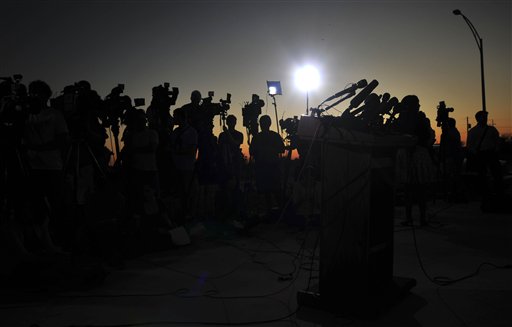
The sun sets at Ft. Hood, Texas, Thursday, Nov. 5, 2009, as the media awaits a briefing on the day’s terrible events. Photo by Michael Thomas / AP.

Shootings rock massive Fort Hood
As soldiers point to grim mood at the base

‘I’d say [morale is] at an all-time low — mostly because of Afghanistan now,’ he explained..

By Dahr Jamail / November 5, 2009

[This story was written the evening of the shootings at Ft. Hood. When you read it you will know facts not available at the time of this posting. But what’s important here is not the details of the terrible events that took place today; it’s the context in which they occurred, and about which Dahr Jamail reports. That is why this is an important report and one that we encourage you to read. — Ed.]

At approximately 1:30 p.m. CST today, a soldier went on a shooting rampage at Fort Hood in Killeen, Texas, killing 11 people and wounding at least 31 others, according to base commander Lieutenant-General Bob Cone.

Truthout spoke with an Army Specialist who is an active-duty Iraq war veteran currently stationed at the base. The soldier spoke on condition of anonymity since the base is now on “lockdown,” and all “non-authorized” military personnel on the base have been ordered not to speak to the press.

“A soldier entered the ‘Soldier Readiness Center (SRC)’ with two handguns and opened fire,” the soldier, who is currently getting treatment for traumatic brain injury (TBI) and post-traumatic stress disorder (PTSD) explained. “That facility is where you go just before you deploy to Iraq or Afghanistan.”

The soldier named the gunman as Major Malik Nadal Hasan, and said he was about 40 years old. According to the soldier, Hasan was a member of the base’s Medical Evaluation Board, and worked there as a counselor.

“I can confirm Major Hasan was the gunman, and I actually saw him this morning,” the soldier explained. “I was over in the area doing some paperwork, and saw him at the facility. He seemed fine to me, and I spoke with one of my friends who had an appointment with him this morning. They said Major Hasan seemed OK to them too.”

The soldier believes that at least one Killeen Police Department officer was killed before the gunman was shot. Two other soldiers with suspected involvement in the mass shooting were also taken into custody by a SWAT team, according to the soldier.

Fort Hood, located in central Texas, is the largest US military base in the world and contains up to 50,000 soldiers. It is one of the most heavily deployed bases to both Iraq and Afghanistan. In fact, the shooter himself was facing an impending deployment to Iraq.

The soldier says that the mood on the base is “very grim,” and that even before this incident, troop morale has been very low.

“I’d say it’s at an all-time low — mostly because of Afghanistan now,” he explained. “Nobody knows why we are at either place, and I believe the troops need to know why they are there, or we should pull out, and this is a unanimous feeling, even for folks who are pro-war.”

In a strikingly similar incident on May 11, 2009, a U.S. soldier gunned down five fellow soldiers at a stress-counseling center at a U.S. base in Baghdad. Adm. Mike Mullen, the chairman of the US military’s Joint Chiefs of Staff, told reporters at a news conference at the Pentagon that the shootings occurred in a place where “individuals were seeking help.”

“It does speak to me, though, about the need for us to redouble our efforts, the concern in terms of dealing with the stress,” Admiral Mullen said. “It also speaks to the issue of multiple deployments.”

Commenting on the incident in nearly parallel terms, U.S. Secretary of Defense Robert Gates said that the Pentagon needs to redouble its efforts to relieve stress caused by repeated deployments in war zones; stress that is further exacerbated by limited time at home in between deployments.

The condition described by Mullen and Gates is what veteran health experts often refer to as post-traumatic stress disorder (PTSD).

While soldiers returning home are routinely involved in shootings, suicide and other forms of self-destructive violent behavior as a direct result of their experiences in Iraq, we have yet to see an event of this magnitude take place in Iraq.

Prior to the May incident, the last reported incident of this kind happened in 2005, when an Army captain and lieutenant were killed when an anti-personnel mine detonated in the window of their room at a US base in Tikrit. In that case, National Guard Staff Sgt. Alberto Martinez was acquitted.

The shocking story of a soldier killing five of his comrades does not come as a surprise when we consider that the military has, for years now, been sending troops with untreated PTSD back into the U.S. occupations of Iraq and Afghanistan.

According to an Armed Forces Health Surveillance Center analysis, reported in the Denver Post in August 2008, more than “43,000 service members — two-thirds of them in the Army or Army Reserve — were classified as nondeployable for medical reasons three months before they deployed” to Iraq.

Mark Thompson also has reported in Time magazine, “Data contained in the Army’s fifth Mental Health Advisory Team report indicate that, according to an anonymous survey of U.S. troops taken last fall, about 12 percent of combat troops in Iraq and 17 percent of those in Afghanistan are taking prescription antidepressants or sleeping pills to help them cope.”

In April 2008, the RAND Corporation released a stunning report revealing, “Nearly 20 percent of military service members who have returned from Iraq and Afghanistan – 300,000 in all – report symptoms of post-traumatic stress disorder or major depression, yet only slightly more than half have sought treatment.”

President Barack Obama, speaking during an event at the Department of the Interior in Washington, said that the mass shooting at Fort Hood was a “horrific outburst of violence.” He added, “It is horrifying that they should come under fire at an army base on American soil.”

Victor Agosto, an Iraq war veteran who was discharged from the military after publicly refusing to deploy to Afghanistan, has had firsthand experience with the SRFC at Fort Hood, where he too was based.

“I knew there would be a confrontation when I was there, because the only reason to do that process is to deploy,” Agosto explained, speaking to Truthout near Fort Hood . “So the shooter clearly intended to stop people from deploying.”

Agosto was court-martialed for refusing an order to go to the SRC to prepare to deploy to Afghanistan.

“I was court-martialed for refusing the order to SRC in that very same building. I didn’t enter the building, but I didn’t go in because I was refusing the process,” Agosto continued. “It’s a pretty important place in my life, so it’s interesting to me that this happened there.”

Source / truthout

Also see:

  1. War Comes Home: Massacre at Ft. Hood by Danny Schechter / News Dissector / Nov. 6, 2009
  2. Ft. Hood tragedy: Repeat deployments take increasing toll by Sid Christenson / San Antonio Express-News / Houston Chronicle

The Rag Blog

Posted in RagBlog | Tagged , , , , | 11 Comments

Roger Baker : Debunking the Vaccine Scare

Graphic by David Dees / deesillustration.com

Swine flu vaccine:
The facts behind the kerfuffle

By Roger Baker / The Rag Blog / November 5, 2009

Are the big pharmaceutical companies endangering our health with risky things like swine flu vaccine? Maybe vaccines are risky, but perhaps not in the same ways and for the reasons that a lot of people are thinking, if we are to judge by the Internet chatter.

Is there a risk?

Probably the biggest flu vaccine risk is produced by not providing the influenza vaccine soon enough, because the proper federal government incentives were not there. The big pharmaceutical companies are overcharging the government, sending production offshore, withholding information, and using slow and obsolete production technology.

They may be in effect killing people who can’t get the safe and effective vaccines they need in time to prevent disease. We see this with both swine and seasonal flu vaccine shortages. After vaccination, about a two week delay is needed to develop a strong immune response.

From The New York Times:

…So far, the swine flu virus looks no more virulent than a normal seasonal flu. That is bad enough. It has killed roughly 4,000 Americans and sent roughly 40,000 to the hospital. The virus is active in 48 states, and even if it begins to taper off soon, another wave might hit us early next year. Those most at risk would be wise to get vaccinated when they can find a supply…

If you shop at Whole Foods, you might think that leading a healthy natural lifestyle based on their food may be all the medicine you ever need. Stores like this seem to sell a ton of herbal remedies but not much aspirin. This profitable healthy eating culture is no doubt valid, but is not enough by itself. Here is a recent recommendation for a healthy diet from the Harvard School of Public Health

One problem with current trends is that, while an increasing part of the general population might like to eat a healthy diet, more and more average folks can’t afford to eat healthy fresh fruits and vegetables to go along with the staple grains, etc. Perhaps they are exhausted by work and grab a quick burger and fries and soda. Or they are conned by TV commercials into feeding their kids cheap sugary drinks and junk food snacks full of fat and sugar. The kinds of food average people eat is increasingly a function of their economic class, and this certainly affects general public health and immunity.

I agree with a lot of the healthy food thinking, but I don’t believe there is much truth in the notion that just getting lots of exercise and eating a healthy diet somehow protects against contagious disease — and that as a result we won’t get sick when exposed to the various viruses to which we have no natural or vaccine-induced immunity.

The fact is that a lot of virus immunity (and many late onset chronic health problems) are actually genetic in nature and this natural immunity has often played an important role in history. The Spanish who invaded the Americas had previously suffered enough smallpox deaths to be more resistant than the Aztec Indian civilization they conquered, largely by spreading their smallpox.

Another example of natural immunity largely protected the Black slaves in Haiti where yellow fever was endemic in the early 1800s. This mosquito-spread disease then killed many of the French troops that were sent in to put down a Haitian slave revolt. This in turn helped to convince Napoleon to abandon French American colonies like Haiti, which helped lead to the Louisiana Purchase by Jefferson of a huge piece of the current United States.

However, especially since the 1930s, we have learned how to confer virus immunity using vaccines. As antibiotics lose their effectiveness — partly through factory farming of animals such as the swine thought to have cultivated the current swine flu, and from antibiotic overuse — the highly targeted microbe-specific vaccines will, by default, have to play an increasingly important role in medicine. Vaccines can work quite well if used properly and in advance of illness. The swine flu vaccines are thought to be about 75% effective and side effects are rare. Effective HIV and malaria vaccines may be possible in the future.

[A personal case in point: I eat a reasonably good diet at age 66, usually take a daily multivitamin supplement, and got my seasonal flu shot. However, I still got what was probably swine flu and then got a mild secondary infection, subsequently knocked out with the help of a sulfa drug. I had already gotten a pneumococcal vaccine shot to help prevent common strains of bacterial pneumonia.]


Why we dropped the ball on flu vaccine

The following, from the Council on Foreign Relations, clearly reveals that the current vaccine shortages stem from business as usual based on a bunch of fragmented business deals.

Worldwide, drug companies are scrambling to manufacture a vaccine for H1N1, also known as swine flu, which was declared a pandemic in June 2009. David Fedson, an expert in influenza vaccines and a former consultant to the World Health Organization, says the current distribution system is outmoded, and could slow or restrict the delivery of vaccines to some developing countries. “One of the reasons they’re getting it late is that thus far, the distributions of vaccines from companies to countries have been handled as a series of business deals,” Fedson says…

It is clear that the big international pharmaceutical corporations now have no national identity, or unifying principle other than profit. Unfortunately many conventional vaccines are labor intensive and rather unprofitable to produce. Vaccines are thus natural choices for outsourcing production, according to The New York Times.

…The current problems began years ago, experts said, when vaccine companies started abandoning the American market.

Vaccines, which involve living viruses, are much harder to make than most drugs. Profits are lower and unused flu vaccine expires after a few months. Also, vaccines are primarily intended for children, and Americans frequently sue when a child is injured.

Little was done to lure companies back until bioterrorism fears emerged after the anthrax attacks of 2001 and the H5N1 avian flu virus, which kills about 60 percent of humans infected with it, emerged in 2003, Dr. Fauci said.

In 2004, only two companies were licensed to sell flu vaccine in the United States; now there are five, but only one, Sanofi-Pasteur, has a domestic plant. The others — GlaxoSmithKline, Novartis, CSL Ltd. and Medimmune — use plants in England, Germany and Australia.

The drawback of relying on foreign plants was made clear recently when the Australian government pressured CSL to keep its vaccine at home instead of fulfilling its contract for 36 million doses of swine flu vaccine for the United States.

A new and better vaccine technology beckons

We are still trying to produce vaccines by the old fashioned but well established way of growing the flu virus in eggs and then killing it and injecting the killed virus in the flu shots. Another way is to induce immunity with a weakened virus. The nasal vaccine has a weak live flu virus. This is similar in principle to traditional smallpox vaccination which used a weak pox virus to make one pox infection lesion on your arm, thus inducing a lifelong immunity.

But both the killed virus and the weakened virus approaches are likely obsolete in our era of sophisticated biotechnology that now allows us to make recombinant vaccines. Here is what Sen. Bob Graham has recently testified with regard to the current status of our vaccine production technology:

…The United States–unlike the European Union and China–continues to use a 60-year old production method, using chicken eggs, to make H1N1 and other important vaccines. U.S. flu vaccines are safe and effective, but manufacturing can take six months, and is vulnerable to delays. The time it takes to make the vaccine is much longer than the time it takes for a flu virus to cause a pandemic. Right now, the H1N1 vaccine is being produced as quickly as possible, but millions of people will not have the chance to be vaccinated before they are exposed to the virus. Part of the slowness is due to the fact that all six US manufacturers of flu vaccine use chicken eggs. A modern and faster method to make a safe flu vaccine uses a process called “cell culture.” Cell culture does not require eggs. Vaccines for polio and the modern smallpox vaccine have been produced for decades using this technology…

Here Barbara Ehrenreich weighs in along similar lines:

…There are alternative “cell culture” methods that could produce the vaccine much faster, but in complete defiance of the conventional wisdom that private enterprise is always more innovative and resourceful than government, Big Pharma did not demand that they be made available for this year’s swine flu epidemic. Just for the record, those alternative methods have been developed with government funding, which is also the source of almost all our basic knowledge of viruses.

So, thanks to the drug companies, optimism has been about as effective in warding off H1N1 as amulets or fairy dust. Both the government and Big Pharma were indeed overly optimistic about the latter’s ability to supply the vaccine, leaving those of us who are involved in the care of small children with little to rely on but hope — hope that the epidemic will fade out on its own, hope that our loved ones have the luck to survive it…

This describes how the U.S. medical bureaucracy dropped the ball on the swine flu virus by not rapidly employing the recombinant vaccine technology:

…For more than ten years, recombinant flu vaccine has been recognized as a promising means of protection, particularly at the start of a pandemic when a novel strain of influenza appears.1 This method of producing vaccine is fast, and it can be expanded quickly from laboratory to pilot plant to large-scale production in multiple locations. Research on several recombinant vaccines, including vaccines for influenza, has been well supported by the NIH, especially by the National Institute of Allergy and Infectious Diseases (NIAID). Clinical studies have confirmed the safety and effectiveness of a recombinant vaccine for seasonal influenza.

However, the success of this research did not lead quickly, as it should have, to specific plans for industrial scale production of recombinant vaccine in the event of a pandemic. Elsewhere we have described a series of governmental delays and omissions. These seem to reflect, at the very least, a lack of a sense of urgency within DHHS. Specifically, two years ago DHHS solicited proposals for the production of recombinant flu vaccine for use in a pandemic. The Request for Proposals was issued in October 2007 instead of several years earlier — a significant and damaging delay — and the process of awarding the contract resulted in further delays. A contract was finally awarded in June 2009…

This new recombinant technology leads to cheap safe vaccines that don’t need any adjuvants (non-antigen immune response boosters) to help stretch our limited vaccine supplies. Why? Because what we are really doing is inserting a few genes into a bacterium or yeast. These bits of DNA program the microbe to produce a tiny bit of the structure of the targeted virus.

Since it is far easier to grow these special immunity-conferring microbes than to grow the live virus on living tissue, we can produce vast amounts of the pure vaccine immunizing substance fast, and thus largely avoid the traditional costs of production. This new method is fast and cheap after the up front work, but it is not business as usual for the pharmaceutical industry.

The main bottleneck in the new approach is the lab work to find which parts of the virus structure best confer immunity, followed by inserting these genes into microbes, and then testing their purified product to see if it induces immunity in ferrets, or whatever. Here is a description of the general recombinant approach, thought to be applicable to most viruses and vaccines:

Recombinant DNA technology appears to be on the verge of producing safe and effective protein vaccines for animal and human diseases. The procedure is applicable to most viruses because their isolated surface proteins generally possess immunogenic activity. Strategies used for the preparation and cloning of the appropriate genes depend on the characteristics of the viral genomes: whether DNA or RNA; their size, strandedness, and segmentation; and whether messenger RNA are monocistronic or polycistronic. Cloned surface proteins of foot-and-mouth disease and hepatitis B viruses are being tested for possible use as practical vaccines.

Two doses of the cloned foot-and-mouth disease viral protein have elicited large amounts of neutralizing antibody and have protected cattle and swine against challenge exposure with the virus. Surface proteins have also been cloned for the viruses of fowl plague, influenza, vesicular stomatitis, rabies, and herpes simplex. Cloning is in progress for surface proteins of viruses causing canine parvovirus gastroenteritis, human papillomas, infectious bovine rhinotracheitis, Rift Valley fever, and paramyxovirus diseases. In addition, advances in recombinant DNA and other facilitating technologies have rekindled interest in the chemical synthesis of polypeptide vaccines for viral diseases.

The bioengineering of bacterial vaccines is also under way. Proteinaceous pili of enterotoxigenic Escherichia coli are being produced in E coli K-12 strains for use as vaccines against neonatal diarrheal diseases of livestock.

Meanwhile, biotechnology is headed toward Asia

Although the biotechnology manufacturing industry was mostly invented in the USA, it is now rapidly moving to China for manufacture of the most exotic and sophisticated drugs and bio-research materials. Tomorrow expect the best vaccines to be made in China or wherever cheap highly skilled labor and the sophisticated technology can be established. Here is an amusing link to a biotech discussion site where somebody complains about bad Chinese biochemicals. The message is immediately met with a chorus of derision, probably including many Chinese posters, who point out how much of the biochemicals used for U.S. research are already being made in China.

The new genetically engineered bio-reagents are some of the most expensive substances known. If you want a bio-engineered antibody you could easily pay the equivalent of a million dollars a gram, and there may be only one source, but it might be the only source of the only drug that works. Until somebody makes a bootleg version in India, which has been ignoring the bio-patents lately.

Expect more of these exotic and costly but sometimes very effective drugs as more of the complex genomic basis for health and disease becomes better understood. A friend of mine has an eye problem which requires the injection of a special antibody to inhibit eye blood vessel growth for treatment.

The mouse version of this special antibody costs $300 per dose, but the better human antibody version costs $3000! With this kind of incentive, we can expect a lot of the biotechnology production to keep moving offshore and the U.S. biotechnology companies to become the exclusive brokers.

Increasingly, the important issue posed by these trends is whether the manufacture and distribution of these highly specific new biotechnology drugs and their development should continue to be driven by private profit for the big pharmaceutical corporations. Or should the new drugs be developed and produced more for public benefit, much like the Salk polio vaccine that eliminated the fear of polio in the USA? Much of the basic research underlying the biotechnology was publicly funded, by the NIH, etc. Who will now benefit as we move toward our new health care system?


The mercury scare

One additional issue I’d like to address is the fear, especially voiced in conversation on the internet, of potential danger from mercury content in the flu vaccines. It is true that some vaccines still have traces of mercury. When they do, they have about 25 micrograms of thimerosal per dose, but most vaccines — like the common childhood disease vaccines — have none. Go to this link and scroll down and you can see which vaccines still have them and in what amounts.

The fact that only some influenza vaccines have any thimerosal at all indicates that it does not have to be there, but it helps to prevent bacterial contamination — like in multi-dose containers from which you draw fluid repeatedly. Such contamination is dangerous when compared to any threat posed by a preservative. You can’t heat vaccine to sterilize it because that would denature the antigen which is the active ingredient.

Now let’s compare this with the amounts of mercury in servings of fish. Lobster, to choose one example of a food folks often consider a treat, has about .3 parts per million as we see from this link.

Thus if you eat three ounces, or about 100 grams, of lobster, you are getting about 30 micrograms of methyl mercury, said to be a form of mercury more toxic than the ethyl mercury thimerosal in vaccine. So you would get more mercury in a more dangerous form from lobster, as well as other commonly eaten fish. Coal plants also emit lots of mercury into the environment which can end up in fish.

[Roger Baker is an Austin community activist and writer — and regular contributor to The Rag Blog — whose scientist parents helped to cultivate his lifelong interest in science. His work has been published in Scientific American, The Microscope, The Review of Scientific Instruments, and The History of Photography Journal. He wrote a science column called “Science Hacker” for the Society for Amateur Scientists Journal. He still likes to build scientific instruments and is currently working on perfecting an instrument useful for the early detection of insect infestation in stored wheat.]

The Rag Blog

Posted in Rag Bloggers | Tagged , , , , | 8 Comments

Barack Obama : Stop the Runaway Train

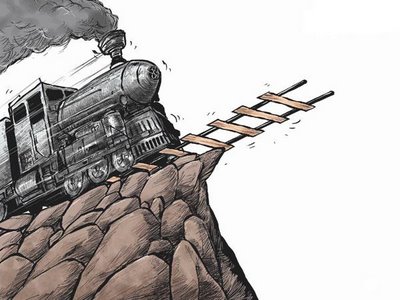
President Obama: Stop the runaway train of globalization.

Long range strategic innovation:

Globalization, the financial crisis, environmental planning, and getting out of Afghanistan

By Ray Reece / The Rag Blog / November 5, 2009

Call this a lesson in how to ensure your mail to the White House won’t be answered. The following proposal was originally drafted in response to a call for submissions on the Obama Transition Team website. That was back in December, after Obama’s election but before his inauguration. “President-elect Obama wants to hear from you,” said the website. “Send us your ideas for change.”

So we did — we being the motley band of scholars, activists and free-thinkers scattered worldwide who constitute the nucleus of the organization named below. Ten months later, we’re still waiting for a green light from the White House, or at least a form letter. We’re not twiddling our thumbs, though. We plan to have a website of our own online by the time Obama delivers his State of the Union address next year. Stay tuned.

Like hundreds of millions of other people around the world, I’m excited by the prospect of having Barack Obama in the White House. I’m a Texas journalist currently working in Italy and Hungary. I’m also a researcher and activist in several spheres of policy and politics, including energy-environment, urban and regional planning, transportation, and, to put it bluntly, the runaway train of globalization.

I have recently joined the board of a new organization of like-minded activists in the U.S. and Europe called the World Coalition for Local and Regional Self-Reliance. In future dispatches, if you are receptive, I will spell out the specific implications of that. For now I want mainly to advance a pair of policy suggestions that arise from the premises of our coalition.

One is based on our conviction that the current approach in Washington to resolving the so-called financial crisis and “getting America back on its feet” is grounded in faulty, obsolete reasoning that will cause it to fail and even be counterproductive in the long run.

We contend that the financial crisis is functionally intertwined with other national and planetary crises, led by global climate change, or GLOCCH, and Peak Oil, the imminent depletion of the fossil fuel resources on which the entire 21st century “global economy” is based. The financial crisis is likewise inextricably bound up with the hyper-suburbanization of American cities, the egregious loss of farmland and other productive capacity, and, yes, globalization and its evil twin, international terrorism.

The latter, we argue, is nothing more or less than a violent response by the oppressed of the world — oppressed culturally as well as economically — to those perceived as their oppressors, meaning, above all, the purveyors of economic and cultural globalization on Wall Street and elsewhere, in league with their national governments.

The banking crisis is thus not merely a symptom of lax regulation of financial markets and greedy investors in recent years. It is systemic in nature, and a systemic crisis requires a systemic response. The trillion-dollar stimulus package recently approved by Congress is not a systemic response, since it purports merely to restart the sputtering engine of the failed larger system itself. Rather, or perhaps we must now say in addition to the stimulus package, the whole matrix of primary socioeconomic assumptions and institutions in the United States — as a starting point and global model — must be examined, assessed and, over time, fundamentally changed.

Toward that end, as our first policy suggestion, we urge President Obama to establish and fold into his brain trust a new Office of Long-Range Strategic Policy Innovation. This would be the place in the White House where staff would be recruited to “think outside the box,” where vision, boldness and creativity would be prized over technical jargon and obeisance to America’s dying corporate mammoths and their powerful defenders in Washington. It is here that independent in-house thinkers, with appropriate input from real-world experts, would incubate the brave new concepts and paradigms the nation and world will need to survive and supercede not only the “financial crisis” but the web of corresponding metacrises mentioned above.

We dare to hope, indeed will strive to ensure, that among the big initiatives generated by a presidential Office of Policy Innovation would be the following:

  1. a greatly expanded and modernized national rail system for passengers and freight alike, similar to the European system;
  2. transformation of the urban/exurban population grid to a revised geography of small and mid-sized cities and towns that are largely autonomous and self-sufficient in the production of food, energy and other life-support resources;
  3. promotion of small organic family and community farms as the mainstay of American agriculture;
  4. at the macro level, encompassing all of the above and more, a liberation of human society from its self-defeating enslavement to the imperative of “growth” in favor of sustainability, sharing and reverence for the planet and its threatened wealth of species.

Our second policy suggestion would necessarily be implemented first, partly in order to redirect funds from the military budget to the crucial and expensive federal initiatives implied heretofore. We urge President Obama to make good on his promise to withdraw American military forces from Iraq. We further urge him NOT to nullify the positive effects of that decision by enlarging and prolonging the American-led NATO military presence in Afghanistan. Such a move, we believe, not only would not save Afghanistan from its own Islamic militants, nor strengthen the security of the U.S. and its allies.

It would have the opposite effect — in fact might well produce a catastrophe on the scale of the wars in Iraq and Vietnam — while diverting critical funds and other resources from the task of redesigning and rebuilding our own beleaguered society. To buttress our case, we refer you to a pair of recent articles in The New York Times, one a column by Bob Herbert, “The Afghan Quagmire,” the second an essay in the Times magazine, “The Worst Pakistan Nightmare for Obama,” by David E. Sanger.

Other references, to name but a few, include two books by James Howard Kunstler, The Long Emergency and World Made By Hand; Kunstler’s blog; E.F. Schumacher’s timeless classic, Small Is Beautiful; two books by Kirkpatrick Sale, Dwellers in the Land and Human Scale; Bill McKibben’s End of Nature; everything published by David Morris and the Institute for Local Self-Reliance; everything published by Pliny Fisk and Gail Vittori at the Center for Maximum Potential Building Systems; La Decrescita Felice by Maurizio Pallante and his website.

[Ray Reece is affiliated with the World Coalition for Local and Regional Self-Reliance. He is a former columnist for The Budapest Sun and author of The Sun Betrayed: A Report on the Corporate Seizure of U.S. Solar Energy Development, among other published works. His most recent book is Abigail in Gangland, a novel. He is currently based in Cagli, Italy.]

The Rag Blog

Posted in Rag Bloggers | Tagged , , , , , , , , , | 7 Comments

Columbia Military Pact : The Yanks are Coming

Colombian President Alvaro Uribe defends military pact with U.S. Photo from AFP.

U.S. and Columbia:
Military pact signed in ‘private’ meeting

Over There, Over There
Send the word, send the word,
Over There
That the Yanks are coming,
The Yanks are coming,
The drums rum tumming everywhere…

By Marion Delgado / The Rag Blog / November 4, 2009

CARTAGENA, Columbia — Well, it finally happened. U.S. Ambassador William Brownfield and three Colombian governmental ministers — Jaime Bermudez the Foreign Minister (same as Secretary of State), Defense Minister Gabriel Silva, and Attorney General Fabio Valencia — inked the deal in a secret (they called it “private”) ceremony in Bogota on Friday.

What was first described as a “military pact” was opposed by the Colombian State Council (the Cabinet), the Colombian Congress, the Union of South American Nations (UNASUR), the Bolivarian Alliance for the People of the Americas (ALBA), the countries of Ecuador, Brazil, Bolivia, Nicaragua, and of course Venezuela. It has been in the works for four months (that we know of). It is now a done deal.

It provides for seven U.S. operations bases scattered throughout the country, a total of 1400 troops (although U.S. law limits it to 800) and 600 contractor/mercenaries, all with diplomatic immunity from Colombian law. There’s more but nobody knows what ‘cuz it’s secret. The public part of the agreement will be published in the Federal Record in 30 days according to a spokesman for H. Clinton.

The week opened on Monday with a two day visit from U.S. Secretary of War Robert Gates. On Wednesday Colombian Foreign Minister Bermudez announced that it wasn’t a military pact after all, but an addendum to a 2004 U.S./Colombian “drug war” agreement and so wouldn’t need the approval of the Colombian Congress anyway.

It all started when Ecuador refused to re-up on a pact to let the U.S. use an air base at Manta in their country. The lease ran out in June. The operations were shifted to bases that the U.S. has in Aruba and Curacao in the Dutch ABC islands. That wasn’t good enough, as always they need more. That set off the go-around.

First they needed three air bases in Colombia, the congress said no! So, then they needed five bases, again resistance, no joy there. Then seven bases… No! How about four? Every day it was a different number. When Bermudez said they didn’t need congressional approval it quickly went back to seven and that’s what they got, three air bases, two naval bases, and two army bases. We don’t know where yet, because they changed the proposed locations from time to time during the squabble.

We know one will become part of the Paloquemado Air Base in the Magdalena River Delta; the U.S. already has a 46 million dollar construction project going there to make the base “safer.” Colombia got 14 million to sign the deal on top of the 16 BILLION dollars that they already got under Plan Colombia, (now known as Plan Uribe).

Cartagena has been mentioned as possibly one of the seaports. The base in Cartagena already plays host to a couple of Coast Guard cutters. We got ‘em all here: CIA, DEA, HSA, USCG, ICE, maybe more but I ran out of letters.

In any case, your correspondent will be traveling around to “our” various bases greeting our boys and reporting to you (since you’re paying for it) about what they are up to.

The Rag Blog

Posted in Rag Bloggers | Tagged , , , , | 6 Comments

Claude Lévi-Strauss : ‘La Pensée Sauvage’

Anthropologist Claude Lévi-Strauss: dead at 100.

Anthropologist Claude Lévi-Strauss:
Making sense of la pensée sauvage

By Carl R. Hultberg / The Rag Blog / November 4, 2009

In French sauvage means wild, not necessarily savage. In our language savage means aggressive, a value judgment left over from centuries of exterminations.

Heathens, savages, primitive people, natives. All these words describe a certain section of humanity, but they all mean something different. If confusion about our ancestral past is the price we pay to be modern, then so called “primitive man” will always be a source of much uneasiness. After the period when natives must be displaced and killed off, what do we derive from our relationship with them? Do we try in sad little ways to imitate their rituals at Boy Scout camp or on a football team?

For years the details of primitive people’s lives were catalogued by observers, anthropologists. But it wasn’t until the 1950s that one of these anthropologists, a Frenchman working for the Rockefeller Foundation, began to draw parallels from all the studies that had been made worldwide.

Claude Lévi-Strauss in the Brazilian Amazon, 1936. Photo by Apic / Getty Images.

To Claude Lévi-Strauss, the mind of the “primitive” was not a disorganized collection of confused myths and superstitions, but was in its own way searching for objective reality like all the rest of us. And the vast collection of mythology collected around the world from these types of populations could be catalogued and searched over for commonalities.

Lévi-Strauss himself did some of this pattern work, creating a new school of Western thought known as structuralism. Of course what structuralism points back to is what certain philosophers, psychologists, and poets have claimed all along: the existence of a universal human element, an originating unified matriarchy, one source and one basic pattern for all disparate human myths.

What Claude Lévi-Strauss succeeded in doing was bringing anthropology as a science to the brink of being able to understand human origins. The fact that he himself backed off before embracing the full Rousseau (Noble Savage), the absolute Carl Jung (Universal Unconscious) or the mother of all mythbreakers, Robert Graves (White Goddess), tells you right away he went too far. Two steps further and Levi-Strauss would have been back in alchemy land.

So it was that structuralism was attacked as simplistic, finally superseded by, you guessed it, “post-structuralism.” All male dominant science is ultimately one big ego-driven pissing contest. Truth can never flourish for long if we are to have neverending “progress” and new succeeding generations of intellectual leaders.

Claude Lévi-Strauss, the father of the structuralist school of anthropology died this week. He was a hundred years old.

The Rag Blog

Posted in Rag Bloggers | Tagged , , , , , , | 2 Comments

Harry Targ : Legitimacy Crisis and the Vietnam Syndrome


Public suspicion of government on the rise:
The return of the Vietnam Syndrome

By Harry Targ / The Rag Blog / November 3, 2009

I teach a course on United States foreign policy. I was just finishing up a discussion of foreign policy in the Nixon/Ford (and Kissinger) period, 1968 to 1976. As I talked about how the consciousness of most Americans in the 1970s changed, I emphasized the rising crisis of legitimacy of American political institutions and opposition to presidents sending troops into foreign lands, the so-called “Vietnam syndrome.” As I lectured to a large group of students who may have been thinking, “What the hell is he talking about?” I began to reflect on what might be instructive about the mid-1970s for analysis and activism today.

Richard Nixon won the presidential election in 1968, promising that he had a “secret plan” to end the war in Vietnam. As the subsequent years unfolded the secret plan became clear: pulling most U.S. troops out of Vietnam while launching a massive bombing campaign targeting virtually every conceivable site in North and South Vietnam, and invading Cambodia.

The U.S.-led war expanded in the most brutal way, at the same time that ground troops returned home. To undermine growing opposition to the war he initiated carrot and stick policies, ending the draft and launching a nationwide program of counterintelligence and police violence against anti-war and anti-racist activists. The drive to repress dissent spread to opponents of the war in the Democratic Party including against the 1972 anti-war candidate Senator George McGovern. The Nixon team, from the White House to small time burglars, engaged in covert programs to disrupt the McGovern campaign. Thus the seeds were planted for the Watergate scandal that forced Nixon to resign his presidency.

Because of the war overseas, repression at home, and rising economic crisis brought on by war in the Middle East, dramatic increases in the price of oil, declining relative competitiveness of the United States economy, the American people began to turn against their government. Enter “legitimacy crisis” and “Vietnam Syndrome.”

What is a Legitimacy Crisis?

Theorists as varied as Karl Marx, Antonio Gramsci, and a variety of American political scientists have written in their own ways about “legitimacy” of political institutions and how degrees of it affect stability and change. We can say that a “legitimacy crisis” exists when there is a substantial decline in the level of support for particular regimes, governmental institutions and/or the political leadership of a country.

Polling data from 1964 (when Lyndon Johnson won a huge election victory over conservative opponent Senator Barry Goldwater) until 1976 (at the end of the eight-year period of the Nixon/Ford administration) indicate a dramatic decline in the trust that the American people had in the government. In 1964, seventy five percent of the people said they trusted their government “always or most of the time.” That declined to thirty percent in 1976. The slide continued until 1980. By 1984 President Reagan’s popularity boosted trust to over forty percent. Then a decline followed bottoming out at twenty percent during the mid-1990s.

Trust in government increased after 9/11 in 2002 but by 2007 had declined again to 26 percent. While we can quibble over the meaning of numbers, methodologies, and questions asked, the general thrust of the data indicates a substantial decline in support for government and its leaders since the 1960s spurred by Vietnam, Watergate, and economic crisis at home. As popular as Ronald Reagan was, he never reached the level of support held by Presidents Eisenhower and Johnson.

The Vietnam Syndrome

As to foreign policy, polling data, protest activity, and pressure from influential and grassroots lobbying groups led politicians “inside the beltway” to conclude that the American people did not want their country to engage in another long, unwinnable, and controversial war again, such as Vietnam. Thus every presidential administration from Jimmy Carter on regarded with scorn the constraint that the “Vietnam Syndrome” placed on their capacity to act in an overt and massive military way overseas. President George Herbert Walker Bush confirmed this perceived constraint when he announced at the press conference ending the first Gulf War: “At last we have licked the Vietnam Syndrome!” He probably was premature in his exuberance.

More recently, political scientist John Mueller refined the idea of the “Vietnam Syndrome” by studying polling data from U.S. participation in three wars, Korea, Vietnam, and Iraq. He found a common trend in declining support for these wars. Namely duration and casualties (particularly number killed) are correlated with the systematic decline in support for the wars in question. When a president sends troops into combat, temporarily, the people “rally round the flag.” But as wars continue support declines.

Meanings of the Past

What is relevant about all this for today? Are there enough similarities between now and the 1970s to learn from the past? What is different today from the 1970s? Is there anything to be gleaned about the “consciousness of the American people” at various points in time that bear on the question of how to build a progressive majority and against more war and for social justice?

The 1976 candidate for president, Jimmy Carter, ran on a program, he hoped, to bring the disenchanted anti-war activists back into the mainstream political process. He said he would “learn the lessons of Vietnam,” cut military spending, and most important, use human rights as the primary criteria for foreign policy. He also pledged to continue the policies of “détente” that his predecessor had initiated with the Soviet Union.

The anti-war movements and social justice movements of the mid-1970s, never well-organized or interconnected, continued to disintegrate. After two years of modest efforts as promised, the Carter Administration tilted back toward the Cold War policies of its predecessors, spurred on by the trauma the collapse of the Shah of Iran created in the foreign policy establishment.

The Iranian revolution was followed by revolutionary change in Grenada, Nicaragua, and reformism on the horizon in El Salvador. In the summer, 1979, Carter signed a secret directive authorizing covert assistance to anti-Soviet rebels who were launching a war against the secular, Marxist regime that had come to power in Afghanistan.

In other words, as the social movements of the 1960s and ’70s dissolved, American foreign policy returned to its historic struggle against revolutionary ferment, albeit in a more covert way. It was candidate Reagan who took the struggle for legitimacy further by promising a more aggressive foreign policy that would lead to victory against the Soviet Union, “the evil empire.”

Even so, Reagan had to gradually bring the American people along to military intervention by invading and winning a one week war in Grenada, and developing a covert strategy to fight communism in Central America, Southern Africa, the Horn of Africa, and Southeast and South Asia called “low intensity conflict.” U.S. military intervention was “low intensity” for Americans while it was “high intensity” for peoples of the Global South.

Relevance for today

Where is the consciousness of the American people in 2009? First, the wars against Afghanistan and Iraq, the illegal and immoral incarcerations and torture of suspected “terrorists,” egregious shifting of government funds to contractors tied to the administration, media manipulation and a host of other unethical and criminal act stimulated a substantial decline in legitimacy of government in the years of the Bush presidency. The campaign of Barack Obama, by contrast, mobilized masses of people to the political process in the hope that government could be made to work for the American people. His first six months in office, however, have raised some questions about the new administration’s ability to deliver on the hope.

In general, I believe we can conclude that despite ups and downs in levels of support for government since the end of World War II, there has been a substantial downward trajectory in support for government institutions and personnel. The American people are suspicious of their government and distrust their leaders. Many believe that government has been an impediment to the health and happiness of the people. Episodes of scandal, from Watergate, to Iran Contra, to Monicagate, reinforce the skepticism about government.

As to foreign policy, initial support for the invasion of Afghanistan and suspension of disbelief about the initiation of the war in Iraq has been superseded by the twenty-first century variant of the “Vietnam Syndrome.” Duration and growing casualties in both wars have led to growing anti-war sentiment.

In the 1970s, mass movements were dissipating. Today such movements, initiated over the last eight years, continue to grow. They are reinforced by the most significant economic crisis since the 1930s. Without mass movements, the twin consciousnesses of the America people as to legitimacy and foreign policy provide little hope for building a progressive majority. In fact, the legitimacy crisis, if not addressed with a progressive alternative vision of what government can be, can lead to massive alienation, right-wing populism, and violence.

Building a progressive majority, at this time, should include making our peace and justice organizations strong, presenting compelling images of what government can and should do, and strategizing about how the mass movements can demand participation in government. As to foreign policy, our campaigns should emphasize the length of our wars and the casualties resulting to Americans and victims in host countries, along with our arguments about the imperial underpinnings of such wars.

Even though the present and the future do not merely repeat the past, the past can inform what we do today,

[Harry Tarq is a professor in American Studies who lives in West Lafayette, Indiana. He blogs at Diary of a Heartland Radical, where this article also appears.]

The Rag Blog

Posted in Rag Bloggers | Tagged , , , , , | 12 Comments

James Howard Kunstler : Our Gods are not Happy

Rough beast, preparing to slouch. Art by Alex “Rhino” Voroshev.

Thinking the unthinkable:
Cornpone Hitlers and the agony of ordinary people

By James Howard Kunstler / November 3, 2009

A side-trip to the local mall — where else to buy ammo around here? — evinced an epic struggle for supremacy of the chain stores between the Great Pumpkin and Santa Claus, with both fat-assed icons trying to shove the other out of the primary display sites as if the store aisle were a WWF ring in some grubby forsaken Palookaville far far from the salons of Washington decision-making, which, I guess, this is.

This is the kind of place that a Jimmy Stewart character would have called home in 1946; only today it looks like a place taken over by a certain species of space aliens, slovenly in mind as well as body.

Our gods are not happy. Anyway, that third fat-assed icon, the Thanksgiving Turkey, was nowhere in sight, perhaps due to the recognition that there is far more grievance than gratitude ‘out here’ in the fly-over zone.

America still does everything possible except prepare to become a different America, perhaps even a better America than the current release, and this is unfortunate because history is merciless. History doesn’t care if the dog peed on your homework… or you had car trouble this morning… or the tattoo on your neck got infected… or (to take this in another direction), you justified robbing scores of billions of dollars out of the mortgage sector because your too-big-to-fail company came down with the financial equivalent of swine flu and the top executives were hallucinating that they lived in a world with no boundaries of law or common decency.

We’re at another one of those weird inflection points of “current events” — a momentous eddy in the larger stream of history. A good deal of the already-proclaimed return to normality (“normalcy” in WGHarding-speak) depends on something close to a normal holiday shopping season, when so much of the nation’s merchandise inventory moves from WalMart to under the Christmas tree.

Of course, even if it were to turn out like a year-2005-type credit card binge, the result would surely be a sort of hemorrhagic fever of buyer’s remorse afterward. An aerial view of the Heartland long about February 1st would show households blowing up like individual kernels of popcorn at an accelerating rate until the terrain itself was obscured by an evil fluff of financial woe suffocating the poor folks trapped under it.

Over the weekend, The Huffington Post ran a McClatchy news service story about Godman Sachs’s misdeeds around the issuance of mortgage backed securities. The basic idea in it was that GS was aggressively gathering trash mortgages from fly-by-night “originators” all over America to bundle into tradable security paper, which they then pawned off on feckless, inattentive investors (pension funds, foreign banks, etc) seeking miracle returns — at the same time that GS was buying credit default swap “insurance” by the bale, knowing full well that the collateral backing their own issuance of MBS was of a quality somewhere between dead carp and dog poop.

In other words, they were shoveling shit investments out of one window, and betting against the value of them from another window. Thus a picture resolves of GS’s “true opinion” of the securities it peddled, and the question arises whether failure to inform the peddled of this opinion constitutes fraud. I certainly think it does.

I’ve been making substantially the same case for two years now, so it is interesting to see the mainstream media awaken to a story-line that an ambitious nine-year-old could have pulled off the Web over recent months. I also continue to assert that a flurry of bonuses paid out this holiday season by Goldman Sachs and its other amigos at the top of the banking food chain will be greeted by violence — which will be the natural outcome of a society whose government fails to even give the appearance of protecting its citizens from organized crime. How did a sock puppet get appointed head of the U.S. Department of Justice, folks will wonder.

How bad is the situation “out there” really? In my view, things are veering toward such extreme desperation that the U.S. government might fall under the sway, by extra-electoral means, of an ambitious military officer, or a group of such, sometime in the near future. I’m not promoting a coup d’etat, you understand, but I am raising it as a realistic possibility as elected officials prove utterly unwilling to cope with a mounting crisis of capital and resources.

The “cornpone Hitler” scenario is still another possibility — Glenn Beck and Sarah Palin vying for the hearts and minds of the morons who want “to keep gubmint out of Medicare!” – but I suspect that there is a growing cadre of concerned officers around the Pentagon who will not brook that fucking nonsense for a Crystal City minute and, what’s more, would be very impatient to begin correcting the many fiascos currently blowing the nation apart from within. Remember, today’s U.S. military elite is battle-hardened after eight years of war in Asia. No doubt they love their country, as Julius Caesar and Napoleon Bonaparte loved theirs. It may pain them to stand by and watch it dissolve like a castle made of sugar in a winter gale.

I raise this possibility because no one else has, and I think we ought to be aware that all kinds of strange outcomes are possible in a society under severe stress. History is a harsh mistress. For all his “star quality” and likable personality, President Obama is increasingly perceived as impotent where the real ongoing disasters of public life are concerned, and he has made the tragic choice to appear to be hostage to the bankers who are systematically draining the life-blood from the middle class.

Whatever we are seeing on the S & P ticker these days does not register the agony of ordinary people losing everything they worked for and even believed in. In a leadership vacuum, centers don’t hold, things come apart, and rough beasts slouch toward Wall Street.

Source / Clusterfuck Nation

Thanks to Roger Baker / The Rag Blog

Posted in RagBlog | Tagged , , , , | 4 Comments

Robert Jensen : War, the Ecology, and the Quest for Justice

Professor Robert Jensen.

War, ecological crises, and the quest for justice:
An interview with Robert Jensen

If you feel overwhelmed, it’s because we face an overwhelming situation.

By Calvin Sloan / The Rag Blog / November 3, 2009

[The following is an edited version of an interview with Robert Jensen conducted by Calvin Sloan for the radio show “The Pursuit of Injustice,” on KVRX in Austin. The podcast can be streamed or downloaded here. An earlier version was published by Energy Bulletin, October 30, 2009.]

Calvin Sloan: So to start off, let’s address some topical issues. The war in Afghanistan has been described in the mainstream media as America’s good war and as the cornerstone of the “War on Terror.” President Obama is currently debating an increase in troop levels there. He’s already sent an additional 21,000 since taking office, and as the Washington Post recently reported, has been deploying without public announcement 13,000 additional troops. You’ve been an outspoken critic of the war since its inception, what is your take on the current situation there?

Robert Jensen: I think any assessment of the current situation has to remember that the U.S. invasion of Afghanistan in 2001 was illegal. The United States invaded the country with no legal authorization. It claimed the right to do this because of the relationship between the governing Taliban and Al Qaeda and the events of 9/11, but there were many ways that the United States could have pursued a just solution to the question of the terrorism of 9/11.

So, why would it pursue an illegal and, I would argue, immoral invasion? Here we have to remember that U.S. military interventions in the Middle East and Central Asia, whatever the stated reason for them, are really about energy resources. The Middle East especially is home to the most extensive reserves of petroleum. There’s a lot of natural gas in Central Asia, plus it has geostrategic importance. So let’s get rid of the idea that this is about the “War on Terror.”

Does the United States want to end terrorist attacks against Americans? Sure, but that doesn’t mean that this particular war is a war on terrorism. We also should remember the phrase is a bad joke, that terrorism is a method by which people try to achieve political goals. You don’t have a war on a method. If you’re going to make war, you’re making war for specific purposes against specific people in specific places, and the “War on Terror” is simply way too obscure for that.

So with all of that background, if the United States were to pursue a just and legal path it would begin a withdrawal from Afghanistan, pay the reparations it owes to the people of Afghanistan, and attempt to work with the appropriate regional and international organizations to try to help Afghanistan transition to a decent government. The United States has no intention of doing that.

So, the proposed buildup in Afghanistan is not only immoral, it’s not only fundamentally unjust, it’s also incredibly stupid. On all counts, anyway you want to evaluate this, the United States is making crucial errors.

The fact that Barrack Obama, the alleged peace candidate in the last election, is willing to pursue this just reminds us of the limits of contemporary mainstream electoral politics with a choice reduced to Republicans and Democrats. What we should be thinking about is the whole structure of, and motivation behind, our involvement in the Middle East and Central Asia, and we should also be rethinking the whole structure of our political discourse at home.

CS: So if this is by all means a stupid endeavor to continue this occupation, why are we doing this? Who is profiting from this? What are the underlying motivations of our occupation?

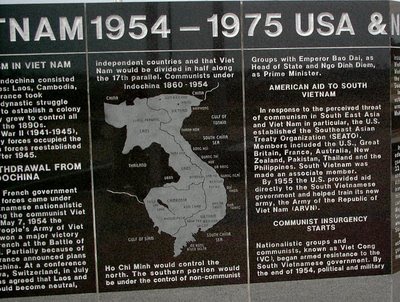
RJ: Remember that just because people in power might be corrupt and immoral doesn’t mean they’re always competent in pursuing that corruption. If you look back at probably the most grotesque U.S. intervention in the post World War II period, the Vietnam War, there were corrupt and immoral reasons the United States invaded Vietnam — mostly to undermine independent development and try to dominate the third world — but in trying to carry out those objectives there were a lot of incompetent decisions made. And sometimes incompetence compounds itself, so as you get further and further into a set of bad strategic decisions, there is an instinct to want to rescue them, but unfortunately it often leads to even more bad strategic decisions.

So, why are we doing it? Well, there’s a certain amount of irrationality to these strategic decision making, even though it’s in the pursuit of a rational — albeit I would say immoral — goal, which is to dominate the Middle East and Central Asia. Why are we doing it? Are there profit motivations for private contractors, who are making a killing? Sure. Are there oil companies and gas companies that want concessions? Sure. There are always those things, but I think that the driving force behind U.S. foreign policy tends not to be the interest of any particular industry or any particular set of contractors, but the fact that the whole system is designed to perpetuate this quest for dominance. And those other factors, like the interests of Blackwater (which has changed its name to Xe Services) or ExxonMobil, just contribute to the motive force behind the policy more generally.

CS: So here we are in 2009, and we’ve entered the ninth year of the war in Afghanistan and we’ve similarly occupied Iraq since 2003, yet when you look around it’s hard to notice that we’re running on a war economy. It’s become so normalized, and from a student’s perspective it’s interesting to note that the majority of undergraduates across the country have spent all of their high school and college careers with our nation at war.

And my question is, how do you think history will judge this perpetual war? Do you believe we’ve entered into Orwell’s 1984 realm, are we living in a society where war has officially become peace?

RJ: I don’t think we have to wait for history to judge it. I think we can assess it today and it’s pretty straight forward. The U.S. invasion of Afghanistan was illegal. The U.S. invasion of Afghanistan was a cover for other interests, and that’s all doubly true with the U.S. invasion of Iraq. The whole project is corrupt beyond description. Yet, the propaganda industries, not just the propaganda emanating from the government, but the propaganda industries — advertising, entertainment, journalism — are all perpetuating this crazed interpretation of the War on Terror, because they all have an interest in doing that. They are all ideologically connected to the same project.

And yes, it’s Orwellian in that sense, it’s corrupt, it’s immoral, it’s illegal, it’s all these things that we’re talking about, and we don’t have to wait for history 30 years from now to make that judgment. What we have to do is recognize it, and try to organize against it. But I think what we should be doing is not just opposing this war but recognizing that the disease from which this war springs is more deeply set in the culture than ever before.

You can clearly see that on a college campus. Remember that when the United States invaded and began to destroy Vietnam, the opposition to that war started, and was always strongest, on college campuses. There was a kind of “natural,” if you’ll accept the term, resistance from students to that imposition of power from above.

Well in some sense, campuses are the most passive places when it comes to anti-war activity today. To the degree that there is an anti-war movement, it’s mostly rooted in the community. So, that tells us something about what’s happened in universities, the way universities have been turned toward a more corporate and ideologically neutered position, though campuses could potentially be centers of opposition, resistance, and struggle. Well, that’s about not just the war, that’s about what’s happened to American higher education, the corporatization of higher education.

In other words, the war is an indicator not just of the depravity of the war-makers, it’s a very important indicator of what’s going on in society more generally. And about that, I’m terrified. The direction the whole culture is heading is very scary. It’s an imperial culture in decline. The United States remains the most powerful country in the world, at least in raw military terms. It remains the largest economy in the world. But it’s an affluent imperial society in decline, and such a society is very dangerous. I think we should be paying attention not only to what these wars tell us about foreign policy and military affairs, but also what they tell us about our society at a much deeper level.

CS: So are you saying that the universities aren’t actually free? Do you think that that’s affected by the politics of tenure and publishing grants?

RJ: It’s affected by the structure of financing, it’s affected by the rewards and punishments that faculty members respond to in building careers. For students, it’s about the economy that the students are going into, and how students are conditioned to believe that college is career training. It’s about trying to create the University as an allegedly politically neutral space, but of course any time you talk about political neutrality what you’re talking about is de facto support for the existing distribution of power. All of these things are part of it, and we should be concerned with it.

Is the University free? Well at some level, obviously yes. Here we are in a University office, I’m a University professor, we’re talking about things that will be on a University radio station. Of course it’s free in that sense, but it’s also a system structured in a way that is going to divert most people from the kind of conversation we’re having. So there are constraints. That’s true of any institution. There are opportunities and freedoms, and then there are constraints. I think what we should be focused on — whether we’re talking about the Universities or the media or any of the other intellectual institution — is how the freedom that exists on the surface is often masking a deeper kind of pressure toward conformity, a conformity that’s not enforced through the barrel of a gun, as in a totalitarian society, but a conformity that’s enforced in a much more complex, and in some a ways a much more effective, fashion, through the rewards and the punishments we’re talking about.

CS: I’d like to move on to your most recently published article entitled “Is Obama a Socialist?” In this article you express a deep concern for our evolving ecological crisis, specifically I’d like to refer to the following statement: “Capitalism is an economic system based on the concept of unlimited growth, yet we live on a finite planet. Capitalism is, quite literally, crazy.” Can you explain this concept further to us?

RJ: For most of the past couple hundred years, we’ve been living really in a rather unique historical moment. First of all it’s a moment made possible by unleashing the enormous energy of coal, oil, and natural gas, the fossil fuels. That’s a blip in human history. There’s never been energy like that available to human beings before, and we’re quickly running out of it. So, all of this bonanza of consumption and material comfort is really subsidized by that energy source, and there is nothing on the horizon to replace it. All of the talk of alternative fuels and biofuels and wind and solar, that’s fine, they are all going to supply some energy, but they are not going to replace the energy we’ve been using from coal, oil, and natural gas.

The explosion of this energy is also the time in which modern industrial capitalism has emerged. It’s all based on a fantasy that is easy to understand because of all that energy. It did look like we could simply grow endlessly. But the ecological crises, and I use the plural quite specifically — multiple crises, not just global warming but levels of toxicity in the air, water, loss of top soil, the reduction in biodiversity — are part of a global pattern that is uncontroversial: We are reaching, and probably are long beyond, the carrying capacity of the planet, and we are drawing down the ecological capital of the planet at a rate that is increasingly threatening, not just centuries from now, but likely in decades.

That’s all part of an era in which capitalism led us to believe we could have unlimited growth. It’s a crazy claim, and more striking is that it is a crazy claim that is considered to be the conventional wisdom. This is the kind of thing we should be worried about. We’re not having a debate about capitalism in this country — there’s no debate for the most part in the mainstream. Capitalism is taken to be the only way to organize an economy, yet it is a system of organizing an economy that is literally crazy. Well, if that doesn’t scare people, then I don’t know what will.

CS: If you are implying that if we are at a level of overreach, that there will be, that we might reach a population crash?

RJ: I think it’s inevitable. Ecological overshoot is the key concept. The planet has a carrying capacity. The planet can host only so many human beings, depending on the level at which we live. I’m not a scientist, I’m not an ecologist, I’m not trained in any of this, but reading people whose judgment I trust, and trying to synthesize the information that I can, my judgment is that we’re probably well past the carrying capacity of the planet already.

And at the level of first-world consumption, we are dramatically past the carrying capacity. That is, if you are going to expand this high energy consumption and lifestyle of the first world to the whole planet, it would be game-over tomorrow. If everybody in the world lived like you and I live, the planet would literally die tomorrow. So the only reason we can continue this system is the fact that a good portion of the world’s population is living at a dramatically lower level than we are. Even at that level, I don’t think that the world can support this many people. So we’re in a position of overshoot.

When is the crash going to come? Well in some sense the answer is it’s already here. You have half the world’s population living on less than $2.50 a day, you have hundreds of people dying every hour in Africa from easily preventable diseases, you have the beginnings of ecological crises that are manifesting themselves not only in the reduction of biodiversity but in the direct threat to human life.

When is all of this going to come crashing? Well I don’t know, because I don’t have a crystal ball and no one else does. The question shouldn’t be when can you predict all of this is going to fall apart. More important is the recognition that it inevitably will fall apart, and we should prepare for it, in both physical terms and moral terms. My own view is that, if not in my lifetime certainly in yours, there will be a massive human die-off. That’s an antiseptic term — it means that millions upon millions of people will die in large sweeps across the planet. What do we do about that morally? What do you do if you’re living in a world in which you know that simply by virtue of the luck of where you were born, you are protected from a scourge that is literally killing millions around the planet?

Well we’re seeing small examples of that today with such things as the devastation from easily preventable diseases in Africa for instance, but what if that happens on a massive scale? I don’t think the human species has a way to cope with that. We’re not ready physically, technologically, but we’re also not ready morally. And the only way you get ready for that is by openly discussing it, but it’s still a culture that cannot come to terms with this. Everything we’re talking about today would have been unthinkable as subjects for the presidential election. No candidate could talk like this and expect to be elected, because the culture is still in such deep denial about the fundamentally unsustainable nature of our economic system and the moral implications of that.

CS: How do you think nation-states will respond to these collapse scenarios?

RJ: First of all I think we should recognize nation-states are not inevitable for the rest of human history. My own view is that were going to end up finding other ways to organize ourselves politically, because the nation-state is at the center of so much of this destruction.

How will people respond? Well I think a lot of that has to do with how the most powerful nations respond. Remember that one of the aspects of being the most affluent and militarily powerful countries on the planet is that what you do matters a lot. You can continue to pursue insane strategies in a crazy system, or you can tell the truth. And if powerful countries tell the truth, start to actively reduce their energy and other material consumption, start to take seriously the demands of justice in equalizing the distribution of wealth around the world, give up on fantasies of control and domination, well that would have a huge effect.

The developing world, which clearly doesn’t trust us and shouldn’t trust us, might be able to move into a posture of more cooperation. Democratic movements within those countries might strengthen when they know there is in fact a commitment from the powerful states to real law, real democracy, real justice, real moral principles. Well, all of that is possible. It’s not a guarantee of success. We could do everything we can imagine in the realm of just and sustainable policies and still fail. The human species does not have some magic guarantee of endless success. Other species have come and gone, and it’s quite possible — in fact, I would argue it’s probably likely — were going to go that way relatively soon. And people always say, well that’s a rather depressing fact. Well if it’s a fact, it’s a fact, but of course there’s no way to know for sure, and we can struggle to create a different future, without guarantees.

But even if it does seem to be our future, what of the time we are here? I think part of what makes one fully human is to resist that, to struggle, even with no guarantee of success. And that’s where I put my faith. Maybe it’s a faith that is going to be betrayed, but I don’t see any better option at the moment.

CS: If we were to inevitably make this transition, or at least in the process of making it, do you believe that there will be restoration of matriarchal values?

RJ: I don’t think it’s about matriarchy versus patriarchy. Patriarchy is a system that emerged in the last 8,000 to 10,000 years, and it imposed systems of hierarchy, not just around gender but around other differences as well, and we are still trying to get out from under those. If we succeed in that — if we succeed in realizing that power does not come only with the ability to control other people, that power comes in the creative potential of human collaboration, it can come in non-hierarchical ways to organize ourselves — it doesn’t mean obviously that there will be a matriarchy, if by that we mean a world in which women dominate. It means that we move into a real space where mutuality and egalitarian values can reign.

What will that look like? I don’t know. If we were to magically get there in my lifetime I couldn’t begin to imagine what it would look like. I know that it won’t look much like the institutions I live in today — it won’t look like the modern corporation, it won’t look like the modern nation-state, it won’t look like the modern University. But you don’t really predict those things, you try to live them. And you live them in small steps, not in some grand utopian fantasy.

CS: Given our trajectory towards this cliff, this ecological cliff, should college students be rethinking their career choices? Are we being trained properly?

RJ: Reality is going to force college students to reconsider career choices, when certain assumptions will no longer hold. The most important thing that Universities could do right now is be laboratories for experiments outside of the dominant system, which is exactly what we’re not doing.

What we’re doing is still training people to be rats in a maze. Well, what if we said, the maze is over. For now, the maze may still exist out in the world, but we’re going to spend four years here going beyond the maze, and your job as a student, and your job as a faculty member, is to experiment with alternatives. That would mean a dramatically different curriculum, that would mean a dramatically different classroom.

I would like to see that happen. In journalism education, the collapse of the commercial journalism industry — the fact that there are fewer jobs for our students in the traditional journalism institutions — gives us a kind of opportunity. It’s a disaster at one level, in that the way we’ve done things no longer works, but it’s also an opportunity to reshape those methods.

In my own experience, there is a lot of resistance to that kind of change, because it is kind of frightening. If you’ve been doing something on a model that in the past has worked, or at least appeared to work, and now people are saying that model is over, well it’s not exactly easy to jump to that position where everything is up for grabs. But that’s what Universities should be doing. Unfortunately, not only in journalism but in the University at large, I think there is a distinct lack of that spirit. There is an attempt to kind of hunker down, and make this model work, but I don’t think the model can work. I don’t think it ever worked for real education, but it’s certainly not going to work in a dramatically changing landscape.

CS: What advice do you offer UT students, or just to activists of all ages, who want to participate, want to fight the system, but feel overwhelmed by its strength?

RJ: If you feel overwhelmed, let’s recognize that that’s a rational response. If you feel overwhelmed, it’s because we face an overwhelming situation. We’re facing a collapse economically, a collapse of U.S. power around the world, and ecological crises that defy the imagination. Well that is overwhelming. But we should also look at history and realize that this is not the first time the world has appeared to be on the brink, and people didn’t lie down and die in the past. People organized, people committed to long-term projects to create a different future, and we can still do that.

In my case, I’ve moved toward a focus on helping to build local community networks and institutions that can help people explore other alternatives. One of the groups in Austin I’ve connected with is the Workers Defense Project, a wonderful group that helps immigrant workers, especially undocumented immigrant workers, who are vulnerable to exploitation by employers. Through that work it offers a critique of the underlying power structure and a vehicle for people to build the power to change things. It’s really inspiring.

If we’re going to be effective, we’ve got to dig in for the long haul. There’s a paradox in all this. We may feel the crisis is more urgent then ever — and I do feel that, more than ever — but we have to recognize there’s no short-term solution, and we have to dig in for the long haul. That might be difficult, but it’s the only way I can see us moving forward.

[Robert Jensen is a professor in the School of Journalism of the University of Texas at Austin and a board member of the Third Coast Activist Resource Center. His latest book is All My Bones Shake: Seeking a Progressive Path to the Prophetic Voice (Soft Skull Press, 2009). His film, Abe Osheroff: One Foot in the Grave, the Other Still Dancing, has been released by the Media Education Foundation. Jensen can be reached at rjensen@uts.cc.utexas.edu. His articles on The Rag Blog are here and his writing can also be found here.]

The Rag Blog

Posted in Rag Bloggers | Tagged , , , , , , , , , | 1 Comment

Hall of Fame Concerts : Rocking the Garden!

Hall of Fame rock ‘n rollers: Bono and Mick Jagger. Photo from Mirror, U.K.

Hall of Fame benefit:
Taking rock and roll to a new level

By Harvey Wasserman / The Rag Blog / November 3, 2009
[With Gary Baumgarten and Abbie Wasserman]

NEW YORK — Music history has been made with two uniquely powerful nights of performances at Madison Square Garden in celebration of the Rock and Roll Hall of Fame — and the educational foundation it supports.

Bruce Springsteen and the E Street Band; U2; Simon and Garfunkel; Metallica; Aretha Franklin; Annie Lennox; Stevie Wonder; Crosby, Stills & Nash along with Bonnie Raitt, Jackson Browne and James Taylor; Dion; Patti Smith; Smokey Robinson; the Jeff Beck Band; a surprise appearance by Mick Jagger; intros (both nights) by Tom Hanks (who said he did it “just to get the access pass”) and much much more turned midtown into the center of the musical universe once again.

With two (almost) completely different concerts (Jerry Lee Lewis played both nights) the Hall of Fame celebrated its 25th Anniversary and raised more than $4 million for a permanent endowment for the Cleveland-based museum and the educational work in which it specializes. An HBO special from the show will debut at the end of the long Thanksgiving weekend, Sunday, November 29.

Both concerts opened with the 74-year-old Lewis who, in a signature move, kicked over his piano bench the first night, then did it again on Friday.

Since his “Great Balls of Fire” was instrumental in kicking off the musical revolution that became Rock and Roll, it was a fitting pair of gestures.

Crosby, Stills & Nash’s impeccable set opened with their loving ode to the festival at Woodstock, this year celebrating its 40th anniversary. As Graham Nash reminded the audience, 30 years and one month ago, CSN was here in the Garden for the legendary “No Nukes” concerts, whose platinum triple album and feature film raised money and awareness for Musicians United for Safe Energy.

The trio was joined on “Love Has No Pride,” “The Pretender,” “Teach Your Children” and more by MUSE veterans James Taylor, Jackson Browne and Bonnie Raitt, whom David Crosby described as “my favorite singer in the world.”

The “CSN and Friends” show took the form of a “swing (and hug) your partner” fest in which a close-knit extended family of world-class musicians moved from their own songs to hits shared by the group in a graceful, loving minuet. It set the tone for all that followed.

Paul Simon (also a MUSE vet) opened with “Diamonds on the Soles of Her Shoes,” “Me and Julio Down by the Schoolyard,” and “You Can Call Me Al.” He was joined by Dion on “The Wanderer,” Crosby and Nash on “Here Comes the Sun,” and Little Anthony and the Imperials on “Two Kinds of People.” Art Garfunkel brought “The Sounds of Silence,” “Mrs. Robinson,” “Not Fade Away” and “Bridge Over Troubled Water,” in which he indeed conquered the high notes.

Stevie Wonder then delivered Bob Dylan’s “Blowin’ in the Wind,” “Uptight,” “I Was Made to Love Her” and more. He was joined in succession by Smokey Robinson for “Track of My Tears,” by John Legend for “Mercy, Mercy Me,” by B.B. King for his signature “The Thrill is Gone,” by Sam Moore for “Hold On, I’m Coming,” by Sting for “Higher Ground” and “Roxanne,” and by Jeff Beck for “Superstition,” among others.

Stevie Wonder at Rock and Roll Hall of Fame concert. Photo by Henny Ray Abrams / AP.

Bruce Springsteen and the E Street Band then anchored the stage for the rest of the night. Tom Morello joined in for “the Ghost of Tom Joad,” John Fogerty for “Fortunate Son” and “Proud Mary,” Darlene Love for “A Fine, Fine Boy” and “Da Do Ron Ron” and Billy Joel for “You May Be Right,” “Only the Good Die Young,” and “New York State of Mind.” For a Star Spangled Finale reminiscent of the one with which they closed two MUSE nights in 1979, Fogerty, Moore, Browne, Love, Peter Wolfe and others joined Bruce and the E-Streeters in an unforgettable “Higher and Higher.”

After Hanks again hailed Rock & Roll, and Jerry Lee Lewis again kicked over his seat, Night Two opened with the Queen of Soul, Aretha Franklin’s “Baby I Love You” and “Don’t Play that Song,” in honor of the man who first signed her, the recently departed Ahmet Ertegun. Annie Lennox joined her for “Chain of Fools.” Then came Lenny Kravitz for “Think.” With “Respect” Aretha nailed things down, backed as she was by a 20-piece band that included her son Teddy on guitar.

Jeff Beck returned with a jazz/blues quartet in a set highlighted by “Drown in My Own Tears.” Sting joined in for “People Get Ready,” bluesman Buddy Guy for “Let Me Love You,” followed by ZZ Top’s Billy Gibbons for “Rough Boy” and Jimi Hendrix’s “Foxy Lady.”

After an instrumental version of “Day in the Life,” Beck gave way to Metallica’s high-amp renditions of “For Whom the Bell Tolls” and “One.” Lou Reed contributed “Sweet Jane” and then gave way to Ozzy Osbourne’s “Paranoid” and “Iron.” The Kinks’ Ray Davies set the stage for U2 with the classics “You Really Got Me” and “All Day and All of the Night.”

The rest of the show belonged to Bono and his bandmates and friends. Opening with “Vertigo,” the quartet sailed through “Magnificent” and “No Line on the Horizon.”

Springsteen and Patti Smith came out for a group cover of her “Because of the Night” — twice, apparently for the benefit of HBO, which may have needed the second take to cover a glitch the first time around. It’s a good bet you’ll see that one on the HBO Special at the end of the month.

Also a good bet is “Still Haven’t Found What I’m Looking For,” along with the Black Eyed Peas’ guest version of “Where is the Love.”

To top the two nights, Mick Jagger brought his aerobic instructor’s physique center stage with Fergie to do “Gimme Shelter” and “Stuck in a Moment.”

U2 closed down more than ten hours of the two-night extravaganza with “Beautiful Day.”

But not before Bono gave a monumental nod to “the saints, the heretics, the poets and punks that now make up our Hall of Fame.” Rock, Springsteen added, is a form of liberation that demands everyone “have fun with it.”

The fun was more than evident through both big nights, from Hanks’s loosey-goosey introductions and Jerry Lee’s pyrotechnics to a beautifully choreographed but gritty and completely professional 10-hour marathon from those who have created a culture that simply did not exist a half-century ago, and does not seem to be going away.

That a uniquely crafted museum stands to commemorate it in the nation’s heartland seems every bit as fitting as two powerful nights in the nation’s media center, a landmark event that has made possible the institution’s first permanent endowment.

Close your eyes, for example, and the beautifully bedecked Aretha could have been singing in Detroit’s New Bethel Baptist Church, founded by her father, where she first began to sing in the 1950s. The music industry has changed over the decades, she told us after her Friday performance, but it must do that to stay strong. “R&B, hip hop are alive and well,” she says. “Some of the lyrics I like,” she said, “some not so well.” But the karma of the Rock Hall allows her to “see older members… that have come a long way” along with “the new people.”

Among them might be Jeff Beck, who “thanked” Eric Clapton for being grounded by the gall stone operation that turned Beck from a back-up to a headliner. And Ozzy Osbourne, who challenged us to name another profession in which a performer knows that “when he’s fucked up it’s gonna be a good show.”

A more subdued Steven Van Zandt paid homage to “the British invasion” which got the industry “where we are today.” It was “fun to do a review” of multiple songs with multiple artists, as the E-Streeters did with Springsteen Thursday night. “It’s like an old school rock and roll show. That’s the way it used to be.”

After nominating Darlene Love for membership in the Hall, Van Zandt lamented that if the Rolling Stones were beginning now, his radio show, the “Underground Garage,” would be the only one to play them. “There is no format for new rock and roll,” Van Zandt said. “It’s almost impossible these days” for new groups to make a dent.

“When our generation goes,” he added, “it’s going to be weird.”

John Legend might agree. “I am the luckiest kid in the world,” he told us. “I haven’t paid my dues, and I am humbled and honored to be with Stevie Wonder” and “all these amazing artists that have been making music for a long time.”

“A new generation will be changing the world in different ways,” added Bonnie Raitt. “In the change we feel brewing, I think the Internet and the advent of satellite radio and independent newspapers… will help get the truth out and keep the debate going,” she told us. “I think music and rock and roll will continue to shepherd that along.”

“Rebellion is a life-long thing,” said Jackson Browne. “Rock and roll has always been the language of self-empowerment, freedom and community, and always will be.”

[Harvey Wasserman is author of Solartopia! and Harvey Wasserman’s History of the United States. He helped co-found Musicians United for Safe Energy, and spoke (for Greenpeace USA) at Woodstock II in 1994. Gary Baumgarten is the Paltalk News Network’s director of news and programming and host of the network’s News Talk Online; for CNN Radio he covered the 9/11 attacks in New York and Hurricane Katrina. Abbie Wasserman is a senior at Stern College in New York City, majoring in English literature.]

Rock and Roll Hall of Fame: Stevie Wonder

The Rag Blog

Posted in Rag Bloggers | Tagged , , | 1 Comment

Health Care Naysayers : Please Get the Message

Saying it all in sixty seconds:
Health care reform is a human issue

By Larry Ray / The Rag Blog / Novemeber 3, 2009

I just saw a TV health care message that sensitively illustrates what is happening to too many American lives. A message down on the human level instead of screaming about numbers and cold political minutiae.

Americans for Stable Quality Care produced this :60 second commercial. Its strong message looks at the end of a lifetime of deep love, memories and sharing. With not a word spoken, this powerful one minute message is a clarion call for jaded politicians to look outside their soured, isolated careers and at the need for universal health care for all Americans. This message should urge these career politicians to respond to the Americans they represent by expediting rather than politically picking over and rejecting a plan for health care reform.

Please take a minute to watch this powerful TV message that visually illustrates the words of Health and Human Services Secretary, Kathleen Sebelius, in an August 4, 2009, Washington Post interview:

As the political debate about how to pay for and pass health reform grows louder and more contentious, we shouldn’t lose sight of the reason we’re even having this conversation: We have a huge, once-in-a-lifetime opportunity to improve the lives of all Americans, insured and uninsured alike.

How many of those in the House and Senate who have categorically rejected a proposed universal health care plan could watch this message and with dry eyes still stiffly say NO, clearly for crass personal and partisan reasons? That politicians of all stripes are saying YES to the strong health insurance and big drug manufacturing lobby and their millions in political campaign contributions is truly sickening.

Have a look at the national organizations that make up Americans for Stable Quality Care.

The Rag Blog

Posted in Rag Bloggers | Tagged , , | 2 Comments