The Lion Passes: A Different Look at Chappaquiddick


Teddy Kennedy and Chappaquiddick:
The official story doesn’t wash

After the airplane crash and the shooting of JFK and RFK, killing Ted Kennedy would not do. Gullible as the public is, too many would think a plot was afoot. Kennedy had to be neutralized by some sort of scandal that would damage any run for the White House.

By Sherman DeBrosse / The Rag Blog / August 26, 2009

Brain cancer has claimed the life of Edward M. Kennedy, most likely the greatest U.S. Senator of recent times. Over the decades, “the Lion of the Senate” courageously stuck by his guns, bucking a national conservative tide, seeking justice and to improve the lives of his fellow citizens.

Some historians will see a parallel between Ted and his two slain brothers and the Gracci brothers of ancient Rome who fought for ordinary citizens in the second century BC. Senator Kennedy was known for a great sense of humor and compassion for the sufferings of others. For example, he often sat by the bedside of Senator Phil Hart and performed many kindnesses for columnist Mary McGrory, when a stroke felled her and made it difficult to speak.

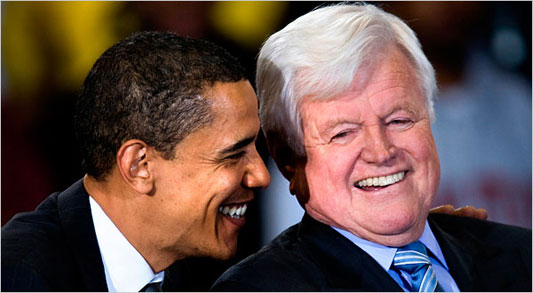
Sen. Edward Kennedy with President Barack Obama.

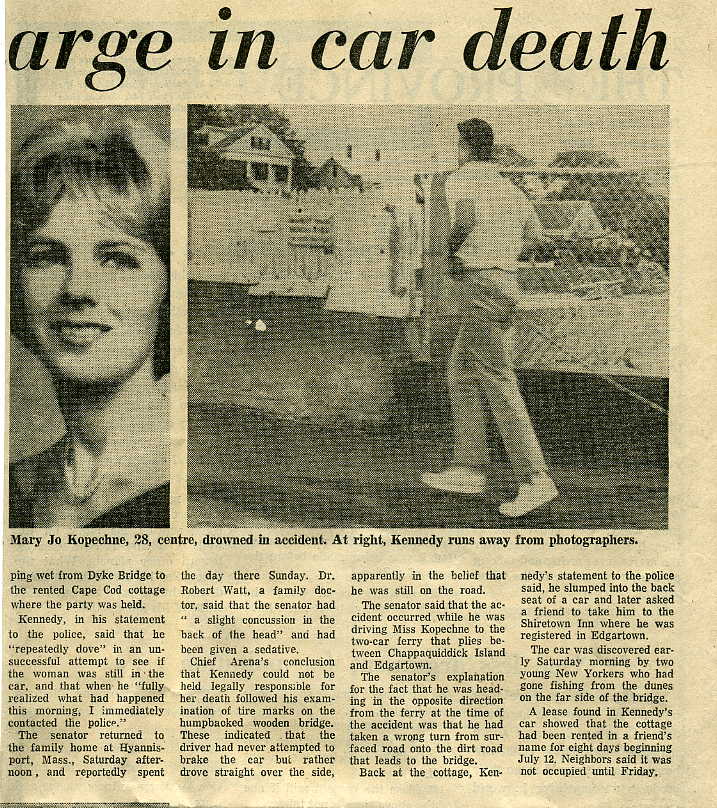
Yet, it is likely that he will be remembered for the 1969 incident at Chappaquiddick, in which Mary Jo Kopechne, 28, drowned in an accident most blame on Kennedy. Witnesses said she did not drink that night or at other times, yet she had a high blood alcohol level. There was a puncture mark on the back of her neck, and it is possible to inject ethanol that way.

Ms. Kopechne was a self described “novena Catholic,” who did not like bad language or sexual impropriety. She was described as an idealist and serious. She was close to being engaged to a foreign service officer. She was one of the “boiler room girls” who had worked in the Robert F. Kennedy presidential campaign. They were all well-educated and professional people of good character, not mere secretaries looking for a good time. Mary Jo was simply attending a reunion of campaign friends.

The public perception of that incident is based largely on the assumption that Kennedy was a very different man. It could be that we do not have the full story of the event that was to be forever linked with his name.

Conservatives assume heavy drinking and sexual involvement without a shred of evidence about either. Kennedy admits to letting nine hours elapse before reporting the accident, which would place the blame for a death on him. However, very little of that story makes a lot of sense.

A writer named Bob Cutler put together a scenario of what could have happened. Here it is in the words of Richard Sprague.

The Group hired several men and at least one woman to be at Chappaquiddick during the weekend of the yacht race and the planned party on the island. They ambushed Ted and Mary Jo after they left the cottage and knocked Ted out with blows to his head and body. They took the unconscious or semi-conscious Kennedy to Martha’s Vineyard and deposited him in his hotel room.

Another group took Mary Jo to the bridge in Ted’s car, force fed her with a knock out potion of alcoholic beverage, placed her in the back seat, and caused the car to accelerate off the side of the bridge into the water. They broke the windows on one side of the car to insure the entry of water; then they watched the car until they were sure Mary Jo would not escape.

Mary Jo actually regained consciousness and pushed her way to the top of the car (which was actually the bottom of the car — it had landed on its roof) and died from asphyxiation. The group with Teddy revived him early in the morning and let him know he had a problem. Possibly they told him that Mary Jo had been kidnapped. They told him his children would be killed if he told anyone what had happened and that he would hear from them.

On Chappaquiddick, the other group made contact with Markham and Gargan, Ted’s cousin and lawyer. They told both men that Mary Jo was at the bottom of the river and that Ted would have to make up a story about it, not revealing the existence of the group. One of the men resembled Ted and his voice sounded something like Ted’s. Markham and Gargan were instructed to go the the Vineyard on the morning ferry, tell Ted where Mary Jo was, and come back to the island to wait for a phone call at a pay station near the ferry on the Chappaquiddick side.

The two men did as they were told and Ted found out what had happened to Mary Jo that morning. The three men returned to the pay phone and received their instructions to concoct a story about the “accident” and to report it to the police. The threat against Ted’s children was repeated at that time.

Ted, Markham and Gargan went right away to police chief Arena’s office on the Vineyard where Ted reported the so-called “accident.” Almost at the same time scuba diver John Farror was pulling Mary Jo out of the water, since two boys who had gone fishing earlier that morning had spotted the car and reported it.

Ted called together a small coterie of friends and advisors including family lawyer Burke Marshall, Robert MacNamara, Ted Sorenson, and others. They met on Squaw Island near the Kennedy compound at Hyannisport for three days. At the end of that time they had manufactured the story which Ted told on TV, and later at the inquest. Bob Cutler calls the story, “the shroud.” Even the most cursory examination of the story shows it was full of holes and an impossible explanation of what happened.

Ted’s claim that he made the wrong turn down the dirt road toward the bridge by mistake is an obvious lie. His claim that he swam the channel back to Martha’s Vineyard is not believable. His description of how he got out of the car under water and then dove down to try to rescue Mary Jo is impossible. Markham and Gargan’s claims that they kept diving after Mary Jo are also unbelievable.

Leaving aside talk of an unidentified “group,” Cutler’s theory still makes a lot more sense than Ted Kennedy’s first statement, which follows:

On July 18, 1969, at approximately 11.15 on Chappaquiddick Island, Martha’s Vineyard, I was driving my car on Main Street on my way to get the ferry back to Edgartown.

I was unfamiliar with the road and turned onto Dyke Road instead of bearing left on Main Street. After proceeding for approximately a half mile on Dyke Road I descended a hill and came upon a narrow bridge. The car went off the side of the bridge.

There was one passenger with me, Miss Kopechne, a former secretary of my brother Robert Kennedy. The car turned over and sank into the water and landed with the roof resting on the bottom. I attempted to open the door and window of the car but have no recollection of how I got out of the car. I came to the surface and then repeatedly dove down to the car in an attempt to see if the passenger was still in the car. I was unsuccessful in the attempt.

I was exhausted and in a state of shock. I recall walking back to where my friends were eating. There was a car parked in front of the cottage and I climbed into the back seat. I then asked for someone to bring me back to Edgartown. I remember walking around for a period of time and then going back to my hotel room. When I fully realized what had happened this morning, I immediately contacted the police.

It took Kennedy and his circle three days to concoct a more complete explanation of what happened. They had to deal with the fact that the young woman died in the back of his car after running out of air. Ted’s pregnant wife Joan was at Martha’s Vineyard, and the girl had been at a party that Kennedy attended.

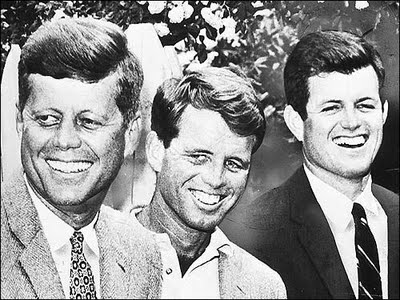
The brothers: from left, Jack, Bobby and Teddy.

It was better to let people make assumptions about alcohol than illicit sex. Oddly, the Kennedys paid to have tests conducted to see if the car would have come off the dock and into the water in the manner Ted said it did. They should have looked into the likelihood of his getting out of a submerged car. They must not have really known what happened. It is doubtful if anything the Kennedy circle said after the official story came out can be believed. Their comments all supported a very implausible story.

He said he got out of the car, which was underwater and then started diving into Poucha Pond to save Mary Jo. Did he open the car door, exit, and then close it? This might happen in the movies, but not in real life. In The Bridge at Chappaquiddick, Jack Olsen argues that the water pressure would have been too great for Kennedy to open the car door. A window was broken, admitting water, but only Harry Hudini could have gotten out through it.

After eight attempts to rescue her, Kennedy went back to the cottage, got help, and returned to the diving.

The wounds above his ear and the large bump on the top of his head indicate he was probably knocked unconscious. But how and where? Police saw the broken windshield and wondered why Kennedy’s head and face did not reflect the level of damage associated with a wreck of that scale. . His face bore no marks.

Markings on the bridge suggest the car was at rest and then somehow greatly accelerated. It had to have been in the air for a distance before landing in the water. There was a rope attached to a stick that could have been attached to the rear-view mirror, which was askew and hanging only by one screw.

The Kennedy story does not match the testimony of Deputy Sheriff Christopher Look and three others, that two women were with Kennedy that night at 12:45 . Of course, the senator was completely familiar with those roads, but there had to be an explanation for where the car was found.

There are some other odd things about the official story. All the witnesses who knew Mary Jo said she did not drink at all and that she did not drink that night. Yet there was alcohol in her blood stream.

It is just assumed Kennedy was smashed, but no witness said this was the case. His chauffeur John Crimmins was present and could have driven Kennedy. If he wanted sex with Mary Jo, he would have stayed at the Lawrence cottage. Why did he not have Crimmins drive and Mary J to the hotel?
.
Senator Kennedy said he swam a complicated route from Chappaquiddick back to the inn on Martha’s Vineyard. Professional swimmers have not been able to duplicate swimming that route at the same time and against the same tides. People assume he swam it dressed, but if it happened at all, he had to be in his shorts. But Kennedy, exhausted from the night’s exertions, claimed he was able to do this. No one saw an all wet Kennedy when he reached the Edgartown inn.

Even at the time, in 1969, many noted that he did not behave at the hotel the next morning as though he knew that Mary Jo was dead or that anything was wrong. It is pretty clear that he did not know until former U.S. Attorney Paul Markham and Joe Gargan arrived and told him about the tragedy. An elderly couple saw Kennedy coming into the dining room. He was relaxed and completely at ease. When the two men spoke to him he seemed to be completely shocked and upset.

The three men then made the trip over to Chappaquiddick to use the pay phone. This makes no sense unless they went there to receive a call, not make one. There were pay phones at the hotel.

Some wonder about the June, 1964 airplane crash in western Massachusetts in which only Edward Kennedy emerged a survivor. He was laid up for some time with serious injuries. Teddy came out of that alive. If anyone wanted to harm Ted Kennedy it was either to prevent him from running for president or, more likely, to prevent him from using the power of that office to examine the deaths of his brothers.

After the airplane crash and the shooting of JFK and RFK, killing Ted Kennedy would not do. Gullible as the public is, too many would think a plot was afoot. Kennedy had to be neutralized by some sort of scandal that would damage any run for the White House.

E. Howard Hunt, later a Watergate burglar, was at Martha’s Vineyard.

One witness has said that James McCord, a CIA agent, and one Albert Peterson followed Kennedy throughout 1969. The witness added that Peterson was an alias for E. Howard Hunt. Frank Sturgis and E. Howard Hunt were on Martha’s Vineyard at the time for a Regatta. Both had CIA connections and would be among the Watergate burglars later. Hunt explained to Watergate investigators that he was there to gather dirt on Kennedy but only admitted to getting there after the accident.

He came to see some unknown person and admitted to having a disguise and a voice alteration device. Charles Colson later obtained the disguise from the CIA and Hunt used them at the burglary of the office of Daniel Ellsberg’s psychiatrist and at the break-in at the Democratic National Committee Headquarters at the Watergate. Hunt’s son St. John said his father spoke with approval of the murders of JFK and RFK and wanted to finish the job on Ted Kennedy. David Morales, a CIA hit man, was photographed at the Ambassador Hotel.

Richard Milhouse Nixon also had an operative there that day, but the president may not have known about it at the time. Nixon had established Operation Sandwedge to keep track of Kennedy and other enemies. Tony Ulasewicz, a skilled investigator in Nixon’s employ, admits being there the morning after the accident. He said he was sent there to dig up dirt on Kennedy. However, he was seen there that morning before news of the accident was public.

In a conversation between John Dean and President Nixon, Dean refers to him without mentioning him by name, saying that he was there again in 1971, both times posing as a reporter and steering other reporters to look into matters that would damage Kennedy. However, it appears he was poking around there for about two years and may have come up with something that showed Kennedy had been set up. Dean said to Nixon, “If Kennedy knew the bear trap he was walking into…”

It sounds as though they could prove the White House had nothing to do with the accident, but perhaps they knew who did. If Nixon had an even more damaging story about Kennedy and Chappaquiddick, he would have used it. Ulasewicz’s salary was financed with money left over from the 1968 convention. He was controlled by John Caulfield, who first answered to John Ehrlichman and then to John Dean.

The Boston office of the FBI investigated the incident on orders from the White House. The agency had earlier put out stories that Ted Kennedy had cheated on an exam and was a poor student.

Finally, there is the remote possibility that Mary Jo’s death had something to do with dealing with two birds with one stone, or event. Mary Jo shared an apartment with Nancy Carole Tyler, a real looker who worked for Bobby Baker, who owned the building and had parties there while the girls occupied it. . She later expressed frustration that Baker did not leave his wife to marry her. Tyler died in a 1965 plane crash.

At one point she refused to talk to investigators about Bobby Baker but then had changed her mind. She knew a great deal about Baker and corrupt deals in the Senate and could have shared information with Mary J. Kopechne worked for Senator George Smathers, who was close to LBJ and Baker. Smathers claimed to be a Kennedy friend, but he put out the story about the Kennedy brothers’ involvement with Marilyn Monroe. She became RFK’s secretary after the assassination of JFK. These two girls knew about JFK’s efforts to dump LBJ and leaked the story. After RFK’s death. Mary Jo allegedly had the job of packing Bobby’s files and then worked for a Kennedy-connected consulting firm.

It is said that Edward Kennedy does not express an interest in getting behind the official accounts of his brothers’ deaths and that he urges friends not to probe these questions. What happened at Chappaquiddick will never be known. He may have learned something then that convinced him it was best to leave these matters alone. Christian Cafarakis, Jackie’s butler in Athens, wrote in 1972 that Aristotle Onassis hired a New York firm to look into the JFK assassination. It gave Jackie the names of the four assassins and told who was behind it. Jackie was dissuaded from turning over the report to LBJ by threats to the lives of members of her family.

There is no way to know what happened that night at Chappaquiddick. We do know that John Dean said to Nixon in 1973, “If Teddy knew the bear trap he was walking into at Chappaquiddick. . . .” Those who have long disliked Senator Edward Kennedy will assume the worst and think that he somehow got out of that car and went back to the inn without another thought about that young woman.

Others may see the courageous, compassionate man he has proven himself to be and give him the benefit of the doubt or even analyze the evidence more closely and conclude that Bob Cutler was not that far wrong.

[Sherman DeBrosse spent seven years writing an analytical chronicle of what the Republicans have been up to since the 1970s. It discusses elements in the Republican coalition, their ideologies, strategies, informational and financial resources, and election shenanigans. Abuses of power by the Reagan and G. W. Bush administration and the Republican Congresses are detailed. The New Republican Coalition : Its Rise and Impact, The Seventies to Present (Publish America) can be acquired by calling 301-695-1707. On line, go to here.]

The Rag Blog

Posted in Rag Bloggers | Tagged , , , , , , | 4 Comments

James Retherford : Who Watches the Watchman? Paranoia and Persecution


Part VI
Who Watches the Watchman?

COINTELPRO and the Federal Government’s
Clandestine Attack on the U.S. Constitution

Paranoia strikes deep / into your life it will creep
it starts when you’re always afraid
step out of line and they’ll come
and take you away… — Buffalo Springfield

By James Retherford / The Rag Blog / August 25, 2009

Quis custodiet ipsos custodes?
Juvenal, Satires, VI, 347

During the 1960s, movement activists discovered a new definition of the clinical term, paranoia. If classic paranoia is an irrational response to irrational fears, then the new paranoia could be defined as an irrational response to rational fears. One of the FBI COINTELPRO’s most effective initiatives was to create and exploit paranoia in order to disrupt the organizing work of the American Left.

The following is a list, both paranoid and rational, of known and suspected COINTELPRO operations that I experienced as an underground newspaper editor in Bloomington, Indiana, and later as a writer and anti-war organizer in New York City. Please note that because of continued secrecy surrounding many federal covert operations I am forced to include events that are unproven but fit the COINTELPRO profile. This illustrates precisely why paranoia proved to be such an effective weapon against dissidents:

1. Sometime in late 1967, small calibre gunshots fired through my front door in Bloomington, Indiana. Later this was revealed to be a “fear” tactic used by the FBI against activists, usually carried out by off-duty local police officers or members of right-wing support groups (such as the Bloomington Ku Klux Klan who months later firebombed an African-American bookstore near the Indiana University campus). (The offices of Space City! in Houston were shot up in similar fashion, with the local police and KKK later implicated.)

2. Publication in a local right-wing newspaper of a rude, crude caricature intended to ridicule my appearance and politics. (Note: one wonders whether FBI field agents perhaps had too much time on their hands — the cartoon made great refrigerator art.) In Los Angeles, a COINTELPRO-produced Black Panther “coloring book” exploited tensions between the Panthers and white cops, on one hand, and Ron Karenga’s black nationalist US, on the other.

When the smoke had cleared, Black Panthers Bunchy Carter and John Huggins had been shot to death on the UCLA campus, and Geronimo Pratt, targeted by a COINTELPRO operation to “neutralize Pratt as an effective BPP functionary,” spent 27 years in prison falsely imprisoned on a murder charge based solely on the testimony of FBI and Los Angeles Police Department informant Julius Butler. Pratt’s conviction was vacated in 1997 when his defense team discovered Butler’s secret “business relationship” with the police.

3. A probable “snitch jacket”operation in Bloomington, revealed in 1967 when friends told me that someone was spreading rumors that I was an undercover agent. During this period, snitch rumors also were rampant about other local activists, narc rumors about some notable potheads, persistent rumors about impending busts. (One local crazy figured out where the rumors were coming from and started his own counter-counter intelligence rumor campaign: a plot to spike the Bloomington drinking water supply with LSD. The reverse rumor operation peaked when the governor publicly announced plans to call out the National Guard to circle and protect the waters of Lake Lemon, and we — temporarily — had to find a new place to go skinny dipping.)

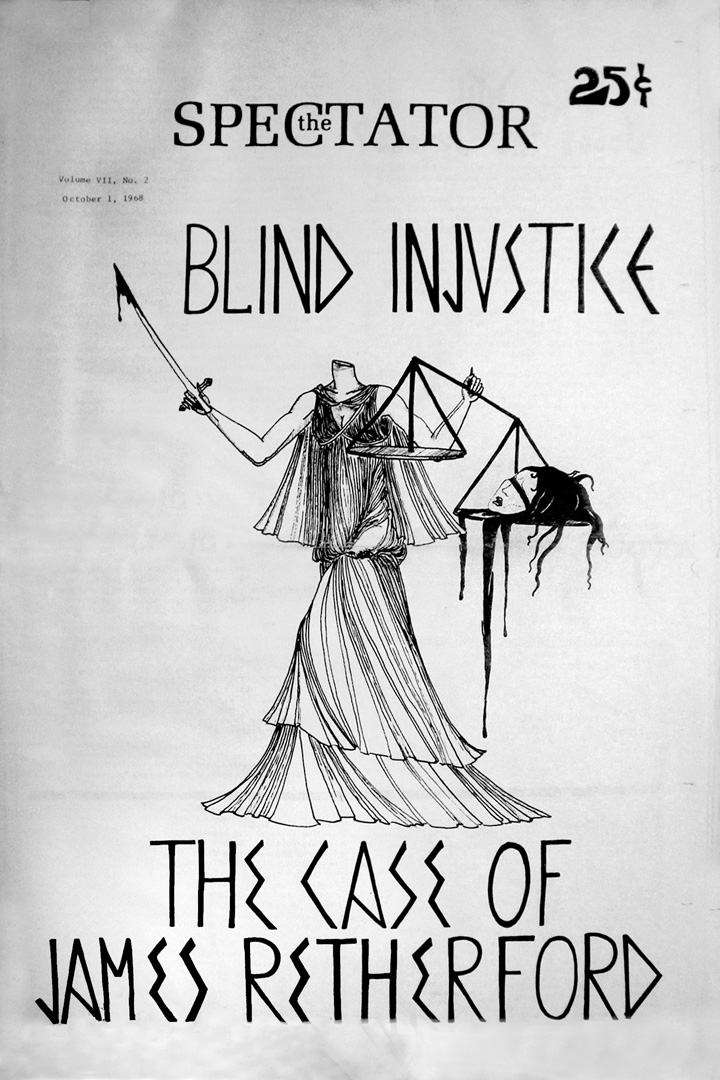
4. A fairly recent discovery, thanks to Texan Geoffrey Rips, that Director Hoover himself approved an attempt by the Indianapolis field office to publish a fake “underground newspaper” — called Armageddon News — in another crude attempt to discredit The Spectator and divide the local New Left leadership. Hoover himself critiqued the first issue, chiding his field officers for failing to use words and phrases that would sound “authentic” to students.

A note to Ragsters: the FBI created a similar faux underground newspaper in Austin during this time. It was called Longhorn Tales (though a more apt name would have been The Bull Sheet.) I have not spoken with anyone in Bloomington or in Austin who remembers seeing either of the FBI’s “journalistic” enterprises. However, I briefly examined Armageddon Times at the Indiana University Archives several years ago and have to say that it was NOT one of COINTELPRO’s most effective endeavors.

5. Use of the sympathetic courts to “railroad” activists into prison: While this tactic was successful in imprisoning African American, Native American, and hispanic leaders for decades, it was also used against white activists such as myself. In December 1967 I learned that I was the subject of two federal grand indictments alleging Selective Service law violations. (In January a third indictment was announced.) The indictments were so specious that one must wonder whether the government’s intention was actually to gain a conviction or merely to overextend the Bloomington movement’s limited resources and put The Spectator out of business. The government’s “case” was pathetic, as evidenced by the fact that Attorney General Ramsey Clark ordered the federal prosecutor to stop the investigation and later to drop all charges. The judge refused, and in June 1968 I went on trial.

I did not go on trial, however, for technical violations of the Selective Service act, though that is what was written on the indictments. Rather I was put on trial for the editorial content of The Spectator. Lengthy excerpts of articles and editorials were recited into the court record to build a case of sedition. I was portrayed as a revolutionary advocating the violent overthrow of the government, a communist subversive, a seditious traitor. Every time my attorney attempted to object on grounds of relevance to the actual charges, he was overruled by the trial judge, who, time and again, ruled that the prosecution’s relentless political attack was relevant to the case. I was found guilty on all counts and sentenced to six years in federal prison.

Next the judge ruled that my appeal had been improperly filed, and I was incarcerated for almost three months while my new attorney, Leonard Boudin (representing the Emergency Civil Liberties Committee), successfully appealed for my right to appeal. A year later, noting that my order to appear for “additional processing” was not only unsigned but also hand written on blank note paper, rather than official Selective Service stationary as required by law, and that I “was never officially declared delinquent by the Selective Service System,” a stipulated prerequisite for draft law prosecution, Federal Circuit Court of Appeals for the Seventh Circuit on October 2, 1969, overturned all convictions with a strongly worded rebuke to the prosecution and the presiding district trial judge.

6. Discovery of a new “snitch jacket” operation in New York City, where I had moved in late 1968 to assist Boudin’s preparation of my appeal. As before, friends told me about a rumor that I was an FBI informer. At the time, such rumors were rampant in the close-knit Lower East Side activist community, and, indeed, the Movement had been hard hit by police infiltrators and agents provocateurs, notably Crazy George Demerle in the Sam Melville bombing case.

7. Proverbial cracks, hisses, and buzzes during telephone conversations.

8. Numerous observations of New York Police Red Squad and the ubiquitous Detective Finnegan taking photographs as activists entered and exited public meetings at Washington Square Church and other popular Movement meeting places.

9. Discovery of an electronic surveillance operation set up in an adjoining apartment on West Sixteenth Street near Eighth Avenue. The FBI and local authorities moved my next-door neighbor to another location and then used his apartment to eavesdrop on my activities. During this time frame, the same thing happened to my friends Stew Albert and Judy Gumbo (see below).

After I met my neighbor in the hallway with suitcases in hand, leaving for what he said was a theatre gig in upstate New York, I became suspicious when I ran into a crew cut white male — 30ish, wearing suit, tie and London Fog trenchcoat, and looking very out-of-his-element in this dilapidated tenement building — leaving the neighbor’s apartment. When he had gone down the stairs, I tapped on the apartment door. When no one answered, I edged my way out on the fire escape landing through my living room window and peeked into the neighbor’s window. Inside the dark room in front of the common wall separating the two apartments, I spotted banks of green-glowing VU meters illuminating slowly moving tape reels.

10. A couple weeks later, I was awakened by a loud banging on my door. I opened it to discover a half-dozen trenchcoat-clad clones, some very large, nasty-looking guys wearing jeans and jackboots, and about a dozen uniformed SWAT police carrying shotguns lining the hallway. Stepping forth, one of the men identified himself as a federal marshal and handed me a subpoena to appear to a federal grand jury hearing.


11. The Guy Goodwin Grand Jury. Following the bombing of a washroom in the Capitol Building in Washington, the FBI faced increased pressure from the White House to catch some radicals. First they seized my friend Leslie Bacon, age 19, from her bed in the Student Mobilization collective house in Washington, D.C., and transported her incommunicado by automobile to Seattle where they put her, represented by counsel arranged by the government, in front of a specially convened grand jury. For two days, Leslie answered seemingly innocuous questions about her personal life and friends. This was the beginning of the infamous Guy Goodwin grand juries; Goodwin used the names revealed by Leslie to issue subpoenas for grand jury proceedings all over the U.S.

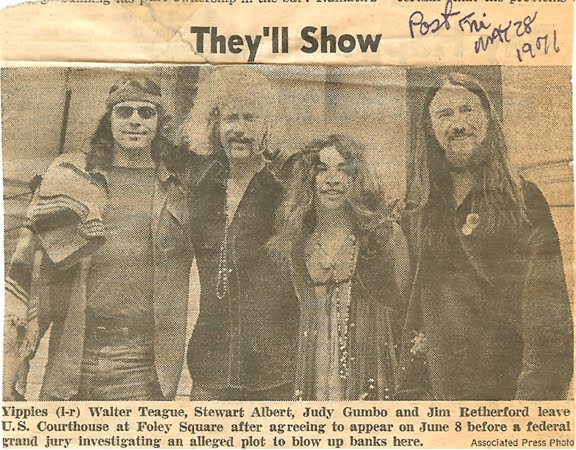
I was one of seven activists commanded to testify in New York. Our response was quite appropriate. Stew Albert, a large man with a big blonde afro, wore a custom-made rainbow-sequined dress with appliqué spelling out the name “Bernardine” (for Bernardine Dohrn, the Weather Underground spokeswoman who had announced the group’s responsibility for the Capitol bombing and a number of other equally provocative “armed” actions). Judy “Gumbo” Clavet and Santa Barbara-Isla Vista activist Sandra Wardwell dressed as witches and carried broomsticks… to assist Goodwin in his witch hunt.

I rented a gorilla costume and showed up at the grand jury chambers as King Cong — remember, Goodwin was looking for, ah, gorilla fighters… Only Walter Teague (who headed a National Liberation Front support group with perhaps the longest set of initials in U.S. movement history) actually got invited into the chamber — he was wearing his “Walter Teague” working class disguise, i.e., plaid flannel work shirt, jeans, and work boots, and thus probably looked less frightening to the geriatrics who typically serve on grand jury panels. Walter was quickly dismissed after he recited the litany of constitutional amendments which our legal team was using to launch a legal challenge to the government’s “witch hunt.”

Goodwin eventually was forced to call off all grand jury probes when it became obvious that the government could not make any cases without producing volumes of evidence obtained from illegal wiretaps, electronic surveillance, and other illicit operations.

12. “Dumpster diving” and trashcan espionage: several weeks after the subpoena was served, my apartment house superintendent stopped me on my way in. With a big grin splashed across his face, he asked me if I knew that the FBI had been pulling up in a big garbage truck and hauling off trash for the entire building.


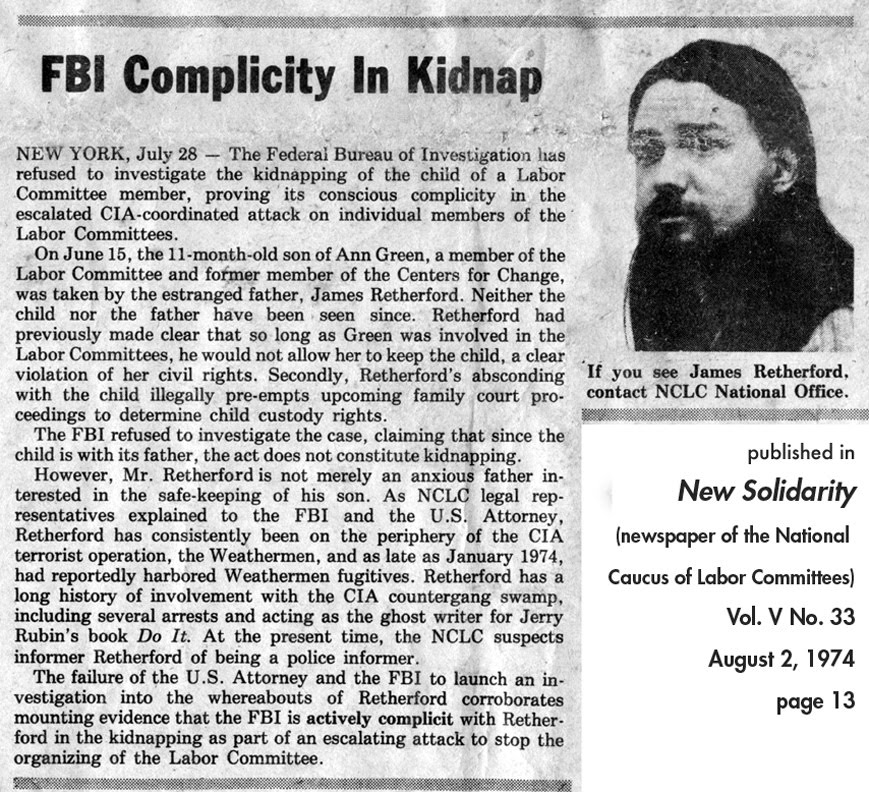
13. In the summer of 1974, Fred Newman’s small New York City Upper West Side psychotherapy cult, newly merged into Lyndon LaRouche’s National Caucus of Labor Committees (NCLC), went to the FBI and Justice Department with the story that I had harbored fugitives such as Jane Alpert, at that time on the FBI most-wanted list as one of Sam Melville’s accomplices. The Newmanites also told the FBI that I was working with the Weather Underground.

At that time, I was “underground” myself, having moved my infant son to safety far away from the Newman cult in whose hands Jesse had been criminally neglected, abused, and almost killed. The group was under investigation for child endangerment. This was the period when NCLC was staging violent attacks on public meetings held by the Communist Party USA and the Socialist Workers Party, when Chairman LaRouche appeared to be mentally unstable and a number of suspected agents (including Zeke Boyd, who had been thrown out of the Baltimore Black Panther chapter as an agent provocateur) had moved into secondary leadership positions and were orchestrating the group’s orgy of thuggery and intimidation. Many New York activists already had concluded that NCLC had, by this time, become a front for the government’s attack on the anti-racism/anti-imperialism movement.

14. As late as 1990 or 1991, in the midst of a very mellow buzz, my telephone range, and the disturbing voice of a man who said something like, “Hey, Jim. This is [name unintelligible]. I’ve been wondering what you’ve been up to. I haven’t seen you since I ran into you at the Indianapolis jail in 1968.” The diction was neither African American nor Southern White, which meant he had not been in lock-up with me. My heightened sense of awareness told me that he sounded like an FBI bureaucrat assigned to work an old case file, trying to scare up some action.

[James Retherford knows firsthand what it was like to be targeted by COINTELPRO. A founder and editor of The Spectator in Bloomington, Indiana, in 1966, Retherford is a director of the New Journalism Project, the nonprofit organization that publishes The Rag Blog.]

Please see

Also see James Retherford : Brandon Darby, The Texas 2, and the FBI’s Runaway Informants by James Retherford / The Rag Blog / May 26, 2009

And for more background on the history of informants in Texas, read The Spies of Texas by Thorne Dreyer / The Texas Observer / Nov. 17, 2006.

The Rag Blog

Posted in Rag Bloggers | Tagged , , , , , , , , , , , , , | 3 Comments

Backlash : Whole Foods Rep Takes Serious Dip

Whole Foods Buzz

As the Whole Foods Boycott grows on Facebook, brand perception is dropping

By Jennifer Van Grove / August 25, 2009

As the Whole Foods Boycott on Facebook continues to swell — the group now has over 27,000 members — we’re finding out that CEO John Mackey’s statements in The Wall Street Journal are affecting more than just angry Facebookers, but consumers in general.

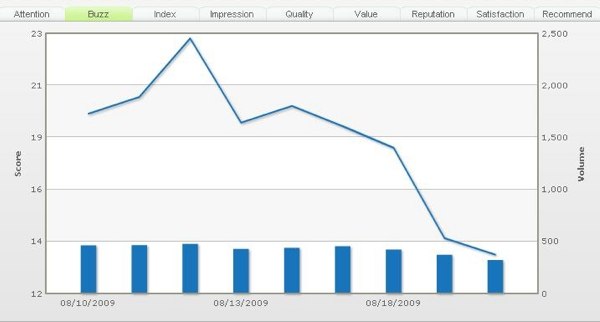
According to YouGov’s BrandIndex, which tracks the daily consumer perception of brands, consumer opinion towards Whole Foods has been falling fast on the Web since the editorial appeared.

YouGov scores brands from 100 to -100, with zero being neutral, based on daily interviews from respondents, and they track the change in the score to show a rise or decline in overall brand perception.

Their buzz chart is a reflection of how buzz perception changes over time. They ask consumers, “If you’ve heard anything about the brand in the last two weeks, was it positive or negative?” Their results indicate that Whole Foods had a buzz score of 22.8 on August 12th, and that score fell to 13.6 by August 20th. That’s almost a 10 point drop in just over a week.

Whole Foods Rep

The reputation chart is scored in the same manner, but asks respondents, “Would you be proud or embarrassed to work for this brand?” According to their research, the reputation score is suffering even more. On August 12th Whole Foods had a 33.3 score, but by the 20th they were down to 20.3.

Can the results be trusted? Well, according to the firm, “YouGov’s BrandIndex interviews 5,000 people each weekday from a representative US population sample, more than 1.2 million interviews per year. Respondents are drawn from an online panel of more than 1MM individuals. Margin of error is a very accurate +/- 2%.”

While we take no sides on the issue, it’s hard not to attribute at least some of the drop in consumer perception to the vocal Facebook group that has emerged in the aftermath of the CEO’s Wall Street Journal op-ed. Should YouGov’s research be as accurate as it claims to be, then Whole Foods definitely needs to be concerned about this social media backlash that’s negatively impacting consumer opinion.

Source / Mashable

For previous Rag Blog articles on Whole Foods and founder John Mackey, go here.

Thanks to David P. Hamilton / The Rag Blog

Posted in RagBlog | Tagged , , , | 6 Comments

Pirate Radio and the FCC : Blue Meanies in Austin

Blue Meanie (with antennas at alert) / Yellow Submarine.

TAB conference in Austin:
Keeping it legal

By Jim Radio / The Rag Blog / August 25, 2009

AUSTIN — The Texas Associaton of Broadcasting (TAB) annual conference was held here in Austin last week. A local radio activist group infiltrated the industry conference and filed this dispatch.

During the Q&A following his “Keeping it Legal, Avoiding FCC Fines,” presentation to about thirty Texas radio industry members, Mr. Stephen Lee, an FCC Resident Agent, based in Houston, was immediately asked a number of questions about “unlicensed radio operations,” AKA radio pirates.

“We actually chased a guy house to house here in Austin!” (I suspect the diminutive Mr. Lee would not be much of a challenge in a foot race…)

He was referring not to a literal foot chase, but repeated visits to followers of Austin’s infamous Alex Jones. Jones’ numerous inflammatory, conspiracy-inflaming programs are distributed on the commercially-supported Republic Broadcasting Network online and are broadcast on both licensed and increasingly, unlicensed, stations across the country.

According to those who routinely monitor the Austin airwaves, there are currently at least two such RBN stations operating somewhere in the city. Thus you now have the phenomenon of “commercial pirates,” touting gold futures, water filters, dried fruits, and of course, Jones’ numerous videos.

“Even after visiting one house,” said Lee, “we have to check tax records, etc. to check ownership before visiting another house.”


After a few more questions on the pirate issue, one of the undercover reconn team members, smartly dressed in a suit and tie, with a perfect copy of the conference registration badge draped around his neck, weighed in.

“I was in California recently and visited both Free Radio Santa Cruz which has been broadcasting for years without a license, overtly, publicly, they even run the local city council meetings! (Big laugh from audience. Lee squirmed.) And the Pirate Cat Radio/Cafe in SF which is operating with impunity from their own popular coffee shop. With the ready availability for anyone to purchase an FM transmitter over the internet (armstrongradio.com; freeradio.org) and the ability to deliver a signal via the internet to virtually anywhere, how is the Commission going to address this issue? I mean, it seems like there’s a real movement afoot to forgo all the regulatory hassles and just go straight on the air.”

Stammering a little, Lee responded, “Well, um, that’s a little above my pay grade. The Commission has to deal with the ‘problem de jour,’ and there has not been the same push for [busting] pirates as there has been, say, for cell phone jammers, which is a big issue. I really can’t advise you all policy-wise.” (methodshop.com; phonejammer.com.)

About that time, cell phone service in the room mysteriously went out…

[Jim Radio is a community media activist in Austin.]

The Rag Blog

Posted in RagBlog | Tagged , , , , , | 5 Comments

Austin Buses : Fare Hike Means More Traffic, Pollution

Waiting for a bus on the Rio Grande campus of Austin Community College. Photo by Alberto Martinez / Austin American-Statesman.

Transit officials in Austin refuse to even acknowledge the relationship between fare hikes and ridership loss. Their estimates for the first increase were off by a factor of ten.

By Glenn Gaven / The Rag Blog / August 25, 2009

The average Austin household contributes $450 per year to Capital Metro. Most people don’t ride the bus. So what is it that non-riders are paying for?

The few altruistic Socialists believe that low income residents deserve mobility, but the rest of us are paying for two things: less traffic congestion and the cleaner air that should result from less cars on the road. A great value in an ideal situation. Unfortunately, our transit authority fails to deliver. When they raised fares at the beginning of 2009, it resulted in over 1,000,000 fewer trips in the first six months.

By and large, non-choice riders use monthly passes and did not reduce their trips. Choice riders, those who have a car option, make up the vast majority of lost trips. So by raising fares, Metro added up to a million more car trips to our roads. Not exactly what we paid for. What we did pay for is management waste, and accelerated development. You can find mountains of evidence of this in the local daily.

Now Metro officials want to raise the fares again. The average increase would amount to over 100% in a one year period. Fear not, there is no threat to raise the $450 that non-riders pay, but imagine if there were. $900 a year to increase pollution and traffic congestion? This might finally get the attention of the seemingly oblivious CMTA Board of Directors. Even CAMPO chair, Kirk Watson might be moved by a 100% increase in his personal outlay.

Transit officials in Austin refuse to even acknowledge the relationship between fare hikes and ridership loss. Their estimates for the first increase were off by a factor of ten. Even if they proffer an estimate for the second hike, it will take a ton of sugar to swallow. The industry “fare-elasticity” model expects a 3-4% ridership drop for every 10% increase.

As environmentalists, we cannot stand for another devastating fare hike. Austin is approaching official EPA non-attainment status. Mass transit is a proven, effective means of reducing pollution. As the system is already in place, it is also far and away the most immediate and efficient means.

Not only should we stop the fare hike, we should demand that the transit system we bought be used effectively and begin exploring ways to maximize ridership like the fare-free proposal put forth last year by the Bus Riders Union-ATX. Then we would all pay the same price. And get our $450 worth.

CLICK ON IMAGE TO ENLARGE

Also see Austin Metro Policies Are Creating Fewer Riders and More Pollution by Glenn Gaven / The Rag Blog / May 7, 2009.

The Rag Blog

Posted in RagBlog | Tagged , , , , , | 2 Comments

God Thinks You’re a Loser

CLICK ON IMAGE TO ENLARGE

“God Thinks You’re a Loser”

The Rag Blog and South Austin Pictures present a screening of
God Thinks You’re a Loser,”
a perverse comedy from Austin director Gary Chason
at The Independent at 501 Studios
in the 501 Studio Complex,
501 E. 5th at I-35 in Austin, Texas (entrance on Brushy Street, one block east of I-35).

8 p.m., Thursday, August 27, 2009

A donation of $10 is suggested, with proceeds benefiting The Rag Blog, a progressive internet news magazine based in Austin.
There will be a cash bar.

According to Chason, “God Thinks You’re a Loser” is “a zany comedy about strippers and oil men” with “plenty of kinky sex, drugs, and the reckless pursuit of sensual pleasure.” But in the end, those who hurt others must answer for their actions.

Much of the film takes place in Hell.

A live discussion with director Gary Chason and star Sue Rock
will follow the screening.

The Rag Blog

Posted in Rag Bloggers | Tagged , , , | 1 Comment

The Wingnuts : Paranoia and Rage Serve the GOP Well


Paranoia, rage and right wing populism

From the time of Plato, thinkers have noted that building fear and anger directed at the ‘Other’ is a potent political tool.

By Sherman DeBrosse / The Rag Blog / August 25, 2009

Lately, we have seen extreme manifestations of anger and rage in our politics. On C-Span we have watched numerous town meetings at which raging rightists have shouted down Congressmen and Senators. The noisy ones rarely had coherent comments. They came to disrupt and were fueled by their hatred of progressives.

When President Barack Obama appeared in Arizona, people showed up wearing guns. One man showed newsmen his semiautomatic rifle. Others had guns strapped on their hips. In Portsmouth, New Hampshire, a man named Kostric showed up with a gun at President Obama’s August 11 meeting and recited Thomas Jefferson’s words about occasionally sprinkling the tree of liberty with the blood of tyrants. This man did not understand that most Americans believe that violence may have been sanctioned before we became a republic, but that violence thereafter is an attack on the republic and people of the United States.

Lately people have been appearing at meetings with posters of Obama as Hitler. Some of these posters came from the followers of Lyndon LaRouche. One can only wonder who gave the cash-strapped LaRouche movement cash for the vile signs. The inclusion of the LaRouchists in the conservative anti-Obama coalition underscores a decision to draw more upon the growing far-right fringe groups.

Any sane person should realize these Brown Shirt tactics can inflict massive damage on democracy. Shouting down speakers and bringing guns to meetings are means of intimidation and pose threats of violence. These tactics are meant to short-circuit the democratic process. Yet David Broder, the dean of pundits, simply cautioned that the right was playing with fire and that the tactic could backfire.

He noted that a Texas Congressman who incited a mob against LBJ in 1964 was turned out of office. It is doubtful that a backfire will occur this time. Cokie and Steve Roberts, positioned ever so slightly right of center, thought the tactics normal and said the Democrats make a mistake in complaining. Maybe the Roberts were trying to say that Americans have come to tolerate almost any kind of destructive behavior from the Right.

Recalling conservatives who once defended our American institutions

Can you imagine what Edmund Burke or John Adams or Alexander Hamilton would say about the riotous behavior of “conservatives” at political meetings?

Decades ago, conservatives were people who took very seriously the task of defending our institutions. They deplored mob tactics as irrational and destructive. Today, conservative organizations send out instructions on how to disrupt a political meeting and how to divert the police so they cannot protect besieged speakers. Other people bearing that label defend the incendiaries or find clever ways to avoid criticizing them.

Traditional conservatives are very rare these days, and those now bearing the term are interested in defending incendiaries and not protecting our hallowed institutions. Today the word “conservative” applies to people who are willing to wreck our political institutions to defend insurance and pharmaceutical companies and to impose their narrow, warped values on the rest of us.

Right-wing populism

How did all this come about? From the time of Plato, thinkers have noted that building fear and anger directed at the “Other” is a potent political tool. These two emotions fuel what is called right-wing populism, which centers around the belief that an alleged cultural elite is plotting against the cultural values of good, God-fearing ordinary folks. McCarthyism and, before that, Father Coughlin’s movement were of this stripe. It has proven to be a very popular political tool. Social scientists long thought that these ugly outbreaks were short lived, as people soon came to their senses.

Since the 1970s, rightist strategists in “conservative” think tanks have figured out how to keep right-wing populism up and running for decades on end. The goal is to protect entrenched corporate power, but right-wing populists rarely see this. The exceptions would be the few people picketing town hall meetings with signs defending insurance company profits. A massive information network, limitless money, a mastery of cognitive psychology, and the use of conservative churches for political purposes were all deployed to create the Republican’s right-wing populist base.

Usually, the fear/anger approach does not result in ugly actions but it does motivate people to turn out and vote. Some think the New Right is all about religion and family values, but both values and religion are essentially tools that are secondary to right-wing populism. The religious issues are necessary to distinguish the populists from the so-called elitists. Time and again, the Christian conservatives have shown that they are not overly concerned about misbehavior by leaders like Henry Hyde, David Vitters, or any number of others. Also crucial are advances in cognitive science which permit conservative propagandists to literally create new memories for people, thus rewiring their very mental processes and shaping their political thought.

The authoritarian impulse

Some theorists think right wing populism can morph into something different and worse which is characterized by an openness to authoritarianism, a willingness to do anything to political enemies, and a great deal of paranoia and rage. It is not a certainty, at least to this writer, that there is a natural evolution from right-wing populism to an extremist mindset that is a mental illness by most standards.

We know that prejudice, rigid cognitive functioning, a preference for conventional wisdom, an interest in punishing folks who violate the dictates of conventional wisdom, and an inclination to scapegoat others are characteristics of people who are more likely than others to accept authoritarianism and to acquire authoritarian personalities. Etiologist Konrad Lorenz thought that some people have more aggressive instincts than others and that this lends them to authoritarianism.

We have all seen that fear becomes paranoia, and anger becomes rage. Somehow when rage and paranoia merge they become more powerful and an inclination toward authoritarianism emerges as what appears to be an authoritarian person. For whatever reason, rage and paranoia generate great energy and have a way of spreading and attracting converts. They are most powerful in the body politics in bad economic times.

Samuel Goldhagen has used the term “eliminationism.” Maybe that is not the best term as it would seem to only characterize the extreme stage of this pathological form of political extremism. Yet, it is clear that those who are disrupting town meetings are bent on excluding opponents from meaningful participation in the political process. Granted, for the moment, they are not inclined to use actual force. On the other hand, they present many of the characteristics of authoritarians.

Fear/anger become paranoia/rage and people approach eliminationism. Language and actions come closer to violence; at its extreme, eliminationism results in one people wanting to wipe out as many enemies as possible. Sometimes this happened in the West when settlers massacred Native Americans or in the East, earlier, when the Pequots almost disappeared. In Germany, Hitler preached eliminationism against the Jews. Of course, these are extreme cases and hardly possible now.

Examples of people who fall into the second category are white supremacists, survivalists and militia people, gun nuts who fear the government will invade their homes tomorrow, members of the different secessionist and anti-income tax movements, and Christian Identity people, who think Christ only saved whites. Some far-right Christians are even saying Obama is the Antichrist because of some strange and wrong interpretations of the sounds of two Hebrew words. Membership in such extremist groups grew in the Clinton years, and we now see thousands flocking to the militias because we have a black president. Ammo and weapons are literally flying off store shelves.

Right-wing populists and the extremists to the right of them sometimes work together. We saw this when many circulated films accusing the Clintons of bringing about the death of Vincent Foster. The Swift Boater attack on John Kerry was another example. In this case, careful observers would have learned that the media treats the extremists with respect and spreads their lies. Moreover, the general public does not punish those allied with the extremists. Indeed, the extremists briefly make many converts to whatever massive lie they are spreading.

We have no way of knowing what runs through the minds of right-wing strategists. They must have noticed that they can ignite the Republican base and temporarily enlarge it when they use language and ideas borrowed from the far right extremists some might call “eliminationists.” When Governor Sarah Palin used these techniques her political meetings resembled Klan rallies. These sorts of appeal were second nature for Governor Palin who had attended Alaska Independence Party rallies. Her husband had been a member of this extremist-leaning party.

A few Republicans criticized her because she seemed to do nothing to overcome her broad ignorance, but the critics did not mention the appeals to extremism. There is no evidence that any voters changed their votes because of the demonstration of rage evinced at her meetings. Earlier this year, the anti-tax, anti-Obama “tea parties” were sponsored by FOX News, Glenn Beck, and other shockjocks,. They had the aspect of Survivalist/Patriot rallies. Some, including one governor, spoke favorably of secession rather than living with a liberal regime. There was strange talk about the income tax being illegal. The tactic of appealing to the extremists on the right fringe ignited the GOP base and seems to have had no down side.

Why are appeals to paranoia and rage successful now?

Liberals and leftists have been known to accept strange conspiracy theories and authoritarian notions, but, as the late Richard Hofstadter noted, this sort of conduct is far more common on the right. Perhaps it is, as Wilhelm Reich speculated, that people raised in authoritarian, patriarchal homes were most likely to be seduced by authoritarian political ideology. This kind of upbringing is most common in the South and other red areas. Of course, many living in urban areas have grown up in similar situations, where traditional values were also reinforced by conservative religion.

So many working class people are caught in the situation of suffering as a result of our economic system but still being reactionary in their basic cultural and political outlook. They fear change, even change that will help them. They talk about freedom and often see the gun as the symbol of their freedom. Yet, they are afraid to exercise freedom by casting votes that could result in systemic change. So they react against big government, when it is in the hands of progressives, by joining militias and/or essentially serving as foot soldiers in the political arena in upholding an economic system that places them at a great disadvantage. Reich claimed they do so in part because their wretched economic position makes them fear progress. They will not take chances, even on a better life.

He believed they suppress their rebellious instincts because they are products of authoritarian households. They have to deal with their desire to rebel with subservience and this preconditions them to accept an extreme right wing ideology. For some, it is simply continued acceptance of what is. In either case, there is an unconscious inhibition against rebellion and meaningful change. These people feel so much more comfortable upholding the economic status quo and the extreme version of the values learned in their authoritarian homes.

In times of liberal dominance since World War II, it seems that more people have been prone to violence and violent language. The language has been fierce and can be categorized as exclusionist in that these people have been willing to separate others, whom they detested, from the American body politic. Right-wing Minutemen and militias were prominent in the Kennedy years. Kennedy was a liberal and many did not realize that he was only a nominal Catholic.

Some believed the Soviets were about to take over. Another militia group, the Posse Comitatus emerged in the Carter years. In the Clinton years, there was the Oklahoma City bombing, which probably involved the Christian Identity movement and there were six anti-abortion murders. The rhetoric level was white hot sometimes. Now, with Barack Obama in the White House, there seems to be more extremism on the Right than before. The problem is exacerbated by the deep economic recession and the aftermath of 9/11.

The horrific events of 9/11 created a volcano of fear and anger that was soon exploited by adroit right-wing politicians. It created positive energy to the degree that we moved to protect our beloved homeland. But there was a great deal of destructive energy that did not dissipate. Politicians milked it for their own gains, claiming that their opponents were somehow in league with terrorists. This was done effectively in 2002 and 2004.

Who in his right mind, under normal circumstances, could believe that Max Cleland, who lost limbs in service of his country, was a traitor. The fallout of 9/11 made it possible to convince the people of Georgia that this was true and to turn Senator Cleland out of office. The power of rage was effectively demonstrated by the Swiftboaters in 2004. Someone must have also noted that the mainstream media acted as a megaphone for these wild and irresponsible charges.

We still have not cornered Osama bin Laden, an event that might help diminish some of the festering fear/rage. It seems that building hostility has gotten to the depths of many people’s personalities, polluting their inner lives, and warping their political judgments. Sigmund Freud taught that this hostility has to go somewhere and that displacement is likely to occur. So people find substitutes against whom to vent their rage. That explains who the people of Georgia and South Dakota were influenced by videos showing these men with Osama bin Laden. But the displacement can move to other areas, away from terrorism.

Playing the wingnut card, but not too often

Rick Perlstein has noted that the Republicans have, at each outbreak of rightist extremism, “adroitly hive{ed] off the embarrassing fringe while laying claim to some of the grassroots anger that inspired it.” But at each outbreak, they have borrowed some extremist language. Ann Coulter and Rush Limbaugh have done this and have even imported some notions that are popular on the far right.

Republican leaders, fighting Obama and health care reform, fanned paranoia and rage with absurd claims, and soon Obama’s support levels began to fall. Senator John Cornyn says that Obama’s health care plan is a scheme to construct an enemies list. At one time, 47% of Republicans believed Obama was born outside the country. Now that figure is down to 29%. Most Southern Republicans still believe this. Other Republicans, with a few remarkable exceptions, think it is fine to bring guns to meetings addressed by Obama. Then Sarah Palin claimed the plan included “death panels” that would euthanize old people. Only two Republicans, one with personal reasons to oppose the governor, criticized these comments. Even columnist Kathleen Parker, no Palin backer, wrote a fascinating column full of double talk explaining how one could imagine “death panels” in the House bill. A popular sign is “Obama Lies; Grandma Dies.”

Another extreme tactic is to claim that health care reform carries a mandate to pay for all abortions. Within Catholic circles, the far right anti-abortionists who have consistently worked for the Republicans and misstated facts have attacked church organizations that support reform, claiming they are automatically backing abortion. So far, the reform has been neutral as far as abortion is concerned. There has even been a wild attack upon the character of Sister Carol Keehan, head of the Catholic Health Association. It was claimed she backed reform in hopes of personal monetary profits.

The resort to extremism is proving useful in the fight against health care reform, and we can expect more of this when Congress reconvenes in the fall.

If the Republicans are unable to attract more support among the young and Hispanics, it is likely that they will make more frequent appeals to people of an authoritarian cast of mind who are most susceptible to demagogic appeals. The tactic has produced considerable success in the battle against health care reform, and it, to some degree, revived John McCain’s flagging presidential campaign.

There is a danger to using it too often as the GOP will rule again some day and reliance on such tactics would greatly diminish the cachet of American democracy abroad. Moreover, the appearance of a functioning healthy democracy is essential for corporate and conservative forces who exercise hegemony by dominating the mainstream media and establishing the content of givenness and conventional wisdom.

It is not in the interest of corporate America and its allies to deploy jackboot tactics on a regular basis, and it is possible that the mob actions and wild and irresponsible appeals could get out of hand and produce serious violence. Even the current tactic of likening Obama to a potential Hitler could set off some unhinged rightist to emulate Lee Harvey Oswald or Richard McVeigh.

[There is a great deal more on these topics in Sherm’s The New Republican Coalition : Its Rise and Impact, The Seventies to Present (Publish America). It can be acquired by calling 301-695-1707. On line, go here.]

The Rag Blog

Posted in Rag Bloggers | Tagged , , , | 1 Comment

The American Doctor : From ‘Practitioner’ to ‘Provider’

Doctor’s Office by Lee Dubin.

Graphic from ‘South Park’ / Comedy Central.

The practice of medicine has ceased to be a profession, it has become a business with the doctor being a ‘provider’ for the insurance company.

By Dr. Stephen R. Keister / The Rag Blog / August 24, 2009

One cannot recapture the past; however, a few musings about what medical care used to be, when it was a proud profession, as opposed to the model of medical care as a business in our present culture where it is dictated by the insurance cartels, rather than by a cooperative effort between physician and patient.

I opened my practice in Erie, Pennsylvania, in the summer of 1950, with the specialty of internal medicine and a new specialty, then unrecognized by the medical specialty boards, of rheumatology. I was encouraged in the latter by one of the outstanding physicians in the history of American medicine, Dr. Maxwell Lockie, a rheumatologist in Buffalo.

I shared a rather decrepit office with an excellent family practitioner, and we shared a single employee, a lady who acted as receptionist and did a bit of paperwork. Ultimately, I moved to an office building with a group of excellent physicians in various specialties.

At that time the hospital we were affiliated with required that we care for the charity in-patients, which numbered approximately 20, for two months each year. We also were expected to attend a charity clinic in our specialty one morning a week. This hospital-sponsored largesse ended with the advent of insurance sponsored medicine.

As an internist, and our number in Erie grew to something like 15 over the next several years, I followed a fairly fixed routine in patient care. The initial visit was a full hour during which we discussed the patient’s medical problem, asked pertinent questions and did a complete physical examination, sans pelvic examinations, which we felt were better handled by a lady’s gynecologist.

Rheumatology is the treatment of arthritis and there are some 100 varieties of arthritis. But listening to the patient during that first visit, and doing a comprehensive examination, 90 % of the time I was able to make a definitive diagnosis of the type of arthritis, and initiiate treatment. Our findings, conclusions, and treatment were discussed with the individual in detail, hoping to avoid any questions that might remain in their mind after they left the office; however, we always assured the individual that they could telephone us personally for any further advice.

As time went on they were given booklets published by the Arthritis Foundation to further their knowledge of their problem. One thing I always made sure to convey to the patient was the fact that most types of arthritis are not curable; however, we would try and arrest the disorder and provide relief. Relief did not involve the use of narcotics. They were always rescheduled for regular follow up visits.

In most instances a minimum of blood testing was necessary to confirm the diagnosis, if questionable, and to check on any concurrent conditions, and as a means of checking for possible side effects with certain types of therapy. No expensive, exotic testing was needed. No endless X-rays or scans. And, oh yes, sometimes we were paid at the time of the patients visit, at times they paid us later, in full or in part, at times we waived the fee altogether. Somehow, I made a respectable living but never accumulated a great amount of money in my IRA.

We were slaves to the telephone or beeper. (As a matter of fact after 40 years of practice my dislike of the beeper was so intense that on retirement I buried it in the back yard.) I had a colleague who treated childhood diabetes who had a “phone hour” at home each evening between 6-7 when his patients’ parents could call him for advice. I had a dermatologist colleague who, when his patents called him at home, commented that if he had been adverse to taking phone calls he would have been a banker.

During those early years few patients had hospital insurance: however, the genie was already out of the bottle, for frequently after discharge they were told by their carrier, that the company would not pay since they had a “pre-existing condition.” I always referred these to the Pennsylvania Insurance Commission, and universally the payments were forthcoming.

Some 30 years ago the large insurance companies at a weekend retreat conspired to take over the practice of medicine under the guise of establishing HMOs or PPOs with the knowledge that the medical profession, with the AMA standing passively by, would not oppose the takeover — which they did not. The doctors responded like lemmings running over a cliff, and here we are.

The practice of medicine has ceased to be a profession, it has become a business with the doctor being a “provider” for the insurance company. If one is ill, and if anything is required save a routine office visit, the provider must get permission from a bureaucrat employed by the insurance company; thus, the insurance industry rations care and provides profits beyond belief for their executives, stockholders, and the politicians beholden to the industry for their thirty pieces of silver.

As this system was foisted onto the complicit providers and the ill informed, misguided public, the industry required that each HMO had a physician in primary attendance for each patient. He was called the “gate keeper” and was financially rewarded at the end of each year by showing the insurance company what care he had denied, or what tests or procedures he/she had not ordered.

I retired in 1990 after a telling episode that illustrates what the current “providers” face. A medical comment. A person with breathing difficulties should not receive morphine or other narcotics because it may stop the person’s breathing. In any event, in my latter months of practice, a delightful lady, with advanced, neglected, rheumatoid arthritis came under my care. She also had emphysema, having been a heavy smoker and living alone. She had had frequent treatment with cortisone derivatives in the past, and one of the common side effects of corticosteroids is bone softening. In any event, we got her under the then accepted therapy with methotrexate and non-steroidal anti-inflammatory drugs.

Shortly thereafter, the lady called me with intense, unrelenting pain in her upper back. I met her at the ER and she had two spontaneously fractured vertebrae. We admitted her, put her on bed rest, used hot packs and physical therapy, as well as muscle relaxants as well as non-narcotic pain killers. Two days later I was called by her insurance carrier telling me that there was no justification for hospitalizing this lady! Asking why, I was told that the insurance company’s policy was that if the person did not require morphine for pain they did not need to be in the hospital.

I appealed this to the insurance company’s medical director, explaining the emphysema and breathing problems. The insurance company stood firm; it was their policy! I had to discharge a lady in intense pain, and do what we could with home care by the visiting nurses. This was the final straw, I retired some months later.

I am now a patient, having well-treated cancer of the prostate, and spinal stenosis. I am fortunate to have an excellent internist, a first rate neurologist, and a superlative pain specialist. I am on Medicare, a government-managed medical program, and in 18 years I have had no denials nor problems. I do find in talking to friends and acquaintances, that medical care has changed. When a patient enters through a waiting room door, the first thing that the receptionist asks is for is insurance information.

Then, in lieu of a conversation with the doctor, one is given a lengthy questionnaire to fill out. Then time with a “physicians assistant.” Then a brief chat and superficial examination by the doctor. In place of a detailed office visit one is whisked off for CT scans, MRIs (if approved by the insurance carrier, other than Medicare), greatly increasing the overall cost of medical care in this country. If anyone needs to call the doctor for advise they will probable have to talk to his nurse since he is too busy to return the call; hence, her response, “I will talk to the doctor and get back to you.”

I would hope that a universal single payer health program as promulgated by Physicians For A National Health Program and endorsed by the American College of Physicians would be in the cards and return medical care to the province of the physician where it abides in most other industrialized nations. However, the paid lackeys of the insurance industry and drug companies (yes we pay more than twice for prescriptions in the USA than in any other civilized nation) in the Senate and the Blue Dogs in the House will not consider such an enlightened program since it would cut into the excessive profits of their paymasters.

A poor substitute, but much better than the domination of medical care by the for profit insurance companies and their public mouthpieces Rick Scott, Zack Wamp, Glenn Beck, Betsy McCasughey, John Goodman, Rush Limbaugh, John Mackey, and the U.S. Chamber of Commerce, would be the “government option.”

Yet this would require true leadership from President Obama, as once was shown by President Franklin D. Roosevelt; however, sadly, Obama now appears to be emulating Neville Chamberlain at Munich in 1937 when he was negotiating “Peace in Our Time.” Why does the president keep harping on “bipartisanship” when to any logical person it is a long lost cause. (Yesterday I removed my Obama bumper sticker).

The times have changed and the younger physicians have been reared and are practicing in our culture of materialism and greed. Unless somewhere deep inside them resides the Hippocratic Oath, I fear that we will never return to a climate of old time medicine, such as they have in France, where family doctors still make house calls, and where no one entering a doctors office or emergency room need produce all those insurance cards before being seen and and are not required to endure endless waits. I understand, that at St. Paul’s free Clinic, where I once volunteered part time, there is hare to get doctors to put in a couple hours taking care of the poor and disadvantaged.

And, oh yes, I personally have encountered the “socialized medicine” in The UK, and have close friends and relatives, who have experience with the government subsidized health care in France, Norway and Italy, and in all instances it is caring and prompt. Of course, now and then I am sure there may be a hitch, but do not believe the nay-sayers who are trying to play on our worst instincts, and produce fear and mistrust.

Those thinking people, who believe in the individual’s right to decent medical care as a moral and ethical issue must make themselves heard. Time grows short, the forces that are opposing decent care in this nation are spending $14 million a day to deceive and confuse the public with fraudulent television ads, scripted demonstrations at town meetings held by Democratic representatives (Blue Dogs excepted), with gun-toting hoodlums outside.

[Dr. Stephen R. Keister lives in Erie, PA. He is a retired physician who is active in health care reform.]

The Rag Blog

Posted in Rag Bloggers | Tagged , , , | 2 Comments

Mexico Frees Convicted Killers of Chiapas Indians

Relatives of those killed in the 1997 Acteal massacre carry photos and pray in San Cristobal, Chiapas, Mexico, Tuesday, August 11, 2009. Photo by Moyses Zuniga / AP.

Supreme Inpunity:
Mexico’s high court frees convicted killers of 49 Indians in Chiapas

By John Ross / The Rag Blog / August 24, 2009

MEXICO CITY — With immense sorrow etched into his weather-beaten face, the Tzotzil Indian farmer slowly mounted the imposing granite steps of Mexico’s Supreme Court.

Sebastian Perez Vazquez’s job was a thankless one. As president of the civil group “Las Abejas” (“The Bees”), he was obligated to communicate the bad news to the villagers who had trekked up to the capital from their homes in the highlands of Chiapas (“Los Altos“) that, after 12 years, the killers who had been convicted of murdering their mothers and fathers and grandparents and children at Acteal on December 22nd 1997 would now be freed from prison on the instructions of four out of five Supreme Court justices because of procedural errors in their prosecutions.

The Abejas had dressed in their best clothes for the court hearing, the men in their short ornamental “chujs” (serapes) and the women in their finest huipiles (traditional blouses) and long embroidered skirts they wear like a proud emblem of their Tzotzil roots but they had not even been allowed inside the courtroom to bear witness to the verdict of the justices. Heavily armed federal police patrolled the marble hallways of the court building on one corner of Mexico City’s great Zocalo plaza intent on keeping the Indians out in the street.

Elena Perez Perez looked like the air had been sucked out of her. She had expected the exoneration of the killers but still could not staunch the tears that washed her bladed cheekbones. “We cry because we cannot find justice anywhere,” Elena, who was 19 when the accused murdered her father and two eldest siblings, told a U.S. reporter. Maria Vazquez had lost nine family members in the massacre. She too had expected the justices’ decision. “This court releases the killers but it cannot resuscitate the dead.”

Early on the morning of December 22nd, 1997, three dozen armed men gathered on a lonely roadside in Chenalho county in the Altos of Chiapas, Mexico’s southernmost state, and began firing on women and children clustered around a clapboard chapel who were praying for peace on a promontory below. A detachment of 40 Chiapas police officers were stationed at a schoolhouse just meters away but made no effort to stop the killing.

The gunfire continued for the better part of the day, the shooters scouring the hillside for those who had escaped the first assault and finishing them off one by one. When they were done seven hours later, 49 Abejas were dead: 15 children, 21 women, nine men, and four babies who had been cut out of the wombs of their mothers and dashed against the rocks. The killers were determined to exterminate the “seed” of the Abejas.

The outside world learned of the massacre at Acteal when survivors straggled into San Cristobal de las Casas, the old colonial city that crowns the highlands, several hours later. A call went out to doctors to come to the Civil Hospital to treat the many wounded. One medic who responded to the call was Hermann Bellinghausen who doubles as correspondent for the left daily La Jornada in Chiapas. Hermann has accompanied the rebellion of the Zapatista Army of National Liberation (EZLN) since it exploded in the mountains and jungle of this deeply indigenous state on January 1st 1994. The Abejas were supporters of the Zapatistas but rejected the insurgents’ use of weapons.

Around 10 p.m. that night, a Red Cross ambulance braved gunfire to reach the village of Acteal enclaved in the saw-toothed mountains about 45 minutes above San Cristobal and discovered state police officers stacking the corpses of the Indians, apparently preparing them for burning. Caught in the act, the cops gathered up the bodies and tossed them in a dump truck where they were driven down to the state capital in Tuxtla Gutierrez for “autopsies.”

The contamination of the crime scene was corroborated by Bellinghausen and two colleagues Jesus Ramirez Cuevas and Juan Balboa the next morning and later that day, Hermann posted his first dispatch. Bellinghausen would go on to write a book, Acteal: A Crime of State that has become a definitive text on understanding the massacre.

The Abejas are a civil association of honey gatherers and coffee growers who had been forced from their home villages in the months previous to the murders — the massacre took place at the height of the coffee harvest — by armed bands affiliated with the long-ruling PRI party and its surrogates in the “Cardenas Front.”

Unlike the Abejas who were devout Catholics, the PRIistas lined up with the evangelical National Presbyterian Church that first established itself in Los Altos back in the 1930s. Since spring, they had been burning the Bees’ homes and stealing their coffee and their cattle. Abeja families from Quextic had been particularly persecuted and the Zapatista community of Acteal offered them sanctuary on the hillside where they would later be murdered.

All of the dead Abejas and those who killed them were Tzotzil Mayan Indians.

Although they supported the EZLN’s struggle, the Abejas‘ allegiances were to the liberation bishop of San Cristobal Samuel Ruiz who had been instrumental in their formation. The Bees were indeed a Sui Genero grouping amongst the Tzotziles of Los Altos. They were resolutely non-violent and eschewed the “posh”, sugar-cane aguardiente that is obligatory in many highland villages. Unlike their neighbors, they defended the right of women to own land in the community.

Bellinghausen’s reportage triggered a chain reaction of indignation around the world. Demonstrators circled Mexican embassies in European cities. Pope John Paul II expressed his grief and U.S. president Bill Clinton lamented the violence. International human rights workers flocked to Chiapas.

As commander-in-chief, Mexican president Ernesto Zedillo ordered U.S.-trained troops into the Chiapas highlands to restore order and separate the paramilitaries responsible for the massacre from the EZLN — the military invaded dozens of Zapatista villages purportedly looking for weapons but, at first, left the paramilitaries alone. Fear of a new massacre panicked villagers and 10,000 Indians abandoned their homes and sought refuge in Polho, a Zapatista refugee camp.

The bodies of the dead were returned to the Abejas on Christmas day for burial. As the funeral procession advanced up the mountain road from Polho to Acteal, the mourners encountered a truck speeding in the opposite direction that was carrying stolen Abeja coffee. The Abejas recognized the men in the truck as their killers — many of them were PRIistas who had run them off their land and at least one was the cousin of a victim. Bishop Ruiz moved swiftly to prevent a lynching and 24 of the presumed assassins were taken into custody. They would not be released until the Supreme Court’s August 12th decree a dozen years later.

Other suspects were rounded up by federal police during raids in Los Chorros, Quextic, and Pechiquil. One old Indian farmer was reportedly handed a list of 100 suspects and forced to sign it. Agustin Luna did not read or write Spanish.

According to Zedillo’s attorney general Jorge Madrazo Cuellar, 124 arrest warrants were issued but apparently only 87 were ever served. Almost all of those who were taken into custody were Tzotziles — 14 mostly mestizo public servants served less than six years for their roles in the massacre. Two high-ranking Mexican Army officers who functioned as commandants in Chiapas public security agencies simply disappeared and more than a decade later remain at large.

The Indians were heavily punished for the killings, dealt 20 to 40 year sentences for premeditated homicide and possession of weapons that only the military was licensed to carry. Two of the 70 Tzotzil defendants were let go because of old age and another died in custody. Several more were re-sentenced and released. Of the 57 Indians who remained in prison only five confessed to participating in the massacre.

There is little question that the prosecution of those rounded up for the killings at Acteal was slipshod. Witnesses were pressured and declarations obtained by force. In the Zedillo government’s rush to judgment, many were swept up who were not in Acteal on the day of the massacre. Translators who are required by law to be available to defendants who do not speak Spanish were not. Weapons were seized that did not match the caliber of the bullets that killed the Bees. The Supreme Court decried the disappearance of evidence and the destruction of the crime scene and the falsification of testimony.

To mark the first anniversary of the killings, Madrazo’s Federal Prosecutor’s Office (PGR) published The White Book of Acteal that blamed the murders on “inter-communal conflicts” and underscored the savage nature of the killings, intimating that the violence had cultural roots.

Although many of the victims had been brutally slashed by machete blows, one autopsy lists gunshot wounds as the cause of death for 43 of the slain villagers and writer Carlos Montemayor, an outspoken defender of indigenous culture, concluded that the bodies of the Abejas were further brutalized by police to emphasize the “primitive” nature of the Indians. Madrazo’s White Book absolved the Zedillo government of all crimes of commission and omission.

Once convictions were obtained and the presumed killers sentenced, Acteal was relegated to the cold case file. Although the PRI quickly washed its hands of the prisoners, the National Presbyterian Church soon came to their defense. The evangelicals’ point man was an influential politico and preacher Hugo Eric Flores who is described as being close to the “theology of prosperity.”

During the 2006 presidential campaign, Flores, the founder and “moral leader” of Encuentro Social (“Social Encounter”), an evangelical political association that had been tied to the PRI, met with right-wing PAN party candidate Felipe Calderon and offered to deliver the evangelical vote (the PAN had none) if Calderon would agree to reopen the cases of those he described as “political prisoners.” According to La Jornada op-ed editor Luis Hernandez Navarro, the deal went down that April.

Months later, after Calderon had been awarded the fraud-marred election, Hugo Eric Flores emerged as the director of the Environmental Secretariat’s PRO-ARBOL (“pro-tree”) program but within a year was fired from the post and barred from working for the agency for the next ten years. No explanation has ever been offered for Flores’ removal but despite the stain on his resume, the evangelical preacher had no difficulty finding “>chamba>” (“work”) and today serves as back-up (“suplente“) for a PANista senator.

Soon after he was fired from his environmental sinecure, Hugo Eric Flores hired on with the prestigious Center for Investigation & Teaching of Economics (CIDE), an entity of the Secretary of Public Education, and published a defense of those convicted for the Acteal massacre, “The Other Acteal,” chapters of which appeared in Nexos magazine, a glossy monthly edited by the prominent PRIista writer and Televisa talking head Hector Aguilar Camin who in 1997 on the tenth anniversary of the killings published his own three part vindication of the incarcerated paramilitaries.

Amongst Aguilar Camin’s revelations: there had been no massacre at Acteal, a hypothesis that rested largely on the testimony of Lorenzo Perez Vazquez who at 17 was the youngest of the convicted killers. According to Perez, the Abejas were caught in a crossfire between the Zapatistas and PRIistas. Lorenzo Perez himself was one of the five paramilitaries who confessed to the murders. Notwithstanding, his name was listed among the first batch of 20 the Supreme Court set free.

Eric Flores used his growing clout to recruit young lawyers from the CIDE’s law clinic and in December 2007, the same month as Aguilar Camin’s vindication appeared, they officially filed an appeal for the release of the 57 imprisoned indigenas, citing discriminatory treatment of Indians by the courts. According to the CIDE’s general secretary Dr Sergio Lopez Ayllon, the legal costs were offset by sizable grants from both the Hewitt Foundation and George Soras’ Open Society Institute.

How many of those released actually have blood on their hands? Miguel Angel De los Santos, a prominent human rights attorney in San Cristobal, thinks that the government case was so “flojo” (lazily assembled) that separating the guilty from the innocent at this late date may be next to impossible — in the Mexican justice system, “fabricando cupables” (literally “manufacturing the guilty”) is an “art form.” De los Santos charges that government prosecutors often leave big holes in unpopular cases to establish grounds for appeal and ultimately absolution of the perpetrators. “The release of the accused paramilitaries,” he writes in La Jornada, “is a confession of the Mexican state’s fracaso in the impartation of justice.”

During a decade and more, imprisoned first at the crumbling old Cerro Hueco fortress above Tuxtla, those convicted of the Acteal murders (the “material assassins” in legal jargon) have been demonized by the Abejas and the Zapatistas and their supporters as cold-blooded killers — the phrase “paramilitary” is an ugly curse in the rebels’ lexicon and those who suggest that some of those railroaded by the Zedillo government’s inept prosecution are not guilty are deemed “politically incorrect.”

On the other hand, government officials who conceived, put in motion, and covered up the Acteal killings — “the intellectual authors” — have evaded justice for a decade.

At the top of the list is ex-president Ernesto Zedillo whose xenophobic jeremiads against non-Mexican human rights workers animated a lethal atmosphere of fear and loathing in Chiapas. As commander-in-chief of Mexico’s Armed Forces, Zedillo signed off on the counterinsurgency initiative that culminated with the massacre at Acteal. The former Mexican president now heads up the Yale University Globalization Studies Institute and sits on the board of major U.S. corporations.

Zedillo’s Secretary of Defense and the commander of Mexican Army forces in the region Mario Renon Castillo collaborated on a “Chiapas Campaign Plan.” a counterinsurgency strategy to develop paramilitary groups in 39 municipalities in which the EZLN had influence. Renon Castillo is a graduate of Center for Special Forces in Fort Bragg, North Carolina, where he was trained in counterinsurgency warfare. According to diplomatic cables unearthed by investigator Kate Doyle at the Washington-based National Security Archives, the Mexican military trained and financed paramilitaries in Chenalho — one corporal was briefly jailed as a trainer.

Chiapas Governor Julio Ruiz Ferro, a Zedillo appointee, had ample prior knowledge of the violence brewing in the highlands and did nothing to head it off — the deaths of 32 Indians in Chenalho in the months before the massacre set the stage for Acteal. Ruiz Ferro was bumped up to agricultural attaché at Mexico’s Washington embassy after he resigned as governor as reward for his inattention.

Interior Secretary Emilio Chuayffet, who supervised national security, was forced to resign for failing to anticipate Acteal but remained active in the PRI hierarchy and may soon become head of the PRI’s majority delegation in the lower house of congress.

Former Attorney General Jorge Madrazo’s flawed prosecution may have jailed innocent Indians for a dozen years — the National Fraternity of Christian Churches now demands that he be incarcerated.

Finally, suggests Raul Vera, auxiliary bishop of San Cristobal during Acteal, by freeing the accused killers, the justices of Mexico’s Supreme Court are now “accomplices” in this lurid plot.

Although the Supreme Court did not rule on the innocence or guilt of the prisoners and only considered the poisoned judicial procedures, 20 of the accused killers were released August 13th from El Amate prison on the western edge of Chiapas and transported to a small hotel outside of Tuxtla Gutierrez where they met with worried state officials behind closed doors for 12 hours. Authorities are fearful that the ex-prisoners will return to Chenalho and seek revenge against the Abejas for their long incarceration.

Indeed, fear permeates Acteal and Polho in the wake of the prisoners’ release — the Abejas have long charged that the paramilitaries still have weapons cached in the region. “I survived the first time but I won’t survive another massacre,” Catalina Perez, who was shot nine times during the attack, told La Jornada.

The freed Indians are also under the gun. If they were not the real killers then they know who the real killers were and local “caciques” (rural bosses) will try to silence them.

Governor Juan Sabines, whose father was also Juan and served as Chiapas governor when dozens of Indians were gunned down by army troops in another massacre at Wolonchan in 1981, vowed that the prisoners’ release would not rupture the fragile calm in the state. The ex-prisoners would be relocated as far from Chenalho as the borders of Chiapas would allow and provided with land and animals and generous pensions. Even though the accused were being closely watched by state officials, by week’s end six had already escaped for parts unknown.

Conspicuously absent from the controversy over the released paramilitaries is the EZLN which has yet to comment on the Supreme Court decision. The Zapatistas‘ key public outpost in the highlands at Oventic has been reportedly closed to outside visitors since the Supreme Court ordered the paramilitaries released from prison.

Since the evangelical Summer Language Institute was installed in Los Altos by President Lazaro Cardenas in the 1930s, the political clout of the “sects” as the Catholic Church labels the Protestants has grown precipitously.

Each Sunday, the Army of God marches in military cadence through San Cristobal. With their red berets, spit-shined army boots, and camouflage cargo pants, the marchers are dead ringers for paramilitaries but Army of God commander-in-chief Esdras Alonso, a fiery highland preacher with connections to the National Presbyterian Church, claims that his followers are armed only with the “Word of God.” According to Bellinghausen, Esdras Alonso’s home base is in San Cristobal’s Hormiga Colony where the killers of the Abejas are said to have acquired their weapons. Reverend Esdras also claims that fallen-away Zapatista comandantes have joined the Army of God.

Alonso’s evangelicals have considerable influence in Mitziton just outside San Cristobal which Governor Sabines has designated as the starting point for a super highway that will connect up the tourist corridor between that old colonial city and the fabled Mayan ruins at Palenque in the lowlands to the east.

Although the actual route remains under wraps, the new highway is expected to invade autonomous Zapatista communities and tensions are running tall in Mitziton where farmers are aligned with the EZLN’s “Other Campaign.” This past July 21st, when ski-masked protestors blocked road-building equipment, the Army of God counterattacked, killing one villager.

Commander-in-chief Esdras responded to unfavorable news coverage of the confrontation by filing a complaint with the local prosecutor against both the Fray Bartolome Human Rights Center, founded by Bishop Ruiz, and Hermann Bellinghausen for allegedly spreading libelous rumors on the Internet. Esdras also demanded that Immigration authorities investigate Bellinghausen’s immigration status — the Jornada reporter is a third generation Mexican.

The Supreme Court’s decision to free those convicted of killing 49 Abejas at Acteal is the latest finding of the high court to grant impunity to those deemed responsible for notorious crimes. In 2006, the court barred citizens from access to ballots cast in the presidential elections, one of the most egregious frauds in Mexican electoral history. In 2007, the justices absolved Puebla governor Mario Marin after evidence implicated him in the kidnapping of independent journalist Lydia Cacho who had blown the whistle on the governor’s pederast associates.

In 2008, the Supreme Court declared Mexico state governor and current PRI presidential front runner Enrique Pena Nieto innocent of ordering state mayhem at San Salvador Atenco where 200 protesters were attacked and arrested, a score of women sexually abused by Pena Nieto’s police, and two young men gunned down by the cops. Later that year, the justices concluded that Oaxaca governor Ulysis Ruiz had used “legitimate” force to suppress protests by the Oaxaca Peoples Popular Assembly or APPO during which 26 civilians lost their lives.

Just a week before the Acteal ruling, the Supreme Court concurred that a Sinaloa woman whose husband had been shot down at an Army checkpoint bad no standing and turned the matter over to a military tribunal that has no civilian oversight. By sustaining the military’s “fuero” or immunity from prosecution by civil authorities, the court assured the army of continued impunity.

Release of those prisoners sentenced for the Acteal massacre because of judicial errors will have far reaching impact on Mexican courts observes Barbara Zamora, lawyer for the prisoners of Atenco and other high profile government targets. Zamora affirms that she has never defended a case that was not contaminated by gross judicial error.

“The Mexican judicial system is rotten to the core. But from now on, whether they are guilty or not, anyone who can afford a powerful lawyer and has been sentenced for homicide, narco, kidnapping, or organized crime will be able to claim judicial impropriety and appeal to the Supreme Court to be set free. This could empty out the jails,” the lawyer adds with a mischievous smile.

[John Ross’s monstrous tome El Monstruo — Dread & Redemption in Mexico City will be published by Nation Books this November. The author is soliciting venues for book presentations this fall and next spring. If you have further information, write johnross@igc.org.]

Source /

The Rag Blog

Posted in Rag Bloggers | Tagged , , , , | 2 Comments

Politics of Fear : A Historical Perspective

Harry Truman delivers his “Truman Doctrine” speech to Congress on March 12, 1947. Photo from Truman Presidential Museum and Library.

The politics of fear:
A basic tool of reaction

By Harry Targ / The Rag Blog / August 23, 2009

“Scare hell out of the American people.” (attributed to Arthur Vandenberg, Senator, Michigan, February, 1947)

“Ridge writes that there was a ‘vigorous, some might say dramatic discussion’ about raising the threat level. The former Republican governor of Pennsylvania (and first secretary for Homeland Security) says his aides told the White House that doing so would politicize national security.” (‘Ridge Felt a Push to Politicize Alert Levels,” Boston Globe, August 21, 2009).

A basic tactic used by American politicians to marshal support for policies and politicians that ordinary citizens, given their common sense and self-interest would never support, is to create a sense of fear.

The “politics of fear” has a long and venal history in American political life. We can point to warnings of the penetration of foreigners into our public life before the civil war, to dangerous Reds in the struggle for the eight-hour day in the 1880s, to the Red scares of the post-World War I and II periods.

The politics of fear has always used class hatred and class envy, racism, sexism, homophobia, and a sense of the “alien” to create enthusiasm for policies that are backward and inhumane.

After World War II, opinion polls indicated that most Americans hoped for a period of peace built upon the continued collaboration of the powerful wartime allies, the United States, the former Soviet Union, and Great Britain. But, as President Truman articulated in a relatively unknown speech to a gathering at Baylor University on March, 6, 1947, the United States was committed to the creation of a global economy based upon private enterprise, foreign investment, and free trade. He alluded to forces in the world that sought to organize economic life around different principles, national autonomous development and state directed economies.

What the Truman administration had been discussing in private was not a public debate on the virtues of free markets versus national planning, but a global crusade against “communist tyranny.” At an apocryphal meeting of key aides and politicians in February, 1947, before Truman’s famous “Truman Doctrine” speech of March 13, the formerly isolationist senator from Michigan, Arthur Vandenberg, reportedly declared that he would support a global policy, presumably to promote free market capitalism, but he advised that the president should “scare hell out of the American people.”

Why? Because the American people still thought peace was possible between the East and the West. In March, Truman warned Congress that the United States was going to be engaged in a long-term struggle against the forces of tyranny in the world, the international communist menace.

In the 1950s, President Eisenhower’s Secretary of State, John Foster Dulles, warned that President Jacob Arbenz, of Guatemala, constituted a threat to the Central American isthmus, and eventually the United States itself. Since Arbenz supported the expropriation of unused land owned by the United Fruit Company, the administration claimed he was moving toward communism.

Candidate John Kennedy framed his campaign for president around the fears of a “missile gap” that had allegedly opened up between the United States and the Soviet Union and the spread of communism to 90 miles off our shores on the island of Cuba.

Ronald Reagan, another presidential candidate, powerfully introduced the idea of a “the window of vulnerability” to popular discourse on the dangers to American freedom if the incumbent candidate Jimmy Carter was reelected and the government did not dramatically increase military spending.

With the end of the Cold War, new enemies needed to be constructed. And, indeed they were. They were more diabolical, less tangible than the Soviet Union and international communism. These included “failed states,” “rogue states,” and “terrorists.”

So, in a new book, not to anyone’s surprise (except for the dense mainstream media), a former Bush official, Thomas Ridge, reports on the latest gimmick in the politics of fear tool kit, color coated signals of threat levels. And in this case, once again the threat levels were designed and used, not only to engender fear and quiescent support for insane war policies but to support candidates who created these policies.

Reflecting on the politics of fear and its long history, we can extrapolate some core ideas about it and how it works. The politics of fear creates demonic enemies such as communists, terrorists, foreigners, or people who are defined as different. The politics of fear requires an implied or stated prediction of doom. If the people do not support what is being advocated, the consequences for human survival would be in jeopardy. Only clear and total support of the policies and politicians promoting it can save us from the apocalypse. Finally, in most instances the politics of fear relates to war and militarism.

The Nixon administration added to the politics of fear the militarization of domestic policies as well. For example, the US needed to commit to a war on cancer or a war on drugs. While military images verbally have not been added to the debate about health care reform today, some opponents have begun to carry guns to places where debates are occurring, suggesting that this debate is indeed a prelude to war.

What are some lessons that this argument raises for progressives to consider? First, we must recognize that the politics of fear undergirds much of our political discourse and it has for a long time. Second, the politics of fear is based on distortions of other peoples’ thoughts and behaviors and other countries’ intentions and what their actions might mean for us. Third, we must be ready to challenge virtually every instance in which the politics of fear is used to coerce and manipulate people. Fourth, we need to articulate more vigorously our own public policy proposals and our own vision of how we can build a society that is based on social and economic justice rather than fear, enemies, and the prospects of doom.

[Harry Tarq a professor in American Studies who lives in West Lafayette, Indiana. He blogs at Diary of a Heartland Radical, where this article also appears.]

The Rag Blog
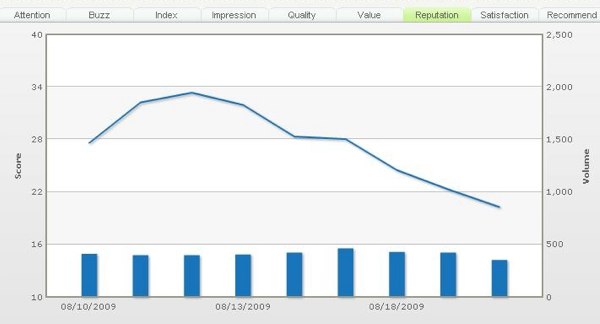
Posted in Rag Bloggers | Tagged , , | Leave a comment

Extraordinary Rendition: Not Yet Obsolete


Lebanese man is target of first rendition under Obama

Contractor Raymond Azar is arrested in Afghanistan, hooded, stripped and flown to the U.S. His alleged crime? Bribery. A human rights activist calls the case ‘bizarre.’

By Bob Drogin / August 22, 2009

ALEXANDRIA, Va. – A Lebanese citizen being held in a detention center here was hooded, stripped naked for photographs and bundled onto an executive jet by FBI agents in Afghanistan in April, making him the first known target of a rendition during the Obama administration.

Unlike terrorism suspects who were secretly snatched by the CIA and harshly interrogated and imprisoned overseas during the George W. Bush administration, Raymond Azar was flown to this Washington suburb for a case involving inflated invoices.

Azar, 45, pleaded guilty Tuesday to conspiracy to commit bribery, the only charge against him. He faces a maximum of five years in prison, but a sentence of 2 1/2 years or less is likely under federal guidelines.

Defense lawyers and prosecutors declined to comment on the case Friday.

But Joanne Mariner, terrorism and counter-terrorism director at Human Rights Watch, called the case “bizarre.”

“He was treated like a high-security terrorist instead of someone accused of a relatively minor white-collar crime,” she said.

Justice Department lawyers have denied any misconduct in the case.

“The FBI followed standard operating procedures when transporting prisoners to the United States,” Gina Talamona, a Justice Department spokeswoman, said Friday. She said restraints “were used with the sole purpose of ensuring the safety of the defendants and the agents.”

As the Obama administration steps up efforts to curb fraud at military facilities in Iraq and Afghanistan, a senior Army official said Azar’s case “should serve as a warning” to other contractors.

In court papers, Azar said he was denied his eyeglasses, not given food for 30 hours and put in a freezing room after his arrest by “more than 10 men wearing flak jackets and carrying military style assault rifles.”

Azar also said he was shackled and forced to wear a blindfold, dark hood and earphones for up to 18 hours on a Gulfstream V jet that flew him from Bagram air base, outside Kabul, to Virginia.

Before the hood was put on, he said, one of his captors waved a photo of Azar’s wife and four children and warned Azar that he would “never see them again” unless he confessed.

“Frightened for his immediate safety . . . and under the belief he would end up in the prison camp at Guantanamo Bay or Abu Ghraib to be tortured,” Azar signed a paper he did not understand, his lawyers told the court.

Prosecutors, however, said that Azar was “treated professionally,” kept in a heated room, offered food and water repeatedly and “provided with comfortable chairs to sit in.”

They said he was photographed naked and subjected to a cavity search to ensure that he did not carry hidden weapons and was fit for travel. Court records confirmed that Azar was shackled at the ankles, waist and wrists and made to wear a blindfold, hood and earphones aboard the plane.

Prosecutors also said that FBI agents read Azar his rights against self-incrimination on three occasions, and that he “voluntarily” waived them.

The FBI agent in charge, Perry J. Goerish, denied in an affidavit that Azar was “told he would never see his family again unless he confessed.”

Arrested along with Azar was Dinorah Cobos, 52, a naturalized American from Honduras. Cobos, who did not make the same claims of abuse, this week pleaded guilty to conspiracy and bribery.

Their case is different from the widely criticized “extraordinary renditions” carried out after the Sept. 11 attacks. In those cases, CIA teams snatched suspected Al Qaeda members and other alleged terrorists overseas and flew them, shackled and hooded, to prisons outside the United States without any arrest warrants or other judicial proceedings.

The FBI arrested Azar and Cobos with warrants signed by a federal magistrate. And the State Department, Talamona said, asked the government of Afghanistan “for its consent in advance to take these two individuals into custody and return them to the United States to stand trial. They consented to our request.”

Azar and Cobos worked for a Lebanese construction company, Sima Salazar Group, which was awarded more than $50 million in Pentagon contracts for reconstruction and supply work in Afghanistan. In December, according to the indictment, the pair offered to pay kickbacks to an Army Corps of Engineers officer in Kabul. In exchange, he agreed to approve $13 million in outstanding bills from Sima Salazar.

Over the next four months, according to the charges, more than $106,000 was wired to the officer’s bank account in Manassas. But the case was an FBI sting, and Azar and Cobos were arrested at Camp Eggers, a U.S. military base in Kabul, after being lured to a meeting April 7.

Sima Salazar Group is also under indictment.

On Wednesday, Cobos’ sister, Gloria Martinez, 61, pleaded guilty in federal court in New Orleans to conspiracy and two counts of bribery in a related case. Prosecutors said Martinez, a senior Army Corps of Engineers official, accepted $425,000 in cash, jewelry and other gifts for herself and Cobos from companies seeking military contracts in Iraq and Afghanistan.

As a candidate last year, President Obama vowed to end “the practice of shipping away prisoners in the dead of night to be tortured in far-off countries.”

After taking office, he ordered the CIA to close its network of “black site” prisons and promised to shutter the detention camp at Guantanamo Bay, Cuba.

The Justice Department has seized and transported foreign drug lords, terrorists and other high-profile fugitives to U.S. courtrooms when normal extradition was not considered possible. The Supreme Court ruled in 1992 that such renditions, as the transfers are known, are permissible.

In 1997, for example, FBI agents in Pakistan captured Mir Aimal Kasi, who was on the FBI’s Ten Most Wanted list, and returned him to Washington to stand trial. Kasi was convicted of murder in the killing of two CIA employees and was executed in Virginia in 2002.

Azar is hardly in the same league, but Talamona pointed out that “we take very seriously criminal fraud against the United States government.”

Source / Los Angeles Times

The Rag Blog

Posted in RagBlog | Tagged , , | 1 Comment

Documenting Human Rights Abuse in Honduras

Photo from AP.

Honduras:
Human rights violations
by military and police

By David Holmes Morris / The Rag Blog / August 23, 2009

See more photos Below.

In the past few days, several organizations have issued reports documenting human rights violations committed by military and police forces in Honduras since the coup d’état that ousted President Manuel Zelaya on June 28.

● After five days of meetings with representatives of a number of organizations and interviews with Hondurans jailed or hospitalized following demonstrations against the coup, a delegation from Amnesty International on August 19 released a summary of its findings.

“Mass arbitrary arrests and ill treatment of protesters are a serious and growing concern in Honduras today,” declared Esther Major, a member of the delegation, at a press conference announcing the report.

“Excessive force by police and military has been routine and hundreds of peaceful demonstrators have been subject to arbitrary detention,” the AI report says. It cited as an example a peaceful march in Tegucigalpa on July 30 in which police, who wore no visible identification, charged at demonstrators without warning, beating them with batons as they fled.

Demonstrators later interviewed by AI reported being struck on the back, the buttocks and the backs of their legs. Several hundred demonstrators were detained and taken to jail, the report continues, with no charges being filed against them and no explanation given for their detention.

One demonstrator, who told AI he had been one of over 200 students involved in the demonstration, said, “The police were throwing stones, they rounded us up, they threw us down on the ground and they beat us — there are people with fractures, with head wounds, they beat us on the buttocks. They stole our cameras, they beat us if we raised our heads, they beat us when they were getting us into the police cars.”

The report says women demonstrators have been subjected to sexual intimidation and assaults as well as beatings. There are accounts of police prodding women with truncheons as they lay on the ground. “Why aren’t you at home having sex with your husband?” one officer reportedly asked a demonstrator.

Also targeted for abuse, AI reports, are human rights observers and news media. Roberto Barra, a Chilean photojournalist, told the AI delegates that on July 30 he had been surrounded suddenly by some 20 officers as he photographed police beating demonstrators. His camera was taken and he himself was beaten. “You journalists are responsible for this situation,” the police shouted, “for the bad image abroad, son of a bitch, you’re a communist just like the rest of them”

AI reports an interview with Alex Matamoros, an observer with a Honduran human rights group, who confronted police officers he had seen beating three young men whose hands were tied behind their backs. When Matamoros explained who he was and showed them his ID card, one policeman said, “Keep this piece of shit. Here there are no human rights.”

Photo by José Cabezas, Agence France Presse.

● Of greater interest to Hondurans was a similar investigation by members of the Inter-American Commission on Human Rights, an autonomous arm of the Organization of American States. Four of the seven members of the Commission were in Honduras from August 17 to 21 interviewing anti-coup activists, journalists, government officials not directly connected with the coup regime and a few citizens claiming abuse by anti-coup demonstrators.

At a press conference on August 21, the group delivered a preliminary report confirming “the existence of a pattern of disproportionate use of force by the government, arbitrary detentions and control of information with the intention of limiting political participation by a sector of the citizenry.” The group confirmed “repression exerted against demonstrators through military blockades and the arbitrary declaring of curfews.”

The Commission said it had verified the shooting deaths of four individuals and the wounding of others, apparently at the hands of government agents. It claimed further that between 3,500 and 4,000 persons had been detained arbitrarily since the June 28 coup and that from July 24 to 27 between 4,000 and 5,000 persons had been trapped between military roadblocks during demonstrations in the department of El Paraíso, near the Nicaraguan border, with no access to food or water.

In contrast, demonstrators have been peaceful, the report says, except for isolated incidents like a march on August 11 at the Universidad Pedagógica, in Tegucigalpa, where a bus and a U.S.-franchised fast-food restaurant were burned and windows were broken at another U.S.-identified fast-food restaurant.

On the other hand, the Commision also reported statements from parents who claimed their children’s rights had been abused by teachers who had been on strike and had been demonstrating against the coup when they should have been in the classrooms.

Martha Lorena Casco, vice-chancellor in the Micheletti government, dismissed the Commision because, she claimed, it was “infiltrated by the left,” mentioning specifically Venezuelan Luz Patricia Mejía, who heads the group

Photo from AP.

● The Misión de Observación Internacional Feminista (International Feminist Observation Mission), consisting of women from Canada, the United States, Mexico, Guatemala, El Salvador and Costa Rica, spent a week in Honduras to show their solidarity with Feministas en Resistencia (Feminists in Resistance) and to document abuse of women by the coup regime.

At a press conference on August 20, Gilda Rivera of the Honduran group Centro de Derechos de Mujeres (Women’s Rights Center) specified that there were 19 documented cases of police and military abuse of women since the coup and that many other cases have not been reported out of fear of retaliation.

The international group says there has been an increase in the killing of women since the coup, with 51 cases reported for July, an increase of 60 percent over previous months.

One woman, Alba Ochoa, was reportedly beaten, jailed and charged with threats against the security of the state after she happened upon police beating demonstrators in Tegucigalpa. “They arrested me because I yelled at them to stop beating a 16-year-old boy,” she told reporters, “they were beating him with an iron pipe. Then they hit me with a baton, they beat me with an iron pipe. They said, ‘You old whore, it’s none of your business.’”

Photo by Eduardo Verdugo / AP.

● The Comité para la Defensa de los Derechos Humanos en Honduras (Committee for the Defense of Human Rights in Honduras) issued a report on August 15 listing the names of the 101 Hondurans who have been shot to death in the country during curfew hours since the June 28 coup with what are known to be, or appear to be, 5.56mm bullets, the caliber used by the armed forces and the police. The victims ranged in age from 14 to 60. Thirty-two of the killings occurred in Tegucigalpa, the capital and largest city, and 53 in San Pedro Sula, the second largest city. The committee holds the de facto government of Roberto Micheletti responsible for the killings.

Photo by Oswaldo Rivas, Reuters

Photo from Reuters.


Photo by Orlando Sierra, Agence France Presse.

Photo from Amnesty International.

The Rag Blog

Posted in Rag Bloggers | Tagged , , , , | 4 Comments