Austin Buses : Fare Hike Means More Traffic, Pollution

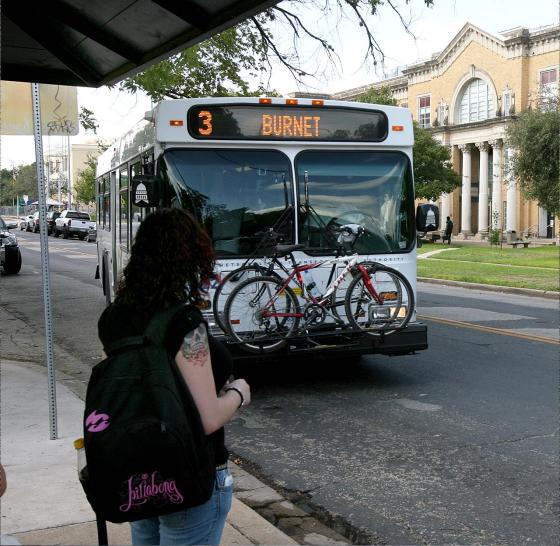
Waiting for a bus on the Rio Grande campus of Austin Community College. Photo by Alberto Martinez / Austin American-Statesman.

Transit officials in Austin refuse to even acknowledge the relationship between fare hikes and ridership loss. Their estimates for the first increase were off by a factor of ten.

By Glenn Gaven / The Rag Blog / August 25, 2009

The average Austin household contributes $450 per year to Capital Metro. Most people don’t ride the bus. So what is it that non-riders are paying for?

The few altruistic Socialists believe that low income residents deserve mobility, but the rest of us are paying for two things: less traffic congestion and the cleaner air that should result from less cars on the road. A great value in an ideal situation. Unfortunately, our transit authority fails to deliver. When they raised fares at the beginning of 2009, it resulted in over 1,000,000 fewer trips in the first six months.

By and large, non-choice riders use monthly passes and did not reduce their trips. Choice riders, those who have a car option, make up the vast majority of lost trips. So by raising fares, Metro added up to a million more car trips to our roads. Not exactly what we paid for. What we did pay for is management waste, and accelerated development. You can find mountains of evidence of this in the local daily.

Now Metro officials want to raise the fares again. The average increase would amount to over 100% in a one year period. Fear not, there is no threat to raise the $450 that non-riders pay, but imagine if there were. $900 a year to increase pollution and traffic congestion? This might finally get the attention of the seemingly oblivious CMTA Board of Directors. Even CAMPO chair, Kirk Watson might be moved by a 100% increase in his personal outlay.

Transit officials in Austin refuse to even acknowledge the relationship between fare hikes and ridership loss. Their estimates for the first increase were off by a factor of ten. Even if they proffer an estimate for the second hike, it will take a ton of sugar to swallow. The industry “fare-elasticity” model expects a 3-4% ridership drop for every 10% increase.

As environmentalists, we cannot stand for another devastating fare hike. Austin is approaching official EPA non-attainment status. Mass transit is a proven, effective means of reducing pollution. As the system is already in place, it is also far and away the most immediate and efficient means.

Not only should we stop the fare hike, we should demand that the transit system we bought be used effectively and begin exploring ways to maximize ridership like the fare-free proposal put forth last year by the Bus Riders Union-ATX. Then we would all pay the same price. And get our $450 worth.

CLICK ON IMAGE TO ENLARGE

Also see Austin Metro Policies Are Creating Fewer Riders and More Pollution by Glenn Gaven / The Rag Blog / May 7, 2009.

The Rag Blog

Posted in RagBlog | Tagged , , , , , | 2 Comments

God Thinks You’re a Loser

CLICK ON IMAGE TO ENLARGE

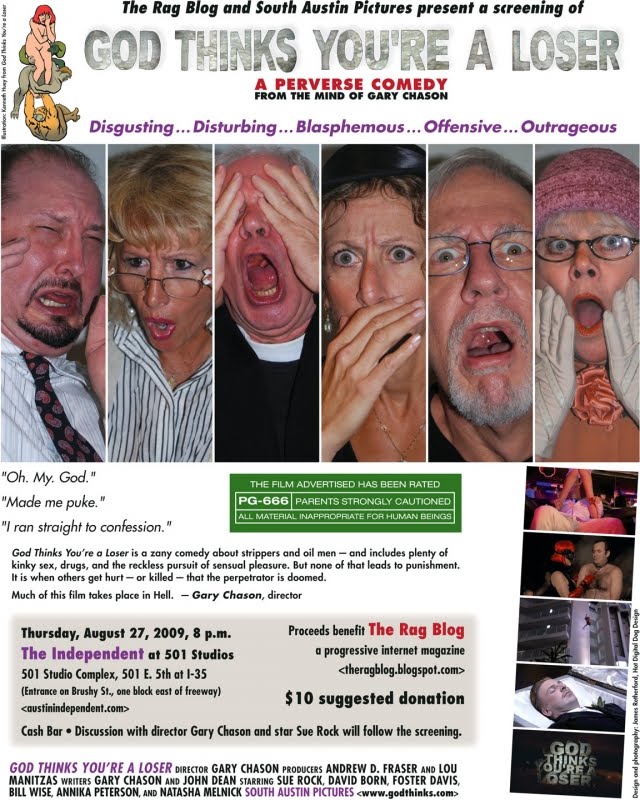
“God Thinks You’re a Loser”

The Rag Blog and South Austin Pictures present a screening of
God Thinks You’re a Loser,”
a perverse comedy from Austin director Gary Chason
at The Independent at 501 Studios
in the 501 Studio Complex,
501 E. 5th at I-35 in Austin, Texas (entrance on Brushy Street, one block east of I-35).

8 p.m., Thursday, August 27, 2009

A donation of $10 is suggested, with proceeds benefiting The Rag Blog, a progressive internet news magazine based in Austin.
There will be a cash bar.

According to Chason, “God Thinks You’re a Loser” is “a zany comedy about strippers and oil men” with “plenty of kinky sex, drugs, and the reckless pursuit of sensual pleasure.” But in the end, those who hurt others must answer for their actions.

Much of the film takes place in Hell.

A live discussion with director Gary Chason and star Sue Rock
will follow the screening.

The Rag Blog

Posted in Rag Bloggers | Tagged , , , | 1 Comment

The Wingnuts : Paranoia and Rage Serve the GOP Well


Paranoia, rage and right wing populism

From the time of Plato, thinkers have noted that building fear and anger directed at the ‘Other’ is a potent political tool.

By Sherman DeBrosse / The Rag Blog / August 25, 2009

Lately, we have seen extreme manifestations of anger and rage in our politics. On C-Span we have watched numerous town meetings at which raging rightists have shouted down Congressmen and Senators. The noisy ones rarely had coherent comments. They came to disrupt and were fueled by their hatred of progressives.

When President Barack Obama appeared in Arizona, people showed up wearing guns. One man showed newsmen his semiautomatic rifle. Others had guns strapped on their hips. In Portsmouth, New Hampshire, a man named Kostric showed up with a gun at President Obama’s August 11 meeting and recited Thomas Jefferson’s words about occasionally sprinkling the tree of liberty with the blood of tyrants. This man did not understand that most Americans believe that violence may have been sanctioned before we became a republic, but that violence thereafter is an attack on the republic and people of the United States.

Lately people have been appearing at meetings with posters of Obama as Hitler. Some of these posters came from the followers of Lyndon LaRouche. One can only wonder who gave the cash-strapped LaRouche movement cash for the vile signs. The inclusion of the LaRouchists in the conservative anti-Obama coalition underscores a decision to draw more upon the growing far-right fringe groups.

Any sane person should realize these Brown Shirt tactics can inflict massive damage on democracy. Shouting down speakers and bringing guns to meetings are means of intimidation and pose threats of violence. These tactics are meant to short-circuit the democratic process. Yet David Broder, the dean of pundits, simply cautioned that the right was playing with fire and that the tactic could backfire.

He noted that a Texas Congressman who incited a mob against LBJ in 1964 was turned out of office. It is doubtful that a backfire will occur this time. Cokie and Steve Roberts, positioned ever so slightly right of center, thought the tactics normal and said the Democrats make a mistake in complaining. Maybe the Roberts were trying to say that Americans have come to tolerate almost any kind of destructive behavior from the Right.

Recalling conservatives who once defended our American institutions

Can you imagine what Edmund Burke or John Adams or Alexander Hamilton would say about the riotous behavior of “conservatives” at political meetings?

Decades ago, conservatives were people who took very seriously the task of defending our institutions. They deplored mob tactics as irrational and destructive. Today, conservative organizations send out instructions on how to disrupt a political meeting and how to divert the police so they cannot protect besieged speakers. Other people bearing that label defend the incendiaries or find clever ways to avoid criticizing them.

Traditional conservatives are very rare these days, and those now bearing the term are interested in defending incendiaries and not protecting our hallowed institutions. Today the word “conservative” applies to people who are willing to wreck our political institutions to defend insurance and pharmaceutical companies and to impose their narrow, warped values on the rest of us.

Right-wing populism

How did all this come about? From the time of Plato, thinkers have noted that building fear and anger directed at the “Other” is a potent political tool. These two emotions fuel what is called right-wing populism, which centers around the belief that an alleged cultural elite is plotting against the cultural values of good, God-fearing ordinary folks. McCarthyism and, before that, Father Coughlin’s movement were of this stripe. It has proven to be a very popular political tool. Social scientists long thought that these ugly outbreaks were short lived, as people soon came to their senses.

Since the 1970s, rightist strategists in “conservative” think tanks have figured out how to keep right-wing populism up and running for decades on end. The goal is to protect entrenched corporate power, but right-wing populists rarely see this. The exceptions would be the few people picketing town hall meetings with signs defending insurance company profits. A massive information network, limitless money, a mastery of cognitive psychology, and the use of conservative churches for political purposes were all deployed to create the Republican’s right-wing populist base.

Usually, the fear/anger approach does not result in ugly actions but it does motivate people to turn out and vote. Some think the New Right is all about religion and family values, but both values and religion are essentially tools that are secondary to right-wing populism. The religious issues are necessary to distinguish the populists from the so-called elitists. Time and again, the Christian conservatives have shown that they are not overly concerned about misbehavior by leaders like Henry Hyde, David Vitters, or any number of others. Also crucial are advances in cognitive science which permit conservative propagandists to literally create new memories for people, thus rewiring their very mental processes and shaping their political thought.

The authoritarian impulse

Some theorists think right wing populism can morph into something different and worse which is characterized by an openness to authoritarianism, a willingness to do anything to political enemies, and a great deal of paranoia and rage. It is not a certainty, at least to this writer, that there is a natural evolution from right-wing populism to an extremist mindset that is a mental illness by most standards.

We know that prejudice, rigid cognitive functioning, a preference for conventional wisdom, an interest in punishing folks who violate the dictates of conventional wisdom, and an inclination to scapegoat others are characteristics of people who are more likely than others to accept authoritarianism and to acquire authoritarian personalities. Etiologist Konrad Lorenz thought that some people have more aggressive instincts than others and that this lends them to authoritarianism.

We have all seen that fear becomes paranoia, and anger becomes rage. Somehow when rage and paranoia merge they become more powerful and an inclination toward authoritarianism emerges as what appears to be an authoritarian person. For whatever reason, rage and paranoia generate great energy and have a way of spreading and attracting converts. They are most powerful in the body politics in bad economic times.

Samuel Goldhagen has used the term “eliminationism.” Maybe that is not the best term as it would seem to only characterize the extreme stage of this pathological form of political extremism. Yet, it is clear that those who are disrupting town meetings are bent on excluding opponents from meaningful participation in the political process. Granted, for the moment, they are not inclined to use actual force. On the other hand, they present many of the characteristics of authoritarians.

Fear/anger become paranoia/rage and people approach eliminationism. Language and actions come closer to violence; at its extreme, eliminationism results in one people wanting to wipe out as many enemies as possible. Sometimes this happened in the West when settlers massacred Native Americans or in the East, earlier, when the Pequots almost disappeared. In Germany, Hitler preached eliminationism against the Jews. Of course, these are extreme cases and hardly possible now.

Examples of people who fall into the second category are white supremacists, survivalists and militia people, gun nuts who fear the government will invade their homes tomorrow, members of the different secessionist and anti-income tax movements, and Christian Identity people, who think Christ only saved whites. Some far-right Christians are even saying Obama is the Antichrist because of some strange and wrong interpretations of the sounds of two Hebrew words. Membership in such extremist groups grew in the Clinton years, and we now see thousands flocking to the militias because we have a black president. Ammo and weapons are literally flying off store shelves.

Right-wing populists and the extremists to the right of them sometimes work together. We saw this when many circulated films accusing the Clintons of bringing about the death of Vincent Foster. The Swift Boater attack on John Kerry was another example. In this case, careful observers would have learned that the media treats the extremists with respect and spreads their lies. Moreover, the general public does not punish those allied with the extremists. Indeed, the extremists briefly make many converts to whatever massive lie they are spreading.

We have no way of knowing what runs through the minds of right-wing strategists. They must have noticed that they can ignite the Republican base and temporarily enlarge it when they use language and ideas borrowed from the far right extremists some might call “eliminationists.” When Governor Sarah Palin used these techniques her political meetings resembled Klan rallies. These sorts of appeal were second nature for Governor Palin who had attended Alaska Independence Party rallies. Her husband had been a member of this extremist-leaning party.

A few Republicans criticized her because she seemed to do nothing to overcome her broad ignorance, but the critics did not mention the appeals to extremism. There is no evidence that any voters changed their votes because of the demonstration of rage evinced at her meetings. Earlier this year, the anti-tax, anti-Obama “tea parties” were sponsored by FOX News, Glenn Beck, and other shockjocks,. They had the aspect of Survivalist/Patriot rallies. Some, including one governor, spoke favorably of secession rather than living with a liberal regime. There was strange talk about the income tax being illegal. The tactic of appealing to the extremists on the right fringe ignited the GOP base and seems to have had no down side.

Why are appeals to paranoia and rage successful now?

Liberals and leftists have been known to accept strange conspiracy theories and authoritarian notions, but, as the late Richard Hofstadter noted, this sort of conduct is far more common on the right. Perhaps it is, as Wilhelm Reich speculated, that people raised in authoritarian, patriarchal homes were most likely to be seduced by authoritarian political ideology. This kind of upbringing is most common in the South and other red areas. Of course, many living in urban areas have grown up in similar situations, where traditional values were also reinforced by conservative religion.

So many working class people are caught in the situation of suffering as a result of our economic system but still being reactionary in their basic cultural and political outlook. They fear change, even change that will help them. They talk about freedom and often see the gun as the symbol of their freedom. Yet, they are afraid to exercise freedom by casting votes that could result in systemic change. So they react against big government, when it is in the hands of progressives, by joining militias and/or essentially serving as foot soldiers in the political arena in upholding an economic system that places them at a great disadvantage. Reich claimed they do so in part because their wretched economic position makes them fear progress. They will not take chances, even on a better life.

He believed they suppress their rebellious instincts because they are products of authoritarian households. They have to deal with their desire to rebel with subservience and this preconditions them to accept an extreme right wing ideology. For some, it is simply continued acceptance of what is. In either case, there is an unconscious inhibition against rebellion and meaningful change. These people feel so much more comfortable upholding the economic status quo and the extreme version of the values learned in their authoritarian homes.

In times of liberal dominance since World War II, it seems that more people have been prone to violence and violent language. The language has been fierce and can be categorized as exclusionist in that these people have been willing to separate others, whom they detested, from the American body politic. Right-wing Minutemen and militias were prominent in the Kennedy years. Kennedy was a liberal and many did not realize that he was only a nominal Catholic.

Some believed the Soviets were about to take over. Another militia group, the Posse Comitatus emerged in the Carter years. In the Clinton years, there was the Oklahoma City bombing, which probably involved the Christian Identity movement and there were six anti-abortion murders. The rhetoric level was white hot sometimes. Now, with Barack Obama in the White House, there seems to be more extremism on the Right than before. The problem is exacerbated by the deep economic recession and the aftermath of 9/11.

The horrific events of 9/11 created a volcano of fear and anger that was soon exploited by adroit right-wing politicians. It created positive energy to the degree that we moved to protect our beloved homeland. But there was a great deal of destructive energy that did not dissipate. Politicians milked it for their own gains, claiming that their opponents were somehow in league with terrorists. This was done effectively in 2002 and 2004.

Who in his right mind, under normal circumstances, could believe that Max Cleland, who lost limbs in service of his country, was a traitor. The fallout of 9/11 made it possible to convince the people of Georgia that this was true and to turn Senator Cleland out of office. The power of rage was effectively demonstrated by the Swiftboaters in 2004. Someone must have also noted that the mainstream media acted as a megaphone for these wild and irresponsible charges.

We still have not cornered Osama bin Laden, an event that might help diminish some of the festering fear/rage. It seems that building hostility has gotten to the depths of many people’s personalities, polluting their inner lives, and warping their political judgments. Sigmund Freud taught that this hostility has to go somewhere and that displacement is likely to occur. So people find substitutes against whom to vent their rage. That explains who the people of Georgia and South Dakota were influenced by videos showing these men with Osama bin Laden. But the displacement can move to other areas, away from terrorism.

Playing the wingnut card, but not too often

Rick Perlstein has noted that the Republicans have, at each outbreak of rightist extremism, “adroitly hive{ed] off the embarrassing fringe while laying claim to some of the grassroots anger that inspired it.” But at each outbreak, they have borrowed some extremist language. Ann Coulter and Rush Limbaugh have done this and have even imported some notions that are popular on the far right.

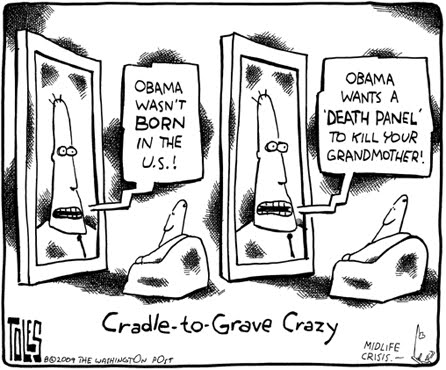
Republican leaders, fighting Obama and health care reform, fanned paranoia and rage with absurd claims, and soon Obama’s support levels began to fall. Senator John Cornyn says that Obama’s health care plan is a scheme to construct an enemies list. At one time, 47% of Republicans believed Obama was born outside the country. Now that figure is down to 29%. Most Southern Republicans still believe this. Other Republicans, with a few remarkable exceptions, think it is fine to bring guns to meetings addressed by Obama. Then Sarah Palin claimed the plan included “death panels” that would euthanize old people. Only two Republicans, one with personal reasons to oppose the governor, criticized these comments. Even columnist Kathleen Parker, no Palin backer, wrote a fascinating column full of double talk explaining how one could imagine “death panels” in the House bill. A popular sign is “Obama Lies; Grandma Dies.”

Another extreme tactic is to claim that health care reform carries a mandate to pay for all abortions. Within Catholic circles, the far right anti-abortionists who have consistently worked for the Republicans and misstated facts have attacked church organizations that support reform, claiming they are automatically backing abortion. So far, the reform has been neutral as far as abortion is concerned. There has even been a wild attack upon the character of Sister Carol Keehan, head of the Catholic Health Association. It was claimed she backed reform in hopes of personal monetary profits.

The resort to extremism is proving useful in the fight against health care reform, and we can expect more of this when Congress reconvenes in the fall.

If the Republicans are unable to attract more support among the young and Hispanics, it is likely that they will make more frequent appeals to people of an authoritarian cast of mind who are most susceptible to demagogic appeals. The tactic has produced considerable success in the battle against health care reform, and it, to some degree, revived John McCain’s flagging presidential campaign.

There is a danger to using it too often as the GOP will rule again some day and reliance on such tactics would greatly diminish the cachet of American democracy abroad. Moreover, the appearance of a functioning healthy democracy is essential for corporate and conservative forces who exercise hegemony by dominating the mainstream media and establishing the content of givenness and conventional wisdom.

It is not in the interest of corporate America and its allies to deploy jackboot tactics on a regular basis, and it is possible that the mob actions and wild and irresponsible appeals could get out of hand and produce serious violence. Even the current tactic of likening Obama to a potential Hitler could set off some unhinged rightist to emulate Lee Harvey Oswald or Richard McVeigh.

[There is a great deal more on these topics in Sherm’s The New Republican Coalition : Its Rise and Impact, The Seventies to Present (Publish America). It can be acquired by calling 301-695-1707. On line, go here.]

The Rag Blog

Posted in Rag Bloggers | Tagged , , , | 1 Comment

The American Doctor : From ‘Practitioner’ to ‘Provider’

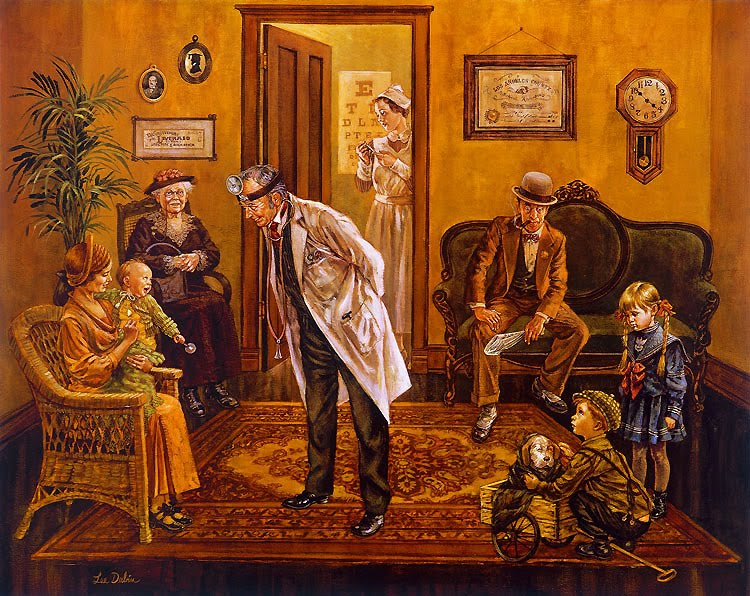
Doctor’s Office by Lee Dubin.

Graphic from ‘South Park’ / Comedy Central.

The practice of medicine has ceased to be a profession, it has become a business with the doctor being a ‘provider’ for the insurance company.

By Dr. Stephen R. Keister / The Rag Blog / August 24, 2009

One cannot recapture the past; however, a few musings about what medical care used to be, when it was a proud profession, as opposed to the model of medical care as a business in our present culture where it is dictated by the insurance cartels, rather than by a cooperative effort between physician and patient.

I opened my practice in Erie, Pennsylvania, in the summer of 1950, with the specialty of internal medicine and a new specialty, then unrecognized by the medical specialty boards, of rheumatology. I was encouraged in the latter by one of the outstanding physicians in the history of American medicine, Dr. Maxwell Lockie, a rheumatologist in Buffalo.

I shared a rather decrepit office with an excellent family practitioner, and we shared a single employee, a lady who acted as receptionist and did a bit of paperwork. Ultimately, I moved to an office building with a group of excellent physicians in various specialties.

At that time the hospital we were affiliated with required that we care for the charity in-patients, which numbered approximately 20, for two months each year. We also were expected to attend a charity clinic in our specialty one morning a week. This hospital-sponsored largesse ended with the advent of insurance sponsored medicine.

As an internist, and our number in Erie grew to something like 15 over the next several years, I followed a fairly fixed routine in patient care. The initial visit was a full hour during which we discussed the patient’s medical problem, asked pertinent questions and did a complete physical examination, sans pelvic examinations, which we felt were better handled by a lady’s gynecologist.

Rheumatology is the treatment of arthritis and there are some 100 varieties of arthritis. But listening to the patient during that first visit, and doing a comprehensive examination, 90 % of the time I was able to make a definitive diagnosis of the type of arthritis, and initiiate treatment. Our findings, conclusions, and treatment were discussed with the individual in detail, hoping to avoid any questions that might remain in their mind after they left the office; however, we always assured the individual that they could telephone us personally for any further advice.

As time went on they were given booklets published by the Arthritis Foundation to further their knowledge of their problem. One thing I always made sure to convey to the patient was the fact that most types of arthritis are not curable; however, we would try and arrest the disorder and provide relief. Relief did not involve the use of narcotics. They were always rescheduled for regular follow up visits.

In most instances a minimum of blood testing was necessary to confirm the diagnosis, if questionable, and to check on any concurrent conditions, and as a means of checking for possible side effects with certain types of therapy. No expensive, exotic testing was needed. No endless X-rays or scans. And, oh yes, sometimes we were paid at the time of the patients visit, at times they paid us later, in full or in part, at times we waived the fee altogether. Somehow, I made a respectable living but never accumulated a great amount of money in my IRA.

We were slaves to the telephone or beeper. (As a matter of fact after 40 years of practice my dislike of the beeper was so intense that on retirement I buried it in the back yard.) I had a colleague who treated childhood diabetes who had a “phone hour” at home each evening between 6-7 when his patients’ parents could call him for advice. I had a dermatologist colleague who, when his patents called him at home, commented that if he had been adverse to taking phone calls he would have been a banker.

During those early years few patients had hospital insurance: however, the genie was already out of the bottle, for frequently after discharge they were told by their carrier, that the company would not pay since they had a “pre-existing condition.” I always referred these to the Pennsylvania Insurance Commission, and universally the payments were forthcoming.

Some 30 years ago the large insurance companies at a weekend retreat conspired to take over the practice of medicine under the guise of establishing HMOs or PPOs with the knowledge that the medical profession, with the AMA standing passively by, would not oppose the takeover — which they did not. The doctors responded like lemmings running over a cliff, and here we are.

The practice of medicine has ceased to be a profession, it has become a business with the doctor being a “provider” for the insurance company. If one is ill, and if anything is required save a routine office visit, the provider must get permission from a bureaucrat employed by the insurance company; thus, the insurance industry rations care and provides profits beyond belief for their executives, stockholders, and the politicians beholden to the industry for their thirty pieces of silver.

As this system was foisted onto the complicit providers and the ill informed, misguided public, the industry required that each HMO had a physician in primary attendance for each patient. He was called the “gate keeper” and was financially rewarded at the end of each year by showing the insurance company what care he had denied, or what tests or procedures he/she had not ordered.

I retired in 1990 after a telling episode that illustrates what the current “providers” face. A medical comment. A person with breathing difficulties should not receive morphine or other narcotics because it may stop the person’s breathing. In any event, in my latter months of practice, a delightful lady, with advanced, neglected, rheumatoid arthritis came under my care. She also had emphysema, having been a heavy smoker and living alone. She had had frequent treatment with cortisone derivatives in the past, and one of the common side effects of corticosteroids is bone softening. In any event, we got her under the then accepted therapy with methotrexate and non-steroidal anti-inflammatory drugs.

Shortly thereafter, the lady called me with intense, unrelenting pain in her upper back. I met her at the ER and she had two spontaneously fractured vertebrae. We admitted her, put her on bed rest, used hot packs and physical therapy, as well as muscle relaxants as well as non-narcotic pain killers. Two days later I was called by her insurance carrier telling me that there was no justification for hospitalizing this lady! Asking why, I was told that the insurance company’s policy was that if the person did not require morphine for pain they did not need to be in the hospital.

I appealed this to the insurance company’s medical director, explaining the emphysema and breathing problems. The insurance company stood firm; it was their policy! I had to discharge a lady in intense pain, and do what we could with home care by the visiting nurses. This was the final straw, I retired some months later.

I am now a patient, having well-treated cancer of the prostate, and spinal stenosis. I am fortunate to have an excellent internist, a first rate neurologist, and a superlative pain specialist. I am on Medicare, a government-managed medical program, and in 18 years I have had no denials nor problems. I do find in talking to friends and acquaintances, that medical care has changed. When a patient enters through a waiting room door, the first thing that the receptionist asks is for is insurance information.

Then, in lieu of a conversation with the doctor, one is given a lengthy questionnaire to fill out. Then time with a “physicians assistant.” Then a brief chat and superficial examination by the doctor. In place of a detailed office visit one is whisked off for CT scans, MRIs (if approved by the insurance carrier, other than Medicare), greatly increasing the overall cost of medical care in this country. If anyone needs to call the doctor for advise they will probable have to talk to his nurse since he is too busy to return the call; hence, her response, “I will talk to the doctor and get back to you.”

I would hope that a universal single payer health program as promulgated by Physicians For A National Health Program and endorsed by the American College of Physicians would be in the cards and return medical care to the province of the physician where it abides in most other industrialized nations. However, the paid lackeys of the insurance industry and drug companies (yes we pay more than twice for prescriptions in the USA than in any other civilized nation) in the Senate and the Blue Dogs in the House will not consider such an enlightened program since it would cut into the excessive profits of their paymasters.

A poor substitute, but much better than the domination of medical care by the for profit insurance companies and their public mouthpieces Rick Scott, Zack Wamp, Glenn Beck, Betsy McCasughey, John Goodman, Rush Limbaugh, John Mackey, and the U.S. Chamber of Commerce, would be the “government option.”

Yet this would require true leadership from President Obama, as once was shown by President Franklin D. Roosevelt; however, sadly, Obama now appears to be emulating Neville Chamberlain at Munich in 1937 when he was negotiating “Peace in Our Time.” Why does the president keep harping on “bipartisanship” when to any logical person it is a long lost cause. (Yesterday I removed my Obama bumper sticker).

The times have changed and the younger physicians have been reared and are practicing in our culture of materialism and greed. Unless somewhere deep inside them resides the Hippocratic Oath, I fear that we will never return to a climate of old time medicine, such as they have in France, where family doctors still make house calls, and where no one entering a doctors office or emergency room need produce all those insurance cards before being seen and and are not required to endure endless waits. I understand, that at St. Paul’s free Clinic, where I once volunteered part time, there is hare to get doctors to put in a couple hours taking care of the poor and disadvantaged.

And, oh yes, I personally have encountered the “socialized medicine” in The UK, and have close friends and relatives, who have experience with the government subsidized health care in France, Norway and Italy, and in all instances it is caring and prompt. Of course, now and then I am sure there may be a hitch, but do not believe the nay-sayers who are trying to play on our worst instincts, and produce fear and mistrust.

Those thinking people, who believe in the individual’s right to decent medical care as a moral and ethical issue must make themselves heard. Time grows short, the forces that are opposing decent care in this nation are spending $14 million a day to deceive and confuse the public with fraudulent television ads, scripted demonstrations at town meetings held by Democratic representatives (Blue Dogs excepted), with gun-toting hoodlums outside.

[Dr. Stephen R. Keister lives in Erie, PA. He is a retired physician who is active in health care reform.]

The Rag Blog

Posted in Rag Bloggers | Tagged , , , | 2 Comments

Mexico Frees Convicted Killers of Chiapas Indians

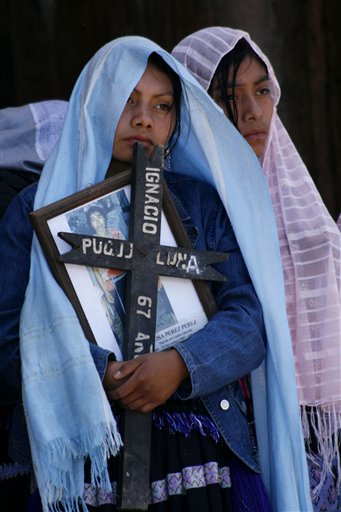
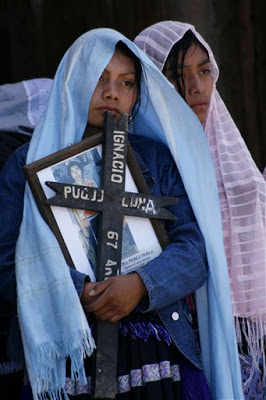
Relatives of those killed in the 1997 Acteal massacre carry photos and pray in San Cristobal, Chiapas, Mexico, Tuesday, August 11, 2009. Photo by Moyses Zuniga / AP.

Supreme Inpunity:
Mexico’s high court frees convicted killers of 49 Indians in Chiapas

By John Ross / The Rag Blog / August 24, 2009

MEXICO CITY — With immense sorrow etched into his weather-beaten face, the Tzotzil Indian farmer slowly mounted the imposing granite steps of Mexico’s Supreme Court.

Sebastian Perez Vazquez’s job was a thankless one. As president of the civil group “Las Abejas” (“The Bees”), he was obligated to communicate the bad news to the villagers who had trekked up to the capital from their homes in the highlands of Chiapas (“Los Altos“) that, after 12 years, the killers who had been convicted of murdering their mothers and fathers and grandparents and children at Acteal on December 22nd 1997 would now be freed from prison on the instructions of four out of five Supreme Court justices because of procedural errors in their prosecutions.

The Abejas had dressed in their best clothes for the court hearing, the men in their short ornamental “chujs” (serapes) and the women in their finest huipiles (traditional blouses) and long embroidered skirts they wear like a proud emblem of their Tzotzil roots but they had not even been allowed inside the courtroom to bear witness to the verdict of the justices. Heavily armed federal police patrolled the marble hallways of the court building on one corner of Mexico City’s great Zocalo plaza intent on keeping the Indians out in the street.

Elena Perez Perez looked like the air had been sucked out of her. She had expected the exoneration of the killers but still could not staunch the tears that washed her bladed cheekbones. “We cry because we cannot find justice anywhere,” Elena, who was 19 when the accused murdered her father and two eldest siblings, told a U.S. reporter. Maria Vazquez had lost nine family members in the massacre. She too had expected the justices’ decision. “This court releases the killers but it cannot resuscitate the dead.”

Early on the morning of December 22nd, 1997, three dozen armed men gathered on a lonely roadside in Chenalho county in the Altos of Chiapas, Mexico’s southernmost state, and began firing on women and children clustered around a clapboard chapel who were praying for peace on a promontory below. A detachment of 40 Chiapas police officers were stationed at a schoolhouse just meters away but made no effort to stop the killing.

The gunfire continued for the better part of the day, the shooters scouring the hillside for those who had escaped the first assault and finishing them off one by one. When they were done seven hours later, 49 Abejas were dead: 15 children, 21 women, nine men, and four babies who had been cut out of the wombs of their mothers and dashed against the rocks. The killers were determined to exterminate the “seed” of the Abejas.

The outside world learned of the massacre at Acteal when survivors straggled into San Cristobal de las Casas, the old colonial city that crowns the highlands, several hours later. A call went out to doctors to come to the Civil Hospital to treat the many wounded. One medic who responded to the call was Hermann Bellinghausen who doubles as correspondent for the left daily La Jornada in Chiapas. Hermann has accompanied the rebellion of the Zapatista Army of National Liberation (EZLN) since it exploded in the mountains and jungle of this deeply indigenous state on January 1st 1994. The Abejas were supporters of the Zapatistas but rejected the insurgents’ use of weapons.

Around 10 p.m. that night, a Red Cross ambulance braved gunfire to reach the village of Acteal enclaved in the saw-toothed mountains about 45 minutes above San Cristobal and discovered state police officers stacking the corpses of the Indians, apparently preparing them for burning. Caught in the act, the cops gathered up the bodies and tossed them in a dump truck where they were driven down to the state capital in Tuxtla Gutierrez for “autopsies.”

The contamination of the crime scene was corroborated by Bellinghausen and two colleagues Jesus Ramirez Cuevas and Juan Balboa the next morning and later that day, Hermann posted his first dispatch. Bellinghausen would go on to write a book, Acteal: A Crime of State that has become a definitive text on understanding the massacre.

The Abejas are a civil association of honey gatherers and coffee growers who had been forced from their home villages in the months previous to the murders — the massacre took place at the height of the coffee harvest — by armed bands affiliated with the long-ruling PRI party and its surrogates in the “Cardenas Front.”

Unlike the Abejas who were devout Catholics, the PRIistas lined up with the evangelical National Presbyterian Church that first established itself in Los Altos back in the 1930s. Since spring, they had been burning the Bees’ homes and stealing their coffee and their cattle. Abeja families from Quextic had been particularly persecuted and the Zapatista community of Acteal offered them sanctuary on the hillside where they would later be murdered.

All of the dead Abejas and those who killed them were Tzotzil Mayan Indians.

Although they supported the EZLN’s struggle, the Abejas‘ allegiances were to the liberation bishop of San Cristobal Samuel Ruiz who had been instrumental in their formation. The Bees were indeed a Sui Genero grouping amongst the Tzotziles of Los Altos. They were resolutely non-violent and eschewed the “posh”, sugar-cane aguardiente that is obligatory in many highland villages. Unlike their neighbors, they defended the right of women to own land in the community.

Bellinghausen’s reportage triggered a chain reaction of indignation around the world. Demonstrators circled Mexican embassies in European cities. Pope John Paul II expressed his grief and U.S. president Bill Clinton lamented the violence. International human rights workers flocked to Chiapas.

As commander-in-chief, Mexican president Ernesto Zedillo ordered U.S.-trained troops into the Chiapas highlands to restore order and separate the paramilitaries responsible for the massacre from the EZLN — the military invaded dozens of Zapatista villages purportedly looking for weapons but, at first, left the paramilitaries alone. Fear of a new massacre panicked villagers and 10,000 Indians abandoned their homes and sought refuge in Polho, a Zapatista refugee camp.

The bodies of the dead were returned to the Abejas on Christmas day for burial. As the funeral procession advanced up the mountain road from Polho to Acteal, the mourners encountered a truck speeding in the opposite direction that was carrying stolen Abeja coffee. The Abejas recognized the men in the truck as their killers — many of them were PRIistas who had run them off their land and at least one was the cousin of a victim. Bishop Ruiz moved swiftly to prevent a lynching and 24 of the presumed assassins were taken into custody. They would not be released until the Supreme Court’s August 12th decree a dozen years later.

Other suspects were rounded up by federal police during raids in Los Chorros, Quextic, and Pechiquil. One old Indian farmer was reportedly handed a list of 100 suspects and forced to sign it. Agustin Luna did not read or write Spanish.

According to Zedillo’s attorney general Jorge Madrazo Cuellar, 124 arrest warrants were issued but apparently only 87 were ever served. Almost all of those who were taken into custody were Tzotziles — 14 mostly mestizo public servants served less than six years for their roles in the massacre. Two high-ranking Mexican Army officers who functioned as commandants in Chiapas public security agencies simply disappeared and more than a decade later remain at large.

The Indians were heavily punished for the killings, dealt 20 to 40 year sentences for premeditated homicide and possession of weapons that only the military was licensed to carry. Two of the 70 Tzotzil defendants were let go because of old age and another died in custody. Several more were re-sentenced and released. Of the 57 Indians who remained in prison only five confessed to participating in the massacre.

There is little question that the prosecution of those rounded up for the killings at Acteal was slipshod. Witnesses were pressured and declarations obtained by force. In the Zedillo government’s rush to judgment, many were swept up who were not in Acteal on the day of the massacre. Translators who are required by law to be available to defendants who do not speak Spanish were not. Weapons were seized that did not match the caliber of the bullets that killed the Bees. The Supreme Court decried the disappearance of evidence and the destruction of the crime scene and the falsification of testimony.

To mark the first anniversary of the killings, Madrazo’s Federal Prosecutor’s Office (PGR) published The White Book of Acteal that blamed the murders on “inter-communal conflicts” and underscored the savage nature of the killings, intimating that the violence had cultural roots.

Although many of the victims had been brutally slashed by machete blows, one autopsy lists gunshot wounds as the cause of death for 43 of the slain villagers and writer Carlos Montemayor, an outspoken defender of indigenous culture, concluded that the bodies of the Abejas were further brutalized by police to emphasize the “primitive” nature of the Indians. Madrazo’s White Book absolved the Zedillo government of all crimes of commission and omission.

Once convictions were obtained and the presumed killers sentenced, Acteal was relegated to the cold case file. Although the PRI quickly washed its hands of the prisoners, the National Presbyterian Church soon came to their defense. The evangelicals’ point man was an influential politico and preacher Hugo Eric Flores who is described as being close to the “theology of prosperity.”

During the 2006 presidential campaign, Flores, the founder and “moral leader” of Encuentro Social (“Social Encounter”), an evangelical political association that had been tied to the PRI, met with right-wing PAN party candidate Felipe Calderon and offered to deliver the evangelical vote (the PAN had none) if Calderon would agree to reopen the cases of those he described as “political prisoners.” According to La Jornada op-ed editor Luis Hernandez Navarro, the deal went down that April.

Months later, after Calderon had been awarded the fraud-marred election, Hugo Eric Flores emerged as the director of the Environmental Secretariat’s PRO-ARBOL (“pro-tree”) program but within a year was fired from the post and barred from working for the agency for the next ten years. No explanation has ever been offered for Flores’ removal but despite the stain on his resume, the evangelical preacher had no difficulty finding “>chamba>” (“work”) and today serves as back-up (“suplente“) for a PANista senator.

Soon after he was fired from his environmental sinecure, Hugo Eric Flores hired on with the prestigious Center for Investigation & Teaching of Economics (CIDE), an entity of the Secretary of Public Education, and published a defense of those convicted for the Acteal massacre, “The Other Acteal,” chapters of which appeared in Nexos magazine, a glossy monthly edited by the prominent PRIista writer and Televisa talking head Hector Aguilar Camin who in 1997 on the tenth anniversary of the killings published his own three part vindication of the incarcerated paramilitaries.

Amongst Aguilar Camin’s revelations: there had been no massacre at Acteal, a hypothesis that rested largely on the testimony of Lorenzo Perez Vazquez who at 17 was the youngest of the convicted killers. According to Perez, the Abejas were caught in a crossfire between the Zapatistas and PRIistas. Lorenzo Perez himself was one of the five paramilitaries who confessed to the murders. Notwithstanding, his name was listed among the first batch of 20 the Supreme Court set free.

Eric Flores used his growing clout to recruit young lawyers from the CIDE’s law clinic and in December 2007, the same month as Aguilar Camin’s vindication appeared, they officially filed an appeal for the release of the 57 imprisoned indigenas, citing discriminatory treatment of Indians by the courts. According to the CIDE’s general secretary Dr Sergio Lopez Ayllon, the legal costs were offset by sizable grants from both the Hewitt Foundation and George Soras’ Open Society Institute.

How many of those released actually have blood on their hands? Miguel Angel De los Santos, a prominent human rights attorney in San Cristobal, thinks that the government case was so “flojo” (lazily assembled) that separating the guilty from the innocent at this late date may be next to impossible — in the Mexican justice system, “fabricando cupables” (literally “manufacturing the guilty”) is an “art form.” De los Santos charges that government prosecutors often leave big holes in unpopular cases to establish grounds for appeal and ultimately absolution of the perpetrators. “The release of the accused paramilitaries,” he writes in La Jornada, “is a confession of the Mexican state’s fracaso in the impartation of justice.”

During a decade and more, imprisoned first at the crumbling old Cerro Hueco fortress above Tuxtla, those convicted of the Acteal murders (the “material assassins” in legal jargon) have been demonized by the Abejas and the Zapatistas and their supporters as cold-blooded killers — the phrase “paramilitary” is an ugly curse in the rebels’ lexicon and those who suggest that some of those railroaded by the Zedillo government’s inept prosecution are not guilty are deemed “politically incorrect.”

On the other hand, government officials who conceived, put in motion, and covered up the Acteal killings — “the intellectual authors” — have evaded justice for a decade.

At the top of the list is ex-president Ernesto Zedillo whose xenophobic jeremiads against non-Mexican human rights workers animated a lethal atmosphere of fear and loathing in Chiapas. As commander-in-chief of Mexico’s Armed Forces, Zedillo signed off on the counterinsurgency initiative that culminated with the massacre at Acteal. The former Mexican president now heads up the Yale University Globalization Studies Institute and sits on the board of major U.S. corporations.

Zedillo’s Secretary of Defense and the commander of Mexican Army forces in the region Mario Renon Castillo collaborated on a “Chiapas Campaign Plan.” a counterinsurgency strategy to develop paramilitary groups in 39 municipalities in which the EZLN had influence. Renon Castillo is a graduate of Center for Special Forces in Fort Bragg, North Carolina, where he was trained in counterinsurgency warfare. According to diplomatic cables unearthed by investigator Kate Doyle at the Washington-based National Security Archives, the Mexican military trained and financed paramilitaries in Chenalho — one corporal was briefly jailed as a trainer.

Chiapas Governor Julio Ruiz Ferro, a Zedillo appointee, had ample prior knowledge of the violence brewing in the highlands and did nothing to head it off — the deaths of 32 Indians in Chenalho in the months before the massacre set the stage for Acteal. Ruiz Ferro was bumped up to agricultural attaché at Mexico’s Washington embassy after he resigned as governor as reward for his inattention.

Interior Secretary Emilio Chuayffet, who supervised national security, was forced to resign for failing to anticipate Acteal but remained active in the PRI hierarchy and may soon become head of the PRI’s majority delegation in the lower house of congress.

Former Attorney General Jorge Madrazo’s flawed prosecution may have jailed innocent Indians for a dozen years — the National Fraternity of Christian Churches now demands that he be incarcerated.

Finally, suggests Raul Vera, auxiliary bishop of San Cristobal during Acteal, by freeing the accused killers, the justices of Mexico’s Supreme Court are now “accomplices” in this lurid plot.

Although the Supreme Court did not rule on the innocence or guilt of the prisoners and only considered the poisoned judicial procedures, 20 of the accused killers were released August 13th from El Amate prison on the western edge of Chiapas and transported to a small hotel outside of Tuxtla Gutierrez where they met with worried state officials behind closed doors for 12 hours. Authorities are fearful that the ex-prisoners will return to Chenalho and seek revenge against the Abejas for their long incarceration.

Indeed, fear permeates Acteal and Polho in the wake of the prisoners’ release — the Abejas have long charged that the paramilitaries still have weapons cached in the region. “I survived the first time but I won’t survive another massacre,” Catalina Perez, who was shot nine times during the attack, told La Jornada.

The freed Indians are also under the gun. If they were not the real killers then they know who the real killers were and local “caciques” (rural bosses) will try to silence them.

Governor Juan Sabines, whose father was also Juan and served as Chiapas governor when dozens of Indians were gunned down by army troops in another massacre at Wolonchan in 1981, vowed that the prisoners’ release would not rupture the fragile calm in the state. The ex-prisoners would be relocated as far from Chenalho as the borders of Chiapas would allow and provided with land and animals and generous pensions. Even though the accused were being closely watched by state officials, by week’s end six had already escaped for parts unknown.

Conspicuously absent from the controversy over the released paramilitaries is the EZLN which has yet to comment on the Supreme Court decision. The Zapatistas‘ key public outpost in the highlands at Oventic has been reportedly closed to outside visitors since the Supreme Court ordered the paramilitaries released from prison.

Since the evangelical Summer Language Institute was installed in Los Altos by President Lazaro Cardenas in the 1930s, the political clout of the “sects” as the Catholic Church labels the Protestants has grown precipitously.

Each Sunday, the Army of God marches in military cadence through San Cristobal. With their red berets, spit-shined army boots, and camouflage cargo pants, the marchers are dead ringers for paramilitaries but Army of God commander-in-chief Esdras Alonso, a fiery highland preacher with connections to the National Presbyterian Church, claims that his followers are armed only with the “Word of God.” According to Bellinghausen, Esdras Alonso’s home base is in San Cristobal’s Hormiga Colony where the killers of the Abejas are said to have acquired their weapons. Reverend Esdras also claims that fallen-away Zapatista comandantes have joined the Army of God.

Alonso’s evangelicals have considerable influence in Mitziton just outside San Cristobal which Governor Sabines has designated as the starting point for a super highway that will connect up the tourist corridor between that old colonial city and the fabled Mayan ruins at Palenque in the lowlands to the east.

Although the actual route remains under wraps, the new highway is expected to invade autonomous Zapatista communities and tensions are running tall in Mitziton where farmers are aligned with the EZLN’s “Other Campaign.” This past July 21st, when ski-masked protestors blocked road-building equipment, the Army of God counterattacked, killing one villager.

Commander-in-chief Esdras responded to unfavorable news coverage of the confrontation by filing a complaint with the local prosecutor against both the Fray Bartolome Human Rights Center, founded by Bishop Ruiz, and Hermann Bellinghausen for allegedly spreading libelous rumors on the Internet. Esdras also demanded that Immigration authorities investigate Bellinghausen’s immigration status — the Jornada reporter is a third generation Mexican.

The Supreme Court’s decision to free those convicted of killing 49 Abejas at Acteal is the latest finding of the high court to grant impunity to those deemed responsible for notorious crimes. In 2006, the court barred citizens from access to ballots cast in the presidential elections, one of the most egregious frauds in Mexican electoral history. In 2007, the justices absolved Puebla governor Mario Marin after evidence implicated him in the kidnapping of independent journalist Lydia Cacho who had blown the whistle on the governor’s pederast associates.

In 2008, the Supreme Court declared Mexico state governor and current PRI presidential front runner Enrique Pena Nieto innocent of ordering state mayhem at San Salvador Atenco where 200 protesters were attacked and arrested, a score of women sexually abused by Pena Nieto’s police, and two young men gunned down by the cops. Later that year, the justices concluded that Oaxaca governor Ulysis Ruiz had used “legitimate” force to suppress protests by the Oaxaca Peoples Popular Assembly or APPO during which 26 civilians lost their lives.

Just a week before the Acteal ruling, the Supreme Court concurred that a Sinaloa woman whose husband had been shot down at an Army checkpoint bad no standing and turned the matter over to a military tribunal that has no civilian oversight. By sustaining the military’s “fuero” or immunity from prosecution by civil authorities, the court assured the army of continued impunity.

Release of those prisoners sentenced for the Acteal massacre because of judicial errors will have far reaching impact on Mexican courts observes Barbara Zamora, lawyer for the prisoners of Atenco and other high profile government targets. Zamora affirms that she has never defended a case that was not contaminated by gross judicial error.

“The Mexican judicial system is rotten to the core. But from now on, whether they are guilty or not, anyone who can afford a powerful lawyer and has been sentenced for homicide, narco, kidnapping, or organized crime will be able to claim judicial impropriety and appeal to the Supreme Court to be set free. This could empty out the jails,” the lawyer adds with a mischievous smile.

[John Ross’s monstrous tome El Monstruo — Dread & Redemption in Mexico City will be published by Nation Books this November. The author is soliciting venues for book presentations this fall and next spring. If you have further information, write johnross@igc.org.]

Source /

The Rag Blog

Posted in Rag Bloggers | Tagged , , , , | 2 Comments

Politics of Fear : A Historical Perspective

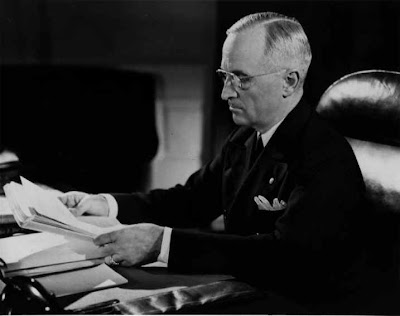
Harry Truman delivers his “Truman Doctrine” speech to Congress on March 12, 1947. Photo from Truman Presidential Museum and Library.

The politics of fear:
A basic tool of reaction

By Harry Targ / The Rag Blog / August 23, 2009

“Scare hell out of the American people.” (attributed to Arthur Vandenberg, Senator, Michigan, February, 1947)

“Ridge writes that there was a ‘vigorous, some might say dramatic discussion’ about raising the threat level. The former Republican governor of Pennsylvania (and first secretary for Homeland Security) says his aides told the White House that doing so would politicize national security.” (‘Ridge Felt a Push to Politicize Alert Levels,” Boston Globe, August 21, 2009).

A basic tactic used by American politicians to marshal support for policies and politicians that ordinary citizens, given their common sense and self-interest would never support, is to create a sense of fear.

The “politics of fear” has a long and venal history in American political life. We can point to warnings of the penetration of foreigners into our public life before the civil war, to dangerous Reds in the struggle for the eight-hour day in the 1880s, to the Red scares of the post-World War I and II periods.

The politics of fear has always used class hatred and class envy, racism, sexism, homophobia, and a sense of the “alien” to create enthusiasm for policies that are backward and inhumane.

After World War II, opinion polls indicated that most Americans hoped for a period of peace built upon the continued collaboration of the powerful wartime allies, the United States, the former Soviet Union, and Great Britain. But, as President Truman articulated in a relatively unknown speech to a gathering at Baylor University on March, 6, 1947, the United States was committed to the creation of a global economy based upon private enterprise, foreign investment, and free trade. He alluded to forces in the world that sought to organize economic life around different principles, national autonomous development and state directed economies.

What the Truman administration had been discussing in private was not a public debate on the virtues of free markets versus national planning, but a global crusade against “communist tyranny.” At an apocryphal meeting of key aides and politicians in February, 1947, before Truman’s famous “Truman Doctrine” speech of March 13, the formerly isolationist senator from Michigan, Arthur Vandenberg, reportedly declared that he would support a global policy, presumably to promote free market capitalism, but he advised that the president should “scare hell out of the American people.”

Why? Because the American people still thought peace was possible between the East and the West. In March, Truman warned Congress that the United States was going to be engaged in a long-term struggle against the forces of tyranny in the world, the international communist menace.

In the 1950s, President Eisenhower’s Secretary of State, John Foster Dulles, warned that President Jacob Arbenz, of Guatemala, constituted a threat to the Central American isthmus, and eventually the United States itself. Since Arbenz supported the expropriation of unused land owned by the United Fruit Company, the administration claimed he was moving toward communism.

Candidate John Kennedy framed his campaign for president around the fears of a “missile gap” that had allegedly opened up between the United States and the Soviet Union and the spread of communism to 90 miles off our shores on the island of Cuba.

Ronald Reagan, another presidential candidate, powerfully introduced the idea of a “the window of vulnerability” to popular discourse on the dangers to American freedom if the incumbent candidate Jimmy Carter was reelected and the government did not dramatically increase military spending.

With the end of the Cold War, new enemies needed to be constructed. And, indeed they were. They were more diabolical, less tangible than the Soviet Union and international communism. These included “failed states,” “rogue states,” and “terrorists.”

So, in a new book, not to anyone’s surprise (except for the dense mainstream media), a former Bush official, Thomas Ridge, reports on the latest gimmick in the politics of fear tool kit, color coated signals of threat levels. And in this case, once again the threat levels were designed and used, not only to engender fear and quiescent support for insane war policies but to support candidates who created these policies.

Reflecting on the politics of fear and its long history, we can extrapolate some core ideas about it and how it works. The politics of fear creates demonic enemies such as communists, terrorists, foreigners, or people who are defined as different. The politics of fear requires an implied or stated prediction of doom. If the people do not support what is being advocated, the consequences for human survival would be in jeopardy. Only clear and total support of the policies and politicians promoting it can save us from the apocalypse. Finally, in most instances the politics of fear relates to war and militarism.

The Nixon administration added to the politics of fear the militarization of domestic policies as well. For example, the US needed to commit to a war on cancer or a war on drugs. While military images verbally have not been added to the debate about health care reform today, some opponents have begun to carry guns to places where debates are occurring, suggesting that this debate is indeed a prelude to war.

What are some lessons that this argument raises for progressives to consider? First, we must recognize that the politics of fear undergirds much of our political discourse and it has for a long time. Second, the politics of fear is based on distortions of other peoples’ thoughts and behaviors and other countries’ intentions and what their actions might mean for us. Third, we must be ready to challenge virtually every instance in which the politics of fear is used to coerce and manipulate people. Fourth, we need to articulate more vigorously our own public policy proposals and our own vision of how we can build a society that is based on social and economic justice rather than fear, enemies, and the prospects of doom.

[Harry Tarq a professor in American Studies who lives in West Lafayette, Indiana. He blogs at Diary of a Heartland Radical, where this article also appears.]

The Rag Blog

Posted in Rag Bloggers | Tagged , , | Leave a comment

Extraordinary Rendition: Not Yet Obsolete


Lebanese man is target of first rendition under Obama

Contractor Raymond Azar is arrested in Afghanistan, hooded, stripped and flown to the U.S. His alleged crime? Bribery. A human rights activist calls the case ‘bizarre.’

By Bob Drogin / August 22, 2009

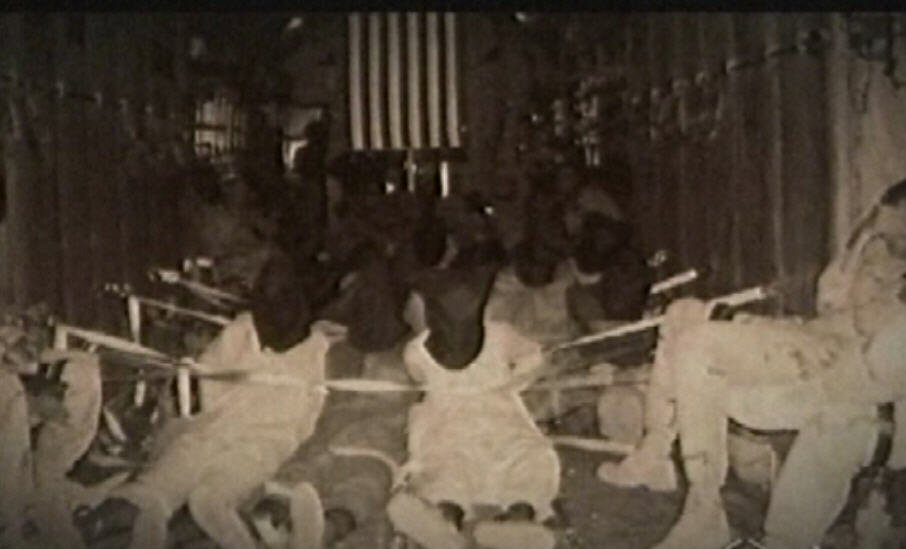
ALEXANDRIA, Va. – A Lebanese citizen being held in a detention center here was hooded, stripped naked for photographs and bundled onto an executive jet by FBI agents in Afghanistan in April, making him the first known target of a rendition during the Obama administration.

Unlike terrorism suspects who were secretly snatched by the CIA and harshly interrogated and imprisoned overseas during the George W. Bush administration, Raymond Azar was flown to this Washington suburb for a case involving inflated invoices.

Azar, 45, pleaded guilty Tuesday to conspiracy to commit bribery, the only charge against him. He faces a maximum of five years in prison, but a sentence of 2 1/2 years or less is likely under federal guidelines.

Defense lawyers and prosecutors declined to comment on the case Friday.

But Joanne Mariner, terrorism and counter-terrorism director at Human Rights Watch, called the case “bizarre.”

“He was treated like a high-security terrorist instead of someone accused of a relatively minor white-collar crime,” she said.

Justice Department lawyers have denied any misconduct in the case.

“The FBI followed standard operating procedures when transporting prisoners to the United States,” Gina Talamona, a Justice Department spokeswoman, said Friday. She said restraints “were used with the sole purpose of ensuring the safety of the defendants and the agents.”

As the Obama administration steps up efforts to curb fraud at military facilities in Iraq and Afghanistan, a senior Army official said Azar’s case “should serve as a warning” to other contractors.

In court papers, Azar said he was denied his eyeglasses, not given food for 30 hours and put in a freezing room after his arrest by “more than 10 men wearing flak jackets and carrying military style assault rifles.”

Azar also said he was shackled and forced to wear a blindfold, dark hood and earphones for up to 18 hours on a Gulfstream V jet that flew him from Bagram air base, outside Kabul, to Virginia.

Before the hood was put on, he said, one of his captors waved a photo of Azar’s wife and four children and warned Azar that he would “never see them again” unless he confessed.

“Frightened for his immediate safety . . . and under the belief he would end up in the prison camp at Guantanamo Bay or Abu Ghraib to be tortured,” Azar signed a paper he did not understand, his lawyers told the court.

Prosecutors, however, said that Azar was “treated professionally,” kept in a heated room, offered food and water repeatedly and “provided with comfortable chairs to sit in.”

They said he was photographed naked and subjected to a cavity search to ensure that he did not carry hidden weapons and was fit for travel. Court records confirmed that Azar was shackled at the ankles, waist and wrists and made to wear a blindfold, hood and earphones aboard the plane.

Prosecutors also said that FBI agents read Azar his rights against self-incrimination on three occasions, and that he “voluntarily” waived them.

The FBI agent in charge, Perry J. Goerish, denied in an affidavit that Azar was “told he would never see his family again unless he confessed.”

Arrested along with Azar was Dinorah Cobos, 52, a naturalized American from Honduras. Cobos, who did not make the same claims of abuse, this week pleaded guilty to conspiracy and bribery.

Their case is different from the widely criticized “extraordinary renditions” carried out after the Sept. 11 attacks. In those cases, CIA teams snatched suspected Al Qaeda members and other alleged terrorists overseas and flew them, shackled and hooded, to prisons outside the United States without any arrest warrants or other judicial proceedings.

The FBI arrested Azar and Cobos with warrants signed by a federal magistrate. And the State Department, Talamona said, asked the government of Afghanistan “for its consent in advance to take these two individuals into custody and return them to the United States to stand trial. They consented to our request.”

Azar and Cobos worked for a Lebanese construction company, Sima Salazar Group, which was awarded more than $50 million in Pentagon contracts for reconstruction and supply work in Afghanistan. In December, according to the indictment, the pair offered to pay kickbacks to an Army Corps of Engineers officer in Kabul. In exchange, he agreed to approve $13 million in outstanding bills from Sima Salazar.

Over the next four months, according to the charges, more than $106,000 was wired to the officer’s bank account in Manassas. But the case was an FBI sting, and Azar and Cobos were arrested at Camp Eggers, a U.S. military base in Kabul, after being lured to a meeting April 7.

Sima Salazar Group is also under indictment.

On Wednesday, Cobos’ sister, Gloria Martinez, 61, pleaded guilty in federal court in New Orleans to conspiracy and two counts of bribery in a related case. Prosecutors said Martinez, a senior Army Corps of Engineers official, accepted $425,000 in cash, jewelry and other gifts for herself and Cobos from companies seeking military contracts in Iraq and Afghanistan.

As a candidate last year, President Obama vowed to end “the practice of shipping away prisoners in the dead of night to be tortured in far-off countries.”

After taking office, he ordered the CIA to close its network of “black site” prisons and promised to shutter the detention camp at Guantanamo Bay, Cuba.

The Justice Department has seized and transported foreign drug lords, terrorists and other high-profile fugitives to U.S. courtrooms when normal extradition was not considered possible. The Supreme Court ruled in 1992 that such renditions, as the transfers are known, are permissible.

In 1997, for example, FBI agents in Pakistan captured Mir Aimal Kasi, who was on the FBI’s Ten Most Wanted list, and returned him to Washington to stand trial. Kasi was convicted of murder in the killing of two CIA employees and was executed in Virginia in 2002.

Azar is hardly in the same league, but Talamona pointed out that “we take very seriously criminal fraud against the United States government.”

Source / Los Angeles Times

The Rag Blog

Posted in RagBlog | Tagged , , | 1 Comment

Documenting Human Rights Abuse in Honduras

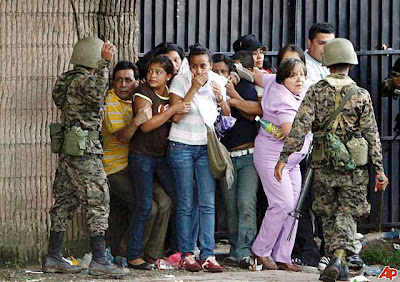
Photo from AP.

Honduras:
Human rights violations
by military and police

By David Holmes Morris / The Rag Blog / August 23, 2009

See more photos Below.

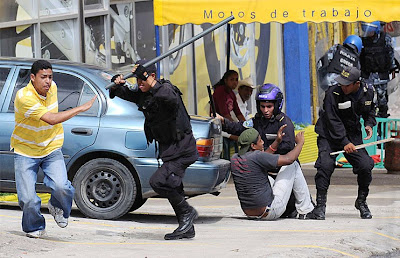
In the past few days, several organizations have issued reports documenting human rights violations committed by military and police forces in Honduras since the coup d’état that ousted President Manuel Zelaya on June 28.

● After five days of meetings with representatives of a number of organizations and interviews with Hondurans jailed or hospitalized following demonstrations against the coup, a delegation from Amnesty International on August 19 released a summary of its findings.

“Mass arbitrary arrests and ill treatment of protesters are a serious and growing concern in Honduras today,” declared Esther Major, a member of the delegation, at a press conference announcing the report.

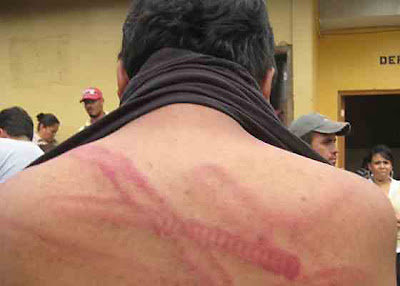
“Excessive force by police and military has been routine and hundreds of peaceful demonstrators have been subject to arbitrary detention,” the AI report says. It cited as an example a peaceful march in Tegucigalpa on July 30 in which police, who wore no visible identification, charged at demonstrators without warning, beating them with batons as they fled.

Demonstrators later interviewed by AI reported being struck on the back, the buttocks and the backs of their legs. Several hundred demonstrators were detained and taken to jail, the report continues, with no charges being filed against them and no explanation given for their detention.

One demonstrator, who told AI he had been one of over 200 students involved in the demonstration, said, “The police were throwing stones, they rounded us up, they threw us down on the ground and they beat us — there are people with fractures, with head wounds, they beat us on the buttocks. They stole our cameras, they beat us if we raised our heads, they beat us when they were getting us into the police cars.”

The report says women demonstrators have been subjected to sexual intimidation and assaults as well as beatings. There are accounts of police prodding women with truncheons as they lay on the ground. “Why aren’t you at home having sex with your husband?” one officer reportedly asked a demonstrator.

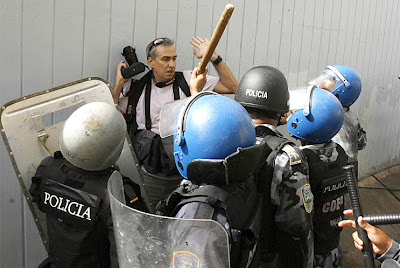
Also targeted for abuse, AI reports, are human rights observers and news media. Roberto Barra, a Chilean photojournalist, told the AI delegates that on July 30 he had been surrounded suddenly by some 20 officers as he photographed police beating demonstrators. His camera was taken and he himself was beaten. “You journalists are responsible for this situation,” the police shouted, “for the bad image abroad, son of a bitch, you’re a communist just like the rest of them”

AI reports an interview with Alex Matamoros, an observer with a Honduran human rights group, who confronted police officers he had seen beating three young men whose hands were tied behind their backs. When Matamoros explained who he was and showed them his ID card, one policeman said, “Keep this piece of shit. Here there are no human rights.”

Photo by José Cabezas, Agence France Presse.

● Of greater interest to Hondurans was a similar investigation by members of the Inter-American Commission on Human Rights, an autonomous arm of the Organization of American States. Four of the seven members of the Commission were in Honduras from August 17 to 21 interviewing anti-coup activists, journalists, government officials not directly connected with the coup regime and a few citizens claiming abuse by anti-coup demonstrators.

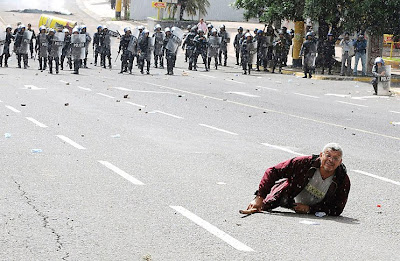
At a press conference on August 21, the group delivered a preliminary report confirming “the existence of a pattern of disproportionate use of force by the government, arbitrary detentions and control of information with the intention of limiting political participation by a sector of the citizenry.” The group confirmed “repression exerted against demonstrators through military blockades and the arbitrary declaring of curfews.”

The Commission said it had verified the shooting deaths of four individuals and the wounding of others, apparently at the hands of government agents. It claimed further that between 3,500 and 4,000 persons had been detained arbitrarily since the June 28 coup and that from July 24 to 27 between 4,000 and 5,000 persons had been trapped between military roadblocks during demonstrations in the department of El Paraíso, near the Nicaraguan border, with no access to food or water.

In contrast, demonstrators have been peaceful, the report says, except for isolated incidents like a march on August 11 at the Universidad Pedagógica, in Tegucigalpa, where a bus and a U.S.-franchised fast-food restaurant were burned and windows were broken at another U.S.-identified fast-food restaurant.

On the other hand, the Commision also reported statements from parents who claimed their children’s rights had been abused by teachers who had been on strike and had been demonstrating against the coup when they should have been in the classrooms.

Martha Lorena Casco, vice-chancellor in the Micheletti government, dismissed the Commision because, she claimed, it was “infiltrated by the left,” mentioning specifically Venezuelan Luz Patricia Mejía, who heads the group

Photo from AP.

● The Misión de Observación Internacional Feminista (International Feminist Observation Mission), consisting of women from Canada, the United States, Mexico, Guatemala, El Salvador and Costa Rica, spent a week in Honduras to show their solidarity with Feministas en Resistencia (Feminists in Resistance) and to document abuse of women by the coup regime.

At a press conference on August 20, Gilda Rivera of the Honduran group Centro de Derechos de Mujeres (Women’s Rights Center) specified that there were 19 documented cases of police and military abuse of women since the coup and that many other cases have not been reported out of fear of retaliation.

The international group says there has been an increase in the killing of women since the coup, with 51 cases reported for July, an increase of 60 percent over previous months.

One woman, Alba Ochoa, was reportedly beaten, jailed and charged with threats against the security of the state after she happened upon police beating demonstrators in Tegucigalpa. “They arrested me because I yelled at them to stop beating a 16-year-old boy,” she told reporters, “they were beating him with an iron pipe. Then they hit me with a baton, they beat me with an iron pipe. They said, ‘You old whore, it’s none of your business.’”

Photo by Eduardo Verdugo / AP.

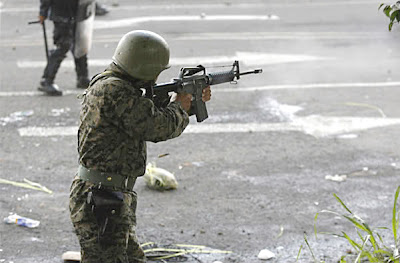
● The Comité para la Defensa de los Derechos Humanos en Honduras (Committee for the Defense of Human Rights in Honduras) issued a report on August 15 listing the names of the 101 Hondurans who have been shot to death in the country during curfew hours since the June 28 coup with what are known to be, or appear to be, 5.56mm bullets, the caliber used by the armed forces and the police. The victims ranged in age from 14 to 60. Thirty-two of the killings occurred in Tegucigalpa, the capital and largest city, and 53 in San Pedro Sula, the second largest city. The committee holds the de facto government of Roberto Micheletti responsible for the killings.

Photo by Oswaldo Rivas, Reuters

Photo from Reuters.


Photo by Orlando Sierra, Agence France Presse.

Photo from Amnesty International.

The Rag Blog

Posted in Rag Bloggers | Tagged , , , , | 4 Comments

BushCo: It Was Worse Than We Thought


Bush Admin. Worse Than Our Nightmares
By Juan Cole / August 21, 2009

It was worse.

Back in the bad old days of Bush’s corrupt gang, we on the left were pilloried for suggesting that the administration was manipulating terrorism-related news in order to win the 2004 elections. But when Tom Ridge says it ….

In fact, I argued in summer, 2004, that when Ridge did raise the terrorism alert, it had the unfortunate effect of outing an al-Qaeda double agent who had been turned by the Pakistani government and was helping set a trap for al-Qaeda in the UK. In turn, that caused the British government to have to move against the people it had under surveillance prematurely, harming the case.

Ridge is alleging he was pressured on the eve of the election. But I still wonder about the circumstances of the summer announcement. He might have been being used then, too, and not known it.

And if any of us had said that Dick Cheney was setting up civilian mercenary assassination squads (at least 007 works for the British government), and set things up so that perhaps neither the CIA director nor the president even knew about it, we would have been branded moonbats. But well, that is today’s story.

You shudder to think what hasn’t come out yet.

If Bush and his gang falsely put up the terror alert or even tried to, for partisan political gain, that is a sort of treason. If they thereby ruined a British surveillance operation, they recklessly endangered US and NATO security. If they were arranging for civilian mercenaries to murder people . . . well you’d have to say that they were at least planning to be murderers. (The wingnuts will say that Xe was only being contracted to kill al-Qaeda types; but the wingnuts wouldn’t be able to tell a Barelvi from an al-Qaeda supporter if their lives depended on it, and I wouldn’t exactly trust Mr. Prince to be fair to Muslims.)

The horrible thing is that Wolf Blitzer on CNN assembled David Frum and Frances Townsend, former members of the Bush administration, to sit around on his afternoon news and analysis program on Thursday afternoon and more or less either call Ridge a liar or pooh-pooh the significance of what he is saying. There wasn’t a single centrist or left of center voice to show any outrage. I mean, I know that Time Warner is not made up of people who necessarily care about the little person or social justice or anything. But a little bit of shame?

It isn’t enough that the corporate media lied to us for Bush for 8 years, they are continuing to do it. Give money to Amy Goodman.

Source / Informed Comment

The Rag Blog

Posted in RagBlog | Tagged , , | 1 Comment

A Letter from Dick Motherfucker

Photo of the author by Alan Pogue.

A LETTER: 211 DAYS and counting
By Dick Motherfucker / August 18, 2009

To my Compatriots, comrades, partners, friends and lovers,

Some Q’s:

Ain’t it about time yet? Snap out of it! How long are you gonna continue to bullshit yourselves? Are you going to HOPE forever that things are going to CHANGE? Do you still think that this president is going to stop these senseless, unwinnable wars? Wake the fuck up!! Can you find any difference between obama and bush except that this prez can read and write the English language?

Some A’s

I don’t hate to say “I told you so.” But it gives me no joy to have to remind you that I did tell you so. On several occasions, way back, a year and a half or so ago I tried to open your eyes to the obvious, but, as time passed my warnings were drowned out by Obamamania, and so you had your way.

First you were sucked into voting, you joined the self-righteous masses and went to the polls adding your number to those who “approve” of this CCE (Continuing Criminal Enterprise) that call themselves a government. You should be ashamed of yourselves. Don’t beg the question here, just because a lot of other people did it too, that should not lessen your responsibility.

All right, that was then and this is now. Shit happens. Don’t beat yourself up over your mistakes of the past. On second thought, punch yourself in the face a couple times. I HOPE that woke you up.

You have been prancing around like a bevy of bliss bunnies over Obama’s victory for 211 days now. And what did you win? Squat. Even less than squat.

So, what’s it gonna be? Are you going to stand there hoping and grinning while you are getting fucked or are you going to free yourself, and take a stand to STOP these brutal and criminal wars? It ain’t easy but it can be done, remember we did it before. They are getting away with it because YOU are letting them get away with it.

Let me help you get started with my anarchist/outlaw plan to STOP THE WARS!!

1. ORGANIZE YOURSELVES. Build your anti-war affinity group. Start slow, find the next two and form the basic pact, then plan on adding six to eight more. Practice moving together, learn point and slack, take control of your streets, eat together, sleep together (yeah, anti-war can be fun,) love one another, this is your strength. Love one another.

2. ARM YOURSELVES. Not with anything sharp or that makes a loud noise, (at first) you don’t need any cut fingers or toes blown off. Arm yourself first with information; know your song well before you start singing. Carry: superglue for locks that shouldn’t be opened, red and black magic markers (slicks) to leave the enemy a warning, bolt cutters (learn the pattern of chain link fences,) disguises so you fit in anywhere

2b. Finish this list of arms.

3. TAKE ACTION. That’s right, DO SOMETHING. Every day, two actions a day, one a personal action and one with your AG. DO SOMETHING. Seal a lock, spray paint a pig sign, encourage anarchy wherever you are, cut a fence, be an outlaw for peace. DO SOMETHING to disable the death megamachine….

3b. Finish this list of actions.

Well kiddies there it is, as easy as 1, 2, 3. Start now; our sisters and mothers, brothers and uncles, cousins, are dying; only we can save them. Know this, the face of the murderer behind the mask is not the Tally band, or the mythical Al Kyder, they can only plead self-defense, the face was LBJ/Nixon and now is Bush/Obama.

Armed Love,
Dick Motherfucker (At large)

The Rag Blog

Posted in RagBlog | Tagged , , | 6 Comments

Republicans, Religion and the Triumph of Unreason

Graphic by R.S. Janes / LT Saloon

Shrill, baby, shrill:
How do they train themselves to be so impervious to reality?

By Johann Hari / August 21, 2009

Something strange has happened in America in the nine months since Barack Obama was elected. It has best been summarised by the comedian Bill Maher: “The Democrats have moved to the right, and the Republicans have moved to a mental hospital.”

The election of Obama –- a black man with an anti-conservative message –- as a successor to George W. Bush has scrambled the core American right’s view of their country. In their gut, they saw the US as a white-skinned, right-wing nation forever shaped like Sarah Palin.

When this image was repudiated by a majority of Americans in a massive landslide, it simply didn’t compute. How could this have happened? How could the cry of “Drill, baby, drill” have been beaten by a supposedly big government black guy? So a streak that has always been there in the American right’s world-view –- to deny reality, and argue against a demonic phantasm of their own creation –- has swollen. Now it is all they can see.

Since Obama’s rise, the US right has been skipping frantically from one fantasy to another, like a person in the throes of a mental breakdown. It started when they claimed he was a secret Muslim, and –- at the same time – that he was a member of a black nationalist church that hated white people. Then, once these arguments were rejected and Obama won, they began to argue that he was born in Kenya and secretly smuggled into the United States as a baby, and the Hawaiian authorities conspired to fake his US birth certificate. So he is ineligible to rule and the office of President should pass to… the Republican runner-up, John McCain.

These aren’t fringe phenomena: a Research 200 poll found that a majority of Republicans and Southerners say Obama wasn’t born in the US, or aren’t sure. A steady steam of Republican congressmen have been jabbering that Obama has “questions to answer.” No amount of hard evidence –- here’s his birth certificate, here’s a picture of his mother heavily pregnant in Hawaii, here’s the announcement of his birth in the local Hawaiian paper –- can pierce this conviction.

This trend has reached its apotheosis this summer with the Republican Party now claiming en masse that Obama wants to set up “death panels” to euthanise the old and disabled. Yes: Sarah Palin really has claimed –- with a straight face –- that Barack Obama wants to kill her baby.

You have to admire the audacity of the right. Here’s what’s actually happening. The US is the only major industrialised country that does not provide regular healthcare to all its citizens. Instead, they are required to provide for themselves – and 50 million people can’t afford the insurance. As a result, 18,000 US citizens die every year needlessly, because they can’t access the care they require. That’s equivalent to six 9/11s, every year, year on year. Yet the Republicans have accused the Democrats who are trying to stop all this death by extending healthcare of being “killers” –- and they have successfully managed to put them on the defensive.

The Republicans want to defend the existing system, not least because they are given massive sums of money by the private medical firms who benefit from the deadly status quo. But they can’t do so honestly: some 70 per cent of Americans say it is “immoral” to retain a medical system that doesn’t cover all citizens. So they have to invent lies to make any life-saving extension of healthcare sound depraved.

A few months ago, a recent board member for several private health corporations called Betsy McCaughey reportedly noticed a clause in the proposed healthcare legislation that would pay for old people to see a doctor and write a living will. They could stipulate when (if at all) they would like care to be withdrawn. It’s totally voluntary. Many people want it: I know I wouldn’t want to be kept alive for a few extra months if I was only going to be in agony and unable to speak.

But McCaughey started the rumour that this was a form of euthanasia, where old people would be forced to agree to death. This was then stretched to include the disabled, like Palin’s youngest child, who she claimed would have to “justify” his existence. It was flatly untrue –- but the right had their talking-point, Palin declared the non-existent proposals “downright evil”, and they were off.

It’s been amazingly successful. Now, every conversation about healthcare has to begin with a Democrat explaining at great length that, no, they are not in favour of killing the elderly –- while Republicans get away with defending a status quo that kills 18,000 people a year. The hypocrisy was startling: when Sarah Palin was Governor of Alaska, she encouraged citizens there to take out living wills. Almost all the Republicans leading the charge against “death panels” have voted for living wills in the past. But the lie has done its work: a confetti of distractions has been thrown up, and support is leaking away from the plan that would save lives.

These increasingly frenzied claims have become so detached from reality that they often seem like black comedy. The right-wing magazine US Investors’ Daily claimed that if Stephen Hawking had been British, he would have been allowed to die at birth by its “socialist” healthcare system. Hawking responded with a polite cough that he is British, and “I wouldn’t be here without the NHS”.

This tendency to simply deny inconvenient facts and invent a fantasy world isn’t new; it’s only becoming more heightened. It ran through the Bush years like a dash of bourbon in water. When it became clear that Saddam Hussein had no weapons of mass destruction, the US right simply claimed they had been shipped to Syria. When the scientific evidence for man-made global warming became unanswerable, they claimed – as one Republican congressman put it – that it was “the greatest hoax in human history”, and that all the world’s climatologists were “liars”. The American media then presents itself as an umpire between “the rival sides”, as if they both had evidence behind them.

It’s a shame, because there are some areas in which a conservative philosophy –- reminding us of the limits of grand human schemes, and advising caution –- could be a useful corrective. But that’s not what these so-called “conservatives” are providing: instead, they are pumping up a hysterical fantasy that serves as a thin skin covering some raw economic interests and base prejudices.

For many of the people at the top of the party, this is merely cynical manipulation. One of Bush’s former advisers, David Kuo, has said the President and Karl Rove would mock evangelicals as “nuts” as soon as they left the Oval Office. But the ordinary Republican base believe this stuff. They are being tricked into opposing their own interests through false fears and invented demons. Last week, one of the Republicans sent to disrupt a healthcare town hall started a fight and was injured – and then complained he had no health insurance. I didn’t laugh; I wanted to weep.

How do they train themselves to be so impervious to reality? It begins, I suspect, with religion. They are taught from a young age that it is good to have “faith” – which is, by definition, a belief without any evidence to back it up. You don’t have “faith” that Australia exists, or that fire burns: you have evidence. You only need “faith” to believe the untrue or unprovable. Indeed, they are taught that faith is the highest aspiration and most noble cause. Is it any surprise this then percolates into their political views? Faith-based thinking spreads and contaminates the rational.

Up to now, Obama has not responded well to this onslaught of unreason. He has had a two-pronged strategy: conciliate the elite economic interests, and joke about the fanatical fringe they are stirring up. He has (shamefully) assured the pharmaceutical companies that an expanded healthcare system will not use the power of government as a purchaser to bargain down drug prices, while wryly saying in public that he “doesn’t want to kill Grandma.” Rather than challenging these hard interests and bizarre fantasies aggressively, he has tried to flatter and soothe them.

This kind of mania can’t be co-opted: it can only be overruled. Sometimes in politics you will have enemies, and they must be democratically defeated. The political system cannot be gummed up by a need to reach out to the maddest people or the greediest constituencies. There is no way to expand healthcare without angering Big Pharma and the Republicaloons. So be it. As Arianna Huffington put it, “It is as though, at the height of the civil rights movement, you thought you had to bring together Martin Luther King and George Wallace and make them agree. It’s not how change happens.”

However strange it seems, the Republican Party really is spinning off into a bizarre cult who believe Barack Obama is a baby-killer plotting to build death panels for the grannies of America. Their new slogan could be –- shrill, baby, shrill.

Source / The Independent, U.K.

Thanks to S.M. Wilhelm / The Rag Blog

Posted in RagBlog | Tagged , , , | 9 Comments

Berlin : A Look at Health Care in Germany

Some U.S. Citizens in Germany comparing, contrasting and acting upon health care issues. That’s The Rag Blog’s David MacBryde hovering in the back and scratching his head (lower picture). Photos by Karen Axelrad / The Rag Blog.

Americans in Germany:
How health care works here

By David MacBryde / The Rag Blog / August 21, 2009
BERLIN — While health care issues are difficult and can be complicated, there was certainly a shared sense that although health care in Germany can be improved, on the whole it is comparatively better than the current situation in the USA.

There was no controversy about the point that some German beers are great. There was lots of controversy about health care issues, but a common sense that on the whole health care in Germany is better and is worth looking at.

Below is a FAQs about some of the issues. This was written by two Americans in Germany, Carolyn Prescott and Ann Wertheimer, to encourage discussion and robust reform, and to urge Americans here to write home to friends and representatives.

Frequently asked questions about health care coverage in Germany


Question: Why should we as Americans consider features of the German system in crafting our own health care reform?

Answer
: In planning our own public health care system, we should investigate the strengths and weaknesses of many other systems. We can then choose the best of some of them and avoid the pitfalls of others.

Question: Does Germany have a single-payer system?

Answer: No, it is a hybrid system: a public plan and private plans. The public option covers about 90% percent of the German population, with most of the rest covered under private insurance.

Question: What does public option mean in Germany?

Answer: Germany has around two hundred nonprofit companies called sickness funds, which comprise the public option. Germans can select from these sickness funds, each of which provides their members with a comprehensive benefit package. The sickness funds are nonprofit entities; there is nevertheless competition for price and quality among them because the funds seek to survive and grow.(1)

Public option sickness funds may not refuse someone on the basis of a pre-existing condition or drop them if they become ill. A centralized agency administers a pool of money to sickness funds to cover their sicker patients; that is, they ensure that sickness funds have the means to cover the health needs of those people they carry who have chronic illnesses such as diabetes or intensive illnesses such as cancer.

Question: Is enrollment in the German system mandated? If so, who pays for people who can’t pay?

Answer: Yes, health care coverage is mandatory; you must be covered by some plan, either public or private. Employed persons generally have half of their premiums paid by their employer. Unemployed persons remain members of the sickness funds they were in when employed. Their contributions are paid by federal and local governments. The contributions of retirees are paid by the pensioners themselves and by their pension funds. Thus, the public health insurance program redistributes from higher to lower income groups, from the healthy to the sick, from the young to the old, from the employed to the unemployed, and from those without children to those with children. The idea is that everybody’s in it together, and nobody should be without health insurance.(2)

Question: How much does the average German pay for health care under the public option?

Answer: State health insurance contributions are based on your gross income (around 15.5% with an income cap), with employers and employees each paying about half of the premium. The individual’s contribution is 8.2%; the employer pays the remaining 7.3%. In addition, Germans are now required to carry long-term nursing care insurance, which is charged at 2.2% of your gross income, with employers paying half.(3)

The income cap is $62,781, or around $5,232 per month (July 28, 2009 conversion rate). So if you make, for example, $85,000,. per year, your contribution would be the same as that of someone who makes $62,781 per year (4 ), even though that would amount to a lower percentage of your income.

Benefits are commensurate with those of most major medical insurance plans in the U.S. and include basic dental care. There are no deductibles and only minimal copayments.

Again, premiums are set according to earnings rather than risk and are not affected by a member’s marital status, family size, or health; they are the same for all members of a particular fund with the same earnings. In a household with two wage earners, each pays the full premium assessed by his or her sickness fund according to his or her income.

Question: How much are health care costs in Germany compared to those in the U.S.?

Answer: Health care costs for an entire country are measured in terms of the percentage of gross national product (GNP). In Germany that percentage is 10.7% of GNP, while in the U.S. it is 15.3% (2008 figures).(5) When the costs for various treatments and procedures are compared, the costs in Germany average about a third of those for the same procedure or medication in the U.S.

Question: Are there waiting lists for surgeries, expensive treatments, etc. in Germany? Are high-tech diagnostic procedures and treatments readily available?

Answer: There is no waiting time in the case of acute illnesses and emergencies. Waiting times to see specialists and to undergo surgeries and treatments tend to be quite similar to those in the U.S. Elective surgeries have an average waiting time of one month. High-tech diagnostic procedures and treatments are readily available.

Question: Do doctors or dentists in Germany bear high costs for their medical education?

Answer: Medical and dental schools, like all other forms of higher education, are virtually free in Germany, requiring only the payment of administrative fees. Of course, medical students, like students in all fields, must pay for their own room and board. Young people who can’t afford their room and board while they are getting an advanced degree are eligible for various kinds of public loans. Repeat: there is no tuition for medical or dental school, or any other advanced degree, in Germany. Tertiary education in Germany is virtually all public.

Germany has more physicians per capita than the United States, and physicians typically make less than in the States. For example, a family doctor in Germany makes about two-thirds as much as he or she would in America.(6)

Question: Do doctors or dentists in Germany bear high costs for malpractice insurance?

Answer: German doctors pay less for malpractice protection through medical protective associations rather than through for-profit medical malpractice insurance companies.

Question: How much are typical deductibles and co-pays for Germans under the public option insurance?

Answer: There are no deductibles. Under the public option, a patient pays 10 euros (about $15 as of this writing) per quarter year; that is, 10 euros are paid for the first doctor’s visit during a quarter of a year. If no visit is made during, let’s say, January 1 through March 31, no payment is required. If there are many visits, the payment is still only 10 euros. The dentist costs another 10 euros for the first visit per quarter. In-patient hospital days now have a co-pay of 10 Euros per day up to 28 days. There are generally no further co-pays except for a few designated treatments; such as dental crowns, for example.

Question: Does public option insurance pay for medication?

Answer: Medications have co-payments of between 5 and 10 euros (around $8 to $15) per prescription.

Question: Do you pay your bills and get reimbursed, or does the insurance pay directly?

Answer: You submit your health insurance identification card to the doctor, dentist or hospital and make your copayment, if there is one. You do not see the bill.

Question: Is there rationing?

Answer: While doctors may feel some pressure to hold down costs, treatment decisions are not generally individually arbitrated through the sickness funds. Some treatment decisions may require evidence of need; for example, a dentist has to show the need for certain types of extensive gum treatments.

Under the law that applies to the German health care system, there is a Joint Federal Committee composed of representatives from associations of physicians, dentists, hospitals and sickness funds. The JFC assesses the effectiveness of traditionally covered services and of new diagnostic and therapeutic procedures. Coverage guidelines are issued after public notice of the subjects under consideration, and comments by interested parties and experts enter into the decision-making. JFC decisions on procedures are made according to evidence-based criteria. Such criteria range from randomized, controlled clinical studies to consensus conferences and expert opinions. Since care under the law must correspond to the generally accepted standard of medical knowledge and the progress of medical science, clinical practice guidelines and prevailing practices are highly relevant for coverage guideline validity. In case of individual sickness fund denials of reimbursement of a treatment not yet addressed by a JFC guideline, patients may appeal to a special court that will consider the evidence; generally one does not need to hire a lawyer to go through this process. Thus there are checks on the power of the JFC to limit clinical autonomy.(7) There is no age rationing for any procedure.

To make this process somewhat more concrete, we offer a few examples of costs refused or limited versus those paid for by one or more sickness funds: Some disallowed treatments under the public option, for example, are homeopathic remedies, Vitamin B injections (except in the case of a proven deficiency), and Viagra (considered a lifestyle drug). In some cases, the sickness funds cover a basic need such as glasses or a hearing aid, but if the patient wants a top-of-the-line, in-the-ear hearing aid or designer glasses, he or she must supplement the basic amount paid by the sickness fund. A few examples of treatments that are fully covered in the German system are very expensive, end-of-life cancer drugs; mental health therapies and medications; and home care hospice services. In addition, some sickness funds pay for preventive measures such as up to 20 yoga sessions per year or Nordic walking courses, both of which have reportedly been shown through clinical trials to be beneficial in preventing certain illnesses or improving health.

Question: Is there a lot of bureaucracy?

Answer: Administration costs of the system, which is another way of referring to and measuring bureaucracy, account for about 6 percent of spending in the public option sickness funds (which again, cover about 90% of the population).(8) Patients experience virtually no bureaucracy; they do not have to deal with any agent or financial paperwork. Among the private insurance companies in Germany, the administrative costs are around 17%. In the U.S. system, administrative costs are estimated at close to one-fifth, or 20%, of total costs. So bureaucracy is actually much less in the public option health care system.

Question: How many Germans go bankrupt in a year because of medical bills?

Answer: In Germany it is impossible to go bankrupt because of medical bills, since even if you declare bankruptcy, the social solidarity system pays for your medical care. The idea is, if you do have financial problems and a lot of worries for other reasons, you do not need to have another burden in not being able to pay medical bills.(9)

Question: If you lose your job or get sick and cannot work, what happens to your health insurance?

Answer: Health insurance continues with no change if you lose a job. Germans simply do not have this worry that they will be without coverage for themselves and their family members.

Question : If the public option is so good, why do some people choose private insurance?

Answer: About 10% of the population is covered under private insurance. Anyone who makes more than $69,187 per year for at least a three-year period has the option of choosing private insurance.(10) People who are civil servants, self-employed or freelance also have this option, even if they do not meet the income requirement. For some people who are still young and healthy and earn high salaries, private health insurance may be (temporarily) cheaper than the public option. Others choose private insurance to ensure that they have certain privileges: a private room in case of hospitalization, payment for homeopathic remedies, or spa cures. Some people also supplement their public insurance with private insurancein order to gain these and other privileges.

Question : What are the problems of the German health care system?

Answer: There is pressure on the health care system because of the relatively high rate of unemployment in Germany. Hospital personnel, including doctors, have demonstrated and lobbied in recent years to get higher allocations (and doctors have just won increases that average out to 7.8%, varying according to specialization and geographic area). Copayments were introduced a few years ago to try to bring more money into the system. Nonetheless, the German health care system dates back to 1883 and has proven to be both flexible and robust. During the last two decades, Germans have tweaked their system, on average, every three years in order to try to address problems and keep costs under control.

————————————————————————
Footnotes:

(1) Interview with Kurt Lauterbach, in Frontline: Sick Around the World: Five Capitalist Democracies and How They Do It, Public Broadcasting System series, April 2008.

(2) “Most Germans Happy with German Health Care,” National Public Radio feature, reported by Richard Knox, produced by Jane Greenhalgh, June, 2008.

(3) Krankenkassentarife, an independent website that provides information (in German) on the German health care laws, 2009:

(4) Krankenkassentarife website.

(5) Frontline: Sick Around the World: Five Capitalist Democracies and How They Do It , Public Broadcasting System series, April 2008. http: www.pbs.org/wgbh/pages/frontline/sickaroundtheworld/etc/graphs.html

(6) Frontline interview with Kurt Lauterbach.

(7) Ursula Weide, “Law and the German Universal Health Care System: A Contemporary Overview,” German Law Journal No. 8 (1 August 2005).

(8) Frontline interview with Kurt Lauterbach.

(9) Frontline interview with Kurt Lauterbach.

(10) Krankenkassentarife website.

[David MacBryde — our correspondent in Berlin — was an Austin activist and a contributor to The Rag Blog’s historical precursor, The Rag , a pioneering member of the Sixties underground press.]

The Rag Blog

Posted in Rag Bloggers | Tagged , , | 2 Comments