Bob Dylan. Born, May 24, 1941.
Thanks to Harry Edwards / The Rag Blog
Stephen was music, a genuine player’s player… Kristofferson called him ‘the best damn rock and roll guitar player in the world.’
By Joe Nick Patoski / The Rag Blog / May 24, 2009
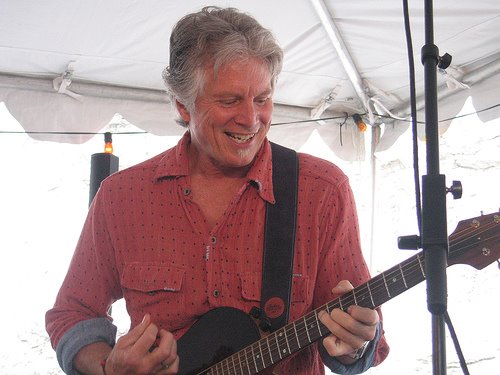
Turner Stephen Bruton, the Fort Worth Flash and “the best damn rock and roll guitar player in the world,” as his friend, mentor, and bandleader Kris Kristofferson would introduce him night after night, rode off into the sunset on Saturday, May 9, at the doorstep of the Pacific Ocean.
Stephen was music, a genuine player’s player. He was a mandolinist, banjo picker and guitarist who trafficked in bluegrass at Arlington Heights High School where he was recognized as Most Talented and performed with the Brazos Valley Ramblers. His mom and dad ran Record Town, a record shop across from TCU that his brother and mother still run today, and one of the greatest dispensers of “hep” Fort Worth ever had, educating critic Dave Hickey, producer T-Bone Burnett, and western swing scholar Kevin Coffey, among others.
He rambled around briefly after graduating from high school, hanging out in Woodstock with Geoff Muldaur and the players in the Band before hooking up with Kris Kristofferson, for whom he ended up playing lead guitar for 17 years. Back home, he dove into the blues at local jooks, most prominently the New Bluebird Nite Club, where he and his high school music buddy T-Bone (formerly J. Henry) Burnett co-produced an exceptional gritty live recording of Robert Ealey & His Five Careless Lovers, a band that included Stephen’s brother Sumter. Stephen fronted his own occasional Fort Worth band, Little Whisper & the Rumors with Jim Colegrove, whom he’d met up in Woodstock, when he wasn’t hanging in his new hometown of Los Angeles, where he was the kid with the gig to a cadre of hungry Fort Worth expats including Delbert McClinton and Glen Clark.
After leaving Kristofferson, Stephen joined up with Bonnie Raitt just as she was enjoying her second burst of fame for Give It Up for an extended spell, writing songs for her. He briefly worked with Bob Dylan.
In the 1980s, Stephen drifted from LA down to Austin where he reinvented himself as a producer (Alejandro Escovedo, Marcia Ball,Jimmie Dale Gilmore, Hal Ketchum, Chris Smither, Storyville, among others) and a session player, recording with Elvis Costello, T-Bone,Delbert, B.B.King, Lowell George, Bob Neuwirth, and the Wallflowers, while playing solo and band gigs inAustin. His songs were covered by Hal Ketchum, Kris Kristofferson, Rita Coolidge, Willie Nelson, Waylon Jennings, Johnny Cash, Patty Loveless, Jimmy Buffet, and Bonnie Raitt.
For the past 13 years, he fronted the Resentments, a collective of clean and sober players (Jon Dee Graham, Scrappy Jud Newcomb, Bruce Hughes, the late Mambo John Treanor and John Chipman) who held court early Sunday evenings at the Saxon Club, an under the radar joint where they developed a bar band groove so cool, they were “discovered” and toured Japan and Europe, but hardly anywhere else in the United States.
His sobriety helped inspire others, including Stevie Ray Vaughan,to straighten up and save themselves, which he shared with me for the book Stevie Ray Vaughan: Caught in the Crossfire
Stephen was diagnosed with cancer in December 2006, a few days after I visited him to talk about Willie for the book I was working on. We ended up talking about Fort Worth’s rich but hidden music history, touching Sock Underwood, Robert Johnson, and graveyard jams involving white and black musicians in the days of segregation.
After a long fight with his sickness, he left Austin this past winter when T-Bone Burnett chartered a jet for Stephen the night after T-Bone won a Grammy and brought him to Los Angeles where they were working on a movie soundtrack.
Stephen had a full life despite barely making it to 60. He had so much more in him, though, his early exit is a huge loss for those who knew him and loved him and those who simply knew him through his music.
[Joe Nick Patoski, who lives near the village of Wimberley in the Texas Hill Country, writes about Texas and Texans. He has authored biographies of Willie Nelson, Selena and Stevie Ray Vaughan and has been published in numerous periodicals including Rolling Stone and Texas Monthly. A version of this article appeared on his blog, Notes and Musings.]
It would be nice if we saw this sort of thing in the US more often. In Canada, it’s almost an annual tradition to introduce these sorts of bills into Parliament for consideration. Maybe someday, legislators world-wide will become enlightened enough to actually pass these into law.
Richard Jehn / The Rag Blog

B.C. MP tables ‘peace tax’ bill
May 24, 2009
A private member’s bill proposed by a B.C. MP would see income tax paid by Canadians who oppose war be put into a special account not to be used by the military.
Burnaby-Douglas New Democrat MP Bill Siksay said he wants conscientious objectors to be able to register with the Canada Revenue Agency so their taxes can be diverted to a special peace tax account.
If Bill C-390 passes, the government would be able to access the account for anything except military spending.
“The reality is this would be a symbolic measure because the government still collects … tax dollars from everybody and the government will still decide how they are spent,” Siksay said.
“But it makes a point about some people who believe that the government shouldn’t be spending money on making war or buying armament.”
Siksay acknowledged the bill has little chance of passing, but said that’s not the point.
“You know, you table private member’s bills and motions to make a point and to try to stimulate discussion on issues and to provide a specific tool for lobbying and promoting change, and that’s what this particular private member’s bill about the peace tax is all about,” he said.
In 1983, the first private member’s bill calling for a National Peace Tax Fund was introduced into the House of Commons.
The bill has been reintroduced over a dozen times since.
Source / CBC News
Many thanks to Deva Wood / The Rag Blog

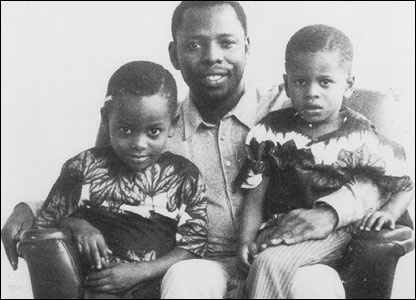
Now at last it’s time for Shell to atone for my father’s death
The son of the executed activist faces the oil giant in a human rights trial this week. He seeks understanding rather than retribution.
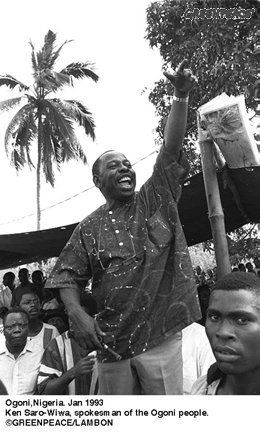
By Ken Saro-Wiwa Jnr / May 24, 2009
This week, a US court will hear a case that I and nine other plaintiffs filed against Royal Dutch Shell for its part in human rights violations committed against some Ogoni families and individuals in Nigeria in 1995. For some, the case is already being cast as a bookmark in the struggle for corporate accountability, but to me and the other nine plaintiffs it is all that and more.
Fourteen years ago, Ken Saro-Wiwa predicted that Shell would one day have to account for its actions in Nigeria. “I repeat,” he wrote in what would have been his final statement to the military tribunal that was to order his execution, “that I and my colleagues are not the only ones on trial. Shell is here on trial… the company has, indeed, ducked this particular trial, but its day will surely come … there is no doubt in my mind that the ecological war that the company has waged in the delta will be called to question sooner than later and the crimes of that war be duly punished. The crime of the company’s dirty wars against the Ogoni people will also be punished.”
My father was prevented from making his final statement to the court and he and eight of his colleagues were tried and executed for their alleged role in the harrowing murders of four Ogoni chiefs including his brother-in-law. The murders divided my family and set Ogoni against Ogoni, providing a convenient excuse for the military regime to arrest my father, detain and torture scores of innocent men and send in a military taskforce whose leader publicly vowed to “sanitise” Ogoni so that Shell could drill oil in my community.
Ken Saro-Wiwa’s real “crime” was his audacity to sensitise local and global public opinion to the ecological and human rights abuses perpetrated by Shell and a ruthless military dictatorship against the Ogoni people. The success of his campaign had mobilised our community to say “No to Shell” and to demand compensation for years of oil spills that had polluted our farms, streams and water sources. My father called the world’s attention to the gas flares that had been pumping toxic fumes into the Earth’s atmosphere for up to 24 hours a day since oil was discovered on our lands in 1958. He accused Shell of double standards, of racism and asked why a company that was rightly proud of its efforts to preserve the environment in the west would deny the Ogoni the same.
In response to his campaign, Shell armed, financed and otherwise colluded with the Nigerian military regime to repress the non-violent movement, leading to the torture and shootings of Ogoni people as well as massive raids and the destruction of Ogoni villages. In an infamous memo, Colonel Paul Okuntimo, the head of the military taskforce sent to pacify Ogoni, boasted that Shell provided the logistics for his soldiers. In one incident, Shell was building an oil pipeline and requested support from the Nigerian military. The pipeline destroyed Karalolo Kogbara’s farm and, as she was crying over her lost crops, the soldiers shot her. In another incident, Uebari N-nah was shot and killed by soldiers near a Shell flow station; the soldiers were requested by and later compensated by Shell.
A year after the executions, some of the relatives of what has become known as the “Ogoni Nine” filed a federal lawsuit against Shell in a district court in New York. We felt we would not get a fair hearing in a Nigeria groaning under the very same military dictatorship that had colluded with Shell to violate the human rights of our relatives and our community.
In response Shell, which denied that it encouraged violence against Ken Saro-Wiwa, or other Ogonis, and said it attempted to persuade the Nigerian government to grant clemency to the Ogoni 9, hired the most expensive legal minds to prevent us from holding them to account for their actions in the US. Their filibustering brought 13 years of time, four spent arguing over where they should stand trial.
No doubt Shell will try to present themselves as the victims, whose only interest was to produce hydrocarbons in a “challenging” business environment. But can you be so sure of Shell? This, after all, is a company that, as revealed in an investigation by this paper in January 1996, lied about importing arms to Nigeria. And even its own consultants concluded in a 2003 report that its community development schemes were fanning the flames of conflict in the Niger Delta. Shell declined to publish the results. Moreover, this is a corporation that was widely reported to have misled investors and shareholders in 2004 about the size of its reserves in places like Nigeria.
For that financial violation, the New York stock exchange moved quickly to protect the rights of shareholders and investors and Shell was fined $100m. It took less than two years to hold a multinational corporation to account in a US court for financial violations in a foreign jurisdiction.
And yet it has taken 14 years to bring a case to trial against the same multinational corporation in a US court for human rights violations.
All over the globe, people are becoming better informed about the global economy. People are joining the dots that connect the oil under their farms to the extravagant lifestyles in the west. You can make these connections via cable television in my village even thought there is no pipe-borne water and the electricity mostly comes from a diesel generator. There is increasing awareness of the connections between irreversible climate change and our thirst for fossil fuels. More and more people are now feeling the effects of unregulated corporations.
My father was not against oil exploration and production. He appreciated many of the benefits of capitalism, valued the “can-do” spirit, the innovation and would never deny the right of anyone to seek adequate reward and fulfilment from their risk and sweat equity. But can we continue to put profits before people and the planet? How do we monitor institutions and organisations that have the capacity to operate and organise themselves beyond the regulation and jurisdiction of the current regimes of global governance?
Ken Saro-Wiwa always maintained that Shell would eventually come to see him as their greatest friend. He believed that the day would come when Shell would understand that its social licence to operate is as valuable as its commercial rights. In a competitive and uncertain world where the price of doing business becomes ever more unpredictable, where more players – Russians, Indians and Chinese – are able to compete for drilling rights, it will become ever more important to win the battle for local hearts and minds to advocate for a world run on mutual benefit rather than exploitation.
For the relatives, the trial remains our last opportunity to close this sad chapter in our lives. For 12 years, we have all separately developed strategies to survive, living with the anger and the rage that one’s relative was unjustly murdered and that many of the institutions and individuals who were responsible for human rights violations continued not only to get away with murder but also to profit from their crimes.
We have remained dignified while the world has moved on. Few have ever wondered about the emotional or financial welfare of the victims but real lives, real people were destroyed.
In the face of the provocations and psychological trauma of all this, I have tried to maintain a dignified position, worked assiduously to deny myself the right to grieve in order to find a lasting solution to the challenges of the Ogoni and the Niger Delta in Nigeria.
The day after my father was hanged, I was asked my opinion of Shell and I didn’t hesitate to answer that Shell was part of the problem and must be part of the solution.
I haven’t changed my opinion. I am not interested in retributive justice but a justice that is creative, a justice that enables all stakeholders in this affair to account for and learn lessons from the past so that we can all move forward within a constructive and sustainable framework. We have to remain committed to building the kind of world that ensures that people who live on natural resource-bearing areas are not treated as collateral damage in a senseless race for profit.
With all of its experience in Nigeria, Shell knows that such creative justice is possible and the time for us to move in that direction is at hand.
Source / Guardian Observer
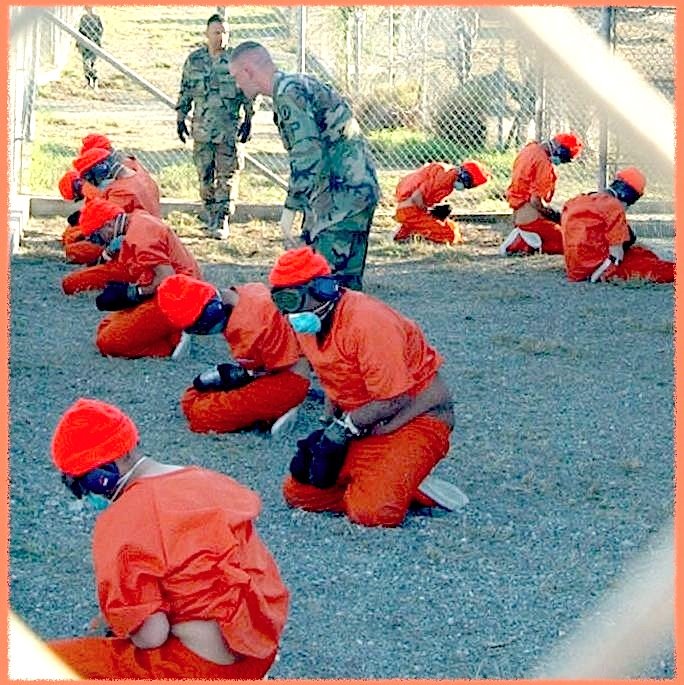
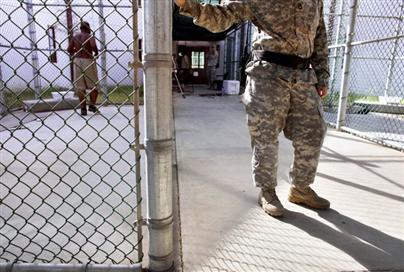
The Republican game plan is to make it look like Obama is about to empty the prison camp down in Cuba, and turn out the lights and let the terrorists be set loose across America.
By Larry Ray / The Rag Blog / May 24, 2009
With only 23 percent of Americans now claiming to be Republicans, what’s left of their party has decided to attack Barack Obama for “not having a plan” to close the Guantanamo Bay Detainee Center. It has been a loud, shameless exercise in fear-mongering.
The protean Senators have said, “Never mind the priority of halting a national financial collapse and possible economic depression in America. Forget the powder keg that is the Taliban and al-Qaida threat in Pakistan and Afghanistan. Personal political futures back home are much more important.
The Senate let personal political priorities guide their 90 to 6 vote to withhold the $80 million Obama requested for the Guantanamo closure till he gives them “a plan.” Scared silly Democrats also joined in the disgraceful fear-mongering vote.
No one would like to get Mr. Bush’s nightmarish mess cleared up more than Mr. Obama. His Thursday speech made clear that work has been underway by legal, military, and diplomatic experts to solve the complex problem since he took office less than 150 days ago. But Republicans desperate to woo back lost votes are all screaming BOOGIE MAN COMING!!
They warn that dangerous terrorists are going to be moved to jails and prisons in their districts back home where they could break out and hide under YOUR bed waiting to get you! The scenario continues with terrorists being turned loose with a new suit of clothes and a few bucks, on the streets of YOUR TOWN! Shamefully, Majority Leader, Harry Reid said, “Part of what we don’t want is them be put in prisons in the United States.” That’s the way to support “real change,” Harry.
The whipped up fear exploits a deeply buried American realization that if we or our family members had been rounded up, shackled, tortured and held with no charges and no rights for seven years we would be mad as hell. Just as mad as the Gitmo prisoners who have been treated that way and are now “headed for the streets of America.” OMG
The Republican game plan is to make it look like Obama is about to empty the prison camp down in Cuba, and turn out the lights and let the terrorists be set loose across America. Lots of plain folks, aided by Dick Cheney’s mad raving on cable TV may actually believe this nonsense.
Just so the politically terrorized can all sleep at night without having to leave the lights on, let’s review some facts:
Thirty three international terrorists, including those with al-Qaida connections are locked up in the Federal prison known as the “Alcatraz of the Rockies,” or ADMAX Florence in Florence, Colorado, and there has been no public outcry at all.
Any bad guys transferred from Guantanamo to the USA will be housed in maximum security, super-max prisons, like the Fort Leavenworth prison and the Florence ADMAX. No dangerous Guantanamo prisoners are to be released in the USA. The most dangerous of the prisoners held in Guantanamo are to be incarcerated as “enemy combatants” in maximum security prisons, as will others awaiting trial in a federal court of law in the US. No one has ever escaped from a super-max prison.
Terrorists and violent criminals are kept in solitary confinement, and when moved outside their cells one hour a day, they are in leg shackles accompanied by three guards. They rarely see other prisoners, are allowed few visitors and their mail is monitored. Ramzi Yousef, who headed the group that carried out the first bombing of the World Trade Center in February 1993 faces this daily routine as a prisoner in the $60 million Florence, Colorado super-max prison.
Let’s look at how many prisoners we are talking about after Guantanamo is finally closed. Since 2002, 775 detainees have been brought to Guantanamo. Some 420 have been released to countries of origin or other countries with no charges against them. In late January 2004, U.S. officials finally released three children aged 13 to 15 swept up as “enemy combatants” and returned them to Afghanistan. As of January 2009, approximately 245 detainees remain and only three of them have been charged.
The US Department of Defense on February 11, 2008, charged terrorists Khalid Sheikh Mohammed, Ramzi Binalshibh, Mustafa Ahmad al-Hawsawi, Ali Abd al-Aziz Ali and Walid Bin Attash for the September 11 attacks under the Military Commissions Act of 2006. Untangling the details of trying these 911 terrorists is part of what is taking time to find a constitutionally and internationally legal approach to handling these cases which involve serious questions, not the least of which include torture.
Earlier, U.S. officials have said they intended to eventually put 60 to 80 prisoners on trial and free the rest. But what to do with those held for years, and never charged? That is one of many tough problems taking so much time to work out. Mr. Cheney and some hard core conservatives would prefer to keep them locked up in Cuba forever, innocent or not, Constitution be damned.
It would seem that our Congressmen and Senators, would all be pitching in on a a plan to work out a diplomatic, constitutional way to deal with these thorny problems and close this sad chapter in our history.
Yes these prisoners include dangerous terrorists who want to hurt America. But all have to be dealt with under the law. Holding them in maximum-security prisons poses no threat to our security at home. Continuing to do what we have been doing for the past seven years in Guantanamo remains a growing threat to our security.
We cannot continue to hold these prisoners in indefinite limbo on our military base in Cuba. The United States Supreme Court has ruled that they are entitled to the protection of the U.S. Constitution, the same constitution our Congressmen and Senators have sworn to defend and uphold.
[Retired journalist Larry Ray is a Texas native and former Austin television news anchor. He also posts at The iHandbill.]
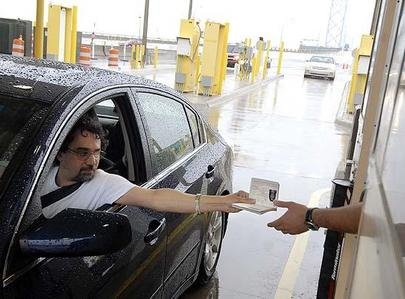
DETROIT – About 15 metres before a car from Canada reaches the border inspection booth, the screenings begin.
A camera snaps your licence plate.
An electronic card reader mounted on a yellow post scans your car for the presence of any radio-frequency ID cards inside. If there is an enhanced driver’s licence embedded with biometric information, its unique PIN number is read without you offering it.
The Customs and Border Protection computer connects with your province’s database and in less than a second – .56 to be exact – your personal information is uploaded to a screen in the booth. A second camera snaps the driver’s face.
Welcome to the United States of America.
If Canadians were under the impression that the Canada-loving U.S. President Barack Obama would heed pleas to loosen border controls to ease trade and traffic, there should no longer be any confusion. He has not.
Beginning June 1, you’d better have that passport ready. Or if you have an enhanced driver’s licence from British Columbia, Manitoba or Quebec, make sure it’s in your wallet, ready to show. (Ontario is now processing applications for the cards.)
Some Canadian MPs, border state lawmakers and Detroit-Windsor area businesses expect the worst when the new controls kick in.
“Either it’s going to cause a massive backup, or it’s going to cause a dramatic decrease in travellers across the border, or it’s going to cause both,” says Melissa Roy of the Detroit Regional Chamber, the largest chamber of commerce organization in the U.S. “It’s an absolute nightmare.”
Obama’s top officials – Homeland Security Secretary Janet Napolitano and Secretary of State Hillary Clinton – signed off long ago on the June 1 deadline for the infamous Western Hemisphere Travel Initiative. That’s the George W. Bush-era policy that Congress pushed through under the 9/11 intelligence reform bill, which requires every person entering the United States by air, sea or land to carry a passport or U.S. government-approved secure identity document.
Napolitano says Canadians had better get used to it. “The future is that there will be a real border,” she told a trade group last month.
This is what that border already looks like:
A post-mounted scanner screens your vehicle for radioactive material that could be used to build a “dirty bomb” – a probe so sensitive it will detect if you’ve recently had a medical test that used isotopes.
As you pull up to the booth, a computer monitor may be filling with information about you, even before the guard asks, “Where are you coming from? What’s your citizenship? Where are you headed? Why?”
If a border lookout, arrest warrant or criminal record pops up on the guard’s screen, or if something doesn’t quite add up – maybe you’re sweating bullets on a cold day – expect to get hauled over for a secondary inspection.
The port of entry at the Ambassador Bridge in Detroit – the busiest commercial land crossing in North America, through which a quarter of all Canada-U.S. trade passes – has strict controls, as does the Detroit-Windsor tunnel.
Border agents, packing pepper spray, collapsible batons and 9-mm automatic pistols, are the first point of contact for people and cargo alike. Sometimes their supervisors order vehicle sweeps at random. Then for 30 minutes, agents will pop every trunk, just for a look-see.
Down below the 80-year-old bridge, dozens of long-haul transport trailers are queued up to go through the same checks, and possibly pass through a giant gamma-ray screening facility that peers inside suspicious 18-wheelers.
Between the legal crossing points, all along the Canada-U.S. border, there’s a new reality.
While the U.S. is not constructing an 1,100-kilometre fence between itself and Canada, as it is doing along its southern border with Mexico, the makings of a virtual fence are in place along what was once known as the world’s longest undefended border.
High in the sky over North Dakota, an unmanned Predator drone is on patrol, equipped with an infrared security camera that looks forward 24 kilometres.
The drone is not authorized to fly in Canadian airspace, but it can peer across into Manitoba. Another one is to be stationed near Detroit next year to scan the Michigan- Ontario boundary.
More daytime and nighttime infrared camera, radar surveillance towers and remote motion sensors are being erected across the northern U.S. border with Canada.
And there are more boots on the ground than ever. Before 9/11, the U.S. had 340 Border Patrol agents along its Canadian border. By next year, there will be more than 2,000.
The Detroit—Port Huron—Sault Ste. Marie regional border patrol operation boasts a fleet of prop planes, small helicopters, a bigger Black Hawk helicopter, speedboats, Coast Guard vessels, even a small Cessna Citation jet.
In Windsor, it makes MPs like the NDP’s Brian Masse nervous about “the militarization of the border.”
He points to the helicopters and drones, and Canada’s willingness to accept U.S. Coast Guard training exercises on the Great Lakes, where boats are equipped with machine guns that fire more than 600 bullets a minute.
It’s all “really changed the nature of the border itself,” Masse says.
Edward Alden, a Canadian journalist and senior fellow at the Council on Foreign Relations in Washington, wrote The Closing of the American Border, which documented the toll of overzealous border policies on the U.S. economy.
He argues “the biggest mistake of the post-9/11 period” was the decision to blur the lines between the fight against terrorism and the fight against illegal immigration.
Alden does not see any evidence of change under Obama. Democrats don’t want to be seen as soft on homeland security, and have been “hawkish since Day One.” But they also are under pressure by a strong Hispanic voting bloc to treat the southern and northern border with what Napolitano calls “parity.”
Chief Ron Smith, public affairs liaison for Customs and Border Protection in Detroit, concedes that when it comes to the northern border, “A lot of people overstate the security threat. If somebody’s trying to sneak into the United States along the northern border, it doesn’t mean they are a terrorist. We get people trying to sneak across the northern border for the same reasons people try to sneak across the southern border.”
Source / Toronto Star
See Rachel Maddow video below.
Facts and myths about Obama’s preventive detention proposal
By Glenn Greenwald / May 22, 2009
In the wake of Obama’s speech on Thursday, there are vast numbers of new converts who now support indefinite “preventive detention.” It thus seems constructive to have as dispassionate and fact-based discussion as possible of the implications of “preventive detention” and Obama’s related detention proposals (military commissions). I’ll have a podcast discussion on this topic a little bit later today with the ACLU’s Ben Wizner, which I’ll add below, but until then, here are some facts and other points worth noting:
(1) What does “preventive detention” allow?
It’s important to be clear about what “preventive detention” authorizes. It does not merely allow the U.S. Government to imprison people alleged to have committed Terrorist acts yet who are unable to be convicted in a civilian court proceeding. That class is merely a subset, perhaps a small subset, of who the Government can detain. Far more significant, “preventive detention” allows indefinite imprisonment not based on proven crimes or past violations of law, but of those deemed generally “dangerous” by the Government for various reasons (such as, as Obama put it yesterday, they “expressed their allegiance to Osama bin Laden” or “otherwise made it clear that they want to kill Americans”). That’s what “preventive” means: imprisoning people because the Government claims they are likely to engage in violent acts in the future because they are alleged to be “combatants.”
Once known, the details of the proposal could — and likely will — make this even more extreme by extending the “preventive detention” power beyond a handful of Guantanamo detainees to anyone, anywhere in the world, alleged to be a “combatant.” After all, once you accept the rationale on which this proposal is based — namely, that the U.S. Government must, in order to keep us safe, preventively detain “dangerous” people even when they can’t prove they violated any laws — there’s no coherent reason whatsoever to limit that power to people already at Guantanamo, as opposed to indefinitely imprisoning with no trials all allegedly “dangerous” combatants, whether located in Pakistan, Thailand, Indonesia, Western countries and even the U.S.
(2) Are defenders of Obama’s proposals being consistent?
During the Bush years, it was common for Democrats to try to convince conservatives to oppose Bush’s executive power expansions by asking them: “Do you really want these powers to be exercised by Hillary Clinton or some liberal President?”
Following that logic, for any Democrat/progressive/liberal/Obama supporter who wants to defend Obama’s proposal of “preventive detention,” shouldn’t you first ask yourself three simple questions:
(a) what would I have said if George Bush and Dick Cheney advocated a law vesting them with the power to preventively imprison people indefinitely and with no charges?;
(b) when Bush and Cheney did preventively imprison large numbers of people, was I in favor of that or did I oppose it, and when right-wing groups such as Heritage Foundation were alone in urging a preventive detention law in 2004, did I support them?; and
(c) even if I’m comfortable with Obama having this new power because I trust him not to abuse it, am I comfortable with future Presidents — including Republicans — having the power of indefinite “preventive detention”?
(3) Questions for defenders of Obama’s proposal:
There are many claims being made by defenders of Obama’s proposals which seem quite contradictory and/or without any apparent basis, and I’ve been searching for a defender of those proposals to address these questions:
Bush supporters have long claimed — and many Obama supporters are now insisting as well — that there are hard-core terrorists who cannot be convicted in our civilian courts. For anyone making that claim, what is the basis for believing that? In the Bush era, the Government has repeatedly been able to convict alleged Al Qaeda and Taliban members in civilian courts, including several (Ali al-Marri, Jose Padilla, John Walker Lindh) who were tortured and others (Zacharais Moussaoui, Padilla) where evidence against them was obtained by extreme coercion. What convinced you to believe that genuine terrorists can’t be convicted in our justice system?
For those asserting that there are dangerous people who have not yet been given any trial and who Obama can’t possibly release, how do you know they are “dangerous” if they haven’t been tried? Is the Government’s accusation enough for you to assume it’s true?
Above all: for those justifying Obama’s use of military commissions by arguing that some terrorists can’t be convicted in civilian courts because the evidence against them is “tainted” because it was obtained by Bush’s torture, Obama himself claimed just yesterday that his military commissions also won’t allow such evidence (“We will no longer permit the use of evidence — as evidence statements that have been obtained using cruel, inhuman, or degrading interrogation methods”). How does our civilian court’s refusal to consider evidence obtained by torture demonstrate the need for Obama’s military commissions if, as Obama himself claims, Obama’s military commissions also won’t consider evidence obtained by torture?
Finally, don’t virtually all progressives and Democrats argue that torture produces unreliable evidence? If it’s really true (as Obama defenders claim) that the evidence we have against these detainees was obtained by torture and is therefore inadmissible in real courts, do you really think such unreliable evidence — evidence we obtained by torture — should be the basis for concluding that someone is so “dangerous” that they belong in prison indefinitely with no trial? If you don’t trust evidence obtained by torture, why do you trust it to justify holding someone forever, with no trial, as “dangerous”?
(4) Do other countries have indefinite preventive detention?
Obama yesterday suggested that other countries have turned to “preventive detention” and that his proposal therefore isn’t radical (“other countries have grappled with this question; now, so must we”). Is that true?
In June of last year, there was a tumultuous political debate in Britain that sheds ample light on this question. In the era of IRA bombings, the British Parliament passed a law allowing the Government to preventively detain terrorist suspects for 14 days — and then either have to charge them or release them. In 2006, Prime Minister Tony Blair — citing the London subway attacks and the need to “intervene early before a terrorist cell has the opportunity to achieve its goals” — wanted to increase the preventive detention period to 90 days, but MPs from his own party and across the political spectrum overwhelmingly opposed this, and ultimately increased it only to 28 days.
In June of last year, Prime Minister Gordon Brown sought an expansion of this preventive detention authority to 42 days — a mere two weeks more. Reacting to that extremely modest increase, a major political rebellion erupted, with large numbers of Brown’s own Labour Party joining with Tories to vehemently oppose it as a major threat to liberty. Ultimately, Brown’s 42-day scheme barely passed the House of Commons. As former Prime Minister John Major put it in opposing the expansion to 42 days:
It is hard to justify: pre-charge detention in Canada is 24 hours; South Africa, Germany, New Zealand and America 48 hours; Russia 5 days; and Turkey 7½ days.
By rather stark and extreme contrast, Obama is seeking preventive detention powers that are indefinite — meaning without any end, potentially permanent. There’s no time limit on the “preventive detention.” Compare that power to the proposal that caused such a political storm in Britain and what these other governments are empowered to do. The suggestion that indefinite preventive detention without charges is some sort of common or traditional scheme is clearly false.
(5) Is this comparable to traditional POW detentions?
When Bush supporters used to justify Bush/Cheney detention policies by arguing that it’s normal for “Prisoners of War” to be held without trials, that argument was deeply misleading. And it’s no less misleading when made now by Obama supporters. That comparison is patently inappropriate for two reasons: (a) the circumstances of the apprehension, and (b) the fact that, by all accounts, this “war” will not be over for decades, if ever, which means — unlike for traditional POWs, who are released once the war is over — these prisoners are going to be in a cage not for a few years, but for decades, if not life.
Traditional “POWs” are ones picked up during an actual military battle, on a real battlefield, wearing a uniform, while engaged in fighting. The potential for error and abuse in deciding who was a “combatant” was thus minimal. By contrast, many of the people we accuse in the “war on terror” of being “combatants” aren’t anywhere near a “battlefield,” aren’t part of any army, aren’t wearing any uniforms, etc. Instead, many of them are picked up from their homes, at work, off the streets. In most cases, then, we thus have little more than the say-so of the U.S. Government that they are guilty, which is why actual judicial proceedings before imprisoning them is so much more vital than in the standard POW situation.
Anyone who doubts that should just look at how many Guantanamo detainees were accused of being “the worst of the worst” yet ended up being released because they did absolutely nothing wrong. Can anyone point to any traditional POW situation where so many people were falsely accused and where the risk of false accusations was so high? For obvious reasons, this is not and has never been a traditional POW detention scheme.
During the Bush era, that was a standard argument among Democrats, so why should that change now? Here is what Anne-Marie Slaughter — now Obama’s Director of Policy Planning for the State Department — said about Bush’s “POW” comparison on Fox News on November 21, 2001:
Military commissions have been around since the Revolutionary War. But they’ve always been used to try spies that we find behind enemy lines. It’s normally a situation, you’re on the battlefield, you find an enemy spy behind your lines. You can’t ship them to national court, so you provide a kind of rough battlefield justice in a commission. You give them the best process you can, and then you execute the sentence on the spot, which generally means executing the defendant.
That’s not this situation. It’s not remotely like it.
As for duration, the U.S. government has repeatedly said that this “war” is so different from standard wars because it will last for decades, if not generations. Obama himself yesterday said that “unlike the Civil War or World War II, we can’t count on a surrender ceremony to bring this journey to an end” and that we’ll still be fighting this “war” “a year from now, five years from now, and — in all probability — 10 years from now.” No rational person can compare POW detentions of a finite and usually short (2-5 years) duration to decades or life in a cage. That’s why, yesterday, Law Professor Diane Marie Amann, in The New York Times, said this:
[Obama] signaled a plan by which [Guantanamo detainees] — and perhaps other detainees yet to be arrested? — could remain in custody forever without charge. There is no precedent in the American legal tradition for this kind of preventive detention. That is not quite right: precedents do exist, among them the Alien and Sedition Acts of 1798 and the Japanese internment of the 1940s, but they are widely seen as low points in America’s history under the Constitution.
There are many things that can be said about indefinitely imprisoning people with no charges who were not captured on any battlefield, but the claim that this is some sort of standard or well-established practice in American history is patently false.
(6) Is it “due process” when the Government can guarantee it always wins?
If you really think about the argument Obama made yesterday — when he described the five categories of detainees and the procedures to which each will be subjected — it becomes manifest just how profound a violation of Western conceptions of justice this is. What Obama is saying is this: we’ll give real trials only to those detainees we know in advance we will convict. For those we don’t think we can convict in a real court, we’ll get convictions in the military commissions I’m creating. For those we can’t convict even in my military commissions, we’ll just imprison them anyway with no charges (“preventively detain” them).
Giving trials to people only when you know for sure, in advance, that you’ll get convictions is not due process. Those are called “show trials.” In a healthy system of justice, the Government gives everyone it wants to imprison a trial and then imprisons only those whom it can convict. The process is constant (trials), and the outcome varies (convictions or acquittals).
Obama is saying the opposite: in his scheme, it is the outcome that is constant (everyone ends up imprisoned), while the process varies and is determined by the Government (trials for some; military commissions for others; indefinite detention for the rest). The Government picks and chooses which process you get in order to ensure that it always wins. A more warped “system of justice” is hard to imagine.
(7) Can we “be safe” by locking up all the Terrorists with no charges?
Obama stressed yesterday that the “preventive detention” system should be created only through an act of Congress with “a process of periodic review, so that any prolonged detention is carefully evaluated and justified.” That’s certainly better than what Bush did: namely, preventively detain people with no oversight and no Congressional authorization — in violation of the law. But as we learned with the Military Commissions Act of 2006 and the Protect America Act of 2007, the mere fact that Congress approves of a radical policy may mean that it is no longer lawless but it doesn’t make it justified. As Professor Amann put it: “no amount of procedures can justify deprivations that, because of their very nature violate the Constitution’s core guarantee of liberty.” Dan Froomkin said that no matter how many procedures are created, that’s “a dangerously extreme policy proposal.”
Regarding Obama’s “process” justification — and regarding Obama’s primary argument that we need to preventively detain allegedly dangerous people in order to keep us safe — Digby said it best:
We are still in a “war” against a method of violence, which means there is no possible end and which means that the government can capture and imprison anyone they determine to be “the enemy” forever. The only thing that will change is where the prisoners are held and few little procedural tweaks to make it less capricious. (It’s nice that some sort of official committee will meet once in a while to decide if the war is over or if the prisoner is finally too old to still be a “danger to Americans.”)
There seems to be some misunderstanding about Guantanamo. Somehow people have gotten it into their heads is that it is nothing more than a symbol, which can be dealt with simply by closing the prison. That’s just not true. Guantanamo is a symbol, true, but it’s a symbol of a lawless, unconstitutional detention and interrogation system. Changing the venue doesn’t solve the problem.
I know it’s a mess, but the fact is that this isn’t really that difficult, except in the usual beltway kabuki political sense. There are literally tens of thousands of potential terrorists all over the world who could theoretically harm America. We cannot protect ourselves from that possibility by keeping the handful we have in custody locked up forever, whether in Guantanamo or some Super Max prison in the US. It’s patently absurd to obsess over these guys like it makes us even the slightest bit safer to have them under indefinite lock and key so they “can’t kill Americans.”
The mere fact that we are doing this makes us less safe because the complete lack of faith we show in our constitution and our justice systems is what fuels the idea that this country is weak and easily terrified. There is no such thing as a terrorist suspect who is too dangerous to be set free. They are a dime a dozen, they are all over the world and for every one we lock up there will be three to take his place. There is not some finite number of terrorists we can kill or capture and then the “war” will be over and the babies will always be safe. This whole concept is nonsensical.
As I said yesterday, there were some positive aspects to Obama’s speech. His resolve to close Guantanamo in the face of all the fear-mongering, like his release of the OLC memos, is commendable. But the fact that a Democratic President who ran on a platform of restoring America’s standing and returning to our core principles is now advocating the creation of a new system of indefinite preventive detention — something that is now sure to become a standard view of Democratic politicians and hordes of Obama supporters — is by far the most consequential event yet in the formation of Obama’s civil liberties policies.
UPDATE: Here’s what White House Counsel Greg Craig told The New Yorker‘s Jane Mayer in February:
“It’s possible but hard to imagine Barack Obama as the first President of the United States to introduce a preventive-detention law,” Craig said. “Our presumption is that there is no need to create a whole new system. Our system is very capable.”
“The first President of the United States to introduce a preventive-detention law” is how Obama’s own White House Counsel described him. Technically speaking, that is a form of change, but probably not the type that many Obama voters expected.
UPDATE II: Ben Wizner of the ACLU’s National Security Project is the lead lawyer in the Jeppesen case, which resulted in the recent rejection by the 9th Circuit Court of Appeals of the Bush/Obama state secrets argument, and also co-wrote (along with the ACLU’s Jameel Jaffer) a superb article in Salon in December making the case against preventive detention. I spoke with him this morning for roughly 20 minutes regarding the detention policies proposed by Obama in yesterday’s speech. It can be heard by clicking PLAY on the recorder below. A transcript will be posted shortly.
UPDATE III: Rachel Maddow was superb last night — truly superb — on the topic of Obama’s preventive detention proposal:
UPDATE IV: The New Yorker‘s Amy Davidson compares Obama’s detention proposal to the internment of Japanese-Americans during World War II (as did Professor Amann, quoted above). Hilzoy, of The Washington Monthly, writes: “If we don’t have enough evidence to charge someone with a crime, we don’t have enough evidence to hold them. Period” and “the power to detain people without filing criminal charges against them is a dictatorial power.” Salon‘s Joan Walsh quotes the Center for Constitutional Rights’ Vincent Warren as saying: “They’re creating, essentially, an American Gulag.” The Philadelphia Inquirer‘s Will Bunch says of Obama’s proposal: “What he’s proposing is against one of this country’s core principles” and “this is why people need to keep the pressure on Obama — even those inclined to view his presidency favorably.”
UPDATE V: The Atlantic‘s Marc Ambinder — who is as close to the Obama White House as any journalist around — makes an important point about Obama that I really wish more of his supporters would appreciate:
[Obama] was blunt [in his meeting with civil libertiarians]; the [military commissions] are a fait accompli, so the civil libertarians can either help Congress and the White House figure out the best way to protect the rights of the accused within the framework of that decision, or they can remain on the outside, as agitators. That’s not meant to be pejorative; whereas the White House does not give a scintilla of attention to its right-wing critics, it does read, and will read, everything Glenn Greenwald writes. Obama, according to an administration official, finds this outside pressure healthy and useful.
Ambinder doesn’t mean me personally or exclusively; he means people who are criticizing Obama not in order to harm him politically, but in order to pressure him to do better. It’s not just the right, but the duty, of citizens to pressure and criticize political leaders when they adopt policies that one finds objectionable or destructive. Criticism of this sort is a vital check on political leaders — a key way to impose accountability — and Obama himself has said as much many times before.
It has nothing to do with personalities or allegiances. It doesn’t matter if one “likes” or “trusts” Obama or thinks he’s a good or bad person. That’s all irrelevant. The only thing that matters is whether one thinks that the actions he’s undertaking are helpful or harmful. If they’re harmful, one should criticize them. Where, as here, they’re very harmful and dangerous, one should criticize them loudly. Obama himself, according to Ambinder, “finds this outside pressure healthy and useful.” And it is. It’s not only healthy and useful but absolutely vital.
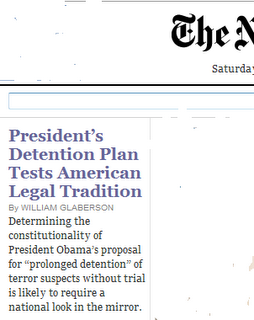
UPDATE VI: Bearing in mind what Obama repeatedly pledged to do while running, this headline from The New York Times this morning is rather extraordinary:
As Greg Craig put it: “hard to imagine Barack Obama as the first President of the United States to introduce a preventive-detention law.”
Source / Salon
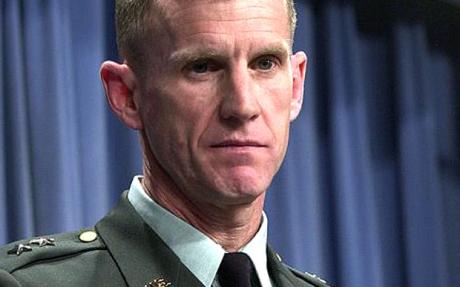
Yes, Stanley McChrystal is the general from the dark side (and proud of it). So the recent sacking of Afghan commander General David McKiernan after less than a year in the field and McChrystal’s appointment as the man to run the Afghan War seems to signal that the Obama administration is going for broke. It’s heading straight into what, in the Vietnam era, was known as “the big muddy.”
General McChrystal comes from a world where killing by any means is the norm and a blanket of secrecy provides the necessary protection. For five years he commanded the Pentagon’s super-secret Joint Special Operations Command (JSOC), which, among other things, ran what Seymour Hersh has described as an “executive assassination wing” out of Vice President Cheney’s office. (Cheney just returned the favor by giving the newly appointed general a ringing endorsement: “I think you’d be hard put to find anyone better than Stan McChrystal.”)
McChrystal gained a certain renown when President Bush outed him as the man responsible for tracking down and eliminating al-Qaeda-in-Mesopotamia leader Abu Musab al-Zarqawi. The secret force of “manhunters” he commanded had its own secret detention and interrogation center near Baghdad, Camp Nama, where bad things happened regularly, and the unit there, Task Force 6-26, had its own slogan: “If you don’t make them bleed, they can’t prosecute for it.” Since some of the task force’s men were, in the end, prosecuted, the bleeding evidently wasn’t avoided.
In the Bush years, McChrystal was reputedly extremely close to Secretary of Defense Donald Rumsfeld. The super-secret force he commanded was, in fact, part of Rumsfeld’s effort to seize control of, and Pentagonize, the covert, on-the-ground activities that were once the purview of the CIA.
Behind McChrystal lies a string of targeted executions that may run into the hundreds, as well as accusations of torture and abuse by troops under his command (and a role in the cover-up of the circumstances surrounding the death of Army Ranger and former National Football League player Pat Tillman). The general has reportedly long thought of Afghanistan and Pakistan as a single battlefield, which means that he was a premature adherent to the idea of an Af-Pak — that is, expanded — war. While in Afghanistan in 2008, the New York Times reported, he was a “key advocate… of a plan, ultimately approved by President George W. Bush, to use American commandos to strike at Taliban sanctuaries in Pakistan.” This end-of-term Bush program provoked such anger and blowback in Pakistan that it was reportedly halted after two cross-border raids, one of which killed civilians.
All of this offers more than a hint of the sort of “new thinking and new approaches” — to use Secretary of Defense Robert Gates’s words — that the Obama administration expects General McChrystal to bring to the devolving Af-Pak battlefield. He is, in a sense, both a legacy figure from the worst days of the Bush-Cheney-Rumsfeld era and the first-born child of Obama-era Washington’s growing desperation and hysteria over the wars it inherited.
Hagiography
And here’s the good news: We luv the guy. Just luv him to death.
We loved him back in 2006, when Bush first outed him and Newsweek reporters Michael Hirsh and John Barry dubbed him “a rising star” in the Army and one of the “Jedi Knights who are fighting in what Cheney calls ‘the shadows.'”
It’s no different today in what’s left of the mainstream news analysis business. In that mix of sports lingo, Hollywood-ese, and just plain hyperbole that makes armchair war strategizing just so darn much fun, Washington Post columnist David Ignatius, for instance, claimed that Centcom commander General David Petraeus, who picked McChrystal as his man in Afghanistan, is “assembling an all-star team” and that McChrystal himself is “a rising superstar who, like Petraeus, has helped reinvent the U.S. Army.” Is that all?
When it came to pure, instant hagiography, however, the prize went to Elisabeth Bumiller and Mark Mazzetti of the New York Times, who wrote a front-pager, “A General Steps from the Shadows,” that painted a picture of McChrystal as a mutant cross between Superman and a saint.
Among other things, it described the general as “an ascetic who… usually eats just one meal a day, in the evening, to avoid sluggishness. He is known for operating on a few hours’ sleep and for running to and from work while listening to audio books on an iPod… [He has] an encyclopedic, even obsessive, knowledge about the lives of terrorists… [He is] a warrior-scholar, comfortable with diplomats, politicians…” and so on. The quotes Bumiller and Mazzetti dug up from others were no less spectacular: “He’s got all the Special Ops attributes, plus an intellect.” “If you asked me the first thing that comes to mind about General McChrystal… I think of no body fat.”
From the gush of good cheer about his appointment, you might almost conclude that the general was not human at all, but an advanced android (a good one, of course!) and the “elite” world (of murder and abuse) he emerged from an unbearably sexy one.
Above all, as we’re told here and elsewhere, what’s so good about the new appointment is that General McChrystal is “more aggressive” than his stick-in-the-mud predecessor. He will, as Bumiller and Thom Shanker report in another piece, bring “a more aggressive and innovative approach to a worsening seven-year war.” The general, we’re assured, likes operations without body fat, but with plenty of punch. And though no one quite says this, given his closeness to Rumsfeld and possibly Cheney, both desperately eager to “take the gloves off” on a planetary scale, his mentality is undoubtedly a global-war-on-terror one, which translates into no respect for boundaries, restraints, or the sovereignty of others. After all, as journalist Gareth Porter pointed out recently in a thoughtful Asia Times portrait of the new Afghan War commander, Secretary of Defense Donald Rumsfeld granted the parent of JSOC, the Special Operations Command (SOCOM), “the authority to carry out actions unilaterally anywhere on the globe.”
Think of McChrystal’s appointment, then, as a decision in Washington to dispatch the bull directly to the China shop with the most meager of hopes that the results won’t be smashed Afghans and Pakistanis. The Post‘s Ignatius even compares McChrystal’s boss Petraeus and Obama’s special envoy to the region, Richard Holbrooke, to “two headstrong bulls in a small paddock.” He then concludes his paean to all of them with this passage — far more ominous than he means it to be:
“Obama knows the immense difficulty of trying to fix a broken Afghanistan and make it a functioning, modern country. But with his two bulls, Petraeus and Holbrooke, he’s marching his presidency into the ‘graveyard of empires’ anyway.”
McChrystal is evidently the third bull, the one slated to start knocking over the tombstones.
An Expanding Af-Pak War
Of course, there are now so many bulls in this particular China shop that smashing is increasingly the name of the game. At this point, the early moves of the Obama administration, when combined with the momentum of the situation it inherited, have resulted in the expansion of the Af-Pak War in at least six areas, which only presage further expansion in the months to come:
1. Expanding Troop Commitment: In February, President Obama ordered a “surge” of 17,000 extra troops into Afghanistan, increasing U.S. forces there by 50%. (Then-commander McKiernan had called for 30,000 new troops.) In March, another 4,000 American military advisors and trainers were promised. The first of the surge troops, reportedly ill-equipped, are already arriving. In March, it was announced that this troop surge would be accompanied by a “civilian surge” of diplomats, advisors, and the like; in April, it was reported that, because the requisite diplomats and advisors couldn’t be found, the civilian surge would actually be made up largely of military personnel.
In preparation for this influx, there has been massive base and outpost building in the southern parts of that country, including the construction of 443-acre Camp Leatherneck in that region’s “desert of death.” When finished, it will support up to 8,000 U.S. troops, and a raft of helicopters and planes. Its airfield, which is under construction, has been described as the “largest such project in the world in a combat setting.”
2. Expanding CIA Drone War: The CIA is running an escalating secret drone war in the skies over the Pakistani borderlands with Afghanistan, a “targeted” assassination program of the sort that McChrystal specialized in while in Iraq. Since last September, more than three dozen drone attacks — the Los Angeles Times put the number at 55 — have been launched, as opposed to 10 in 2006-2007. The program has reportedly taken out a number of mid-level al-Qaeda and Taliban leaders, but also caused significant civilian casualties, destabilized the Pashtun border areas of Pakistan, and fostered support for the Islamic guerrillas in those regions. As Noah Shachtman wrote recently at his Danger Room website:
“According to the American press, a pair of missiles from the unmanned aircraft killed ‘at least 25 militants.’ In the local media, the dead were simply described as ’29 tribesmen present there.’ That simple difference in description underlies a serious problem in the campaign against the Taliban and Al Qaeda. To Americans, the drones over Pakistan are terrorist-killers. In Pakistan, the robotic planes are wiping out neighbors.”
David Kilcullen, a key advisor to Petraeus during the Iraq “surge” months, and counterinsurgency expert Andrew McDonald Exum recently called for a moratorium on these attacks on the New York Times op-ed page. (“Press reports suggest that over the last three years drone strikes have killed about 14 terrorist leaders. But, according to Pakistani sources, they have also killed some 700 civilians. This is 50 civilians for every militant killed, a hit rate of 2 percent — hardly ‘precision.'”) As it happens, however, the Obama administration is deeply committed to its drone war. As CIA Director Leon Panetta put the matter, “Very frankly, it’s the only game in town in terms of confronting or trying to disrupt the al Qaeda leadership.”
3. Expanding Air Force Drone War: The U.S. Air Force now seems to be getting into the act as well. There are conflicting reports about just what it is trying to do, but it has evidently brought its own set of Predator and Reaper drones into play in Pakistani skies, in conjunction, it seems, with a somewhat reluctant Pakistani military. Though the outlines of this program are foggy at best, this nonetheless represents an expansion of the war.
4. Expanding Political Interference: Quite a different kind of escalation is also underway. Washington is evidently attempting to insert yet another figure from the Bush-Cheney-Rumsfeld era into the Afghan mix. Not so long ago, Zalmay Khalilzad, the neocon former American viceroy in Kabul and then Baghdad, was considering making a run for the Afghan presidency against Hamid Karzai, the leader the Obama administration is desperate to ditch. In March, reports — hotly denied by Holbrooke and others — broke in the British press of a U.S./British plan to “undermine President Karzai of Afghanistan by forcing him to install a powerful chief of staff to run the Government.” Karzai, so the rumors went, would be reduced to “figurehead” status, while a “chief executive with prime ministerial-style powers” not provided for in the Afghan Constitution would essentially take over the running of the weak and corrupt government.
This week, Helene Cooper reported on the front page of the New York Times that Khalilzad would be that man. He “could assume a powerful, unelected position inside the Afghan government under a plan he is discussing with Hamid Karzai, the Afghan president, according to senior American and Afghan officials.” He would then be “the chief executive officer of Afghanistan.”
Cooper’s report is filled with official denials that these negotiations involve Washington in any way. Yet if they succeed, an American citizen, a former U.S. Ambassador to the U.N. as well as to Kabul, would end up functionally atop the Karzai government just as the Obama administration is eagerly pursuing a stepped-up war against the Taliban.
Why officials in Washington imagine that Afghans might actually accept such a figure is the mystery of the moment. It’s best to think of this plan as the kinder, gentler, soft-power version of the Kennedy administration’s 1963 decision to sign off on the coup that led to the assassination of South Vietnamese autocrat Ngo Dinh Diem. Then, too, top Washington officials were distressed that a puppet who seemed to be losing support was, like Karzai, also acting in an increasingly independent manner when it came to playing his appointed role in an American drama. That assassination, by the way, only increased instability in South Vietnam, leading to a succession of weak military regimes and paving the way for a further unraveling there. This American expansion of the war would likely have similar consequences.
5. Expanding War in Pakistan: Meanwhile, in Pakistan itself, mayhem has ensued, again in significant part thanks to Washington, whose disastrous Afghan war and escalating drone attacks have helped to destabilize the Pashtun regions of the country. Now, the Pakistani military — pushed and threatened by Washington (with the loss of military aid, among other things) — has smashed full force into the districts of Buner and Swat, which had, in recent months, been largely taken over by the Islamic fundamentalist guerrillas we call “the Pakistani Taliban.”
It’s been a massive show of force by a military configured for smash-mouth war with India, not urban or village warfare with lightly armed guerrillas. The Pakistani military has loosed its jets, helicopter gunships, and artillery on the region (even as the CIA drone strikes continue), killing unknown numbers of civilians and, far more significantly, causing a massive exodus of the local population. In some areas, well more than half the population has fled Taliban depredations and indiscriminate fire from the military. Those that remain in besieged towns and cities, often without electricity, with the dead in the streets, and fast disappearing supplies of food, are clearly in trouble.
With nearly 1.5 million Pakistanis turned into refugees just since the latest offensive began, U.N. officials are suggesting that this could be the worst refugee crisis since the Rwandan genocide in 1994. Talk about the destabilization of a country.
In the long run, this may only increase the anger of Pashtuns in the tribal areas of Pakistan at both the Americans and the Pakistani military and government. The rise of Pashtun nationalism and a fight for an “Islamic Pashtunistan” would prove a dangerous development indeed. This latest offensive is what Washington thought it wanted, but undoubtedly the old saw, “Be careful what you wish for, lest it come true,” applies. Already a panicky Washington is planning to rush $110 million in refugee assistance to the country.
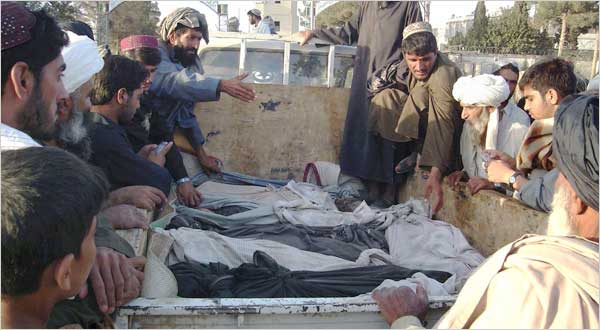
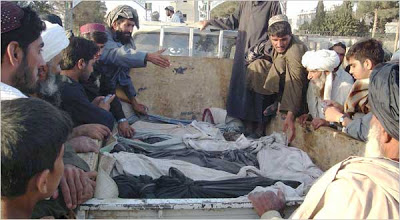
6. Expanding Civilian Death Toll and Blowback: As Taliban attacks in Afghanistan rise and that loose guerrilla force (more like a coalition of various Islamist, tribal, warlord, and criminal groups) spreads into new areas, the American air war in Afghanistan continues to take a heavy toll on Afghan civilians, while manufacturing ever more enemies as well as deep resentment and protest in that country. The latest such incident, possibly the worst since the Taliban was defeated in 2001, involves the deaths of up to 147 Afghans in the Bala Baluk district of Farah Province, according to accounts that have come out of the villages attacked. Up to 95 of the dead were under 18, one Afghan lawmaker involved in investigating the incident claims, and up to 65 of them women or girls. These deaths came after Americans were called into an escalating fight between the Taliban and Afghan police and military units, and in turn, called in devastating air strikes by two U.S. jets and a B-1 bomber (which, villagers claim, hit them after the Taliban fighters had left).
Despite American pledges to own up to and apologize more quickly for civilian deaths, the post-carnage events followed a predictable stonewalling pattern, including a begrudging step-by-step retreat in the face of independent claims and reports. The Americans first denied that anything much had happened; then claimed that they had killed mainly Taliban “militants”; then that the Taliban had themselves used grenades to kill most of the civilians (a charge later partially withdrawn as “thinly sourced”); and finally, that the numbers of Afghan dead were “extremely over-exaggerated,” and that the urge for payment from the Afghan government might be partially responsible.
An investigation, as always, was launched that never seems to end, while the Americans wait for the story to fade from view. As of this moment, while still awaiting the results of a “very exhaustive” investigation, American spokesmen nonetheless claim that only 20-30 civilians died along with up to 65 Taliban insurgents. In these years, however, the record tells us that, when weighing the stories offered by surviving villagers and those of American officials, believe the villagers. Put more bluntly, in such situations, we lie, they die.
Two things make this “incident” at Bala Baluk more striking. First of all, according to Jerome Starkey of the British Independent, another Rumsfeld creation, the U.S. Marines Corps Special Operations Command (MarSOC), the Marines’ version of JSOC, was centrally involved, as it had been in two other major civilian slaughters, one near Jalalabad in 2007 (committed by a MarSOC unit that dubbed itself “Taskforce Violence”), the second in 2008 at the village of Azizabad in Herat Province. McChrystal’s appointment, reports Starkey, has “prompted speculation that [similar] commando counterinsurgency missions will increase in the battle to beat the Taliban.”
Second, back in Washington, National Security Advisor James Jones and head of the Joint Chiefs Admiral Mike Mullen, fretting about civilian casualties in Afghanistan and faced with President Karzai’s repeated pleas to cease air attacks on Afghan villages, nonetheless refused to consider the possibility. Both, in fact, used the same image. As Jones told ABC’s George Stephanopoulos: “Well, I think he understands that… we have to have the full complement of… our offensive military power when we need it… We can’t fight with one hand tied behind our back…”
In a world in which the U.S. is the military equivalent of the multi-armed Hindu god Shiva, this is one of the truly strange, if long-lasting, American images. It was, for instance, used by President George H. W. Bush on the eve of the first Gulf War. “No hands,” he said, “are going to be tied behind backs. This is not a Vietnam.”
Forgetting the levels of firepower loosed in Vietnam, the image itself is abidingly odd. After all, in everyday speech, the challenge “I could beat you with one hand tied behind my back” is a bravado offer of voluntary restraint and an implicit admission that fighting any other way would make one a bully. So hidden in the image, both when the elder Bush used it and today, is a most un-American acceptance of the United States as a bully nation, about to be restrained by no one, least of all itself.
Apologize or stonewall, one thing remains certain: the air war will continue and so civilians will continue to die. The idea that the U.S. might actually be better off with one “hand” tied behind its back is now so alien to us as to be beyond serious consideration.
The Pressure of an Expanding War
President Obama has opted for a down-and-dirty war strategy in search of some at least minimalist form of success. For this, McChrystal is the poster boy. Former Afghan commander General McKiernan believed that, “as a NATO commander, my mandate stops at the [Afghan] border. So unless there is a clear case of self-protection to fire across the border, we don’t consider any operations across the border in the tribal areas.”
That the “responsibilities” of U.S. generals fighting the Afghan War “ended at the border with Pakistan,” Mark Mazzetti and Eric Schmitt of the Times report, is now considered part of an “old mind-set.” McChrystal represents those “fresh eyes” that Secretary of Defense Robert Gates talked about in the press conference announcing the general’s appointment. As Mazzetti and Schmitt point out, “Among [McChrystal’s] last projects as the head of the Joint Special Operations Command was to better coordinate Pentagon and Central Intelligence Agency efforts on both sides of the porous border.”
For those old enough to remember, we’ve been here before. Administrations that start down a path of expansion in such a war find themselves strangely locked in — psychically, if nothing else — if things don’t work out as expected and the situation continues to deteriorate. In Vietnam, the result was escalation without end. President Obama and his foreign policy team now seem locked into an expanding war. Despite the fact that the application of force has not only failed for years, but actually fed that expansion, they also seem to be locked into a policy of applying ever greater force, with the goal of, as the Post‘s Ignatius puts it, cracking the “Taliban coalition” and bringing elements of it to the bargaining table.
So keep an eye out for whatever goes wrong, as it most certainly will, and then for the pressures on Washington to respond with further expansions of what is already “Obama’s war.” With McChrystal in charge in Afghanistan, for instance, it seems reasonable to assume that the urge to sanction new special forces raids into Pakistan will grow. After all, frustration in Washington is already building, for however much the Pakistani military may be taking on the Taliban in Swat or Buner, don’t expect its military or civilian leaders to be terribly interested in what happens near the Afghan border.
As Tony Karon of the Rootless Cosmopolitan blog puts the matter: “The current military campaign is designed to enforce a limit on the Taliban’s reach within Pakistan, confining it to the movement’s heartland.” And that heartland is the Afghan border region. For one thing, the Pakistani military (and the country’s intelligence services, which essentially brought the Taliban into being long ago) are focused on India. They want a Pashtun ally across the border, Taliban or otherwise, where they fear the Indians are making inroads.
So the frustration of a war in which the enemy has no borders and we do is bound to rise along with the fighting, long predicted to intensify this year. We now have a more aggressive “team” in place. Soon enough, if the fighting in the Afghan south and along the Pakistani border doesn’t go as planned, pressure for the president to send in those other 10,000 troops General McKiernan asked for may rise as well, as could pressure to apply more air power, more drone power, more of almost anything. And yet, as former CIA station chief in Kabul, Graham Fuller, wrote recently, in the region “crises have only grown worse under the U.S. military footprint.”
And what if, as the war continues its slow arc of expansion, the “Washington coalition” is the one that cracks first? What then?
[Tom Engelhardt, co-founder of the American Empire Project, runs the Nation Institute’s TomDispatch.com. He is the author of The End of Victory Culture, a history of the Cold War and beyond, as well as of a novel, The Last Days of Publishing. He also edited The World According to TomDispatch: America in the New Age of Empire (Verso, 2008), an alternative history of the mad Bush years.]
Copyright 2009 Tom Engelhardt
Source / TomDispatch
Thanks to Juan Cole / The Rag Blog

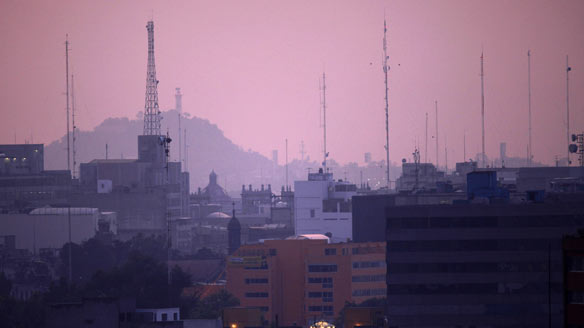
It’s been three weeks since the taps in Carlos Sandana’s Mexico City home ran dry.
In that time, the swine flu fears that gripped his country have peaked and subsided, though the government has urged residents to continue their vigilance with extra cleaning and hand washing.
“We need to clean more often than before because, like they say, you needed to maintain your house clean and wash with Clorox and everything,” Sandana told CBC’s The Current. “You can’t do that ’cause you don’t have enough water to do it.”
Sandana, his wife, Elizabeth, and his 8-year-old son, Samuel, are lucky enough to have a storage tank under their house, unlike others in their poor neighbourhood in Iztapalapa, a federal district in the city’s east end. But that too is running dry and he must sometimes purchase water.
Even when water flows from his faucet, Sandana says it’s brown and “terrible” quality, despite pipes being replaced several months ago.
Jorge Villalón Efrén Figaredo, a general director with Mexico’s National Water Commission, known by the Spanish acronym CONAGUA, says the neighbourhood where Sandana lives is at the end of the water pipeline, about 100 kilometres from the source. As a result, the water pressure and volume is insufficient to reach the highest parts of the neighbourhood.
But the problem is larger than one neighbourhood. The sprawling metropolis of 20 million people is struggling with a crumbling water infrastructure and serious shortage of the precious resource.
Sinking city
Three times this spring, water has been cut off for hundreds of thousands of people due to dangerously low reservoir levels.
The city relies on the Cutzamala system, which pipes in surface water from the Cutzamala River basin, for about 20 per cent of its water, while 70 per cent is pumped up from underground wells.
“That’s a problem because the city is sinking 10 centimetres per year due to the amount of water we are extracting from the wells, which is equivalent to 60,000 litres per second,” says Villalón.
Mexico City was founded by the Aztecs on what was once a great lake, but Spanish conquerors later drained most of the water to allow for expansion.
As the city sinks into the old lake bed, pressure is building on water pipes, causing them to leak about 40 per cent of the liquid before it even reaches its destination.
Though the city holds out hope that the coming rainy season will replenish its reservoirs, Villalón says the government is investing “a lot of money” in water projects, including finding new sources and raising awareness about water conservation.
Mexico City residents use about 300 litres of water per person each day, twice what Europeans in some cities are using.
“We are using 50 per cent more than in other parts of the world and we need to change that,” said Villalon.
But Villalón notes the government is facing a tough task. Even if the city can find additional sources of water and reduce consumption, demand for water is expected to rise by 20 per cent over the next three to four years as the population grows by about four per cent each year.
David Stahle, a geoscience professor at the University of Arkansas, says since 1994 Mexico has been in the midst of one of the country’s worst droughts.
“It’s been very persistent and it’s been very severe,” says Stahle, who was the lead researcher of an article titled Early 21st Century Drought in Mexico. “And in those metrics it’s nearly equal to the very severe drought of the 1950s, and the epic drought of the 16th century, about 1560 to 1580.”
Wake-up call
For Piet Klop, a senior fellow with the environmental think tank World Resources Institute, it all combines to suggest Mexico City, like many other metropolises around the world, has reached a tipping point.
“I think in many cases — and Mexico City may be a case in point — we’ve actually gotten to the point where politicians may not have any other choice than to fix the system,” said Klop. “We got used to the idea that water would be free … That’s one philosophy that can no longer be maintained.”
As dozens of mega cities such as Mexico City, Jakarta and Bangkok face water shortages and growing populations, Klop expects many will begin to start pricing water according to its actual cost and scarcity value.
“We’ve got to price water as though it was oil,” he adds.
By providing low-priced, subsidized water, he says, the city robs itself of having enough revenue in its coffers to maintain the system, plus eliminates an incentive for people to use water more efficiently.
To ensure the poor do not suffer due to a drastic rise in prices, Klop suggests subsidizing the price they pay.
“In many places around the world … the poor indeed suffer from service and scarcity problems like the one of Mexico City. Per litre they pay 10, 20, 50 times as much as others fortunate enough to be connected to the network,” he said.
As a result, water conservation for the poor, like Sandana, is already part of daily life.
His family scrimps on water use, foregoing showers in order to have enough water to cook with.
“You can’t just really throw it around. So we’d rather save it because you don’t know if you spend that bucket of water, when are you gonna get water again.”
Source / CBC
Thanks to Deva Wood / The Rag Blog
The following is from former Austinite and Ragamuffin (contributor to our Sixties underground paper), long-time political prisoner and poet Marilyn Buck, the latest of her continuing letters to a legion of friends and supporters hopefully awaiting her release, perhaps in 2010.
Her informal reflections on current events provide an important perspective too often missing from our debates. Far removed, as yet, from the world of blogs and tweets, Buck is forced to observe events unfold on their terms, and to objectively weigh their relative importance.
You can see Marilyn’s work on The Rag Authors’ Page.
Mariann G. Wizard / The Rag Blog / May 23, 2009
‘Already it’s May! National Poetry Month in April, celebrated poetry in… more public quarters. I think of prisoners buried in dark cells (maybe not so dark, but bleak without signs of spring and nature).’
By Marilyn Buck / The Rag Blog / May 23, 2009
My legs are tied with a rope
and my arms are bound by my side,
but I smell the sweet perfume of woodland flowers
and hear the birds. Impossible
to keep these from me.
Anyhow, now the road is not so long,
and I am not alone.Ho Chi Minh
I didn’t quite get to an International Women’s day/month letter, but as always my spirit is renewed through the evidences of our ongoing struggle for equality as human beings.
My spirits were not renewed at all on learning Uncle Sam’s lackey in Afghanistan signed a law legalizing men’s right — at least in the Shia communities — to forcibly have sex with their wives, turning anti-women culture tradition into modern law. A few giant steps backward for women, everywhere. And then there’s Nicaragua’s and Uruguay’s presidents, D. Ortega and Tabaré, ostensibly “progressive, former leftists,” signed laws further criminalizing abortion and women’s right to choose.
Let us see how the other progressing nations of Latin America develop programs that do or do not benefit more than half of their populations, the women. If a politic or struggle does not work to liberate the women of the country, the country will not be able to advance very far. Not a good sign for anyone, woman or man, especially among those who advocate for justice and liberation.
Nor is it a good sign that our brother Mumia Abu Jamal’s Supreme Court petition was denied. I hope more strategies will emerge to free our comrade. It continues to be dangerous to give voice to the voiceless, especially when the voice and militancy is African.
Already it’s May! National Poetry Month in April, celebrated poetry in [….] more public quarters. I think of prisoners buried in dark cells (maybe not so dark, but bleak without signs of spring and nature). Even though at times it may seem frivolous, excessive, not serious enough for these times in which we live, poetry… is important for the famished spirit. Spring, with its bursting of flowers, greenery and new life gladdens our hearts, despite the dying, torture and brutality that generates poetry of war, incredible loss and anguish.
Many of us like to think of poets as artists-advocates of progress or justice. I am reminded of the Fascist poets, and, recently I read a short essay by Slavoj Žižek , “The Military Poetic Complex” which reminds us of the role of Randovan Karadzic, a poet/psychiatrist/leader in ethnic cleansing and the torturous dismemberment of Yugoslavia. Žižek reminds us that poetry can advocate for the worst of human behaviors.
As for my own poetry, I’ve not been writing much. Nevertheless, recently a graduate music student (now university teacher) in Texas, Lauren Morgan, used three of my poems as the lyrics for a post-modern musical suite, performed in early April in San Marcos, Texas and sung by an operatic-level soprano. She won a competition for her composition! Finally, [my] translation of [exiled Uruguayan poet Cristina Peri Rossi’s] State of Exile was a finalist in the Northern California Book Awards. It was quite a surprise!
May you be well. Spring calls us to renew our energies and to generate collective work towards possibilities of liberation, justice and peace.
Marilyn Buck
FCI Dublin, California
[Marilyn J. Buck was an activist in Austin, Texas in the late Sixties. She was a staffer on The Rag, the underground newspaper that was The Rag Blog’s inspiration. She is also a former editor of the original SDS’ New Left Notes, former member of San Francisco’s movement film project Newsreel, an accomplished poet, and a literacy and AIDS prevention educator. She is one of the longest-held woman political prisoners in the US today. To learn more about Marilyn’s history, her incarceration and her creative work, go to her entry on The Rag Authors’ Page.]
Also see Marilyn Buck from the Greybar: Thoughts on the Recent Election, by Marilyn Buck / The Rag Blog / Dec. 28, 2008