Health Care Reform : Private Companies Just in it for the Money

Graphic from lamiavitafolle.

We have an opportunity to make real and substantial changes to fix America’s health care. A few promises and some band-aids on our current system are not nearly enough.

By Ted McLaughlin / The Rag Blog / May 10, 2009

According to CNN, “President Obama will announce Monday that he has secured the commitment of several industry groups to do their part to rein in the growth in health care costs. This pledge from the private sector could reduce the growth in health care spending by 1.5 percentage points a year, for a savings of $2 trillion over 10 years. Overall, it could amount to a 20% reduction in the growth of health care spending.”

The commitment has been agreed to by six trade associations representing unions, hospitals, insurers and the drug industry. The administration is treating this as good news, and says it shows these private companies are on board with health reform. I’m not at all sure I agree.

These companies, especially the insurance companies, know that a large majority of the American people are unhappy with our health care system as it is. This sounds more like the opening salvo in a public relations campaign to convince the American people that these companies are not really such bad guys after all.

The fact is that we are spending more money on health care per patient than any other industrialized nation and getting less for it. The climate is ripe for real reform, and that is scaring the hell out of the insurers and health care providers. They are making obscene profits from the current system, and are afraid of substantial reform — afraid it will interfere with those profits.

Notice that they didn’t agree to actually cut any costs — only the rate of growth of the costs. If you’ll re-read the first paragraph, you’ll see they are only promising a 20% cut in the “growth” of health care costs. Frankly, that’s not nearly good enough.

It’s time to take the obscene profits out of health care. Providers need to be paid fairly, but that is not the problem in the current system. The problem is that the insurance providers and big pharmaceutical companies are in charge — not the doctors, clinics and hospitals.

The last time health care reform was proposed, these companies ran ads saying it would deny patients the right to choose their own doctor, and keep the doctors from determining what care was needed and should be provided. This campaign was a big lie, because consumers who have private insurance do not currently have those rights.

Consumers cannot choose their own doctor and hospital. Both must be chosen from a list provided by the insurance company. If a doctor or hospital is not on the list, then the consumer cannot choose them (or must pay thousands of extra dollars out of their own pockets if they do choose them).

And doctors are not currently in charge of your health care — an insurance company employee is. Doctors can only provide the care that the insurance company will pay for, and if that care is expensive, the company will probably not pay for it. After all, they make bigger profits if they don’t pay, and for an insurance company profit is the name of the game.

The only way to actually cut costs and cover all of our citizens is to institute a government-run single-payer health care system. This would instantly cut out the obscene profits of the insurance companies. It would also allow the government to control the costs of medications.

And it would allow each patient to choose his own doctor and hospital, and put the doctors back in charge of health care decisions. This is true in Canada, Great Britain, France and most other industrialized nations with government-run health insurance system, so there is no reason it cannot be done here.

So, don’t fall for this announcement that the private companies are going to cut costs. They aren’t — only the growth of costs. Don’t let them fool you into believing a public health care insurance plan is not needed. It most certainly is needed.

We have an opportunity to make real and substantial changes to fix America’s health care. A few promises and some band-aids on our current system are not nearly enough. Decent and affordable health care should be the right of every American — not just the rich.

[Rag Blog contributor Ted McLaughlin also posts at jobsanger, an excellent Texas political blog.]

Source /

The Rag Blog

Posted in Rag Bloggers | Tagged , , , | 1 Comment

Foodie Sunday: Open Season on Alice Waters

Alice Waters. Photograph by Jamie Rose/The New York Times/Redux.

The War on Alice Waters
By Laura Shapiro / May 6, 2009

She made sustainable agriculture a rallying cry, but now the activist chef is under attack from food lovers.

“It…radically overstates Alice Waters’s significance and impact to say that…any major changes have occurred because of her. She’s one person in a large movement that would have been just fine without her, albeit perhaps a little different at the margins.” —Fat Guy, egullet.org

“There’s something very Khmer Rouge about Alice Waters that has become unrealistic.” —Anthony Bourdain, DCist.com

“Is it wrong for me to wish that [Alice Waters] would just go away, already?” —Josh Ozersky, the-feedbag.com

“Alice Waters Was a Foodie Hero. Now She’s the Food Police.” —Todd Kliman, npr.org

“Leading the culinary cops is Alice Waters….Her cooking philosophy [is] a chiding and bourgeois brand of junk food prohibitionism.” —Carla Spartos, New York Post

“What is it exactly that she did that has changed things?” —rancho_gordo, egullet.org

Lock and load, folks: It’s open season on Alice Waters. The woman who put agriculture at the center of American gastronomy, back when you couldn’t buy a truly ripe peach even at the fanciest grocer in town, is now getting pounded in the most concentrated assault from food lovers since ketchup was named a vegetable. Once a glorious heroine battling to reclaim our diet from the food industry, today she’s a Gang of One, trashed over and over for a long list of crimes against the revolution. Out in the real world Waters is still a popular figure, greeting friends at her flourishing restaurant, Chez Panisse, and drawing enthusiastic audiences at events on the cuisine-and-politics circuit. But throughout the food media, especially in the blogs, the term “food police” is back and dripping with blood.

Part of what’s happening, of course, may just be cyclical. The spectacle of fame followed by destruction has always been one of the great epic dramas, played out over and over in the favorite myths of every land. Perhaps we’re about to witness a triumphant final act, as the exiled heroine returns in glory to lead her people to victory. (Then again, if the gods are feeling testy, we sometimes get the Joan of Arc scenario, where the outcome is less good. Never mind.) At any rate, Waters can hardly open a newspaper or log on to the Internet these days without finding herself at the center of a tempestuous debate about rich and poor, slim and obese, the proper uses of fame and whether it’s still a revolution if it’s taking place in the nation’s most desirable culinary zip code.

What it all seems to come down to is elitism, a charge against Waters that has become increasingly vehement as the economy keeps getting worse. It’s easy to understand the accusation. After all, this is a woman who believes to her heart’s core that local, organic strawberries are always going to be the most practical purchase—no matter what they cost, or how tight your budget—because this is the most important way you can possibly spend money. Okay, it’s not a point of view that leaves a lot of room for canned tuna. But I wouldn’t call it elitism, especially in the larger context of her single-minded determination to change American food systems from the ground up. The history of great professional cuisine is largely about feeding the rich, and few chefs or proprietors ever thought to include anyone in their constituency except the people who ate in their restaurants. Waters was the first high-end restaurateur to put her kitchen at the service of social change, and to define her clientele far more widely than the glamorous crowd in the dining rooms.

What irks people, I think, are the impossibly airy goals she likes to swirl about herself like so many silk scarves. But she isn’t a thinker, she’s a utopian, a relentless radical who just doesn’t care whether the current checks and balances of real life can accommodate her ideas. Where she’s been effective—amassing widespread support for small farms, reinventing school lunch, overhauling our image of luxury dining to put three carrots and a radish at center stage—it’s because she had the power to make her own fantasies come true. But she’s perfectly willing to press on with the fantasies even without the power. I doubt whether she knows any other way to operate.

A single person doesn’t constitute a revolution, any more than a single restaurant does, or a single best-seller. But every revolution has its focal points—a few people, events, and books so invigorating and memorable they become stand-ins for change itself. We use them to gain historical traction as we assess what’s happened and try to figure out where we should be going. Clearly, Waters is a focal point, whether you think of her as the Gandhi of food or the Britney Spears. And if you’re in the latter camp, just remember that while you don’t have to share her conviction that Satan invented freezers, you do have to give her credit for helping to inspire a genuine turnaround in the way Americans think about food. “Do we really need to know the provenance of an egg?” asks restaurant critic Todd Kliman, who can’t stand what he calls Waters’s “inflexible brand of gastronomical correctness.” And he adds, “Shopping is not cooking.”

Oh, but it is. Shopping is at least 50 percent of cooking, and the rest is up to the cook, for better or worse. Julia Child focused her immense influence on the cook; and although we no longer make rich, elaborate French dinners even for company, her lessons became part of the American culinary genome. Waters has focused on the ingredients. I confess, I rarely shop for organic pea shoots and will probably live my entire life without tasting a biodynamic medjool date from Flying Disc Ranch in California. But the little farmers market up the street from me, with its local apples and onions, is there two days a week without fail because many people these days have a far greater understanding of what makes good food good than nearly anybody did 40 years ago. A big part of the difference has been Alice Waters.

Source / Gourmet

Thanks to Jeffrey Segal / The Rag Blog

Posted in RagBlog | Tagged , , , | 1 Comment

When It Comes to Combating Teen Pregnancy, the Palin Family Has Done Enough Damage Already

Bristol Palin attends the Candie’s Foundation town hall meeting on teen pregnancy prevention at TheTimesCenter on May 6, 2009 in New York City. Photo: Bryan Bedder/Getty Images.

Bristol Palin’s New Gig
By Gail Collins / May 6, 2009

“Just because you’re wearing high-heeled sexy shoes doesn’t mean you should have a baby,” said Neil Cole.

I believe we can all rally around this sentiment.

Cole is the head of Iconix, a company that makes the Candie’s line of teen fashions. A couple of years ago, under fire from critics who accused him of dressing high schoolers like tarts, he established the Candie’s Foundation, which fights teen pregnancy. And there he was on Wednesday introducing the foundation’s new teen ambassador, Bristol Palin.

Palin is not in any way to be confused with the new Candie’s brand spokesperson, Britney Spears. Bristol is the one endorsing abstinence; Britney is the one promoting “hot bottoms.”

Can I say upfront that this is a terrible, terrible idea? Not the sexy clothes. Perhaps in the best of all possible worlds we would not have 12-year-olds dressing as if they were auditioning for a leading role in “Girls Gone Wild,” but history suggests that resistance is futile. There was one minute back in the late 1960s when the women’s movement tried to convince everyone that being liberated involved wearing sensible shoes. It was not a success. Really, you should never try to impose feminist principles that even Gloria Steinem refuses to pay attention to.

But surely, when it comes to combating teen pregnancy, the Palin family has done enough damage already. What worse message could you send to teenage girls than the one they delivered at the Republican convention: If your handsome but somewhat thuglike boyfriend gets you with child, he will clean up nicely, propose marriage, and show up at an important family event wearing a suit and holding your hand. At which point you will get a standing ovation.

Now a single mom on the outs with the father of her baby, Bristol wants a new kind of happy ending.

“I just want to go out there and promote abstinence and say this is the safest choice,” she said on “Good Morning America.”

“It’s not going to work,” said her ex-boyfriend, Levi Johnston, in a dueling early-morning interview.

If you have ever watched Levi Johnston on TV for two minutes you will appreciate how terrifying it is when he has the most reasonable analysis of a social issue.

Because Bristol’s own philosophy seems, at minimum, tentative, it’s hard to tell whether she believes that cheerleading for abstinence should be coupled with education about birth control methods. She and Levi used condoms, except when they didn’t.

Her mom has said in the past that she opposes “explicit” sex education, which kind of sounds like … sex education. And while encouraging kids to wait is obviously fine, the evidence is pretty clear that abstinence education is worse than useless. Texas, where virtually all the schools teach abstinence and abstinence alone, is a teen pregnancy disaster zone. “It’s had one of the highest rates for as long as I can remember,” said David Wiley, a professor of health education at Texas State University.

Bristol appeared Wednesday at Event to Prevent, a teen town hall, during which she said very little except to assure her audience that having a baby is no picnic. (“You have so much responsibility. It’s just hard work all the time.”) It’s hard not to suspect that for her, being the anti-pregnancy ambassador is just a good excuse to get out of Wasilla.

But where were her parents? Her mom ought to know by now that the only way to protect your family from becoming tabloid fodder is to make it clear to the media that the kids are absolutely, totally off limits. You can’t put them on network TV one day and then complain the next when a reporter asks whether the baby’s other grandmother is still facing drug charges.

“We contacted the governor’s office, and the next thing we knew Todd Palin was on the phone and said Bristol wanted to talk,” Cole said, explaining how his ambassador had been recruited. And indeed, there was Todd, beaming as his beautiful daughter stood in front of about 50 shrieking photographers, smiling a fixed smile.

We have seen so many bad plans about breaching the public-private divide lately. Elizabeth Edwards’s book tour. Eliot Spitzer’s media blitz. (Can we point out here that when 51 percent of the public tells pollsters that they would rather have Spitzer as governor than the current incumbent, David Paterson, that is not the same as saying they would like Spitzer to come back? You could probably get 51 percent of the voters to say they would rather have Vlad the Impaler than David Paterson. Or at least 30.)

But when a teenager goes out on this kind of mission, you have to wonder where her parents’ heads were. What does this say about Sarah Palin’s judgment?

Although we’ve sort of answered that question before.

Source / New York Times

The Rag Blog

Posted in RagBlog | Tagged , , | 1 Comment

Austin’s Whole Foods : Union Busting in Hippie Clothing?

Whole Foods Market’s flagship store and corporate headquarters in Austin, Texas.

Something Stinks at Whole Foods

…something sinister lurks beneath the surface of Whole Foods’ progressive image. Somehow, [founder and CEO John] Mackey has managed to achieve multimillionaire status while his employees’ hourly wages have remained in the $8 to $13 range for two decades.

By Sharon Smith / May 9, 2009

Whole Foods Market is a highly profitable corporation that far outperforms its competitors, while maintaining an aura of commitment to social justice and environmental responsibility. Its clientele is attracted not only to its brightly lit array of pristine fruits and vegetables, organically farmed meats, and delectable (yet healthy) recipes, but also to the notion that the mere act of shopping at Whole Foods is helping to change the world.

In 2007, Whole Foods launched its “Whole Trade Guarantee,” stating its aim as advancing the Fair Trade movement — encouraging higher wages and prices paid to farmers in poor countries while promoting environmentally safe practices. In addition, Whole Foods announced that one percent of proceeds will be turned over to its own Whole Planet Foundation, which supports micro-loans to entrepreneurs in developing countries.

Meanwhile, the company’s Animal Compassion Foundation seeks to improve living conditions for farm animals, while stores periodically hold “5 Percent Days,” when they donate five percent of sales for that day to an area non-profit or educational organization.

Whole Foods also has a distinctive reputation for rejecting traditional corporate management models in favor of decentralized decision-making, described as an experiment in workplace democracy. There are no departments at Whole Foods stores, only “Teams” of employees. And Whole Foods has no managerial job titles, just Team Leaders and Assistant Team Leaders.

Nor does the company admit to having any workers, only Team Members who meet regularly to decide everything from local suppliers to who should get hired onto the Team. Generally, the company strives to achieve consensus at Team meetings, where workers brainstorm about new ways to raise productivity. And new hires need to win the votes of at least two-thirds of Team Members in order to make the cut.

The liberal dress code at Whole Foods allows nose rings, Mohawks, visible tattoos and other expressions of individuality to help promote its stated goal of “Team Member Happiness” for its relatively young workforce. Each Team takes regular expeditions, known as “Team Builds,” to local farms or other enterprises to educate themselves on how to better serve their customers.

When Team Members show extra effort on the job, Team Leaders award them with “High Fives” that can be used to enter an onsite raffle to win a gift card. When a Team Member gets fired, it is sadly announced as a “separation.”

For all its decentralization, the “unique culture” so beholden to Whole Foods’ supporters bears the distinct stamp of its cofounder and CEO, John Mackey, who declared in 1992, a year after Whole Foods went public, “We’re creating an organization based on love instead of fear.

The former hippie is known for shunning suits and ties and wearing shorts and hiking boots to meetings — and for insisting that before the end of every business meeting, everyone says something nice about everyone else in a round of “appreciations.” In a 2004 Fast Company article, business writer Charles Fishman favorably quoted a former Whole Foods executive calling Mackey an “anarchist” for his eccentric executive style.

But something sinister lurks beneath the surface of Whole Foods’ progressive image. Somehow, Mackey has managed to achieve multimillionaire status while his employees’ hourly wages have remained in the $8 to $13 range for two decades. With an annual turnover rate of 25 percent, the vast majority of workers last no more than four years and thus rarely manage to achieve anything approaching seniority and the higher wages that would accompany it. If Whole Foods’ workers are younger than the competitions’, that is the intention.

But another secret to Whole Foods’ success is its shockingly high prices. When Wal-Mart began promoting its own organic products last year, Whole Foods’ Southwest regional president Michael Besancon scoffed at the notion that Wal-Mart could present serious competition. “There’s no way in the world that we’d win a price battle with Wal-Mart,” he told the Rocky Mountain News. “I’m relatively smarter than that.”

On the contrary, Whole Foods orients to a higher income clientele willing to pay significantly more for somewhat higher quality foods. Whereas the average supermarket chain’s profits traditionally hover at around one percent, Whole Foods was able to sustain a profit margin of three percent for 14 years after it went public in 1992. After hitting a low of one percent in the economic downturn in late 2008, “now the margins are expanding again,” according to the Cabot Report’s investment adviser Mike Cintolo on April 26th.

Indeed, Mackey is no progressive, but rather a self-described libertarian in the tradition of the Cato Institute. He combines this with a strong dose of paternalism toward the company’s employees. Mackey complained about his unique dilemma at the helm of Whole Foods to fellow executives in an October 2004 speech: “I cofounded the company, so I’m like this father figure at Whole Foods. I’m this rich father figure and everybody’s pulling at me saying, ‘Daddy, daddy can we have this, can we have that, can we have this, can we have that?’ And I’m either like the kind, generous daddy or the mean, scrooge daddy who says ‘No.'”

Using a carrot and very large stick, Mackey managed to “convince” Whole Foods workers across the country to vote in 2004 to dramatically downgrade their own healthcare benefits by switching to a so-called “consumer-driven” health plan –- corporate double-speak for the high deductible/low coverage savings account plans preferred by profit-driven enterprises. As Mackey advised other executives in the same 2004 speech, “[I]f you want to set up a consumer-driven health plan, I strongly urge you not to put it as one option in a cafeteria plan, but to make it the only option.”

There have been setbacks for Mackey, to be sure. He suffered public humiliation in 2007 when he was exposed as having blogged under the false user name “rahodeb” — his wife’s name spelled in reverse — between 1999 and 2006 at online financial chat boards hosted by Yahoo.

For seven years, he backstabbed his rivals — including the Wild Oats franchise that Mackey later purchased as an addition to the Whole Foods Empire. The Wall Street Journal reported a typical post: “’Would Whole Foods buy (Wild Oats)? Almost surely not at current prices,’ rahodeb wrote. ‘What would they gain? (Their) locations are too small.’” At one point, rahodeb even admired Mackey’s latest haircut, gushing, “I think he looks cute!”

Preventing Whole Foods workers from unionizing has always been at the top of Mackey’s agenda, and the company has been successful thus far at crushing every attempt. Perhaps the company’s most notorious attack on workers’ right to unionize occurred in Madison, Wisconsin in 2002. Even after a majority of workers voted for the union, Whole Foods spent the next year canceling and stalling negotiation sessions — knowing that after a year, they could legally engineer a vote to decertify the union. Mission accomplished.

At the mere mention of the word “union,” Whole Foods still turns ferocious. Even when United Farm Workers activists turned up outside a Whole Foods store in Austin, Texas, where Mackey is based, the company called the police and had them arrested for the “crime” of passing out informational literature on their current grape boycott. And as Mother Jones recently reported, “An internal Whole Foods document listing ‘six strategic goals for Whole Foods Market to achieve by 201… includes a goal to remain ‘100% union-free.’”

Mackey launched a national anti-union offensive in January, in preparation for the (remote) possibility that President Barack Obama, upon his inauguration, would make it a legislative priority to pass the Employee Free Choice Act (EFCA), allowing workers to win unionization when a majority of a company’s workforce signs a union card. Although union card check is standard procedure in many countries, Mackey claimed to the Washington Post that it “violates a bedrock principle of American democracy” and has vowed to fight to prevent its passage here.

“Armed with those weapons,” Mackey argued, “you will see unionization sweep across the United States and set workplaces at war with each other. I do not think it would be a good thing.” Workers don’t want to join unions anymore, Mackey declared, contradicting every recent opinion poll: “That so few companies are unionized is not for a lack of trying but because [unions] are losing elections — workers aren’t choosing to have labor representation. I don’t feel things are worse off for labor today.”

In January, Whole Foods launched a nationwide campaign, requiring workers to attend “Union Awareness Training” complete with Power Point presentations. At the meetings, store leaders asserted, “Unions are deceptive, money hungry organizations who will say and do almost anything to ‘infiltrate’ and coerce employees into joining their ranks,” according to Whole Foods workers who attended one such meeting.

“According to store leadership,” the workers continued, “since the mid 1980’s unions have been on decline because according to Whole Foods ‘theory’, federal and state legislation enacted to protect workers rights has eliminated the need in most industries (and especially Whole Foods stores) for union organization… No need to disrupt the great ‘culture’ that would shrivel up and die if the company become unionized.”

When rumors recently began circulating that a union drive might be brewing in San Francisco, the response from the company was immediate — including mandatory “Morale Meetings” to dissuade employees. But company leaders failed to address workers’ complaints that they have gone without any pay raises sometimes for more than two years because Team Leaders have neglected to hold “Job Dialogue” meetings (known as “annual performance reviews” in traditional corporate-speak).

There was a time in decades past when liberalism was defined in part by its principled defense of the right to collective bargaining. That liberal tradition was buried by the market-driven neoliberal agenda over the last three decades, allowing companies like Whole Foods to posture as progressive organizations when their corporate policies are based upon violating one of the most basic of civil rights: the right of workers to organize and bargain collectively. Indeed, Whole Foods has ridden its progressive image to absorb its smaller competitors and emerge as a corporate giant.

As the Texas Observer argued recently, “People shop at Whole Foods not just because it offers organic produce and natural foods, but because it claims to run its business in a way that demonstrates a genuine concern for the community, the environment, and the ‘whole planet,’ in the words of its motto. In reality, Whole Foods has gone on a corporate feeding frenzy in recent years, swallowing rival retailers across the country… The expansion is driven by a simple and lucrative business strategy: high prices and low wages.”

Indeed, Whole Foods now stands as the second largest anti-union retailer in the U.S., beaten only by Wal-Mart. Most of Whole Foods’ loyal clientele certainly would –- and should — shudder at the comparison.

[Sharon Smith is the author of Women and Socialism and Subterranean Fire: a History of Working-Class Radicalism in the United States. She can be reached at: sharon@internationalsocialist.org.]

Source / Counter Punch

The Rag Blog

Posted in RagBlog | Tagged , , , | 12 Comments

ToFlu: The Next (Tongue-in-Cheek) Pandemic

Bird Flu, Swine Flu, ToFLU? Is a worldwide pandemic affecting only vegetarians next? Actors: Andrea Chalupa, Matt Pearson, Katrina Cacal, Rakesh Baruah. Written/Directed by Rakesh Baruah. Produced by Modern Jackass Productions.

Thanks to Diane Stirling-Stevens / The Rag Blog

Posted in RagBlog | Tagged , , | 1 Comment

America’s Strategic and National Security Interests: Not Much Good for the Rest of the World


Secretary Doomsday and the Empathy Gap: The Everyday Extremism of Washington
By Tom Engelhardt / May 7, 2009

A front-page New York Times headline last week put the matter politely indeed: “In Pakistan, U.S. Courts Leader of Opposition.” And nobody thought it was strange at all.

In fact, it’s the sort of thing you can read just about any time when it comes to American policy in Pakistan or, for that matter, Afghanistan. It’s just the norm on a planet on which it’s assumed that American civilian and military leaders can issue pronunciamentos about what other countries must do; publicly demand various actions of ruling groups; opt for specific leaders, and then, when they disappoint, attempt to replace them; and use what was once called “foreign aid,” now taxpayer dollars largely funneled through the Pentagon, to bribe those who are hard to convince.

Last week as well, in a prime-time news conference, President Obama said of Pakistan: “We want to respect their sovereignty, but we also recognize that we have huge strategic interests, huge national security interests in making sure that Pakistan is stable and that you don’t end up having a nuclear-armed militant state.”

To the extent that this statement was commented on, it was praised here for its restraint and good sense. Yet, thought about a moment, what the president actually said went something like this: When it comes to U.S. respect for Pakistan’s sovereignty, this country has more important fish to fry. A look at the historical record indicates that Washington has, in fact, been frying those “fish” for at least the last four decades without particular regard for Pakistani sensibilities.

In a week in which the presidents of both Pakistan and Afghanistan have, like two satraps, dutifully trekked to the U.S. capital to be called on the carpet by Obama and his national security team, Washington officials have been issuing one shrill statement after another about what U.S. media reports regularly term the “dire situation” in Pakistan.

Of course, to put this in perspective, we now live in a thoroughly ramped-up atmosphere in which “American national security” — defined to include just about anything unsettling that occurs anywhere on Earth — is the eternal preoccupation of a vast national security bureaucracy. Its bread and butter increasingly seems to be worst-case scenarios (perfect for our 24/7 media to pounce on) in which something truly catastrophic is always about to happen to us, and every “situation” is a “crisis.” In the hothouse atmosphere of Washington, the result can be a feeding frenzy in which doomsday scenarios pour out. Though we don’t recognize it as such, this is a kind of everyday extremism.

Being Hysterical in Washington

As the recent release of more Justice Department torture memos (which were also, in effect, torture manuals) reminds us, we’ve just passed through eight years of such obvious extremism that the present everyday extremity of Washington and its national security mindset seems almost a relief.

We naturally grasp the extremity of the Taliban — those floggings, beheadings, school burnings, bans on music, the medieval attitude toward women’s role in the world — but our own extremity is in no way evident to us. So Obama’s statement on Pakistani sovereignty is reported as the height of sobriety, even when what lies behind it is an expanding “covert” air war and assassination campaign by unmanned aerial drones over the Pakistani tribal lands, which has reportedly killed hundreds of bystanders and helped unsettle the region.

Let’s stop here and consider another bit of news that few of us seem to find strange. Mark Lander and Elizabeth Bumiller of the New York Times offered this tidbit out of an overheated Washington last week: “President Obama and his top advisers have been meeting almost daily to discuss options for helping the Pakistani government and military repel the [Taliban] offensive.” Imagine that. Almost daily. It’s this kind of atmosphere that naturally produces the bureaucratic equivalent of mass hysteria.

In fact, other reports indicate that Obama’s national security team has been convening regular “crisis” meetings and having “nearly nonstop discussions” at the White House, not to mention issuing alarming and alarmist statements of all sorts about the devolving situation in Pakistan, the dangers to Islamabad, our fears for the Pakistani nuclear arsenal, and so on. In fact, Warren Strobel and Jonathan Landy of McClatchy news service quote “a senior U.S. intelligence official” (from among the legion of anonymous officials who populate our nation’s capital) saying: “The situation in Pakistan has gone from bad to worse, and no one has any idea about how to reverse it. I don’t think ‘panic’ is too strong a word to describe the mood here.”

Now, if it were the economic meltdown, the Chrysler bankruptcy, the bank stress tests, the potential flu pandemic, or any number of close-to-home issues pressing in on the administration, perhaps this would make some sense. But everyday discussions of Pakistan?

You know, that offensive in the Lower Dir Valley. That’s near the Buner District. You remember, right next to the Swat Valley and, in case you’re still not completely keyed in, geographically speaking, close to the Malakand Division. I mean, if the Pakistani government were in crisis over the deteriorating situation in Fargo, North Dakota, we would consider it material for late night jokesters.

And yet, in the strange American world we inhabit, nobody finds these practically Cuban-Missile-Crisis-style, round-the-clock meetings the least bit strange, not after eight years of post-9/11 national security fears, not after living with worst-case scenarios in which jihadi atomic bombs regularly are imagined going off in American cities.

Keep in mind a certain irony here: We essentially know what those crisis meetings will result in. After all, the U.S. government has been embroiled with Pakistan for at least 40 years and for just that long, its top officials have regularly come to the same policy conclusions — to support Pakistani military dictatorships or, in periods when civilian rule returns, pour yet more money (and support) into the Pakistani military. That military has long been a power unto itself in the country, a state within a state. And in moments like this, part of our weird extremism is that, having spent decades undermining Pakistani democracy, we bemoan its “fragility” in the face of threats and proceed to put even more of our hopes and dollars into its military. (As Strobel and Landy report, “Some U.S. officials say Pakistan’s only hope, and Washington’s, too, at this stage may be the country’s army. That, another senior official acknowledged Wednesday, ‘means another coup.'”)

In the Bush years, this support added up to at least $10 billion, with next to no idea what the military was doing with it. Another $100 million went into making that country’s nuclear-weapons program, about which there is now such panic, safer from theft or other intrusion, again with next to no idea of what was actually done with those dollars. And now the Obama administration is rushing to create a new Pakistan Counterinsurgency Capability Fund that will be controlled by General David Petraeus, head of U.S. Central Command. If Congress agrees — and in this panic atmosphere, how could it not? — there will be an initial rushed down payment of $400 million to train the Pakistani military, probably outside that country, in counterinsurgency warfare. (“The fund would be similar to those used to train and equip Iraqi and Afghan soldiers and police, Petraeus said.”)

Doomsday Scenarios

Oh, and speaking of extremism, the ur-extreme statement of the last few weeks came from Secretary of State Hillary Clinton and was treated like the most ho-hum news here. In congressional testimony, she insisted that the situation in Pakistan — that Taliban thrust into Swat and the lower Dir Valley — “poses a mortal threat to the security and safety of our country and the world.”

Umm… Okay, the situation is unnerving — certainly for the Pakistanis, the large majority of whom have not the slightest love for the Taliban, have opted for democracy and against military dictatorship with a passion, and yet strongly oppose the destabilizing American air war in their borderlands. It could even result in the fall of the elected government or of democracy itself — not exactly a rare event in the annals of recent Pakistani history. It’s undoubtedly unnerving as well for the American military, intent on fighting a war in Afghanistan that has spilled disastrously across the open border. (As Pakistan expert Anatol Lieven wrote recently: “The danger to Pakistan is not of a Taliban revolution, but rather of creeping destabilization and terrorism, making any Pakistani help to the U.S. against the Afghan Taliban even less likely than it is at present.”)

In other words, it’s not a pretty picture. If you happen to live in the tribal borderlands, or Swat, or the Dir Valley, squeezed between the Taliban, the Pakistani Army, whose attacks cause great civilian harm, and those drones cruising overhead, you may be in trouble, if not in flight — or you may simply support the Taliban, as most of the rest of Pakistan does not. If you happen to live in India, you might start working up a sweat over what the future holds on the other side of the border. But all of this is unlikely to be a “mortal threat” even to Islamabad, the Pakistani military, or that nuclear arsenal American national security managers spend so much time fretting about. It is certainly not a “mortal threat to the security and safety of our country.”

So here’s a little common sense. If Pakistan poses a mortal threat to you in New York, Toledo, or El Paso, well then, get in line. Believe me, it will be a long one and you’ll be toward the back. Despite constant reports that lightly armed Taliban militants are only 60 miles from the “doorstep” of Islamabad, Pakistan’s national capital, and increasing inside-the-Beltway invocations of Ayatollah Khomeini’s 1979 revolution in Iran, you’re unlikely to see a Taliban government in Islamabad anytime soon, or probably ever. As one unnamed expert commented recently in the insider Washington newsletter, the Nelson Report, “I find it troubling that we are hyping the ‘security situation’ in Pakistan. Pakistan is not being taken over, the FATA [Federally Administered Tribal Areas] is. This has been happening since 2004.”

Mind you, when Vice President Joe Biden said something extreme about flu precautions — don’t take the subway! — the media didn’t hesitate to laugh him off stage. When Hillary Clinton said what should be considered the equivalent about Pakistan, everyone treated it as part of a sober national-security conversation.

Of course, when it comes to hysteria, nothing helps like a nuclear arsenal, and in recent weeks nuclear doomsday scenarios have broken out like a swine flu pandemic, even though a victorious Taliban regime in Islamabad with a nuclear arsenal would undoubtedly still find the difficulties of planting and detonating such devices in American cities close to insurmountable.

By the way, for all our kindly talk about how the poor Pakistanis just can’t get it together democracy-wise, the U.S. has a terrible record when it comes not just to promoting democracy in that country, but to really giving much of a damn about its people. In fact, not to put too kindly a point on things, Washington has, over the past decades, done few favors for ordinary Pakistanis. Having played our version of the imperial Great Game first vis-à-vis the Soviets and, more recently, a bunch of jihadist warriors, we are now waging a most unpopular and destabilizing air war without mercy in parts of that country, and another deeply unpopular war just across its mountainous, porous border.

And this brings us to perhaps the most extreme aspect of the mentality of our national security managers — what might be called their empathy gap. They are, it seems, incapable of seeing the situations they deal through the eyes of those being dealt with. They lack, that is, all empathy, which means, in the end, that they lack understanding. They take it for granted that America’s destiny is to “engineer” the fates of peoples half a world away and are incapable of imagining that the United States could, in almost any situation, be part of the problem, not a major part of its solution. This is surely folly of the first order and, year after year, has only made the “situation” in Pakistan worse.

Closing the Empathy Gap?

To complete our picture of this over-the-top moment, we have to leave the heated confines of Washington and head for California’s China Lake. That’s where the U.S. military tests some of its advanced weapons.

On April 20th, Peter Pae of the Los Angeles Times reported the following: “A 5-pound missile the size of a loaf of French bread is being quietly tested in the Mojave Desert north of Los Angeles as the military searches for more deadly and far more precise robotic weapons for modern warfare.”

This tiny missile called the Spike will someday replace the 100-pound Hellfire missiles mounted on our Predator and more advanced Reaper unmanned aerial drones flying those assassination missions over the tribal lands of Pakistan. New weaponry like this is invariably promoted as being more “precise,” and so capable of causing less “collateral damage,” than whatever we’ve been using; that is, as an advance for humanity. But in this case, up to 12 of these powerful micro-weapons will someday replace the two Hellfires now capable of being mounted on a Predator, which means a future drone will have to come home far less often as it cruises the badlands of the planet looking for targets.

According to Pae, this new development is considered a “milestone” in weaponizing robot planes. Chillingly, he quotes Steven Zaloga, a military analyst with the Teal Group Corporation as saying, “We’re sort of at the same stage as we were in 1914 when we began to arm airplanes.”

Not only that but the Spike may someday soon be mounted on a new generation of more deadly drones, one of which, General Atomics Aeronautical Systems’ Avenger or Predator C, is already being tested. It will be able to fly 50% faster than the Reaper and at up to 60,000 feet for 20 hours before returning to base.

In other words, the decisions to be made in future panicky “crisis” meetings in Washington, when “American security” once again faces a “mortal threat,” are already being predetermined in the Mojave desert and elsewhere. In the Pentagon’s eternal arms race of one, a major vote is being cast at China Lake for future Terminator wars. In a crisis mood of desperation, we tend to fall back on what we know. This, too, plays into Washington’s national-security extremism.

By now it should be obvious enough that the military approaches to Afghanistan and Pakistan (or the newly merged Af-Pak battlefield) have been in the process of failing for years. Take just our drone wars: they are not only killing significant numbers of civilians, but also destabilizing Pakistan’s tribal lands — military and civilian officials there have long begged us to ground them — and so creating an anti-American atmosphere throughout that country. Recently, former advisor to Gen. David Petraeus and counterinsurgency expert David Kilcullen told Congress:

“We need to call off the drones… Since 2006, we’ve killed 14 senior Al Qaeda leaders using drone strikes; in the same time period, we’ve killed 700 Pakistani civilians in the same area. The drone strikes are highly unpopular. They are deeply aggravating to the population. And they’ve given rise to a feeling of anger that coalesces the population around the extremists and leads to spikes of extremism… The current path that we are on is leading us to loss of Pakistani government control over its own population.”

Sage advice. If President Obama temporarily suspended the Bush-era drone war, which his administration has recently escalated, it would represent a start down a different path, one not already strewn with the skeletons of failed policies. And while he’s at it — and here’s a little touch of extremism by American standards — why not declare a six-month moratorium on all drone research of any sort, a brief period to reconsider whether we really want to pursue such “solutions” ad infinitum?

Why not, in fact, call for a six-month moratorium on all weapons research? A long Pentagon holiday. Militarily, the U.S. is in no danger of losing significant military ground globally by shutting down its R&D machine for a time, while reconsidering whether it actually wants to lead the planet into a future filled with Spikes and Avengers.

If, however, nothing else was done, at least the president should order his national security team to calm down, skip those crisis meetings on Pakistan, tamp down the doomsday scenarios, and try to take a few minutes to imagine what the world looks like if you’re not in Washington or the skies over our planet. Are there really no solutions anywhere that don’t need to be engineered first in our national capital?

[Tom Engelhardt, co-founder of the American Empire Project, runs the Nation Institute’s TomDispatch.com. He is the author of The End of Victory Culture, a history of the Cold War and beyond, as well as of a novel, The Last Days of Publishing. He also edited The World According to TomDispatch: America in the New Age of Empire (Verso, 2008), an alternative history of the mad Bush years.]

Copyright 2009 Tom Engelhardt

Source / TomDispatch

Thanks to Juan Cole / The Rag Blog

Posted in RagBlog | Tagged , , , | Leave a comment

The Ongoing, All-American Katrina Debacle

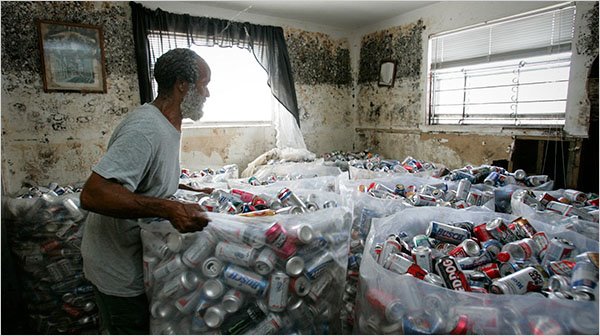
Earnest Hammond, 70, with cans he collects to pay for repairs to his hurricane-damaged home. Photo: Lee Celano for The New York Times.

Leaving the Trailers: Ready or Not, Katrina Victims Lose Temporary Housing
By Shaila Dewan / May 7, 2009

NEW ORLEANS — Earnest Hammond, a retired truck driver, did not get any of the money that went to aid property owners after Hurricanes Katrina and Rita.

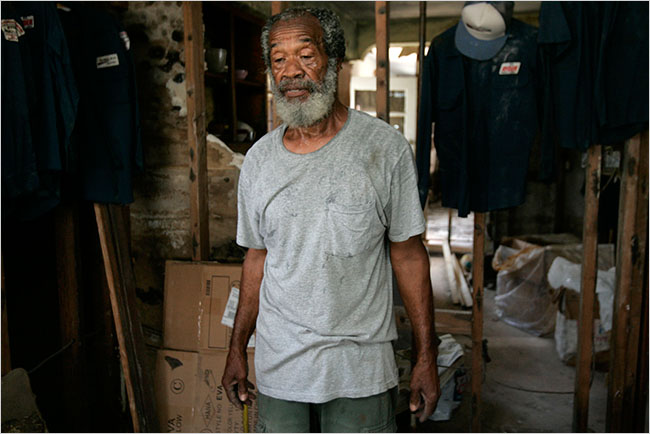
He failed to qualify for one federal program and was told he missed the deadline on another. But he did get a trailer to live in while he carries out his own recovery plan: collecting cans in a pushcart to pay for the renovations to his storm-damaged apartment, storing them by the roomful in the gutted building he owns.

It is a slow yet steady process. Before the price of aluminum fell to 30 cents a pound, from 85 cents, he had accumulated more than $10,000, he said, almost enough to pay the electrician. But despite such progress, last Friday a worker from the Federal Emergency Management Agency delivered a letter informing him that it would soon repossess the trailer that is, for now, his only home.

“I need the trailer,” said Mr. Hammond, 70. “I ain’t got nowhere to go if they take the trailer.”

Earnest Hammond has lived in a trailer while he tries to raise money to repair the apartment building he owns. He has not received any federal aid for repairs. Photo: Lee Celano for The New York Times.

Though more than 4,000 Louisiana homeowners have received rebuilding money only in the last six months, or are struggling with inadequate grants or no money at all, FEMA is intent on taking away their trailers by the end of May. The deadline, which ends temporary housing before permanent housing has replaced it, has become a stark example of recovery programs that seem almost to be working against one another.

Thousands of rental units have yet to be restored, and not a single one of 500 planned “Katrina cottages” has been completed and occupied. The Road Home program for single-family homeowners, which has cost federal taxpayers $7.9 billion, has a new contractor who is struggling to review a host of appeals, and workers who assist the homeless are finding more elderly people squatting in abandoned buildings.

Nonetheless, FEMA wants its trailers back, even though it plans to scrap or sell them for a fraction of what it paid for them.

“All I can say is that this is a temporary program, it was always intended as a temporary program, and at a certain point all temporary programs must end,” said Brent Colburn, the agency’s director of external affairs. He said there would be no extensions.

As of last week, there were two groups still in the agency’s temporary housing program: more than 3,000 in trailers and nearly 80 who have been in hotels paid for by FEMA since last May, when it shut down group trailer sites. Most are elderly, disabled or both, including double amputees, diabetes patients, the mentally ill, people prone to seizures and others dependent on oxygen tanks.

Of those in trailers, more than 2,000 are homeowners who fear that the progress they are making in rebuilding will come to a halt if their trailers are taken.

“They had helped me out up until this point, and I couldn’t believe that they suddenly decided, no, we’re not going to let you finish the house, we’re just going to take the trailer, and you can sit here on an empty lot,” said Philipp Seelig, 70, a retired handyman. He said he was about two months from being able to move back into his duplex in the Broadmoor neighborhood. A grant to elevate his house to the required height did not come until December.

Progress on renovations has been slow for many reasons: contractors who did shoddy work or simply absconded with money, baffling red tape and rule changes, and inadequate grants. The opening of new rental units began to accelerate this year, but many projects have been stymied by the recession.

FEMA says it has done everything it can to help those in temporary housing. But, as is so often the case when it comes to Katrina issues, the agency’s clients give a different account. Agency officials insist, for example, that they have been working “extensively” to help families in trailers and hotels find permanent solutions.

“A lot of people are involved in the process of making sure that no one falls through the cracks,” said Manuel Broussard, an agency spokesman in Louisiana. “Everyone’s been offered housing up to this point several times. And for various reasons, they have not accepted it.”

But the dozen temporary housing occupants interviewed for this story said they had received little if any attention from FEMA workers and were lucky to get a list of landlords, much less an offer of permanent housing.

In Baton Rouge, Troy Porter, 47, had been staying in virtual isolation at a $100-a-night Courtyard Inn by Marriott since last June. There, his normally manageable depression deepened until, he said, he would go for weeks without leaving his room.

“The only time I’ve seen FEMA workers was in the last couple of weeks, where they come and give you the paper saying this month is your last month,” Mr. Porter said. “They handed you the paper, and they turned around and walked off.”

Mr. Porter perked up last week when he was visited by Sister Judith Brun, who has been working with Katrina evacuees. In her view, the type of case management endorsed by FEMA — which primarily involves handing someone a list of phone numbers for other overtaxed agencies and, according to numerous Katrina victims, declining to return phone calls — lacks the type of personal engagement that someone like Mr. Porter needs to become self-sufficient.

“Because nobody comes in at a personal level to help him recover,” Sister Judith said, “it costs us tons of money.”

Last year, the Louisiana Recovery Authority was supposed to unveil a more intensive caseworker system for people in temporary housing, but it never materialized. The authority has now asked homeless service organizations like Unity of Greater New Orleans and the Capital Area Alliance for the Homeless in Baton Rouge to help find stable housing for the hotel occupants.

FEMA officials also say that residents can buy their trailers, sometimes for as little as $300. But virtually all of the residents interviewed said they had offered to do so and been told they could not.

Residents said FEMA workers had started visiting them in the past two months, advising them not to move out and saying extensions would be available to those who showed hardship or progress in rebuilding. But agency officials said that was not the case.

Jane Batty, Mr. Seelig’s longtime tenant, who has her own trailer next to his, was not surprised. “There is only one way to categorize this kind of behavior: it’s crazy making,” she said. “They’ve always had a different answer or had a different ploy to get us out of trailers that we had already agreed to buy.”

Source / New York Times

The Rag Blog

Posted in RagBlog | Tagged , , | Leave a comment

Houston : Rape Victims Dunned for Hospital Costs

Rape victim. Photo from The Sun, U.K.

The price of justice? Sounds more like the cost of doing bidness. Since when does one get billed for being a victim of a violent crime?

Harry Edwards / The Rag Blog

May 8, 2009

‘I’m the victim, and yet here I am. I’m asked to pay this bill and my credit’s going to get hurt,’ said a single mom from Houston.

HOUSTON — Victims of sexual assault are getting bills, rejection letters and pushy calls from bill collectors while a state crime victims’ fund sits full of cash, Local 2 Investigates reported Thursday.

“I’m the victim, and yet here I am. I’m asked to pay this bill and my credit’s going to get hurt,” said a single mom from Houston.

She received bills marked, “delinquent,” after she visited a hospital where police told her to have evidence gathered. Officers assured her she would not pay a dime for that rape kit to be handled.

“That was unreal,” she said. “I never thought I’d be out anything for what I went through.”

She was 44 years old when she was attacked in her own bed. She said she awoke to find a burly 15-year-old friend of her son assaulting her. He was found delinquent, meaning he was convicted, in juvenile court, thanks in part to the evidence gathered with the rape kit.

“It is set up legislatively so that the criminal justice system pays for whatever evidence collection occurs,” said Kelly Young, with the Houston Area Women’s Center, a rape crisis facility.

Police departments are reimbursed for up to $700 by the Texas Crime Victims’ Compensation Fund, but many departments cover the bills if they exceed that.

After that happens, victims can apply for other costs associated with the rape kit hospital visits to be covered by the fund.

The Houston Police Department made one payment toward the single mother’s hospital bill, but when she submitted the $1,847 worth of remaining bills to the Crime Victims’ Compensation Fund, she received a denial letter, telling her that law enforcement should have paid.

“She’s getting the run-around,” said Young at the rape crisis center, which was not involved in her case.

“There may be lots of survivors who have this happen and we don’t know because they don’t know that they shouldn’t be getting the bills,” she said.

“A lot of people aren’t going to ask. They’re just going to go ahead and pay it and move forward with their lives. They don’t want to keep re-living that experience,” said Young.

Texas State Comptroller’s office figures show the fund has tens of millions of dollars left over at the end of each year.

In September 2006, the balance was $67,058,646 and one year later, the balance was $57,669,432.

In 2008, that figure was up again to $66,572,261 that was left unspent in the fund.

Attorney General’s spokesman Jerry Strickland said the crime victim fund is enforcing strict guidelines imposed by the legislature as to which bills are paid and which victims are sent a denial notice.

Otherwise, he said that fund could become “insolvent.”

He said state law is clear that crime victims must exhaust all other potential funding sources, such as local police or their own health insurance.

“The legislature set it up that way,” said Strickland.

When asked for a number of how many denial letters had been sent out to Texas rape victims in the past, Strickland did not have an answer after checking with his crime victims’ compensation office workers.

He said the attorney general’s office constantly trains hospitals and health care providers on how to help victims in getting reimbursed for their expenses.

Health care workers and rape crisis counselors told Local 2 Investigates that victims have come forward with denial letters for varying reasons, such as police listing the case as inactive, paperwork being filed incorrectly, or expenses falling into the wrong category.

Young, the advocate at Houston Area Women’s Center said, “They’re not dotting the Is and crossing the Ts to make sure that the person who was victimized does not have to re-live it six months later because they get a bill.”

When Local 2 Investigates contacted the hospital where the single mother had her rape kit performed, hospital leaders quickly canceled her bill when they found out the state would not be paying the charges She now owes nothing.

She said she’s amazed it happened to begin with, adding, “I don’t look very kindly to them. I mean, I would expect that they would have had a little more feeling for me and they didn’t.”

Source / KPRC-TV / The Political Asylum

The Rag Blog

Posted in RagBlog | Tagged , , , | 1 Comment

Roger Baker : The Zombie Bank Syndrome

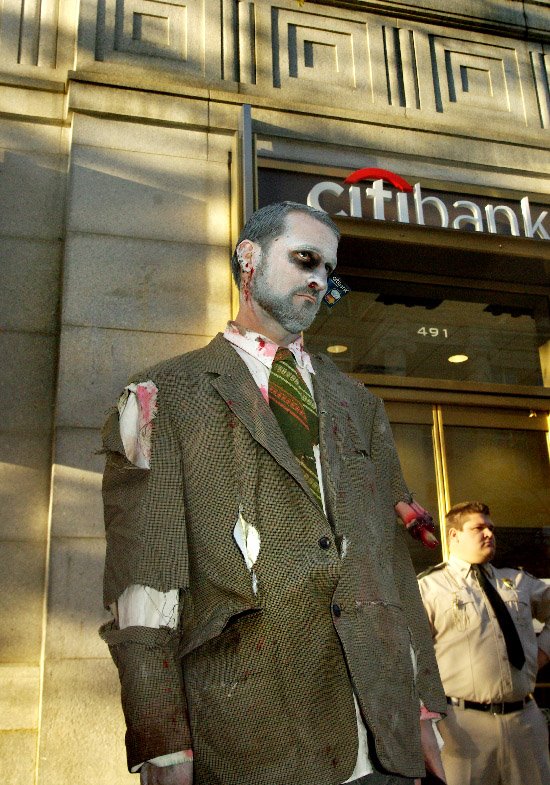
Zombie banker. Image from Mother Jones.

Dead Banks Walking. . .

Except for the bankers and the Obama administration, the prevailing reaction of many prominent economists is not one of optimism.

By Roger Baker / The Rag Blog / May 8, 2009

The latest news headlines say that as the result of federal stress testing, some of the biggest US banks are likely to fail if hard times continue. The numbers proposed to correct the bank problem don’t seem too large. Except for the bankers and the Obama administration, the prevailing reaction of many prominent economists is not one of optimism. For one, the widely read Paul Krugman is not too hopeful about the current situation:

“. . .I won’t weigh in on the debate over the quality of the stress tests themselves, except to repeat what many observers have noted: the regulators didn’t have the resources to make a really careful assessment of the banks’ assets, and in any case they allowed the banks to bargain over what the results would say.

A rigorous audit it wasn’t. But focusing on the process can distract from the larger picture. What we’re really seeing here is a decision on the part of President Obama and his officials to muddle through the financial crisis, hoping that the banks can earn their way back to health.

It’s a strategy that might work. After all, right now the banks are lending at high interest rates, while paying virtually no interest on their (government-insured) deposits. Given enough time, the banks could be flush again.

But it’s important to see the strategy for what it is and to understand the risks. Remember, it was the markets, not the government, that in effect declared the banks under-capitalized… given the possibility of bigger losses in the future, the government’s evident unwillingness either to own banks or let them fail creates a heads-they-win-tails-we-lose situation.

If all goes well, the bankers will win big. If the current strategy fails, taxpayers will be forced to pay for another bailout. But what worries me most about the way policy is going isn’t any of these things. It’s my sense that the prospects for fundamental financial reform are fading…”

So how big is the bad debt problem? The federal stress test predicts that the Bank of America will only need about $35 billion to survive the crisis. Yet it has securities in its portfolio worth a staggering $38 trillion, or more than a thousand times as much! In other words, Timothy Geithner’s proposed solution is not anywhere near in scale with the probable debt problem, and it may need a miracle to succeed

”…According to author F. William Engdahl:

Five US banks, according to data in the just-released Federal Office of Comptroller of the Currency’s Quarterly Report on Bank Trading and Derivatives Activity, hold 96 per cent of all US Bank derivatives positions in terms of nominal values, and an eye-popping 81 per cent of the total net credit risk exposure in event of default.

“The top three are, in declining order of importance: JPMorgan Chase, which holds a staggering $88 trillion in derivatives; Bank of America with $38 trillion, and Citibank with $32 trillion. Number four in the derivatives sweepstakes is Goldman Sachs, with a mere $30 trillion in derivatives; number five, the merged Wells Fargo-Wachovia Bank, drops dramatically in size to $5 trillion. Number six, Britain’s HSBC Bank USA, has $3.7 trillion.

(Geithner’s Dirty Little Secret, F. William Engdahl, Asia Times)…”

The banks that are too big to fail, yet are drowning in red ink, are being termed “zombie banks.” These banks are being kept on life support through emergency federal cash injections on a case by case basis. Some economists, like the recently successful Wall Street prophet Roubini, say we should just let the zombies fail:

“The U.S. government should let its weakest banks fail, argues economist Nouriel Roubini, whose pessimistic forecasts have earned him the moniker Dr. Doom. Roubini and fellow New York University economist Matthew Richardson, writing in the Financial Times, ask the question: ‘Why keep insolvent banks afloat?’ Their answer: ‘We believe there is no convincing answer; we should instead find ways to manage the systemic risk of bank failures.’ The bank stress tests ‘could have facilitated this process,’ the duo explain. The problem is, ‘the tests, which measure how viable banks are under adverse economic conditions, have no “failed” category, even if as many as 10 are reported to need additional capital,’ they write…”

One genuinely progressive solution to the zombie bank syndrome might be to create a parallel system of closely regulated and guaranteed-to-be-solvent federal banks. A sort of people’s banking system to underwrite the vital functions of government. There are some very bright economists who support this concept of a parallel public banking system; a sort of a banking safety net to shield the “personal sector.”

Levy Economics Institute economist Elias Karakitsos has collected some basic numbers relating to the zombie bank problem, and supports a parallel bank solution. In effect, the proposed solution is to set up healthy banks and then let the air out of the over-leveraged banking bubble gradually, since a cold turkey approach might crash the US financial system. See page 5, entitled “A ‘Good Bank’ with a Personal Sector Shield: A Viable Solution.”

“The conclusion that emerges from this analysis, therefore, is that the ‘good bank’ solution carries a risk that the entire economy may sink into a worse depression than in the 1930s.”

Our current federal policy of bailing out Detroit might possibly fit the description of what a wise and sound public bank should be doing, assuming that we really have a plan to make a transition to sensibly restructure the car industry. There are many important social needs that are not profitable enough to attract the shell-shocked private investment bankers. Things like retooling for rail transit, preserving our basic industrial muscle, while preparing to decentralize agriculture. Such strategic investments that make good sense in preparation for a leaner energy future. But we are not making this shift, as Jim Kunstler acidly observes.

Many economists long to see the Obama’s Administration make a commitment to a deep reform of the banking system; one sufficient to cure the problem and prevent its recurrence. A lot of the current job creation by the Obama administration is disappointing in character, and does not seem to be based on an inspiring vision.

Assuming that we do somehow manage to make a transition to a healthier banking system, we should also take the next oil shock into account. We cannot ignore the key role that high oil prices played in triggering the current economic and banking crisis in 2008. Since world oil production has probably already peaked, a return to a tight oil market and another debilitating oil shock seems all but certain within a few years. If the dollar is devalued by inflation, the problem of buying imported oil will be compounded:

Meanwhile, some like Mr. Goldman, below, argue that we are too pain-adverse to exorcise our banking demons, through nationalization and major economic cleansing. And furthermore, that trying to do so would not be likely to work. So we prop up our zombie banks with as much federal credit as is needed to prevent their collapse and stall for time. The guys in charge of the US Treasury and the Federal Reserve seem decidedly short on solutions, other than providing enough easy federal credit to keep the zombies alive. This might work for awhile, but at some point the currently sluggish dollars we are injecting will start actively bidding for oil and food, whereupon hyperinflation could make things get truly exciting.

The following is from “Profit-Taking Opportunity for Banks” by David Goldman:

“…Nationalization never-never-never was going to happen because if it did, the rest of the financial system (e.g., insurers) would go with it, and shortly afterward the credit of the United States. This should have been obvious to anyone with an abacus, let alone a spreadsheet program.

The clowns in the Obama administration lurched drunkenly from one stupid scheme to another, confusing the market no end, until they settled on the only thing that they could do: let the banking system remain in a zombie state indefinitely. Zombie, as I kept telling you, was as good as it gets. I said this in mid-March at the bottom of the market. This was an easy call. It like watching a very stupid lab rat run a maze. The rat might double back or spin circles, but eventually it would find the exit by trial and error. So much for the great genius of Larry Summers.”

I think Goldman is right. Whenever the big banks go down, then the dollar will likely get dragged down too, and discredited as the world’s standard reserve currency. With no stable way to store wealth except gold, international trade, already suffering, is likely to get really tough.

The Rag Blog

Posted in Rag Bloggers | Tagged , , , | 2 Comments

Health Care and Senator Baucus : Channeling Emile Zola

Psychiatrist Dr. Carol Paris is arrested for disorderly conduct outside of a U.S. Senate office building Tuesday, May 5, for speaking out at Sen. Max Baucus’ Congressional hearings on health care reform. Photo from South Maryland News.

Dr. Carol A. Paris [a psychiatrist], spent Tuesday in jail — all in the name of health care reform.

“I interrupt this so-called public hearing to bring you the following unpaid, political announcement: Put single-payer on the table. My name is Dr. Carol Paris, and I approve this message,” Paris said as she was taken out of a congressional public hearing by police for disorderly conduct, as several other protesters with Paris who are part of Physicians for a National Health Program also shouted similar messages.

Kayleigh Kulp / South Maryland News / May 8, 2009

‘I have seen many blatant excesses of power and suppression of free speech in our “land of the free,” but never have I seen anything like the excesses that Sen. Max Baucus has exhibited in his hearings on health care in the Senate of The United States.’

By Dr. Stephen R. Keister / The Rag Blog / May 8, 2009

J’accuse.

It was in 1895 that Emil Zola challenged the openness and truthfulness of The Third Republic. It would appear that it is time for a voice to be raised against the corporatocracy that now rules our Republic and permeates every level of our government institutions.

In the near 88 years that I have been a citizen of this nation I have seen many blatant excesses of power and suppression of free speech in our “land of the free,” but never have I seen anything like the excesses that Sen. Max Baucus has exhibited in his hearings on health care in the Senate of The United States. These farcical hearings are but a theatrical performance to satisfy the uninformed public.

Thus, I would accuse Senator Baucus of being a willing tool of his corporate masters, those who make such excessive contributions to his campaigns — the insurance (HMO), pharmaceutical, and medical equipment industries. I would further aver that — in conducting these hearings in such a fashion — he is doing exactly what his donors expect of him, with no consideration of his duty to, or the rights of, the citizens of the United States. It should be pointed out that only Sen. John McCain receives similar amounts of money, openly, from these sources.

Approximately 70% of the public desires single payer, universal health care, or as an interim solution, President Obama plan of “Medicare for all.” This is echoed by polls of physicians with near 60% approval. Yet, Senator Baucus convenes Senate hearings excluding the various advocates of universal, or publicly insured, health care as proposed by Physicians For A National Health Care Program, Healthcare Now, Single Payer Action, Doctors For America, and with endorsements from hundreds of labor, civic, and religious organizations — and includes only his corporate handlers in the discussion: the health insurance industry, Blue Cross/Blue Shield, AARP, the national Chamber of Commerce, the American Enterprise Institute.

Not only does Senator Baucus deny representation to the single payer advocates, but when they appear at his hearings, uninvited, he not only refuses them the right to speak but he has them handcuffed and taken to jail. Is this my country, the nation where we are guaranteed freedom of assembly and freedom of speech, or has it morphed into a nation run without rights for its citizen, with the population answerable only to the corporations that bribe our elected representatives?

On Monday night, an emergency health care briefing was held with Dr. Howard Dean. More than 20,000 persons signed up for it — the biggest conference call ever. Dr. Dean made a key point during the briefing: “If there is no public insurance option — then this is not health reform at all.” To date I have heard no discussion of the bill for universal health care introduced into the Senate by Sen. Bernie Sanders. Of course some of the Obama handlers have marginalized Dr. Dean, a uniquely honest politician.

Sadly, the main stream media has assiduously avoided the now contentious discussion on health care. Even our “liberal” commentators on MSNBC from 5-9 P.M. have pretended that there is no such debate going on in the nation or within the Washington establishment. Step back a moment and think. The newspaper industry is in the financial pits; the TV industry has all but lost automobile advertising; hence, two crippled “news” sources are greatly dependent on advertising revenues from the pharmaceutical, insurance, hospital and medical supply industries. Are we going to get any fair, in depth, discussion of health care for all Americans from our normal media. If you want to find the truth go to the internet.

We were hopeful that the Democrats would bring change; however, it has become only too apparent that many of our legislators on that side of the isle are also bought and paid for by the corporations. To see for yourselves go to . If not, why are there not more co-sponsors for Rep. John Conyers’ health care bill in the House or Senator Sander’s bill in the Senate. Further, to see where many of our “peoples’ representatives’” hearts lie, look at the lukewarm reception that President Obama’s suggestions for closing corporate tax loopholes and shipping jobs overseas received. The Republicans of course merely say “no” and the Democrats equivocate.

It is also interesting that the Republicans who mouth desire for better health care, when asked for a solution, once again respond with their ongoing mantra regarding tort reform. “The high cost of health care is due to the trial lawyers and the malpractice hazard.” In reality legal problems amount to less than 1% of healthcare costs. Enough said, we know already that the Republicans, by and large, are corporate toadies and will offer no reasonable plan. It is the Democrats, who appeared to back the Obama call for change, that are the disappointment; although anyone with a keen sense of history and of human nature is familiar with baksheesh and its behavioral effect.

The “flu crises” creates other problems about our health care in this nation of unchallenged capitalism. The New York Times recently in an editorial reminds us that The President, as a reasonable public health measure,suggested that those with flu symptoms stay home from work. Problem: about 60 million workers do not have paid sick leave, Many will be fired if they stay home. And if not fired, many cannot afford to lose the hours. 43% of Americans have no sick days at all. Yet, as The Times indicates. 160 countries have laws that ensure all their citizens receive paid sick leave, and more than 110 guarantee paid leave from the first day of the illness. Perhaps, Senator Baucus, you should incorporate some of these stipulations in your health care discussion. Forget it, your handlers would never permit such government intrusion into their culture just as they will fight to the death against The Employees Free Choice Act.

I would suggest that — in spite of Senator Baucus and his corporate handlers — the American people must be heard. In many European nations the heavy fisted suppression of free speech in the Baucus hearings would have produced a virtual general strike with swarms of folks taking to the streets. In our “free” nation such activity is looked on harshly and we shouldn’t be surprised at the heavy-handed police response; hence, proceed slowly. I note that demonstrations are planned for a Day of Action on May 30 in support of Hr 676 and S 703. (Information at Healthcare-Now) We must try, but we must not expect any comfort from the powers that be.

You might ask, does this old duffer have the right to criticize a U.S. senator in this manner?. Perhaps I do not; however, my forbearers were at the Battle of Bushy Run in the French and Indian War, they were active in the events of 1776 and 1861, and a cousin of my grandmother made the well known statement (in my opinion a bit overblown) “Lafayette We are Here.” Thus, though I am no Zola, humor me, as I once again ask this nation to revisit the intentions of Franklin, Paine, Jefferson, Madison, et al. The United States was founded as a secular nation designed to represent the interests of its citizens, not the interests of the folks who become extremely wealthy off the labor of others, and still deny them the opportunities for health care and a decent everyday life. One notes that the average American CEO makes 400 times more per day than the average worker, while in Europe the average is merely 20 times more. An excellent article on this appears in the Magazine Section of the May 3, 2009, New York Times entitled “Going Dutch.”

NOTE: Shortly after I finished this article The Ed Show on MSNBC gave an excellent account of the denial of civil rights before the Baucus committee and also publicized the amount of money that the Senator receives from the insurance and pharmaceutical industries. Our thanks and gratitude to Ed!

[Dr. Stephen R. Keister, a regular contributor to The Rag Blog, lives in Erie, PA. He is a retired physician who is active in health care reform. His previous articles on The Rag Blog can be found here.]

Doctors protest exclusion of single-payer at Senate Finance Committee

Please see Doctors, Single Payer Activists Arrested, Make History at Senate Finance Roundtable by Donna Smith / Monthly Review / May 5, 2009

The Rag Blog

Posted in Rag Bloggers | Tagged , , , , , | Leave a comment

Fidel: ‘Cuba Has Been the Victim of Terrorism for Many Years’


Reflections by Comrade Fidel – Cuba: A Terrorist Country?
By Fidel Castro Ruz / May 2, 2009

“Cuba has been the victim of terrorism for many years and it has a completely clean record in this matter. Cuban territory has never been used to organize, fund or execute terrorist acts against the United States of America. The State Department which issues those reports cannot say the same.”

Thursday, April 30 was unlucky for the United States. On that day it occurred to them to include Cuba yet again on the list of terrorist countries. Committed as they are to their own crimes and lies, perhaps even Obama himself was unable to untangle himself from that mess. A man whose talent nobody denies must feel ashamed about the empire’s cult of lie. Fifty years of terrorism against our Homeland come to light in an instant.

What can one explain to those who know about the horrific event of a plane blown up in mid flight, with its passengers and crew, about the participation of the United States in the events, the recruiting of Orlando Bosch and Posada Carriles, and the supplying of explosives, funds and the complicity of the intelligence agencies and the authorities of that country? How can one explain the campaign of terror that preceded and followed the mercenary invasion of the Bay of Pigs, the attacks on our coasts, towns, transport and fishing vessels, the terrorist actions inside and outside of the United States? How can one explain the hundreds of frustrated assassination plots on the lives of Cuban leaders? What can one say about the introduction of viruses such as hemorrhagic dengue and swine fever that genetically had never even existed in the hemisphere? I am merely mentioning some of the acts of terror in which the United States has played a part, the ones recorded in their own declassified documents. Don’t these events embarrass the current administration?

I could put together an endless list of abhorrent activities.

At our request, Bruno Rodríguez, Minister of Foreign Affairs, sent me the exact words used by a France-Presse reporter to ask him a question on April 30, along with his compelling answer.

Rigoberto Díaz, of AFP: “Coinciding with the final moments of this meeting and also on a subject that has been dealt with during this event, the US government has once more included Cuba on the list of countries sponsors of terrorism along with Sudan, Iran and Syria. I would like to hear your opinion on this.”

Bruno’s reply:

“We do not recognize any political or moral authority to the US government to make any list on any subject, or to “certify” good or bad behavior.

The Bush government was “certified” by world public opinion as a government violating international law; as being aggressive and war-mongering; as a government that tortures and that is responsible for extrajudicial executions.

“Bush has been the only president who has boasted in public, in the US Congress, about having carried out extrajudicial executions. That is a government which kidnapped people and transported them illegally, created secret prisons that nobody knows whether they are still in existence, and a concentration camp where torturing is going on in the part of territory usurped from the Republic of Cuba.

“In the matter of terrorism, the US government has historically held a long record of State terrorism acts, not only against Cuba.

“In the US, Orlando Bosch and Posada Carriles are free to come and go; these two who are responsible for numerous terrorist acts including the blowing up of a civilian Cuban plane in mid-flight. There is no answer to Venezuela’s official request for the extradition of Posada Carriles who is being tried for various charges, but not as a notorious international terrorist.

“The US government held a travesty of a trial against the five young Cuban anti-terrorist activists who are today being held as political prisoners in its jails.

“The US government covers up acts of State terrorism committed by Israel against the Palestinian people and the Arab peoples. And, it kept silent before the crimes taking place in the Gaza Strip.

“Therefore one shouldn’t recognize that the United States has any moral authority whatsoever, and I, frankly, believe that nobody pays any attention or reads those documents, among other things, because the author is an international outlaw in many of the matters which it criticizes.

“Cuba’s position against all manifestations and forms of terrorism, wherever they may be committed, against any state that may be affected, in any form it may be carried out, for whatever purpose, is clear and consistent with its actions.

“Cuba has been the victim of terrorism for many years and it has a completely clean record in this matter. Cuban territory has never been used to organize, fund or execute terrorist acts against the United States of America. The State Department which issues those reports cannot say the same.”

This declaration, issued at the ministerial meeting of the Non-Aligned Countries, is not yet widely known by the population which in these days has been receiving plenty of news of all kinds. If the State Department wishes to discuss this with Bruno, there is sufficient information to bury it in its own lies.

Source / Kingston Chronicle

Thanks to Jeffrey Segal / The Rag Blog

Posted in RagBlog | Tagged , , , | 1 Comment

Dick J. Reavis : The Narco Republic of Texas

Cool beard, chief. David Gouverneur Burnet was the first president of the original Republic of Texas. The Rag Blog’s Reavis has some ambitions of his own. Photo from Daughters of the Republic of Texas.

If Texas were an independent nation, [Perry] could let the narco globalists set up headquarters in Highland Park, near a busy airport. After all, if Houston can host Enron and KBR, what harm is done if Dallas attracts cartels?

By Dick J. Reavis / The Rag Blog / May 7, 2009

When Rick Perry used the word “sovereignty” in a speech at a tea-bagger demonstration, some of his followers chanted “secede!” They gave pundits, far and wide, a chance to mock, deplore and accuse Texans again. Perry and his crew played both roles that are incumbent on Texas in the national media: as clowns and villains. Most columnists called them “crazy,” and at least one said the very idea was “treasonous.”

Of course, Perry and his party had guffaws coming — but for other reasons. One has to sympathize with anybody who wants to break from the Empire, however impractical the idea may seem.

I have always aspired to be the first governor of the Socialist Military Republic of Texas, an ambition that Perry is too clueless to entertain. Blessings would accrue to Texans if, under my leadership, we were to break away. A few of them are:

1. Texans would no longer have to participate in costly conquests. As a small nation, we could not make war on other governments, and the loss of the cannon fodder and bases we provide the United States would hobble its undying ambition to rule the world badly.

2. An independent Texas could make up with its mother, Mexico. Were I in charge, I’d order the dismantling of the walls along the Rio Grande and have them rebuilt along the Red and Sabine.

3. In order to establish economic and cultural equality, I’d resurrect the slogan “Made in Texas, By Texans,” and would institute policies of preferential hiring for Texans in universities, the media, and national government. If Texas has a culture, it shouldn’t, as at present, be largely in alien hands.

I don’t say any of this entirely in jest. Instead, I proceed from common sense, which holds that Nothing is Forever. If that adage is true, the United States is not eternal. Like the Soviet Union, like Yugoslavia, like the Austro-Hungarian and Ottoman and British empires, it will someday dissolve into its constituent parts.

The only problem I see with the Republic of Reavis (my apologies to Plato) is that it requires the inclusion of the term “Military.” That’s because I know my people. I can’t imagine that anyone in Texas would endorse my ideas, except maybe in the wake of a revolution or coup.

But Perry doesn’t have the socialist handicap. If he’d been smart, he could have attracted potent forces to the cause of independence. His mistake was that he shouldn’t have said “sovereignty.” Instead the governor should have said, “cartel.” The boys who run the Zetas and the Gulf, Sinaloa and Juárez outfits could give him some muscle if he wants to stand off the feds. Of course, he’d have to do a favor for them. If Texas were an independent nation, he could let the narco globalists set up headquarters in Highland Park, near a busy airport. After all, if Houston can host Enron and KBR, what harm is done if Dallas attracts cartels? Murder and fraud are old-line, respectable business in the Lone Star State.

The only consequence I can see for Perry is that if the narcos moved into Highland Park, his mentor George Bush would have to flee, because Bush brought a passel of Mexican narco executives to trial and imprisonment in the United States.

The Narco-Military Republic of Texas! It couldn’t hold a candle to the glories of my Military Republic, but maybe the idea deserves second place.

[Rag Blog contributor Dick J. Reavis is an award-winning journalist, educator and author. He wrote for Austin’s underground newspaper The Rag, and was a senior editor at Texas Monthly magazine. Dick Reavis’ book, The Ashes of Waco: An Investigation, about the siege and burning of the Branch Davidian compound, was published by Simon and Schuster and may be the definitive work on the subject.]

The Rag Blog

Posted in Rag Bloggers | Tagged , , | 1 Comment