Fidel: ‘Cuba Has Been the Victim of Terrorism for Many Years’


Reflections by Comrade Fidel – Cuba: A Terrorist Country?
By Fidel Castro Ruz / May 2, 2009

“Cuba has been the victim of terrorism for many years and it has a completely clean record in this matter. Cuban territory has never been used to organize, fund or execute terrorist acts against the United States of America. The State Department which issues those reports cannot say the same.”

Thursday, April 30 was unlucky for the United States. On that day it occurred to them to include Cuba yet again on the list of terrorist countries. Committed as they are to their own crimes and lies, perhaps even Obama himself was unable to untangle himself from that mess. A man whose talent nobody denies must feel ashamed about the empire’s cult of lie. Fifty years of terrorism against our Homeland come to light in an instant.

What can one explain to those who know about the horrific event of a plane blown up in mid flight, with its passengers and crew, about the participation of the United States in the events, the recruiting of Orlando Bosch and Posada Carriles, and the supplying of explosives, funds and the complicity of the intelligence agencies and the authorities of that country? How can one explain the campaign of terror that preceded and followed the mercenary invasion of the Bay of Pigs, the attacks on our coasts, towns, transport and fishing vessels, the terrorist actions inside and outside of the United States? How can one explain the hundreds of frustrated assassination plots on the lives of Cuban leaders? What can one say about the introduction of viruses such as hemorrhagic dengue and swine fever that genetically had never even existed in the hemisphere? I am merely mentioning some of the acts of terror in which the United States has played a part, the ones recorded in their own declassified documents. Don’t these events embarrass the current administration?

I could put together an endless list of abhorrent activities.

At our request, Bruno Rodríguez, Minister of Foreign Affairs, sent me the exact words used by a France-Presse reporter to ask him a question on April 30, along with his compelling answer.

Rigoberto Díaz, of AFP: “Coinciding with the final moments of this meeting and also on a subject that has been dealt with during this event, the US government has once more included Cuba on the list of countries sponsors of terrorism along with Sudan, Iran and Syria. I would like to hear your opinion on this.”

Bruno’s reply:

“We do not recognize any political or moral authority to the US government to make any list on any subject, or to “certify” good or bad behavior.

The Bush government was “certified” by world public opinion as a government violating international law; as being aggressive and war-mongering; as a government that tortures and that is responsible for extrajudicial executions.

“Bush has been the only president who has boasted in public, in the US Congress, about having carried out extrajudicial executions. That is a government which kidnapped people and transported them illegally, created secret prisons that nobody knows whether they are still in existence, and a concentration camp where torturing is going on in the part of territory usurped from the Republic of Cuba.

“In the matter of terrorism, the US government has historically held a long record of State terrorism acts, not only against Cuba.

“In the US, Orlando Bosch and Posada Carriles are free to come and go; these two who are responsible for numerous terrorist acts including the blowing up of a civilian Cuban plane in mid-flight. There is no answer to Venezuela’s official request for the extradition of Posada Carriles who is being tried for various charges, but not as a notorious international terrorist.

“The US government held a travesty of a trial against the five young Cuban anti-terrorist activists who are today being held as political prisoners in its jails.

“The US government covers up acts of State terrorism committed by Israel against the Palestinian people and the Arab peoples. And, it kept silent before the crimes taking place in the Gaza Strip.

“Therefore one shouldn’t recognize that the United States has any moral authority whatsoever, and I, frankly, believe that nobody pays any attention or reads those documents, among other things, because the author is an international outlaw in many of the matters which it criticizes.

“Cuba’s position against all manifestations and forms of terrorism, wherever they may be committed, against any state that may be affected, in any form it may be carried out, for whatever purpose, is clear and consistent with its actions.

“Cuba has been the victim of terrorism for many years and it has a completely clean record in this matter. Cuban territory has never been used to organize, fund or execute terrorist acts against the United States of America. The State Department which issues those reports cannot say the same.”

This declaration, issued at the ministerial meeting of the Non-Aligned Countries, is not yet widely known by the population which in these days has been receiving plenty of news of all kinds. If the State Department wishes to discuss this with Bruno, there is sufficient information to bury it in its own lies.

Source / Kingston Chronicle

Thanks to Jeffrey Segal / The Rag Blog

Posted in RagBlog | Tagged , , , | 1 Comment

Dick J. Reavis : The Narco Republic of Texas

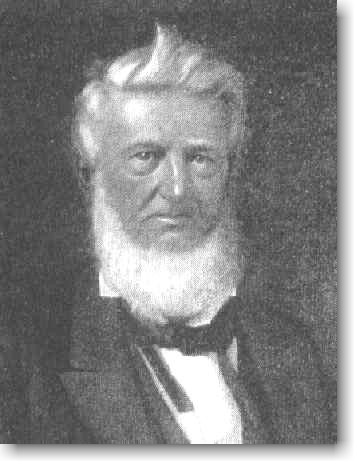
Cool beard, chief. David Gouverneur Burnet was the first president of the original Republic of Texas. The Rag Blog’s Reavis has some ambitions of his own. Photo from Daughters of the Republic of Texas.

If Texas were an independent nation, [Perry] could let the narco globalists set up headquarters in Highland Park, near a busy airport. After all, if Houston can host Enron and KBR, what harm is done if Dallas attracts cartels?

By Dick J. Reavis / The Rag Blog / May 7, 2009

When Rick Perry used the word “sovereignty” in a speech at a tea-bagger demonstration, some of his followers chanted “secede!” They gave pundits, far and wide, a chance to mock, deplore and accuse Texans again. Perry and his crew played both roles that are incumbent on Texas in the national media: as clowns and villains. Most columnists called them “crazy,” and at least one said the very idea was “treasonous.”

Of course, Perry and his party had guffaws coming — but for other reasons. One has to sympathize with anybody who wants to break from the Empire, however impractical the idea may seem.

I have always aspired to be the first governor of the Socialist Military Republic of Texas, an ambition that Perry is too clueless to entertain. Blessings would accrue to Texans if, under my leadership, we were to break away. A few of them are:

1. Texans would no longer have to participate in costly conquests. As a small nation, we could not make war on other governments, and the loss of the cannon fodder and bases we provide the United States would hobble its undying ambition to rule the world badly.

2. An independent Texas could make up with its mother, Mexico. Were I in charge, I’d order the dismantling of the walls along the Rio Grande and have them rebuilt along the Red and Sabine.

3. In order to establish economic and cultural equality, I’d resurrect the slogan “Made in Texas, By Texans,” and would institute policies of preferential hiring for Texans in universities, the media, and national government. If Texas has a culture, it shouldn’t, as at present, be largely in alien hands.

I don’t say any of this entirely in jest. Instead, I proceed from common sense, which holds that Nothing is Forever. If that adage is true, the United States is not eternal. Like the Soviet Union, like Yugoslavia, like the Austro-Hungarian and Ottoman and British empires, it will someday dissolve into its constituent parts.

The only problem I see with the Republic of Reavis (my apologies to Plato) is that it requires the inclusion of the term “Military.” That’s because I know my people. I can’t imagine that anyone in Texas would endorse my ideas, except maybe in the wake of a revolution or coup.

But Perry doesn’t have the socialist handicap. If he’d been smart, he could have attracted potent forces to the cause of independence. His mistake was that he shouldn’t have said “sovereignty.” Instead the governor should have said, “cartel.” The boys who run the Zetas and the Gulf, Sinaloa and Juárez outfits could give him some muscle if he wants to stand off the feds. Of course, he’d have to do a favor for them. If Texas were an independent nation, he could let the narco globalists set up headquarters in Highland Park, near a busy airport. After all, if Houston can host Enron and KBR, what harm is done if Dallas attracts cartels? Murder and fraud are old-line, respectable business in the Lone Star State.

The only consequence I can see for Perry is that if the narcos moved into Highland Park, his mentor George Bush would have to flee, because Bush brought a passel of Mexican narco executives to trial and imprisonment in the United States.

The Narco-Military Republic of Texas! It couldn’t hold a candle to the glories of my Military Republic, but maybe the idea deserves second place.

[Rag Blog contributor Dick J. Reavis is an award-winning journalist, educator and author. He wrote for Austin’s underground newspaper The Rag, and was a senior editor at Texas Monthly magazine. Dick Reavis’ book, The Ashes of Waco: An Investigation, about the siege and burning of the Branch Davidian compound, was published by Simon and Schuster and may be the definitive work on the subject.]

The Rag Blog

Posted in Rag Bloggers | Tagged , , | 1 Comment

Schwarzenegger : Let’s Talk About Legalizing Pot

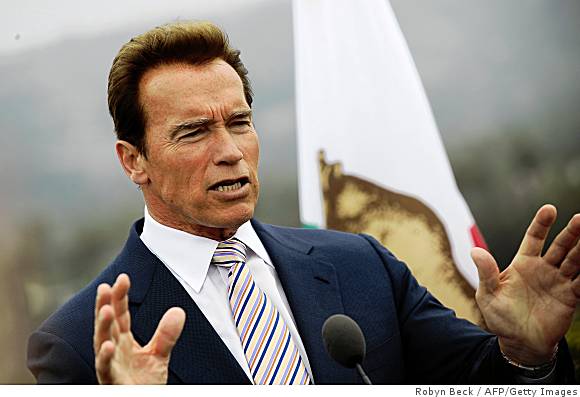
Gov. Arnold Schwarzenegger of California says it’s time to talk about legalizing pot. Photo by Robyn Beck / AFP / Getty Images.

‘This is only going to increase the governor’s popularity,’ Aaron Smith of the Marijuana Policy Project said. ‘We have solid polling data showing that a majority of Californians are ready for this.’

By Declan McCullagh / May 6, 2009

In the last week or two, proposals to legalize medical marijuana have advanced in Minnesota, New Hampshire, and Rhode Island.

But Gov. Arnold Schwarzenegger has taken a significant step further, saying on Tuesday that it’s time to debate legalizing marijuana for recreational use in California.

“I think it’s time for debate,” he said in response to a reporter’s question. “I think all of those ideas of creating extra revenues — I’m always for an open debate on it.”

Thanks to a 1996 ballot measure, medical marijuana is already legal under California law, though local officials have substantial discretion. Although that conflicts with federal law, the Obama administration has chosen not to target California medical marijuana dispensaries.

“Most Californians support the idea of making marijuana legal,” Aaron Smith, the California policy director for the Marijuana Policy Project, told CBSNews.com. “Right now, the state is in a budget fiasco that not going to go away soon… It’s about time they look outside the box at ways of generating revenue.”

State legislator Tom Ammiano, a San Francisco Democrat,
introduced a bill in February to legalize recreational marijuana. Bill AB 390 would license “commercial cultivators of marijuana” and establish a complicated web of regulations and tax rules they and retailers must follow.

It could raise over $1.2 billion a year in new tax revenues, assuming a $50-an-ounce tax, according to one analysis one analysis.

“This is only going to increase the governor’s popularity,” Smith said. “We have solid polling data showing that a majority of Californians are ready for this. It’s a good political move, though I don’t think he necessarily did it for those reasons alone.”

A Field poll (PDF) released on April 30th found that 56 percent of the state’s registered voters support legalizing marijuana and taxing its proceeds.

[CBSNews.com’s Charles Cooper contributed to this report.]

Source / Political Hotsheet / CBS News

Governor Says ‘It’s Time For Debate’ On Pot

Also see New Poll: 52% Say Marijuana Should Be Legal, Taxed, Regulated / Salem News-com / May 6, 2009

The Rag Blog

Posted in RagBlog | Tagged , , , | 8 Comments

GI Victor Agosto : ‘There is No Way I Will Deploy to Afghanistan’

Victor Agosto with fan club at opening of Under the Hood Cafe in Kileen, Texas, on March 1, 2009. Photo by Carlos Lowry / The Rag Blog.

To Victor Agosto, Ft. Hood, Texas:

‘You will deploy in support of OEF on or about [XXXXX] with 57th ESB. This is a direct order from your Company Commander CPT Michael J. Pederson.’

By Alice Embree / The Rag Blog / May 7 / 2009

In a photo taken at Under the Hood Café in Killeen, Texas, Victor Agosto stands soldier tall, flanked by two older women peace activists from Fort Worth. Victor doesn’t talk a lot, but when he does he reveals a resolve and intelligence that seems far older than his 23 years.

Victor has served three years and nine months in the U.S. Army, including one tour in Iraq. His Estimated Termination of Service (ETS) date was until very recently August 3, 2009. With his impeccable record and accrued leave, he was slated for release at the end of June. That date slipped away, apparent victim to the Stop Loss clause that renders the phrase “voluntary service” meaningless. The Army has told Specialist (SPC) Victor Agosto that he will be deployed to Afghanistan. He has told the Army he won’t go.

Victor’s Facebook page posts the specifics. His Counseling Form dated May 1st states the Army’s position:

“You will deploy in support of OEF on or about [XXXXX] with 57th ESB. This is a direct order from your Company Commander CPT Michael J. Pederson.”

Victor’s Session Closing statement is succinct:

“There is no way I will deploy to Afghanistan. The occupation is immoral and unjust. It does not make the American people any safer. It has the opposite effect.”

Victor has been something of a fixture at Under the Hood. In the small house turned gathering spot, a free speech zone has been created for GIs, military families and friends. Coffee, snacks and GI Rights literature is available.

A large world map featuring U.S. interventions takes up one wall. The first interventions posted were Iraq and Afghanistan. Gradually, more countries and dates have been added: Chile, 1973, the CIA-backed military coup; Guatemala, 1954, the Marine invasion; Iran, 1953, the CIA-backed overthrow of the democratic government.

Under the Hood is a place where GIs can talk, relax, and think. It is the thinking that has brought Victor to his decision. In his words, “The supportive ‘family’ that I have found at Under the Hood helped me muster up the courage to resist.”

[Under the Hood Café is a project of the Fort Hood Support Network. Donations can be made at underthehoodcafe.org.: Rag Blog contributor Alice Embree is a founder of Austin’s original underground paper The Rag and serves on the Board of the Fort Hood Support Network.]

The Rag Blog

Posted in Rag Bloggers | Tagged , , , , , | 45 Comments

Nice is Not Enough : Obama and the Israeli Political Mess

Is Israeli Foreign Affairs Minister Avigdor Lieberman (with lifted glass) even embarassing his boss, Prime Minister Bibi Netanyahu? Photo from acus.org.

Obama vs. Netanyahu and Lieberman

Obama, as shrewd a gentleman as he is supposed to be, is in no way prepared to handle the weird mix of arrogance and insult originating from Netanyahu and Lieberman and flooding the Israeli media.

By Reuven Kaminer / May 6, 2009

Universally respected, even loved in many quarters, and still the embodiment of hope for many of the simple folk and the downtrodden, Barack Obama is not doing very well with the new government of Israel. Obama sounds well intentioned when he talks of peace in the area. But Obama, as shrewd a gentleman as he is supposed to be, is in no way prepared to handle the weird mix of arrogance and insult originating from Netanyahu and Lieberman and flooding the Israeli media.

The Minister of Foreign Affairs, Avigdor Lieberman, ignores the hints by many of the pundits that he may be embarrassing his boss, Bibi Netanyahu. Thriving on media attention, Lieberman keeps up a barrage of inanities like his statement in an interview to a Russian publication to the effect that “the US will do what we tell it to do.” Despite his appearance as a thug and a buffoon, Lieberman has a broad geo-political agenda and even presumes to explain to Obama that Pakistan and Afghanistan and not Iran are the chief problem.

Lieberman is working on his very own contribution to world security by pushing the idea of a USA-Russia alliance against the Islamic world (civilization) to be brokered by…you guessed it…Israel and its foreign minister. There are people out there who take the clash of civilizations seriously. Just what we need – a Judeo-Christian alliance for the preservation of Western values.

Lieberman is no genius but he can pick up on a racist strain in US-European thinking. Bibi is a bit more elegant, but he is following the very same scenario as his buddy. This policy must be characterized as the right wing-extremist line of the more aggressive and adventurous elements in the US administration. These forces dislike Obama’s “moderate” style even when it is seen purely as a matter of form. They know the hard facts of imperial power and will exploit every element to wear down Obama, who has hitherto been simply unable to elaborate a coherent alternative to traditional hegemonic thinking.

Israel sees itself a pioneer in the war of civilizations. From its forward position it looks back at Obama and reminds him that, in the light of the conceptual continuity of US foreign policy, respect and consideration are due to the pioneers watching the fort.

Obama and the U.S. are in a particularly sensitive situation in the ME. Netanyahu has effectively scuttled the peace process, as faint and unconvincing as it was. Iran is exerting greater influence in the ME where the moderate Arab regimes are reduced to depending on Israel muscle to protect themselves from the fall out resulting from their collaborationist betrayal of the Palestinians.

Odds and increasing signs on the ground indicate that the departure and the redeployment of US troops will have a destabilizing effect in Iraq. There are increasing signs that the present leadership in Baghdad might take a hike to Teheran. The US leadership has figured out it needs some secular horses in the Iraqi race and is busy trying to resurrect Sadaam Hussein’s old party. You see, this is the Middle East.

Meanwhile, for the last few weeks, Bibi Netanyahu has been working overtime to kill off any chance whatsoever for any solution to the Israeli-Palestinian and the Israeli-Arab conflict. He has already demonstrated clearly and unequivocally that, when and if he deigns to be so kind to his US buddy as to agree to go back to the negotiating table, he will talk only exclusively to a waterboarded Palestinian delegation that will kiss the whip after being thoroughly inundated by a flood of new unconditional demands.

Israel now demands that the Palestinians must not only recognize Israel and undertake peaceful coexistence with it, the Palestinians must recognize Israel as the state of the Jewish people. This recognition is to be interpreted by Israel, inter alia, as a clear renunciation of the demands for the rights of the Palestinian refugees. You see, Israel seeks closure.

The plain fact of the matter is that while Obama’s advisers’ limit him to bland generalities such as “Let’s have two states,” and “Everybody should behave well,” Lieberman and Netanyahu are hard at work. They are ostensibly reviewing their policy options, but really making sure that by issuing a slew of new demands, one more outrageous than the other, there will not be a Palestinian in sight who will dare to sit down to discuss “Two-states.”

Washington is stupefied and fails to react. Netanyahu says that Israel has just as much right to build in the occupied territories as the Palestinians and that the status of the land in the territories is “disputed land.” Washington is stupefied and fails to react. Netanyahu wants it clear right now that Palestine will never have any sort of army, and accept all kinds of limitations regarding water and elctro-magnetic fields on its truncated sovereignty. Washington is stupefied and fails to act.

Some wise guy pundit here called this new list of demands, Netanyahu’s shopping list for Obama. Obama has scheduled a full and frank discussion with Netanyahu for the 18th this month. Hillary Clinton is looking forward to hear about new developments in Israeli policy and hopes to explain to Netanyahu the danger of alienating the moderate Arab regimes. But Netanyahu is smart enough to exploit any opening given him in D.C. to present a new agenda of unlimited complications. Obama and Clinton may want to play dumb but if they allow Netanyahu to participate in shaping the agenda, they are selling the Palestinian down the river…again.

Netanyahu is not without friends and connections in D.C. within the present administration which is still in the grips of the political ideas and anti-Iran hysteria of its predecessor.

Making War for Peace or Making Peace for War

Everybody watching Bibi here knows how he is preparing himself for the coming meeting with Obama. The war on terror he says trumps peacemaking in the region. With Ahmadinajad on the loose, how could you conceivably talk to us about concessions affecting our vital rights. First lets take out Iran and then I will have time and patience to talk with you about Palestine. The hawkish, militarist, chauvinist boss here is telling Obama, no peace with Palestine without war on Iran.

Hillary Clinton was unable to understand that she was trailing far behind the discussion when she suggested that Netanyahu should desist from alienating the moderate Arab by making peace with the Palestinians. Despite the rumors that Lieberman is spitting in the soup, the Israeli-Egyptian love fest is on again. The Israeli government and the head of Egyptian intelligence, meet personally on a regular basis to work out the details of the siege and isolation of Gaza.

When he has a chance, Bibi will explain to Hillary Clinton that he has the moderate Arab regimes in the palms of his hands. The moderates fear, more than anything else, political confrontation with Arabs and Muslims who have their very own ideas as to the disposition of their own oil. They, the “moderates”, are simply too busy defending their own privileges to be bothered by the fate of Palestine.

Even so, Obama and Hillary will tell Netanyahu that progress in the Palestinian talks is absolutely necessary to isolate Iran either for heavy sanctions or eventually a full sale attack. We must have peace they will explain before we can make war. Netanyahu, if it appears that he cannot really get his war (with Iran) for promising peace (with the Palestinians) will make the “ultimate concession” and agree to renew talks with the Palestinians.

Obama will fake a victory, the “moderate” Arab countries will marvel at US diplomatic and the US will proceed on its mission to Teheran. The US will ostensibly have moved in the direction of dialogue but will brandish the Israeli sword in the face of the recalcitrant Iranians to keep them up to speed. With all this jockeying hither and thither very few bright people will be fooled into forgetting the name of the game.

This region is oil country and it is the United States and it alone which wants it hands on the spigot. Iran with its reactionary regime and crude and clumsy leadership has the weird idea that it should decide how to dispose of its own oil, a crime punishable by death and invasion in the US playbook.

Barack Obama Really Seems Like a Nice Guy

I wish to avoid the full scale debate on the significance of the Obama presidency. Suffice it to say that even the most enthusiastic of Obama’s admirers on the left understand that he is the man responsible for tending store for the US empire and its interests. He himself has chosen to surround himself especially in foreign affairs by circles that represent continuity while he must rely on a state apparatus which honors the “virtues” of continuity above all else.

Meanwhile, the US is in full retreat in the Middle East, where Iran and its allies enjoy a spurt of prestige for their support for the forsaken Palestinians. And now South Asia is falling apart. It is worth believing that the nuclear warehouse in Pakistan is in safe hands, but nothing else is safe and no where else is the area secure. Iraq is evermore inherently unstable, and the latest news is that the US is trying to resurrect Saadam Hussein’s party in order to balance the Shi’ite predilection for friendship in Teheran.

Unless it is ready to radically increase its military activity, directly or by proxy, in these regions, the US must come up with a serious shift in policy and the cosmetic stuff is just not enough. In short, the US must demonstrate a serious willingness to recognize Iran’s legitimate interests and get rid of the “axis of evil” baggage.

And now back to Bibi and his plans for war. As long as the hard line Israeli policy and the softer line US policy are supposed to advance the same goal of thwarting and obstructing Iranian influence, as long as Washington buys the Israeli propaganda that Israel is in danger of a new Auschwitz and Ahmadinajad is a new Hitler (like Nasser and Arafat figured in previous Israeli narratives), there is a danger that Israel will attack. Equivocation in DC can easily translate to Israeli provocation in Boshir.

Our condemnation of the US-Israeli alliance in the ME does not mean that we have any sympathy whatsoever for the reactionary Islamic Republic and its leadership. Ahmadinajad seems totally unable to understand that his sloppy loose and crude formulations regarding Jewry and Israel are just what Bibi and Lieberman ordered. However, recent experience has shown that US intervention, direct or sponsored, will only strengthen a vicious regime, while spreading untold death and destruction among the people of Iran.

[Reuven Kaminer, was born in Detroit, Michigan in 1929, and he emigrated to Israel in 1951. He is a writer, political analyst, and veteran activist of the Left in Israel. His blog can be found here.]

Source / CounterPunch

Thanks to David Hamilton / The Rag Blog

Posted in RagBlog | Tagged , , | Leave a comment

Austin Metro Policies Are Creating Fewer Riders and More Pollution


Capital Metro and the Environment
By Glenn Gaven / The Rag Blog / May 7, 2009

As EPA clean air requirements become more stringent, Texas’ Travis County is poised to enter a new phase of its non-attainment status. For the first time, TCEQ and the County will likely be forced to implement a serious action plan to reduce greenhouse gases, or risk massive reductions in federal transportation subsidy. Mass transit is well recognized as an immediate, efficient means to reduce pollution.

For whatever reason, our local transit authority is so far unwilling to genuinely participate in cleaning our air. They have opted against natural gas and expanding hybrid utilization as fuel options in favor of diesel. Capital Metro last year discontinued free rides on ozone action days even though they saw an average 15% ridership increase on those days. They raised fares last year and are set to raise them again this October. Raising fares reduces ridership. In fact, current ridership goals are set for 20,000 less trips per month and actual ridership figures are even lower, averaging 10% fewer riders from last year. This means more cars, far and away the number one source of ozone pollution, on our roads.

On Earth Day 2008, the Bus Riders Union-ATX submitted a proposal for fare-free transit to Capital Metro. The proposal was aimed at increasing mobility for all Austin residents, and just as important, at reducing pollution.

Fare-free transit is highly efficient as it eliminates the expensive and time consuming collection of fares on the bus. Such a system reduces pollution by getting people out of their cars. During a 15 month fare-free period in 1989-90 Capital Metro increased ridership by 80%. Not only were more people riding the bus, but discussion about adding more freeway capacity on IH35 subsided. Pollution is further reduced as idling times for buses lessens without fare collection and decreased traffic congestion lowers idling times of both buses and cars.

Capital Metropolitan Transportation Authority should not just rescind the impending fare hike which would devastate ridership, they should immediately implement a fare-free system to coax riders out of their ozone emitting cars. The small drop in revenue would be more than recovered by eliminating the cost of collection, maintaining and increasing federal funding, and reducing the expensive and deadly health care costs resulting from breathing dirty air.

The Rag Blog

Posted in RagBlog | Tagged , , , , | 1 Comment

Steven Johnson: Making Something More of Imagination

Nod office. Steven M. Johnson.

Searching for Value in Ludicrous Ideas
By Allison Arieff / May 4, 2009

This is a relentless age we’re living in, a time when innovative solutions — or any solutions, for that matter — to our seemingly infinite problems seem in short supply.

So how do we come up with new ideas? How do we learn to think outside of normal parameters? Are the processes in place for doing so flawed? Do we rely too much on computer models? On consultants? On big-idea gurus lauding the merits of tribes and crowds or of starfish and spiders? On Twitter?

At the risk of sounding like a big-idea guru myself, I can’t help thinking that we’re all so mired in it that we’ve forgotten how to get out of it — how to daydream, invent, engage with the absurd.

That’s why I am so enamored with the work of inventor/author/cartoonist/former urban planner Steven M. Johnson, a sort of R. Crumb meets R. Buckminster Fuller. Johnson is a former urban planner, and his work tends toward the nodes where social issues intersect with design and urban planning issues.

In discussing his often fantastical, sometimes silly, sometimes visionary concepts, he has said, “If I could use two words to describe what it is that I enjoy it is that I love to be sneakily outrageous . . . [It may be that] I have decided an idea has no practical worth and would never be likely to be adopted seriously (like most of my ideas), but I like it anyway.”

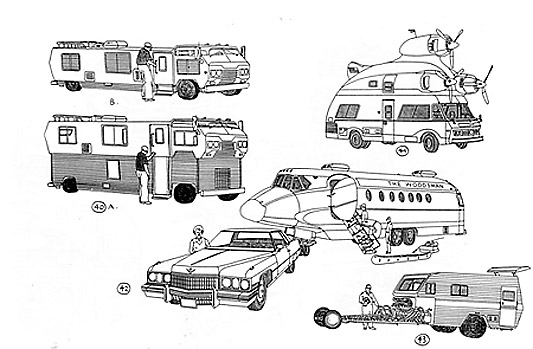
A latent inventor, Johnson discovered his “ability” only at age 36 in 1974, when he was the editorial cartoonist for The Sierra Club Bulletin and the editor, Roger Olmsted, asked him to invent whimsical recreational vehicles. Olmsted asked for 16; Johnson gave him 109. “I had never invented anything before,” he told me in an e-mail recently, “because no one had ever asked me to invent anything!”

Variations on the theme of recreational vehicles. Steven M. Johnson. (Click to enlarge.)

It would be ridiculous to suggest that the powers that be should do nothing but give in to their wild imaginations. But there’s something to Johnson’s explorations that warrants our attention. It may be, as the title of his 1984 book suggests, exactly “What the World Needs Now: A Resource Book for Daydreamers, Frustrated Inventors, Cranks, Efficiency Experts, Utopians, Gadgeteers, Tinkerers, and Just About Everybody Else.”

As the 70-year-old told me last week, “America has been falling into a depression, a psychological depression, for many years. Yet this is a land of pioneer inventors. It annoys me that an untrained person like myself can think up products easily (in fact I usually spend energy ‘turning off’ the idea-generating machine just as psychics train themselves to turn off their capability) and yet the nation seems to sit helplessly passive and wait to be saved somehow.”

So maybe there are some lessons to be learned from Johnson.

Many of his musings are simply whimsical, existing primarily as a source of inspiration or delight. Others tackle very real issues, from environmentalism to alternative transportation to homelessness. Here, a look at both ends of the spectrum.

Every worker would appreciate the Nod Office (1984), an ingenious desk that can be transformed into a hidden sleeping chamber, perfect for late afternoon naps. Owning such a contraption remains for me a significant yet unrealized career goal.

Anyone who ever left the house without eating breakfast will appreciate his dashboard toaster oven. (Another feature, the Automobile Snack Conveyer, allows you to deliver that toast to your kid in the back seat.)

Variations on the theme of recreational vehicles. Steven M. Johnson.

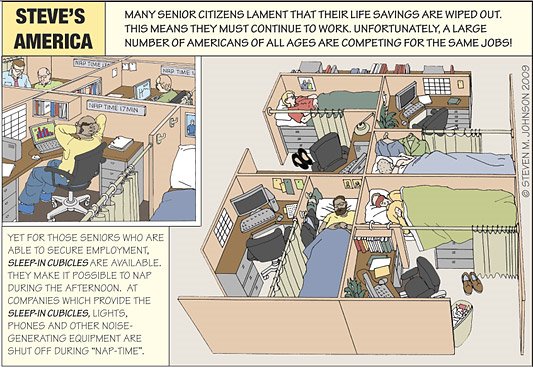
Yet there’s a darker side to Johnson as well, as evidenced by this much more recent exploration, drawn in 2009, of office cubicles: these are now used not just for afternoon siestas but to offer working seniors, unable to retire in this economy, a much-needed place to rest.

Sleep-in cubicles for seniors. Steven M. Johnson.

In Johnson’s oeuvre, nothing gets to exist if it doesn’t have at least two functions: the skylight uses solar energy to cook the dinner, for instance, and the exercise bike operates the washing machine (cleaning clothes and toning the wearer’s muscles simultaneously).

Sky-Light Oven. Steven M. Johnson.

Hide-a-Shower. Steven M. Johnson.

“Accessories with a purpose,” drawings from 1991, include such then seemingly silly items as “hands-free phones” and “pouchpants” (a tragically unflattering variation on what would become the still tragically unflattering fanny pack). A very small apartment might house the Hide-a-Shower, a sofa that can be upended for bathing. Murder on the upholstery, no doubt.

Grindplay. Steven M. Johnson.

Johnson has even done a series of drawings on how not to invent: here, a radio powered by a coffee grinder (2005). Other bizarre explorations include adjacent commodes in an exploration of Toilets for Immodest Times. And the Cigaire smoke hood, which redirects cigarette smoke from the smoker’s mouth into a stylish helmet, a variant of which Johnson actually saw at an inventors’ convention in 1989.

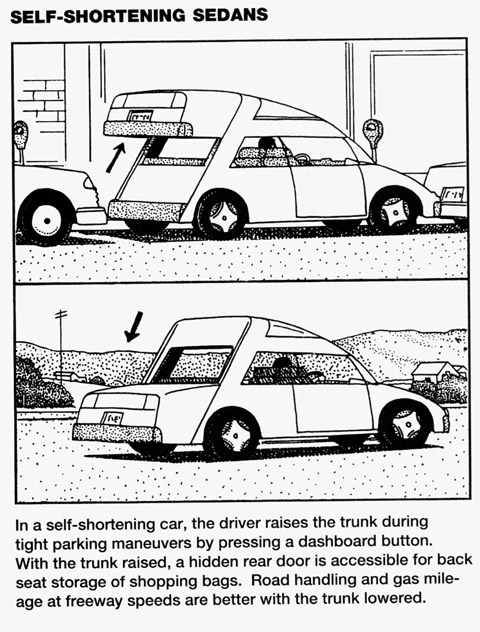
Self-shortening sedans. Steven M. Johnson.

Transportation figures prominently in Johnson’s work, much of it showcased in his second book, “Public Therapy Buses” (1991). Again, many of his concepts are simply cute and clever, like the self-shortening sedan with its adjustable bumper (combines the stability of a larger car with the parking convenience of a tinier one), or the View Cab (puts some power back in the hands of the drivers of compact cars).

View Cabs. Steven M. Johnson.

Other Johnson transportation ideas do move increasingly, if not entirely, toward practicality, like the clever albeit cumbersome Bike Vest:

Bike Vest. Steven M. Johnson.

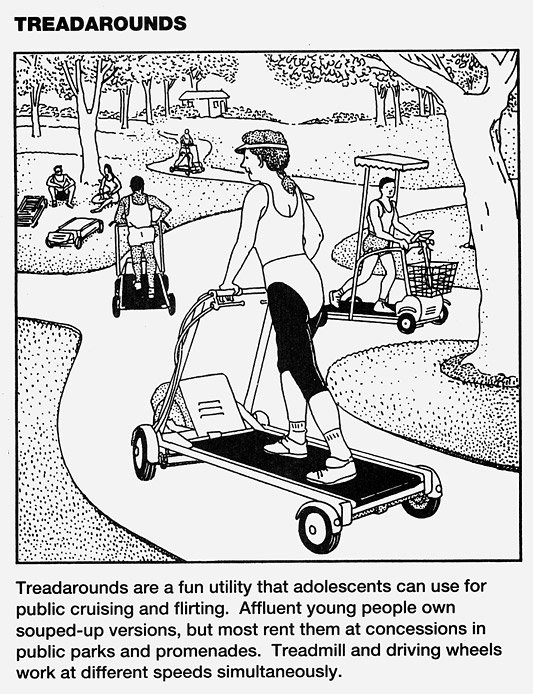
A golf-cart-meets-treadmill contraption seems to predate the Segway.

Treadarounds. Steven M. Johnson.

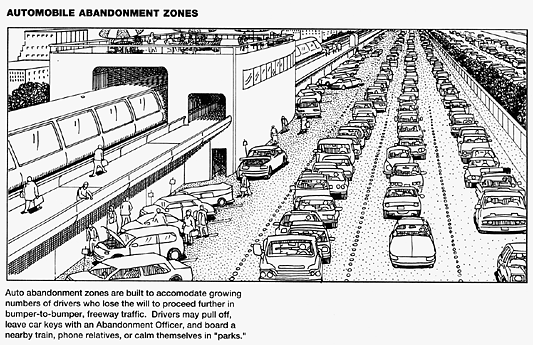
Some of his transit concepts begin to address tangible issues. Automobile Abandonment Zones intuit the very contemporary possibility of commuters fleeing gridlock for a nearby train, willingly relinquishing their keys to Abandonment Officers.

Automobile Abandonment Zones. Steven M. Johnson. (Click to enlarge.)

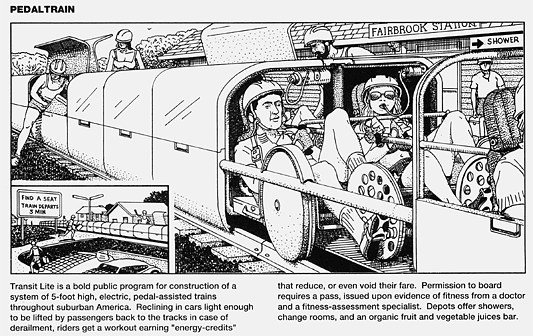
Pedaltrains posit the intriguing concept of combining two car alternatives: bicycles and public transit.

Pedaltrain. Steven M. Johnson. (Click to enlarge.)

It was nearly 20 years ago, in “Public Therapy Buses,” that Johnson predicted that shopping malls would be given over to mega-malls for consignment and thrift items. He was pretty on-target with concepts like Landfill Surprise: The Quality Trash Store.

Landfill Surprise: The Quality Trash Store. Steven M. Johnson.

And his Neighborhood Sharing Booths, designed to provide food, water and clothing from kiosks on neighborhood lawns, seem eerie predictors of the current reality of foreclosed subdivisions.

Fans of prefab can appreciate flexible housing concepts like “Rooms Added a Piece at a Time” and “Homes Purchased by the Room,” while builders of gated communities, tongue firmly out of cheek, clearly missed the intended irony of Johnson’s “Double-Walled Communities,” in which “developers gain approval from planning departments to build double-walled communities for wealthy executives,” or his “Monitowers” — staffed towers in subdivisions that feature surveillance cameras.

What fascinates me about Johnson is his ability to riff on anything, from a sort of frivolous contraption called a brief skate (yes, a briefcase that morphs into a skateboard — perfect for today’s unemployed boomers) to a wholly prescient formed concept like Oakville, a gasoline-and-diesel-engine free city that features a freeway for electric cars and bicycles, and a medieval-like perimeter wall that keeps polluting cars out. He can be so out there as to make one think he shouldn’t be taken seriously until you realize just how serious his thinking can be.

To be sure, there’s no small amount of goofiness in Johnson’s creations, but deeper exploration into his decades of inventions show not only a complex and intuitive mind but real visionary tendencies. His mental process? It’s one he describes as “Mix-’N-Match, outrageous extrapolation, speeded-up thinking, random/lateral thinking (which comes close to the hypnagogic state between waking and sleep where some claim inspired inventions and scientific inventions come through), and so forth.”

He writes of avoiding his desk when inventing, avoiding the connotations of serious endeavor, of earning a living. “I wish instead,” he writes, “to be irresponsible, rash, associative, dreamy, impish, brainy, intuitive, and stupid.” Which seems, to me, about the right strategy for our times.

[Allison Arieff is editor at large for Sunset, and the former editor in chief of Dwell magazine. She is co-author of the books “Prefab” and “Trailer Travel,” and the editor of many books on design and popular culture, including “Airstream: The History of the Land Yacht” and “Cheap Hotels.” Ms. Arieff lives in San Francisco.]

Source / New York Times

The Rag Blog

Posted in RagBlog | Tagged , , | 1 Comment

MEDIA / Where Were the Watchdogs on Iraq and the Economy?

Were the watchdogs asleep on the job? Photo of Rottie ( “Who me?”) from Dog Infopedia.

When the Watchdogs Are Asleep, We All Get Robbed

In the wake of the financial collapse, I wonder if the remaining (if relatively low) public respect for the press is gone for good. Yes, the delivery platform of the future will change, but the content still has to be credible. And now it must be said: The media blew both of the major catastrophes of our time.

By Greg Mitchell / May 5, 2009

NEW YORK — Sometimes, pieces that may not really fit come together in revealing ways, especially nowadays, thanks to immediate distribution and then saturation via the Web. It happened again recently.

Several leading newspapers announced new layoffs, furloughs and/or pay cuts. A few hours later, a new Rasmussen poll revealed that one in four Americans now believe that the “faux” news delivered by Jon Stewart and Stephen Colbert is replacing “real” news sources as viable outlets.

Unlike previous polls, this one showed that it wasn’t just Democrats and the under-30 crowd who feel this way (actually, more Republicans endorsed this view). After recent press performance, who could blame them? Especially since Stewart seemed to reveal more guts and passion — and even skill — than nearly anyone else in the “real” media in destroying Jim Cramer and some of his blowhard CNBC brethren for their cheerleading role in the financial collapse.

A few days after that, Ben Stein, a friend of Cramer’s, in his regular Sunday column for The New York Times, hailed Stewart for “calling us all to account.” Why wasn’t he praising the Times itself or any other member of the mainstream news media?

But it goes way beyond that.

No one is a bigger booster of newspapers than I, going back to my first job in journalism as a summer reporter four decades ago. I have long defended newspapers from charges of political “bias” and championed their coverage, and credibility, over that found in any other media.

But in the wake of the financial collapse, I wonder if the remaining (if relatively low) public respect for the press is gone for good. Yes, the delivery platform of the future will change — the Kindle, iPhone apps or rubbery plastic may replace paper everywhere — but the content still has to be credible. And now it must be said: The media blew both of the major catastrophes of our time.

I speak, of course, of the Iraq war and the financial meltdown. I wrote a book about the first, calling it “So Wrong for So Long.” I could write a sequel on the second disaster, and maybe title it “So Wrong Again.”

True, there’s more of a consensus around the Iraq failure. The press has circled the wagons on the latest flop, and I agree that individual reporters at certain papers did some fine watchdog work, to no avail. But the defenders of the press in this matter are cherry-picking the good stuff, much like Bush with his intelligence on Iraqi WMDs.

Others admit the press failed but could not have possibly understood how bad things were at the banks and on Wall Street. “No one knew” and “we’re only as good as our sources” or “they lied to us” are the common excuses. That sounds exactly like the media defending its Iraq miscues.

Many point to the terrific press coverage of the financial meltdown since September. Agreed, but again, the media also played great catch-up on Iraq — when it was too late.

And to say that some did probe deeply — well, I concur, just as some did on Saddam and WMDs. And, as in that case, the reports were often buried in the paper or the broadcast, or just sat there quietly waiting for follow-up or editorial comment. The watchdogs barked, but often off in the distance, and then went on their way. Why else was the Jon Stewart rant taken as such a breath of fresh air?

History will be the judge, although I suspect the first books that prove my case will appear any month now. But it doesn’t matter what I or other commentators charge. It’s what the news consumer thinks. And there’s no way that most of them, fairly or unfairly, have not already thought: Damn media. Why didn’t they warn us of these financial shenanigans in time?

The media miss stories all the time, always have, always will, and there’s nothing to be ashamed about in that — you can only do so much, especially in a time of slashed newsroom staffs. But to miss a story of this enormity, with consequences that will echo (like Iraq) for decades, only adds weight to the warnings of doom for the “old” media.

[Greg Mitchell is editor of Editor & Publisher. His latest book is Why Obama Won.]

Source / Editor & Publisher

The Rag Blog

Posted in RagBlog | Tagged , , , | 1 Comment

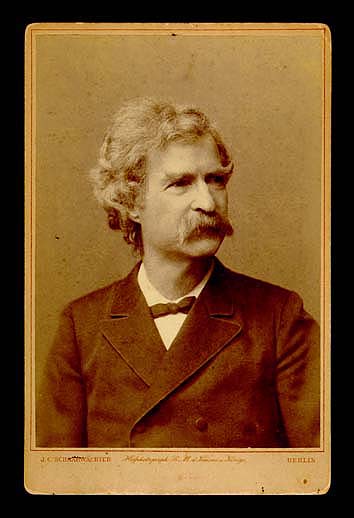
Not Samuel Clemens : Blue Dog Diary

Image of Samuel Clemens from Vintage Memorabilia

During my days in college at Virginia Beach I learned quite early that one should beware of certain American writers such as Twain, Upton Sinclair, and John dos Pasos, who were in favor of anarchists and did not have the interests of America at heart.

By Joseph Clemens
[As told to Dr. Stephen R. Keister] / The Rag Blog / May 5, 2009

My name is Joseph Clemens and I am not kin to Samuel, who was otherwise known as Mark Twain. My mother assured me that we were not related, since Sam, as he got older, developed queer ideas, some even saying that he was an atheist. During my days in college at Virginia Beach I learned quite early that one should beware of certain American writers such as Twain, Upton Sinclair, and John dos Pasos, who were in favor of anarchists and did not have the interests of America at heart.

In any event, as I look into the mirror shaving for my breakfast appointment with the gentleman from the U.S. Chamber of Commerce, I cannot get the wonderful gathering of last evening out of my mind. I should realize, as a senior adviser to a Democratic United States Senator, that one is blessed with certain privileges; however, last evening and this morning are indeed mind boggling. It was a humdinger of a party and I am eternally grateful to my boss, who is a committee chair whose responsibilities include health care, for including me in the function.

The entire ball room of the Mayflower was taken up by the several hundred folks feted by the AARP. The same AARP that was instrumental in providing our seniors with that excellent legislation incorporated in Medicare Part D prescription plans. Though few of the Democrats from the House or Senate were included, we by and large felt at home with our numerous Republican colleagues. The cocktail hour was excellent, although I limit myself to two mint-juleps. The problem was that darned journalist I encountered at the bar. I cannot recall whether he was from Madison or Austin, but he was surely out of place dressed in a turtleneck and corduroys. Even worse, he kept talking of unacceptable writers such as Will Rogers, H.L.Mencken, and I.F.Stone, all communist toadies at one time or other as I recall.

In any event, I was able to shake the chap and spent the remainder of the evening enjoying the main speaker, Richard Scott, who founded the American Hospital Corporation. He, and his adjunct speakers, made a point of indicating that we in the United States have the best medical care in the world, unlike those socialist countries in Europe that provide free medical care for all. Huh! Somehow, the stupid Europeans just do not get it. Medicine, like banking and the stock market, should be controlled by the free market. Ronald Reagan made a point of that. One just does not appreciate medical care unless one pays for it oneself. So, what if a few folks die from lack of care. They, in all probability, are poor or are illegal immigrants and will not be missed by proper folks in any event. The evening ended with all of us standing at attention singing God Bless America.

But time to move on and get dressed. Breakfast at the Hay Adams demands that I wear my pin stripe Brooks Brothers suit, with, of course, the American flag pin in my lapel. My boss asked me to carry along my brown briefcase and enclose in it yesterday’s Washington Post. He also had pre-ordered me a limousine to pick me up at my Connecticut Avenue apartment building. That gentleman thinks of everything especially when the Senate is working on health care, a subject dear to his heart. He was even considerate enough yesterday to organize a breakfast for Americas’s Health Insurance Plans, The Business Round Table, Blue Cross and Blue Shield and the Heritage Foundation. It is because of his thoughtfulness that he is helped out in his campaigns by many of these fine civic organizations. A true American, as are another half dozen Senators and quite a few Democrats in The House, unkindly called “blue dogs.”

I am always happy to dine at the Hay Adams and have the opportunity to look over Lafayette Park at The White House. At the moment I have mixed feelings looking at the White House. Odd, to have a dark complected foreigner living there. He has such peculiar ideas: equal pay for women, the discontinuation of enhanced interrogation which the liberals call “torture,” the closure of our fine detention facility at Guantanamo Bay, educational opportunities for pre-school children, treating foreign governments with respect. Frightening, for as Rush points out, “it is not the American Way.” Perhaps with the excellent efforts of The NRA and thinking folks at Colorado Springs we can inculcate our legislators with some decency.

Yet, there are certain factors I find frightening, such as a group of 15,000 nutty doctors, called Physicians For A National Health Program, obviously duped by the commies, who feel that health care is a right and a privilege for all Americans. I am glad to hear that they get little attention on Capital Hill. Added to this there is a Catholic Hospital in Erie, Pennsylvania, which is broadening its base for health care for the indigent and dispossessed. We all know that most of these folks are drug addicts or those too lazy to look for a job. I cannot imagine what motivates folks like this.

Here we are at The Hay Adams and my limousine driver tells me that he will wait. Strange, but there seems to be a bulge under his left arm. Probably his shirt does not fit or his coat is badly tailored. Had to await the head waiter and noted a lone man sitting at a table inside the door reading the Wilson Quarterly — probably one of those liberal professors from Georgetown or American University. Another group that needs the attention of patriotic thinking Americans.

At last seated with the gentleman from the Chamber of Commerce who sits his black brief case next to mine under the table. He had pre-ordered breakfast, which was first rate. We had an engaging conversation about the wonderful days under President Bush, who he tells me is to make his first speech in the United States since leaving office on June 17, in Erie, Pennsylvania. The Manufacturers Association there is raising $150,000 to be able to enjoy Mr. Bash’s company for the evening and to listen to his engaging words of wisdom. The Chamber anticipates flag waving, cheering crowds along the route from the airport to the convention center. It is great to be an American!

We also had a chance to discuss the fact that the present administration has crazy ideas about energy production, plans that will reduce income to the oil companies and antagonize our Saudi friends. He, like I, is concerned that we won’t thoroughly whip the Islamic fascists in Iraq and Afghanistan and establish a true Pax Americana. Much to be done; however, we agree that the initial problem is keeping health care in the devoted hands of the insurance industry it belongs.

I thanked my friend for the excellent breakfast and found my driver waiting. I instructed him to take me back to the Senate Office Building and it was only on the drive back that I noted I now had a black briefcase — considerably heavier than my brown one that my companion had accidentally picked up from under the table. I tried to open this one; however, it is locked. Best ask my boss, the Senator, what to do about it.

The Rag Blog

Posted in Rag Bloggers | Tagged , | 3 Comments

Concern About Human Rights May Be a Thing of the Past


Kiss the Era of Human Rights Goodbye: What Bush Willed to Obama and the World
By Karen J. Greenberg / April 30, 2009

These days, it’s virtually impossible to escape the world of torture the Bush administration constructed. Whether we like it or not, almost every day we learn ever more about the full range of its shameful policies, about who the culprits were, and just which crimes they might be prosecuted for. But in the morass of memos, testimony, op-eds, punditry, whistle-blowing, documents, and who knows what else, with all the blaming, evasion, and denial going on, somehow we’ve overlooked the most significant victim of all. One casualty of the Bush torture policies — certainly, at least equal in damage to those who were tortured and the country whose laws were twisted and perverted in the process — has been human rights itself. And no one even seems to notice.

So let’s be utterly clear: The policies of the Bush administration were not just horrific in themselves or to others, they may also have brought to an end the human rights movement as we know it.

One need only glance at the recently released Justice Department memos, which have caused such a media storm of late, for the story of what has happened to human rights in American hands to become clearer. It is not just, as New York Times columnist Frank Rich recently wrote, that “our government methodically authorized torture and lied about it.” No less important, though hardly commented upon, is this fact: the United States succumbed to the exact patterns of abusive state action that the human rights movement was created to outlaw forever. What the Bush administration pursued, after all, was a policy of state-sponsored, legally codified dehumanization designed to torture (and in some cases destroy) individuals, which was to be systematically and bureaucratically implemented in the name of the greater good of the country, however defined.

The documents that the Obama administration and Congress have just released make this conclusion impossible to avoid. These include four memos written by the Office of Legal Council between 2002 and 2005, the Senate Armed Services Committee Report on Interrogation Practices, and the Senate Select Committee Narrative on the Chronology of the Office of Legal Counsel (OLC) Memos. Added to this must be the publication by Mark Danner in the New York Review of Books of a previously secret International Committee of the Red Cross report on abuse at Guantanamo Bay.

As a group, these documents reveal that the pattern of systematic abuse at the hands of the American government during George W. Bush’s Global War on Terror has been a textbook case of human rights violations designed and implemented at the highest levels of government. First, there was the assault on the English language, a necessary initial step in the process of changing the national mindset of a country about to become a first-class human-rights abuser. As Susan Sontag once wrote in a piece about the Bush administration and its pretzeling of language, “Words alter, words add, words subtract.”

Creating American-style Torture Techniques and Manuals

Just as the U.S. military at Guantanamo was instructed in January 2002 never to refer to that detention facility as a “prison” and never to call the inmates “prisoners,” so the infamous OLC August 1, 2002 “torture memo” that came out of the Justice Department, and was made public in 2004, officially banished torture to the dust heap of history when it came to American actions. It was now to be considered only physical pain of “an intensity akin to that which accompanies serious physical injury such as death or organ failure,” or mental pain which produced “lasting psychological harm.”

Now, that memo’s twin has just been released, providing more detailed reasoning about the redefinition of torture. This second August 1, 2002 memo gives us an even more comprehensive picture of the rationale behind the insistence of the Justice Department that the techniques being applied to detainees in the War on Terror in no way amounted to torture.

Examining specific techniques of coercive interrogation, all of which would technically violate the U.S. Anti-Torture Statute [18 U.S.C. §§ 2340-2340A], Justice Department officials craftily reasoned their way out of old, well-accepted definitions of universally agreed-upon acts of torture. Thanks to creatively worded explanations, this new August 1, 2002 memo declared that neither “the waterboard,” “walling,” nor being placed in a box amounted to torture. In situation after grim situation, torture, it was explained, just wasn’t the right word.

The focus of the just released memo was the interrogation of al-Qaeda terror suspect Abu Zubaydah. According to the memo, Zubaydah simply wouldn’t feel pain or suffer repercussions as others might have from these redefined acts of torture. Similarly, extreme “stress positions” could be used on him because he “appears to be quite flexible despite his wound,” and because he had already proven he could withstand other abuses. “You have orally informed us that you… have previously kept him awake for 72 hours. From which no mental or physical harm resulted.” The Justice Department lawyers, informed by the CIA that Zubaydah was in exceptional physical and psychological condition, conveniently reasoned that the techniques in question wouldn’t harm him — and, of course, they would be oh-so-helpful to the longer term torture goals of the Bush administration.

The next step from offering reasons for redefining torture for just one individual — Zubaydah — to a general policy proved easy, despite the fact that Zubaydah’s powers to withstand and recuperate from these techniques were deemed exceptional. The memos assumed that the next detainees to undergo these methods of interrogation were somehow in the same category as the Navy Seals who had experienced them while undergoing training to resist the techniques of torturers from totalitarian or rogue regimes. Repeatedly, that August memo insisted that such techniques, rather than being the property of torturing regimes, really added up to little more than “physical discomfort,” to (at worst) only temporary psychological disorientation, rather than a “profound” disruption of one’s psyche. “No prolonged mental harm,” the memo asserted, “would result from the use of these proposed procedures.”

One by one, then, the techniques were intricately described in ways that repainted them the color of mere “abuse,” which sounds so penny ante, rather than torture. When it came to sleep deprivation, for example, the reasoning was that, even if “abnormal reactions” did result, “reactions abate after the individual is permitted to sleep.” Likewise, “the goal of the facial slap is not to inflict physical pain that is severe or lasting. Instead the purpose of the facial slap is to induce shock, surprise, and/or humiliation.”

The subjects might believe themselves tortured, but they would be wrong. “The idea,” as the memo wrote about what’s now called “walling,” “is to create a sound that will make the impact seem far worse than it is and that will be far worse than any injury that might result… [whereby] the interrogator pulls the individual forward and then quickly and firmly pushes the individual into the wall. It is the individual’s shoulder blades that hit the wall,” but his “head and neck are supported by a rolled towel… to help prevent whiplash.”

Even when there is a modest admission that some damage could actually occur — that, for instance, “placement” in “small,” “cramped” confinement boxes could “disrupt profoundly the senses” — it was quickly dismissed on the grounds that such confinement wasn’t to extend beyond two hours. And finally, there were those assurances in the matter of waterboarding, or so-called simulated drowning, that “the sensation of drowning is immediately relieved” once the procedure is stopped.

And this, of course, just grazes the surface of these nightmarish documents that should bring to mind the demonic regimes that gave rise to the human rights movement. Among other things, the Justice Department lawyers writing them weren’t just changing the language and redefining torture out of existence, they were offering nothing short of a detailed manual for those about to go to work on actual human beings in just how to perform torture. Take for instance, this description of how to waterboard correctly:

“…[T]he individual is bound securely to an inclined bench, which is approximately four feet by seven feet. The individual’s feet are generally elevated. A cloth is placed over the forehead and eyes. Water is then applied to the cloth in a controlled manner. As this is done, the cloth is lowered until it covers both the nose and mouth. Once the cloth is saturated and completely covers the mouth and nose, air flow is slightly restricted for 20 to 40 seconds…This causes an increase in carbon dioxide level in the individual’s blood… [stimulating] increased effort to breathe… [producing] the perception of ‘suffocation and incipient panic,’ i.e. the perception of drowning…”

One day, perhaps soon, much of the rest of the minutiae produced by the Bush administration’s torture-policy bureaucracy will come to light. Procurement lists, for example, will undoubtedly be found. After all, who ordered the sandbags for use as hoods, the collars with chains for bashing detainees’ heads into walls, the chemical lights for sodomy and flesh burns, or the women’s underwear? The training manuals, whatever they were called, will be discovered: the schooling of dogs to bite on command, the precise use of the waterboard to get the best effects, the experiments in spreading the fingers just wide enough in a slap to comport with policy. The Senate Armed Services Committee’s report, released last week, has already begun to identify the existence of training sessions in techniques redefined as not rising to the level of torture.

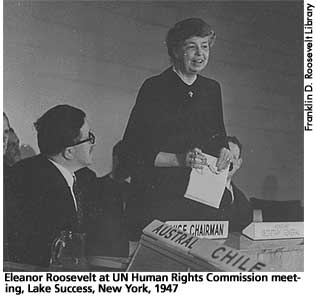
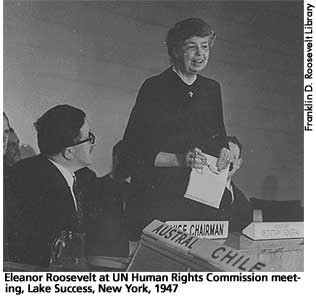
For now, however, we have far more than we need to know that what the United States started when, in 1948, it led the effort to create the Universal Declaration of Human Rights and became the moral figurehead for human rights concerns worldwide for more than a half-century, has come to an end. Eleanor Roosevelt, who led the commission that drafted that 1948 Declaration, remarked at the time that the United States was “the showcase” for the principles embodied in the declaration. Sixty-one years later, that is no longer true.

The Human Rights Movement Is History

From the very beginning of my own descent into the world of Bush administration torture policy — and, among other things, I was the co-editor of a 2005 collection of documents, already leaking out then, called The Torture Papers — I have resisted associating what U.S. officials were doing with past state atrocities. That was another, far worse realm, I reasoned, one in which countless people were disappeared and millions murdered. After all, the unfolding torture policy didn’t kill (though some detainees certainly did die from maltreatment in U.S. secret and not-so-secret prisons abroad), it only inflicted pain. Others pointed out similarities between such Bush administration outrages and past barbarisms, but I veered away from analogies which, to my mind, undermined the evils of this particular story. So when Scott Horton compared the Nazi commandant of Auschwitz Rudolf Hoess to those who crafted the U.S. torture policy or Susan Sontag compared administration abuses of language to the linguistic perversions that preceded genocidal acts against the Hutus in Rwanda, I recoiled.

Analogies of such an extreme order just didn’t suit me. But what I’ve resisted for five years, since the first Abu Ghraib revelations in the spring of 2004, I now find sadly indisputable. The supposed moral exceptionalism of the most powerful nation on Earth is no more. In its action-packed eight years, the Bush administration ensured that the United States would be the most ordinary of abusing, torturing nations.

Through perverse language, a twisting of the law, and an immersion in the precise details of implementing torture techniques, the United States renounced its position as the leader of the global human rights movement. Abandoned by the country it long considered its greatest ally, that movement now teeters at the edge of its grave. That’s what the torture memos and the present media uproar over torture really mean.

[Karen J. Greenberg is the Executive Director of the Center on Law and Security at the NYU School of Law, the co-editor of The Torture Papers: The Road to Abu Ghraib and the editor of The Torture Debate in America. Her most recent book is The Least Worst Place: Guantanamo’s First 100 Days. To catch an audio interview in which she discusses the Bush administration “torture memos,” click here.]

Copyright 2009 Karen J. Greenberg

Source / TomDispatch

The Rag Blog

Posted in RagBlog | Tagged , , , | Leave a comment

Swine Flu Redux : We’re Not Out of the Woods Yet

Doctors and nurses treat patients at a tent hospital for influenza victims in Lawrence, Mass., in 1918. Archive photo from Hartford Courant.

The outbreak in the Spring of 1918 was not the huge killer. It came back in a second and third wave in the Fall of 1918 and Winter of 1919. It was these second and third waves that turned out to be the nasty killers.

By Ted McLaughlin / The Rag Blog / May 5, 2009

Last week, I wrote a post about the H1N1 virus (swine flu) and how scientists have discovered that it has some genetic differences from the first time the H1N1 virus spread in 1918. That time it was known as the Spanish Flu, and it wound up killing more people than World War I did (combatants and civilians combined).

The scientists said the genetic difference meant that the current strain of H1N1 was probably no more deadly than a regular yearly flu outbreak, which kills around 36,000 in a normal year. It looks like the scientists were right. The swine flu has turned out to not be the pandemic killer that health officials had feared, and in fact, they seem to be getting a hold on this outbreak.

Now you might think I would be pretty pleased with myself for posting that while others were still beating the pandemic drum. I’m not. That’s because I know a little bit about the Spanish Flu (my own grandfather died from it in 1919). Yes, I said 1919.

The outbreak in the Spring of 1918 was not the huge killer. It came back in a second and third wave in the Fall of 1918 and Winter of 1919. It was these second and third waves that turned out to be the nasty killers. The second and third waves were far more virulent than the first.

If you’ll forgive me for using a euphemism, we’re not out of the woods yet. The normal time for the flu season is Fall and Winter, and it’s entirely possible that the H1N1 virus may pay us a second and possibly even a third visit at that time.

Any scientist will tell you that a virus can evolve (or mutate) very fast. What if it has mutated into a much more deadly form when it returns? We could still have a repeat of the pandemic known as Spanish Flu.

I’m not trying to be an alarmist, just a realist. It may not come back. If it does, it may still be fairly benign. But it could also be very nasty and create a real mess. The point is, we must remain vigilant. We can’t be caught napping if it returns in a few months.

[Rag Blog contributor Ted McLaughlin also posts at jobsanger, an excellent Texas political blog.]

The Rag Blog

Posted in Rag Bloggers | Tagged , , , | 1 Comment

KBR Still Owes Millions from the Corruption in Iraq


Senators Accuse Pentagon of Delay in Recovering Millions in Overcharges
By James Glanz / May 3, 2009

The Pentagon has done little to collect at least $100 million in overcharges paid in deals arranged by corrupt former officials of Kellogg Brown & Root, the defense contractor, even though the officials admitted much of the wrongdoing years ago, two senators have complained in a letter to Defense Secretary Robert M. Gates.

The letter also said that the Army had almost completely failed to move away from the monopolistic nature of the logistics contract that has paid the contractor, now called KBR, $31.3 billion for logistics operations in Iraq, Kuwait and Afghanistan.

The New York Times obtained a copy of the letter, dated Friday, by the senators, Claire McCaskill, Democrat of Missouri, and Susan M. Collins, Republican of Maine. Senator McCaskill is chairman of a contracting oversight subcommittee of the Senate Homeland Security and Governmental Affairs Committee, and Senator Collins is the subcommittee’s ranking Republican.

Their letter is likely to revive allegations that the Pentagon has become so close to KBR, and relies so heavily on it, that there is little inclination or incentive to discipline the company, in response to either Congress or critics outside the government.

In 2007 the Army split the logistics contract, known as Logcap, in a way that allowed several companies to compete for each new need. The Army did this partly to avoid relying solely on KBR, whose pricing practices, even when technically legal, have sometimes received criticism as exorbitant. But the Army has seldom used the newly competitive arrangement.

The senators wrote that as of February, the latest date for which the subcommittee had received information, the Army had “not awarded a single task order for work in Iraq,” the biggest source of logistics work.

In pressing for use of the new competitive arrangement, the senators cited 2008 legislation that calls for competition by multiple companies on military contracts unless there is “a compelling reason not to do so.” The senators also brought up Congressional testimony by the Army’s chief of logistics that they said indicated the Army had no such compelling reason.

Reached for comment, Dan Carlson, a spokesman at the Army Sustainment Command in Rock Island, Ill., which administers the work, pointed out that under the new competitive arrangement, in which KBR, Fluor and Dyncorp submit bids, Fluor and Dyncorp have received some work in Afghanistan and Kuwait. Mr. Carlson said that the Army was working toward awarding work in Iraq under the new competitive arrangement.

A spokeswoman for KBR, Heather L. Browne, said all of KBR’s logistics contracts have been won competitively. She added that “when KBR has discovered wrongdoing of any sort by an employee, we have swiftly reported it to the government,” and said the company “in no way condones or tolerates illegal or unethical behavior.” KBR itself has not been accused of wrongdoing in any of the cases of fraud by former employees.

Ms. Browne made clear that the company intended to continue its logistics work, saying KBR remained committed to high quality and to “engaging in a transparent and fact-based dialogue with the government.”

The letter and the Pentagon auditing documents that back up its conclusions are likely to be a point of discussion in Washington on Monday, when the Wartime Contracting Commission, a bipartisan legislative commission, is scheduled to meet on the logistics program, according to its Web site.

To the irritation of KBR’s critics, the Army has generally upheld the bills the company has submitted to the military, even when the Pentagon’s own auditors have questioned the amounts. But the argument that the Army was overcharged appears to be more clear-cut in the cases of several former KBR officials convicted of accepting bribes and kickbacks.

In those cases, the Army asked KBR to perform a certain task under the Logcap contract, like buying living trailers or building a dining facility, and the KBR officials found subcontractors in the region to carry out the actual work. The officials took bribes to steer the work toward subcontractors who were not the low bidders, or simply inflated the worth of the contracts once they had been awarded.

In the contracts handled by just one of those officials, Stephen Lowell Seamans, who pleaded guilty to bribery and conspiracy in March 2006, Pentagon auditors quickly found potential excess profits by a Kuwaiti subcontractor of $49.8 million, or 76 percent, “as a result of Mr. Seamans’s fraudulent activities,” the senators wrote.

Of $306 million in tainted contracts, at least $100 million of the charges appeared to be unjustified, wrote the senators.

Source / New York Times

The Rag Blog

Posted in RagBlog | Tagged , , , | 1 Comment