Ecosocialism – For a Society of Good Ancestors!
By Ian Angus / April 30, 2009
[Ian Angus was a featured guest at the World at a Crossroads: Fighting for Socialism in the 21st Century conference , in Sydney Australia, April 10-12, 2009. The event, which drew 440 participants from more than 15 countries, was organized by Democratic Socialist Perspective, Resistance and Green Left Weekly. The following is Ian’s talk to the plenary session on “Confronting the climate change crisis: an ecosocialist perspective.” He has lightly edited the text for publication.]
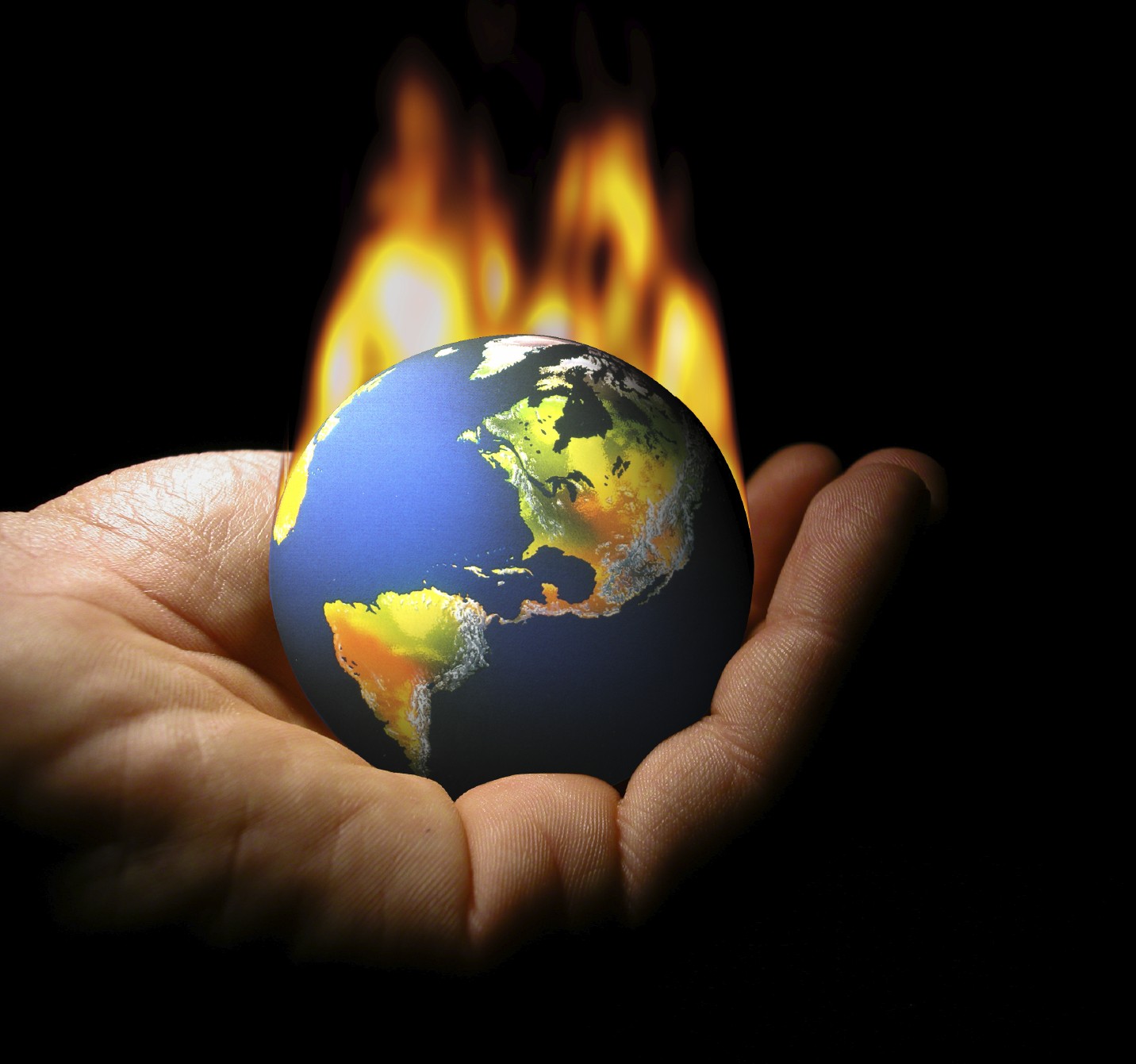
The world is getting hotter, and the main cause is greenhouse gas emissions produced by human activity. Enormous damage has already been done, and we will have to live with the consequences of past emissions for decades, perhaps even centuries. Unless we rapidly and drastically cut emissions, the existing damage will turn to catastrophe.
Anyone who denies that is either lying or somehow unaware of the huge mass of compelling scientific evidence.
Many publications regularly publish articles summarizing the scientific evidence and outlining the devastation that we face if action isn’t taken quickly. I highly recommend Green Left Weekly as a continuing source. I’m not going to repeat what you’ve undoubtedly read there.
But I do want to draw your attention to an important recent development. Last month, more than 2500 climate scientists met in Copenhagen to discuss the state of scientific knowledge on this subject. And the one message that came through loud and clear was this: it’s much worse than we thought.
What were called “worst case scenarios” two years ago by the Intergovernmental Panel on Climate Change actually understated the problem. The final statement issued by the Copenhagen conference declared: “The worst-case IPCC scenario trajectories (or even worse) are being realized .”
Nicholas Stern, author of the landmark 2006 study, The Stern Review on the Economics of Climate Change now says, “We underestimated the risks . we underestimated the damage associated with the temperature increases . and we underestimated the probability of temperature increases.”
Seventeen years of failure – with one exception
Later this year, the world’s governments will meet, again in Copenhagen, to try to reach a new post-Kyoto climate treaty. Will they meet the challenge of climate change that is much worse than expected?
The politicians’ record does not inspire hope.
Seventeen years ago, in June 1992, 172 governments, including 108 heads of state, met at the Earth Summit in Rio de Janeiro.
That meeting produced the United Nations Framework Convention on Climate Change, the first international agreement that aimed “to achieve stabilization of greenhouse gas concentrations in the atmosphere at a low enough level to prevent dangerous anthropogenic interference with the climate system.” In particular, the industrialized countries promised to reduce their greenhouse gas emissions below 1990 levels.
Like the Kyoto Accord that followed it, that agreement was a failure. The world’s top politicians demonstrated their gross hypocrisy and their indifference to the future of humanity and nature by giving fine speeches and making promises – and then continuing with business as usual.
But there was one exception. In Rio one head of state spoke out strongly, and called for immediate emergency action – and then returned home to support the implementation of practical policies for sustainable, low-emission development.
That head of state was Fidel Castro.
Fidel began his brief remarks to the plenary session of the 1992 Earth Summit with a blunt description of the crisis: “An important biological species is in danger of disappearing due to the fast and progressive destruction of its natural living conditions: mankind. We have become aware of this problem when it is almost too late to stop it.”
He placed the blame for the crisis squarely on the imperialist countries, and he finished with a warning that emergency action was needed: “Tomorrow it will be too late to do what we should have done a long time ago.”
After the 1992 Earth Summit, only the Cubans acted on their promises and commitments.
In 1992 Cuba amended its constitution to recognize the importance of “sustainable economic and social development to make human life more rational and to ensure the survival, well-being and security of present and future generations.” The amended constitution obligates the provincial and municipal assemblies of People’s Power to implement and enforce environmental protections. And it says that “it is the duty of citizens to contribute to the protection of the waters, atmosphere, the conservation of the soil, flora, fauna and nature’s entire rich potential.”
The Cubans have adopted low-fertilizer agriculture, and encouraged urban farming to reduce the distances food has to travel. They have replaced all of their incandescent light bulbs with fluorescents, and distributed energy efficient rice cookers. They have stepped up reforestation, nearly doubling the island’s forested area, to 25% in 2006.
As a result of these and many other projects, in 2006 the World Wildlife Federation concluded that Cuba is the only country in the world that meets the criteria for sustainable development.
By contrast, the countries responsible for the great majority of greenhouse gas emissions followed one of two paths. Some gave lip service to cleaning up their acts, but in practice did little or nothing. Others denied that action was needed and so did little or nothing.
As a result we are now very close to the tomorrow that Fidel spoke of, the tomorrow when it is too late.
Why Cuba?
The World Wildlife Federation deserves credit for its honesty in reporting Cuba’s achievements. But the WWF failed to address the next logical question. Why was Cuba the exception? Why could a tiny island republic in the Caribbean do what no other country could do?
And the next question after that is, why have the richest countries in the world not cut their emissions, not developed sustainable economies? Why, despite their enormous physical and scientific resources, has their performance actually gotten worse?
The first question, why Cuba could do it, was answered not long ago by Armando Choy, a leader of the Cuban revolution who has recently headed the drive to clean up Havana Bay. His explanation was very clear and compelling:
“This is possible because our system is socialist in character and commitment, and because the revolution’s top leadership acts in the interests of the majority of humanity inhabiting planet earth – not on behalf of narrow individual interests, or even simply Cuba’s national interests.”
General Choy’s comments reminded me of a passage in Capital, a paragraph that all by itself refutes the claim that is sometimes made, that Marxism has nothing in common with ecology. Karl Marx wrote:
“Even an entire society, a nation, or all simultaneously existing societies taken together, are not the owners of the earth. They are simply its possessors, its beneficiaries, and have to bequeath it in an improved state to succeeding generations.”
I’ve never known any socialist organization to make this point explicitly, but Marx’s words imply that one of the key objectives of socialism must be to build a society in which human beings work consciously to be Good Ancestors.
And that is what the Cubans are doing in practice.
The idea that we must act in the present to build a better world for the future, has been a theme of the Cuban revolutionary movement since Fidel’s great 1953 speech, History Will Absolve Me. That commitment to future generations is central to what has justly been called the greening of the Cuban revolution.
The Cubans are committed, not just in words but in practice, to being Good Ancestors, not only to future Cubans, but to future generations around the globe.
Why not capitalism?
But what about the other side of the question? Why do we not see a similar commitment in the ruling classes of Australia, or Canada, or the United States?
If you ask any of them individually, our rulers would undoubtedly say that they want their children and grandchildren to live in a stable and sustainable world. So why do their actions contradict their words? Why do they seem determined, in practice, to leave their children and grandchildren a world of poisoned air and water, a world of floods and droughts and escalating climate disasters? Why have they repeatedly sabotaged international efforts to adopt even half-hearted measures to cut greenhouse gas emissions?
When they do consider or implement responses to the climate crisis, why do they always support solutions that do not work, that cannot possibly work?
Karl Marx had a wonderful phrase for the bosses and their agents – the big shareholders and executives and top managers and the politicians they own – a phrase that explains why they invariably act against the present and future interests of humanity. These people, he said, are “personifications of capital.” Regardless of how they behave at home, or with their children, their social role is that of capital in human form.
They don’t act to stop climate change because the changes needed by the people of this world are directly contrary to the needs of capital.
Capital has no conscience. Capital can’t be anyone’s ancestor because capital has no children. Capital has only one imperative: it has to grow.
The only reason for using money to buy stock, launch a corporation, build a factory or drill an oil well is to get more money back than you invested. That doesn’t always happen, of course – some investments fail to produce profits, and, as we are seeing today, periodically the entire system goes into freefall, wiping out jobs and livelihoods and destroying capital. But that doesn’t contradict the fact that the potential for profit, to make capital grow, is a defining feature of capitalism. Without it, the system would rapidly collapse.
As Joel Kovel says, “Capitalism can no more survive limits on growth than a person can live without breathing.”
A system of growth and waste
Under capitalism, the only measure of success is how much is sold every day, every week, every year. It doesn’t matter that the sales include vast quantities of products that are directly harmful to both humans and nature, or that many commodities cannot be produced without spreading disease, destroying the forests that produce the oxygen we breathe, demolishing ecosystems, and treating our water, air and soil as sewers for the disposal of industrial waste.
It all contributes to profits, and thus to the growth of capital – and that’s what counts.
In Capital, Marx wrote that from a capitalist’s perspective, raw materials such as metals, minerals, coal, stone, etc. are “furnished by Nature gratis.” The wealth of nature doesn’t have to be paid for or replaced when it is used – it is there for the taking. If the capitalists had to pay the real cost of that replacing or restoring that wealth, their profits would fall drastically.
That’s true not only of raw materials, but also of what are sometimes called “environmental services” – the water and air that have been absorbing capitalism’s waste products for centuries. They have been treated as free sewers and free garbage dumps, “furnished by Nature gratis.”
That’s what the pioneering environmental economist William Kapp meant nearly sixty years ago, when he wrote, “Capitalism must be regarded as an economy of unpaid costs.”
Kapp wrote that capitalism’s claims of efficiency and productivity are: “nothing more than an institutionalized cover under which it is possible for private enterprise to shift part of the costs to the shoulders of others and to practice a form of large-scale spoliation which transcends everything the early socialists had in mind when they spoke of the exploitation of man by man.”
In short, pollution is not an accident, and it is not a “market failure.” It is the way the system works.
How large is the problem? In 1998 the World Resources Institute conducted a major international study of the resource inputs used by corporations in major industrial countries – water, raw materials, fuel, and so on. Then they determined what happened to those inputs. They found that “One half to three quarters of annual resource inputs to industrial economies are returned to the environment as wastes within a year.”
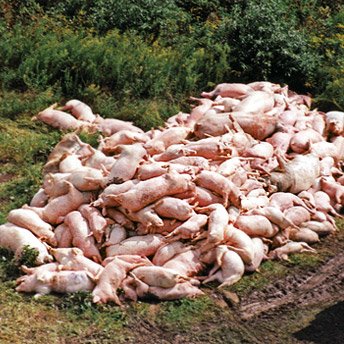
Similar numbers are reported by others. As you know, about a billion people live in hunger. And yet, as the head of the United Nations Environmental Program said recently, “Over half of the food produced today is either lost, wasted or discarded as a result of inefficiency in the human-managed food chain.”
“Inefficiency” in this case means that it is no profit to be made by preventing food waste – so waste continues. In addition to exacerbating world hunger, capitalism’s gross inefficiency poisons the land and water with food that is harvested but not used.
Capitalism’s destructive DNA
Capitalism combines an irresistible drive to grow, with an irresistible drive to create waste and pollution. If nothing stops it, capitalism will expand both those processes infinitely.
But the earth is not infinite. The atmosphere and oceans and the forests are very large, but ultimately they are finite, limited resources – and capitalism is now pressing against those limits. The 2006 WWF Living Planet Report concludes, “The Earth’s regenerative capacity can no longer keep up with demand – people are turning resources into waste faster than nature can turn waste back into resources.”
My only disagreement with that statement is that it places the blame on “people” as an abstract category. In fact the devastation is caused by the global capitalist system, and by the tiny class of exploiters that profits from capitalism’s continued growth. The great majority of people are victims, not perpetrators.
In particular, capitalist pollution has passed the physical limit of the ability of nature to absorb carbon dioxide and other gases while keeping the earth’s temperature steady. As a result, the world is warmer today than it has been for 100,000 years, and the temperature continues to rise.
Greenhouse Gas Emissions are not unusual or exceptional. Pouring crap into the environment is a fundamental feature of capitalism, and it isn’t going to stop so long as capitalism survives. That’s why “solutions” like carbon trading have failed so badly and will continue to fail: waste and pollution and ecological destruction are built into the system’s DNA.
No matter how carefully the scheme is developed, no matter how many loopholes are identified and plugged, and no matter how sincere the implementers and administrators may be, capitalism’s fundamental nature will always prevail.
We’ve seen that happen with Kyoto’s Clean Development Mechanism, under which polluters in rich countries can avoid cutting their own emissions if they invest in equivalent emission-reducing projects in the Third World. A Stanford University study shows that two-thirds or more of the CDM emission reduction credits have not produced any reductions in pollution.
The entire system is based on what one observer says are “enough lies to make a sub-prime mortgage pusher blush.”
CDM continues not because it is reducing emissions, but because there are profits to be made buying and selling credits. CDM is an attempt to trick the market into doing good in spite of itself, but capitalism’s drive for profits wins every time.
Green eco-capitalists
One of the greatest weaknesses of the mainstream environmental movement has been its failure or refusal to identify capitalism as the root problem. Indeed, many of the world’s Green Parties, including the one in Canada where I live, openly describe themselves as eco-capitalist, committed to maintaining the profit system.
Of course this puts them in a contradictory position when they face the reality of capitalist ecocide.
In Canada, as you may know, oil companies are engaged in what the British newspaper, The Independent, accurately called, “The Biggest Environmental Crime in History,” mining the Alberta Tar Sands. If it continues, it will ultimately destroy an area that is nearly twice as big as New South Wales, in order to produce oil by a process that generates three times as much greenhouse gas as normal oil production.
It is also destroying ecosystems, killing animals, fish and birds, and poisoning the drinking water used by Indigenous peoples in that area.
It’s obvious that anyone who is serious about protecting the environment and stopping emissions should demand that the Tar Sands be shut down. But when I raised that in a talk not long ago in Vancouver, a Green Party candidate in the audience objected that would be irresponsible, because it would violate the oil companies’ contract rights.
Evidently, for these eco-capitalists, “capitalism” takes precedence over “eco.”
But as capitalist destruction accelerates, and as capitalist politicians continue to stall, or to introduce measures that only benefit the fossil fuel companies, we can expect that many of the most sincere and dedicated greens will begin to question the system itself, not just its worst results.
Greens moving left: Gus Speth
An important case in point, and, I hope, a harbinger of what’s to come in green circles – is James Gustave Speth, who is now dean of the Yale University School of Forestry and Environmental Studies.
Gus Speth has spent most of his life trying to save the environment by working inside the system. He was a senior environmental advisor to US President Jimmy Carter, and later to Bill Clinton. In the 1990s, he was Administrator of the United Nations Development Programme and Chair of the United Nations Development Group. Time magazine called him “the ultimate insider.”
Last year, after 40 years working inside the system, Speth published a book called, “The Bridge at the Edge of the World: Capitalism, the Environment, and Crossing from Crisis to Stability”.
…He argues that working inside the system has failed – because the system itself is the cause of environmental destruction.
“My conclusion, after much searching and considerable reluctance, is that most environmental deterioration is a result of systemic failures of the capitalism that we have today .
“Inherent in the dynamics of capitalism is a powerful drive to earn profits, invest them, innovate, and thus grow the economy, typically at exponential rates.”
That’s exactly correct – no Marxist could have said it better. Nor could we improve on Speth’s summary of the factors that combine to make contemporary capitalism the enemy of ecology.
“An unquestioning society-wide commitment to economic growth at almost any cost; enormous investment in technologies designed with little regard for the environment; powerful corporate interests whose overriding objective is to grow by generating profit, including profit from avoiding the environmental costs they create; markets that systematically fail to recognize environmental costs unless corrected by government; government that is subservient to corporate interests and the growth imperative; rampant consumerism spurred by a worshipping of novelty and by sophisticated advertising; economic activity so large in scale that its impacts alter the fundamental biophysical operations of the planet; all combine to deliver an ever-growing world economy that is undermining the planet’s ability to sustain life.”
Speth is not a Marxist. He still hopes that governments can reform and control capitalism, eliminating pollution. He’s wrong about that, but his analysis of the problem is dead-on, and the fact that it comes from someone who has worked for so long inside the system makes his argument against capitalism credible and powerful.
The socialist movement should welcome and publicize this development, even though Speth and others like him don’t yet take their ideas to the necessary socialist conclusions.
Greens moving left: James Hansen
Similarly, we should be very encouraged that NASA’s James Hansen, one of the world’s most respected climate scientists, joined in the March 20 demonstration against a planned coal-fired electricity plant in Coventry, England. Hansen is another environmentalist who has worked inside the system for years.
He told the UK “Guardian” that people should first use the “democratic process” by which he means elections. He went on:
“What is frustrating people, me included, is that democratic action affects elections but what we get then from political leaders is greenwash.
“The democratic process is supposed to be one person one vote, but it turns out that money is talking louder than the votes. So, I’m not surprised that people are getting frustrated.
“I think that peaceful demonstration is not out of order, because we’re running out of time.”
In the same interview, Hansen expressed concern about the approach of the Obama administration:
“It’s not clear what their intentions are yet, but if they are going to support cap and trade then unfortunately I think that will be another case of greenwash. It’s going to take stronger action than that.”
Like Speth, Hansen is not a socialist. But he condemns the most widely-promoted market-based “solution,” and he calls for demonstrations and protests, so eco-socialists can and must view him as an ally.
Why ECO-socialism?
Which brings me to a question I’ve been asked many times, including during this visit to Australia. “Why eco-socialism?”
Why not just say ‘socialism’? Marx and Engels were deeply concerned about humanity’s relationship to nature, and what we today would call ecological ideas, are deeply embedded in their writings. In the 1920s, there was a very influential ecology movement in the Soviet Union. So why do we need a new word?
All that is true. But it is also true that during the 20th century socialists forgot or ignored that tradition, supporting (and in some cases implementing) approaches to economic growth and development that were grossly harmful to the environment.
Socialist Voice recently published an interview in which Oswaldo Martinez, the president of the Economic Affairs Commission of Cuba’s National Assembly addressed just that question. He said:
“The socialism practiced by the countries of the Socialist Camp replicated the development model of capitalism, in the sense that socialism was conceived as a quantitative result of growth in productive forces. It thus established a purely quantitative competition with capitalism, and development consisted in achieving this without taking into account that the capitalist model of development is the structuring of a consumer society that is inconceivable for humanity as a whole.
“The planet would not survive. It is impossible to replicate the model of one car for each family, the model of the idyllic North American society, Hollywood etc. – absolutely impossible, and this cannot be the reality for the 250 million inhabitants of the United States, with a huge rearguard of poverty in the rest of the world.
“It is therefore necessary to come up with another model of development that is compatible with the environment and has a much more collective way of functioning.” [Full interview: www.socialistvoice.ca/?p=375]
In my view, one good reason for using the word `eco-socialism’ is to signal a clear break with the practices that Martinez describes: practices that were called socialist for seventy years. It is a way of saying that we aim not to create a society based on having more things, but on living better – not quantitative growth, but qualitative change.
Another reason, just as important, is to signal loud and clear that we view ecology and climate change not as just as another stick to bash capitalism with, but as one of the principal problems facing humanity in this century.
Evo Morales: Save the planet from capitalism
Although he has never used the word, so far as I know, one of the strongest defenders of eco-socialist ideas in the world today is Evo Morales, the president of Bolivia, the first indigenous head of state in Latin America.
In a short essay published last November, Evo brilliantly defined the problem, named the villain, and posed the alternative.
“Competition and the thirst for profit without limits of the capitalist system are destroying the planet. Under Capitalism we are not human beings but consumers. Under Capitalism, Mother Earth does not exist, instead there are raw materials. Capitalism is the source of the asymmetries and imbalances in the world. It generates luxury, ostentation and waste for a few, while millions in the world die from hunger in the world.
“In the hands of capitalism everything becomes a commodity: the water, the soil, the human genome, the ancestral cultures, justice, ethics, death and life itself. Everything, absolutely everything, can be bought and sold under capitalism. And even “climate change” itself has become a business.
“Climate change” has placed all humankind before a great choice: to continue in the ways of capitalism and death, or to start down the path of harmony with nature and respect for life.”
You know, last year I spent months working with other members of the Eco-socialist International Network, composing a statement to be distributed at the World Social Forum. It was finally published as the Belem Eco-socialist Declaration. [See climateandcapitalism.com/?p=597]
Now I wonder why we didn’t just publish this statement by comrade Evo Morales. He set out the case for eco-socialism, including a program of 20 demands, more concisely, more clearly, and vastly more eloquently than we did. I urge you to read it and to distribute it as widely as possible. [Full text – climateandcapitalism.com/?p=591]
Slamming on the brakes
Writing in the 1930s, when Nazi barbarism was in the rise, the Marxist philosopher and literary critic Walter Benjamin said:
“Marx says that revolutions are the locomotives of world history. But the situation may be quite different. Perhaps revolutions are not the train ride, but the human race grabbing for the emergency brake.”
That’s a powerful and profound metaphor. Capitalism has been so destructive, and taken us so far down the road to catastrophe, that one of the first tasks facing a socialist government will be to slam on the brakes.
The only choice, the only way forward, is eco-socialism, which I suggest can be defined simply as a socialism that will give top priority to the restoration of ecosystems that capitalism has destroyed, to the reestablishment of agriculture and industry on ecologically sound principles, and to mending what Marx called the metabolic rift, the destructive divide that capitalism has created between humanity and nature.
The fate of the ecological struggle is closely tied to the fortunes of the class struggle as a whole. The long neo-liberal drive to weaken the movements of working people also undermine ecological resistance, isolating it, pushing its leaders and organizations to the right.
But today neo-liberalism is discredited. Its financial and economic structures are in shambles. There is growing recognition that profound economic change is needed.
This is an historic opportunity for ecological activists to join hands with workers, with indigenous activists, with anti-imperialist movements here and around the world, to make ecological transformation a central feature of the economic change that is so clearly needed.
Together we can build a society of Good Ancestors, and cooperatively create a better world for future generations.
It won’t be easy, and it won’t be quick, but together we can make it happen.
Thank you.
[Ian Angus is editor of Climate and Capitalism, associate editor Socialist Voice, and a founding member of the Eco-socialist International Network. He lives near Ottawa, Canada.]
Source / Socialist Voice
Thanks to Ron Ridenour / The Rag Blog