Artist Delara Darabi Executed in Iran

Delara Darabi made a tearful call early on Friday to her parents. Photo from Amnesty International.

Iran Executes Woman for Alleged Murder Committed as a Juvenile

Delara Darabi knew the end was close when she made a panic-filled call to her mother from prison to say that she could see the hangman’s noose from her window.

By Philip Sherwell / May 3, 2009

The Iranian artist was executed on Friday for a murder allegedly committed when she was a juvenile and for which she retracted her brief confession, claiming she was covering up for her boyfriend.

The prison authorities hanged Miss Darabi, 23, even though the head of Iran’s judiciary granted her a two-month stay of execution on April 19 amid international outrage over her case. They also did not give her lawyer the required 48 hours notice.

Horrific new details have emerged of her last desperate plea for help from Rasht prison as jail guards came to lead her away.

Delara Darabi made a tearful call early on Friday to her parents (Photo: Amnesty International) Miss Darabi made a tearful call early on Friday to her parents to say she could see the gallows and noose, according to media reports from Tehran.

“Mother they are going to execute me, please save me,” she pleaded. But a prison official then grabbed the phone and told her distraught mother: “We are going to execute your daughter and there’s nothing you can do about it.”

The execution of a young woman whose case has become an international cause célèbre is a further damaging blow to President Barack Obama’s attempts to thaw US relations with the Islamic regime. Roxana Saberi, an American-Iranian journalist, is on hunger strike in a Tehran prison after being convicted of espionage in a show trial last month.

Miss Darabi’s case gained widespread attention after moving paintings and drawings that she made in her prison cell were shown around the world. She developed her talent as a painter behind bars.

Iran, Saudi Arabia and Yemen are the only countries to execute people for crimes committed when they are under 18. Miss Darabi was 17 when she admitted killing her 58-year-old uncle in a burglary in 2003 but she quickly retracted the confession, saying she had taken the blame to save her boyfriend.

Amnesty International, the human rights group that campaigned vigorously to save Miss Darabi, led the condemnation.

“Amnesty International is outraged at the execution and particularly at the news that her lawyer was not informed,” said Hassiba Hadj Sahraoui, deputy chief for the Middle East and North Africa.

“This appears to have been a cynical move on the part of the authorities to avoid domestic and international protests which might have saved Delara Darabi’s life.

“This indicates that even decisions by the Head of the Judiciary carry no weight and are disregarded in the provinces.”

The Iranian authorities said that Miss Darabi confessed to the murder because she believed she would be pardoned as the crime was committed when she was a minor. But her lawyer said that new forensic evidence and the explanation for her confession cleared her, but the court declined to hear the testimony.

“Amnesty International does not consider her trial to have been fair, as the courts later refused to consider new evidence which the lawyer said would have proved she could not have committed the murder,” Mr Sahraoui added.

Iran has executed at least 42 juvenile criminals since 1990, including seven in 2007, according to human rights groups. Iran says it only carries out the death penalty when a prisoner reaches the age of 18.

Iran’s existing penal code holds a nine-year-old girl and a 15-year-old boy to be legally responsible if involved in crime.

Capital offences in Iran include murder, rape, armed robbery, apostasy, blasphemy, serious drug trafficking, repeated sodomy, adultery or prostitution, treason and espionage.

Iran stepped up its use of the death penalty last year in what it says is a bid to improve security in society.

© Copyright of Telegraph Media Group Limited 2009

Source / Telegraph, U.K. / CommonDreams

The Rag Blog

Posted in RagBlog | Tagged , , , | 3 Comments

‘Climate Hacking’ : The Real Fear of Freelance Geoengineering

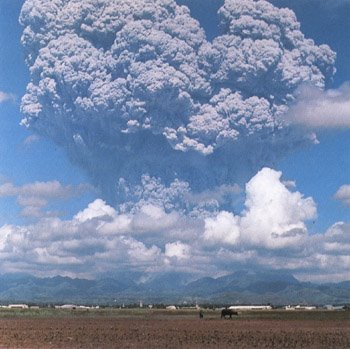
The “Pinatubo option” would involve spewing aerosol gunk into the stratosphere. Photo of Mount Pinatubo from U.S. Geological Survey publications.

Freelance atmospheric modification may sound far-fetched, but the potboiler concept was on the agenda last week at an invitation-only, international workshop in Lisbon, Portugal.

By Eli Kintisch

Add this to your list of climate nightmare scenarios: In 2040, facing rising seas, the Qatari government starts polluting the stratosphere in order to cool the planet, precipitating an international crisis and possibly upsetting monsoon patterns.

Freelance atmospheric modification may sound far-fetched, but the potboiler concept was on the agenda last week at an invitation-only, international workshop in Lisbon, Portugal. The private event was the first global powwow designed to explore the political aspects of geoengineering, or the deliberate manipulation of the climate. About 30 scientists and bureaucrats, representing 14 nations, mulled over the implications of global climate control in a wood-paneled conference room. The setting was the verdant grounds of an arts-and-science foundation started half a century ago by Armenian oil baron Calouste Gulbenkian.

The idea that we might solve our climate woes through planet hacking had its political coming-out earlier this month, when White House science adviser John Holdren said geoengineering research has “got to be looked at” by scientists. The work to which he was referring has quietly emerged over the last two years in a steady stream of meetings, a small but increasing number of papers, and substantial ongoing efforts by major science societies. The Lisbon meeting marked the introduction of what had once been the domain of fringe science to the international foreign-policy wonkocracy.

The first presenter, Carnegie Mellon engineer Granger Morgan, began with a review of the geoengineering options at our disposal. Employing a smiling cartoon sun to illustrate the ways radiation might be adjusted in the atmosphere, he rattled them off one by one: carbon-sucking machines, man-made jumbo algae blooms, planetary-scale sunshades to deflect solar rays, brightening clouds to reflect more sunlight. But Morgan’s main topic—and the focus for the rest of the meeting—was the concept of spewing aerosol gunk into the stratosphere, known among the geoengineering intelligentsia as the “Pinatubo option.” That Ludlum-esque moniker derives from the 1991 volcanic eruption that spewed 20 million tons of sulfur dioxide into the atmosphere, blocking out a fraction of the sun’s rays and cooling the planet by 1 degree Fahrenheit. A Pinatubo approach to geoengineering would involve the deliberate spraying of more sulfur dioxide, or an alternative aerosol, at high altitudes. It’s almost certainly the cheapest and most effective method we have for cooling the planet fast. For Morgan and the others, that’s exactly what makes it so dangerous.

Modeling studies and data from volcanoes suggest the Pinatubo option could lower global temperatures by 3 degrees or more and compensate for skyrocketing carbon pollution in a matter of months. We wouldn’t need any outlandish technology to make it work—just some jet aircraft, naval guns, or aerosol tanks. Reputable studies have suggested that the whole thing wouldn’t cost very much, either: To offset the warming caused by all current CO2 emissions would require an outlay of at most $100 billion dollars per year. That’s one-five-hundredth of the world’s GDP or one-eighth of an economic stimulus package.

“This is not at all hard to do,” Granger told the audience, declaring that “a single large nation”—especially a nuclear power, which might act with relative impunity—could easily exercise the option. A run of bad news from the climate scientists might convince a government that the breakup of the Greenland ice sheet was accelerating, and that Earth’s low-lying areas were facing an imminent rise of 3 feet or more in sea level. “If, say, a Huckabee administration suddenly woke up and started geoengineering the planet, what could anybody else do about it?” Morgan asked. (One could equally envision a left-leaning, low-lying European nation with the same inclination.) Geoengineering “turns the normal debate over climate change on its head,” he and some co-authors wrote recently in Foreign Affairs. Getting nations to agree to cut their greenhouse pollution has proved to be the ultimate free-rider problem, as the biggest nations must all cooperate or the planet will keep getting warmer. The Pinatubo option creates the opposite dilemma: As the discussions in Lisbon made clear, any of a dozen nations could change the global temperature all by itself.

The Pinatubo option could have some very unpleasant side effects, too. An Indian space scientist suggested that deploying the scheme might disrupt various monsoon cycles that provide water to hundreds of millions of people across the world. Granger’s graduate student got up afterward and warned the group that computer simulations suggest the technique might lead to a drop in global rainfall. (The aerosols would block solar energy, which drives precipitation systems. She did note that higher temperatures in a world without geoengineering might also yield drier areas.)

Whatever its specific effects, it’s easy to see how geoengineering would create confusion and sow international conflict. “If a country like the United States were to do this on their own and China [happened] to go into a decadelong drought, [the Chinese would] want to know what was the cause,” explained Ken Caldeira, a geochemist from the Carnegie Institution. “Climate science is not at the point of attributing the cause of weather events.” Not every expert at the meeting thought that the unilateral scenario was realistic, but no one downplayed the emerging strategic risk that geoengineering represents. Some mused that rich individuals or corporations—”climate pirates” perhaps?—might even issue their own “Pinatubo ultimatum.”

None of the participants were eager to geo-engineer; they’d much rather see humanity stem the problem by ending its greenhouse-gas binge. But they wonder whether it may one day become a necessity. At any rate, it’s better to explore it now, they say, so we’re as prepared as possible. Everyone at the meeting thought field tests were inevitable fairly soon.

It’s not clear how nations would go about regulating such a technology. “There aren’t very good analogies,” University of Maryland arms-control expert John Steinbruner told me. Treaties that might apply—the Weather Modification Convention, the Outer Space Treaty, the ol’ Law of the Sea—wouldn’t really cover geoengineering experiments or deployments, he said. Participants wondered whether the U.N. Security Council or a new international treaty might eventually regulate geoengineering, but to cover experiments on the shorter term, scientific societies, national science academies, or the Intergovernmental Panel on Climate Change were each proposed as possible venues for some sort of geoengineering accord.

Or is it too early to be discussing the Pinatubo option at all? Just under the surface of the Lisbon workshop lurked the ever-present worry among scientists that exploring geoengineering could dissuade the public from aggressive and expensive emissions-cutting measures—the risk of moral hazard. In a way, one might hope that the geoengineering alternative weren’t available at all, said University of Calgary physicist David Keith. He asked us to imagine one could open a box (“call it Pandora’s box”) to find out for certain whether it would work. “Which do you wish for?” If it does work, it’s going to be a colossal mess, he said. “But on the other hand, if it really serves to be a method of reducing the climate risk, and the climate risk is the essential thing. …” Later, he e-mailed me: “We should wish it works,” he wrote.

[Eli Kintisch edits Science magazine’s Science Insider blog and is writing a book on geoengineering.]

Source / Slate / Originally posted April 29, 2009

Thanks to Jesse James Retherford / The Rag Blog

Posted in RagBlog | Tagged , , , | 1 Comment

Farewell to Space Junk? Satellites With Sails?

Space Junk. Space debris seen from outside geosynchronous orbit. Photo from Wikipedia Commons.

With much of our new technologies being dependent upon satellites, a solution to the problem of the proliferation of space junk must be found.

By Ted McLaughlin / The Rag Blog / May 4, 2009

Each year, various governments send several new satellites into orbit around our planet. These satellites have a variety of purposes, and operate from one to many years. But eventually, they all outlive their usefullness and become just more space junk, cluttering up the space around Earth.

A piece of space junk can orbit the planet for many decades before its orbit decays enough that it falls back toward Earth and burns up in the atmosphere. That is why the space junk is piling up around our planet, and soon it may start to pose a danger for any new satellites being launched. With much of our new technologies being dependent upon satellites, a solution to the problem of the proliferation of space junk must be found.

One solution is to save some power for the end of the satellites usefulness, and use that to ignite an engine to send it plummeting back to Earth. There are a couple of drawbacks to this. First, it is very expensive to outfit every satellite this way. Second, there is no guarantee that even if the money is spent, the satellite will have enough power left to power the re-entry engine.

Fortunately, there is a cheaper and more reliable solution being developed. Scientists are now working on a system they call the Innovative DEorbiting Aerobrake System (IDEAS). Basically, it is a sail that can be deployed at the end of a satellite’s usefullness.

Even at heights of 470 miles above the Earth’s surface, there are residual air molecules. The sail would catch these molecules and provide a drag effect on the satellite. While it would not send the satellite instantly plunging toward Earth, it would significantly cut the amount of time it would take for its orbit to decay enough to send it plummeting back.

For example, a French scientific satellite is to be launched soon. It is called Microscope, and will complete its mission in about a year. If left to decay and fall on its own, it could remain in orbit for between 50 and 100 years. However, it is being fitted with a deployable sail which is expected to bring the satellite down within 25 years.

While this may not be the complete solution to space junk, it can be of immense value in controlling the lifespan of future such space junk. Imagine how much it would help to cut the space lifetime of a piece of space junk by 50% to 75%.

A piece of space junk that has burned up falling back to Earth, poses no danger to the launch and orbit of a future satellite.

Space Sails. Booms can be inflated with gas. Photo from Eads Astrium / BBC News.

The Rag Blog

Posted in Rag Bloggers | Tagged , | 1 Comment

Charlie Loving: The Banking Lobby

Cartoon by Charlie Loving / The Rag Blog

Posted in RagBlog | Tagged , , | 2 Comments

Al Giordano : How the ‘NAFTA Flu’ Exploded

Updated May 4, 2009

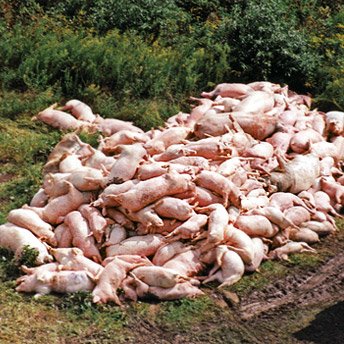
This photo, on the Smithfield Farms website, (still there at this posting on May 3, 2009), carries the following caption: “Life is short. Break the rules. Forgive quickly. Kiss slowly. Love truly. Laugh uncontrollably and never regret anything that made you smile.” Smithfield Farms is a subsidiary of Smithfield Foods.

Smithfield Farms fled U.S. environmental laws to open a gigantic pig farm in Mexico, and all we got was this lousy Swine Flu.

By Al Giordano

See ‘The Name of the Beast,’ by James Retherford, below.

[Al Giordano first published the following eye-opener on April 29, 2009, in the Narco News Bulletin. Posted by The Rag Blog on May 3, 2009.]

US and Mexico authorities claim that neither knew about the “swine flu” outbreak until April 24. But after hundreds of residents of a town in Veracruz, Mexico, came down with its symptoms, the story had already hit the Mexican national press by April 5. The daily La Jornada reported:

Clouds of flies emanate from the rusty lagoons where the Carroll Ranches business tosses the fecal wastes of its pig farms, and the open-air contamination is already generating an epidemic of respiratory infections in the town of La Gloria, in the Perote Valley, according to Town Administrator Bertha Crisóstomo López.

The town has 3,000 inhabitants, hundreds of whom reported severe flu symptoms in March.

CNN’s Dr. Sanjay Gupta, reporting from Mexico, has identified a La Gloria child who contracted the first case of identified “swine flu” in February as “patient zero,” five-year-old Edgar Hernández, now a survivor of the disease.

By April 15 – nine days before Mexican federal authorities of the regime of President Felipe Calderon acknowledged any problem at all – the local daily newspaper, Marcha, reported that a company called Carroll Ranches was “the cause of the epidemic.”

La Jornada columnist Julio Hernández López connects the corporate dots to explain how the Virginia-based Smithfield Farms came to Mexico: In 1985, Smithfield Farms received what was, at the time, the most expensive fine in history – $12.6 million – for violating the US Clean Water Act at its pig facilities near the Pagan River in Smithfield, Virginia, a tributary that flows into the Chesapeake Bay. The company, according to the Environmental Protection Agency (EPA), dumped hog waste into the river.

It was a case in which US environmental law succeeded in forcing a polluter, Smithfield Farms, to construct a sewage treatment plant at that facility after decades of using the river as a mega-toilet. But “free trade” opened a path for Smithfield Farms to simply move its harmful practices next door into Mexico so that it could evade the tougher US regulators.

The North American Free Trade Agreement (NAFTA) came into effect on January 1, 1994. That very same year Smithfield Farms opened the “Carroll Ranches” in the Mexican state of Veracruz through a new subsidiary corporation, “Agroindustrias de México.”

Unlike what law enforcers forced upon Smithfield Farms in the US, the new Mexican facility – processing 800,000 pigs into bacon and other products per year – does not have a sewage treatment plant.

According to Rolling Stone magazine, Smithfield slaughters an estimated 27 million hogs a year to produce more than six billion pounds of packaged pork products. (The Veracruz facility thus constitutes about three percent of its total production.)

Photo from doveimaging.com / Rolling Stone.

Reporter Jeff Teitz reported in 2006 on the conditions in Smithfield’s US facilities (remember: what you are about to read describes conditions that are more sanitary and regulated than those in Mexico):

Smithfield’s pigs live by the hundreds or thousands in warehouse-like barns, in rows of wall-to-wall pens. Sows are artificially inseminated and fed and delivered of their piglets in cages so small they cannot turn around. Forty fully grown 250-pound male hogs often occupy a pen the size of a tiny apartment. They trample each other to death. There is no sunlight, straw, fresh air or earth. The floors are slatted to allow excrement to fall into a catchment pit under the pens, but many things besides excrement can wind up in the pits: afterbirths, piglets accidentally crushed by their mothers, old batteries, broken bottles of insecticide, antibiotic syringes, stillborn pigs—anything small enough to fit through the foot-wide pipes that drain the pits. The pipes remain closed until enough sewage accumulates in the pits to create good expulsion pressure; then the pipes are opened and everything bursts out into a large holding pond.

The temperature inside hog houses is often hotter than ninety degrees. The air, saturated almost to the point of precipitation with gases from shit and chemicals, can be lethal to the pigs. Enormous exhaust fans run twenty-four hours a day. The ventilation systems function like the ventilators of terminal patients: If they break down for any length of time, pigs start dying.

Consider what happens when such forms of massive pork production move to unregulated territory where Mexican authorities allow wealthy interests to do business without adequate oversight, abusing workers and the environment both. And there it is: The violence wrought by NAFTA in clear and understandable human terms.

The so-called “swine flu” exploded because an environmental disaster simply moved (and with it, took jobs from US workers) to Mexico where environmental and worker safety laws, if they exist, are not enforced against powerful multinational corporations.

False mental constructs of borders –- the kind that cause US and Mexican citizens alike to imagine a flu strain like this one invading their nations from other lands –- are taking a long overdue hit by the current “swine flu” media frenzy. In this case, US-Mexico trade policy created a time bomb in Veracruz that has already murdered more than 150 Mexican citizens, and at least one child in the US, by creating a gigantic Petri dish in the form pig farms to generate bacon and ham for international sale.

None of that indicates that this flu strain was born in Mexico, but, rather, that the North American Free Trade Agreement created the optimal conditions for the flu to gestate and become, at minimum, epidemic in La Gloria and, now, Mexico City, and threatens to become international pandemic.

Welcome to the aftermath of “free trade.” Authorities now want you to grab a hospital facemask and avoid human contact until the outbreak hopefully blows over. And if you start to feel dizzy, or a flush with fever, or other symptoms begin to molest you or your children, remember this: The real name of this infirmity is “The NAFTA Flu,” the first of what may well emerge as many new illnesses to emerge internationally as the direct result of “free trade” agreements that allow companies like Smithfield Farms to escape health, safety and environmental laws.

Source / The Narco News Bulletin

The Name of the Beast: Smithfield Foods

By James Retherford / The Rag Blog / May 4, 2009

Smithfield Foods, inc. — not Smithfield Farms — is the name of the multinational food corporation ($11.4 billion in 2008 sales) whose Mexican subsidiary near Veracruz, Granjas Carroll de México, is linked by writer Al Giordano to ground zero of the swine flu outbreak. Smithfield Farms is a small subsidiary selling mail-order pork products.

In addition to the Carroll operation in the Perote Valley, Smithfield Foods owns international hog factory farms near Sonora, Mexico, and in Poland, Romania, China, and the U.K. and slaughterhouses in Virginia, North Carolina, Maryland, Florida, and Kentucky. The corporation also owns a number of well-known private brands such as restaurant supplier Curly’s Foods and retail names Armour, Eckrich, Farmland, and more. Its wholly owned subsidiary Murphy-Brown — with 300 company-owned farms and 1,500 contract farms across 12 states — boasts of being the world’s largest hog producer and one of the nation’s leading turkey producers. Last year the corporation became the U.S.’s fifth largest beef processor. Through its specialty foods group, Smithfield markets peanuts, the source of the nation’s last big health scare.

In October 2007 Smithfield Foods filed a federal civil suit against the United Food and Commercial Workers Union for alleged “racketeering” in the union’s effort to organize the workers at Smithfield’s Tar Heel, N.C., pork processing plant. The company dropped the suit a year later and agreed to hold a fair election. Two previous union elections, in 1993 and 1997, resulted in narrow union defeats later overturned by the federal appeals court’s determination that the company improperly influenced the outcome, and Smithfield was required to pay $1.1 million plus interest to workers who had been fired as part of the company’s union-busting effort.

In December 2006, Smithfield Foods was the subject of an explosive investigative report by Jeff Tietz, published in Rolling Stone magazine.

Thanks to Janet Gilles / The Rag Blog

Posted in RagBlog | Tagged , , , , , , | 3 Comments

We Can Build a Society of Good Ancestors


Ecosocialism – For a Society of Good Ancestors!
By Ian Angus / April 30, 2009

[Ian Angus was a featured guest at the World at a Crossroads: Fighting for Socialism in the 21st Century conference , in Sydney Australia, April 10-12, 2009. The event, which drew 440 participants from more than 15 countries, was organized by Democratic Socialist Perspective, Resistance and Green Left Weekly. The following is Ian’s talk to the plenary session on “Confronting the climate change crisis: an ecosocialist perspective.” He has lightly edited the text for publication.]

The world is getting hotter, and the main cause is greenhouse gas emissions produced by human activity. Enormous damage has already been done, and we will have to live with the consequences of past emissions for decades, perhaps even centuries. Unless we rapidly and drastically cut emissions, the existing damage will turn to catastrophe.

Anyone who denies that is either lying or somehow unaware of the huge mass of compelling scientific evidence.

Many publications regularly publish articles summarizing the scientific evidence and outlining the devastation that we face if action isn’t taken quickly. I highly recommend Green Left Weekly as a continuing source. I’m not going to repeat what you’ve undoubtedly read there.

But I do want to draw your attention to an important recent development. Last month, more than 2500 climate scientists met in Copenhagen to discuss the state of scientific knowledge on this subject. And the one message that came through loud and clear was this: it’s much worse than we thought.

What were called “worst case scenarios” two years ago by the Intergovernmental Panel on Climate Change actually understated the problem. The final statement issued by the Copenhagen conference declared: “The worst-case IPCC scenario trajectories (or even worse) are being realized .”

Nicholas Stern, author of the landmark 2006 study, The Stern Review on the Economics of Climate Change now says, “We underestimated the risks . we underestimated the damage associated with the temperature increases . and we underestimated the probability of temperature increases.”

Seventeen years of failure – with one exception

Later this year, the world’s governments will meet, again in Copenhagen, to try to reach a new post-Kyoto climate treaty. Will they meet the challenge of climate change that is much worse than expected?

The politicians’ record does not inspire hope.

Seventeen years ago, in June 1992, 172 governments, including 108 heads of state, met at the Earth Summit in Rio de Janeiro.

That meeting produced the United Nations Framework Convention on Climate Change, the first international agreement that aimed “to achieve stabilization of greenhouse gas concentrations in the atmosphere at a low enough level to prevent dangerous anthropogenic interference with the climate system.” In particular, the industrialized countries promised to reduce their greenhouse gas emissions below 1990 levels.

Like the Kyoto Accord that followed it, that agreement was a failure. The world’s top politicians demonstrated their gross hypocrisy and their indifference to the future of humanity and nature by giving fine speeches and making promises – and then continuing with business as usual.

But there was one exception. In Rio one head of state spoke out strongly, and called for immediate emergency action – and then returned home to support the implementation of practical policies for sustainable, low-emission development.

That head of state was Fidel Castro.

Fidel began his brief remarks to the plenary session of the 1992 Earth Summit with a blunt description of the crisis: “An important biological species is in danger of disappearing due to the fast and progressive destruction of its natural living conditions: mankind. We have become aware of this problem when it is almost too late to stop it.”

He placed the blame for the crisis squarely on the imperialist countries, and he finished with a warning that emergency action was needed: “Tomorrow it will be too late to do what we should have done a long time ago.”

After the 1992 Earth Summit, only the Cubans acted on their promises and commitments.

In 1992 Cuba amended its constitution to recognize the importance of “sustainable economic and social development to make human life more rational and to ensure the survival, well-being and security of present and future generations.” The amended constitution obligates the provincial and municipal assemblies of People’s Power to implement and enforce environmental protections. And it says that “it is the duty of citizens to contribute to the protection of the waters, atmosphere, the conservation of the soil, flora, fauna and nature’s entire rich potential.”

The Cubans have adopted low-fertilizer agriculture, and encouraged urban farming to reduce the distances food has to travel. They have replaced all of their incandescent light bulbs with fluorescents, and distributed energy efficient rice cookers. They have stepped up reforestation, nearly doubling the island’s forested area, to 25% in 2006.

As a result of these and many other projects, in 2006 the World Wildlife Federation concluded that Cuba is the only country in the world that meets the criteria for sustainable development.

By contrast, the countries responsible for the great majority of greenhouse gas emissions followed one of two paths. Some gave lip service to cleaning up their acts, but in practice did little or nothing. Others denied that action was needed and so did little or nothing.

As a result we are now very close to the tomorrow that Fidel spoke of, the tomorrow when it is too late.

Why Cuba?

The World Wildlife Federation deserves credit for its honesty in reporting Cuba’s achievements. But the WWF failed to address the next logical question. Why was Cuba the exception? Why could a tiny island republic in the Caribbean do what no other country could do?

And the next question after that is, why have the richest countries in the world not cut their emissions, not developed sustainable economies? Why, despite their enormous physical and scientific resources, has their performance actually gotten worse?

The first question, why Cuba could do it, was answered not long ago by Armando Choy, a leader of the Cuban revolution who has recently headed the drive to clean up Havana Bay. His explanation was very clear and compelling:

“This is possible because our system is socialist in character and commitment, and because the revolution’s top leadership acts in the interests of the majority of humanity inhabiting planet earth – not on behalf of narrow individual interests, or even simply Cuba’s national interests.”

General Choy’s comments reminded me of a passage in Capital, a paragraph that all by itself refutes the claim that is sometimes made, that Marxism has nothing in common with ecology. Karl Marx wrote:

“Even an entire society, a nation, or all simultaneously existing societies taken together, are not the owners of the earth. They are simply its possessors, its beneficiaries, and have to bequeath it in an improved state to succeeding generations.”

I’ve never known any socialist organization to make this point explicitly, but Marx’s words imply that one of the key objectives of socialism must be to build a society in which human beings work consciously to be Good Ancestors.

And that is what the Cubans are doing in practice.

The idea that we must act in the present to build a better world for the future, has been a theme of the Cuban revolutionary movement since Fidel’s great 1953 speech, History Will Absolve Me. That commitment to future generations is central to what has justly been called the greening of the Cuban revolution.

The Cubans are committed, not just in words but in practice, to being Good Ancestors, not only to future Cubans, but to future generations around the globe.

Why not capitalism?

But what about the other side of the question? Why do we not see a similar commitment in the ruling classes of Australia, or Canada, or the United States?

If you ask any of them individually, our rulers would undoubtedly say that they want their children and grandchildren to live in a stable and sustainable world. So why do their actions contradict their words? Why do they seem determined, in practice, to leave their children and grandchildren a world of poisoned air and water, a world of floods and droughts and escalating climate disasters? Why have they repeatedly sabotaged international efforts to adopt even half-hearted measures to cut greenhouse gas emissions?

When they do consider or implement responses to the climate crisis, why do they always support solutions that do not work, that cannot possibly work?

Karl Marx had a wonderful phrase for the bosses and their agents – the big shareholders and executives and top managers and the politicians they own – a phrase that explains why they invariably act against the present and future interests of humanity. These people, he said, are “personifications of capital.” Regardless of how they behave at home, or with their children, their social role is that of capital in human form.

They don’t act to stop climate change because the changes needed by the people of this world are directly contrary to the needs of capital.

Capital has no conscience. Capital can’t be anyone’s ancestor because capital has no children. Capital has only one imperative: it has to grow.

The only reason for using money to buy stock, launch a corporation, build a factory or drill an oil well is to get more money back than you invested. That doesn’t always happen, of course – some investments fail to produce profits, and, as we are seeing today, periodically the entire system goes into freefall, wiping out jobs and livelihoods and destroying capital. But that doesn’t contradict the fact that the potential for profit, to make capital grow, is a defining feature of capitalism. Without it, the system would rapidly collapse.

As Joel Kovel says, “Capitalism can no more survive limits on growth than a person can live without breathing.”

A system of growth and waste

Under capitalism, the only measure of success is how much is sold every day, every week, every year. It doesn’t matter that the sales include vast quantities of products that are directly harmful to both humans and nature, or that many commodities cannot be produced without spreading disease, destroying the forests that produce the oxygen we breathe, demolishing ecosystems, and treating our water, air and soil as sewers for the disposal of industrial waste.

It all contributes to profits, and thus to the growth of capital – and that’s what counts.

In Capital, Marx wrote that from a capitalist’s perspective, raw materials such as metals, minerals, coal, stone, etc. are “furnished by Nature gratis.” The wealth of nature doesn’t have to be paid for or replaced when it is used – it is there for the taking. If the capitalists had to pay the real cost of that replacing or restoring that wealth, their profits would fall drastically.

That’s true not only of raw materials, but also of what are sometimes called “environmental services” – the water and air that have been absorbing capitalism’s waste products for centuries. They have been treated as free sewers and free garbage dumps, “furnished by Nature gratis.”

That’s what the pioneering environmental economist William Kapp meant nearly sixty years ago, when he wrote, “Capitalism must be regarded as an economy of unpaid costs.”

Kapp wrote that capitalism’s claims of efficiency and productivity are: “nothing more than an institutionalized cover under which it is possible for private enterprise to shift part of the costs to the shoulders of others and to practice a form of large-scale spoliation which transcends everything the early socialists had in mind when they spoke of the exploitation of man by man.”

In short, pollution is not an accident, and it is not a “market failure.” It is the way the system works.

How large is the problem? In 1998 the World Resources Institute conducted a major international study of the resource inputs used by corporations in major industrial countries – water, raw materials, fuel, and so on. Then they determined what happened to those inputs. They found that “One half to three quarters of annual resource inputs to industrial economies are returned to the environment as wastes within a year.”

Similar numbers are reported by others. As you know, about a billion people live in hunger. And yet, as the head of the United Nations Environmental Program said recently, “Over half of the food produced today is either lost, wasted or discarded as a result of inefficiency in the human-managed food chain.”

“Inefficiency” in this case means that it is no profit to be made by preventing food waste – so waste continues. In addition to exacerbating world hunger, capitalism’s gross inefficiency poisons the land and water with food that is harvested but not used.

Capitalism’s destructive DNA

Capitalism combines an irresistible drive to grow, with an irresistible drive to create waste and pollution. If nothing stops it, capitalism will expand both those processes infinitely.

But the earth is not infinite. The atmosphere and oceans and the forests are very large, but ultimately they are finite, limited resources – and capitalism is now pressing against those limits. The 2006 WWF Living Planet Report concludes, “The Earth’s regenerative capacity can no longer keep up with demand – people are turning resources into waste faster than nature can turn waste back into resources.”

My only disagreement with that statement is that it places the blame on “people” as an abstract category. In fact the devastation is caused by the global capitalist system, and by the tiny class of exploiters that profits from capitalism’s continued growth. The great majority of people are victims, not perpetrators.

In particular, capitalist pollution has passed the physical limit of the ability of nature to absorb carbon dioxide and other gases while keeping the earth’s temperature steady. As a result, the world is warmer today than it has been for 100,000 years, and the temperature continues to rise.

Greenhouse Gas Emissions are not unusual or exceptional. Pouring crap into the environment is a fundamental feature of capitalism, and it isn’t going to stop so long as capitalism survives. That’s why “solutions” like carbon trading have failed so badly and will continue to fail: waste and pollution and ecological destruction are built into the system’s DNA.

No matter how carefully the scheme is developed, no matter how many loopholes are identified and plugged, and no matter how sincere the implementers and administrators may be, capitalism’s fundamental nature will always prevail.

We’ve seen that happen with Kyoto’s Clean Development Mechanism, under which polluters in rich countries can avoid cutting their own emissions if they invest in equivalent emission-reducing projects in the Third World. A Stanford University study shows that two-thirds or more of the CDM emission reduction credits have not produced any reductions in pollution.

The entire system is based on what one observer says are “enough lies to make a sub-prime mortgage pusher blush.”

CDM continues not because it is reducing emissions, but because there are profits to be made buying and selling credits. CDM is an attempt to trick the market into doing good in spite of itself, but capitalism’s drive for profits wins every time.

Green eco-capitalists

One of the greatest weaknesses of the mainstream environmental movement has been its failure or refusal to identify capitalism as the root problem. Indeed, many of the world’s Green Parties, including the one in Canada where I live, openly describe themselves as eco-capitalist, committed to maintaining the profit system.

Of course this puts them in a contradictory position when they face the reality of capitalist ecocide.

In Canada, as you may know, oil companies are engaged in what the British newspaper, The Independent, accurately called, “The Biggest Environmental Crime in History,” mining the Alberta Tar Sands. If it continues, it will ultimately destroy an area that is nearly twice as big as New South Wales, in order to produce oil by a process that generates three times as much greenhouse gas as normal oil production.

It is also destroying ecosystems, killing animals, fish and birds, and poisoning the drinking water used by Indigenous peoples in that area.

It’s obvious that anyone who is serious about protecting the environment and stopping emissions should demand that the Tar Sands be shut down. But when I raised that in a talk not long ago in Vancouver, a Green Party candidate in the audience objected that would be irresponsible, because it would violate the oil companies’ contract rights.

Evidently, for these eco-capitalists, “capitalism” takes precedence over “eco.”

But as capitalist destruction accelerates, and as capitalist politicians continue to stall, or to introduce measures that only benefit the fossil fuel companies, we can expect that many of the most sincere and dedicated greens will begin to question the system itself, not just its worst results.

Greens moving left: Gus Speth

An important case in point, and, I hope, a harbinger of what’s to come in green circles – is James Gustave Speth, who is now dean of the Yale University School of Forestry and Environmental Studies.

Gus Speth has spent most of his life trying to save the environment by working inside the system. He was a senior environmental advisor to US President Jimmy Carter, and later to Bill Clinton. In the 1990s, he was Administrator of the United Nations Development Programme and Chair of the United Nations Development Group. Time magazine called him “the ultimate insider.”

Last year, after 40 years working inside the system, Speth published a book called, “The Bridge at the Edge of the World: Capitalism, the Environment, and Crossing from Crisis to Stability”.

…He argues that working inside the system has failed – because the system itself is the cause of environmental destruction.

“My conclusion, after much searching and considerable reluctance, is that most environmental deterioration is a result of systemic failures of the capitalism that we have today .

“Inherent in the dynamics of capitalism is a powerful drive to earn profits, invest them, innovate, and thus grow the economy, typically at exponential rates.”

That’s exactly correct – no Marxist could have said it better. Nor could we improve on Speth’s summary of the factors that combine to make contemporary capitalism the enemy of ecology.

“An unquestioning society-wide commitment to economic growth at almost any cost; enormous investment in technologies designed with little regard for the environment; powerful corporate interests whose overriding objective is to grow by generating profit, including profit from avoiding the environmental costs they create; markets that systematically fail to recognize environmental costs unless corrected by government; government that is subservient to corporate interests and the growth imperative; rampant consumerism spurred by a worshipping of novelty and by sophisticated advertising; economic activity so large in scale that its impacts alter the fundamental biophysical operations of the planet; all combine to deliver an ever-growing world economy that is undermining the planet’s ability to sustain life.”

Speth is not a Marxist. He still hopes that governments can reform and control capitalism, eliminating pollution. He’s wrong about that, but his analysis of the problem is dead-on, and the fact that it comes from someone who has worked for so long inside the system makes his argument against capitalism credible and powerful.

The socialist movement should welcome and publicize this development, even though Speth and others like him don’t yet take their ideas to the necessary socialist conclusions.

Greens moving left: James Hansen

Similarly, we should be very encouraged that NASA’s James Hansen, one of the world’s most respected climate scientists, joined in the March 20 demonstration against a planned coal-fired electricity plant in Coventry, England. Hansen is another environmentalist who has worked inside the system for years.

He told the UK “Guardian” that people should first use the “democratic process” by which he means elections. He went on:

“What is frustrating people, me included, is that democratic action affects elections but what we get then from political leaders is greenwash.

“The democratic process is supposed to be one person one vote, but it turns out that money is talking louder than the votes. So, I’m not surprised that people are getting frustrated.

“I think that peaceful demonstration is not out of order, because we’re running out of time.”

In the same interview, Hansen expressed concern about the approach of the Obama administration:

“It’s not clear what their intentions are yet, but if they are going to support cap and trade then unfortunately I think that will be another case of greenwash. It’s going to take stronger action than that.”

Like Speth, Hansen is not a socialist. But he condemns the most widely-promoted market-based “solution,” and he calls for demonstrations and protests, so eco-socialists can and must view him as an ally.

Why ECO-socialism?

Which brings me to a question I’ve been asked many times, including during this visit to Australia. “Why eco-socialism?”

Why not just say ‘socialism’? Marx and Engels were deeply concerned about humanity’s relationship to nature, and what we today would call ecological ideas, are deeply embedded in their writings. In the 1920s, there was a very influential ecology movement in the Soviet Union. So why do we need a new word?

All that is true. But it is also true that during the 20th century socialists forgot or ignored that tradition, supporting (and in some cases implementing) approaches to economic growth and development that were grossly harmful to the environment.

Socialist Voice recently published an interview in which Oswaldo Martinez, the president of the Economic Affairs Commission of Cuba’s National Assembly addressed just that question. He said:

“The socialism practiced by the countries of the Socialist Camp replicated the development model of capitalism, in the sense that socialism was conceived as a quantitative result of growth in productive forces. It thus established a purely quantitative competition with capitalism, and development consisted in achieving this without taking into account that the capitalist model of development is the structuring of a consumer society that is inconceivable for humanity as a whole.

“The planet would not survive. It is impossible to replicate the model of one car for each family, the model of the idyllic North American society, Hollywood etc. – absolutely impossible, and this cannot be the reality for the 250 million inhabitants of the United States, with a huge rearguard of poverty in the rest of the world.

“It is therefore necessary to come up with another model of development that is compatible with the environment and has a much more collective way of functioning.” [Full interview: www.socialistvoice.ca/?p=375]

In my view, one good reason for using the word `eco-socialism’ is to signal a clear break with the practices that Martinez describes: practices that were called socialist for seventy years. It is a way of saying that we aim not to create a society based on having more things, but on living better – not quantitative growth, but qualitative change.

Another reason, just as important, is to signal loud and clear that we view ecology and climate change not as just as another stick to bash capitalism with, but as one of the principal problems facing humanity in this century.

Evo Morales: Save the planet from capitalism

Although he has never used the word, so far as I know, one of the strongest defenders of eco-socialist ideas in the world today is Evo Morales, the president of Bolivia, the first indigenous head of state in Latin America.

In a short essay published last November, Evo brilliantly defined the problem, named the villain, and posed the alternative.

“Competition and the thirst for profit without limits of the capitalist system are destroying the planet. Under Capitalism we are not human beings but consumers. Under Capitalism, Mother Earth does not exist, instead there are raw materials. Capitalism is the source of the asymmetries and imbalances in the world. It generates luxury, ostentation and waste for a few, while millions in the world die from hunger in the world.

“In the hands of capitalism everything becomes a commodity: the water, the soil, the human genome, the ancestral cultures, justice, ethics, death and life itself. Everything, absolutely everything, can be bought and sold under capitalism. And even “climate change” itself has become a business.

“Climate change” has placed all humankind before a great choice: to continue in the ways of capitalism and death, or to start down the path of harmony with nature and respect for life.”

You know, last year I spent months working with other members of the Eco-socialist International Network, composing a statement to be distributed at the World Social Forum. It was finally published as the Belem Eco-socialist Declaration. [See climateandcapitalism.com/?p=597]

Now I wonder why we didn’t just publish this statement by comrade Evo Morales. He set out the case for eco-socialism, including a program of 20 demands, more concisely, more clearly, and vastly more eloquently than we did. I urge you to read it and to distribute it as widely as possible. [Full text – climateandcapitalism.com/?p=591]

Slamming on the brakes

Writing in the 1930s, when Nazi barbarism was in the rise, the Marxist philosopher and literary critic Walter Benjamin said:

“Marx says that revolutions are the locomotives of world history. But the situation may be quite different. Perhaps revolutions are not the train ride, but the human race grabbing for the emergency brake.”

That’s a powerful and profound metaphor. Capitalism has been so destructive, and taken us so far down the road to catastrophe, that one of the first tasks facing a socialist government will be to slam on the brakes.

The only choice, the only way forward, is eco-socialism, which I suggest can be defined simply as a socialism that will give top priority to the restoration of ecosystems that capitalism has destroyed, to the reestablishment of agriculture and industry on ecologically sound principles, and to mending what Marx called the metabolic rift, the destructive divide that capitalism has created between humanity and nature.

The fate of the ecological struggle is closely tied to the fortunes of the class struggle as a whole. The long neo-liberal drive to weaken the movements of working people also undermine ecological resistance, isolating it, pushing its leaders and organizations to the right.

But today neo-liberalism is discredited. Its financial and economic structures are in shambles. There is growing recognition that profound economic change is needed.

This is an historic opportunity for ecological activists to join hands with workers, with indigenous activists, with anti-imperialist movements here and around the world, to make ecological transformation a central feature of the economic change that is so clearly needed.

Together we can build a society of Good Ancestors, and cooperatively create a better world for future generations.

It won’t be easy, and it won’t be quick, but together we can make it happen.

Thank you.

[Ian Angus is editor of Climate and Capitalism, associate editor Socialist Voice, and a founding member of the Eco-socialist International Network. He lives near Ottawa, Canada.]

Source / Socialist Voice

Thanks to Ron Ridenour / The Rag Blog

Posted in RagBlog | Tagged , , , , | Leave a comment

Haiti Needs More Than Words from the U.S.

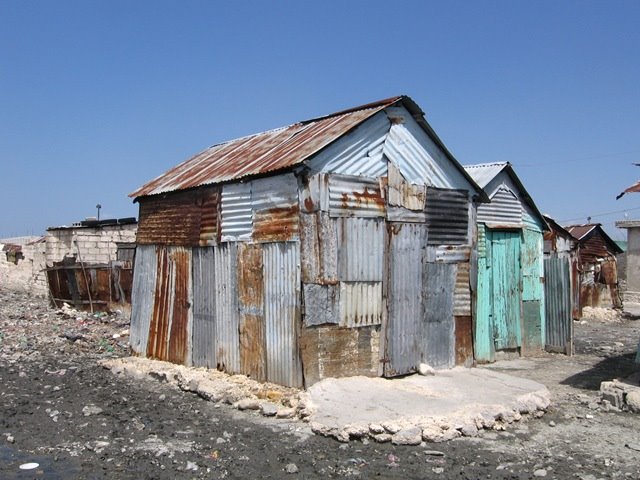
Haitian suburb.

See video below.

Haiti needs U.S. support for democracy
By Ansel Herz / The Rag Blog / May 1, 2009

Secretary of State Hillary Clinton stood on the floor of a textile factory in Port-Au-Prince, Haiti, earlier this month and talked about America’s commitment to the island nation. “I pledge we will do more to create more good jobs for the people of Haiti,” she told an audience of textile workers.

Sounds good, right? But when Clinton finished her speech with a smile, the applause was muted. Many of the workers could not understand her speech because it was not translated into Kreyol, the language spoken by the vast majority of Haitians. Clinton’s obliviousness is typical of policy makers who ignore a deeply flawed democratic process in Haiti, while pushing anti-poverty schemes against Haiti from afar.

Clinton, along with U.N. Secretary General Ban Ki-Moon, is touting a plan devised by Oxford economist Paul Collier to expand tariff-free export zones around Haiti. The plan calls for Haiti to lift urban slum-dwellers out of poverty through jobs in textile factories, like the Inter-American Garment Factory at which Clinton spoke.

There is little popular demand in Haiti for this maquiladora-style development. Workers at the factory assembling clothes for American companies like Levi’s are paid twice Haiti’s minimum wage, but they have complained to Al Jazeera English, the English version of the Arabic-language news network, that the wages are still so low that the workers cannot escape poverty.

The former president of Haiti, Jean-Bertrand Aristide, whose Lavalas party has enjoyed overwhelming support among Haitians in many elections, tried during the 1990s to triple the minimum wage. But under pressure from U.S. officials and people like Andy Apaid, a Haitian who owns numerous sweatshops and the garment factory that hosted Clinton, Aristide was forced to drastically scale back the wage increase.

In 2004, Apaid and other members of the tiny Haitian elite successfully conspired to overthrow Aristide with the help of the U.S. government. Aristide was flown out of the country on a U.S. jet surrounded by Marines and dumped in Central African Republic. Aristide says he was kidnapped and still has not returned to Haiti.

Aristide and Lavalas represent a grassroots threat to the centuries-old status quo in Haiti and international interests that have exploited it. Aristide raised taxes on the rich, launched highly effective literacy and anti-AIDS programs and built schools and hospitals across the country during his two presidential terms, each cut short by U.S.-backed coups.

The Lavalas party has tried to carry on amid continuing repression. A heavily armed U.N. peacekeeping force has repeatedly shelled and occupied Cite Soleil, a slum outside the capital and one of Lavalas’ strongest bases of support.

Many of the party’s leaders were imprisoned on bogus charges by the post-coup regime, and without Aristide the party is less united than it once was.

Lavalas was banned from last week’s Haitian Senate elections by the government’s Provisional Electoral Council because of a technical problem with the list of candidates it submitted. A judge who ruled that the council’s decision was illegal was promptly stripped of his post by the Haitian government.

Like the rebel force of slaves that defeated Napoleon’s armies and founded Haiti, however, Lavalas and its agenda of social uplift have not been easily marginalized. The organization called for a boycott of the Senate elections from which it was banned, and Haitians heeded the call — voter turnout on April 19 was estimated at less than 10 percent.

Popular Haitian demands include revitalization of local peasant economies, debt cancellation, temporary protected status for immigrants in the United States and the return of Aristide. The Obama administration has already pledged $20 million to pay off part of Haiti’s illegitimate debt to the World Bank. That’s a start.

The mentality that the “international community” knows what is best for Haiti’s poor has been discredited by decades of worsening poverty. Strong support from the Obama administration for democracy in Haiti, including the participation of Lavalas, would represent change Haitians can believe in and so desperately need.

[Herz is a journalism senior at the University of Texas. Video courtesy of the author at his Web site.]

Source / Daily Texan

The Rag Blog

Posted in RagBlog | Tagged , , , , | 1 Comment

Ron Ridenour Reports on May Day in Cuba

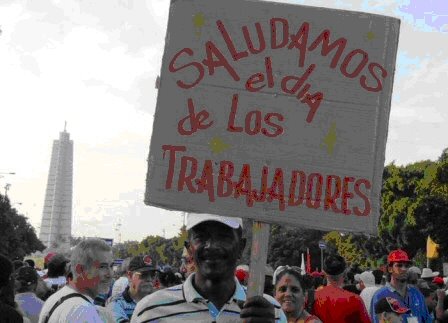
On May Day Havana is a melting pot of labor solidarity. Photo: Bill Hackwell.

May Day 2009 in Cuba
By Ron Ridenour / The Rag Blog / May 2, 2009
Seventeen days after the first May Day of the revolution, May 17, 1959, Fidel Castro proclaimed the first radical land reform to an outburst of great popular joy, as well as a violent reaction from the national landowners and their ally in the United States, the latter continuing its merciless revenge against the revolutionary government of Cuba.

On that day 50 years ago, Fidel said, “A wonderful future awaits our country if we dedicate ourselves to work with all our might.”

The historic and indelible advantages Cubans earned from forging an incipient socialism following the nation’s real independence, with its ensuing products and services for all, was supported by the vast majority of the population, especially in the early years. Just to mention some benefits: free and ample health care and education for all; clothing and food for all babies and school children; free or inexpensive access to all sports and cultural events; the assurance that no resident go without minimal nutrition and a residence; the right for all to obtain work. And the spirit, the spirit of idealistic Don Quixote, and that of the thoroughly dedicated revolutionary guerrilla, El Che.

However, today, fifty years later, there is still a long ways to go to advance the interests, energies and the wisdom of Cuba’s working people. It is a sad fact of reality, which must be confronted today, that many Cubans have not worked “with all our might.”

The nation is fraught with passivity, poor production in quantity and quality. I believe this is so in large part because people lack the real power to make decisions at their work centers, schools, and even in their local governments and provincial and national legislatures.

Cuban Workers March on May Day. Photo: Bill Hackwell.

They are not in control of their work, their production, or of product distribution. Too many people are not contributing to society’s needs; too many people are skimming off the enticing plate of foreign capitalism; too many people have lost their morality, their solidarity and have succumbed to their thirst for the tinted silver plate.

Today, half a century after the great victory, its no secret that many people are tired and discontent. The four main areas of dissatisfaction, as I see it, are: a) low salaries and the two currency system, which separates people; b) shortages of sufficient foodstuffs and other basic goods; c) perpetual lack of sufficient housing made worse by last year’s hurricane destruction; d) insufficient improvement in worker empowerment, with few exceptions.

And then, for many -especially the revolutionary conscious people who linger in the days of Che enthusiasm for creating the new man and woman- there is the crippling effect that the government continues to limit the access to ample information and real debate, hampering an exchange of ideas necessary for them to become empowered.
This has led to a sizeable segment of the population, especially youth, to be disbelievers of what they are told by the government and its mass media. They hunger for more and open information.

There are a few signs of movement, not least among some university students and professors. On this May Day 2009, let us listen carefully and join those voices.

Source / Havana Times

The Rag Blog

Posted in RagBlog | Tagged , , | Leave a comment

Saturday Snapshot: The Worker

The Rag Blog

Posted in RagBlog | Tagged , , | Leave a comment

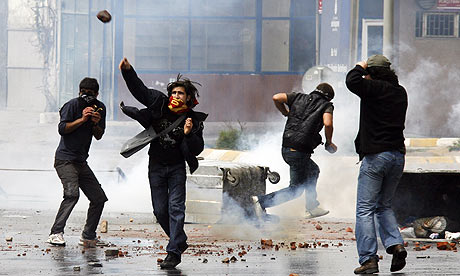
May Day in Europe : Protesters Clash with Riot Police

Protesters throw stones at riot police during a May Day rally in Istanbul. Photo by Osman Orsal / Reuters.

Giant demonstrations in France; battles with police in Turkey, Greece and Germany

Protests reflect growing anger in Europe over unemployment and handling of economic crisis

By Robert Tait [in Istanbul] and Angelique Chrisafis [in Paris] / May 1, 2009

May Day protesters clashed with riot police in Turkey, Greece and Germany yesterday while French unions led their biggest ever Labour Day demonstrations amid growing public anger in Europe at unemployment and the handling of global economic crisis.

Turkey’s May Day demonstrations were marred by violence for the third year running as police battled to stop protesters reaching Istanbul’s landmark Taksim Square. Riot officers fired water cannon and teargas canisters in clashes with leftwing demonstrators, some of whom hurled stones and Molotov cocktails and smashed the windows of banks and shops. There were at least 26 arrests and 11 police officers were reported injured.

Some of the worst violence took place in side streets. In the fashionable Cihangir neighbourhood near Taksim, protesters were seen placing large plant pots on the road to use as barricades against police vehicles.

The protesters had been seeking to join an estimated 2,000 trade unionists who had been given permission to hold a rally in Taksim for the first May Day since 1977, when 37 people died after unidentified gunmen opened fire on demonstrators. That event triggered political violence and was seen as a turning point that led to a military coup three years later.

The Turkish government last week bowed to pressure to declare May Day a public holiday and allow limited access to Taksim Square following criticism that police heavy handedness aimed at cordoning it off had been responsible for violence at last year’s event.

In Greece, police clashed with anarchist demonstrators, firing teargas on protesters at Athens Polytechnic.

In Berlin and Hamburg, scattered violence erupted in the early hours of the May Day holiday. More than 50 ­people were detained in Berlin after demonstrators chanting anti-capitalism slogans threw bottles and stones at riot police and torched five cars, 48 police were injured.

France saw a record number of almost 300 street demonstrations with union leaders marching as a united front for the first time since the second world war.

Public support for the marches was over 70% as tension rises over unemployment, factory closures and mass lay-offs. The demonstrations were France’s third national protest over the handling of the economic crisis in four months. Unions will meet on Monday to decide whether to organise a further general strike.

As civil unrest by workers becomes more radical, with gestures such as “bossnapping” and vandalism, the former prime minister Dominique de Villepin has warned of a “revolutionary risk” in France. In one poll yesterday for Challenges magazine, 66% people felt there was a risk of “social explosion” in France over the coming months.

Source / Guardian, U.K.

Thanks to CommonDreamsThe Rag Blog

Posted in RagBlog | Tagged , , , , | Leave a comment

Life During Wartime : Condi on Torture

Political cartoon by Joshua Brown / Historians Against the War / The Rag Blog

The Rag Blog

Posted in Rag Bloggers | Tagged , , , , | Leave a comment

May Day Special : Carl Davidson on Socialism in Today’s Society

May Day poster from Holt Labor Library.

…in light of the faux ‘socialisms’ bandied about in the headlines and sound bytes of the mass media in the wake of the financial crisis, especially the absurd claim in the media of rightwing populism that the Obama administration is Marxist and socialist, I felt something a little more rigorous might be helpful.

By Carl Davidson / The Rag Blog / May 1, 2009

The current discussion around socialism in left and progressive circles in the U.S. needs to be placed in a more substantive arena. This is an effort to do so. I take note in advance of the criticism that the following eleven working hypotheses are rather dry and formal. But in light of the faux “socialisms” bandied about in the headlines and sound bytes of the mass media in the wake of the financial crisis, especially the absurd claim in the media of rightwing populism that the Obama administration is Marxist and socialist, I felt something a little more rigorous might be helpful. Obviously, criticism and commentary is invited.

1. Socialism’s fundamental building blocks are already present in US society. The means of production, for the most part, are fully developed and in fact are stagnating under the political domination of finance capital. The US labor force, again for the most part, is highly skilled at all levels of production, management, marketing, and finance. The kernels of socialist organization are also scattered across the landscape in cooperatives, socially organized human services, and centralized and widespread mass means of many-to-many communication and supply/demand data management. Many earlier attempts at socialism did not have these advantages.

2. Socialism is first of all a democratic political system where the interests and organizations of the working class and its allies have attained and hold the preponderance of political power and thus play the critical leading role in society. It is still a class society, but one in a protracted transition, over hundreds of years, to a future classless society where exploiting class privileges are abolished and classes and class distinctions generally wither away, both nationally and globally.

So socialism will have classes for some time, including some capitalists, because it will be a mixed economy, with both public and private ownership, even as the balance shifts over time. Family farmers and small proprietors will both exist and flourish alongside cooperatives. Innovative ‘high road’ entrepreneurial privately-held firms will compete with publically-own firms, and encouraged to create new wealth within an environmentally regulated and progressively taxed system. Past efforts to build socialism have suffered from aggravated conflict between and among popular classes and lack of emphasis on building wide unity among the people.

3. Socialism at the base is a transitional economic system anchored in the social mode of production brought into being by capitalist development over several centuries. Its economic system is necessarily mixed, and makes use of markets, especially in goods and services, which are regulated, especially regarding the environment. But capital markets and wage-labor markets can be sharply restricted and even abolished in due time. Markets are a function of scarcity, and all economies of any scale in a time of scarcity have them, even if they are disguised as ‘black’ or ‘tiered’ markets.

In addition to regulated markets, socialism will also feature planning, especially on the macro level of infrastructure development, in investment of public assets and funds, and other arenas where markets have failed. Planning will especially be required to face the challenges of uneven development and harsh inequalities on a global scale, as well as the challenge of moving from a carbon and uranium based energy system to one based on renewable green energy sources. The socialisms of the last century fell or stagnated due to failure to develop the proper interplay between plans and markets.

4. Socialism will be anchored in public and worker ownership of the main productive forces and natural resources. This can be achieved by various means: a) buying out major failing corporations at penny stock status, then leasing them back to the unions and having the workers in each firm—one worker, one vote—run them, b) workers directly taking ownership and control over failed and abandoned factories, c) eminent domain seizures of resources and factories, with compensation, otherwise required for the public good, and d) public funding for startups of worker-owned cooperative businesses.

Socialism will also require public ownership of most finance capital institutions, including bringing the Federal Reserve under the Treasury Department and federal ownership. Lease payments from publically owned firms will go into a public investment fund, which will in turn lend money to community and worker owned banks and credit unions. A stock market will still exist for remaining publically traded firms and investments abroad, but will be strictly controlled. A stock transfer tax will be implemented. Gambling in derivatives will be outlawed. Fair trade agreements with other countries will be on a bilateral basis for mutual benefit.

5. Socialism will require democracy in the workplace of public firms and encourage it in all places of work. Workers have the right to independent unions to protect their social and daily interests, in addition to their rights as worker-owners in the governance of their firms. In addition to direct democracy at the plant level, the organizations of the working class also participate in the wider public planning process and thus democratically shape the direction of ongoing development on the macro level as well. Under socialism the government will also serve as the employer-of-last-resort. Minimum living-wage jobs will be provided for all who want to work. Socialism is committed to genuine full employment. Every citizen will have a genuine right to work.

6. Socialism will largely be gained by the working class and it allies winning the battle for democracy in politics and civil society at large, especially taking down the structures and backward laws of class, gender and racial privilege. Women have equal rights with men, and minority nationalities have equal rights with the majority. It also defends equal rights and self-determination among all nations across the globe; no nation can itself be fully free when it oppresses another. Socialism will encourage public citizenship and mass participation at every level, with open information systems, public education and transparency in its procedures. It will need a true multiparty system, with fusion voting, proportional representation and instant runoff.

Given the size and diversity of our country, it is highly unlikely that any single party could adequately represent all popular interests; working class and progressive organizations will need to form common fronts. All trends are guaranteed the right to speak, organize, petition and stand for election. With public financing as an option, socialism can restrict the role of wealth in elections, moving away from a system, in effect, of “one dollar, one vote” and toward a system more reflective of “one person, one vote.” These are the structural measures that can allow the majority of the people, especially the working class and its allies, to secure the political leadership of government and instruments of the state by democratic means, unless these are sabotaged by reaction.

Some socialisms of the past used only limited formal democracy or simply used administrative means to implement goals, with the failure of both the goals and the overall projects. Americans are not likely to be interested in systems with elections where only one party runs and no one can lose.

7. Socialism will be a state power, specifically a democratic political order with a representative government. But the government and state components of the current order, corrupted with the thousand threads connecting it to old ruling class, will have to be broken up and replaced with new ones that are transparent, honest and serve the majority of the people. The US Constitution and Bill of Rights can still be the initial basic organizing principle for a socialist government and state. The democratic rights it has gained over the years will be protected and enhanced. Government will also be needed to organize and finance the social development benefitting the people and the environment already mentioned; but the state power behind the law will be required to compel the honest use of resources and to protect people from criminal elements, individual and organized.

Forces who try to overturn and reverse the new socialist government illegally and in violation of the Constitution will not be able to do so; they will be broken up and brought to justice. Our society will need a state power for some time to come, even as its form changes. Still, government power has limits; under socialism sovereignty resides in the people themselves, and the powers of any government are necessarily restricted and subordinate to the universal and natural rights of all humankind. Attempts to ignore or reject these principles have severely harmed socialist governments and movements in the past.

8. Socialism will be a society in harmony with the natural environment, understanding that all economies are subsets of the eco-system and ignore it at their peril. In its economics, there are no such things as “externalities” to be pushed off downstream or to future generations. The nature of pending planetary disasters necessitates a high level of planning. We need to redesign communities, promote healthier foods, and rebuild sustainable agriculture—all on a global scale with high design, but on a human scale with mass participation of communities in diverse localities.

Socialism will treasure and preserve the diversity of nature’s bounty and end the practice of genetic modification to control the human food supply. We need growth, but intelligent growth in quality and wider knowledge with a lighter environmental footprint. A socialism that simply reproduces the wasteful expansion of an earlier capitalism creates more problems than it solves.

9. Socialism values equality, and will be a society of far greater equality of opportunity, and far less economic inequality. In addition to equal rights before the law, all citizens and residents will have equitable access to a “universal toolbox” of paid-up free public education for all who want to learn, for as far as they want and are able to go; universal public pre-school care; a minimum income, as a social wage, for all who create value, whether in a workplace or otherwise; our notions of socially useful work, activity that creates value, has to be expanded beyond market definitions.

Parents raising children, students learning skills, elders educating and passing traditions to younger generations–all these create value that society can in turn reward. Universal single-payer health care with retirement benefits at the level of a living wage is critical to start. Since everyone has access to employment, the existing welfare system can be abolished; individuals will be free to choose the career path and level of income targets they desire, or not. There are no handouts for those able to work, but there are also no irrational barriers to achievement.

10. Socialism is a society where religion can be freely practiced, or not, and no religion is given any special advantages over any other. Religious freedom remains a fundamental tenant of socialism, but naturally neither its practitioners nor anyone else can deny anyone the benefits and protection of civil and criminal law, especially to women and children.

11. Socialism will require an institution of armed forces. Their mission will be to defend the people and secure their interests against any enemies and help in times of natural disasters. It will not be their task to expand markets abroad and defend the property abroad of the exploiting classes. Soldiers will be allowed to organize and petition for the redress of grievances. Armed forces also include local police, under community control, as well as a greatly reduced prison system, based on the principle of restorative justice, and mainly for the protection of society from individuals inflicted with violent pathologies and criminal practices. Non-violent conflict resolution and community-based rehabilitation will be encouraged, but the need for some coercive means will remain for some time.

[Carl Davidson, a regular contributor to The Rag Blog, is webmaster for SolidarityEconomy.net, where this article was also posted. He also blogs at Keep On Keepin On. Together with Jerry Harris, he is author of Cyber-Radicalism: A New Left for a Global Age.]

The Rag Blog

Posted in Rag Bloggers | Tagged , , , , | Leave a comment