Chris Jordan : The Photographer as Agent of Environmental Change

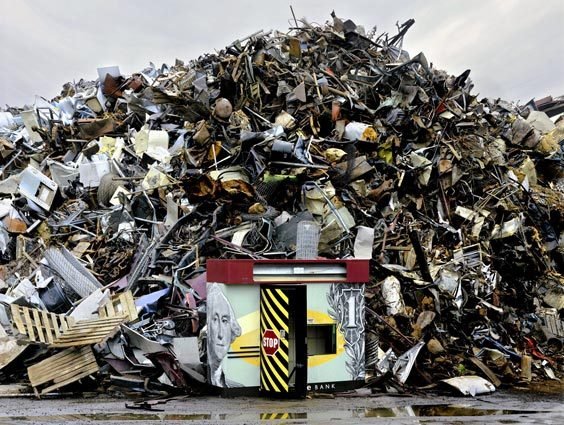
Chris Jordan took this photo at a Florida cellphone-processing plant, which he says sorts about 50,000 phones a month. Working ones are resold; the rest are shredded and burned to recover a tiny amount of gold in each one. “Pound for pound, there is more gold in cellphones than there is in gold mines,” he says. “All of the remaining material from the phones (something like 99.995 percent of the phone) goes to a landfill.” Photo: Chris Jordan.

Chris Jordan photographs our culture of excess in hopes of changing it
By Carey Quan Gelernter / April 19, 2009

Seattle-based, internationally acclaimed photographer Chris Jordan has become the “it” artist of the international green movement. At a time the public is waking up to the planet’s peril, Jordan’s large-scale images of the vast detritus of American consumer excess seem made-to-order to dramatize the environmental story.

PHOTOGRAPHER CHRIS Jordan is living out an eco-fairytale. In a few short years, he catapulted from corporate lawyer chancing a career change to “it” artist of the international green movement.

Talk about timing. The fateful tale of how his muse intersected with the zeitgeist unfolds something like this: New law-school grad moves from Texas to Seattle in 1991 for its rep as a top-10 cool place and its nearby mountains to climb. Resigns the bar a decade later to save his soul and take a leap of faith he can survive as an art photographer. Follows his muse into industrial yards, trash heaps and recycling centers, fascinated by the colors and patterns. A friend comments he’s captured a macabre portrait of America; he’s seized by an “aha” moment.

He sits by a New York Times reporter at a dinner; a prominent feature story on Jordan follows, anticipating by several months his first solo New York show, “Intolerable Beauty: Portraits of American Mass Consumption.” This is September 2005; four months later “An Inconvenient Truth” premieres at Sundance, galvanizing awareness of the planet in peril.

Suddenly it’s as if Jordan’s large-scale images of the vast detritus of our excess, from the seas of plastic bottles to the plains of discarded cellphones, were made-to-order to dramatize the environmental story.

Everyone wants him: Rachael Ray, a World Economic Forum in Dubai, the exclusive, $6,000-per-person TED conference where celebs and brainiacs commune about big ideas. He’s in Harper’s, Men’s Journal and Vogue Italy; giving talks from Qatar to China. He goes to New Orleans to document the aftermath of Hurricane Katrina, which he links to global warming; these photos are shortlisted for the major enviro-photography prize, the Pictet.

But because this is an eco fairytale, you cannot assume “happily ever after.” How does one person, one artist, cope with the urgency, the weight of responsibility of his role as messenger? Answers keep shifting; angst accompanies fame.

We caught up with Jordan, 45, for a chat in his cramped studio behind his small, wood-frame home in a still-modest part of Ballard. It’s an unusual time for him, as he just spent a rare whole month without leaving Seattle. Mostly curled up, in fact, with wife, son and dog in “a big nest” of comforters and pillows on the living-room floor. Recovering from the whirlwind. Thinking.

What follows is an edited portion of our conversation.

Q: You have become “the” artist of the green movement. What are the best aspects of wearing this crown, and the worst?

A: The best aspect is, there’s a kind of awakening process happening right now that is incredibly exciting to see and contribute to. Although I don’t like that term green movement because it seems to be only about plants, save the trees; it’s far bigger and deeper and broader.

Seattleite Chris Jordan has made an international reputation documenting America’s culture of consumer excess. He took this photo, “E-Bank, Tacoma, 2004,” at a scrap-metal-recovery facility that sorts, shreds and ships out the scrap. Photo: Chris Jordan.

Q: How would you define it?

A: It’s about environmental stewardship, and that includes noticing we’re devastating the population of our oceans, for example, and it’s about reducing cruelty to animals, raging against factory farming and addressing global climate change. It’s also about social justice.

Q: In your “Running the Numbers: An American Self Portrait” series that’s now a national traveling exhibit, you’ve included photos about women’s breast augmentation, U.S. spending in Iraq, prisoners in Abu Ghraib, and the high percentage of Americans in prison. Is there a link to environmentalism?

A: These are all issues we’re in denial about, including the environment. I think there’s shame associated with looking at any of these.

Q: Shame?

A: American culture is not about experiencing our shame, it’s about denying it. It’s been that way our whole history.

One culture I find fascinating to juxtapose against American culture is the culture of Germany. They’ve gone through a long process through their art, poetry, public discourse, their politics, of owning the fact of their complicity in what happened in World War II. It’s still a topic of everyday conversation in Germany.

Q: Is that where we want to go?

A: I think we have to. Not necessarily the same way Germany did. But American culture, there’s a swashbuckling ego, personified by George Bush and (Dick) Cheney, of, “If I’m doing it, it must be right, because I’m American.” In my view, this is part of a bigger American picture, which is a denial of any kind of bad feelings.

We remove ourselves from our connection with each other and the world. After doing that for a very long time, we end up where we are now.

Q: What is the grief and shame about?

A: Grief — here’s an example. We’ve never grieved Katrina the way we could have. We barely grieved 9/11. The most spectacular tragedy to happen in our country in a long time, and the very first thing our leader said was, “Everybody go shopping.”

We had candlelight vigils, then we moved right on to hatred — of the Mideast. It’s like, the grief went underground and got subversive and turned into a war.

I think there’s a tremendous amount of unacknowledged hostility in American culture.

Also, with the advent of the Internet — this whole new cult of just infinite information that’s like an avalanche that hits all of us — I think our culture of not feeling has gone up by a whole magnitude. We’re all kind of emotionally overwhelmed.

“Barbie Dolls” depicts 32,000 Barbies, equal to the number of elective breast-augmentation surgeries performed monthly in the U.S. in 2006. Photo: Chris Jordan.

“Barbie Dolls” depicts 32,000 Barbies, equal to the number of elective breast-augmentation surgeries performed monthly in the U.S. in 2006. A partial zoom shows how the Barbies are arranged. Photo: Chris Jordan.

Q: So is your work to counter that?

A: For a while, I thought the “Running the Numbers” series was about holding onto individual empowerment; one of its central themes is the relationship of the individual and the collective. When you stand back a distance from these pieces, you see the collective, and it adds up to a picture of some kind. When you walk up close you see that the picture is created by lots and lots of individuals who each play an equal role.

Last spring, I was doing all these keynote talks, talking about the power of the individual. How every vote counts. Every individual matters. I began to realize that you also could look at my pieces in exactly the opposite way, which if you look at the 2 million plastic bottles, you could take one of those plastic bottles away, and never know the difference.

I’m starting to realize a primary theme is not a belief that every individual matters, it’s a much deeper experience of rage.

Q: Your rage?

A: Yeah, my own personal rage, at the experience of feeling disempowered. And anonymous.

We all want to feel we matter. And yet, with something like Google Earth, you look at your house, zooming all the way back, and see it’s not even one pixel in a city like Seattle. And then you can zoom out and see that Seattle’s not even a pixel … And seeing all these statistics, about our mass culture, our mass consumption.

I understand on a new level why it is that babies cry when they’re just born. It’s like, it used to be warm and quiet and safe and all about me. And then they come on out and there’s this experience of, oh my God, I’m in this giant, cold, harsh, overwhelming, incomprehensibly complex world, and all I know to do is scream.

And in a way, that’s what these pieces of mine are. They’re like very carefully filtered screams of rage.

Q: So you’re saying, we were always less than pixel, but now we know it, and we see the complexity of problems in the world, and it’s like, aaaaah.

A: Yeah, yeah. I don’t think people yet have the ability to experience their individuality at the same time as having this new global world view. Because if you think about our history, it was only a really short time ago we were living in tribes. If your tribe is 50 people or 30 people or 100 people, then it’s not so hard to have a very palpable sense of who you are, and how you matter.

“Prison Uniforms” depicts 2.3 million folded prison uniforms, equal to the number of Americans incarcerated in 2005. The U.S. has the largest prison population of any country in the world. Jordan’s parents, Rocky and Susan Jordan, view the work on exhibit at the Von Lintel Gallery in New York, June 2007. Photo: Chris Jordan.

Q: So how do you deal with that?

A: Our kind of national response, until now, is to live in denial of it. Because at the same time as we’re developing this new world view and we’re learning that computers we buy have an unacceptable effect on the environment, on the world, and the shoes we buy have an unacceptable effect on poor people in another country, and the food we buy is having an unacceptable effect on the oceans, at the same time we’re learning all that stuff, we have become accustomed to this highly material lifestyle. And we don’t want to give it up.

Q: And so…

A: And so we just live in denial. I had a very dear friend over yesterday that I was talking to about vegetarianism. And I said, let’s just watch this little clip together, called Meet your Meat. It’s a devastatingly powerful 12-minute film on the cruelty in the factory-farming business. She didn’t want to watch it. She said, “I’m afraid I’ll have to give up meat. I don’t want to know.” This, to me, is the crux.

And the crux is the change of consciousness that I see many, many people experiencing, and that is to realize that there is a benefit to making a lifestyle change. You could even use the word that I hesitate to use, but there’s almost something sacred about rediscovering our connection with the Earth and with each other. It’s a path to happiness.

Q: What about the worst aspects of wearing your crown?

A: There’s a tremendous amount of hypocrisy in the green movement that I’m only beginning to see I carry myself. I own a 44-inch-wide printer that uses petroleum-based inks and prints on petroleum-based paper. I flew entirely around the world in three weeks one time last year, made a complete circumnavigation of the world to give three talks about C02 and saving the environment.

It’s hard because I don’t want to give up my comfortable material lifestyle. I don’t want to give up my iPod, and when the new iPod comes out, I want to buy that one. And when the new computer comes out, I want to buy that one. I’m in absolutely no position to wag my finger at anybody. And yet — I don’t want to just sit mute.

Q: More irony…You were in Paris, where you were shortlisted for this really big prize for environmental photography, the Prix Pictet. You were in Dubai…

A: It was ridiculous: 900 wealthy people from all over the world flew to Dubai and stayed in a five-star hotel, ate top-quality food imported from all over the world, and talked about what we could do to save the world. It was truly an exercise in irony and denial and hypocrisy.

Q: And appearing on Rachael Ray, at TED … This is a very glamorous life.

A: It is. I thought that was all good, too. I realized lately, a few things happened to me as a result of the last year. First of all, I did almost no new work. And my personal relationships also all suffered. I have a 12-year-old son. Lots of times I was away, I missed his soccer and school events. And my friendships, my relationship with my wife. It got a little out of balance for me. It also, I think, went to my head.

Q: You’ve said you’d really rather be a musician like Herbie Hancock, who brings joy, than what you do.

A: It’s like I’m at a great big party, and everybody’s enjoying themselves, and I’m the one guy who just can’t help but point out the bloody rhinoceros head in the corner.

Q: It’s a downer, huh?

A: In a way it’s a real downer. It’s an emotionally hard role to sustain. And yet I embrace it. And it’s beyond what I ever thought would happen to me in my lifetime. I never thought my work would be viewed by 100,000 people a month on the Internet. It’s astonishing to me.

Q: What differences have you seen around the world in how your art and message are viewed?

A: The people who connect with my work are remarkably like-minded; (there’s a) thread that just truly connects people of every race, culture and background. There was a while there that I felt extremely hopeful.

Q: There’s a “but” coming…

A: The “but” is . . . Imagine the scenario. I’m in Taipei, in a room of 250 people; I feel hopeful — there seems to be this spreading, new consciousness, and it’s the same consciousness I felt in Lisbon, Caracas, Tokyo. And then I walk out into a city of (millions) of people and get on a plane and fly out, and it’s night, and I see gigawatts of electricity being burned, and I realize what a tiny, tiny minority of people it is that even care about these issues. And a minority of people who even have the luxury of thinking about them.

And so I waver between hopefulness and an overwhelming feeling of despair and hopelessness. I’ve heard so many visionary, brilliant people from all walks of life, scientists who say the next 10 years are the most important 10 years in the next 10,000 years. We either turn it around in the next 10 years or it isn’t going to be turn-aroundable.

See, hear more of Chris Jordan

The first comprehensive presentation of Jordan’s work opened at the Museum of Art at Washington State University in January and now moves to museums throughout the country, including the Pacific Science Center in Seattle from Oct. 3 to Jan. 3, 2010.

The exhibit focuses primarily on Jordan’s “Running the Numbers: An American Self Portrait” series. More info: chrisjordan.com.

Hear Chris Jordan at the exclusive TED gathering.

[Carey Quan Gelernter is a Seattle Times staff editor and writer. She can be reached at cgelernter@seattletimes.com. Alan Berner is a staff photographer.]

Copyright © 2009 The Seattle Times Company

Source / Seattle Times / Pacific Northwest Magazine

Thanks to Diane Stirling-Stevens / The Rag Blog

Posted in RagBlog | Tagged , , , | 3 Comments

Israeli War Crimes Continue: Palestinian Dead

After shooting one Palestinian demonstrator, Israeli soldiers call out, ‘Do you want more gas?’
By Philip Weiss / April 18, 2009

This is a fuller video than the short, shocking video we posted last night depicting the killing of Bassem Ibrahim Abu Ramah yesterday at the weekly protest of the confiscatory wall in the West Bank village of Bil’in. The video shows plainly that the demonstrators were not violent. Here is a rough translation of the words on the video, supplied by an anonymous friend:

The demonstrators are telling the soldiers in Hebrew that there are children and Israelis present and they are asking them not to shoot. Bassem is shouting “listen, wait a minute, wait a minute” before he falls to the ground. The soldiers then fire another round of tear gas as the demonstrators yell that he is injured and needs an ambulance.

In the longer video, as [Mohammed] Khatib is arguing with the soldier, I can’t make out all of it because they’re talking over each other, but you can clearly hear the soldier say, “do you want more gas?” They can see someone is on the ground and bleeding and because they know it’s a Palestinian, they don’t care.

And the soldier is telling Khatib “Are you going to shut up?” as Khatib pleads with him to stop shooting. The Israeli who’s next to Bassem right after the shooting is just saying, there’s an injured man, bring an ambulance quickly. He asks Bassem where he was hit. The demonstrators also repeat throughout, this is a non-violent demonstration. The soldiers merely respond with teargas.

Source / Mondoweiss

The Rag Blog

Posted in RagBlog | Tagged , , , | Leave a comment

Sid Eschenbach: Myth-Busting for Dummies


An Idiot’s Guide to Myth-Busting
By Sid Eschenbach / The Rag Blog / April 19, 2009

All things come to an end, and this deep recession will not be the exception no matter what policy roads are taken. However, the speed with which we are able to climb out of the hole and the shape of the economy once out depend directly upon our understanding of what happened … of how, exactly, we got here.

The answer to those questions lies in what economic theories we hold as truths and upon which we shape the policies that lead us forwards, and which theories we discard as false as we rebuild on the ruins of the present. Will they be the theories of the past 30 years, of laissez faire capitalism, low taxes, inequality, deregulation, free trade and the celebration of greed; or will they be the theories of the 50 years prior to that, the theories that brought us the great middle class, social security, economic stability, progressive taxation and general equality?

To inform that outcome, we need to look closely at two particularly pernicious central myths of Free Market theology:

  1. Low taxes stimulate and grow the economy
  2. Import duties and tariffs inhibit trade and shrink the economy

While the larger body of laissez faire capitalistic theory includes many other dangerous moving parts, these two are central to the disaster we are currently trying to manage, and refuting and burying them is essential to our thinking clearly about our way forwards and our ability to shape rationally what we want ‘recovery’ to look like. To do that, let’s examine each more closely:

Myth #1: Lower taxes stimulate and grow the economy, while higher taxes choke and slow the growth of the economy.

When economists talk about ‘stimulating’ an economy, they are essentially talking about injecting capital into the system through one means or another (either via internal or external mechanisms), thereby creating new money … and (at the risk of inflation) the economy ‘grows’. Historically, this was done ‘internally’, first through trade and then through manufacturing, as those activities created money through profits. In trade, it was buy low, sell high, and then spend, save or reinvest the ‘value added’. In manufacturing, it was buy raw materials, sell finished goods, and then spend, save or reinvest the ‘value added’.

Both of these natural capitalistic activities reliably produced economic growth and wealth over the centuries, from Carthage to Venice, from Beijing to Amsterdam. However, since the advent of central banks and the creation of financial markets in the 18th century, there have evolved a variety of new ‘external’ ways an economy can be ‘stimulated’ that are now standard tools of economic policy.

A review of the methodology of ‘stimulation’:

  • First, as mentioned above, money can be created through trade, buying low and selling high, creating new wealth.
  • Second, money can also be created through ‘value-added’ manufacturing activities that create a new finished item, the value of which is greater than the sum of the component parts.
  • Third, money can be ‘created’ by simply speeding up the velocity of spending. This increased rate of spending has essentially the same effect as adding money to the system.
  • Fourth, money can be created through commercial (non governmental) debt, thereby increasing the total amount in circulation and ‘stimulating’ the economy. Obviously, the greater the amount of leverage permitted the lenders, the greater the ‘stimulation’.
  • Last, central governments can create more money through either issuing instruments of government debt or simply by printing more money, thereby ‘stimulating’ the economy.

It might be noticed that none of those examples of the different ways to stimulate an economy mentions tax cuts… and that is for the simple reason tax cuts per se are no more stimulative that regular income, and regular income is not considered ‘stimulative’ by economists. A tax cut is simply a transfer of capital out of public and into private hands… without the creation of any new capital, and therefore, in ‘simulative’ terms, there is absolutely nothing intrinsically stimulative about a tax cut.

What do the Stats Guys Say?

If taxes paid to the government disappeared in smoke, burned at the feet of some bureaucratic idol, then in comparison, a tax cut would be stimulative… but that of course is not the case. Government revenues have many destinations, just as do private, and as they are both distributed over a wide variety of consumption, savings, operating expenses, investments, etc, it is very difficult to argue that there is a clear ‘stimulus’ created by either… and it is why ordinary income is not considered a ‘stimulus’ to the economy.

Mark Zandi, chief economist and founder of Moody’s Economy.com, and the CEPR (Center for Economic Policy and Research) have both demonstrated that the opposite is actually the case… that government spending is more ‘stimulative’ than private spending (via tax cuts). Specifically, tax cuts generate .30 to .50 cents of ‘stimulus’ for every dollar ‘cut’, while government spending generates from $1.38 to $1.73 of ‘stimulus’ for every dollar spent. What that means is that government spending is approximately 4 times as ‘stimulative’ as a tax cut.

However, as the ‘stimulative’ effects of both tax cuts or increased government spending are, in normal economic circumstances, relatively small compared to true economic stimulus… like monetary growth through central bank credit, the value added profits generated through normal industry, or the impact upon an economy of the creation of entire new industries (like the tech revolution of the 1990’s), neither is considered nor should it be considered ‘stimulative’ in the macro sense.

Destination is Important

Where there is a real difference between the economic effects of tax cuts vs. government spending is not how much they ‘stimulate’, but where they ‘stimulate’… what each spends their money on and the long term effects of that spending… and that bears directly upon the discussion of what kind of economy needs to be built out of the ruins of the laissez faire experiment.

National, regional and local governments, through large scale spending and long term investment, are able to create many essential things that private individuals are simply not able to… like health and education systems, transport and communication systems, security and judicial systems… all of which are investments that are essential to create the framework within which individuals and companies then do their part, within the capitalist system, and create new trading and manufacturing value added activities that are beneficial to the wellbeing of society at large.

Individual tax cuts cannot begin to have this kind of impact, and as shown by the return on investment numbers above, the reality is that they cannot begin to have the impact upon the national economy that government spending does. Therefore, a government that spends wisely can have a broad, beneficial and enduring impact on the society at large. For these reasons, much more than for their larger ‘stimulative’ effects, government spending well applied can be much more beneficial to the national economy than individual tax cuts.

Prosperity AND High Tax Rates?

The best example to prove the veracity of all of the above, of course, is the period at the end of the Great Depression. During and for many years after WWII, the tax rate on the wealthiest was very high — over 90%. The government was creating massive deficits, nobody was saving, and the velocity of capital was very high. Simply put, the Great Depression ended when the government began was spending money it didn’t have to win a war, to build the industrial base that would equip the military — a classic example of Keynesian stimulus… and that’s how Keynesian stimulation ended the Great Depression. It wasn’t through tax cuts and small government; it was through deficit war spending and big government projects, paid for with high tax rates and industrial growth.

According to modern laissez faire theory, the 90% tax rate on the wealthy should have choked all the productive energy out of the economy, and the deficit spending should have created hyper inflation… but instead exactly the opposite happened. As a result, and again, contrary to all the free market myths, the high tax and high spending period known as the ‘Great Compression’ led to end of the Great Depression and the creation of the largest and richest middle class in history. Today, a report just out from the IRS and published by the Citizens for Tax Justice shows that the 400 highest earning Americans averaged an effective tax rate of 17.2% on gross income of $105 billion! If the ‘low tax rates stimulate the economy’ myth were true, then instead of the financial and economic crash we are currently in the middle of, we should be enjoying one of the greatest booms in history… but we’re not. Indeed, the historical record shows that as a general rule in the American economy, tax cuts create recessions and depressions, while tax increases create balanced budgets and steady growth.

The Rich Recapture the Steering Wheel

So where did this myth come from? In the late 1970’s, more than 30 years after the end of WWII, the wealthy recaptured control of the levers of policy and power that they lost in 1932, created and then pushed a ‘free market’ mythology through then President Reagan that lowering tax rates for the rich would stimulate the economy… a shibbolethic self-serving policy that is demonstrable fantasy. It was done for one reason and one reason only, a reason very different from their public and professed goals, and that was simply to drastically lower their own tax rate!

None of the ‘it’s good national economics’ slogans fabricated by their Madison Avenue marketing guys, like ‘greed is good’, ‘protect and reward those who innovate and risk’, ‘government is the problem, not the solution’, ‘small government is good government’, etc… none of them are legitimate economic arguments and have no goal other than to confuse, distract, and ultimately defeat the needs of the majority of middle and lower income people who would otherwise vote to raise taxes on the wealthy. In the end, for an educated society to have believed the idea that cutting taxes on the rich was ‘stimulative’ fiscal policy would be laughable… if they hadn’t been so successful in pedaling the snake oil that if played a major role in bringing a great country to its economic knees. Once again, as in Jonestown, it’s shown that drinking Kool-Aid can be dangerous to a society’s health.

Going forward, the Obama administration must confront this myth head on: it should identify it, describe it and defeat it, and return the nation to a more progressive national tax system. They must realize, and this current “Tea Party” madness is proof, that as long as the ‘tax cuts are stimulative’ myth goes unchallenged and undefeated, it can continue to claim legitimacy. It must be remembered that as of 2009, there is more than one full generation of Americans who are shocked to discover that as recently as 1960 the tax rates on the wealthiest Americans topped 90%… and it is this ignorance that the wealthy are counting on to hold on to their money.

Myth #2: Import duties and tariffs inhibit trade and shrink the economy, and the absence of duties and tariffs increase trade and grow the economy.

The widespread acceptance in this second ‘free market’ myth is even more unbelievable than the belief in the ‘low taxes are stimulative’ myth. As the economic history of the Great Depression shows the fallacy of the low taxation equals prosperity theory, world history shows us that every single major economic power, without exception, went through a period of high tariffs and industrial growth that lead to and created their wealth and economic power, how is it possible that tariffs do harm through restricting trade and growth?

The only way anyone could possibly believe that the general elimination of tariffs would lead to economic well-being and economic power would be if they also believed that the laws of economic development had been recently revoked and a new model for prosperity had arrived that didn’t use protective barriers in order to create a national industrial base. Unfortunately, every time that happens, when historical laws are believed to be revoked… the results are uniformly bad. Just as we recently discovered that the law of supply and demand hadn’t been revoked when the housing bubble burst, we are also discovering that a nation that does not protect its manufacturing base is one that cannot long maintain its economic power and the wellbeing of its people.

The History: Tariffs and Strong Nations

Were it so obvious that tariffs actually inhibited growth and hindered prosperity, then clearly no national policymaker would ever use them. That, of course, has not and never will happen, because it’s clear that eliminating tariffs will in fact do harm to the particular sector of the economy that asked for them and that they protect. It has been universally concluded by national policymakers, particularly since the 17th century, that it is better for a country to sell than to buy, to manufacture than to market, to create rather than copy. Indeed, why would any businessman ask their national leaders to tax particular imports if domestic interests weren’t going to be harmed by the unrestrained imports of a particular product?

If the above is true, then one must ask why is this argument advanced? In whose interest is it that nation-states are pushed to adopt trade policies that reduce or eliminate tariffs on all types of goods? History shows us that tariffs are an essential tool to be used in defense of national interests, so if it is not in their interests to reduce tariffs, in whose interests is it? Logically, it can only be a stateless group… and the only stateless group large, powerful and influential enough to distort international trade are the multinational corporations. The argument advanced that free-trade helps all countries is a fantasy that has been disproven time and again… but because it makes so much money for the corporations, they spend huge sums building, supporting and selling an economic theory that benefits principally themselves… and unfortunately, many national policymakers are taken in by their arguments to the clear detriment of their peoples interests.

The money they spend supports countless ‘think tanks’ that pump out… shall we call them ‘rationally challenged’ economic theories day in and day out. They write papers that support and defend their right to move capital and manufacturing facilities at will between countries in the name of low prices and market efficiency… all while they stockpile their earnings in tax havens protected by the very nations they pillage. All in all, as I said at the start of this section, it’s more amazing that people accept the ‘free trade no tariffs’ theory than it is that they believe the ‘don’t tax the rich’ theory.

Like the example of the frog who won’t jump out of water that is slowly heated, eventually perishing in the boiling liquid because the change is so gradual, major corporations have slowly changed from being national to international entities while the nations where they were originally headquartered still think of them as national businesses and believe that they act in the national interest. Alan Greenspan testified before congress that he was shocked to discover that bankers did not act in the best interest of their banks. He would, I assume, be equally shocked to discover that multinational corporations no longer act in national interests, but in their own best interests… and therein lies the ‘flaw’ in the entire free-trade argument:

Multinational corporate interest ≠ National interest

Why this fact is not manifestly obvious to everyone is a mystery, but neither should it have come as a surprise to Mr. Greenspan that individuals would not act in the best interest of their companies but rather in their own best interests …

How to Stay Prosperous in a Flat World

Recognizing that nations can only become prosperous industrialized nations by protecting their industries through tariffs as they mature, however, is just the first part of a ‘new’ economic understanding that must come to dominate national policy decisions. The second part of this truth is best arrived at by finding the answers to the following questions: how can a high labor cost nation compete with a low labor cost nation in any labor intensive economic endeavor that has no inherent geographic restrictions that limit the movement of the activity? More to the point, do they even want to try and compete, or should they simply let the low labor cost nations take over global ‘menial labor’ manufacturing business and dedicate themselves to ‘high tech’ and ‘high paid’ jobs? The answer to the first question is, simply, they can’t compete without some adjustments, while the answer to the second is that they must. In today’s flat world, there is no such thing as a secure manufacturing job, high tech or otherwise, so long as labor cost is the principal component of production costs. Therefore, if they can’t compete on an ‘even’ footing with low labor cost nations, but they must if they are to retain their industrial base, what can be done?

Slay the Myths

The first thing that must be done is to slay the myths that got us to this juncture. Furthermore, the discussion must be stripped of all the nationalistic jingoism that the argument is usually presented in – like ‘The American worker is the greatest worker in the world, and ‘We can out compete any workforce on the planet!!’ – and all the other countless and silly slogans manufactured by the corporate spokespeople intended to paralyze all rational thought behind false pride wrapped in the national flag… statements like ‘It’s good policy to ship overseas all the menial labor jobs and hold on to the high technology, high paying jobs.’ If national economic policy continues to be made in the boardrooms of the large multinational trading and manufacturing corporations, no one should be surprised when it favors them and not the nations where they are headquartered. Furthermore, as long as efficiency is the dominant component that drives all subsequent decision making, everything else runs the risk of being sacrificed at it’s altar; jobs, unions, political stability, governance, development policy, tax policy, import policy… everything falls to the ax of efficiency.

In business… business is business, not whim or wannabe. Facts are facts, costs are costs, advantage is profitable and disadvantage is bankruptcy. Therefore, if in our increasingly flat world nearly all else is equal, labor costs become the dominant factor in the location of production facilities. In a world where businesses routinely compete for a tiny or marginal price advantage, where a marginal rise or fall in the value of a national currency can mean the difference between success or failure, labor cost differences on the order of 50:1 are not merely ‘helpful’, they are definitive, and any business that does not take advantage of them is no longer in business tomorrow.

Thus, the board-room designed solution to the ‘high wages are ruining the bottom line problem’ is simply to move to where articles can be most ‘efficiently’ produced and raising a rear-guard trading myth to insure that the rich countries don’t raise tariffs that would inhibit sales. This abandonment of national policy to corporate boardrooms can only have one outcome… the lowering of the standards of living and generalized deflation in the historically developed countries. Without manufacturing, they will not be able to produce enough ‘value added’ products nor create the well-paid jobs that between them create the growth essential for economic success. In this fashion, the companies, wittingly or not, become the hammers used to drive the trade nails home into the coffins of the rich nations.

National Solutions are Good Solutions

What can be done? First, and in general terms, each country must start to take a clear-eyed look at their particular national situation and make decisions based upon national interests. They can no longer allow corporate boardrooms to pedal economic myths that obfuscate the fact that national policies must reflect, resolve and protect national interests. For example, U.S. leaders must recognize that what is good for GM, IBM, Nike, HP and Fruit of the Loom is not necessarily good for the people of the United States … just as what is good for Volkswagen and Siemens is not necessarily good for the people of Germany. Further, the national entities must not make decisions based upon one size fits all economic theories cooked up for the benefit of private capital and worshiping at the god of efficiency. Theories of trade and development that do not bring prosperity, stability and wellbeing to any nation need to be discarded in favor of pragmatic solutions that do.

Small is Beautiful … and Stable

Second, all nations should be encouraged, each within their possibilities, to create their own industrial bases, however inefficient or small, and protect and grow them. It is ALWAYS better to have an industrial base, even an inefficient one, than none at all. In the absence of a domestic national ability to industrialize either broadly or in specific areas, nations should at a minimum require multinationals to produce in the country if they intend to sell there, as Mexico has done for many years with the automotive industry. If that means that the products will be more expensive for national consumers, so be it. It is far better to have an industrial base and the jobs that they create than to have the same products that are consumed domestically produced more cheaply in another country.

The model that we have used to date, that of manufacturing where it’s cheapest and exporting all over the world from those plants has failed. Among its many problems, this model ends up with manufacturing, trading and financial businesses on a scale that threaten national political independence, that are concentrated regionally instead of diversified globally, and instead of smaller, possibly less ‘efficient’ but much more stable entities that can weather the normal ups and downs of the business cycle, large multinational enterprises that become ‘too big to fail.’

The ability of businesses and industries to persevere in adversity is critical, and is far easier when the design is many small bases as opposed to a few gigantic bases. When national economies are more balanced, not dependent upon either massive exports or crippling imports to resolve their capital or consumption needs, they are more stable both in good and bad times. Furthermore, the jobs and the ‘value added’ portion of the industrialized part of their economies will tend to stabilize and equalize incomes, strengthen local organized labor, grow and mature the industries within each economy, and increase social and political governability.

Of course, a policy shift of this nature would be fought tooth and nail by all the major industrial and trading multinationals, from Toyota and GM to Sony and Nokia. It would immediately be pointed out, and correctly, that consumers would almost universally pay more for the products they consume.

However, the argument that cheaper products equals a better economy was proven wrong once and for all in the American consumer and then global financial meltdown of 2008: there is no there there.

What good, after all, are cheap products if there are no jobs? Price will always be a major factor in consumption, but that doesn’t mean that it should be the determinant factor in the formation and execution of new national industrial and economic policies that put jobs, the environment, and political and economic stability behind price.

Destroying the myths of laissez faire capitalism is critical to forging a new model, one that will rebuild and protect not only the American economy, but all economies struggling to recover from the crash of 2008 and the abuses of the Washington Consensus and Friedmanite Capitalism. And if, after surveying the damage done by them over the past thirty years the reader still thinks that low taxes create wealth and that free trade produces prosperity, I would simply ask;

“Who are you going to believe … me, or your lying eyes”

The Rag Blog

Posted in Rag Bloggers | Tagged , | 1 Comment

Ridenour Reports on Cuban Freedom of Expression

“It is not a question of luxury, an alternative which one can choose or not: worker democracy is a condition sin qua non for the normal unfolding of a socialist economy.”

Cuba: Freedom of Expression & Socialism
By Ron Ridenour / The Rag Blog

How much freedom of expression and real (active) power the Cuban working class and the population as a whole, possess and exercise is a vital matter for the very survival of socialism and its development, a question that is being addressed by a few hundred university students, professors and professionals in Havana since November 2007.

Over the last 50 years, the Communist party and government strategy for survival has focused on unity: unity in decision-making, unity around the top leaders, and unity in the media. This strategy has enabled the country to resist the United States and allied efforts to smash it.

However, this approach has prevented leaders and the bureaucracy from believing that it can afford the “luxury” of allowing any significant active participation on the part of the population to discuss and decide what the nation’s politics and economy ought to be. Nor do the media question decisions taken.

When questioned about the wisdom of this control, officials either ignore the question or respond with examples of how the US intelligence apparatuses intervene in other countries´ processes when they are not in what Washington perceives as its interests.

Suffice it here to note the successful interventions in media organs during the Allende government in Chile (1970-73), and in Nicaragua during the first Sandinista government from 1979-1990.

The University of Havana. Photo by Maycgx.

Hunger for More Information

Cuba’s leadership has maintained that broader freedom of expression can place the nation’s very sovereignty in peril. While there is some truth to this historically, strict government control of the media and other channels of information and debate cripple the ability of the common man and woman from acquiring adequate information and ideas necessary for them to become empowered.

This had led a sizeable segment of the population, and especially the younger generations, to be, disbelievers of what they are told by the media. They hunger for more and open information.

Cuban historian and professor of the University of Oriente, Frank Josue Solar, recently wrote:

“It is not a question of luxury, an alternative which one can choose or not: worker democracy is a condition sin qua non for the normal unfolding of a socialist economy. Without this it is deformed, and finally perishes.”

In the past two years or so some leftist voices have begun to hold indoor workshops to discuss these questions. There are also handfuls of students at the University of Havana and the Cujae University who meet to discuss socialism’s future.

This is the first time in decades that the government has allowed such open critique, albeit confined indoors until now.

A group of university students, professors and professionals formed the Bolshevik Workshop to pay homage to the Russian revolution, at the 90th year anniversary in November 2007, and to discuss its trajectory and collapse.

Some 500 people assembled at the University of Havana. One of the workshop organizers, Ariel Dacal Diaz, a professor of law, delivered a paper on the subject. The English translation is available at: http://www.marxist.com/cuba-october-youth-future.htm

A sizeable segment of the population is hungry for more and open information. Photo by Caridad.

Revitalizing Revolutionary Marxism in Cuba

At this assembly, and at a subsequent workshop, participants viewed the need to revitalize revolutionary Marxism, also in Cuba. The dozen coordinators of the original workshop continued writing but did not organize other meetings in 2008 although they did create a lively Spanish language website, http://www.cuba-urss.cult.cu/. They propose to “contribute to the empowerment of persons and groups in their practice as citizen-subjects within the Cuban revolution as a process and with socialism as its project.”

The website has hundreds of essays and articles by readers and past and current theoreticians and leading activists such as: Lenin, Trotsky, Gramsci, Luxemburg, and Che…

At the end of January this year, the coordinators organized another workshop by the name: “To live the revolution 50 years after the triumph.” They now meet monthly at the Ministry of Culture’s Juan Marinello Center, close to the Plaza of the Revolution.

The Ministry’s Antonio Gramsci Department and the Superior Art Institute (ISA) are cosponsors. The meeting hall allotted can hold just under 100 persons. It was full at the initial workshop where the theme was: Sentidos y significados de la revolucion en la vida de nosotros. (The significance and meaning of the revolution in our lives).

This lay the basis for the following workshop- “The political system of the revolution: participation, popular subject and citizenship”–which I attended.

In its announcement folder, the coordinators wrote: “This workshop seeks to contribute to the analysis on the place of citizen participation in the political system, its forms of expression concerning sovereignty, the necessity of a political and legal culture consistent with the social protagonism at the moment to create, control, limit and enjoy the political and the law.”

Specific topics were: how does socialism reformulate the concept of citizenship; mechanisms of actual popular participation; how to contribute to empowerment, all within the context of Hagamos nuestra la revolución (Making the revolution ours).

After a brief introduction and a short Cuban film, “The revolution we make,” the filled meeting hall broke into four groups to discuss what experiences we had with active participation and with forced participation, and how we felt as subject-citizens. (My participation was mainly as an observer since I do not currently live and work in Cuba, which I did from 1987 to 1996.)

Paulo Freire: “If the structure does not permit dialogue the structure must be changed.” Photo by Distant Camera.

Frustrations and Impotence

Diverse expressions surfaced regarding active and “obligatory” participation. When people had felt they could participate and, perhaps make a difference they felt positive. The reverse was the case when their experiences were not truly voluntary.

A student said that it was possible “to participate but `they´ make the decisions”. A young woman student spoke enthusiastically about this workshop initiative, which allowed her to feel as an active subject, “hoping it can lead to making a difference for the society.”

A Colombian studying here said he felt more as a subject in Cuba than in Colombia but hoped for greater active participation.

An older woman, who classified herself as an ordinary worker, said she felt isolated. “`They´ don’t give me a chance to participate in any real sense. `They´ don’t take our commentaries seriously, so I feel like a crazy old woman.”

During a break, she said she believed the revolution has stood still since the mid-60s. A couple of older professional men, remembering those activist days when peasants and militia still carried weapons to defend the nation-which they did at the Bay of Pigs invasion and against counter-revolutionary groups infiltrated and financed by the CIA (Operation Mongoose)-believed the revolution died after that.

The walls were covered with handwritten quotations by Bertolt Brecht, Roque Dalton, Silvio Rodriguez and others. On one wall were posted words by Paulo Freire: “If the structure does not permit dialogue the structure must be changed.”

Summaries of each group’s discussion were read during the last plenary session. The experiences and sentiments were similar. Bureaucratic mechanism’s of control were outlined and criticized during the discussion period.

There was ample self-critique as well. We must overcome self-censorship. We must not yield to the fear of losing what we may have or hope to obtain, such as a better position, and thereby remain silent in face of unfairness or wrong decisions.

One young man said each of us should find ways to improve our own behavior. For example, we must stop throwing trash anywhere we feel like it. We should intervene in all our surroundings with a positive spirit that we can make change.

He said we can make “them” listen to us, because we are the producers, the people for whom the political structure serves. An older professor suggested we invite bureaucrats to meet with us, “because they are Cubans too and we could learn from one another”.

A young professor of law, Julio Antonio Fernandez, gave a brief talk, first giving a brushstroke of revolutionary political and legal history. He then defended the constitution of 1976 as a revolutionary one, and one legalizing an active citizenry for socialism, one that establishes popular control of all mechanisms for sovereignty. The audience was so attentive a pin could be heard to drop.

“We do not seek to regress to before the revolution: we must be designers and controllers… What is most important now is a critique of current state organisms and not the possible creation of ideal institutions,” said Fernandez.

He continued by asking: If a dominating regime is necessary how can it act without alienating the people? How can we democratize power?

We have formal rights of control, Fernandez said, but need to actualize them. The law is not that of the state but that of and for the people. Citizenry duty must be restored. He also spoke against continuing discrimination both of race and gender. The individual and the collective must recognize and confront these ills.

“The danger of imperialism is real and we must find forms to act taking this reality into account,” he concluded.

Participation Leads to Solutions

Following his well received analysis, the body was asked for comments, especially concerning the question of how one can participate in a revolutionary manner. One-fourth of the audience-25 people-made comments and offered ideas to further the revolutionary process, and some called for action.

Several people young and old said that the workshop process and its ideas should go public. There must be ways of involving workers, vital producers. Some said that while laws protect the right to associate and to organize associations, and no law prohibits strikes, the reality is something different.

No one dare try to organize strikes, and many who petition for permission to organize associations are ignored or denied their right.

An older lawyer said he was still waiting, now ten years, for a reply from the Ministry of Justice to his several petitions to organize a harmless, social association of descendants of Slavic people in Cuba.

A sociology professor said that while some professions were allowed to form associations, those in sociology-a study prohibited in Cuba for three decades, which the government reinstated in the mid-90s-were not. Yet no reason was given.

A history professor said it was necessary to define what socialism really is and what it should be. Among other things, socialism must be personal as well as collective. One must feel that he/she is a decision-maker. Without that sense, what occurred in Russia and Eastern Europe could well occur in Cuba.

“Participation leads to solutions and that is liberating,” he concluded.

Another person said that Internet is a liberating tool. The Cuban Ministry of Telecommunications has repeatedly said that broader access will be technologically possible when the Venezuelan undersea cable reaches Cuba later this year or next.

One participant raised doubts about whether a dominating state power was any longer a necessity, especially one in which many leaders retain power positions for many years, even decades.

A young female student said she felt stimulated by these workshops and was optimistic that positive changes could be made. Several youths echoed her sentiment. The last speaker, a Brazilian student, said that it was most important that the group not degenerate into sectarianism as do so many left groups around the world.

Originally published in the Havana Times, 12 March 2009.

Source / Havana Times

The Rag Blog

Posted in RagBlog | Tagged , , , | 1 Comment

Dr. Stephen R. Keister : Health Care Reform, Tea Baggers and the Politics of Fear

Sign from “Tax Revolt Tea-Toss,” on April 3 in Longport, Long Island, NY. Photo from VigilantSquirrelBrigade.

There were older folks, no doubt on Social Security and Medicare, carrying signs reading, ‘Send the Socialists to Europe.’ There were working folks, no doubt the beneficiaries of the Obama tax cuts and job programs, carrying signs saying, ‘No more taxes. No more spending.’

By Dr. Stephen R. Keister / The Rag Blog / April 19, 2009

At the risk of being marked as a Cassandra I would ask my brethren in the fight for single payer, universal health care to pause a minute to take stock. I am fully aware that the upcoming week is devoted in bringing universal care to the attention of the public. However, I am extremely troubled by several developments. I would call your attention to an AP article by Ricardo Alonzo-Zaldifar distributed by truthout on April 11, 2009, entitled “No Strength in Numbers for America’s Uninsured”

The author, I believe, makes an excellent point about why the uninsured, including the recently uninsured, will not rally into a mass movement.. Without a true mass movement our elected representatives, in view of the largesse received from the pharmaceutical/insurance industries, are not going to pay serious attention to us. As one who has been working for some years toward a plan first suggested by Physicians for a national Health Program, and which is now before the House and Senate, I am very apprehensive.

Further, we are dealing with a problem that is only beginning to surface but was made abundantly obvious at the “tea bag” rallies of April 15. Read the chilling article by Professor Joseph A. Palermo, written for The Huffington Post and published in The Rag Blog on April 15, 2009, as “Sacramento: Tea Bagger Hate-Fest.” The attitudes he describes are akin to those I remember displayed in the newsreels from Germany in the 1930s. Further, as he notes, the crowd was larger than those that he attended at the anti-war rallies of the Bush years.

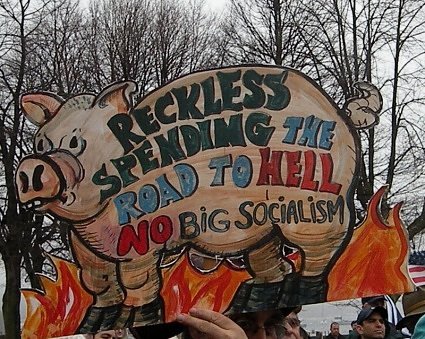
My liberal colleagues will counter, “but these were organized affairs.” That is just my point, those in the gathering driven by ignorance, apathy, hate and fear want to be led. It is an ideal situation to be taken advantage of by The Man on the White Horse. No logic, of course not. There were older folks, no doubt on Social Security and Medicare, carrying signs reading, “Send the Socialists to Europe.” There were working folks, no doubt the beneficiaries of the Obama tax cuts and job programs, carrying signs saying, “No more taxes. No more spending.” The undercurrent at all the rallies was racial with the NRA folks in the forefront. All that was missing was signs pointing out that Bernie Madoff, Lehman Brothers, Bear-Sterns, and the other like bankers are at the heart of the nation’s financial problems.

I would ask all to pay attention to Carl Davidson’s comment introducing the Palermo article:

Too many liberals are trying to deal with this with dismissive humor, but it’s deadly serious. Too many of the “tea party” spokesmen are calling for the right to become “armed and dangerous,” with their sights aimed at Obama and the progressive left. These people are not fools, and serious people had best develop tactics to mobilize against them. Fox and Hannity would be a worthy focus for mass anti-fascist protest.

I would further suggest that we in the progressive movement reread the early chapters of William Shirer’s “Rise and Fall of The Third Reich” as well as Naomi Klein’s “The Shock Doctrine.” Also see the excerpt from Milton Mayer’s book, They Thought They were Free, The Germans 1933-45, distributed by Information Clearing House on September 23, 2008.

We who support the concept of national health care are prone to use European nations as examples. However, let us not forget the vast cultural differences. After spending 800 years killing one another, the Europeans in the past 50 years have developed an entirely different outlook from that of our citizens. The Europeans, by and large, do not respect militarism, conquest, and nationalism. Their societies are basically secularist, and interested in communal well-being, and they are not taken up with the ide fixe of ultimate personal salvation. The outlook demonstrated during the “tea bag” rallies here is quite different. Further, to compound my fears, a poll in The Erie (Pennsylvania) Times News this week found 65% of the respondents in sympathy with the “tea bag” outlook. This may give the reader some insight into an impending event in Erie in mid-June. The Manufacturers Association is sponsoring George W. Bush’s first domestic address since leaving office. Do not be overwhelmed when you see it on TV!

To digress for a moment, I believe that President Obama has shown progressive thinking in general, though, I disagree with him regarding his economic advisers, and his gung-ho approach to Afghanistan. I can understand the former in view of his University of Chicago background; however, the latter continues to perplex me considering the fact that he has a good grasp of history. Afghanistan in 3000 years has never been conquered, and it is not a nation but an area composed of a mixture of tribal societies. What, really, is the United States committed to? I can, however, after much thought, understand why the Obama administration is continuing the policy of domestic surveillance. If I were the President, and aware of the hate, hostility, mindless folks with guns, and the undercurrent of far right support, I would probably want to get some handle on the comings and goings of domestic terrorists, not only for the protection of my family I, but for the protection of the thinking people of the nation.

Common Dreams on April 13, 2009, reprinted an open letter by Benjamin Day, executive director of The Massachusetts Campaign for Single Payer Health Care, which originally appeared in The New York Times, entitled “Why Has The Press Failed Us In Reporting on Health Care Reform?” This underlines the absence of coverage of single payer health care by the mainstream media. As a matter of fact, I have not heard a single word on MSNBC’s evening lineup. Strange!

I recently had an E mail from a high-school friend (1935) upon his return from Florida. He tells me that on the Amtrak Auto Train he met a couple from Canada, one of whom required a medical procedure while vacationing. (It should be understood that Canadians are required to buy an inexpensive additional insurance policy when traveling out of the country.) The procedure in Florida cost $2000, paid for by the Canadian National Health Plan and co-insurance. In Canada the same procedure would have cost $800. Incidentally, the couple feel that in Canada they get excellent and timely medical care.

After addressing physicians’ fees in my last submission to The Rag Blog, I received a notice from The American College of Physicians, which incidentally endorses single payer, universal care. The ACP is requesting that members of Congress who support this position consider the following

  1. Eliminate use of the “sustainable growth rate” (SGR) in updating Medicare fees and adopt a system that provides positive, stable, and predictable increases based on the costs of practices serving Medicare patients.
  2. Increase payments to primary care physicians to make primary care competitive in the market and with other physician career and specialty choices, and
  3. Fund loan repayment and scholarship programs to cover the costs of medical education for students who agree to pursue careers in primary care and subsequently practice in areas of the nation with greatest need.

I have no illusions that the present Congress will pass John Conyers’ health care bill in the House, or the Bernie Sander’s bill in the Senate. But if we can break the hold that the insurance and pharmaceutical industries have on our elected representatives and achieve an optional “Medicare for All,” as a “public insurance company,” it may well be a step in the right direction. Further, the state initiatives for single payer, universal care, including the one in Pennsylvania, still present an opportunity. After all, the Canadian system started in the provinces and finally coalesced into the current national plan.

A very perceptive online friend e-mailed me Ghandi’s seven root causes of unfairness and injustice in the world, all consisting of volitional human activities in the absence of socially-redeeming moral content, all accurately describing the right wing in the contemporary United States.

  • Wealth without Work
  • Pleasure without Conscience
  • Knowledge without Character
  • Commerce without Morality
  • Science without Humanity
  • Worship without Sacrifice
  • Politics without Principles.

[Dr. Stephen R. Keister, a regular contributor to The Rag Blog, lives in Erie, PA. He is a retired physician who is active in health care reform. His previous articles on The Rag Blog can be found here.]

The Rag Blog

Posted in Rag Bloggers | Tagged , , , , , | 4 Comments

Handshake May Signal Better Relations

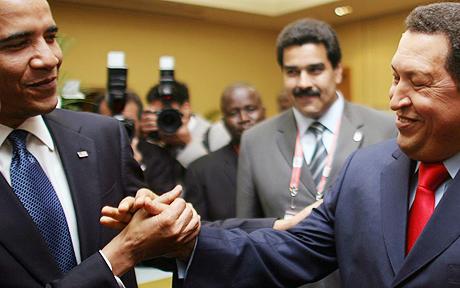
Barack Obama exchanges a friendly handshake with Venezuela’s President Hugo Chavez. Photo: AP.

Barack Obama shakes hands with Hugo Chavez
By Philip Sherwell / April 18, 2009

US President Barack Obama has shaken hands with Venezuela’s President Hugo Chavez, a bitter foe of the former Washington administration.

The surprise encounter came at the opening ceremony of the Summit of the Americas in Trinidad, where Mr Obama has made Cuba a key priority.

After several days of the US and Cuba trading warm words that have hinted at a détente after a half century of hostility, Mr Obama said that he was seeking “a new beginning” with Havana.

But it was his unexpected handshake and the smiles he exchanged with Mr Chavez that caught many at the summit by surprise.

Mr Chavez’s populist government in Caracas has sought to generate support by railing against Washington at every opportunity. He once described President George W Bush “the devil”.

But he was warned by his fellow Latin American leaders last week that he must tone down his anti-Americanism at the summit.

Asked what he had said to Mr Chavez, Mr Obama replied with a smile: “I said como estas”.

Mr Obama meanwhile made his diplomatic overtures to Cuba as he joined 33 other leaders of Western Hemisphere states at the summit in Port of Spain in Trinidad and Tobago late on Friday.

Only Cuba is not represented after being thrown out of the Organisation of American States (OAS) in 1962.

But Mr Obama said: “The United States seeks a new beginning with Cuba. I know there is a longer journey that must be travelled to overcome decades of mistrust, but there are critical steps we can take toward a new day.”

His comments came a day after Cuba’s President Raúl Castro said that the communist island state was ready to discuss “human rights, freedom of the press, political prisoners – everything”. Significantly, he also acknowledged that the regime “could be wrong”.

Mr Obama announced earlier in the week that the US was easing restrictions on travel and remittances for Cuban-Americans and challenged Mr Castro to make concessions of his own.

In his speech in Trinidad, Mr Obama renewed his promise for his administration to engage with the Cuban government “on a wide range of issues”, including human rights, free speech, democratic reform, drugs, immigration and the economy.

“Let me be clear: I am not interested in talking for the sake of talking,” the president said. “But I do believe that we can move US-Cuban relations in a new direction.”

Earlier, the US Secretary of State, Hillary Clinton, also welcomed Mr Castro’s comments. “We welcome his comments, the overture they represent, and we are taking a very serious look at how we intend to respond,” she said.

In another sign of changing times, the OAS Secretary-General, Jose Miguel Insulza, said he would ask the 34 member nations to invite Cuba back into the fold. Mr Insulza is known for his political caution and is thought unlikely to have floated the idea without the approval of Washington.

White House aides said Mr Obama had been particularly encouraged by Mr Castro’s concession that Cuba “could be wrong”.

However, the White House spokesman Robert Gibbs made clear that while Mr Castro’s new openness to change was welcome, the US was not abandoning its demand for Cuba to start making concrete moves toward greater freedoms.

“They’re certainly free to release political prisoners,” he said aboard Air Force One as Obama flew into Trinidad. “They’re certainly free to stop skimming money off the top of remittance payments as they come back to the Cuban island. They’re free to institute a greater freedom of the press.”

Source / Telegraph

The Rag Blog

Posted in RagBlog | Tagged , , | 2 Comments

Naomi Klein : Hopebroken and Hopesick


In Obamafanland:
A Lexicon of Disappointment

by Naomi Klein / April 17, 2009

All is not well in Obamafanland. It’s not clear exactly what accounts for the change of mood. Maybe it was the rancid smell emanating from Treasury’s latest bank bailout. Or the news that the president’s chief economic adviser, Larry Summers, earned millions from the very Wall Street banks and hedge funds he is protecting from reregulation now. Or perhaps it began earlier, with Obama’s silence during Israel’s Gaza attack.

Whatever the last straw, a growing number of Obama enthusiasts are starting to entertain the possibility that their man is not, in fact, going to save the world if we all just hope really hard.

This is a good thing. If the superfan culture that brought Obama to power is going to transform itself into an independent political movement, one fierce enough to produce programs capable of meeting the current crises, we are all going to have to stop hoping and start demanding.

The first stage, however, is to understand fully the awkward in-between space in which many US progressive movements find themselves. To do that, we need a new language, one specific to the Obama moment. Here is a start.

Hopeover. Like a hangover, a hopeover comes from having overindulged in something that felt good at the time but wasn’t really all that healthy, leading to feelings of remorse, even shame. It’s the political equivalent of the crash after a sugar high. Sample sentence: “When I listened to Obama’s economic speech my heart soared. But then, when I tried to tell a friend about his plans for the millions of layoffs and foreclosures, I found myself saying nothing at all. I’ve got a serious hopeover.”

Hoper coaster. Like a roller coaster, the hoper coaster describes the intense emotional peaks and valleys of the Obama era, the veering between joy at having a president who supports safe-sex education and despondency that single-payer healthcare is off the table at the very moment when it could actually become a reality. Sample sentence: “I was so psyched when Obama said he is closing Guantánamo. But now they are fighting like mad to make sure the prisoners in Bagram have no legal rights at all. Stop this hoper coaster-I want to get off!”

Hopesick. Like the homesick, hopesick individuals are intensely nostalgic. They miss the rush of optimism from the campaign trail and are forever trying to recapture that warm, hopey feeling-usually by exaggerating the significance of relatively minor acts of Obama decency. Sample sentences: “I was feeling really hopesick about the escalation in Afghanistan, but then I watched a YouTube video of Michelle in her organic garden and it felt like inauguration day all over again. A few hours later, when I heard that the Obama administration was boycotting a major UN racism conference, the hopesickness came back hard. So I watched slideshows of Michelle wearing clothes made by ethnically diverse independent fashion designers, and that sort of helped.”

Hope fiend. With hope receding, the hope fiend, like the dope fiend, goes into serious withdrawal, willing to do anything to chase the buzz. (Closely related to hopesickness but more severe, usually affecting middle-aged males.) Sample sentence: “Joe told me he actually believes Obama deliberately brought in Summers so that he would blow the bailout, and then Obama would have the excuse he needs to do what he really wants: nationalize the banks and turn them into credit unions. What a hope fiend!”

Hopebreak. Like the heartbroken lover, the hopebroken Obama-ite is not mad but terribly sad. She projected messianic powers on to Obama and is now inconsolable in her disappointment. Sample sentence: “I really believed Obama would finally force us to confront the legacy of slavery in this country and start a serious national conversation about race. But now whenever he seems to mention race, he’s using twisted legal arguments to keep us from even confronting the crimes of the Bush years. Every time I hear him say ‘move forward,’ I’m hopebroken all over again.”

Hopelash. Like a backlash, hopelash is a 180-degree reversal of everything Obama-related. Sufferers were once Obama’s most passionate evangelists. Now they are his angriest critics. Sample sentence: “At least with Bush everyone knew he was an asshole. Now we’ve got the same wars, the same lawless prisons, the same Washington corruption, but everyone is cheering like Stepford wives. It’s time for a full-on hopelash.”

In trying to name these various hope-related ailments, I found myself wondering what the late Studs Terkel would have said about our collective hopeover. He surely would have urged us not to give in to despair. I reached for one of his last books, Hope Dies Last. I didn’t have to read long. The book opens with the words: “Hope has never trickled down. It has always sprung up.”

And that pretty much says it all. Hope was a fine slogan when rooting for a long-shot presidential candidate. But as a posture toward the president of the most powerful nation on earth, it is dangerously deferential. The task as we move forward (as Obama likes to say) is not to abandon hope but to find more appropriate homes for it-in the factories, neighborhoods and schools where tactics like sit-ins, squats and occupations are seeing a resurgence.

Political scientist Sam Gindin wrote recently that the labor movement can do more than protect the status quo. It can demand, for instance, that shuttered auto plants be converted into green-future factories, capable of producing mass-transit vehicles and technology for a renewable energy system. “Being realistic means taking hope out of speeches,” he wrote, “and putting it in the hands of workers.”

Which brings me to the final entry in the lexicon.

Hoperoots. Sample sentence: “It’s time to stop waiting for hope to be handed down, and start pushing it up, from the hoperoots.”

© 2009 The Nation

[Naomi Klein is an award-winning journalist and syndicated columnist and the author of the international and New York Times bestseller The Shock Doctrine: The Rise of Disaster Capitalism, now out in paperback. Her earlier books include the international best-seller, No Logo: Taking Aim at the Brand Bullies; and the collection Fences and Windows: Dispatches from the Front Lines of the Globalization Debate (2002). To read all her latest writing visit www.naomiklein.org.]

Source / The Nation / CommonDreams

The Rag Blog

Posted in RagBlog | Tagged , , , | 6 Comments

Preserving the Evidence of CIA Secret Detentions

The Combatant Status Review Tribunal Notice is read to a detainee at Guantanamo Bay, Cuba, July 13. Photo by Airman Randall Damm, USN.

CIA Director Asked to Preserve Secret Prisons
By William Fisher / April 17, 2009

NEW YORK — Lawyers for a Guantanamo detainee who claims he was held and tortured in one of the “black site” secret prisons run by the U.S. Central Intelligence Agency is demanding that the CIA preserve cells and interrogation paraphernalia there as evidence of mistreatment.

Military and civilian counsel to Abd Al-Rahim Hussain Mohammed al-Nashiri sent a letter to CIA Director Leon Panetta requesting that the CIA “black site” buildings, interrogation cells, prisoner cells, shackles, waterboards and other equipment be preserved for inspection and documentation.

Disclosure of the letter came on the heels of Thursday’s release of four more top-secret “legal memoranda” prepared by the Justice Department’s Office of Legal Counsel during the administration of former President George W. Bush. The memos approved “enhanced” interrogation techniques they claimed were not torture – a claim rejected by both the Barack Obama administration and human rights advocates. Nine other OLC memos were previously released by the Obama administration.

OLC is the DOJ office that provides authoritative legal advice to the president and all executive branch agencies. It drafts legal opinions of the attorney general and also provides its own written opinions and oral advice in response to requests from the executive branch.

Al-Nashiri, who is now detained at Guantánamo, was held in the secret CIA prison facilities from 2002 to 2006. While President Obama has ordered the closure of CIA black sites, al-Nashiri’s attorneys are concerned that the CIA intends to destroy the sites, including the buildings and the equipment used to interrogate and torture al-Nashiri and other detainees. They say that would amount to destroying evidence of his mistreatment.

Panetta told CIA personnel on April 9, 2009, that the CIA would be “decommissioning” the CIA secret facilities. The letter asks Panetta to “preserve all the secret sites.”

The CIA has admitted that al-Nashiri was subjected to waterboarding while in CIA custody. Videotapes depicting his abusive interrogations have already been destroyed by the agency and are the subject of ongoing litigation by the American Civil Liberties Union (ACLU).

Through its John Adams Project with the National Association of Criminal Defense Lawyers, the ACLU worked with under-resourced military lawyers to provide legal counsel for several of the Guantánamo detainees including al-Nashiri during the military commissions process.

The lawyers’ letter put Panetta “on notice that we will be seeking discovery and inspection of this highly relevant evidence in whatever court Mr. Al-Nashiri finds himself.”


The lawyers added, “We have already lost the video tapes which would have allowed a jury to see what happened to Mr. Al-Nashiri in those secret prisons. We cannot lose the remaining tangible evidence of the actual prisons themselves and the instruments of torture within them.”

They note that Panetta’s predecessor, General Michael V. Hayden, has admitted that Mr. Al-Nashiri was subjected to waterboarding, “which is a form of torture, while in the custody of the CIA.”

According to the recently released report from the International Committee of the Red Cross (ICRC), ‘waterboarding was only one of the many forms of torture inflicted on Mr. Al-Nashiri while in the custody of the CIA,” the lawyers’ letter said.

They claim that, according to the ICRC report, “While in CIA custody, Mr. Al-Nashiri was also forced to stand with his wrists shackled to a bar in the ceiling for prolonged periods of time – extending to several days – and was threatened with sodomy and with the rape and arrest of his family members.”

Throughout that time, the letter says, Al-Nashiri “was not able to communicate with his family, a lawyer or anyone. Effectively the CIA ‘disappeared’ him for four years while it tortured him at will and beyond the eyes of the world.”

The CIA and other government agencies also admitted to the purposeful destruction of at least 92 videotapes of interrogations and observations of prisoners in its black sites, specifically including the destruction of videotapes of waterboarding and other observations of Mr. Al-Nashiri, the letter says.

It concludes, “Had Mr. Al-Nashiri known that the CIA possessed these video tapes and intended to destroy them, he would have demanded their preservation. However, neither he, his lawyers nor the courts learned of the CIA’s plan until after the tapes had been destroyed and now they are forever gone.”

“Although we welcome your decision to cease the secret detention and mistreatment of prisoners of the United States Government, we are concerned that the CIA intends to actually destroy the sites – including the buildings and the equipment used to interrogate and torture Mr. Al-Nashiri – before Mr. Al-Nashiri has had the opportunity to fully investigate his conditions of confinement. We write to avoid the destruction of more evidence – namely the actual secret facilities themselves,” the lawyers wrote.

Al-Nashiri was charged in the military commission with offences that carried the death penalty. His lawyers note that, “Although those charges have now been dismissed, we fully expect the government to prosecute Mr. Al-Nashiri and again charge him with offenses that could carry the death penalty. In fact the government is now actively working to determine in what forum he will be prosecuted.”

Evidence held by the CIA “is exculpatory evidence” and Al-Nashiri “will be entitled to it.”

The letter concludes: “The CIA’s secret prison facilities and the inquisition-like treatment meted out to its prisoners were a tragic, immoral and illegal period in our history that we all hope has come to an end. But its effects are enduring, especially on someone like Mr. Al-Nashiri who, according to the ICRC report, lived through the horror chambers of at least three different secret prisons.”

Following Thursday’s release of the four OLC memos, it is likely that the government’s treatment of detainees will attract increased public scrutiny – despite President Obama’s pledge to close Guantanamo Bay and CIA black site prisons.

Continuing concern about U.S. credibility in war-on-terror detentions and prosecutions has been voiced by many U.S. legal scholars. David Cole, one of the country’s preeminent constitutional authorities, told IPS, “For better or worse, the U.S. is a world leader on matters of human rights. When the U.S. violates human rights in the fight against terrorism, it sends a message to autocrats and dictators worldwide that they, too, can deny human rights in the name of counterterrorism.”

Source / IPS News North America

The Rag Blog

Posted in RagBlog | Tagged , , , | Leave a comment

The 2009 Tea Parties: Fox News Is Responsible

If Fox News Had Been Around. Graphic: Source.

Media verdict is in: Fox News driving force behind tea parties

Summary: Like local media across the country, major national news outlets noted that Fox News was a driving force behind the April 15 tea parties.

In their coverage of the April 15 tea-party protests, major national news outlets joined numerous local media in noting that Fox News was a driving force behind the tea parties. For example, on the April 15 edition of CNN Newsroom, media critic and Reliable Sources host Howard Kurtz said, “I don’t think I’ve ever seen a news network throw its weight behind a protest like we are seeing in the past few weeks with Fox and these tea parties.”

As Media Matters for America documented, despite describing their reports as “fair and balanced,” Fox News hosts aggressively promoted the protests and encouraged viewers across the country to get involved; hosts and guests, including those on Fox Business Network, engaged in inflammatory rhetoric during their coverage of the protests on April 15. From April 6 to April 15, the network aired 107 commercial promotions for its coverage of the tea-party protests, featured at least 20 segments about the protests, directed viewers to a “virtual tea party” on FoxNation.com, and repeatedly described the protests as “FNC Tax Day Tea Parties.” During the lead-up to the April 15 protests, tea-party organizers also used the planned attendance of several Fox News hosts to promote their protests.

Fox News’ promotion of the tea parties has not gone unnoticed, and the consensus that Fox News played a key role goes is shared by national and local media alike. Dozens of articles about tea parties in various cities reported that Fox News and its hosts helped influence, start, or turn out participants to local protests. In numerous cases, these reports quoted local participants or organizers stating they were motivated to join or start protests because of Fox News. As the Albany Times Union put it in an April 15 editorial, “This manufactured movement has been provided a sense of legitimacy and momentum by Fox News.”

Below are examples of major national media outlets similarly highlighting Fox News’ key role in the tea party protests:

* On the April 15 edition of ABC’s World News, correspondent Dan Harris reported that the protests were “cheered on by Fox News and talk radio.”

* During live coverage of the tea party in Chicago, CNN correspondent Susan Roesgen said the “party for Obama bashers” was “highly promoted by the right-wing conservative network Fox.”

* On the April 15 edition of the CBS Evening News, correspondent Dean Reynolds cited Fox News hosts Glenn Beck and Neil Cavuto as “rightward-leaning … commentators” who “embraced the cause” of the tea parties.

* On the April 13 edition of MSNBC’s Countdown with Keith Olbermann, guest host David Shuster described the tea parties as a “movement that’s short on outrage and long on Republican manufacturing” and also said: “Then there is the media, specifically the Fox News Channel, including Glenn Beck and Sean Hannity. Both are looking forward to an up-close-and-personal taste of tea-bagging at events this Wednesday.” Shuster also noted that Cavuto had been “defending his network’s promotion” of the events. Later in the segment, MSNBC political analyst Lawrence O’Donnell said of Fox News’ involvement with the event: “What they’re trying to do is create gigantic television events for their shows on that day. They have to pretend that they are covering a news event rather than trying to create one, which they’ve very clearly done when you look at the history of — in the last month of the Fox News discussion of this, and how they’ve built it up.”

* On the April 9 edition of her MSNBC show, Rachel Maddow stated that “our colleagues at Fox News are not just reporting on” the tea party protests, “they are officially promoting” them. After airing a clip of Beck asserting that you can “celebrate with Fox News” at the tea parties its hosts will be attending, Maddow noted that “Fox News Channel has described the tax day events on-screen as ‘FNC Tax Day Tea Parties,’ and they are dispatching some of their hosts to take part in” the events.

* After airing a Fox News promotion of its upcoming “fair and balanced” coverage of the tea parties, Chris Matthews stated during the April 13 edition of MSNBC’s Hardball: “I have got to believe that [Fox News president] Roger Ailes has the biggest tongue in his cheek when he does these ads. ‘We report. You decide.’ I mean, what are you — balanced coverage of an anti-government rally, an anti-tax rally — balanced coverage of that, it’s so amazing.”

* On the April 15 edition of Hardball, guest host Mike Barnicle said: “The tea parties have been funded by conservative groups, hailed by the Republican National Committee and promoted by Fox News.”

* On the April 15 edition of NPR’s All Things Considered, correspondent Robert Smith reported that “Fox News began publicizing the events early and often. Fox hosts are broadcasting live today from various tea parties.”

* Reporting live from Boston on the April 15 edition of CNN Newsroom, correspondent Mary Snow said: “A number of different speakers here today throughout the day, and also a lot of the people who are here saying, you know, they had heard about this. FOX News radio hosts had been promoting this event, and they came out today.”

* During the April 13 edition of CNN’s The Situation Room, Kurtz asserted that Fox News “practically seems to be a co-sponsor” of the tea-party protests. Kurtz pointed out that Fox News contributors Newt Gingrich and Michelle Malkin are supporting the protests and noted that “Fox News, whose new online slogan is ‘Just say no to biased media,’ began publicizing the protests. And, soon, some hosts were signing on.” Kurtz later added that “[t]hese hosts said little or nothing about the huge deficits run up by President Bush, but Barack Obama’s budget and tax plans have driven them to tea,” and said that, while Beck and his fellow Fox News host Sean Hannity “and the gang” are “paid for their opinions,” “[t]he question is whether Rupert Murdoch’s network wants to be so closely identified with what has become an anti-Obama protest movement.”

* Washington Post business columnist Steven Pearlstein wrote in an April 17 column: “I almost choked on my scrambled egg whites yesterday morning when I read The Post’s story about the April 15 ‘tea party’ protests promoted by Fox News and other conservative organizations.”

* In his April 16 Washington Post column, Dana Milbank wrote that “Fox News, though actively promoting the ‘tea party’ protests for tax day, tried to argue that it was not behind yesterday’s coast-to-coast events.” Milbank continued:

But Fox News analyst Tobin Smith, who took the stage in Lafayette Square yesterday, evidently didn’t get the memo. “On behalf of Fox News Channel,” he told more than 500 mud-spattered demonstrators, “I want to say: Welcome to the Comedy Channel of America, Washington, D.C.”

After a few preliminaries, he went into a Fox News commercial for anchor Glenn Beck. “Anybody watching Glenn?” he asked to cheers. “That was a shameless plug, wasn’t it? Glenn says hello as well. He’s out at another tea party.” Indeed he was, as were Sean Hannity and Neil Cavuto.

A small group of counterdemonstrators, wearing ballgowns, tuxedoes and pig snouts, interrupted and were stripped of their signs. Smith seized the display as an opportunity to highlight the Fox News slogan. “You know what ‘Fair and Balanced’ means?” he asked. ” ‘Fair and Balanced’ means we take our message and try to overcompensate for their lack of message.” Smith left with instructions: “Keep watching Fox, will you?”

The theme was echoed in some of the homemade signs the demonstrators carried, including “Watch Fox News,” “Thank You Fox News,” and even a recommendation: “Move Glenn Beck to 7 PM.”

* An April 15 New York Times article reported that “[a]lthough organizers insisted they had created a nonpartisan grass-roots movement, others argued that these parties were more of the Astroturf variety: an occasion largely created by the clamor of cable news and fueled by the financial and political support of current and former Republican leaders.” It continued: “Fox News covered the events all day with reporters and hosts at the scenes. Neil Cavuto, a Fox host, and Michelle Malkin, a conservative contributor, headlined the protests in Sacramento while Sean Hannity broadcast his show from the protests in Atlanta.”

* In his April 12 New York Times column, Paul Krugman wrote that “it turns out that the tea parties don’t represent a spontaneous outpouring of public sentiment. They’re AstroTurf (fake grass roots) events, manufactured by the usual suspects. In particular, a key role is being played by FreedomWorks, an organization run by Richard Armey, the former House majority leader, and supported by the usual group of right-wing billionaires. And the parties are, of course, being promoted heavily by Fox News.”

* On April 15, in commentary in the Los Angeles Times, columnist James Rainey wrote that “Fox has been building up to the protests with Super Bowl-style intensity. Promos promise ‘powerful’ coverage of an event that will ‘sweep the nation.’ ” Rainey characterized Fox News as giving “relentless support” to the protests and added that “[t]he Fox promotions people have been pumping up the volume, with ads celebrating hundreds of rallies and citizens who are ‘demanding real economic solutions.’ ” He also noted: “You’d expect conservative commentators like Glenn Beck and Sean Hannity to be hyping today’s wave of anti-tax ‘tea parties.’ But Fox personalities labeled ‘news’ anchors are right there with their blessings too.”

* In an April 16 Los Angeles Times article, reporters Michael Finnegan and Janet Hook wrote that “protesters gathered in cities across America to mark the April 15 tax filing deadline with rallies inspired by the Boston Tea Party and promoted by Fox News, conservative blogs and talk radio.”

* An April 16 San Francisco Chronicle article stated, “Conservative Fox News commentators like Sean Hannity talked up the rallies for weeks and hosted their programs from them Wednesday.”

* An April 16 Associated Press article reported: “In Atlanta, thousands of people were expected to gather on the steps of the Georgia Capitol, where Fox News Channel conservative pundit Sean Hannity was set to broadcast his show Wednesday night. He’s been promoting the show on Fox.” The article also reported that one protester attended a Louisville, Kentucky, tea party “after reading about it online and hearing about it on Fox News.”

* In addition to referencing Hannity’s broadcast from the Georgia Capitol, a separate April 16 AP article also stated that “[o]rganizers said the movement developed organically … through exposure on Fox News.”

From the April 15 broadcast of NPR’s All Things Considered:

SMITH: Organizers say that by the end of the evening, the number of protests will number more than 300, all conceived and put together, they say, by grassroots activists — not that there wasn’t a little partisan fertilizer. Conservative groups like FreedomWorks lent their organizing muscle on the Internet. FreedomWorks was founded by former Republican Congressman Dick Armey. Conservative bloggers and talk show hosts jumped on board. Fox News began publicizing the events early and often. Fox hosts are broadcasting live today from various tea parties.

Source / Media Matters

Thanks to Diane Stirling-Stevens / The Rag Blog

Posted in RagBlog | Tagged , , | 3 Comments

The Torture Administration: Still Believing They Should Be Let Off the Hook

Even though some Bush administration officials are now openly acknowledging that they knew what they were doing was wrong, they like the new President’s philosophy that we should move forward.

And the wheels of empire turn slowly forward, crushing most of what is in the path, running roughshod over the small and meek, ignoring the important things in this existence such as justice.

Richard Jehn / The Rag Blog

Avi Lewis interviews former Deputy Secretary of State for Aljazeera English

Armitage: ‘They Tortured. . . Maybe I should Have Resigned”
By Juan Cole / April 16, 2009

Armitage admits:

1. He and his boss Colin Powell lost a major battle within the Bush administration on whether the Geneva Conventions on the treatment of prisoners of war applied to guerrillas captured during the “war on terror.”

2. That the Bush administration engaged in torture in the form of waterboarding, though he denied that he had sure knowledge of this practice at the time he was in office

3. That he probably should have resigned, but hung on for fear of how bad policy could get if he and others were not there to fight the battles

4. He says that the US Senate should have known about the torture, calls them “AWOL,” and implies that there will be no investigation of Bush crimes against humanity because such a process would implicate the senators themselves, as at the very least having been derelict in their duty to advise and consent. (I wonder if he is also implying that some Democratic senators knew about the waterboarding and remained silent, so that they will not now launch a prosecution?)

Armitage was one of three officials, including Karl Rove and Irv Lewis Libby, who revealed to US reporters that Valerie Plame was a covert operative in the CIA. Plame is the wife of Ambassador Joseph Wilson, who was the first to publicly undermine the Bush claim that Iraq had weapons of mass destruction, which was used to justify the war.

Armitage was also involved in the Iran-Contra scandal.

A Spanish judge is considering an indictment of former Attorney General Alberto Gonzales and several other Bush administration officials for having sanctioned torture at Guantanamo Bay. In breaking news Thursday morning, it was announced in Spain that the government prosecutor has advised the judge to drop the case; apparently he still has the discretion to continue.

The others who would likely be indicted if the case went forward, according to Scott Horton, are “Federal Appeals Court Judge and former Assistant Attorney General Jay Bybee, University of California law professor and former Deputy Assistant Attorney General John Yoo, former Defense Department general counsel and current Chevron lawyer William J. Haynes II, Vice President Cheney’s former chief of staff David Addington, and former Undersecretary of Defense Douglas J. Feith.”

Armitage’s revelation that he and his boss “lost” a battle to preserve a commitment to the Geneva Conventions in Washington in this period seems likely to me to become part of the Spanish prosecution.

Japanese officers were tried for war crimes after World War II by the United States for having engaged in waterboarding.

It has been suggested that the six implicated Bush administration officials would, in case of formal indictment, no longer be able safely travel to Europe, because judges claiming universal jurisdiction over crimes against humanity might well order their arrest, as happened to former Chilean dictator Augusto Pinochet.

Source / Informed Comment

The Rag Blog

Posted in RagBlog | Tagged , , | 4 Comments

Foodie Friday: Huevos Ricardos

Poached eggs on corn bread with chipotle-hollandaise sauce from the Mercadito Cantina, in the East Village, NYC. The dish described below is similar, but different.

Huevos Ricardos for Two
By Richard Jehn / The Rag Blog / April 17, 2009

These were exactly what I was aiming for today (for my original version, the date is 1 January 2001) – the texture of cornbread, the slight saltiness of prosciutto, and the depth of a good hollandaise, with a wonderful spicy flavour. Superbly different! Similar to Eggs Benedict, but not at all ….

Cornbread

1/4 cup all-purpose flour
1/2 teaspoon salt
1 teaspoon baking powder

Sift together the above ingredients, then add:

1/2 cup yellow corn meal

Mix dry ingredients thoroughly. Preheat oven to 425° F. Heavily butter a 4-inch by 8-inch baking dish by using a paper towel or plastic wrap to spread butter on the bottom and sides of the pan. The pan should be at least 2 inches deep. Pop it into the oven to make the butter sizzle.

1 egg
1/2 tablespoon olive oil
2/3 cup milk
1 small jalapeño chile, stemmed, seeded and minced

Beat egg in a large measuring cup or a separate small bowl, then add oil, chile, and milk, mixing completely. Add the liquids to the dry ingredients and stir together thoroughly.

Pour mixture into “sizzly” butter and bake at 425° F. for 20 to 25 minutes until golden brown. Remove cornbread from dish immediately to a rack to cool. When cornbread is cooled enough, cut in half (about 4-inch square pieces, then slice into a total of 4 “slices of cornbread,” about 3/4-inch thick and 4 inches by 4 inches.

Hollandaise Sauce

Prepare by putting 1-inch of water in the bottom of a double boiler and bringing to a light simmer. We actually used a small stainless steel bowl over simmering water.

3 egg yolks
1 to 1-1/4 teaspoons cold water

Whisk egg yolks and cold water together thoroughly in the top portion of the double boiler. When mixed, place top of double boiler over simmering bottom and continue whisking. The yolks should thicken within 3 or 4 minutes. Remove from heat and add very slowly, while whisking constantly:

1/2 cup of warmed (NOT hot) clarified butter

3 teaspoons fresh-squeezed lemon juice
1/4 teaspoon morita chile powder or 1/2 teaspoon sweet Hungarian paprika
Salt and pepper to taste

Place hollandaise mixture over bottom portion of double boiler, but be sure the heat is now turned to low. Add the spices and lemon juice, continuing to whisk until very smooth. Watch the sauce constantly, whisking to settle it, removing from heat if it gets too hot, or adding a tiny bit of warm water if it loses consistency (pro’s term it “if the sauce breaks”).

Poached Eggs

4 eggs
2 tablespoons of white wine vinegar

In a 4-quart pot, bring 3 inches (deep) of cold water to a simmer. Be certain that the water does not boil, but remains just simmering; add the vinegar after the water simmers. Using a teacup, crack one egg (one at a time) into the cup and add immediately, but slowly, to the simmering water.

Leave eggs until beginning to set, then gently loosen with a slotted spoon if sticking to pot. The 4 eggs will be cooked to perfection in about 6 or 7 minutes.

Hot tip from Bobby Flay’s sidekick, Jacqui Malouf: crack each egg into a soup ladle, lower the ladle into the simmering water, wait until the egg sets (10 to 15 seconds), then let each egg roll out of the ladle.

Building the Plates

2 plates, warmed a little in the oven
The 4 slices of cornbread
8 thin slices of prosciutto
The 4 poached eggs
The Hollandaise Sauce
Morita molida (best) or sweet Hungarian paprika

On each of two warmed plates, place 2 pieces of cornbread. Place 2 thin slices of prosciutto on each slice of cornbread, then carefully remove each egg from the simmering water, using a slotted spoon and allowing the eggs to drain, and place one each on your preparation. Top with hollandaise, a sprinkling of pepper, and a light sprinkle of ground morita chiles or paprika, depending on your personal preference.

The Rag Blog

Posted in Rag Bloggers | Tagged | 1 Comment

Steve Weissman : Obama’s Big Stick

Barack Obama: Taking up where Teddy Roosevelt left off? Political cartoon from Dakin Archives.

In less than hundred days in office, President Barack Obama has already demonstrated his desire to speak softly to all comers, friend or foe, while his proposed military budget shows a determination to carry America’s big stick into far-off trouble spots that most of us don’t know how to spell.

By Steve Weissman / The Rag Blog / April 17, 2009

“Speak softly and carry a big stick,” President Theodore Roosevelt proclaimed just over a hundred years ago. Unabashedly committed to make America an imperial power, the energetic Roosevelt looked to a strong Navy to enforce the Monroe’s Doctrine’s hold over Latin America and to project the country’s growing power into the far corners of the world.

In less than hundred days in office, President Barack Obama has already demonstrated his desire to speak softly to all comers, friend or foe, while his proposed military budget shows a determination to carry America’s big stick into far-off trouble spots that most of us don’t know how to spell. The budget numbers and choice of weapon systems tell the story. Obama turns out be far more globally ambitious than either his supporters or detractors expected, and far more eager for Washington to remain the world’s policeman, ready, willing, and able to intervene militarily in what the Pentagon calls counter-insurgency and Teddy Roosevelt would have called colonial wars.

As Secretary of Defense Robert Gates put it, the Pentagon would retain a hedge against other risks, but the primary goal was to prepare to “fight the wars we are in today and the scenarios we are most likely to face in the years to come.”

Up to now, the raw numbers have drawn the most attention, much of it scurrilous or silly. Republican hawks condemn Obama for “gutting the military budget.” Anti-war bloggers defend him for proposing the most military spending in years, an estimated $534 billion or some 4% higher than George W. Bush’s last budget. And, it takes the right-wing libertarians at the Cato Institute to point out that the total military spending – including the wars in Iraq and Afghanistan and other incidentals – amounts to more than $750 billion. According to CATO researcher Benjamin H. Friedman, “That is more than six times what China spends, 10 times what Russia spends and 70 times what Iran, North Korea and Syria spend combined.”

Obama’s choice of which arms to keep – and which to cut – further highlights his global ambitions. He has forced the Pentagon to cut down on overly exquisite and under-performing weapons systems, especially those intended primarily to combat technologically sophisticated opponents, such as Russia and China. The cuts would halt or scale back the F-22 fighter jet, the missile shield in Poland and the Czech Republic that the Kremlin opposes, non-workable armored vehicles for the Army’s Future Combat Systems, a new communication satellite, the C-17 transport plane, a new generation of stealth destroyers, and new helicopters to rescue downed pilots and for President Obama himself.

In place of these, Obama is boosting proposed expenditures for more boots on the ground and more plentiful, more modular, lower-tech, and somewhat lower-cost arms that make military intervention in colonial wars faster, cheaper, and – he hopes – more effective. Among the keepers:

  • Littoral Combat Ships – smaller, high-speed, multi-purpose surface vessels that can operate in shallow water close to shore. The Pentagon will use them to move troops and equipment onto a beach, support Special Forces in commando raids, collect intelligence, perform surveillance and reconnaissance, sweep mines, hunt submarines, and fight pirates.
  • F-35 joint-strike fighter planes – high-speed, multi-purpose single-engine jet fighters optimized for air-to-ground rather than air-to-air combat. The Air Force, Navy, and Marine Corps will use as many as 2,443 F-35’s to provide close air support, tactical bombing, and air defense. Allied nations will also use them.
  • Unmanned Aerial Vehicles – remotely piloted drones to fly over targeted areas to collect intelligence and fire rockets. The Pentagon and CIA are already using them in Afghanistan and Pakistan, often killing civilians and provoking a militant reaction.

These are the weapons systems Obama wants to help Washington police the world. Whether he gets them, and whether he gets rid of those arms that do little to serve that task, remain to be seen. Each of the wasteful weapons systems has a powerful constituency, including the companies that make them, all the sub-contractors, the unions, the communities in which all of the work is done, and the senators and representatives who feed at the military trough. But, win or lose, Obama’s first military budget reveals his global goals and the technocratic rationality with which he is pursuing them. Teddy Roosevelt would be proud.

[A veteran of the Berkeley Free Speech Movement and the New Left monthly Ramparts, Steve Weissman lived for many years in London, working as a magazine writer and television producer. He now lives and works in France, where he writes regularly for The Rag Blog.]

The Rag Blog

Posted in RagBlog | Tagged , , , , | 1 Comment