Annie Leibovitz and The Gay Tax : The Cost of Love

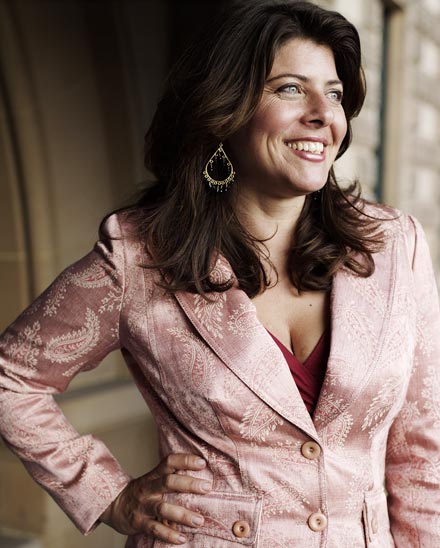
Susan Sontag. Photo © Annie Leibovitz / Politics, Theory & Photography.

Annie Leibovitz and the gay tax

Same-sex couples do not have the same privileges as straight married couples when it comes to inheritance. If your partner passes away and leaves her estate to you, you have to pay up to 50 percent of the value of your inheritance in taxes. However, if you and your partner were recognized as a married couple, you wouldn’t have to pay a dime.

By Nancy Goldstein / March 5, 2009

Poets swoon about it and singers croon about it, but LGBT people can calculate the cost of love down to the last penny. In my household it comes to around $329.25 monthly: that’s the gay tax my wife and I shell out for me to be on her health insurance plan, because her company must treat that benefit as additional taxable income. It doesn’t matter that our Massachusetts marriage is recognized in New York. Companies pay for their employees’ health insurance with pre-tax money through a federal program, and same-sex marriage isn’t federally recognized.

But that’s chump change compared to what love is currently costing celebrity photographer Annie Leibovitz. Back in late February the NYT noted that Leibovitz had borrowed a total of $15.5 million from a company called Art Capital Group using “as collateral, among other items … town houses she owns in Greenwich Village, a country house, and something else: the rights to all of her photographs.”

But what the NYT missed, along with every other straight newspaper that picked up the story, is why Leibovitz suddenly found herself in such dire financial straits. It took AfterEllen’s Julie Miranda to put two and two together and figure out that “most of Leibovitz’ financial woes stemmed from her inheritance of her longtime partner, Susan Sontag’s estate.” Writes Miranda (who, in turn, is channeling Suze Orman’s Valentine’s Wish for Gay Marriage):

“Same-sex couples do not have the same privileges as straight married couples when it comes to inheritance. If your partner passes away and leaves her estate to you, you have to pay up to 50 percent of the value of your inheritance in taxes. However, if you and your partner were recognized as a married couple, you wouldn’t have to pay a dime…When Sontag died in 2004, she bequeathed several properties to Leibovitz, who was forced to pony up half of their value to keep them.”

Will this profoundly unfair issue be challenged now that attention’s being drawn to it by the situations of couples like Sontag and Leibovitz who are far higher-profile than me and my gal? We’re about to get a shot at finding out. As my Broadsheet colleague Judy Berman reported on Tuesday, Gay and Lesbian Advocates and Defenders filed suit earlier this week on behalf of same-sex couples who have tied the knot in states that have marriage equality, seeking to challenge their blocked access to federal benefits. The plaintiffs include Dean Hara, spouse of the late Rep. Gerry Studds. But even with the spectacle of a U.S. Congressman’s widower being denied Social Security benefits, the case isn’t a slam dunk, since its slingshot is aimed at the big federal law that institutionalized this discrimination: the 1996 Defense of Marriage Act. It’s likely to face a long slog up to the U.S. Supreme Court. Until then, there’s a high price on our heads, dead or alive.

Source / broadsheet / salon.com

The Rag Blog

Posted in RagBlog | Tagged , , , | 3 Comments

Sherman DeBrosse : An Economic Enema to Chill the Meltdown

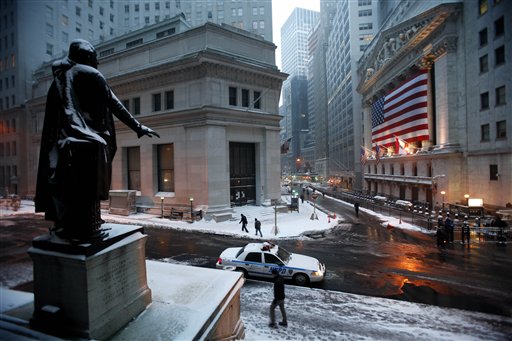
People walk to work in the snow as they pass the flag-draped New York Stock Exchange Monday, March 2, 2009. Photo by Mark Lennihan / AP.

The Geithner Plan may be good economics but it probably is terrible politics.

By Sherman DeBrosse / The Rag Blog / March 5, 2009

The Dow and Obama

Last night, an evening news anchor said that the plunging Dow registered investors’ belief that President Barack Obama’s policies were not helping the economy or fixing the financial system meltdown. The fact is that the Dow does not reflect what is going on in the economy, and it does not reflect political opinion.

This line of reasoning demands that Obama be a miracle worker. In the last twenty months, about half the world’s wealth has evaporated, and Obama is supposed to fix it in a matter of weeks!

Obama cannot be blamed for the insolvency of the banks. That was a result of Republican economics. Yes, some Democrats bought into the new ideas, but it was largely Reaganism and Phil Gramm economics. Now John McCain, a big Gramm backer, wants to investigate what happened! What a joke! But if this disaster goes on too long, current Republican efforts to blame him will pay them big dividends.

The Dow is going down because investors know the financial system is broken and insolvent, and they fear that the fix will be painful for them. Some, of course, have listened too much to talk radio and Republican interviews on the cable stations. They fear “nationalization” and “socialism” but would be hard pressed to define either. The obverse of these fears is that the bank managers have done a wonderful job so far.

Headlong panic could doom the Geithner Plan, no matter how excellent it may be.

Setting aside their fears and the real “panic” that exists in the investment world, they have a point in wanting to know exactly what the Geithner Plan is, what banks will be reorganized, and how shaky assets will be assessed. He has kept to very broad outlines because he shares the fear that there is insolvency across the board and because he needs flexibility in addressing it.

The problem is that panicked investors are incapable of patience or even thinking clearly about this. So long as these questions are not answered, the market will plunge over the several months needed to conduct the “stress tests” and for the banks to, probably unsuccessfully, seek private refinancing.

As long as there is uncertainty, investors will stay on the sideline watching the bloodbath and shareholders will keep dumping their stocks.

The continued dramatic drop of the Dow will further reduce confidence in the economy and will begin to rapidly chip away at confidence in the Obama Administration. It will make recovery so much more difficult and will, though unfairly, do infinite damage to Obama and the progressive cause. Republicans are busy talking down recovery efforts and claiming Obama has “cooked the books” when pointing to any sign of hope.

We now know that the Obama Administration thinks another $700 billion is needed to continue the bail-out. If the market continues to plunge, it will be exceedingly hard to get votes for this. Moreover, the folks in Congress do understand the absolute rage most people feel toward the banks.

The current Geithner Plan and the proposed new TARP must be considered together. Maybe this writer has been wrong in saying an approach modeled on what happened in Japan was wrong. Assume a Japanese-style rescue approach is theoretically correct. The fact seems to be that it will take too long to implement and will drive the Dow and public confidence to an unacceptable level. Phase two of this effort seems to be raising another $700 billion to continue the bailout. Finding votes for that will be very, very tough and will cost many Democratic seats in November, 2010. Unless the Democratic leadership and Obama people are sure the GOP will provide half the votes for the Second TARP, a course change is absolutely necessary.

The near impossibility of getting another TARP might save us from just sustaining “zombie banks” through what has been called “the shovel method” and producing a lost decade.

The Geithner plan makes some sense, but it is a political time-bomb and unworkable without a huge second TARP. We need a second best plan that passes the political tests.

A few of the deans of the punditocracy write that great presidents can get beyond partisanship and that Obama should continue to reach out to the GOP. So far we saw a near brick wall of opposition to the stimulus package and GOP’s, led by Corker and Shelby, trying to push GM and Chrysler into bankruptcy, throwing millions out of jobs. Even FDR could not have charmed these blind partisans. Obama should follow Ronald Reagan’s advice, “Trust but verify.”

We need “Plan B” now — sort of an economic enema

If the current plan is creating too much uncertainty and cannot be completely carried out, we need to think about a second-best approach that can be performed quickly and decisively. Hopefully, its implementation would commit the taxpayer to far less immediate debt.

To buy time and perhaps stimulate growth, four steps—three of which are usually anathema to progressives—could be tried to, promote confidence, buy time and slow the slide.

  • Increase the tax credit on new home construction and purchases to 10% up to 15,000.
  • Roll back the recent moratorium on off-shore drilling to just the most environmentally sensitive areas.
  • Legislate no long-term capital gains taxes on purchases made in the next 24 months.
  • Ban short selling for 12 months. We all know that the hedges profit mightily by driving the market down. This must stop now! Even ultra-rightist Ben Stein calls for a halt to selling short.

“Plan B” should simply build on the existing plan. Given that Paul Voelker is a key Obama advisor, a good guess is that the Geithner plan is designed to slowly release the remaining air from the Bush bubble. The problem is that the fear out there was underestimated.

We read that the “stress tests” do not take into account exotic assets and liabilities. They must be thoroughly examined. There is a New Deal lesson we must heed. Conservative scholars may be correct in saying that hundreds of millions were wasted trying to recapitalize insolvent banks. It might be better to just let them sink, more or less at once.

When the tests are done, Geithner should announce that the most insolvent banks must be left to bankruptcy. Market forces must be permitted to do their work. Weak banks can be restructured and combined, with losses being carried by stockholders.

If the second TARP is unattainable, the only recourse is to move swiftly to let market forces quickly and decisively resolve the situation. It might mean more pain for the GOP’s constituencies—banks and bankers, but it will speed the recovery.

To the extent possible, the FDIC will guide restructured banks, and they can be partly recapitalized with money from the Fed. All the bad assets must be identified, purged, and revalued. If there is no TARP money to purchase them, they should be given current market value and placed on contingency basis in a federally operated aggregator bank.

Make a distinction between the everyday banks that loan money for things we can see and use and those at the top of the pyramid that engage in issuing exotic instruments and casino capitalism. Focus on fixing the former and seeing that any aid advanced to them cannot be sent up to whatever is left of the bank holding companies.

Of course, the U.S. needs banks at the top end, but we can build around those we have already subsidized.

When all the smoke clears, borrow a Republican idea and introduce a new insurance scheme for banks and phase it in gradually, perhaps with partial premium write-offs at first.

It will be very messy for some time, and the Dow will fall to new lows. This was going to happen anyhow under Plan A. But the purge could well work if it is sufficiently thorough. There does not seem to be any other choice given the strong possibility that the Congress and public simply will not accept borrowing hundreds and hundreds of billions to bail out the irresponsible bankers.

It is a shame we could not fix the banking and securities sector in several weeks as did FDR, but the problem is so much greater and more complicated.

Take out some insurance — plan for more setbacks

If “Plan B” does not work due to lack of bank cooperation, there need to be contingency plans for bypassing them to make loans to merchants, students, car purchasers and home buyers to get the economy going. In the New Deal, there were contingency plans for all sorts of undesirable contingencies. A second contingency plan will provide making some banks smaller so that none are “too big” to fail in the future.

The GOP is banking on a deepening crisis

The political dimensions of this are fascinating. One cannot help but wonder if the Bushies warned the GOP on the hill that the problem was so darned big that there was no clear solution. A long banking crisis means a long depression, and that most likely would provide political dividends for the GOP.

We see every day that Rush Limbaugh, who calls for Obama’s failure, has become the party’s most important spokesman. Former Speaker Newt Gingrich has emerged from retirement as their most important tactician. Remember when he and his followers called opponents “traitors;” now he says the “secular left” is driving “God out of the secular affair.” We can only imagine the line he will take on the Bush depression. His rule or ruin, scorched earth, take no hostages obstructionism was rewarded by the American people in the election of 1994 with turning over the House of representatives to him and his party. Previously, his approach took years of throwing monkey wrenches into the machinery of government. This time, a few years of obstruction might be enough for many voters to give up on this creative, bright and idealist president and go back to the party of trickle down economics.

It is doubtful if most Republicans think beyond blocking useful legislation, demanding more tax cuts for the rich and reciting easily understood but childlike bumper-sticker formulae. But some, like Gingrich, would seize the opportunity to scrap entitlement programs, privatize as much as possible, slash taxes for the rich and resume using our armed forces to pursue abroad the economic objectives of the great interests on Wall Street. They would also have the internal security apparatus begun by Ronald Reagan and Ollie North and vastly increased by George W. Bush to subtly cripple their opposition.

The Rag Blog

Posted in Rag Bloggers | Tagged , , | Leave a comment

Perhaps BushCo Will Yet Meet Justice

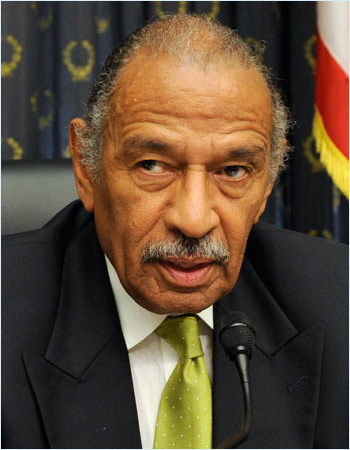
Representative John Conyers Jr. has called for an investigation.
Photo: Susan Walsh/Associated Press.

Release of Memos Fuels Push for Inquiry Into Bush’s Terror-Fighting Policies
By Charlie Savage and Neil A. Lewis / March 3, 2009

WASHINGTON — A day after releasing a set of Bush administration opinions that claimed sweeping presidential powers in fighting terrorism, the Obama administration faced new pressure on Tuesday to support a broad inquiry into interrogation, detention, surveillance and other practices under President George W. Bush.

Justice Department officials said they might soon release additional opinions on those subjects. But the disclosure of the nine formerly secret documents fueled calls by lawmakers for an independent commission to investigate and make public what the Bush administration did in the global campaign against terrorism.

The chairman of the House Judiciary Committee, Representative John Conyers Jr., Democrat of Michigan, said the revelations, together with the release of new information about the Central Intelligence Agency’s destruction of 92 interrogation videotapes, had underscored the need for a commission that would have the power to subpoena documents and testimony.

Officials who discussed the process spoke on the condition of anonymity because memorandums still under review might involve classified information. Among those that have not been disclosed but are believed to exist are a memorandum from the fall of 2001 justifying the National Security Agency’s program of domestic surveillance without warrants and one from the summer of 2002 that listed specific harsh interrogation techniques, including waterboarding, that the C.I.A. was authorized to use.

The Justice Department officials said the decision to release the nine memorandums on Monday came after some of the opinions were sought in a civil lawsuit in California. They said department lawyers had determined that the opinions did not contain classified information.

The lawsuit was filed by Jose Padilla, a United States citizen who was arrested in Chicago in 2002 and detained for years as an enemy combatant before eventually being tried and convicted in a civilian criminal procedure. Mr. Padilla is suing John C. Yoo, a former Bush administration lawyer who was the author of many of the opinions justifying detention and interrogation policies.

The Senate Judiciary Committee has scheduled a hearing on Wednesday on whether to create a commission to look into the Bush administration’s counterterrorism policy. The committee chairman, Senator Patrick J. Leahy, Democrat of Vermont, has already called for a commission, and another Democrat on the panel said Tuesday that he would support such an approach.

But David B. Rivkin Jr., an associate White House counsel under the first President Bush who is scheduled to testify at the hearing on Wednesday, said he planned to urge Congress not to move forward with that proposal, which he said would violate the rights of Bush administration officials and set them up for prosecutions by foreign courts.

“They want to pillory people,” Mr. Rivkin said. “They want to destroy their reputation. They want to drag them through the mud and single them out for foreign prosecutions. And if you get someone in a perjury trap, so much the better.”

President Obama has signaled a reluctance to open a wide-ranging investigation into his predecessor’s policies, saying he preferred to fix the policies and move on. In his first days in office, he issued executive orders requiring strict adherence to rules against torture. As a senator, he voted for legislation that brought surveillance efforts into alignment with federal statutes.

The increased calls for a greater public accounting come as the Justice Department’s internal ethics office is preparing to release a report that is expected to criticize sharply members of the Bush legal team who wrote memorandums purporting to provide legal justification for the use of harsh interrogation methods on detainees despite anti-torture laws and treaties, according to department and Congressional officials.

The Office of Professional Responsibility at the Justice Department is examining whether certain political appointees in the department knowingly signed off on an unreasonable interpretation of the law to provide legal cover for a program sought by Bush White House officials.

The report is expected to focus on three former officials of the Office of Legal Counsel: Mr. Yoo, a Berkeley law professor, now on leave at Chapman University, who was the principal author of opinions on national security matters from 2001 to 2003; Jay S. Bybee, who oversaw the counsel’s office during that period and is now a federal appeals court judge; and Steven G. Bradbury, who oversaw the counsel’s office in Mr. Bush’s second term.

Mr. Bradbury wrote two of the opinions released on Monday. Written last October and this January, they broadly repudiated the aggressive theory of virtually unlimited commander-in-chief power at the heart of Mr. Yoo’s memorandums.

Although he was a critic of Mr. Yoo’s work, Mr. Bradbury himself wrote three memorandums on the use of harsh interrogation techniques in 2005. Those documents are believed to be part of the Office of Professional Responsibility’s investigation.

In a footnote to Mr. Bradbury’s January memorandum that sharply criticized Mr. Yoo’s work, Mr. Bradbury signaled that he did not want a repudiation of Mr. Yoo’s legal reasoning to be used against him as part of the ethics inquiry.

Mr. Bradbury wrote that his retractions were not “intended to suggest in any way that the attorneys involved in the preparation of the opinions in question” violated any “applicable standards of professional responsibility.”

[Scott Shane contributed reporting.]

Source / New York Times

The Rag Blog

Posted in RagBlog | Tagged , , | Leave a comment

Yowling Conservatives : Preferring to Defy Definition?

Graphic by Larry Ray / The Rag Blog.

Stuck in a time warp of denial and obstinacy, it seems that conservatives today continue to thrash about as harsh reality bangs hard against their deep seated belief in some sort of fiscal tooth fairy.

By Larry Ray / The Rag Blog / March 4, 2009

The cable channels are choked with yowling, contumacious conservatives who rail against President Obama’s emergency stimulus bill and a federal bailout of failed financial institutions. What makes them “conservative?” Defining “conservative” as it applies to today’s obstreperous orators is not an easy thing to do.

The shaping and molding of today’s conservatives has taken a twisting path over past decades. From the Whigs of the 1830’s to the early twentieth century when Teddy Roosevelt’s governing style was more as a Progressive than a Conservative, on to the promises of Herbert Hoover that prosperity was just “on the horizon,” defining conservatives has been but a series of redefinitions.

Other evolutionary benchmarks include William F. Buckley, Jr’s founding of The National Review in 1955. It was a magazine where writers could express their disagreements with liberal views and leadership. Buckley attracted the strident anti-communist, Robert W. Welch, Jr., who founded the John Birch Society and helped bankroll the new right wing magazine. The anti-left, anti-liberal movement picked up steam in the 1970’s with Irving Kristol’s attacks upon those whom he saw as “soft on communism.” Kristol is credited with starting the neoconservative movement which ultimately produced the likes of Dick Cheney, Donald Rumsfeld, Paul Wolfowitz, and most of the top players in the eight years of the George W.Bush administration.

But, in a few words, what do conservatives believe today? What do they want from government? The conservative family tree is a murky genealogy. It ranges from Whigs to Libertarians to the influence of Russian immigrant and popular author, Ayn Rand, whose “Atlas Shrugged” is still a top seller on Amazon. Rand, to me, was like the oracle Sibyl, because her populist political pronouncements are interpreted so broadly from opposing poles.

It has been noted that, “On the left, linguist and analytic philosopher Noam Chomsky considered Rand “one of the most evil figures of modern intellectual history.” On the right, conservative commentator William F. Buckley, Jr. declared: “Ayn Rand is dead. So, incidentally, is the philosophy she sought to launch dead; it was in fact stillborn.”

More recently, Social scientists at UCBerkeley undertook a detailed non-judgmental study of “consistent underlying motivations of politically conservative agendas.” It basically boils down some of the common psychological factors linked to political conservatism which include:

  • Fear and aggression
  • Dogmatism and intolerance of ambiguity
  • Uncertainty avoidance
  • Need for cognitive closure
  • Terror management

Prof. Jack Glazer of the University of California explains, “Conservatives don’t feel the need to jump through complex, intellectual hoops in order to understand or justify some of their positions. They are more comfortable seeing and stating things in black and white in ways that would make liberals squirm.”

That certainly seems to apply to the flat statements of present day conservatives like Eric Cantor, John Boehner, and certainly John McCain. “Our plan would create 6 million jobs,” is a common claim they present. However no one has ever bothered to explain their “plan” and how it would create jobs. Conservatives seem to believe, just as they believe they are going to heaven, that if we only granted tax cuts, tax credits and tax-rebates without actually spending any money, we would create 6 million jobs and overcome a recession. They also call for “Victory in Iraq” which is equally undefined, and undefinable.

So, what is left of the so-called conservative-base today are at each others throats. Radio entertainer Rush Limbaugh, exploits their discord, whipping up a frenzy. It seems so difficult for conservatives to admit they may be wrong. It is equally hard to admit that Limbaugh is playing them all like a cheap guitar while he rakes in millions from his outrageous radio show.

Howard Gardner, a psychologist at Harvard University, asks, “Why, then, do right wing partisans ignore this evidence and continue to support policies that are patently dysfunctional? I believe it is because, having stated a position, based on either their own family values or those dictated by their religion, they are loathe to change their minds and declare that they have been wrong.”

British Economist, John Maynard Keynes’ economic policies basically state: “The modern capitalist economy does not automatically work at top efficiency, but can be raised to that level by the intervention and influence of the government.” Such governmental control is anathema to conservatives. Today, they refuse to admit that their gradual removal of the Keynesian oversight of banks and Wall Street largely brought about the mess we are in today.

Keynes himself noted, appropriately, “I do not know which makes a man more conservative — to know nothing but the present, or nothing but the past.”

Stuck in a time warp of denial and obstinacy, it seems that conservatives today continue to thrash about as harsh reality bangs hard against their deep seated belief in some sort of fiscal tooth fairy.

Rush Limbaugh this afternoon reached new heights of megalomania when he invited President Obama to come to his studio and debate him. Regarding the invitation, Mr. Obama will certainly apply his understanding that, “If one finds oneself in an argument with a fool, make sure he is not similarly occupied.”

[Retired journalist Larry Ray is a Texas native and former Austin television news anchor. He also posts at The iHandbill.]

The Rag Blog

Posted in Rag Bloggers | Tagged , , | Leave a comment

GI Coffehouse : Checking ‘Under the Hood’ in Killeen, Texas


Grand opening of the Under the Hood Cafe in Killeen, Texas. Photos by Carlos Lowry / The Rag Blog.

Under The Hood is an experiment. It’s a labor of love. It’s an antidote to the “divide and conquer” mentality that undergirds war.

By Susan Van Haitsma / The Rag Blog / March 4, 2009

March came in like a lion lying down with a lamb. Or maybe the day was about recognizing that the lion and lamb exist together in each of us. In any case, collaboration was the theme on Sunday, March 1, as soldiers and civilians, men and women, children and adults, locals and out-of-towners, seasoned and new organizers gathered to celebrate the opening of a meeting place in Killeen, Texas, on the edge of the world’s largest US Army base. “Under The Hood” is the catchy name of the new coffee house that is up and running near Ft. Hood as a long-wished-for resource for soldiers and military family members who find the culture of silence around military bases detrimental to their health and well-being.

As stated on the café’s website, the purpose of the coffee house is to provide a welcoming setting for the free exchange of ideas and information, as well as offering a family-oriented entertainment space for soldiers and civilians. The house rules encourage talking, flirting, learning and debating, and from what I observed at the opening Sunday, the café is functioning just as it was intended.

The engine propelling Under The Hood is its warm and able manager, Cindy Thomas, a native Texan, military spouse, mother of two young daughters and step-mother of a military-aged son. While her husband was serving a tour in Iraq last year after having been injured there on a previous tour, Cindy looked for support for her own family as well as the military families she saw around her who were dealing with issues involving physical and mental health, housing, education and GI rights.

I first met Cindy in the Fall of 2007 when she walked up to the Café Caffeine in Austin along with her two girls, all of them sporting something pink, to attend a CodePink meeting after having heard about the national group on the Rosie O’Donnell show. By coincidence, as Cindy and her daughters joined us, we were finishing up an interview with a reporter from the Austin American-Statesman just before the official start of our meeting. I was impressed with Cindy’s candid and cogent answers to the reporter’s questions, even though she hardly expected to be interviewed by the press the moment she arrived to meet a new group of women a hundred miles from home.

It was a fortuitous meeting. Our Austin CodePink group already had been actively engaged in outreach to GIs and military families, forming alliances between civilians, soldiers, activists and veterans through several projects in support of GI resisters. Cindy’s outgoing nature and capable organizing skills blended well with the abilities of kindred souls in our group. Together with the fledgling Central Texas Iraq Veterans Against the War, Veterans for Peace and the reinvigorated Movement for a Democratic Society, a committee formed to fundraise and look for a location for a coffee house in Killeen.

In some respects, Under The Hood is a reincarnation of the Oleo Strut, one of the most vibrant of the GI coffee houses that sprang up in the 1960’s as active duty soldiers organized in resistance to the US war in Indochina and in opposition to the use of soldiers to thwart civil rights and antiwar demonstrations in the US.

As described in the history of the Oleo Strut documented by Thomas Cleaver and posted on the Under The Hood website, one of the most awesome acts of resistance by GIs during the Vietnam war was launched from Ft. Hood when 43 decorated African-American GIs refused to board planes destined for the Great Lakes Naval Training Center where they were to be used as backup for Chicago police against demonstrators at the 1968 Democratic National Convention.

The Oleo Strut had opened just a month prior, taking its name and purpose from a mechanical part on a helicopter that functions as a shock absorber. The Oleo Strut distributed its own GI newspaper, “The Fatigue Press,” and became a beehive of activity where soldiers could hang out, organize and mingle in a supportive atmosphere with civilians. The coffee house also hosted poets and musicians, including the renowned Pete Seeger and the as-yet-unknown 16-year old Stevie Ray Vaughn and his blues band.

Under The Hood doesn’t resemble the Oleo Strut much in terms of looks, judging by photographs and accounts of those who were there both Sunday and back in the day. But, there is a strong spirit of life, love, resistance and support in the café that bridges the years while also evolving with the times. I saw it in the tears that photojournalist and Veteran for Peace, Alan Pogue, brushed from his eyes as he took pictures during Sunday’s opening while remembering The Oleo Strut he photographed in its heyday. I saw it in the tears that Cindy brushed from her eyes as she was being presented a medal by members of the Ft. Hood chapter of Iraq Veterans Against the War. On one side of the medal was an engraved portrait of Thomas Paine, who coined the term “Winter Soldier” that Vietnam Veterans Against the War and IVAW adopted. On the other side of the medal was an inscription from the IVAW chapter: “Love and Thanks from Man and Woman.”

Others from CodePink Austin were honored by IVAW, as well, for assistance with the café project in everything from fundraising to painting, carpentry, cleaning, cooking and counseling. CodePink seamstress extraordinaire, Heidi Turpin, made the handsome curtains and banner that adorn the café’s windows and walls. She and her husband, Jim, made the sign that hangs in front of the house and installed the ammunition box that had been transformed into a donations box (bills, not bullets!). Jim, a vegetarian, amiably helped grill chicken and sausages all afternoon for the hungry flock that arrived for the opening. Fran Hanlon, active with CodePink and the GI Rights Hotline, and Alice Embree, active with CodePink and MDS, have served with Cindy in the Ft. Hood Support Network that has powered the project from the beginning.

These folks and other volunteers combined their time and talents to create a welcoming space that is beautiful in both form and function. There are games to play, books to read, films to see, and comfortable places to sit and talk, think and peruse the materials that are made available. There is good light, good coffee and good company. (Check out the slide show of photos taken during the opening by Alice’s husband, Carlos Lowry and posted to the site.)

Under The Hood is an experiment. It’s a labor of love. It’s an antidote to the “divide and conquer” mentality that undergirds war. Soldiers are taught to distrust and separate themselves from civilians, but the coffee house brings soldiers and civilians together. The military is a male-dominated institution, but this coffee house project has been led by women. Children are welcome. Music is welcome. You are welcome, all you lions and lambs, so come on in.

Also see the following:

The Rag Blog

Posted in Rag Bloggers | Tagged , , , , , | Leave a comment

Stimulus Bill Continues Tradition : No Funding for LGBT Arts Groups

San Francisco Lesbian/Gay Freedom Band during “christening” of the Pink Triangle on Twin Peaks in 2008. Photo by Bill Wilson © 2008 / San Francisco Sentinel>

After more than 40 years of business as usual, will the NEA be able to perpetuate its Eurocentric and anti-LGBT biases under a mixed-race President?

By Jeff Jones / The Rag Blog / March 4, 2009

SAN FRANCISCO — The National Endowment for the Arts will receive $50 million as part of the American Recovery and Reinvestment Act of 2009 signed by President Obama on Feb. 17, 2009. Since the Robert Mapplethorpe controversy almost 20 years ago, the NEA has refused to fund out-of–the-closet LGBT (Lesbian, Gay, Bisexual and Transgender) arts organizations. The agency’s recently released eligibility requirements for Stimulus funding ensure that the NEA’s ongoing censorship of LGBT arts groups will continue: they exclude organizations that have not been funded by NEA during the past four years.

Since the Bush administration’s NEA did not fund LGBT arts groups and only paid lip-service to diversity, most Stimulus-funded grants are expected to be funneled to the nation’s symphonies, operas and ballets (the SOBs); these groups already receive the lion’s share of government arts funds and serve almost exclusively affluent white audiences.

While the NEA’s failure to financially support the nation’s cultural diversity stretches back to its founding during the LBJ era, the agency’s anti-LGBT zeal hit its zenith during the Clinton administration, when his appointee—Jane Alexander—personally censored every LGBT grant recommended for funding by the agency’s peer panelists. The NEA’s largest grant program “Access to Artistic Excellence” illustrates the agency’s overall Eurocentric and anti-LGBT bias: in the last two rounds of funding, this NEA category awarded 1479 grants worth more than $34,000,000, but less than 10% were awarded to arts groups rooted in communities of color and not a single grant was awarded to an out-of-the-closet LGBT arts organization.

After more than 40 years of business as usual, will the NEA be able to perpetuate its Eurocentric and anti-LGBT biases under a mixed-race President? Will the NEA’s blatantly discriminatory policies be challenged along with Don’t Ask Don’t Tell? Will the NEA continue to spend millions of dollars funding Madame Butterfly instead of supporting the hundreds of community-based arts projects taking place across the country that promote social justice? More soon on this developing story.

The Rag Blog

Posted in Rag Bloggers | Tagged , , , , | Leave a comment

Peter Coyote in Cuba : A State of Grace With the Requisite Complexities

“Jose Marti Dove Hands,” Oil on Canvas portrait of Jose Marti by Rene Mederos from the Hernandez-Miyares collection. Marti was ‘widely revered as a poet and an intellectual, a soldier and resistance fighter, a lover of women, and a politician.’

Does the U.S. embargo help the Cuban government?

…every system is a series of interlocking, intractable problems, where consequences, intended and unintended, inevitably wall off potentially desirable effects from delivering their intended promises. I cannot think of a system, certainly including my own, which is not beset by contradictions and dilemmas which are the direct results of policies designed for the best of reasons.

By Peter Coyote / March 2, 2009

HAVANA — Interesting and informative as it may be, meeting virtually the entire world of cigars, running around relentlessly, speaking another language, eating different food and writing hundreds of words a day is exhausting and it’s time for a day off. I decide to visit the town of Coghinar, the site Hemingway chose as the setting for “The Old Man and the Sea.” I thought it might be nice to sit in the sun, on a beach.

Leaving Havana, on a wide clean road, in a car that appears to be a relatively new Audi A-6, the absence of any evidence of shock absorbers serves as a reminder to “stay awake” and “be observant,” transmitted through my lower back and kidneys like body-blows.

Driving on roads with virtually no traffic is like being returned to a state of grace in America of the 1950s. The way is wide and broad and there is absolutely no advertising. It’s refreshing. There are the odd signs of propaganda — reminding us of the plight of the Cuban 5, that Che and his example lives forever, that Chavez of Venezuela is a good friend to Cubans etc. Despite being clear and bright and usually cryptic, a few are too dense for me to grab in my limited Spanish. One for instance, announces that “two hours of the blockade would” (and here I lost it for the instant it took to drive by) “all the Braille in Cuba.”

For the most part however, Cubans have not considered the concept that all “public” space be made available for private exploitation, which, if you think of it, is exactly what advertising accomplishes. Before Freud’s nephew, Edward Bernays, used his uncle’s work to delve into the unconscious of consumers (dedicating his skills to successfully convince women to begin smoking) and before he had come up with the idea of re-branding his efforts as “public relations,” folks simply called it what it was quite nakedly — propaganda. In its most elemental form, it allows a corporation to place between you and the view of any scenery or vista a psychologically adroit argument (in visual coding) to buy something you probably do not need. Since it’s public space and “free,” and since Americans are a freedom-loving people, there appear to be no limits on the concentration of media messages allowed even if an actual forest is replaced by a virtual forest of brand-name exhortations. It’s “free.”

In Cuba however, the road is lined with dense green woods, or pastures, shanties, sometimes stately homes, herds of goats, or lines of distant palms. These views are uninterrupted by bright, colorful, sexually suggestive photographs of attractive people interacting with sexy products. Perhaps it’s because there appears to be so little money here, but I barely saw an inducement to buy anything, and, for one, found it restful. All the Cubans I saw were clothed, shod, and well-fed. (Though to be fair, I never saw a fat person in Cuba — unless they were a foreign visitor.) They must have purchased these items somewhere, but except for my granddaughter’s present, I saw very few stores. Cuban cars, in many cases, were newer than the hand-painted relics I find so attractive here and remember fondly from my youth. They too came from somewhere, but I never saw any of those “where’s” or any of the automobile brands advertised.

A short hop off the main road, we pulled onto a sandy knoll in the La Playa del Este region, under a palm tree, near a little bohio that sold pop. The vista is decidedly Fellini-esque with large open spaces, a single inexplicable industrial-sized building off in the distance, and a single person crossing an expanse of dried lawn. There were one or two other cars about, but no surf shops, condos, jet-ski rentals, scuba-tours, marlin tournaments, or motorboats advertised. The sand was fine and white and extended as far as I could see in two directions and the water was a magnificent collision of two bands of very distinct color next to the shore — a milky jade green; and approximately 15 feet out it turned immediately into an intense lapis lazuli extending to the horizon. I could sense the whetting of corporate knives as international hotel executives plotted to turn such a beach into a replica of the Zona de Hoteles in Cancun I found so depressing. All that potential capital going to waste; all that beauty unexploited. “These Cubans are too dumb to realize what they have, Fred.”

I rented a chair from the owner of the bohio for a peso and plotzed to look at the horizon awhile. To my left, about a hundred yards away, two men body-surfed in the swells with evident relish. To my right, an equal distance away, two people lay on the sand taking the sun. That was it. Sun, sand, gorgeous water, an old white plastic beach chair, y nada mas, as they say down here. The wind was brisk, and occasionally grains of sand stung my cheeks, but I sat for a lovely uninterrupted, unhurried hour. The week to date, however, had generated too much internal momentum to sit longer. I returned the chair and moved on.

We arrive in Santa Maria de la Mar, which may be where all the ugliest housing projects that the Russians ever gave to Cuba came to die. They are impersonal, vast as projects in the slums of the States, only more decrepit. It is unsettling to see them and hard to consider how anyone could be happy or even dream of beauty in such an environment, but my guide, catching my cultural assumptions, reminds me they are “Mejor que nada,” much better than the “nothing” that most poor Cubans possessed before the Revolution. I realize that once again, attempting to view Cuba through lenses appropriate to the United States can easily lead one astray, and that for people who grew up on dirt floors and under palm-thatch and open walls, even gray-concrete with running water and a bathroom is an improvement. Once again, I remember that I have not seen one homeless person in all of Cuba, and if it takes these ugly Russian buildings to accomplish that, I will shut my mouth about it.

From Santa Maria we descend into the little fishing village of Coghinar. Two men are playing guitar and singing on a porch opposite where we park. One is a wiry man with honey-colored skin about 50. His companion is white and stooped, probably in his late 70s. They play and harmonize beautifully, and the darker man acknowledges my interest with a lifted-chin salute and a smile.

The main street slopes down to the sea, and even from several hundred yards away, I can see the white pergola with pink-trim, which David tells me houses a bust of Ernest Hemingway. I start in that direction, when an old woman stops me. Pointing to my cigar she says, “Hay una Cohiba.” I stop to chat and show her the black band of the Gran Reserva, which she has never seen. (When the cigar went out last night, I put the remaining half in a Bolivar aluminum tube and saved it for today.) She tells me that she worked in the Cohiba factory for 25 years, wrapping the bands on the cigars and that she thought it was fine. Life now is hard, she confesses, and shows me her swollen feet and says something about “adult diabetes.” We listen to the music a bit together, and she waves goodbye as I walk on.

A bit farther down the street, a house is having some construction done. There are concrete blocks and piles of sand and cement blocking the driveway of a sweet and modest house in good repair. A handsome man in his early forties stops me and points. “You’re an actor,” he says and I nod, yes. Laying his hand lightly on my shoulder as a request to wait, he calls loudly to his wife inside to “come out and see who this is.” A younger woman with an open and expressive face comes out and smiles in surprise. She takes my hand and we chat a moment. Both she and her husband know some of my films, and the TV series, “The 4400,” is currently playing on Cuban TV. (Of course, because the U.S. refuses all relations with Cuba, they simply download such shows off the satellites and see them for nothing.)

The man’s wife then says with evident pride, “My husband is José Modesto Darcourt.” David explains that José was a champion Cuban baseball player who pitched for a team called The Industrials. I am embarrassed to have had the advantage of the distribution machinery of American culture. He knows who I am because America’s reach extends into his living room, yet because we have no reciprocity with them, I had no idea I was in the presence of a hero. I was just “well-known,” in Cuba, he was once a god.

We talked awhile and when I told him why I had come, he pointed down the hill in Hemingway’s direction, smiled and shook my hand again. His wife smiled too, clutching her apron, and moved sideways to stand beside José, proud of her husband, proud of her house, and perhaps even proud to live in a town where neighbors serenade one another and “movie stars” can suddenly appear in the street.

We walk down to the wharf at the end of town and I bow to Hemingway and take a photo of his statue with a dog sleeping at its base. Unlike Odysseus, who traveled the world and returned home and whose dog died upon recognizing him, it is this fine writer, immortalized all over Cuba, who has died, and the skinny, dusty, and undernourished dog endures, much like the rest of Cuba.

On the way back to town, we pass more cheerless, three-story concrete Russian apartments, stained with a dark grey mold. Cultural bias aside, I can’t understand how the Russia that produced Tolstoy and Dostoevsky and Turgenev and Gogol and Chagall and Kandinskii, Moussorgsky and Rachmaninoff and Rostropovich and the Bolshoi Ballet; poets like Anna Tsvetaeva and Mandelstam; which constructed the fanciful multi-colored, turreted buildings of Moscow and St. Petersburg — how could it have contributed such ugliness to the world? I’m stunned by it, will never accept it, but I can understand why it appeared to be a necessity. For that reason, at least in Cuba, I’ll keep my opinions about them to myself.

Back in Havana, we walk awhile at the Plaza de José Marti, a popular gathering spot where people argue sports and politics in loud and energetic exchanges. It’s hard to estimate the meaning of Marti for Cuba. Widely revered as a poet and an intellectual, a soldier and resistance fighter, a lover of women, and a politician, Castro acknowledged him before the entire country when he addressed it after the Revolution and told the Cuban people that he had simply finished what was begun by Jose Marti.

Born in 1853, he lived a full, active, politically engaged life, 10 years of which he spent in New York City. Statues of him are everywhere, and even the dictator Batista had a statue of him in his office. (Hypocrisy is the tax that vice pays to virtue.) He dedicated his entire life to ending imperialism and driving the Spanish from Cuba, but incidentally found much about America’s freedom and immigrant society to love even as he feared its global reach. He died in a suicidal two-man charge against Spanish positions at the Battle of Dos Rios and when the Spanish soldiers discovered who they had killed, they were afraid to burn his body for fear that his ashes would enter their throats and choke them.

No me entierren en lo oscuro
A morir como un traidor
Yo soy bueno y como bueno
Moriré de cara al sol.”

(“Do not bury me in darkness / to die like a traitor / I am good, and as a good man / I will die facing the sun.”) — Marti.

We have lunch at a restaurant, in another barrio which was called (I think) La Paila, though the waiters wore aprons embroidered with other names like “Casillero del Diablo.” As we nibble on the traditional fried Malanga crouquets, a slender American man with a beard, casually dressed, in his 50s introduces himself as Bob Israel. I’m momentarily befuddled until I realize that his son Jesse is one of my son’s best friends in New York. Bob sits a moment and explains that he’s here with a group from Dreamworks Studio (think Stephen Spielberg), being led on a tour by one of their executives who loves Cuba and loves introducing people to it. They are here under license (meaning that the government cannot fine them or confiscate their property) doing some sort of humanitarian work, but I am too surprised by the sudden intrusion of Hollywood into Havana to fully register what it was. We chat about our kids, thousands of miles away, until his food arrives and he rejoins his group, and my other friend (who I’ll leave nameless due to the nature of our conversation) and I pick up a thread we’ve been discussing throughout my trip.

Orelio (a name as good as any other) has previously explained to me that Cuba now imports sugar and tomatoes, crops which would grow here effortlessly, along with a host of other things that require them to spend precious currency. I cannot understand why. Why grow tobacco and not tomatoes? Is it only a question of which brings in the most currency? If there were more food available obviously the state would require less money. Why not grow it?

Orelio drops his voice — and I get the first intimation of why some refer to it as “a police state,” though I have seen no evidence of surveillance, or oppressive police presence, or any undue deference of the people to their fellows in uniform. Still, his gesture was reflexive, defensive in nature and I did not understand the situation fully enough to know whether he was keeping our conversation private out of respect for the people at other tables who might hold other opinions, or because he was in some way afraid.

He points out that the revolution will not allow brokers of any kind. Consequently there is no agency, public or private, to buy food from the farmers and sell it to the state. They have been forbidden, because they would inject profit into the process of sustenance and, inevitably raise the price of food and create a class that “lives off the work of others.” Food must, for a number of reasons, be kept cheap, and so the state buys directly from the farmers at a very, very small margin. This lack of ability to make money from their work acts as a disincentive for the farmers from growing much more than they need, or working overly diligently for so little money. It is honestly, the first time I have ever given any credence to Republican assertions that without money as an incentive people will not work. It never made sense to me because I enjoy writing and performing, by and large, and so do most of my friends. We have all done our work free before, and so the “incentive” argument has always seemed like a thin soup. As in most things, I can see that no one side of an argument ever owns the entire truth.

Farmwork is tough. It demands long hours, patience, dedication, endurance and hardship and it is pretty clear that people work for more than the simple human pleasures of interacting with the soil. It is intractable. If the government allows markets to develop and the price of food to rise, food may be plentiful, but it will also be too expensive for the majority of Cubans. It will also become plentiful at the expense of creating hierarchical classes of people, a condition which is anathema to the sentiments of Fidel’s revolutionary generation. Remember again the natural opposition of “freedom” and “equality.”

It’s clear that every system is a series of interlocking, intractable problems, where consequences, intended and unintended, inevitably wall off potentially desirable effects from delivering their intended promises. I cannot think of a system, certainly including my own, which is not beset by contradictions and dilemmas which are the direct results of policies designed for the best of reasons. Take the car, for instance. Who could have predicted that this vessel which offered freedom and independence, generated millions of jobs, virtually an entire economy, and nearly uncountable national wealth would wind up controlling our lives, architecture, transportation design, poisoning the planet, threatening our national security and independence and collapsing a major wing of our economy?

Americans have been trained to criticize socialist countries for their problems, but those cultures arrived at their problematic conditions the same way we did…pursuing ideologies and intentions that ensared them in unintended consequences. I’m not trying to make all problems equal, either morally or practically, but one can understand, just by examining the question of sharing food, that the dilemmas are universal.

Orelio continues, shocking me by suggesting that the embargo may serve the Cuban government with a ready-made excuse for its failures. “As things stand now, the embargo actually helps the government,” he suggests, by being the source of all things miserable in Cuba. Should it end suddenly, then people may wonder why buildings are so decrepit, why the environment is not better cared for as it should be, or why Cuba is forced to import so much of what they need. He is open, of course, to the possibility that ending the embargo might also change all those examples for the better, but he offers as evidence the following story:

A Miami Cuban counter-revolutionary group had been flying into Cuban airspace, filing false flight plans with our government, and dropping propaganda leaflets over the population for many years. The Cubans did not like it and complained to the United States for years about these violations of international law, and airspace. They were very very patient about this insult to their sovereignty. One day, however, they had enough and shot down two planes killing all aboard. “When did they shoot down the planes?” he demands. When Bill Clinton was in office and there were talks afoot to relax travel and remittances and the like, he said. Clinton was going to support liberalization of relations and it was then that the Cubans shot down the plane. That act made it impossible for Clinton to continue his liberalization efforts and gave sustenance to all Castro’s enemies in Congress, insuring (according to Orelio) that the embargo remained in place. Knowing the degree to which Clinton was dependent on the Cuban vote in Florida for his presidency, it’s hard to believe he was intending to be too liberal, but even the fact that this hypothesis is believed by (at least one) of the Cuban people, it’s informative of tensions and difficulties in the system.

“America could invade Cuba any time it wanted without a problem,” he continues. “They never will. They don’t want to take care of 11 millions Cubans” for one thing, and for another, Cuban boats patrol the maritime borders — one every five miles to interdict drug runners and (according to Orelio) escapees to the United States. “Do you know how much it would cost the United States to do such patrolling to keep drugs away? Do the math.”

Orelio is persuasive and it is less important whether he is correct than it is that he is highlighting facets and complexities of the American-Cuban interface that are never publicly discussed. There are others who probably have direct access to the information which could prove or disprove these assertions, but without open dialogue and frank exchange they never surface into public discourse and citizens of both cultures are the losers.

© 2009 Hearst Communications Inc.

[Peter Coyote is an actor and author. He was active with the San Francisco Mime Troupe and the Diggers in Sixties San Francisco. Sleeping Where I Fall, his memoir of the 1960s counter-culture, will be re-released in May 2009. This article was originally posted by Peter Coyote on Feb. 26, 2009.]

Source / SFGate

The Rag Blog

Posted in RagBlog | Tagged , , , | 1 Comment

James Howard Kunstler : Downscaling our Lifestyle

Miniature City by Theo Elsworth / Art Capacity.

‘Consumerism’ Is Dead — Can Obama Lead Us to a Downscaled Lifestyle?

In the folder marked ‘unsustainable’ you can file most of the artifacts, usufructs, habits, and expectations of recent American life: suburban living, credit-card spending, Happy Motoring, vacations in Las Vegas, college education for the masses…

By James Howard Kunstler / March 3, 2009

The public perception of the ongoing fiasco in governance has moved from sheer, mute incomprehension to goggle-eyed panic as the scrims of unreality peel away revealing something like a national death-watch scene in history’s intensive care unit. Is the USA in recession, depression, or collapse? People are at least beginning to ask. Nature’s way of hinting that something truly creepy may be up is when both Paul Volcker and George Soros both declare on the same day that the economic landscape is looking darker than the Great Depression.

Those tuned into the media-waves were enchanted, in a related instance, by Rick Santelli’s grand moment of theater in the Chicago trader’s pit when he seemed to ignite the first spark of revolution by demonstrating that bail-out fatigue had morphed into high emotion — and that the emotion could be marshaled against public policy. The traders in the pit on-screen seemed to color up and buzz loudly, like ordinary grasshoppers turning into angry locusts preparing to ravage a waiting valley. “Are you listening, President Obama?” Mr. Santelli asked portentously.

In the broad blogging margins of the web that orbit the mainstream media like the rings of Saturn, an awful lot of reasonable people have begun to ask whether President Obama is a stooge of whatever remains of Wall Street, with Citigroup and Goldman Sachs’s puppeteer, Robert Rubin, pulling strings behind an arras in the Oval Office. Personally, I doubt it, but it is still a little hard to understand what the President is up to. For one thing, the stimulus package, so-called, looks more and more like national sub-prime mortgage itself, a bad bargain made under less-than-realistic terms, with future obligations fobbed onto whoever inhabits this corner of the world for the next seven hundred years — and all to pay for a bunch of granite counter-tops and flat-screen TVs.

I suppose Mr. Obama is burdened with the knowledge that the economic truth is so much worse than he imagined back in November that there is simply nothing to do at this point except pretend to serve up a “tasting menu” of rescue plans in the hope that markets and mechanisms might be conned back into compliance with our wish to keep getting something-for-nothing forever. FDR already used the fear of fear itself trope, so Mr. O is left with little more than displaying pluck and confidence in the face of overwhelming bad news.

The sad truth is that banking has become a Chinese fire drill — a frantic act of futility — as insolvent companies persist in covering up their losses in order to avoid the counter-party hell of credit default swaps that would ring the world’s “game over” bell. This can only go on so long. All the chatter about “nationalizing” the banks really boils down to what kind of bankruptcy work-out will they be put through, how destructive will the process be, and how much of the pain can be shoved forward in time to people now in diapers and their descendants.

Among the questions that disturb the sleep of many casual observers is how come Mr. O doesn’t get that the conventional process of economic growth — based, as it was, on industrial expansion via revolving credit in a cheap-energy-resource era — is over, and why does he keep invoking it at the podium? Dear Mr. President, you are presiding over an epochal contraction, not a pause in the growth epic. Your assignment is to manage that contraction in a way that does not lead to world war, civil disorder or both. Among other things, contraction means that all the activities of everyday life need to be downscaled including standards of living, ranges of commerce, and levels of governance. “Consumerism” is dead. Revolving credit is dead — at least at the scale that became normal the last thirty years. The wealth of several future generations has already been spent and there is no equity left there to re-finance.

If contraction and downscaling are indeed the case, then the better question is: why don’t we get started on it right away instead of flogging rescue plans to restart something that is DOA? Downscaling the price of over-priced houses would be a good place to start. This gets to the heart of Rick Santelli’s crowd-stirring moment. Let the chumps and weasels who over-reached take their lumps and move into rentals. Let the bankers who parlayed these fraudulent mortgages into investment swindles lose their jobs, surrender their perks, and maybe even go to jail (if attorney general Eric Holder can be induced to investigate their deeds). No good will come of propping up the false values of mis-priced things.

No good, in fact, will come of a campaign to sustain the unsustainable, which is exactly what the Obama program is starting to look like. In the folder marked “unsustainable” you can file most of the artifacts, usufructs, habits, and expectations of recent American life: suburban living, credit-card spending, Happy Motoring, vacations in Las Vegas, college education for the masses, and cheap food among them. All these things are over. The public may suspect as much, but they can’t admit it to themselves, and political leadership has so far declined to speak the truth about it for them — in short, to form a useful consensus that will allow us to move forward effectively. One of the sad paradoxes of politics is that democracies do not seem very good at disciplining their citizens’ behavior. The wish to please voters and the influence of campaign money overwhelm even leaders with mature instincts. In America’s case, this could lead to what I like to call corn-pone Nazism a few years down the road. Someone will design snazzy uniforms and get us all marching around to “God Bless America.” At the point of a gun.

It’s not too late for President Obama to start uttering these truths so that we can avoid a turn to fascism and get on with the real business of America’s next phase of history — living locally, working hard at things that matter, and preserving civilized culture. What a lot of us can see now staring out of the abyss is a new dark age. I don’t think it’s necessarily our destiny to end up that way, but these days we’re not doing much to avoid it.

[This article was originally posted by John Howard Kunstler on Feb. 26, 2009. Read more of Kunstler’s work at Kunstler.com.]

© 2009 Kunstler.com All rights reserved.

Source / AlterNet

Thanks to David Hamilton / The Rag Blog

Posted in RagBlog | Tagged , , , , | Leave a comment

Why Don’t We Ask the Afghanis What THEY Want?

Like it or not: These farmers near Pakistan will see more US troops.
Photo: Oleg Popov/Reuters.

Many in Afghanistan oppose Obama’s troop buildup plans
By Anand Gopal / March 2, 2009

Frustration and fear is sparking opposition to plans that would nearly double the size of US forces there.

Kabul, Afghanistan – Parliamentarian Shukria Barakzai says she has an innovative amendment to Washington’s planned injection of up to 30,000 new troops here.

“Send us 30,000 scholars instead. Or 30,000 engineers. But don’t send more troops – it will just bring more violence.”

Ms. Barakzai is among the growing number of Afghans – especially in the Pashtun south – who oppose a troop increase here, posing what could be the biggest challenge to the Obama administration’s stabilization strategy.

“At least half the country is deeply suspicious of the new troops,” says Kabul-based political analyst Waheed Muzjda. “The US will have to wage an intense hearts-and-minds campaign to turn this situation around.”

The lack of public support could provide fertile recruiting ground for the Taliban and hinder US operations, Mr. Muzjda says.

After a year that saw the highest number of civilian and troop casualties since the war began in 2001, officials in Washington recently pledged to send 17,000 soldiers to stem the growing violence. The move has broad support among the American public – a recent ABC News/Washington Post poll found that 64 percent back the new deployments.

Much of the Afghan opposition comes from provinces dominated by the Pashtun ethnic group, which include areas that have seen the most fighting and where the new troops will be deployed. A group of 50 mostly Pashtun members of parliament recently formed a working group aimed at blocking the arrival of new troops and pushing for a bilateral military agreement between Kabul and Washington, which currently does not exist.

Pashtun support is crucial

Although any proposed legislation or motion condemning the troop increase would be purely symbolic – the Afghan government does not have direct say over the operations of Western forces – observers say that the development is an important gauge of public opinion in Pashtun areas.

Dozens of interviews with tribal elders, parliamentarians who are not part of the working group, and locals in Pashtun areas have revealed similar sentiments.

“I can’t find a single man in the entire province who is in favor of more troops,” says Awal Khan, a tribal leader from Logar province, just south of Kabul. “They don’t respect our tradition, culture, or religion.”

“The majority of my people disagree with this increase,” says Hanif Shah Hosseini, an MP from Khost province who is not part of the working group. “More troops won’t bring more security, just an increase in the fighting.”

US supporters targeted

Many cite civilian casualties and house raids as the main reason for their opposition. Recently in Logar, armed locals blocked the highway into Kabul for hours, in protest of a night raid where US forces killed one and detained three others. According to local reports, the nearly 2,000 protestors burned tires and chanted anti-US slogans.

In Kandahar Province, villagers recently placed the bodies of two children who were killed by mines in front of a government office, shouting anti-Western slogans. They alleged that unexploded Canadian ordnance killed the children.

Many locals also fear the reprisals of the Taliban in areas where troops operate. Recently in Wardak Province, locals saw two boys practicing their fledgling English with American soldiers who were passing by. The Taliban later executed the children, accusing them of being spies.

Some feel that the US should focus its efforts solely on reconstruction and the building of Afghan security forces. “The Americans spend thousands of dollars every month on a single soldier,” says Khost MP Mr. Hosseini. “With this huge amount of money, they can train our soldiers more effectively.”

Others say that if the troops must come, they should coordinate with the Afghan government. “Without such coordination, I don’t think sending more troops will change anything,” says Kandahar tribal leader Agha Lalai Dastageri.

He adds that if troops were under the control of the Afghan government, they would be deployed near the Pakistani border and away from populated areas, diminishing the chance of civilian casualties. Many Afghans believe that the source of insecurity partly lies in Pakistan, where the leadership of the insurgency allegedly takes refuge, and that policing the border will improve security throughout Afghanistan.

American military officials say that although the goal is to eventually transfer all security responsibilities to Afghans, troops are still needed now for development and security. “Our intent is to use the troops to secure rural areas,” says Capt. Elizabeth Mathias, spokeswoman for US forces in Afghanistan. “The Afghans are showing great promise, but they need us here for now.”

Snowmelt ups urgency

The injection of forces still enjoys support outside the Pashtun belt. Other ethnic groups, such as the Tajiks and the Hezaras, who predominantly hail from the country’s relatively peaceful north and west, back the notion. “We need these troops to strengthen security in the unstable provinces,” says Mirwais Yassini, chair of the Afghan Parliament and a Tajik. “We also need them [to provide security] for the upcoming presidential elections.”

Support for more troops is higher in the non-Pashtun areas because residents there have experienced less violence, and because they may view US forces as a buffer between them and the Taliban, analysts say. The memory of the Taliban’s harsh rule is still fresh in many non-Pashtun communities, who suffered greatly during that time.

But winning support in the rural Pashtun villages, where the war is being fought, is crucial for the plan, analysts say. Development will be a key component to this war. Military planners intend to continue focusing on projects meant to boost economic activity, which they say will show locals the benefits of US presence in the region.

“A couple of months ago Arghasan district in Kandahar was controlled by insurgents,” says Kandahar provincial council member Hajji Qasim. “But ever since USAID started a road project there, the economic situation improved and the insurgency lost influence.”

Military officials say that such development projects can only succeed if they are accompanied by a corresponding troop increase, since insurgents often attack reconstruction teams.

Officials in Washington and Pashtun villagers agree on one thing: They expect the violence to increase this summer as the new forces attempt to root out insurgent strongholds.

“I know once the snows melt, things will start to get much worse,” Logar resident Nasar Ahmad says. “The fighting will be intense, and a lot of us villagers are talking about fleeing to Kabul.”

“We are worried our families will be caught in the middle,” he adds.

Source / Christian Science Monitor

The Rag Blog

Posted in RagBlog | Tagged , , , | Leave a comment

Mind Boggling Numbers


Source / The Comic News

The Rag Blog

Posted in RagBlog | Tagged , , | Leave a comment

Texas Public Schools : State-Mandated Ignorance

‘The report, Just Say Don’t Know: Sexuality Education in Public Schools, studied materials from 990 Texas school districts and found that 94% of the districts use “abstinence-only programs that usually pass moral judgments while either downplaying or ignoring contraception and health screenings.”‘

By Steve Benen / March 2, 2009

STATE-MANDATED IGNORANCE…. McClatchy ran a disturbing piece the other day, noting the results of a new study examining Texas’ public schools and lessons on sexual health. It wasn’t at all encouraging: “The overwhelming majority of Texas schools use scare tactics and spread myths in place of teaching basic sex and health information that students can use to protect themselves and others.”

The report, Just Say Don’t Know: Sexuality Education in Public Schools, published by the Texas Freedom Network, studied materials from 990 Texas school districts and found that 94% of the districts use “abstinence-only programs that usually pass moral judgments while either downplaying or ignoring contraception and health screenings.” An additional 2% ignore sexual health altogether. “What is left is a miniscule 4 percent of Texas school districts that teach any information about responsible pregnancy and STD prevention, including various contraceptive methods,” the TFN noted.

How bad is it? Frederick Clarkson reported on some of the specifics:

Unsurprisingly, the study found that “more than 3.7 million Texas students attend school in a district where they will not encounter even the most basic information about how to protect themselves from unintended pregnancy and sexually transmitted diseases (STDs).” Just Say Don’t Know reveals that the way that Texas schools address sexuality ranges from incompetent to bizarre, but that there is little oversight from the state or from school districts.

For example, one school district utilizes a skit that compares using a condom to committing suicide. The skit titled “Jumping Off the Bridge” concludes: “Giving a condom to a teen is just like saying, “Well if you insist on killing yourself by jumping off the bridge, at least wear these elbow pads — they may protect you some?” Knowing that STDs can kill and that there is at least a 30% failure rate is like helping the teen kill them self [sic]. It is a lie to call condoms “safe sex.” If there is a 30% failure rate of condoms against life threatening diseases, then calling them a way to have “safe sex” is like “helping” someone commit suicide by giving them elbow pads to “protect” them or finding them the safest spot from the bridge to jump.'”

Crackpot claims about condoms are perhaps the leading misinformation promoted in many school districts, including long discredited assertions that latex condoms have tiny holes large enough for sperm to travel through, even if the condom is otherwise properly used.

Here are some of what the report says about the state of the programs they evaluated: alarming,” “shockingly poor,” “blatant errors of fact mixed with misleading Information,” scare tactics and shaming,” “outdated gender stereotypes” “unconstitutional religious content.” And they say that the “examples are numerous and widespread.”

Let’s not forget that state-mandated ignorance on this scale comes with considerable costs. Texas, thanks to its taxpayer-financed confusion, has one of the highest teen-pregnancy rates in the nation, costing the state “approximately $1 billion annually for the costs of teen childbearing.”

Data from the CDC further showed that “young Texans overall rate well above national averages on virtually every published statistic involving sexual risk-taking behaviors,” making this “one of the most pressing public health issues facing” Texas.

Source / Political Animal / Washington Monthly

Thanks to Tom Cleaver / The Rag Blog

Posted in RagBlog | Tagged , , , , | Leave a comment

Roger Baker : AIG and the ‘Adverse Feedback Loop’

Image from nextlogics

Bernanke hates to call our current situation a deflationary spiral despite its close resemblance to one. Perhaps because of the association of that term with the Great depression, Bernanke chooses to call our current crisis an ‘adverse feedback loop.’

By Roger Baker / The Rag Blog / March 2, 2009

American International Group (AIG) is in big trouble, its stock having fallen from $50 a few years ago to less than 50 cents today. Why is this so important?

AIG is a sort of deregulated non-bank global securities insurance “group” that has specialized in insuring securities deals, through credit default swaps, etc. This insurance was deemed smart and profitable, unless there is a world economic crisis. Such a crisis was known to be to be theoretically impossible because of readiness of the US treasury and the Fed to do whatever it takes (even dispatching helicopters full of money if needed) to stimulate the US economy enough to pull the USA out of a deflationary spiral.

Bernanke hates to call our current situation a deflationary spiral despite its close resemblance to one. Perhaps because of the association of that term with the Great depression, Bernanke chooses to call our current crisis an “adverse feedback loop.”

The adverse feedback loop and how Ben Bernanke is trying to loosen it

“…On a day when more dismal housing price data and record-low consumer confidence highlighted the continuing plight of the U.S. economy, Mr. Bernanke warned that a full recovery could take more than two to three years and that recent economic forecasts could prove optimistic. “I believe that, over all, the downside risks probably outweigh those on the upside,” the central bank chief said in his semi-annual appearance before lawmakers…”

However, before we blame AIG too harshly for risking the whole global economy by pledging too many trillions of dollars in now-failing security insurance policies, we should recall that these institutions were poorly informed by those who should know better. There were scholarly assurances from brilliant mathematicians who calculated the risk on the credit swaps, which were much of the basis for much of AIG’s business (although AIG knew how to insure anything).

It was mathematically determined that the kind of securities insurance deals that AIG sought to do could, at the same time, be highly profitable and carry a low risk.

Enough retroactive finger pointing. It is now considered vital for the U.S.A to bail out AIG’s securities’ bad insurance deals. If not, a huge amount of supposedly rock solid deals around the globe will go up in smoke, leaving the biggest players in the global economy feeling cheated, suspicious, unwilling to lend, buy treasury debt, etc.

Whether or not to admit that the biggest banks are broke, and then to nationalize them, is something else Bernanke may need to figure out fairly soon. The bank solvency problem is a related issue involving domestic investor confidence.

“…nationalisation is not an end in itself, but a consequence of the policy that most rapidly returns the banking system to health. It is a heavy cost, but there is no alternative. If taxpayers own a bank, pretending that they don’t only exacerbates the harm…”

Meanwhile, the AIG deals need our immediate attention. Bailing out the AIG deals (and perhaps similar assurances spread throughout the “shadow banking system” – see the link above) through a series of emergency cash injections is deemed absolutely necessary, no matter what the cost, as the following article indicates. The main problem is the U.S. treasury funded bailouts needed to paper over the global bad debt shortfalls seem to keep getting bigger and bigger.

AIG failure would still be disastrous for global mkts
By Lilla Zuill and Kristina Cooke / March 1, 2009

NEW YORK — A revised bailout of American International Group Inc (AIG.N) may be just another “band-aid” solution, but more than five months after it was first rescued by the government the option of letting the insurer fail would still be considered too big a shock to already fragile global markets…”The government really does not have the option of letting AIG totally blow up,” said Robert Haines, senior insurance analyst at CreditSights. AIG’s foray into the roughly $28.5 trillion credit default swap market left it heavily exposed to losses on toxic mortgage assets that it had guaranteed against default….

“European banks are about two-third of the problem… it would be a domino effect across the globe. “The ensuing panic would be disastrous,” he said…

Moody’s Investors Service and Standard & Poor’s both have AIG on review for downgrade from the seventh highest investment grade, and have said that only government support was keeping ratings from being cut to “junk” status. “If AIG is allowed to fail — many banks holding CDS paper from AIG could also fail,” said Mark Keenan, insurance partner at law firm Anderson Kill & Olick. “In other words, I don’t think the U.S. government can afford to allow AIG to fail — no matter how many bandaids may be needed,” he added. Over time, however, some analysts say the U.S. government may find that an orderly failure of AIG is the only way to stop the financial bleeding.

“The whole thing is ridiculous. How much longer are we going to do this? This is another bandaid, and we’ll be having this discussion again,” said Christopher Whalen, co-founder of Institutional Risk Analytics, a provider of analysis and ratings for banks…”

Source / Reuters, UK

The dollar value of global securities deals AIG has insured against default is fairly astronomical. The article above mentions $28 trillion. Whatever the dollar amount needed to stabilize the global economy, it apparently could dwarf the few trillion dollars in Obama’s budget and or his stimulus package. Perhaps China will decide that our US treasury bonds have, for some reason, regained their previous appeal.

However, if cutting the interest rate to zero, plus the stimulus package, plus all the bailouts so far all put together can’t seem to do the job, and if all else fails, there are always the US Treasury Department printing presses.

The Rag Blog

Posted in Rag Bloggers | Tagged , , , , | 2 Comments