Climate Change : OMG. It’s Even Worse Than we Thought it was Worse Than.

House sliding into the sea. As climate change melts the permafrost, Arctic villages slip into the sea, taking a way of life with them. Photo by Robert Knoth / Mother Jones.

The planet is now so vandalised that only total energy renewal can save us. It may be too late. But without radical action, we will be the generation that saved the banks and let the biosphere collapse.

By George Monbiot / November 25, 2008

George Bush is behaving like a furious defaulter whose home is about to be repossessed. Smashing the porcelain, ripping the doors off their hinges, he is determined that there will be nothing worth owning by the time the bastards kick him out. His midnight regulations, opening America’s wilderness to logging and mining, trashing pollution controls, tearing up conservation laws, will do almost as much damage in the last 60 days of his presidency as he achieved in the foregoing 3,000.

His backers – among them the nastiest pollutocrats in America – are calling in their favours. But this last binge of vandalism is also the Bush presidency reduced to its essentials. Destruction is not an accidental product of its ideology. Destruction is the ideology. Neoconservatism is power expressed by showing that you can reduce any part of the world to rubble.

If it is too late to prevent runaway climate change, the Bush team must carry much of the blame. His wilful trashing of the Middle Climate – the interlude of benign temperatures which allowed human civilisation to flourish – makes the mass murder he engineered in Iraq only the second of his crimes against humanity. Bush has waged his war on science with the same obtuse determination with which he has waged his war on terror.

Is it too late? To say so is to make it true. To suggest there is nothing that can be done is to ensure that nothing is done. But even a resolute optimist like me finds hope ever harder to summon. A new summary of the science published since last year’s Intergovernmental Panel report suggests that – almost a century ahead of schedule – the critical climate processes might have begun.

Just a year ago the Intergovernmental Panel warned that the Arctic’s “late-summer sea ice is projected to disappear almost completely towards the end of the 21st century … in some models.” But, as the new report by the Public Interest Research Centre (Pirc) shows, climate scientists are now predicting the end of late-summer sea ice within three to seven years. The trajectory of current melting plummets through the graphs like a meteorite falling to earth.

Forget the sodding polar bears: this is about all of us. As the ice disappears, the region becomes darker, which means that it absorbs more heat. A recent paper published in Geophysical Research Letters shows that the extra warming caused by disappearing sea ice penetrates 1,000 miles inland, covering almost the entire region of continuous permafrost. Arctic permafrost contains twice as much carbon as the entire global atmosphere. It remains safe for as long as the ground stays frozen. But the melting has begun. Methane gushers are now gassing out of some places with such force that they keep the water open in Arctic lakes through the winter.

The effects of melting permafrost are not incorporated in any global climate models. Runaway warming in the Arctic alone could flip the entire planet into a new climatic state. The Middle Climate could collapse faster and sooner than the grimmest forecasts proposed.

Barack Obama’s speech to the US climate summit last week was an astonishing development. It shows that, in this respect at least, there really is a prospect of profound political change in America. But while he described a workable plan for dealing with the problem perceived by the Earth Summit of 1992, the measures he proposes are hopelessly out of date. The science has moved on. The events the Earth Summit and the Kyoto process were supposed to have prevented are already beginning. Thanks to the wrecking tactics of Bush the elder, Clinton (and Gore) and Bush the younger, steady, sensible programmes of the kind that Obama proposes are now irrelevant. As the Pirc report suggests, the years of sabotage and procrastination have left us with only one remaining shot: a crash programme of total energy replacement.

A paper by the Tyndall Centre for Climate Change Research shows that if we are to give ourselves a roughly even chance of preventing more than two degrees of warming, global emissions from energy must peak by 2015 and decline by between 6% and 8% per year from 2020 to 2040, leading to a complete decarbonisation of the global economy soon after 2050. Even this programme would work only if some optimistic assumptions about the response of the biosphere hold true. Delivering a high chance of preventing two degrees of warming would mean cutting global emissions by more than 8% a year.

Is this possible? Is this acceptable? The Tyndall paper points out that annual emission cuts greater than 1% have “been associated only with economic recession or upheaval”. When the Soviet Union collapsed, emissions fell by some 5% a year. But you can answer these questions only by considering the alternatives. The trajectory both Barack Obama and Gordon Brown have proposed – an 80% cut by 2050 – means reducing emissions by an average of 2% a year. This programme, the figures in the Tyndall paper suggest, is likely to commit the world to at least four or five degrees of warming, which means the likely collapse of human civilisation across much of the planet. Is this acceptable?

The costs of a total energy replacement and conservation plan would be astronomical, the speed improbable. But the governments of the rich nations have already deployed a scheme like this for another purpose. A survey by the broadcasting network CNBC suggests that the US federal government has now spent $4.2 trillion in response to the financial crisis, more than the total spending on the second world war when adjusted for inflation. Do we want to be remembered as the generation that saved the banks and let the biosphere collapse?

This approach is challenged by the American thinker Sharon Astyk. In an interesting new essay, she points out that replacing the world’s energy infrastructure involves “an enormous front-load of fossil fuels”, which are required to manufacture wind turbines, electric cars, new grid connections, insulation and all the rest. This could push us past the climate tipping point. Instead, she proposes, we must ask people “to make short term, radical sacrifices”, cutting our energy consumption by 50%, with little technological assistance, in five years.

There are two problems: the first is that all previous attempts show that relying on voluntary abstinence does not work. The second is that a 10% annual cut in energy consumption while the infrastructure remains mostly unchanged means a 10% annual cut in total consumption: a deeper depression than the modern world has ever experienced. No political system – even an absolute monarchy – could survive an economic collapse on this scale.

She is right about the risks of a technological green new deal, but these are risks we have to take. Astyk’s proposals travel far into the realm of wishful thinking. Even the technological new deal I favour inhabits the distant margins of possibility.

Can we do it? Search me. Reviewing the new evidence, I have to admit that we might have left it too late. But there is another question I can answer more easily. Can we afford not to try? No, we can’t.

Source / Guardian, U.K.

Thanks to David Hamilton / The Rag Blog

Posted in RagBlog | Tagged , , , , , | 1 Comment

Cauldron Bubble : Witch’s Mix of Socialism and Capitalism


‘Our goal is to grow the commons and regulate capitalism, not abolish it.’
By David P. Hamilton / The Rag Blog / November 25, 2008

From Friedman to Fidel, all agree.

No one seriously argues against some form of mixed economy, some combination of public/private sectors. Hence, the traditional argument between socialism and capitalism, framed as the conflict of opposites in which only one can survive, is arcane and obscuring.

Our goal is to grow the commons and regulate capitalism, not abolish it. Single payer universal health care would move the line between public and private considerably in favor of the commons. Another way to move the line would be partial government ownership of major elements of the economy, a common feature of European socialist government policy.

General Motors could be bought at this moment for under $10 billion. So what sense does it make to loan them $20 billion to stay afloat with just a few strings attached? The government should just buy controlling interest in it and convert its factories to the production of high speed trains, electric cars, wind turbines and other environmental products. Failing corporations could be bailed out of bankruptcy only by selling large chunks of their voting stock cheap to the government and having true representatives of the public and unions on their boards of directors.

In any period of revolutionary change, the most important factors are the objective conditions. The Russian Revolution happened as poorly equipped and badly led Russian armies where being massacred by invading Germans, their highly stratified economy was collapsing and the Tzar was being advised by a mad cleric. The subjective factors, e.g., the Bolshevik Party, were just those able to successfully surf the wave.

We are currently in the early stages of the most cataclysmic and punishing changes in the objective conditions that we have experienced in our lifetimes. The American model of laissez faire capitalism is belly up and the world financial system is in serious crisis. The environmental crisis is probably even worse as the climate necessary to sustain human life is rapidly deteriorating.

Obama’s administration is, therefore, likely to be much more “socialist” than you would expect, growing the commons, because that’s their only logical choice given the objective conditions. For example, how can an American auto company, which is required to contribute to its employee’s health care insurance costs, possibly for life ($1500 per car at Chrysler), compete with an auto company in a country that has government funded universal health care? Hence, we have to have government funded universal health care in order to have a competitive auto industry.

As Mike Davis points out in his article, “Note to Obama: ‘Futurama’ Has to Wait Its Turn,” posted on The Rag Blog on Nov. 22, “Of the larger rich, industrial countries, only the United States has yet to build a single mile of what constitutes the new global standard of transportation,” high speed rail. That too, has to be done. And the only checkbook in town big enough to do it is the government.

So have high expectations and keep demanding real change. But Obama meeting those demands will be more a function of his responding to drastic conditions in order that we might mutually survive.

The Rag Blog

Posted in Rag Bloggers | Tagged , , , , , , | 1 Comment

Energy Tech : There’s Still Some Buck Rogers Stuff Out There

Buck Rogers #1, Melbourne, Fitchett Brothers, 1936-1953 / Monash University Rare Book Collection.

‘There is still some Buck Rogers stuff out there that might become important if we can just back the smart people who are not in the oil business.’
By Steve Russell / The Rag Blog / November 25, 2008

As we detach ourselves from a national energy policy written behind closed doors by oilmen, we naturally move to proven technology that is underused in the United States: wind, solar, geothermal.

But, you know, there is still some Buck Rogers stuff out there that might become important if we can just back the smart people who are not in the oil business.

Here we have hydro power from slow currents.

Here we have hydrogen power accomplished by splitting water as needed rather than storage. Therefore, no big infrastructure required.

Here we have carbon captured by algae that turns into biofuel.

All of this stuff comes from fundamental research of the kind ridiculed by John McCain during this election cycle.

Some of it no doubt will not come to fruition, but putting science back on the national agenda can only be a good thing in the long run.

The Rag Blog

Posted in RagBlog | Tagged , , , | Leave a comment

Tim Wise : Obama’s Victory and the Rage of the Barbiturate Left

Member of the “joyless left.”

Now in the wake of Barack Obama’s victory these barbiturate leftists are back in full effect, lecturing the rest of us about how naive we are for having any confidence whatsoever in him, or for voting at all, since “the Democrats and Republicans are all the same…”

By Tim Wise

My political entry into the left (and by this I mean the real left, beyond the Democratic Party) came a little more than twenty years ago in New Orleans, when, as a college student I became involved in the fight against U.S. intervention in Central America. In particular, the groups of which I was a part sought to end military aid to the death squad governments in El Salvador and Guatemala, and to block support for the contra thugs our nation was arming in Nicaragua, who by that time had already killed about 30,000 civilians in their war with the nominally socialist Sandinista government.

It was the first place where I came into contact with folks who defined themselves as radicals (I had grown up in Nashville, after all, where at that time, even finding “out” liberals was sometimes a challenge), and where I got to experience all the fascinating permutations of Marxism that the left had to offer. In addition to unaffiliated socialists (which I considered myself to be at the time), there were Trotskyites, old-line Leninists, Maoists, and even some bizarre Stalinists in the bunch. Excluding from consideration those among this number who turned out to be FBI spies, there were still plenty of real and interesting ideologues who had valuable insights to offer, even for those of us who didn’t swallow their particular party line.

But despite being interesting, these folks also managed, at least for me, to demonstrate one of the key problems with the left in the U.S. Namely, for the sake of ideological purity few within the professional left expressed any joy about life, or any emotion whatsoever that wasn’t rooted in negativity. They were like the political equivalent of quaaludes: guaranteed to bring you down from whatever partly optimistic place you might find yourself from time to time.

This was never so evident as the day I hopped into a car with one of the Stalinoids (a member of something called the Albanian Liberation League, which viewed the brutal regime of Enver Hoxha as a worker’s paradise), and headed downtown for a rally to protest Contra aid. Once in the car, I asked about the music playing from his stereo. What was it? I wanted to know. He quickly explained that it was Albanian folk music, and the only music he listened to. I made some joke about how strange it was to be living in one of the greatest musical towns on Earth and yet to restrict oneself to a single genre of music (especially that favored by Albanian sheepherders), to which my revolutionary friend responded with a grunt and a scowl. Of course, because Comrade Stalin never much liked jazz.

The humorlessness of the far left — to which I remain connected ideologically if not organizationally — has always struck me as one of its greatest weaknesses. People like to laugh, they like to smile, they like to be joyful, and an awful lot of hardened leftists seem almost utterly incapable of doing any of these things. It’s as if they have all taken a pledge that there should be no laughter until the revolution, or some such shit. No positivity, no hope, no happiness so long as people are still poor and exploited and being murdered by cops, and victimized by United States militarism, or performing as wage slaves for global capital, or eating meat, or driving cars. And they wonder why the left is so weak?

Now, in the wake of Barack Obama’s victory these barbiturate leftists are back in full effect, lecturing the rest of us about how naive we are for having any confidence whatsoever in him, or for voting at all, since “the Democrats and Republicans are all the same,” and he supports FISA and the war with Afghanistan, and all kinds of other messed up policies just like many on the right. Those of us who find any significance in the election of a man of color in a nation founded on white supremacy are fools who “drank the kool-aid,” unlike they, whose clear-headed radical consciousness leads them to recognize the superior morality of Ralph Nader, or the pure “scientific wisdom of chairman Bob Avakian,” or the intellectual profundity of their favorite graffiti bomb: “If voting changed anything it would be illegal.” Yeah, and if body piercings and anarchy tats changed anything, they would be too, and then what would some folks do to be “different?” (Note: there is nothing wrong with either type of adornment, but getting either or both doesn’t make you a revolutionary, any more than voting, that’s all I’m saying).

These are people who think being agitators is about pissing people off more than reaching out to them. So they pull out their “Buck Fush” signs at their repetitively irrelevant antiwar demonstrations, or their posters with W sporting a Hitler mustache, because that tends to work so well at convincing folks to oppose the slaughter in Iraq. But effectiveness isn’t what matters to them. What matters to them is raging against the machine for the sake of rage itself. Their message is simple: everything sucks, the earth is doomed, all cops are brutal, all soldiers are baby-killers, all people who work for corporations are evil, blah, blah, blah, right on down the line. It’s as if much of the left has become co-dependent with despondency, addicted to its own isolation, and enamored of its moral purity and unwillingness to work with mere liberals. In the name of ideological asceticism, they spurn the hard work of movement building and inspiring others to join the struggle, snicker at those foolish enough to not understand or appreciate their superior philosophical constructs, and then act shocked when their movements and groups accomplish exactly nothing. But honestly, who wants to join a movement filled with people who look down on you as a sucker?

If we on the left want those liberals to join the struggle for social justice and liberation, we’re going to have to meet people where they are, not where Bakunin would want them to be. For those who can’t get excited about Obama, so be it, but at least realize that there are millions of people who, for whatever reason, are; people who are mobilized and active, and that energy is looking for an outlet. Odds are, that outlet won’t be the Obama administration, since few of them will actually land jobs with it. So that leaves activist formations, community groups and grass-roots struggles. That leaves, in short, us. Just as young people inspired by the center-right JFK candidacy in 1960 ultimately moved well beyond him on their way to the left and made up many of the most committed and effective activists of the 60s and early 70s, so too can such growth occur now among the Obama faithful. But not if we write them off.

At some point, the left will have to relinquish its love affair with marginalization. We’ll have to stop behaving like those people who have a favorite band they love, and even damn near worship, until that day when the band actually begins to sell a lot of records and gain a measure of popularity, at which point they now suck and have obviously sold out: the idea being that if people like you, you must not be doing anything important, and that obscurity is the true measure of integrity. Deconstructing the psychological issues at the root of such a pose is well above my pay grade, but I’m sure would prove fascinating.

The simple fact is, people are inspired by Obama not because they view him as especially progressive per se (except in relation to some of the more retrograde policies of the current president, and in relation to where they feel, rightly, McCain/Palin would have led us), but because most folks respond to optimism, however ill-defined it may be. This is what the Reaganites understood, and for that matter it’s what Martin Luther King Jr. and the civil rights movement knew too. It wasn’t anger and pessimism that broke the back of formal apartheid in the south, but rather, hope, and a belief in the fundamental decency of people to make a change if confronted by the yawning chasm between their professed national ideals and the bleak national reality.

In other words, what the 60s freedom struggle took for granted, but which the cynical barbiturate left refuses to concede, is the basic goodness of the people of this nation, and the ability of the nation, for all of its faults (and they are legion) to change. Look at pictures of the freedom riders in 1961, or the volunteers during Freedom Summer of 1964 and notice the dramatic difference between them and some of the seething radicals of today–whose radicalism is almost entirely about style and image more than actual analysis and movement building. In the case of the former, even as they stared down mobs intent on injuring or killing them, and even as they knew they might be murdered, they smiled, they laughed, they sang, they found joy. In the case of the latter, one most often notices an almost permanent scowl, a dour and depressing affect devoid of happiness, unable to appreciate life until the state is smashed altogether and everyone is subsisting on a diet of wheatgrass, bean curd and tempeh.

Hell, maybe I’m just missing the strategic value of calling people “useful idiots,” or likening them to members of a cult, the way some leftists have done recently with regard to Obama supporters. Or maybe it’s just that being a father, I have to temper my contempt for this system and its managers with hope. After all, as a dad (for me at least), it’s hard to look at my children every day and think, “Gee, it sucks that the world is so screwed up, and will probably end in a few years from resource exploitation…Oh well, I sure hope my daughters have a great day at school!”

Fatherhood hasn’t made me any less radical in my analysis or desire to see change. In fact, if anything, it has made me more so. I am as angry now as I’ve ever been about injustice, because I can see how it affects these children I helped to create, and for whom I am now responsible. But anger and cynicism do not make good dance partners. Anger without hope, without a certain faith in the capacity of we the people to change our world is a sickness unto death. It is consuming, like a flesh-eating disease, and whose first victim is human compassion. While I would never counsel too much confidence in far-right types to join the struggle for justice — and there, I think skepticism is well-warranted — if we can’t conjure at least a little optimism for the ability of liberals and Democrats to come along for the ride and to do the work, then what is the point? Under such a weighty and pessimistic load as this, life simply becomes unbearable. And if there is one thing we cannot afford to do now — especially now — it is to give up the will to live and to fight, another day.

Tim Wise is a prominent writer and anti-racist activist. He is the author of White Like Me: Reflections on Race from a Privileged Son, and Affirmative Action: Racial Preference in Black and White. He has contributed essays to 17 books, and is one of several persons featured in White Men Challenging Racism: Thirty-Five Personal Stories, from Duke University Press. A collection of his essays, Speaking Treason Fluently: Anti-Racist Reflections From an Angry White Male, will be released in fall 2008.

Source / Red Room / Posted Nov. 10, 2008

Thanks to David Hamilton / The Rag Blog

Posted in RagBlog | Tagged , , , , , | 5 Comments

Obama’s Team : Can the Big ‘O’ Put the Ball in the Hoop?

‘Our early take must hinge on how much we believe in Obama’s long-term commitment to at least a modicum of progressive change and his ability to listen, to incorporate the ideas of others, and to use their skills to make him a more effective leader.’

By Thorne Dreyer / The Rag Blog / November 25, 2008

See ‘Obama’s Brain Trust’ by E. J. Dionne Jr., Below.

There has been understandable disappointment among many progressives over President-elect Barack Obama’s early appointments; moderates have praised the choices as a smart and pragmatic first step. There is little doubt, however, that the team so far assembled is packed with unprecedented brainpower and a track record of getting things done. And Obama’s choices certainly show his personal confidence: he clearly thrives on having strong-willed people around him, many of whom not only disagree with some of his tenets, but with each other’s as well.

Our early take must hinge on how much we believe in Obama’s long-term commitment to at least a modicum of progressive change and his ability to listen, to incorporate the ideas of others, and, bottom line, to use their skills and judgments to make him a more effective leader.

And we can hope at least that even the choice of Rahm Emanuel, with his reactionary foreign policy history, is based on the man’s undeniable skills as one who makes things happen and Obama’s calm certainty that he well be the one determining what those things are. We’re talking “decider” here.

One can conclude this: in the realm of brainpower, Obama can hold his own with the best and there’s scarce liklihood of a Dick Cheney (or a Joe Lieberman!) perched on his shoulder issuing whispered directives.

Part of Barack Obama’s strategy — his preemptive strike — is to incorporate and thus neutralize the opposition. To buy into this you must be willing to make a leap of faith: that Obama knows what he’s doing, that he will be able to make it work, and that his projected endgame will be to our liking.

Put this in your pipe: Obama will do things that cause the left to feel despair and outrage. True as the sun will rise. But also remember that even the most committed leftist president — dedicated to constructing, say, a European style socialist government in these United States — could, in reality, do little. Might be the very best we can hope for is some diminution of the corporate stranglehold and an incremental move in the direction of economic democracy.

And, if there’s still room in that pipe: We will not finally end war in our lifetime. Certainly won’t get the troops home from Iraq as quickly as we should and much of that momentum will most likely just be transferred to Afghanistan. American imperialist foreign policy will continue to ride high in the saddle, even without a faux Texan “yippee-yi-yo”-ing at the reins; however, a steadier and more enlightened hand should result in a turn back to diplomacy and away from waterboarding. And our community organizer president-to-be could make– already is — a real difference in the tone of world politics, a return to civility, as they say.

A diffusing of the extremist momentum poisoning the world could be a legitimate expectation. Though words and tone must be accompanied by a serious commitment to addressing the social conditions at the core of the problem. I don’t believe it’s too much of a stretch to expect that of an Obama presidency.

Seems the prudent thing to this moldy observer that we reserve judgment at least until the man takes office. And those of us holding out hope for this presidency should keep in mind that conditions — especially the economy — mitigate strongly for progressive solutions. An expansive public works project appears inevitable. And I, for one, wouldn’t be surprised to see even the neo-liberal Clintonites, newly unfettered by the pull of cynical triangulation — the whole damn pack — move solidly to the left.

And then again: if this be delusion, we should all be perched to pounce.

Below E. J. Dionne sheds a bit of light on the recently annointed Obama team, which he says informs the expectation that our next president will govern as both a progressive and a pragmatist.

Obama’s Brain Trust
By E. J. Dionne Jr. / November 25, 2008

President-elect Barack Obama has now made three things clear about his plans to bring the economy back: He wants his actions to be big and bold. He sees economic recovery as intimately linked with economic and social reform. And he is bringing in a gifted brain trust to get the job done.

Just three weeks after Election Day, Obama has already expanded his authority by seizing on “an economic crisis of historic proportions,” as he described it yesterday, to call for a stimulus package that will dwarf anything ever attempted by the federal government.

But Obama is also using the crisis to make the case for larger structural reforms in health care, energy and education — “to lay the groundwork for long-term, sustained economic growth,” as he put it. Obama clearly views the economic downturn not as an impediment to the broadly progressive program he outlined during the campaign but as an opportunity for a round of unprecedented social legislation.

“He feels very strongly that this is not just a short-term fix but a long-term retooling of the American economy,” said one of Obama’s closest advisers. “Obama has a holistic view of the economy. Health care is going to be part of it,” the lieutenant told me, and so will green energy investments, education reform and a new approach to regulating financial markets.

Obama further underscored his decision to tether social and economic policy by linking his announcement of Melody Barnes as the director of the White House Domestic Policy Council to the unveiling of his economic team.

Getting Timothy Geithner and former Treasury secretary Larry Summers working in harness is Obama’s single biggest post-election victory.

Some who know Summers, a man with a large personality, were surprised that he would take the job as inside-the-White-House economic adviser and accept the appointment of Geithner, the president of the Federal Reserve Bank of New York, as Treasury secretary.

But Obama’s aides are making clear that Summers is being assigned a large role in shaping the administration’s overall economic policy, and his White House post will free him from the day-to-day responsibilities of running the Treasury Department — duties well suited for Geithner, widely seen as a good manager and also as an economic diplomat likely to broker international cooperation in stemming the downturn. The fact that Summers and Geithner have a long history of working together should ease potential conflicts.

The senior Obama adviser said the president-elect benefited from Summers’s desire to be at the center of the action during the greatest economic crisis since the Great Depression. “If ever there was a time to want to be involved, it’s now,” said the adviser, who added that Obama, in turn, sees Summers as “brilliant.”

Obama got to know Geithner “during the final weeks of the campaign,” said the senior Obama aide, and the two hit it off immediately. Like Obama, Geithner had partly grown up abroad, and this gave the two an immediate connection. It led to “an ease in conversation,” and the two discovered they “also share a common temperament,” including a calm demeanor and a curiosity about the thinking of others.

“When Obama emerged from the first meeting, he was very effusive,” said the senior aide. “He said, ‘I feel good about him as a person; he inspires confidence.’ ” Geithner did not campaign for the job, which only sent his stock higher in the Obama circle. “He suggested that others might be better, that he might be more useful where he is,” said the Obama lieutenant. “That was impressive as well.”

Obama’s selection of a team of highly skilled pragmatists has already been described as a move to the political center, but Obama advisers and longtime acquaintances say that this is a misreading of the incoming president and his approach. They describe it as combining a practicality about means with an overriding concern about the corrosive effects of growing economic inequalities.

Aides say that Obama was drawn to Summers in part because the former Harvard president shares the president-elect’s passion for a more equitable distribution of economic benefits. Obama was impressed during campaign policy discussions that Summers would often pull the conversation away from general talk about economic growth to a concern with the living standards of families with average incomes.

Washington often divides the Democratic policy world between progressives and pragmatists. With Obama, as yesterday’s news conference showed, it will have to become accustomed to a president who is both.

Source / Washington Post

The Rag Blog

Posted in RagBlog | Tagged , , , | Leave a comment

Quickie Questionaire : How Long Have You been a Heterosexual?


The Heterosexual Questionaire : Turning the other cheek.

The Heterosexual Questionnaire was created back in 1972 to put heterosexual people in the shoes of a gay person for just a moment. Questions and assumptions made of Gays and Lesbians that are unfair, are reversed and this time asked to the straight people.

This is a fun survey, but also an activist survey. Please repost this to your email list, myspace bulletin, use it in a group setting, have fun with it but also let the point be made.

1. What do you think caused your heterosexuality?

2. When and where did you decide you were a heterosexual?

3. Is it possible this is just a phase and you will out grow it?

4. Is it possible that your sexual orientation has stemmed from a neurotic fear of others of the same sex?

5. Do your parents know you are straight? Do your friends know- how did they react?

6. If you have never slept with a person of the same sex, is it just possible that all you need is a good gay lover?

7. Why do you insist on flaunting your heterosexuality… can’t you just be who you are and keep it quiet?

8. Why do heterosexuals place so much emphasis on sex?

9. Why do heterosexuals try to recruit others into this lifestyle?

10. A disproportionate majority of child molesters are heterosexual… Do you consider it safe to expose children to heterosexual teachers?

11. Just what do men and women do in bed together? How can they truly know how to please each other, being so anatomically different?

12. With all the societal support marriage receives, the divorce rate is spiraling. Why are there so few stable relationships among heterosexuals?

13. How can you become a whole person if you limit yourself to compulsive, exclusive heterosexuality?

14. Considering the menace of overpopulation how could the human race survive if everyone were heterosexual?

15. Could you trust a heterosexual therapist to be objective? Don’t you feel that he or she might be inclined to influence you in the direction of his orher leanings?

16. There seem to very few happy heterosexuals. Techniques have been developed that might enable you to change if you really want to.

17. Have you considered trying aversion therapy?

Martin Rochlin, Ph.D., 1972

Source / Queers United

The Rag Blog

Posted in RagBlog | Tagged , , | 1 Comment

Alan Pogue, Good Samaritan, Reports on the Man Who Beat Him

Alan Pogue wrote at the time on the subject of his new look: “All I need is the two knobs, one on either side of my neck, for the perfect Halloween mask.” Halloween has passed, as all things do, and Alan is back to being pretty.
Painful self-portrait by Alan Pogue / The Rag Blog.

‘The premiere episode of Law and Order: Austin? Not this time. It was a very real night scene in the mellow central Texas mecca, where, as with every other American city, much lies beneath the surface.’
By Thorne Dreyer
/ The Rag Blog / November 25, 2008

See ‘Willie McDade: A report on the man who attacked me’ by Alan Pogue, Below.

One late night in late April of this year, Alan Pogue was severely beaten when he tried to save a woman’s life on a street corner in east Austin. The woman, presumed then by Alan to be a prostitute, was being pounded by two others. Alan — the noted Austin photojournalist, social activist and frequent contributor to these pages — pulled the two women away from their victim but was sucker punched by their pimp.

The premiere of Law and Order: Austin? (Episode: “Pimp wars in music city: A sour note for a good Samaritan?”) Or maybe Friday Night Lights Out? Sorry, no “day for night” here. It was a very real night scene in the mellow central Texas mecca, where, as with every other American city, much lies beneath the surface.

Alan’s injuries brought a lot of pain and required surgery to his eye socket, but mostly he had to suffer through being not so pretty for a while.

His assailant went to trial this week, and below Alan turns court reporter, updating us on the legal developments. But he also gives us some background on the perp and the victim and places it all in a societal context so often lacking in today’s world of news reporting.

Following Alan’s update, we are publishing again his original story which was reposted widely and drew much attention.

Willie McDade: A report on the man who attacked me
By Alan Pogue / The Rag Blog / November 25, 2008

The trial of my attacker, Willie C. McDade, Jr., 25, was held on Nov. 4. He had two prior felony assault convictions, one of them a domestic case, so this conviction triggered a 25 year minimum. The jury was confused about the importance of the weapon and the theft. They convicted him of the aggravated assault with serious bodily harm, only. Had they convicted him of assault with a deadly weapon while in the commission of a theft then he would have gotten life in prison.

McDade had a bad attitude and displayed it. He showed no remorse, not even fake remorse. His defense attorneys did everything they could for him. He will come up for parole in 7 1/2 years. The problem for him is that he was already fighting with the guards in the county jail. I discovered that his father has four felony convictions. His mother is nowhere in sight. No one came to the trial for him. His brother is married into another extended crack family. But even within this group Willie is persona non grata.

The boyfriend of the mother of the other man who had been with McDade did testify that it was the two women who beat me up. The jury discounted the “women” part but this witness did identify McDade as being there and so unwittingly helped convict McDade. The woman I stopped to help, is in another state with her sister. She has a job and is receiving counseling.

She and her mother, who I met at the trial, thanked me very much for saving her life and turning her life around. It turns out that the knowledge of how badly I was injured is what snapped Tracey out of her self destructive pattern. I do not suggest this as a form of social work or psychological intervention.

This is a big onion. There is McDade’s whole extended, intertwined crack family. There is the crack cocaine and where it comes from, how it gets here, and why so little is done about that. More of what Gray Webb was writing about in the San Jose Mercury News series The Dark Alliance on the Contras, cocaine and the CIA.

McDade’s criminal career started when he was 12, with his father as a role model. His siblings and their partners are in and out of prison on a regular basis. I am thinking of producing his family tree and where everyone is on it in relation to the illicit drug trade. They are all small time dealers but they have to get the cocaine from others higher up the drug food chain. No Serpico here. I can get the information I want without hanging out in alleys.

Now that I have been sensitized I am noticing the other drug bazaars north, 290 and Cameron Road up to St. Johns, and southeast around Oltorf and Montopolis Blvd. My friends in Lago Vista tell me about the meth labs there. But meth can be made anywhere. Cocaine has to travel a long way, needs lots of help to get here.

Alan Pogue : Photojournalist

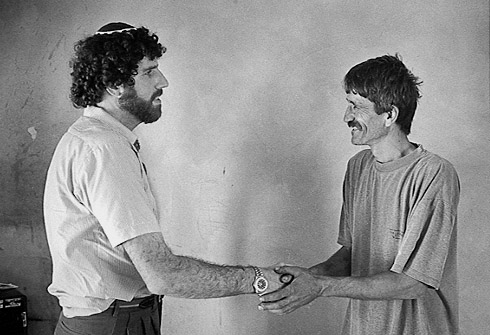
Other Scenes: Shaking Hands, Palestine, 1998. Rabbi Arik Ascherman, co-director of Rabbis for Human Rights, shakes hands with Atta Jabber in Atta’s home near Hebron. Rabbi Ascherman often goes to visit Palestinians who have received home demolition orders in order to offer his moral support and sometimes to be arrested peacefully opposing such disrespect for his fellow human beings. Photo by Alan Pogue / The Rag Blog.

‘No good deed goes unpunished’: A cautionary tale of east Austin
By Alan Pogue
/ The Rag Blog / May 3, 2008

Rag Blog contributor Alan Pogue was staff photographer for The Rag, Austin’s legendary underground newspaper, in the late sixties and seventies, and has served in the same capacity for The Texas Observer. He began his career while serving in Vietnam in 1967. He later documented Texas farm workers and has photographed in Texas prisons, in Cuba, in Iraq and Pakistan, in Latin America and the Caribbean. His book Witness for Justice was published by the University of Texas Press.

Alan’s work has often placed him in physical danger but, as it turns out, none as dangerous as the corner of Chicon and Rosewood in east Austin, Texas.

A few nights ago I stopped to help a woman who was being beaten badly by two other women. It was 11 p.m. on Chicon and Rosewood in east Austin. I got the two women off the one on the ground but the pimp for the two women (I hypothesize) snuck up from behind and sapped me. I had to spend a few hours at St. David’s and then Brackenridge hospitals so they could scan my head and put a few stitches in my face. I will recover fully but I will require a bit more surgery on my right eye socket, an “orbital floor fracture”.

Looking on the bright side, the pimp didn’t shoot or stab me. My wallet was taken but somebody found it and called me so I got my ID and checks back. This character was smart enough not to try and cash them. The EMS and emergency people said this type of assault is on the rise. They told me about a man who stopped to help someone with a flat tire only to be beaten very badly. Bad times for good Samaritans, so watch out.

I’ll be back on the job in the middle of next week if all the surgery goes according to plan. I am ok with soup and ice cream. Someone gave me a fine bottle of Scotch but I will have to wait to drink it.

It could be that the beaten woman was on the other women’s turf and the pimp sent them over to run the third woman off. The beaten woman was very thankful to me. We both answered questions put to us by the police. The pimp was upset that I stopped the beating and wanted to show that he was still in charge. After I was assaulted I drove a short distance to my home and splashed water on my face to check myself out. When I returned to the scene the EMS and police were there. I will work with the detective on the case and try to talk to the woman I kept from further injury. There is the possibility that she too was in on a decoy action. I will know she is not if she was willing to identify the women and/or the pimp.

Darn it, I didn’t have a camera on me because it was a short trip to pick up a book to read, “Can Humanity Change?” by Khrishnamurti, kind of ironic. While taking it easy, as my face returns to its normal shape, my mind looks to the wider social context.

Drug dealing and prostitution are a big feature of the stretch of Chicon between Rosewood and MLK in Austin. There are also many churches in the area. Yet the churches do not minister to those most in need. The epicenter of the drug trade, for the impoverished, is 12th and Chicon. This has been the case for decades, sort of an informal red light district. Indigenous eastsiders have been complaining about this crime scene for many years. The police cruise the area frequently but there seems to be no coordinated social services plan to address the problem at its root. Surprise!. No kind and creative approach has been used. Only a minimalist military mind set has been used by the Austin police to maintain an uneasy status quo for this drug district.

The vacant lots are being filled up with new home construction so the territory for illegal activity is shrinking. Much of it has moved down the alley between 12th and 13th off of Chicon. Some truly dangerous characters hang out in that alley (I spotted a fellow with a 12 gauge pump shotgun under his trench coat), so I have not taken to documenting the culture. The open solicitation for drugs and prostitution rises and falls in an unpredictable tide but the activity is constant. Red is the color of the dominant gang so one sees red pants, red caps, red sweat shirts. This level of organization means that there are other people involved who aren’t there.

I see younger people hanging out at the few public coin-operated phones to take drug orders and pass them on to older people. As Jesse Jackson said, “Fourteen year-olds on street corners are not importing drugs. Bankers are importing drugs.”

Many of the people I see at 12th and Chicon are mentally and /or physically impaired. Old people in wheel chairs often sleep on the street in their wheelchairs. More than once I have been offered sex by psychotic homeless women. In the past none of these people has ever done more than offer me drugs or sex. Once I declined they did not persist. Most of the solicitation is done with subtle eye contact so I have learned not to wave back or make eye contact with the solicitors.

In breaking up a fight among three women I stepped into their culture in a big way. The problem all around is that gentrification is forcing two cultures to overlap. I didn’t see “three prostitutes” fighting over territory, I saw one woman being beaten by two other people. They and the pimp made their activity very public in a new overall environment. I wish for the kind and creative approach but as we have seen in Waco and Eldorado, “Shock and Awe” seem to be the only tactics the authorities care to use. When the territory shrinks a bit more”something will have to be done” about what has been ignored for years. The East Side has been the recipient of planned neglect until such a time that it was worthy of being taken over by the West Side and the real-estate interests, both east and west.

I will try and look into the situation for the young woman I saved from a worse beating than she got. Her story should cast light on many forms of neglect in Texas which is always vying for last place in social services.

Go here for the original posting of Alan Pogue’s story on The Rag Blog on May 3, 2008

Also see Man gets 30 years in attack on photojournalist by Steven Kreytak / Austin American-Statesman / Nov. 6, 2008

Please visit Alan Pogue: Texas Center for Documentary Photography.

Find Witness for Justice: The Documentary Photographs of Alan Pogue by Alan Pogue, on Amazon.com.

The Rag Blog

Posted in Rag Bloggers | Tagged , , , , , , , | 1 Comment

Bailout : Idiots in Detroit Can’t Even Get an Electric Car Right

Electric Edsel? GM unveils the Volt.

‘At this point, since the Democrats in Congress and the White House are congenitally incapable of imagining a state-owned or partially state-owned enterprise, it would be better to just let GM go under.’
By Dave Lindorff / November 24, 2008

It’s a safe bet that within the next several months, Congress will vote to bail out General Motors. It will be a colossal boondoggle involving, probably, upwards of $50 billion when it’s through, and it will fail in the end.

The reason is before our eyes. This bloated megacorporation is being run by idiots.

For years, as it became evident to everyone that oil prices were going to soar because demand has been exceeding both production and supply and will continue to do so, it has been obvious that to succeed, a car company had to offer well-made cars that could demonstrate high gas mileage. GM, perhaps more than any other company, ignored that reality and has been paying the price, watching its share of the car market wither.

Now the company, worth about what Starbucks used to be worth, its stock now down to where it was in the depths of the Great Depression, has bet the farm on a new car, the Volt, which it promises will, two years from now, be able to go all of 40 miles purely on electric power. It will have a motor too, and not a small one, but rather one the size of what you get in a typical conventional Honda Civic—1.4 ltr. That motor wouldn’t drive the car; rather it would keep charging the Volt’s huge lithium-ion battery so the car could keep going for a few hundred miles.

Wow.

The management wizards at GM obviously don’t do much driving. If they did, and found themselves in typical commuter traffic, they’d see that maybe 90% of the cars, or more, have only one person in them. Occasionally, they’d see a passenger. On a typical 45-minute trip from the burbs into Philadelphia at rush hour, I can count the number of cars I see with three or more people in them on my fingers.

So why is GM making the Volt as a full-sized four or five-passenger car? That’s not where the market for an electric car is. What is needed is a two-seater little car.

Because GM is trying to make an electric family car, they’ve made something so big that, if they are lucky, they’ll be able to get it to 40 miles on electric drive only, but at a cost in excess of $40,000 and perhaps much higher, which will put it out of almost everyone’s reach. The car is destined to be a bust.

And yet, because President-elect Obama will want to win Michigan next election, and because Congressional Democrats don’t want to be seen as ignoring the fate of GM’s workers, GM will be bailed out and the Volt will be funded right through to its introduction and subsequent disaster in the market.

I’m not opposed to the idea of government support of industry, but that support has to involve government input or even control over decision-making.

Maybe GM wouldn’t make much profit on a little electric commuter car, but a little two-seater electric commuter car would have a huge impact on reducing the output of hydrocarbons into the atmosphere, particularly if efforts were made to increase solar and wind-generated electricity. A small electric commuter car would also massively reduce the amount of oil the US imports, making a major contribution to reducing the nation’s trade deficit. Those are results that justify a bailout.

Making an overpriced electric family car is not.

At this point, since the Democrats in Congress and the White House are congenitally incapable of imagining a state-owned or partially state-owned enterprise, it would be better to just let GM go under, and maybe Ford too, if it comes to that (another stupid company). The pieces could be sold off, and allowed to sink and swim on their own. Maybe one of those smaller, more entrepreneurial fragments would see the wisdom of developing what the public really needs.

The truth is that the entrepreneurs over at Tesla, a star-up in California, have already made that car—a high-performance two-seater commuter car that can go 200 miles on a charge and that doesn’t need an auxiliary engine. Their problem is that small size and too little capital have forced them to pimp it up into a high-priced luxury show-off item for rich people costing $100,000. If they were to team up with a GM spin-off—say Saturn—they could make a stripped-down version of that baby and crank out 100,000 of them to start at a price ordinary people could afford.

Meanwhile, regarding those poor autoworkers, they have a legitimate complaint. While Republicans like to blame the auto industry’s problems on them, saying they have demanded too much pay, and too much in healthcare benefits, it’s not their fault that GM and Ford executives have been stupid and greedy and short-sighted (besides, the high wages and benefits that the United Auto Workers won over decades of bitter struggle helped to set standards that raised the wages of all workers across the nation). But let’s do the math. There are about 125,000 unionized hourly workers at the two companies. For a lousy $8.7 billion, every one of those people could receive a $70,000 buyout from Congress. Double that if you want to give them two years to adjust and find new work at an electric car plant or something else. That would cost $17 billion, or less than half of what the doomed bailout of GM is going to end up costing.

And of course, with the rest of us suffering from the massive mismanagement of the nation’s economy by its corporate leaders and their puppets in Washington, there’s no reason why our tax dollars should be subsidizing those particular workers tat that high a level. After all, companies are failing and will be failing all over the place, without such largesse. Besides, if the bailout goes ahead, all it will do is delay the time these workers will be out on the street anyhow.

The point is, however, there are more cost-effective ways to help out workers in failing businesses than to have the government simply subsidize the continued operation of enterprises that have been destroyed by management. In truth, all the talk in congress and in the Obama camp about rescuing jobs is just a cover for bailouts that are really aimed at rescuing managers and investors, not workers.

[Dave Lindorff is a Philadelphia-based journalist and columnist. His latest book is “The Case for Impeachment” (St. Martin’s Press, 2006 and now available in paperback edition.) His work is available at www.thiscantbehappening.net. ]

Source / counterpunch

The Rag Blog

Posted in RagBlog | Tagged , , , , , | 1 Comment

Type your summary here


Type rest of the post here

Source

The Rag Blog


Posted in RagBlog | Leave a comment

Obama and a Brave New World : Governing a Netroots Nation

Obama addresses journalism convention in July, 2008. Photo by Jennifer Dronkers / Unity News.

‘Obama isn’t just trying to make government more transparent by posting online videos of himself or his transition team’s doings. He is attempting to organize his campaign supporters into a political force that he can tap in tough times.’
Joe Garofoli / November 24, 2008

During the campaign, the Obama team showed how new media tools can be used to win the White House. Now, the president-elect’s advisers and allies are previewing how they intend to use the power of online organizing to govern.

The effort gained national visibility when President-elect Barack Obama started posting YouTube videos of his weekly national address, and it accelerated as the transition team and others solicited supporters’ ideas on what to do next with their “movement.”

Analysts say Obama isn’t just trying to make government more transparent by posting online videos of himself or his transition team’s doings. He is attempting to organize his campaign supporters into a political force that he can tap in tough times – like when he needs to go around Congress and the mainstream media for direct citizen support.

“Just like people hadn’t used the Internet in campaigning to this extent before, they haven’t really used it to govern before,” said Peter Daou, Internet strategist for Sen. Hillary Rodham Clinton. “The challenge here is trying to figure out how to use something that was used mostly for campaign advocacy – and use it in a way to advance policy.”

That’s tricky. A campaign runs on an adrenaline rush fueled by a deadline (election day), a person to rally against and the rush of daily polls. Shepherding policy through Washington is not as sexy, and now the candidate is president of all Americans – not just his supporters.

So on the grassroots level, the legions of Obama supporters who self-organized on social networking sites are reconvening to figure out what to do. Meanwhile, the incoming administration is trying to figure out how to engage its supporters and solicit their ideas – and continued support.

“Where they meet in the middle somewhere is where the energy will come from,” Daou said.

Those efforts intensified last week when Obama campaign manager David Plouffe asked the estimated 11 million members of Obama’s e-mail list what new ideas they had for the administration. Before asking supporters to complete a brief survey, Plouffe wrote, “Your hard work built this movement. Now it’s up to you to decide how we move forward.”

The survey asked supporters “how they would like to be engaged” and to rank the importance of “goals for this movement” such as “Helping Barack’s administration pass legislation through grassroots efforts” and “training volunteers in the organizing techniques we used to elect Barack.”

MoveOn’s efforts

The efforts extend beyond the official Obama organization.

On Thursday night, MoveOn.org – whose members supported Obama – held more than 1,200 offline “Fired Up and Ready to Go” parties. The point of the gatherings, according to an invitation from MoveOn: “We’ll launch a new campaign to help Barack win big changes – like health care and clean energy.” The group will follow Thursday’s meetings with a day of personal lobbying on Capitol Hill and in congressional district offices Jan. 21, the day after Obama is sworn in.

The 5 million-member liberal online hub has seen its membership transformed this year. MoveOn gained 2 million new members in the past six months – 55 percent of them are not white. (Membership was 85 percent white before.) At least half of the newcomers are under 35, said executive director Eli Pariser.

Unlike past political campaigns, where voters returned home after casting their ballots and waited for politicians to deliver results, many Obama supporters are looking for ways to continue to provide their input and offer help.

“It’s clear to MoveOn members that they want to continue to focus on a few core issues,” Pariser said.

In addition to posting the president-elect’s weekly addresses on YouTube, the Obama transition team is posting snippets that describe the activities of some of its transition groups. A three-minute video titled “Inside the Transition: Energy and Environment Policy Team” that recently appeared may not sound like scintillating viewing, but it does give viewers a peek into the mind-set of the incoming government.

“He doesn’t have to wait for CBS to use four seconds of one of his speeches as a sound bite in a story. He can send his full comments directly to his supporters – and everyone else,” Pariser said.

But Obama’s early efforts on YouTube have not been in the two-way spirit of new media communication – comments are not accepted, although people can repost the videos or embed them elsewhere and start their own conversation threads.

“I’m not sure of the strategy behind that,” said Steve Grove, YouTube’s head of news and politics. “They’re probably trying to feel out how it will work.”

If the Obama administration is anything like the Obama campaign, Grove predicts it will produce a prolific amount of video. He wouldn’t be surprised if Cabinet officials and other top administration leaders began posting videos, too. And, even though “day-in-the-life” videos may be hackneyed, Grove said there would be an audience for such a behind-the-scenes peek at the White House.

Obama’s YouTube channel had more than 1,800 videos during the campaign, and they were viewed 110 million times. Many posted after September were seen upward of 50,000 times each and more than a dozen were seen at least 1 million times.

“Their user base has come to expect a certain level of accessibility,” Grove said. “But the challenge will be to find that sweet spot now that they’re governing. There has to be a certain imprimatur and gravitas when the president of the United States is involved.”

‘Craigslist for service’

There’s no shortage of other ideas on how to engage people online. During the campaign, Obama officials talked about ways to create a “Craigslist for service” – where people interested in doing some sort of public service or volunteering could be connected with a need in their community. Others have spoken about video streaming all open government meetings. Daou said to expect a lot of “trial and error over the next few months as the White House sees what works.”

“What’s most important is that he makes government more transparent,” said Raven Brooks, executive director of Netroots Nation, the annual conference of bloggers and online activists that grew out of the popular DailyKos political blog.

Brooks’ idea: He would love to see Obama – or more likely an aide – use the social networking tool Twitter to update citizens on what he is up to throughout the day. “He wouldn’t have to be giving away state secrets or anything, but maybe something like, ‘I just met with Paul Volcker and we talked about monetary policy.’

“Now, the average voter is not a political junkie, and may not be interested in that level of minutiae, but I think a lot of people would appreciate the effort to communicate,” Brooks said.

A spokesman for the Obama transition team said of its new media strategy, “Unfortunately, we’re not ready to discuss further details at this time.”

Perhaps the details will be posted first on YouTube.

Source / SF Gate

The Rag Blog

Posted in RagBlog | Tagged , , , , , , | Leave a comment

Sodomites! : Bigotry on the Bus

‘The bus driver surveyed the situation and exclaimed, loud enough for the passengers to hear, “sodomites!”‘
By Dan Wentzel / November 24, 2008

A week after the election, I was riding the bus home in Santa Monica when we went past one of the many protests around the city against the narrow passage of Proposition 8, which amended the California constitution to eliminate marriage rights for an entire class of people.

The bus driver surveyed the situation and exclaimed, loud enough for the passengers to hear, “sodomites!” I’ve been so hurt and angry since my theoretically liberal and gay-friendly state passed Proposition 8 that I instantly replied, just as loudly, “Hey, I’m one of those sodomites, too!” Maybe I should have had a snappier comeback, but the driver was stunned. I’m guessing that nobody had ever stood up to him for saying something homophobic. The driver has a right to free speech and is entitled to his beliefs and opinions — and his bigotry — just like everyone else. However, he was a public employee in uniform, on the clock.

Once upon a time, I might have been too scared to say something, or I’d have just grumbled in silence. No more. In my anger, I wanted to immediately report the driver to the transit authority. But I found myself with a moral dilemma. What if this person was fired as a result of my complaint? These are tough economic times. Would he find another job? What if he was just having a really bad day? So for two days I thought about whether to report the driver.

I realized that in a post-Proposition 8 world, it is not okay for me to enable anyone’s bigotry with my silence. If he had said the “n” word or the “k” word or something else offensive regarding someone’s race, gender or religion, there would have been no question about whether to report him. But gay men and lesbians are no longer willing to be doormats. It is no longer acceptable for people to say bigoted and hateful things about gays or anyone else in front of me. This behavior has to stop now.

If the bigots thought they would slap down gay men and lesbians by passing Proposition 8, or if they thought it would end the gay civil rights movement, they were mistaken. I haven’t seen the gay community this galvanized in a long time. The passage of Proposition 8 might be this generation’s “Stonewall,” the 1969 riot that began after an unprovoked police raid on a gay bar in Greenwich Village and that marked the start of the gay rights movement. If we can somehow harness the energy unleashed by California’s Proposition 8 vote, we can achieve tremendous gains for us and for future generations of gay men and lesbians.

One of the most gratifying aspects of attending “No on 8” rallies was the number of straight demonstrators who showed up — people who see this not just as an issue for gay men and lesbians but as a matter of everyone’s civil rights.

So I finally stood up for myself and reported the driver to the transit authority. If someone were to say something racist, sexist or antisemitic, I would say something, even though I am white, male and non-Jewish. But I wonder, when a homophobic remark is made in a conversation among straight people, whether anyone is willing to say, “That’s not appropriate and I find that offensive.” I don’t know, but I hope so.

I am sorry I had to report the bus driver, because I’m sorry that the incident happened. However, if I won’t stand up for myself now, who else will stand up for me? The world has changed. No more Mr. Nice Gay. We are all in a post-Proposition 8 world now.

[Dan Wentzel is an actor and writer living in Southern California.]

Source / Washington Post

The Rag Blog

Posted in RagBlog | Tagged , , , , , | 3 Comments

Dubya on Iraq : Oh What a Beautiful War

Springtime for Hitler from The Producers.

Mission Accomplished: Bush tells Japanese television he’s ‘very pleased’ with the Iraq War.
November 23, 2008

US President George W Bush believes the Iraq war has been successful and is “very pleased” with what is happening there, he said in a pre-recorded interview broadcast on a Japanese television network on Sunday.

“I think the decision to remove Saddam Hussein was right,” Bush told the Sunday Project program of the private Asahi network.

Saddam was an enemy of the United States and a lot of people thought he had weapons of mass destruction, Bush said, adding “remarkable” progress had been made in Iraq since the late dictator was toppled in 2003.

“People have been able to take their troops out of Iraq because Iraq is becoming successful. I’m very pleased with what is taking place there now,” he said, adding there still is “a lot of work” to be done.

“We are bringing troops home because of the success in Iraq. But Iraq is not yet completely safe.

“So there will be a US presence for a while there at the request of the Iraqi government,” he said.

“The United States is willing to continue to help. Most countries there within a very broad coalition have come home but we want to help this government,” he said without further elaborating.

The Japanese network said the interview was conducted in Washington just before Bush left for Asia-Pacific talks in Peru at the weekend.

The Bush presidency has been indelibly marked by the Iraq war, from the invasion spurred by false allegations that Saddam was harbouring weapons of mass destruction to the abuses by US troops of Iraqis in the Abu Ghraib jail.

Some 4,200 US soldiers have been killed in the country in a war which has also cost the US hundreds of billions of dollars.

The war was also a dominant theme of the 2008 White House race, with president-elect Barack Obama vowing to bring home the forces within 16 months.

Source / AFP / The Age, Au

The Rag Blog

Posted in RagBlog | Tagged , , , | Leave a comment