GOP Rallies : Conservatives Go Ballistic

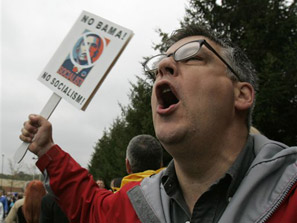
A McCain supporter yells at Obama supporters before McCain and Palin arrive at a rally, Oct. 8, 2008, in Strongsville, Ohio. Photo by AP.

McCain campaign riling up base by ‘ratcheting up fears and frustrations.’
By Jonathan Martin / October 10, 2008

The unmistakable momentum behind Barack Obama’s campaign, combined with worry that John McCain is not doing enough to stop it, is ratcheting up fears and frustrations among conservatives.

And nowhere is this emotion on plainer display than at Republican rallies, where voters this week have shouted out insults at the mention of Obama, pleaded with McCain to get more aggressive with the Democrat and generally demonstrated the sort of visceral anger and unease that reflects a party on the precipice of panic.

The calendar is closing and the polls, at least right now, are not.

With McCain passing up the opportunity to level any tough personal shots in his first two debates and the very real prospect of an Obama presidency setting in, the sort of hard-core partisan activists who turn out for campaign events are venting in unusually personal terms.

“Terrorist!” one man screamed Monday at a New Mexico rally after McCain voiced the campaign’s new rhetorical staple aimed at raising doubts about the Illinois senator: “Who is the real Barack Obama?”

“He’s a damn liar!” yelled a woman Wednesday in Pennsylvania. “Get him. He’s bad for our country.”

At both stops, there were cries of, “Nobama,” picking up on a phrase that has appeared on yard signs, T-shirts and bumper stickers.

And Thursday, at a campaign town hall in Wisconsin, one Republican brought the crowd to its feet when he used his turn at the microphone to offer a soliloquy so impassioned it made the network news and earned extended play on Rush Limbaugh’s program.

“I’m mad; I’m really mad!” the voter bellowed. “And what’s going to surprise ya, is it’s not the economy — it’s the socialists taking over our country.”

After the crowd settled down he was back at it. “When you have an Obama, Pelosi and the rest of the hooligans up there gonna run this country, we gotta have our head examined!”

Such contempt for Democrats is, of course, nothing new from conservative activists. But in 2000 and 2004, the Republican rank and file was more apt to ridicule Gore as a stiff fabulist or Kerry as an effete weather vane of a politician.

“Flip-flop, flip-flop,” went the cry at Republican rallies four years ago, often with footwear to match the chant.

Now, though, the emotion on display is unadulterated anger rather than mocking.

Activists outside rallies openly talk about Obama as a terrorist, citing his name and purported ties to Islam in the fashion of the viral e-mails that have rocketed around the Internet for over a year now.

Some of this activity is finding its way into the events, too.

On Thursday, as one man in the audience asked a question about Obama’s associations, the crowd erupted in name-calling.

“Obama Osama!” one woman called out.

And twice this week, local officials have warmed up the crowd by railing against “Barack Hussein Obama.”

Both times, McCain’s campaign has issued statements disavowing the use of the Democrat’s full name.
A McCain aide said they tell individuals speaking before every event not to do so. “Sometimes people just do what they want,” explained the aide.

The raw emotions worry some in the party who believe the broader swath of swing voters are far more focused on their dwindling retirement accounts than on Obama’s background and associations and will be turned off by footage of the McCain events.

John Weaver, McCain’s former top strategist, said top Republicans have a responsibility to temper this behavior.

“People need to understand, for moral reasons and the protection of our civil society, the differences with Sen. Obama are ideological, based on clear differences on policy and a lack of experience compared to Sen. McCain,” Weaver said. “And from a purely practical political vantage point, please find me a swing voter, an undecided independent, or a torn female voter that finds an angry mob mentality attractive.”

“Sen. Obama is a classic liberal with an outdated economic agenda. We should take that agenda on in a robust manner. As a party we should not and must not stand by as the small amount of haters in our society question whether he is as American as the rest of us. Shame on them and shame on us if we allow this to take hold.”

But, if it were up to them, such hard-edged tactics are clearly what many in the party base would like to use against Obama.

That McCain has so far seemed reluctant to do so has frustrated Republicans.

“It’s time that you two are representing us, and we are mad,” reiterated the boisterous Republican at McCain’s town hall in Wisconsin Thursday. “So go get ’em!”

“I am begging you, sir, I am begging you — take it to him,” pleaded James T. Harris, a local talk radio host at the same event, earning an extended standing ovation.

“Yosemite Sam is having the law laid down to him today in Waukesha, Wis.,” quipped Limbaugh on his show Thursday, referring to the GOP nominee. “This guy, this audience member, is exactly right,” the conservative talk show host said of the first individual.

“You are running for president. You have a right to defend this country. You have a responsibility to defend this country and not just fulfill some dream you had eight years ago running for president against Bush. It’s time to start naming names and explain what’s actually going on, because, Sen. McCain, the people of this country are dead scared about what we face if you lose.”

John J. Pitney Jr., a political science professor at California’s Claremont McKenna College and former Republican operative, suggested core Republicans were acting out their longstanding frustrations with their self-proclaimed maverick nominee.

“McCain has always frustrated the Republican base,” Pitney said. “In this campaign, he has alternated between partisan attacks and calls for bipartisan cooperation. It’s nice that he thinks he can round up congressional votes the way a border collie rounds up sheep. But you can’t be a border collie and a pit bull at the same time. The crowds want a pit bull.”

There is also the belief that taking out Obama is the only way to win.

“They know that when McCain has taken off the Senate mantle and put the stick to Obama (celebrity ad, as a case in point), we get movement in the polls,” said Rick Wilson, a GOP consultant not working on the presidential race. “They want McCain to call out Obama — on the Fannie/Freddie mess, on Wright, on Ayers, on guns, on [the Association of Community Organizations for Reform Now] — because they know that if McCain says it, it penetrates the MSM filter. … Only McCain and Palin can really drive that message.”

The two have begun to get more aggressive on many of these topics, with both discussing Ayers in multiple venues Thursday. The RNC is also going up for the first time with an ad featuring the former domestic terrorist.

It was enough to stir hope that McCain may stay on the offensive, even in Limbaugh, who has often criticized the Arizona senator for working with Democrats more than attacking them. The radio host praised his sometimes-nemesis for singling out Rep. Barney Frank (D-Mass.) and Sen. Chris Dodd (D-Conn.) as partly responsible for the credit crisis.

“McCain/Palin fired back today in Waukesha, and 15 years of frustration is coming out joyously in the voices of GOP supporters at these rallies,” Limbaugh wrote in an e-mail, arguing that Republicans were fed up with having been portrayed as the bogeyman for myriad issues since the Clinton years.

But to the exasperation of many in the party, Obama’s pastor, the most damning of all his associations, remains off-limits, at the express desire of McCain. Palin ignored Wright and focused on Ayers when she was asked about the two in an interview Thursday with conservative talk show host Laura Ingraham. And McCain focused on Ayers only when he was asked an open-ended question at the town hall about Obama’s “associations.”

“It is a shame McCain took Wright off the table,” lamented one prominent Republican operative not working on the race. “He is a legitimate issue, and we may look back and realize he was the issue that could have changed the race.”

For now, though, party members don’t seem to be looking back with regret as much as fearing what lies ahead.

“McCain is behind in the polls, and the Republicans have no chance of regaining control of Congress,” Pitney noted. “Republicans are facing the prospect of unified Democratic control of the government for the first time since the first two Clinton years. And even then, Clinton’s agenda had moderate elements (e.g., [the North American Free Trade Agreement] and deficit reduction). With Obama, [Senate Majority Leader Harry] Reid and [House Speaker Nancy] Pelosi in power, Republicans worry about a hard push for a hard-left agenda.”

Source / Politico

Thanks to CommonDreams / The Rag Blog

Posted in RagBlog | Tagged , , , , , | Leave a comment

Chomsky: "Progressive Legislation and Social Welfare Have Been Won by Popular Struggles, Not Gifts from Above"


Anti-Democratic Nature of US Capitalism is Being Exposed
By Noam Chomsky / October 10, 2008

Bretton Woods was the system of global financial management set up at the end of the second World War to ensure the interests of capital did not smother wider social concerns in post-war democracies. It was hated by the US neoliberals – the very people who created the banking crisis, writes Noam Chomsky.

THE SIMULTANEOUS unfolding of the US presidential campaign and unraveling of the financial markets presents one of those occasions where the political and economic systems starkly reveal their nature.

Passion about the campaign may not be universally shared but almost everybody can feel the anxiety from the foreclosure of a million homes, and concerns about jobs, savings and healthcare at risk.

The initial Bush proposals to deal with the crisis so reeked of totalitarianism that they were quickly modified. Under intense lobbyist pressure, they were reshaped as “a clear win for the largest institutions in the system . . . a way of dumping assets without having to fail or close”, as described by James Rickards, who negotiated the federal bailout for the hedge fund Long Term Capital Management in 1998, reminding us that we are treading familiar turf. The immediate origins of the current meltdown lie in the collapse of the housing bubble supervised by Federal Reserve chairman Alan Greenspan, which sustained the struggling economy through the Bush years by debt-based consumer spending along with borrowing from abroad. But the roots are deeper. In part they lie in the triumph of financial liberalisation in the past 30 years – that is, freeing the markets as much as possible from government regulation.

These steps predictably increased the frequency and depth of severe reversals, which now threaten to bring about the worst crisis since the Great Depression.

Also predictably, the narrow sectors that reaped enormous profits from liberalisation are calling for massive state intervention to rescue collapsing financial institutions.

Such interventionism is a regular feature of state capitalism, though the scale today is unusual. A study by international economists Winfried Ruigrok and Rob van Tulder 15 years ago found that at least 20 companies in the Fortune 100 would not have survived if they had not been saved by their respective governments, and that many of the rest gained substantially by demanding that governments “socialise their losses,” as in today’s taxpayer-financed bailout. Such government intervention “has been the rule rather than the exception over the past two centuries”, they conclude.

In a functioning democratic society, a political campaign would address such fundamental issues, looking into root causes and cures, and proposing the means by which people suffering the consequences can take effective control.

The financial market “underprices risk” and is “systematically inefficient”, as economists John Eatwell and Lance Taylor wrote a decade ago, warning of the extreme dangers of financial liberalisation and reviewing the substantial costs already incurred – and proposing solutions, which have been ignored. One factor is failure to calculate the costs to those who do not participate in transactions. These “externalities” can be huge. Ignoring systemic risk leads to more risk-taking than would take place in an efficient economy, even by the narrowest measures.

The task of financial institutions is to take risks and, if well-managed, to ensure that potential losses to themselves will be covered. The emphasis is on “to themselves”. Under state capitalist rules, it is not their business to consider the cost to others – the “externalities” of decent survival – if their practices lead to financial crisis, as they regularly do.

Financial liberalisation has effects well beyond the economy. It has long been understood that it is a powerful weapon against democracy. Free capital movement creates what some have called a “virtual parliament” of investors and lenders, who closely monitor government programmes and “vote” against them if they are considered irrational: for the benefit of people, rather than concentrated private power.

Investors and lenders can “vote” by capital flight, attacks on currencies and other devices offered by financial liberalisation. That is one reason why the Bretton Woods system established by the United States and Britain after the second World War instituted capital controls and regulated currencies.*

The Great Depression and the war had aroused powerful radical democratic currents, ranging from the anti-fascist resistance to working class organisation. These pressures made it necessary to permit social democratic policies. The Bretton Woods system was designed in part to create a space for government action responding to public will – for some measure of democracy.

John Maynard Keynes, the British negotiator, considered the most important achievement of Bretton Woods to be the establishment of the right of governments to restrict capital movement.

In dramatic contrast, in the neoliberal phase after the breakdown of the Bretton Woods system in the 1970s, the US treasury now regards free capital mobility as a “fundamental right”, unlike such alleged “rights” as those guaranteed by the Universal Declaration of Human Rights: health, education, decent employment, security and other rights that the Reagan and Bush administrations have dismissed as “letters to Santa Claus”, “preposterous”, mere “myths”.

In earlier years, the public had not been much of a problem. The reasons are reviewed by Barry Eichengreen in his standard scholarly history of the international monetary system. He explains that in the 19th century, governments had not yet been “politicised by universal male suffrage and the rise of trade unionism and parliamentary labour parties”. Therefore, the severe costs imposed by the virtual parliament could be transferred to the general population.

But with the radicalisation of the general public during the Great Depression and the anti-fascist war, that luxury was no longer available to private power and wealth. Hence in the Bretton Woods system, “limits on capital mobility substituted for limits on democracy as a source of insulation from market pressures”.

The obvious corollary is that after the dismantling of the postwar system, democracy is restricted. It has therefore become necessary to control and marginalise the public in some fashion, processes particularly evident in the more business-run societies like the United States. The management of electoral extravaganzas by the public relations industry is one illustration.

“Politics is the shadow cast on society by big business,” concluded America’s leading 20th century social philosopher John Dewey, and will remain so as long as power resides in “business for private profit through private control of banking, land, industry, reinforced by command of the press, press agents and other means of publicity and propaganda”.

The United States effectively has a one-party system, the business party, with two factions, Republicans and Democrats. There are differences between them. In his study Unequal Democracy: The Political Economy of the New Gilded Age, Larry Bartels shows that during the past six decades “real incomes of middle-class families have grown twice as fast under Democrats as they have under Republicans, while the real incomes of working-poor families have grown six times as fast under Democrats as they have under Republicans”.

Differences can be detected in the current election as well. Voters should consider them, but without illusions about the political parties, and with the recognition that consistently over the centuries, progressive legislation and social welfare have been won by popular struggles, not gifts from above.

Those struggles follow a cycle of success and setback. They must be waged every day, not just once every four years, always with the goal of creating a genuinely responsive democratic society, from the voting booth to the workplace.

* The Bretton Woods system of global financial management was created by 730 delegates from all 44 Allied second World War nations who attended a UN-hosted Monetary and Financial Conference at the Mount Washington Hotel in Bretton Woods in New Hampshire in 1944.

Bretton Woods, which collapsed in 1971, was the system of rules, institutions, and procedures that regulated the international monetary system, under which were set up the International Bank for Reconstruction and Development (IBRD) (now one of five institutions in the World Bank Group) and the International Monetary Fund (IMF), which came into effect in 1945.

The chief feature of Bretton Woods was an obligation for each country to adopt a monetary policy that maintained the exchange rate of its currency within a fixed value.

The system collapsed when the US suspended convertibility from dollars to gold. This created the unique situation whereby the US dollar became the “reserve currency” for the other countries within Bretton Woods.

© 2008 The Irish Times

Noam Chomsky is professor emeritus of linguistics at the Massachusetts Institute of Technology. His writings on linguistics and politics have just been collected in The Essential Chomsky, edited by Anthony Arnove, from the New Press.

Source / Irish Times

The Rag Blog

Posted in RagBlog | Tagged , | 1 Comment

Sarah the Scoundrel : The High Art of Lying

Sarah Palin: Drive-by liar?

‘When a candidate repeatedly lies about herself and her accomplishments, the lies reflect profound character disorders.’
By Sherman De Brosse / The Rag Blog / October 10, 2008

See video of Sarah Palin defending the ‘Bridge to Nowhere’ during 2006 campaign for governor, Below.

Sarah Palin has set a new standard of mendaciousness in politics. Americans are usually only slightly annoyed when one candidate tells a flat-out lie about an opponent. Palin and McCain have taken this to a new level, repeating the same lies even after numerous fact checkers disprove their claims. But these are only lies about an opponent, so people think they do not reflect on the liar’s character. Maybe they are only white, excusable lies.

But when a candidate repeatedly lies about herself and her accomplishments, the lies reflect profound character disorders. Her claim to having initiated action to act on behalf of Darfur demonstrates a shocking opportunism and that she has no respect for truth.

It is no surprise that Governor Sarah Palin lied about the State of Alaska ending its investment in Sudan. She claimed that as soon as she learned of the Darfur situation she took the lead in the divestment cause. In fact, she ignored a 2007 postcard campaign aimed at getting her to act. Save Darfur people also met with her staff in 2007. She did nothing. The fact is that the Palin Administration openly stated its opposition to divestment in 2008 and prevented it from coming to a vote! This is what her deputy revenue commissioner said in a hearing:

The legislation is well-intended, and the desire to make a difference is noble, but mixing moral and political agendas at the expense of our citizens’ financial security is not a good combination

The hearing minutes are on line as of this date. State Representative Les Gara said that killed the bill. He said, “I walked out of that hearing livid.” The committee would not vote on divestiture. The Alaska Permanent Fund still had the $22 million invested in Sudan as of a few weeks ago.

Some say she has the power as chief executive to change the investment. In the debate, she said action will be taken when the legislature reconvenes.

She lied about when she knew about the problem and about taking leadership at the outset. Perhaps she came to see Darfur as a winning political issue a little belatedly and decided she could still claim this as a political feather.

She retained two clear lies in her standard stump speech long after they were disproven.

1.) She boasted that she told Congress “thanks but no thanks” on the Bridge to Nowhere. The fact is Congress pulled the plug on the bridge and she then reversed her position. She had supported it.

2.) She said she opposed earmarks. The fact is she zealously pursued them as mayor and is seeking them as governor.

There are other important questions to be raised.

3.) She said she did not use religion in her first campaign for mayor. In fact she criticized the incumbent for not going to church enough.

4.) She told Wasilla employees their jobs were safe, and then she set about firing six department heads.

5.) She told the police chief she was firing him because the NRA disliked him. Then she changed her story and said the man intimidated her.

6.) The evidence is clear that she wanted to censor books in the library and that she tried to fire the chief librarian for not going along with censorship. Then she said the discussion was only hypothetical.

How can we believe anything this woman says. Can we believe her denials about Troopergate when she did so much to block the investigation?

For whatever reason, she believes it is right for her to lie whenever it accomplishes her political purpose. Her distorted claim that Obama’s limited ties to William Ayers constitute proof of lack of patriotism remind us of the axiom that patriotism is the last resort of a scoundrel. Her own words prove that she is, indeed, a scoundrel.

Sherman De Brosse is the peudonym for a retired history professor who was once chased off the Ohio University campus for protesting the John Birch Society. He is a contributor to The Rag Blog and also blogs at Sherm Says and on DailyKos.

Sarah Palin defending the ‘Bridge to Nowhere’ during the 2006 election:

Also see Sarah Palin and Dominionism : Kingdom Now by Sherman DeBRosse / The Rag Blog / October 8, 2008

The Rag Blog

Posted in RagBlog | Tagged , , , | Leave a comment

The NSA DOES Spy on Innocent Americans


NSA Snooped on Innocent Americans’ Private Calls from Iraq, Former Operators Charge
By Ryan Singel / October 09, 2008

The National Security Agency routinely listened in on the intimate and innocent phone calls of Americans in Iraq, including government personnel, journalists and aid workers, as they called back into the United States, according to two former NSA operators who spoke to ABC News.

The accusations that the NSA routinely listened in on Americans’ phone calls contradicts the Administration’s repeated claims that its secret spying did not listen to any Americans other than suspected terrorists.

The conduct also appears to violate the rules that govern when the NSA can listen in to Americans’ making calls overseas — which then required high-level approval for each target.

The two operators, who ABC News say do not know one other, came forward after speaking with the foremost chronicler of the NSA, James Bamford, whose new book the Shadow Factory comes out on Tuesday.

ABC News reports:

“These were just really everyday, average, ordinary Americans who happened to be in the Middle East, in our area of intercept and happened to be making these phone calls on satellite phones,” said Adrienne Kinne, a 31-year old US Army Reserves Arab linguist assigned to a special military program at the NSA’s Back Hall at Fort Gordon from November 2001 to 2003.

Kinne described the contents of the calls as “personal, private things with Americans who are not in any way, shape or form associated with anything to do with terrorism.”

Another intercept operator, former Navy Arab linguist, David Murfee Faulk, 39, said he and his fellow intercept operators listened into hundreds of Americans picked up using phones in Baghdad’s Green Zone from late 2003 to November 2007.

Faulk says he and others in his section of the NSA facility at Fort Gordon routinely shared salacious or tantalizing phone calls that had been intercepted, alerting office mates to certain time codes of “cuts” that were available on each operator’s computer.

“Hey, check this out,” Faulk says he would be told, “there’s good phone sex or there’s some pillow talk, pull up this call, it’s really funny, go check it out. It would be some colonel making pillow talk and we would say, ‘Wow, this was crazy’,” Faulk told ABC News.

It’s not clear whether the allegations refer to the so-called Terrorist Surveillance Program that the Administration admitted to running after the New York Times revealed its existence in December 2005. The government describes that program as listening into phone calls where one end is outside the United States and where one party is suspected of being a terrorist. That program likely intercepted phone calls with help from American telecom companies.

The program described by the operators in the ABC News story likely collected the intelligence outside the United States.

Kinne’s allegations are not new — she’s been making them public for sometime as part of her involvement in the Iraq Veterans Against the War.

Adrienne Kinne IVAW – US spied on Americans “just in case”

If the allegations are true, they show that when the government secretly tossed aside the decades-old credo that the NSA doesn’t spy on Americans, it did not simply make one or two exceptions — it shredded the it.

ABC News says the head of the Senate Intelligence committee Jay Rockefeller (D-West Virginia) is disturbed by the news and pledges to look into it.

However, it fails to note that Rockefeller was the key lawmaker in this summer’s legislation that largely legalized the government’s formerly secret warrantless wiretap program and gave immunity to the companies that helped.

Source / Wired

The Rag Blog

Posted in RagBlog | Tagged , | Leave a comment

Ron Ridenour: Sounds of Venezuela, Part XI

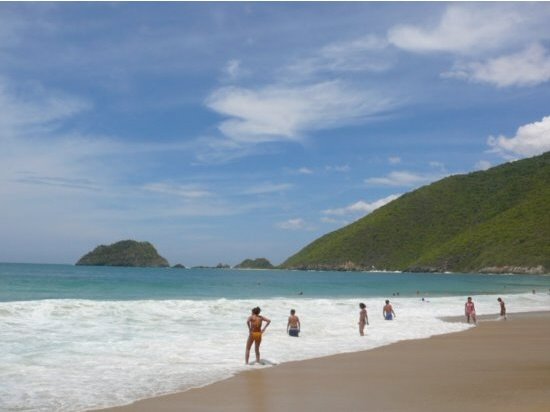
Ocumare de la Costa at Cata beach in Aragua state, one of hundreds of coastline beaches. Photo: Ron Ridenour.

Click here to view the entire series.

Sounds of Venezuela
Part XI: Ocumare de la Costa
By Ron Ridenour / The Rag Blog / October 10, 2008

Diego insisted that I take a relaxing trip to a resort area for ordinary Venezuelans called, Ocumare de la Costa, before I should leave. I must see and do something else than politics. He’d accompany me on the bus. Relaxing it wasn’t. The curves winding up a jungle mountain last for an hour as head and stomach sway. Some people can’t repress their breakfast from spewing over the bus floor. Although the distance from La Victoria is just 100 kilometers, it took three and one-half hours in two buses. But it was worth the dizzy ride.

Nothing fancy about the beaches or the small town of 10,000 inhabitants. The most talked about feature is the new therapeutic hospital with Cuban doctors. There are plenty of liquor stores, cafes serving beer, rum and fish, and lottery gambling stalls, which also sell bets on horse races. Profits go to government supported programs.

At one of the beachfront cafes, Diego asked around for a decent and inexpensive hotel for me. A local man guided us to Restaurant Los Nonnos, an Italian restaurant with a guest house. I was the only guest in this house spacious enough for eight persons. I had use of the kitchen and a good double bed.

Diego did not want to stay after our fish soup lunch. He did not care for swimming and he wanted to rejoin his lover for the weekend. So he returned and I went for a swim. The salt water felt good on my skin. I stayed inside the reef, which crossed parallel to the beach about four hundred meters out, stretching from large boulders spilled into the sea from the mountain range. Cata beach is thus enclosed. At peak times about 100 people were on the beach. Most are fearful of the small waves and do not bathe unless the water is calm. This is not a surfers’ beach nor is it an environmentalist haven. Trash lay everywhere despite several trash barrels placed about, which remain empty or nearly so.

I walked a kilometer down the beach, skirting trash, to La Boca. Here, at The Mouth, was fishermen’s turf. There were dozens of small two-man motor boats docked or returning from the day’s fishing. They didn’t bring in many fish but each boat had a share of some of the best tasting fish in the world: dorado, aguja, bonito, pargo. The golden dorado, which weigh from 10 to 20 kilos, and the smaller red snapper (pargo) are my favorite. There were no fancy restaurants but numerous beachfront cafes or even stands that served grilled fish and cold beer.

As the sun sat glowing red, I watched the last boat return with an unusual shark. It was two meters in length. No one knew its name but one man called it “pure water”, because once cut open most of its 40 kilos proved to be nothing but water.

In the evening, I drank beer on Cata beach and watched the women. They were not bashful but were not after a quick sexual encounter either. Women in this country are definitely independent, strong, feminists without hatred of men from what I saw here and in three municipalities I explored and in three visits to Caracas. During the day, many walk on and near the beach in g-strings. Most women normally dress so that their breasts and thighs are high-lighted. But I got no sensation that their display of flesh is meant to entice men, but rather is an expression of liberty and for comfort in this sun-baked land.

The next day, the water was calm and came above the reef line. I knew it was risky but I dared myself to swim over it. Remember the dare devil boy-wants-to-be man syndrome in our youth? I haven’t quite gotten over that even when alone with no one to impress how manly I am. Maybe I do this because I don’t want to be encumbered. The open sea is most inviting, and I had my snorkel and mask so maybe I could see some large fish.

I floated cautiously over the sharp-pointed reef, about three to four meters wide and into freedom. The feeling that I can do it propels me more than common sense. After a fruitless search for fish yet having showed myself that “I can still do it at my age” I turned back toward the beach. Though the current was not strong I had neglected to take into account that ebb and flow directions make a difference. As I approached the reef the current pushed me forward. I could not control my body entirely. As I lay flat above the reef, the inward current forced my legs downward. I could only manage to resist with one, the other foot scraped upon a reef. I ignored whatever damage may have been caused and swam to the beach with decreasing lung capacity.

Once upon the sand, I saw blood running from the gash alongside my big toe. I collected my shirt and short pants and hobbled up the beach to a police station, which fortunately was no more than a couple hundred meters away. A policewoman gave me toilet paper to hold over my bleeding foot. She asked for identification but I had left it at the hotel. I only had a few Bolivars in my pocket. She and another policeman drove me the 10 kilometers to the Ocumare town emergency clinic. The hospital did not treat wounds.

I hobbled into the clinic as the police watched, ready to help if needed while respectful of do-it-yourself life approach whenever possible. There were a handful of patients but no waiting line. A nurse immediately guided me into a treatment room and the police departed. In the ensuing half-an-hour, three nurses and a doctor—all Venezuelan women—looked in on me. My foot was washed and I was given an anesthesia prior to being stitched. They all asked what had happened to my foot. Nurses, and the doctor, Dalia, about 55 years old, laughed as I explained my discovery that ocean waves and currents are stronger than my macho attitude.

Despite the anesthesia, it was still painful as Dalia sewed eight stitches through five centimeters of skin tightened over foot bone. They gave me another shot and asked me to sing. I am a terrible singer and know no songs but I managed to recall from my teenage years in Brazil a couple verses of a song about cachaza (a sugar cane pure brandy).

The medical workers appreciated my self-critique and humor. I appreciated their skill and affectionate care. After I was bandaged, the doctor had to fill out a brief form. It did not matter that I had no ID. Dalia just wrote down my name, age, the nature of injury and treatment. She wrote out a prescription against infection and swelling, and then told me:

“I love this revolution. I am a Colombian forced to flee 35 years ago. These past nine years have been most wonderful. Never before has a president cared for his people as does Chavez. He is almost too good,” she said, adding that his big heart causes some people to enshroud themselves in a sense of worthlessness.

There was no fee, not even for foreigners, and no papers for me to fill out. I later asked at a La Victoria private clinic what this would have cost: at least 100BF. I asked why people still came for private treatment when government health care was free.

“Oh, our services are better, and we are quicker. The government hospitals and clinics are not as good as private ones and they are all full,” the receptionist replied.

It was only two hundred meters from the Ocumare clinic to the pharmacy where I paid 6BF, less than $3, for the pills. Within a few minutes, I caught a taxi back to the beach town where I sat at a café table on the sand and ate the day’s catch — dorado — and drank my name. Ron in Spanish means rum.

As I watched the sun set, I felt content and wiser. Through this accident, one I unnecessarily caused, I had learned first hand how well the new health care system functions. The emergency service clinics, and the 2,700 community health centers constructed in five years, part of the Barrio Adentro Misión (Inside the Barrio Mission), has profoundly improved the health and welfare of more than half the nation not previously covered by medical care. Three thousand more health centers are under construction, according to the ministry’s August 2008 figures. True, many of the old hospitals are deteriorated and there is not uniformly accessible, excellent health care everywhere, but how can the right-wing make that an issue against the current government when they did nothing for the people’s health care when they ruled Venezuela.

Two days later, I splurged on a taxi to the airport, about a two-hour ride from La Victoria, depending on the traffic. The night before, I’d said my farewells to my new friends. Over the course of my time here they had all warned me about watching my back and my wallet. Maybe I was lucky, maybe careful enough but I was never attacked or robbed, and no one had short-changed me in the entire time.

The airport was packed, five long lines waited to pass through the first check-in. In all, our baggage was checked three times, and our persons once or twice. There were the civilian airline checkers, the customs, and the National Guard specializing in drug detection. When my flight was called and my ticket checked, I was asked to stand aside. Eventually, three young women from three countries were also standing aside. We were escorted outside near the aircraft where National Guardsmen opened our bags in our presence. We were politely told that the cameras and scanners can not always see everything in the bags so they make personal checks for drugs.

“We haven’t found anything today in this type of check. But yesterday, we confiscated 10 suitcases of cocaine destined for Mexico,” a young guardsman told me.

“You know,” he continued, “we confiscate and capture thousands of kilos every year and burn them—mostly cocaine, but also some heroin and marijuana. I wonder what President Bush would think if he knew how hard we work at stopping drug trafficking, almost all of which originates in Colombia not in our country.”

Drug free, we were boarding the plane but not before we were patted down at the entrance. Fortunately, I had put Diego’s advice into practice. I would not buy a commercial deodorant with which to swathe my armpits but I did apply a blend of lime juice and sodium carbonate, something Diego’s mother used long ago. So I did not offend the nostrils of the guards when I raised my left arm, clenched my fist and shouted the new sound of Venezuela: No volverán, the Empire and Oligarchy will not return.

The End

The Rag Blog

Posted in Rag Bloggers | Tagged | 1 Comment

Cleese Does Hannity. And Good…

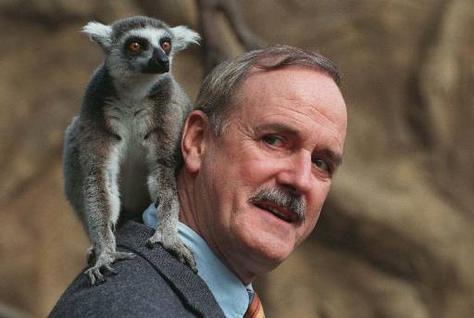
John Cleese, shown with Sean Hannity. Madagascar photo by rodeime.

It’s a beautiful poem from the comedy icon of Monty Python fame that perfectly captures the essence of Sean Hannity.

Ode to Sean Hannity
by John Cleese

Aping urbanity
Oozing with vanity
Plump as a manatee
Faking humanity
Journalistic calamity
Intellectual inanity
Fox Noise insanity
You’re a profanity
Hannity

Source / Bademus / Talking Points Memo / October 8, 2008

Thanks to Larry Piltz / The Rag Blog

Posted in RagBlog | Tagged , , , , | Leave a comment

Cholera in Iraq: A Result of Government Corruption

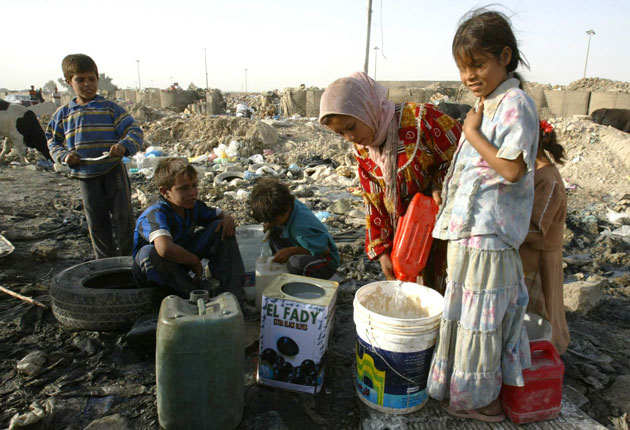
Children fill water containers in a former Baghdad army base, now a slum. Cholera has infected many supplies. Photo: AFP/GETTY IMAGES

Corruption blamed as cholera rips through Iraq
By Patrick Cockburn / October 10, 2008

BAGHDAD — A deadly outbreak of cholera in Iraq is being blamed on a scandal involving corrupt officials who failed to sterilise the local drinking water because they were bribed to buy chlorine from Iran that was long past its expiration date.

The centre of the epidemic is in Babil province, south of Baghdad, in the marshy lands east of the Euphrates river, not far from the ruins of ancient Babylon. In Baghdad, where half the six million population has no access to clean drinking water, people are now drinking only bottled or boiled water.

The Iraqi Prime Minister, Nouri al-Maliki, has appointed a commission of inquiry to find out why ineffective chlorine was being used. He is also refusing to release three officials under arrest despite demands from the Islamic Supreme Council of Iraq (ISCI) to which they are linked. In the town of al-Madhatiya, in southern Babil, a councillor involved in buying the chlorine was reportedly released after militiamen connected to ISCI intimidated police into freeing him.

The scandal over the contract is becoming a test case of the Maliki government’s willingness to tackle the pervasive corruption in Iraq where officials see their jobs primarily as a way of enriching themselves through bribes. It is also a test of his ability to exercise central control over ISCI and parties which have been hitherto dominant outside Baghdad.

Cholera is endemic in Iraq but last year there was an epidemic in northern Iraq which was far more serious than anything seen for years. Some 4,700 people, mostly in Sulaimaniyah province, were struck.

This year, the government hoped to stop another outbreak of the disease by repairing shattered water and sanitation stations and putting chlorine in the water supply. An Iraqi government official, who did not want his name published, said the Health Ministry bought $11m (£6.4m) worth of chlorine from Iran for use in the provinces of Babil, Diwaniyah and Kerbala, all on the Euphrates river south of Baghdad.

In the latter two provinces, officials noticed that the chlorine was old and the time during which it could be employed effectively had expired, and refused to use it. But in Babil the chlorine was put in the fresh water supply stations at al-Madhatiyah, al-Hashimiyah and al-Qasim, south-east of the provincial capital, al-Hillah. Soon 222 people were confirmed as having cholera in Babil, in a total of 420 cases of whom seven have died.

The scandal is a reflection of the the way Iraqi politics works. The ruling parties monopolise jobs and contracts. It is impossible to find work at any level in most ministries without a letter of commendation from one of the parties in the government. The enormous Iraqi government apparatus, employing some two million people, is a patronage machine. There are now more state officials than under Saddam, but it is unable to supply electricity, food rations and clean water, despite Iraq’s $80bn in accumulated oil revenues.

The power base of ISCI, the most powerful Shia religious party, is the Shia provinces of southern Iraq between Baghdad and Basra. Political parties are expected to protect their members from arrest. This explains what happened next. The officials arrested in Babil belonged to the Badr Organisation, the militia wing of ISCI. Leaders of the party demanded their release but Mr Maliki refused. Badr militants then turned up at a police station in al-Madhatiya and forced the police to release a councillor apparently involved in purchasing the chlorine.

But the grand Shia coalition which won more than half the seats in the Iraqi parliament in the last election in December 2005 has broken up. Mr Maliki is trying to build up his own Dawa party, using the resources of the state.

He has deepening differences with ISCI which won most of the southern Iraqi provinces. They accuse him of trying to create a power base in what was previously their territory by paying the tribes who belong to government-sponsored “support councils” in southern Iraq. His aim is to get his own candidates elected in the provincial and parliamentary elections next year. “These will be crucial in deciding who will hold power in Iraq in future,” said one senior Iraqi official.

Control of oil revenues gives Mr Maliki a crucial card. Iraq has 50 to 60 per cent unemployment and most jobs are with the state. Salaries of state employees have risen sharply. But the government remains largely dysfunctional aside from its growing military strength. Iraqi journalists are encouraged and paid to write “good news” stories. In Baghdad, people notice there is little mention of the cholera in the media. This provokes fear that the epidemic may be worse than the government admits.

After the invasion: Services in Iraq

* Before the war, Baghdad had electricity between 16 and 24 hours a day. This has dropped to just under 12.

* There was no national mobile phone network, now there are at least 12 million subscribers.

* In April 2007 there were 261,000 internet subscribers. Before the war this number was estimated as 4,500.

* Of the 34,000 doctors registered in pre-war Iraq, 20,000 fled, 2,000 have been killed and 250 kidnapped.

* Registered cars more than doubled, to 3.1 million by October 2005.

Source: The Brookings Institution

Source / The Independent

The Rag Blog

Posted in RagBlog | Tagged , , , | Leave a comment

You Don’t Need a Weatherman : George Will and Friends Blast McCain Tactics

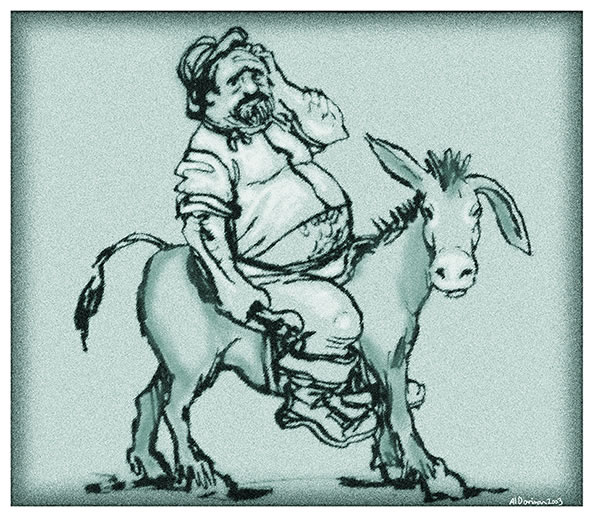
George Will calls Sarah Palin John McCain’s ‘female Sancho Panza.’

Conservative pundits say negative campaign just isn’t cutting it.
By Michael C. Moynihan / October 9, 2008

A bit of conservative blowback on the McCain campaign’s impotent strategy of making the final weeks of the election about Barack Obama’s association with former Weather Underground leader Bill Ayers. First up, George Will:

This, McCain and his female Sancho Panza say, is demonstrated by bad associations Obama had in Chicago, such as with William Ayers, the unrepentant terrorist. But the McCain-Palin charges have come just as the Obama campaign is benefiting from a mass mailing it is not paying for. Many millions of American households are gingerly opening envelopes containing reports of the third-quarter losses in their 401(k) and other retirement accounts — telling each household its portion of the nearly $2 trillion that Americans’ accounts have recently shed. In this context, the McCain-Palin campaign’s attempt to get Americans to focus on Obama’s Chicago associations seems surreal — or, as a British politician once said about criticism he was receiving, “like being savaged by a dead sheep.”

David Frum, who has been scathing in his criticism of the Sarah Palin choice, is similarly baffled by the “chummy with terrorists” line of attack. At his National Review blog, Frum unloads on Team McCain (after assuring readers that he will indeed vote for him):

American voters are staggering under the worst financial crisis since at least 1982. Asset values are tumbling, consumer spending is contracting, and a recession is visibly on the way. This crisis follows upon seven years in which middle-class incomes have stagnated and Republican economic management has been badly tarnished. Anybody who imagines that an election can be won under these circumstances by banging on about William Ayers and Jeremiah Wright is … to put it mildly … severely under-estimating the electoral importance of pocketbook issues.

We conservatives are sending a powerful, inadvertent message with this negative campaign against Barack Obama’s associations and former associations: that we lack a positive agenda of our own and that we don’t care about the economic issues that are worrying American voters.

Source / reason.com

The Rag Blog

Posted in RagBlog | Tagged , , , , , , | Leave a comment

Victory for Free Speech at University of Texas

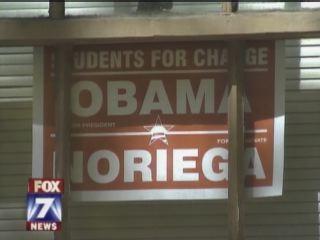
Sign supporting Obama and Rick Noriega on dorm window at UT-Austin.

Administration gives in; allows political signs in dorm windows.
By Jay Root / October 9, 2008

AUSTIN — Facing a free-speech uproar, the University of Texas backed down Thursday from punishing two students who refused to remove political signs from their dormitory window.

Connor Kincaid and his cousin and roommate, Blake Kincaid, said they were barred from registering for spring classes after refusing Wednesday to take down their signs supporting Democratic presidential candidate Barack Obama.

“Effective immediately, I am suspending the prohibition on signs in individual students’ residence hall room windows and any sanctions related to its enforcement,” UT President Bill Powers said in a written statement.

Powers said he had formed a committee to study the policy and make recommendations. In the meantime, he said, school policy now “expressly allows the display of signs and posters in students’ residence hall room windows.”

The Kincaid cousins were told during an administrative hearing Wednesday to take down their signs supporting Obama.

“This is an important free speech issue,” said Connor Kincaid, a 20-year-old junior who claimed during the hearing that he saw a sign supporting Republican candidate John McCain in the window of another dorm.

The university says the dispute had nothing to do with either candidate. UT has had a policy for more than 10 years forbidding the posting of signs in dorm windows in order to control the look of the campus and avoid the appearance that the university is supporting any candidate, said Jeff Graves, an associate vice president for UT legal affairs.

The crackdown sparked an outcry among students, and university Democrats and Republicans worked together to fight rules they said were unconstitutional. They had encouraged students across campus to put signs in their dorm windows as a form of protest.

Graves said he wasn’t aware of a prior case of a student facing an administrative hearing over the policy.

“It’s never been an issue,” he said. “Obviously this is a hot political issue, and it got pushed this time.”

UT officials believe the policy was constitutional as written but thought it made sense to allow signs to be posted inside the windows of individual living quarters, Graves said.

Source / AP / Google News

The Rag Blog

Posted in RagBlog | Tagged , , | 1 Comment

CODEPink Questions Henry Paulson’s Leadership


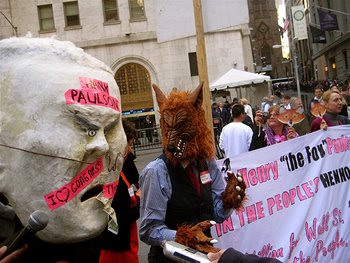
Should Henry ‘The Fox’ Paulson Guard the Henhouse?
By Medea Benjamin / October 9, 2008

On Tuesday, October 7, a group of CODEPINK pranksters pranced in front of the New York Stock Exchange. One, wearing an oversized papier maché head of Treasury Secretary Henry Paulson, grabbed at the purses of the “chickens.” “Give me your money; give me your money,” he cried. “You might need a new house, but my buddies and I need new yachts.” Passersby, reading the sign “Henry ‘The Fox’ Paulson’ in the People’s Henhouse,” heartily agreed.

Congress thought otherwise, entrusting Paulson — the former CEO of Goldman Sachs — with $700 billion of the people’s money. On October 3, Speaker Nancy Pelosi, smiling ear to ear, congratulated Congress for passing a bill that gave Secretary Paulson unprecedented control over our nation’s economic future. An hour later, President Bush and Secretary Paulson appeared on the steps of the Treasury Department signing the bill.

“This bailout bill does not deal with the absurdity of the fox guarding the henhouse,” Senator Bernie Sanders decried on the Senate floor. But during the post-bailout hearings held by the House Oversight Committee, Congressman Dennis Kucinich was the lone voice raising questions about Paulson’s performance and his obvious conflict of interest.

Kucinich asked the witnesses from AIG and Lehman Brothers why one company — AIG — was bailed out by the Treasury Secretary while Lehman Brothers was allowed to go under. AIG owed Goldman Sachs $20 billion, so their bailout meant that Paulson’s buddies at Goldman Sachs would get repaid in full. Goldman Sachs also gained a competitive advantage from the bankruptcy of its rival Lehman Brothers. One would think that this maneuver alone, which happened BEFORE the $700 billion taxpayer bailout, would have immediately raised hackles in Congress and disqualified Paulson as economic czar.

To see the absurdity of Paulson in charge of the crisis, Congress need only have looked at Paulson’s past. On the very day that Congress passed the bailout, The New York Times published a shocking story about how the SEC was lobbied in 2004 by the nation’s five largest investment banks to change a regulation that limited the amount of debt they could take on. The exemption unshackled billions of dollars held in reserve as a cushion against losses on their investments, and led to the unraveling of the financial sector. Among the five banks leading the charge to change the rule was Goldman Sachs, which was headed by Henry Paulson. Translation: Paulson was one of the architects of the crisis!

Paulson also benefited personally from the casino economy he helped engineer. After creating billions of dollars in bizarre financial products that are now nearly worthless, he left Goldman Sachs with a personal fortune of over $700 million.

“It is remarkable that Congress would be willing to give Secretary Paulson such enormous power in running this bailout given his advocacy of rule changes that played such an important role in this financial disaster, and the extent to which he personally profited from these changes,” said Dean Baker, an economist who was one of the first in the country to sound the alarm that the housing bubble was about to burst. “This would be like giving the bank robber who cleaned out the vaults the opportunity to set the bank’s finances in order — and letting him keep the loot.”

Paulson’s job performance as Treasury Secretary since July 2006 should be enough to have him fired, as Paulson fiddled while our economy slowly burned. When sub-prime mortgage losses set off a domino effect in mid-2007, Paulson insisted that troubles in the mortgage market were not likely to spread throughout the economy. In a Jim Lehrer interview in May 2007, he stated, “We’re fortunate that we have a diverse, healthy economy” and insisted the housing problem was contained. A year later, he told the Wall Street Journal, “The worst is likely to be behind us,” and stated on CNBC: “Our long-term fundamentals in this economy are strong, and this is a strong, competitive economy.” As Cong. DeFazio stated, “This guy has been consistently wrong and out of touch or he’s been lying to Congress and the American people about how sound our fundamentals are.”

When in September we found ourselves in the midst of a full-blown crisis, Paulson’s response was to blackmail Congress. With the proverbial gun to their heads, members of Congress were asked to hand Paulson $700 billion — immediately — on the basis of a three-page proposal and with no oversight, no Congressional or Judicial review and no accountability! Where did that $700 billion figure come from? “It’s not based on any particular data point,” a Treasury spokeswoman told Forbes.com. “We just wanted to choose a really large number.” Cong. Brad Sherman called Paulson’s proposed legislation an “awe-striking, mind-boggling power grab” designed with only Wall Street in mind.

Instead of tossing out Paulson and his plan in favor of a solution for Main Street, Congress passed a bill giving Paulson enormous power to decide which companies will be bailed out and which will go under. “A plan that relies on the former chairman of Goldman Sachs disbursing hundreds of billions of dollars to Wall Street is a terrible concept and inevitably will lead to crony capitalism and the appearance of — if not the actual existence of — corruption,” said Newt Gingrich, who called on President Bush to fire Paulson.

The people’s ire over the Wall Street bailout almost derailed the entire plan, but the bankers prevailed. Paulson’s plan, however, has not calmed the markets and shouldn’t mute the public outcry. Join us in demanding that the Fox stop raiding the henhouse. Join us in insisting that Paulson must go! (go to www.paulsonmustgo.com).

Medea Benjamin (medea@globalexchange.org) is cofounder of CODEPINK: Women for Peace (www.codepinkalert.org) and Global Exchange (www.globalexchange.org).

Source / Common Dreams

The Rag Blog

Posted in RagBlog | Tagged , , , | Leave a comment

NIE: Surge Has Not Put the US on a Path to Victory


US team warns of fresh ethnic violence in Iraq
By Michael Jansen / October 9, 2008

THE TEAM preparing the latest US intelligence analysis of the situation in Iraq warns that ethnic and sectarian tensions could erupt into fresh violence, reversing security and political advances made over the past 20 months.

The 16 agencies drafting the National Intelligence Estimate, due to be presented to the White House shortly, agree that the “surge” strategy has not put the US “on a path to victory” and questions the wisdom of withdrawing US troops before stability is bolstered by solid political gains on the ground.

According to leaks from the team, the main threats to security come from the ethnic power struggle between Arabs, Turkomen and Kurds in the northern oil city of Kirkuk and from the Shia-dominated government’s refusal to recruit into the security forces Sunni “Awakening Council” fighters who fought al-Qaeda alongside US troops.

The still-secret report also expresses concern over the possibility that the Mahdi army militia loyal to dissident cleric Muqtada al-Sadr could end its ceasefire and resume attacks on US and Iraqi troops.

This assessment echoes a US defence department report issued last month as well as the words of former US commander General David Petraeus. US secretary of state Condoleezza Rice also admitted that “success in Iraq is not a sure thing”.

The leaks from the intelligence report coincided with the publication by the International Migration Office (IOM) of its latest Displacement and Return Assessment Report. This gloomy text shows that, of the 2.8 million internally-displaced persons, i.e. domestic refugees, only 16,782 families with 100,692 members had returned to their homes by September 21st. It also shows that the number of Iraqis fleeing the country, now 2.5 million, exceeds those returning.

The IOM says that although security is improving in many areas, displaced persons are unwilling or unable to go home, and they require food, shelter and other assistance where they are living.

They have not been encouraged to return to their homes by prime minister Nuri al-Maliki’s September 1st decree requiring squatters to vacate houses they “unlawfully occupy in Baghdad or face prosecution”. Those who comply receive $255 per month for six months to tide them over until they find alternative accommodation.

The decree also creates centres in the capital to register returnees, provide them with a grant of $852, and resolve property disputes. While his initiatives focus on Baghdad, Mr Maliki intends to implement these measures in Iraq’s other provinces.

© 2008 The Irish Times

Source / Irish Times

The Rag Blog

Posted in RagBlog | Tagged , , | Leave a comment

"Message Force Multipliers" to Be Investigated

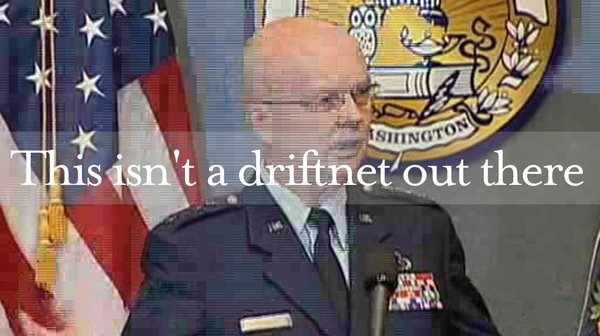
Needless to say, I have a $20 bill that says this turns itself into a quiet whitewash for those poor, retired generals and the Pentagon weasels. Nothing whatsoever will come of this aside from a little neatly-bound report that sits on a back shelf in the National Archive and Library of Congress in perpetuity.

Richard Jehn / The Rag Blog


FCC to Probe Defense Department’s ‘Propaganda’ Program
By E&P Staff / October 07, 2008

NEW YORK The Federal Communications Commission has announced that it will investigate a Department of Defense propaganda program to determine whether news networks or military analysts violated the Communications Act of 1934 and FCC rules.

Earlier this year, The New York Times reported that a Department of Defense program had ex-military officers presenting the Bush administration’s position on the War on Terror as objective analysis on major television news programs and 24-hour cable news networks. Congresswoman Rosa L. DeLauro and Congressman John Dingell wrote to the FCC to investigate allegations that the news networks and the analysts failed to disclose the ex-military officers’ ties to the Pentagon — and if that violated sponsorship identification requirements in the Communications Act.

“Given the revelations in the [New York Times] article, had the FCC not heeded our request for an investigation, it would have raised serious questions about their oversight capabilities. I am pleased with today’s news, but will continue to monitor the situation to ensure the FCC fully investigates the networks in addition to the analysts,” DeLauro said in a statement Tuesday.

According to the Times report, Department of Defense documents described the analysts as “message force multipliers” instructed to deliver “administration themes and messages” to the public “in the form of their own opinions.” The report found that these analysts — who The Times called “a media Trojan horse” for the administration — were encouraged to convey specific Defense Department talking points to the public, even when they suspected the information could be exaggerated or false.

Network officials cited in the Times story acknowledged “a limited understanding” of the on-air analysts’ ties to the government. They argued that it was the analysts’ responsibility to disclose any potential conflicts of interest.

Source / Editor and Publisher

The Rag Blog

Posted in RagBlog | Tagged , , , , | Leave a comment