Being Realistic Eventually Turns Out To Be Right

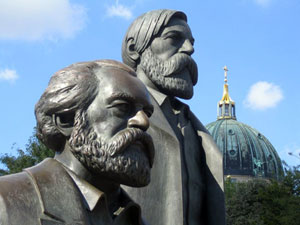
The Karl Marx and Friedrich Engels monument in Berlin.
Photo: commons.wikimedia.org / Manfred Brückels

Reality Catches Up to the Free Market
By William Pfaff / September 18, 2008

Karl Marx, were he still about, would surely be interested in the report that unregulated free-market capitalism has died in a flash, by its own hand; whereas it took 70 years and a Cold War to bring down the Marxist economy established in the Soviet Union following the Bolshevik Revolution.

The Marxist economy died of its internal contradictions.

This was the fate Marxism (or Marxism-Leninism) had predicted for capitalism, not for itself. Unregulated free-market capitalism may be said to have killed itself by greed, vanity and excess, all amply evident before and at the death scene, but the ultimate guilt must be attributed to the vacuity and perversity of market ideology, which contradicts human nature.

In this, it exactly resembles the American national foreign affairs ideology, that democracy will always eventually triumph over all else. Regrettably, this is an illusion, clung to in American governmental, political and, to a considerable degree, academic circles. It is stubbornly adhered to because everyone would like to think it true, since it is very reassuring to Americans, and an uplifting idea.

Both market and democratic ideologies rest on a belief in the essential goodness of mankind, admittedly blocked from time to time by institutional or intellectual obstructions, which have only to be removed for harmony to be restored.

Market capitalism rests on the observation that, all things being equal, a free market is the most perfect known mechanism for setting priorities in an economic system manufacturing goods or providing services.

It declares that in free-market conditions, everyone will make, sell and buy within an equilibrium established by the coincidence of their true interests. People will buy what they need or want according to the value they place on the good or service, and manufacturers or service providers will meet these needs according to whether the value offered incites them to do so, rather than to do something else.

It also is assumed that the employer will pay the true value of the employee’s work, since otherwise the worker will go to an employer who will do so, who naturally will understand that paying a higher wage is in his competitive interest vis-à-vis his competitor.

Owners and managers will be rewarded according to the true value of what each contributes to the common interest. Otherwise they will lose business and fail.

Those last two clauses demonstrate how artificial this theory is. That artificiality—that remoteness from how the real world functions—is why the market has to be regulated, a lesson last learned in the United States 80 years ago in the Great Depression, and progressively disregarded or discarded during the Reagan, Clinton and George W. Bush administrations.

What is this perfect and all-wise free market composed of?

Legitimate actors with legitimate goals, plus speculators, swindlers, confidence men, guys trafficking in inside information, and criminal actors. Yes, the defenders of the market say, but it all averages out in the end. So we see, as the market today destroys global credit and global value. Everyone currently acts as if all this happens as the result of an act of God or the will of the law of averages, or is the result of forgivable miscalculations. President George W. Bush said it’s all been very simple. They built too many houses.

Of course “they” didn’t build too many houses. “They” swindled too many people who bought those houses, or wanted to buy them, by giving them the money to buy them, or to refinance them in order to have a cash gain, with mortgages or second mortgages that these people could not responsibly be expected to repay. That is where it started.

The subsequent manipulation of the funds, so as to bundle bad debt with good debt and pass it off on the international financial market as “securitized” good debt, has had more than enough discussion since the crisis blew up this summer.

The financiers, as Joseph Stiglitz has observed (in a recent CNN interview), were doing what the system demanded of them. They were assured generous rewards for managing risk and allocating capital so as to improve the efficiency of the economy enough to justify their generous compensation. “But they misallocated capital; they mismanaged risk—they created risk. They did what their incentive structures were designed to do: focusing on short-term profits and encouraging excessive risk-taking.”

And this does not take account of an Iraq war financed by debt, and the unconscionable Bush tax cuts to the wealthy, the president’s perverse punishment of the very working- and middle-class voters who had elected him.

As Stiglitz says, the first measures in recovering from the disaster must be to reconstruct the system of corporate incentives to serve the public interest rather than private interests.

Prior to that, however, public policy must be reconstructed on the basis of a historical understanding of how people actually behave rather than on theories about how they might be presumed to behave in the world of abstractions.

This understanding is called realism, and in American public affairs during the past two decades it has been scorned. However, one good thing about realism is that being realistic eventually turns out to be right. The distinguished Protestant theologian and political philosopher Reinhold Niebuhr once remarked that of all the doctrines of the Christian religion, only one is invariably self-validating: the doctrine of Original Sin.

Visit William Pfaff’s Web site at www.williampfaff.com.

Source / TruthDig

The Rag Blog

Posted in RagBlog | Tagged , , | Leave a comment

But Will Dick Cheney Be Impeached? No !!

Dick Armey, victim of the big lie. Photo: CBS

Vice President Dick Cheney’s Incredible and Deadly Lie
By John W. Dean / September 19, 2008

By Deceiving a Congressional Leader, Cheney Sent Us to War on False Pretenses and Violated the Separation of Powers – as Well as the Criminal Law

This week, I agreed to deliver a “Constitution Day” talk on a college campus. My talk was not partisan. Yet the subject matter I selected was prompted by the most incredible – not to mention the most deadly – lie Dick Cheney has yet told, which was reported earlier this week.

Last year, Washington Post reporter Barton Gellman and Jo Baker, now of the New York Times, did an extensive series for the Post on Cheney. Now, Gellman has done some more digging, and published the result in a book he released this week: Angler: The Cheney Vice Presidency. The book reveals a lie told to a high-ranking fellow Republican, and the difference that lie made. In this column, I’ll explain how Cheney defied the separation of powers, and go back to the founding history to show why actions like his matter so profoundly.

Cheney’s Bold Face Lie To Congress

According to Gellman (and to paraphrase from the Post story on his finding), in the run-up to the war in Iraq, the White House was worried about the stance of Republican Majority Leader Richard Armey of Texas, who had deep concerns about going to war with Saddam Hussein. According to the Post, Armey met with Cheney for a highly classified, one-on-on briefing, in Room H-208, Cheney’s luxurious hideaway office on the House side of the Capitol.

During this meeting, the Post reports, Cheney turned Armey around on the war issue. Cheney did so by telling the House Majority Leader that he was giving him information that the Administration could not tell the public — namely (according to Armey), that Iraq had the “‘ability to miniaturize weapons of mass destruction, particularly nuclear,’ which had been ‘substantially refined since the first Gulf War,’ and would soon result in ‘packages that could be moved even by ground personnel.’ In addition, Cheney linked that threat to Saddam’s alleged personal ties to al Qaeda, explaining that ‘we now know they have the ability to develop these weapons in a very portable fashion, and they have a delivery system in their relationship with organizations such as al Qaeda.'”

The Post story continues, “Armey has asked: “Did Dick Cheney … purposely tell me things he knew to be untrue?” His answer: “I seriously feel that may be the case…Had I known or believed then what I believe now, I would have publicly opposed [the war] resolution right to the bitter end, and I believe I might have stopped it from happening.”

In short, it was this lie that sealed the nation’s fate, and sent us to war in Iraq. By lying to such an influential figure in Congress, Cheney not only may have changed the course of history, but also corrupted the separation of powers with their inherent checks and balances.

Cheney’s monumental dishonesty, the news of which has been buried under the current meltdown of the nation’s economy, did not strike me as a topic for a Constitution Day speech. But a realistic discussion of the working of the separations of powers did seem a fitting topic, for college students need to understand the basics of our system. After we remind ourselves of those basics, Cheney’s great lie can be viewed not only as a great immorality and violation of the criminal code, but also and more fundamentally as the significant breach of his oath of office to protect and defend the Constitution that it is.

Our Constitutional Separation of Powers

Historians, not to mention contemporary historical documents, establish that no issue was more important to the founders of our national government than that of what its structure should be. Accordingly, in anticipation of the Constitutional Convention in Philadelphia during the summer of 1787, James Madison of Virginia plowed through historical accounts of governments and concluded that there are three basic forms of government: monarchy (the one), oligarchy (an elite few) and democracy (the many). Each form, however, had serious drawbacks.

As a result, Madison sought to take the best of each to create a “republic” – as had been done in varying degrees with many of the American colonies. Republics, of course, had been around a long time, for they were the forms employed by the Greeks and Romans. Thus, the republic was a form of government those who were meeting in Philadelphia well understood, in which sovereignty resides with the people who elect agents to represent them in the political decision-making process.

Madison’s republic combined elements of each type of government, in a mixing of forms. It featured an executive who incorporated the strength of monarchy without the evils of a King; a Senate that embodied the wisdom of an oligarchy; and a House that balanced the self-interest of such elites with a throng of representatives who spoke for the people of the nation.

Many delegates at the founding convention were mistrustful of a pure democracy since none had worked well in the past; moreover, the country was too large and diverse to directly involve everyone. Later, Madison nicely explained the differences in Federalist No. 14: “[I]n a democracy, the people meet and exercise the government in person; in a republic they assemble and administer it by their representatives and agents. A democracy consequently will be confined to a small spot. A republic may be extended over a large region.”

Most importantly, Madison’s structure had three separate branches of the government – legislative, executive and judicial — and each branch was empowered to check and balance the others, and thereby diffuse power.

Madison’s system, however, has not worked as designed even in the best of times, not to mention when there is an all-powerful Vice President hell-bent on gaming the system.

The Reality of Separation of Powers

An article in the June 2006 Harvard Law Journal — Daryl J. Levinson and Richard H. Pildes, “Separation of Parties, Not Powers,” Harvard Law Journal (Jun. 2006) 2311 — provides one of the better analyses out there of the real-world workings of the separation of powers, and their accompanying checks and balances. Professors Levinson and Pildes argue that Madison’s vision of separation of powers has, in fact, been trumped in America by political parties. Their point is well taken, but as I see it their conclusion is far more applicable to the Republicans than the Democrats.

“The success of American democracy overwhelmed the Madisonian conception of separation of powers almost from the outset, preempting the political dynamics that were supposed to provide each branch with a ‘will of its own’ that would propel departmental ‘[a]mbition … to counteract ambition’,” Levinson and Pildes explain. This, in turn, they argue, made the underlying theory of the government – separation of powers – largely “anachronistic.”

When they looked at government, however, they found that when different political parties control the different branches – creating a divided government – then the parties working through those branches still do operate as Madison had hoped. Why? By sifting through the work of noted political scientists, Levinson and Pildes have concluded that it is not on behalf of protecting the institutional powers that the checking and balancing occurs; rather, it is through the influence of party politics operating through that divided branch.

I believe, based on the record (and as someone who worked on the Hill when Democrats controlled both ends of Pennsylvania Avenue) that Levinson and Pildes have it half right.

Democrats under unified government (i.e., when Democrats control both Congress and the White House) have been remarkably institutionally-minded, and the separation of powers has remained viable. On the other hand, conservative Republicans – as I have explained in my book Broken Government (just out in paperback too) – easily place party loyalty before the responsibilities of the governmental institution in which they serve. The first six years of the Bush/Cheney Administration, for example, were a travesty in Republican denial of institutional responsibilities. In contrast, there is a long list of Democratic House and Senate Chairmen who have a on-going history of refusing to be the rubber-stamps of Democratic Presidents.

For instance, unlike in the situation where Cheney lied to former Majority Leader Armey, when both the Democratic House and Senate suspected that President Lyndon Johnson had lied to them about the incident(s) in the Gulf of Tonkin that provoked Congress to authorize the war in Viet Nam, they took action. In contrast, Republicans have not acted on Cheney’s lie to Armey – and surely Washington Post reporter Barton Gellman is not the first person to learn about this lie.

Why Cheney Is Not Likely To Be Held Accountable

Those of us who follow these matters have long known – and I have written before – that it is Dick Cheney who is molding his hapless and naive president to his will, by effecting endless expansions of Presidential powers, and acting upon Cheney’s total disregard of the separation of powers.

Cheney does not seem to believe the Constitution applies to “real leaders,” who do whatever they believe they must do. Nor does he believe in the separation of powers. Indeed, Cheney absurdly claims he is himself part of the Legislative Branch because he is the presiding officer of the Senate – though, in practice, that position exists only to break tie votes. It has long been clear that Cheney has been corruptly bridging the constitutional separation of powers throughout the Bush/Cheney presidency.

If Armey is right, Dick Cheney has not only behaved improperly, but also criminally: In addition, when lying to Armey, Cheney clearly committed a “high crime or misdemeanor” in his blocking the Constitution’s checks and balances from stopping our march into Iraq. During the debates that took place during the Constitution’s ratification conventions, it was specifically stated that lying to Congress about matters of war would be an impeachable offense. Congress has also made it a crime.

Nonetheless, nothing is likely to happen to Cheney, for Congress is too busy dealing with the disastrous economy that he and Bush are leaving behind as they head for the door. No one seems inclined to hold Cheney responsible, and he appears totally unconcerned about the wrath of history. Yet in lying even to those in his own party, about reasons to go to war, he has sunk to a low level few have reached, and it is no hyperbole to call his actions treasonous to the structure and spirit of the Republic.

Copyright © 2008 FindLaw

John W. Dean, a FindLaw columnist, is a former counsel to the president.

Source / FindLaw

The Rag Blog

Posted in RagBlog | Tagged , , , | 1 Comment

US Recycling Is Poisoning the Rest of the World

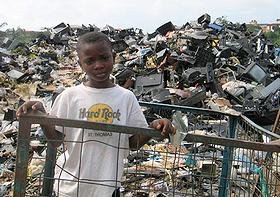
This boy was scavenging on a pile of broken electronics at the Alaba market, Lagos, Nigeria. 2006. (Photo © Basel Action Network)

EPA Faulted for Failing to Control E-Waste Exports
September 19, 2008

WASHINGTON, DC — U.S. hazardous waste regulations have not stopped exports of toxic used electronics to developing countries, partly because they are not being enforced by the U.S. Environmental Protection Agency, finds a new report issued Wednesday by the investigative branch of Congress.

In the report commissioned by the House Committee on Foreign Affairs, the Government Accountability Office says that in addition to the EPA’s poor enforcement performance, the regulations themselves are too limited to deal with the problem.

The rules address only one type of electronics – the old-fashioned rectangular type of monitors called cathode ray tubes. CRTs are particularly harmful because they can contain as much as four pounds of lead, a known toxin.

But exports of other used electronics flow virtually unrestricted, even to countries where unsafe recycling practices can cause health and environmental problems. This happens, the GAO reports, because the existing hazardous waste regulations assess only how products will react in unlined U.S. landfills.

While more Americans are recycling old computers and more companies are taking them back for recycling, there is a “tsunami of CRTs coming that will end up in developing countries contaminating their land and waters,” said Jim Puckett of the nonprofit Basel Action Network, who first documented computer breaking in China in 2001.

“Thousands of laborers, former farmers were making $1 a day smashing, melting, cooking our old computers,” Puckett told reporters on a teleconference call about the GAO report on Wednesday.

“Whole villages were making their living burning little wires, cooking computer chips, beathing toxic fumes,” he said. “Vats of chips were soaked in acid to extract the gold and all the residues were flushed into the river.”

Woman cooking circuit boards over pool of molten solder. Taizhou, China 2007. (Photo © Stuart Isett courtesy Basel Action Network)

When he returned to the same area last year, Puckett said the scene had expanded with many more workers breaking many more electronic devices.

He says that some of the lead recovered from these scrapped computers is returned to the United States in the form of toys and jewelry that can poison kids.

“We are hopeful that the GAO report will help us achieve a full ban on exporting toxic electronic waste to developing countries,” he said. “Then we can starting taking back and doing recycling.”

Federal legislation is needed, said Puckett, because the current patchwork of state laws and regulations is not effective, and under the Constitution states cannot regulate foreign trade. “They must punt on that and now they’re punting into a black hole,” he told reporters.

The average useful life of a computer is about two years. Americans dispose of at least 50 million computers a year or 3,000 tons each day, and millions more are stored in homes and corporate warehouses awaiting disposal. Each computer contains toxics such as lead, cadmium and mercury, which if disposed of improperly can harm people and the environment.

Obsolete CRT monitors awaiting export from the United States. (Photo credit unknown)

In January 2007, the EPA began regulating the export of CRTs under a rule that requires companies to notify the agency before exporting CRTs.

But companies easily circumvent this rule, GAO investigators found when they posed as foreign buyers of broken CRTs in Hong Kong, India and Pakistan, among other countries.

They identified 43 U.S. companies that expressed willingness to export these items. “Some of the companies, including ones that publicly tout their exemplary environmental practices, were willing to export CRTs in apparent violation of the CRT rule,” the report states.

Recent surveys made on behalf of the United Nations found that used electronics exported from the United States to many Asian countries are dismantled under unsafe conditions, using methods like open-air incineration and acid baths to extract metals such as copper and gold.

GAO observed thousands of requests for these items on e-commerce websites during a three month period, mostly from Asian countries such as China and India, but also from some in Africa.

“Some exported used electronics are handled responsibly in countries with effective regulatory controls and by companies with advanced technologies, but a substantial quantity ends up in countries where disposal practices are unsafe to workers and dangerous to the environment,” the GAO report states.

EPA officials acknowledged compliance problems with its CRT rule but said that because the rule is new, their focus was on educating the regulated community.

The GAO called this reasoning “misplaced” because investigators found so many exporters willing to engage in apparent violations of the CRT rule, even some who are aware of the rule.

The report faults the EPA for not assessing the extent of noncompliance. EPA officials told investigators they have neither plans nor a timetable to develop an enforcement program.

The GAO says hazardous waste regulations should be enforced and also expanded to include computers, printers, and cell phones.

To help make U.S. export controls more consistent with those of other industrialized countries, the GAO recommends that the United States ratify the Basel Convention, an international treaty governing the import and export of hazardous wastes.

Customs and other agencies need to improve identification and tracking of exported used electronics, the GAO recommends.

Congressman Gene Green, a Texas Democrat who chairs the House Subcommittee on the Environment and Hazardous Materials, told reporters on the teleconference that he considers the current EPA administration intransigent.

“The EPA is not as interested in doing what statutorily they should be on this and lots of other issues,” he said.

After the elections in November, said Green, “Whatever happens, we’re going to get ourselves a new EPA administrator.”

Congressman Mike Thompson, a California Democrat and founding member of the congressional E-Waste Working Group in 2005, said that when Congress reconvenes after the elections, “We’ll give a resonable time for a reconstituted working group to put something together, but if nothing emerges, then we’ll have to start from scratch.”

Copyright Environment News Service (ENS) 2008.

Source / Environment news Service

The Rag Blog

Posted in RagBlog | Tagged , | Leave a comment

Fighting Against Disenfranchisement in Michigan


ACLU sues state over voter purging programs
By David Ashenfelter / September 18, 2008

The ACLU and a national student group have sued Michigan Secretary of State Terri Lynn Land to halt two statewide voter purging programs that they say could disenfranchise hundreds of thousands of state voters before the November presidential election.

“We have repeatedly advised Secretary Land’s office that these voter purge programs are unlawful, yet they have refused to bring their practices into compliance,” said Bradley Heard, senior attorney with the Advancement Project, which joined the ACLU in the lawsuit.

The suit was filed Wednesday in U.S. District Court in Detroit. No hearings have been set on the suit which requests a preliminary injunction to halt the programs.

There was no immediate comment from the Secretary of State’s Office.

Secretary of State spokeswoman Kelly Chesney said Land hasn’t been served with the complaint.

But based on press reports, she said “it appears these groups are challenging laws that have been on the books since 1975.”

One of them the Michigan’s Motor Voter law, served as a model for the National Voter Registration Act of 1993, which the ACLU cited in the suit, she said.

The groups say one program immediately cancels the registrations of voters who obtain driver licenses in other states instead of issuing confirmation notices and following procedures required by the National Voter Registration Act of 1993. The suit said that program removes an estimated 180,000 voters annually.

A second program requires local clerks to nullify the registrations of newly registered voters when their original voter identifications cards are returned as undeliverable by postal authorities. The groups said Detroit elections officials remove about 30,000 voters annually through the program.

“The state of Michigan is breaking the law,” said Meredith Bell-Platts, staff counsel with the ACLU Voting Rights Project. “With the election just weeks away, the effect of these undemocratic purges could make all the difference in deciding who becomes our next president.”

The other plaintiff in the suit is the United States Student Association. Defendants are state elections director Christopher Thomas and Ypsilanti City Clerk Frances McMullan.

The suit was assigned to U.S. District Judge Stephen Murphy.

Contact DAVID ASHENFELTER at ashenf@freepress.com.

Source /

The Rag Blog

Posted in RagBlog | Tagged , | 1 Comment

And It Won’t Be Painless


Hey U.S., welcome to the Third World!
By Rosa Brooks / September 18, 2008

It’s been a quick slide from economic superpower to economic basket case.

Dear United States, Welcome to the Third World!

It’s not every day that a superpower makes a bid to transform itself into a Third World nation, and we here at the World Bank and the International Monetary Fund want to be among the first to welcome you to the community of states in desperate need of international economic assistance. As you spiral into a catastrophic financial meltdown, we are delighted to respond to your Treasury Department’s request that we undertake a joint stability assessment of your financial sector. In these turbulent times, we can provide services ranging from subsidized loans to expert advisors willing to perform an emergency overhaul of your entire government.

As you know, some outside intervention in your economy is overdue. Last week — even before Wall Street’s latest collapse — 13 former finance ministers convened at the University of Virginia and agreed that you must fix your “broken financial system.” Australia’s Peter Costello noted that lately you’ve been “exporting instability” in world markets, and Yashwant Sinha, former finance minister of India, concluded, “The time has come. The U.S. should accept some monitoring by the IMF.”

We hope you won’t feel embarrassed as we assess the stability of your economy and suggest needed changes. Remember, many other countries have been in your shoes. We’ve bailed out the economies of Argentina, Brazil, Indonesia and South Korea. But whether our work is in Sudan, Bangladesh or now the United States, our experts are committed to intervening in national economies with care and sensitivity.

We thus want to acknowledge the progress you have made in your evolution from economic superpower to economic basket case. Normally, such a process might take 100 years or more. With your oscillation between free-market extremism and nationalization of private companies, however, you have successfully achieved, in a few short years, many of the key hallmarks of Third World economies.

Your policies of irresponsible government deregulation in critical sectors allowed you to rapidly develop an energy crisis, a housing crisis, a credit crisis and a financial market crisis, all at once, and accompanied (and partly caused) by impressive levels of corruption and speculation. Meanwhile, those of your political leaders charged with oversight were either napping or in bed with corporate lobbyists.

Take John McCain, your Republican presidential nominee, whose senior staff includes half a dozen prominent former lobbyists. As he recently put it, “I was chairman of the [Senate] Commerce Committee that oversights every part of the economy.” No question about it: Your leaders’ failure to notice the damage done by irresponsible deregulation was indeed an oversight of epic proportions.

Now you are facing the consequences. Income inequality has increased, as the rich have gotten windfalls while the middle class has seen incomes stagnate. Fewer and fewer of your citizens have access to affordable housing, healthcare or security in retirement. Even life expectancy has dropped. And when your economic woes went from chronic to acute, you responded — like so many Third World states have — with an extensive program of nationalizing private companies and assets. Your mortgage giants Fannie Mae and Freddie Mac are now state owned and controlled, and this week your reinsurance giant AIG was effectively nationalized, with the Federal Reserve Board seizing an 80% equity stake in the flailing company.

Some might deride this as socialism. But desperate times call for desperate measures.

Admittedly, your transition to Third World status is far from over, and it won’t be painless. At first, for instance, you may find it hard to get used to the shantytowns that will replace the exurban sprawl of McMansions that helped fuel the real estate speculation bubble. But in time, such shantytowns will simply become part of the landscape. Similarly, as unemployment rates continue to rise, you will initially struggle to find a use for the expanding pool of angry, jobless young men. But you will gradually realize that you can recruit them to fight in a ceaseless round of armed conflicts, a solution that has been utilized by many other Third World states before you. Indeed, with your wars in Iraq and Afghanistan, you are off to an excellent start.

Perhaps this letter comes as a surprise to you, and you feel you’re not fully ready to join the Third World. Don’t let this feeling concern you. Though you may never have realized it, you’ve been preparing for this moment for years.

Source / Los Angeles Times

And while we’re at it, take a look at this:

4 out of 10 Angeleno’s Are Living In Poverty
By Joel John Roberts / September 4, 2007

So says a study published by the Los Angeles Alliance for a New Economy (LAANE). (Here is the pdf file of the study.) The study says that 44% of the people in the City of Los Angeles are living at 200% of the federal poverty level—which they define as “poor”. And 1.5 million people actually live at the federal poverty level.

One out of 10 families in Los Angeles live in extreme poverty (below the federal poverty level.)

I am not normally a pessimist. When the glass is filled with water halfway, I see the glass as not just half full, but “just about ready to overflow”.

But when looking at the state of our community (especially with the perspective from being on the front lines of homelessness), I am also a realist. And the reality is simple. If 4 out of 10 people in a community are living in poverty, homelessness has a greater chance of increasing in that community.

We work hard to address homelessness at its current state. But we can’t forget to address the prevention aspect of homelessness. There are people in our community who are on the verge of being homeless. (That’s the 4 out of 10 people in Los Angeles—or 3.5 million people are living in poverty.)

In 2005, it was reported that 250,000 people stated that they were homeless at least once during that year. In contrast to the point in time number (88,000 homeless people) that was announced that same year—the number of people who were homeless during the 3 day period the count was taken.

As a community, we are not doing a very good job of addressing the current state of homelessness. Let alone, even thinking about those living in poverty who are on the verge of homelessness.

We cannot allow our community to become a Third World City, where there is a large number of people living in poverty, a class of extreme wealth, and where the middle class is diminishing. If we don’t address poverty and homelessness, this could very well be our future.

Source / LA’s Homeless Blog

The Rag Blog

Posted in RagBlog | Tagged , | 2 Comments

Harry Reid: "No One Knows What to Do"


The Point of No Return
By Mike Whitney / September 19, 2008

Following another eratic day of trading on the stock market, Treasury Secretary Henry Paulson and Federal Reserve chairman Ben Bernanke convened an emergency meeting of the Senate Banking Committee and other congressional leaders to request fast-track authority for a sweeping plan to buy back illiquid assets and other complex securities from distressed and under-capitalized banks. The turbulence in the financial markets has intensified and there is every indication that the situation will get worse before it gets better. There are a number of signs that the financial system is at the brink of collapse and that Wall Street is headed for a 1929-type crash. Depositors have begun to withdrawal their savings from money market funds alarmed by the gyrations in the market and the daily deluge of bad economic news. According to the Washington Post, funds dropped “by at least $79 billion, or about 2.6 percent” on Wednesday alone. The withdrawals are the equivalent of a slow bank run just at the time when stressed commercial banks need access to cheap capital to finance daily operations and provide loans for a steadily weakening economy. There’s also been a surge of panic-buying of US Treasurys which is considered the safest of investments. According to the Wall Street Journal, during Wednesday’s market-rout, “investors were willing to pay more for one-month Treasurys than they could expect to get back when the bonds matured. Some investors, in essence, had decided that a small but known loss was better than the uncertainty connected to any other type of investment. That’s never happened before.” (Wall Street Journal) Also, the VIX, or “fear gauge”, has soared to levels not seen since the crisis began in August just over a year ago.

On Tuesday, interbank lending rates spiked upwards causing banks to abruptly stop lending to each other. When banks stop lending to each other, they cannot perform their primary function of transmitting credit to consumers and businesses, and the economy shuts down. That is why the Fed and other members of the western banking cartel made a surprise announcement at 3 AM (EST) Wednesday morning.

From the FED:

“Today, the Bank of Canada, the Bank of England, the European Central Bank (ECB), the Federal Reserve, the Bank of Japan, and the Swiss National Bank are announcing coordinated measures designed to address the continued elevated pressures in U.S. dollar short-term funding markets. These measures, together with other actions taken in the last few days by individual central banks, are designed to improve the liquidity conditions in global financial markets….The Federal Open Market Committee has authorized a $180 billion expansion of its temporary reciprocal currency arrangements (swap lines). This increased capacity will be available to provide dollar funding for both term and overnight liquidity operations by the other central banks.”

Before the end of the day, the Fed had quadrupled the amount of dollars (to $247 billion) that central banks around the world could access in an effort to loosen up trading between the banks and resume lending to loan applicants and businesses. According to Bloomberg: “The Fed will spray dollars around the world via swap lines with other central banks. They can then auction them in their own markets.” At first, the stock market reacted positively to the Fed’s announcement, but by noon the market was 200 points down and losing altitude fast. It took another surprise announcement by the Treasury Dept–of a massive government intervention to remove the bad loans and withering mortgage-backed securities from banks’ balance sheets—of to jolt the market out of its funk and send it climbing 410 points higher on the day.

Paulson’s emergency session of Congress last night was characterized by lawmakers who attended as “chilling”. The situation is much worse than government officials have let on so far. The resurrecting of the Resolution Trust Corporation (RTC) is a desperate attempt to address the banking systems troubles head-on by providing a taxpayer funded clearinghouse for illiquid assets and toxic mortgage-related securities for which there is presently no market. The taxpayer is being asked to pay up to $1 trillion for the speculative excesses of Wall Street investment banks and their fraudulent securities scam. Homeowners who are likely to lose their homes through foreclosure will not benefit from Paulson’s RTC. Both presidential candidates have already declared their support for the plan.

According to the New York Times: “Rumors about the Bush administration’s new stance swept through the stock markets Thursday afternoon. By the end of trading, the Dow Jones industrial average shot up 617 points from its low point in mid afternoon, the biggest surge in six years, and ended the day with a gain of 410 points or 3.9 percent.”

If ever there was proof of Plunge Protection Team activity; Thursday’s market is it. The market was sinking fast at midday even though the Fed just added nearly $250 billion in liquidity to the global system. Investors were buying short-term Treasurys in record numbers, the VIX “fear gauge” was soaring, money markets were collapsing, and the aftershocks from defaulting AIG and Lehmen were still being felt around the world. Were investors really that eager to buy back battered investment bank stocks or was the PPT busy panic-buying up futures and forcing the market upwards 617 points?

Bloomberg News: “Options under consideration (by congress) include establishing an $800 billion fund to purchase so-called failed assets and a separate $400 billion pool at the Federal Deposit Insurance Corp. to insure investors in money-market funds, said two people briefed by congressional staff who spoke on condition of anonymity because the plans may change.”

Not a dime of public money is provided for over-extended homeowners trying to stay out of foreclosure. Not one congressman or senator at Thursday’s meeting rejected the bailout plan or called for a criminal investigation to establish whether laws were broken in the sale of fraudulent securities which have clogged the global system; pushed banks, hedge funds, insurance companies and homeowners into default, and precipitated the greatest financial crisis in the nation’s 230 year history.

Ironically, the very people who created this mess, are the ones who will decide how to resolve it; the Federal Reserve and the US Treasury. Where else, but Washington would such massive failure be rewarded with more power and authority.

The investment giants and the Federal Reserve are entirely responsible for the current meltdown. Currency deregulation brought foreign capital flooding into the equities and bond markets while the real economy suffered. Businesses were off-shored while good paying manufacturing jobs were moved overseas. Wall Street gorged itself on foreign capital while America was transformed into a nation of construction laborers and service industry workers. Now those jobs are vanishing by the millions and unemployment lines are swelling.

The ratings agencies, prevaricating mortgage applicants, and appraisers all played a part, but it’s Wall Street that’s really to blame. They lobbied to deregulate the system so investment banks could merge with commercial banks and allow the world’s biggest risk takers to have unrestricted access to the cheapest capital available; deposits. They even crafted a bogus ideology, “market fundamentalism”; touting trickle-down, free market, Voodoo economics that was entirely designed to further enrich the wealthy and savage the middle class. Earlier this week, former Senator Jack Kemp appeared at a whistle-stop with John McCain in Jacksonville, Florida. Kemp was one of the primary architects of “supply side” economics, the thoroughly discredited Reagan-era doctrine which has led us to our present economic catastrophe. Kemp’s theories fit with Milton Friedman’s “greed is good” Chicago School mumbo jumbo. Both Friedman and Kemp believe that what is good for the stock market is good for America, ignoring the shocking economic polarization that has divided the nation. Now, more and more people are beginning to see that Friedman was a charlatan who provided ideological cover for obscenely rich financiers and their dodgy investment scams.

Economist and author Henry Liu summed it up brilliantly in a recent article in the Asia Times:

“The collapse of market fundamentalism in economies everywhere is putting the Chicago School theology on trial. Its big lie has been exposed by facts on two levels. The Chicago Boys’ claim that helping the rich will also help the poor is not only exposed as not true, it turns out that market fundamentalism hurts not only the poor and the powerless; it hurts everyone, rich and poor, albeit in different ways. When wages are kept low to fight inflation, the low-wage regime causes overcapacity through over investment from excess profit. And monetary easing under such conditions produces hyperinflation that hurts also the rich. The fruits of Friedman test are in – and they are all rotten.”

Whatever headwinds the country now faces economically can be directly attributed to the inherently flawed ideology of market fundamentalism.

Tuesday’s 449 point bloodbath on Wall Street is the beginning of an unavoidable market crash. Regardless of Paulson’s plan, there’s more pain on the way. According to Bloomberg: “More than $19 trillion has been wiped off global stock market value since a high on Oct. 31 as the worst U.S. housing recession since the Great Depression and a resulting global credit crisis slowed the world economy.” All of the economic indicators point to greater losses. Once the system begins to deleverage, there’s nothing anyone can do to stop it. Paulson can place himself in front of a market avalanche if he so chooses, but it won’t change the outcome. Market corrections are as inexorable as the force of gravity. That’s why equity bubbles cannot be allowed to develop without interest rate intervention. Responsible action by the Central Bank could have prevented the present crisis.

On Wednesday, Forex.tv reported that the net long-term TIC flows came in below the consensus forecast, totaling $6.1 billion in July, while total TIC flows for the month fell to $74.8 billion, according to data released by the U.S. Treasury on Tuesday morning. Economists had been expecting net long-term flows to rise to $55.0 billion compared to the previous month’s previously reported figure of $53.4 billion.

$6.1 billion does not begin to meet the requirements of our current account deficit of $700 billion. The dollar is headed for a fall.

On Wednesday, New York Mayor Michael Bloomberg warned that the “next wave” of financial pain may come from overseas if foreign entities stop buying U.S. debt.”It’s not clear who’s going to be buying our debt,” said Bloomberg. “It may very well be that the next wave is going to come back and bite us.”

The New York Times tells a similar story except this time about Asia:

“Asia’s savings have, in essence, bankrolled American spending for decades (but) Asian interest in American assets is wilting, a trend that seems to have started over the summer…Little-noticed data released by the Treasury Department on Tuesday showed that a sharp shift in international capital movements began in July. Private investors pulled a net $92.9 billion out of the United States, after putting $46.8 billion into American securities in June. (“Asia rethinks American Investments Amid Market Upheaval”, Keith Bradsher, New York Times)

Foreign central banks and investors have turned off the spigot. They can see that the US financial system is teetering and that the dollar is weakening. “The perceived risk of U.S. government debt, long held to be absent of any default risk, also climbed to a record yesterday as the government’s involvement in bailing out financial markets weighed on its own balance sheet.” (Bloomberg News) The “full faith and credit” of the United States government is slipping. US debt will be downgraded. Triple A is no longer guaranteed. America’s stock just moved to Level 3 assets. The US is now a subprime economy on life support.

Presently, “there is roughly $6.84 Trillion in bank deposits. $2.60 Trillion of that is uninsured. There is only $53 billion in FDIC insurance to cover $6.84 Trillion in bank deposits. Of the $6.84 Trillion in bank deposits, the total cash on hand at banks is a mere $273.7 Billion.” (Mish’s Global Economic Trend Analysis)

$273.7 Billion is a paltry sum, insufficient to meet the needs of even a minor run on the banking system. The storm hasn’t even touched ground in middle America, and already the system is buckling. 2009 is shaping up to be bleak, indeed.

The battered and over-leveraged US financial system is facing its greatest challenge in the months ahead. The frantic search for capital has already begun, but with predictably disappointing results.

Neither China nor the Saudi princes are buying any more failing investment banks. They’ll leave that to the US taxpayer. What started off as a brilliant plan to offload garbage mortgage-backed paper to gullible investors around the world has suddenly backfired and now threatens to bring the entire system crashing down and change the geopolitical power paradigm for the forseeable future.

Reid: “NO ONE KNOWS WHAT TO DO”

On Monday night, Senate Majority Leader Harry Reid was briefed on the gravity of the financial situation in a secret meeting with the Treasury Secretary and Federal Reserve Chairman. Reid’s remarks are the best summary yet of the troubles that lie just ahead. He said, “We are in new territory, this is a different game…No one knows what to do.”

Source / Information Clearing House

The Rag Blog

Posted in RagBlog | Tagged , , | 1 Comment

McCain’s Spain Blunder : A Walking Foreign Policy Disaster

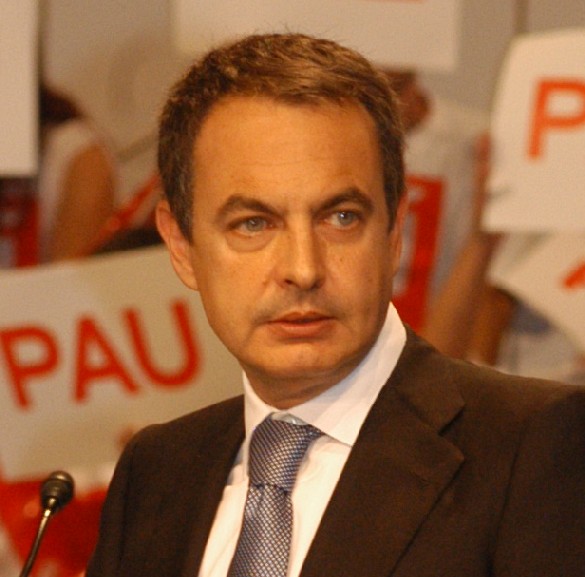
Spain’s Prime Minister, José Luis Rodríguez Zapatero. Now let’s see: where is Spain again?

Or worse: Is it an expression of policy towards a U.S. ally?

‘McCain has run on his foreign policy expertise and such confusion completely undercuts his credibility’
By Max Bergmann / September 18, 2008

Worse than Bush. There can be no doubt about it now.

In McCain’s bizarre interview with Spanish Owned Union Radio he refused to say whether he would meet with Spain’s Prime Minister, José Luis Rodríguez Zapatero. Listening to the interview repeatedly, it simply seemed that McCain had no idea who Zapatero actually was. McCain seemed to think he was a Latin American autocrat – despite the reporter repeatedly saying “I am talking about Spain.”

This gaffe would seem to have very significant implications. Not knowing who the leader of Spain was or thinking Spain was in Latin America would not really be shocking coming from his running mate, but . Furthermore this gaffe would bring up real questions about his age. Is McCain really prepared to deal with a crisis at 3AM, when he can’t even remember who the leader of Spain is during a late evening interview?

But was it a gaffe? While it definitely seemed so, now Randy Sheunemann, McCain’s foreign policy adviser is shockingly saying that this is not a gaffe but an intentional expression of policy toward Spain. Instead of just admitting that it was small gaffe late in the day, the McCain campaign has decided that they care so little about governing that they are willing to potentially nuke the U.S.-Spain relationship just to get elected. Sheunemann emailed the Washington Post, saying:

The questioner asked several times about Senator McCain’s willingness to meet Zapatero (and id’d him in the question so there is no doubt Senator McCain knew exactly to whom the question referred). Senator McCain refused to commit to a White House meeting with President Zapatero in this interview,” he said in an e-mail.

This is beyond extreme. This is beyond reckless. This is insane.

McCain won’t meet with a NATO ally, that has nearly 1,000 troops in Afghanistan, that has lost more than 20 soldiers there, has been brutally attacked by Al Qaeda, is incredibly influential in Latin America, has the seventh largest economy in the world, is a DEMOCRACY, and is a large and influential country in the EU. Won’t meet with them?

The only plausible explanation for McCain not wanting to meet with Zapatero, is that, like Bush, he is still angry about Spain pulling its troops out of Iraq in 2004. If McCain carries that much of a grudge then how in the world will he rebuild our relationship with Europe, as he has said he would do. In a big foreign policy speech to the Los Angeles World Affairs Council in March, McCain expressed a desire to strengthen the transatlantic relationship.

We cannot build an enduring peace based on freedom by ourselves, and we do not want to. We have to strengthen our global alliances as the core of a new global compact…The bonds we share with Europe in terms of history, values, and interests are unique. Americans should welcome the rise of a strong, confident European Union as we continue to support a strong NATO.

McCain even told El Pais, Spain’s major newspaper, in April that he would bring Prime Minister Zapatero to the White House. (translation via America Blog)

Republican presidential candidate, John McCain, is ready to change the policy of estrangement with the Spanish government that was put in place for four years now by George Bush. He declared that he was ready to fully normalize bilateral relations and that Jose Luis Rodriguez Zapatero was invited to the White House.

And does McCain not know that his campaign has already met with a representative of Zapatero’s office? From the BBC in April:

Recently, Bernardino Leon, who is currently heading the General Secretariat of the Prime Minister’s Office to attempt to foster Zapatero’s interest in international issues, travelled to Washington to meet the foreign policy advisers to Democratic candidates Hillary Clinton and Barack Obama and to Republican candidate John McCain. [BBC Monitoring 4/22/08]

But Sheunemann’s statement now makes it clear that there will be no rebuilding of the transatlantic relationship. Instead, McCain will continue the ruinous approach of the Bush administration and continue to alienate our allies and further isolate America. This should not come as a surprise. McCain has after all shown in the past a reckless eagerness to attack America’s allies.

See below for some of his more prominent attacks:

McCain attacked our allies as “vacuous and posturing” for opposing war in Iraq. “Sen. John McCain (R-Ariz.) said that “Iraq is the test” of both the U.N. and NATO. He charged that the alliance is failing the test because of the “flawed calculations” and “vacuous posturing” of Germany and France. McCain and Rumsfeld both said that recent French and German foot-dragging over even discussing the possible deployment of NATO assets, such as Patriot anti-missile batteries, to Turkey also threatened to damage the alliance.” [Washington Post, 2/9/03]

John McCain engaged in the anti-French bashing of the far right because they opposed the invasion of the war. “The Lord said the poor will always be with us, and the French will be with us, too,” said McCain, a member of the Armed Services Committee. “This is part of a continuing French practice of throwing sand in the gears of the Atlantic alliance. But now they’re playing a dangerous game, and coming close to rendering themselves irrelevant.” A few days later he even said that, “Sen. John McCain (R-Ariz.) likened France to an aging ’40s starlet “still trying to dine out on her looks but doesn’t have the face for it.” [NY Times, 2/14/03. NY Daily News, 2/17/03]

McCain attacked Germany for opposing the war – saying they lacked “political courage.” McCain said that former German Chancellor Gerhard Schroeder “looks little like the ally that anchored our presence in Europe throughout the Cold War…A German Rip Van Winkle from the 1960s would not understand the lack of political courage and cooperation with its allies on the question of Iraq exhibited in Berlin today.” [Washington Times, 2/14/03]

On the war path, McCain said didn’t care if invading Iraq damaged UN, thought Iraq would prove UN to be irrelevant. “If war is necessary, the United States will not ‘be going it alone,’ he said, but will wage war in Iraq with a coalition of allies – with or without the blessing of the United Nations. ‘The problem here is not whether we do damage to the United Nations if we have to take military action,’ he said. ‘The question is, will the United Nations follow the League of Nations and risk irrelevancy.'” [Washington Times, 2/14/03]

McCain dismissed interests of French and Russians over invasion, said they were just based on commercial concerns. McCain said that “The French and Russians are putting their “commercial interests above international law, world peace and the political ideals of Western civilization.” [Washington Times, 2/14/03]

At German security conference in the run up to the war McCain echoed Rumsfeld’s notorious attacks on our European allies. “Rumsfeld has made headlines across Europe in recent weeks for a series of barbs at those who oppose U.S. policy.” McCain clearly echoed Rumsfeld’s statements, “McCain accused the Germans and French of “calculated self-interest” and “vacuous posturing” that left NATO with a “terrible injury.” German Foreign Minister Joschka Fischer said Germany would support its ally Turkey, but the question was one of timing. Both German and French officials have said that such a vote is tantamount to admitting war’s inevitability. The conference’s most emotional moment came from Fischer…he told how three times he had led the charge for German troops to be deployed: in Kosovo, Macedonia and Afghanistan…His voice rising, and beginning to speak in English, he addressed Rumsfeld directly: ‘My generation learned you must make a case and, excuse me, I am not convinced.’ Rumsfeld sat against the wall, sipping water and watching without expression. Much was said at the meeting about the strident tone of U.S.-European discussions.” [Philadelphia Inquirer, 2/9/03]

McCain rejected calls to get more international troops on the ground in Iraq. McCain said, “I think that the only military presence required right now would be American and British.” [MSNBC Hardball, 4/23/03]

Source / The Huffington Post

The Rag Blog

Posted in RagBlog | Tagged , , , , , | 1 Comment

Blowback from US Aggression – Get Used to It

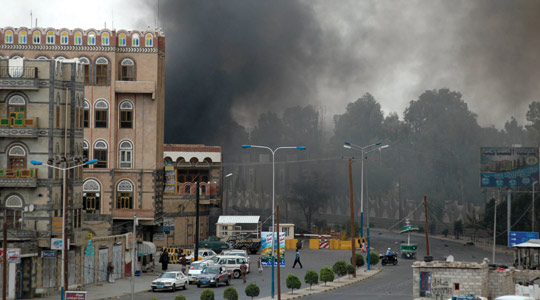
Smoke billows outside the US embassy in Sana yesterday after a car bomb set off a series of explosions outside the heavily fortified embassy in Yemen.

Reaping The Iraq Whirlwind
By M Duss / September 18, 2008

The Washington Post confirms that yesterday’s terrorist attack on the U.S. embassy in Sanaa was the work of an Al Qaeda affiliate, using tactics developed in Iraq:

The use of two vehicle bombs — one to breach the perimeter of a compound, a second to drive inside and explode — is a tactic used by the Sunni insurgent group al-Qaeda in Iraq. […]

He said a new, less-compromising generation of al-Qaeda leaders emerged, many of them moving into action after escaping from a Yemeni prison that year, he said.[…]

The new leaders have found followers among al-Qaeda fighters returning from Iraq. “The quieter it is in Iraq, the more inflamed it is here,” as Yemeni fighters travel back and forth, said Nabil al-Sofee, a former spokesman for a Yemeni Islamist political party who is now an analyst.

Those who have been following the Iraq debate might remember “flypaper theory,” which was one of the earliest exponents of the “incoherent post hoc justifications for the Iraq war” genre. The idea was that there was some limited number of terrorists in the Middle East, and the presence of an occupying U.S. army would lure them to Iraq, whereupon they could all be conveniently killed, presumably as soon as they stepped off the bus.

This plan was prevented from working only by the fact that it was staggeringly dumb. The U.S. occupation radicalized scores of young Muslims, many of whom traveled to Iraq, where they learned terror warfare and were galvanized in the global jihad. And now they’ve begun returning home, to share the tactics and technology developed in a laboratory we provided for them by invading Iraq. The violence in the Nahr al-Bared refugee camp in Lebanon in May 2007 was one instance of this. Yesterday’s attack in Yemen is another.

Various Bush administration courtiers have tried to spin the containment of Al Qaeda in Iraq as a vindication of the invasion of Iraq, eliding the fact that Al Qaeda in Iraq was a direct consequence of America in Iraq. By mispresenting Al Qaeda as a single, united faction under the command of Osama bin Laden — rather than a collection of factions gathered beneath the banner of global jihad — Bush and his supporters have misrepresented successes against AQI as if they represented successes against Al Qaeda as a whole. In doing this, they have ignored the ideological and propaganda components of Al Qaeda’s continuing operations in the region, and the ways in which the Iraq war has profited both.

And this from a commenter, Mugsy: “Imagine a terrorist network with Iraq as an arsenal and as a training ground…” – [President George W. Bush giving reason why we should invade Iraq. 11/4/02]

Source / Wonk Room

The Rag Blog

Posted in RagBlog | Tagged , | Leave a comment

On Meeting Junior’s 2007 Iraq Benchmarks

Frankly, I take issue with Mr. Doggett’s propensity to lay so much blame on the current Iraqi government. Remember that it was the United States military, with tacit Congressional approval and on the orders of George Bush, that illegally entered the sovereign nation of Iraq and has spent the past 5 years destroying it. There continues to be enormous arrogance on the part of all Americans respecting the role that this nation should be playing in the world.

Richard Jehn / The Rag Blog

A couple of days ago, Rep. Lloyd Doggett (D-Texas) succeeded in eliciting from an official of the GAO an admission that there has not in fact been much progress on the Bush benchmarks on Iraq.

‘Washington, D.C. – Today, the House Budget Committee held a hearing on Iraq’s Budget Surplus. While the US has a budget deficit of over $400 billion, the Government of Iraq has a budget surplus of $79 billion. During questioning by Congressman Lloyd Doggett (D-Texas), Joseph Christoff, Director, International Affairs and Trade, for the U.S. Government Accountability Office, admitted that the Iraq troop surge has failed to achieve most of the benchmarks of success originally articulated by the Bush Administration in January 2007.’

Source / Informed Comment

The Rag Blog

Posted in RagBlog | Tagged , , | Leave a comment

Houston and Ike : Abandoning the ‘Independent’

Bill Phillips was trapped for two days at his senior apartment at the Villas. Photo by Dave Rossman / Houston Chronicle

One story among many:

‘Independent seniors’ — which means they can dress themselves — abandoned by apartment complex during Ike
By Lisa Gray / September 18, 2008

Villas on Winkler, a large, newish complex in southeast Houston, describes itself as a “community designed to provide affordable comfort, quality and serenity” for “independent seniors.”

That’s a tricky phrase, “independent seniors.”

“Senior ” is the easy part: It means age 55 or older. Independence is where things get sticky.

Many of the Villas’ residents are elderly, frail or disabled. They don’t need the services that “assisted living” provides; they can dress, bathe and feed themselves. But they can’t necessarily walk down a flight of stairs, drive to another city, or lug ice and bottled water.

The complex wasn’t in a mandatory evacuation ZIP code for Hurricane Ike. Though most projections warned that Houston could lose electric power for quite a while, no government entity bused the seniors inland.

Instead, management handed out fliers informing residents that they were in charge of their own storm preparations: “ARE YOU PREPARED FOR A HURRICANE? … VILLAS ON WINKLER IS NOT RESPONSIBLE FOR YOUR EVACUATION!”

And at 5:10 p.m. Thursday, as the storm barreled toward Texas, Villas on Winkler’s office personnel went home, leaving the residents in the care of a skeleton maintenance crew.

As the storm passed over Houston, the neighborhood took a pounding. But the buildings at the Villas escaped large-scale physical harm. Like most of the city, they lost power.

On Tuesday, four days into the post-Ike electric outage, I saw a dozen weary people sitting under a canopy in the Villas’ parking lot. They’d covered the temporary shelter with cardboard signs: “Seniors! Disabled! Need food! Please help!”

They’d had it with independence.

Could be a killer

Ike was an equal-opportunity storm. He knocked out power to the rich and the poor, the healthy and the sick, the young and the old. And so far, electricity’s spotty return has seemed almost as fair. My blue-collar eastside neighborhood remains without power — but so does much of The Woodlands.

A blackout, though, isn’t fair. Being forced off the grid hurts the weak more than it hurts the strong. For me it’s a drag. For residents of the Villas, it could be a killer.

Irma Linda, a nurse, stayed with family during the storm, and was shocked when she returned home to the Villas. The hallways’ emergency lights had lasted only one night. People were running out of food and insulin. Her door-to-door canvass of the apartments turned up a man who had passed out from hunger.

Maybe the residents using wheelchairs suffered most. Bill Phillips was trapped in his apartment for two days. When the power’s on, it’s easy to leave: He drives his red scooter into the elevator. But when the power’s off, Phillips can’t charge his scooter, and he can’t take the elevator.

On Monday, three of the complex’s able-bodied residents carried Phillips and the scooter down the stairwell. They loaded the scooter onto a pickup, and he drove it to a car-sales lot that had a generator. The lot’s owners let him charge the scooter.

Now Phillips spends his days outside, under the shade of a tarp, with Linda’s crew. Before darkness falls, he bike-locks his scooter to the stairwell.

Then, he says, he crawls up the stairs, one by one, and on his belly slides to his apartment, where he’ll spend the dark night.

Serving the hungry

Linda grilled the meat from her fridge and served it to the hungry. With a band of other residents, she gathered more food to be distributed and made the cardboard signs.

She also called state Sen. Mario Gallegos, who lives nearby. Gallegos says he’s made sure that the Villas is at the top of CenterPoint’s priority list. But as of Thursday, the independent-living complex was still without lights.

Residents say they’re running out of medicine, but for the moment, there’s enough food. Passersby donated hamburgers, doughnuts and cash. Relief workers delivered MREs and bottled water.

The complex’s office management still hasn’t reappeared.

But days into the slo-mo emergency, contract security guards showed up to guard the gate.

At least one maintenance man has remained on the site throughout the emergency. But residents regard him as a hindrance.

On Wednesday, he made them take down their cardboard pleas for help. He said they made the Villas look bad. He seemed to think that an independent-living complex should look … you know … independent.

Copyright 2008 Houston Chronicle

Source / Houston Chronicle

The Rag Blog

Posted in RagBlog | Tagged , , , | Leave a comment

For American Workers : Lessons from the French Revolution

Victory of the “Front Populaire” in 1936. From left to right: Mme. Blum, Léon Blum (SFIO), Maurice Thorez (PCF), Roger Salengro (SFIO, minister of the Interior). In the second row, behind Blum and Thorez, (rolling a cigarette) is Edouard Dalladier (Parti Radical , defense minister).

No history to learn from: American working class consciousness is almost an oxymoron.
By David P. Hamilton
/ The Rag Blog / September 19, 2008

Class-consciousness: a basic some have and some don’t.

The pinnacle triumph of French socialism was triggered when Stalin changed his international policy in 1934. From the Bolshevik Revolution onward, the leadership of the Soviet Union had insisted that all socialist parties follow their model. In France, conflict over this dictate came to a head at a Congress of the Socialist Party in December 1920. The decision was whether to join the Third International by endorsing Lenin’s “Twenty-one Points”, a statement of principles that was “a break with the wartime reformism [and] the adoption of methods similar to those of the Bolshevik Party”.

The result was a classic left sectarian split. The faction that dominated the congress became the French Communist Party. Leon Blum led the minority, which became the French Socialist Party. But strength at the congress did not accurately reflect strength on the ground. The Socialist Party soon proved it could win more votes in parliamentary elections and was stronger among union members. The split became rancorous with Communists commonly referring to Socialists as “social fascists” who didn’t understand “scientific socialism”. The Socialist believed Communists to be unpatriotic sycophants of Moscow.

Then fascism began its march across Europe. First, Mussolini came to power in Italy in 1922 and initially earned widespread positive reviews. Then Hitler took over in Germany in 1933 and Franco initiated his right wing insurrection to overthrow the Spanish Republic in July 1936. It was mainly fear of a resurgent Germany that caused Stalin to change his mind. The new policy for the Third International directed member parties to form anti-fascist popular fronts that united all elements of the left under a common, reformist program, essentially the program of the Socialist Party, plus anti-fascism. The reunification of the socialists into “popular fronts” quickly led socialist led governments in Spain in 1935 and France in 1936, a first for both. For France, a country with a long history of vitriolic anti-Semitism, the Socialist leader, Leon Blum, was also the first Jewish Prime Minister. His ruling coalition was based on the legislative plurality of the combined Socialist and Communist Parties.

Immediately after Blum became prime minister, the country was swept by a huge wave of strikes, 12,000 of them, all in the private sector, 75% of which involved worker occupations of the workspace. Two million workers went out on strike in the middle of a depression regardless of the deep pool of unemployed. For the first time, the strikers knew that the government would not send in the troops.

On Sunday, June 7, 1936, the patronat, essentially the central committee of the capitalist class, met at Blum’s office with officials of the new government, plus Socialist Party, Communist Party and union leaders backed by the majority of the electorate and the strikers. It was not a fair fight. With the government on the side of an insurgent working class, the capitalist leaders felt largely helpless. In one afternoon, French workers won the right to organize unions, mandatory collective bargaining, union representation in the determination of workforce policy, a 15-17% wage increase, and amnesty for strike actions. The government also pledged to move instantly to pass legislation to establish the 40-hour week without loss of pay and two weeks paid annual vacations. Not surprisingly, membership in socialist parties and unions “rose by hundreds of thousands”. The French socialist movement probably won more in one Sunday afternoon as the US labor movement has won throughout its history.

This socialist victory has now been taught for generations by public school teachers, their union being a one of the most stalwartly socialist of French unions. A positive depiction of socialism’s achievements has been standard curriculum for French students since the end of WWII. Because of this general consensus, the great majority of French people are well aware of the benefits they, their parents and their grandparents have all received as a result of the actions of socialist movements; eventually including national healthcare, mass transportation, paid education, public housing, lengthy unemployment compensation, guaranteed pensions, the 35 hour week, a month’s paid vacation and self respect. Hence, the French have a relatively high degree of class-consciousness, an entrenched awareness of the very tangible benefits socialism has brought their society and them personally. Bourgeoisie and proletariat are, indeed, both French words.

In the United States, our basic problem is that this consciousness is negligible among American workers. They have never had their own socialist government. They have the only non-socialist labor movement in the world. Their unions, although weak, remain under continuous and unrelenting assault by the capitalist class, its media minions and government functionaries. Not surprisingly, American unions are today a shadow of their former limited selves, more a relic than a major force in American society. American capitalist hegemony has effectively fought the development of class-consciousness among American workers. That’s a lot to overcome.

The Rag Blog

Posted in Rag Bloggers | Tagged , , , , , , , | Leave a comment

Bolivian Crisis in the New South America

Supporters of Bolivian President Evo Morales shout slogans against Pando’s governor Leopoldo Fernadez outside a justice court in La Paz September 18, 2008. Photo by David Mercado / Reuters.

The Machine Gun and the Meeting Table
By Benjamin Dangl / September 18, 2008

On Monday, September 15, Bolivian President Evo Morales arrived in Santiago, Chile for an emergency meeting of Latin American leaders that convened to seek a resolution to the recent conflict in Bolivia. Upon his arrival, Morales said, “I have come here to explain to the presidents of South America the civic coup d’etat by Governors in some Bolivian states in recent days. This is a coup in the past few days by the leaders of some provinces, with the takeover of some institutions, the sacking and robbery of some government institutions and attempts to assault the national police and the armed forces.”

Morales was arriving from his country where the smoke was still rising from a week of right-wing government opposition violence that left the nation paralyzed, at least 30 people dead, and businesses, government and human rights buildings destroyed. During the same week, Morales declared US ambassador in Bolivia Philip Goldberg a “persona non grata” for “conspiring against democracy” and for his ties to the Bolivian opposition. The recent conflict in Bolivia and the subsequent meeting of presidents raise the questions: What led to this meltdown? Whose side is the Bolivian military on? And what does the Bolivian crisis and regional reaction tell us about the new power bloc of South American nations?

Massacre in Pando

On September 11, in the tropical Bolivian department of Pando, which borders Brazil and Peru, a thousand pro-Morales men, women and children were heading toward Cobija, the department’s capital to protest the right wing governor Leopoldo Fernández and his thugs’ takeover of the city and airport.

According to press reports and eye witness accounts, when the protesters arrived at a bridge seven kilometers outside the town of Porvenir, they were ambushed by assassins hired and trained by governor Fernández. Snipers in the tree tops shot down on the unarmed campesinos. Shirley Segovia, a Porvenir resident recalled to Bolpress, “We were killed like pigs, with machine guns, with rifles, with shotguns, with revolvers. The campesinos had only brought their teeth, clubs and sling shots, they didn’t bring rifles. After the first shots, some fled to the river Tahuamanu, but they were followed and shot at.” Others reported being tortured; days later the death toll rose to 30, with dozens wounded and over a hundred still missing. Roberto Tito, a farmer who was present at the conflict, said “This was a massacre of farmers, this is something that we should not allow.”

In 2006, Fernández, who denies orchestrating this violence, was denounced by then Government Minister Alicia Muñoz who said the governor was training at least a hundred paramilitaries as a “citizen’s protection” force. These paramilitaries are believed to have participated in the massacre. Fernández is one of the opposition governors that form part of the National Democratic Council (CONALDE), an organization which includes governors from Santa Cruz, Beni, Pando, Tarija, and Chuquisaca who are organizing for departmental autonomy against the Morales government and his administration’s redistribution of land and natural gas wealth, and other socialistic policies.

After the massacre, President Morales declared a state of siege in Pando, sent in the military, and by September 15 a tense peace had reportedly returned to the region. Morales also called for the arrest of Fernandez who fled across the border, into rural Brazil.

This massacre took place just weeks after an August 10 national recall vote invigorated Morales mandate: he won 67% support nationwide, showing that his staunch, violent opponents are clearly in the minority. In Pando, Morales won 53% of the vote, an increase of 32% from the 21% he received from Pando residents during the presidential election in 2005.

A few key political developments led to this recent increase in regional tension. On August 28, Morales announced a presidential decree establishing a constitutional referendum on December 7. This referendum would apply to the constitution which was re-written and passed in a constituent assembly in December 2007. On September 2 of this year the electoral court said it opposed the referendum because it had to first be passed by Congress and the opposition controlled Senate. The debate revived existing conflicts, and opposition leaders began to block major roads and seized an airport in Cobija on September 5.

The days leading up to the September 11 massacre in Pando were full of anti-government protesters ransacking businesses and human rights organizations across the country. On September 10, an explosion reportedly set off by opposition groups disrupted the flow of gas lines to Brazil from Tarija, Bolivia.

US Ambassadors Expelled

Following these tumultuous events, Morales demanded that US ambassador to Bolivia, Philip Goldberg leave the country. “Without fear of anyone, without fear of the empire, today before you, before the Bolivian people, I declare the ambassador of the United States persona non grata,” Morales said. “The ambassador of the United States is conspiring against democracy and wants Bolivia to break apart.”

The announcement came after a private meeting Goldberg had with the right wing governor of Santa Cruz on August 25, and a later visit to the opposition governor of Chuquisaca. Throughout Goldberg’s time as ambassador, which began in 2006, the Morales government has accused him of orchestrating US funding and support to opposition groups in the eastern part of the country. [See the February 2008, The Progressive Magazine article “Undermining Bolivia” for more information on Washington’s destabilization efforts in Bolivia.] Before coming to Bolivia, Goldberg worked as an ambassador in Kosovo from 2004-2006 and consular in Colombia. At a press conference Goldberg held in La Paz before leaving for the US, he said: “I want to say that all the accusations made against me, against my embassy… against my country and against my people are entirely false and unjustified.”

Following the US ambassador’s expulsion from Bolivia, Venezuelan president Hugo Chavez announced that the US ambassador in his country had to leave: “He has 72 hours, from this moment, the Yankee ambassador in Caracas, to leave Venezuela.” The US responded by asking the ambassadors of Venezuela and Bolivia to leave the US. This all took place during a tense few months in US-Latin American relations in which the US Navy re-instated its Fourth Fleet in the Caribbean after decades of inactivity, Chavez announced joint exercises with Russia in the Caribbean and Bolivia strengthened its ties with Iran.

On September 15 in Santiago, Chile, the nine presidents within the Union of South American Nations (UNASUR), including Argentina, Ecuador, Brazil, Venezuela, Colombia, Chile – even Colombia, a close US ally – met to come to a resolution on the Bolivian crisis. This organization is one of the newest in a series of regional networks that are making increasingly collaborative political and economic decisions throughout South America. All of the leaders backed Morales, condemned the opposition’s violent tactics and emphasized that they won’t recognize separatists in the country.

Bolivian Military Alliances

Though the threat of a “civic coup d’etat” Morales spoke about in Santiago still looms, the Bolivian military is unlikely to back the government opposition. I asked Kathryn Ledebur, a human rights specialist and director of the Andean Information Network in Cochabamba, Bolivia if the military might side with the opposition to overthrow Morales. Lebedur said, “No way, they are in a tough bind, and CONALDE is trying to set Morales up, drive a wedge between him and the military. But in spite of their frustrations, they [the military] have received more materially and in terms of a positive discourse from the Morales government than any other civilian one, and that makes a huge difference.”

“CONALDE has intentionally created a messy catch 22 for the Morales administration, a tense, provocative violent situation, in some cases targeting the security forces,” Ledebur explained. “If Morales orders repression, or there are clear cut violent acts by the security forces, his legitimacy as a socially conscious president erodes. But if the security forces don’t [act], as they didn’t for a long time, the vandalism escalates, and the military and police get humiliated and attacked – which in the long term erodes what, at least for the armed forces, had been a mutually beneficial marriage of convenience, with friction along the way.”

This past June the Andean Information Network released a report analyzing the Bolivian Armed Forces’ growing mission in the country under Morales. According to this report, part of the military’s support stems from the fact that Morales has given the military popular and lucrative jobs such as “enforcing customs regulations and confiscating contraband at the borders, including authorization to arrest offenders.” The AIN report explains that “traditionally military officers look forward to border postings as ‘the most profitable part’ of their careers.” In addition, “under the Morales government, the armed forces are in charge of baking subsidized bread (the regular price has gone up 270 percent in the past year), as well as passing out bonuses to schoolchildren and senior citizens.” Improved wages among some officials and better equipment have also kept the military on Morales’ side.

The AIN report also stated that the Bolivian military institution “will continue to categorically reject aggressive regional autonomy initiatives or threats of secession as risks to both national sovereignty and the budget they receive from the national government.” As one high ranking officer explained to AIN, “The only way the military would even remotely consider a coup, is if they took away most of our budget; at the core, we’re really a bunch of bureaucrats.”

US Influence in a Changing South America

The current crisis in Bolivia and the ongoing diplomatic drama between the US and Latin America says a lot about the future of the region and its cooperative handling of economic and political questions. In an interview via email, Raúl Zibechi, a Uruguayan journalist, professor and political analyst who writes regularly for the Americas Program, said he believes the expulsion of US ambassadors, and the regional leaders’ response to the conflict in Bolivia, “is the manifestation of the fact that the USA can no longer impose its will on Latin America, and very concretely in South America.” He says there are two reasons for this change: “the birth of a regional power that seeks to be a global player, such as Brazil, a capitalist power but with different interests from the USA, and the existence of governments born of the heat of the resistance of social movements in countries that are large producers of hydrocarbons, as in Venezuela, Bolivia and perhaps Ecuador.”

Zibechi emphasized Bolivia’s importance as the leading supplier of gas to Argentina and Brazil, and how this contributes to the support Morales receives from these nations. “Brazil has big stakes in much of Bolivia and it already announced that it would not permit a destabilization of the country,” Zibechi explained. “The key alliance in the region is between Brazil and Argentina. They have problems, but in this topic they are very united.”

Back in Santiago, Chile, after six hours of talks between the nine South American presidents, the UNASUR group issued a statement which expressed their “their full and firm support for the constitutional government of President Evo Morales, whose mandate was ratified by a big majority.” In the statement, the leaders “warn that our respective government energetically reject and will not recognize any situation that attempts a civil coup and the rupture of institutional order and which could compromise the territorial integrity of the Republic of Bolivia.” They also decided to send a commission to Bolivia to investigate the killings in Pando.

Though working to overthrow leftist governments is unfortunately nothing new in South America, region-wide cooperation between left-leaning governments, without the presence of the US, is new. As Morales and other regional leaders forge ahead with progressive policies, there may be no turning back for this changing continent – regardless of the challenges posed by the Bolivian opposition. The geopolitical map of the hemisphere is being redrawn, in large part by the new alliances between South American nations, and the region’s increased resistance to Washington’s political and economic interference.

The economic and agricultural powerhouse of Brazil is a key part of this new regional defiance and independence. “In Brazil, the right wing in the parliament questions very strongly the [US Navy’s] Fourth Fleet because they say it is to control the new oil fields in Brazil,” Zibechi explained. “In Brazil, things don’t depend just on Lula being in the government. Brazil has autonomous politics that go beyond who governs… Because of this, imperial policy is to overthrow Chavez and Evo before there are changes in these countries that are so profound that they no longer depend on who is governing.”

In Bolivia, much still depends on what happens on the ground, outside of the presidential meetings and negotiations. The opposition has lifted their road blockades for now, and meetings between the government and representatives from the opposition continue. Meanwhile, many of Bolivia’s social organizations and unions have pledged their support for Morales and against the right wing. On September 15 thousands of workers, families and students marched in La Paz, the nation’s capital, against the massacre in Pando and the right’s violence. “We are against the massacre of campesinos which has taken place in Pando,” Edgar Patanta, the leader of the Regional Workers’ Center, told ABI, “We will not permit the repetition of these acts. We will defend democracy and life as we have in the past.”

[Benjamin Dangl is the author of “The Price of Fire: Resource Wars and Social Movements in Bolivia,” (AK Press). He is an editor at UpsideDownWorld.org, a website on activism and politics in Latin America, and TowardFreedom.com, a progressive perspective on world events. Email bendangl(at)gmail.com.]

Source / counterpunch

Thanks to Alice Embree / The Rag Blog

Posted in RagBlog | Tagged , , , | Leave a comment