
Bush’s Legacy Memo Leaked to Press
By Lee Camp / September 9, 2008
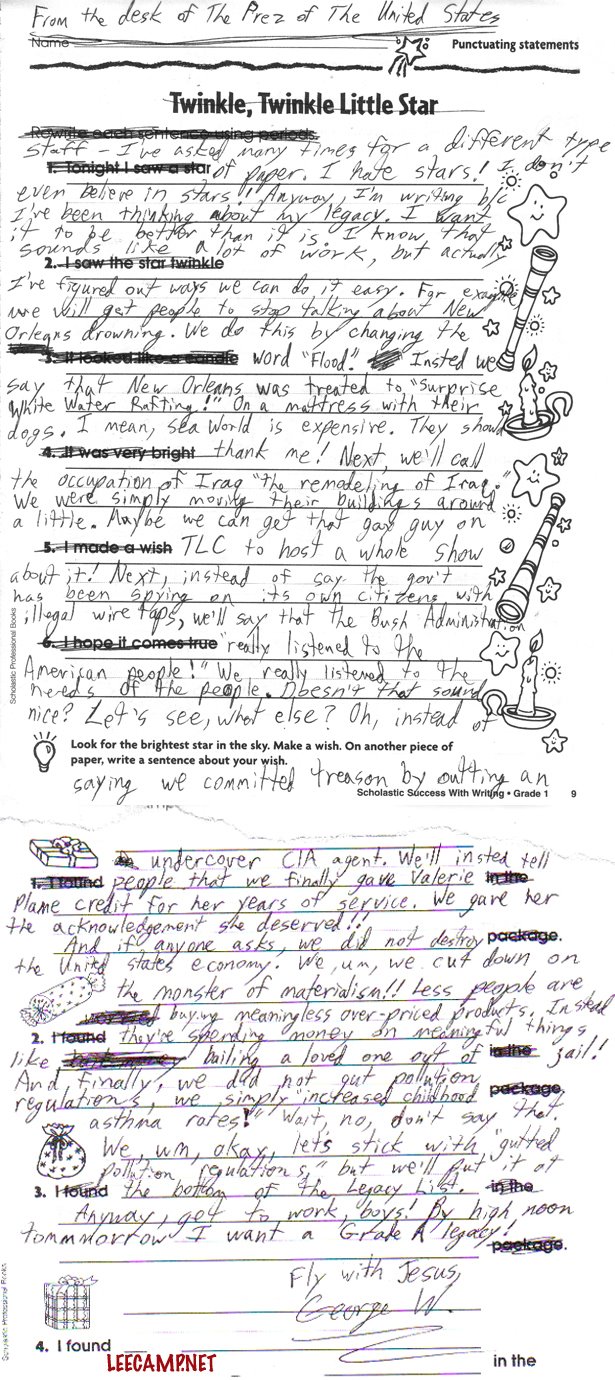
Source / 23/6
Thanks to Diane Stirling-Stevens / The Rag Blog
Bush’s Legacy Memo Leaked to Press
By Lee Camp / September 9, 2008
Source / 23/6
Thanks to Diane Stirling-Stevens / The Rag Blog

Al Jazeera speaks to Howard Zinn, the author, American historian, social critic and activist, about how the Iraq war damaged attitudes towards the US and why the US “empire” is close to collapse.
Q: Where is the United States heading in terms of world power and influence?
HZ: America has been heading – for some time, and is heading right now – toward less and less world power, less and less influence.
Obviously, since the war in Iraq, the rest of the world has fallen away from the United States, and if American foreign policy continues in the way it has been – that is aggressive and violent and uncaring about the feelings and thoughts of other people – then the influence of the United States is going to decline more and more.
This is an empire which is on the one hand the most powerful empire that ever existed; on the other hand an empire that is crumbling – an empire that has no future … because the rest of the world is alienated and simply because this empire is top-heavy with military commitments, with bases around the world, with the exhaustion of its own resources at home.
[This is] leading to more and more discontent and home, so I think the American empire will go the way of other empires and I think it is on its way now.
Q: Is there any hope the US will change its approach to the rest of the world?
HZ: If there is any hope, the hope lies in the American people.
[It] lies in American people becoming resentful enough and indignant enough over what has happened to their country, over the loss of dignity in the world, over the starving of human resources in the United States, the starving of education and health, the takeover of the political mechanism by corporate power and the result this has on the everyday lives of the American people.
[There is also] the higher and higher food prices, the more and more insecurity, the sending of the young people to war.
I think all of this may very well build up into a movement of rebellion.
We have seen movements of rebellion in the past: The labour movement, the civil rights movement, the movement against the war in Vietnam.
I think we may well see, if the United States keeps heading in the same direction, a new popular movement. That is the only hope for the United States.
Q: How did the US get to this point?
HZ: Well, we got to this point because … I suppose the American people have allowed it to get it to this point because there were enough Americans who were satisfied with their lives, just enough.
Of course, many Americans were not, that is why half of the population doesn’t vote, they’re alienated.
But there are just enough Americans who have been satisfied, you might say getting some of the “goodies” of the empire, just some of them, just enough people satisfied to support the system, so we got this way because of the ability of the system to maintain itself by satisfying just enough of the population to keep its legitimacy.
And I think that era is coming to an end.
Q: What should the world know about the United States?
HZ: What I find many people in the rest of the world don’t know is that there is an opposition in the United States.
Very often, people in the rest of the world think that Bush is popular, they think ‘oh, he was elected twice’, they don’t understand the corruption of the American political system which enabled Bush to win twice.
They don’t understand the basic undemocratic nature of the American political system in which all power is concentrated within two parties which are not very far from one another and people cannot easily tell the difference.
So I think we are in a situation where we are going to need some very fundamental changes in American society if the American people are going to be finally satisfied with the kind of society we have.
Q: Do you think the US can recover from its current position?
HZ: Well, I am hoping for a recovery process. I mean, so far we haven’t seen it.
You asked about what the people of the rest of the world don’t know about the United States, and as I said, they don’t know that there is an opposition.
There always has been an opposition, but the opposition has always been either crushed or quieted, kept in the shadows, marginalised so their voices are not heard.
People in the rest of the world hear the voices of the American leaders.
They do not hear the voices of the people all over this country who do not like the American leaders who want different policies.
I think also, people in the rest of the world should know that what they see in Iraq now is really a continuation of a long, long term of American imperial expansion in the world.
I think … a lot of people in the world think that this war in Iraq is an aberration, that before this the United States was a benign power.
It has never been a benign power, from the very first, from the American Revolution, from the taking-over of Indian land, from the Mexican war, the Spanish-American war.
It is embarrassing to say, but we have a long history in this country of violent expansion and I think not only do most people in other countries [not] know this, most Americans don’t know this.
Q: Is there a way for this to improve?
HZ: Well you know, whatever hope there is lies in that large number of Americans who are decent, who don’t want to go to war, who don’t want to kill other people.
It is hard to see that hope because these Americans who feel that way have been shut out of the communications system, so their voices are not heard, they are not seen on the television screen, but they exist.
I have gone through, in my life, a number of social movements and I have seen how at the very beginning of these social movements or just before these social movements develop, there didn’t seem to be any hope.
I lived in the [US] south for seven years, in the years of the civil rights movements, and it didn’t seem that there was any hope, but there was hope under the surface.
And when people organised, and when people began to act, when people began to work together, people began to take risks, people began to oppose the establishment, people began to commit civil disobedience.
Well, then that hope became manifest … it actually turned into change.
Q: Do you think there is a way out of this and for the future influence of the US on the world to be a positive one?
HZ: Well, you know for the United States to begin to be a positive influence in the world we are going to have to have a new political leadership that is sensitive to the needs of the American people, and those needs do not include war and aggression.
[It must also be] sensitive to the needs of people in other parts of the world, sensitive enough to know that American resources, instead of being devoted to war, should be devoted to helping people who are suffering.
You’ve got earthquakes and natural disasters all over the world, but the people in the United States have been in the same position as people in other countries.
The natural disasters here [also] brought little positive reaction – look at [Hurricane] Katrina.
The people in this country, the poor people especially and the people of colour especially, have been as much victims of American power as people in other countries.
Q: Can you give us an overall scope of everything we talked about – the power and influence of the United States?
HZ: The power and influence of the United States has declined rapidly since the war in Iraq because American power, as it has been exercised in the world historically, has been exposed more to the rest of the world in this situation and in other situations.
So the US influence is declining, its power is declining.
However strong a military machine it is, power does not ultimately depend on a military machine. So power is declining.
Ultimately power rests on the moral legitimacy of a system and the United States has been losing moral legitimacy.
My hope is that the American people will rouse themselves and change this situation, for the benefit of themselves and for the benefit of the rest of the world.
© 2008 Aljazeera.net/English
Source / Al Jazeera English
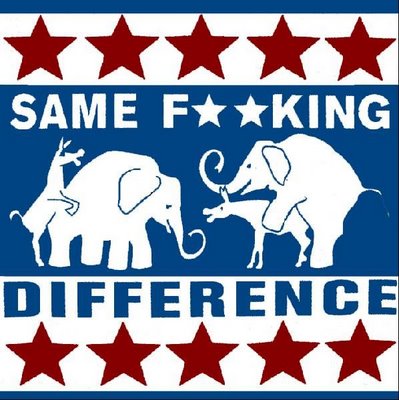
Deception and Delusion: Dummies for Democracy
by Joel S. Hirschhorn / September 9, 2008
I confess. I believe there is a ruling class that sustains the two-party plutocracy running the nation for the benefit of the rich and corporate class. Their broad strategy is deception and delusion. Tactically, they use government, the mainstream media, the financial services sector, funding of politicians and the two major parties, and many other parts of the culture and economy to maintain their power and control.
Elections do not threaten elites. To the contrary, political debate and elections are important to maintain the illusion and delusion of a real democracy. They are key to prevent outright revolution, marginalize dissidents and political reform efforts, and suppress third parties. Would power plutocrats allow election of a president that threatened their control? Of course not. And no Democratic or Republican presidential candidate ever poses a real threat despite cloaking themselves with labels like maverick, reformer or change agent.
If you accept my worldview, then you know that the ruling class would prefer John McCain over Barack Obama, though they can live with Obama, which is why many, many wealthy people and corporations have poured money into the Obama’s campaign and the recent Democratic convention. The chief disadvantage of Obama and Sarah Palin, from the rulers’ perspective, is their relative brief stints as politicians. It takes time to corrupt politicians and cement their dependency on and membership in the ruling class. In contrast, McCain and Joe Biden clearly have shown themselves reliable in protecting the status quo two-party plutocracy.
The best way to view most current events is through the prism of the ruling class. Take lower gas prices and the federal takeover of the two mortgage giants Fannie Mae and Freddie Mac. Both occurred relatively soon before the general election, as has far better information about the Iraq war. Manipulation and engineering of national and even world events are designed to serve the interests of the ruling class.
Why does deception and delusion work so effectively? When it comes to politics, current events and history, the vast majority of citizens are uninformed, stupid and dumb, regardless of their educational level. As distracted and compulsive consumers, they fall head over hills for political lies and slick campaign rhetoric.
First, consider younger voters. So much talk is about the increased interest in this presidential campaign by younger people, especially evident in the Ron Paul and Obama campaigns. But consider these facts: For those age 18 to 29 just 20 percent read newspapers and just 11 percent regularly surf the Internet for news. Most of what people know about candidates’ positions on the issues comes from what they learn from unreliable and all too often misleading 30-second commercials. Despite far more widespread and extensive schooling, people today possess no more political knowledge than their parents and grandparents. And don’t think that those addicted to The Daily Show and its irreverent view of politics are a lot smarter than those favoring The conservative O’Reilly Factor show. In both groups, only about 54 percent of the shows’ politicized viewers scored in the high knowledge category.
Propaganda and misinformation really work. Just prior to the 2003 invasion of Iraq some 60 percent of Americans believed that Iraq was behind the 9/11 attack. But here is the kicker: A year later there was a wealth of information, including the 9/11 Commission report, saying that Iraq had nothing to do with the 9/11 attack. Yet an amazing 50 percent of Americans still believed that Iraq was to blame, and may still think so. As Rick Shenkman, author of Just How Stupid Are We? Facing the Truth About the American Voter, concluded: “By every measure social scientists have devised, voters are spectacularly uninformed.” Guess who takes advantage of the stupidity of voters, especially younger ones.
If people can believe Obama when he says that the election is not about him but about them, then they also can believe McCain when he says he is a proven change agent and reformer.
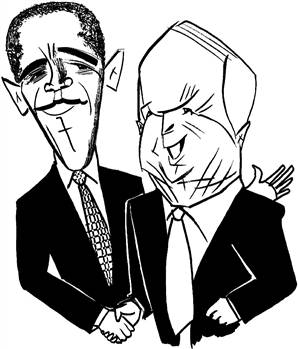
The only real difference between Obama and McCain is exactly how they will screw the public and benefit the rich and powerful if elected, not whether they will. If the electorate was really intelligent, they would understand and focus on the similarity between the two, rather than their professed differences. It is what they share – obedience and loyalty to the two-party plutocracy – that matters the most.
two of the same As long as voters do not understand this, the oppression and destruction of the middle class will continue, despite people thinking they are free and live in a democracy.
Mostly, Americans are free to remain vulnerable to deception and delusion.
Democracy for dummies is what we have and what the majority deserve. For the rest of us the difficult challenge is to find ways to fight the political system that are not marginalized and only satisfy our egos. As long as you are an enthusiastic supporter of any Democrat or Republican you are a willing participant in our fake democracy. Most voters persist in believing in the myth that some Democrat or Republican can and will reform the political system, fix the economy, and restore American democracy. They refuse to face the painful truth that this is simply not true. They rather keep embracing the delusional myth.
Consider these wise words of John F. Kennedy: “The great enemy of the truth is very often not the lie – deliberate, contrived, and dishonest, but the myth – persistent, persuasive, and unrealistic. Belief in myths allows the comfort of opinion without the discomfort of thought.”
And so millions of Americans suffering from habitual stupidity will cast their votes confident that they have discovered the truth. Like the march of the penguins diving into icy water without thinking they have any other choice, they succumb to the big myth that this year cost about $1 billion to keep alive. These voters are dummies for democracy. The rest of us will vote for Ralph Nader or some other third party candidate, or refuse to vote at all, and seek ways to ignite the Second American Revolution.
Politicians and media people often praise the smart public and smart voters as if they inevitably make the best, most intelligent and informed electoral decisions. This is sheer hype designed to maintain the political status quo. There is only one smart fact: Every single Democrat and Republican candidate lies. Why do they keep lying? It works.
Joel S. Hirschhorn is the author of Delusional Democracy – Fixing the Republic Without Overthrowing the Government. His current political writings have been greatly influenced by working as a senior staffer for the U.S. Congress and for the National Governors Association. He advocates a Second American Revolution, beginning with an Article V Convention to propose constitutional amendments. He is Chair of the Independent Party of Maryland.
Source / OpEdNews
This appears as a comment to an AlterNet article titled “Why Obama’s Message Resonates with Millions” by Matt Taibbi. The article is fine, but this faux conversation between competing wings of the Money Party says more than most of us are willing to admit.
Richard Jehn / The Rag Blog
They’re back… and they’re doin’ it again.
By Chlamor / September 9, 2008
Demobama: “We love the miltary, they are all heroes, we honor their service…”
Republicain: “I was the military; I should be honored…”
Demobama: “We don’t oppose all war; we are just against the way war is handled.”
Republicain: “Didn’t you hear me? I am the military. Who can handle war better?”
Demobama: “Gas prices are really high. We favor all kinds of indistinct measures to fix them.”
Republicain: “We favor the same indistinct shit (what is the harm?) plus we wanna drill everywhere – Hummers are us.
Demobama: “The economy is terrible. We want a middle class tax break.”
Republicain: “We want a tax break for everybody – we are more egalitarian.”
Demobama: “We want indistinct change and meaningless experience.”
Republicain: “We want meaningless experience and indistinct change – better ordering.”
Demobama: “Women’s issues are really important. That is why we are for abortion.”
Republicain: “Hell, we gotta a girl… err, ‘woman’.”
Demobama: “Since we live in a post racial era, our guy is black but it don’t mean nothin’.”
Republicain: “Since it don’t mean nothin’, we stopped paying attention.”
Demobama: “We are really really smart and entitled. We should win.”
Republicain: “Lots of people hate ‘entitled’. We are billionaire homies.”
Demobama: “We want to invite the Republicans into our ruling coalition.”
Republicain: “We are Republicans. We don’t need to invite nobody.”
Demobama: “Don’t worry, we won’t really change too much.”
Republicain: “Ditto…”
Demobama: “We are certain voters are stupid so we will wow ’em with fireworks and not distract them with substance.”
Republicain: “We will see your ‘stupid’ and raise you ten thousand ‘floating chrysanthemums of cynicism’.”
…and so it goes.
Source / AlterNet
Thanks to Diane Stirling-Stevens / The Rag Blog
It disgusts me that the politics of fear has become big business in the US. How can I be anything but deeply cynical about a power elite that ratchets up this fear-mongering for the election and a complacent population that dutifully cowers and dashes for cover at any hint of imaginary danger. When will we see through the sham and kick all these bastards out of our lives and, more particularly, out of the power structure of the nation?
Richard Jehn / The Rag Blog
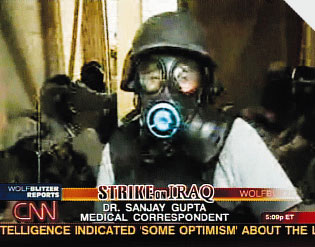
WASHINGTON – The United States remains “dangerously vulnerable” to chemical, biological and nuclear attacks seven years after 9/11, a forthcoming independent study concludes. And a House Democrats’ report says the Bush administration has missed one opportunity after another to improve the nation’s security.
The recent political rupture between Russia and the U.S. only makes matters worse, said Lee Hamilton, the former Indiana Democratic congressman who helped lead the 9/11 Commission and now chairs the independent group’s latest study.
Efforts to reduce access to nuclear technology and bomb-making materials have slowed, thousands of U.S. chemical plants remain unprotected, and the U.S. government continues to oppose strengthening an international treaty to prevent bioterrorism, according to the report produced by the bipartisan Partnership for a Secure America.
The group includes leaders of the disbanded 9/11 Commission, the bipartisan panel that investigated government missteps before the 2001 terror attacks on the United States.
“The threat of a new, major terrorist attack on the United States is still very real,” concludes the report to be released Wednesday, the same day a congressional commission will hold a hearing in New York on nuclear and biological terrorism threats.
“A nuclear, chemical or biological weapon in the hands of terrorists remains the single greatest threat to our nation. While progress has been made in securing these weapons and materials, we are still dangerously vulnerable,” the report said.
Congressional Democrats, meanwhile, had harsher criticism of the Bush administration’s efforts. Their report, written by the staffs of the House Homeland Security and Foreign Affairs committees, found little or no progress across the board on national security initiatives.
“The Bush administration has not delivered on a myriad of critical homeland and national security mandates,” the Democrats’ report states. That report was being released Tuesday.
“The administration has just failed to act in so many ways,” said Rep. Bennie Thompson, D-Miss. “Let’s say that we’ve been fortunate that we have not been attacked” since 2001, said Thompson, who chairs the House Homeland Security Committee.
The independent report focuses narrowly on weapons of mass destruction.
The report and supporting studies describe the failure of international cooperation to prevent terrorists from obtaining weapons of mass destruction, which they call a major problem. Many countries continue to ignore a United Nations mandate to prevent the spread of weapons; the ability of many countries to monitor potential bioterrorism is “essentially nonexistent,” and dangerous chemical weapons stockpiles remain in some countries, including Russia and Libya, the report said.
Russia has been a significant player in U.S. efforts to secure nuclear weapons and to eliminate inventories of chemical weapons in the former Soviet region. That cooperation could be jeopardized as the two countries face off over the Russian invasion of Georgia and concerns about a U.S. missile defense base in Poland, Hamilton said.
Bush on Monday Bush on canceled a civilian nuclear cooperation deal with Russia.
“The things we do to penalize Russia will make it more difficult for us to deal with Russia on other matters,” Hamilton said.
State Department spokesman Robert Wood said he hasn’t seen the report. But he said there have been a number of successes in recent years, including negotiations to dismantle North Korea’s nuclear program and Libya’s agreement to end its nuclear and chemical weapons program.
“We have been engaged multilaterally with a number of countries to deal with this issue of weapons of mass destruction,” Wood said.
Wood said he also has not seen the Democrats’ report. “I fundamentally reject the charge that the administration has made the world less safe from terrorism,” he said.
House Democrats also blasted Bush policy in Pakistan, Afghanistan and Saudi Arabia as damaging to national security. U.S. efforts to combat terrorists in Pakistan have suffered because of “unyielding support for a military dictator”; Iraq has drained resources from the fight in Afghanistan, and Saudi Arabia continues to serve “as a major source of terrorist activity,” the Democrats’ report states.
The independent study, however, did credit the Bush administration with progress in a number of areas. It cited improved U.S. port security, reduction of military chemical stockpiles, increased U.S. funding for securing nuclear weapons sites in
Russia and new international programs aimed at preventing crimes involving biological weapons.
Source / AP / America On Line
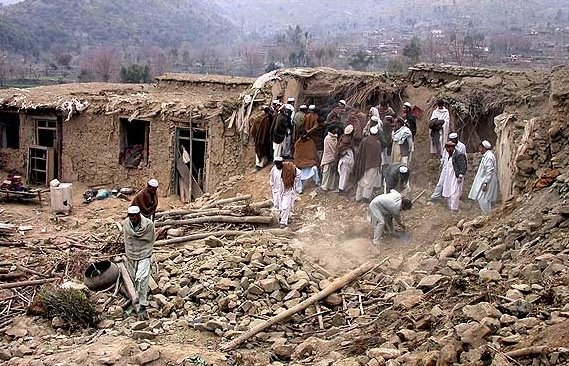
Video Shows US Carnage In Afghanistan
By Tom Coghlan / September 8, 2008
Harrowing video film backs Afghan villagers’ claims of carnage caused by US troops
KABUL — As the doctor walks between rows of bodies, people lift funeral shrouds to reveal the faces of children and babies, some with severe head injuries.
Women are heard wailing in the background. “Oh God, this is just a child,” shouts one villager. Another cries: “My mother, my mother.”
The grainy video eight-minute footage, seen exclusively by The Times, is the most compelling evidence to emerge of what may be the biggest loss of civilian life during the Afghanistan war.
These are the images that have forced the Pentagon into a rare U-turn. Until yesterday the US military had insisted that only seven civilians were killed in Nawabad on the night of August 21.
Last night the Pentagon announced that it was reopening the investigation in the light of “emerging evidence” and was sending an officer to Nawabad to review its previous inquiry. Villagers and the UN insist that 92 were killed, including as many as 60 children. Locals say that the US and Afghan troops who came into the village looking for a Taleban commander, with US air support, used excessive force.
In the video scores of bodies are seen laid out in a building that villagers say is used as a mosque; the people were killed apparently during a combined operation by US special forces and Afghan army commandos in western Afghanistan. The film was shot on a mobile phone by an Afghan doctor who arrived the next morning.
Local people say that US forces bombed preparations for a memorial ceremony for a tribal leader. Residential compounds were levelled by US attack helicopters, armed drones and a cannon-armed C130 Spectre gunship.
However, US commanders and Pentagon officials have said repeatedly that seven civilians died alongside 35 Taleban militants during a legitimate combat operation, the target of which was a meeting of Taleban leaders.
The villagers’ accounts have been supported by separate investigations conducted by the UN, by Afghanistan’s leading human rights organisation and by an Afghan government delegation. Two Afghan army officers involved in the operation have been dismissed.
The Pentagon’s original investigation concluded last week that US forces used close air support after coming under heavy fire during a mission to seize a Taleban commander named Mullah Sadiq. They allege that he died in the operation.
The US military said that its findings were corroborated by an independent journalist embedded with the US force. He was named as the Fox News correspondent Oliver North, who came to prominence in the 1980s Iran-Contra affair, when he was an army colonel.
Sources close to one of the investigations said that a video film was shot by Afghan officials the morning after the attack. It corroborates the doctor’s footage but has not been made public.
In a statement released on Saturday, the commander of Nato forces, General David McKiernan, appeared to back away from previous US accounts. He said: “Following the recent operation in Azizabad, Shindand district, we realise there is a large discrepancy between the number of civilian casualties reported by soldiers and local villagers. I remain responsible to continue to try and account for this disparity in numbers, but above all I want to express our heartfelt sorrow to all families that lost loved ones in this firefight.”
A Human Rights Watch report due to be published today is highly critical of US and Nato forces in Afghanistan for the number of civilians killed in airstrikes. It gives warning that repeated instances of Western forces killing Afghan civilians have led to a collapse in popular support for the international presence.
Taking what it says are the most conservative figures available, Human Rights Watch has calculated that civilian deaths as a result of Western airstrikes tripled between 2006 and 2007 to 321. In the first seven months of this year the figure was 119. In the same period, 367 civilian deaths were attributed to Taleban attacks. It accuses US officials of routinely denying reports of civilian deaths.
Maulavi Gul Ahmad, an Afghan MP who was part of a government delegation that investigated the Nawabad attack, told The Times: “We are not only blaming America – this is destroying the reputation of the international community and undermining their presence in Afghanistan.”
Other Afghan investigators alleged that US forces had been duped into attacking the village by tribal figures involved in a local feud.
To view the video, click here.
Civilian casualties in Afghanistan
December 2001
US aircraft attack a convoy taking tribal leaders to the inauguration of new Afghan Government. About 60 killed; US claims al-Qaeda leaders among them
July 2002
46 die, many from same family, when a wedding party in Uruzgan province is bombed in error
October 26, 2006
Between 40 and 85 civilians are killed in airstrikes and mortar bombardments around the settlement of Zangawat in Kandahar province
March 2007
19 people are killed and 50 wounded when US Marine Special Forces fire on civilians after a suicide attack in Shinwar, eastern Afghanistan. The US military apologises and pays compensation to the families
July 6, 2008
47 civilians, including 39 women and children attending a wedding party, are killed by a US airstrike in Nangarhar province, an Afghan government investigating team claims
Sources: Times archive, agencies
Source / Times Online

Why Rednecks May Rule the World
By Joe Bageant / September 7, 2008
During this US election cycle we are hearing a lot from the pundits and candidates about “heartland voters,” and “white working class voters.”
What they are talking about are rednecks. But in their political correctness, media types cannot bring themselves to utter the word “redneck.” So I’ll say it for them: redneck-redneck-redneck-redneck.
The fact is that we American rednecks embrace the term in a sort of proud defiance. To us, the term redneck indicates a culture we were born in and enjoy. So I find it very interesting that politically correct people have taken it upon themselves to protect us from what has come to be one of our own warm and light hearted terms for one another.
On the other hand, I can quite imagine their concern, given what’s at stake in the upcoming election. We represent at least a third of all voters and no US president has ever been elected without our support.
Consequently, rednecks have never had so many friends or so much attention as in 2008. Contrary to the stereotype, we are not all tobacco chawing, guffawing Southerners, but are scattered from coast to coast. Over 50% of us live in the “cultural south”, which is to say places with white Southern Scots-Irish values — redneck values.
They include western Pennsylvania, central Missouri and southern Illinois, upstate Michigan and Minnesota, eastern Connecticut, northern New Hampshire …
So when you look at what pundits call the red state heartland, you are looking at the Republic of Redneckia.
As to having our delicate beer-sodden feelings protected from the term redneck; well, I appreciate the effort, though I highly suspect that the best way to hide snobbishness is to pose as protector of any class of folks you cannot bear. Thus we are being protected by the very people who look down on us — educated urban progressives.
And let’s face it, there’s plenty to look down on. By any tasteful standard, we ain’t a pretty people.
Uppity and slick? Not us …
We come in one size: extra large. We are sometimes insolent and often quick to fight. We love competitive spectacle such as NASCAR and paintball, and believe gun ownership is the eleventh commandment.
We fry things nobody ever considered friable — things like cupcakes, banana sandwiches and batter dipped artificial cheese … even pickles.
And most of all we are defiant and suspicious of authority, and people who are “uppity” (sophisticated) and “slick” (people who use words with more than three syllables). Two should be enough for anybody.
And that is one of the reasons that, mystifying as it is to the outside world, John McCain’s choice of the moose-shooting Alaskan woman with the pregnant unmarried teen daughter appeals to many redneck and working class Americans.
We all understand that there is a political class which dominates in America, and that Sarah Palin for damned sure is not one of them. And the more she is attacked by liberal Democratic elements (translation: elite highly-educated big city people) the more America’s working mooks will come to her defence. Her daughter had a baby out of wedlock? Big deal. What family has not? She is a Christian fundamentalist who believes God spat on his beefy paws and made the world in seven days? So do at least 150 million other Americans. She snowmobiles and fishes and she is a looker to boot. She’s a redneck.
American ethos
The term redneck indicates a lifestyle and culture that can be found in every state in our union. The essentials of redneck culture were brought to America by what we call the Scots Irish, after first being shipped to the Ulster Plantation, where our, uh, remarkable cultural legacy can still be seen every 12 July in Ireland.
Ultimately, the Scots Irish have had more of an effect on the American ethos than any other immigrant group. Here are a few you will recognize:
* Belief that no law is above God’s law, not even the US Constitution.
* Hyper patriotism. A fighting defence of native land, home and heart, even when it is not actually threatened: ie, Iraq, Panama, Grenada, Somalia, Cuba, Nicaragua, Vietnam, Haiti and dozens more with righteous operations titles such as Enduring Freedom, Restore Hope, and Just Cause.
* A love of guns and tremendous respect for the warrior ideal. Along with this comes a strong sense of fealty and loyalty. Fealty to wartime leaders, whether it be FDR or George Bush.
* Self effacement, humility. We are usually the butt of our own jokes, in an effort not to appear aloof among one another.
* Belief that most things outside our own community and nation are inferior and threatening, that the world is jealous of the American lifestyle.
* Personal pride in equality. No man, however rich or powerful, is better than me.
* Perseverance and belief in hard work. If a man or a family is poor, it is because they did not work hard enough. God rewards those who work hard enough. So does the American system.
* The only free country in the world is the United States, and the only reason we ever go to war is to protect that freedom.
All this has become so deeply instilled as to now be reflexive. It represents many of the worst traits in American culture and a few of the best. And that has every thinking person here in the US, except perhaps John McCain and Sarah Palin, worried.
Very worried.
Source / Joe Bageant
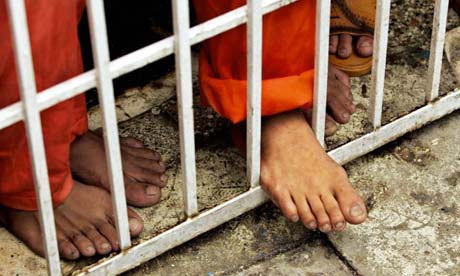
BAGHDAD — Hundreds of children, some as young as nine, are being held in appalling conditions in Baghdad’s prisons, sleeping in sweltering temperatures in overcrowded cells without working fans, no daily access to showers, and subject to frequent sexual abuse by guards, current and former prisoners say.
At Karkh juvenile prison, Omar Ali, a 16-year-old who has spent more than three years there, showed the multiple skin sores he and many other fellow inmates have contracted through lying on thin, sweat-soaked mattresses night after night.
“The electricity comes from a generator and it’s only switched on during the two-hour weekly session when visitors come in, and for two or three hours in the evening. We are convinced the guards sell the generator fuel on the black market,” he said.
Daytime temperatures in Baghdad last week averaged 44C (112F). They barely drop below 38C at night. Water supplies in Karkh are spasmodic, and Omar said he was able to shower only once every three days. Boys sleep in four dormitories, averaging 75 inmates in a cell about 5 metres by 10 metres, on double bunks or the concrete floor.
Guards often take boys to a separate room in the prison and rape them, Omar alleged. They also break prison rules by lending their mobile phones to boys to ring home, on condition that each time their families top the phone up by $10 or $20. The teaching staff resigned en masse in November because of low pay, according to an international official. As a result, the children lounge around aimlessly with no daytime activities, other than an exercise yard.
Though the boys in the prison have been convicted, international standards for fair trials are never met. “Trials last on average for 25 minutes, no witnesses are called, confessions are used as the only evidence, and court-appointed defence lawyers get the case file on the day of the trial, leaving no chance to consult the defendant in private,” an international adviser in Baghdad said on condition of anonymity.
Omar Ali was 13 when interior ministry special forces raided his house in a predominantly Sunni suburb in October 2004. He and his 14-year-old brother were arrested. A week later the special forces came back and took their father. All three are still in custody.
The ministry is under Shia control and its forces have repeatedly been accused of targeting innocent Sunnis. Sahar Muhammad, the boys’ mother, told the Guardian that when she was able to visit her sons they told her they were beaten repeatedly in the first days of custody and ordered to sign a blank sheet of paper on which charges would be written later.
Raad Jamal was 17 when US forces raided his home in the mixed Sunni and Shia district of Doura in June last year. His mother, Suad Ahmed Rashid, who was with him during the interview, told the Guardian: “During the US raid an American officer told my daughter: ‘Tell your brother to confess he is with al-Qaida so we can send him to Camp Bucca [a US prison near Basra] or else we’ll hand him to the Iraqis and they will torture him’.”
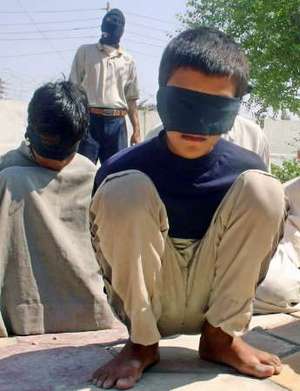
Raad and a friend were taken to a US base and were transferred next morning to the seventh brigade of the Iraqi army’s second regiment. Raad said he and his friend were hung from the ceiling on ropes, beaten with electric cables, and taken for interrogation one by one. “They said everyone who comes here has to confess,” Raad said.
He was then sent to another Iraqi army base. “I stayed there about six months. I didn’t confess anything I didn’t do. They write false statements and ask you to press your thumb on it. I refused but they forced my thumb on to the paper,” he said. At the juvenile court Raad encountered a sympathetic judge.
“The judge did not accept my confession. He said I was innocent but for administrative reasons I would have to go to Tobchi until I was released.” He spent a few months in Tobchi and was released in March.
Last year officials from the United Nations Assistance Mission to Iraq (Unami) visited Baghdad’s Tobchi prison, where children awaiting trial are held. They reported that detainees provided “particularly worrisome allegations of ill-treatment or other abuse of juvenile males, several of whom told Unami they had been beaten and sexually abused while held in the custody of the ministries of the interior and defence prior to transfer to a juvenile facility. Upon examining them Unami observed injuries consistent with beatings.”
The UN found severe overcrowding at Tobchi, with around 400 inmates in a prison with an official capacity of 206. “In some cells juveniles were taking turns to sleep on the floor without mattresses,” the UN reported. The ministry of labour and social affairs (Molsa), which manages the prison, said shortages of funds prevented improvements.
Kadhim Raouf Ali, deputy director general of Molsa’s juvenile department, told the Guardian that inmate numbers in Tobchi had been sharply reduced this year thanks to speeded-up releases under the new amnesty law. There were only 226 inmates now. But he admitted Karkh was still overcrowded. It was holding 315 children while capacity was 250.
Child detainees in US custody in Iraq fare better than those in Iraqi hands, said Shatha Alobosi, an Iraqi woman MP. Former inmates interviewed by the Guardian confirmed that there is less overcrowding and brutality.
Now, as Iraqi pressure mounts for a return of sovereignty, the US has been moving to release all under-18s. In December last year it held 950 children. The current total is 180.
“We anticipate having less than 100 juveniles in detention by the end of Ramadan [later this month], and hopefully release all juveniles to their families before the end of this year,” First Lieutenant Randi Norton, a US military spokesman, said.
The Iraqi Islamic party, the main Sunni party in parliament, takes a special interest in detainees, adult as well as juvenile, since the majority are Sunnis. It gives aid to poor families who have no breadwinner, and has urged the authorities to improve conditions and release prisoners.
“We still have a long way to go. The problem is how to make a major and drastic reform of the judicial system, and change the mentality of officers in the army and police,” its leader, the Iraqi vice president Tariq al-Hashemi, told the Guardian.
· An Iraqi contributed reporting for this article. Names of inmates and family members have been changed.
Source / The Guardian
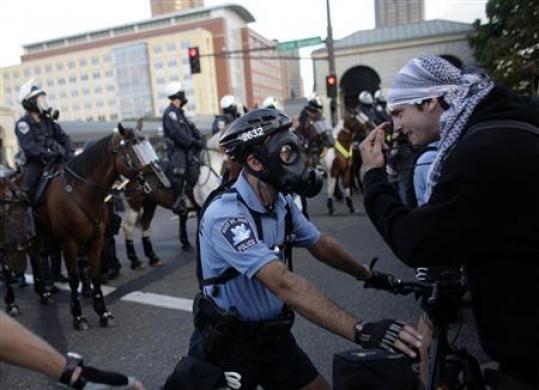
St. Paul is a window into our future. It is a future where, as one protester told me by phone, “people have been pepper-gassed, thrown on the ground by police who had drawn their weapons, had their documents seized and their tattoos photographed before being taken away to jail.” It is a future where illegal house raids are carried out. It is a future where vans containing heavily armed paramilitary units circle and film protesters. It is a future where, as the protester said, “people have been pulled from cars because their license plates were on a database and handcuffed, thrown in the back of a squad car and then watched as their vehicles were ransacked and their personal possessions from computers to literature seized.” It is a future where constitutional rights mean nothing and where lawful dissent is branded a form of terrorism.
The rise of the corporate state means the rise of the surveillance state. The Janus-like face of America swings from packaged and canned spectacles, from nationalist slogans, from seas of flags and Christian crosses, from professions of faith and patriotism, to widespread surveillance, illegal mass detentions, informants, provocateurs and crude acts of repression and violence. We barrel toward a world filled with stupendous lies and blood.
What difference is there between the crowds of flag-waving Republicans and the apparatchiks I covered as a reporter in the old East German Communist Party? These Republican delegates, like the fat and compromised party functionaries in East Berlin, all fawned on cue over an inept and corrupt party hierarchy. They all purported to champion workers’ rights and freedom while they systematically fleeced, disempowered and impoverished the workers they lauded. They all celebrated the virtue of a state that was morally bankrupt. And while they played this con game, one that gave them special privileges, power and wealth, they unleashed their goons and thugs on all who dared to challenge them. We are not East Germany, but we are well on our way. An economic meltdown, another catastrophic terrorist attack on American soil, a war with Iran, and we could easily swing into an authoritarian model that would look very familiar to anyone who lived in the former communist East Bloc.
A few of those arrested in St. Paul, including eight leaders of the RNC Welcoming Committee — one of the groups organizing protests at the GOP convention in St. Paul — now face terrorism-related charges. Monica Bicking, Eryn Trimmer, Luce Guillen Givins, Erik Oseland, Nathanael Secor, Robert Czernik, Garrett Fitzgerald and Max Spector could get up to seven and a half years in prison under the terrorism enhancement charge, which allows for a 50 percent increase in the maximum penalty. This is the first time criminal charges have been filed under the 2002 Minnesota version of the federal Patriot Act.
The Patriot Act, which was put in place as much to silence domestic opposition as to ferret out real terrorists, has largely lain dormant. It has authorized the government to monitor our phone conversations, e-mails, meetings and political opinions. It has authorized the government to shut down anti-war groups and lock up innocents as terrorists. It has abolished habeas corpus. But until now we have not grasped its full implications for our open society. We catch glimpses, as in St. Paul or in our offshore penal colonies where we torture detainees, of its awful destructive power.
The commercial media told us that what was important in St. Paul was happening inside the convention hall. The vapid interviews, the ridiculous soap opera sagas about Sarah Palin’s daughter and the debate about whether John McCain or Barack Obama has proprietary rights to “Change” divert us from the truth of who we have become. You had to search out “Democracy Now!,” TheUptake.org, Twin Cities Indymedia, I-Witness, along with a few other independent outlets, to see, hear or read real journalism from St. Paul.
It does not matter that the RNC Welcoming Committee describes itself as an “anarchist/anti-authoritarian” organization. We don’t have to embrace a political agenda to protect the right to be heard. Shut down free speech and radicals only burrow deeper underground, splitting ossified political systems into fractured extremes. We may well end up with the Christian right on one side, with politicians like Sarah Palin providing an ideological veneer to a Christian fascism, and embittered leftist radicals who turn to violence on the other.
St. Paul was not ultimately about selecting a presidential candidate. It was about the power of the corporate state to carry out pre-emptive searches, seizures and arrests. It was about squads of police in high-tech riot gear, many with drawn semiautomatic weapons, bursting into houses. It was about seized computers, journals and political literature. It was about shutting down independent journalism, even at gunpoint. It was about charging protesters with “conspiracy to commit riot,” a rarely used statute that criminalizes legal dissent. It was about 500 people held in open-air detention centers. It was about the rising Orwellian state that has hollowed out the insides of America, cast away all that was good and vital, and donned its skin to shackle us all.
Source / TruthDig
I cannot resist remarking that this is eerily similar to the Pakistani reaction following the events of September 11, 2001: instant acquiescence. Recall that there was rumour of a threat from the reigning US Vice-Emperor that Pakistan would be bombed into the stone age if they refused to cooperate in the newly-minted US “War
ofon Terror.”Is it possible that a similar threat surfaced over the weekend in consequence of Pakistan’s closure of the Khyber Pass?
Richard Jehn / The Rag Blog
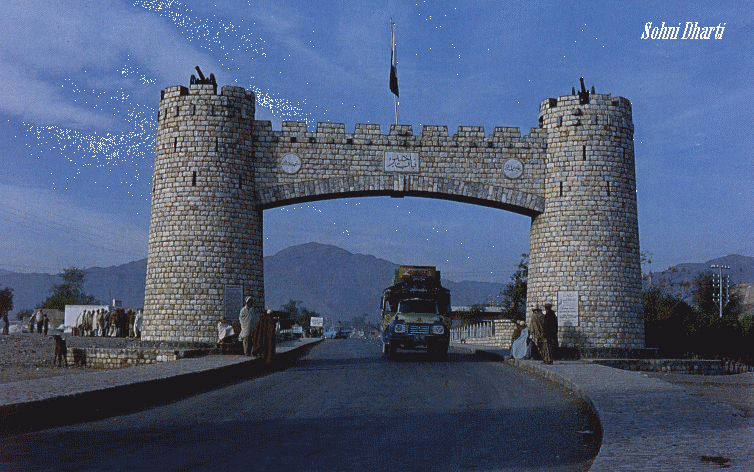
ISLAMABAD, Sept 8 (Reuters) – Pakistan has reopened supply lines to Western forces in Afghanistan, after the road through the Khyber Pass was blocked on Saturday, days after a raid by U.S. commandos on a Pakistani village, a minister said on Monday.
Rehman Malik, the top Interior Ministry official, said the road was unblocked after a few hours, and traffic had only been halted for security reasons, although the country’s defence minister had earlier said the action was taken in response to violations of Pakistani territory by Western forces.
“There was a suspension for a few hours due to security reasons but later, supplies to Afghanistan were resumed after clearing the road,” Malik told Reuters.
Militants have been attacking trucks in the Khyber Pass, on the way to Torkham, the main crossing point on the Pakistani-Afghan border near Peshawar, the capital of North West Frontier Province.
But the move to stop tankers carrying fuel came after the new government expressed outrage over the killing of 20 people, including women and children, during a U.S. commando raid on a remote border village in Pakistani tribal lands on Sept. 3.
Defence Minister Chaudhry Ahmed Mukhtar told Dawn Television on Saturday that the fuel supply route through Torkham had been blocked “to tell how serious we are”.
Pakistan has been a close U.S. ally in the unpopular campaign against terrorism and it has tens of thousands of soldiers battling militants. But it forbids incursions by foreign forces.
The five-month-old civilian coalition is more sensitive to public opinion than former army chief Pervez Musharraf, who was forced out of office in August.
While the brief interruption to fuel supplies demonstrated the West’s dependence on Pakistani cooperation to keep troops in landlocked Afghanistan supplied, Pakistan’s leverage is limited.
The government gets paid by the United States for expenditure and logistical support in fighting militancy in the region, and needs billions of dollars of foreign assistance to stave off a looming balance of payments crisis.
Most fuel and other supplies for U.S. forces in Afghanistan are trucked through Pakistan, crossing the border at two points: Torkham and Chaman, to the southwest.
The Chaman crossing, used to supply foreign forces in southern Afghanistan, was operating normally on Saturday.
In April, Russia agreed to allow NATO to transport non-lethal supplies through its territory and into northern Afghanistan.
(Reporting by Kamran Haider; Writing by Simon Cameron-Moore)
Source / Reuters
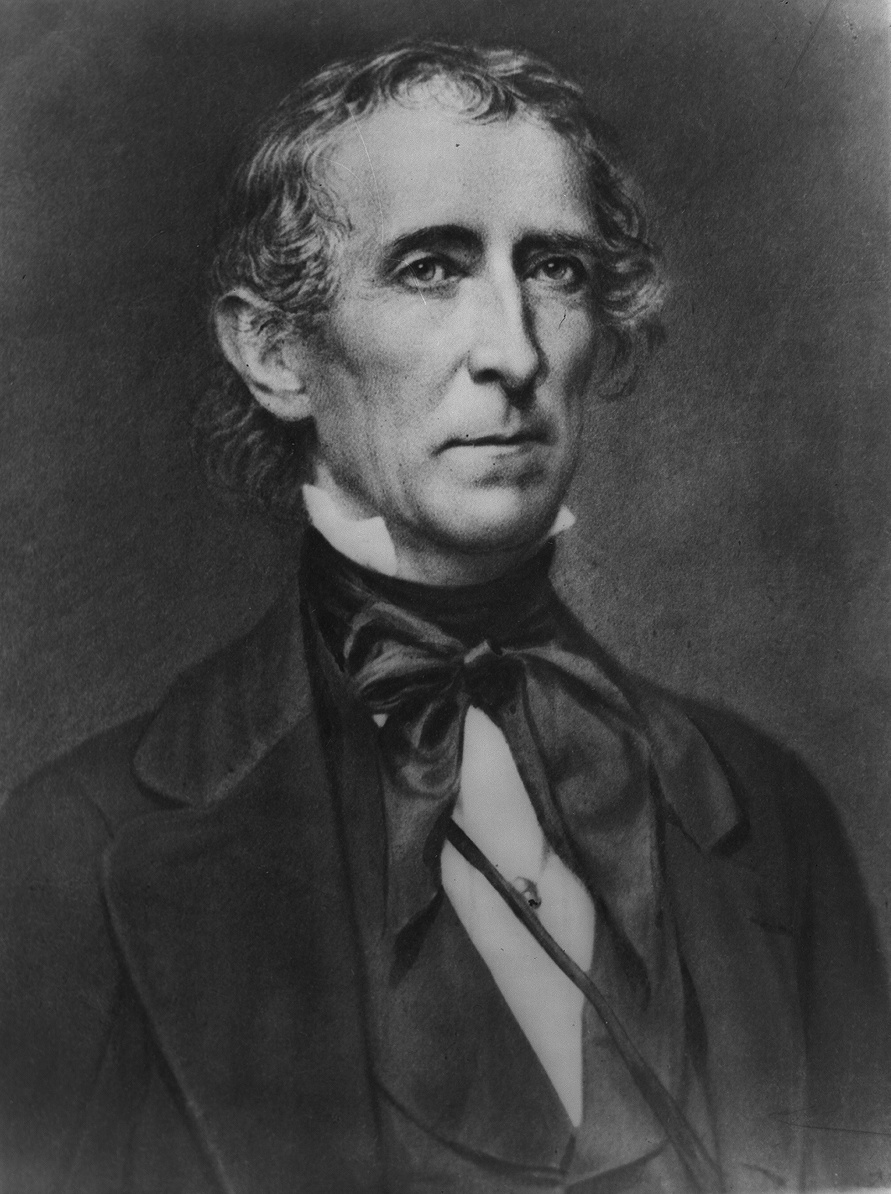
In truth, the Vice President of the United States is important for only one reason: He or she will become President of the United States upon the death, incapacity or resignation of the President. Nine times in our history, vice presidents have succeeded to the presidency: John Tyler (1841), Millard Fillmore (1850), Andrew Johnson (1865), Chester A. Arthur (1881), Theodore Roosevelt (1901), Calvin Coolidge (1923), Harry Truman (1945), Lyndon Johnson (1963), and Gerald Ford (1974). Of course, the vice president also has a significant secondary role: It is he or she, acting with a majority of the Cabinet, who can declare the president incapable of carrying out the duties of the office, and then take charge – until the action is either ratified or rejected by a majority of the Congress. So far in our history, however, this has never occurred.
Given the fact that the 2008 GOP standard-bearer John McCain is seventy-two years of age, his selection of an inexperienced Vice Presidential running mate, Alaska Governor Sarah Palin, has again focused attention on the process and procedures for selecting vice presidents – or, to put it more bluntly, the utter lack of process or procedures in selecting the person who is a heartbeat away from the presidency. McCain, not unlike others before him, selected a less than fully vetted running mate for political reasons. That is surely a concern for voters to think over in the upcoming election – but it raises a systemic concern, too, for the long run.
Consider this parallel: Does anyone believe that if John McCain were president and had selected Governor Sarah Palin under the Twenty-fifty Amendment to fill a vacancy in the vice presidency, Congress would have confirmed her? Not likely. In fact, it is even less likely that McCain would have even attempted to do so, for he would have embarrassed himself.
While the Constitution does not expressly set forth qualifications for the vice-presidency, it strongly implies them — and Palin falls short.
How Our Constitutional Process for Selecting Vice Presidents Evolved
Our founders gave little thought to the vice presidential selection process. Initially, the candidate who placed second in Electoral College votes became vice president. While this worked for the first three presidential elections, the election of 1800 produced a tie in the Electoral College, between Thomas Jefferson and Aaron Burr (both of the same party), and although Burr was the announced candidate for vice president, when he came up with a tie vote, he refused to step aside, forcing the resolution of the contest in the House of Representatives, which proved to be a messy affair.
This clear flaw in the system was corrected by the Twelfth Amendment, which requires electors to vote separately for president and vice president. It was the Twelfth Amendment (adopted in 1804), along with the growth of political parties, that encouraged the pairing of candidates in the presidential election. Since then, the vice presidential selection process has evolved from party leaders’ making the selection to the current system, under which the party’s presidential nominee is given the power to select a vice presidential running mate.
The Twenty-fifth Amendment (adopted in 1967) indirectly codified the power of a candidate for president to select his vice president, for the Amendment states that when there is a vacancy in the office of the Vice President, “the President shall nominate a Vice President who shall take office upon confirmation by a majority vote of both Houses of Congress.” A Vice President, like a President, must be a natural born citizen, at least thirty-five years of age, and a resident of the United States for fourteen years.
Of course, Sarah Palin, McCain’s running mate, meets the minimum constitutional requirements. But there also exists a clear subtext within the Constitution, and related statutes, that suggests that there are other, implicit qualifications for the Vice President, as well – qualifications as to which Governor Palin falls short. While this subtext is plainly not formally binding on either a presidential candidate or president, candidates and presidents have traditionally followed the implicit qualifications suggested by the Constitution.
The Twenty-fifth Amendment Suggests the Primary Qualifications for Vice Presidents: Be Equipped to Serve as President Starting, if Necessary, on Day One
I served as minority counsel to the House Judiciary Committee when the Committee was working on the Twenty-fifty Amendment. Accordingly, I recall well the difficult debates and discussions on how vacancies in the vice presidency should be filled. The procedures under discussion ranged from a special national election for the vice president, to a convening of the Electoral College to make the decision, to the selection of a vice president by the Congress.
The process that was actually settled on, as I mentioned earlier, codified the procedure that had evolved over the years, through which the candidate selected his running mate. In line with that procedure, presidents were similarly given the power to fill vacancies in the office of the vice president. But there was a crucial difference: Under the Twenty-fifth Amendment, presidents can only fill that office with the approval of a majority vote of both the House and Senate. Confirmation thus entails not only ratification by the public, but also scrutiny by political pros who assure Americans that the new vice president is up to the task of taking charge.
Twice, the Twenty-fifty Amendment has been employed to fill a vacancy in the vice presidency. Nixon appointed Gerald Ford to fill the office when Vice President Spiro Agnew resigned (under threat of indictment). Then, after Nixon resigned, and Ford succeeded to the presidency, Ford used it to appoint Nelson Rockefeller his Vice President.
Both Nixon and Ford explained their decisions, and the criteria at the top of their lists. Nixon wrote in RN: Memoirs of Richard Nixon that from “the outset of the search for a new Vice President I had established four criteria for the man I would select: qualification to be President; ideological affinity; loyalty and confirmability.” (Emphasis added.) Nixon’s first choice was his Secretary of Treasury John Connally, who was dropped because he would have confirmation problems. (Connally was, in fact, later indicted but acquitted.) New York Governor Nelson Rockefeller and California Governor Ronald Reagan were taken off Nixon’s list because the selection of either one over the other would have split the Republican Party. Finally, also on the list was Jerry Ford, the Minority Leader of the House, on whom Nixon settled.
Ford explained in A Time To Heal: The Autobiography of Gerald R. Ford that he had given considerable thought to filling the vice presidency when he became president, and his staff developed a ranking system. “There was one overriding criterion,” he wrote to explain his baseline: “[H]e had to be a man fully qualified to step into my shoes should something happen to me.”
Ford’s top aides eliminated George H. W. Bush, who had served in the House of Representatives and headed the Republican National Committee, “as not yet ready to handle the rough challenges of the Oval Office.” And when Ford settled on one of the wealthiest men in America, Nelson Rockefeller, it resulted in protracted confirmation hearings because of the extent of Rockefeller’s holdings (which might have raised conflicts of interest). But in the end, Rockefeller was confirmed.
Congress Has Also Suggested Vice Presidential Qualifications Indirectly In the Succession Statutes It Has Passed
The Twenty-fifth Amendment only covers succession to the presidency or vice presidency when one of these offices is vacant – not both. It is silent if there are vacancies in both of the offices of the President and Vice President. The scenario of concurrent vacancies has, however, been addressed by Congress, most recently in a 1947 law.
The line of succession to the presidency begins with the Speaker of the House of Representatives (currently, Nancy Pelosi of California). Next is the President pro tempore of the Senate (currently, Robert Byrd of West Virginia). Finally, if neither of these officers is willing or able to take the post, the succession law turns to the President’s Cabinet members.
The current order of succession is Secretary of State (currently, Condoleezza Rice), Secretary of the Treasury (Henry Paulson), Secretary of Defense (Robert Gates), Attorney General (Michael Mukasey), Secretary of the Interior (Dirk Kempthorne ), Secretary of Agriculture (Edward Schafer), Secretary of Commerce (Carlos Gutierrez, who was born in Cuba, and thus not “natural born”), Secretary of Labor (Elaine Chao, who was born in Taiwan, and thus not “natural born”), Secretary of Health and Human Services (Mike Leavitt), Secretary of Housing and Urban Development (Steven Preston), Secretary of Transportation (Mary Peters), Secretary of Energy (Samuel Bodman), Secretary of Education (Margaret Spellings), Secretary of Veterans Affairs (James Peake) and Secretary of Homeland Security (Michael Chertoff). Under the succession statute, the presidency is filled for the remainder of the president’s term.
Although this 1947 succession statute has been appropriately criticized, Congress has been reluctant to change it. The Congressional consensus has been that if there is a dual vacancy in the Executive branch’s elected officials, it should be temporarily filled by a seasoned elected official from the Legislative Branch. In practice, while the full line of succession has been stipulated, it is unlikely that we will ever need to go beyond the Speaker of the House to fill the vacancy temporarily.
If neither the Speaker nor the President pro tempore is up to the task of serving, Congress has been comfortable with the caliber of appointees serving as Secretaries of State, Treasury, or Defense to serve as temporary president – for no one believes (absent a dramatic situation such as a massive attack on the seat of government that would call into force continuity-of-government plans) that the succession process would ever proceed beyond the “big three” Cabinet posts.
Governor Sarah Palin Does Not Qualify Under the Implicit Constitutional Standards
When Nixon selected Ford to be his Vice President, and Ford selected Rockefeller, the government was divided, with the Democrats controlling Congress. Yet a Democratic Congress approved both Ford and Rockefeller to be Vice President based on inter-branch comity. Surely no one would argue that Sarah Palin is in a league with Ford and Rockefeller when it comes to experience.
Nor does Palin possess anything close to the experience qualifications of the Speaker of the House, Nancy Pelosi, or the President pro tempore of the Senate, Robert Byrd. Indeed, I feel confident that Palin could not get confirmed for any of the top presidential succession posts, namely the posts of Secretary of State, Treasury and Defense. Palin’s lack of qualifications have been widely noted. Newspapers from her state have raised questions of her qualifications.
Recently, I was in Alaska, just after Palin’s name was first floated as a possible McCain running mate. Although I am not a Democrat, I gave a keynote speech at the Democrats’ state convention. During my visit, a senior Democratic Party official said to me that he sure hoped McCain would select Palin, because based on his observation of her record Alaska, he opined that, : “She’s screwing up Alaska big time, and she could probably assure defeat for McCain.” His wish may be coming true.
John W. Dean, a FindLaw columnist, is a former counsel to the president.
Source / FindLaw’s Writ
Thanks to Diane Stirling-Stevens / The Rag Blog
An Interview with Economist Michael Hudson…
The worsening debt crisis: Who got us into this mess and what are the real political options?
By Mike Whitney / September 8, 2008
Michael Hudson is a former Wall Street economist specializing in the balance of payments and real estate at the Chase Manhattan Bank (now JP Morgan Chase & Co.), Arthur Anderson, and later at the Hudson Institute (no relation). In 1990 he helped established the world’s first sovereign debt fund for Scudder Stevens & Clark. Dr. Hudson was Dennis Kucinich’s Chief Economic Advisor in the recent Democratic primary presidential campaign, and has advised the U.S., Canadian, Mexican and Latvian governments, as well as the United Nations Institute for Training and Research (UNITAR). A Distinguished Research Professor at University of Missouri, Kansas City (UMKC), he is the author of many books, including Super Imperialism: The Economic Strategy of American Empire (new ed., Pluto Press, 2002).
Mike Whitney: On Friday afternoon the government announced plans to place the two mortgage giants, Fannie Mae and Freddie Mac, under “conservatorship.” Shareholders will be virtually wiped out (their stock already had plunged by over 90 per cent) but the US Treasury will step in to protect the companies’ debt. To some extent it also will protect their preferred shares, which Morgan-Chase have marked down only by half.
This seems to be the most sweeping government intervention into the financial markets in American history. If these two companies are nationalized, it will add $5.3 trillion dollars to the nation’s balance sheet. So my first question is, why is the Treasury bailing out bondholders and other investors in their mortgage IOUs? What is the public interest in all this?
Hudson: The Treasury emphasized that it was under a Sunday afternoon deadline to finalize the takeover details before the Asian markets opened for trading. This concern reflects the balance-of-payments and hence military dimension to the bailout. The central banks of China, Japan and Korea are major holders of these securities, precisely because of the large size of Fannie Mae and Freddie Mac – their $5.3 trillion in mortgage-backed debt that you mention, and the $11 trillion overall U.S. mortgage market.
When you look at the balance sheet of U.S. assets available for foreign central banks to buy with the $2.5 to $3.5 trillion of surplus dollars they hold, real estate is the only asset category large enough to absorb the balance-of-payments outflows that U.S. military spending, foreign trade and investment-capital flight are throwing off. When the U.S. military spends money abroad to fight the New Cold War, these dollars are recycled increasingly into U.S. mortgage-backed securities, because there is no other market large enough to absorb the sums involved. Remember, we do not permit foreigners – especially Asians – to buy high-tech, “national security” or key infrastructure. The government would prefer to see them buy harmless real estate trophies such as Rockefeller Center, or minority shares in banks with negative equity such as Citibank shares sold to the Saudis and Bahrainis.
But there is a limit on how nakedly the U.S. Government can exploit foreign central banks. It does need to keep dollar recycling going, in order to prevent a sharp dollar depreciation. The Treasury therefore has given informal assurances to foreign governments that they will guarantee at least the dollar value of the money their central banks are recycling. (These governments still will lose as the dollar plunges against hard currencies – just about every currency except the dollar these days.) A failure to provide investment guarantees to foreigners would thwart the continuation of U.S. overseas military spending! And once foreigners are bailed out, the Treasury has to bail out domestic American investors as well, simply for political reasons.
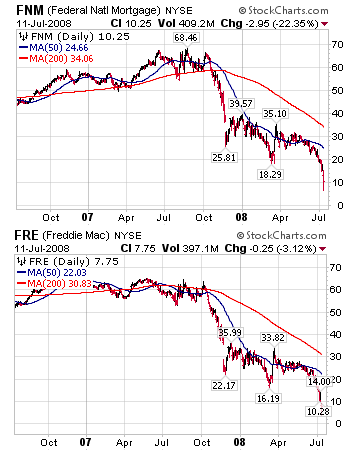
Fannie and Freddie have been loading up on risky mortgages for ages, under-stating the risks largely to increase their stock price so that their CEOs can pay themselves tens of millions of dollars in salary and stock options. Now they are essentially insolvent, as the principal itself is in question. There was widespread criticism of this year after year after year. Why was nothing done?
Hudson: Fannie and Freddie were notorious for their heavy Washington lobbying. They bought the support of Congressmen and Senators who managed to get onto the financial oversight committees so that they would be in a position to collect campaign financing from Wall Street that wanted to make sure that no real regulation would take place.
On the broadest level, Treasury Secretary Paulson has said that these companies are being taken over in order to reflate the real estate market. Fannie and Freddie were almost single-handedly supporting the junk mortgage market that was making Wall Street rich.
The CEOs claimed to pay themselves for “innovation.” In today’s Orwellian vocabulary financial “innovation” means the creation of special rent-extracting privilege. The privilege was being able to get the proverbial “free ride” (that is, economic rent) by borrowing at low-interest government rates to buy and repackage mortgages to sell at a high-interest markup. Their “innovation” lies in the ambiguity that enabled them to pose as public-sector borrowers when they wanted to borrow at low rates, and private-sector arbitrageurs when they wanted to get a rake-off from higher margins.
The government’s auditors are now finding out that their other innovation was to cook the accounting books, Enron-style. As mortgage arrears and defaults mounted up, Fannie and Freddie did not mark down their mortgage holdings to realistic prices. They said they would do this in a year or so – by 2009, after the Bush Administration’s deregulators have left office. The idea was to blame it all on Obama when they finally failed.
But at the deepest level of all, the “innovation” that created a rent-extracting loophole was the deception that making more and more bad-mortgage loans could continue for a prolonged period of time. The reality is that no exponential rise in debt ever has been able to be paid for more than a few years, because no economy ever has been able to produce a surplus fast enough to keep pace with the “magic of compound interest.” That phrase is itself a synonym for the exponential growth of debt.
The Road to Debt Peonage
In an earlier interview you said: “The economy has reached its debt limit and is entering its insolvency phase. We are not in a cycle but the end of an era. The old world of debt pyramiding to a fraudulent degree cannot be restored.” Would you expand on this in view of today’s developments?
Hudson: How long more and more money can be pumped into the real estate market, while disposable personal income is not growing by enough to pay these debts? How can people pay mortgages in excess of the rental value of their property? Where is the “market demand” to come from? Speculators already withdrew from the real estate market by late 2006 – and in that year they represented about a sixth of all purchases.
The best that this weekend’s bailout can do is to postpone the losses on bad mortgage debts. But this is a far cry from actually restoring the ability of debtors to pay. Mr. Paulson talks about more lending to support real estate prices. But this will prevent housing from falling to levels that people can afford without running deeper and deeper into mortgage debt. Housing prices are still way, way above the traditional definition of equilibrium – prices whose carrying charges are just about equal to what it would cost to rent over time.
The Treasury’s aim is to revive Fannie and Freddie as lenders – and hence as vehicles for the U.S. economy to borrow from the foreign central banks and large institutional investors that I mentioned above. More lending is supposed to support real estate prices from falling quite so far as they otherwise would – and in fact, the aim is to keep the debt pyramid growing. The only way to do this is to lend mortgage debtors enough to pay the interest and amortization charges on the existing volume of debt they have been loaded down with. And since most people aren’t really earning any more – and in fact are finding their budgets squeezed – the only basis for borrowing more is to inflate the price of real estate that is being pledged as collateral for mortgage refinancing.
It is pure hypocrisy for Wall Street’s Hank Paulson to claim that all this is being done to “help home owners.” They are vehicles off whom to make money, not the beneficiaries. They are at the bottom of an increasingly carnivorous and extractive financial food chain.
Nearly all real estate experts are in agreement that for the next year or two, many of today’s homeowners will find themselves locked into where they are now living. Their situation is much like medieval serfs were tied to their land. They can’t sell, because the market price won’t cover the mortgage they owe, and they don’t have the savings to pay the difference.
Matters are aggravated by the fact that interest rates are scheduled to reset at higher non-teaser rates for the rest of this next year and 2010, increasing the financial burden. You may remember that Alan Greenspan recommended that homebuyers take out adjustable-rate mortgages (ARMs) because the average American moves every three years. By the time the mortgage interest rate jumped, he explained, they could sell to a new buyer in this game of musical chairs – presumably with more and more chairs being added all the times, and plusher ones to boot.
But homeowners can’t move today, so they find themselves stuck with rising interest charges on top of their rising fuel and heating and electricity charges, transportation charges, food costs, health insurance and even property taxes as these begin to catch up with the rise in Bubble Prices.
The government has carefully avoided nationalizing the companies and thereby taking them onto its own balance sheet. It has created a “conservatorship” (a word that my spellchecker does not recognize). So the bailout of Fannie and Freddie looks like the Republicans are trying to play the financial just-pretend game simply until they leave office in February, after which time they can blame the failure of the “miracle of compound debt interest” on the incoming Democratic Congress.
So it’s politics as usual: play for the short run. In the long run – even next year – the real estate market will continue to drift down.
The economic news keeps getting grimmer and grimmer, but you’d never know it by listening to the politicians at the Republican Convention. The only time the economy was brought up at all was in the context of praise for free markets and globalization. The housing crash and credit market meltdown were not mentioned. Could you tell us what you think the rising unemployment numbers, falling consumer demand, skyrocketing foreclosures and ongoing troubles in the credit markets mean for America’s future? Is this just a blip on the radar or are we in the middle of a major retrenchment that will result in falling living standards and a deep, protracted recession?
Hudson: The Republicans prefer to distract attention from how the Bush regime has failed over the past eight years. If attention can be focused on Iraq and terrorism, on personalities and style, serious discussion of such matters may be crowded out. That’s what the news media are for.
When politicians do talk about the economy, the basic strategy is to fight the November election over who has the nicest dream for what people would like to believe. Amazing as it seems, a large number of Americans actually expect to have a good chance of becoming millionaires. They’re simply not looking at the debt side of the balance sheet.
The most striking economic dynamic today is polarization between those who live off the returns to wealth (finance and property extracting interest and rent, plus capital gains as asset prices are inflated) and those who live off what they can earn, struggling to pay the taxes and debts they are taking on. The national income and product accounts – GNP and national income – don’t say anything about the polarization of property, and doesn’t include capital gains, which are how most wealth is being achieved these days, not by actual direct investment to increase the means of production as lobbyists for trickle-down economic theory claim.
Here’s how things look today: The richest 1 per cent of the population receive 57.5 per cent of all the income generated by wealth – that is, payment for privilege, most of it inherited. These returns – interest, rent and capital gains – are not primarily a return for enterprise. They are pure inertia, weighing down markets. They do not “free” markets, except by providing a free lunch to the wealthiest families. The richest 20 per cent of the population receives some 86 per cent of all this income – that is, what actually is increasing household balance sheets.
What people still view as an economic democracy is turning into a financial oligarchy. Politicians are looking for campaign support mainly from this oligarchy because that is where the money is. So they talk about a happy-face economy to appeal to American optimism, while being quite pragmatic in knowing who to serve if they want to get ahead and not be blackballed.
During the 1990s the bottom 90 per cent of the population tried to catch up by going into debt to buy homes and other property. What they didn’t see was that an insatiable growth in debt is needed to keep a real estate and finance bubble expanding. All this credit imposes financial charges, which have been largely responsible for polarizing wealth ownership so sharply in recent decades.
These debt charges have grown so heavy that debtors are able to pay only by borrowing the interest that is falling due. They have been able to borrow for the past few years by pledging real estate or other collateral whose prices are being inflated by Federal Reserve policy. The Treasury also contributes by giving tax favoritism, un-taxing property and finance. This forces labor and tangible industrial capital to pick up the fiscal slack, even as they are being forced to carry a heavier debt burden.
Homeowners do not gain by this higher market “equilibrium” price for housing. Higher prices simply mean more debt overhead. Rising price/rent and price/earnings ratios for debt-financed properties, stocks and bonds oblige wage earners to go deeper and deeper into debt, devoting more and more years of their working life to pay for housing and to buy income-yielding stocks and bonds for their retirement.
Debt expansion to buy property seems self-justifying as long as asset prices are rising. This asset-price inflation is euphemized as “wealth creation” by focusing on real estate, stock and bond prices – even as disposable personal income and living and working conditions are eroded.
So to come back to your broad question, I don’t see consumer demand rising much, except by foreign tourists coming over and spending their money as the dollar falls. Here in New York, foreign buyers are supporting the real estate market. The Wall Street downturn already has forced the city to postpone its promised property tax cuts and its subway expansion. My wife and I just got our condo tax bill this week. There was an explanatory note telling us that the only tax cuts will be for commercial property owners. Residential property tax rates rise.
It gets worse. Without better transportation, wage earners will be squeezed across the country. Higher gas prices, electricity, health care and food are crowding out spending on output and forcing people into even more debt. That’s why arrears and defaults are rising. Even rents are rising, despite falling real estate prices. This is because houses under foreclosure can’t be rented out, so millions of houses may be taken off the market.
What exactly do you mean by “modern debt peonage”?
Hudson: This is what happens when wage earners are obliged to turn over all their income above basic subsistence needs to the FIRE sector – mainly for debt service but also to pay for compulsory insurance and, most recently, the tax burden that finance and property have shifted off themselves.
The distinguishing feature about peonage is its lack of choice. It is the antithesis of free markets. As I mentioned above, many families today find themselves locked into homes that have negative equity. Their mortgage debt exceeds the market price. These homes can’t be sold – unless the family can pay the difference to the banker who has made the bad mortgage loan. The gap may exceed all the income the family earns in an entire year – just as it was making on paper a price gain larger than its annual take-home pay.
But what did all this matter, in retrospect, if the house was for living, not for buying and selling? This dimension of use value was left out of account by focusing on paper wealth.
In a nutshell, debt peonage is the other side of the coin in a rentier economy. The negative equity we are seeing today is a key component of debt peonage. It forces debt peons to spend their lives trying to work their way out of debt. The more desperate they get, the more risks they take, and the deeper they end up. In Kansas City, one of my students wrote his class paper on how the immediate cause of many mortgage defaults is gambling debt. Missouri has a lot of fundamentalist Christians who think of God as watching carefully over them. Being good people, they want to give God a chance to reward them for living an honest life. So they go to the gambling boats that are moored along the river. But the odds are against them, and it looks like Einstein was wrong when he said that God doesn’t play dice. Gambling – and much financial speculation – is all about probability, and the odds are as much against gamblers as they are against debtors. Being laws of nature, the laws of probability are like the privilege of land ownership: a gambling license provides the house with an opportunity to rake economic rent off the top.
Debt deflation and the tax shift off finance and property onto labor
In the short run it looks like slow growth and deflation will be bigger problems than inflation. Commodities, including gold and oil, are tumbling almost daily, while bank assets are being steadily downgraded, foreclosures are soaring and the stock market is reeling. The financial crisis that began in the real estate market has triggered a boycott of structured products and is now rippling through the broader economy.
The Federal Reserve has already dropped interest rates by 3.5 per cent and has used up half its balance sheet ($450 billion) to shore up the faltering banking system. But the situation keeps getting worse. The banks have curtailed their lending, and consumer spending is off in nearly every area. It looks like the Fed is out of ammo. Is it time to consider fiscal alternatives to the present downturn, such as cutting payroll taxes to give families more money to increase demand, or initiating massive infrastructure projects?
Hudson: By “deflation” I assume you mean debt deflation – draining purchasing power as a result of rising debt service and compulsory insurance, plus the wage squeeze that the government praises for “raising productivity” to “create wealth” for the CEOs who pay themselves what they have cut back from labor’s paycheck. There will be less consumer spending – but even so, consumer prices may not come down if the dollar resumes its fall, especially if monopoly pricing continues to be permitted.
Your solution is indeed what is needed, and Mr. Obama has promised to raise the wage and salary limit subject to FICA withholding. I think that an even better idea would be to go back to the original 1913 income tax and exempt wages that merely cover subsistence. I would restore a cut-off point at $102,000 in today’s dollars, matching the terms of America’s 1913 income tax. People earning less would not have to file an income-tax return at all.
This truly conservative idea would free income to be spent on improving living standards. Instead, high income brackets and property are being un-taxed today, and their tax savings are being spent mainly in making loans that are used to bid up the price of wealth and luxury goods.
This is what the classical economists warned against, yet the tax shift off property onto labor is being done hypocritically in their name. To get the kind of free markets they advocated, taxes should fall on the FIRE sector (finance, insurance and real estate) and monopolies, not wages or bona fide industrial profits stemming from tangible capital investment and employment.
This June you wrote a groundbreaking paper for a recent Post-Keynesian conference at the University of Missouri in Kansas City, where you’re an economics professor. Its title was “How the Real Estate Bubble drives Home buyers into Debt Peonage.” You earlier wrote a now famous May 2006 Harpers cover story on debt peonage. Your Kansas City paper produces charts showing how tax favoritism for real estate and other clients for the banking and financial sector stimulates asset-inflation, leading to massive equity bubbles like the one we are currently experiencing in the housing market. Would you give us a brief summary of your thesis?
Hudson: My paper explained how the money the tax collector gives up is “freed” to be paid to banks as interest. This is the motto of real estate investors: “Rent is for paying interest.” The FIRE sector has adopted a populist rhetoric to persuade homeowners to believe that lowering the property tax will end up giving them more money. It seems at first blush that this would happen. But in practice, new buyers – and speculators – come into the market and pledge the tax cuts to bid up housing prices all the more. The winner in this new anti-tax marketplace is the buyer who pledges to pay the tax cut to the banks as interest on a mortgage loan to buy the property.
As my paper describes:
“Tax favoritism for real estate, corporate raiders and ultimately for bankers has freed income to be pledged to carry more and more debt, which has been used to fuel asset-price inflation that raises the price of home ownership, corporate stocks and bonds – but not to increase production and output. … Shaping the marketplace to favor finance and property over industry and labor does not create a ‘free market.’ It favors the debt-leveraged buying and selling of real estate, stocks and bonds, distorting markets in ways that de-industrialize the economy. [And] shifting taxes off property and finance is more a distortion than a virtue, unless debt leveraging is deemed virtuous.
“This is the tragedy of our economy today. Credit creation, saving and investment are not being mobilized to increase new direct investment or raise living standards, but to bid up prices for real estate and other assets already in place and for financial securities (stocks and bonds) already issued. This loads down the economy with debt without putting in place the means to pay it off, except by further and even more rapid asset-price inflation.
This is largely the result of relinquishing planning and the structuring of markets to large banks and other financial institutions, political lobbyists have rewritten most of today’s tax laws and sponsored general public deregulation of the checks and balances that were being put in place by the late 19th century. At that time, just over a hundred years ago, it seemed that wealth – and banking – were being industrialized, while landed wealth and monopolies would become more socialized and their rents fully taxed. Instead of real estate prices rising, the rental ‘free lunch’ would provide the basic source of public finance. Technology and productivity would increase industrial capital formation and raise labor’s living standards. These policies would free markets from rent extraction and also from taxes as the fiscal burden was shifted back onto property.
But this is not what has occurred. The financial system has used its power to extract fiscal favors for real estate and to press for deregulation of monopolies as the major source of its interest and collateral for its loans.”
What do you think the positive effects would be of taxing property rather than income and industrial profit?
Hudson: It would have two major positive effects. First, it would free labor and industry from the tax burden. And by the same token, it would require the economic rent currently used to pay interest and depreciation to be paid instead as a property rent tax. This would free an equivalent sum from having to be raised in the form of income and sales tax. That was the classical idea of free markets. As matters stand today, the tax subsidy for real estate and finance leaves more net rental income to be capitalized into bank loans. This is a travesty of the “free markets” that lobbyists for the banks and the wealthy in general claim to advocate.
Replacing income and sales taxes by a land-rent “free lunch” tax would make real estate prices more affordable, because the interest now “free” to be paid to banks to support a high debt overhead would instead be collected and used to lower the tax burden on labor and industry. This would reduce the cost of production and living, I estimate by about 16 percent of national income.
Homeowners and renters would pay the same amount as they now do, but the public sector would recapture the expense of building transportation and other basic infrastructure out of the higher rental value this spending creates. The tax system would be based on user fees for property, falling on owners in a way that collects the rising value of their property resulting from the rent of location, enhanced by public transportation and other infrastructure, and from the general level of prosperity, for which landlords are not responsible but merely are the passive beneficiaries under current practice.
A Neo-Progressive fiscal policy would aim at recapturing the land’s site value created by public infrastructure spending, schooling and the general level of prosperity. The debt pyramid would be much smaller, and savings could take the form of equity investment once again. Slower growth of debt, housing and office prices, and lower taxes on income and sales would make the economy more competitive internationally.
I’d like to expand on what you have said in your article and you can correct me if I’ve got it wrong. You say that today’s tax code poses an obstacle to progressive political change, and puts more and more power in the hands of bankers and speculators who profit from “boom and bust” cycles. In other words, reworking the tax system has to be the cornerstone of any progressive platform? Is this the bigger point you are trying to make?
Hudson: It’s certainly the tax point I want to make. But I think that my most important point is the analysis of how the mathematics of compound interest intrudes increasingly into the economy. The fiscal link is that as finance strips more and more wealth, Wall Street converts its economic power into political power. Its main aim is to free itself from taxation – by shifting the burden onto labor.
One way to achieve this tax shift has been to re-define taxes as a “user fee.” This is what the Greenspan Commission did in 1983 when it imposed heavy regressive taxation on labor via FICA wage withholding for Social Security and Medicare instead of funding these programs out of the general budget, to be paid for largely by the higher brackets. The Social Security Trust Fund generated a heavy tax surplus, which was used to cut tax rates on the upper wealth brackets.
The tax code’s “small print” made commercial real estate free of having to pay income tax by pretending that landlords were losing money on their property as buildings depreciated – as if the land’s rising site value did not more than compensate. Most important, interest was treated as a tax-deductible expense. This encouraged debt leveraging rather than equity investment, creating an enormous market for bankers creating credit and collecting interest on it.
You say in your article that there’s “a symbiosis between finance, insurance and real estate” which is at the core of the Bubble Economy. And that this creates a “a feedback between bank credit and asset prices. The quickest and easiest path to wealth is not to earn profits by investing in industry, but to go into debt to ride the wave of asset-price inflation. The result is a shift of wealth seeking away from industry to financial maneuvering on credit to ride the wave of asset-price inflation.”
Is this financialization trend irreversible, or is there a way we can revitalize America’s industrial base? Should we consider nationalizing the failing auto industry and putting people to work while we build vehicles for the future?
Hudson: Nationalization may not be the answer as long as financial interests have replaced the government as society’s new central planners. I fear that nationalization under today’s political conditions would mean “socializing the losses,” having the government bear them and then sell off the companies at the usual give-away price to new buyers on credit, all to the benefit of Wall Street.
If there is any sector to be nationalized, it should be the FIRE sector – finance, insurance and industry – along with taking basic infrastructure back into the public domain by de-privatizing it. The Progressive Era’s plan that made America so rich and dominant a nation was for the government to supply basic services such as railroads, phone systems, the post office and roads or canals at cost or at a subsidy. This lowered the price structure across the economic spectrum, enabling the United States to undersell and out-produce other economies.
We are now in Year 2 of the so-called credit crisis, what Bloomberg News calls “the worst financial crisis since the Depression.” More and more pundits are pointing at the Fed’s monetary policies as the source of the troubles. Surprisingly, even the New York Times has joined in the finger pointing by admitting that Greenspan played a central role in the housing bubble.
Here’s what The New York Times recently said: “Who’s to blame? In the estimation of many economists, it starts with the Federal Reserve. The central bank lowered interest rates following the calamitous end of the technology bubble in 2000, lowered them more after the terrorist attacks of Sept. 11, 2001, and then kept them low, even as speculators began to trade homes like dot-com stocks. Meanwhile, the Fed sat back and watched as Wall Street’s financial wizards engineered diabolically complicated investments linked to mortgages, generating huge amounts of speculative capital that turned real estate into a conflagration.”
How would you characterize Greenspan’s part in the present crisis?
Hudson: He was its cheerleader, with backup from the University of Chicago and a slew of right-wing think tanks. Mr. Greenspan gave all this trickle-down economics a patina of rationale and also a rhetoric pretending that the financial bubble was helping homeowners rather than mortgage lenders and Wall Street. His role was to translate Ayn Rand propaganda into populist euphemism.
The role of a financial cheerleader is to confuse the economic issues, above all by depicting running into debt as “debt leverage” to accelerate “wealth creation.” Looking backward, we now can see that this was really debt creation. When Mr. Greenspan spoke about wealth, he didn’t mean the kind that Adam Smith referred to in The Wealth of Nations – tangible means of production. Mr. Greenspan meant balance-sheet financial claims on this wealth in the form of stocks, bonds and property claims. Adam Smith said that to count these monetary forms of wealth alongside the actual land and capital of Britain would be double counting. For Greenspan, the liabilities side of the economy’s balance sheet – what its producers owed to financial and property owners – became the only kind of wealth he really cared about.
This inside-out perspective was largely responsible for de-industrializing, downsizing and outsourcing the U.S. economy. Mr. Greenspan’s idea of “free markets” was simply to deregulate them – covertly, to be sure, by appointing non-regulators to the government’s key regulatory positions. This resulted in asset stripping, which created some conspicuous billionaires (corporate raiders, re-christened as “shareholder activists” these days) and hence won the praise of Mr. Greenspan for ostensibly playing a positive role in “wealth creation.”
The bottom line is that the economic vocabulary was turned into double-think.
The Political dimension
I have no background in economics, and never had any particular interest in the topic. My frustration with the direction of the country – particularly the Iraq war and the dismantling of civil liberties – led me to search for answers in places that I never otherwise would have looked. Now I am convinced that the war in Iraq and the rapid shift towards a police state here in America are logical corollaries of the economic polarization that has its root in policies that are fundamentally flawed and serve the narrow interests of corporatists, bankers and other vested interests.
Hudson: With regard to your abhorrence of economics, some of my best students at the New School withdrew from the discipline as they found that it wasn’t addressing the problems they were most concerned about. The field has been sterilized by more than a generation of Chicago School intolerance.
The economics profession does not seem to be amenable to reform along the lines that would get you interested in it. It has become mainly a rhetorical gloss to depict financial oligarchy as if it were populist economic democracy. Many people have tried to expand its scope, and have failed. Thorstein Veblen made an attempt a century ago, his analysis – basically, classical political economy – was exiled to the academic sub-basement of sociology. Economists preferred to put on blinders when it came to looking at wealth distribution and the classical distinction between “earned” and unearned” (that is, parasitic) income. Just while sex was becoming un-repressed, wealth distribution became the new politically incorrect topic to discuss.
In the old movies about invaders from outer space such as The Thing, there usually was a near-sighted scientist who said, “Let’s try to reason with it. It’s smarter than we are, because it’s come in a flying saucer with all that great technology.” The monster from outer space then would simply whack the man aside, killing him brutally.
It’s much like the Terminator from the future. “It doesn’t feel compassion. It doesn’t feel pain. You can’t reason with it,” says the movie’s hero. “All it does is kill.”
This is the task the Chicago Boys have taken on in their defense of financialized markets as being “free.” You can’t reason with them. Reason is not their job. They are not there to be fair.
But to achieve its censorial role, today’s economic orthodoxy pretends that markets work in a fair way to provide everyone with opportunity – something like a sperm with a chance to inherit a billion dollars from a Russian kleptocrat or American real estate magnate or Wall Street operator. To promote this worldview, one needs to craft a rhetoric pretending that markets are “free,” not leading to serfdom. One has to pretend that is government regulation of the kleptocrats that is leading to serfdom rather than protecting the population from predatory finance.
Regarding your concern with the police state and, ultimately military aggression that is required to promote “free markets” at gunpoint, Pinochet-style, empire building always has gone hand in hand with impoverishing the population of the imperial center as well as its periphery. For starters, empires and wars don’t pay, at least not in modern times. At best, it is like the war in Iraq – a vehicle for the Bush administration to channel billions of “missing” dollars to its campaign supporters, to recycle back into new Republican campaign funding. The economy at large is taxed as imperialism turns into asset stripping.
A second and more purely political dimension of imperial warfare is to distract the attention of voters away from economic issues, by appealing to their nationalism and chauvinism.
Hobson’s theory of imperialism was that the domestic population lacked the income to consume what it produced, so that producers had to seek out foreign markets. This led to war. But today, the “postindustrial” mode of imperialism is more about recycling wealth to produce capital gains, mainly by globalizing and privatizing the Bubble Economy. The most important markets for “wealth creation” are not for goods and services, but for real estate and financial assets. So we are brought back to your initial questions today, about how Fannie Mae and Freddie Mac will sponsor more sales of mortgage-backed securities.
I think your article offers a straightforward way to avoid disaster and to transform society by changing the tax code so that it strengthens the middle class and levels the playing field between “the haves and the have-nots.” But how can this be achieved without breaking your ideas into snappy sound-bytes and building a broad-based grassroots movement devoted to working class issues and economic justice? Is there a way to make these transformative social changes without starting a third political party; an American Labor Party perhaps?
Hudson: If the incoming Democratic administration proves to be more of the same, pressure will indeed arise to create a new party. More often economic reform has come from the top, but I don’t see it from the Republicans, given their corruption. Within the Democratic Party the question is whether the Wall Street Democratic Leadership Committee (who gave us Gore and Lieberman after the Clintons) will continue to impose its stranglehold.
Any real improvement will need an educational campaign to prepare the ground for making economic reform the centerpiece of major elections. This educational role often has been filled by third parties. In the 1890s, for instance, the main Progressive Era campaigning occurred outside of the Democrats and largely outside of the Republicans as well.
[Mike Whitney lives in Washington state. He can be reached at: fergiewhitney@msn.com. ]
Source / CounterPunch
Thorne Webb Dreyer, Editor





