Palin’s Wikipedia Entry Overhauled Overnight

Sarah Palin’s Bio Gets Padded
By Yuki Noguchi / August 29, 2008

If you happened to check Sarah Palin’s Wikipedia entry Thursday, you might have had a good tip about today’s announcement. Someone — and apparently it was just one person — felt like the existing biography wasn’t appropriate for a vice-presidential candidate.

To listen to NPR’s report, go here / National Public Radio

NPR just had a story about a flurry of mostly-positive edits that occurred to Sarah Palin’s wikipedia page, 45 minutes before her VP candidacy was leaked–including edits that removed/downplayed references to the brother-in-law scandal. The author of those edits? An anonymous user with the handle “YoungTrig.” Trig–I’m sure just coincidentally–is the name of Palin’s infant son.

The NPR story noted that editing your own page on wikipedia is considered a “no-no,” according to their terms of use.

S.L / Talking Points Memo / August 29, 2008

Thanks to Jesse James Retherford / The Rag Blog

Posted in RagBlog | Tagged , , , , | Leave a comment

William Greider on Sarah Palin : McCain’s Hail Mary Pass


‘You mean, if John McCain croaks, she becomes our president?’
By William Greider / August 29, 2008

The news was so stunning I refused to believe it until I saw John McCain on the TV screen announcing his pick for Vice President. There’s no need to disparage Sarah Palin. She’s seems like a smart, serious person. But what the choice reveals about McCain is devastating with a capital D for Desperation.

Within forty-eight hours, all America will be talking about her. What people will say is, “You mean, if John McCain croaks, she becomes our president?” Gasp, yes. That is what McCain has decided. So much for “experience” and wise judgment as a campaign issue.

The Senator was widely thought to be on the fifty-yard line, nose to nose with Barack Obama. But this selection reveals the Republican campaign strategists knew better. Picking the obscure and under-experienced governor from Alaska for veep means McCain and his people recognize they are in a very weak position for the fall campaign. So weak they decided to throw a forty-year Hail Mary pass and hope audaciously for a lucky catch.

It won’t succeed. In fact, I expect this gambit is going to drive far more voters to Obama’s column than it does for McCain.

Choosing Palin kills the “experience” argument. Republicans must have recognized from their own market research that it wasn’t working for them. For two months or more, McCain and his handlers have smeared and slandered Obama, mocked his star quality talents, belittled his lack of tenure in Washington back rooms and accused him of unpatriotic egotism. Clearly, their internal polling told them this line of character attack wasn’t grabbing the public. Playing the wise old man was not going to be enough to overcome McCain’s other significant handicaps, his somewhat doddering style and memory lapses, his deadly embrace of right-wing cant and G.W. Bush.

So, what the hell, let’s take a wild shot and see what happens. The other veep possibilities are dull guys in good suits. Let’s go with the young gal from Alaska. She’s not only a woman–she’s a mother! You want history-making? We Republicans can do history-making.

Their internal logic was obvious, it was also pathetic. Putting a woman on the ticket is supposed to draw away those discontented Clinton voters in the Democratic party. Not going to happen, I think. First, that group has dwindled considerably in the last few days–thanks to Hillary Clinton’s straight-shooting endorsement of Obama and especially to Bill Clinton’s brilliant blessing. The former President went the full mile in defending Obama as ready to be President by reminding everyone that he too had been dogged for a youthful lack of experience. Any remaining bitterness among Clinton voters will not be salved by supporting a hardcore right-winger on feminist issues.

The early returns I am hearing from people suggest that McCain’s gambit may prove to be a home run (mixing my sports metaphors) for Obama. One young friend first heard the news from his mother who called to say, okay, she was switching to Obama. For months, she had rooted for Hillary and insisted Obama was too wet behind the ears. “You can stop arguing with your mother,” she said.

Palin’s previous political experience was as mayor in a town of 6,000. Did they mention this to John McCain? Or did he perhaps forget? Senator McCain says he has seasoned judgment, but he may have been over-cooked.

Source / The Nation

The Rag Blog

Posted in RagBlog | Tagged , , , , | Leave a comment

A Chance to Be Heard Above the Propaganda

Federal Reserve building

A Master-Slave Society: Democrats in Denver Should Skip One of Their Parties and Read the American Monetary Act
By Richard C. Cook / August 28, 2008

How are things going at the Democratic Party National Convention in Denver this week?

Are they talking about the fact that the Western world is run by an international financial elite headquartered in London, the financial capitals of mainland Europe (such as Frankfurt, Hamburg, Amsterdam, Paris, and Milan), and, of course, New York City?

Are they mentioning at their cocktail parties that the financial elite exert control over the world’s population through the cartels that make up the world’s producing economies and through the civilian and military bureaucracies who work for the governments that kow-tow to them?

Of course they know that the most important cartels are those which control energy resources. And that of these, the commodity of central importance is oil. But is any of this helping them draw conclusions regarding the doubling of oil prices during the last year or about the largest oil company profits in history?

Also, they should be drawing the right conclusions from the fact that every private and pubic enterprise operates on the basis of a money economy, though it would be more accurate to call it a credit economy. This means that whoever controls the issuance of money and credit controls the world. And the world’s monetary systems function on the basis of money and credit being introduced into circulation through loans from the banking system, loans for which interest is charged. So what should that tell them?

In fact, they should be pointing out to each other and their TV viewers that the charging of interest for the use of money is a chain around the neck of everyone on earth. Further, that these cumulative interest charges are built into the price of every product that is manufactured or consumed. And that growth of debt means price increases too.

They should be honest in making it clear that the world is a master-slave society, that the slaves are those who borrow and pay interest, that the masters are those who collect the interest, and that this unjust system has existed in one form or another for thousands of years.

The candidates and delegates are talking about the aspirations of the American people and how everyone should have an opportunity to achieve their dreams. But if the United States were a free nation, they would also be talking about a financial system that destroys people’s dreams.

Unfortunately, the highest rung the candidates and delegates have been able to reach on the ladder of modern-day slavery is the need for more jobs—but they fail to note that jobs are not only the means by which people live, but also the instruments for them to pay the heavy burden of interest the masters of finance require.

What they won’t say is that the world economy is based on usury, something religions used to consider a crime (and which Islam still does). Usury is the charging of interest for the use of money. As the religions backed off from their prohibitions of interest, usury became just excess interest. But that’s not what the word really means.

So what have over two centuries of usury done to the United States?

The best answer ever given to that question was contained in a paper entitled “Revisiting U.S. Public and Private Debt” published in January 2005 by Dr. Bob Blain, Emeritus Professor of Sociology at Southern Illinois University. The paper updated an earlier study by Dr. Blain published for the United Nations Educational, Scientific, and Cultural Organization (UNESCO) in the International Social Science Journal, November, 1987, Paris, pages 577-591.

In his paper, Dr. Blain examined the growth of total public and private debt in the U.S. Total debt includes “the debts of governments (federal, state, and local), corporations, farmers, home mortgages, and consumer, commercial, and financial debts.”

In his analysis, Dr. Blain began with data from the Bureau of Economic Analyses of the United States Department of Commerce which covered the years 1916-1976. After that year the Bureau stopped publishing the data.

The figures showed that from 1916-1976, total U.S. debt grew from $82 billion to $3,800 billion ($3.8 trillion). But most of that growth was during the last 21 years, from 1955-1976, when it began to grow exponentially. Dr. Blain wrote, “The consistency of the pattern suggests that some imperative is at work, something that requires debt to increase.”

Dr. Blain found the answer by researching American history. He wrote: “Then I read G.R. Taylor’s 1950 book, Hamilton and the National Debt, which described the debate over Alexander Hamilton’s plan to fund the new economy with borrowed money.” He continued:

“The most revealing account was a speech by the first congressman from Georgia, James Jackson, on February 9, 1790, in which he predicted that adoption of Hamilton’s funding plan would lead to the explosive growth of debt. Jackson said, ‘Though our present debt be but a few millions, in the course of a single century it may be multiplied to an extent we dare not think of.’” (Annals of Congress, Vol. I, February 1790, pp. 1141-2)

From the very beginning, the U.S. had a monetary system based on borrowing and debt. First came the thousands of state chartered banks that began operating late in the Revolutionary War period and continued in one form or another until today. Then there were the two early central banks: the First Bank of the United States (1791-1811) and the Second Bank of the United States (1816-1836). Today’s national banking system began during the Civil War with the National Banking Acts of 1863-64. Then there is the system we are living under today, the Federal Reserve, chartered by Congress in 1913. Even during the times when the government has sold its debt directly to the public, as with war bonds, savings bonds, and Treasury notes and bills, that too has been money borrowed at interest.

Although there have been times in history when money entered into circulation other than through debt, such as with coinage and the Civil War greenbacks, those were exceptions and today are of little importance.

Dr. Blain estimated that from the time Alexander Hamilton placed the U.S. under a debt-based monetary system until today, the debt has compounded at 5.8 percent annually. The big problem with this system, he said, was “that no money was created to pay interest.” He continued:

“Loans created only the principal. Interest had to be paid out of principal. So payment of interest reduced the money supply and slowed economic activity. Recovery could come only when new loans were taken out at least equal to interest paid.”

Dr. Blain concluded, “As long as the money supply of a nation is created as debt costing interest, debt must grow by compound interest.” From a longer-range view, it’s a system that is constantly collapsing and that must constantly be bailed out.

Dr. Blain next sought to update his figures past the 1976 data from the Bureau of Economic Analyses. Turning to the Federal Reserve’s series on “Total Credit Market Debt Outstanding,” he found remarkably similar indicators.

He found that adding data from the Federal Reserve from 1945 to 2003 showed the “debt explosion” continuing. In 1945 total debt was $463.4 billion. In 2003 it was $44,967.7 billion ($45.0 trillion). When he projected the debt level for 2010, he arrived at a figure of $74.9 trillion. By this time the debt curve was climbing so steeply there would be almost a doubling of the amount of total debt in only nine years.

It might be argued that these figures do not take into account inflation. This is because lending at interest is the cause of inflation. The dollars still have to be repaid with interest. The problem occurs when economic growth, measured by GDP, does not keep up.

Looking at the growth of GDP from 1945 to 2003, the increase was from $223.1 billion to $10,987.9 billion, a factor of 49. But the debt ($463.4 billion vs. $44,967.7 billion) grew by a factor of 97, almost twice the rate of GDP growth. Thus the total debt burden on the economy has doubled from a ratio of 2:1 to more than 4:1 (though it was much less than that during the early days of the nation).

But with continued compound growth of debt and a slow- or no-growth state of the economy as we head into a recession, we are starting to see what Dr. Blain called an “acceleration to meltdown.” He wrote:

“We are buying more and more in the same amount of time. Witness the efforts of people to get rid of their excess through yard sales, storage units, and big trash pickup days, and the massive size of what are euphemistically called landfills. While two billion people in the world lack basics such as clean water, food, and shelter, Americans throw away their microwave ovens, televisions, computers, refrigerators, furniture, and cars. Meanwhile, acceleration is applauded as increasing productivity. It’s like arguing that cancer is good because it grows.”

These are the things the Democrats in Denver should be talking about, instead of going to so many parties. They should be making note that the U.S., to quote economists close to the Federal Reserve, is “functionally bankrupt.”

In fact, the debt this nation owes to the banks, to foreign creditors, and to each other can never be paid off. Further, one big reason for all of our fruitless military endeavors overseas may simply be to escape unpleasant economic realities at home. But this is pointless. Nothing creates more debt than war, as the bankers have always known.

The only solution is to adopt a monetary system that is not based on debt. Dr. Blain makes a couple of specific recommendations: 1) “Stop using percentage rates to calculate charges for the use of money”; and 2) “Congress must supply the economy with a money base that is debt-free and interest-free.”

The second point is a call for a new monetary system, not one based solely on lending by the banks or on government borrowing. One organization that has developed a blueprint for such a system is the American Monetary Institute (AMI), headquartered in Chicago. The director of the AMI is Stephen Zarlenga, author of a massive, groundbreaking work: The Lost Science of Money (AMI, 2002). Zarlenga’s assistant is Jamie Walton, a monetary reformer from New Zealand.

AMI will be holding its fourth annual conference in Chicago on September 25-28. Expected as keynote speaker is Congressman Dennis Kucinich, whose wife Elizabeth once worked as an intern at AMI. Dr. Bob Blain will be a featured speaker.

On the AMI website at www.monetary.org is a remarkable document, the American Monetary Act. The product of several years of work by Zarlenga and his network, which now includes a number of local chapters around the country, the American Monetary Act would replace today’s debt-based monetary system with one where the government spends or loans money directly into circulation.

Under the Act, the Federal Reserve would be retained as a national financial clearinghouse but would no longer be a bank of issue. The system would be overseen by a Monetary Control Board within the U.S. Treasury Department. The Act also includes a provision for a citizens’ dividend, similar in some respects to the Alaska Permanent Fund, which would inject desperately needed purchasing power into the economy without additional government debt or taxation.

Also promoting a citizens’ dividend, by the way, is Stephen Shafarman in his important new book, Peaceful, Positive Revolution. (Tendril Press, 2008)

It’s the American Monetary Act the candidates and delegates in Denver should skip one of their parties to read, because it’s the only way any of their hopes for America can ever be realized. Says AMI’s Jamie Walton:

“This is a crucial time. Things are happening. We have got some key media people talking and writing about our kind of reforms. The inertia is starting to yield. Things are starting to roll. The worsening conditions in 2009 will give us a once-in-a-lifetime chance to be heard above the propaganda.”

Copyright 2008 by Richard C. Cook

Richard C. Cook is a former U.S. federal government analyst, whose career included service with the U.S. Civil Service Commission, the Food and Drug Administration, the Carter White House, NASA, and the U.S. Treasury Department. He is a contributor to the American Monetary Act. His articles on economics, politics, and space policy have appeared in numerous websites and print magazines. His book on monetary reform, entitled We Hold These Truths: The Hope of Monetary Reform, will soon be published by Tendril Press. He is the author of Challenger Revealed: An Insider’s Account of How the Reagan Administration Caused the Greatest Tragedy of the Space Age, called by one reviewer, “the most important spaceflight book of the last twenty years.” His website is www.richardccook.com. Comments or requests to be added to his mailing list may be sent to WhiteLightPress@gmail.com.

Source / Information Clearing House

The Rag Blog

Posted in RagBlog | Tagged , , | Leave a comment

US Presidential Politics: Really Only for Comedians


A “Papa and Daughter” Ticket?
By Diane Stirling-Stevens / The Rag Blog / August 29, 2008

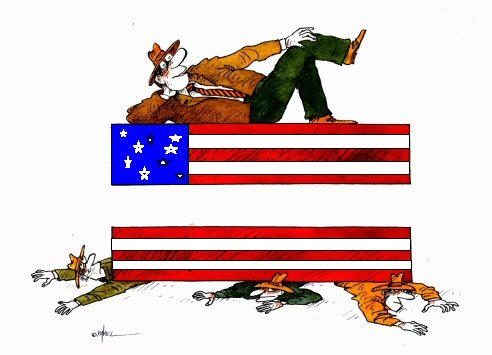
I was delighted to find someone has already put my opinion of McCain’s pick (and reason for it) into a picture! McCain dumped his first wife for Cindy; claims she has a pre-nuptial (and owns most or all of the homes they have), and has riden on her skirt. Now he intends to ride on the skirt of a young woman; a ‘papa and daughter’ ticket?

If you take Palin’s experience and educational history; use that ‘resume’ as a guideline, and handed it to a ‘guy’ – telling him, ‘…hey, give this to McCain, and he’ll pick you for his running mate’, don’t you think he’d laugh himself to tears? Don’t you think he’d tell you to have your head examined? Then again, as I write this, maybe it’s McCain who likes having his ‘head’ examined (I know – bad taste on my part; no pun intended of course).

In any case, I hope Oprah jumps on this ridiculous decision; I hope she reminds all of us women, that it’s an insult to our intelligence, and Palin is nothing more than a token female who’ll get McCain what he wants. I’m sickened by this man; the one and only time I met him over 20 years ago, I couldn’t stand his smile; the way he ‘lusted’ after every single woman at the gathering I went to in California!

In any case, this is my personal rant and opinion, but I think whoever the artist was who promptly got this picture completed in record time, has said it perfectly!

Worse Than Quayle
by Trapper John / August 29, 2008

So it’s official – John McCain has thrown a Hail Mary and tapped Alaska Governor Sarah Palin as his running mate. The trad med types are ga-ga about what a game-changing choice Palin is. And they’re right. It is a game-changer. The Palin pick takes a race already leaning toward Obama and pushes it further into his corner.

Why? Because Sarah Palin is the most unqualified VP nominee in modern history, with the possible exception of Admiral Stockdale.

She’s worse than Quayle.

After his selection in 1988, Dan Quayle was rightly lambasted as a dim, inexperienced lightweight with no real pertinent experience who was named by George H. W. Bush as a gimmick – a case of an old, out-of touch candidate trying to appear relevant by teaming up with a much younger pol. Now, Palin’s not Quayle – by all accounts, she’s quite bright. But she’s fantastically inexperienced, far more so than Quayle was when he was tapped. And she possesses an attribute far worse than Quayle’s stupidity – she’s a big corrupt wheel in Alaska’s big corrupt Republican Party, arguably the most corrupt political apparatus in the United States.

We’re told that McCain really wanted to pick his old friend Joe Lieberman to run with him, but that Karl Rove and the rest of the elite Republican politburo nixed the idea, and told McCain that he had to take a conservative. And as he has at every step of his campaign, the one-time “maverick” sold out to the venal, icy core of the Republican leadership, and acquiesced by selecting Palin. Palin is really a Republican after Rove’s heart – she’s a product of the party that produced the indicted Ted Stevens and ethically tarred Don Young, and she’s embroiled in a Troopergate scandal of her own, with state investigators looking at serious allegations that Palin abused her office by pressuring the state Public Safety Commissioner to fire “an Alaska state trooper involved in a rough divorce from Palin’s sister.” Sounds like a woman after Karl Rove’s heart.

In addition to further associating McCain with the Republican culture of corruption, the Palin pick undermines one of his main anti-Obama narratives. It’s going to be laughable to hear McCain assail Obama’s supposed lack of experience after naming the first-term governor — only one-and-a-half years into her term — of the 47th largest state to be his running mate. Palin lacks any foreign policy experience, and is bereft of even the two core areas of policy expertise that governors are supposed to bring to a ticket — ag policy (Alaska doesn’t have much in the way of traditional agriculture) and urban affairs (Anchorage is the 65th largest city in the US, behind giants such as Corpus Christi). She’s easily the least experienced running mate in recent memory, which is pretty scary, given McCain’s age and his history of cancer.

By picking Palin, McCain revealed his desperation to make a splash to rival the genuine excitement generated by the Obama campaign. But desperation leads to poor decisions — and McCain’s Hail Mary, like most last second desperation moves, is destined to fail miserably. He’s smeared himself with the pungent mud of Alaska Republican corruption, while cutting the legs out from one of his most reliable attacks against Obama. And he’s presented Americans with the prospect of electing a dangerous neophyte to be a heartbeat away from the presidency, behind a man whose life expectancy is less than two presidential terms.

We all expected McCain to pick someone underwhelming to run with him. But we never could have expected a pick worse than Quayle. Yet that’s what we got. Thanks, John!

(And for those who are certain to point out that Bush-Quayle won in ’88 — do you really think that Barack Obama is remotely close to Michael Dukakis in political skill? No? Didn’t think so.)

Source / Daily Kos

The Rag Blog

Posted in RagBlog | Tagged , | 1 Comment

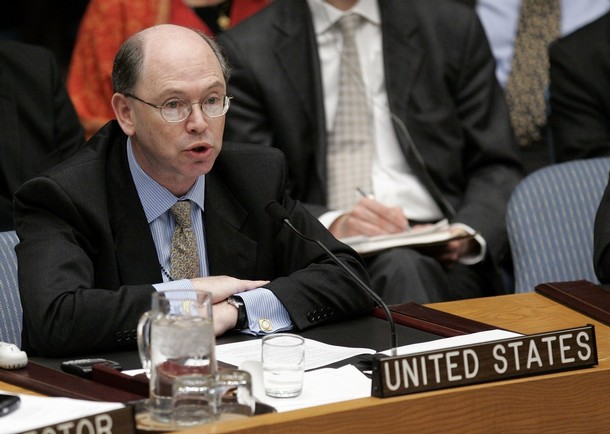
UN Ambassador Wolff: Just Making Sure We All Understood the Hypocrisy

Alejandro Wolff, trained all-American hypocrite

Russia and U.S trade barbs over Iraq
By Louis Charbonneau / August 28, 2008

UNITED NATIONS — U.S. and Russian envoys exchanged sharp words on Thursday over Iraq and Kosovo at a U.N. Security Council meeting on Georgia, at which Russia found little support for its actions in the Caucasus.

It was the council’s sixth emergency session on the crisis in the former Soviet republic, which Russia invaded earlier this month to thwart an attempt by Tbilisi to restore its control over a breakaway region.

Like the five previous council meetings on the brief war this month between Russia and Georgia, the 15-nation body passed no resolution or statement due to Russia’s veto powers.

The meeting was characterized by Cold War-style exchanges of insults between the U.S. and Russian U.N. ambassadors that reflected the growing tensions between the two countries.

U.S. Deputy Ambassador Alejandro Wolff told the meeting it was a violation of the U.N. charter for member states to use force against others, or threaten to use it, and suggested that Moscow’s claims to be protecting Russian citizens in Georgia’s South Ossetia region were a sham.

Russia’s U.N. envoy, Vitaly Churkin, suggested Wolff’s statement was hypocritical and referred to the U.S.-led March 2003 invasion of Iraq, which Moscow strongly opposed.

“I would like to ask the distinguished representative of the United States — weapons of mass destruction. Have you found them yet in Iraq or are you still looking for them?”

The United States justified the invasion of Iraq by saying it had to find and secure what it said were caches of nuclear, chemical and biological weapons hidden by then-President Saddam Hussein. The weapons were never found.

Wolff accused Churkin of making false comparisons. “I’m not a psychologist and I don’t know what brought on the free association we heard from Ambassador Churkin,” he said.

“There were divisions on the Iraq war,” he said. “Those are well known. We thought we had overcome them. Apparently there are still some lingering frustrations. But there is no territorial ambition or desire to dismember Iraq.”

‘JUST LIKE KOSOVO’

Churkin also cited NATO’s 1999 bombing campaign against Serbia to force it to withdraw from its Kosovo region. He likened the declaration of independence by South Ossetia and another Georgian separatist enclave, Abkhazia, to Kosovo’s Western-backed secession from Serbia in February 2008.

British Ambassador John Sawers rejected the comparison, saying, “I’m afraid this assertion, Ambassador Churkin, simply does not stand up to scrutiny.”

Sawers said NATO’s 1999 military intervention in Kosovo was multilateral, was intended to prevent an impending humanitarian crisis and took place after all peaceful avenues had been exhausted. He added that Kosovo’s declaration of independence followed nine years of U.N. administration.

The Security Council has so far refused to accept a request from envoys of South Ossetia and Abkhazia, which Russia recognized this week as independent states, to address it.

Only South African Ambassador Dumisani Kumalo supported Russia on the issue of inviting the separatist envoys, who have applied for U.S. visas in Moscow using Russian passports, to speak before the council.

The Chinese delegation, Russia’s traditional ally on the council, did not speak, which Western diplomats said was a defeat for Russia and proved that Moscow enjoyed virtually no support on the council.

Source / Yahoo News

The Rag Blog

Posted in RagBlog | Tagged , , | Leave a comment

Because the Empire Is Never, Ever Wrong

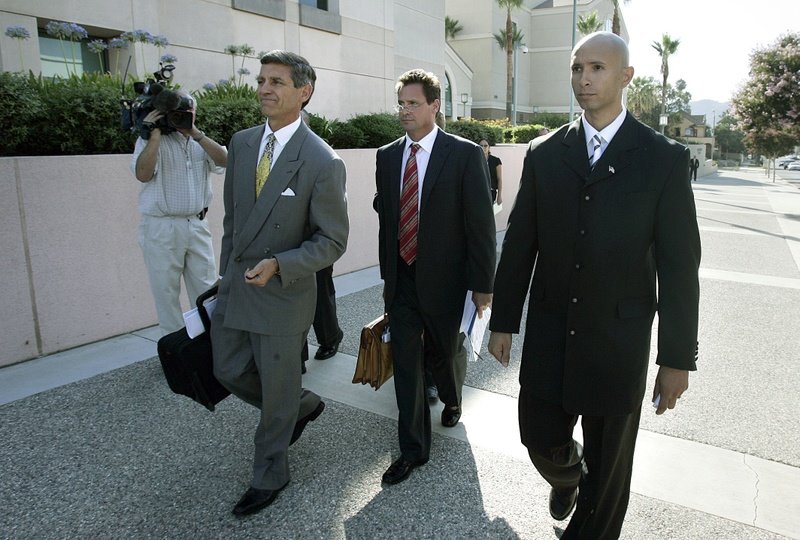
Jose Nazario (right) with lawyers

Ex-Marine Acquitted in Killing of Iraqis
By Chelsea J. Carter / August 29, 2008

RIVERSIDE, Calif. — Jurors wept and embraced former Marine Jose Luis Nazario Jr. after acquitting him of voluntary manslaughter in the killings of unarmed Iraqi detainees during a fierce 2004 battle.

Tears rolled down Nazario’s cheeks and courtroom spectators openly sobbed and cheered Thursday. He is the first U.S. veteran tried by a civilian court for alleged actions in combat.

“It’s been a long, hard year for my family,” Nazario said outside the courtroom. “I need a moment to catch my breath and try to get my life back together.”

Jurors took less than six hours over two days to find the former sergeant not guilty of charges that he killed or caused others to kill four detainees in Fallujah, Iraq, on Nov. 9, 2004. The detainees were shot during a battle — marked by house-to-house fighting — that was considered one of the fiercest of the Iraq war.

Nazario had been charged with voluntary manslaughter, assault with a deadly weapon and discharging a firearm during a crime of violence. He could have faced more than 10 years in prison if found guilty.

Prosecutors had urged the jury to convict Nazario, saying he violated his duty as a Marine and must be held accountable for his actions in Fallujah.

Juror Ted Grinell said the panel acquitted Nazario because no witnesses testified to actually seeing the shootings and there was “not enough evidence to point that he was guilty.”

Jury forewoman Ingrid Wicken said the panel was not making a statement with its verdict, but added: “I think you don’t know what goes on in combat until you are in combat.”

Minutes after the verdict was read, jurors shook hands with and hugged Nazario and his sobbing mother, Sandra Montanez.

Nazario’s attorney, Kevin McDermott, said he believes the verdict will curb similar federal prosecutions in the future.

Read the rest of it here. / America On Line

The Rag Blog

Posted in RagBlog | Tagged , , | 1 Comment

Jack Abramoff Has Been Singin’ the Blues

Frankly, I cannot agree with the suggestion that this weasel deserves leniency, but I’m a hard-nosed radical bastard. We can perhaps remain hopeful that his ‘singing’ will result in a few other deserving crooks professional colleagues also doing a little hard time.

Richard Jehn / The Rag Blog


Abramoff’s Cooperation Brings Call for Leniency
By James V. Grimaldi / August 28, 2008

Since his conviction on fraud and conspiracy charges, former lobbyist Jack Abramoff has spent more than 3,000 hours helping more than 100 law enforcement agents in an ongoing federal corruption probe that has implicated “scores of other persons not yet charged,” lawyers said in court filings yesterday.

The extent of Abramoff’s cooperation was described in documents from prosecutors and defense attorneys. They are seeking leniency from the judges who heard the two cases that landed the Republican influence broker in federal prison in Cumberland, Md.

If a federal judge in Washington accepts the recommendation from the Justice Department, Abramoff would serve no more than an additional three years and three months in prison, not accounting for credit for good behavior awarded by the Federal Bureau of Prisons. Abramoff’s attorneys are seeking more leniency, which could have him released from prison by 2010.

In November 2006, Abramoff began serving a sentence of five years and 10 months for fraud in his purchase of a Florida casino cruise line. The Justice Department is seeking a reduction to three years and nine months. Abramoff’s sentencing in a parallel case of tax evasion, fraud and conspiracy to ply public officials with gifts in exchange for official actions was delayed until he had mostly completed his cooperation. The sentencing is set for Sept. 4 before U.S. District Judge Ellen Huvelle.

In the public-corruption case, the Justice Department is asking Huvelle to sentence Abramoff to five years and four months rather than the maximum 11 years and three months he could receive. The sentences in the two cases would be served concurrently. The government also is seeking about $23 million in restitution.

Abramoff attorneys Abbe D. Lowell of Washington and Neal R. Sonnett of Miami noted in a memorandum that in addition to the meeting with FBI and other agents, Abramoff had reviewed more than a half-million documents.

They also noted that Abramoff has helped convict more than a dozen people, in addition to admitting guilt himself, and that his case has prompted reforms that the lawyers said are known as “Abramoff Ethics Rules.” Among those who have pleaded guilty are former congressman Robert W. Ney (R-Ohio), who was released this month after he completed his prison sentence, and J. Steven Griles, former deputy secretary of the interior.

The court papers indicate an extensive ongoing probe by referencing a document that is sealed because it contains grand jury information. Former House majority leader Tom DeLay (R-Tex.) and retiring Rep. John T. Doolittle (R-Calif.), among others, are still under investigation.

One new scheme revealed involves Abramoff and his team of K Street lobbyists padding their billing records — not to cheat clients, most of whom had hired them on retainer — but to bilk additional bonuses out of their firm, Greenberg Traurig, because “padded hours possibly resulted in higher bonuses,” according to a brief signed by William M. Welch II, head of the Justice Department’s public integrity section, and prosecutor Mary Butler.

Abramoff’s attorneys also cited a statement by Noel Hillman, the former chief of the public integrity office and now a federal judge in New Jersey. Hillman said that Mr. Abramoff’s decision to plead guilty and expose the wrongs he and others did was a ‘watershed’ event in addressing public corruption.”

Source / Washington Post

h/t Bad Attitudes / The Rag Blog

Posted in RagBlog | Tagged , , | Leave a comment

Go Sign On to Something You Believe In Today


The Land of the Silent and the Home of the Fearful
By Dave Lindorff / August 28, 2008

I was a speaker last night at an anti-war event sponsored by the Unitarian Universalist Congregation of Monmouth County, Progressive Democrats of America and Democrats For America in Lincroft, NJ, near the shore. It was a great group of activist Americans who want to see this country end the Iraq War, turn away from war as a primary instrument of policy, and start dealing with the pressing human needs of the country and the world.

Yet even in this group of committed people, one woman stood up during the question-and-answer session and said, “I want to get involved in writing emails to members of Congress urging them to cut off funding for the war and other things, but if I do that won’t I end up getting put on a ‘watch list’ or something?”

I told her the short answer was yes, she probably would. In George Bush’s and Dick Cheney’s America, no one is safe from such spying, and even from harassment, as witness Tom Feeley, the man behind the website Information Clearing House, who had armed men invade his house at night and threaten his wife complaining about his First Amendment-protected effort to publicize important stories on the Internet.

But I also told her that it didn’t matter. She should defend her freedom of speech and her right to petition for redress of grievances, just as she was defending her freedom of assembly by attending last night’s event.

The only demonstrably true statement George Bush has made in his sorry eight years in office is that the Constitution is “just a goddamned piece of paper.” While it wasn’t the point he was making, when he reportedly shouted this at a couple of Republican members of Congress who were questioning the constitutionality of some of his actions, he was right that the nation’s founding document is only worth the parchment and ink it’s composed of, unless people use it and defend it.

There is a remarkable and palpable fear abroad in this land-not a fear of terrorism, but a fear of speaking up, a fear of being labeled as “different” or as a “troublemaker.”

People will lean over and whisper their opinions, if they think they are anti-Establishment, as though someone might be listening. People write me after some of my columns run, praising me for my “courage,” though why it should be perceived as requiring courage to merely write something in America is beyond me.

The worst thing is that every time someone says she or he is afraid, or acts afraid to speak or write what she or he is thinking, five more acquaintances become equally scared and silenced.

The corollary, though, is that each time someone forgets or ignores or rejects that fear, five people gain courage the do the same thing.

Now I’m not saying that there aren’t people monitoring, and reporting on, what we say. I know our government is busy doing that. I assume that my Internet activities are being monitored by the National Security Agency. I assume my phones are tapped. I assume there was some agent or informant among the fine people at the church last night. But these Stasi wannabes have no power if we don’t let them frighten us into silence and inaction.

What I find discouraging is the widespread acceptance, even on the left, of this effort to intimidate us, and the pervasive attitude of fear that has grown up around us. I spent a year and a half living in a truly fascistic society in China, where there are real, concrete threats to life and liberty faced by those who stand up and say what they are thinking, and yet sometimes I think that ordinary people I met in China were braver about stating their minds than many, or even most Americans are. I’m not talking here about saying things like that you think the Post Office is dysfunctional, or that you think federal bureaucrats are corrupt or that taxes are too high. I’m talking about questioning the system, or challenging the war, or protesting military spending. Chinese people would tell me all the time that the Chinese Communist Party was a corrupt gang of thugs or that you could not get justice in a Chinese court. Chinese people are closing down factories that short them on their pay. They have rallied in the thousands and burned down police stations when corrupt police have raped, killed and then covered up the death of a young girl. They have marched in massive impromptu protests at the theft of their homes through eminent domain.

If you want to see where we’re headed here in America, check out the workplace. There, we Americans have, through years of collective cowardice and unwillingness to stand together in organized labor unions, allowed our constitutional freedoms to be almost completely erased. Today, an American workplace is more akin to a police state than to a democratic society. Say what you’re thinking on the job, and you’re liable to lose it. Wear a shirt that says something the boss disagrees with, and you either remove that shirt or you are unemployed. Even that final refuge of free speech, the bumper sticker, can get workers in trouble if the wrong one shows up in the company parking lot. That loss of will and of freedom has in no small way contributed to the loss of jobs and the decline in living standards of American workers.

It’s time for all of us to put a stop to this creeping usurpation of our liberties.

The anxious woman who asked her question came up to me after the meeting and said proudly that she would not be afraid, and would start signing on to protest letter-writing and emailing campaigns.

We need lots more like her.

[Dave Lindorff is a Philadelphia-based journalist and columnist. His latest book is “The Case for Impeachment” (St. Martin’s Press, 2006 and now available in paperback edition). His work is available at http://www.thiscantbehappening.net/. ]

Source / Information Clearing House

The Rag Blog

Posted in RagBlog | Tagged , , | 1 Comment

Why Can We Not Do Something About Poverty?

Kabul street children

World poverty ‘more widespread’
By Steve Schifferes / August 27, 2008

Tackling global poverty requires both public and private investment

The World Bank has warned that world poverty is much greater than previously thought.

It has revised its previous estimate and now says that 1.4 billion people live in poverty, based on a new poverty line of $1.25 per day.

This is substantially more than its earlier estimate of 985 million people living in poverty in 2004.

The Bank has also revised upwards the number it said were poor in 1981, from 1.5 billion to 1.9 billion.

The new estimates suggest that poverty is both more persistent, and has fallen less sharply, than previously thought.

However, given the increase in world population, the poverty rate has still fallen from 50% to 25% over the past 25 years.

“This is pretty grim analysis coming from the World Bank,” said Elizabeth Stuart, senior policy adviser at Oxfam.

“The urgency to act has never been greater, especially in sub-Saharan Africa where half the population of the continent lives in extreme poverty, a figure that hasn’t changed for over 25 years.”

Regional differences

The new figures confirm that Africa has been the least successful region of the world in reducing poverty.

The poor need growth – but it must be distributed more equitably

The number of poor people in Africa doubled between 1981 and 2005 from 200 million to 380 million, and the depth of poverty is greater as well, with the average poor person living on just 70 cents per day.

The poverty rate is unchanged at 50% since 1981.

But in absolute numbers, it is South Asia which has the most poor people, with 595 million, of which 455 million live in India.

The poverty rate, however, has fallen from 60% to 40%.

China has been most successful in reducing poverty, with the numbers falling by more than 600 million, from 835 million in 1981 to 207 million in 2005. The poverty rate in China has plummeted from 85% to 15.9%, with the biggest part of that drop coming in the past 15 years, when China opened up to Western investment and its coastal regions boomed.

In fact, in absolute terms, China accounts for nearly all the world’s reduction in poverty. In percentage terms, world poverty excluding China fell from 40% to 30% over the past 25 years.

Millennium goals

The new figures still suggest that the world will reach its millennium development goal of halving the 1990 level of poverty by 2015, according to World Bank chief economist Justin Lin.

“Poverty has fallen by about 1% per year since 1981,” he said.

“However the sobering news that poverty is more pervasive than we thought means we must redouble our efforts.”

Oxfam, however, warns that another 100 million people may be forced into poverty by rising food prices, as well as the additional 400 million identified in the new report.

The Bank’s findings come as the OECD has reported that many rich countries have cut back on their foreign aid budgets, with little sign that the pledge made at the G8 summit at Gleneagles in 2005 to double aid to Africa by 2010 is being met.

The World Bank’s new poverty line of $1.25 per day in 2005 is equivalent to its $1 per day poverty line introduced in 1981 after adjustment for inflation. The new estimates are based on 675 household surveys for 116 countries, based on 1.2 million interviews. The data has also been revised on the basis of new data on inflation and prices from the 2005 ICP survey of world prices, which showed that the cost of living in developing countries was higher than previously thought. It does not take into account the recent increases in fuel and food prices.

Source / BBC News

The Rag Blog

Posted in RagBlog | Tagged , , | Leave a comment

Thursday Thought: The USA Today


Thanks to Diane Stirling-Stevens | The Rag Blog | Posted August 28, 2008

Posted in RagBlog | Tagged , , | 1 Comment

Denver : Iraq Veterans March Against the Machine

Vets/Rage Against the Machine march in Denver Wednesday.

Rage Against the Machine fans join vets in rousing Denver protest
By Carl Davidson / August 28, 2008

I start the day early loading leaflets and joining Leslie Cagan, Judith LeBlanc and five other United for Peace and Justice volunteers headed to the Denver Coliseum on the North Side of town before 9:00 am.

We’re going to the ‘Rage Against the Machine’ benefit for Iraq Veterans Against the War, organized by the Tent State kids and their allies, and we’re expecting about 10,000 young people. It’s a beautiful day-sunny, not too hot, blue skies with a few clouds, and the first range of the Rockies clear on the horizon. The concert is to be followed by a mass march to the Pepsi Center, led by the vets, to press their antiwar demands on the Democrats. Since there’s no permit, and the Pepsi Center is restricted with ‘protest pens’ no one intends to enter, there’s a sense of tension in the air.

Our UFPJ leaflet has a simple message: Join us Sept. 20 to knock on a million doors for peace. Get signatures on petitions, get to know your neighbors, get outside your ‘comfort zones’ into new neighborhoods and help us double the size of our movement with new names, addresses and emails.

Since the lines are long and organized, we quickly get out thousands of flyers. A brief rap, and most people say, ‘Oh, this is cool. I can do this.’ Some don’t want to be bothered, interested only in the bands, and a few kids are rather spaced out early since no intoxicants other than the music are permitted on the grounds.

I get a ‘workfare’ pass into the concert with terrific seats. This means I’m on the security team for IVAW inside the concert and along the line of march. We get our special chartreuse armbands and blue wristbands, a quick training in nonviolent methods in dealing with problems. Then we’re into the cavernous space, with a local Denver band, Flobots, which is decidedly left and high-energy hip-hop. IVAW speakers appear between numbers and keep the politics of the day clear and focused.

They have three demands: ‘Out Now,’ full benefits for returning vets, and reparations for Iraq. They have no great love for the Democrats who keep voting to fund the war, they’re angry with Obama for not taking a harder line, but they see McCain as more dangerous, both to the world and to vets. They want militancy, but they insist on nonviolence for the day, and demand a resolute respect for their leadership and ground rules.

When “Rage” comes on the stage and gets itself and the crowd wound up, one thing becomes crystal clear. If you’re interested in radical and democratic social change from below, here is one powerful engine for it. You dismiss, ignore or demoralize the high energy and critical force of these young people at your peril. This is a multiclass, multinational force of youth, and on this day, they are accepting the lead of the working class, even if it’s taking the form of the politics, militancy, organization and discipline of the Iraq vets.

The beautiful thing is how well it all worked.

The vets marched in formation with cadence at the front, dozens of them in uniform, some in full dress with a chest full of medals. They wanted us to keep a short space for media behind them, then everyone else another few yards back behind a large banner supporting GI resistance to the war. No breakaways and no nonsense. If arrest situations came up, we had our instructions on how to keep those who didn’t want to risk arrest still involved, but out of the immediate reach of the police.

I’d guess that at least two-thirds of the 10,000 Rage fans joined us, then we picked up other youth, a few workers, and even Convention delegates along the way. The banners and signs and costume were colorful, the chants imaginative and militant, and the energy infected everyone, even the crowds of bystanders, many of whom broke into applause.

I had one of the harder jobs, keeping people from breaking the front ranks and jumping the banner. But with the vets leadership, we kept the spirit both upbeat and disciplined. Denver’s overkill police presence was everywhere, but everything remained civil. Some even felt some sympathy for them, sweltering on a hot sunny day in their new Black Ninja Turtle outfits, which must have been unbearable.

It was a long march, nearly five miles. One problem was keeping everyone hydrated, but cases of water kept showing up at critical points. The best energy was downtown Denver, with the cheering and applause from Convention delegates. But we all knew there were trouble spots ahead.

Denver’s security rules meant you couldn’t get closer to the Pepsi center than several hundred yards, and then you were to be put in fenced ‘protest pens.’

The vets would have none of it. They hadn’t risked their lives, supposedly defending the Constitution, to be treated this way. They were going to march until they were stopped and then we’d seen what would happen. As we got closer to the skirmish line, they stopped several times, and the vets took turns giving heart-rending stories to the press, which, by this time, was everywhere, and driving us nuts trying to keep them to respect our lines and discipline.

At the final stopping point, a decorated Marine told the cops they would get no violence from us, and we expected none from them. The three demands were read to Obama’s campaign and the Democratic Party. The vets demanded a response, and were determined to wait for one.

So now we had the problem of keeping thousands of people, encircled by police and barricades, in an upbeat, but patient and calm state of mind.

One young Black kid from Denver of our security team rose to the occasion. He starts doing his raps, and those of others as well. The crowd loves it, especially when he gets on their case for not being too good at ‘call and response.’ So he starts an on-the-spot workshop on how we can all become better rappers.

Next two young African American women start softly singing an old church-based civil rights song ‘Those Who Love Freedom…” The lyrics are simple and lyrical, and soon hundreds are singing it, over and over. For me, powerful memories come up from my days on Freedom Marches in Mississippi, when we sang this same song in the face of the Klan and cops. When I start to sing along, my eyes fill with tears from long-buried emotions. To hell with it, I decide, let the tears flow, and I sing along.

Finally, we get the word. The other side blinked. The Obama campaign’s top veterans affairs people ask the Vets to send two reps into the Pepsi center to discuss their demands. Moreover, they want an ongoing series of discussions to make sure all veterans concerns are heard and dealt with. That’s enough for IVAW to call a victory, even if a partial one, and work out a way to bring the day to a close. It’s decided that we part the crowd down the middle, opening a path. The vets do an about face, march in formation though the crowd, and as they pass, to many cheers, we fall in behind, get back to the downtown area, and go our various ways.

I find a way to get to my car, then back to ‘tent city’ to secure our display in preparations for leaving. I meet up with my team in a Taco joint, where they, along with some of the new media people working with Laura Flanders, are watching Joe Biden’s speech. I’ll have to read it tomorrow, because given everything we’ve been through, right now it seems rather trivial.

Source / Progressives for Obama

The Rag Blog

Posted in RagBlog | Tagged , , , , , , , , , | Leave a comment

U.N. Finds U.S. Airstrike Killed 90 Afghans

An Afghan doctor, left, examines Zinat Gul’s wounded hand, who allegedly was wounded by a U.S. air strike in Shindand district, as her mother looks on at a hospital in Herat, east of Kabul, Afghanistan, on Monday. Photo by Fraidoon Pooyaa / AP.

Most fatalities in U.S.-led attack said to be children
By Candace Rondeaux and Karen DeYoung / August 27, 2008

ISLAMABAD, Pakistan — United Nations officials in Afghanistan said Tuesday that there was “convincing evidence” at least 90 civilians — two-thirds of them children — were killed in a U.S.-led airstrike last week that caused the Afghan government to call for a review of U.S. and NATO military operations in the country.

Kai Eide, the top U.N. official in Afghanistan, said local officials and residents in the western province of Herat corroborated reports that 60 children and 30 adults had been killed in an Aug. 21 military operation led by U.S. Special Operations forces and the Afghan army.

In a statement, Eide called the incident a “matter of grave concern to the United Nations” and said he had “repeatedly made clear that the safety and welfare of civilians must be considered above all else during the planning and conduct of all military operations.”

U.S. forces in Afghanistan have increased their reliance on air power since last year, causing a corresponding increase in civilian deaths. The Herat assault appears to have caused the largest civilian loss of life attributed to U.S. forces since the war began in late 2001.

Pentagon spokesman Bryan Whitman said military commanders in Afghanistan continued to believe that the attack in Herat “was a legitimate strike on a Taliban target.”

Whitman promised a detailed investigation. “This has a lot of people’s interest, and my sense is they want to be thorough and complete. We’re doing it as expeditiously as we can.”

The U.N. findings came as the government of President Hamid Karzai demanded more coordination between Afghan and international security forces and called for greater accountability on the part of U.S. and NATO troops operating in the country. Afghanistan’s Council of Ministers called Monday for a halt to aerial bombings and to what it called overly aggressive house raids and illegal detentions. The council demanded an agreement with U.S. and NATO forces that would define the parameters of international military operations in Afghanistan.

Afghan officials and independent investigators say more than 165 civilians have been killed in four airstrikes in the past two months. The deaths have angered Afghans, who are pressuring Karzai to seek greater control over foreign troops even as resurgent Taliban fighters increase their attacks on the international presence in Afghanistan.

Sultan Ahmed Baheen, spokesman for the Afghan Foreign Ministry, said his office and the Afghan Defense Ministry have been working to draft a document that would require more coordination between Afghan security forces and international troops to minimize civilian deaths and damage from military operations. About 60,000 troops from 40 nations are in Afghanistan, including 32,000 from the United States.

At the United Nations on Tuesday, Russia introduced a sharply worded draft statement expressing concern about reports that U.S. airstrikes in Afghanistan had caused “numerous civilian casualties, including women and children.”

U.N. diplomats said the Russian text stood little chance of being adopted in the Security Council, where the United States wields veto power. They interpreted the Russian action as a signal that it would pursue a more confrontational approach with the United States in response to Washington’s criticism of the Russian intervention in Georgia.

U.S. officials in Washington said they have been anticipating that Karzai will demand a formal status-of-forces agreement with the United States; the Bush administration is finalizing a similar accord with Iraq after protracted negotiations. Although U.S. troops participate in the NATO-led force in Afghanistan under a U.N. mandate, the bulk of U.S. forces fall under Operation Enduring Freedom, a U.S.-only force governed by an exchange of diplomatic notes signed with the Afghan government in May 2003.

At least 90 percent of all aircraft being used in the Afghan war belong to U.S. forces operating under their own command structure. “Civilian deaths are not a NATO problem,” said Marc Garlasco, a military analyst at New York-based Human Rights Watch. “Civilian casualties are primarily being caused in airstrikes in support of the counterterrorism mission that the United States is running completely separate from the NATO-run counterinsurgency conflict,” said Garlasco, who has compiled a report on civilian deaths from airstrikes to be published next month.

Last year, as Taliban attacks increased, the number of civilian deaths caused by airstrikes spiked sharply, from 116 killed in 2006 to 321 in 2007, according to figures issued by the U.S. Air Forces Central Command. The number of sorties increased by about one-third in 2007, and the amount of munitions that were dropped more than doubled, according to the data.

Garlasco said the amount of bombs dropped by U.S. airstrikes in June (317,000 pounds) and July (270,000 pounds) is equivalent to the total tonnage dropped in 2006. The vast majority of the strikes, Garlasco said, are unplanned missions called in by U.S. Special Operations ground forces fighting Taliban units or because a “target of opportunity” is located through on-the-ground intelligence.

Unlike in Iraq, where U.S. forces frequently use 250-pound bombs to make attacks more precise, Garlasco said American troops in Afghanistan “are still using a lot of” 2,000-pound bombs.

The Herat bombing occurred around midnight after U.S. Special Operations forces and Afghan troops led a raid on a compound in the town of Azizabad where they said they thought a Taliban commander was holding a meeting with supporters. U.S. military officials said at least 30 insurgents were killed, including the commander, who is known as Mullah Siddiq.

Afghan officials in Herat said the bombing occurred as dozens of villagers gathered for a memorial ceremony for a villager who was killed last year. Ahmed Dehzad, one of the province’s parliamentary representatives, said that local officials had received reports of Taliban activity in the vicinity several days before the ceremony but that coalition forces did not issue a warning before the attack on a compound near where the ceremony was held.

A spokesman for the Afghan army’s western command said Saturday that an army investigation into the incident confirmed that about 60 children and 19 women had been killed in the airstrike. The spokesman, Raouf Ahmedi, said there was no evidence that any of those killed had ties to the Taliban.

The U.N. investigators found that at least 15 people were injured in the operation.

A little more than a day after the raid, a U.S. military spokeswoman dismissed as “outrageous” the Afghan government’s assertions that scores of civilians had been killed in the attack. Lt. Col. Rumi Nielson-Green said U.S. forces who inspected the site afterward found that five civilians had been killed.

A U.S. official in Washington, speaking on the condition of anonymity, said the Taliban has become adept at spreading false intelligence to draw U.S. strikes on civilians. “The fact is that the Taliban now has pretty good insight into where we’re picking up information and how we’re developing it into actionable intelligence,” the official said. “They’ve figured out a way to misguide us.”

[DeYoung reported from Washington. Staff writer Colum Lynch at the United Nations and special correspondent Javed Hamdard in Kabul contributed to this report.]

Source / Washington Post

The Rag Blog

Posted in RagBlog | Tagged , , , , , | Leave a comment