Minneapolis/ St. Paul : Rocking the Republicans

Texas-reared singer-songwriter Steve Earle will be rocking the Republicans on Labor Day. Image copyright Charles Devlin.

‘Most of the rock concerts during RNC convention week are renegade events aimed at countering the Republican mania, not fueling it’
by Keith Goetzman / August 11, 2008

What do the Republican National Convention and rock and roll have in common? Very little, which is why most of the rock concerts in Minneapolis and St. Paul during RNC convention week are renegade events aimed at countering the Republican mania, not fueling it.

On August 31, the day before the convention, a large roster of local bands plus smartypants New York singer-songwriter Nellie McKay will play at ProVention, “a concert for people, peace, and the planet” at O’Gara’s, a stalwart St. Paul rock club. (Utne Reader will be involved as a sponsor.)

On Labor Day, which is RNC kickoff day, a host of national acts with working-class sympathies will rock the Take Back Labor Day Festival at Harriet Island Regional Park, just across the river from the convention site. On the docket of this concert sponsored by the SEIU (Service Employees International Union) are Steve Earle, Billy Bragg, Lupe Fiasco, Mos Def, Atmosphere, Alison Moorer, and Tom Morello, a.k.a. the political hell raiser known as the Nightwatchman.

Finally, on September 3, the eve of the convention’s close, Morello and his briefly reunited Rage Against the Machine bandmates will bring their potent rap-rock to the Target Center in St. Paul’s sister city of Minneapolis. You might recall that Rage broke up shortly after an incendiary gig during the 2000 Democratic National Convention in Los Angeles.

Altogether, this show of musical force seems to reinforce the idea that apart from Ted Nugent, the Republican Party doesn’t have many rock and rollers on its side. Minnesota Governor Tim Pawlenty, who’s been getting a lot of buzz as a potential McCain running mate, was famously flummoxed before the 2004 election to learn that his favorite rock artist, Bruce Springsteen, harbored liberal tendencies. As the governor may have figured out by now, it’s not just the Boss who’s blue.

Source / Utne Reader

Thanks to Sarito Neiman / The Rag Blog

Posted in RagBlog | Tagged , , , , | Leave a comment

The American Left : Do We Have a Progressive Movement Today?

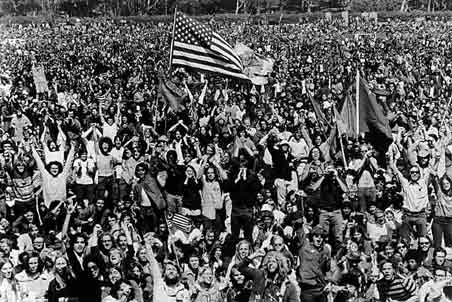
Is there a new progressive movement? If so, it’s different from the last one: sixties anti-war demonstration was part of the New Left movement. Photo courtesy of Robert Altman.

George Bush ‘has succeeded in bringing moderates, liberals, and progressives closer together than at any time in decades’
By Ken Brociner

Even if there are only fleeting moments when many of us can feel – in our bones – that there really is such a thing as “a national progressive movement,” the fact is that those moments are real.

George W. Bush will go down in history as one of this country’s worst presidents ever. But there is at least one thing we can genuinely thank him for: He has succeeded in bringing moderates, liberals, and progressives closer together than at any time in decades. But do the many political connections created since Bush took office actually add up to something that can be called a (or “the”) “progressive movement”?

The short answer is – it depends on who you ask. Over the past five or six years, I have been struck by the wide range of answers to this question within progressive circles. Some progressives believe it is premature to talk about the existence of a singular “progressive movement” – as opposed to the existence of a number of separate but related progressive movements. Some even dismiss the importance of the question to begin with – considering the issue either irrelevant or of secondary importance.

The question of whether or not we constitute “a movement” cuts to the very core of just who “we” are at the present moment. How we answer it is bound to shape the programs and strategies we develop in the months and years ahead.

I recently interviewed a few leading intellectuals and activists to find out whether or not they believe it is accurate to say that today – less than four months before the 2008 election – “a progressive movement” actually exists.

Bill Gamson is the co-director of Boston College’s Media/Movement Research and Action Project — and one of the leading scholars in the field of social movement theory. In an email interview last week this is what he had to say:

“Is there a field of actors – formal organizations and/or networks — who are trying to mobilize people for collective action to challenge and change social, political, and economic inequalities? Of course. Sometimes they work in coalitions and sometimes they work independently. Do they always work together harmoniously with a common strategy? Of course not. But that doesn’t make them less of a progressive movement.”

Offering a strikingly different perspective was Charles Knight, the president of the Commonwealth Institute, an independent, public policy research center in Cambridge, Mass. Knight, who also co-directs the institute’s Progressive Strategies Studies Project, said he sees ” a progressive political tendency,” but not a movement.

“But I would agree that there are movement elements within progressive politics today,” Knight said. “Still, while referring to a ‘progressive movement’ does give people a feeling of being part of something bigger, it’s important that progressives have a sense of our own history, and that we not throw around the term ‘movement’ too loosely.”

I also spoke with Fred Berman, a leading activist/organizer in the Boston area. Berman, one of the leaders of the Progressive Democrats of Somerville (which is affiliated with Democracy for America), spends most of his time working on issues like regional development, affordable housing and government accountability. He told me: “I do feel connected to people and organizations that are working on particular issues on a local, state, or national level. But that feels very different than being part of an overarching national movement.”

Todd Gitlin, a longtime activist and professor of journalism and sociology at Columbia University, has written several important books that discuss progressive movement building, including, most recently, The Bulldozer and the Big Tent. When I asked Gitlin what he thought about the current state of progressivism, he said: “It’s a wish more than an accomplished fact to say that there is a single progressive movement. There are movements, plural, some moving more vigorously than others…. Insofar as there is a single movement, it’s a reaction to the depredations of the Bush years.”

Is there any way to synthesize these different viewpoints? I think there is. For four out of the last six years, I have attended the Take Back America (TBA) conferences, now held every spring in Washington D.C. TBA brings together progressive politicians and leaders, activists, and organizers from the peace, labor, civil rights, economic justice, environmental, women’s, gay rights and netroots movements. But each year – from lecterns, in panel discussions and in the corridors, one hears constant references to “the progressive movement.”

This has never felt like a political line or wishful thinking to me, but rather a perfectly appropriate way of capturing the essence of what is happening right then and there, during three jam-packed days of speeches and discussions. Sure, the 2,000 or so people who attend each year are not reading from the same playbook on a year-round basis. And most people in attendance have individual organizational allegiances of one sort or another. But that feeling of being part of a national “movement” that so many people get from attending the TBA conferences is something quite real. I know I can practically “taste it,” and I doubt I am alone in this.

Other activists find that same feeling of connectivity when they attend mass anti-war demonstrations, the annual Netroots Nation conference, or national meetings of their labor unions – especially when representatives of other movements show up to offer solidarity.

Throughout this decade, progressive groups large and small have significantly increased their connections to each other in all sorts of ways unimaginable just ten years ago. One excellent example of this is the recently formed Health Care for America Now coalition that includes many of the leading unions and progressive organizations in the country, such as ACORN, AFSCME, SEIU, MoveOn, USAction, and The Campaign for America’s Future.

Obviously, the Internet has been a big part of these new connections – but the stolen 2000 election, the war in Iraq and Bush’s many other disastrous policies have also been instrumental in bringing progressives together.

Even if there are only fleeting moments when many of us can feel – in our bones – that there really is such a thing as “a national progressive movement,” the fact is that those moments are real. Which raises this question: How can we hold onto and enhance those feelings of nationwide connectivity?

Clearly, one way is to expand “the movement” (what it was universally called in the ’60s) itself. The idealism and mass participation in the Obama campaign provides us with an enormous opportunity to do just that. We also need to create more effective relationships, links, and coalitions between the various components of the progressive movement.

But equally important is that we expand our collective awareness of the existence of a national movement. To some extent, what this really boils down to is how we think, write, and talk about ourselves. The more frequently we refer to the progressive movement, the more we actually solidify its — and thus our — existence as a nationwide entity.

Back in the 1960s, the lines were more clearly drawn than they are today. Both the counterculture and the New Left (which constantly overlapped) felt as if they were practically at war with “the system.” There was no need to promote a sense of there being “a movement” forty years ago — it was in the very air one breathed. But the situation today is very different: opposition to the war in Iraq hasn’t generated anywhere near the kind of cataclysmic revolt within American society that the war in Vietnam did. And nothing today approximates the ’60s mass rebellion of youth – when millions openly rejected the cultural and social norms of “mainstream America.”

Still, it seems clear that – thanks to the Internet and new connections between progressive organizations – “a movement” has come back into existence since Bush took office.

Perhaps it’s a matter of seeing the proverbial glass as half full. For what is to be gained by insisting it is still half empty? By looking at our movement positively, we not only boost our spirits, but help to foster progressive unity rather than fragmentation. After all, if we are “a movement, ” than we need to act like one.

As the Jefferson Airplane so aptly put it back in 1969, “We can be together… we should be together.”

[Ken Brociner’s essays and book reviews have appeared in Dissent, In These Times and Israel Horizons. He also has a biweekly column in the Somerville (Mass.) Journal.]

Source / In These Times / Posted August 5, 2008

The Rag Blog

Posted in RagBlog | Tagged , , , , , , | Leave a comment

The Next Bubble Is on the Way : Credit Card Debt


Why are we all complicit in our own economic servitude?
by Danny Schechter / August 11, 2008

Let me try a few words out on you: “Charge It,” “Swipe It” and “Priceless.”

You know exactly what I am talking about. We all have credit and debit cards. We all use them, and many of us keep our lives going because of them.

That is, until the bill becomes due.

The sad truth is that we are all complicit in our own economic servitude even if, at bottom, it’s not our fault because we live in a consumption society, and don’t feel we could live without them.

While many eyes are focusing on the housing meltdown and its hugely negative effect on an economy clearly moving into recession, few are paying attention to the next bubble expected to burst: credit cards. You would never know it by watching those slick VISA card ads on the Olympic TV broadcasts.

Combined with the subprime losses, such a credit card nightmare has the potential, experts say, of bringing down the entire financial system and global economy.

You and your credit card have become key players in the highly unstable financial crunch. Mortgage lender cupidity and bank credit card greed wedded to financial institution deregulation supported by both political parties, have been made manifestly worse by Bush administration support-the-rich policies. It has brought us to a brink not seen since just before the Great Depression.

While campaigning in Edinburg, Texas, in February, Barack Obama met with students at the University of Texas-Pan American. “Just be careful about those credit cards, all right? Don’t eat out as much,” he said. After the foreclosure crisis, he warned, “the credit cards are next in line.”

The coupling of home equity debt and credit card debt has gone hand in glove for years. The homeowners at risk can no longer use their homes as ATM machines, thanks to their prior re-financings and equity loans, often used in the past to pay off their credit cards. Indeed, homeowners cashed out $1.2 trillion from their home equity from 2002 to 2007 to pay down credit card debts and to cover other costs of living, according to the public policy research organization Demos.

To compound the problem, fewer people are paying their credit card bills on time. And, to flip the old paradigm, more are using high-interest credit card cash to pay at least part of their mortgages instead of the other way around.

Younger people are being crushed by this debt burden as college students and new consumers. Emma Johnson of MSN Money reports that “Generation Y” is broke.

“The democratization of credit has really generated a competitive spending culture, and plastic has allowed for material goods not had in the previous generation,” says Bob Manning, author of Credit Card Nation. “Most of us grew up in a home with just one or two bathrooms for the whole family, he points out; today, new homes usually have at least one bathroom per bedroom.”That change has happened so fast,” Manning says.

“This generation feels that somehow or another they’re going to figure out some technological advancement that’s going to get them out of their financial troubles and outsmart the market,” says Manning, who served as adviser to the documentary In Debt We Trust. The documentary paints a picture of national financial crisis stemming from the personal-debt burden. (See InDebtWeTrust.com)

Happily, this issue is finally being addressed by Congress and the Federal Reserve Bank. When asked for comments, the public overloaded the Fed’s website as the New York Times commented:

When the Federal Reserve asked for comments on its proposed rules on abusive credit card practices, an astonishing 56,000 poured in. Most were from outraged consumers. They told of interest rates skyrocketing when they paid an unrelated bill late. They complained of unwarranted late fees and pushed-up due dates. One Pennsylvania customer fumed: “I’m fed up with credit card company tricks that drive us deeper in debt.”

This anguished deluge should send a clear message to leaders in Washington. The Federal Reserve should swiftly adopt its proposed rules against unfair or deceptive credit card practices. But the real burden to curb these abuses falls on Congress.

This discontent is being organized to press Congress to act by groups like the Consumer Federation of America and the Center for Responsible Lending. And Congress is listening:

WASHINGTON (Reuters) – Legislation aimed at curbing credit card billing practices that surprise borrowers with unexpected interest rate increases and fees was approved on Thursday by a U.S. House of Representatives committee.

The bill approved by Financial Services Committee mirrors Federal Reserve proposals that would effectively end double-cycle billing — in which card companies reach back to prior billing cycles to help calculate the interest charged in the current cycle.

These reforms are a start but much more needs to be done because it’s not just billing practices that is at issue — it’s high interest changes, deceptive marketing, and arbitrary rules. On top of that, there are other loans that need scrutiny including payday lenders and student loans. And of course our own addiction to shop until we drop.

Also, let us not forget that our credit card companies have been colonizing markets throughout the world. As the New York Times explained in a series on debt, “As the American blessing of credit cards became widespread, so did the American curse of debt.”

Bear in mind the experience of another addicting industry — tobacco. As they came under restraints in the US, they escalated their poison pushing worldwide.

Debt is a global issue and has to be treated as such.

Just as groups like NACA provide help to homeowners in distress, we need a major effort to help the victims of credit cards — with practical assistance and political demands for regulation and relief.

[News Dissector Danny Schechter made the film In Debt We Trust (InDebtWeTrust.com). His new book PLUNDER: Investigating Our Economic Calamity is out later this month from Cosimo. (Newsdissector.com/Plunder) Comments to dissector @mediachannel.org.]

Source / CommonDreams

The Rag Blog

Posted in RagBlog | Tagged , , , , , | 1 Comment

A Video Series on World Agriculture: Monsanto, Part 2

The World According to Monsanto (Part 2 of 8)

Right now, there is probably no other company that is doing more to endanger the health of this planet, and it’s inhabitants, than Monsanto. With Nazi-like attitude, they are leading the world in shear destructive evil greed. First they were a drug company, and then they expanded to become a drugs and genetic engineering company, and now Monsanto is attempting to acquire water rights in countries with water shortages in a move to control the people’s basic means of survival, and production of the global food supply. Giant transnational corporations like Monsanto, in collusion with the World Bank and the World Trade Organization, seek to commodify and privatize the world’s water and put it on the open market for sale to the highest bidder. Millions of the world’s citizens are being deprived of this fundamental human right, and vast ecological damage is being wrought as massive industry claims water once used to sustain communities and replenish nature.

Click here for more information.

Thanks to Diane Stirling-Stevens / The Rag Blog

Posted in RagBlog | Tagged , | 3 Comments

Corporate America Prepares for Battle Against Progressive Labor Legislation


Big business building massive war chest to stop Employee Free Choice Act and other efforts to put a check on corporate power
By Joshua Holland

There is nothing more terrifying to corporate America than the prospect of dealing with its workforce on an even playing field, and, along with allies on the Right, it’s pulling out all the stops to keep that from happening. At stake is much more than the usual tax breaks, trade deals and relentless deregulation; corporations are gearing up for a fight to preserve a status quo in which the largest share of America’s national income goes to profits and the smallest share to wages since the Great Depression — in fact, since the government started tracking those figures.

There will be many heated legislative battles if 2008 shakes out with larger Congressional majorities for Democrats and an Obama White House — fights over war and peace, energy policy, health care reform and immigration. But it may be a bill that many Americans have never heard of that sparks the most pitched battle Washington has seen since the Civil Rights Act. It’s called the Employee Free Choice Act (EFCA) — a measure that would go a long way toward guaranteeing working people the right to join a union if they so choose — and it has the potential to reverse more than three decades of painful stagflation, with prices rising and paychecks flat, for America’s middle class and working poor.

The Chamber of Commerce, D.C. lobbyists, firms that rely on cheap labor and a host of “astroturf” front groups are building a war chest that could reach hundreds of millions of dollars in an effort to build a firewall against EFCA and other efforts to put a check on corporate power and rebuild a declining middle class. A recent report on the front page of the Wall Street Journal about how Wal-Mart — the nation’s largest employer — is “mobilizing its store managers and department supervisors” in an effort to discourage its workers from voting Democratic this fall generated quite a bit of controversy. According to a report in the National Journal that received less attention, “several business-backed groups … (including) two fledgling coalitions fighting labor-supported legislation and the conservative political group Freedom’s Watch are trying to raise $100 million for issue advocacy and get-out-the-vote efforts to benefit about 10 GOP Senate races.”

It’s the EFCA — the idea that working people who want to join a union can — that has corporate America quaking in its collective boots. The bill passed the House easily in 2007 — by 56 votes — and had majority support in the Senate. But it didn’t reach the 60 votes required to kill a GOP-led filibuster, and that massive war chest being amassed by the corporate Right is, in part, an attempt to maintain a firewall of at least 41 anti-union senators — mostly Republicans joined by a few corporatist Dems — to kill the bill in the 2009 Congress. President Bush threatened to veto the legislation if it had passed in 2007, but this time around, they fear that a Democrat will be sitting in the White House. Obama was a co-sponsor of the 2007 legislation; McCain opposed it.

The prospect of a filibuster-proof majority that’s sympathetic to the needs of ordinary working Americans, according to the National Journal, is making “business groups jittery.” Polls show that the economy is Americans’ number one concern going into this fall’s election; fully 75 percent of Americans believe the country is on the wrong track, and these well-funded groups are intent on keeping it firmly on that track.

American Wages and the Law of Supply and Demand

At the heart of the bloody cage match that’s likely to come is this: In economic terms, the wages of many — probably most — Americans represent a “market failure” of massive proportions. Even the most devout of free-marketeers — economists like Alan Greenspan and the late Milton Friedman — agree that it’s appropriate and necessary for government to intervene in the case of those failures (they believe it’s the only time that such “meddling” is appropriate). But the corporate Right, which claims to have an almost religious reverence for the power of “free” and functional markets, has gotten fat off of this particular market failure, and it’s dead-set on continuing to game the system for its own enrichment.

About 1 in 4 Americans has at least a four-year college degree, and many of those degrees are even worth something in the labor market (sorry, art history majors). Others — Derek Jeter, Bill Gates, a gifted artist or a writer who can turn a decent phrase — have specialized skills that allow them to command an income that’s as high as the market for their scarce talents will bear. There are also people with more common skills who have the scratch (and/or connections) and fortitude to establish their own businesses — think George W. Bush or a really great mechanic who owns his or her own shop.

That leaves a lot of people (about 80 percent of working America) who are hourly workers — “wage slaves” in the traditional sense. There’s no doubt that their salaries are heavily influenced by the laws of supply and demand. We saw that clearly in the latter half of the 1990s, when, under Bill Clinton, the Fed allowed the economy to grow at a fast clip, unemployment dropped below 4 percent, and for a brief period, a three-decade spiral in inequality was reversed as wages grew for people in every income bracket.

But a common fallacy is that wages are determined by market forces. They’re not, for a variety of reasons that require more explanation than space permits. I’ll focus on two: what economists call “information asymmetries” and coercion. Both are anathema to a functional free market, and both exist today, in abundance, in the American workplace.

To understand these failures of the free market, one has to go back, briefly, to basic economic theory. In order for a free market transaction to work, both the buyer and the seller need to have a good grasp of what the product being sold — in this case, people’s sweat — is worth elsewhere, who else is buying and selling, etc. In other words, they have to have more or less equal access to information. There can be no misrepresentation by either the buyer or the seller in a free market transaction. And both parties have to enter into the transaction freely, without being coerced; neither side can exercise power or undue influence over the other, whether implicitly or explicitly, through threats or other means.

Now let’s look at how that theoretical construct plays out in the real world of the American workplace. When an individual worker negotiates a price for their time, effort and dedication with any business bigger than a mom-and-pop operation, there’s quite a bit of explicit coercion (much of it in violation of our labor laws), which I’ll get to shortly. But there’s always an element of inherent coercion when an individual negotiates with a company alone, because of the power differential: a company that’s shorthanded by one person will continue to function, while a person without a job is up a creek with no paddle, unable to put a roof over his or her head or food on the table.

The “information asymmetries” in such a negotiation are immense — they’re actually more like process asymmetries. Companies spend millions of dollars on human resource experts, consultants, labor lawyers, etc., and they know both the conditions of the market and the ins and outs of the labor laws in intimate detail. While working people with rarified skills are often members of trade associations or guilds, read trade journals and have a pretty good sense of what the market will bear, many low- and semi-skilled workers don’t know their rights under the labor laws, don’t know how to assert them and (rightfully) fear reprisals when they do. They often have little knowledge of the financial health — or illness, as the case may be — of the company to which they’re applying for a job, how profitable it is, how much similar workers in other regions or firms earn, etc.

What Would a Free Market Transaction Look Like?

For the majority of Americans who lack scarce talents or a high level of education, negotiating a price for one’s time with a firm on an individual basis is anything but a free market transaction. And that’s where collective bargaining comes in — when workers bargain as a group, they do so on a level playing field with employers, and the resulting wages (and benefits) are as high as the market can bear, but no higher.

Unions, like corporations, have a great deal of information about the market. They know how a firm is doing, how profitable it is and where it is relative to the larger industry in which it operates. They know what deals workers at other plants have negotiated. They have attorneys who are just as familiar with the American labor laws as their counterparts in management.

And while an individual has very little leverage in negotiations — again, most companies can do with one less worker — collectively, an entire work force has the ability to shut down or at least slow down a company’s operations if management chooses not to negotiate in good faith (as is often the case).

It’s not difficult to quantify the difference between what most hourly employees take home and what the free market would dictate. Economists Lawrence Mishel and Matthew Walters estimate the “union wage premium” — the amount of additional pay a unionized worker receives compared with a similar worker who isn’t a member of a union — at around 20 percent (that’s in keeping with other studies, using different methodologies, which put the premium in a range between 15 and 25 percent). If one includes benefits — health care, paid vacations, etc. — union members make almost 30 percent more than their nonunion counterparts.

Another way of looking at it is this: Millions of American families are scraping by on below-market wages, and if that weren’t the case, there wouldn’t be such a large group of American families among the “working poor.” In economic theory, it’s a given that a producer can’t sell his or her wares below the cost of production. The equivalent to the cost of producing a gizmo, when we’re talking about the sale of someone’s working hours, is the cost of providing basic necessities — nutritious food, safe housing and decent medical care. These are out of reach for the almost 3 million American families who work full-time and live beneath the poverty level. According to the Working Poor Families Project, half of the working poor have no health insurance.

It’s important to understand that unionization doesn’t just boost the incomes of union members. When an industry has a certain threshold of unionization, all workers, whether unionized or nonunionized, end up with a fairer share of the pie. Mishel and Matthew point out that a high school graduate who doesn’t belong to a union but who works in an industry that has a rate of union membership of 25 percent or higher brings home 5 percent more in wages than a similar worker in a less unionized industry.

Unions, Coercion and the Long Decline

Those are the tangibles, but there are intangibles as well. When enough workers are organized, and can speak with one voice, they represent a powerful influence on the political establishment — one that is largely absent in America today. Inequality, stagnant wages, out-of-reach health care costs, rising prices for food and energy, dwindling opportunities to get an affordable, high-quality education and a host of other issues that have a real impact on most American families are all issues that a healthy labor movement can force politicians to address

Read the rest of this article here / AlterNet / Posted August 8, 2008

Thanks to Bill Meacham / The Rag Blog

Posted in RagBlog | Tagged , , , , , | 1 Comment

The Rag Blog’s David MacBryde from Berlin : Obama and the German People

BEFOREHAND: Setting up for TV coverage: The message to Obama: “The whole world will be watching you.” Photo © David MacBryde / The Rag Blog.

‘Obama’s speech was sober and serious – he did not grandstand or pump up emotions.’
By David MacBryde / The Rag Blog / August 11, 2008

BERLIN — Here is some high-value news, some on the ground reporting, some philosophical reflections on profound issues, and some personal references to Texas and personal comments, including on McCain’s responses.

Beforehand: In the lead-up to Obama’s visit expectations climbed higher and higher – with a standard question being how Obama would handle what was widely seen as a “high-wire balancing act” (Hochseilakt) between arriving as a star who is supposed to make a spectacular appearance and giving a serious speech. What will he say? (The cover of popular weekly Die Stern pictured a smiling Obama and provocatively asked “A savior, or a [devilish] seducer?”.)

I will point out the most important reactions here to the speech, and offer some reflections.

* German Foreign Minister Frank-Walter Steinmeier was quoted (throughout the German media) that their talks and Obama’s speech demonstrated a common philosophy to base foreign policy on cooperation instead of on confrontation.

Backgroundt: Obama did not repeat here his quote of JFK, “Never negotiate out of fear, but never fear to negotiate.” But foreign policy experts here certainly know of Obama’s judgment on that.

Note that in the two days PRIOR to Obama’s visit the president of Iraq was in Germany on a working trip.

(Media footnote: Der Spiegel, major league magazine, reported that the Iraq President confirmed that he also wants a planned withdrawal of occupation troups, agreeing with the Germans and Obama. The McCain campaign responded on this core issue by accusing “Der Spiegel” of mistranslation. As Jon Stewart of the Daily Show, pointed out: the Germans are well known for sloppy work and imprecision.)

The day AFTER Obama’s visit Foreign Minister Steinmeier went to Afghanistan — on a working trip that including putting potable water works on line and the German support for police training and the legal system (including anti-corruption measures).

(Media footnote: Most German media covers the question of exactly what “larger efforts” Obama will ask the Europeans to undertake, especially in Afghanistan. The German public is 70% against continuing war in Afghanistan. At the same time, support for an immediate withdrawal of security including military forces has little support. The predominant interest in Germany is for fundamental change in strategic priority — to implement a “Marshall Plan” for civilian development, and refocusing security efforts to develop robust Afghanistan police and anti-corruption capabilities. With that in mind, Obama’s very specific local reference to the Marshall Plan was noted with interest here as an important example of how to get from war to peace. This time the Germans will be on the paying side, and it will cost them a lot of money.

* One of the widely reported statements in the speech (eg. headlined by the Handelsblatt, the usually pro-American and conservative publication of economics and finance) was Obama’s point that there are challenges in the world that the United States — that no one nation alone — can solve. The idea was not new. German Chancellor Angie Merkel, at a recent public event in Berlin with Father Bush, made precisely that point. Father Bush’s public grin showed no reaction. What was seen as newsworthy, and so widely reported, was that Obama evidently actually understands this.

* Among the most lively responses to the speech came from the younger people, when Obama was talking about himself and mentioned that his father had been a goat herder. The younger people, including the “young Turks” and Arabs who moved here from rural areas, really enjoyed that. It is apparent the young people of Berlin identified with Obama’s background and evident comfort with his own “mixed identity,” especially those trying to live in multi-cultural, multi-racial and multi-ethnic Berlin.

Talking with older Germans just after the speech (mostly reporters, who, not only in Berlin, can be cynical) there was relief that Obama’s speech was sober and serious – that he did not grandstand or pump up emotions. (An historical aside: older Germans are nervous and cynical about “charismatic leaders”.) They were seriously pleased that the younger generation here reacted not to hype but to a calm Obama as a role model the kids could identify with. Not so calm was the Berlin mayor. He was, to say the least, delighted. Obama’s visit was of great help – on “the street” and in the schools of big city multi-cultural Berlin. The city is no utopia and there certainly can be “youth problems” among ethnic (including “Aryan”) young people grouping together and forming “gangs” for self- and group-empowerment. Especially in the last two decades Berlin has become “multi-cultural”. Berliners are dealing with that, but it is new and not easy for them.

The visit was also helpful for older Berliners. Germans are not known historically for their lack of racism.

Obama is likeable. More than that, as some otherwise cynical reporters commented, Obama’s speech was indeed well-crafted for Berliners. There are a range of points where he evidently had received excellent, experienced advice.

Obama walked out by himself, and it was a long walkway.

“Setting up a long walk to the podium.” Photo © David MacBryde / The Rag Blog.

Look at the picture of the walkway and podium and also take note of what you do NOT see in the background – no cheerleaders, clapping supporters, balloons and flags, lines of military at attention, and no music hype. Indeed at the time he was scheduled to walk out the music that had been played while people were arriving and waiting (some 215,000 – it took a while) had stopped. There was silence. He walked out simply by himself and started by introducing himself as a citizen of the United States and a citizen of the world. A double identity. He did not try to say “Ich bin ein Berliner,” or try to identify himself with JFK (as some had expected). He said he was here as a US citizen and a world citizen. And he addressed the Berliners, with respect, as being both Berliners AND citizens of the world. This was very well received by both younger and older Germans.

The main question Germans have is, of course, whether he can get elected . Will voters elect Obama? Indeed, the whole world is watching the voters in the United States.

In trying to answer that question here for Germans I usually note that Obama has one very difficult problem, and one huge problem.

In contrast to German proportional voting, Obama has to win a majority off the bat, or he is off the field. So he has the very difficult problem of getting a numerical majority.

And then there is the huge problem:

I think that we in the United States have a problem in our culture with identity politics.

Germans, even those who know the US well, often have a hard time getting their head around this. Some Germans know a lot about the great efforts of the civil rights movement, with its successes and failures. What I think they do not understand is that the very successes (as limited as they were) of the civil rights movement(s), the women’s movement, all the various efforts for empowerment, often were based on specific group identification, on identity politics. Philosophically put, there is a fundamental and ontological difference between an identity defined against others and an identity defined with respect for others. And “identity politics” in a diverse country does not necessarily lead to a sense of common ground. Greg Calvert reflected a lot on this in writing his 1991 book Democracy from the Heart.

Specifically, let us look at Texas. While an Obama victory is a long shot (maybe everything in Texas is a long shot) consider the likely voting patterns ther. How will the Hispanics, Chicanos, Latinos, and, very interestingly, Texans with German ancestors, or “cowboys” vote? (Remember the “Cowboys Need Love Too” Bumper-stickers that appeared after county musician Kenneth Threadgill’s 60th Birthday Party when Janis Joplin flew in with a ring of flowers from Hawaii to give Kenneth what he always wanted – “a good lay”. Kenneth and Janis giggled, and there was much laughter and raucous enjoyment by thousands of hippies and country music lovers.)

So sometimes people who identify themselves differently do find themselves on common ground. Sometimes not.

While some Germans I know do understand how the economy and the media actually work in the US, they still find likely voting patterns in Texas hard to understand.

For instance, Germans do not understand the US health care system, and why voters have not changed it. Germans live longer, and pay less. Germans consider their health care system to be a public good. There is a fundamental issue here. Germans want good health-care for themselves and their children, and for their colleagues at work and the other kids in their school, for their neighbors and generally for all in their society. This they see as making common sense.. They think that there are common goods that are important and worth creating, maintaining and improving. There are other common goods they value. Germans want a good school system, as a common good, and have lively controversies about how best to do that. They view their decentralized and democratically operated and publically owned broadcast system as important so that they and their fellow citizens can be well informed, so that they can live in a society of well informed citizens.

Some Germans do understand the United States, and have even read the US Constitution. They understand that the USA is a “work in progress” and that the “we” in “We, the people” now also includes Native Americans, descendents from slaves and even women. They also know that a core purpose in the founding of the USA was “to promote the general welfare”. Concerning that point some Germans I know do laugh. Some know well the phrase made famous in the 1950’s that “what is good for General Motors is good for America”. (Also General Electric, General Dynamics, etc.) They ask: How is the “general welfare” defined, decided upon, historically and now? From here, it seems that what was good for General Motors was not generally and in the long-run very good for the United States, or for the planet. And that GM now is hardly able to take care of itself, or meet obligations to retiring workers, and is certainly not in a position to dominate much of anything.

Even more than that: there is extreme concern here about what in recent times have been the main products “made in the USA” and exported, namely investment products. Investment decisions, the processes in the investment sector, and indeed the question of ownership and decision-making rights in creating the dollar supply are at issue. But this is a topic for a later piece. Here I am trying to focus on the German’s response to Obama’s speech and the question here about how US citizens will vote, and thus invest in their future.

(I will get to McCain later – the short version here is that McCain’s stature now [after his campaign response to Obama’s speech] is not even in the ball park – except maybe with Herbert Hoover.)

The Germans, with their rather commonly held view of the challenges facing us on the thin surface of this planet and in the economy, did not want to see — and did not see – a “humble” Obama. There was, as mentioned above and so widely reported, relief and appreciation that Obama evidently does recognize that there are problems that no one nation alone can solve, and that in foreign policy, the subject of the speech, indeed a strategic change is needed towards international cooperation instead of confrontation. (Academic aside: I hear there is a new book on recent US history titled “US vs.Them”.)

While there is certainly broad appreciation here for Obama, the far more important concern here is what US citizens will do.

Will the pumping of paranoia for purposes of perpetuating political power prevail? Will, one way or another, Obama be portrayed as something “unknown” or somehow “foreign” and not quite “American”?

The older Germans I spoke with after the speech tried to explain why there was such a positive response to Obama. The common explanation was that the Germans would love there to be an America that they could like, an America that could vote for Obama, whom they saw as so very, a positive sense, American. And who walked out alone and introduced himself as being both a US citizen and a citizen of the world. Obama was someone they could identify as a good American.

I will finish up this report from Berlin with the response here to the McCain campaign activity, and then with a few personal comments.

I already pointed at the McCain reaction on one core issue – the McCain charge that “Der Spiegel” had mistranslated something during the visit in Berlin by the President of Iraq. While Jon Stewart managed to find some humor in that, the serious press here did not. (But then Germans are not necessarily known for their sense of humor.)

Not funny here was the McCain campaign’s dismissive reference to Germans as “fawning” — the standard translation into German is “kriecherisch,” with connotations of groveling in mindless adulation, and in any case and however translated, a huge insult to all Germans. So even if McCain was not here in Germany, he did, if very briefly, gain much attention.

While the official McCain (“I approve of this”) video blending in Brittney Spears and Paris Hilton has not gotten that much play here, some younger Germans might find it titillating. But the chance of that making the McCain campaign look cool is sub-zero here. I will leave to the readers’ imagination what, say, high school kids in Germany would think of an America that is seduced by such a McCain campaign.

The Republican National Committee video response was an attempted satire in the fictional form of a Made in Germany ad for Obama, “Obama in Berlin.” Starting with some spaced out kids, the clip focuses on “Marxists’” support for Obama and identifying him with Che Guevara. That is of course disconnected from the reality in Germany – the ideological “left” press here did not advertise for but criticized Obama. My sense is that Germans who see the ad would not think that it relates to Obama but that it does position the Republican National Committee as an extremist group trying to play dirty in an historical dustbin.

In contrasting Obama’s visit with McCain’s activities, there was one very particular foreign policy issue raised by McCain and noted by serious observers here, and by the Wall Street Journal, that has to do with foreign policy judgment.

The smallest of the formal international meetings of heads of state is the annual G8 Summit of the main industrial countries. McCain has announced, and made it a campaign promise, that he wants to kick Russia out of the G8. Whatever one thinks of the G8, my considered estimate is that if McCain were to win and were to hold his campaign promise, the net result would be to finish isolating the US completely, even from the narrowest group of traditional allies.

Many Germans working on foreign policy will say privately, and some have said publically, that while they would prefer to work with someone like Obama in order to get things done, there is one sense in which working with McCain would be easier – it would be easier to say “no” to McCain, to dismiss his foreign policy positions as not serious or helpful.

And they can certainly count on an informed German public to agree with that.

I will conclude this report with a few personal comments.

First, on the faith of my father: He was a “Carolina boy,” a veteran who proudly fought the Nazis in WW II. He and my mother well knew that freedom is worth fighting for, and if it must be, to die for. He went on to serve as a minister in a small North Carolina town. He worked hard to get different churches in town to hold joint Easter Sunrise services, white and black together. He found the most difficult problem he had to deal with in pastoral care was the intensity of feelings about sexuality and race. Any whisper, indeed any image, placing sexy white women near a black man was the hottest button that could be pushed.

I will also mention that he had worked in military intelligence during WW II, including psychological warfare, and found his most rewarding work was after the war in Berlin, working on de-Nazification and for a democratic culture here. The greatest help he found right after the war was the arrival in Germany of jazz (which the Nazis called “neger musik” and tried to ban). The Armed Forces Network radio, and black soldiers were greeted here as fresh, lively and very American.

Given my father’s experience, in Berlin and North Carolina, and in psychological warfare, I ask you to imagine what questions he might now have about McCain’s “I approve of this” ad titled “Celeb.” If one wanted show “celebrities” in relation to Obama, why not show a popular celebrity boxer, like Mohammed Ali, or musician like Prince? Why pick sexy women and in particular a celebrity, a virtual porn star, to place with Obama? What did John “Straight Talker” McCain, with his claimed experience as a military tactician working on hearts and minds, show about his judgment, or lack thereof, in personally approving this ad?

My first reaction to the ad was to laugh. I thought it silly, and showed poor judgment by McCain to insult the citizens of Germany, to insult their reaction to Obama.

When I reflected on my father’s experience I was concerned about the effects, the consequences of putting out that ad. In his time and place he would not have been amused at all, and would judge harshly what the production of the ad showed about the judgment and trustworthiness of its producers. What are the ad’s actual effects? Many, I presume, might simply see it as silly. Those who reflect on how Germans might react may make a judgment about McCain’s foreign policy expertise. I ask, however, who today would react to the images in the racist way that so concerned my father, as a man of faith and with experience in combat and psychological warfare?

My father, may he rest in peace, enjoyed revisiting peaceful Berlin, now not a hate-filled enemy city but a friendly place. And I have enjoyed living here over 20 years, having also experienced the Germans, actually the East Germans (and not Regan or Gorbachev) taking down one wall. Obama talked of the other walls that must have our attention, at this moment. While I will admit that Obama was not my initial choice, I will say that it was a pleasure to work with fellow Americans living in Berlin on some preparations for Obama’s visit. It was also a pleasure to see the response here to the visit of a fellow American. After the pre-visit hype and after the speech it was good to experience the broadly positive, serious and sober response among the often cynical press. Some who were not familiar with Obama but who knew the “I have a Dream” speech by Martin Luther King Jr., and who also may have had pre-judgments about the style of the black preacher, expressed some disappointment. The speech itself was not as “rousing” as some had anticipated. But most I talked with later, after having actually read the speech, did acknowledge with respect how well crafted it was. And “good workmanship” is a serious compliment here.

For me it was pleasant to hear an American being complimented.

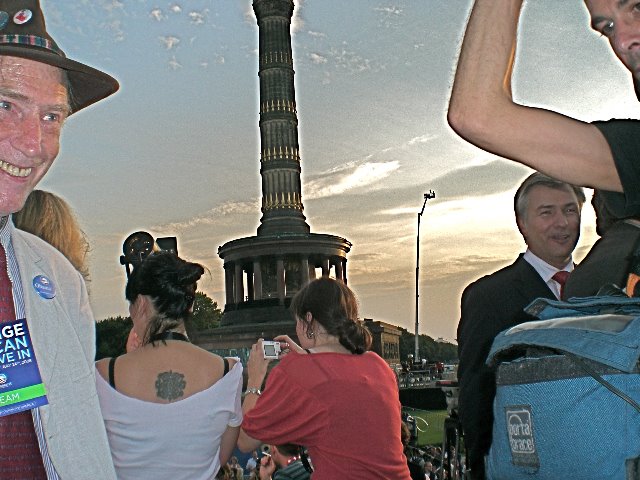
AFTER the speech: me grinning at a happy fellow American, Dr. Susan Neiman (off camera) who directs the Einstein Forum in Germany. The other happy guy with a tie is Klaus Wowereit, who has the mixed identity of being both a governor of a state and mayor of a city (and considers himself to be a citizen of the world) – Berlin being both a city and a state. Susan was being interviewed and doing interviews – writing a quick opinion in the New York Times and a long thoughtful piece “Obama in Berlin: Finding the Right Tone,” The Huffington Post, 31. July 2008. She looked at how the speech was designed and received, and focused on media hype and substance, and on satire, irony and cynicism in reporting. And, at the end, how happy she was.

In the end I was happy, indeed feeling some layers of depression melting away – layers of depression reaching back to the time of the Nixon elections, and all that we learned about what happened in that time. While the economic news may be depressing, compared to McCain (or Herbert Hoover for that matter) it was a relief to see a fellow American who has gained rather than destroyed respect here. Someone who has now convinced a lot of people here that he understands that there are very hard problems on this planet that must be faced, that no nation alone can solve, that will require great effort, and that in particular require a fundamental change toward international cooperation. Obama’s visit and McCain’s actual responses provide a vast contrast in judgment and capability on that foreign policy point.

With best wishes from Berlin,
For now, and for the future
David

The Rag Blog

Posted in Rag Bloggers | Tagged , , , , , , , | 3 Comments

Oil Drilling, the New ‘Clean’ Energy?

The New York Sun ran this idyllic graphic with its op-ed by Texas state Rep. Myra Crownover, who also owns a drilling company.

Texas state Rep. Myra Crownover — who owns an oil drilling company — asserts that ‘oil drilling in Texas has had no environmental impact.’
By Forest Wilder / August 19, 2008

Did anyone catch [Texas] state Rep. Myra Crownover’s op-ed in the New York Sun on Friday? I doubt there are many readers of the Sun in Crownover’s North Texas district, but the piece wasn’t really intended for her constituents anyway. In her op-ed, Crownover, who co-owns a drilling company, joins the chorus of Republicans screaming “Drill Here, Drill Now.” Even in that crowd — in which pandering and misinformation have been commonplace — Crownover manages to distinguish herself. Crownover argues that Texas has much to teach the nation about “energy, the economy, and the environment.”

Among her boldest assertions is that oil drilling in Texas has had no environmental impact. Crownover writes:

There is debate in Congress right now as to whether the Atlantic and Pacific Coastlines should be opened to offshore drilling. In Texas and the Gulf of Mexico, we have been producing millions of barrels of oil for years with no environmental consequences. Offshore drilling safety is so advanced that even during Hurricane Katrina not one drilling rig in the Gulf experienced a significant environmental event.

You heard the representative: there have been NO environmental consequences from oil production in the Gulf. Zero. Crownover goes on to state that Hurricane Katrina didn’t cause any “significant” environmental problems related to drilling rigs either.

Both assertions are flatly contradicted by numerous media accounts and reports from the federal government, only a Google search or phone call away. Just take hurricanes Katrina and Rita, events that happened in the last three years. For example, a Houston Chronicle investigation found:

[T]he two storms caused at least 595 spills, incidents that released untold amounts of oil, natural gas and other chemicals into the air, onto land and into the water. The quantity and cumulative magnitude of the 595 spills, which were spread across four states and struck offshore and inland, rank these two hurricanes among the worst environmental disasters in U.S. history. Some have even compared the total amount of oil released — estimated at 9 million gallons — to the tragedy of Exxon Valdez.

I called Wilma Subra, the technical assistant for the Louisiana Environmental Action Network (LEAN), to get her assessment of Crownover’s belief that Katrina produced no major oil problems. “There were a large number of rigs totally lost,” she said. “They’re not there anymore. There were a large number of spills. There were pipelines that run from the rigs to the shore that were disrupted. The oil had an impact on aquatic organisms… You can go along the coastal areas and still find residual oil.”

While it’s true that drilling rigs are safer and cleaner than they used to be, spills still occur with some regularity. In 2006, a pipeline linking a rig to the land leaked 21,000 gallons of oil offshore of Galveston. Sometimes oil outfits intentionally and illegally discharge waste into the Gulf. And what about the barge on the Mississippi that recently leaked hundreds of thousands of gallons of fuel oil into the river? Or how about the oil spill from a leaking pipeline in San Leon, Texas that happened just today?

It’s as if Crownover is living in some alternative universe.

But you can’t really blame her. The drilling-is-safe/”not-one-drop-spilled” meme has caught fire in the GOP ranks, bandied cavalierly about by John McCain, Fox News talking heads, and a hundred others who’ve read the talking points. Texas elected officials, who speak with some authority about the oil bidness, have gotten in on the act. For example, Railroad Commissioner Elizabeth Ames-Jones, whose agency regulates the oil and gas industry, writing in the Washington Post, urged federal policymakers to “cast off ’70s thinking and learn from the recent experiences of energy-producing states such as Texas.” The impacts on sensitive areas like ANWR, she said, would be “minuscule.”

Contrary to the belief of some, repeating something that is untrue over and over does not make it true.

Source / Texas Observer Blog

The Rag Blog

Posted in RagBlog | Tagged , , , , , , , | Leave a comment

Blame Is an Ugly Word – Let’s Stop Doing It

If we have and respect political freedom, then we have a responsibility to only vote for those whose policy positions, values, etc., are what we truly admire and think are what is needed for the country.

Misplaced Blame Undermines Democracy
by Joel S. Hirschhorn / August 11, 2008

A lot of people that I describe as neo-progressives have already started, nervously, to blame those of us who totally reject lesser-evil voting and the two-party system (duopoly) and plutocracy that Barack Obama supporters seem more than willing to sustain.

Neo-progressives are really nothing more than Democrats feeling too ashamed to call themselves Democrats but, instead, rejoice in calling themselves progressives, as if they buck the status quo political system. They do not. They are not genuine political dissidents. They always find a rationale to keep voting for Democrats and for not voting for any third-party or independent candidate, especially in presidential elections.

How do we best serve democracy? That is a central question for me. I reject lesser-evil voting that allows people with an easy conscience to vote for candidates that they know have very serious deficiencies, and not vote for others that do not have much of a chance of winning, even though they represent a more preferred set of policy positions and ideals.

Here is the central lesson I have come to: If democracy is to have real meaning and if people recognize the critical importance of fostering political competition, then clearly we must stop blaming some people for who wins an election, even though they did not vote for that winner.

In other words, it is very damaging to democracy if the concept of a spoiler is applied to some candidates (for taking votes away from some preferred candidate) and if blame is also placed on those who follow their conscience and do not vote for the candidate favored by the left (neo-progressives, liberals, and Democrats).

This year, lesser-evil voters in the millions will vote for Obama. They really do not agree with many of Obama’s positions and views, nor do they necessarily have much confidence that he will deliver true political reforms. That they want change does not make their choice right, certainly not in the long run if one agrees that we must put an end to the two-party plutocracy run mostly to serve the corporate state and the wealthy. Lesser-evil voting got us to where we are today and will not restore American democracy.

I hope there are millions of astute Americans that conclude that neither Obama nor McCain deserve their vote. If they decide not to vote at all or if they vote for some third-party candidate, then they are not to be blamed. They are to be respected as taking democracy seriously and making freedom more than an empty symbolic concept.

If we have and respect political freedom, then we have a responsibility to only vote for those whose policy positions, values, etc., are what we truly admire and think are what is needed for the country.

The lesser-evil voters are the ones making a mockery of democracy. And the people who blame all those not voting for Obama for electing McCain, should that happen, are the ones defiling democracy.

True proponents for change will vote for Ralph Nader or one of the other third-party candidates, if they find that candidate to really be what the country needs. Winning is not the highest priority or the greatest need. Getting votes counted for candidates outside the corrupt two-party system is what is needed for the longer term and keeping hope alive for an eventual political revolution — something that Obama shows no signs of delivering. People who label themselves as independents should not succumb to pressure to vote for Obama mainly because they fear McCain.

If McCain wins, then the only people deserving blame for what results are those that voted for him. And make no mistake; I predict there would be much to blame him and them for. Still, I would feel much joy in seeing Obama with his audacity of arrogance lose. And if he wins, there will be, eventually, much to blame him and his voters for. It is less important to get the first black president than it is to strike a blow against the two-party plutocracy. Anyway, if Obama was a true political messiah he would have, from the very start, proclaimed he wanted to be considered an American, not an African-American.

American democracy has become fake and delusional and our Constitution shredded. And the only people to blame for both are all those who voted for Democrats and Republicans. When will people learn?

Despite revolting conditions, most Americans remain unready to revolt, even the working poor. And the longer that ugly truth remains, the more we need what Thomas Jefferson knew was periodically required, a real political revolution.

Millions of Obamatons would probably welcome putting this on all our currency: “In God and Barack Obama We Trust.” That’s how insane things seem these days, at least to those of us who have not succumbed to all his smiles and empty rhetoric. As to those genuinely believing that McCain would make a great president, being dumb is no better than being delusional.

Source / Swans Commentary

The Rag Blog

Posted in RagBlog | Tagged , | 1 Comment

John Edwards? Paging Henry Cisneros

Henry Cisneros and friend: In the day.

San Antonio’s Cisneros ‘was on his way to becoming the Latino Obama before he cheated on his saintly wife’
By Melinda Henneberger / August 10, 2008

John Edwards is reminding me more and more of poor Henry Cisneros, who was on his way to becoming the Latino Obama before he cheated on his saintly wife, Mary Alice, while she was pregnant with their third child, a son born with no spleen and a malformed heart and stomach. Bill Clinton asked Cisneros to serve as his housing secretary anyway, a few years later, and by then, the affair was such old news that it never even came up during his confirmation hearings. Yet in the course of his background check for the cabinet post, Cisneros lied to the FBI – not about whether he was supporting his former mistress, but about the amount he paid her — and as a result, was subjected to a four-year investigation by a special prosecutor, a probe that cost taxpayers $9 million.

Heck of a public servant, Henry, so big-hearted and capable; watching him work a crowd in San Antonio back in the day, you’d have sworn you were looking at the future. But at some point after he stopped paying Linda Medlar, she started taping their phone calls, and triggered the investigation. When the judge who presided over his trial finally asked Cisneros why he’d lied in the first place, he explained that while he wasn’t positive himself about the amount he’d paid Medlar, he was positive he didn’t want his wife to know how high that figure was. He pled guilty to a misdemeanor, and when he left public life, we all lost out. So, what’s the relevance?

First, it’s that scary as we wives can be, federal investigators are scarier, and if any of the $15,000 a month that’s being paid to Edwards’ ex-girlfriend came from campaign funds, I cannot overemphasize how seldom fudging the facts with the Feds works out. Second, what do Monica Lewinsky, Linda Medlar and Rielle Hunter have in common? All were employees, and world-class blabbermouths. (You never really hear about the guys who get involved with the quiet types, do you?) It’s silly to say we don’t care if politicians fool around as long as they don’t lie about it; how is that supposed to work? And until we figure it out, we’re stuck pretending these people are perfect and then, we when find out otherwise, pretending we’re surprised.

As it is, we’re so perplexed about how to treat this stuff I can’t even tell what this first-person Newsweek piece is trying to say. In it, reporter Jonathan Darman tells about his own adventures with Rielle Hunter, a woman so fascinating that after meeting her on a trip to Iowa with Edwards in 2006, Darman spends weeks trying to track her down and months getting to know her. After concluding she’s an unreliable source, he keeps in touch anyway: “I continued to see her…I liked Rielle” and “let her do my astrological chart.” From the way he describes their first, boozy lunch, I can’t tell if he suspected she and Edwards were carrying on or not: Is the tone confessional because he missed the story, because he had the story and sat on it, or because he fell for the “I can tell you’re an old soul” hoodoo himself? (The last guy I knew who talked like that wound up blowing town with the life savings of several women who each thought they were going to marry him and start an ashram.) Hunter told Darman that in this incarnation, she wanted to help Edwards become a transformational figure on a par with Gandhi or MLK; better luck next time?

Source / Slate

The Rag Blog

Posted in RagBlog | Tagged , , , , | 2 Comments

Hipster: The Dead End of Western Civilization

‘Lovers of apathy and irony, hipsters are connected through a global network of blogs and shops’
By Douglas Haddow

We’ve reached a point in our civilization where counterculture has mutated into a self-obsessed aesthetic vacuum. So while hipsterdom is the end product of all prior countercultures, it’s been stripped of its subversion and originality.

I‘m sipping a scummy pint of cloudy beer in the back of a trendy dive bar turned nightclub in the heart of the city’s heroin district. In front of me stand a gang of hippiesh grunge-punk types, who crowd around each other and collectively scoff at the smoking laws by sneaking puffs of “fuck-you,” reveling in their perceived rebellion as the haggard, staggering staff look on without the slightest concern.

The “DJ” is keystroking a selection of MP3s off his MacBook, making a mix that sounds like he took a hatchet to a collection of yesteryear billboard hits, from DMX to Dolly Parton, but mashed up with a jittery techno backbeat.

“So… this is a hipster party?” I ask the girl sitting next to me. She’s wearing big dangling earrings, an American Apparel V-neck tee, non-prescription eyeglasses and an inappropriately warm wool coat.

“Yeah, just look around you, 99 percent of the people here are total hipsters!”

“Are you a hipster?”

“Fuck no,” she says, laughing back the last of her glass before she hops off to the dance floor.

Ever since the Allies bombed the Axis into submission, Western civilization has had a succession of counter-culture movements that have energetically challenged the status quo. Each successive decade of the post-war era has seen it smash social standards, riot and fight to revolutionize every aspect of music, art, government and civil society.

But after punk was plasticized and hip hop lost its impetus for social change, all of the formerly dominant streams of “counter-culture” have merged together. Now, one mutating, trans-Atlantic melting pot of styles, tastes and behavior has come to define the generally indefinable idea of the “Hipster.”

An artificial appropriation of different styles from different eras, the hipster represents the end of Western civilization – a culture lost in the superficiality of its past and unable to create any new meaning. Not only is it unsustainable, it is suicidal. While previous youth movements have challenged the dysfunction and decadence of their elders, today we have the “hipster” – a youth subculture that mirrors the doomed shallowness of mainstream society.

Take a stroll down the street in any major North American or European city and you’ll be sure to see a speckle of fashion-conscious twentysomethings hanging about and sporting a number of predictable stylistic trademarks: skinny jeans, cotton spandex leggings, fixed-gear bikes, vintage flannel, fake eyeglasses and a keffiyeh – initially sported by Jewish students and Western protesters to express solidarity with Palestinians, the keffiyeh has become a completely meaningless hipster cliché fashion accessory.

The American Apparel V-neck shirt, Pabst Blue Ribbon beer and Parliament cigarettes are symbols and icons of working or revolutionary classes that have been appropriated by hipsterdom and drained of meaning. Ten years ago, a man wearing a plain V-neck tee and drinking a Pabst would never be accused of being a trend-follower. But in 2008, such things have become shameless clichés of a class of individuals that seek to escape their own wealth and privilege by immersing themselves in the aesthetic of the working class.

This obsession with “street-cred” reaches its apex of absurdity as hipsters have recently and wholeheartedly adopted the fixed-gear bike as the only acceptable form of transportation – only to have brakes installed on a piece of machinery that is defined by its lack thereof.

Lovers of apathy and irony, hipsters are connected through a global network of blogs and shops that push forth a global vision of fashion-informed aesthetics. Loosely associated with some form of creative output, they attend art parties, take lo-fi pictures with analog cameras, ride their bikes to night clubs and sweat it up at nouveau disco-coke parties. The hipster tends to religiously blog about their daily exploits, usually while leafing through generation-defining magazines like Vice, Another Magazine and Wallpaper. This cursory and stylized lifestyle has made the hipster almost universally loathed.

“These hipster zombies… are the idols of the style pages, the darlings of viral marketers and the marks of predatory real-estate agents,” wrote Christian Lorentzen in a Time Out New York article entitled ‘Why the Hipster Must Die.’ “And they must be buried for cool to be reborn.”
With nothing to defend, uphold or even embrace, the idea of “hipsterdom” is left wide open for attack. And yet, it is this ironic lack of authenticity that has allowed hipsterdom to grow into a global phenomenon that is set to consume the very core of Western counterculture. Most critics make a point of attacking the hipster’s lack of individuality, but it is this stubborn obfuscation that distinguishes them from their predecessors, while allowing hipsterdom to easily blend in and mutate other social movements, sub-cultures and lifestyles.

***

Standing outside an art-party next to a neat row of locked-up fixed-gear bikes, I come across a couple girls who exemplify hipster homogeneity. I ask one of the girls if her being at an art party and wearing fake eyeglasses, leggings and a flannel shirt makes her a hipster.

“I’m not comfortable with that term,” she replies.

Her friend adds, with just a flicker of menace in her eyes, “Yeah, I don’t know, you shouldn’t use that word, it’s just…”

“Offensive?”

“No… it’s just, well… if you don’t know why then you just shouldn’t even use it.”

“Ok, so what are you girls doing tonight after this party?”

“Ummm… We’re going to the after-party.”

***

Gavin McInnes, one of the founders of Vice, who recently left the magazine, is considered to be one of hipsterdom’s primary architects. But, in contrast to the majority of concerned media-types, McInnes, whose “Dos and Don’ts” commentary defined the rules of hipster fashion for over a decade, is more critical of those doing the criticizing.

“I’ve always found that word [“hipster”] is used with such disdain, like it’s always used by chubby bloggers who aren’t getting laid anymore and are bored, and they’re just so mad at these young kids for going out and getting wasted and having fun and being fashionable,” he says. “I’m dubious of these hypotheses because they always smell of an agenda.”

Punks wear their tattered threads and studded leather jackets with honor, priding themselves on their innovative and cheap methods of self-expression and rebellion. B-boys and b-girls announce themselves to anyone within earshot with baggy gear and boomboxes. But it is rare, if not impossible, to find an individual who will proclaim themself a proud hipster. It’s an odd dance of self-identity – adamantly denying your existence while wearing clearly defined symbols that proclaims it.

***

“He’s 17 and he lives for the scene!” a girl whispers in my ear as I sneak a photo of a young kid dancing up against a wall in a dimly lit corner of the after-party. He’s got a flipped-out, do-it-yourself haircut, skin-tight jeans, leather jacket, a vintage punk tee and some popping high tops.

“Shoot me,” he demands, walking up, cigarette in mouth, striking a pose and exhaling. He hits a few different angles with a firmly unimpressed expression and then gets a bit giddy when I show him the results.

“Rad, thanks,” he says, re-focusing on the music and submerging himself back into the sweaty funk of the crowd where he resumes a jittery head bobble with a little bit of a twitch.

The dance floor at a hipster party looks like it should be surrounded by quotation marks. While punk, disco and hip hop all had immersive, intimate and energetic dance styles that liberated the dancer from his/her mental states – be it the head-spinning b-boy or violent thrashings of a live punk show – the hipster has more of a joke dance. A faux shrug shuffle that mocks the very idea of dancing or, at its best, illustrates a non-committal fear of expression typified in a weird twitch/ironic twist. The dancers are too self-aware to let themselves feel any form of liberation; they shuffle along, shrugging themselves into oblivion.

***

Perhaps the true motivation behind this deliberate nonchalance is an attempt to attract the attention of the ever-present party photographers, who swim through the crowd like neon sharks, flashing little blasts of phosphorescent ecstasy whenever they spot someone worth momentarily immortalizing.

Noticing a few flickers of light splash out from the club bathroom, I peep in only to find one such photographer taking part in an impromptu soft-core porno shoot. Two girls and a guy are taking off their clothes and striking poses for a set of grimy glamour shots. It’s all grins and smirks until another girl pokes her head inside and screeches, “You’re not some club kid in New York in the nineties. This shit is so hipster!” – which sparks a bit of a catfight, causing me to beat a hasty retreat.

In many ways, the lifestyle promoted by hipsterdom is highly ritualized. Many of the party-goers who are subject to the photoblogger’s snapshots no doubt crawl out of bed the next afternoon and immediately re-experience the previous night’s debauchery. Red-eyed and bleary, they sit hunched over their laptops, wading through a sea of similarity to find their own (momentarily) thrilling instant of perfected hipster-ness.

What they may or may not know is that “cool-hunters” will also be skulking the same sites, taking note of how they dress and what they consume. These marketers and party-promoters get paid to co-opt youth culture and then re-sell it back at a profit. In the end, hipsters are sold what they think they invent and are spoon-fed their pre-packaged cultural livelihood.

Hipsterdom is the first “counterculture” to be born under the advertising industry’s microscope, leaving it open to constant manipulation but also forcing its participants to continually shift their interests and affiliations. Less a subculture, the hipster is a consumer group – using their capital to purchase empty authenticity and rebellion. But the moment a trend, band, sound, style or feeling gains too much exposure, it is suddenly looked upon with disdain. Hipsters cannot afford to maintain any cultural loyalties or affiliations for fear they will lose relevance.

An amalgamation of its own history, the youth of the West are left with consuming cool rather that creating it. The cultural zeitgeists of the past have always been sparked by furious indignation and are reactionary movements. But the hipster’s self-involved and isolated maintenance does nothing to feed cultural evolution. Western civilization’s well has run dry. The only way to avoid hitting the colossus of societal failure that looms over the horizon is for the kids to abandon this vain existence and start over.
***

“If you don’t give a damn, we don’t give a fuck!” chants an emcee before his incitements are abruptly cut short when the power plug is pulled and the lights snapped on.

Dawn breaks and the last of the after-after-parties begin to spill into the streets. The hipsters are falling out, rubbing their eyes and scanning the surrounding landscape for the way back from which they came. Some hop on their fixed-gear bikes, some call for cabs, while a few of us hop a fence and cut through the industrial wasteland of a nearby condo development.

The half-built condos tower above us like foreboding monoliths of our yuppie futures. I take a look at one of the girls wearing a bright pink keffiyah and carrying a Polaroid camera and think, “If only we carried rocks instead of cameras, we’d look like revolutionaries.” But instead we ignore the weapons that lie at our feet – oblivious to our own impending demise.

We are a lost generation, desperately clinging to anything that feels real, but too afraid to become it ourselves. We are a defeated generation, resigned to the hypocrisy of those before us, who once sang songs of rebellion and now sell them back to us. We are the last generation, a culmination of all previous things, destroyed by the vapidity that surrounds us. The hipster represents the end of Western civilization – a culture so detached and disconnected that it has stopped giving birth to anything new.

Source / Adbusters / Posted July 29, 2008

The Rag Blog

Posted in RagBlog | Tagged , , , | 3 Comments

San Antonio Baptist Church Says ‘Gay Street’ Not ‘Baptist Way’


City Council won’t change street name
By Kate X Messer / August 9, 2008

According to WOAI, the NBC affiliate in the Alamo City, San Antonio City Council has denied Second Baptist Church’s request to change the name of the street on which their church resides.

As the report points out, “Gay” is the name of a community activist of significance to the surrounding community, which wants the name of the street to remain Gay Street.

We think instead that the church should move a few blocks south to the corner of Gay/Hub.

Source / Austin Chronicle

A street on the East Side is in the spotlight because a church wants to change its name. But now it looks like that won’t be happening anytime soon.

News 4 looked into why this one request is getting so much attention.

It seems like a simple process. Second Baptist Church wants to change the name of the street that runs next to it, to Second Baptist Way. But it’s the name they’re trying to change it from that’s raising some eyebrows.

If Second Baptist wanted to change Edna Street or Bob Street, most involved in the debate wouldn’t bat an eye.

But the street they are trying to convert isn’t just any street, it’s Gay Street. Many people questioned why they wanted to change that street’s name.

Second Baptist said they simply wanted to reach out to the community more by changing the street to the church name.

But Attorney Rosie Gonzales didn’t buy that reasoning.

“They could reach out into the community just leaving it the way it is,” said Gonzales. “I don’t see how changing the name of a street is going to help their community outreach efforts whatsoever.”

Those outreach efforts by the church ended right where they began on Thursday, at City Hall.

City Councilwoman Sheila McNeil requested that the name change be denied and the council agreed. By almost an unanimous vote, the name Gay Street was left as is.

McNeil said the neighbors who live around Gay Street want the name to stay.

According to neighbors, the street was actually named after a community activist. They say that’s part of the reason the name has stayed and why the want it to continue.

Kim Fischer / WOAI.com / August 8, 2008

The Rag Blog

Posted in RagBlog | Tagged , , , , | Leave a comment

Critiquing the Human Family

See “EdgeLeft: Taking China’s Side” by David McReynolds below

It Was a Good Reminder for Me
By Diane Stirling-Stevens / The Rag Blog / August 10, 2008

Since my family came from Germany (my mom’s side in 1631; my dad’s in 1710), and I clearly remember being told how the Germans and Chinese worked side-by-side building the railroads, this article struck ‘home’ with me. Maybe having the funny name of Rambow; being extremely poor growing up, and living in a town that was 90% German where they felt ‘safe’ (pretty clannish actually), there were lots of ‘tales’ about ‘other folk’ that were either of different religion; color, or origin. It took moving away from that small town – living in large cities and in different parts of the United States, for me to fully understand the necessity of eliminating prejudice; bigotry, and setting arbitrary standards that often (I think) are based on family folk lore, hear-say, and tradition.

I got my first real chance to learn more about the Negro when I moved to Cincinnati in 1974. Nearly all of the friends I’ve kept in touch with (and visit there), after 34 years, are my black friends (and I have 3 that live near me now, that I’m very close to). I’ve been taught so much by them; their history – enjoyed their traditional foods, and heard their viewpoints about the slave situation; how they felt when they could finally vote, and of course their reaction to the improvement in the way our country is now incorporating the black American into business/entertainment/politics/society, as it should have done.

When I lived in California for almost 20 years, I had a chance to visit China town; various parts of both Southern, and Northern California where the Vietnamese create their little ‘territories’ – again, they not only offer excellent food, but their neighborhoods are clean – they are diligent shop-owners, and very conscious of the work they perform. I learned more about the Mexican way of life; my youngest son married a beautiful Mexican lady in 2002 – another son married a beautiful Cuban woman back in 1990, so I know all of my children benefited from learning to appreciate the ways and customs of not just we ‘white German immigrants’ aka Americans.

Getting into the electronics industry in 1980 (Seattle, Washington), I again got a chance to see the exceptional workmanship of the Asian – learned more about our Indian nations; the Eskimo nation, and I think by that time I was truly beginning to ‘balance’ my reaction and be much less willing to accept the historical ‘slander’ done to some races of people, by other races of people. In fact, I’ve come to love the ‘mix’ of we Americans; the colors of our America, and chose to move next to the Mohave Indian reservation back in 2000 because I knew they’d never build up the land the way many of the white ‘developers’ choose to plunder the land. I have to say ‘white’ builders, because I’ve never met any other kind (imagine there are some of course). It’s sad to think how all the ‘colors of the rainbow’ have built up this country, and I’m sure you’ve noticed it’s only been pretty much the leadership of the ‘white good old boys’, that have put us in this condition we’re in today.

The world is big now; communications are faster than they’ve ever been, and I’m hoping all of this will help us learn to understand each other better, not start conflicts and fight wars more efficiently. What I’m guessing is we have to get a few other ‘colors’ of people into our leadership/administration, and not allow our media (who also is predominately white guys and gals) feed us propaganda. In fact, I bet the Rag Blog and its many writers, could easily create a powerful piece on how the media does (and does not) deliver the news that we REALLY need. If you look at the ‘faces’ of those who are spewing the daily headlines and ‘breaking news’, more often than not it’s a white person – very well made up; a suit or lovely dress with jewelry, and all are photogenic! In fact as I type this, it strikes me many of the comedy shows have over-weight and not-so-good-looking stars and cast. Even if some are handsome or pretty to look at, they’ve usually got a ‘fall guy or gal’, who isn’t nearly as attractive.

Hey, if I don’t stop right now and let you read the great article Alan sent, this will turn into a book. My mind is traveling to a place that says: “Hey, Diane, since you rarely watch television why don’t you make it a project, and see just how many shows have minorities, and what parts do they play….” I guess I’ll do that this coming week …

EdgeLeft: Taking China’s Side
by David McReynolds

There has been an enormous amount of China-bashing in recent months, leading up to the Olympics. I’d like to put in a good word for China, something not that politically correct these days.

Sure, I wish the Chinese did not eat dogs, but we have pigs on our menu, and they are just as smart as dogs. Yes, I wish the Dalai Lama could return to Tibet, though the issue of Tibet is more complex than either the Chinese or the Dalai Lama make it out to be. And the history of Tibet under the Buddhists not as ideal as some in the West believe.

Perhaps most of all I wish the Chinese would use strong pressure on Sudan regarding Darfur. And, of course, as a member of the American Civil Liberties Union, and a lifelong American dissident, I support the full and complete extension of human rights to every human being on this planet.

However, much of the coverage I’ve seen overlooks some painful Western history. I fell in love with China as a kid in Los Angeles, before ever tasting Chinese food. Why, I’m not sure. Perhaps it was reading Pearl Buck’s Good Earth. Perhaps it was because I loved fireworks and firecrackers, and the ones we bought for July 4th were made in China. Whatever the reason, it certainly wasn’t the culture of California, riddled with anti-Chinese and anti-Asian attitudes.

Let’s remember, as Americans, the Chinese Exclusion Act of 1882, which was “progressive racism”. At the time of our Gold Rush there was a flood of poor Chinese who came here, provided low wage labor, built our railways, did our laundry, but also became a scapegoat for low income workers who saw Chinese labor as competition. Some of the slogans of the time are chilling to remember:

“We want no slaves or artistocrats
The Coolie Labor System Leaves us No Alternative
Starvation or Disgrace Mark the Man who Would Crush Us To the Level of the Mongolian Slave
We All Vote
Women’s Rights and No More Chinese Chambermaids”

These were slogans carried by anti-Chinese demonstrators. In 1882, after decades of such agitation, and with the support of the progressives of the day, the Chinese Exclusion Act was passed, making it all but impossible for Chinese to come to this country.

But this was small change compared to what the rest of the world was doing to China. The Opium Wars of 1839 and 1856 resulted from a struggle between the Qing Dynasty of China, which sought to suppress the use of opium, and the British who had a monopoly on the opium trade and were determined to push that addiction on the Chinese.

China lost both wars, and had to grant the British “extraterritorial rights” (similar to the rights the Americans in Iraq enjoy today). So the civilized British who, like our own half-civilized President, today lectures the Chinese on human rights, have forgotten that, for a profit, they were delighted to deal in opium.

The Boxer Rebellion at the turn of the last century saw an uprising by members of the “Chinese Society of Right and Harmonious Fists” against foreign influence. (They took the name “boxer” from the martial arts they used). The rebellion against foreign influence was serious enough. According to Wikipedia “In June 1900, the Boxers invaded Beijing and killed 230 foreign diplomats and foreigners.”

Chinese Christians – who had also been targeted – and Westerners retreated to the legation quarter, putting up a two month struggle until a “multinational coalition rushed 20,000 troops to the rescue”. The Boxer Rebellion was a serious challenge to outside influence and those outsiders (including Japan) were enthusiastic in sharing the burden of crushing the Chinese. There were 51 warships sent in (18 of them being Japanese, 10 being Russian). At least 55,000 troops were sent (Japan, with 20,300, sent the most, the Russians with 12,400 were second, and the British with 10,000 came in third. The Americans, not yet a world power, sent only 2 warships and fewer than 3500 troops.

China was crushed, humiliated, the last Chinese dynasty ended. Let me quote Kaiser Wilhelm II’s July 27th order to his troops: “Make the name German remembered in China for a thousand years so that no Chinaman will ever again dare to even squint at a German.”

Western intervention paved the way for the rise of Sun Yat-sen, who overthrew the Mancu (Qing) dynasty and established the Chinese Republic. But the Chinese Republic had a short and turbulent life. World War II did not begin in Europe – it began on July 7th, 1937, when the Empire of Japan launched a full scale invasion of China. It was this which I remember as a child, when our bubble gum came wrapped in horrific (and pro-Chinese) illustrations of Japanese atrocities. (Perhaps the chewing gum was made in China?). The infamous Rape of Nanking, in which thousands of Chinese civilians were raped and murdered by the Japanese military forces, still rankles in Chinese minds.

For a time Chiang Kai-Shek, who had succeeded Sun Yat-sen, cooperated with Mao and the Communists in fighting the Japanese. But at a crucial point Chiang turned on the Chinese, massacred thousands in a surprise attack, and the Chinese Civil War began in earnest, continuing until 1949, when Chiang retreated to Taiwan and the Chinese Revolution was complete. (Throughout that war, the US sided with Chiang Kai-Shek, supplying him with weapons and using US air power to move Nationalist troops into position against the Communists).

My sense is that there is a general agreement by military historians that Mao and his forces did a better job of fighting the Japanese than Chiang’s Nationalists.

But the West was hardly ready to deal ith China, a nation far more civilized than our own, or any nation in Western Europe. We denied China its seat in the Security Council. The US refused to “recognize” China. It was not until the famous visit to China by Richard Nixon that relations were finally normalized.

My view of China is not shaped by an enthusiasm for Maoism. (I do recommend Edgar Snow’s Red Star Over China for a sympathetic view of the Chinese Communists, and I know my father, who served with Army Air Force Intelligence during the war, and was in China more than once, was deeply impressed by the Chinese. More than that, my father, a devout Christian and political conservative, was baffled that the Chinese, in all their poverty and hunger, had a dignity and “sense of worth” that impressed him).

It is not the current Chinese State I endorse, but the long history of China, its remarkable accomplishments over thousands of years. I am embarrassed when the West chides China today, at a time when NATO is killing civilians in Afghanistan, and the US and Great Britain have, between them, laid waste to Iraq, one of the cradles of civilization in the Middle East.

It had long been my hope to visit China. I know, as the years pass, that goal won’t be achieved. But from afar, and long before the Chinese Revolution, I was on the side of China. I don’t even like sports, but I am glad the Olympics is a success. I compare the speed with which China dealt with the horrible disaster of its great earthquake this year with the total failure of George Bush to cope with Katrina.

I believe in human rights – but one of the most basic of human rights is the right to eat. China has paid a high price for its swift industrialization but it has given many of the people of China a chance at what we would call “the good life”. I live in a country with the highest number of men and women behind bars of any nation in the world – I hesitate to make human rights in China my first priority. China is now one of the emerging great powers. It would be to our advantage to treat it with a sense of respect to which its several thousand years of civilization entitles it.

[David McReynolds worked for many years for War Resisters League, was at one time Chair of War Resisters International, and was the Socialist Party’s Presidential candidate in 1980 and 2000. He retired in 1999 and lives on the Lower East side with his cats. He can be reached by email at: dmcreynolds@nyc.rr.com].

Source / EdgeLeft

The Rag Blog

Posted in Rag Bloggers | Tagged , , | 1 Comment