Just Another "War on Terror" Conspiracy Theory


Vital unresolved anthrax questions and ABC News
By Glenn Greenwald

The FBI’s lead suspect in the September, 2001 anthrax attacks — Bruce E. Ivins — died Tuesday night, apparently by suicide, just as the Justice Department was about to charge him with responsibility for the attacks. For the last 18 years, Ivins was a top anthrax researcher at the U.S. Government’s biological weapons research laboratories at Ft. Detrick, Maryland, where he was one of the most elite government anthrax scientists on the research team at the U.S. Army Medical Research Institute of Infectious Disease (USAMRIID).

The 2001 anthrax attacks remain one of the great mysteries of the post-9/11 era. After 9/11 itself, the anthrax attacks were probably the most consequential event of the Bush presidency. One could make a persuasive case that they were actually more consequential. The 9/11 attacks were obviously traumatic for the country, but in the absence of the anthrax attacks, 9/11 could easily have been perceived as a single, isolated event. It was really the anthrax letters — with the first one sent on September 18, just one week after 9/11 — that severely ratcheted up the fear levels and created the climate that would dominate in this country for the next several years after. It was anthrax — sent directly into the heart of the country’s elite political and media institutions, to then-Senate Majority Leader Tom Daschle (D-SD), Sen. Pat Leahy (D-Vt), NBC News anchor Tom Brokaw, and other leading media outlets — that created the impression that social order itself was genuinely threatened by Islamic radicalism.

If the now-deceased Ivins really was the culprit behind the attacks, then that means that the anthrax came from a U.S. Government lab, sent by a top U.S. Army scientist at Ft. Detrick. Without resort to any speculation or inferences at all, it is hard to overstate the significance of that fact. From the beginning, there was a clear intent on the part of the anthrax attacker to create a link between the anthrax attacks and both Islamic radicals and the 9/11 attacks. [ … the letter sent to Brokaw is pictured above]

The letter sent to Leahy contained this message:

We have anthrax.
You die now.
Are you afraid?
Death to America.
Death to Israel.
Allah is great.

By design, those attacks put the American population into a state of intense fear of Islamic terrorism, far more than the 9/11 attacks alone could have accomplished.

Much more important than the general attempt to link the anthrax to Islamic terrorists, there was a specific intent — indispensably aided by ABC News — to link the anthrax attacks to Iraq and Saddam Hussein. In my view, and I’ve written about this several times and in great detail to no avail, the role played by ABC News in this episode is the single greatest, unresolved media scandal of this decade. News of Ivins’ suicide, which means (presumably) that the anthrax attacks originated from Ft. Detrick, adds critical new facts and heightens how scandalous ABC News’ conduct continues to be in this matter.

During the last week of October, 2001, ABC News, led by Brian Ross, continuously trumpeted the claim as their top news story that government tests conducted on the anthrax — tests conducted at Ft. Detrick — revealed that the anthrax sent to Daschele contained the chemical additive known as bentonite. ABC News, including Peter Jennings, repeatedly claimed that the presence of bentonite in the anthrax was compelling evidence that Iraq was responsible for the attacks, since — as ABC variously claimed — bentonite “is a trademark of Iraqi leader Saddam Hussein’s biological weapons program” and “only one country, Iraq, has used bentonite to produce biological weapons.”

ABC News’ claim — which they said came at first from “three well-placed but separate sources,” followed by “four well-placed and separate sources” — was completely false from the beginning. There never was any bentonite detected in the anthrax (a fact ABC News acknowledged for the first time in 2007 only as a result of my badgering them about this issue). It’s critical to note that it isn’t the case that preliminary tests really did detect bentonite and then subsequent tests found there was none. No tests ever found or even suggested the presence of bentonite. The claim was just concocted from the start. It just never happened.

Read all of it here. / Salon / Posted August 1, 2008

Thanks to Informed Comment / The Rag Blog

Posted in RagBlog | Tagged , , | Leave a comment

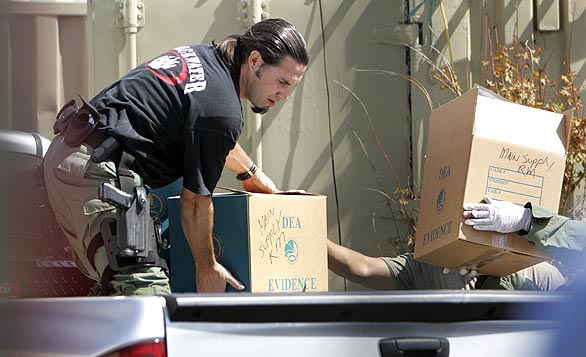
DEA Uses Blackwater to Raid Medical Marijuana Providers

Blackwater does the DEA’s job in Culver City, Cal.

‘I guess none of their usual buddies were available’
By Rebecca Saltzman

Last week the DEA raided a medical marijuana dispensary in Culver City, Cal., spending hours on site detaining employees and ultimately leaving the facility in disarray. This is unfortunately not an unusal story. Since 2005, the DEA has raided dozens of state-sanctioned dispensaries in California.

But this time was different. We’re used to the DEA calling in help from various federal agencies and local law enforcement. But I guess none of their usual buddies were available yesterday because from the picture below, which appeared in the LA Times today, it looks like they had to resort to calling in Blackwater:

The DEA often likes to say that medical marijuana is not their top priority (though at the height of the raids last year, they were raiding an average of one dispensary per week). They like to argue that medical marijuana raids do not take resources away from other drug interdiction. Yet this photo [above] makes me wonder – if they have sufficient resources to shut down meth labs and to bust medical marijuana providers, why do they need the help of Blackwater, a private agency?

Yet another reason we need Congress to hold oversight hearings on DEA medical marijuana activities. Good to know that House Judiciary Committee Chairman John Conyers is concerned about this issue and has already begun to question the DEA on its actions.

Source / Americans for Safe Access / Posted August 1, 2008

Thanks to Roger Baker / The Rag Blog

Posted in RagBlog | Tagged , , , , , , , , | Leave a comment

SCIENCE : Dark Energy’s Fingerprint Found in Distant Galaxies

This image was produced by combining a dozen NASA Chandra X-ray Observatory observations made of a 130 light-year region in the center of the Milky Way. When microwaves created by the Big Bang pass through large galaxies, they appear to pick up energy. The reason, say astronomers, is dark energy. Photo courtesy of NASA.

‘May be the clearest detection of dark energy to date’
By Irene Klotz / August 5, 2008

Scientists don’t know much about the mysterious phenomenon known as dark energy, but they do have a picture of what it’s doing to the universe, namely, driving it apart.

In what may be the clearest detection of dark energy to date, astronomers at the University of Hawaii looked at microwaves left over from the beginning of the universe some 13.7 billion years ago. The scientists grouped the rays depending on whether they had passed through massive clusters of galaxies or bee-lined to Earthly detectors through areas largely lacking galactic real estate.

The premise was that these “background” microwaves would pick up a little energy as they entered the clusters, urged on by the forces of gravity. But if gravity had a monopoly on the game, the rays would lose that snap as they pressed through the other side, rendering the energy gain a transitory phenomenon.

So how to explain that the microwaves passing through super-sized galaxy clusters got to keep a bit of unearned gain?

István Szapudi and colleagues believe it is because dark energy, which sometimes is referred to as anti-gravity or vacuum energy, had spread out the galaxy clusters, as it is doing to all space. By the time the microwaves exited, there was proportionally a bit less mass to deal with, leaving the rays with a slight energy advantage.

“It’s kind of like if you have a car on a hill,” explained Gary Hinshaw of NASA’s Goddard Space Flight Center in Greenbelt, Md. “You pick up energy as you’re going down, but you give it all back up again when you go up.

“What is happening here,” he added, “is that the acceleration of the universe is forcing the gravity wells to be less strong…so over the time it takes for energy to cross the cluster, the strength of the cluster has diminished.”

The measurements are difficult to make because tiny variations in the Big Bang remnant waves are larger than the observable effects of intervening galaxy clusters and voids. But by grouping together data from background radiation maps of the 50 largest galaxy clusters and the 50 largest voids, researchers were able to come up with a finding they say has only a one in 200,000 chance of being a statistical fluke.

The data was taken from Sloan Digital Sky Survey, which has mapped the distribution of galaxies in about 25 percent of the sky.

Previous dark energy studies have a one in 20 chance of being statistically coincidental, Szapudi said.

Dark energy was discovered about 10 years ago and is considered the leading outstanding puzzle in cosmology today.

“In the last six or seven billion years, the expansion of the universe has switched over from slowing down to speeding up, meaning that dark energy is becoming more dominant in controlling the growth of the universe,” Hinshaw said. “As the universe expands, matter gets more and more dilute and dark energy gets more and more dominate.”

Szapudi’s research will be published in an upcoming issue of The Astrophysical Journal.

Source / Discovery News

The Rag Blog

Posted in RagBlog | Tagged , , , , | 2 Comments

The Compromise ‘Drill Anywhere’ Plan


‘Joe Sixpack will never notice the effect of any oil recovered from these areas’
By Dean Baker / August 4, 2008

Senator McCain and the Republicans in Congress are calling Senator Obama and the Democrats environmental wimps for refusing to allow the oil industry to drill in the Arctic National Wildlife Refuge, environmentally sensitive offshore areas and anywhere else they please. The Republicans are claiming that the Democrats don’t care about Joe Sixpack, who now has to pay $4 a gallon for his gas. Nor do they care that most of this oil is now imported.

In addition to concerns about the environment, one major reason that Democrats oppose drilling is that Joe Sixpack will never notice the effect of any oil recovered from these areas, even if we did allow drilling. According to independent experts such as the Energy Information Agency, there is too little oil in the offshore protected areas to have any noticeable impact on gas prices.

In other words, we are not debating about helping Joe Sixpack pay for his gas. We are only arguing over whether to put environmentally sensitive areas at risk for nothing. The Republican claims about the impact of drilling on oil prices simply are not true.

But we all know that politics is about the art of compromise, so there is a simple compromise that opponents of drilling can put forward. Since the drilling advocates are telling us that increased drilling will bring down the price of gas, there is no reason not to take them at their word. Why not just give them the green light to drill in the Arctic National Wildlife Refuge, the Florida Coast and other offshore protected areas, Mount Rushmore and anywhere else on the planet that they want.

However, open drilling season comes with a simple quid pro quo. The oil industry gets slapped with a windfall profits tax that takes away any revenue in excess of $3 a gallon. Since we know it takes time to search for oil and drill wells, we can even give the oil boys a six-month grace period before the windfall tax takes effect.

Based on what Senator McCain and the Republicans are telling us, this windfall profits tax shouldn’t be of any concern to the industry. After all, opening up these protected areas for drilling will lead to a huge gusher of new oil on the market. This increased supply should push the price of gas back below $2 a gallon. According to McCain and the Republicans, once we declare open season for drilling, $4-a-gallon gas will just be a bad memory of what happens when you let environmentalists run the country.

It would be interesting to see the response if Senator Obama or Democrats in Congress put forward this proposal. If McCain and the Republicans believe what they have been saying, then they should have no problem putting a windfall profits tax provision into their bill, since they know it will have no effect. On the other hand, if they believe what all the experts are saying – that additional drilling will have no noticeable impact on oil prices – then they will strongly oppose this bill, since it would be a huge tax on their friends in the oil industry.

In short, this compromise “drill anywhere” plan is a simple way to force Senator McCain and the Republicans to tell the country whether they really believe that drilling in protected areas will lower gas prices, or whether they are knowingly making false claims for political gain. The “drill anywhere” plan will make them tell the truth without waterboarding.

Source / truthout

The Rag Blog

Posted in RagBlog | Tagged , , , , | Leave a comment

BOOKS : Dick Reavis on Carl Oglesby

Another view of ‘Ravens in the Storm’
By Dick J. Reavis / The Rag Blog / July 5, 2008

Comrades:

A week or so ago I more or less promised a review of Oglesby’s Ravens in the Storm. I have read the book and don’t think I have much to add to Wizard’s review, except the notes below.

Oglesby admits that he never advocated socialism and that he tended to view SDS as an anti-war group, not as the cradle of a new revolutionary or socialist movement. He is/was an American exceptionalist and a libertarian or social democrat. Since he states his positions honestly, I see nothing to be gained in expressing my disagreements with his political orientation, with two exceptions.

His attitude towards the black liberation movement of those days seems paternal to me, and he makes a big deal out of Cointelpro’s attempts to disorient SDS. But all governments try to disorient all opposition movements. It comes with the turf!

In the pages of Ravens, PL [Progressive Labor Party], which I supported, is beneath his notice, even beneath his contempt. His exposure to socialism comes from what he, I think accurately, terms the “comic book Marxism” of the Weathermen.

But that’s almost the point. Nowhere in his book does he describe the daily life of any chapter, or of any role he played in any chapter. He was a spokesman for a movement to which, on the grass-roots level, he did not belong. He learned about shifts in the thinking of chapter members from people like Dohrn, not from living the experience.

That he did so is a great indictment of the supposed democratic nature of SDS. A run of “leaders” was able to “lead” with being held accountable by the members on the ground. The book demonstrates that we had two types of elitism in SDS: the openly-declared elitism of PLP and the covert elitism of the national leadership during the group’s latter days.

Klonsky complained about Oglesby’s handling of him. I think his complaint is fair. Oglesby refers to him as a “thug of the Left,” but never justifies that characterization. One gets the impression that Oglesby was expecting to find thugs on the Left.

I was surpised to see that Oglesby apparently still feels a bitterness towards his former comrades in SDS. That’s sad. I would propose that he consider a general amnesty for anybody who took part!

For previous discussion of this topic, go to BOOKS : Carl Oglesby’s ‘Ravens in the Storm’ by Mariann Wizard / The Rag Blog / July 24, 2008;

And to Susan Klonsky on Carl Oglesby’s Memoir / The Rag Blog / July 30, 2008.

The Rag Blog

Posted in Rag Bloggers | Tagged , , , , , , , | 1 Comment

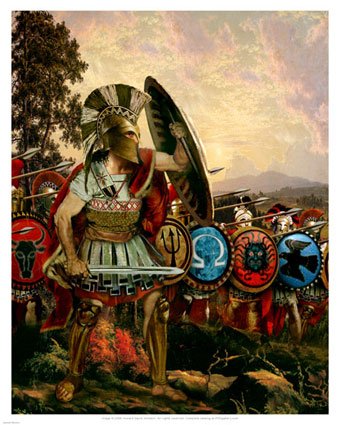
Tom Hayden : Empire Through the Athens-Sparta Prism

Spartan Warriors by Howard Johnson.

Obama-McCain Dilemma: Warriors or Statesman?
By Tom Hayden

ATHENS — As Barack Obama swept Europe politically this week, my vantage point was the ancient Agora of Athens, where I could muse whether the young conquerer might become more Athenian or Spartan.

Athens today still evokes a powerful historical parallel with the present American experience. Here, more than 2,000 years ago, an open participatory democracy was born, with lasting artistic, scientific and philosophic achievements, but in tandem with a system of slave labor. Obama strides the same historical contradiction.

The city-state of Sparta, on the other hand, birthed today’s military ideal, turning young boys into warrior-patriots, becoming the vanguard of “the 300” against the Persian advance at Thermopolae, but eventually succumbing to decay as their hyper-militarism led to over-extension.

The parallels between the Athenian Obama and the Spartan John McCain [and his neo-conservative allies] seem obvious.

After George Bush and the Iraq War, the vast majority of Greeks and Europeans long for the restoration of democratic, free-thinking Athens – with the Harvard scholar Obama symbolizing the overcoming the legacy of a slave-state underclass. Instead of Spartan militarism, and its echoes in Pax Romana, Nicolo Machiavelli, or Pax Americana, the dream here is of a Pax Humana led by Barack Obama. The “new Athenian” will have to negotiate with the modern Persians, not fight them at a modern Thermopolae.

The Republican incarnation of the Spartans is seen here as an insanely-dangerous neo-conservative faction attempting to hold off the terrorist throngs at a new Thermopolae, somewhere near the Khyber Pass. Sparta’s vanguard units in those times were known as the Crypteria, which roughly translates as “special ops brigade.” The hard lessons learned at Thermopolae, however, have been ignored by neo-conservative discourse, including the recent Hollywood film glorifying Sparta’s 300.

The Greek worldview is helpful here, in permitting a distinction between the Mythic Obama and the Literal Obama. The rapture in Europe is for the mythic Obama, whose candidacy suggests a possible transcendence of the world’s woes over racism and immigration. But support for Obama’s insistence that Europe join America in sending thousands of troops to Afghanistan, in a new, aggressive combat mission, meets with heavy resistance even among hard-core Obama supporters.

“The bottom line is an abhorrence with Bush”, says Spyros Draenos, a Greek researcher writing a history of the 1960s’ Greek reformer, Andreas Papandreou, overthrown and imprisoned with the cooperation of the American CIA. Draenos’ familiarity with the sadness of modern history places him as an interested, but by no means passionate, supporter of the Illinois senator who was two years old when the Greek generals jailed Papandreou and installed a dictatorship in 1967.

“But that leaves open the question of why the fascination with Obama”, Draenos admits. “We are in awe of the fact that a black could be elected president of the US, because America is so associated with racism. Yet underneath the deep anti-US sentiment here is a desire to believe. Back in the Sixties it was the same, it was the rise of a movement among those who were disillusioned pro-Americans.”

Obama is likely to be mistaken in his stated belief that his popularity in Europe will translate into support for more combat troops in Afganistan. Here the Mythic Obama faces the real world. There is little European desire to shed blood in Afghanistan or Pakistan, not even among the British who carved the two countries into existence. Those are seen as reputational interests of the American superpower, not global interests in securing peace. ***The literal Obama would have fared better in Europe if he had acknowledged America’s stakes in Pakistan’s garment sweatshops, which receive privileged trade status, or America’s tolerance of Afghanistan’s monopoly on opium.***

Dreanos notes his “amazement that young people here are actually following Obama when he makes compromises, and asking the same questions” as the older, more critical generation. “There is an underlying cynicism” that Obama has not yet addressed, “about America playing a different role in the world” from the Middle East to Afghanistan. “The Greeks are fatalistic about getting ***f-d over”*** by a varied series of masters, he bluntly says. They are not likely to understand the imperial goal of dying in Afghanistan. They think they have been here before, for centuries.

As Obama made his near-perfect pitch, for example, a top US official was confirming European skepticism by writing in the New York Times that Afghanistan is a “virtual narco-state” with collusion at “the top of government” and complete indifference from the Pentagon. [NYT, Global, July 25, 2008]. From any perspective, Obama’s proposal is to join a coalition in quagmire, a token form of Spartan resolve, designed to protect him through the next American election.

Obama also is asking NATO to sign up for combat, not peacekeeping, in the global war on terrorism [GWOT, in original Pentagon terminology], a haunting reminder of Greece’s experience with the first CIA subversion of a European government under the cover of the fledgling NATO.

In brief, Communist-led nationalist forces would have defeated the Nazis and taken power in 1944 were it not for British military intervention, a task soon handed off to the Americans. It is not clear what an anti-Nazi victory of the Left would have meant for Greece, but it is known that the Soviet Union left the Greek partisans on their own. As a result, a radical and turbulent Greece came under NATO control, with a royalist government that included an army, police and civil service purged of anyone suspected of anti-monarchist or left-wing sympathies.

In the Cold War dichotomy, neutralism was unacceptable to the Americans, a policy that foreshadowed the Bush/GWOT era’s pronouncements that governments and parties were “either for us or against us.” But the Greek passions for national sovereignty and social justice gave rise to a Center-Left resistance led by George Papandreaou and his son, the American-educated economist Andreas [and his Chicago-born wife Margaret] in the early Sixties. Following the US-supported overthrow of the democratically-elected governments of Iran, Guatemala and Brazil, the “colonels’ coup” in Greece was a preview of the violent overthrow of the Chilean government in 1973. In those years, right-wing generals seemed to be the solution to the rise of neutralism and non-alignment. The hubris was astounding, as recently-declassified CIA and State Department documents, never before reported in America’s mainstream media, reveal:

According to a CIA cable of January 21, 1965, retrieved from the Lyndon Baines Johnson Library, “the [Greek] king believes that the [Papandreaou] government’s move to the left and the apparent rise of leftist activity are dangerous developments and that preventive action should begin now.” And further: “the king wants Papandreou’s image destroyed…but he does not want to become involved or blamed if the attacks fail.” Another document, dated September 5, 1965, stated that the American “embassy has concluded George Papandreou’s return to power should be avoided if this can be done without a direct and open confrontation with him.”

A memo drafted by the CIA station chief in Athens concluded that “the anti-monarchists [led by Papandreou] would draw some 70 to 80 percent of the vote.” The CIA reported favorably on articles by the New York Time’s C.L. Sulzberger “highly critical of Andreas Papandreou and his father [as] a fair reflection of the U.S. [government view and were probably inspired by U.S. officials. [NYT, July 28, Aug. 4,5,6,1965]

Andreas Papandreou was an unlikely reformer or revolutionary, but a Greek patriot who sought alternatives to the Cold War divisions. Chairman of the economics faculty at UC Berkeley, he blended Greek destiny with the Sixties’s zeitgeist.

He was closely aligned with the Galbraithean wing of the Kennedy administration, and ***later*** with more progressive economists like Stanley Sheinbaum, then extricating himself from a CIA-funded Vietnam police training program at Michigan State University.

Like Obama, Andreas Papandreou developed what he called a “mystagogical” relationship with his fervent audiences at mass rallies in Greece. Despite a 53 percent electoral mandate for his father’s Center Union coalition, its ascendance was destabilized, thwarted and ultimately overthrown by a Greek junta with CIA support in 1967***. Andreas Papandreau’s life was saved by the passionate intervention by Americans like Sheinbaum. President Johnson told Arthur Schlesinger at the time that he ordered that the Greeks “not kill that son of a bitch”, according to later interviews and documents.

After being released from prison, Andreas Papandreou came to power on a democratic electoral tide in the 1980s. Ten years earlier he had written a prophetic book, Democracy at Gunpoint: The Greek Front, which contains a compelling challenge to today’s humanitarian hawks gathering around the Obama candidacy.

Caught between two powers [then the Cold War, now the Global War on Terrorism], Papandreou wrote that “democracy is indeed at the gunpoint; and the sooner that the democratic, progressive forces of the world perceive that situation, the greater is the chance that the trigger will not be pulled.”

I visited Papandreou’s widow, the American-born former first lady of Greece, at her shoreline home in Corinth as Obama passed through Europe last week. Now 85, Margaret Papandreou remains a charismatic proponent of human rights, particularly women’s rights, on a global basis. She finds Obama, a resident of her native city of Chicago, a fascinating new force in global politics. But aware of the haunted chapters of the Papandreou’s progressive legacy, she wonders aloud if Obama can achieve his idealistic origins, become more Athenian than Spartan.

Wishing him well and not waiting for a Delphic oracle, she already is planning conferences on how to organize community leadership for the next generation. She hopes to contact the Obama organizers for their advice.

Source / Progressives for Obama / Posted July 30, 2008

The Rag Blog

Posted in RagBlog | Tagged , , , , , | Leave a comment

BOOKS : White House Ordered Forgery


‘Designed to portray a false link between Hussein’s regime and al Qaeda’
By Mike Allen / August 4, 2008

A new book by the author Ron Suskind claims that the White House ordered the CIA to forge a back-dated, handwritten letter from the head of Iraqi intelligence to Saddam Hussein.

Suskind writes in “The Way of the World,” to be published Tuesday, that the alleged forgery – adamantly denied by the White House – was designed to portray a false link between Hussein’s regime and al Qaeda as a justification for the Iraq war.

The author also claims that the Bush administration had information from a top Iraqi intelligence official “that there were no weapons of mass destruction in Iraq – intelligence they received in plenty of time to stop an invasion.”

The letter’s existence has been reported before, and it had been written about as if it were genuine. It was passed in Baghdad to a reporter for The (London) Sunday Telegraph who wrote about it on the front page of Dec. 14, 2003, under the headline, “Terrorist behind September 11 strike ‘was trained by Saddam.’”

The Telegraph story by Con Coughlin (which, coincidentally, ran the day Hussein was captured in his “spider hole”) was touted in the U.S. media by supporters of the war, and he was interviewed on NBC’s “Meet the Press.”

“Over the next few days, the Habbush letter continued to be featured prominently in the United States and across the globe,” Suskind writes. “Fox’s Bill O’Reilly trumpeted the story Sunday night on ‘The O’Reilly Factor,’ talking breathlessly about details of the story and exhorting, ‘Now, if this is true, that blows the lid off al Qaeda—Saddam.'”

According to Suskind, the administration had been in contact with the director of the Iraqi intelligence service in the last years of Hussein’s regime, Tahir Jalil Habbush al-Tikriti.

“The White House had concocted a fake letter from Habbush to Saddam, backdated to July 1, 2001,” Suskind writes. “It said that 9/11 ringleader Mohammad Atta had actually trained for his mission in Iraq – thus showing, finally, that there was an operational link between Saddam and al Qaeda, something the Vice President’s Office had been pressing CIA to prove since 9/11 as a justification to invade Iraq. There is no link.”

The White House flatly denied Suskind’s account. Tony Fratto, deputy White House press secretary, told Politico: “The allegation that the White House directed anyone to forge a document from Habbush to Saddam is just absurd.”

The White House plans to push back hard. Fratto added: “Ron Suskind makes a living from gutter journalism. He is about selling books and making wild allegations that no one can verify, including the numerous bipartisan commissions that have reported on pre-war intelligence.”

Before “The Way of the World: A Story of Truth and Hope in an Age of Extremism,” Suskind wrote two New York Times bestsellers critical of the Bush administration – “The Price of Loyalty” (2004), which featured extensive comments by former Treasury Secretary Paul O’Neill, and “The One Percent Doctrine” (2006).

Suskind writes in his new book that the order to create the letter was written on “creamy White House stationery.” The book suggests that the letter was subsequently created by the CIA and delivered to Iraq, but does not say how.

The author claims that such an operation, part of “false pretenses” for war, would apparently constitute illegal White House use of the CIA to influence a domestic audience, an arguably impeachable offense.

Suskind writes that the White House had “ignored the Iraq intelligence chief’s accurate disclosure that there were no weapons of mass destruction in Iraq – intelligence they received in plenty of time to stop an invasion.

“They secretly resettled him in Jordan, paid him $5 million – which one could argue was hush money – and then used his captive status to help deceive the world about one of the era’s most crushing truths: that America had gone to war under false pretenses,” the book says.

Suskind writes that the forgery “operation created by the White House and passed to the CIA seems inconsistent with” a statute saying the CIA may not conduct covert operations “intended to influence United States political processes, public opinion, policies or media.”

“It is not the sort of offense, such as assault or burglary, that carries specific penalties, for example, a fine or jail time,” Suskind writes. “It is much broader than that. It pertains to the White House’s knowingly misusing an arm of government, the sort of thing generally taken up in impeachment proceedings.”

Habbush is still listed as wanted on a State Department website designed to help combat international terrorism, with the notation: “Up to $1 Million Reward.”

Suskind is scheduled to discuss the book’s findings – and his assertion that the country has “diminished moral authority” — in a pair of interviews by NBC’s Meredith Vieira on the “Today” show at 7:10 p.m. Eastern on Tuesday and Wednesday.

“[B]y placing so much on its secret ledger,” Suskind writes in his final chapter, “the administration profoundly altered basic democratic ideals of accountability and informed consent.”

The book (HarperCollins, $27.95) was not supposed to be publicly available until Tuesday, but Politico purchased a copy Monday night at a Washington bookstore.

Suskind, an engaging and confident Washingtonian, writes that the book was “one tough project.” He won the Pulitzer Prize for feature writing as a reporter for The Wall Street Journal, where he worked from 1993 to 2000.

The White House said Suskind received no formal cooperation. He writes in the acknowledgments section at the end of the book: “It should be noted that the intelligence sources who are quoted in this book in no way disclosed any classified information. None crossed the line.”

Among the 415-page book’s other highlights:

* John Maguire, one of two men who oversaw the CIA’s Iraq Operations Group, was frustrated by what Suskind describes as the “tendency of the White House to ignore advice it didn’t want to hear – advice that contradicted its willed certainty, political judgments, or rigid message strategies.”

And Suskind writes that the administration “did not want to hear the word insurgency.”

* In the first days of his presidency, Bush rejected advice from the CIA to wiretap Russian President Vladimir Putin in February 2001 in Vienna, where he was staying in a hotel where the CIA had a listening device planted in the wall of the presidential suite, in need only of a battery change. The CIA said that if the surveillance were discovered, Putin’s respect for Bush would be heightened.

But Condoleezza Rice, Bush’s national security adviser, advised that it was “too risky, it might be discovered,” Suskind writes. Bush decided against if as “a gut decision” based on what he thought was a friendship based on several conversations, including during the presidential campaign. The CIA had warned him that Putin “was a trained KGB agent … [who] wants you to think he’s your friend.”

* Suskind reports that Bush initially told Cheney he had to “‘step back’ in large meetings when they were together, like those at the NSC [National Security Council], because people were addressing and deferring to Cheney. Cheney said he understood, that he’d mostly just take notes at the big tables and then he and Bush would meet privately, frequently, to discuss options and action.”

* Suskind contends Cheney established “deniability” for Bush as part of the vice president’s “complex strategies, developed over decades, for how to protect a president.”

“After the searing experience of being in the Nixon White House, Cheney developed a view that the failure of Watergate was not the break-in, or even the cover-up, but the way the president had, in essence, been over-briefed. There were certain things a president shouldn’t know – things that could be illegal, disruptive to key foreign relationships, or humiliating to the executive.

“They key was a signaling system, where the president made his wishes broadly known to a sufficiently powerful deputy who could take it from there. If an investigation ensued, or a foreign leader cried foul, the president could shrug. This was never something he’d authorized. The whole point of Cheney’s model is to make a president less accountable for his action. Cheney’s view is that accountability – a bedrock feature of representative democracy – is not, in every case, a virtue.”

* Suskind is acidly derisive of Bush, saying that he initially lost his “nerve” on 9/11, regaining it when he grabbed the Ground Zero bullhorn. Suskind says Bush’s 9 p.m. Oval Office address on the fifth anniversary was “well along in petulance, seasoned by a touch of self-defensiveness.”

“Moving on its own natural arc, the country is in the process of leaving Bush – his bullying impulse fused, permanently, with satisfying vengeance – in the scattering ashes of 9/11,” Suskind writes. “The high purpose his angry words carried after the attacks, and in two elections since, is dissolving with each passing minute.”

* Suskind writes in the acknowledgments that his research assistant, Greg Jackson, “was sent to New York on a project for the book” in September 2007 and was “detained by federal agents in Manhattan. He was interrogated and his notes were confiscated, violations of his First and Fourth Amendment rights.” The author provides no further detail.

© 2008 Capitol News Company, LLC

Source / Politico

Find The Way of the World at Amazon.com

The Rag Blog

Posted in RagBlog | Tagged , , , , , , , , | Leave a comment

The Tire-Gauge Solution : No Joke

‘We can use significantly less energy without significantly changing our lifestyle’
By Thomas Cleaver / August 5, 2008

God, a week to prove my great-grand-uncle who was Harry Truman’s “Eminence Grise” right:

“The only ‘Good Republicans’ are pushing up daisies.”

They were for it till they thought they could swing a vote from a drooler.

Just like the way they dissed real heroes 4 years ago with their “Purple Heart bandaids.”

I just want to shoot them.

Here’s a bit of the article:

How out of touch is Barack Obama? He’s so out of touch that he suggested that if all Americans inflated their tires properly and took their cars for regular tune-ups, they could save as much oil as new offshore drilling would produce. Gleeful Republicans have made this their daily talking point; Rush Limbaugh is having a field day; and the Republican National Committee is sending tire gauges labeled “Barack Obama’s Energy Plan” to Washington reporters.

But who’s really out of touch? The Bush Administration estimates that expanded offshore drilling could increase oil production by 200,000 bbl. per day by 2030. We use about 20 million bbl. per day, so that would meet about 1% of our demand two decades from now. Meanwhile, efficiency experts say that keeping tires inflated can improve gas mileage 3%, and regular maintenance can add another 4%. Many drivers already follow their advice, but if everyone did, we could immediately reduce demand several percentage points. In other words: Obama is right.

Politics ain’t beanbag, and Obama has defended himself against worse smears. The real problem with the attacks on his tire-gauge plan is that efforts to improve conservation and efficiency happen to be the best approaches to dealing with the energy crisis, the cheapest, cleanest, quickest and easiest ways to ease our addiction to oil, reduce our pain at the pump and address global warming. It’s a pretty simple concept: if our use of fossil fuels is increasing our reliance on Middle Eastern dictators while destroying the planet, maybe we ought to use less.

The RNC is trying to make the tire gauge a symbol of unseriousness, as if only the fatuous believed we could reduce our dependence on foreign oil without doing the bidding of Big Oil. But the tire gauge is really a symbol of a very serious piece of good news: we can use significantly less energy without significantly changing our lifestyle. The energy guru Amory Lovins has shown that investment in “nega-watts” — reduced electricity use through efficiency improvements is much more cost-effective than investment in new megawatts, and the same is clearly true of nega-barrels. It might not fit the worldviews of right-wingers who deny the existence of global warming and insist that reducing emissions would destroy our economy, or of left-wing Earth-firsters who insist that maintaining our creature comforts would destroy the world, but there’s a lot of simple things we can do on the demand side before we start rushing to ratchet up supply.

Source / Michael Grunwald / Time

The Rag Blog

Posted in Rag Bloggers | Tagged , , , , | Leave a comment

Robert Reich : The Heart of the Economic mess.

Former labor secretary Robert B. Reich.

Most Americans can no longer maintain their standard of living. And the core problem isn’t the housing crisis or rising oil and food prices.
By Robert B. Reich / August 4, 2008.

The Federal Reserve Board’s “beige book” for June and July offers a clear explanation for why the economy has slowed to a crawl. It shows American consumers cutting way back on their purchases of everything from food to cars, appliances and name-brand products. As they do so, employers inevitably are cutting back on the hours they need people to work for them, thereby contributing to a downward spiral.

The normal remedies for economic downturns are necessary. But even an adequate stimulus package will offer only temporary relief this time, because this isn’t a normal downturn. The problem lies deeper. Most Americans can no longer maintain their standard of living. The only lasting remedy is to improve their standard of living by widening the circle of prosperity.

The heart of the matter isn’t the collapse in housing prices or even the frenetic rise in oil and food prices. These are contributing to the mess, but they are not creating it directly. The basic reality is this: For most Americans, earnings have not kept up with the cost of living. This is not a new phenomenon, but it has finally caught up with the pocketbooks of average people. If you look at the earnings of nongovernment workers, especially the hourly workers who comprise 80 percent of the work force, you’ll find they are barely higher than they were in the mid-1970s, adjusted for inflation. The income of a man in his 30s is now 12 percent below that of a man his age three decades ago. Per-person productivity has grown considerably since then, but most Americans have not reaped the benefits of those productivity gains. They’ve gone largely to the top.

Inequality on this scale is bad for many reasons, but it is also bad for the economy. The wealthy devote a smaller percentage of their earnings to buying things than the rest of us because, after all, they’re rich. They already have most of what they want. Instead of buying, the very wealthy are more likely to invest their earnings wherever around the world they can get the highest return.

This underlying earnings problem has been masked for years as middle- and lower-income Americans found means to live beyond their paychecks. But they have now run out of such coping mechanisms. As I’ve noted elsewhere, the first coping mechanism was to send more women into paid work. Most women streamed into the work force in the 1970s less because new professional opportunities opened up to them than because they had to prop up family incomes. The percentage of American working mothers with school-age children has almost doubled since 1970, to more than 70 percent. But there’s a limit to how many mothers can maintain paying jobs.

So Americans turned to a second way of spending beyond their hourly wages: They worked more hours. The typical American now works more each year than he or she did three decades ago. Americans became veritable workaholics, putting in 350 more hours a year than the average European, more even than the notoriously industrious Japanese.

But there’s also a limit to how many hours Americans can put into work, so Americans turned to a third coping mechanism: They began to borrow. With housing prices rising briskly through the 1990s and even faster from 2002 to 2006, they turned their homes into piggy banks by refinancing home mortgages and taking out home-equity loans. But this third strategy also had a built-in limit. And now, with the bursting of the housing bubble, the piggy banks are closing. Americans are reaching the end of their ability to borrow, and lenders have reached the end of their capacity to lend. Credit-card debt, meanwhile, has reached dangerous proportions. Banks are now pulling back.

As a result, typical Americans have run out of coping mechanisms to keep up their standard of living. That means there’s not enough purchasing power in the economy to buy all the goods and services it’s producing. We’re finally reaping the whirlwind of widening inequality and ever-more-concentrated wealth.

The only way to keep the economy going over the long run is to increase the real earnings of middle-class and lower-middle-class Americans. The answer is not to protect jobs through trade protection — that would only drive up the prices of everything purchased from abroad. Most routine jobs are being automated anyway. Nor is the answer to give tax breaks to the very wealthy and to giant corporations in the hope they will trickle down to everyone else. We’ve tried that, and it hasn’t worked. Nothing has trickled down.

Rather, the long-term answer is for us to invest in the productivity of our working people — enabling families to afford health insurance and have access to good schools and higher education — while also rebuilding our infrastructure and investing in the clean energy technologies of the future. We must also adopt progressive taxes at the federal, state and local levels. In other words, we must rebuild the American economy from the bottom up. It cannot be rebuilt from the top down.

Robert Reich is a professor of public policy at the Richard and Rhoda Goldman School of Public Policy at the University of California at Berkeley. He was secretary of labor in the Clinton administration.

Source / AlterNet

The Rag Blog

Posted in RagBlog | Tagged , , , , | Leave a comment

Houston Demonstrators Join World-Wide Protest Against Attacking Iran

A diverse, multi-generational group demonstrated on August 1 in Houston to demand that the US and Israel halt any plans for a war on Iran. Photo by Gloria Rubac.

‘In our name, with our money, they are killing people across the world.’
By Gloria Rubac / August 4, 2008

The threat of a U.S./Israeli attack against Iran is growing – but so is grassroots opposition.

Over the weekend of August 1-3, thousands of people from coast to coast and around the world gathered to demand no new war on Iran. Activists in Houston gathered at the Mickey Leland Federal Building on August 1.

On June 12, the Stop War on Iran Campaign issued an emergency call to action for August 2. Response was overwhelming, and activists had actions in more than 87 cities, including Los Angeles, New York, Boston, and Washington DC, as well as in smaller towns and cities like Westbrook, Maine; Melbourne and Ocala, Fla.; Charlotte, N.C.; Bozeman, Mont.; Salt Lake City; Oklahoma City, and Tucson, Ariz. Organizers as far away as Hawaii mobilized to protest as an attack against Iran is threatened daily.

Protests also took place in Australia, China, France, Germany, Italy, Japan, Bangladesh and a number of countries in the Middle East. There were also actions in cities across Canada.

Houston activists representing many organizations spoke on an open microphone on August 1, during a protest at the Mickey Leland Federal Building, to denounce any plans to make war on Iran. “We have so many issues to fight right here at home. We don’t need to make war on Iran,” said Alma Diaz, co-host of KPFT Pacifica’s Proyecto Latino Americano. “Tomorrow morning we are going to confront the racist Border Watch at a job site and we urge you to join us.”

The Troops Out Now Coalition organized the Houston protest and about 40 people came out in the 100-degree sun for almost 2 hours, attracting the attention of federal employees as well as motorists passing by in the 5 o’clock traffic. They occupied both corners of the federal building on St. Joseph Parkway.

Reactions to signs that read, “Honk to Stop War” were received with continuous honking and with waving and peace signs from car windows. People walking to bus stops signed petitions for “No War on Iran” and took leaflets with information about the US’s latest threats in the Middle East.

A representative of the Council on American-Islamic Relations, Ali Khalili, spoke. “Enough is enough,” said Khalili. “In our name, with our money, they are killing people across the world.” Khalili also accused the administration of lying to gain support for the war in Iraq and says the White House is using the same tactic to convince the American public to support a war with Iran. “We waged war in Iraq. More than a million innocent men, women and children have died,” he adds.

Members of the Harris County Green Party, Women’s International League for Peace and Freedom, the Houston Peace Forum, the Houston Peace and Justice Center, the Council on American-Islamic Relations, Code Pink, Texas Death Penalty Abolition Movement, Houston Coalition for Justice, justice for Palestinians, Venezuela Viva and several immigrant rights activists took part in Houston’s protest.

Njeri Shakur, an anti-death penalty activist who gathered sheets of signatures on petitions opposing a war on Iran during the protest said, “Peoples’ lives are in a crisis with the rising gas prices, rising rents and food costs. It is so clear that even in Houston, Texas, home of former President George Bush, people are sick of war and want our tax money to be spent on the real needs of the people. “

Source / Houston Independent Media Center

The Rag Blog

Posted in RagBlog | Tagged , , , , | Leave a comment

Grits for Breakfast :
Texas Jail Crisis : Pretrial Detention up nearly 50%

photo of Henderson County Courthouse

Henderson County (Texas) Courthouse. Photo by Bob Weston.

Dumping Debra and Donna: Counties should reduce pretrial incarceration if they can’t afford health costs

By Grits for Breakfast | The Rag Blog | August 4, 2008

Over the last decade or so, even as crime has declined, most Texas jails have gotten fuller mostly because of a dramatic expansion in pretrial detention – in particular requiring bail instead of releasing offenders on personal recognizance bonds.

Indeed, for reasons I cannot explain, this pattern constitutes a statewide trend even though the decisions behind it are all made by local judges. According to Dr. Tony Fabelo, overall jail populations in Texas increased 18.6% between 2000-2007, while the number of pretrial detainees increased 49.2% over the same period.

With this decision, though, comes all the costs resulting from jail overcrowding – particularly health care for inmates.

In two ugly cases this year in Henderson County, a judge refused to offer a female defendant a personal bond, then while incarcerated they became sick unto death. Reports the Athens Review (“Second inmate dies after jail release,” Aug. 1 ):

Like Debra Lee Newton, Donna Carroll, 49, of Mabank was released from jail on a personal recognizance bond a few days before she died earlier this month.

The cases of the two women are similar in some respects.

Both were handled by area police on drug charges. Both became ill while in the Henderson County Jail. And both were released on $5,000 personal recognizance bonds once it was determined they needed major medical attention.

Both also died within several days of being released from Henderson County Sheriff’s Department custody.

While Newton’s body was disposed of without an autopsy being performed, Carroll’s body was autopsied.

The difference?

Carrol’s death was “unattended” at her home in Mabank. State law requires that all such deaths undergo autopsy.

Newton died at ETMC as a patient of the hospital.

The article goes on to speculate that health problems related to meth abuse may have caused these women’s deaths, but there are policy concerns that won’t be satisfied with that explanation.

In the case of Debra Newton, she’d been in the jail two months before a judge released her on a personal bond and deputies took her to the local hospital where she later died. So even if drug abuse caused her problem, she’d presumably been off drugs and under the jail’s care for two full months. If either a) she was able to get drugs in the jail or b) the Sheriff did not provide adequate health care, the county may still be at fault.

Finding another, similar case makes me think the county simply has too many people in its jail to provide adequate health care. These women had not been sentenced, they were being held pretrial on drug charges because they could not make bail and a judge denied them personal bonds. Then, when healthcare costs became too dear, probably the same judge decided they were safe to release on their own recognizance, conveniently eliminating the county’s obligation to pick up the tab for their health care.

When judges require bail for low-level offenses, they’re undertaking costs to the taxpayers that can easily rise if the person gets sick or must stay in jail many months awaiting trial. Counties unwilling to meet their obligation to provide health care to inmates shouldn’t incarcerate so many of them prior to sentencing. But once they do, they’re the county’s responsibility when they get sick; jailers and judges can’t just dump sick inmates at home or in the local E.R. and wash their hands of the matter.

Posted in RagBlog | Tagged , , , | Leave a comment

Solar Power Breakthrough Stores Energy for Later Use

MIT’s Daniel Nocera.

‘Now we can seriously think about solar power as unlimited and soon’
August 2, 2008

CAMBRIDGE, Mass. – Within 10 years, homeowners could power their homes in daylight with solar photovoltaic cells, while using excess solar energy to produce hydrogen and oxygen from water to power a household fuel cell. If the new process developed at the Massachusetts Institute of Technology finds acceptance in the marketplace, electricity-by-wire from a central source could be a thing of the past.

“This is the nirvana of what we’ve been talking about for years,” said MIT’s Daniel Nocera, senior author of a paper describing the simple, inexpensive, and efficient process for storing solar energy in the July 31 issue of the journal “Science.”

“Solar power has always been a limited, far-off solution. Now we can seriously think about solar power as unlimited and soon,” Nocera said.

Until now, solar power has been a daytime-only energy source, because storing extra solar energy for later use is expensive and inefficient. But Nocera and his team of researchers have hit upon an elegant solution.

Inspired by the photosynthesis performed by plants, Nocera and Matthew Kanan, a postdoctoral fellow in Nocera’s lab, have developed a new process that will allow the Sun’s energy to be used to split water into hydrogen and oxygen gases.

Later, the oxygen and hydrogen can be recombined inside a fuel cell, creating carbon-free electricity to power buildings, homes or electric cars – day or night.

The key component in the new process is a new catalyst that produces oxygen gas from water – another catalyst produces valuable hydrogen gas.

The new catalyst consists of cobalt metal, phosphate and an electrode, placed in water.

When electricity from a photovoltaic cell, a wind turbine or any other source runs through the electrode, the cobalt and phosphate form a thin film on the electrode, and oxygen gas is produced.

Combined with another catalyst, such as platinum, that can produce hydrogen gas from water, the system can duplicate the water splitting reaction that occurs in plants during photosynthesis.

The new catalyst works at room temperature, in neutral pH water, and is easy to set up, Nocera said. “That’s why I know this is going to work. It’s so easy to implement,” he said.

Sunlight has the greatest potential of any power source to solve the world’s energy problems, said Nocera. In one hour, enough sunlight strikes the Earth to provide the entire planet’s energy needs for one year.

James Barber, a leader in the study of photosynthesis who was not involved in this research, called the discovery by Nocera and Kanan a “giant leap” toward generating clean, carbon-free energy on a massive scale.

“This is a major discovery with enormous implications for the future prosperity of humankind,” said Barber, the Ernst Chain Professor of Biochemistry at Imperial College London. “The importance of their discovery cannot be overstated since it opens up the door for developing new technologies for energy production thus reducing our dependence for fossil fuels and addressing the global climate change problem.”

Currently available electrolyzers, which split water with electricity and are often used industrially, are not suited for artificial photosynthesis because they are very expensive and require an environment that has little to do with the conditions under which photosynthesis operates.

More engineering work needs to be done to integrate the new scientific discovery into existing photovoltaic systems, but Nocera said he is confident that such systems will become a reality.

“This is just the beginning,” said Nocera, principal investigator for the Solar Revolution Project funded by the Chesonis Family Foundation and co-Director of the Eni-MIT Solar Frontiers Center. “The scientific community is really going to run with this.”

The project is part of the MIT Energy Initiative, a program designed to help transform the global energy system to meet the needs of the future and to help build a bridge to that future by improving today’s energy systems.

MITEI Director Ernest Moniz said, “This discovery in the Nocera lab demonstrates that moving up the transformation of our energy supply system to one based on renewables will depend heavily on frontier basic science.”

This project was funded by the National Science Foundation and by the Chesonis Family Foundation, which gave MIT $10 million this spring to launch the Solar Revolution Project, with a goal to make the large scale deployment of solar energy within 10 years.

Copyright Environment News Service (ENS) 2008. All rights reserved.

Source / Environment News Service

Thanks to CommonDreams / The Rag Blog

Posted in RagBlog | Tagged , , , | Leave a comment