A young soldier displays a tattoo reading “Walk Peacefully on Heavens Streets, You’ve Done You’re Time in Hell.” Baghdad, Iraq – July, 2007.
Source / Zoriah Photojournalist
A young soldier displays a tattoo reading “Walk Peacefully on Heavens Streets, You’ve Done You’re Time in Hell.” Baghdad, Iraq – July, 2007.
Source / Zoriah Photojournalist
Following another computer crash and a friend’s valiant attempt to fix it, we headed out yesterday to buy a new machine. Now we’re getting used to the new set-up and hoping the machine’s memory outlives that of its predecessor (if not its owners.) I admit to feeling generally uneasy using too many things that I don’t know how to fix. Wood and paper are mediums that I understand – and under the right conditions, their longevity is greater than wired circuits. Maybe Austin’s supercomputer, “Ranger,” knows more than a forest worth of trees — but I doubt its memory is longer, nor are its roots as deep. But, maybe the forest and the ranger can yet develop a relationship as symbiotic as their natural counterparts.
For some insight in these matters, I spoke by phone Friday morning with a couple of other attendees of the Netroots convention: Ronnie Cummins of the Organic Consumers Association (www.organicconsumers.org), who had just returned to his home state of Minnesota after driving back with his family in their camper van, and Thorne Dreyer, who is a local blogger (and happened to have a letter in yesterday’s AAS about Netroots).
On his way to Austin, Ronnie had attended the Green Party Convention in Chicago. He said he’d like to see more interaction between those who blog about electoral politics and those who are involved in public interest campaigns. He said that there were only a few folks who attended both the Green Party and the Netroots conventions, even though he feels their “world views are almost identical.”
Ronnie appreciated all the networking opportunities at both conventions, and he is passionate about making connections between people and issues — war funding and the environment, consumers and farmers, green builders and peace builders. “I think for the first time since 1970, people are seeing the whole picture,” he says. He hopes the US is moving toward a “New Green Deal” or a “New Peace and Green Deal.” He is optimistic, but also stresses the urgency of our global crises. “We don’t have unlimited time left to turn things around.”
Ronnie is still active with the Organic Consumers Association that he co-founded 10 years ago and is editor of the group’s online newsletter, Organic Bytes. The network has grown to about a million people who are connected online. A new lobby arm at www.grassrootsnetroots.org aims to further green awareness throughout political campaigns, especially in local elections.
I learned that Ronnie grew up in Port Arthur, Texas, where “from an early age, I saw the power of the oil companies and how they bought off politicians.” He attended Rice University and also spent a brief time in Austin in the early 1970’s. He has worked in peace and justice efforts since those years. He is committed, energized and hopeful. “The Rainbow Coalition we hoped for did not come about, but now we have a real chance to make it happen,” he says.
I sensed similar optimism from Thorne Dreyer, another long-time writer and social justice advocate who, like Ronnie, grew up on the Texas Gulf Coast. Thorne edits The Rag Blog (www.theragblog.com), an online revival of the underground newspaper that flourished in Austin in the 1960’s and ’70’s. Thorne edited The Rag then, saw the paper influence the explosive growth of underground publications around the country and is delighted to see the parallels with the burgeoning alternative press now. He likens the internet to the technology of the offset press in the 1960’s that allowed more people to contribute to the media. The Rag Blog is doubling its readership every month, and Thorne is pleased with the feedback he and the other blog contributors have been getting.
Like Ronnie, Thorne expressed enthusiasm about the opportunities he had to meet folks and learn from the speakers and panelists at the Netroots Convention. “It was like the old days — it gave you a sense of the immensity of the movement. I didn’t think there was a weak moment in the convention,” he said. He was glad that Netroots attendees could come to Austin to see that a spirit of populism survives and that “Texas is fertile ground for maverick thinking.”
Embracing the internet hasn’t diminished Thorne’s passion for the printed page. He’s a long-time journalist and a book collector whose father was a reporter and editor at the Houston Chronicle. He remembers three daily Houston newspapers when he was young, and not that long ago was able to have the Houston Chronicle delivered to his doorstep in Austin. Now it’s not even available at most news stands here. He’s not sure what the future holds for the major dailies, but he sees a real problem with their concentration of ownership.
“I still love hard copy,” he says. “Something I can spill coffee on, read in bed — I’m still old school in that sense. I don’t think the internet can ever take the place of the print media. We need both.”
[Susan Van Haitsma posts as makingpeace, news and commentary about nonviolence in action / statesman.com.]

Thar She Blows: The Last Hurrah for the Banking System
By Mike Whitney / July 28, 2008
The Bush administration will be mailing out another batch of “stimulus” checks in the very near future. There’s no way around it. The Fed is in a pickle and can’t lower interest rates for fear that food and energy prices will shoot to stratosphere. At the same time, the economy is shrinking faster than anyone thought possible with no sign of a rebound. That leaves stimulus checks as the only way to “prime the pump” and keep consumer spending chugging along. Otherwise business activity will slow to a crawl and the economy will tank. There’s no other choice.
The daily barrage of bad news is really starting to get on people’s nerves. Most of the TV chatterboxes have already cut-out the cheery stock market predictions and no one is praising the “impressive powers of the free market” anymore. They know things are bad, real bad. A pervasive sense of gloom has crept into the television studios just like it has into the stock exchanges and the luxury penthouses on Manhattan’s West End. That same sense of foreboding is creeping like a noxious cloud to every town and city across the country. Everyone is cutting back on non-essentials and trimming the fat from the family budget. The days of extravagant impulse-spending at the mall are over. So are the “big ticket” purchases and the “go-for-broke” trips to Europe. Consumer confidence is at historic lows, disposal income is a thing of the past, and all the credit cards are at their limit. The country is drowning in red ink.
Something has gone terribly wrong with the economy, but no one knows what it is? In the last three months bank credit has shrunk faster than any time since 1948. The banks aren’t lending and people aren’t borrowing; that’s a lethal combo. When credit-creation slows, the economy falters, unemployment rises and the misery index soars. That’s why Bush will have to mail out more stimulus checks whether he wants to or not; his back is against the wall. He’ll try to make it look like the economy is still breathing on its own and just needs a spell on the respirator before resuming its normal activities. But Bush is wrong; we’ve reached Peak credit and the blood-transfusions won’t work anymore. The vital signs have shut down and rigamortis is already setting in. Our goose is cooked.
MORE BANK RUNS
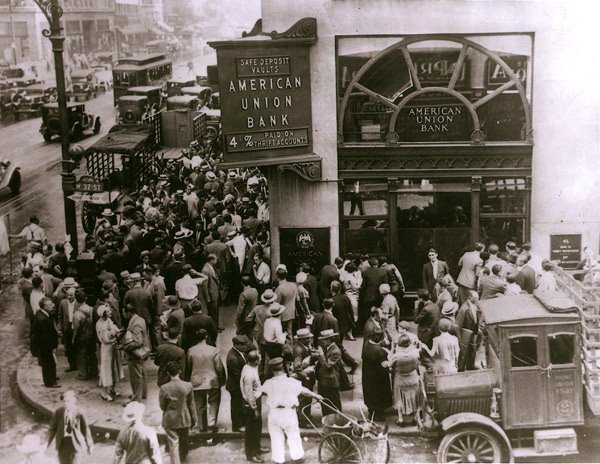
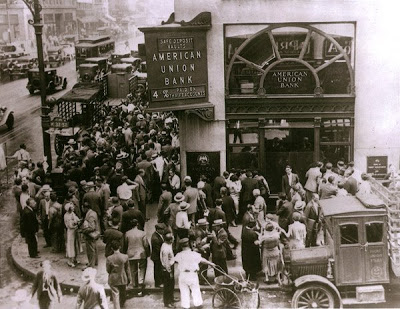
On Friday, after the market had closed, the FDIC shut down two more banks, First Heritage Bank and First National Bank. Two weeks earlier, regulators seized Indymac Bancorp following a run by depositors. The FDIC now operates like a stealth paramilitary unit, deploying its shock troops on the weekends to do their dirty work out of the public eye and at times when it will least effect the stock market. The reasons for this are obvious; there’s only one thing the government hates more than seeing flag-draped coffins on the evening news, and that’s seeing long lines of frantic soccer moms and blue-collar working guys waiting impatiently to get what’s left of their savings out of their now-deceased bank. After all, flag-draped coffins merely indicate that we’re losing a war, but lines at the bank prove that the system is broken. And the system is broken, that’s why people are depressed and confidence is waning.
Banks-runs are a shock to the collective psyche; they demonstrate that the stewards of the system are imcompetent and have made a mess of things. When depositors see a bank run they realize that their hard-earned money is not safe. That’s why they get edgy and cut back on their spending. When their confidence wanes, it extends to the whole system. Suddenly they start questioning everything they once took for granted. They become skeptical of the institutions which, just days earlier, seemed rock-solid. That’s why bankers surround themselves with marble columns, vaulted ceilings and lofty-sounding titles; to maintain the illusion of security while masking the truth, that fractional banking is the biggest scam in history. It relies on the “greater fools” theory which assumes that bankers can be trusted to only create credit when it is backed by sufficient capital. But it is not true. The banks have put us all at risk.
Bank runs are a direct hit on the foundation of the free market system. Unchecked, the tremors can ripple through the entire society and trigger violent political upheaval, even revolution. The public may not grasp their significance, but everyone in Washington is paying attention. They take it seriously, very seriously. It is a sign that the system is disintegrating and it may be irreversible.
SABER-RATTLING AT THE FDIC
An article in the San Francisco Business Times said that the FDIC is worried about the reporting on Internet blogs. They’d rather keep banking system’s troubles out of the news. The publicity just further undermines the publics confidence and spreads fear. Sheila Bair, chairman of the Federal Deposit Insurance Corp., summed it up like this after the run on Indymac:
“The blogs were a bit out of control. We’re very mindful of the media coverage and blogs in controlling misinformation. All I can say is were going to continue to stay on top of it. The misinformation that came out over the weekend fed a lot of depositors’ fears.”
Is that a threat? The cure for a failed banking system is adequate capital and prudent oversight not threats to critics of the system. That’s balderdash. Commissar Blair apparently believes that bloggers should be treated the same way as journalists in Iraq, who, if they veer ever so slightly from the Pentagon’s “the surge is a great triumph” script, find themselves on the smoky end of an M-16 at some unmarked checkpoint outside Baquba.
If Blair wants people to take her seriously, she should stop the paramilitary-type mothballing operations to shut down banks and tell the American people the truth about what is going on. The banking system is busted; Blair knows that as well as anyone. Now its time for someone to accept the mantle of leadership, step up to the microphone and tell the public what they really need to know:
“My fellow citizens, we are embroiled in the greatest financial crisis our nation has ever faced and we will have to take emergency action to keep the entire system from melting down.”
How hard is that? But it won’t happen, because everyone in the administration has an aversion to telling the truth; it’s like the Devil and Holy Water. Besides, its easier to blame the bloggers, that harmless subspecies that spend long hours pecking away at their keyboards in their windowless 5′ by 7′ hovels.
Bloggers aren’t the problem; the problem is a system that’s collapsing from decades of abusive credit expansion creation and insufficient capital. Now everyone is going to pay for the excesses of the few.
As the bank-runs increase, the FDIC will be forced to admit the truth, that they don’t have the resources to deal with a problem this big. Currently, the FDIC has only $53 billion in reserves to guarantee $4 trillion in total bank deposits. The entire system has a mere $267 billion cash in the vaults. What a shabby way to run a banking system. Where’s the money going to come from when depositors start withdrawing their savings? How will the FDIC deal with the ongoing deleveraging in the market which is forcing more and more investors move into cash?
No one knows. All we get is more prevaricating; more smoke and mirrors, Bush assures us that “Our capital markets are functioning efficiently and effectively.” Nonsense. The markets are cratering and the banks are toast. A blind man can see it. The FDIC is listing and Blair knows it. Bush needs to cut the gibberish and tell the American people the truth so they can prepare for the hard times ahead.
P.T. PAULSON: “The the banking system is sound… This is a very manageable situation.”
Last Sunday, sought Treasury Secretary Henry Paulson tried to reassure the public that the banking system is sound, while bracing people for more trouble ahead:
“I think it’s going to be months that we’re working our way through this period — clearly months. But again, it’s a safe banking system, a sound banking system. Our regulators are on top of it. This is a very manageable situation.”
Paulson is like a broken record. Everything is always hunky-dory. He is the consummate Wall Street investment sharpie; a bright guy who could charm a hungry dog off a meat-wagon. But when it comes to telling the truth; forget about it. You’d be better off listening to Bush, which isn’t saying much. The banking system is not sound nor is it well capitalized. It is a corpse that’s been propped up in the office hallway next to the water-cooler so that everyone who passes bye gets a stifling whiff of the decaying flesh. Still, the charade goes on. Still the lies persist.
If the rate of bank closures continues at the present pace, by the middle of 2009 their will be restrictions on withdrawals. Even now, if you go to your bank and try to withdraw $9,000 or $10,000, it sends waves of panic through the entire building like a 5-alarm fire that quickly engulfs the main exits. It’s crazy. Tellers go scampering around helter-skelter, and bank managers suddenly appear at the window grimacing in pain and wringing the sweat from their brows.
“Did you say $10,000, sir?” which is usually followed by low moaning sounds and heavy wheezing.
Journalist Bill Sardi summed it up nicely in an article last week on lewrockwell.com titled “Could Your Bail Fail?”:
“The banking industry is walking on pins and needles, hoping the bad news doesn’t become a self-fulfilling prophecy that drives bank depositors to demand withdrawal of funds en masse…….. There is a high likelihood the American banking system will fail, and you will likely be the last to know. The more panicked you get, and withdraw funds, the worse the implosion. In an effort to avert runs on the banks, will the news media delay informing the public of the current dire situation, which appears to be an inevitable system-wide banking collapse?
What to do?
So, while your bank still has money and can process your checks, it may be time to pay down debts, pay quarterly taxes and mortgage payments in advance, and think of having money outside of banks (gold, foreign currencies), etc., before your money is inaccessible or even evaporates! Don’t think all your investments outside of banks are immune from all this turmoil. For example, money market mutual funds, where Americans have invested $3 trillion, are not covered by FDIC insurance (however, money market accounts offered by banks are covered). Recent losses in some of these money market mutual funds have caused some companies to rush to plug the losses. For example, Legg Mason Inc. and SunTrust Banks Inc., recently pumped $1.4 billion each into its money market funds. Bank of America Corp. has injected $600 million.
As for your checking and savings accounts, recognize you may have five different accounts in the same bank, but the FDIC only insures individuals, not each account, up to $100,000. Putting your money in different accounts in the same bank does not necessarily provide better insurance for your deposits. (Bill Sardi, “Could Your Bail Fail?”, lewrockwell.com)
Good advice, but if the whole system blows; we’re all in trouble. It’s probably wise to have a back-up plan; like plenty of ammo and a couple hundred pounds of seed potatoes. It could get hairy.
FANNIE BAILOUT: “If they dumped these securities on the market today, their value would go straight to 0.”
Most people are unaware of the fact that the new Fannie Mae and Freddie Mac bailout package that was passed into law on Saturday, provides Paulson with $300 billion of taxpayer dollars to shore up the faltering mortgage behemoths. In order to accomplish this, the congress increased the national debt by a whopping $800 billion sending it over the $10 trillion mark for the first time in history. Naturally the congress buried this little tidbit of information deep in the 600 pages of legislation. It’s clear that the administration is lying about Fannie and Freddie. They’ll need much more than the $25 billion infusion that Paulson is predicting. That’s why the national debt is ballooning. This is the biggest boondoggle of all time and it’s spearheaded by the “dueling windbags”, Chris Dodd and Barney Frank; both Democrats. Dodd’s lengthly oratory on the floor of the House on Friday nearly earned him a citation from the EPA for releasing massive levels of toxic gas into the jet-stream and accelerating the rate of global warming.
So it’s not just the Fed and the Treasury that are ruining the system; the politicos are busy bankrupting the country, too. In fact, the Fannie bailout could quite possibly be the last straw.
It now looks like Obama has been anointed by Wall Street (who are his biggest contributors) to revive the Resolution Trust Corporation (RTC)–a morgue for dead banks—so that the investment giants can off-load hundreds of billions in bad paper in one fell swoop and purge the system. That will be the big “post election” surprise; another bone for investment giants.
The path ahead has never looked so uncertain. Still, niether Paulson nor Bernanke seem at all upset by the riskiness of their strategy or by the fact that the nation’s economic future has been reduced to a crap-shoot. The Fed has already spent more than $300 billion to prop up the teetering banking system in the last year alone, plus another $29 (that was never approved by congress) to buy the toxic bonds from Bear Stearns in the JP Morgan acquisition. Now, the Treasury has been authorized by congress to buy an “unlimited amount” of Fannie and Freddie shares at their own discretion. They are presently exchanging Fannie and Freddie securities for US Treasurys, which means that the dollar is now backed by dodgy mortgage-backed sludge for which there is no market. According to Rep Ron Paul, “This is the asset (MBS) which now backs up our currency. An asset that no one else wants. If they were to dump these securities on the market today, the value of these stocks would go straight to 0. But that is literally the asset that is behind our currency. It is a very serious situation.”
None of congress’s back-room maneuvering has anything to do with “providing a lifeline for the struggling homeowner”, as Senator Dodd claims. That’s all bunkum. The homeowner won’t get a lick of help from this bill. Its just another handout for the brokerage fraternity. The country is putting its AAA credit rating on the line for same clatter of carpetbaggers who created the mammoth equity bubble in the first place. Now they are being rewarded for their criminal conduct. Also, Bloomberg News notes that, “Sensible people are starting to question whether the U.S. can hang on to its AAA credit rating. The prospect of an extra $5 trillion or thereabouts leaking onto the U.S. government’s tab from Fannie Mae and Freddie Mac has spooked investors.”
America’s AAA rating will vanish in a year. It should be zero anyway. No one really believes the US will repay its debts. The US bond market is just a glitzy imitation of casino roulette only the odds are considerably worse.
Our political leaders have engineered this whole farce and are now speeding up the process by savaging the dollar. How long before foreign creditors see through this ruse and dump their dollar-backed assets on the open market? The hoax can’t go on forever.
Of course, some market analysts think the banking system will make it through this rough patch, even though it is likely to take a real pasting. Economics guru, Gary North, for example, expects a slightly different outcome which he details in his latest article on Lew Rockwell’s web site “Ben Bernanke’s Hush Money”:
“There is an enormous difference – a literally life-and-death difference – between individual bank failures and a systemic banking failure. I do NOT believe we are facing a systemic banking failure. But we are facing more individual bank failures…
Beginning in December 2007, the Federal Reserve System has sold Treasury debt whenever it has increased its purchase of questionable assets that it has bought from banks and large financial institutions. It has unloaded about 40% of its holdings of liquid Treasury debt. This has kept it from inflating the money supply at a dramatic rate. At some point, it will run out of Treasury debt to sell to the general public in order to offset the increase of its purchase of questionable assets held by the financial system. At that point, the great inflation will begin. This could be a year away. This could be a month away. All we know is this: when the Federal Reserve system runs out of Treasury debt to sell, its purchase of all assets will be inflationary. The banking system as a whole is protected. What is not protected is the purchasing power of the dollar.” (“Ben Bernanke’s Hush Money”, Gary North, lewrockwell.com)
North makes a good point; when the Fed runs out of US Treasuries, they’ll have to rev-up the printing presses and monetize the debt. That’ll be doomsday for the dollar. When foreign central banks see the greenbacks a-gushing like the blood from a harpooned whale; they’ll have to sell off their dollar stockpiles and take the loss. That will trigger a period of hyper-inflation in the US. Everyone will pay for the excesses of the few.
The whole system has been rejiggered to serve the needs of a few greedy bankers on top of the food chain. They could care less whether the whole country blows up or not as long as they get their slice of the pie. That’s all that matters. Congress is just as bad. They abdicated their most important responsibility by giving Paulson the authority to take whatever money he needs to do whatever he wants. If that’s their attitude, then what do we need congress for? Let’s just board up the House of Representatives and send them all home. It would be a lot cheaper.
The truth is, the big money guys have taken a wrecking-ball to the financial system and have now moved on to the real economy. By the time their done, we’ll all be picking through the wreckage just to feed our families.
Source / Information Clearing House
No revolution ever disappears…
by Len Wallace / The Rag Blog / July 28, 2008
Penelope Rosemont, Dreams & Everyday Life: Andre Breton, Surrealism, sds & the Seven Cities of Cibola, Charles H. Kerr Publishing. Co., Chicago, 2008,ISBN 978-0-88286-234-2.
Despite an era made for modern day state and corporate Metternichs there are stirrings, movement, growing discontent. In the words of Buffalo Springfield’s song, “There’s something happening here. What it is ain’t exactly clear.” It’s difficult to define it, but it’s there and it has some folks worried. Today’s sparks are being compared to the sixties New Left.
I recently saw a televised panel discussion making just such comparisons. The pundits argued that the sixties youth were a spoiled generation of a consumerist society who never experienced economic depression and political oppression. Left “leaderless” because of the assassinations of John F. Kennedy, Robert Kennedy, Martin Luther King Jr. the movement spiraled off into excessive radicalism and violence. Of course, what other “insight” could one expect from the defenders of the status quo?
I was fourteen in that tumultuous year of 1968 when student youth congregated in protest at the Democratic Party National convention in Chicago and were brutally clubbed, tear gassed, jailed by the riot of the forces of law and order. In Prague, Czechoslovakia, students and workers rallied in the streets against Red Army tanks of the Soviet Union sent in to crush attempts of democratization. In Paris, students spurred on with the slogans of surrealists and situationists occupied universities and, allied with workers, erected barricades in the streets as the country advanced to a general strike that almost toppled the DeGuallist government order. Worldwide protest against the Vietnam War raised consciousness against colonial order. Black Power, the Black Panther Party of Huey Newton and Bobby Seale openly confronted institutionalized and systematic racism of the state. Women’s Liberation challenged male privilege and white men in suits.
The following years were for me a passage of discovery grappling with and absorbing wide ranging radical thought, ideas, symbols and images so different from those I obtained through osmosis from the elders of Windsor’s left-wing working class Ukrainian-Russian community.
By the time I reached university the New Left train had departed and left the station on the way to derailment. The student rebels had exited the campus and broke into factionalism. Some went off to the factories to join the proletariat and hopefully ferment revolution. Others were swallowed up by increasingly commodified counter-culture. A few would eventually make their peace with capitalism, seeking gain in publicly funded institutions, amused at their youthful endeavors and only speak about their “left-wing principles” in very hushed tones. And by the 1980s the corporate counter-revolution under the various names of Reaganism, Thatcherism, neo-conservatism and neo-liberalism with the correlative growth of state authoritarianism was in full swing.
The actors and activists of that sixties movement have attempted to define and redefine what it was all about. Was there anything here worth preserving? Has any program for dissidence, rebellion and revolution been snuffed out? Is there any hope of resurrection? Paul Buhle and Harvey Pekar’s Students for a Democratic Society: A Graphic History tries to tell some of the stories. One of the chapters focuses on the role of Penelope Rosemont.
Rosemont was at the center of the whirlstorm as an activist in SDS, on its national staff and editor of its theoretical journal Radical America. In Dreams & Everyday Life she recounts her journey to becoming a revolutionary from the first moments she stepped onto the campus of Chicago’s Roosevelt University in 1964.
Writing forty years later her account is a retelling of that personal journey still with the fresh eyes of youth. Artist, writer, editor, surrealist, she remains a revolutionary still captivated with the vision that freedom is worth fighting for.
The philosopher Hegel once asserted that “nothing great in the World has been accomplished without passion.” Rosemont’s book is a passionate remembering. In an era when we are taught that there is no real history because nothing ever changes, that today’s society is the way it has always been and will always be, amen!, remembering becomes a useful and subversive tool.
If one is seeking an analytical and historical text about the rise and fall of the New Left, this is not the book. There are no judgments of people, parties and programs here. No second thoughts or justifications. This is a personal history of a history unfolding — at once a personal diary and the potent weapon of cultural critique against conformity and the mindless drudge of imposed wage work. Rosemont takes us along a journey and trajectory opening dreams and possibilities. In the conscious surrealist activity of aimlessly walking the streets of Chicago directed by chance she discovers the thousands of instances of daily life that exist far beyond the pale of commodity capitalism, those small rebellions, free spaces of action, art, poetry, music and culture, real human relationships that have not been devalued by the cold exchange of cash. The discoveries on the streets are also discoveries of the links to a revolutionary past that reaches back to the Haymarket strikes of 1886, the birth of the IWW, the street corner soapboxing of old socialists and anarchists. History is indeed an unfolding and the past does not simply disappear.
Karl Marx, Mikhail Bakunin, Henry David Thoreau, Ralph Waldo Emerson,
Emma Goldman, Sigmund Freud, Herbert Marcuse are part of the journey that accompany her to meetings with the old rebel Wobblies, to London’s anarchists and the profound influences of Andre Breton and the surrealists of Paris. This very personal account recaptures the youthful sense of marvel, excitement and desire that are too often pushed aside and buried under the dead weight of life’s daily drudgeries. She takes aim at today’s spirit-sucking new world corporate Disney Wal-Mart order of ipods, internet, text messaging, commercial bombardment, official government lies and doublespeak that numb us.
André Breton announced in an early surrealist manifesto that imagination balks at being stifled. As we bend to the vicissitudes of capitalist utilitarianism it will abandon us to a “lustreless life.” Fast approaching the age of 54 I’ll be damned that such a fate lays in store for me. Rosemont’s book provides a good reminder never to let go of radical and revolutionary youthful élan.
Go to Charles H. Kerr Publishing
Find No Revolution Ever Disappears by Penelope Rosemont at Amazon.com
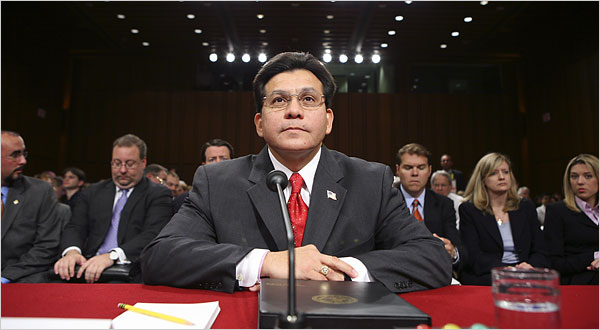
Senior aides to former Attorney General Alberto Gonzales broke the law by using politics to guide their hiring decisions for a wide range of important department positions, slowing the hiring process at critical times and damaging the department’s credibility and independence, an internal report concluded Monday.
The report, prepared by the Justice Department’s inspector general and its internal ethics office, singles out for particular criticism Monica Goodling, a young lawyer from the Republican National Committee who rose quickly through the ranks of the department to become a top aide to Mr. Gonzales.
Ms. Goodling, who testified before Congress in May 2007 at the height of the scandal over the firings of nine United States attorneys, introduced politics into the hiring process in a systematic way that constituted illegal misconduct, the report found.
Last month, the inspector general, Glenn A. Fine, released a separate report that found a similar pattern of politicized hiring at the Justice Department in reviewing applications from young lawyers for the honors and intern programs. The new report released Monday goes much further, however, in documenting pervasive evidence of political hiring for some of the department’s most senior career, apolitical positions, including immigration judges and assistant United States attorneys.
The inspector general’s investigation found that Ms. Goodling and a handful of other senior aides to Mr. Gonzales developed a system of using in-person interviews and Internet searches to screen out candidates who might be too liberal and to identify candidates seen as pro-Republican and supportive of President Bush.
When interviewed by the inspector general, Mr. Gonzales said he was not aware that Ms. Goodling and other aides were using political criteria in their decisions for career positions. Mr. Gonzales resigned last summer in the face of mounting accusations from congressional Democrats that politics had corrupted the department.
His successor, Attorney General Michael Mukasey, said in a statement Monday after the report’s release that he was disturbed by their findings that improper political considerations were used in hiring decisions relating to some career employees.
“I have said many times, both to members of the public and to Department employees, it is neither permissible nor acceptable to consider political affiliations in the hiring of career Department employees,” he said. “And I have acted, and will continue to act, to ensure that my words are translated into reality so that the conduct described in this report does not occur again at the Department.”
He said that over the course of the last year and a half, the Justice Department has made institutional changes to remedy the problems discussed in today’s report.
“It is crucial that the American people have confidence in the propriety of what we do and how we do it,” he said, “and I will continue my efforts to make certain they can have such confidence.”
An attorney for Ms. Goodling, John Dowd, did not return a phone message Monday.
In her position as White House liaison for the Justice Department, Ms. Goodling was involved in hiring lawyers for both political appointments and non-political, career positions. Regardless of the type of position, the report said, Ms. Goodling would run through the same batch of questions, asking candidates about their political philosophies, why they wanted to serve President Bush, and who, aside from Mr. Bush, they admired as public servants. Sometimes, Ms. Goodling would ask: “Why are you a Republican?”
Such questioning was allowed for candidates to political appointments, but was clearly banned under both civil service law and the Justice Department’s own internal policies, the inspector general said. Ms. Goodling’s questioning also generated complaints from one senior official who believed it was improper, long before the issue became a public controversy following the firings of nine United States attorneys. The inspector general concluded that Ms. Goodling knew that questioning applicants to career positions about their political beliefs was improper.
In one case, for instance, Ms. Goodling slowed the hiring of a prosecutor in the United States attorney’s office in Washington, D.C., for a vacancy because she said she was concerned that he was a “liberal Democrat.” After the United States attorney, Jeffrey Taylor, complained to her supervisors, he was allowed to hire the candidate anyway.
And in another case, colleagues said that Ms. Goodling refused to extend the appointment of a female prosecutor because she believed the lawyer was involved in a lesbian relationship with her supervisor, according to the report.
And in another case cited by the inspector general, Ms. Goodling blocked the hiring of an experienced prosecutor for a senior counter-terrorism position because his wife was active in Democratic politics. The candidate was regarded as “head and shoulders above the other candidates” in the view of officials in the executive office of United States attorneys, but they were forced to take a candidate with much less experience because he was deemed acceptable to Ms. Goodling.
In forwarding a résumé in 2006 from a lawyer who was working for the Federalist Society, Ms. Goodling sent an e-mail message to the head of the Office of Legal Counsel, Steven Bradbury, saying: “Am attaching a résumé for a young, conservative female lawyer.”
Ms. Goodling interviewed the woman herself for possible positions and wrote in her notes such phrases as “pro-God in public life,” and “pro-marriage, anti-civil union.” She was eventually hired as a career prosecutor.
Ms. Goodling also conducted extensive searches on the Internet to glean the political or ideological leanings of candidates for career positions, the report found. She and other Justice Department supervisors would look for key phrases like “abortion,” “homosexual,” “guns,” or “Florida re-count” to get information on a candidate’s political leanings.
Source / New York Times

‘There is too much at stake right now to elect another George W. Bush to the White House’
By: Jeffrey Ressner / July 28, 2008
“She sometimes answers questions by e-mail,” said one of Barbra Streisand’s trusted confidants, when asked if the star would consent to an interview with Politico. Streisand, who occasionally posts political statements on her own website, rarely does print Q&As and gave her last TV interview back in 2005 with Ellen DeGeneres.
So a month ago a dozen e-mail questions were sent off, nearly all regarding the presidential race. Late last week, we received her answers on shifting her support from Hillary Clinton to Barack Obama (“immediate”), racism (“naïve to think [it] won’t be a factor”), how things might play out this year (“close”), and much more.
Here are our questions and her answers in full, minus one exchange that substantially overlapped with another.
You strongly supported Sen. Hillary Rodham Clinton for the Democratic nomination. Was switching to Sen. Barack Obama difficult?
We had a very deep bench of Democratic Presidential candidates in the primary, and we were very lucky to finally have two capable, dynamic and intelligent candidates vying to be the nominee. Supporting Sen. Obama for President was an immediate decision for me after Sen. Clinton ended her bid for the Democratic nomination. Throughout this process, they challenged each other to be better. It was a historical race, with Hillary breaking through that glass ceiling for all women and Barack inspiring young kids that they can overcome their circumstances to reach greatness.
Will you be doing any concerts to support Obama and the Democrats before the election?
I would absolutely consider performing for Sen. Obama and for the Democratic Party.
What do you say to Hillary’s fans that might be moving to vote for McCain — a figure that’s been estimated to be as high as 15 percent of her supporters?
I would urge those voters to take a step back and realize that our country is at an extremely serious crossroad . . . . There is too much at stake right now to elect another George W. Bush to the White House. And John McCain is just that. He has stated that the issue of economics is not something he’s understood as well as he should. He does not support reproductive rights for women, increased veteran’s benefits and ending the war in Iraq. There is just no reason for Sen. Clinton’s supporters not to back Sen. Obama.
Have you spoken with Obama? If so, what did you talk about?
I have met and spoken to Sen. Obama, but I don’t discuss my personal conversations with the media.
Which Clinton policies do you think Obama should embrace, and what role would you like to see her have in his administration should he be elected?
I would like to see him embrace her universal healthcare policy. But it is ultimately up to the two of them to decide whether she will be more effective as a leader in the Senate or if she should work in the Administration. She has years of experience in public service and her work serving the needs of children and poor and working class Americans is incredibly admirable.
A lot of folks object to “Hollywood celebrities” participating in political discourse. Aside from pure disagreement over certain issues, why do you think there’s such a backlash when you or other well-known performers speak your mind?
On a very basic level, many people think celebrities have too much already so we shouldn’t be entitled to our political opinions. Also, the other side objects to the fact that we might be listened to. But, I see myself first and foremost as a citizen of this country. And I am outspoken about the issues I care about like healthcare, global warming, the war in Iraq, energy independence, education, poverty and so on.
I think we are all lucky to live in a country where people have the constitutional right to voice their opinion and speak their mind without punishment or penalty. Everyone should exercise that right, because it engages people in the political process and forces our candidates to be clear about their stances on important issues affecting all Americans.
Do you have any friends or family members who are conservative and/or Republican?
I do have friends that are Republicans and we have very spirited conversations on a whole range of issues. I am often baffled by why they are Republicans, but I enjoy the dialogue and can move beyond politics to find common ground in my personal relationships.
How do you think the election will play itself out over the next four months? Do you think the subject of race will continue to be a factor?
As we head toward November, I think the race will continue to be close — although I hope I am wrong. But this country likes tight races and I am afraid it will ultimately come down to which campaign turns out the most voters on Election Day.
I want to believe that our country can see beyond race as a factor in voting for a Presidential candidate…that instead, a candidate’s intellect, vision, political values and policies override any consideration of his skin color. But on some level, it would be naive to think that race will not be a factor. I do believe, however, that there is much less racism, sexism and homophobia among the younger generation and that we have come a very long way.
There’s been a lot of discussion about Israel during this race so far. Should this issue have a major place in this year’s election?
Issues of foreign policy have a place in every election for President. As a woman, a Jew, and a strong supporter of Israel, I am confident Sen. Obama is committed to Israel’s safety and security.
Aside from the presidential contest, are there any other races around the country that you’re following?
Yes, Yes, Yes! I am closely following the Senate races. We need to reach a 60-seat majority in the Senate. There are 35 Senate races, of which 5 are open challenges. Democratic strategists believe with varying degrees of probability that the following states are at least a possibility for turnover: Alaska, Colorado, Kentucky, Maine, Minnesota, Mississippi, Nebraska, New Hampshire, New Mexico, North Carolina, Oklahoma, Oregon and Virginia.
If the Democrats win the Presidency, we will need a strong mandate in the Senate to break the gridlock of filibustering that the Republicans have used over the past four years. For that to happen, Democrats need to capitalize on picking up key seats in states where Republican support is waning. I can’t imagine a Supreme Court with another judicial appointment like Scalia, Thomas, or Alito.
Source / Politico
Have you seen the Barack Obama mariachi ad?
It’s on YouTube if you want to check it out. [See it below.]
In a word? Ay fao.
Really, it begs the question: What on earth is his campaign’s brain trust thinking about Latino voters?
Now, first I have to say I admire the Senator from Illinois. I thought his speech on race in the United States was the finest political speech I’ve heard in my lifetime. A big part of what I admire about him is that sometimes his ideas are complicated, which is unusual for a político. No tidy 3-second monosyllabic sound bytes here. No “read my lips,” no “just say no,” no “I’ll be back.” Though his syntax is simple, he still expects a lot of sophistication from his audience. I even have one friend who is convinced that, if Obama wins the election, Americans will start reading more; he interprets the mass’s toleration (and admiration) of such eloquence as a sign that Obama will help the publishing industry rally.
Hmm…
There was another Democratic candidate this campaign season who also has sophistication and a whopping vocabulary, Senator Chris Dodd. But I knew he wouldn’t get far in his campaign. His syntax is too complex, which I appreciate, but most don’t. And on top of that he speaks English the way a Cuban speaks Spanish, wicked fast. I don’t mind that either. I’ve actually heard Senator Dodd speak Spanish with the same speed and fluency. Amazing. But most people have no patience with language woven into an elaborate web at warp speed, especially when the speaker is very articulate. I think it makes them somehow feel stupid.
Of course, that was probably the appeal of a certain ex-Governor of Texas. No one on the planet could feel stupid listening to him speak. Just maybe a little perplexed. What language does he speak anyway?
Which brings me to this mariachi ad. It’s stupid dope tacky, mega rasquache. Zip zero nada in the way of production values. There’s this group of musicians, donned in full mariachi regalia, walking down a street in a run down neighborhood, singing a praise song about Obama. Spliced between close-ups of the musicians in action (well, as close-up as the camera can get without clipping their enormous sombreros) are still photos of Senator Obama. The final photo has our hero wearing a ten-gallon hat!
Watching this video, I thought about Jessie Jackson’s frustration with the timbre of Senator Obama’s approach to some Black audiences, which he considered condescending. I don’t know how Senator Obama plays to Black audiences, but if his performance in those venues resembles the mariachi ad’s in low expectations about the audience’s intelligence and aesthetic tastes, then I think the Reverend Jackson may have a point.
The whole thing is fascinating, really. The core issue, for me at least, is how the Obama camp is conceptualizing discrete audiences. Ultimately, their aim is to “sell” the idea of a President Obama to voters, kind of like convincing people to place a bet on their horse in a race. So they craft different messages to inspire different groups of people to think he can and should win. In the process, it seems to me, they’ve given the Presidential hopeful a split personality. In English, talking to the “mainstream,” he is a sleek Harvard-trained thoroughbred with immense potential. In Spanish, he is a humble little brown burro from TJ.
Please don’t get me wrong. I adore burros. Eeyore is my all-time favorite character in the books I read as a child. But I would never ever bet on him to win a race against Seabiscuit.
There is the possibility though that I’m appalled by that ad because I am as much an elitist as any ivory tower academic. But I want to believe that, if the rest of the country is going to move on up the intellectual evolutionary ladder on the heels of Senator Obama’s lofty rhetoric and even loftier aspirations for the future, as I cautiously hope it does, Latinos will also be part of it.
Or perhaps this merely points to a bad translation, a failed effort to make a visual and cultural statement that would make this imaginary Latino audience feel good about Obama. Though I think the better strategy would be to find an ally from the ranks of Latin celebrities to speak to this audience, nationally, in Spanish, on his behalf. An ally like Oprah; outrageously popular among all sorts of people, at the top of her own game professionally, whose credentials as the best of the best and perhaps the best ever in a quintessentially American field is beyond a shadow of a doubt.
How to translate Obama into Spanish in precisely that way? That’s difficult given the huge diversity within this demographic. But there are heroes in this community whose popularity transcends ethnic, racial, cultural, linguistic and even national borders.
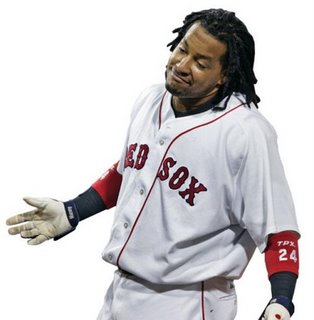
How about Manny Ramírez? The great guapón himself. Everyone loves him, no? He’s ever-so-easy on the eyes, and charismatic, and part of the magic that made it possible for the Red Sox to win the world series. He’s an all-American hero, Latin style. A trigueño, like Obama, like a lot of us, who represents, like Obama, unlike most of us, an unlikely team triumph for the least likely to succeed.
That’s it. Dump the mariachis. Go Little Papi instead! But please, please, please make the ad eloquent, sleek, and hopeful.
Source / Lisa’s Blog
Thanks to Mercedes Lynn de Uriarte / The Rag Blog

New Zealand Students Offer New Bounty For Arrest of Condoleezza Rice For War Crimes
by Ray Lilley / July 26, 2008
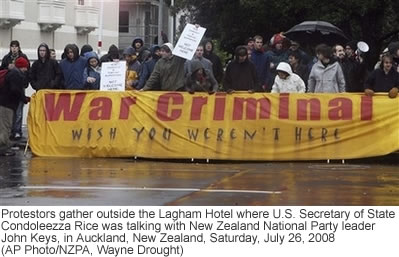
WELLINGTON, New Zealand – A group of New Zealand students offered a higher reward Saturday for the citizen’s arrest of U.S. Secretary of State Condoleezza Rice for war crimes after another group withdrew their own bounty, accusing police of threatening them.
Students at Victoria University in the capital, Wellington, doubled the original reward offer to US$7,400, according to Joel Cosgrove, the student president.
Cosgrove said Rice should be arrested because she is responsible for the deaths of at least 600,000 Iraqis killed since the 2003 invasion by U.S.-led coalition troops.
“Condoleezza Rice needs to be tried before the international war crimes tribunal,” Cosgrove told New Zealand’s National Radio.
The new bounty came a day after the Auckland University Students’ Association made a formal complaint to local police seeking Rice’s arrest for “overseeing the illegal invasion and continued occupation” of Iraq in violation of the Geneva Conventions.
The Auckland students offered a reward of 5,000 New Zealand dollars (US$3,700), but late Friday withdrew the bounty. Student President David Do said authorities had threatened criminal charges for anyone trying to make a citizen’s arrest.
“It is unfortunate the police have threatened students for essentially a form of peaceful protest and civil disobedience,” Do said.
Superintendent Brett England, the district police commander in Auckland, New Zealand’s biggest city, warned anyone attempting to penetrate the security around Rice would be punished.
“The consequences of such a security threat could be very serious indeed,” England said.
Rice, asked about the demonstration at a news conference Friday, said “student protests are particularly a long-honored tradition in democratic society.”
“I can only say that the United States has done everything that it can to end this war on terror, to live up to our international and national laws and obligations,” Rice said.
About 70 people protested Saturday outside Government House, where Rice was meeting with Prime Minister Helen Clark.
Source / Common Dreams

In Vietnam they called it ‘escalation’
By James Abourezk / July 27, 2008
Back in the good old days of the Vietnam War General Westmoreland, Lyndon Johnson and Bob McNamara kept sending more troops into battle, calling it “escalation.” It was a term fraught with negative meaning, but capitalizing on the horrible public relations experience of that war, George Bush has since hired PR experts who have given it a new name, i.e., “surge.” It sounds much better, and despite the horrors of what’s happening in Iraq, Bush and his political clone, John McCain, are chanting the mantra, “the surge is working,” meaning the escalation is working. Sen. McCain has come out for victory and against surrender in Iraq.
What Sen. McCain means by “the surge is working,” is that he sees America as winning the war in Iraq and that we shouldn’t stop what we are doing in order to finalize the victory there. Aside from never explaining what he means by “winning the war” he also hints that American casualties are way down because of the escalation. That chorus is intended to help him win the Presidency this fall.
In January of 2007, when Bush first announced his escalation, U.S. troop levels were at 132,000. By then the government had counted 3044 dead Americans. Iraqi civilian deaths continued to mount.
By March, 2007, U.S. troop strength reached 152,000. On March 27, 2008, Sen. John McCain told CNN’s Wolf Blitzer that “General Petraeus goes out there every day in an unarmed humvee . . .” But he later acknowledged that there is no such thing as an unarmored humvee.
In April, 2007, U.S. troop levels reached 150,000 soldiers, and in June, 2008, the American command acknowledged that they were arming and passing money to Sunni Tribes formerly allied with Al-Qaeda, who, after the money was passed, have promised to fight their former allies alongside their former enemies— the U.S.
In September, 2007, U.S. troop strength reached 168,000, a time when Gen. Petraeus told Congress that the escalation had largely met its military goals. By October of 2007, U.S. military casualties had dropped to levels that were lower than any before it. For example, in October, 37 U.S. soldiers died from combat; in November, 35 died, and in December, 2007, 23 died. From January, 2008, through July, 2008, the U.S. lost 215 American soldiers to combat. That, obviously, is relatively a good thing, compared to the earlier much heavier losses.
No Americans lost would be my preference, which would have been the case had Bush not lied in 2003, and had not invaded Iraq that year.
But what neither McCain nor Bush are adding to the “surge is working” mantra is a series of factors that more accurately explain the drop in casualties, a drop that has little or nothing to do with the escalation. The drop in casualty rates in fact coincided with the near completion of the ethnic cleansing of Sunnis that the Shiite militias had undertaken in Baghdad. In effect, the Sunni minority already had either been killed, or they had fled to other parts of Iraq, or had fled to Syria and to Jordan to save themselves and their families. Syria now has about 1.5 million Iraqis who are refugees from the killing fields in Iraq, and Jordan has about 750,000 of such refugees. (As opposed to less than a thousand Iraqi refugees who have been admitted to the United States).
To simplify the equation, there were very few Sunnis remaining to be killed who were within reach of the Shiite militias.
Adding to this milestone was the outright U.S. bribery of Sunni tribesmen in western Iraq, many of whom once had been allied with Al-Qaeda, and who made up the bulk of the insurgency, but who are now fighting alongside the Americans. The bribing of Sunnis started in 2006 by a fellow named Col. McFarland, and not in 2007 under Petraeus. It continued under Petraeus.
The result of this positive change in strategy has been to drive Al-Qaeda sympathizers into remote corners of Iraq, and away from where U.S. troop strength is concentrated.
While it has fortunately brought down American casualties, bribing these former enemies is itself a danger. No one knows what will happen should someone else come along and offer them more money. The danger is that they may not stay bribed and they may turn on Americans again with the weapons General Petraeus has given them. But hopefully they will stay bribed, and that would also be a good thing. One wishes that General Westmoreland would have thought of that military strategy in Vietnam, provided, that is, only if the Communists were capable of being bribed.
The third factor accounting for the drop in U.S. deaths is the cease-fire called by Moktada Al-Sadr, which has been of great help in saving American lives. One must suppose that the cease fire came about because of the departure of Sunnis from Baghdad—people who were the targets of Al-Sadr’s militia.
Far be it for me to accuse politicians of using wars and casualties to advance themselves politically, but in short, Mr. Bush and Sen. McCain have manufactured the modern myth that escalating troop strength was the correct formula for Iraq, thus giving McCain the words to his song of “Obama was wrong.” In fact, Obama is wrong on a lot of issues, but he was right when he opposed the Iraq War [though he has continued to vote the money to pay for it] and he was not wrong on the escalation.
McCain, however, has tried to turn his deadly mistake of supporting the Iraq War to his advantage by trumpeting that his policy decision has brought down American casualties. But what neither Obama nor McCain are talking about is the 32,000 wounded and maimed Americans, nor do they mention the several hundred thousand Iraqis who have died as a result of Bush’s invasion and who would be alive today had Bush not invaded. It’s as though those dead Iraqis never existed. Supporters of the Iraq war are unable so see the wreckage of Iraqi lives caused by George W. Bush, the former fraternity boy, who has left to someone else the cleaning up of the terrible mess he’s made.
The suffering of the tens of thousands of Iraqis and the killing of hundreds of thousands more is an invisible thing, invisible because of the silence of the mainstream American press as well as the silence of the politicians. That silence, that arrogance, and that refusal to see what has been done to Iraq and to the Middle East allows those people to argue for continuing a debilitating war until we reach some vague “victory,” where someone else suffers, but not them.
James G. Abourezk is a lawyer practicing in South Dakota. He is a former United States senator and the author of two books, Advise and Dissent, and a co-author of Through Different Eyes. Abourezk can be reached at georgepatton@alyajames.net.
Source / counterpunch
Thanks to David Hamilton / The Rag Blog

Cable talking heads accuse broadcast networks of liberal bias — but a think tank finds that ABC, NBC and CBS were tougher on Barack Obama than on John McCain in recent weeks.
By James Rainey / July 27, 2008
Haters of the mainstream media reheated a bit of conventional wisdom last week.
Barack Obama, they said, was getting a free ride from those insufferable liberals.
Such pronouncements, sorry to say, tend to be wrong since they describe a monolithic media that no longer exists. Information today cascades from countless outlets and channels, from the Huffington Post to Politico.com to CBS News and beyond.
But now there’s additional evidence that casts doubt on the bias claims aimed — with particular venom — at three broadcast networks.
The Center for Media and Public Affairs at George Mason University, where researchers have tracked network news content for two decades, found that ABC, NBC and CBS were tougher on Obama than on Republican John McCain during the first six weeks of the general-election campaign.
You read it right: tougher on the Democrat.
During the evening news, the majority of statements from reporters and anchors on all three networks are neutral, the center found. And when network news people ventured opinions in recent weeks, 28% of the statements were positive for Obama and 72% negative.
Network reporting also tilted against McCain, but far less dramatically, with 43% of the statements positive and 57% negative, according to the Washington-based media center.
Conservatives have been snarling about the grotesque disparity revealed by another study, the online Tyndall Report, which showed Obama receiving more than twice as much network air time as McCain in the last month and a half. Obama got 166 minutes of coverage in the seven weeks after the end of the primary season, compared with 67 minutes for McCain, according to longtime network-news observer Andrew Tyndall.
I wrote last week that the networks should do more to better balance the air time. But I also suggested that much of the attention to Obama was far from glowing.
That earned a spasm of e-mails that described me as irrational, unpatriotic and . . . somehow . . . French.
But the center’s director, RobertLichter, who has won conservative hearts with several of his previous studies, told me the facts were the facts.
“This information should blow away this silly assumption that more coverage is always better coverage,” he said.
Here’s a bit more on the research, so you’ll understand how the communications professor and his researchers arrived at their conclusions.
The center reviews and “codes” statements on the evening news as positive or negative toward the candidates. For example, when NBC reporter Andrea Mitchell said in June that Obama “has problems” with white men and suburban women, the media center deemed that a negative.
The positive and negative remarks about each candidate are then totaled to calculate the percentages that cut for and against them.
Visual images and other more subjective cues are not assessed. But the tracking applies a measure of analytical rigor to a field rife with seat-of-the-pants fulminations.
The media center’s most recent batch of data covers nightly newscasts beginning June 8, the day after Hillary Rodham Clinton conceded the Democratic nomination, ushering in the start of the general-election campaign. The data ran through Monday, as Obama began his overseas trip.
Most on-air statements during that time could not be classified as positive or negative, Lichter said. The study found, on average, less than two opinion statements per night on the candidates on all three networks combined — not exactly embracing or pummeling Obama or McCain. But when a point of view did emerge, it tended to tilt against Obama.
That was a reversal of the trend during the primaries, when the same researchers found that 64% of statements about Obama — new to the political spotlight — were positive, but just 43% of statements about McCain were positive.
Such reversals are nothing new in national politics, as reporters tend to warm up to newcomers, then turn increasingly critical when such candidates emerge as front-runners.
It might be tempting to discount the latest findings by Lichter’s researchers. But this guy is anything but a liberal toady.
In 2006, conservative cable showmen Glenn Beck and Bill O’Reilly had Lichter, a onetime Fox News contributor, on their programs. They heralded his findings in the congressional midterm election: that the networks were giving far more positive coverage to the Democrats.
More proof of the liberal domination of the media, Beck and O’Reilly declared.
Now the same researchers have found something less palatable to those conspiracy theorists.
But don’t expect cable talking heads to end their trashing of the networks.
Repeated assertions that the networks are in the tank for Democrats represent not only an article of faith on Fox, but a crucial piece of branding. On Thursday night, O’Reilly and his trusty lieutenant Bernard Goldberg worked themselves into righteous indignation — again — about the liberal bias they knew was lurking.
Goldberg seemed gleeful beyond measure in saying that “they’re fiddling while their ratings are burning.”
O’Reilly assured viewers that “the folks” — whom he claims to treasure far more than effete network executives do — “understand what’s happening.”
By the way, Lichter’s group also surveys the first half-hour of “Special Report With Brit Hume,” Fox News’ answer to the network evening news shows.
The review found that, since the start of the general-election campaign, “Special Report” offered more opinions on the two candidates than all three networks combined.
No surprise there. Previous research has shown Fox News to be opinion-heavy.
“Special Report” was tougher than the networks on Obama — with 79% of the statements about the Democrat negative, compared with 61% negative on McCain.
There’s plenty of room for questioning the networks’ performance and watching closely for symptoms of Obamamania.
But could we at least remain focused on what ABC, NBC and CBS actually put on the air, rather than illusions that their critics create to puff themselves up?
Source / Los Angeles Times
Thanks to Harry Edwards / The Rag Blog
With multiple crises on the horizon, survivalist views don’t seem as marginal as they did before.
By Scott Thill / July 26, 2008.
They used to be paranoid preparation nuts who built bomb shelters for a place to duck and cover during nuclear dustups with communist heathens, but their tangled roots go back to the Great Depression for a reason. If you want to get sociological about it, survivalism started out as a response to economic catastrophe. And now, with a cratering stock market, a housing meltdown that has devalued everything in sight, and skyrocketing prices for food, gas and pretty much everything else, survivalists are preparing for — and are prepared for — the rerun. In fact, they may be the only people in America feeling good about the prospects of a major crash.
And the interesting thing about the once-fringe movement at this moment in history is that survivalism has now gone green — at least in theory.
From peak oil and food crises all the way to catastrophic payback from that bitch Mother Earth, there are more reasons to hide than ever. Conventional society as we know it is already undergoing some disastrous transformations. Ask anyone ducking fires in California, floods in the Midwest or bullets in Baghdad. Maybe it didn’t make sense to run for the hills, stockpile water and food, grow your own vegetables and drugs, or unplug from consumerism back when America’s budget surplus still existed, its armies weren’t burning up all the nation’s revenue and its infrastructure wasn’t being outsourced to a globalized work force.
But those days are gone, daddy, gone.
What’s coming up is weirder. Author, social critic and overall hilarious dude James Kunstler tackled that weirdness, otherwise known as an incoming post-oil dystopia, in his recent novel, World Made by Hand, which has since become one of a handful of survivalist classics. And as Kunstler sees it, whether you are talking about gun nuts or green pioneers, at least you are talking.
“At least they’re aware that we’ve entered the early innings of what could easily become a very disruptive period of our history,” the Clusterfuck Nation columnist explains. “Most of them are responding constructively rather than just defensively. They’re much more interested in gardening and animal husbandry than firearms.”
Not that the gun nuts have gone away. Their ranks have just diversified.
“The gun nuts have been on the scene longer than the peak oil argument has been in play,” he adds. “They were initially preoccupied with Big Government and its accompanying narrative fantasy of fascist oppression, which is why they adopted a fascist tone themselves. But peak-oil survivalists are different from the Ruby Ridge generation. They don’t think that a bolt-hole in the woods is a very promising strategy. We have no idea at this point what the level of social cohesion or disorder may be, but if the rural areas, especially the agricultural centers, become too lawless for farming, then we’ll be in pretty severe trouble because there will be nothing for us to eat.”
That’s not on the to-do list of author and SurvivalBlog owner James Rawles, who has been getting asked more and more questions by a mainstream press finally waking to the consequences of disaster capitalism, climate crisis and the hyperreal dream of bottomless consumption. He has fielded questions from the New York Times, and he has taken an online beating from conscientious pubs like Grist, but he hasn’t gone Hollywood. The times, which are a-changin’, have caught up to him.
“There is greater interest in preparedness these days because the fragility of our economy, lengthening chains of supply and the complexity of the technological infrastructure have become apparent to a broader cross section of the populace,” Rawles wrote to me via e-mail (but only after asking how many unique monthly visitors AlterNet commanded). “All parties concerned may not realize it, but the left-of-center greens calling for local economies and encouraging farmers markets have a tremendous amount in common with John Birchers decrying globalist bankers and gun owners complaining about their constitutional rights. At the core, for all of them, is the recognition that big, entrenched, centralized power structures are not the answer. They are, in fact, the problem.”
Fair enough. But that broad brush fails to recognize the complexities of the very community it is purporting to try to establish. Indeed, difference is what survivalists seem to be running from, whether it is historically the difference between blacks and whites, secularists and true believers, or simply the haves and have-nots. It is that latter crowd that the survivalists seem most worried about. Their separation from society at large is arguably a retreat from community rather than a striving toward it.
“I’d say that survivalism is indeed a celebration of community,” Rawles asserts. “It is the embodiment of America’s traditional can-do spirit of self-reliance that settled the frontier.”
But that’s also a generalization, especially when one considers that the word “settled” is a coded reduction for a “near-genocidal wipeout of the frontier’s native populations,” most if not all of whom were perfecting a survivalist ethic by maximizing their skill sets and living in symbiosis with the land that provided them what they needed in food, tools and medicine. In fact, those settlements would have been hard-pressed to exist without what Rawles earlier described as a “centralized power structure,” known as the expansionist United States government and its military, paving the road forward. Each self-reliant mythology carries within it grains of complicity in the community at large, which is a fancy way of saying there’s nowhere to run, baby, nowhere to hide.
This is especially true today in our hyperreal, hyperconsuming 21st century, where survivalism has become more of a gadget fantasy than an earnest grasp for community.
“It seems a natural human impulse that we are hard-wired to follow as circumstances require,” Kunstler says, “although it is constrained by social and cultural conditioning. To some degree, in our consumer culture, survivalism is related to the gear fetishism you see in popular magazines that purport to be about sporting adventures, but are really about acquiring snazzy equipment. America in 2008 has become a cartoon culture of Hollywood violence that promotes grandiose power fantasies of hyper-individualism and vigilante justice. Add guns and economic hardship, and spice it up with ethnic grievances, and the recipe is not very appetizing.”
This future cultural, environmental and geopolitical miasma is where the survivalist and the mainstream converge in agreement. Both camps, pardon the pun, are convinced that we’re screwed down the road.
“The next Great Depression will be a tremendous leveler,” Rawles prophesies. “If anything, life in the 22nd century will more closely resemble the 19th century than the 20th century. Sadly, the 21st century will probably be remembered as the time of the Great Die-Off.”
“I don’t consider it a total wipeout,” Kunstler counters. “It’s a very big change, but people are resilient and resourceful. Look, imagine if you were a person who had survived the Second World War in Europe, and you were walking around Berlin in the spring of 1946, a year after the end of the war. A once-magnificent city has been reduced to rubble. Your culture is lying in ashes. Yet, people pick up and rebuild.”
That is, if they’re sticking together. If they’re scattered and fending for themselves, and taking armed retreat defense tips from SurvivalBlog, that makes rebuilding a bit more complicated. Which, in the end, is where survivalism is most ambiguous. Is it a growing population of forward-looking realists who are smartly preparing for the die-off brought on by climate crisis and economic collapse, so they can pick up themselves and their people, and rebuild with that “can-do” spirit, as Rawles calls it? Or are they simply gadget-fascinated fundamentalists afraid of change and challenge, so afraid that they’d rather hide and hoard than join the fight?
The jury is still out. But, according to Rawles, it will soon have its diversity mirrored by survivalism’s changing demographic.
“I think that in the next couple of decades,” he explains, “we will witness the formation of some remarkable intentional communities that will feature some unlikely bedfellows: anarchists and Ayn Rand readers, Mennonites and gun enthusiasts, Luddites and techno-geeks, fundamentalist Christians and Gaia worshippers, tree huggers and horse wranglers. We welcome them all. Because the threats are clearly manifold: peak oil, derivatives meltdowns, pandemics, food shortages, market collapses, terrorism, state-sponsored global war and more. In a situation this precarious, I believe that it is remarkably naive to think that mere geographical isolation will be sufficient to shelter communities from the predation of evildoers.”
[Scott Thill runs the online mag Morphizm.com. His writing has appeared on Salon, XLR8R, All Music Guide, Wired and others.]
Source / AlterNet

Thanks to Harry Edwards / The Rag Blog / Posted July 27, 2008