U.S. Sadly Lags Behind in Human Development

The sad state of American health care was strikingly depicted by Michael Moore in “Sicko”.

US slips down development index

Americans live shorter lives than citizens of almost every other developed nation, according to a report from several US charities.

The report found that the US ranked 42nd in the world for life expectancy despite spending more on health care per person than any other country.

Overall, the American Human Development Report ranked the world’s richest country 12th for human development.

The study looked at US government data on health, education and income.

The report was funded by Oxfam America, the Rockefeller Foundation and the Conrad Hilton Foundation.

The report combines measurements of health, education and income into one measurement – the human development index – based on that used by the United Nations.

Health insurance

The report, Measure of America, identifies significant progress in the US in the last 50 years.

Life expectancy – which averages 78 – has risen eight years since 1960.

Some Americans are living anywhere from 30 to 50 years behind others when it comes to issues we all care about: health, education and standard of living
Sarah Burd-Sharps
Author, Measure of America

Japan has the world’s highest life expectancy – 82.1 years – according to the Organisation for Economic Co-operation and Development (OECD).

The US report identifies obesity and the lack of health insurance for some 47 million Americans as the most significant factors in premature death.

It also provides a snapshot of the inequalities between the richest and the poorest Americans and between different ethnic groups.

“The Measure of America reveals huge gaps among some groups in our country to access opportunity and reach their potential,” said the report’s author, Sarah Burd-Sharps.

“Some Americans are living anywhere from 30 to 50 years behind others when it comes to issues we all care about: health, education and standard of living.

“For example, the state human development index shows that people in last-ranked Mississippi are living 30 years behind those in first-ranked Connecticut.”

Rich north-east

Asian males in the US were found to have the highest human development index score and were expected to live 14 years longer than African-American males, who had the lowest human development index rating.

African-Americans had a shorter lifespan than the average American did in the late 1970s.

The report further breaks down its findings into the US’s 436 Congressional districts.

The 20th district, around Fresno, California, was ranked last – with people earning one-third as much as residents of the top-ranked US district,- in Manhattan, New York.

The US north-east has the highest overall ranking because people there earn more, are more highly-educated and have the second highest life expectancy.

West Virginia, Louisiana, Arkansas and Alabama are four of the five bottom states on the index. Mississippi is ranked lowest.

Among other findings:

* Of the world’s richest nations, the US has the most children (15%) living in poverty;

* Of the OECD nations, the US has the most people in prison – as a percentage and in absolute numbers;

* 25% of 15-year-old students performed at or below the lowest level in an international maths test – worse than Canada, France, Germany and Japan;

* If the US infant mortality rate were equal to first-ranked Sweden, more than 20,000 babies would survive beyond their first year of life.

Source / BBC News / Posted July 17, 2008

The Rag Blog

Posted in RagBlog | Tagged , , , | Leave a comment

ACLU : ‘Mukasey calls on Congress to subvert Constitution’

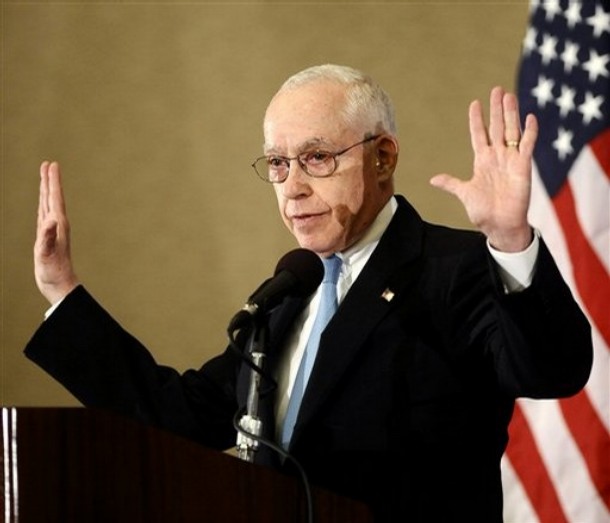
Atty. Gen. John Mukasey. Photo by Noah Berger / AP.

Under Attorney General’s plan detainees could be held indefinitely
By Stephen C. Webster / July 21, 2008

Attorney General Michael Mukasey prompted Congress Monday morning, during a speech to the conservative American Enterprise Institute, to create new rules governing the rights of detainees held at Guantanamo Bay, Cuba. The American Civil Liberties Union immediately responded to Mukasey’s request, calling his proposals nothing short of asking Congress to subvert the Constitution.

“Mukasey is asking Congress to expand and extend the war on terror forever,” said Caroline Fredrickson, Director of the ACLU Washington Legislative Office, in a media advisory. “Anyone that this president or the next one declares to be a terrorist could then be held indefinitely without a trial. This is clearly the last gasp of an administration desperate to rationalize what is a failed legal scheme that was correctly rejected four times by the Supreme Court.”

The Associated Press, acknowledging a Congress eager to transition into a busy election season, notes the rules are not likely to be approved. Mukasey’s requests comes on the heels of a Supreme Court decision granting detainees the right to challenge their captivity in US federal court. Under Mukasey’s proposals, a detainee would be able to challenge their detention, but would receive no extradition to the United States for the proceedings.

According to the Washington Post: “Under the Justice plan that Mukasey talked about today, the U.S. government could hold prisoners indefinitely so long as the armed conflict with al-Qaeda persisted.”

Senator Russ Feingold (D-WI) accused the attorney general of trying “to create an election-year security issue where there isn’t one.”

“Our federal courts are capable of handling these cases, and no dangerous detainees held at Guantanamo will be released anytime soon,” read a statement by Feingold to RAW STORY. “By repeatedly mishandling these cases, the administration has delayed justice from being served. If congressional action is needed to clean up the mess the administration created at Guantanamo, it should be taken alongside a new administration that doesn’t have such contempt for the rule of law.”

“There is simply no need to invent yet another set of legal rules to govern the detention and trial of prisoners held on national security grounds, and the rules that the attorney general is proposing are fundamentally inconsistent with the Constitution,” said Jameel Jaffer, Director of the ACLU National Security Project, in a media advisory. “The prisoners at Guantanamo, some of whom have been held without charges for more than six years, should be allowed a meaningful opportunity to challenge their detention in court. The handful of prisoners that have actually been charged with crimes should be tried under rules that conform to the Constitution and that the rest of the world will recognize as fair.”

Among the rules Mukasey is seeking:

-Barring federal courts from allowing the detainees to be brought or released into the United States. He said detainees could participate in the court hearings by video link from Guantanamo if necessary. “Many of them pose an extraordinary threat to Americans,” he said.

-Protecting counterterror intelligence gathered and used to detain the suspects from being turned over to courts.

-Prohibiting detainees charged with war crimes from challenging their capture until after they stand trial. Additionally, detainees should not be allowed to appeal their imprisonment under more than one legal standard.

-Assigning one federal court, and one judge, to oversee the detainee release cases to make sure they are heard in a coordinated effort.

-Underscoring that the United States has the authority to detain suspects it has identified as enemy combatants. “The United States has every right to capture and detain enemy combatants in this conflict, and need not simply release them to return to the battlefield – as indeed some of them have,” Mukasey said.

Excerpts from ACLU press release:

“This is clearly the last gasp of an administration desperate to rationalize what is a failed legal scheme that was correctly rejected four times by the Supreme Court. With as little as five work weeks left in this Congress, there are more important issues than helping the lame-duck president cook up an indefensible plan to lock people up forever and throw away the key with no due process rights and limited judicial review.”

“The attorney general’s proposal would hide the torture and abuse conducted since 9/11,” Fredrickson said. “This is one more effort to cover up the illegal activities authorized by the president and his administration. Attorney General Mukasey might be ok with helping in a cover-up, but there is no reason to think that Congress will assist him.”

Source / therawstory

Read ACLU statement here.

The Rag Blog

Posted in RagBlog | Tagged , , , , , , | Leave a comment

JOURNALISM : Was I. F. Stone the World’s First Blogger?

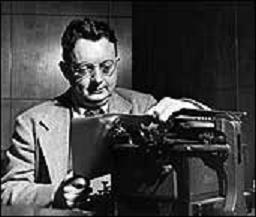
In the days before the Internet, one of the great voices of independent journalism was I.F. Stone, whose simple newsletter challenged the conventional thinking of the day. Media critic Jeff Cohen recalls Stone’s contributions to the cause of journalism.

It was nineteen years ago this week that I.F. (Izzy) Stone died. The legendary blogger was 81.
By Jeff Cohen

Confused? You say he died years before web blogs were invented?

Well, yeah, but when I think of today’s blunt, fact-based online hell-raisers, my mind quickly flashes on Izzy Stone. You may think of Josh Marshall or Glenn Greenwald or Arianna Huffington. I think of Izzy.

Before there was an Internet, Izzy Stone was doing the work we associate with today’s best bloggers.

Like them, he was obsessed with citing original documents and texts. But before search engines, Izzy had to consume ten newspapers per day – and physically visit government archives and press offices, and personally pore over thousands of words in the Congressional Record.

That’s how he repeatedly scooped the gullible, faux-objective MSM of his day in exposing government deceit, like that propelling the Vietnam War.

Izzy was the ultimate un-embedded reporter. His journalism was motivated by a simple maxim that resonates loudly in our era of Cheneys and Rumsfelds and WMD hoaxes: “All governments lie, but disaster lies in wait for countries whose officials smoke the same hashish they give out.”

Month after month from 1953 to 1969 I.F. Stone’s Weekly (biweekly through 1971) exposed deceptions as fast as governments could spin them. His timely and timeless dispatches are gathered in an exceptional paperback, The Best of I.F. Stone.

In real time in August 1964, Izzy was virtually alone in challenging the Gulf of Tonkin hoax, an imaginary “unprovoked attack” on U.S. warships used by the Johnson administration to send several hundred thousand American troops into Vietnam.

How did Izzy do it? By citing international law texts and finding nuggets of truth in the Congressional Record of the Senate debate (no C-SPAN then) and in contradictory reporting in mainstream publications.

Izzy’s expose began boldly: “The American government and the American press have kept the full truth about the Tonkin Bay incidents from the American public.” He fumed at the credulous MSM: “The process of brain-washing the public starts with off-the-record briefings for newspapermen.”

Only two senators, Oregon’s Wayne Morse and Alaska’s Ernest Gruening, had voted against the Tonkin Resolution; Izzy noted that the press had “dropped an Iron Curtain weeks ago on the antiwar speeches of Morse and Gruening.”

Like today’s online journalistic entrepreneurs, being his own editor and boss allowed Izzy the freedom and space to parse out the distortions of government in detail.

A year before the Tonkin hoax, he wrote: “In this age of corporation men, I am an independent capitalist, the owner of my own enterprise.” While most journalists “find their niche in some huge newspaper of magazine combine, I am a wholly independent newspaperman, standing alone.”

Bloggers battle today’s McCarthyites who smear Iraq War opponents as un-American abettors of our country’s enemies. Izzy battled the original Joe McCarthy, in issue after issue of his weekly.

Indeed, he launched his publication the same month – January 1953 – McCarthy became chair of the Senate Operations Committee, enhancing his powers of intimidation.

Izzy warned prophetically: “McCarthy is in a position to smear any government official who fails to do his bidding. With such daring and few scruples, McCarthy can make himself the most powerful single figure in Congress.”

Three months later, he wrote: “The most subversive force in America today is Joe McCarthy. No one is so effectively importing alien conceptions into American government. No one is doing so much to damage the country’s prestige abroad. . . .If ‘subversion’ is to be met by deportation, then it is time to deport McCarthy back to Wisconsin.”

Not until 11 months later did Edward R. Murrow air his first report on McCarthy.

Today, online media critics and bloggers expose the bigotry and fallacy gushing forth from Fox News and talk radio and the Rev. Moon-owned Washington Times, long-edited by Wes Pruden Jr. They blog about MSM being stenographers to rightwing extremists.

When racists in Little Rock were obstructing court-ordered school desegregation in 1958, Izzy was on the scene reporting: “A staff correspondent in Little Rock quoted the Reverend Wesley Pruden the segregationist leader, as saying, ‘The South will not accept this outrage, which a Communist-dominated government is trying to lay on us.’ This was my introduction to a regional journalism which prints such statements matter-of-factly.”

The Communist-dominated regime referred to by Pruden Sr. was headed by Eisenhower.

Izzy loved to tell the story of how he found – hiding in plain view in different editions of the New York Times – one-paragraph “shirrtail” wire stories indicating that our country’s first underground nuclear test in Nevada in 1957 was detected in Toronto, Rome and Tokyo.

Months later, just as hawks in Washington were preparing to attack a test ban treaty with the Soviets on the basis that nuclear tests could not be detected more than 200 miles away, Izzy found a seismologist in the Commerce Department who told him the test had also been detected as far away as Alaska and Arkansas.

Izzy’s reporting obstructed the government’s lie before it could get its shoes on.

Starting out in his teens, Izzy was a daily reporter, editor and columnist. After moving to D.C. in 1940 to become Washington editor of The Nation, he exposed U.S. corporations still doing business with Hitler’s Germany. He was one of the first to sound the alarm about the Nazi holocaust, referring in 1942 to “a murder of a people.”

An anti-racist, he battled the all-white National Press Club over exclusion of black journalists.

Izzy’s cantankerousness and “hound-dog tenacity” – in the words of his biographer– would make even the most stubborn blogger blush. Although he was a lifelong progressive, his journalistic hallmark was independence: “I felt that party affiliation was incompatible with independent journalism.”

His writings show deep admiration for Franklin Roosevelt, yet his article on FDR’s death criticized his “deplorable disrespect for the constitutional amenities” in resisting a reactionary Supreme Court that knocked down one New Deal bill after another.

He wrote books passionately supporting the birth of Israel, but strongly criticized it for mistreatment of Palestinians. He advocated peace and negotiations with the Soviet Union, while increasingly vocal in denouncing its rulers: “The worker [in Russia] is more exploited than in Western welfare states.”

He despised racists, but fought for their free speech rights, and everyone’s: “Once you put ifs and buts in the Bill of Rights, nobody’s civil liberties will be secure.”

That he marched to his own drummer can be seen in his dispatch from the 1963 March on Washington for civil rights, in which he criticized “respectables” for muting “Negro militancy” into support of JFK’s inadequate program, and referred to Martin Luther King as “a little too saccharine for my taste.”

Born of immigrant parents, Izzy was an American patriot who worshipped the Bill of Rights: “You may think I am a red Jew son-of-a-bitch, but I’m keeping Thomas Jefferson alive.”

And he worshipped our country’s tradition of press freedom: “There are few countries in which you can spit in the eye of the government and get away with it. It’s not possible in Moscow.”

But Izzy was never naïve about American traditions that threatened freedom, and he had a 5,000-page FBI spy file to prove it.

Today’s muckraking bloggers are often belittled for working from their homes, far removed from the corridors of power. Izzy worked out of his home. If he were alive, he’d be applauding the Josh Marshalls and other independents, urging: Keep your distance from power.

“I made no claim to inside stuff. . . I tried to dig the truth out of hearings, official transcripts and government documents, and to be as accurate as possible. . . I felt like a guerilla warrior, swooping down in surprise attack on a stuffy bureaucracy where it least expected independent inquiry.

“The reporter assigned to specific beats like the State Department or the Pentagon for a wire service or a big daily newspaper soon finds himself a captive. State and Pentagon have large press relations forces whose job it is to herd the press and shape the news. There are many ways to punish a reporter who gets out of line. . .

“But a reporter covering the whole capitol on his own – particularly if he is his own employer – is immune from these pressures.”

Imagine the obstacles Izzy faced – did I mention his impaired eyesight and hearing? – launching a weekly and finding an audience at the height of McCarthy’s witch hunts (even at $5 for an annual subscription).

Far fewer obstacles face today’s bloggers who seek to follow in Izzy’s footsteps – blessed as they are with relative freedom and this awesome research and outreach tool known as the Internet.

As these upstarts speak truth to power, I see Izzy Stone watching over them, from the heavens.

[Jeff Cohen is the director of the Park Center for Independent Media at Ithaca College. He first saw I.F. Stone’s Bi-Weekly at a D.C. peace march in 1969. Soon after Cohen launched the media watch group FAIR in 1986, Izzy Stone signed on to its first formal protest, a telegram to ABC News on the exclusion of progressive voices. This article was posted on July 16, 2008.]

Source / consortiumnews.com

The Rag Blog

Posted in RagBlog | Tagged , , , , | Leave a comment

Drawn and Quartered

Martin Kozlowski / inxart.com

The Rag Blog / Posted July 21, 2008

Posted in RagBlog | Tagged , , , | Leave a comment

Ruling : Janet Jackson’s Breast Not Indecent


Appeals court sides with CBS, throws out fine for ‘wardrobe malfunction’
By King Kaufman / July 21, 2008

A federal appeals court in Philadelphia has thrown out the $550,000 fine the FCC imposed on CBS for airing Janet Jackson’s breast for nine-sixteenths of a second during the Super Bowl halftime show in February 2004.

The court ruled that because “the commission frequently declined to find broadcast programming indecent, its restraint punctuated only by a few occasions where programming contained indecent material so pervasive as to amount to ‘shock treatment’ for the audience,” it had effectively changed the rules on CBS without warning.

“The FCC arbitrarily and capriciously departed from its prior policy excepting fleeting broadcast material from the scope of actionable indecency,” the court said.

You can read the ruling in PDF format here, and I heartily recommend it for the play-by-play of the FCC’s dishonesty in its pursuit of alleged indecency under chairman Michael Powell. Also for the details on a case called Young Broadcasting, because it was an important precedent here, but more importantly because it involved penis puppetry.

Pending further appeals by the FCC, CBS gets to keep its half mil, but the rest of us will never get back all those seven-second delays that resulted. They add up, you know. With all the sports I watch on TV, I’m more than eight hours behind actual time.

The incident did leave us with the phrase “wardrobe malfunction,” Justin Timberlake’s super-lame excuse for what happened when he sang the words “gonna have you naked by the end of this song” as he ripped Jackson’s bodice. Pathetic excuse, but a great phrase.

The whole thing was a pathetic excuse for a controversy, really. Jackson’s breast was exposed for just over half a second. It was actually pretty easy to miss. This column missed it in real time and had to be alerted by a friend to check the TiVo. The friend called and said something like “Did I just see what I think I saw?”

The thousands upon thousands of people who complained had to go out of their way to be offended by the image, which they had to go out of their way to be sure they’d seen. TiVo reported record numbers for that moment. CBS argued in court that a huge number of the complaints it received were identical, the result of conservative groups organizing campaigns in which people used a complaint template and sent it in dozens of times each.

Whatever the merits of the case — and the ruling goes into some detail about how the FCC changed the rules midstream and then, in the Young Broadcasting case, tried to pretend that the earlier rules, described many times over three decades, had never existed — the huge fine of CBS being overturned is a good thing because that kind of draconian punishment only encourages more similar nonsense, more political opinions masquerading as think-of-the-children moral vexation.

If the FCC wants to make itself useful in the sports realm, it should do something about the blackout rules.

Source / salon.com

The Rag Blog

Posted in RagBlog | Tagged , , , , | Leave a comment

McCain’s War on Women


‘To vote for McCain, a feminist would have to be insane.’
By Kate Sheppard / July 21, 2008

Sen. John McCain’s (R-Ariz.) campaign and the media would have us believe that herds of disaffected women voters will be stampeding to the Republicans this year because a woman candidate won’t be on the presidential ballot in November.

McCain’s campaign has been making a clear play for women voters in recent weeks, hosting conference calls with Republican women and touting that his policies on national security, the economy and healthcare appeal to women voters.

But the suggestion that women — and feminist women, at that — will be lining up behind him is a fairytale. At least, it should be. McCain’s record and policies on issues of importance to women are neither moderate nor maverick.

In The Nation, Katha Pollitt put it simply: “[T]o vote for McCain, a feminist would have to be insane.”

But the chatter about the voting decisions of former presidential candidate Sen. Hillary Clinton (D-N.Y.) supporters continues. Much of the recent talk has focused on PUMAs (the acronym stands for “Party Unity My Ass”), a group supposedly so angry about the Democratic primary that they won’t vote for Sen. Barack Obama (D-Ill.). But as blogger Amanda Marcotte reported, PUMA PAC was started by a McCain donor, according to the Federal Election Commission.

That doesn’t mean there aren’t angry Clinton voters. But the number of progressive or even moderate voters who would seriously consider voting for McCain is much smaller than the media would have you believe. Unfortunately, McCain’s propaganda seems to be working, at least on those who aren’t aware of his record on issues of concern to women voters.

A February Planned Parenthood poll of 1,205 women voters in 16 battleground states found that 50 percent of women voters don’t know McCain’s position on abortion, and that 49 percent of women who backed McCain were pro-choice. Forty-six percent of women supporting McCain said they’d like to see Roe v. Wade upheld — though McCain says he supports overturning the decision. When they learned of his position on Roe, 36 percent of women who identified as both pro-choice and likely McCain voters said they would be less likely to vote for him.

These moderate, often suburban, middle-class women could be critical swing voters this election. At the time of the Planned Parenthood poll, Obama held only a 5 percentage-point margin over McCain with its swing-state demographic, 41 percent to 36 percent.

Planned Parenthood concludes that these findings suggest “that just filling in McCain’s actual voting record and his publicly stated positions on a handful of key issues has the potential to diminish his total vote share among battleground women voters by about 17 to 20 percentage points.”

“The only reason [McCain is] saying he’s going after Clinton voters is because if he doesn’t win their votes, he’s not going to win this election,” says Cecile Richards, president of Planned Parenthood. “Even though I think it’s a real wash-up for him, he’s got to find some more voters somewhere. That’s the political math here.”

On the record

One reason many pro-choice women are confused about McCain is because he has flip-flopped on the abortion issue.

In 1999, McCain said he backed Roe: “Certainly, in the short term, or even the long term, I would not support repeal of Roe v. Wade, which would then force X number of women in America to [undergo] illegal and dangerous operations.”

But on NBC’s “Meet the Press” in May 2007, responding to a question about his statements in 1999, McCain said: “Well, it was in the context of conversation about having to change the culture of America as regards to this issue. I have stated time after time after time that Roe v. Wade was a bad decision.”

NARAL Pro-Choice America President Nancy Keenan says his shifting rhetoric is an attempt to “game” the electorate and confuse voters about his actual stances. “[The McCain campaign] knows full well that women in America, especially independent and pro-choice women, will not support a candidate who wants to overturn Roe v. Wade,” Keenan says. “So they’re still trying to make the case that he’s a moderate and a maverick, when his record proves that he is neither.”

The record also shows that McCain has rarely strayed outside Republican Party line on the issue of choice. He has consistently voted against measures to provide access to contraception and sex-education, and voted to approve anti-choice judges.

Planned Parenthood and NARAL have each given him a zero for his record on women’s health issues. (The record dates back to his days in the House of Representatives, between 1983 and 1986, and carries through to his career in the U.S. Senate, which began in 1987.) Of the 130 congressional votes related to reproductive freedom that McCain has cast, 125 have been anti-choice, according to NARAL.

It’s a record McCain says he’s proud of — when he’s not trying to appeal to women outside his Republican base.

“I have many, many votes and it’s been consistent,” McCain told The National Review, a conservative magazine, last year. “And I’ve got a consistent zero from NARAL throughout all those years. … My record is clear.” He has also bragged to the media that his record has “been pro-life, unchanging and unwavering.”

On the campaign trail this year, he has been adamant, telling MSNBC’s Chris Matthews in April that “the rights of the unborn is one of my most important values.”

And McCain has pledged that if elected president, he will appoint Supreme Court justices who would overturn Roe. In February, he said he “will try to find clones of [Justice Samuel] Alito and [Chief Justice John] Roberts” — two conservative Bush administration appointees — to fill high court vacancies.

He has worked his pro-life ideology into other aspects of federal decisions. Perhaps the most preposterous example is his voting in favor of legislation to amend the definition of those eligible for the State Children’s Health Insurance Program (SCHIP) to include the unborn — while voting against legislation to expand SCHIP’s coverage to low-income children and pregnant women at least six times.

In 2003, he voted for a ban on so-called “partial-birth abortions.” And in 2004, he supported the Unborn Victims of Violence Act, which makes it a criminal offense to harm or kill a fetus while committing a violent crime — essentially deeming the fetus a person in the eyes of the law.

In July 2006, McCain voted for legislation that would fine and/or imprison physicians who perform abortions on out-of-state minors if there are parental notification requirements in their home state. In October 2007, he voted for legislation that would cut Health and Human Services grants to organizations that perform abortions.

McCain is no better when it comes to the issues of providing access to contraception, family planning information and basic women’s healthcare. He has voted to require parental consent for teenagers who want access to contraceptives, and against an amendment to the Senate’s 2006 budget that would have allocated $100 million for the prevention of teen pregnancy by providing education and contraceptives.

He opposed legislation requiring that abstinence-only programs be medically accurate and based in science. He voted to abolish funding for birth control and gynecological care for low-income women, and against funding for public education on emergency contraception.

He also voted against a measure that would require insurance companies to cover prescription contraception, despite the fact that many currently fund male reproductive pharmaceuticals, such as Viagra.

And he supports President Bush’s restoration of the “global gag rule” — which cuts off federal funding for nongovernmental organizations that provide abortion services and information — and he opposes funding international family planning, in general. Yet he doesn’t seem particularly well-informed on the subject.

In March 2007, the New York Times’ Adam Nagourney asked McCain whether grants for sex education in the United States include instructions about using contraceptives, or if they should abide by Bush’s abstinence-only policy.

After a pause, McCain responded, “Ahhh. I think I support the president’s policy.”

Nagourney followed up: “So no contraception, no counseling on contraception? Just abstinence. Do you think contraceptives help stop the spread of HIV?”

After another pause, McCain replied, “You’ve stumped me.”

McCain is confused about his stance on the issue of choice overall, according to other accounts. In the 2000 primary, he was asked what he would do if his daughter Meghan, then 15, became pregnant. McCain said it would be a “family decision.”

“The final decision would be made by Meghan with our advice and counsel,” McCain said, referring to himself and his wife, Cindy. When reporters suggested that this view made him, in fact, pro-choice, McCain became irritated. “I don’t think it is the pro-choice position to say that my daughter and my wife and I will discuss something that is a family matter that we have to decide.”

McCain’s record on women “undermines any thought that he is a moderate or that he is someone more independent,” says Planned Parenthood’s Richards. “Unlike George [W.] Bush, who really had no voting record on anything, Sen. McCain has a record he has to stand by, and it’s a very consistent one.”

But others, including Jennifer Stockman, co-chair of Republican Majority for Choice, an organization that works to elect pro-choice Republicans, says she believes McCain would be better than Bush in the White House.

“There’s more hope with McCain,” Stockman says, “because of his genuine interest in being more common-sense centered and to reach out to independents and to the majority of the Republican Party [who] are people like us rather than pander to the social conservatives.”

But Stockman says her group isn’t going to endorse McCain, and she herself still isn’t sure whether she’s going to vote for anyone this year. Like many, she says she doesn’t really understand where McCain’s is coming from, since he’s not outwardly religious, nor has he displayed a desire to pander to social conservatives on other issues.

“I don’t understand, knowing him, why he’s been so anti-choice,” says Stockman. “His voting record doesn’t really make sense to me, honestly.”

But she adds that chances are, as in previous years, social conservatives will commandeer the GOP’s platform and make sure anti-choice language is a centerpiece.

Education and training

McCain has an equally dismal record on other issues central to women’s lives — pay equity, fighting workplace discrimination, and supporting programs that help working mothers and their families.

In April, he skipped the vote on the Ledbetter Fair Pay Act. Had it passed the Senate, this bill would have restored the interpretation of the protections for pay equity in the Civil Rights Act that was overturned in a 5-4 Supreme Court ruling.

Though he didn’t vote, he spoke against the bill on the campaign trail, saying in New Orleans: “They need the education and training, particularly since more and more women are heads of their households, as much or more than anybody else. And it’s hard for them to leave their families when they don’t have somebody to take care of them.”

In addition to suggesting women need to be taken care of, the statement shows a total lack of understanding of the case.Lilly Ledbetter had worked for nearly 20 years at a Goodyear Tires plant in Gadsden, Ala., before she discovered that she was being paid less than her male counterparts — despite having received awards for her performance. She brought an Equal Employment Opportunity Commission complaint against the company to rectify the situation, but the court ruled that employees have only 180 days from when payroll decisions are made to file a wage-discrimination complaint.

McCain’s allegation that Ledbetter’s problem was in her preparation for the job is, at best, misinformed. At worst, it expresses ignorance of the reality of discriminatory practices against women in the workplace.

“It’s not because of training and education; it’s because of discrimination,” says NOW Executive Vice President Olga Vives. “And he doesn’t seem to get that.”

The candidate, however, has said repeatedly that he’s in favor of pay equity — though there is little in his record or his platform to suggest he supports it.

“Regarding women’s rights, this guy really doesn’t see it,” Vives says. “There’s no indication in his record before then or now that he’s going to be supporting the issues that are very important to women, including economic issues and health.”

On civil rights issues, his record, again, is poor. He has voted in favor of banning affirmative action hiring for jobs funded by the federal government, and says he’s against policies that might result in “quotas” — an oft-repeated conservative excuse for not supporting policies that rectify systemic inequities. In the first session of 109th Congress, he voted with the National Association for the Advancement of Colored People’s positions only 7 percent of the time.

On the economic front, McCain’s platform suggests he’d perpetuate many of the Bush-era policies that have done little for low- and middle-income women and families. Although he initially opposed the Bush tax cuts for the wealthy, McCain has now flipped.

In 1993, before voting in favor of the Family and Medical Leave Act — which, among other things, allows pregnant women to take unpaid maternity leave if it’s not automatically offered in the workplace — McCain sought to weaken the measure. He proposed allowing the government to suspend the law if it found that the act would increase the cost to business.

His record on broader health issues for women and families isn’t any better. McCain voted at least six times to reduce, eliminate or restrict health insurance programs for low-income children and pregnant women. In August 2007, he again voted against a bill to expand coverage of SCHIP.

In 2000, he voted against providing tax credits to small businesses that offer health insurance to their employees — the same year he voted against a $3,000 tax credit to help seniors and their families cover long-term care.

In 1995 and 1999, he voted against measures that provided additional funding for home and community-based healthcare providers. And he has voted seven times for measures that cut or restricted funding for Medicaid, and 18 times for measures that cut or restricted Medicare.

“It’s a typical conservative approach,” Vives says. “As we know, that doesn’t bode well for the common ordinary person, more than half of whom are women. It’s the same old story of trickle-down economics.”

The personal is political

Then there’s what we know about McCain’s personal interactions with women. In his book The Real McCain, Cliff Schecter describes one stop during his 1992 Senate reelection bid. He writes, “At one point, Cindy playfully twirled McCain’s hair and said, ‘You’re getting a little thin up there.’ McCain’s face reddened, and he responded, ‘At least I don’t plaster on the makeup like a trollop, you cunt.’ ” (Schecter confirmed this remark with three reporters who were present when it was made.)

And at a 1998 Republican Senate fundraiser, McCain proffered this “joke”: “Why is Chelsea Clinton so ugly?” Answer: “Because her father is Janet Reno.”

Then, there is McCain’s response to a questioner in Hilton Head, S.C., last November, who asked, referring to Sen. Clinton: “How do we beat the bitch?” McCain responded: “Excellent question.”

During this election campaign, McCain has taken to talking up the sexual conquests of his youth, perhaps to appeal himself to younger voters. In March, he told a crowd in Meridian, Miss.: “I remember with affection the unruly passions of youth.” He then regaled them with a story of his exploits organizing an off-base toga party for his military pals and local girls.

In another campaign stop in Pensacola, Fla., McCain recalled his days as a Florida-based fighter pilot — dating an exotic dancer known as the “Flame of Florida” and “blowing my pay at Trader Jon’s,” a local strip club. Abstinence-only must not apply for the boys.

Not an easy fix

As Republican Majority for Choice’s Stockman notes, if more women get wind of his record on women’s issues, he’ll have a problem.

“McCain’s going to have to come up with reasoning about his voting record and what he really believes without flip-flopping,” says Stockman. “It’s very challenging for him. I don’t know how he’s going to handle it.”

[Kate Sheppard is the political reporter for the online environmental magazine, Grist.org. She has also written for The American Prospect, Bitch, The Guardian and MSN.]

Source / In These Times

The Rag Blog

Posted in RagBlog | Tagged , , , , , , , , | Leave a comment

Amira Baraka : Avoid a Split on the Left

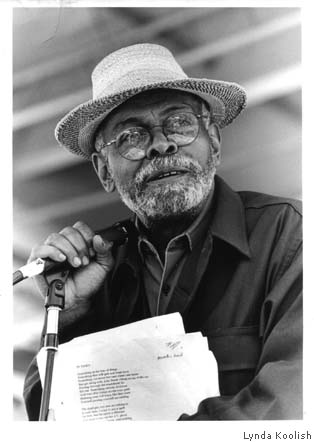
Amira Baraka. Photo by Lynda Koolish.

Obama & The Tragic Errors of The Weimar Republic
By Amiri Baraka

Amiri Baraka, formerly LeRoi Jones, was born in 1934 in Newark, New Jersey. He is the author of over 40 books of essays, poems, drama, and music history and criticism, a poet icon and revolutionary political activist who has recited poetry and lectured on cultural and political issues extensively in the USA, the Caribbean, Africa, and Europe. This article was originally posted on July 16, 2008 on SeeingBlack.com.

The post World War I journey of Germany from an empire, which was overthrown, and then a democratic republic, and finally the overthrow of that republic and the emergence and domination of Hitler’s Nazi fascism, is important for us to understand. Because some of the facts of these years still apply to the contemporary United States.

With the withering Depression that had set in in the late 20’s in addition to Germany’s war losses, when the international stock market collapsed (U.S. Wall St.) in 1929, a worldwide Depression of staggering proportions set in. And it is this Depression and the rise and fall of governments in Germany that set the stage for the final takeover by Hitler and the fascists—and finally the beginning of World War II.

Although McCain’s adviser Gramm says this is a “mental recession,” unless he’s referring to himself and McCain, today’s depression in the U.S. is not just mental. We should also factor in the outright theft of the last two elections, the general public bankruptcy of the Republican party, which has been playing and still is playing a “White card”. (The Democrats have not won the majority of White male voters since John Kennedy!)

There is the spreading foreclosure menace of the subprime (fraud ridden) mortgages, now at 6,000 foreclosures a day, the closing of the huge banking mortgage regime, Bear-Stearns. The Bush cabal has agreed to revalue Bear Stearns stocks so that the historically infamous speculator JPMorgan can get a better payday. No aid for the people losing their homes at terrifying rates. Today the government announced it had a new plan to save more banks. If there’s no recession why the plan to save “unthreatened” banks?

Suffice it to say there is a deepening Depression in the U.S., with the nation going from a surplus at the end of the Clinton regime to today’s deficit, much of it caused by the $10-billion-a-month war in Iraq. Even many straight-up backward Americans are convinced of the bold corruption that is the real cause of the war and spiraling gas prices since it is the oil swindlers who hold state power in the U.S. While they talk bad about the “Arabs,” the Bush group is clearly in bed with the Saudis, Arab Emirates, with Dubai now becoming a financial capital to compete with Wall St. and London.

There is no doubt that U.S. forces are losing in the Middle East, just as they got wasted in Viet Nam. The whole ugly scam of removing oil billions from Iraq ( all those contracts for privatization of Iraqi oil went to the big U.S. oilies) based on the 911 episode, the reality of which is still covered with crude lies. But now at scam’s end, with a raging Depression setting in and a war-incurred deficit climbing into the trillions, the stage is set for stunning rightward surge that will perhaps bring street fighting to the U.S. and a final toppling that will make the current shrinking of the dollar, .60 per Euro, seem mild. China already holds U.S. paper, the U.S. is China’s top debtor. IndyMac Bank has just failed in California.

So this is a time much like that in Germany, during the last phase of the Weimar Democratic Republic. Ostensibly a democratic republic, the Depression caused widespread unemployment and great public unrest. And as the curtain began to rise for fascist takeover, (See Brecht’s Berlin) the country, especially the large cities like Berlin, were inundated with pornography, sex crimes, business and political scandals and street fighting, usually between the rising fascists and the communists.

What brought the democratic era to an end was a split between the communists and the social democrats, i.e., the left and the near left and the liberals, which permitted Hitler’s National Socialists in a coalition with the conservatives and nationalists to win the election, even though the left-center coalition had more voters objectively. It was the split which allowed the right to consolidate power.

Recently in the U.S. presidential campaign we have seen two tendencies, the one to vilify and distort Obama from the right, e.g., the recent New Yorker cover described as “satirical” with Obama as a Muslim, his wife as a machine toting militant with an American flag in the fireplace and Osama bin laden in a portrait of honor on the wall. It is objectively a message from McCain, the U.S. Right and the Israelis.

But as well there is the tendency on the presumed left and the social democrats and people styling themselves “progressives” to attack Obama for moving to the right, thereby disappointing some very vocal would-be Obama voters. One woman publicized prominently in the NY Times said now she “hated him.” But as I have said repeatedly this is an imperialist country, with two imperialist parties and a media controlled directly by the 6/10ths of 1 percent of the people that own the land wealth factories, the means of production.

There is no way Obama is even in the presidential race condemning Israel or embracing Cuba. Not to know this is not to know where you are or where you have been for the last 40 years. But even with this clear motion to the center for the purposes of the general election, McCain is still a more backward and a more dangerous candidate and exactly the kind of right leaning militarist that would fit the paradigm for the weak chancellors during Weimar’s last throes that President Hindenburg removed and then appointed Hitler.

It is this split between the left and near left that is being exploited by the right with war and Depression threatening to dump this whole nation on its head, so that Obama will be defeated, McCain elected and with the McCain opening plummet the country headlong into the far, far right. Bush 2 has already obviously set the stage for this. Those elections were stolen out of desperation. The fact that Gore and Kerry were such weak liberals, tied clearly and obviously to the ruling class of this imperialist state allowed that theft to take place with minimum real struggle.

So that is the real struggle unfolding before us. First, to oppose the empty idealism which allows the elitist base to claim to represent the masses but actually have as little to do with them as possible. Allowing seemingly intelligent people to throw their votes away on McKinney or even the racial chauvinist, Nader, thus formalizing a hole in an actual progressive constituency, which allowed Bush 2 to seize power in 2000.

We must also oppose the absolutising of Obama’s progressive stance and,with that, drawing away from him as he gets closer to the general election and tacks toward the middle. This would be the other aspect of the tragic Weimar breakup of the fragile democratic coalition that caused millions to die in fascist purges, concentration camps, or World War 2.

On the other hand, it should be part of our campaign tasks to create a document of planks of progressive character to submit to Obama and publish and popularize this as well, to exert what pressure we can bring to bear on the campaign and publicly for a reversal of Bush’s neo-fascist creations, war, Depression, unemployment, violation of democratic rights, diplomatic isolation from the rest of the world, a general weakening, morally and politically and economically, of the country.

Source / SeeingBlack.com

Thanks to Carl Davidson / The Rag Blog

Posted in RagBlog | Tagged , , , , , | Leave a comment

BOOKS : ‘The Art of Political Murder’

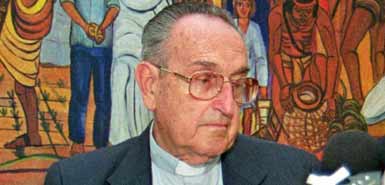
Activist Auxiliary Bishop Juan Girardi Conederal, murdered in April, 1988.

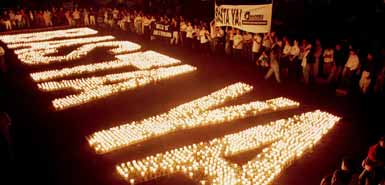
Mourners gather with can candles to mourn the murder of Bishop Juan Girardi: “Enough!”

The Novelist and the Murderers
By Nathaniel Popper

[This article first appeared in the July 7, 2008 edition of The Nation.]

Early last November, the novelist Francisco Goldman was shouldering his way through the Texas leg of a reading tour for his first nonfiction book, The Art of Political Murder. Published by Grove Press in September, the book had received glowing reviews in newspapers and magazines nationwide, and it would soon be included by The New York Times Book Review in its list of the 100 Notable Books of the Year. On Nov. 5 Goldman was relaxing in his hotel before a reading at a Houston Barnes & Noble when his BlackBerry pinged with an e-mail from an innkeeper in the Guatemalan town of Santiago de Atitlán.

One day earlier, Guatemalans had voted in a general election, and the winner of the presidential contest was Álvaro Colom, a self-proclaimed Social Democrat and head of the National Unity of Hope (UNE) Party. Quite unexpectedly, Colom had come from behind in the polls to defeat Otto Pérez Molina, a salt-and-pepper-haired general who had campaigned on the slogan of Mano Dura (Firm Fist), a sturdy platform in a country that was ruled by the military and repressive right-wing parties almost without interruption from 1954 until the late ’90s. As it happens, the election was also the subject of the e-mail Goldman received from the innkeeper, David Glanville: The Art of Political Murder, Glanville wrote, may have been a decisive factor in Pérez Molina’s loss.

Goldman’s book is about neither the election nor the candidates. The Art of Political Murder is an investigation of one of Guatemala’s most notorious and gruesome killings. On a Sunday night in April 1998, Bishop Juan Gerardi had been bludgeoned to death just two days after publishing a report about the Guatemalan military’s responsibility for civilian massacres in the country’s recently concluded civil war. In the midst of investigating the case, Goldman found sources who told him that on the night of the murder, Pérez Molina was hanging out in a convenience store near Gerardi’s church with a few conspirators in Gerardi’s murder. That scrap of information is mentioned–but not heavily scrutinized–by Goldman in his book.

The Art of Political Murder was available only in English, but during the campaign the news it contained slowly spread through Guatemala: in some places disseminated by priests, in other places by UNE officials at election rallies. In Santiago de Atitlán, a small indigenous town on the shores of Guatemala’s most beautiful lake, word had arrived in the form of a pamphlet featuring three photos–two of Gerardi and one of the cover of The Art of Political Murder–and a line from the book, translated into Spanish, about the general’s alleged role in the crime. The pamphlets were handed out to people visiting Santiago’s cemetery on the Day of the Dead, two days before the election. Dolores Ratzan, a local woman who had lived in exile in the United States during much of the civil war, says she saw the pamphlets when she went to the cemetery. What she noticed even more was the discussion they stirred up. “I just heard people talking about it–like, This Pérez Molina, he killed the bishop. That’s what everybody talked about,” she recalled a few months after the election. She says that on election day, “that’s why a lot of people didn’t vote for him, because he was a killer.”

Pérez Molina’s campaign of law and order had played well in Santiago, thanks to a wave of crime and lynchings last year. But as in many areas of Guatemala, the invocation of Goldman’s account of Gerardi’s murder had deep resonance. In 1981, at the height of the country’s civil war, Guatemalan soldiers broke into Santiago’s Catholic church and drove nails through the head of its priest–a transplant from Oklahoma who had been accused of siding too closely with the indigenous people.

Santiago has weathered the varied effects of US involvement in Guatemala. After the CIA-led coup d’état against Col. Jacobo Arbenz in 1954, the US government funded and trained Guatemalan military officers, some of whom went on to serve at a base near Santiago. More recently, Santiago has been the site of American charitable projects. But the unexpected presence of Goldman’s book, not just in Santiago but throughout the country during the 2007 election campaign, represented an inadvertent kind of American involvement in Guatemala. Edgar Gutiérrez, an old colleague of Bishop Gerardi’s and a former foreign minister, calls Guatemala a “kingdom of impunity.” Written to tell one story about that kingdom, The Art of Political Murder has become caught up in another story, one about the kingdom’s possible reformation. More improbable still, the book has injected an element of accountability and consequence into a country where for decades there’s been far too little of either.

During Guatemala’s civil war, 200,000 people were killed–roughly 5 percent of the population at the outbreak of fighting–and nearly all of the dead were from rural indigenous areas. UN-monitored peace accords were signed by the Guatemalan Army and guerrillas in 1996, but since then a virtual narco-state has arisen, created and overseen largely by former military officers. The homicide rate in Guatemala is seven times that of New York City, and it recently surpassed the levels in Colombia and South Africa. The figure is roughly equal to what it was during the civil war–forty-five deaths per 100,000 people. Equally staggering is the fact that the Guatemalan police make arrests in about 5 percent of their homicide cases (in the United States, the figure is 62 percent). During the Colom-Pérez Molina presidential race, nearly sixty people affiliated with the campaigns were murdered, more than twice the number killed during the previous election, in 2003. During a recent stay in Guatemala City, I passed a man who was bleeding from a bullet wound in his abdomen at 1 pm in the middle of downtown. Several firemen, who are responsible for removing dead bodies, were on the scene, but the police were nowhere in sight.

Bishop Gerardi was renowned for defending a group often targeted by brutal political violence–Guatemala’s downtrodden indigenous population. After working as the bishop in the rural province of El Quiché for six years, Gerardi was warned by locals that assassins were on his trail, and so in 1980 he fled to Costa Rica. But people who know him say that his exile never dulled his off-color humor or disdain for the risks involved with his work. After Gerardi returned to Guatemala in 1983, he helped found the human rights project of the Catholic Church, called Oficina de Derechos Humanos del Arzobispado (ODHA). After the 1996 peace accords, ODHA launched an investigation dedicated to providing a thorough accounting of civil war-related crimes, including the massacre of civilians. By 1998 the organization had assembled a four-volume report documenting the toll of the war. Guatemala: Never Again concluded that the military was responsible for 80 percent of the civilian deaths during the civil war. The next year, ODHA’s findings were corroborated by a UN investigation, which attributed 93 percent of the casualties to the military.

Gerardi would not live to see this confirmation of his work. On April 26, 1998, two days after a public presentation of Never Again in Guatemala City’s main cathedral, the bishop was found in a pool of blood in the garage of his parish house, a jagged piece of concrete nearby. The crime occurred a little after 10 pm, and the bishop’s wallet and gold ring were found with his body.

Gerardi’s church, San Sebastián, is a modest, elegant structure within blocks of the National Palace and every major intelligence agency, and initially it appeared that the investigation of the bishop’s murder would, like so many other cases, disappear into the thicket of impunity. The crime scene was a mess (gawkers were allowed on the scene, and some walked through puddles of blood), and the first arrest was a homeless man. The UN verification team stationed in Guatemala after the peace accords quickly raised the possibility of a cover-up and criticized the government prosecutor for withholding documents.

The theory was certainly a plausible one, since at the time only one human rights case against members of the military had gone through the Guatemalan courts, and in that case, when an officer was convicted, he quickly escaped–this after the investigating police officer was murdered in broad daylight. Members of Gerardi’s team at ODHA had worked on that case, and when their boss was killed, the young team of ODHA investigators, which included Edgar Gutiérrez, quickly went to work. While the government prosecutor investigating Gerardi’s murder stumbled, the ODHA team found a taxi driver who had driven past the church on the night of the crime and seen a car with men gathered around it. They traced the car to a mothballed military base. When the information was shared with the government, all public records of the car disappeared. It was the first clear signal in the Gerardi case that, as Goldman writes in his book, “the Army had many chess pieces to play with, and a very large board.”

Born in 1954 to a Guatemalan mother and a Ukrainian-American Jewish father, Goldman has a round head of curly black hair and a ready laugh. He lives in a brownstone in Brooklyn, and when I met him there books and papers were strewn about his one-bedroom apartment. Goldman spent most of his early childhood in Guatemala, and the country is the setting of his first novel, The Long Night of White Chickens, published in 1992. It’s the story of a Guatemalan-American aristocrat from Boston who investigates the mysterious murder of his adoptive Guatemalan sister, who ran an orphanage in her home country. The Art of Political Murder covers similar territory–murder, paranoia, Guatemalan political intrigue–but it reads as though it were written by a different author. The Long Night of White Chickens is filled with florid poetic language that often doubles back on itself, exploring ideas of memory and dislocation. The Art of Political Murder, by contrast, is a study in spare storytelling, with Goldman rarely devoting more than a sentence to set a scene. Goldman is an ebullient, expressive man, but he says he felt the need to restrain himself while telling the Gerardi story in order to write “with the most diligent fidelity to the case itself.”

Goldman began reporting on the Gerardi case a few months after the killing, initially on assignment for The New Yorker. He befriended the young team of ODHA investigators, joining them for long days of sleuthing and equally long nights of drinking. “When Frank wrote this book he was living with us–in all the time that we were suffering,” Mario Domingo, the head of ODHA’s legal team, recalls. As the ODHA team and a new, more ambitious government prosecutor pushed the case forward, Goldman quickly became a part of the story he was telling. When his piece appeared in The New Yorker on March 15, 1999, a small but respected Guatemalan newspaper, El Periódico, translated and printed the article in a special edition, and sent copies to 5,000 churches around the country. Several months later, Goldman showed up at the trial in Guatemala City, which had commenced after Gerardi’s team at ODHA had assembled a case in concert with a new government prosecutor. In the halls of the courthouse, Goldman was menaced by taunts from the most colorful of the defendants, Capt. Byron Lima. During a break in the proceedings, Lima called Goldman a “faggot,” leading to a brief verbal altercation. Soon thereafter, the defense lawyers called for the removal of Goldman from the courtroom–a motion that was rejected.

Other people involved in the case encountered more lethal forms of intimidation. Grenades were thrown into the backyard of a judge overseeing the case; masked men broke into the house of ODHA’s director and assaulted his son and maid. Despite these threats–issued from Guatemala’s kingdom of impunity–after a two-and-a-half-month trial the prosecutors and ODHA won convictions against two military officers, a sergeant and Father Mario Orantes, a priest who lived in the parish house with Gerardi and had colluded to let the killers into the church, according to the sentence. The judges determined that the crime had been planned and executed by the presidential intelligence unit, the Estado Mayor Presidencial (EMP), which had long been a nearly independent unit of terror within the Guatemalan government, answerable only to the president. The court issued a list of thirteen others, including seven military officers, to be investigated further, a probe that continues to this day.

The four convictions did little to close the case. The officers denied any role in the crime and quickly appealed. At the same time, two European journalists, Maite Rico and Bertrand de la Grange, published an article in August 2001 in the Mexican magazine Letras Libres that claimed to contradict the findings of the court. According to the duo, who relied heavily on information provided by members of the military and their attorneys, the military defendants had been innocent and the murder had been committed by renegade military officers in cahoots with the Catholic Church. In 2003, Rico and de la Grange published a longer version of their article as a book, ¿Quién mató al obispo? (Who Killed the Bishop?).

The Rico and de la Grange argument won a wide following in Guatemala. Álvaro Arzú, who had been Guatemala’s president when Gerardi was murdered and has since become the mayor of Guatemala City, handed out ¿Quién mató al obispo? to foreign diplomats stationed in Guatemala. Among the many television networks and newspapers to run laudatory coverage of Rico and de la Grange was El Periódico, which published an excerpt from the book. “Bertrand and Maite are rightist journalists working here in a conservative, Catholic country,” a top editor at the paper, Juan Luis Font, told me. “I think most editors here wanted to believe that they were telling the truth.”

The vituperative atmosphere created by Rico and de la Grange provoked Goldman to expand his article into a book. It also pushed two crucial sources to open up to him: the lead government prosecutor, Leopoldo Zeissig, and Rafael Guillamón, a reticent UN police investigator who had been in charge of a parallel inquiry into the Gerardi case. Guillamón told Goldman that he was “nauseated” by the coverage and showed him all his old notebooks about the case.

Goldman was not alone in pursuing the story that had been laid out by the judges. El Periódico had Claudia Méndez, a young, tenacious reporter, on the beat. Méndez, who had studied at one of Guatemala City’s bilingual schools, was only 23 when the trial started, and she speaks with a mix of humility and confidence about the case. “I was like a child when I started working on this case. It was a real clash–a real wake-up. Like I had thought of my country one way and then, bam, I had to realize it is actually this way.” Méndez used her guile and seeming innocence to engage the defendants in jailhouse interviews that brought them as close as they ever came to admitting their culpability in Gerardi’s murder. But in the end it was Goldman, not Méndez, who wrote the book about the case, and she expresses no unhappiness about that. “Who would have the means to do it here?” she explained to me during a driving tour of the Gerardi crime scene. Even more important than resources, Méndez says, is the fact that only a foreigner would have any credibility with the authorities: “They knew that Frank was a power that they cannot buy and they cannot threaten. It’s someone from the outside.”

In early 2007, as Goldman was putting the finishing touches on The Art of Political Murder, he gave Méndez a version. Soon people in the office of Álvaro Arzú spotted printouts of the galleys on the mayor’s desk. Similar reports came from the bishop’s office. (How those two offices nabbed copies of the galleys remains a mystery.) Goldman had sent the copy to Méndez so that the editors of El Periódico could translate and print an excerpt from the book before its publication. For the editors, it was not hard to see which pages would be the most explosive. About two-thirds of the way into the text, on page 239, Goldman introduces Pérez Molina, describing him only as a “Guatemalan officer.” But this suave political operator would not blend into the seemingly endless cast of characters who people the book. An excerpt featuring the passage about the “Guatemalan officer” appeared in El Periódico on June 10 along with a photo of Pérez Molina.

Read all of this article here. / The Nation /

Thanks to Mercedes Lynn de Uriarte / The Rag Blog

Posted in RagBlog | Tagged , , , , , , | Leave a comment

The Economy : A Throw of the Dice


Here are the odds…
By Roger Baker
/ The Rag Blog / July 21, 2008

This article following these comments is a judgment by Mark Gongloff of the Wall Street Journal about “how bad” the US economy might get.

This is as seen by capitalist expansionists who are mostly blissfully unaware of the pervasive implications of resource depletion, and peak oil. While meanwhile ignoring the slowly worsening but unavoidable impact of climate change on many agricultural commodities necessary to feed the world.

Where are the economic scenarios below in error, IMO?

First of all the odds presented below have no credible basis as anything but unattributed guesses of the writer, devoid of much supporting evidence or numbers. Averaging the opinions of economists and a focus on the short term does not lead to important economic insights.

The recent drop in the price of oil from about $147 to $130, referenced below, appears to be more than anything an indication of the short-term speculation factor affecting oil price. This is the short term psychology change among traders during one week or so, rather than a reflection of long range global supply and demand
trends, which have been raising oil prices fairly steadily for about a decade.

If we look at the “Stagflation” scenario below, there is no discussion of the fact that rising oil demand is unavoidably forcing cost-push inflation into the commodity sector of the US economy while simultaneously deflating the discretionary spending sector. The federal interest rate remedy for the one problem tends to worsen the other.

More money spent on gasoline and the diesel needed to deliver food means less dollars spent at the movies and Starbucks and vacations. The falling profits in the discretionary sector like tourism and housing demand forces federal bank bailouts, due to the many trillions in credit default swaps and derivatives pervading the global economy.

These newly minted Wall Street bailout dollars are needed to inject liquidity and prevent an economic domino collapse effect. But these dollars then tend to gravitate toward the more profitable commodity sector of the economy rather than the depressed sectors like housing, worsening the cost-push inflation.

When commodity price inflation exceeds the US interest rate, the global economy tends to dump and thus devalue dollars, further worsening US inflation, and forcing even more bailouts. This steady increase in fiat currency, its inflationary effect and subsequent devaluation, can trigger a sudden panicky flight from dollars resembling a global bank run.

Let us now focus on the last scenario below, titled “Just Getting By” which is given 2 to 1 odds, This is proposed to be by far the most likely scenario:

…”We can keep muddling along, but we may have to accept more inflation and more weakness and adapt to that,” says Bruce McCain, chief investment strategist at Key Private Bank in Cleveland…

Thus this favored last scenario of price inflation plus a weak economy turns out on close inspection to be nothing more than a relabeled and weaker version of the “Stagflation” scenario above it. But without the numbers or a cause and effect analysis to distinguish the two scenarios.

The missing factor linking all the scenarios is the primacy of world supply and demand for oil. The global economy, structured as we know it, cannot expand without the cheap portable energy that has stimulated global population and economic expansion for most of the last century. When all is said and done, the global economy cannot expand without decades of restructuring to replace cheap oil as a primary dependency factor.

But for this transition to be made assumes that general resource depletion, global warming, and social and political calm will cooperate to allow what is bound to be a painful and slow restructuring process involving a new global energy infrastructure. A transition that is unlikely to be in harmony with the past few decades of rapid growth of the global economy.

The Economy: How Bad Can It Get?
By Mark Gongloff / July 20, 2008

A full year into the miserable journey of the credit crisis, the economy and financial markets have come to a crossroads, beyond which lay several possible destinations, not all of them pleasant.

So far, despite bank losses of some $400 billion, a crumbling housing market and oil prices at $130 a barrel, the economy has managed to avoid a deep recession — at least according to the common definition, which is two quarters of negative gross domestic product growth.

But federal tax-rebate checks have supported consumer spending, which drives 70% of the U.S. economy. That jolt will soon fade, potentially leading to a hangover.

A resilient export sector — driven by a weak dollar that makes U.S. goods cheaper and more competitive overseas — has also kept the economy going and lifted the profits of many multinational corporations. But several big overseas economies are starting to feel the bite of inflation and the troubles in the U.S., and their appetite for American goods might wane.

Meanwhile, major U.S. stock indexes remained near bear-market territory despite a big drop in oil prices that sparked an impressive three-day rally. The Dow Jones Industrial Average rose 396 points, ending the week up 3.6%. The Nasdaq and S&P 500 also rallied last week.

As heartening as last week’s turnabout in oil prices was, however, the economy is still a long way from healthy. And there could be a lot more stock-market pain to come.

Where do we go from here? Here are the main scenarios most economists and analysts are considering.

Stagflation

Remember “That ’70s Show”? We could be in for a rerun. Oil and other commodity prices rise relentlessly, spurring runaway inflation not seen since the 1970s. All the while, growth stays weak, a double dose of misery that crushes corporate profits and stock-market returns. There’s a word for this: stagflation.

Fortunately, the odds of this history repeating itself are slim. Inflation readings are nowhere near as high as they were in the 1970s and early 1980s, when the year-over-year percent change in the consumer price index soared as high as 14.8% at one point; it was up 5% in June.

And a key driver of that era’s hyperinflation is missing: In those days, strong labor unions were able to wrest wage increases at every tremor of the inflation rate. Companies passed their higher labor and energy costs to consumers in the form of higher prices, which encouraged still more wage increases, in a grim dance economists call a “wage-price spiral.”

Today workers have much less bargaining power, and wages haven’t kept up with inflation. That hurts consumers and the economy, but it will at least keep inflation in check.

One wild card: If the U.S. dollar continues to weaken, then that could keep inflation going despite the lack of a wage-price spiral. “This would be checkmate for the U.S. economy, turning a relatively mild recession into a severe one,” Paul Kasriel, chief economist at Northern Trust, told clients recently.
Odds: 20 to 1 against.

‘Lost Decade’

One word — Japan. If stagflation is the world ending in fire, then this scenario is Apocalypse by ice. Some observers worry the U.S. is following a path Japan blazed in the 1980s and 1990s. Like the U.S., Japan had stock and real-estate bubbles fueled by easy credit.

The aftermath for Japan was a “lost decade” for its economy and stock market, an especially terrifying time for policy makers because there seemed to be little they could do to fix it. Low interest rates were useless because nobody wanted to borrow.
The likelihood of this scenario is not high, either. Unlike Japanese officials, who waited for years to try to stimulate Japan’s economy, the Federal Reserve, the Treasury Department and Congress have responded quickly with rate cuts and stimulus packages and won’t hesitate to break out more, if necessary.

What’s more, Japan tried to keep its troubled banks alive, creating “zombie” institutions that only extended the pain of the financial crisis. U.S. officials are well aware of this history and will likely avoid it — though some analysts warn they’ve merely kicked problems down the road by preventing the collapses of Bear Stearns, Fannie Mae and Freddie Mac.

Odds: 15 to 1 against.

Next Year, the Turnaround

Like Chicago Cubs fans always looking to the next season, there are analysts who have been calling for a turnaround for months despite evidence to the contrary, yelling their hearts out for what so far has been a losing cause.

According to their theory, this has all been a fever dream, a midcycle slowdown like the one the economy suffered in 1998, when stocks briefly swooned, but the technology bubble quickly went right back to inflating. This is the same crowd who dismissed the collapse of the housing market because it’s just a small part of gross domestic product and who said the subprime mortgage meltdown would be no big deal.

And now, $400 billion in losses and one bear market later, they’re still calling for the rosy outcome, and there’s a chance they might be right, given the fiscal and monetary stimulus flowing through the system. Perhaps banks, emboldened by a wide government safety net, will start lending again to consumers and businesses eager to borrow and get back to the high life. This, along with the still-booming export sector, could cause the economy and stocks to rocket higher once again.

Unfortunately, this also seems unlikely. “This financial crisis is the worst since the Great Depression,” points out New York University economist Nouriel Roubini. “The recession is unavoidable at this point.”

One wild card here is the U.S. consumer, the lifeblood of the economy. Though their debts are growing and their inflation-adjusted wages are not, analysts have unsuccessfully predicted a slowdown in their spending for years. A dramatic plunge in oil prices could give them extra incentive to spend.

Odds: 10 to 1 against.

Just Getting By

If you’ve enjoyed the economy for the past year, then you’ll love this, because it involves more of the same. The trouble is that most people haven’t enjoyed it, but it’s the most likely outcome, according to many economists.

In this scenario, weaker global growth cools inflation, but not by much, as China, India and other emerging economies stay hungry for oil and other commodities.
The U.S. economy improves little and perhaps slides into a mild recession, as the repercussions of the credit crunch, housing-market collapse and high oil prices work their way slowly through the system.

Banks, stung by hundreds of billions of dollars in losses and under pressure to rebuild their coffers, keep a tight lid on borrowing. Businesses, squeezed by higher costs and lower sales, lay off more workers, raising the unemployment rate.
“We can keep muddling along, but we may have to accept more inflation and more weakness and adapt to that,” says Bruce McCain, chief investment strategist at Key Private Bank in Cleveland.

Odds: 2 to 1 for.

Source / Wall Street Journal

The Rag Blog

Posted in Rag Bloggers | Tagged , , , , | Leave a comment

The Accidental Tourist

Vaison-la-Romaine in Southern France.

A tale of healing in southern France
By Mary O’Grady / The Rag Blog / July 21, 2008

In Vaison-la-Romaine in Southern France where my husband Mack and I were staying with our old friend Massimo Mauro, there is one supermarket with a perpetually congested parking lot, and parking is an international competition, what with all the tourists from all over Europe. Massimo and Mack and I went there almost every day; the fresh bread and fruit and vegetables and meat were excellent.

(Have you heard about the locavore movement, the latest big thing among conscious eaters in the US? People are pledging to eat as much as possible foods produced within some small radius of where they live, say 80 or 100 miles. The locavore movement is old news in France. I was impressed that even at the supermarket so much of the fruit, delectable apricots and cherries for example, and the meat came from the surrounding region.)

Well, on Wednesday the 23rd at mid-morning, Massimo was heading his small BMW sedan into a parking space when a woman in the next slot started backing out without looking. Massimo reacted instantly, backing his left front tire straight onto the front third of my right foot. (That car was way heavier than it looked, by the way.)

After I screamed at the top of my lungs, my further response was more articulate but loud and profane. Massimo got his tire off my foot, which now sported an obvious tire track and a torn toenail which began to bleed profusely.

My screams attracted a small knot of French matrons who pointed at my foot and made idiotic suggestions, e.g.,“Vous devez aller au pharmacien. (“You should go to a pharmacist.”) French pharmacists are versatile and extremely well-trained but I doubted one of them would be up to this particular task. I was grateful when Mack and Massimo, now white as a sheet, agreed with me that we should find an emergency room.

Mack put a plasticized shopping bag on the back seat to protect the upholstery and took over driving. The woman who had been backing out of the parking space said she would lead us to the local hospital, a modern structure which was somehow tucked away among the narrow streets and ivy-covered stone houses of the old part of the town.

At the Urgences door of the hospital, Massimo clambered out of the car and went to tell somebody what had happened. Mack and I waited. I was all for stumping on in, myself, but Massimo wanted me to wait for a wheelchair that I did not strictly need.

After several minutes, a sprightly little nurse of about sixty emerged with a wheelchair. She wheeled me into a two-bed emergency room bay and got me up on a gurney. The other bed was occupied by a very elderly, very ill man in obvious respiratory distress. She drew a curtain between his bed and my gurney.

The nurse occupied herself with cleaning the rubber off my foot. The little toenail was hanging by a skin tag but the bleeding had stopped. Massimo, meanwhile, had achieved a rare degree of emotional shock, poor man. I was extremely relieved when the nurse came up with a chair for him.

The paperwork came a bit later, and proved minimal. The nurse wanted a peek at my passport; she was very amused at the Xeroxed copy of Mack’s and my rather grand-looking marriage license which I always carry in it because my passport lists “O’Grady” as my surname. She asked me to write my name and address and telephone number on a yellow form; I could have put down “555 Minnie Mouse Street, Anytown, Texas, USA,” and nobody would have been the wiser. There was no breath expended on payment.

A trim, blonde female doctor in early middle age then came in and examined my foot. She and the nurse apologized that there would be about a thirty-minute wait for x-rays, which proved to be true. Massimo and Mack were told that they would absolutely not be allowed to accompany me.

Mack and Massimo and I passed the time in idle chit-chat and much reassurance for Massimo– it was really just a freak accident, but Massimo was simply aghast. Meanwhile, the moribund man in the next bay rasped away as his heart monitor beeped steadily. At length, the little nurse put me back in a wheelchair and wheeled me to an elevator, telling me meanwhile that the following month she was going on holiday to California. “Ah, oui?” I replied.

“Oui, a Phoenix,” she said. I did not feel quite up to a geography lesson, but I wondered about her travel agent.

In the radiology department upstairs, I was swiftly taken in hand by a pretty young female technician who took two shots of my foot. After several minutes, I was wheeled out of the x-ray room to a waiting room with a beautiful view of an ancient honey-colored stone church spire topped with an interesting wrought-iron belfry.

The little nurse from the emergency department emerged from the elevator after several minutes and collected my x-rays in their big Manila envelope, and me. Downstairs, the doctor said that no bones were broken, to expressions of happy relief. The nurse bandaged my toe and instructed me not to get the bandage wet, and the doctor said I should come back in two days to have the bandage changed. She also gave me a prescription for a mild painkiller.

At the pharmacy across from the supermarket, 32 painkiller tablets came to about $8 US. After filling the prescription, Mack parked up at the supermarket, thankfully without incident, and we went in and bought things, including a bottle of alleged tequila, some Grand Marnier, and the entire stock of Mexican limes, so that Mack could make some margaritas to soothe Massimo’s shattered nerves.

Back at the house, I repaired to our upstairs bedroom and propped up my foot and tuned in to the BBC World Service on my teensy radio. Later on, we all had a light supper with margaritas for Mack and Massimo and just a few sips of an excellent Sancerre for me, considering the painkillers I had taken. Mack and Massimo then had a very “guy” evening, watching the German national soccer team playing Spain, if memory serves, and drinking more margaritas. I could hear their hoots and groans from the bed upstairs.

On the Friday morning my toe was re-bandaged by another nurse, a slim young woman who told me that henceforth I should feel free to bathe as long as I put a dry bandage on the toe afterward. (Oh, joy! I was very tired of sponging myself and I feared that I was beginning to smell stereotypically French.) She also said that I should visit the accounts department and pay.

Massimo insisted on dealing with the accounts department. The total hospital charge came to about $80 US. How much do you think this all would have cost a hapless, uninsured foreigner in an American small-town emergency room?

Copyright Mary O’Grady 2008

The Rag Blog

Posted in Rag Bloggers | Tagged , , | Leave a comment

See the Superhero Inside Yourself


NetRoots Nation, Code Pink and why we do what we do
By The Voice / The Rag Blog / July 21, 2008

Early Saturday morning, 19 July 2008,five super sheroes and a shackled Bush in striped prison garb gathered outside a restaurant in Austin, Texas and put together a loose strategy of street theater and flyering at the Netroots Nation conference down the street. We strode in confidently and gave flyers to the largely sympathetic crowd waiting to be allowed into the auditorium where Speaker of the House Nancy Pelosi was to speak.

Security was not as tight as we had feared. We strode around easily and quickly exhausted our supply of flyers. We did a little theater chasing Bush the war criminal around the lobby. Then the organizers took us aside to be assured we wouldn’t disrupt things once inside. Not realizing that not all of us had passes, this gave us a de facto invitation to enter the hall and when the doors opened, we did. We strode through the crowd shouting slogans such as “Our powers are your powers. Use them.” In response one woman said to me sarcastically, “What do you think we’re going to do, sit quietly by?” Well, indeed, and really to my surprise, that is what I saw unfold.

The control of dissent was masterfully orchestrated, really. First, all questions were taken through a website where anyone could post a question. On the days leading up to the talk, users voted on the “best” question. The NetRoots moderators then would ask these hard-hitting questions. So far so good, right? Well, in theory, yes. Some of the authors of the chosen questions were even there to ask them in person. However, there was no follow up question, and, certainly, no interrupting the prestigious Speaker who, in response to a question about FCC regulations, I think it was, took us back to the days of Lewis and Clark! No one called her on the carpet for evading the questions. People clapped when she referred to change coming in 107 days. She’s been Speaker for two years, people! I really wanted to shout, to rant…at the liberal –or are they supposed to be left of liberal? – bloggers in the audience. Then, and here comes the coup de grace, the rumored secret guest makes his entrance: none-other-than Al Gore. Phew! Pelosi is off the hook. No more questions. Gore has a prepared speech and gets 3 of the 4 allowed and controlled questions after it. (Though there were apparently more after we left.)


Through most of the proceedings we Sheroes, with Bush in tow, stood silently at the back aisle in the auditorium. We held peace signs aloft and some strolled around the room, keeping security on their toes. As Pelosi began on the last question – though, again, she not-so-deftly avoided answering it – we began to stroll through the hall and began shouting for the bloggers to make her be accountable and call her on her lies. Then, we walked on out, security trailing after.

It is actions like these and more confrontational ones that bring questions from within the movement as well as from others of “Why be disrespectful?” “Why disrupt?” “Aren’t we just alienating people who would otherwise be our friends?” I have contemplated the effectiveness of our actions frequently and Cintra Wilson recently wrote a piece about Code Pink tactics which was posted on Salon.com. My experience at NetRoots convinced me of the need for the actions and here’s why.

Many of the conference attendees gave us the thumbs up as they passed us. One woman early in Pelosi’s talk urged us to “Make some noise…” though making every effort to be indiscrete herself. As I later read the bloggers’ chats taking place during the event on the Daily Kos and Netroots Nation sites I was amazed to see how many were as disgusted with her responses as we were and there were some comments about wishing we would do something and they were glad we were there. You certainly wouldn’t know it standing in the hall, watching the respectful silence as she droned on, and enthusiastic applause as she spouted liberal truisms as well as lies. Here’s the thing, it was their conference! This was a largely sympathetic crowd and we were mindful of not alienating our allies. This was their conference to disrupt. It was their job as independent media to demand real and thoughtful answers of Pelosi and not demagoguery. And to expect the organizers to focus less on control and more on facilitating true dialogue.

I think of our work this way: according to the diffusion of innovations theory and Malcolm Gladwell’s the Tipping Point, (please forgive my gross simplification here) you have to have a critical mass of adopters of a thought or behavior before mainstream acceptance of it. Do some of our allies cringe at CodePink tactics? Sure, but, believe me, Pelosi isn’t refusing to initiate the impeachment process just to spite Code Pink. By being among the many groups that keep antiwar sentiment in the news, CP provides pressure on public opinion towards

• ending the war,
• bringing the troops home,
• impeachment, and, goddess forgive,
• keeping our troops and Israel’s bombs out of Iran.

If the anti-war movement were purely a fringe movement, we could be said to be ineffective, but “fringe” tactics on an issue that at least two-thirds of Americans support keeps the ideas out there and encourages people to use more mainstream strategies such as letter-writing, signing a petition, calling a representative or making a donation to a citizen lobbying organization, for example. That is, perhaps people will make the same point in the best way they know how and feel comfortable.

Perhaps this morning, in this we failed: Our signs should have/could have been more specific if they couldn’t hear our words. So, if you were there and didn’t get it, and I’m not being facetious here:

We are the Code Pink Super Sheroes. Our powers are: Truth, Justice, Peace, Reason, Observation, Organizing, Love and more. And these, indeed, are everyone’s powers. We want everyone to see the superhero inside them and use their powers.

You can do it in costume if you want or from your computer as many of the NetRoots Nation attendees do, but don’t rag on us for calling for accountability among our elected officials and the media, including independent media. If you wanted Pelosi to be accountable and answer the questions and know that you wanted a real answer, you could have stood with us. Can you imagine the effect if even a third of the room had gotten up and stood silently with us? Blogging is great and necessary, an important tool in the political discourse, but it is not enough, just as putting on a pink dress and gold mask isn’t going to change the world today. It takes both of us and all of us and action beyond these.

Okay, now I’ve done what you do (though it’s taken me much longer than you no doubt), maybe you can do a little of what I do toward the same end. You don’t have to wear a tiara when you do, but you might have more fun if you do!

[Disclaimer: These opinions are mine and I don’t speak for Code Pink.]

Photo credits: Anne Elizabeth Moore, 2008

Source / Peaceably

The Rag Blog

Posted in Rag Bloggers | Tagged , | Leave a comment

Speaking the Truth About Iraq Ellicits Punishment

Army court-martials resister for blowing whistle on ‘bait-and-kill’
By Dee Knight / July 20, 2008

Private First Class James Burmeister faces a Special Court Martial at Fort Knox on July 16. The charges are AWOL and desertion. He returned to Fort Knox voluntarily in March, after living 10 months in Canada with his spouse and infant child. He refused redeployment to Iraq while on leave in May 2007.

In most such cases at Fort Knox, the Army has in recent years quietly dismissed the resister with a less than honorable discharge “for the good of the military.” This time it’s different. The brass “offered” Burmeister a year in military prison and a dishonorable discharge if he agreed to plead guilty.

Burmeister refused the offer. His father, Erich, says the Army is making an example of James for denouncing a secret “bait-and-switch” program he was forced to participate in while in Iraq. In media interviews last year in Canada, James described the program as a war crime he was forced to commit. Shortly afterward, the program’s details came out in the Washington Post.

“Baiting is putting an object out there that we know they will use, with the intention of destroying the enemy,” the Post quoted Capt. Matthew Didier, leader of an elite sniper scout platoon. “We would put an item out there and watch it. If someone found the item, picked it up and attempted to leave with the item, we would engage the individual.”

The Post reported that “Eugene Fidell, president of the National Institute of Military Justice, said such a baiting program … raises troubling possibilities, such as what happens when civilians pick up the items. … ‘You might as well ask every Iraqi to walk around with a target on his back,’ Fidell said.” (Sept. 24, 2007)

James had asked to be classified as a conscientious objector following his training in Germany, but his request was ignored by his commander. Instead, he became a machine gunner. “Our unit’s job seemed to be more about targeting a largely innocent civilian population or deliberately attracting confrontation,” he wrote in his deposition seeking asylum in Canada. “These citizens were almost always unarmed. In some cases the Iraqi victims looked to me like they were children.” (Eugene Weekly, May 22)

In Iraq, Burmeister had been knocked unconscious and his face filled with shrapnel when his Humvee was hit by a roadside bomb. The shrapnel wounds left him with a traumatic brain injury, and he suffers from severe Post-Traumatic Stress Disorder. His parents insist that he urgently needs medical and psychological help, not jail time.

His parents have waged an unceasing struggle for the Army to release him. They called on their representative, Peter DeFazio, to launch a congressional inquiry into James’s case, but have so far heard nothing. James’ mother, Helen Burmeister, flew to Fort Knox in June, with help from anti-war ex-Colonel Ann Wright. Helen spoke directly to the base commander there, demanding that her son be discharged in lieu of a court martial. She then joined supporters from Veterans for Peace and Vietnam Vets Against the War demonstrating outside.

On July 8 the Army invited Helen to attend her son’s court martial on July 16. This time both she and her husband Erich are going. They’re determined to keep James out of jail. “I bought a one-way ticket,” Erich told Workers World. “I’m not leaving without my son. If I have to sit outside the base and wait for him, I’ll do it. Even if I have to go on a hunger strike, that’s what I’ll do. My son does not deserve another day in jail.”

In an interview with Courage to Resist, Erich said: “[James] struggles with PTSD, yet he is quartered within earshot of the shooting range and tank training area, daily hearing the gunfire and explosions. He has been prescribed a dangerous cocktail of anti-psychotic drugs and sleep aids by Army doctors, while the command decides if they want to send him to prison, as a coward, a soldier who faced death, and followed orders to ‘shoot to kill.’ The cowards—George Bush and Dick Cheney, those in Congress and the generals with the blood on their hands—why are they the punishers instead of the punished?” (couragetoresist.org, May 12)

Supporters can contact the Fort Knox post commander, General Campbell, to demand a speedy discharge and no further punishment for James. Send email to knox.pao@conus.army.mil, or call the Fort Knox public affairs office at 502-624-7451. Ask that they discharge PFC James Burmeister now so that he can get the help that he needs.

Articles copyright 1995-2008 Workers World.

Source / Information Clearing House

The Rag Blog

Posted in RagBlog | Tagged , , | Leave a comment