Economy : Nearing a Tipping Point


Those Greenspan bubbles a’bursting…
By Roger Baker / The Rag Blog / July 16, 2008

It looks like the US economy has gotten itself into a ‘liquidity trap’; the blowback from Greenspan’s bubbles and banking deregulation.

If we try to avoid a deepening depression, the fed would normally try to inject enough liquidity by lowering interest rates to reflate the economy and stimulate spending, according to classic Keynesian principles. The income tax rebates were supposed to do the same thing, but were too little too late. But once the psychology of cutting back on the non-essential spending sector of the economy gets started, it tends to be reduce business profits for a large part of the total GNP and to become a self-reinforcing recession, depression, whatever.

Since the financial panic is centered in the finance industry, “Helicopter Ben” is trying to avoid bank runs by bailing out the big guys, including Freddie Mac and Fannie Mae. The unregulated hedge funds who have borrowed from the giant investment banks like JP Morgan have to get bailed out too as part of the same process.

But all the new dollars and taxpayer IOUs that Ben Bernanke uses to bail out the banks and their wealthy investors has to go somewhere. This liquidity would be stupid to go into parts of the consumer economy that are doing poorly, so it will go into the parts of the economy that have a solid spending base like food and oil and commodities. So the bailout dollars get recycled into bidding against the Chinese for a limited world supply of oil and all the fruits thereof, which naturally increases their price, which shows up as the inflation we see now.

But we are nearing a tipping point where T-note holders worldwide see how stupid it is to hold dollars that are losing value, due to inflation not paying as much as their T-note value, and so dump massive amounts of dollar liquidity into the international economy to buy Euros, gold, etc. So the dollar plunges and the cost of oil in dollars leaps upwards, raising the cost of nearly all necessary commodities. If you think inflation is bad now wait until the whole world dumps their dollars.

Its a new version of the stagflation of the oil crisis of the early 1970s and 1980s. Then economic shock therapy by Paul Volker plus Arab oil led to recovery, but this time things look a lot more serious because the economy is so highly-leveraged so that a lot of banking debt on the books is worthless and also because there is no more cheap oil to hold down commodity prices that depend on an oil-addictive economy designed to benefit financial interests with the short range investment focus that flourished under Greenspan’s watch

U.S. economy: Consumer prices up 5% to 17-year high
By Shobhana Chandra and Timothy R. Homa / July 16, 2008

U.S. consumer prices surged 5 percent in the past year, the biggest jump since 1991, just as households struggled with falling home values and the credit crunch.

Spiraling expenses for food and fuel spurred the increase in June, the Labor Department said today in Washington. The cost of living rose 1.1 percent from May, more than forecast and the second-largest rise since 1982. Separate figures showed industrial production rose more than estimated because of the end of a strike at American Axle & Manufacturing Holdings Inc. and increased electricity output.

Price gains accelerated last month even after stripping out energy and food, underscoring the challenge for Federal Reserve Chairman Ben S. Bernanke as he attempts to steer the economy through the slowdown and credit crisis. Treasuries fell.

“This is a problem for the economy; it’s even worse for the Fed,” said Joel Naroff, president of Naroff Economic Advisors Inc. in Holland, Pennsylvania.

“Inflation numbers are high enough that under different circumstances the Fed would be hiking rates.”

Excluding food and energy, so-called core costs climbed 0.3 percent in June from the previous month and 2.4 percent from a year before.

Yields Jump

Benchmark 10-year note yields rose to 3.93 percent at 4:20 p.m. in New York, from 3.82 percent late yesterday. The Standard & Poor’s 500 Stock Index advanced 2.5 percent to close at 1,245.36, after earnings from Wells Fargo & Co. topped analysts’ estimates.

Consumer prices were forecast to rise 0.7 percent, according to the median estimate of 79 economists in a Bloomberg News survey. Projections ranged from gains of 0.2 percent to 1.1 percent. Costs excluding food and energy were forecast to rise 0.2 percent, the survey showed.

Bernanke told lawmakers in semiannual testimony on the economy yesterday and today that inflation risks have “intensified.” At the same time, he dropped his June assessment that risks to the economic expansion had diminished, indicating policy makers aren’t ready to raise interest rates to contain expenses.

“We don’t think they’re going to raise rates now — until June next year now is our forecast — until basically the economy starts to get some footing,” Beth Ann Bovino, senior economist at Standard & Poor’s in New York, said in an interview with Bloomberg Radio. “Right now the beast is what’s going to happen with the economy.”

Exceeding Forecasts

Prices were forecast to climb 4.5 percent in June from a year earlier, according to the survey median.

A separate report today said confidence among U.S. homebuilders dropped to 16 this month, a record low. Readings for current sales, expected sales and buyer traffic in the National Association of Homebuilders/Wells Fargo sentiment index also were at all-time lows.

“The magnitude of the housing bubble was unprecedented, and the corrective process promises to be a long and painful one,” Joshua Shapiro, chief U.S. economist at Maria Fiorini Ramirez Inc. in New York, said in a note to clients.

The Fed said today that production at factories, mines and utilities increased 0.5 percent last month after dropping 0.2 percent in May. Capacity utilization, which measures the proportion of plants in use, rose to 79.9 percent from 79.6 percent.

Strike’s Resolution

The resolution of a three-month strike by General Motors Corp.’s largest axle supplier, American Axle, probably helped lift auto output. Excluding autos, factory output fell 0.1 percent for a second month.

Wholesale costs rose 1.8 percent in June, the most in seven months, the Labor Department reported yesterday. From a year ago, prices climbed 9.2 percent, the biggest surge since 1981.

Companies, unable to fully recover ballooning raw-material costs by raising prices, have cut staff and reduced equipment purchases as profits shrink.

Kimberly-Clark Corp., the maker of Huggies diapers and Scott paper towels, said earnings for this year will trail its previous forecast as expenses rise more than twice as fast as predicted,

“Inflation has outpaced our ability to offset higher costs in the near term through price increases, cost reductions and other measures,” Thomas Falk, the Dallas-based company’s chief executive officer, said this week in a statement.

Price Increase

Procter & Gamble Co., the maker of Tide detergent and Head & Shoulders shampoo, last week said it’ll raise prices as much as 16 percent due to higher costs for plastic, energy and paper. The increases start in September and are the Cincinnati-based company’s steepest in at least 18 months.

Energy expenses jumped 6.6 percent, the biggest gain since November. Gasoline soared 10.1 percent and fuel oil jumped 10.4 percent.

The cost of fuel will continue stoking price pressures. Crude oil futures reached a record $147.27 a barrel on July 11 and have risen almost 90 percent in the past year. Regular gasoline, which topped $4 a gallon for the first time in June, kept rising this month, AAA figures show.

The consumer price index is Labor’s broadest gauge of costs. Almost 60 percent of the CPI covers prices consumers pay for services ranging from medical visits to airline fares and movie tickets.

Food Expenses

Food prices, which account for about a fifth of the CPI, increased 0.8 percent, driven by the biggest gain in the cost of vegetables in almost four years.

The report showed that food and fuel weren’t the only items on the rise. Costs for airline fares jumped 4.5 percent, the most since 2001.

Rents which, make up almost 40 percent of the core CPI, also accelerated. A category designed to track rental prices rose 0.3 percent after a 0.1 percent gain in May.

Today’s figures also showed wages decreased 0.9 percent in June after adjusting for inflation, the biggest drop since September 2005, and were down 2.4 percent over the last 12 months. The decline in buying power is one reason economists forecast consumer spending will slow.

Americans trimmed purchases of automobiles, furniture and restaurant meals last month as the cost of gasoline soared, a Commerce Department report showed yesterday.
Retail sales rose 0.1 percent, less than forecast, a sign the boost from the tax rebate checks is already fading.

Source. / Bloomberg

The Rag Blog

Posted in RagBlog | Tagged , , , , , | Leave a comment

Rabbi Arthur Waskow to Barack Obama : "Justice, Justice Shall You Pursue"

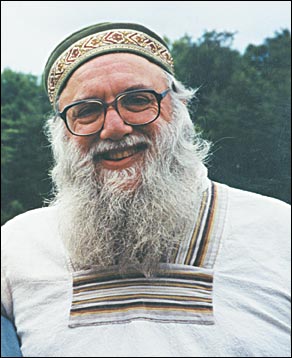
Rabbi Arthur Waskow.

Rabbi Arthur Waskow asked us to publish this open letter to Barack Obama. He has also posted it to the On Faith blog on the Newsweek/Washington Post website.

Rabbi Waskow has been one of the creators and leaders of Jewish renewal since writing the original Freedom Seder in 1969. Rabbi Waskow is director of The Shalom Center; author of Down-to-Earth Judaism and a dozen other books on Jewish thought and practice, as well as books on US public policy. Newsweek named Rabbi Arthur Waskow one of America’s 50 most influential rabbis.

Open Letter to Senator Obama:
The Middle East, Islam, Ends, & Means

By Rabbi Arthur Waskow

Dear friends, I am writing this out of personal experience and my own individual ethical concern, not on behalf of any organization or campaign. It comes with Martin Buber’s teaching ringing in my brain: that he had no idea what it meant to say that “the ends justify the means,” but that for sure the means we actually use will become the ends that we actually achieve.

Or as ancient Torah teaches, “Justice, justice shall you pursue.” Why “justice” twice? To teach that just ends can only be achieved through just means.

A lesson for all who work to change society.

Shalom, salaam, peace — Arthur

Dear Senator Obama,

I met you at your talk with Philadelphia Jewish leaders in April. It was I who as you entered the room handed you a copy of the original Freedom Seder, which I wrote in 1969, and which bound together the freedom struggles of Blacks and Jews. And during Q & A, it was I who asked you how as President you would deal with the peace-obstructing settlement policy of this and many previous Israeli governments.

I asked that question because one of the advance speakers for your meeting, Congressman Roth of New Jersey, had just asserted that you believe the failure of the peace process has been solely the result of the absence of a Palestinian partner for peace.

“Solely the fault of the Palestinians?” I thought. “Surely he doesn’t believe that!” So I rose to say that hundreds of rabbis and hundreds of thousands of American Jews see Israeli settlement policy as obstacles to peace, and asked what as President you would do about it.

Your answer cited the vigorous debate on these questions in Israel — more vigorous than here; the recognition by most Israelis that for peace to unfold, there will have to be a shift in settlement policy; and your sense that most Israelis know that internal debate would be so wrenching that they want to know there is a partner for that decision before going through the debate.

Though you avoided saying what you would do, I was satisfied with your answer — then.

I was especially ready to be satisfied because I knew that earlier, when you met with Jewish leaders in Cleveland, you had gone even further, saying:

“I sat down with the head of Israeli security forces and his view of the Palestinians was incredibly nuanced because he’s dealing with these people every day. He was willing to say sometimes we make mistakes and if we are just pressing down on these folks constantly without giving them some prospects for hope, that’s not good for our security situation.”

It would be profoundly important to have a President who understands that! Yet more recently, in your speech to AIPAC, there was no such language. And you slid so far into simply repeating official shibboleths like “Jerusalem undivided” that you had to correct yourself the next day.

No one knows better than I that many of the “official” Jewish organizations would go ballistic to hear a presidential candidate bring such ideas to the fore in, say, a major speech about making peace across the whole region that Abraham, Hagar, and Sarah walked.

And no one knows better than I that millions of American Jews , Christians, and Muslims want exactly that kind of honest talk and vigorous diplomacy. They would support any President who insisted on exactly the kind of broad pursuit of peace you have sometimes affirmed, and the changes in not only Palestinian, Syrian, and Iranian but also Israeli and American behavior it requires.

I know some people who carry a strange mixture of cynicism and wish-fulfillment in their heads — who think you can, will, and should say anything to calm folks like the AIPAC membership and thereby get elected, and later will work hard for a real peace. I know people who think that you can, will, and should pretend you never met Palestinians and heard their suffering, never got to understand their understanding of their history as you have so eloquently explained that you have heard and understood the Jewish story — all in order that once you are in office, you can bring your “true” knowledge into policy.

But I don’t think it works that way. Not only would that kind of campaign be an ethical failure and a personal self-betrayal, abandoning the honest, nuanced, politics of change that you claimed to represent — but I think it won’t work politically.

First of all, that kind of campaign will greatly weaken your appeal to the passionate supporters you have had — just like your betrayal of your own understanding that the FISA bill violates the Fourth Amendment’s prohibition of searches without warrants. Already, the drop-off of small contributions to your campaign suggests that these people are dismayed. And they are the core of your strength, as you yourself have repeatedly said.

Secondly, it will weaken your ability if you are elected President to take the steps necessary for peace. For it would weaken and delegitimate the millions of American Jews, Muslims, and Christians who seek precisely a policy of peace for Israel alongside a peaceful Palestine, and peace between Iran and the United States. Who would thank God — literally! — for a President who would seek to meet the crucial needs of all these peoples while refusing to humiliate or subjugate any of them. There will be many people and organizations ready to attack any President who takes such positions. There need to be people and organizations motivated and mobilized to support them.

To strengthen such a faith-based coalition, you will also have to make clear — by where you speak as well as what you say — that of course American Muslims are as much a part of American society as any other religious group. So your unwillingness to speak in any mosque — presumably for fear that might reinforce the wicked rumors that you are really a Muslim — simply strengthens the mind-set that thinks to demonize you on the false grounds that you are a Muslim, and any Muslim must be anti-American.

I remember being moved when in your speech to the 2004 Democratic National Convention, you said, “If there’s an Arab-American family being rounded up without benefit of an attorney or due process, that threatens my civil liberties.” That line had no political pay-off in numbers of voters. It was a principled statement, fearlessly swimming against the tide of public opinion. And — against all “realistic” calculation — it won vigorous applause from those assembled number-centered politicians!

You owe it to Americans of all faiths, to Jews around the world, to the Arab and Muslim billions – – to treat all these people as part of the world community that must work together to heal our planet from war and eco-disaster.

Just as in Philadelphia you expressed compassion for white working-class anger without surrendering to right-wing policies that ignore Black poverty and despair — so you can express compassion for Jewish fears without surrendering to oppressive right-wing Israeli policy. And in the same new approach to change, you can include Muslims in the body politic and express compassion for some Muslims’ anger and fear, without affirming violence and terrorism.

You will need to address these questions honestly if you are not to be caught against your will in years of war and terror that would destroy an Administration you might lead as it did the last one, will damage America at least as deeply as our deafness to others’ narratives has damaged us this past seven years.

Just as the racial chasm has haunted and daunted American democracy two centuries and more, the growing chasm between “the West” and “Islam” will haunt and daunt every effort to make peace and heal our planet, if we and you do not address it in all its depth and difficulty.

So just as you spoke in Philadelphia with nuance and compassion about race, I implore you to speak as clearly with nuance and compassion about these questions.

With blessings of shalom, salaam, peace —

Rabbi Arthur Waskow

[The Shalom Center voices a new prophetic agenda in Jewish, multireligious, and American life. To receive the weekly on-line Shalom Report, click
here.]

The Rag Blog / Posted July 16, 2008

Posted in RagBlog | Tagged , , , , , , , , | 2 Comments

Silver Lining Dept : The Upside of $4 Gas


Five Reasons to Love $4 Gas
July 16, 2008

Sure, it’s ruining the global economy and making everyone miserable, but there’s an underappreciated upside to the high price of oil.

1. The mass transit boom

What’s happening: From 2000 to 2005, fewer than 5 percent of Americans used mass transit for their commutes, compared with about 50 percent in Japan and Europe. But that may be changing. More U.S. commuters than ever are taking buses, subways, or light rail to work instead of driving their cars. Americans took nearly 85 million more trips in the first three months of 2008 than they did in the same period in 2007, a recent American Public Transportation Association study found. Ridership in 2007 was the highest in 50 years.

Why it’s happening: It’s not rocket science. For many, a roundtrip bus or metro fare is easier to stomach than gas prices that in some places have climbed to $4.79 per gallon. Three quarters of Americans now believe more money should be spent on developing and improving mass transit systems, and cities are responding. Expansion and renovation projects are in the works for southern California, New York, Philadelphia, Seattle, and Washington, DC. Europe, meanwhile, is taking transit to the next level: Paris, which has been updating its light rail network, is installing energy-efficient trains on several Métro lines, while London plans to increase its system’s overall capacity by 50 percent by 2022.

2. Lower obesity rates

What’s happening: Rising gas prices and smaller belt sizes go together, according to Charles Courtemanche of Washington University in St. Louis. His research found that, for every dollar increase in the average real price of gas, overweight and obesity levels in the United States would decline by 16 percent after seven years. His study also attributes the outward expansion of American waistlines between 1979 and 2004 in part to falling prices. Similar research published in the European Journal of Public Health found that European countries with higher gasoline prices tend to have lower rates of obesity.

Why it’s happening: One word: exercise. Bike shops across the United States are reporting record sales, and Britain is even promoting a national “Bike Week” to encourage commuters to ride, not drive, to the office. Not only is two-wheeling a cheaper way to travel, it’s also healthier. Courtemanche’s results show that “the average person walks or bicycles an average of 0.5 times more per week if the price of gas rises by $1.” Another factor he identifies is that cost-conscious Americans are choosing to eat at restaurants less frequently. Indeed, a virtuous cycle could be at work: A study published in The Engineering Economist found that Americans today use nearly a billion additional gallons of gasoline each year, compared with 1960, solely because they weigh more.

3. Fewer accidents

What’s happening: This past Memorial Day, normally a time when American drivers swarm the country’s interstates and police expect large numbers of accidents, many states reported that traffic deaths were the lowest in years. For instance, North Carolina saw just five traffic fatalities over Memorial Day weekend, down from 19 in 2007. Ohio experienced its lowest number of accidents in 38 years, and other states reported similar declines.

Why it’s happening: Americans are driving at historic lows, according to a May U.S. Department of Transportation (DOT) report, and less driving means fewer accidents. And they may be driving slower and more cautiously, too. Ian Parry, a senior fellow at Resources for the Future, an energy think tank, says that while the effect would be modest, some people “will realize they can drive less aggressively” and conserve gas mileage. According to fueleconomy.gov, a U.S. government Web site, “each 5 mph you drive over 60 mph is like paying an additional $0.20 per gallon.”

4. Shorter commutes

What’s happening: Worry about rising gas prices has encouraged workers to move closer to their jobs to cut costs and find alternate ways of traveling to work. And for many of those that still drive, less-packed roads are actually producing shorter commutes. While the change is by no means uniform, in some of the most congested areas of southern California, the average commute time has reportedly fallen by 5 or 6 minutes. That could make for a sunnier Los Angeles: a 2006 paper in Science found that people with shorter commute times tend to be happier.

Why it’s happening: Confirming the predictions of experts such as Harvard economist Gregory Mankiw, the DOT estimates that since November 2006, cumulative vehicle miles traveled have dropped by 17.3 billion miles. And with fewer cars on the road, as Mankiw forecast in 2006, those still able to afford driving are finding more lanes clear. In Europe, however, the effect has so far been the opposite, as striking truck drivers in Britain, Spain, and France have slowed or shut down entire highways to protest diesel prices.

5. The alternative fuels craze

What’s happening: More of the world’s fuel is coming from renewable energy sources instead of Middle East oil drums. Global production of biofuels — generally ethanol derived from corn, but also plant oils that produce biodiesel — roughly tripled from 2000 to 2007. Critics of biofuels point to studies indicating that the increasing diversion of cereal crops for biofuel production is driving up food prices around the world. Supporters counter that the answer isn’t to give up on alternatives to gasoline, but to develop “next-generation” biofuels (think: switchgrass and algae) that don’t interfere with the food supply. And without biofuels, “the [oil] prices today that we are experiencing could be much higher,” says Fatih Birol of the International Energy Agency.

Why it’s happening: Everyone responds to incentives. The U.S. Congress has set a national goal of 36 billion gallons of biofuel production by 2022, and generous subsidies are accordingly in place to make that happen. In Europe, public policy has also led the way. The European Union wants biofuels to constitute 10 percent of the fuel mix by 2020, a target that has come under scrutiny as food prices have risen sharply in recent months.

[Reproduced with permission from Foreign Policy www.foreignpolicy.com. Copyright 2008, Carnegie Endowment for International Peace.]

Source. / AlterNet

Thanks to David Hamilton / The Rag Blog

Posted in RagBlog | Tagged , | Leave a comment

POETRY : Haiku Sadness


his blood on the sand

shall never again party,

yet paints the town red

Shane O’Neal
The Rag Blog / July 15, 2008

The Rag Blog

Posted in Rag Bloggers | Tagged , | Leave a comment

Exclusively Using the Wind for Power

Missouri’s turbines will provide electric service for at least 20 years, the expected lifetime of the wind-to-power devices. Photo: Steve Morse, MU Cooperative Media Group

First US Town Powered Solely by Wind
By Andrea Thompson / July 15, 2008

Rock Port, Missouri has an unusual crop: wind turbines.

The four turbines that supply electricity to the small town of 1,300 residents make it the first community in the United States to operate solely on wind power.

“That’s something to be very proud of, especially in a rural area like this — that we’re doing our part for the environment,” said Jim Crawford, a natural resource engineer at the University of Missouri Extension in Columbia.

A map published by the U.S. Department of Energy indicates that northwest Missouri has the state’s highest concentrations of wind resources and contains a number of locations that are potentially suitable for utility-scale wind development. The four turbines that power Rock Port are part of a larger set of 75 turbines across three counties that are used to harvest the power of wind.

“We’re farming the wind, which is something that we have up here,” Crawford said. “The payback on a per-acre basis is generally quite good when compared to a lot of other crops, and it’s as simple as getting a cup of coffee and watching the blades spin.”

And the turbines have another benefit besides produces clean energy: MU Extension specialists said that the Missouri wind farms will bring in more than $1.1 million annually in county real estate taxes, to be paid by Wind Capital Group, a wind energy developer based in St. Louis.

“This is a unique situation because in rural areas it is quite uncommon to have this increase in taxation revenues,” said Jerry Baker, and MU Extension community development specialist.

Landowners can also benefit by leasing part of their property for wind turbines.

The turbines will also provide savings to rural electric companies and will provide electric service for at least 20 years, the anticipated lifetime of the turbines.

“Anybody who is currently using Rock Port utilities can expect no increase in rates for the next 15 to 20 years,” Crawford said.

Baker added that the turbines could also attract tourists to the area.

(c) 1999-2007 Imaginova Corp.

Source / America On Line

The Rag Blog

Posted in RagBlog | Tagged , | Leave a comment

A Bit of Justice Concerning BushCo Secrecy


White House Loses Appeal to Keep Visitor Logs Secret
by Jason Leopold / July 15, 2008

The White House lost an appeal to keep secret visitor logs containing the identities of evangelical Christian leaders who visited the White House and Vice President Dick Cheney’s home, according to an opinion issued Friday by a federal appeals court.

The U.S. Court of Appeals for the D.C. Circuit rejected the Bush administration’s claims that Secret Service visitor logs are the property of President George W. Bush and are not subject to Freedom of Information Act (FOIA) requests. The White House assumed control of the visitor logs when watchdog groups and the media sought access to the files.

The panel of three appeals court judges essentially upheld a December decision by a U.S. District Court judge who said the visitor logs were public documents subject to the FOIA. They sent the case back to District Court Judge Royce Lamberth for consideration

“At that point, the court may agree with the agency, allowing it to withhold the requested records, in which case the government would have no cause to appeal,” says the appeals court’s opinion.

The government watchdog group Citizens for Responsibility and Ethics in Washington (CREW) sued the Department of Homeland Security in 2006 for access to the records after the Secret Service — on orders from Cheney — refused to process CREW’s FOIA request. The Secret Service was formerly operated by the Treasury Department. It became part of the Homeland Security Department in March 2003.

The Bush administration had argued in its appeal that a Supreme Court ruling issued in 2004 “warning that courts should hesitate before requiring the President or Vice President to “bear the burden” of “asserting specific claims of privilege and making . . . particular objections.”

“In this case, we disagree,” states the 14-page opinion written by Clinton appointee David Tatel. “We find unpersuasive the government’s argument that this case implicates the same separation-of-powers concerns present in” a lawsuit filed against the vice president for access to documents related to the identities of corporate executives and lobbyists who advised Cheney on energy policy.

In the lawsuit filed against Cheney “two nonprofit organizations, Judicial Watch and the Sierra Club, filed civil suits, not FOIA requests, directly against various government officials — including Vice President Cheney himself — alleging that the National Energy Policy Development Group (NEPDG) was subject to the Federal Advisory Committee Act’s disclosure requirements.

“The district court had allowed discovery to proceed against the Vice President in order to establish exactly who attended NEPDG meetings, and the Vice President sought a writ of mandamus from this court to vacate the discovery orders. After emphasizing the need for the district court to “narrow discovery to ensure that plaintiffs obtain no more than they need to prove their case,” we rejected the Vice President’s request for mandamus, explaining that he could object to individual discovery requests on executive privilege grounds if need be. The Supreme Court reversed, explaining, “Separation-of-powers considerations should inform a court of appeals’ evaluation of a mandamus petition involving the President or the Vice President.”

In the case of the Secret Service visitor logs, “the government argues that requiring the Secret Service to review FOIA requests for its visitor logs is tantamount to the discovery request at issue in” the lawsuit against Cheney related to his energy task force, the appeals court opinion says.

The energy task force lawsuit “is distinguishable from this case on several grounds. To begin with, the discovery request . . . was directed at the Vice President himself. Indeed, the Court explained that “[w]ere the Vice President not a party in the case, the argument that the Court of Appeals should have entertained an action . . . might present different considerations. The Court also observed, “[t]his is not a routine discovery dispute. The discovery requests are directed to the Vice President and other senior Government officials who served on the NEPDG to give advice and make recommendations to the President.”

CREW is seeking “documents not from the President or Vice President, but rather from the Secret Service, a FOIA agency well accustomed to dealing with such requests,” the appeals court opinion states. “According to the Secret Service’s FOIA officer, “the individuals who performed the searches . . . conduct FOIA searches as part of their regular responsibilities.”

In its 2006 FOIA filing, CREW identified nine evangelical Christian leaders, such as James Dobson of Focus on the Family, Family Research Council president Tony Perkins, Gary Bauer and Moral Majority co-founder Jerry Falwell, who visited the White House and Cheney’s residence since 2001, who are alleged to have had a major impact on some aspects of the Bush administration’s domestic and foreign policy decisions.

“We are pleased that the D.C. Circuit is requiring the government to provide these Secret Service records that the White House has been trying to hide from the public,” said Anne Weismann, chief counsel for CREW. “The American people are entitled to know who has been influencing the White House.”

Last December, the White House sent out Christmas cards signed by President Bush and his wife Laura that contained a Biblical passage from the Old Testament:

“You alone are the LORD. You made the heavens, even the highest heavens, and all their starry host, the earth and all that is on it, the seas and all that is in them. You give life to everything, and the multitudes of heaven worship you.”

The inclusion of the Biblical passage caught the attention of longtime broadcaster Barbara Walters, who was a recipient of the presidential Christmas card.

Walters said she doesn’t recall receiving “religious” holiday cards from past presidents and she wondered how non-Christians would receive such an overtly religious greeting.

“Usually in the past when I have received a Christmas card, it’s been ‘Happy Holidays’ and so on,” said Walters. “Don’t you think it’s a little interesting that the president of all the people is sending out a religious Christmas card? Does this also go to agnostics, and atheists, and Muslims?”

The Biblical passage inside the Christmas card did not amount to a constitutional violation because it was paid for by the Republican National Committee, but Weinstein said it’s intolerable, nonetheless, because military officials believe they have the approval of the White House to allow fundamentalist Christian organizations and their leaders to proselytize in the military.

The appeals court said it lacked jurisdiction to resolve the Bush administration’s appeal because the U.S. District Court’s December 2007 ruling did not require the White House to produce the visitor logs, rather the court simply required that the Secret Service process CREW’s FOIA filing.

Moreover, the appeals court rejected the White House’s argument that requiring the government to process the request and invoke exemptions would place a constitutionally impermissible burden on the president or vice president. The court determined that CREW’s request is “narrowly drawn” and that requiring the administration to rely on the FOIA’s exemptions to protect claims of executive privilege “is a routine occurrence, not a uniquely intrusive burden.”

As a result of the court’s ruling, the Secret Service must process CREW’s FOIA request seeking copies of the visitor logs.

But the Bush administration is expected to assert other legal arguments, the White House indicated Friday, in an attempt to block access to the visitor logs and perhaps delay release of the materials until President Bush leaves office.

The appeals court judges added that, “it is entirely possible that the government will never have to turn over a single document.

Source / Dissident Voice

The Rag Blog

Posted in RagBlog | Tagged , , , , | Leave a comment

Drawn and Quartered


The Rag Blog / Posted July 15, 2008

Posted in RagBlog | Tagged , , , , , , | Leave a comment

Phil Gramm : Don’t Worry, Be Happy


But it’s actually Wall Street where they’re whining. Or, shall we say, panicking?
By William Greider / July 14, 2008

Phil Gramm, the senator-banker who until recently advised John McCain’s campaign, did get it right about a “nation of whiners,” but he misidentified the faint-hearted. It’s not the people or even the politicians. It is Wall Street–the financial titans and big-money bankers, the most important investors and worldwide creditors who are scared witless by events. These folks are in full-flight panic and screaming for mercy from Washington, Their cries were answered by the massive federal bailout of Fannie Mae and Freddy Mac, the endangered mortgage companies.

When the monied interests whined, they made themselves heard by dumping the stocks of these two quasi-public private corporations, threatening to collapse the two financial firms like the investor “run” that wiped out Bear Stearns in March. The real distress of the banks and brokerages and major investors is that they cannot unload the rotten mortgage securities packaged by Fannie Mae and banks sold worldwide. Wall Street’s preferred solution: dump the bad paper on the rest of us, the unwitting American taxpayers.

The Bush crowd, always so reluctant to support federal aid for mere people, stepped up to the challenge and did as it was told. Treasury Secretary Paulson (ex-Goldman Sachs) and his sidekick, Federal Reserve Chairman Ben Bernanke, announced their bailout plan on Sunday to prevent another disastrous selloff on Monday when markets opened. Like the first-stage rescue of Wall Street’s largest investment firms in March, this bold stroke was said to benefit all of us. The whole kingdom of American high finance would tumble down if government failed to act or made the financial guys pay for their own reckless delusions. Instead, dump the losses on the people.

Democrats who imagine they may find some partisan advantage in these events are deeply mistaken. The Democratic party was co-author of the disaster we are experiencing and its leaders fell in line swiftly. House banking chair, Rep. Barney Frank, announced he could have the bailout bill on President Bush’s desk next week. No need to confuse citizens by dwelling on the details. Save Wall Street first. Maybe lowbrow citizens won’t notice it’s their money.

We are witnessing a momentous event–the great deflation of Wall Street–and it is far from over. The crash of IndyMac is just the beginning. More banks will fail, so will many more debtors. The crisis has the potential to transform American politics because, first it destroys a generation of ideological bromides about free markets, and, second, because it makes visible the ugly power realities of our deformed democracy. Democrats and Republicans are bipartisan in this crisis because they have colluded all along over thirty years in creating the unregulated financial system and mammoth mega-banks that produced the phony valuations and deceitful assurances. The federal government protects the most powerful interests from the consequences of their plundering. It prescribes “market justice” for everyone else.

Of course, the federal government has to step up to the crisis, but the crucial question is how government can respond in the broad public interest. Bernanke knows the history of the last great deflation in the 1930s–better known as the Great Depression–and so he is determined to intervene swiftly, as the Federal Reserve failed to do in that earlier crisis. By pumping generous loans and liquidity into the system, the Fed chairman hopes to calm the market fears and reverse the panic. So far, he has failed. I think he will continue to fail because he has not gone far enough.

If Washington wants real results, it has to abandon the wishful posture that is simply helping the private firms get over their fright. The government must instead act decisively to take charge in more convincing ways. That means acknowledging to the general public the depth of the national crisis and the need for more dramatic interventions.

Instead of propping up Fannie Mae or others, the threatened firm should be formally nationalized as a nonprofit federal agency performing valuable services for the housing market. That is the real consequence anyway if the taxpayers have to buy up $300 billion in stock.

The private shareholders “are walking dead men, muerto,” Institutional Risk Analytics, a private banking monitor, observed. Make them eat their losses, the sooner the better. The real national concern should be focused on the major creditors who lend to Fannie Mae and other US agencies as well as private financial firms. They include China, Japan and other foreign central banks. Foreign investors hold about 21 percent of the long-term debt paper issued by US government agencies–$376 billion in China, $229 billion in Japan.

It is not in our national interest to burn these nations with heavy losses. On the contrary, we need to sustain their good regard because they can help us recover by bailing out the US economy with more lending. If these foreign creditors turn away and stop their lending now, the US economy is toast and won’t soon recover.

Americans should forget about whining; it’s too late for that. People need to get angry–really, really angry–and take it out on both parties. What the country needs right now is a few more politicians in Washington with the guts to stand up and tell us the hard truth about out situation. It will be painful to hear. They will be denounced as “whiners.” But truth might be our only way out.

Source. / The Nation

Thanks to David Hamilton / The Rag Blog

Posted in RagBlog | Tagged , , , | Leave a comment

Jim Hightower on Pot

Sharing his thoughts on pot, that is…
July 14, 2008

Watch the Marijuana Policy Project’s Profiles in Marijuana Reform interview with author and national radio commentator, Jim Hightower in the video above. This is a project of MPP.tv.

Here’s more from the Marijuana Policy Project:

Marijuana: Myths vs. Reality

Myth: There is no scientific evidence proving marijuana’s therapeutic qualities.

Reality: In a White House-commissioned 1999 report, the National Academy of Sciences’ Institute of Medicine declared that “nausea, appetite loss, pain, and anxiety are all afflictions of wasting and all can be mitigated by marijuana.”

Myth: Marijuana’s potential health benefits are insignificant compared to the damage caused by smoking the drug.

Reality: Marijuana need not be administered by smoking: It can be taken in food, tea, or through a smokeless vaporizer. Furthermore, a 2006 study by a leading pulmonologist, Dr. Donald Tashkin, found that even regular and heavy smoking of marijuana does not lead to lung cancer.

Myth: Allowing the medical use of marijuana will send the wrong message to children and lead to more youths using the drug.

Reality: In the 10 medical marijuana states that have before-and-after data, studies have unanimously shown that not only has youth use of marijuana not gone up overall, it actually has declined since medical marijuana became legal.

Myth: Marijuana is a gateway drug to harder substances, and therefore medical marijuana use will lead to dangerous drug use.

Reality: In science, the distinction between cause and correlation is a crucial one. A White House-commissioned study by the Institute of Medicine found that marijuana “does not appear to be a gateway drug to the extent that it is the cause or even that it is the most significant predictor of serious drug abuse; that is, care must be taken not to attribute cause to association.” Moreover, claims about marijuana being a gateway make no sense in the context of medical marijuana: Patients often use marijuana instead of highly addictive prescription medicines like morphine and Oxycontin. Medical marijuana is a safe alternative for patients whose other options are not as reliable or effective.

Myth: Supporting medical marijuana is politically risky.

Reality: Across the country and with increasing frequency, public opinion polls show that support for medical marijuana is popular and steadily rising — and cuts across demographic and party lines. A 2004 AARP poll showed that 72% of seniors support medical marijuana, and a 2005 Gallup poll found that 78% of Americans support “making marijuana legally available for doctors to prescribe in order to reduce pain and suffering.” Compassion and relief from suffering are nonpartisan issues that all legislators can — and should — support.

Myth: Marijuana’s potential health benefits are insignificant compared to the damage caused by smoking the drug.

Reality: Marijuana need not be administered by smoking: It can be taken in food, tea, or through a smokeless vaporizer. Furthermore, a 2006 study by a leading pulmonologist, Dr. Donald Tashkin, found that even regular and heavy smoking of marijuana does not lead to lung cancer.

Myth: Allowing the medical use of marijuana will send the wrong message to children and lead to more youths using the drug.

Reality: In the 10 medical marijuana states that have before-and-after data, studies have unanimously shown that not only has youth use of marijuana not gone up overall, it actually has declined since medical marijuana became legal.

Myth: Marijuana is a gateway drug to harder substances, and therefore medical marijuana use will lead to dangerous drug use.

Reality: In science, the distinction between cause and correlation is a crucial one. A White House-commissioned study by the Institute of Medicine found that marijuana “does not appear to be a gateway drug to the extent that it is the cause or even that it is the most significant predictor of serious drug abuse; that is, care must be taken not to attribute cause to association.” Moreover, claims about marijuana being a gateway make no sense in the context of medical marijuana: Patients often use marijuana instead of highly addictive prescription medicines like morphine and Oxycontin. Medical marijuana is a safe alternative for patients whose other options are not as reliable or effective.

Myth: Supporting medical marijuana is politically risky.

Reality: Across the country and with increasing frequency, public opinion polls show that support for medical marijuana is popular and steadily rising — and cuts across demographic and party lines. A 2004 AARP poll showed that 72% of seniors support medical marijuana, and a 2005 Gallup poll found that 78% of Americans support “making marijuana legally available for doctors to prescribe in order to reduce pain and suffering.” Compassion and relief from suffering are nonpartisan issues that all legislators can — and should — support.

Myth: Marijuana’s potential health benefits are insignificant compared to the damage caused by smoking the drug.

Reality: Marijuana need not be administered by smoking: It can be taken in food, tea, or through a smokeless vaporizer. Furthermore, a 2006 study by a leading pulmonologist, Dr. Donald Tashkin, found that even regular and heavy smoking of marijuana does not lead to lung cancer.

Myth: Allowing the medical use of marijuana will send the wrong message to children and lead to more youths using the drug.

Reality: In the 10 medical marijuana states that have before-and-after data, studies have unanimously shown that not only has youth use of marijuana not gone up overall, it actually has declined since medical marijuana became legal.

Myth: Marijuana is a gateway drug to harder substances, and therefore medical marijuana use will lead to dangerous drug use.

Reality: In science, the distinction between cause and correlation is a crucial one. A White House-commissioned study by the Institute of Medicine found that marijuana “does not appear to be a gateway drug to the extent that it is the cause or even that it is the most significant predictor of serious drug abuse; that is, care must be taken not to attribute cause to association.” Moreover, claims about marijuana being a gateway make no sense in the context of medical marijuana: Patients often use marijuana instead of highly addictive prescription medicines like morphine and Oxycontin. Medical marijuana is a safe alternative for patients whose other options are not as reliable or effective.

Myth: Supporting medical marijuana is politically risky.

Reality: Across the country and with increasing frequency, public opinion polls show that support for medical marijuana is popular and steadily rising — and cuts across demographic and party lines. A 2004 AARP poll showed that 72% of seniors support medical marijuana, and a 2005 Gallup poll found that 78% of Americans support “making marijuana legally available for doctors to prescribe in order to reduce pain and suffering.” Compassion and relief from suffering are nonpartisan issues that all legislators can — and should — support.

Source. / AlterNet

Thanks to David Hamilton / The Rag Blog

Posted in RagBlog | Tagged , , , , , | 1 Comment

A Special Report : Colombia’s Bloody Civil War


A Rag Blog exclusive report…
War and poverty in today´s Colombia

July 15, 2008

The following analysis was presented by a Conscientious Objectors´ group, and edited and translated by The Rag Blog’s Val Liveoak. The presenter´s name is withheld to protect him. Val Liveoak was on the staff of The Rag in Austin from 1972-1975. She works with Friends Peace Teams on peacebuidling in Colombia. Val has worked on projects in Colombia since 2000, and lives in San Antonio.

Colombia is a rich country, with abundant natural resources and occupying a strategic geopolitical position on the South American Continent. Its biodiversity is remarkable: 10 per cent of all the earth’s flora and fauna are found in Colombia, and 22.4 per cent of the planet’s fresh water. This abundance of water alone makes it attractive to transnational and national businesses that need water to produce their products. Colombia has a very youthful population–of the total 43 million inhabitants, 46.5 per cent are younger than 19 years old.

Additionally Colombia has great mineral wealth. Its largest product is coal — 1,183 metric tons have been mined, about one sixth of the known reserves. Gold is also a major product. The companies which exploit these resources, along with petroleum, nickel, uranium, magnesium, zinc, copper and many others, are mainly US or Canadian owned.

In gold production, for example, Gulf Crown, a Canadian company, takes around 80 per cent of the income generated by its mines. Workers, using 18th century technology and little safety equipment, enter dangerous mineshafts, dig with pickaxes and then carry out ore which they treat with an acid despite having no protective equipment. Then they then transport it by mule-back to the mine’s office and are paid under two cents per gram for partially refined gold, while gold sells on the world market for up to $2.50/gram.

“Despite Colombia’s natural wealth of mineral and biologic resources and our geopolitical importance, or to be exact, because of these interests, it is ironic that Colombia is also a place with great poverty and human suffering.”

For more that 50 years, Colombia has suffered one of the most prolonged and bloody civil wars of the century. The past four administrations in Colombia have tried to diminish or even deny that a war is happening, but there have been over 2,500 military actions annually and deaths of over 3,000 combatants, so it is undeniable that there is a real war in process. (International standards consider an annual total of 1,000 casualties as defining a war.) In the June 6, 2008 issue of El Tiempo, a national newspaper, a survey showed that around 20 per cent of Colombians do not believe there is a war going on, and the other 80 per cent believe there is.

The human consequences of this ongoing war are innumerable. It would not be feasible to try to document in this article all of the effects on Colombians during nearly four generations of war. But we will outline a few of the effects.

Most noteworthy as having affected nearly 10 per cent of the Colombian population is internal forced displacement. Colombia has the second largest population of internally-displaced people (IDPs) in the world, over 3,500,000 according to the UN High Commission on Refugees. And even this figure is considered low, due to IDPs’ fear of reporting their displacement because the report might put themselves or their families at further risk of violence. Both paramilitary and guerrilla groups cause displacement, although paramilitaries are responsible for the majority of displacements.

In addition to the people who have suffered displacement, thousands have been assassinated, kidnapped or have disappeared. To cite one statistic, from 1993 to the first quarter of 2006, the Self Defense forces of Colombia (known in Spanish as the AUC), only one of a number of paramilitary groups, have perpetuated 1,517 massacres of a total of 8,386 victims. According to the Association of Families of the Disappeared, more than 7,000 people have been disappeared since 1977, and we know that the actual total might be much higher because not all disappearances are reported because of the fear of further violence. During the process of demobilization, begun in January, 2007, former paramilitary members´ confessions have led to the discovery of around 800 common graves with 2-18 cadavers each.

In Colombia, according to the Fiscal General (a Cabinet position similar to Attorney General), there were “…more victims of paramilitaries than there were in Chile during the military dictatorship of Agosto Pinochet and in Argentina under Rafael Videla together.” Paramilitary groups are blamed for the majority of disappearances. (Note: Paramilitary groups began appearing in Colombia around the mid 1970s, when Colombian officers began receiving counterinsurgency training at the US School of the Americas — now known as the Western Hemisphere Institute of Security and Cooperation. They were taught to form groups that could do things the Army was forbidden to do by law. Additionally, large landowners and other business owners began around that time to hire armed groups to “protect their interests” including displacing small farmers from desirable land, and suppressing unions, journalists and judges.)

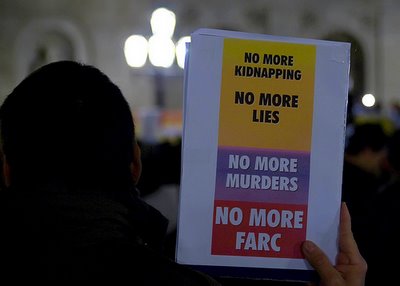
Kidnapping is common in Colombia, with over 21,000 known victims in the last 12 years, 3,167 of whom remain in captivity. Massive protests of kidnapping, and public demand for the liberation of the victims have received worldwide publicity. During this month, there have been very few days when the media did not mention a victim of kidnapping, or his/her release. The guerrilla groups, the FARC and the ELN, use the ransoms to help finance their programs. (Additionally these groups also blockade and rob travelers on highways—a tactic known as “miraculous fishing,” and are involved in the drug trade.) Other groups also kidnap people for ransom, but kidnapping by guerrilla groups is most loudly denounced.

The psychosocial implications of the impact of constant and innumerable deaths, disappearances, tortures, kidnappings, threats of violence, displacements and aggressions against the civilian population throughout the length and breadth of the country, in addition to the grave implications of entire generations marked by violence are compounded by the economic effects of the war economy that has created the terrible phenomenon of impoverishment throughout the Colombian population.

Currently, according to CEPALC (The Peoples’ Communication Center of Latin American), 63 per cent of Colombians live in poverty on less than $2 a day and of that group, 32 per cent live in absolute poverty on less than $1 daily. At the same time 1.8 per cent of the richest Colombians control approximately 68 per cent of the wealth and capital of the country. (Compare to the US where the richest one per cent controls about 55% of the national wealth.) 6,000 of the largest landowners control 50 million hectares of land while 3 million small farmers (campesinos, literally, “country people”) share around 7 million hectares, an area which is constantly being reduced by the difficulties of agricultural production, violence and the threats of armed groups.

At the same time the current administration is spending record breaking amounts on the war, deepening the critical problems of the country and creating a dangerous economic dynamic around “national security,” which in addition to being onerous is also ineffective at fulfilling the government’s own goals.

Increases in military spending directly correspond to the increases in the rates of poverty among the population. A recent year’s defense budget of over $9.7 billion makes Colombia the country with the third highest military budget (by percentage of GNP) in the world, at 6.3 per cent. (The US, even with the Iraq and Afghanistan wars, spends around 4.04 per cent of GNP.)

This increase in military spending is obviously one cause of decreases in spending for health, education, housing, pensions, public services, infrastructure, sports and other vital elements for development. As a comparison, consider that there are five Colombian soldiers for every 1,000 civilians but only one doctor for every 3,800 persons. (“And that doctor is limited to serving only paying patients, so most of us use herbal medicines and other home remedies to keep well. This may be like the US medical system.”) If we take into account that not only members of the armed forces are involved in efforts to ensure “national security,” we also note that of 556,000 public employees, 460,000 are working in the area of defense, security or as police. By the account of the Colombian Defense Department, each soldier costs $7,900 each year (up from $3,500 in 1999) while the Ministry of Education says that each student in public school is budgeted to receive a little less than $900/year.

The US government is supporting this onerous war machine, too, with $320 million as a part of the Patriot Plan (the successor to the first and second phases of Plan Colombia that gave the Colombian government $580 million over the last ten years of both Democratic and Republican administrations.) Additionally, the US has provided over $150 million in technological and logistical assistance and in military equipment (“mostly obsolete”). There are large amounts of military supplies being stored in depots, far more than the Army can currently use.

Why then, cannot the 415,000 members of the Colombian Armed Forces (aided by an estimated 21,000-30,000 paramilitary members) defeat the guerrilla groups FARC (15,000 members) and the ELN (7,500 members)? Paraphrasing Noam Chomsky, “Winning a war is not good business.” Recent events also seem to indicate that the US is nudging the Uribe government into a proxy war with Venezuela. (See below.)
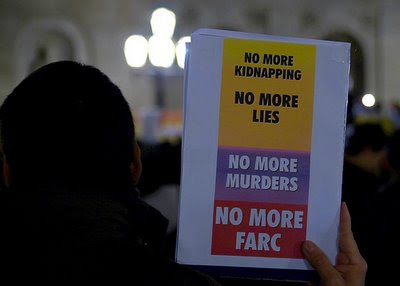

What are (some) Colombians afraid of?

Colombian friends have spoken often of the desire to end the “culture of violence” they experience daily. Although in the capital, Bogotá, life seems pretty normal to most people who do not have contact with the hordes of displaced people who have fled to the slum neighborhoods around the city, there are many reminders of the ongoing war, not to mention the other effects outlined in the article above.

In Colombia, all men between the ages of 18 and 50 (!) are obliged to serve in the military. Most expect to serve around the ages of 18-20, when those who have access to higher education complete their bachillerato, a degree similar to an AB from a junior college in the US. Young men studying for this degree or in seminary, heads of households, handicapped, and some others are legally entitled to deferment, if not exemption from military service, although conscientious objection for religious or moral reasons is not recognized. The Colombian Mennonite Church has led efforts to achieve recognition of CO’s for many years.

One event that affected the group of Conscientious Objectors was a massive roundup of young men for military service in February of this year. While some young men volunteer for military service (daily during the evening news there is a Colombian version of the “Be all you can be” advertisement), most are forcibly recruited — swept up by the authorities outside movie theaters or in parks, on their way to work, or even outside schools. On February 12, 2008, over 30,000 young men were taken, in the largest dragnet in the history of the country. Some, like a CO we spoke to, had received draft notices to report to a center. When he and some 3,000 others arrived they were processed and immediately sent to an Army camp. He had the assistance of the CO group, and was able, after 12 hours of protesting, to be let go with a citation to return in a few months. Others were not so fortunate, and the CO groups are still fighting in the courts for the release of youths entitled to legal exemptions as well as COs.

But those are not the only concerns the COs expressed. They have heard that these new recruits — some of whom should never have been taken — have been sent after brief training to the border areas with Venezuela and Ecuador where many troops are being massed. Although relations with Ecuador have improved after Colombia´s raid on guerrilla camps across the border in March, saber-rattling on both sides of the Colombian-Venezuelan border continues. News stories of Venezuela´s efforts to increase its military might, including its display of newly acquired missiles, are added to the coverage of President Chavez´ defiant statements opposing US military aid to Colombia. “I think there’s a propaganda campaign preparing us to wage a proxy war against Venezuela,” said one CO, “and the troop buildup on the borders seems to point to a possible war as well, not to mention the stockpiling of military equipment.”

While much of the US peace movement’s attention is (rightly) focused on the Middle East, we should remember that US interests are strong in Latin America and that Colombia is the third largest recipient of US military aid. On Sunday (June 8) President Chavez called for an end of the guerrilla war in Colombia and a unilateral release of all the kidnapped hostages. “You in the FARC should know that the war has become the excuse for the Empire to threaten us all. The day there is peace in Colombia, there will no longer be any excuse for a US Empire.” It seems he is also concerned about a possible proxy war.

The Rag Blog

Posted in Rag Bloggers | Tagged , , , , | Leave a comment

FILM : Hollywood’s Response to War


How Vietnam Gave us Dude, Where’s My Car
By Michael Bronski

One of the most amazing cultural responses to the war against Iraq has been the plethora of documentary and feature films produced by independent companies and even Hollywood studios. From In the Valley of Elah, Grace is Gone, and Stop-Loss to Redacted, Taxi to the Dark Side, and Standard Operating Procedure, this ongoing nightmare of a war is being discussed, analyzed, and attacked by filmmakers within a wide array of disciplines and political backgrounds

In the 1960 and 1970s the response to the Vietnam War was totally different. Sure there were some films that addressed it—Brian de Palma’s early independent Greetings (1968) and Emile de Antonio’s documentary In the Year of the Pig (1968), as well as a few other movies. Vietnam was obviously the inspiration for Robert Altman’s M*A*S*H (1970), and metaphorically for a few other films, but it was much later—a full decade—that we began getting mainstream films that dealt with the war in various ways: Deer Hunter (1978), Coming Home (1978), Apocalypse Now (1979). Years after that more films were made and released: Platoon (1986), Full Metal Jacket (1987), Hamburger Hill (1987), Good Morning, Vietnam (1987), and Born on the 4th of July (1989).

The more I thought about the quirks of popular culture and film culture, it seemed to me that Hollywood did have a very visceral response to the senseless slaughter of young Americans in Vietnam (though it didn’t really care to think about the millions of Vietnamese deaths or casualties). Beginning in 1978 with the release of Halloween and a slew of other slasher films, Hollywood was responding to the senseless slaughter of young American lives in its own peculiar way. Friday the 13th came out in 1980, A Nightmare on Elm Street in 1984. These quickly evolved into ongoing series that betrayed a national preoccupation with the deaths of young people. Along with these, a host of other films—Prom Night (1980), Terror Train (1980), My Bloody Valentine (1981), Happy Birthday to Me (1981), Slumber Party Massacre (1982)—drew huge audiences (and little critical approval) as the genre hit some nerve with viewers throughout the country.

Certainly the few Vietnam films that were released in the late 1980s could not be the only response to the national tragedy and crisis. But then it occurred to me that while Hollywood always liked a good war—although, apparently not in this case—what really moved it was the U.S. losing the war in Vietnam. This loss was a tremendous blow to the idea of American manhood. Clearly, this manhood had to be psychically restored in mass consumer culture. And made to order came butch, strong men who let nothing stand in their way of success.

First there was Rocky (1976) in which Sly Stallone turned the boxing ring into a war. As the series caught on to his real meaning he was pitted against Russian thugs to make sure that we won the Cold War. Arnold S. did Rocky one better as an indescribable cyborg in Terminator (1984). He continued with Commando in 1985, Raw Deal in 1986, and Running Man and Predator in 1987. All of these had post-Vietnam and Cold War contexts and guess what—Arnold won everything. At the end of this cycle came Bruce Willis in Die Hard (1988).

The subtext of these films was the reassertion of a masculinity so extreme, so powerful, so conclusive that it was super-human. Massive and casual death was the narrative of these films—and the disposibility of other bodies was the drive. They all did that with a grave disregard for morality or honesty.

After so much straining and huffing and puffing these unholy three petered out and the genre passed into film history (the actors, unfortunately, did not). America was tired, apparently, of proving that it could have won in Vietnam and moved on to what seemed to be a completely antithetical genre: the stoner buddy movie. These films are an outright rejection of the Stallone/ Schwarzenegger/Willis mythos. They featured teenaged boys; they did not promote violence, but a charmingly pot-riddled sense of make love, not war. They were wedded to a view that was both naively innocent and anti-rational. They insisted on being as non-traditionally masculine as possible. America’s romance with the brute had been replaced with a new love affair: the clever, innocent, but haplessly wrecked teen boy. It was an improvement.

Bill & Ted’s Excellent Adventure in 1989 gave way to Bill & Ted’s Bogus Journey in 1991, and then Dazed and Confused in 1993. The one salient theme was the refusal to take anything seriously. In what seemed to be a rebuke to the death-obsessed antics of the unholy three, these guys didn’t even take death seriously. As slight and silly as it was, it was preferable to killing machines.

The next evolution in these films—and we see it in 1994’s Dumb and Dumber (1994) and Kevin Smith’s characters Jay and Silent Bob in Dogma (1999) and Jay and Silent Bob Strike Back (2001)—is the queer subtexts of these films that keeps emerging. While the guys in Dumb and Dumber (not really stoners, but acting in the same way) were heterosexual, they were too dumb to know how to act heterosexual. And Jay, of Jay and Silent Bob, is a complete semi-closet case. This rejection of masculinity included, to a large degree, also getting rid of not only the trappings of heterosexuality, but heterosexuality itself at some points.

By the time we get to Dude Where’s My Car in 2000, the guys are straight—they remember they have girlfriends when they are able to, often they are just too wasted to think about it—but they have no problem acting like they are a couple. It’s true that in Harold and Kumar Go to White Castle (2004)—a demented son of Dude, Where’s My Car—they are more actively interested in women, but they are still fleeing any sort of traditional masculinity. Their refusal to think about the realities of world politics in any conscious way makes these films profoundly apolitical.

It may be too much to expect stoner films to deal with political realities—they exist precisely to deal with them by ignoring them—but the fact is that, unlike the 1960s and 1970s when films avoided the harsh, ugly realities of war, we are blessed today with films that deal with most aspects of our current political crisis.

And we have some fun stoner comedies as well that aptly and neatly critique the very notions of masculinity that have brought us into, and continue, this mess.

[Michael Bronski is the author of numerous articles and books including Pulp Friction: Uncovering the Gold- en Age of Gay Male Pulps. He has been a visiting professor in Women’s and Gender Studies and Jewish Studies at Dartmouth College since 1999.]

Source. / ZMag / Posted July 1, 2008

The Rag Blog

Posted in RagBlog | Tagged , , , , , , | 1 Comment

South African Human Rights Activists Shocked By Palestinian Refugee Camp

Palestinian mourners carry the body of Al-Aqsa Martyrs Brigades militant Hani Al-Kabi who was killed in an Israeli army raid in the Balata refugee camp, during his funeral in the West Bank town of Nablus, Friday, April 18, 2008. Photo by Nasser Ishtayeh / AP

Twilight Zone: ‘Worse than apartheid’
By Gideon Levy / July 15, 2008

I thought they would feel right at home in the alleys of Balata refugee camp, the Casbah and the Hawara checkpoint. But they said there is no comparison: for them the Israeli occupation regime is worse than anything they knew under apartheid. This week, 21 human rights activists from South Africa visited Israel. Among them were members of Nelson Mandela’s African National Congress; at least one of them took part in the armed struggle and at least two were jailed. There were two South African Supreme Court judges, a former deputy minister, members of Parliament, attorneys, writers and journalists. Blacks and whites, about half of them Jews who today are in conflict with attitudes of the conservative Jewish community in their country. Some of them have been here before; for others it was their first visit.

For five days they paid an unconventional visit to Israel – without Sderot, the IDF and the Foreign Ministry (but with Yad Vashem, the Holocaust Memorial and a meeting with Supreme Court President Justice Dorit Beinisch. They spent most of their time in the occupied areas, where hardly any official guests go – places that are also shunned by most Israelis.

On Monday they visited Nablus, the most imprisoned city in the West Bank. From Hawara to the Casbah, from the Casbah to Balata, from Joseph’s Tomb to the monastery of Jacob’s Well. They traveled from Jerusalem to Nablus via Highway 60, observing the imprisoned villages that have no access to the main road, and seeing the “roads for the natives,” which pass under the main road. They saw and said nothing. There were no separate roads under apartheid. They went through the Hawara checkpoint mutely: they never had such barriers.

Jody Kollapen, who was head of Lawyers for Human Rights in the apartheid regime, watches silently. He sees the “carousel” into which masses of people are jammed on their way to work, visit family or go to the hospital. Israeli peace activist Neta Golan, who lived for several years in the besieged city, explains that only 1 percent of the inhabitants are allowed to leave the city by car, and they are suspected of being collaborators with Israel. Nozizwe Madlala-Routledge, a former deputy minister of defense and of health and a current member of Parliament, a revered figure in her country, notices a sick person being taken through on a stretcher and is shocked. “To deprive people of humane medical care? You know, people die because of that,” she says in a muted voice.

The tour guides – Palestinian activists – explain that Nablus is closed off by six checkpoints. Until 2005, one of them was open. “The checkpoints are supposedly for security purposes, but anyone who wants to perpetrate an attack can pay NIS 10 for a taxi and travel by bypass roads, or walk through the hills.

The real purpose is to make life hard for the inhabitants. The civilian population suffers,” says Said Abu Hijla, a lecturer at Al-Najah University in the city.

In the bus I get acquainted with my two neighbors: Andrew Feinstein, a son of Holocaust survivors who is married to a Muslim woman from Bangladesh and served six years as an MP for the ANC; and Nathan Gefen, who has a male Muslim partner and was a member of the right-wing Betar movement in his youth. Gefen is active on the Committee against AIDS in his AIDS-ravaged country.

“Look left and right,” the guide says through a loudspeaker, “on the top of every hill, on Gerizim and Ebal, is an Israeli army outpost that is watching us.” Here are bullet holes in the wall of a school, there is Joseph’s Tomb, guarded by a group of armed Palestinian policemen. Here there was a checkpoint, and this is where a woman passerby was shot to death two years ago. The government building that used to be here was bombed and destroyed by F-16 warplanes. A thousand residents of Nablus were killed in the second intifada, 90 of them in Operation Defensive Shield – more than in Jenin. Two weeks ago, on the day the Gaza Strip truce came into effect, Israel carried out its last two assassinations here for the time being. Last night the soldiers entered again and arrested people.

It has been a long time since tourists visited here. There is something new: the numberless memorial posters that were pasted to the walls to commemorate the fallen have been replaced by marble monuments and metal plaques in every corner of the Casbah.

“Don’t throw paper into the toilet bowl, because we have a water shortage,” the guests are told in the offices of the Casbah Popular Committee, located high in a spectacular old stone building. The former deputy minister takes a seat at the head of the table. Behind her are portraits of Yasser Arafat, Abu Jihad and Marwan Barghouti – the jailed Tanzim leader. Representatives of the Casbah residents describe the ordeals they face. Ninety percent of the children in the ancient neighborhood suffer from anemia and malnutrition, the economic situation is dire, the nightly incursions are continuing, and some of the inhabitants are not allowed to leave the city at all. We go out for a tour on the trail of devastation wrought by the IDF over the years.

Edwin Cameron, a judge on the Supreme Court of Appeal, tells his hosts: “We came here lacking in knowledge and are thirsty to know. We are shocked by what we have seen until now. It is very clear to us that the situation here is intolerable.” A poster pasted on an outside wall has a photograph of a man who spent 34 years in an Israeli prison. Mandela was incarcerated seven years less than that. One of the Jewish members of the delegation is prepared to say, though not for attribution, that the comparison with apartheid is very relevant and that the Israelis are even more efficient in implementing the separation-of-races regime than the South Africans were. If he were to say this publicly, he would be attacked by the members of the Jewish community, he says.

Under a fig tree in the center of the Casbah one of the Palestinian activists explains: “The Israeli soldiers are cowards. That is why they created routes of movement with bulldozers. In doing so they killed three generations of one family, the Shubi family, with the bulldozers.” Here is the stone monument to the family – grandfather, two aunts, mother and two children. The words “We will never forget, we will never forgive” are engraved on the stone.

No less beautiful than the famed Paris cemetery of Pere-Lachaise, the central cemetery of Nablus rests in the shadow of a large grove of pine trees. Among the hundreds of headstones, those of the intifada victims stand out. Here is the fresh grave of a boy who was killed a few weeks ago at the Hawara checkpoint. The South Africans walk quietly between the graves, pausing at the grave of the mother of our guide, Abu Hijla. She was shot 15 times. “We promise you we will not surrender,” her children wrote on the headstone of the woman who was known as “mother of the poor.”

Lunch is in a hotel in the city, and Madlala-Routledge speaks. “It is hard for me to describe what I am feeling. What I see here is worse than what we experienced. But I am encouraged to find that there are courageous people here. We want to support you in your struggle, by every possible means. There are quite a few Jews in our delegation, and we are very proud that they are the ones who brought us here. They are demonstrating their commitment to support you. In our country we were able to unite all the forces behind one struggle, and there were courageous whites, including Jews, who joined the struggle. I hope we will see more Israeli Jews joining your struggle.”

She was deputy defense minister from 1999 to 2004; in 1987 she served time in prison. Later, I asked her in what ways the situation here is worse than apartheid. “The absolute control of people’s lives, the lack of freedom of movement, the army presence everywhere, the total separation and the extensive destruction we saw.”

Madlala-Routledge thinks that the struggle against the occupation is not succeeding here because of U.S. support for Israel – not the case with apartheid, which international sanctions helped destroy. Here, the racist ideology is also reinforced by religion, which was not the case in South Africa. “Talk about the ‘promised land’ and the ‘chosen people’ adds a religious dimension to racism which we did not have.”

Equally harsh are the remarks of the editor-in-chief of the Sunday Times of South Africa, Mondli Makhanya, 38. “When you observe from afar you know that things are bad, but you do not know how bad. Nothing can prepare you for the evil we have seen here. In a certain sense, it is worse, worse, worse than everything we endured. The level of the apartheid, the racism and the brutality are worse than the worst period of apartheid.

“The apartheid regime viewed the blacks as inferior; I do not think the Israelis see the Palestinians as human beings at all. How can a human brain engineer this total separation, the separate roads, the checkpoints? What we went through was terrible, terrible, terrible – and yet there is no comparison. Here it is more terrible. We also knew that it would end one day; here there is no end in sight. The end of the tunnel is blacker than black.

“Under apartheid, whites and blacks met in certain places. The Israelis and the Palestinians do not meet any longer at all. The separation is total. It seems to me that the Israelis would like the Palestinians to disappear. There was never anything like that in our case. The whites did not want the blacks to disappear. I saw the settlers in Silwan [in East Jerusalem] – people who want to expel other people from their place.”

Afterward we walk silently through the alleys of Balata, the largest refugee camp in the West Bank, a place that was designated 60 years ago to be a temporary haven for 5,000 refugees and is now inhabited by 26,000. In the dark alleys, which are about the width of a thin person, an oppressive silence prevailed. Everyone was immersed in his thoughts, and only the voice of the muezzin broke the stillness.

Source. / Haaretz.com

Thanks to Larry Piltz / The Rag Blog

Posted in RagBlog | Tagged , , , , , , , , | 1 Comment