The Rag Blog / Posted July 8, 2008

Just two days ago, Gordon Brown was urging us all to stop wasting food and combat rising prices and a global shortage of provisions.
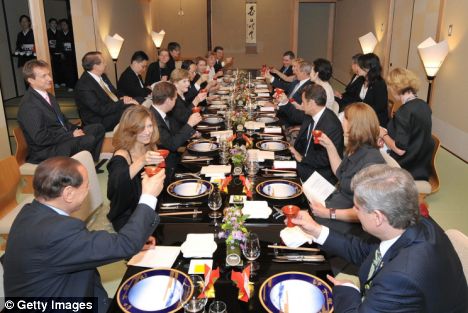
But yesterday the Prime Minister and other world leaders sat down to an 18-course gastronomic extravaganza at a G8 summit in Japan, which is focusing on the food crisis.
The dinner, and a six-course lunch, at the summit of leading industrialised nations on the island of Hokkaido, included delicacies such as caviar, milkfed lamb, sea urchin and tuna, with champagne and wines flown in from Europe and the U.S.
But the extravagance of the menus drew disapproval from critics who thought it hypocritical to produce such a lavish meal when world food supplies are under threat.
He suggested we could save up to £8 a week by making our shopping go further. It was vital to reduce ‘unnecessary demand’ for food, he said.
Last night’s dinner menu was created by Katsuhiro Nakamura, the first Japanese chef to win a Michelin star. It was themed: Hokkaido, blessings of the earth and the sea.
But Dominic Nutt, of the charity Save the Children, did not approve.
‘It is deeply hypocritical that they should be lavishing course after course on world leaders when there is a food crisis and millions cannot afford a decent meal,’ he said.
‘If the G8 wants to betray the hopes of a generation of children, it is going the right way about it. The food crisis is an emergency and the G8 must treat it as that.’
In 2005, at the G8 summit in Gleneagles, Scotland, world leaders promised to increase global aid by £25billion a year by 2010 and raise aid to Africa, the world’s poorest continent, by £12.5billion. But the bloc of rich nations is only 14 per cent of the way towards hitting its target.
Britain is meeting its commitments in full, but other countries are understood to be dragging their feet – and there are fears the figures on global aid could be watered down.
French President Nicolas Sarkozy and Italian leader Silvio Berlusconi, who face pressure to cut spending at home, are understood to be leading the charge to weaken the Gleneagles proposal.
Tory international development spokesman Andrew Mitchell said: ‘The G8 have made a bad start to their summit, with excessive cost and lavish consumption.
‘Surely it is not unreasonable for each leader to give a guarantee that they will stand by their solemn pledges of three years ago at Gleneagles to help the world’s poor.
‘All of us are watching, waiting and listening.’

Yesterday the European Union agreed to channel £800million in unused European farm subsidies to African farmers, as part of its response to the global food crisis.
‘The EU really can give a boost to agriculture in developing countries,’ Jose Manuel Barroso, president of the European Commission, told the meeting.
The money will be used to buy seed and fertiliser and fund agriculture projects in Africa.
The meal was served at the Windsor Hotel, on the shores of Lake Toya, where the presidential suite costs £7,000 a night.
Japan has spent a record sum of money and deployed about 20,000 police to seal off the remote lakeside town of Toyako for the three-day talks.
Source. / The Huffington Post
The Rag Blog

Obama, Keep Your Hands Off My Faith-Based Initiative
by Jim Moss / July 6, 2008
[Jim Moss is a Presbyterian minister from York, South Carolina. He publishes a blog and a quarterly newsletter called “Discipline for Justice,” which focuses on ways North Americans can live lives that promote peace and economic justice.]
Last week, Obama spoke out in favor of expanding Bush’s faith-based initiative program, part of a predictable and consistent move to the center.
“I’m not saying that faith-based groups are an alternative to government or secular non-profits. I’m not saying that they’re somehow better at lifting people up. What I’m saying is that we all have to work together — Christian and Jew, Hindu and Muslim; believer and non-believer alike — to meet the challenges of the 21st Century.”
Naturally, the secular left is not happy about this development. But neither are many on the spiritual left. Speaking as a progressive, as an ordained minister in the Presbyterian Church (USA), and as someone who has successfully organized a church-based food pantry, I have a message for Obama and any other politician who is making the sacred task of outreach ministry a tool of political pandering:
Get your hands off my faith-based initiative! We don’t want any of your government money getting in the way of our work.
It’s a bad idea for a number of reasons:
1) Over-Regulation. The government never just gives you money. There are always rules and regulations, mountains of paperwork, and any number of hoops to jump through – sometimes they make sense, sometimes they don’t. This extra work always seems to stand in the way of doing the real work at hand.
2) The Fickle Nature of Politics. Government funding can get turned on and off like a faucet, depending on the political climate . Entire agencies can get the ax simply because a new administration comes in with different priorities. Charities need to depend on consistent money sources that are not politicized.
3) Strings Attached. There really is no such thing as a free lunch. Government funding equals a government agenda, and the political issues of the day will certainly affect where the funding goes. Instead of the meeting the greatest needs of the people, the money will tend to go where it makes the elected officials look best.
4) Separation of Church and State. This is one area where I agree with atheists. Looking back through history, it’s clear that when government and religion are in cahoots, bad things tend to happen. They need to be a check on one another’s power, and the line between them needs to stay crystal clear. This program blurs that line.
5) A Higher Calling. Feeding the poor, tending the lame, caring for the widow and the orphan. These are some of the most sacred tasks for Christians and for other religions. Using government money to do these tasks is not acceptable. Individuals are called to give of their time and money because giving is a central part of what we believe. It is part of building a community that takes care of one another. Being funded with government money raised through taxation cheapens this noble task. The government certainly has its role in meeting the needs of the people, but this does not come through doing for the faithful what they should be doing themselves.
So thanks, Barack, but no thanks. Our charities are not another pawn in the chess game of this election.
Source. / The Seminal
Also see Obama’s Faith-Based Folly / The Progressive
The Rag Blog

And the words that are used for to get the ship confused will not be understood as they are spoken…
And like Pharaoh’s tribe they’ll be drowned in the tide and like Goliath they’ll be conquered.Money doesn’t talk it swears. Propaganda all is phony
Bob Dylan
Why we need Barack Obama now
By Robert Pardun / The Rag Blog / July 8, 2008
[Robert Pardun — an activist in Austin in the sixties and a contributor to the underground paper, The Rag — was a national officer of Students for a Democratic Society (SDS). He is the author of Prairie Radical : A Journey Through the Sixties. Robert now lives in the mountains near Santa Cruz, California.]
This is to express my solidarity with those of us out there working for the election of Barack Obama. I have seen many election cycles come and go and in general what we learned during the sixties is still true today—those with money use government for their own private ends. The Bush Administration has been the most blatant I can remember in taking from the poor and giving to the rich. One has only to look at the war in Afghanistan and Iraq to see this. With the money spent to occupy and then militarily control those two countries we could have rebuilt every school, every bridge, and every road in the United States. In addition we could have universal health care for everyone and funded research in alternative energy sources. In the movie “The Graduate” Dustin Hoffman is told that the wave of the future was in plastics. Today it is in batteries.
About ten years ago I read about a survey of attitudes of the American people concerning work, war, family and the like. The conclusion was that there is within America a sizable contingent of people who maintain the attitudes of the counterculture of the 1960s and 70s. These people make up a substantial part of Obama’s support and many are actively involved in his campaign. These are people who send in the checks for fifteen or twenty dollars and who sit behind card tables at the local grocery store encouraging people to vote. They are us and a new generation that learned from us.
During the sixties we wondered why defacto slavery still existed in parts of the South even though the Civil War had been fought a hundred years before. Culture changes slowly as new ideas become commonly accepted. Obama represents the ideals of the sixties even though he wasn’t there, and the younger generations like Obama because he represents a different way of looking at the world.
Is Obama a revolutionary? Hardly! If he was you would never have heard of him. Besides we are not in a revolutionary period. But he does stand for a more open government and that is important. We have a much better chance of getting the draconian drug laws changed with Obama. The drug war is known to have been a campaign gimmick of Nixon targeted at the black liberation movement and the anti-war movement. We should concentrate on repealing those laws. We used to say that we needed to work to stop the seventh war from now. Well we’ve already passed that point but with a President who is willing to think about alternatives we stand a chance of stopping the automatic reflex of attacking what we don’t like first and talking about it later. In addition we must change the way the government treats the people it “puts in harm’s way.” The treatment of veterans is absolutely scandalous and must be changed.
This election is the third in my lifetime in which I thought the democratic candidate might actually make a difference. After wondering why anyone would say that he smoked marijuana but didn’t inhale I voted for Clinton. With Obama we stand a change of actually changing things for the benefit of the people. Instead of taking the people’s money and using it to benefit the military-industrial complex we could actually use it to better the condition of the people who work hard to keep body and soul together.
The Rag Blog

The Christian Defense Coalition held their anti-Obama press conference today — “An Appeal to Catholics Regarding the 2008 Presidential Election” — complete with the “I want you to pay for abortions” Obama-as-Uncle-Sam picture (see below)… as well as some other interesting material.
Such as: this image of slavery (above), invoked in the CDC’s literature to argue that there is nothing wrong with Catholics being “single issue” voters on abortion.
Argues the CDC: “if that issue involves a fundamental right, such as the right to life for a certain group of human beings, and there is only one morally legitimate position on that issue…no faithful Catholic would vote for a candidate who, although ‘personally opposed to slavery,’ supported ‘a white man’s right to choose’ to own slaves.”
Click HERE to see the context of the slavery mention as well as the other controversial materials. (Note: we did blur out one image of an aborted fetus.)
Obama’s Abortion Kerfuffle
Sen. Barack Obama, D-Illinois, and his views on abortion have been confounding some observers these days.And perhaps that’s in no small way the reason why the controversial Christian Defense Coalition is launching a new campaign focused on painting Obama as “The Abortion President.”
Check out THIS IMAGE of Obama as Uncle Sam: “I Want YOU To Pay for Abortions,” courtesy of CBN’s Brody File.
Rev. Patrick J. Mahoney, director of the Christian Defense Coalition, says Obama would have “the most extremist policies on abortion of any President in history. Senator Obama’s views on abortion are so radical that he even wants American citizens to pay for them. This would include Catholics, Evangelicals and all people of faith. He would also expand abortion rights through his passionate support of The Freedom of Choice Act.”
This ad becomes relevant within the context of Obama’s attempts to win over evangelical voters — some of whose votes may be up for grabs given Obama’s comfort discussing his Christian faith and their distrust of Sen. John McCain, R-Ariz. — Obama’s support for abortion rights will assuredly be a sticking point.
Obama’s desire to win these voters may be why, in a recent interview with Relevant magazine, (“Covering God, Life, and Progressive Culture”) Obama seemed to be moving rightward on the issue — rhetorically, at least — saying:
“I have repeatedly said that I think it’s entirely appropriate for states to restrict or even prohibit late-term abortions as long as there is a strict, well-defined exception for the health of the mother. Now, I don’t think that ‘mental distress’ qualifies as the health of the mother. I think it has to be a serious physical issue that arises in pregnancy, where there are real, significant problems to the mother carrying that child to term. Otherwise, as long as there is such a medical exception in place, I think we can prohibit late-term abortions.”
The language Obama used in that response seemed to remove “mental distress” as an allowable exception justifying a post-22 week abortion.
To some observers, that would seem to go against the Supreme Court decision Doe v. Bolton — handed down the same day as the more famous (or infamous) Roe v Wade decision legalizing abortion, though the Court said the decisions were to be “read together.”
Doe holds that the health exception permitting abortion after viability should be based on a “medical judgment…exercised in the light of all factors — physical, emotional, psychological, familial, and the woman’s age — relevant to the wellbeing of the patient,” as ABC News’ Supreme Court reporter Jan Crawford Greenburg noted over the weekend.
So was Obama suggesting to Relevant that he disagrees with Doe?
That would seem to contradict Obama’s support for the “Freedom of Choice Act,” which codifies in law a mental health exception for post-viability abortions, legislation that Obama has publicly supported.
The Obama campaign says no, that’s not what he was saying, and spokesfolk explained that the senator’s use of “mental distress” in the Relevant interview was not a reference to “mental illness.”
On Saturday, after a reporter noted to Obama that he had said that mental distress shouldn’t be a reason for late-term abortion, Obama clarified, “historically I have been a strong believer in a women’s right to choose with her doctor, her pastor and her family…I have consistently been saying that you have to have a health exception on many significant restrictions or bans on abortions including late-term abortions. In the past there has been some fear on the part of people who, not only people who are anti-abortion, but people who may be in the middle, that that means that if a woman just doesn’t feel good then that is an exception. That’s never been the case.”
Obama continued: “I don’t think that is how it has been interpreted. My only point is that in an area like partial-birth abortion having a mental, having a health exception can be defined rigorously. It can be defined through physical health, It can be defined by serious clinical mental-health diseases. It is not just a matter of feeling blue. I don’t think that’s how pro-choice folks have interpreted it. I don’t think that’s how the courts have interpreted it and I think that’s important to emphasize and understand.”
But if Obama is saying that “mental distress” is already not a legal exception for abortion bans, then what was the point of what he told Relevant? He maintains he wasn’t discussing any view that runs contrary to current abortion law, so it would seem he was just discussing a personal view — that a woman, 8 1/2 months pregnant, shouldn’t be able to get an abortion just because she’s feeling blue.
Some abortion opponents suggest that Obama was merely trying to muddy the waters and sound more centrist on the issue — as if his mind were open to some abortion bans, when in fact he was merely stating current law wrapped in some triangulating language.
J.P.T. / July 7, 2008
Source. / Political Punch / ABC News
The Rag Blog
The long-running showdown over the proposed US-Iraq treaty, aimed at legitimizing the American occupation of Iraq, is coming to a head, and it doesn’t look good for the United States.
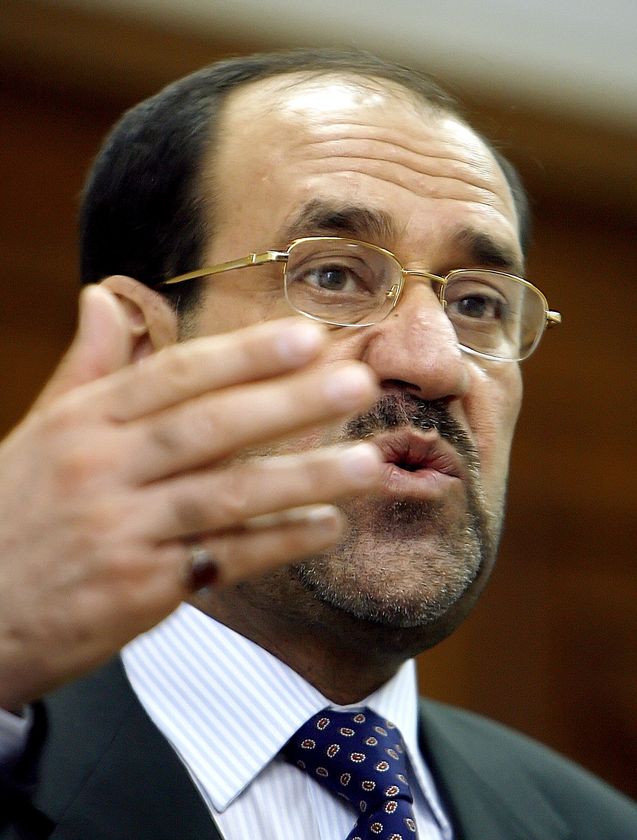
Prime Minister Nouri al-Maliki tossed a bombshell Monday. In a news conference about the still-secret US-Iraqi talks, which began in March, Maliki for the first time said that the chances of securing the pact are just about nil, and instead he said Iraq will seek a limited, ad hoc renewal of the US authority to remain in Iraq, rather than a broad-based accord.
More important, Maliki and his top security adviser, Mouwaffak al-Rubaie added that Iraq intends to link even a limited accord to a timetable for the withdrawal of US forces. Reports the Sydney Morning Herald:
Iraqi Prime Minister Nuri al-Maliki raised the prospect of setting a timetable for the withdrawal of US troops as part of negotiations over a new security agreement with Washington.
It was the first time the US-backed Shi’ite-led government has floated the idea of a timetable for the removal of American forces from Iraq. The Bush administration has always opposed such a move, saying it would benefit militant groups.
Rubaie strengthened his position today: “There should not be any permanent bases in Iraq unless these bases are under Iraqi control. … We would not accept any memorandum of understanding with (the US) side that has no obvious and specific dates for the foreign troops’ withdrawal from Iraq.”
Here’s the quote from Maliki:
“The current trend is to reach an agreement on a memorandum of understanding either for the departure of the forces or a memorandum of understanding to put a timetable on their withdrawal.”
Don’t think for a minute that Maliki, or his Shiite allies, want the US forces to leave. But they are under a lot of pressure. First of all, they are under pressure from Iran, whose regime remains the chief ally of the ruling alliance of Shiites, including Maliki’s Dawa party and the powerful Islamic Supreme Council of Iraq (ISCI), led by Abdel Aziz al-Hakim. Iran’s goal is to neutralize Iraq as a possible threat to Iran, and Iran’s leaders are pressuring Maliki and Hakim to loosen their reliance on the United States. Interestingly, Maliki reportedly told President Bush personally, in a video teleconference on Friday, that the United States cannot use Iraqi territory to attack Iran, and he added that “fomenting tension in the region and pushing for military action against Tehran could wreak havoc on the entire region, including Iraq.”
Maliki is also under pressure from a broad coalition of Iraqi nationalists, from angry, disenfranchised Sunnis to Muqtada al-Sadr’s movement.
But Maliki’s statement is a big deal. At a minimum, it presents an enormous problem for Bush and John McCain, who are arguing for an indefinite US stay in Iraq til “victory,” and who oppose a timetable. True, Maliki seems to be linking his timetable to Iraqi military success, which is not too different from the Bush-McCain formula. But inside Iraq, the pressure is building day by day for a US withdrawal, and Maliki is by no means in control of the process. The fact that both Iran and Sunni nationalists, who are on a collision course, agree that US forces need to leave Iraq, only means that pro- and anti-Iranian factions will settle their differences (either by peaceful diplomacy or by violence) once the United States is gone.
Another factor is that Maliki, who is visiting the United Arab Emirates, is working hard to gain the support of the Sunni-led Arab regimes for his shaky coalition. The UAE and Jordan have both announced that they will be sending ambassadors to Baghdad, and King Abdullah of Jordan will himself make a visit to Baghdad soon, the first by an Arab head of state since the US invasion.
Despite US bungling, it seems increasingly likely that Iran and Saudi Arabia are working behind the scenes to negotiate a Shiite-Sunni accord in Iraq, but both Tehran and Riyadh will want it conditioned on a US withdrawal.
Source. / The Nation
The Rag Blog
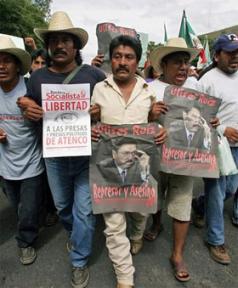
OAXACA and CHICAGO – On April 30, in the small village of Santo Domingo Ixcatlan, in Oaxaca, Mexico, a group of armed men from the paramilitary group the “White Guards” pulled over the car of carpenter Gustavo Castaneda Hernandez, a villager and vocal opponent of the sale of Santo Domingo’s communal land. The group, led by Freddy Eucario Morales Arias, the ex-mayor of Santo Domingo, rapidly blocked off the entrance and exit to the road with pickup trucks. The men began beating Hernandez, still trapped in his vehicle. They then set the car on fire. Hernandez was burned alive.
Meanwhile, two other villagers, Inocencio Medina Bernabe and Melesio Martinez Robles – a leader in the defense of communal land – rushed onto the scene, ostensibly in an attempt to aid Hernandez. The armed group killed both men, then dismembered Robles from the waist down and dragged his body through the street. The attackers lingered on the scene, drinking alcohol and listening to music for approximately six hours, witnesses said.
At 2:30 a.m., the State Preventative Police arrived on the scene, detained no one, and permitted all the armed men to return to their vehicles and drive away. The police had close affiliations with Arias. Under the former mayor’s guidance, from 2005 to 2007, the village had converted the local community center for children into a new headquarters for the State Preventative Police. Arias remains closely associated with the group.
Since the assassination, several more residents of Santo Domingo have been threatened. The community frequently hears gunshots at night and the paramilitaries – civilian groups armed and ordered by the government – have announced to the people that there will be further executions.
“Never in my 51 years have I seen anything like this,” a long-time Santo Domingo resident told Truthout. “Our community was always a peaceful one until Freddy Eucario Morales Arias came to power.”
However, this story of a village struck by government-entangled violence based on land disputes is, tragically, increasingly common in Oaxaca.
Only 29 percent of land in Oaxaca is privately owned – the rest is controlled by some form of collective system. In places like Santo Domingo, all agrarian issues are decided by those who work the communal land. Many government figures would like that reality to change, according to Suzy Shepard-Durini of the Council on Hemispheric Affairs.
“It would be in the interest of the government for communal land to be sold because the government can heavily tax any land that is not communal,” Shepard-Durini told Truthout. “Officials can also profit off the land by charging the people who live there fees for use of that land. If the natives don’t have legal ownership of the land, it is easy to exploit them or threaten them with relocation.”
Although it is unclear what specific economic interest the government holds in Santo Domingo’s land, the ongoing state-supported violence indicates that the government stands to profit from a sale, according to Maurilio Santiago Reyes, of the Center for Human Rights and Advice for Indigenous People.
Therefore, when land ownership conflicts emerge between villages or between individuals, self-serving government intervention often exacerbates the situation.
“This type of conflict is not uncommon in Oaxaca,” Santiago Reyes told Truthout. “One part of the community wants to sell and another does not; the government gets involved and makes matters worse.”
The turmoil in Santo Domingo originated from a conflict between the village and its neighboring town, Chalcotongo de Hidalgo, over a piece of communal land. The federal government offered to buy off participants in Santo Domingo’s communal land organization, “bienes comunales,” but most community members refused to abandon their way of life for a sum of money.
“We prefer to conserve our land,” one villager told Truthout. “We prefer to use this land agriculturally. If we sell, maybe a factory comes, they have the capital and we do the work. But if we conserve the land, we own the land, and we also work it.”
Several judicial orders have declared the land to be the property of Santo Domingo Ixcatlan.
In the state of Oaxaca alone, there are 656 similar documented agrarian conflicts. Of those cases, 53 are considered to be “hot spots,” or at great risk of developing into armed conflict.
During his tenure as mayor, Arias took over a portion of the land that is in conflict and began storing weapons there. Only Arias’ armed paramilitary followers were allowed inside that area. Arias then sought to sell the land in conflict to Chalcatongo. The current mayor of Chalcatongo, Guadalupe Susan Ruiz, is the cousin of Ulises Ruiz Ortiz, the governor of Oaxaca, with whom Arias also maintains ties, according to a piece written by his wife, published in La Jornada, a leading Mexican newspaper.
The government’s discontent over land ownership coincides with a rise in paramilitary violence, particularly in heavily indigenous areas.
According to a June 28 op-ed piece in La Jornada, federal military extension groups are now “openly occupying indigenous communities.”
“[Paramilitaries] act as a large fan of practices and processes of criminalizing social protest, with the purpose of containing the discontent of indigenous farming people,” the editorial states.
Paramilitaries routinely exploit regional land conflicts. The recent history of the land conflict between Santo Domingo and Chalcatongo has not been violent. In fact, citizens of Chalcatongo offered sympathy and economic support to the people of Santo Domingo Ixcatlan after the assassinations. Community leaders of Santo Domingo emphasize that the homicides were committed by state-sponsored paramilitaries in order to further political goals and that the paramilitaries are merely using the history of land conflict between the two towns as a cover for the politically motivated violence.
The Santo Domingo tragedies follow the usual course of much Mexican paramilitary intervention: Arias trained his followers in a state-sponsored military program, approved by the Oaxaca state government. When the Santo Domingo-Chalcotongo land dispute arose, Arias kicked into gear, planning to reward his paramilitary followers’ activism-suppressing efforts with 40 percent of the contested land and sell the other 60 percent to Chalcotongo, according to a Santo Domingo resident.
“Those paramilitaries want to push out anyone who does not want to sell the land to Chalcatongo so they can receive the government money,” he said.
The power – and routine use – of paramilitaries has risen in recent years, especially since Ruiz Ortiz became governor.
Ruiz Ortiz was widely criticized for his militarized response to striking teachers in Oaxaca City in 2006. Several people were killed and hundreds were arbitrarily detained. Since that time, the Popular Assembly of Oaxacan Peoples, a large social movement comprised of many civil society groups and governed by traditional indigenous leadership systems, has continued to call for Ruiz Ortiz’s resignation.
Santiago Reyes told Truthout that although the paramilitaries existed before the current governor’s rise to power, their influence has never been as blatant as during Ruiz Ortiz’s term.
Back in Santo Domingo, Arias is moving through a series of legal proceedings. Yet the town’s residents doubt much retribution will be served, especially since Arias maintains connections to Oaxaca’s governor.
Several weeks ago, police investigating the April assassinations were expelled from the community by the paramilitaries, leaving no police in town. Residents feared a nighttime massacre, ill-assured by the presence of the State Preventive Police – the same force that dismissed the assassinations at the scene of the crime. These days, Oaxacans find it difficult to trust any group linked to the state government to carry out peacekeeping duties.
“The Oaxaca state authorities have repeatedly used excessive force, sometimes lethal, to disperse protests against the controversial state governor,” states a late June report issued by Amnesty International. The report also correlates with Santo Domingo’s residents’ doubts that Arias will be fairly prosecuted, stating, “Those responsible have not been brought to justice.”
Meanwhile, last week, a group of paramilitary families who live on Santo Domingo’s disputed land came down the mountain and fired guns in the town square. All of those opposed to Morales Arias and his paramilitaries gathered in one house for safety.
So far, the Mexican federal government has not met with the people of Santo Domingo or taken any security measures on their behalf. Governor Ruiz Ortiz recently did meet with residents, and denied any connection to Arias, despite the statements of Arias, villagers, Reyes and Arias’ wife. Ruiz Ortiz also claimed that the conflict was merely one between two municipalities, and not a political struggle involving the state government or paramilitaries.
Mexican federal officials have not returned Truthout’s requests for comment.
State government representatives assert that they are working steadily to resolve Oaxaca’s agrarian conflicts.
“The government of Ulises Ruiz will never underestimate the importance of this subject,” said Encar Manuel Zamora Dominguez, a state official in charge of “agrarian reconciliation,” at a July 1 press conference.
Villagers across Oaxaca view such statements as doublespeak, pointing to the paramilitary-stoked and government-funded violence that persists in Santo Domingo and beyond.
[Theresa Kleinhaus is a peace activist and law student in Chicago, Illinois. She is working for the summer in Tlaxiaco, Oaxaca. Maya Schenwar is an editor and reporter for Truthout.]
Source. / truthout
The Rag Blog

Rep. Henry Waxman (D-Calif.), who has primary jurisdiction over the executive branch, is considering legislation to eliminate Karl Rove-type advisers in future administrations.
The chairman of the House Oversight and Government Reform Committee hints broadly that such a bill could ban the use of federal funds to finance such a politically partisan office.
“Why should we be using taxpayer dollars to have a person solely in charge of politics in the White House?” Waxman said in an interview. “Can you imagine the reaction if each member of Congress had a campaign person paid for with taxpayer dollars?”
Waxman, one of President Bush’s most dogged opponents, will decide in September whether to press ahead this year or wait until next in hope of having a Democratic president sign such a bill.
Waxman says the White House operates under looser political ethics rules than does Congress, where chiefs of staff and other high-ranking officials are prohibited from using government phones, computers and facilities for political purposes.
Rove focused on President Bush’s reelection while working on a West Wing salary during the first four years of the Bush administration.
As Bush’s senior adviser, Rove headed the Office of Political Affairs, which interacts with the party’s political committees, and the Office of Public Liaison, which works with outside groups such as business, religious and advocacy organizations that want to communicate with the president.
Rove’s political activity at the White House sparked fierce disputes with congressional Democrats.
They accused Rove of making the White House too political, pointing to reports that Rove told political appointees throughout the administration to stage official announcements and federal grants in ways that would help Republican candidates.
Waxman’s committee found that senior White House aides sent tens of thousands of political communications through government e-mail accounts. This led to a public fight over copies of the messages, many of which were erased because Bush advisers stopped using an e-mail archiving system dating from the Clinton administration.
Bush spokesman Scott Stanzel defended the White House political office.
“This administration, like [former] President [Bill] Clinton did in his time in office, determined it was appropriate for the head of the party to have a specific office to interface with political committees,” he said. “Any future president will have to make those determinations for himself.”
Waxman wants legislation to strengthen electronic record-keeping in future administrations. He has introduced an electronic records bill along with legislation that would require presidential libraries to disclose donor information. He introduced a sweeping executive branch reform bill in 2007 that would implement some ethics rules similar to those Congress adopted for itself after Democrats won the House and Senate.
But Waxman has yet to unveil his proposal for eliminating the White House Office of Political Affairs.
The idea is likely to provoke controversy and even scorn in a town where politics in the White House is considered akin to drinking in a sports bar.
“The notion of taking politics out of governing is silly,” said Rich Galen, a GOP strategist, in reference to Waxman. “I understand what he’s getting at, but Rove would have had the influence he had no matter what his title was and what his duties were.”
Galen and other operatives interviewed said that future White Houses would find ways to get around restrictions on political activity, such as by outsourcing political strategy to the Republican National Committee or letting aides handle it unofficially.
Recognizing the complexity of the issue, Waxman wants to interview political aides from the Bush and Clinton administrations before crafting his proposal.
“We are going to bring in people from the Bush administration and the Clinton administration and talk it through,” he said. “We want to get people’s thoughts on it.”
It’s unclear how Sen. Barack Obama (Ill.), the expected Democratic presidential nominee, would view Waxman’s proposal. His aides did not respond to a request for comment.
Richard Norton Smith, a presidential historian at George Mason University, said that the Bush administration is the culmination of the growing politicization of the White House over the last few decades.
“I think this is something that’s been growing for the last 40 years,” said Smith, who said the trend began with former President John F. Kennedy, whom he described as very “image-conscious.”
“You really have to go back to Truman and Eisenhower to find presidents who didn’t spend a lot of time worrying about their political images,” said Smith.
Smith said he doubted eliminating the White House political office would make the future presidencies any less political. Nevertheless, he acknowledged the problem of excessive politicking in the West Wing.
Smith said banning future Roves is “attacking a symptom.”
“The disease is the inability to distinguish between campaigning and governance and the extent the two have become fused,” he said.
Lawmakers and their aides must abide by stricter rules dividing government business and political activity than senior administration officials.
Republican senators and representatives, for example, hold conference meetings at party committee headquarters whenever they plan to discuss fundraising and other political topics.
Congressional aides must also use personal or campaign-issued cell phones and BlackBerrys to send political communications.
Executive-branch officials are governed by the Hatch Act, which details what activities are accepted and which are barred. Most officials may assist in voter-registration drives but may not engage in political activity while on duty or in a government office.
But those restrictions do not apply to the president and the vice president and their senior aides.
“The higher you go in the administration, the more complicated it becomes … to enforce the Hatch Act, because of exemptions,” said Jim Mitchell, spokesman for the U.S. Office of Special Counsel, which enforces the act.
Source. / The Hill
The Rag Blog
 Houston: Customers ask Wal-Mart stores to remove Memín Pinguín comic
By Leslie Casimir / July 8, 2008
See “Stamps Racist, Civil Rights Leaders Say,” at end of this article.
Beloved by Mexicans for his dim wits, street smarts and playful disposition, long-running comic book character Memín Pinguín — a little black boy whose face resembles a monkey — is at it again.
His zany adventures chronicled in a hugely popular book series for decades are up for sale at your neighborhood Wal-Mart store in the Libros en Español section, right next to the store’s cadre of African-American books.
The latest issue: Memín para presidente.
By Shawnedria McGinty’s American standards, the image was shocking. The African-American woman who was shopping at the store on South Post Oak over the weekend immediately asked a store manager to remove the books from the shelves. A manager told her he would comply.
“I said, wait a minute: Is this a monkey or a little black boy?” said McGinty, 34, of Meyerland. “I was so upset. This is 2008.”
But as of Monday afternoon, the books were still on the shelves at many Houston stores, prompting community activist Quanell X to demand that Wal-Mart apologize for selling the racially charged books.
“Even Hispanics of conscious minds sense this is racist and that to sell this is totally unacceptable,” said Quanell X, who spoke in front of the Wal-Mart on South Post Oak and demanded officials issue an apology. “It is a disgrace — it’s an insult to all African-Americans.”
Quanell X, who was contacted by McGinty, requested a meeting with regional Wal-Mart officials.
A Wal-Mart spokesman said the books were removed late Monday at the Meyerland location, but would not say if the comic books would be pulled at other Houston locations. A Houston Chronicle reporter bought three Memín comic books for $7.44 each at another Wal-Mart on Dunvale.
“We will be evaluating the best course of action,” said Phillip Keene, a company spokesman.
Memín is no stranger to controversy. In 2005, the Mexican postal service released a series of new stamps commemorating the comic book character, who debuted in the 1940s. The stamps sold out quickly, but the debate endured and swirled between the U.S. White House and the Mexican White House.
To some in America, Memín’s stereotypical image of exaggerated lips and ape-like characteristics represents a racist period in the nation’s history when black-face characters were popular.
The stamps were deemed offensive by President Bush and a number of American leaders, including civil rights icon Jesse Jackson. Former Mexican President Vicente Fox said he didn’t understand what all the fuss was about and insisted that Memín’s image was not racist, but a beloved character embraced by all Mexicans.
“When you read the stories, he’s always the hero — he saves the day,” said Raul Ramos, professor of Mexican-American history at the University of Houston, who added that the racial dynamics in Mexico — where stereotypical “Sambo” characters do not exist — are far more complex than in the U.S. “He’s kind of the Charlie Chaplin figure, the rascal who is able to overcome the difficult situations. So he’s a very populist character in that way.”
Omar G., 45, who was shopping at the Meyerland Wal-Mart with his four American-born children, said he did not want his children to read it.
“I grew up reading the comic book as a kid in Mexico, but for here, it is offensive for some people,” said Omar, who did not want his last name published. “To see it here in Wal-Mart, I am surprised.”
Copyright 2008 Houston Chronicle
Source. / Houston Chronicle

Mexican Stamps Racist, Civil Rights Leaders Say
Images Feature Popular Cartoon Character
By Darryl Fears / June 30, 2008The Mexican government issued a series of stamps yesterday depicting a dark-skinned Jim Crow-era cartoon character with greatly exaggerated eyes and lips, infuriating black and Hispanic civil rights leaders for the second time in weeks.
Mexican postal officials said the five-stamp series features Memin Pinguin, a character from a comic book created in the 1940s, because he is beloved in Mexico. A spokesman for the Mexican Embassy described the depiction as a cultural image that has no meaning and is not intended to offend.
The Mexican government issued a series of five stamps depicting a black cartoon character known as Memin Pinguin. (By Dario Lopez-mills — Associated Press)
“Just as Speedy Gonzalez has never been interpreted in a racial manner by the people in Mexico,” embassy spokesman Rafael Laveaga said. “. . . He is a cartoon character. I am certain that this commemorative postage stamp is not intended to be interpreted on a racial basis in Mexico or anywhere else.”
But the leaders of the NAACP, the Rainbow/PUSH Coalition, the National Council of La Raza and the National Urban League denounced the image in strong terms, calling it the worst kind of black stereotype. The curator of a Michigan museum that collects Jim Crow memorabilia said the Memin Pinguin caricature is a classic “pickaninny” — a black child, oafish and with apelike features.
“It is offensive,” said the Rev. Jesse L. Jackson of the Rainbow/PUSH Coalition, who like other leaders called on Mexican President Vicente Fox to apologize and stop circulation of the stamps. Jackson vowed to lead a demonstration at Mexican consulates if Fox does not do so.
It was the second time in seven weeks that Jackson called on Fox to apologize for a racial offense. In May, Fox apologized for saying that Mexican migrants in the United States work jobs that “even blacks don’t want,” a comment he said was taken out of context.
Marc H. Morial, executive director of the National Urban League, joined Jackson in calling on President Bush and Secretary of State Condoleezza Rice to denounce the stamps. “It’s outrageous, it’s offensive, and it really raises the question of whether President Fox’s apology was sincere and meaningful,” Morial said.
Janet Murguia, president of the National Council of La Raza, said it is “impossible to overstate how appalled and offended I am, not only by the stamp but by the reaction of the Mexican postal service.” She added: “Hispanic Americans and all other Americans will and should be equally outraged.”
David Pilgrim, curator of the Jim Crow Museum of Racist Memorabilia at Ferris State University in Big Rapids, Mich., said images such as that of Memin Pinguin are prolific in Mexico, Latin America and Japan. “I’m disappointed but not shocked,” he said. “This is consistent with what we in the United States would refer to as a pickaninny image. It’s disappointing when you find a government putting its stamp on racism.”
Source. / Washington Post
Memin Pinguin:
The Structural Violence of an Image
The Rag Blog

World class sailors are rarely afraid of water but the bright green algae that adorns the surface of their Beijing Olympics venue has left many boaters fearing for their health.
The grass-like growths that have choked parts of the sailing course at Qingdao has thrown an unwelcome spotlight on China’s environmental record and forced an ongoing cleanup by more than 10,000 people. Boats, bulldozers and the military have been deployed to remove the eyesore.
But for many Olympic sailors it’s what they can’t see in the water that is their greatest concern. After several test events in Qingdao, sailors realize they have an added opponent at this Olympics — pollution.
“You don’t really want to go sailing around in pollution and I’ve never sailed in a place that’s more polluted than this,” said Australian coach Euan McNicol, a former skiff world champion.
Almost every team has stories of members falling ill, or cuts and scrapes getting infected after contact with the Qingdao water.
The most shocking story is that of Australian sailor Elise Rechichi, who swallowed water when she slipped on a boat ramp during a test event here in 2006. It took her 10 months to recover from severe gastric trauma that had her in and out of hospital.
“It’s made us all reasonably wary of what’s going on,” McNicol said, adding Rechichi was not currently training in Qingdao, but she will be back in August.
With the Olympics only a month away, athletes cannot risk falling sick and are taking few chances.
“Everybody is being very careful about the pollution, making sure they don’t drink the water, trying not to have too much contact with the water, and not swallowing it,” Swiss coach Nicolas Novara said.
On Saturday, officials briefly claimed victory over the algae saying the course had been cleared.
But Qu Chun, the 2008 Olympic sailing competition manager said the bloom has not been totally wiped out, estimating that 2-5 percent of the course was still affected, down from nearly a third a week earlier.
Officials have said the algae is the result of a hot spell after heavy rain, but environmentalists said such blooms are largely due to sewage and agricultural pollutant run-off.
Israeli windsurfer Maayan Davidovich believes the cleanup work could be paying off. In her latest two week training stint in Qingdao she managed to avoid falling into the water.
“It’s not clean, but two years ago it was much worse, you would see bags and things floating in. Now you’re not seeing bags,” she said.
Canadian coach Dave Hughes said the water quality has improved a lot, but there are still spots where sailors track through what smell like sewage.
“You have two schools of people: those who complain about it — because it really is a terrible venue in terms of sailing, it’s horrendous — or those who just say it is what it is and you approach it as best you can,” Hughes said.
Qu, the competition manager, who competed for China 20 years ago and managed his country’s sailing team during the 2000 Olympics in Sydney, disputes that Qingdao is more polluted than other courses around the world.
“The water’s not poison and it won’t harm the athletes,” he said.
He said the stomach problems experienced by athletes following previous races in Qingdao could be caused by a variety of factors, such as not being used to Chinese food.
The government has invested heavily to clean up Qingdao’s water, he said, with new facilities moving sewage away from the coast and into the deep sea.
“Now you can see the bottom of the marina, before I couldn’t see it,” Qu said.
Source. / AFP / Discovery News
The Rag Blog
Thanks to Harry Edwards / The Rag Blog / Posted July 7, 2008
[Nicholas Carr’s most recent book, The Big Switch: Rewiring the World, From Edison to Google, was published earlier this year. “Is Google Making Us Stupid?” appears in the July/August issue of The Atlantic Monthly.]
“Dave, stop. Stop, will you? Stop, Dave. Will you stop, Dave?” So the supercomputer HAL pleads with the implacable astronaut Dave Bowman in a famous and weirdly poignant scene toward the end of Stanley Kubrick’s 2001: A Space Odyssey. Bowman, having nearly been sent to a deep-space death by the malfunctioning machine, is calmly, coldly disconnecting the memory circuits that control its artificial brain. “Dave, my mind is going,” HAL says, forlornly. “I can feel it. I can feel it.”
I can feel it, too. Over the past few years I’ve had an uncomfortable sense that someone, or something, has been tinkering with my brain, remapping the neural circuitry, reprogramming the memory. My mind isn’t going—so far as I can tell—but it’s changing. I’m not thinking the way I used to think. I can feel it most strongly when I’m reading. Immersing myself in a book or a lengthy article used to be easy. My mind would get caught up in the narrative or the turns of the argument, and I’d spend hours strolling through long stretches of prose. That’s rarely the case anymore. Now my concentration often starts to drift after two or three pages. I get fidgety, lose the thread, begin looking for something else to do. I feel as if I’m always dragging my wayward brain back to the text. The deep reading that used to come naturally has become a struggle.
I think I know what’s going on. For more than a decade now, I’ve been spending a lot of time online, searching and surfing and sometimes adding to the great databases of the Internet. The Web has been a godsend to me as a writer. Research that once required days in the stacks or periodical rooms of libraries can now be done in minutes. A few Google searches, some quick clicks on hyperlinks, and I’ve got the telltale fact or pithy quote I was after. Even when I’m not working, I’m as likely as not to be foraging in the Web’s info-thickets—reading and writing e-mails, scanning headlines and blog posts, watching videos and listening to podcasts, or just tripping from link to link to link. (Unlike footnotes, to which they’re sometimes likened, hyperlinks don’t merely point to related works; they propel you toward them.)
For me, as for others, the Net is becoming a universal medium, the conduit for most of the information that flows through my eyes and ears and into my mind. The advantages of having immediate access to such an incredibly rich store of information are many, and they’ve been widely described and duly applauded. “The perfect recall of silicon memory,” Wired’s Clive Thompson has written, “can be an enormous boon to thinking.” But that boon comes at a price. As the media theorist Marshall McLuhan pointed out in the 1960s, media are not just passive channels of information. They supply the stuff of thought, but they also shape the process of thought. And what the Net seems to be doing is chipping away my capacity for concentration and contemplation. My mind now expects to take in information the way the Net distributes it: in a swiftly moving stream of particles. Once I was a scuba diver in the sea of words. Now I zip along the surface like a guy on a Jet Ski.
I’m not the only one. When I mention my troubles with reading to friends and acquaintances—literary types, most of them—many say they’re having similar experiences. The more they use the Web, the more they have to fight to stay focused on long pieces of writing. Some of the bloggers I follow have also begun mentioning the phenomenon. Scott Karp, who writes a blog about online media, recently confessed that he has stopped reading books altogether. “I was a lit major in college, and used to be [a] voracious book reader,” he wrote. “What happened?” He speculates on the answer: “What if I do all my reading on the web not so much because the way I read has changed, i.e. I’m just seeking convenience, but because the way I THINK has changed?”
Bruce Friedman, who blogs regularly about the use of computers in medicine, also has described how the Internet has altered his mental habits. “I now have almost totally lost the ability to read and absorb a longish article on the web or in print,” he wrote earlier this year. A pathologist who has long been on the faculty of the University of Michigan Medical School, Friedman elaborated on his comment in a telephone conversation with me. His thinking, he said, has taken on a “staccato” quality, reflecting the way he quickly scans short passages of text from many sources online. “I can’t read War and Peace anymore,” he admitted. “I’ve lost the ability to do that. Even a blog post of more than three or four paragraphs is too much to absorb. I skim it.”
Anecdotes alone don’t prove much. And we still await the long-term neurological and psychological experiments that will provide a definitive picture of how Internet use affects cognition. But a recently published study of online research habits, conducted by scholars from University College London, suggests that we may well be in the midst of a sea change in the way we read and think. As part of the five-year research program, the scholars examined computer logs documenting the behavior of visitors to two popular research sites, one operated by the British Library and one by a U.K. educational consortium, that provide access to journal articles, e-books, and other sources of written information. They found that people using the sites exhibited “a form of skimming activity,” hopping from one source to another and rarely returning to any source they’d already visited. They typically read no more than one or two pages of an article or book before they would “bounce” out to another site. Sometimes they’d save a long article, but there’s no evidence that they ever went back and actually read it. The authors of the study report:
It is clear that users are not reading online in the traditional sense; indeed there are signs that new forms of “reading” are emerging as users “power browse” horizontally through titles, contents pages and abstracts going for quick wins. It almost seems that they go online to avoid reading in the traditional sense.
Thanks to the ubiquity of text on the Internet, not to mention the popularity of text-messaging on cell phones, we may well be reading more today than we did in the 1970s or 1980s, when television was our medium of choice. But it’s a different kind of reading, and behind it lies a different kind of thinking—perhaps even a new sense of the self. “We are not only what we read,” says Maryanne Wolf, a developmental psychologist at Tufts University and the author of Proust and the Squid: The Story and Science of the Reading Brain. “We are how we read.” Wolf worries that the style of reading promoted by the Net, a style that puts “efficiency” and “immediacy” above all else, may be weakening our capacity for the kind of deep reading that emerged when an earlier technology, the printing press, made long and complex works of prose commonplace. When we read online, she says, we tend to become “mere decoders of information.” Our ability to interpret text, to make the rich mental connections that form when we read deeply and without distraction, remains largely disengaged.
Reading, explains Wolf, is not an instinctive skill for human beings. It’s not etched into our genes the way speech is. We have to teach our minds how to translate the symbolic characters we see into the language we understand. And the media or other technologies we use in learning and practicing the craft of reading play an important part in shaping the neural circuits inside our brains. Experiments demonstrate that readers of ideograms, such as the Chinese, develop a mental circuitry for reading that is very different from the circuitry found in those of us whose written language employs an alphabet. The variations extend across many regions of the brain, including those that govern such essential cognitive functions as memory and the interpretation of visual and auditory stimuli. We can expect as well that the circuits woven by our use of the Net will be different from those woven by our reading of books and other printed works.
Sometime in 1882, Friedrich Nietzsche bought a typewriter—a Malling-Hansen Writing Ball, to be precise. His vision was failing, and keeping his eyes focused on a page had become exhausting and painful, often bringing on crushing headaches. He had been forced to curtail his writing, and he feared that he would soon have to give it up. The typewriter rescued him, at least for a time. Once he had mastered touch-typing, he was able to write with his eyes closed, using only the tips of his fingers. Words could once again flow from his mind to the page.
But the machine had a subtler effect on his work. One of Nietzsche’s friends, a composer, noticed a change in the style of his writing. His already terse prose had become even tighter, more telegraphic. “Perhaps you will through this instrument even take to a new idiom,” the friend wrote in a letter, noting that, in his own work, his “‘thoughts’ in music and language often depend on the quality of pen and paper.”
“You are right,” Nietzsche replied, “our writing equipment takes part in the forming of our thoughts.” Under the sway of the machine, writes the German media scholar Friedrich A. Kittler, Nietzsche’s prose “changed from arguments to aphorisms, from thoughts to puns, from rhetoric to telegram style.”
The human brain is almost infinitely malleable. People used to think that our mental meshwork, the dense connections formed among the 100 billion or so neurons inside our skulls, was largely fixed by the time we reached adulthood. But brain researchers have discovered that that’s not the case. James Olds, a professor of neuroscience who directs the Krasnow Institute for Advanced Study at George Mason University, says that even the adult mind “is very plastic.” Nerve cells routinely break old connections and form new ones. “The brain,” according to Olds, “has the ability to reprogram itself on the fly, altering the way it functions.”
As we use what the sociologist Daniel Bell has called our “intellectual technologies”—the tools that extend our mental rather than our physical capacities—we inevitably begin to take on the qualities of those technologies. The mechanical clock, which came into common use in the 14th century, provides a compelling example. In Technics and Civilization, the historian and cultural critic Lewis Mumford described how the clock “disassociated time from human events and helped create the belief in an independent world of mathematically measurable sequences.” The “abstract framework of divided time” became “the point of reference for both action and thought.”
The clock’s methodical ticking helped bring into being the scientific mind and the scientific man. But it also took something away. As the late MIT computer scientist Joseph Weizenbaum observed in his 1976 book, Computer Power and Human Reason: From Judgment to Calculation, the conception of the world that emerged from the widespread use of timekeeping instruments “remains an impoverished version of the older one, for it rests on a rejection of those direct experiences that formed the basis for, and indeed constituted, the old reality.” In deciding when to eat, to work, to sleep, to rise, we stopped listening to our senses and started obeying the clock.
The process of adapting to new intellectual technologies is reflected in the changing metaphors we use to explain ourselves to ourselves. When the mechanical clock arrived, people began thinking of their brains as operating “like clockwork.” Today, in the age of software, we have come to think of them as operating “like computers.” But the changes, neuroscience tells us, go much deeper than metaphor. Thanks to our brain’s plasticity, the adaptation occurs also at a biological level.
The Internet promises to have particularly far-reaching effects on cognition. In a paper published in 1936, the British mathematician Alan Turing proved that a digital computer, which at the time existed only as a theoretical machine, could be programmed to perform the function of any other information-processing device. And that’s what we’re seeing today. The Internet, an immeasurably powerful computing system, is subsuming most of our other intellectual technologies. It’s becoming our map and our clock, our printing press and our typewriter, our calculator and our telephone, and our radio and TV.
When the Net absorbs a medium, that medium is re-created in the Net’s image. It injects the medium’s content with hyperlinks, blinking ads, and other digital gewgaws, and it surrounds the content with the content of all the other media it has absorbed. A new e-mail message, for instance, may announce its arrival as we’re glancing over the latest headlines at a newspaper’s site. The result is to scatter our attention and diffuse our concentration.
The Net’s influence doesn’t end at the edges of a computer screen, either. As people’s minds become attuned to the crazy quilt of Internet media, traditional media have to adapt to the audience’s new expectations. Television programs add text crawls and pop-up ads, and magazines and newspapers shorten their articles, introduce capsule summaries, and crowd their pages with easy-to-browse info-snippets. When, in March of this year, TheNew York Times decided to devote the second and third pages of every edition to article abstracts, its design director, Tom Bodkin, explained that the “shortcuts” would give harried readers a quick “taste” of the day’s news, sparing them the “less efficient” method of actually turning the pages and reading the articles. Old media have little choice but to play by the new-media rules.
Never has a communications system played so many roles in our lives—or exerted such broad influence over our thoughts—as the Internet does today. Yet, for all that’s been written about the Net, there’s been little consideration of how, exactly, it’s reprogramming us. The Net’s intellectual ethic remains obscure.
About the same time that Nietzsche started using his typewriter, an earnest young man named Frederick Winslow Taylor carried a stopwatch into the Midvale Steel plant in Philadelphia and began a historic series of experiments aimed at improving the efficiency of the plant’s machinists. With the approval of Midvale’s owners, he recruited a group of factory hands, set them to work on various metalworking machines, and recorded and timed their every movement as well as the operations of the machines. By breaking down every job into a sequence of small, discrete steps and then testing different ways of performing each one, Taylor created a set of precise instructions—an “algorithm,” we might say today—for how each worker should work. Midvale’s employees grumbled about the strict new regime, claiming that it turned them into little more than automatons, but the factory’s productivity soared.
More than a hundred years after the invention of the steam engine, the Industrial Revolution had at last found its philosophy and its philosopher. Taylor’s tight industrial choreography—his “system,” as he liked to call it—was embraced by manufacturers throughout the country and, in time, around the world. Seeking maximum speed, maximum efficiency, and maximum output, factory owners used time-and-motion studies to organize their work and configure the jobs of their workers. The goal, as Taylor defined it in his celebrated 1911 treatise, The Principles of Scientific Management, was to identify and adopt, for every job, the “one best method” of work and thereby to effect “the gradual substitution of science for rule of thumb throughout the mechanic arts.” Once his system was applied to all acts of manual labor, Taylor assured his followers, it would bring about a restructuring not only of industry but of society, creating a utopia of perfect efficiency. “In the past the man has been first,” he declared; “in the future the system must be first.”
Taylor’s system is still very much with us; it remains the ethic of industrial manufacturing. And now, thanks to the growing power that computer engineers and software coders wield over our intellectual lives, Taylor’s ethic is beginning to govern the realm of the mind as well. The Internet is a machine designed for the efficient and automated collection, transmission, and manipulation of information, and its legions of programmers are intent on finding the “one best method”—the perfect algorithm—to carry out every mental movement of what we’ve come to describe as “knowledge work.”
Google’s headquarters, in Mountain View, California—the Googleplex—is the Internet’s high church, and the religion practiced inside its walls is Taylorism. Google, says its chief executive, Eric Schmidt, is “a company that’s founded around the science of measurement,” and it is striving to “systematize everything” it does. Drawing on the terabytes of behavioral data it collects through its search engine and other sites, it carries out thousands of experiments a day, according to the Harvard Business Review, and it uses the results to refine the algorithms that increasingly control how people find information and extract meaning from it. What Taylor did for the work of the hand, Google is doing for the work of the mind.
The company has declared that its mission is “to organize the world’s information and make it universally accessible and useful.” It seeks to develop “the perfect search engine,” which it defines as something that “understands exactly what you mean and gives you back exactly what you want.” In Google’s view, information is a kind of commodity, a utilitarian resource that can be mined and processed with industrial efficiency. The more pieces of information we can “access” and the faster we can extract their gist, the more productive we become as thinkers.
Where does it end? Sergey Brin and Larry Page, the gifted young men who founded Google while pursuing doctoral degrees in computer science at Stanford, speak frequently of their desire to turn their search engine into an artificial intelligence, a HAL-like machine that might be connected directly to our brains. “The ultimate search engine is something as smart as people—or smarter,” Page said in a speech a few years back. “For us, working on search is a way to work on artificial intelligence.” In a 2004 interview with Newsweek, Brin said, “Certainly if you had all the world’s information directly attached to your brain, or an artificial brain that was smarter than your brain, you’d be better off.” Last year, Page told a convention of scientists that Google is “really trying to build artificial intelligence and to do it on a large scale.”
Such an ambition is a natural one, even an admirable one, for a pair of math whizzes with vast quantities of cash at their disposal and a small army of computer scientists in their employ. A fundamentally scientific enterprise, Google is motivated by a desire to use technology, in Eric Schmidt’s words, “to solve problems that have never been solved before,” and artificial intelligence is the hardest problem out there. Why wouldn’t Brin and Page want to be the ones to crack it?
Still, their easy assumption that we’d all “be better off” if our brains were supplemented, or even replaced, by an artificial intelligence is unsettling. It suggests a belief that intelligence is the output of a mechanical process, a series of discrete steps that can be isolated, measured, and optimized. In Google’s world, the world we enter when we go online, there’s little place for the fuzziness of contemplation. Ambiguity is not an opening for insight but a bug to be fixed. The human brain is just an outdated computer that needs a faster processor and a bigger hard drive.
The idea that our minds should operate as high-speed data-processing machines is not only built into the workings of the Internet, it is the network’s reigning business model as well. The faster we surf across the Web—the more links we click and pages we view—the more opportunities Google and other companies gain to collect information about us and to feed us advertisements. Most of the proprietors of the commercial Internet have a financial stake in collecting the crumbs of data we leave behind as we flit from link to link—the more crumbs, the better. The last thing these companies want is to encourage leisurely reading or slow, concentrated thought. It’s in their economic interest to drive us to distraction.
Maybe I’m just a worrywart. Just as there’s a tendency to glorify technological progress, there’s a countertendency to expect the worst of every new tool or machine. In Plato’s Phaedrus, Socrates bemoaned the development of writing. He feared that, as people came to rely on the written word as a substitute for the knowledge they used to carry inside their heads, they would, in the words of one of the dialogue’s characters, “cease to exercise their memory and become forgetful.” And because they would be able to “receive a quantity of information without proper instruction,” they would “be thought very knowledgeable when they are for the most part quite ignorant.” They would be “filled with the conceit of wisdom instead of real wisdom.” Socrates wasn’t wrong—the new technology did often have the effects he feared—but he was shortsighted. He couldn’t foresee the many ways that writing and reading would serve to spread information, spur fresh ideas, and expand human knowledge (if not wisdom).
The arrival of Gutenberg’s printing press, in the 15th century, set off another round of teeth gnashing. The Italian humanist Hieronimo Squarciafico worried that the easy availability of books would lead to intellectual laziness, making men “less studious” and weakening their minds. Others argued that cheaply printed books and broadsheets would undermine religious authority, demean the work of scholars and scribes, and spread sedition and debauchery. As New York University professor Clay Shirky notes, “Most of the arguments made against the printing press were correct, even prescient.” But, again, the doomsayers were unable to imagine the myriad blessings that the printed word would deliver.
So, yes, you should be skeptical of my skepticism. Perhaps those who dismiss critics of the Internet as Luddites or nostalgists will be proved correct, and from our hyperactive, data-stoked minds will spring a golden age of intellectual discovery and universal wisdom. Then again, the Net isn’t the alphabet, and although it may replace the printing press, it produces something altogether different. The kind of deep reading that a sequence of printed pages promotes is valuable not just for the knowledge we acquire from the author’s words but for the intellectual vibrations those words set off within our own minds. In the quiet spaces opened up by the sustained, undistracted reading of a book, or by any other act of contemplation, for that matter, we make our own associations, draw our own inferences and analogies, foster our own ideas. Deep reading, as Maryanne Wolf argues, is indistinguishable from deep thinking.
If we lose those quiet spaces, or fill them up with “content,” we will sacrifice something important not only in our selves but in our culture. In a recent essay, the playwright Richard Foreman eloquently described what’s at stake:
I come from a tradition of Western culture, in which the ideal (my ideal) was the complex, dense and “cathedral-like” structure of the highly educated and articulate personality—a man or woman who carried inside themselves a personally constructed and unique version of the entire heritage of the West. [But now] I see within us all (myself included) the replacement of complex inner density with a new kind of self—evolving under the pressure of information overload and the technology of the “instantly available.”
As we are drained of our “inner repertory of dense cultural inheritance,” Foreman concluded, we risk turning into “‘pancake people’—spread wide and thin as we connect with that vast network of information accessed by the mere touch of a button.”
I’m haunted by that scene in 2001. What makes it so poignant, and so weird, is the computer’s emotional response to the disassembly of its mind: its despair as one circuit after another goes dark, its childlike pleading with the astronaut—“I can feel it. I can feel it. I’m afraid”—and its final reversion to what can only be called a state of innocence. HAL’s outpouring of feeling contrasts with the emotionlessness that characterizes the human figures in the film, who go about their business with an almost robotic efficiency. Their thoughts and actions feel scripted, as if they’re following the steps of an algorithm. In the world of 2001, people have become so machinelike that the most human character turns out to be a machine. That’s the essence of Kubrick’s dark prophecy: as we come to rely on computers to mediate our understanding of the world, it is our own intelligence that flattens into artificial intelligence.
Source. / The Atlantic
Thanks to Mercedes Lynn de Uriarte / The Rag Blog
Thorne Webb Dreyer, Editor