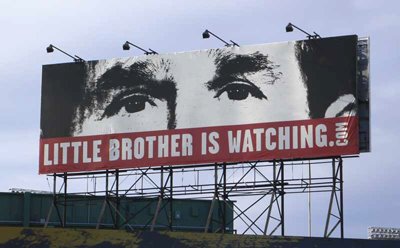
Clear Channel Bans Ads For Harry Shearer’s CD Over Anti-Bush Image

Clear Channel, the radio station and billboard powerhouse, has banned an ad for Harry Shearer’s new CD “Songs of Bushmen” because it depicts George Bush with a bone through his nose, the New York Post‘s Page Six reports:

The outdoor advertising arm of notoriously conservative Clear Channel has banned signs for “Songs of the Bushmen” because the cover depicts the president with a bone through his nose. “Their tone turned from genial salesperson to angry schoolmarm – ‘This is unacceptable,’ ” Shearer, the voice of Mr. Burns and Flanders on “The Simpsons,” told Page Six. “And it’s not like this is a dangerous time to criticize George Bush.”

Last October, Clear Channel’s Palm Beach arm refused to air an ad for VoteVets during Rush Limbaugh’s show because the ad “would conflict with the listeners who have chosen to listen to Rush Limbaugh.”

[Disclosure: The ad is running on the Huffington Post, and Harry Shearer is a regular contributor to the site.]

Source / The Huffington Post / June 27, 2008

The Rag Blog

Posted in RagBlog | Tagged , , , , , , , | Leave a comment

Ecstasy May Be Key To Treating PTSD


At last the incurably traumatised may be seeing the light at the end of the tunnel.

And controversially, the key to taming their demons is the ‘killer’ drug Ecstasy

By Amy Turner

The following story was originally posted on May 4, 2008 in the Times of London. It’s an eye opener.

An Ecstasy tablet. That’s what it took to make Donna Kilgore feel alive again – that and the doctor who prescribed it. As the pill began to take effect, she giggled for the first time in ages. She felt warm and fuzzy, as if she was floating. The anxiety melted away. Gradually, it all became clear: the guilt, the anger, the shame.

Before, she’d been frozen, unable to feel anything but fear for 10 years. Touching her own arms was, she says, “like touching a corpse”. She was terrified, unable to respond to her loving husband or rock her baby to sleep. She couldn’t drive over bridges for fear of dying, was by turns uncontrollably angry and paralysed with numbness. When she spoke, she heard her voice as if it were miles away; her head felt detached from her body. “It was like living in a movie but watching myself through the camera lens,” she says. “I wasn’t real.”

Unknowingly, Donna, now 39, had post-traumatic stress disorder (PTSD). And she would become the first subject in a pioneering American research programme to test the effects of MDMA – otherwise known as the dancefloor drug Ecstasy – on PTSD sufferers.

Some doctors believe MDMA could be the key to solving previously untreatable deep-rooted traumas. For a hard core of PTSD cases, no amount of antidepressants or psychotherapy can rid them of the horror of systematic abuse or a bad near-death experience, and the slightest reminder triggers vivid flashbacks.

PTSD-specific psychotherapy has always been based on the idea that the sufferer must be guided back to the pivotal moment of that trauma – the crash, the battlefield, the moment of rape – and relive it before they can move on and begin to heal. But what if that trauma is insurmountable? What if a person is so horrified by their experience that even to think of revisiting it can bring on hysterics? The Home Office estimates that 11,000 clubbers take Ecstasy every weekend. Could MDMA – the illegal class-A rave drug, found in the system of Leah Betts when she died in 1995, and over 200 others since – really help? Dr Michael Mithoefer, the psychiatrist from South Carolina who struggled for years to get funding and permission for the study, believes so. Some regard his study – approved by the US government – as irresponsible, dangerous even. But Mithoefer’s results tell a different story.

MDMA was patented in 1912 by the German pharmaceutical company Merck. To begin with, it was merely an intermediate chemical used in creating a drug to control bleeding. In the 1920s MDMA was used in studies on blood glucose as a substitute for adrenaline. The Merck chemist Max Oberlin concluded that it would be worth “keeping an eye on this field”. Still, no further studies were carried out until 1952, when the chemist Dr Albert van Schoor tested the toxicity of MDMA on flies. “Flies lie in supine position, then death,” he recorded.

MDMA’s therapeutic potential wasn’t realised until 1976, when the American chemist Alexander Shulgin tried it on himself. He noted that its effect, “an easily controlled altered state of consciousness with emotional and sensual overtones”, could be ideal for psychotherapy, as it induced a state of openness and trust without hallucination or paranoia. It quickly became known as a wonder drug, and began to be used widely in couples therapy and for treating anxiety disorders. None of these tests was “empirical” in the scientific sense – no placebos, no follow-up testing – but anecdotally the results were almost entirely positive.

Word, and supplies, of the new “love drug” got out, and in the early 1980s it became popular in the fashionable clubs of Dallas, LA and London, where it was known as Ecstasy, X or “dolphins”. As use became widespread, the US authorities panicked, and by 1985 MDMA was an illegal, schedule-1 drug. UK laws were even tighter: MDMA, illegal under the 1971 Misuse of Drugs Act, was categorised class A in 1977, carrying a sentence of up to seven years for possession.

Criminalisation put paid to MDMA research almost overnight, at least until Mithoefer’s current programme began. But it didn’t stop the ravers. The drug was popular in the late 1980s and early 1990s for its energising, euphoric effects. There are no official figures for that period, but the Home Office estimates that in 2006/7, between 236,000 and 341,000 people took Ecstasy. Experts say the drug is far less fashionable now than in its heyday in 1988, the second so-called “summer of love”.

The MDMA used in the studies – the drug Dr Mithoefer gave Donna and other patients – was the pure chemical compound, not the black-market Ecstasy bought by recreational users. “A lot of Ecstasy pills aren’t MDMA at all,” says Steve Rolles of the drug-policy reform group Transform. “They may be amphetamines, or unknown pharmaceuticals, or they can be cut with almost any drug in pill or powder form. That’s when you magnify risks associated with taking a drug that’s already toxic. Plus, people use it irresponsibly, mixing it with other drugs, not drinking enough water or drinking too much.”

The images of Leah Betts and Lorna Spinks lying in hospital on life-support, bloodied and bloated, are familiar to all of us – we know drugs cost lives. But has MDMA’s reputation been tarnished so badly that its potential medical value has been overshadowed? That question is the reason that Donna agreed to speak to The Sunday Times about her MDMA treatment. “It’s so important people know what it did for me, what it could do for others,” she says. Her voice trembles: it isn’t easy to talk about what she went through.

In 1993, Donna was brutally raped. She was a single parent living in a small town in Alaska, working as a dental nurse for the Air Force. She was due to work an early shift the next day and her two-year-old daughter was staying with a friend for the night. She was alone at home. At midnight she opened the door to a stranger who said he was looking for his dog. He asked if her husband was at home, and a second’s hesitation was enough. He burst in, backing her up against the fireplace in the living room. Donna picked up a poker to defend herself. He said: “If you co-operate, I won’t kill you. I’ve got a gun.” And he reached into his jacket.

“I dropped the poker and that was it,” she says. “I thought, this is how I’m going to die. No life flashed before my eyes, I didn’t think about my daughter. Just death. I left my body and I stayed that way. The next thing I remember, the cops were coming through the door with a dog.”

She endured the rape with her eyes squeezed shut. That she hadn’t physically struggled would later form a large part of the guilt and shame that contributed to her PTSD. “I guess a lot of women would say, ‘Someone would have to kill me before I’d let that happen.’ Well, I did what I thought I had to do to survive,” she says. When she heard a shuffle of feet outside the door she screamed for all she was worth. Her attacker beat her. Two policemen, probably alerted by a neighbour, broke down the door and arrested the man, then drove Donna to the Air Force hospital where she worked. “Of course it was full of people who knew me,” she says. “It was completely embarrassing. And after that, nobody knew what to say. People avoided me, they looked at me funny. It was miserable.”

Afterwards, convinced that getting on with life was the best thing for herself and her child, Donna carried on as usual. She was embarrassed that people who knew her also knew about the rape, particularly as she was still working at the hospital. But she couldn’t remember much of the attack itself, and didn’t try. So she was surprised when, four years later, her symptoms started to kick in. “I had no idea it was PTSD. I couldn’t understand why I was so angry, why I was having nightmares, flashbacks, fainting spells, migraine, why I felt so awful, like my body was stuffed with cotton wool. Things had been going so good.”

She started drinking heavily and went from relationship to relationship, finding men hard to trust and get close to. Convinced that she was dying and wouldn’t live to see her next birthday, she went to the Air Force psychiatrist. “And that’s where it started – take this pill, that pill. I’ve been on every kind of antidepressant – Zoloft, Celexa, Lexapro, Paxil. Wellbutrin made me feel suicidal. Prozac did the same. The pills were just masking the symptoms, I wasn’t getting any better.”

Yet she met her “soul mate”, Steve, and married him in 2000. “When I first saw him I thought, ‘This is the man I’m going to spend the rest of my life with.’ We were like one person, finishing each other’s sentences,” she says. They muddled along, with Donna putting on a brave face. She had two more children. But getting close wasn’t easy: “The longer we were married, the worse I got.”

Once, Steve and Donna were watching TV when she had a vivid flashback to the night she was raped. “I looked at the door, I saw it open, and that feeling came over me all over again.

I thought, ‘My God, why won’t this go away?’ Steve tried to understand, but unless you’ve been through this, you don’t know what it’s like.”

Donna moved to South Carolina in 2002 when Steve – also in the services – was posted there. She began seeing a psychiatrist called Dr Marcet, who diagnosed her with PTSD and attributed it to the rape. It helped to know that whatever it was had a name and a cause: “I was like, why hasn’t anybody told me this before?” It was Marcet who referred her to the Mithoefers.

Donna had never taken Ecstasy before. “I was a little afraid, but I was desperate. I had to have some kind of relief. I didn’t want to live any more. This was no way to wake up every morning. So I met Dr Mithoefer. I said, ‘Doctor, I will do anything short of a lobotomy. I need to get better.’ ” That’s how, in March 2004, Donna became the first of Mithoefer’s subjects in the MDMA study. Lying on a futon, with Mithoefer on one side of her and his wife, Annie, a psychiatric nurse, on the other, talking softly to her, she swallowed the small white pill. It was her last hope.

“After 5 or 10 minutes, I started giggling and I said, ‘I don’t think I got the placebo,”’ she recalls. “It was a fuzzy, relaxing, on-a-different-plane feeling. Kind of floaty. It was an awakening.” For the first time Donna faced her fears. “I saw myself standing on top of a mountain looking down. You know you’ve got to go down the mountain and up the other side to get better. But there’s so much fog down there, you’re afraid of going into it. You know what’s down there and it’s horrible.

“What MDMA did was clear the fog so I could see. Down there was guilt, anger, shame, fear. And it wasn’t so bad. I thought, ‘I can do this. This fear is not going to kill me.’ I remembered the rape from start to finish – those memories I had repressed so deeply.” Encouraged by the Mithoefers, Donna expressed her overwhelming love for her family, how she felt protected by their support and grateful for their love.

MDMA is well known for inducing these compassionate, “loved-up” feelings. For Donna, the experience was life-changing.

So what happened when she went home? Was she cured? She sighs. “I don’t know if there’s such a thing as a cure. But after the first session I got up the next day and went outside, and it was like walking into a crayon box – everything was clear and bright. I did better in my job, in my marriage, with my kids. I had a feeling I’d never had before – hope. I felt I could live instead of exist.”

What makes MDMA so useful, Mithoefer believes, is the trust it establishes. “Many people with PTSD have a great deal of trouble trusting anybody, especially if they’ve been betrayed by someone who abused their trust, like a parent or a caregiver,” he says. “MDMA has this effect of lowering fear and defences. It also allows more compassion for oneself and for others. People can revisit the trauma, feel the original feelings but not be retraumatised, not feel overwhelmed or have to numb out to cope with it.”

Before they can take part in Mithoefer’s study, every participant undergoes rigorous testing. There are 21 participants per phase and the study is now in its second phase. First, they must be diagnosed with PTSD. Then its severity is measured on the Clinician Administered PTSD Scale (Caps) – it must be at least “moderately severe”. They must be “treatment-resistant”, meaning they have failed to respond to at least one other type of psychotherapy and also drug treatment with an SSRI (selective serotonin reuptake inhibitor) antidepressant. They must sign a 20-page document giving informed consent; they cannot have an addiction, psychosis or bipolar disorder, because these conditions affect the ability to give consent. Then they have a physical examination, a full medical-history check and lab tests for cardiovascular disease.

After the screening, the patient has two 90-minute “preparatory sessions” with the Mithoefers, to begin to build trust and get an idea of what may lie ahead. “We make sure they understand that symptoms will be stirred up, that painful feelings will come before they feel better and that they should experience them as fully as they can, and express them, rather than blocking them out,” Mithoefer says. “We have one rule: during the session they don’t have to talk at all if they don’t want to, or they can talk about anything they feel like. But if, after an hour, the trauma topic hasn’t come up, we can bring it up. But it always does come up,” he chuckles.

The patient lies on the futon in the Mithoefers’ living-room-style office in Charleston, South Carolina. They wear eye shades to encourage introspection, and headphones through which relaxing music is played. Annie keeps an eye on the blood-pressure cuffs and temperature gauge. Mithoefer sits opposite, taking notes. Each patient is given a recording of their session afterwards.

The patient takes either a 125mg tablet of MDMA or a placebo pill, followed by a 62.5mg dose about two hours into the therapy session. The study is double-blind, so only the emergency nurse who carries the drugs from the safe to the office knows whether the patient is getting the drug. “We can always tell whether it’s real or placebo. The patient can’t – some people thought they got MDMA when they didn’t,” says Mithoefer. “But we’re seeing very encouraging results. There’s a real difference between placebo patients and patients who got MDMA, in terms of their ability to relive the trauma.”

Michael and Annie Mithoefer “aren’t your typical kind of therapists”, says Donna. She was dubious about Michael’s ponytail and sandals when they first met, but she is emotional as she talks about him now. “I don’t think I’ve ever met two people who cared so much about people getting well. I’d see tears in their eyes when I told them what I went through.” Three other former patients of the Mithoefers who contacted me about this article described them as “heroes”, “pioneers”, even “life-savers”.

At the time the Mithoefers treated Donna, in March 2004, their study had been a long time in the pipeline. Convinced of MDMA’s potential, Rick Doblin, founder of the Multidisciplinary Association for Psychedelic Studies (Maps), had been in and out of the courts seeking permission from the Food & Drug Administration for clinical research since 1984. Maps, a group set up to fund psychedelic research, agreed to fund Mithoefer’s study in 2000. The next year the FDA approved it. Then approval was withdrawn because of research by the neurologist George Ricuarte, at Johns Hopkins University, claiming that MDMA was lethally toxic. Even a single use, he reported, could cause brain damage and possibly Parkinson’s disease. Ricuarte retracted his findings in 2002 when it turned out that bottles had been mixed up and the monkeys used as subjects had received lethal doses of methamphetamine (speed), rather than MDMA. “It was incredibly frustrating,” Mithoefer says.

Mithoefer’s study, which looks set to cost $1m by the time it finishes in four years’ time, is scrupulously monitored. Doblin had 1,000g of MDMA made specially, each gram costing $4. Mithoefer had to obtain a licence from the Drug Enforcement Administration (DEA), which keeps track of exactly how much MDMA each licence-holder has, and periodically checks the stocks for purity. A defibrillator must be kept in the building at all times in case of cardiac arrest, and an emergency nurse must be present during the treatment session. Once the study is complete, it will be subject to peer review. Then, all being well, Mithoefer hopes to see MDMA therapy available on prescription, administered in controlled surroundings, in 5 to 10 years.

Interest is growing in the UK too, but scientists admit it will take time to change hearts and minds. Dr Ben Sessa of Bristol University’s Psychopharmacology Unit has been writing papers on MDMA therapy for two years. “The Mithoefers’ struggle has been ludicrous,” he says. “There’s plenty of anecdotal evidence that it could be really useful in psychotherapy. There they are, qualified doctors with experience and medical backup, giving people this tiny dose of MDMA with safeguards in place. It took them 20 years for Maps to get it off the ground and it costs $1m. The irony is that thousands of people are taking this stuff every weekend and there’s a 15-year-old on the street corner who’ll sell it to you for a tenner.”

Sessa would like to set up a programme of research in the UK, pointing to the thousands who could benefit: “For severe, unremitting PTSD sufferers, it could be a lifeline. What they’re seeing in the US is people who have suffered for years suddenly saying, ‘Wow, for the first time in my life I can talk about this, I can live with it.’ And these are not young ravers. They’re people in their thirties, forties, fifties who have never taken drugs. It’s quite remarkable.”

But what about the potential for post-study abuse? Might someone who felt deflated after the elation of their MDMA session find the urge to self-medicate irresistible and pop to that 15-year-old on the corner for a quick fix? Not at all, says Sessa. “I prescribe Valium all the time, and when the course is finished the patient could go and buy Valium on the street, but they don’t. Very few people are interested in recreational drugs.”

I ask Donna the same question. “Would I take the drug again? Yes, definitely,” she says. “But not without a therapist. It’s illegal.”

Another former patient of Mithoefer’s, a 42-year-old woman, had severe PTSD after being repeatedly and horrifically beaten and locked in a basement by her father during childhood. She wished to remain anonymous because she is still in contact with her parents. When I asked her the question, she replied: “I did it to get better, not to get high. Before the treatment, I would drink to hide my symptoms. But I don’t want to get drunk now, let alone take drugs. I just don’t need it any more.”

The harmful effects of MDMA are still under investigation. The type of research that is carried out – normally with animals or with recreational users who also take other drugs – means that the exact levels of toxicity it causes are unknown. In 2006 Dr Maartje de Win of the University of Amsterdam published research showing that Ecstasy could cause depression, anxiety and long-term memory damage after one small dose. “We really don’t know how much Ecstasy affects the brain in the long term,” she says. “I would be very cautious about giving it therapeutically. We need to conduct much more research. And even then it should only be given as a last resort, after weighing the benefits against the risk of harm.”

Sessa is adamant that research into MDMA is justified. “Look at heroin. It’s a class-A drug that’s dangerous when used recreationally, but it’s used widely in medicine, and so it should be – it’s a very useful drug. Can you imagine saying to the Royal College of Anaesthetists, ‘You can’t use morphine or diamorphine [heroin] or pethidine or codeine or any opiate-based drugs because heroin is dangerous and people abuse it?’ It’s culturally bound. MDMA has been demonised.”

In 2004, the most recent year for which there are records, 46 people died after taking Ecstasy, as against 8,221 alcohol-related deaths. And most of those who die with MDMA in their system have mixed it with substances such as alcohol or cannabis, which confounds the picture.

Earlier this year, the police chief for North Wales, Richard Brunstrom, called for the drug to be reclassified, claiming it was “safer than aspirin”. He was widely shouted down, but Steve Rolles of Transform believes he may have a point. “It’s not appropriate to have Ecstasy in class A. In terms of indicators of harm – toxicity, mortality, addictiveness and antisocial behaviour – it’s not comparable to heroin or cocaine. But the government won’t reclassify it. Reclassifying cannabis [from class B to C] in 2004 caused years of grief from opposition parties and the media.”

The minister for drugs policy, Vernon Coaker, declined to comment on reclassification for medical purposes, but a spokesman said: “The government has no intention of reclassifying Ecstasy. It can and does kill unpredictably; there is no such thing as a ‘safe dose’. We firmly believe it should remain a class-A drug. In addition, the government warns young people of the dangers of Ecstasy through the Frank campaign.”

It does. But it also gives advice on safe Ecstasy use – or “harm minimisation”. This is precisely the mixed message that Rolles believes is damaging. “Harm reduction is reducing the harm that’s created by illegal supply in the first place,” he says. “So you have harm-reduction information within a legal framework that maximises harm. It’s a clear contradiction.”

Then there is the problem of funding. MDMA therapy is based on the idea of a single treatment, or a course of treatment sessions, rather than long-term prescriptive use. This presents little or no benefit to drug companies that have huge budgets for research as long as there’s a saleable product at the end. And if MDMA does prove effective, companies could stand to lose millions from lost sales of long-term antidepressants prescribed for PTSD.

Sessa says: “There’s no financial incentive for the pharmaceutical companies to look into it. Psychotherapy is notoriously underfunded and discredited by the drug companies. It could benefit the government to look into MDMA, but their funding is a drop in the ocean next to a company like Pfizer’s research budget. So who’s going to pay for a multi-centre psychotherapy trial for 10,000 people – the couch-makers?”

PTSD therapy currently costs the NHS £14m a year, and with more veterans returning from Iraq and Afghanistan, that figure is set to rise. Last year, 1,200 new veterans sought treatment for PTSD from the organisation Combat Stress, compared with 300 in the year 2000. But realistically, would the government ever sanction MDMA research? “It’s not impossible, but it’s improbable,” says Sessa. “It takes a very brave politician to look at the evidence and say, ‘Well, there might be positive aspects to this class-A drug. Let’s look into it.’ It’s a conceptual, social battle which won’t be easy to win.”

Source. / Times of London

Thanks to telebob / The Rag Blog / Posted June 27, 2008

Posted in RagBlog | Tagged , , , , , , | 3 Comments

Houston Immigration Raid Draws Protest : Employer Arrests May Follow

Dozens protest immigration raid in Houston.

HOUSTON — Dozens protested against an immigration raid on an east Houston exporting company where 160 people were arrested, KPRC Local 2 reported Thursday.

Immigration and Customs Enforcement officials said the raid at Action Rags USA Wednesday was a success. Some called the bust into question, claiming some of the workers panicked and were hurt.

Protesters outside Mickey Leland Federal Building in downtown Houston carried signs and chanted slogans. They said they were especially outraged because 60 to 70 percent of the people arrested were women.

Source. / Click2Houston / June 26, 2008

Immigration agents detain 166 undocumented
workers at east side Houston plant

By James Pinkerton and Susan Carroll / June 26, 2008

As anxious relatives stood outside, van after van of mostly female undocumented workers were removed from a sweltering rag-sorting factory on Houston’s east side and whisked to an immigration processing facility.

The early morning raid Wednesday by Immigration and Customs Enforcement agents, while netting 166 undocumented workers, did not include arrests of company officials with Action Rags USA. But those charges may be on the way.

“The office of investigation is looking at allegations of the hiring of illegal aliens, which is a crime,” said Special Agent Bob Rutt, of the Houston ICE office. Arresting illegal immigrants was “a collateral part” of the investigation, he said. “Our focus, ICE’s overall focus, is targeting the employer.”

Rutt, however, referred inquiries about possible criminal charges in Wednesday’s raid case, as well as one at Shipley Do-Nuts in Houston, to federal prosecutors. There have been no arrests of Shipley managers or company officials.

“As it pertains to Shipley Do-Nuts, we cannot confirm or deny the existence of a criminal investigation,” said Angela Dodge, public affairs officer for the U.S. Attorney’s Office in Houston.

“Are we safer because they arrested immigrant women who are working?” asked Maria Jimenez, with the Center for Central American Resources in Houston. “I mean, 200 agents went to basically capture women who were contributing to the economy. What have we gained for society by removing mothers, wives and sisters from their family?”

“I think everybody recognizes that to get a handle on this, … you have to go after the employer,” said Steven Camarota, director of research with the Center for Immigration Studies, which advocates stricter immigration controls.

In fiscal 2007, ICE secured fines and forfeitures of more than $30 million in worksite enforcement cases, according to the agency’s annual report. ICE did not provide statistics on the number of employers criminally charged last year.

Employer prosecutions aren’t “the biggest bang for the buck, as far as the way ICE is thinking about it,” said Demetrios Papademetriou, president of the Migration Policy Institute, an immigration think tank based in Washington, D.C.

“It’s much easier and gets more headlines to arrest a lot of people,” Papademetriou said. “To make a case against an employer requires time and significant investments of investigative resources. Sometimes it takes half a year, or a year.”

ICE began investigating Action Rags USA a year ago after learning about hiring practices from a former employee.

The Wednesday raid, which involved 200 ICE agents, started shortly after work began at 7 a.m. at the sorting facility at 1225 Port Houston.

Late Wednesday, ICE officials said of the 166 workers they detained, 130 were females, including 10 who were pregnant. In all, 66 undocumented workers were released for humanitarian reasons, including pregnancy and child care issues, and were told to report to an immigration judge.

The workers who remain detained could be processed for removal from the U.S. The arrest tally included 135 from Mexico, 12 from Honduras, 10 from Guatemala, eight from El Salvador, and one whose nationality is unknown, ICE officials said.

‘We were like a family’

The raid surprised many workers as they began a day of sorting bales of used clothing in the un-airconditioned facility. The clothing is shipped worldwide, according to a company Web site, or processed into rags for industry.

A woman who identified herself as a company supervisor said many of the workers initially didn’t believe a raid was under way, noting false reports of raids in the past year.

“But when I came out to look, the agents were at the doors, and they had surrounded the warehouse,” said Brenda, who gave only her first name. “They started yelling for us to sit down. They started searching us to see if we had knives or weapons.”

Brenda said workers who ran from federal agents or tried to hide were handcuffed “and treated like criminals.”

“When I left I was crying, because we all got along well,” she said. “We were like a family.”

ICE officials said four workers were taken to area hospitals due to anxiety attacks and heat-related illness; one woman fell 20 feet from a stack of pallets in which she was hiding.

Repeated attempts to contact company officials at the facility Wednesday were unsuccessful.

Action Rags lost its corporate status in July 2007 due to a tax forfeiture, according to Texas Secretary of State records. The records listed Mubarik Kahlon as the company’s registered agent and director.

Secretary of State spokesman Scott Haywood confirmed that Action Rags is no longer a registered LLC in Texas, but said he could not comment on any potential legal implications.

A woman who answered the door at Kahlon’s home in Humble said he was not there.

Critics call raid a waste

As ICE continues its investigation, pro-immigrant activists blasted the raid as a waste of taxpayer money which will have hurt Houston’s economy and workers’ families.

“Are we safer because they arrested immigrant women who are working?” asked Maria Jimenez, with the Center for Central American Resources in Houston. “I mean, 200 agents went to basically capture women who were contributing to the economy. What have we gained for society by removing mothers, wives and sisters from their family?”

Men were also detained, including the husband of Juana Ramirez, who acknowledged her spouse is not in the country legally.

“All he does is go to work, comes home and takes care of the kids when I go to work,” said an angry Ramirez, who works at a fast-food restaurant and is expecting the couple’s third child. “He doesn’t drink or do drugs. It’s not good at all.”

Papademetriou called raids like Wednesday’s the “low-hanging fruit” of operations.

“They don’t require an enormous amount of investment on the part of ICE. They make headlines. The numbers look substantial,” he said.

According to ICE statistics for the 2007 fiscal year, ICE made 863 criminal arrests and 4,077 administrative arrests as a result of worksite enforcement efforts nationally.

Camarota said even though the number of arrests is small in relation to the millions of illegal immigrants in the U.S., the raids have a significant impact.

“If you’re on a highway and thousands of people were speeding and one person gets pulled over, compliance with the law shoots up dramatically. Any law enforcement action has a much greater effect than just on the individuals who are subject to it,” he said.

One former ICE prosecutor, Austin attorney Kevin Lashus, said worksite raids are designed to frighten companies who hire undocumented workers.

“What they’re hoping to do is be able to use these stepped-up raids to force employers to reconsider their employment verification policies,” said Lashus, who is now a member of the Tindall & Foster immigration law firm in Austin. “They’re trying to scare the hell out of them — their intent is to force employers to police themselves.”

Copyright 2008 Houston Chronicle

Source. / Houston Chronicle

The Rag Blog

Posted in RagBlog | Tagged , , , | Leave a comment

Capitol Hill : Gone Fishing


Congress Still Corrupt and Useless
By Marc Ash / June 26, 2008

For those who thought Tom Delay’s departure would really change anything in Congress, this past week was a strong cup of coffee. On Capitol Hill, politics and greed still trump the good of the nation, still trump the Constitution, still trump all.

While nothing that happened in Washington this past week was new or should have surprised anyone, we were nonetheless served clear notice, anew, that this is a democracy under siege.

In one week, Congress authorized one hundred and sixty two billion US taxpayer dollars to extend for another year the illegal and immoral occupation of Iraq, and rewrote federal law to specifically pardon criminal actions by the nation’s largest telecommunications companies. No one really noticed that a retired US general bluntly accused the Bush administration of war crimes. He could just as easily have accused Congress of the same. They are just as guilty

It’s often said that there is no difference between Democrats and Republicans. False. The vast majority of honest public servants in Congress are Democrats. However, it would not be safe to say that the majority of Democrats are honest public servants. About half of the Democrats and a small handful of Republicans take seriously their sworn oaths. The rest would be arrested in any other walk of life.

It has been reported in our publication and elsewhere that Democratic Congressional leaders sought to address the issue of war funding as quickly as possible. Some in Democratic leadership feared that the issue might prove a burden in an election year. A political consideration. In the end, Democratic leadership accelerated, without significant opposition, the pace at which the latest war funding bill was brought to a vote. It passed well before it was required and well before the fall elections. The die is cast, the nation is committed to another year of bloody war and all of its crimes, so that we can vote for the leaders who took this action without having to think about it.

In December 1974, Seymour Hersh, writing for The New York Times, revealed that the Central Intelligence Agency (CIA) had, under orders from Nixon, violated its charter and engaged in warrantless domestic spying on American citizens, on American soil. The practice Hersh pointed out had been going on for years. Hersh’s report led to the creation in April 1976 of the Church Committee, named after its chairman, Senator Frank Church, a Democrat from Idaho. The Church Committee reports, which should be required reading for all Americans, detailed systemic warrantless domestic spying on and surveillance of Americans by a host of federal government agencies including the CIA, the IRS, the US Postal Service and the National Security Agency (NSA).

As a result first of Hersh’s story and the subsequent findings of the Church Committee, Congress passed the Foreign Intelligence Surveillance Act of 1978, (FISA). FISA’s express purpose was to make illegal presidential directives that would authorize warrantless domestic spying. It might just as well have been called the Nixon Act because it was a direct consequence of his Stalinesque abuses. FISA worked well for roughly 23 years.

Enter George W. Bush and Richard B. Cheney, et al. Essentially Bush, Cheney, their families and allies are monarchists, autocrats and on occasion, when they feel the need arises, fascists. They have little patience with Democratic process, and less patience with Congressional interference. In short, to the Bush crew FISA was an insult. They deliberately and knowingly broke the law, directing the NSA to employ its electronic surveillance capabilities on American citizens on American soil without warrants, and enlisting successfully the aid and comfort of most of the nation’s largest telecommunications companies in the illegal effort.

The Bush administration argues that it did so to protect Americans after 9/11. That argument is flawed for two reasons. First, all statutes that prohibit warrantless domestic spying point out specifically that such restrictions are not to be dispensed with due to – any – immediate threat, including national security, except as specified by law. Second, there is significant evidence that authorization for warrantless domestic spying came from the Oval Office well before 9/11.

Who, then, will confront those who would break the law under cover of executive privilege? Congress, of course, is designated under the Constitution to address violations of law by the executive branch. But not this Congress. This Congress, handed a sweeping mandate with one of the largest nationwide electoral victories in US history, a mandate from the American people for confronting massive illegality at 1600 Pennsylvania Avenue, this Congress has utterly abdicated. This Congress has not only abdicated; it has capitulated and conspired to circumvent the Constitution. That is the FISA legislation that this Congress has passed. The war funding legislation is worse; it is authored in innocent blood and unending human suffering.

Today this US Congress stands in opposition to the Constitution, and in opposition to the American people. The American people might well be expected to stand in opposition to Congress as well.

Source. / truthout

The Rag Blog

Posted in RagBlog | Tagged , , , , , | Leave a comment

We are doomed! Sort of!


Earth in crisis, food and water increasingly scarce, people freaking out. Should you join them?
By Mark Morford / June 25, 2008

It would be nice to think much of the ugliness is coming to an end.

It would be lovely to imagine the era of brutal Earth-mauling technologies, coal extraction and petroleum and industrial agriculture and strip mining and clear cutting and industrial fishing and all rest, all the more rapacious and unforgiving notions of how we exist on this planet are, after an era of unchecked capitalistic greed and waste and over-consumption right along with almost zero concern for consequences and the ethics of sustainability, finally moving toward obsolescence — or rather, are quickly being shoved there by sheer necessity, brutal market forces, as supply runs dry and oil production slows and the Earth groans and spits and says, “enough already.”

It is a pivotal time, and now more than ever, you get to choose the lens through which you want to watch it all unfold. Or implode.

Are we headed toward a brighter future packed like a Hooters Energy Drink with a renewed sense of hope and global cooperation? Or is our species plainly doomed to be crushed under the corn syrupy weight of our own gluttony and ego and entitlement? Are we waking up just in time to save ourselves from ourselves, or is that fistful of sociocultural Ambien we downed all those years ago merely causing us to sleep-drive into a wall of nuclear asbestos?

Choose your attitude, baby. Because on the one hand, you can cruise through cool conscious hipster mags like Grist or Treehugger and Dwell and Good and the like, and be happily inspired by all the latest ideas for sustainable development and socially conscious tech — from micro-turbines built right into the skin of buildings, to amazing new solar panels, cool prefab housing, better batteries, microcars, electric mopeds, eco-nightclubs, dual-flush toilets and CFLs and bamboo everything, wind farms and urban solar initiatives and LEED-certified homes and even some tentative positive ideas from Big Auto. Hell, even toxic monolith Clorox has a green line of products that’s actually, well, relatively green. Go figure.

Every major newspaper site has a green section. Every intellectual rag features weighty thought pieces on how we might stave off the encroaching calamities. Every pop culture magazine pumps out a heartfelt “green issue,” despite how said magazine is usually printed on sweet virgin wood pulp and coated in petroleum-based wax and Chinese-made ink and if you lick the pages you will likely get cancer of the teeth. But hey, check out that sweet profile of Leo DiCaprio. Mmm, grass-fed hunkiness.

The goodness is spreading. Nearly all formerly soul-deadening supermarkets from Safeway to Wal-Mart to Ralph’s now have large organic sections and multiple recycling bins and swell-sounding sustainability policies to match their new, softer lighting and friendlier layout, all designed to create a more welcoming vibe so you can feel like you’re not contributing quite so painfully to the global petroleum-based corporate mega-economy when you buy that flat of strawberries in January.

And then there are the crazy inventors, the mad geniuses you can read about just about everywhere, the ones who’ve developed a Potential Answer to It All, maybe a new engine that runs on salt water and cat dander, or a new zero-point energy technology, or some sort of nano-cellular magnetic generator, or a method by which we can power the entire planet using only the energy created by mixing fingernail clippings and bat guano with whatever toxic gloop Ann Coulter is made of.

Indeed, it feels like incredible inventions are now pouring out of the woodwork, though this merely might be a reflection of our increased sense of desperation to find a magic bullet before it’s too late. In other words, the mad geniuses have always been there, but we’ve never needed them so badly to really take notice.

Problem is, most of these nascent technologies come with a giant throbbing caveat: They’re either still in concept stage, have barely been tested, or they only exist in the inventor’s garage in happy rickety Make-style geekdom on an old Formica table next to a giant Death Star made of Legos. Almost none is provable at scale, none ready to be manufactured for the masses.

Add to this the fact that the forces of Bush Regime have slowed, stalled, blocked, or otherwise worked like bitter hellspawn to aggressively reverse every progressive (read: non-petroleum based) energy idea for nearly a decade, and all that positivism can be swiftly swallowed by the wary dragons of harsh reality.

Truly, before you get to too cozy with your low-VOC paint and organic grass-fed burger, it takes but a split second to shatter that green lens of hope and replace it with a crimson one full of blood and pollution and phthalates and cheap copper wiring in the form of e-waste, dumped into the slums of China and India, as the residual plastic floats out to the Pacific Garbage Patch and further chokes the collapsing fish and seafood stocks of the world.

How bleak do you want it? Tar sand extraction? Receding ice floes? Ocean food-chain collapse? Clean water crisis? Brutal food shortages? The plight of the rich who are struggling with being slightly less rich? Hell, you only have to glance at a single snapshot of those violently polluted Asian and Indian slums, or even of ominous shots of Beijing and Hong Kong and Mexico City and Las Vegas, to feel that we are still growing and lurching and sucking down resources far too quickly to understand how to do so responsibly.

For every bit of good news, bad seems to top it like a dirt clod on an ice cream cone. More than 10 years ago, we banned CFCs and as a result, the ozone hole is actually healing, which could theoretically help slow global warming. Then again, as the ice shelves melt, more trees grow, which, given the circumstances, might actually make things worse by reducing the albedo effect.

On it goes. Flooding in the Midwest has severely damaged corn and soy crops, further straining the food supply and washing tons of pesticides into the water table. Meanwhile, California is in drought, wildfires are spreading like, well, wildfire as the state endures its driest spring ever.

It’s tempting to see it as one vicious tug of war, eternal dark forces pitted against eternal light, exemplified by, say, Big Oil CEOs on one side and hemp-loving biodiesel hippies on the other, a grand footrace to see if our rapacious capitalistic appetites will destroy us before our finer reason and good conscience saves us in the final minute.

Far harder to swallow the reality, which is far more gray and murky and strange. Because of course there is no 100-percent perfect energy source, no such thing as zero pollution, no magic bullet, no way to move through God’s wicked workshop without breaking a few glasses and swiping some gumballs and leaving skid marks on the lawn. Maybe the real question isn’t which lens to choose, but rather, do we even know how to see?

Source. / SF Gate

Thanks to Roger Baker / The Rag Blog

Posted in RagBlog | Tagged , , , , , , , | Leave a comment

Exxon Valdez – An Inevitability, Not an Accident


Court Rewards Exxon for Valdez Spill
by Greg Palast / June 26, 2008

Twenty years after Exxon Valdez slimed over one thousand miles of Alaskan beaches, the company has yet to pay the $5 billion in punitive damages awarded by the jury. And now they won’t have to. The Supreme Court today cut Exxon’s liability by 90% to half a billion. It’s so cheap, it’s like a permit to spill.

Exxon knew this would happen. Right after the spill, I was brought to Alaska by the Natives whose Prince William Sound islands, livelihoods, and their food source was contaminated by Exxon crude. My assignment: to investigate oil company frauds that led to to the disaster. There were plenty.

But before we brought charges, the Natives hoped to settle with the oil company, to receive just enough compensation to buy some boats and rebuild their island villages to withstand what would be a decade of trying to survive in a polluted ecological death zone.

In San Diego, I met with Exxon’s US production chief, Otto Harrison, who said, “Admit it; the oil spill’s the best thing to happen” to the Natives.

His company offered the Natives pennies on the dollar. The oil men added a cruel threat: take it or leave it and wait twenty years to get even the pennies. Exxon is immortal — but Natives die.

And they did. A third of the Native fishermen and seal hunters I worked with are dead. Now their families will collect one tenth of their award, two decades too late.

In today’s ruling, Supreme Court Justice David Souter wrote that Exxon’s recklessness was ”profitless” — so the company shouldn’t have to pay punitive damages. Profitless, Mr. Souter? Exxon and it’s oil shipping partners saved billions – BILLIONS – by operating for sixteen years without the oil spill safety equipment they promised, in writing, under oath and by contract.

The official story is, “Drunken Skipper Hits Reef.” But don’t believe it, Mr. Souter. Alaska’s Native lands and coastline were destroyed by a systematic fraud motivated by profit-crazed penny-pinching. Here’s the unreported story, the one you won’t get tonight on the Petroleum Broadcast System:

It begins in 1969 when big shots from Humble Oil and ARCO (now known as Exxon and British Petroleum) met with the Chugach Natives, owners of the most valuable parcel of land on the planet: Valdez Port, the only conceivable terminus for a pipeline that would handle a trillion dollars in crude oil.

These Alaskan natives ultimately agreed to sell the Exxon consortium this astronomically valuable patch of land — for a single dollar. The Natives refused cash. Rather, in 1969, they asked only that the oil companies promise to protect their Prince William Sound fishing and seal hunting grounds from oil.

In 1971, Exxon and partners agreed to place the Natives’ specific list of safeguards into federal law. These commitment to safety reassured enough Congressmen for the oil group to win, by one vote, the right to ship oil from Valdez.

The oil companies repeated their promises under oath to the US Congress.

The spill disaster was the result of Exxon and partners breaking every one of those promises – cynically, systematically, disastrously, in the fifteen years leading up to the spill.

Forget the drunken skipper fable. As to Captain Joe Hazelwood, he was below decks, sleeping off his bender. At the helm, the third mate would never have collided with Bligh Reef had he looked at his Raycas radar. But the radar was not turned on. In fact, the tanker’s radar was left broken and disasbled for more than a year before the disaster, and Exxon management knew it. It was just too expensive to fix and operate.

For the Chugach, this discovery was poignantly ironic. On their list of safety demands in return for Valdez was “state-of-the-art” on-ship radar.

We discovered more, but because of the labyrinthine ways of litigation, little became public, especially about the reckless acts of the industry consortium, Alyeska, which controls the Alaska Pipeline.

* Several smaller oil spills before the Exxon Valdez could have warned of a system breakdown. But a former Senior Lab Technician with Alyeska, Erlene Blake, told our investigators that management routinely ordered her to toss out test samples of water evidencing spilled oil. She was ordered to refill the test tubes with a bucket of clean sea water called, “The Miracle Barrel.”

* In a secret meeting in April 1988, Alyeska Vice-President T.L. Polasek confidentially warned the oil group executives that, because Alyeska had never purchased promised safety equipment, it was simply “not possible” to contain an oil spill past the Valdez Narrows — exactly where the Exxon Valdez ran aground 10 months later.

* The Natives demanded (and law requires) that the shippers maintain round-the-clock oil spill response teams. Alyeska hired the Natives, especiallly qualified by their generations-old knowledge of the Sound, for this emergency work. They trained to drop from helicopters into the water with special equipment to contain an oil slick at a moments notice. But in 1979, quietly, Alyeska fired them all. To deflect inquisitive state inspectors, the oil consortium created sham teams, listing names of oil terminal workers who had not the foggiest idea how to use spill equipment which, in any event, was missing, broken or existed only on paper.

In 1989, when the oil poured from the tanker, there was no Native response team, only chaos.

Today, twenty years after the oil washed over the Chugach beaches, you can kick over a rock and it will smell like an old gas station.

The cover story of the Drunken Captain serves the oil industry well. It falsely presents America’s greatest environmental disaster as a tale of human frailty, a one-time accident. But broken radar, missing equipment, phantom spill teams, faked tests — the profit-driven disregard of the law — made the spill an inevitability, not an accident.

Yet Big Oil tells us, as they plead to drill in the Arctic National Wildlife Reserve, as Senator John McCain calls for drilling off the shores of the Lower 48, it can’t happen again. They promise.

[Greg Palast is an investigative journalist and author of the New York Times bestseller, ARMED MADHOUSE: From Baghdad to New Orleans — Sordid Secrets and Strange Tales of a White House Gone Wild.]

Source / Dissident Voice

The Rag Blog

Posted in RagBlog | Tagged , , | Leave a comment

US Mayors Step Into Iran Fray

Mayor Bob Kiss of Burlington, Vermont sponsored Iran resolution at U.S Conference of Mayors.

Calling for Diplomacy, Not War
by Medea Benjamin / June 26, 2008

Tensions around Iran have been heating up with President Bush’s recent trip to Europe urging stronger sanctions and reports of major Israeli military exercises in June designed to prepare for a potential strike against Iran’s nuclear facilities. UN atomic watchdog chief Mohamed El Baradei, concerned about the belligerent direction, warned on June 21 that an attack on Iran would “transform the Middle East region into a ball of fire.”

U. S. mayors, feeling the disastrous effects of the war in Iraq on their city budgets and local military families, are speaking out to try to stop another disastrous war. Thanks to a grassroots campaign initiated by CODEPINK, Global Exchange and Cities for Peace, a group of mayors have signed on to a National Mayors Resolution for Diplomacy with Iran. So far, 32 mayors from Alexandria, VA to Wilmington, DE have signed on. The resolution urges the Bush Administration to pursue diplomatic engagement with Iran and calls on Congress to prohibit the use of funds to carry out any military action against Iran without Congressional authorization.

The resolution’s initial sponsor was Mayor Bob Kiss of Burlington, Vermont. “Cities across the US are already paying a high price for war with thousands of servicemen and women killed and wounded and other resources diverted away from important national priorities like infrastructure, education, housing and human needs,” said Mayor Kiss. “Our experience in Iraq makes it even more critical to pursue diplomacy with Iran — talks anytime, anywhere.”

Mayor Scott Brook of Coral Springs, FL agrees. “In Iraq we’re spending $10 billion a month while people here are losing their homes and can’t get jobs. Where are our priorities? We can’t afford more interventions.”

Another early cosponsor of the resolution, Mayor Dan Coody from Fayetteville, Arkansas, does not want the public to be fooled again. “The Bush administration is playing the American people on Iran just like they did in Iraq,” Mayor Coody said. “With Iraq going so badly and the economy in shambles, it would be crazy to wage a new war in another Arab country.”

The mayors brought the resolution to the U.S. Conference of Mayors that was held in Miami from June 20-23. Unfortunately, it was tabled for another year when a small group of mayors voiced opposition. Some said it sounded disrespectful to the troops, others said it was just too controversial and they did not want to see a rerun of the divisive debate the year before when a resolution against the war in Iraq was put forth.

Undeterred, the mayors and their supporters used the Conference to gather more support and vowed to continue the campaign. The goal is to get 100 mayors from across the country on board, and then, in September, descend on Washington DC to deliver the resolution to Congress and the White House.

Local peace groups are excited about pushing their own mayors to take a stand. “The prospect of aggression against Iran is really troubling and it’s frustrating we have so few avenues to try to forestall that,” said Nina Utne, a CODEPINK cofounder who was successful in pressuring her Minneapolis Mayor R.T. Rybak to sign on. “I’m grateful that mayors are responding to their constituents and are willing to take a position of conscience.”

“The public has shown itself wiser and more prudent than the Bush administration in matters of foreign policy and are claiming their civic right to weigh in through locally-elected officials,” said Karen Dolan, director of the Cities for Peace project based at the Washington DC-based Institute for Policy Studies. “With the signatures of a growing number of mayors against a military strike on Iran, we see an encouraging continuation of local lawmakers and citizens speaking out in national venues regarding international policy.”

Global Exchange, a group that organizes regular citizen delegations to Iran, is mobilizing its members. “People return from Iran in love with the Iranian people and energized to stop a war,” said Sanaz Meshkinpour of Global Exchange. “We urge them to contact their congressional representatives, but also their local mayor. If we build a groundswell of support for diplomacy, we will hopefully force the decision-makers in Washington to listen.”

You can join the campaign by asking your mayor to sign on. To see the full resolution, a sample letter to your mayor and your mayor’s contact information, go here.

[Medea Benjamin is cofounder of CODEPINK and Global Exchange.]

Source. / CommonDreams

Also see U.S. Mayors Mobilizing Against a War with Iran / AlterNet

The Rag Blog

Posted in RagBlog | Tagged , , , , , | Leave a comment

Quote of the Day – NAFTA – Don’t Bend Over

NAFTA Signing Ceremony

“They debated the NAFTA bill for a long time; should we sign it or not? Either way, the people get fucked. Trade always exists for the traders. Anytime you hear businessmen debating ‘which policy is better for America,’ don’t bend over.”

George Carlin, 1937 – 2008.

h/t Bad Attitudes

The Rag Blog

Posted in RagBlog | Tagged , | Leave a comment

Making You Safer Through Personal Invasion


U.S. border agents copying contents of travelers’ laptops
By Federica Narancio / June 25, 2008

WASHINGTON — U.S. border agents are copying and seizing the contents of laptops, cell phones and digital cameras from U.S. and foreign travelers entering the United States, witnesses told a Senate subcommittee Wednesday.

The extent of this practice is unknown despite requests to the Department of Homeland Security from the Senate Subcommittee on the Constitution and several nonprofit agencies.

The department also declined to send a representative to the hearing. Subcommittee Chairman Russ Feingold, D-Wis., said Homeland Security had told him that its “preferred” witness was unavailable Wednesday.

Feingold added that he’d submitted written questions about the seizures of electronic data — and of some devices — to Homeland Security Secretary Michael Chertoff in April. To date, Feingold said, he’s gotten no reply.

Chertoff’s department provided a written statement that said it wasn’t its intention to infringe on Americans’ privacy but to protect the country from terrorists and criminals, whose electronic devices can reveal incriminating materials.

During border searches of laptops, according to the statement, the department’s Customs and Border Protection officers have found “jihadist material, information about cyanide and nuclear material, video clips of improvised explosive devices being exploded, pictures of various high-level al Qaida officials and other material associated with people seeking to do harm to U.S. and its citizens.”

Jayson Ahern, the deputy commissioner of Customs and Border Protection, signed the statement.

Some witnesses noted that the 9th U.S. Circuit Court of Appeals in San Francisco had ruled in a recent child-pornography case that federal agents could seize a laptop computer at the border without reasonable suspicion that its owner was engaged in unlawful activities.

However, several witnesses said that the ruling, by the most liberal of U.S. appeals courts, didn’t end their concerns about Homeland Security’s refusal to explain the standards for its searches, how it protects privacy, how the seized material is used and who can see or use it.

Three nonprofits — the Electronic Frontier Foundation, the Asian Law Caucus and the Association of Corporate Travel Executives — filed a Freedom of Information Act request last year seeking Homeland Security’s answers to those questions. They’ve gotten none thus far.

They and other groups consider seizures made without probable cause to be an invasion of privacy that leaves the door open to ethnic and racial profiling.

Farhana Khera, the president of Muslim Advocates, a San Francisco nonprofit, said they’d received complaints from Muslim, Arab and South Asian Americans. She said they also had been questioned about their political, religious and personal views.

Retaining confidential computer files also worries business travelers and companies, said Susan Gurley, the executive director of the Association of Corporate Travel Executives, an international group based in Alexandria, Va..

Her organization surveyed its 2,500 members in February, Gurley said. Of 100 respondents, seven said border agents had seized their laptops or their files. Four out of five, she said, were unaware that border agents could seize their electronic data and devices.

Source / McClatchy

The Rag Blog

Posted in RagBlog | Tagged , | Leave a comment

Shell Shock, Battle Fatigue, and Wor(d)se

Horrors Of War Hit Home

Kelly Kennedy, George Carlin, and the Reason for Traumatized Iraq Veterans
By Juan Cole / June 25, 2008

The late George Carlin did not like the phrase “post-traumatic stress disorder.” He famously said,

‘ I don’t like words that hide the truth. I don’t like words that conceal reality. I don’t like euphemisms, or euphemistic language. And American English is loaded with euphemisms. Cause Americans have a lot of trouble dealing with reality. Americans have trouble facing the truth, so they invent the kind of a soft language to protect themselves from it, and it gets worse with every generation. For some reason, it just keeps getting worse. I’ll give you an example of that.

There’s a condition in combat. Most people know about it. It’s when a fighting person’s nervous system has been stressed to it’s absolute peak and maximum. Can’t take anymore input. The nervous system has either (click) snapped or is about to snap.

In the first world war, that condition was called shell shock. Simple, honest, direct language. Two syllables, shell shock. Almost sounds like the guns themselves.

That was seventy years ago. Then a whole generation went by and the second world war came along and very same combat condition was called battle fatigue. Four syllables now. Takes a little longer to say. Doesn’t seem to hurt as much. Fatigue is a nicer word than shock. Shell shock! Battle fatigue.

Then we had the war in Korea, 1950. Madison avenue was riding high by that time, and the very same combat condition was called operational exhaustion. Hey, we’re up to eight syllables now! And the humanity has been squeezed completely out of the phrase. It’s totally sterile now. Operational exhaustion. Sounds like something that might happen to your car.

Then of course, came the war in Viet Nam, which has only been over for about sixteen or seventeen years, and thanks to the lies and deceits surrounding that war, I guess it’s no surprise that the very same condition was called post-traumatic stress disorder. Still eight syllables, but we’ve added a hyphen! And the pain is completely buried under jargon. Post-traumatic stress disorder.

I’ll bet you if we’d of still been calling it shell shock, some of those Viet Nam veterans might have gotten the attention they needed at the time. I’ll betcha. I’ll betcha.’

I have concluded that Carlin was right about that issue. Being traumatized by war is not a disorder. In fact, if you are not traumatized by the sight of body parts flying all around you as you are splattered with the blood of people you know, then you would have a disorder. Why not just say “war-traumatized”? Or better yet, “war-scarred”? The PTSD phrase has the unfortunate effect of making it seem abnormal for people to be negatively affected by wartime violence.

It is like the phrase “Vietnam syndrome,” in which the understandable reluctance of the Baby Boom generation to launch big, long-lasting land wars in Asia was medicalized, as though there was something wrong with them that they were not warmongers. Why not say that they had ‘learned the lessons of Vietnam,’ or were ‘Vietnam-scarred’? Why suggest that there is something wrong with them for it?

So below is a report from CBS on how the US networks have sanitized the Iraq War for viewers, and how we cannot understand the long-term trauma suffered by US troops who served in Iraq unless we understand what they’ve been through. Warning: her description of what she and others saw in Iraq is explicit and disturbing. Carlin would be proud of her:

“Army Times reporter Kelly Kennedy saw first hand the horrors of the war in Iraq. She spoke to CBS News about her experiences and about how post traumatic stress disorder is affecting the troops.”

Source / Informed Comment

The Rag Blog

Posted in RagBlog | Tagged , , | 1 Comment

Pentagon : The Five Secret Billion-Dollar Companies

Billionaire Ronald Perelman’s holding company MacAndrews & Forbes Holdings Inc. received $3,360,739,032 from the Department of Defense in 2007.

Sucking Obscene Amounts of Taxpayer Money
By Nick Turse / June 26, 2008

At $34 billion, you’re already counting pretty high. After all, that’s Harvard’s endowment; it’s the amount of damage the triple hurricanes — Charley, Ivan, and Jeanne — inflicted in 2004; it’s what car crashes involving 15-to-17-year-old teenage drivers mean yearly in “medical expenses, lost work, property damage, quality of life loss and other related costs”; it’s the loans the nation’s largest, crippled, home lender, Countrywide Financial, holds for home-equity lines of credit and second liens; it’s Citigroup’s recent write-off, mainly for subprime exposure; it’s what New Jersey’s tourism industry is worth — and, according to the Center for Strategic and Budgetary Assessments, it’s the minimal figure for the Pentagon’s “black budget” for fiscal year 2009 — money for, among other things, “classified weapons purchases and development,” money for which the Pentagon will remain unaccountable because almost no Americans will have any way of knowing what it’s being spent for.

Now, imagine that, due to a little more Pentagon/Bush administration wizardry, even this black budget estimate is undoubtedly a low-ball figure. One reason is simple enough: The proposed $541 billion Pentagon 2009 budget doesn’t even include money for actual wars. George W. Bush’s wars are all paid for by “supplemental” bills like the $162 billion one Congress will soon pass — so the Department of Defense’s $34 billion black budget skips “war-related funding.” This means that even the overall figure for that budget remains darker than we might imagine (as in “black hole”). The Pentagon not only produces stealth planes, it is, in budgetary terms, a stealth operation. If honestly accounted, the actual Pentagon yearly budget, including all the “military-related” funds salted away elsewhere, is probably now more than $1 trillion a year.

There is, however, another stealth side to the Pentagon — the corporate side where a range of giant companies you’ve never heard of are gobbling up our tax dollars at phenomenal rates. Nick Turse, author of the single best account of how our lives are being militarized, our civilian economy Pentagonized, and the Pentagon privatized — I’m talking about The Complex: How the Military Invades Our Everyday Lives — now turns to the stealth corporate side of the Pentagon to give us a glimpse into the larger black hole into which our dollars pour.

Tom Engelhardt / TomDispatch / June 26, 2008

Billion-Dollar Babies
By Nick Turse

The top Pentagon contractors, like death and taxes, almost never change. In 2002, the massive arms dealers Lockheed Martin, Boeing, and Northrop Grumman ranked one, two, and three among Department of Defense contractors, taking in $17 billion, $16.6 billion, and $8.7 billion. Lockheed, Boeing, and Northrop Grumman did it again in 2003 ($21.9, $17.3, and $11.1 billion); 2004 ($20.7, $17.1, and $11.9 billion); 2005 ($19.4, $18.3, and $13.5 billion); 2006 ($26.6, $20.3, and $16.6 billion); and, not surprisingly, 2007 as well ($27.8, $22.5, and $14.6 billion). Other regulars receiving mega-tax-funded payouts in a similarly clockwork-like manner include defense giants General Dynamics, Raytheon, the British weapons maker BAE Systems, and former Halliburton subsidiary KBR, as well as BP, Shell, and other power players from the military-petroleum complex.

With the basic Pentagon budget now clocking in at roughly $541 billion per year — before “supplemental” war funding for Iraq, Afghanistan, and the President’s Global War on Terror, as well as national security spending by other agencies, are factored in — even Lockheed’s hefty $28 billion take is a small percentage of the massive total. Obviously, significant sums of money are headed to other companies. However, most of them, including some of the largest, are all but unknown even to Pentagon-watchers and antiwar critics with a good grasp of the military industrial complex.

Last year, in a piece headlined “Washington’s $8 Billion Shadow,” Vanity Fair published an exposé of one of the better known large stealth contractors, SAIC (Science Applications International Corporation). SAIC, however, is just one of tens of thousands of Pentagon contractors. Many of these firms receive only tens or hundreds of thousands of dollars from the Pentagon every year. Some take home millions, tens of millions, or even hundreds of millions of dollars.

Then there’s a select group that are masters of the universe in the ever-expanding military-corporate complex, regularly scoring more than a billion tax dollars a year from the Department of Defense. Unlike Lockheed, Boeing, and Northrop Grumman, however, most of these billion-dollar babies manage to fly beneath the radar of media (not to mention public) attention. If appearing at all, they generally do so innocuously in the business pages of newspapers. When it comes to their support for the Pentagon’s wars and occupations in Afghanistan and Iraq, they are, in media terms, missing in action.

So, who are some of these mystery defense contractors you’ve probably never heard of? Here are snapshot portraits, culled largely from their own corporate documents, of five of the Pentagon’s secret billion-dollar babies:

1. MacAndrews & Forbes Holdings Inc.

Total DoD dollars in 2007: $3,360,739,032

This is billionaire investor Ronald Perelman’s massive holding company. It has “interests in a diversified portfolio of public and private companies” that includes the cosmetics maker Revlon and Panavision (the folks who make the cameras that bring you TV shows like 24 and CSI). MacAndrews & Forbes might, at first blush, seem an unlikely defense contractor, but one of those privately owned companies it holds is AM General — the folks who make the military Humvee. Today, says the company, nearly 200,000 Humvees have been “built and delivered to the U.S. Armed Forces and more than 50 friendly overseas nations.” Humvees, however, are only part of the story.

AM General has also assisted Carnegie Mellon University researchers in developing robots for the Pentagon blue-skies outfit, the Defense Advanced Research Projects Agency’s “Grand Challenge,” an autonomous robot-vehicle competition. Last year, AM General and General Dynamics Land Systems, a subsidiary of mega-weapons maker General Dynamics, formed a joint venture “to compete for the U.S. Army and Marine Corps Joint Light Tactical Vehicle (JLTV) program.” AM General has even gone to war — dispatching its “field service representatives” and “maintenance technical representatives” to Iraq where they were embedded with U.S. troops.

As such, it’s hardly surprising that, earlier this year, the company received one of the Defense Logistics Agency’s Outstanding Readiness Support Awards. Nor should anyone be surprised to discover that a top MacAndrews & Forbes corporate honcho, Executive Vice Chairman and Chief Administrative Officer Barry F. Schwartz, contributed a total of at least $10,000 to Straight Talk America, the political action committee of presidential candidate John McCain, who famously said it would be “fine” with him if U.S. troops occupied Iraq for “maybe a hundred years” (if not “a thousand” or “a million”).

Perhaps hedging their bets just a bit, MacAndrews & Forbes is diversifying into an emerging complex-within-the-Complex: homeland security. Recently, AM General sold the Department of Homeland Security’s Border Patrol “more than 100 HUMMER K-series trucks for use in border security operations.”

2. DRS Technologies, Inc.

Total DoD dollars in 2007: $1,791,321,140

Incorporated during the Vietnam War, DRS Technologies has long been “a leading supplier of integrated products, services and support to military forces, intelligence agencies and prime contractors worldwide”; that is, they have been in the business of fielding products that enhance some of the DoD’s deadliest weaponry, including “DDG-51 Aegis destroyers, M1A2 Abrams Main Battle Tanks, M2A3 Bradley Fighting Vehicles, OH-58D Kiowa Warrior helicopters, AH-64 Apache helicopters, F/A-18E/F Super Hornet and F-16 Fighting Falcon jet fighters, F-15 Eagle tactical fighters… [and] Ohio, Los Angeles and Virginia class submarines.” They even have “contracts that support future military platforms, such as the DDG-1000 destroyer, CVN-78 next-generation aircraft carrier, Littoral Combat Ship and Future Combat System.”

In addition to 2007’s haul of Pentagon dollars, DRS Technologies has continued to clean up in 2008 for a range of projects, including: a $16.2 million Army contract for refrigeration units; $51 million in new orders from the Army for thermal weapon sights (part of a five-year, $2.3-billion deal inked in 2007); a $10.1 million contract to build more than 140 M989A1 Heavy Expanded Mobility Ammunition Trailers (to transport “numerous and extremely heavy Multiple Launch Rocket System pods, palletized or non-palletized conventional ammunition and fuel bladders”); and a $23 million deal “to provide engineering support, field service support and general depot repairs for the Mast Mounted Sights (MMS) on OH-58 Kiowa Warrior attack helicopters,” among many other contracts.

Fitch Ratings, an international credit rating agency, recently made a smart, if perhaps understated, point — one that actually fits all of these billion-dollar babies. DRS, it wrote, “has benefited from the conflicts in Iraq and Afghanistan…”

3. Harris Corporation

Total DoD dollars in 2007: $1,501,163,834

Harris is “an international communications and information technology company serving government, defense and commercial markets in more than 150 countries.” It has an annual revenue of more than $4 billion and an impressive roster of former military personnel and other military-corporate complex insiders on its payroll. Not only does Harris assist and do business with a number of the Pentagon’s largest contractors (like Lockheed Martin and BAE Systems), it is also an active participant in occupations abroad. On its website, the company boasts that “Harris technology has been used for a variety of commercial and defense applications, including the War in Iraq where the [Harris software] system provided detailed, 3-D representations of Baghdad and other key Iraqi cities.”

Last year, Harris signed multiple deals with the military, including contracts to create a high-speed digital data link that transmits tactical video, radar, acoustic, and other sensor data from Navy MH-60R helicopters to their host ships. It also supplies the Navy with advanced computers that provide the “highly sophisticated moving maps and critical mission information via cockpit displays” used by flight crews.

In the first six months of this year, Harris has continued its hard work for the Complex. In January, the company was “selected by the U.S. Air Force for the Network and Space Operations and Maintenance (NSOM) program” for “a base contract and six options that bring the potential overall value to $410 million over six-and-a-half-years” to provide “operations and maintenance support to the 50th Space Wing’s Air Force Satellite Control Network at locations around the world.”

In May, the company was “awarded a three-year, $20 million contract by [top 10 Pentagon contractor] L3 Communications to provide products and services for a next-generation Tactical Video Capture System (TVCS)” — a system that integrates real time video streams to enhance tactical training exercises — “that will support training at various U.S. Marine Corps locations across the U.S. and abroad.” That same month, Harris was also “awarded a potential five-year, $85 million Indefinite Delivery/Indefinite Quantity (IDIQ) contract from the U.S. Navy for multiband satellite communications terminals that will provide advanced communications for aircraft carriers and other large deck ships.”

In addition, Harris is now hard at work in the Homeland. Not only did the company pick up more than $3 million from the Department of Homeland Security last year, but national security expert Tim Shorrock, in a 2007 CorpWatch article, “Domestic Spying, Inc.,” specifically noted that Harris and fellow intelligence industry contractors “stand to profit from th[e] unprecedented expansion of America’s domestic intelligence system.”

4. Navistar Defense

Total DoD dollars in 2007: $1,166,805,361

Still listed in Pentagon documents under its old name, International Military and Government, LLC, Navistar is the military subsidiary of Navistar International Corporation — “a holding company whose individual units provide integrated and best-in-class transportation solutions.” While the company has served the U.S. military since World War I, it’s known, if at all, by the public for making some of the Mine Resistant Ambush Protected (MRAP) vehicles designed to thwart Iraqi roadside bombs. As of April 2008, the U.S. military had “ordered 5,214 total production MaxxPro MRAP vehicles” from Navistar and, that same month, the company was awarded “a contract valued at more than $261 million… for engineering upgrades to the armor used on International MaxxPro MRAP vehicles.”

But Navistar makes more than MRAPs. Just last month, the company signed a “multi-year contract valued at nearly $1.3 billion” with the U.S. Army “to provide Medium Tactical Vehicles and spare parts to the Afghanistan National Police, Afghan National Army, and the Iraqi Ministry of Defense.” This followed a 2005 multi-year Army contract, worth $430 million, “for more than 2,900 vehicles and spare parts.”

Quite obviously, the company is significantly, profitably, and proudly involved in the occupations of Iraq and Afghanistan. As Tom Feifar, the Global Defense and Export general manager for Navistar Parts, put it late last year, “It’s an honor to be a part of the effort to support our troops.”

5. Evergreen International Airlines

Total DoD dollars in 2007: $1,105,610,723

A privately held global aviation services company, it has subsidiaries in related industries such as helicopter aviation (Evergreen Helicopters, Inc.), as well as a few unrelated efforts like producing “agricultural, nursery and wine products” (Evergreen Agricultural Enterprises, Inc.). Evergreen has been on the Pentagon’s payroll for a long time. Back in 2004, Ed Connolly, the executive vice president of Evergreen International Airlines, stated, “Evergreen has flown continuously for the [U.S. Air Force] Air Mobility Command since 1975 and is proud to continue its long standing history of supporting the U.S. Armed Forces global missions with quality and reliable services.”

Not surprisingly, Evergreen has been intimately involved in the occupation of Iraq. In fact, in 2004, the company received “approximately 200 awards for its support of international airlift services during the Iraq war” from the Air Force’s Air Mobility Command. An Air Force general even handed out these medals and certificates of achievement to Evergreen’s employees.

In Amnesty International’s 2006 report, “Below the Radar: Secret Flights to Torture and ‘Disappearance,'” the human rights organization noted that Evergreen was one of only a handful of private companies with current permits to land at U.S. military bases worldwide. That same year, the company even airlifted FOX News personality Bill O’Reilly and his TV show crew to Kuwait and Iraq to meet and greet troops, sign books and pictures, and hand out trinkets. And just last year the company was part of a consortium, including such high profile commercial carriers as American, Delta, and United Airlines that the Pentagon awarded a “$1,031,154,403 firm fixed-price contract for international airlift services… [that] is expected to be completed September 2008.”

Under the Radar

All told, these five stealth corporations from the military-corporate complex received more than $8.9 billion in taxpayer dollars in 2007. To put this into perspective, that sum is almost $2 billion more than the Bush administration’s proposed 2009 budget for the Environmental Protection Agency. Put another way, it’s about nine times what one-sixth of the world’s population spent on food last year.

Tens of thousands of defense contractors — from well-known “civilian” corporations (like Coca-Cola, Kraft, and Dell) to tiny companies — have fattened up on the Pentagon and its wars. Most of the time, large or small, they fly under the radar and are seldom identified as defense contractors at all. So it’s hardly surprising that firms like Harris and Evergreen, without name recognition outside their own worlds, can take in billions in taxpayer dollars without notice or comment in our increasingly militarized civilian economy.

When the history of the Iraq War is finally written, chances are that these five billion-dollar babies, and most of the other defense contractors involved in making the U.S. occupation possible, will be left out. Until we begin coming to grips with the role of such corporations in creating the material basis for an imperial foreign policy, we’ll never be able to grasp fully how the Pentagon works and why we so regularly make war in, and carry out occupations of, distant lands.

[Nick Turse is the associate editor and research director of Tomdispatch. He has written for the Los Angeles Times, the San Francisco Chronicle, the Nation, the Village Voice, and regularly for Tomdispatch.com.]

Source. / AlterNet

The Complex: How the Military Invades Our Everyday Lives by Nick Turse on Amazon.com.

The Rag Blog

Posted in RagBlog | Tagged , , | Leave a comment

Maybe He’s With Waldo…

Where the Hell is Matt? (2008)

14 months in the making, 42 countries, and a cast of thousands. Thanks to everyone who danced with me.

Matt

[Matthew (Matt) Harding is an American video game developer and Internet celebrity known as Dancing Matt. This is fun stuff.]

Thanks to Larry Piltz / The Rag Blog / Posted June 26, 2008

Posted in RagBlog | Tagged , , , , | Leave a comment