The Earth : Love It Or Lose It, Solar Energy Dept.

Photovoltaic electrical generation array.

Solar Power to the Rescue
By Paul Spencer / The Rag Blog / June 26, 2008

Paul Spencer is a former Austin activist and staff member of sixties/seventies underground newsppaper The Rag, who has been running for president as a way of addressing the serious issues facing our society and the world.

The nice thing about imperialism is that it motivates others to defeat it. For now, most countries are still tip-toeing around the U.S.A. because of the nuclear arsenal and due to the destabilizing effect on international economic activity of cutting off the U.S. markets. In one particular, though, the rest of the industrialized world has an anti-imperialist strategy – even Great Britain is in on this one.

Exploitation of renewable energy is the main feature of this strategy – particularly solar-derived power. Ten years ago, largely as a function of government (NASA and military) contracts, the U.S. was the world’s leading producer of photovoltaic generation devices. Now there is no U.S. manufacturer in the top 10, although there are a lot of start-ups and GE is talking a good game. The U.S. ranks third in cumulative, installed capacity; but, if it were not for tax breaks and other incentives in California and New Jersey (of all places), this country would be declining rapidly in the ranking.

Japan is now number one in installed capacity and in manufacturing output. Germany is number two. Japan has more than three times the installed capacity of the U.S. and produced five times the solar cell capacity in 2005; Germany has double the U.S. numbers in both categories. Four of the top five manufacturers in terms of rated output are Japanese, four of the top 10 are European (including the solar division of British Petroleum), one is based in Taiwan, but at the top of the list is a Chinese company that wasn’t even on the list three years ago.

Germany has rebates and incentives that cut the cost of modules roughly in half. Japan has energy (petroleum-based) prices at an unsubsidized level – the upshot is that their manufacturing output for “solar modules” is sold out for some time to come. Spain has promulgated policy to require new roofs to be constructed with photovoltaic capability. Shanghai has a similar “100,000 roofs” policy.

These are the numbers that are reported by “Western” interests. China, India and Russia all have extensive policy and capacity development projects designed to diminish reliance on hydrocarbon-based energy production. China in particular aims to become the world’s chief solar power producer and purveyor. The Chinese government instituted a policy at the beginning of 2006 that includes reducing the cost of solar modules by about 60 percent in the next six years. The Chinese intend to invest $180 billion USD (billion, not million) in photovoltaics (and wind-based-generation) over the next 14 years with a target of 80 percent (45 percent in terms of compound rate) growth in manufacturing and use per year over the next five years, as a starter. Chinese and Japanese technical papers seem now to dominate both the engineering and the scientific conferences, and Indian researchers are just getting warmed up.

One of the myths that the anti-solar (oil-supported, of course) contingent promotes is that the energy cost of solar cell production is more than the cell’s output during its operational lifetime. Research now shows between one and four years of energy payback, depending on the technology. As to cost per se, payback ranges from four to 10 years, depending on local rebates, tax credits, and other subsidies. When China succeeds in cost reduction (and the other big suppliers are forced to price compete), the payback will be two to four years – without applying the price increases for petroleum and natural gas. The lifetime of most modules is generally rated at about 20 years, but experience with actual installations is showing that this is an underestimate. Do we get the picture?

And these are just the standard, silicon-based solar cells. Interestingly, there are a large number of new developments here in the U.S., too, despite virtually no federal support for research or development. Some of the new approaches are cosmetic to some degree, such as integration with roofing material, window glass, or coatings; but, when you consider that roofs, windows, and outside walls make up a lot of single-purpose surface area, why not expand their functionality?

Much of the improvement is driven by the goal of increasing conversion efficiency. Materials such as gallium arsenide tolerate higher temperatures, which permits the use of relatively cheap light-concentration methods and materials, such as plastic Fresnel lensing. Some others, such as nitrides of gallium, indium, and copper make use of a wider spectrum of sunlight than the standard silicon material.

Much of the R&D has been done in the U.S. over the last 30-plus years in support of the space program. All of a sudden, however, the rest of the world has apparently all realized at once how they can escape the giant thumb. I don’t know if they whispered this to one another at UN cocktail parties or how this movement arose. I’m guessing, however, that the Japanese figured it out first.

Meantime, the Russians re-federalized their oil and gas industry to finance their re-engagement with science and industry; and the Chinese put together an overall strategy to exploit the U.S. retail market to raise capital, make nice with the hydrocarbon suppliers for the short-term, and develop renewable energy resources for the long-term.

I know that it’s Pollyanna-ish, but I’m still optimistic. I think that imperialism is finally being seen for the anchor that it is in the U.S. domestic sectors that tried to play along in the past. And I think that a broad segment of the world is doing something about it. The petro-sector of the U.S. ruling class appears to have overplayed its hand with its hired-hand federal government. One outcome is that the world’s oil producers figured out in a hurry that they could sell to someone else besides U.S. energy companies – even if on credit – while the U.S. was pummeling the southwest Asian tar-baby.

One practically revolutionary strategy for fundamental political change (i.e., diminishing the influence of the petroleum industry) in this country is to push for rapid alternative energy development at every level. Almost nobody will disagree with the purpose of this movement. Before long it must be allied with public power to prevent the usual co-optation, but in the short run it’s radical in its own right.

The Rag Blog

Posted in RagBlog | Tagged , , , , , | Leave a comment

Mesmo’s Desert Digest : The Beat Goes On

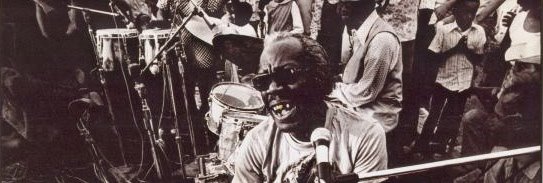
Professor Longhair his own self.

Bo Diddley, Professor Longhair and Drumming the Clave Beat
By Gerry Storm / The Rag Blog / June 26, 2008

Gerry, aka Mesmo, is a former Austin activist and musician who now lives in harmony with the Shamanic rhythms of the southwestern New Mexico desert. He shares bits and pieces of his wisdom with us on The Rag Blog.

It came to pass that I was pushed onto the drums by fate. A guru drum teacher entered my young life and explained it all to me.

“It’s all rhythm, man, the universe, all of it.”

I kind of understood what he meant, and have spent the rest of my life trying to understand it more deeply, to find supporting evidence. Now I tell my occasional students the same thing. Now I know about the solar system and the rhythms of the planets, about the rhythms of the seasons, about the rhythms of life itself.

So while I did not immediately embrace the idea of becoming a drummer, I was fascinated with rhythms and their associations. Playing them was a rush. I learned to play the 3-2 clave beat with one hand and the 2-3 clave beat with the other (not all that difficult). In this execution there is a cosmic connection. 2.0 against 1.67, the basics against infinity, the even against the odd. You can’t explain it but everyone can hear it. It’s not just the notes, it’s the way the silences between the notes are arranged as well. There is a push and a pull, a constant rotation. It is all rather mystical. And for pure fun it has few competitors amongst the rhythms.

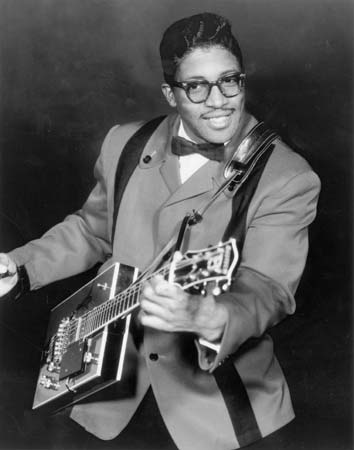
The late great Bo Diddley

Most recently a universal recognition of this phenomenon surfaced when the great entertainer, Bo Diddley died. “The Bo Diddley Beat” was again celebrated. All the headlines gave Mr. Diddley credit for “inventing” the beat. He did not. It is the 3-2 clave beat played on the electric guitar, while the drums rumble a loose 2-3 clave beat on the tom toms. The likely source of Mr. Diddley’s inspiration was the New Orleans school of whorehouse piano players, like Professor Longhair.

Longhair’s famous “Mardi Gras in New Orleans” released in the early ‘50’s can lay claim to many firsts. Some say it is the first rock and roll record. Some say it is still the best rock and roll record. It has the feel of the rumba, a blues rumba. When one listens carefully one hears the 3-2 clave beat played very prominently on a clave, out in the front of the mix, through the chorus, and then an answer comes rolling in from the saxophone section, playing the 2-3 clave beat in double time, two repetitions. And back and forth these patterns go, call and response. Longhair continued to play his gem throughout his career, often changing the arrangement, even changing the words into a kind of tourism promotion for the city. Some of his later arrangements feature horn sections and showy arrangements. But none of them is better than the original which has a feeling of the primitive that is mysterious and infectious.

According to fable these “professors” of the piano heard the beat in Caribbean music and translated it onto their instrument. The rumba was a big craze back in the ‘30’s and carved itself a niche in American popular music. The source was Havana, by way of Miami, the two being sister cities in those days with daily cruise ships running between them. If you study Latin dancing you will learn to use the clave beat in your basic steps. But the beat is also found in children’s games which are said to be traceable all the way back to Africa. You can still find it there today. To get the blues rumba feeling the piano players played the 2-3 clave in the bass with the left hand and the 3-2 above it with the right. One had a difficult time not dancing when the beat was being played. The 2-3 clave in the bass was modified slightly and became the famous early rock and roll bass line, the roll in rock and roll. This beat is prevalent in New Orleans music. You could say it’s the basis of New Orleans rhythm. It may well be much more than that. It may be the path to understanding the rhythms of the universe.

In trying to teach the beat to young wannabe hand drummers I had to find different ways to explain it. They heard the magic in the beat and could execute either of the elements quite competently but did not yet have the confidence to play both at once, kind of a duel between the left and right brains. I came up with the attached graphic illustration to show them pictorially how the beat looked. And what I came up with explained the beat to me with a new clarity.

Observe in the drawing that there are 16 equal subdivisions of the circle, 8 above the horizon line and 8 below. There 3 elements, the black, the white, and the red. Observe also that the black and red elements are identical, each with 5 parts. The white element has an extra slice, 6 parts.

If one notates the Bo Diddley interpretation of the beat, the 16 slices are 8th notes. So there would be two bars of 8th notes. The accents in the first bar are on 1, 4, and 7 (the black slices). The accents in the second bar are on 3 and 5. The response or red notes is the opposite, accents on the 3 and 5 in the first bar and on 1, 4, and 7 in the second.

Here’s the way to read the drawing: the beginning is the western horizon line. The black “note” there is 1. The remaining spaces in the upper hemisphere are numbered consecutively up to 8 moving clockwise. The first note of the second sequence of 8 is the red note just below the eastern horizon and the numbering is consecutive and clockwise. The white notes are rests or silences. Normally one would play the black notes with the right hand and the red notes with the left.

I invite one and all to give it a try.

In Africa the rhythms are tribal, they do not follow the national boundaries. I am not a student of African tribal cultures. I have not tried to pin the clave beats down to a certain place of origin beyond Cuba. The only culture I know a little about is the Madinke. I have studied the rhythms of this ancient culture. They are absolutely amazing. According to fable there are about 200 of them, each played for a specific purpose, a specific ceremony. Most are a combination of five rhythm lines, each drum and bell assigned an individual line. These musicians do not jam, they play the lines the same way, over and over, find the trance space and lie there. But you will not find the clave beats in these rhythms. I suspect they came from another culture to the south of the Madinkes, probably the Yoruban culture.

A widely accepted theory is that the original African clave beat was notated in 12/8 time. This beat was transformed to 4/4 time by the Cubans to make the music “more danceable”. In other words, it was westernized. So that is what we have today, the westernized clave, made for dancing. You can hear it in all the Cuban dances like the Son, Mambo, and Rumba. If you grew up in the past century listening to American pop music you probably have it in your soul.

Mesmo / The Rag Blog
Greater Chihuahuan Desert / June 26, 2008

Professor Longhair, Bo Diddley and More

The Rag Blog

Posted in Rag Bloggers | Tagged , , , , | Leave a comment

You Wanna Win or Not?


Thanks to Harry Edwards / The Rag Blog

Posted in RagBlog | Tagged , , , , | Leave a comment

Hope Is Sometimes Green

An agreement between Florida and United States Sugar could help restore water flows through the Everglades’ mangrove-lined creeks. Photo: Barbara P. Fernandez for The New York Times.

Florida Buying Big Sugar Tract for Everglades
By Damien Cave — June 25, 2008

LOXAHATCHEE, Fla. — The dream of a restored Everglades, with water flowing from Lake Okeechobee to Florida Bay, moved a giant step closer to reality on Tuesday when the nation’s largest sugarcane producer agreed to sell all of its assets to the state and go out of business.

Under the proposed deal, Florida will pay $1.75 billion for United States Sugar, which would have six years to continue farming before turning over 187,000 acres north of Everglades National Park, along with two sugar refineries, 200 miles of railroad and other assets.

It would be Florida’s biggest land acquisition ever, and the magnitude and location of the purchase left environmentalists and state officials giddy.

Even before Gov. Charlie Crist arrived to make the announcement against a backdrop of water, grass and birds here, dozens of advocates gathered in small groups, gasping with awe, as if at a wedding for a couple they never thought would fall in love. After years of battling with United States Sugar over water and pollution, many of them said that the prospect of a partnership came as a shock.

“It’s so exciting,” said Margaret McPherson, vice president of the Everglades Foundation. “I’m going to do cartwheels.”

The details of the deal, which is scheduled to be completed over the next few months, and does not require legislative approval, may define how long the honeymoon lasts. Previous acquisitions took longer to integrate than initially expected and because United States Sugar’s fields are not all contiguous, complicated land swaps with other businesses may be required.

The purchase will be paid for with bonds and from fees already added to water bills. But if the price goes up or environmental remediation enters the picture, the state could have to renegotiate or find other money.

The fate of the company’s 1,900 workers also remains in question and some former company executives have suggested that the state is overpaying, bailing out a company burdened with debt, a troubled new sugar mill and a lawsuit from former employees who said they were bilked out of retirement money.

Company officials said the deal would amount to $350 a share, after taxes and other obligations were paid, a premium over two previous offers of $293 per share that the company had dismissed as inadequate.

The accusations and concerns, however, did not dampen the mood. Even as workers from the mill in Clewiston tried to get a handle on their futures, and some cried foul, Mr. Crist emphasized the land’s environmental value.

He said the deal was “as monumental as the creation of the nation’s first national park, Yellowstone.” Declining to provide details of how the state arrived at the price of $1.7 billion, he said it was a terrific bargain.

“I can envision no better gift to the Everglades,” he said, “the people of Florida and the people of America — as well as our planet — than to place in public ownership this missing link that represents the key to true restoration.”

The impact on the Everglades could be substantial. The natural flow of water would be restored, and the expanse of about 292 square miles would add about a million acre-feet of water storage. That amount of water — enough to fill about 500,000 Olympic size swimming pools — could soak the southern Everglades during the dry season, protecting wildlife, preventing fires, and allowing for a redrawing of the $8 billion Everglades restoration plan approved in 2000.

It would essentially remove some of the proposed plumbing. Many of the complicated wells and pumps the plan relied on might never have to be built, water officials said, because the water could move naturally down the gradually sloping land.

Kenneth G. Ammon, deputy executive director of the South Florida Water Management District, which would assume control of the land, said it would be a “managed” flow-way, with reservoirs and other engineered mechanisms to control water flow. David G. Guest, a lawyer for Earthjustice Legal Defense Fund, joked that he might have to go to blows to keep the area all natural.

Read all of it here. / The New York Times

Thanks to Betsy Gaines / The Rag Blog

Posted in RagBlog | Tagged , | Leave a comment

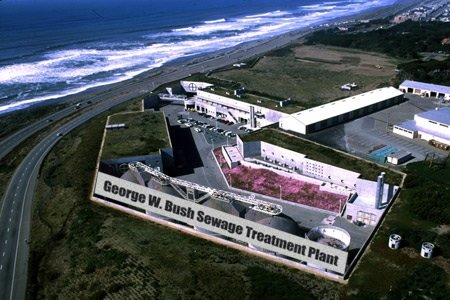
No Shit! George W. Bush Sewage Plant


An Honor That Bush Is Unlikely to Embrace
By Jesse McKinley / June 25, 2008

SAN FRANCISCO — Reagan has his highways. Lincoln has his memorial. Washington has the capital (and a state, too). But President Bush may soon be the sole president to have a memorial named after him that you can contribute to from the bathroom.

From the Department of Damned-With-Faint-Praise, a group going by the regal-sounding name of the Presidential Memorial Commission of San Francisco is planning to ask voters here to change the name of a prize-winning water treatment plant on the shoreline to the George W. Bush Sewage Plant.

The plan, naturally hatched in a bar, would place a vote on the November ballot to provide “an appropriate honor for a truly unique president.”

Supporters say that they have plenty of signatures to qualify the initiative and that the renaming would fit in a long and proud American tradition of poking political figures in the eye.

“Most politicians tend to be narcissistic and egomaniacs,” said Brian McConnell, an organizer who regularly suits up as Uncle Sam to solicit signatures. “So it is important for satirists to help define their history rather than letting them define their own history.”

Not surprisingly, those Republicans in a city that voted 83 percent Democratic in 2004 are not thrilled with the idea. Howard Epstein, chairman of the ever-outnumbered San Francisco Republican Party, called the initiative “an abuse of process.”

“You got a bunch of guys drunk who came up with an idea,” Mr. Epstein said, “and want to put on the ballot as a big joke without regard to the city’s governance or cost.”

The renaming would take effect on Jan. 20, when the new president is sworn in. And regardless of the measure’s outcome, supporters plan to commemorate the inaugural with a synchronized flush of hundreds of thousands of San Francisco toilets, an action that would send a flood of water toward the plant, now called the Oceanside Water Pollution Control Plant.

“It’s a way of doing something physical that’s mentally freeing,” said Stacey Reineccius, 45, a software consultant and entrepreneur who supports the plan. “It’s a weird thing, but it’s true.”

Source. / New York Times

Thanks to Richard Kendrick / The Rag Blog

Posted in RagBlog | Tagged , , , | 1 Comment

Iraq : Closing the Deal


Deal Allows U.S. To Attack Any Country From Iraq
June 24, 2008

BAGHDAD – A Sunni legislator said on Monday that the security agreement to be signed between Baghdad and Washington would allow the latter to attack any country from Iraqi territories.

“The Iraqi-U.S. agreement contains several items that impinge upon the sovereignty of Iraq, including the right of the U.S. forces in Iraq to attack any nation and raid any Iraqi house and arrest people without prior permission from the Iraqi government,” Khalaf al-Alyan, a member of parliament from the Iraqi Accordance Front (IAF), told Aswat al-Iraq – Voices of Iraq – (VOI).

U.S. President George W. Bush had signed a declaration of principles with Iraqi Prime Minister Nouri al-Maliki on December 1, 2007. It was planned to be ratified on July 31, 2008 to be effective as of January 1, 2009.

“The agreement grants the United States the right to set up a large number of bases in Iraq, ranging between 50 and 58 bases,” said Alyan.

The IAF is composed of three key political components: Vice President Tareq al-Hashimi’s Iraqi Islamic Party (IIP), IAF leader Adnan al-Dulaimi’s Iraq People’s Congress (IPC) and Alyan’s National Dialogue Council (NDC).

The IAF, which has 40 out of a total 275 seats, is the main bloc representing Arab Sunnis in the country’s political process.

Meanwhile, Labid Abbawi, the undersecretary for foreign affairs, denied that the agreement contained an item allowing U.S. forces to use Iraqi territories as a springboard to threaten other countries.

“This item does not exist in the agreement because it simply runs counter to the policies of both Baghdad and Washington governments,” Abbawi told VOI.

The deal governs the presence of U.S. forces in Iraq after the year 2008. The U.S. presence in Iraq is currently relying on a mandate by the United Nations, renewed annually upon the request of the Iraqi government.

The agreement would not enter into effect if the Iraqi parliament did not approve it.

Source. Information Clearing House

Thanks to Devra Morice / The Rag Blog

Posted in RagBlog | Tagged , , | Leave a comment

Hell No, We Won’t Go!


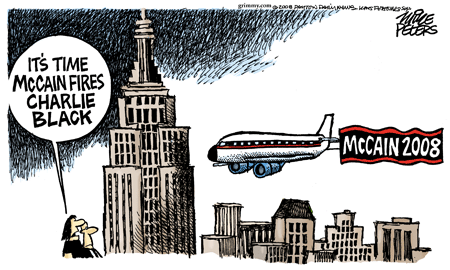
McCain: World War III Would Justify Draft
June 25, 2008

John McCain said last night during a campaign tele-conference that he would bring back a military draft in the United States only in the case of a ‘World War III’ scenario.

Reuters reported:

Many Americans are fearful the U.S. government will be forced to reinstitute the draft given the prolonged Iraq and Afghanistan wars.
Asked about that possibility by a potential voter in Florida during a telephone “town hall meeting,” McCain said: “I don’t know what would make a draft happen unless we were in an all-out World War III.” …

McCain, a Vietnam veteran, said the draft during that conflict weighed most heavily on lower-income Americans, and that this should not be repeated.

But McCain may be more open to the draft than it seems. During a July 2006 interview on CNN, McCain was asked about the following statement by Newt Gingrich: “We’re in the early stages of what I would describes as the Third World War and, frankly, our bureaucracies aren’t responding fast enough.” Asked whether he agreed, McCain said:

“I do to some extent. I think it’s important to recognize that we have terrorist organizations which — who are dangerous by themselves, are now being supported by radical Islamic governments, i.e., the Iranians, which makes them incredibly more dangerous because they are trained, equipped, motivated and assisted in every way by the Iranians.”

Also, as ThinkProgress noted, “Last October, President Bush himself warned of a coming ‘World War III’ with Iran. ‘I’ve told people that if you’re interested in avoiding World War III,’ said the President. ‘It seems like you ought to be interested in preventing them from have the knowledge necessary to make a nuclear weapon.'”

Source. / The Huffington Post

The Rag Blog

Posted in RagBlog | Tagged , , , , | Leave a comment

Stop the Noise!


When noise pollution is not making us sick
and anxious, it is literally killing us.
How do we turn it off?
By Katharine Mieszkowski

Jun. 25, 2008 Henry Bean can’t stand the sound of burglar alarms. He hates back-up beepers on trucks and bristles when garbage rigs grind up their fetid loads in the middle of the night, the noise reverberating off Manhattan’s buildings. But Bean harbors special resentment for the oblivious car owners whose vehicles blare false alarms. “It bothers me that their cars can shout in my ear, not stop shouting, and I can’t do anything about it,” he says. “My pride can’t handle it. I can’t exist if I don’t fight back in some way, however pathetically or ineffectually.”

For years, Bean enacted small-scale revenge, breaking in to stop the alarms or letting air out of tires. One night in the early ’90s, an alarm sounded for more than four hours outside his apartment at 97th Street and West End. By the time Bean broke into the car, the vehicle was covered with eggs, beer and tomatoes. “People inflicted their fury, but nobody did what I did, which is break the window, pop the hood and disconnect the battery cable,” he says.

For his crime against private property, Bean was arrested. After a night in jail, and spending thousands on his legal defense, Bean was somewhat chastened, but not reformed. Just the other day, a car alarm started making a ruckus, and he confesses he confronted the blaring vehicle and “did some stuff to it,” but won’t be more specific than that.

Bean, who is in his early 60s, is a screenwriter, director, novelist and actor. He may be best known for his 2001 film “The Believer,” about a 22-year-old Jew (Ryan Gosling) who becomes a Nazi skinhead, which won the Grand Jury Prize at the Sundance Film Festival. His real-life role as noise vigilante inspired “Noise,” released in May, in which an upscale Manhattan lawyer (Tim Robbins) throws away his job, his marriage and his apartment in a quixotic quest to fight car alarms. In vain pursuit of a little quiet, the lawyer becomes “The Rectifier,” waging a one-man war on the discordant urban soundscape, throttling offending cars. One scene shot at 97th and West End replicates Bean’s own crime and trip to jail.

Despite a host of good reviews, in the New Yorker, Entertainment Weekly and the Los Angeles Times, “Noise” hasn’t found a huge audience. But if the film won’t set any box office records, it does spotlight a pervasive form of pollution that seems to escape our concern — at our peril. Recent studies reveal that noise can be harmful to human health, just like water or air pollution, damaging not only hearing and sleep but raising our blood pressure to dangerous levels. According to the World Health Organization, noise pollution is responsible for tens of thousands of deaths a year.

In the city that never sleeps, noise is the No. 1 quality-of-life complaint. New York City’s 311 hot line logged 350,000 complaints about racket in 2006, according to Arline Bronzaft, a psychologist who studies noise. In the ’70s, Bronzaft did landmark research on how the noise of elevated train tracks hampered children’s learning in nearby schools. Now a member of New York’s Council on the Environment, she recently helped rewrite the city’s noise code.

In July 2007, a new noise code went into effect, updating the old one for the first time in 30 years, and regulating construction noise, air-conditioner noise, garbage truck grinding and even music from bars and restaurants. Hey, taxi drivers! Horn honking is not permitted, except in situations of “imminent danger.” Is the new code quieting things down out there? It’s hard to say, but the complaining about noise has only gotten louder. In the 11 months following the new code’s introduction, the city registered a 6 percent increase in noise complaints.

Modern cities can be so noisy that ornithologists have found birds warbling at the top of their lungs to be heard. Nightingales in Berlin have been documented singing up to 14 decibels louder than their counterparts in woody environs, in an attempt to make their songs audible above all the background noise. Yet the cacophony of modern life is hardly confined to metropolises like New York or Cairo, Egypt, where you literally have to shout on the street to make yourself heard.

In “Noise,” Bean’s protagonist and his family escape to the country for the weekend. Their getaway is besieged by a neighbor’s farting leaf blower. Getting away from it all just isn’t that easy.

“For 50 years, if people didn’t like noise, and they had money, the solution has been: Move to the suburbs. Now we’ve made our suburbs noisy. They’re no longer quiet refuges,” says Les Blomberg, executive director of the Noise Pollution Clearinghouse in Montpelier, Vt. “We got our half-acre lots, and now we have our weed whacker, our leaf blower, our hedge trimmer, our riding lawn mower, and then we hop in our car and drive on four- and six-lane highways past thousands of other suburbs to our place of work, noise-polluting every place we pass.”

But you don’t have to be an anti-noise crusader to suffer physical effects from noise, even if you’re sleeping right through it. Scientists at Imperial College London monitored the blood pressure of 140 sleeping volunteers who lived near London’s Heathrow airport. They discovered that subjects’ blood pressure rose when a plane few overhead even when the subjects remained asleep. A study of 5,000 45-to-70-year-olds living near airports for at least five years found that they were at greater risk of suffering from hypertension, aka high blood pressure, than their counterparts in quieter realms. People with high blood pressure have an increased risk of developing heart disease, stroke, kidney disease and dementia. In 2007, WHO estimated that long-term exposure to traffic noise may account for 3 percent of deaths from ischemic heart disease among Europeans.

Not only can too much loud noise damage your hearing, or disrupt your sleep, it can literally suck the life out of you thanks to the human body’s fight-or-flight response. “The human auditory system is designed to serve as a means of warning against dangers in the environment,” explains Louis Hagler, a retired internal medicine specialist in Oakland, Calif. “Noise above a certain level is perceived by the nervous system as a threat.” The body responds to that threat with an outpouring of epinephrine and cortisol, the so-called stress hormones. “Your blood pressure goes up, your pulse rate goes up, there is a sudden outpouring of sugar into the bloodstream so the body is prepared to meet whatever threat there is in the environment.”

If exposures are intermittent or rare, the body has the chance to return to normal. But if the exposure is unrelenting, the body doesn’t have a chance to calm down, and blood pressure and heart rate may remain elevated, Hagler explains. That’s why what seems like a mere annoyance can actually have long-term health effects. “There is no question that people who live near a busy roadway are experiencing effects on their blood pressure,” says Hagler.

As Bean attests, once you tune into the din, it’s hard to tune out again. “It’s like an allergy — once you get sensitized to one of these things then they all bother you, and then each one builds on the other,” he says. And what’s a mere nuisance to one person is another’s bête noire. “There is no evidence that noise causes mental illness itself, but there is little doubt that it may accelerate or intensify some kind of mental disorders,” explains Hagler. He adds that symptoms of exposure to noise pollution include anxiety, nervousness, nausea, headaches, emotional instability, argumentativeness and changes in mood. No wonder excessive noise has been used as a form of torture.

In ancient Rome, chariots were banned from the streets at night to prevent clattering wheels on stones from waking people up. In the United States, back in the ’70s, when Bronzaft was documenting how children studying in classrooms next to elevated train tracks had delayed learning, there was an outpouring of official concern about the effects of noise, on both health and quality of life. In 1972, Congress passed the Noise Control Act. The Environmental Protection Agency had its own Office of Noise Abatement and Control, which still exists today, but as an unfunded skeleton. What happened? “A man got elected president named Ronald Reagan and everything stopped,” says Bronzaft. The Gipper decided that noise was best regulated by cities and states, but federal funding to help them evaporated. Attempts to refund the office have failed.

Since the ’80s, noise abatement, such as it is, has been subject to a hodgepodge of local regulations in towns and cities, on a piecemeal basis, banning gas-powered leaf blowers here or restricting construction hours there. You’re in trouble in Florida if your car stereo can be plainly heard from more than 25 feet away. California cities including Berkeley, Santa Monica, Beverley Hills and Laguna Beach have restricted leaf blowers. Many communities deal with noise under more general nuisance laws. “Even if you have the law on your side, getting the police to enforce it can be the bigger challenge,” says Richard Tur, 39, founder of NoiseOff.org, a Web resource for fighting local noise pollution. Beyond regulating highway and aircraft noise, the feds don’t do much.

Meanwhile, the world continues to get louder. “The last century was the loudest in the history of the world,” says Blomberg. “The last decade was the loudest decade in the history of the world without a question,” he adds, citing rising populations and their attendant airplanes, cars, trucks, weed whackers, air conditioners and, yes, leaf blowers. Yet Blomberg is optimistic the future can be quieter than it is today.

“People assume that living in this advanced technological world, noise is the price we pay,” he says. “Almost all our noises are related to technology. Only the barking dog is not related to technology.” But he thinks that technological innovation can also quiet the din. He points to electric lawn equipment and hybrid and electric cars, and cites innovation in asphalt technology to help reduce highway noise, which mostly consists of the sound of wheels on the pavement.

Blomberg says he gets about 150 calls or e-mails per week from the noise-addled seeking some peace and quiet. He recommends confronting, nicely, noisemakers themselves and, if that doesn’t work, getting a copy of a local noise or nuisance ordinance to make your case, or even approaching lawmakers about the racket. Blomberg led his own local noise pollution crusade back in the ’90s against street cleaners that swept the street in front of his downtown apartment at 4 a.m., three days a week. Political organizing, including a petition drive and lobbying City Council members, got the street cleaning postponed to 6 a.m.

Since then, Blomberg has moved to a quieter neighborhood, where he mows his property with electric mowers (both battery and plug-in) and a push mower. He has outfitted his house with a quieter-model furnace, air conditioner and dishwasher. He recommends befriending your neighbors, as a way to stop many noise pollution problems before they start.

But not everyone can move where it’s quieter. Noise pollution activist Tur, founder of Noise Off, which has 600 online community members, all fighting the loud and obnoxious, lives in an apartment in Astoria, Queens, N.Y., near a major thoroughfare. “I pretty much live near a ‘perfect storm’ of noise pollution,” he says. That’s clear during our phone conversation, in which a siren is blaring the background. Tur has joined political clubs, spoken out at public meetings and lobbied local officials, as well as networked hundreds of activists. He has also installed soundproofing windows in his bedroom; they create a dead-air space between the inner and outer panes of glass, which muffles general traffic noise.

With little official relief in earshot, it’s clear that finding relief from the din is left up to individuals, whether through grass-roots organizing or buying a quieter lawn mower. We may not, however, want to follow the lead of Bean, for whom the degrading indignities of life are concentrated in the car alarm.

“The whole purpose of car alarms is to make money for the people who manufacture and install them,” he says, fuming. “They don’t prevent theft.” (He’s right, according to the Highway Loss Data Institute of the Insurance Institute for Highway Safety.) In New York City, car alarms can legally blare for three minutes. Bean wants the city to ban them outright, but doesn’t have a lot of faith in that happening any time soon. “If people in New York City destroyed or severely damaged every car whose alarm went off for any time at all, except during a burglary or theft, I think people would disconnect their alarms,” he says. “Then this whole thing would go away.”

For years, Bean enacted small-scale revenge, breaking in to stop the alarms or letting air out of tires. One night in the early ’90s, an alarm sounded for more than four hours outside his apartment at 97th Street and West End. By the time Bean broke into the car, the vehicle was covered with eggs, beer and tomatoes. “People inflicted their fury, but nobody did what I did, which is break the window, pop the hood and disconnect the battery cable,” he says.

For his crime against private property, Bean was arrested. After a night in jail, and spending thousands on his legal defense, Bean was somewhat chastened, but not reformed. Just the other day, a car alarm started making a ruckus, and he confesses he confronted the blaring vehicle and “did some stuff to it,” but won’t be more specific than that.

Bean, who is in his early 60s, is a screenwriter, director, novelist and actor. He may be best known for his 2001 film “The Believer,” about a 22-year-old Jew (Ryan Gosling) who becomes a Nazi skinhead, which won the Grand Jury Prize at the Sundance Film Festival. His real-life role as noise vigilante inspired “Noise,” released in May, in which an upscale Manhattan lawyer (Tim Robbins) throws away his job, his marriage and his apartment in a quixotic quest to fight car alarms. In vain pursuit of a little quiet, the lawyer becomes “The Rectifier,” waging a one-man war on the discordant urban soundscape, throttling offending cars. One scene shot at 97th and West End replicates Bean’s own crime and trip to jail.

Despite a host of good reviews, in the New Yorker, Entertainment Weekly and the Los Angeles Times, “Noise” hasn’t found a huge audience. But if the film won’t set any box office records, it does spotlight a pervasive form of pollution that seems to escape our concern — at our peril. Recent studies reveal that noise can be harmful to human health, just like water or air pollution, damaging not only hearing and sleep but raising our blood pressure to dangerous levels. According to the World Health Organization, noise pollution is responsible for tens of thousands of deaths a year.

In the city that never sleeps, noise is the No. 1 quality-of-life complaint. New York City’s 311 hot line logged 350,000 complaints about racket in 2006, according to Arline Bronzaft, a psychologist who studies noise. In the ’70s, Bronzaft did landmark research on how the noise of elevated train tracks hampered children’s learning in nearby schools. Now a member of New York’s Council on the Environment, she recently helped rewrite the city’s noise code.

In July 2007, a new noise code went into effect, updating the old one for the first time in 30 years, and regulating construction noise, air-conditioner noise, garbage truck grinding and even music from bars and restaurants. Hey, taxi drivers! Horn honking is not permitted, except in situations of “imminent danger.” Is the new code quieting things down out there? It’s hard to say, but the complaining about noise has only gotten louder. In the 11 months following the new code’s introduction, the city registered a 6 percent increase in noise complaints.

Modern cities can be so noisy that ornithologists have found birds warbling at the top of their lungs to be heard. Nightingales in Berlin have been documented singing up to 14 decibels louder than their counterparts in woody environs, in an attempt to make their songs audible above all the background noise. Yet the cacophony of modern life is hardly confined to metropolises like New York or Cairo, Egypt, where you literally have to shout on the street to make yourself heard.

In “Noise,” Bean’s protagonist and his family escape to the country for the weekend. Their getaway is besieged by a neighbor’s farting leaf blower. Getting away from it all just isn’t that easy.

“For 50 years, if people didn’t like noise, and they had money, the solution has been: Move to the suburbs. Now we’ve made our suburbs noisy. They’re no longer quiet refuges,” says Les Blomberg, executive director of the Noise Pollution Clearinghouse in Montpelier, Vt. “We got our half-acre lots, and now we have our weed whacker, our leaf blower, our hedge trimmer, our riding lawn mower, and then we hop in our car and drive on four- and six-lane highways past thousands of other suburbs to our place of work, noise-polluting every place we pass.”

But you don’t have to be an anti-noise crusader to suffer physical effects from noise, even if you’re sleeping right through it. Scientists at Imperial College London monitored the blood pressure of 140 sleeping volunteers who lived near London’s Heathrow airport. They discovered that subjects’ blood pressure rose when a plane few overhead even when the subjects remained asleep. A study of 5,000 45-to-70-year-olds living near airports for at least five years found that they were at greater risk of suffering from hypertension, aka high blood pressure, than their counterparts in quieter realms. People with high blood pressure have an increased risk of developing heart disease, stroke, kidney disease and dementia. In 2007, WHO estimated that long-term exposure to traffic noise may account for 3 percent of deaths from ischemic heart disease among Europeans.

Not only can too much loud noise damage your hearing, or disrupt your sleep, it can literally suck the life out of you thanks to the human body’s fight-or-flight response. “The human auditory system is designed to serve as a means of warning against dangers in the environment,” explains Louis Hagler, a retired internal medicine specialist in Oakland, Calif. “Noise above a certain level is perceived by the nervous system as a threat.” The body responds to that threat with an outpouring of epinephrine and cortisol, the so-called stress hormones. “Your blood pressure goes up, your pulse rate goes up, there is a sudden outpouring of sugar into the bloodstream so the body is prepared to meet whatever threat there is in the environment.”

If exposures are intermittent or rare, the body has the chance to return to normal. But if the exposure is unrelenting, the body doesn’t have a chance to calm down, and blood pressure and heart rate may remain elevated, Hagler explains. That’s why what seems like a mere annoyance can actually have long-term health effects. “There is no question that people who live near a busy roadway are experiencing effects on their blood pressure,” says Hagler.

As Bean attests, once you tune into the din, it’s hard to tune out again. “It’s like an allergy — once you get sensitized to one of these things then they all bother you, and then each one builds on the other,” he says. And what’s a mere nuisance to one person is another’s bête noire. “There is no evidence that noise causes mental illness itself, but there is little doubt that it may accelerate or intensify some kind of mental disorders,” explains Hagler. He adds that symptoms of exposure to noise pollution include anxiety, nervousness, nausea, headaches, emotional instability, argumentativeness and changes in mood. No wonder excessive noise has been used as a form of torture.

In ancient Rome, chariots were banned from the streets at night to prevent clattering wheels on stones from waking people up. In the United States, back in the ’70s, when Bronzaft was documenting how children studying in classrooms next to elevated train tracks had delayed learning, there was an outpouring of official concern about the effects of noise, on both health and quality of life. In 1972, Congress passed the Noise Control Act. The Environmental Protection Agency had its own Office of Noise Abatement and Control, which still exists today, but as an unfunded skeleton. What happened? “A man got elected president named Ronald Reagan and everything stopped,” says Bronzaft. The Gipper decided that noise was best regulated by cities and states, but federal funding to help them evaporated. Attempts to refund the office have failed.

Since the ’80s, noise abatement, such as it is, has been subject to a hodgepodge of local regulations in towns and cities, on a piecemeal basis, banning gas-powered leaf blowers here or restricting construction hours there. You’re in trouble in Florida if your car stereo can be plainly heard from more than 25 feet away. California cities including Berkeley, Santa Monica, Beverley Hills and Laguna Beach have restricted leaf blowers. Many communities deal with noise under more general nuisance laws. “Even if you have the law on your side, getting the police to enforce it can be the bigger challenge,” says Richard Tur, 39, founder of NoiseOff.org, a Web resource for fighting local noise pollution. Beyond regulating highway and aircraft noise, the feds don’t do much.

Meanwhile, the world continues to get louder. “The last century was the loudest in the history of the world,” says Blomberg. “The last decade was the loudest decade in the history of the world without a question,” he adds, citing rising populations and their attendant airplanes, cars, trucks, weed whackers, air conditioners and, yes, leaf blowers. Yet Blomberg is optimistic the future can be quieter than it is today.

“People assume that living in this advanced technological world, noise is the price we pay,” he says. “Almost all our noises are related to technology. Only the barking dog is not related to technology.” But he thinks that technological innovation can also quiet the din. He points to electric lawn equipment and hybrid and electric cars, and cites innovation in asphalt technology to help reduce highway noise, which mostly consists of the sound of wheels on the pavement.

Blomberg says he gets about 150 calls or e-mails per week from the noise-addled seeking some peace and quiet. He recommends confronting, nicely, noisemakers themselves and, if that doesn’t work, getting a copy of a local noise or nuisance ordinance to make your case, or even approaching lawmakers about the racket. Blomberg led his own local noise pollution crusade back in the ’90s against street cleaners that swept the street in front of his downtown apartment at 4 a.m., three days a week. Political organizing, including a petition drive and lobbying City Council members, got the street cleaning postponed to 6 a.m.

Since then, Blomberg has moved to a quieter neighborhood, where he mows his property with electric mowers (both battery and plug-in) and a push mower. He has outfitted his house with a quieter-model furnace, air conditioner and dishwasher. He recommends befriending your neighbors, as a way to stop many noise pollution problems before they start.

But not everyone can move where it’s quieter. Noise pollution activist Tur, founder of Noise Off, which has 600 online community members, all fighting the loud and obnoxious, lives in an apartment in Astoria, Queens, N.Y., near a major thoroughfare. “I pretty much live near a ‘perfect storm’ of noise pollution,” he says. That’s clear during our phone conversation, in which a siren is blaring the background. Tur has joined political clubs, spoken out at public meetings and lobbied local officials, as well as networked hundreds of activists. He has also installed soundproofing windows in his bedroom; they create a dead-air space between the inner and outer panes of glass, which muffles general traffic noise.

With little official relief in earshot, it’s clear that finding relief from the din is left up to individuals, whether through grass-roots organizing or buying a quieter lawn mower. We may not, however, want to follow the lead of Bean, for whom the degrading indignities of life are concentrated in the car alarm.

“The whole purpose of car alarms is to make money for the people who manufacture and install them,” he says, fuming. “They don’t prevent theft.” (He’s right, according to the Highway Loss Data Institute of the Insurance Institute for Highway Safety.) In New York City, car alarms can legally blare for three minutes. Bean wants the city to ban them outright, but doesn’t have a lot of faith in that happening any time soon. “If people in New York City destroyed or severely damaged every car whose alarm went off for any time at all, except during a burglary or theft, I think people would disconnect their alarms,” he says. “Then this whole thing would go away.”

Source. salon.com

The Rag Blog

Posted in RagBlog | Leave a comment

Telecom Donations Tied to FISA Vote


Supporters of the spying bill received twice
the contributions as those against it.
By Mike Lillis / June 24, 2008

When scores of House Democrats joined Republicans last week to reauthorize a controversial White House spying program, many critics attributed that support to election-year jitters. But as liberal voters continue to bash Democrats on the issue, some campaign finance reformers charge that political contributions from the telecom industry, which benefited handsomely under the bill, probably also swayed votes

In an analysis released Tuesday, Maplight.org, a nonprofit campaign finance watchdog group, found that lawmakers voting Friday in support of the wiretap deal averaged roughly twice the donations from the nation’s leading telecoms – Verizon, Sprint and AT&T – over the last three years as those voting against it.

The figures might not have raised eyebrows except that the proposal contained a gift for the industry, effectively granting retroactive legal immunity to the telecoms that enabled the Bush administration’s warrantless eavesdropping program. The immunity provision – blasted by civil libertarians for putting industry concerns above Fourth Amendment rights against search and seizure – rescues the companies from the roughly 40 lawsuits pending against them. Some money-in-politics watchdogs say the connection between the contributions and votes is no accident.

The money-in-politics debate is hardly new to Washington, but it has taken on greater urgency as both political contributions and federal budgets grow larger with each passing year. Under the current system, lawmakers have become ever more reliant on campaign coffers to maintain their hold on power. Industry, meanwhile, is under constant pressure to be at the negotiation table when related legislation is being crafted on Capitol Hill. Money is often the quickest way to gain that seat. This combination of factors has created a near symbiotic relationship between Congress and industry, often lending a sense that business interests take priority over citizens’ concerns.

“It’s not a dollar given and a vote bought,” said Meredith McGehee, policy director at the Campaign Legal Center, a nonprofit campaign finance reform advocate, “but it is a system where large industries can gain influence and direct how policy is decided.”

The shame, McGehee said, is that the campaign-finance system leads to conflict-of-interest questions even when none exist. “That undermines confidence in the legislative process,” she stated.

Mary Boyle, a spokeswoman with Common Cause, echoed the message. “We certainly know that contributions go a long way to gaining access and influence,” she said. “The appearance is that money buys votes.”

Maplight’s analysis, crunched using contribution data from the Center for Responsive Politics, found that the 293 House members voting last week in favor of the wiretapping compromise received, on average, more than double the amount of money as those who voted against it. They got $9,659 from Verizon, AT&T and Sprint between January 2005 and March 2008, while those voting against got $4,810.

But some campaign finance experts warned against linking campaign donations to votes. “It’s way too simplistic just to look at money given to a candidate and claim it’s affected a particular vote,” said Richard L. Hasen, an election specialist at Loyola Law School in Los Angeles. “It’s something that’s often alleged, but much harder to prove.”

“There does seem to be a correlation between telecom money and the way people voted,” Massie Ritsch, spokesman for the Center for Responsive Politics, said in an email, “but as in all cases when you’re following the money, causation is nearly impossible to establish.”

Indeed, in the case of the spying proposal, 94 of the 105 Democrats voting for the bill had supported an earlier House proposal to renew the spying law without granting retroactive immunity to the telecoms. House Speaker Nancy Pelosi (D-Cal.), one of those 94, made clear that she opposed telecom immunity, but was forced to accept a compromise for the sake of passing a bill. The immunity language was a concession to the White House, which threatened to veto any bill without it.

“I do not believe that Congress should be in the business of interfering with ongoing lawsuits and attempting to grant immunity to telecommunications companies that allegedly violated the law,” Pelosi said on the chamber floor last week. “Those companies have not lived up to the standards expected by the American people … They come out of this with a taint.”

In return, Democrats included language previously opposed by the administration, including a clarification that the president has no authority outside the 1978 Foreign Intelligence Surveillance Act to collect foreign-to-domestic communications, even in times of war.

The Senate is expected to pass the bill on Wednesday.

Not all Democrats felt the compromise language was worth the sacrifice of civil liberties.

“I have consistently said that it is not appropriate for Congress to grant these companies immunity for their actions without having an understanding of what it is that they did,” said Rep. John Dingell (D-Mich.), chairman of the House Energy and Commerce Committee. “This is not only because it will hold the telecommunications companies accountable for their actions, but because it is the only way of finding out just how extensive the president’s illegal wiretapping program really was.”

Liberal voters have lit up the blogosphere in agreement, charging that Democrats caved to White House demands at the expense of constitutional rights. Some civil liberties advocates also placed blame on the congressional leaders.

“This is all part of the abuse of power that we’ve seen out of this White House, as well as Congress’ refusal to stand up and perform its constitutional duty to check the executive branch,” said Boyle of Common Cause. “Congress is complicit here.”

Source. / Washington Independent / truthout

The Rag Blog

Posted in RagBlog | Tagged , , , , , , , | Leave a comment

If I Had to Watch US News, I’d Blow My Brains Out

Iraq story buried by US networks:
features Lara Logan of CBS

h/t Informed Comment / Posted June 25, 2008

Go to War in Iraq? What War in Iraq? about lack of media coverage of the war. / The Rag Blog

The Rag Blog

Posted in RagBlog | Tagged , , , , , | Leave a comment

Where Teardrops Fall

Antonio Neri Licon, “Nerilicon” / El Economista, Mexico City

The Rag Blog / Posted June 25, 2008

Posted in RagBlog | Tagged , , , , , | Leave a comment

Time for a Grand Inquest into Bush’s High Crimes

Impeachment trial of Andrew Johnson.

We have witnessed a staggering
abuse of power by the president

By Robert L. Borosage / June 24, 2008

One of House Speaker Nancy Pelosi’s first acts upon taking the gavel was to rule impeachment off the table. She wanted Democrats to focus on challenging the president on the war and on kitchen table concerns — from energy to education to health care. With Democrats now enjoying an increasing margin in generic polls and looking towards gaining seats in both the House and the Senate, the strategy certainly hasn’t hurt politically.

But the constitutional implications are far more disturbing. This was dramatized as the Congress debated the FISA reform legislation that will provide retroactive immunity to the telecommunications companies for warrantless interception of the conversations of Americans — and by implication, retroactive acceptance of the president’s authority to order such wiretaps.

We have witnessed a staggering abuse of power by this president. Even former Bush Justice Department officials now charge President Bush with trampling the Constitution. Bush has claimed the prerogative to declare an endless war without congressional approval, to designate someone an enemy without cause, to proceed to wiretap them without warrant, arrest or kidnap them at will, jail them without a hearing, hold them indefinitely, interrogate them intensively (read torture), bring them to trial outside the US court system. He claims that executive privilege exempts his aides — even the aides of his aides and his vice president’s aides — from congressional investigation. He claims the right to amend or negate congressional laws with a statement upon signing them. And much more.

Even this Supreme Court, stacked with activist right-wing judges enamored of executive national security powers, has rebuked the president on some of these claims, particularly around the treatment of allegedly enemy combatants. But many of Bush’s claims will escape judicial determination.

And there is the rub. According to the leading case on presidential powers, if Bush’s extreme assertions of power are not challenged by the Congress, they end up not simply creating new law, they could end up rewriting the Constitution itself, altering the Constitutional division of powers by establishing the president’s claims as constitutional powers that the Congress or the Courts may not infringe.

The Steel Seizure case — Youngstown Sheet and Tube v Sawyer, 343 US 579 (1952), remains the leading case on presidential power. In Youngstown, a six member majority of the Court joined in overturning Truman’s executive order nationalizing the steel plants to end a strike during the Korean War. Justice Black wrote the opinion for the Court, but the historically influential opinions were penned by Justices Robert H. Jackson and Felix Frankfurter, both Democratic appointees. Frankfurter laid out the argument for a sort of common law of constitutional amendment:

Deeply embedded traditional ways of conducting government cannot supplant the Constitution or legislation, but they give meaning to the words of a text or supply them. It is an inadmissibly narrow conception of American constitutional law to confine it to the words of the Constitution and to disregard the gloss which life has written upon them. In short, a systematic, unbroken, executive practice, long pursued to the knowledge of the Congress and never before questioned, engaged in by Presidents who have also sworn to uphold the Constitution, making as it were such exercise of power part [343 U.S. 579, 611] of the structure of our government, may be treated as a gloss on “executive Power” vested in the President by 1 of Art. II.

In Youngstown, Jackson concurred, arguing that the president’s powers vary as to whether he acts with congressional authority (his greatest power), in the absence of it, or in opposition to it:

When the president acts in absence of either a congressional grant or denial of authority, he can only rely upon his own independent powers, but there is a zone of twilight in which he and Congress may have concurrent authority, or in which its distribution is uncertain. Therefore, congressional inertia, indifference or quiescence may sometimes, at least as a practical matter, enable, if not invite, measures on independent presidential responsibility. In this area, any actual test of power is likely to depend on the imperatives of events and contemporary imponderables rather than on abstract theories of law.

When a president egregiously abuses his power — particularly in areas relating to the rights of American citizens — remedies are often difficult. The Supreme Court is reluctant to arbitrate a power struggle between two co-equal branches. That is why the Constitution prescribes the specific remedy of impeachment for crimes and abuses of power — High Crimes and Misdemeanors — and empowers the House and Senate to sit in judgment whether the actions are to be accepted or condemned.

What the Court said in Youngstown is that if presidents assert a prerogative — like the power to make war without a congressional declaration — systematically, with unbroken regularity, with the knowledge of the Congress and are never questioned — then that practice becomes a Constitutional power that cannot be infringed upon by the Congress or the Courts.

Thus, Congress must formally object to President Bush’s abuses or it risks by “indifference or quiescence” contributing to the powers of our imperial presidency.

When Pelosi took impeachment off the table, it was reduced to being a rhetorical protest vehicle for progressives like Dennis Kucinich or Russ Feingold. But Congress need not convict President Bush to impeach him for High Crimes and Misdemeanors. And arguably, the House need not even impeach the president to hold a Grand Inquest into the powers that he has claimed, registering a formal objection to them. The Judiciary Committee in the House should formally convene that Inquest, no matter what the decision is on impeachment. For if Pelosi’s sensible political judgment results, as it has to date, in a show of congressional “inertia, indifference or quiescence,” the Democratic majority in Congress may have gained a dozen seats at the cost of relinquishing its own powers, and putting the rights of Americans at risk.

Source. / The Huffington Post

The Rag Blog

Posted in RagBlog | Tagged , , , , , | Leave a comment