Lamar W. Hankins : Pipeline Debate is Mired in Disinformation

Coming your way? Pieces of the pipeline. Image from National Radio Canada.

Keystone XL Pipeline debate
is mired in disinformation

The Keystone XL Pipeline project has virtually nothing to do with American energy independence, but everything to do with enriching Canadian tar sands oil interests and the interests of refineries that are in the oil products exporting business.

By Lamar W. Hankins | The Rag Blog | March 5, 2013

One of the attributes of our current politics is the repetition of false information, even after it has been proven false. Such repetition is the use of propaganda based on deceit — not to persuade, but to manipulate.

A year ago, when I wrote about the Keystone XL pipeline, I assumed that the debate would be over by now, but the pipeline project has been delayed by protests in Texas and Oklahoma — the Tar Sands Blockade — which have kept the debate alive for a while longer. (To read more about the Tar Sands Blockade, go here and here.)

These delays have given the proponents of the pipeline an opportunity to push their disinformation campaign into high gear, although virtually all they have to say amounts to outright lies or distortions of the truth, to make a few petrochemical companies and investors richer at the expense of the environment — which means to the detriment of the people.

I’m in favor of advocacy, but when advocates are caught in lies, they have to change their message or expose themselves as untrustworthy or worse. Apparently this exposure does not bother the proponents of the Keystone XL Pipeline, which is intended to carry tar sands oil — perhaps the most environmentally destructive oil found on the planet — from Canada to refineries on the Texas Gulf Coast.

  • Deceit 1: Tar sands oil will move the U.S. toward energy independence

The most egregious lie told repeatedly by pipeline proponents is that the tar sands oil will move us toward energy independence. However, most of the petroleum products made from the tar sands oil will be sold overseas at prices even higher than we pay in the U.S. Nothing about the tar sands oil makes the U.S. energy independent, but it does increase the profits of the oil companies that are regularly gouging Americans by manipulating the availability of gasoline.

Sen. John Cornyn, Texas’ senior Republican senator, along with others, stated in a January 2013 letter, “The pipeline is also a major step toward American energy security.” How can a source of oil that will be used primarily to make diesel fuel to be sold overseas help domestic energy security? Canada is seeking a way to have its tar sands oil processed for the international market, not the American market. Refineries in Texas, primarily the Valero refinery in Port Arthur, have been retrofitted to process tar sands oil, rather than to process the kind of oil that comes from domestic production and from OPEC, Venezuela, and Mexico.

The Valero refinery operates in a Foreign Trade Zone so that tar sands oil products will not be taxed when they are sold overseas. At conferences with investors since 2008, Valero has touted its ability to make and export diesel from its Port Arthur facility — the primary purpose of the tar sands oil. But it should come as no surprise that Sen. Cornyn is willing to deceive the public about an issue that involves the profits of oil companies. Since 1999, Sen. Cornyn has taken more than $2.1 million in oil company political contributions, including over $42,000 from Valero alone.

An honest look at the Keystone XL Pipeline project shows clearly that it has virtually nothing to do with American energy independence, but everything to do with enriching Canadian tar sands oil interests and the interests of refineries that are in the oil products exporting business.

  • Deceit 2: If the U.S. doesn’t get the tar sands oil, China will get it

Another unsupported proposition is that if we don’t allow Canada to send the tar sands oil to Gulf Coast refineries, they will just send it to Canada’s West Coast to be sold to China. This proposition is doubtful at best. China is trying to rid itself of massive pollution caused by its own industrialization. Tar sands oil is dirtier than other oil and will just make China’s environment worse, so it is unlikely to want the extra pollution problems it will cause.

Canada also has another problem with pipelining the tar sands oil to its west coast, through British Columbia: More than 100 indigenous groups along the Canadian pipeline route, organized in a coalition called First Nations, oppose the pipeline through British Columbia.

First Nations opposition is largely environmental and cultural. Over the past two years, First Nations tribes have signed an agreement to oppose all pipelines that cross through indigenous territory largely because of environmental concerns that focus on bird habitat, endangered boreal woodland caribou, and the Great Bear Rainforest. They fear also that oil spills from giant tankers will harm Fraser River salmon.

  • Deceit 3: The tar sands pipeline will result in many U.S. jobs

Proponents of the tar sands pipeline have claimed from 20,000 to half a million new jobs related to construction of the pipeline. But the original application for the pipeline made to the State Department claimed at most 4,200 temporary pipeline construction jobs. Every independent assessment of job claims has concluded that the projections of pipeline proponents are wildly inflated. The Cornell University Global Labor Institute, for example, reported last year the number of permanent pipeline jobs (inspection, maintenance, etc.) at about 50.

The Cornell Global Labor Institute published the only jobs study that was not funded by TransCanada, the developer of the XL Pipeline project. That study found that the pipeline project could destroy more jobs than it creates by causing long-term increases in domestic gasoline prices in the Midwest (where Canadian oil is processed in refineries that make gasoline for domestic use) and because of the cost of environmental impacts.

 The Institute reports that

TransCanada has already purchased most of the steel it intends to use for the pipeline from India; that most of the work will be conducted by people already employed by TransCanada; and that the Perryman Group (which did a study paid for by TransCanada) included already-completed pipeline projects in its job-creation estimates.

Something that has delayed the Texas portion of the pipeline project has been the unwillingness of a few Texans to be bullied by a foreign company that has manipulated Texas eminent domain law to its advantage until now. TransCanada claims that it is a “common carrier” in Texas, a status that would allow it to condemn property to use for its pipeline project.

But its status as a common carrier is not settled. Until we get an opinion from the appeals court in Texarkana (for information on the eminent domain suit, go here), we may not know if TransCanada is operating legally with regard to eminent domain. But if eminent domain can be used by a foreign company to take private land against the will of its owner, we are a lot less free than many of our politicians claim we are.

Even if you aren’t concerned about the environmental effects of the pipeline, the risk of leaks polluting surface water and aquifers, and the extra pollution caused by refining and transporting tar sands oil, it is hard to ignore the basic fact that the project has little, if any, benefit for the American public. We won’t get any closer to energy independence and we will get few, if any, permanent jobs out of the project. The pipeline project is not a public works project for which eminent domain should be used. There is no public benefit.

Let TransCanada make its money without burdening Texans by taking their land for the benefit of TransCanada’s owners.

[Lamar W. Hankins, a former San Marcos, Texas, city attorney, is also a columnist for the San Marcos Mercury. This article © Freethought San Marcos, Lamar W. Hankins. Read more articles by Lamar W. Hankins on The Rag Blog.]

The Rag Blog

Posted in Rag Bloggers | Tagged , , , , , , , , | 5 Comments

Ron Jacobs : Bob Dylan’s Biography of American Racism

Bob Dylan visits Rubin “Hurricane” Carter in prison, 1975. Image from Tumblr.

Bob Dylan’s biography of American racism

“Sometimes I think this whole world / is one big prison yard / Some of us are prisoners / and some of us are guards.” — Bob Dylan, “George Jackson”

By Ron Jacobs | The Rag Blog | March 4, 2013

When people think of Bob Dylan, it’s unlikely very many consider him a biographer. Yet, he does write songs about people. I don’t mean that in a general sense, either. I mean he literally writes songs about people. Some of those songs are about people that only Dylan knows or at least only Dylan knows who they are about. Others are about people most of us have heard of or heard of because of a song Dylan wrote.

Recently, I was choosing some images from the web for a display concerning the Emancipation Proclamation and the 1963 March on Washington for Jobs and Justice. As I clicked my way in and out of websites I came across a grainy photo of Bob Dylan, Joan Baez, Harry Belafonte, and other musicians on the stage at the aforementioned march.

This got me to thinking about Bob Dylan and his songs concerning the racism that is part of the definition of these United States. Then I got to thinking about those Dylan songs that name people; even more specifically, the songs that named people that were famous in their own right. “Joey” came to mind. Upon examination, though, this song stands out as an anomaly in the Dylan catalog. Not only is Joey Gallo an ambiguous hero at best, Dylan’s lyrics do not really attempt to make a point, unlike the other songs in this rather loose set.

Then I narrowed the whole process down to songs that are tributes to individuals as opposed to songs which portray an incident featuring an individual who is either acting or being “acted upon.” A song in the former category would be the dark tale Dylan tells in “The Ballad of Hollis Brown.” This song is a tale of a farmer driven to the simultaneously horrendous and protective act of murdering his family because of economic ruin.

Songs that fall in the latter category include “The Death of Emmett Till” and “The Lonesome Death of Hattie Carroll.” Both tunes describe an incident of racist injustice that not only goes virtually unpunished but, in Dylan’s telling, is symptomatic of an evil at home in these United States. Indeed, it is not just at home, but is one of the darkest elements in the myths that describe the nation.

Emmett Till was more than just a boy who looked the “wrong” way at a white woman down South. He was a threat to white supremacy and its falsehood. Millions of men and women paid a price quite similar to Till’s in slavery, lynchings, and prisons. Hattie Carroll lost her life when a rich white man carelessly and callously killed her with his cane. Her killer’s punishment was inconsequential: six months for murder.

Recorded 1983 for Infidels; Released
1991 in
Bootleg Series.

Blind Willie McTell is perhaps most famous nowadays for his song “Statesboro Blues,” most likely titled after the city he grew up in. Although McTell was somewhat well-known on the blues circuit during the 1920s and 1930s, most folks who know this song today know it because of the Allman Brothers. Their version is electric and extended. McTell played a fluid twelve-string and the occasional slide. He lived for 60 years and played throughout the southern United States in a style of picking known as Piedmont — named after the region of the Carolinas it originated in.

While Bob Dylan was recording songs for the album eventually known as Infidels, he recorded his song “Blind Willie McTell.” A masterpiece of a song from a man who has many such songs to his name, Dylan’s work is about much more than the blues singer Willie McTell. It is an angry message transmitted through Dylan from an angry god. Even more, it is about a people and a nation that continue to suffer what Abraham Lincoln correctly identified as “the woe due to those by whom the offense came.”

Just as Mr. Lincoln told the nation in his Second Inaugural Address that perhaps “every drop of blood drawn with the lash shall be paid by another drawn with the sword,” so does Dylan close his song with a parallel observation and warning: “Well, God is in His heaven/And we all want what’s His/But power and greed and corruptible seed/Seem to be all that there is.”

The entire song is written in the minor with the piano the dominant instrument. One sees images of slave auctions, tenant shacks, Ishmael Reed’s Arthur Swille and Raven Quickskill, and Neil Young’s southern man; Christopher Dorner and Barney Fife; Richard Wright’s Bigger Thomas and the past and future Imperial Wizards of the Ku Klux Klan; Huey Newton, Oscar Grant, and Nina Simone. The cries of the whipped and the sound of the lashes become as real as the silence of solitary in today’s supermax prisons.

I remember hearing George Jackson had been killed a few hours after it occurred. The news reports coming in from the AP over Armed Forces Radio were sketchy and most notable for the information they did not provide. European broadcasts were somewhat more complete but all of the reports echoed the official line that Jackson had been trying to escape prior to his murder.

We still don’t know exactly what happened. The theory that makes the most sense to me is that he was planning to escape and had been working out the details with a section of the Bay Area Black Panthers, their mutual allies, and a probable police agent who tipped off the authorities and thereby ensured Jackson’s murder.

Two-sided single, 1971.

It’s difficult to explain the power George Jackson’s words and life story had when his first book Soledad Brother was published. In a world hungry for men and women who had lived a life of wretchedness and risen from those roots, Jackson’s was a life that indicted the evils rooted in slavery and U.S. capitalism while providing hope that this world could be changed. His brother’s heroically futile attempt to free him from the prison George had been exiled to only enhanced his revolutionary and ultimately tragic mystique. So, too, did the arrest and imprisonment of Jackson’s lover and comrade, Angela Davis.

My thoughts upon hearing Bob Dylan’s tribute to Jackson, simply titled “George Jackson,” were that even Bob Dylan, the rock superstar and (by then) recluse was not immune to the meaning of Jackson’s life and death. A poet, after all, lives to discover a meaning in the world that he exists in. For a poet like Dylan, the story of George Jackson confirmed his growing understanding that the scourge of racism was the defining condition of the country he lived in. Indeed, as he explained in a 2012 Rolling Stone interview:

This country is just too fucked up about color. It’s a distraction. People at each other’s throats just because they are of a different color. It’s the height of insanity, and it will hold any nation back — or any neighborhood back. Or any anything back. Blacks know that some whites didn’t want to give up slavery — that if they had their way, they would still be under the yoke, and they can’t pretend they don’t know that. If you got a slave master or Klan in your blood, blacks can sense that.

In other words, as far as Dylan is concerned, there is very little hope. Perhaps the most memorable lines in “George Jackson” are contained in this quatrain, “Sometimes I think this whole world/is one big prison yard/Some of us are prisoners /and some of us are guards.” These lines describe the nation’s dilemma better than any treatise might. Until the guards are willing to accept the fact they are as imprisoned by the legacy of racism as the prisoners they guard, beat, and kill, none of us will be free to leave the prison that is these United States.

Those that try, especially African-Americans, all too often find themselves put away behind bars even more real than the figurative ones that we know as racism. That is the story of Rubin “Hurricane” Carter, a black man who fought his way out of the prison of poverty and the urban ghetto only to be charged with a crime “that he never done.”

Rolling Thunder Revue, 1976.

Like Jackson, Hurricane Carter spent a good portion of his life in prison. Also, like Jackson (and millions of others), Carter’s fate was determined by men and a system that cared little for the truth. Dylan’s lyrics tell the story of dirty cops, lying witnesses, and a prosecution determined to put Carter in prison, if not for the crime he was charged with, then because he had too much pride in his person and his race; traits not just hated by the white power structure, but seen as serious threats. Carter, like Jackson, came to understand his position, a fact which led to his undoing almost as much as the perversions of justice existent in the cases of both men.

When Bob Dylan released his song “Hurricane,” most people had not heard of Carter or his case. As I recall, the demand for a new trial was primarily popular among left organizations like the Revolutionary Union, its student group the Attica Brigades/Revolutionary Student Brigades and various radical anti-racist organizations on the East Coast of the United States.

When Dylan recorded his song and released it as a two-sided single (because of its length), many radio stations did not know what to do with it. The more cutting-edge stations that played non-formula album cuts and regional artists (WHFS-FM in Maryland, WNEW-FM in New York, for example) played the song in its entirety, flipping the single mid-song or having it cued on two turntables. Other, more commercial stations didn’t play it much at all until it reached the Top 40. Stations that traditionally catered to Black audiences were also slow to play the song at first, with the exception of a few college and community-owned stations.

Meanwhile, Dylan and his cohorts were organizing what would be known as the Rolling Thunder Tour. This tour would champion Hurricane’s case and was perhaps one of the last great “Sixties” tours (with the possible exception of the continuing road trip of the Grateful Dead.) Hurricane did get a new trial. He was convicted again, thanks to continued prosecutorial misconduct. He was finally freed in 1985 after a federal judge determined that Carter’s arrest and prosecution was “predicated upon an appeal to racism rather than reason…”

To put it simply, the song itself rocks. There is no other word that describes its appeal. There is probably no other rock song that features a gypsy violin as lead instrument where that can be said. Sharing imagery with the New Jersey street songs of Bruce Springsteen and borrowing rhythms and melody from Ashkenazi and Romano folk songs, “Hurricane” maintains a level of emotion appropriate to its subject matter.

After all, we were trying to save a man’s life. It was already too late for Blind Willie McTell and George Jackson.

This article was first published in Red Wedge Magazine.

[Rag Blog contributor Ron Jacobs is the author of The Way The Wind Blew: A History of the Weather Underground. He recently released a collection of essays and musings titled Tripping Through the American Night. His novels, The Co-Conspirator’s Tale, and Short Order Frame Up will be republished by Fomite in April 2013 along with the third novel in the series All the Sinners Saints. Ron Jacobs can be reached at ronj1955@gmail.com. Find more articles by Ron Jacobs on The Rag Blog.]

The Rag Blog

Posted in Rag Bloggers | Tagged , , , , , , , , , , | Leave a comment

INTERVIEW / Jonah Raskin : ‘Fearless’ Yippie Pioneer Nancy Kurshan Battles Prison Behemoth

Nancy Kurshan speaks to the press during the Chicago Conspiracy trial, 1969. To her left is Anita Hoffman and on her right, Susan Schultz. Back row: Ann Froines, Tasha Dellinger, and Sharon Avery. Photo courtesy Nancy Kurshan.

An interview with Nancy Kurshan:
From Yippie street protest to
fighting the American prison behemoth

“The prisoner usually has no idea how long he or she will be there… The rules for exiting are unclear at best and impossible to comprehend at worst. I believe that control unit prisons are tantamount to torture and an abuse of state power.” — Nancy Kurshan

By Jonah Raskin | The Rag Blog | February 28, 2013

Nancy Kurshan will be joined by fellow Yippie founder, Judy Gumbo Albert, as Thorne Dreyer’s guest on Rag Radio, Friday, April 12, 2013, from 2-3 p.m., on KOOP 91.7-FM in Austin, and streamed live on the Internet. Also, please see Judy Gumbo Albert’s photo essay, “Visiting Viet Nam, 1970-2013,” published this week in The Rag Blog. Nancy and Judy recently returned from a trip to Viet Nam.

If someone asked me to describe Nancy Kurshan in a word, the word I would choose would be “fearless.”

Kurshan, now 69, and a founding member of the Yippies — was born in Brooklyn, New York, and raised by Old Left parents. She has been an activist since high school days. Not surprisingly, she doesn’t like prisons any more than anyone else I know, though she enters prisons almost routinely. You might well say that she’s leery about them. Indeed, she knows how antithetical they are to the very essence of the human condition, and yet how thoroughly they define the human condition. That’s what might be called the prison paradox.

If you’re reading these words in The Rag Blog you probably know that prisons are almost everywhere on the face of the earth. You may remember that zealous Puritan settlers constructed them when they arrived in America in the seventeenth century. “The founders of a new colony,” Nathaniel Hawthorne wrote in his 1850 novel, The Scarlet Letter,“ have invariably recognized it among their earliest practical necessities to allot a portion of the virgin soil as a cemetery and another portion as the site of a prison.”

Graveyards and jails, cemeteries and prisons invariably go together.

Over the past 400 years or so, Americans have never stopped building prisons and American prisons, such as San Quentin, Alcatraz, and Angola in Louisiana, are world famous because of the books and movies about them and because of the harrowing testimonies by prisoners themselves.

Ask Nancy Kurshan. She has the facts and the figures. She’ll tell you all about America and its prisons. No one builds prison better than Americans, she says. No one builds more prisons than Americans, and no one builds the new generation of prisons, often called “control units,” with the same gusto as Americans.

When I asked her recently about her own prison experiences, she told me that she once spent 24-hours behind bars in Chicago and that “it drove me crazy.” Kurshan has been arrested so many times — at least 15 times by her own count — that they tend to blur in memory, though she remembers the incarcerations that followed street protests in the 1980s: the occupation of a Marine Corps office on International Women’s Day; a sit-in in the street that blocked traffic around the Federal Building in Chicago; yet another protest when she and others chained themselves to an African consulate.

Image grab from the Marion Daily Republican, Marion, IL, April 28, 1989. Image from Freedom Archives.

Kurshan has never allowed her own personal feelings about prisons to prevent her from protesting in the streets. And she has never allowed fear to stop her from aiming to dismantle the American prison behemoth that has grown bigger, meaner, and more vicious over the past several decades. A sense of boundless optimism carries her over immense hurdles.

Kurshan describes her work — you can’t really call it “prison reform” — in a new book entitled Out of Control: A Fifteen Year Battle Against Control Unit Prisons that’s published by the Freedom Archives in San Francisco, and that has a trenchant introduction by Sundiata Acoli, who is currently “serving time” at the Federal Correctional Institution in Cumberland, Maryland.

I realize that “serving time” is probably not the most effective phrase for me to use here. As American Indian Movement activist and long time federal prisoner, Leonard Peltier, once said, “a prisoner doesn’t do the time. Time does the prisoner.”

Readers can order Kurshan’s informative, energizing book here, and you can learn more about it online at the Freedom Archives.

In the preface to the book, Kurshan says that, “In the end we lost every large issue we pursued.” But she’s not discouraged. She explains that her book “tells the story of one long determined fight against the core of the greatest military empire that has ever existed on this planet.” She adds, “If activists who stand in opposition to what Malcolm X called the ‘American nightmare’ can benefit from reading this and can move ahead with greater insight and effectiveness, then it will be worth while.”

Kurshan ends her preface with a quotation from the African revolutionary, Amilcar Cabral, who insisted, “Tell no lies, claim no easy victories.”

In this interview for The Rag Blog, Kurshan describes her political work and her thinking about prisons and prisoners. She also looks at her experience as a Yippie when one might say that she was a sweetheart of the Sixties. Her name and the name Jerry Rubin were nearly synonymous at the time of the Democratic National Convention in 1968 and at the Chicago Conspiracy Trial in 1969 and 1970. Rubin memorialized Kurshan in Do It!: Scenarios of the Revolution. Now as then her Yippie heart beats strongly.

This interview was conducted soon after Kurshan returned from a 2013 visit to Vietnam 40 years after the signing of the Paris Peace Accord that ended U.S. military presence there. To say that she was “high” would probably be an understatement.

Nancy Kurshan in 2008. Image from TimeOut Chicago.

Jonah Raskin: Aren’t all prisons “control unit prisons”?

Nancy Kurshan: There are at least two ways to answer your question — by the way, they go by various names: Secure Housing Unit (SHU), Administrative Maximum Facility (ADX), Supermax, and more. And remember there are variations from prison to prison. Still, a “control unit prison” is one in which all prisoners are locked in individual 9’ by 9’ boxes about 23 hours a day under severe sensory deprivation.

No fresh air. No natural light. The prisoner eats, sleeps, and defecates in a windowless cell. Meals come through a slot in the door. In some cases, the prisoner may be out of the cell for solitary exercise, but in other cases the exercise area is attached to the cell itself. There is restricted, or no, access to education and recreational facilities.

How are they different from “normal” prisons?

In most penal institutions, prisoners are in the “general population.” They live among other prisoners, take their meals in a social setting, have visitors (sometimes even conjugal visits), and participate in recreational activities with others. Some prisons offer education and training for jobs, though that’s becoming increasingly rare. A particular prisoner might be placed in solitary confinement as punishment — “thrown in the hole” in prison vernacular. The entire wing of a prison might also be “locked down” after an incident.

Is it a question of the degree of harshness and punishment?

All prisons are grim. Nonetheless, a control unit prison is qualitatively different than the rest. Control units limit the prisoner’s connection, not just with other prisoners, but also with family and friends in the outside world. Often only family members can visit and then only if approved.

The number and length of visits are limited, and no physical contact is permitted between prisoner and visitor. Visiting takes place over a Plexiglas wall and through telephones monitored by guards. Prisoners are searched before and after visits. They undergo body cavity searches and are often brought in shackles.

Sounds like psychological warfare and brainwashing.

It’s an endless hell — a living Kafkaesque limbo. The purpose of the control unit prison is to make the person feel helpless, powerless, and totally dependent on the authorities. A control unit institutionalizes solitary confinement as a way to exert maximum control over as much of the prisoner’s life as possible. This is long-term, severe behavior modification, and it’s the vilest, most mind- and spirit-deforming use of solitary confinement imaginable.

The control unit prisons probably cast a long shadow on everyone in prison, and perhaps on the whole society.

Control units have the affect of controlling prisoners in the general population. They’re meant to terrify prisoners so that they tolerate intolerable conditions. The federal prison at Marion, Illinois — and the word “Marion” itself — was meant to strike fear into the hearts of prisoners throughout the whole federal prison system.

Nancy with son, Michael Kurshan-Emmer, wearing a Sundiata Acoli t-shirt, at 1998 Washington, D.C., march to free political prisoners. Image from Freedom Archives.


Can you say more about the Kafkaesque aspect?

Inside a control unit, the prisoner usually has no idea how long he or she will be there. It’s an indeterminate sentence and the rules or guidelines for exiting it are unclear at best and impossible to comprehend at worst. I believe that control unit prisons are tantamount to torture and an abuse of state power.

Amnesty International recently released its 2012 report, “The Edge of Endurance: Conditions in California’s Security Housing Units,” in which the conditions in two California prisons — Corcoran and Pelican Bay — are described as “cruel, degrading and inhuman” and a violation of international standards. Readers can check it out at the Amnesty International site.

Are there political prisoners in the American penal system?

Absolutely. Let me name a few: Sundiata Acoli, who was one of the Panther 21 in the 1970s; Oscar Lopez Rivera, a Puerto Rican patriot; and Native American Leonard Peltier. They have all been imprisoned for over 30 years each! By comparison, Nelson Mandela, the world’s iconic political prisoner, spent 27 years in prison.

I recently traveled to Vietnam to participate in the celebration of the 40th anniversary of the Paris Peace Accords and met with people who were political prisoners in the Tiger Cages of the U.S.-backed South Vietnamese government. Their situations were nearly identical to those of political prisoners in this country today. Leonard Peltier, Sundiata Acoli, and Oscar Lopez Rivera are probably the longest-held political prisoners in the world.

Albert Woodfox* has been in prison at Angola for more than 40 years. Warden Burl Cain, said he would never transfer Woodfox out of solitary because, as he explained, “He is still trying to practice Black Pantherism, and I still would not want him walking around my prison because he would organize the young new inmates. I would have me all kinds of problems.”

What makes for a political prisoner? I ask because I often find it easier to recognize political prisoners in other parts of the world — Ireland, Russia, and China — than in the United States. I know individuals in the U.S. who began as conscious reformers and avowed revolutionaries and veered into crime — theft, robbery, dealing illicit drugs, and more.

People have been arguing about the nuances of this for years, but generally speaking a political prisoner is someone who is imprisoned for his or her participation in political activity.

Why do you think that you chose to work with prisoners, to secure their release, and to protect them from the worse abuses of the prison system?

Once I was in prison — as a result of my participation in the movements of the 1960s and 1970s — it was difficult to turn away. At first, there were many amazing political prisoners that grabbed my attention. I felt that if our movement were to succeed, we could not abandon people behind bars. If we did, we couldn’t hope to move forward.

Imprisonment was chilling for everyone — on the outside as well as the inside. To a large extent, Americans are afraid of prisons and political prisoners. I didn’t want to be one of them.

What did you learn as you became more involved?

That prisons are about racism and the social control of people of color. I felt that the work I was doing was an important way to be a principled anti-racist. It was also a way for me to express moral outrage about the fact that humans are treated worse than animals, though I don’t wish those same conditions on animals either.

When were you arrested and jailed in the 1960s and 1970s?

More times than I can remember. The first time was in 1967 for mass civil disobedience at the Pentagon. In 1971, I was arrested on the campus of Kent State for spray-painting the words “U.S. Out Of Laos.” I was charged with a felony — malicious destruction of property with damage over $100 — and told that they would break it down to a misdemeanor if I agreed to leave Kent, Ohio.

By then, I was happy to go. Our house had received bomb threats. Then, in the 1980s, I was part of a women’s group called “No Pasaran” and was arrested protesting U.S. wars in Central America. Most of the charges are not memorable. As I recall, they were for “disturbing the peace.” I got off completely, or had to pay a fine after pleading guilty.

What do you remember about your own jail time?

The Pentagon jail time, my first, was in what I call “white peoples’ jail.” There were about a thousand of us. The authorities created a men’s dormitory and a women’s dormitory. Ours was lined with hundreds of cots; I was there with Anita Hoffman. We stayed overnight, went to court, pled no contest, paid $25, and left. In Chicago in the 1980s, it was rougher. We were held at the lockup at 11th and State, like all other detainees, and single-celled with nothing to read and nothing but a bologna sandwich to eat.

We could talk to people across the cell, but I remember being cold and uncomfortable, lying on a cement bed. The guards were unresponsive to requests. You could call out to your heart’s content and they wouldn’t come. The longest time I spent there was about 24 hours and it drove me crazy. I can’t imagine what long-term solitary must feel like.

How do you feel about the Yippies now, looking back?

Nancy Kurshan and Jerry Rubin.

I love the Yippies! We were really onto something and reached many more people than we’re given credit for. Most Left history is written by people who were in what we considered the “straight Left.” They were not fond of us then and they still aren’t.

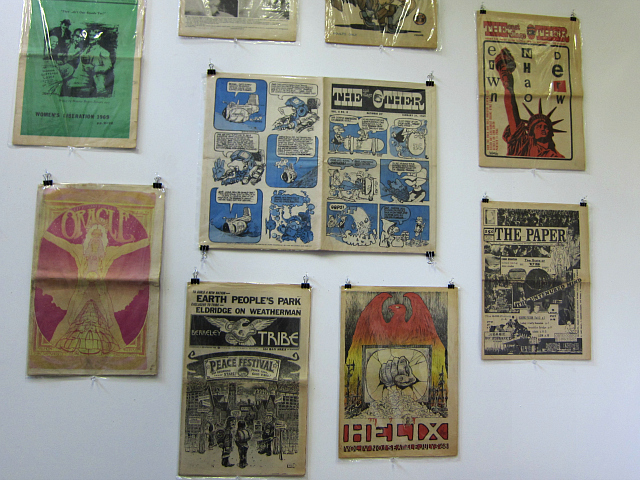
Our use of the media, creation of myths, comedy, and appeal to artists was fabulous. We levitated the Pentagon to allow the evil spirits to flee (clearly not high enough), ran a pig for President, and burned money at the Stock Exchange on Wall Street.

We also represented a segment of American youth that was in militant rebellion. We didn’t lead them. We were a part of them and we were not part of any official Left organization. Much of the Left dismissed the youth population. They criticized us for alienating older, middle class people. I think the youth movement was a vital engine of the anti-war movement, driving everything and everyone to the Left and forcing debate onto dinner tables.

Any criticisms?

My main issue, of course, is the sexism of the Yippies. But honestly, it was no worse than in the rest of the Left. Sexism was an Achilles Heel of the whole movement.

The Yippies seemed to me to be about couples — you and Jerry Rubin, Judy Gumbo and Stew Albert, Anita and Abbie Hoffman. What thoughts do you have now about sex and gender and power in the Yippie universe?

Yippies weren’t any more about couples than the rest of the movement. Male supremacy was “normal.” I had been a political activist beginning in high school; then in the 1960s and 1970s my role in the movement was compromised. At times, I went to work every day so that Jerry Rubin and the guys who were living at our tiny apartment could be movement activists!

After work I shopped. Then I came home and cooked. Then the men treated us like gophers and we accepted it. It was hard to find one’s own voice and it was easy to “stand by your man” when conflicts arose. Until the women’s movement burst on the scene, there were awkward distances between women.

When Robin Morgan quit the Yippies and published “Goodbye To All That” in the underground paper, RAT, I was uncomfortable. I knew she was right about the big picture, if not everything. It was embarrassing and I didn’t know what to do. Change can be confusing and uncomfortable. Morgan’s piece and my 1970 trip to Vietnam really pushed me to fight male dominance and find my own voice.

To get back to prisons. In what ways have they changed over the last decades?

Two things strike me. One is the massive incarceration of people of color. In 1994, for instance, there were 85,000 people in federal prisons. Today. there are 218,000. In state and federal prisons there are 2.3 million people behind bars. We are the “Incarceration Nation.”

Albert Hunt stated in The New York Times (November, 20, 2011) that, “With just a little more than four percent of the world’s population, the U.S. accounts for a quarter of the planet’s prisoners and has more inmates than the leading 35 European countries combined.”

Prisons overflow disproportionately with black and Latino prisoners. According to the same New York Times article, “more than 60 percent of the United States’ prisoners are black or Hispanic, though these groups comprise less than 30 percent of the population.” One in every nine black children has a parent in jail!

What are the other trends?

The prison system has become much more punitive. When we began our work in the 1980s, Marion Federal Prison was the only control unit prison in the federal and the state system. When we argued they should shut it down, they argued that it would allow the rest of the system to function more effectively. We said no, it would function as an anchor and pull the whole system in the direction of tighter control. We would have liked to have been proven wrong, but unfortunately we’ve been proved right. Now, virtually every state has at least one control unit prison.

Is there hope?

Just recently there has been some motion. Two serious challenges have developed. One, that this form of imprisonment is too expensive. Our whole society is running out of money, thanks in part to our bloated military. Also, in some states, like California, prisoners have stood up by the thousands and said, “We won’t take it no more.”

There have been hunger strikes of 6,000 or more prisoners. Support on the outside has helped give voice to grievances. In response to hunger strikers at Pelican Bay, The New York Times, in an editorial on February 8, 2011, entitled “Cruel Isolation,” said, “For many decades, the civilized world has recognized prolonged isolation of prisoners in cruel conditions to be inhumane, even torture. The Geneva Convention forbids it.”

Is anyone rehabilitated through the effort of prison programs?

As Malcolm X said, “I ain’t never been habilitated, how can I be rehabilitated?” Sure, some people have come out of prison wiser than when they went in, or perhaps with some skills they didn’t have. But by and large, the problems are structural, not individual and have to do with whether or not society has room for ex-prisoners. Generally, when people get out of prison, no matter how good they are, their options are lousy. They face great obstacles.

The Russian novelist, Fyodor Dostoevsky, shrewdly observed 150 years or so ago that, “The degree of civilization in a society can be judged by entering its prisons.” When you enter a prison what are some of the first things you hear, see, and feel?

Nancy in Hanoi, 2013, with
Agent Orange victims.

That Dostoevsky quote has always been a favorite of mine. When I enter a prison, I usually feel I’m entering a bastion of the military. There are gun towers, barbed wire, metal detectors, arbitrary rules, regulations, and tight surveillance. Then there are the pat-downs.

The first thing that comes to mind is that I’m on a slave ship — a landlocked slave ship. The racial aspect is undeniable, from the waiting room to the visiting room. After all these years, you would think I would be used to it, but I’m not. For me there is no experience like it.

What degree of civilization would you say exists in the U.S.?

I would answer with a shrewd quote from Gandhi. When he was asked what he thought of Western civilization, he replied, “That would be a good idea.” I’ve just returned from Vietnam, still a primarily agrarian, developing country. They have one of the lowest imprisonment rates in the world. Vietnam is a more civilized place than the U.S.

Since you’re just back from Vietnam would you give us your impressions of the country?

Vietnam is beautiful and vibrant with more than half the population under 20. The legacy of the war is still enormous. More bombs were dropped on Vietnam than on all of Europe in World War II. We visited the Highway 9 Cemetery of the Fallen Combatants where thousands of Vietnamese are buried. As I looked at the tombstones I noticed how very many were cut down in their youth. Somewhere between 2 and 4 million people were killed in the “American War” — as the Vietnamese call it.

You met people and talked face-to-face?

Nearly everyone had a story to tell about their family’s sacrifice, although they tell it after persistent prodding. We visited schools where children are suffering from severe birth defects as a result of the millions of gallons of herbicides such as Agent Orange that the U.S. used. These children are three generations removed from direct exposure!

We also went to what was the Da Nang Air Base during the war (now a regular airport) where the U.S. is just now beginning cleanup, 40 years later. That’s a drop in the bucket because it’s only one “hot spot” and to the tune of $43 million which is really nothing.

The country seems to have taken your breath away.

The experience was fabulous: the natural beauty and the energy and warmth of the people; the privilege to share in the celebrations of the Paris Peace Accords; the meeting with Madame Binh and many people who survived the Tiger Cages. I went inside the underground “Cu Chi tunnels” that testify to the ingenuity and determination of the Vietnamese to be free from of colonialism. Seeing the legacy of the war made me angry. I’m still processing my time in Vietnam.

[Jonah Raskin, a regular contributor to The Rag Blog, is a professor emeritus at Sonoma State University and the editor of The Radical Jack London: Writings on War and Revolution. Read more articles by Jonah Raskin on The Rag Blog.]

*UPDATE: As we went to press a federal judge ordered the release of former Black Panther and member of the Angola 3, Albert Woodfox. This is the third time Woodfox’s conviction has been overturned in a federal court, but prosecutors successfully reversed the two previous court decisions and are expected to try once more to keep Woodfox behind bars.

The Rag Blog

Posted in Rag Bloggers | Tagged , , , , , , , , , , , , , | 1 Comment

PHOTO ESSAY / Judy Gumbo Albert : Visiting Viet Nam, 1970-2013

From left: Genie Plamondon, Nancy Kurshan, and Judy Gumbo Albert in Viet Nam, 1970.

A photo essay:
Visiting Viet Nam, 1970-2013

Everywhere we traveled we were warmly welcomed. The Vietnamese still feel grateful to the U.S. peace movement. I came to understand that while my trip in 1970 was life changing, this trip was life affirming.

By Judy Gumbo Albert / The Rag Blog / February 28, 2013

Rag Blog contributor Judy Gumbo Albert was an original member of the Youth International Party (YIPPIES), founded in 1967. See Jonah Raskin’s April 17, 2012, interview with Judy Gumbo Albert in The Rag Blog — and see Raskin’s current Rag Blog interview with Nancy Kurshan, a prison activist and fellow Yippie founder who recently traveled with Judy to Viet Nam. Judy Gumbo Albert and Nancy Kurshan will be Thorne Dreyer’s guests on Rag Radio, Friday, April 12, 2013, from 2-3 p.m., on KOOP 91.7-FM in Austin, and streamed live on the Internet — so mark your calendars!

In 1970, during the American War, I visited what was then North Viet Nam. It was a Yippie trip. I’m the one on the right above. Next to me is Nancy Kurshan, next to her is Genie Plamondon of the White Panther Party. This year I returned to Viet Nam. What follows are some of my impressions.

In Ha Noi and the surrounding countryside, I photographed the devastation wrought by the war:

CLICK ON IMAGES TO ENLARGE.

And felt inspired by Viet Nam’s resistance fighters:

Forty years later, in January 2013, Nancy and I were invited back as part of a delegation of activists who had visited Viet Nam during the war. We were there to help celebrate the 40th Anniversary of the Paris Peace Accords:

I met former Attorney General Ramsey Clark and filmmaker Jay Craven:

And my favorite hero of all time, Mme. Nguyen Thi Binh, a member of the Provisional Revolutionary Government of South Viet Nam, a leader of the Viet Nam Women’s movement, and a negotiator and signer of the Paris Peace Accords. I told her, “Thank you for what you have done.” She replied, “We will continue to do it,” and squeezed my hand:

Everywhere we traveled we were warmly welcomed. The Vietnamese still feel grateful to the U.S. peace movement. I came to understand that while my trip in 1970 was life changing, this trip was life affirming.
At the same time, it was apparent that the outcomes of the American war continue to devastate the country.
With unexploded ordnance

that to this day kills and maims:

Agent Orange/dioxin, has remained in the soil and water of Viet Nam for 40 years, poisoning a third and fourth generation of children:

I was heartbroken when I met these kids. All I could think was, “We are responsible.”
Nor could I ignore the remnants of Diem and Thieu’s tiger cages:

Survivors of the tiger cages have managed to make a new life for themselves. “In order to close the past, we must be open to the future,” is what I heard them say. (The older woman in the center was imprisoned in a tiger cage for 15 years.)

Today Viet Nam integrates the new with the old. They are on the road to prosperity by means of what they call a “socialist-oriented market economy.”

I came home from Viet Nam understanding that every one of us can — and should — feel proud of what we did and continue to do to end all wars.

© Judy Gumbo Albert. See more of Judy’s photos here.

Thanks to The Rag Blog‘s James Retherford for assistance with graphics on this article.

[Judy Gumbo Albert is an original Yippie, along with Abbie and Anita Hoffman, Jerry Rubin and Nancy Kurshan, Paul Krassner, and Judy’s late husband Stew Albert. Judy has remarried, lives in Berkeley, California, and is currently writing her memoir, Yippie Girl. She can be found at www.yippiegirl.com. You can contact her at judygumboalbert@gmail.com or on Facebook at Judy Gumbo Albert or Yippie Girl. Read more articles by Judy Gumbo Albert on The Rag Blog.]

The Rag Blog

Posted in Rag Bloggers | Tagged , , , , , , | 3 Comments


Type your summary here

Type rest of the post here

Source /

The Rag Blog

Posted in RagBlog | Leave a comment

BOOKS / Gregg Barrios : Zadie Smith’s ‘NW’ Speaks in the Polygot of the Streets

Zadie Smith’s latest novel, NW,
speaks in the polygot of the streets

Smith never identifies the color of her characters — well, not unless they are white.

By Gregg Barrios / Critical Mass / February 27, 2013

“Tread carefully over the pavements of London for you are treading on skin, a skein of stone that covers rivers and labyrinths, springs and cavern, pipes and cables, springs and passages, crypts and sewers, creeping things that will never see the light of day.” — Peter Ackroyd, Underground London

[NW: A Novel by Zadie Smith (2012: Penguin Press); Hardback; 416 pp; $26.95.]

Zadie Smith’s 2012 novel NW was a finalist for the National Book Critics Circle award for fiction. Rag Blog contributor Gregg Barrios is on the Board of Directors of the National Book Critics Circle. 

Welcome to London’s NW — home turf to Zadie Smith’s fictional wellspring. It’s the place where many of her earlier characters still reside — from Archie Jones, Irie, and Alsana from White Teeth to Howard Belsey’s dad from On Beauty and Alex-Li Tandem from Autograph Man.

NW introduces a new cast of characters — Leah, Natalie, Felix and Nathan — all in their mid-30s, and with multi-racial roots — this is a Smith novel after all — and who grew up in the fictional council estate (housing project) of Caldwell.

Smith’s tells their stories with precise details and rich characterization, vividly capturing their individual personalities by utilizing a writing style suited to each. The opening chapter finds Leah daydreaming in a backyard hammock:

The fat sun stalls by the phone masts. Anti-climb paint turns sulphurous on school gates and lampposts. In Willesden people go barefoot, the streets turn European, there is a mania for eating outside. She keeps to the shade. Redheaded. On the radio: I am the sole author of the dictionary that defines me. A good line — write it out on the back of a magazine. In a hammock in the garden of a basement flat. Fenced in, on all sides.

Her reverie comes crashing when the doorbell rings and a strange woman with a hard luck story asks for money. Through Smith’s deft descriptions, it is evident that the women are as different as night and day despite living in the same NW postal code. How Smith forges connections between them and the other denizens in da hood is part of what NW grapples with.

It isn’t for naught that the chapter is called “The Visitation.” It echoes the Biblical Mary visiting her older, barren cousin Elizabeth to announce her pregnancy and then to learn that her cousin is also in a family way. Throughout the novel, Leah will struggle with not wanting to have a child and with her denial that she may already be pregnant (“Blue cross on a white stick, clear, definite”).

Smith has acknowledged the influence of Forester’s Howards End on her novel On Beauty, and that the inspiration for NW comes from the novelist Virginia Woolf. Some critics have written that since Leah is part Irish, her narrative emulates a Joycean style. I prefer to consider that the NW postal zone is more akin to Faulkner’s fictional Yoknapatawpha County and his novel As I Lay Dying. Both employ stream of consciousness technique, multiple narrators and varying chapter lengths and voices. One section will have quotation marks, while another will do without the punctuation. NW speaks in the polyglot of the street and in slogans and the TV news sound bites of dinner parties.

In the novel’s first section, Leah works for a charity trust and her husband Michel, a French-African, is a hairdresser. They rent and have a dog Olive. Leah doesn’t want children, but Michel does. When they attend a posh party given by Leah’s lifelong friend Natalie, we learn the different roads they’ve taken. Natalie nee Keisha Blake has moved up in the world. She is a barrister who is happily married to an Italian-Trinidadian; they have two children.

At the party, Natalie appropriates Leah’s story about the woman who bilked her. Later Leah and Michel spot a man thought to be the grifter’s partner. A street row ensued, and Olive was repeatedly kicked. Natalie turns it into a bad after-dinner joke. (“- And then did you just both go your separate ways? ‘Thank you, I’ve been your potential murderer now I must be off…’”

Natalie is novel’s central character. She tells her story in “The Host,” a series of short, numbered (185) chapters. In the initial entry, “These red pigtails,” Keisha saves Leah from drowning by pulling her out of a city pool by her red pigtails. (Think Renoir’s “Boudu Saved From Drowning.”)

There is a wonderful list (in # 6) of the girl’s middle school likes and dislikes. Keisha: Cameo, Culture Club, Bob Marley, world peace in South Africa. Leah: Madonna, Culture Club, Thompson Twins, no bombs. Oh, they list one another as their best friend. And to an unknown question, they both answer “Deaf.”

Smith never identifies the color of her characters — well, not unless they are white. A subtle dig at how other-than-whites are described in more traditional novels. In a telling short entry, Smith succinctly describes Keisha’s mindset growing up in a white world:

18. Sony Walkman (borrowed). That Keisha should be able to hear the Rebel MC in her ears was a kind of miracle and modern ecstasy, and yet there was very little space in the day for anything like ecstasy or abandon or even simple laziness, for whatever you did in life you have to do it twice as well as they did ‘just to break even, a troubling belief held simultaneously by Keisha Blake’s mother and her Uncle Jeffery, know to be “gifted” but also beyond the pale.

Keisha reinvents herself as Natalie and escapes from the Caldwell projects. But as the novel progresses, Smith seems to be asking — But at what a cost? Natalie’s entry 179: “Aphorism. What a difficult thing a gift is for a woman! She’ll punish herself for receiving it.” Natalie will do the same thing with her gift (an oblique reference to the late Amy Winehouse).

Zadie Smith.

Enter Felix in the section titled “The Guest.” Felix is a native of the Caldwell projects. His story is told in a traditional narrative style. Neither Leah nor Natalie knows him, but they will by the novel’s end. This chapter chronicles Felix’s last day alive. It begins as he delivers a book to his father that his new lady friend Grace has bought for him.

The book is a photographic record of Garvey House, an actual hostel for troubled youth in northeast London where Felix and his siblings grew up with their Black revolutionary parents. Felix then takes a walk through the old neighborhood on his way to buy a used car for the repair shop where he works part time.

This section contains some of Smith finest writing and could well stand alone outside the novel’s frame, but it is also integral to it. I kept hoping Smith would speak through Felix (with his parents’ activist past and his dream of becoming a filmmaker) of the recent London Riots and British film hit Ill Manor – that speak of the disenfranchisement of today’s multiracial Brit youth.

Some readers may see the 32-year old Felix as a sacrificial lamb, a Christ-like figure hinted in the book’s religious-tinged chapter titles, “Visitation,” “Host,” “The Crossing.” (The thrust of the narrative here resembles the Stations of the Cross.) A few hours before his death, his pays a visit to Annie, his older, former lover intent on ending their relationship since he has found Grace (pun intended):

Felix what is this pathological need of yours to be the good guy? It’s very dull. Frankly, you were more fun when you were my dealer. You don’t have to save my life. Or anybody’s life. We’re all fine. We don’t need you to ride on a white horse. You’re nobody’s savior.

Hours later, he lays dying at a bus stop, the victim of a blotched robbery and assault, his life unreeling in jump-cut not unlike Belmondo’s end in Breathless: “Five and innocent at this bus stop. Fourteen and drunk. Twenty-six and stoned. Twenty-nine in utter oblivion, out of his mind on coke and K.”

Natalie becomes addicted to an online hook-up website where “she was what everyone was looking for.” Her Cinderella story turns Grimm after her husband discovers her sexual addiction. She finds herself down and out on the London underworld in “a big T-shirt, leggings, and a pair of filthy red slippers, like a junkie.”

A former classmate Nathan Bogle, a drug-dealer and perhaps a pimp for the woman who rang Leah’s doorbell, recognizes her. At first, they enjoy rediscovering their mutual past. She tells him how Leah was in love with him. “She’d never admit it but the man she ended up marrying — he looks like you.” Nathan isn’t having any of it.

Oh Nathan ‘member this, ‘member that — truthfully Keisha I don’t remember. I’ve burned the whole business out of my brain. Different life. No use to me. I don’t live in them towers no more. I’m on the streets now, different attitude. Survival. That’s it. Survival. That’s all there is.

Nathan is ultimately the dark messenger not the message — all the while singing, “If I Ruled the World (Imagine That).”

The final section is a return to “The Visitation.” Carnival is in full swing. Leah and Natalie reestablish their on-again, off-again friendship. When Natalie enters Leah’s backyard carrying her dog Spike, she greets them: “Look at you, mother and child. Look at you. You look like the fucking Madonna.”

Smith wrote NW during her pregnancy, so it isn’t surprising that her characters both male and female have bringing children into the world on their mind. All throughout NW, its characters constantly talk about wanting or not wanting children, of mothers that abandon their kids, of irresponsible fathers that procreate but avoid responsibility, and of a loony who sings, “If I ruled the world. I’d free all my sons.”

Reading NW evokes memories of that series of British documentaries from 7UP to 56 UP (most directed by Michael Apted). Starting at age seven, a group of children from different socio-economic classes were filmed every seven years to see how they and their friends and families changed over the years and if socio-economic variables predetermined their future. Smith in NW (30 something) accomplishes the same in one majestic swoop. Imagine that!

[Gregg Barrios is a journalist, playwright, and poet living in San Antonio. Gregg, who wrote for The Rag in Sixties Austin, is on the board of directors of the National Book Critics Circle. Contact Gregg at gregg.barrios@gmail.com. Read more articles by Gregg Barrios on The Rag Blog.]

The Rag Blog

Posted in Rag Bloggers | Tagged , , , , , , | Leave a comment

Jim Turpin : Is the Imperial Presidency the ‘New Normal’?

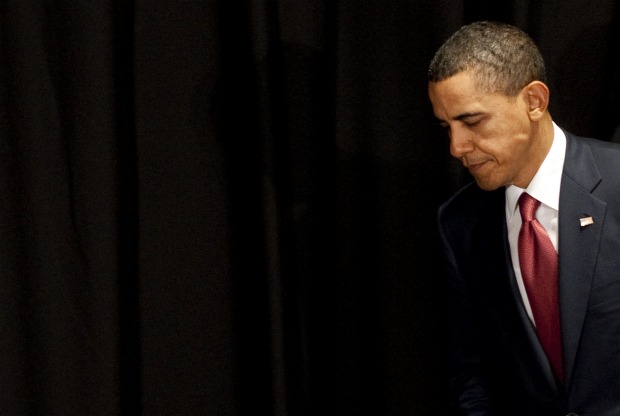
The Imperial Obama? Image from The Express Tribune.

The ‘new normal’?
The Imperial Presidency

“Same as it ever was…”
Talking Heads (“Once in a Lifetime”)

By Jim Turpin | The Rag Blog | February 27, 2013

First of a two-part series.

Many presidents throughout our history, from revered to despised, have ignored the Constitution and taken on the mantle of imperial power. From Lincoln to FDR to Nixon, the examples are easily found.

In the ancient Roman world, the term imperium refers to the amount of power given to individuals of authority such as dictators or consuls and was frequently applied to generals with military power. The term “imperial” usually is linked to an empire or the concept of imperialism.

But how have we gotten to where we are today, where the president of the United States can detain or assassinate an American citizen without due process? Where American citizens are constantly monitored and personal information is subject to review? Where whistleblowers are now detained and prosecuted for exposing war crimes and corruption?

The development of the executive branch’s imperial power has its gnarled roots deep in American history. Frequently presidents have used it as an excuse during times of war, but this has not always been the case.

Abraham Lincoln famously suspended habeas corpus during the Civil War on April 27, 1861, in response to riots, local militia actions, and the threat that the border slave state of Maryland would secede from the Union. Habeas corpus (literally in Latin “you shall have the body [in court]”) is specifically detailed in the U.S. Constitution in Article I, Section 9: “The Privilege of the Writ of Habeas Corpus shall not be suspended, unless when in Cases of Rebellion or Invasion the public Safety may require it.”

A writ of habeas corpus is used to bring a prisoner or other detainee before the court to determine if the person’s imprisonment or detention is lawful.

Franklin D. Roosevelt issued Executive Order 9066 over 70 years ago on February 19, 1942, which led to the forced internment of more than 120,000 Japanese-Americans that lived on the west coast.

The U.S., citing national security interests, demanded that Japanese-Americans be interned without due process or, it would eventually turn out, any factual basis. Whole communities were rounded up and sent to camps, sometimes just clapboard shelters or converted horse stables, in arid deserts and barren fields in Utah, Idaho, Wyoming, Arkansas.

Nixon’s paranoid presidency..

Richard M. Nixon’s deep paranoia over the civil rights and peace movement led to the continued use of the secret FBI program Counterintelligence Program (COINTELPRO), as a means to monitor, sabotage, and neutralize legitimate dissent across the country. COINTELPRO infiltrated the Southern Christian Leadership Conference (SCLC), the NAACP, the Students for a Democratic Society (SDS), the National Lawyer Guild, and many other groups and organizations.

But what drives today’s constitutional overreach by the Executive Office? Recent history points to a number of factors, including:

  • Codification of the Executive’s Imperial Power
  • America’s One Party System

Codification of the Executive Imperial Power

Within days of the 9/11 attacks, the U.S. Congress responded by ramroding a number of open-ended laws that gave the Executive branch a blank check to wage war world-wide and indefinitely detain civilians at home and abroad.

Joanne Mariner of Justia.com neatly fits together the convoluted pieces of the Patriot Act, the Authorization of the Use of Military Force (AUMF), and the National Defense Authorization Act (NDAA) which, though initiated by George W. Bush, is now fully promulgated by Barack Obama:

During the Bush years, despite massive public and press attention to the administration’s detention policies, Congress remained largely out of the picture. While the USA PATRIOT Act contained some provisions on detention, they were never put to use; the Bush administration preferred to create a detention system that was, it assumed, largely free of legal constraints and judicial oversight.

The military prison at Guantanamo and the CIA’s secret prison system were therefore created by executive fiat, without congressional input or restriction. When cases challenging Guantanamo and the military detention of U.S. citizens on U.S. soil got to court, however, the administration claimed that the Authorization for Use of Military Force (AUMF), a joint resolution passed by Congress in September 2001, gave congressional approval for those detentions.

The AUMF, which authorizes the president to use “necessary and appropriate force” against those whom he determined “planned, authorized, committed or aided” the September 11 attacks, or who harbored such persons or groups, is silent on the issue of detention. A plurality of the U.S. Supreme Court agreed with the administration, nonetheless, that the power to detain is necessarily implied by the power to use military force.

The NDAA, which is renewed every year, also contains sections, according to Mariner, that are deeply troubling to human rights activists:

What is now known as Subtitle D of the NDAA — the section on detention — made its first appearance in March of this year (2011). Called the Detainee Security Act in the House, and the Military Detainee Procedures Improvement Act in the Senate, the bills, introduced by Representative Buck McKeon and Senator John McCain, respectively, were meant to shift counterterrorism responsibilities from law enforcement to the military.

The clear goal of the two bills was to require that suspected terrorists either be tried before military commissions or be held in indefinite detention without charge… every provision in subtitle D is objectionable from the standpoint of human rights and civil liberties. Among the controversial provisions are sections 1026, 1027 and 1028 of the bill, which restrict detainee transfers and releases from Guantanamo. But while human rights organizations are worried about these limitations, their gravest concerns pertain to sections 1021 and 1022.

Glenn Greenwald, while still at Salon, addresses Sections 1021 and 1022:

There are two separate indefinite military detention provisions in this bill. The first, Section 1021, authorizes indefinite detention for the broad definition of “covered persons” discussed above in the prior point. And that section does provide that “Nothing in this section shall be construed to affect existing law or authorities relating to the detention of United States citizens, lawful resident aliens of the United States, or any other persons who are captured or arrested in the United States.” So that section contains a disclaimer regarding an intention to expand detention powers for U.S. citizens, but does so only for the powers vested by that specific section.

More important, the exclusion appears to extend only to U.S. citizens “captured or arrested in the United States” — meaning that the powers of indefinite detention vested by that section apply to U.S. citizens captured anywhere abroad (there is some grammatical vagueness on this point, but at the very least, there is a viable argument that the detention power in this section applies to U.S. citizens captured abroad).

But the next section, Section 1022, is a different story. That section specifically deals with a smaller category of people than the broad group covered by 1021: namely, anyone whom the President determines is “a member of, or part of, al-Qaeda or an associated force” and “participated in the course of planning or carrying out an attack or attempted attack against the United States or its coalition partners.”

For those persons, section (a) not only authorizes, but requires (absent a Presidential waiver), that they be held “in military custody pending disposition under the law of war.” The section title is “Military Custody for Foreign Al Qaeda Terrorists,” but the definition of who it covers does not exclude U.S. citizens or include any requirement of foreignness.

That section — 1022 — does not contain the broad disclaimer regarding U.S. citizens that 1021 contains. Instead, it simply says that the requirement of military detention does not apply to U.S. citizens, but it does not exclude U.S. citizens from the authority, the option, to hold them in military custody.

The annual renewal of the NDAA by the Congress of the United States is a sad and deeply troubling testimony to how we empower an Executive branch that is ironically supposed to have their overreach limited by the very branch voting for this law.

America’s One Party System

John Kerry, Winter Soldier.

During the presidential election last fall, if I closed my eyes and listened to speeches on national security, there was basically no policy difference. Both parties called us the “Greatest nation on Earth” and tried to outdo the other with patriotic and nationalistic proclamations and slogans.

As pointed out by Mother Jones during coverage of the election for both party’s conventions, John Kerry (who coincidentally became our new Secretary of State in 2013) spouted, “Ask Osama bin Laden if he is better off now than he was four years ago.”

The story went on:

…Democrats have adopted the kind of language that might have been derided as “cowboy rhetoric” four years ago. And Kerry wasn’t the first or last speaker to invoke Bin Laden in Charlotte last week [in 2012]. Asking for four more years of Obama, Vice President Joe Biden intoned that “Osama bin Laden is dead and General Motors is alive!” Eight years ago, Democrats trying to act tough on national security sounded like kids playing pretend; at times, this year’s convention sounded like a Roman triumph.

Let’s remember, this is the same Lieutenant John Kerry who as a member of Vietnam Veteran’s Against the War (VVAW) spoke at Winter Soldier in 1971 in Washington, D.C., decrying militarism and war:

We are here in Washington also to say that the problem of this war is not just a question of war and diplomacy. It is part and parcel of everything that we are trying as human beings to communicate to people in this country, the question of racism, which is rampant in the military, and so many other questions also, the use of weapons, the hypocrisy in our taking umbrage in the Geneva Conventions and using that as justification for a continuation of this war, when we are more guilty than any other body of violations of those Geneva Conventions, in the use of free fire zones, harassment interdiction fire, search and destroy missions, the bombings, the torture of prisoners, the killing of prisoners, accepted policy by many units in South Vietnam. That is what we are trying to say. It is part and parcel of everything.

I would be curious to know if Kerry as the new Secretary of State remembers the importance of his testimony in 1971 and what his brothers at VVAW think of him now.

The same Mother Jones article deftly points out that:

Barack Obama has a plan to withdraw troops from Afghanistan, but neither candidate [Democratic or Republican] actually has a plan to end the war that started on September 11, 2001. Both parties accept that conflict as a permanent feature of American life. An American citizen in the U.S. is as likely to be killed by their own furniture as a Muslim terrorist, but fear of violent Islamic extremism has changed this country almost irrevocably.

But let’s compare… are the Democratic and Republican Party really just the same party on issues like national security?

ProPublica recently did a side-by-side comparison of Bush and Obama policies on the use of torture, surveillance, and detention and the results are not very surprising.

To Obama’s credit, CIA “black sites” (outsourced torture sites to foreign countries) and “enhanced interrogation techniques” (also known in the vernacular as “torture”) have been, as far as the American public is aware, discontinued and stopped by this administration.

But… Obama has continued the following policies started by Bush and ramped them up dramatically under his administration:

  • Continued renewal of the Patriot Act;
  • Wiretaps and data collection of U.S. citizens and foreign nationals;
  • Continuation of Guantanamo prison as an indefinite detention center;
  • Targeted killings (also known as “assassinations”) of U.S. citizens and foreign nationals without legal oversight;
  • Significant increase of drone strikes in Afghanistan, Pakistan, Yemen, Somalia, and possibly now in Mali, that have killed thousands of civilians;
  • The use of military commissions to nullify the rights of U.S. citizens and foreign nationals in civilian court.

On issues of national security, America really remains a one-party system that use the “War on Terror” as an excuse to abrogate civil liberties of its’ citizenry.

“You may ask yourself, where does that highway lead to?”Talking Heads (“Once in a Lifetime”)

In the second installment of this article, I will investigate the use of assassination by “Star Chamber” and how a subjugated and cravenly media has led us down the highway of a fearful nation with fewer and fewer civil liberties.

[Rag Blog contributor Jim Turpin is an Austin activist and writer who works with CodePink Austin. He also volunteers for the GI coffeehouse Under the Hood Café at Ft. Hood in Killeen, Texas. Read more articles by Tim Turpin on The Rag Blog.]

The Rag Blog
Posted in Rag Bloggers | Tagged , , , , , , , , , , , , | 2 Comments

RAG RADIO / Thorne Dreyer : Anne Lewis’ Documentary About Anne Braden Is ‘Gem of a Film’

Filmmaker Anne Lewis on Rag Radio in the studios of KOOP-FM in Austin, Texas, Friday, February 22, 2012. Photo by William Michael Hanks / The Rag Blog.

Rag Radio Podcast:
Documentary filmmaker Anne Lewis,
co-director of Anne Braden: Southern Patriot

By Rag Radio | The Rag Blog | February 27, 2013

Documentary filmmaker and University of Texas senior lecturer Anne Lewis, whose most recent work, Anne Braden: Southern Patriot, was called a “gem of a film” by folksinger and civil rights activist Joan Baez, was Thorne Dreyer’s guest on Rag Radio, Friday, February 22, 2013.

On the show, Lewis discussed her impressive body of work as an independent filmmaker and, in particular, her acclaimed film about the remarkable Southern civil rights fighter Anne Braden.

She also addressed recent developments at the University of Texas at Austin, where university president Bill Powers has made radical proposals to “increase efficiency” at the the school, in part by privatizing much of the university staff. Powers’ plans have drawn reaction from faculty, students, and union activists on the UT-Austin campus, and Lewis wrote about the issue in The Rag Blog.

Rag Radio is a syndicated radio program produced at the studios of KOOP 91.7-FM in Austin, Texas. This episode was produced during KOOP’s Spring 2013 Membership Drive and includes fundraising pitches for the cooperatively-run all volunteer public radio station.

Listen to or download our interview with Anne Lewis, here:


Anne Lewis is an independent filmmaker, a senior lecturer at the University of Texas at Austin’s School of Radio-Television-Film, and an active member of the Texas State Employees Union (TSEU-CWA Local 6186) and NABET-CWA. She has been making documentary films since 1970. Most of her filmmaking depicts working class people — often women — fighting for social change. She is associated with Appalshop, an arts and education center located in the heart of Appalachia.

Anne Lewis was associate director of Harlan County, U.S.A, and the producer/director of Fast Food Women, To Save the Land and People, Morristown: in the air and sun, and a number of other social issue and cultural documentaries. She was associate director/assistant camera for Harlan County, USA, the Academy Award-winning documentary, which focused on the Brookside, Kentucky, strike of 1975. After the strike, Lewis moved to the coalfields where she lived for 25 years.

Lewis was co-director with Mimi Pickering of the 2012 film, Anne Braden: Southern Patriot, a first-person documentary about the extraordinary life of the American civil rights leader. The film was first screened by the Austin Film Society on July 18, 2012.

Filmmaker Anne Lewis.

Writing at The Rag Blog, William Michael Hanks called the film “a wellspring of intellectual reason, a blueprint for action [that] includes some of the most iconic footage from the civil-rights movement ever seen.” The Rag Blog‘s Hanks, himself a former documentary filmmaker, joined us in the interview, discussing with Lewis her unique use of first person narrative in constructing the film.

According to The Texas Observer‘s Susan Smith Richardson, Anne Braden, a middle-class white woman from Alabama who “rejected her racial privilege in the Jim Crow South and devoted her life to fighting racism,” was considered a “traitor to her race” by many who opposed her. Braden and her husband Carl, who together published the crusading Southern Patriot newspaper, were targets of Sen. Joseph McCarthy’s anti-Communist witch hunts. Braden, who was an inspirational figure among movement activists, was called “eloquent and prophetic” by Dr. Martin Luther King Jr.

Joan Baez called Anne Braden: Southern Patriot, “a gem of a film, accented with freedom fighters who speak firsthand about carving a path through a traumatized, violent, racist South, to make way for one of the largest and most effective nonviolent movements for social change the world has ever seen.”

To learn more about Anne Lewis’ work, visit her website, AnneLewis.org.

Rag Radio has aired since September 2009 on KOOP 91.7-FM, an all-volunteer cooperatively-run community radio station in Austin, Texas. Hosted and produced by Rag Blog editor and long-time alternative journalist Thorne Dreyer, a pioneer of the Sixties underground press movement, Rag Radio is broadcast every Friday from 2-3 p.m. (CST) on KOOP, and is rebroadcast on Sundays at 10 a.m. (EST) on WFTE, 90.3-FM in Mt. Cobb, PA, and 105.7-FM in Scranton, PA.

The show is streamed live on the web by both stations and, after broadcast, all Rag Radio shows are posted as podcasts at the Internet Archive.

Rag Radio is produced in association with The Rag Blog, a progressive internet newsmagazine, and the New Journalism Project, a Texas 501(c)(3) nonprofit corporation. Tracey Schulz is the show’s engineer and co-producer.

Rag Radio can be contacted at ragradio@koop.org.

Coming up on Rag Radio:
THIS FRIDAY, March 1, 2013:
Louis Black, co-founder and editor of the Austin Chronicle and co-founder of the South by Southwest Music, Interactive, and Film Festival (SXSW).
Friday, March 8: Novelist David McCabe, author of Without Sin, based on a true story of a sex trafficking ring exploiting young, undocumented women.
Friday, March 15: Legendary producer Chris Strachwitz of Arhoolie Records, and filmmakers Maureen Gosling & Chris Simon, This Ain’t No Mouse Music!

The Rag Blog

Posted in Rag Bloggers | Tagged , , , , , , , , , , | Leave a comment

Alan Waldman : The Last Three Seasons of ‘Blackadder’ Are Astonishingly Funny


Waldman’s film and TV
treasures you may have missed:

England’s two best TV writers, Richard Curtis and Ben Elton, crafted a small-screen classic.

By Alan Waldman | The Rag Blog | February 26, 2013

[In his weekly column, Alan Waldman reviews some of his favorite films and TV series that readers may have missed, including TV dramas, mysteries, and comedies from Canada, England, Ireland, and Scotland. Most are available on DVD and/or Netflix, and some episodes are on YouTube.]

A 2004 British TV poll rated Blackadder the second-best sitcom of all time, and Empire magazine ranked it as the 20th-best TV show ever. The first six-episode season, set in 1485, was less funny and more slapsticky than the final three seasons. It portrayed Edmond Blackadder as an idiot, whereas in the latter trio (written by certified geniuses Ben Elton and Richard Curtis) he was clever, satiric, verbally sharp, and a tremendous pleasure to watch.

Nonetheless, viewers who rated the four series at imdb.com disagree with me; 95% of them give Season One thumbs up, versus 92.6% for Season Two, 93% for Three and 90.8% for Four. Season Three won the 1988 Best Comedy Series BAFTA award and four other nominations, and Season Four repeated the feat and won another BAFTA for series star Rowan Atkinson, as well as snagging a Best Situation Comedy Series honor from Britain’s Royal Television Society.

Atkinson was brilliant in the last three seasons, as was Tony Robinson as his moth-eaten servant Baldrick. Hugh Laurie was hilarious in the last two seasons, Miranda Richardson shined as a dippy Queen Elizabeth I in Season Two and Stephen Fry was outstanding in the final three series. The guest cast included many of Britain’s top thesps, including Robbie Coltrane, Peter Cook, Jim Broadbent, Colin Firth, Tim McInerny, Geoffrey Palmer, Brian Blessed, Frank Finlay, Miriam Margolyes, Patsy Byrne, Rik Mayall, and Warren Clarke.

All seasons are available on Netflix and here on Netflix Instant, and most episodes, plus the 1988 and 2000 specials, can also be seen on YouTube.

Blackadder is set in four distinct historical periods, and descendants of Blackadder and Baldrick (with the same names) appear in the final trio.

Season One, set at the end of the War of the Roses, has Prince Edmund the Black Adder perpetually scheming to seize the throne from his father or brother.

In Season Two, set in the Tudor Court of Elizabeth I, Blackadder is a courtier who seeks the nutsy, spoiled, whimsical and dangerous queen’s hand, in competition with her right-hand man Lord Melchett (Fry). The Queen is also advised by her demented former nanny “Nursie” (a priceless Patsy Byrne). Blackadder is aided in his plotting by clueless Lord Percy (McInerny) and dim-witted, dung-eating servant Baldrick (one of the funniest characters ever).

Season Three is set in the Regency period (18th and 19th Centuries, in the reign of George III) when Blackadder is a butler to the supremely idiotic Prince of Wales (a wonderfully over-the–top Hugh Laurie). The six episodes feature Dr. Samuel Johnson (Coltrane), William Pitt the Younger, the French Revolution, The Scarlet Pimpernel (McInerny), the Duke of Wellington (Fry) and a squirrel-hating transvestite highwayman.

In one scene Baldrick asks, “Something wrong, Mr. B?” Blackadder replies, “Oh something’s always wrong, Balders. The fact that I’m not a millionaire aristocrat with the sexual capacity of a rutting rhino is a constant niggle.” Season Four, funny but slightly more serious in tone, has Captain Blackadder, Private Baldrick, and Lieutenant George (Laurie) in the trenches of World War I, while their fates are determined by misguided General Melchett (Fry), located in a chateau 35 miles behind the lines.

If you have never seen the three final seasons of Blackadder, you have missed one of the great comic treats and should rectify that forthwith. Other series by Ben Elton (The Thin Blue Line ) and Richard Curtis (The Vicar of Dibley and films including Four Weddings and a Funeral, Notting Hill, and Love Actually) are also well worth watching.

[Oregon writer and Houston native Alan Waldman holds a B.A. in theater arts from Brandeis University and has worked as an editor at The Hollywood Reporter and Honolulu magazine. Read more of Alan Waldman’s articles on The Rag Blog.]

The Rag Blog
Posted in Rag Bloggers | Tagged , , , , | Leave a comment

Susan Van Haitsma : Texans Rally to Save Our Schools

An estimated 10,000 education advocates gathered at the Texas State Capitol, Saturday, February 23, 2013. Photo by Susan Van Haitsma / The Rag Blog.

Texans rally to save our schools

Behind the Capitol edifice, I hope lawmakers are listening. These are the voices of experienced teachers and smart, young learners. In fact, we’ll all learn, if we listen.

By Susan Van Haitsma | The Rag Blog | February 26, 2013

See more photos by Susan Van Haitsma, Below.

AUSTIN — One thing I noticed about education historian, author, teacher, and former Assistant Secretary of Education, Diane Ravitch, after she joined the march up Congress Avenue in Austin and then addressed the Save Our Schools statewide rally at the Texas State Capitol on Saturday, February 23, 2013, was that she remained on stage to listen to the many other speakers who came after her.

Two were students from Eastside Memorial High School in Austin, a public school that has kept the charter companies at bay, thus far, through the impassioned advocacy of students, teachers, parents, and Ravitch herself, who has visited Austin previously to speak on behalf of the school.

Ravitch lives in Brooklyn now, but she was raised in Houston, where she attended public schools from K-12, so her interest in Texas schools comes naturally. From the enthusiasm shown by the thousands of public education advocates who turned out for Saturday’s march and rally, Ravitch’s critiques of Arne Duncan-style school reform are shared by many Texans. (Ravitch is a prolific blogger as well as a renowned author. Check out her blog post about the Austin rally here.)

The rally, which drew an estimated 10,000, was sponsored by Save Texas Schools, a nonpartisan “coalition of parents, students, educators, business leaders, concerned citizens, community groups and faith organizations,” whose stated goal is “to encourage our state’s elected officials to support quality public education for ALL Texas students, pre-K to college.”

Watching the flow of sign-carrying teachers, retired teachers, young students, and grown students moving up Congress Avenue toward the Capitol, I appreciated the variety of hand-lettered messages that conveyed a common sentiment: We value the power of knowledge, and we value each other.

When the crowd was gathered at the Capitol, the speakers’ testimonies, facts, and figures continued on that theme, explaining why blaming teachers, students, parents, and public education in general by privatizing schools and amping up testing is hurting rather than helping our education system.

Ravitch is not completely opposed to charter schools, but as a policy analyst, she says that evidence gathered over the past decade shows, on balance, that charter schools do not produce better-educated kids. If private schools want to offer alternatives to public schools, fine. But don’t use public funds to pay for them.

One of the final speakers on the program was Zack Kopplin, a 19-year-old Rice University student who, as a high school student in Louisiana, led an effort to repeal the 2008 Louisiana Science Education Act, legislation which allowed the teaching of creationism in Louisiana public schools.

Kopplin’s research on the use of non-scientific and religiously biased curriculum used in public schools in other states, like Texas, has led him to continue speaking out about the dangers of misleading students about the crucial issues of their day, such as climate change.

Behind the Capitol edifice, I hope lawmakers are listening. These are the voices of experienced teachers and smart, young learners. In fact, we’ll all learn, if we listen.

[Susan Van Haitsma is active in Austin with Sustainable Options for Youth and CodePink. She also blogs at makingpeace. Find more articles by Susan Van Haitsma on The Rag Blog.]

Save our Texas Schools:
Photos by Susan Van Haitsma

The Rag Blog

Posted in Rag Bloggers | Tagged , , , , , , | Leave a comment

BOOKS / Ron Jacobs : ‘Cruel Harvest’ in Afghanistan

Drugs, war and occupation:
‘Cruel Harvest’ in Afghanistan

Cruel Harvest does not claim that the U.S. is in Afghanistan because of the drug trade, either to end it or to profit from it. The text does explain that Washington has used drug profits to fund its covert and not-so-covert military and intelligence operations.

By Ron Jacobs | The Rag Blog | February 26, 2013

Cruel Harvest: U.S. Intervention in the Afghan Drug Trade by Julien Mercille (2012: Pluto Press); Paperback; 192 pp; $29.00)

The United States invaded Afghanistan over 11 years ago. Men and women who were seven and eight years old are now enlisting in the military. Some of them will end up walking the streets and trails of that faraway land before their enlistments are up. Even if the Obama administration keeps its pledge to withdraw 34,000 U.S. troops in the next year or so, there will still be rotations and special forces in and out of Afghanistan for years if Washington’s plans are not derailed.

Likewise, the Afghan opium trade will continue. Regarding that trade, questions often arise concerning its relationship to the battle on the ground and the groups fighting that battle. As those who watched the Soviet military disintegrate in Afghanistan during the 1980s will remember, news stories occasionally appeared in the U.S. media that mentioned the growing rates of drug addiction and use among Soviet conscripts. These mentions usually occurred in relation to the U.S. desire to “make Afghanistan the Soviets’ Vietnam..” After all, the rampant drug use among American conscripts during its war in Vietnam was well documented.

Despite apparent Pentagon efforts to hide the fact, some U.S. soldiers and Marines in Afghanistan certainly take advantage of the opium and marijuana products produced in Afghanistan. However, the Pentagon seems more concerned with prescription drug and steroid abuse by its troops. However this doesn’t mean there is no U.S. interest in the Afghan drug trade

Julien Mercille, author of Cruel Harvest: U.S Intervention in the Afghan Drug Trade, points out that the United States goverment meets its own definition of a narco-terrorist organization. This definition (provided by the U.S. Drug Enforcement Administration (DEA) during testimony before Congress) describes such organizations as those groups which are “complicit in the activities of drug trafficking to further premeditated, politically motivated violence to influence a government or group of people.”

If this is narco-terrorism, than not only is the U.S. government involved; it can be reasonably argued that it almost invented the practice. To prove his point, Mercille reviews the complicity of the Central Intelligence Agency and its predecessor, the Office of Strategic Services, in the drug trade since World War II. Drawing on the work of Alfred McCoy (The Politics of Heroin) and others, he adds the intrigue in Afghanistan to that history.

In looking at McCoy’s work, Mercille acknowledges and accepts the volume and depth of the research he brings to the subject. At the same time, he rejects McCoy’s assumption that, even though the CIA was trafficking in drugs, other agencies in the U.S. government were fighting the drug trade. Other researchers on this apparent interagency conflict include Douglas Valentine, whose books The Strength of the Wolf and The Strength of the Pack chronicle in concise detail the corruption, conflicts and lies of the DEA and its predecessor the Bureau of Narcotics and Dangerous Drugs.

Despite the incredible research and writing involved in these books, it seems safe to assume that their readers know only a small portion of the story they tell, due to the nature of the topic and the secrecy and subterfuge of the agencies involved.

Cruel Harvest takes a sharp look at the history of U.S. intervention in Afghanistan since the 1970s. It provides a background to U.S. intervention in Afghanistan and the surrounding region while examining the growth of CENTCOM, the Pentagon command in that part of the world. Mercille exposes the lies told by Jimmy Carter, Ronald Reagan, and CIA man Bill Casey about Soviet intentions for the country and emphasizes that it’s the occupation that fuels the current insurgency, not the drug trade.

Merceille substantiates the claim made by many in the anti-war camp that the U.S.-NATO intervention in Afghanistan is nothing but an attempt to establish Washington’s dominance in a country where no outside power has done so for any extended period since Alexander the Great.

Claims about freedom, women’s rights, and every other excuse provided are proven to be untrue. Even drug prevention is shown to be a sham. After detailing Washington claims that the Taliban are partially funded by opium production, Merceille points out that most of the U.S. allies in Afghanistan, including the Karzai government, are involved in opium and heroin production, as well.

Indeed, the head of the Northern Alliance, Washington’s first ally in the mujahedin phase of the war in the 1970s and 1980s, was (and remains) a well-known drug lord. It becomes clear by the end of this book that Washington is not interested in eradicating drug production and trafficking. It just wants to ensure the people profiting from the business are willing to work in Washington’s interest.

Cruel Harvest does not claim that the U.S. is in Afghanistan because of the drug trade, either to end it or to profit from it. The text does explain that Washington has used drug profits to fund its covert and not-so-covert military and intelligence operations. It also points out that, while poppy farmers who pay taxes to the Taliban are targeted, those that align themselves with the U.S.-supported regime rarely are. Furthermore, it makes the point that this practice is intentional.

Mercille’s relatively short work is a useful, extensively cited and fact-laden discussion of the role narcotics production plays in the U.S. occupation of Afghanistan.

[Rag Blog contributor Ron Jacobs is the author of The Way The Wind Blew: A History of the Weather Underground. He recently released a collection of essays and musings titled Tripping Through the American Night. His latest novel, The Co-Conspirator’s Tale, is published by Fomite. His first novel, Short Order Frame Up, is published by Mainstay Press. Ron Jacobs can be reached at ronj1955@gmail.com. Find more articles by Ron Jacobs on The Rag Blog.]

The Rag Blog
Posted in Rag Bloggers | Tagged , , , , , , | Leave a comment

David Macaray : Twelve Questions for Satirical Icon Paul Krassner

Paul Krassner in the day. Photo by Robert Altman.

Twelve Questions for
satirical icon Paul Krassner

“I think [audiences are] more aware now of the contradictions in mainstream culture, the phony piety that permeates society, the inhumane hypocrisy.” — Paul Krassner

By David Macaray | The Rag Blog | February 27, 2013

To say Paul Krassner has lived an eventful life is an understatement. He invented The Realist, America’s premiere counterculture journal. He co-founded the Youth International Party (Yippies). He was a child violin prodigy who, at age six, was the youngest person ever to perform at Carnegie Hall.

He was a member of Ken Kesey’s Merry Pranksters. He edited Lenny Bruce’s classic, How to Talk Dirty and Influence People. He’s written more than a dozen books, recorded several comedy albums, and, at age 80, is still writing, lecturing, and stirring the pot.

Krassner is unique in that he’s one of those veteran radicals who never came in from the cold, never cashed in his chips, and was never co-opted by the mainstream media. This was partly because he didn’t seek their approval, and partly because he wasn’t considered “domesticated” enough to be embraced. As testimony to his wit and sensibilities, he’s the only person to have won both a Playboy magazine satire prize, and a Feminist Party Media Workshop award for journalism.

1. What’s it like being 80 years old?

Well, I’m more aware that it’s one more decade closer to my death, and my priorities keep falling into place. And in order to keep myself, literally, from falling into place — stemming from a police beating in 1979, when I got caught in a post-verdict riot after covering the trial of Dan White, who was sentenced to seven years for the assassination of San Francisco Mayor George Moscone and Supervisor Harvey Milk — I now walk around with a cane, and when I go anywhere I use a walker.

Otherwise, I seem to be in good health. I owe my longevity to never taking any legal drugs. Although, I did take an aspirin last month. I didn’t have a headache or anything, it was just at a party, and the host was passing around a plate full of aspirins. It was just a kind of social ingestion. You know, peer pressure.

2. What do you think the result would be if all 50 states legalized marijuana?

Allow me to quote Ken Kesey’s response when I asked, “Do you see the legalization of grass as any sort of panacea?” “The legalization of grass,” he said, “would do absolutely nothing for our standard of living, or our military supremacy, or even our problem of high school dropouts. It could do nothing for this country except mellow it, and that’s not a panacea, that’s downright subversive.

3. How do you feel about Medicare?

It’s worked for me until now. All I know is that my doctor and the doctors of two friends, each with a different doctor, were told that Medicare alone would not be accepted any more. The unstated reason is that an HMO supplement plan will pay the doctor a monthly sum per patient whether or not they come in for medical help. So the doctors and the insurance companies benefit from this plan. And the patient becomes a pawn in the game.

4. Why did you title your memoir Confessions of a Raving, Unconfined Nut?

After Life magazine published a profile of me in 1968, an FBI agent sent a poison-pen letter stating, “To classify Krassner as some sort of social rebel is far too cute. He’s a nut, a raving, unconfined nut.” Even if that were true, it’s not what taxpayers provide funding for the FBI to do. So when I wrote my autobiography, I decided that the agent’s words would serve as a more appropriate title than Yay for Me.

5. The FBI’s tactics during this period are so frightening, they almost defy belief. What was the Bureau’s main beef with you?

I guess they perceived me as a threat to the status quo. But I perceived them as a threat to my life. In 1969, they produced a Wanted poster featuring a large swastika and the headline “LAMPSHADES! LAMPSHADES! LAMPSHADES!” Inside the four square spaces of the swastika were photos of Yippie co-founders Abbie Hoffman, Jerry Rubin and me, and Mark Rudd of SDS. The text warned that “the only solution to Negro problems in America would be the elimination of the Jews. May we suggest the following order of elimination? (After all, we’ve been this way before.) All Jews connected with the Establishment. All Jews connected with Jews connected with the Establishment. All Jews connected with those immediately above. All Jews except those in the Movement. All Jews in the Movement except those who dye their skin black. All Jews (look out, Jerry, Abbie, Mark and Paul)!”

My FBI files indicate that the leaflet was approved by J. Edgar Hoover’s top two aides in Washington D.C.: “Authority was granted to prepare and distribute on an anonymous basis to selected individuals and organizations in the New Left the leaflet submitted. Assure that all necessary precautions are taken to protect the Bureau as the source of these leaflets. NY suggested a leaflet containing pictures of several New Left leaders who are Jewish. This leaflet suggests facetiously the elimination of these leaders. NY’s proposal would create further ill feeling between the New Left and the black nationalist movement.”

And, of course, if some overly militant black nationalist had obtained that flyer and eliminated one of those New Left leaders who was Jewish, the FBI’s bureaucratic ass would be covered. “We said it was a facetious suggestion, didn’t we?”

6. Given that you were at the forefront of the tumultuous Sixties, what comparisons between then and now can you make? How were the Yippies and Occupy movement similar/different?

Image from Hollywood Progressive.

We had to perform stunts to get media coverage. A group of us went to the New York Stock Exchange and threw $200 worth of singles onto the floor below, where shouts of “Pork Bellies! Pork Bellies!” suddenly morphed into Diving for Dollars. This was followed by a press conference about the connection between capitalism and war. And now, an Occupy placard, “Wall Street Is War Street,” gave me a strong sense of continuity.

The evolution of technology has changed the way protests are organized. The Yippies had to use messy mimeograph machines to print out flyers that had to be folded and stuffed into envelopes, licked, addressed, stamped and mailed. The Internet — and social media such as Facebook and Twitter — have enabled Occupiers to inexpensively reach countless people immediately.


7. Despite the obvious limitations of our traditional two-party system, who are some of your all-time favorite and least favorite politicians?

Favorites: Bernie Sanders, Barney Frank, Dennis Kucinich. Least favorites: Ronald Reagan, Richard Nixon, George W. Bush.


8. Obviously, it’s way too early, but if you had to bet $100, who do you see as the Democratic and Republican candidates in 2016? 

Hillary Clinton and Chris Christie.

9. What inspired your infamous FUCK COMMUNISM! poster?

Mad magazine art director and Realist columnist John Francis Putnam wanted to give me a housewarming gift in 1963. He had designed the word FUCK in red-white-and-blue lettering emblazoned with stars and stripes. Now he needed a second word, a noun that would serve as an appropriate object for that verb. He suggested AMERICA, but that didn’t seem right to me. It certainly wasn’t an accurate representation of my feelings. I was well aware that I probably couldn’t publish The Realist in any other country. Besides, a poster saying FUCK AMERICA! lacked a certain sense of irony.

There was at that time a severe anti-Communist hysteria burgeoning throughout the land. The attorney general of Arizona rejected the Communist Party’s request for a place on the ballot because state law “prohibits official representation” for Communists and, in addition, “The subversive nature of your organization is even more clearly designated by the fact that you do not even include your Zip Code.”

Alvin Dark, manager of the Giants, announced that “Any pitcher who throws at a batter and deliberately tries to hit him is a Communist.” And singer Pat Boone declared at the Greater New York Anti-Communism Rally in Madison Square Garden, “I would rather see my four daughters shot before my eyes than have them grow up in a Communist United States. I would rather see those kids blown into Heaven than taught into Hell by the Communists.”

So I suggested COMMUNISM for the second word, since the usual correlation between conservatism and prudishness would provide the incongruity that was missing. Putnam designed the word COMMUNISM in red lettering emblazoned with hammers and sickles. Then he presented me with a patriotic poster which now proudly proclaimed FUCK COMMUNISM! — suitable for framing.

10. Also, I have to ask about your controversial Disneyland Memorial Orgy poster. How did that come about?

When Walt Disney died in December 1966, it occurred to me that he had served as the Creator of this whole stable of imaginary characters who were now mourning in a state of suspended animation. Disney had been their Intelligent Designer, and had repressed all their baser instincts. But now that he had departed, they could finally shed their cumulative inhibitions and participate together in an unspeakable sexual binge to signify the crumbling of an empire.

So, I contacted Wally Wood, who had illustrated the first script I wrote for Mad, and I told him my notion of a memorial orgy at Disneyland. He fulfilled that assignment with a magnificently degenerate montage, unleashing those characters’ collective libido and demystified an entire genre in the process. I published it as a black-and-white two-page centerspread, which was so popular that I re-published it as a poster. In 2005, a new, digitally colored edition of the original artwork in authentic Disney colors (you can see it at paulkrassner.com) was done by a former Disney employee who prefers to remain anonymous.

11. Having done stand-up comedy for more than 50 years, how have your audiences changed?

I think they’re more aware now of the contradictions in mainstream culture, the phony piety that permeates society, the inhumane hypocrisy. And I’ve evolved right along with them. Performing, for me, has always been a two-way street. English is my second language. Laughter is my first.

12. And finally, what are you working on currently?

I’m writing my long-awaited (by me) first novel, about a contemporary Lenny Bruce-type performer. I’m also compiling a collection, The Best of Paul Krassner: 50 Years of Investigative Satire. And I’m gathering up my archives — translation: all the crap in my garage — for some lucky university.

[David Macaray, a Los Angeles playwright and author (It’s Never Been Easy: Essays on Modern Labor), is a former labor union rep.] 

Find articles by and about Paul Krassner on The Rag Blog and listen to Thorne Dreyer’s three Rag Radio interviews with Paul Krassner.

The Rag Blog

Posted in RagBlog | Tagged , , , , , , , , | Leave a comment