Mari Jo and Paul Buhle : Wisconsin’s Historic ‘Solidarity Sing Along’

Solidarity Sing Along at the Wisconsin State Capitol. Photo from Solidarity Sing Along / Facebook.

The historic Wisconsin ‘Solidarity Sing Along’

Dubbed the ‘longest continuously running singing protest in history,’ the Solidarity Sing Along is about to celebrate its 350th performance.

By Mari Jo and Paul Buhle / The Progressive / April 10, 2012

MADISON, Wisconsin — More than once, left-leaning music critics have pronounced the demise of the Seeger-esque, Almanacs labor-themed song. Along with Pete goes the whole genre of political folk revival, including, for the most disparaging, Bob Dylan and Joan Baez. A veritable mess of clichés, our critic snaps. This music, especially the lyrics, neither clever nor funny nor inspiring.

The appearance of Harry Belafonte and Pete Seeger himself at the Obama inauguration might have prompted some doubts in this judgment. The Seeger Sessions recorded by Bruce Springsteen in 2009 might have ratcheted up those doubts.

What happened in the Wisconsin Uprising of 2011-2012 provides an even more persuasive counter example. The Solidarity Sing Along, which began on March 11, 2011, with a small group of singers and a one-page song sheet, revived the protest song and made it a major component of the political movement.

The Solidarity singers responded in full voice to Governor Scott Walker’s curtailment of the collective bargaining rights of state workers. In shaping their protest, they mixed familiar civil rights anthems such as “We Shall Overcome” with the sacred songs of the union movement. Every weekday, they engage a shifting population of singers in songs touting the rights of working people, the meaning of class struggle, and, asserting, in words of Billy Bragg, “There Is Power in the Union.”

Solidarity singers continue to gather at the Capitol in numbers ranging from 20-30 to more than 200. Barring officially scheduled events, they circle the Rotunda floor, with their conductor strategically placed before the bust of Robert M. La Follette, the state’s most beloved opposition politician.

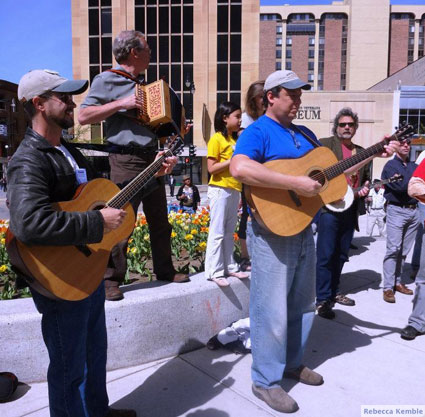
Solidarity Sing Along group outside Wisconsin State Capitol. Photo by Rebecca Kemble / The Progressive.

On other days they brave the cold winds, rain, and snow of the Wisconsin winter and, in recent weeks, revel in the unusually warm temperatures. For the outdoor gatherings (Walker banned all instruments from the Capitol), musicians bring an assortment of instruments — violins, guitars, mandolins, sousaphones, and squeeze boxes — and play together as “The Learning Curve” pick-up band.

The selection of songs varies from day to day, but every sing-along concludes with the group’s theme song, “Solidarity Forever.” A timely favorite is “Roll Out the Roll Call,” with new lyrics by Sheboyganites Frank and Mary Koczan. “Recall Scott Walker…/Give him a kick in the rear!/ Recall Scott Walker…./Toss him right out on his ear!” If the chorus of Ralph Chaplin’s labor classic routinely produces raised fists, the updated “Beer Barrel Polka” invariably stirs a few in the crowd to polka, German-style. This is Wisconsin, after all.

The driving force through all these performances has been R. Chris Reeder. Although he worked as an actor and stage technician before moving to Madison with his wife, Lisa Penning, Reeder had never directed anything musical before taking on the Solidarity Sing Along. But he is tall and limber and comfortable with occupying center-stage. His voice is distinctive and deep and carries high above the rumbling of a crowd. He says he lacks prior political experience, but was simply eager to jump at the opportunity to oppose Walker’s draconian anti-union legislation.

In a recent interview, Reeder described the sing-along as a source of empowerment for the singers as much as a political statement aimed at the public. It turns out to be both: tourists to Madison regularly drop in the Capitol either to watch from a distance or to join in the singing.

Invitations to conduct sing-alongs are now coming from distant parts of Wisconsin. Recently a small group made the six-hour drive to Ashland to lead a sing-along far “up north.” The Wisconsin Network for Peace and Justice, a coalition of activist groups founded in 1991, posts songbooks on its website and encourages communities throughout the state to start their own Solidarity Sing Alongs.

Reeder, who was born and raised near Seattle, is at home in Wisconsin. He finds his way to the Capitol between making deliveries to grocery stores for a local artisan bakery. He also receives a small stipend from the Wisconsin Network for Peace and Justice, and picks up a few extra dollars from the sale of Solidarity Sing Along t-shirts and sweatshirts emblazoned with the motto “This Is What Democracy Sounds Like.”

So intimate is Reeder with the several dozen regulars and hundreds of admirers that the details of the recent birth of his first-born, August, reached his many fans on the Solidarity Sing Along Facebook page and generated thousands of “likes.”

Heroes, even those possessing great charm, are created by the times, according to the old saw. When Walker tried to force the sing-along out of the Capitol, the singers stood their ground. At every performance, Reeder read the relevant passage in the state Constitution: “The right of the people peaceably to assemble, to consult for the common good, and to petition the government, or any department thereof, shall never be abridged.”

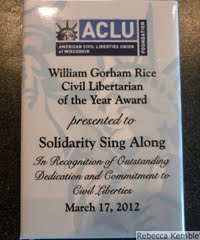
On March 17, 2012, the American Civil Liberties Union of Wisconsin presented Reeder, on behalf of the Solidarity Sing Along, a much deserved award, the William Gorham Rice Civil Libertarian of the Year Award “for the expression of the First Amendment rights of free speech and freedom of assembly.” Even more recently, Leadership Wisconsin, a group that promotes the development of leaders to strengthen communities, tagged Reeder for yet futher recognition.

Dubbed the “longest continuously running singing protest in history,” the Solidarity Sing Along is about to celebrate its “semiseptcentennial,” that is, its 350th performance on April 26th at the Majestic Theatre, Madison’s oldest theater, a former vaudeville house that opened in 1906. The event coincides with the release of a CD of its standard repertoire of songs, which were recorded in February at a local Unitarian Universalist church. (Authors’ disclaimer: we were there for the major session, but sang softly far from the microphone, befitting limited talents.).

The lyrics may not be deft prose, but topicality and regionalism have their place. Woody Guthrie’s iconic ballad now goes: “From Lake Geneva to Madeleine Island/ From the rolling prairies,/ to our lovely dairies,/ Wisconsin was made for you and me!”

Lead violinist Daithi Wolfe seasonally updated the lyrics of a St. Patrick’s Day favorite: “Scotty Boy, Scotty Boy We Loathe You So…”

Several songs have inspired hand and body gestures. The chorus of “Bring Back Wisconsin to Me,” with new lyrics by Madison folk favorites Lou and Peter Berryman, involves “swaying the Wisconsin Way,” first left, then right. “Roll the Union On” prompts the “rolling” of arm over arm. The ever-popular “Scotty, We’re Coming for You!” (written by the local Indie-Irish-Rock band, The Kissers) ends energetically with index fingers pointed at the Capitol.

It should also be added that the Solidarity Sing Along is nothing but a joyous occasion. We wonder: When in the history of labor choruses did the singer-amateurs have more fun? It’s sheer pleasure to sing the rousing lyrics adapted from Florence Reece’s beloved “Which Side Are You On?”: “Don’t believe the Governor/ don’t listen to his lies/ Working folks don’t have a chance,/ unless we organize!”

[Mary Jo and Paul Buhle are the editors of It Started in Wisconsin: Dispatches from the Front Lines of the New Labor Protest (Verso Books). This article was first published at The Progressive. Read more articles by Mari Jo and Paul Buhle on The Rag Blog.]

The Rag Blog

Posted in Rag Bloggers | Tagged , , , , , , , | Leave a comment

Bob Feldman : Labor and Farmer Activism in Texas, 1890-1920

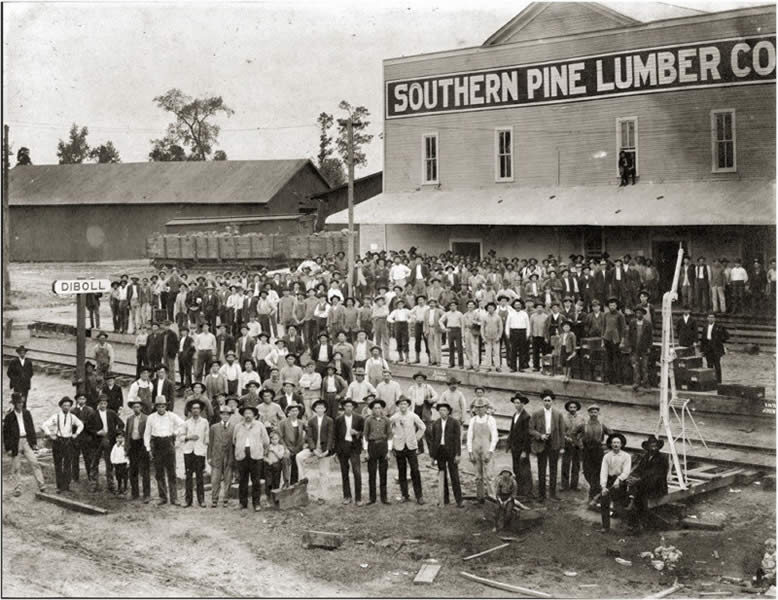
Southern Pine Lumber Company workers at the company store, Diboll, Texas, about 1907. Photo courtesy of The History Center, Diboll. Image from Texas Beyond History.

The hidden history of Texas

Part IX: 1890-1920/5 — Labor and farmer activism

By Bob Feldman / The Rag Blog / April 9, 2012

[This is the fifth section of Part 9 of Bob Feldman’s Rag Blog series on the hidden history of Texas.]

During the 1890-1920 period of Texas history a post-1900 revival of Texas labor and farmer activism developed into a worker-farmer political alliance which produced some pro-labor laws between 1900 and 1915 in Texas.

As F. Ray Marshall recalled in his 1967 book Labor in the South,

In 1900, the railway brotherhoods and the Texas State Federation of Labor [TSFL] established the Joint Labor Legislative Board of Texas. The board formed an alliance with the Farmers’ Union, organized in 1902.

The Texas Joint Board was instrumental in securing the passage of favorable labor legislation during the 1900-1915 period, particularly: a 1901 measure outlawing the issuance of company checks, tickets or symbols of any sort redeemable only in merchandise at company stores; a child labor law — first adopted in 1903 and improved in 1911; a 1907 law giving railroad telegraphers an eight-hour day; an eight-hour shift for state employees and persons working on government contracts in 1911; a 1913 law establishing a 9-hour day and a 54-hour work week for women in manufacturing; anti-blacklisting and mine safety codes in 1907; apprenticeship requirements for locomotive engineers and conductors, a full crew law for passenger trains and a requirement that railroads repair their equipment in Texas shops; and workmen’s compensation for railroad workers in 1909; workmen’s compensation was extended to industrial workers in 1911; a bureau of labor statistics in 1909 to enforce protective labor legislation; and the abolition of the convict lease system in 1910.

But by 1915 the political clout of Texas’s labor movement had begun to decline after cooperation with insurgent Texas farmers “began to weaken in 1911 when the Farmers’ Union secured the passage of the bill — over labor’s objections — to establish a textile mill in the Rusk penitentiary, and in 1913 when the farmers lobbied against the railway brotherhoods’ ‘full crew.'” Texas’s “Farmers’ Union had [by then] been infiltrated by the anti-union Commercial Secretaries Association,” according to Labor in the South.

Formed in Rains County, Texas, in 1902, the all-white Farmers’ Educational and Cooperative Union of America (aka The Farmers’ Union) excluded Texas’ African-American farmers as members. Yet “country teachers, mechanics, physicians, ministers of the gospels and publishers” who were not farmers, but who were white, were apparently allowed to be members, according to Labor in the South.

Despite having been able to recruit about 120,000 members in Texas during its early years, by 1919 the Farmers Union had ceased to exist as a significant and influential mass-based progressive political force within the state (although it still claimed 10,000 members in Texas in 1990).

The Texas labor movement’s political clout also decreased again by 1915 after Texas State Federation of Labor leaders complained that five of the six seats on the Joint Labor Legislative Board of Texas should not still be held by railroad brotherhood representatives — because the number of railway brotherhood members in Texas was only 16 percent of the 9,000 Texas workers who were members of the Texas State Federation of Labor-affiliated unions in 1906.

So in 1914, the leaders of Brotherhood of Locomotive Engineers, the Brotherhood of Locomotive Firemen, the Order of Railway Conductors, and the Brotherhood of Railroad Trainmen decided to end their organizational involvement in the Joint Labor Legislative Board of Texas.

But despite the legislative gains made by Texas workers between 1900 and 1915, this was also a period when dissatisfied Texas workers in the lumber industry of East Texas — 7,958 of whom were African-Americans who worked mostly as laborers in Texas lumber industry mills — joined lumber industry workers of adjacent Southern states in a region-wide strike. As Philip Foner recalled in his History of the Labor Movement in United States , Vol. IV: The Industrial Workers of the World 1905-1917:

The magnificent forests of… East Texas… were literally stolen by the lumber companies from the public domain… They were handed over to the lumber kings for prices ranging from 12.5 cents to 75 cents an acre…

Having grabbed these forests — one company owned 87,000 acres in a single tract in Western Louisiana and Eastern Texas — the companies proceeded to operate them as feudal domains, filling the towns with gunmen whom the authorities had commissioned as deputy sheriffs, and jailing anyone who questioned their rule…

Following a… study in Texas, the Commission on Industrial Relations found “that in such communities, political liberty does not exist and its forms are hollow mockery… Free speech, free assembly, and a free press may be denied as they have been denied time and again, and the employer’s agent may be placed in public office to do his bidding…”

So, not surprisingly, according to Foner’s 1965 book:

The first widespread revolt of the lumber workers occurred in the autumn of 1907…The lumber companies, taking advantage of the panic of 1907, issued orders to cut wages 20 percent or more, and lengthened the hours of work. Against these orders, all the lumber workers in Western Louisiana and Eastern Texas rose en masse, and in a spontaneous general strike closed hundreds of mills…

Although most of the striking Texas lumber workers soon returned to work after “promises of wage increases when economic conditions improved were made” to them by lumber company managers, according to the same book, “not only were the promises not kept, but the oppression grew even worse” over the next few years.

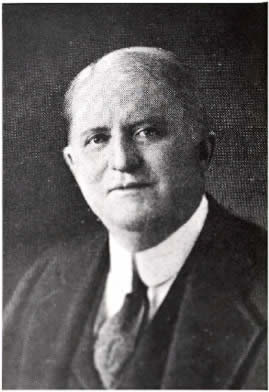
Texas labor baron John Henry Kirby, circa 1925. Image from Texas Beyond History.

So after dissatisfied activist workers in the U.S. lumber industry joined together to create a national industrial union of lumber industry workers, the Brotherhood of Timber Workers [B. of T.W.] in June 1911, “the B. of T.W. spread rapidly over Texas,…recruiting Negroes and white lumberjacks, mill workers, tenant and small farmers who worked in the lumber industry for parts of the year, and town craftsmen,” according to Foner’s History of the Labor Movement in the United States. The same book also described how the corporations that still controlled the lumber industry in Texas between 1890 and 1920 then chose to respond to the success that the Brotherhood of Timber Workers industrial union organizing drive in Texas was achieving in 1911:

The union’s rapid growth had alarmed the employers. In the summer of 1911, individual mill owners began to take action against the organization, requiring all workers to sign a card declaring that they would not join the union. This caused several strikes and a number of mills shut down, discharged every Brotherhood member, and kept closed down for weeks…

The Southern Lumber Operators’ Association was… reactivated and a secret meeting was called for July 19 [1911] at New Orleans. The meeting was attended by some 150 lumbermen from Texas, Arkansas and Louisiana… The meeting was controlled by John H. Kirby, the largest lumber operator in Texas, who… directed the activities of the organization. A one-time president of the National Association of Manufacturers, Kirby was determined to smash the Brotherhood of Timber Workers.

The leading speech at the session was delivered by Kirby. He began by announcing that “whenever any efforts are discovered to organize unions, the mills will be closed down and will remain so until the union is killed.” …Arrangements were worked out between Kirby and [then-American Federation of Labor Leader Samuel] Gompers for the Southern Lumber Operators’ Association to drive its workers out of the B. of T.W., and, after that union was destroyed, to extend recognition to the A.F. of L. which would send its representatives into the lumber camps and mills to recruit the skilled, white craftsmen…

During the next few months over 300… mills in Texas, Arkansas, and Louisiana were closed down, and union men were locked out of, or blacklisted from, every mill within the Association’s sphere of influence… “Good Citizens” Protective Leagues… were organized in Eastern Texas… to break up local meetings of the Brotherhood and to intimidate its speakers and organizers… During the summer and fall of 1911 between 5,000 and 7.000 of the most active members of the Brotherhood, white and Negro, were blacklisted…

Yet when the mills reopened in the winter of 1912, according to Foner’s History of the Labor Movement in the United States, the not-recognized B. of T.W. union “still existed as a force after the infamous war to exterminate it [and] by May 1912, the Brotherhood had a membership of between 20,000 to 25,000 workers, about half of whom were Negroes.”

But following another general lockout throughout the lumber industry by the Southern Lumber Operators’ Association in 1912, the B. of T.W. industrial union was driven out of the lumber industry in Texas by 1920.

As Bryan Burrough’s The Big Rich observed, “before oil the greatest Texas fortunes were made in ranching and East Texas lumber, where success depended on exploiting the labor of blacks, Latinos, and poor whites [and] in the years before World War I, John Henry Kirby all but owned East Texas.”

And according to the same book:

Kirby put together a group of Boston and New York investors and spent… 20 years buying timberlands… In 1901 he merged these interests and took control, creating the giant Kirby Lumber Company — at one point Kirby controlled more pine acreage than any other man in the world — and the Houston Oil Company… By the 1920s Kirby had emerged as [the] Texan’s leading businessman… He maintained suites at the Waldorf-Astoria in New York [and]… a mansion called Dixie Pines at Saranac Lake, New York.

[Bob Feldman is an East Coast-based writer-activist and a former member of the Columbia SDS Steering Committee of the late 1960s. Read more articles by Bob Feldman on The Rag Blog.]

The Rag Blog

Posted in Rag Bloggers | Tagged , , | Leave a comment

Harry Targ : Culture and the Cuban Experience

The Cuban band Sierra Maestra was formed at the University of Havana in 1976.

Economics, politics, and culture:
The Cuban experience

Culture can be revolutionary when it expresses pain, implies a better life, and extends the experiences of some to others…

By Harry Targ | The Rag Blog | April 9, 2012

[These remarks were prepared for a presentation before a musical performance at Purdue University by Sierra Maestra, the stirring band formed at the University of Havana in 1976. The band was named after the mountain range in Eastern Cuba that was the site of the formation of the Cuban revolutionary force that overthrew the U.S.-supported dictator in the 1950s. The nine-person band promotes and celebrates the classic Cuba Son music that has its roots in the diversity of class, race, ethnicity, and gender in Cuban history.]

People’s lives begin with the struggle for existence and are supplemented by the pursuit of joy and liberation. Culture, often reflecting the pain of daily existence and the vision of a better life, is intimately embedded in history, economics, and politics.

Cuba’s revolutionary poet Jose Marti describes his place in history, economics, and politics.

I am a truthful man,
From the land of the palm,
Before dying, I want to
Share these poems of my soul.

My poems are light green,
But they are also flaming red
My verses are like a wounded fawn.
Seeking refuge in the mountain.

(Pete Seeger reports learning these two additional Marti verses from a Cuban of African descent in 1983.)

Red, as in the desert,
Rose the sun on the horizon.
It shone on a dead slave
Hanging from a tree of the mountain.

A child saw it, trembled,
With passion for those that wept,
And swore that with his blood
He would wash away that crime.

Latin American social theorists and activists of the era of the Cuban revolutionary process (since the 1950s) defined the economic and political context of countries like Cuba — less passionately but rigorously — as a result of dependency. For example, Brazilian social scientist Theotonio Dos Santos wrote about what he called “the structure of dependence.”

Dependence is a situation in which a certain group of countries have their economy conditioned by the development and expansion of another economy, to which the former is subject.

Andre Gunter Frank, looking at the broad sweep of history beginning with the rise of capitalism out of feudalism referred to “the development of underdevelopment.” During the fifteenth century the sectors of the globe now referred to as the “Global North” and “Global South” were roughly equal in economic and military power. But as a result of the globalization of capitalism and militarism, some countries, primarily in Europe and North America, developed at the expense of most of the other countries of the world.

Dependency theorists began to include domestic class structures in their analysis of relations between dominant and dependent nations. In addition to dominant and weak countries bound by exploitation and violence, within both powerful and weak countries class structures existed.

In fact, rulers in poor countries usually were tied by interests and ideology to the interests and ideology of the ruling classes in powerful countries. And, most important, the poor, the exploited, the repressed in both rich and poor countries shared common experiences, often a common outlook, and potentially a common culture.

I have written a book chapter about “Themes in Cuban History” from the point of view of dominance and dependence (from Harry R. Targ, Cuba and the USA: A New World Order? International Publishers, 1992). The chapter addresses:

  • Spanish conquest between 1511 and 1515
  • Cuba as sugar producer
  • Cuba as slave society. By 1827 over 50 percent of Cuban residents were of African descent.
  • Britain’s economic and military penetration of the island beginning in the 18th century
  • Revolutionary ferment, particularly slave revolts, permeating 19th century Cuban society
  • The visions of U.S. leaders, including Thomas Jefferson, that some day Cuba would join the new nation to the North.
  • U.S. investor penetration of the island, challenging the Spanish and British. By the 1880s over 80 percent of sugar exports went to the United States and large plantations on the island were owned by Americans.
  • The Spanish/Cuban/American war of 1898 which lead to a full transfer of colonial and neo-colonial hegemony from the Spanish and British to the United States
  • The United States establishment of economic, political, and cultural domination of the island from 1898 to 1959. Subordinate wealthy and powerful Cubans controlled the political system, benefitting from U.S. hegemony, while “the poor people of this earth” on the island made up the vast majority.
  • 1953 to 1959 armed struggle which overthrew the Batista dictatorship and the elimination of U.S. interests on the island.
  • 1959 to the present Cuba haltingly, with international and domestic opposition, pursuing a new society to “wash away that crime” of long years of empire and dependency.

How is this history relevant to indigenous Cuban music and its connections with U.S. culture?

Culture, it seems to me, grows out of the experience of peoples. That experience is shaped by history, economics, and politics. Music is a common way of communicating and sharing experience, particularly of pain and joy.

The seeds of a common Cuban culture were planted in various fields — Africa, the sugar plantations of the island, and growing relations between Cubans and people of African descent in the region, including the United States.

Finally, culture can be revolutionary when it expresses pain, implies a better life, and extends the experiences of some to others — of similar class, racial, ethnic, and gender histories.

So as we listen to Sierra Maestra and reflect on the roots of its music, its contribution to jazz in the U.S., and the commonalities of Cuban Son and U.S jazz and blues, we might remember Marti’s expression from the poet’s point of view:

With the poor people of this earth,
I want to share my lot.
The little streams of the mountains
Please me more than the sea.

(All verses quoted here are from Pete Seeger, Where Have all the Flowers Gone?: A Singer’s Stories, Songs, Seeds, Robberies, A Sing Out Publication,1993).

[Harry Targ is a professor of political science at Purdue University who lives in West Lafayette, Indiana. He blogs at Diary of a Heartland Radical — and that’s also the name of his new book which can be found at Lulu.com. Read more of Harry Targ’s articles on The Rag Blog.]

The Rag Blog

Posted in Rag Bloggers | Tagged , , , , , , , | Leave a comment

Harvey Wasserman : Two New U.S. Nukes in Big Trouble

Georgia’s Vogtle nuclear plant faces big challenges. Image from io9.

America’s two new nukes
are on the brink of death

The financial pitfalls of what may be America’s last two proposed reactor projects may write the final epitaph for an industry whose fiscal failures are in the multi-billions.

By Harvey Wasserman | The Rag Blog | April 9, 2012

The only two U.S. reactor projects now technically under construction are on the brink of death for financial reasons.

If they go under, there will almost certainly be no new reactors built here.

The much mythologized “nuclear renaissance” will be officially buried, and the U.S. can take a definitive leap toward a green-powered future that will actually work and that won’t threaten the continent with radioactive contamination.

As this drama unfolds, the collapse of global nuclear power continues, as two reactors proposed for Bulgaria have been cancelled, and just one of Japan’s 54 licensed reactors is operating. That one may well close next month, leaving Japan without a single operating commercial nuke.

Georgia’s double-reactor Vogtle project has been sold on the basis of federal loan guarantees. Last year President Obama promised the Southern Company, parent to Georgia Power, $8.33 billion in financing from an $18.5 billion fund that had been established at the Department of Energy by George W. Bush.

Until last week most industry observers had assumed the guarantees were a done deal. But the Nuclear Energy Institute, an industry trade group, has publicly complained that the Office of Management and Budget may be requiring terms that are unacceptable to the builders.

Southern and its supporters remain ostensibly optimistic that the deal will be done. But the climate for loan guarantees has changed since this one was promised. The $535 million collapse of Solyndra prompted a rash of angry Congressional hearings and cast a long shadow over the whole range of loan guarantees for energy projects. Though the Vogtle deal comes from a separate fund, skepticism over stalled negotiations is rising.

So is resistance among Georgia ratepayers. To fund the new Vogtle reactors, Southern is forcing “construction work in progress” rate hikes that require consumers to pay for the new nukes as they’re being built. Southern is free of liability, even if the reactors are not completed. Thus it behooves the company to build them essentially forever, collecting payment whether they open or not.

All that would collapse should the loan guarantee package fail.

A similar fate may be awaiting the Summer Project. South Carolina Electric & Gas has pledged to build the two new reactors there without federal subsidies or guarantees. But it does require ratepayer funding up front. That includes an apparent need for substantial financial participation from Duke Power and/or Progress Energy customers in North Carolina who have been targeted to receive some of the electricity projected to come from Summer.

But resistance in the Tar Heel State is fierce. NCWarn and other consumer/anti-nuclear organizations are geared up to fight the necessary rate hikes tooth and nail. Should they win — and in a troubled economy there is much going for them — nuclear opponents could well take Summer down before it gets seriously off the ground.

Progress already has its hands full with a double-reactor project proposed for Levy County, Florida. Massive rate hikes granted for CWIP by the Florida legislature have ignited tremendous public anger. Unlike Vogtle and Summer, Levy County has yet to get NRC approval.

Progress is also over its head at Crystal River. Upwards of $2 billion has been poured into botched repairs at this north Florida reactor. Odds are strong it will never reopen.

The same may be true at California’s San Onofre, now shut due to problems with its steam generator tubing, a generic flaw that could affect up to about half the currently licensed 104 U.S. reactors. Nukes at Vermont Yankee, New York’s Indian Point, and Pilgrim, in Massachusetts, among others, are also under fierce attack.

These elderly reactors have been routinely issued extended operating licenses by the NRC.

But as their physical deterioration accelerates, official licenses may now be beside the point for these old reactors… and for new nukes as well. The major financial trade publications such as Bloomberg, Fortune et al, now regularly concede that increased efficiency and renewable projects are cheaper, faster to build and more profitable than new reactors.

The Tennessee Valley Authority, a federal agency, could conceivably pick up the corpse and try to build new reactors, as it did at the dawn of the nuclear age, when no private utilities would touch the untested but clearly dubious promise of the “Peaceful Atom.”

In the decades since, the promise of electricity “too cheap to meter” has proven to be a tragic myth.

And all these years later, the financial pitfalls of what may be America’s last two proposed reactor projects may write the final epitaph for an industry whose fiscal failures are in the multi-billions.

At the end of the road, it will still take citizen activism to finally bury this industry. But we may be very close to making it happen, and now is a critical time to push extra hard.

[Harvey Wasserman edits www.nukefree.org. His Solartopia! Our Green-Powered Earth is at www.solartopia.org. The Solartopia Green Power and Wellness Show airs at www.progressiveradionetwork.com. Read more of Harvey Wasserman’s writing on The Rag Blog.]

The Rag Blog

Posted in Rag Bloggers | Tagged , , | Leave a comment

Lamar W. Hankins : Fighting Back Against Groups That Intimidate

Transforming the discussion. Image from pennlive.com.

Voice of Choice:
Fighting back against bullies, stalkers,

and those who would intimidate

Maybe it is time to empower local citizens overwhelmed by moneyed interests and influential groups to find ways to ‘speak back’ effectively.

By Lamar W. Hankins | The Rag Blog | April 8, 2012

“Voice of Choice” offers an effective way to counteract those who would deny us liberty. Its approach was born out of the experiences of those trying to secure their right to a safe and legal abortion. But its approach will work for anyone who is bullied, intimidated, stalked, threatened, ridiculed, disregarded, and harassed as they try to secure for themselves and others their rights under the laws and Constitution.

Last fall, when anti-abortion activists started picketing the middle school attended by the 11-year old daughter of a man who rented clinic space near Washington, DC, to a physician who performs abortions, the landlord decided not to put up with the harassment. There were anti-abortion demonstrations, all legal, with signs proclaiming, “Please STOP the Child Killing,” and posters showing aborted fetuses.

Some of the same demonstrators had been picketing the clinic for nine months before they turned their attention to this young girl in an effort to intimidate her father into getting rid of the doctor’s Reproductive Health Services Clinic. A website posted the picture, name, address, and phone number of the landlord, Todd Stave.

These are well-known tactics of those who would deny women their lawful rights to control their own health care and reproductive choices. Sometimes, the tactics have been even more confrontational.

Demonstrators shout at women who show up at clinics; confront them on the sidewalks imploring them not to kill innocent babies; pray loudly for them to change their minds; force them to run a gauntlet of screaming demonstrators to enter clinics; follow them to their cars; follow them home trying to make personal contact with them; picket the abortion providers (doctors as well as clinic staff); post their pictures, addresses, and telephone numbers in prominent locations; and take any action to hold these people, patients as well as clinic workers, up to ridicule and intimidation.

This particular demonstration at a middle school was organized by a group called Defend Life. It was done in conjunction with a larger effort of the Maryland Coalition of Life that focused on the clinic’s landlord. The intimidation included sending over 100 emails and making 25 or more phone calls to the landlord. To counteract the harassment, the landlord asked for help from volunteers to oppose these anti-abortion activists tactics.

In response to the call for help, hundreds of people in the community of Germantown, MD, reached out “peacefully and individually to each of the protesters” according to Stave. When the volunteers described the protesters’ behavior to them from their perspectives, many protesters came to see that their actions could be fairly described as “thoughtless, mob-mentality accusations and aspersions.”

These experiences led Stave to create Voice of Choice, which describes its views and intentions:

For too long, the abortion discussion has been dominated by angry, nasty protests fueled by individuals and organizations that thrive on sensationalism and extremism. Now it is our turn.

“Voice of Choice” was established as a calm, measured response to anti-abortion activists who engage in misguided, raging protest tactics that are often ill-informed and only serve to victimize women, pro-choice professionals, law-abiding businesses and unaligned bystanders.

We use email, telephone and social media in peaceful, person-to-person counter-protests against groups that target abortion facilities, providers and patients, as well as their families and communities. We don’t question anyone’s right to express opinions and ideals; we challenge their bullying tactics and their contempt.

Voice of Choice volunteers used Facebook and Twitter, as well as phone calls, letters, and email to explain their concerns to the antiabortion demonstrators. Within a few weeks of trying this new tactic against the anti-abortion demonstrators, as many as 5,000 people contacted Stave offering to help.

The response of the anti-abortion demonstrators contacted has been overwhelmingly positive. Many of the demonstrators had not thought about or understood the debilitating and frightening effects of targeting an 11-year old girl for the actions of her father.

Stave asks that his volunteers not argue with the demonstrators, be polite, explain the problem of harassing others for exercising their constitutional rights, and respect the right of the demonstrators to engage in their own protests against abortion.

Such approaches are worth trying against other instances of both legal and illegal protests and actions, such as religious intimidation, bullying gays and lesbians, and government promotion of religion. Locally, websites could be established or Facebook sites could be used to ask for volunteers to help oppose instances of bullying, intimidation, insensitivity, over-reaching, and harassment.

If offenders are approached respectfully, such contacts could lead to a greater understanding of the concerns of varying views on many public issues.

In fact, implementing this idea using readily-available internet resources could be effective on many local political issues. While only a few people attend city council, commissioners courts, and legislative hearings, using targeted electronic and personal communications locally that identify supporters of a proposition could generate many contacts with elected officials and those pushing them to act on many public issues.

Usually, such officials succumb to organized efforts by a few people to promote practices and regulations that are offensive to many of their constituents and sometimes unconstitutional.

Nationally, efforts to get people to sign petitions and occasionally send emails or call national officials are old hat to internet denizens. But using Voice of Choice’s approaches locally could transform discussions and positions on public issues in our community, or at least lead to greater understanding of these issues among the populace, and hopefully help some local officials see the insensitivity and unfairness inherent in some of their decisions.

The effectiveness of such an approach depends on volunteer activists being polite, not arguing, explaining clearly the purpose of their contact, listening to the others’ viewpoint, and being civil. Maybe it is time to empower local citizens overwhelmed by moneyed interests and influential groups to find ways to “speak back” effectively.

[Lamar W. Hankins, a former San Marcos, Texas, city attorney, is also a columnist for the San Marcos Mercury. This article © Freethought San Marcos, Lamar W. Hankins. Read more articles by Lamar W. Hankins on The Rag Blog.]

The Rag Blog

Posted in Rag Bloggers | Tagged , , | 1 Comment

Fighting back against bullies, stalkers, and those who would intimidate

By Lamar W. Hankins / The Rag Blog /

“Voice of Choice” offers an effective way to counteract those who would deny us liberty. Its approach was born out of the experiences of those trying to secure their right to a safe and legal abortion. But its approach will work for anyone who is bullied, intimidated, stalked, threatened, ridiculed, disregarded, and harassed as they try to secure for themselves and others their rights under the laws and Constitution.

Last fall, when anti-abortion activists started picketing the middle school attended by the 11-year old daughter of a man who rented clinic space near Washington, DC, to a physician who performs abortions, the landlord decided not to put up with the harassment. There were anti-abortion demonstrations, all legal, with signs proclaiming, “Please STOP the Child Killing,” and posters showing aborted fetuses. Some of the same demonstrators had been picketing the clinic for nine months before they turned their attention to this young girl in an effort to intimidate her father into getting rid of the doctor’s Reproductive Health Services Clinic. A website posted the picture, name, address, and phone number of the landlord, Todd Stave.

These are well-known tactics of those who would deny women their lawful rights to control their own health care and reproductive choices. Sometimes, the tactics have been even more confrontational. Demonstrators shout at women who show up at clinics; confront them on the sidewalks imploring them not to kill innocent babies; pray loudly for them to change their minds; force them to run a gauntlet of screaming demonstrators to enter clinics; follow them to their cars; follow them home trying to make personal contact with them; picket the abortion providers (doctors as well as clinic staff); post their pictures, addresses, and telephone numbers in prominent locations; and take any action to hold these people, patients as well as clinic workers, up to ridicule and intimidation.

This particular demonstration at a middle school was organized by a group called Defend Life. It was done in conjunction with a larger effort of the Maryland Coalition of Life that focused on the clinic’s landlord. The intimidation included sending over 100 emails and making 25 or more phone calls to the landlord. To counteract the harassment, the landlord asked for help from volunteers to oppose these anti-abortion activists tactics.

In response to the call for help, hundreds of people in the community of Germantown, MD, reached out “peacefully and individually to each of the protesters” according to Stave. When the volunteers described the protesters’ behavior to them from their perspectives, many protesters came to see that their actions could be fairly described as “thoughtless, mob-mentality accusations and aspersions.”

These experiences led Stave to create Voice of Choice, which describes its views and intentions:

For too long, the abortion discussion has been dominated by angry, nasty protests fueled by individuals and organizations that thrive on sensationalism and extremism. Now it is our turn.

“Voice of Choice” was established as a calm, measured response to anti-abortion activists who engage in misguided, raging protest tactics that are often ill-informed and only serve to victimize women, pro-choice professionals, law-abiding businesses and unaligned bystanders.

We use email, telephone and social media in peaceful, person-to-person counter-protests against groups that target abortion facilities, providers and patients, as well as their families and communities. We don’t question anyone’s right to express opinions and ideals; we challenge their bullying tactics and their contempt.

Voice of Choice volunteers used Facebook and Twitter, as well as phone calls, letters, and email to explain their concerns to the antiabortion demonstrators. Within a few weeks of trying this new tactic against the anti-abortion demonstrators, as many as 5000 people contacted Stave offering to help. The response of the anti-abortion demonstrators contacted has been overwhelmingly positive. Many of the demonstrators had not thought about or understood the debilitating and frightening effects of targeting an 11-year old girl for the actions of her father.

Stave asks that his volunteers not argue with the demonstrators, be polite, explain the problem of harassing others for exercising their constitutional rights, and respect the right of the demonstrators to engage in their own protests against abortion.

Such approaches are worth trying against other instances of both legal and illegal protests and actions, such as religious intimidation, bullying gays and lesbians, and government promotion of religion. Locally, websites could be established or Facebook sites could be used to ask for volunteers to help oppose instances of bullying, intimidation, insensitivity, over-reaching, and harassment. If offenders are approached respectfully, such contacts could lead to a greater understanding of the concerns of varying views on many public issues.

In fact, implementing this idea using readily-available internet resources could be effective on many local political issues. While only a few people attend city council, commissioners courts, and legislative hearings, using targeted electronic and personal communications locally that identify supporters of a proposition could generate many contacts with elected officials and those pushing them to act on many public issues. Usually, such officials succumb to organized efforts by a few people to promote practices and regulations that are offensive to many of their constituents and sometimes unconstitutional.

Nationally, efforts to get people to sign petitions and occasionally send emails or call national officials are old hat to internet denizens. But using Voice of Choice’s approaches locally could transform discussions and positions on public issues in our community, or at least lead to greater understanding of these issues among the populace, and hopefully help some local officials see the insensitivity and unfairness inherent in some of their decisions.

The effectiveness of such an approach depends on volunteer activists being polite, not arguing, explaining clearly the purpose of their contact, listening to the others’ viewpoint, and being civil. Maybe it is time to empower local citizens overwhelmed by moneyed interests and influential groups to find ways to “Speak Back” effectively.

[Lamar W. Hankins, a former San Marcos, Texas, city attorney, is also a columnist for the San Marcos Mercury. This article © Freethought San Marcos, Lamar W. Hankins. Read more articles by Lamar W. Hankins on The Rag Blog.]
Type rest of the post here

Source /

The Rag Blog

Posted in RagBlog | Leave a comment

James Retherford : Old Skool Reunion!

Spencer Perskin of Shiva’s Headband performs at the Rag Blog benefit. Photoillustration by James Retherford / The Rag Blog.

‘Feed Your Head!’
Rag Blog benefit is boffo bash

Photography by James Retherford | The Rag Blog | April 5, 2012

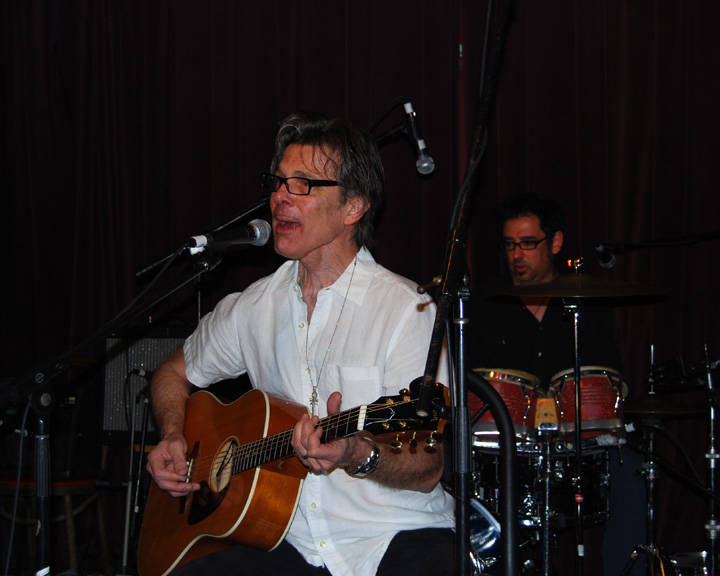
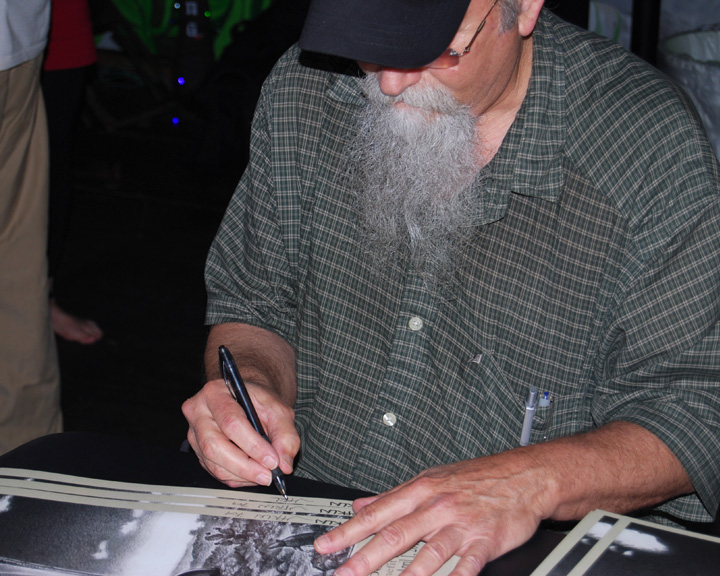
“Feed Your Head,” The Rag Blog‘s “Old Skool” April Fool’s benefit bash, held on Sunday night, April 1, at Jovita’s in Austin, was a rousing success. Featuring memorable performances by historic Texas musicians Shiva’s Headband, Greezy Wheels, and Jesse Sublett — and with legendary surrealist graphic artist Jim Franklin signing his commemorative poster — the show drew a packed crowd of nostalgic revelers who came out to support The Rag Blog and Rag Radio and to just plain have fun.

Rag Blog art director Jim Retherford’s gallery of photos, below, captures the spirit of the night and the character of the, well, characters in attendance.

The musicians:

Susan Perskin and Spencer Perskin: Shiva’s Headband.

Cleve Hattersley and Sweet Mary Hattersley: Greezy Wheels.

Jesse Sublett.

The artist:

Jim Franklin signs his poster.

The celebrants:


The new Rag Blog/Rag Radio t-shirt, designed by Jim Retherford, was premiered at the event.

The Rag Blog

Posted in Rag Bloggers | Tagged , , , , , , , , | 3 Comments

David P. Hamilton : Change You Can, You Know, Believe In…

Graphic from Pyrrhic Defeat.

Consumer choice division:

Change you can believe in

By David P. Hamilton | The Rag Blog | April 4, 2012

I could no longer tolerate the bell chamber of American cable news. Its obsessive fixation on the still months-away American presidential election pitting two candidates approved by the 1% was driving me up the wall. I would regurgitate involuntarily if forced to watch one more of that repulsive manifestation of all the worst features of America, the Republican primary debates.

So, I dumped Time Warner for the Dish to get access to better news sources. The Dish gets us Al Jazeera, Democracy Now, and RT (Russia Today — media home of numerous American leftists), Link TV, Free Speech TV, and several other international sources of information. What a relief. Now I had a much wider selection of biases. But there remain issues.

This enhanced news selection prominently includes the various shows of Thom Hartmann, most notably, the “Big Picture” that appears on both RT and Free Speech. He also does a couple of hours of live call-in, just him talking and answering calls on camera.

Thom is very busy and generally very sharp. We are fortunate that he is there. Sometimes he does a feature where he debates two rightists at the same time. They are perpetually on the defensive. We first caught his show on San Francisco’s cable television. Then we found a way to get him in Austin.

After watching a few days and getting a bit excited, I called Thom’s show and asked the following question:

Thom, you support a constitutional amendment to take corporate money out of politics and revoke corporate personhood. So do I. But to enact a constitutional amendment, it must be passed by two-thirds of the members of the Congress and then in three-fourths of the state legislatures.

If our democracy is already seriously corrupted by corporate money, how can we expect legislators who are already largely sycophants of corporate America, to act against the interests of those who pay so handsomely for their services by voting for this amendment?

Thom’s answer, confirmed by his Washington reporter guest, was that they have heard many legislators say that they really hate having to raise money all the time. If only enough of the electorate pressured them, they would vote for the amendment. They essentially argued that these are good people who just need a little support in order to do the right thing.

Basically, I asked Thom whether or not democracy was already dead in America and Thom answered by saying no, just on life support.

As much as I admire Thom, there is some fuzzy thinking here. He is campaigning hard for an amendment that is premised on the idea that democracy in America is quite seriously compromised already. Yet he appeals to the corrupted institution to rise up and cleanse itself. You can’t have it both ways.

You can hardly expect the utmost beneficiaries of the burgeoning economic inequality that so heavily compromises our democracy to instruct their functionaries in the so-called “public” sector to rectify the situation in our favor.

Most legislators are already virtual employees of the less than 1%, the capitalist class who own the controlling interests in the major corporations. They are in that role because they are highly adapted to the corrupted system. They like money and power, the respectful recognition and bounteous benefits they acquire by being political operatives of the rich and powerful.

Thom’s answer posits that they are actually there to do what’s best for the country and the general population and are only inhibited from doing so by the need to raise millions to run their necessarily expensive campaigns, money readily supplied by the dastardly corporations. That’s nonsense. If that were true, they would have passed public financing of political campaigns years ago.

The amendment to overturn “Citizens United” may be a wonderful device to focus the public on the issue of how economic inequality corrupts our democracy, but it will pass when pigs fly.

Which brings us to a fundamental question. Is economic reform that measurably effects income distribution in the U.S., and consequently the class structure, still possible given the current level of political corruption by corporate money?

The answer is not very possible, if at all, and the potential is diminishing. The ruling economic elite can only be expected to instruct their political servants to minimize their social responsibilities as much as possible and to increase their access to government money. They have unswerving faith in a religion called the “Free Market” — and Social Darwinism that allows them to take this course without the least guilt.

What is the difference in corporate deference between Democrats and Republicans? The former have progressive voting constituencies that must be placated to some small degree, but just enough to distinguish them from Republicans.

The most crucial arena is the tax structure. Specifically, will the Democrats end the Bush tax cuts for the rich when they again have the chance? Despite the fact they controlled both houses of Congress and the presidency for two years, they did not do so when it was last up for a vote. Will they risk bing labeled as those who raised taxes or will they again “bargain it away”? I advise you to limit your expectations.

Before the “Citizens United” decision, the barriers limiting corporate control of the political process were already full of holes. With that decision, they fell by the wayside entirely.

As a direct result, we today have the spectacle of a Las Vegas gambling tycoon openly giving $15 million to Newt Gingrich to run his campaign. Given the donor’s reputed wealth of many billions, that’s pocket change. That example is just the egregious tip of the iceberg. It would be hard to argue that most legislators are not already at this point, beneficiaries of significant corporate largesse.

This system, like others, produces politicians that are adaptive to it. Insofar as there are still shining examples of probity in regards to corporate cash, given this burst of judicial activism by the Supremes, they are a dying breed.

Witness the strenuous effort that has been exerted for years to get rid of Congressman Lloyd Doggett of Austin. Eventually, his right-wing detractors will find the right district, the right flunky, and enough big bucks to take him down.

Their personhood is immoral, devious, relentless, and infinitely well financed. Corporations will continue to own the controlling interest in an enterprise known as the U.S. government and they will expand their holdings, because there is nothing to stop them and very little chance that things will change.

Consider also the important role the federal government now plays in relation to the private sector. Forbes magazine recently reported that of the 10 richest counties in the U.S., half of them bordered on Washington, D.C. Average household income in these counties hovers around $100,000 per year.

In recent decades northern Virginia has become an economic dynamo, driven by a private sector that feasts on government contracting. These counties are also home to corporate lobbyists, lawyers and consultants who work in or around the nation’s capital, soaking up federal government spending.

There is no other prize more valuable to corporate elites than maintaining their control over the power and wealth of the federal government for their private gain. They are firmly in the driver’s seat now and have the power to change the rules to their further advantage. No election occurring in other than catastrophic conditions will change that and in such conditions, they probably won’t allow elections.

As American anarchist Emma Goodman once said, “If you could change things by voting, it would be illegal.”

Whatever may have been the case in the past, serious reform that alters the class structure or the political institutions of American society in favor of the 99% is no longer possible by electoral means.

[Rag Blog contributor David P. Hamilton has been a political activist in Austin since the late 1960s when he worked with SDS and wrote for The Rag, Austin’s underground newspaper. Read more articles by David P. Hamilton on The Rag Blog.]

The Rag Blog

Posted in Rag Bloggers | Tagged , , , , , , | 3 Comments

RAG RADIO / Thorne Dreyer : Chicano Activist and Filmmaker Carlos Calbillo


Chicano community activist and
filmmaker Carlos Calbillo on Rag Radio

Carlos Calbillo, an award-winning filmmaker and longtime Houston Chicano community activist, was Thorne Dreyer’s guest on Rag Radio, Friday, March 30, 2012, on Austin community radio station KOOP 91-7-FM, and streamed live on the Internet.

You can listen to the show here.


Carlos Calbillo was active with SDS and the Mexican-American Youth Organization (MAYO) in Texas in the ’60s and ’70s, and edited the Houston Chicano newspaper, El Papel.

He has worked in film and television and has produced numerous short films on subjects ranging from community activism to musical documentaries on Texas and Chicano/Latino musicians, including Doug Sahm, Freddy Fender, Mance Lipscomb, Little Joe y La Familia, and ZZ Top. His film, The Case of Joe Campos Torres, documented one of the most infamous cases of police misconduct in Houston history.

Carlos is the Artist-in-Education at the Southwest Alternate Media Project in Houston, and teaches filmmaking at the Raul Yzaguirre School for Success in Houston’s East End.

In addition to covering Carlos Calbillo’s work as an activist and filmmaker — and the underrecognized legacy of Chicano activism in Houston, Texas, and the Southwest — we discuss the new Tejano Monument on the Texas Capitol grounds and the role of Tejanos in Texas history.

Rag Radio, which has aired since September 2009 on KOOP 91.7-FM, a cooperatively-run all-volunteer community radio station in Austin, Texas, features hour-long in-depth interviews and discussion about issues of progressive politics, culture, and history.

Hosted and produced by Rag Blog editor and long-time alternative journalist Thorne Dreyer, a pioneer of the Sixties underground press movement, Rag Radio is broadcast every Friday from 2-3 p.m. (CST) on KOOP and streamed live on the web. Rag Radio is also rebroadcast on Sundays at 10 a.m. (EST) on WFTE, 90.3-FM in Mt. Cobb, PA, and 105.7-FM in Scranton, PA.

Rag Radio is produced in the KOOP studios, in association with The Rag Blog, a progressive internet newsmagazine, and the New Journalism Project, a Texas 501(c)(3) nonprofit corporation. Tracey Schulz is the show’s engineer and co-producer.

After broadcast, all episodes are posted as podcasts and can be downloaded at the Internet Archive.

Coming up on Rag Radio:

THIS FRIDAY, April 6, 2012: Progressive populist writer, commentator & orator Jim Hightower.
April 13, 2012: Sustainability activist Bill Neiman of Native American Seeds.

The Rag Blog

Posted in RagBlog | Tagged , , , , , | Leave a comment

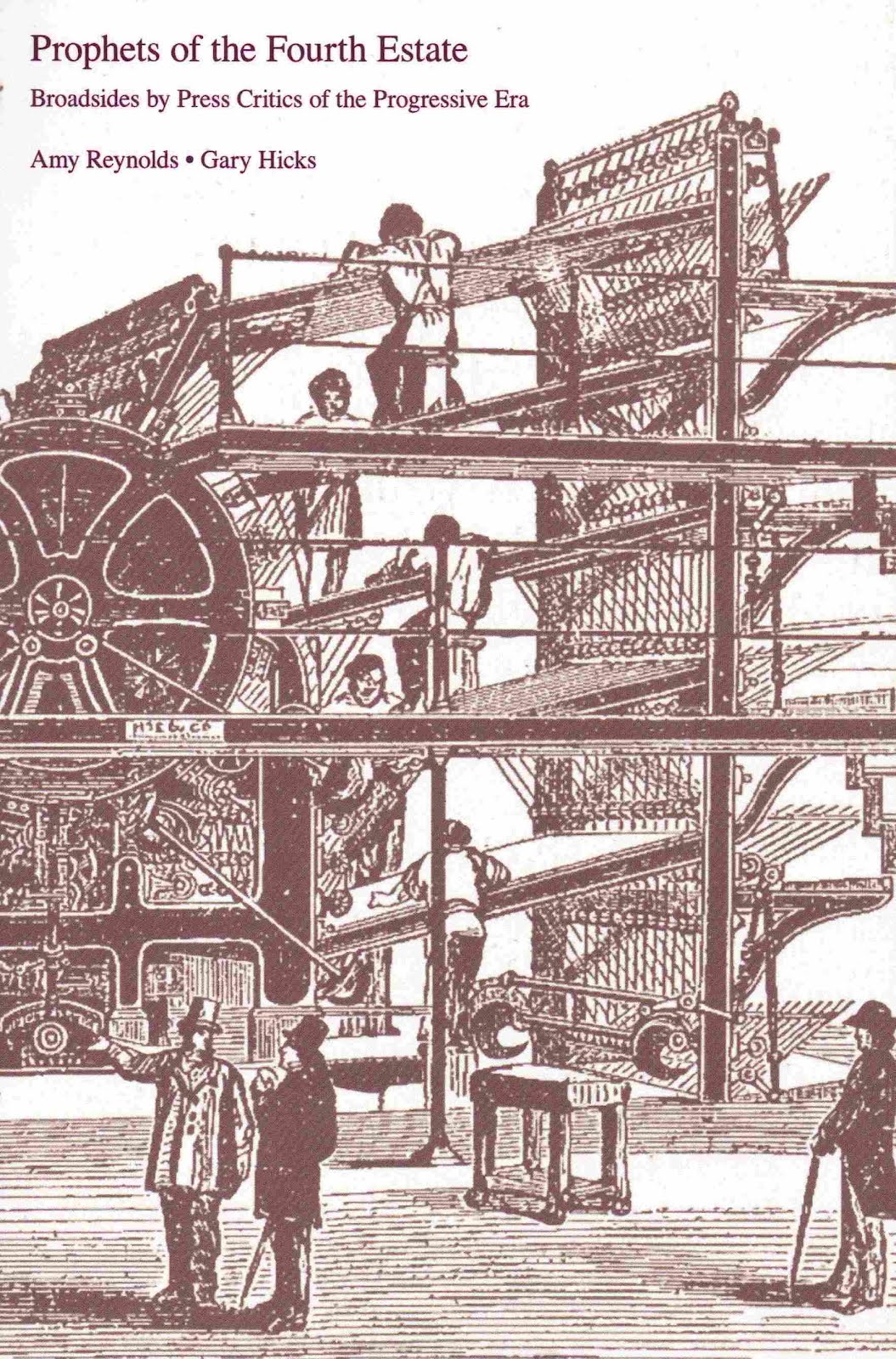
BOOKS / Robert Jensen : Prophets of the Fourth Estate


The corporate media crisis:
Everything old is new again

By Robert Jensen | The Rag Blog | April 4, 2012

[Prophets of the Fourth Estate: Broadsides by Press Critics of the Progressive Era, edited by Amy Reynolds and Gary Hicks; Foreword by Robert Jensen (2012: Litwin Books); Paperback; 218 pp.; $28.]

These days there’s one political point on which one can usually get consensus: Mainstream journalists are failing. In common parlance, most everyone “hates the media.” But there is little agreement on why journalism might be inadequate to the task of engaging the public in a democratic society. More than ever, it’s important to understand the forces that constrain good journalism.

In Prophets of the Fourth Estate: Broadsides by Press Critics of the Progressive Era, editors Amy Reynolds and Gary Hicks look back to the press criticism of the Progressive Era for help in that project. In the material they’ve collected and analyzed, we can see how the problems of a corporate-commercial media system go back more than a century.

In my foreword to the book, posted below, I try to identify some of the key limitations of the contemporary media system and emphasize the importance of this work to the project of deepening democracy.

The managers of commercial news organizations in the United States love to proclaim their independence from the corporate suits who sign their paychecks. Extolling the unbreachable “firewall” between the journalistic and the business sides of the operation, these editors and news directors wax eloquent about their ability to pursue any story without interference from the corporate front office.

“No one from corporate headquarters has ever called me to tell me what to run in my paper,” one editor (let’s call him Joe) told me proudly after hearing my critique of the overwhelmingly commercial news media system in the United States.

I asked Joe if it were possible that he simply had internalized the value system of the folks who run the corporation (and, by extension, the folks who run the world), and therefore they never needed to give him direct instructions.

He rejected that, reasserting his independence from any force outside his newsroom. I countered:

“Let’s say, for the purposes of discussion, that you and I were equally capable journalists in terms of professional skills, and we were both reasonable candidates for the job of editor-in-chief that you hold. If we had both applied for the job, do you think your corporate bosses would have ever considered me for the position given my politics? Would I, for even a second, have been seen by them to be a viable candidate for the job?”

Joe’s politics are pretty conventional, well within the range of mainstream Republicans and Democrats — he supports big business and U.S. supremacy in global politics and economics. In other words, he’s a capitalist and imperialist. I am on the political left, anti-capitalist and critical of the U.S. empire. On some political issues, Joe and I would agree, but we diverge sharply on the core questions of the nature of the economy and foreign policy.

Joe pondered my question and conceded that I was right, that his bosses would never hire someone with my politics, no matter how qualified, to run one of their newspapers. The conversation trailed off, and we parted without resolving our differences.

I would like to think my critique at least got Joe to question his platitudes, but I never saw any evidence of that. In his subsequent writing and public comments that I read and heard, Joe continued to assert that a news media system dominated by for-profit corporations was the best way to produce the critical, independent journalism that citizens in a democracy needed.

After he retired from the paper, he signed on as a “senior adviser” with a high-powered lobbying/public relations firm, apparently without a sense of irony, or shame.

The collapse of mainstream journalism’s business model has given news managers less time to pontificate as they scramble to figure out how to stay afloat, but the smug, self-satisfied attitude hasn’t changed much.

As a former journalist, I certainly understood Joe’s position. When I was a working reporter and editor, I would have asserted my journalistic independence in similar fashion, a viewpoint that reflected the dominant assumptions of newsroom culture.

We saw ourselves as non-ideological and uncontrolled. We knew there were owners and bosses whose political views clearly were not radical, and we knew we worked in a larger ideological system. But we working journalists were convinced that we were not constrained.

It was not until I got some critical distance from the daily grind of journalism that I learned there were compelling analyses of the news media that questioned those assumptions I had taken for granted. That media criticism, which had taken off in the 1970s on the heels of the progressive and radical social movements of the ‘60s, was a rich source of new insights for me, first as a graduate student and later as a professor.

But that was only part of my education about the political economy of journalism. As is so often the case, I needed to look to the past to better understand the present. While I had immersed myself in contemporary criticism, I had been slow to look at history, and turning to the critiques of journalism from the progressive/populist era of the early 20th century proved fruitful.

Early critics of the commercial news media were pointing out the ways that media owners’ interest in profit undermined journalists’ desire to serve the public interest. Owners and managers are interested in news that serves the bottom line, while journalists are supposed to be pursuing news that serves democracy.

The writings collected and analyzed in this volume provide that historical context. This material is important for the ways it reminds us of a simple truth: An overwhelmingly commercial, for-profit media system based on advertising will never adequately serve citizens in a democracy.

But while history helps us recognize simple truths, it does not lead to simplistic predictions — we study history not only to identify the continuities, but also to help us understand the effects of the inevitable changes in institutions and systems.

Indeed, news media and society as a whole have changed over the century. Most obvious are the recent economic changes that have undermined the business model of commercial media. Newspapers and broadcast television stations were wildly profitable through the 20th century, which subsidized an annoying cockiness on the part of owners, managers, and working journalists.

Competition from digital media has wiped that smug smile off the face of mainstream journalism, leaving everyone scrambling to come up with a new model. But to focus only on the recent economic crisis would be to miss other trends in the past century that are at least as important.

Reporters who were once members of the working class have become quasi-professionals, and that professionalization of journalism has had effects both positive (elevating ethical standards) and negative (institutionalizing illusory claims to neutrality).

Too often journalists in the second half of the 20th century acted as part of the power structure rather than critics of it, as reporters and editors increasingly identified with the powerful people and institutions they were covering rather than being true adversaries.

In the 21st century, the idea of professional journalism — whatever its problems and limitations — is under assault from a pseudo-journalism driven by right-wing ideology. The assertion that the problem with media is that they are too liberal is attractive to many ordinary people who feel alienated from a centrist/liberal elite, which appears unconcerned with their plight. But the right-wing populism offered up by conservatives obscures the way in which elites from that perspective are equally unconcerned with the struggles of most citizens.

So, we sit at a strange time: Professional journalism is inadequate because of its ideological narrowness and subordination to power, but the attacks on professional journalism typically are ideologically even narrower and are rooted in a misguided analysis of power.

Some of us are tempted to applaud the erosion of the model of professional journalism we find inadequate for democracy, but a more politicized model for journalism likely will follow the right-wing propaganda that has dominated in the United States in recent decades.

Does history offer insights as we struggle to create a more democratic news media? My reading of the past century leaves me focused on two points.

First, we have to be clear about what we mean by “democracy.” The elites in the United States prefer a managerial conception of democracy based on the idea that in a complex society, ordinary people can participate most effectively by choosing between competing groups of political managers.

A participatory conception understands democracy as a system in which ordinary people have meaningful ways to participate in the formation of public policy, not just in the selection of elites to rule them.

Second, we must recognize that expansions of individual freedom do not automatically translate into a deepening of democracy. Though legal guarantees of freedom of expression and political association are more developed today, there is less vibrant grassroots political organizing compared with the United States of the late 19th and early 20th centuries.

In other writing I have referred to this as the “more freedom/ less democracy” paradox, and it is central to understanding the perilous political situation we face. (See Citizens of the Empire: The Struggle to Claim Our Humanity [San Francisco: City Lights Books, 2004], Chapter 4, “More Freedom, Less Democracy: American Political Culture in the Twentieth Century,” pp. 55–76.)

The lesson I take away: Real democracy means real participation, which comes not from voting in elections or posting on blogs, but from a lifelong commitment to challenging power from the bottom up.

The problem, in short, is not just a media that doesn’t serve democracy, but a political, economic, and social system that doesn’t serve democracy. Paradoxically, radical movements have over the past century won an expansion of freedom, but much of the citizenry has become less progressive and less politically active at the grassroots.

Concentrated wealth has adapted, becoming more sophisticated in its use of propaganda and skillful in its manipulation of the political process.

Journalism’s claim to a special role in democracy is based on an assertion of independence. The corporate/commercial model puts limits on journalists’ ability to follow crucial stories and critique systems and structures of power. Flinging the doors open to a more ideological journalism in a society dominated by well-funded right-wing forces will not create the space for truly independent journalism that challenges power.

The simple truth is that a more democratic media requires a more democratic culture and economy. The media critics in this volume articulated that idea in the context of their time. We need to continue that tradition.

[Robert Jensen is a journalism professor at the University of Texas at Austin, where he teaches courses in media law, ethics, and politics — and a board member of the Third Coast Activist Resource Center in Austin. His books include All My Bones Shake: Seeking a Progressive Path to the Prophetic Voice, and Getting Off: Pornography and the End of Masculinity. His writing is published extensively in mainstream and alternative media. This article was first published at Truthout. Robert Jensen can be reached at rjensen@uts.cc.utexas.edu. Read more articles by Robert Jensen on The Rag Blog.]

The Rag Blog

Posted in Rag Bloggers | Tagged , , , , , , | Leave a comment

Van Jones : What Went Wrong in the Age of Obama

Van Jones. Photo by Bill Pugliano / Getty Images.

The Age of Obama:
What went wrong (and how to fix it)

By Van Jones / Progressive America Rising / April 3, 2012

[This article is adapted from Van Jones’ new book, Rebuild the Dream.]

The 2008 campaign was a campfire around which millions gathered. But after the election, it was nobody’s job or role to tend that campfire. The White House was focused on the minutiae of passing legislation, not on the magic of leading a movement. Obama For America did the best that it could, but the mass gatherings, the idealism, the expanded notions of American identity, the growing sense of a new national community, all of that disappeared.

It goes without saying that clear thinking and imaginative problem solving are easier in hindsight, away from the battlefield. I was in the White House for six months of 2009, and I was outside of it afterward. I had some of the above insights at the time, but many did not come to me in the middle of the drama and action. Most are the product of deeper reflection, which I was able to do only from a distance.

Nonetheless, the exercise of trying to sort out what might have been and trying to understand why nobody was able to make those things happen in real time has informed this book and shaped my arguments going forward.

I say Obama relied on the people too little, and we tried to rely on him too much.

Let me speak personally: looking back, I do not think those of us who believed in the agenda of change had to get beaten as badly as we were, after Obama was sworn in. We did not have to leave millions of once-inspired people feeling lost, deceived, and abandoned. We did not have to let our movement die down to the level that it did.

The simple truth is this: we overestimated our achievement in 2008, and we underestimated our opponents in 2009.

We did not lose because the backlashers got so loud. We lost because the rest of us got so quiet. Too many of us treated Obama’s inauguration as some kind of finish line, when we should have seen it as just the starting line. Too many of us sat down at the very moment when we should have stood up.

Among those who stayed active, too many of us (myself included) were in the suites when we should have been in the streets. Many “repositioned” our grassroots organizations to be “at the table” in order to “work with the administration.” Some of us (like me) took roles in the government. For a while at least, many were so enthralled with the idea of being a part of history that we forgot the courage, sacrifices, and risks that are sometimes required to make history.

That is hard, scary, and thankless work. It requires a willingness to walk with a White House when possible — and to walk boldly ahead of that same White House, when necessary. A few leaders were willing to play that role from the very beginning, but many more were not. Too many activists reverted to acting like either die-hard or disappointed fans of the president, not fighters for the people.

The conventional wisdom is that Obama went too far to the left to accommodate his liberal base. In my view, the liberal base went too far to the center to accommodate Obama. The conventional wisdom says that Obama relied on Congress too much. I say Obama relied on the people too little, and we tried to rely on him too much.

Once it became obvious that he was committed to bipartisanship at all costs, even if it meant chasing an opposition party that was moving further to the right every day, progressives needed to reassess our strategies, defend our own interests, and go our own way. It took us way too long to internalize this lesson — and act upon it.

The independent movement for hope and change, which had been growing since 2003, was a goose that was laying golden eggs. But the bird could not be bossed. Caging it killed it. It died around conference tables in Washington, D.C., long before the Tea Party got big enough to kick its carcass down the street.

The administration was naïve and hubristic enough to try to absorb and even direct the popular movement that had helped to elect the president. That was part of the problem. But the main problem was that the movement itself was naïve and enamored enough that it wanted to be absorbed and directed. Instead of marching on Washington, many of us longed to get marching orders from Washington. We so much wanted to be a part of something beautiful that we forgot how ugly and difficult political change can be.

Somewhere along the line, a bottom-up, largely decentralized phenomenon found itself trying to function as a subcomponent of a national party apparatus. Despite the best intentions of practically everyone involved, the whole process wound up sucking the soul out of the movement.

As a result, when the backlash came, the hope-and-changers had no independent ground on which to stand and fight back. Grassroots activists had little independent ability to challenge the White House when it was wrong and, therefore, a dwindling capacity to defend it when it was right.

We need a president who is willing to be pushed into doing the right thing, and we need independent leaders and movements that are willing to do the pushing.

The Obama administration had the wrong theory of the movement, and the movement had the wrong theory of the presidency. In America, change comes when we have two kinds of leaders, not just one. We need a president who is willing to be pushed into doing the right thing, and we need independent leaders and movements that are willing to do the pushing. For a few years, Obama’s supporters expected the president to act like a movement leader, rather than a head of state.

The confusion was understandable: As a candidate, Obama performed many of the functions of a movement leader. He gave inspiring speeches, held massive rallies, and stirred our hearts. But when he became president, he could no longer play that role.

The expectation that he would or could arose from a fundamental misreading of U.S. history. After all, as head of state, President Lyndon Johnson did not lead the civil rights movement. That was the job of independent movement leaders, such as Martin Luther King Jr., Ella Baker, Bayard Rustin, and Fannie Lou Hamer.

There were moments of conflict and cooperation between Johnson and leaders in the freedom struggle, but the alchemy of political power and people power is what resulted in the Civil Rights Acts of 1964 and the Voting Rights Act of 1965.

As head of state, Franklin Delano Roosevelt did not lead the labor movement. That was the job of independent union leaders. Again, the alchemy of political power and people power resulted in the New Deal.

As head of state, Woodrow Wilson did not lead the fight to enfranchise women. That was the role of independent movement leaders, such as suffragettes Susan B. Anthony and Ida B. Wells. The alchemy of political power and people power resulted in women’s right to vote.

As head of state, Abraham Lincoln did not lead the abolitionists. That was the job of independent movement leaders Frederick Douglass, John Brown, and Harriet Tubman. The alchemy of political power and people power resulted in the emancipation of enslaved Africans.

As head of state, Richard Nixon did not lead the environmental movement. That was the job of various environmental organizations, such as the Sierra Club, and other leaders, like those whom writer Rachel Carson inspired. Once again it was the alchemy of political power and people power that resulted in the Clean Air Act, the Clean Water Act, and the Environmental Protection Agency

The biggest reason for our frustrations and failures is that we have not yet understood that both of these are necessary — and they are distinct. We already have our head of state who arguably is willing to be pushed. We do not yet have a strong enough independent movement to do the pushing. The bulk of this book makes the case for how and why we should build one.

[Van Jones, a former adviser to President Obama and a former contributing editor to YES! Magazine, is the co-founder of Rebuild the Dream, a platform for bottom-up, people-powered innovations to help fix the U.S. economy. He is also the co-founder of the Ella Baker Center for Human Rights, Color of Change, and Green for All. This article was adapted by Jones for YES! Magazine, a national, nonprofit media organization that fuses powerful ideas with practical actions, from his new book, Rebuild the Dream. It was first published at YES! Magazine and was also published at and distributed by Progressive America Rising.]

The Rag Blog

Posted in RagBlog | Tagged , , , | Leave a comment

BOOKS / Ron Jacobs : Papa Had a Brand New Bag


Papa had a brand new bag:
James Brown was ‘The One’

By Ron Jacobs | The Rag Blog | April 3, 2012

[The One: The Life and Music of James Brown, by RJ Smith (2012: Gotham); Hardcover; 464 pp.; $27.50l.]

When I was in junior high back in 1967-68, many of my Saturday afternoons were spent at the outdoor basketball courts across the highway from my house. These courts were where I learned about many things besides basketball, which I was never very good at.

Sex, beer, and music were the three favorite subjects of conversation. By music, I mean everything from the Beatles to Led Zeppelin, Joe Tex to James Brown.

The blacktop courts were midway between the lily-white suburban development I lived in and the so-called “colored” section of town. That asphalt served as a neutral zone for anyone who wanted to play ball.

Like I said before, I was never very good at basketball (or any other sport for that matter) but was appreciated for my smart ass banter and musical knowledge. These were the days before iPods or even boom boxes. Hell, 8-tracks had barely made an impression on our youthful culture back then. The only source of music that was portable was the transistor radio.

In the Baltimore-Washington, D.C.area, there were three or four stations that played the songs people were listening too. WPGC-FM and WCAO-AM played the Top 40 hits of the day while WOOK and WUST played soul and R&B. While radio was not as divided into niche markets then as it is today, the fact is that the very few performers were heard on both stations. For example, Led Zeppelin and the Beatles were never heard on the soul stations, while Bobby Blue Bland and Joe Tex were rarely heard on the Top 40 stations.

There was one man, however, who was heard quite often on both formats back then. His name was James Brown. We would choose our teams and play pickup game after pickup game. Since there were usually more than 10 kids hanging around, the odd guys out chose the music (unless we were convinced otherwise).

Whenever the current hit by Brown came on the brothers would start vamping. Doing the slide step as they neared a basket or attempting a split at mid court. Then they would tell us lighter skinned guys to not even try. We knew we couldn’t dance like Mr. Brown. That particular period of time was when James Brown truly was the King of Soul, when he really was The One.

This was also a period when racism had very few shadows to hide it. Black men were subject to whatever wrath a white man felt like imposing on him. Black men with money and power like James Brown felt that wrath perhaps less often but in greater measure when they did feel it.

When he released his single “Say It Loud (I’m Black and I’m Proud)”, Brown was making it clear: he didn’t really give a shit about racists keeping him from his music, money, and people. Never much of a militant, James Brown was always proud, even as a street urchin cum hustler in Augusta, GA.

A new biography of Brown, titled The One: The Life and Music of James Brown, places that pride in the context of the black freedom struggle in the United States. It opens with the story of the 1739 Stono Rebellion in colonial Georgia that saw slaves killing slave owners and increasing their ranks as they marched through the area just south of Charleston, S.C. beating their drums, singing and dancing in rebellion. Forty slaves and 20 whites were killed during that rebellion and never again did Georgia legally import slaves from the African continent.

With the story of the slave rebellion as his jumping-off point, biographer RJ Smith writes a tale that evokes Mr. Brown’s insistence on freedom, his pride, innate musicality, and the high-energy life that helped earn him the title of the hardest working man in show business.

Smith gives the reader a fantastic story: from Brown’s roots in Augusta, where he entertained soldiers on weekend passes with his dancing while hustling them down to the brothel where he lived with his aunt, to his casket’s tour of three cities after Brown’s death in 2006. The text details the complexities of a man who, with this bandmates, created a signature musical style that many have used as inspiration but none have successfully duplicated.

It also traces the political journey of a black man in the United States during a time when the world of Black America underwent a sea change. Never a militant, but always an individual proud of his racial and personal identity, Brown’s politics included Martin Luther King and Richard Nixon; Elijah Muhammad and Strom Thurmond.

His support for Nixon’s 1972 campaign led to a boycott attempt by several African-American organizations and individuals that had some success. Smith relates a tale of 10,000-seat arenas with less than 2,000 concertgoers. When I thought about seeing a concert of his in Frankfurt, Germany, in 1972, my African-American comrades convinced me not to go because of Brown’s support of Nixon (it didn’t take much — I hated Nixon). They passed out leaflets in the parking lot discouraging attendance. At the same time, Brown’s singles were still being played on the radio and still selling.

At a recent anti-racism rally in Burlington, VT. held in the wake of the murder of Trayvon Martin, a black teen talked about his struggle to maintain a positive self-identity in a culture that insists on labeling him and other black males in as negative of a light as possible.

I will paraphrase his statement here: I am going to be me. Part of that is saying “Hi” to my neighbors even if they won’t say”Hi” to me. Part of that is dating who I want. Part of that is being black. I am going to be me.

James Brown would have agreed with that young man. His political actions, his insistence on doing things his way musically and otherwise — all of these actions, writes Smith, stem from a combination of Brown’s ego, mistrust, and determination.

To hear Smith tell it, James Brown definitely did not come from comfortable beginnings. He movingly describes just how tough it was. Anything that came easy made Brown suspicious. This didn’t seem to change as he grew older and developed into one of the world’s best-known people — his fame in Africa rivaled that of boxer Muhammad Ali, while in the United States very few acts sold more records than Brown.

Never one to rest on his laurels, Brown gave hundreds of shows every year, went through wives and mistresses almost as quickly as he did towns and cities when he was on tour, and spent money quicker than he could count it. The magic of Smith’s writing is that Brown’s life is told in as captivating a manner as Brown lived it. This is a classic rags-to-riches Horatio Alger story, but with a twist: it’s Alger’s “Ragged Dick” as an African-American bootblack who rises above his station.

Smith, who is also the author of The Great Black Way: L.A. in the 1940s and the Last African American Renaissance, and a former music writer for the Village Voice and Spin magazine, has done a public service by writing this biography. His approach to the narrative does more than detail the life of James Brown. It captures the essence of a James Brown performance and manipulates that essence — its franticness, its passion, and its sheer jubilation — into a story about one of the world’s greatest musicians and performers ever.

In Smith’s telling, it becomes clear that James Brown’s myth was not only larger than life, so was James Brown himself.

[Rag Blog contributor Ron Jacobs is the author of The Way The Wind Blew: A History of the Weather Underground. He recently released a collection of essays and musings titled Tripping Through the American Night. His latest novel, The Co-Conspirator’s Tale, is published by Fomite. His first novel, Short Order Frame Up, is published by Mainstay Press. Ron Jacobs can be reached at ronj1955@gmail.com. Find more articles by Ron Jacobs on The Rag Blog.]

The Rag Blog

Posted in Rag Bloggers | Tagged , , , , , , | Leave a comment