Jay D. Jurie : Vietnam and the Historic Struggle Against ROTC

Marchers in 1970 want ROTC removed from the campus of Ohio University. Image from Cape Girardeau History and Photos.


ROTC resurgent

Part I: ROTC and the anti-war movement

They held regular drills on an open field approximately two blocks from the heart of campus. It was viewed as an affront that ROTC paraded so openly while the carnage mounted in Vietnam.

By Jay D. Jurie / The Rag Blog / August 18, 2011

[This is the first of a two-part series on ROTC (Reserve Officer Training Corps) — dealing with the militant opposition to ROTC during the Vietnam War era, and with the program’s recent resurgence on college campuses. The author was at Boulder and participated in the demonstrations he describes. Similar actions occurred at campuses throughout the country.]

Carrying an upside-down U.S. flag tacked onto a short wooden stake, a student at the head of a column of anti-Vietnam war students marching onto a University of Colorado practice field was tackled by several pro-war student athletes.


As the protest column continued to press onto the field the “jocks” and police struggled to bring it to a halt. They were unsuccessful and the protestors made their way through the ranks of parading cadets, turning the drill into a melee. This April 30, 1970 event was not the first time such a drill had been disrupted on the Boulder campus.

Early in the fall of 1969, members of the Student Peace Union (SPU) approached their counterparts in the Students for a Democratic Society (SDS) with a proposal.

SPU had decided the Reserve Officer Training Corps (ROTC, pronounced “rotsee” by friend and foe alike) was the most visible manifestation of the Vietnam War on campus. While SDS elsewhere had devoted some attention to ROTC, this had not particularly filtered down to the Boulder chapter as an “action item.” SPU’s proposal was that SDS partner in demonstrating against ROTC.

At that time, ROTC held regular drills on an open field approximately two blocks from the heart of campus. SDS readily agreed with the SPU proposal, not only because of the high profile, but because it was viewed as an affront that ROTC paraded so openly while the carnage mounted in Vietnam.

It was agreed that the target of the protest would not be the individual cadets enrolled in ROTC, but the program itself and its relation to the University, the military, and the war. SDS put out a very simple flyer that read only:

1) end ROTC. 2) reimburse students on ROTC scholarships.

When the day of protest came, the two organizations, along with their supporters, met at the student union fountain area and marched to the field where the ROTC drill was already under way. Proceeding onto the field protestors marched to and fro through the ranks of parading cadets and confusion reigned. There was no violence, but the drill was disrupted. ROTC instructors sized up the situation and called off the exercise.

At the next ROTC parade, the protest was repeated. Though they again marched from the fountain area together, relations between SPU and SDS were cool. From the outset it was clear there was a tactical dispute. SPU wanted to be a visible presence and make a statement in opposition to the war and ROTC on campus, while SDS wanted to do everything in its power to “stop the war machine” and end the killing.

Nearing arrival at the field, the column of protestors split into two, with SPU heading to the side of the field, and SDS marching toward the drill. This time, campus police were better prepared. They formed a cordon along the edge of the parade ground to prevent the SDS contingent from reaching the drill. However, SDS moved quickly and did an end run around the police line. As before, protestors managed to run through the ranks of drilling cadets and chaos ensued. There was no violence, but the drill was again disrupted.

Apparently the police realized that if they chased the protestors across the field they would only contribute to the disruption. Again, ROTC instructors called off the drill. SDS was elated, believing the system had been beaten twice and one small corner of the war machine had been shut down, at least temporarily.

Army ROTC patch. Image from Eastern Washington University / Flickr.


There was one more “ROTC smash” that fall, but by this time, in disagreement with SDS tactics, SPU had dropped out of the partnership. SDS figured the police would be too well prepared for a third successful march onto the field. Instead, when the marchers neared the field, they abruptly veered off and headed toward the stadium, where ROTC had its offices. Campus police rapidly redeployed and kept pace with the SDS march.

Outside the ROTC offices, a couple of SDS leaders were making the usual anti-war speeches when the campus police chief noticed smoke billowing from the area where the ROTC parade was underway. He quickly realized they’d been duped. Several police officers stayed with the rally to keep an eye on the demonstrators and ensure the ROTC offices were protected, while the main force ran back to the field.

At that point, the protestors had a good laugh and dispersed. In the planning for the event some SDS members had volunteered to throw smoke bombs onto the field. This was not done in such a way as to cause any harm, but to make a symbolic point about the bombing of Vietnam, and to sow confusion and hopefully yet again cause disruption. In this respect the action was a success, as were all the ROTC “smashes” that fall. No one was injured, and remarkably, no one was kicked out of school and there were no arrests.

By the spring of 1970 both the SPU and SDS chapters were defunct. Filling the void of campus anti-war activism at the University of Colorado was the Student Mobilization Committee (SMC), a front group for the Young Socialist Alliance (YSA), the youth affiliate of the Trotskyite Socialist Workers Party (SWP). Meanwhile, the depredations of the Nixon-Kissinger regime in Southeast Asia had intensified. Campus awareness and activism across the country, and at the University of Colorado, reached its zenith that spring.

Students who were more militant, including many previously affiliated with SDS, became the very uneasy left-wing “junior partner” under the SMC umbrella. The dominant YSA faction, strategically if not ideologically, fulfilled the role played by SPU the previous fall. While a variety of anti-war actions took place early in the year, including an occupation of the first floor of the administration building, ROTC was not forgotten.

Hofstra students protest mandatory ROTC on campus. Image from The Hofstra Chronicle, 1967.


It was decided by late April that ROTC would once again be a “smash” target. This time, it was understood well in advance by all in SMC that there would be a divergence over tactics. As before, marchers gathered at the fountain area and set off for the ROTC drill field. This time the protest was larger, with 300-500 participating. When the field was reached, the larger YSA-affliated contingent peeled off and, in keeping with their strategy of mass rallies, like SPU the preceding fall, assumed positions along the sidelines.

Campus police turned out in full force, accompanying the march all the way to the field, where they formed a much larger cordon than before and were more fully equipped for a riot. Determined they were not going to be stopped, the more militant faction of SMC marched directly toward the line of police. Aligned with the police was a contingent of about 30 “jocks.”

As the two sides converged, the previously described scuffle broke out. Police chased demonstrators on and off the field. Police parked in cruisers adjacent to the field pursued some who fled across campus. Some students were handcuffed to a nearby chain link fence as the arresting officers returned to the fray. A student who thoughtfully came equipped with a handcuff key surreptitiously set them free.

On this occasion, a number of people were tackled, knocked down, shoved, punched, or grabbed. While there was violence, there were no serious injuries. Most of the violence was initiated by the jocks, a fact which the police ignored, and no jocks were arrested. It was widely believed by protestors that an understanding had been reached between the police and jocks beforehand.

Since some of those arrested had stayed on the sidelines, it was abundantly clear the University strategy was to target and get rid of those they identified as leaders of the campus anti-war movement. Nine of the anti-war students were arrested at the scene and nine more were subsequently charged with violating Colorado’s newly-enacted “Campus Disorder Act.”

As it turned out, no one was ever tried for the Boulder “ROTC smashes” of 1969-70, though after the 1970 protest several were suspended from school for varying lengths of time. Eventually, the case of the “Boulder 18” wound up in front of the Colorado Supreme Court, which ruled the statute unconstitutionally vague, threw it out, and quashed the charges.

Not knowing this would be the final “smash,” the University moved all ROTC drills inside the football stadium, where they could control access. For their part, Boulder’s anti-war protestors won at least a minor victory by visibly exposing University complicity with the military and the war. While ROTC was not forced off campus, the protests resulted in some change of “business as usual.”

Part II will cover the history of the ROTC program, the issue of discrimination against gays, and the recent return of ROTC to a number of U.S. campuses.

[Jay D. Jurie was a student at the University of Colorado at Boulder, a member of SDS, and one of the “Boulder 18” arrested as a result of the ROTC demonstrations. Jay now teaches public administration and urban planning and lives near Orlando, Florida. Read more articles by Jay D. Jurie on The Rag Blog.]

The Rag Blog

Posted in Rag Bloggers | Tagged , , , , , , , , , , | Leave a comment

Dr. Stephen R. Keister : America and the Big Lie

Art from Macho Response.


Sold down the river:

America and the big lie

By Dr. Stephen R. Keister / The Rag Blog / August 17, 2011

“Tell big lies. Do not qualify or concede a point, no matter how wrong you may be. Do not hesitate or stop for reservations. The masses are always more easily corrupted in the deeper strata of their emotional natures than consciously, and thus fall victims of the big lie rather than the small lie, since they themselves often tell small lies but would be ashamed to resort to large scale falsehoods.” — Adolph Hitler, Mein Kampf.

Since 1987, Physicians for a National Health Program has been working to bring about reasonable health care reform in the United States. The following comes from the August 10, 2011 online edition of the PNHP Newsletter:

These are challenging times for advocates of single payer health reform, we think you’ll agree. Even as PNHP members vigorously celebrate the 48th anniversary of Medicare in opinion pieces, letters to the editor, blogs and even on radio stations across the nation, noting the program’s merits and utility as a model for a universal, cost-effective single-payer system, Congress and the White House set up a “deficit reduction” process that will likely result in serious cuts in the program — with deeper cuts down the road.

The Budget Control Act, signed by President Obama last week, calls for an automatic 2% reduction in Medicare in the event that a newly created “super committee” of six Democrats and six Republicans can’t agree on a wider package amounting to at least $1.5 trillion in cuts in federal spending. This super committee can also recommend cuts to Medicaid and Social Security, among other programs.

The Republicans on this panel are unbending hardliners and one of the Senate’s Democratic appointees, Max Baucus, has voted with the Republicans on many occasions. He supported the Bush tax cuts for the wealthy and was the driving force, with an advisor from the insurance industry, in creating the faux Obama health care bill.

Wendell Potter offers an in-depth look at the Affordable Care Act as part of The Nation‘s series on the American Legislative Exchange Council (“ALEC Exposed”). As we may recall, a very reasonable version of universal health care emerged from the House of Representatives but never was discussed by the Senate. The White House had carried out secret negotiations with the Health Insurance cartel and PhARMA. The prime framing of the final plan came from the Senate Finance Committee under Sen. Baucus.

Mr. Potter points out that there were advance agreements with the insurance industry regarding this legislation, as follows:

  1. Keeping single-payer off the table;
  2. Requiring all Americans not eligible for an existing federal program to buy coverage from a private insurance company;
  3. Excluding the possibility of a government-run alternative (a “public option” that would compete with private insurers);
  4. Making sure that the reform law would be implemented primarily at the state level, to keep the federal government from assuming any significant new oversight of private insurers’ business practices; and
  5. Keeping any new regulations and consumer protections to a minimum.

There was nothing in the legislation dealing with cost control and no restrictions were placed on “deductibles” or co-insurance.

I would also direct you to the following that appeared on Talking Points Memo:

Last week, Congressional Democrats were blindsided by newly confirmed Defense Secretary Leon Panetta, who basically nixed any further cuts to military spending, and demanded that lawmakers trim from programs like Medicare and raise taxes to reduce future deficits. Republicans on the new Super Committee are expected to seize on Panetta’s remarks to push for another deficit deal that comes exclusively from entitlement cuts.

As a 90-year-old retired physician, I am extremely depressed by the unfolding developments in this country and the apparent lack of concern by the American public as they are sold down the river by the politicians — as the political establishment pays homage to the relatively few Tea Party members of Congress who now control the agenda.

I have just read Erik Larson’s excellent book, In The Garden of Beasts. Mr. Larson points to a cultural change that happened in Germany in 1933. He writes:

Beneath the surface… Germany had undergone a rapid and sweeping revolution that reached deep into the fabric of daily life. It had occurred quietly and largely out of easy view. At the core was a government campaign called Gleichschaltung — meaning “Coordination” — to bring citizens, government ministries, universities and cultural and social institutions in line with Nazi beliefs and attitudes.

“Coordination” occurred with astonishing speed, even in sectors of life not targeted by specific laws, as Germans willingly placed themselves under the sway of Nazi rule, a phenomenon that became known as Selbstgleichschaltung, or “self-coordination.” Change came to Germany so quickly and across such a wide front that German citizens who left the country for business or travel returned to find everything about them altered, as if they were characters in a horror movie who came back to find people who once were their friends, clients, patients, and customers have become different in ways hard to discern.

Now, with the help of the mainstream media, the American people appear to be accepting the current situation without a single cry of anguish or pain. We remain silent — unlike our British cousins, who are taking to the streets in response to a similar assault on the middle and lower classes under David Cameron’s right wing government.

Do not believe that the cause of the furor in the U.K. is simple vandalism; the unrest is the result of the government’s slashing of programs for the middle class, the minorities, the elderly, and the chronically deprived, accentuated by a serious lack of opportunity for the country’s youth, and the decline in health care. All that has ignited the flame. Our collective psyche in the United States will never permit this to happen and should it ever do so there is always NORTHCOM (the United States Northern Command) waiting in the wings.

I am also alarmed by the attitude of my fellow educated progressives, who — despite the quite obvious successes of the Tea Baggers in Congress, especially on the recent budget resolution bill — tend to demean these folks as a gaggle of ignorant troublemakers who will have no long term impact on the nation.

I would call attention to a group that formed in Germany in the 1920s who were ridiculed by the establishment. This group included a wholesale merchant, a second rate Russian architect, a pornographer, a drunken dramatist, a locksmith, a broken down professional soldier, a second rate journalist, a transport pilot, a chicken farmer, and a paperhanger.*

In 1933 these folks asserted themselves quite loudly by confining their critics, largely intellectuals and Social Democrats, to an institution south of Munich. The camp, supervised by the previously mentioned chicken farmer, was known as Dachau. It was not yet a concentration camp for Jews. And, oh yes, the paperhanger would gain even further prominence!

And these folks — as do our politicians today — had their corporate sponsors: Emil Kirdorf, the coal baron; Fritz Thyssen, head of the steel trust; Georg von Schnitzel of I.G. Farben; Carl Beckstein the piano manufacturer; Alfred Krupp of the munitions industry, and many, many bankers.

*For those interested, the Germans I was referring to above were, in order, Rudolph Hess, Alfred Rosenberg, Julius Streiker, Dietrich Eckard, Anton Drexler, Ernst Roehm, Joseph Goebbels, Herman Goering, Heinrich Himmler, and Adolph Hitler.

[Dr. Stephen R. Keister lives in Erie, Pennsylvania. He is a retired physician who is active in health care reform and is a regular contributor to The Rag Blog. Read more articles by Dr. Stephen R. Keister on The Rag Blog]

The Rag Blog

Posted in Rag Bloggers | Tagged , , , , , | 2 Comments

Ted McLaughlin : Electoral College? Sis Boom Bah.

Electoral College map. Image from Wikimedia Commons.
A level playing field?

The Electoral College and the popular vote

By Ted McLaughlin / The Rag Blog / August 17, 2011

For the last 60 years or more a majority of Americans have been in favor of the direct election of the president, where the candidate with the most votes nationwide would be elected. This has been shown by surveys done by the Gallup Organization since 1944.

But the politicians don’t want that. They know that even if they lose the national vote they can still get their party in the White House by winning enough states to get a majority of the electoral college vote (where each state gets the number of votes equal to its number of senators and representatives, and the District of Columbia gets three votes).

John Quincy Adams, in the 1824 election, was the first president elected without getting more popular votes than his opponent (Andrew Jackson). Jackson bested Adams in both popular and electoral votes. But Jackson was unable to get a majority of electoral votes, and the House of Representatives chose Adams. Since that time, there have been three presidents elected by the electoral college even though their opponents had more popular votes. They are:

  • 1876 — Rutherford B. Hayes (Republican) received fewer popular votes than Samuel J. Tilden (Democrat), but won the electoral college vote 185-184.
  • 1888 — Benjamin Harrison (Republican) received fewer popular votes than Grover Cleveland (Democrat), but won the electoral college vote 233-168.
  • 2000 — George W. Bush (Republican) received fewer popular votes than Al Gore (Democrat), but won the electoral college vote by 271-266.

So we can see that the national popular vote is pretty meaningless. Only the popular vote in each state is important because that determines who gets that state’s electoral votes, and it is those electoral votes that pick the president. There are 538 total electoral votes, and to become president, a candidate must get at least 270 of them.

In 2008, Barack Obama won the electoral college (and the popular) vote. He received 365 electoral college votes to 173 for his opponent, John McCain. The question now is this: can President Obama get another majority of the electoral college vote in 2012? At the current time I would have to give him the advantage, but it is anything but certain. It will depend on who Americans blame for the poor economy and high unemployment (both of which will still be around in November of next year).

At the present time there are 16 states and the District of Columbia that have consistently given President Obama a 50% or better approval rating in the polls. Barring an unforeseen disaster of some kind, it is likely that the president will win the electoral votes of those entities. These electoral entities are (with their electoral votes in parentheses): District of Columbia (3), Connecticut (7), Maryland (10), Delaware (3), New York (29), Massachusetts (11), Hawaii (4), Vermont (3), Illinois (20), New Jersey (14), California (55), Minnesota (10), Rhode Island (4), Maine (4), Michigan (16), Washington (12), and Wisconsin (10).

If President Obama wins all of those, and there’s no real reason to believe he won’t, then he will have 215 electoral votes. That’s a good start, but still 55 votes short of the 270 votes needed. There are 23 other states which are extremely likely to vote for the Republican candidate in 2012. Those states have 168 electoral votes.

That leaves 12 states, with 155 electoral votes, as the so-called “battleground” states. The outcome of the vote in these 12 states is likely to determine the winner in the 2012 presidential race. The states (with their electoral votes) are: Florida (29), Ohio (18), Pennsylvania (20), Iowa (6), Virginia (13), North Carolina (15), Georgia (16), Oregon (7), Nevada (6), Arizona (11), New Mexico (5), and Colorado (9).

Can the president get 55 electoral votes out of those states? Republican governors are giving him some help in a couple of the biggest states — Florida and Ohio. Both elected Republican governors in 2010, but those governors have become very unpopular with the electorate because of their institution of teabagger policies (which have favored the rich and hurt ordinary citizens). Those states could be ready to return to the Democratic column.

Other good possibilities are Oregon, New Mexico, and Colorado. But any way you slice it, it looks like the 2012 election is going to be much closer than the 2008 election was (at least electorally).

Personally, I wish we could elect our president by the popular vote. But that’s not going to happen before the 2012 election (and probably not anytime in the near future either). So for now, I guess we’ll just have to watch and see how the electoral college ball bounces.

[Ted McLaughlin also posts at jobsanger. Read more articles by Ted McLaughlin on The Rag Blog.]

The Rag Blog

Posted in Rag Bloggers | Tagged , , , , | 1 Comment

A Word From Our Sponsor(s)

By Richard Raznikov / The Rag Blog / August 17, 2011

The first time I personally experienced the unreliability — i.e. lies — of the media was as a freshman at U.C. Berkeley in October 1964. Along with about a thousand others, my friend JBD and I found ourselves in the middle of what was to become the Free Speech Movement.

The University had embarked on a mission, spurred by its corporate sponsors, to impede the recruitment of civil rights volunteers on campus. Students were already in the forefront of demonstrations against racial discrimination in San Francisco at the Sheraton Palace, on auto row, and at Zim’s Restaurants, and the targets had grown to include businesses in Oakland’s Jack London Square and the Oakland Tribune newspaper.

Powerful people were pissed off, and they leaned on the University’s administration to put a stop to it.

The Free Speech Movement was the student response to new restrictions on free speech imposed by Chancellor Ed Strong and U.C. President Clark Kerr.

Being in the middle of this historic development was an intoxicating experience, and JBD and I participated in sit-ins and demonstrations, and passed out leaflets. We were among the first batch of students to surround a police car with our bodies, preventing the removal of one Jack Weinberg, who had been arrested for violating university rules when he sat at a recruitment table for either the Student Nonviolent Coordinating Committee (SNCC) or the Congress of Racial Equalit (CORE) –– I can’t recall which.

The October 1st capture of the police car in a spontaneous circle of students generated nationwide press coverage, and most of America learned of the incipient student revolt on their evening news programs. What they learned was a little bit different from what we were experiencing in Sproul Plaza.

The public heard that we were a bunch of ungrateful brats, outside agitators, and Communist dupes. The quite significant issues of freedom of speech and of constitutional rights in general, although they were the central point of the protests and of the speeches given by Mario Savio and others, standing atop the imprisoned squad car, were completely ignored.

We were too busy to watch ourselves on the news but we soon discovered how we were being portrayed. Personally, I didn’t mind the brat thing, but I resented anyone regarding me as a dupe. Not to mention that one of the friends I’d made in the FSM was a member of the steering committee who was a libertarian — and happened to belong to “Students for Goldwater.”

Whoever controls the media controls the story the public sees and hears. I am reminded of that daily, following events in England, in Israel, in Libya, in Syria, in Egypt, in Haiti, in Greece. Whatever “news” we get is filtered through the propaganda requirements of those who own it, those who sponsor it, and those whose threats can promote or make vanish a given narrative.

In other words, you can’t take at face value anything you see on television or coming from the mouths of politicians. They are lying to you. That’s a part of their job.

I wrote a piece called “London Burning” and got a pretty fast response from people who took issue with my slant on events. One of them was my old friend JBD himself, whose quite reasonable question was, mainly, how sympathetic would I be if the looters were looting and/or burning down my shop.

Answer: I wouldn’t be very sympathetic; I’d be pissed off.

But, here’s the thing: I didn’t write favorably about looters. I don’t even know how much looting has taken place, and neither do you. I know what the Cameron government is saying, but they are notorious liars to begin with. I also know that the media, in collusion with government, can make a snowplow look like a Trailways bus.

My point was this: the England riots are political.

What the media coverage is leaving out, among other things:

Last fall there were demonstrations across England by students angry about prospective cuts in social services. The level of outrage surprised the Cameron regime which, along with other European governments, has been implementing so-called “austerity” measures, the translation being that in order to satisfy the bankers and other corporate thugs the few crumbs formerly doled out to the poor will now be taken away.

Then, on March 26th of this year, half a million demonstrators — many of them trade unionists — converged on London to protest the slashing of government programs and social services. They were joined by huge numbers of the young, especially students.

In a prescient article two months ago in the Indypendent, Peter Bratsis wrote:

…the class dimensions of the demonstration are not yet obvious nor are they reducible to the social-economic positions or to the intentions of those of us who were there. The class character of the demonstration will be manifest by its impact and what will follow in the months ahead…

As Bratsis pointed out,

One thing is certain, however: The March 26 protest will have as little impact on policymakers as the antiwar demonstrations did. Within the “democratic” world at least, orderly popular protests have proven to be of little consequence when it comes to influencing policies.

He then observed that while many union participants would abandon the field, having come to London and “done all that they could,” the events would lead to further radicalization of those who were most directly victimized by the government’s actions and targeted by police.

Partly as a response to the heavy-handed actions of the police and partly as a product of principled political reflection and organization, the extra-parliamentary left, especially anarchism, is on the rise. There were hundreds of mask-wearing protesters willing to engage in property destruction and risk arrest.

Their occupation of Fortnum and Mason, one of the most famous stores in London, and their attack on the Ritz Hotel and dozens of stores on Oxford Street, especially those known for not paying any taxes, is a clear sign that the movement is growing. Although there may still be far to go before the streets of London look like those of Seattle in 1999 or Athens in 2008, major progress is being made.

Historically, ideology is always an unsteady partner to rebellion. Indeed, if revolution waited for the development of a broad-based intellectual theory it would wait forever. Most American colonists had not read Tom Paine’s “Common Sense,” and those Russians who stormed the Winter Palace had by and large never heard of Karl Marx.

Bratsis continues:

According to the historian Karl Polanyi, the working class in Britain has been the most repressed and beaten down in all of Europe. Polanyi asserts that this has rendered them nearly incapable of any self-directed, progressive, political action. Nonetheless, we have seen flashes of political possibilities, such as the poll tax riots of 1990 that brought down Margaret Thatcher and the fierce but unsuccessful coal miners’ strike of 1984-85 that broke organized labor in the U.K.

The stakes of the current attack on working people are clear. Orderly demonstrations and petitions are not sufficient for fighting the power of the ruling classes and their… servants within Parliament. A new chapter in disruptive, disciplined and disorderly political action by the dominated is necessary. If marching is as far as the political efforts go, the overcrowded classrooms, shrinking universities, declining life expectancy and decreasing wages and pensions will be all the evidence we need for understanding how the class struggle in Britain is progressing.

More than 16,000 police have been deployed to retake the streets of London. More than 1,700 arrests have been carried out, and magistrates have already tried and sentenced some to prison. A majority of the arrestees are minors. One such was sent to jail for six months for stealing bottled water. Prisons and juvenile detention centers are running out of cells for the inmates.

London police have conducted raids specifically against low-income housing projects, and concerns over civil liberties of the accused have been brushed aside by the Cameron regime in the wild rush to convict and imprison those accused. The prime minister declared that “phony concerns about human rights” wouldn’t be permitted to get in the way.

Despite the cover stories promoted by the British government and the widespread media complicity in reducing the rioters to “mindless” criminals and “anarchists,” the enormity of the rebellion — and its use of social networks and Blackberry messaging services — suggests something with clearer direction and better organization.

The British government is working on policies which will shut down these web sites and services to impede future actions, much the same way the Egyptian government sought to save Mubarak’s miserable skin. It didn’t work in Egypt but maybe the English will have better luck.

The U.S. government has, of course, embarked on the same course, and the mass media in this country are complicit in distorting the news out of London. After all, the same kind of phony “austerity” policies being used in Europe to screw the last dime out of the poor and the seemingly powerless are being tried in America by the Obama regime and its Republican allies. Don’t think for a minute we’re not being set up. In England, the economics editor at
The Guardian (and a part-time magistrate) wrote:

From the bench, what magistrates see is a raging bundle of id impulses, the desire for immediate gratification untempered by a sense of guilt and with only an ill-formed notion of right and wrong. The temptation to bang them up and throw away the key is strong, and magistrates will no doubt be encouraged to do just that over the coming weeks.

Don’t be fooled by the press releases. Crisis is manufactured in order to seize money or to get rid of civil liberties, often both. When people fight back with whatever rudimentary weapons are at their disposal, it is essential that they be divested of reason and marginalized as criminals. That’s what the mass media do these days — create and promote the cover stories of their sponsors.

No, I do not personally think that looting businesses is a good idea, a sound tactic, or a morally-defensible position. But I’m not going to pretend that there isn’t a reason for it.

[Richard Raznikov is an attorney practicing in San Rafael, California. He blogs at News from a Parallel World.]

Type rest of the post here

Source

The Rag Blog

Posted in RagBlog | Leave a comment

Bob Feldman : Texas Under Mexican Rule

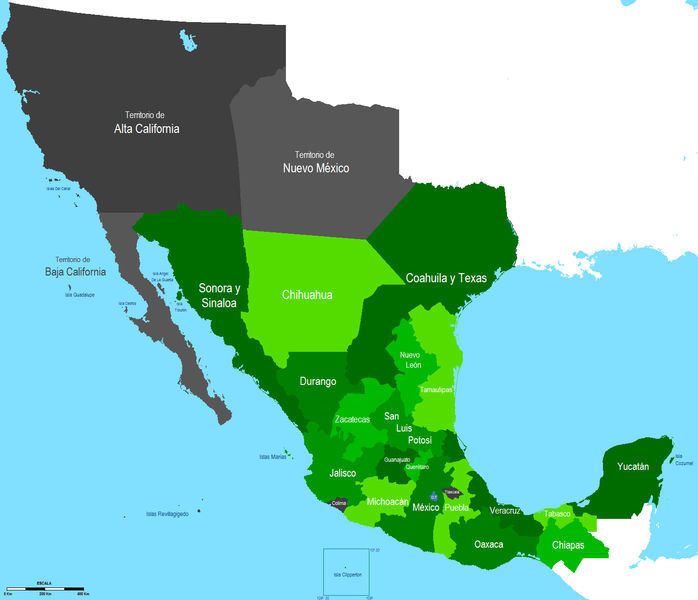
Texas colonizer Stephen F. Austin (with his father, Moses Austin, inset on right). Painting from the Fort Bend Museum / Wikimedia Commons.


The hidden history of Texas

Part 2: The 1821-1826 years under Mexican rule

By Bob Feldman / The Rag Blog / August 16, 2011

[This is the second installment of Bob Feldman’s new Rag Blog series on the hidden history of Texas.]

White English-speaking Texans of wealth have exercised a special influence over the direction of Texas history for many years. Yet it wasn’t until Dec. 21, 1821, that the first white Anglo, Mary James Long, was born on Texas soil.


And long before any white Anglos from the United States had settled in Texas in the early 19th-century, Spanish-speaking Texans had already, in the 18th century, developed the cattle ranching techniques such as the round-up, branding, roping, and herding from horseback, for which Texas later became well-known throughout the world as a result of Hollywood movies during the 20th century.

White Anglos only began crossing the border from Louisiana and into New Spain territory in Texas around 1815. So, not surprisingly, in the early 1820s the number of Native Americans who (as members of tribal nations like the Cherokees, Delaware, Shawnees, etc.) lived in Texas — 20,000 — was still greater than the number of white Anglo settlers who lived in Texas.

But in November 1820, a white Anglo named Moses Austin (accompanied by his African-American slave, Richmond) went to San Antonio and met with local authorities to talk about setting up an Anglo settler colony in not yet densely-populated Texas. And following Moses Austin’s death in June 1821, his son — Stephen Fuller Austin — established a settler-colony in Texas in December 1821, on land granted by Texas’s then-governing authorities.

Since thousands of acres of Texas’ best farmland were being offered by Stephen F. Austin to prospective Anglo settlers at a much cheaper price (10 cents per acre) than what land was then selling for in the United States — and on credit — the number of Anglo settler-colonists in Austin’s Texas colony quickly increased during the 1820s.

Under the Empire of Mexico’s Colonization Law of January 1823, each Anglo family who settled in Austin’s colony was given 4,423 acres of land in Texas if they planned to raise cattle stock and 177 acres of land in Texas if they planned to just be farmers. In addition, the Anglo settler-colonists were required to be only of Catholic background and were also required to free all the African-American slave children they owned when the slave children reached the age of 14.

Although the Empire of Mexico’s Colonization Law was voided by Mexico’s new federal republican government by March 1823, the land grant to Austin’s colony in Texas continued to be recognized as valid by the new Mexican federal republican government. But under the March 28, 1825 Colonization Act passed by the state government of Coahuila in Mexico (of which Texas was now a part), Anglo settlers in Austin’s colony had to agree to become both Mexican citizens and Catholics — in exchange for being given land in Texas (for less than $100 in fees) by Mexico’s governing authorities.

There were only seven African-American slaves in Texas — living around San Antonio — according to an 1819 census, and the same 1823 Empire of Mexico law that required slave children to be freed at the age of 14 also prohibited the sale or purchase of African-American slaves by the Anglo settlers in Austin’s colony.

But the newly-arrived white Anglo settlers soon began to create an economy based on the enslavement of African-Americans within Texas, and by 1825, Austin’s Anglo colony included 69 white slaveholders — mostly settlers from the southern United States region — who owned 443 slaves of African-American descent.

A white settler from Georgia, Jared E. Groce, for example, brought 90 slaves with him when he settled in Texas, establishing a plantation there in 1822, and apparently became one of the wealthiest settler-colonists. And around 25 percent of the 1,800 people who lived in Austin’s colony in Texas by 1825 were African-American slaves.

In his Gone To Texas, professor Randolph Campbell indicated the economic motive and the ideological reason for the white Anglos who settled in Austin’s colony deciding to set up a slave labor-based economic system in Texas during the 1820s, when he wrote:

A trend toward cash-crop agriculture developed almost immediately… Cotton production depended on slavery, which in turn provided the strongest link between Texas and the American South… Anglo-Americans made slavery an institution of significance in Texas beginning in the 1820s because they saw it as economic necessity… Free labor could not be hired where land was so inexpensive… Most Texas immigrants… held racist views that allowed them to see nothing wrong with the practice of whites owning blacks in order to profit from their labor…

So, not surprisingly, a few years after the Republic of Mexico legally prohibited the further importation of slaves of African-American descent into Mexico in 1824, a minority of the Anglo settlers in eastern Texas, led by Haden Edwards, declared their independence from Mexico on Dec. 21, 1826 and attempted to establish an independent “Republic of Fredonia.”

But the independent Republic of Fredonia did not gain the support of either Stephen F. Austin or most of the other Anglo settlers in Texas in 1826 — and once Mexican government troops arrived in the Republic of Fredonia on Jan. 4, 1827, the Republic of Fredonia quickly ceased to exist.

[Bob Feldman is an East Coast-based writer-activist and a former member of the Columbia SDS Steering Committee of the late 1960s. Read more articles by Bob Feldman on The Rag Blog.]

The Rag Blog

Posted in Rag Bloggers | Tagged , , , , , | Leave a comment

The hidden history of Texas

Part 2: The 1821-1826 years under Mexican rule

By Bob Feldman / The Rag Blog / August 16, 2011

[This is the second installment of Bob Feldman’s new Rag Blog series on the hidden history of Texas.]

White English-speaking Texans of wealth have exercised a special influence over the direction of Texas history for many years. Yet it wasn’t until Dec. 21, 1821 that the first white Anglo, Mary James Long, was born on Texas soil. And long before any white Anglos from the United States had settled in Texas in the early 19th-century, Spanish-speaking Texans had already, in the 18th century, first developed the cattle ranching techniques such as branding, the round-up, roping and herding from horseback, for which Texas later became well-known throughout the world as a result of Hollywood movies during the 20th century.

White Anglos only began crossing the border from Louisiana and into New Spain territory in Texas around 1815. So, not surprisingly, in the early 1820s the number of Native Americans who (as members of tribal nations like the Cherokees, Delaware, Shawnees, etc.) lived in Texas—20,000—was still greater than the number of white Anglo settlers who lived in Texas. But in November 1820, a white Anglo named Moses Austin (accompanied by his African-American slave, Richmond) went to San Antonio and met with local authorities to talk about setting up an Anglo settler-colony in not yet densely-populated Texas. And following Moses Austin’s death in June 1821, his son—Stephen Austin–established a settler-colony in Texas in December 1821, on land granted by Texas’s then-governing authorities. Since thousands of acres of Texas’s best farmland were being offered by Stephen Austin to prospective Anglo settlers at a much cheaper price (10 cents per acre) than what land was then selling for in the United States–and on credit–the number of Anglo settler-colonists in Austin’s Texas colony quickly increased during the 1820s.

Under the Empire of Mexico’s Colonization Law of January 1823, each Anglo family who settled in Austin’s colony was given 4,423 acres of land in Texas if they planned to raise cattle stock; and 177 acres of land in Texas if they planned to just be farmers. In addition, the Anglo settler-colonists were required to be only of Catholic religious background and required to free all the African-American slave children they owned when the slave children reached the age of 14.

Although the Empire of Mexico’s Colonization Law was voided by Mexico’s new federal republican government by March 1823, the land grant to Austin’s colony in Texas continued to be recognized as valid by the new Mexican federal republican government. But under the Mar. 28, 1825 Colonization Act passed by the state government in Mexico of Coahuila-Texas (of which Texas was now a part of), Anglo settlers in Austin’s colony had to now agree to become both Mexican citizens and Catholics–in exchange for being given land in Texas (for less than $100 in fees) by Mexico’s governing authorities.

There were only 7 African-American slaves living around San Antonio in Texas according to an 1819 census; and the same 1823 Empire of Mexico law that required slave children to be freed at the age of 14 also prohibited the sale or purchase of African-American slaves by the Anglo settlers in Austin’s colony. But the newly-arrived white Anglo settlers still soon began to create an economy based on the enslavement of African-Americans within Texas; and by 1825, Austin’s Anglo colony included 69 white slaveholders—mostly settlers from the southern United States region—who owned 443 slaves of African-American descent. A white settler from Georgia, Jared E. Groce, for example, brought 90 slaves with him when he settled in Texas, established a plantation there in 1822 and apparently became one of the wealthiest settler-colonists. And around 25 percent of the 1,800 people who lived in Austin’s colony in Texas by 1825 were African-American slaves.

In his Gone To Texas book, Professor Randolph Campbell indicated the economic motive and the ideological reason for the white Anglos who settled in Austin’s colony deciding to set up a slave labor-based economic system in Texas during the 1820s, when he wrote:

“A trend toward cash-crop agriculture developed almost immediately…Cotton production depended on slavery, which in turn provided the strongest link between Texas and the American South…Anglo-Americans made slavery an institution of significance in Texas beginning in the 1820s because they saw it as economic necessity…Free labor could not be hired where land was so inexpensive…Most Texas immigrants…held racist views that allowed them to see nothing wrong with the practice of whites owning blacks in order to profit from their labor…”

So, not surprisingly, a few years after the Republic of Mexico legally prohibited the further importation of slaves of African-American descent into Mexico in 1824, a minority of the Anglo settlers in eastern Texas, led by Haden Edwards, declared their independence from Mexico on Dec. 21, 1826 and attempted to establish an independent Republic of Fredonia. But the independent “Republic of Fredonia” did not gain the support of either Stephen Austin or most of the other Anglo settlers in Texas in 1826; and once Mexican government troops arrived in the “Republic of Fredonia” on Jan. 4, 1827, the “Republic of Fredonia” quickly ceased to exist in Texas.

[Bob Feldman is an East Coast-based writer-activist and a former member of the Columbia SDS Steering Committee of the late 1960s. Read more articles by Bob Feldman on The Rag Blog.]

Type rest of the post here

Source /

The Rag Blog

Posted in RagBlog | Leave a comment

Sarito Carol Neiman : The Highs and Lows of Rick Perry’s ‘Texas Miracle’

And a tip of the ten-gallon hat to the ‘Texas Miracle.’ Photo by Paul Moseley / Ft. Worth Star-Telegram.


The highs and the lows:

Rick Perry’s ‘Texas Miracle’

By Sarito Carol Neiman / The Rag Blog / August 16, 2011

Buried in the “Room for Debate” pages of The New York Times online is an interesting little piece by Ruben Navarrette Jr., a columnist with The Washington Post Writers Group, Cnn.com contributor, and member of the USA Today board of contributors. Before he reached such lofty national heights, Navarrette was on the editorial board of The Dallas Morning News, and sometime in the early part of 2003 he had the opportunity to interview Governor Rick Perry when he dropped by the Morning News offices.


In his “Room for Debate” piece, Navarrette recalls that at the time of the interview, he had just read a series in The New York Times about McWane, Inc., a company based in Birmingham, Alabama, that was, at the time, one of the world’s largest manufacturers of cast-iron sewer and water pipe, and had an absolutely horrendous and Dickensian record when it came to the safety of its workers.

Navarrette says he mentioned to the governor that this notorious company had said that it “would only do business in two places: developing countries and Texas.” I asked the governor if he was bothered by this fact. He wasn’t, to put it mildly.

“Well,” Mr. Perry said… “I don’t take direction from The New York Times.” Then he changed the subject and proceeded to make the case for why many other companies had moved to Texas. He also adjusted his chair so that, for the rest of the meeting, he had his back to me. Message received.

Since Perry’s “Response” prayer rally in Houston, and the declaration of his candidacy for president, more and more nuggets of information have been surfacing about “Gov. Goodhair,” the secrets to his success, who his best buddies are, and the mediocre grades that characterized his passage through his college years.

And much chatter has arisen about the “Texas miracle” that appears, in the world of “damn lies and statistics,” to award credit to Perry’s stewardship for the (relative) lower unemployment rate and faster job growth in the great state of Texas than in much of the rest of the country during the recent economic meltdown.

No doubt there is much yet to surface about that miracle, as more pundits and commentators take a closer look under the hood of the Texas economic engine and discover all the low-wage jobs (Texas ties Mississippi for the most minimum-wage workers in the country), disparities between the rich and the middle class and working poor, and unequal tax burdens that fuel that engine. Complicated, of course, by a very large Mexican-American population that has a not-insignificant portion of socially conservative, just-grateful-not-to-be-caught in the border drug wars, component.

Meantime — for the record — here’s a short list of the highs and lows — the “A’s” and the “F’s” if you will — on the transcript of Rick Perry’s Texas miracle. It might begin to answer the question, at least, of why the McWane, Inc. management considered Texas to be equivalent to a third world country. For the B’s, C’s, D’s, and E’s, see the Texas on the Brink website.

A’s (Texas is #1 in the country!)

  • Amount of Carbon Dioxide Emissions
  • Amount of Volatile Organic Compounds Released into Air
  • Amount of Toxic Chemicals Released into Water
  • Amount of Recognized Cancer-Causing Carcinogens Released into Air
  • Amount of Hazardous Waste Generated
  • Number of Executions
  • Percent of Population Uninsured

F’s (Texas is 49th/50th in the country!)

  • Women’s Voter Turnout
  • Percent of Pregnant Women Receiving Prenatal Care in First Trimester
  • Workers’ Compensation Coverage
  • Per Capita State Spending on Mental Health
  • Per Capita State Spending on Medicaid
  • Percent of Population 25 and Older with a High School Diploma
  • Average Credit Score.

[Sarito Carol Neiman was a founding editor of The Rag in 1966 Austin, and later edited New Left Notes, the national newspaper of Students for a Democratic Society (SDS). With then-husband Greg Calvert, Neiman co-authored one of the seminal books of the New Left era, A Disrupted History: The New Left and the New Capitalism and later compiled and edited the contemporary Buddhist mystic Osho’s posthumous Authobiography of a Spiritually Incorrect Mystic. Neiman currently lives in Junction, Texas. Read more articles by Sarito Carol Neiman on The Rag Blog]

The Rag Blog

Posted in Rag Bloggers | Tagged , , , , , , , | 1 Comment

Lamar W. Hankins : What Happened to ‘Government for the People’?

Do we still hold these truths to be self-evident? Image from Greenwich Workshop.


Why Republicans (and many Democrats)

don’t believe in government for the people

By Lamar W. Hankins / The Rag Blog / August 16, 2011

“I promise you this. I’ll work every day to try to make Washington, D.C., as inconsequential in your life as I can.” — Rick Perry, Candidate for the Republican nomination for president

Nearly all Republicans, and many Democrats, don’t believe in the American government because they don’t believe in the basic tenets of our democracy, they don’t believe in the Constitution, and they don’t believe in the Declaration of Independence.


Based on their actions in the last 30 years, nearly all Republicans (as well as many, sometimes most, Democrats and some independents) don’t believe that government should have the purposes envisioned by our founders. The Declaration, for instance, provides as follows:

We hold these truths to be self-evident, that all men are created equal, that they are endowed by their Creator with certain unalienable rights, that among these are life, liberty and the pursuit of happiness. That to secure these rights, governments are instituted among men, deriving their just powers from the consent of the governed.

For the most part, these politicians — all members of what I will call the Finance Party — don’t like the fact that governments are created by people (for now, I will ignore the misogyny implicit in the word “men”) to secure the basic rights of equality and a multitude of other rights — life, liberty, and the pursuit of happiness — which were further explained and expanded in the Constitution’s Bill of Rights.

All of these ideas from the Declaration and Constitution create an implicit bargain — a social contract — among the American people. The essence of that social contract is that we will help one another by joining together to form a government that will serve the interests of us all.

Governance — the task given to our elected representatives — is all about balancing the social contract and the rights we have so that one group cannot dominate another, a view anathema to the members of the Finance Party, who are perfectly happy

  • deciding who can marry whom;
  • helping corporations dominate American life in any way that satisfies their quest for greater profits;
  • enriching the wealthy further, insisting that people pull themselves up by their bootstraps (ignoring the fact that to do so literally means that you land on your backside when you try);
  • denying the basic need of all people for adequate food, housing, education, and medical care if they are unable to afford those things because they can’t find a job, are unable because of infirmity to hold a job, or are a child in need of nurture and care;
  • making medical decisions for others, particularly women;
  • passing laws like Medicare Part D in a way that enriches the pharmaceutical and insurance industries at the expense of the people and creates greater deficits;
  • letting half the people and many corporations get away with contributing nothing to fund the federal government;
  • refusing to stabilize Social Security through two simple methods — expanding the payroll tax to all earned income, and recovering most Social Security benefits paid to the wealthy through the tax system;
  • and fighting wars that do little if anything to protect America, but everything to enrich “defense” contractors, funding these wars with borrowed money.

I could go on, but I hope readers get the idea. The signers of the Declaration believed that laws should be adopted that are “most wholesome and necessary for the public good.” This is virtual heresy to most members of the Finance Party. Republicans in particular, along with a substantial number of Democrats, do not want laws that are for the public good. They want laws that benefit the corporations and the wealthy, particularly those that contribute to their political campaigns.

The Constitution itself provides that one of the purposes of our form of government is to “promote the general Welfare.” But the Finance Party members believe that government should promote the welfare of the wealthy.

The latest entrant into the Republican presidential sweepstakes believes that Social Security and Medicare are unconstitutional. When challenged on this notion and asked to explain what was meant by the “general Welfare” language of the Constitution, Rick Perry had no answer, which should not be surprising for someone that made a grade of D in a class on how to feed goats.

It is myopic to believe that the founders did not envision a role for the federal government in assuring that the elderly and infirm are not forced into penury and destitution by an economic and political system based on exploitation and greed. But these Finance Partiers are more than happy to enrich the corporations and toady up to the moneyed at the expense of the many. Rick Perry is just one more feckless politician from the party of finance who is seeking more power and money for his patrons.

We, the people, formed a government to be consequential in our lives, to overcome the tyranny of despotic rule, and to promote the general welfare. Now that we have a government that does just the opposite, it seems time to make use of our rights to reconstitute our government to meet the needs of the public, not the special interests of the financial class. We can do so with our votes and our voices.

[Lamar W. Hankins, a former San Marcos, Texas, city attorney, is also a columnist for the San Marcos Mercury. This article © Freethought San Marcos, Lamar W. Hankins. Read more articles by Lamar W. Hankins on The Rag Blog.]

The Rag Blog

Posted in Rag Bloggers | Tagged , , , , , | Leave a comment

Common Dreams : President Ricky Perry, Aggie

Ricky Perry, Cadet, 1972…


President Ricky?

Cadet, cheerleader… Aggie


By Common Dreams / The Rag Blog / August 15, 2011

Sure Michele Bachmann and Sarah Palin are batshit crazy. But Rick Perry as a brown-shirted cadet and cheerleader at Texas A&M University… whoa!

The Texas Tribune writes:

When Rick Perry arrived at Texas A&M University in 1968, it was at the end of a summer in which Soviet troops crushed the Prague Spring, protesters at the Democratic National Convention were met by a police riot and the United States reeled from the twin assassinations of Martin Luther King Jr. and Robert F. Kennedy. With its conservative culture, military tradition and focus on agriculture, few places in the U.S. might have seemed more insulated from the prevailing currents of the age… Perry was elected a yell leader — an esteemed male cheerleader who has traditional responsibilities at major athletic events — and social secretary for his class. And he was exceedingly loyal to the corps, which he credited with giving him the discipline to get an animal sciences degree — his 2.5 grade point average wasn’t high enough to go the veterinary route — and join the Air Force.


…and Ricky Perry, Aggie (with Reveille), 1972. Images from Cushing Memorial Library and Archives, Texas A&M University / Texas Tribune / Common Dreams.


The Rag Blog

Posted in RagBlog | Tagged , , , | 3 Comments

ART / Jordan Flaherty : ‘Every Portrait Tells a Story’

Sheila Phipps with some of her work from the exhibit, “Every Portrait Tells a Story.” Photo from Loop21.


A mother’s art:

Every portrait tells a story

Sheila Phipps does portraits of young men she believes were convicted of crimes they did not commit. Her son, New Orleans rapper ‘Mac,’ is serving 30 years for manslaughter and her art proclaims his innocence.

By Jordan Flaherty / The Rag Blog / August 14, 2011

NEW ORLEANS — As the date approaches for the 10th anniversary of her son’s conviction, Sheila Phipps is hard at work completing a powerful and moving series of paintings that tell the stories of wrongly-convicted young men in the U.S. prison system.


Phipps, a self-taught artist in New Orleans, has been selling and displaying her work for more than 20 years. Her son is Mckinley “Mac” Phipps, the legendary New Orleans rapper who was convicted of manslaughter in 2001 and sentenced to 30 years in prison.

In collaboration with the Innocence Project, Phipps contacted prisoners across the nation and researched their cases. Once she read enough evidence to convince her of their innocence, she communicated with the prisoner and then painted an image of them.

Now, Phipps is unveiling a series of 10 works, for a show called the Injustice Exhibition. Her use of color and framing varies with the inspiration, ranging from muted portraits to bright explosions of color, often capturing small details like focusing on a subject’s feet or hands. In the portrait of her son she highlights the gentle features of his face.

Seeing her son locked away caused Phipps’ to use her art in another way, as both activism and as release.

“To be honest I didn’t know what else to do,” says Phipps. “I’ve had four lawyers. One of the lawyers said she don’t even think the judges read the appeals we’ve written.” The hope is that her art will wake up people to the lives being wasted in prison — not only her sons’, but all lives.

“Art is a way to express yourself,” she says. “So why not express yourself by raising awareness?” Phipps started painting in the 1980s, using art as a way to relax from the strain of raising her six children. She quickly caught the attention of Sandra Berry who runs the Neighborhood Gallery, a New Orleans arts institution. “Her work is absolutely wonderful,” says Berry. “There is a sensitivity and a mother-like compassion in her work that she brings to every subject.”

The subject for whom Phipps’ compassion is most concentrated, her son “Mac,” started rapping at the age of seven. At 11, his talents won him a contest held at New Orleans’ Superdome, for which he won a record deal. He released his first album, featuring production work by former Cash Money Records artist Mannie Fresh — who would later develop the sound that made Cash Money Records famous — at age 12.

Painting by Sheila Phipps from “Every Portrait Tells a Story.” Image from Loop21.


By the age of 22, Mac had released two more albums, and was one of New Orleans’ most popular rappers. His collaborations included tracks with Master P, Snoop Dogg, and Mystikal. According to Phipps, Mac stayed grounded, despite his success. “He’s a very humble person,” she says. “He doesn’t even smoke and drink, if you can believe that in this day and time.”

On February 22, 2000, after a concert in Louisiana, a fight broke out and a young man named Barron C. Victor Jr. was shot and killed. Phipps, who helped book her son’s shows, was there that night. According to her, Mac was nowhere near the altercation. “Mac was in the corner signing autographs,” she says. “When the shots we’re fired, he hit the floor like everyone else.”

According to Phipps, Mac ran out of the club, but then came back in with a gun drawn. The reason? Phipps says he was trying to rescue her. “He heard the gunshot and didn’t know what was going on,” she says. “All he knew is, I gotta get my momma out of there.”

Although ballistics tests showed that Mac’s gun (which he had a license to carry) had never been fired, he was charged with second degree murder. Another man came forward and said that he had killed Victor, but prosecutors said they found his story unreliable. Mac was sentenced to 30 years behind bars. It was his first offense.

“Before this happened to my son, I thought when people went to jail that they were supposed to be there,” says Phipps. “Going to trial, I see how these DA’s twist stories just to get a conviction. Then they go home and sleep at night while innocent people are just sitting there behind bars.”

Mac’s story continues to inspire outrage. A documentary about his case, called “The Camouflaged Truth,” is currently in post-production, and last year Dee-1, an up-and-coming conscious New Orleans rapper with several videos in rotation on MTV networks, organized a benefit concert to raise awareness about Mac’s case. For Sheila, every day that Mac is locked up is a struggle, but she plans to continue fighting. “I want to travel with the exhibit,” she says. “Just to shine light on the prison system and how they railroad people. I hope that this will open up a lot of people’s eyes.”

View photos of Sheila’s work here: “Source Every Portrait Tells a Story.” For more about Mac and his case, see Source http://www.free-mac.org. You can contact Sheila at sheilaphippsstudio@yahoo.com

.

[Jordan Flaherty is a journalist and staffer with the Louisiana Justice Institute. His award-winning reporting from the Gulf Coast has been featured in a range of outlets including The New York Times, Al Jazeera, and Argentina’s Clarin newspaper. His new book is FLOODLINES: Community and Resistance from Katrina to the Jena Six. He can be reached at neworleans@leftturn.org, and more information about Floodlines can be found at floodlines.org. This article was also published at Loop21. Find more articles by Jordan Flaherty on The Rag Blog.]

The Rag Blog

Posted in Rag Bloggers | Tagged , , , , | Leave a comment

New Film ‘The Help’ Whitewashes the Civil Rights Struggle into a Heartstring-tugging Hallmark Card

By Julianne Escobedo Shepherd / AlterNet / August 14, 2011

This week, disgusted by The Help’s revisionist history, scholar and pundit Melissa Harris Perry began livetweeting the film halfway through it. This one summed it up best: “I just timed it. Miss Skeeter’s date got same amount of screen time as Medgar Evers assassination. #TheHelpMovie sigh.”

Hollywood’s compulsion for feel-good movies is annoying at best, but when applied to storylines that are ostensibly historical — particularly when they involve issues that people still don’t seem to understand — they can be toxic.

In The Help’s case, the history of civil rights in the virulently racist Southern town of Jackson, Mississippi, is neatly packaged into a heartstring-tugging Hallmark card, set to a rousing Mary J. Blige soundtrack, that completely trivializes the suffering and hard work that went into making civil rights a reality.

It also implies, perhaps inadvertently, that after the ‘60s everything was fine and dandy for non-whites in America, not to mention domestic workers. As The Nation points out, the civil rights struggle in Mississippi is still having to hang tough:

In the past few years, Mississippi activists’ formula of visible black and immigrant partnership, within a “workers’ rights/civil rights” frame, abetted by dogged labor organizing, has added up to visible success.

There’s no coincidence civil rights and workers rights groups are more successful when they band together — working class labor is more likely to be done by Latinos and other non-white groups. In particular, domestic workers are still among the last to receive basic rights such as sick leave, vacation pay, and overtime.

In New York, these were granted to domestic workers just last year. In June 2011, an international coalition for domestic workers was successful among a broad coalition at the Geneva Convention, ensuring basic rights and protection for laborers around the world, but the United States still leaves it up to states to decide how domestic workers will be treated, and is not likely to ratify it.

Thanks to The Help’s sugarcoating, the National Domestic Worker’s Alliance has been compelled to release a video discussing the truth about the country’s maids, nannies, and chauffeurs. As Colorlines notes,

The 2.5 million women who keep contemporary families going by cleaning their homes while looking after the young, the old and the infirm are still not covered by a large number of labor laws. Congress initially excluded domestic workers and agricultural workers from the Social Security and the Fair Labor Standards Acts specifically to keep “the help” under the thumbs of their employers. These workers were incorporated into some aspects of labor law over time — that kind of discrimination being, well, illegal — but they still suffer from an almost-total lack of enforcement.

Back to the movie, The Help. Based on Kathryn Stockton’s best-selling novel, it follows Skeeter, an idealistic, plucky young white journalist who was raised by a black nanny, and her interactions with similar black domestic workers Aibileen and Minny (who are played by the great actors Viola Davis and Octavia Spencer, but whose characters’ essential Mammy-ness cannot be overlooked).

She interviews Aibileen and Minny after much persuading, detailing the travails of their daily lives in a book. After tears, laughter and hugs, mutual understanding and racial harmony ensue.

There’s a lot written about the “magical negro” — the sagely black character in films who exists only to enlighten the white main character, and then go away. But its inverse is the scourge of the “magical cracker” — the white protagonist who becomes a vessel for a film’s disempowered characters, and therefore becomes the hero of the story, trivializing their actual struggle.

The Help is a classic example of “magical cracker” — Skeeter is the only way in which poor disempowered maid Aiblieen can tell her story, to recognize that she is worthy of a voice. Skeeter writes a book about the maids of Jackson, therefore as Harris-Perry put it in a tweet, “#TheHelpMovie reduces systematic, violent racism, sexism & labor exploitation to a cat fight that can be won w/ cunning spunk.”

When the super-sassy Minny talks back, she is simply reprimanded or let go — obscuring the fact that such petulant behavior toward whites by blacks in the Jim Crow South was often met with violence and murder.

A statement from the Association of Black Women Historians further details this whitewashing:

Both versions of The Help also misrepresent African American speech and culture. Set in the South, the appropriate regional accent gives way to a child-like, over-exaggerated “black” dialect. In the film, for example, the primary character, Aibileen, reassures a young white child that, “You is smat, you is kind, you is important.”

In the book, black women refer to the Lord as the “Law,” an irreverent depiction of black vernacular. For centuries, black women and men have drawn strength from their community institutions. The black family, in particular provided support and the validation of personhood necessary to stand against adversity. We do not recognize the black community described in The Help where most of the black male characters are depicted as drunkards, abusive, or absent. Such distorted images are misleading and do not represent the historical realities of black masculinity and manhood.

Furthermore, African American domestic workers often suffered sexual harassment as well as physical and verbal abuse in the homes of white employers. For example, a recently discovered letter written by Civil Rights activist Rosa Parks indicates that she, like many black domestic workers, lived under the threat and sometimes reality of sexual assault. The film, on the other hand, makes light of black women’s fears and vulnerabilities, turning them into moments of comic relief.

Similarly, the film is woefully silent on the rich and vibrant history of black Civil Rights activists in Mississippi. Granted, the assassination of Medgar Evers, the first Mississippi based field secretary of the NAACP, gets some attention. However, Evers’ assassination sends Jackson’s black community frantically scurrying into the streets in utter chaos and disorganized confusion — a far cry from the courage demonstrated by the black men and women who continued his fight.

Portraying the most dangerous racists in 1960s Mississippi as a group of attractive, well dressed, society women, while ignoring the reign of terror perpetuated by the Ku Klux Klan and the White Citizens Council, limits racial injustice to individual acts of meanness.

Tone-deaf white liberalism is at the heart of this film — the concept that some white liberals want everything to be okay and everything to be equal (up to a point), but don’t want to deal with the “icky” parts that go along with getting there in a fundamentally unjust society. It’s a reflection of white privilege, of course — that a book such as The Help could be so well received and its filmic counterpart so dunderheaded and feel-good, as if it were just another romantic comedy with a cheery outcome.

So with all the historical whitewashing, why does this type of film continue to exist? EW’s Martha Southgate puts it most succinctly:

Suffice it to say that these stories are more likely to get the green light and to have more popular appeal (and often acclaim) if they have white characters up front. That’s a shame. The continued impulse to reduce the black women and men of the civil rights movement to bit players in the most extraordinary step toward justice that this nation has ever known is infuriating, to say the least. Minny and Aibileen are heroines, but they didn’t need Skeeter to guide them to the light. They fought their way out of the darkness on their own — and they brought the nation with them.

On the off chance that you simply enjoy feel-good movies, might I recommend The Great Debaters, which dealt with Civil Rights in a more realistic way? And as for historical accuracy, Harris-Perry tweeted several books that would right The Help’s wrongs, including Clinging to Mammy: The Faithful Slave in Twentieth-Century America. While it’s always excellent to see a cast of talented black women getting starring roles in top films, let’s start demanding that Hollywood give them better, more accurate, less white-tethered roles to play.

[Julianne Escobedo Shepherd is an associate editor at AlterNet and a Brooklyn-based freelance writer and editor. Formerly the executive editor of The FADER, her work has appeared in VIBE, SPIN, New York Times and various other magazines and websites. This article was published and distributed by AlterNetSource

The Rag Blog

Posted in RagBlog | Leave a comment

Writer and progressive organizer Carl Davidson looks at the summer rebellions in the impoverished communities in London and other industrial centers of the UK — as well as the Arab spring uprisings — and, taking into account our current situation, exacerbated by the GOP-led “Shock Doctrine” — wonders if similar unrest could be in the cards for the U.S. this winter.

Posted in RagBlog | Leave a comment