BOOKS / Danny Schechter : Villains Galore! A Bankster Dozen

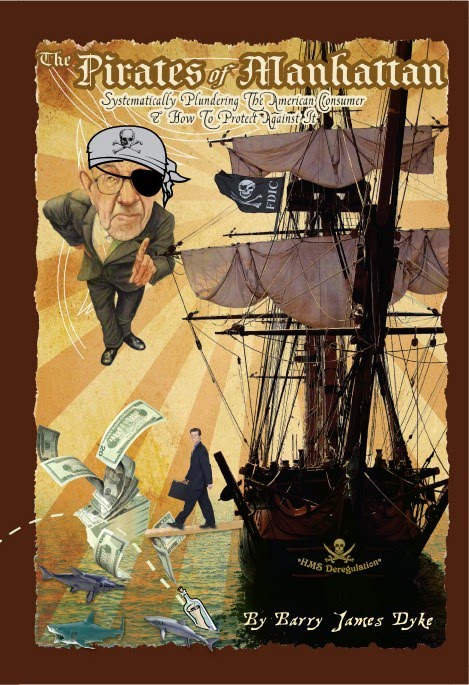
Bankster graphic from ANU News.

Villains galore!
Good holiday reads about
the great economic crisis

By Danny Schechter / The Rag Blog / December 4, 2010

Back in 2007, just as the markets began their meltdown, I started writing a book I called Plunder to investigate the then emerging economic calamity. I had a well-known agent representing me, and, at that time, had published 10 books. My agent warned me that I was ahead of the curve but agreed that the subject couldn’t be timelier.

Before we were through, the manuscript went to and was returned by 30 publishers. I was told that there is only one person that a book like mine had to pass muster with, not an economist, not a book editor — but the book buyer who handles business books for Barnes and Noble. If she/she didn’t like it, forget it. (This was before the bottom dropped out of that company that was later nearly sold.)

So much for their business savvy. I guess Plunder was too much of an anti-business book for them then.

At that point, they were looking for “How to Get Rich” books and volumes with investment advice. Since I was not offering either, my warnings of the collapse ahead were off-message. No sale. Finally, a small press, Cosimo Books put it out. Sadly, with no real advertising budget or retail support, it wasn’t going to go anywhere. It was on the money in one sense — published just before Lehman Brothers went down.

Since then, as the crisis was acknowledged and legitimated, the subject was finally validated for the publishing world, perhaps as millions of people began asking, “What the F…? What the hell happened?”

To answer that question, a mighty stream of crisis books was commissioned and soon poured forth. Every publisher wanted one. Some authors blamed psychological factors. Others were technical to a fault and unreadable. Still, others trashed borrowers who bought homes they couldn’t afford. Many framed the problem in terms of Wall Street mistakes and miscalculations, and occasionally greed.

Wrote Satyajit Das, author of Traders, Guns & Money: “The number of books on the Global Financial Crisis (GFC) has reached pandemic proportions — the World Health Organization (WHO) is investigating. With the decorum of vultures at a carcass, publishers are cashing in on the transitory interest of the masses (normally obsessed with war, scandal or reality TV shows) in the arcane minutiae of financial matters.”

Few indicted the system; fewer still focused on intentionality — crime in the suites, the subject I explore in my film Plunder: The Crime Of Our Time and the more detailed companion book The Crime of Our Time (Disinfo).

In the meantime, I tried to keep up with the hype and a flow that is still flowing.

Here are 12 books worth reading:

  1. The Pecora Investigation: Stock Exchange Practices and The Causes of the 1929 Stock Market Crash. This is the just reissued actual text of the U.S. Senate Committee on Banking and Currency in the days before the Congress was bought and sold. Pecora had said “Legal chicanery and pitch darkness were the banker’s stoutest allies.”

    So far, in today’s crisis, there has been only ONE real Senate hearing, by Senator Levin questioning ONE deal by Goldman Sachs who denied everything until the bank reached a $550 MILLION settlement without admitting any wrongdoing. Clearly we still need a new Pecora-like investigation, not a tepid Congressional inquiry commission

  2. Matt Taibbi: Griftopia: Bubble Machines, Vampire Squids and the Long Con that is Breaking America (Spiegel & Grau). As Rolling Stone readers know, Matt is a bold reporter and brilliant stylist turning his rage into brilliant prose and giving no mercy to the Goldman Sachs gang.
  3. Nomi Prims: It Takes A Pillage: Behind the Bailouts, Bonuses and Backroom Deals from Washington to Wall Street. An elegant writer, Nomi knows the financial world up close because she’s “been there and done that” with high paying stints at Bear Stearns and Goldman Sachs. You can see her brilliance in my film, Plunder. Her book goes much deeper.
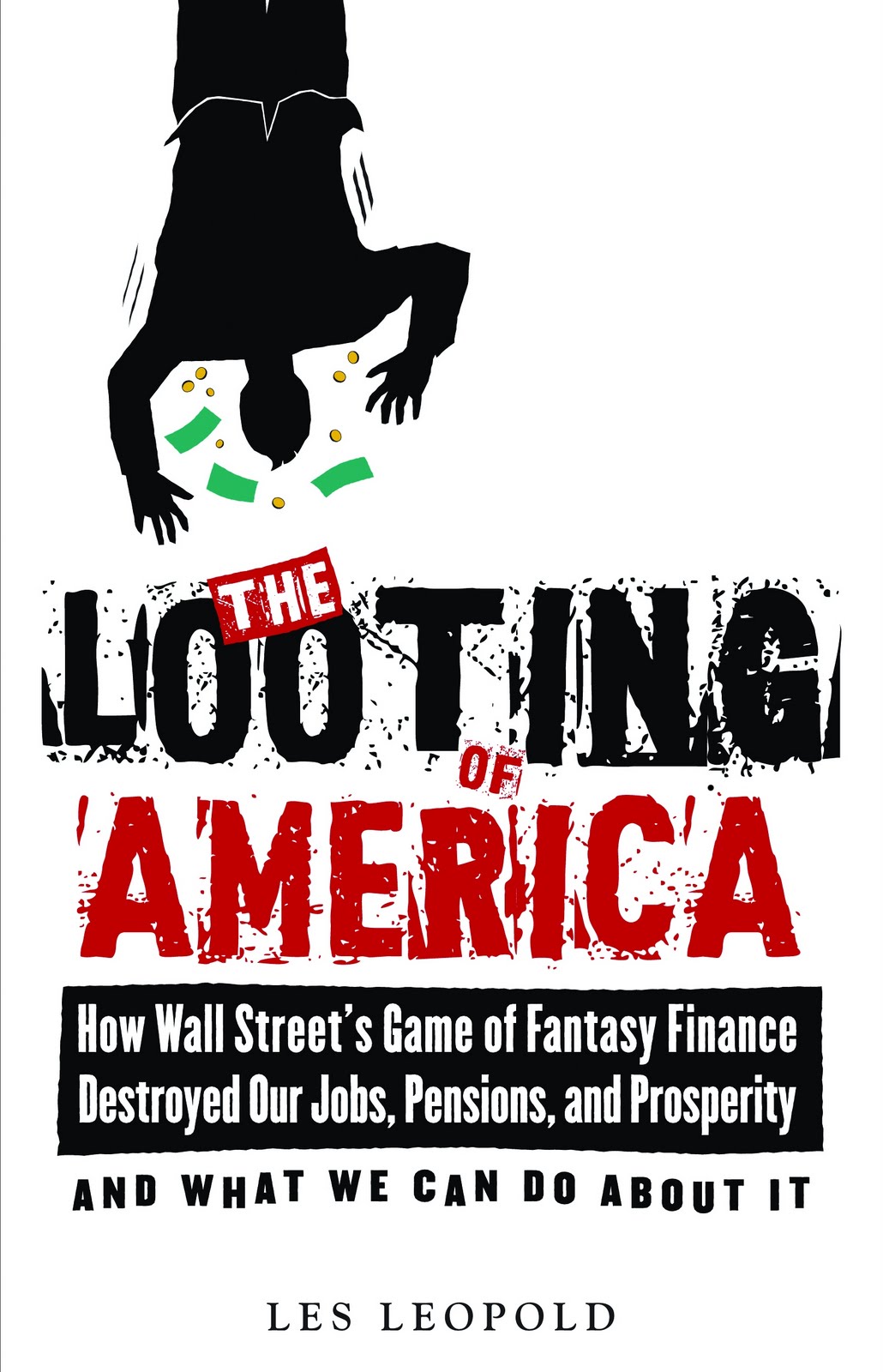
  4. Les Leopold: The Looting of America: How Wall Street’s Game of Fantasy Finance Destroyed Our Jobs, Pensions and Prosperity — and What We Can Do About It (Chelsea Green). Les is a passionate and compelling writer, teacher and activist. He has been steeped in union politics and knows how to fuse analysis and agitation
  5. Joseph E. Stiglitz: Free Fall: America, Free Markets, and the Sinking of the Global Economy (Norton). Siglitz is the economist’s economist, a Nobel Prize Winner, an insider turned fierce critic of our economic crisis. He has the credentials and THE critique and a much needed global perspective.
  6. Howard Davies: The Financial Crisis: Who is to Blame? (Polity). I picked this book up at my alma mater, the London School of Economics, which Davies now directs. This is straight down the middle without dismissing more radical insights. He even references my critique of media complicity.
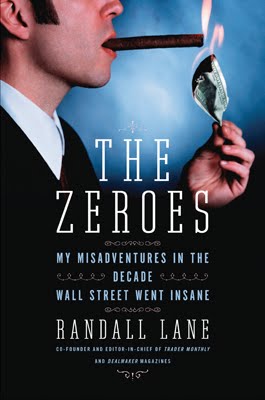
  7. Randall Lane: The Zeroes: My Misadventures in the Decade Wall Street Went Insane. A colorful personal account by a gonzo editor who covered the madness for Wall Street pubs. Sample: “Historically, Wall Street has been like one giant extended High School (A boy’s High School). The jocks become trader — large, aggressive men who succeed in the pits based on heft and testosterone. The nerds went into banking, crunching numbers and pumping out spread sheets to determine the efficacy of deals.”
  8. Yves Smith: ECONned: How Unenlightened Self Interest Undermined Democracy, and Corrupted Capitalism (Palgrave Macmillan). Yves is a rock star in the business of critical economics. A financial industry professional, she defected to the “light side” and founded the must read website, NakedCapitalism.com. This book skewers government policy, the economics “profession” and Wall Street fraudsters.
  9. Steig Larsson: The Millennium Trilogy. The late Swedish journalist, turned popular writer, has produced three volumes of best-selling action thrillers with intelligent plots. I cite his work here because he and the character he created, Mikael Blomkvist, were investigative reporters in the financial realm.

    Larsson describes Blomkvist’s contempt for his fellow financial journalists based on morality: “His contempt for his fellow financial journalists was based on something that in his opinion was as plain as morality. The equation was simple. A bank director who blows millions on foolhardy speculations should not keep his job. A managing director who plays shell company games should do time.

    “The job of the financial journalist was to examine the sharks who created interest crises and speculated away the savings of small investors, to scrutinise company boards with the same merciless zeal with which political reporters pursue the tiniest steps out of line of ministers and members of Parliament.”

    His books are more than storytelling. They are also a cry for more truth in media.

  10. And, since I try to practice the investigative protocols of journalism in this sphere, may I call your attention to the republication of one of the greatest American classics of taking on corporate power?

    Ida M. Tarbell may be gone but her work is not forgotten, especially her classic, two volume blistering The History of the Standard Oil Company. I was privileged to write the introduction for the Cosimo edition. She wrote this muckraking blockbuster in 1904 and remains relevant, and an example of the best of us.

  11. For a left critique, try Michael Chossudovsky and Andrew Gayin Marshall, Editors: The Global Economic Crisis: The Great Depression of the XXI Century (Global Research) from the Canadian-based global web site I contribute to.
  12. Barry James Dyke: The Pirates of Manhattan: Systematically Plundering The American Consumer and How To protect Yourself Against It. The one financial book I saw “blurbed” by Jay Leno (Self-published).


So, this is my “cheaper by the dozen” for 2010. I am sure I have overlooked some great work so it is hardly the “end-all” and “be-all.” Many of the new financial books out there are written by journalists for leading newspapers and magazines, as well as mainstream economists, many of whom missed the crisis when they might have warned us about it.

And, while many of us wait for the promised Wikileaks take down of a major bank, many authors and journalists still fail to tackle the really essential issues.

Hopefully, some of the books I am recommending will fill some gaps in your knowledge.

[“News Dissector” Danny Schechter is a journalist, author, Emmy award winning television producer, and independent filmmaker. Schechter directed Plunder: The Crime of Our Time, and a companion book, The Crime of Our Time: Why Wall Street Is Not Too Big to Jail. Contact him at dissector@mediachannel.org.]

Listen to Thorne Dreyer‘s Sept. 28 interview with journalist and filmmaker Danny Schechter on Rag Radio here. To find all shows on the Rag Radio archives, go here.

The Rag Blog

Posted in Rag Bloggers | Tagged , , , , , , , , | Leave a comment

Are the WikiLeaks documents a danger to our security, or do they serve the public’s right to know? Ted says, “I doubt if there’s any established government on earth that can’t access that kind of information, which means the only people these ‘secrets’ are being kept from are the voting public.” The documents may be revealing — and embarrassing — but it is unlikely any of these released cables will hurt the security of the United States.

Posted in RagBlog | Leave a comment

James McEnteer : Proud Heritage of Indians in South Africa

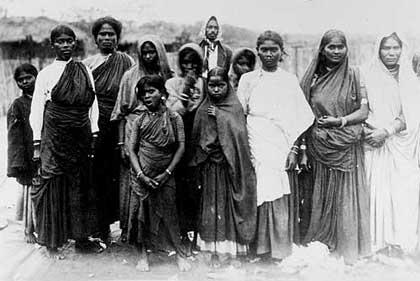
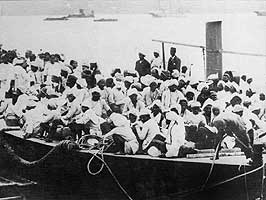
Indians first came to South Africa 150 years ago. Photo from Hindi Blog.

Indian givers:
South Africa isn’t all black and white

By James McEnteer / The Rag Blog / December 3, 2010

KWA-ZULU NATAL, South Africa — South Africans of Indian descent are commemorating the arrival of the first indentured Indian workers here 150 years ago. In November 1860, two ships brought nearly 700 laborers from India to Durban. By 1911 more than 150,000 indentured Indian workers had landed in South Africa. Most came to what is now the province of Kwa-Zulu Natal, where more than half of them worked in the sugar cane fields.

Today about 1.5 million Indians live in South Africa, a small but influential minority comprising about three percent of the country’s population. Indian South Africans have distinguished themselves in many professions, including medicine, academia, and commerce. Some have risen to Cabinet level government positions. Navanethem Pillay, a South African lawyer, university professor and judge of Indian descent has served since 2008 as the United Nations High Commissioner for Human Rights.

Before the British abolished slavery in 1833, some Indians had been sold into slavery along with Malays and Africans, primarily to work harvesting sugar cane in Britain’s tropical colonies. The British had become addicted to the sugar that went so well with the tea from India they had adopted as a comfort ritual on their cold island, a bit of cultural colonial blowback.

Workers contracted to work for five years for whatever employer they were assigned. After five years they could re-indenture or look elsewhere for work. Workers who spent 10 years in the colony had the right to a free passage back to India, or to remain as citizens in the colony.

The British tried to regulate the conditions of indenture, but workers often lived and worked in primitive, brutal circumstances, like slaves. Isolated from legal oversight, employers abused their indentured laborers with impunity. Workers returning to India complained of the overwork, malnourishment, and squalid living conditions they had to endure. A Coolie Commission was appointed in 1872 to protect Indian immigrants, but failed to prevent abuses.

The overtly racist government and society of the time dictated where Indians could live and how they could travel within the country. Despite this discrimination and the limitations on their freedom, more than half of the indentured laborers elected to remain in South Africa. Besides the cane fields of Natal, Indians worked at the port of Durban, in hospitals, in the coal mines, or helping to build the railroads.

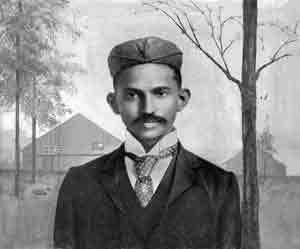
A momentous event for the future of Indians in South Africa, and for the future transformation of the entire nation, was the arrival in the country of a young, newly-minted Indian lawyer, Mohandas Gandhi, in 1893. Gandhi had come to represent an Indian firm on a one-year contract. Less than a week into his stay, on a train from Durban to Pretoria to attend court, Gandhi was ordered out of his first-class compartment. When he refused to leave he was ejected from the train at Pietermaritzberg and forced to spend a cold night on a station bench.

Mahatma Gandhi shortly after arriving in South Africa, in 1895. Image from Wikimedia Commons.

In his Autobiography Gandhi describes his conflicting emotions during that long night and his temptation to return immediately to India. Instead he elected to stay, despite being barred from hotels and suffering other acts of discrimination daily, including violence. Gandhi extended his stay to oppose a bill denying Indians the right to vote. He helped found the Natal Indian Congress in 1894 and survived the attack of a white mob in Durban in 1897. When the government passed a law requiring registration of the Indian population in 1906, Gandhi led a mass protest, adopting non-violent resistance for the first time.

That struggle continued for seven years. Thousands of Indians were jailed, including Gandhi. Others were flogged and even shot for striking, refusing to register, or burning their registration cards. The public outcry at the government’s harsh methods of repressing the peaceful Indian protesters eventually forced South African officials to compromise with Gandhi.

Inspired by the success of this Indian movement, Black African leaders formed the African National Congress in 1912 to mount a similar resistance against racist oppression of their own kind. ANC efforts against apartheid, modeled on Gandhi’s non-violent principle of satyagraha, or “the force of truth,” encouraged massive peaceful disobedience of repressive laws. Ultimately, South Africa’s apartheid government yielded to ANC pressure and world sanctions without the massive bloodshed many feared was inevitable.

For these reasons and others, Indian descendants of indentured laborers have the right to be proud of their forebears. ANC political leaders owe Ghandi and other Indian activists thanks for being the catalysts of their own peaceful revolution. All South Africans, regardless of race, should be grateful for the Indian contributions to their current prosperity and cultural panache.

[James McEnteer is the author of Shooting the Truth: the Rise of American Political Documentaries. He lives in Kwa-Zulu Natal, South Africa]

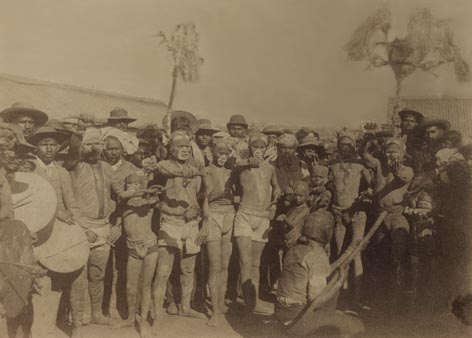
Top, Indians arriving for the first time in Durban, South Africa, exact date unknown. Photo from Wikimedia Commons. Below, indentured Indians, still on the boat. Photo from SAHO.

The Rag Blog

Posted in Rag Bloggers | Tagged , , , , , , | 1 Comment

Bruce Melton : Catastrophic Change and Climate Blindness

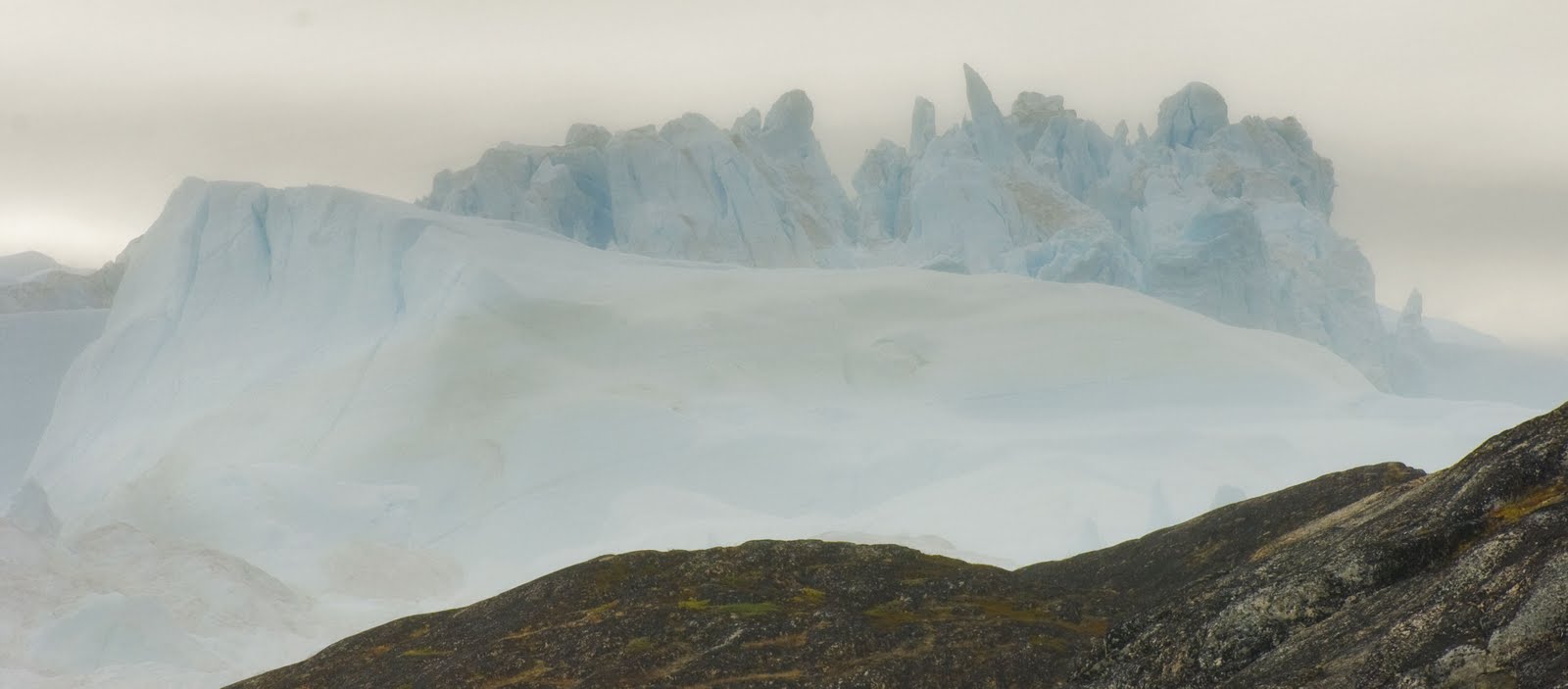
Iceberg discharge is accelerating rapidly in Greenland. Photo by Bruce Melton / The Rag Blog.

Climate blindness

By Bruce Melton / The Rag Blog / December 2, 2010

Bruce Melton will be Thorne Dreyer’s guest on Rag Radio, Friday, Dec. 3, 2010, 2-3 p.m. (CST), on KOOP 91.7 FM in Austin. To stream Rag Radio live on the internet, go here. To listen to this interview after it is broadcast — and to other shows on the Rag Radio archives — go here.

[Bruce Melton sketched out some of this material in his November 28, 2010, Rag Blog article on dangerous climate change, “Climate Change and Global Economic Dysfunction.”]

How do we curb emissions with the way our society has evolved? Really. I mean serious curbing; enough to prevent dangerous climate change?

When considering the answer, dangerous climate change must be clearly defined. So, what exactly is dangerous climate change?

There is a disconnection between climate science and the public’s knowledge of climate change. The knowledge gap is becoming obvious to many, but to the climate scientists it is clear: there is a fundamental blindness in the vast majority of our society as to the meaning of man-caused climate change.

The disconnection itself is not easy to see without expert knowledge. The dendrochronologists have a hard enough time understanding the cryologists (tree ring scientists and ice scientists.)

Even so, the amount of important decision-making class of information being discovered is simply staggering. But the means to deliver this knowledge, to mine it out of the academic jargon and deliver it to the people, is just not there. Once this outreach issue is overcome however, and the disconnection is understood, the blindness becomes obvious.
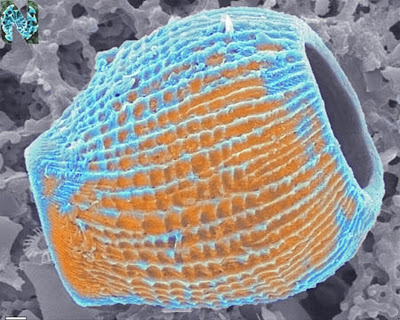
Photo by Bruce Melton / The Rag Blog.

Researchers at Dalhousie University, Halifax, Nova Scotia, Canada, after evaluating a half million water clarity observations taken from the world’s oceans over the last 100 years, have come to the conclusion that ocean primary productivity has declined 40% since 1950. Primary productivity is that nearly planetary-size mass of life that makes up the algae and plankton in our oceans — it is the bottom of the food chain (1).

As our oceans warm, currents slow, nutrients become scarce and fewer of these creatures inhabit ocean water. These tiny and more often than not microscopic life forms use carbon dioxide to create organic material and tiny plankton shells made out of calcium carbonate, just like clams and oysters.

Once the life form that is using this organic and shell material dies, the remains drift to the ocean floor as what is called marine snow. After hundreds of thousands of years, this material accumulates enough to become limestone.

Scanning electron photography, colorized. These images are just a few of thousands of plankton that make up primary productivity in our oceans. Magnification is about 1,000 times. Photo from the Alfred Wagener Institute for Polar and Marine Research.

Primary productivity is responsible for a third to a half of all of the natural carbon dioxide sequestration on Earth, as well as a third to half of the atmospheric oxygen generation on Earth. Many things buffer impacts from the decline of this primary earth system, but tipping points likely exist. Because primary productivity is such a large planetary function, runaway greenhouse gas accumulation in the atmosphere and runaway loss of atmospheric oxygen could be the result.

Such a large change in ocean clarity demonstrated over such a long period as has been found by these Dalhousie researchers is clearly an indicator of great change. These types of earth systems disruptions are happening across the globe with impacts that are changing Earth like it has not changed in tens and even hundreds of millions of years.

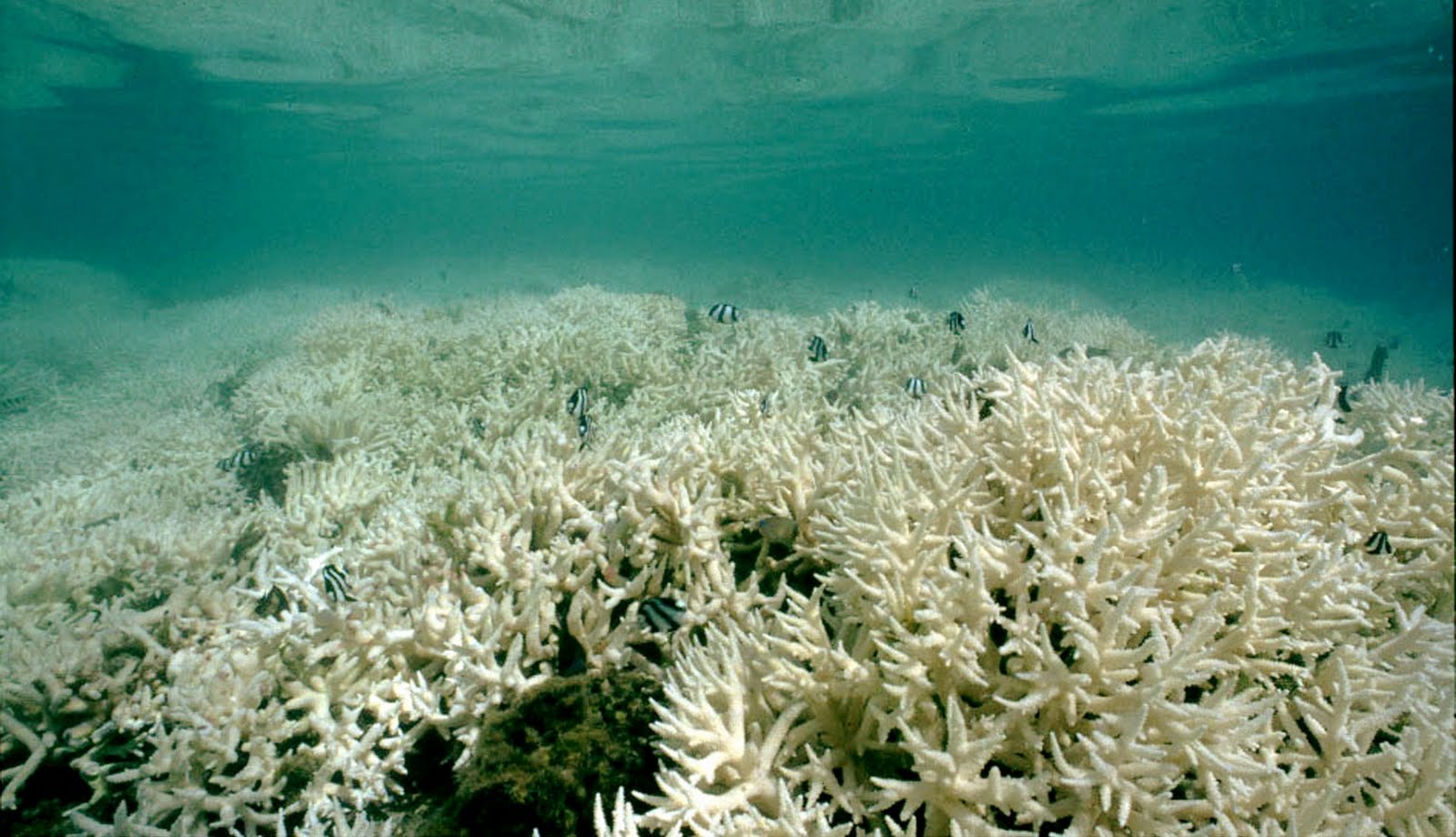
From across the globe oceanographers have been grimacing over this year’s coral bleaching event that has likely been worse than during the super El Nino of ’98 — the worst bleaching event ever recorded. Overly warm, or record warm water temperatures are killing coral like mankind has never seen (2).
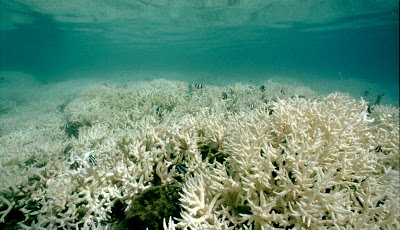
Large scale reef bleaching at Reunion Island in the western Indian Ocean. This type of bleaching is occurring throughout the Indian Ocean and Caribbean Sea. This year (2010) the bleaching was likely worse than anything ever recorded. Photo by John Pascal / Agence pour la Recherche et la Valorisation Marines (Aram).

The Arctic was declared functionally ice-free last summer for the first time in 14 million years in a paper in Geophysical Research Letters, or at the least, the argument was presented by one of the world’s leading Arctic sea ice scientists from the University of Manitoba in Winnipeg, Canada (3, 4).

Ultra high CO2 levels in prehistory were really only a third as high as we thought. Those 3,000 ppm CO2 concentrations back in the Mesozoic hothouse were in actuality only about 1,000 ppm. This means that our 21st century CO2 projection of the worst-case scenario nearing 1,000 ppm is frighteningly close to anything our planet has seen in the last 400 million years.

When we look back in time this far, and realize that modern atmospheric oxygen and carbon dioxide concentrations on Earth were stabilizing during this period after green plants colonized land, the implications of this finding are profound (5). (And yes, unfortunately we are progressing along the IPCC CO2 worst-case scenario (6).)

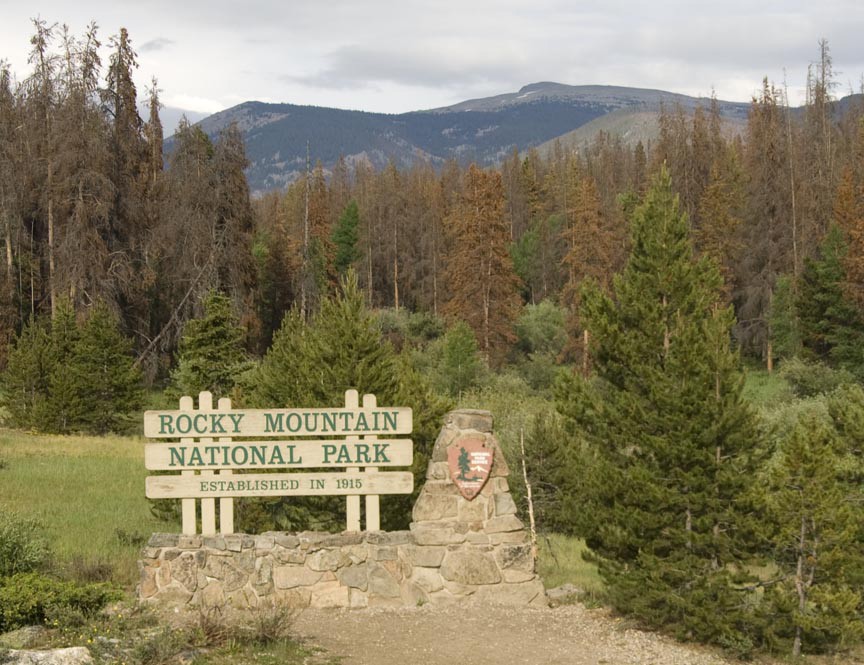
The dead trees from the pine beetle pandemic in Yellowstone, part of a warming induced bark beetle pandemic in the Rocky Mountains, responsible for 61 million acres of dead and dieing trees, billions of trees, in an area nearly the size of New England and Pennsylvania combined, are visible on Google.

The pandemic is 10 to 20 times larger than anything ever known, is growing rapidly, and scientists fear it will spread across the entire North American continent because its only enemy is extreme cold that has not been seen in more than a decade (7, 8).
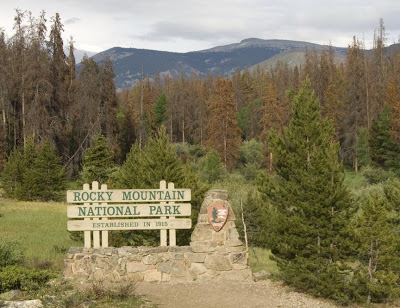
Photo by Bruce Melton / The Rag Blog.

October 2010 was the 308th consecutive month with an average temperature above the 20th century average (9).

The evidence in the academic literature is simply overwhelming. But virulent societal tricks have sequestered much of this knowledge. Virtually none escapes the academic literature. The reasons are many and diverse and range from vested interests and religion to the scientists simply not being trained (or willing) to communicate their discoveries to the public in language that can be understood by non-specialists.

This black knowledge hole however, is but a symptom of the disconnection. If just one fundamental definition was understood, the disconnection could simply vanish.

The public’s misunderstanding of the definition of “dangerous climate change” was emphasized to me when I was made aware of a climate survey in the October issue of Scientific American.

Question #8 of the survey, the last question, read: How much would you be willing to pay to forestall the risk of catastrophic climate change? The response was 79.6 percent for “nothing.” (10).

The word catastrophic is often interchanged with dangerous as an outcome to avoid in climate change scenarios and if anything, a catastrophe would be worse than something that is dangerous. Regardless, the terms are often considered to be of similar outcome and will be used interchangeably in the rest of this article.

Anyone following the climate science polls across the country knows that the last decade has seen an actual decline in the public’s knowledge of climate science. In a series of Gallup polls beginning in 1997, the number of poll respondents who think climate scientists are exaggerating increased more than 50 percent (to 48 percent) from 2006. Sixty-seven percent of poll respondents believe that climate change will not pose a serious threat to them in their lifetimes. This is up 16 percent from 2008 (11).

All of this increased disbelief is happening while the science itself continues to grow more and more robust. A study of nearly 1,400 climate scientists agrees that the man-caused tenets of the IPCC are valid. What’s more, of the two to three percent that do not support man-caused climate change science, 80 percent have published fewer than 20 papers, while the IPCC crowd includes only 10 percent that have published fewer than 20 papers (12).


So seeing 79.6 percent of the public say that they would do “nothing” to prevent catastrophic climate change was not, to me, a red flag. It was the key.

If the Scientific American readership could say something like this, surely they just did not understand the definition of dangerous climate change.

Following up, I found that Scientific American had removed the poll from their website. This was curious. I searched more and found an article on the Scientific American site, by the editors of Scientific American, that explained a few things. It seems that the there is one more thing that makes it difficult for the public to understand climate science.

This one more thing unfortunately, is organized deceit. The Watts Up With That website, a prominent climate change denial portal, decided that it would be a good thing to load up the Scientific American poll with opinions from Watts Up With That visitors. Watts Up created a new web page urging its visitors to complete the Scientific American survey.

Their campaign netted 30.5% of the respondents on the survey, likely skewing the results quite significantly. And in an as yet unexplained coincidence, a website called www.smalldeadanimals.com accounted for 16 percent of the survey respondents. A quick visit to this site shows that it too is obviously full of climate change unbelievers.

Another key finding in the Scientific American editors’ investigation was that the number three ranked referring website was a well known climate science site by Joe Romm called Climate Progress. Referrals from this website accounted for only 2.9 percent of the respondents of the SA survey. This information tells us that this poll was definitely ruined by organized deceit emanating from a prominent climate denier website (13).

The underlying concept however, that the public has a significant misunderstanding of the science, as is shown by the Gallup polls (and many others) is still valid. The key to the blindness must be that, if the definition of “dangerous climate change” was understood, even by the climate deniers, the answer that would have been chosen for question #8 would certainly have been something other than “nothing.”

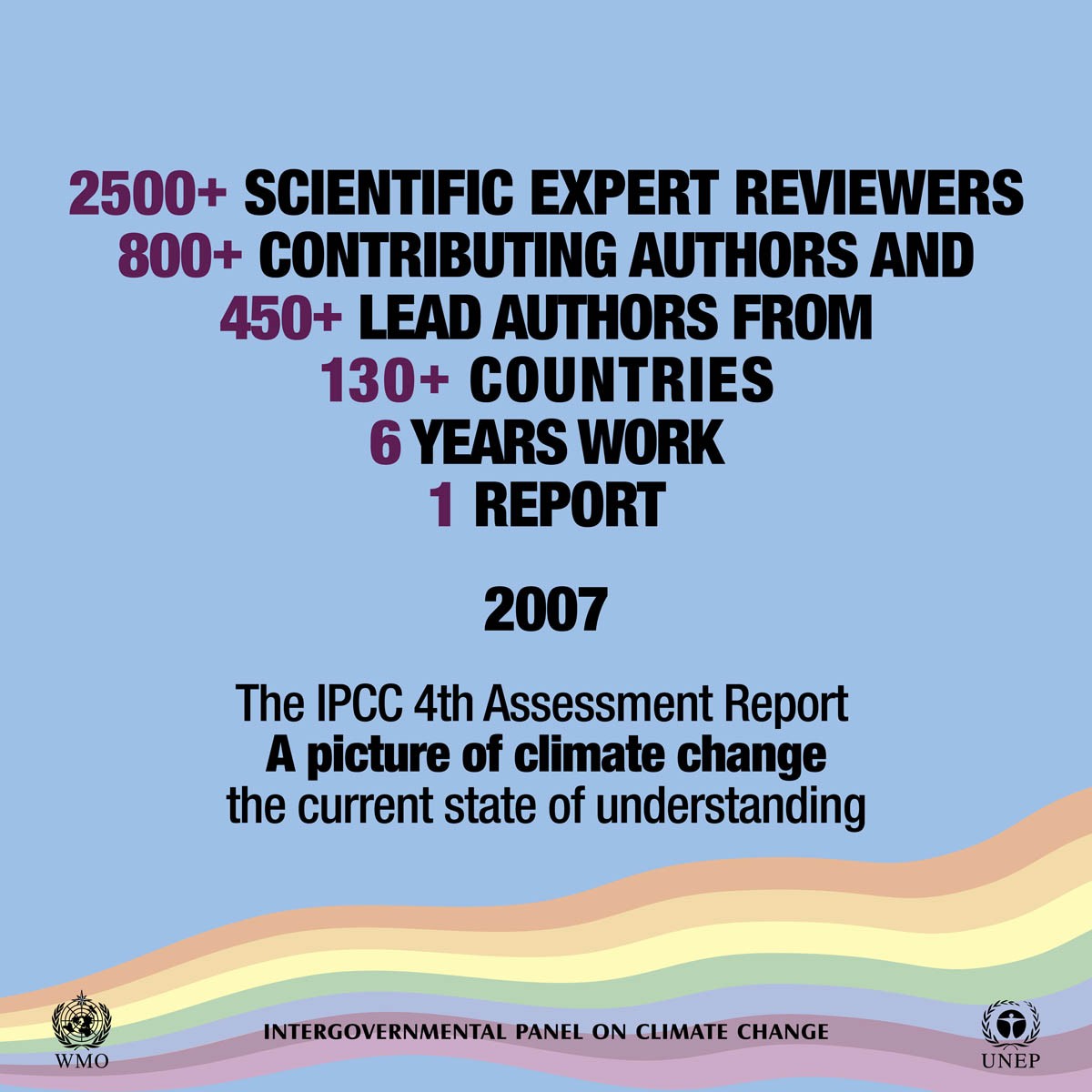
So then, what do the scientists say is the definition of dangerous climate change? The Intergovernmental Panel on Climate Change (IPCC) specifically does not define dangerous climate change. They say that the definition is a value judgment that should be made by policy makers, not the IPCC. They do suggest however that the definition would include threats to our food supply, or the creation of unsustainable economic conditions.

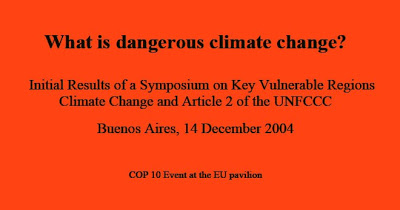
At the European Climate Forum of the United Nations Framework Convention on Climate Change in Buenos Aires in 2004, the topic of dangerous climate change was the main event. They said that dangerous climate change could include circumstances that could lead to global and unprecedented consequences, extinction of “iconic” species, loss of entire ecosystems, loss of human cultures, water resource threats, and substantial increases in mortality.

They say these dangers could include Arctic sea ice retreat, boreal forest fires, increases in frequency of drought, widespread dangers over a large region, most likely related to food security, water resources, infrastructure, or ecosystems (14).

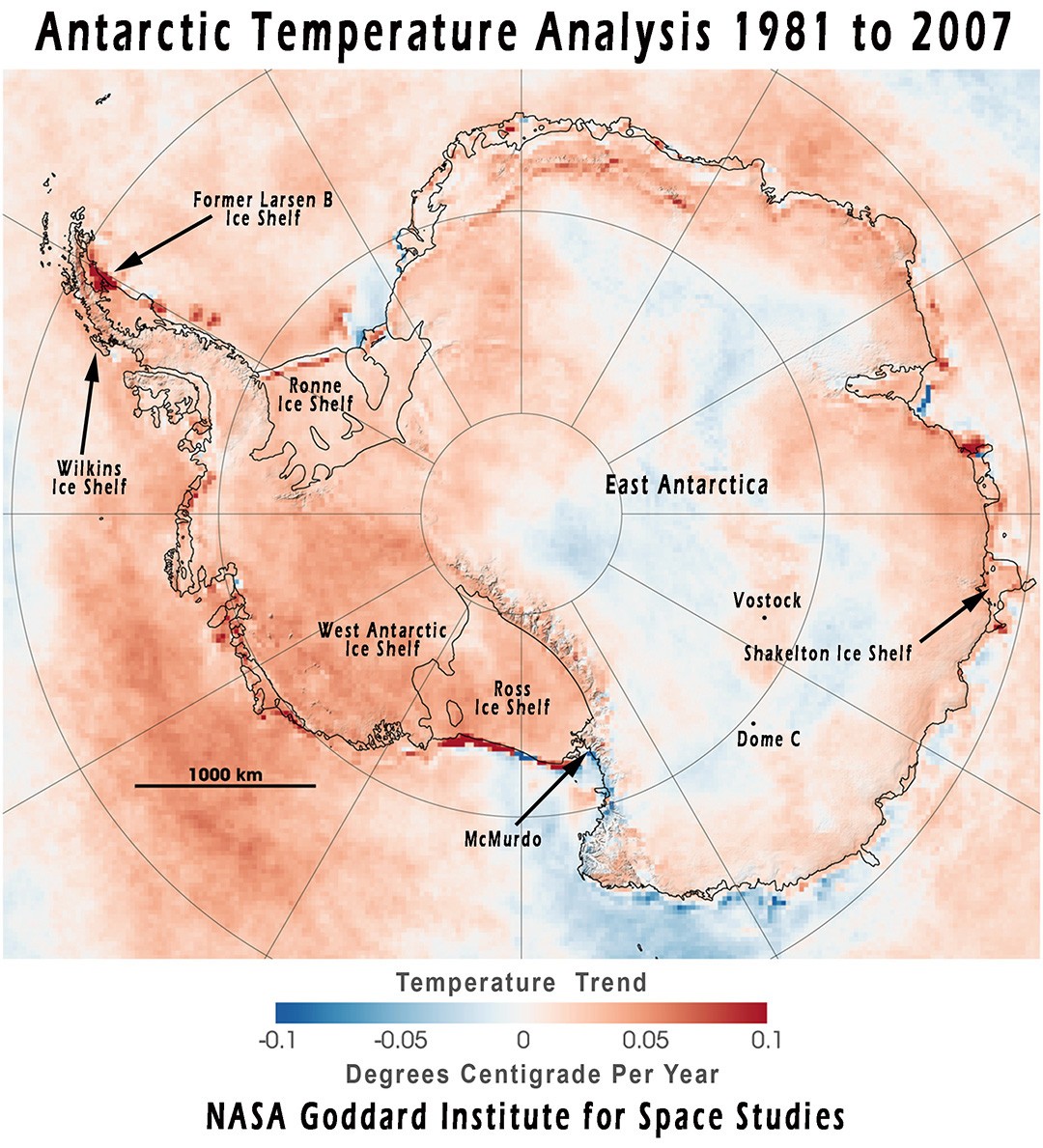
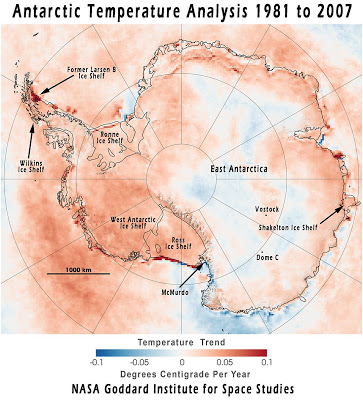
An abrupt sea level jump would be a dangerous climate change. The last time Earth was as close to being as warm as it is today, 121,000 years ago, sea level jumped 10 feet in 100 years for 300 years in a row (about 10 meters total). The jump was likely because of collapse of the West Antarctic Ice Sheet (WAI), and it has been shown that the WAI is destabilizing now. (15, 16)

A sea level rise of just one foot per decade (30 mm), just an inch and three sixteenths per year, would wreak utter havoc across the planet after just a couple of years. To start with, the United States Geological Survey, Environmental Protection Agency, National Oceanic and Atmospheric Administration, and Department of Transportation say, in a mega report from 2009, that the threshold for regeneration of coastal barrier islands and coastal wetlands is just a quarter of an inch (seven millimeters) per year of sea level rise.

This means that sea level rise of greater than a quarter of an inch per year would either cause the disintegration of our coastal barrier islands and wetlands, or keep them from naturally regenerating after they are gone.

There are 405 barrier islands on the Atlantic and Gulf Coasts of the U.S. totaling over 3,000 miles in length and there are 5.3 million acres of coastal wetlands. All would be destroyed.

This documented rate of sea level rise of an inch and three sixteenths per year is more than four times greater than the barrier island and wetland disintegration threshold. Our coastal defenses against storms would completely disappear, taking their trillions of dollars of weather defenses with them, not to mention the loss of one of the most productive eco regions on the planet (17).

When the beaches go, the refugees begin to flow, millions per year. Then the world’s coastal infrastructure begins to submerge. Nearly half of Earth’s industrial capacity is close to sea level.

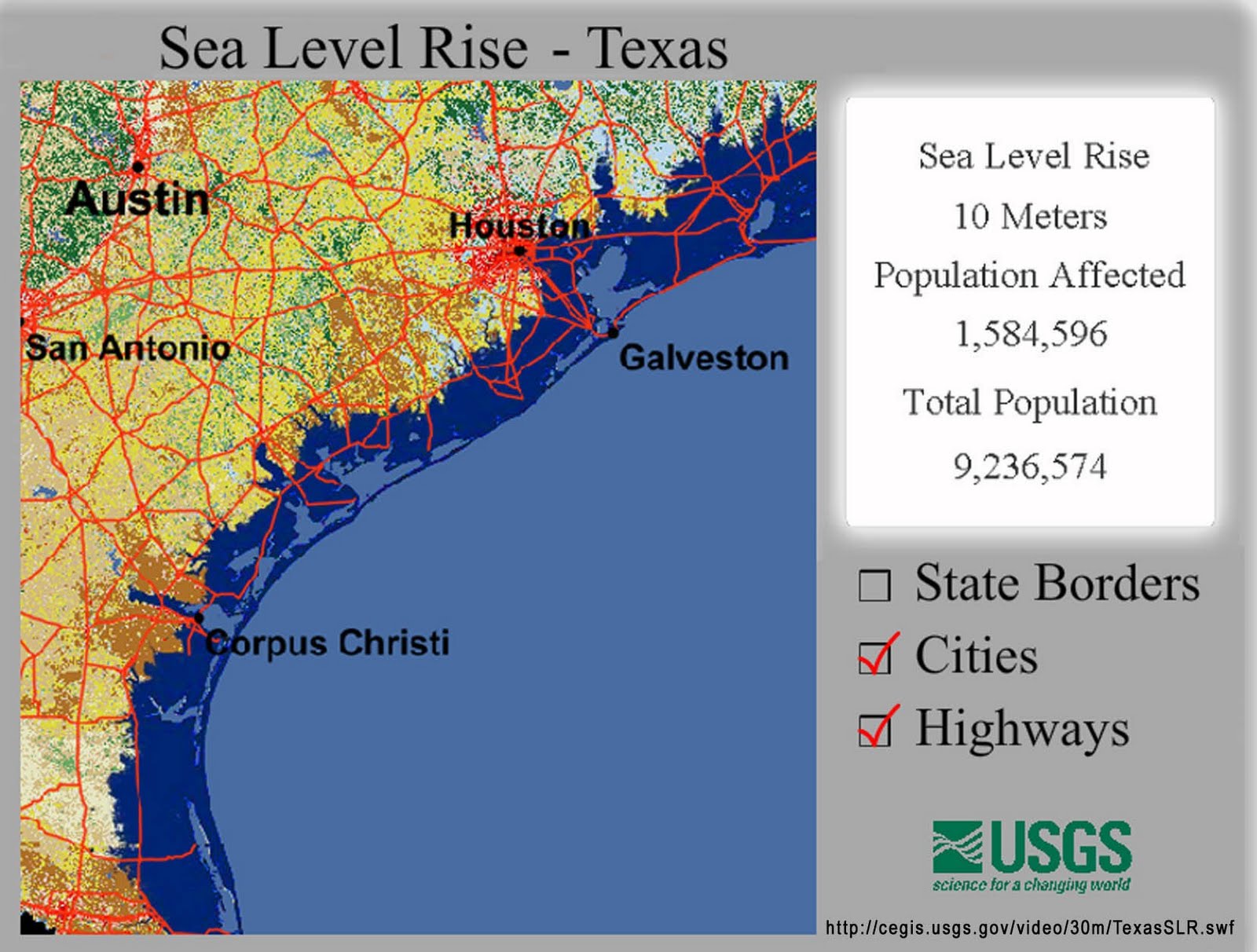
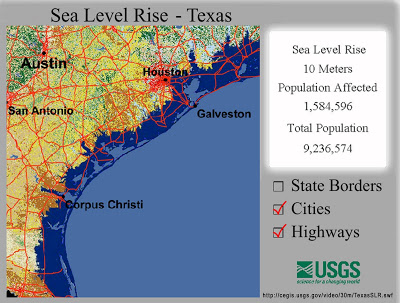
Over the last 100 years, sea level has risen only five or six inches. Across the globe 233 million people would be displaced by 10 feet of sea level rise. This is 2.3 million climate refugees per year. The United States Geologic Survey says that a 10-meter sea level rise, something like what happened 121,000 years ago, would flood a quarter of the United States population (about 78 million Americans), and nearly 1 billion people worldwide (870 million) (18, 19, 20).

And what of the 2007 IPCC projection of about a foot of sea level rise this century? They do not take into consideration, and the IPCC scientists persistently and frequently caveat their report in the text and footnotes saying that, because too little is known, dynamical ice sheet disintegrations are not taken into consideration in the projections of sea level rise.

This rapid jump in sea level 121,000 years ago, likely caused by the disintegration of the West Antarctic Ice sheet, is just such a dynamical event that is excluded from consideration of sea level rise by the IPCC.

The Dust Bowl is to weather like megadroughts are to climate change. The dust bowl was but a small blip on the climate change screen, meaning that the 10-year long Dust Bowl was a relatively insignificant event in a discussion of climate. The Dust Bowl was a really long weather event and should be viewed in that context. Weather events are not climate. Climate is the result of weather happening over time periods of generations to centuries.

Megadroughts have reoccurred repeatedly in the prehistoric past with ample evidence that the Great Plains of North America was changed to a sea of shifting sand. They simply dwarf any drought that we as a society have experienced since long before the Industrial Revolution began.

Dangerous climate change includes megadroughts that would simply wipe out agriculture in much of North America. Megadroughts from the past were typically 10 to 30 times as long as the Dust Bowl (100 to 300 plus years) with only half as much precipitation. These extreme climate events have happened because of the “natural” variability of our climate. Warming projected for the future and the latest high-resolution climate models show that perpetual drought will settle over much of North America in a megadrought scenario similar to the past (21).

Dangerous climate change changes Earth’s environment beyond the evolutionary niches of fundamental ecological services like primary productivity. When the bottom of the ocean food chain is compromised, everything on Earth is compromised. The same goes for the Great Plains changing to a sea of shifting sand.
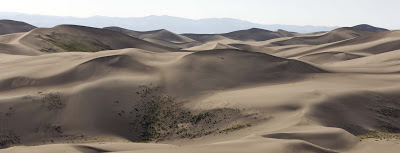
Photo by Bruce Melton / The Rag Blog.

This is the fundamental blindness. Dangerous climate change is dangerous to mankind. It threatens our very existence on this planet. It can happen in a geologic instant. And it is not just a distant “future” climate change that threatens us. This fundamental blindness will not allow us to see the disconnection between the public’s knowledge and the science.

In fact, the disconnection is so large, the blindness so profound, that right now, today, we have already passed beyond the threshold of dangerous climate change. In the 1990s, this threshold was 3 degrees C. of warming or about 550 ppm CO2. The 2001 IPCC report lowered this safe threshold to 450 ppm CO2 or 2 degrees C. warming.

This gets a little complicated now, so stay with me. Before the Industrial Revolution our atmospheric CO2 concentration was 280 ppm. Today it is 387 ppm, and we know that our planet has a tipping point where glaciation begins (or ends) at the poles at 450 ppm CO2 equaling about 2 degrees warming over the preindustrial times. This is one of the fundamental reasons that climate policy treaties like the Kyoto Protocol have defined 2 degrees C. of warming as the threshold for dangerous climate change.

Since the industrial revolution, Earth has warmed 0.76 degrees C. There is also warming in the pipeline of about 0.5 degrees C that is masked in our oceans. It takes a long time for the oceans to warm. Once warmed, the heat that they have been absorbing will stay in our atmosphere. About 90 percent of the 0.5 degrees of warming in the pipeline will occur by 2100.

A significant body of climate scientists have now published academic papers showing that a 350 ppm concentration should be the threshold level for determining dangerous climate change.

What, you say? Our atmospheric CO2 concentration has already passed 350 ppm. Yes it has, and we have another half degree of warming in the pipeline. The trouble is, there is a lot more than half a degree hidden in the sky.

Atmospheric aerosols are masking the warming. They occur mostly in the form of smog, significantly in the form of what is called the Asian Brown Cloud (a massive smog bank that covers much of Asia and can blow far out into the Pacific and can even be recognized in the U.S. when conditions are right.) There is so much smog in the developing world, and it is so good at cooling our atmosphere, that a full 1.0 degree C of warming is hidden because the smog cools Earth (22).

As these developing nations continue to develop, they will likely bring their air pollution under control similarly to what happened in the U.S. after the end of World War II. It was during this period that air pollution due to rapid growth and industrialization created tremendous smog problems across the country.

Environmental regulations were rapidly ramped up the 1970s when the big pollution laws were created which led to significant reductions in air pollution emissions that cause smog. The developing nations across the world, responsible for the 1 degree C. of warming, will likely remove their warming masks by the end of the century. This leaves us with:

Warming already = 0.76 degrees C.
Warming in the pipeline (90%) = 0.45 degrees C.
Hidden warming = 1.00 degrees
Total warming by 2100 = 2.21 degrees C.

One more important CO2 math thing: This 2.2 degrees C. of warming has been based on stabilizing CO2 at 2005 levels of 383 ppm. If CO2 goes higher, and it will not likely stop going higher for several decades, there will be more warming. And at the rate that we are increasing CO2 (remember, faster than the worst-case scenario) there will be a lot more CO2 emitted before we begin to bring things under control.

So if you are beginning to think the 350 ppm CO2 dangerous climate change threshold is a little high, you are not alone. The latest work done on the threshold comes from the University of California, Santa Barbara. This work (Morrigan 2010) suggests that 300 ppm CO2 is more appropriate as a threshold above which we can expect dangerous climate change.

So the short story says we need to actively begin removing carbon dioxide from our atmosphere, not just reducing emissions. Most would say that this is a tall order and we are likely doomed.

Realistically, we have a few years yet. The great thermal mass of the oceans slows climate change by decades to even a generation or more. We have a second chance in effect, at least if the West Antarctic Ice Sheet can hold on. Surprisingly, the costs will likely not be more than one to two percent of GDP. At least, this is what Lord Nicholas Sterns says.

Lord Stern’s groundbreaking 700-page global economic analysis of climate change (2006) not only says that the costs will be relatively benign but adds that there will quite likely be benefits that far outweigh the costs. Lord Stern was the UK’s Chief Economist under Prime Minister Tony Blair.

I am also certain that there are plenty of sequestration technologies in the developing and proving stages that can feasibly do the job, including clean coal… if, we act really soon. Our society has the capacity for tremendously large accomplishments on short order. World War II, The moonshot, The Manhattan Project, the Great Wall of China, the pyramids, and the U.S Interstate Highways System, all are indicators that we can handle large projects quickly, even on borrowed money.

Things are bad now. They are much worse than the public understands because of the disconnected climate blindness and they are getting worse faster than expected. In simple terms, we need to start spending money on our environment like we have recently spent it on institutions that are too big to fail.

[Bruce Melton is a registered professional engineer, environmental researcher, trained outreach specialist, and environmental filmmaker. He has been translating and interpreting scholarly science publications for two decades. His main mission is filming and reporting on the impacts of climate changes happening now, unknown to the greater portion of society. Austin, Texas is his home. His writing and films are on his website.]

References:

1) Primary productivity declined 40% since 1950… Boyce et. al., Global Phytoplankton decline over the past century, Nature, July 2010. Press Release: Phytoplankton in retreat, Dalhouse University.
2)
Worst bleaching event ever recorded…

3) Functionally ice free… Barber et. al., Perennial pack ice in the southern Beaufort Sea was not as it appeared in the summer of 2009, Geophysical Research Letters, December 2009.
http://www.agu.org/journals/ABS/2009/2009GL041434.shtml
News Release: University of Manitoba, Canada.
4)
14 million years… Perovich and Richter-Menge, Loss of Sea Ice in the Arctic, US Army Engineering Research Center, Cold Regions Research and Engineering, 2009.
http://arjournals.annualreviews.org/doi/full/10.1146/annurev.marine.010908.163805
5)
Mesozoic CO2 1,000 ppm, not 3,000 ppm… Breecker, et. al., Atmospheric CO2 concentrations during ancient greenhouse climates were similar to those predicted for A.D. 2100, PNAS, October 2009.
http://www.pnas.org/content/107/2/576.full.pdf+html
6)
Worst-case Scenario… Raupach and Canadell, Carbon and the Anthropocene, Current Opinion in Environmental Sustainability, August 2010.
7)
Beetle kill in the Greater Yellowstone Ecosystem seen from Google… Link
8)
Ten to 20 times greater, concerns of continent wide outbreak… Bentz, et. al., Climate Change and Bark Beetles of the western United States and Canada: Direct and indirect effects, Bioscience, September 2010.
9)
308th consecutive month above average…
http://www.ncdc.noaa.gov/sotc/?report=global
10)
Scientific American Climate Survey results: link
11)
Gallup, Americans Global Warming Concerns Continue to Drop, March 11, 2010… link
12)
Ninety-seven to ninety-eight percent of scientists agree… Anderegg, et. al., Expert Credibility in climate change, PNAS April 2010.
http://www.pnas.org/content/early/2010/06/22/1003187107.full.pdf+html
13)
Scientific American investigation of Watts Up website slam of their survey… http://www.scientificamerican.com/blog/post.cfm?id=do-80-percent-of-scientific-america-2010-11-17
14)
At the European Climate Forum… What is Dangerous Climate Change? Initial Results of a Symposium on Key Vulnerable Regions Climate change and Article 2 of the UNFCCC, Buenos Aires, December 14, 2004.
http://www.european-climate-forum.net/fileadmin/ecf-documents/publications/articles-and-papers/what-is-dangerous-climate-change.pdf
15)
Sea level rise of over 10 feet in 100 years… Blanchon, et. al., Rapid sea level rise and reef back stepping at the close of the last interglacial highstand, Nature, April 2009.
16) West Antarctic Ice Sheet Collapse may have already begun… Katz and Worster, Stability of ice sheet grounding lines, Proceedings of the Royal Society, January 2010.
http://rspa.royalsocietypublishing.org/content/early/2010/01/13/rspa.2009.0434.short?rss=1
17)
Barrier island and coastal wetland regeneration threshold of 7 mm per year…US Geological Survey, Environmental Protection Agency, National Oceanic And Atmospheric Administration and Department of Transportation Report, U.S. Climate Change Science Program Coastal Sensitivity to Sea Level Rise: A Focus on the Mid-Atlantic Region, November 2009.
http://www.climatescience.gov/Library/sap/sap4-1/final-report/
18)
233 million climate change refugees from 10 feet of sea level rise… Risk of Rising Sea Level to Population and Land Area, EOS, Transactions of the American Geophysical Union, February 2007.
http://www.clas.ufl.edu/users/prwaylen/GEO2200ARTICLES/Part2/hydrologic/Sea%20level%20rise.pdf
19)
Ten meters of sea level rise would displace 78 million Americans… http://pubs.usgs.gov/fs/fs2-00/
20)
Nearly one billion people live within 10 meters… United States Geologic Survey, Center of Excellence for Geospatial Information Science (CEGIS) http://cegis.usgs.gov/sea_level_rise.html
21)
Continental scale desertification…

  • deMenocal, et. al., Coherent high and low latitude variability during the Holocene warm period, Science, June 2000.
  • Cook, et. al., Long Term Aridity Changes in the Western United States, Science 306, 1015, 2004.
  • Miao, et. al., High resolution proxy record of Holocene climate from a loess section in Southwest Nebraska, Paleoclimatology, September 2006.
  • Cook, et. al., North American Drought: Reconstructions, Causes, and Consequences, Earth Science Reviews, March 200.
  • Broecker and Kunzig, Fixing Climate, Three Books Publishing, 2008.

22) We have already passed the threshold of dangerous climate change…

The Rag Blog

Posted in Rag Bloggers | Tagged , , , , , | 9 Comments


Climate Blindness

By Bruce Melton

How do we curb emissions with the way our society has evolved? Really. I mean serious curbing; enough to prevent dangerous climate change?

When considering the answer, dangerous climate change must be clearly defined. So, what exactly is dangerous climate change?

There is a disconnection between climate science and the public’s knowledge of climate change. The knowledge gap is becoming obvious to many, but to the climate scientists it is clear: there is a fundamental blindness in the vast majority of our society as to the meaning of man-caused climate change.

The disconnection itself is not easy to see without expert knowledge. The dendrochronologists have a hard enough time understanding the cryologists (tree ring scientists and ice scientists.)

Even so, the amount of important decision-making class of information being discovered is simply staggering. But the means to deliver this knowledge, to mine it out of the academic jargon and deliver it to the people, is just not there. Once this outreach issue is overcome however, and the disconnection is understood, the blindness becomes obvious.

Researchers at Dalhousie University, Halifax, Nova Scotia, Canada, after evaluating a half million water clarity observations taken from the world’s oceans over the last 100 years, have come to the conclusion that ocean primary productivity has declined 40% since 1950. Primary productivity is that nearly planetary-size mass of life that makes up the algae and plankton in our oceans — it is the bottom of the food chain (1).

As our oceans warm, currents slow, nutrients become scarce and fewer of these creatures inhabit ocean water. These tiny and more often than not microscopic life forms use carbon dioxide to create organic material and tiny plankton shells made out of calcium carbonate, just like clams and oysters.

Once the life form that is using this organic and shell material dies, the remains drift to the ocean floor as what is called marine snow. After hundreds of thousands of years, this material accumulates enough to become limestone.

Primary productivity is responsible for a third to a half of all of the natural carbon dioxide sequestration on Earth, as well as a third to half of the atmospheric oxygen generation on Earth. Many things buffer impacts from the decline of this primary earth system, but tipping points likely exist. Because primary productivity is such a large planetary function, runaway greenhouse gas accumulation in the atmosphere and runaway loss of atmospheric oxygen could be the result.

Such a large change in ocean clarity demonstrated over such a long period as has been found by these Dalhousie researchers is clearly an indicator of great change. These types of earth systems disruptions are happening across the globe with impacts that are changing Earth like it has not changed in tens and even hundreds of millions of years.

From across the globe oceanographers have been grimacing over this year’s coral bleaching event that has likely been worse than during the super El Nino of ’98 — the worst bleaching event ever recorded. Overly warm, or record warm water temperatures are killing coral like mankind has never seen (2).

The Arctic was declared functionally ice-free last summer for the first time in 14 million years in a paper in Geophysical Research Letters, or at the least, the argument was presented by one of the world’s leading Arctic sea ice scientists from the University of Manitoba in Winnipeg, Canada (3, 4).

Ultra high CO2 levels in prehistory were really only a third as high as we thought. Those 3,000 ppm CO2 concentrations back in the Mesozoic hothouse were in actuality only about 1,000 ppm. This means that our 21st century CO2 projection of the worst-case scenario nearing 1,000 ppm is frighteningly close to anything our planet has seen in the last 400 million years.

When we look back in time this far, and realize that modern atmospheric oxygen and carbon dioxide concentrations on Earth were stabilizing during this period after green plants colonized land, the implications of this finding are profound (5). (And yes, unfortunately we are progressing along the IPCC CO2 worst-case scenario (6).)

The dead trees from the pine beetle pandemic in Yellowstone, part of a warming induced bark beetle pandemic in the Rocky Mountains, responsible for 61 million acres of dead and dieing trees, billions of trees, in an area nearly the size of New England and Pennsylvania combined, are visible on Google.

The pandemic is 10 to 20 times larger than anything ever known, is growing rapidly, and scientists fear it will spread across the entire North American continent because its only enemy is extreme cold that has not been seen in more than a decade (7, 8).

October 2010 was the 308th consecutive month with an average temperature above the 20th century average (9).

The evidence in the academic literature is simply overwhelming. But virulent societal tricks have sequestered much of this knowledge. Virtually none escapes the academic literature. The reasons are many and diverse and range from vested interests and religion to the scientists simply not being trained (or willing) to communicate their discoveries to the public in language that can be understood by non-specialists.

This black knowledge hole however, is but a symptom of the disconnection. If just one fundamental definition was understood, the disconnection could simply vanish.

The public’s misunderstanding of the definition of “dangerous climate change” was emphasized to me when I was made aware of a climate survey in the October issue of Scientific American.

Question #8 of the survey, the last question, read: How much would you be willing to pay to forestall the risk of catastrophic climate change? The response was 79.6 percent for “nothing.” (10).

The word catastrophic is often interchanged with dangerous as an outcome to avoid in climate change scenarios and if anything, a catastrophe would be worse than something that is dangerous. Regardless, the terms are often considered to be of similar outcome and will be used interchangeably in the rest of this article.

Anyone following the climate science polls across the country knows that the last decade has seen an actual decline in the public’s knowledge of climate science. In a series of Gallup polls beginning in 1997, the number of poll respondents who think climate scientists are exaggerating increased more than 50 percent (to 48 percent) from 2006. Sixty-seven percent of poll respondents believe that climate change will not pose a serious threat to them in their lifetimes. This is up 16 percent from 2008 (11).

All of this increased disbelief is happening while the science itself continues to grow more and more robust. A study of nearly 1,400 climate scientists agrees that the man-caused tenets of the IPCC are valid. What’s more, of the two to three percent that do not support man-caused climate change science, 80 percent have published fewer than 20 papers, while the IPCC crowd includes only 10 percent that have published fewer than 20 papers (12).

So seeing 79.6 percent of the public say that they would do “nothing” to prevent catastrophic climate change was not, to me, a red flag. It was the key.

If the Scientific American readership could say something like this, surely they just did not understand the definition of dangerous climate change.

Following up, I found that Scientific American had removed the poll from their website. This was curious. I searched more and found an article on the Scientific American site, by the editors of Scientific American, that explained a few things. It seems that the there is one more thing that makes it difficult for the public to understand climate science.

This one more thing unfortunately, is organized deceit. The Watts Up With That website, a prominent climate change denial portal, decided that it would be a good thing to load up the Scientific American poll with opinions from Watts Up With That visitors. Watts Up created a new web page urging its visitors to complete the Scientific American survey.

Their campaign netted 30.5% of the respondents on the survey, likely skewing the results quite significantly. And in an as yet unexplained coincidence, a website called www.smalldeadanimals.com accounted for 16 percent of the survey respondents. A quick visit to this site shows that it too is obviously full of climate change unbelievers.

Another key finding in the Scientific American editors’ investigation was that the number three ranked referring website was a well known climate science site by Joe Romm called Climate Progress. Referrals from this website accounted for only 2.9 percent of the respondents of the SA survey. This information tells us that this poll was definitely ruined by organized deceit emanating from a prominent climate denier website (13).

The underlying concept however, that the public has a significant misunderstanding of the science, as is shown by the Gallup polls (and many others) is still valid. The key to the blindness must be that, if the definition of “dangerous climate change” was understood, even by the climate deniers, the answer that would have been chosen for question #8 would certainly have been something other than “nothing.”

So then, what do the scientists say is the definition of dangerous climate change? The Intergovernmental Panel on Climate Change (IPCC) specifically does not define dangerous climate change. They say that the definition is a value judgment that should be made by policy makers, not the IPCC. They do suggest however that the definition would include threats to our food supply, or the creation of unsustainable economic conditions.

At the European Climate Forum of the United Nations Framework Convention on Climate Change in Buenos Aires in 2004, the topic of dangerous climate change was the main event. They said that dangerous climate change could include circumstances that could lead to global and unprecedented consequences, extinction of “iconic” species, loss of entire ecosystems, loss of human cultures, water resource threats, and substantial increases in mortality.

They say these dangers could include Arctic sea ice retreat, boreal forest fires, increases in frequency of drought, widespread dangers over a large region, most likely related to food security, water resources, infrastructure, or ecosystems (14).

An abrupt sea level jump would be a dangerous climate change. The last time Earth was as close to being as warm as it is today, 121,000 years ago, sea level jumped 10 feet in 100 years for 300 years in a row (about 10 meters total). The jump was likely because of collapse of the West Antarctic Ice Sheet (WAI), and it has been shown that the WAI is destabilizing now. (15, 16)

A sea level rise of just one foot per decade (30 mm), just an inch and three sixteenths per year, would wreak utter havoc across the planet after just a couple of years. To start with, the United States Geological Survey, Environmental Protection Agency, National Oceanic and Atmospheric Administration, and Department of Transportation say, in a mega report from 2009, that the threshold for regeneration of coastal barrier islands and coastal wetlands is just a quarter of an inch (seven millimeters) per year of sea level rise.

This means that sea level rise of greater than a quarter of an inch per year would either cause the disintegration of our coastal barrier islands and wetlands, or keep them from naturally regenerating after they are gone.

There are 405 barrier islands on the Atlantic and Gulf Coasts of the U.S. totaling over 3,000 miles in length and there are 5.3 million acres of coastal wetlands. All would be destroyed.

This documented rate of sea level rise of an inch and three sixteenths per year is more than four times greater than the barrier island and wetland disintegration threshold. Our coastal defenses against storms would completely disappear, taking their trillions of dollars of weather defenses with them, not to mention the loss of one of the most productive eco regions on the planet (17).

When the beaches go, the refugees begin to flow, millions per year. Then the world’s coastal infrastructure begins to submerge. Nearly half of Earth’s industrial capacity is close to sea level.

Over the last 100 years, sea level has risen only five or six inches. Across the globe 233 million people would be displaced by 10 feet of sea level rise. This is 2.3 million climate refugees per year. The United States Geologic Survey says that a 10-meter sea level rise, something like what happened 121,000 years ago, would flood a quarter of the United States population (about 78 million Americans), and nearly 1 billion people worldwide (870 million) (18, 19, 20).

And what of the 2007 IPCC projection of about a foot of sea level rise this century? They do not take into consideration, and the IPCC scientists persistently and frequently caveat their report in the text and footnotes saying that, because too little is known, dynamical ice sheet disintegrations are not taken into consideration in the projections of sea level rise.

This rapid jump in sea level 121,000 years ago, likely caused by the disintegration of the West Antarctic Ice sheet, is just such a dynamical event that is excluded from consideration of sea level rise by the IPCC.

The Dust Bowl is to weather like megadroughts are to climate change. The dust bowl was but a small blip on the climate change screen, meaning that the 10-year long Dust Bowl was a relatively insignificant event in a discussion of climate. The Dust Bowl was a really long weather event and should be viewed in that context. Weather events are not climate. Climate is the result of weather happening over time periods of generations to centuries.

Megadroughts have reoccurred repeatedly in the prehistoric past with ample evidence that the Great Plains of North America was changed to a sea of shifting sand. They simply dwarf any drought that we as a society have experienced since long before the Industrial Revolution began.

Dangerous climate change includes megadroughts that would simple wipe out agriculture in much of North America. Megadroughts from the past were typically 10 to 30 times as long as the Dust Bowl (100 to 300 plus years) with only half as much precipitation. These extreme climate events have happened because of the “natural” variability of our climate. Warming projected for the future and the latest high-resolution climate models show that perpetual drought will settle over much of North America in a megadrought scenario similar to the past (21).

Dangerous climate change changes Earth’s environment beyond the evolutionary niches of fundamental ecological services like primary productivity. When the bottom of the ocean food chain is compromised, everything on Earth is compromised. The same goes for the Great Plains changing to a sea of shifting sand.

This is the fundamental blindness. Dangerous climate change is dangerous to mankind. It threatens our very existence on this planet. It can happen in a geologic instant. And it is not just a distant “future” climate change that threatens us. This fundamental blindness will not allow us to see the disconnection between the public’s knowledge and the science.

In fact, the disconnection is so large, the blindness so profound, that right now, today, we have already passed beyond the threshold of dangerous climate change. In the 1990s, this threshold was 3 degrees C. of warming or about 550 ppm CO2. The 2001 IPCC report lowered this safe threshold to 450 ppm CO2 or 2 degrees C. warming.

This gets a little complicated now, so stay with me. Before the Industrial Revolution our atmospheric CO2 concentration was 280 ppm. Today it is 387 ppm, and we know that our planet has a tipping point where glaciation begins (or ends) at the poles at 450 ppm CO2 equaling about 2 degrees warming over the preindustrial times. This is one of the fundamental reasons that climate policy treaties like the Kyoto Protocol have defined 2 degrees C. of warming as the threshold for dangerous climate change.

Since the industrial revolution, Earth has warmed 0.76 degrees C. There is also warming in the pipeline of about 0.5 degrees C that is masked in our oceans. It takes a long time for the oceans to warm. Once warmed, the heat that they have been absorbing will stay in our atmosphere. About 90 percent of the 0.5 degrees of warming in the pipeline will occur by 2100.

A significant body of climate scientists have now published academic papers showing that a 350 ppm concentration should be the threshold level for determining dangerous climate change.

What, you say? Our atmospheric CO2 concentration has already passed 350 ppm. Yes it has, and we have another half degree of warming in the pipeline. The trouble is, there is a lot more than half a degree hidden in the sky.

Atmospheric aerosols are masking the warming. They occur mostly in the form of smog, significantly in the form of what is called the Asian Brown Cloud (a massive smog bank that covers much of Asia and can blow far out into the Pacific and can even be recognized in the U.S. when conditions are right.) There is so much smog in the developing world, and it is so good at cooling our atmosphere, that a full 1.0 degree C of warming is hidden because the smog cools Earth (22).

As these developing nations continue to develop, they will likely bring their air pollution under control similarly to what happened in the U.S. after the end of World War II. It was during this period that air pollution due to rapid growth and industrialization created tremendous smog problems across the country.

Environmental regulations were rapidly ramped up the 1970s when the big pollution laws were created which led to significant reductions in air pollution emissions that cause smog. The developing nations across the world, responsible for the 1 degree C. of warming, will likely remove their warming masks by the end of the century. This leaves us with:

Warming already = 0.76 degrees C.
Warming in the pipeline (90%) = 0.45 degrees C.
Hidden warming = 1.00 degrees
Total warming by 2100 = 2.21 degrees C.

One more important CO2 math thing: This 2.2 degrees C. of warming has been based on stabilizing CO2 at 2005 levels of 383 ppm. If CO2 goes higher, and it will not likely stop going higher for several decades, there will be more warming. And at the rate that we are increasing CO2 (remember, faster than the worst-case scenario) there will be a lot more CO2 emitted before we begin to bring things under control.

So if you are beginning to think the 350 ppm CO2 dangerous climate change threshold is a little high, you are not alone. The latest work done on the threshold comes from the University of California, Santa Barbara. This work (Morrigan 2010) suggests that 300 ppm CO2 is more appropriate as a threshold above which we can expect dangerous climate change.

So the short story says we need to actively begin removing carbon dioxide from our atmosphere, not just reducing emissions. Most would say that this is a tall order and we are likely doomed.

Realistically, we have a few years yet. The great thermal mass of the oceans slows climate change by decades to even a generation or more. We have a second chance in effect, at least if the West Antarctic Ice Sheet can hold on. Surprisingly, the costs will likely not be more than one to two percent of GDP. At least, this is what Lord Nicholas Sterns says.

Lord Stern’s groundbreaking 700-page global economic analysis of climate change (2006) not only says that the costs will be relatively benign but adds that there will quite likely be benefits that far outweigh the costs. Lord Stern was the UK’s Chief Economist under Prime Minister Tony Blair.

I am also certain that there are plenty of sequestration technologies in the developing and proving stages that can feasibly do the job, including clean coal… if, we act really soon. Our society has the capacity for tremendously large accomplishments on short order. World War II, The moonshot, The Manhattan Project, the Great Wall of China, the pyramids, and the U.S Interstate Highways System, all are indicators that we can handle large projects quickly, even on borrowed money.

Things are bad now. They are much worse than the public understands because of the disconnected climate blindness and they are getting worse faster than expected. In simple terms, we need to start spending money on our environment like we have recently spent it on institutions that are too big to fail.

[Bruce Melton is a registered professional engineer, environmental researcher, trained outreach specialist, and environmental filmmaker. He has been translating and interpreting scholarly science publications for two decades. His main mission is filming and reporting on the impacts of climate changes happening now, unknown to the greater portion of society. Austin, Texas is his home. His writing and films are on his website.]

References:

1) Primary productivity declined 40% since 1950… Boyce et. al., Global Phytoplankton decline over the past century, Nature, July 2010. Press Release: Phytoplankton in retreat, Dalhouse University.
2) Worst bleaching event ever recorded…

3) Functionally ice free… Barber et. al., Perennial pack ice in the southern Beaufort Sea was not as it appeared in the summer of 2009, Geophysical Research Letters, December 2009.
http://www.agu.org/journals/ABS/2009/2009GL041434.shtml
News Release: University of Manitoba, Canada.
4) 14 million years… Perovich and Richter-Menge, Loss of Sea Ice in the Arctic, US Army Engineering Research Center, Cold Regions Research and Engineering, 2009.
http://arjournals.annualreviews.org/doi/full/10.1146/annurev.marine.010908.163805
5) Mesozoic CO2 1,000 ppm, not 3,000 ppm… Breecker, et. al., Atmospheric CO2 concentrations during ancient greenhouse climates were similar to those predicted for A.D. 2100, PNAS, October 2009.
http://www.pnas.org/content/107/2/576.full.pdf+html
6) Worst-case Scenario… Raupach and Canadell, Carbon and the Anthropocene, Current Opinion in Environmental Sustainability, August 2010. Source Link
7) Beetle kill in the Greater Yellowstone Ecosystem seen from Google… Link
8) Ten to 20 times greater, concerns of continent wide outbreak… Bentz, et. al., Climate Change and Bark Beetles of the western United States and Canada: Direct and indirect effects, Bioscience, September 2010.
9) 308th consecutive month above average…
http://www.ncdc.noaa.gov/sotc/?report=global
10) Scientific American Climate Survey results: link
11) Gallup, Americans Global Warming Concerns Continue to Drop, March 11, 2010… link
12) Ninety-seven to ninety-eight percent of scientists agree… Anderegg, et. al., Expert Credibility in climate change, PNAS April 2010.
http://www.pnas.org/content/early/2010/06/22/1003187107.full.pdf+html
13) Scientific American investigation of Watts Up website slam of their survey… http://www.scientificamerican.com/blog/post.cfm?id=do-80-percent-of-scientific-america-2010-11-17
14) At the European Climate Forum… What is Dangerous Climate Change? Initial Results of a Symposium on Key Vulnerable Regions Climate change and Article 2 of the UNFCCC, Buenos Aires, December 14, 2004.
http://www.european-climate-forum.net/fileadmin/ecf-documents/publications/articles-and-papers/what-is-dangerous-climate-change.pdf
15) Sea level rise of over 10 feet in 100 years… Blanchon, et. al., Rapid sea level rise and reef back stepping at the close of the last interglacial highstand, Nature, April 2009.
16) West Antarctic Ice Sheet Collapse may have already begun… Katz and Worster, Stability of ice sheet grounding lines, Proceedings of the Royal Society, January 2010.
http://rspa.royalsocietypublishing.org/content/early/2010/01/13/rspa.2009.0434.short?rss=1
17) Barrier island and coastal wetland regeneration threshold of 7 mm per year…US Geological Survey, Environmental Protection Agency, National Oceanic And Atmospheric Administration and Department of Transportation Report, U.S. Climate Change Science Program Coastal Sensitivity to Sea Level Rise: A Focus on the Mid-Atlantic Region, November 2009.
http://www.climatescience.gov/Library/sap/sap4-1/final-report/
18) 233 million climate change refugees from 10 feet of sea level rise… Risk of Rising Sea Level to Population and Land Area, EOS, Transactions of the American Geophysical Union, February 2007.
http://www.clas.ufl.edu/users/prwaylen/GEO2200ARTICLES/Part2/hydrologic/Sea%20level%20rise.pdf
19) Ten meters of sea level rise would displace 78 million Americans… http://pubs.usgs.gov/fs/fs2-00/
20) Nearly one billion people live within 10 meters… United States Geologic Survey, Center of Excellence for Geospatial Information Science (CEGIS) http://cegis.usgs.gov/sea_level_rise.html
21) Continental scale desertification…

  • deMenocal, et. al., Coherent high and low latitude variability during the Holocene warm period, Science, June 2000.
  • Cook, et. al., Long Term Aridity Changes in the Western United States, Science 306, 1015, 2004.
  • Miao, et. al., High resolution proxy record of Holocene climate from a loess section in Southwest Nebraska, Paleoclimatology, September 2006.
  • Cook, et. al., North American Drought: Reconstructions, Causes, and Consequences, Earth Science Reviews, March 200.
  • Broecker and Kunzig, Fixing Climate, Three Books Publishing, 2008.

22) We have already passed the threshold of dangerous climate change…

The Rag Blog
Posted in RagBlog | Leave a comment

Ivan Koop Kuper : Ken Kesey’s Houston Acid Test

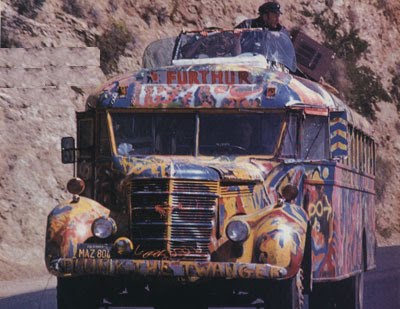
The original “Furthur,” the magic bus of Ken Kesey and the Merry Pranksters, on the road. Photo from NoFurthur.

Paying Larry McMurtry a visit:
The Merry Pranksters’ last acid test

By Ivan Koop Kuper / The Rag Blog / December 1, 2010
HOUSTON — In the heat of a July Houston morning in 1964, residents of the quiet Southampton neighborhood woke up to find a strangely painted school bus parked in front of an unassuming two-story brick house in the middle of the block.

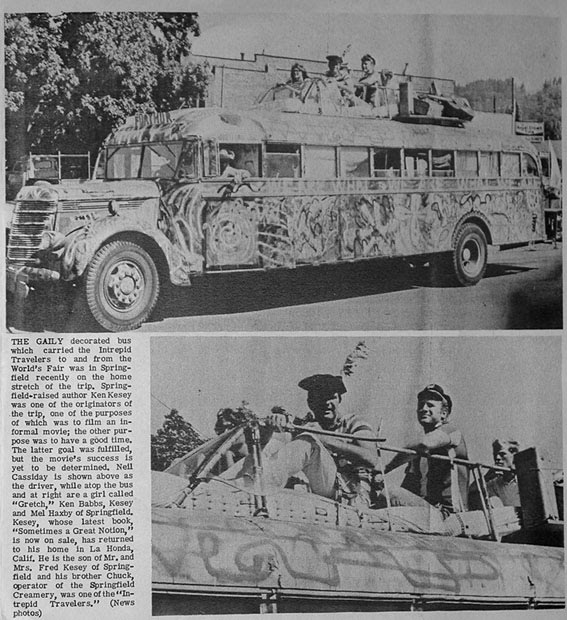
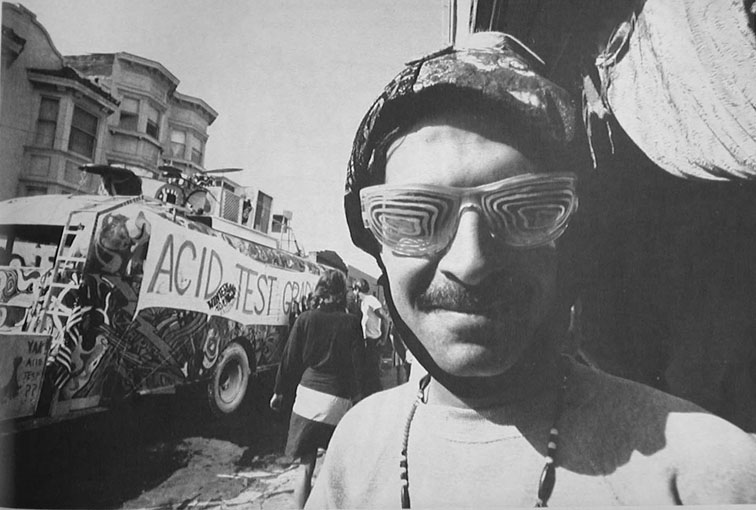
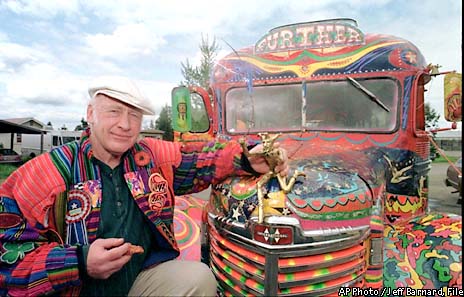
The vintage 1939 International Harvester with its passengers of “Merry Pranksters” drove half way across the United States and was now parked in front of the house of novelist and Rice University professor, Larry McMurtry. The Southampton neighbors would learn that the brightly painted bus whose destination plate read “FURTHUR,” with two u’s, was filled with strangely acting and even stranger looking people from California.

The leader of the Merry Pranksters was author Ken Kesey, whose novel, Sometimes a Great Notion, had just been published that summer. Their cross-country road trip to New York City was in part a celebration to commemorate the publication of his second novel, as well as the fulfillment of a request by his publisher for a personal appearance and an excuse to visit the World’s Fair taking place in the borough of Queens.

Fueled by the then-legal hallucinogenic drug LSD, Kesey and the Pranksters stopped in Houston along the way to visit McMurtry, who Kesey knew from their days at Stanford.

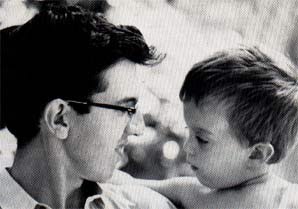
McMurtry lived with his 2-year-old son, James, on the oak-lined street near Rice University, where he taught undergraduate English.

Larry McMurtry and son, James, 1964. Photo from The Magic Bus.

McMurtry was also experiencing success in his life during this time. His inaugural novel, Horseman, Pass By, had been adapted into a screenplay and released as the feature-length movie, Hud, staring Paul Newman and Melvyn Douglas, the previous year.

“I remember walking down Quenby Street one afternoon and seeing the school bus parked in front of the McMurtry’s house,” said Kentucky-based artist Joan Wilhoit. “It was very atypical and pretty damn psychedelic with lots of colors. The Pranksters were very accommodating and invited us on the bus. They were very different, sort of proto-hippies, and I remember they painted their sneakers with Day-Glo paint. My parents befriended them and brought old clothes and hand-me-downs to those who needed it. My parents weren’t rude like some of the other neighbors were.”

Wilhoit, who was nine at the time, remembers that not all the neighbors were as welcoming as her parents and that some made sarcastic remarks about the Pranksters.

“’Do you have a bathroom on that bus?’ I remember one our neighbors asking the Pranksters through the school bus window,” the former Houstonian recounted. “I also remember hearing about the ‘naked girl’ and I thought it was the strangest thing how the police were called and how she had to be admitted to a psych ward of some Houston hospital.”

“Stark Naked,” as she was referred to in Tom Wolfe’s Electric Kool-Aid Acid Test, the novel that chronicled the exploits of Kesey and the Pranksters in the 1960s, was a bus passenger apparently “tripping” throughout her bus ride to Houston, who discarded her clothing in favor of a blanket that she wore for the duration of the journey. Upon her arrival in Houston, she experienced an episode of “lysergically-induced” psychosis, and confused McMurtry’s toddler son with her own estranged child, “Frankie.”

“Stark Naked” (aka “The Beauty Witch”) wore nothing but a blanket. Photo from The Magic Bus.

Three years later, the brightly painted bus was parked once again in front of McMurtry’s house on the oak-lined street near Rice Village. Kesey and the Pranksters returned to Houston in March 1967 to visit their old friend and to conduct what is purported to have been the last “acid test.” The social experiment was staged in the dining room of Brown College, a residential facility on the campus of Rice University, with McMurtry acting as faculty sponsor.

“I would have been 14 years old when they returned,” said Pricilla Boston (nee Ebersole), an employee of the department of state health services in Austin and the mother of two teen-aged sons.

I remember getting off the school bus from junior high one afternoon and seeing that the painted bus was parked in front of Mr. McMurtry’s house again. It was immensely colorful and there was no missing it, that’s for sure. All the kids in the neighborhood used to play street games at night a lot and it was almost like there was another set of kids in the neighborhood.

They had a youthful, fun vibe about them. I remember this one skinny guy in particular who would interact with us; he was younger than the others and he showed us the inside of the bus. He once asked us to go home and look in our parents’ medicine cabinet to see if they had any bottles of pills and bring them to him. I was asking myself “Why would he want those?”

Boston recounted following the skinny Prankster’s instructions and looking in her parent’s cabinet. “I don’t remember whether I brought him anything or not,” she said, “I just remember having a sense of what I was doing as being a little bit naughty.”

Although Kesey’s arrival and the ensuing acid test were promoted as a “concert” in the March 9 issue of the Rice Thresher, the campus student newspaper, this non-event turned out to be an acid test in name only. The promise of a reenactment of the “tests” conducted in California between 1965 and 1966 never materialized. Absent was the liquid light show, the live, amplified rock music, the pulsating strobe lights and movie projector images on the walls.

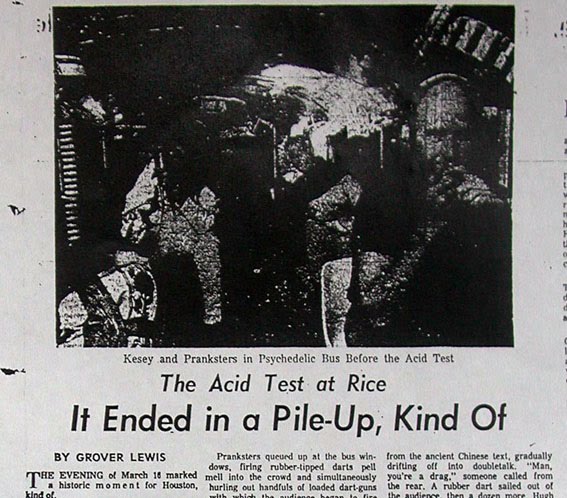
Also conspicuously absent was the mass dispensation and ingestion of psychotropic drugs by the Rice student body and other “assorted weirdos” in attendance. Instead, the Pranksters indulged the more than 200 attendees with a “madcap improvisation” of toy dart-gun fights, human dog piles, deep breathing demonstrations by Kesey himself, and rides on the “magic bus” around the Rice campus.

“The great Kesey affair was an absolute dud,” reported the Houston Post on March 21. “Some of the kids hissed while he [Kesey] read some kind of incantation, and others just left talking about what a drag it was.”

[Ivan Koop Kuper is a graduate student at the University of St. Thomas, Houston, Texas, and maintains a healthy diet of music, media, and popular culture. He can be reached at kuperi@stthom.edu. Find more articles by Ivan Koop Kuper on The Rag Blog]


Merry Pranksters in the news, 1964. Top, in Houston, and below, in Springfield, Ohio.

Prankster Hermit and the original bus. Photo from Lysergic Pranksters in Texas.

Top, Ken Kesey with restored bus, by then renamed “Further” with an “e”. Below, the 1939 International Harvester, before restoration, at the Kesey family farm in Pleasant Hill, Oregon, after being stored in the swamp for 15 years. Photo by Jeff Barnard / AP

The Rag Blog
Posted in Rag Bloggers | Tagged , , , , , , , , , , , | 5 Comments

Mariann G. Wizard : Grinch Winning in ‘War on Christmas’

Santa gets busted. This particular holiday pat-down took place in Akron, Ohio in 1978. But we’re just saying… Image © Bettmann / CORBIS.

Carnivores, male hookers, and the Grinch
make advances in ‘War on Christmas’

By Mariann G. Wizard / The Rag Blog / December 1, 2010
Thanksgiving came early this year, and a lot of non-traditional groups have had more reason than usual to be thankful. Among these, male sex workers are the big winners, but hey, babe, let’s take it slow!

Anti-family carnivorous loners got a boost from none other than advice columnist “Dear Abby,” who has for the last several years been impersonated by one Jeanne Phillips, daughter of the column’s kinder, gentler, founder. Asked by “Turkey Eater in Texas” whether one was under any obligation to respect the wishes of a brother and two nieces for vegan Thanksgiving fare, Phillips gave a resounding slap to family values, advising that the renegade relatives be told to “bring something they will enjoy or make other plans.”

Wonderfully grumpy, especially since including vegan dishes in our holiday fare might be easier than making them “traditionally”: simply leave the milk, butter, cheese, sheep-derived marshmallows, and lard out of the vegetable dishes when preparing them. Put butter and cheese on the table for people to use as they choose. Substitute vegetable oil for the swine fat.

Would it kill you to cut down a bit on the cholesterol during the holidays, Turkey Eater? You can have your turkey and ham on the table; the vegans don’t have to eat it, but omnivores shouldn’t have to clog their arteries, either. And, at the risk of revealing truly radical tendencies, couldn’t somebody make dessert with a non-sugar sweetener? Or will insulin be served with the coffee?

Kickoff of Grinchfest

Of course, Thanksgiving marked the official beginning of the annual “War on Christmas” season of national schizophrenia, when newscasters and columnists decry supposed threats to the pagan/Christian holiday. Grinches will grin to hear that this year network and cable television channels will present 160 holiday specials, not counting holiday episodes of almost every regular series, and ubiquitous holiday greetings from athletes and sportscasters during virtually every sports event from now through the New Year. (Think about all those advertising dollars, kids, and this phony “war” makes a lot more sense, like the once-secret U.S. attack on the “USS Maine”!)

How does this phethora of pablum gratify the anti-Santa contingent, you ask? Well, look at the odds: most of those 160 holiday specials, and most of the series holiday episodes, concern Christmas, not Hannukkah or Diwali or Yule. And in most — really I don’t know of anywhere this isn’t the case — Christmas is threatened, and must be saved by some unlikely hero or heroine: a freaky reindeer, a dog who thinks she’s a reindeer, folks who sing carols when their presents have been stolen.

Hey, it’s just a matter of time until one of these losers loses, and Christmas is defeated once and for all! So far, the closest to a real cartoon victory in the War on Christmas may be Futurama’s Robot Santa episodes, with a wise-cracking metal maniac delivering murder and mayhem to good and bad kids alike.

The huge variety of Christmas foes seen in the annual television glut is worth noting. From Central Park Rangers and low Christmas spirit in Will Farrell’s “Elf,” to miserly Scrooge in the Dickens classic, to Winter itself against misfit toys and talking snowmen; talk about a broad united front! And this year, the still-plummeting economy may at last deprive Santa’s media defenders of their most reliable weapon for saving Christmases Past: unrestrained consumer spending.

The holiday season and the sexually deviant

Now, as promised: the best news this holiday season is surely for the sexually deviant and/or adventuresome among us.

First, everyone has been salivating over the Transportation Safety Authority’s (TSA) official new gropings! I almost ran out and booked the first flight going anywhere! This fellow Tyson in California who got all upset by the prospect of someone touching his “junk” is clearly a terrible prude.

What will happen, you think, when a passenger moans in ecstasy while having her breasts diddled for contraband? Could one be aroused beyond the point of self-control by being felt up in the middle of a busy airport? In photos of the new pat-down procedure, TSA employees are seen kneeling or bending to probe groins and buttocks with rubber-gloved digits. Oh-baby-oh-baby!

Some irate travelers plugged for a national “opt-out” day to slow airport security lines and mess up everyone’s holiday travels, and a part of me wanted to go with that, but another part is like, “No, man, let’s have a big love-in on Concourse 3!”

(Mostly male) pilots have been excused from radiating full-body scanners and pat-downs, through the efforts of their union. (Mostly female) flight attendants have not, and are crying double standard. And they’re partly right, but may not win the point. Pilots, the argument goes, can intentionally crash a plane anytime they want, so are unlikely to carry explosives in their underpants.

The TSA even lets pilots pack heat in the cockpit, as a last defense against in-flight terrorists. Flight attendants aren’t usually in a position to crash a plane, and don’t have permission to carry guns in the air. I figure they’re going to get stuck in the scanner lines with the paying customers.

And male sex workers have the most to be thankful for, following Pope Benedict’s approval of their using condoms to prevent AIDS. The startling announcement was received with wild expressions of renewed religious fervor among Italy’s devout male prostitutes, for whom contraception is usually not an issue.

Here, too, a double standard may appear to apply, as female prostitutes did not receive similar dispensation from His Holiness. Clearly, however, their spiritual interest in preventing AIDS infection from a diseased client is pre-empted by their spiritual duty to bear his child, should God will that they receive that infection instead of, or in addition to, the modern plague.

Can the day be far ahead when the Vatican will allow pedophile priests to use condoms while molesting choir boys, as a “first step in assuming moral responsibility”? But for heterosexual couplings of any age or condition, fuggeddaboudit!


And in a final travel note

If you’re traveling this holiday season, The Rag Blog hopes you’ll remember that everyone else on the highway is a homicidal drunk who is sexting Grandma while speeding blindly up your tailpipe. Don’t trust anybody over or under 30! And if you really pig out, try to spend a few hours after dinner with people who can recognize a heart attack. You can probably help save Christmas without falling under the sleigh.
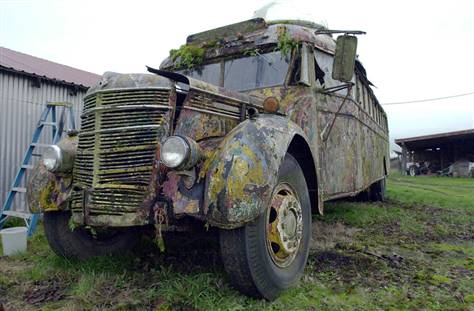
[Mariann Wizard, a Sixties radical activist and contributor to The Rag, Austin’s underground newspaper from the 60s and 70s, is a poet, a professional science writer specializing in natural health therapies, and a regular contributor to The Rag Blog. And, we might add, a world class cut-up.]

The Rag Blog
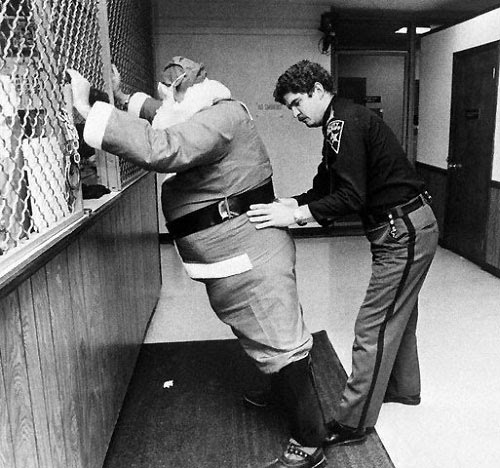
Posted in Rag Bloggers | Tagged , , , | 6 Comments

David Bacon : Students ‘Sin Papeles’ Work for DREAM Act

Latino students at the University of Virginia hold a silent march to support the DREAM Act. Photo courtesy Latino Student Alliance / University of Virginia.

Students
sin papeles‘ defy deportation,
urge Congress to support DREAM Act

By David Bacon / The Rag Blog / November 30, 2010
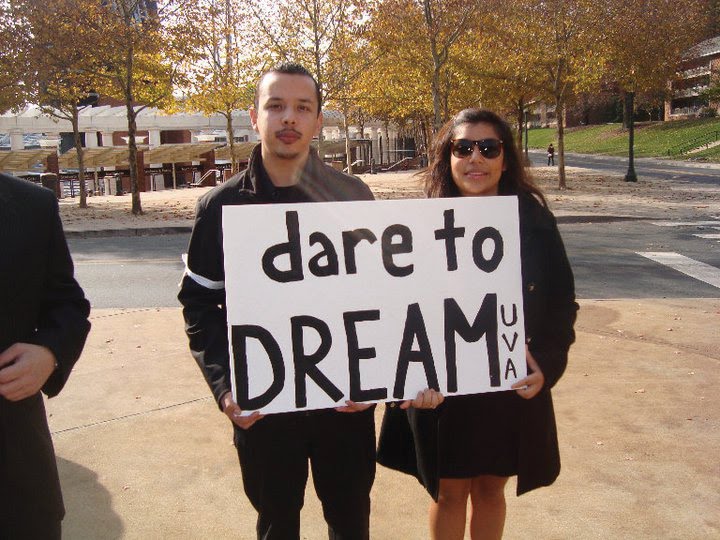
See “DREAM Act supporters arrested at Texas Senator Hutchison’s office,” Below.

OAKLAND, California — This week, if Senator Harry Reid keeps his word, Congress may get a chance to vote on the DREAM Act. First introduced in 2003, the bill would allow undocumented students graduating from a U.S. high school to apply for permanent residence if they complete two years of college or serve two years in the U.S. military. Estimates are that it would enable over 800,000 young people to gain legal status, and eventual citizenship.

A vote in Congress would be a tribute to thousands of these young “sin papeles,” or people without papers . For seven years they’ve marched, sat-in, written letters and mastered every civil rights tactic in the book to get their bill onto the Washington, DC agenda.

Many of them have given new meaning to “coming out” — declaring openly their lack of legal immigration status in media interviews, defying authorities to detain them. Three were arrested last May, when they sat-in at the office of Arizona Senator John McCain, demanding that he support the bill, while defying immigration authorities to come get them. T

hey were, in fact, arrested and held in detention overnight. Then a judge recognized the obvious. These were not “aliens” who might flee if they were released from detention, but political activists who were doing their best not only to stay in the country, but to do so as visibly as possible.

Reid owes his tiny margin of victory in Nevada’s election to an outpouring of Latino votes. Since he announced he’d bring the bill to the floor of Congress, more students have begun a hunger strike at the University of Texas in Austin. They insist they won’t eat until Senator Kay Bailey Hutchinson renounces her opposition to the DREAM Act. First their fast spread to campuses across Texas. Then students in other parts of the country announced they too would act when Reid calls the bill up for a vote.

But the DREAM Act campaigners have done more than get a vote in Washington, no matter how that may turn out. They’ve learned to use their activism to stop deportations. Further, they did this in an era when more people have been deported — 400,000 last year alone — than ever before in this country’s history. To highlight the connection between the bill and their challenge to the rising wave of deportations, four undocumented students walked for weeks from Miami to Washington in protest.

In the process, they learned the lesson the civil rights movement of the 60s’ taught activists of an earlier generation: Congress and Washington’s political class can be forced to respond to social movements outside the capitol. When those movements grow and make themselves felt, they can win legislation, and even more. People in the streets can change the conditions in their own communities. DREAM Act activists, by stopping deportations even in the absence of Congressional action, have made possible what political insiders held to be impossible.

Fredd Reyes. Photo from Facebook.

Fredd Reyes is living proof. This week he came back to North Carolina for Thanksgiving. He was picked up last September as he was studying for exams at Guilford Technical Community College, and taken first to the North Georgia Detention Center, and then to the Stewart Center in Lumpkin, Georgia. Fredd’s parents fled the massacres of Guatemala counter-insurgency war of the 1980s, when President Ronald Reagan gave guns to that country’s military, which they then turned on indigenous communities seeking social justice. Fredd was a toddler then.

DREAM Act students mobilized, and got Fredd sprung loose.

Jennifer Abreu had her Thanksgiving in Kentucky. She came to the U.S. with her parents when she was 13. She graduated from Lafayette High School in Lexington, where she became an activist, performed Brazilian and Colombian dances at fiestas and dreamt of life as a journalist. ICE picked her up, but a campaign by DREAM Act students and their supporters set her free too.

And in San Francisco, activists won freedom for Shing Ma “Steve” Li, a nursing student at San Francisco Community College. Immigration authorities detained him on September 15, igniting a lightening effort to stop his deportation. As the DREAM Act moved closer to a vote in Congress, he also became a living symbol for the national campaign to pass the bill.

Shing Ma “Steve” Li. Photo from America’s Voice.

Li’s predicament was dramatic and unusual. His parents emigrated from China to Peru, where Li was born. They later came to the U.S., where their petition for political asylum was denied. That made Li an undocumented immigrant, although as he went through San Francisco public schools, he had no knowledge of his status.

Last year, however, as the net of immigration enforcement was cast more widely than ever, Li and his mother were arrested. She was bailed out of detention, and now awaits deportation to China. But Steve Li was shipped to a detention center in Florence, Arizona, from which he would have been flown to Peru, where he was born. He has no relatives or family connections there at all.

John Morton, director for Immigration and Customs Enforcement at the Department of Homeland Security, told the media that picking up students for deportation was at the bottom of the government’s priority list. “So why are they nabbing highly-motivated students? Why has Steve been in jail for the past 60 days?” asked Sang Chi, Li’s Asian American studies instructor last year, at a rally on Li’s behalf.

The union for teachers at the community college, AFT Local 2121, became part of a broad effort to win Li’s release before he was put on the plane to South America. The case became a cause célèbre for the Asian Law Caucus, the Chinese Progressive Association, and other organizations in the city’s Asian community. The city Board of Supervisors and the college’s Board of Trustees both passed resolutions opposing the deportation. “We’ve made over 1,000 calls,” Daniel Tay, a fellow nursing student who emigrated from Peru two years ago, told reporter Rupa Dev.

Finally, Senator Diane Feinstein introduced a private bill that would grant Li permanent residence status. Li was then freed by ICE, and returned to San Francisco. His freedom is not permanent, however, but lasts for just 75 days following the end of the current Congressional session.

Private bills granting an individual legal status are rarely passed. Of the 29 introduced by Feinstein since 1997, only four have passed, and in the anti-immigrant climate of the incoming Congress, passage of Li’s bill is unlikely.

For Li and his supporters, however, although they’re grateful that he’s not in Lima, the private bill is not the answer. “As long as I’m here and able to use my voice and help myself and all those people in the same situation, I don’t feel like it’s a countdown,” he told reporter Jessica Kwong. “It’s just one step closer toward the Dream Act.” Recalling the other young people he met in the Arizona detention center, he said, “their stories and faces will be with me for the rest of my life.”

Without passage of the DREAM Act, “thousands of students are threatened with deportation, which is a tremendous waste of resources,” says Kent Wong, vice-president of the California Federation of Teachers, director of the UCLA Center for Labor Research and Education, and one of the national organizers of the DREAM Act campaign.

Many undocumented students, however, can’t get into colleges although they’ve graduated from U.S. high schools with excellent grades, because they’re either barred directly by lack of legal status, or can’t qualify for the financial aid that other students can receive. Undocumented students come overwhelmingly from working-class families.

When it was originally written, the bill would have allowed young people to qualify for legalization with 900 hours of community service, as an alternative to attending college, which many can’t afford. However, when the bill was introduced, the Pentagon pressured to substitute military for community service. Many young activists are torn by this provision.

Conscientious objector Camilo Mejia. Photo from American Documentary.

Camilo Mejia, the first GI who served in Iraq to have publicly resisted the war, was imprisoned for almost a year for refusing to go back. Mejia says the country already uses a “poverty draft” to fill the military with young people who have no jobs and no money for higher education.

In a debate on Democracy Now!, he said, “[The military is] in a position to offer to the vast majority of these 65,000 [immigrant] students who graduate every year, to say, ‘Come over here. We will teach you English. We will give you housing. We’ll give you a steady paycheck. We’ll give you all these things, if you serve in the military.'”

Rishi Singh, of Desis Rising Up and Moving, added “many of our families can’t afford to send us to college. And, you know, for many of our young people, there would be no other choice but to join the military.”

Debating him, undocumented former student Gabriela Pacheco said, “with the conditional residency, you are going to be able to work. Students might be able to find ways to cost and pay for their college and university.”

Mexicanos Sin Fronteras in Chicago argues that

“undocumented youth are in an increasingly desperate situation… With legal status as a goal, many who otherwise might have dropped out of school could be motivated to graduate and enroll in college… Instead let’s educate the youth about the injustice of these imperial wars and the historical government practice of putting the poorest and most disenfranchised youth on the front lines. Let’s encourage and support them in choosing the college option.

Like many DREAM Act supporters, the California Federation of Teachers has called for reinstatement of the community service provision. But it supports the Act regardless. “The Federal Dream Act will establish the important principle that undocumented students can no longer be assigned to a second-class, inferior status and must be treated with respect and dignity,” says a resolution adopted by the union in 2009.

“We have to remember that for every case like Steve Li’s, there are hundreds of other young people who are deported,” emphasizes Local 2121 President Alisa Messer. “These are our students. They’re doing everything we want young people to do. So we have to fight for their ability to get an education, to support their families, and to participate in society. They’re American kids.”

Many immigrant rights activists also view the DREAM Act as an important step towards a more basic reform of the country’s immigration laws. It would not only help students to stay in school, but by giving them legal status, give them the ability to work and use their education after graduation.

Luis Perez, for instance, the son of working-class parents in Los Angeles, will graduate from UCLA’s law school this year and take the bar exam in January. But after that, without legalization, he won’t be able to work. The 1986 Immigration Reform and Control Act says employers may only hire workers who are citizens or who have visas that give them “work authorization.”

The DREAM Act could resolve this problem for undocumented young people graduating from college. But it also highlights the same problem for millions of other undocumented workers who would not be affected by the bill. Twelve million undocumented people live in the U.S., and almost all of them work for a living.

The same wave of enforcement that led to the deportation of 400,000 people last year is also targeting undocumented people in the workplace. Thousands of workers have been fired for lack of legal status, and many have even gone to prison because they invented Social Security numbers in order to get a job. Unscrupulous employers have used their lack of status to threaten and terminate workers who protest illegal conditions or try to organize unions.

Arizona’s law requiring police to stop and hold for deportation any person without legal immigration status is another example of the impact of the immigration enforcement wave — growing cooperation between law enforcement and immigration authorities. That cooperation produced many of the hundreds of thousands of people detained and deported last year alone.

Ending that enforcement program would also require a more extensive immigration reform. So would a real effort to get at the roots of forced migration — the military interventions, trade agreements and pro-corporate policies that uproot communities in other countries, and make migration a matter of survival.

Yet the DREAM Act students have shown that fighting detention and deportation is possible. As they’ve marched and demonstrated, they’ve pointed out over and over that stopping the enforcement wave and changing immigration law are so connected that one can’t be fought without fighting for the other. In the end, the basic requirement for both is the same — a social movement of millions of people, willing to take to the streets and the halls of Congress.

[David Bacon is a writer and photojournalist based in Oakland and Berkeley, California. He is an associate editor at Pacific News Service, and writes for Truthout, The Nation, The American Prospect, The Progressive, and the San Francisco Chronicle, among other publications. His documentary photography has been exhibited widely. His latest book is Illegal People: How Globalization Creates Migration and Criminalizes Immigrants. This article was also published at Truthout.]

Student on hunger strike at UT Pan American in Edinburg, Texas, speaks out in support of the DREAM act. Image from KVEO NBC 23.


Dream Act
supporters arrested
at Texas Senator Hutchison’s office


SAN ANTONIO — More than a dozen UTSA [University of Texas at San Antonio] students are under arrest for trespassing at Sen. Kay Bailey Hutchison’s district office during a protest in support of the Dream Act.

The magistrate’s office had custody of the 16 protesters Tuesday morning. They were booked for criminal trespassing.

They stuck like glue to her office, and they would have stayed there until police took them away. The group included an ex-city council member, a professor and students. They want the senator to support the Dream Act, which paves the way to citizenship for undocumented students.
[….]
Cops first arrested the group of ten that formed a human chain in the hallway, and then made their way to the senator’s office, where six protesters were engaged in a sit-in.

“These students made a major sacrifice,” protester Joel Settles said. “They started the hunger strike 21 days ago.” …

Noelle Gardner / KENS 5

The Rag Blog

Posted in Rag Bloggers | Tagged , , , , , | 3 Comments

Carl Davidson : Bearing Witness at the School of the Americas

Top: photo from Keep on Keepin’ On. Below: photo by Linda Panetta / SOA Watch.

Bearing witness to torture and murder
at Fort Benning’s School of the Americas

By Carl Davidson / The Rag Blog / November 30, 2010
FORT BENNING, Georgia — The annual School of the Americas Watch vigil and procession is a unique and powerful event in America political life

Going on for 20 years now, the mobilization against the training of torturers and killers in Fort Benning, Georgia, is part peace mobilization, part solidarity with Latin America event, part religious pageant, part public face of the Catholic left, and part gathering of the tribes for newly radicalized youth.

The gathering draws thousands of people, including nuns and priests, veterans and labor organizers, along with other peace and solidarity activists. They all come for a two-day creative mixture of diverse events that leaves everyone politically transformed and emotionally peaked.

This year’s event was no different. Over the weekend of Nov 19-21, close to 5,000 people took part is a series of colorful and dramatic actions. Thirty were arrested and held several days by police. Four of these were arrested after intentionally committing civil disobedience by climbing over a fence topped with barbed wire at the entrance to Fort Benning. Others were arrested for simply straying off a sidewalk in an attempt to march to downtown Columbus. Local courts imposed heavy fines and maximum sentences.

Why is the U.S military training torturers and death squads? The answer is an old one: wealth, power, and intimidated, non-union labor.

“For the past several decades, the U.S. has allied with dictators in Latin America who helped that region’s small, elite group of wealthy landowners,” said SOAW founder Father Roy Bourgeois, a Louisiana native, who lives just outside the gates of the school in Fort Benning where he carries on his work.

“We got involved militarily with these countries because they were rich in natural resources, with coffee in Colombia, bananas in Central America, copper in Chile, petroleum in Venezuela, and tin in Bolivia. With their militaries, the U.S. joined with them to exploit those natural resources and to pay workers $1 a day. There were no labor laws there,” Bourgeois noted. “We were like the new conquistadors.”

The high point of the weekend was the Sunday procession of thousands, each carrying a white cross with the name of a slain Latin American peasant, worker or child, and a number of priests and nuns, including Salvadoran Archbishop Oscar Romero, slain by those trained in Fort Benning’s SOA facility.

Teams of singers mournfully sang the names and ages, and after each one, everyone raised their crosses, and answered with the classic salute of the living to those who have fallen in battle: “Presente!

The procession lasted for hours as the column of mourners bearing crosses of the dead walked from the front of the stage up one side of the street to the police barriers and back down the other side of the street to the back of the stage. There they placed the crosses into the chain link fence blocking the entrance to the military base.

Many mourners cried. Some raised their fists. Some knelt in prayer or meditation as the singing of the names and the chant of “Presente!” continued. Behind the stage a theatre group staged a scene of murdered members of a religious order, their bodies spattered with blood. Others snapped pictures or stood quietly.

As soon as a young man approached the fence military loudspeakers surrounding the entire area blared a recorded message asserting that the military base was a legal entity and operated under the U.S. Constitution and that crossing onto base property was a federal crime.

Cheering and applause roared up as the young man climbed the fence, crossed the barbed wire top, and dropped onto the grass. Before he could reach the second fence he was apprehended and cuffed by the military police. On the east side of the street up the hillside crowds of neighborhood residents stood silently in their yards observing the ceremony of remembrance.

Over its 59 years of existence, the SOA, frequently dubbed the “School of Assassins,” has left a trail of blood and suffering. It has trained over 60,000 Latin American soldiers in counterinsurgency techniques, sniper training, commando and psychological warfare, military intelligence, and interrogation tactics.

Among those targeted are educators, union organizers, religious workers, student leaders, and others who work for the rights of the poor. Hundreds of thousands of Latin Americans have been tortured, raped, assassinated, “disappeared,” massacred, and forced into being refugees.

“I am a different person, and so is everyone else who confronted this evil,” said Randy Shannon from Beaver County, Pennsylvania. Randy is a national committee member of the Committees of Correspondence for Democracy and Socialism. “We walked in a procession singing out the name of each and every one of the thousands of Latin American men, women, and children, mostly working people and their spiritual brothers and sisters. It was a remembrance of their loss and our shame.”

The School of the Americas Watch team had the area well organized. A strikingly decorated stage was constructed near the double barbed wire topped fences blocking the entrance to Fort Benning. The stage was at the foot of a 10-block-long section of a street that was had been blocked off by police. The wide corridor with tall loudspeakers stationed every few blocks, provided excellent acoustics.

Homes of local residents were on one side of the corridor, and many had food concessions on their lawns. On the other side of the street was a chain link fence, against which a long line of booths for political groups and vendors were arrayed. On the other side of the chain link fence was a grassy area patrolled by military and local police.

Before long, the buses start arriving. They came from across the South and the Midwest, up to Minnesota, down to Florida, and out to Nebraska. A good number were from small Catholic colleges and universities, and loads of students, along with the nuns, monks, and priests who taught them, unloaded with smiles and excitement at being there.

Photo by Linda Panetta / SOA Watch.

“As an activist since the 1960s,” said Atlanta’s Jim Skillman, “I find it intoxicating to be in the midst of so many justice-minded young people.” A Vietnam veteran, Skillman had joined SDS at Georgia State after leaving the army in 1967, and has been a dedicated labor, peace, and human rights organizer ever since.

Other veterans started showing up in batches. They gathered around the Courage to Resist table, a group of today’s Iraq and Afghan vets. They were featuring a display defending Private Bradley Manning who faces 50 years in prison for being a whistleblower, leaking information about war crimes in Iraq.

A variety of religious forces also began arriving. A group of Presbyterians unfurled a banner. A group of Buddhist monks of Nipponzan Myohoji, Atlanta Dojo walked more than 100 miles as a walking prayer to “Close the SOA.” They averaged 15 miles per day, staying in churches or supporters’ homes. .

A major undercurrent during the weekend was a building tension with the police, military security, and the FBI, who were all present in force. The strategy of the SOA and local authorities is apparently to find every possible minor transgression to crack down hard on participants, to impose quick and severe penalties for planned civil disobedience, and where no problems exists, to use undercover agents provocateurs to create division and trouble.

The Columbus city police headed the security preparations this year, assisted by the Muscogee County sheriff’s and marshal’s offices, Fort Benning’s own military police force, and a number of undercover agents disguised as protesters.

The agents provocateurs were focused on a planned march to take the SOA Watch protest into downtown Columbus on Saturday afternoon. At a meeting the night before, three individuals kept egging people into the streets. When challenged as to who they were, they then faded away. The next day when the march did take place, a number of the crowd stepped off the sidewalk and into the street at one point. According to the Columbus Ledger-Enquirer:

Lauren Stinson, an undercover agent with the Metro Narcotics Task Force, testified Sunday that she participated in two meetings with SOA Watch protesters as they planned to step onto Victory Drive Saturday afternoon. All but one of the 22 arrested were found guilty, an SOA Watch organizer said. Stinson followed the group of about 12 people into the southbound lane around 4:45 p.m., blocking traffic and being rounded up with the others on charges including obstruction of a highway and unlawful assembly. Stinson was put in the back of a patrol car and taken to the Muscogee County Jail, but wasn’t arrested. She testified before Columbus Recorder’s Court Judge Michael Cielinski in some of the 22 cases the judge heard Sunday afternoon.

When defense attorneys tried to question Agent Stinson on the stand to learn more about her team’s operation, the judge ruled that she didn’t have to answer, and she didn’t. For the minor incursion of stepping into the street, each protester was hit with $5000 in bail and six month jail terms.

“Many of these tactics are not new,” said Jake Olzen of the SOA Watch team.

What is new, however, is the intensity, preparation, and specific targeting used by law enforcement authorities to discredit the movement’s legitimacy through the use of scare tactics and deterrence. For example, the Columbus Police department had photographs and lists of members of the SOA Watch Legal Collective and were specifically targeting these individuals because of their capacity as organizers and their ability to offer legal support. Charity Ryerson, a former SOA Prisoner of Conscience and Georgetown University law student, was specifically sought out and arrested for her role as an organizer.

Sunday morning began with a march of about 100 veterans, followed by music from the stage, mixed with appeals for bail money for those arrested the day before.

Bob King — the newly elected president of the United Auto Workers — has been at the SOA Watch protest many times, and has led a U.S. trade union delegation to El Salvador. This year he was a featured speaker, and took part in the procession with his daughter.

“The SOA has a terrible history,” said King from the stage. “Its graduates were involved in some of the worst human rights abuses in South and Central America including the assassination of Archbishop Romero and six Jesuits priests at the University of Central America in San Salvador. Those of us who have democratic rights must be a voice for those less fortunate who do not have a voice because of the terrorism they face.”

A speaker from Resistencia in Honduras also detailed some of the atrocities carried out by the Micheletti and Lobo regimes since the June 28 coup. The new Wikileaks exposes may well reveal a less-than-neutral hand by the Obama administration.

Father Roy Bourgeois, when he spoke from the stage, tied the arrests and undercover police efforts over the weekend to the wider efforts by the FBI to target antiwar and solidarity activists with grand jury subpoenas under the guise of “fighting terrorism.”

“If the FBI is interested in investigating terrorism,” said Father Bourgeois, “they should come here to Columbus, Georgia, home of Ft. Benning, where there is the School of the Americas. This really is a well known terrorist training camp, and if we want to get serious about talking about terrorism and closing down terrorist training camps, I would highly recommend that the FBI come right in their backyard… I want to offer my support, as so many of us want to, to our brothers and sisters in the Committee to Stop FBI Repression. What has happened to them can happen to anyone, anyone that is a critic of U.S. foreign policy.”

As the speeches concluded and the procession was underway, the planned civil disobedience of climbing the barbed-wire fence into Ft. Benning got underway. This year four people took that step. Two of them, Louie Vitale, OFM, who crossed the line for the fourth time, and David Omondi of the Los Angeles Catholic Worker who crossed the line for the first time, pleaded “no contest” and were immediately convicted in federal court. They each received a six month prison sentence from U.S. Magistrate Judge Stephen Hyles. Nancy Smith and Chris Spicer, the two others who crossed over the fence, will go to trial January 5, 2011.

A number of reports noted that this year’s SOAW effort was smaller than the peak of 20,000 years back. Part of the reason was that this year’s efforts were divided between those who came to Ft Benning, and others who had lobbied Congress earlier this summer. In any case, given the high spirits and determination of those who came this year, the struggle will be ongoing.

Randy Shannon summed it up: “Seeing UAW’s Bob King here and hearing his militant speech pledging labor’s solidarity with the peace community and Latin America, all working to close this abomination — that gives me hope. Likewise, the thousands of students from small Catholic colleges across the country standing up against murder and torture — that gives me hope as well.”

[Carl Davidson is a national co-chair of the Committees of Correspondence for Democracy and Socialism, a national board member of the Solidarity Economy Network, and webmaster for Beaver County Peace Links. His website is Keep on Keepin’ On. Follow Carl Davidson on Twitter.

The Rag Blog
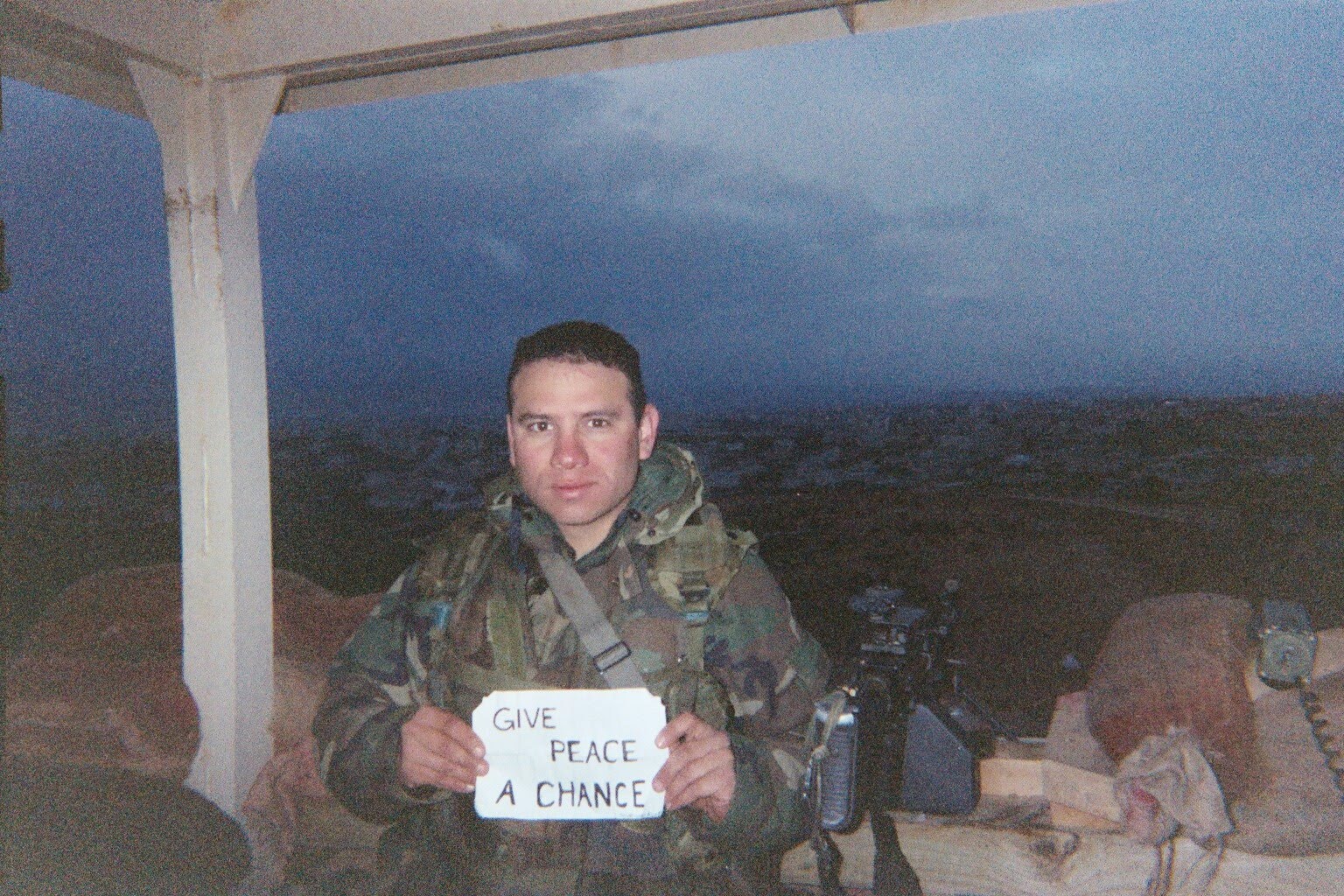
Posted in Rag Bloggers | Tagged , , , , , | Leave a comment

Ted McLaughlin : The WikiLeaks Brouhaha

Political cartoon by samir alramahi / toonpool.com.

WikiLeaks brouhaha:
A danger to our security,
or serving the public’s right to know?

By Ted McLaughlin / The Rag Blog / November 29, 2010

I doubt if there’s any established government on earth that can’t access that kind of information, which means the only people these “secrets” are being kept from are the voting public.

The internet site called WikiLeaks is in the headlines again, and once again they are embarrassing the United States government (and a bunch of other governments also, this time). They are in the process of releasing hundreds of thousands of U.S. State Department cables, which the government is claiming to be “classified” material.

Some of the material is just embarrassing, such as when government officials make unflattering remarks about other countries’ officials. Other cables show us some “secret” discussions between governments that could have serious repercussions for American citizens, such as cables that show that countries like Israel and Saudi Arabia have been putting a lot of pressure on the United States to attack Iran (and at least destroy their nuclear facilities).

The big question being debated right now is whether the release of these cables to the public (several news organizations are making them widely known to the public at large) poses a real danger to the United States government and the citizens, or does it just expose some things that probably should be public knowledge anyway in a democracy (regardless of whether some officials are embarrassed or not).

The Obama administration is taking the tack that the release of this information poses a danger. White House press secretary Robert Gibbs says:

To be clear, such disclosures put at risk our diplomats, intelligence professionals and people around the world who come to the United States for assistance in promoting democracy and open government. These documents also may include named individuals who in many cases live and work under oppressive regimes and who are trying to create more open and free societies.

By releasing stolen and classified documents, WikiLeaks has put at risk not only the cause of human rights but also the lives and work of these individuals. We condemn in the strongest terms the unauthorized disclosure of classified documents and sensitive national security information.

But WikiLeaks founder Julian Assange counters that the United States is just trying to cover up its participation in serious “human rights abuse and other criminal behavior.” The New York Times, which is printing some of the exposed diplomatic cables, says “the documents serve an important public interest, illuminating the goals, successes, compromises and frustrations of American diplomacy in a way that other accounts cannot match.”

After much thought, I have to agree with WikiLeaks and The New York Times. This is information that the American people have a right to know. Are there times when a government needs to keep a secret for national security? Yes. But I believe a Democratic government needs to keep as few secrets as is possible, and there is little doubt that our government keeps far too much from the voters (who have the right to know as much as possible to make intelligent decisions when they go to the polls).

If the government is just covering up embarrassing blunders or statements by government officials, then they are wrong — that kind of thing should not be a “state secret.” If they are indeed covering up human rights abuses or criminal behavior, that is even worse. The American people needs to know if its government is acting in such a way.

I also have to wonder just how secure these “secrets” were if an organization like WikiLeaks could get hold of them. Frankly, any government that sends real secrets by cable or electronic transmission in this information age is pretty stupid anyway (and that is something else the people need to know).

I doubt if there’s any established government on earth that can’t access that kind of information, which means the only people these “secrets” are being kept from are the voting public. The idea that WikiLeaks has been able to access information not available to any interested intelligence service is just ludicrous.

The most intelligent comment on this WikiLeaks mess that I’ve heard comes from Professor Michael Cox, associate fellow of Chatham House Think Tank. He says:

It’s a great treasure trove for historians and students of international relations. It is a sign that in the information age, it is very difficult to keep anything secret. But as to whether it’s going to cause the kind of seismic collapse of international relations that governments have been talking about, I somehow doubt.

Diplomats have always said rude things about each other in private, and everyone has always known that. Governments have a tendency to try to keep as much information as possible secret or classified, whether it really needs to be or not. The really secret information, I would suggest, is still pretty safe and probably won’t end up on WikiLeaks.

I seriously doubt that any of these released cables will hurt the security of the United States. I do think that there will be officials of the U.S. government (and other governments) who will be embarrassed by exposure of stupid or criminal actions. That is a good thing. I just don’t care if government officials are embarrassed, and I care even less if officials from other countries are embarrassed or exposed.

The American people need to know how these other countries are thinking and acting. As for our own officials, they shouldn’t be doing or saying anything they wouldn’t want their fellow citizens to know about.

Are the folks at WikiLeaks traitors or heroes? I’m voting for heroes — albeit minor ones.

[Rag Blog contributor Ted McLaughlin also posts at jobsanger.]
The Rag Blog
Posted in Rag Bloggers | Tagged , , , , | 4 Comments

Jonah Raskin : Historian Eric Foner: A Contemporary View of America’s Past

Historian Eric Foner. Photo from Wikimedia Commons.

A Rag Blog interview:
Lincoln biographer Eric Foner
tells history from the bottom up

By Jonah Raskin / The Rag Blog / November 29, 2010

The award-winning American historian, Eric Foner, has often written about the Republican Party — its origins, icon leaders, and tipping points — but Foner himself is not now nor has he ever been a front man for the Republicans.

A popular professor of history at Columbia University since 1981, he is the author most recently of The Fiery Trial: American Lincoln and American Slavery, in which he charts both the strengths and weaknesses of our 16th-president, and depicts him as an original thinker and as an adept politician in near-constant evolution.

Revered by students and fellow historians — a past president of the American Historical Association — and reviled by right-wing ideologies, Eric Foner seems to have been destined to write history. His father, Jack Foner, was an American historian who was blacklisted for years; his uncle Phil Foner was also a historian who wrote about nearly everything and everyone in American history — from 19th-century New York merchants to Frederick Douglass, Helen Keller, and the Black Panthers.

Like his father and his uncle, he is thoroughly immersed in the American past, and yet attuned to contemporary history as it unfolds today.

I met Eric Foner at Columbia in 1960 when we were both freshman, and members of Action — a student-run organization and a forerunner of Students for a Democratic Society (SDS) — that protested nuclear testing, the House Committee on Un-American Activities, and the policies of a paternalist administration.

Even in 1960, at the age of 17, he already knew he would go on to teach and to write about American history, to see it from the bottom up and from the point of view of the underdog: the slave, the worker, the immigrant.

Fifty years on, and at the start of the 50th anniversary of the 1960s — an era that shaped his own view of history — Foner continues to teach, write, and speak out on controversial political issues of the day. This interview was conducted over the long Thanksgiving holiday and ranged over a wide variety of topics — from Lincoln to Obama and Karl Marx to revolution.


Almost every day I go on line there’s another piece about Lincoln? Why is this?

Lincoln is so iconic a figure in American culture — the self-made man, frontier hero, liberator of the slaves — that everyone wants to claim him as their own. Also, because the issues of his day still resonate with ours, he somehow seems to be our contemporary in ways other figures of our past do not.

If you could channel Lincoln what do you think he’d say about Obama?

Historians don’t like to answer questions like this. Lincoln would no doubt be pleased and surprised that a black man was elected president but on bailouts, gay marriage, Afghanistan — who knows?

And about Sarah Palin?

All that I’ll say on that subject is that Lincoln had great respect for learning and expertise.

You have a new book out on Lincoln and slavery. Why did it take so long for someone to write a book about a subject that seems to obvious?

There are previous books on Lincoln and slavery but they tend to be either hagiographies — he was born ready to sign the Emancipation Proclamation — or prosecutorial briefs — he was an inveterate racist. I think it requires someone from outside what a friend of mine calls the Lincoln-industrial complex to try to show the man in all his strengths and weaknesses, and how his views changed over time.

What does the reception to your book tell you about the state of our country today?

To the extent that people relate the book to the present it may reflect a longing for political leadership in which one can take pride and have confidence.

Was Lincoln a prophetic president? Did he see into the future and see the way U.S. society was developing?

Lincoln looked back more than forward. He thought of himself as fulfilling the promise of the American Revolution. He did not foresee the rise of the industrial state of the late 19th-century, which undermined many of his deep assumptions about the dignity of labor.

You became an historian in the 1960s. What do you see now as the impact of the 1960s as an historical era on the writing and the teaching of history?

The 1960s put on the agenda of historians, issues that had been very marginalized before then — the history of race and racism; women’s history; the history more generally of ordinary people, neglected groups. We are still trying to create a persuasive new overall view of U.S. history incorporating this expansion of the historical cast of characters.

You teach U.S. history to students now. Could you characterize how this generation views history and the past?

Like previous generations, they look to history for a sense of their own identity as individuals and Americans. Because students are today so much more diverse than in the past, so must history be.

American history is continually rewritten. Only recently I read a piece about the ways that the Boston Tea Party has been viewed through the ages. Which historical periods are rewritten and revised and rethought more than others?

Reconstruction after the Civil War has been revised most thoroughly by historians, although the general public has not really caught up. The role of slavery in American life has been completely rewritten. But every period is open to reinterpretation — that’s what historians do.

What do you think is the single most important thing we ought to learn from Lincoln?

Open-mindedness, willingness to listen to critics and not surround one’s self with yes men, willingness to abandon ideas and policies that are not working and move to new ones, while maintaining one’s core principles.

Karl Marx wrote about the U.S. in the 1850s; how astute was he about the U.S.?

Marx was a shrewd observer of the Civil War, understanding the revolutionary implications for the society of the emancipation of the slaves.

And on Lincoln?

Marx saw Lincoln as a man willing to take radical steps to achieve his goals, but to couch them in mundane language like a lawyer. He also saw freeing the slaves as an essential step toward liberating labor more generally.

Do you think it’s impossible for there to be another civil war in the U.S. — a third American Revolution?

Probably not. A third Reconstruction (the second being the civil rights movement) would be a good idea, however.

Are all the major events of our society behind us?

I doubt it. The most important things in history come as complete surprises. More surprises will come in the future.

[Jonah Raskin is a professor of communication studies at Sonoma State University.]

The Rag Blog

Posted in Rag Bloggers | Tagged , , , , , , | Leave a comment

Danny Schechter : Memories of U.S. Embassy in Tehran Still Hold Us Hostage

Outside wall of U.S. Embassy, Tehran. Photo from smoughadam / Flickr.

Memories that still hold us hostage:
A visit to the U.S. Embassy in Tehran

By Danny Schechter / The Rag Blog / November 29, 2010

The latest massive Wikileaks revelations released Sunday show how the U.S. and its allies have been discussing military attacks and covert actions against Iran. If history is any judge, things don’t always work out the way Washington wants, as Danny Schechter recounts in this report about his recent visit to the former U.S. Embassy in Tehran, Iran, known locally then as a “spy nest.”

TEHRAN, Iran — The building was smaller than I remembered. The fading images in my mind were grainy: angry crowds, students marching, flags burning, chants of “Death to America,” and Americans diplomats in blindfolds, It became a soap opera: Ted Koppel started his rise in TV News with ABC’s nightly “America Held Hostage” series, the forerunner to Nightline.

Back then, I was in radio news, just transitioning into TV. I remember publicly debating about what we should do with a DJ friend who had turned from a Vietnam War peacenik into a bomb-Iran hawk.

In Iran, he takeover of the U.S. Embassy — what students called its “conquering” — was justified as a blow against imperialism, the seizure of a “spy nest.” It was, at the time, the most globally covered aspect of the Iranian Revolution, an audacious confrontation between people power and a foreign power.

The events that followed may have been considered revolutionary in Iran, but for progressive Americans they became the nail in President Jimmy Carter’s political coffin. He angered Iranians first when he toasted the Shah, calling him a beloved figure. He then tried and failed to negotiate through third parties and later sent in a military “rescue” operation that crashed and burned, leading to his own downfall.

The Iranians held him responsible for sheltering the ailing Shah; he in turn was being pressured by the likes of David Rockefeller and Henry Kissinger to protect the fleeing Monarch.

These events also helped bring on the turn to the right with the elevation of the actor we called “Ronnie Raygun.” The hostages were released in a tacit agreement after 444 days at the very hour of his inauguration.

We are still living with the consequences: wages declined, unions were broken, and military spending escalated. Reagan invaded Grenada and Beirut where the killings of hundreds of U.S. soldiers sparked what we now label a War on Terror and which Iranians see as a “Clash of Civilizations.”

The despotic Shah, our faithful servant for so many years, was driven from power by a popular revolt with the Ayatollah Ruhollah Khomeini soon becoming the man we loved to hate.

Now, 30-plus years later, I am standing in front of what was once our embassy, surrounded today by well-kept lawns as it was then.

It is as if the past is never past, with so many ghosts still around.

The tragedy is that polarization between our two countries remains symbolized by what is now a very politicized museum with photos of the activists who crawled through a basement window and tunnel to take it over. They were demanding the return of the Shah to stand trial. They were protesting U.S. interference in their internal affairs.

I didn’t remember that eight hostages — women and black employees — were released by Khomeini as a gesture. He urged the black men to return home and carry on the work of our most famous Muslim martyr, Malcolm X.

Malcolm was one of the Americans they admired.

There are rooms of creative if didactic art works, graffiti, and murals denouncing U.S. policy, including our news media which they see as a weapons system that has been deployed against them. (One slogan on the wall: “Information R.I.P.”) Perhaps this is why my film WMD: Weapons of Mass Deception was shown here and is popular.)

The angry art is not the building’s most popular attraction. On the second floor is the ex-Embassy’s own West Wing; behind a metal safe-like door is where the spying was done.

The offices are pretty much as they found them — a soundproof glass-encased safe room within a room, cryptographic equipment, communications gear that allowed them to tap Tehran’s telephones and a forgery bench where they created passports and spread disinformation. (I once saw a similar room in a former Stasi secret police station in East Germany that kept tabs on everyone.)

The students found a secret document with a floor plan of the Ayatollah’s residence and other artifacts of CIA espionage including guns and coding machines.

Today, all of this is done digitally and with much more sophistication. Just last week, the U.S. launched a massive new spy satellite to upgrade our global surveillance capabilities.

You don’t need embassies anymore to do this dirty work. We have since set up a well-funded Office of Global Reconnaissance but it doesn’t seem be to making us any more secure.

These days, a small group like Wikileaks has found ways to release hundreds of thousands of documents that officialdom wants to hide.

(After the Embassy seizure, The U.S. government downplayed spying by its diplomats, calling it “routine.” The latest Wikileaks expose reveals that diplomats are spying more than ever.)

As the students muscled their way into the Embassy back then, U.S. officials were busy destroying documents, burning them in the basement, throwing them into chemical vats that turned paper into powder, and feeding them into huge industrial-strength shredders. I saw the machines.

They managed to keep the activists at bay for three hours while destroying sensitive and potentially embarrassing data before surrendering.

What they didn’t count on was that scores of students would spend weeks patiently and systematically piecing the shreds together, literally ironing and weaving the fragments into readable prose. They reconstructed the destroyed documents and published them in scores of books that topped the best-seller list in Iran (if there was such a thing).

The late Bill Worthy, a legendary African American journalist, brought some of the books back to Boston in 1980 only to have them confiscated at the airport where he was threatened with prosecution.

Most Americans know little of Iran’s 2,500 year history, its proud culture, or the role played by the CIA in toppling the democratically elected Mosaddegh government in 1953. Mosaddegh wanted to nationalize the country’s oil instead of being forced to allow the West to exploit it. (The Ayatollah Khomeini referenced this event when he told the U.S.: “You have no right to complain, because you took our whole country hostage in 1953.”) There is no evidence that the Ayatollah organized the Embassy takeover.

They don’t know that the U.S. orchestrated Iraq’s invasion of Iran, causing a half million deaths, many from chemical weapons. I met some of the still-sick victims of those chemicals, including a disfigured Member of Parliament who was a war correspondent. Saddam’s chemical attacks on Iran’s military got almost no press attention compared to his gassing of Kurds.

Our ignorance still feeds dangerous calls for war like those made recently by the pin-headed Lindsey Graham, a Republican senator from the former Confederate State of South Carolina. He’s called for the sinking of the Iranian Navy. He seems to have forgotten his own state’s role in launching the American civil war after a Naval battle between the Monitor and the Merrimack in Charleston harbor.

The Confederates started it, but the Union finished it, finishing them finally at a great cost. Today, the South and its attitudes have risen again.

Graham also seems unaware that if we attack them, Iran will likely block the Strait of Hormuz freezing oil shipments worldwide. Not a good thing.

Today, some U.S. personalities want a theocratic state here like the one in Iran. Our own fundamentalists, many of them end-of-timers politicized into Christian Right movements, the antecedents of today’s Tea Party, fired up by vicious Islamaphobia.

Theocratic evangelists like Glenn Beck — posing as TV commentators — urge us to let God Rule, the message of some of Iran’s Mullahs. George Bush denounced Iran as part of the “Axis of Evil” while they do the same towards us. There is a poster in the former Embassy building denouncing U.S. evils.

I know my Iranian hosts expected me to be excited by visiting the Embassy as a symbol of an embarrassing setback to U.S. plans.

I wasn’t.

I reminded them that when the Taliban took Iranian diplomats hostage, and threatened to kill them, Iran moved troops to the border, and was about to invade Afghanistan before we did.

The U.S. government learned from the Embassy takeover; they didn’t change imperial policies, but did invest in more security. The U.S. now builds vast and far better-fortified “diplomatic” enclaves like Iraq’s Green Zone. Secrecy has become our national security state’s religion.

These symbols of our past conflicts have a way of blocking new initiatives and possible reconciliation. I am sure that the former Embassy building is on some target list for potential missile attacks on Tehran. Americans relish “payback” as much as do Iranians.

Avoiding an escalation of tension will not be easy as Jaswant Singh, a former Indian finance minister, foreign minister, and defense minister explains: “In both countries, deep and mutually paralyzing suspicion has poisoned relations for three decades. Negotiations in such an atmosphere are almost fated to failure.”

Can anything be done?

On the plane back, I watched the movie SALT where Angelina Jolie stops a fictionalized nuclear attack on Tehran at the last second in a gun battle staged in the bunker below the White House.

Hollywood pictures the story as a plot by Russian renegades who want to use nukes to outrage the whole Muslim world and trigger a more apocalyptic jihad against the U.S.

At the same time, we are doing all we can to block Iranian nuclear ambitions, even as I told an audience in Iran about my own objections to nuclear power plants in favor of green energies — not a popular position.

There are legitimate nonfiction fears of a new war against Iran, another no-win conflict that will cause more death and sap more treasure.

The neocons are busy at work lobbying for just such a war, eager to replicate their “heroic victory” over Iraq. They are playing the fear card with lots of covert lobbying from Israel that claims Iran represents an “existential” threat.

To me, the arrogant right-wing politicians and propagandists in Israel are a far more dangerous threat to any prospects for peace. Successive American administrations, like the current one, keep shoveling sheckels at them, appeasing their contempt for and occupation of Palestinians.

The world mocks dogmatic believers in the Koran while fanatical Torah worshippers have a free pass to practice hatred.

Talk about hypocrisy.

War is a profitable business, and as our economy continues its decline, we can anticipate more calls to “bomb, bomb, bomb Iran” so we can fight and spend our way to “recovery.”

Talk about insanity.

Already our sanctions are hurting the Iranian people and their businesses without seriously impacting their government, whatever the fiery pubic claims of President Mahmoud Ahmadinejad.

We need to engage, but even the talks President Obama promised have yet to happen. Washington seems as frozen as Tehran in making a real overture.

What if Iran turned the former U.S. Embassy into an international peace and religious center for diplomatic discourse and mediation? That might be a gesture Washington could respond to. Why not recycle a relic of the past to enable a serious initiative for resolving conflict? The growing confrontation gives both countries an enemy to mobilize against while diverting attention from real problems.

Someone has to break the ice before we end up causing each other more pain!

My walk down a lane of bad memories convinced me that we need to work for a better future, not stay mired in the images and rhetorical combats of the past.

[News Dissector Danny Schechter just returned from Tehran where he was invited to be a judge in an international short film festival. Contact hem at Dissector@mediachannel.org.]

The Rag Blog

Posted in Rag Bloggers | Tagged , , , , , , | Leave a comment