Martial Law in Chile

Tossed like toys: People look at vehicles, strewn belongings, and large shipping containers hurled aground by the tsunami in downtown Talcahuano, Chile (March 1, 2010). Photo: Martin Bernetti/AFP/Getty Images.

Government declares martial law in central Chile after earthquake

By Rafael Azul / March 2, 2010

President-elect Sebastián Piñera, a billionaire businessman and right-wing figure who had close ties to the Pinochet dictatorship and the US …

“has strongly endorsed the use of troops and called for the restoration of order. ‘We must prevent vandalism and looting,’ he declared.”

We ask, “How about preventing hunger and thirst?” This militarist response to the tragedy quickly elicits thoughts of the US response to Katrina and Haiti. But it’s not surprising seeing that Piñera and Bachelet are both on Washington’s leash and ideological throwbacks to Pinochet.

Les Blough, Editor, Axis of Logic

The Chilean government of President Michelle Bachelet has declared martial law in parts of central Chile in the aftermath of Saturday’s devastating earthquake. Ten thousand soldiers have taken control of Maule and Bío Bío, the two regions most directly affected.

President Bachelet declared a state of siege on the pretext that it was necessary to maintain order and distribute aid. Government officials blamed so-called looters for interfering with the rescue and aid effort. This is the first state of siege declared in Chile since the fall of the bloody Pinochet military dictatorship in 1989.

So far, the death toll from the massive 8.8-magnitude earthquake and a subsequent tsunami stands at 723 and is expected to rise. Many who are now missing are believed to have drowned at sea, while others are still buried under the rubble. Some 1.5 million homes were destroyed, many of them wiped out by the tsunami.

The number of wounded and disappeared has not been established, but it is believed to be in the tens of thousands. In Concepción, Chile’s second largest city, 48 people are believed to be trapped alive under a collapsed 15-story building.

Attempts by residents to get access to food have been most concentrated in the poor neighborhoods of southern Santiago, Chile’s capital, and Concepción. Concepción’s mayor, Jacqueline Van Rysselberghe, was first to demand the use of government troops, after using Concepción police to fire tear gas at residents. “Marines and soldiers must be on the street, because there is chaos,” declared Van Rysselberghe.

Van Rysselberghe herself admitted that the quake victims are facing hunger. “If we do not solve the food problem, we will face an explosive situation,” she said. Her words were echoed by her counterpart at Bío Bío, Jaime Tohár: “We had a dramatic day. The earthquake caused enormous damage. We fully expect that the number of dead will increase. Many are still buried under the rubble.”

Furthermore, the twin blows, the earthquake followed by a tsunami, served to expose the state of Chilean infrastructure. The most essential services — electricity, water, fuel, and transportation — failed.

Because of the tsunami, some of the worst hit towns — including Constitucion, Lloca, Dichato, and others — lie on the coast. Many of these towns remain largely isolated three days later. The Los Angeles Times quoted Constitucion municipal comptroller Cesar Arrellano saying, “It seems everyone has forgotten about us. Maybe that’s because we’re out of contact.”

The Argentine daily Página 12 quoted a Concepción resident who was taking food from a store as saying, “This is for my children. I have no way of feeding them.” Another woman leaving a supermarket added, “We must eat.”

Defense Minister Francisco Vidal has publicly declared that the military will only have a “dissuasive” role. However, reports from Concepción describe how some troops lay in ambush waiting for people to remove merchandise, only to chase them away with tear gas and water cannons in scenes reminiscent of the Pinochet dictatorship. In the city of Talcahuano, near Concepción, troops repressed citizens trying to open a shipping container that they believed was loaded with bananas, sugar and oil.

So far, the police and army have arrested over 105 people. Two people have been shot and killed, one of them by the military in Concepción. Another was gunned down in the city of Chiguayante while walking after curfew; it is not known who killed him.

Government authorities now say that the Navy was slow in warning about the tsunami danger to Juan Fernandez Island, 813 kilometers (about 500 miles) off the coast of Valparaiso. The tsunami flooded half the island and killed at least six, while dozens are still missing. In the cities of Concepción, Talcauano, Curicó, San Javier, Linares, and Talca, as well as in smaller coastal towns, hundreds of families made homeless by the twin disasters are sleeping outside.

President-elect Sebastián Piñera, a billionaire businessman and right-wing figure who had close ties to the Pinochet dictatorship and the U.S., will take office on March 11. He has strongly endorsed the use of troops and called for the restoration of order. “We must prevent vandalism and looting,” he declared. Both Piñera and Bachelet have shown profound indifference to the plight of hundreds of thousands of Chilean families.

Piñera’s election last February came after two decades of Concertación governments, a partnership between the Socialist and Christian Democratic parties. Successive Concertación regimes perpetuated the disaster of Pinochet’s free-market policies. With nearly 20 percent of Chilean households below the poverty line, Chile has one of the most unequal distributions of income in South America, exceeded only by Brazil and Colombia.

Piñera is now using the crisis to renew his call for a “public-private partnership to rebuild Chile.” In fact, Piñera has made no secret that this “partnership” is nothing else than the subordination of Chilean society and government institutions to the profit needs of the corporations and banks.

Source / Axis of Logic

Thanks to Deva Wood / The Rag Blog

Posted in RagBlog | Tagged , | Leave a comment

Empathy: Human Evolution’s Next Step

The human ability to empathize with other humans, to place oneself in the shoes of another, is a skill that is greatly diminished in modern society.Image from Demand More.

‘Empathic Civilization’: When both faith and reason fail, stepping up to the Age of Empathy

Empathy represents the deepest expression of awe, and understandably is regarded as the most spiritual of human qualities.

By Jeremy Rifkin / March 1, 2010

While our radio talk shows and 24-hour cable TV news programs incessantly play off the political rift between conservative and liberal ideologies, the deeper conflict in America has always been the cultural divide between faith versus reason.

At the dawn of the modern market economy and nation-state era, the philosophers of the Enlightenment challenged the Age of Faith that governed over the feudal economy with the Age of Reason. Theologians and philosophers have continued to battle over faith vs. reason ever since, their debates often spilling over into the cultural and political arenas, with profound consequences for society.

Today, however, at the outset of a global economy and the biosphere era, a new generation of scientists, scholars, and social reformers is beginning to challenge some of the underlying assumptions of both the Age of Faith and the Age of Reason, taking us into the Age of Empathy.

The empathic advocates argue that, for the most part, both earlier narratives about human nature fail to plumb the depths of what makes us human and therefore leave us with cosmologies that are incomplete stories — that is, they fail to touch the deepest realities of existence. That’s not to dismiss the critical elements that make the stories of faith and reason so compelling. It’s only that something essential is missing — and that something is “embodied experience.”

Both the Abrahamic faiths — Judaism, Christianity, and Islam — as well as the Eastern religions of Buddhism, Hinduism, and Taoism, either disparage bodily existence or deny its importance. So too does modern science and most of the rational philosophers of the Enlightenment.

For the former, especially the Abrahamic faiths, the body is fallen and a source of evil. Its presence is a constant reminder of the depravity and mortality of human nature. For the latter, the body is mere scaffolding to maintain the mind, a necessary inconvenience to provide sensory perception, nutrients, and mobility. It is a machine the mind uses to impress its will on the world. It is even loathed because of its transient nature. The body is a constant reminder of death, and therefore, feared, disparaged and dismissed in the world’s great religions and among many of the Enlightenment philosophers.

Most of all, the body is to be mistrusted, especially the emotions that flow from its continuous engagement with and reaction to the outside world. Neither the Bible nor the Enlightenment ruminations make much room for human emotions, except to depreciate them as untrustworthy and an impediment either to obedience to God in the first instance or to the rational will in the second instance.

In the modern era, with its emphasis on rationality, objectivity, detachment, and calculability, human emotions are considered irrational, quixotic, impossible to objectify, not subject to detached evaluation, and difficult to quantify. Even today, it is common lore not to let one’s emotions get in the way of sound reasoning and judgment. How many times have we heard someone say, or have we said to someone else, “Try not to be so emotional… try to behave more rationally.”

The clear message is that emotions are of a lesser ilk than reason. They are too carnal and close to our animal passions to be considered worthy of being taken seriously — and worse still, they pollute the reasoning process.

The Enlightenment philosophers — with a few notable exceptions — eliminated the very mortality of being. To be alive is to be physical, finite, and mortal. It is to be aware of the vulnerability of life and the inevitability of death. Being alive requires a continuous struggle to be and comes with pain, suffering, and anguish, as well as moments of joy. How does one celebrate life or mourn the passing of a relative or friend or enter into an intimate relationship with another in a world devoid of feelings and emotions?

New developments in evolutionary biology, cognitive science, and psychology are laying the groundwork for a wholesale reappraisal of human consciousness. The premodern notion that faith and God’s grace are the windows to reality and the Enlightenment idea that reason is at the apex of modern consciousness are giving way to a more sophisticated approach to a theory of mind.

Researchers in a diverse range of fields and disciplines are beginning to reprioritize some of the critical features of faith and reason within the context of a broader empathic consciousness. They argue that all of human activity is embodied experience — that is, participation with the other — and that the ability to read and respond to another person “as if” he or she were oneself is the key to how human beings engage the world, create individual identity, develop language, learn to reason, become social, establish cultural narratives, and define reality and existence.

If empathic consciousness flows from embodied experience and is a celebration of life — our own and that of other beings — how do we square it with faith and reason, which are disembodied ways of looking at reality and steeped in the fear of death?

When we deconstruct the notion of faith, we find that at the core are three essential pillars: awe, trust, and transcendence. The religious impulse begins with the sense of awe, the feeling of the wonder of existence, both the mystery and majesty. Awe is the deepest celebration of life. We marvel at the overwhelming nature of existence, and sense that by our own aliveness, we somehow fit into the wonder we behold.

Although faith is set in motion by a feeling of awe and requires a belief that one’s life has meaning in a larger, universal sense of things, it can be purloined and made into a social construct that exacts obedience, feeds on fear of death, is disembodied in its approach, and establishes rigid boundaries separating the saved from the damned. Many institutionalized religions do just that.

It is awe that inspires all human imagination. Without awe, we would be without wonder and without wonder we would have no way to exercise imagination and would therefore be unable to imagine another’s life “as if” it were our own. We know that empathy is impossible without imagination. Imagination, however, is impossible without wonder, and wonder is impossible without awe. Empathy represents the deepest expression of awe, and understandably is regarded as the most spiritual of human qualities.

But faith also requires trust — the willingness to surrender ourselves to the mystery of existence at both the cosmic level and at the level of everyday life with our fellow beings. Trust becomes indispensable to allowing empathy to grow, and empathy, in turn, allows us to plumb the divine presence that exists in all things. Empathy becomes the window to the divine. It is by empathic extension that we transcend ourselves and begin connecting with the mystery of existence.

In the empathic civilization, spirituality invariably replaces religiosity. Spirituality is a deeply personal journey of discovery in which empathic experience — as a general rule — becomes the guide to making connections, and becomes the means to foster transcendence. The World Values Survey and countless other polls show a generational shift in attitudes toward the divine, with the younger generation in the industrialized nations increasingly turning away from institutionalized religiosity and toward personal spiritual quests that are empathic in nature.

Reason too can be salvaged from its disembodied Enlightenment roots and be recast within an embodied empathic frame. While reason is most often thought of in terms of rationalization, that is, abstracting and classifying phenomena, usually with the help of quantifiable tools of measurement, it is more than that. Reason includes mindfulness, reflection, introspection, contemplation, musing, and pondering, as well as rhetorical and literary ways of thinking. Reason is all of this and more. When we think of reason, we generally think of stepping back from the immediacy of an experience and probing our memories to see if there might be an analogous experience that could help us make the appropriate judgment or decisions about how best to respond.

The critical question is where does reason come from? The Cartesian and Kantian idea that reason exists independently of experience as an a priori phenomenon to be accessed does not conform to the way we reason in the real world. Reason is a way of organizing experience and relies on many mental tools. The point, however, is that reason is never disembodied from experience but rather a means of understanding and managing it.

Experience, as we learned earlier, begins with sensations and feelings that flow from engagement with others. While one’s sensations and feelings make possible the initial connection with the other, they are quickly filtered by way of past memories and organized by the various powers of reason at our disposal to establish an appropriate emotional, cognitive, and behavioral response. The entire process is what makes up empathetic consciousness. Empathy is both an affective and cognitive experience.

If empathy did not exist, we could not understand why we feel the way we do, or conceptualize something called an emotion or think rationally. Many scholars have mistakenly associated empathy with just feelings and emotions. If that were all it was, empathic consciousness would be an impossibility.

Reason, then, is the process by which we order the world of feelings in order to create what psychologists call pro-social behavior and sociologists call social intelligence. Empathy is the substance of the process. Reason becomes increasingly sophisticated as societies become more complex, human differentiation more pronounced, and human exchange more diverse. Greater exposure to others increases the volume of feelings that need to be organized. Reason becomes more adept at abstracting and managing the flood of embodied feelings. That’s not to say that reason can’t also be used to exploit others, for example, to advance narcissistic ends or create terror among people.

By reimagining faith and reason as intimate aspects of empathic consciousness, we create a new historical synthesis–the Age of Empathy–that incorporates many of the most powerful and compelling features of the Age of Faith and the Age of Reason, while leaving behind the disembodied story lines that shake the celebration out of life.

[Jeremy Rifkin is the author of The Empathic Civilization: The Race to Global Consciousness in a World in Crisis.]

Source / Huffington Post

Thank you to Deva Wood / The Rag Blog

Posted in RagBlog | Tagged , | Leave a comment

Chris Hedges on Refusing to Support the Democrats


Ralph Nader was right about Barack Obama

The timidity of the left exposes its cowardice, lack of a moral compass and mounting political impotence. The left stands for nothing.

By Chris Hedges / March 1, 2010

We owe Ralph Nader and Cynthia McKinney an apology. They were right about Barack Obama. They were right about the corporate state. They had the courage of their convictions and they stood fast despite wholesale defections and ridicule by liberals and progressives.

Obama lies as cravenly, if not as crudely, as George W. Bush. He promised us that the transfer of $12.8 trillion in taxpayer money to Wall Street would open up credit and lending to the average consumer. The Federal Deposit Insurance Corporation (FDIC), however, admitted last week that banks have reduced lending at the sharpest pace since 1942.

As a senator, Obama promised he would filibuster amendments to the FISA Reform Act that retroactively made legal the wiretapping and monitoring of millions of American citizens without warrant; instead he supported passage of the loathsome legislation. He told us he would withdraw American troops from Iraq, close the detention facility at Guantánamo, end torture, restore civil liberties such as habeas corpus, and create new jobs. None of this has happened.

He is shoving a health care bill down our throats that would give hundreds of billions of taxpayer dollars to the private health insurance industry in the form of subsidies, and force millions of uninsured Americans to buy insurers’ defective products. These policies would come with ever-rising co-pays, deductibles and premiums and see most of the seriously ill left bankrupt and unable to afford medical care.

Obama did nothing to halt the collapse of the Copenhagen climate conference, after promising meaningful environmental reform, and has left us at the mercy of corporations such as ExxonMobil. He empowers Israel’s brutal apartheid state. He has expanded the war in Afghanistan and Pakistan, where hundreds of civilians, including entire families, have been slaughtered by sophisticated weapons systems such as the Hellfire missile, which sucks the air out of victims’ lungs. And he is delivering war and death to Yemen, Somalia and perhaps Iran.

The illegal wars and occupations, the largest transference of wealth upward in American history and the egregious assault on civil liberties, all begun under George W. Bush, raise only a flicker of tepid protest from liberals when propagated by the Democrats.

Liberals, unlike the right wing, are emotionally disabled. They appear not to feel. The tea-party protesters, the myopic supporters of Sarah Palin, the veterans signing up for Oath Keepers and the myriad of armed patriot groups have swept into their ranks legions of disenfranchised workers, angry libertarians, John Birchers, and many who, until now, were never politically active. They articulate a legitimate rage.

Yet liberals continue to speak in the bloodless language of issues and policies, and leave emotion and anger to the protofascists. Take a look at the 3,000-word suicide note left by Joe Stack, who flew his Piper Cherokee last month into an IRS office in Austin, Texas, murdering an IRS worker and injuring dozens. He was not alone in his rage.

“Why is it that a handful of thugs and plunderers can commit unthinkable atrocities (and in the case of the GM executives, for scores of years) and when it’s time for their gravy train to crash under the weight of their gluttony and overwhelming stupidity, the force of the full federal government has no difficulty coming to their aid within days if not hours?” Stack wrote.

“Yet at the same time, the joke we call the American medical system, including the drug and insurance companies, are murdering tens of thousands of people a year and stealing from the corpses and victims they cripple, and this country’s leaders don’t see this as important as bailing out a few of their vile, rich cronies.

“Yet, the political ‘representatives’ (thieves, liars, and self-serving scumbags is far more accurate) have endless time to sit around for year after year and debate the state of the ‘terrible health care problem’. It’s clear they see no crisis as long as the dead people don’t get in the way of their corporate profits rolling in.”

The timidity of the left exposes its cowardice, lack of a moral compass and mounting political impotence. The left stands for nothing. The damage Obama and the Democrats have done is immense. But the damage liberals do the longer they beg Obama and the Democrats for a few scraps is worse.

It is time to walk out on the Democrats. It is time to back alternative third-party candidates and grass-roots movements, no matter how marginal such support may be. If we do not take a stand soon we must prepare for the rise of a frightening protofascist movement, one that is already gaining huge ground among the permanently unemployed, a frightened middle class and frustrated low-wage workers.

We are, even more than Glenn Beck or tea-party protesters, responsible for the gusts fanning the flames of right-wing revolt because we have failed to articulate a credible alternative.

A shift to the Green Party, McKinney, and Nader, along with genuine grass-roots movements, will not be a quick fix. It will require years in the wilderness. We will again be told by the Democrats that the least-worse candidate they select for office is better than the Republican troll trotted out as an alternative.

We will be bombarded with slick commercials about hope and change and spoken to in a cloying feel-your-pain language. We will be made afraid. But if we again acquiesce we will be reduced to sad and pathetic footnotes in our accelerating transformation from a democracy to a totalitarian corporate state.

Isolation and ridicule — ask Nader or McKinney — is the cost of defying power, speaking truth and building movements. Anger at injustice, as Martin Luther King wrote, is the political expression of love. And it is vital that this anger become our own. We have historical precedents to fall back upon.

“Here in the United States, at the beginning of the twentieth century, before there was a Soviet Union to spoil it, you see, socialism had a good name,” the late historian and activist Howard Zinn said in a lecture a year ago at Binghamton University. “Millions of people in the United States read socialist newspapers. They elected socialist members of Congress and socialist members of state legislatures. You know, there were like 14 socialist chapters in Oklahoma. Really. I mean, you know, socialism — who stood for socialism? Eugene Debs, Helen Keller, Emma Goldman, Clarence Darrow, Jack London, Upton Sinclair. Yeah, socialism had a good name. It needs to be restored.”

Social change does not come through voting. It is delivered through activism, organizing, and mobilization that empower groups to confront the hegemony of the corporate state and the power elite. The longer socialism is identified with the corporatist policies of the Democratic Party, the longer we allow the right wing to tag Obama as a socialist, the more absurd and ineffectual we become.

The right-wing mantra of “Obama the socialist,” repeated a few days ago to a room full of Georgia Republicans, by Newt Gingrich, the former U.S. speaker of the House, is discrediting socialism itself. Gingrich, who looks set to run for president, called Obama the “most radical president” the country had seen in decades. “By any standard of government control of the economy, he is a socialist,” Gingrich said. If only the critique were true.

The hypocrisy and ineptitude of the Democrats become, in the eyes of the wider public, the hypocrisy and ineptitude of the liberal class. We can continue to tie our own hands and bind our own feet or we can break free, endure the inevitable opprobrium, and fight back.

This means refusing to support the Democrats. It means undertaking the laborious work of building a viable socialist movement. It is the only alternative left to save our embattled open society. We can begin by sending a message to the Green Party, McKinney and Nader. Let them know they are no longer alone.

Source / Truthdig

The Rag Blog

Posted in RagBlog | Tagged , | 4 Comments

Saying Coal Can Be Clean Doesn’t Make It So


The dirty truth behind clean coal

By Joshua Frank / February 28, 2010

If you’ve tuned in to the Winter Olympics this past week, you likely sat through repeated showings of a multimillion-dollar public relations campaign paid for by Big Coal regarding the potential laurels of “clean-coal” technology. The premise of the 30-second spot is simple: Coal can be clean and America needs to wean itself off of foreign crude and create jobs back home by tapping our nation’s vast coal reserves.

Indeed, the effort to paint coal as environmentally friendly is not an easy endeavor, especially when the climate movement has picked up speed and lambasted the industry for contributing more than its fair share to the global warming dilemma.

Activists around the world have targeted coal for a number of reasons. First, coal is still plentiful (compared to gas and oil) so stopping its use will largely curtail carbon output down the road. Second, it is the dirtiest of all fossil fuels. Lastly, in the U.S. the fleet of coal-fired power plants is almost old enough to file for Medicare, so these aging plants are sitting ducks for closure efforts.

“NASA climate scientist James Hansen… has demonstrated two things in recent papers,” writes environmental author and activist Bill McKibben about the need to axe coal. “One, that any concentration of carbon dioxide greater than 350 parts per million in the atmosphere is not compatible with the ‘planet on which civilization developed and to which life on earth is adapted.’ And two, that the world as a whole must stop burning coal by 2030 — and the developed world well before that — if we are to have any hope of ever getting the planet back down below that 350 number.”

If this were a prize fight, Big Coal would be the battered boxer in the corner of the ring, shuffling away in an attempt to avoid the repeated jabs anti-coal warriors and scientists have been tossing its way. In 2009, not one new coal plant broke ground in the United States. Over 100 new plants were canceled or abandoned, largely due to the public’s awareness that coal isn’t the fuel of the future but a scourge of the past.

Clearly there is a reason for the coal industry’s recent PR stunts. Big Coal is losing, and its best attempts to persuade the public about coal’s green potential are failing miserably.

At the heart of “clean-coal” logic is the idea that carbon dioxide produced from burning coal can be captured and buried underground before it is ever released into the atmosphere where it will contribute to the earth’s warming for centuries to come. Despite the fact that this technology, dubbed Carbon Capture and Storage (CCS), doesn’t actually exist in any real capacity in the United States, it has not stopped the coal lobby from spreading the filthy myths.

Given the reality of climate change, Big Coal is banking on CCS to help it navigate its tenuous future, so much so that they are already touting the virtues of CCS to the public. Not surprisingly, the industry’s pals in Washington, including virtually all the senators (Republican and Democrat alike) from coal-producing states, are going to bat for the beleaguered industry.

Certainly the effort to greenwash one of the most prolific and dirtiest energy sources on the planet does not come without a hefty price tag. The proposed Waxman-Markey climate bill, for example, is set to provide a whopping $60 billion in subsidies for “clean-coal” technologies. President Obama is on board and nary a word of opposition has peeped out of the Beltway. To put this amount of money in perspective, the coal industry itself, measured by its falling Wall Street stock, is only worth about $50 billion. The subsidies are a bailout by a different name.

Photo from London Permaculture.

In theory, in order for CCS to work, large underground geological formations would have to house this carbon dioxide. But according to a recent peer-reviewed article in the Society of Petroleum Engineers’ publication, the CCS jig is up and the technology just doesn’t seem feasible.

“Earlier published reports on the potential for sequestration fail to address the necessity of storing CO2 in a closed system,” writes report author Professor Michael Economides in an editorial for the Casper, Wyoming, Star-Tribune. “Our calculations suggest that the volume of liquid or supercritical CO2 to be disposed cannot exceed more than about 1 percent of pore space. This will require from 5 to 20 times more underground reservoir volume than has been envisioned by many, including federal government laboratories, and it renders geologic sequestration of CO2 a profoundly non-feasible option for the management of CO2 emissions.”

To put this in laymen’s terms, the areas that would house carbon produced from coal plants will have to be much larger than originally predicted. So much so, in fact, that it makes CCS absolutely improbable. By Professor Economides’ projections, a small 500 MW plant’s underground CO2 reservoir would need to be the size of a small state like Vermont to even work.

“There is no need to research this subject any longer,” adds Economides. “Let’s try something else.”

Let’s take that a step further and add that we ought to bag the idea that coal can be clean altogether. The public investment in clean-coal technology is a fraud and will only serve as a life-support system for an industry that must be phased out completely over the course of the next two decades.

Putting billions of dollars behind a dead-end theory will not bring about the energy changes our country and climate so drastically need.

Source / TruthOut

The Rag Blog

Posted in RagBlog | Tagged , , | Leave a comment

Utah : Challenging Women’s Rights Again

Critics fear the new law could affect women who drink and miscarry.
Photo: UPPA / Photoshot.

Utah women may face murder charges after miscarriages

By David Usborne / February 28, 2010

Outrage at bill that could jail women who ‘recklessly’ endanger unborn children

A proposed Utah law that would open women who suffer a miscarriage to possible criminal prosecution and life imprisonment has enraged feminists and civil rights activists across the United States.

Adopted overwhelmingly by both sides of the state legislature in Salt Lake City earlier this month, the draft bill is now awaiting the signature of the state’s Republican Governor, Gary Herbert. It is not clear if the growing national controversy surrounding the proposed law will slow or even stay his pen.

While the main thrust of the law is to enable prosecutors in the majority-Mormon state to pursue women who seek illegal, unsupervised forms of abortion, it includes a provision that could trigger murder charges against women found guilty of an “intentional, knowing or reckless act” that leads to a miscarriage. Some say this could include drinking one glass of wine too many, walking on an icy pavement or skiing.

Lawmakers were responding to the case of a 17-year-old pregnant Utah woman who paid a man $150 to assault her physically in the hope that the beating would cause her to miscarry. The child was born anyway and put up for adoption. And while the man involved is currently behind bars, prosecutors found they had no basis in state law to prosecute the young woman. She was in her seventh month when she tried to terminate her pregnancy.

Last-minute efforts to remove reference in the bill to “reckless” acts failed, feeding the uproar about a law that some people say would be impossible to implement and threatens basic freedoms of women. Statistics suggest that 15 to 20 per cent of recognized pregnancies end in miscarriage.

“This creates a law that makes any pregnant woman who has a miscarriage potentially criminally liable for murder,” said Missy Bird, director of Planned Parenthood Action Fund of Utah, part of the national organisation that champions abortion rights.

Critics also note that the bill has no exemptions for women who suffer domestic abuse or who have addiction problems. They wonder, for example, about the putative case of a woman remaining with an abusive partner and suffering a miscarriage after an episode of violence. Would remaining in that relationship constitute “reckless” behavior, they ask?

Abortion remains deeply contentious in the United States, where, with some restrictions, it has been legal under the terms of the landmark Roe v Wade ruling by the Supreme Court of 1973. The issue returned to the front pages last month when Scott Roeder was tried and convicted for the murder in Kansas last August of one of the few doctors legally providing late-term abortions in the country.

The reaction to Utah’s new initiative has verged in most quarters on disbelief, however. “For all these years the anti-choice movement has said ‘we want to outlaw abortion, not put women in jail’, but what this law says is ‘no, we really want to put women in jail’,” Lynn Paltrow, executive director of National Advocates for Pregnant Women, wrote in a blog.

Similarly astonished is the syndicated columnist Dan Savage. “Where will this insanity end?” he wrote. “If every miscarriage is a potential homicide, how does Utah avoid launching a criminal investigation every time a woman has a miscarriage? And how is Utah supposed to know when a pregnant woman has had a miscarriage? You’re going to have to create some sort of pregnancy registry to keep track of all those fetuses. Perhaps you could start issuing ‘conception certificates’ to women who get pregnant. And then, if there isn’t a baby within nine months of the issuance of a conception certificate, the woman could be hauled in for questioning.”

Utah is used to criticism from some of its more liberal neighbors for its socially conservative ways that range from allowing concealed guns on its state university campus to strict limits on alcohol sales. It has not gone unnoticed that consideration of the bill, with the potentially high costs it would entail, has coincided with a debate on canceling the last year of school for Utah children to help to save the state money.

Source / The Independent, U.K.

The Rag Blog

Posted in RagBlog | Tagged , , | Leave a comment

Cole on the "Swift-Boating" of Climate Change Science


Advice to climate scientists on how to avoid being Swift-boated and how to become public intellectuals

By Juan Cole / February 28, 2010

Climate Scientists continue to see persuasive evidence of global warming and climate change when they speak at academic conferences, even though, as Andrew Sullivan rightly put it, the science is being ‘swift-boated before our eyes.’ (See also Bill McKibben at Tomdispatch.com on Climate Change’s OJ Simpson moment.)

This article at mongabay.com includes some hand-wringing from scientists who say that they should have responded to the attacks earlier and more forcefully in public last fall, or who worry that scientists are not charismatic TV personalities who can be persuasive on that medium.

Let me just give my scientific colleagues some advice, since as a Middle East expert I’ve seen all sorts of falsehoods about the region successfully purveyed by the U.S. mass media and print press, in such a way as to shape public opinion and to affect policy-making in Washington:

  1. Every single serious climate scientist should be running a blog. There is enormous thirst among the public for this information, and publishing only in technical refereed journals is guaranteed to quarantine the information away from the general public. A blog allows scientists to summarize new findings in clear language for a wide audience. It makes the scientist and the scientific research “legible” to the wider society. Educated lay persons will run with interesting new findings and cause them to go viral. You will also find that you give courage to other colleagues who are specialists to speak out in public. You cannot depend on journalists to do this work. You have to do it yourselves.
  2. It is not your fault. The falsehoods in the media are not there because you haven’t spoken out forcefully or are not good on t.v. They are there for the following reasons:
  • Very, very wealthy and powerful interests are lobbying the big media companies behind the scenes to push climate change skepticism, or in some cases (as with Rupert Murdoch’s Newscorp/Fox Cable News) the powerful and wealthy interests actually own the media.
  • Powerful politicians linked to those wealthy interests are shilling for them, and elected politicians clearly backed by economic elites are given respect in the U.S. corporate media. Big Oil executives e.g. have an excellent Rolodex for CEOs, producers, the bookers for the talk shows, etc., in the corporate media. They also behind the scenes fund “think tanks” such as the American Enterprise Institute to produce phony science. Since the AEI generates talking points that aim at helping Republicans get elected and pass right wing legislation, it is paid attention to by the corporate media.
  • Media thrives on controversy, which produces ratings and advertising revenue. As a result, it is structured into an “on the one hand, on the other hand” binary argument. Any broadcast that pits a climate change skeptic against a serious climate scientist is automatically a win for the skeptic, since a false position is being given equal time and legitimacy. It was the same in the old days when the cigarette manufacturers would pay a “scientist” to go deny that smoking causes lung cancer. And of course we saw all the instant Middle East experts who knew no Arabic and had never lived in the Arab world or sometimes even been there who were paraded as knowledgeable sources of what would happen if the United States invaded Iraq and occupied it.
  • Journalists for the most part have to do as they are told. Their editors and the owners of the corporate media decide which stories get air time and how they are pitched. Most journalists privately admit that they hate their often venal and ignorant bosses. But what alternative do most of them have?
  • Journalists for the most part do not know how to find academic experts. An enterprising one might call a university and be directed to a particular faculty member, which is way too random a way to proceed. If I were looking for an academic expert, I’d check a citation index of refereed articles, but most people don’t even know how to find the relevant database. Moreover, it is not all the journalists’ fault. Journalism works on short deadlines and academics are often teaching or in committee and away from email. Many academics refuse (shame on them) to make time for media interviews.
  • Many journalists are generalists and do not themselves have the specialized training or background for deciding what the truth is in technical controversies. Some of them are therefore fairly easily fooled on issues that require technical or specialist knowledge. Even a veteran journalist like Judy Miller fell for an allegation that Iraq’s importation of thin aluminum tubes in 2002 was for nuclear enrichment centrifuges, even though the tubes were not substantial enough for that purpose.

    Many journalists (and even Colin Powell) reported with a straight face the Neocon lie that Iraq had “mobile biological weapons labs,” as though they were something you could put in a Winnebago and bounce around on Iraq’s pitted roads. No biological weapons lab could possibly be set up without a clean room, which can hardly be mobile.

    Back in the Iran-Iraq War, I can remember an American wire service story that took seriously Iraq’s claim that large numbers of Iranian troops were killed trying to cross a large body of water by fallen electrical wires; that could happen in a puddle but not in a river. They were killed by Iraqi poison gas, of course.

    The good journalists are aware of their limitations and develop proxies for figuring out who is credible. But the social climbers and time servers are happy just to host a shouting match that maybe produces ‘compelling’ television, which is how they get ahead in life.

  • If you just keep plugging away at it, with blogging and print, radio and television interviews, you can have an impact on public discourse over time. I could not quantify it, but I am sure that I have. It is a lifetime commitment and a lot of work and it interferes with academic life to some extent. Going public also makes it likely that you will be personally smeared and horrible lies purveyed about you in public (they don’t play fair — they make up quotes and falsely attribute them to you; it isn’t a debate, it is a hatchet job).

    I certainly have been calumniated, e.g. by powerful voices such as John Fund at the Wall Street Journal or Michael Rubin at the American Enterprise Institute. But if an issue is important to you and the fate of your children and grandchildren, surely having an impact is well worth any price you pay.

  • Source / Informed Comment

    The Rag Blog

    Posted in RagBlog | Tagged , , | 3 Comments

    The Pentagon and All Its Suckers (That Would Be Us)


    Gargantua’s mouth:
    The Pentagon and the suckers

    By Saul Landau and Nelson P. Valdes / February 27, 2010

    The perpetual menacings of danger oblige the government to be always prepared to repel it; its armies must be numerous enough for instant defense. The continual necessity for their services enhances the importance of the soldier, and proportionally degrades the condition of the citizen. The military state becomes elevated above the civil. The inhabitants of territories, often the theatre of war, are unavoidably subjected to frequent infringements on their rights, which serve to weaken their sense of those rights; and by degrees the people are brought to consider the soldiery not only as their protectors, but as their superiors. The transition from this disposition to that of considering them masters, is neither remote nor difficult; but it is very difficult to prevail upon a people under such impressions, to make a bold or effectual resistance to usurpations supported by the military power.” — Alexander Hamilton

    “In the councils of government, we must guard against the acquisition of unwarranted influence, whether sought or unsought, by the military-industrial complex. The potential for the disastrous rise of misplaced power exists and will persist.” – Dwight Eisenhower, January 17, 1961, Farewell Address.

    During pre-game Super Bowl ceremonies Queen Latifah sang America the Beautiful. Following her, American Idol winner Carrie Underwood began warbling the Star Spangled Banner. Four jet fighters swished over the stadium. Did any of the cheering crowd or the tens of millions watching on TV ask how much it cost to have the thrill of two screaming jets offer the public supersonic foreplay before extra large men smashed and bashed through the thin membrane (the line) to reach the tantalizing quarterback?

    In his farewell address, Eisenhower would not have dreamed of adding military sports/entertainment complex to his now fabled military industrial, military scientific and academic complexes. Rather, he called for “statesmanship” by which he meant molding, balancing, and integrating “these and other forces, new and old, within the principles of our democratic system — ever aiming toward the supreme goals of our free society.”

    Empty rhetoric? Now, 44 cents of every taxpayer’s dollar feeds the military budget at a time when no nation has a military capable of challenging us. Maybe Obama should call for a national holiday just to appreciate the failure of Presidents and Congresses to take Ike’s warning seriously.

    The Orwellian name change from War Department to Defense Department should have sparked national skepticism. Since 1947, DoD holds the world record for spending, but has yet to defend the United States. Under the pretext of defense, Truman sent troops to Korea (Eisenhower stopped U.S. involvement in that war). Subsequently, U.S. troops have attacked and occupied more than a dozen countries, none of which threatened U.S. territory (Korea, Dominican Republic, Vietnam, Laos, Cambodia, Grenada, Panama, Libya, Somalia, the former Yugoslavia, Iraq, and Afghanistan).

    The DoD, however, cannot claim victory in its four major wars: Korea (1950-3), Vietnam (1964-75), Afghanistan (2001-?), and Iraq (2003-?). Before each invasion, war advocates shook the impending “domino” effect. Now it’s the spread of terrorism. During the Cold War, all Asia would somehow fall under red rule if the Chinese or Vietnamese Communists won in Korea or Vietnam. The Communist Party still rules in China and Vietnam, both major U.S. trade partners. U.S. forces triumphed in Grenada and Panama where they met no major and ongoing resistance, and during Gulf War I, when Iraqi troops retreated and got “turkey shot.”)

    Last December, despite the DoD’s no-win record when the enemy fights back and without any sign that a rival nation plans an attack against us or any of our vulnerable allies, Congress passed without debate the highest “defense” budget in human history.

    Since 1988, as the Soviet Union neared collapse and no major power threatened, the military has ingested some $5.1 trillion. From 1999 to 2010, the DoD budget increased 153%. After 2001, when 19 suicidal men armed with box cutters hijacked and crashed planes into buildings, the Pentagon spent more than it did in Cold War years.

    Every two years since 2001, the military budget has grown approximately $100 billion. Did this reasoning presume more military prowess would defeat civilian suicide bombers? Add to the Pentagon budget, $17 billion in military-related items from the Department of Energy, plus $70 billion for Homeland Security (isn’t that redundant with Defense Department?), $38 billion from the Military Retirement Funds found within the Department of the Treasury, and military-related aid within the Department of State: the present budget exceeds $1 trillion.

    By 2008, total weapons acquisition “cost growth” had reached nearly $300 billion over initial estimates. In other words, cost overruns of weapons alone surpassed the total 2000 defense budget! Why did the United States government invest more, and at an increased rate, than when it faced all the Soviet divisions and 20,000 nuclear weapons?

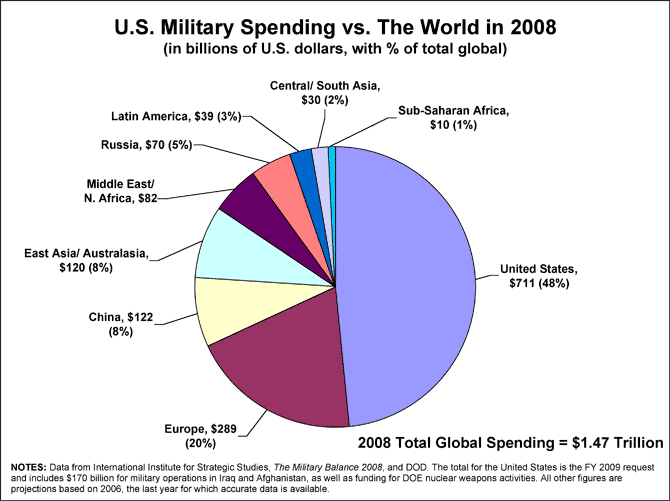
    According to the Stockholm International Peace Research Institute, “the USA is responsible for 41.5 per cent of the world’s total defense spending, distantly followed by China (5.8% of world share), France (4.5%), the UK (4.5%), and Russia (4%).”

    In 2005, the total value of DoD assets was estimated at $1.3 trillion, with $1.9 trillion in liabilities. The Department has a workforce of over 2.9 million of military and civilian personnel, much larger than any other organization worldwide.

    Wal-Mart, the largest corporate employer, has 1.8 million on payroll. The Pentagon’s workforce is twice as large. The net income of the top 10 global Fortune 500s (including Exxon, Wal-Mart, BP, and Chevron) does not reach even 50% of DoD’s budget.

    Last year, the Pentagon had 539,000 facilities (buildings, structures, and linear structures), and 5,570 military sites; it also occupies 29 million acres of land, almost half the size of the United Kingdom.

    The United States also has 837 overseas military bases, not including undisclosed secret bases. The Pentagon has 716 bases in 150 of the 192 countries in the world; others in U.S. territories abroad. The DoD does not count facilities with value of less than $10 million or those occupying less than 10 acres. The Pentagon itself claims the record for biggest building in human history (6.5 million square feet), 37 times larger than the Capitol.

    Business scams promise high rates of return at little risk to investors. The Pentagon, however, pledges only to keep the nation well defended from all outside threats. Since no military threats have existed for almost two decades, DoD officials and their neo-con cousins invent them. And the suckers — U.S. taxpayers — invest.

    [Saul Landau is an Institute for Policy Studies fellow whose A Bush and a Botox World was published by Counterpunch. Nelson P. Valdés is Professor Emeritus at the University of New Mexico.]

    Source / CounterPunch

    The Rag Blog

    Posted in RagBlog | Tagged , | Leave a comment

    A History of Relations with Iran

    Mohammad Mosaddeq (1882-1967), Iranian Prime Minister and a major political figure in the modern history of Iran. This photograph was taken ca 1965 in Ahmadabad, Iran.

    Accusing Iran; Ignoring history

    By Ted Snider / February 26, 2010

    Did Hillary Clinton seriously just accuse Iran of heading toward becoming a dictatorship? This accusation is one of two made in the past couple of weeks against Iran that totally defy history.

    The U.S. has never minded Iran being a dictatorship. On the contrary, given the choice between an uncooperative democracy and a cooperative dictatorship in Iran, the U.S. chose dictatorship.

    This story of intrigue and spies begins not in America, but in Britain. Through its Anglo-Iranian Oil Company (AIOC), Britain totally controlled Iranian oil in the first half of the twentieth century. The AIOC held exclusive rights to extract, refine, ship and sell Iranian oil. And though they did pay Iran a small amount for these rights, the AIOC made ten times what it paid Iran. Hardly fair. At least, it hardly seemed fair to the impoverished Iranians.

    So in 1951, Mohammad Mosaddeq surged to power in Iran propelled by a wave of Iranian nationalism determined to recapture their oil so that the profits could be used for the benefit, not of the British people and the British navy, but of the Iranian people. Mosaddeq was enormously popular, a genuine democrat and nationalist and the first democratically elected leader of Iran. Here was a chance to foster democracy in Iran.

    But democracy meant losing control of Iran’s oil. Mosaddeq immediately started trying to nationalize Iran’s oil. In April 1951, the Iranian parliament nationalized the oil industry. In May, Mosaddeq was elected Prime Minister and signed the bill into law. Britain responded by clamping a crushing embargo on Iran. The AIOC led an international boycott of the new Iranian oil industry. Then Britain began diplomatic and covert actions against Mosaddeq. But Mosaddeq was wildly popular and the people supported his moves. According to the U.S. State Department, he had the support of a full 95-98% of Iranians. He easily won a huge referendum victory.

    So Britain tried to overthrow him. They failed. Miserably. Mosaddeq responded by shutting down the British embassy in Iran, and when all the diplomats were purged, all the spies were flushed out with them. England had no one in Iran to overthrow the Prime Minister.

    Enter America. But not yet. Britain turned to America. But though Truman had been willing to drop a nuclear bomb on Japanese citizens, he was not willing to use the CIA to overthrow a foreign government. The CIA was brand new, and for Truman, it was for intelligence gathering and not for government overthrowing. But in 1952, when the Republican Eisenhower came to power, everything changed. Eisenhower was willing, and he agreed to do Britain’s dirty work. And in an incredible story of intrigue, Kermit Roosevelt, the grandson of Theodore Roosevelt, would take the helm of Operation Ajax, and in August of 1953, in the very first CIA coup, the American advised Iranian military, completed the CIA and M16 inspired and organized coup and overthrew Mohammad Mosaddeq.

    With that America ended a flowering and promising period of Iranian democracy because it threatened their interests and reinstalled the Shah of Iran who would carry out his many years of savage and repressive dictatorship. The Shah would repress opposition media, political parties, unions and other groups. He would bring in SAVAK, that most notorious and murderous secret police and their hellish torture chambers. With the Shah now in power, for their share of the dirty work, the U.S. acquired 40% of Iran’s oil industry. AIOC, now renamed British Petroleum, got back 40% of Iran’s oil.

    And this dance with dictatorship was no short term blip. After Eisenhower, Nixon would ally America with the Shah, Ford received him in the White House, and even Jimmy Carter said Iran “blossomed” under his “enlightened leadership”.

    So when Iran began a promising experiment in democracy, the U.S. took it out because it threatened U.S. interests and put in a brutal dictatorship, for which Iran has never forgiven America, showing that it is cooperating with U.S. interests and not being democratic that wins U.S. support. So when Clinton accuses Iran of becoming a dictatorship, Iranians, and anyone who agrees not to ignore history, laugh. Iranians wanted democracy; America gave them a dictator.

    But Iran is not only rushing headlong into dictatorship, it is also hurtling inexorably towards becoming a nuclear state with weapons of mass destruction. Iran recently announced that it would begin enriching uranium not only to 3.5%, as it has up to now, but up to 19.5%. The western world screams hysterically and points to the proof that Iran is rejecting proposals for trading their low-enriched uranium for 19.5% uranium processed abroad and that it is placing itself dangerously and inevitably within striking distance of being able to enrich weapons grade uranium.

    Like the claim about Iranian dictatorship, this claim utterly ignores history: albeit much more recent history.

    First of all, let’s get the numbers straight. Uranium enriched to 3.5% is what Iran needs to run its power reactors to produce energy. 19.5% enriched uranium is what it needs to produce medical isotopes for treating and imaging cancer in its hospitals. Uranium for nuclear weapons has to be enriched to 90%: hardly placing Iran within striking distance or proving that it has a weapons program.

    In fact, Iran is running out of uranium enriched to 19.5% for cancer treatment in its hospitals and soon will have to shut its medical reactors down. Why is it running out? In 1988, Iran signed an agreement with Argentina to receive 23 kilograms of fuel enriched to 20% so that it could produce medical isotopes in its, ironically, U.S. built medical research reactor. That 23 kilograms is nearly used up. Iran requested that the International Atomic Energy Association (IAEA) help it purchase more under IAEA supervision, which it has every right to do, like every other country who is signatory to the Nuclear Non-Proliferation Treaty. But the U.S. and Europe stepped in and prevented the purchase, leaving Iran without the ability the rest of the modern world has to use nuclear fuel to treat cancer.

    So if Iran is enriching uranium to 19.5% instead of 3.5%, it is only because we forced her to: ironic, since we are supposedly trying to prevent just that. And far from being evidence of a massive weapons program, Iran is only hoping to enrich 40 kilograms for medical use. Could it continue to enrich that 19.5% uranium to 90% weapons grade uranium? Is that the concern? Forget about it. Scott Ritter, who was a top U.N. weapons inspector in Iraq, one of the only loud public voices to contradict the Bush White House and warn that there were no weapons of mass destruction in Iraq, and the author of a book on Iranian nuclear showdown, says that the IAEA can account for all of Iran’s nuclear material and would be able to detect any diversion of nuclear material.

    And there have been other opportunities to prevent Iran from further enriching uranium for medical purposes. Though prevent is perhaps too strong a word, since they only seem reluctantly to be enriching after their preferred choice of legally purchasing was prevented. In 2009, the U.S. proposed a nuclear swap in which Iran would send its 3.5% enriched uranium out of the country where it would be enriched into fuel rods for the medical reactor and sent back to Iran. Iran agreed in principal, again showing their lack of desire to further enrich uranium, but did not agree on the details. Why did Iran reject the details, but not the point of the plan? Because the U.S. was being disingenuous: it was a trick.

    According to both Scott Ritter and Gareth Porter, whose reports on Iran’s nuclear program have been invaluable, the real objective of the American swap plan was to get every bit of the 3.5% enriched uranium out of Iran to buy the U.S. several months, or even a year. And there was another problem from Iran’s perspective. The American plan called for Iran to send away all its 3.5% uranium immediately even though it would take a year, or even several years, to receive the 19.5% enriched uranium needed for its medical reactor. That would not only leave Iran without its 3.5% enriched uranium needed to force the Americans to take Iran seriously in negotiations, but it would defy the point of the whole plan: leaving Iran without medical isotopes and forcing its medical facility to shut down. So Iran made a counterproposal. They would send out their 3.5% uranium in batches, and when the enriched uranium for medical isotopes was returned, they would send out the next batch: a so-called “simultaneous exchange”. America ignored Iran’s counterproposal. It was only then that Iran declared that it would try to enrich its own uranium.

    So the claim that Iran’s intention to further enrich uranium to 19.5% is proof of its intention to pursue a nuclear weapons program ignores two important pieces of recent history: that Iran first tried to purchase it and then agreed in principal to a fair swap for it. It was not Iran’s intent to further enrich uranium: it was the last resort.

    And there is a third piece of recent history that the nuclear accusation ignores: the lack, as in Iraq, of any evidence that Iran is pursuing nuclear weapons. Not only the U.N.’s nuclear inspectors say that there is no evidence of an Iranian nuclear weapons program, all of the several American intelligence organizations have unanimously agreed, not once, but twice, in uncommon public declarations that there is no evidence of an Iranian nuclear weapons program.

    Each sensational story of proof to the contrary that keeps glittering in the headlines of the western media has been clearly and consistently refuted, as shown by the reports of people like Porter and Ritter. It is the reports and not the refutations, though, that make the headlines. And that’s an old and effective trick for misshaping public opinion: report the error in large letters, but not the correction that follows.

    The media and the political powers provide the erroneous accusations; history, if you listen to it, provides the corrections.

    Source / Z-Net

    The Rag Blog

    Posted in RagBlog | Tagged , , | 1 Comment

    Health Care Reform : A Bad Proposal or a Worse One?

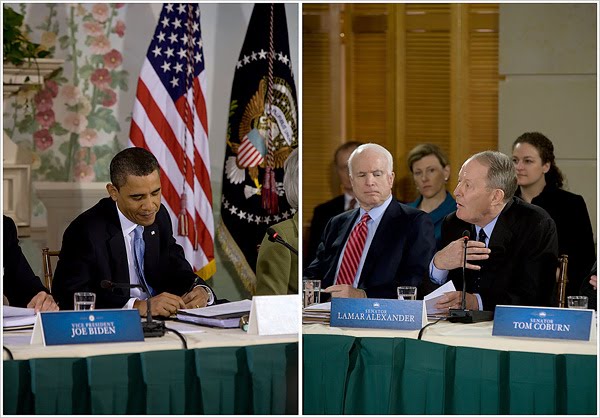
    Senator Alexander, sitting next to Senator McCain, provided the Republicans’ opening statement at the Health Care Forum at Blair House, and he challenged President Obama and the Democrats “to renounce jamming it through in a partisan way.” Photo: Stephen Crowley/The New York Times.

    Corporate Restructuring of Healthcare
    Fails the American People

    By Billy Wharton / The Rag Blog / February 26, 2010

    At the President’s Healthcare Summit today, the American people witnessed a debate between the bad proposal for healthcare reform and the even worse one. The Democrats’ House and Senate bills fail to address the growing problems of for-profit healthcare. Instead, by mandating the purchase of healthcare, their plan will create a profitable market for private health insurance companies to exploit.

    The Republicans’ counter-proposal, which seeks to allow consumers to buy insurance plans across state lines, would reverse decades of necessary reforms carried out at the state level. This would give mega-healthcare corporations a free-hand to expand their already abusive practices.

    While the two parties squabble about how to carry out the corporate restructuring of healthcare, the American people continue to suffer under a for-profit healthcare system. 50 million people are uninsured, another 20 million underinsured and nearly 50,000 people die each year from preventable illnesses. In response, millions of Americans have begun to avoid healthcare — a recent survey indicates that six out of 10 have either deferred or delayed necessary care in the last year.

    A fundamental political shift in the healthcare debate is necessary. Instead of a discussion of how markets should operate or how to build the proper risk pool to insure profits, we should be examining how to recognize healthcare as a basic human right.

    Simply put, healthcare should not be treated as a commodity. Private health insurers provide no medical benefit to the people they cover. They merely extract profits from the doctor-patient relationship. Instead, we should create a comprehensive medical system that guarantees no-charge access and the provision of all medically necessary care.

    Near the end of today’s summit, President Barack Obama asked “Can America, the wealthiest nation on earth, do what every industrialized country in the world does?” As a socialist, my answer is yes, but it will not come from the Democratic or Republican proposals. Instead, a single-payer National Healthcare Program would provide universal access for all people in America. Such a program would pave the way for the creation of a fully-socialized medical system that would ensure healthcare as a human right.

    The time for high-level summits and backroom wrangling among politicians who have received large-scale contributions from private insurers and pharmaceutical companies has ended. It is now time for the creation of a mass social movement that expresses the desires of everyday Americans for a medical system organized around the values of solidarity, compassion, and justice. Rejecting both the Democratic and Republican proposals will be a key part of this process.

    [Billy Wharton is the co-chair of the Socialist Party USA and the editor of The Socialist and the Socialist WebZine.]

    The Rag Blog

    Posted in RagBlog | Tagged , , | 3 Comments

    Juan Cole on the U.S. Defense Budget


    Gates Wants Europe to Beggar Itself on War Expenditures the Way the U.S. Has

    By Juan Cole / February 25, 2010

    U.S. Secretary of Defense Robert Gates decries Europe for general anti-war sentiment, unwillingness to beggar itself with expenditures on war.

    But as far as I can tell, Europe is the world’s largest economy and got there without any recent substantial wars except those the U.S. dragged it into. Moreover, the fastest-growing economy for the past nearly 30 years has been China, which spends a fraction on their military of what the US spends on its, and, aside from a skirmish with Vietnam in the early 1980s, has been at peace. Apparently massive war expenditures are unrelated to economic growth or prosperity.

    In contrast, the U.S. has been at war for 19 of the last 47 years (not counting U.S.-backed insurgencies such as 1980s Afghanistan, on which we spent billions) but has not grown faster than the other two economically.

    Moreover, the increasingly unwieldy U.S. national debt, deriving from the U.S. government spending more than it took in in recent decades, would not exist if the U.S. military budget had been the same as that of the European Union since 1980. The U.S. overspent on its military because Washington mistakenly thought the Soviet economy was twice as big as it actually was, and vastly over-estimated Soviet military capabilities.

    The bloated military budgets continue now, apparently because of a couple thousand al-Qaeda operatives hiding out in caves in the Hadhramawt and Waziristan.

    Some statistics to ponder:

    U.S. Military Budget 2009: $711 billion
    European Union Military Budget 2009: $289 billion
    China Military Budget 2009: $122 billion.

    U.S. GDP 2009: $14.4 trillion
    European Union GDP 2009: $16.5 trillion (PPP)
    China GDP 2009: $8.8 trillion (PPP)

    U.S. economic growth 2009: 0.2%
    European Union economic growth 2009: -4%
    China economic growth 2009: 8.7 %

    The real military-related expenditures of the U.S. are closer to $1 trillion. If the US cut those back to the level of the European Union and spent the money on promoting solar energy and making it inexpensive, America would have a chance of remaining a great power in the 21st century. If it goes on rampaging around the world bankrupting itself by invading and occupying other countries, the Chinese will laugh at us all the way to world dominance.

    Source / Informed Comment

    The Rag Blog

    Posted in RagBlog | Tagged , , , | 2 Comments

    Harvey Wasserman : Putting Lipstick on a Radioactive Pig

    Image from Texas Vox / Public Citizen.

    High dollar nuclear makeover:
    $645 million in lipstick for a radioactive pig

    By Harvey Wasserman / The Rag Blog / February 24, 2010

    The mystery has been solved.

    Where is this “new reactor renaissance” coming from?

    There has been no deep, thoughtful re-making or re-evaluation of atomic technology. No solution to the nuke waste problem. No making reactors economically sound. No private insurance against radioactive disasters by terror or error. No grassroots citizens now desperate to live near fragile containment domes and outtake pipes spewing radioactive tritium at 27 U.S. reactors.

    No, nothing about atomic energy has really changed.

    Except this: $645 MILLION for lobbying Congress and the White House over the past 10 years.

    As reported by Judy Pasternak and a team of reporters at American University’s Investigative Reporting Workshop, filings with the Senate Office of Public Records show that members of the Nuclear Energy Institute and other reactor owner/operators admit spending that money on issues that “include legislation to promote construction of new nuclear power plants.”

    Money has also gone to “other nuclear-related priorities” including “energy policy, Yucca Mountain and nuclear waste disposal, plant decommissioning costs, uranium issues such as tariffs, re-enrichment and mining, and Nuclear Regulatory Commission funding.” But even that may not fully account for money spent on coal and other energy sources, or on media campaigning.

    In short: think $64.5 million, EVERY YEAR since the coming of George W. Bush.

    That’s $1 million per every U.S. Senator and Representative, plus another, say, $100 million for the White House, courts, and media.

    “I think that’s understated,” says Journalism Professor Karl Grossman of the State University of New York/College at Old Westbury. The “torrent of lies” from General Electric and Westinghouse, the “Coke and Pepsi” of the nuclear industry, “has made the tobacco industry look like a piker.

    Their past, present and/or future media mouthpieces, says Grossman, span CBS, NBC, and a global phalanx of interlocking radio-TV-print directorates.

    All are geared, adds MediaChannel.org’s Rory O’Connor, to flood the globe with “Nukespeak,” the Orwellian lingo that sells atomic power while rhetorically airbrushing its costs and dangers.

    Thus Noam Chomsky’s “manufacturing consent” has become an “outright purchase.”

    Thus National Public Radio is now the Nuclear Proliferation Redux. Disgraced ex-Greenpeacer Patrick Moore (who also sells clear-cut forests and genetically modified food) is portrayed as an “environmentalist” rather than an industry employee.

    That’s not to say all reactor advocates do it for the money. Certainly some have grown on their own to like nuke power.

    But $645 million — SIX HUNDRED FORTY-FIVE MILLION — can buy a lot of opinion going one way, and suppresses a lot going the other. Op eds, air time, “independent” reports, phony claims that “green” nukes can solve global warming… not to mention campaign “donations,” fact-finding junkets, political fundraisers, K-Street dinners… all can be had for a trifling drip from the mega-slush fund.

    The latest payback is Barack Obama’s $8.33 billion in promised loan guarantees for two new nukes proposed in Georgia. Two old ones came in at 3000% over budget at a site where the Nuclear Regulatory Commission warns the proposed new ones might crumble in an earthquake or hurricane.

    As Juan Gonzalez of Democracy Now! points out, Team Obama has taken VERY goodly chunks of that $645 million from Chicago’s nuke-loving Exelon. Despite his campaign hype for a green revolution, Obama’s first two named advisors, David Axelrod and Rahm Emmanuel, were proud Exelon “associates.”

    Now Obama wants taxpayers to pony up $36 billion MORE in loan guarantees. (John McCain wants a mere trillion.)

    All this BEFORE the U.S. Supreme Court ruled that corporations are “persons” who can spend without limit to buy Congress and the media. The cash pouring into the pockets of politicians voting for still more taxpayer money to build still more reactors will parallel the gusher of radiation that poured from Chernobyl.

    But does this mean the flood of new reactors is inevitable?

    NO!

    Despite that cash tsunami, grassroots activists stopped $50 billion in loan guarantees three times since 2007. No new U.S. reactor construction has started since the 1970s, when public opinion was over 70% in favor of atomic power, and Richard Nixon promised 1,000 U.S. reactors by the year 2000.

    With green jobs advocate Van Jones ditched and Obama now openly in the nuclear camp, atomic energy is still a loser.

    It can’t solve its waste problems, can’t operate without leaking radiation, can’t pay for itself, and can’t get private insurance against terror or error.

    Once hyped as “too cheap to meter,” Warren Buffett, the National Taxpayers Union, the Heritage Foundation, and the CATO Institute are among those joining the Congressional Budget Office in warning that atomic energy is really “too expensive to matter.”

    With all those hundreds of millions to spend, the reactor backers are still selling a technological corpse. With licensing and construction and the inevitable unforeseen, not one new U.S. reactor can come on line in less than seven years.

    Meanwhile, renewable/efficiency prices will continue to plummet. And grassroots opposition will not stop, as in Vermont and wherever else reactors operate or are proposed.

    As Abe Lincoln reminds us: you can’t buy all the people all the time. And the ones that can’t be bought CAN be damn powerful.

    Those loan guarantees, all that hype about a new nuclear age… they are NOT a done deal. They still must withstand a Solartopian revolution in green technology that’s left atomic power in its economic dust… and a human species whose core instincts DEMAND economic and ecological survival.

    So when you hear some hired gun selling nukes, remember: even $645 million can buy only so much green lipstick for a dead radioactive pig.

    And when Nature bats last, the final score is not about cash.

    [Harvey Wasserman’s Solartopia! Our Green-Powered Earth is at www.harveywasserman.com, along with Harvey Wasserman’s History of the United States. He is Senior Advisor to Greenpeace USA and the Nuclear Information and Resource Service. This article was also published at http://freepress.org.]

    The Rag Blog

    Posted in Rag Bloggers | Tagged , , , , , | 4 Comments

    Harry Targ : How the Ruling Class Rules

    Image from La Revue Gauche.

    The new class society:
    How does the ruling class rule?

    By Harry Targ / The Rag Blog / February 23, 2010

    The substructure

    In an effort to teach and reflect more systematically about class rule in the United States, I have used an interesting book by Robert Perrucci and Earl Wysong, The New Class Society. It describes the transformation of the class system over the last 30 years from one in which there was a small ruling class, a significantly-sized “middle class,” and a lesser population of the poor and working classes.

    According to these sociologists the diamond-shaped distribution of wealth, income, and power that existed during the “golden years” of U.S. capitalist hegemony after World War II began to change in the 1970s. Today, in the “new class society” the top one percent of income, wealth, and power holders, in conjunction with the remainder of the top 20 percent of managers, professionals and support staff of the super class, dominate at the expense of the bottom 80 percent of the population.

    Using older language, ownership and control of the means of production and the relationships that exist between the owners and those who work constitute the “substructure” of the capitalist system. But what remains a puzzle is “how does the ruling class rule?”

    The superstructure

    Perrucci and Wysong suggest some answers that can serve as a basis for others to analyze and refine. They suggest four critical institutions, what I might call the “superstructure,” which ensure the maintenance of class rule. These are the political system, the education industry, the information industry, and the culture industry. Each in its own way is designed to shape the consciousness the new working class, the bottom 80 percent, has of itself and its place in the world of economics, politics, and society.

    The political system constitutes the public arena where choices get made about public policy. It remains relevant to all actors in the society, from those who are at the top of the class system to the vast majority of the population constituting the new working class. However, since wealth most often can be translated into power, political institutions in usual times are used to serve the interests of the ruling class. Wealth is used to maintain power through financing elections, lobbying decision-makers, and funding so-called “think tanks” to give “expert” advice to the rulers.

    Sometimes combined efforts of trade associations and corporations martial national campaigns to pressure government to shift the direction of public policy away from the popular classes to the rulers.

    In an enlightening book by Elizabeth Fones-Wolff, Selling Free Enterprise, the author describes a continuing struggle in the 1940s and 1950s by the National Association of Manufacturers, the Chamber of Commerce, and like minded groups to convince the American people that individualism, private enterprise, and union-busting were more in their interests than expanding government programs, communities assuming more responsibility for social well-being, and building workers associations as sources of strength and protection from corporate elites.

    In sum, political institutions are portrayed as the venue through which “the people decide,” when in fact usually their interests are not adequately represented.

    The education industry, that is K through 12, college and university, and professional school education, provides the tools for credentialing some young people and not others. Usually the highest educational achievement is earned by those who come from privileged class families.

    Systems of “tracking,” which are supposed to shape education to the talents and needs of individual students are used to promote and encourage those who come from the wealthy and to channel in other directions the children of the working class. “Streaming” policies are designed to encourage the creativity and interests of the children of wealth.

    In sum, the education system, which does enlighten, inform, and train, also serves as a gatekeeper to reward and encourage those from the privileged classes and sustain and reproduce the new working class.

    Perhaps the most vital function the education system serves is to “socialize” the young into their proper political roles in adulthood. Curricula promote the idea among children of the wealthy that they are creative, they can and should serve the public, and that their obligation is to be engaged citizens. Children of the new working class are taught to be obedient, respect authority and expertise, and participate in politics only as a voter.

    The information industry provides our lens on the world. As communications theorists have long suggested, most of people’s information and experience of the world is indirect and mediated by electronic and print media.

    The information we consume is packaged in “media frames.” Since most of the information we receive comes from fewer than 10 mega-media corporations, they are shaping the understanding of the world of the new working class. Why making war is necessary, how the United States must continue to support Wall Street during this economic crisis, and the diabolical reasons why some countries, such as Cuba or Venezuela, criticize the United States are examples of most people’s experience of these issues.

    Media framing includes what stories are left out as well as how the ones communicated are covered.

    Finally, the culture industry provides entertainment or activity for the non-working hours of most people. Television, movies, music, sporting activities are presented to people by the same handful of mega-corporations that dominate the information industry. Increasingly the products of these two industries merge so that “news” and “entertainment” become one. This is true for sex, violence, and mayhem reported as news and the fake news as reported by the comedians.

    Perhaps most important to the culture industry is its portrait of presumed human experience. This experience highlights the super-natural, the futuristic, or the “reality” of swallowing insects and brutally competing with others for prize money or attractive sexual objects.

    When the culture industry addresses contemporary experience, for example in situation comedies and crime shows, there are no workers present, African-Americans are hoodlums or victims, women are helpless, and authority figures such as the police are the friends of the people rather than employees of the state. Perrucci and Wysong refer to the primary role of the culture industry as “pacification.”

    The points raised in this essay do not break any new theoretical ground. But, in my view, clearly identifying critical elements of the “substructure” and the “superstructure” can provide a road map for progressives to plan their future political agendas. Of course, a fundamental change in the mode of production, capitalism, is basic. But in the interim, organizing around the political system, and the education, information, and culture industries makes sense.

    [Harry Tarq is a professor in American Studies who lives in West Lafayette, Indiana. He blogs at Diary of a Heartland Radical.]

    The Rag Blog

    Posted in Rag Bloggers | Tagged , , , , , | Leave a comment